<?xml version="1.0" encoding="ISO-8859-1"?><article xmlns:mml="http://www.w3.org/1998/Math/MathML" xmlns:xlink="http://www.w3.org/1999/xlink" xmlns:xsi="http://www.w3.org/2001/XMLSchema-instance">
<front>
<journal-meta>
<journal-id>0034-7744</journal-id>
<journal-title><![CDATA[Revista de Biología Tropical]]></journal-title>
<abbrev-journal-title><![CDATA[Rev. biol. trop]]></abbrev-journal-title>
<issn>0034-7744</issn>
<publisher>
<publisher-name><![CDATA[Universidad de Costa Rica]]></publisher-name>
</publisher>
</journal-meta>
<article-meta>
<article-id>S0034-77442006000600024</article-id>
<title-group>
<article-title xml:lang="en"><![CDATA[Isopods (Isopoda: Aegidae, Cymothoidae, Gnathiidae) associated with Venezuelan marine fishes (Elasmobranchii, Actinopterygii)]]></article-title>
</title-group>
<contrib-group>
<contrib contrib-type="author">
<name>
<surname><![CDATA[Bunkley-Williams]]></surname>
<given-names><![CDATA[Lucy]]></given-names>
</name>
<xref ref-type="aff" rid="A01"/>
</contrib>
<contrib contrib-type="author">
<name>
<surname><![CDATA[Williams, Jr]]></surname>
<given-names><![CDATA[Ernest H]]></given-names>
</name>
<xref ref-type="aff" rid="A02"/>
</contrib>
<contrib contrib-type="author">
<name>
<surname><![CDATA[Bashirullah]]></surname>
<given-names><![CDATA[Abul K.M]]></given-names>
</name>
<xref ref-type="aff" rid="A03"/>
</contrib>
</contrib-group>
<aff id="A01">
<institution><![CDATA[,University of Puerto Rico  ]]></institution>
<addr-line><![CDATA[Mayagüez ]]></addr-line>
<country>USA</country>
</aff>
<aff id="A02">
<institution><![CDATA[,University of Puerto Rico  ]]></institution>
<addr-line><![CDATA[ ]]></addr-line>
<country>USA</country>
</aff>
<aff id="A03">
<institution><![CDATA[,Universidad de Oriente  ]]></institution>
<addr-line><![CDATA[Cumaná ]]></addr-line>
<country>Venezuela</country>
</aff>
<pub-date pub-type="pub">
<day>00</day>
<month>12</month>
<year>2006</year>
</pub-date>
<pub-date pub-type="epub">
<day>00</day>
<month>12</month>
<year>2006</year>
</pub-date>
<volume>54</volume>
<fpage>175</fpage>
<lpage>188</lpage>
<copyright-statement/>
<copyright-year/>
<self-uri xlink:href="http://www.scielo.sa.cr/scielo.php?script=sci_arttext&amp;pid=S0034-77442006000600024&amp;lng=en&amp;nrm=iso"></self-uri><self-uri xlink:href="http://www.scielo.sa.cr/scielo.php?script=sci_abstract&amp;pid=S0034-77442006000600024&amp;lng=en&amp;nrm=iso"></self-uri><self-uri xlink:href="http://www.scielo.sa.cr/scielo.php?script=sci_pdf&amp;pid=S0034-77442006000600024&amp;lng=en&amp;nrm=iso"></self-uri><abstract abstract-type="short" xml:lang="en"><p><![CDATA[The parasitic isopod fauna of fishes in the southern Caribbean is poorly known. In examinations of 12 639 specimens of 187 species of Venezuelan fishes, the authors found 10 species in three families of isopods (Gnathiids, Gnathia spp. from Diplectrum radiale *, Heteropriacanthus cruentatus *, Orthopristis ruber * and Trachinotus carolinus *; two aegids, Rocinela signata from Dasyatis guttata *, H. cruentatus *, Haemulon aurolineatum *, H. steindachneri * and O. ruber ; and Rocinela sp. from Epinephelus flavolimbatus *; five cymothoids: Anilocra haemuli from Haemulon boschmae *, H. flavolineatum * and H. steindachneri *; Anilocra cf haemuli from Heteropriacanthus cruentatus *; Haemulon bonariense*, O. ruber*, Cymothoa excisa in H. cruentatus *; Cymothoa oestrum in Chloroscombrus chrysurus, H. cruentatus* and Priacanthus arenatus ; Cymothoa sp. in O. ruber; Livoneca sp. from H. cruentatus *; and Nerocila fluviatilis from H. cruentatus * and P. arenatus *). The Rocinela sp. and A. cf haemuli in the southern Caribbean could represent new species. The abundance of A. cf haemuli appears to have drastically reduced from 1994 to 1999 in the Gulf of Cariaco. The Cymothoa sp. represents an undescribed species that is apparently host specific to O. ruber . It does not occur in the Gulf of Cariaco, but is relatively abundant on the Caribbean coast of Sucre State, Venezuela. The Livoneca sp. is an undescribed species host specific to Diapterus rhombeus, Cymothoa excisa and C. oestrum were thought to have distinct host preferences, but both infected the Heteropriacanthus cruentatus in the present study.Gnathia spp. are reported from Venezuelan waters for the first time. Twenty new host records* are noted. The fish-associated isopod fauna is much more extensive and important than has previously been suspected. Rev. Biol. Trop. 54 (Suppl. 3): 175-188. Epub 2007 Jan. 15.]]></p></abstract>
<abstract abstract-type="short" xml:lang="es"><p><![CDATA[Se conoce muy poco acerca de la fauna de isópodos parásitos de peces en el Caribe Sur. Tras examinar 12 639 especímenes de 187 especies de peces de Venezuela, los autores encontraron 10 especies de isópodos distribuidos en tres familias. Los asteriscos indican nuevos registros (Gnátidos, Gnathia spp. en Diplectrum radiale*, Heteropriacanthus cruentatus*; Orthopristis ruber* y Trachinotus carolinus*; dos aégidos, Rocinela signata en Dasyatis guttata*, H. cruentatus*, Haemulon aurolineatum*, H. steindachneri * y O. ruber ; y Rocinela sp. en Epinephelus flavolimbatus*; cinco cimotoidos: Anilocra haemuli en Haemulon boschmae*, H. flavolineatum* y H.steindachneri*; Anilocra cf haemuli en Heteropriacanthus cruentatus*; Haemulon bonariense*, O. ruber*; Cymothoa excise in H. cruentatus*; Cymothoa oestrum en Chloroscombrus chrysurus, H. cruentatus* y Priacanthus arenatus; Cymothoa sp. en O. ruber; Livoneca sp. en H. cruentatus*; y Nerocila fluviatilis en H. cruentatus* y P. arenatus*). Las especies Rocinela sp.y A.cf haemuli en el Caribe sur podrían representar especies distintas. La abundancia de A. cf haemuli en el Golfo de Coriaco parece haberse reducido drásticamente entre 1994 a 1999. Cymothoa sp.es una especie no descrita que aparentemente parasita específicamente a O. ruber. No se le encuentra en el Golfo de Cariaco, pero es relativamente abundante en la costa Caribe del Estado de Sucre, Venezuela. Livoneca sp. (especie sin describir) parasita específicamente a Diapterus rhombeus. Anteriormente se pensaba que Cymothoa excisa y C. oestrum tenían distintas preferencias de hospedero, pero ambas infectan a Heteropriacanthus cruentatus. Gnathia spp. Son además primer registro en aguas venezolanas. Se informan en total 20 nuevos registros. La fauna de isópodos asociados a peces es mucho más extensa e importante de lo que se sospechaba.]]></p></abstract>
<kwd-group>
<kwd lng="en"><![CDATA[fish-parasitic isopods]]></kwd>
<kwd lng="en"><![CDATA[Venezuela]]></kwd>
<kwd lng="en"><![CDATA[new species]]></kwd>
<kwd lng="en"><![CDATA[new host]]></kwd>
<kwd lng="en"><![CDATA[new locality records]]></kwd>
<kwd lng="es"><![CDATA[isópodos parásitos de peces]]></kwd>
<kwd lng="es"><![CDATA[Venezuela]]></kwd>
<kwd lng="es"><![CDATA[nuevas especies]]></kwd>
<kwd lng="es"><![CDATA[nuevos hospederos]]></kwd>
<kwd lng="es"><![CDATA[nuevos registros de localidad]]></kwd>
</kwd-group>
</article-meta>
</front><body><![CDATA[  <b><font face="Arial">     <p align="center">Isopods (Isopoda: Aegidae, Cymothoidae, Gnathiidae) associated with Venezuelan marine fishes (Elasmobranchii, Actinopterygii)</p> </font><font face="Arial" size="2"> </font></b>     <p><font face="Arial" size="2">Lucy Bunkley-Williams,<a name="1"></a><a  href="#2"><sup>1</sup></a> Ernest H. Williams, Jr.<a href="#2"><sup>2</sup></a> &amp; Abul K.M. Bashirullah<a href="#2"><sup>3</sup></a> </font></p>     <p><font face="Arial" size="2"><a name="2"></a><a href="#1">1</a> Caribbean Aquatic Animal Health Project, Department of Biology, University of Puerto Rico, P.O. Box 9012, Mayagüez, PR 00861, USA; <a  href="mailto:lwilliams@uprm.edu">lwilliams@uprm.edu</a> </font></p>     <p><font face="Arial" size="2"><a href="#1">2</a> Department of Marine Sciences, University of Puerto Rico, P.O. Box 908, Lajas, Puerto Rico 00667, USA; <a href="mailto:ewilliams@uprm.edu">ewilliams@uprm.edu</a> </font></p>     <p><font face="Arial" size="2"><a href="#1">3</a> Instituto Oceanografico de Venezuela, Universidad de Oriente, Cumaná, Venezuela.</font></p>     <p><font face="Arial" size="2">Author for Correspondence: LBW, address as above. Telephone: 1 (787) 832-4040 x 3900 or 265-3837 (Administrative Office), x 3936, 3937 (Research Labs), x 3929 (Office); Fax: 1-787-834-3673; <a href="mailto:lwilliams@uprm.edu">lwilliams@uprm.edu</a></font></p>     <p align="center"><font face="Arial" size="2">Received 01-VI-2006. Corrected 02-X-2006. Accepted 13-X-2006.</font></p> <font face="Arial" size="2"><b></b></font>     <p><font face="Arial" size="2"><b>Abstract: </b>The parasitic isopod fauna of fishes in the southern Caribbean is poorly known. In examinations of 12 639 specimens of 187 species of Venezuelan fishes, the authors found 10 species in three families of isopods (Gnathiids, <i>Gnathia </i>spp. from <i>Diplectrum radiale </i>*, <i>Heteropriacanthus cruentatus </i>*, <i>Orthopristis ruber </i>* and <i>Trachinotus carolinus </i>*; two aegids, <i>Rocinela signata </i>from <i>Dasyatis guttata </i>*, <i>H. cruentatus </i>*, <i>Haemulon aurolineatum </i>*, <i>H. steindachneri </i>* and <i>O. ruber </i>; and <i>Rocinela </i>sp. from <i>Epinephelus flavolimbatus </i>*; five cymothoids: <i>Anilocra haemuli </i>from <i>Haemulon boschmae </i>*, <i>H. flavolineatum </i>* and <i>H. steindachneri </i>*; <i>Anilocra </i>cf <i>haemuli </i>from <i>Heteropriacanthus cruentatus </i>*; <i>Haemulon bonariense*</i>, <i>O. ruber*, Cymothoa excisa </i>in <i>H. cruentatus </i>*; <i>Cymothoa oestrum </i>in <i>Chloroscombrus chrysurus</i>, <i>H. cruentatus* </i>and <i>Priacanthus arenatus </i>; <i>Cymothoa </i>sp. in <i>O. ruber</i>; <i>Livoneca </i>sp. from <i>H. cruentatus </i>*; and <i>Nerocila fluviatilis </i>from <i>H. cruentatus </i>* and <i>P. arenatus </i>*). The <i>Rocinela </i>sp. and <i>A. </i>cf <i>haemuli </i>in the southern Caribbean could represent new species. The abundance of <i>A. </i>cf <i>haemuli </i>appears to have drastically reduced from 1994 to 1999 in the Gulf of Cariaco. The <i>Cymothoa </i>sp. represents an undescribed species that is apparently host specific to <i>O. ruber </i>. It does not occur in the Gulf of Cariaco, but is relatively abundant on the Caribbean coast of Sucre State, Venezuela. The <i>Livoneca </i>sp. is an undescribed species host specific to <i>Diapterus rhombeus, Cymothoa excisa </i>and <i>C. oestrum </i>were thought to have distinct host preferences, but both infected the <i>Heteropriacanthus cruentatus </i>in the present study.<i>Gnathia </i>spp. are reported from Venezuelan waters for the first time. Twenty new host records* are noted. The fish-associated isopod fauna is much more extensive and important than has previously been suspected. Rev. Biol. Trop. 54 (Suppl. 3): 175-188. Epub 2007 Jan. 15.</font></p> <font face="Arial" size="2"><b></b></font>     <p><font face="Arial" size="2"><b>Key words: </b>fish-parasitic isopods, Venezuela, new species, new host, new locality records.</font></p>     ]]></body>
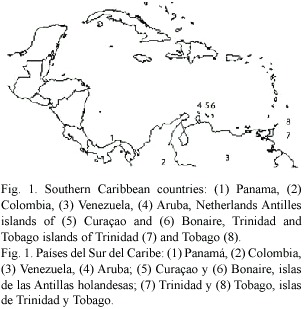
<body><![CDATA[<p><font face="Arial" size="2">Isopods associate with many species of commercially important fishes around the world and cause significant economic losses to fisheries by killing, stunting, or damaging these fishes. They can also kill or impair immature fishes so that they do not survive. At least one species often and quite painfully bites human swimmers and divers in the Caribbean: sometimes in alarming mass attacks. However, folklore endows these isopods with positive qualities. The presence of isopods on Caribbean fishes is supposed to indicate that the host is free of ciguatera (fish poisoning) toxins [not tested] and dried isopods are used as folk medicines around the world. Despite their importance, isopods associated with fishes are relatively poorly studied or even surveyed in many parts of the world (<a  href="#wi96">Williams and Bunkley-Williams 1996</a>, <a href="#bu98">Bunkley-Williams and Williams 1998</a>). </font></p>     <p><font face="Arial" size="2">Few reports of fish-associated isopods have been made in the southern Caribbean (<a href="#f1">Fig. 1</a>): only 17 species of isopods have been recorded from 39 species of fishes (<a href="#t1">Table 1</a>). The authors use the term "fish-associated" because some aegids and corallanids on fishes may be minipredators instead of parasites, and few of them are known well enough to be certain. <a href="#ba91">Bashirullah (1991)</a> examined the attachment positions of <i>Anilocra laticauda </i>H. Milne Edwards in Venezuela. <a href="#de89">Delaney (1989)</a> noted <i>Alcirona </i>spp., isopods that sometimes associate with fishes, from Colombia. <a  href="#ga90">Garzon-Ferreira (1990)</a> noted an isopod, which often associates with fishes, attacking humans in Colombia.    <br> </font></p>     <div style="text-align: center;"><font face="Arial" size="2"><a  name="f1"></a><img src="/img/fbpe/rbt/v54s3/3406i2.JPG" title="" alt=""  style="width: 305px; height: 309px;"></font>    
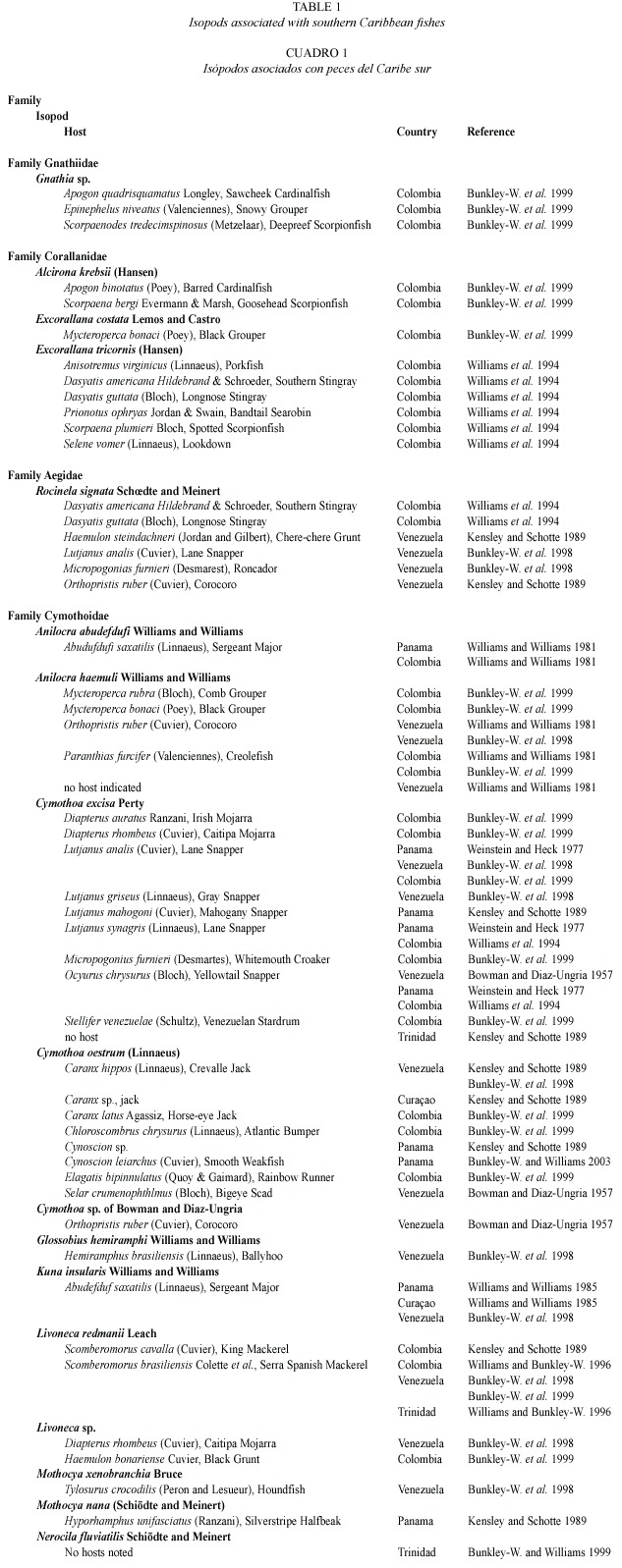
<br> </div>     <p><font face="Arial" size="2">    <br> </font></p> <a name="t1"></a>     <div style="text-align: center;"><img src="/img/fbpe/rbt/v54s3/3406i1.JPG" title=""  alt="" style="width: 633px; height: 1597px;"></div>     
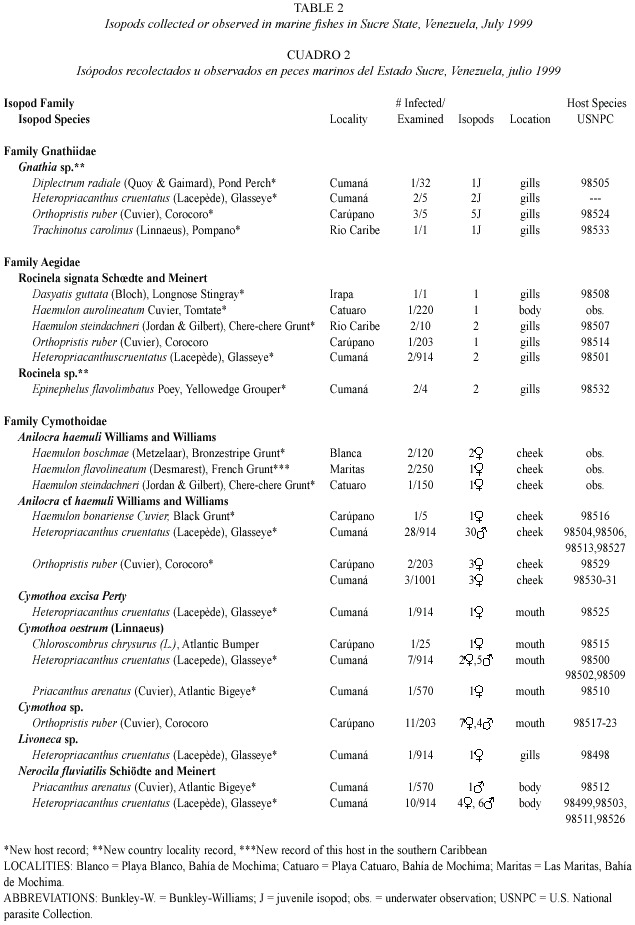
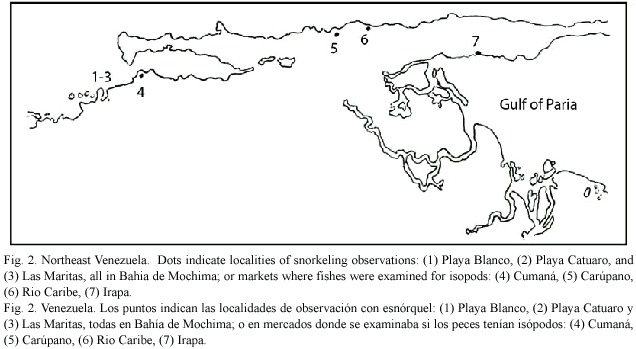
<p><font face="Arial" size="2">A collection of isopods taken from marine fishes in Venezuela (<a href="#f2">Fig. 2</a>), July 1999, is reported below including four undescribed species, a new geographic record for Venezuela, and 20 new host records. <a href="#ke89">Kensley and Schotte (1989)</a> provided keys, diagnostic characters, and biological information about all of the species the authors discuss. </font></p> <a name="f2"></a>     <div style="text-align: center;"><img src="/img/fbpe/rbt/v54s3/3406i3.JPG" title=""  alt="" style="width: 636px; height: 349px;"></div> <font face="Arial" size="2"><b>     
]]></body>
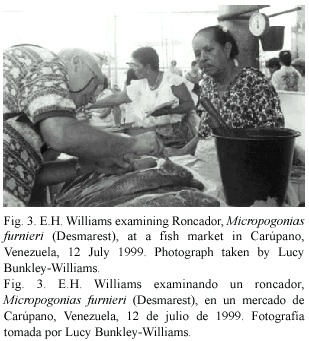
<body><![CDATA[<p>Materials and methods </p> </b> </font>     <p><font face="Arial" size="2">Fishes were obtained from fish markets after having been captured by trawl, traps, trammel nets, spearing, and hook and line. The external surfaces, mouth and gill chambers of each fish were examined grossly without the aid of magnification at the markets (<a href="#f3">Fig. 3</a>). Some specimens were purchased and transported to the laboratory for microscopic examination. Gnathiid isopods were only found on those hosts examined microscopically. Isopods were preserved in 70% ethanol in individual vials for each host specimen. All isopod specimens were deposited in the U.S. National Parasite Collection (USNPC). The authors were familiar with all of the isopod and fish host species reported. The keys and diagnostic characters provided in Kensley and Schotte (1989) can be used to identify all of these isopods. The authors carried a copy of <a  href="#ce93">Cervigón <i>et al. </i>(1993)</a> in the field with them during examinations, which was useful in identifying some fishes on site (<a href="#a1">Appendix 1</a>). Not all fish hosts were preserved. Tumors and other parasites collected from some of these hosts will be reported elsewhere. Using snorkeling equipment, the authors observed external isopods at three localities in Mochina National Park (<a href="#t2">Table 2</a>, <a href="#f2">Fig. 2</a>). This article was submitted for publication in the 29<sup>th</sup> AMLC Proceedings in 1999 (<a href="#an00">Anonymous 2000</a>) immediately after the study was conducted, but the manuscript was misplaced at some point in the process. It was updated and resubmitted in 2005. </font></p> <a name="f3"></a>     <div style="text-align: center;"><img src="/img/fbpe/rbt/v54s3/3406i4.JPG" title=""  alt="" style="width: 309px; height: 341px;">    
<br> </div>     <br> <a name="t2"></a>     <div style="text-align: center;"><img src="/img/fbpe/rbt/v54s3/3406i5.JPG" title=""  alt="" style="width: 635px; height: 925px;">    
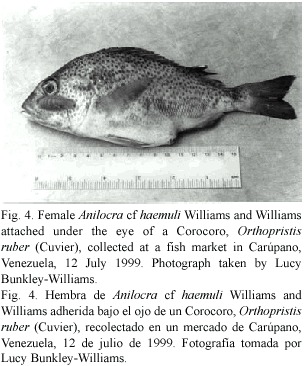
<br> </div> <font face="Arial" size="2"><b>     <p>Results and discussion </p> </b> </font>     <p><font face="Arial" size="2">Eighty-seven isopods representing 10 species (or more because of the unknown number of gnathid species) were collected from 12 639 specimens representing 187 species of fishes (<a  href="#t2">Table 2</a>, <a href="#a1">Appendix 1</a>). The use of fish markets for obtaining hosts certainly limited the diversity and abundance of parasites collected. However, it did focus our efforts on the more economically important fishes in the region. Length of fish storage; use of ice, refrigeration or freezing; rough and frequent handling; and rinsing in salt or freshwater caused the loss or diminished the numbers of available parasites.</font></p> <font face="Arial" size="2"><b><i></i></b></font>     <p><font face="Arial" size="2"><b><i>Anilocra </i>cf <i>haemuli </i>Williams and Williams (<a href="#f4">Fig. 4</a>): </b><i>Anilocra haemuli </i>infects a variety of grunts (Haemulidae) and groupers (Serranidae) throughout the West Indies (<a href="#wi81">Williams and Williams 1981</a>). One form in the southern Caribbean infects different fish species than those individuals found further north and also differs by occurring on off-reef habitats (Bunkley-Williams <i>et al. </i>2000). This form also possesses some minor morphological differences from <i>A. haemuli</i>. The authors are in the process of genetically evaluating this and other forms in this possible species complex (Bunkley-Williams and Williams, unpubl. data). This southern form could represent a distinct species (<a  href="#f4">Fig. 4</a>). This isopod was called <i>Anilocra laticauda </i>H. Milne Edwards by <a href="#ba91">Bashirulla (1991)</a>, a name the present authors declared <i>nomen dubium </i>in 1981.</font></p> <a name="f4"></a>     ]]></body>
<body><![CDATA[<div style="text-align: center;"><img src="/img/fbpe/rbt/v54s3/3406i6.JPG" title=""  alt="" style="width: 305px; height: 366px;"></div>     
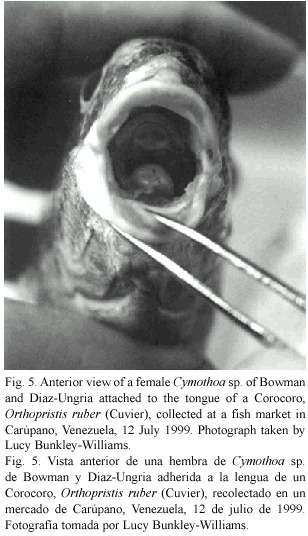
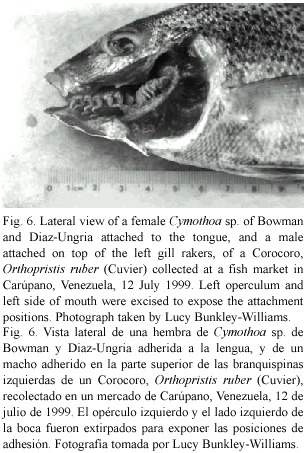
<p><font face="Arial" size="2">The authors found this isopod on only three of 1001 <i>Orthopristis ruber </i>examined from the Gulf of Cariaco (<a href="#t2">Table 2</a>). This scarcity was not merely the result of losses due to handling because the typical and obvious external wounds caused by this isopod were also absent. Three years prior to this study this isopod was abundant in the Gulf of Cariaco and parasitized 3-6% of the <i>Orthopristis ruber </i>(Bashirulla, unpubl. data). <a href="#bu98">Bunkley-Williams <i>et al. </i>(1998)</a> found five of 30 (16.7%) <i>O. ruber </i>examined around Cumaná prior to 1992 infected with this isopod. The authors were unable to determine the cause for the reduction in prevalence of this isopod in the Gulf. Fishermen told us that this isopod also occurs on the Chere-chere Grunt, <i>Haemulon steindachneri </i>(Jordan and Gilbert), but the authors were unable to find specimens of this isopod on this fish.</font></p> <font face="Arial" size="2"><i></i></font>     <p><font face="Arial" size="2"><i>Heteropriacanthus cruentatus </i>appear to be acting as intermediate hosts for this isopod. The juveniles or males of this isopods occurred abundantly on the body of this host in the Gulf of Cariaco, but no adult females were found on this host.</font></p> <font face="Arial" size="2"><b><i></i></b></font>     <p><font face="Arial" size="2"><b><i>Cymothoa excisa </i>Perty: </b>This is an important isopod due to its preference for members of the commercially important snapper family (Lutjanidae).This mouth-dwelling isopod stunts or reduces growth in infected snappers thus causing significant economic losses in snapper fisheries (<a href="#bu98">Bunkley-Williams <i>et al. </i>1998</a>, <a href="#bu99">1999</a>, <a href="#ke89">Kensley and Schotte 1989</a>, <a href="#we77">Weinstein and Heck 1977</a>).</font></p>     <p><font face="Arial" size="2">It is similar to <i>C. oestrum </i>in size, geographic range, and location in the host, but that isopod prefers jacks. Cymothoa excisa and C. oestrum were thought to have distinct host preferences, but both infected the Glasseye in the present study. However, both infections were very rare (<a href="#t2">Table 2</a>) and may have represented little more than accidental infections. The Glasseye appears to be so abundant that it was available as a host for 8 of the 10 species of isopods we collected.</font></p> <font face="Arial" size="2"><b><i></i></b></font>     <p><font face="Arial" size="2"><b><i>Cymothoa oestrum </i>(Linnaeus): </b>This isopod typically infects jacks throughout the tropical and subtropical western Atlantic (<a href="#wi96">Williams and Bunkley-Williams 1996</a>, <a href="#bu98">Bunkley-Williams <i>et al. </i>1998</a>). The authors examined 235 specimens of seven species of jacks, but only found this isopod once (<a href="#t2">Table 2</a>). This unusual scarcity may be due to losses during the handling of hosts. <a href="#wi94">Williams and Bunkley-Williams (1994)</a> described its early juvenile stages. <a  href="#bu03">Bunkley-Williams and Williams (2003)</a> recently documented the plasticity of the morphology of this isopod as it becomes larger. <a href="#th03">Thatcher <i>et al. </i>(2003)</a> redescribed this species on the basis of one specimen from Brazil without comparison with the original type material. This isopod causes some stunting and losses of jacks, which are becoming more commercially important in the Caribbean region as other fish species become over exploited.</font></p> <font face="Arial" size="2"><b><i></i></b></font>     <p><font face="Arial" size="2"><b><i>Cymothoa </i>sp. of Bowman and Diaz-Ungria (<a href="#f5">Figs. 5</a>-<a href="#f6">6</a>): </b><a  href="#bo57">Bowman and Diaz-Ungria (1957)</a> found a female and male pair of this isopod in <i>Orthopristis ruber </i>from "Paria (Estado Sucre)" Venezuela. This apparently refered to the Gulf of Paria, since there is no town in the Sucre State by that name. They suggested that this isopod represented a new species, but declined to describe it with only two specimens. The authors attempted to find additional specimens of this isopod in the Gulf of Cariaco in 1992 (<a href="#bu98">Bunkley-Williams <i>et al. </i>1998</a>), but it apparently does not occur there (<a  href="#t2">Table 2</a>; Bashirulla, unpubl. data). It was relatively abundant in the <i>O. ruber </i>on the Caribbean coast of Sucre (<a  href="#t2">Table 2</a>).</font></p> <a name="f5"></a>     <div style="text-align: center;"><img src="/img/fbpe/rbt/v54s3/3406i7.JPG" title=""  alt="" style="width: 308px; height: 536px;">    
<br> </div>     <br> <a name="f6"></a>     ]]></body>
<body><![CDATA[<div style="text-align: center;"><img src="/img/fbpe/rbt/v54s3/3406i8.JPG" title=""  alt="" style="width: 306px; height: 453px;">    
<br> </div>     <p><font face="Arial" size="2">The female isopod occurs on the tongue of the host (<a href="#f5">Figs. 5</a>, <a href="#f6">6</a>) and the male on the gill rakers of one gill chamber (<a href="#f6">Fig. 6</a>), which is typical for many species of the genus. It occupies almost the entire oral cavity (<a href="#f5">Fig. 5</a>) and probably modifies the diet of the host since the size of items swallowed must be less. <a  href="#ki78">Kimmel and Arneson (1978)</a> studied the food habits of jacks infected with <i>C. oestrum </i>in Puerto Rico and found that the volume of the food was the same as in uninfected jacks, but the sizes and types of food items differed.</font></p>     <p><font face="Arial" size="2">The externally-attaching isopods, <i>Anilocra abudefdufi </i>Williams and Williams and <i>A. acanthuri </i>Williams and Williams, infect the Sergeant Major, <i>Abudefduf saxatilis </i>(Linnaeus) and the Doctorfish, <i>Acanthurus chirurgus </i>(Bloch), respectively. These hosts are more likely to be infected with gill-dwelling isopods <i>Kuna insularis </i>Williams and Williams and <i>Agarna cumulus </i>(Haller), respectively (<a href="#wi81">Williams and Williams 1981</a>, <a href="#wi85">1985</a>). The authors have not been able to determine the basis of this interesting interspecific cooperation. In the case of the externally-attaching <i>Anilocra </i>cf <i>haemuli </i>and the mouth-dwelling <i>Cymothoa </i>sp. both infecting <i>O. ruber</i>, the authors have not found both species on the same host specimen. Interspecific antagonism could be occurring; however, more hosts must be examined to determine the relationship between these two isopod species.</font></p>     <p><font face="Arial" size="2">This isopod is apparently host specific to <i>O. ruber </i>and represents an undescribed species. The authors are preparing a description of this isopod.</font></p> <font face="Arial" size="2"><b><i></i></b></font>     <p><font face="Arial" size="2"><b><i>Gnathia </i>spp.: </b>These isopods were found on four new hosts (<a href="#t2">Table 2</a>), and are reported for the first time in Venezuela. <a href="#mu88">Müller (1988)</a> noted <i>Gnathia </i>spp. in the southern Caribbean, but was concerned only with the adult males, which do not occur on fishes. They are very numerous and ubiquitous throughout the Caribbean. Their blood feeding takes an enormous amount of energy and resources away from coral-reef fishes and they have caused mortalities in aquaculture fishes (<a href="#bu98">Bunkley-Williams and Williams 1998</a>).</font></p> <font face="Arial" size="2"><b><i></i></b></font>     <p><font face="Arial" size="2"><b><i>Livoneca </i>sp. of Bunkley-Williams <i>et al.</i>: </b>This isopod is found in the gill chambers of the Caitipa mojarra, <i>Diapterus rhombeus </i>(Cuvier), throughout the southern Caribbean (<a href="#bu98">Bunkley-Williams <i>et al. </i>1998</a>). A record in <i>Haemulon bonariense </i>could have represented an accidental infection (Bunkley-Williams <i>et al. </i>2000), as is probably the case with the present record in one of 914 <i>Heteropriacanthus cruentatus </i>(<a href="#t2">Table 2</a>). Its occasional accidental parasitism is interesting, but it seems largely host specific to the Caitipa mojarra. The authors are preparing a description of this isopod. It causes extreme damage to the opercular flap of the host, but since this is not a commercially important host, the economic damage is slight.</font></p> <font face="Arial" size="2"><b><i></i></b></font>     <p><font face="Arial" size="2"><b><i>Nerocila fluviatilis </i>Schioedte and Meinert: </b>The authors found this isopod on fishes in Trinidad and Tobago (<a href="#bu99">Bunkley-Williams and Williams 1999</a>, unpubl. data), which represented a new locality record. In the present study, the authors only found this isopod on <i>Heteropriacanthus cruentatus </i>and rarely on <i>Priacanthus arenatus </i>and only in the Gulf of Cariaco (<a href="#t2">Table 2</a>).This is a new locality and host record. This isopod can cause considerable damage to its host and occurs on a great variety of hosts including some of commercial importance. It was previously thought to be restricted to the eastern coast of South America. The authors’ records in Venezuela and Trinidad and Tobago, extend its range into the northern coast of South America and the Caribbean Sea, although it may not extend much further since the authors did not find it in Bonaire and Curaçao (Bunkley-Williams and Williams 1981, unpubl. data), Colombia (<a href="#wi94">Williams <i>et al. </i>1994</a>, <a href="#bu99">Bunkley-Williams <i>et al. </i>1999</a>) or Panama (<a href="#wi85">Williams and Bunkley-Williams 1985</a>), or northern Tobago (Williams, unpubl. data).</font></p> <font face="Arial" size="2"><b><i></i></b></font>     <p><font face="Arial" size="2"><b><i>Rocinela signata </i>Schœdte and Meinert: </b>The authors found this isopod on five new fish hosts. It occurs throughout the Caribbean on a great variety of fishes. This isopod is particularly abundant in the gill chambers of larger commercially important hosts (e.g., hogfish, snappers, groupers). Thus it is responsible for reducing the growth rate of many of these important fishes. This is also the only fish-associated isopod that treats humans like a routine food source. The bite of this isopod is painful, bloody, and particularly terrifying in mass attacks. The authors gave this isopod the common name of "Monogram Isopod" because of the inverted W-shaped mark on its pleotelson (tail) (<a href="#ga90">Garzon-Ferreira 1990</a>, <a href="#bu98">Bunkley-Williams and Williams 1998</a>, unpubl. data).</font></p> <font face="Arial" size="2"><b><i></i></b></font>     <p><font face="Arial" size="2"><b><i>Rocinela </i>sp.: </b>These specimens appear to represent a new species of <i>Rocinela</i>. They do not conform to any species of this genus known from the Caribbean. Only <i>R. signata </i>has been noted to associate with fishes in the Atlantic. The new species may represent another fish- associated isopod.</font></p> <font face="Arial" size="2"><b></b></font>     ]]></body>
<body><![CDATA[<p><font face="Arial" size="2"><b>Distributions: </b>Too little is known about isopods associated with fishes in the southern Caribbean to adequately discuss their zoogeography. One large-scale division of the Caribbean into continental and insular regions, first noted in fish distributions by <a href="#er63">Erdman (1963)</a> and later refined by <a href="#ro71">Robins (1971)</a>; however, seems to also occur in some fish-parasitic isopods of the southern Caribbean. <i>Anilocra abudefdufi</i>, <i>Cymothoa excisa</i>, <i>Cymothoa </i>sp., <i>Kuna insularis</i>, <i>Livoneca </i>sp., and <i>Nerocila fluviatilis </i>appear to have a continental distribution in the Caribbean. <i>Alcirona krebsii</i>, <i>Anilocra haemuli</i>, <i>Excorallana tricornis</i>, <i>Cymothoa oestrum</i>, <i>Glossobius hemiramphi</i>, <i>Livoneca redmanii</i>, <i>Mothocya nana</i>, <i>M. xenobranchia</i>, and <i>Rocinela signata </i>occur in both Caribbean continental and insular areas (<a href="#bo57">Bowman and Diaz-Ungria 1957</a>, <a href="#we77">Weinstein and Heck 1977</a>, <a href="#wi81">Williams and Bunkley-Williams 1981</a>, 1985, 1996, <a  href="#de89">Delaney 1989</a>, <a href="#ke89">Kensley and Schotte 1989</a>, <a href="#ba91">Bashirullah 1991</a>, <a href="#wi94">Williams <i>et al. </i>1994</a>, <a href="#bu98">Bunkley-Williams <i>et al. </i>1998</a>, 1999, Bunkley-Williams and Williams 1999, 2003 unpubl. data). </font></p> <font face="Arial" size="2"><b>     <p>Acknowledgments </p> </b> </font>     <p><font face="Arial" size="2">The authors thank J. Ralph Lichtenfels, U. S. National Parasite Collection, Biosystematic Parasitology Laboratory, for depositing the specimens and providing museum numbers. Partial support was provided by Sportfish Restoration Funds, Wallop-Braux Project F-28-13. </font></p> <font face="Arial" size="2"><b>     <p>Resumen </p> </b> </font>     <p><font face="Arial" size="2">Se conoce muy poco acerca de la fauna de isópodos parásitos de peces en el Caribe Sur. Tras examinar 12 639 especímenes de 187 especies de peces de Venezuela, los autores encontraron 10 especies de isópodos distribuidos en tres familias. Los asteriscos indican nuevos registros (Gnátidos, <i>Gnathia </i>spp. en <i>Diplectrum radiale</i>*, <i>Heteropriacanthus cruentatus</i>*; <i>Orthopristis ruber</i>* y <i>Trachinotus carolinus</i>*; dos aégidos, <i>Rocinela signata </i>en <i>Dasyatis guttata</i>*, <i>H. cruentatus</i>*, <i>Haemulon aurolineatum</i>*, <i>H. steindachneri </i>* y <i>O. ruber </i>; y <i>Rocinela </i>sp. en <i>Epinephelus flavolimbatus</i>*; cinco cimotoidos: <i>Anilocra haemuli </i>en <i>Haemulon boschmae</i>*, <i>H. flavolineatum</i>* y <i>H.steindachneri</i>*; <i>Anilocra </i>cf <i>haemuli </i>en <i>Heteropriacanthus cruentatus</i>*; <i>Haemulon bonariense*</i>, <i>O. ruber*</i>; <i>Cymothoa excise </i>in <i>H. cruentatus</i>*; <i>Cymothoa oestrum </i>en <i>Chloroscombrus chrysurus</i>, <i>H. cruentatus</i>* y <i>Priacanthus arenatus</i>; <i>Cymothoa </i>sp. en <i>O. ruber</i>; <i>Livoneca </i>sp. en <i>H. cruentatus</i>*; y <i>Nerocila fluviatilis </i>en <i>H. cruentatus</i>* y <i>P. arenatus</i>*). Las especies <i>Rocinela </i>sp.y <i>A.</i>cf <i>haemuli </i>en el Caribe sur podrían representar especies distintas. La abundancia de <i>A. </i>cf <i>haemuli </i>en el Golfo de Coriaco parece haberse reducido drásticamente entre 1994 a 1999. <i>Cymothoa </i>sp.es una especie no descrita que aparentemente parasita específicamente a <i>O. ruber</i>. No se le encuentra en el Golfo de Cariaco, pero es relativamente abundante en la costa Caribe del Estado de Sucre, Venezuela. <i>Livoneca </i>sp. (especie sin describir) parasita específicamente a <i>Diapterus rhombeus</i>. Anteriormente se pensaba que <i>Cymothoa excisa </i>y <i>C. oestrum </i>tenían distintas preferencias de hospedero, pero ambas infectan a <i>Heteropriacanthus cruentatus</i>. <i>Gnathia </i>spp. Son además primer registro en aguas venezolanas. Se informan en total 20 nuevos registros. La fauna de isópodos asociados a peces es mucho más extensa e importante de lo que se sospechaba.</font></p> <font face="Arial" size="2"><b></b></font>     <p><font face="Arial" size="2"><b>Palabras clave: </b>isópodos parásitos de peces, Venezuela, nuevas especies, nuevos hospederos, nuevos registros de localidad. </font></p> <font face="Arial" size="2"><b>     <p>References </p> </b> </font>     <!-- ref --><p><font face="Arial" size="2"><a name="an00"></a>Anonymous. 2000. Proceedings of the 29<sup>th</sup> Scientific Meeting, Association of Marine Laboratories of the Caribbean, Cumaná, Venezuela. Rev. Biol. Trop. 48(Suppl. 1): 1-279.</font>&nbsp;&nbsp;&nbsp;&nbsp;&nbsp;&nbsp;&nbsp;&nbsp;[&#160;<a href="javascript:void(0);" onclick="javascript: window.open('/scielo.php?script=sci_nlinks&ref=1233679&pid=S0034-7744200600060002400001&lng=','','width=640,height=500,resizable=yes,scrollbars=1,menubar=yes,');">Links</a>&#160;]<!-- end-ref --><!-- ref --><p><font face="Arial" size="2"><a name="ba91"></a>Bashirullah, A. K. M. 1991. Occurrence and site specificity of an isopod <i>Anilocra laticauda </i>H. Milne Edwards, 1840 (Isopoda, Cymothoidae) parasitic on the grunt, <i>Orthopristis ruber </i>(Cuvier) in eastern Venezuela. Crustaceana 61: 38-42.</font>&nbsp;&nbsp;&nbsp;&nbsp;&nbsp;&nbsp;&nbsp;&nbsp;[&#160;<a href="javascript:void(0);" onclick="javascript: window.open('/scielo.php?script=sci_nlinks&ref=1233680&pid=S0034-7744200600060002400002&lng=','','width=640,height=500,resizable=yes,scrollbars=1,menubar=yes,');">Links</a>&#160;]<!-- end-ref --><!-- ref --><p><font face="Arial" size="2"><a name="bo57"></a>Bowman, T. E. &amp; C. Diaz-Ungria. 1957. Isopodos quimotoideos parasitos de peces de las aguas Venezolanas. Mem. Soc. Cienc. Nat. "La Salle" 17: 112-124.</font>&nbsp;&nbsp;&nbsp;&nbsp;&nbsp;&nbsp;&nbsp;&nbsp;[&#160;<a href="javascript:void(0);" onclick="javascript: window.open('/scielo.php?script=sci_nlinks&ref=1233681&pid=S0034-7744200600060002400003&lng=','','width=640,height=500,resizable=yes,scrollbars=1,menubar=yes,');">Links</a>&#160;]<!-- end-ref --><!-- ref --><p><font face="Arial" size="2"><a name="bu98"></a>Bunkley-Williams, L. &amp; E. H. Williams, Jr. 1998. Isopods associated with fishes: A synopsis and corrections. J. Parasit. 84: 893-896.</font>&nbsp;&nbsp;&nbsp;&nbsp;&nbsp;&nbsp;&nbsp;&nbsp;[&#160;<a href="javascript:void(0);" onclick="javascript: window.open('/scielo.php?script=sci_nlinks&ref=1233682&pid=S0034-7744200600060002400004&lng=','','width=640,height=500,resizable=yes,scrollbars=1,menubar=yes,');">Links</a>&#160;]<!-- end-ref --><!-- ref --><p><font face="Arial" size="2"><a name="bu99"></a>Bunkley-Williams, L. &amp; E. H. Williams, Jr. 1999. <i>Nerocila benrosei </i>n. sp. (Isopoda: Cymothoidae) an external parasite of hogfishes from the northern Bahamas. J. Parasit. 85: 1036-1040.</font>&nbsp;&nbsp;&nbsp;&nbsp;&nbsp;&nbsp;&nbsp;&nbsp;[&#160;<a href="javascript:void(0);" onclick="javascript: window.open('/scielo.php?script=sci_nlinks&ref=1233683&pid=S0034-7744200600060002400005&lng=','','width=640,height=500,resizable=yes,scrollbars=1,menubar=yes,');">Links</a>&#160;]<!-- end-ref --><!-- ref --><p><font face="Arial" size="2"><a name="bu03"></a>Bunkley-Williams, L.&amp; E. H. Williams, Jr. 2003. The identity of the seldom found Caribbean and Gulf of Mexico fish-parasitic isopod, <i>Cymothoa caraibica </i>Bovallius, resolved: A neoteric synonym of <i>C. oestrum </i>(L.). Caribbean J. Sci. 39: 245-248.(Also available on line: <a href="http://caribjsci.org/aug03/39_245_248.pdf">http://caribjsci.org/aug03/39_245_248.pdf</a>).</font>&nbsp;&nbsp;&nbsp;&nbsp;&nbsp;&nbsp;&nbsp;&nbsp;[&#160;<a href="javascript:void(0);" onclick="javascript: window.open('/scielo.php?script=sci_nlinks&ref=1233684&pid=S0034-7744200600060002400006&lng=','','width=640,height=500,resizable=yes,scrollbars=1,menubar=yes,');">Links</a>&#160;]<!-- end-ref --><!-- ref --><p><font face="Arial" size="2">Bunkley-Williams, L., E. H. Williams, Jr., &amp; A. K. M. Bashirulla. 1998. Some isopods associated with Venezuelan fishes. Carib. Mar. Stud. 6: 27-30.</font>&nbsp;&nbsp;&nbsp;&nbsp;&nbsp;&nbsp;&nbsp;&nbsp;[&#160;<a href="javascript:void(0);" onclick="javascript: window.open('/scielo.php?script=sci_nlinks&ref=1233685&pid=S0034-7744200600060002400007&lng=','','width=640,height=500,resizable=yes,scrollbars=1,menubar=yes,');">Links</a>&#160;]<!-- end-ref --><!-- ref --><p><font face="Arial" size="2">Bunkley-Williams, L., E. H. Williams, Jr. &amp; J. Garzon-Ferreira. 1999. Some isopod and copepod parasites (Crustacea) of Colombian marine fishes. Carib. J. Sci. 35: 311-314.</font>&nbsp;&nbsp;&nbsp;&nbsp;&nbsp;&nbsp;&nbsp;&nbsp;[&#160;<a href="javascript:void(0);" onclick="javascript: window.open('/scielo.php?script=sci_nlinks&ref=1233686&pid=S0034-7744200600060002400008&lng=','','width=640,height=500,resizable=yes,scrollbars=1,menubar=yes,');">Links</a>&#160;]<!-- end-ref --><!-- ref --><p><font face="Arial" size="2"><a name="ce93"></a>Cervigón, F., R. Ciprani, W. Fischer, L. Garibaldi, M. Hendrickx, A. J. Lemus, R. Márquez, J. M. Poutiers, G. Robaina &amp; B. Rodríguez. 1993. Field guide to the commercial marine and brackish-water resources of the northern coast of South America. Food and Agriculture Organization of the United Nations, Rome, Italy. 513 p.</font>&nbsp;&nbsp;&nbsp;&nbsp;&nbsp;&nbsp;&nbsp;&nbsp;[&#160;<a href="javascript:void(0);" onclick="javascript: window.open('/scielo.php?script=sci_nlinks&ref=1233687&pid=S0034-7744200600060002400009&lng=','','width=640,height=500,resizable=yes,scrollbars=1,menubar=yes,');">Links</a>&#160;]<!-- end-ref --><!-- ref --><p><font face="Arial" size="2"><a name="de89"></a>Delaney, P. M. 1989. Phylogeny and biogeography of the marine isopod family Corallanidae (Crustacea, Isopoda, Flabellifera).Natural History Museum of Los Angeles County, Contributions in Science 409:1-75.</font>&nbsp;&nbsp;&nbsp;&nbsp;&nbsp;&nbsp;&nbsp;&nbsp;[&#160;<a href="javascript:void(0);" onclick="javascript: window.open('/scielo.php?script=sci_nlinks&ref=1233688&pid=S0034-7744200600060002400010&lng=','','width=640,height=500,resizable=yes,scrollbars=1,menubar=yes,');">Links</a>&#160;]<!-- end-ref --><!-- ref --><p><font face="Arial" size="2"><a name="er63"></a>Erdman, D.S. 1963. Discontinuity in marine fish distribution in the Caribbean. Carib. Agricult. 1: 127-131.</font>&nbsp;&nbsp;&nbsp;&nbsp;&nbsp;&nbsp;&nbsp;&nbsp;[&#160;<a href="javascript:void(0);" onclick="javascript: window.open('/scielo.php?script=sci_nlinks&ref=1233689&pid=S0034-7744200600060002400011&lng=','','width=640,height=500,resizable=yes,scrollbars=1,menubar=yes,');">Links</a>&#160;]<!-- end-ref --><!-- ref --><p><font face="Arial" size="2"><a name="ga90"></a>Garzon-Ferreira, J. 1990. An isopod, <i>Rocinela signata </i>(Crustacea: Isopoda: Aegidae), that attacks humans. Bull. Mar. Sci. 46: 813-815.</font>&nbsp;&nbsp;&nbsp;&nbsp;&nbsp;&nbsp;&nbsp;&nbsp;[&#160;<a href="javascript:void(0);" onclick="javascript: window.open('/scielo.php?script=sci_nlinks&ref=1233690&pid=S0034-7744200600060002400012&lng=','','width=640,height=500,resizable=yes,scrollbars=1,menubar=yes,');">Links</a>&#160;]<!-- end-ref --><!-- ref --><p><font face="Arial" size="2"><a name="ke89"></a>Kensley, B. &amp; M. Schotte. 1989. Marine isopod crustaceans of the Caribbean. Smithsonian Institution Press, Washington, D.C. 308 p.</font>&nbsp;&nbsp;&nbsp;&nbsp;&nbsp;&nbsp;&nbsp;&nbsp;[&#160;<a href="javascript:void(0);" onclick="javascript: window.open('/scielo.php?script=sci_nlinks&ref=1233691&pid=S0034-7744200600060002400013&lng=','','width=640,height=500,resizable=yes,scrollbars=1,menubar=yes,');">Links</a>&#160;]<!-- end-ref --><!-- ref --><p><font face="Arial" size="2"><a name="ki78"></a>Kimmel, J. J. &amp; D. W. Arneson. 1978. The response of two species of jacks, <i>C. latus </i>and <i>C. hippos </i>to the isopod ectoparasite, <i>Cymothoa oestrum</i>. Proc. Assoc. Isl. Mar. Labs. Carib. 14: 27 (abstract).</font>&nbsp;&nbsp;&nbsp;&nbsp;&nbsp;&nbsp;&nbsp;&nbsp;[&#160;<a href="javascript:void(0);" onclick="javascript: window.open('/scielo.php?script=sci_nlinks&ref=1233692&pid=S0034-7744200600060002400014&lng=','','width=640,height=500,resizable=yes,scrollbars=1,menubar=yes,');">Links</a>&#160;]<!-- end-ref --><!-- ref --><p><font face="Arial" size="2"><a name="mu88"></a>Müller, H.-G. 1988. The genus <i>Gnathia </i>Leach (Isopoda) from Santa Marta area, northern Colombia, with a review of Gnathiidea from the Caribbean Sea and Gulf of Mexico. Bijdragen Tot de Dierkunde 58:88-104.</font>&nbsp;&nbsp;&nbsp;&nbsp;&nbsp;&nbsp;&nbsp;&nbsp;[&#160;<a href="javascript:void(0);" onclick="javascript: window.open('/scielo.php?script=sci_nlinks&ref=1233693&pid=S0034-7744200600060002400015&lng=','','width=640,height=500,resizable=yes,scrollbars=1,menubar=yes,');">Links</a>&#160;]<!-- end-ref --><!-- ref --><p><font face="Arial" size="2"><a name="ro71"></a>Robins, C. R. 1971. Distribution patterns of fishes from coastal and shelf waters of the tropical western Atlantic. Symposium on Investigations and Resources of the Caribbean Sea and Adjacent Regions. Papers on Fisheries Resources, FAO United Nations, Rome, Italy. Pp. 249-255.</font>&nbsp;&nbsp;&nbsp;&nbsp;&nbsp;&nbsp;&nbsp;&nbsp;[&#160;<a href="javascript:void(0);" onclick="javascript: window.open('/scielo.php?script=sci_nlinks&ref=1233694&pid=S0034-7744200600060002400016&lng=','','width=640,height=500,resizable=yes,scrollbars=1,menubar=yes,');">Links</a>&#160;]<!-- end-ref --><!-- ref --><p><font face="Arial" size="2"><a name="th03"></a>Thatcher, V. E., J. de Loyola e Silva, G. F. Jost &amp; J. M. Souza-Conceiçã. 2003. Comparative morphology of <i>Cymothoa </i>spp. (Isopoda, Cymothoidae) from Brazilian fishes, with the description of <i>Cymothoa catarinensis </i>sp. nov. and redescriptions of <i>C. excisa </i>Perty and <i>C. oestrum </i>(Linnaeus).. Rev. Bras. Zool. 20: 541-552.</font>&nbsp;&nbsp;&nbsp;&nbsp;&nbsp;&nbsp;&nbsp;&nbsp;[&#160;<a href="javascript:void(0);" onclick="javascript: window.open('/scielo.php?script=sci_nlinks&ref=1233695&pid=S0034-7744200600060002400017&lng=','','width=640,height=500,resizable=yes,scrollbars=1,menubar=yes,');">Links</a>&#160;]<!-- end-ref --><!-- ref --><p><font face="Arial" size="2"><a name="we77"></a>Weinstein, M. P. &amp; K. L. Heck. 1977. Biology and host-parasite relationships of <i>Cymothoa excisa </i>(Isopoda, Cymothoidae) with three species of snappers (Lutjanidae) on the Caribbean coast of Panama. Fish. Bull. 75: 875-877.</font>&nbsp;&nbsp;&nbsp;&nbsp;&nbsp;&nbsp;&nbsp;&nbsp;[&#160;<a href="javascript:void(0);" onclick="javascript: window.open('/scielo.php?script=sci_nlinks&ref=1233696&pid=S0034-7744200600060002400018&lng=','','width=640,height=500,resizable=yes,scrollbars=1,menubar=yes,');">Links</a>&#160;]<!-- end-ref --><!-- ref --><p><font face="Arial" size="2"><a name="wi94"></a>Williams, E. H., Jr. &amp; L. Bunkley-Williams. 1994. Four cases of unusual crustacean-fish associations and comments on parasitic processes. J. Aquatic Animal Health 6: 202-208.</font>&nbsp;&nbsp;&nbsp;&nbsp;&nbsp;&nbsp;&nbsp;&nbsp;[&#160;<a href="javascript:void(0);" onclick="javascript: window.open('/scielo.php?script=sci_nlinks&ref=1233697&pid=S0034-7744200600060002400019&lng=','','width=640,height=500,resizable=yes,scrollbars=1,menubar=yes,');">Links</a>&#160;]<!-- end-ref --><!-- ref --><p><font face="Arial" size="2"><a name="wi96"></a>Williams, E. H., Jr. &amp; L. Bunkley-Williams. 1996. Parasites of off shore, big game sport fishes of Puerto Rico and the Western North Atlantic. Puerto Rico Department of Natural and Environmental Resources, San Juan, Puerto Rico, and Department of Biology, University of Puerto Rico, Mayagüez, Puerto Rico. 384 p.</font>&nbsp;&nbsp;&nbsp;&nbsp;&nbsp;&nbsp;&nbsp;&nbsp;[&#160;<a href="javascript:void(0);" onclick="javascript: window.open('/scielo.php?script=sci_nlinks&ref=1233698&pid=S0034-7744200600060002400020&lng=','','width=640,height=500,resizable=yes,scrollbars=1,menubar=yes,');">Links</a>&#160;]<!-- end-ref --><!-- ref --><p><font face="Arial" size="2">Williams, E. H., Jr., L. Bunkley-Williams &amp; C. J. Sanner. 1994. New host and locality records for copepod and isopod parasites of Colombian marine fishes. J. Aquatic Animal Health 6: 362-364.</font>&nbsp;&nbsp;&nbsp;&nbsp;&nbsp;&nbsp;&nbsp;&nbsp;[&#160;<a href="javascript:void(0);" onclick="javascript: window.open('/scielo.php?script=sci_nlinks&ref=1233699&pid=S0034-7744200600060002400021&lng=','','width=640,height=500,resizable=yes,scrollbars=1,menubar=yes,');">Links</a>&#160;]<!-- end-ref --><!-- ref --><p><font face="Arial" size="2"><a name="wi85"></a>Williams, E. H., Jr. &amp; L. B. Williams. 1985. <i>Cuna insularis </i>n. gen. and n. sp. (Isopoda: Cymothoidae) from the gill chamber of the sergeant major, <i>Abedufduf saxatilis </i>(Linnaeus), (Osteichthyes) in the West Indies. J. Parasit. 71: 209-214.</font>&nbsp;&nbsp;&nbsp;&nbsp;&nbsp;&nbsp;&nbsp;&nbsp;[&#160;<a href="javascript:void(0);" onclick="javascript: window.open('/scielo.php?script=sci_nlinks&ref=1233700&pid=S0034-7744200600060002400022&lng=','','width=640,height=500,resizable=yes,scrollbars=1,menubar=yes,');">Links</a>&#160;]<!-- end-ref --><!-- ref --><p><font face="Arial" size="2"><a name="wi81"></a>Williams, L. B. &amp; E. H. Williams, Jr. 1981. Nine new species of <i>Anilocra </i>(Crustacea: Isopoda: Cymothoidae) external parasites of West Indian coral reef fishes. Proc. Biol. Soc. Wash. 94: 1005-1047.</font>&nbsp;&nbsp;&nbsp;&nbsp;&nbsp;&nbsp;&nbsp;&nbsp;[&#160;<a href="javascript:void(0);" onclick="javascript: window.open('/scielo.php?script=sci_nlinks&ref=1233701&pid=S0034-7744200600060002400023&lng=','','width=640,height=500,resizable=yes,scrollbars=1,menubar=yes,');">Links</a>&#160;]<!-- end-ref --><p align="center"><a name="a1"></a>Appendix 1</p> </b><i>     <p align="center">Host fishes examined for isopod parasites</p> </i> <b>     <p align="center">Anexo 1</p> </b><i>     <p align="center">Peces hospederos examinados para detección de isópodos parásitos</p> </i></font>     <p><font face="Arial" size="2">Class, Order, Family Scientific-common name, scientific name, author, common name, and number of specimens examined are noted in phylogenetic order. Number examined in fish markets for macroparasites on the body, fins, gills, and mouth are in (parenthesis), number examined underwater for macroparasites on the body and fins in [brackets], and number examined for total metazoan parasites in detail in the laboratory in {curly brackets}. Numbers do not necessarily represent all of the specimens available, but the number that the authors had time to examine. Most of the fish species were identified in the field without benefit of detailed laboratory examinations. The authors feel confident in our identifications, but in the process of quickly examining large numbers of fish, a few specimens of similar species may have been occasionally confused. Fish specimens infected with isopods were individually and carefully identified. All fish specimens were adults, but only those with isopod parasites were measured. Cervigón <i>et al. </i>(1993) was used as a field guide. </font></p> <font face="Arial" size="2"><b></b></font>     <p><font face="Arial" size="2"><b>Class Elasmobranchii </b>-sharks and rays, <b>Order Carcharhiniformes </b>-ground sharks, <b>Family Carcharhinidae </b>-requiem sharks, Blacknose Shark,<i>Carcharhinus acronotus </i>(Poey) (6); Bullshark, <i>C. leucas </i>(Müller &amp; Henle) (3); Blacktip Shark, <i>C. limbatus </i>(Müller &amp; Henle) (22); Dusky Shark, <i>C. obscurus </i>(Leseuer) (6); Lemon Shark, <i>Negaprion brevirostris </i>(Poey) (1); Brazilian Sharpnose Shark, <i>Rhizoprionodon lalandii </i>(Müller &amp; Henle) (35); Caribbean Sharpnose Shark, <i>R. porosus </i>(Poey) (50); <b>Family Triakidae </b>-houndsharks, Dusky Smooth-hound, <i>Mustelus canis </i>(Mitchill) (25);<b>Family Sphyrnidae </b>-hammerhead etc. sharks, Bonnethead, <i>Sphyrna tiburo </i>(L.) (30); <b>Order Squaliformes </b>-dogfish etc.sharks, <b>Family Squalidae </b>-dogfish sharks, Cuban Dogfish, <i>Squalus cubensis </i>Rivero (100); <b>Order Rajiformes </b>-skates and rays, <b>Family Dasyatidae </b>-stingrays, Southern Stingray, <i>Dasyatis americana </i>Hildebrand &amp; Schroeder (35); Sharpsnout Stingray, <i>D. geijkesi </i>Boeseman (2); <b>Class Actinopterygii </b>-ray-finned fishes, <b>Order Elopiformes </b>-tarpons and tenpounders, <b>Family Megalopidae </b>-tarpons, Tarpon, <i>Megalops atlanticus </i>Valenciennes (16); <b>Order Abuliformes </b>-bonefishes, <b>Family Albulidae </b>- bonefishes, Threadfin Bonefish, <i>Albula nemoptera </i>(Fowler) (2); <b>Order Clupeiformes </b>-herrings etc., <b>Family Clupeidae </b>-herrings etc., Atlantic Thread Herring, <i>Opisthonema oglinum </i>(Lesueur) (300), Round Sardinella, <i>Sardinella aurita </i>Valenciennes (100), Brazilian Sardinella, <i>S. janeiro </i>(Egenmann)(100); <b>Family Engraulididae </b>-anchovies, Broadband Anchovy, <i>Anchoviella lepidentostole </i>(Fowler) (100); <b>Order Siluriformes </b>-catfishes, <b>Family Ariidae </b>-sea catfishes, Couma Sea Catfish, <i>Hexanematichthys couma </i>(Valenciennes) (6); Gillbacker Sea Catfish, <i>H. parkeri </i>(Trail) (25); Passany Sea Catfish, <i>H. passany </i>(Valenciennes) (32); Thomas Sea Catfish, <i>Notarius grandicassis </i>(Valenciennes)(10); Coco Sea Catfish, <i>Bagre bagre </i>(Linnaeus) (20), Gafftopsail Sea Catfish, <i>Bagre marinus </i>(Mitchell) (100); <b>Family Auchenipteridae </b>-driftwood catfishes, Cocosoda Catfish, <i>Pseudauchenipterus nodosus </i>(Bloch) (10); <b>Family Pimelodidae </b>-long- whiskered catfishes, Kumakuma, <i>Brachyplatystoma filamentosum </i>(Lichtenstein) (5); Highwaterman Catfish, <i>Hypophthalmus edentatus </i>Spix &amp; Agassiz (13); <b>Order Ophidiiformes </b>-cusk eels, <b>Family Ophidiidae </b>- cusk-eels, Shortbeard Cusk-eel, <i>Lepophidium brevibarbe </i>(Cuvier)(20); Bank Cusk-el, <i>Ophidion holbrookii </i>(Putnam) (16); <b>Order </b></font></p>     <p><font face="Arial" size="2"><b>Batrachoidiformes </b>-toadfishes, <b>Family     Batrachoididae </b>-toadfishes, Bocon Toadfish, <i>Amphichthys     cryptocentrus </i>(Valenciennes) (66); Pacuma Toadfish, <i>Batrachoides     surinamensis </i>(Bloch &amp; Schneider) (20); <b>Order Beryciformes </b>-sawbellies,     ]]></body>
<body><![CDATA[<b>Family Holocentridae </b>-squirrelfishes &amp; soldierfishes,     Squirrelfish, <i>Holocentrus adscensionis </i>(Osbeck)(6)     [35];Blackbar Soldierfish, <i>Myripristis jacobus </i>Cuvier [51]; <b>Order     Scorpaeniformes </b>-scorpionfishes &amp; flatheads, <b>Family     Sebastidae </b>-rockfishes etc., Blackbelly Rosefish, <i>Helicolenus     dactylopterus dactylopterus </i>(Delaroche) (25); <b>Order     Perciformes </b>- perch-like fishes, <b>Family Centropomidae </b>-     snooks, Fat Snook, <i>Centropomus parallelus </i>Poey (5); Tarpon     Snook, <i>C. pectinatus </i>Poey (6); Snook, <i>C. undecimalis </i>(Bloch)     (15); <b>Family Serranidae </b>-sea basses etc., Pound Perch, <i>Diplectrum     ]]></body>
<body><![CDATA[radiale </i>(Quoy &amp; Gaimard) (65); Coney, <i>Epinephelus fulva </i>(Linnaeus)     (25) [36]; Rock Hind, <i>E. adscensionis </i>(Osbeck) (16) {1};     Yellowedge Grouper, <i>E. flavolimbatus </i>Poey (50) {1}; Red Hind, <i>E.     guttatus </i>(Linnaeus) (50)[19]; Snowy Grouper, <i>E. niveatus </i>(Valenciennes)     (10); Venezuelan Grouper, <i>Mycteroperca cidi </i>Cervigón (60);     Yellowmouth Grouper, <i>M. interstitialis </i>(Poey) (20); Mottled     Grouper, <i>M. rubra </i>(Bloch) (20); Yellowfin Grouper, <i>M.     venenosa </i>(Linnaeus) (10); <b>Family Priacanthidae </b>-bigeyes,     Glasseye, <i>Heteropriacanthus cruentatus </i>(Lacepède) (300) [37]     {4}; Atlantic Bigeye, <i>Priacanthus arenatus </i>Cuvier (200) {2}; <b>Family     ]]></body>
<body><![CDATA[Malacanthidae </b>- tilefishes, Atlantic Goldeye Tilefish, <i>Caulolatilus     chrysops </i>(Valenciennes) (16); <b>Family Pomatomidae </b>-bluefishes,     Bluefish, <i>Pomatomus saltatrix </i>(Linnaeus) (7); <b>Family     Rachycentridae </b>-cobias, Cobia, <i>Rachycentron canadum </i>(Linnaeus)     (3); <b>Family Carangidae </b>- jacks &amp; pompanos, Yellow Jack, <i>Carangoides     bartholomaei </i>(Cuvier) (35); Bar Jack, <i>C. ruber </i>(Bloch)     (200); Blue Runner, <i>Caranx crysos </i>(Mitchill) (157) {1};     Crevalle Jack, <i>C. hippos </i>(Linnaeus)(45); Horse-eye Jack, <i>C.     latus </i>Agassiz (35); Atlantic Bumper, <i>Chloroscombrus chrysurus </i>(Linnaeus)(100){1};     Mackerel Scad, <i>Decapterus macarellus </i>(Cuvier) (120); Round     ]]></body>
<body><![CDATA[Scad, <i>D. punctatus </i>(Cuvier)(30); Roughear Scad, <i>D. tabl </i>Berry     (25); Rainbow Runner, <i>Elagatis bipinnulata </i>(Quoy &amp;     Gaimard) (5); Bluntnose Jack, <i>Hemicaranx amblyrhynchus </i>(Cuvier)     (4); Maracaibo Leatherjacket, <i>Oligoplites palometa </i>(Cuvier)     (50); Castin Leatherjacket, <i>O. saliens </i>(Bloch) (40); Atlantic     Leatherjack, <i>O. saurus </i>(Bloch &amp; Schneider) (100); Bigeye     Scad, <i>Selar crumenophthalmus </i>(Bloch) (250); Atlantic Moonfish,     <i>Selene setapinnis </i>(Mitchill) (10); Lookdown, <i>S. vomer </i>(Linnaeus)     (30); Greater Amberjack, <i>Seriola dumerili </i>(Risso) (1);     Pompano, <i>Trachinotus carolinus </i>(Linnaeus)(25){1};Cayenne     ]]></body>
<body><![CDATA[Pompano, <i>T. cayennensis </i>Cuvier (10); Permit, <i>T. falcatus </i>(Linnaeus)     (25); Palometa, <i>T. goodei </i>Jordan &amp; Everman (6); Rough     Scad, <i>Trachurus lathami </i>Nichols (220); <b>Family     Coryphaenidae </b>- dolphinfishes, Dolphinfish, <i>Coryphaena     hippurus </i>Linnaeus (16); <b>Family Lutjanidae </b>-snap- pers,     Mutton Snapper, <i>Lutjanus analis </i>(Cuvier) (26);Schoolmaster     Snapper, <i>L. apodus </i>(Walbaum) (120); Blackfin Snapper, <i>L.     buccanella </i>(Cuvier)(6); Cubera Snapper, <i>L. cyanopterus </i>(Cuvier)     (10); Gray Snapper, <i>L. griseus </i>Linnaeus) (275); Dog Snapper, <i>L.     jocu </i>(Bloch &amp; Schneider) (32); Mahogany Snapper, <i>L.     ]]></body>
<body><![CDATA[mahogoni </i>(Cuvier) (56); Southern Red Snapper, <i>L. purpureus </i>Poey     (270); Lane Snapper, <i>L. synagris </i>(Linnaeus) (27); Silk     Snapper, <i>L. vivanus </i>(Cuvier) (51); Yellowtail Snapper, <i>Ocyurus     chrysurus </i>(Bloch) (160); Wenchman, <i>Pristipomoides aquilonaris </i>(Goode     &amp; Bean) (12); Cardinal Snapper, <i>P. macrophthalmus </i>(Müller     &amp; Troschel) (6); Vermilion Snapper, <i>Rhomboplites aurorubens </i>(Cuvier)     (2); <b>Family Lobotidae </b>-tripletails, Atlantic Tripletail, <i>Lobotes     surinamensis </i>(Bloch) (2); <b>Family Gerreidae </b>-mojarras,     Brazilian Mojarra, <i>Eugerres brasilianus </i>(Cuvier)(55); Striped     Mojarra, <i>E. plumieri </i>(Cuvier) (110); Yellowfin Mojarra, <i>Gerres     ]]></body>
<body><![CDATA[cinereus </i>(Walbaum)(20); <b>Family Haemulonidae </b>-grunts,     Black Margate, <i>Anisotremus surinamensis </i>(Bloch) (35); Barred     Grunt, <i>Conodon nobilis </i>(Linnaeus)(20); White Margate, <i>Haemulon     album </i>Cuvier (15); Tomtate, <i>H. aurolineatum </i>Cuvier [575];     Black Grunt, <i>H. bonariense </i>Cuvier (35) [26] {11};     Bronzestriped Grunt, <i>H. boschmae </i>(Metzelaar) [325]; Caesar     Grunt, <i>H. carbonarium </i>Poey [87]; Smallmouth grunt, <i>H.     chrysargyreum </i>Günther [260]; French Grunt, <i>H. flavolineatum </i>(Desmarest)     (5) [275]; Spanish Grunt, <i>H. macrostomum </i>Günther (3) [6];     Cottonwick Grunt, <i>H. melanurum </i>(Linnaeus) (25) [210]; Sailor’s     ]]></body>
<body><![CDATA[Grunt, <i>H. parra </i>(Desmarest) (12); White Grunt, <i>H.     plumierii </i>(Lacepède) (23) [16]; Bluestriped Grunt, <i>H. sciurus </i>(Shaw)     (20) [36]; Chere-chere Grunt, <i>H. steindachneri </i>(Jordan and     Gilbert)(50)[415] {2}; Corocoro Grunt, <i>Orthopristis </i>ruber     (Cuvier)(250){9}; Roughneck Grunt, <i>Pomadasys corvinaeformis </i>(Steindachner)     (10); <b>Family Inermiidae </b>-bon- netmouths, Boga, <i>Inermia     vittata </i>Poey (35); <b>Family Sparidae </b>-porgies, Western     Atlantic Seabream, <i>Archosargus rhomboidalis </i>(Linnaeus) (16);     Jolthead Porgy, <i>Calamus bajonado </i>(Bloch &amp; Schneider) (35);     Saucereye Porgey, <i>C. calamus </i>(Valenciennes) (70); Sheepshead     ]]></body>
<body><![CDATA[Porgy, <i>C. penna </i>(Valenciennes) (15); Pluma Porgy, <i>C.     pennatula </i>Guichenot (80); <b>Family Sciaenidae </b>-drums,     Ground Croaker, <i>Bairdiella rhonchus </i>(Cuvier) (25); Striped     Croaker, <i>B. sanctaeluciae </i>(Jordan) (10); Acoupa Weakfish, <i>Cynoscion     acoupa </i>(Lacepède) (20); Smooth Weakfish, <i>C. leiarchus </i>(Cuvier)     (10); Smallscale Weakfish, <i>C. microlepidotus </i>(Cuvier) (25);     Tonkin Weakfish, <i>C. similis </i>Randall &amp; Cervigon (30); Green     Weakfish, <i>C. virescens </i>(Cuvier) (50); Shorthead Drum, <i>Larimus     breviceps </i>(Cuvier) (10); King Weakfish, <i>Macrodon ancylodon </i>(Bloch     &amp; Schneider)(120); Gulf King Croaker, <i>Menticirrhus littoralis </i>(Holbrook)(22);     ]]></body>
<body><![CDATA[Whitemouth Croaker, <i>Micropogonias furnieri </i>(Desmarest) (200);     Smalleye Croaker, <i>Nebris microps </i>Cuvier (50); Spotted Croaker,     <i>Ophioscion punctatissimus </i>Meek &amp; Hildebrand (1); Sand Drum,     <i>Umbrina coroides </i>Cuvier (200); <b>Family Mullidae </b>-goatfishes,Yellow     Goatfish, <i>Mulloidichthys martinicus </i>(Cuvier) (25); Spotted     Goatfish, <i>Pseudupeneus maculates </i>(Bloch) (12); <b>Family     Kyphosidae </b>-sea chubs, Yellow Sea Chub, <i>Kyphosus incisor </i>(Cuvier)     (66); Bermuda Sea Chub, <i>K. sectator </i>(Linnaeus) (25); <b>Family     Ephippidae </b>-spade- fishes, Atlantic Spadefish, <i>Chaetodipterus     faber </i>(Broussonet)(15); <b>Family Chaetodontidae </b>-butterflyfishes,     ]]></body>
<body><![CDATA[Foureye Butterflyfish, <i>Chaetodon capistratus </i>Linnaeus [41];     Spotfin Butterflyfish, <i>C. ocellatus </i>Bloch [2]; Banded     Butterflyfish, <i>C. striatus </i>Linnaeus [9]; <b>Family     Pomacanthidae </b>-angelfishes, Rock Beauty, <i>Holacanthus tricolor </i>(Bloch)     [16]; Gray Angelfish, <i>Pomacanthus arcuatus </i>(Linnaeus) (10); <b>Family     Pomacentridae </b>-damselfishes, Blue Chromis, <i>Chromis cyanea </i>(Poey)     [75]; Brown Chromis, <i>C. multilineata </i>(Guichenot) [23]; <b>Family     Mugilidae </b>-mullets, White Mullet, <i>Mugil curema </i>Valenciennes     (120); Redeye Mullet, <i>M. gaimardianus </i>Desmarest (10);     Lebranche Mullet, <i>M. liza </i>Valenciennes (23); <b>Family     ]]></body>
<body><![CDATA[Sphyraenidae </b>-barracudas, reat Barracuda, <i>Sphyraena barracuda </i>(Walbaum)     (40); Guaguanche, <i>S. guachancho </i>Cuvier (15); <b>Family     Polynemidae </b>-threadfins, Littlescale Threadfin, <i>Polydactylus     oligodon </i>(Günther) (20); <b>Family Labridae </b>-wrasses,     Spanish Hogfish, <i>Bodianus rufus </i>(Linnaeus)(7); Hogfish, <i>Lachnolaimus     maximus </i>(Walbaum) (3); <b>Family Scaridae </b>-parrotfishes,     Blue Parrotfish, <i>Scarus coeruleus </i>(Bloch) (20); Striped     Parrotfish, <i>S. iseri </i>(Bloch)(25); Princess Parrotfish, <i>S.     taeniopterus </i>Desmarest (5); Queen Parrotfish, <i>S. vetula </i>Bloch     &amp; Schneider (30); Redtail Parrotfish, <i>Sparisoma chrysopterum </i>(Bloch     ]]></body>
<body><![CDATA[&amp; Schneider) (10); Redfin Parrotfish, <i>S. rubripinne </i>(Valenciennes)(200);     Stoplight Parrotfish, <i>S. viride </i>(Bonnaterre)(100); <b>Family     Acanthuridae </b>-surgeonfishes etc., Ocean Surgeon, <i>Acanthurus     bahianus </i>Castelnau [330]; Blue Tang, <i>A. coeruleus </i>Bloch     &amp; Schneider [125]; Doctorfish, <i>A. chirurgus </i>(Bloch) [38]; <b>Family     Trichiuridae </b>-cutlassfishes, Longhead Hairtail, <i>Trichiurus     lepturus </i>Linnaeus (257){5}; <b>Family Scombridae </b>-mackerels,     Wahoo, <i>Acanthocybium solandri </i>(Cuvier)(26); Bullet Tuna, <i>Auxis     rochei </i>(Risso)(25); Frigate Tuna, <i>A. thazard thazard </i>(Lacepède)     (50); Little Tuny, <i>Euthynnus alletteratus </i>(Rafinesque)(60);     ]]></body>
<body><![CDATA[Skipjack Tuna, <i>Katsuwonus pelamis </i>(Linnaeus) (100); Atlantic     Bonito, <i>Sarda sarda </i>(Bloch)(30); Chub Mackerel, <i>Scomber     japonicus </i>Houttuyn (100); Serra Spanish Mackerel, <i>Scomberomorus     brasiliensis </i>Collette, Russo, and Zavala-Camin (120); King     Mackerel, <i>S.cavalla </i>(Cuvier)(70); Cero, <i>S. regalis </i>(Bloch)(20);     Yellowfin Tuna, <i>Thunnus albacares </i>(Bonnaterre)(6); Blackfin     Tuna, <i>T. atlanticus </i>(Lesson) (25); <b>Family Istiophoridae </b>-billfishes,     Atlantic Sailfish, <i>Istiophorus albicans </i>(Latreille)(1);Atlantic     Blue Marlin, <i>Makaira nigricans </i>Lacepède (3); <b>Order     Pleuronectiformes </b>-flatfishes, <b>Family Paralichthyidae </b>-large-tooth     ]]></body>
<body><![CDATA[flounders, Cyclope Flounder, <i>Ancylopsetta cycloidea </i>Tyler     (10); Mexican Flounder, <i>Cyclopsetta chittendeni </i>Bean (12);     Tropical Flounder, <i>Paralichthys tropicus </i>Ginsburg (120); <b>Family     Cynoglossidae </b>-tongue- fishes, Duskycheek Tonguefish, <i>Symphurus     plagusia </i>(Bloch &amp;Schneider)(12); <b>Order Tetraodontiformes </b>-puffers     &amp; filefishes, <b>Family Ostraciidae </b>-boxfishes, Spotted     Trunkfish, <i>Lactophrys bicaudalis </i>(Linnaeus)(50); Buffalo     Trunkfish, <i>L. trigonus </i>(Linnaeus)(5); <b>Family Balistidae </b>-triggerfishes,     Gray Triggerfish, <i>Balistes capriscus </i>Gmelin (25); Queen     Triggerfish, <i>B. vetula </i>Linnaeus (100); <b>Family     ]]></body>
<body><![CDATA[Tetradontidae </b>-puffers, Green Puffer, <i>Sphoeroides greeleyi </i>(Gilbert)(100);     <b>Family Diodontidae </b>-porcupinefishes &amp; burrfishes, Striped     Burrfish, <i>C. schoepfii </i>(Walbaum) (1); Spot-fin Porcupinefish, <i>Diodon     hystrix </i>Linnaeus (16). </font></p>      ]]></body><back>
<ref-list>
<ref id="B1">
<nlm-citation citation-type="journal">
<person-group person-group-type="author">
<name>
</name>
<name>
</name>
</person-group>
<article-title xml:lang="en"><![CDATA[Proceedings of the 29th Scientific Meeting, Association of Marine Laboratories of the Caribbean, Cumaná, Venezuela]]></article-title>
<source><![CDATA[Rev. Biol. Trop]]></source>
<year>2000</year>
<volume>48</volume>
<numero>^sSuppl. 1</numero>
<issue>^sSuppl. 1</issue>
<supplement>Suppl. 1</supplement>
<page-range>1-279</page-range></nlm-citation>
</ref>
<ref id="B2">
<nlm-citation citation-type="journal">
<person-group person-group-type="author">
<name>
<surname><![CDATA[Bashirullah]]></surname>
<given-names><![CDATA[A. K. M]]></given-names>
</name>
</person-group>
<article-title xml:lang="en"><![CDATA[Occurrence and site specificity of an isopod Anilocra laticauda H. Milne Edwards, 1840 (Isopoda, Cymothoidae) parasitic on the grunt, Orthopristis ruber (Cuvier) in eastern Venezuela]]></article-title>
<source><![CDATA[Crustaceana]]></source>
<year>1991</year>
<volume>61</volume>
<page-range>38-42</page-range></nlm-citation>
</ref>
<ref id="B3">
<nlm-citation citation-type="journal">
<person-group person-group-type="author">
<name>
<surname><![CDATA[Bowman]]></surname>
<given-names><![CDATA[T. E]]></given-names>
</name>
<name>
<surname><![CDATA[Diaz-Ungria]]></surname>
<given-names><![CDATA[C]]></given-names>
</name>
</person-group>
<article-title xml:lang="es"><![CDATA[Isopodos quimotoideos parasitos de peces de las aguas Venezolanas]]></article-title>
<source><![CDATA[Mem. Soc. Cienc. Nat. "La Salle"]]></source>
<year>1957</year>
<volume>17</volume>
<page-range>112-124</page-range></nlm-citation>
</ref>
<ref id="B4">
<nlm-citation citation-type="journal">
<person-group person-group-type="author">
<name>
<surname><![CDATA[Bunkley-Williams]]></surname>
<given-names><![CDATA[L]]></given-names>
</name>
<name>
<surname><![CDATA[Williams, Jr]]></surname>
<given-names><![CDATA[E. H]]></given-names>
</name>
</person-group>
<article-title xml:lang="en"><![CDATA[Isopods associated with fishes: A synopsis and corrections]]></article-title>
<source><![CDATA[J. Parasit]]></source>
<year>1998</year>
<volume>84</volume>
<page-range>893-896</page-range></nlm-citation>
</ref>
<ref id="B5">
<nlm-citation citation-type="journal">
<person-group person-group-type="author">
<name>
<surname><![CDATA[Bunkley-Williams]]></surname>
<given-names><![CDATA[L]]></given-names>
</name>
<name>
<surname><![CDATA[Williams, Jr]]></surname>
<given-names><![CDATA[E. H]]></given-names>
</name>
</person-group>
<article-title xml:lang="en"><![CDATA[Nerocila benrosei n. sp. (Isopoda: Cymothoidae) an external parasite of hogfishes from the northern Bahamas]]></article-title>
<source><![CDATA[J. Parasit]]></source>
<year>1999</year>
<volume>85</volume>
<page-range>1036-1040</page-range></nlm-citation>
</ref>
<ref id="B6">
<nlm-citation citation-type="journal">
<person-group person-group-type="author">
<name>
<surname><![CDATA[Bunkley-Williams]]></surname>
<given-names><![CDATA[L]]></given-names>
</name>
<name>
<surname><![CDATA[Williams, Jr]]></surname>
<given-names><![CDATA[E. H]]></given-names>
</name>
</person-group>
<article-title xml:lang="en"><![CDATA[The identity of the seldom found Caribbean and Gulf of Mexico fish-parasitic isopod, Cymothoa caraibica Bovallius, resolved: A neoteric synonym of C. oestrum (L.)]]></article-title>
<source><![CDATA[Caribbean J. Sci]]></source>
<year>2003</year>
<volume>39</volume>
<page-range>245-248</page-range></nlm-citation>
</ref>
<ref id="B7">
<nlm-citation citation-type="journal">
<person-group person-group-type="author">
<name>
<surname><![CDATA[Bunkley-Williams]]></surname>
<given-names><![CDATA[L]]></given-names>
</name>
<name>
<surname><![CDATA[Williams, Jr]]></surname>
<given-names><![CDATA[E. H]]></given-names>
</name>
<name>
<surname><![CDATA[Bashirulla]]></surname>
<given-names><![CDATA[A. K. M]]></given-names>
</name>
</person-group>
<article-title xml:lang="en"><![CDATA[Some isopods associated with Venezuelan fishes]]></article-title>
<source><![CDATA[Carib. Mar. Stud]]></source>
<year>1998</year>
<volume>6</volume>
<page-range>27-30</page-range></nlm-citation>
</ref>
<ref id="B8">
<nlm-citation citation-type="journal">
<person-group person-group-type="author">
<name>
<surname><![CDATA[Bunkley-Williams]]></surname>
<given-names><![CDATA[L]]></given-names>
</name>
<name>
<surname><![CDATA[Williams, Jr]]></surname>
<given-names><![CDATA[E. H]]></given-names>
</name>
<name>
<surname><![CDATA[Garzon-Ferreira]]></surname>
<given-names><![CDATA[J]]></given-names>
</name>
</person-group>
<article-title xml:lang="en"><![CDATA[Some isopod and copepod parasites (Crustacea) of Colombian marine fishes]]></article-title>
<source><![CDATA[Carib. J. Sci]]></source>
<year>1999</year>
<volume>35</volume>
<page-range>311-314</page-range></nlm-citation>
</ref>
<ref id="B9">
<nlm-citation citation-type="book">
<person-group person-group-type="author">
<name>
<surname><![CDATA[Cervigón]]></surname>
<given-names><![CDATA[F]]></given-names>
</name>
<name>
<surname><![CDATA[Ciprani]]></surname>
<given-names><![CDATA[R]]></given-names>
</name>
<name>
<surname><![CDATA[Fischer]]></surname>
<given-names><![CDATA[W]]></given-names>
</name>
<name>
<surname><![CDATA[Garibaldi]]></surname>
<given-names><![CDATA[L]]></given-names>
</name>
<name>
<surname><![CDATA[Hendrickx]]></surname>
<given-names><![CDATA[M]]></given-names>
</name>
<name>
<surname><![CDATA[Lemus]]></surname>
<given-names><![CDATA[A. J]]></given-names>
</name>
<name>
<surname><![CDATA[Márquez]]></surname>
<given-names><![CDATA[R]]></given-names>
</name>
<name>
<surname><![CDATA[Poutiers]]></surname>
<given-names><![CDATA[J. M]]></given-names>
</name>
<name>
<surname><![CDATA[Robaina]]></surname>
<given-names><![CDATA[G]]></given-names>
</name>
<name>
<surname><![CDATA[Rodríguez]]></surname>
<given-names><![CDATA[B]]></given-names>
</name>
</person-group>
<source><![CDATA[Field guide to the commercial marine and brackish-water resources of the northern coast of South America]]></source>
<year>1993</year>
<page-range>513</page-range><publisher-loc><![CDATA[Rome ]]></publisher-loc>
<publisher-name><![CDATA[Food and Agriculture Organization of the United Nations]]></publisher-name>
</nlm-citation>
</ref>
<ref id="B10">
<nlm-citation citation-type="journal">
<person-group person-group-type="author">
<name>
<surname><![CDATA[Delaney]]></surname>
<given-names><![CDATA[P. M]]></given-names>
</name>
</person-group>
<article-title xml:lang="en"><![CDATA[Phylogeny and biogeography of the marine isopod family Corallanidae (Crustacea, Isopoda, Flabellifera)]]></article-title>
<source><![CDATA[Natural History Museum of Los Angeles County, Contributions in Science]]></source>
<year>1989</year>
<volume>409</volume>
<page-range>1-75</page-range></nlm-citation>
</ref>
<ref id="B11">
<nlm-citation citation-type="journal">
<person-group person-group-type="author">
<name>
<surname><![CDATA[Erdman]]></surname>
<given-names><![CDATA[D.S]]></given-names>
</name>
</person-group>
<article-title xml:lang="en"><![CDATA[Discontinuity in marine fish distribution in the Caribbean]]></article-title>
<source><![CDATA[Carib. Agricult]]></source>
<year>1963</year>
<volume>1</volume>
<page-range>127-131</page-range></nlm-citation>
</ref>
<ref id="B12">
<nlm-citation citation-type="journal">
<person-group person-group-type="author">
<name>
<surname><![CDATA[Garzon-Ferreira]]></surname>
<given-names><![CDATA[J]]></given-names>
</name>
</person-group>
<article-title xml:lang="en"><![CDATA[An isopod, Rocinela signata (Crustacea: Isopoda: Aegidae), that attacks humans]]></article-title>
<source><![CDATA[Bull. Mar. Sci]]></source>
<year>1990</year>
<volume>46</volume>
<page-range>813-815</page-range></nlm-citation>
</ref>
<ref id="B13">
<nlm-citation citation-type="book">
<person-group person-group-type="author">
<name>
<surname><![CDATA[Kensley]]></surname>
<given-names><![CDATA[B]]></given-names>
</name>
<name>
<surname><![CDATA[Schotte]]></surname>
<given-names><![CDATA[M]]></given-names>
</name>
</person-group>
<source><![CDATA[Marine isopod crustaceans of the Caribbean]]></source>
<year>1989</year>
<page-range>308</page-range><publisher-loc><![CDATA[^eWashington, D.C Washington, D.C]]></publisher-loc>
<publisher-name><![CDATA[Smithsonian Institution Press]]></publisher-name>
</nlm-citation>
</ref>
<ref id="B14">
<nlm-citation citation-type="journal">
<person-group person-group-type="author">
<name>
<surname><![CDATA[Kimmel]]></surname>
<given-names><![CDATA[J. J]]></given-names>
</name>
<name>
<surname><![CDATA[Arneson]]></surname>
<given-names><![CDATA[D. W]]></given-names>
</name>
</person-group>
<article-title xml:lang="en"><![CDATA[The response of two species of jacks, C. latus and C. hippos to the isopod ectoparasite, Cymothoa oestrum]]></article-title>
<source><![CDATA[Proc. Assoc. Isl. Mar. Labs. Carib]]></source>
<year>1978</year>
<volume>14</volume>
<page-range>27</page-range></nlm-citation>
</ref>
<ref id="B15">
<nlm-citation citation-type="journal">
<person-group person-group-type="author">
<name>
<surname><![CDATA[Müller]]></surname>
<given-names><![CDATA[H.-G]]></given-names>
</name>
</person-group>
<article-title xml:lang="en"><![CDATA[The genus Gnathia Leach (Isopoda) from Santa Marta area, northern Colombia, with a review of Gnathiidea from the Caribbean Sea and Gulf of Mexico]]></article-title>
<source><![CDATA[Bijdragen Tot de Dierkunde]]></source>
<year>1988</year>
<volume>58</volume>
<page-range>88-104</page-range></nlm-citation>
</ref>
<ref id="B16">
<nlm-citation citation-type="book">
<person-group person-group-type="author">
<name>
<surname><![CDATA[Robins]]></surname>
<given-names><![CDATA[C. R]]></given-names>
</name>
</person-group>
<source><![CDATA[Distribution patterns of fishes from coastal and shelf waters of the tropical western Atlantic. Symposium on Investigations and Resources of the Caribbean Sea and Adjacent Regions. Papers on Fisheries Resources]]></source>
<year>1971</year>
<page-range>249-255</page-range><publisher-loc><![CDATA[Rome ]]></publisher-loc>
<publisher-name><![CDATA[FAO United Nations]]></publisher-name>
</nlm-citation>
</ref>
<ref id="B17">
<nlm-citation citation-type="journal">
<person-group person-group-type="author">
<name>
<surname><![CDATA[Thatcher]]></surname>
<given-names><![CDATA[V. E]]></given-names>
</name>
<name>
<surname><![CDATA[de Loyola e Silva]]></surname>
<given-names><![CDATA[J]]></given-names>
</name>
<name>
<surname><![CDATA[Jost]]></surname>
<given-names><![CDATA[G. F]]></given-names>
</name>
<name>
<surname><![CDATA[Souza-Conceiçã]]></surname>
<given-names><![CDATA[J. M]]></given-names>
</name>
</person-group>
<article-title xml:lang="en"><![CDATA[Comparative morphology of Cymothoa spp. (Isopoda, Cymothoidae) from Brazilian fishes, with the description of Cymothoa catarinensis sp. nov. and redescriptions of C. excisa Perty and C. oestrum (Linnaeus)]]></article-title>
<source><![CDATA[Rev. Bras. Zool]]></source>
<year>2003</year>
<volume>20</volume>
<page-range>541-552</page-range></nlm-citation>
</ref>
<ref id="B18">
<nlm-citation citation-type="journal">
<person-group person-group-type="author">
<name>
<surname><![CDATA[Weinstein]]></surname>
<given-names><![CDATA[M. P]]></given-names>
</name>
<name>
<surname><![CDATA[Heck]]></surname>
<given-names><![CDATA[K. L]]></given-names>
</name>
</person-group>
<article-title xml:lang="en"><![CDATA[Biology and host-parasite relationships of Cymothoa excisa (Isopoda, Cymothoidae) with three species of snappers (Lutjanidae) on the Caribbean coast of Panama]]></article-title>
<source><![CDATA[Fish. Bull]]></source>
<year>1977</year>
<volume>75</volume>
<page-range>875-877</page-range></nlm-citation>
</ref>
<ref id="B19">
<nlm-citation citation-type="journal">
<person-group person-group-type="author">
<name>
<surname><![CDATA[Williams]]></surname>
<given-names><![CDATA[E. H., Jr]]></given-names>
</name>
<name>
<surname><![CDATA[Bunkley-Williams]]></surname>
<given-names><![CDATA[L]]></given-names>
</name>
</person-group>
<article-title xml:lang="en"><![CDATA[Four cases of unusual crustacean-fish associations and comments on parasitic processes]]></article-title>
<source><![CDATA[J. Aquatic Animal Health]]></source>
<year>1994</year>
<volume>6</volume>
<page-range>202-208</page-range></nlm-citation>
</ref>
<ref id="B20">
<nlm-citation citation-type="book">
<person-group person-group-type="author">
<name>
<surname><![CDATA[Williams]]></surname>
<given-names><![CDATA[E. H., Jr]]></given-names>
</name>
<name>
<surname><![CDATA[Bunkley-Williams]]></surname>
<given-names><![CDATA[L]]></given-names>
</name>
</person-group>
<source><![CDATA[Parasites of off shore, big game sport fishes of Puerto Rico and the Western North Atlantic]]></source>
<year>1996</year>
<page-range>384</page-range><publisher-loc><![CDATA[Mayagüez ]]></publisher-loc>
<publisher-name><![CDATA[Puerto Rico Department of Natural and Environmental Resources, San Juan, Puerto Rico, and Department of Biology, University of Puerto Rico]]></publisher-name>
</nlm-citation>
</ref>
<ref id="B21">
<nlm-citation citation-type="journal">
<person-group person-group-type="author">
<name>
<surname><![CDATA[Williams]]></surname>
<given-names><![CDATA[E. H., Jr]]></given-names>
</name>
<name>
<surname><![CDATA[Bunkley-Williams]]></surname>
<given-names><![CDATA[L]]></given-names>
</name>
<name>
<surname><![CDATA[Sanner]]></surname>
<given-names><![CDATA[C. J]]></given-names>
</name>
</person-group>
<article-title xml:lang="en"><![CDATA[New host and locality records for copepod and isopod parasites of Colombian marine fishes]]></article-title>
<source><![CDATA[J. Aquatic Animal Health]]></source>
<year>1994</year>
<volume>6</volume>
<page-range>362-364</page-range></nlm-citation>
</ref>
<ref id="B22">
<nlm-citation citation-type="journal">
<person-group person-group-type="author">
<name>
<surname><![CDATA[Williams]]></surname>
<given-names><![CDATA[E. H., Jr]]></given-names>
</name>
<name>
<surname><![CDATA[Williams]]></surname>
<given-names><![CDATA[L. B]]></given-names>
</name>
</person-group>
<article-title xml:lang="en"><![CDATA[Cuna insularis n. gen. and n. sp. (Isopoda: Cymothoidae) from the gill chamber of the sergeant major, Abedufduf saxatilis (Linnaeus), (Osteichthyes) in the West Indies]]></article-title>
<source><![CDATA[J. Parasit]]></source>
<year>1985</year>
<volume>71</volume>
<page-range>209-214</page-range></nlm-citation>
</ref>
<ref id="B23">
<nlm-citation citation-type="journal">
<person-group person-group-type="author">
<name>
<surname><![CDATA[Williams]]></surname>
<given-names><![CDATA[L. B]]></given-names>
</name>
<name>
<surname><![CDATA[Williams, Jr]]></surname>
<given-names><![CDATA[E. H]]></given-names>
</name>
</person-group>
<article-title xml:lang="en"><![CDATA[Nine new species of Anilocra (Crustacea: Isopoda: Cymothoidae) external parasites of West Indian coral reef fishes]]></article-title>
<source><![CDATA[Proc. Biol. Soc. Wash]]></source>
<year>1981</year>
<volume>94</volume>
<page-range>1005-1047</page-range></nlm-citation>
</ref>
</ref-list>
</back>
</article>