<?xml version="1.0" encoding="ISO-8859-1"?><article xmlns:mml="http://www.w3.org/1998/Math/MathML" xmlns:xlink="http://www.w3.org/1999/xlink" xmlns:xsi="http://www.w3.org/2001/XMLSchema-instance">
<front>
<journal-meta>
<journal-id>0034-7744</journal-id>
<journal-title><![CDATA[Revista de Biología Tropical]]></journal-title>
<abbrev-journal-title><![CDATA[Rev. biol. trop]]></abbrev-journal-title>
<issn>0034-7744</issn>
<publisher>
<publisher-name><![CDATA[Universidad de Costa Rica]]></publisher-name>
</publisher>
</journal-meta>
<article-meta>
<article-id>S0034-77442006000600023</article-id>
<title-group>
<article-title xml:lang="en"><![CDATA[New geographic records of Hamlets, Hypoplectrus spp. (Serranidae), in the Caribbean Sea]]></article-title>
</title-group>
<contrib-group>
<contrib contrib-type="author">
<name>
<surname><![CDATA[Williams, Jr]]></surname>
<given-names><![CDATA[Ernest H]]></given-names>
</name>
<xref ref-type="aff" rid="A01"/>
</contrib>
<contrib contrib-type="author">
<name>
<surname><![CDATA[Bunkley-Williams]]></surname>
<given-names><![CDATA[Lucy]]></given-names>
</name>
<xref ref-type="aff" rid="A02"/>
</contrib>
<contrib contrib-type="author">
<name>
<surname><![CDATA[Rogers]]></surname>
<given-names><![CDATA[Caroline S]]></given-names>
</name>
<xref ref-type="aff" rid="A03"/>
</contrib>
<contrib contrib-type="author">
<name>
<surname><![CDATA[Fenner]]></surname>
<given-names><![CDATA[Robert]]></given-names>
</name>
<xref ref-type="aff" rid="A04"/>
</contrib>
</contrib-group>
<aff id="A01">
<institution><![CDATA[,University of Puerto Rico  ]]></institution>
<addr-line><![CDATA[Mayagüez ]]></addr-line>
<country>Puerto Rico</country>
</aff>
<aff id="A02">
<institution><![CDATA[,University of Puerto Rico  ]]></institution>
<addr-line><![CDATA[Mayagüez ]]></addr-line>
<country>Puerto Rico</country>
</aff>
<aff id="A03">
<institution><![CDATA[,Florida Caribbean Science Center  ]]></institution>
<addr-line><![CDATA[ ]]></addr-line>
</aff>
<aff id="A04">
<institution><![CDATA[,Web Web Media  ]]></institution>
<addr-line><![CDATA[San Diego California]]></addr-line>
<country>USA</country>
</aff>
<pub-date pub-type="pub">
<day>00</day>
<month>12</month>
<year>2006</year>
</pub-date>
<pub-date pub-type="epub">
<day>00</day>
<month>12</month>
<year>2006</year>
</pub-date>
<volume>54</volume>
<fpage>171</fpage>
<lpage>173</lpage>
<copyright-statement/>
<copyright-year/>
<self-uri xlink:href="http://www.scielo.sa.cr/scielo.php?script=sci_arttext&amp;pid=S0034-77442006000600023&amp;lng=en&amp;nrm=iso"></self-uri><self-uri xlink:href="http://www.scielo.sa.cr/scielo.php?script=sci_abstract&amp;pid=S0034-77442006000600023&amp;lng=en&amp;nrm=iso"></self-uri><self-uri xlink:href="http://www.scielo.sa.cr/scielo.php?script=sci_pdf&amp;pid=S0034-77442006000600023&amp;lng=en&amp;nrm=iso"></self-uri><abstract abstract-type="short" xml:lang="en"><p><![CDATA[The exact number of species of hamlets, Hypoplectrus spp., in the Caribbean is controversial and the geographic distributions of these species/forms are poorly documented. We report Curaçao, Netherlands Antilles, as a new locality for the Barred Hamlet, H. puella (Cuvier), and Shy Hamlet, H. guttavarius (Poey); and St. John and St. Thomas, U.S. Virgin Islands, for the Tan Hamlet, Hypoplectrus sp. The Black Hamlet, H. nigricans (Poey), has previously been reported from Curaçao, but we did not see it there. Rev. Biol. Trop. 54 (Suppl. 3): 171-173. Epub 2007 Jan. 15.]]></p></abstract>
<abstract abstract-type="short" xml:lang="es"><p><![CDATA[En el Caribe, el número exacto de especies de pez vaca, Hypoplectrus spp., es controversial y la distribución geográfica de estas especies/variedades está pobremente documentada. Presentamos Curaçao, Antillas Holandesas, como nueva localidad para el pez vaca de barras, H. puella (Cuvier) y el vaca bicolor, H. guttavarius (Poey). Agregamos St. John y St. Thomas, Islas Vírgenes de los EUA, al ámbito del "Tan Hamlet", Hypoplectrus sp. Anteriormente se dijo que en Curaçao se halla el pez vaca negra, H. nigricans (Poey), pero no lo vimos en nuestros muestreos.]]></p></abstract>
<kwd-group>
<kwd lng="en"><![CDATA[Hamlets]]></kwd>
<kwd lng="en"><![CDATA[geographic distribution]]></kwd>
<kwd lng="en"><![CDATA[Curaçao]]></kwd>
<kwd lng="en"><![CDATA[U.S. Virgin Islands]]></kwd>
<kwd lng="en"><![CDATA[Hypoplectrus spp]]></kwd>
<kwd lng="es"><![CDATA[pez vaca]]></kwd>
<kwd lng="es"><![CDATA[distribución geográfica]]></kwd>
<kwd lng="es"><![CDATA[Curaçao]]></kwd>
<kwd lng="es"><![CDATA[Islas Vírgenes]]></kwd>
<kwd lng="es"><![CDATA[Hypoplectrus spp]]></kwd>
</kwd-group>
</article-meta>
</front><body><![CDATA[  <b><font face="Arial"></font></b>     <p align="center"><b><font face="Arial">New geographic records of Hamlets, </font></b><font face="Arial"><i>Hypoplectrus </i><b>spp. (Serranidae), in the Caribbean Sea</b></font></p> <font face="Arial" size="2"></font>     <p><font face="Arial" size="2">Ernest H. Williams, Jr.<sup><a name="1"></a><a  href="#2">1</a></sup><a href="#2">*</a>, Lucy Bunkley-Williams<a  href="#2"><sup>2</sup></a>, Caroline S. Rogers<a href="#2"><sup>3</sup></a> &amp; Robert Fenner<a href="#2"><sup>4</sup></a> </font></p>     <p><font face="Arial" size="2"><a name="2"></a><a href="#1">1</a> Department of Marine Sciences, University of Puerto Rico, P.O. Box 9013, Mayagüez, Puerto Rico 00667; 1 Department of Marine Sciences, University of Puerto Rico, P.O. Box 9013, Mayagüez, Puerto Rico 00667; telephones: office/message (787) 832-4040 x 1725, fax: 787-265-3838; <a  href="mailto:ewilliams@uprm.edu">ewilliams@uprm.edu</a> </font></p>     <p><font face="Arial" size="2"><a href="#1">2</a> Caribbean Aquatic Animal Health Project, Department of Biology, University of Puerto Rico, P.O. Box 9012, Mayagüez, Puerto Rico 00861; <a  href="mailto:lwilliams@uprm.edu">lwilliams@uprm.edu</a> </font></p>     <p><font face="Arial" size="2"><a href="#1">3</a> Virgin Islands National Park, U.S. Geological Survey, Biological Resources Division, Florida Caribbean Science Center, P.O. Box 710, St. John, US Virgin Islands 00830; <a href="mailto:caroline_rogers@usgs.gov">caroline_rogers@usgs.gov</a> </font></p>     <p><font face="Arial" size="2"><a href="#1">4</a> Web Web Media, 8586 Menkar Road, San Diego, California, USA 92126; <a  href="mailto:BobFenner@WetWebMedia.com">BobFenner@WetWebMedia.com</a> </font></p>     <p><font face="Arial" size="2"><a href="#1">*</a> Correspondence</font></p>     <p align="center"><font face="Arial" size="2">Received 01-VI-2006. Corrected 02-X-2006. Accepted 13-X-2006.</font></p> <font face="Arial" size="2"><b></b></font>     <p><font face="Arial" size="2"><b>Abstract: </b>The exact number of species of hamlets, <i>Hypoplectrus </i>spp., in the Caribbean is controversial and the geographic distributions of these species/forms are poorly documented. We report Curaçao, Netherlands Antilles, as a new locality for the Barred Hamlet, <i>H. puella </i>(Cuvier), and Shy Hamlet, <i>H. guttavarius </i>(Poey); and St. John and St. Thomas, U.S. Virgin Islands, for the Tan Hamlet, <i>Hypoplectrus </i>sp. The Black Hamlet, <i>H. nigricans </i>(Poey), has previously been reported from Curaçao, but we did not see it there. Rev. Biol. Trop. 54 (Suppl. 3): 171-173. Epub 2007 Jan. 15.</font></p> <font face="Arial" size="2"><b></b></font>     ]]></body>
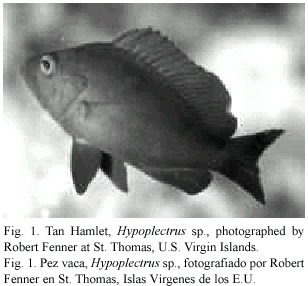
<body><![CDATA[<p><font face="Arial" size="2"><b>Key words: </b>Hamlets, geographic distribution, Curaçao, U.S. Virgin Islands, <i>Hypoplectrus </i>spp.</font></p>     <p><font face="Arial" size="2">Hamlets (<i>Hypoplectrus </i>spp.) are either 10 to 12 species, a single species, or some number in between, of tiny, dull to brightly colored Caribbean coral-reef grouper(s) (Serranidae). They are too small to be of value as human food, too aggressive to be much use as aquarium fishes, and would be pretty much ignored if not for the controversy over the number of species that exist and some of their interesting mimicry (<a href="#do94">Domeier 1994</a>, <a href="#hu94">Humann 1994</a>, <a href="#hu02">2002</a>, <a  href="#ag03">Aguilar-Perera 2003</a>). Although some species are very popular photographic subjects for sport divers (e.g., Golden Hamlet, <i>H. gummiguttta</i>) and most species/variants are relatively easy to identify in the field, their distributions remain confused and poorly documented.</font></p>     <p><font face="Arial" size="2">On 10 June 2002 using SCUBA, we observed numerous 8-12 cm TL specimens of Tan Hamlet, <i>Hypoplectrus </i>sp., an undescribed species/variant, in 8-16 m depth on an approximately 45º seaward slope of a rock ridge sparsely covered with largely dead, low-profile stony corals off Whistling Key, St. John, U. S. Virgin Islands, 18°22.1’N, 64°45.3’W. An atypical specimen of Butter Hamlet, <i>Hypoplectrus unicolor</i>, also occurred on this reef (<a href="#wi05">Williams and Bunkley-Williams 2005</a>, <a href="#wi06">2006</a>). The Tan Hamlet had not been previously reported from any of the U.S. Virgin Islands (<a  href="#do94">Domeier 1994</a>, <a href="#hu94">Humann 1994</a>, <a  href="#ag03">Aguilar-Perera 2003</a>, <a href="#ag">in press</a>); although, <a href="#hu02">Humann (2002)</a> reported it from the Virgin Islands in general, with no specific locality, and Fenner (no date) photographed a specimen in St. Thomas, USVI (<a href="#f1">Fig. 1</a>) below.</font></p> <a name="f1"></a>     <div style="text-align: center;"><img src="/img/fbpe/rbt/v54s3/3405i1.JPG" title=""  alt="" style="width: 308px; height: 286px;"></div>     
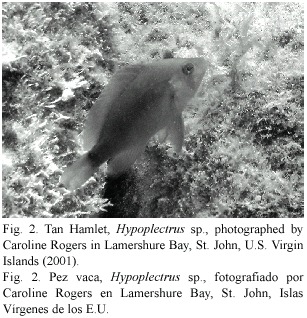
<p><font face="Arial" size="2">After <a href="#wi05">Williams and Bunkley-Williams (2005)</a> was presented in Curaçao, Caroline Rogers (unpubl. data.) informed EHW about a photograph of a Tan Hamlet she had recently taken in Lamershure Bay, St. John, U.S. Virgin Islands, 18°19.2’N, 64°43.6’W (<a href="#f2">Fig. 2</a>);and we learned from Robert Fenner (unpubl. data) that he took his photograph in 2001 in Water Bay, St. Thomas, U. S. Virgin Islands,18 °20.6 ’N, 64°51.6’W. Thus we establish new geographic records for the Tan Hamlet in St. John and St. Thomas.    <br> </font></p>     <p style="text-align: center;"><font face="Arial" size="2"><a name="f2"></a><img  src="/img/fbpe/rbt/v54s3/3405i2.JPG" title="" alt=""  style="width: 307px; height: 318px;">    
<br> </font></p>     <p><font face="Arial" size="2">During SCUBA dives in Curaçao (<a  href="#wi05">Williams and Bunkley-Williams 2005</a>, <a href="#wi06">2006</a>), 12 Yellowtail Hamlets, <i>Hypoplectrus chlorurus </i>(Cuvier); three Barred Hamlets, <i>H. puella </i>(Cuvier); one Shy Hamlet, <i>H. guttavarius </i>(Poey); and one hybrid between a Butter Hamlet and a Barred Hamlet were observed. The Barred Hamlet and Shy Hamlet have not been previously reported from Curaçao. <a href="#sm97">Smith (1997)</a> reported the Black Hamlet, <i>H. nigricans </i>(Poey), from Curaçao, but we did not observe that species/variant. <a href="#pa02">Pattengill-Semmens (2002)</a> reported the Tan Hamlet from Bonaire, Netherlands Antilles; however, this was based on the observation of a non-professional. </font></p> <font face="Arial" size="2"><b>     <p>Acknowledgments </p> </b></font>     ]]></body>
<body><![CDATA[<p><font face="Arial" size="2">We thank Steven Piontek, Curaçao Sea Aquarium, Bapor, Curaçao, for assistance in diving; Emma, Jessie, Dolph and Helen Bunkley, Santa Fe, New Mexico, and Len and Michelle Amato, Virgin Islands registry trimaran Opus, St. Thomas, USVI, for field assistance in the Virgin Islands. Partial support was provided by Sportfish Restoration Funds, Wallop-Braux Project F-28-13. </font></p> <font face="Arial" size="2"><b>     <p>Resumen </p> </b></font>     <p><font face="Arial" size="2">En el Caribe, el número exacto de especies de pez vaca, <i>Hypoplectrus </i>spp., es controversial y la distribución geográfica de estas especies/variedades está pobremente documentada. Presentamos Curaçao, Antillas Holandesas, como nueva localidad para el pez vaca de barras, <i>H. puella </i>(Cuvier) y el vaca bicolor, <i>H. guttavarius </i>(Poey). Agregamos St. John y St. Thomas, Islas Vírgenes de los EUA, al ámbito del "Tan Hamlet", <i>Hypoplectrus </i>sp. Anteriormente se dijo que en Curaçao se halla el pez vaca negra, <i>H. nigricans </i>(Poey), pero no lo vimos en nuestros muestreos.</font></p> <font face="Arial" size="2"><b></b></font>     <p><font face="Arial" size="2"><b>Palabras clave: </b>pez vaca, distribución geográfica, Curaçao, Islas Vírgenes, <i>Hypoplectrus </i>spp. </font></p> <font face="Arial" size="2"><b>     <p>References </p> </b></font>     <!-- ref --><p><font face="Arial" size="2"><a name="ag03"></a>Aguilar-Perera, A. 2003. Abundance and distribution of hamlets (Teleostis: <i>Hypoplectrus</i>) in coral reefs off southwestern Puerto Rico: Support for the multispecies hypothesis. Carib. J. Sci. 39: 147-151.</font>&nbsp;&nbsp;&nbsp;&nbsp;&nbsp;&nbsp;&nbsp;&nbsp;[&#160;<a href="javascript:void(0);" onclick="javascript: window.open('/scielo.php?script=sci_nlinks&ref=1243550&pid=S0034-7744200600060002300001&lng=','','width=640,height=500,resizable=yes,scrollbars=1,menubar=yes,');">Links</a>&#160;]<!-- end-ref --><!-- ref --><p><font face="Arial" size="2"><a name="ag"></a>Aguilar-Perera, A. in press. Distribution of <i>Hypoplectrus </i>(Teleostei: Serranidae) in the Wider Caribbean Region. J. Biogeogr. </font>&nbsp;&nbsp;&nbsp;&nbsp;&nbsp;&nbsp;&nbsp;&nbsp;[&#160;<a href="javascript:void(0);" onclick="javascript: window.open('/scielo.php?script=sci_nlinks&ref=1243551&pid=S0034-7744200600060002300002&lng=','','width=640,height=500,resizable=yes,scrollbars=1,menubar=yes,');">Links</a>&#160;]<!-- end-ref --><!-- ref --><p><font face="Arial" size="2"><a name="do94"></a>Domeier, M. L. 1994. Speciation in the serranid fish <i>Hypoplectrus. </i>Bull. Mar. Sci. 54: 103-141.</font>&nbsp;&nbsp;&nbsp;&nbsp;&nbsp;&nbsp;&nbsp;&nbsp;[&#160;<a href="javascript:void(0);" onclick="javascript: window.open('/scielo.php?script=sci_nlinks&ref=1243552&pid=S0034-7744200600060002300003&lng=','','width=640,height=500,resizable=yes,scrollbars=1,menubar=yes,');">Links</a>&#160;]<!-- end-ref --><!-- ref --><p><font face="Arial" size="2"><a name="hu94"></a>Humann, P. 1994. Reef fish identification: Florida, Caribbean, Bahamas. New World, Jacksonville, Florida, USA. 424 p.</font>&nbsp;&nbsp;&nbsp;&nbsp;&nbsp;&nbsp;&nbsp;&nbsp;[&#160;<a href="javascript:void(0);" onclick="javascript: window.open('/scielo.php?script=sci_nlinks&ref=1243553&pid=S0034-7744200600060002300004&lng=','','width=640,height=500,resizable=yes,scrollbars=1,menubar=yes,');">Links</a>&#160;]<!-- end-ref --><!-- ref --><p><font face="Arial" size="2"><a name="hu02"></a>Humann, P. 2002. Reef fish identification: Florida, Caribbean, Bahamas. New World, Jacksonville, Florida, USA. 512 p.</font>&nbsp;&nbsp;&nbsp;&nbsp;&nbsp;&nbsp;&nbsp;&nbsp;[&#160;<a href="javascript:void(0);" onclick="javascript: window.open('/scielo.php?script=sci_nlinks&ref=1243554&pid=S0034-7744200600060002300005&lng=','','width=640,height=500,resizable=yes,scrollbars=1,menubar=yes,');">Links</a>&#160;]<!-- end-ref --><!-- ref --><p><font face="Arial" size="2"><a name="pa02"></a>Pattengill-Semmens, C. V. 2002. The reef fish assemblage of Bonaire Marine Park: An analysis of REEF fish survey data. Proc. 53<sup>rd</sup> Gulf Carib. Fish. Inst. 53: 591-605.</font>&nbsp;&nbsp;&nbsp;&nbsp;&nbsp;&nbsp;&nbsp;&nbsp;[&#160;<a href="javascript:void(0);" onclick="javascript: window.open('/scielo.php?script=sci_nlinks&ref=1243555&pid=S0034-7744200600060002300006&lng=','','width=640,height=500,resizable=yes,scrollbars=1,menubar=yes,');">Links</a>&#160;]<!-- end-ref --><!-- ref --><p><font face="Arial" size="2"><a name="sm97"></a>Smith, C. L. 1997. National Audubon Society field guide to tropical marine fishes of the Caribbean, the Gulf of Mexico, Florida, the Bahamas, and Bermuda. Alfred A. Knopf, New York, USA. 720 p.</font>&nbsp;&nbsp;&nbsp;&nbsp;&nbsp;&nbsp;&nbsp;&nbsp;[&#160;<a href="javascript:void(0);" onclick="javascript: window.open('/scielo.php?script=sci_nlinks&ref=1243556&pid=S0034-7744200600060002300007&lng=','','width=640,height=500,resizable=yes,scrollbars=1,menubar=yes,');">Links</a>&#160;]<!-- end-ref --><!-- ref --><p><font face="Arial" size="2"><a name="wi05"></a>Williams, E. H., Jr. &amp; L. Bunkley-Williams. 2005. Rock Beauty crown pattern, grackle scythebill, and Butter Hamlet double spot anomalies, and their possible genetic significance. Proc. Assoc. Mar. Lab. Carib. 32: 57 (abstract).</font>&nbsp;&nbsp;&nbsp;&nbsp;&nbsp;&nbsp;&nbsp;&nbsp;[&#160;<a href="javascript:void(0);" onclick="javascript: window.open('/scielo.php?script=sci_nlinks&ref=1243557&pid=S0034-7744200600060002300008&lng=','','width=640,height=500,resizable=yes,scrollbars=1,menubar=yes,');">Links</a>&#160;]<!-- end-ref --><!-- ref --><p><font face="Arial" size="2"><a name="wi06"></a>Williams, E. H., Jr. &amp; L. Bunkley-Williams. 2006. Grackle scythebill, Rock Beauty crown pattern, and Butter Hamlet double spot anomalies, and their possible genetic significance. Rev. Biol. Trop. 54 (Suppl. 3): 161-169. </font>&nbsp;&nbsp;&nbsp;&nbsp;&nbsp;&nbsp;&nbsp;&nbsp;[&#160;<a href="javascript:void(0);" onclick="javascript: window.open('/scielo.php?script=sci_nlinks&ref=1243558&pid=S0034-7744200600060002300009&lng=','','width=640,height=500,resizable=yes,scrollbars=1,menubar=yes,');">Links</a>&#160;]<!-- end-ref --><p><font face="Arial" size="2"><span style="font-weight: bold;">Internet reference</span>    <br> </font></p>     <!-- ref --><p><font face="Arial" size="2"><a name="fe"></a>Fenner, R. no date. The basses called hamlets, genus <i>Hypoplectrus</i>. Wet Web Media.com (Downloaded:2 July 2005,<a href="http://www.wetmedia.com/Hypoplec.htm">http://www.wetmedia.com/Hypoplec.htm</a>). </font>&nbsp;&nbsp;&nbsp;&nbsp;&nbsp;&nbsp;&nbsp;&nbsp;[&#160;<a href="javascript:void(0);" onclick="javascript: window.open('/scielo.php?script=sci_nlinks&ref=1243561&pid=S0034-7744200600060002300010&lng=','','width=640,height=500,resizable=yes,scrollbars=1,menubar=yes,');">Links</a>&#160;]<!-- end-ref --> ]]></body><back>
<ref-list>
<ref id="B1">
<nlm-citation citation-type="journal">
<person-group person-group-type="author">
<name>
<surname><![CDATA[Aguilar-Perera]]></surname>
<given-names><![CDATA[A]]></given-names>
</name>
</person-group>
<article-title xml:lang="en"><![CDATA[Abundance and distribution of hamlets (Teleostis: Hypoplectrus) in coral reefs off southwestern Puerto Rico: Support for the multispecies hypothesis]]></article-title>
<source><![CDATA[Carib. J. Sci]]></source>
<year>2003</year>
<volume>39</volume>
<page-range>147-151</page-range></nlm-citation>
</ref>
<ref id="B2">
<nlm-citation citation-type="journal">
<person-group person-group-type="author">
<name>
<surname><![CDATA[Aguilar-Perera]]></surname>
<given-names><![CDATA[A]]></given-names>
</name>
</person-group>
<article-title xml:lang="en"><![CDATA[Distribution of Hypoplectrus (Teleostei: Serranidae) in the Wider Caribbean Region]]></article-title>
<source><![CDATA[J. Biogeogr]]></source>
<year></year>
</nlm-citation>
</ref>
<ref id="B3">
<nlm-citation citation-type="journal">
<person-group person-group-type="author">
<name>
<surname><![CDATA[Domeier]]></surname>
<given-names><![CDATA[M. L]]></given-names>
</name>
</person-group>
<article-title xml:lang="en"><![CDATA[Speciation in the serranid fish Hypoplectrus]]></article-title>
<source><![CDATA[Bull. Mar. Sci]]></source>
<year>1994</year>
<volume>54</volume>
<page-range>103-141</page-range></nlm-citation>
</ref>
<ref id="B4">
<nlm-citation citation-type="book">
<person-group person-group-type="author">
<name>
<surname><![CDATA[Humann]]></surname>
<given-names><![CDATA[P]]></given-names>
</name>
</person-group>
<source><![CDATA[Reef fish identification: Florida, Caribbean, Bahamas]]></source>
<year>1994</year>
<page-range>424</page-range><publisher-loc><![CDATA[Jacksonville^eFlorida Florida]]></publisher-loc>
<publisher-name><![CDATA[New World]]></publisher-name>
</nlm-citation>
</ref>
<ref id="B5">
<nlm-citation citation-type="book">
<person-group person-group-type="author">
<name>
<surname><![CDATA[Humann]]></surname>
<given-names><![CDATA[P]]></given-names>
</name>
</person-group>
<source><![CDATA[Reef fish identification: Florida, Caribbean, Bahamas]]></source>
<year>2002</year>
<page-range>512</page-range><publisher-loc><![CDATA[Jacksonville^eFlorida Florida]]></publisher-loc>
<publisher-name><![CDATA[New World]]></publisher-name>
</nlm-citation>
</ref>
<ref id="B6">
<nlm-citation citation-type="journal">
<person-group person-group-type="author">
<name>
<surname><![CDATA[Pattengill-Semmens]]></surname>
<given-names><![CDATA[C. V]]></given-names>
</name>
</person-group>
<article-title xml:lang="en"><![CDATA[The reef fish assemblage of Bonaire Marine Park: An analysis of REEF fish survey data]]></article-title>
<source><![CDATA[Proc. 53rd Gulf Carib. Fish. Inst]]></source>
<year>2002</year>
<volume>53</volume>
<page-range>591-605</page-range></nlm-citation>
</ref>
<ref id="B7">
<nlm-citation citation-type="book">
<person-group person-group-type="author">
<name>
<surname><![CDATA[Smith]]></surname>
<given-names><![CDATA[C. L]]></given-names>
</name>
</person-group>
<source><![CDATA[National Audubon Society field guide to tropical marine fishes of the Caribbean, the Gulf of Mexico, Florida, the Bahamas, and Bermuda]]></source>
<year>1997</year>
<page-range>720</page-range><publisher-loc><![CDATA[^eNew York New York]]></publisher-loc>
<publisher-name><![CDATA[Alfred A. Knopf]]></publisher-name>
</nlm-citation>
</ref>
<ref id="B8">
<nlm-citation citation-type="journal">
<person-group person-group-type="author">
<name>
<surname><![CDATA[Williams]]></surname>
<given-names><![CDATA[E. H., Jr]]></given-names>
</name>
<name>
<surname><![CDATA[Bunkley-Williams]]></surname>
<given-names><![CDATA[L]]></given-names>
</name>
</person-group>
<article-title xml:lang="en"><![CDATA[Rock Beauty crown pattern, grackle scythebill, and Butter Hamlet double spot anomalies, and their possible genetic significance]]></article-title>
<source><![CDATA[Proc. Assoc. Mar. Lab. Carib]]></source>
<year>2005</year>
<volume>32</volume>
<page-range>57</page-range></nlm-citation>
</ref>
<ref id="B9">
<nlm-citation citation-type="journal">
<person-group person-group-type="author">
<name>
<surname><![CDATA[Williams]]></surname>
<given-names><![CDATA[E. H., Jr]]></given-names>
</name>
<name>
<surname><![CDATA[Bunkley-Williams]]></surname>
<given-names><![CDATA[L]]></given-names>
</name>
</person-group>
<article-title xml:lang="en"><![CDATA[Grackle scythebill, Rock Beauty crown pattern, and Butter Hamlet double spot anomalies, and their possible genetic significance]]></article-title>
<source><![CDATA[Rev. Biol. Trop]]></source>
<year>2006</year>
<volume>54</volume>
<numero>^sSuppl. 3</numero>
<issue>^sSuppl. 3</issue>
<supplement>Suppl. 3</supplement>
<page-range>161-169</page-range></nlm-citation>
</ref>
<ref id="B10">
<nlm-citation citation-type="">
<person-group person-group-type="author">
<name>
<surname><![CDATA[Fenner]]></surname>
<given-names><![CDATA[R]]></given-names>
</name>
</person-group>
<source><![CDATA[The basses called hamlets, genus Hypoplectrus]]></source>
<year></year>
</nlm-citation>
</ref>
</ref-list>
</back>
</article>