<?xml version="1.0" encoding="ISO-8859-1"?><article xmlns:mml="http://www.w3.org/1998/Math/MathML" xmlns:xlink="http://www.w3.org/1999/xlink" xmlns:xsi="http://www.w3.org/2001/XMLSchema-instance">
<front>
<journal-meta>
<journal-id>0034-7744</journal-id>
<journal-title><![CDATA[Revista de Biología Tropical]]></journal-title>
<abbrev-journal-title><![CDATA[Rev. biol. trop]]></abbrev-journal-title>
<issn>0034-7744</issn>
<publisher>
<publisher-name><![CDATA[Universidad de Costa Rica]]></publisher-name>
</publisher>
</journal-meta>
<article-meta>
<article-id>S0034-77442006000600022</article-id>
<title-group>
<article-title xml:lang="en"><![CDATA[Three anomalies: A scythebill in the Greater Antillean Grackle (blackbird), a crown pattern in the Rock Beauty (angelfish), and a double spot in the Butter Hamlet (grouper), and their possible genetic significance]]></article-title>
</title-group>
<contrib-group>
<contrib contrib-type="author">
<name>
<surname><![CDATA[Williams, Jr]]></surname>
<given-names><![CDATA[Ernest H]]></given-names>
</name>
<xref ref-type="aff" rid="A01"/>
</contrib>
<contrib contrib-type="author">
<name>
<surname><![CDATA[Bunkley-Williams]]></surname>
<given-names><![CDATA[Lucy]]></given-names>
</name>
<xref ref-type="aff" rid="A02"/>
</contrib>
</contrib-group>
<aff id="A01">
<institution><![CDATA[,University of Puerto Rico  ]]></institution>
<addr-line><![CDATA[Mayagüez ]]></addr-line>
<country>Puerto Rico</country>
</aff>
<aff id="A02">
<institution><![CDATA[,University of Puerto Rico  ]]></institution>
<addr-line><![CDATA[Mayagüez ]]></addr-line>
<country>Puerto Rico</country>
</aff>
<pub-date pub-type="pub">
<day>00</day>
<month>12</month>
<year>2006</year>
</pub-date>
<pub-date pub-type="epub">
<day>00</day>
<month>12</month>
<year>2006</year>
</pub-date>
<volume>54</volume>
<fpage>161</fpage>
<lpage>169</lpage>
<copyright-statement/>
<copyright-year/>
<self-uri xlink:href="http://www.scielo.sa.cr/scielo.php?script=sci_arttext&amp;pid=S0034-77442006000600022&amp;lng=en&amp;nrm=iso"></self-uri><self-uri xlink:href="http://www.scielo.sa.cr/scielo.php?script=sci_abstract&amp;pid=S0034-77442006000600022&amp;lng=en&amp;nrm=iso"></self-uri><self-uri xlink:href="http://www.scielo.sa.cr/scielo.php?script=sci_pdf&amp;pid=S0034-77442006000600022&amp;lng=en&amp;nrm=iso"></self-uri><abstract abstract-type="short" xml:lang="en"><p><![CDATA[Three anomalies are described: a scythebill in Greater Antillean Grackle, Quiscalus niger (Boddaert) (Passeriformes: Emberizidae), a crown color pattern in Rock Beauty, Holacanthus tricolor (Bloch) (Perciformes: Pomacanthidae), and a double-spot color pattern in Butter Hamlet, Hypoplectrus unicolor (Walbaum) (Perciformes: Pomacanthidae). Bill anomalies are generally thought to be genetic in origin and genetic changes in bill shape can occur rapidly in a population. The scythebill anomally demonstrates how quickly a drastic bill modification may occur. The crown color pattern anomaly is similar to distinctive markings found in other members of this genus [Queen Angelfish, H. ciliaris (Linnaeus) and hybrid Townsend Angelfish H. ciliaris X H. bermudensis Goode] in the tropical western Atlantic. It suggests how quickly this pattern could have originated in the other species, and/or some propensity of this pattern in the genus. The distinct double-spot color pattern anomaly suggests how quickly new color patterns can originate in genus Hypoplectrus. This is important because species in this genus are distinguished almost solely on the basis of color pattern and speciation may be occurring rapidly. Anomalies should be recorded because they may give us some hints at the genetic origin of species characters and some could represent potentially inheritable characters. We suggest these potentially inheritable characters could be recognized and described when they first arise in an individual and before they become inherited by a population. Following these potentially inheritable characters could help to explain how such characters enter into a population. This approach to the study of inherited characters could fill a void in our knowledge of evolution and speciation. Rev. Biol. Trop. 54 (Suppl. 3): 161-169. Epub 2007 Jan. 15.]]></p></abstract>
<abstract abstract-type="short" xml:lang="es"><p><![CDATA[Se describen tres anomalías: el pico de guadaña en el chinchilín, Quiscalus niger (Boddaert) (Passeriformes: Emberizidae), un patrón de color de corona en el isabelita medioluto, Holacanthus tricolor (Bloch) (Perciformes: Pomacanthidae), y un patrón de color de doble mancha en el vaca blanca, Hypoplectrus unicolor (Walbaum) (Perciformes: Pomacanthidae). Generalmente se piensa que las anomalías en el pico son de origen genético y que los cambios genéticos en la forma del pico pueden ocurrir rápidamente en una población. La anomalía del pico de guadaña demuestra cuan rápido puede ocurrir una modificación drástica del pico. La anomalía del patrón de color de corona es similar a otras marcas distintivas encontradas en otros miembros de este género [isabelita reina, H. ciliaris (Linnaeus) y el híbrido isabelita azul H. ciliaris X H. bermudensis Goode] en el Atlántico occidental tropical y también indica cambios rápidos. Esto es importante porque las especies de este género se distinguen casi solamente por patrones de color. Las anomalías deberían ser registradas ya que podrían darnos algunas pistas acerca del origen genético de las características de las especies. Proponemos que los caracteres potencialmente heredables pueden reconocerse y describirse cuando aparecen en un individuo, antes de que sean heredados a la población, llenando un vacío en nuestro conocimiento de la evolución y la especiación.]]></p></abstract>
<kwd-group>
<kwd lng="en"><![CDATA[anomalies]]></kwd>
<kwd lng="en"><![CDATA[crown color pattern]]></kwd>
<kwd lng="en"><![CDATA[scythebill]]></kwd>
<kwd lng="en"><![CDATA[double-spot color pattern]]></kwd>
<kwd lng="en"><![CDATA[Rock Beauty]]></kwd>
<kwd lng="en"><![CDATA[Greater Antillean Grackle]]></kwd>
<kwd lng="en"><![CDATA[Butter Hamlet]]></kwd>
<kwd lng="en"><![CDATA[Caribbean]]></kwd>
<kwd lng="es"><![CDATA[anomalías]]></kwd>
<kwd lng="es"><![CDATA[patrón de color de corona]]></kwd>
<kwd lng="es"><![CDATA[pico de guadaña]]></kwd>
<kwd lng="es"><![CDATA[patrón de color de doble mancha]]></kwd>
<kwd lng="es"><![CDATA[isabelita medioluto]]></kwd>
<kwd lng="es"><![CDATA[chinchilín (mozambique, chango)]]></kwd>
<kwd lng="es"><![CDATA[vaca blanca]]></kwd>
<kwd lng="es"><![CDATA[Caribe]]></kwd>
</kwd-group>
</article-meta>
</front><body><![CDATA[  <b><font face="Arial">     <p align="center">Three anomalies: A scythebill in the Greater Antillean Grackle (blackbird), a crown pattern in the Rock Beauty (angelfish), and a double spot in the Butter Hamlet (grouper), and their possible genetic significance</p> </font><font face="Arial" size="2"> </font></b>     <p><font face="Arial" size="2">Ernest H. Williams, Jr.<a name="1"></a><a  href="#2"><sup>1</sup>*</a> &amp; Lucy Bunkley-Williams<a href="#2"><sup>2</sup></a> </font></p>     <p><font face="Arial" size="2"><a name="2"></a><a href="#1">1</a> Department of Marine Sciences, University of Puerto Rico, P.O. Box 9013, Mayagüez, Puerto Rico 00667; telephones: office/message (787) 832-4040 x 1725, fax: 787-265-3838; <a href="mailto:ewilliams@uprm.edu">ewilliams@uprm.edu</a> T </font></p>     <p><font face="Arial" size="2"><a href="#1">2</a> Caribbean Aquatic Animal Health Project, Department of Biology, University of Puerto Rico, P.O. Box 9012, Mayagüez, Puerto Rico 00861; <a  href="mailto:lwilliams@uprm.edu">lwilliams@uprm.edu</a> </font></p>     <p><font face="Arial" size="2"><a href="#1">*</a> Correspondence</font></p>     <p align="center"><font face="Arial" size="2">Received 01-VI-2006. Corrected 02-X-2006. Accepted 13-X-2006.</font></p> <font face="Arial" size="2"><b></b></font>     <p><font face="Arial" size="2"><b>Abstract: </b>Three anomalies are described: a scythebill in Greater Antillean Grackle, <i>Quiscalus niger </i>(Boddaert) (Passeriformes: Emberizidae), a crown color pattern in Rock Beauty, <i>Holacanthus tricolor </i>(Bloch) (Perciformes: Pomacanthidae), and a double-spot color pattern in Butter Hamlet, <i>Hypoplectrus unicolor </i>(Walbaum) (Perciformes: Pomacanthidae). Bill anomalies are generally thought to be genetic in origin and genetic changes in bill shape can occur rapidly in a population. The scythebill anomally demonstrates how quickly a drastic bill modification may occur. The crown color pattern anomaly is similar to distinctive markings found in other members of this genus [Queen Angelfish, <i>H. ciliaris </i>(Linnaeus) and hybrid Townsend Angelfish <i>H. ciliaris </i>X <i>H. bermudensis </i>Goode] in the tropical western Atlantic. It suggests how quickly this pattern could have originated in the other species, and/or some propensity of this pattern in the genus. The distinct double-spot color pattern anomaly suggests how quickly new color patterns can originate in genus <i>Hypoplectrus</i>. This is important because species in this genus are distinguished almost solely on the basis of color pattern and speciation may be occurring rapidly. Anomalies should be recorded because they may give us some hints at the genetic origin of species characters and some could represent potentially inheritable characters. We suggest these potentially inheritable characters could be recognized and described when they first arise in an individual and before they become inherited by a population. Following these potentially inheritable characters could help to explain how such characters enter into a population. This approach to the study of inherited characters could fill a void in our knowledge of evolution and speciation. Rev. Biol. Trop. 54 (Suppl. 3): 161-169. Epub 2007 Jan. 15.</font></p> <font face="Arial" size="2"><b></b></font>     <p><font face="Arial" size="2"><b>Key words: </b>anomalies, crown color pattern, scythebill, double-spot color pattern, Rock Beauty, Greater Antillean Grackle, Butter Hamlet, Caribbean.</font></p>     <p><font face="Arial" size="2">We describe three distinctive anomalies: a scythebill in Greater Antillean Grackle, <i>Quiscalus niger </i>(Boddaert) (Passeriformes: Emberizidae), a crown color pattern in Rock Beauty, <i>Holacanthus tricolor </i>(Bloch) (Perciformes: Pomacanthidae), and a double-spot color pattern in Butter Hamlet, <i>Hypoplectrus unicolor </i>(Walbaum) (Perciformes: Pomacanthidae). Since the cases discussed are rather diverse in background and methodology, we present each case, in the chronological order of when we first found them, separately for clarity with its own introduction, materials and methods, results and discussion. The possible genetic significance of each anomaly is briefly discussed as is their collective importance as potentially inherited characters.</font></p>     ]]></body>
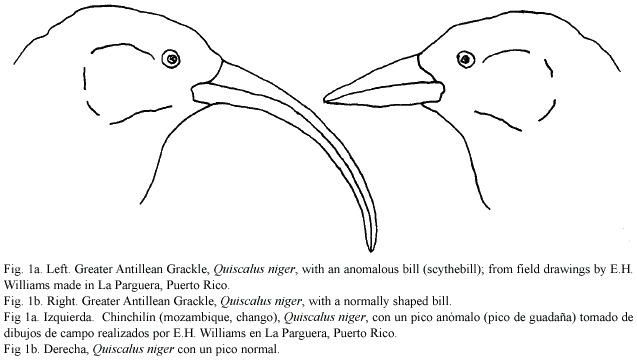
<body><![CDATA[<p><font face="Arial" size="2">These three anomalies were selected for consideration because each appears to represent a genetically controlled trait in each species that at least has the potential to be inherited. We suggest these potentially inheritable characters could be recognized and described when they first arise in an individual, and before they become inherited by a population. Following these potentially inheritable characters could help to explain how such characters enter into a population. This approach to the study of inherited characters could fill a void in our knowledge of evolution and speciation. </font></p> <font face="Arial" size="2"><b>     <p align="center">Presentation of cases</p> </b> <b>     <p>A Scythebill in Greater Antillean Grackle from Southwestern Puerto Rico</p> </b></font>     <p><font face="Arial" size="2">The Greater Antillean Grackle, <i>Quiscalus niger</i>, is a relatively large (25-30 cm) blackbird in the family Emberizidae. It is only found in the Greater Antilles and the Cayman Islands. This bird is common in many open, low-land areas with some trees. It has a conical, sharply pointed bill (<a href="#f1">Fig. 1b</a>). <i>Quiscalus niger </i>is relatively undisturbed by humans and frequently forages food scraps from humans in parks and around restaurants (<a href="#ra98">Raffaele <i>et al. </i>1998</a>).    <br> </font></p>     <p style="text-align: center;"><font face="Arial" size="2"><a name="f1"></a><img  src="/img/fbpe/rbt/v54s3/3404i1.JPG" title="" alt=""  style="width: 637px; height: 360px;">    
<br> </font></p>     <p><font face="Arial" size="2"><a href="#ca85">Campbell and Lack (1985)</a> summarized bird bill anomalies, and <a href="#cr94">Craves (1994)</a> and <a href="#an03">Anonymous (2003)</a> summarized deformed bills in passerines (perching and song birds). They found anomalies were usually confined to the outer covering of the bill (rhamphotheca). Bill elongation with some degree of down curving was the most common anomaly, but lateral curvature [as normally seen in crossbills] was also quite common. Anomalies involving distorted growth are believed to have genetic origins, but the evidence is stronger in domestic fowls, than in wild birds. Bill anomalies have been found in many species and families of birds, but more frequently in passerines, and these are more often reported in bird species that have become commensal with humans. They suggest that some sort of bill anomalies may be found in between 1.0 to 0.1% of birds. </font></p> <font face="Arial" size="2"><b>     <p align="center">Materials and methods</p> </b> </font>     <p><font face="Arial" size="2">We incidentally observed an unusual specimen of this bird in a flock of normally appearing <i>Q. niger </i>on the grounds of the Villa Parguera Hotel in La Parguera, Puerto Rico, in the open area between the hotel rooms and the Caribbean Sea on three occasions from June 1997 through September 1998, 17°58.4’N, 67°03.0’W. We examined the specimen within 2 m distance and from 8-12 m with Nikon 10X35 6.6º WF binoculars for a total of 4 hr and made field drawings. Initial observations were made close enough (2 m) to probably cause behavior modifications; however, most subsequent observations were made from concealment and with little movement behind an opportunistic blind (low hedge, plastic lawn chairs). </font></p> <font face="Arial" size="2"><b>     ]]></body>
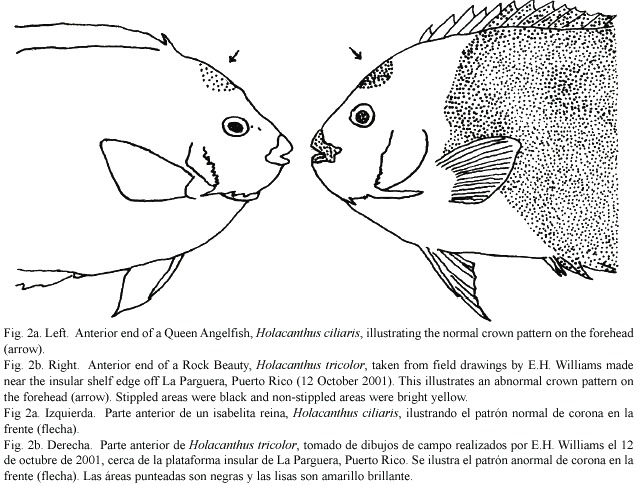
<body><![CDATA[<p align="center">Results and discussion</p> </b> </font>     <p><font face="Arial" size="2">The <i>Q. niger </i>specimen possessed an abnormally shaped bill (<a href="#f1">Fig. 1a</a>). We closely examined this abnormal bird and found that it otherwise conformed to all of the characters of the species. It was a female approximately 26 cm in length. The bird did not appear to differ from other, normally appearing, <i>Q. niger </i>in behavior. It associated with flocks and smaller groups of six to eight <i>Q. niger</i>. The abnormal <i>Q. niger </i>foraged and competed for seeds and other food items equally as well as the other associated birds. It did not appear to be ostracized, attacked, or harassed by other <i>Q. niger</i>. The abnormal <i>Q. niger </i>interacted with other <i>Q. </i>niger similarly to the normally appearing <i>Q. niger </i>observed. Our observations run contrary to the summary of <a href="#ca85">Campbell and Lack (1985)</a> that suggested behavioral changes, sometimes-drastic ones, were usually associated with bill anomalies, although<a href="#fo52"> Fox (1952)</a> suggested that birds can adapt to extremely long bill anomalies.</font></p> <font face="Arial" size="2">Although <a href="#ca85">Campbell and Lack (1985)</a> suggested that bill elongation with some degree of down curving was the most common anomaly, the extension we described was much more drastic or extensive than the more limited extensions they considered common. We are aware of no similar reports of elongated bills in <i>Q. niger </i>(<a href="#bl57">Blake 1957</a>, <a  href="#cr94">Craves 1994</a>, <a href="#an03">Anonymous 2003</a>). Bill elongation has been noted in one specimen of <i>Q. mexicanus </i>(Gmelin) (Great-tailed Grackle) from Ft. Worth, Texas (<a href="#sh79">Sharp and Neill 1979</a>), and two specimens of <i>Q. quiscula </i>(Linnaeus) (Common Grackle) from Pennsylvania (<a href="#mu76">Mutchler 1976</a>) and Washtwnaw County, Minnesota (<a href="#cr94">Craves 1994</a>). <a  href="#sn37">Snyder (1937)</a> reports other beak anomalies in <i>Q. quiscula </i>from Canada. <a href="#ar86">Arendt and Arendt (1986)</a> report a bill anomaly in the closely related, <i>Margarops fuscatus </i>(Vieillot) (Pearly-eyed Thrasher) from Montserrat, West Indies; and <a  href="#po81">Post (1981)</a> described a crossed beak in the closely related <i>Agelaius xanthomus </i>(Sclater) (Yellow-shouldered Blackbird) collected at La Parguera, Puerto Rico. <a href="#bo04">Bowdish (1904)</a> described a greatly elongated beak in a <i>Melanerpes portoricensis (</i>Daudin) (Puerto Rican Woodpecker)(Picidae) he shot near Mayagüez, Puerto Rico.</font>     <p><font face="Arial" size="2">The abnormal bill we observed appeared to be rather similar in shape to the bill of <i>Campylorhamphus procurviodes </i>(Lafrenaye) (Curved-billed Scythebill) (Dendrocolaptidae) found in the Central Amazonian Basin. We therefore call this unusual form of bill a "scythebill anomaly" and the <i>Q. niger </i>specimen a "scythe-billed Greater Antillean Grackle." This odd occurrence points out how quickly a drastically different bill (<a  href="#f1">Figs. 1a</a>, <a href="#f1">b</a>) form can arise. <a  href="#we95">Weiner (1995)</a> demonstrated that bill form can change rapidly in a population. Should the scythebill abnormality prove beneficial to the abnormal grackle, and if it is inheritable, it could have speciation or evolutionary importance. <a href="#ca85">Campbell and Lack (1985)</a> suggested that bill anomalies are genetic in origin, thus the present anomaly could be assumed to be inheritable. Similar anomalous bill development should be looked for in <i>Q. niger</i>. <a href="#fo52">Fox (1952)</a> suggested that greatly elongated bills represented "new tools" to which some birds are able to adapt and use. He did not go so far as to suggest that these may be potentially inherited characters or to suggest any speciation possibilities, but did suggest that the character might be passed through several generations. He also emphasized that these individual birds with elongated beaks represented an opportunity to further study bird behavior.</font></p>     <p><font face="Arial" size="2">The Hotel grounds may provide supplemental sources of food that may allow abnormal or damaged birds to survive and thrive that might not otherwise survive in the wild. <a  href="#ca85">Campbell and Lack (1985)</a> suggested commensal species that rely in part on food from humans might survive bill anomalies more often than wild birds. However, we never observed the anomalous <i>Q. niger </i>eating anything but natural foods, and a hotel grounds would be considered a normal habitat for grackles (<a href="#ra98">Raffaele <i>et al. </i>1998</a>).</font></p>     <p><font face="Arial" size="2">Documentation by photography would have improved this study. However, we could not obtain permission to photograph so close to guest rooms at the Villa Parguera Hotel.</font></p> <font face="Arial" size="2"><b>     <p>A Crown Color Pattern in Rock Beauty from Southwestern Puerto Rico</p> </b></font>     <p><font face="Arial" size="2">Rock Beauty, <i>Holacanthus tricolor</i>, is a brilliant yellow and black colored, moderate-sized angelfish found in clear-water, coral-reef areas of the western North Atlantic. It occurs commonly, but is not used as a food fish.</font></p>     <p><font face="Arial" size="2">We routinely closely examine <i>H. tricolor </i>because they host a large, external isopod, <i>Anilocra holacanthi </i>(<a href="#wi81">Williams and Williams 1981</a>).These fishes are also of interest because abnormal color patterns in it are caused by a turbellarian parasite (<a href="#gr85">Grizzle and Williams 1985</a>). </font></p> <font face="Arial" size="2"><b>     <p align="center">Materials and methods</p> </b> </font>     <p><font face="Arial" size="2">On 12 October 2001 using SCUBA, we closely observed an approximately 17 cm total length (TL) <i>H. tricolor </i>in 19.88 m depth in the shelf edge coral reef 13 m N, or inshore, from the insular shelf drop-off S of La Parguera, Puerto Rico, 17°52.8’N, 67°02.7’W. An under - water camera was not available at the time, but field drawings were made of the <i>H. tricolor </i>specimen on a slate (<a href="#f2">Fig. 2b</a>).</font></p> <a name="f2"></a>     ]]></body>
<body><![CDATA[<div style="text-align: center;"><img src="/img/fbpe/rbt/v54s3/3404i2.JPG" title=""  alt="" style="width: 640px; height: 486px;"></div> <font face="Arial" size="2"><b>     
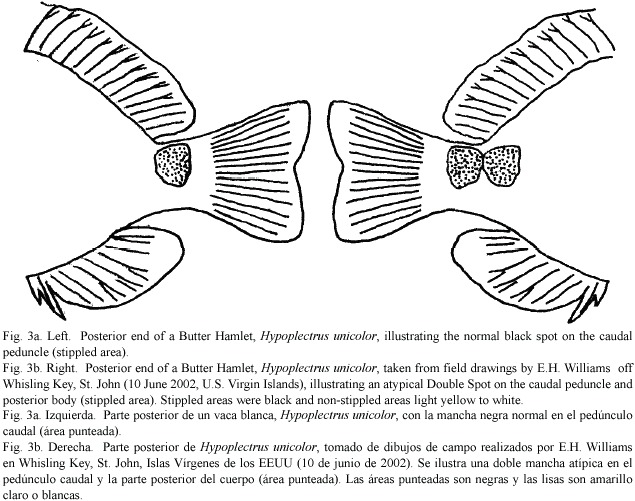
<p align="center">Results and discussion</p> </b> </font>     <p><font face="Arial" size="2">A darkly-pigmented oval surrounded by a lighter-pigmented ring on the foreheads of some angelfishes is called a "crown." The black-pigmented distinct oval on the forehead of the specimen we examined is similar except lacking the ring (<a href="#f2">Fig. 2b</a>).This is apparently an odd color pattern in <i>H. tricolor </i>as we have examined many thousands of specimens of this fish throughout the West Indies and have not seen anything similar. It is of interest because another member of the genus <i>Holacanthus </i>in the West Indies, <i>H. ciliaris </i>(Linnaeus) (Queen Angelfish), has a distinct crown pattern (<a href="#f2">Fig. 2a</a>). The apparently spontaneous expression of a pattern similar to the crown color pattern in the <i>H. tricolor </i>may suggest how quickly it could have originated in the other species, and/or some propensity of this pattern in the genus.</font></p>     <p><font face="Arial" size="2">A similar crown pattern is seen in the <i>H. ciliaris </i>X <i>H. bermudensis </i>Goode hybrid (Townsend Angelfish). However, the otherwise normal color pattern of the specimen of <i>H. tricolor </i>that we observed would not suggest any hybridization between <i>H. ciliaris </i>and <i>H. tricolor</i>. We are unaware of any report of <i>H. tricolor </i>hybridization resulting in a crown pattern in the literature.</font></p>     <p><font face="Arial" size="2">Attachment of the parasitic isopod, <i>A. holacanthi</i>, can cause an area of dark pigmentation on normally yellow-colored areas (<a href="#wi81">Williams and Williams 1981</a>); however, this isopod attaches under the eye and never on the forehead of <i>H. tricolor </i>(<a href="#wi81">Williams and Williams 1981</a>, Williams and Bunkley-Williams, unpub. data). Tissue-embedded turbellarians can cause normally yellow portions of <i>H. tricolor </i>to darken (<a href="#gr85">Grizzle and Williams 1985</a>); however, these color alterations are more diffuse and generalized than the crown pattern seen in the observed specimen. Breeding male <i>H. tricolor </i>are well known to develop darkened faces, but this pattern is also more diffuse and general than what we observed.</font></p> <font face="Arial" size="2"><b>     <p>A Double-spot Pattern in Butter Hamlet from St. John, U.S. Virgin Islands</p> </b></font>     <p><font face="Arial" size="2">The Butter Hamlet, <i>Hypoplectrus unicolor</i>, is a grayish-white to yellow, miniature (&lt;13 cm TL) grouper found in clear-water, coral-reef areas of the western North Atlantic. It occurs commonly in the Florida Keys, but only occasionally in the remainder of the West Indies. This fish has no economic aquarium or food-fish value, but is of taxonomic importance as the first described in a complex of hamlet species/subspecies/variants.</font></p>     <p><font face="Arial" size="2">We routinely closely examine hamlets in the field because we are cooperating with a Department of Marine Sciences, University of Puerto Rico, graduate student working on hamlet biology including their parasites. We have also observed unusual geographic distribution patterns in some species/variants (<a  href="#wi06">Williams <i>et al. </i>2006</a>, Williams and Bunkley-Williams, unpubl. data). </font></p> <font face="Arial" size="2"><b>     <p align="center">Materials and methods</p> </b> </font>     <p><font face="Arial" size="2">On 10 June 2002 using SCUBA, we closely observed an 11.4 cm TL <i>H. unicolor </i>in 12.2 m depth on an approximately 45º seaward slope of a rock ridge sparsely covered with largely dead, low-profile stony corals off Whistling Key, St. John, U. S. Virgin Islands, 18°22.1’N, 64°45.3’W. An underwater camera was not available, but field drawings of the <i>H. unicolor </i>specimen were made on a slate (<a href="#f3">Fig. 3b</a>).</font></p> <a name="f3"></a>     ]]></body>
<body><![CDATA[<div style="text-align: center;"><img src="/img/fbpe/rbt/v54s3/3404i3.JPG" title=""  alt="" style="width: 635px; height: 501px;"></div> <font face="Arial" size="2"><b>     
<p align="center">Results and discussion</p> </b> </font>     <p><font face="Arial" size="2">Normally, a darkly-pigmented black saddle blotch occurs on the base of the caudal peduncle (<a href="#f3">Fig. 3a</a>) of <i>H. unicolor</i>. In side view, this blotch appears to be a "spot" on either side of the caudal peduncle (<a href="#f3">Fig. 3a</a>). The black blotch of the specimen we examined is similar except it has been duplicated with a similar size and shape, and congruent anterior spot on both sides of the fish (<a href="#f3">Fig. 3b</a>). This is apparently an odd "double-spot" color pattern in <i>H. unicolor </i>as we have examined many hundreds of specimens of this fish throughout the West Indies and have not seen anything similar. It is of interest because members of the genus <i>Hypoplectrus </i>(hamlets) in the West Indies are distinguished largely on the basis of color patterns and the origin, development, and genetic significance of distinctive color patterns is a subject of much debate (<a href="#th78">Thresher 1978</a>, <a href="#gr80">Graves and Rosenblatt 1980</a>, <a  href="#do94">Domeier 1994</a>, <a href="#sr99">Srinivasa Rao and Lakshmi 1999</a>, <a href="#mc03">McCartney <i>et al. </i>2003</a>, <a  href="#ra03">Ramon <i>et al. </i>2003</a>, <a href="#ag03">Aguilar-Perera 2003</a>, <a href="#ag04">2004</a>, <a href="#ag">in press</a>, <a  href="#ga04">García-Machado <i>et al. </i>2004</a>). Members of this genus are thought to have undergone recent and rapid speciation and/or formation of color morphs (<a href="#ra03">Ramon <i>et al. </i>2003</a>). The apparently spontaneous expression of a distinct, new color pattern in this specimen of <i>H. unicolor </i>may suggest how abruptly new patterns can originate. Following this new pattern may well be important in this genetically fluid genus. We are unaware of any report of a color pattern similar to the double-spot in the <i>H. unicolor </i>or in any other hamlet, <i>Hypoplectrus </i>spp., in the literature.</font></p>     <p><font face="Arial" size="2">Species or color variants of hamlets usually chose to breed with partners that are identical in morphology, although hybridization between forms does occur (<a href="#do94">Domeier 1994</a>). An anomaly such as the Double-spot Pattern could be the beginning of a new variant or species. This is at least some indication of how they might evolve. </font></p>     <p><font face="Arial" size="2">After the presentation of this paper (<a  href="#wi05">Williams and Bunkley-Williams 2005</a>), Steven Piontek (pers. comm.) informed us that approximately half of the specimens of Butter Hamlets he had examined in the field and collected for the Curaçao Sea Aquarium over many years had a dark spot on the nose, while half were lacking the spot. We observed 15 specimens of Butter Hamlets during scuba dives at nine different sites 14-18 June 2005 (EHW 7, LBW 5), and three specimens in the Aquarium. Approximately half (N=10 of 18) had the nose spot, while eight lacked any trace of the spot. One pair about to breed seen 17:20 hrs 17 June 2005 each had the nose spot. Apparently variations in pigment spots commonly occur in this species and we hypothesize that it may affect mate choice. </font></p> <font face="Arial" size="2"><b>     <p align="center">Conclusions</p> </b> </font>     <p><font face="Arial" size="2">Bill anomalies are generally thought to be genetic in origin. The scythebill anomally demonstrates how quickly a drastic bill modification may occur. This is important because changes in bill shape can occur rapidly in a population. The crown color pattern anomaly in <i>Holacanthus tricolor </i>is similar to distinctive markings found in other members of this genus in the tropical western Atlantic. It suggests how abruptly this pattern could have originated in the other species, and/or some propensity of this pattern in the genus. The distinct double-spot color pattern anomaly suggests how quickly new color patterns can originate in genus <i>Hypoplectrus</i>. This is important because species in this genus are distinguished almost solely on the basis of color pattern and they are apparently in a period of rapid speciation. These and similar anomalies should be recorded because they may give us some hints at the genetic origin of species characters and some could represent potentially inheritable characters.</font></p>     <p><font face="Arial" size="2">The existence of natural, spontaneous mutational changes that can be inherited is the basis of evolutionary theory (<a href="#da59">Darwin 1859</a>, <a href="#go02">Gould 2002</a>). Considerable disagreement exists among evolutionary biologists regarding the methods for studying adaptation in nature (<a href="#ba91">Baum and Larson 1991</a>). A multitude of studies of this process have attempted to identify characters that have already been inherited in a species, subspecies, race, variant, or population. Macroevolutionary thought must assume "historical genesis" of adaptations (<a href="#bo65">Bock and von Wahlert 1965</a>, <a href="#wi66">Williams 1966</a>, <a  href="#bo79">Bock 1979</a>, <a href="#go79">Gould and Lewontin 1979</a>, <a href="#go82">Gould and Vrba 1982</a>, <a href="#ba91">Baum and Larson 1991</a>) because the history of existing traits is not known. The origins of such characters already existing in a species are usually obscured by too much complexity and too many alternative possibilities. Retrogressing existing characters also seems a rather backward approach and "demonstration of the past action of natural selection … is considered impractical" (<a href="#gr86">Green 1986</a>). We suggest searching for potentially inheritable characters (or precursors) before these are inherited into the genome of a species. However, potentially inheritable changes have been assumed to be so difficult to recognize and substantiate that the scientific literature is all but devoid of such cases. We should be more alert for such changes. These three recently observed examples of unusual changes in species characters may be instructive of the type of potentially inheritable changes that should be searched for, recorded, and followed to evaluate their evolutionary importance. We suggest these potentially inheritable characters could be recognized and described when they first arise in an individual and before they become inherited by a population. Following these potentially inheritable characters could help to explain how such characters enter into a population. Such a new approach to the study of inherited characters could fill a void in our knowledge of evolution and speciation. </font></p> <font face="Arial" size="2"><b>     <p>Acknowledgments </p> </b> </font>     <p><font face="Arial" size="2">We thank Steven Piontek, Curaçao Sea Aquarium, Bapor, Curaçao, for information on the Butter Hamlet and assistance in diving; G. Lopez-Padilla, Department of Marine Sciences, University of Puerto Rico (UPR), for field assistance in observing the Rock Beauty; Emma, Jessie, and Dolph Bunkley and Helen Nelson, Santa Fe, New Mexico, and Len and Michelle Amato, Virgin Islands registry trimaran Opus, St. Thomas, USVI, for field assistance with the Butter Hamlet; the staff of the Villa Parguera Hotel, La Parguera, Puerto Rico, for allowing us to conduct research on their grounds; and J. A. Cross, Rouge River Bird Observatory, University of Michigan for reviewing an early version of the manuscript. Partial support was provided by Sportfish Restoration Funds, Wallop-Braux Project F-28-13. </font></p> <font face="Arial" size="2"><b>     ]]></body>
<body><![CDATA[<p>Resumen </p> </b> </font>     <p><font face="Arial" size="2">Se describen tres anomalías: el pico de guadaña en el chinchilín, <i>Quiscalus niger </i>(Boddaert) (Passeriformes: Emberizidae), un patrón de color de corona en el isabelita medioluto, <i>Holacanthus tricolor </i>(Bloch) (Perciformes: Pomacanthidae), y un patrón de color de doble mancha en el vaca blanca, <i>Hypoplectrus unicolor </i>(Walbaum) (Perciformes: Pomacanthidae). Generalmente se piensa que las anomalías en el pico son de origen genético y que los cambios genéticos en la forma del pico pueden ocurrir rápidamente en una población. La anomalía del pico de guadaña demuestra cuan rápido puede ocurrir una modificación drástica del pico. La anomalía del patrón de color de corona es similar a otras marcas distintivas encontradas en otros miembros de este género [isabelita reina, <i>H. ciliaris </i>(Linnaeus) y el híbrido isabelita azul <i>H. ciliaris </i>X <i>H. bermudensis </i>Goode] en el Atlántico occidental tropical y también indica cambios rápidos. Esto es importante porque las especies de este género se distinguen casi solamente por patrones de color. Las anomalías deberían ser registradas ya que podrían darnos algunas pistas acerca del origen genético de las características de las especies. Proponemos que los caracteres potencialmente heredables pueden reconocerse y describirse cuando aparecen en un individuo, antes de que sean heredados a la población, llenando un vacío en nuestro conocimiento de la evolución y la especiación.</font></p> <font face="Arial" size="2"><b></b></font>     <p><font face="Arial" size="2"><b>Palabras clave: </b>anomalías, patrón de color de corona, pico de guadaña, patrón de color de doble mancha, isabelita medioluto, chinchilín (mozambique, chango), vaca blanca, Caribe. </font></p> <font face="Arial" size="2"><b>     <p>References </p> </b> </font>     <!-- ref --><p><font face="Arial" size="2"><a name="ag03"></a>Aguilar-Perera, A. 2003. Abundance and distribution of hamlets (Teleostei: <i>Hypoplectrus </i>) in coral reefs off southwestern Puerto Rico: Support for the multispecies hypothesis. Carib. J. Sci. 39: 147-151.</font>&nbsp;&nbsp;&nbsp;&nbsp;&nbsp;&nbsp;&nbsp;&nbsp;[&#160;<a href="javascript:void(0);" onclick="javascript: window.open('/scielo.php?script=sci_nlinks&ref=1243448&pid=S0034-7744200600060002200001&lng=','','width=640,height=500,resizable=yes,scrollbars=1,menubar=yes,');">Links</a>&#160;]<!-- end-ref --><!-- ref --><p><font face="Arial" size="2"><a name="ag04"></a>Aguilar-Perera, A. 2004. Variations in morphology and coloration in the Black Hamlet, <i>Hypoplectrus nigricans </i>(Teleostei: Serranidae). Carib. J. Sci. 40: 150-154.</font>&nbsp;&nbsp;&nbsp;&nbsp;&nbsp;&nbsp;&nbsp;&nbsp;[&#160;<a href="javascript:void(0);" onclick="javascript: window.open('/scielo.php?script=sci_nlinks&ref=1243449&pid=S0034-7744200600060002200002&lng=','','width=640,height=500,resizable=yes,scrollbars=1,menubar=yes,');">Links</a>&#160;]<!-- end-ref --><!-- ref --><p><a name="ag"></a>Aguilar-Perera, A. in press. Distribution of Hypoplectrus (Teleostei: Serranidae) in the wider Caribbean Region. J. Biogeogr.&nbsp;&nbsp;&nbsp;&nbsp;&nbsp;&nbsp;&nbsp;&nbsp;[&#160;<a href="javascript:void(0);" onclick="javascript: window.open('/scielo.php?script=sci_nlinks&ref=1243450&pid=S0034-7744200600060002200003&lng=','','width=640,height=500,resizable=yes,scrollbars=1,menubar=yes,');">Links</a>&#160;]<!-- end-ref --><!-- ref --><p><font face="Arial" size="2"><a name="ar86"></a>Arendt, J. W. &amp; A. I. Arendt. 1986. Bird deformity in a Pearly-eyed Thrasher from Montserrat, West Indies. N. Amer. Bird Band<i>. </i>11: 51-52.</font>&nbsp;&nbsp;&nbsp;&nbsp;&nbsp;&nbsp;&nbsp;&nbsp;[&#160;<a href="javascript:void(0);" onclick="javascript: window.open('/scielo.php?script=sci_nlinks&ref=1243451&pid=S0034-7744200600060002200004&lng=','','width=640,height=500,resizable=yes,scrollbars=1,menubar=yes,');">Links</a>&#160;]<!-- end-ref --><!-- ref --><p><font face="Arial" size="2"><a name="ba91"></a>Baum, D. A. &amp; A. Larson. 1991. Adaptation reviewed: a phylogenetic methodology for studying character macroevolution. Syst. Zool. 40: 1-18.</font>&nbsp;&nbsp;&nbsp;&nbsp;&nbsp;&nbsp;&nbsp;&nbsp;[&#160;<a href="javascript:void(0);" onclick="javascript: window.open('/scielo.php?script=sci_nlinks&ref=1243452&pid=S0034-7744200600060002200005&lng=','','width=640,height=500,resizable=yes,scrollbars=1,menubar=yes,');">Links</a>&#160;]<!-- end-ref --><!-- ref --><p><font face="Arial" size="2"><a name="bo79"></a>Bock, W. J. 1979. The scientific explanation of macroevolutionary change —A reductionistic approach. Bull. Carnegie Mus. Nat. Hist. 13: 20-69.</font>&nbsp;&nbsp;&nbsp;&nbsp;&nbsp;&nbsp;&nbsp;&nbsp;[&#160;<a href="javascript:void(0);" onclick="javascript: window.open('/scielo.php?script=sci_nlinks&ref=1243453&pid=S0034-7744200600060002200006&lng=','','width=640,height=500,resizable=yes,scrollbars=1,menubar=yes,');">Links</a>&#160;]<!-- end-ref --><!-- ref --><p><font face="Arial" size="2"><a name="bo65"></a>Bock, W. J. &amp; G. von Wahlert. 1965. Adaptation and the function-form complex. Evolution 19: 269-299.</font>&nbsp;&nbsp;&nbsp;&nbsp;&nbsp;&nbsp;&nbsp;&nbsp;[&#160;<a href="javascript:void(0);" onclick="javascript: window.open('/scielo.php?script=sci_nlinks&ref=1243454&pid=S0034-7744200600060002200007&lng=','','width=640,height=500,resizable=yes,scrollbars=1,menubar=yes,');">Links</a>&#160;]<!-- end-ref --><!-- ref --><p><font face="Arial" size="2"><a name="bl57"></a>Blake, C. H. 1957. Diseases and injuries of Jamaican birds. J. Field Ornithol. 28: 157-159.</font>&nbsp;&nbsp;&nbsp;&nbsp;&nbsp;&nbsp;&nbsp;&nbsp;[&#160;<a href="javascript:void(0);" onclick="javascript: window.open('/scielo.php?script=sci_nlinks&ref=1243455&pid=S0034-7744200600060002200008&lng=','','width=640,height=500,resizable=yes,scrollbars=1,menubar=yes,');">Links</a>&#160;]<!-- end-ref --><!-- ref --><p><font face="Arial" size="2"><a name="bo04"></a>Bowdish, B. S. 1904. An abnormal bill of <i>Melanerpes portoricensis</i>. Auk 21: 53-55.</font>&nbsp;&nbsp;&nbsp;&nbsp;&nbsp;&nbsp;&nbsp;&nbsp;[&#160;<a href="javascript:void(0);" onclick="javascript: window.open('/scielo.php?script=sci_nlinks&ref=1243456&pid=S0034-7744200600060002200009&lng=','','width=640,height=500,resizable=yes,scrollbars=1,menubar=yes,');">Links</a>&#160;]<!-- end-ref --><!-- ref --><p><font face="Arial" size="2"><a name="ca85"></a>Campbell, B. &amp; E. Lack (eds.). 1985. A dictionary of birds. Buteo Books, Vermillion, South Dakota, USA. 670 p.</font>&nbsp;&nbsp;&nbsp;&nbsp;&nbsp;&nbsp;&nbsp;&nbsp;[&#160;<a href="javascript:void(0);" onclick="javascript: window.open('/scielo.php?script=sci_nlinks&ref=1243457&pid=S0034-7744200600060002200010&lng=','','width=640,height=500,resizable=yes,scrollbars=1,menubar=yes,');">Links</a>&#160;]<!-- end-ref --><!-- ref --><p><font face="Arial" size="2"><a name="cr94"></a>Craves, J. A. 1994. Passerines with deformed bills. N. Amer. Bird Band. 19: 14-18.</font>&nbsp;&nbsp;&nbsp;&nbsp;&nbsp;&nbsp;&nbsp;&nbsp;[&#160;<a href="javascript:void(0);" onclick="javascript: window.open('/scielo.php?script=sci_nlinks&ref=1243458&pid=S0034-7744200600060002200011&lng=','','width=640,height=500,resizable=yes,scrollbars=1,menubar=yes,');">Links</a>&#160;]<!-- end-ref --><!-- ref --><p><font face="Arial" size="2"><a name="da59"></a>Darwin, C. 1859. The origin of the species by means of natural selection or the preservation of favored races in the struggle for life. 6th ed, Mentor, New York, USA. 495 p.</font>&nbsp;&nbsp;&nbsp;&nbsp;&nbsp;&nbsp;&nbsp;&nbsp;[&#160;<a href="javascript:void(0);" onclick="javascript: window.open('/scielo.php?script=sci_nlinks&ref=1243459&pid=S0034-7744200600060002200012&lng=','','width=640,height=500,resizable=yes,scrollbars=1,menubar=yes,');">Links</a>&#160;]<!-- end-ref --><!-- ref --><p><font face="Arial" size="2"><a name="do94"></a>Domeier, M. L. 1994. Speciation in the serranid fish <i>Hypoplectrus. </i>Bull. Mar. Sci. 54: 103-141.</font>&nbsp;&nbsp;&nbsp;&nbsp;&nbsp;&nbsp;&nbsp;&nbsp;[&#160;<a href="javascript:void(0);" onclick="javascript: window.open('/scielo.php?script=sci_nlinks&ref=1243460&pid=S0034-7744200600060002200013&lng=','','width=640,height=500,resizable=yes,scrollbars=1,menubar=yes,');">Links</a>&#160;]<!-- end-ref --><!-- ref --><p><font face="Arial" size="2"><a name="fo52"></a>Fox, W. 1952. Behavioral and evolutionary significance of the abnormal growth of beaks of birds. Condor 54: 160-162.</font>&nbsp;&nbsp;&nbsp;&nbsp;&nbsp;&nbsp;&nbsp;&nbsp;[&#160;<a href="javascript:void(0);" onclick="javascript: window.open('/scielo.php?script=sci_nlinks&ref=1243461&pid=S0034-7744200600060002200014&lng=','','width=640,height=500,resizable=yes,scrollbars=1,menubar=yes,');">Links</a>&#160;]<!-- end-ref --><!-- ref --><p><font face="Arial" size="2"><a name="ga04"></a>García-Machado, E., P. P Chevalier Monteagudo &amp; M. Solignac. 2004. Lack of mtDNA differentiation among hamlets (<i>Hypoplectrus</i>: Serranidae). Mar. Biol. 144: 147-152.</font>&nbsp;&nbsp;&nbsp;&nbsp;&nbsp;&nbsp;&nbsp;&nbsp;[&#160;<a href="javascript:void(0);" onclick="javascript: window.open('/scielo.php?script=sci_nlinks&ref=1243462&pid=S0034-7744200600060002200015&lng=','','width=640,height=500,resizable=yes,scrollbars=1,menubar=yes,');">Links</a>&#160;]<!-- end-ref --><!-- ref --><p><font face="Arial" size="2"><a name="go02"></a>Gould, S. J. 2002. The structure of evolutionary theory. Harvard University, Cambridge, United Kingdom. 1464 p.</font>&nbsp;&nbsp;&nbsp;&nbsp;&nbsp;&nbsp;&nbsp;&nbsp;[&#160;<a href="javascript:void(0);" onclick="javascript: window.open('/scielo.php?script=sci_nlinks&ref=1243463&pid=S0034-7744200600060002200016&lng=','','width=640,height=500,resizable=yes,scrollbars=1,menubar=yes,');">Links</a>&#160;]<!-- end-ref --><!-- ref --><p><font face="Arial" size="2"><a name="go79"></a>Gould, S. J. &amp; R. Lewontin. 1979. The spandrels of San Marco and the Panglossian paradigm: A critique of the adaptation programme. Proc. R. Soc. Lond. B Biol. Sci. 205: 581-598.</font>&nbsp;&nbsp;&nbsp;&nbsp;&nbsp;&nbsp;&nbsp;&nbsp;[&#160;<a href="javascript:void(0);" onclick="javascript: window.open('/scielo.php?script=sci_nlinks&ref=1243464&pid=S0034-7744200600060002200017&lng=','','width=640,height=500,resizable=yes,scrollbars=1,menubar=yes,');">Links</a>&#160;]<!-- end-ref --><!-- ref --><p><font face="Arial" size="2"><a name="go82"></a>Gould, S. J. &amp; E. S. Vrba. 1982. Exaptation —A missing term in the science of form. Paleobiol. 8: 4-15.</font>&nbsp;&nbsp;&nbsp;&nbsp;&nbsp;&nbsp;&nbsp;&nbsp;[&#160;<a href="javascript:void(0);" onclick="javascript: window.open('/scielo.php?script=sci_nlinks&ref=1243465&pid=S0034-7744200600060002200018&lng=','','width=640,height=500,resizable=yes,scrollbars=1,menubar=yes,');">Links</a>&#160;]<!-- end-ref --><!-- ref --><p><font face="Arial" size="2"><a name="gr80"></a>Graves, J. E. &amp; R. H. Rosenblatt. 1980. Genetic relationships of the color morphs of the serranid fish <i>Hypoplectrus unicolor</i>. Evolution 34: 240-245.</font>&nbsp;&nbsp;&nbsp;&nbsp;&nbsp;&nbsp;&nbsp;&nbsp;[&#160;<a href="javascript:void(0);" onclick="javascript: window.open('/scielo.php?script=sci_nlinks&ref=1243466&pid=S0034-7744200600060002200019&lng=','','width=640,height=500,resizable=yes,scrollbars=1,menubar=yes,');">Links</a>&#160;]<!-- end-ref --><!-- ref --><p><font face="Arial" size="2"><a name="gr86"></a>Green, H. W. 1986. Diet and arboreality in the emerald monitor, <i>Varanus prasinus</i>, with comments on the study of adaptation. Fieldiana Zool. N. Ser. 31: 1-12.</font>&nbsp;&nbsp;&nbsp;&nbsp;&nbsp;&nbsp;&nbsp;&nbsp;[&#160;<a href="javascript:void(0);" onclick="javascript: window.open('/scielo.php?script=sci_nlinks&ref=1243467&pid=S0034-7744200600060002200020&lng=','','width=640,height=500,resizable=yes,scrollbars=1,menubar=yes,');">Links</a>&#160;]<!-- end-ref --><!-- ref --><p><font face="Arial" size="2"><a name="gr85"></a>Grizzle, J. M. &amp; E. H. Williams, Jr. 1985. Lesions of a rock beauty, <i>Holacanthus tricolor </i>(Bloch), from Puerto Rico. J. Fish Dis<i>. </i>8: 129-134.</font>&nbsp;&nbsp;&nbsp;&nbsp;&nbsp;&nbsp;&nbsp;&nbsp;[&#160;<a href="javascript:void(0);" onclick="javascript: window.open('/scielo.php?script=sci_nlinks&ref=1243468&pid=S0034-7744200600060002200021&lng=','','width=640,height=500,resizable=yes,scrollbars=1,menubar=yes,');">Links</a>&#160;]<!-- end-ref --><!-- ref --><p><font face="Arial" size="2"><a name="mc03"></a>McCartney, M. A., J. Acevedo, C. Heredia, C. Rico, B. Quenoville, E. Bermingham &amp; W. O. McMillan. 2003. Genetic mosaic in a marine species flock. Molecular Ecol. 12: 2963-2973.</font>&nbsp;&nbsp;&nbsp;&nbsp;&nbsp;&nbsp;&nbsp;&nbsp;[&#160;<a href="javascript:void(0);" onclick="javascript: window.open('/scielo.php?script=sci_nlinks&ref=1243469&pid=S0034-7744200600060002200022&lng=','','width=640,height=500,resizable=yes,scrollbars=1,menubar=yes,');">Links</a>&#160;]<!-- end-ref --><!-- ref --><p><font face="Arial" size="2"><a name="mu76"></a>Mutchler, T. M. 1976. Common Grackle with a malformed bill. N. Amer. Bird Band. 1: 145.</font>&nbsp;&nbsp;&nbsp;&nbsp;&nbsp;&nbsp;&nbsp;&nbsp;[&#160;<a href="javascript:void(0);" onclick="javascript: window.open('/scielo.php?script=sci_nlinks&ref=1243470&pid=S0034-7744200600060002200023&lng=','','width=640,height=500,resizable=yes,scrollbars=1,menubar=yes,');">Links</a>&#160;]<!-- end-ref --><!-- ref --><p><font face="Arial" size="2"><a name="po81"></a>Post, W. 1981. The prevalence of some ectoparasites, diseases, and anomalies in the Yellow-shouldered Blackbird. J. Field Ornithol. 52: 16-22.</font>&nbsp;&nbsp;&nbsp;&nbsp;&nbsp;&nbsp;&nbsp;&nbsp;[&#160;<a href="javascript:void(0);" onclick="javascript: window.open('/scielo.php?script=sci_nlinks&ref=1243471&pid=S0034-7744200600060002200024&lng=','','width=640,height=500,resizable=yes,scrollbars=1,menubar=yes,');">Links</a>&#160;]<!-- end-ref --><!-- ref --><p><font face="Arial" size="2"><a name="ra98"></a>Raffaele, H., J. Wiley, O. Garrido, A. Keith, &amp; J. Raffaele. 1998. A guide to the birds of the West Indies. Princeton University, Princeton, New Jersey, USA. 511 p.</font>&nbsp;&nbsp;&nbsp;&nbsp;&nbsp;&nbsp;&nbsp;&nbsp;[&#160;<a href="javascript:void(0);" onclick="javascript: window.open('/scielo.php?script=sci_nlinks&ref=1243472&pid=S0034-7744200600060002200025&lng=','','width=640,height=500,resizable=yes,scrollbars=1,menubar=yes,');">Links</a>&#160;]<!-- end-ref --><!-- ref --><p><font face="Arial" size="2"><a name="ra03"></a>Ramon, M. L., P. S. Lobel &amp; M. D. Sorenson. 2003. Lack of mitochondrial genetic structure in hamlets (Hypop <i>lectrus </i>spp.): recent speciation or ongoing hybridization. Molecular Ecol. 12: 2975-2980.</font>&nbsp;&nbsp;&nbsp;&nbsp;&nbsp;&nbsp;&nbsp;&nbsp;[&#160;<a href="javascript:void(0);" onclick="javascript: window.open('/scielo.php?script=sci_nlinks&ref=1243473&pid=S0034-7744200600060002200026&lng=','','width=640,height=500,resizable=yes,scrollbars=1,menubar=yes,');">Links</a>&#160;]<!-- end-ref --><!-- ref --><p><font face="Arial" size="2"><a name="sh79"></a>Sharp, M. S. &amp; R. L. Neill. 1979. Physical deformities in a population of wintering black birds. Condor 8: 427-430.</font>&nbsp;&nbsp;&nbsp;&nbsp;&nbsp;&nbsp;&nbsp;&nbsp;[&#160;<a href="javascript:void(0);" onclick="javascript: window.open('/scielo.php?script=sci_nlinks&ref=1243474&pid=S0034-7744200600060002200027&lng=','','width=640,height=500,resizable=yes,scrollbars=1,menubar=yes,');">Links</a>&#160;]<!-- end-ref --><!-- ref --><p><font face="Arial" size="2"><a name="sn37"></a>Snyder, L. L. 1937. Some measurements and observations from Bronzed Grackles. Canad. Field-Nat. 51: 37-39.</font>&nbsp;&nbsp;&nbsp;&nbsp;&nbsp;&nbsp;&nbsp;&nbsp;[&#160;<a href="javascript:void(0);" onclick="javascript: window.open('/scielo.php?script=sci_nlinks&ref=1243475&pid=S0034-7744200600060002200028&lng=','','width=640,height=500,resizable=yes,scrollbars=1,menubar=yes,');">Links</a>&#160;]<!-- end-ref --><!-- ref --><p><font face="Arial" size="2"><a name="sr99"></a>Srinivasa Rao, K. &amp; K. Lakshmi. 1999. Cryptic hybridization in marine fishes: Significance of narrow hybrid zones in identifying stable hybrid populations. J. Nat. Hist. 33: 1237-1259.</font>&nbsp;&nbsp;&nbsp;&nbsp;&nbsp;&nbsp;&nbsp;&nbsp;[&#160;<a href="javascript:void(0);" onclick="javascript: window.open('/scielo.php?script=sci_nlinks&ref=1243476&pid=S0034-7744200600060002200029&lng=','','width=640,height=500,resizable=yes,scrollbars=1,menubar=yes,');">Links</a>&#160;]<!-- end-ref --><!-- ref --><p><font face="Arial" size="2"><a name="th78"></a>Thresher, R. E. 1978. Polymorphism, mimicry and the evolution of the hamlets. Bull. Mar. Sci. 28: 345-353.</font>&nbsp;&nbsp;&nbsp;&nbsp;&nbsp;&nbsp;&nbsp;&nbsp;[&#160;<a href="javascript:void(0);" onclick="javascript: window.open('/scielo.php?script=sci_nlinks&ref=1243477&pid=S0034-7744200600060002200030&lng=','','width=640,height=500,resizable=yes,scrollbars=1,menubar=yes,');">Links</a>&#160;]<!-- end-ref --><!-- ref --><p><font face="Arial" size="2"><a name="we95"></a>Weiner, J. 1995. The beak of the finch: A study of evolution in our time. Alfred A. Knopf, New York, USA. 332 p.</font>&nbsp;&nbsp;&nbsp;&nbsp;&nbsp;&nbsp;&nbsp;&nbsp;[&#160;<a href="javascript:void(0);" onclick="javascript: window.open('/scielo.php?script=sci_nlinks&ref=1243478&pid=S0034-7744200600060002200031&lng=','','width=640,height=500,resizable=yes,scrollbars=1,menubar=yes,');">Links</a>&#160;]<!-- end-ref --><!-- ref --><p><font face="Arial" size="2"><a name="wi05"></a>Williams, E. H., Jr. &amp; L. Bunkley-Williams. 2005. Rock Beauty crown pattern, grackle scythebill, and Butter Hamlet double spot anomalies, and their possible genetic significance. Proc. Assoc. Mar. Labs. Carib. 32: 57 (abstract).</font>&nbsp;&nbsp;&nbsp;&nbsp;&nbsp;&nbsp;&nbsp;&nbsp;[&#160;<a href="javascript:void(0);" onclick="javascript: window.open('/scielo.php?script=sci_nlinks&ref=1243479&pid=S0034-7744200600060002200032&lng=','','width=640,height=500,resizable=yes,scrollbars=1,menubar=yes,');">Links</a>&#160;]<!-- end-ref --><!-- ref --><p><font face="Arial" size="2"><a name="wi06"></a>Williams, E. H., Jr., L. Bunkley-Williams, C. S. Rogers &amp; R. Fenner. 2006. New geographic records of Hamlets, <i>Hypoplectrus </i>spp. (Serranidae), in the Caribbean Sea. Rev. Biol. Trop. 54 (Suppl. 3): 171-173.</font>&nbsp;&nbsp;&nbsp;&nbsp;&nbsp;&nbsp;&nbsp;&nbsp;[&#160;<a href="javascript:void(0);" onclick="javascript: window.open('/scielo.php?script=sci_nlinks&ref=1243480&pid=S0034-7744200600060002200033&lng=','','width=640,height=500,resizable=yes,scrollbars=1,menubar=yes,');">Links</a>&#160;]<!-- end-ref --><!-- ref --><p><font face="Arial" size="2"><a name="wi66"></a>Williams, G. C. 1966. Adaptations and natural selection. Princeton University, Princeton, New Jersey, USA. 307 p.</font>&nbsp;&nbsp;&nbsp;&nbsp;&nbsp;&nbsp;&nbsp;&nbsp;[&#160;<a href="javascript:void(0);" onclick="javascript: window.open('/scielo.php?script=sci_nlinks&ref=1243481&pid=S0034-7744200600060002200034&lng=','','width=640,height=500,resizable=yes,scrollbars=1,menubar=yes,');">Links</a>&#160;]<!-- end-ref --><!-- ref --><p><font face="Arial" size="2"><a name="wi81"></a>Williams, L. B. &amp; E. H. Williams, Jr. 1981. Nine new species of <i>Anilocra </i>(Crustacea: Isopoda: Cymothoidae) external parasites of West Indian coral reef fishes. Proc. Biol. Soc. Wash <i>.</i>94: 1005-1047. </font>&nbsp;&nbsp;&nbsp;&nbsp;&nbsp;&nbsp;&nbsp;&nbsp;[&#160;<a href="javascript:void(0);" onclick="javascript: window.open('/scielo.php?script=sci_nlinks&ref=1243482&pid=S0034-7744200600060002200035&lng=','','width=640,height=500,resizable=yes,scrollbars=1,menubar=yes,');">Links</a>&#160;]<!-- end-ref --><p>Internet reference </p> </b> </font>     ]]></body>
<body><![CDATA[<!-- ref --><p><font face="Arial" size="2"><a name="an03"></a>Anonymous. 2003. Additional reports of passerines with deformed bills. Rouge River Bird Observatory, University of Michigan, Dearborn (Downloaded: 14 March 2003, <a href="http://www.umd.umic.edu/dept/rouge_river/bills.html">http://www.umd.umic.edu/dept/rouge_river/bills.html</a>).</font>&nbsp;&nbsp;&nbsp;&nbsp;&nbsp;&nbsp;&nbsp;&nbsp;[&#160;<a href="javascript:void(0);" onclick="javascript: window.open('/scielo.php?script=sci_nlinks&ref=1243484&pid=S0034-7744200600060002200036&lng=','','width=640,height=500,resizable=yes,scrollbars=1,menubar=yes,');">Links</a>&#160;]<!-- end-ref --> ]]></body><back>
<ref-list>
<ref id="B1">
<nlm-citation citation-type="journal">
<person-group person-group-type="author">
<name>
<surname><![CDATA[Aguilar-Perera]]></surname>
<given-names><![CDATA[A]]></given-names>
</name>
</person-group>
<article-title xml:lang="en"><![CDATA[Abundance and distribution of hamlets (Teleostei: Hypoplectrus ) in coral reefs off southwestern Puerto Rico: Support for the multispecies hypothesis]]></article-title>
<source><![CDATA[Carib. J. Sci]]></source>
<year>2003</year>
<volume>39</volume>
<page-range>147-151</page-range></nlm-citation>
</ref>
<ref id="B2">
<nlm-citation citation-type="journal">
<person-group person-group-type="author">
<name>
<surname><![CDATA[Aguilar-Perera]]></surname>
<given-names><![CDATA[A]]></given-names>
</name>
</person-group>
<article-title xml:lang="en"><![CDATA[Variations in morphology and coloration in the Black Hamlet, Hypoplectrus nigricans (Teleostei: Serranidae)]]></article-title>
<source><![CDATA[Carib. J. Sci]]></source>
<year>2004</year>
<volume>40</volume>
<page-range>150-154</page-range></nlm-citation>
</ref>
<ref id="B3">
<nlm-citation citation-type="journal">
<person-group person-group-type="author">
<name>
<surname><![CDATA[Aguilar-Perera]]></surname>
<given-names><![CDATA[A]]></given-names>
</name>
</person-group>
<article-title xml:lang="en"><![CDATA[Distribution of Hypoplectrus (Teleostei: Serranidae) in the wider Caribbean Region]]></article-title>
<source><![CDATA[J. Biogeogr]]></source>
<year></year>
</nlm-citation>
</ref>
<ref id="B4">
<nlm-citation citation-type="journal">
<person-group person-group-type="author">
<name>
<surname><![CDATA[Arendt]]></surname>
<given-names><![CDATA[J. W]]></given-names>
</name>
<name>
<surname><![CDATA[Arendt]]></surname>
<given-names><![CDATA[A. I]]></given-names>
</name>
</person-group>
<article-title xml:lang="en"><![CDATA[Bird deformity in a Pearly-eyed Thrasher from Montserrat, West Indies]]></article-title>
<source><![CDATA[N. Amer. Bird Band]]></source>
<year>1986</year>
<volume>11</volume>
<page-range>51-52</page-range></nlm-citation>
</ref>
<ref id="B5">
<nlm-citation citation-type="journal">
<person-group person-group-type="author">
<name>
<surname><![CDATA[Baum]]></surname>
<given-names><![CDATA[D. A]]></given-names>
</name>
<name>
<surname><![CDATA[Larson]]></surname>
<given-names><![CDATA[A]]></given-names>
</name>
</person-group>
<article-title xml:lang="en"><![CDATA[Adaptation reviewed: a phylogenetic methodology for studying character macroevolution]]></article-title>
<source><![CDATA[Syst. Zool]]></source>
<year>1991</year>
<volume>40</volume>
<page-range>1-18</page-range></nlm-citation>
</ref>
<ref id="B6">
<nlm-citation citation-type="journal">
<person-group person-group-type="author">
<name>
<surname><![CDATA[Bock]]></surname>
<given-names><![CDATA[W. J]]></given-names>
</name>
</person-group>
<article-title xml:lang="en"><![CDATA[The scientific explanation of macroevolutionary change -A reductionistic approach]]></article-title>
<source><![CDATA[Bull. Carnegie Mus. Nat. Hist]]></source>
<year>1979</year>
<volume>13</volume>
<page-range>20-69</page-range></nlm-citation>
</ref>
<ref id="B7">
<nlm-citation citation-type="journal">
<person-group person-group-type="author">
<name>
<surname><![CDATA[Bock]]></surname>
<given-names><![CDATA[W. J]]></given-names>
</name>
<name>
<surname><![CDATA[von Wahlert]]></surname>
<given-names><![CDATA[G]]></given-names>
</name>
</person-group>
<article-title xml:lang="en"><![CDATA[Adaptation and the function-form complex]]></article-title>
<source><![CDATA[Evolution]]></source>
<year>1965</year>
<volume>19</volume>
<page-range>269-299</page-range></nlm-citation>
</ref>
<ref id="B8">
<nlm-citation citation-type="journal">
<person-group person-group-type="author">
<name>
<surname><![CDATA[Blake]]></surname>
<given-names><![CDATA[C. H]]></given-names>
</name>
</person-group>
<article-title xml:lang="en"><![CDATA[Diseases and injuries of Jamaican birds]]></article-title>
<source><![CDATA[J. Field Ornithol]]></source>
<year>1957</year>
<volume>28</volume>
<page-range>157-159</page-range></nlm-citation>
</ref>
<ref id="B9">
<nlm-citation citation-type="journal">
<person-group person-group-type="author">
<name>
<surname><![CDATA[Bowdish]]></surname>
<given-names><![CDATA[B. S]]></given-names>
</name>
</person-group>
<article-title xml:lang="en"><![CDATA[An abnormal bill of Melanerpes portoricensis]]></article-title>
<source><![CDATA[Auk]]></source>
<year>1904</year>
<volume>21</volume>
<page-range>53-55</page-range></nlm-citation>
</ref>
<ref id="B10">
<nlm-citation citation-type="book">
<person-group person-group-type="author">
<name>
<surname><![CDATA[Campbell]]></surname>
<given-names><![CDATA[B]]></given-names>
</name>
<name>
<surname><![CDATA[Lack]]></surname>
<given-names><![CDATA[E]]></given-names>
</name>
</person-group>
<source><![CDATA[A dictionary of birds]]></source>
<year>1985</year>
<page-range>670</page-range><publisher-loc><![CDATA[Vermillion^eSouth Dakota South Dakota]]></publisher-loc>
<publisher-name><![CDATA[Buteo Books]]></publisher-name>
</nlm-citation>
</ref>
<ref id="B11">
<nlm-citation citation-type="journal">
<person-group person-group-type="author">
<name>
<surname><![CDATA[Craves]]></surname>
<given-names><![CDATA[J. A]]></given-names>
</name>
</person-group>
<article-title xml:lang="en"><![CDATA[Passerines with deformed bills]]></article-title>
<source><![CDATA[N. Amer. Bird Band]]></source>
<year>1994</year>
<volume>19</volume>
<page-range>14-18</page-range></nlm-citation>
</ref>
<ref id="B12">
<nlm-citation citation-type="book">
<person-group person-group-type="author">
<name>
<surname><![CDATA[Darwin]]></surname>
<given-names><![CDATA[C]]></given-names>
</name>
</person-group>
<source><![CDATA[The origin of the species by means of natural selection or the preservation of favored races in the struggle for life]]></source>
<year>1859</year>
<edition>6</edition>
<page-range>495</page-range><publisher-loc><![CDATA[^eNew York New York]]></publisher-loc>
<publisher-name><![CDATA[Mentor]]></publisher-name>
</nlm-citation>
</ref>
<ref id="B13">
<nlm-citation citation-type="journal">
<person-group person-group-type="author">
<name>
<surname><![CDATA[Domeier]]></surname>
<given-names><![CDATA[M. L]]></given-names>
</name>
</person-group>
<article-title xml:lang="en"><![CDATA[Speciation in the serranid fish Hypoplectrus]]></article-title>
<source><![CDATA[Bull. Mar. Sci]]></source>
<year>1994</year>
<volume>54</volume>
<page-range>103-141</page-range></nlm-citation>
</ref>
<ref id="B14">
<nlm-citation citation-type="journal">
<person-group person-group-type="author">
<name>
<surname><![CDATA[Fox]]></surname>
<given-names><![CDATA[W]]></given-names>
</name>
</person-group>
<article-title xml:lang="en"><![CDATA[Behavioral and evolutionary significance of the abnormal growth of beaks of birds]]></article-title>
<source><![CDATA[Condor]]></source>
<year>1952</year>
<volume>54</volume>
<page-range>160-162</page-range></nlm-citation>
</ref>
<ref id="B15">
<nlm-citation citation-type="journal">
<person-group person-group-type="author">
<name>
<surname><![CDATA[García-Machado]]></surname>
<given-names><![CDATA[E]]></given-names>
</name>
<name>
<surname><![CDATA[Chevalier Monteagudo]]></surname>
<given-names><![CDATA[P. P]]></given-names>
</name>
<name>
<surname><![CDATA[Solignac]]></surname>
<given-names><![CDATA[M]]></given-names>
</name>
</person-group>
<article-title xml:lang="en"><![CDATA[Lack of mtDNA differentiation among hamlets (Hypoplectrus: Serranidae)]]></article-title>
<source><![CDATA[Mar. Biol]]></source>
<year>2004</year>
<volume>144</volume>
<page-range>147-152</page-range></nlm-citation>
</ref>
<ref id="B16">
<nlm-citation citation-type="book">
<person-group person-group-type="author">
<name>
<surname><![CDATA[Gould]]></surname>
<given-names><![CDATA[S. J]]></given-names>
</name>
</person-group>
<source><![CDATA[The structure of evolutionary theory]]></source>
<year>2002</year>
<page-range>1464</page-range><publisher-loc><![CDATA[Cambridge ]]></publisher-loc>
<publisher-name><![CDATA[Harvard University]]></publisher-name>
</nlm-citation>
</ref>
<ref id="B17">
<nlm-citation citation-type="journal">
<person-group person-group-type="author">
<name>
<surname><![CDATA[Gould]]></surname>
<given-names><![CDATA[S. J]]></given-names>
</name>
<name>
<surname><![CDATA[Lewontin]]></surname>
<given-names><![CDATA[R]]></given-names>
</name>
</person-group>
<article-title xml:lang="en"><![CDATA[The spandrels of San Marco and the Panglossian paradigm: A critique of the adaptation programme]]></article-title>
<source><![CDATA[Proc. R. Soc. Lond. B Biol. Sci]]></source>
<year>1979</year>
<volume>205</volume>
<page-range>581-598</page-range></nlm-citation>
</ref>
<ref id="B18">
<nlm-citation citation-type="journal">
<person-group person-group-type="author">
<name>
<surname><![CDATA[Gould]]></surname>
<given-names><![CDATA[S. J]]></given-names>
</name>
<name>
<surname><![CDATA[Vrba]]></surname>
<given-names><![CDATA[E. S]]></given-names>
</name>
</person-group>
<article-title xml:lang="en"><![CDATA[Exaptation -A missing term in the science of form]]></article-title>
<source><![CDATA[Paleobiol]]></source>
<year>1982</year>
<volume>8</volume>
<page-range>4-15</page-range></nlm-citation>
</ref>
<ref id="B19">
<nlm-citation citation-type="journal">
<person-group person-group-type="author">
<name>
<surname><![CDATA[Graves]]></surname>
<given-names><![CDATA[J. E]]></given-names>
</name>
<name>
<surname><![CDATA[Rosenblatt]]></surname>
<given-names><![CDATA[R. H]]></given-names>
</name>
</person-group>
<article-title xml:lang="en"><![CDATA[Genetic relationships of the color morphs of the serranid fish Hypoplectrus unicolor]]></article-title>
<source><![CDATA[Evolution]]></source>
<year>1980</year>
<volume>34</volume>
<page-range>240-245</page-range></nlm-citation>
</ref>
<ref id="B20">
<nlm-citation citation-type="journal">
<person-group person-group-type="author">
<name>
<surname><![CDATA[Green]]></surname>
<given-names><![CDATA[H. W]]></given-names>
</name>
</person-group>
<article-title xml:lang="en"><![CDATA[Diet and arboreality in the emerald monitor, Varanus prasinus, with comments on the study of adaptation]]></article-title>
<source><![CDATA[Fieldiana Zool. N. Ser]]></source>
<year>1986</year>
<volume>31</volume>
<page-range>1-12</page-range></nlm-citation>
</ref>
<ref id="B21">
<nlm-citation citation-type="journal">
<person-group person-group-type="author">
<name>
<surname><![CDATA[Grizzle]]></surname>
<given-names><![CDATA[J. M]]></given-names>
</name>
<name>
<surname><![CDATA[Williams, Jr]]></surname>
<given-names><![CDATA[E. H]]></given-names>
</name>
</person-group>
<article-title xml:lang="en"><![CDATA[Lesions of a rock beauty, Holacanthus tricolor (Bloch), from Puerto Rico]]></article-title>
<source><![CDATA[J. Fish Dis]]></source>
<year>1985</year>
<volume>8</volume>
<page-range>129-134</page-range></nlm-citation>
</ref>
<ref id="B22">
<nlm-citation citation-type="journal">
<person-group person-group-type="author">
<name>
<surname><![CDATA[McCartney]]></surname>
<given-names><![CDATA[M. A]]></given-names>
</name>
<name>
<surname><![CDATA[Acevedo]]></surname>
<given-names><![CDATA[J]]></given-names>
</name>
<name>
<surname><![CDATA[Heredia]]></surname>
<given-names><![CDATA[C]]></given-names>
</name>
<name>
<surname><![CDATA[Rico]]></surname>
<given-names><![CDATA[C]]></given-names>
</name>
<name>
<surname><![CDATA[Quenoville]]></surname>
<given-names><![CDATA[B]]></given-names>
</name>
<name>
<surname><![CDATA[Bermingham]]></surname>
<given-names><![CDATA[E]]></given-names>
</name>
<name>
<surname><![CDATA[McMillan]]></surname>
<given-names><![CDATA[W. O]]></given-names>
</name>
</person-group>
<article-title xml:lang="en"><![CDATA[Genetic mosaic in a marine species flock]]></article-title>
<source><![CDATA[Molecular Ecol]]></source>
<year>2003</year>
<volume>12</volume>
<page-range>2963-2973</page-range></nlm-citation>
</ref>
<ref id="B23">
<nlm-citation citation-type="journal">
<person-group person-group-type="author">
<name>
<surname><![CDATA[Mutchler]]></surname>
<given-names><![CDATA[T. M]]></given-names>
</name>
</person-group>
<article-title xml:lang="en"><![CDATA[Common Grackle with a malformed bill]]></article-title>
<source><![CDATA[N. Amer. Bird Band]]></source>
<year>1976</year>
<volume>1</volume>
<page-range>145</page-range></nlm-citation>
</ref>
<ref id="B24">
<nlm-citation citation-type="journal">
<person-group person-group-type="author">
<name>
<surname><![CDATA[Post]]></surname>
<given-names><![CDATA[W]]></given-names>
</name>
</person-group>
<article-title xml:lang="en"><![CDATA[The prevalence of some ectoparasites, diseases, and anomalies in the Yellow-shouldered Blackbird]]></article-title>
<source><![CDATA[J. Field Ornithol]]></source>
<year>1981</year>
<volume>52</volume>
<page-range>16-22</page-range></nlm-citation>
</ref>
<ref id="B25">
<nlm-citation citation-type="book">
<person-group person-group-type="author">
<name>
<surname><![CDATA[Raffaele]]></surname>
<given-names><![CDATA[H]]></given-names>
</name>
<name>
<surname><![CDATA[Wiley]]></surname>
<given-names><![CDATA[J]]></given-names>
</name>
<name>
<surname><![CDATA[Garrido]]></surname>
<given-names><![CDATA[O]]></given-names>
</name>
<name>
<surname><![CDATA[Keith]]></surname>
<given-names><![CDATA[A]]></given-names>
</name>
<name>
<surname><![CDATA[Raffaele]]></surname>
<given-names><![CDATA[J]]></given-names>
</name>
</person-group>
<source><![CDATA[A guide to the birds of the West Indies]]></source>
<year>1998</year>
<page-range>511</page-range><publisher-loc><![CDATA[Princeton^eNew Jersey New Jersey]]></publisher-loc>
<publisher-name><![CDATA[Princeton University]]></publisher-name>
</nlm-citation>
</ref>
<ref id="B26">
<nlm-citation citation-type="journal">
<person-group person-group-type="author">
<name>
<surname><![CDATA[Ramon]]></surname>
<given-names><![CDATA[M. L]]></given-names>
</name>
<name>
<surname><![CDATA[Lobel]]></surname>
<given-names><![CDATA[P. S]]></given-names>
</name>
<name>
<surname><![CDATA[Sorenson]]></surname>
<given-names><![CDATA[M. D]]></given-names>
</name>
</person-group>
<article-title xml:lang="en"><![CDATA[Lack of mitochondrial genetic structure in hamlets (Hypop lectrus spp.): recent speciation or ongoing hybridization]]></article-title>
<source><![CDATA[Molecular Ecol]]></source>
<year>2003</year>
<volume>12</volume>
<page-range>2975-2980</page-range></nlm-citation>
</ref>
<ref id="B27">
<nlm-citation citation-type="journal">
<person-group person-group-type="author">
<name>
<surname><![CDATA[Sharp]]></surname>
<given-names><![CDATA[M. S]]></given-names>
</name>
<name>
<surname><![CDATA[Neill]]></surname>
<given-names><![CDATA[R. L]]></given-names>
</name>
</person-group>
<article-title xml:lang="en"><![CDATA[Physical deformities in a population of wintering black birds]]></article-title>
<source><![CDATA[Condor]]></source>
<year>1979</year>
<volume>8</volume>
<page-range>427-430</page-range></nlm-citation>
</ref>
<ref id="B28">
<nlm-citation citation-type="journal">
<person-group person-group-type="author">
<name>
<surname><![CDATA[Snyder]]></surname>
<given-names><![CDATA[L. L]]></given-names>
</name>
</person-group>
<article-title xml:lang="en"><![CDATA[Some measurements and observations from Bronzed Grackles]]></article-title>
<source><![CDATA[Canad. Field-Nat]]></source>
<year>1937</year>
<volume>51</volume>
<page-range>37-39</page-range></nlm-citation>
</ref>
<ref id="B29">
<nlm-citation citation-type="journal">
<person-group person-group-type="author">
<name>
<surname><![CDATA[Srinivasa Rao]]></surname>
<given-names><![CDATA[K]]></given-names>
</name>
<name>
<surname><![CDATA[Lakshmi]]></surname>
<given-names><![CDATA[K]]></given-names>
</name>
</person-group>
<article-title xml:lang="en"><![CDATA[Cryptic hybridization in marine fishes: Significance of narrow hybrid zones in identifying stable hybrid populations]]></article-title>
<source><![CDATA[J. Nat. Hist]]></source>
<year>1999</year>
<volume>33</volume>
<page-range>1237-1259</page-range></nlm-citation>
</ref>
<ref id="B30">
<nlm-citation citation-type="journal">
<person-group person-group-type="author">
<name>
<surname><![CDATA[Thresher]]></surname>
<given-names><![CDATA[R. E]]></given-names>
</name>
</person-group>
<article-title xml:lang="en"><![CDATA[Polymorphism, mimicry and the evolution of the hamlets]]></article-title>
<source><![CDATA[Bull. Mar. Sci]]></source>
<year>1978</year>
<volume>28</volume>
<page-range>345-353</page-range></nlm-citation>
</ref>
<ref id="B31">
<nlm-citation citation-type="book">
<person-group person-group-type="author">
<name>
<surname><![CDATA[Weiner]]></surname>
<given-names><![CDATA[J]]></given-names>
</name>
</person-group>
<source><![CDATA[The beak of the finch: A study of evolution in our time]]></source>
<year>1995</year>
<page-range>332</page-range><publisher-loc><![CDATA[^eNew York New York]]></publisher-loc>
<publisher-name><![CDATA[Alfred A. Knopf]]></publisher-name>
</nlm-citation>
</ref>
<ref id="B32">
<nlm-citation citation-type="journal">
<person-group person-group-type="author">
<name>
<surname><![CDATA[Williams]]></surname>
<given-names><![CDATA[E. H., Jr]]></given-names>
</name>
<name>
<surname><![CDATA[Bunkley-Williams]]></surname>
<given-names><![CDATA[L]]></given-names>
</name>
</person-group>
<article-title xml:lang="en"><![CDATA[Rock Beauty crown pattern, grackle scythebill, and Butter Hamlet double spot anomalies, and their possible genetic significance]]></article-title>
<source><![CDATA[Proc. Assoc. Mar. Labs. Carib]]></source>
<year>2005</year>
<volume>32</volume>
<page-range>57</page-range></nlm-citation>
</ref>
<ref id="B33">
<nlm-citation citation-type="journal">
<person-group person-group-type="author">
<name>
<surname><![CDATA[Williams]]></surname>
<given-names><![CDATA[E. H., Jr]]></given-names>
</name>
<name>
<surname><![CDATA[Bunkley-Williams]]></surname>
<given-names><![CDATA[L]]></given-names>
</name>
<name>
<surname><![CDATA[Rogers]]></surname>
<given-names><![CDATA[C. S]]></given-names>
</name>
<name>
<surname><![CDATA[Fenner]]></surname>
<given-names><![CDATA[R]]></given-names>
</name>
</person-group>
<article-title xml:lang="en"><![CDATA[New geographic records of Hamlets, Hypoplectrus spp. (Serranidae), in the Caribbean Sea]]></article-title>
<source><![CDATA[Rev. Biol. Trop]]></source>
<year>2006</year>
<volume>54</volume>
<numero>^sSuppl. 3</numero>
<issue>^sSuppl. 3</issue>
<supplement>Suppl. 3</supplement>
<page-range>171-173</page-range></nlm-citation>
</ref>
<ref id="B34">
<nlm-citation citation-type="book">
<person-group person-group-type="author">
<name>
<surname><![CDATA[Williams]]></surname>
<given-names><![CDATA[G. C]]></given-names>
</name>
</person-group>
<source><![CDATA[Adaptations and natural selection]]></source>
<year>1966</year>
<page-range>307</page-range><publisher-loc><![CDATA[Princeton^eNew Jersey New Jersey]]></publisher-loc>
<publisher-name><![CDATA[Princeton University]]></publisher-name>
</nlm-citation>
</ref>
<ref id="B35">
<nlm-citation citation-type="journal">
<person-group person-group-type="author">
<name>
<surname><![CDATA[Williams]]></surname>
<given-names><![CDATA[L. B]]></given-names>
</name>
<name>
<surname><![CDATA[Williams, Jr]]></surname>
<given-names><![CDATA[E. H]]></given-names>
</name>
</person-group>
<article-title xml:lang="en"><![CDATA[Nine new species of Anilocra (Crustacea: Isopoda: Cymothoidae) external parasites of West Indian coral reef fishes]]></article-title>
<source><![CDATA[Proc. Biol. Soc. Wash]]></source>
<year>1981</year>
<volume>94</volume>
<page-range>1005-1047</page-range></nlm-citation>
</ref>
<ref id="B36">
<nlm-citation citation-type="book">
<person-group person-group-type="author">
<name>
</name>
<name>
</name>
</person-group>
<source><![CDATA[Additional reports of passerines with deformed bills]]></source>
<year>2003</year>
<publisher-loc><![CDATA[Dearborn ]]></publisher-loc>
<publisher-name><![CDATA[Rouge River Bird Observatory, University of Michigan]]></publisher-name>
</nlm-citation>
</ref>
</ref-list>
</back>
</article>