<?xml version="1.0" encoding="ISO-8859-1"?><article xmlns:mml="http://www.w3.org/1998/Math/MathML" xmlns:xlink="http://www.w3.org/1999/xlink" xmlns:xsi="http://www.w3.org/2001/XMLSchema-instance">
<front>
<journal-meta>
<journal-id>0034-7744</journal-id>
<journal-title><![CDATA[Revista de Biología Tropical]]></journal-title>
<abbrev-journal-title><![CDATA[Rev. biol. trop]]></abbrev-journal-title>
<issn>0034-7744</issn>
<publisher>
<publisher-name><![CDATA[Universidad de Costa Rica]]></publisher-name>
</publisher>
</journal-meta>
<article-meta>
<article-id>S0034-77442006000600009</article-id>
<title-group>
<article-title xml:lang="en"><![CDATA[Relationship between anthropogenic impacts and bleaching-associated tissue mortality of corals in Curaçao (Netherlands Antilles)]]></article-title>
</title-group>
<contrib-group>
<contrib contrib-type="author">
<name>
<surname><![CDATA[Nagelkerken]]></surname>
<given-names><![CDATA[I]]></given-names>
</name>
<xref ref-type="aff" rid="A01"/>
</contrib>
</contrib-group>
<aff id="A01">
<institution><![CDATA[,Radboud University  ]]></institution>
<addr-line><![CDATA[ ]]></addr-line>
</aff>
<pub-date pub-type="pub">
<day>00</day>
<month>12</month>
<year>2006</year>
</pub-date>
<pub-date pub-type="epub">
<day>00</day>
<month>12</month>
<year>2006</year>
</pub-date>
<volume>54</volume>
<fpage>31</fpage>
<lpage>43</lpage>
<copyright-statement/>
<copyright-year/>
<self-uri xlink:href="http://www.scielo.sa.cr/scielo.php?script=sci_arttext&amp;pid=S0034-77442006000600009&amp;lng=en&amp;nrm=iso"></self-uri><self-uri xlink:href="http://www.scielo.sa.cr/scielo.php?script=sci_abstract&amp;pid=S0034-77442006000600009&amp;lng=en&amp;nrm=iso"></self-uri><self-uri xlink:href="http://www.scielo.sa.cr/scielo.php?script=sci_pdf&amp;pid=S0034-77442006000600009&amp;lng=en&amp;nrm=iso"></self-uri><abstract abstract-type="short" xml:lang="en"><p><![CDATA[Chronic anthropogenic impacts can have a negative effect on coral health and on coral energy budgets needed for regeneration of lesions. I therefore hypothesise that during massive bleaching events, the degree of corals showing bleaching-related tissue mortality is higher in areas subject to chronic anthropogenic impacts than in relatively pristine areas. In the present study, the degree of bleaching and bleaching-related tissue mortality was estimated for eight abundant coral species in Curaçao, at the onset of a massive Caribbean bleaching event in 1995, and three months afterwards. To study the possible effects of anthropogenic disturbances, the study was done at four unpolluted control sites, two polluted sites (sedimentation, sewage), and four sites at the mouth of lagoons with outflow of nutrient-rich, warm and turbid seawater. No pattern of an overall difference in bleaching between impacted and control sites was found for the degree of bleaching. However, the percentage of corals showing bleaching-related tissue mortality was higher at the impacted sites than at the control sites for the total number of corals and for corals with < 50% of their surface area bleached. Highest and most significant values of tissue mortality were found at a reef site experiencing chronic pollution by raw sewage. The data thus suggest that unfavourable conditions caused by anthropogenic influences, such as increased sedimentation, eutrophication and seawater temperature, have an additional negative effect on the tissue survival of coral colonies during bleaching episodes. Rev. Biol. Trop. 54 (Suppl. 3): 31-43. Epub 2007 Jan. 15.]]></p></abstract>
<abstract abstract-type="short" xml:lang="es"><p><![CDATA[Los impactos antropogénicos crónicos pueden tener efectos negativos en la salud y en las cantidades de energía necesarias para la regeneración de lesiones en los corales. Mi hipótesis fue que durante los casos de blanqueamiento masivo, el grado en que los corales muestren mortalidades de tejido relacionadas con el blanqueamiento, será mayor en áreas sujetas a impactos antropogénicos crónicos que en áreas relativamente prístinas. Estimé los grados de blanqueamiento y mortalidad tisular en ocho especies de coral abundantes en Curaçao, durante el comienzo de un de blanqueamiento masivo en el Caribe en 1995 y tres meses después. El estudio se realizó en cuatro sitios control no contaminados, dos sitios contaminados (sedimentación, aguas residuales), y cuatro sitios en la boca de lagunas con aguas tibias, ricas en nutrientes y turbias. En general, no se encontró ningún patrónx de diferencias en el grado de blanqueamiento entre sitios. Sin embargo, el porcentaje de corales que mostraron mortalidad tisular relacionada con el blanqueamiento fue mayor en los sitios impactados que en los controles, tanto en el número total de corales como en corales con <50% de su superficie blanquedada. Los valores más altos y más significativos de mortalidad tisular se encontraron en un arrecife que experimentaba contaminación crónica por aguas residuales crudas. La información sugiere que las condiciones desfavorables causadas por la influencia antropogénica, como el incremento en la sedimentación, eutrofización y la temperatura del agua, tienen un efecto negativo adicional en la supervivencia del tejido de las colonias de coral, durante el blanqueamiento.]]></p></abstract>
<kwd-group>
<kwd lng="en"><![CDATA[Stony corals]]></kwd>
<kwd lng="en"><![CDATA[bleaching]]></kwd>
<kwd lng="en"><![CDATA[tissue mortality]]></kwd>
<kwd lng="en"><![CDATA[anthropogenic impacts]]></kwd>
<kwd lng="en"><![CDATA[Caribbean]]></kwd>
<kwd lng="es"><![CDATA[corales pétreos]]></kwd>
<kwd lng="es"><![CDATA[blanqueamiento]]></kwd>
<kwd lng="es"><![CDATA[mortalidad tisular]]></kwd>
<kwd lng="es"><![CDATA[impactos antropogénicos]]></kwd>
<kwd lng="es"><![CDATA[Caribe]]></kwd>
</kwd-group>
</article-meta>
</front><body><![CDATA[  <b><font face="Arial">     <p align="center">Relationship between anthropogenic impacts and bleaching-associated tissue mortality of corals in Curaçao (Netherlands Antilles)</p> </font><font face="Arial" size="2"> </font></b>     <p><font face="Arial" size="2">I. Nagelkerken</font></p>     <p><font face="Arial" size="2">Department of Animal Ecology and Ecophysiology, Institute for Water and Wetland Research, Faculty of Science, Radboud University, Toernooiveld 1, 6525 ED Nijmegen, The Netherlands, Tel.: +31-24-3652471, Fax: +31-24-3652409; <a  href="mailto:i.nagelkerken@science.ru.nl">i.nagelkerken@science.ru.nl</a></font></p>     <p align="center"><font face="Arial" size="2">Received 01-VI-2006. Corrected 02-X-2006. Accepted 13-X-2006.</font></p> <font face="Arial" size="2"><b></b></font>     <p><font face="Arial" size="2"><b>Abstract: </b>Chronic anthropogenic impacts can have a negative effect on coral health and on coral energy budgets needed for regeneration of lesions. I therefore hypothesise that during massive bleaching events, the degree of corals showing bleaching-related tissue mortality is higher in areas subject to chronic anthropogenic impacts than in relatively pristine areas. In the present study, the degree of bleaching and bleaching-related tissue mortality was estimated for eight abundant coral species in Curaçao, at the onset of a massive Caribbean bleaching event in 1995, and three months afterwards. To study the possible effects of anthropogenic disturbances, the study was done at four unpolluted control sites, two polluted sites (sedimentation, sewage), and four sites at the mouth of lagoons with outflow of nutrient-rich, warm and turbid seawater. No pattern of an overall difference in bleaching between impacted and control sites was found for the degree of bleaching. However, the percentage of corals showing bleaching-related tissue mortality was higher at the impacted sites than at the control sites for the total number of corals and for corals with &lt; 50% of their surface area bleached. Highest and most significant values of tissue mortality were found at a reef site experiencing chronic pollution by raw sewage. The data thus suggest that unfavourable conditions caused by anthropogenic influences, such as increased sedimentation, eutrophication and seawater temperature, have an additional negative effect on the tissue survival of coral colonies during bleaching episodes. Rev. Biol. Trop. 54 (Suppl. 3): 31-43. Epub 2007 Jan. 15.</font></p> <font face="Arial" size="2"><b></b></font>     <p><font face="Arial" size="2"><b>Key words: </b>Stony corals, bleaching, tissue mortality, anthropogenic impacts, Caribbean.</font></p>     <p><font face="Arial" size="2">Coral bleaching, defined as the loss of symbiotic zooxanthellae leading to a whitening of corals, can result from a variety of environmental stressors, but massive bleaching events have mainly been related to increased seawater temperature and solar radiation (<a href="#br97">Brown 1997</a>, <a href="#fi01">Fitt <i>et al. </i>2001</a>). Studies have indicated that the frequency of coral bleaching and the area affected has been increasing in the last decades (<a href="#go92">Goreau 1992</a>, <a href="#gl93">Glynn 1993</a>, <a  href="#go94">Goreau and Hayes 1994</a>, <a href="#br97">Brown 1997</a>). This trend has also been observed for coral diseases and both may be related to an increased background stress from global warming and/or a higher susceptibility of colonies due to a lower resistance (<a  href="#br97">Brown 1997</a>, <a href="#ha99">Harvell <i>et al. </i>1999</a>).</font></p>     <p><font face="Arial" size="2">Coral bleaching can have a significant effect on the survival of coral colonies (<a href="#ha85">Harriott 1985</a>), and massive coral bleaching events have resulted world-wide in large-scale loss of coral cover (<a href="#gl84">Glynn 1984</a>, <a  href="#ar00">Aronson <i>et al. </i>2000</a>, <a href="#go00">Goreau <i>et al. </i>2000</a>, <a href="#mc01">McClanahan <i>et al. </i>2001</a>, <a href="#ri02">Riegl 2002</a>). Aside from natural stressors, coral reefs are also subject to many anthropogenic influences such as overfishing, nutrient enrichment and sedimentation, and together they can cause major phase shifts in coral reef communities (<a href="#hu94">Hughes 1994</a>, <a href="#sh96">Shulman and Robertson 1996</a>).</font></p>     <p><font face="Arial" size="2">Extensive bleaching can result in partial tissue mortality of the coral (<a href="#qu99">Quinn and Kojis 1999</a>, <a href="#ba02">Baird and Marshall 2002</a>, <a href="#sh05">Shenkar <i>et al. </i>2005</a>). Corals have a limited energy budget which is partitioned over important physiological processes such as regeneration, respiration, growth and reproduction (<a href="#ba83">Bak 1983</a>, <a href="#sp91">Spencer Davies 1991</a>). A trade-off in energy exists in favour of regeneration and to the detriment of growth (<a  href="#ba83">Bak 1983</a>, <a href="#me94">Meesters <i>et al. </i>1994</a>) and fecundity (<a href="#va94">van Veghel and Bak 1994</a>), which indicates the importance of this process. During bleaching events, the zooxanthellae which are the main providers of carbon for their coral host are expelled for an extended period of time, and energy budgets of corals may be even more limited. This is probably the cause for a slower growth (<a href="#go90">Goreau and Macfarlane 1990</a>), reproduction (<a href="#sz90">Szmant and Gassman 1990</a>) and regeneration (<a href="#me93">Meesters and Bak 1993</a>, <a  href="#ma99">Mascarelli and Bunkley-Williams 1999</a>) in bleached colonies.</font></p>     ]]></body>
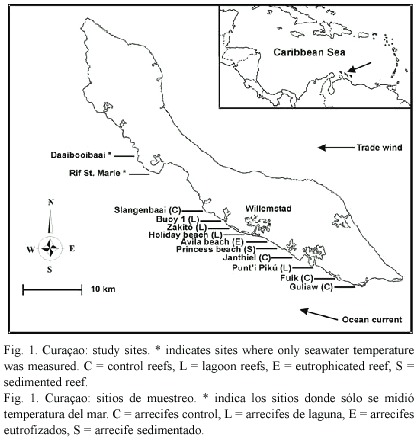
<body><![CDATA[<p><font face="Arial" size="2">Bleaching often causes considerable lesions in the coral tissue. This means that during bleaching, corals are confronted with a lower energy budget (due to loss of zooxanthellae) and a higher surface area of tissue (i.e. on top of lesions due to other causes) to be regenerated. This may inhibit colony regeneration and survival, because a large lesion perimeter length is related to a slower regeneration, and large lesions are colonised more often by algae, and do not regenerate completely (<a href="#ma99">Mascarelli and Bunkley-Williams 1999</a>, <a href="#me97a">Meesters <i>et al. </i>1997a</a>).</font></p>     <p><font face="Arial" size="2">Anthropogenic stressors on top of natural disturbances can further lower the resistance, health and energy budgets of corals, especially when these impacts are chronic (<a  href="#ku05">Kuntz <i>et al. </i>2005</a>). I therefore hypothesise that during massive bleaching events, the degree of corals showing bleaching-related tissue mortality is higher in areas subject to chronic anthropogenic impacts than in relatively pristine areas. In the present study this hypothesis is tested on the island of Curaçao during the massive Caribbean bleaching event of 1995 (<a href="#ca97">CARICOMP 1997</a>). Coral reef sites influenced by anthropogenic stressors which are known to affect coral health were selected: sedimentation (<a href="#ba76">Bak and Elgershuizen 1976</a>, <a href="#ba78">Bak 1978</a>), eutrophication (<a  href="#pa85">Pastorok and Bilyard 1985</a>, <a href="#no03">Nordemar <i>et al. </i>2003</a>), and water effluents with an elevated temperature (<a href="#jo74">Jokiel and Coles 1974</a>, <a href="#me93">Meesters and Bak 1993</a>). </font></p> <font face="Arial" size="2"><b>     <p>Materials and methods </p> </b> <b></b></font>     <p><font face="Arial" size="2"><b>Study area: </b>Fringing coral reefs run along the entire sheltered south-western coast of Curaçao. From the shore, a submarine terrace gradually slopes to a ‘drop-off ’ at approximately 7 - 11 m depth. At the drop-ooff, the reef slopes off steeply, sometimes interrupted by a small terrace at 50 to 60 m (<a  href="#ba75">Bak 1975</a>). For a detailed description of the reef structure and distribution of corals on the reefs of Curaçao see <a href="#ba75">Bak (1975)</a>.</font></p>     <p><font face="Arial" size="2">Two directly impacted,four indirectly impacted, and four relatively pristine (control) reef sites were selected for the study (<a href="#f1">Fig. 1</a>). Two control sites were located up-current of all coastal developments on the island (Fuik, Guliaw) and were located in the Curaçao Underwater Park. These pristine reefs receive fresh oceanic waters, are not influenced by any coastal impacts (no development whatsoever from Fuik south-eastwards) and are very well-developed in terms of coral cover (<a href="#va02">van Duyl <i>et al. </i>2002</a>). A third control site was a very well-developed reef at Slangenbaai, situated down-ccurrent of an area of approx. 3.5 km in length without any coastal development. The fourth control site was a well-developed reef at Janthiel, situated in an area with very little up-current coastal development (<a href="#va02">van Duyl <i>et al. </i>2002</a>).</font></p>     <p style="text-align: center;"><font face="Arial" size="2">&nbsp;<a  name="f1"></a><img src="/img/fbpe/rbt/v54s3/3391i1.JPG" title="" alt=""  style="width: 420px; height: 440px;"></font></p>     
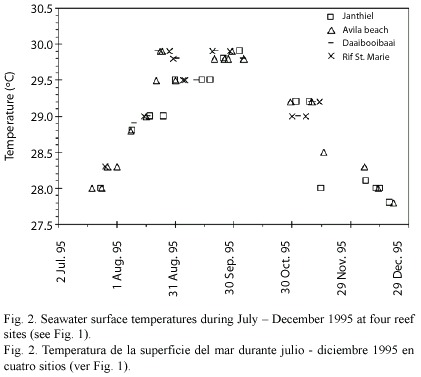
<p><font face="Arial" size="2">The four indirectly impacted sites consisted of reefs located near the mouths of large semi-enclosed bays. Punt’i Pikú is located at the mouth of Spanish Water Bay, which is a bay with a relatively high degree of coastal development consisting of residential development (lacking sewage control), marinas, fishing harbours and water-sport facilities, as a result of which some areas in the bay have elevated levels of phosphate, heavy metals and human faeces (<a href="#an87">Anonymous 1987</a>, <a href="#dj88">Djohani and Klok 1988</a>, <a href="#an91">Anonymous 1991</a>). Likely as a result of eutrophication caused by indirect or direct sewage pollution from residential development along the shoreline of the bay, the coral populations in the bay have declined significantly during the last three decades and have been heavily overgrown by algae (<a  href="#de98">Debrot <i>et al. </i>1998</a>).The bay water has an increased temperature, salinity and turbidity (<a href="#ku95">Kuenen and Debrot 1995</a>), which flows out onto the adjacent reef during outgoing tides, which can be visually seen as a thick brown, sediment-rich, warm water layer flowing out of the bay onto the reef, predominantly at the lower part of the water column (pers.obs.). Holiday beach is located near the mouth of the St. Anna Bay, which is a bay used entirely for industrial activities (harbour, container terminal, oil refinery, dry dock, etc.). The sediments are polluted by heavy metals, petroleum and other organic compounds (<a href="#de00">Debrot and Sybesma 2000</a>), while the water is highly polluted by sewage and industrial waste-water (<a href="#bu92">Buth and Ras 1992</a>). The polluted bay water flows out of the bay during low tides, and corals are largely absent at the first kilometre down-current of the mouth of the bay (<a href="#ga99">Gast <i>et al. </i>1999</a>). Zakitó is located at the mouth of a lagoon which harbours the local desalination plant, which releases its cooling water and salt-water effluents into the lagoon (<a href="#bu92">Buth and Ras 1992</a>). The surface seawater in front of the mouth of the lagoon has an elevated temperature (range 4.3 -7.9 ºC) and salinity (range 1.8 -2.0 ppt) compared to that of a control up-current reef site, whereas concentrations of copper in the sediment on the reef were four times higher than at the control site (<a href="#ho81">Hoppe 1981</a>). Buoy 1 is located near the mouth of Piscadera Bay, which is contaminated with sewage effluent overflow from the municipal sewage treatment plant at Klein Hofje (<a href="#bu92">Buth and Ras 1992</a>). <i>E. coli </i>measurements at the mouth of Piscaderabaai during 2004 ranged from 230 to beyond 2000 per cc (A. Debrot, pers. comm.). <a href="#dj88">Djohani and Klok (1988)</a> further showed elevated heavy metals contamination in sediments for two stations in the bay. A channel has been dredged in the mouth of the bay in 1972, as a result of which sediment and nutrient-rich water flows out onto the adjacent reef during outgoing tides (<a href="#ba78">Bak 1978</a>, pers. obs.).</font></p>     <p><font face="Arial" size="2">The two directly impacted sites consisted of a coral reef located just downstream of a 340 m long artificial sandy beach causing chronic sedimentation (Princess Beach) and a coral reef near a sewage outlet with chronic eutrophication (Avila beach). The artificial beach was constructed during 1987-1990 and is protected from the waves by breakwaters placed parallel to the coastline. Continuous beach erosion causes sediment to be deposited on the adjacent reefs, as a result of which the beach needs to be replenished with sand periodically as sand retention is poor (Debrot and Sybesma 2000). In 1991, long-term (1 yr) sedimentation at 5 m depth was significantly higher at the studied reef site (40 g m<sup>-2</sup> d<sup>-1</sup>) than at an up-current control reef (27 g m<sup>-2</sup> d-<sup>1</sup>) (<a href="#me92">Meesters <i>et al. </i>1992</a>). Next to Princess Beach (up-current) a second, 500 m long, artificial beach (Seaquarium Beach) is located, causing additional sedimentation. At Avila beach, the water is polluted by sewage being discharged into the sea by three pipes, at a rate of approx. 1000 m<sup>3</sup> raw sewage per day (<a href="#ga99">Gast <i>et al. </i>1999</a>). During 1994/1995, concentrations of PO<sub>4</sub><sup>3-</sup>, NH<sub>4</sub><sup>+</sup>, NO<sub>2</sub><sup>-</sup> and NO<sub>3</sub><sup>-</sup> were much higher here than at the control site Fuik Bay, and mainly originated from untreated sewage (<a href="#ga99">Gast <i>et al. </i>1999</a>, <a  href="#va02">van Duyl <i>et al. </i>2002</a>).</font></p>     <p><font face="Arial" size="2">Differences between sites in physical variables are expected to be smaller than for the anthropogenic stressors. The surface ocean currents run parallel to the coast line (see <a href="#f1">Fig. 1</a>), and differences in flushing of the study sites is therefore likely to be minimal. Difference in seawater temperature was negligible between sites (see <a href="#f2">Fig. 2</a>). Wave exposure did not differ much between the sites. Seven of the ten sites had a wave energy index of level 4 (average wave height 0.5 - 1.0 m; see <a href="#va85">van Duyl 1985</a>); Holiday beach and Guliaw had an index of level 3 (1.0 - 1.5 m), and Princess beach had an index of level 5 (0.3 - 0.5 m).</font></p> <a name="f2"></a>     <div style="text-align: center;"><img src="/img/fbpe/rbt/v54s3/3391i2.JPG" title=""  alt="" style="width: 421px; height: 377px;"></div>     
]]></body>
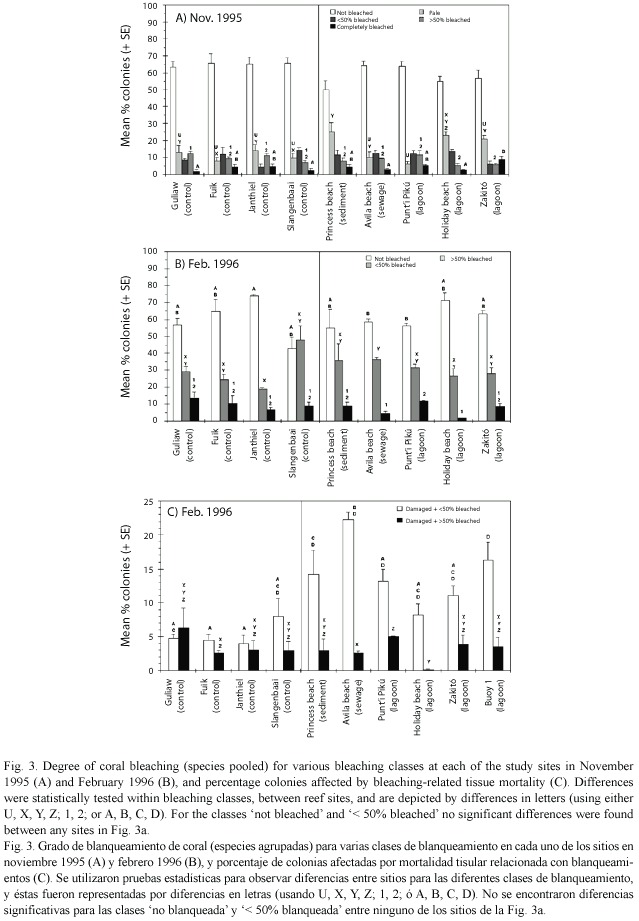
<body><![CDATA[<p><font face="Arial" size="2"><b>Sampling design: </b>At each reef site, three permanent transects of 2 x 15 m were established on the reef terrace between 6 and 8 m depth. The replicate transects were placed in areas with highest coral cover and were separated from each other by an average distance of 15 m. Eight common coral species were selected for the study, viz. <i>Colpophyllia natans </i>(Houttuyn, 1772), <i>Diploria strigosa </i>(Dana, 1848), <i>Meandrina meandrites </i>(Linnaeus, 1758), <i>Millepora complanata </i>(Linnaeus, 1758), <i>Montastrea annularis </i>(Ellis and Solander, 1786) (consisting for 77% of the columnar morph and 23% of the massive morph),<i>M. cavernosa </i>(Linnaeus, 1767), <i>Porites astreoides </i>(Lamarck, 1816) and <i>Siderastrea siderea </i>(Ellis and Solander, 1786). Of these species, all coral colonies &gt; 5 cm in diameter were counted within the transects. For each colony, bleaching status was determined following Gleason (1993): not bleached, pale (colonies slightly discoloured but not yet bleached white), and bleached (i.e. white) colonies further subdivided into three categories: 5 - 50% bleached (referred to as &lt; 50% bleached), 50 -95% bleached (referred to as &gt; 50% bleached), and completely bleached (100% bleached). Presence of lesions (&gt; 1 cm) on the coral surface was noted for each colony. Highest sea surface temperature at four reef sites occurred during September 1995 (<a href="#f2">Fig. 2</a>), with coral bleaching starting afterwards. The sampling took place during November 1995, at the onset of the massive coral bleaching event.</font></p>     <p><font face="Arial" size="2">The study was repeated in the permanent transects after three months (February 1996) at the peak of the bleaching event. The bleaching class ‘pale’ was no longer present (i.e., all pale corals had turned white and were thus classified as bleached colonies). Lagoon site ‘Buoy 1’ was included as an additional site (<a href="#f1">Fig. 1</a>) and had not been surveyed during November 1995. Bleaching-related tissue mortality was noted for each colony, and was classified as either &lt; 25% or &gt; 25% of the colony surface area affected. The latter was only observed for 38 of the 6 030 studied colonies and was therefore not analysed separately. The percent damaged colonies thus refers to the number of colonies with one or more lesions, expressed as the percentage of the total number of colonies studied. Bleaching-related tissue mortality was distinguished as lesions of various sizes, almost always located at the part of the colony with most bleached tissue. Lesions were always located within the bleached parts of the colony. Tissue mortality was mostly represented by tissue sloughing off the colony, with parts of the lesion already devoid of tissue and showing the clean white coral calices. On basis of the above, the lesions could be readily distinguished from parrotfish-associated lesions which have a sharp edge along the living tissue, are devoid of coral calices, show biting grooves, and are often &lt; 5% of the total surface area in size. Furthermore, lesions caused by non-bleaching associated processes are mostly &lt; 4 cm<sup>2 </sup>(lesion Type I, <a href="#me97b">Meesters <i>et al. </i>1997b</a>). Tissue mortality due to coral diseases is often identified by either a sharp line between dead and living tis- sue or a ‘disease’ band with a different colour than that of coral bleaching. The most common diseases in the coral species investigated at the time of study were yellow band, black band and dark-spot disease, all of which are differently coloured or shaped than bleached tissue (<a href="#go98">Goreau <i>et al. </i>1998</a>). Also, since these diseases progress relatively slow (<a href="#go98">Goreau <i>et al. </i>1998</a>, <a href="#ce01">Cervino <i>et al. </i>2001</a>), the dead coral calices close to the disease band are often overgrown by filamentous algae. White plague which proceeds much faster and also shows clean coral calices where the coral tissue has died was not yet apparent in 1995 (pers. obs.).</font></p> <font face="Arial" size="2"><b></b></font>     <p><font face="Arial" size="2"><b>Data analysis: </b>For the pooled data (see <a href="#f3">Fig. 3</a>), mean percent of colonies affected was calculated as follows. First the percent colonies affected was calculated separately for the various classes of bleaching, within each transect, for each species. Then the average percentage of colonies affected (per bleaching class) was calculated per transect based on the values of the eight species. This was done to avoid that the pooled averages per transects were influenced by the abundance of coral colonies within a transect. Afterwards, the averages (pooled for species) of the three replicate transects were used to calculate an average and standard error for each reef site, in this way depicting the variability between transects within sites.    <br> </font></p>     <p style="text-align: center;"><font face="Arial" size="2"><a name="f3"></a><img  src="/img/fbpe/rbt/v54s3/3391i3.JPG" title="" alt=""  style="width: 639px; height: 921px;">    
<br> </font></p>     <p><font face="Arial" size="2">Reef sites were statistically compared using a one-way ANOVA followed by a Tukey HSD (for homogeneous variances), or a Kruskal-Wallis test followed by a Games-Howell (for non-homogeneous variances) post-hoc test (<a href="#fi02">Field 2002</a>). A nested design was not used because although the six (in)directly impacted sites were all affected, they were affected differently and thus did not represent the same type of replicate. For example, Princess beach and Avila beach were both highly affected by anthropogenic influences, but a reef suffering from sedimentation cannot serve as a replicate for a reef being affected by sewage pollution. The results showed that the impacted sites had a higher percentage of damaged colonies than the control sites. To account for the effect of non-bleaching related lesions in determining this difference, the percentage of all damaged colonies in November (i. e., non-bleaching related), when the onset of bleaching had not yet resulted in partial tissue mortality, was compared between affected and control sites using a Student’s <i>t</i>- test. This was also done for the data of February. Significant differences were accepted at&nbsp;</font><b><font face="Arial" size="2"  color="#ff0000"><img src="/img/fbpe/rbt/v54s3/ALFA_P%D1A.JPG" title="" alt=""  style="width: 12px; height: 11px;"></font></b><font face="Arial"  size="2"> =0.05.</font></p>     
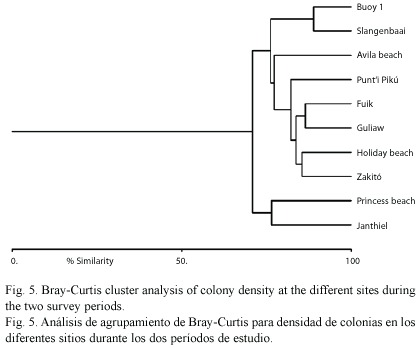
<p><font face="Arial" size="2">Cluster analysis (Bray-Curtis similarity) was done on colony density of the eight different coral species at the different sites (mean density of the two survey periods). </font></p> <font face="Arial" size="2"><b>     <p>Results </p> </b> </font>     <p><font face="Arial" size="2">In November 1995, no significant difference (one-way ANOVA, p&gt;0.132) was found between the various reef sites for the percent colonies ‘not bleached’ (<a href="#f3">Fig. 3a</a>). This was also the case at species level (one-way ANOVA, p&gt;0.292, data not shown), except for <i>D. strigosa </i>which showed a lower value at Princess beach than at Avila beach, Fuik, Guliaw, Holiday beach, Punt’iPikú and Slangenbaai (Tukey HSD post-hoc test, p&lt;0.047), and for <i>M. cavernosa </i>which showed a lower value at Holiday beach than at Janthiel, Fuik and Slangenbaai (p&lt;0.043).</font></p> <font face="Arial" size="2">There were some small differences between reef sites for the pale colonies and the three bleaching categories, but without a consistent pattern for the impacted versus control reefs. The most obvious difference at the level of individual sites was the significantly highest percentage of pale colonies at the sedimented site (Princess beach), and the significantly highest percentage of completely bleached colonies at the lagoon site with outflow of hot seawater (Zakitó) (<a href="#f3">Fig. 3a</a>).</font>     ]]></body>
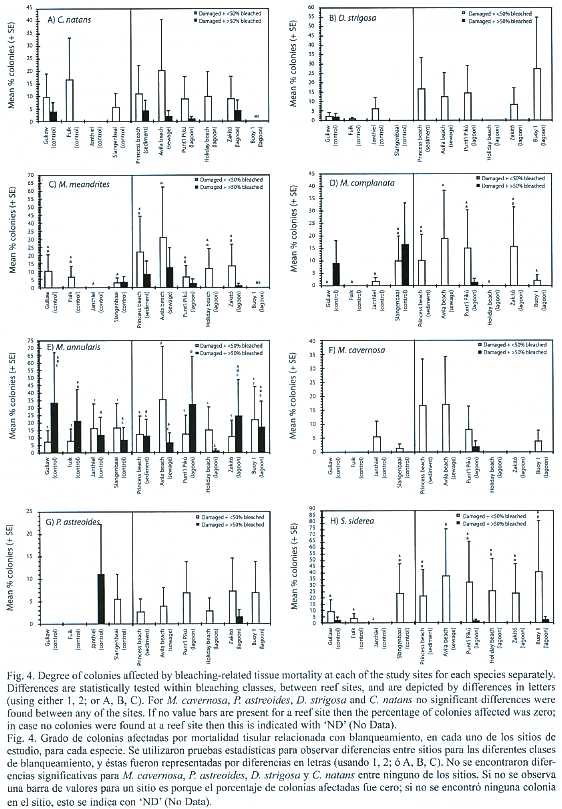
<body><![CDATA[<p><font face="Arial" size="2">Three months later, the percentage of colonies not bleached was still similar between all reef sites, except for one lagoon site (Punt’I Pikú) and one eutrophicated site (Avila beach) showing a significantly lower percentage of colonies not bleached than one control site (Janthiel) (<a href="#f3">Fig. 3b</a>). Also at species level no difference was found between impacted and control sites for the percentage of colonies not bleached (Kruskal-Wallis test, p&gt;0.073, data not shown); the only differences found were lower values of not bleached corals at Zakitó than at Holiday beach for <i>M. cavernosa </i>(Games-Howell post-hoc test, p=0.019), and for <i>S. siderea </i>at Buoy 1 than at Avila beach and Guliaw (p&lt;0.017) and at Slangenbaai than Guliaw (p=0.047). For the two bleaching classes (&lt; 50% and &gt; 50%) no obvious trends in degree of bleaching could be detected between the reef sites (<a href="#f3">Fig. 3b</a>).</font></p>     <p><font face="Arial" size="2">The percentage of damaged colonies was much higher at the impacted sites than at the control sites, for corals with &lt; 50% surface area bleached (<a href="#f3">Fig. 3c</a>). A significantly higher percentage of colonies with lesions was found at the sedimented site (Princess beach), the eutrophicated site (Avila beach) and one lagoon site (Buoy 1) than at several of the control sites. For corals with &gt; 50% surface area bleached, no obvious trend could be discerned between the various reef sites (<a href="#f3">Fig. 3c</a>).</font></p>     <p><font face="Arial" size="2">The difference in bleaching-related tissue damage between impacted and control sites could not be attributed to other causes than bleaching. In November, when bleaching had not yet resulted in partial tissue mortality, the occurrence of ‘natural lesions’ was equal between impacted and control sites (mean % colonies with lesions ± SD: 0.6 ± 0.5 vs 0.7 ± 0.6, respectively, <i>t </i>-test, p=0.725), whereas in February when many colonies were bleached and suffered from partial mortality the percentage of corals with lesions was much higher at impacted than at control sites (24.44 ± 8.9 vs 11.7 ± 3.5, respectively, <i>t </i>-test, p=0.033).</font></p>     <p><font face="Arial" size="2">At species level, the percentage of damaged colonies with &lt; 50% surface area bleached was higher at the impacted sites than at most of the control sites for <i>D. strigosa </i>, <i>M. meandrites</i>, <i>M. complanata</i>, <i>M. cavernosa</i>, <i>P. astreoides </i>and <i>S. siderea </i>(<a href="#f4">Fig. 4</a>). Probably due to the low numbers of replicate transects (N = 3) and coral colonies per site, significant differences were only found between the eutrophicated site (Avila beach) and control sites, for several species (<i>M. meandrites</i>, <i>M. complanata</i>, <i>S. siderea </i>). For <i>M. annularis</i>, the percent of damaged colonies was similar between sites, except at the eutrophicated site (Avila beach) where it was significantly higher (<a href="#f4">Fig. 4e</a>). <i>C. natans </i>did not show a clear difference between the impacted and control sites (<a href="#f4">Fig. 4a</a>).</font></p> <a name="f4"></a>     <div style="text-align: center;"><img src="/img/fbpe/rbt/v54s3/3391i7.JPG" title=""  alt="" style="width: 562px; height: 809px;"></div>     
<p><font face="Arial" size="2">For the percentage of damaged colonies with &gt; 50% surface area bleached, no clear trend in percent colonies damaged was observed between the impacted and control sites (<a  href="#f4">Fig. 4</a>).</font></p>     <p><font face="Arial" size="2">The overall absence of a difference in bleaching or presence of a difference in bleaching-associated tissue mortality between impacted and control sites could not be attributed to differences in colony density of bleaching-resistant or mortality-susceptible species at the various sites, since cluster analysis showed a high similarity between coral community structure at impacted versus control sites (<a href="#F5">Fig. 5</a>). </font></p> <a name="F5"></a>     <div style="text-align: center;"><img src="/img/fbpe/rbt/v54s3/3391i4.JPG" title=""  alt="" style="width: 420px; height: 348px;"></div> <font face="Arial" size="2"><b>     
<p>Discussion </p> </b> <b></b></font>     <p><font face="Arial" size="2"><b>Spatial variation in bleaching: </b>The percentage of bleached coral colonies was similar at all reef sites along the sheltered coast of Curaçao, suggesting that various environmental variables (other than seawater temperature) and anthropogenic impacts may have had relatively little effect on the process of coral bleaching. Nevertheless, there were some minor indications of a positive relationship between coral bleaching and environmental impacts: the percentage of pale colonies and completely bleached colonies in November 1995 and the percentage of bleached colonies in February 1996 were all highest at an impacted site. However, because there was no consistent and clear pattern present, I conclude that in the present study no single relationship is present between various types of anthropogenic impacts and the degree of coral bleaching. This is supported by studies in the South Pacific showing that coral bleaching was not related to any of 15 environmental variables (including pollution, terrestrial mud and fleshy algae cover) except water temperature (<a href="#go96">Goreau and Hayes 1996</a>, <a  href="#go97">Goreau <i>et al. </i>1997</a>). <a href="#me93">Meesters and Bak (1993)</a> showed an effect of the elevated seawater temperature at Zakitó lagoon on the degree of bleaching. When considering this reef site alone, the latter observation is partly supported by the present study, since the degree of completely bleached colonies was highest at the Zakitó lagoon.</font></p> <font face="Arial" size="2"><b></b></font>     ]]></body>
<body><![CDATA[<p><font face="Arial" size="2"><b>Spatial variation in tissue mortality: </b>The current data suggest a positive relationship between bleaching-related tissue damage and some types of anthropogenic impacts. For pooled species, as well as at species level (for six out of eight coral species), the percent coral colonies with lesions resulting from coral bleaching was much higher at the impacted sites than at the control sites. This was visible for total number of colonies and for colonies with &lt; 50% of their surface area bleached (which applied to the greater majority of the colonies); no explanation can be provided why colonies with &gt; 50% of surface area bleached did not show such a pattern. The lack of a relationship between impacts and bleaching-related tissue mortality in <i>M. annularis </i>can possibly be explained by the fact that this species was the most sensitive to bleaching (<a href="#me93">Meesters and Bak 1993</a>; this study, 97% of all colonies), resulting in significant mortality also at control sites. Also bleaching-related tissue mortality has been reported to be highest in <i>M. annularis </i>compared to other coral species (<a  href="#wi90">Williams and Bunkley-Williams 1990</a>).</font></p>     <p><font face="Arial" size="2">Although bleaching-related mortality was higher at impacted reef sites, this did not apply to each individual site. In almost all cases the eutrophicated site Avila beach showed the (significantly) highest degree of damaged colonies, suggesting that direct pollution by sewage effluents negatively affects coral tissue integrity of bleached colonies. Chronic stress on corals at this eutrophicated site has probably caused a higher vulnerability of the colonies, either resulting in faster tissue mortality and/or a lower degree of tissue regeneration (<a href="#me93">Meesters and Bak 1993</a>, <a href="#ku95">Kuntz <i>et al. </i>2005</a>). This is supported by a study of <a href="#no03">Nordemar <i>et al. </i>(2003)</a>, which showed that nutrient enrichment at elevated water temperatures had a stronger negative effect on coral health than elevated temperature alone.</font></p>     <p><font face="Arial" size="2">The impacted reef sites other than Avila beach, in most cases also showed a higher degree of damaged colonies related to bleaching (although not as high as Avila beach) than the control sites, but no hierarchy could be detected between the various types of anthropogenic impacts. Apparently, eutrophication, sedimentation and elevated seawater temperature can all, depending on the reef area, have an effect on bleaching-related tissue damage in corals, either directly, or indirectly through outflow of nutrient/sediment-rich water of elevated temperature from lagoons.</font></p>     <p><font face="Arial" size="2">Colony size was not measured in this study, and this factor may be related to degree of bleaching (<a  href="#be04">Bena and van Woesik 2004</a>, <a href="#sh05">Shenkar <i>et al. </i>2005</a>). In 1996, <a href="#me01">Meesters <i>et al. </i>(2001)</a> compared the size-frequency distributions of 13 coral species (including 7 of the species studied here) between two polluted sites (including Avila beach) and two pristine sites (just up-current of Princess beach), but found no significant differences in colony size between the pristine and impacted areas. Although the size-distribution of all sites has not been compared, the study of <a href="#me01">Meesters <i>et al. </i>(2001)</a> suggests that there is no general pattern in smaller or larger colonies at the impacted sites, and differences in colony size could not have played the main role in the degree of bleaching and the related tissue mortality.</font></p>     <p><font face="Arial" size="2">In conclusion, degree of coral bleaching showed little relationship with various types of anthropogenic impacts on coral reefs, whereas bleaching-related tissue mortality was related to anthropogenic impacts, especially to eutrophication by sewage. </font></p> <font face="Arial" size="2"><b>     <p>Acknowledgments </p> </b> </font>     <p><font face="Arial" size="2">I thank G. A. M. T. Wiltjer, L. P. J. J. Pors and L. A. M. Aerts for logistic support in the field, and the latter two persons also for providing the seawater temperature data. I also thank A. O. Debrot for providing information on the pollution of Piscadera Bay. This is Centre for Wetland publication # 409. </font></p> <font face="Arial" size="2"><b>     <p>Resumen </p> </b> </font>     <p><font face="Arial" size="2">Los impactos antropogénicos crónicos pueden tener efectos negativos en la salud y en las cantidades de energía necesarias para la regeneración de lesiones en los corales. Mi hipótesis fue que durante los casos de blanqueamiento masivo, el grado en que los corales muestren mortalidades de tejido relacionadas con el blanqueamiento, será mayor en áreas sujetas a impactos antropogénicos crónicos que en áreas relativamente prístinas. Estimé los grados de blanqueamiento y mortalidad tisular en ocho especies de coral abundantes en Curaçao, durante el comienzo de un de blanqueamiento masivo en el Caribe en 1995 y tres meses después. El estudio se realizó en cuatro sitios control no contaminados, dos sitios contaminados (sedimentación, aguas residuales), y cuatro sitios en la boca de lagunas con aguas tibias, ricas en nutrientes y turbias. En general, no se encontró ningún patrónx de diferencias en el grado de blanqueamiento entre sitios. Sin embargo, el porcentaje de corales que mostraron mortalidad tisular relacionada con el blanqueamiento fue mayor en los sitios impactados que en los controles, tanto en el número total de corales como en corales con &lt;50% de su superficie blanquedada. Los valores más altos y más significativos de mortalidad tisular se encontraron en un arrecife que experimentaba contaminación crónica por aguas residuales crudas. La información sugiere que las condiciones desfavorables causadas por la influencia antropogénica, como el incremento en la sedimentación, eutrofización y la temperatura del agua, tienen un efecto negativo adicional en la supervivencia del tejido de las colonias de coral, durante el blanqueamiento.</font></p> <font face="Arial" size="2"><b></b></font>     <p><font face="Arial" size="2"><b>Palabras clave: </b>corales pétreos, blanqueamiento, mortalidad tisular, impactos antropogénicos, Caribe. </font></p> <font face="Arial" size="2"><b>     ]]></body>
<body><![CDATA[<p>References </p> </b> </font>     <!-- ref --><p><font face="Arial" size="2"><a name="an87"></a>Anonymous. 1987. Waterkwaliteitsonderzoek Spaanse Water. Environmental Service, Curaçao, Netherlands Antilles. 19 p.</font>&nbsp;&nbsp;&nbsp;&nbsp;&nbsp;&nbsp;&nbsp;&nbsp;[&#160;<a href="javascript:void(0);" onclick="javascript: window.open('/scielo.php?script=sci_nlinks&ref=1232288&pid=S0034-7744200600060000900001&lng=','','width=640,height=500,resizable=yes,scrollbars=1,menubar=yes,');">Links</a>&#160;]<!-- end-ref --><!-- ref --><p><font face="Arial" size="2"><a name="an91"></a>Anonymous. 1991. Improvement of the environment and infrastructure of Spanish Waters and Caracasbay. Grabowsky and Poort International Consulting Engineers, Curaçao, Netherlands Antilles. 6 p.</font>&nbsp;&nbsp;&nbsp;&nbsp;&nbsp;&nbsp;&nbsp;&nbsp;[&#160;<a href="javascript:void(0);" onclick="javascript: window.open('/scielo.php?script=sci_nlinks&ref=1232289&pid=S0034-7744200600060000900002&lng=','','width=640,height=500,resizable=yes,scrollbars=1,menubar=yes,');">Links</a>&#160;]<!-- end-ref --><!-- ref --><p><font face="Arial" size="2"><a name="ar00"></a>Aronson, R. B., W. F Precht, I. G. Macintyre &amp; T. J. Murdoch. 2000. Coral bleach-out in Belize. Nature 405: 36.</font>&nbsp;&nbsp;&nbsp;&nbsp;&nbsp;&nbsp;&nbsp;&nbsp;[&#160;<a href="javascript:void(0);" onclick="javascript: window.open('/scielo.php?script=sci_nlinks&ref=1232290&pid=S0034-7744200600060000900003&lng=','','width=640,height=500,resizable=yes,scrollbars=1,menubar=yes,');">Links</a>&#160;]<!-- end-ref --><!-- ref --><p><font face="Arial" size="2"><a name="ba02"></a>Baird, A. H. &amp; P. A. Marshall. 2002. Mortality, growth and reproduction in scleractinian corals following bleaching on the Great Barrier Reef. Mar. Ecol. Prog. Ser. 237: 133-141.</font>&nbsp;&nbsp;&nbsp;&nbsp;&nbsp;&nbsp;&nbsp;&nbsp;[&#160;<a href="javascript:void(0);" onclick="javascript: window.open('/scielo.php?script=sci_nlinks&ref=1232291&pid=S0034-7744200600060000900004&lng=','','width=640,height=500,resizable=yes,scrollbars=1,menubar=yes,');">Links</a>&#160;]<!-- end-ref --><!-- ref --><p><font face="Arial" size="2"><a name="ba75"></a>Bak, R. P. M. 1975. Ecological aspects of the distribution of reef corals in the Netherlands Antilles. Bijdr. Dierk. 45: 181-190.</font>&nbsp;&nbsp;&nbsp;&nbsp;&nbsp;&nbsp;&nbsp;&nbsp;[&#160;<a href="javascript:void(0);" onclick="javascript: window.open('/scielo.php?script=sci_nlinks&ref=1232292&pid=S0034-7744200600060000900005&lng=','','width=640,height=500,resizable=yes,scrollbars=1,menubar=yes,');">Links</a>&#160;]<!-- end-ref --><p><font face="Arial" size="2"><a name="ba78"></a>Bak, R. P. M. 1978. Lethal and sublethal effects of dredging on reef corals. Mar. Pollut. Bull. 9: 14-116.</font></p>     <!-- ref --><p><font face="Arial" size="2"><a name="ba83"></a>Bak, R. P. M. 1983. Neoplasia, regeneration and growth in the reef-building coral <i>Acropora palmata</i>. Mar. Biol. 77: 221-227.</font>&nbsp;&nbsp;&nbsp;&nbsp;&nbsp;&nbsp;&nbsp;&nbsp;[&#160;<a href="javascript:void(0);" onclick="javascript: window.open('/scielo.php?script=sci_nlinks&ref=1232294&pid=S0034-7744200600060000900007&lng=','','width=640,height=500,resizable=yes,scrollbars=1,menubar=yes,');">Links</a>&#160;]<!-- end-ref --><!-- ref --><p><font face="Arial" size="2"><a name="ba76"></a>Bak, R. P. M. &amp; H. B. W. Elgershuizen. 1976. Patterns of oil-sediment rejection in corals. Mar. Biol. 37: 105-113.</font>&nbsp;&nbsp;&nbsp;&nbsp;&nbsp;&nbsp;&nbsp;&nbsp;[&#160;<a href="javascript:void(0);" onclick="javascript: window.open('/scielo.php?script=sci_nlinks&ref=1232295&pid=S0034-7744200600060000900008&lng=','','width=640,height=500,resizable=yes,scrollbars=1,menubar=yes,');">Links</a>&#160;]<!-- end-ref --><p><font face="Arial" size="2"><a name="be04"></a>Bena, C. &amp; R. van Woesik 2004. The impact of two bleaching events on the survival of small coral colonies (Okinawa, Japan). Bull. Mar. Sci. 75: 115-1125.</font></p>     ]]></body>
<body><![CDATA[<!-- ref --><p><font face="Arial" size="2"><a name="br97"></a>Brown, B. E. 1997. Coral bleaching: causes and consequences. Coral Reefs 16: S129- S138.</font>&nbsp;&nbsp;&nbsp;&nbsp;&nbsp;&nbsp;&nbsp;&nbsp;[&#160;<a href="javascript:void(0);" onclick="javascript: window.open('/scielo.php?script=sci_nlinks&ref=1232297&pid=S0034-7744200600060000900010&lng=','','width=640,height=500,resizable=yes,scrollbars=1,menubar=yes,');">Links</a>&#160;]<!-- end-ref --><!-- ref --><p><font face="Arial" size="2"><a name="bu92"></a>Buth, L. &amp; J. Ras. 1992. Inventory of the land-based sources of marine pollution, Netherlands Antilles. RZZ (Council for Sea Research and Sea Activities), Curaçao, Netherlands Antilles. 22 p.</font>&nbsp;&nbsp;&nbsp;&nbsp;&nbsp;&nbsp;&nbsp;&nbsp;[&#160;<a href="javascript:void(0);" onclick="javascript: window.open('/scielo.php?script=sci_nlinks&ref=1232298&pid=S0034-7744200600060000900011&lng=','','width=640,height=500,resizable=yes,scrollbars=1,menubar=yes,');">Links</a>&#160;]<!-- end-ref --><p><font face="Arial" size="2"><a name="ca97"></a>CARICOMP. 1997. Studies on Caribbean coral bleaching, 1995-996. Proc. 8 th Int. Coral Reef Symp., Panama 1: 673-678.</font></p>     <p><font face="Arial" size="2"><a name="ce01"></a>Cervino, J., T. J. Goreau, I. Nagelkerken, G. W. Smith &amp; R. Hayes. 2001. Yellow band and dark spot syndromes in Caribbean corals: distribution, rate of spread, cytology, and effects on abundance and division rate of zooxanthellae. Hydrobiol. 460: 53-663.</font></p>     <!-- ref --><p><font face="Arial" size="2"><a name="de00"></a>Debrot, A. O. &amp; J. Sybesma. 2000. The Dutch Antilles, p. 595-614. In C. R. C. Sheppard (ed.). Seas at the Millennium: An Environmental Evaluation. Vol. I, Regional Chapters: Europe, the Americas and West Africa. Pergamon, Amsterdam, Holland.</font>&nbsp;&nbsp;&nbsp;&nbsp;&nbsp;&nbsp;&nbsp;&nbsp;[&#160;<a href="javascript:void(0);" onclick="javascript: window.open('/scielo.php?script=sci_nlinks&ref=1232301&pid=S0034-7744200600060000900014&lng=','','width=640,height=500,resizable=yes,scrollbars=1,menubar=yes,');">Links</a>&#160;]<!-- end-ref --><!-- ref --><p><font face="Arial" size="2"><a name="de98"></a>Debrot, A. O., M. M. C. E. Kuenen &amp; K. Dekker. 1998. Recent declines in the coral fauna of the Spaanse Water, Curaçao, Netherlands Antilles. Bull. Mar. Sci. 63: 571-580.</font>&nbsp;&nbsp;&nbsp;&nbsp;&nbsp;&nbsp;&nbsp;&nbsp;[&#160;<a href="javascript:void(0);" onclick="javascript: window.open('/scielo.php?script=sci_nlinks&ref=1232302&pid=S0034-7744200600060000900015&lng=','','width=640,height=500,resizable=yes,scrollbars=1,menubar=yes,');">Links</a>&#160;]<!-- end-ref --><!-- ref --><p><font face="Arial" size="2"><a name="dj88"></a>Djohani, R. H. &amp; C. Klok. 1988. Een onderzoek naar de waterkwaliteit van enkele baaien van Curaçao op basis van biologische en abiotische parameters. Carmabi Foundation, Curaçao, Netherlands Antilles. M. Sc. thesis, Univ. Amsterdam, Amsterdam. 59 p.</font>&nbsp;&nbsp;&nbsp;&nbsp;&nbsp;&nbsp;&nbsp;&nbsp;[&#160;<a href="javascript:void(0);" onclick="javascript: window.open('/scielo.php?script=sci_nlinks&ref=1232303&pid=S0034-7744200600060000900016&lng=','','width=640,height=500,resizable=yes,scrollbars=1,menubar=yes,');">Links</a>&#160;]<!-- end-ref --><!-- ref --><p><font face="Arial" size="2"><a name="fi02"></a>Field, A. 2002. Discovering Statistics Using SPPP for Windows. Sage Publ., London. 496 p.</font>&nbsp;&nbsp;&nbsp;&nbsp;&nbsp;&nbsp;&nbsp;&nbsp;[&#160;<a href="javascript:void(0);" onclick="javascript: window.open('/scielo.php?script=sci_nlinks&ref=1232304&pid=S0034-7744200600060000900017&lng=','','width=640,height=500,resizable=yes,scrollbars=1,menubar=yes,');">Links</a>&#160;]<!-- end-ref --><p><font face="Arial" size="2"><a name="fi01"></a>Fitt, W. K., B. E. Brown, M. E. Warner &amp; R. P. Dunne. 2001. Coral bleaching: interpretation of thermal tolerance limits and thermal thresholds in tropical corals. Coral Reefs 20: 51-665.</font></p>     <!-- ref --><p><font face="Arial" size="2"><a name="ga99"></a>Gast, G. J., P. J. Jonkers, F. van Duyl F &amp; R. P. M. Bak. 1999. Bacteria, flagellates and nutrients in island fringing coral reef waters: influence of the ocean, the reef and eutrophication. Bull. Mar. Sci. 65: 523-538.</font>&nbsp;&nbsp;&nbsp;&nbsp;&nbsp;&nbsp;&nbsp;&nbsp;[&#160;<a href="javascript:void(0);" onclick="javascript: window.open('/scielo.php?script=sci_nlinks&ref=1232306&pid=S0034-7744200600060000900019&lng=','','width=640,height=500,resizable=yes,scrollbars=1,menubar=yes,');">Links</a>&#160;]<!-- end-ref --><!-- ref --><p><font face="Arial" size="2"><a name="gle93"></a>Gleason, M. G. 1993. Effects of disturbance on coral communities: bleaching in Moorea, French Polynesia. Coral Reefs 12: 193-201.</font>&nbsp;&nbsp;&nbsp;&nbsp;&nbsp;&nbsp;&nbsp;&nbsp;[&#160;<a href="javascript:void(0);" onclick="javascript: window.open('/scielo.php?script=sci_nlinks&ref=1232307&pid=S0034-7744200600060000900020&lng=','','width=640,height=500,resizable=yes,scrollbars=1,menubar=yes,');">Links</a>&#160;]<!-- end-ref --><!-- ref --><p><font face="Arial" size="2"><a name="gl84"></a>Glynn, P. W 1984. Widespread coral mortality and the 1982-1983 El Niño warming event. Environ. Conserv. 10: 149-154.</font>&nbsp;&nbsp;&nbsp;&nbsp;&nbsp;&nbsp;&nbsp;&nbsp;[&#160;<a href="javascript:void(0);" onclick="javascript: window.open('/scielo.php?script=sci_nlinks&ref=1232308&pid=S0034-7744200600060000900021&lng=','','width=640,height=500,resizable=yes,scrollbars=1,menubar=yes,');">Links</a>&#160;]<!-- end-ref --><!-- ref --><p><font face="Arial" size="2"><a name="gl93"></a>Glynn, P. W 1993. Coral reef bleaching: ecological perspectives. Coral Reefs 12: 1-17.</font>&nbsp;&nbsp;&nbsp;&nbsp;&nbsp;&nbsp;&nbsp;&nbsp;[&#160;<a href="javascript:void(0);" onclick="javascript: window.open('/scielo.php?script=sci_nlinks&ref=1232309&pid=S0034-7744200600060000900022&lng=','','width=640,height=500,resizable=yes,scrollbars=1,menubar=yes,');">Links</a>&#160;]<!-- end-ref --><!-- ref --><p><font face="Arial" size="2"><a name="go92"></a>Goreau, T. J. 1992. Bleaching and reef community change in Jamaica: 1951-1991. Amer. Zool. 32: 683-695.</font>&nbsp;&nbsp;&nbsp;&nbsp;&nbsp;&nbsp;&nbsp;&nbsp;[&#160;<a href="javascript:void(0);" onclick="javascript: window.open('/scielo.php?script=sci_nlinks&ref=1232310&pid=S0034-7744200600060000900023&lng=','','width=640,height=500,resizable=yes,scrollbars=1,menubar=yes,');">Links</a>&#160;]<!-- end-ref --><!-- ref --><p><font face="Arial" size="2"><a name="go94"></a>Goreau, T. J. &amp; R. L. Hayes. 1994. Coral bleaching and ocean "hot spots". Ambio 23: 176-180.</font>&nbsp;&nbsp;&nbsp;&nbsp;&nbsp;&nbsp;&nbsp;&nbsp;[&#160;<a href="javascript:void(0);" onclick="javascript: window.open('/scielo.php?script=sci_nlinks&ref=1232311&pid=S0034-7744200600060000900024&lng=','','width=640,height=500,resizable=yes,scrollbars=1,menubar=yes,');">Links</a>&#160;]<!-- end-ref --><!-- ref --><p><font face="Arial" size="2"><a name="go96"></a>Goreau, T. J. &amp; R. L. Hayes. 1996. A survey of coral reef bleaching in the South Central Pacific during 1994: Report to the International Coral Reef Initiative. Global Coral Reef Alliance, Chappaqua, New York, New York, USA. 201 p.</font>&nbsp;&nbsp;&nbsp;&nbsp;&nbsp;&nbsp;&nbsp;&nbsp;[&#160;<a href="javascript:void(0);" onclick="javascript: window.open('/scielo.php?script=sci_nlinks&ref=1232312&pid=S0034-7744200600060000900025&lng=','','width=640,height=500,resizable=yes,scrollbars=1,menubar=yes,');">Links</a>&#160;]<!-- end-ref --><!-- ref --><p><font face="Arial" size="2"><a name="go90"></a>Goreau, T. J. &amp; A. H. Macfarlane. 1990. Reduced growth rate of <i>Montastrea annularis </i>following the 1987- 1988 coral bleaching event. Coral Reefs 8: 211-215.</font>&nbsp;&nbsp;&nbsp;&nbsp;&nbsp;&nbsp;&nbsp;&nbsp;[&#160;<a href="javascript:void(0);" onclick="javascript: window.open('/scielo.php?script=sci_nlinks&ref=1232313&pid=S0034-7744200600060000900026&lng=','','width=640,height=500,resizable=yes,scrollbars=1,menubar=yes,');">Links</a>&#160;]<!-- end-ref --><p><font face="Arial" size="2"><a name="go97"></a>Goreau, T. J., R.L. Hayes &amp; A. E. Strong. 1997. Tracking South Pacific coral reef bleaching by satellite and field observations. Proc. 8<sup>th</sup> Int Coral Reef Symp., Panama 2: 1491-11494.</font></p>     <!-- ref --><p><font face="Arial" size="2"><a name="go98"></a>Goreau, T. J., J. Cervino, M. Goreau, R. Hayes., M. Hayes, L. Richardson, G. Smith, K. DeMeyer, I. Nagelkerken, J. Garzon-Ferreira, D. Gil, E. C. Peters, G. Garrison, E. H. Williams, L. Bunkley-Williams, C. Quirolo, K. Patterson, J. W. Porter &amp; K. Porter. 1998. Rapid spread of diseases in Caribbean coral reefs. Rev. Biol. Trop. 46 (Suppl. 5): 157-171.</font>&nbsp;&nbsp;&nbsp;&nbsp;&nbsp;&nbsp;&nbsp;&nbsp;[&#160;<a href="javascript:void(0);" onclick="javascript: window.open('/scielo.php?script=sci_nlinks&ref=1232315&pid=S0034-7744200600060000900028&lng=','','width=640,height=500,resizable=yes,scrollbars=1,menubar=yes,');">Links</a>&#160;]<!-- end-ref --><!-- ref --><p><font face="Arial" size="2"><a name="go00"></a>Goreau, T. J., T. McClanahan, R. Hayes &amp; A. Strong. 2000. Conservation of coral reefs after the 1998 global bleaching event. Conserv. Biol. 14: 5-15.</font>&nbsp;&nbsp;&nbsp;&nbsp;&nbsp;&nbsp;&nbsp;&nbsp;[&#160;<a href="javascript:void(0);" onclick="javascript: window.open('/scielo.php?script=sci_nlinks&ref=1232316&pid=S0034-7744200600060000900029&lng=','','width=640,height=500,resizable=yes,scrollbars=1,menubar=yes,');">Links</a>&#160;]<!-- end-ref --><!-- ref --><p><font face="Arial" size="2"><a name="ha85"></a>Harriott, V. J. 1985. Mortality rates of scleractinian corals before and during a mass bleaching event. Mar. Ecol. Prog. Ser. 21: 81-888    &nbsp;&nbsp;&nbsp;&nbsp;&nbsp;&nbsp;&nbsp;&nbsp;[&#160;<a href="javascript:void(0);" onclick="javascript: window.open('/scielo.php?script=sci_nlinks&ref=1232317&pid=S0034-7744200600060000900030&lng=','','width=640,height=500,resizable=yes,scrollbars=1,menubar=yes,');">Links</a>&#160;]<!-- end-ref -->.</font></p>     <!-- ref --><p><font face="Arial" size="2"><a name="ha99"></a>Harvell, C. D., K. Kim, J. M. Burkholder, R. R. Colwell, P. R Epstein, D. J. Grimes, E. E. Hofmann, E. K. Lipp, A. D. M. E. Osterhaus, R. M. Overstreet, J. W. Porter, G. W. Smith &amp; G. R. Vasta. 1999. Emerging marine diseases – climate links and anthropogenic factors. Science 285: 150.</font>&nbsp;&nbsp;&nbsp;&nbsp;&nbsp;&nbsp;&nbsp;&nbsp;[&#160;<a href="javascript:void(0);" onclick="javascript: window.open('/scielo.php?script=sci_nlinks&ref=1232319&pid=S0034-7744200600060000900031&lng=','','width=640,height=500,resizable=yes,scrollbars=1,menubar=yes,');">Links</a>&#160;]<!-- end-ref --><!-- ref --><p><font face="Arial" size="2"><a name="ho81"></a>Hoppe, W. 1981. Invloed van vervuiling op het koraalrif van Curacao met speciale referentie naar de KAE en COT. M. Sc. thesis, Univ. Nijmegen, Nijmegen. 98 p.</font>&nbsp;&nbsp;&nbsp;&nbsp;&nbsp;&nbsp;&nbsp;&nbsp;[&#160;<a href="javascript:void(0);" onclick="javascript: window.open('/scielo.php?script=sci_nlinks&ref=1232320&pid=S0034-7744200600060000900032&lng=','','width=640,height=500,resizable=yes,scrollbars=1,menubar=yes,');">Links</a>&#160;]<!-- end-ref --><p><font face="Arial" size="2"><a name="hu94"></a>Hughes, T. P 1994. Catastrophes, phase-shifts, and large-scale degradation of a Caribbean coral-reef. Science 265: 1547-11551.</font></p>     <!-- ref --><p><font face="Arial" size="2"><a name="jo74"></a>Jokiel, P. L. &amp; S. L. Coles. 1974. Effects of heated effluent on hermatypic corals at Kahe Point, Oahu. Pac. Sci. 28: 1-18.</font>&nbsp;&nbsp;&nbsp;&nbsp;&nbsp;&nbsp;&nbsp;&nbsp;[&#160;<a href="javascript:void(0);" onclick="javascript: window.open('/scielo.php?script=sci_nlinks&ref=1232322&pid=S0034-7744200600060000900034&lng=','','width=640,height=500,resizable=yes,scrollbars=1,menubar=yes,');">Links</a>&#160;]<!-- end-ref --><!-- ref --><p><font face="Arial" size="2"><a name="ku95"></a>Kuenen, M. M. C. E. &amp; A. O. Debrot. 1995. A quantitative study of the seagrass and algal meadows of the Spaanse Water, Curaçao, The Netherlands Antilles. Aquat. Bot. 51: 291-310.</font>&nbsp;&nbsp;&nbsp;&nbsp;&nbsp;&nbsp;&nbsp;&nbsp;[&#160;<a href="javascript:void(0);" onclick="javascript: window.open('/scielo.php?script=sci_nlinks&ref=1232323&pid=S0034-7744200600060000900035&lng=','','width=640,height=500,resizable=yes,scrollbars=1,menubar=yes,');">Links</a>&#160;]<!-- end-ref --><!-- ref --><p><font face="Arial" size="2"><a name="ku05"></a>Kuntz, N. M., D. I. Kline, S. A. Sandin &amp; F. Rohwer. 2005. Pathologies and mortality rates caused by organic carbon and nutrient stressors in three Caribbean coral species. Mar. Ecol. Prog. Ser. 294: 173-180.</font>&nbsp;&nbsp;&nbsp;&nbsp;&nbsp;&nbsp;&nbsp;&nbsp;[&#160;<a href="javascript:void(0);" onclick="javascript: window.open('/scielo.php?script=sci_nlinks&ref=1232324&pid=S0034-7744200600060000900036&lng=','','width=640,height=500,resizable=yes,scrollbars=1,menubar=yes,');">Links</a>&#160;]<!-- end-ref --><!-- ref --><p><font face="Arial" size="2"><a name="ma99"></a>Mascarelli, P. E. &amp; L. Bunkley-Williams. 1999. An experimental field evaluation of healing in damaged, unbleached and artificially bleached star coral, <i>Montastrea annularis</i>. Bull. Mar. Sci. 65: 577-586.</font>&nbsp;&nbsp;&nbsp;&nbsp;&nbsp;&nbsp;&nbsp;&nbsp;[&#160;<a href="javascript:void(0);" onclick="javascript: window.open('/scielo.php?script=sci_nlinks&ref=1232325&pid=S0034-7744200600060000900037&lng=','','width=640,height=500,resizable=yes,scrollbars=1,menubar=yes,');">Links</a>&#160;]<!-- end-ref --><!-- ref --><p><font face="Arial" size="2"><a name="mc01"></a>McClanahan, T. R., N. A. Muthiga &amp; S. Mangi. 2001. Coral and algal changes after the 1998 coral bleaching: interaction with reef management and herbivores on Kenyan reefs. Coral Reefs 19: 380-391.</font>&nbsp;&nbsp;&nbsp;&nbsp;&nbsp;&nbsp;&nbsp;&nbsp;[&#160;<a href="javascript:void(0);" onclick="javascript: window.open('/scielo.php?script=sci_nlinks&ref=1232326&pid=S0034-7744200600060000900038&lng=','','width=640,height=500,resizable=yes,scrollbars=1,menubar=yes,');">Links</a>&#160;]<!-- end-ref --><!-- ref --><p><font face="Arial" size="2"><a name="me93"></a>Meesters, E. H. &amp; R. P. M. Bak. 1993. Effects of coral bleaching on tissue regeneration potential and colony survival. Mar. Ecol. Prog. Ser. 96: 189-198.</font>&nbsp;&nbsp;&nbsp;&nbsp;&nbsp;&nbsp;&nbsp;&nbsp;[&#160;<a href="javascript:void(0);" onclick="javascript: window.open('/scielo.php?script=sci_nlinks&ref=1232327&pid=S0034-7744200600060000900039&lng=','','width=640,height=500,resizable=yes,scrollbars=1,menubar=yes,');">Links</a>&#160;]<!-- end-ref --><!-- ref --><p><font face="Arial" size="2"><a name="me92"></a>Meesters, E. H., A. Bos &amp; G. J. Gast. 1992. Effects of sedimentation and lesion position on coral tissue regeneration. Proc. 7 th Int. Coral Reef Symp., Guam 2: 681-688.</font>&nbsp;&nbsp;&nbsp;&nbsp;&nbsp;&nbsp;&nbsp;&nbsp;[&#160;<a href="javascript:void(0);" onclick="javascript: window.open('/scielo.php?script=sci_nlinks&ref=1232328&pid=S0034-7744200600060000900040&lng=','','width=640,height=500,resizable=yes,scrollbars=1,menubar=yes,');">Links</a>&#160;]<!-- end-ref --><!-- ref --><p><font face="Arial" size="2"><a name="me94"></a>Meesters, E. H., M. Noorderloos &amp; R. P. M. Bak. 1994. Damage and regeneration: links to growth in the reef-building coral <i>Montastrea annularis</i>. Mar. Ecol. Prog. Ser. 112: 119-128.</font>&nbsp;&nbsp;&nbsp;&nbsp;&nbsp;&nbsp;&nbsp;&nbsp;[&#160;<a href="javascript:void(0);" onclick="javascript: window.open('/scielo.php?script=sci_nlinks&ref=1232329&pid=S0034-7744200600060000900041&lng=','','width=640,height=500,resizable=yes,scrollbars=1,menubar=yes,');">Links</a>&#160;]<!-- end-ref --><!-- ref --><p><font face="Arial" size="2"><a name="me97a"></a>Meesters, E. H., W. Pauchli &amp; R. P. M. Bak. 1997a. Predicting regeneration of physical damage on a reef-building coral by regeneration capacity and lesion shape. Mar. Ecol. Prog. Ser. 146: 91-99.</font>&nbsp;&nbsp;&nbsp;&nbsp;&nbsp;&nbsp;&nbsp;&nbsp;[&#160;<a href="javascript:void(0);" onclick="javascript: window.open('/scielo.php?script=sci_nlinks&ref=1232330&pid=S0034-7744200600060000900042&lng=','','width=640,height=500,resizable=yes,scrollbars=1,menubar=yes,');">Links</a>&#160;]<!-- end-ref --><!-- ref --><p><font face="Arial" size="2"><a name="me97b"></a>Meesters, E. H., I. Wesseling &amp; R. P. M. Bak. 1997b. Coral colony tissue damage in six species of reef-building corals: partial mortality in relation with depth and surface area. J. Sea Res. 37: 131-144.</font>&nbsp;&nbsp;&nbsp;&nbsp;&nbsp;&nbsp;&nbsp;&nbsp;[&#160;<a href="javascript:void(0);" onclick="javascript: window.open('/scielo.php?script=sci_nlinks&ref=1232331&pid=S0034-7744200600060000900043&lng=','','width=640,height=500,resizable=yes,scrollbars=1,menubar=yes,');">Links</a>&#160;]<!-- end-ref --><!-- ref --><p><font face="Arial" size="2"><a name="me01"></a>Meesters, E. H., M. Hilterman, E. Kardinaal, M. Keetman, M. de Vries &amp; R. P. M. Bak. 2001. Colony size-frequency distributions of scleractinians coral populations: spatial and interspecific variation. Mar. Ecol. Prog. Ser. 209: 73-54.</font>&nbsp;&nbsp;&nbsp;&nbsp;&nbsp;&nbsp;&nbsp;&nbsp;[&#160;<a href="javascript:void(0);" onclick="javascript: window.open('/scielo.php?script=sci_nlinks&ref=1232332&pid=S0034-7744200600060000900044&lng=','','width=640,height=500,resizable=yes,scrollbars=1,menubar=yes,');">Links</a>&#160;]<!-- end-ref --><!-- ref --><p><font face="Arial" size="2"><a name="no03"></a>Nordemar, I., M. Nyström &amp; R. Dizon. 2003. Effects of elevated seawater temperature and nitrate enrichment on the branching coral <i>Porites cylindrica </i>in the absence of particulate food. Mar. Biol. 142: 669-677.</font>&nbsp;&nbsp;&nbsp;&nbsp;&nbsp;&nbsp;&nbsp;&nbsp;[&#160;<a href="javascript:void(0);" onclick="javascript: window.open('/scielo.php?script=sci_nlinks&ref=1232333&pid=S0034-7744200600060000900045&lng=','','width=640,height=500,resizable=yes,scrollbars=1,menubar=yes,');">Links</a>&#160;]<!-- end-ref --><!-- ref --><p><font face="Arial" size="2"><a name="pa85"></a>Pastorok, R. A. &amp; G. R. Bilyard. 1985. Effects of sewage pollution on coral-reef communities. Mar. Ecol. Prog. Ser. 21: 175-189.</font>&nbsp;&nbsp;&nbsp;&nbsp;&nbsp;&nbsp;&nbsp;&nbsp;[&#160;<a href="javascript:void(0);" onclick="javascript: window.open('/scielo.php?script=sci_nlinks&ref=1232334&pid=S0034-7744200600060000900046&lng=','','width=640,height=500,resizable=yes,scrollbars=1,menubar=yes,');">Links</a>&#160;]<!-- end-ref --><!-- ref --><p><font face="Arial" size="2"><a name="qu99"></a>Quinn, N. J. &amp; B. L. Kojis. 1999. Subsurface seawater temperature variation and the recovery of corals from the 1993 coral bleaching event in waters off St. Thomas, US Virgin Islands. Bull. Mar. Sci. 65: 201-214.</font>&nbsp;&nbsp;&nbsp;&nbsp;&nbsp;&nbsp;&nbsp;&nbsp;[&#160;<a href="javascript:void(0);" onclick="javascript: window.open('/scielo.php?script=sci_nlinks&ref=1232335&pid=S0034-7744200600060000900047&lng=','','width=640,height=500,resizable=yes,scrollbars=1,menubar=yes,');">Links</a>&#160;]<!-- end-ref --><!-- ref --><p><font face="Arial" size="2"><a name="ri02"></a>Riegl, B. 2002. Effects of the 1996 and 1998 positive sea-surface temperature anomalies on corals, coral diseases and fish in the Arabian Gulf (Dubai, UAE). Mar. Biol. 140: 29-40.</font>&nbsp;&nbsp;&nbsp;&nbsp;&nbsp;&nbsp;&nbsp;&nbsp;[&#160;<a href="javascript:void(0);" onclick="javascript: window.open('/scielo.php?script=sci_nlinks&ref=1232336&pid=S0034-7744200600060000900048&lng=','','width=640,height=500,resizable=yes,scrollbars=1,menubar=yes,');">Links</a>&#160;]<!-- end-ref --><!-- ref --><p><font face="Arial" size="2"><a name="sh05"></a>Shenkar, N., M. Fine &amp; Y. Loya. 2005. Size matters: bleaching dynamics of the coral <i>Oculina patagonica</i>. Mar. Ecol. Prog. Ser. 294: 181-188.</font>&nbsp;&nbsp;&nbsp;&nbsp;&nbsp;&nbsp;&nbsp;&nbsp;[&#160;<a href="javascript:void(0);" onclick="javascript: window.open('/scielo.php?script=sci_nlinks&ref=1232337&pid=S0034-7744200600060000900049&lng=','','width=640,height=500,resizable=yes,scrollbars=1,menubar=yes,');">Links</a>&#160;]<!-- end-ref --><!-- ref --><p><font face="Arial" size="2"><a name="sh96"></a>Shulman, M. J. &amp; D. R. Robertson. 1996. Changes in the coral reefs of San Blas, Caribbean Panama: 1983 to 1990. Coral Reefs 15: 231-236.</font>&nbsp;&nbsp;&nbsp;&nbsp;&nbsp;&nbsp;&nbsp;&nbsp;[&#160;<a href="javascript:void(0);" onclick="javascript: window.open('/scielo.php?script=sci_nlinks&ref=1232338&pid=S0034-7744200600060000900050&lng=','','width=640,height=500,resizable=yes,scrollbars=1,menubar=yes,');">Links</a>&#160;]<!-- end-ref --><!-- ref --><p><font face="Arial" size="2"><a name="sp91"></a>Spencer Davies, P. 1991. Effect of daylight variations on the energy budgets of shallow-water corals. Mar. Biol. 108: 137-144.</font>&nbsp;&nbsp;&nbsp;&nbsp;&nbsp;&nbsp;&nbsp;&nbsp;[&#160;<a href="javascript:void(0);" onclick="javascript: window.open('/scielo.php?script=sci_nlinks&ref=1232339&pid=S0034-7744200600060000900051&lng=','','width=640,height=500,resizable=yes,scrollbars=1,menubar=yes,');">Links</a>&#160;]<!-- end-ref --><!-- ref --><p><font face="Arial" size="2"><a name="sz90"></a>Szmant, A. M. &amp; N. J. Gassman. 1990. The effects of prolonged bleaching on the tissue biomass and reproduction of the reef coral <i>Montastrea annularis</i>. Coral Reefs 8: 217-224. </font>&nbsp;&nbsp;&nbsp;&nbsp;&nbsp;&nbsp;&nbsp;&nbsp;[&#160;<a href="javascript:void(0);" onclick="javascript: window.open('/scielo.php?script=sci_nlinks&ref=1232340&pid=S0034-7744200600060000900052&lng=','','width=640,height=500,resizable=yes,scrollbars=1,menubar=yes,');">Links</a>&#160;]<!-- end-ref --><!-- ref --><p><font face="Arial" size="2"><a name="va94"></a>van Veghel, M. L. J. &amp; R. P. M. Bak. 1994. Reproductive characteristics of the polymorphic Caribbean reef building coral <i>Montastrea annularis</i>. III. Reproduction in damaged and regenerating colonies. Mar. Ecol. Prog. Ser. 109: 229-233.</font>&nbsp;&nbsp;&nbsp;&nbsp;&nbsp;&nbsp;&nbsp;&nbsp;[&#160;<a href="javascript:void(0);" onclick="javascript: window.open('/scielo.php?script=sci_nlinks&ref=1232341&pid=S0034-7744200600060000900053&lng=','','width=640,height=500,resizable=yes,scrollbars=1,menubar=yes,');">Links</a>&#160;]<!-- end-ref --><!-- ref --><p><font face="Arial" size="2"><a name="wi90"></a>Williams, E. H. &amp; L. Bunkley-Williams. 1990. The world-wide coral reef bleaching cycle and related sources of coral reef mortality. Atoll Res. Bull. 335: 1-71. </font>&nbsp;&nbsp;&nbsp;&nbsp;&nbsp;&nbsp;&nbsp;&nbsp;[&#160;<a href="javascript:void(0);" onclick="javascript: window.open('/scielo.php?script=sci_nlinks&ref=1232342&pid=S0034-7744200600060000900054&lng=','','width=640,height=500,resizable=yes,scrollbars=1,menubar=yes,');">Links</a>&#160;]<!-- end-ref --><!-- ref --><p><font face="Arial" size="2"><a name="va85"></a>van Duyl, F. C. 1985. Atlas of the living reefs of Curaçao and Bonaire (Netherlands Antilles). Uitgaven Natuurwetenschappelijke Studiekring Suriname en de Nederlandse Antillen No. 117, Utrecht. 37 p. </font>&nbsp;&nbsp;&nbsp;&nbsp;&nbsp;&nbsp;&nbsp;&nbsp;[&#160;<a href="javascript:void(0);" onclick="javascript: window.open('/scielo.php?script=sci_nlinks&ref=1232343&pid=S0034-7744200600060000900055&lng=','','width=640,height=500,resizable=yes,scrollbars=1,menubar=yes,');">Links</a>&#160;]<!-- end-ref --><!-- ref --><p><font face="Arial" size="2"><a name="va02"></a>van Duyl, F. C., G. J. Gast, W. Steinhoff, S. Kloff, M. J. W. Veldhuis &amp; R. P. M. Bak. 2002. Factors influencing the short-term variation in phytoplankton composition and biomass in coral reef waters. Coral Reefs 21:293-306. </font>&nbsp;&nbsp;&nbsp;&nbsp;&nbsp;&nbsp;&nbsp;&nbsp;[&#160;<a href="javascript:void(0);" onclick="javascript: window.open('/scielo.php?script=sci_nlinks&ref=1232344&pid=S0034-7744200600060000900056&lng=','','width=640,height=500,resizable=yes,scrollbars=1,menubar=yes,');">Links</a>&#160;]<!-- end-ref --> ]]></body><back>
<ref-list>
<ref id="B1">
<nlm-citation citation-type="book">
<person-group person-group-type="author">
<name>
</name>
<name>
</name>
</person-group>
<source><![CDATA[Waterkwaliteitsonderzoek Spaanse Water]]></source>
<year>1987</year>
<page-range>19</page-range><publisher-loc><![CDATA[Curaçao ]]></publisher-loc>
<publisher-name><![CDATA[Environmental Service]]></publisher-name>
</nlm-citation>
</ref>
<ref id="B2">
<nlm-citation citation-type="book">
<person-group person-group-type="author">
<name>
</name>
<name>
</name>
</person-group>
<source><![CDATA[Improvement of the environment and infrastructure of Spanish Waters and Caracasbay]]></source>
<year>1991</year>
<page-range>6</page-range><publisher-loc><![CDATA[Curaçao ]]></publisher-loc>
<publisher-name><![CDATA[Grabowsky and Poort International Consulting Engineers]]></publisher-name>
</nlm-citation>
</ref>
<ref id="B3">
<nlm-citation citation-type="journal">
<person-group person-group-type="author">
<name>
<surname><![CDATA[Aronson]]></surname>
<given-names><![CDATA[R. B]]></given-names>
</name>
<name>
<surname><![CDATA[Precht]]></surname>
<given-names><![CDATA[W. F]]></given-names>
</name>
<name>
<surname><![CDATA[Macintyre]]></surname>
<given-names><![CDATA[I. G]]></given-names>
</name>
<name>
<surname><![CDATA[Murdoch]]></surname>
<given-names><![CDATA[T. J]]></given-names>
</name>
</person-group>
<article-title xml:lang="en"><![CDATA[Coral bleach-out in Belize]]></article-title>
<source><![CDATA[Nature]]></source>
<year>2000</year>
<volume>405</volume>
<page-range>36</page-range></nlm-citation>
</ref>
<ref id="B4">
<nlm-citation citation-type="journal">
<person-group person-group-type="author">
<name>
<surname><![CDATA[Baird]]></surname>
<given-names><![CDATA[A. H]]></given-names>
</name>
<name>
<surname><![CDATA[Marshall]]></surname>
<given-names><![CDATA[P. A]]></given-names>
</name>
</person-group>
<article-title xml:lang="en"><![CDATA[Mortality, growth and reproduction in scleractinian corals following bleaching on the Great Barrier Reef]]></article-title>
<source><![CDATA[Mar. Ecol. Prog. Ser]]></source>
<year>2002</year>
<volume>237</volume>
<page-range>133-141</page-range></nlm-citation>
</ref>
<ref id="B5">
<nlm-citation citation-type="journal">
<person-group person-group-type="author">
<name>
<surname><![CDATA[Bak]]></surname>
<given-names><![CDATA[R. P. M]]></given-names>
</name>
</person-group>
<article-title xml:lang="en"><![CDATA[Ecological aspects of the distribution of reef corals in the Netherlands Antilles]]></article-title>
<source><![CDATA[Bijdr. Dierk]]></source>
<year>1975</year>
<volume>45</volume>
<page-range>181-190</page-range></nlm-citation>
</ref>
<ref id="B6">
<nlm-citation citation-type="journal">
<person-group person-group-type="author">
<name>
<surname><![CDATA[Bak]]></surname>
<given-names><![CDATA[R. P. M]]></given-names>
</name>
</person-group>
<article-title xml:lang="en"><![CDATA[Lethal and sublethal effects of dredging on reef corals]]></article-title>
<source><![CDATA[Mar. Pollut. Bull]]></source>
<year>1978</year>
<volume>9</volume>
<page-range>14-16</page-range></nlm-citation>
</ref>
<ref id="B7">
<nlm-citation citation-type="journal">
<person-group person-group-type="author">
<name>
<surname><![CDATA[Bak]]></surname>
<given-names><![CDATA[R. P. M]]></given-names>
</name>
</person-group>
<article-title xml:lang="en"><![CDATA[Neoplasia, regeneration and growth in the reef-building coral Acropora palmata]]></article-title>
<source><![CDATA[Mar. Biol]]></source>
<year>1983</year>
<volume>77</volume>
<page-range>221-227</page-range></nlm-citation>
</ref>
<ref id="B8">
<nlm-citation citation-type="journal">
<person-group person-group-type="author">
<name>
<surname><![CDATA[Bak]]></surname>
<given-names><![CDATA[R. P. M]]></given-names>
</name>
<name>
<surname><![CDATA[Elgershuizen]]></surname>
<given-names><![CDATA[H. B. W]]></given-names>
</name>
</person-group>
<article-title xml:lang="en"><![CDATA[Patterns of oil-sediment rejection in corals]]></article-title>
<source><![CDATA[Mar. Biol]]></source>
<year>1976</year>
<volume>37</volume>
<page-range>105-113</page-range></nlm-citation>
</ref>
<ref id="B9">
<nlm-citation citation-type="journal">
<person-group person-group-type="author">
<name>
<surname><![CDATA[Bena]]></surname>
<given-names><![CDATA[C]]></given-names>
</name>
<name>
<surname><![CDATA[van Woesik]]></surname>
<given-names><![CDATA[R]]></given-names>
</name>
</person-group>
<article-title xml:lang="en"><![CDATA[The impact of two bleaching events on the survival of small coral colonies (Okinawa, Japan)]]></article-title>
<source><![CDATA[Bull. Mar. Sci]]></source>
<year>2004</year>
<volume>75</volume>
<page-range>115-125</page-range></nlm-citation>
</ref>
<ref id="B10">
<nlm-citation citation-type="journal">
<person-group person-group-type="author">
<name>
<surname><![CDATA[Brown]]></surname>
<given-names><![CDATA[B. E]]></given-names>
</name>
</person-group>
<article-title xml:lang="en"><![CDATA[Coral bleaching: causes and consequences]]></article-title>
<source><![CDATA[Coral Reefs]]></source>
<year>1997</year>
<volume>16</volume>
<page-range>S129- S138</page-range></nlm-citation>
</ref>
<ref id="B11">
<nlm-citation citation-type="book">
<person-group person-group-type="author">
<name>
<surname><![CDATA[Buth]]></surname>
<given-names><![CDATA[L]]></given-names>
</name>
<name>
<surname><![CDATA[Ras]]></surname>
<given-names><![CDATA[J]]></given-names>
</name>
</person-group>
<source><![CDATA[Inventory of the land-based sources of marine pollution, Netherlands Antilles]]></source>
<year>1992</year>
<page-range>22</page-range><publisher-loc><![CDATA[Curaçao ]]></publisher-loc>
<publisher-name><![CDATA[RZZ (Council for Sea Research and Sea Activities)]]></publisher-name>
</nlm-citation>
</ref>
<ref id="B12">
<nlm-citation citation-type="journal">
<collab>CARICOMP</collab>
<article-title xml:lang="en"><![CDATA[Studies on Caribbean coral bleaching, 1995-1996]]></article-title>
<source><![CDATA[Proc. 8 th Int. Coral Reef Symp]]></source>
<year>1997</year>
<volume>1</volume>
<page-range>673-678</page-range></nlm-citation>
</ref>
<ref id="B13">
<nlm-citation citation-type="journal">
<person-group person-group-type="author">
<name>
<surname><![CDATA[Cervino]]></surname>
<given-names><![CDATA[J]]></given-names>
</name>
<name>
<surname><![CDATA[Goreau]]></surname>
<given-names><![CDATA[T. J]]></given-names>
</name>
<name>
<surname><![CDATA[Nagelkerken]]></surname>
<given-names><![CDATA[I]]></given-names>
</name>
<name>
<surname><![CDATA[Smith]]></surname>
<given-names><![CDATA[G. W]]></given-names>
</name>
<name>
<surname><![CDATA[Hayes]]></surname>
<given-names><![CDATA[R]]></given-names>
</name>
</person-group>
<article-title xml:lang="en"><![CDATA[Yellow band and dark spot syndromes in Caribbean corals: distribution, rate of spread, cytology, and effects on abundance and division rate of zooxanthellae]]></article-title>
<source><![CDATA[Hydrobiol]]></source>
<year>2001</year>
<volume>460</volume>
<page-range>53-63</page-range></nlm-citation>
</ref>
<ref id="B14">
<nlm-citation citation-type="">
<person-group person-group-type="author">
<name>
<surname><![CDATA[Debrot]]></surname>
<given-names><![CDATA[A. O]]></given-names>
</name>
<name>
<surname><![CDATA[Sybesma]]></surname>
<given-names><![CDATA[J]]></given-names>
</name>
</person-group>
<article-title xml:lang="en"><![CDATA[The Dutch Antilles]]></article-title>
<person-group person-group-type="editor">
<name>
<surname><![CDATA[Sheppard]]></surname>
<given-names><![CDATA[C. R. C]]></given-names>
</name>
</person-group>
<source><![CDATA[Seas at the Millennium: An Environmental Evaluation. Vol. I, Regional Chapters: Europe, the Americas and West Africa]]></source>
<year>2000</year>
<page-range>595-614</page-range><publisher-loc><![CDATA[Pergamon^eAmsterdam Amsterdam]]></publisher-loc>
</nlm-citation>
</ref>
<ref id="B15">
<nlm-citation citation-type="journal">
<person-group person-group-type="author">
<name>
<surname><![CDATA[Debrot]]></surname>
<given-names><![CDATA[A. O]]></given-names>
</name>
<name>
<surname><![CDATA[Kuenen]]></surname>
<given-names><![CDATA[M. M. C. E]]></given-names>
</name>
<name>
<surname><![CDATA[Dekker]]></surname>
<given-names><![CDATA[K]]></given-names>
</name>
</person-group>
<article-title xml:lang="en"><![CDATA[Recent declines in the coral fauna of the Spaanse Water, Curaçao, Netherlands Antilles]]></article-title>
<source><![CDATA[Bull. Mar. Sci]]></source>
<year>1998</year>
<volume>63</volume>
<page-range>571-580</page-range></nlm-citation>
</ref>
<ref id="B16">
<nlm-citation citation-type="book">
<person-group person-group-type="author">
<name>
<surname><![CDATA[Djohani]]></surname>
<given-names><![CDATA[R. H]]></given-names>
</name>
<name>
<surname><![CDATA[Klok]]></surname>
<given-names><![CDATA[C]]></given-names>
</name>
</person-group>
<source><![CDATA[Een onderzoek naar de waterkwaliteit van enkele baaien van Curaçao op basis van biologische en abiotische parameters]]></source>
<year>1988</year>
<page-range>59</page-range><publisher-loc><![CDATA[Curaçao ]]></publisher-loc>
<publisher-name><![CDATA[Carmabi FoundationNetherlands Antilles]]></publisher-name>
</nlm-citation>
</ref>
<ref id="B17">
<nlm-citation citation-type="book">
<person-group person-group-type="author">
<name>
<surname><![CDATA[Field]]></surname>
<given-names><![CDATA[A]]></given-names>
</name>
</person-group>
<source><![CDATA[Discovering Statistics Using SPPP for Windows]]></source>
<year>2002</year>
<page-range>496</page-range><publisher-name><![CDATA[Sage Publ]]></publisher-name>
</nlm-citation>
</ref>
<ref id="B18">
<nlm-citation citation-type="journal">
<person-group person-group-type="author">
<name>
<surname><![CDATA[Fitt]]></surname>
<given-names><![CDATA[W. K]]></given-names>
</name>
<name>
<surname><![CDATA[Brown]]></surname>
<given-names><![CDATA[B. E]]></given-names>
</name>
<name>
<surname><![CDATA[Warner]]></surname>
<given-names><![CDATA[M. E]]></given-names>
</name>
<name>
<surname><![CDATA[Dunne]]></surname>
<given-names><![CDATA[R. P]]></given-names>
</name>
</person-group>
<article-title xml:lang="en"><![CDATA[Coral bleaching: interpretation of thermal tolerance limits and thermal thresholds in tropical corals]]></article-title>
<source><![CDATA[Coral Reefs]]></source>
<year>2001</year>
<volume>20</volume>
<page-range>51-65</page-range></nlm-citation>
</ref>
<ref id="B19">
<nlm-citation citation-type="journal">
<person-group person-group-type="author">
<name>
<surname><![CDATA[Gast]]></surname>
<given-names><![CDATA[G. J]]></given-names>
</name>
<name>
<surname><![CDATA[Jonkers]]></surname>
<given-names><![CDATA[P. J]]></given-names>
</name>
<name>
<surname><![CDATA[van Duyl F]]></surname>
<given-names><![CDATA[F]]></given-names>
</name>
<name>
<surname><![CDATA[Bak]]></surname>
<given-names><![CDATA[R. P. M]]></given-names>
</name>
</person-group>
<article-title xml:lang="en"><![CDATA[Bacteria, flagellates and nutrients in island fringing coral reef waters: influence of the ocean, the reef and eutrophication]]></article-title>
<source><![CDATA[Bull. Mar. Sci]]></source>
<year>1999</year>
<volume>65</volume>
<page-range>523-538</page-range></nlm-citation>
</ref>
<ref id="B20">
<nlm-citation citation-type="journal">
<person-group person-group-type="author">
<name>
<surname><![CDATA[Gleason]]></surname>
<given-names><![CDATA[M. G]]></given-names>
</name>
</person-group>
<article-title xml:lang="en"><![CDATA[Effects of disturbance on coral communities: bleaching in Moorea, French Polynesia]]></article-title>
<source><![CDATA[Coral Reefs]]></source>
<year>1993</year>
<volume>12</volume>
<page-range>193-201</page-range></nlm-citation>
</ref>
<ref id="B21">
<nlm-citation citation-type="journal">
<person-group person-group-type="author">
<name>
<surname><![CDATA[Glynn]]></surname>
<given-names><![CDATA[P. W]]></given-names>
</name>
</person-group>
<article-title xml:lang="en"><![CDATA[Widespread coral mortality and the 1982-1983 El Niño warming event]]></article-title>
<source><![CDATA[Environ. Conserv]]></source>
<year>1984</year>
<volume>10</volume>
<page-range>149-154</page-range></nlm-citation>
</ref>
<ref id="B22">
<nlm-citation citation-type="journal">
<person-group person-group-type="author">
<name>
<surname><![CDATA[Glynn]]></surname>
<given-names><![CDATA[P. W]]></given-names>
</name>
</person-group>
<article-title xml:lang="en"><![CDATA[Coral reef bleaching: ecological perspectives]]></article-title>
<source><![CDATA[Coral Reefs]]></source>
<year>1993</year>
<volume>12</volume>
<page-range>1-17</page-range></nlm-citation>
</ref>
<ref id="B23">
<nlm-citation citation-type="journal">
<person-group person-group-type="author">
<name>
<surname><![CDATA[Goreau]]></surname>
<given-names><![CDATA[T.J]]></given-names>
</name>
</person-group>
<article-title xml:lang="en"><![CDATA[Bleaching and reef community change in Jamaica: 1951-1991]]></article-title>
<source><![CDATA[Amer. Zool]]></source>
<year>1992</year>
<volume>32</volume>
<page-range>683-695</page-range></nlm-citation>
</ref>
<ref id="B24">
<nlm-citation citation-type="journal">
<person-group person-group-type="author">
<name>
<surname><![CDATA[Goreau]]></surname>
<given-names><![CDATA[T. J]]></given-names>
</name>
<name>
<surname><![CDATA[Hayes]]></surname>
<given-names><![CDATA[R. L]]></given-names>
</name>
</person-group>
<article-title xml:lang="en"><![CDATA[Coral bleaching and ocean "hot spots"]]></article-title>
<source><![CDATA[Ambio]]></source>
<year>1994</year>
<volume>23</volume>
<page-range>176-180</page-range></nlm-citation>
</ref>
<ref id="B25">
<nlm-citation citation-type="book">
<person-group person-group-type="author">
<name>
<surname><![CDATA[Goreau]]></surname>
<given-names><![CDATA[T. J]]></given-names>
</name>
<name>
<surname><![CDATA[Hayes]]></surname>
<given-names><![CDATA[R. L]]></given-names>
</name>
</person-group>
<source><![CDATA[A survey of coral reef bleaching in the South Central Pacific during 1994: Report to the International Coral Reef Initiative]]></source>
<year>1996</year>
<page-range>201</page-range><publisher-loc><![CDATA[New York^eNew York New York]]></publisher-loc>
<publisher-name><![CDATA[Global Coral Reef Alliance]]></publisher-name>
</nlm-citation>
</ref>
<ref id="B26">
<nlm-citation citation-type="journal">
<person-group person-group-type="author">
<name>
<surname><![CDATA[Goreau]]></surname>
<given-names><![CDATA[T. J]]></given-names>
</name>
<name>
<surname><![CDATA[Macfarlane]]></surname>
<given-names><![CDATA[A. H]]></given-names>
</name>
</person-group>
<article-title xml:lang="en"><![CDATA[Reduced growth rate of Montastrea annularis following the 1987- 1988 coral bleaching event]]></article-title>
<source><![CDATA[Coral Reefs]]></source>
<year>1990</year>
<volume>8</volume>
<page-range>211-215</page-range></nlm-citation>
</ref>
<ref id="B27">
<nlm-citation citation-type="journal">
<person-group person-group-type="author">
<name>
<surname><![CDATA[Goreau]]></surname>
<given-names><![CDATA[T. J]]></given-names>
</name>
<name>
<surname><![CDATA[Hayes]]></surname>
<given-names><![CDATA[R.L]]></given-names>
</name>
<name>
<surname><![CDATA[Strong]]></surname>
<given-names><![CDATA[A. E]]></given-names>
</name>
</person-group>
<article-title xml:lang="en"><![CDATA[Tracking South Pacific coral reef bleaching by satellite and field observations]]></article-title>
<source><![CDATA[Proc. 8 th Int Coral Reef Symp]]></source>
<year>1997</year>
<volume>2</volume>
<page-range>1491-1494</page-range></nlm-citation>
</ref>
<ref id="B28">
<nlm-citation citation-type="journal">
<person-group person-group-type="author">
<name>
<surname><![CDATA[Goreau]]></surname>
<given-names><![CDATA[T. J]]></given-names>
</name>
<name>
<surname><![CDATA[Cervino]]></surname>
<given-names><![CDATA[J]]></given-names>
</name>
<name>
<surname><![CDATA[Goreau]]></surname>
<given-names><![CDATA[M]]></given-names>
</name>
<name>
<surname><![CDATA[Hayes]]></surname>
<given-names><![CDATA[R]]></given-names>
</name>
<name>
<surname><![CDATA[Hayes]]></surname>
<given-names><![CDATA[M]]></given-names>
</name>
<name>
<surname><![CDATA[Richardson]]></surname>
<given-names><![CDATA[L]]></given-names>
</name>
<name>
<surname><![CDATA[Smith]]></surname>
<given-names><![CDATA[G]]></given-names>
</name>
<name>
<surname><![CDATA[DeMeyer]]></surname>
<given-names><![CDATA[K]]></given-names>
</name>
<name>
<surname><![CDATA[Nagelkerken]]></surname>
<given-names><![CDATA[I]]></given-names>
</name>
<name>
<surname><![CDATA[Garzon-Ferreira]]></surname>
<given-names><![CDATA[J]]></given-names>
</name>
<name>
<surname><![CDATA[Gil]]></surname>
<given-names><![CDATA[D]]></given-names>
</name>
<name>
<surname><![CDATA[Peters]]></surname>
<given-names><![CDATA[E. C]]></given-names>
</name>
<name>
<surname><![CDATA[Garrison]]></surname>
<given-names><![CDATA[G]]></given-names>
</name>
<name>
<surname><![CDATA[Williams]]></surname>
<given-names><![CDATA[E. H]]></given-names>
</name>
<name>
<surname><![CDATA[Bunkley-Williams]]></surname>
<given-names><![CDATA[L]]></given-names>
</name>
<name>
<surname><![CDATA[Quirolo]]></surname>
<given-names><![CDATA[C]]></given-names>
</name>
<name>
<surname><![CDATA[Patterson]]></surname>
<given-names><![CDATA[K]]></given-names>
</name>
<name>
<surname><![CDATA[Porter]]></surname>
<given-names><![CDATA[J. W]]></given-names>
</name>
<name>
<surname><![CDATA[Porter]]></surname>
<given-names><![CDATA[K]]></given-names>
</name>
</person-group>
<article-title xml:lang="en"><![CDATA[Rapid spread of diseases in Caribbean coral reefs]]></article-title>
<source><![CDATA[Rev. Biol. Trop]]></source>
<year>1998</year>
<volume>46</volume>
<numero>^sSuppl. 5</numero>
<issue>^sSuppl. 5</issue>
<supplement>Suppl. 5</supplement>
<page-range>157-171</page-range></nlm-citation>
</ref>
<ref id="B29">
<nlm-citation citation-type="journal">
<person-group person-group-type="author">
<name>
<surname><![CDATA[Goreau]]></surname>
<given-names><![CDATA[T. J]]></given-names>
</name>
<name>
<surname><![CDATA[McClanahan]]></surname>
<given-names><![CDATA[T]]></given-names>
</name>
<name>
<surname><![CDATA[Hayes]]></surname>
<given-names><![CDATA[R]]></given-names>
</name>
<name>
<surname><![CDATA[Strong]]></surname>
<given-names><![CDATA[A]]></given-names>
</name>
</person-group>
<article-title xml:lang="en"><![CDATA[Conservation of coral reefs after the 1998 global bleaching event]]></article-title>
<source><![CDATA[Conserv. Biol]]></source>
<year>2000</year>
<volume>14</volume>
<page-range>5-15</page-range></nlm-citation>
</ref>
<ref id="B30">
<nlm-citation citation-type="journal">
<person-group person-group-type="author">
<name>
<surname><![CDATA[Harriott]]></surname>
<given-names><![CDATA[V. J]]></given-names>
</name>
</person-group>
<article-title xml:lang="en"><![CDATA[Mortality rates of scleractinian corals before and during a mass bleaching event]]></article-title>
<source><![CDATA[Mar. Ecol. Prog. Ser]]></source>
<year>1985</year>
<volume>21</volume>
<page-range>81-88</page-range></nlm-citation>
</ref>
<ref id="B31">
<nlm-citation citation-type="journal">
<person-group person-group-type="author">
<name>
<surname><![CDATA[Harvell]]></surname>
<given-names><![CDATA[C. D]]></given-names>
</name>
<name>
<surname><![CDATA[Kim]]></surname>
<given-names><![CDATA[K]]></given-names>
</name>
<name>
<surname><![CDATA[Burkholder]]></surname>
<given-names><![CDATA[J. M]]></given-names>
</name>
<name>
<surname><![CDATA[Colwell]]></surname>
<given-names><![CDATA[R. R]]></given-names>
</name>
<name>
<surname><![CDATA[Epstein]]></surname>
<given-names><![CDATA[P. R]]></given-names>
</name>
<name>
<surname><![CDATA[Grimes]]></surname>
<given-names><![CDATA[D. J]]></given-names>
</name>
<name>
<surname><![CDATA[Hofmann]]></surname>
<given-names><![CDATA[E. E]]></given-names>
</name>
<name>
<surname><![CDATA[Lipp]]></surname>
<given-names><![CDATA[E. K]]></given-names>
</name>
<name>
<surname><![CDATA[Osterhaus]]></surname>
<given-names><![CDATA[A. D. M. E]]></given-names>
</name>
<name>
<surname><![CDATA[Overstreet]]></surname>
<given-names><![CDATA[R. M]]></given-names>
</name>
<name>
<surname><![CDATA[Porter]]></surname>
<given-names><![CDATA[J. W]]></given-names>
</name>
<name>
<surname><![CDATA[Smith]]></surname>
<given-names><![CDATA[G. W]]></given-names>
</name>
<name>
<surname><![CDATA[Vasta]]></surname>
<given-names><![CDATA[G. R]]></given-names>
</name>
</person-group>
<article-title xml:lang="en"><![CDATA[Emerging marine diseases - climate links and anthropogenic factors]]></article-title>
<source><![CDATA[Science]]></source>
<year>1999</year>
<volume>285</volume>
<page-range>150</page-range></nlm-citation>
</ref>
<ref id="B32">
<nlm-citation citation-type="">
<person-group person-group-type="author">
<name>
<surname><![CDATA[Hoppe]]></surname>
<given-names><![CDATA[W]]></given-names>
</name>
</person-group>
<source><![CDATA[Invloed van vervuiling op het koraalrif van Curacao met speciale referentie naar de KAE en COT]]></source>
<year>1981</year>
<page-range>98</page-range></nlm-citation>
</ref>
<ref id="B33">
<nlm-citation citation-type="journal">
<person-group person-group-type="author">
<name>
<surname><![CDATA[Hughes]]></surname>
<given-names><![CDATA[T. P]]></given-names>
</name>
</person-group>
<article-title xml:lang="en"><![CDATA[Catastrophes, phase-shifts, and large-scale degradation of a Caribbean coral-reef]]></article-title>
<source><![CDATA[Science]]></source>
<year>1994</year>
<volume>265</volume>
<page-range>1547-1551</page-range></nlm-citation>
</ref>
<ref id="B34">
<nlm-citation citation-type="journal">
<person-group person-group-type="author">
<name>
<surname><![CDATA[Jokiel]]></surname>
<given-names><![CDATA[P. L]]></given-names>
</name>
<name>
<surname><![CDATA[Coles]]></surname>
<given-names><![CDATA[S. L]]></given-names>
</name>
</person-group>
<article-title xml:lang="en"><![CDATA[Effects of heated effluent on hermatypic corals at Kahe Point, Oahu]]></article-title>
<source><![CDATA[Pac. Sci]]></source>
<year>1974</year>
<volume>28</volume>
<page-range>1-18</page-range></nlm-citation>
</ref>
<ref id="B35">
<nlm-citation citation-type="journal">
<person-group person-group-type="author">
<name>
<surname><![CDATA[Kuenen]]></surname>
<given-names><![CDATA[M. M. C. E]]></given-names>
</name>
<name>
<surname><![CDATA[Debrot]]></surname>
<given-names><![CDATA[A. O]]></given-names>
</name>
</person-group>
<article-title xml:lang="en"><![CDATA[A quantitative study of the seagrass and algal meadows of the Spaanse Water, Curaçao, The Netherlands Antilles]]></article-title>
<source><![CDATA[Aquat. Bot]]></source>
<year>1995</year>
<volume>51</volume>
<page-range>291-310</page-range></nlm-citation>
</ref>
<ref id="B36">
<nlm-citation citation-type="journal">
<person-group person-group-type="author">
<name>
<surname><![CDATA[Kuntz]]></surname>
<given-names><![CDATA[N. M]]></given-names>
</name>
<name>
<surname><![CDATA[Kline]]></surname>
<given-names><![CDATA[D. I]]></given-names>
</name>
<name>
<surname><![CDATA[Sandin]]></surname>
<given-names><![CDATA[S. A]]></given-names>
</name>
<name>
<surname><![CDATA[Rohwer]]></surname>
<given-names><![CDATA[F]]></given-names>
</name>
</person-group>
<article-title xml:lang="en"><![CDATA[Pathologies and mortality rates caused by organic carbon and nutrient stressors in three Caribbean coral species]]></article-title>
<source><![CDATA[Mar. Ecol. Prog. Ser]]></source>
<year>2005</year>
<volume>294</volume>
<page-range>173-180</page-range></nlm-citation>
</ref>
<ref id="B37">
<nlm-citation citation-type="journal">
<person-group person-group-type="author">
<name>
<surname><![CDATA[Mascarelli]]></surname>
<given-names><![CDATA[P. E]]></given-names>
</name>
<name>
<surname><![CDATA[Bunkley-Williams]]></surname>
<given-names><![CDATA[L]]></given-names>
</name>
</person-group>
<article-title xml:lang="en"><![CDATA[An experimental field evaluation of healing in damaged, unbleached and artificially bleached star coral, Montastrea annularis]]></article-title>
<source><![CDATA[Bull. Mar. Sci]]></source>
<year>1999</year>
<volume>65</volume>
<page-range>577-586</page-range></nlm-citation>
</ref>
<ref id="B38">
<nlm-citation citation-type="journal">
<person-group person-group-type="author">
<name>
<surname><![CDATA[McClanahan]]></surname>
<given-names><![CDATA[T. R]]></given-names>
</name>
<name>
<surname><![CDATA[Muthiga]]></surname>
<given-names><![CDATA[N. A]]></given-names>
</name>
<name>
<surname><![CDATA[Mangi]]></surname>
<given-names><![CDATA[S]]></given-names>
</name>
</person-group>
<article-title xml:lang="en"><![CDATA[Coral and algal changes after the 1998 coral bleaching: interaction with reef management and herbivores on Kenyan reefs]]></article-title>
<source><![CDATA[Coral Reefs]]></source>
<year>2001</year>
<volume>19</volume>
<page-range>380-391</page-range></nlm-citation>
</ref>
<ref id="B39">
<nlm-citation citation-type="journal">
<person-group person-group-type="author">
<name>
<surname><![CDATA[Meesters]]></surname>
<given-names><![CDATA[E. H]]></given-names>
</name>
<name>
<surname><![CDATA[Bak]]></surname>
<given-names><![CDATA[R. P. M]]></given-names>
</name>
</person-group>
<article-title xml:lang="en"><![CDATA[Effects of coral bleaching on tissue regeneration potential and colony survival]]></article-title>
<source><![CDATA[Mar. Ecol. Prog. Ser]]></source>
<year>1993</year>
<volume>96</volume>
<page-range>189-198</page-range></nlm-citation>
</ref>
<ref id="B40">
<nlm-citation citation-type="journal">
<person-group person-group-type="author">
<name>
<surname><![CDATA[Meesters]]></surname>
<given-names><![CDATA[E. H]]></given-names>
</name>
<name>
<surname><![CDATA[Bos]]></surname>
<given-names><![CDATA[A]]></given-names>
</name>
<name>
<surname><![CDATA[Gast]]></surname>
<given-names><![CDATA[G. J]]></given-names>
</name>
</person-group>
<article-title xml:lang="en"><![CDATA[Effects of sedimentation and lesion position on coral tissue regeneration]]></article-title>
<source><![CDATA[Proc. 7 th Int. Coral Reef Symp., Guam]]></source>
<year>1992</year>
<volume>2</volume>
<page-range>681-688</page-range></nlm-citation>
</ref>
<ref id="B41">
<nlm-citation citation-type="journal">
<person-group person-group-type="author">
<name>
<surname><![CDATA[Meesters]]></surname>
<given-names><![CDATA[E. H]]></given-names>
</name>
<name>
<surname><![CDATA[Noorderloos]]></surname>
<given-names><![CDATA[M]]></given-names>
</name>
<name>
<surname><![CDATA[Bak]]></surname>
<given-names><![CDATA[R. P. M]]></given-names>
</name>
</person-group>
<article-title xml:lang="en"><![CDATA[Damage and regeneration: links to growth in the reef-building coral Montastrea annularis]]></article-title>
<source><![CDATA[Mar. Ecol. Prog. Ser]]></source>
<year>1994</year>
<volume>112</volume>
<page-range>119-128</page-range></nlm-citation>
</ref>
<ref id="B42">
<nlm-citation citation-type="journal">
<person-group person-group-type="author">
<name>
<surname><![CDATA[Meesters]]></surname>
<given-names><![CDATA[E. H]]></given-names>
</name>
<name>
<surname><![CDATA[Pauchli]]></surname>
<given-names><![CDATA[W]]></given-names>
</name>
<name>
<surname><![CDATA[Bak]]></surname>
<given-names><![CDATA[R. P. M]]></given-names>
</name>
</person-group>
<article-title xml:lang="en"><![CDATA[Predicting regeneration of physical damage on a reef-building coral by regeneration capacity and lesion shape]]></article-title>
<source><![CDATA[Mar. Ecol. Prog. Ser]]></source>
<year>1997</year>
<month>a</month>
<volume>146</volume>
<page-range>91-99</page-range></nlm-citation>
</ref>
<ref id="B43">
<nlm-citation citation-type="journal">
<person-group person-group-type="author">
<name>
<surname><![CDATA[Meesters]]></surname>
<given-names><![CDATA[E. H]]></given-names>
</name>
<name>
<surname><![CDATA[Wesseling]]></surname>
<given-names><![CDATA[I]]></given-names>
</name>
<name>
<surname><![CDATA[Bak]]></surname>
<given-names><![CDATA[R. P. M]]></given-names>
</name>
</person-group>
<article-title xml:lang="en"><![CDATA[Coral colony tissue damage in six species of reef-building corals: partial mortality in relation with depth and surface area]]></article-title>
<source><![CDATA[J. Sea Res]]></source>
<year>1997</year>
<month>b</month>
<volume>37</volume>
<page-range>131-144</page-range></nlm-citation>
</ref>
<ref id="B44">
<nlm-citation citation-type="journal">
<person-group person-group-type="author">
<name>
<surname><![CDATA[Meesters]]></surname>
<given-names><![CDATA[E. H]]></given-names>
</name>
<name>
<surname><![CDATA[Hilterman]]></surname>
<given-names><![CDATA[M]]></given-names>
</name>
<name>
<surname><![CDATA[Kardinaal]]></surname>
<given-names><![CDATA[E]]></given-names>
</name>
<name>
<surname><![CDATA[Keetman]]></surname>
<given-names><![CDATA[M]]></given-names>
</name>
<name>
<surname><![CDATA[de Vries]]></surname>
<given-names><![CDATA[M]]></given-names>
</name>
<name>
<surname><![CDATA[Bak]]></surname>
<given-names><![CDATA[R. P. M]]></given-names>
</name>
</person-group>
<article-title xml:lang="en"><![CDATA[Colony size-frequency distributions of scleractinians coral populations: spatial and interspecific variation]]></article-title>
<source><![CDATA[Mar. Ecol. Prog. Ser]]></source>
<year>2001</year>
<volume>209</volume>
<page-range>73-54</page-range></nlm-citation>
</ref>
<ref id="B45">
<nlm-citation citation-type="journal">
<person-group person-group-type="author">
<name>
<surname><![CDATA[Nordemar]]></surname>
<given-names><![CDATA[I]]></given-names>
</name>
<name>
<surname><![CDATA[Nyström]]></surname>
<given-names><![CDATA[M]]></given-names>
</name>
<name>
<surname><![CDATA[Dizon]]></surname>
<given-names><![CDATA[R]]></given-names>
</name>
</person-group>
<article-title xml:lang="en"><![CDATA[Effects of elevated seawater temperature and nitrate enrichment on the branching coral Porites cylindrica in the absence of particulate food]]></article-title>
<source><![CDATA[Mar. Biol]]></source>
<year>2003</year>
<volume>142</volume>
<page-range>669-677</page-range></nlm-citation>
</ref>
<ref id="B46">
<nlm-citation citation-type="journal">
<person-group person-group-type="author">
<name>
<surname><![CDATA[Pastorok]]></surname>
<given-names><![CDATA[R. A]]></given-names>
</name>
<name>
<surname><![CDATA[Bilyard]]></surname>
<given-names><![CDATA[G. R]]></given-names>
</name>
</person-group>
<article-title xml:lang="en"><![CDATA[Effects of sewage pollution on coral-reef communities]]></article-title>
<source><![CDATA[Mar. Ecol. Prog. Ser]]></source>
<year>1985</year>
<volume>21</volume>
<page-range>175-189</page-range></nlm-citation>
</ref>
<ref id="B47">
<nlm-citation citation-type="journal">
<person-group person-group-type="author">
<name>
<surname><![CDATA[Quinn]]></surname>
<given-names><![CDATA[N. J]]></given-names>
</name>
<name>
<surname><![CDATA[Kojis]]></surname>
<given-names><![CDATA[B. L]]></given-names>
</name>
</person-group>
<article-title xml:lang="en"><![CDATA[Subsurface seawater temperature variation and the recovery of corals from the 1993 coral bleaching event in waters off St. Thomas, US Virgin Islands]]></article-title>
<source><![CDATA[Bull. Mar. Sci]]></source>
<year>1999</year>
<volume>65</volume>
<page-range>201-214</page-range></nlm-citation>
</ref>
<ref id="B48">
<nlm-citation citation-type="journal">
<person-group person-group-type="author">
<name>
<surname><![CDATA[Riegl]]></surname>
<given-names><![CDATA[B]]></given-names>
</name>
</person-group>
<article-title xml:lang="en"><![CDATA[Effects of the 1996 and 1998 positive sea-surface temperature anomalies on corals, coral diseases and fish in the Arabian Gulf (Dubai, UAE)]]></article-title>
<source><![CDATA[Mar. Biol]]></source>
<year>2002</year>
<volume>140</volume>
<page-range>29-40</page-range></nlm-citation>
</ref>
<ref id="B49">
<nlm-citation citation-type="journal">
<person-group person-group-type="author">
<name>
<surname><![CDATA[Shenkar]]></surname>
<given-names><![CDATA[N]]></given-names>
</name>
<name>
<surname><![CDATA[Fine]]></surname>
<given-names><![CDATA[M]]></given-names>
</name>
<name>
<surname><![CDATA[Loya]]></surname>
<given-names><![CDATA[Y]]></given-names>
</name>
</person-group>
<article-title xml:lang="en"><![CDATA[Size matters: bleaching dynamics of the coral Oculina patagonica]]></article-title>
<source><![CDATA[Mar. Ecol. Prog. Ser]]></source>
<year>2005</year>
<volume>294</volume>
<page-range>181-188</page-range></nlm-citation>
</ref>
<ref id="B50">
<nlm-citation citation-type="journal">
<person-group person-group-type="author">
<name>
<surname><![CDATA[Shulman]]></surname>
<given-names><![CDATA[M. J]]></given-names>
</name>
<name>
<surname><![CDATA[Robertson]]></surname>
<given-names><![CDATA[D. R]]></given-names>
</name>
</person-group>
<article-title xml:lang="en"><![CDATA[Changes in the coral reefs of San Blas, Caribbean Panama: 1983 to 1990]]></article-title>
<source><![CDATA[Coral Reefs]]></source>
<year>1996</year>
<volume>15</volume>
<page-range>231-236</page-range></nlm-citation>
</ref>
<ref id="B51">
<nlm-citation citation-type="journal">
<person-group person-group-type="author">
<name>
<surname><![CDATA[Spencer Davies]]></surname>
<given-names><![CDATA[P]]></given-names>
</name>
</person-group>
<article-title xml:lang="en"><![CDATA[Effect of daylight variations on the energy budgets of shallow-water corals]]></article-title>
<source><![CDATA[Mar. Biol]]></source>
<year>1991</year>
<volume>108</volume>
<page-range>137-144</page-range></nlm-citation>
</ref>
<ref id="B52">
<nlm-citation citation-type="journal">
<person-group person-group-type="author">
<name>
<surname><![CDATA[Szmant]]></surname>
<given-names><![CDATA[A. M]]></given-names>
</name>
<name>
<surname><![CDATA[Gassman]]></surname>
<given-names><![CDATA[N. J]]></given-names>
</name>
</person-group>
<article-title xml:lang="en"><![CDATA[The effects of prolonged bleaching on the tissue biomass and reproduction of the reef coral Montastrea annularis]]></article-title>
<source><![CDATA[Coral Reefs]]></source>
<year>1990</year>
<volume>8</volume>
<page-range>217-224</page-range></nlm-citation>
</ref>
<ref id="B53">
<nlm-citation citation-type="">
<person-group person-group-type="author">
<name>
<surname><![CDATA[van Veghel]]></surname>
<given-names><![CDATA[M. L. J]]></given-names>
</name>
<name>
<surname><![CDATA[Bak]]></surname>
<given-names><![CDATA[R. P. M]]></given-names>
</name>
</person-group>
<source><![CDATA[]]></source>
<year>1994</year>
</nlm-citation>
</ref>
<ref id="B54">
<nlm-citation citation-type="journal">
<person-group person-group-type="author">
<name>
<surname><![CDATA[Williams]]></surname>
<given-names><![CDATA[E. H]]></given-names>
</name>
<name>
<surname><![CDATA[Bunkley-Williams]]></surname>
<given-names><![CDATA[L]]></given-names>
</name>
</person-group>
<article-title xml:lang="en"><![CDATA[The world-wide coral reef bleaching cycle and related sources of coral reef mortality]]></article-title>
<source><![CDATA[Atoll Res. Bull]]></source>
<year>1990</year>
<volume>335</volume>
<page-range>1-71</page-range></nlm-citation>
</ref>
<ref id="B55">
<nlm-citation citation-type="">
<person-group person-group-type="author">
<name>
<surname><![CDATA[van Duyl]]></surname>
<given-names><![CDATA[F. C]]></given-names>
</name>
</person-group>
<source><![CDATA[Atlas of the living reefs of Curaçao and Bonaire (Netherlands Antilles)]]></source>
<year>1985</year>
<page-range>37</page-range></nlm-citation>
</ref>
<ref id="B56">
<nlm-citation citation-type="journal">
<person-group person-group-type="author">
<name>
<surname><![CDATA[van Duyl]]></surname>
<given-names><![CDATA[F. C]]></given-names>
</name>
<name>
<surname><![CDATA[Gast]]></surname>
<given-names><![CDATA[G. J]]></given-names>
</name>
<name>
<surname><![CDATA[Steinhoff]]></surname>
<given-names><![CDATA[W]]></given-names>
</name>
<name>
<surname><![CDATA[Kloff]]></surname>
<given-names><![CDATA[S]]></given-names>
</name>
<name>
<surname><![CDATA[Veldhuis]]></surname>
<given-names><![CDATA[M. J. W]]></given-names>
</name>
<name>
<surname><![CDATA[Bak]]></surname>
<given-names><![CDATA[R. P. M]]></given-names>
</name>
</person-group>
<article-title xml:lang="en"><![CDATA[Factors influencing the short-term variation in phytoplankton composition and biomass in coral reef waters]]></article-title>
<source><![CDATA[Coral Reefs]]></source>
<year>2002</year>
<volume>21</volume>
<page-range>293-306</page-range></nlm-citation>
</ref>
</ref-list>
</back>
</article>