<?xml version="1.0" encoding="ISO-8859-1"?><article xmlns:mml="http://www.w3.org/1998/Math/MathML" xmlns:xlink="http://www.w3.org/1999/xlink" xmlns:xsi="http://www.w3.org/2001/XMLSchema-instance">
<front>
<journal-meta>
<journal-id>0034-7744</journal-id>
<journal-title><![CDATA[Revista de Biología Tropical]]></journal-title>
<abbrev-journal-title><![CDATA[Rev. biol. trop]]></abbrev-journal-title>
<issn>0034-7744</issn>
<publisher>
<publisher-name><![CDATA[Universidad de Costa Rica]]></publisher-name>
</publisher>
</journal-meta>
<article-meta>
<article-id>S0034-77442006000400021</article-id>
<title-group>
<article-title xml:lang="es"><![CDATA[Alimentación del pez insectívoro neotropical Creagrutus bolivari (Pisces: Characidae) según los métodos gráfico y de importancia relativa]]></article-title>
</title-group>
<contrib-group>
<contrib contrib-type="author">
<name>
<surname><![CDATA[Ortaz]]></surname>
<given-names><![CDATA[Mario]]></given-names>
</name>
<xref ref-type="aff" rid="A01"/>
</contrib>
<contrib contrib-type="author">
<name>
<surname><![CDATA[Borjas von Bach]]></surname>
<given-names><![CDATA[Pablo]]></given-names>
</name>
</contrib>
<contrib contrib-type="author">
<name>
<surname><![CDATA[Candia]]></surname>
<given-names><![CDATA[Rubén]]></given-names>
</name>
<xref ref-type="aff" rid="A02"/>
</contrib>
</contrib-group>
<aff id="A01">
<institution><![CDATA[,Univ. Central de Venezuela Instituto de Biología Experimental ]]></institution>
<addr-line><![CDATA[ ]]></addr-line>
</aff>
<aff id="A02">
<institution><![CDATA[,Univ. Central de Venezuela Instituto de Zoología Tropical ]]></institution>
<addr-line><![CDATA[ ]]></addr-line>
</aff>
<pub-date pub-type="pub">
<day>00</day>
<month>12</month>
<year>2006</year>
</pub-date>
<pub-date pub-type="epub">
<day>00</day>
<month>12</month>
<year>2006</year>
</pub-date>
<volume>54</volume>
<numero>4</numero>
<fpage>1227</fpage>
<lpage>1239</lpage>
<copyright-statement/>
<copyright-year/>
<self-uri xlink:href="http://www.scielo.sa.cr/scielo.php?script=sci_arttext&amp;pid=S0034-77442006000400021&amp;lng=en&amp;nrm=iso"></self-uri><self-uri xlink:href="http://www.scielo.sa.cr/scielo.php?script=sci_abstract&amp;pid=S0034-77442006000400021&amp;lng=en&amp;nrm=iso"></self-uri><self-uri xlink:href="http://www.scielo.sa.cr/scielo.php?script=sci_pdf&amp;pid=S0034-77442006000400021&amp;lng=en&amp;nrm=iso"></self-uri><abstract abstract-type="short" xml:lang="en"><p><![CDATA[The diet of the neotropical insectivorous fish Creagrutus bolivari (Pisces: Characidae) according to the "graphic" and "relative importance" methods. The diet of a neotropical fish species (Creagrutus bolivari) was studied using different methods: the Cortés 1997 graphic method and two relative importance indexes, one designed by George and Hadley in 1979 (% RIi) and another proposed by Cortés in 1997 (% IRIi). Only discrete prey (aquatic and terrestrial invertebrates) were used in the diet analysis. The occurrence (% A), number (% N) and weight (% G) frequencies were estimated for each food item. A total of 240 specimens (size range from 25.3 to 64.7 mm standard length) were analyzed. For values of % A > 50 %, % IRIi was higher than % RIi with an opposite trend (up to 130 times) for values of % A &lt; 50 %. % IRIi overestimated the relative importance of prey for high values of % A, while it underestimated the relative importance of prey for low values of % A, showing a nonlinear relationship to % A. The variables used in the Cortés graphic method are insufficient to evaluate predator feeding strategy (generalization versus specialization). Therefore, we suggest including other variables, such as population and individual trophic niche breadth and a suitable field sampling record. An extended sampling record is necessary to classify prey as rare or dominant according to Cortés’ classification. The indexes of relative importance and graphic method are complementary. Compound indexes that comprise mass, number, and occurrence provide a more accurate description of diet and allow comparative studies. The graphic analysis is easy to interpret and helps in the evaluation of prey importance and predator feeding strategy. Rev. Biol. Trop. 54 (4): 1227-1239. Epub 2006 Dec. 15]]></p></abstract>
<abstract abstract-type="short" xml:lang="es"><p><![CDATA[Se estudió la alimentación de un pez neotropical (Creagrutus bolivari) usando diferentes métodos: el método gráfico de Cortés (1997) y dos índices de importancia relativa (George y Hadley, 1979 (% RIi) y Cortés, 1997 (% IRIi)). Sólo las presas discretas (invertebrados acuáticos y terrestres) se emplearon en el análisis de dieta. Se estimó ara cada ítem, las frecuencias de aparición (% A), numérica (% N) y gravimétrica (% G). Se analizó un total de 240 ejemplares (intervalo de talla desde 25.3 hasta 64.7 mm de longitud estándar). Para valores de % A > 50 %, el % IRIi resultó mayor al obtenido para el % RIi, con una tendencia opuesta (hasta 130 veces) para valores de % A por debajo del 50 %. El % IRIi sobreestimó la importancia relativa de las presas para valores altos de % A, mientras que subestimó la importancia relativa de las presas para valores bajos de % A y mostró un comportamiento no lineal a medida que varió el % A. Las variables empleadas en el método gráfico de Cortés son insuficientes para evaluar la estrategia alimentaria del depredador (generalismo-especialismo). De este modo, se sugiere incluir otras variables como el ancho de nicho trófico poblacional e individual así como un adecuado registro de campo. Es necesario un amplio registro de campo para clasificar a las presas como escasa o dominante de acuerdo a la clasificación de Cortés. Los índices compuestos que incluyen las variables: masa, número y aparición proporcionan una descripción más precisa de la dieta y permiten realizar estudios comparativos. El análisis gráfico es fácil de interpretar y ayuda a evaluar aspectos como la importancia de la presa y la estrategia alimentaria del depredador]]></p></abstract>
<kwd-group>
<kwd lng="en"><![CDATA[diet analysis]]></kwd>
<kwd lng="en"><![CDATA[index of relative importance]]></kwd>
<kwd lng="en"><![CDATA[Neotropical fish]]></kwd>
<kwd lng="en"><![CDATA[Characidae]]></kwd>
<kwd lng="en"><![CDATA[Creagrutus]]></kwd>
<kwd lng="es"><![CDATA[análisis de dieta]]></kwd>
<kwd lng="es"><![CDATA[índice de importancia relativa]]></kwd>
<kwd lng="es"><![CDATA[peces neotropicales]]></kwd>
<kwd lng="es"><![CDATA[Characidae]]></kwd>
<kwd lng="es"><![CDATA[Creagrutus]]></kwd>
</kwd-group>
</article-meta>
</front><body><![CDATA[ <div style="text-align: center;"><span style="font-family: arial;"><span  style="font-weight: bold;">Alimentaci&oacute;n del pez insect&iacute;voro neotropical</span> <span style="font-style: italic;">Creagrutus bolivari</span> <span style="font-weight: bold;">(Pisces: Characidae) seg&uacute;n los m&eacute;todos gr&aacute;fico y de importancia relativa</span></span><!-- big --><br  style="font-family: arial; font-weight: bold;"> <!-- /big --></div> <small><br style="font-family: arial;"> <!-- big --><span style="font-family: arial;"><small>Mario Ortaz<sup>1,</sup> Pablo Borjas von Bach<sup>1</sup> &amp; Rub&eacute;n Candia</small><sup><small>2</small>    <br> <br style="font-family: arial;"> </sup></span><!-- /big --><span style="font-family: arial;">1 Instituto de Biolog&iacute;a Experimental, Univ. Central de Venezuela. <a  href="mailto:maortaz@hotmail.com">maortaz@hotmail.com</a>    <br> <br style="font-family: arial;"> </span><span style="font-family: arial;">2 Instituto de Zoolog&iacute;a Tropical, Univ. Central de Venezuela.</span><br  style="font-family: arial;"> <br style="font-family: arial;"> </small>     <div style="text-align: center;"><small><span  style="font-family: arial;">Recibido 22-X-2004. Corregido 01-XI-2005. Aceptado 22-VI-2006.</span></small><br style="font-family: arial;"> </div>     <p align="justify"> <small><br style="font-family: arial;"> </small></p>     <div style="text-align: left;"><small><span style="font-family: arial;"><span  style="font-weight: bold;">Abstract: The diet of the neotropical insectivorous fish</span><span  style="font-style: italic;"> Creagrutus bolivari</span> <span  style="font-weight: bold;">(Pisces: Characidae) according </span></span><span  style="font-family: arial;"><span style="font-weight: bold;">to the &#8220;graphic&#8221; and &#8220;relative importance&#8221; methods</span>. The diet of a neotropical fish species (<span style="font-style: italic;">Creagrutus bolivari</span>) </span><span style="font-family: arial;">was studied using different methods: the Cort&eacute;s 1997 graphic method and two relative importance indexes, one designed by George and Hadley in 1979 (% RI<sub>i</sub>) and another proposed by Cort&eacute;s in 1997 (% IRI<sub>i</sub>). Only discrete prey (aquatic and terrestrial invertebrates) were used in the diet analysis. The occurrence (% A), number (% N) and weight (% G) frequencies were estimated for each food item. A total of 240 specimens (size range from 25.3 to 64.7 mm standard length) were analyzed. For values of % A &gt; 50 %, % IRI<sub>i</sub> was higher than % RI<sub>i</sub> with an opposite trend (up to 130 times) for values of % A &lt; 50 %. % IRI<sub>i</sub> overestimated the relative importance of prey for high values of % A, while it underestimated the relative importance of prey for low values of % A, showing a nonlinear relationship to % A. The variables used in the Cort&eacute;s graphic method are insufficient to evaluate predator feeding strategy (generalization versus specialization). Therefore, we suggest including other variables, such as population and individual trophic niche breadth and a suitable field sampling record. An extended sampling record is necessary to classify prey as rare or dominant according to Cort&eacute;s&#8217; classification. The indexes of relative importance and graphic method are complementary. Compound indexes that comprise mass, number, and occurrence provide a more accurate description of diet and allow comparative studies. The graphic analysis is easy to interpret and helps in the evaluation of prey importance and predator feeding strategy. </span><span style="font-family: arial;">Rev. Biol. Trop. 54 (4): 1227-1239. Epub 2006 Dec. 15.</span></small><br  style="font-family: arial;"> <small></small><br style="font-family: arial;"> <small><span style="font-family: arial;"><span  style="font-weight: bold;">Key words</span>: diet analysis, index of relative importance, Neotropical fish, Characidae, <span style="font-style: italic;">Creagrutus</span>.</span></small><br  style="font-family: arial;"> <small></small><br style="font-family: arial;"> <small><span style="font-family: arial;">El an&aacute;lisis de dieta a trav&eacute;s de la evaluaci&oacute;n </span><span  style="font-family: arial;">del contenido estomacal ha sido una </span><span  style="font-family: arial;">pr&aacute;ctica frecuente en estudios de tramas tr&oacute;ficas </span><span style="font-family: arial;">y algunos investigadores consideran que el </span><span  style="font-family: arial;">an&aacute;lisis del contenido estomacal es la manera </span><span style="font-family: arial;">adecuada de evaluar aspectos de la ecolog&iacute;a </span><span style="font-family: arial;">alimentaria de las especies en condiciones </span><span style="font-family: arial;">naturales, lo cual es fundamental para el desarrollo </span><span  style="font-family: arial;">de estrategias para el manejo sostenido </span><span  style="font-family: arial;">de los ecosistemas acu&aacute;ticos (Amundsen <span style="font-style: italic;">et </span></span><span  style="font-family: arial;"><span style="font-style: italic;">al.</span> 1996, Segatti y Luciana 2003). En estudios </span><span  style="font-family: arial;">de ecolog&iacute;a alimentaria de peces, se estiman </span><span style="font-family: arial;">frecuentemente dos variables: la frecuencia de </span><span style="font-family: arial;">aparici&oacute;n y la abundancia relativa de las presas. </span><span  style="font-family: arial;">La frecuencia de aparici&oacute;n consiste en registrar </span><span style="font-family: arial;">el n&uacute;mero de est&oacute;magos que contienen un tipo </span><span  style="font-family: arial;">de presa, referido al n&uacute;mero total de est&oacute;magos </span><span style="font-family: arial;">con alimento (Hyslop 1980). La abundancia </span><span  style="font-family: arial;">relativa de la presa (volumen, masa o n&uacute;mero), </span><span style="font-family: arial;">se estima como su contribuci&oacute;n particular con </span><span  style="font-family: arial;">relaci&oacute;n a todos los tipos de presas consumidas </span><span style="font-family: arial;">de modo que se expresa como una proporci&oacute;n </span><span  style="font-family: arial;">usualmente en porcentaje (Hynes 1950, Frost </span><span style="font-family: arial;">1954, Bagenal 1978, Hyslop 1980, Amundsen </span><span style="font-family: arial;"><span  style="font-style: italic;">et al</span>. 1996). </span></small>    <br> <small><span style="font-family: arial;"></span></small>    <br>     <small><span style="font-family: arial;">La frecuencia de     aparici&oacute;n es la manera </span><span style="font-family: arial;">m&aacute;s     ]]></body>
<body><![CDATA[simple de registrar datos de     dieta y </span><span style="font-family: arial;">proporciona     informaci&oacute;n acerca del espectro alimentario de una     poblaci&oacute;n, sin embargo, </span><span style="font-family: arial;">no     proporciona indicios de la importancia relativa </span><span      style="font-family: arial;">de cada tipo de presa en la dieta de un </span><span      style="font-family: arial;">consumidor (Hyslop 1980, Cort&eacute;s     1997). La </span><span style="font-family: arial;">frecuencia     num&eacute;rica proporciona un estimado </span><span      style="font-family: arial;">cuantitativo de un tipo de presa y muestra     ]]></body>
<body><![CDATA[</span><span style="font-family: arial;">indicios de la intensidad de     alimentaci&oacute;n, sin </span><span style="font-family: arial;">embargo,     sobreestima la importancia relativa de </span><span      style="font-family: arial;">las presas peque&ntilde;as en aquellos     consumidores </span><span style="font-family: arial;">que depredan un     amplio intervalo de tama&ntilde;os de </span><span      style="font-family: arial;">presas. Adicionalmente, con esta variable     no se </span><span style="font-family: arial;">puede estimar la     importancia relativa de aquellas </span><span      style="font-family: arial;">presas que no aparecen como unidades     ]]></body>
<body><![CDATA[discretas </span><span style="font-family: arial;">como es el caso del     material vegetal y del detritus. </span><span      style="font-family: arial;">La frecuencia gravim&eacute;trica     proporciona un </span><span style="font-family: arial;">estimado del     valor nutricional de las presas y&nbsp; </span><span      style="font-family: arial;">si se relaciona, a distintas escalas     temporales, </span><span style="font-family: arial;">el peso del     alimento consumido con el peso del </span><span      style="font-family: arial;">pez, se pueden conocer los lapsos de     actividad </span><span style="font-family: arial;">alimentaria (Knight     ]]></body>
<body><![CDATA[y Margraf 1982, Kwak <span style="font-style: italic;">et al</span>. </span><span      style="font-family: arial;">1992). Sin embargo, el peso puede     sobreestimar </span><span style="font-family: arial;">la importancia     relativa de aquellas presas con </span><span      style="font-family: arial;">una gran proporci&oacute;n de&nbsp;     estructuras no digeribles </span><span style="font-family: arial;">(George     y Hadley 1979, Hyslop 1980).</span></small><br      style="font-family: arial;">     <small></small><br style="font-family: arial;">     <small><span style="font-family: arial;">Una descripci&oacute;n     ]]></body>
<body><![CDATA[adecuada de la     importancia&nbsp; </span><span style="font-family: arial;">de un tipo     de alimento en la dieta de </span><span style="font-family: arial;">una     especie debe incluir una medida de su </span><span      style="font-family: arial;">peso, cantidad y aparici&oacute;n. Debido     a que cada </span><span style="font-family: arial;">una de estas     variables proporciona diferentes </span><span      style="font-family: arial;">aproximaciones de la estrategia     alimentaria de </span><span style="font-family: arial;">un depredador,     se han desarrollado una serie </span><span style="font-family: arial;">de     ]]></body>
<body><![CDATA[&iacute;ndices que incorporan distintas variables </span><span      style="font-family: arial;">(Segatti y Luciana 2003). Uno de ellos es     el </span><span style="font-family: arial;">&Iacute;ndice de     Importancia Relativa (IRI) de Pinkas </span><span      style="font-family: arial;">et al. (1971). En este &iacute;ndice, la     frecuencia de&nbsp; </span><span style="font-family: arial;">aparici&oacute;n     (% A) de cada tipo de presa se multiplica </span><span      style="font-family: arial;">por la suma de las frecuencias     gravim&eacute;trica </span><span style="font-family: arial;">(% G) y     num&eacute;rica (% N). Debido a que este </span><span     ]]></body>
<body><![CDATA[ style="font-family: arial;">&iacute;ndice no se expresa en     t&eacute;rminos porcentuales, </span><span style="font-family: arial;">se     hace dif&iacute;cil la comparaci&oacute;n de los valores </span><span      style="font-family: arial;">de IRI estimados para distintos tipos de     presa. P</span><span style="font-family: arial;">ara evitar esto,     Cort&eacute;s (1997) lo expres&oacute; en </span><span      style="font-family: arial;">t&eacute;rmino porcentual (% IRI<sub>i</sub>),     de modo que cada </span><span style="font-family: arial;">valor     representa una frecuencia relativa.</span></small><br      style="font-family: arial;">     ]]></body>
<body><![CDATA[<small></small><br style="font-family: arial;">     <small><span style="font-family: arial;">George y Hadley (1979)     emplearon otro     </span><span style="font-family: arial;">&Iacute;ndice de Importancia     Relativa (RI) el cual est&aacute; </span><span      style="font-family: arial;">basado en un &Iacute;ndice de Importancia     Absoluta </span><span style="font-family: arial;">(AI). En este caso     AI se obtiene de la suma </span><span style="font-family: arial;">de     las frecuencias num&eacute;rica, de aparici&oacute;n y </span><span      style="font-family: arial;">gravim&eacute;trica de cada tipo de presa     ]]></body>
<body><![CDATA[y RI es la </span><span style="font-family: arial;">frecuencia     relativa porcentual.</span></small><br style="font-family: arial;">     <small></small><br style="font-family: arial;">     <small><span style="font-family: arial;">De lo anterior se observa que     la     diferencia </span><span style="font-family: arial;">entre % IRI<sub>i</sub>     y % RI<sub>i </sub>radica en la manera de </span><span      style="font-family: arial;">estimar IRI<sub>i</sub> y Ai<sub>i</sub>,     respectivamente. En el primer </span><span style="font-family: arial;">caso,     IRI<sub>i</sub> se obtiene al multiplicar el % A por la </span><span     ]]></body>
<body><![CDATA[ style="font-family: arial;">suma del % G y % N. En el segundo caso, Ai<sub>i</sub>     se </span><span style="font-family: arial;">obtiene al sumar % A, % G     y % N.</span></small><br style="font-family: arial;">     <small></small><br style="font-family: arial;">     <small><span style="font-family: arial;">La representaci&oacute;n     gr&aacute;fica de los datos de </span><span style="font-family: arial;">dieta     se ha usado como un m&eacute;todo alternativo </span><span      style="font-family: arial;">en estudios de ecolog&iacute;a     tr&oacute;fica debido a que </span><span style="font-family: arial;">resulta     f&aacute;cil de interpretar (Costello 1990, </span><span     ]]></body>
<body><![CDATA[ style="font-family: arial;">Cort&eacute;s 1997). Cort&eacute;s (1997),     propuso una </span><span style="font-family: arial;">modificaci&oacute;n     del m&eacute;todo de Costello (1990), </span><span      style="font-family: arial;">que incluye los datos de % A, % G y % N en     </span><span style="font-family: arial;">la misma representaci&oacute;n     gr&aacute;fica. Cada punto en </span><span style="font-family: arial;">la     gr&aacute;fica representa la aparici&oacute;n y abundancia </span><span      style="font-family: arial;">(en masa y n&uacute;mero) de cada tipo de     presa. Cada </span><span style="font-family: arial;">punto localizado     cerca del 100 % A, 100 % N </span><span style="font-family: arial;">y     ]]></body>
<body><![CDATA[100 % G, representa a una presa dominante. </span><span      style="font-family: arial;">Por el contrario, cada punto localizado     cerca </span><span style="font-family: arial;">del origen de los tres     ejes representa a una </span><span style="font-family: arial;">presa     rara. Las l&iacute;neas diagonales entre los ejes </span><span      style="font-family: arial;">de la gr&aacute;fica indicar&iacute;an la     importancia de la </span><span style="font-family: arial;">presa en la     dieta del consumidor (dominante vs </span><span      style="font-family: arial;">rara) y la estrategia alimentaria del     consumidor </span><span style="font-family: arial;">(generalista vs     ]]></body>
<body><![CDATA[especialista). Una nube de </span><span style="font-family: arial;">puntos     localizada cerca del 100 % A indicar&iacute;a </span><span      style="font-family: arial;">una dieta generalizada y una con bajos     valores </span><span style="font-family: arial;">de % A una dieta     especializada. Sin embargo, </span><span style="font-family: arial;">dependiendo     de la frecuencia de depredaci&oacute;n </span><span      style="font-family: arial;">sobre una escala temporal (diaria o     anual), y </span><span style="font-family: arial;">del ancho de nicho     tr&oacute;fico del consumidor, este </span><span      style="font-family: arial;">panorama puede ser diferente al planteado     ]]></body>
<body><![CDATA[por </span><span style="font-family: arial;">Cort&eacute;s (1997). Al     respecto, &iquest;una presa con un </span><span      style="font-family: arial;">bajo valor de % A, % N y % G pero que     aparece </span><span style="font-family: arial;">a lo largo de todo el     a&ntilde;o en la dieta de un&nbsp; </span><span      style="font-family: arial;">consumidor debe considerarse rara? Lo     anterior&nbsp; </span><span style="font-family: arial;">significa que     no necesariamente un alto valor </span><span      style="font-family: arial;">de % A es la &uacute;nica condici&oacute;n     de una dieta generalizada </span><span style="font-family: arial;">ya     ]]></body>
<body><![CDATA[que depender&iacute;a de otras variables&nbsp; </span><span      style="font-family: arial;">como elancho&nbsp; de nicho     tr&oacute;fico. Un ejemplo </span><span style="font-family: arial;">extremo     es el koala, el cual se alimenta s&oacute;lo&nbsp; </span><span      style="font-family: arial;">de hojas de ciertas especies de <span      style="font-style: italic;">Eucalyptus</span>, de </span><span      style="font-family: arial;">modo que su ancho de nicho tr&oacute;fico     es estrecho </span><span style="font-family: arial;">y, sin embargo,     el % A del tipo de alimento que </span><span      style="font-family: arial;">consume (hojas de <span     ]]></body>
<body><![CDATA[ style="font-style: italic;">Eucalyptus</span>) es alto.</span></small><br      style="font-family: arial;">     <small></small><br style="font-family: arial;">     <small><span style="font-family: arial;">El objetivo del presente     trabajo     consisti&oacute; </span><span style="font-family: arial;">en comparar     los &iacute;ndices de importancia relativa </span><span      style="font-family: arial;">de George y Hadley (1979) y Cort&eacute;s     (1997), </span><span style="font-family: arial;">con los datos de     dieta de <span style="font-style: italic;">C. bolivari</span> y&nbsp;     ]]></body>
<body><![CDATA[a dos </span><span style="font-family: arial;">resoluciones     taxon&oacute;micas (orden y familia). </span><span      style="font-family: arial;">Adicionalmente, se emple&oacute; el     m&eacute;todo gr&aacute;fico </span><span style="font-family: arial;">de     Cort&eacute;s (1997) y se discuti&oacute; su aplicabilidad&nbsp; </span><span      style="font-family: arial;">como estimador de la importancia de las     presas </span><span style="font-family: arial;">y de la estrategia     alimentaria de esta especie.</span></small><br      style="font-family: arial;">     <small></small><br style="font-family: arial;">     ]]></body>
<body><![CDATA[<small><small><!-- big --><span style="font-family: arial; font-weight: 700;">Materiales     y m&eacute;todos</span><!-- /big --></small></small></div>     <div style="text-align: left;"></div>     <p style="text-align: left;"><small><span style="font-family: arial;">Se analiz&oacute; la dieta de una especie de car&aacute;cido </span><span style="font-family: arial;">del g&eacute;nero <span style="font-style: italic;">Creagrutus (Creagrutus bolivari)</span>, el </span><span style="font-family: arial;">cual incluye a una variedad de especies de peces </span><span  style="font-family: arial;">de tama&ntilde;o adulto peque&ntilde;o&nbsp; que se distribuyen </span><span  style="font-family: arial;">desde Panam&aacute; hasta Paraguay y son especies t&iacute;picas </span><span style="font-family: arial;">de r&iacute;os de piedemonte, las cuales son omn&iacute;voras </span><span  style="font-family: arial;">con tendencia a la insectivor&iacute;a (G&eacute;ry 1977,&nbsp; </span><span style="font-family: arial;">Lowe-McConnell 1987, Taphorn 1992, Anthony </span><span style="font-family: arial;"><span  style="font-style: italic;">et al</span>. 1994, Harold y Vari 1994, Ortaz 2001).</span><br style="font-family: arial;"> <span style="font-family: arial;">    <br>     Los ejemplares analizados se colectaron en </span><span      style="font-family: arial;">el canal principal de un r&iacute;o de     monta&ntilde;a boscosa </span><span style="font-family: arial;">ubicado     en la regi&oacute;n centro norte de Venezuela&nbsp; </span><span      style="font-family: arial;">(10&ordm;14&#8217;25&#8217;&#8217; - 10&ordm;32&#8217;40&#8217;&#8217; N;     ]]></body>
<body><![CDATA[67&ordm;24&#8217;36&#8217;&#8217; - </span><span style="font-family: arial;">67&ordm;52&#8217;54&#8217;&#8217;     W), sujeta a la influencia de los </span><span      style="font-family: arial;">vientos alisios del noreste y de la     convergencia </span><span style="font-family: arial;">intertropical     (Huber 1986, PDVSA 1993). Los </span><span style="font-family: arial;">espec&iacute;menes     se colectaron con una frecuencia </span><span      style="font-family: arial;">mensual entre junio de 1992 y marzo de     1993 </span><span style="font-family: arial;">para un total de ocho     colectas que incluyeron </span><span style="font-family: arial;">meses     secos y lluviosos. Las muestras se mantuvieron </span><span     ]]></body>
<body><![CDATA[ style="font-family: arial;">adecuadamente preservadas hasta su </span><span      style="font-family: arial;">procesamiento por Borjas (2001). Se     escogi&oacute;&nbsp; </span><span style="font-family: arial;">a esta     especie para el an&aacute;lisis por tener una </span><span      style="font-family: arial;">dieta amplia, adem&aacute;s de disponer de     un n&uacute;mero </span><span style="font-family: arial;">significativo     de individuos analizados (n = 240 </span><span      style="font-family: arial;">individuos con tallas que variaron entre     25.3 y&nbsp; </span><span style="font-family: arial;">64.7 mm de     longitud est&aacute;ndar) que provinieron </span><span     ]]></body>
<body><![CDATA[ style="font-family: arial;">de un amplio registro de campo. Se     examin&oacute; el </span><span style="font-family: arial;">contenido     estomacal bajo lupa. Este an&aacute;lisis se </span><span      style="font-family: arial;">realiz&oacute; s&oacute;lo para las presas     discretas las cuales </span><span style="font-family: arial;">constituyeron     la fracci&oacute;n mayoritaria de la dieta </span><span      style="font-family: arial;">de esta especie (Ortaz 1992, Borjas 2001).</span><br      style="font-family: arial;">     <br style="font-family: arial;">     <span style="font-family: arial;">Las presas consumidas (insectos     ]]></body>
<body><![CDATA[acu&aacute;ticos </span><span style="font-family: arial;">e     invertebrados terrestres) se identificaron a </span><span      style="font-family: arial;">dos niveles de resoluci&oacute;n     taxon&oacute;mica (orden </span><span style="font-family: arial;">y     familia) (Usinger 1956, Merrit y Cummins </span><span      style="font-family: arial;">1984, Rold&aacute;n 1996). El peso (peso     h&uacute;medo) de </span><span style="font-family: arial;">cada tipo     de presa se estim&oacute; con una balanza de </span><span      style="font-family: arial;">0.1 &#956;g de precisi&oacute;n. Los resultados     del an&aacute;lisis </span><span style="font-family: arial;">de dieta     ]]></body>
<body><![CDATA[se informaron como frecuencias num&eacute;rica </span><span      style="font-family: arial;">(% N), gravim&eacute;trica (% G) y de     aparici&oacute;n </span><span style="font-family: arial;">(% A) para     cada tipo de presa. El % N se estim&oacute; </span><span      style="font-family: arial;">como la proporci&oacute;n porcentual entre     el n&uacute;mero </span><span style="font-family: arial;">de     individuos de un tipo de presa y el n&uacute;mero </span><span      style="font-family: arial;">total de individuos de todos los tipos de     presa. </span><span style="font-family: arial;">El % G se     estim&oacute; como la proporci&oacute;n porcentual </span><span     ]]></body>
<body><![CDATA[ style="font-family: arial;">entre el peso de un tipo de presa y el     peso </span><span style="font-family: arial;">de todas las presas. El     % A se estim&oacute; como la </span><span style="font-family: arial;">proporci&oacute;n     porcentual entre el n&uacute;mero de est&oacute;magos </span><span      style="font-family: arial;">en los que apareci&oacute; un tipo de     presa y el </span><span style="font-family: arial;">n&uacute;mero     total de est&oacute;magos con alimento.</span><br      style="font-family: arial;">     <br style="font-family: arial;">     <span style="font-family: arial;">Con los estimados de % A, % N y % G </span><span     ]]></body>
<body><![CDATA[ style="font-family: arial;">para cada tipo de presa consumida, se     calcularon </span><span style="font-family: arial;">los &iacute;ndices     relativos %RI<sub>i</sub> y % IRI<sub>i</sub> propuestos </span><span      style="font-family: arial;">por George y Hadley (1979) y Cort&eacute;s     </span><span style="font-family: arial;">(1997), respectivamente.     Adicionalmente, se </span><span style="font-family: arial;">representaron     en una misma gr&aacute;fica los valores </span><span      style="font-family: arial;">de % A, % N y % G para cada tipo de presa </span><span      style="font-family: arial;">consumida, lo cual se realiz&oacute; para     las presas </span><span style="font-family: arial;">identificadas a     ]]></body>
<body><![CDATA[nivel de orden y familia.</span><br style="font-family: arial;">     <br style="font-family: arial;">     <small><b>     <!-- big --><span style="font-family: arial;">R</span><!-- /big --><font size="3"><small><span      style="font-family: arial;">esultados</span></small></font></b></small><br      style="font-family: arial;">     <br style="font-family: arial;">     <span style="font-family: arial;"><span style="font-weight: bold;">&Iacute;ndices     de Importancia Relativa</span>: Los </span><span      style="font-family: arial;">resultados globales mostraron que <span     ]]></body>
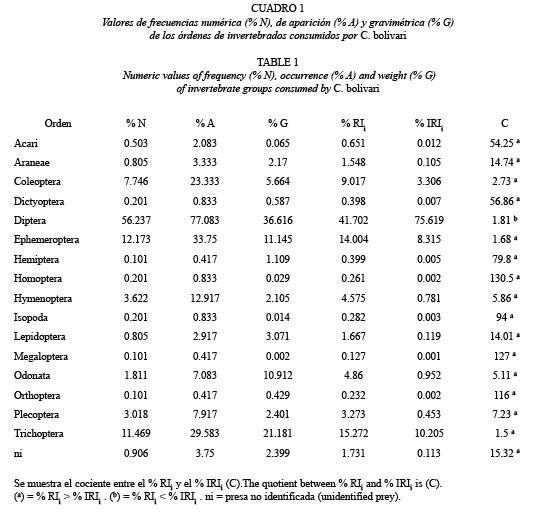
<body><![CDATA[ style="font-style: italic;">C. bolivari&nbsp; </span></span><span      style="font-family: arial;">posee una dieta amplia con base a la     variedad </span><span style="font-family: arial;">de presas     consumidas. Se identificaron doce </span><span      style="font-family: arial;">&oacute;rdenes de insectos, dos     &oacute;rdenes de ar&aacute;cnidos </span><span      style="font-family: arial;">y el orden Isopoda (<a href="#cuadro1">Cuadro     1</a>). En cuanto a     las </span><span style="font-family: arial;">familias consumidas,     s&oacute;lo se identificaron las&nbsp; </span><span     ]]></body>
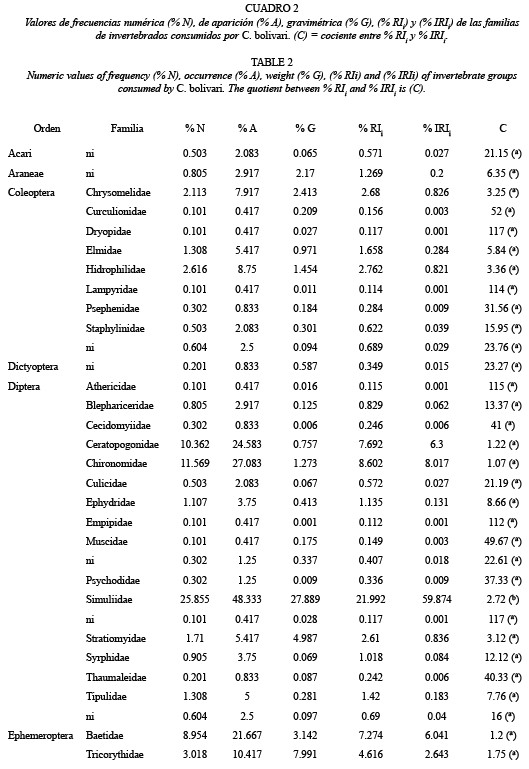
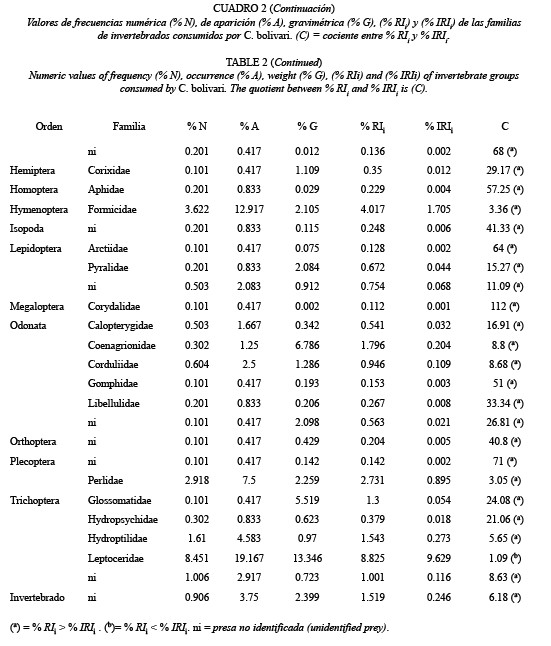
<body><![CDATA[ style="font-family: arial;">pertenecientes a los insectos, que     incluy&oacute; un </span><span style="font-family: arial;">total de 41     familias de las cuales 15 pertenecieron </span><span      style="font-family: arial;">al orden Diptera (<a href="#cuadro2">Cuadro     2</a>).</span><br style="font-family: arial;">     <br style="font-family: arial;">     <span style="font-family: arial;">Los valores de importancia relativa     de </span><span style="font-family: arial;">los datos agrupados de las     ocho colectas y </span><span style="font-family: arial;">de los     &oacute;rdenes con las mayores frecuencias </span><span     ]]></body>
<body><![CDATA[ style="font-family: arial;">mostraron la siguiente tendencia: Diptera     &gt;&nbsp; </span><span style="font-family: arial;">Trichoptera &gt;     Ephemeroptera &gt; Coleoptera &gt; </span><span      style="font-family: arial;">Odonata &gt; Hymenoptera &gt; Plecoptera,     la cual </span><span style="font-family: arial;">fue similar     independientemente del &iacute;ndice </span><span      style="font-family: arial;">empleado. Sin embargo, los valores     resultaron </span><span style="font-family: arial;">diferentes entre     &iacute;ndices.</span></small></p>     <p align="justify">&nbsp;</p>     ]]></body>
<body><![CDATA[<p align="center"><a name="cuadro1"> <img style="border: 0px solid ; width: 536px; height: 512px;"  src="/img/fbpe/rbt/v54n4/3507i1.JPG" title="" alt=""></a></p>     
<p align="justify"><small><br style="font-family: arial;"> <br style="font-family: arial;"> </small></p>     <div style="text-align: left;"><small><span style="font-family: arial;">En los Diptera, que fue el orden con las </span><span style="font-family: arial;">mayores frecuencias de % A, % N y % G, el </span><span style="font-family: arial;">valor de % IRI<sub>i</sub> fue 1.81 veces mayor que el </span><span  style="font-family: arial;">%RI<sub>i</sub>. Por el contrario, en el resto de los &oacute;rdenes, </span><span style="font-family: arial;">el resultado fue opuesto, y los valores de % </span><span  style="font-family: arial;">IRI<sub>i</sub> fueron entre 1.5 y 7.23 veces menores que </span><span style="font-family: arial;">los correspondientes al %RI<sub>i</sub> (<a href="#cuadro1">Cuadro 1</a>).</span></small><br  style="font-family: arial;"> <small></small><br style="font-family: arial;"> <small><span style="font-family: arial;">En los casos en que el % A fue mayor de </span><span style="font-family: arial;">20 % (Coleoptera, Diptera, Ephemeroptera y </span><span style="font-family: arial;">Trichoptera), el valor absoluto estimado para el </span><span  style="font-family: arial;">c&aacute;lculo del % IRI<sub>i</sub> de &eacute;stas presas fue un orden </span><span  style="font-family: arial;">de magnitud mayor que el estimado para el c&aacute;lculo </span><span style="font-family: arial;">del %RI<sub>i</sub> y a medida que el % A se acerc&oacute; </span><span  style="font-family: arial;">al 20 %, como fue el caso de Coleoptera, la </span><span style="font-family: arial;">diferencia entre ambos &iacute;ndices increment&oacute;.</span></small><br  style="font-family: arial;"> <small></small><br style="font-family: arial;"> <small><span style="font-family: arial;">En las presas en las que el % A fue menor </span><span style="font-family: arial;">del 20 % (Hymenoptera, Odonata y Plecoptera), </span><span style="font-family: arial;">si bien las diferencias entre los valores absolutos </span><span  style="font-family: arial;">para el c&aacute;lculo de los &iacute;ndices&nbsp; relativos no </span><span  style="font-family: arial;">fueron de un orden de magnitud, las diferencias </span><span style="font-family: arial;">entre ambos estimadores resultaron mayores </span><span style="font-family: arial;">que en el caso anterior (entre 5 y 7 veces).</span></small><br  style="font-family: arial;"> <small></small><br style="font-family: arial;"> <small><span style="font-family: arial;">Se observ&oacute; otro grupo de valores, correspondientes </span><span style="font-family: arial;">a &oacute;rdenes consumidos en bajas frecuencias </span><span  style="font-family: arial;">(&lt; 10 %), en los cuales los valores de </span><span  style="font-family: arial;">% IRI<sub>i </sub>fueron entre 14 y 131 veces menores </span><span style="font-family: arial;">que los obtenidos para el %RI<sub>i</sub>. En este grupo, </span><span  style="font-family: arial;">a excepci&oacute;n de Acari, se obtuvo un incremento </span><span style="font-family: arial;">en la diferencia entre ambos &iacute;ndices relativos a </span><span  style="font-family: arial;">medida que disminuy&oacute; el % A. A su vez, dentro de este grupo, se observaron valores como los </span><span  style="font-family: arial;">obtenidos para Araneae, Lepidoptera y ni, en los </span><span style="font-family: arial;">cuales las peque&ntilde;as variaciones en el % A, % N </span><span  style="font-family: arial;">y % G no generaron grandes diferencias en el </span><span style="font-family: arial;">cociente %RI<sub>i </sub>/ % IRI<sub>i</sub>. Por el contrario, en otros </span><span  style="font-family: arial;">&oacute;rdenes consumidos en los cuales no vari&oacute; el % </span><span style="font-family: arial;">A, como fue el caso de Dictyoptera-Homoptera- Isopoda (% A = 0.83) y Hemiptera-Orthoptera- </span><span style="font-family: arial;">Megaloptera (% A = 0.42), el cociente %RI<sub>i</sub> / </span><span  style="font-family: arial;">% IRI<sub>i </sub>fluctu&oacute; considerablemente debido a la </span><span style="font-family: arial;">variaci&oacute;n en el % G.</span></small></div>     <p align="center"><a name="cuadro2"> <img style="border: 0px solid ; width: 529px; height: 769px;"  src="/img/fbpe/rbt/v54n4/3507i2.JPG" title="" alt=""></a></p>     
<p align="center"><img  style="border: 0px solid ; width: 551px; height: 646px;"  src="/img/fbpe/rbt/v54n4/3507i3.JPG" title="" alt=""></p>     
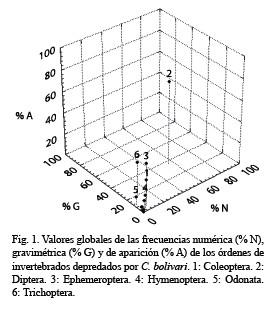
<p align="justify"><small><br style="font-family: arial;"> <br style="font-family: arial;"> </small></p>     <div style="text-align: left;"><small><span style="font-family: arial;">Para una mayor resoluci&oacute;n taxon&oacute;mica, las </span><span style="font-family: arial;">diferencias entre ambos &iacute;ndices incrementaron </span><span  style="font-family: arial;">a medida que los valores de % A, % N y % G disminuyeron (<a href="#cuadro2">Cuadro 2</a>). En este caso, la </span><span  style="font-family: arial;">diferencia entre ambos fue mayor (entre 1.07 </span><span style="font-family: arial;">y 117 veces), que la obtenida para el an&aacute;lisis a </span><span  style="font-family: arial;">nivel de orden. S&oacute;lo en dos presas (Simuliidae </span><span style="font-family: arial;">y Leptoceridae), el&nbsp; valor del % IRI<sub>i</sub> fue mayor </span><span  style="font-family: arial;">que el correspondiente al %RI<sub>i</sub>. En el caso de </span><span style="font-family: arial;">Simuliidae, esto se debi&oacute; a los altos valores </span><span  style="font-family: arial;">de las frecuencias estimadas tal como ocurri&oacute; </span><span style="font-family: arial;">para los Diptera en el an&aacute;lisis a nivel de orden. </span><span  style="font-family: arial;">En el caso de Leptoceridae, se debi&oacute; al efecto&nbsp; </span><span style="font-family: arial;">del relativo alto valor del % G para esta presa </span><span  style="font-family: arial;">lo cual se deduce al observar lo obtenido en </span><span style="font-family: arial;">Baetidae en la cual los valores de % A y % N </span><span style="font-family: arial;">fueron parecidos y s&oacute;lo vari&oacute; en mayor magnitud </span><span  style="font-family: arial;">el % G. Como ocurri&oacute; en el an&aacute;lisis a nivel </span><span style="font-family: arial;">de orden, en casi la totalidad de las presas, a </span><span  style="font-family: arial;">excepci&oacute;n de Simuliidae y Leptoceridae, los </span><span style="font-family: arial;">valores del % IRI<sub>i</sub> fueron menores que los </span><span  style="font-family: arial;">correspondientes al %RI<sub>i</sub>.</span></small><br  style="font-family: arial;"> <small></small><br style="font-family: arial;"> <small><span style="font-family: arial;">Se observaron varios sub-grupos en los </span><span style="font-family: arial;">cuales, los valores del % A y % N fueron </span><span style="font-family: arial;">similares entro ellos y s&oacute;lo vari&oacute; el % G, </span><span  style="font-family: arial;">lo cual produjo dentro de cada sub-grupo, </span><span  style="font-family: arial;">una mayor variaci&oacute;n en los estimados del % </span><span style="font-family: arial;">IRIi, con unas diferencias de hasta 95 %, en </span><span  style="font-family: arial;">comparaci&oacute;n a los estimados del %RI<sub>i</sub>. Estos </span><span style="font-family: arial;">sub-grupos fueron los siguientes: Syrphidae </span><span style="font-family: arial;">-Invertebrado (ni); Araneae-Blephariceridae; </span><span style="font-family: arial;">Corduliidae- Diptera (ni) - Coleoptera (ni); </span><span  style="font-family: arial;">Lepidoptera (ni)-Staphilinidae-Culicidae-Acari </span><span  style="font-family: arial;">(ni); Coenagrionidae-Diptera (ni)-Psychodidae; </span><span style="font-family: arial;">Pyralidae-Dictyoctera (ni)-Libellulidae- </span><span style="font-family: arial;">Isopoda (ni)-Thaumalidae-Aphidae; </span><span style="font-family: arial;">Glossomatidae-Odonata (ni)-Corixidae- </span><span style="font-family: arial;">Or thoptera-Curcul ionidae-Gomphidae-&nbsp; </span><span  style="font-family: arial;">Muscidae-Plecoptera (ni)-Arctiidae - Dryopidae </span><span style="font-family: arial;">- Diptera (ni)-Athericidae y Lampyridae- </span><span style="font-family: arial;">Corydalidae-Empididae.</span></small><br  style="font-family: arial;"> <small></small><br style="font-family: arial;"> <small><span style="font-family: arial;"><span  style="font-weight: bold;">An&aacute;lisis gr&aacute;fico de la dieta de</span><span style="font-style: italic;"> C. bolivari</span>: </span><span style="font-family: arial;">En la representaci&oacute;n tridimensional propuesta </span><span  style="font-family: arial;">por Cort&eacute;s (1997) y aplicada a los &oacute;rdenes de </span><span style="font-family: arial;">invertebrados consumidos por <span style="font-style: italic;">C. bolivari</span> se </span><span style="font-family: arial;">apreciaron tres conjuntos de puntos. El primero </span><span style="font-family: arial;">estuvo representado por los Diptera que </span><span  style="font-family: arial;">constituy&oacute; el &iacute;tem m&aacute;s frecuente. El segundo </span><span  style="font-family: arial;">estuvo constituido por&nbsp; presas en las cuales al&nbsp; menos una de las frecuencias estimadas fue </span><span  style="font-family: arial;">mayor del 10 %. Esto incluy&oacute; a Trichoptera, </span><span style="font-family: arial;">Ephemeroptera, Coleoptera, Hymenoptera y </span><span style="font-family: arial;">Odonata. El&nbsp; tercer grupo estuvo constituido por </span><span  style="font-family: arial;">el resto de los &oacute;rdenes depredados cuyas frecuencias </span><span style="font-family: arial;">de consumo resultaron bajas (&lt; 10 %) </span><span style="font-family: arial;">(<a  href="#figura1">Fig. 1</a>).</span></small></div>     <p align="center"><a name="figura1"> <img style="border: 0px solid ; width: 277px; height: 311px;"  src="/img/fbpe/rbt/v54n4/3507i4.JPG" title="" alt=""></a></p>     
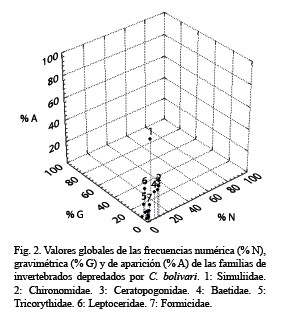
<p align="justify"><small><br style="font-family: arial;"> <br style="font-family: arial;"> </small></p>     <div style="text-align: left;"><small><span style="font-family: arial;">La representaci&oacute;n a nivel de familia mostr&oacute; </span><span style="font-family: arial;">igualmente la existencia de tres grupos </span><span style="font-family: arial;">de valores. El primer estuvo constituido por </span><span  style="font-family: arial;">Simuliidae con unas frecuencias por encima&nbsp; </span><span style="font-family: arial;">de 25 %. El segundo lo conformaron Baetidae, Chironomidae, Ceratopogonidae, Formicidae, Leptoceridae y Tricorythidae. En este grupo al menos una frecuencia fue mayor del 10 %. El tercer grupo, que fue el m&aacute;s numeroso, estuvo constituido por el resto de las familias depredadas cuyas frecuencias fueron muy bajas (<a href="#figura2">Fig. 2</a>). Como en el caso anterior, en un extremo, una presa (Simuliidae) result&oacute; ser la m&aacute;s depredada y a lo largo de los ocho muestreos evaluados y en&nbsp; el otro extremo aparecieron con recurrencia una serie de presas en la dieta de este car&aacute;cido pero en baja frecuencia. Dentro de estos extremos se&nbsp; detect&oacute; un grupo de presas con una condici&oacute;n intermedia pero igualmente recurrentes. </span></small></div>     ]]></body>
<body><![CDATA[<p align="justify">&nbsp;</p>     <p align="center"><a name="figura2"><img  style="border: 0px solid ; width: 282px; height: 326px;"  src="/img/fbpe/rbt/v54n4/3507i5.JPG" title="" alt=""></a></p>     
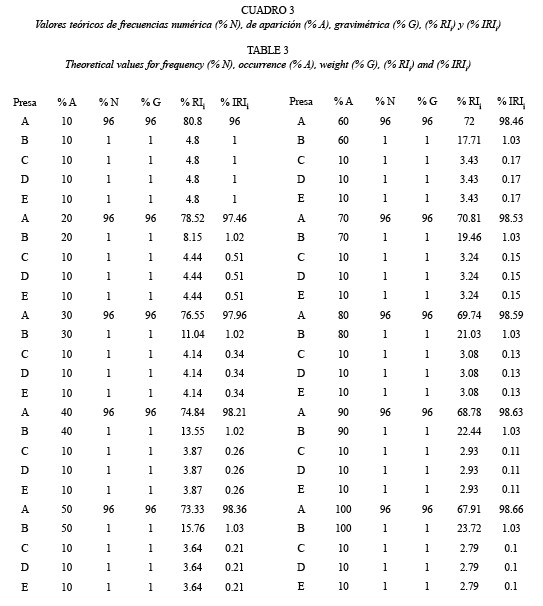
<div style="text-align: left;"><small> <span style="font-family: arial; font-weight: 700;">Discusi&oacute;n</span></small><br  style="font-family: arial;"> <small></small><br style="font-family: arial;"> <small><span style="font-family: arial;">Al evaluar la dieta de una especie analizando </span><span style="font-family: arial;">de manera aislada las frecuencias num&eacute;rica, </span><span  style="font-family: arial;">gravim&eacute;trica y de aparici&oacute;n se pueden producir </span><span style="font-family: arial;">errores de interpretaci&oacute;n, debido a que cada </span><span  style="font-family: arial;">una de estas variables proporciona indicios </span><span style="font-family: arial;">distintos (Cort&eacute;s 1998). Un ejemplo de esto se </span><span  style="font-family: arial;">observ&oacute; en los datos obtenidos en el presente </span><span style="font-family: arial;">trabajo ya que si se&nbsp; hubiese evaluado s&oacute;lo las </span><span  style="font-family: arial;">frecuencia num&eacute;rica y de aparici&oacute;n de presas </span><span style="font-family: arial;">como Trichoptera, Ephemeroptera, Odonata e </span><span  style="font-family: arial;">Hymenoptera, se concluir&iacute;a que la importancia </span><span style="font-family: arial;">relativa de los Trichoptera y Ephemeroptera </span><span style="font-family: arial;">ser&iacute;a igual por tener valores de % A y % N parecidos. </span><span  style="font-family: arial;">Sin embargo, la contribuci&oacute;n en peso de </span><span style="font-family: arial;">los Trichoptera casi duplic&oacute; la&nbsp; correspondiente </span><span  style="font-family: arial;">a los Ephemeroptera. Otro caso fue Odonata e </span><span style="font-family: arial;">Hymenoptera, la primera con la mitad del % N </span><span style="font-family: arial;">estimado para Hymenoptera y sin embargo su </span><span  style="font-family: arial;">% G fue cinco veces mayor.</span></small><br  style="font-family: arial;"> <small></small><br style="font-family: arial;"> <small><span style="font-family: arial;">Lo anterior indica que no resulta obvio </span><span style="font-family: arial;">suponer que una alta frecuencia num&eacute;rica </span><span style="font-family: arial;">implicar&iacute;a por tanto una alta frecuencia gravim&eacute;trica </span><span  style="font-family: arial;">por el simple efecto aditivo, lo cual&nbsp; </span><span style="font-family: arial;">resalta la importancia del peso individual de </span><span  style="font-family: arial;">cada presa. S&oacute;lo en el caso de Diptera, hubo coincidencia en la tendencia de las tres variables </span><span  style="font-family: arial;">evaluadas.</span></small><br  style="font-family: arial;"> <small></small><br style="font-family: arial;"> <small><span style="font-family: arial;">Los resultados mostraron la importancia </span><span style="font-family: arial;">de cuantificar el espectro alimentario (% A), </span><span style="font-family: arial;">la intensidad de depredaci&oacute;n (% N) y el valor </span><span  style="font-family: arial;">nutricional (% G) de las presas consumidas, las </span><span style="font-family: arial;">cuales se pueden agrupar en &iacute;ndices como los de </span><span  style="font-family: arial;">importancia relativa. Sin embargo, algunos consideran </span><span style="font-family: arial;">que estos &iacute;ndices son redundantes ya que </span><span  style="font-family: arial;">adicionan poca informaci&oacute;n nueva con relaci&oacute;n a </span><span style="font-family: arial;">los componentes que lo conforman (MacDonald </span><span  style="font-family: arial;">y Green 1983, Hansson 1998). Adicionalmente, </span><span style="font-family: arial;">su aplicaci&oacute;n estar&iacute;a restringida a especies que </span><span  style="font-family: arial;">consumen presas discretas o a aquellas en las </span><span style="font-family: arial;">que estas son las m&aacute;s importantes.</span></small><br style="font-family: arial;"> <small></small><br style="font-family: arial;"> <small><span style="font-family: arial;">Los resultados mostraron que el % IRI<sub>i</sub>, fue </span><span style="font-family: arial;">mayor que el % RI<sub>i</sub> para valores de % A &gt; 50 </span><span style="font-family: arial;">%. Este fue el caso de Diptera cuyo % IRIi fue </span><span  style="font-family: arial;">1.8 veces mayor que el % R</span></small><small><span  style="font-family: arial;">I<sub>i</sub></span></small><small><span  style="font-family: arial;">. Por el contrario, </span><span  style="font-family: arial;">en aquellas presas con valores de % A &lt; 50 %, </span><span style="font-family: arial;">es decir la mayor&iacute;a de los &oacute;rdenes depredados </span><span  style="font-family: arial;">por <span style="font-style: italic;">C. bolivari</span>, el % IRI<sub>i,</sub> result&oacute; menor que el </span><span  style="font-family: arial;">% RI<sub>i</sub> y la diferencia entre ambos increment&oacute; </span><span style="font-family: arial;">(hasta 130 veces), a medida que disminuy&oacute; el </span><span  style="font-family: arial;">% A. Sin embargo, para valores bajos y parecidos </span><span style="font-family: arial;">de % A, la variaci&oacute;n en las otras frecuencias </span><span  style="font-family: arial;">generaron grandes diferencias.</span></small><br  style="font-family: arial;"> </div>     <p align="justify"><small>&nbsp;</small></p>     <p align="center"><a name="cuadro3"> <img style="border: 0px solid ; width: 543px; height: 606px;"  src="/img/fbpe/rbt/v54n4/3507i6.JPG" title="" alt=""></a></p>     
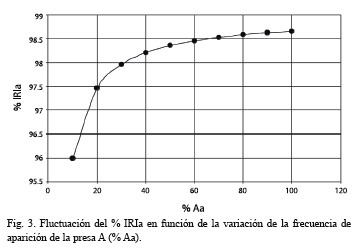
<p align="justify"><small> <br style="font-family: arial;"> </small></p>     <div style="text-align: left;"><small><span style="font-family: arial;">El % IRI<sub>i</sub> no s&oacute;lo sobreestim&oacute; y subestim&oacute; </span><span  style="font-family: arial;">la importancia relativa de las presas con altos </span><span style="font-family: arial;">y bajos valores de % A, respectivamente, sino </span><span style="font-family: arial;">que mostr&oacute; un comportamiento no lineal a </span><span  style="font-family: arial;">medida que vari&oacute; la fracci&oacute;n multiplicadora (% </span><span style="font-family: arial;">A). Esto se pudo observar en un caso hipot&eacute;tico </span><span  style="font-family: arial;">en el que se estim&oacute; el % IRI<sub>i</sub> para dos tipos de </span><span style="font-family: arial;">presas: presa A = m&aacute;s importante; presa B = </span><span  style="font-family: arial;">menos importante. En este caso, el % A de las </span><span style="font-family: arial;">presas A y B vari&oacute; de manera constante, cada </span><span style="font-family: arial;">10 % (<a href="#cuadro3">Cuadro 3</a>). En el <a href="#cuadro3">Cuadro 3</a> se observa </span><span style="font-family: arial;">que el % IRI<sub>i</sub> vari&oacute; de manera no lineal a </span><span style="font-family: arial;">medida que vari&oacute; el % A y la mayor variaci&oacute;n </span><span  style="font-family: arial;">ocurri&oacute; a valores bajos (<a  href="#figura3">Fig. 3</a>).</span></small><br  style="font-family: arial;"> <small></small><br style="font-family: arial;"> <small><span style="font-family: arial;">El emplear una mayor resoluci&oacute;n taxon&oacute;mica </span><span  style="font-family: arial;">en la identificaci&oacute;n de las presas que </span><span style="font-family: arial;">conforman la dieta de un consumidor, permite </span><span style="font-family: arial;">identificar cu&aacute;l es el grupo m&aacute;s importante </span><span  style="font-family: arial;">y proporciona una visi&oacute;n m&aacute;s detallada del </span><span style="font-family: arial;">espectro alimentario de una especie. Hansson </span><span  style="font-family: arial;">(1998), en un ejemplo hipot&eacute;tico, demostr&oacute; que al emplear diferentes resoluciones taxon&oacute;micas </span><span style="font-family: arial;">se produce una sobreestimaci&oacute;n de la </span><span  style="font-family: arial;">importancia relativa del &iacute;tem que representa la </span><span style="font-family: arial;">resoluci&oacute;n taxon&oacute;mica menos detallada. Algo </span><span  style="font-family: arial;">similar se obtuvo en el presente estudio ya que </span><span style="font-family: arial;">al comparar los valores de % N, % G y % A </span><span style="font-family: arial;">de los &oacute;rdenes de insectos consumidos con las&nbsp; </span><span  style="font-family: arial;">familias consumidas, se observ&oacute; una disminuci&oacute;n </span><span style="font-family: arial;">en la separaci&oacute;n de los puntos (frecuencias) </span><span  style="font-family: arial;">para la resoluci&oacute;n m&aacute;s fina (familia en este caso). Si bien, la resoluci&oacute;n taxon&oacute;mica </span><span style="font-family: arial;">que deber&iacute;a emplearse en estudios tr&oacute;ficos es </span><span style="font-family: arial;">la de especie, cuya definici&oacute;n inclusive resulta </span><span  style="font-family: arial;">ambigua (Aguilera y Silva 1997), esto requerir&iacute;a </span><span style="font-family: arial;">de un adecuado conocimiento taxon&oacute;mico.</span></small><br  style="font-family: arial;"> <small></small><br style="font-family: arial;"> <small><span style="font-family: arial;">Cort&eacute;s (1997) plante&oacute; que una especie es </span><span style="font-family: arial;">generalista si el % A de las presas consumidas </span><span  style="font-family: arial;">es alto, independientemente de su importancia </span><span style="font-family: arial;">num&eacute;rica y/o gravim&eacute;trica. Por el contrario, </span><span  style="font-family: arial;">una especie ser&aacute; especialista si el % A de las presas consumidas es bajo, </span><span  style="font-family: arial;">de modo que su criterio s&oacute;lo </span><span  style="font-family: arial;">considera la variaci&oacute;n del % </span><span  style="font-family: arial;">A y no incluye otro como </span><span  style="font-family: arial;">la&nbsp; amplitud del nicho tr&oacute;fico. </span><span style="font-family: arial;">Supongamos que un consumidor </span><span style="font-family: arial;">se alimenta s&oacute;lo de un </span><span style="font-family: arial;">tipo de presa y el % A de &eacute;sta </span><span style="font-family: arial;">es elevado. &iquest;Podr&iacute;a considerarse </span><span  style="font-family: arial;">a este consumidor como </span><span  style="font-family: arial;">generalista? Por el contrario, si </span><span  style="font-family: arial;">una especie consume una gran </span><span  style="font-family: arial;">variedad de tipos de presas y el </span><span  style="font-family: arial;">% A de cada una es bajo, &iquest;ser&iacute;a </span><span style="font-family: arial;">&eacute;sta una especie especialista? </span><span style="font-family: arial;">Lo&nbsp; anterior significa que debe </span><span style="font-family: arial;">incorporarse a la propuesta de </span><span style="font-family: arial;">Cort&eacute;s (1997), otra variable como el ancho de </span><span  style="font-family: arial;">nicho tr&oacute;fico y considerar la variaci&oacute;n dentro de </span><span style="font-family: arial;">fenotipos (VDF) y entre fenotipos (VEF) en el </span><span  style="font-family: arial;">consumo de las presas (Pianka 1994, Bridcut y </span><span style="font-family: arial;">Giller 1995, Amundsen <span style="font-style: italic;">et al</span>. 1996).</span></small></div>     <p align="center"><a name="figura3"> <img style="border: 0px solid ; width: 358px; height: 248px;"  src="/img/fbpe/rbt/v54n4/3507i7.JPG" title="" alt=""></a>&nbsp;     
<br> </p>     <p align="center"><a name="tabla4"><img  style="border: 0px solid ; width: 270px; height: 522px;"  src="/img/fbpe/rbt/v54n4/3507i8.JPG" title="" alt=""></a></p>     
]]></body>
<body><![CDATA[<p align="justify"><small><br style="font-family: arial;"> <br style="font-family: arial;"> </small></p>     <div style="text-align: left;"><small><span style="font-family: arial;">En     el caso de <span style="font-style: italic;">C. bolivari</span>, los     resultados </span><span style="font-family: arial;">sugieren que la     especie puede considerarse     </span><span style="font-family: arial;">generalista por la gran     variedad de tipos de presas </span><span style="font-family: arial;">consumidas,     es decir muestra a nivel poblacional, </span><span      style="font-family: arial;">un nicho tr&oacute;fico amplio. Sin     embargo, </span><span style="font-family: arial;">muestra preferencia     ]]></body>
<body><![CDATA[por el consumo de Diptera </span><span style="font-family: arial;">por     los altos valores de % A, % N y % G, lo </span><span      style="font-family: arial;">que indicar&iacute;a una estrategia     especialista hacia </span><span style="font-family: arial;">el consumo     de esta presa en particular. Los </span><span      style="font-family: arial;">resultados tambi&eacute;n sugieren la     existencia del </span><span style="font-family: arial;">componente     VEF, por los bajos valores de % </span><span      style="font-family: arial;">A de una serie de presas en las cuales     tambi&eacute;n </span><span style="font-family: arial;">fueron bajos     ]]></body>
<body><![CDATA[los % N y % G.</span></small><br style="font-family: arial;">     <small></small><br style="font-family: arial;">     <small><span style="font-family: arial;">Los bajos valores de % A     obtenidos     para </span><span style="font-family: arial;">una serie de presas, no     necesariamente indicar&iacute;a </span><span      style="font-family: arial;">especializaci&oacute;n por parte de sus     consumidores, </span><span style="font-family: arial;">ya que     &eacute;ste podr&iacute;a ser el caso si s&oacute;lo en dichos </span><span      style="font-family: arial;">consumidores no aparecen     ]]></body>
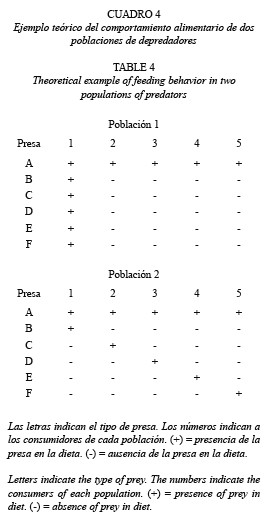
<body><![CDATA[simult&aacute;neamente </span><span style="font-family: arial;">varias     de estas presas.</span></small><br style="font-family: arial;">     <small></small><br style="font-family: arial;">     <small><span style="font-family: arial;">En el <a href="#tabla4">Cuadro     4</a> se muestra un ejemplo </span><span style="font-family: arial;">hipot&eacute;tico     que ilustra este     planteamiento. Los </span><span style="font-family: arial;">n&uacute;meros     representan a los consumidores de </span><span      style="font-family: arial;">cada poblaci&oacute;n, las letras a las     presas, y los </span><span style="font-family: arial;">s&iacute;mbolos     ]]></body>
<body><![CDATA[indican la presencia (+) o ausencia </span><span      style="font-family: arial;">(-) de la presa en la dieta de cada     individuo. </span><span style="font-family: arial;">En este ejemplo,     el % A de todas las presas, a excepci&oacute;n de A, es bajo e     id&eacute;ntico para ambas </span><span style="font-family: arial;">poblaciones,     es decir 20 % para las presas B, C, </span><span      style="font-family: arial;">D, E y F y 100 % para la presa A. Sin     embargo, </span><span style="font-family: arial;">en la     poblaci&oacute;n 1, todas las presas con bajo % A&nbsp; </span><span      style="font-family: arial;">aparecen simult&aacute;neamente y     ]]></body>
<body><![CDATA[s&oacute;lo en un mismo </span><span style="font-family: arial;">individuo.     Por el contrario, en la poblaci&oacute;n 2, </span><span      style="font-family: arial;">cada una de estas presas con bajo % A     aparece </span><span style="font-family: arial;">en distintos     individuos. Si se&nbsp; considera la </span><span      style="font-family: arial;">especializaci&oacute;n como el consumo de     distintas </span><span style="font-family: arial;">presas por     diferentes depredadores, s&oacute;lo los </span><span      style="font-family: arial;">individuos de la poblaci&oacute;n 2     entrar&iacute;an en esta </span><span style="font-family: arial;">categor&iacute;a     ]]></body>
<body><![CDATA[ya que, si bien todos los individuos </span><span      style="font-family: arial;">de la poblaci&oacute;n 1 a     excepci&oacute;n del individuo 1, </span><span      style="font-family: arial;">consumen s&oacute;lo un tipo de presa     (presa A), &eacute;sta </span><span style="font-family: arial;">es     compartida por todos los consumidores.</span></small><br      style="font-family: arial;">     <small></small><br style="font-family: arial;">     <small><span style="font-family: arial;">Al realizar este     an&aacute;lisis en <span style="font-style: italic;">C. bolivari</span>,     ]]></body>
<body><![CDATA[</span><span style="font-family: arial;">se encontr&oacute; que las     presas con bajo     % A, no </span><span style="font-family: arial;">aparecieron en los     mismos individuos consumidores, </span><span      style="font-family: arial;">es decir los resultados fueron parecidos </span><span      style="font-family: arial;">al ejemplo correspondiente a la     poblaci&oacute;n 2. </span><span style="font-family: arial;">Al     respecto, esto indicar&iacute;a efectivamente la </span><span      style="font-family: arial;">existencia de especializaci&oacute;n por     parte de una </span><span style="font-family: arial;">fracci&oacute;n     ]]></body>
<body><![CDATA[de la poblaci&oacute;n evaluada.</span></small><br      style="font-family: arial;">     <small></small><br style="font-family: arial;">     <small><span style="font-family: arial;">Amundsen <span      style="font-style: italic;">et al</span>. (1996) sugirieron que las </span><span      style="font-family: arial;">gr&aacute;ficas que incluyen las     frecuencias de aparici&oacute;n </span><span      style="font-family: arial;">y de abundancia de las presas se puede </span><span      style="font-family: arial;">detectar la presencia de los componentes     VDF </span><span style="font-family: arial;">y VEF del nicho     ]]></body>
<body><![CDATA[tr&oacute;fico. Seg&uacute;n los autores, un </span><span      style="font-family: arial;">alto VEF corresponder&iacute;a a presas     con bajo % A </span><span style="font-family: arial;">y gran     abundancia en la dieta, mientras que un </span><span      style="font-family: arial;">alto VDF corresponder&iacute;a a presas     con alto % A </span><span style="font-family: arial;">y baja     abundancia en la dieta. Sin embargo, no </span><span      style="font-family: arial;">necesariamente &eacute;ste es el     &uacute;nico requisito para </span><span style="font-family: arial;">detectar     la presencia del componente VEF, </span><span     ]]></body>
<body><![CDATA[ style="font-family: arial;">ya que puede darse el caso de una     poblaci&oacute;n </span><span style="font-family: arial;">depredadora     en la cual s&oacute;lo algunos de sus </span><span      style="font-family: arial;">miembros depredan a determinadas presas,     es </span><span style="font-family: arial;">decir el % A de     &eacute;stas es bajo, pero sin embargo </span><span      style="font-family: arial;">la intensidad de consumo tambi&eacute;n es     baja, tal y </span><span style="font-family: arial;">como ocurre en <span      style="font-style: italic;">C. bolivari</span>, hacia el consumo </span><span      style="font-family: arial;">de una gran variedad de presas.</span></small><br     ]]></body>
<body><![CDATA[ style="font-family: arial;">     <small></small><br style="font-family: arial;">     <small><span style="font-family: arial;">Cort&eacute;s (1997)     plante&oacute;     que, dependiendo </span><span style="font-family: arial;">del % A, % N     y % G, las presas pudieran clasificarse </span><span      style="font-family: arial;">como raras (si los valores son bajos) </span><span      style="font-family: arial;">o dominantes (si los valores son altos)Sin     </span><span style="font-family: arial;">embargo, dicho autor no     considera otro criterio </span><span style="font-family: arial;">como     ]]></body>
<body><![CDATA[lo es la recurrencia, por ejemplo en una </span><span      style="font-family: arial;">escala temporal, de las presas en la dieta     del </span><span style="font-family: arial;">consumidor,     independientemente de sus valores </span><span      style="font-family: arial;">de frecuencias. Esto se observ&oacute;     claramente </span><span style="font-family: arial;">en <span      style="font-style: italic;">C. bolivari</span>, la cual si bien     consumi&oacute; una </span><span style="font-family: arial;">serie de     presas y en bajas frecuencias, &eacute;stas </span><span      style="font-family: arial;">siempre estuvieron presentes en todo el     ]]></body>
<body><![CDATA[registro </span><span style="font-family: arial;">evaluado, de modo     que &iquest;hasta que punto dichas </span><span      style="font-family: arial;">presas pudieran clasificarse como un     componente </span><span style="font-family: arial;">ocasional en la     dieta&nbsp; de esta especie? Lo </span><span      style="font-family: arial;">mismo puede ocurrir con las presas     denominadas </span><span style="font-family: arial;">dominantes, las     cuales podr&iacute;an poseer </span><span style="font-family: arial;">altos     valores de frecuencias en la dieta de un </span><span      style="font-family: arial;">consumidor pero s&oacute;lo aparecer en un     ]]></body>
<body><![CDATA[momento </span><span style="font-family: arial;">determinado. En el     caso de <span style="font-style: italic;">C. bolivari</span>, esto no </span><span      style="font-family: arial;">ocurri&oacute;, ya que la presa con la     m&aacute;s alta frecuencia </span><span style="font-family: arial;">(Diptera)     fue depredada en todo el lapso </span><span style="font-family: arial;">evaluado.     Lo anterior indica la importancia de </span><span      style="font-family: arial;">tener un amplio registro temporal de la     dieta de </span><span style="font-family: arial;">un consumidor para     aproximarse a una clasificaci&oacute;n </span><span      style="font-family: arial;">m&aacute;s acertada de las presas     ]]></body>
<body><![CDATA[explotadas.</span></small><br style="font-family: arial;">     <small></small><br style="font-family: arial;">     <small><small><!-- big --><span style="font-family: arial; font-weight: 700;">Agradecimientos</span><!-- /big --></small></small><br      style="font-family: arial;">     <small></small><br style="font-family: arial;">     <small><span style="font-family: arial;">A Cesar Diaz y Wilmer Texara     por su </span><span style="font-family: arial;">ayuda prestada en los     trabajos de campo. A     </span><span style="font-family: arial;">Maria E. Rocha por la ayuda en     la redacci&oacute;n </span><span style="font-family: arial;">del     ]]></body>
<body><![CDATA[resumen en ingl&eacute;s. A la Estaci&oacute;n&nbsp; Biol&oacute;gica </span><span      style="font-family: arial;">de Rancho Grande adscrita al MARN por el </span><span      style="font-family: arial;">apoyo log&iacute;stico.</span></small><br      style="font-family: arial;">     <small></small><br style="font-family: arial;">     <small style="font-weight: bold;"><small><!-- big --><span      style="font-family: arial;">Resumen</span><!-- /big --></small></small><br      style="font-family: arial;">     <small></small><br style="font-family: arial;">     <small><span style="font-family: arial;">Se estudi&oacute; la     ]]></body>
<body><![CDATA[alimentaci&oacute;n de un pez neotropical </span><span      style="font-family: arial;">(<span style="font-style: italic;">Creagrutus     bolivari</span>) usando diferentes m&eacute;todos: el m&eacute;todo </span><span      style="font-family: arial;">gr&aacute;fico de Cort&eacute;s (1997) y     dos &iacute;ndices de importancia </span><span      style="font-family: arial;">relativa (George y Hadley, 1979 (% RIi) y     Cort&eacute;s, 1997 </span><span style="font-family: arial;">(%     IRIi)). S&oacute;lo las presas discretas (invertebrados     acu&aacute;ticos </span><span style="font-family: arial;">y     terrestres) se emplearon en el an&aacute;lisis de dieta. Se     ]]></body>
<body><![CDATA[estim&oacute;&nbsp; </span><span style="font-family: arial;">ara cada     &iacute;tem, las frecuencias de aparici&oacute;n (% A), num&eacute;rica     </span><span style="font-family: arial;">(% N) y gravim&eacute;trica (%     G). Se analiz&oacute; un total de 240 </span><span      style="font-family: arial;">ejemplares (intervalo de talla desde 25.3     hasta 64.7 mm de </span><span style="font-family: arial;">longitud     est&aacute;ndar). Para valores de % A &gt; 50 %, el % IRI<sub>i&nbsp; </sub></span><span      style="font-family: arial;">result&oacute; mayor al obtenido para el %     RI<sub>i</sub>, con una tendencia </span><span      style="font-family: arial;">opuesta (hasta 130 veces) para valores de     ]]></body>
<body><![CDATA[% A por debajo </span><span style="font-family: arial;">del 50 %. El %     IRI<sub>i </sub>sobreestim&oacute; la importancia relativa de </span><span      style="font-family: arial;">las presas para valores altos de % A,     mientras que subestim&oacute; </span><span style="font-family: arial;">la     importancia relativa de las presas para valores bajos </span><span      style="font-family: arial;">de % A y mostr&oacute; un comportamiento     no lineal a medida que </span><span style="font-family: arial;">vari&oacute;     el % A. Las variables empleadas en el m&eacute;todo gr&aacute;fico </span><span      style="font-family: arial;">de Cort&eacute;s son insuficientes para     evaluar la estrategia alimentaria del depredador     ]]></body>
<body><![CDATA[(generalismo-especialismo). De </span><span style="font-family: arial;">este     modo, se sugiere incluir otras variables como el ancho </span><span      style="font-family: arial;">de nicho tr&oacute;fico poblacional e     individual as&iacute; como un adecuado </span><span      style="font-family: arial;">registro de campo. Es necesario un amplio     registro </span><span style="font-family: arial;">de campo para     clasificar a las presas como escasa o dominante </span><span      style="font-family: arial;">de acuerdo a la clasificaci&oacute;n de     Cort&eacute;s. Los &iacute;ndices </span><span      style="font-family: arial;">compuestos que incluyen las variables:     ]]></body>
<body><![CDATA[masa, n&uacute;mero y </span><span style="font-family: arial;">aparici&oacute;n     proporcionan una descripci&oacute;n m&aacute;s precisa de la </span><span      style="font-family: arial;">dieta y permiten realizar estudios     comparativos. El an&aacute;lisis </span><span      style="font-family: arial;">gr&aacute;fico es f&aacute;cil de     interpretar y ayuda a evaluar aspectos </span><span      style="font-family: arial;">como la importancia de la presa y la     estrategia alimentaria </span><span style="font-family: arial;">del     depredador.</span></small><br style="font-family: arial;">     <small></small><br style="font-family: arial;">     ]]></body>
<body><![CDATA[<small><span style="font-family: arial;"><span      style="font-weight: bold;">Palabras     clave</span>: an&aacute;lisis de dieta, &iacute;ndice de importancia     relativa, peces neotropicales, Characidae, <span      style="font-style: italic;">Creagrutus</span>.</span></small><br      style="font-family: arial;">     <small></small><br style="font-family: arial;">     <small><small><!-- big --><span style="font-family: arial; font-weight: 700;">Referencias</span><!-- /big --></small></small><br      style="font-family: arial;">     <small><!-- big --><!-- /big --></small><br style="font-family: arial;">     ]]></body>
<body><![CDATA[<small><span style="font-family: arial;">Aguilera, M &amp; J.F. Silva.     1997.     Especies y Biodiversidad. </span><span style="font-family: arial;">Interciencia     22: 299-306.</span></small><br style="font-family: arial;">     <small></small><br style="font-family: arial;">     <!-- ref --><small><span style="font-family: arial;">    &nbsp;&nbsp;&nbsp;&nbsp;&nbsp;&nbsp;&nbsp;&nbsp;[&#160;<a href="javascript:void(0);" onclick="javascript: window.open('/scielo.php?script=sci_nlinks&ref=1363441&pid=S0034-7744200600040002100001&lng=','','width=640,height=500,resizable=yes,scrollbars=1,menubar=yes,');">Links</a>&#160;]<!-- end-ref --><!-- ref -->Anthony, S.H., R.P. Vari, A. Machado-Allison &amp; F. </span><span style="font-family: arial;">Provenzano. 1994. <span style="font-style: italic;">Creagrutus hysginus </span>(Teleostei: </span><span style="font-family: arial;">Characiformes), a new species of characid from northeastern </span><span style="font-family: arial;">Venezuela, Sucre State. Copeia 4: 975-979.</span></small><br  style="font-family: arial;"> <small></small><br style="font-family: arial;"> <small><span style="font-family: arial;">    &nbsp;&nbsp;&nbsp;&nbsp;&nbsp;&nbsp;&nbsp;&nbsp;[&#160;<a href="javascript:void(0);" onclick="javascript: window.open('/scielo.php?script=sci_nlinks&ref=1363442&pid=S0034-7744200600040002100002&lng=','','width=640,height=500,resizable=yes,scrollbars=1,menubar=yes,');">Links</a>&#160;]<!-- end-ref --><!-- ref -->Amundsen, P.A., H.M. Gabler &amp; F.J. Staldvik. 1996. A </span><span style="font-family: arial;">new approach to graphical analysis of feeding strategy </span><span  style="font-family: arial;">from stomach contents data modification of the </span><span style="font-family: arial;">Costello (1990) method. J. Fish. Biol. 48: 607-614.</span></small><br  style="font-family: arial;"> <small></small><br style="font-family: arial;"> <small><span style="font-family: arial;">    &nbsp;&nbsp;&nbsp;&nbsp;&nbsp;&nbsp;&nbsp;&nbsp;[&#160;<a href="javascript:void(0);" onclick="javascript: window.open('/scielo.php?script=sci_nlinks&ref=1363443&pid=S0034-7744200600040002100003&lng=','','width=640,height=500,resizable=yes,scrollbars=1,menubar=yes,');">Links</a>&#160;]<!-- end-ref --><!-- ref -->Bagenal, T. 1978. Methods for assessment of fish production </span><span style="font-family: arial;">in freshwater. IBP Handbook, No 3. Blackwell, </span><span  style="font-family: arial;">Oxford, Inglaterra. 365 p.</span></small><br  style="font-family: arial;"> <small></small><br style="font-family: arial;"> <small><span style="font-family: arial;">    &nbsp;&nbsp;&nbsp;&nbsp;&nbsp;&nbsp;&nbsp;&nbsp;[&#160;<a href="javascript:void(0);" onclick="javascript: window.open('/scielo.php?script=sci_nlinks&ref=1363444&pid=S0034-7744200600040002100004&lng=','','width=640,height=500,resizable=yes,scrollbars=1,menubar=yes,');">Links</a>&#160;]<!-- end-ref --><!-- ref -->Borjas von Bach, P. 2001. Empleo de dos m&eacute;todos para </span><span style="font-family: arial;">el an&aacute;lisis de la dieta de <span style="font-style: italic;">Cregrutus bolivari</span> (Pisces: </span><span style="font-family: arial;">Characidae) y estimaci&oacute;n de su variaci&oacute;n temporal. </span><span  style="font-family: arial;">Tesis de Licenciatura. Universidad Central de </span><span style="font-family: arial;">Venezuela, Caracas, Venezuela. 76 p.</span></small><br style="font-family: arial;"> <small></small><br style="font-family: arial;"> <small><span style="font-family: arial;">    &nbsp;&nbsp;&nbsp;&nbsp;&nbsp;&nbsp;&nbsp;&nbsp;[&#160;<a href="javascript:void(0);" onclick="javascript: window.open('/scielo.php?script=sci_nlinks&ref=1363445&pid=S0034-7744200600040002100005&lng=','','width=640,height=500,resizable=yes,scrollbars=1,menubar=yes,');">Links</a>&#160;]<!-- end-ref --><!-- ref -->Bridcut, E. &amp; P. Giller. 1995. Diet variability and foraging </span><span style="font-family: arial;">strategies in brown trout (<span style="font-style: italic;">Salmo trutta</span>): an analysis </span><span style="font-family: arial;">from subpopulations to individuals. Can. J. Fish. </span><span  style="font-family: arial;">Aquat. Sci. 52: 2543-2552.</span></small><br  style="font-family: arial;"> <small></small><br style="font-family: arial;"> <small><span style="font-family: arial;">    &nbsp;&nbsp;&nbsp;&nbsp;&nbsp;&nbsp;&nbsp;&nbsp;[&#160;<a href="javascript:void(0);" onclick="javascript: window.open('/scielo.php?script=sci_nlinks&ref=1363446&pid=S0034-7744200600040002100006&lng=','','width=640,height=500,resizable=yes,scrollbars=1,menubar=yes,');">Links</a>&#160;]<!-- end-ref --><!-- ref -->Cort&eacute;s, E. 1997. A critical review of methods of studying </span><span style="font-family: arial;">fish feeding based on analysis of stomach contents: </span><span  style="font-family: arial;">application to elasmobranch fishes. Can. J. Fish. </span><span style="font-family: arial;">Aquat. Sci. 54: 726-738.</span></small><br style="font-family: arial;"> <small></small><br style="font-family: arial;"> <small><span style="font-family: arial;">    &nbsp;&nbsp;&nbsp;&nbsp;&nbsp;&nbsp;&nbsp;&nbsp;[&#160;<a href="javascript:void(0);" onclick="javascript: window.open('/scielo.php?script=sci_nlinks&ref=1363447&pid=S0034-7744200600040002100007&lng=','','width=640,height=500,resizable=yes,scrollbars=1,menubar=yes,');">Links</a>&#160;]<!-- end-ref --><!-- ref -->Cort&eacute;s, E. 1998. Methods of studying fish feeding: reply. </span><span style="font-family: arial;">Can. J. Fish. Aquat. Sci. 55: 2708.</span></small><br  style="font-family: arial;"> <small></small><br style="font-family: arial;"> <small><span style="font-family: arial;">    &nbsp;&nbsp;&nbsp;&nbsp;&nbsp;&nbsp;&nbsp;&nbsp;[&#160;<a href="javascript:void(0);" onclick="javascript: window.open('/scielo.php?script=sci_nlinks&ref=1363448&pid=S0034-7744200600040002100008&lng=','','width=640,height=500,resizable=yes,scrollbars=1,menubar=yes,');">Links</a>&#160;]<!-- end-ref --><!-- ref -->Costello, M.J. 1990. Predator feeding strategy and prey </span><span style="font-family: arial;">importance: a new graphical analysis. J. Fish. Biol. </span><span  style="font-family: arial;">36: 261-263.</span></small><br  style="font-family: arial;"> <small></small><br style="font-family: arial;"> <small><span style="font-family: arial;">    &nbsp;&nbsp;&nbsp;&nbsp;&nbsp;&nbsp;&nbsp;&nbsp;[&#160;<a href="javascript:void(0);" onclick="javascript: window.open('/scielo.php?script=sci_nlinks&ref=1363449&pid=S0034-7744200600040002100009&lng=','','width=640,height=500,resizable=yes,scrollbars=1,menubar=yes,');">Links</a>&#160;]<!-- end-ref --><!-- ref -->Frost, W.E. 1954. The food of the pike, <span style="font-style: italic;">Esox lucius.</span> L., in </span><span  style="font-family: arial;">Windermere. J. Anim. Ecol. 23: 339-360.</span></small><br  style="font-family: arial;"> <small></small><br style="font-family: arial;"> <small><span style="font-family: arial;">    &nbsp;&nbsp;&nbsp;&nbsp;&nbsp;&nbsp;&nbsp;&nbsp;[&#160;<a href="javascript:void(0);" onclick="javascript: window.open('/scielo.php?script=sci_nlinks&ref=1363450&pid=S0034-7744200600040002100010&lng=','','width=640,height=500,resizable=yes,scrollbars=1,menubar=yes,');">Links</a>&#160;]<!-- end-ref --><!-- ref -->George, E.L. &amp; W.F. Hadley. 1979. Food and habitat partitioning </span><span style="font-family: arial;">between rock bass (<span style="font-style: italic;">Amblopites rupestris</span>) and </span><span style="font-family: arial;">smallmouth bass (<span  style="font-style: italic;">Micropterus dolomieui</span>) young of </span><span  style="font-family: arial;">the year. Trans. Am. Fish. Soc. 108: 253-261.</span></small><br style="font-family: arial;"> <small></small><br style="font-family: arial;"> <small><span style="font-family: arial;">    &nbsp;&nbsp;&nbsp;&nbsp;&nbsp;&nbsp;&nbsp;&nbsp;[&#160;<a href="javascript:void(0);" onclick="javascript: window.open('/scielo.php?script=sci_nlinks&ref=1363451&pid=S0034-7744200600040002100011&lng=','','width=640,height=500,resizable=yes,scrollbars=1,menubar=yes,');">Links</a>&#160;]<!-- end-ref --><!-- ref -->G&eacute;ry, J. 1977. Characoids of the World. TFH, Ciudad de </span><span style="font-family: arial;">Neptune, Nueva Jersey, EEUU. 672 p.</span></small><br style="font-family: arial;"> <small></small><br style="font-family: arial;"> <small><span style="font-family: arial;">    &nbsp;&nbsp;&nbsp;&nbsp;&nbsp;&nbsp;&nbsp;&nbsp;[&#160;<a href="javascript:void(0);" onclick="javascript: window.open('/scielo.php?script=sci_nlinks&ref=1363452&pid=S0034-7744200600040002100012&lng=','','width=640,height=500,resizable=yes,scrollbars=1,menubar=yes,');">Links</a>&#160;]<!-- end-ref --><!-- ref -->Hansson, S. 1998. Methods of studying fish feeding: a </span><span style="font-family: arial;">comment. Can. J. Fish. Aquat. Sci. 55: 2706-2707.</span></small><br  style="font-family: arial;"> <small></small><br style="font-family: arial;"> <small><span style="font-family: arial;">    &nbsp;&nbsp;&nbsp;&nbsp;&nbsp;&nbsp;&nbsp;&nbsp;[&#160;<a href="javascript:void(0);" onclick="javascript: window.open('/scielo.php?script=sci_nlinks&ref=1363453&pid=S0034-7744200600040002100013&lng=','','width=640,height=500,resizable=yes,scrollbars=1,menubar=yes,');">Links</a>&#160;]<!-- end-ref --><!-- ref -->Harold, A.S. &amp; R.P. Vari. 1994. Systematics of the </span><span style="font-family: arial;">trans-andean species of <span style="font-style: italic;">Creagrutus</span> (Ostariophysi: </span><span style="font-family: arial;">Characiformes:Characidae). Smiths. Cont. Zool. </span><span style="font-family: arial;">Washington, No 551: 1-31.</span></small><br style="font-family: arial;"> <small></small><br style="font-family: arial;"> <small><span style="font-family: arial;">    &nbsp;&nbsp;&nbsp;&nbsp;&nbsp;&nbsp;&nbsp;&nbsp;[&#160;<a href="javascript:void(0);" onclick="javascript: window.open('/scielo.php?script=sci_nlinks&ref=1363454&pid=S0034-7744200600040002100014&lng=','','width=640,height=500,resizable=yes,scrollbars=1,menubar=yes,');">Links</a>&#160;]<!-- end-ref --><!-- ref -->Huber, O. 1986. La Selva Nublada de Rancho Grande, </span><span style="font-family: arial;">Parque Nacional Henri Pittier. Acta Cient&iacute;fica </span><span  style="font-family: arial;">Venezolana, Caracas, Venezuela. 288 p.</span></small><br  style="font-family: arial;"> <small></small>    &nbsp;&nbsp;&nbsp;&nbsp;&nbsp;&nbsp;&nbsp;&nbsp;[&#160;<a href="javascript:void(0);" onclick="javascript: window.open('/scielo.php?script=sci_nlinks&ref=1363455&pid=S0034-7744200600040002100015&lng=','','width=640,height=500,resizable=yes,scrollbars=1,menubar=yes,');">Links</a>&#160;]<!-- end-ref --><!-- ref --><br> <small><span style="font-family: arial;">Hynes, H.B.N. 1950. The food of freshwater sticklebacks </span><span style="font-family: arial;">(<span  style="font-style: italic;">Gasterosteus aculeatus</span> and <span style="font-style: italic;">Pygosteus pungitius</span>) </span><span style="font-family: arial;">with a review of methods used in studies of the food </span><span  style="font-family: arial;">of fishes. J. Anim. Ecol. 19: 36-58.</span></small><br  style="font-family: arial;"> <small></small><br style="font-family: arial;"> <small><span style="font-family: arial;">    &nbsp;&nbsp;&nbsp;&nbsp;&nbsp;&nbsp;&nbsp;&nbsp;[&#160;<a href="javascript:void(0);" onclick="javascript: window.open('/scielo.php?script=sci_nlinks&ref=1363456&pid=S0034-7744200600040002100016&lng=','','width=640,height=500,resizable=yes,scrollbars=1,menubar=yes,');">Links</a>&#160;]<!-- end-ref --><!-- ref -->Hyslop, E.J. 1980. Stomach contents analysis: a review </span><span style="font-family: arial;">of methods and their application. J. Fish. Biol. 17: </span><span  style="font-family: arial;">411-429.</span></small><br  style="font-family: arial;"> <small></small><br style="font-family: arial;"> <small><span style="font-family: arial;">    &nbsp;&nbsp;&nbsp;&nbsp;&nbsp;&nbsp;&nbsp;&nbsp;[&#160;<a href="javascript:void(0);" onclick="javascript: window.open('/scielo.php?script=sci_nlinks&ref=1363457&pid=S0034-7744200600040002100017&lng=','','width=640,height=500,resizable=yes,scrollbars=1,menubar=yes,');">Links</a>&#160;]<!-- end-ref --><!-- ref -->Knight, R.L. &amp; F.J. Margraf. 1982. Estimating stomach fullness </span><span  style="font-family: arial;">in fishes. N. Am. J. Fish. Manage. 2: 413-414.</span></small><br style="font-family: arial;"> <small></small><br style="font-family: arial;"> <small><span style="font-family: arial;">    &nbsp;&nbsp;&nbsp;&nbsp;&nbsp;&nbsp;&nbsp;&nbsp;[&#160;<a href="javascript:void(0);" onclick="javascript: window.open('/scielo.php?script=sci_nlinks&ref=1363458&pid=S0034-7744200600040002100018&lng=','','width=640,height=500,resizable=yes,scrollbars=1,menubar=yes,');">Links</a>&#160;]<!-- end-ref --><!-- ref -->Kwak, J.T., M.J. Wiley., L.L. Osborne &amp; R.W. Larimore. </span><span style="font-family: arial;">1992. Application of diel feeding chronology to habitat </span><span  style="font-family: arial;">suitability analysis of warmwater stream fishes. </span><span style="font-family: arial;">Can. J. Fish. Aquat. Sci. 49: 1417-1430.</span></small><br style="font-family: arial;"> <small></small><br style="font-family: arial;"> <small><span style="font-family: arial;">    &nbsp;&nbsp;&nbsp;&nbsp;&nbsp;&nbsp;&nbsp;&nbsp;[&#160;<a href="javascript:void(0);" onclick="javascript: window.open('/scielo.php?script=sci_nlinks&ref=1363459&pid=S0034-7744200600040002100019&lng=','','width=640,height=500,resizable=yes,scrollbars=1,menubar=yes,');">Links</a>&#160;]<!-- end-ref --><!-- ref -->Lowe-McConnell, R.H. 1987. Ecological Studies in </span><span style="font-family: arial;">Tropical Fish Communities. Cambridge, Londres, </span><span  style="font-family: arial;">Inglaterra. 382 p.</span></small><br  style="font-family: arial;"> <small></small><br style="font-family: arial;"> <small><span style="font-family: arial;">    &nbsp;&nbsp;&nbsp;&nbsp;&nbsp;&nbsp;&nbsp;&nbsp;[&#160;<a href="javascript:void(0);" onclick="javascript: window.open('/scielo.php?script=sci_nlinks&ref=1363460&pid=S0034-7744200600040002100020&lng=','','width=640,height=500,resizable=yes,scrollbars=1,menubar=yes,');">Links</a>&#160;]<!-- end-ref --><!-- ref -->McDonald, J.S. &amp; R.H. Green. 1983. Redundancy of variables </span><span style="font-family: arial;">used to describe importance of prey species in </span><span  style="font-family: arial;">fish diets. Can. J. Fish. Aquat. Sci. 40: 635-637.</span></small><br style="font-family: arial;"> <small></small><br style="font-family: arial;"> <small><span style="font-family: arial;">    &nbsp;&nbsp;&nbsp;&nbsp;&nbsp;&nbsp;&nbsp;&nbsp;[&#160;<a href="javascript:void(0);" onclick="javascript: window.open('/scielo.php?script=sci_nlinks&ref=1363461&pid=S0034-7744200600040002100021&lng=','','width=640,height=500,resizable=yes,scrollbars=1,menubar=yes,');">Links</a>&#160;]<!-- end-ref --><!-- ref -->Merrit, R.G. &amp; K.W. Cummins. 1984. An Introduction to </span><span style="font-family: arial;">the Aquatic Insects of the North America. Kendall/ </span><span  style="font-family: arial;">Hunt, Iowa, EEUU. 722 p.</span></small><br  style="font-family: arial;"> <small></small><br style="font-family: arial;"> <small><span style="font-family: arial;">    &nbsp;&nbsp;&nbsp;&nbsp;&nbsp;&nbsp;&nbsp;&nbsp;[&#160;<a href="javascript:void(0);" onclick="javascript: window.open('/scielo.php?script=sci_nlinks&ref=1363462&pid=S0034-7744200600040002100022&lng=','','width=640,height=500,resizable=yes,scrollbars=1,menubar=yes,');">Links</a>&#160;]<!-- end-ref --><!-- ref -->Ortaz, M. 1992. H&aacute;bitos alimenticios de los peces de un r&iacute;o </span><span  style="font-family: arial;">de monta&ntilde;a neotropical. Biotropica. 24: 550-559.</span></small><br style="font-family: arial;"> <small></small><br style="font-family: arial;"> <small><span style="font-family: arial;">    &nbsp;&nbsp;&nbsp;&nbsp;&nbsp;&nbsp;&nbsp;&nbsp;[&#160;<a href="javascript:void(0);" onclick="javascript: window.open('/scielo.php?script=sci_nlinks&ref=1363463&pid=S0034-7744200600040002100023&lng=','','width=640,height=500,resizable=yes,scrollbars=1,menubar=yes,');">Links</a>&#160;]<!-- end-ref --><!-- ref -->Ortaz, M. 2001. Diet seasonality and food overlap among </span><span style="font-family: arial;">fishes inhabiting the upper Orituco stream in northern </span><span  style="font-family: arial;">Venezuela. Rev. Biol. Trop. 49: 191-198.</span></small><br  style="font-family: arial;"> <small></small><br style="font-family: arial;"> <small><span style="font-family: arial;">    &nbsp;&nbsp;&nbsp;&nbsp;&nbsp;&nbsp;&nbsp;&nbsp;[&#160;<a href="javascript:void(0);" onclick="javascript: window.open('/scielo.php?script=sci_nlinks&ref=1363464&pid=S0034-7744200600040002100024&lng=','','width=640,height=500,resizable=yes,scrollbars=1,menubar=yes,');">Links</a>&#160;]<!-- end-ref --><!-- ref -->PDVSA. 1993. Imagen Atlas de Venezuela: una visi&oacute;n </span><span style="font-family: arial;">espacial. Arte, Caracas, Venezuela. 271 p. </span></small><br  style="font-family: arial;"> <small></small><br style="font-family: arial;"> <small><span style="font-family: arial;">    &nbsp;&nbsp;&nbsp;&nbsp;&nbsp;&nbsp;&nbsp;&nbsp;[&#160;<a href="javascript:void(0);" onclick="javascript: window.open('/scielo.php?script=sci_nlinks&ref=1363465&pid=S0034-7744200600040002100025&lng=','','width=640,height=500,resizable=yes,scrollbars=1,menubar=yes,');">Links</a>&#160;]<!-- end-ref --><!-- ref -->Pianka, E.R. 1994. Evolutionary ecology. Harper-Collins, </span><span style="font-family: arial;">Nueva York, EEUU. 397 p.</span></small><br style="font-family: arial;"> <small></small><br style="font-family: arial;"> <small><span style="font-family: arial;">    &nbsp;&nbsp;&nbsp;&nbsp;&nbsp;&nbsp;&nbsp;&nbsp;[&#160;<a href="javascript:void(0);" onclick="javascript: window.open('/scielo.php?script=sci_nlinks&ref=1363466&pid=S0034-7744200600040002100026&lng=','','width=640,height=500,resizable=yes,scrollbars=1,menubar=yes,');">Links</a>&#160;]<!-- end-ref --><!-- ref -->Pinkas, L., M.S. Oliphant &amp; I.L. Iverson. 1971. Food habits </span><span style="font-family: arial;">of albacore, bluefin tuna and bonito in California </span><span  style="font-family: arial;">waters. Calif. Fish. Game. 152: 1-105.</span></small><br  style="font-family: arial;"> <small></small><br style="font-family: arial;"> <small><span style="font-family: arial;">    &nbsp;&nbsp;&nbsp;&nbsp;&nbsp;&nbsp;&nbsp;&nbsp;[&#160;<a href="javascript:void(0);" onclick="javascript: window.open('/scielo.php?script=sci_nlinks&ref=1363467&pid=S0034-7744200600040002100027&lng=','','width=640,height=500,resizable=yes,scrollbars=1,menubar=yes,');">Links</a>&#160;]<!-- end-ref --><!-- ref -->Rold&aacute;n, P.G. 1996. Gu&iacute;a para el Estudio de los </span><span style="font-family: arial;">Macroinvertebrados Acu&aacute;ticos del Departamento </span><span  style="font-family: arial;">de Antioquia. Universidad de Antioquia, Bogot&aacute;, </span><span style="font-family: arial;">Colombia. 217 p.</span></small><br style="font-family: arial;"> <small></small><br style="font-family: arial;"> <small><span style="font-family: arial;">    &nbsp;&nbsp;&nbsp;&nbsp;&nbsp;&nbsp;&nbsp;&nbsp;[&#160;<a href="javascript:void(0);" onclick="javascript: window.open('/scielo.php?script=sci_nlinks&ref=1363468&pid=S0034-7744200600040002100028&lng=','','width=640,height=500,resizable=yes,scrollbars=1,menubar=yes,');">Links</a>&#160;]<!-- end-ref --><!-- ref -->Segatti, N.H. &amp; R.D. Luciana. 2003. M&eacute;todos para la </span><span style="font-family: arial;">evaluaci&oacute;n de la alimentaci&oacute;n natural de peces: &iquest;Qu&eacute; </span><span  style="font-family: arial;">estamos usando? Interciencia 28: 100-104.</span></small><br  style="font-family: arial;"> <small></small><br style="font-family: arial;"> <small><span style="font-family: arial;">    &nbsp;&nbsp;&nbsp;&nbsp;&nbsp;&nbsp;&nbsp;&nbsp;[&#160;<a href="javascript:void(0);" onclick="javascript: window.open('/scielo.php?script=sci_nlinks&ref=1363469&pid=S0034-7744200600040002100029&lng=','','width=640,height=500,resizable=yes,scrollbars=1,menubar=yes,');">Links</a>&#160;]<!-- end-ref --><!-- ref -->Taphorn, D. 1992. The Characiform fishes of the Apure </span><span style="font-family: arial;">river drainage, Venezuela. Biollania (Edici&oacute;n </span><span  style="font-family: arial;">Especial) 4: 1-536.</span></small><br  style="font-family: arial;"> <small></small><br style="font-family: arial;"> <small><span style="font-family: arial;">    &nbsp;&nbsp;&nbsp;&nbsp;&nbsp;&nbsp;&nbsp;&nbsp;[&#160;<a href="javascript:void(0);" onclick="javascript: window.open('/scielo.php?script=sci_nlinks&ref=1363470&pid=S0034-7744200600040002100030&lng=','','width=640,height=500,resizable=yes,scrollbars=1,menubar=yes,');">Links</a>&#160;]<!-- end-ref --><!-- ref -->Usinger, R. 1956. Aquatic Insects of California with keys </span><span style="font-family: arial;">to North American Genera and California Species. </span><span  style="font-family: arial;">California, California, EEUU. 508 p.</span></small></div>    &nbsp;&nbsp;&nbsp;&nbsp;&nbsp;&nbsp;&nbsp;&nbsp;[&#160;<a href="javascript:void(0);" onclick="javascript: window.open('/scielo.php?script=sci_nlinks&ref=1363471&pid=S0034-7744200600040002100031&lng=','','width=640,height=500,resizable=yes,scrollbars=1,menubar=yes,');">Links</a>&#160;]<!-- end-ref --> ]]></body><back>
<ref-list>
<ref id="B1">
<nlm-citation citation-type="journal">
<person-group person-group-type="author">
<name>
<surname><![CDATA[Aguilera]]></surname>
<given-names><![CDATA[M]]></given-names>
</name>
<name>
<surname><![CDATA[Silva]]></surname>
<given-names><![CDATA[J.F]]></given-names>
</name>
</person-group>
<article-title xml:lang="es"><![CDATA[Especies y Biodiversidad]]></article-title>
<source><![CDATA[Interciencia]]></source>
<year>1997</year>
<volume>22</volume>
<page-range>299-306</page-range></nlm-citation>
</ref>
<ref id="B2">
<nlm-citation citation-type="journal">
<person-group person-group-type="author">
<name>
<surname><![CDATA[Anthony]]></surname>
<given-names><![CDATA[S.H]]></given-names>
</name>
<name>
<surname><![CDATA[Vari]]></surname>
<given-names><![CDATA[R.P]]></given-names>
</name>
<name>
<surname><![CDATA[Machado-Allison]]></surname>
<given-names><![CDATA[A]]></given-names>
</name>
<name>
<surname><![CDATA[Provenzano]]></surname>
<given-names><![CDATA[F]]></given-names>
</name>
</person-group>
<article-title xml:lang="en"><![CDATA[Creagrutus hysginus (Teleostei: Characiformes), a new species of characid from northeastern Venezuela, Sucre State]]></article-title>
<source><![CDATA[Copeia]]></source>
<year>1994</year>
<volume>4</volume>
<page-range>975-979</page-range></nlm-citation>
</ref>
<ref id="B3">
<nlm-citation citation-type="journal">
<person-group person-group-type="author">
<name>
<surname><![CDATA[Amundsen]]></surname>
<given-names><![CDATA[P.A]]></given-names>
</name>
<name>
<surname><![CDATA[H.M]]></surname>
<given-names><![CDATA[Gabler]]></given-names>
</name>
<name>
<surname><![CDATA[Staldvik]]></surname>
<given-names><![CDATA[F.J]]></given-names>
</name>
</person-group>
<article-title xml:lang="en"><![CDATA[A new approach to graphical analysis of feeding strategy from stomach contents data modification of the Costello (1990) method]]></article-title>
<source><![CDATA[J. Fish. Biol]]></source>
<year>1996</year>
<volume>48</volume>
<page-range>607-614</page-range></nlm-citation>
</ref>
<ref id="B4">
<nlm-citation citation-type="book">
<person-group person-group-type="author">
<name>
<surname><![CDATA[Bagenal]]></surname>
<given-names><![CDATA[T]]></given-names>
</name>
</person-group>
<source><![CDATA[Methods for assessment of fish production in freshwater]]></source>
<year>1978</year>
<volume>No 3</volume>
<page-range>365</page-range><publisher-loc><![CDATA[^eOxford Oxford]]></publisher-loc>
<publisher-name><![CDATA[Blackwell]]></publisher-name>
</nlm-citation>
</ref>
<ref id="B5">
<nlm-citation citation-type="">
<person-group person-group-type="author">
<name>
<surname><![CDATA[Borjas von Bach]]></surname>
<given-names><![CDATA[P]]></given-names>
</name>
</person-group>
<source><![CDATA[Empleo de dos métodos para el análisis de la dieta de Cregrutus bolivari (Pisces: Characidae) y estimación de su variación temporal]]></source>
<year>2001</year>
<page-range>76</page-range></nlm-citation>
</ref>
<ref id="B6">
<nlm-citation citation-type="journal">
<person-group person-group-type="author">
<name>
<surname><![CDATA[Bridcut]]></surname>
<given-names><![CDATA[E]]></given-names>
</name>
<name>
<surname><![CDATA[Giller]]></surname>
<given-names><![CDATA[P]]></given-names>
</name>
</person-group>
<article-title xml:lang="en"><![CDATA[Diet variability and foraging strategies in brown trout (Salmo trutta): an analysis from subpopulations to individuals]]></article-title>
<source><![CDATA[Can. J. Fish. Aquat. Sci]]></source>
<year></year>
<volume>52</volume>
<page-range>1995</page-range><page-range>2543-2552</page-range></nlm-citation>
</ref>
<ref id="B7">
<nlm-citation citation-type="journal">
<person-group person-group-type="author">
<name>
<surname><![CDATA[Cortés]]></surname>
<given-names><![CDATA[E]]></given-names>
</name>
</person-group>
<article-title xml:lang="en"><![CDATA[A critical review of methods of studying fish feeding based on analysis of stomach contents: application to elasmobranch fishes]]></article-title>
<source><![CDATA[Can. J. Fish. Aquat. Sci]]></source>
<year>1997</year>
<volume>54</volume>
<page-range>726-738</page-range></nlm-citation>
</ref>
<ref id="B8">
<nlm-citation citation-type="journal">
<person-group person-group-type="author">
<name>
<surname><![CDATA[Cortés]]></surname>
<given-names><![CDATA[E]]></given-names>
</name>
</person-group>
<article-title xml:lang="en"><![CDATA[Methods of studying fish feeding: reply]]></article-title>
<source><![CDATA[Can. J. Fish. Aquat. Sci]]></source>
<year>1998</year>
<volume>55</volume>
<page-range>2708</page-range></nlm-citation>
</ref>
<ref id="B9">
<nlm-citation citation-type="journal">
<person-group person-group-type="author">
<name>
<surname><![CDATA[Costello]]></surname>
<given-names><![CDATA[M.J]]></given-names>
</name>
</person-group>
<article-title xml:lang="en"><![CDATA[Predator feeding strategy and prey importance: a new graphical analysis]]></article-title>
<source><![CDATA[J. Fish. Biol]]></source>
<year>1990</year>
<volume>36</volume><volume>261-263</volume>
</nlm-citation>
</ref>
<ref id="B10">
<nlm-citation citation-type="journal">
<person-group person-group-type="author">
<name>
<surname><![CDATA[Frost]]></surname>
<given-names><![CDATA[W.E]]></given-names>
</name>
</person-group>
<article-title xml:lang="en"><![CDATA[The food of the pike, Esox lucius. L., in Windermere]]></article-title>
<source><![CDATA[J. Anim. Ecol]]></source>
<year>1954</year>
<page-range>339-360</page-range><publisher-name><![CDATA[23]]></publisher-name>
</nlm-citation>
</ref>
<ref id="B11">
<nlm-citation citation-type="journal">
<person-group person-group-type="author">
<name>
<surname><![CDATA[George]]></surname>
<given-names><![CDATA[E.L]]></given-names>
</name>
<name>
<surname><![CDATA[Hadley]]></surname>
<given-names><![CDATA[W.F]]></given-names>
</name>
</person-group>
<article-title xml:lang="en"><![CDATA[Food and habitat partitioning between rock bass (Amblopites rupestris) and smallmouth bass (Micropterus dolomieui) young of the year]]></article-title>
<source><![CDATA[Trans. Am. Fish. Soc]]></source>
<year>1979</year>
<volume>108</volume>
<page-range>253-261</page-range></nlm-citation>
</ref>
<ref id="B12">
<nlm-citation citation-type="book">
<person-group person-group-type="author">
<name>
<surname><![CDATA[Géry]]></surname>
<given-names><![CDATA[J]]></given-names>
</name>
</person-group>
<source><![CDATA[Characoids of the World]]></source>
<year>1977</year>
<page-range>672</page-range><publisher-loc><![CDATA[^eNueva Jersey Nueva Jersey]]></publisher-loc>
<publisher-name><![CDATA[Ciudad de Neptune]]></publisher-name>
</nlm-citation>
</ref>
<ref id="B13">
<nlm-citation citation-type="journal">
<person-group person-group-type="author">
<name>
<surname><![CDATA[Hansson]]></surname>
<given-names><![CDATA[S]]></given-names>
</name>
</person-group>
<article-title xml:lang="en"><![CDATA[Methods of studying fish feeding: a comment]]></article-title>
<source><![CDATA[Can. J. Fish. Aquat. Sci]]></source>
<year></year>
<volume>55</volume>
<page-range>1998</page-range><page-range>2706-2707</page-range></nlm-citation>
</ref>
<ref id="B14">
<nlm-citation citation-type="journal">
<person-group person-group-type="author">
<name>
<surname><![CDATA[Harold]]></surname>
<given-names><![CDATA[A.S]]></given-names>
</name>
<name>
<surname><![CDATA[Vari]]></surname>
<given-names><![CDATA[R.P]]></given-names>
</name>
</person-group>
<article-title xml:lang="en"><![CDATA[Systematics of the trans-andean species of Creagrutus (Ostariophysi: Characiformes:Characidae]]></article-title>
<source><![CDATA[Smiths. Cont. Zool. Washington]]></source>
<year>1994</year>
<volume>551</volume>
<page-range>1-31</page-range></nlm-citation>
</ref>
<ref id="B15">
<nlm-citation citation-type="book">
<person-group person-group-type="author">
<name>
<surname><![CDATA[Huber]]></surname>
<given-names><![CDATA[O]]></given-names>
</name>
</person-group>
<source><![CDATA[La Selva Nublada de Rancho Grande, Parque Nacional Henri Pittier]]></source>
<year>1986</year>
<page-range>288</page-range><publisher-loc><![CDATA[^eCaracas Caracas]]></publisher-loc>
<publisher-name><![CDATA[Acta Científica Venezolana]]></publisher-name>
</nlm-citation>
</ref>
<ref id="B16">
<nlm-citation citation-type="journal">
<person-group person-group-type="author">
<name>
<surname><![CDATA[Hynes]]></surname>
<given-names><![CDATA[H.B.N]]></given-names>
</name>
</person-group>
<article-title xml:lang="es"><![CDATA[The food of freshwater sticklebacks (Gasterosteus aculeatus and Pygosteus pungitius) with a review of methods used in studies of the food of fishes]]></article-title>
<source><![CDATA[J. Anim. Ecol]]></source>
<year>1950</year>
<volume>19</volume>
<page-range>36-58</page-range></nlm-citation>
</ref>
<ref id="B17">
<nlm-citation citation-type="journal">
<person-group person-group-type="author">
<name>
<surname><![CDATA[Hyslop]]></surname>
<given-names><![CDATA[E.J]]></given-names>
</name>
</person-group>
<article-title xml:lang="en"><![CDATA[Stomach contents analysis: a review of methods and their application]]></article-title>
<source><![CDATA[J. Fish. Biol]]></source>
<year>1980</year>
<volume>17</volume>
<page-range>411-429</page-range></nlm-citation>
</ref>
<ref id="B18">
<nlm-citation citation-type="journal">
<person-group person-group-type="author">
<name>
<surname><![CDATA[Knight]]></surname>
<given-names><![CDATA[R.L]]></given-names>
</name>
<name>
<surname><![CDATA[Margraf]]></surname>
<given-names><![CDATA[F.J]]></given-names>
</name>
</person-group>
<article-title xml:lang="en"><![CDATA[Estimating stomach fullness in fishes]]></article-title>
<source><![CDATA[N. Am. J. Fish. Manage]]></source>
<year>1982</year>
<volume>2</volume>
<page-range>413-414</page-range></nlm-citation>
</ref>
<ref id="B19">
<nlm-citation citation-type="journal">
<person-group person-group-type="author">
<name>
<surname><![CDATA[Kwak]]></surname>
<given-names><![CDATA[J.T]]></given-names>
</name>
<name>
<surname><![CDATA[Wiley]]></surname>
<given-names><![CDATA[M.J]]></given-names>
</name>
<name>
<surname><![CDATA[Osborne]]></surname>
<given-names><![CDATA[L.L]]></given-names>
</name>
<name>
<surname><![CDATA[Larimore]]></surname>
<given-names><![CDATA[R.W]]></given-names>
</name>
</person-group>
<article-title xml:lang="en"><![CDATA[Application of diel feeding chronology to habitat suitability analysis of warmwater stream fishes]]></article-title>
<source><![CDATA[Can. J. Fish. Aquat. Sci]]></source>
<year>1992</year>
<volume>49</volume>
<page-range>1417-1430</page-range></nlm-citation>
</ref>
<ref id="B20">
<nlm-citation citation-type="book">
<person-group person-group-type="author">
<name>
<surname><![CDATA[Lowe-McConnell]]></surname>
<given-names><![CDATA[R.H]]></given-names>
</name>
</person-group>
<source><![CDATA[Ecological Studies in Tropical Fish Communities]]></source>
<year>1987</year>
<page-range>382</page-range><publisher-loc><![CDATA[^eLondres Londres]]></publisher-loc>
<publisher-name><![CDATA[Cambridge]]></publisher-name>
</nlm-citation>
</ref>
<ref id="B21">
<nlm-citation citation-type="journal">
<person-group person-group-type="author">
<name>
<surname><![CDATA[McDonald]]></surname>
<given-names><![CDATA[J.S]]></given-names>
</name>
<name>
<surname><![CDATA[Green]]></surname>
<given-names><![CDATA[R.H]]></given-names>
</name>
</person-group>
<article-title xml:lang="en"><![CDATA[Redundancy of variables used to describe importance of prey species in fish diets]]></article-title>
<source><![CDATA[Can. J. Fish. Aquat. Sci]]></source>
<year>1983</year>
<volume>40</volume>
<page-range>635-637</page-range></nlm-citation>
</ref>
<ref id="B22">
<nlm-citation citation-type="book">
<person-group person-group-type="author">
<name>
<surname><![CDATA[Merrit]]></surname>
<given-names><![CDATA[R.G]]></given-names>
</name>
<name>
<surname><![CDATA[Cummins]]></surname>
<given-names><![CDATA[K.W]]></given-names>
</name>
</person-group>
<source><![CDATA[An Introduction to the Aquatic Insects of the North America]]></source>
<year>1984</year>
<page-range>722</page-range><publisher-loc><![CDATA[^eIowa Iowa]]></publisher-loc>
<publisher-name><![CDATA[Kendall/ Hunt]]></publisher-name>
</nlm-citation>
</ref>
<ref id="B23">
<nlm-citation citation-type="journal">
<person-group person-group-type="author">
<name>
<surname><![CDATA[Ortaz]]></surname>
<given-names><![CDATA[M]]></given-names>
</name>
</person-group>
<article-title xml:lang="es"><![CDATA[Hábitos alimenticios de los peces de un río de montaña neotropical]]></article-title>
<source><![CDATA[Biotropica]]></source>
<year>1992</year>
<volume>24</volume>
<page-range>550-559</page-range></nlm-citation>
</ref>
<ref id="B24">
<nlm-citation citation-type="journal">
<person-group person-group-type="author">
<name>
<surname><![CDATA[Ortaz]]></surname>
<given-names><![CDATA[M]]></given-names>
</name>
</person-group>
<article-title xml:lang="en"><![CDATA[Diet seasonality and food overlap among fishes inhabiting the upper Orituco stream in northern Venezuela]]></article-title>
<source><![CDATA[Rev. Biol. Trop]]></source>
<year>2001</year>
<volume>49</volume>
<page-range>191-198</page-range></nlm-citation>
</ref>
<ref id="B25">
<nlm-citation citation-type="book">
<collab>PDVSA</collab>
<source><![CDATA[Imagen Atlas de Venezuela: una visión espacial]]></source>
<year>1993</year>
<page-range>271</page-range><publisher-loc><![CDATA[^eCaracas Caracas]]></publisher-loc>
<publisher-name><![CDATA[ArteVenezuela]]></publisher-name>
</nlm-citation>
</ref>
<ref id="B26">
<nlm-citation citation-type="book">
<person-group person-group-type="author">
<name>
<surname><![CDATA[Pianka]]></surname>
<given-names><![CDATA[E.R]]></given-names>
</name>
</person-group>
<source><![CDATA[Evolutionary ecology]]></source>
<year>1994</year>
<page-range>397</page-range><publisher-loc><![CDATA[^eNueva York Nueva York]]></publisher-loc>
<publisher-name><![CDATA[Harper-Collins]]></publisher-name>
</nlm-citation>
</ref>
<ref id="B27">
<nlm-citation citation-type="journal">
<person-group person-group-type="author">
<name>
<surname><![CDATA[Pinkas]]></surname>
<given-names><![CDATA[L]]></given-names>
</name>
<name>
<surname><![CDATA[Oliphant]]></surname>
<given-names><![CDATA[M.S]]></given-names>
</name>
<name>
<surname><![CDATA[Iverson]]></surname>
<given-names><![CDATA[I.L]]></given-names>
</name>
</person-group>
<article-title xml:lang="en"><![CDATA[Food habits of albacore, bluefin tuna and bonito in California waters]]></article-title>
<source><![CDATA[Calif. Fish. Game]]></source>
<year>1971</year>
<volume>152</volume>
<page-range>1-105</page-range></nlm-citation>
</ref>
<ref id="B28">
<nlm-citation citation-type="book">
<person-group person-group-type="author">
<name>
<surname><![CDATA[Roldán]]></surname>
<given-names><![CDATA[P.G]]></given-names>
</name>
</person-group>
<source><![CDATA[Guía para el Estudio de los Macroinvertebrados Acuáticos del Departamento de Antioquia]]></source>
<year>1996</year>
<page-range>217</page-range><publisher-loc><![CDATA[^eBogotá Bogotá]]></publisher-loc>
<publisher-name><![CDATA[Universidad de Antioquia]]></publisher-name>
</nlm-citation>
</ref>
<ref id="B29">
<nlm-citation citation-type="journal">
<person-group person-group-type="author">
<name>
<surname><![CDATA[Segatti]]></surname>
<given-names><![CDATA[N.H]]></given-names>
</name>
<name>
<surname><![CDATA[Luciana]]></surname>
<given-names><![CDATA[R.D]]></given-names>
</name>
</person-group>
<article-title xml:lang="es"><![CDATA[Métodos para la evaluación de la alimentación natural de peces: Qué estamos usando]]></article-title>
<source><![CDATA[Interciencia]]></source>
<year>2003</year>
<volume>28</volume>
<page-range>100-104</page-range></nlm-citation>
</ref>
<ref id="B30">
<nlm-citation citation-type="journal">
<person-group person-group-type="author">
<name>
<surname><![CDATA[Taphorn]]></surname>
<given-names><![CDATA[D]]></given-names>
</name>
</person-group>
<article-title xml:lang="en"><![CDATA[The Characiform fishes of the Apure river drainage, Venezuela]]></article-title>
<source><![CDATA[Biollania]]></source>
<year>1992</year>
<volume>4</volume>
<numero>Edición Especial</numero>
<issue>Edición Especial</issue>
<page-range>1-536</page-range></nlm-citation>
</ref>
<ref id="B31">
<nlm-citation citation-type="book">
<person-group person-group-type="author">
<name>
<surname><![CDATA[Usinger]]></surname>
<given-names><![CDATA[R]]></given-names>
</name>
</person-group>
<source><![CDATA[Aquatic Insects of California with keys to North American Genera and California Species]]></source>
<year>1956</year>
<page-range>508</page-range><publisher-loc><![CDATA[^eCalifornia California]]></publisher-loc>
<publisher-name><![CDATA[California]]></publisher-name>
</nlm-citation>
</ref>
</ref-list>
</back>
</article>