<?xml version="1.0" encoding="ISO-8859-1"?><article xmlns:mml="http://www.w3.org/1998/Math/MathML" xmlns:xlink="http://www.w3.org/1999/xlink" xmlns:xsi="http://www.w3.org/2001/XMLSchema-instance">
<front>
<journal-meta>
<journal-id>0034-7744</journal-id>
<journal-title><![CDATA[Revista de Biología Tropical]]></journal-title>
<abbrev-journal-title><![CDATA[Rev. biol. trop]]></abbrev-journal-title>
<issn>0034-7744</issn>
<publisher>
<publisher-name><![CDATA[Universidad de Costa Rica]]></publisher-name>
</publisher>
</journal-meta>
<article-meta>
<article-id>S0034-77442006000400020</article-id>
<title-group>
<article-title xml:lang="es"><![CDATA[Establecimiento y desarrollo de plántulas de Tabebuia rosea (Bignoniaceae) en una selva subcaducifolia manejada de la costa Pacífica de México]]></article-title>
</title-group>
<contrib-group>
<contrib contrib-type="author">
<name>
<surname><![CDATA[Mora Santacruz]]></surname>
<given-names><![CDATA[Antonio]]></given-names>
</name>
<xref ref-type="aff" rid="A01"/>
</contrib>
<contrib contrib-type="author">
<name>
<surname><![CDATA[Valdez Hernández]]></surname>
<given-names><![CDATA[Juan Ignacio]]></given-names>
</name>
<xref ref-type="aff" rid="A02"/>
</contrib>
<contrib contrib-type="author">
<name>
<surname><![CDATA[Ángeles Pérez]]></surname>
<given-names><![CDATA[Gregorio]]></given-names>
</name>
</contrib>
<contrib contrib-type="author">
<name>
<surname><![CDATA[Musálem Santiago]]></surname>
<given-names><![CDATA[Miguel Ángel]]></given-names>
</name>
<xref ref-type="aff" rid="A03"/>
</contrib>
<contrib contrib-type="author">
<name>
<surname><![CDATA[Vaquera Huerta]]></surname>
<given-names><![CDATA[Humberto]]></given-names>
</name>
<xref ref-type="aff" rid="A04"/>
</contrib>
</contrib-group>
<aff id="A01">
<institution><![CDATA[,Centro Universitario de Ciencia Biológicas y Agropecuarias Universidad de Guadalajara Departamento de Producción Forestal]]></institution>
<addr-line><![CDATA[ Jalisco]]></addr-line>
<country>México</country>
</aff>
<aff id="A02">
<institution><![CDATA[,Colegio de Postgraduados Programa Forestal ]]></institution>
<addr-line><![CDATA[ ]]></addr-line>
<country>México</country>
</aff>
<aff id="A03">
<institution><![CDATA[,INIFAP Coordinador Nacional Proyecto Sierra Madre ]]></institution>
<addr-line><![CDATA[ ]]></addr-line>
</aff>
<aff id="A04">
<institution><![CDATA[,Colegio de Postgraduados Coordinador Nacional Proyecto Sierra Madre ]]></institution>
<addr-line><![CDATA[ ]]></addr-line>
<country>México</country>
</aff>
<pub-date pub-type="pub">
<day>00</day>
<month>12</month>
<year>2006</year>
</pub-date>
<pub-date pub-type="epub">
<day>00</day>
<month>12</month>
<year>2006</year>
</pub-date>
<volume>54</volume>
<numero>4</numero>
<fpage>1215</fpage>
<lpage>1225</lpage>
<copyright-statement/>
<copyright-year/>
<self-uri xlink:href="http://www.scielo.sa.cr/scielo.php?script=sci_arttext&amp;pid=S0034-77442006000400020&amp;lng=en&amp;nrm=iso"></self-uri><self-uri xlink:href="http://www.scielo.sa.cr/scielo.php?script=sci_abstract&amp;pid=S0034-77442006000400020&amp;lng=en&amp;nrm=iso"></self-uri><self-uri xlink:href="http://www.scielo.sa.cr/scielo.php?script=sci_pdf&amp;pid=S0034-77442006000400020&amp;lng=en&amp;nrm=iso"></self-uri><abstract abstract-type="short" xml:lang="en"><p><![CDATA[Establishment and development of Tabebuia rosea (Bignoniaceae) seedlings in a semideciduous tropical forest under management, Pacific coast of Mexico. We evaluated the effect of soil "scarification" and vegetation clearing treatments on the natural regeneration and initial development of Tabebuia rosea (Bertold) DC. seedlings in a moderate sized semideciduous tropical forest subjected to wood harvesting on the coast of Jalisco, Mexico. The treatments were applied under "seed" trees, and the number of germinated seedlings and their development were evaluated for nine months. Soil "scarification" promoted seed germination and initial seedling development, while the control of the competing vegetation increased the seedling growth and reduced their mortality. These results should be taken into account for the natural regeneration of this species, after clearing, to improve wood production, and should be incorporated into the silvicultural techniques currently developed in the region. Rev. Biol. Trop. 54 (4): 1215-1225. Epub 2006 Dec. 15]]></p></abstract>
<abstract abstract-type="short" xml:lang="es"><p><![CDATA[Evaluamos el efecto de los tratamientos de remoción de suelo y roza de vegetación sobre el establecimiento y desarrollo inicial de la regeneración natural de Tabebuia rosea (Bertold) DC. en una selva mediana subcaducifolia sometida a aprovechamiento maderable en la costa de Jalisco, México. Los tratamientos se aplicaron bajo la copa de árboles "semilleros" y se evaluó el número de plántulas emergidas y su desarrollo durante nueve meses. El tratamiento de remoción de suelo favoreció la emergencia de plántulas y su desarrollo inicial, mientras que el control de la vegetación competidora promovió un mayor crecimiento y menores porcentajes de mortalidad. Estos aspectos deben tomarse en cuenta para la regeneración natural de la especie después de la aplicación de las cortas con fines de aprovechamiento maderable y se sugiere incorporarlos a las técnicas silvícolas que actualmente se desarrollan en la zona]]></p></abstract>
<kwd-group>
<kwd lng="en"><![CDATA[semideciduous tropical forest]]></kwd>
<kwd lng="en"><![CDATA[Mexican Pacific coast]]></kwd>
<kwd lng="en"><![CDATA[natural regeneration]]></kwd>
<kwd lng="en"><![CDATA[soil scarification]]></kwd>
<kwd lng="en"><![CDATA[seedling growth and mortality]]></kwd>
<kwd lng="en"><![CDATA[Tabebuia rosea]]></kwd>
<kwd lng="es"><![CDATA[Selva mediana subcaducifolia]]></kwd>
<kwd lng="es"><![CDATA[costa del Pacífico]]></kwd>
<kwd lng="es"><![CDATA[regeneración natural]]></kwd>
<kwd lng="es"><![CDATA[remoción de suelo]]></kwd>
<kwd lng="es"><![CDATA[desarrollo inicial]]></kwd>
<kwd lng="es"><![CDATA[mortalidad de plántulas]]></kwd>
<kwd lng="es"><![CDATA[Tabebuia rosea]]></kwd>
</kwd-group>
</article-meta>
</front><body><![CDATA[ <div style="text-align: center;"><span style="font-family: arial;"><span  style="font-weight: bold;">Establecimiento y desarrollo de pl&aacute;ntulas de</span> <span style="font-style: italic;">Tabebuia rosea</span><span style="font-weight: bold;"> (Bignoniaceae) en una selva subcaducifolia manejada de la costa Pac&iacute;fica de M&eacute;xico</span></span><br style="font-weight: bold;"> </div> <big style="font-family: arial;"><font size="3">    <br> </font> <small><small>Antonio Mora Santacruz<sup>1</sup>, Juan Ignacio Valdez Hern&aacute;ndez<sup>2</sup>, Gregorio &Aacute;ngeles P&eacute;rez<sup>2, </sup>Miguel &Aacute;ngel Mus&aacute;lem Santiago<sup>3</sup> &amp; Humberto Vaquera Huerta<sup>4</sup></small></small>     <br>     <br> <!-- /big --><small><!-- big --><!-- /big --><span style="font-family: arial;">1 Departamento de Producci&oacute;n Forestal, Centro Universitario de Ciencias Biol&oacute;gicas y Agropecuarias (CUCBA), </span><span  style="font-family: arial;">Universidad de Guadalajara (UdG). Kil&oacute;metro 15.5 Carretera a Nogales, Las Agujas, Nextipac, Apartado postal 129, </span><span style="font-family: arial;">Zapopan CP 45110, Jalisco, M&eacute;xico. Tel&eacute;fono y Fax: (33) 36 82 02 44; <a href="mailto:msa19076@cucba.udg.mx">msa19076@cucba.udg.mx</a>    <br> <br style="font-family: arial;"> </span><span style="font-family: arial;">2 Programa Forestal, IRENAT, Colegio de Postgraduados, M&eacute;xico    <br> <br style="font-family: arial;"> </span><span style="font-family: arial;">3 Coordinador Nacional Proyecto Sierra Madre. INIFAP, El Horno, Chapingo, M&eacute;xico    <br> <br style="font-family: arial;"> </span><span style="font-family: arial;">4 Programa de Estad&iacute;stica. ISEI, Colegio de Postgraduados, M&eacute;xico</span><!-- big --> <!-- /big --><br style="font-family: arial;"> <br style="font-family: arial;"> </small>     <div style="text-align: center;"><small><span  style="font-family: arial;">Recibido 13-IV-2003. Corregido 27-V-2005. Aceptado 15-III-2006.</span></small><br style="font-family: arial;"> </div>     <p align="justify"> <small><br style="font-family: arial;"> </small></p>     <div style="text-align: left;"><small><span style="font-family: arial;"><span     ]]></body>
<body><![CDATA[ style="font-weight: bold;">Abstract:</span>     <span style="font-weight: bold;">Establishment and development of</span>     <span style="font-style: italic;">Tabebuia rosea</span> <span      style="font-weight: bold;">(Bignoniaceae) seedlings in a semideciduous     </span></span><span style="font-family: arial;"><span      style="font-weight: bold;">tropical forest under management, Pacific     coast of Mexico</span>. We evaluated the effect of soil &#8220;scarification&#8221;     and vegetation clearing     treatments on the natural regeneration and initial development of <span      style="font-style: italic;">Tabebuia rosea</span> (Bertold) DC.     ]]></body>
<body><![CDATA[seedlings in a moderate sized     semideciduous tropical forest subjected to wood harvesting on the coast     of Jalisco, Mexico. The     treatments were applied under &#8220;seed&#8221; trees, and the number of     germinated seedlings and their     development were evaluated for nine months. Soil &#8220;scarification&#8221;     promoted seed germination and initial seedling development, while the     control of     the competing vegetation increased the seedling growth and reduced     their mortality. These results should be     ]]></body>
<body><![CDATA[taken into account for the natural regeneration of this species, after     clearing, to improve wood production, and     should be incorporated into the silvicultural techniques currently </span><span      style="font-family: arial;">developed in the region. Rev. Biol. Trop.     54 (4): 1215-1225. Epub 2006 Dec. 15.</span></small><br      style="font-family: arial;">     <small></small><br style="font-family: arial;">     <small><span style="font-family: arial;"><span      style="font-weight: bold;">Key     words</span>: semideciduous tropical forest, Mexican Pacific coast,     ]]></body>
<body><![CDATA[natural regeneration, soil scarification, seedling </span><span      style="font-family: arial;">growth and mortality, <span      style="font-style: italic;">Tabebuia rosea</span>.</span></small><br      style="font-family: arial;">     <small></small><br style="font-family: arial;">     <small><span style="font-family: arial;">Entre los principales usos de     las     selvas </span><span style="font-family: arial;">medianas     subcaducifolias en el estado de </span><span      style="font-family: arial;">Jalisco, M&eacute;xico, el aprovechamiento     ]]></body>
<body><![CDATA[maderable </span><span style="font-family: arial;">es uno de los     m&aacute;s importantes, destacando </span><span      style="font-family: arial;">por su valor comercial <span      style="font-style: italic;">Tabebuia rosea</span>. Los </span><span      style="font-family: arial;">esquemas de extracci&oacute;n aplicados en     este </span><span style="font-family: arial;">tipo de     vegetaci&oacute;n se basan en la regeneraci&oacute;n </span><span      style="font-family: arial;">natural como el principal fundamento de </span><span      style="font-family: arial;">manejo, sin embargo, uno de los problemas </span><span      style="font-family: arial;">que presentan las &aacute;reas bajo     ]]></body>
<body><![CDATA[aprovechamiento </span><span style="font-family: arial;">es la escasa     regeneraci&oacute;n de las especies de </span><span      style="font-family: arial;">inter&eacute;s comercial, entre las que     sobresale T. </span><span style="font-family: arial;">rosea. Esta     situaci&oacute;n ha dado como resultado </span><span      style="font-family: arial;">la disminuci&oacute;n de los     vol&uacute;menes de extracci&oacute;n </span><span      style="font-family: arial;">debido a la falta de incorporaci&oacute;n     de arbolado </span><span style="font-family: arial;">joven que     sustituya al arbolado maduro que ha </span><span     ]]></body>
<body><![CDATA[ style="font-family: arial;">sido aprovechado.</span></small><br      style="font-family: arial;">     <small></small><br style="font-family: arial;">     <small><span style="font-family: arial;">Existe una serie de factores     que     influyen </span><span style="font-family: arial;">en la     regeneraci&oacute;n natural y su comprensi&oacute;n </span><span      style="font-family: arial;">requiere conocer los procesos     ecol&oacute;gicos que </span><span style="font-family: arial;">limitan     el establecimiento y desarrollo de las </span><span     ]]></body>
<body><![CDATA[ style="font-family: arial;">pl&aacute;ntulas, en especial en aquellas     &aacute;reas que han </span><span style="font-family: arial;">sido     perturbadas a trav&eacute;s de, por ejemplo, los </span><span      style="font-family: arial;">aprovechamientos maderables (Hardwick <span      style="font-style: italic;">et </span></span><span      style="font-family: arial;"><span style="font-style: italic;">al.</span>     1997). El &eacute;xito o fracaso de la regeneraci&oacute;n </span><span      style="font-family: arial;">natural depende, entre otros, de factores     como </span><span style="font-family: arial;">la producci&oacute;n y     dispersi&oacute;n de semillas, as&iacute; </span><span     ]]></body>
<body><![CDATA[ style="font-family: arial;">como de las condiciones para la     germinaci&oacute;n </span><span style="font-family: arial;">y     desarrollo de las pl&aacute;ntulas (temperatura, </span><span      style="font-family: arial;">radiaci&oacute;n solar y humedad del     suelo). Cuando </span><span style="font-family: arial;">se hace una     corta, &eacute;sta no es necesariamente </span><span      style="font-family: arial;">suficiente para crear las condiciones     apropiadas </span><span style="font-family: arial;">en la     germinaci&oacute;n de las semillas y el </span><span      style="font-family: arial;">establecimiento de las pl&aacute;ntulas,     ]]></body>
<body><![CDATA[por lo que en ocasiones se hace necesario aplicar tratamientos </span><span      style="font-family: arial;">silviculturales complementarios como la </span><span      style="font-family: arial;">eliminaci&oacute;n de residuos de     aprovechamiento y </span><span style="font-family: arial;">el     tratamiento al suelo tambi&eacute;n conocido como </span><span      style="font-family: arial;">escarificaci&oacute;n (Hawley y Smith     1972).</span></small><br style="font-family: arial;">     <small></small><br style="font-family: arial;">     <small><span style="font-family: arial;">Las selvas medianas     subcaducifolias     ]]></body>
<body><![CDATA[se </span><span style="font-family: arial;">caracterizan por     defoliarse en la &eacute;poca seca, </span><span      style="font-family: arial;">acumul&aacute;ndose cantidades importantes     de hojarasca </span><span style="font-family: arial;">en el piso     forestal. Esta capa de hojarasca </span><span      style="font-family: arial;">se presenta como una barrera que impide la     </span><span style="font-family: arial;">penetraci&oacute;n de las     ra&iacute;ces al suelo y limita </span><span      style="font-family: arial;">la germinaci&oacute;n de algunas semillas     especialmente </span><span style="font-family: arial;">peque&ntilde;as     ]]></body>
<body><![CDATA[(Hardwick <span style="font-style: italic;">et al</span>. 1997). En </span><span      style="font-family: arial;">condiciones naturales, la apertura de     claros es </span><span style="font-family: arial;">provocada por la     ca&iacute;da de &aacute;rboles, que puede </span><span      style="font-family: arial;">ocasionar un desenraizamiento, exponiendo </span><span      style="font-family: arial;">una superficie del suelo mineral la cual     es colonizada </span><span style="font-family: arial;">por especies     arb&oacute;reas m&aacute;s r&aacute;pidamente </span><span      style="font-family: arial;">que aquellas donde la acumulaci&oacute;n     de residuos </span><span style="font-family: arial;">es mayor     ]]></body>
<body><![CDATA[(Hartshorn 1980). El suelo mineral </span><span      style="font-family: arial;">desnudo suele ser un sustrato mucho     m&aacute;s favorable, </span><span style="font-family: arial;">ya que     es relativamente estable en cuanto </span><span      style="font-family: arial;">a humedad. La escarificaci&oacute;n     permite obtener </span><span style="font-family: arial;">condiciones     &oacute;ptimas para la reproducci&oacute;n de </span><span      style="font-family: arial;">especies con semillas peque&ntilde;as     (Hawley y </span><span style="font-family: arial;">Smith 1972).</span></small><br      style="font-family: arial;">     ]]></body>
<body><![CDATA[<small></small><br style="font-family: arial;">     <small><span style="font-family: arial;">Adem&aacute;s, la competencia     de la     vegetaci&oacute;n </span><span style="font-family: arial;">rastrera es     generalmente un factor importante. </span><span      style="font-family: arial;">En un bosque denso, estas plantas son     normalmente </span><span style="font-family: arial;">escasas, pero     despu&eacute;s de las cortas y </span><span style="font-family: arial;">apertura     de claros, llegan a cubrir el suelo por </span><span      style="font-family: arial;">completo, extendi&eacute;ndose a veces tan     ]]></body>
<body><![CDATA[velozmente </span><span style="font-family: arial;">que la     regeneraci&oacute;n de las otras especies </span><span      style="font-family: arial;">no puede prosperar. Tambi&eacute;n las     enredaderas </span><span style="font-family: arial;">y da&ntilde;os     mec&aacute;nicos producidos por la fauna </span><span      style="font-family: arial;">silvestre, as&iacute; como la ca&iacute;da     de ramas y &aacute;rboles, </span><span style="font-family: arial;">pueden     causar p&eacute;rdidas graves (Lamprecht </span><span      style="font-family: arial;">1990). Por tanto, el control de la     vegetaci&oacute;n </span><span style="font-family: arial;">competidora     ]]></body>
<body><![CDATA[mejora la supervivencia y el crecimiento </span><span      style="font-family: arial;">de las pl&aacute;ntulas, ya que las     malezas </span><span style="font-family: arial;">compiten por agua,     nutrientes y luz en el </span><span style="font-family: arial;">espacio     de crecimiento de una especie (Oliver </span><span      style="font-family: arial;">y Larson 1990). De esta manera, al liberar     las </span><span style="font-family: arial;">pl&aacute;ntulas de la     competencia se mejora la disponibilidad </span><span      style="font-family: arial;">de recursos, lo que se traduce en </span><span      style="font-family: arial;">una mayor supervivencia y crecimiento     ]]></body>
<body><![CDATA[inicial, </span><span style="font-family: arial;">logrando un mejor     establecimiento de la nueva </span><span style="font-family: arial;">masa     (Lowery <span style="font-style: italic;">et al</span>. 1993).</span></small><br      style="font-family: arial;">     <small></small><br style="font-family: arial;">     <small><span style="font-family: arial;">En la costa de Jalisco, no se     dispone     de </span><span style="font-family: arial;">informaci&oacute;n acerca     de la respuesta de las especies </span><span      style="font-family: arial;">de importancia maderable a tratamientos </span><span     ]]></body>
<body><![CDATA[ style="font-family: arial;">al suelo y a la vegetaci&oacute;n para     promover su </span><span style="font-family: arial;">establecimiento.     Por lo que, el presente trabajo </span><span      style="font-family: arial;">tiene como objetivo determinar el efecto     que </span><span style="font-family: arial;">tienen los tratamientos     al suelo y a la vegetaci&oacute;n </span><span      style="font-family: arial;">competidora sobre el establecimiento y </span><span      style="font-family: arial;">desarrollo de pl&aacute;ntulas producto de     la regeneraci&oacute;n </span><span style="font-family: arial;">natural     de <span style="font-style: italic;">T. rosea</span>.</span></small><br     ]]></body>
<body><![CDATA[ style="font-family: arial;">     <small></small><br style="font-family: arial;">     <small><small><b>     </b></small></small>     <div style="text-align: center;"><small><small><b><!-- big --><span      style="font-family: arial;">M</span><!-- /big --><font size="3"><small><span      style="font-family: arial;">ateriales y m&eacute;todos</span></small></font></b></small></small><br      style="font-family: arial;">     </div>     <small></small><br style="font-family: arial;">     ]]></body>
<body><![CDATA[<small><span style="font-family: arial;"><span      style="font-weight: bold;">&Aacute;rea     de estudio</span>: El trabajo se realiz&oacute; en </span><span      style="font-family: arial;">el predio &#8220;El Laurel&#8221;, municipio de     Tomatl&aacute;n, </span><span style="font-family: arial;">Jalisco,     M&eacute;xico (19&ordm;58&#8217;47.5&#8221; N, 105&ordm;04&#8217;46.7&#8221; </span><span      style="font-family: arial;">W). La topograf&iacute;a es accidentada y     la altitud </span><span style="font-family: arial;">oscila entre 200 a     600 msnm. La temperatura </span><span style="font-family: arial;">media     anual es de 26 &ordm;C y la precipitaci&oacute;n </span><span     ]]></body>
<body><![CDATA[ style="font-family: arial;">media anual de 1 300 mm, con una temporada     </span><span style="font-family: arial;">seca de siete meses bien     definida (noviembre a </span><span style="font-family: arial;">mayo).     La vegetaci&oacute;n se clasifica como selva </span><span      style="font-family: arial;">mediana subcaducifolia (Miranda y     Hern&aacute;ndez </span><span style="font-family: arial;">1963). La     altura del dosel superior oscila entre </span><span      style="font-family: arial;">20 y 25 m; las especies arb&oacute;reas     m&aacute;s abundantes </span><span style="font-family: arial;">son: <span      style="font-style: italic;">Brosimum alicastrum</span> Sw. (Moraceae),     ]]></body>
<body><![CDATA[</span><span style="font-family: arial;"><span      style="font-style: italic;">Hura polyandra</span> Baill     (Euphorbiaceae), <span style="font-style: italic;">T. </span></span><span      style="font-family: arial;"><span style="font-style: italic;">rosea</span>     (Bignoneaceae), <span style="font-style: italic;">Bursera simaruba</span>     (L.) </span><span style="font-family: arial;">Sarg. (Burseraceae),<span      style="font-style: italic;"> Lysiloma acapulcensis </span></span><span      style="font-family: arial;">(Kunth) Benth. (Fabaceae), <span      style="font-style: italic;">Enterolobium </span></span><span      style="font-family: arial;"><span style="font-style: italic;">cyclocarpum</span>     ]]></body>
<body><![CDATA[(Jacq.) Griseb. (Fabaceae), <span style="font-style: italic;">Ficus </span></span><span      style="font-family: arial;">sp. (Moraceae), <span      style="font-style: italic;">Astronium graveolens</span> Jacq. </span><span      style="font-family: arial;">(Anacardiaceae), <span      style="font-style: italic;">Roseodendron donnell-smithii </span></span><span      style="font-family: arial;">Rose (Bignoneaceae), <span      style="font-style: italic;">Psidium sartorianum</span> (O. </span><span      style="font-family: arial;">Berg) Nied. (Myrtaceae) y <span      style="font-style: italic;">Annona squamosa </span></span><span      style="font-family: arial;">L. (Annonaceae) (An&oacute;nimo 1994). El     ]]></body>
<body><![CDATA[aprovechamiento </span><span style="font-family: arial;">maderable se     ha realizado por 15 </span><span style="font-family: arial;">a&ntilde;os     en este predio, con base en programas de </span><span      style="font-family: arial;">manejo forestal, aplic&aacute;ndose cortas     de selecci&oacute;n </span><span style="font-family: arial;">(entresaca),     extray&eacute;ndose arbolado sobremaduro </span><span      style="font-family: arial;">de especies comerciales. El pastoreo     extensivo </span><span style="font-family: arial;">es otro uso     significativo de la selva.</span></small><br style="font-family: arial;">     <small></small><br style="font-family: arial;">     ]]></body>
<body><![CDATA[<small><span style="font-family: arial;"><span      style="font-weight: bold;">Descripci&oacute;n     de la superficie experimental</span>: </span><span      style="font-family: arial;">El experimento se ubic&oacute; en un rodal     de </span><span style="font-family: arial;">aproximadamente 1.5 ha,     donde en 1987 se </span><span style="font-family: arial;">aplic&oacute;     una corta de refinamiento eliminando las especies no comerciales,     dejando en pie solo </span><span style="font-family: arial;">algunos     &aacute;rboles de<span style="font-style: italic;"> H. polyandra, T.     rosea </span>y <span style="font-style: italic;">E. </span></span><span     ]]></body>
<body><![CDATA[ style="font-family: arial;"><span style="font-style: italic;">cyclocarpum     </span>(especies comerciales). El per&iacute;metro </span><span      style="font-family: arial;">del &aacute;rea est&aacute; cercado con     alambre de p&uacute;as </span><span style="font-family: arial;">para     prevenir la entrada del ganado. El rodal </span><span      style="font-family: arial;">est&aacute; conformado por dos estratos:     uno superior </span><span style="font-family: arial;">compuesto en su     mayor&iacute;a por &aacute;rboles adultos de </span><span      style="font-family: arial;">especies comerciales, y otro inferior que     consiste </span><span style="font-family: arial;">principalmente de     ]]></body>
<body><![CDATA[especies arbustivas y herb&aacute;ceas, </span><span      style="font-family: arial;">las cuales son peri&oacute;dicamente     eliminadas </span><span style="font-family: arial;">con el     prop&oacute;sito de favorecer el crecimiento de </span><span      style="font-family: arial;">especies con valor comercial.</span></small><br      style="font-family: arial;">     <small></small><br style="font-family: arial;">     <small><span style="font-family: arial; font-weight: bold;">Efecto de     los     tratamientos al suelo y </span><span     ]]></body>
<body><![CDATA[ style="font-family: arial; font-weight: bold;">vegetaci&oacute;n en el     establecimiento de la regeneraci&oacute;n </span><span      style="font-family: arial;"><span style="font-weight: bold;">natural</span>:     Se escogieron &aacute;rboles muestra </span><span      style="font-family: arial;">o &#8220;semilleros&#8221;, adultos y en edad     reproductiva </span><span style="font-family: arial;">(45-55 cm de     DAP, 20-25 m de altura), separados </span><span      style="font-family: arial;">entre s&iacute; de tal manera que no     hubiera </span><span style="font-family: arial;">sobreposici&oacute;n     entre sus copas, debajo de las </span><span style="font-family: arial;">cuales     ]]></body>
<body><![CDATA[se aplicaron los siguientes tratamientos: </span><span      style="font-family: arial;">a) Remoci&oacute;n de suelo, una vez     eliminada y </span><span style="font-family: arial;">retirada la     vegetaci&oacute;n herb&aacute;cea y arbustiva, se </span><span      style="font-family: arial;">revolvi&oacute; el suelo con una     herramienta manual, </span><span style="font-family: arial;">incorporando     la materia org&aacute;nica (hojarasca) </span><span      style="font-family: arial;">hasta dejar expuesto el suelo mineral,     tambi&eacute;n </span><span style="font-family: arial;">se extrajeron     con todo y ra&iacute;z los peque&ntilde;os tocones </span><span     ]]></body>
<body><![CDATA[ style="font-family: arial;">de los arbustos; y b) Roza de     vegetaci&oacute;n, </span><span style="font-family: arial;">eliminaci&oacute;n     con machete de la vegetaci&oacute;n herb&aacute;cea </span><span      style="font-family: arial;">y arbustiva, retirando los residuos, pero </span><span      style="font-family: arial;">sin remover el suelo, manteniendo la capa     de </span><span style="font-family: arial;">hojarasca y ramillas     peque&ntilde;as.</span></small><br style="font-family: arial;">     <small></small><br style="font-family: arial;">     <small><span style="font-family: arial;">La forma de las parcelas fue     rectangular, de </span><span style="font-family: arial;">2 m de ancho     ]]></body>
<body><![CDATA[por una longitud igual a dos veces </span><span      style="font-family: arial;">el tama&ntilde;o de la copa de cada     &aacute;rbol &#8220;semillero&#8221;, </span><span style="font-family: arial;">partiendo     del fuste hacia el l&iacute;mite exterior de la </span><span      style="font-family: arial;">copa; es decir, sobrepasando la zona de     goteo </span><span style="font-family: arial;">en el doble de su     tama&ntilde;o, esto con el prop&oacute;sito </span><span      style="font-family: arial;">de ampliar el &aacute;rea potencial de     captaci&oacute;n de las </span><span style="font-family: arial;">semillas.     En promedio las parcelas tuvieron una </span><span     ]]></body>
<body><![CDATA[ style="font-family: arial;">longitud de 12.5 m y una superficie de 24 m<sup>2</sup>.     La </span><span style="font-family: arial;">orientaci&oacute;n de     todas las parcelas sigui&oacute; rumbos </span><span      style="font-family: arial;">francos trazados con br&uacute;jula:     Norte, Sur, Este y </span><span style="font-family: arial;">Oeste,     tomando como punto de partida el fuste </span><span      style="font-family: arial;">de cada &aacute;rbol semillero.</span></small>    <br>     <small><span style="font-family: arial;"></span></small><br      style="font-family: arial;">     ]]></body>
<body><![CDATA[<small><span style="font-family: arial;"></span><span      style="font-family: arial;">En total fueron cinco     &aacute;rboles semilleros </span><span style="font-family: arial;">con     20 parcelas experimentales, de las cuales&nbsp; </span><span      style="font-family: arial;">12 correspondieron al tratamiento de     remoci&oacute;n </span><span style="font-family: arial;">de suelo y     las ocho restantes al tratamiento roza </span><span      style="font-family: arial;">de vegetaci&oacute;n. La toma de datos en     campo se </span><span style="font-family: arial;">realiz&oacute; al     final de la cuarta semana (julio del </span><span     ]]></body>
<body><![CDATA[ style="font-family: arial;">2000), registr&aacute;ndose el     n&uacute;mero de pl&aacute;ntulas </span><span      style="font-family: arial;">emergidas: cotiledones visibles por arriba     de la </span><span style="font-family: arial;">superficie del suelo.</span></small><br      style="font-family: arial;">     <small></small><br style="font-family: arial;">     <small><span style="font-family: arial; font-weight: bold;">Influencia     de los     tratamientos al suelo </span><span      style="font-family: arial; font-weight: bold;">y vegetaci&oacute;n     ]]></body>
<body><![CDATA[sobre el desarrollo inicial </span><span      style="font-family: arial; font-weight: bold;">de pl&aacute;ntulas</span></small><br      style="font-family: arial;">     <small></small><br style="font-family: arial;">     <small><span style="font-family: arial;"><span      style="font-weight: bold;">Crecimiento</span>:     Para su evaluaci&oacute;n se utilizaron </span><span      style="font-family: arial;">subparcelas de 2 x 2 m ubicadas dentro </span><span      style="font-family: arial;">de las parcelas ya establecidas bajo los     &aacute;rboles </span><span style="font-family: arial;">semilleros.     ]]></body>
<body><![CDATA[Los tratamientos evaluados fueron: </span><span      style="font-family: arial;">a) Remoci&oacute;n de suelo con deshierbe     y b) Roza </span><span style="font-family: arial;">de     vegetaci&oacute;n con deshierbe, los cuales son </span><span      style="font-family: arial;">los mismos a los descritos anteriormente,     con </span><span style="font-family: arial;">la diferencia que a estos     &uacute;ltimos se les aplic&oacute; </span><span      style="font-family: arial;">deshierbe. El deshierbe se realiz&oacute;     en forma </span><span style="font-family: arial;">manual, manteniendo     las subparcelas limpias </span><span style="font-family: arial;">de     ]]></body>
<body><![CDATA[maleza.</span></small><br style="font-family: arial;">     <small></small><br style="font-family: arial;">     <small><span style="font-family: arial;">Todas las pl&aacute;ntulas     fueron     marcadas y las </span><span style="font-family: arial;">evaluaciones     se realizaron en forma mensual </span><span style="font-family: arial;">durante     nueve meses (noviembre 2000-julio </span><span      style="font-family: arial;">2001). Las variables que se midieron     fueron </span><span style="font-family: arial;">altura (cm),     di&aacute;metro al cuello de la ra&iacute;z (mm) </span><span     ]]></body>
<body><![CDATA[ style="font-family: arial;">y n&uacute;mero de hojas.</span></small><br      style="font-family: arial;">     <small></small><br style="font-family: arial;">     <small><span style="font-family: arial;"><span      style="font-weight: bold;">Vegetaci&oacute;n     competidora</span>: El control de </span><span      style="font-family: arial;">esta vegetaci&oacute;n se evalu&oacute; en     las subparcelas </span><span style="font-family: arial;">de 2 x 2 m     descritas anteriormente y bajo los </span><span      style="font-family: arial;">siguientes tratamientos: a)     ]]></body>
<body><![CDATA[Remoci&oacute;n de suelo </span><span style="font-family: arial;">con     deshierbe (Remo c/d), b) Roza de vegetaci&oacute;n </span><span      style="font-family: arial;">con deshierbe (Roza c/d), c)     Remoci&oacute;n de </span><span style="font-family: arial;">suelo sin     deshierbe (Remo s/d) y d) Roza de </span><span      style="font-family: arial;">vegetaci&oacute;n sin deshierbe (Roza s/d).</span></small><br      style="font-family: arial;">     <small></small><br style="font-family: arial;">     <small><span style="font-family: arial;">Las variables evaluadas fueron     altura     ]]></body>
<body><![CDATA[total </span><span style="font-family: arial;">(cm), di&aacute;metro     al cuello de la ra&iacute;z (mm) y </span><span      style="font-family: arial;">n&uacute;mero de hojas. La toma de datos     se efectu&oacute; </span><span style="font-family: arial;">en tres     periodos: marzo, mayo y julio del 2001, </span><span      style="font-family: arial;">este &uacute;ltimo al inicio de las     lluvias. Lo anterior </span><span style="font-family: arial;">se     debi&oacute; a que en las subparcelas donde no se </span><span      style="font-family: arial;">aplic&oacute; deshierbe, la maleza     creci&oacute; tan r&aacute;pida y </span><span     ]]></body>
<body><![CDATA[ style="font-family: arial;">abundantemente que no permiti&oacute;     hacer mediciones </span><span style="font-family: arial;">sin alterar     la cobertura original, por lo </span><span style="font-family: arial;">que     se decidi&oacute; esperar hasta que la maleza disminuyera </span><span      style="font-family: arial;">para poder medir las pl&aacute;ntulas.</span></small><br      style="font-family: arial;">     <small></small><br style="font-family: arial;">     <small><span style="font-family: arial;"><span      style="font-weight: bold;">Mortalidad     de pl&aacute;ntulas</span>: El periodo de </span><span     ]]></body>
<body><![CDATA[ style="font-family: arial;">evaluaci&oacute;n de la mortalidad     comprendi&oacute; 12 </span><span style="font-family: arial;">meses,     inici&oacute; con la aplicaci&oacute;n del deshierbe </span><span      style="font-family: arial;">en agosto del 2000 y concluy&oacute; en     julio del </span><span style="font-family: arial;">2001. Los     tratamientos de remoci&oacute;n y roza </span><span      style="font-family: arial;">con deshierbe se evaluaron cada mes     (agosto </span><span style="font-family: arial;">del 2000 a julio del     2001), mientras que en los </span><span style="font-family: arial;">tratamientos     de remoci&oacute;n y roza sin deshierbe </span><span     ]]></body>
<body><![CDATA[ style="font-family: arial;">solamente se realizaron tres evaluaciones:     </span><span style="font-family: arial;">marzo, mayo y julio del 2001.     Esto con el </span><span style="font-family: arial;">prop&oacute;sito     de no alterar la cobertura original, </span><span      style="font-family: arial;">como se describi&oacute; anteriormente.</span></small><br      style="font-family: arial;">     <small></small><br style="font-family: arial;">     <small><span style="font-family: arial;"><span      style="font-weight: bold;">An&aacute;lisis     de datos</span>: Con la finalidad de </span><span     ]]></body>
<body><![CDATA[ style="font-family: arial;">detectar posibles diferencias     significativas </span><span style="font-family: arial;">(p&lt;0.05)     entre los tratamientos al suelo y vegetaci&oacute;n </span><span      style="font-family: arial;">sobre el establecimiento de la     regeneraci&oacute;n </span><span style="font-family: arial;">natural y     desarrollo inicial de pl&aacute;ntulas, se </span><span      style="font-family: arial;">llevaron a cabo an&aacute;lisis de     varianza (ANDEVA) </span><span style="font-family: arial;">bajo un     dise&ntilde;o experimental completamente al </span><span      style="font-family: arial;">azar (Infante y Z&aacute;rate 1990). Para     ]]></body>
<body><![CDATA[evaluar el </span><span style="font-family: arial;">efecto de la     vegetaci&oacute;n competidora sobre el </span><span      style="font-family: arial;">desarrollo inicial de pl&aacute;ntulas     tambi&eacute;n se realizaron </span><span style="font-family: arial;">an&aacute;lisis     de varianza, complementados </span><span style="font-family: arial;">por     pruebas de comparaci&oacute;n de medias (Tukey, </span><span      style="font-family: arial;">p&lt;0.05) de acuerdo con Cochran (1998).     Los </span><span style="font-family: arial;">an&aacute;lisis     estad&iacute;sticos anteriores se efectuaron </span><span      style="font-family: arial;">con el paquete S-Plus 2000 (An&oacute;nimo     ]]></body>
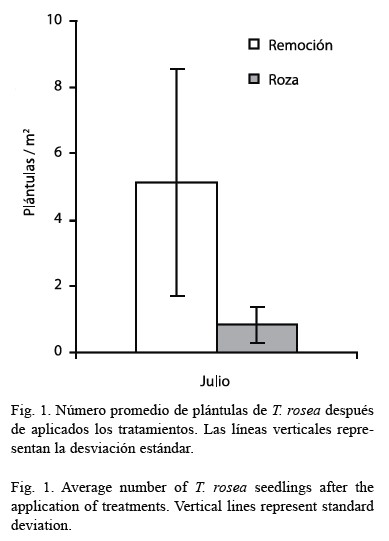
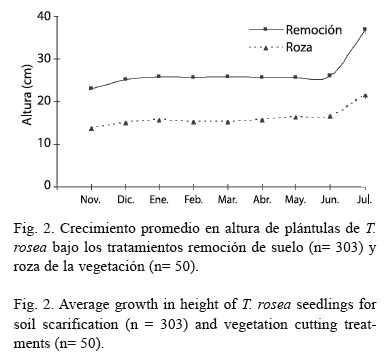
<body><![CDATA[1999). </span></small><br style="font-family: arial;">     <small></small><br style="font-family: arial;">     <small><small><b>     </b></small></small>     <div style="text-align: center;"><small><small><b><!-- big --><span  style="font-family: arial;">R</span><!-- /big --><font size="3"><small><span  style="font-family: arial;">esultados</span></small></font></b></small></small><br  style="font-family: arial;"> </div> <small></small><br style="font-family: arial;"> <small><span style="font-family: arial; font-weight: bold;">Efecto de los tratamientos al suelo </span><span  style="font-family: arial; font-weight: bold;">y vegetaci&oacute;n en el establecimiento </span><span  style="font-family: arial; font-weight: bold;">de la regeneraci&oacute;n natural</span></small><br  style="font-family: arial;"> <small></small><br style="font-family: arial;"> <small><span style="font-family: arial;">La mayor cantidad de pl&aacute;ntulas por unidad </span><span style="font-family: arial;">de superficie correspondi&oacute; al tratamiento </span><span  style="font-family: arial;">remoci&oacute;n de suelo con 5.16 pl&aacute;ntulas por m<sup>2</sup>, </span><span  style="font-family: arial;">mientras que el tratamiento roza de vegetaci&oacute;n </span><span style="font-family: arial;">tuvo solo 0.82 pl&aacute;ntulas por m2 (<a href="#figura1">Fig. 1</a>).</span></small><br  style="font-family: arial;"> <small></small><br style="font-family: arial;"> <small><span style="font-family: arial;">Los resultados anteriores permiten establecer </span><span style="font-family: arial;">que el tratamiento remoci&oacute;n de suelo tuvo </span><span style="font-family: arial;">un efecto positivo sobre la densidad de pl&aacute;ntulas </span><span  style="font-family: arial;">emergidas (ANDEVA, F= 12.35, p&lt;0.01).</span></small><br  style="font-family: arial;"> <small></small><br style="font-family: arial;"> <small><span style="font-family: arial;">I<span  style="font-weight: bold;">nfluencia de los tratamientos al suelo </span></span><span  style="font-family: arial; font-weight: bold;">y vegetaci&oacute;n sobre el desarrollo inicial </span><span  style="font-family: arial; font-weight: bold;">de pl&aacute;ntulas</span></small><br  style="font-family: arial;"> <small></small><br style="font-family: arial;"> <small><span style="font-family: arial;"><span  style="font-weight: bold;">Crecimiento</span>: El periodo de evaluaci&oacute;n </span><span  style="font-family: arial;">abarc&oacute; de noviembre del 2000 (temporada </span><span style="font-family: arial;">seca) a julio del 2001 (temporada h&uacute;meda). De </span><span  style="font-family: arial;">las 353 pl&aacute;ntulas marcadas, 303 correspondieron </span><span style="font-family: arial;">al tratamiento remoci&oacute;n de suelo y 50 al de </span><span  style="font-family: arial;">roza de vegetaci&oacute;n. </span></small><br  style="font-family: arial;"> <small></small><br style="font-family: arial;"> <small><span style="font-family: arial;">El crecimiento en altura de las pl&aacute;ntulas </span><span style="font-family: arial;">fue significativamente (ANDEVA, p&lt;0.01 para </span><span  style="font-family: arial;">los meses de noviembre F= 10.10, diciembre </span><span style="font-family: arial;">F= 7.83, abril F= 7.83 y julio F= 9.09, y p&lt;0.05 </span><span style="font-family: arial;">para enero F= 7.40, febrero F= 7.35, marzo </span><span  style="font-family: arial;">F= 7.48, mayo F= 6.92 y junio F= 6.69) mayor </span><span style="font-family: arial;">en el tratamiento remoci&oacute;n de suelo en comparaci&oacute;n</span><span  style="font-family: arial;">con el tratamiento roza de la vegetaci&oacute;n </span><span style="font-family: arial;">para cada fecha de medici&oacute;n (<a href="#figura2">Fig. 2</a>).</span></small></div>     <p align="center"><a name="figura1"> <img style="border: 0px solid ; width: 389px; height: 541px;"  src="/img/fbpe/rbt/v54n4/3506i1.JPG" title="" alt=""></a><a name="figura2"><img  style="border: 0px solid ; width: 386px; height: 359px;"  src="/img/fbpe/rbt/v54n4/3506i2.JPG" title="" alt=""></a></p>     
<p align="center">&nbsp;</p>     <p align="center"><a name="figura3"> <img style="border: 0px solid ; width: 391px; height: 344px;"  src="/img/fbpe/rbt/v54n4/3506i3.JPG" title="" alt=""></a><a name="figura4"><img  style="border: 0px solid ; width: 386px; height: 344px;"  src="/img/fbpe/rbt/v54n4/3506i4.JPG" title="" alt=""></a></p>     
<p align="justify"><small><br style="font-family: arial;"> <br style="font-family: arial;"> </small></p>     <div style="text-align: left;"><small><span style="font-family: arial;">La     ]]></body>
<body><![CDATA[altura promedio de las     pl&aacute;ntulas al </span><span style="font-family: arial;">final del     periodo de evaluaci&oacute;n (julio 2001) fue 58.3 % mayor para el     tratamiento remoci&oacute;n de </span><span style="font-family: arial;">suelo     (36.9 cm) en comparaci&oacute;n con el tratamiento </span><span      style="font-family: arial;">roza de la vegetaci&oacute;n (21.5 cm).</span></small><br      style="font-family: arial;">     <small></small><br style="font-family: arial;">     <small><span style="font-family: arial;">El crecimiento en     di&aacute;metro de     ]]></body>
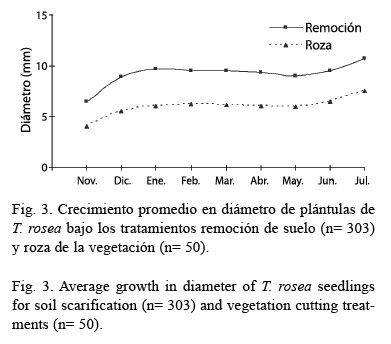
<body><![CDATA[las pl&aacute;ntulas </span><span style="font-family: arial;">fue     significativamente (ANDEVA, p&lt;0.01 para </span><span      style="font-family: arial;">los meses de noviembre F= 19.48, diciembre     F= </span><span style="font-family: arial;">9.92 y enero F= 8.37; y de     p&lt;0.05 para febrero </span><span style="font-family: arial;">F=     4.25, marzo F= 6.09, abril F= 5.68, mayo </span><span      style="font-family: arial;">F= 4.40, junio F= 4.26 y julio F= 5.59)     mayor </span><span style="font-family: arial;">en el tratamiento     remoci&oacute;n de suelo en comparaci&oacute;n </span><span      style="font-family: arial;">con el tratamiento roza de la     ]]></body>
<body><![CDATA[vegetaci&oacute;n </span><span style="font-family: arial;">para cada     fecha de medici&oacute;n (<a href="#figura3">Fig. 3</a>).</span></small><br      style="font-family: arial;">     <small></small><br style="font-family: arial;">     <small><span style="font-family: arial;">El di&aacute;metro promedio de     las     pl&aacute;ntulas al </span><span style="font-family: arial;">final del     periodo de evaluaci&oacute;n (julio 2001) fue </span><span      style="font-family: arial;">70.3 % mayor para el tratamiento     remoci&oacute;n de </span><span style="font-family: arial;">suelo     ]]></body>
<body><![CDATA[(10.76 mm) en comparaci&oacute;n con el tratamiento </span><span      style="font-family: arial;">roza de la vegetaci&oacute;n (7.57 mm).</span></small><br      style="font-family: arial;">     <small></small><br style="font-family: arial;">     <small><span style="font-family: arial;">Sin embargo, en ambos     tratamientos     las </span><span style="font-family: arial;">pl&aacute;ntulas tuvieron     una forma c&oacute;nica del tallo: </span><span      style="font-family: arial;">grueso en la base y ahus&aacute;ndose     hacia la punta o </span><span style="font-family: arial;">yema apical,     ]]></body>
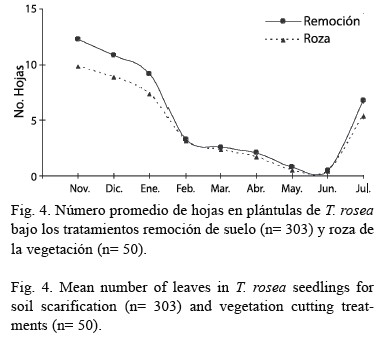
<body><![CDATA[y presentaron una contracci&oacute;n en </span><span      style="font-family: arial;">mayo: &eacute;poca m&aacute;s seca del     a&ntilde;o (<a href="#figura3">Fig. 3</a>).</span></small><br      style="font-family: arial;">     <small></small><br style="font-family: arial;">     <small><span style="font-family: arial;">La cantidad de hojas generada     durante     el </span><span style="font-family: arial;">periodo de     evaluaci&oacute;n, bajo los tratamientos </span><span      style="font-family: arial;">descritos, fue muy similar (<a     ]]></body>
<body><![CDATA[ href="#figura4">Fig. 4</a>). El an&aacute;lisis </span><span      style="font-family: arial;">de varianza     del n&uacute;mero de hojas mostr&oacute; </span><span      style="font-family: arial;">diferencias significativas entre     tratamientos </span><span style="font-family: arial;">(ANDEVA,     p&lt;0.05) s&oacute;lo para la fecha inicial </span><span      style="font-family: arial;">de muestreo (noviembre F= 5.85), mientras </span><span      style="font-family: arial;">que para los meses restantes no hubo     diferencias </span><span style="font-family: arial;">significativas.</span></small><br      style="font-family: arial;">     ]]></body>
<body><![CDATA[<small></small><br style="font-family: arial;">     <small><span style="font-family: arial;"><span      style="font-weight: bold;">Vegetaci&oacute;n     competidora</span>: De 565 pl&aacute;ntulas </span><span      style="font-family: arial;">evaluadas, 303 fueron para remoci&oacute;n     de </span><span style="font-family: arial;">suelo con deshierbe, 208     para remoci&oacute;n de </span><span style="font-family: arial;">suelo     sin deshierbe, 50 para roza de vegetaci&oacute;n </span><span      style="font-family: arial;">con deshierbe y cuatro para roza de     vegetaci&oacute;n </span><span style="font-family: arial;">sin     ]]></body>
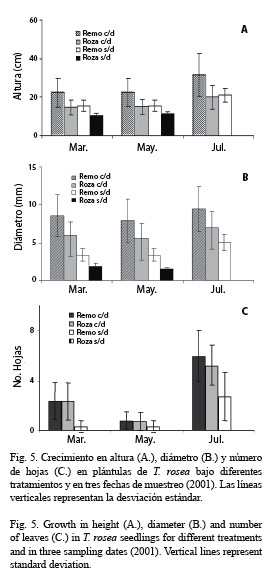
<body><![CDATA[deshierbe. El mayor crecimiento en altura </span><span      style="font-family: arial;">se present&oacute; en la condici&oacute;n     de remoci&oacute;n de </span><span style="font-family: arial;">suelo     con deshierbe; sin embargo, el crecimiento </span><span      style="font-family: arial;">en altura entre los tratamientos de roza </span><span      style="font-family: arial;">con deshierbe y remoci&oacute;n sin     deshierbe fue </span><span style="font-family: arial;">muy similar en     los tres periodos de evaluaci&oacute;n </span><span      style="font-family: arial;">(<a href="#figura5">Fig. 5A</a>). Lo mismo     ocurri&oacute; para el     ]]></body>
<body><![CDATA[n&uacute;mero </span><span style="font-family: arial;">de hojas en los     tratamientos de remoci&oacute;n con </span><span      style="font-family: arial;">deshierbe y roza con deshierbe (<a      href="#figura5">Fig. 5C</a>), pero </span><span      style="font-family: arial;">no as&iacute; con el     crecimiento en di&aacute;metro donde el </span><span      style="font-family: arial;">tratamiento remoci&oacute;n con deshierbe     fue superior </span><span style="font-family: arial;">(<a      href="#figura5">Fig. 5B</a>).</span></small><br      style="font-family: arial;">     ]]></body>
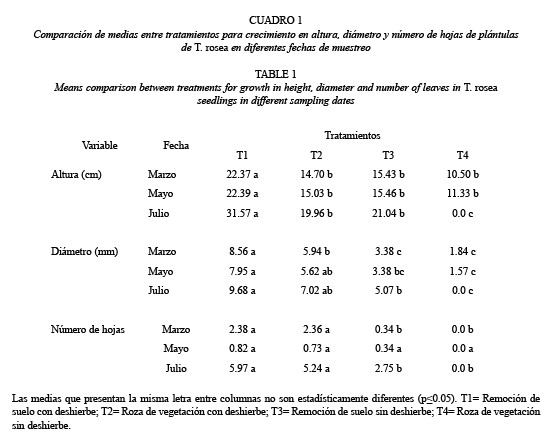
<body><![CDATA[<small></small><br style="font-family: arial;">     <small><span style="font-family: arial;">Los resultados del     an&aacute;lisis de     varianza </span><span style="font-family: arial;">para el crecimiento     en altura de las pl&aacute;ntulas </span><span      style="font-family: arial;">manifestaron diferencias significativas     (marzo </span><span style="font-family: arial;">F= 8.31, p&lt;0.01;     mayo F= 8.04, p&lt;0.01; julio </span><span style="font-family: arial;">F=     7.90, p&lt;0.01). Al menos un tratamiento </span><span      style="font-family: arial;">fue diferente en cada uno de los periodos     ]]></body>
<body><![CDATA[de </span><span style="font-family: arial;">evaluaci&oacute;n. Se     utiliz&oacute; la prueba de Tukey para </span><span      style="font-family: arial;">comparar las medias (Cuadro 1). Los     tratamientos </span><span style="font-family: arial;">roza con     deshierbe y remoci&oacute;n sin </span><span      style="font-family: arial;">deshierbe comparten similitud     estad&iacute;stica en </span><span style="font-family: arial;">los     tres periodos de evaluaci&oacute;n. El tratamiento que present&oacute;     las pl&aacute;ntulas con alturas significativamente </span><span      style="font-family: arial;">mayores a los dem&aacute;s tratamientos </span><span     ]]></body>
<body><![CDATA[ style="font-family: arial;">fue el de remoci&oacute;n con deshierbe.</span></small><br      style="font-family: arial;">     <small></small><br style="font-family: arial;">     <small><span style="font-family: arial;">Los resultados del     an&aacute;lisis de     varianza para </span><span style="font-family: arial;">el crecimiento     en di&aacute;metro muestran evidencias </span><span      style="font-family: arial;">altamente significativas de que existen     diferencias </span><span style="font-family: arial;">entre     tratamientos en todas las fechas </span><span     ]]></body>
<body><![CDATA[ style="font-family: arial;">de muestreo (marzo F= 24.68, p&lt;0.01;     mayo </span><span style="font-family: arial;">F= 21.63, p&lt;0.01;     julio F= 11.18, p&lt;0.01). La </span><span style="font-family: arial;">prueba     de Tukey (<a href="#cuadro1">Cuadro 1</a>) muestra que el tratamiento </span><span      style="font-family: arial;">roza sin deshierbe fue el que     present&oacute; </span><span style="font-family: arial;">valores     menores de di&aacute;metro, seguido por el </span><span      style="font-family: arial;">tratamiento remoci&oacute;n sin deshierbe;     y el que </span><span style="font-family: arial;">mayores valores     registr&oacute; fue el de remoci&oacute;n </span><span     ]]></body>
<body><![CDATA[ style="font-family: arial;">con&nbsp; deshierbe.</span></small></div>     <p align="center"><a name="figura5"> <img style="border: 0px solid ; width: 268px; height: 587px;"  src="/img/fbpe/rbt/v54n4/3506i5.JPG" title="" alt=""></a></p>     
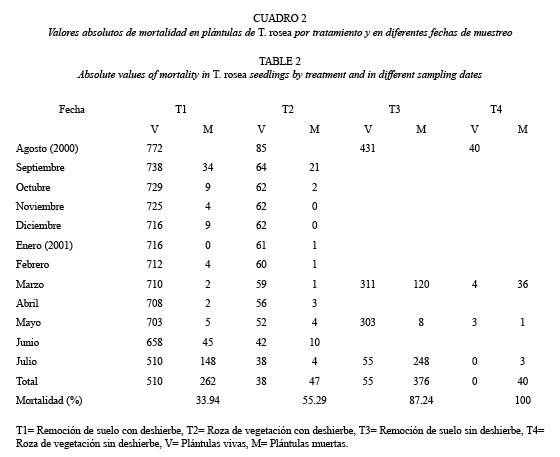
<p align="justify"><small><br style="font-family: arial;"> <br style="font-family: arial;"> </small></p>     <div style="text-align: left;"><small><span style="font-family: arial;">Los resultados del an&aacute;lisis de varianza </span><span style="font-family: arial;">muestran diferencias altamente significativas </span><span style="font-family: arial;">entre tratamientos en el n&uacute;mero de hojas de las </span><span  style="font-family: arial;">pl&aacute;ntulas para dos fechas de medici&oacute;n (marzo </span><span style="font-family: arial;">F= 12.21, p&lt;0.01; julio F= 9.48, p&lt;0.01). </span><span  style="font-family: arial;">La prueba de Tukey (<a href="#cuadro1">Cuadro 1</a>) mostr&oacute; que </span><span style="font-family: arial;">los tratamientos remoci&oacute;n y roza ambos sin </span><span  style="font-family: arial;">deshierbe fueron los que presentaron valores </span><span style="font-family: arial;">significativamente menores en n&uacute;mero </span><span style="font-family: arial;">de hojas para tales fechas de evaluaci&oacute;n, en </span><span  style="font-family: arial;">comparaci&oacute;n con los tratamientos remoci&oacute;n y </span><span style="font-family: arial;">roza ambos con deshierbe, que fueron estad&iacute;sticamente </span><span  style="font-family: arial;">similares entre s&iacute;.</span></small><br  style="font-family: arial;"> <small></small><br style="font-family: arial;"> <small><span style="font-family: arial;">En general, los mayores crecimientos de las </span><span style="font-family: arial;">pl&aacute;ntulas en altura, di&aacute;metro y n&uacute;mero de hojas, </span><span  style="font-family: arial;">se presentaron en aquellas desarrolladas bajo el </span><span style="font-family: arial;">tratamiento remoci&oacute;n de suelo con deshierbe; es </span><span  style="font-family: arial;">decir, que crecieron libres de malezas. </span><span  style="font-family: arial;">Mortalidad: Se observ&oacute; una clara tendencia </span><span style="font-family: arial;">de la mortalidad de pl&aacute;ntulas hacia aquellos </span><span  style="font-family: arial;">tratamientos donde no se aplic&oacute; deshierbe </span><span style="font-family: arial;">(<a href="#cuadro2">Cuadro 2</a>).</span></small><br style="font-family: arial;"> <small></small>    <br> <small><span style="font-family: arial;"><span  style="font-weight: bold;">Mortalidad</span>: Se observ&oacute; una clara tendencia </span><span  style="font-family: arial;">de la mortalidad de pl&aacute;ntulas hacia aquellos </span><span style="font-family: arial;">tratamientos donde no se aplic&oacute; deshierbe </span><span style="font-family: arial;">(<a  href="#cuadro2">Cuadro 2</a>).</span></small><br style="font-family: arial;"> <small></small>    <br> <small><span style="font-family: arial;"></span><span  style="font-family: arial;">En la &uacute;ltima evaluaci&oacute;n (julio del 2001), </span><span  style="font-family: arial;">al principio de la temporada de lluvias, se </span><span style="font-family: arial;">encontr&oacute; que los mayores porcentajes de mortalidad </span><span  style="font-family: arial;">correspondieron al tratamiento roza sin </span><span  style="font-family: arial;">deshierbe con el 100 %, seguido por remoci&oacute;n </span><span style="font-family: arial;">sin deshierbe con 87 %, roza con deshierbe con </span><span  style="font-family: arial;">55 % y el que menor proporci&oacute;n present&oacute; fue </span><span style="font-family: arial;">remoci&oacute;n con deshierbe con 34 %. Las pl&aacute;ntulas </span><span  style="font-family: arial;">que crecieron bajo la maleza se mostraron </span><span  style="font-family: arial;">d&eacute;biles y raqu&iacute;ticas, por lo que la mayor&iacute;a de ellas no logr&oacute; sobreponerse a las condiciones </span><span style="font-family: arial;">adversas&nbsp; de competencia.</span></small></div>     <p align="center"><a name="cuadro1"> <img style="border: 0px solid ; width: 552px; height: 439px;"  src="/img/fbpe/rbt/v54n4/3506i6.JPG" title="" alt=""></a></p>     
<p align="justify"><small><br style="font-family: arial;"> <br style="font-family: arial;"> </small></p>     <div style="text-align: left;">     <div style="text-align: center;"><small><span  style="font-family: arial; font-weight: 700;">Discusi&oacute;n</span></small><br  style="font-family: arial;"> </div> <small></small><br style="font-family: arial;"> <small><span style="font-family: arial; font-weight: bold;">Establecimiento de la regeneraci&oacute;n natural</span></small><br  style="font-family: arial;"> <small></small><br style="font-family: arial;"> <small><span style="font-family: arial;">La emergencia de las pl&aacute;ntulas fue mayor </span><span style="font-family: arial;">en el tratamiento remoci&oacute;n de suelo, ya que </span><span  style="font-family: arial;">se dej&oacute; expuesto el suelo mineral, proporcionando </span><span style="font-family: arial;">una cama semillera donde la rad&iacute;cula&nbsp; </span><span  style="font-family: arial;">de las pl&aacute;ntulas alcanz&oacute; f&aacute;cilmente el mismo. </span><span style="font-family: arial;">Los resultados anteriores son congruentes con </span><span  style="font-family: arial;">los informados por Mus&aacute;lem (1984) para <span style="font-style: italic;">Pinus </span></span><span  style="font-family: arial;"><span style="font-style: italic;">montezumae </span>y&nbsp; Vel&aacute;zquez (1984) para <span  style="font-style: italic;">Pinus </span></span><span  style="font-family: arial;"><span style="font-style: italic;">hartwegii </span>en un bosque de clima templado de </span><span  style="font-family: arial;">M&eacute;xico, as&iacute; como con los de Karlsson y &Ouml;rlander </span><span style="font-family: arial;">(2000) para <span style="font-style: italic;">Pinus sylvestris</span> en Suecia. </span></small><br style="font-family: arial;"> <small></small><br style="font-family: arial;"> <small><span style="font-family: arial;">Se ha documentado que con la remoci&oacute;n </span><span style="font-family: arial;">del suelo se incorpora la capa de hojarasca que </span><span  style="font-family: arial;">llega a ser una barrera que impide el contacto </span><span style="font-family: arial;">de las semillas con el suelo limitando su germinaci&oacute;n </span><span  style="font-family: arial;">(Beland <span style="font-style: italic;">et al</span>. 2000), siendo significativamente </span><span  style="font-family: arial;">mayor la germinaci&oacute;n en suelo </span><span  style="font-family: arial;">mineral que en suelo mezclado con humus y </span><span  style="font-family: arial;">suelo sin remover. Asimismo, se ha encontrado </span><span style="font-family: arial;">que la presencia de hojarasca tiene tambi&eacute;n </span><span  style="font-family: arial;">un efecto negativo en el establecimiento de </span><span style="font-family: arial;">especies con semillas peque&ntilde;as (Molofsky y </span><span style="font-family: arial;">Augspurger 1992).</span></small><br style="font-family: arial;"> <small></small><br style="font-family: arial;"> <small><span style="font-family: arial;">No obstante que para algunas especies la </span><span style="font-family: arial;">capa de hojarasca y de humus en descomposici&oacute;n </span><span style="font-family: arial;">puede ser una buena cama semillera, </span><span style="font-family: arial;">debido a su alta capacidad de infiltraci&oacute;n de </span><span  style="font-family: arial;">agua, buena aireaci&oacute;n y a que favorece el contacto </span><span style="font-family: arial;">de las part&iacute;culas del suelo con el agua y </span><span  style="font-family: arial;">la semilla (Kozlowski 2002), muchas pl&aacute;ntulas mueren debido a que sus ra&iacute;ces no logran penetrar </span><span style="font-family: arial;">dicha capa hasta llegar al suelo mineral </span><span style="font-family: arial;">(Ahlgren 1974).</span></small></div>     ]]></body>
<body><![CDATA[<p align="center"><a name="cuadro2"> <img style="border: 0px solid ; width: 560px; height: 457px;"  src="/img/fbpe/rbt/v54n4/3506i7.JPG" title="" alt=""></a></p>     
<p align="justify"><small><br style="font-family: arial;"> </small></p>     <div style="text-align: left;"><small><span style="font-family: arial;">Los     resultados obtenidos en el     presente </span><span style="font-family: arial;">estudio, y el hecho     que algunas especies requieren </span><span style="font-family: arial;">de     suelos desnudos para el establecimiento </span><span      style="font-family: arial;">de sus pl&aacute;ntulas (Finegan 1984), se     puede establecer </span><span style="font-family: arial;">que <span      style="font-style: italic;">T. rosea </span>requiere de suelo mineral</span><span     ]]></body>
<body><![CDATA[ style="font-family: arial;">para su germinaci&oacute;n. La     germinaci&oacute;n de las </span><span style="font-family: arial;">semillas     de esta especie fue favorecida con la </span><span      style="font-family: arial;">eliminaci&oacute;n de hojarasca, ya que     debido a&nbsp; su </span><span style="font-family: arial;">tama&ntilde;o     (0.0166 g) no tuvo la capacidad para </span><span      style="font-family: arial;">que sus ra&iacute;ces atravesaran esta     barrera y alcanzaran </span><span style="font-family: arial;">el suelo     mineral. Estos resultados son </span><span style="font-family: arial;">similares     a lo informado por Macario (1991) </span><span     ]]></body>
<body><![CDATA[ style="font-family: arial;">quien menciona que si las semillas al caer     en </span><span style="font-family: arial;">la hojarasca logran     germinar durante la &eacute;poca </span><span      style="font-family: arial;">h&uacute;meda, &eacute;stas pueden morir     durante la &eacute;poca </span><span style="font-family: arial;">seca     debido a que sus ra&iacute;ces no alcanzan el suelo mineral. En     general, la disponibilidad de agua en </span><span      style="font-family: arial;">el suelo mineral es m&aacute;s estable que     en la capa de </span><span style="font-family: arial;">hojarasca     (&Aacute;ngeles y Sakimoto 1999).</span></small><br     ]]></body>
<body><![CDATA[ style="font-family: arial;">     <small></small><br style="font-family: arial;">     <small><span style="font-family: arial; font-weight: bold;">Desarrollo     inicial     de pl&aacute;ntulas</span></small><br style="font-family: arial;">     <small></small><br style="font-family: arial;">     <small><span style="font-family: arial;">El mayor crecimiento en altura     y     di&aacute;metro </span><span style="font-family: arial;">de las     pl&aacute;ntulas de <span style="font-style: italic;">T. rosea </span>ocurri&oacute;     ]]></body>
<body><![CDATA[en el tratamiento </span><span style="font-family: arial;">remoci&oacute;n     de suelo. Probablemente con </span><span style="font-family: arial;">el     aflojamiento del suelo las pl&aacute;ntulas desarrollaron </span><span      style="font-family: arial;">un mayor sistema radical que     permiti&oacute; </span><span style="font-family: arial;">un mayor     suministro de agua y nutrientes. Sin </span><span      style="font-family: arial;">embargo, aunque no hubo un efecto de los     tratamientos </span><span style="font-family: arial;">sobre el     n&uacute;mero de hojas, se observ&oacute; </span><span      style="font-family: arial;">que las pl&aacute;ntulas desarrolladas en     ]]></body>
<body><![CDATA[el tratamiento </span><span style="font-family: arial;">de     remoci&oacute;n de suelo tuvieron hojas de mayor </span><span      style="font-family: arial;">tama&ntilde;o que aquellas en el     tratamiento roza de </span><span style="font-family: arial;">vegetaci&oacute;n.     Este factor no se evalu&oacute; en la presente </span><span      style="font-family: arial;">investigaci&oacute;n pero pudo ejercer un     efecto positivo sobre el desarrollo de las pl&aacute;ntulas, </span><span      style="font-family: arial;">como se manifest&oacute; en los     an&aacute;lisis anteriores de </span><span style="font-family: arial;">crecimiento     en altura y di&aacute;metro. </span><span style="font-family: arial;">Asimismo,     ]]></body>
<body><![CDATA[Hartshorn (1980) y Macario </span><span style="font-family: arial;">(1991)     informan que las pl&aacute;ntulas se desarrollan </span><span      style="font-family: arial;">mejor en lugares iluminados y con suelo     expuesto, </span><span style="font-family: arial;">mientras que     Karlsson y &Ouml;rlander (2000) </span><span      style="font-family: arial;">se&ntilde;alan que la     escarificaci&oacute;n o remoci&oacute;n del </span><span      style="font-family: arial;">suelo mejoran la germinaci&oacute;n de las     semillas y </span><span style="font-family: arial;">aumentan el&nbsp;     crecimiento de las pl&aacute;ntulas.</span></small><br     ]]></body>
<body><![CDATA[ style="font-family: arial;">     <small></small><br style="font-family: arial;">     <small><span style="font-family: arial; font-weight: bold;">Efecto de     la     vegetaci&oacute;n competidora</span></small><br      style="font-family: arial;">     <small></small><br style="font-family: arial;">     <small><span style="font-family: arial;">Los resultados muestran que el     crecimiento </span><span style="font-family: arial;">en altura de <span      style="font-style: italic;">T. rosea</span> fue menos sensible a la </span><span     ]]></body>
<body><![CDATA[ style="font-family: arial;">eliminaci&oacute;n de la vegetaci&oacute;n     competidora, al </span><span style="font-family: arial;">parecer, la     competencia de hierbas y arbustos </span><span      style="font-family: arial;">redujo el crecimiento en di&aacute;metro     m&aacute;s que el </span><span style="font-family: arial;">crecimiento     en altura. </span></small><br style="font-family: arial;">     <small></small><br style="font-family: arial;">     <small><span style="font-family: arial;">De acuerdo con esto,     &Aacute;ngeles<span style="font-style: italic;"> et al</span>. (1997) </span><span      style="font-family: arial;">informan que el incremento en     ]]></body>
<body><![CDATA[di&aacute;metro de </span><span style="font-family: arial;"><span      style="font-style: italic;">Pinus patula</span> (especie de bosque     templado) </span><span style="font-family: arial;">fue mayor donde se     tuvo control de la maleza </span><span style="font-family: arial;">que     donde no se tuvo. Tambi&eacute;n mencionan </span><span      style="font-family: arial;">que al existir un mayor espacio     disponible, los </span><span style="font-family: arial;">brinzales     sujetos al tratamiento de control de </span><span      style="font-family: arial;">la maleza tuvieron oportunidad de     apropiarse </span><span style="font-family: arial;">de una mayor     ]]></body>
<body><![CDATA[cantidad de recursos, lo cual se </span><span      style="font-family: arial;">tradujo en un mayor crecimiento radial. </span></small><br      style="font-family: arial;">     <small></small><br style="font-family: arial;">     <small><span style="font-family: arial;">La competencia de las     pl&aacute;ntulas con hierbas </span><span style="font-family: arial;">y     arbustos se presenta principalmente de </span><span      style="font-family: arial;">dos formas (Holl 1998): a) a nivel de     sistema </span><span style="font-family: arial;">radical, disputando     nutrientes y agua; y b) por </span><span style="font-family: arial;">la     ]]></body>
<body><![CDATA[luz; en ambos casos se reduce el crecimiento. </span><span      style="font-family: arial;">Augspurger (1984) demostr&oacute; que     algunas </span><span style="font-family: arial;">especies tropicales     crecieron m&aacute;s r&aacute;pidamente </span><span      style="font-family: arial;">cuando fueron expuestas a altos niveles de     luz, </span><span style="font-family: arial;">lo cual sucede con <span      style="font-style: italic;">T. rosea</span> considerada como </span><span      style="font-family: arial;">una especie heli&oacute;fita que requiere     luz directa </span><span style="font-family: arial;">para su     desarrollo.</span></small><br style="font-family: arial;">     ]]></body>
<body><![CDATA[<small></small><br style="font-family: arial;">     <small><span style="font-family: arial;">En el presente trabajo, en los     tratamientos </span><span style="font-family: arial;">donde se     removi&oacute; el suelo, el crecimiento de </span><span      style="font-family: arial;">las pl&aacute;ntulas de esta especie fue     m&aacute;s afectado </span><span style="font-family: arial;">cuando se     aplic&oacute; deshierbe, observ&aacute;ndose </span><span      style="font-family: arial;">claramente que las pl&aacute;ntulas     desarrolladas libres d</span><span style="font-family: arial;">e maleza     presentaron mayores crecimientos </span><span     ]]></body>
<body><![CDATA[ style="font-family: arial;">que aquellas donde no se realiz&oacute; el     control de </span><span style="font-family: arial;">la misma. Estos     resultados coinciden con los </span><span style="font-family: arial;">informados     por Uhl (1987), quien se&ntilde;ala que la </span><span      style="font-family: arial;">competencia por luz es m&aacute;s     importante que la </span><span style="font-family: arial;">disponibilidad     de agua o minerales en el suelo.</span></small><br      style="font-family: arial;">     <small></small><br style="font-family: arial;">     <small><span style="font-family: arial;">Las hierbas y arbustos     ]]></body>
<body><![CDATA[tuvieron un     efecto </span><span style="font-family: arial;">negativo sobre el     desarrollo de las pl&aacute;ntulas </span><span      style="font-family: arial;">de <span style="font-style: italic;">T.     rosea</span>, debido a que dichas pl&aacute;ntulas son </span><span      style="font-family: arial;">de crecimiento lento, en     comparaci&oacute;n con las </span><span style="font-family: arial;">hierbas     que crecieron r&aacute;pidamente y a la capacidad</span><span      style="font-family: arial;"> que tienen algunos arbustos de rebrotar, </span><span      style="font-family: arial;">alcanzando en algunos casos alturas de     ]]></body>
<body><![CDATA[hasta </span><span style="font-family: arial;">2 m en los primeros 40     d&iacute;as, mientras que </span><span style="font-family: arial;">las     pl&aacute;ntulas s&oacute;lo alcanzaban 15 cm. Miller y </span><span      style="font-family: arial;">Kauffman (1998) se&ntilde;alan que los     brotes o reto&ntilde;os </span><span style="font-family: arial;">de     los arbustos crecen r&aacute;pidamente debido </span><span      style="font-family: arial;">a sus&nbsp; eservas alimenticias     almacenadas en las </span><span style="font-family: arial;">ra&iacute;ces,     adem&aacute;s son largos y delgados y su copa </span><span      style="font-family: arial;">crece m&aacute;s r&aacute;pidamente que     ]]></body>
<body><![CDATA[las pl&aacute;ntulas, las </span><span style="font-family: arial;">cuales     tienen menores reservas en sus semillas </span><span      style="font-family: arial;">que las de los brotes.</span></small><br      style="font-family: arial;">     <small></small><br style="font-family: arial;">     <small><span style="font-family: arial;">Otra ventaja de los brotes de     arbustos en </span><span style="font-family: arial;">comparaci&oacute;n     con las pl&aacute;ntulas, es la mayor </span><span      style="font-family: arial;">superficie que abarca su sistema radical y     la gran </span><span style="font-family: arial;">profundidad a que     ]]></body>
<body><![CDATA[penetra en el suelo, caracter&iacute;stica </span><span      style="font-family: arial;">relevante sobre todo en bosques secos </span><span      style="font-family: arial;">donde el agua es un factor limitante.     Debido a </span><span style="font-family: arial;">esto, Holl (1998)     se&ntilde;ala la importancia de reducir </span><span      style="font-family: arial;">la competencia por hierbas y arbustos, ya </span><span      style="font-family: arial;">que afectan de manera negativa el     crecimiento&nbsp; </span><span style="font-family: arial;">de     &aacute;rboles j&oacute;venes y pl&aacute;ntulas, tanto en la     regeneraci&oacute;n </span><span style="font-family: arial;">natural     ]]></body>
<body><![CDATA[como en proyectos de reforestaci&oacute;n. </span><span      style="font-family: arial;">Adem&aacute;s, algunos arbustos     podr&iacute;an generar </span><span style="font-family: arial;">efectos     alelop&aacute;ticos sobre el crecimiento de las </span><span      style="font-family: arial;">pl&aacute;ntulas (Anaya 1976).</span></small><br      style="font-family: arial;">     <small></small><br style="font-family: arial;">     <small></small>     <div style="text-align: center;"><small><span  style="font-family: arial; font-weight: bold;">Mortalidad</span></small><br  style="font-family: arial;"> </div> <small></small><br style="font-family: arial;"> <small><span style="font-family: arial;">El mayor porcentaje de mortalidad se </span><span style="font-family: arial;">present&oacute; en los tratamientos sin control de la </span><span style="font-family: arial;">maleza, indicando una gran influencia de la </span><span style="font-family: arial;">misma sobre las pl&aacute;ntulas de <span style="font-style: italic;">T. rosea</span>.&nbsp; </span></small>    <br> <small><span style="font-family: arial;"></span></small>    ]]></body>
<body><![CDATA[<br>     <small><span style="font-family: arial;">Las pl&aacute;ntulas que     tuvieron     mejor desarrollo </span><span style="font-family: arial;">lo     reflejaron en un incremento de     altura y di&aacute;metro, </span><span style="font-family: arial;">siendo     m&aacute;s robustas, lo que     les permiti&oacute; </span><span style="font-family: arial;">una mayor     capacidad de sobrevivir a condiciones </span><span      style="font-family: arial;">adversas como la sequ&iacute;a.     ]]></body>
<body><![CDATA[Steven (1994) </span><span style="font-family: arial;">inform&oacute;     que la supervivencia     de pl&aacute;ntulas de Quararibea asterolepis, <span      style="font-style: italic;">Trichilia tuberculata </span></span><span      style="font-family: arial;">y <span style="font-style: italic;">Tetragastris     panamensis</span>, en la Isla     de Barro </span><span style="font-family: arial;">Colorado,     Panam&aacute;,     aument&oacute; conforme incrementaban </span><span      style="font-family: arial;">en edad y tama&ntilde;o.</span></small><br     ]]></body>
<body><![CDATA[ style="font-family: arial;">     <small></small><br style="font-family: arial;">     <small><span style="font-family: arial;">Al parecer, la principal causa     de     mortalidad&nbsp; </span><span style="font-family: arial;">de las     pl&aacute;ntulas de <span style="font-style: italic;">T. rosea</span>     fue la sequ&iacute;a o </span><span style="font-family: arial;">alta     de humedad en el suelo, que     aunado a la </span><span style="font-family: arial;">competencia con     la maleza fue determinante. </span><span style="font-family: arial;">Esto     ]]></body>
<body><![CDATA[coincide con lo expuesto por     Kennard <span style="font-style: italic;">et </span></span><span      style="font-family: arial;"><span style="font-style: italic;">al</span>.     (2002), quienes consideran que la     supervivencia&nbsp; </span><span style="font-family: arial;">de las     pl&aacute;ntulas est&aacute;     estrechamente </span><span style="font-family: arial;">relacionada con     la capacidad de     poseer un </span><span style="font-family: arial;">amplio sistema     radical que les     ]]></body>
<body><![CDATA[proporcione una&nbsp; </span><span style="font-family: arial;">superficie     mayor para la     obtenci&oacute;n de agua y </span><span style="font-family: arial;">nutrientes,     as&iacute; como una mayor     profundidad en </span><span style="font-family: arial;">el suelo,     especialmente en bosques     secos donde </span><span style="font-family: arial;">el agua es     estacionalmente limitada.</span></small><br style="font-family: arial;">     <small></small><br style="font-family: arial;">     <small><span style="font-family: arial;">Los niveles de mortalidad en <span     ]]></body>
<body><![CDATA[ style="font-style: italic;">T. rosea </span></span><span      style="font-family: arial;">se incrementaron conforme     avanz&oacute; la &eacute;poca </span><span style="font-family: arial;">seca,     las cifras de la &uacute;ltima     evaluaci&oacute;n (Julio) </span><span style="font-family: arial;">reflejaron     la condici&oacute;n de     mayor sequ&iacute;a de los </span><span style="font-family: arial;">meses     anteriores (Mayo, Junio). Estos     resultados </span><span style="font-family: arial;">son congruentes     con los informados por </span><span style="font-family: arial;">Gerhardt     ]]></body>
<body><![CDATA[(1996), quien     encontr&oacute; que al final </span><span style="font-family: arial;">de     la &eacute;poca de sequ&iacute;a     todas las pl&aacute;ntulas de </span><span style="font-family: arial;"><span      style="font-style: italic;">Swietenia macrophylla</span> (King)     hab&iacute;an muerto </span><span style="font-family: arial;">en un     bosque seco de Costa Rica y     coinciden </span><span style="font-family: arial;">con lo     se&ntilde;alado por varios     autores respecto a </span><span style="font-family: arial;">que la     ]]></body>
<body><![CDATA[principal causa de muerte de     las pl&aacute;ntulas </span><span style="font-family: arial;">en los     bosques secos o con un marcado </span><span style="font-family: arial;">periodo     seco, es debida a la     desecaci&oacute;n durante </span><span style="font-family: arial;">tal     periodo (Steven 1994, Richards     1996, </span><span style="font-family: arial;">Kozlowski 2002).</span></small><br      style="font-family: arial;">     <small></small><br style="font-family: arial;">     <small><small><!-- big --><span style="font-family: arial; font-weight: 700;">Resumen</span><!-- /big --></small></small><br     ]]></body>
<body><![CDATA[ style="font-family: arial;">     <small></small><br style="font-family: arial;">     <small><span style="font-family: arial;">Evaluamos el efecto de los     tratamientos de remoci&oacute;n </span><span      style="font-family: arial;">de suelo y roza de vegetaci&oacute;n     sobre el establecimiento y </span><span style="font-family: arial;">desarrollo     inicial de la     regeneraci&oacute;n natural de <span style="font-style: italic;">Tabebuia&nbsp;     </span></span><span style="font-family: arial;"><span      style="font-style: italic;">rosea</span> (Bertold) DC. en una selva     ]]></body>
<body><![CDATA[mediana subcaducifolia </span><span style="font-family: arial;">sometida     a aprovechamiento maderable     en la costa de </span><span style="font-family: arial;">Jalisco,     M&eacute;xico. Los     tratamientos se aplicaron bajo la copa&nbsp; </span><span      style="font-family: arial;">de &aacute;rboles &#8220;semilleros&#8221; y se     evalu&oacute; el n&uacute;mero de pl&aacute;ntulas </span><span      style="font-family: arial;">emergidas y su desarrollo durante     nueve meses. El tratamiento </span><span style="font-family: arial;">de     remoci&oacute;n de suelo     ]]></body>
<body><![CDATA[favoreci&oacute; la emergencia de </span><span      style="font-family: arial;">pl&aacute;ntulas y su desarrollo     inicial, mientras que el control de </span><span      style="font-family: arial;">la vegetaci&oacute;n competidora     promovi&oacute; un mayor crecimiento </span><span      style="font-family: arial;">y menores porcentajes de mortalidad. Estos     aspectos deben </span><span style="font-family: arial;">tomarse en     cuenta para la     regeneraci&oacute;n natural de la especie </span><span      style="font-family: arial;">despu&eacute;s de la     ]]></body>
<body><![CDATA[aplicaci&oacute;n de las cortas con fines de aprovechamiento </span><span      style="font-family: arial;">maderable y se sugiere incorporarlos     a las t&eacute;cnicas </span><span style="font-family: arial;">silv&iacute;colas     que actualmente se     desarrollan en la zona.</span></small><br style="font-family: arial;">     <small></small><br style="font-family: arial;">     <small><span style="font-family: arial;"><span      style="font-weight: bold;">Palabras     clave</span>: Selva mediana     subcaducifolia, costa del </span><span style="font-family: arial;">Pac&iacute;fico,     ]]></body>
<body><![CDATA[regeneraci&oacute;n     natural, remoci&oacute;n de suelo, desarrollo </span><span      style="font-family: arial;">inicial y mortalidad de     pl&aacute;ntulas, <span style="font-style: italic;">Tabebuia rosea</span>.</span></small><br      style="font-family: arial;">     <small></small><br style="font-family: arial;">     <small><small><!-- big --><span style="font-family: arial; font-weight: 700;">Referencias</span><!-- /big --></small></small><br      style="font-family: arial;">     <small></small><br style="font-family: arial;">     <small><span style="font-family: arial;">Ahlgren, C. 1974. Effects of     ]]></body>
<body><![CDATA[fire on     temperate forest: northcentral </span><span style="font-family: arial;">United     States, p 279-391.<span style="font-style: italic;"> In</span> T.T.     Kozlowski </span><span style="font-family: arial;">&amp; C.E. Ahlgren.     Fire and     Ecosystems. Academic, </span><span style="font-family: arial;">Nueva     York, EEUU.</span></small><br style="font-family: arial;">     <small></small><br style="font-family: arial;">     <!-- ref --><small><span style="font-family: arial;">    &nbsp;&nbsp;&nbsp;&nbsp;&nbsp;&nbsp;&nbsp;&nbsp;[&#160;<a href="javascript:void(0);" onclick="javascript: window.open('/scielo.php?script=sci_nlinks&ref=1358533&pid=S0034-7744200600040002000001&lng=','','width=640,height=500,resizable=yes,scrollbars=1,menubar=yes,');">Links</a>&#160;]<!-- end-ref --><!-- ref -->Anaya, L. 1976. Alelopat&iacute;a en plantas superiores: diferencias </span><span  style="font-family: arial;">entre el efecto de la presi&oacute;n osm&oacute;tica y los </span><span style="font-family: arial;">alelop&aacute;ticos sobre la germinaci&oacute;n secundaria de una </span><span  style="font-family: arial;">zona c&aacute;lido h&uacute;meda de M&eacute;xico, p. 388-427.<span style="font-style: italic;"> In </span>A. </span><span style="font-family: arial;">G&oacute;mez-Pompa, C. V&aacute;zquez Y&aacute;nez, S. Del Amo R. </span><span style="font-family: arial;">&amp; A. Butanda C. Regeneraci&oacute;n de Selvas. CECSA, </span><span  style="font-family: arial;">M&eacute;xico, DF, M&eacute;xico.</span></small><br  style="font-family: arial;"> <small></small><br style="font-family: arial;"> <small><span style="font-family: arial;">&Aacute;    &nbsp;&nbsp;&nbsp;&nbsp;&nbsp;&nbsp;&nbsp;&nbsp;[&#160;<a href="javascript:void(0);" onclick="javascript: window.open('/scielo.php?script=sci_nlinks&ref=1358534&pid=S0034-7744200600040002000002&lng=','','width=640,height=500,resizable=yes,scrollbars=1,menubar=yes,');">Links</a>&#160;]<!-- end-ref --><!-- ref -->ngeles, G. &amp; P. Sakimoto. 1999. Emergence disappearance </span><span style="font-family: arial;">process and mortality factors of current year </span><span style="font-family: arial;">seedlings of<span  style="font-style: italic;"> Abies firma</span> in a natural <span style="font-style: italic;">Abies-Tsuga</span> forest, </span><span  style="font-family: arial;">Wakayama. For. Res. Kyoto. 71: 27-33.</span></small><br  style="font-family: arial;"> <small></small><br style="font-family: arial;"> <small><span style="font-family: arial;">&Aacute;    &nbsp;&nbsp;&nbsp;&nbsp;&nbsp;&nbsp;&nbsp;&nbsp;[&#160;<a href="javascript:void(0);" onclick="javascript: window.open('/scielo.php?script=sci_nlinks&ref=1358535&pid=S0034-7744200600040002000003&lng=','','width=640,height=500,resizable=yes,scrollbars=1,menubar=yes,');">Links</a>&#160;]<!-- end-ref --><!-- ref -->ngeles, G., A. Vel&aacute;zquez, J. Vargas, H. Ram&iacute;rez &amp; M. </span><span  style="font-family: arial;">Mus&aacute;lem. 1997. Efecto del manejo de la vegetaci&oacute;n </span><span style="font-family: arial;">en algunas variables de crecimiento de la repoblaci&oacute;n </span><span style="font-family: arial;">natural de un rodal de <span style="font-style: italic;">Pinus patula</span> en el estado de </span><span style="font-family: arial;">Hidalgo (M&eacute;xico). Invest. Agr. Sist. Recur. For. 6:&nbsp; </span><span style="font-family: arial;">119-131.</span></small><br  style="font-family: arial;"> <small></small><br style="font-family: arial;"> <small><span style="font-family: arial;">    &nbsp;&nbsp;&nbsp;&nbsp;&nbsp;&nbsp;&nbsp;&nbsp;[&#160;<a href="javascript:void(0);" onclick="javascript: window.open('/scielo.php?script=sci_nlinks&ref=1358536&pid=S0034-7744200600040002000004&lng=','','width=640,height=500,resizable=yes,scrollbars=1,menubar=yes,');">Links</a>&#160;]<!-- end-ref --><!-- ref -->An&oacute;nimo. 1994. Secretaria de Agricultura y Recursos </span><span style="font-family: arial;">Hidr&aacute;ulicos. Inventario Forestal Peri&oacute;dico del </span><span style="font-family: arial;">Estado de Jalisco, M&eacute;xico. Gobierno Estatal, Jalisco, </span><span style="font-family: arial;">M&eacute;xico. 78 p. </span></small><br style="font-family: arial;"> <small></small><br style="font-family: arial;"> <small><span style="font-family: arial;">    &nbsp;&nbsp;&nbsp;&nbsp;&nbsp;&nbsp;&nbsp;&nbsp;[&#160;<a href="javascript:void(0);" onclick="javascript: window.open('/scielo.php?script=sci_nlinks&ref=1358537&pid=S0034-7744200600040002000005&lng=','','width=640,height=500,resizable=yes,scrollbars=1,menubar=yes,');">Links</a>&#160;]<!-- end-ref --><!-- ref -->An&oacute;nimo. 1999. S-Plus 2000 modern statistics and advanced </span><span style="font-family: arial;">graphics (user&#8217;s guide). Mathsoft, Massachusetts, </span><span style="font-family: arial;">EEUU. 557 p.</span></small><br  style="font-family: arial;"> <small></small><br style="font-family: arial;"> <small><span style="font-family: arial;">    &nbsp;&nbsp;&nbsp;&nbsp;&nbsp;&nbsp;&nbsp;&nbsp;[&#160;<a href="javascript:void(0);" onclick="javascript: window.open('/scielo.php?script=sci_nlinks&ref=1358538&pid=S0034-7744200600040002000006&lng=','','width=640,height=500,resizable=yes,scrollbars=1,menubar=yes,');">Links</a>&#160;]<!-- end-ref --><!-- ref -->Augspurger, C. 1984. Seedling survival of tropical tree </span><span style="font-family: arial;">species: interactions of dispersal distance, light-gaps, </span><span style="font-family: arial;">and pathogens. Ecology 65: 1705-1712. </span></small>    &nbsp;&nbsp;&nbsp;&nbsp;&nbsp;&nbsp;&nbsp;&nbsp;[&#160;<a href="javascript:void(0);" onclick="javascript: window.open('/scielo.php?script=sci_nlinks&ref=1358539&pid=S0034-7744200600040002000007&lng=','','width=640,height=500,resizable=yes,scrollbars=1,menubar=yes,');">Links</a>&#160;]<!-- end-ref --><!-- ref --><br> <small><span style="font-family: arial;"></span></small><br  style="font-family: arial;"> <small><span style="font-family: arial;"></span><span  style="font-family: arial;">Beland, M., E. Agestam, P. Pek&ouml;, P. Gemmel &amp; U. Nilsson. </span><span style="font-family: arial;">2000. Scarification and seedfall affects natural </span><span style="font-family: arial;">regeneration of Scots pine under two shelterwood </span><span style="font-family: arial;">densities and a clear-cut in Southern Sweden. Scand. </span><span style="font-family: arial;">J. Forest Res. 15: 247-255.</span></small><br style="font-family: arial;"> <small></small><br style="font-family: arial;"> <small><span style="font-family: arial;">    &nbsp;&nbsp;&nbsp;&nbsp;&nbsp;&nbsp;&nbsp;&nbsp;[&#160;<a href="javascript:void(0);" onclick="javascript: window.open('/scielo.php?script=sci_nlinks&ref=1358540&pid=S0034-7744200600040002000008&lng=','','width=640,height=500,resizable=yes,scrollbars=1,menubar=yes,');">Links</a>&#160;]<!-- end-ref --><!-- ref -->Cochran, W.G. 1998. T&eacute;cnicas de muestreo. CECSA, </span><span style="font-family: arial;">M&eacute;xico, DF, M&eacute;xico. 513 p. </span></small>    &nbsp;&nbsp;&nbsp;&nbsp;&nbsp;&nbsp;&nbsp;&nbsp;[&#160;<a href="javascript:void(0);" onclick="javascript: window.open('/scielo.php?script=sci_nlinks&ref=1358541&pid=S0034-7744200600040002000009&lng=','','width=640,height=500,resizable=yes,scrollbars=1,menubar=yes,');">Links</a>&#160;]<!-- end-ref --><br> <small><span style="font-family: arial;"></span></small>    <!-- ref --><br> <small><span style="font-family: arial;">Finegan, B. 1984. Forest succession. Nature 312: 109-114. </span></small><br style="font-family: arial;"> <small></small><br style="font-family: arial;"> <small><span style="font-family: arial;">    &nbsp;&nbsp;&nbsp;&nbsp;&nbsp;&nbsp;&nbsp;&nbsp;[&#160;<a href="javascript:void(0);" onclick="javascript: window.open('/scielo.php?script=sci_nlinks&ref=1358543&pid=S0034-7744200600040002000010&lng=','','width=640,height=500,resizable=yes,scrollbars=1,menubar=yes,');">Links</a>&#160;]<!-- end-ref --><!-- ref -->Gerhardt, K. 1996. Germination and development of show </span><span style="font-family: arial;">mahogany (<span  style="font-style: italic;">Swietenia macrophylla King</span>) in secondary </span><span style="font-family: arial;">tropical dry forest habitats in Costa Rica. J. Trop. </span><span style="font-family: arial;">Eco. 12: 275-289.</span></small><br style="font-family: arial;"> <small></small><br style="font-family: arial;"> <small><span style="font-family: arial;">    &nbsp;&nbsp;&nbsp;&nbsp;&nbsp;&nbsp;&nbsp;&nbsp;[&#160;<a href="javascript:void(0);" onclick="javascript: window.open('/scielo.php?script=sci_nlinks&ref=1358544&pid=S0034-7744200600040002000011&lng=','','width=640,height=500,resizable=yes,scrollbars=1,menubar=yes,');">Links</a>&#160;]<!-- end-ref --><!-- ref -->Hardwick, K., J. Healey, S. Elliott &amp; N. Garwood. 1997. </span><span style="font-family: arial;">Understanding and assisting natural regeneration </span><span style="font-family: arial;">processes in degraded seasonal evergreen forest </span><span style="font-family: arial;">in northern Thailand. Forest Eco. Manag. 99: </span><span style="font-family: arial;">203-214.</span></small><br  style="font-family: arial;"> <small></small><br style="font-family: arial;"> <small><span style="font-family: arial;">    &nbsp;&nbsp;&nbsp;&nbsp;&nbsp;&nbsp;&nbsp;&nbsp;[&#160;<a href="javascript:void(0);" onclick="javascript: window.open('/scielo.php?script=sci_nlinks&ref=1358545&pid=S0034-7744200600040002000012&lng=','','width=640,height=500,resizable=yes,scrollbars=1,menubar=yes,');">Links</a>&#160;]<!-- end-ref --><!-- ref -->Hartshorn, S. 1980. Neotropical forest dynamics. Biotropica </span><span style="font-family: arial;">12 (Supl.): 23-30.</span></small><br style="font-family: arial;"> <small></small><br style="font-family: arial;"> <small><span style="font-family: arial;">    &nbsp;&nbsp;&nbsp;&nbsp;&nbsp;&nbsp;&nbsp;&nbsp;[&#160;<a href="javascript:void(0);" onclick="javascript: window.open('/scielo.php?script=sci_nlinks&ref=1358546&pid=S0034-7744200600040002000013&lng=','','width=640,height=500,resizable=yes,scrollbars=1,menubar=yes,');">Links</a>&#160;]<!-- end-ref --><!-- ref -->Hawley, R. &amp; D. Smith. 1972. Silvicultura pr&aacute;ctica. Trad. </span><span  style="font-family: arial;">por J. Terrada. Omega, Barcelona, Espa&ntilde;a. 544 p.</span></small><br style="font-family: arial;"> <small></small><br style="font-family: arial;"> <small><span style="font-family: arial;">    &nbsp;&nbsp;&nbsp;&nbsp;&nbsp;&nbsp;&nbsp;&nbsp;[&#160;<a href="javascript:void(0);" onclick="javascript: window.open('/scielo.php?script=sci_nlinks&ref=1358547&pid=S0034-7744200600040002000014&lng=','','width=640,height=500,resizable=yes,scrollbars=1,menubar=yes,');">Links</a>&#160;]<!-- end-ref --><!-- ref -->Holl, K.D. 1998. Effects of above -and below- ground competition </span><span style="font-family: arial;">of shrubs and grass on <span style="font-style: italic;">Calophyllum brasiliense </span></span><span style="font-family: arial;">(Camb.) seedling growth in abandoned tropical&nbsp; </span><span style="font-family: arial;">pasture. Forest Eco. Manag. 109: 187-195.</span></small><br style="font-family: arial;"> <small></small><br style="font-family: arial;"> <small><span style="font-family: arial;">    &nbsp;&nbsp;&nbsp;&nbsp;&nbsp;&nbsp;&nbsp;&nbsp;[&#160;<a href="javascript:void(0);" onclick="javascript: window.open('/scielo.php?script=sci_nlinks&ref=1358548&pid=S0034-7744200600040002000015&lng=','','width=640,height=500,resizable=yes,scrollbars=1,menubar=yes,');">Links</a>&#160;]<!-- end-ref --><!-- ref -->Infante, S.G. &amp; G.P. Z&aacute;rate de Lara. 1990. M&eacute;todos </span><span  style="font-family: arial;">estad&iacute;sticos un enfoque interdiciplinario. Trillas, </span><span style="font-family: arial;">M&eacute;xico, DF, M&eacute;xico. 643 p.</span></small><br style="font-family: arial;"> <small></small><br style="font-family: arial;"> <small><span style="font-family: arial;">    &nbsp;&nbsp;&nbsp;&nbsp;&nbsp;&nbsp;&nbsp;&nbsp;[&#160;<a href="javascript:void(0);" onclick="javascript: window.open('/scielo.php?script=sci_nlinks&ref=1358549&pid=S0034-7744200600040002000016&lng=','','width=640,height=500,resizable=yes,scrollbars=1,menubar=yes,');">Links</a>&#160;]<!-- end-ref --><!-- ref -->Karlsson, C. &amp; G. &Ouml;rlander. 2000. Soil scarification shortly </span><span  style="font-family: arial;">before a rich seed fall improves seedling establishment </span><span style="font-family: arial;">in seed tree stands of <span style="font-style: italic;">Pinus sylvestris</span>. Scand. J. </span><span style="font-family: arial;">Forest Res. 15: 256-266.</span></small><br style="font-family: arial;"> <small></small><br style="font-family: arial;"> <small><span style="font-family: arial;">    &nbsp;&nbsp;&nbsp;&nbsp;&nbsp;&nbsp;&nbsp;&nbsp;[&#160;<a href="javascript:void(0);" onclick="javascript: window.open('/scielo.php?script=sci_nlinks&ref=1358550&pid=S0034-7744200600040002000017&lng=','','width=640,height=500,resizable=yes,scrollbars=1,menubar=yes,');">Links</a>&#160;]<!-- end-ref --><!-- ref -->Kennard, D., K. Guold, F. Putz, T. Fredericksen &amp; F. </span><span style="font-family: arial;">Morales. 2002. Effect of disturbance intensity on </span><span style="font-family: arial;">regeneration mechanisms in a tropical dry forest. </span><span style="font-family: arial;">Forest Ecol. Manag.162: 197-208.</span></small><br style="font-family: arial;"> <small></small><br style="font-family: arial;"> <small><span style="font-family: arial;">    &nbsp;&nbsp;&nbsp;&nbsp;&nbsp;&nbsp;&nbsp;&nbsp;[&#160;<a href="javascript:void(0);" onclick="javascript: window.open('/scielo.php?script=sci_nlinks&ref=1358551&pid=S0034-7744200600040002000018&lng=','','width=640,height=500,resizable=yes,scrollbars=1,menubar=yes,');">Links</a>&#160;]<!-- end-ref --><!-- ref -->Kozlowski, T. 2002. Physiological ecology of natural </span><span style="font-family: arial;">regeneration of harvested and disturbed forest stand: </span><span style="font-family: arial;">implications for forest management. Forest Ecol. </span><span style="font-family: arial;">Manag. 158: 195-221.</span></small><br style="font-family: arial;"> <small></small><br style="font-family: arial;"> <small><span style="font-family: arial;">    &nbsp;&nbsp;&nbsp;&nbsp;&nbsp;&nbsp;&nbsp;&nbsp;[&#160;<a href="javascript:void(0);" onclick="javascript: window.open('/scielo.php?script=sci_nlinks&ref=1358552&pid=S0034-7744200600040002000019&lng=','','width=640,height=500,resizable=yes,scrollbars=1,menubar=yes,');">Links</a>&#160;]<!-- end-ref --><!-- ref -->Lamprecht, H. 1990. Silvicultura en los tr&oacute;picos. </span><span style="font-family: arial;">Cooperaci&oacute;n T&eacute;cnica Alemana, Berl&iacute;n, Alemania. </span><span  style="font-family: arial;">335 p.</span></small><br  style="font-family: arial;"> <small></small><br style="font-family: arial;"> <small><span style="font-family: arial;">    &nbsp;&nbsp;&nbsp;&nbsp;&nbsp;&nbsp;&nbsp;&nbsp;[&#160;<a href="javascript:void(0);" onclick="javascript: window.open('/scielo.php?script=sci_nlinks&ref=1358553&pid=S0034-7744200600040002000020&lng=','','width=640,height=500,resizable=yes,scrollbars=1,menubar=yes,');">Links</a>&#160;]<!-- end-ref --><!-- ref -->Lowery, R., C. Lambeth, M. Endo &amp; M. Kane. 1993.</span><span style="font-family: arial;">Vegetation management in tropical forest plantations. </span><span style="font-family: arial;">Can. J. Forest Res. 23: 2006-2014.</span></small><br style="font-family: arial;"> <small></small><br style="font-family: arial;"> <small><span style="font-family: arial;">    &nbsp;&nbsp;&nbsp;&nbsp;&nbsp;&nbsp;&nbsp;&nbsp;[&#160;<a href="javascript:void(0);" onclick="javascript: window.open('/scielo.php?script=sci_nlinks&ref=1358554&pid=S0034-7744200600040002000021&lng=','','width=640,height=500,resizable=yes,scrollbars=1,menubar=yes,');">Links</a>&#160;]<!-- end-ref --><!-- ref -->Macario, M. 1991. La repoblaci&oacute;n natural en una selva </span><span  style="font-family: arial;">mediana subperenifolia en Quintana Roo bajo aprovechamiento </span><span style="font-family: arial;">forestal. Tesis de Maestr&iacute;a, Colegio de </span><span style="font-family: arial;">Postgraduados, Montecillo, M&eacute;xico. 131 p.</span></small><br style="font-family: arial;"> <small></small><br style="font-family: arial;"> <small><span style="font-family: arial;">    &nbsp;&nbsp;&nbsp;&nbsp;&nbsp;&nbsp;&nbsp;&nbsp;[&#160;<a href="javascript:void(0);" onclick="javascript: window.open('/scielo.php?script=sci_nlinks&ref=1358555&pid=S0034-7744200600040002000022&lng=','','width=640,height=500,resizable=yes,scrollbars=1,menubar=yes,');">Links</a>&#160;]<!-- end-ref --><!-- ref -->Miller, P. &amp; J. Kauffman. 1998. Seedling and sprout </span><span style="font-family: arial;">response to slash and burns agriculture in a tropical </span><span style="font-family: arial;">deciduous forest. Biotropica 30: 538-546.</span></small><br style="font-family: arial;"> <small></small><br style="font-family: arial;"> <small><span style="font-family: arial;">    &nbsp;&nbsp;&nbsp;&nbsp;&nbsp;&nbsp;&nbsp;&nbsp;[&#160;<a href="javascript:void(0);" onclick="javascript: window.open('/scielo.php?script=sci_nlinks&ref=1358556&pid=S0034-7744200600040002000023&lng=','','width=640,height=500,resizable=yes,scrollbars=1,menubar=yes,');">Links</a>&#160;]<!-- end-ref --><!-- ref -->Miranda, F. &amp; E. Hern&aacute;ndez X. 1963. Los tipos de vegetaci&oacute;n </span><span  style="font-family: arial;">de M&eacute;xico y su clasificaci&oacute;n. Bol. Soc. Bot. </span><span  style="font-family: arial;">M&eacute;x. 28: 29-179.</span></small><br  style="font-family: arial;"> <small></small><br style="font-family: arial;"> <small><span style="font-family: arial;">    &nbsp;&nbsp;&nbsp;&nbsp;&nbsp;&nbsp;&nbsp;&nbsp;[&#160;<a href="javascript:void(0);" onclick="javascript: window.open('/scielo.php?script=sci_nlinks&ref=1358557&pid=S0034-7744200600040002000024&lng=','','width=640,height=500,resizable=yes,scrollbars=1,menubar=yes,');">Links</a>&#160;]<!-- end-ref --><!-- ref -->Molofsky, J. &amp; C. Augspurger. 1992. The effect of leaf </span><span style="font-family: arial;">litter on early seedling establishment in a tropical </span><span style="font-family: arial;">forest. Ecology 73: 68-77.</span></small><br style="font-family: arial;"> <small></small><br style="font-family: arial;"> <small><span style="font-family: arial;">    &nbsp;&nbsp;&nbsp;&nbsp;&nbsp;&nbsp;&nbsp;&nbsp;[&#160;<a href="javascript:void(0);" onclick="javascript: window.open('/scielo.php?script=sci_nlinks&ref=1358558&pid=S0034-7744200600040002000025&lng=','','width=640,height=500,resizable=yes,scrollbars=1,menubar=yes,');">Links</a>&#160;]<!-- end-ref --><!-- ref -->Mus&aacute;lem, M. 1984. Effect of environmental factors on </span><span style="font-family: arial;">regeneration of <span style="font-style: italic;">Pinus montezumae</span> Lamb., in temperate </span><span style="font-family: arial;">forest of M&eacute;xico. Ph. D. Dissertation, Yale </span><span style="font-family: arial;">University, Connecticut, EEUU. 262 p.</span></small><br style="font-family: arial;"> <small></small><br style="font-family: arial;"> <small><span style="font-family: arial;">    &nbsp;&nbsp;&nbsp;&nbsp;&nbsp;&nbsp;&nbsp;&nbsp;[&#160;<a href="javascript:void(0);" onclick="javascript: window.open('/scielo.php?script=sci_nlinks&ref=1358559&pid=S0034-7744200600040002000026&lng=','','width=640,height=500,resizable=yes,scrollbars=1,menubar=yes,');">Links</a>&#160;]<!-- end-ref --><!-- ref -->Oliver, C.D. &amp; B.C. Larson. 1990. Forest stand dynamics. </span><span style="font-family: arial;">McGraw-Hill, Nueva York, EEUU. 467 p.</span></small><br style="font-family: arial;"> <small></small><br style="font-family: arial;"> <small><span style="font-family: arial;">    &nbsp;&nbsp;&nbsp;&nbsp;&nbsp;&nbsp;&nbsp;&nbsp;[&#160;<a href="javascript:void(0);" onclick="javascript: window.open('/scielo.php?script=sci_nlinks&ref=1358560&pid=S0034-7744200600040002000027&lng=','','width=640,height=500,resizable=yes,scrollbars=1,menubar=yes,');">Links</a>&#160;]<!-- end-ref --><!-- ref -->Richards, P. 1996. The tropical rain forest: an ecological </span><span style="font-family: arial;">study. Cambridge, Cambridge, Inglaterra. 575 p.</span></small><br style="font-family: arial;"> <small></small><br style="font-family: arial;"> <small><span style="font-family: arial;">    &nbsp;&nbsp;&nbsp;&nbsp;&nbsp;&nbsp;&nbsp;&nbsp;[&#160;<a href="javascript:void(0);" onclick="javascript: window.open('/scielo.php?script=sci_nlinks&ref=1358561&pid=S0034-7744200600040002000028&lng=','','width=640,height=500,resizable=yes,scrollbars=1,menubar=yes,');">Links</a>&#160;]<!-- end-ref --><!-- ref -->Steven, D. 1994. Tropical tree seedling dynamics: recruitment </span><span style="font-family: arial;">patterns and their population consequences for </span><span style="font-family: arial;">tree canopy species in Panama. J. Trop. Ecol. 10: </span><span style="font-family: arial;">369-383.</span></small><br  style="font-family: arial;"> <small></small><br style="font-family: arial;"> <small><span style="font-family: arial;">    &nbsp;&nbsp;&nbsp;&nbsp;&nbsp;&nbsp;&nbsp;&nbsp;[&#160;<a href="javascript:void(0);" onclick="javascript: window.open('/scielo.php?script=sci_nlinks&ref=1358562&pid=S0034-7744200600040002000029&lng=','','width=640,height=500,resizable=yes,scrollbars=1,menubar=yes,');">Links</a>&#160;]<!-- end-ref --><!-- ref -->Uhl, C. 1987. Factors controlling successions following </span><span style="font-family: arial;">slash and burn agriculture in Amazonia. J. Ecol. 75: </span><span style="font-family: arial;">377-407.</span></small><br  style="font-family: arial;"> <small></small><br style="font-family: arial;"> <small><span style="font-family: arial;">    &nbsp;&nbsp;&nbsp;&nbsp;&nbsp;&nbsp;&nbsp;&nbsp;[&#160;<a href="javascript:void(0);" onclick="javascript: window.open('/scielo.php?script=sci_nlinks&ref=1358563&pid=S0034-7744200600040002000030&lng=','','width=640,height=500,resizable=yes,scrollbars=1,menubar=yes,');">Links</a>&#160;]<!-- end-ref --><!-- ref -->Vel&aacute;zquez, M. 1984. Estudio de algunos factores que influyen </span><span style="font-family: arial;">en la regeneraci&oacute;n natural de <span style="font-style: italic;">Pinus hartwegii</span> Lindl., </span><span  style="font-family: arial;">en Zoquiapan, M&eacute;xico. Tesis de Maestr&iacute;a, Colegio de&nbsp; </span><span  style="font-family: arial;">Postgraduados, Montecillo, M&eacute;xico. 123 p. </span></small>    &nbsp;&nbsp;&nbsp;&nbsp;&nbsp;&nbsp;&nbsp;&nbsp;[&#160;<a href="javascript:void(0);" onclick="javascript: window.open('/scielo.php?script=sci_nlinks&ref=1358564&pid=S0034-7744200600040002000031&lng=','','width=640,height=500,resizable=yes,scrollbars=1,menubar=yes,');">Links</a>&#160;]<!-- end-ref --><br> </div>      ]]></body><back>
<ref-list>
<ref id="B1">
<nlm-citation citation-type="book">
<person-group person-group-type="author">
<name>
<surname><![CDATA[Ahlgren]]></surname>
<given-names><![CDATA[C]]></given-names>
</name>
</person-group>
<article-title xml:lang="en"><![CDATA[Effects of fire on temperate forest: northcentral United States]]></article-title>
<person-group person-group-type="editor">
<name>
<surname><![CDATA[Kozlowski]]></surname>
<given-names><![CDATA[T.T]]></given-names>
</name>
<name>
<surname><![CDATA[Ahlgren]]></surname>
<given-names><![CDATA[C.E]]></given-names>
</name>
</person-group>
<source><![CDATA[]]></source>
<year>1974</year>
<page-range>279-391</page-range><publisher-loc><![CDATA[^eNueva York Nueva York]]></publisher-loc>
<publisher-name><![CDATA[Academic]]></publisher-name>
</nlm-citation>
</ref>
<ref id="B2">
<nlm-citation citation-type="book">
<person-group person-group-type="author">
<name>
<surname><![CDATA[Anaya]]></surname>
<given-names><![CDATA[L]]></given-names>
</name>
</person-group>
<article-title xml:lang="es"><![CDATA[Alelopatía en plantas superiores: diferencias entre el efecto de la presión osmótica y los alelopáticos sobre la germinación secundaria de una zona cálido húmeda de México]]></article-title>
<person-group person-group-type="editor">
<name>
<surname><![CDATA[Gómez-Pompa]]></surname>
<given-names><![CDATA[A]]></given-names>
</name>
<name>
<surname><![CDATA[Vázquez Yánez]]></surname>
<given-names><![CDATA[C]]></given-names>
</name>
<name>
<surname><![CDATA[Del Amo R]]></surname>
<given-names><![CDATA[S]]></given-names>
</name>
<name>
<surname><![CDATA[Butanda C]]></surname>
<given-names><![CDATA[A]]></given-names>
</name>
</person-group>
<source><![CDATA[Regeneración de Selvas]]></source>
<year>1976</year>
<page-range>388-427</page-range><publisher-loc><![CDATA[^eMéxico, DF México, DF]]></publisher-loc>
<publisher-name><![CDATA[CECSA]]></publisher-name>
</nlm-citation>
</ref>
<ref id="B3">
<nlm-citation citation-type="journal">
<person-group person-group-type="author">
<name>
<surname><![CDATA[Ángeles]]></surname>
<given-names><![CDATA[G]]></given-names>
</name>
<name>
<surname><![CDATA[Sakimoto]]></surname>
<given-names><![CDATA[P]]></given-names>
</name>
</person-group>
<article-title xml:lang="en"><![CDATA[Emergence disappearance process and mortality factors of current year seedlings of Abies firma in a natural Abies-Tsuga forest, Wakayama]]></article-title>
<source><![CDATA[For. Res. Kyoto]]></source>
<year>1999</year>
<volume>71</volume>
<page-range>27-33</page-range></nlm-citation>
</ref>
<ref id="B4">
<nlm-citation citation-type="journal">
<person-group person-group-type="author">
<name>
<surname><![CDATA[Ángeles]]></surname>
<given-names><![CDATA[G]]></given-names>
</name>
<name>
<surname><![CDATA[Velázquez]]></surname>
<given-names><![CDATA[A]]></given-names>
</name>
<name>
<surname><![CDATA[Vargas]]></surname>
<given-names><![CDATA[J]]></given-names>
</name>
<name>
<surname><![CDATA[Ramírez]]></surname>
<given-names><![CDATA[H]]></given-names>
</name>
<name>
<surname><![CDATA[Musálem]]></surname>
<given-names><![CDATA[M]]></given-names>
</name>
</person-group>
<article-title xml:lang="es"><![CDATA[Efecto del manejo de la vegetación en algunas variables de crecimiento de la repoblación natural de un rodal de Pinus patula en el estado de Hidalgo (México]]></article-title>
<source><![CDATA[Invest. Agr. Sist. Recur. For]]></source>
<year>1997</year>
<volume>6</volume>
<page-range>119-131</page-range></nlm-citation>
</ref>
<ref id="B5">
<nlm-citation citation-type="book">
<person-group person-group-type="author">
<name>
</name>
<name>
</name>
</person-group>
<collab>^dSecretaria de Agricultura y Recursos Hidráulicos</collab>
<source><![CDATA[Inventario Forestal Periódico del Estado de Jalisco, México]]></source>
<year>1994</year>
<page-range>78</page-range><publisher-loc><![CDATA[^eJalisco Jalisco]]></publisher-loc>
<publisher-name><![CDATA[Gobierno Estatal]]></publisher-name>
</nlm-citation>
</ref>
<ref id="B6">
<nlm-citation citation-type="book">
<person-group person-group-type="author">
<name>
</name>
<name>
</name>
</person-group>
<source><![CDATA[S-Plus 2000 modern statistics and advanced graphics (user’s guide]]></source>
<year>1999</year>
<page-range>557</page-range><publisher-loc><![CDATA[^eMassachusetts Massachusetts]]></publisher-loc>
<publisher-name><![CDATA[Mathsoft]]></publisher-name>
</nlm-citation>
</ref>
<ref id="B7">
<nlm-citation citation-type="journal">
<person-group person-group-type="author">
<name>
<surname><![CDATA[Augspurger]]></surname>
<given-names><![CDATA[C]]></given-names>
</name>
</person-group>
<article-title xml:lang="en"><![CDATA[Seedling survival of tropical tree species: interactions of dispersal distance, light-gaps, and pathogens]]></article-title>
<source><![CDATA[Ecology]]></source>
<year>1984</year>
<volume>65</volume>
<page-range>1705-1712</page-range></nlm-citation>
</ref>
<ref id="B8">
<nlm-citation citation-type="journal">
<person-group person-group-type="author">
<name>
<surname><![CDATA[Beland]]></surname>
<given-names><![CDATA[M]]></given-names>
</name>
<name>
<surname><![CDATA[Agestam]]></surname>
<given-names><![CDATA[E]]></given-names>
</name>
<name>
<surname><![CDATA[Pekö]]></surname>
<given-names><![CDATA[P]]></given-names>
</name>
<name>
<surname><![CDATA[Gemmel]]></surname>
<given-names><![CDATA[P]]></given-names>
</name>
<name>
<surname><![CDATA[Nilsson]]></surname>
<given-names><![CDATA[U]]></given-names>
</name>
</person-group>
<article-title xml:lang="en"><![CDATA[Scarification and seedfall affects natural regeneration of Scots pine under two shelterwood densities and a clear-cut in Southern Sweden]]></article-title>
<source><![CDATA[Scand. J. Forest Res]]></source>
<year>2000</year>
<volume>15</volume>
<page-range>247-255</page-range></nlm-citation>
</ref>
<ref id="B9">
<nlm-citation citation-type="book">
<person-group person-group-type="author">
<name>
<surname><![CDATA[Cochran]]></surname>
<given-names><![CDATA[W.G]]></given-names>
</name>
</person-group>
<source><![CDATA[Técnicas de muestreo]]></source>
<year>1998</year>
<page-range>513</page-range><publisher-loc><![CDATA[^eMéxico, DF México, DF]]></publisher-loc>
<publisher-name><![CDATA[CECSA]]></publisher-name>
</nlm-citation>
</ref>
<ref id="B10">
<nlm-citation citation-type="journal">
<person-group person-group-type="author">
<name>
<surname><![CDATA[Finegan]]></surname>
<given-names><![CDATA[B]]></given-names>
</name>
</person-group>
<article-title xml:lang="en"><![CDATA[Forest succession]]></article-title>
<source><![CDATA[Nature]]></source>
<year>1984</year>
<volume>312</volume>
<page-range>109-114</page-range></nlm-citation>
</ref>
<ref id="B11">
<nlm-citation citation-type="journal">
<person-group person-group-type="author">
<name>
<surname><![CDATA[Gerhardt]]></surname>
<given-names><![CDATA[K]]></given-names>
</name>
</person-group>
<article-title xml:lang="en"><![CDATA[Germination and development of show mahogany (Swietenia macrophylla King) in secondary tropical dry forest habitats in Costa Rica]]></article-title>
<source><![CDATA[J. Trop. Eco]]></source>
<year>1996</year>
<volume>12</volume>
<page-range>275-289</page-range></nlm-citation>
</ref>
<ref id="B12">
<nlm-citation citation-type="journal">
<person-group person-group-type="author">
<name>
<surname><![CDATA[Hardwick]]></surname>
<given-names><![CDATA[K]]></given-names>
</name>
<name>
<surname><![CDATA[Healey]]></surname>
<given-names><![CDATA[J]]></given-names>
</name>
<name>
<surname><![CDATA[Elliott]]></surname>
<given-names><![CDATA[S]]></given-names>
</name>
<name>
<surname><![CDATA[Garwood]]></surname>
<given-names><![CDATA[N]]></given-names>
</name>
</person-group>
<article-title xml:lang="en"><![CDATA[Understanding and assisting natural regeneration processes in degraded seasonal evergreen forest in northern Thailand]]></article-title>
<source><![CDATA[Forest Eco. Manag]]></source>
<year>1997</year>
<volume>99</volume>
<page-range>203-214</page-range></nlm-citation>
</ref>
<ref id="B13">
<nlm-citation citation-type="journal">
<person-group person-group-type="author">
<name>
<surname><![CDATA[Hartshorn]]></surname>
<given-names><![CDATA[S]]></given-names>
</name>
</person-group>
<article-title xml:lang="en"><![CDATA[Neotropical forest dynamics]]></article-title>
<source><![CDATA[Biotropica]]></source>
<year>1980</year>
<numero>^s12</numero>
<issue>^s12</issue>
<supplement>12</supplement>
<page-range>23-30</page-range></nlm-citation>
</ref>
<ref id="B14">
<nlm-citation citation-type="book">
<person-group person-group-type="author">
<name>
<surname><![CDATA[Hawley]]></surname>
<given-names><![CDATA[R]]></given-names>
</name>
<name>
<surname><![CDATA[Smith]]></surname>
<given-names><![CDATA[D]]></given-names>
</name>
</person-group>
<article-title xml:lang="es"><![CDATA[Silvicultura práctica]]></article-title>
<person-group person-group-type="editor">
<name>
<surname><![CDATA[Terrada]]></surname>
<given-names><![CDATA[J]]></given-names>
</name>
</person-group>
<source><![CDATA[]]></source>
<year>1972</year>
<page-range>544</page-range><publisher-loc><![CDATA[^eBarcelona Barcelona]]></publisher-loc>
<publisher-name><![CDATA[Omega]]></publisher-name>
</nlm-citation>
</ref>
<ref id="B15">
<nlm-citation citation-type="journal">
<person-group person-group-type="author">
<name>
<surname><![CDATA[Holl]]></surname>
<given-names><![CDATA[K.D]]></given-names>
</name>
</person-group>
<article-title xml:lang="es"><![CDATA[Effects of above -and below- ground competition of shrubs and grass on Calophyllum brasiliense (Camb.) seedling growth in abandoned tropical pasture]]></article-title>
<source><![CDATA[Forest Eco. Manag]]></source>
<year>1998</year>
<volume>109</volume>
<page-range>187-195</page-range></nlm-citation>
</ref>
<ref id="B16">
<nlm-citation citation-type="book">
<person-group person-group-type="author">
<name>
<surname><![CDATA[Infante]]></surname>
<given-names><![CDATA[S.G]]></given-names>
</name>
<name>
<surname><![CDATA[Zárate de Lara]]></surname>
<given-names><![CDATA[G.P]]></given-names>
</name>
</person-group>
<source><![CDATA[Métodos estadísticos un enfoque interdiciplinario]]></source>
<year>1990</year>
<page-range>643</page-range><publisher-loc><![CDATA[^eMéxico, DF México, DF]]></publisher-loc>
<publisher-name><![CDATA[Trillas]]></publisher-name>
</nlm-citation>
</ref>
<ref id="B17">
<nlm-citation citation-type="journal">
<person-group person-group-type="author">
<name>
<surname><![CDATA[Karlsson]]></surname>
<given-names><![CDATA[C]]></given-names>
</name>
<name>
<surname><![CDATA[Örlander]]></surname>
<given-names><![CDATA[G]]></given-names>
</name>
</person-group>
<article-title xml:lang="en"><![CDATA[Soil scarification shortly before a rich seed fall improves seedling establishment in seed tree stands of Pinus sylvestris]]></article-title>
<source><![CDATA[Scand. J. Forest Res]]></source>
<year>2000</year>
<volume>15</volume>
<page-range>256-266</page-range></nlm-citation>
</ref>
<ref id="B18">
<nlm-citation citation-type="journal">
<person-group person-group-type="author">
<name>
<surname><![CDATA[Kennard]]></surname>
<given-names><![CDATA[D]]></given-names>
</name>
<name>
<surname><![CDATA[Guold]]></surname>
<given-names><![CDATA[K]]></given-names>
</name>
<name>
<surname><![CDATA[Putz]]></surname>
<given-names><![CDATA[F]]></given-names>
</name>
<name>
<surname><![CDATA[Fredericksen]]></surname>
<given-names><![CDATA[T]]></given-names>
</name>
<name>
<surname><![CDATA[Morales]]></surname>
<given-names><![CDATA[F]]></given-names>
</name>
</person-group>
<article-title xml:lang="en"><![CDATA[Effect of disturbance intensity on regeneration mechanisms in a tropical dry forest]]></article-title>
<source><![CDATA[Forest Ecol. Manag]]></source>
<year>2002</year>
<volume>162</volume>
<page-range>197-208</page-range></nlm-citation>
</ref>
<ref id="B19">
<nlm-citation citation-type="journal">
<person-group person-group-type="author">
<name>
<surname><![CDATA[Kozlowski]]></surname>
<given-names><![CDATA[T]]></given-names>
</name>
</person-group>
<article-title xml:lang="en"><![CDATA[Physiological ecology of natural regeneration of harvested and disturbed forest stand: implications for forest management]]></article-title>
<source><![CDATA[Forest Ecol. Manag]]></source>
<year>2002</year>
<volume>158</volume>
<page-range>195-221</page-range></nlm-citation>
</ref>
<ref id="B20">
<nlm-citation citation-type="book">
<person-group person-group-type="author">
<name>
<surname><![CDATA[Lamprecht]]></surname>
<given-names><![CDATA[H]]></given-names>
</name>
</person-group>
<source><![CDATA[Silvicultura en los trópicos]]></source>
<year>1990</year>
<page-range>335</page-range><publisher-loc><![CDATA[^eBerlín Berlín]]></publisher-loc>
<publisher-name><![CDATA[Cooperación Técnica Alemana]]></publisher-name>
</nlm-citation>
</ref>
<ref id="B21">
<nlm-citation citation-type="journal">
<person-group person-group-type="author">
<name>
<surname><![CDATA[Lowery]]></surname>
<given-names><![CDATA[R]]></given-names>
</name>
<name>
<surname><![CDATA[Lambeth]]></surname>
<given-names><![CDATA[C]]></given-names>
</name>
<name>
<surname><![CDATA[Endo]]></surname>
<given-names><![CDATA[M]]></given-names>
</name>
<name>
<surname><![CDATA[Kane]]></surname>
<given-names><![CDATA[M]]></given-names>
</name>
</person-group>
<article-title xml:lang="en"><![CDATA[Vegetation management in tropical forest plantations]]></article-title>
<source><![CDATA[Can. J. Forest Res]]></source>
<year>1993</year>
<volume>23</volume>
<page-range>2006-2014</page-range></nlm-citation>
</ref>
<ref id="B22">
<nlm-citation citation-type="">
<person-group person-group-type="author">
<name>
<surname><![CDATA[Macario]]></surname>
<given-names><![CDATA[M]]></given-names>
</name>
</person-group>
<source><![CDATA[La repoblación natural en una selva mediana subperenifolia en Quintana Roo bajo aprovechamiento forestal]]></source>
<year>1991</year>
<page-range>131</page-range></nlm-citation>
</ref>
<ref id="B23">
<nlm-citation citation-type="journal">
<person-group person-group-type="author">
<name>
<surname><![CDATA[Miller]]></surname>
<given-names><![CDATA[P]]></given-names>
</name>
<name>
<surname><![CDATA[Kauffman]]></surname>
<given-names><![CDATA[J]]></given-names>
</name>
</person-group>
<article-title xml:lang="en"><![CDATA[Seedling and sprout response to slash and burns agriculture in a tropical deciduous forest]]></article-title>
<source><![CDATA[Biotropica]]></source>
<year>1998</year>
<volume>30</volume>
<page-range>538-546</page-range></nlm-citation>
</ref>
<ref id="B24">
<nlm-citation citation-type="journal">
<person-group person-group-type="author">
<name>
<surname><![CDATA[Miranda]]></surname>
<given-names><![CDATA[F]]></given-names>
</name>
<name>
<surname><![CDATA[Hernández X]]></surname>
<given-names><![CDATA[E]]></given-names>
</name>
</person-group>
<article-title xml:lang="es"><![CDATA[Los tipos de vegetación de México y su clasificación]]></article-title>
<source><![CDATA[Bol. Soc. Bot. Méx]]></source>
<year>1963</year>
<volume>28</volume>
<page-range>29-179</page-range></nlm-citation>
</ref>
<ref id="B25">
<nlm-citation citation-type="journal">
<person-group person-group-type="author">
<name>
<surname><![CDATA[Molofsky]]></surname>
<given-names><![CDATA[J]]></given-names>
</name>
<name>
<surname><![CDATA[Augspurger]]></surname>
<given-names><![CDATA[C]]></given-names>
</name>
</person-group>
<article-title xml:lang="en"><![CDATA[The effect of leaf litter on early seedling establishment in a tropical forest]]></article-title>
<source><![CDATA[Ecology]]></source>
<year></year>
<volume>73</volume>
<page-range>1992</page-range><page-range>68-77</page-range></nlm-citation>
</ref>
<ref id="B26">
<nlm-citation citation-type="">
<person-group person-group-type="author">
<name>
<surname><![CDATA[Musálem]]></surname>
<given-names><![CDATA[M]]></given-names>
</name>
</person-group>
<source><![CDATA[Effect of environmental factors on regeneration of Pinus montezumae Lamb., in temperate forest of México]]></source>
<year>1984</year>
<page-range>262</page-range></nlm-citation>
</ref>
<ref id="B27">
<nlm-citation citation-type="book">
<person-group person-group-type="author">
<name>
<surname><![CDATA[Oliver]]></surname>
<given-names><![CDATA[C.D]]></given-names>
</name>
<name>
<surname><![CDATA[Larson]]></surname>
<given-names><![CDATA[B.C]]></given-names>
</name>
</person-group>
<source><![CDATA[Forest stand dynamics]]></source>
<year>1990</year>
<page-range>467</page-range><publisher-loc><![CDATA[^eNueva York Nueva York]]></publisher-loc>
<publisher-name><![CDATA[McGraw-Hill]]></publisher-name>
</nlm-citation>
</ref>
<ref id="B28">
<nlm-citation citation-type="book">
<person-group person-group-type="author">
<name>
<surname><![CDATA[Richards]]></surname>
<given-names><![CDATA[P]]></given-names>
</name>
</person-group>
<source><![CDATA[The tropical rain forest: an ecological study]]></source>
<year>1996</year>
<page-range>575</page-range><publisher-loc><![CDATA[Cambridge ]]></publisher-loc>
<publisher-name><![CDATA[Cambridge]]></publisher-name>
</nlm-citation>
</ref>
<ref id="B29">
<nlm-citation citation-type="journal">
<person-group person-group-type="author">
<name>
<surname><![CDATA[Steven]]></surname>
<given-names><![CDATA[D]]></given-names>
</name>
</person-group>
<article-title xml:lang="en"><![CDATA[Tropical tree seedling dynamics: recruitment patterns and their population consequences for tree canopy species in Panama]]></article-title>
<source><![CDATA[J. Trop. Ecol]]></source>
<year>1994</year>
<volume>10</volume>
<page-range>369-383</page-range></nlm-citation>
</ref>
<ref id="B30">
<nlm-citation citation-type="journal">
<person-group person-group-type="author">
<name>
<surname><![CDATA[Uhl]]></surname>
<given-names><![CDATA[C]]></given-names>
</name>
</person-group>
<article-title xml:lang="en"><![CDATA[Factors controlling successions following slash and burn agriculture in Amazonia]]></article-title>
<source><![CDATA[J. Ecol]]></source>
<year>1987</year>
<volume>75</volume>
<page-range>377-407</page-range></nlm-citation>
</ref>
<ref id="B31">
<nlm-citation citation-type="">
<person-group person-group-type="author">
<name>
<surname><![CDATA[Velázquez]]></surname>
<given-names><![CDATA[M]]></given-names>
</name>
</person-group>
<source><![CDATA[Estudio de algunos factores que influyen en la regeneración natural de Pinus hartwegii Lindl., en Zoquiapan, México]]></source>
<year>1984</year>
<page-range>123</page-range></nlm-citation>
</ref>
</ref-list>
</back>
</article>