<?xml version="1.0" encoding="ISO-8859-1"?><article xmlns:mml="http://www.w3.org/1998/Math/MathML" xmlns:xlink="http://www.w3.org/1999/xlink" xmlns:xsi="http://www.w3.org/2001/XMLSchema-instance">
<front>
<journal-meta>
<journal-id>0034-7744</journal-id>
<journal-title><![CDATA[Revista de Biología Tropical]]></journal-title>
<abbrev-journal-title><![CDATA[Rev. biol. trop]]></abbrev-journal-title>
<issn>0034-7744</issn>
<publisher>
<publisher-name><![CDATA[Universidad de Costa Rica]]></publisher-name>
</publisher>
</journal-meta>
<article-meta>
<article-id>S0034-77442006000400019</article-id>
<title-group>
<article-title xml:lang="es"><![CDATA[Consumo de hojas por herbívoros en manglares del estuario del Río Dagua, Costa Pacífica Colombiana]]></article-title>
</title-group>
<contrib-group>
<contrib contrib-type="author">
<name>
<surname><![CDATA[C. Romero]]></surname>
<given-names><![CDATA[Isabel]]></given-names>
</name>
<xref ref-type="aff" rid="A01"/>
</contrib>
<contrib contrib-type="author">
<name>
<surname><![CDATA[Cantera K]]></surname>
<given-names><![CDATA[Jaime R]]></given-names>
</name>
<xref ref-type="aff" rid="A02"/>
</contrib>
<contrib contrib-type="author">
<name>
<surname><![CDATA[Peña S]]></surname>
<given-names><![CDATA[Enrique J]]></given-names>
</name>
<xref ref-type="aff" rid="A03"/>
</contrib>
</contrib-group>
<aff id="A01">
<institution><![CDATA[,Universidad del Valle Departamento de Biología ]]></institution>
<addr-line><![CDATA[ Cali]]></addr-line>
<country>Colombia</country>
</aff>
<aff id="A02">
<institution><![CDATA[,Universidad del Valle  ]]></institution>
<addr-line><![CDATA[ ]]></addr-line>
</aff>
<aff id="A03">
<institution><![CDATA[,Universidad del Valle  ]]></institution>
<addr-line><![CDATA[ ]]></addr-line>
</aff>
<pub-date pub-type="pub">
<day>00</day>
<month>12</month>
<year>2006</year>
</pub-date>
<pub-date pub-type="epub">
<day>00</day>
<month>12</month>
<year>2006</year>
</pub-date>
<volume>54</volume>
<numero>4</numero>
<fpage>1205</fpage>
<lpage>1214</lpage>
<copyright-statement/>
<copyright-year/>
<self-uri xlink:href="http://www.scielo.sa.cr/scielo.php?script=sci_arttext&amp;pid=S0034-77442006000400019&amp;lng=en&amp;nrm=iso"></self-uri><self-uri xlink:href="http://www.scielo.sa.cr/scielo.php?script=sci_abstract&amp;pid=S0034-77442006000400019&amp;lng=en&amp;nrm=iso"></self-uri><self-uri xlink:href="http://www.scielo.sa.cr/scielo.php?script=sci_pdf&amp;pid=S0034-77442006000400019&amp;lng=en&amp;nrm=iso"></self-uri><abstract abstract-type="short" xml:lang="en"><p><![CDATA[Leaf consumption by herbivores in mangroves of the Dagua river estuary, Pacific coast of Colombia. Herbivore leaf consumption of various mangrove species in relation to environmental factors and leaf hardness were studied in the Dagua river estuary, Colombia. Leaf consumption and damage were assessed by measuring the percentage of area attacked by herbivores, distinguishing between consumption and damage. The species that suffered the highest consumption, such as Avicennia germinans (Avicenniaceae) and Laguncularia racemosa (Combretaceae), had softer leaves and less herbivore species when compared with Rhizophora spp. (Rhizophoraceae) and Pelliciera rhizophorae (Theaceae). The abundance and diversity of leaf grazing and its variability among mangrove species in the Dagua River estuary, show the importance of the trophic dynamics of live vegetable matter, in spite of their relatively low contribution to removing organic matter. Rev. Biol. Trop. 54 (4): 1205-1214. Epub 2006 Dec. 15]]></p></abstract>
<abstract abstract-type="short" xml:lang="es"><p><![CDATA[Se estudió el consumo foliar por herbívoros en hojas de varias especies de mangle con relación a los factores ambientales y la dureza de las hojas en el estuario del río Dagua. La intensidad del consumo o de los daños producidos en las hojas se cuantificó determinando el porcentaje de área foliar afectado por herbívoros separando las distintas señales de consumo o daño de las hojas. Las especies más consumidas, como A germinans y L. racemosa, presentan el menor número de tipos de huellas de daños y menor dureza que las especies menos consumidas como Rhizophora sp. y P. rhizophorae. La abundancia y diversidad de huellas de ataque por herbívoros y su variabilidad a lo largo del estuario del río Dagua, muestra la importancia de los procesos de consumo de tejido vegetal vivo en el bosque de manglar dentro de la red trófica del sistema estuarino]]></p></abstract>
<kwd-group>
<kwd lng="en"><![CDATA[herbivory]]></kwd>
<kwd lng="en"><![CDATA[leaf grazing]]></kwd>
<kwd lng="en"><![CDATA[mangrove]]></kwd>
<kwd lng="en"><![CDATA[estuaries]]></kwd>
<kwd lng="en"><![CDATA[Colombia]]></kwd>
<kwd lng="es"><![CDATA[herbivoría]]></kwd>
<kwd lng="es"><![CDATA[consumo de hojas]]></kwd>
<kwd lng="es"><![CDATA[ramoneo]]></kwd>
<kwd lng="es"><![CDATA[mangle]]></kwd>
<kwd lng="es"><![CDATA[estuarios]]></kwd>
<kwd lng="es"><![CDATA[Colombia]]></kwd>
</kwd-group>
</article-meta>
</front><body><![CDATA[ <div style="text-align: center; font-weight: bold;"><span  style="font-family: arial;">Consumo de hojas por herb&iacute;voros en manglares del estuario del R&iacute;o Dagua, Costa Pac&iacute;fica Colombiana</span><br style="font-family: arial;"> </div> <small><br style="font-family: arial;"> <span style="font-family: arial;"><!-- big --><small>Isabel C. Romero<sup>1</sup>, Jaime R. Cantera K.<sup>2 </sup>&amp; Enrique J. Pe&ntilde;a S.</small><sup><small>3</small>    <br>     <br> </sup><!-- /big -->1 Departamento de Biolog&iacute;a, Universidad del Valle, AA 25360, Cali, Colombia. <a href="mailto:1iromero@usc.edu">1iromero@usc.edu</a>    <br>     <br> 2 <a href="mailto:jcantera@univalle.edu.co">jcantera@univalle.edu.co</a>    <br>     <br> 3 <a href="mailto:enripena@univalle.edu.co">enripena@univalle.edu.co</a></span><br  style="font-family: arial;"> <br style="font-family: arial;"> </small>     <div style="text-align: center;"><small><span  style="font-family: arial;">Recibido 05-VI-2002. Corregido 17-VI--2005. Aceptado 09-VIII-2006.</span></small><br  style="font-family: arial;"> </div>     <p align="justify"> <small><br style="font-family: arial;"> </small></p>     <div style="text-align: left;"><small><span style="font-family: arial;"><span  style="font-weight: bold;">Abstract: Leaf consumption by herbivores in mangroves of the Dagua river estuary, Pacific coast of Colombia</span>. Herbivore leaf consumption of various mangrove species in relation to environmental factors and leaf hardness were studied in the Dagua river estuary, Colombia. Leaf consumption and damage were assessed by measuring the percentage of area attacked by herbivores, distinguishing between consumption and damage. The species that suffered the highest consumption, such as <span style="font-style: italic;">Avicennia germinans</span> (Avicenniaceae) and <span style="font-style: italic;">Laguncularia racemosa</span> (Combretaceae), had softer leaves and less herbivore species when compared with <span style="font-style: italic;">Rhizophora</span> spp. (Rhizophoraceae) and <span style="font-style: italic;">Pelliciera rhizophorae</span> (Theaceae). The abundance and diversity of leaf grazing and its variability among mangrove species in the Dagua River estuary, show the importance of the trophic </span><span  style="font-family: arial;">dynamics of live vegetable matter, in spite of their relatively low contribution to removing organic matter. Rev. Biol. Trop. 54 (4): 1205-1214. Epub 2006 Dec. 15.</span></small><br  style="font-family: arial;"> <small></small><br style="font-family: arial;"> <small><span style="font-family: arial;"><span  style="font-weight: bold;">Key words</span>: herbivory, leaf grazing, mangrove, estuaries, Colombia.</span></small><br  style="font-family: arial;"> <small></small><br style="font-family: arial;"> <small><span style="font-family: arial;">La estructura tr&oacute;fica de los bosques de manglar tiene su base en las transformaciones </span><span  style="font-family: arial;">de materia org&aacute;nica originada por la producci&oacute;n de hojarasca de los &aacute;rboles de mangle (Prahl <span style="font-style: italic;">et al</span>. 1990). Estas hojas se encuentran parcialmente consumidas por herb&iacute;voros </span><span  style="font-family: arial;">dependiendo de diferentes factores f&iacute;sicos o procesos biol&oacute;gicos. De esta manera, la acci&oacute;n de los herb&iacute;voros puede regular la productividad primaria y ejercer un papel fundamental </span><span  style="font-family: arial;">en las interacciones tr&oacute;ficas de los bosques de manglar (Robertson 1991). </span></small>    ]]></body>
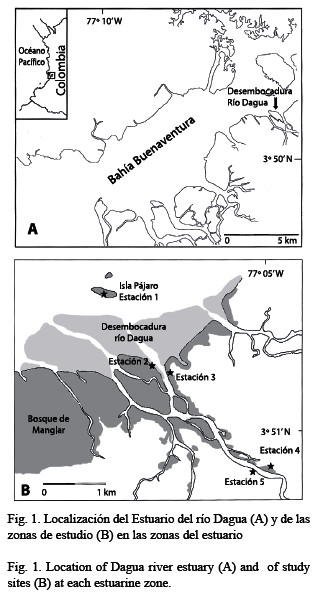
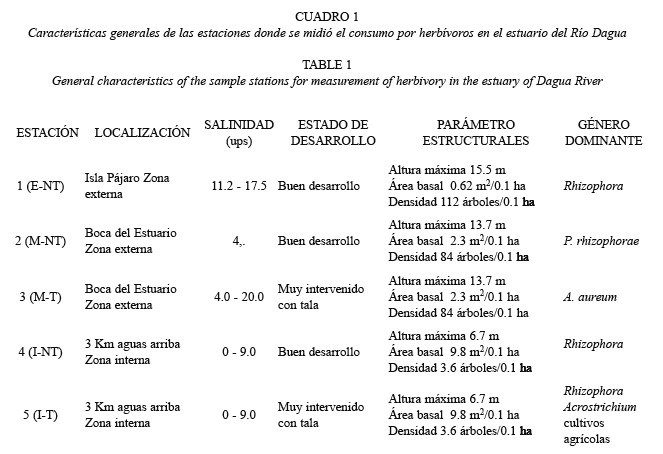
<body><![CDATA[<br> <small><span style="font-family: arial;"></span></small><br  style="font-family: arial;"> <small><span style="font-family: arial;"></span><span  style="font-family: arial;">Estudios anteriores han demostrado que factores como el efecto de los nutrientes (Onuf <span  style="font-style: italic;">et al</span>. 1977), la distancia al continente (Farnsworth y Ellison 1991) y la intervenci&oacute;n humana (Johnstone 1981, Lacerda <span style="font-style: italic;">et al</span>. 1986) pueden incrementar la tasa de consumo por herb&iacute;voros </span><span  style="font-family: arial;">(Blanchard y Prado 1995). Muy pocos trabajos han tratado de establecer las caracter&iacute;sticas </span><span  style="font-family: arial;">propias de cada especie de herb&iacute;voro, sus diferencias y el tipo de destrucci&oacute;n que causan sobre el material vegetal. Adem&aacute;s la mayor&iacute;a de ellos han sido realizados en regiones diferentes al Pac&iacute;fico suramericano y en ambientes diferentes </span><span  style="font-family: arial;">a los estuarios (Onuf <span  style="font-style: italic;">et al.</span> 1977, Johnstone 1981, Lacerda <span style="font-style: italic;">et al.</span> 1986, Robertson y Duke 1987, Farnsworth y Ellison 1991, Anderson y Lee 1995, Feller 1995, Stowe 1995). En los manglares del Pac&iacute;fico tropical americano, y en particular en la costa colombiana, existe poco conocimiento sobre el consumo foliar y sus caracter&iacute;sticas. Se han observado algunas larvas de insectos (Sphingidae, <span  style="font-style: italic;">Ascolapha odorata, Phoebis</span> sp.), cangrejos (<span style="font-style: italic;">Aratus pisonii, Sesarma</span> spp.) y venados (<span style="font-style: italic;">Odocoileus</span> sp.) consumiendo hojas de mangle (Prahl <span  style="font-style: italic;">et al</span>. 1990) pero s&oacute;lo se ha cuantificado el consumo foliar por herb&iacute;voros </span><span  style="font-family: arial;">en <span style="font-style: italic;">Rhizophora</span> sp. en la Bah&iacute;a de M&aacute;laga (Romero y Cantera 1996).</span></small><br  style="font-family: arial;"> <small></small><br style="font-family: arial;"> <small><span style="font-family: arial;">Este trabajo presenta de manera descriptiva o da&ntilde;o que los herb&iacute;voros causan en las hojas, las tasas de consumo en diferentes zonas a lo largo del estuario con diferentes caracter&iacute;sticas estuarinas y las actividades antropog&eacute;nicas, como la tala de los mangles en un bosque ribere&ntilde;o </span><span style="font-family: arial;">de manglar del estuario del r&iacute;o Dagua.</span></small><br  style="font-family: arial;"> <small></small><br style="font-family: arial;"> <small><small><!-- big --><span style="font-family: arial; font-weight: 700;">Materiales y m&eacute;todos</span><!-- /big --></small></small><br  style="font-family: arial;"> <small></small><br style="font-family: arial;"> <small><span style="font-family: arial;">El presente estudio se llev&oacute; a cabo en el estuario del r&iacute;o Dagua (3&deg;51&#8217; N, 77&deg;4&#8217; W), localizado en la bah&iacute;a de Buenaventura (<a href="#figura1">Fig. 1A</a>) La bah&iacute;a est&aacute; localizada en una zona altamente lluviosa durante todo el a&ntilde;o (6 000-8 000 mm) con dos picos un en abril-mayo y otro entre septiembre y noviembre. Las mareas son semidiurnas, regulares con una amplitud m&aacute;xima de 3.7 m (Cantera y Blanco 2001). El estuario del r&iacute;o Dagua se dividi&oacute;, con el fin de ubicar las estaciones de muestreo, en tres zonas (cabecera, estuario propiamente dicho y desembocadura) con diferencias en sus caracter&iacute;sticas </span><span  style="font-family: arial;">hidrol&oacute;gicas (<a href="#figura1">Fig. 1B</a>). Se identificaron </span><span style="font-family: arial;">los &aacute;rboles de mangle predominantes: <span  style="font-style: italic;">Rhizophora</span> sp. (Rhizophoraceae), <span  style="font-style: italic;">Avicennia</span> <span  style="font-style: italic;">germinans</span> (L.) (Avicenniaceae), <span  style="font-style: italic;">Laguncularia racemosa</span> (L.) Gaertn 1807 (Combretaceae) y <span style="font-style: italic;">Pelliciera rhizophorae</span> Triana &amp; Planchon 1862 (Theaceae). En las tres zonas se ubicaron cinco estaciones cubriendo &aacute;reas de manglares en buen estado y &aacute;reas con diferentes grados de intervenci&oacute;n por tala (Cantera 1991, Cantera y Blanco 2001). Las caracter&iacute;sticas de las cinco estaciones se presentan en el <a href="#cuadro1">Cuadro 1</a>.</span></small></div>     <p align="center"><a name="figura1"> <img style="border: 0px solid ; width: 321px; height: 598px;"  src="/img/fbpe/rbt/v54n4/3505i1.JPG" title="" alt=""></a></p>     
<p align="center"><a name="cuadro1"> <img style="border: 0px solid ; width: 663px; height: 454px;"  src="/img/fbpe/rbt/v54n4/3505i2.JPG" title="" alt=""></a></p>     
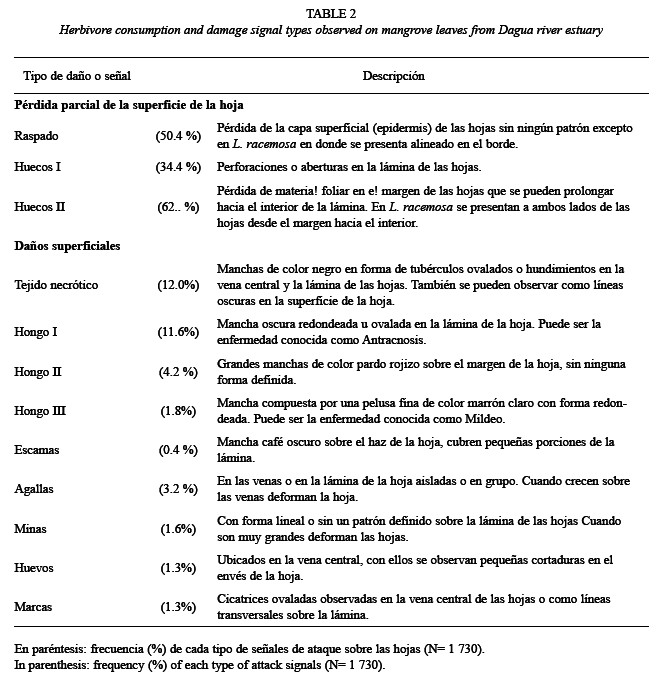
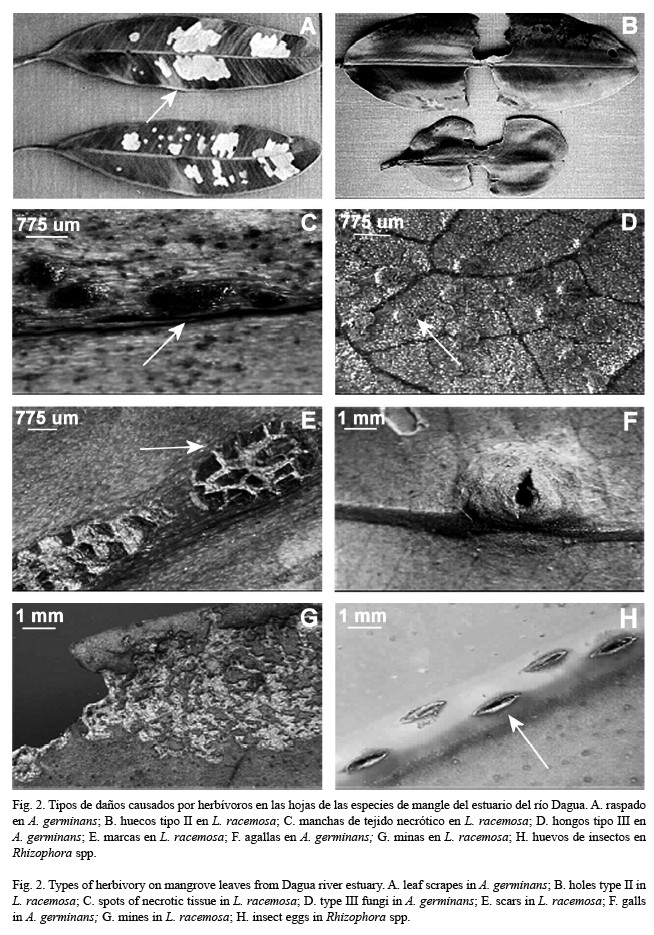
<p style="text-align: left;"><small><span style="font-family: arial;">En cada estaci&oacute;n, se seleccionaron al azar hojas maduras de cinco &aacute;rboles adultos de cada especie que estuvieran ubicadas a una altura media en el dosel con exposici&oacute;n lum&iacute;nica intermedia. En cada &aacute;rbol, se cort&oacute; la terminaci&oacute;n </span><span  style="font-family: arial;">de una rama con 30-40 hojas maduras, de las cuales fueron seleccionadas al azar 20 hojas, limpiadas de sedimentos finos acumulados sobre ellas y almacenadas en bolsas de polietileno </span><span style="font-family: arial;">para su posterior an&aacute;lisis en el laboratorio. Se dibujaron en papel todas las se&ntilde;ales de consumo por herb&iacute;voros. El porcentaje de &aacute;rea foliar consumida se calcul&oacute; midiendo el &aacute;rea de cada se&ntilde;al y el &aacute;rea total de la hoja utilizando un sistema digitalde tratamiento de im&aacute;genes. Tambi&eacute;n se calcul&oacute; el &aacute;rea foliar consumida como la suma de todas las se&ntilde;ales observadas en cada hoja y se determin&oacute; la frecuencia de hojas con se&ntilde;ales de haber sido consumidas (hojas atacadas por herb&iacute;voros/total hojas). En las hojas con el margen removido, el &aacute;rea se determin&oacute; reconstruy&eacute;ndolo visualmente a partir </span><span style="font-family: arial;">de la porci&oacute;n intacta de la hoja (Farnsworth y Ellison 1991). El consumo por herb&iacute;voros se expres&oacute; en t&eacute;rminos de proporciones para minimizar el error asociado a la expansi&oacute;n de los huecos durante el crecimiento de las hojas (Lowman 1984). Para las comparaciones entre especies de mangle, el consumo de hojas se</span><span  style="font-family: arial;">varios aspectos sobre el tipo de destrucci&oacute;n calcul&oacute; como el porcentaje promedio por hoja de &aacute;rea con consumo por herb&iacute;voros (Williams y Abbott 1991). Las hojas se pesaron para estimar </span><span  style="font-family: arial;">el peso h&uacute;medo por unidad de &aacute;rea (g/cm<sup>2</sup>) como indicativo de la dureza de las hojas (Feller 1995), la cual puede afectar los niveles de consumo foliarpor herb&iacute;voros (Coley 1987). Los porcentajes de consumo por herb&iacute;voros se compararon entre las especies, tambi&eacute;n entre las estaciones de muestreo para cada especie, utilizando an&aacute;lisis de varianza de una v&iacute;a con n&uacute;mero desigual de repeticiones. Para determinar </span><span  style="font-family: arial;">el efecto de los factores ambientales sobre los porcentajes calculados, se utiliz&oacute; el an&aacute;lisis de varianza de dos v&iacute;as (ANOVA factorial) con los factores salinidad y condici&oacute;n del bosque. Para los an&aacute;lisis con diferencias significativas </span><span style="font-family: arial;">se realizaron comparaciones m&uacute;ltiples de Newman-Keuls (Zar 1996).</span><br  style="font-family: arial;"> <br style="font-family: arial;"> <span style="font-family: arial; font-weight: 700;">Resultados</span><br  style="font-family: arial;"> <br style="font-family: arial;"> <span style="font-family: arial;"><span style="font-weight: bold;">Patrones generales</span>: Se encontraron 12 formas o se&ntilde;ales de consumo de hojas por herb&iacute;voros en las hojas de mangle, las cuales fueron clasificadas en general como &#8220;da&ntilde;o estructural&#8221;, si el da&ntilde;o ocasionaba p&eacute;rdida total o parcial del material foliar, o como &#8220;da&ntilde;o superficial&#8221;, </span><span  style="font-family: arial;">si presentaban manchas de tejido necr&oacute;tico, </span><span style="font-family: arial;">hongos u otros organismos y otras marcas que representan da&ntilde;o de la superficie del tejido foliar dejado por los herb&iacute;voros, al alimentarse de la savia de las hojas (<a href="#tabla2">Cuadro 2</a>). Las se&ntilde;ales </span><span style="font-family: arial;">m&aacute;s comunes de ataque de herb&iacute;voros a las hojas se presentan en la <a href="#figura2">Fig. 2</a>. El 94.1 % del &aacute;rea foliar utilizada por los herb&iacute;voros es removida por organismos masticadores. Los raspados en la epidermis de las hojas son ocasionados </span><span style="font-family: arial;">por insectos del orden Thysanoptera (Familia: Phlaeothripidae), moluscos gaster&oacute;podos </span><span style="font-family: arial;">de la familia: Littorinidae y el cangrejo <span style="font-style: italic;">Aratus pisonii</span> (Familia: Grapsidae).Los huecos pueden ser ocasionados por larvas de cole&oacute;pteros </span><span  style="font-family: arial;">(Curculionidae), lepid&oacute;pteros (Pyralidae), grillos (Tettigoniidae, Gryllidae) y los cangrejos </span><span  style="font-family: arial;"><span style="font-style: italic;">A. pisonii y Goniopsis pulcra</span> Lockington, 1876. Las manchas de tejido foliar son realizadas </span><span style="font-family: arial;">por insectos succionadores del orden Hemiptera (Aphididae), por la descomposici&oacute;n de la epidermis por hongos, agallas, minas o huevos ocasionados por el orden D&iacute;ptera (Agromyzidae).</span></small></p>     <p align="center"><a name="tabla2"> <img style="border: 0px solid ; width: 666px; height: 683px;"  src="/img/fbpe/rbt/v54n4/3505i3.JPG" title="" alt=""></a></p>     
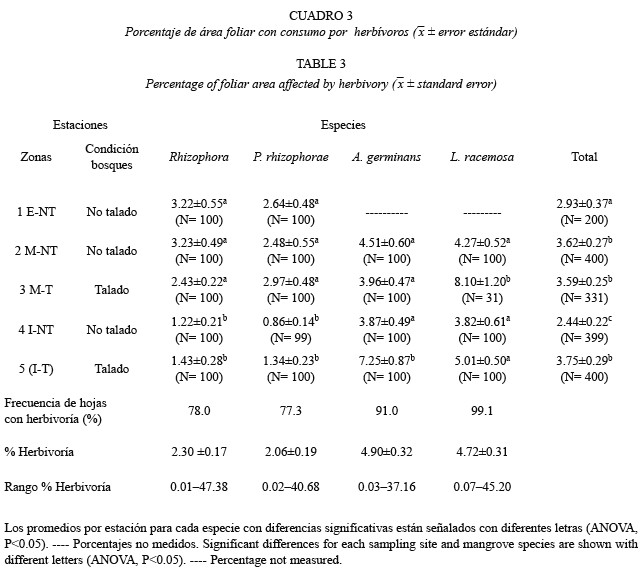
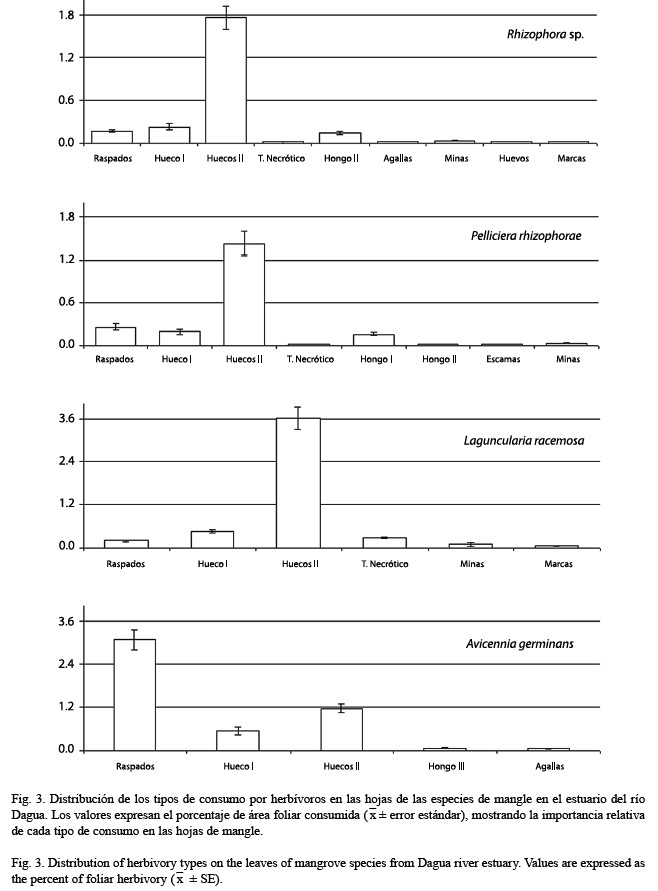
<p align="justify"><small><br style="font-family: arial;"> <br style="font-family: arial;"> </small></p>     <div style="text-align: left;"><small><span style="font-family: arial;">Los huecos y los raspados son las se&ntilde;ales de ataque m&aacute;s frecuentes (96.7 % y 50.4 % respectivamente). Los hongos y los tejidos necr&oacute;ticos son los da&ntilde;os superficiales m&aacute;s importantes (<a href="#tabla2">Cuadro 2</a>). El 54.3 % de las hojas presentan por lo menos dos tipos de se&ntilde;ales de consumo observ&aacute;ndose en algunos casos, como en <span  style="font-style: italic;">L. racemosa</span>, hasta siete tipos diferentes </span><span style="font-family: arial;">en una misma hoja. El 84.9 % del total de las hojas han sido atacadas por herb&iacute;voros. A pesar de esto, la mayor&iacute;a de las hojas no presentan m&aacute;s del 0.5 % de su &aacute;rea da&ntilde;ada por herb&iacute;voros.</span></small><br style="font-family: arial;"> <small></small><br style="font-family: arial;"> <small><span style="font-family: arial;"><span  style="font-weight: bold;">Comparaci&oacute;n entre especies</span>: Las especies de mangle estudiadas presentaron diferen cias significativas en los niveles de consumo por herb&iacute;voros (p&lt;0.001), con los valores promedios </span><span  style="font-family: arial;">m&aacute;s altos en <span  style="font-style: italic;">A. germinans</span> (4.9 %) y<span  style="font-style: italic;"> L. racemosa</span> (4.7 %) y los m&aacute;s bajos en <span style="font-style: italic;">Rhizophora</span> sp. (2.3 %) y <span style="font-style: italic;">P. rhizophorae</span> (2.1 %). A pesar de los bajos porcentajes encontrados para cada especie, se encontr&oacute; que en todas las especies las hojas son muy utilizadas </span><span style="font-family: arial;">por los herb&iacute;voros, (el 77 % de las hojas presentan alg&uacute;n&nbsp; tipo de se&ntilde;ales de consumo por herb&iacute;voros (Cuadro 3). Los huecos presentan los porcentajes m&aacute;s altos en todas las especies, menos en <span style="font-style: italic;">A. germinans</span> en donde los raspados son los m&aacute;s importantes (<a href="#figura3">Fig. 3</a>). Entre los da&ntilde;os superficiales, los hongos tienen los porcentajes m&aacute;s altos en todas las especies con excepci&oacute;n de<span  style="font-style: italic;"> L. racemosa</span>. Aunque la mayor&iacute;a de las se&ntilde;ales </span><span  style="font-family: arial;">se encuentran en varias especies de mangle, algunas pueden ser espec&iacute;ficos a una especie de mangle, como hongo III en <span style="font-style: italic;">A. germinans</span>, escamas y hongos I en <span style="font-style: italic;">P. rhizophorae</span> y presencia </span><span style="font-family: arial;">de huevos en <span  style="font-style: italic;">Rhizophora</span>. La dureza de las hojas (g/cm<sup>2</sup>) tambi&eacute;n present&oacute; diferencias significativas entre las especies de mangle (p&lt;0.001). Las hojas con mayor peso por unidad de &aacute;rea es <span  style="font-style: italic;">Rhizophora</span> (0.043&plusmn;0.0002) seguido de <span style="font-style: italic;">P. rhizophorae</span> (0.039+0.0003), <span style="font-style: italic;">L. racemosa</span> (0.035&plusmn;0.0004) y por &uacute;ltimo, <span  style="font-style: italic;">A. germinans</span> </span><span  style="font-family: arial;">(0.035&plusmn;0.0004).</span></small></div>     <p align="center"><a name="figura2"> <img style="border: 0px solid ; width: 654px; height: 935px;"  src="/img/fbpe/rbt/v54n4/3505i4.JPG" title="" alt=""></a></p>     
<p align="justify"><small><br style="font-family: arial;"> <br style="font-family: arial;"> </small></p>     <div style="text-align: left;"><small><span style="font-family: arial;"><span  style="font-weight: bold;">Variaci&oacute;n espacial del consumo en el estuario</span>: El consumo por herb&iacute;voros total, expresado como el porcentaje promedio de &aacute;rea foliar con se&ntilde;ales de ataque por herb&iacute;voros de todas las muestras de hojas es variable dentro del &aacute;rea de estudio. <span style="font-style: italic;">Rhizophora</span> sp. y <span  style="font-style: italic;">P. rhizophorae </span>presentaron diferencias significativas entre las zonas&nbsp; estuarinas con los promedios m&aacute;s altos en las zonas media y externa (<a href="#cuadro3">Cuadro 3</a>). <span  style="font-style: italic;">A. germinans</span> solo mostr&oacute; diferencias significativas con el efecto combinado del consumo y la localizaci&oacute;n en el estuario. <span style="font-style: italic;">L. racemosa</span> present&oacute; diferencias significativas entre la localizaci&oacute;n, las caracter&iacute;sticas de los bosques y la interacci&oacute;n de estos dos factores (p&lt;0.05).</span></small><br style="font-family: arial;"> <small></small><br style="font-family: arial;"> <small><span style="font-family: arial;">El an&aacute;lisis de la importancia relativa de los factores sobre el consumo por herb&iacute;voros mostr&oacute; que para todas las especies estudiadas, la condici&oacute;n del bosque, el grado de intervenci&oacute;n y la zona del manglar donde se encuentran los &aacute;rboles son los principales factores que determinan la tasa y el tipo de consumo que sufren las especies, aunque la salinidad puede ser otro factor que explica la distribuci&oacute;n de los da&ntilde;os en las hojas a lo largo del estuario. </span></small></div>     ]]></body>
<body><![CDATA[<p align="justify">&nbsp;</p>     <p align="center"><a name="cuadro3"> <img style="border: 0px solid ; width: 642px; height: 576px;"  src="/img/fbpe/rbt/v54n4/3505i5.JPG" title="" alt=""></a></p>     
<p align="justify">&nbsp;</p>     <p align="center"><a name="figura3"> <img style="border: 0px solid ; width: 658px; height: 891px;"  src="/img/fbpe/rbt/v54n4/3505i6.JPG" title="" alt=""></a></p>     
<p align="justify"><small><span style="font-family: arial;">     <br> <br style="font-family: arial;"> </span><span style="font-family: arial; font-weight: 700;">Discusi&oacute;n</span><br  style="font-family: arial;"> <br style="font-family: arial;"> </small></p>     <div style="text-align: left;"><small><span style="font-family: arial;">El     consumo de hojas de mangles en el     estuario del r&iacute;o Dagua se caracteriz&oacute; por la alta     variabilidad. Las hojas de estas especies fueron aprovechadas por una     ]]></body>
<body><![CDATA[gran variedad de organismos herb&iacute;voros que consumieron el     material foliar vivo, exportando este material a niveles superiores de     la red tr&oacute;fica estuarina </span><span      style="font-family: arial;">(Farnsworth y Ellison 1991, Stowe 1995).     Aunque se ha propuesto que un modelo de estudio </span><span      style="font-family: arial;">basado en los tipos de da&ntilde;os puede     describir los consumidores de hojas de manglar (Smith <span      style="font-style: italic;">et al</span>. 1989), es necesario tener en     cuenta que la asociaci&oacute;n entre herb&iacute;voros y las     estrategias de alimentaci&oacute;n pueden depender de las etapas de su     ]]></body>
<body><![CDATA[ciclo de vida. Por ejemplo, los raspados en la epidermis de las hojas     efectuados por <span style="font-style: italic;">A. pisonii</span>     pueden permanecer intactos hasta seis semanas despu&eacute;s, cuando se     oscurecen por el crecimiento de hongos (Beever <span      style="font-style: italic;">et al</span>. 1979).</span></small><br      style="font-family: arial;">     <small></small><br style="font-family: arial;">     <small><span style="font-family: arial;">Las hojas de los mangles del     estuario     del r&iacute;o Dagua son fuertemente atacadas por herb&iacute;voros, </span><span     ]]></body>
<body><![CDATA[ style="font-family: arial;">a pesar de que el &aacute;rea promedio de     cada hoja consumida por herb&iacute;voros es inferior al 5 %. El     consumo directo de tejidos presenta un promedio de 3.3 % y los     da&ntilde;os superficiales </span><span style="font-family: arial;">como     hongos y agallas representan el 0.2 %. Estos porcentajes, aunque bajos,     son comparables con otros trabajos realizados en el ecosistema de     manglar sobre consumo por herb&iacute;voros y da&ntilde;os foliares     (Johnstone 1981, Lowman 1984,&nbsp; Lacerda <span      style="font-style: italic;">et al</span>. 1986, Robertson y Duke 1987,     Romero y Cantera 1996). Los herb&iacute;voros han sido considerados     ]]></body>
<body><![CDATA[como importantes </span><span style="font-family: arial;">en el     funcionamiento y regulaci&oacute;n del ecosistema de bosque, al poder     alterar el flujo de materia org&aacute;nica (Anderson y Lee 1995) y     afectar la estructura y patrones de sucesi&oacute;n de los manglares     (Robertson <span style="font-style: italic;">et al</span>. 1990). </span></small><br      style="font-family: arial;">     <small></small><br style="font-family: arial;">     <small><span style="font-family: arial;">Es probable que una variedad     de     factores hayan sido los responsables de las diferencias </span><span     ]]></body>
<body><![CDATA[ style="font-family: arial;">observadas entre las especies de mangle,     como la dureza f&iacute;sica y el contenido qu&iacute;mico de las hojas     (Colley 1987, Feller 1995). Las especies con las hojas m&aacute;s     duras, presentaron los porcentajes promedios de consumo m&aacute;s     bajos, mientras que las hojas con menos dureza tuvieron los porcentajes     m&aacute;s altos (<span style="font-style: italic;">L. racemosa </span></span><span      style="font-family: arial;">y <span style="font-style: italic;">A.     germinans</span>). Esta misma tendencia ha sido observada en otros     manglares del mundo (Robertson y Duke 1987). El mayor porcentaje </span><span      style="font-family: arial;">promedio de consumo encontrado en <span     ]]></body>
<body><![CDATA[ style="font-style: italic;">A. germinans</span> puede explicarse por     la presencia de cristales de sal en la superficie de las hojas que     inhiben el ataque de ciertos herb&iacute;voros (Newbery 1980,     Farnsworth y Ellison 1991).</span></small><br      style="font-family: arial;">     <small></small><br style="font-family: arial;">     <small><span style="font-family: arial;">La variaci&oacute;n encontrada     en el     consumo foliar por herb&iacute;voros entre las especies de mangle,     puede estar relacionada con el desarrollo </span><span     ]]></body>
<body><![CDATA[ style="font-family: arial;">foliar, el cual depende del desarrollo     estructural de los bosques. As&iacute;, cada especie de mangle presenta     adaptaciones particulares </span><span style="font-family: arial;">para     soportar las condiciones ambientales como cambios en la salinidad del     agua (Soto y Corrales 1987), en la temperatura, la iluminaci&oacute;n </span><span      style="font-family: arial;">y la composici&oacute;n faun&iacute;stica.     Finalmente, las condiciones de intervenci&oacute;n humana, como la tala     de &aacute;rboles, pudieron afectar tambi&eacute;n, el consumo por     herb&iacute;voros. En la zona interna del estuario se presentaron     diferencias importantes entre el bosque talado (3.7 %) y el no talado     ]]></body>
<body><![CDATA[(2.4 %). El patr&oacute;n de distribuci&oacute;n espacial de los tipos     de da&ntilde;os con respecto a los factores ambientales del estuario     vari&oacute; dr&aacute;sticamente entre las especies, lo cual     hacedif&iacute;cil hacer generalizaciones. Al parecer, las especies de     mangle no comparten todos los mismos herb&iacute;voros </span><span      style="font-family: arial;">(Farnsworth y Ellison 1991) aunque es     conocido que <span style="font-style: italic;">A. pisonii</span> puede     comer hojas de<span style="font-style: italic;"> R. mangle</span>, de <span      style="font-style: italic;">A. germinans</span> y<span      style="font-style: italic;"> L. racemosa </span></span><span     ]]></body>
<body><![CDATA[ style="font-family: arial;">(Beever <span style="font-style: italic;">et     al</span>. 1979). La alta variabilidad de las modalidades del consumo     foliar por herb&iacute;voros en el estuario del r&iacute;o Dagua y la     abundancia del material foliar afectado por la acci&oacute;n de estos     organismos permite afirmar que, a pesar del bajo porcentaje promedio de     &aacute;rea foliar (inferior al 10 %), los herb&iacute;voros ejercen un     papel importante en la red tr&oacute;fica del sistema estuarino.</span></small><br      style="font-family: arial;">     <small></small><br style="font-family: arial;">     <small><small><!-- big --><span style="font-family: arial; font-weight: 700;">Agradecimientos</span><!-- /big --></small></small><br     ]]></body>
<body><![CDATA[ style="font-family: arial;">     <small></small><br style="font-family: arial;">     <small><span style="font-family: arial;">Esta investigaci&oacute;n es     parte     del Proyecto Transferencia de Materia y Energ&iacute;a en el Estuario     del r&iacute;o Dagua, financiado por el Instituto Colombiano para el     Desarrollo de la Ciencia y la Tecnolog&iacute;a Francisco Jos&eacute;     de Caldas (COLCIENCIAS, proyecto No. 1106-09-328-97) y por la     Universidad del Valle. Se agradece el apoyo log&iacute;stico ofrecido     por la Secci&oacute;n de Biolog&iacute;a Marina de la Universidad del     ]]></body>
<body><![CDATA[Valle, y la participaci&oacute;n de G. Toro, E. Rodr&iacute;guez, P.     Tabares, R. Neira y C. Fern&aacute;ndez en diversos aspectos de este     trabajo.</span></small><br style="font-family: arial;">     <small></small><br style="font-family: arial;">     <small><small><!-- big --><span style="font-family: arial; font-weight: 700;">Resumen</span><!-- /big --></small></small><br      style="font-family: arial;">     <small></small><br style="font-family: arial;">     <small><span style="font-family: arial;">Se estudi&oacute; el consumo     foliar     por herb&iacute;voros en hojas de varias especies de mangle con     ]]></body>
<body><![CDATA[relaci&oacute;n a los factores ambientales y la dureza de las hojas en     el estuario del r&iacute;o Dagua. La intensidad del consumo o de los     da&ntilde;os producidos </span><span style="font-family: arial;">en     las hojas se cuantific&oacute; determinando el porcentaje de     &aacute;rea foliar afectado por herb&iacute;voros separando las     distintas se&ntilde;ales de consumo o da&ntilde;o de las hojas. Las     especies m&aacute;s consumidas, como <span style="font-style: italic;">A     germinans</span> y <span style="font-style: italic;">L. racemosa</span>,     presentan el menor n&uacute;mero de tipos de huellas de da&ntilde;os y     menor dureza que las especies menos consumidas como <span     ]]></body>
<body><![CDATA[ style="font-style: italic;">Rhizophora </span>sp. y <span      style="font-style: italic;">P. rhizophorae</span>. La abundancia y     diversidad de huellas de ataque por herb&iacute;voros y su variabilidad     a lo largo del estuario </span><span style="font-family: arial;">del     r&iacute;o Dagua, muestra la importancia de los procesos de consumo de     tejido vegetal vivo en el bosque de manglar dentro de la red     tr&oacute;fica del sistema estuarino.</span></small>    <br> <small><span style="font-family: arial;"></span></small>    <!-- ref --><br> <small><span style="font-family: arial;"><span  style="font-weight: bold;">Palabras clave</span>: herbivor&iacute;a, consumo de hojas, ramoneo, mangle, estuarios, Colombia.</span></small><br style="font-family: arial;"> <small></small><br style="font-family: arial;"> <small><small><!-- big --><span style="font-family: arial; font-weight: 700;">Referencias</span><!-- /big --></small></small><br  style="font-family: arial;"> <small></small><br style="font-family: arial;"> <small><span style="font-family: arial;">Anderson, C. &amp; S.Y. Lee. 1995. Defoliation of the mangrove </span><span style="font-family: arial;"><span  style="font-style: italic;">Avicennia marina</span> in Hong Kong: cause and consequences. Biotropica 27: 218-226.</span></small><br  style="font-family: arial;"> <small></small><br style="font-family: arial;"> <small><span style="font-family: arial;">    &nbsp;&nbsp;&nbsp;&nbsp;&nbsp;&nbsp;&nbsp;&nbsp;[&#160;<a href="javascript:void(0);" onclick="javascript: window.open('/scielo.php?script=sci_nlinks&ref=1363232&pid=S0034-7744200600040001900001&lng=','','width=640,height=500,resizable=yes,scrollbars=1,menubar=yes,');">Links</a>&#160;]<!-- end-ref --><!-- ref -->Beever, J.W., D. Simberloff &amp; L. King. 1979. Herbivory and predation by the mangrove tree crab <span  style="font-style: italic;">Aratus pisonii</span>. </span><span  style="font-family: arial;">Oecologia 43: 317-328.</span></small><br  style="font-family: arial;"> <small></small><br style="font-family: arial;"> <small><span style="font-family: arial;">    &nbsp;&nbsp;&nbsp;&nbsp;&nbsp;&nbsp;&nbsp;&nbsp;[&#160;<a href="javascript:void(0);" onclick="javascript: window.open('/scielo.php?script=sci_nlinks&ref=1363233&pid=S0034-7744200600040001900002&lng=','','width=640,height=500,resizable=yes,scrollbars=1,menubar=yes,');">Links</a>&#160;]<!-- end-ref --><!-- ref -->Blanchard, J. &amp; G. Prado. 1995. Natural regeneration of <span style="font-style: italic;">Rhizophora mangle</span> in strip clear-cuts in Northwest Ecuador. Biotropica 27: 160-167.</span></small><br style="font-family: arial;"> <small></small><br style="font-family: arial;"> <small><span style="font-family: arial;">    &nbsp;&nbsp;&nbsp;&nbsp;&nbsp;&nbsp;&nbsp;&nbsp;[&#160;<a href="javascript:void(0);" onclick="javascript: window.open('/scielo.php?script=sci_nlinks&ref=1363234&pid=S0034-7744200600040001900003&lng=','','width=640,height=500,resizable=yes,scrollbars=1,menubar=yes,');">Links</a>&#160;]<!-- end-ref --><!-- ref -->Cantera, J.R. 1991. Etude structurale des mangroves et des peuplements littoraux des deux baies du pacifique </span><span  style="font-family: arial;">colombien (M&aacute;laga et Buenaventura). Rapport avec les conditions du milieu et les perturbations anthropiques. Th&egrave;se d&#8217;Etat Sciences. Universit&eacute; d&#8217;Aix-Marseille II. Marsella, Francia. 429 p. </span></small>    &nbsp;&nbsp;&nbsp;&nbsp;&nbsp;&nbsp;&nbsp;&nbsp;[&#160;<a href="javascript:void(0);" onclick="javascript: window.open('/scielo.php?script=sci_nlinks&ref=1363235&pid=S0034-7744200600040001900004&lng=','','width=640,height=500,resizable=yes,scrollbars=1,menubar=yes,');">Links</a>&#160;]<!-- end-ref --><!-- ref --><br> <small><span style="font-family: arial;"></span></small><br  style="font-family: arial;"> <small><span style="font-family: arial;"></span><span  style="font-family: arial;">Cantera, J.R. &amp; J.F. Blanco. 2001. The estuary ecosystem </span><span  style="font-family: arial;">of Buenaventura Bay, Colombia, p. 265-280. <span style="font-style: italic;">In</span> U. Seeliger &amp; B. Kjerfve (eds.). Coastal Marine Ecosystems of Latin America, Ecological studies. Springer, Nueva York, EEUU.</span></small><br  style="font-family: arial;"> <small></small><br style="font-family: arial;"> <small><span style="font-family: arial;">    &nbsp;&nbsp;&nbsp;&nbsp;&nbsp;&nbsp;&nbsp;&nbsp;[&#160;<a href="javascript:void(0);" onclick="javascript: window.open('/scielo.php?script=sci_nlinks&ref=1363236&pid=S0034-7744200600040001900005&lng=','','width=640,height=500,resizable=yes,scrollbars=1,menubar=yes,');">Links</a>&#160;]<!-- end-ref --><!-- ref -->Coley, P.D. 1987. Patrones en las defensas de las plantas: &iquest;porqu&eacute; los herb&iacute;voros prefieren ciertas especies? Rev. Biol. Trop. 35: 151-164.</span></small><br  style="font-family: arial;"> <small></small><br style="font-family: arial;"> <small><span style="font-family: arial;">    &nbsp;&nbsp;&nbsp;&nbsp;&nbsp;&nbsp;&nbsp;&nbsp;[&#160;<a href="javascript:void(0);" onclick="javascript: window.open('/scielo.php?script=sci_nlinks&ref=1363237&pid=S0034-7744200600040001900006&lng=','','width=640,height=500,resizable=yes,scrollbars=1,menubar=yes,');">Links</a>&#160;]<!-- end-ref --><!-- ref -->Farnsworth, E. &amp; A. Ellison. 1991. Patterns of herbivory in Belizean mangrove swamps. Biotropica 23: 555-567.</span></small><br style="font-family: arial;"> <small></small><br style="font-family: arial;"> <small><span style="font-family: arial;">    &nbsp;&nbsp;&nbsp;&nbsp;&nbsp;&nbsp;&nbsp;&nbsp;[&#160;<a href="javascript:void(0);" onclick="javascript: window.open('/scielo.php?script=sci_nlinks&ref=1363238&pid=S0034-7744200600040001900007&lng=','','width=640,height=500,resizable=yes,scrollbars=1,menubar=yes,');">Links</a>&#160;]<!-- end-ref --><!-- ref -->Feller, I.C. 1995. Effects of nutrients enrichment on growth and herbivory of dwarf red mangrove <span  style="font-style: italic;">(Rhizophora mangle</span>). Ecol. Monog. 65: 477-505.</span></small><br style="font-family: arial;"> <small></small><br style="font-family: arial;"> <small><span style="font-family: arial;">    &nbsp;&nbsp;&nbsp;&nbsp;&nbsp;&nbsp;&nbsp;&nbsp;[&#160;<a href="javascript:void(0);" onclick="javascript: window.open('/scielo.php?script=sci_nlinks&ref=1363239&pid=S0034-7744200600040001900008&lng=','','width=640,height=500,resizable=yes,scrollbars=1,menubar=yes,');">Links</a>&#160;]<!-- end-ref --><!-- ref -->Johnstone, I. 1981. Consumption of leaves by herbivores in mixed mangrove stands. Biotropica 13: 252-259.</span></small><br  style="font-family: arial;"> <small></small><br style="font-family: arial;"> <small><span style="font-family: arial;">    &nbsp;&nbsp;&nbsp;&nbsp;&nbsp;&nbsp;&nbsp;&nbsp;[&#160;<a href="javascript:void(0);" onclick="javascript: window.open('/scielo.php?script=sci_nlinks&ref=1363240&pid=S0034-7744200600040001900009&lng=','','width=640,height=500,resizable=yes,scrollbars=1,menubar=yes,');">Links</a>&#160;]<!-- end-ref --><!-- ref -->Lacerda, L.D., D.V. Jose, C.E. de Rezende, M.C.F. Francisco, J.C. Wasserman &amp; J.C. Martins. 1986. Leaf chemical characteristics affecting herbivory in a new world mangrove forest. Biotropica 18: 350-355.</span></small><br  style="font-family: arial;"> <small></small><br style="font-family: arial;"> <small><span style="font-family: arial;">    &nbsp;&nbsp;&nbsp;&nbsp;&nbsp;&nbsp;&nbsp;&nbsp;[&#160;<a href="javascript:void(0);" onclick="javascript: window.open('/scielo.php?script=sci_nlinks&ref=1363241&pid=S0034-7744200600040001900010&lng=','','width=640,height=500,resizable=yes,scrollbars=1,menubar=yes,');">Links</a>&#160;]<!-- end-ref --><!-- ref -->Lowman, M.D. 1984. An assessment of techniques for measuring herbivory: Is rainforest defoliation more intense than we thought? Biotropica 16: 264-268.</span></small><br  style="font-family: arial;"> <small></small><br style="font-family: arial;"> <small><span style="font-family: arial;">    &nbsp;&nbsp;&nbsp;&nbsp;&nbsp;&nbsp;&nbsp;&nbsp;[&#160;<a href="javascript:void(0);" onclick="javascript: window.open('/scielo.php?script=sci_nlinks&ref=1363242&pid=S0034-7744200600040001900011&lng=','','width=640,height=500,resizable=yes,scrollbars=1,menubar=yes,');">Links</a>&#160;]<!-- end-ref --><!-- ref -->Newbery, D. 1980. Infestation of the coccid,<span style="font-style: italic;"> Icerya seychellarum</span> (Westw.) on the mangrove <span style="font-style: italic;">Avicennia marina </span>(Forsk.) Vierh. on Aldabra Atoll, with special reference to tree age. Oecologia 45: 325-330.</span></small><br  style="font-family: arial;"> <small></small><br style="font-family: arial;"> <small><span style="font-family: arial;">    &nbsp;&nbsp;&nbsp;&nbsp;&nbsp;&nbsp;&nbsp;&nbsp;[&#160;<a href="javascript:void(0);" onclick="javascript: window.open('/scielo.php?script=sci_nlinks&ref=1363243&pid=S0034-7744200600040001900012&lng=','','width=640,height=500,resizable=yes,scrollbars=1,menubar=yes,');">Links</a>&#160;]<!-- end-ref --><!-- ref -->Onuf, C., J. Teal &amp; I. Valiela. 1977. Interactions of nutrient, plant growth and herbivory in a mangrove ecosystem. Ecology 58: 514-526.</span></small><br  style="font-family: arial;"> <small></small><br style="font-family: arial;"> <small><span style="font-family: arial;">    &nbsp;&nbsp;&nbsp;&nbsp;&nbsp;&nbsp;&nbsp;&nbsp;[&#160;<a href="javascript:void(0);" onclick="javascript: window.open('/scielo.php?script=sci_nlinks&ref=1363244&pid=S0034-7744200600040001900013&lng=','','width=640,height=500,resizable=yes,scrollbars=1,menubar=yes,');">Links</a>&#160;]<!-- end-ref --><!-- ref -->Prahl, H., J. Cantera &amp; R. Contreras. 1990. Manglares y hombres del Pac&iacute;fico colombiano. Fondo FEN Colombia, Santa Fe de Bogot&aacute;, Bogot&aacute;, Colombia. 193 p.</span></small><br style="font-family: arial;"> <small></small><br style="font-family: arial;"> <small><span style="font-family: arial;">    &nbsp;&nbsp;&nbsp;&nbsp;&nbsp;&nbsp;&nbsp;&nbsp;[&#160;<a href="javascript:void(0);" onclick="javascript: window.open('/scielo.php?script=sci_nlinks&ref=1363245&pid=S0034-7744200600040001900014&lng=','','width=640,height=500,resizable=yes,scrollbars=1,menubar=yes,');">Links</a>&#160;]<!-- end-ref --><!-- ref -->Robertson, A. 1991. Plant-animal interactions and the structure and function of mangrove forest ecosystems. </span><span style="font-family: arial;">Aust. Jour. Ecol. 16: 433-443.</span></small><br style="font-family: arial;"> <small></small><br style="font-family: arial;"> <small><span style="font-family: arial;">    &nbsp;&nbsp;&nbsp;&nbsp;&nbsp;&nbsp;&nbsp;&nbsp;[&#160;<a href="javascript:void(0);" onclick="javascript: window.open('/scielo.php?script=sci_nlinks&ref=1363246&pid=S0034-7744200600040001900015&lng=','','width=640,height=500,resizable=yes,scrollbars=1,menubar=yes,');">Links</a>&#160;]<!-- end-ref --><!-- ref -->Robertson, A. &amp; N. Duke. 1987. Insect herbivory on mangrove leaves in North Queensland. Aust. Jour. Ecol. 12: 1-7.</span></small><br style="font-family: arial;"> <small></small><br style="font-family: arial;"> <small><span style="font-family: arial;">    &nbsp;&nbsp;&nbsp;&nbsp;&nbsp;&nbsp;&nbsp;&nbsp;[&#160;<a href="javascript:void(0);" onclick="javascript: window.open('/scielo.php?script=sci_nlinks&ref=1363247&pid=S0034-7744200600040001900016&lng=','','width=640,height=500,resizable=yes,scrollbars=1,menubar=yes,');">Links</a>&#160;]<!-- end-ref --><!-- ref -->Robertson, A.I., R. Giddins &amp; T.J. Smith. 1990. Seed predation by insects in tropical mangrove forests: extent and effects on seed viability and the growth of seedlings. Oecologia 83: 213-219.</span></small><br  style="font-family: arial;"> <small></small><br style="font-family: arial;"> <small><span style="font-family: arial;">    &nbsp;&nbsp;&nbsp;&nbsp;&nbsp;&nbsp;&nbsp;&nbsp;[&#160;<a href="javascript:void(0);" onclick="javascript: window.open('/scielo.php?script=sci_nlinks&ref=1363248&pid=S0034-7744200600040001900017&lng=','','width=640,height=500,resizable=yes,scrollbars=1,menubar=yes,');">Links</a>&#160;]<!-- end-ref --><!-- ref -->Romero, I. &amp; J. Cantera. 1996. Herbivor&iacute;a y variaci&oacute;n en el &aacute;rea foliar del g&eacute;nero <span style="font-style: italic;">Rhizophora </span>(Familia Rhizophoracea) en Bah&iacute;a M&aacute;laga. <span  style="font-style: italic;">In</span> I Simposio Nacional de Biolog&iacute;a. Universidad del Valle, Cali, Colombia.</span></small><br  style="font-family: arial;"> <small></small><br style="font-family: arial;"> <small><span style="font-family: arial;">    &nbsp;&nbsp;&nbsp;&nbsp;&nbsp;&nbsp;&nbsp;&nbsp;[&#160;<a href="javascript:void(0);" onclick="javascript: window.open('/scielo.php?script=sci_nlinks&ref=1363249&pid=S0034-7744200600040001900018&lng=','','width=640,height=500,resizable=yes,scrollbars=1,menubar=yes,');">Links</a>&#160;]<!-- end-ref --><!-- ref -->Smith, T.J., H.T. Chan, C.C. McIvor &amp; M.B. Robblee. 1989. Comparisons of seeds predation in tropical tidal forests from three continents. Ecology 70: 146-151.</span></small><br  style="font-family: arial;"> <small></small><br style="font-family: arial;"> <small><span style="font-family: arial;">    &nbsp;&nbsp;&nbsp;&nbsp;&nbsp;&nbsp;&nbsp;&nbsp;[&#160;<a href="javascript:void(0);" onclick="javascript: window.open('/scielo.php?script=sci_nlinks&ref=1363250&pid=S0034-7744200600040001900019&lng=','','width=640,height=500,resizable=yes,scrollbars=1,menubar=yes,');">Links</a>&#160;]<!-- end-ref --><!-- ref -->Soto, R. &amp; L.F. Corrales. 1987. Variaci&oacute;n de algunas caracter&iacute;sticas foliares de <span  style="font-style: italic;">Avicennia germinans</span> (L.) L. (Avicenniaceae) en un gradiente clim&aacute;tico y de salinidad. Rev. Biol. Trop. 35: 245-256.</span></small><br style="font-family: arial;"> <small></small><br style="font-family: arial;"> <small><span style="font-family: arial;">    &nbsp;&nbsp;&nbsp;&nbsp;&nbsp;&nbsp;&nbsp;&nbsp;[&#160;<a href="javascript:void(0);" onclick="javascript: window.open('/scielo.php?script=sci_nlinks&ref=1363251&pid=S0034-7744200600040001900020&lng=','','width=640,height=500,resizable=yes,scrollbars=1,menubar=yes,');">Links</a>&#160;]<!-- end-ref --><!-- ref -->Stowe, K.A. 1995. Intracrown distribution of herbivore damage on<span style="font-style: italic;"> Laguncularia racemosa</span> in a tidally influenced </span><span  style="font-family: arial;">riparian habitat. Biotropica 27: 509-512.    &nbsp;&nbsp;&nbsp;&nbsp;&nbsp;&nbsp;&nbsp;&nbsp;[&#160;<a href="javascript:void(0);" onclick="javascript: window.open('/scielo.php?script=sci_nlinks&ref=1363252&pid=S0034-7744200600040001900021&lng=','','width=640,height=500,resizable=yes,scrollbars=1,menubar=yes,');">Links</a>&#160;]<!-- end-ref --><!-- ref -->Williams, M.R. &amp; I. Abbott. 1991. Quantifying average defoliation using leaf-level measurements. Ecology 72: 1510-1511.</span></small><br  style="font-family: arial;"> <small></small><br style="font-family: arial;"> <small><span style="font-family: arial;">    &nbsp;&nbsp;&nbsp;&nbsp;&nbsp;&nbsp;&nbsp;&nbsp;[&#160;<a href="javascript:void(0);" onclick="javascript: window.open('/scielo.php?script=sci_nlinks&ref=1363253&pid=S0034-7744200600040001900022&lng=','','width=640,height=500,resizable=yes,scrollbars=1,menubar=yes,');">Links</a>&#160;]<!-- end-ref --><!-- ref -->Zar, J.H. 1996. Biostatistical Analysis. Prentice Hall, Nueva Jersey, EEUU. 662 p.</span></small></div>    &nbsp;&nbsp;&nbsp;&nbsp;&nbsp;&nbsp;&nbsp;&nbsp;[&#160;<a href="javascript:void(0);" onclick="javascript: window.open('/scielo.php?script=sci_nlinks&ref=1363254&pid=S0034-7744200600040001900023&lng=','','width=640,height=500,resizable=yes,scrollbars=1,menubar=yes,');">Links</a>&#160;]<!-- end-ref --> ]]></body><back>
<ref-list>
<ref id="B1">
<nlm-citation citation-type="journal">
<person-group person-group-type="author">
<name>
<surname><![CDATA[Anderson]]></surname>
<given-names><![CDATA[C]]></given-names>
</name>
<name>
<surname><![CDATA[Lee]]></surname>
<given-names><![CDATA[S.Y]]></given-names>
</name>
</person-group>
<article-title xml:lang="es"><![CDATA[Defoliation of the mangrove Avicennia marina in Hong Kong: cause and consequences]]></article-title>
<source><![CDATA[Biotropica]]></source>
<year>1995</year>
<volume>27</volume>
<page-range>218-226</page-range></nlm-citation>
</ref>
<ref id="B2">
<nlm-citation citation-type="journal">
<person-group person-group-type="author">
<name>
<surname><![CDATA[Beever]]></surname>
<given-names><![CDATA[J.W]]></given-names>
</name>
<name>
<surname><![CDATA[Simberloff]]></surname>
<given-names><![CDATA[D]]></given-names>
</name>
<name>
<surname><![CDATA[King]]></surname>
<given-names><![CDATA[L]]></given-names>
</name>
</person-group>
<article-title xml:lang="en"><![CDATA[Herbivory and predation by the mangrove tree crab Aratus pisonii]]></article-title>
<source><![CDATA[Oecologia]]></source>
<year>1979</year>
<volume>43</volume>
<page-range>317-328</page-range></nlm-citation>
</ref>
<ref id="B3">
<nlm-citation citation-type="journal">
<person-group person-group-type="author">
<name>
<surname><![CDATA[Blanchard]]></surname>
<given-names><![CDATA[J]]></given-names>
</name>
<name>
<surname><![CDATA[Prado]]></surname>
<given-names><![CDATA[G]]></given-names>
</name>
</person-group>
<article-title xml:lang="en"><![CDATA[Natural regeneration of Rhizophora mangle in strip clear-cuts in Northwest Ecuador]]></article-title>
<source><![CDATA[Biotropica]]></source>
<year>1995</year>
<volume>27</volume>
<page-range>160-167</page-range></nlm-citation>
</ref>
<ref id="B4">
<nlm-citation citation-type="">
<person-group person-group-type="author">
<name>
<surname><![CDATA[Cantera]]></surname>
<given-names><![CDATA[J.R]]></given-names>
</name>
</person-group>
<source><![CDATA[Etude structurale des mangroves et des peuplements littoraux des deux baies du pacifique colombien (Málaga et Buenaventura: ). Rapport avec les conditions du milieu et les perturbations anthropiques]]></source>
<year>1991</year>
<page-range>429</page-range></nlm-citation>
</ref>
<ref id="B5">
<nlm-citation citation-type="book">
<person-group person-group-type="author">
<name>
<surname><![CDATA[Cantera]]></surname>
<given-names><![CDATA[J.R]]></given-names>
</name>
<name>
<surname><![CDATA[Blanco]]></surname>
<given-names><![CDATA[J.F]]></given-names>
</name>
</person-group>
<article-title xml:lang="en"><![CDATA[The estuary ecosystem of Buenaventura Bay, Colombia]]></article-title>
<person-group person-group-type="editor">
<name>
<surname><![CDATA[Seeliger]]></surname>
<given-names><![CDATA[U]]></given-names>
</name>
<name>
<surname><![CDATA[Kjerfve]]></surname>
<given-names><![CDATA[B]]></given-names>
</name>
</person-group>
<source><![CDATA[Coastal Marine Ecosystems of Latin America, Ecological studies]]></source>
<year>2001</year>
<page-range>265-280</page-range><publisher-loc><![CDATA[^eNueva York Nueva York]]></publisher-loc>
<publisher-name><![CDATA[Springer]]></publisher-name>
</nlm-citation>
</ref>
<ref id="B6">
<nlm-citation citation-type="journal">
<person-group person-group-type="author">
<name>
<surname><![CDATA[Coley]]></surname>
<given-names><![CDATA[P.D]]></given-names>
</name>
</person-group>
<article-title xml:lang="en"><![CDATA[Patrones en las defensas de las plantas: porqué los herbívoros prefieren ciertas especies]]></article-title>
<source><![CDATA[Rev. Biol. Trop]]></source>
<year>1987</year>
<volume>35</volume>
<page-range>151-164</page-range></nlm-citation>
</ref>
<ref id="B7">
<nlm-citation citation-type="journal">
<person-group person-group-type="author">
<name>
<surname><![CDATA[Farnsworth]]></surname>
<given-names><![CDATA[E]]></given-names>
</name>
<name>
<surname><![CDATA[Ellison]]></surname>
<given-names><![CDATA[A]]></given-names>
</name>
</person-group>
<article-title xml:lang="en"><![CDATA[Patterns of herbivory in Belizean mangrove swamps]]></article-title>
<source><![CDATA[Biotropica]]></source>
<year>1991</year>
<volume>23</volume>
<page-range>555-567</page-range></nlm-citation>
</ref>
<ref id="B8">
<nlm-citation citation-type="journal">
<person-group person-group-type="author">
<name>
<surname><![CDATA[Feller]]></surname>
<given-names><![CDATA[I.C]]></given-names>
</name>
</person-group>
<article-title xml:lang="en"><![CDATA[Effects of nutrients enrichment on growth and herbivory of dwarf red mangrove (Rhizophora mangle]]></article-title>
<source><![CDATA[Ecol. Monog]]></source>
<year>1995</year>
<volume>65</volume>
<page-range>477-505</page-range></nlm-citation>
</ref>
<ref id="B9">
<nlm-citation citation-type="journal">
<person-group person-group-type="author">
<name>
<surname><![CDATA[Johnstone]]></surname>
<given-names><![CDATA[I]]></given-names>
</name>
</person-group>
<article-title xml:lang="en"><![CDATA[Consumption of leaves by herbivores in mixed mangrove stands]]></article-title>
<source><![CDATA[Biotropica]]></source>
<year>1981</year>
<volume>13</volume>
<page-range>252-259</page-range></nlm-citation>
</ref>
<ref id="B10">
<nlm-citation citation-type="journal">
<person-group person-group-type="author">
<name>
<surname><![CDATA[Lacerda]]></surname>
<given-names><![CDATA[L.D]]></given-names>
</name>
<name>
<surname><![CDATA[Jose]]></surname>
<given-names><![CDATA[D.V]]></given-names>
</name>
<name>
<surname><![CDATA[Rezende]]></surname>
<given-names><![CDATA[C.E]]></given-names>
</name>
<name>
<surname><![CDATA[M.C.F]]></surname>
<given-names><![CDATA[Francisco]]></given-names>
</name>
<name>
<surname><![CDATA[Wasserman]]></surname>
<given-names><![CDATA[J.C]]></given-names>
</name>
<name>
<surname><![CDATA[Martins]]></surname>
<given-names><![CDATA[J.C]]></given-names>
</name>
</person-group>
<article-title xml:lang="en"><![CDATA[Leaf chemical characteristics affecting herbivory in a new world mangrove forest]]></article-title>
<source><![CDATA[Biotropica]]></source>
<year>1986</year>
<volume>18</volume>
<page-range>350-355</page-range></nlm-citation>
</ref>
<ref id="B11">
<nlm-citation citation-type="journal">
<person-group person-group-type="author">
<name>
<surname><![CDATA[Lowman]]></surname>
<given-names><![CDATA[M.D]]></given-names>
</name>
</person-group>
<article-title xml:lang="en"><![CDATA[An assessment of techniques for measuring herbivory: Is rainforest defoliation more intense than we thought]]></article-title>
<source><![CDATA[Biotropica]]></source>
<year>1984</year>
<volume>16</volume>
<page-range>264-268</page-range></nlm-citation>
</ref>
<ref id="B12">
<nlm-citation citation-type="journal">
<person-group person-group-type="author">
<name>
<surname><![CDATA[Newbery]]></surname>
<given-names><![CDATA[D]]></given-names>
</name>
</person-group>
<article-title xml:lang="en"><![CDATA[Infestation of the coccid, Icerya seychellarum (Westw.) on the mangrove Avicennia marina (Forsk.) Vierh. on Aldabra Atoll, with special reference to tree age]]></article-title>
<source><![CDATA[Oecologia]]></source>
<year>1980</year>
<volume>45</volume>
<page-range>325-330</page-range></nlm-citation>
</ref>
<ref id="B13">
<nlm-citation citation-type="journal">
<person-group person-group-type="author">
<name>
<surname><![CDATA[Onuf]]></surname>
<given-names><![CDATA[C]]></given-names>
</name>
<name>
<surname><![CDATA[Teal]]></surname>
<given-names><![CDATA[J]]></given-names>
</name>
<name>
<surname><![CDATA[Valiela]]></surname>
<given-names><![CDATA[I]]></given-names>
</name>
</person-group>
<article-title xml:lang="en"><![CDATA[Interactions of nutrient, plant growth and herbivory in a mangrove ecosystem]]></article-title>
<source><![CDATA[Ecology]]></source>
<year>1977</year>
<volume>58</volume>
<page-range>514-526</page-range></nlm-citation>
</ref>
<ref id="B14">
<nlm-citation citation-type="book">
<person-group person-group-type="author">
<name>
<surname><![CDATA[Prahl]]></surname>
<given-names><![CDATA[H]]></given-names>
</name>
<name>
<surname><![CDATA[Cantera]]></surname>
<given-names><![CDATA[J]]></given-names>
</name>
<name>
<surname><![CDATA[Contreras]]></surname>
<given-names><![CDATA[R]]></given-names>
</name>
</person-group>
<source><![CDATA[Manglares y hombres del Pacífico colombiano]]></source>
<year>1990</year>
<page-range>193</page-range><publisher-loc><![CDATA[Santa Fe de Bogotá^eBogotá Bogotá]]></publisher-loc>
<publisher-name><![CDATA[Fondo FEN Colombia]]></publisher-name>
</nlm-citation>
</ref>
<ref id="B15">
<nlm-citation citation-type="journal">
<person-group person-group-type="author">
<name>
<surname><![CDATA[Robertson]]></surname>
<given-names><![CDATA[A]]></given-names>
</name>
</person-group>
<article-title xml:lang="es"><![CDATA[Plant-animal interactions and the structure and function of mangrove forest ecosystems]]></article-title>
<source><![CDATA[Aust. Jour. Ecol]]></source>
<year>1991</year>
<volume>16</volume>
<page-range>433-443</page-range></nlm-citation>
</ref>
<ref id="B16">
<nlm-citation citation-type="journal">
<person-group person-group-type="author">
<name>
<surname><![CDATA[Robertson]]></surname>
<given-names><![CDATA[A]]></given-names>
</name>
<name>
<surname><![CDATA[Duke]]></surname>
<given-names><![CDATA[N]]></given-names>
</name>
</person-group>
<article-title xml:lang="en"><![CDATA[Insect herbivory on mangrove leaves in North Queensland]]></article-title>
<source><![CDATA[Aust. Jour. Ecol]]></source>
<year>1987</year>
<volume>12</volume>
<page-range>1-7</page-range></nlm-citation>
</ref>
<ref id="B17">
<nlm-citation citation-type="journal">
<person-group person-group-type="author">
<name>
<surname><![CDATA[Robertson]]></surname>
<given-names><![CDATA[A.I]]></given-names>
</name>
<name>
<surname><![CDATA[Giddins]]></surname>
<given-names><![CDATA[R]]></given-names>
</name>
<name>
<surname><![CDATA[Smith]]></surname>
<given-names><![CDATA[T.J]]></given-names>
</name>
</person-group>
<article-title xml:lang="en"><![CDATA[Seed predation by insects in tropical mangrove forests: extent and effects on seed viability and the growth of seedlings]]></article-title>
<source><![CDATA[Oecologia]]></source>
<year>1990</year>
<volume>83</volume>
<page-range>213-219</page-range></nlm-citation>
</ref>
<ref id="B18">
<nlm-citation citation-type="confpro">
<person-group person-group-type="author">
<name>
<surname><![CDATA[Romero]]></surname>
<given-names><![CDATA[I]]></given-names>
</name>
<name>
<surname><![CDATA[Cantera]]></surname>
<given-names><![CDATA[J]]></given-names>
</name>
</person-group>
<source><![CDATA[Herbivoría y variación en el área foliar del género Rhizophora (Familia Rhizophoracea) en Bahía Málaga]]></source>
<year>1996</year>
<conf-name><![CDATA[ I Simposio Nacional de Biología]]></conf-name>
<conf-loc> </conf-loc>
<publisher-loc><![CDATA[^eCali Cali]]></publisher-loc>
</nlm-citation>
</ref>
<ref id="B19">
<nlm-citation citation-type="journal">
<person-group person-group-type="author">
<name>
<surname><![CDATA[Smith]]></surname>
<given-names><![CDATA[T.J]]></given-names>
</name>
<name>
<surname><![CDATA[Chan]]></surname>
<given-names><![CDATA[H.T]]></given-names>
</name>
<name>
<surname><![CDATA[McIvor]]></surname>
<given-names><![CDATA[C.C]]></given-names>
</name>
<name>
<surname><![CDATA[Robblee]]></surname>
<given-names><![CDATA[M.B]]></given-names>
</name>
</person-group>
<article-title xml:lang="en"><![CDATA[Comparisons of seeds predation in tropical tidal forests from three continents]]></article-title>
<source><![CDATA[Ecology]]></source>
<year>1989</year>
<volume>70</volume>
<page-range>146-151</page-range></nlm-citation>
</ref>
<ref id="B20">
<nlm-citation citation-type="journal">
<person-group person-group-type="author">
<name>
<surname><![CDATA[Soto]]></surname>
<given-names><![CDATA[R]]></given-names>
</name>
<name>
<surname><![CDATA[Corrales]]></surname>
<given-names><![CDATA[L.F]]></given-names>
</name>
</person-group>
<article-title xml:lang="es"><![CDATA[Variación de algunas características foliares de Avicennia germinans (L.) L. (Avicenniaceae) en un gradiente climático y de salinidad]]></article-title>
<source><![CDATA[Rev. Biol. Trop]]></source>
<year>1987</year>
<volume>35</volume>
<page-range>245-256</page-range></nlm-citation>
</ref>
<ref id="B21">
<nlm-citation citation-type="journal">
<person-group person-group-type="author">
<name>
<surname><![CDATA[Stowe]]></surname>
<given-names><![CDATA[K.A]]></given-names>
</name>
</person-group>
<article-title xml:lang="en"><![CDATA[Intracrown distribution of herbivore damage on Laguncularia racemosa in a tidally influenced riparian habitat]]></article-title>
<source><![CDATA[Biotropica]]></source>
<year>1995</year>
<volume>27</volume>
<page-range>509-512</page-range></nlm-citation>
</ref>
<ref id="B22">
<nlm-citation citation-type="journal">
<person-group person-group-type="author">
<name>
<surname><![CDATA[Williams]]></surname>
<given-names><![CDATA[M.R]]></given-names>
</name>
<name>
<surname><![CDATA[Abbott]]></surname>
<given-names><![CDATA[I]]></given-names>
</name>
</person-group>
<article-title xml:lang="en"><![CDATA[Quantifying average defoliation using leaf-level measurements]]></article-title>
<source><![CDATA[Ecology]]></source>
<year>1991</year>
<volume>72</volume>
<page-range>1510-1511</page-range></nlm-citation>
</ref>
<ref id="B23">
<nlm-citation citation-type="book">
<person-group person-group-type="author">
<name>
<surname><![CDATA[Zar]]></surname>
<given-names><![CDATA[J.H]]></given-names>
</name>
</person-group>
<source><![CDATA[Biostatistical Analysis]]></source>
<year>1996</year>
<page-range>662</page-range><publisher-loc><![CDATA[^eNueva Jersey Nueva Jersey]]></publisher-loc>
<publisher-name><![CDATA[Prentice Hall]]></publisher-name>
</nlm-citation>
</ref>
</ref-list>
</back>
</article>