<?xml version="1.0" encoding="ISO-8859-1"?><article xmlns:mml="http://www.w3.org/1998/Math/MathML" xmlns:xlink="http://www.w3.org/1999/xlink" xmlns:xsi="http://www.w3.org/2001/XMLSchema-instance">
<front>
<journal-meta>
<journal-id>0034-7744</journal-id>
<journal-title><![CDATA[Revista de Biología Tropical]]></journal-title>
<abbrev-journal-title><![CDATA[Rev. biol. trop]]></abbrev-journal-title>
<issn>0034-7744</issn>
<publisher>
<publisher-name><![CDATA[Universidad de Costa Rica]]></publisher-name>
</publisher>
</journal-meta>
<article-meta>
<article-id>S0034-77442006000400018</article-id>
<title-group>
<article-title xml:lang="en"><![CDATA[The action of post-dispersal beetles (Coleoptera: Scarabaeidae) and ants (Hymenoptera: Formicidae) on scats of Didelphis spp. (Mammalia: Didelphidae)]]></article-title>
</title-group>
<contrib-group>
<contrib contrib-type="author">
<name>
<surname><![CDATA[Carlos Cáceres]]></surname>
<given-names><![CDATA[Nilton]]></given-names>
</name>
<xref ref-type="aff" rid="A01"/>
</contrib>
<contrib contrib-type="author">
<name>
<surname><![CDATA[Monteiro-Filho]]></surname>
<given-names><![CDATA[Emygdio L.A]]></given-names>
</name>
<xref ref-type="aff" rid="A02"/>
</contrib>
</contrib-group>
<aff id="A01">
<institution><![CDATA[,Universidade Federal de Santa Maria  ]]></institution>
<addr-line><![CDATA[ ]]></addr-line>
<country>Brazil</country>
</aff>
<aff id="A02">
<institution><![CDATA[,Universidade Federal do Paraná Departamento de Zoologia ]]></institution>
<addr-line><![CDATA[ ]]></addr-line>
<country>Brazil</country>
</aff>
<pub-date pub-type="pub">
<day>00</day>
<month>12</month>
<year>2006</year>
</pub-date>
<pub-date pub-type="epub">
<day>00</day>
<month>12</month>
<year>2006</year>
</pub-date>
<volume>54</volume>
<numero>4</numero>
<fpage>1197</fpage>
<lpage>1203</lpage>
<copyright-statement/>
<copyright-year/>
<self-uri xlink:href="http://www.scielo.sa.cr/scielo.php?script=sci_arttext&amp;pid=S0034-77442006000400018&amp;lng=en&amp;nrm=iso"></self-uri><self-uri xlink:href="http://www.scielo.sa.cr/scielo.php?script=sci_abstract&amp;pid=S0034-77442006000400018&amp;lng=en&amp;nrm=iso"></self-uri><self-uri xlink:href="http://www.scielo.sa.cr/scielo.php?script=sci_pdf&amp;pid=S0034-77442006000400018&amp;lng=en&amp;nrm=iso"></self-uri><abstract abstract-type="short" xml:lang="en"><p><![CDATA[A two year study of dung beetles and ants acting on scats of two species of opossum (Didelphis spp.) was carried out. Scats were left in the field in order to detect post-dispersal agents. A portion of each scat (30 %) was examined for seeds in the laboratory. Beetles were recovered from burrows (51 % of 84 faecal samples left in the field) where they either buried scats of opossums or were attracted, together with ants, to pitfalls (N= 10) baited with opossum scats. Dung beetles were the main post-dispersal agents of seeds found in scats of opossums, rolling the scats away or burying then on the site of deposition. They buried faeces at 4 to 15 cm in depth (N= 22 tunnels). The main dung beetles identified (medium to large size) were Eurysternus (28.7 % in pitfalls) and Dichotomius (13.7 %), Coprophanaeus (seen only directly on faeces), besides small-bodied beetles (&lt;10 mm; 57.6 %). The ant Acromirmex sp. transported some seeds from scats. This species was present in 25.5 % of all Formicidae samples (pitfall). These post-dispersal agents contribute to avert scat seed predators such as rodents, and to accelerate seed bank formation. Rev. Biol. Trop. 54 (4): 1197-1203. Epub 2006 Dec. 15]]></p></abstract>
<abstract abstract-type="short" xml:lang="es"><p><![CDATA[Por dos años estudiamos los escarabajos coprófagos y las hormigas que actúan en las heces de zarigüellas (Didelphis). Se dejaron excrementos en el campo para descubrir los agentes secundarios de dispersión. Una parte de cada excremento (30 %) fue analizada en laboratorio para estimar el número de semillas. Se recolectaron escarabajos del suelo (51 % de 84 excrementos dejados en el campo). También capturamos escarabajos y hormigas con trampas (N= 10). Los escarabajos coprófagos son los principales agentes secundarios de dispersión. Ruedan los excrementos o los entierran a 4-15 cm de profundidad (N= 22 túneles). Los escarabajos coprófagos de mayor tamaño fueron Eurysternus cyanescens (28.7 % en trampas), Dichotomius assifer (13.7 %) y Coprophanaeus saphirinus (sólo visto en madrigueras y directamente sobre los excrementos). Los escarabajos de menos de 10 mm fueron el 57.6 %. La hormiga Acromirmex sp. fue 25.5 % del total de hormigas capturadas en trampas. Hallamos varias especies de semillas en los excrementos, muchos de ellos enterrados por los escarabajos, y algunas fueron extraídas por las hormigas. Estos agentes secundarios ayudan a evitar los depredadores de semillas (eg. roedores) y aceleran la formación del banco de semillas, pues no las comen]]></p></abstract>
<kwd-group>
<kwd lng="en"><![CDATA[Seed dispersal]]></kwd>
<kwd lng="en"><![CDATA[post dispersal insects]]></kwd>
<kwd lng="en"><![CDATA[dung beetles]]></kwd>
<kwd lng="en"><![CDATA[ants]]></kwd>
<kwd lng="en"><![CDATA[marsupials]]></kwd>
<kwd lng="en"><![CDATA[small mammals]]></kwd>
<kwd lng="es"><![CDATA[dispersión de semillas]]></kwd>
<kwd lng="es"><![CDATA[dispersión secundaria]]></kwd>
<kwd lng="es"><![CDATA[escarabajos coprófagos]]></kwd>
<kwd lng="es"><![CDATA[hormigas]]></kwd>
<kwd lng="es"><![CDATA[marsupiales]]></kwd>
<kwd lng="es"><![CDATA[mamíferos pequeños]]></kwd>
</kwd-group>
</article-meta>
</front><body><![CDATA[ <div style="text-align: center; font-family: arial;"><span  style="font-weight: bold;">The action of post-dispersal beetles (Coleoptera: Scarabaeidae) and ants (Hymenoptera: Formicidae) on scats of</span> <span style="font-style: italic;">Didelphis</span> <span  style="font-weight: bold;">spp. (Mammalia: Didelphidae)</span>    <br> </div> <small><!-- big --><br style="font-family: arial;"> <span style="font-family: arial;"><small>Nilton Carlos C&aacute;ceres<sup>1</sup> &amp; Emygdio L.A. Monteiro-Filho</small><sup><small>2</small>    <br> <br style="font-family: arial;"> </sup></span><!-- /big --><span style="font-family: arial;">1 Universidade Federal de Santa Maria, Cx.P. 5044, Santa Maria, RS, 97.110-970, Brazil; <a href="mailto:nc_caceres@hotmail.com">nc_caceres@hotmail.com</a>. </span><span  style="font-family: arial;">Fax: (55) 3220 8465.    <br> <br style="font-family: arial;"> </span><span style="font-family: arial;">2 Departamento de Zoologia, Cx.P. 19020, Universidade Federal do Paran&aacute;, Curitiba, PR, 81.531-990, Brazil, e Instituto </span><span style="font-family: arial;">de Pesquisas Canan&eacute;ia, Rua Jo&atilde;o Salim, lote 26, quadra Y, Parque Xangril&aacute;, Campinas, SP, 13.098-106, Brazil; </span><a  href="mailto:kamonteiro@uol.com.br"><span style="font-family: arial;">kamonteiro@uol.com.br</span></a><br  style="font-family: arial;"> <br style="font-family: arial;"> </small>     <div style="text-align: center; font-family: arial;"><small>Received 28-IV-2003. Corrected 21-X-2005. Accepted 09-VIII-2006.    <br> </small></div>     <p align="justify"> <small><br style="font-family: arial;"> </small></p>     <div style="text-align: left;"><small><span style="font-family: arial;"><span      style="font-weight: bold;">Abstract</span>:     A two year study of dung beetles and ants acting on scats of two     ]]></body>
<body><![CDATA[species of opossum (<span style="font-style: italic;">Didelphis</span>     spp.) </span><span style="font-family: arial;">was carried out. Scats     were left in the field in order to detect post-dispersal agents. A     portion of each scat (30 %)     was examined for seeds in the laboratory. Beetles were recovered from     burrows (51 % of 84 faecal samples left in the field) where they either     buried scats of opossums or were attracted, together with ants, to     pitfalls&nbsp; (N= 10) baited     with opossum scats. Dung beetles were the main post-dispersal agents of     seeds found in scats of     ]]></body>
<body><![CDATA[opossums, rolling the scats away or burying then on the site of     deposition. They buried faeces at 4 to 15 cm in depth (N= 22 tunnels).     The main dung     beetles identified (medium to large size) were <span      style="font-style: italic;">Eurysternus</span> (28.7 % in pitfalls)     and <span style="font-style: italic;">Dichotomius</span> (13.7 %), <span      style="font-style: italic;">Coprophanaeus</span> (seen only directly     on faeces), besides small-bodied beetles </span><span      style="font-family: arial;">(&lt;10 mm; 57.6 %). The ant <span      style="font-style: italic;">Acromirmex</span> sp. transported some     ]]></body>
<body><![CDATA[seeds from scats. This species was present in 25.5 </span><span      style="font-family: arial;">% of all Formicidae samples (pitfall).     These post-dispersal agents contribute to avert scat seed predators     such as </span><span style="font-family: arial;">rodents, and to     accelerate seed bank formation. Rev. Biol. Trop. 54 (4): 1197-1203.     Epub 2006 Dec. 15.</span></small><br style="font-family: arial;">     <small></small><br style="font-family: arial;">     <small><span style="font-family: arial;"><span      style="font-weight: bold;">Key     words</span>: Seed dispersal, post dispersal insects, dung beetles,     ]]></body>
<body><![CDATA[ants, marsupials, small mammals.</span></small><br      style="font-family: arial;">     <small></small><br style="font-family: arial;">     <small><span style="font-family: arial;">Soil arthropods, such as dung     beetles     and </span><span style="font-family: arial;">ants, have interactions     with scats of mammals </span><span style="font-family: arial;">that     can be very common. In general, these </span><span      style="font-family: arial;">insects use scats for feeding and     reproducing, </span><span style="font-family: arial;">transporting     ]]></body>
<body><![CDATA[them to underground chambers </span><span style="font-family: arial;">dug     in the soil (Marshall 1981, Hanski 1992, </span><span      style="font-family: arial;">Levey and Burne 1993, Halffter <span      style="font-style: italic;">et al.</span> 1996, </span><span      style="font-family: arial;">Mart&iacute;n-Piera and Lobo 1996).</span></small><br      style="font-family: arial;">     <small></small><br style="font-family: arial;">     <small><span style="font-family: arial;">Several studies have reported     the     action of </span><span style="font-family: arial;">dung beetles on     ]]></body>
<body><![CDATA[scats of mammals such as howler </span><span      style="font-family: arial;">monkeys (<span style="font-style: italic;">Alouatta     palliata</span>), spider monkeys </span><span      style="font-family: arial;">(<span style="font-style: italic;">Ateles     geoffroy</span>) and coatis (<span style="font-style: italic;">Nasua     narica</span>) (eg. </span><span style="font-family: arial;">Chapman     1989, Estrada and Coates-Estrada </span><span      style="font-family: arial;">1991, Estrada <span      style="font-style: italic;">et al</span>. 1993). Nevertheless, most </span><span      style="font-family: arial;">of them are about scats of cattle (<span     ]]></body>
<body><![CDATA[ style="font-style: italic;">Bos</span>) and of </span><span      style="font-family: arial;">humans, due to the great facility of     collection </span><span style="font-family: arial;">and the expansion     of livestock, compared to the </span><span style="font-family: arial;">already     reduced areas of preserved forests (Kirk </span><span      style="font-family: arial;">1992, Flechtmann et al. 1995,     Mart&iacute;n-Piera and</span><span style="font-family: arial;">Lobo     1996, Escobar 1997).</span></small><br style="font-family: arial;">     <small></small><br style="font-family: arial;">     <small><span style="font-family: arial;">A conspicous group of mammals,     ]]></body>
<body><![CDATA[the </span><span style="font-family: arial;">marsupials, are     considered seed dispersers     </span><span style="font-family: arial;">(Atramentowicz 1988,     C&aacute;ceres and Monteiro- </span><span style="font-family: arial;">Filho     2001, C&aacute;ceres 2002, Pinheiro <span style="font-style: italic;">et     al</span>. 2002), </span><span style="font-family: arial;">but nothing     is known about the action of postdispersal </span><span      style="font-family: arial;">insects on seeds from scats. Based on </span><span      style="font-family: arial;">this, a study of the interaction between     dung </span><span style="font-family: arial;">beetles and ants on     ]]></body>
<body><![CDATA[scats of <span style="font-style: italic;">Didelphis</span> was     carried </span><span style="font-family: arial;">out in a forest     fragment in southern Brazil, </span><span style="font-family: arial;">where     two species of opossums, <span style="font-style: italic;">Didelphis </span></span><span      style="font-family: arial;"><span style="font-style: italic;">albiventris</span>     (Lund, 1840) and D. <span style="font-style: italic;">aurita</span>     (Wied- </span><span style="font-family: arial;">Newied, 1826), live in     simpatry.</span></small><br style="font-family: arial;">     <small></small><br style="font-family: arial;">     <small><small><b>     ]]></body>
<body><![CDATA[<!-- big --><span style="font-family: arial;">M</span><!-- /big --><font size="3"><small><span      style="font-family: arial;">aterials and methods</span></small></font></b></small></small><br      style="font-family: arial;">     <small><b></b>     </small><br style="font-family: arial;">     <small><span style="font-family: arial;">The study area was an urban     forest     fragment </span><span style="font-family: arial;">of 5 ha located in     the municipality of </span><span style="font-family: arial;">Curitiba,     PR (25&ordm;25&#8217; S; 49&ordm;18&#8217; W), at 940 m asl, </span><span     ]]></body>
<body><![CDATA[ style="font-family: arial;">in the south of Brazil. The area is     covered </span><span style="font-family: arial;">by disturbed mixed     ombrophyllous forest </span><span style="font-family: arial;">(Araucarian     Forest). The average annual temperature </span><span      style="font-family: arial;">is 17 &ordm;C, with frosts during the     coldest </span><span style="font-family: arial;">months (June-July).     The warmest and rainiest </span><span style="font-family: arial;">months     are from October to March, though </span><span      style="font-family: arial;">there is not a well defined rainy season.     April </span><span style="font-family: arial;">is the driest month     ]]></body>
<body><![CDATA[(Maack 1981).</span></small><br style="font-family: arial;">     <small></small><br style="font-family: arial;">     <small><span style="font-family: arial;">Nine field phases were     conducted     between </span><span style="font-family: arial;">November 1998 and     July 2000 to research the </span><span style="font-family: arial;">occurrence     of post-dispersal agents on scats of </span><span      style="font-family: arial;"><span style="font-style: italic;">Didelphis</span>.     To collect scats, four consecutive </span><span      style="font-family: arial;">nights of trapping were carried out in     ]]></body>
<body><![CDATA[each field </span><span style="font-family: arial;">phase, utilizing     20 to 30 live traps baited with </span><span      style="font-family: arial;">banana and codfish liver oil. Part of each     scat </span><span style="font-family: arial;">(30 %) was evaluated for     the presence of seeds. </span><span style="font-family: arial;">After     the release of the trapped animals, their </span><span      style="font-family: arial;">faecal samples were monitored at distances     </span><span style="font-family: arial;">from 2 to 3 m during 30 min to     1 h, in order </span><span style="font-family: arial;">to find     possible post-dispersal agents on scats </span><span     ]]></body>
<body><![CDATA[ style="font-family: arial;">(method of direct observation). During     part of </span><span style="font-family: arial;">the field phases,     scats buried by dung beetles </span><span style="font-family: arial;">were     recovered by digging in the site, in order </span><span      style="font-family: arial;">to determine the beetle species (method of     </span><span style="font-family: arial;">rediscovering faecal samples).     Dung beetles </span><span style="font-family: arial;">build a specific     entrance when they bury a scat,&nbsp; </span><span      style="font-family: arial;">easily discernible in the field.</span></small><br      style="font-family: arial;">     ]]></body>
<body><![CDATA[<small></small><br style="font-family: arial;">     <small><span style="font-family: arial;">Additionally, faecal samples     of <span style="font-style: italic;">Didelphis </span></span><span      style="font-family: arial;">were also placed as baits to attract dung     beetles </span><span style="font-family: arial;">and ants in order to     investigate their diversity </span><span style="font-family: arial;">and     local abundance (method of pitfall). These </span><span      style="font-family: arial;">scats (5 to 25 g) were coiled with a     commercial </span><span style="font-family: arial;">cloth wick and     hung by means of a wooden </span><span style="font-family: arial;">stick     ]]></body>
<body><![CDATA[on a container (500 ml) with water (2 cm </span><span      style="font-family: arial;">of column of water) buried at soil level     (pitfall). </span><span style="font-family: arial;">Five containers     were placed in the edges </span><span style="font-family: arial;">of     the forest fragment (considering 2 m as the </span><span      style="font-family: arial;">effective edge), spaced 20 m from each     other, </span><span style="font-family: arial;">and other five     containers were placed in the </span><span style="font-family: arial;">interior     of the fragment (at least 50 m from the </span><span      style="font-family: arial;">effective edge), spaced 50 m from each     ]]></body>
<body><![CDATA[other </span><span style="font-family: arial;">randomly. Containers     were set and checked for </span><span style="font-family: arial;">four     consecutive days during April, July (the </span><span      style="font-family: arial;">driest season) and October (the wettest     season) </span><span style="font-family: arial;">2000, and the insects     found were collected and </span><span style="font-family: arial;">preserved     in 70 % alcohol. voucher beetle and </span><span      style="font-family: arial;">ant specimens were deposited at the     Instituto </span><span style="font-family: arial;">Biol&oacute;gico de     S&atilde;o Paulo (the Biological Institute </span><span     ]]></body>
<body><![CDATA[ style="font-family: arial;">of S&atilde;o Paulo) and the Museu de     Zoologia </span><span style="font-family: arial;">&#8211; USP, S&atilde;o     Paulo (the Zoology Museum &#8211; USP, </span><span      style="font-family: arial;">S&atilde;o Paulo), Brazil, respectively.</span></small><br      style="font-family: arial;">     <small></small><br style="font-family: arial;">     <small><span style="font-family: arial;">Some seed species identified     as part     of the </span><span style="font-family: arial;">diet of <span      style="font-style: italic;">Didelphis</span> were tested for their     ]]></body>
<body><![CDATA[capacity </span><span style="font-family: arial;">to germinate when     buried by dung beetles at </span><span style="font-family: arial;">different     depths. For each species, a group of </span><span      style="font-family: arial;">seeds was buried at depths from 1 to 5 cm     in </span><span style="font-family: arial;">glass pots and control     seed groups were placed </span><span style="font-family: arial;">on     the soil surface, also in glass pots, both in </span><span      style="font-family: arial;">laboratory conditions. Seeds of the     respective </span><span style="font-family: arial;">species found in     scats were collected from ripe </span><span style="font-family: arial;">fruits     ]]></body>
<body><![CDATA[in the study area, for these experiments </span></small><br      style="font-family: arial;">     <small></small><br style="font-family: arial;">     <small><small><b>     <!-- big --><span style="font-family: arial;">Results</span><!-- /big --></b></small></small><br      style="font-family: arial;">     <small><b></b>     </small><br style="font-family: arial;">     <small><span style="font-family: arial;">Observations of the     destination of     ]]></body>
<body><![CDATA[the scats </span><span style="font-family: arial;">left in the field     (N= 84) showed that about </span><span style="font-family: arial;">51     % of them were visited by dung beetles and </span><span      style="font-family: arial;">were transported by them to chambers dug     (a) </span><span style="font-family: arial;">in the same site of the     original position of the </span><span style="font-family: arial;">scats     (the tunnellers) and (b) far from the scats </span><span      style="font-family: arial;">(the rollers). In most times, from 90 % to     100 % </span><span style="font-family: arial;">of total faecal samples     were buried. However, </span><span style="font-family: arial;">there     ]]></body>
<body><![CDATA[was a tendency for sampling large-sized </span><span      style="font-family: arial;">beetles (1.5 to 3.0 cm) because it was     easier to</span><span style="font-family: arial;">find tunnels near the     original position of the </span><span style="font-family: arial;">scats     (method of recovering faecal samples). </span><span      style="font-family: arial;">Small beetles (mostly tunnellers) were     therefore </span><span style="font-family: arial;">not detected in     many cases by using this </span><span style="font-family: arial;">method.     However, direct observations of scats </span><span      style="font-family: arial;">(N= 25 h) and pitfalls revealed the action     ]]></body>
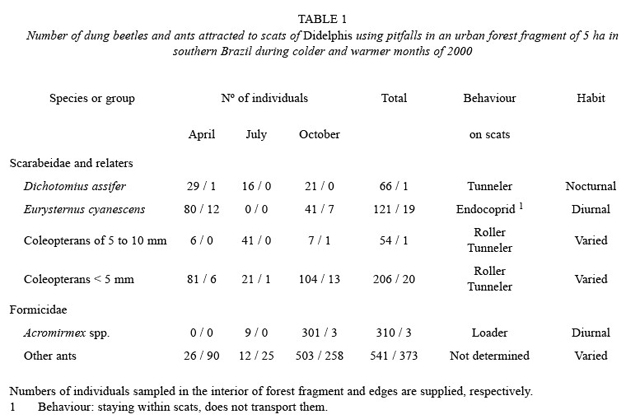
<body><![CDATA[of </span><span style="font-family: arial;">these small-bodied     coprophagous coleopterans. </span><span style="font-family: arial;">Small-bodied     beetles and ants that interact on </span><span      style="font-family: arial;">faeces of <span      style="font-style: italic;">Didelphis</span> (data from pitfalls) were     </span><span style="font-family: arial;">numerically dominant (<a      href="#tabla1">Table     1</a>), as follows.</span></small></div>     <p align="center"><a name="tabla1">     <br> </a><img src="/img/fbpe/rbt/v54n4/3504i1.JPG" title="" alt=""  style="width: 640px; height: 419px;"></p>     
]]></body>
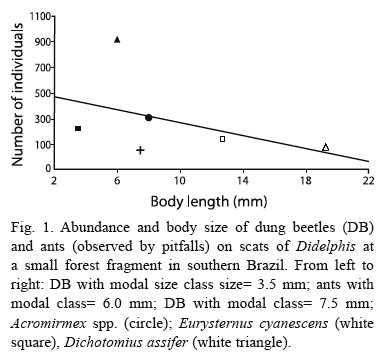
<body><![CDATA[<p align="justify"><small><br style="font-family: arial;"> </small><small><span style="font-family: arial;"><span  style="font-style: italic;">Coprophanaeus saphirinus</span> Sturm, 1826 </span><span style="font-family: arial;">(2.16&plusmn;0.48 cm; N= 2) was the largest species </span><span  style="font-family: arial;">registered by the study. From 22 scats recovered </span><span style="font-family: arial;">in tunnels, this species was found only in </span><span style="font-family: arial;">two occasions (9 %), one of them on scats of </span><span  style="font-family: arial;"><span style="font-style: italic;">D. aurita. C. saphirinus</span> showed diurnal habits, being observed burying scats of <span style="font-style: italic;">Didelphis</span> in </span><span style="font-family: arial;">one occasion, foraging under litter and flying </span><span style="font-family: arial;">above two scats, all of which during the </span><span style="font-family: arial;">day. This is a species that depicts a shiny blue </span><span  style="font-family: arial;">colour, easily discernible in the field. A <span style="font-style: italic;">C. </span></span><span  style="font-family: arial;"><span style="font-style: italic;">saphirinus</span> individual buried an opossum scat </span><span  style="font-family: arial;">at a depth of 7 cm on one occasion. It is a species </span><span style="font-family: arial;">of generalist feeding habits since it was </span><span style="font-family: arial;">seen in the study area burying an <span style="font-style: italic;">Oligoryzomys </span></span><span style="font-family: arial;"><span  style="font-style: italic;">nigripes</span> (Olfers, 1818) carcass, showing thus a </span><span style="font-family: arial;">coprophagous-necrophagous feeding habit.</span></small><br style="font-family: arial;"> </p>     <div style="text-align: left;"><small></small><br  style="font-family: arial;"> <small><span style="font-family: arial;"><span  style="font-style: italic;">Dichotomius assifer</span> (Eschscholtz, 1822) </span><span  style="font-family: arial;">(Mean&plusmn;SD: 1.92&plusmn;0.11 cm; N = 10) was the </span><span style="font-family: arial;">second most abundant species of dung beetle in </span><span  style="font-family: arial;">the study area, medium to large in size (<a href="#figura1">Fig. 1</a>). </span><span  style="font-family: arial;">This species has never been seen during diurnal </span><span style="font-family: arial;">observations of scats and was only found by </span><span style="font-family: arial;">means of excavations in tunnels (which were </span><span  style="font-family: arial;">made during the night). Using this method, </span><span style="font-family: arial;"><span  style="font-style: italic;">D. assifer</span> was found in 55 % of the tunnels </span><span style="font-family: arial;">(N total= 22), close to buried scats, just below </span><span style="font-family: arial;">the point where the scats had been left the day </span><span  style="font-family: arial;">before. However, <span  style="font-style: italic;">D. assifer</span> was the main loader </span><span  style="font-family: arial;">of scats (<a href="#tabla1">Table 1</a>), burying almost 100 % of </span><span style="font-family: arial;">every faecal sample. The pitfall method pointed out the even bigger abundance of <span  style="font-style: italic;">D. assifer</span> in </span><span  style="font-family: arial;">the fragment all year round, though population </span><span style="font-family: arial;">levels have decreased a little (July). <span style="font-style: italic;">D. assifer </span></span><span style="font-family: arial;">buried scats at an average depth of 8.3&plusmn;4.3 cm </span><span  style="font-family: arial;">(N= 8), with a minimum range of 4 cm and </span><span  style="font-family: arial;">a maximum of 15 cm. <span  style="font-style: italic;">D. assifer</span>, similarly to </span><span  style="font-family: arial;">other dung beetle species, occurred mostly in </span><span style="font-family: arial;">the interior of the forest fragment rather than in </span><span style="font-family: arial;">the edges (<a href="#tabla1">Table 1</a>).</span></small></div>     <p align="center"><a name="figura1"> <img style="border: 0px solid ; width: 386px; height: 362px;"  src="/img/fbpe/rbt/v54n4/3504i2.JPG" title="" alt=""></a></p>     
<p align="justify"><small><br style="font-family: arial;"> <br style="font-family: arial;"> </small></p>     <div style="text-align: left;"><small><span style="font-family: arial;"><span      style="font-style: italic;">Eurysternus     cyanescens</span> (Balthazar, 1939), </span><span      style="font-family: arial;">(1.27&plusmn;0.08 cm; N= 14) was the most     abundant </span><span style="font-family: arial;">dung beetle species     in the fragment. It is an </span><span style="font-family: arial;">endocoprid     ]]></body>
<body><![CDATA[species, staying under or inside </span><span      style="font-family: arial;">scats. Its population levels increased     during the </span><span style="font-family: arial;">wet season but     strongly decreased in the cold </span><span style="font-family: arial;">season     (July). In general, one to eight individuals </span><span      style="font-family: arial;">per sample were seen on scats of <span      style="font-style: italic;">Didelphis</span>. </span><span      style="font-family: arial;">It seems to tolerate the environment in     the </span><span style="font-family: arial;">edges better than <span      style="font-style: italic;">D. assifer </span>(<a href="#tabla1">Table     ]]></body>
<body><![CDATA[1</a>).</span></small><br style="font-family: arial;">     <small></small><br style="font-family: arial;">     <small><span style="font-family: arial;">Small-bodied coleopterans (2     to 10     mm). </span><span style="font-family: arial;">These dung beetles also     occurred in considerable </span><span style="font-family: arial;">numbers     within the fragment, mainly in its </span><span      style="font-family: arial;">interior (<a href="#tabla1">Table 1</a>).     Among them,&nbsp; <span style="font-style: italic;">Agamopus</span>     sp. </span><span style="font-family: arial;">(5 to 7 mm), a diurnal     ]]></body>
<body><![CDATA[roller beetle, was     seen </span><span style="font-family: arial;">in two occasions pushing     small pieces of scats, </span><span style="font-family: arial;">with     the aid of its hind legs. On the other hand, </span><span      style="font-family: arial;">individuals of<span      style="font-style: italic;">Canthidium</span> sp. were collected </span><span      style="font-family: arial;">close to scats, however in the interior of     underground </span><span style="font-family: arial;">chambers at low     depths in the soil (1 to </span><span style="font-family: arial;">3     cm). Other small-bodied dung beetles, such </span><span     ]]></body>
<body><![CDATA[ style="font-family: arial;">as hibosorines, were occasionally     collected </span><span style="font-family: arial;">close to scats, in     the interior of underground </span><span style="font-family: arial;">chambers     built by large dung beetles.</span></small><br      style="font-family: arial;">     <small></small><br style="font-family: arial;">     <small><span style="font-family: arial;">Leaf-cutting ants (<span      style="font-style: italic;">Acromirmex </span>spp.) </span><span      style="font-family: arial;">were registered transporting small pieces     of </span><span style="font-family: arial;"><span     ]]></body>
<body><![CDATA[ style="font-style: italic;">Didelphis&#8217;s</span> scats. An individual of     this genus </span><span style="font-family: arial;">was seen     transporting a seed of <span style="font-style: italic;">Passiflora </span></span><span      style="font-family: arial;">removed from scats of <span      style="font-style: italic;">Didelphis</span>. <span      style="font-style: italic;">Acromirmex </span></span><span      style="font-family: arial;">spp. were abundant in the interior of the     fragment </span><span style="font-family: arial;">in October, whereas     the abundance of </span><span style="font-family: arial;">other ants     was seasonal and site-dependent </span><span     ]]></body>
<body><![CDATA[ style="font-family: arial;">(edge or interior; <a href="#tabla1">Table     1</a>).</span></small><br style="font-family: arial;">     <small></small><br style="font-family: arial;">     <small><span style="font-family: arial;">From scats collected (N= 64),     51 %     had </span><span style="font-family: arial;">one or more seed species.     These seeds belonged </span><span style="font-family: arial;">to four     identified families and nine genera distributed </span><span      style="font-family: arial;">among 12 species of plants. The most </span><span      style="font-family: arial;">frequent species in scats were <span     ]]></body>
<body><![CDATA[ style="font-style: italic;">Piper gaudichaudianum </span></span><span      style="font-family: arial;">Kunth (Piperaceae; N= 826 seeds; 30 % </span><span      style="font-family: arial;">of occurrence in scats), <span      style="font-style: italic;">Solanum maioranthum </span></span><span      style="font-family: arial;">L.B.Sm. (N= 170, 11 %) and <span      style="font-style: italic;">Vassobia breviflora </span></span><span      style="font-family: arial;">(Sendtn.) Munz (Solanaceae; N= 30; 8 %). </span><span      style="font-family: arial;"><span style="font-style: italic;">Passiflora     actinia</span> Hooker (Passifloraceae; only </span><span      style="font-family: arial;">seed fragments in scats) seeds also     ]]></body>
<body><![CDATA[appeared in </span><span style="font-family: arial;">scats but usually     in low numbers.</span></small><br style="font-family: arial;">     <small></small><br style="font-family: arial;">     <small><span style="font-family: arial;">Experiments with the     germination of     seeds </span><span style="font-family: arial;">buried in soil under     laboratory conditions </span><span style="font-family: arial;">showed     that seed species dropped by opossums </span><span      style="font-family: arial;">can germinate when buried up to 5 cm in     depth. </span><span style="font-family: arial;">Seeds of <span     ]]></body>
<body><![CDATA[ style="font-style: italic;">Physalis pubescens</span> L. (absent in     the </span><span style="font-family: arial;">scats, but see     C&aacute;ceres 2002) germinated only </span><span      style="font-family: arial;">on the soil surface when submitted to weak     </span><span style="font-family: arial;">light intensity (or in shade     condition), whereas </span><span style="font-family: arial;">when     submitted to strong light intensity (near </span><span      style="font-family: arial;">full light), seeds buried at 1 cm (N= 25)     as well </span><span style="font-family: arial;">as at 5 cm (N= 40,     but from scats) germinated </span><span style="font-family: arial;">at     ]]></body>
<body><![CDATA[similar rates (84 % and 50 %, respectively) </span><span      style="font-family: arial;">to those of the control experiments on the     soil </span><span style="font-family: arial;">surface. Seeds of <span      style="font-style: italic;">P. actinia</span> germinated only </span><span      style="font-family: arial;">at 1 cm and 5 cm in depth in the soil (N=     20, </span><span style="font-family: arial;">60 %; N= 20, 45 %,     respectively) and not on </span><span style="font-family: arial;">the     soil surface. <span style="font-style: italic;">P. gaudichaudianum</span>     germinated </span><span style="font-family: arial;">only on the soil     surface (N= 25, 84 %).</span></small><br style="font-family: arial;">     ]]></body>
<body><![CDATA[<small></small><br style="font-family: arial;">     <small><small><!-- big --><span style="font-family: arial; font-weight: 700;">Discussion</span><!-- /big --></small></small><br      style="font-family: arial;">     <small></small><br style="font-family: arial;">     <small><span style="font-family: arial;">The assemblage of dung beetles     registered </span><span style="font-family: arial;">in the forest     fragment studied for scats of </span><span style="font-family: arial;">opossums     was similar to others found elsewhere </span><span      style="font-family: arial;">in the neotropics, with the presence </span><span      style="font-family: arial;">of genera such as <span     ]]></body>
<body><![CDATA[ style="font-style: italic;">Dichotomius, Eurysternus, </span></span><span      style="font-family: arial;"><span style="font-style: italic;">Agamopus</span>     and <span style="font-style: italic;">Canthidium</span>, which have     the </span><span style="font-family: arial;">same role in the     destination of scats, that is,</span><span style="font-family: arial;">     tunnellers, rollers and endocoprids (Estrada </span><span      style="font-family: arial;">and Coates-Estrada 1991, Kirk 1992, Estrada<span      style="font-style: italic;"> </span></span><span      style="font-family: arial;"><span style="font-style: italic;">et al</span>.     1993, Flechtmann <span style="font-style: italic;">et al</span>. 1995,     ]]></body>
<body><![CDATA[Escobar </span><span style="font-family: arial;">1997). However, these     assemblages were registered </span><span style="font-family: arial;">by     using different types of scats, such </span><span      style="font-family: arial;">as of primates, carnivores, cattle and     humans, </span><span style="font-family: arial;">showing a certain     degree of flexibility in the </span><span style="font-family: arial;">feeding     habits for these dung beetle genera. </span></small>    <br>     <small><span style="font-family: arial;"></span></small><br      style="font-family: arial;">     ]]></body>
<body><![CDATA[<small><span style="font-family: arial;"></span><span      style="font-family: arial;">At least in what concerns the     volume </span><span style="font-family: arial;">of scats buried, there     was, apparently, the </span><span style="font-family: arial;">dominance     of a nocturnal species, <span style="font-style: italic;">D. assifer, </span></span><span      style="font-family: arial;">within the forest fragment. The forested     habitat </span><span style="font-family: arial;">appears to favour the     dominance of nocturnal </span><span style="font-family: arial;">dung     beetles (Halffter <span style="font-style: italic;">et al</span>.     1992). The </span><span style="font-family: arial;">dominance of some     ]]></body>
<body><![CDATA[species of dung beetles in </span><span style="font-family: arial;">fragmented     landscapes seems to be common </span><span style="font-family: arial;">(Kirk     1992, Escobar 1997). Considering the </span><span      style="font-family: arial;">hypothesis of competition between     tunnellers </span><span style="font-family: arial;">for scats of     opossums in the forest fragment, </span><span      style="font-family: arial;">this phenomenon would be diminished by the     </span><span style="font-family: arial;">niche separation of <span      style="font-style: italic;">D. assifer</span> and <span      style="font-style: italic;">C. saphirinus</span>, </span><span     ]]></body>
<body><![CDATA[ style="font-family: arial;">since one is nocturnal and coprophagous     and the other, diurnal and generalist (coprophagous- </span><span      style="font-family: arial;">necrophagous). This explained the lower </span><span      style="font-family: arial;">occurrence of <span      style="font-style: italic;">C. saphirinus</span> on opossum scats </span><span      style="font-family: arial;">found by the method of rediscovering     scats. </span><span style="font-family: arial;">Generalist dung     beetles are common in other </span><span style="font-family: arial;">regions     of the Americas and elsewhere (Hanski </span><span      style="font-family: arial;">1992). The activity time, body size and     ]]></body>
<body><![CDATA[manner </span><span style="font-family: arial;">of transporting scats     are the main strategies </span><span style="font-family: arial;">for     resource partitioning among Neotropical </span><span      style="font-family: arial;">scarabaeid beetles (Halffter <span      style="font-style: italic;">et al</span>. 1992, Hanski </span><span      style="font-family: arial;">1992, Kirk 1992).</span></small><br      style="font-family: arial;">     <small></small><br style="font-family: arial;">     <small><span style="font-family: arial;">Due to the fact that near 100     % of     ]]></body>
<body><![CDATA[most </span><span style="font-family: arial;">faecal samples were     buried by <span style="font-style: italic;">D. assifer</span>, this </span><span      style="font-family: arial;">species, like the remaining small-bodied     species, </span><span style="font-family: arial;">is contributing to     the aeration of the soil </span><span style="font-family: arial;">and     the formation of seed banks, since scats </span><span      style="font-family: arial;">of <span style="font-style: italic;">Didelphis</span>     usually contain a lot of seeds </span><span style="font-family: arial;">(C&aacute;ceres     and Monteiro-Filho 2001, C&aacute;ceres </span><span      style="font-family: arial;">2002). Thus, small-bodied beetles should     ]]></body>
<body><![CDATA[each </span><span style="font-family: arial;">time move small pieces     of scats, having a different </span><span style="font-family: arial;">role     in seed dispersion. According to </span><span      style="font-family: arial;">Estrada and Coates-Estrada (1991), these     small </span><span style="font-family: arial;">balls may contain small     seeds (rather than large </span><span style="font-family: arial;">ones)     that are often buried by these beetles </span><span      style="font-family: arial;">at low depths (Cambefort and Hanski 1991).     </span><span style="font-family: arial;">Small seeds (&lt; 7 mm) are     very common in the </span><span style="font-family: arial;">scats of <span     ]]></body>
<body><![CDATA[ style="font-style: italic;">Didelphis</span> (C&aacute;ceres 2002) and     can germinate </span><span style="font-family: arial;">at low depths     as seen here.</span></small><br style="font-family: arial;">     <small></small><br style="font-family: arial;">     <small><span style="font-family: arial;">Depths at which seeds were     buried     here </span><span style="font-family: arial;">were similar to those     found for dung beetles&nbsp; </span><span style="font-family: arial;">on     howler monkeys&#8217; scats in Mexico (Estrada </span><span      style="font-family: arial;">and Coates-Estrada 1991). In that study,     ]]></body>
<body><![CDATA[depths </span><span style="font-family: arial;">were suitable for seed     germination, just as it </span><span style="font-family: arial;">occurred     experimentally here for some seed </span><span      style="font-family: arial;">species in opossum scats. For example, <span      style="font-style: italic;">P. </span></span><span      style="font-family: arial;"><span style="font-style: italic;">actinia</span>     seeds need complete shadow for germination </span><span      style="font-family: arial;">(C&aacute;ceres and Monteiro-Filho,     unpubl.), </span><span style="font-family: arial;">a condition easily     obtained with the aid of </span><span style="font-family: arial;">dung     ]]></body>
<body><![CDATA[beetles. In fact, seeds present in opossum </span><span      style="font-family: arial;">scats are mainly pioneer in forest     succession </span><span style="font-family: arial;">(C&aacute;ceres     2002). Strong rains usually open gaps </span><span      style="font-family: arial;">in the forest, occasioned by tree falls,     turning </span><span style="font-family: arial;">over litter and     uncovering buried pioneer seeds </span><span      style="font-family: arial;">(Charles-Dominique and Puig 1999). </span></small><br      style="font-family: arial;">     <small></small><br style="font-family: arial;">     ]]></body>
<body><![CDATA[<small><span style="font-family: arial;">Tunneller and roller dung     beetles     prevent </span><span style="font-family: arial;">seeds in scats from     being preyed on by predators </span><span style="font-family: arial;">such     as some rodents (Perry and Fleming 1980, </span><span      style="font-family: arial;">Chapman 1989). This was satisfactorily     tested </span><span style="font-family: arial;">for seeds in scats of     howler monkeys <span style="font-style: italic;">A. palliata </span></span><span      style="font-family: arial;">(Estrada and Coates-Estrada 1991). Such     dung </span><span style="font-family: arial;">beetles, like <span     ]]></body>
<body><![CDATA[ style="font-style: italic;">D. assifer</span> and <span      style="font-style: italic;">C. saphirinus</span>, as well </span><span      style="font-family: arial;">as their larvae in the underground     chambers, do </span><span style="font-family: arial;">not damage the     seeds because of their soft membranaceous </span><span      style="font-family: arial;">buccal apparatuses for feeding on </span><span      style="font-family: arial;">remains of excrements (Halffter and     Matthews </span><span style="font-family: arial;">1966, Cambefort     1991, Halffter 1991, S. Ide, </span><span style="font-family: arial;">pers.     com). Since several species dispersed </span><span     ]]></body>
<body><![CDATA[ style="font-family: arial;">by <span style="font-style: italic;">Didelphis</span>     show dormancy (C&aacute;ceres 2002, </span><span      style="font-family: arial;">unpubl.), they may wait for good     conditions </span><span style="font-family: arial;">of germination in     these chambers. The scattering </span><span style="font-family: arial;">of     faecal balls by rollers from the original </span><span      style="font-family: arial;">position of the scat is also an important     factor </span><span style="font-family: arial;">to avoid seed     predation. The presence of lot of </span><span      style="font-family: arial;">seeds inside the same scat, as usually     ]]></body>
<body><![CDATA[occurs </span><span style="font-family: arial;">with <span      style="font-style: italic;">Didelphis</span> and other marsupials     (C&aacute;ceres </span><span style="font-family: arial;">and     Monteiro-Filho 2001, C&aacute;ceres 2002), is </span><span      style="font-family: arial;">extremely attractive for seed predators     such as </span><span style="font-family: arial;">rodents (Perry and     Fleming 1980).</span></small><br style="font-family: arial;">     <small></small><br style="font-family: arial;">     <small><span style="font-family: arial;">Ants, such as <span      style="font-style: italic;">Acromirmex</span>, did help the </span><span     ]]></body>
<body><![CDATA[ style="font-family: arial;">mammalian seed dispersal by transporting </span><span      style="font-family: arial;">them to suitable sites of germination     (Perry </span><span style="font-family: arial;">and Fleming 1980,     Levey and Byrne 1993). </span><span style="font-family: arial;">Ants     were also seen transporting <span style="font-style: italic;">Philodendron</span>     </span><span style="font-family: arial;">cf. <span      style="font-style: italic;">imbe</span> Schott (Araceae) seeds from <span      style="font-style: italic;">D. aurita</span> </span><span      style="font-family: arial;">scats in the Atlantic Forest (N.C.     C&aacute;ceres, pers.&nbsp; </span><span style="font-family: arial;">obs.).     ]]></body>
<body><![CDATA[They may play an important role in secondary </span><span      style="font-family: arial;">seed dispersal, as estimated here for the </span><span      style="font-family: arial;">interior of the forest fragment as well as     for the </span><span style="font-family: arial;">forest edges. Some     opossum species usually </span><span style="font-family: arial;">forage     in the edges of forest fragments (N.C. </span><span      style="font-family: arial;">C&aacute;ceres, unpubl.), particularly the     small ones, </span><span style="font-family: arial;">propitiating seed     deposition on these places </span><span style="font-family: arial;">(Pinheiro     <span style="font-style: italic;">et al</span>. 2002).</span></small><br     ]]></body>
<body><![CDATA[ style="font-family: arial;">     <small></small><br style="font-family: arial;">     <small><span style="font-family: arial;">Opossums are the most abundant     and     one </span><span style="font-family: arial;">of the largest wild     mammalian species in small, </span><span style="font-family: arial;">urban     forest fragments (Fonseca and Robinson </span><span      style="font-family: arial;">1990, C&aacute;ceres 2002). And, due to     the big amount </span><span style="font-family: arial;">of biomass     produced by them, must be one of the </span><span     ]]></body>
<body><![CDATA[ style="font-family: arial;">most important sources of scats for dung     beetles </span><span style="font-family: arial;">in disturbed,     forested environments.</span></small><br style="font-family: arial;">     <small></small><br style="font-family: arial;">     <small><small><!-- big --><span style="font-family: arial; font-weight: 700;">Acknowledgments</span><!-- /big --></small></small></div>     <div style="text-align: left;"></div>     <!-- ref --><p style="text-align: left;"><small><span style="font-family: arial;">We are in debt to S. Ide and C. Brand&atilde;o for </span><span style="font-family: arial;">identification of beetles and ants, respectively, to J.G. Loreley Oviedo for assistance with the </span><span style="font-family: arial;">abstract in Spanish, and S. Bichara-Desecki </span><span  style="font-family: arial;">for assistance in the English translation. The </span><span style="font-family: arial;">&#8220;Curso de P&oacute;s-Gradua&ccedil;&atilde;o em Zoologia&#8221; at </span><span  style="font-family: arial;">UFPR gave support to this study. CAPES </span><span  style="font-family: arial;">granted a fellowship to NCC.</span><br  style="font-family: arial;"> <br style="font-family: arial;"> <small><b> <!-- big --><span style="font-family: arial;">R</span><!-- /big --><font size="3"><small><span  style="font-family: arial;">esumen</span></small></font></b></small><br  style="font-family: arial;"> <br style="font-family: arial;"> <span style="font-family: arial;">Por dos a&ntilde;os estudiamos los escarabajos copr&oacute;fagos </span><span style="font-family: arial;">y las hormigas que act&uacute;an en las heces de zarig&uuml;ellas </span><span  style="font-family: arial;">(<span style="font-style: italic;">Didelphis</span>). Se dejaron excrementos en el campo para descubrir </span><span  style="font-family: arial;">los agentes secundarios de dispersi&oacute;n. Una parte de </span><span  style="font-family: arial;">cada excremento (30 %) fue analizada en laboratorio para </span><span style="font-family: arial;">estimar el n&uacute;mero de semillas. Se recolectaron escarabajos </span><span  style="font-family: arial;">del suelo (51 % de 84 excrementos dejados en el campo). </span><span style="font-family: arial;">Tambi&eacute;n capturamos escarabajos y hormigas con trampas </span><span  style="font-family: arial;">(N= 10). Los escarabajos copr&oacute;fagos son los principales </span><span style="font-family: arial;">agentes secundarios de dispersi&oacute;n. Ruedan los excrementos </span><span  style="font-family: arial;">o los entierran a 4-15 cm de profundidad (N= 22 t&uacute;neles). </span><span style="font-family: arial;">Los escarabajos copr&oacute;fagos de mayor tama&ntilde;o fueron </span><span  style="font-family: arial;"><span style="font-style: italic;">Eurysternus cyanescens</span> (28.7 % en trampas), <span  style="font-style: italic;">Dichotomius </span></span><span  style="font-family: arial;"><span style="font-style: italic;">assifer</span> (13.7 %) y <span style="font-style: italic;">Coprophanaeus saphirinus</span> (s&oacute;lo visto </span><span style="font-family: arial;">en madrigueras y directamente sobre los excrementos). </span><span  style="font-family: arial;">Los escarabajos de menos de 10 mm fueron el 57.6 %. La </span><span style="font-family: arial;">hormiga <span  style="font-style: italic;">Acromirmex</span> sp. fue 25.5 % del total de hormigas </span><span style="font-family: arial;">capturadas en trampas. Hallamos varias especies de semillas </span><span  style="font-family: arial;">en los excrementos, muchos de ellos enterrados por los </span><span style="font-family: arial;">escarabajos, y algunas fueron extra&iacute;das por las hormigas. </span><span  style="font-family: arial;">Estos agentes secundarios ayudan a evitar los depredadores </span><span style="font-family: arial;">de semillas (eg. roedores) y aceleran la formaci&oacute;n del </span><span  style="font-family: arial;">banco de semillas, pues no las comen.</span><br  style="font-family: arial;"> <br style="font-family: arial;"> <span style="font-family: arial;">Palabras clave: dispersi&oacute;n de semillas, dispersi&oacute;n secundaria, </span><span  style="font-family: arial;">escarabajos copr&oacute;fagos, hormigas, marsupiales, </span><span style="font-family: arial;">mam&iacute;feros peque&ntilde;os.</span><br style="font-family: arial;"> <br style="font-family: arial;"> <!-- big --><small><span style="font-family: arial; font-weight: 700;">References</span></small><br  style="font-family: arial;"> <!-- /big --><br style="font-family: arial;"> <span style="font-family: arial;">Atramentowicz, M. 1988. La frugivorie opportuniste de </span><span style="font-family: arial;">trois marsupiaux didelphid&eacute;s de Guyane. Rev. Ecol. </span><span  style="font-family: arial;">Terre vie 43: 47-57.</span><br  style="font-family: arial;"> <br style="font-family: arial;"> <span style="font-family: arial;">    &nbsp;&nbsp;&nbsp;&nbsp;&nbsp;&nbsp;&nbsp;&nbsp;[&#160;<a href="javascript:void(0);" onclick="javascript: window.open('/scielo.php?script=sci_nlinks&ref=1357685&pid=S0034-7744200600040001800001&lng=','','width=640,height=500,resizable=yes,scrollbars=1,menubar=yes,');">Links</a>&#160;]<!-- end-ref --><!-- ref -->C&aacute;ceres, N.C. 2002. Food habits and seed dispersal </span><span style="font-family: arial;">by the white-eared opossum, <span style="font-style: italic;">Didelphis albiventris</span> </span><span style="font-family: arial;">(Mammalia, Marsupialia), in southern Brazil. Stud. </span><span  style="font-family: arial;">Neotrop. Fauna Environ. 37: 97-104.</span><br  style="font-family: arial;"> <br style="font-family: arial;"> <span style="font-family: arial;">    &nbsp;&nbsp;&nbsp;&nbsp;&nbsp;&nbsp;&nbsp;&nbsp;[&#160;<a href="javascript:void(0);" onclick="javascript: window.open('/scielo.php?script=sci_nlinks&ref=1357686&pid=S0034-7744200600040001800002&lng=','','width=640,height=500,resizable=yes,scrollbars=1,menubar=yes,');">Links</a>&#160;]<!-- end-ref --><!-- ref -->C&aacute;ceres, N.C. &amp; E.L.A. Monteiro-Filho. 2001. Food </span><span style="font-family: arial;">habits, home range and activity of <span style="font-style: italic;">Didelphis aurita</span> </span><span style="font-family: arial;">(Mammalia, Marsupialia) in southern Brazil. Stud. </span><span  style="font-family: arial;">Neotrop. Fauna Environ. 36: 85-92.</span><br  style="font-family: arial;"> <br style="font-family: arial;"> <span style="font-family: arial;">    &nbsp;&nbsp;&nbsp;&nbsp;&nbsp;&nbsp;&nbsp;&nbsp;[&#160;<a href="javascript:void(0);" onclick="javascript: window.open('/scielo.php?script=sci_nlinks&ref=1357687&pid=S0034-7744200600040001800003&lng=','','width=640,height=500,resizable=yes,scrollbars=1,menubar=yes,');">Links</a>&#160;]<!-- end-ref --><!-- ref -->Cambefort, Y. 1991. From saprophagy to coprophagy, p. </span><span style="font-family: arial;">37-50. <span  style="font-style: italic;">In</span> I. Hanski &amp; Y. Cambefort (eds.). Dung </span><span style="font-family: arial;">beetle ecology. Princeton, Massachusetts, USA. </span><br style="font-family: arial;"> <br style="font-family: arial;"> <span style="font-family: arial;">    &nbsp;&nbsp;&nbsp;&nbsp;&nbsp;&nbsp;&nbsp;&nbsp;[&#160;<a href="javascript:void(0);" onclick="javascript: window.open('/scielo.php?script=sci_nlinks&ref=1357688&pid=S0034-7744200600040001800004&lng=','','width=640,height=500,resizable=yes,scrollbars=1,menubar=yes,');">Links</a>&#160;]<!-- end-ref --><!-- ref -->Cambefort, Y. &amp; I. Hanski. 1991. Dung beetle population </span><span style="font-family: arial;">biology, p. 37-50. <span style="font-style: italic;">In</span> I. Hanski &amp; Y. Cambefort (eds.). </span><span style="font-family: arial;">Dung beetle ecology. Princeton, Massachusetts, </span><span  style="font-family: arial;">USA.</span><br style="font-family: arial;"> <br style="font-family: arial;"> <span style="font-family: arial;">    &nbsp;&nbsp;&nbsp;&nbsp;&nbsp;&nbsp;&nbsp;&nbsp;[&#160;<a href="javascript:void(0);" onclick="javascript: window.open('/scielo.php?script=sci_nlinks&ref=1357689&pid=S0034-7744200600040001800005&lng=','','width=640,height=500,resizable=yes,scrollbars=1,menubar=yes,');">Links</a>&#160;]<!-- end-ref --><!-- ref -->Chapman, C.A. 1989. Primate seed dispersal: the fate of </span><span style="font-family: arial;">dispersed seeds. Biotropica 21: 148-154.</span><br style="font-family: arial;"> <br style="font-family: arial;"> <span style="font-family: arial;">    &nbsp;&nbsp;&nbsp;&nbsp;&nbsp;&nbsp;&nbsp;&nbsp;[&#160;<a href="javascript:void(0);" onclick="javascript: window.open('/scielo.php?script=sci_nlinks&ref=1357690&pid=S0034-7744200600040001800006&lng=','','width=640,height=500,resizable=yes,scrollbars=1,menubar=yes,');">Links</a>&#160;]<!-- end-ref --><!-- ref -->Charles-Dominique, P. &amp; H. Puig. 1999. R&eacute;g&eacute;n&eacute;ration des </span><span  style="font-family: arial;">for&ecirc;ts tropicales humides, l&#8217;exemple de la Guyane, p. </span><span style="font-family: arial;">28-36. <span  style="font-style: italic;">In</span> For&ecirc;ts tropicales: des connuissonces par le </span><span style="font-family: arial;">gestion. Minist&egrave;re de l&#8217;Am&eacute;nagement du Territoire et </span><span  style="font-family: arial;">de l&#8217;Environnement, Paris, France.</span><br  style="font-family: arial;"> <br style="font-family: arial;"> <span style="font-family: arial;">    &nbsp;&nbsp;&nbsp;&nbsp;&nbsp;&nbsp;&nbsp;&nbsp;[&#160;<a href="javascript:void(0);" onclick="javascript: window.open('/scielo.php?script=sci_nlinks&ref=1357691&pid=S0034-7744200600040001800007&lng=','','width=640,height=500,resizable=yes,scrollbars=1,menubar=yes,');">Links</a>&#160;]<!-- end-ref --><!-- ref -->Escobar-S., F. 1997. Estudio de la comunidad de coleopteros </span><span style="font-family: arial;">copr&oacute;fagos (Scarabaeidae) en un remanente de </span><span  style="font-family: arial;">bosque seco al norte del Tolima, Colombia. Caldasia </span><span style="font-family: arial;">19: 419-430.    &nbsp;&nbsp;&nbsp;&nbsp;&nbsp;&nbsp;&nbsp;&nbsp;[&#160;<a href="javascript:void(0);" onclick="javascript: window.open('/scielo.php?script=sci_nlinks&ref=1357692&pid=S0034-7744200600040001800008&lng=','','width=640,height=500,resizable=yes,scrollbars=1,menubar=yes,');">Links</a>&#160;]<!-- end-ref --><!-- ref --><br> <br style="font-family: arial;"> </span><span style="font-family: arial;">Estrada, A. &amp; R. Coates-Estrada. 1991. Howler monkeys </span><span  style="font-family: arial;">(<span style="font-style: italic;">Alouatta palliata</span>), dung beetles (Scarabaeidae) and </span><span  style="font-family: arial;">seed dispersal: ecological interactions in the tropical </span><span style="font-family: arial;">rain forest of Los Tuxtlas, M&eacute;xico. J. Trop. Ecol. 7: </span><span  style="font-family: arial;">459-474.</span><br  style="font-family: arial;"> <br style="font-family: arial;"> <span style="font-family: arial;">    &nbsp;&nbsp;&nbsp;&nbsp;&nbsp;&nbsp;&nbsp;&nbsp;[&#160;<a href="javascript:void(0);" onclick="javascript: window.open('/scielo.php?script=sci_nlinks&ref=1357693&pid=S0034-7744200600040001800009&lng=','','width=640,height=500,resizable=yes,scrollbars=1,menubar=yes,');">Links</a>&#160;]<!-- end-ref --><!-- ref -->Estrada, A., G. Halffter, R. Coates-Estrada &amp; D.A. Meritt-</span><span  style="font-family: arial;">Jr. 1993. Dung beetles attracted to mammalian herbivore </span><span style="font-family: arial;">(<span  style="font-style: italic;">Alouatta palliata</span>) and omnivore (<span  style="font-style: italic;">Nasua </span></span><span  style="font-family: arial;"><span style="font-style: italic;">narica</span>) dung in the tropical rain forest of Los Tuxtlas, </span><span  style="font-family: arial;">M&eacute;xico. J. Trop. Ecol. 9: 45-54.</span><br  style="font-family: arial;"> <br style="font-family: arial;"> <span style="font-family: arial;">    &nbsp;&nbsp;&nbsp;&nbsp;&nbsp;&nbsp;&nbsp;&nbsp;[&#160;<a href="javascript:void(0);" onclick="javascript: window.open('/scielo.php?script=sci_nlinks&ref=1357694&pid=S0034-7744200600040001800010&lng=','','width=640,height=500,resizable=yes,scrollbars=1,menubar=yes,');">Links</a>&#160;]<!-- end-ref --><!-- ref -->Flechtmann, C.A.H., S.R. Rodrigues &amp; C.L. Gaspareto. </span><span style="font-family: arial;">1995. Controle biol&oacute;gico da mosca-dos-chifres </span><span  style="font-family: arial;"><span style="font-style: italic;">(Haematobia irritans</span>) em Selv&iacute;ria, Mato Grosso do </span><span  style="font-family: arial;">Sul. 5. Sele&ccedil;&atilde;o de besouros copr&oacute;fagos. Rev. Bras. </span><span style="font-family: arial;">Ent. 39: 277-286.</span><br style="font-family: arial;"> <br style="font-family: arial;"> <span style="font-family: arial;">    &nbsp;&nbsp;&nbsp;&nbsp;&nbsp;&nbsp;&nbsp;&nbsp;[&#160;<a href="javascript:void(0);" onclick="javascript: window.open('/scielo.php?script=sci_nlinks&ref=1357695&pid=S0034-7744200600040001800011&lng=','','width=640,height=500,resizable=yes,scrollbars=1,menubar=yes,');">Links</a>&#160;]<!-- end-ref --><!-- ref -->Fonseca, G.A.B. &amp; J.G. Robinson. 1990. Forest size and </span><span style="font-family: arial;">structure: competitive and predatory effects on small </span><span  style="font-family: arial;">mammal communities. Biol. Cons. 53: 265-294.</span><br style="font-family: arial;"> <br style="font-family: arial;"> <span style="font-family: arial;">    &nbsp;&nbsp;&nbsp;&nbsp;&nbsp;&nbsp;&nbsp;&nbsp;[&#160;<a href="javascript:void(0);" onclick="javascript: window.open('/scielo.php?script=sci_nlinks&ref=1357696&pid=S0034-7744200600040001800012&lng=','','width=640,height=500,resizable=yes,scrollbars=1,menubar=yes,');">Links</a>&#160;]<!-- end-ref --><!-- ref -->Halffter, G. 1991. Feeding, bisexual cooperation and </span><span style="font-family: arial;">subsocial behavior in three groups of Coleoptera, p. </span><span  style="font-family: arial;">281-296. <span style="font-style: italic;">In</span> M. Zunino, X. Bell&eacute;s &amp; M. Blas (eds.).&nbsp; </span><span  style="font-family: arial;">dvances in coleopterology. AEC, Barcelona, Spain.</span><br style="font-family: arial;"> <br style="font-family: arial;"> <span style="font-family: arial;">Halffter, G. &amp; E.G. Matthews. 1966. The natural history </span><span style="font-family: arial;">of dung beetles of the Subfamily Scarabaeinae </span><span  style="font-family: arial;">(Coleoptera, Scarabaeidae). Folia Ent. Mex. 12-14: </span><span style="font-family: arial;">1-312.</span><br  style="font-family: arial;"> <br style="font-family: arial;"> <span style="font-family: arial;">    &nbsp;&nbsp;&nbsp;&nbsp;&nbsp;&nbsp;&nbsp;&nbsp;[&#160;<a href="javascript:void(0);" onclick="javascript: window.open('/scielo.php?script=sci_nlinks&ref=1357697&pid=S0034-7744200600040001800014&lng=','','width=640,height=500,resizable=yes,scrollbars=1,menubar=yes,');">Links</a>&#160;]<!-- end-ref --><!-- ref -->Halffter, G., M.E. Favila &amp; v. Halffter. 1992. A comparative </span><span style="font-family: arial;">study of the structure of the scarab guild in </span><span  style="font-family: arial;">Mexican tropical rain forests and derived ecosystems. </span><span style="font-family: arial;">Folia Ent. Mex. 84: 131-156.</span><br style="font-family: arial;"> <br style="font-family: arial;"> <span style="font-family: arial;">    &nbsp;&nbsp;&nbsp;&nbsp;&nbsp;&nbsp;&nbsp;&nbsp;[&#160;<a href="javascript:void(0);" onclick="javascript: window.open('/scielo.php?script=sci_nlinks&ref=1357698&pid=S0034-7744200600040001800015&lng=','','width=640,height=500,resizable=yes,scrollbars=1,menubar=yes,');">Links</a>&#160;]<!-- end-ref --><!-- ref -->Hanski, I. 1992. Dung beetles, p. 489-511. <span style="font-style: italic;">In </span>H. Lieth &amp; </span><span  style="font-family: arial;">M.J.A. Werger (eds.). Ecosystems of the world tropical </span><span style="font-family: arial;">rain forest ecosystems: biogeographical and ecological </span><span  style="font-family: arial;">studies. Elsevier, Amsterdam, Netherlands.</span><br  style="font-family: arial;"> <br style="font-family: arial;"> <span style="font-family: arial;">    &nbsp;&nbsp;&nbsp;&nbsp;&nbsp;&nbsp;&nbsp;&nbsp;[&#160;<a href="javascript:void(0);" onclick="javascript: window.open('/scielo.php?script=sci_nlinks&ref=1357699&pid=S0034-7744200600040001800016&lng=','','width=640,height=500,resizable=yes,scrollbars=1,menubar=yes,');">Links</a>&#160;]<!-- end-ref --><!-- ref -->Kirk, A.A. 1992. Dung beetles (Coleoptera: Scarabaeidae) </span><span style="font-family: arial;">active in patchy forest and pasture habitats in Santa </span><span  style="font-family: arial;">Cruz Province, Bolivia, during spring. Folia Ent. </span><span style="font-family: arial;">Mex. 84: 45-54.</span><br  style="font-family: arial;"> <br style="font-family: arial;"> <span style="font-family: arial;">    &nbsp;&nbsp;&nbsp;&nbsp;&nbsp;&nbsp;&nbsp;&nbsp;[&#160;<a href="javascript:void(0);" onclick="javascript: window.open('/scielo.php?script=sci_nlinks&ref=1357700&pid=S0034-7744200600040001800017&lng=','','width=640,height=500,resizable=yes,scrollbars=1,menubar=yes,');">Links</a>&#160;]<!-- end-ref --><!-- ref -->Levey, D.J. &amp; M.M. Byrne. 1993. Complex ant-plant interactions: </span><span  style="font-family: arial;">rain forest ants as secondary dispersers and postdispersal </span><span style="font-family: arial;">seed predators. Ecology 74: 1 802-1 812.&nbsp;    &nbsp;&nbsp;&nbsp;&nbsp;&nbsp;&nbsp;&nbsp;&nbsp;[&#160;<a href="javascript:void(0);" onclick="javascript: window.open('/scielo.php?script=sci_nlinks&ref=1357701&pid=S0034-7744200600040001800018&lng=','','width=640,height=500,resizable=yes,scrollbars=1,menubar=yes,');">Links</a>&#160;]<!-- end-ref --><br>     <!-- ref --><br> </span><span style="font-family: arial;">Maack, R. 1981. Geografia f&iacute;sica do Estado do Paran&aacute;. J. </span><span  style="font-family: arial;">Olympio, Rio de Janeiro, Brazil. 450 p.</span><br  style="font-family: arial;"> <br style="font-family: arial;"> <span style="font-family: arial;">    &nbsp;&nbsp;&nbsp;&nbsp;&nbsp;&nbsp;&nbsp;&nbsp;[&#160;<a href="javascript:void(0);" onclick="javascript: window.open('/scielo.php?script=sci_nlinks&ref=1357703&pid=S0034-7744200600040001800019&lng=','','width=640,height=500,resizable=yes,scrollbars=1,menubar=yes,');">Links</a>&#160;]<!-- end-ref --><!-- ref -->Marshall, A.G. 1981. The ecology of ectoparasitic insects. </span><span style="font-family: arial;">Academic, London, England.</span><br style="font-family: arial;"> <br style="font-family: arial;"> <span style="font-family: arial;">    &nbsp;&nbsp;&nbsp;&nbsp;&nbsp;&nbsp;&nbsp;&nbsp;[&#160;<a href="javascript:void(0);" onclick="javascript: window.open('/scielo.php?script=sci_nlinks&ref=1357704&pid=S0034-7744200600040001800020&lng=','','width=640,height=500,resizable=yes,scrollbars=1,menubar=yes,');">Links</a>&#160;]<!-- end-ref --><!-- ref -->Mart&iacute;n-Piera, F. &amp; J.M. Lobo. 1996. A comparative discussion </span><span  style="font-family: arial;">of trophic preferences in dung beetle communities. </span><span style="font-family: arial;">Miscel. Zool. 19: 13-31.</span><br style="font-family: arial;"> <br style="font-family: arial;"> <span style="font-family: arial;">    &nbsp;&nbsp;&nbsp;&nbsp;&nbsp;&nbsp;&nbsp;&nbsp;[&#160;<a href="javascript:void(0);" onclick="javascript: window.open('/scielo.php?script=sci_nlinks&ref=1357705&pid=S0034-7744200600040001800021&lng=','','width=640,height=500,resizable=yes,scrollbars=1,menubar=yes,');">Links</a>&#160;]<!-- end-ref --><!-- ref -->Perry, A.E. &amp; T.H. Fleming. 1980. Ant and rodent predation </span><span style="font-family: arial;">on small, animal-dispersed seeds in a dry tropical </span><span  style="font-family: arial;">forest. Brenesia 17: 11-22.</span><br  style="font-family: arial;"> <br style="font-family: arial;"> <span style="font-family: arial;">    &nbsp;&nbsp;&nbsp;&nbsp;&nbsp;&nbsp;&nbsp;&nbsp;[&#160;<a href="javascript:void(0);" onclick="javascript: window.open('/scielo.php?script=sci_nlinks&ref=1357706&pid=S0034-7744200600040001800022&lng=','','width=640,height=500,resizable=yes,scrollbars=1,menubar=yes,');">Links</a>&#160;]<!-- end-ref --><!-- ref -->Pinheiro, P.S., F.M.v. Carvalho, F.A.S. Fernandez &amp; J.L. </span><span style="font-family: arial;">Nessimian. 2002. Diet of the marsupial <span style="font-style: italic;">Micoureus</span> </span><span style="font-family: arial;"><span  style="font-style: italic;">demerarae</span> in small fragments of Atlantic forest in </span><span style="font-family: arial;">southeastern Brazil. Stud. Neotrop. Fauna Environ. </span><span  style="font-family: arial;">37: 213-218.</span></small>    &nbsp;&nbsp;&nbsp;&nbsp;&nbsp;&nbsp;&nbsp;&nbsp;[&#160;<a href="javascript:void(0);" onclick="javascript: window.open('/scielo.php?script=sci_nlinks&ref=1357707&pid=S0034-7744200600040001800023&lng=','','width=640,height=500,resizable=yes,scrollbars=1,menubar=yes,');">Links</a>&#160;]<!-- end-ref --><br> </p>     ]]></body>
<body><![CDATA[ ]]></body><back>
<ref-list>
<ref id="B1">
<nlm-citation citation-type="journal">
<person-group person-group-type="author">
<name>
<surname><![CDATA[Atramentowicz]]></surname>
<given-names><![CDATA[M]]></given-names>
</name>
</person-group>
<article-title xml:lang="fr"><![CDATA[La frugivorie opportuniste de trois marsupiaux didelphidés de Guyane]]></article-title>
<source><![CDATA[Rev. Ecol. Terre Vie]]></source>
<year>1988</year>
<volume>43</volume>
<page-range>47-57</page-range></nlm-citation>
</ref>
<ref id="B2">
<nlm-citation citation-type="journal">
<person-group person-group-type="author">
<name>
<surname><![CDATA[Cáceres]]></surname>
<given-names><![CDATA[N.C]]></given-names>
</name>
</person-group>
<article-title xml:lang="en"><![CDATA[Food habits and seed dispersal by the white-eared opossum, Didelphis albiventris (Mammalia, Marsupialia), in southern Brazil]]></article-title>
<source><![CDATA[Stud. Neotrop. Fauna Environ]]></source>
<year>2002</year>
<volume>37</volume>
<page-range>97-104</page-range></nlm-citation>
</ref>
<ref id="B3">
<nlm-citation citation-type="journal">
<person-group person-group-type="author">
<name>
<surname><![CDATA[Cáceres]]></surname>
<given-names><![CDATA[N.C]]></given-names>
</name>
<name>
<surname><![CDATA[Monteiro-Filho]]></surname>
<given-names><![CDATA[E.L.A]]></given-names>
</name>
</person-group>
<article-title xml:lang="en"><![CDATA[Food habits, home range and activity of Didelphis aurita (Mammalia, Marsupialia) in southern Brazil]]></article-title>
<source><![CDATA[Stud. Neotrop. Fauna Environ]]></source>
<year>2001</year>
<volume>36</volume>
<page-range>85-92</page-range></nlm-citation>
</ref>
<ref id="B4">
<nlm-citation citation-type="">
<person-group person-group-type="author">
<name>
<surname><![CDATA[Cambefort]]></surname>
<given-names><![CDATA[Y]]></given-names>
</name>
</person-group>
<article-title xml:lang="en"><![CDATA[From saprophagy to coprophagy]]></article-title>
<person-group person-group-type="editor">
<name>
<surname><![CDATA[Hanski]]></surname>
<given-names><![CDATA[I]]></given-names>
</name>
<name>
<surname><![CDATA[Cambefort]]></surname>
<given-names><![CDATA[Y]]></given-names>
</name>
</person-group>
<source><![CDATA[]]></source>
<year>1991</year>
<page-range>37-50</page-range></nlm-citation>
</ref>
<ref id="B5">
<nlm-citation citation-type="">
<person-group person-group-type="author">
<name>
<surname><![CDATA[Cambefort]]></surname>
<given-names><![CDATA[Y]]></given-names>
</name>
<name>
<surname><![CDATA[Hanski]]></surname>
<given-names><![CDATA[I]]></given-names>
</name>
</person-group>
<article-title xml:lang="en"><![CDATA[Dung beetle population biology]]></article-title>
<person-group person-group-type="editor">
<name>
<surname><![CDATA[Hanski]]></surname>
<given-names><![CDATA[I]]></given-names>
</name>
<name>
<surname><![CDATA[Cambefort]]></surname>
<given-names><![CDATA[Y]]></given-names>
</name>
</person-group>
<source><![CDATA[]]></source>
<year>1991</year>
<page-range>37-50</page-range></nlm-citation>
</ref>
<ref id="B6">
<nlm-citation citation-type="journal">
<person-group person-group-type="author">
<name>
<surname><![CDATA[Chapman]]></surname>
<given-names><![CDATA[C.A]]></given-names>
</name>
</person-group>
<article-title xml:lang="en"><![CDATA[Primate seed dispersal: the fate of dispersed seeds]]></article-title>
<source><![CDATA[Biotropica]]></source>
<year>1989</year>
<volume>21</volume>
<page-range>148-154</page-range></nlm-citation>
</ref>
<ref id="B7">
<nlm-citation citation-type="">
<person-group person-group-type="author">
<name>
<surname><![CDATA[Charles-Dominique]]></surname>
<given-names><![CDATA[P]]></given-names>
</name>
<name>
<surname><![CDATA[Puig]]></surname>
<given-names><![CDATA[H]]></given-names>
</name>
</person-group>
<article-title xml:lang="fr"><![CDATA[Régénération des forêts tropicales humides, l’exemple de la Guyane]]></article-title>
<source><![CDATA[Forêts tropicales: des connuissonces par le gestion. Ministère de l’Aménagement du Territoire et de l’Environnement]]></source>
<year>1999</year>
<page-range>28-36</page-range><publisher-loc><![CDATA[^eParis Paris]]></publisher-loc>
</nlm-citation>
</ref>
<ref id="B8">
<nlm-citation citation-type="journal">
<person-group person-group-type="author">
<name>
<surname><![CDATA[Escobar-S]]></surname>
<given-names><![CDATA[F]]></given-names>
</name>
</person-group>
<article-title xml:lang="es"><![CDATA[Estudio de la comunidad de coleopteros coprófagos (Scarabaeidae) en un remanente de bosque seco al norte del Tolima, Colombia]]></article-title>
<source><![CDATA[Caldasia]]></source>
<year>1997</year>
<volume>19</volume>
<page-range>419-430</page-range></nlm-citation>
</ref>
<ref id="B9">
<nlm-citation citation-type="journal">
<person-group person-group-type="author">
<name>
<surname><![CDATA[Estrada]]></surname>
<given-names><![CDATA[A]]></given-names>
</name>
<name>
<surname><![CDATA[Coates-Estrada]]></surname>
<given-names><![CDATA[R]]></given-names>
</name>
</person-group>
<article-title xml:lang="en"><![CDATA[Howler monkeys (Alouatta palliata), dung beetles (Scarabaeidae) and seed dispersal: ecological interactions in the tropical rain forest of Los Tuxtlas, México]]></article-title>
<source><![CDATA[J. Trop. Ecol]]></source>
<year>1991</year>
<volume>7</volume>
<page-range>459-474</page-range></nlm-citation>
</ref>
<ref id="B10">
<nlm-citation citation-type="journal">
<person-group person-group-type="author">
<name>
<surname><![CDATA[Estrada]]></surname>
<given-names><![CDATA[A]]></given-names>
</name>
<name>
<surname><![CDATA[Halffter]]></surname>
<given-names><![CDATA[G]]></given-names>
</name>
<name>
<surname><![CDATA[Coates-Estrada]]></surname>
<given-names><![CDATA[R]]></given-names>
</name>
<name>
<surname><![CDATA[Meritt-Jr]]></surname>
<given-names><![CDATA[D.A]]></given-names>
</name>
</person-group>
<article-title xml:lang="en"><![CDATA[Dung beetles attracted to mammalian herbivore (Alouatta palliata) and omnivore (Nasua narica) dung in the tropical rain forest of Los Tuxtlas, México]]></article-title>
<source><![CDATA[J. Trop. Ecol]]></source>
<year>1993</year>
<volume>9</volume>
<page-range>45-54</page-range></nlm-citation>
</ref>
<ref id="B11">
<nlm-citation citation-type="journal">
<person-group person-group-type="author">
<name>
<surname><![CDATA[Flechtmann]]></surname>
<given-names><![CDATA[C.A.H]]></given-names>
</name>
<name>
<surname><![CDATA[Rodrigues]]></surname>
<given-names><![CDATA[S.R]]></given-names>
</name>
<name>
<surname><![CDATA[Gaspareto]]></surname>
<given-names><![CDATA[C.L]]></given-names>
</name>
</person-group>
<article-title xml:lang="pt"><![CDATA[Controle biológico da mosca-dos-chifres (Haematobia irritans) em Selvíria, Mato Grosso do Sul. 5. Seleção de besouros coprófagos]]></article-title>
<source><![CDATA[Rev. Bras. Ent]]></source>
<year>1995</year>
<volume>39</volume>
<page-range>277-286</page-range></nlm-citation>
</ref>
<ref id="B12">
<nlm-citation citation-type="journal">
<person-group person-group-type="author">
<name>
<surname><![CDATA[Fonseca]]></surname>
<given-names><![CDATA[G.A.B]]></given-names>
</name>
<name>
<surname><![CDATA[Robinson]]></surname>
<given-names><![CDATA[J.G]]></given-names>
</name>
</person-group>
<article-title xml:lang="en"><![CDATA[Forest size and structure: competitive and predatory effects on small mammal communities]]></article-title>
<source><![CDATA[Biol. Cons]]></source>
<year>1990</year>
<volume>53</volume>
<page-range>265-294</page-range></nlm-citation>
</ref>
<ref id="B13">
<nlm-citation citation-type="book">
<person-group person-group-type="author">
<name>
<surname><![CDATA[Halffter]]></surname>
<given-names><![CDATA[G]]></given-names>
</name>
</person-group>
<article-title xml:lang="en"><![CDATA[Feeding, bisexual cooperation and subsocial behavior in three groups of Coleoptera]]></article-title>
<person-group person-group-type="editor">
<name>
<surname><![CDATA[Zunino]]></surname>
<given-names><![CDATA[M]]></given-names>
</name>
<name>
<surname><![CDATA[Bellés]]></surname>
<given-names><![CDATA[X]]></given-names>
</name>
<name>
<surname><![CDATA[Blas]]></surname>
<given-names><![CDATA[M]]></given-names>
</name>
</person-group>
<source><![CDATA[Advances in coleopterology]]></source>
<year>1991</year>
<page-range>281-296</page-range><publisher-loc><![CDATA[^eBarcelona Barcelona]]></publisher-loc>
<publisher-name><![CDATA[AEC]]></publisher-name>
</nlm-citation>
</ref>
<ref id="B14">
<nlm-citation citation-type="journal">
<person-group person-group-type="author">
<name>
<surname><![CDATA[Halffter]]></surname>
<given-names><![CDATA[G]]></given-names>
</name>
<name>
<surname><![CDATA[Matthews]]></surname>
<given-names><![CDATA[E.G]]></given-names>
</name>
</person-group>
<article-title xml:lang="en"><![CDATA[The natural history of dung beetles of the Subfamily Scarabaeinae (Coleoptera, Scarabaeidae)]]></article-title>
<source><![CDATA[Folia Ent. Mex]]></source>
<year>1966</year>
<volume>12-14</volume>
<page-range>1-312</page-range></nlm-citation>
</ref>
<ref id="B15">
<nlm-citation citation-type="journal">
<person-group person-group-type="author">
<name>
<surname><![CDATA[Halffter]]></surname>
<given-names><![CDATA[G]]></given-names>
</name>
<name>
<surname><![CDATA[Favila]]></surname>
<given-names><![CDATA[M.E]]></given-names>
</name>
<name>
<surname><![CDATA[Halffter]]></surname>
<given-names><![CDATA[V]]></given-names>
</name>
</person-group>
<article-title xml:lang="en"><![CDATA[A comparative study of the structure of the scarab guild in Mexican tropical rain forests and derived ecosystems]]></article-title>
<source><![CDATA[Folia Ent. Mex]]></source>
<year>1992</year>
<volume>84</volume>
<page-range>131-156</page-range></nlm-citation>
</ref>
<ref id="B16">
<nlm-citation citation-type="book">
<person-group person-group-type="author">
<name>
<surname><![CDATA[Hanski]]></surname>
<given-names><![CDATA[I]]></given-names>
</name>
</person-group>
<article-title xml:lang="en"><![CDATA[Dung beetles]]></article-title>
<person-group person-group-type="editor">
<name>
<surname><![CDATA[Lieth]]></surname>
<given-names><![CDATA[H]]></given-names>
</name>
<name>
<surname><![CDATA[Werger]]></surname>
<given-names><![CDATA[M.J.A]]></given-names>
</name>
</person-group>
<source><![CDATA[Ecosystems of the world tropical rain forest ecosystems: biogeographical and ecological studies]]></source>
<year>1992</year>
<page-range>489-511</page-range><publisher-loc><![CDATA[^eAmsterdam Amsterdam]]></publisher-loc>
<publisher-name><![CDATA[Elsevier]]></publisher-name>
</nlm-citation>
</ref>
<ref id="B17">
<nlm-citation citation-type="journal">
<person-group person-group-type="author">
<name>
<surname><![CDATA[Kirk]]></surname>
<given-names><![CDATA[A.A]]></given-names>
</name>
</person-group>
<article-title xml:lang="en"><![CDATA[Dung beetles (Coleoptera: Scarabaeidae) active in patchy forest and pasture habitats in Santa Cruz Province, Bolivia, during spring]]></article-title>
<source><![CDATA[Folia Ent. Mex]]></source>
<year>1992</year>
<volume>84</volume>
<page-range>45-54</page-range></nlm-citation>
</ref>
<ref id="B18">
<nlm-citation citation-type="journal">
<person-group person-group-type="author">
<name>
<surname><![CDATA[Levey]]></surname>
<given-names><![CDATA[D.J]]></given-names>
</name>
<name>
<surname><![CDATA[Byrne]]></surname>
<given-names><![CDATA[M.M]]></given-names>
</name>
</person-group>
<article-title xml:lang="en"><![CDATA[Complex ant-plant interactions: rain forest ants as secondary dispersers and postdispersal seed predators]]></article-title>
<source><![CDATA[Ecology]]></source>
<year>1993</year>
<volume>74</volume>
<page-range>1 802-1 812</page-range></nlm-citation>
</ref>
<ref id="B19">
<nlm-citation citation-type="book">
<person-group person-group-type="author">
<name>
<surname><![CDATA[Maack]]></surname>
<given-names><![CDATA[R]]></given-names>
</name>
</person-group>
<source><![CDATA[Geografia física do Estado do Paraná]]></source>
<year>1981</year>
<page-range>450</page-range><publisher-loc><![CDATA[^eRio de Janeiro Rio de Janeiro]]></publisher-loc>
<publisher-name><![CDATA[J. Olympio]]></publisher-name>
</nlm-citation>
</ref>
<ref id="B20">
<nlm-citation citation-type="book">
<person-group person-group-type="author">
<name>
<surname><![CDATA[Marshall]]></surname>
<given-names><![CDATA[A.G]]></given-names>
</name>
</person-group>
<source><![CDATA[The ecology of ectoparasitic insects]]></source>
<year>1981</year>
<publisher-loc><![CDATA[^eLondon London]]></publisher-loc>
<publisher-name><![CDATA[Academic]]></publisher-name>
</nlm-citation>
</ref>
<ref id="B21">
<nlm-citation citation-type="journal">
<person-group person-group-type="author">
<name>
<surname><![CDATA[Martín-Piera]]></surname>
<given-names><![CDATA[F]]></given-names>
</name>
<name>
<surname><![CDATA[Lobo]]></surname>
<given-names><![CDATA[J.M]]></given-names>
</name>
</person-group>
<article-title xml:lang="en"><![CDATA[A comparative discussion of trophic preferences in dung beetle communities]]></article-title>
<source><![CDATA[Miscel. Zool]]></source>
<year>1996</year>
<volume>19</volume>
<page-range>13-31</page-range></nlm-citation>
</ref>
<ref id="B22">
<nlm-citation citation-type="journal">
<person-group person-group-type="author">
<name>
<surname><![CDATA[Perry]]></surname>
<given-names><![CDATA[A.E]]></given-names>
</name>
<name>
<surname><![CDATA[Fleming]]></surname>
<given-names><![CDATA[T.H]]></given-names>
</name>
</person-group>
<article-title xml:lang="en"><![CDATA[Ant and rodent predation on small, animal-dispersed seeds in a dry tropical forest]]></article-title>
<source><![CDATA[Brenesia]]></source>
<year>1980</year>
<volume>17</volume>
<page-range>11-22</page-range></nlm-citation>
</ref>
<ref id="B23">
<nlm-citation citation-type="journal">
<person-group person-group-type="author">
<name>
<surname><![CDATA[Pinheiro]]></surname>
<given-names><![CDATA[P.S]]></given-names>
</name>
<name>
<surname><![CDATA[Carvalho]]></surname>
<given-names><![CDATA[F.M.V]]></given-names>
</name>
<name>
<surname><![CDATA[Fernandez]]></surname>
<given-names><![CDATA[F.A.S]]></given-names>
</name>
<name>
<surname><![CDATA[Nessimian]]></surname>
<given-names><![CDATA[J.L]]></given-names>
</name>
</person-group>
<article-title xml:lang="en"><![CDATA[Diet of the marsupial Micoureus demerarae in small fragments of Atlantic forest in southeastern Brazil]]></article-title>
<source><![CDATA[Stud. Neotrop. Fauna Environ]]></source>
<year>2002</year>
<volume>37</volume>
<page-range>213-218</page-range></nlm-citation>
</ref>
</ref-list>
</back>
</article>