<?xml version="1.0" encoding="ISO-8859-1"?><article xmlns:mml="http://www.w3.org/1998/Math/MathML" xmlns:xlink="http://www.w3.org/1999/xlink" xmlns:xsi="http://www.w3.org/2001/XMLSchema-instance">
<front>
<journal-meta>
<journal-id>0034-7744</journal-id>
<journal-title><![CDATA[Revista de Biología Tropical]]></journal-title>
<abbrev-journal-title><![CDATA[Rev. biol. trop]]></abbrev-journal-title>
<issn>0034-7744</issn>
<publisher>
<publisher-name><![CDATA[Universidad de Costa Rica]]></publisher-name>
</publisher>
</journal-meta>
<article-meta>
<article-id>S0034-77442006000400017</article-id>
<title-group>
<article-title xml:lang="en"><![CDATA[Euglossine bees as potential bio-indicators of coffee farmas: Does forest access, on a seasonal basis, affect sbundance?]]></article-title>
</title-group>
<contrib-group>
<contrib contrib-type="author">
<name>
<surname><![CDATA[Hedström]]></surname>
<given-names><![CDATA[Ingemar]]></given-names>
</name>
<xref ref-type="aff" rid="A01"/>
</contrib>
<contrib contrib-type="author">
<name>
<surname><![CDATA[Harris]]></surname>
<given-names><![CDATA[Jessica]]></given-names>
</name>
<xref ref-type="aff" rid="A02"/>
</contrib>
<contrib contrib-type="author">
<name>
<surname><![CDATA[Fergus]]></surname>
<given-names><![CDATA[Kimberly]]></given-names>
</name>
<xref ref-type="aff" rid="A03"/>
</contrib>
</contrib-group>
<aff id="A01">
<institution><![CDATA[,Boston University College of Arts and Sciences ]]></institution>
<addr-line><![CDATA[Orotina ]]></addr-line>
<country>Costa Rica</country>
</aff>
<aff id="A02">
<institution><![CDATA[,Tufts University College of Liberal Arts and Sciences ]]></institution>
<addr-line><![CDATA[ ]]></addr-line>
<country>USA</country>
</aff>
<aff id="A03">
<institution><![CDATA[,Northern Arizona University College of Arts and Sciences ]]></institution>
<addr-line><![CDATA[ ]]></addr-line>
<country>USA</country>
</aff>
<pub-date pub-type="pub">
<day>00</day>
<month>12</month>
<year>2006</year>
</pub-date>
<pub-date pub-type="epub">
<day>00</day>
<month>12</month>
<year>2006</year>
</pub-date>
<volume>54</volume>
<numero>4</numero>
<fpage>1189</fpage>
<lpage>1195</lpage>
<copyright-statement/>
<copyright-year/>
<self-uri xlink:href="http://www.scielo.sa.cr/scielo.php?script=sci_arttext&amp;pid=S0034-77442006000400017&amp;lng=en&amp;nrm=iso"></self-uri><self-uri xlink:href="http://www.scielo.sa.cr/scielo.php?script=sci_abstract&amp;pid=S0034-77442006000400017&amp;lng=en&amp;nrm=iso"></self-uri><self-uri xlink:href="http://www.scielo.sa.cr/scielo.php?script=sci_pdf&amp;pid=S0034-77442006000400017&amp;lng=en&amp;nrm=iso"></self-uri><abstract abstract-type="short" xml:lang="en"><p><![CDATA[In order to understand the implications of agriculture on the environment, ecosystem health must be measured. Observing the presence of a biological indicator within an ecosystem is one such method. In this study, male euglossine bees were observed using as attractant cineole 1:8, at adjacent organic (La Paz) and conventional (La Carena) coffee farms near the Northern Barranca River, San Ramón, Alajuela, Costa Rica. Simultaneous data collections were conducted on both farms in April 2004 (late-dry season) and June 2004 (early-rainy season) and combined with the findings of August 2004 (mid-rainy season). These observations show that orchid bees are a viable bio-indicator of organic farm health on a seasonal basis. In the dry season there was no significant difference in orchid bee abundance between the two farms. There is a strong tendency for more bees during the rainy season, suggesting that orchid bee abundance is linked to seasonality and forest access. Rev. Biol. Trop. 54 (4): 1189-1195. Epub 2006 Dec. 15]]></p></abstract>
<abstract abstract-type="short" xml:lang="es"><p><![CDATA[Con el propósito de entender las implicaciones de la agricultura orgánica (en comparación con la tradicional) para el "estado de salud ambiental", usamos aceite de eucalipto (1:8-cineole), para monitorear la abundancia de machos de abejas de las orquídeas (euglosinas) como posibles bioindicadores. Comparamos una finca de café orgánico (La Paz) y una tradicional (La Carena), cerca del Río Barranca en San Ramón de Alajuela, Costa Rica. Las tomas simultáneas de datos fueron realizadas en ambas fincas en abril del 2004 (a finales de la estación seca), en junio del 2004 (a principios de la estación lluviosa) y en agosto del 2004 (a mediados de la estación lluviosa). Estas abejas pueden ser bioindicadores viables de la salud de las fincas orgánicas de café (en comparación con las tradicionales) durante la estación lluviosa. Durante la estación seca no se mostró una diferencia significativa en la abundancia de las abejas de orquídeas, entre una y otra finca. Hubo un número significativo de euglosinas en las fincas orgánicas durante la estación lluviosa; sugiriendo que el aumento está vinculado con la estacionalidad y el acceso al bosque en su hábitat natural]]></p></abstract>
<kwd-group>
<kwd lng="en"><![CDATA[orchid bees]]></kwd>
<kwd lng="en"><![CDATA[Euglossa]]></kwd>
<kwd lng="en"><![CDATA[deforestation]]></kwd>
<kwd lng="en"><![CDATA[organic agriculture]]></kwd>
<kwd lng="en"><![CDATA[bio-indicator]]></kwd>
<kwd lng="en"><![CDATA[Costa Rica]]></kwd>
<kwd lng="es"><![CDATA[abejas de las orquídeas]]></kwd>
<kwd lng="es"><![CDATA[Euglossa]]></kwd>
<kwd lng="es"><![CDATA[deforestación]]></kwd>
<kwd lng="es"><![CDATA[agricultura orgánica]]></kwd>
<kwd lng="es"><![CDATA[bioindicadores]]></kwd>
<kwd lng="es"><![CDATA[Costa Rica]]></kwd>
</kwd-group>
</article-meta>
</front><body><![CDATA[ <div style="text-align: center; font-weight: bold;"><small><!-- big --><span  style="font-family: arial;">Euglossine bees as potential bio-indicators of coffee farms: Does forest access, on a seasonal basis, affect abundance?</span><!-- /big --></small><br  style="font-family: arial;"> </div> <small><!-- big --><br style="font-family: arial;"> <small><span style="font-family: arial;">Ingemar Hedstr&ouml;m<sup>1</sup>, Jessica Harris<sup>2 </sup>&amp; Kimberly Fergus<sup>3</sup></span></small><!-- /big --><sup><small> </small>    <br> <br style="font-family: arial;"> </sup><span style="font-family: arial;">1 Boston University, College of Arts and Sciences, 725 Commonwealth Avenue, Boston, MA 02215, USA. </span><span  style="font-family: arial;">Present address: Nairi Foundation, Apdo. 150-4021 Orotina, Costa Rica; <a  href="mailto:ingemar.hedstrom@skutan.smf.se">ingemar.hedstrom@skutan.smf.se</a>    <br> <br style="font-family: arial;"> </span><span style="font-family: arial;">2 Tufts University, College of Liberal Arts and Sciences, Medford, MA 02155, USA; <a href="mailto:jessica.harris@tufts.edu">jessica.harris@tufts.edu</a>    <br> <br style="font-family: arial;"> </span><span style="font-family: arial;">3 Northern Arizona University, College of Arts and Sciences, Flagstaff, AZ 86011, USA; <a  href="mailto:kmfkat@aol.com">kmfkat@aol.com</a></span><br  style="font-family: arial;"> <br style="font-family: arial;"> </small>     <div style="text-align: center;"><small><span  style="font-family: arial;">Received 08-IX-2004. Corrected 08-XII-2005. Accepted 11-VIII-2006.</span></small><br  style="font-family: arial;"> </div>     <p align="justify"> <small><br style="font-family: arial;"> </small></p>     <div style="text-align: left;"><small><span style="font-family: arial;"><span      style="font-weight: bold;">Abstract</span>:     In order to understand the     implications of agriculture on the environment, ecosystem health must </span><span     ]]></body>
<body><![CDATA[ style="font-family: arial;">be measured. Observing the presence     of a biological indicator within an ecosystem is one such method. In     this study, male euglossine     bees were     observed using as attractant cineole 1:8, at adjacent organic (La Paz)     and conventional (La Carena)     coffee farms     near the Northern Barranca River, San Ram&oacute;n, Alajuela, Costa     Rica. Simultaneous data     collections were     ]]></body>
<body><![CDATA[conducted on both farms in April 2004 (late-dry season) and June 2004     (early-rainy season) and combined     with the findings of August 2004 (mid-rainy season). These observations     show that orchid bees are a     viable     bio-indicator of organic farm health on a seasonal basis. In the dry     season </span><span style="font-family: arial;">there was no     significant difference     in orchid bee abundance between the two farms. There is a strong     tendency </span><span style="font-family: arial;">for more bees during     ]]></body>
<body><![CDATA[the rainy     season, suggesting that orchid bee abundance is linked to seasonality     and forest </span><span style="font-family: arial;">access. Rev. Biol.     Trop. 54 (4): 1189-1195. Epub 2006 Dec. 15.</span></small><br      style="font-family: arial;">     <small></small><br style="font-family: arial;">     <small><span style="font-family: arial;"><span      style="font-weight: bold;">Key     words</span>: orchid bees, Euglossa,     deforestation, organic agriculture, bio-indicator, Costa Rica.</span></small><br     ]]></body>
<body><![CDATA[ style="font-family: arial;">     <small></small><br style="font-family: arial;">     <small><span style="font-family: arial;">The onset of commercial     agriculture     and </span><span style="font-family: arial;">increasing urbanization     has a     considerable </span><span style="font-family: arial;">impact on     natural ecosystems     throughout the </span><span style="font-family: arial;">developing     world. In Costa Rica, the national </span><span     ]]></body>
<body><![CDATA[ style="font-family: arial;">economy relies heavily upon     agricultural </span><span style="font-family: arial;">exports, where     coffee was the first     successful </span><span style="font-family: arial;">export and today     remains the number     two crop </span><span style="font-family: arial;">for exportation,     just behind bananas.     Forest </span><span style="font-family: arial;">ecosystems across the     country have     been progressively </span><span style="font-family: arial;">converted     ]]></body>
<body><![CDATA[to commercial farms and </span><span style="font-family: arial;">pasturelands.     Besides the altered     water flow, </span><span style="font-family: arial;">soil erosion, and     loss of     biodiversity caused by </span><span style="font-family: arial;">this     deforestation (Schelhas 1996),     the negative </span><span style="font-family: arial;">implications of     conventional     agriculture include </span><span style="font-family: arial;">pesticide     residues, loss of soil     ]]></body>
<body><![CDATA[productivity, </span><span style="font-family: arial;">and groundwater     contamination.     According to </span><span style="font-family: arial;">Humphries <span      style="font-style: italic;">et al</span>. (1995), biological     diversity </span><span style="font-family: arial;">around the world is     being lost at 1     000 times the&nbsp; </span><span style="font-family: arial;">natural     extinction rate as a result of the alteration of natural habitats,     pollution, and natural habitat </span><span style="font-family: arial;">degradation     caused by human     ]]></body>
<body><![CDATA[activities. This </span><span style="font-family: arial;">manipulation     of the land is creating     environmental&nbsp; </span><span style="font-family: arial;">disturbances     that should be     quantified.</span></small><br style="font-family: arial;">     <small></small><br style="font-family: arial;">     <small><span style="font-family: arial;">Saunders <span      style="font-style: italic;">et al.</span> (1990) state that     integrated </span><span style="font-family: arial;">landscape     management is critical for     ]]></body>
<body><![CDATA[conservation </span><span style="font-family: arial;">of biodiversity     on a macroscale.     Organic </span><span style="font-family: arial;">farming, in which     agroecology is considered </span><span style="font-family: arial;">in     the context of sustainable     production techniques, </span><span style="font-family: arial;">is one     such alternative. The     International </span><span style="font-family: arial;">Federation of     Organic Agricultural     Movements </span><span style="font-family: arial;">(IFOAM) defined     ]]></body>
<body><![CDATA[organic farming as     agricultural </span><span style="font-family: arial;">systems that     promote environmentally, </span><span style="font-family: arial;">socially,     and economically sound     production </span><span style="font-family: arial;">(Stolton<span      style="font-style: italic;"> et al</span>. 2000). These systems     value local </span><span style="font-family: arial;">soil fertility     within natural     ecological cycles, </span><span style="font-family: arial;">and     prohibit the use of synthetic     ]]></body>
<body><![CDATA[chemical fertilizers, </span><span style="font-family: arial;">pesticides,     and pharmaceuticals in an </span><span style="font-family: arial;">effort     to limit harmful external     inputs.</span></small><br style="font-family: arial;">     <small></small><br style="font-family: arial;">     <small><span style="font-family: arial;">Beginning in the 1970s,     organic     agriculture </span><span style="font-family: arial;">has progressively     gained esteem     throughout </span><span style="font-family: arial;">the world as a     ]]></body>
<body><![CDATA[viable means of     production as </span><span style="font-family: arial;">well as a     healthier alternative for     both humans </span><span style="font-family: arial;">and the natural     environment     (Hedstr&ouml;m <span style="font-style: italic;">et al</span>., </span><span      style="font-family: arial;">2006). Due to growing international     markets </span><span style="font-family: arial;">for organic products,     including     coffee, organic </span><span style="font-family: arial;">farming in     ]]></body>
<body><![CDATA[Costa Rica has emerged as     a financially </span><span style="font-family: arial;">viable and     &#8220;eco-friendly&#8221; alternative     to </span><span style="font-family: arial;">conventional farming. </span></small><br      style="font-family: arial;">     <small></small><br style="font-family: arial;">     <small><span style="font-family: arial;">In order to quantitatively     compare     the </span><span style="font-family: arial;">environmental health of     organic and     ]]></body>
<body><![CDATA[conventional </span><span style="font-family: arial;">farming     practices in Costa Rica,     effective </span><span style="font-family: arial;">biological     indicators for this     habitat needs to&nbsp; </span><span style="font-family: arial;">be     established. The use of biological     indicators </span><span style="font-family: arial;">is one of the     simplest forms of     habitat assessment. </span><span style="font-family: arial;">Biological     indicators are used as     ]]></body>
<body><![CDATA[measurable </span><span style="font-family: arial;">surrogates for     monitoring     environmental </span><span style="font-family: arial;">health.     According to Noss (1990),     reliable indicators </span><span style="font-family: arial;">should     be: sensitive to provide an     early </span><span style="font-family: arial;">warning of change;     distributed over a     broad </span><span style="font-family: arial;">geographic area;     provide a continuous     ]]></body>
<body><![CDATA[assessment </span><span style="font-family: arial;">over a wide range     of states;     independent </span><span style="font-family: arial;">of sample size;     easy and effective to     measure </span><span style="font-family: arial;">and collect; and able     to     differentiate between&nbsp; </span><span style="font-family: arial;">natural     cycles or trends and those     induced by </span><span style="font-family: arial;">anthropogenic     stress. As suggested by     ]]></body>
<body><![CDATA[Roubik </span><span style="font-family: arial;">and Hanson (2004),     orchid bees are     supreme </span><span style="font-family: arial;">research subjects.     With the advent of     artificial </span><span style="font-family: arial;">baits for     attracting males, orchid     bees have </span><span style="font-family: arial;">become easy to     study, and their     relatively large </span><span style="font-family: arial;">size and     spectacular colors also make     ]]></body>
<body><![CDATA[them </span><span style="font-family: arial;">more&nbsp; observable     than most insects.</span></small><br style="font-family: arial;">     <small></small><br style="font-family: arial;">     <small><span style="font-family: arial;">Male orchid bees are proposed     here as     </span><span style="font-family: arial;">potential biological     indicators of     tropical </span><span style="font-family: arial;">ecosystems,     specifically the     ecosystems of </span><span style="font-family: arial;">organic and     ]]></body>
<body><![CDATA[conventional coffee     plantations. </span><span style="font-family: arial;">According to     Roubik and Hansson     (2004), </span><span style="font-family: arial;">the Euglossinae     subfamily     (Hymenoptera; </span><span style="font-family: arial;">Apidae), is     composed of five genera     (<span style="font-style: italic;">Aglae, </span></span><span      style="font-family: arial;"><span style="font-style: italic;">Eufriesea,     Euglossa, Eulaena</span>, and <span style="font-style: italic;">Exaerete</span>).     ]]></body>
<body><![CDATA[</span><span style="font-family: arial;"><span      style="font-style: italic;">Euglossa</span>, with 40 species in Costa     Rica (only </span><span style="font-family: arial;">three endemic     species), contains a     total of </span><span style="font-family: arial;">103 described     species in the     Neotropics. They </span><span style="font-family: arial;">are long     distance pollinators of low     to middle- </span><span style="font-family: arial;">elevation plants     across mainland     ]]></body>
<body><![CDATA[tropical </span><span style="font-family: arial;">America, comprising     20-30 % of the     bee community&#8217;s </span><span style="font-family: arial;">species in     lowland forests (Ackerman </span><span style="font-family: arial;">1983,     Roubik and Hanson 2004).     According to </span><span style="font-family: arial;">Dressler (1982),     large numbers of     males may </span><span style="font-family: arial;">be collected     without seriously     affecting the </span><span style="font-family: arial;">reproduction     ]]></body>
<body><![CDATA[and survival of the     population. </span></small><br style="font-family: arial;">     <small></small><br style="font-family: arial;">     <small><span style="font-family: arial;">Male euglossine bees possess a     highly     </span><span style="font-family: arial;">sensitive sense of smell     (Schiestl     and Roubik </span><span style="font-family: arial;">2003) that may     allow them to detect     chemical </span><span style="font-family: arial;">disruptions in their     ]]></body>
<body><![CDATA[habitat such as synthetic </span><span style="font-family: arial;">pesticides     and herbicides. They are     highly </span><span style="font-family: arial;">attracted to perfumes     of plants other     than </span><span style="font-family: arial;">orchids, which they     collect on     specialized hairs </span><span style="font-family: arial;">on their     forelegs and hind tibias for     unknown </span><span style="font-family: arial;">use (Roubik and     Hanson 2004). They     ]]></body>
<body><![CDATA[have a </span><span style="font-family: arial;">memory for scents     relative to their     location </span><span style="font-family: arial;">and can trace the     origin of an odor     from up </span><span style="font-family: arial;">to 1 km away     (Dressler 1982).     According to a </span><span style="font-family: arial;">study by     Ackerman (1983) in central     Panama,&nbsp; </span><span style="font-family: arial;">species     richness and bee abundance     ]]></body>
<body><![CDATA[are correlated; </span><span style="font-family: arial;">both     fluctuate seasonally and peak in the </span><span      style="font-family: arial;">early wet season. Individuals are     known to fly </span><span style="font-family: arial;">long distances,     up to 2.5 km, in     response to a </span><span style="font-family: arial;">perfume bait     (Dressler 1968), and     according to </span><span style="font-family: arial;">Janzen (1981),     will seek a&nbsp; variety of     resources </span><span style="font-family: arial;">in different and     ]]></body>
<body><![CDATA[distant habitats     when their </span><span style="font-family: arial;">original habitat     becomes seasonally     severe. </span><span style="font-family: arial;">Under ordinary     circumstances, every     orchid </span><span style="font-family: arial;">bee can cover an area     of over 1 000     km<sup>2</sup> a </span><span style="font-family: arial;">day (Roubik     and Hansen 2004). Janzen     (1981) </span><span style="font-family: arial;">suggests that     ]]></body>
<body><![CDATA[distances in excess of     20 km </span><span style="font-family: arial;">are normal for     foraging, and greater     distances </span><span style="font-family: arial;">are feasible when     resources become     scarce. </span><span style="font-family: arial;">However, according to     Ackerman     (1983), species&nbsp; </span><span style="font-family: arial;">composition,     evenness, and dominance </span><span style="font-family: arial;">ranks     were virtually non-seasonal, so the male </span><span     ]]></body>
<body><![CDATA[ style="font-family: arial;">euglossine bee community seems to     have some </span><span style="font-family: arial;">structural     continuity.</span></small><br style="font-family: arial;">     <small></small><br style="font-family: arial;">     <small><span style="font-family: arial;">The hypothesis of our study     was based     on </span><span style="font-family: arial;">two assumptions: 1)     organic farms are     healthier </span><span style="font-family: arial;">ecosystems than     conventional farms,     ]]></body>
<body><![CDATA[as organic </span><span style="font-family: arial;">farms seek to     mimic the natural diversity of </span><span style="font-family: arial;">unaltered     habitat, and 2) orchid bees     may serve </span><span style="font-family: arial;">as viable     biological indicators of     ecosystem </span><span style="font-family: arial;">health because they     exhibit many of     the aforementioned </span><span style="font-family: arial;">qualities     of biological indicators. </span><span style="font-family: arial;">variables     such as seasonality has     ]]></body>
<body><![CDATA[been taken </span><span style="font-family: arial;">into account to     project the most     effective conditions </span><span style="font-family: arial;">for     using euglossine bees as a     biological </span><span style="font-family: arial;">indicator of     agricultural ecosystem     health. We expected to demonstrate that organic agriculture </span><span      style="font-family: arial;">is more effective than conventional     agriculture </span><span style="font-family: arial;">in maintaining     tropical ecological     ]]></body>
<body><![CDATA[health.The </span><span style="font-family: arial;">results of the     study conducted in     August 2004 </span><span style="font-family: arial;">(mid-rainy     period), were compiled     with the </span><span style="font-family: arial;">previous findings     from April 2004     (late-dry </span><span style="font-family: arial;">period) and June     2004 (early-rainy     period). </span><span style="font-family: arial;">Our hypothesis is     that more bees will     ]]></body>
<body><![CDATA[be found </span><span style="font-family: arial;">within the organic     farm site,     implying the </span><span style="font-family: arial;">organic     agriculture methods are less     disruptive </span><span style="font-family: arial;">to the     functions&nbsp; of a natural     ecosystem.</span></small><br style="font-family: arial;">     <small></small><br style="font-family: arial;">     <small><small><!-- big --><span style="font-family: arial; font-weight: 700;">Materials     and methods</span><!-- /big --></small></small><br style="font-family: arial;">     ]]></body>
<body><![CDATA[<small></small><br style="font-family: arial;">     <small><span style="font-family: arial;">Data was collected on two     adjacent     coffee </span><span style="font-family: arial;">farms, La Paz     (organic) and Cardena     Farm </span><span style="font-family: arial;">(conventional), located     near the     Northern </span><span style="font-family: arial;">Barranca River     (Norte del R&iacute;o     Barranca), San </span><span style="font-family: arial;">Ram&oacute;n,     ]]></body>
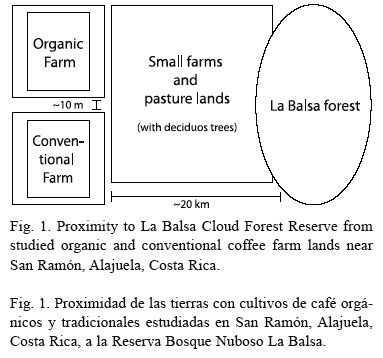
<body><![CDATA[Alajuela Province,     Costa Rica (10&ordm; </span><span style="font-family: arial;">06&#8217; N;     84&ordm; 28&#8217; W). Both farms     are at an elevation&nbsp; </span><span style="font-family: arial;">of     about 1 000 m above sea level, with </span><span      style="font-family: arial;">an average temperature of 21 &deg;C.     There is an </span><span style="font-family: arial;">approximate 10 m     &#8220;buffer zone&#8221;     between the </span><span style="font-family: arial;">two farms (<a      href="#figura1">Fig.     ]]></body>
<body><![CDATA[1</a>), with coffee     plants inside </span><span style="font-family: arial;">the zone still     considered     conventionally-farmed </span><span style="font-family: arial;">coffee.     The Corn Plant (<span style="font-style: italic;">Dracaena     fragrans</span>), </span><span style="font-family: arial;">&#8220;ca&ntilde;a     india&#8221; in Spanish,     originally introduced </span><span style="font-family: arial;">from     West Africa, is used to bolster     the buffer </span><span style="font-family: arial;">zone. Both farms     ]]></body>
<body><![CDATA[use a variety of     shade tree&nbsp; </span><span style="font-family: arial;">species,&nbsp;     including the Coral Bean     (<span style="font-style: italic;">Erythrina</span> </span><span      style="font-family: arial;">sp.) and Guamo <span      style="font-style: italic;">(Inga</span> sp.), commonly     known </span><span style="font-family: arial;">in Costa Rica as     &#8220;por&oacute;&#8221; and     &#8220;guaba&#8221;, respectively, </span><span style="font-family: arial;">which     enrich the soil through nitrogen &nbsp; </span><span     ]]></body>
<body><![CDATA[ style="font-family: arial;">fixation. The farms are about 20 km     from La </span><span style="font-family: arial;">Balsa Cloud Forest     Reserve, which     gradually </span><span style="font-family: arial;">changes into old     secondary forest     (<a href="#figura1">Fig. 1</a>). </span><span      style="font-family: arial;">During the dry     season     (December-April) the </span><span style="font-family: arial;">patch of     deciduous trees on the     ]]></body>
<body><![CDATA[studied farms </span><span style="font-family: arial;">and La Balsa     forest is relatively     bare, yet the </span><span style="font-family: arial;">wet season     (May-November) experiences     an&nbsp; </span><span style="font-family: arial;">explosion of life as     the&nbsp; dormant     trees produce </span><span style="font-family: arial;">new growth.</span></small></div>     <p align="center"><a name="figura1"> <img style="border: 0px solid ; width: 383px; height: 358px;"  src="/img/fbpe/rbt/v54n4/3503i1.JPG" title="" alt=""></a></p>     
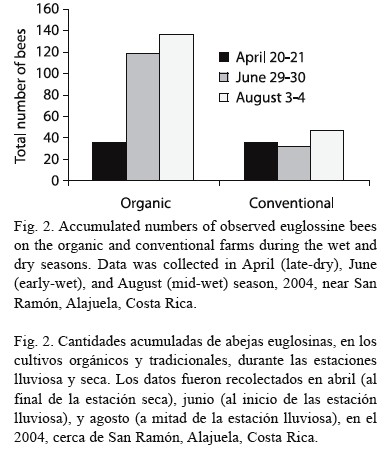
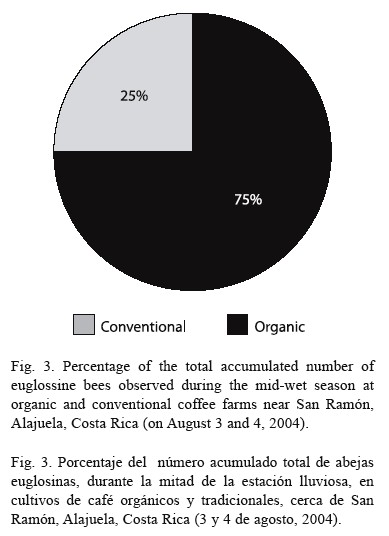
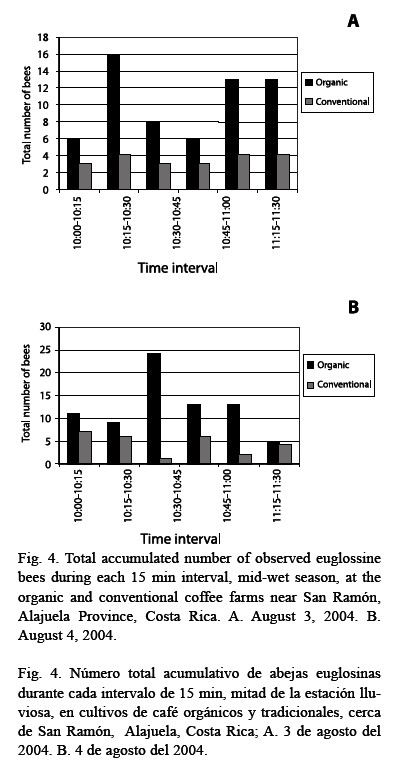
<p align="justify"><small><br style="font-family: arial;"> <br style="font-family: arial;"> </small></p>     <div style="text-align: left;"><small><span style="font-family: arial;">La Paz is a 20 ha, mostly shade-grown </span><span style="font-family: arial;">coffee farm, owned by the export company </span><span style="font-family: arial;">Cafetalera Lomas al R&iacute;o. Approximately 15 ha </span><span style="font-family: arial;">of the farm land is set aside for growing coffee. </span><span style="font-family: arial;">The farm was officially certified as organic by Eco-L&oacute;gica, a Costa Rican certification firm, </span><span  style="font-family: arial;">following a five-year period of abandonment. Compost is the primary means of fertilization, containing coffee hulls from each past harvest and earthworms added to facilitate decomposition. According to the local manager of the organic farm (M. Mora, pers. comm.), an organic soil mixture is spread in 5 cm layers around the base of the coffee plants at routine intervals. The Cardena Farm is a private 1.5 ha plot of a conglomeration of conventional coffee farms. The Cardena Farm, owned by Mr. Fulvio Cardena Montero, uses a strong chemical herbicide once a year in May, and insecticides is used twice a year during the rainy season (M. Mora, pers. comm.). </span></small><br style="font-family: arial;"> <small></small><br style="font-family: arial;"> <small><span style="font-family: arial;">Data were collected on April 20-21, June 29-30, and August 3-4, 2004, at four stations on each farm (eight total data collection sites) using chemical baits to attract male euglossine bees. Each local study station was spaced 50 m apart (April and June, 2004), and 100 m apart (August 2004), and 50 m into the farm from the edge. The distance between the two studied coffee farms was about 1 km apart. Eucalyptus oil (cineole 1:8), a pheromone substitute, was applied with an eyedropper to a coffee filter located on a tree at breast height (approx. 1.5 m). Five drops were reapplied to the coffee filter every 15 min. It was ensured that the </span><span style="font-family: arial;">drops were fully absorbed by the filter paper and did not smear any areas of the trees. The </span><span  style="font-family: arial;">maximum number of bees observed at each </span><span style="font-family: arial;">local station at one time during each 15 min </span><span style="font-family: arial;">interval was recorded for 1.5 h. Bees had to </span><span style="font-family: arial;">be within approximately 0.5 m of the filter in </span><span style="font-family: arial;">order to be counted. A t-test was used to statistically </span><span style="font-family: arial;">determine differences in numbers of bees </span><span style="font-family: arial;">appearing on the two farms.</span></small><br style="font-family: arial;"> <small></small><br style="font-family: arial;"> <small><small><b> <!-- big --><span style="font-family: arial;">R</span><!-- /big --><font size="3"><small><span  style="font-family: arial;">esults</span></small></font></b></small></small><br  style="font-family: arial;"> <small></small><br style="font-family: arial;"> <small><span style="font-family: arial;">The total accumulated numbers of observed </span><span style="font-family: arial;">euglossine bee during the late-dry season (April </span><span style="font-family: arial;">2004) were the same (<a href="#figura2">Fig. 2</a>). However, in both </span><span style="font-family: arial;">studies during the wet season (June 2004 and </span><span style="font-family: arial;">August 2004), a higher number of bees was </span><span style="font-family: arial;">observed in the organic as compared to the conventional </span><span style="font-family: arial;">farm (<a href="#figura2">Fig. 2</a>). The highest cumulative </span><span  style="font-family: arial;">number of bees was observed within the organic </span><span style="font-family: arial;">farm during mid-wet season (August 2004, cf. <a href="#figura3">Fig. 3</a>). On August 3, a total of 62 bees were </span><span style="font-family: arial;">observed within the organic farm, while 21 bees </span><span style="font-family: arial;">were seen in the conventional farm. The following </span><span style="font-family: arial;">day, a total of 75 bees were observed at the </span><span style="font-family: arial;">organic farm land, while 26 bees were observed </span><span style="font-family: arial;">at the conventional farm (<a href="#figura4">Fig. 4</a>).</span></small><br  style="font-family: arial;"> <small></small><br style="font-family: arial;"> <small><span style="font-family: arial;">The t-calculation for August 3, 2004 was </span><span style="font-family: arial;">4.57 with df= 6 and the tc = 2.015 (p= 0.003). </span><span style="font-family: arial;">The to for August 4 was 2.482, the df was </span><span style="font-family: arial;">9, and the tc was 2.015 (p= 0.028). The null </span><span style="font-family: arial;">hypothesis could be rejected because the to </span><span style="font-family: arial;">values were greater than the tc values. </span></small><br style="font-family: arial;"> <small></small><br style="font-family: arial;"> <small><span style="font-family: arial;">In each of the two days in August 2004, a </span><span style="font-family: arial;">higher average number of bees on the organic </span><span style="font-family: arial;">farm was observed at one time per 15 min </span><span style="font-family: arial;">interval. On August 3, an average of 10 bees </span><span style="font-family: arial;">was seen on the organic farm while an average </span><span style="font-family: arial;">of three bees was seen on the conventional </span><span style="font-family: arial;">farm (<a  href="#figura2">Fig. 2</a>). The following day, an average </span><span style="font-family: arial;">of 13 bees was seen on the organic farm while </span><span style="font-family: arial;">an average of four bees was seen on the conventional </span><span style="font-family: arial;">farm (<a  href="#figura3">Fig. 3</a>). On the second day, </span><span style="font-family: arial;">observations for the last 15 min (11:15-11:30) </span><span style="font-family: arial;">occurred under light rain showers.</span></small></div>     ]]></body>
<body><![CDATA[<p align="center"><a name="figura2"> <img style="border: 0px solid ; width: 390px; height: 451px;"  src="/img/fbpe/rbt/v54n4/3503i2.JPG" title="" alt=""></a><a name="figura3"><img  style="border: 0px solid ; width: 389px; height: 536px;"  src="/img/fbpe/rbt/v54n4/3503i3.JPG" title="" alt=""></a></p>     
<p align="justify">&nbsp;</p>     <p style="text-align: left;"><small> <span style="font-family: arial; font-weight: 700;">Discussion</span><br  style="font-family: arial;"> <br style="font-family: arial;"> <span style="font-family: arial;">Data from the mid-wet season (August, </span><span style="font-family: arial;">2004) demonstrated significant support for the </span><span style="font-family: arial;">hypothesis that euglossine bees are effective </span><span style="font-family: arial;">indicators of farm health during Costa Rica&#8217;s </span><span style="font-family: arial;">wet season. Hence the findings show a much </span><span style="font-family: arial;">higher abundance of euglossine bees within </span><span style="font-family: arial;">the organic farm, and the t-test further supports </span><span style="font-family: arial;">the hypothesis. When the results from late-wet </span><span style="font-family: arial;">(April) and early-wet (June) seasons were taken </span><span style="font-family: arial;">into account, more intricate conclusions linked </span><span style="font-family: arial;">to seasonality were drawn. The most significant </span><span style="font-family: arial;">difference in abundance between the two farms </span><span style="font-family: arial;">was found in the studies during the wet season. </span><span style="font-family: arial;">The months of July and August are in the midst </span><span style="font-family: arial;">of the Costa Rican wet season.</span><br style="font-family: arial;"> <br style="font-family: arial;"> <span style="font-family: arial;">When observations were conducted during </span><span style="font-family: arial;">the late-dry season in April 2004, there was </span><span style="font-family: arial;">no difference in bees observed on the organic </span><span style="font-family: arial;">and conventional farms (<a href="#figura4">Fig. 4</a>). By the end </span><span style="font-family: arial;">of June 2004 (early-wet season), however, a </span><span style="font-family: arial;">considerable difference in bee abundance was </span><span style="font-family: arial;">found between the two farms, with many more </span><span style="font-family: arial;">bees observed in the organic environment. The </span><span style="font-family: arial;">August 2004 data (mid-wet season) continued </span><span style="font-family: arial;">this trend. These findings suggest that orchid </span><span style="font-family: arial;">bees in lowland Costa Rica were most abundant </span><span style="font-family: arial;">during the midst of the wet season.</span></small></p>     <p align="center"><a name="figura4"> <img style="border: 0px solid ; width: 399px; height: 771px;"  src="/img/fbpe/rbt/v54n4/3503i4.JPG" title="" alt=""></a><a name="figura5"><img  style="border: 0px solid ; width: 381px; height: 468px;"  src="/img/fbpe/rbt/v54n4/3503i5.JPG" title="" alt=""></a></p>     
<p align="justify"><small><br style="font-family: arial;"> <br style="font-family: arial;"> </small></p>     <div style="text-align: left;"><small><span style="font-family: arial;">A study by Ackerman (1983) on Barro </span><span  style="font-family: arial;">Colorado Island in central Panama confirmed </span><span style="font-family: arial;">that euglossine bee activity may fluctuate on a </span><span style="font-family: arial;">seasonal basis. A similar study, also conducted </span><span  style="font-family: arial;">in Panama (Roubik 1993), found that bees are </span><span style="font-family: arial;">most abundant during the mid-dry season to </span><span style="font-family: arial;">early-wet season. This trend was explained by </span><span style="font-family: arial;">the availability of resources for male euglossines, </span><span style="font-family: arial;">since orchids and their fragrances are </span><span  style="font-family: arial;">ubiquitous during the wet season. In addition, </span><span style="font-family: arial;">during two of the 15 min observations on </span><span style="font-family: arial;">August 4, 2004, it began to rain. Orchid bees </span><span style="font-family: arial;">seek shelter and are seldom seen during rain </span><span style="font-family: arial;">(Hedstr&ouml;m, unplub. data), a variable that could </span><span style="font-family: arial;">affect the total number of bees observed.    <br>     <br> </span></small></div>     <div style="text-align: left;"></div>     <div style="text-align: left;"><small><span style="font-family: arial;">The     ]]></body>
<body><![CDATA[apparent seasonal variation in     male </span><span style="font-family: arial;">euglossine abundance and     their     capacity for </span><span style="font-family: arial;">long flight     distances (Roubik and     Hanson </span><span style="font-family: arial;">2004), make the issue     of forest cover     an important variable that must be taken into </span><span      style="font-family: arial;">account in their use as biological     indicators&nbsp; </span><span style="font-family: arial;">or     ]]></body>
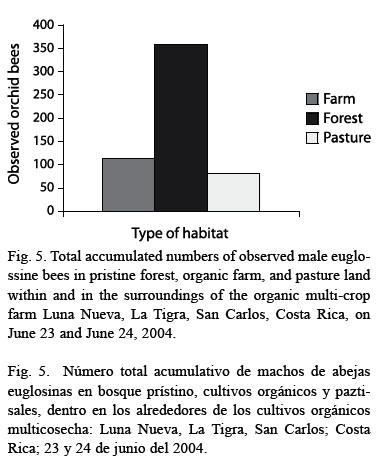
<body><![CDATA[sustainable agriculture.     Euglossines have a </span><span style="font-family: arial;">preference     for dense and humid forest (Dressler </span><span      style="font-family: arial;">1982, Roubik and Hanson 2004). The     findings </span><span style="font-family: arial;">from an earlier     study in June 2004     (cf <a href="#figura5">Fig. 5</a>, </span><span      style="font-family: arial;">Hedstr&ouml;m,     unpubl. data) within     and in the surroundings of     ]]></body>
<body><![CDATA[the organic multi-crop farm Luna Nueva, La Tigra, San Carlos, Costa     Rica, supported this     conclusion. However, the     willingness of the orchid     bees to travel long     distances to obtain     resources, especially in     the context of fragmented     forest patches, may     explain the presence of     ]]></body>
<body><![CDATA[orchid bees on farms     with a proximity to primary and/or secondary forest.&nbsp; The wet     season is particularly     important for this migration     process, as forest cover     may provide a biological     corridor for bees to     travel within. In the case of     La Paz and Cardena     farms, the closest forest, La     ]]></body>
<body><![CDATA[Balsa, is     approximately 20 km away,     separated by other small farms     and pasture lands (<a href="#figura1">Fig. 1</a>).     After reaching La     Balsa, the next substantial     forest habitat is found     at Monteverde Cloud Forest     Reserve. During the dry     season, the deciduous trees     ]]></body>
<body><![CDATA[of the     intermediate small farms and     pasture area lose their     leaves, thus deterring orchid     bees to leave the     forest in search of orchids     and other resources.     During the wet season,     however, these trees can     probably act as a biological     ]]></body>
<body><![CDATA[corridor, allowing bees     to migrate and exhibit their     preference for an     organic farm over a     conventional farm.</span></small><br style="font-family: arial;">     <small></small><br style="font-family: arial;">     <small><span style="font-family: arial;">Previous studies by Roubik     (1993,     2001) have shown that higher     numbers of     ]]></body>
<body><![CDATA[male bees may occur in &#8220;hot     spots&#8221;, presumably     due to physical factors,     nearby     concentration of resources,     or nests and male resting     or display sites. Any absence     in their     populations after a major     forest clearing seemed to not     ]]></body>
<body><![CDATA[be due </span><span style="font-family: arial;">to a suddenly     restricted habitat size     (Becker </span><span style="font-family: arial;"><span      style="font-style: italic;">et al</span>. 1991, Cane 2001), but to a     high level </span><span style="font-family: arial;">of disturbance     (Roubik and Hanson     2004). </span><span style="font-family: arial;">Once the process of     regeneration     begins and </span><span style="font-family: arial;">disturbance     diminishes, the bees may     ]]></body>
<body><![CDATA[spread </span><span style="font-family: arial;">to formerly isolated     patches. If food     and nesting </span><span style="font-family: arial;">resources become     especially abundant, </span><span style="font-family: arial;">secondary     vegetation may even support     a </span><span style="font-family: arial;">higher diversity of     euglossines     (Roubik and </span><span style="font-family: arial;">Hanson 2004).     Therefore, it is not     necessarily </span><span style="font-family: arial;">the size or age     ]]></body>
<body><![CDATA[of the vegetation,     but rather </span><span style="font-family: arial;">the resource     quality, which matters     to euglossine </span><span style="font-family: arial;">bees.     Seasonality is directly related     to this </span><span style="font-family: arial;">variable, as the wet     season provides     more forest </span><span style="font-family: arial;">and vegetation     cover for bees to     travel long </span><span style="font-family: arial;">distances. The     ]]></body>
<body><![CDATA[remarkable stability     of orchid </span><span style="font-family: arial;">bee populations,     even in the face of     ongoing </span><span style="font-family: arial;">deforestation, may     make them ideal to     use to </span><span style="font-family: arial;">monitor Costa Rican     agroecology.     However, </span><span style="font-family: arial;">male euglossines     seem to&nbsp; make     effective biological </span><span style="font-family: arial;">indicators     ]]></body>
<body><![CDATA[only if that their habitat     has </span><span style="font-family: arial;">not been altered to the     extent that     they cannot </span><span style="font-family: arial;">travel to the     monitored area.</span></small><br style="font-family: arial;">     <small></small><br style="font-family: arial;">     <small><span style="font-family: arial;">In conclusion, male euglossine     bees     were </span><span style="font-family: arial;">observed using a known     attractant     ]]></body>
<body><![CDATA[(cineole </span><span style="font-family: arial;">1:8) at organic and     conventional     coffee farms. </span><span style="font-family: arial;">These     observations have shown orchid bees </span><span      style="font-family: arial;">to be a viable bio-indicator of     organic farm </span><span style="font-family: arial;">health on a     seasonal basis. Hence,     orchid bees </span><span style="font-family: arial;">may offer an     effective means for     measuring the </span><span style="font-family: arial;">health of an     ]]></body>
<body><![CDATA[ecosystem. They are     particularly </span><span style="font-family: arial;">useful during     the rainy season, when     the area </span><span style="font-family: arial;">between farm and     forest is green,     providing </span><span style="font-family: arial;">a biological     corridor by which the     bees may </span><span style="font-family: arial;">travel. It is     important to note that     both farms sit </span><span style="font-family: arial;">20 km from the     ]]></body>
<body><![CDATA[nearest forest (<a href="#figura1">Fig.     1</a>) and use </span><span style="font-family: arial;">the same     diversity     of shade trees     (<span style="font-style: italic;">Erytrina</span> sp. </span><span      style="font-family: arial;">and <span style="font-style: italic;">Inga</span>     sp.) and coffee plants, yet     the&nbsp; orchid </span><span style="font-family: arial;">bees still     were more abundant in the     organic </span><span style="font-family: arial;">farm. Since the     ]]></body>
<body><![CDATA[orchid bees have a     acute sense </span><span style="font-family: arial;">of smell, it is     possible that the     unnatural odors </span><span style="font-family: arial;">of     agricultural chemicals&nbsp; used in     conventional </span><span style="font-family: arial;">coffee farms     interfere with their     search for natural&nbsp; </span><span style="font-family: arial;">fragrances.     Our findings demonstrated     that&nbsp; </span><span style="font-family: arial;">euglossine bees     ]]></body>
<body><![CDATA[may have a natural     preference</span><span style="font-family: arial;">for undisturbed     habitat, and thus     will choose to </span><span style="font-family: arial;">forage in an     organic coffee farm over     a conventional </span><span style="font-family: arial;">coffee farm.     However, seasonality and     its </span><span style="font-family: arial;">corollary, forest cover,     are critical variables of </span><span style="font-family: arial;">this     assessment. It seems that     ]]></body>
<body><![CDATA[euglossine bees</span><span style="font-family: arial;">will only     travel in large numbers     during the wet season, traveling through deciduous foliage</span><span      style="font-family: arial;">between the forestandthe farm. It     was only</span><span style="font-family: arial;">during this wet season     migration that     a clear</span><span style="font-family: arial;">preference for organic     versus     conventional</span><span style="font-family: arial;"> farm ecosystems     was shown. Therefore,     ]]></body>
<body><![CDATA[it is</span><span style="font-family: arial;">quitepossible that orchid     bees are     an effective </span><span style="font-family: arial;">biological     indicator of organic     coffee farms</span><span style="font-family: arial;">during the wet     season only.</span></small>    <!-- ref --><br> <small><span style="font-family: arial;"></span></small><br  style="font-family: arial;"> <small><span style="font-family: arial;"></span><span  style="font-family: arial; font-weight: 700;">Acknowledgments</span></small><br  style="font-family: arial;"> <small></small><br style="font-family: arial;"> <small><span style="font-family: arial;">The authors gratefully acknowledge the </span><span style="font-family: arial;">support provided by the Center for Sustainable </span><span style="font-family: arial;">Development Studies, the School for Field </span><span style="font-family: arial;">Studies, SFS, Atenas, Costa Rica. We thank G. </span><span style="font-family: arial;">Sahl&eacute;n, Uppsala University, Sweden, and two </span><span style="font-family: arial;">anonymous reviewers for constructive comments </span><span style="font-family: arial;">of an earlier version of the manuscript, </span><span style="font-family: arial;">and E. Brier-Rosenfield, A. Crane, E. Gladkova, </span><span style="font-family: arial;">A. Gordon, S. Minnerly, M. Mills, O. Carter, S. </span><span style="font-family: arial;">Cashman, E. Kelly, A. Martin, T. Seekircher, L. </span><span style="font-family: arial;">Tinder, for their assistance in the field.</span></small><br style="font-family: arial;"> <small></small><br style="font-family: arial;"> <small><small><!-- big --><span style="font-family: arial; font-weight: 700;">Resumen</span><!-- /big --></small></small><br  style="font-family: arial;"> <small><!-- big --><!-- /big --></small><br style="font-family: arial;"> <small><span style="font-family: arial;">Con el prop&oacute;sito de entender las implicaciones de la </span><span style="font-family: arial;">agricultura org&aacute;nica (en comparaci&oacute;n con la tradicional) </span><span  style="font-family: arial;">para el &#8220;estado de salud ambiental&#8221;, usamos aceite de </span><span style="font-family: arial;">eucalipto (1:8-cineole), para monitorear la abundancia </span><span style="font-family: arial;">de machos de abejas de las orqu&iacute;deas (euglosinas) como </span><span  style="font-family: arial;">posibles bioindicadores. Comparamos una finca de caf&eacute; </span><span style="font-family: arial;">org&aacute;nico (La Paz) y una tradicional (La Carena), cerca del </span><span  style="font-family: arial;">R&iacute;o Barranca en San Ram&oacute;n de Alajuela, Costa Rica. Las </span><span  style="font-family: arial;">tomas simult&aacute;neas de datos fueron realizadas en ambas </span><span style="font-family: arial;">fincas en abril del 2004 (a finales de la estaci&oacute;n seca), en </span><span  style="font-family: arial;">junio del 2004 (a principios de la estaci&oacute;n lluviosa) y en </span><span style="font-family: arial;">agosto del 2004 (a mediados de la estaci&oacute;n lluviosa). Estas </span><span  style="font-family: arial;">abejas pueden ser bioindicadores viables de la salud de las </span><span style="font-family: arial;">fincas org&aacute;nicas de caf&eacute; (en comparaci&oacute;n con las tradicionales) </span><span  style="font-family: arial;">durante la estaci&oacute;n lluviosa. Durante la estaci&oacute;n seca </span><span  style="font-family: arial;">no se mostr&oacute; una diferencia significativa en la abundancia </span><span style="font-family: arial;">de las abejas de orqu&iacute;deas, entre una y otra finca. Hubo un </span><span  style="font-family: arial;">n&uacute;mero significativo de euglosinas en las fincas org&aacute;nicas </span><span style="font-family: arial;">durante la estaci&oacute;n lluviosa; sugiriendo que el aumento est&aacute; </span><span  style="font-family: arial;">vinculado con la estacionalidad y el acceso al bosque en su </span><span style="font-family: arial;">h&aacute;bitat natural.</span></small><br style="font-family: arial;"> <small></small><br style="font-family: arial;"> <small><span style="font-family: arial;"><span  style="font-weight: bold;">Palabras clave</span>: abejas de las orqu&iacute;deas, <span style="font-style: italic;">Euglossa</span>, deforestaci&oacute;n, agricultura org&aacute;nica, bioindicadores, Costa Rica.</span></small><br  style="font-family: arial;"> <small></small><br style="font-family: arial;"> <small><small><!-- big --><span style="font-family: arial; font-weight: 700;">References</span><!-- /big --></small></small><br  style="font-family: arial;"> <small></small><br style="font-family: arial;"> <small><span style="font-family: arial;">Ackerman, J.D. 1983. Diversity and seasonality of male </span><span style="font-family: arial;">euglossine bees (Hymenoptera:Apidae) in Central </span><span style="font-family: arial;">Panama. Ecology 64: 274-283.</span></small><br style="font-family: arial;"> <small></small><br style="font-family: arial;"> <small><span style="font-family: arial;">    &nbsp;&nbsp;&nbsp;&nbsp;&nbsp;&nbsp;&nbsp;&nbsp;[&#160;<a href="javascript:void(0);" onclick="javascript: window.open('/scielo.php?script=sci_nlinks&ref=1364582&pid=S0034-7744200600040001700001&lng=','','width=640,height=500,resizable=yes,scrollbars=1,menubar=yes,');">Links</a>&#160;]<!-- end-ref --><!-- ref -->Becker, P., J.S. Moure &amp; F.J.A. Peralta 1991. More </span><span style="font-family: arial;">about euglossine bees in Amazonian forest fragments. </span><span style="font-family: arial;">Biotropica 23: 586-591.</span></small><br style="font-family: arial;"> <small></small><br style="font-family: arial;"> <small><span style="font-family: arial;">    &nbsp;&nbsp;&nbsp;&nbsp;&nbsp;&nbsp;&nbsp;&nbsp;[&#160;<a href="javascript:void(0);" onclick="javascript: window.open('/scielo.php?script=sci_nlinks&ref=1364583&pid=S0034-7744200600040001700002&lng=','','width=640,height=500,resizable=yes,scrollbars=1,menubar=yes,');">Links</a>&#160;]<!-- end-ref --><!-- ref -->Cane, J.H. 2001. Habitat fragmentation and native bees: </span><span style="font-family: arial;">a premature verdict? Conservation Ecology 5 (also </span><span style="font-family: arial;">available online: www.consecol.org/vol5/iss1/art6).</span></small><br  style="font-family: arial;"> <small></small><br style="font-family: arial;"> <small><span style="font-family: arial;">    &nbsp;&nbsp;&nbsp;&nbsp;&nbsp;&nbsp;&nbsp;&nbsp;[&#160;<a href="javascript:void(0);" onclick="javascript: window.open('/scielo.php?script=sci_nlinks&ref=1364584&pid=S0034-7744200600040001700003&lng=','','width=640,height=500,resizable=yes,scrollbars=1,menubar=yes,');">Links</a>&#160;]<!-- end-ref --><!-- ref -->Dressler, R.L. 1968. Pollination by euglossine bees. </span><span style="font-family: arial;">Evolution 22: 202-210.</span></small><br style="font-family: arial;"> <small></small><br style="font-family: arial;"> <small><span style="font-family: arial;">    &nbsp;&nbsp;&nbsp;&nbsp;&nbsp;&nbsp;&nbsp;&nbsp;[&#160;<a href="javascript:void(0);" onclick="javascript: window.open('/scielo.php?script=sci_nlinks&ref=1364585&pid=S0034-7744200600040001700004&lng=','','width=640,height=500,resizable=yes,scrollbars=1,menubar=yes,');">Links</a>&#160;]<!-- end-ref --><!-- ref -->Dressler, R.L. 1982. Biology of the orchid bees (Euglossini). </span><span style="font-family: arial;">Ann. Rev. Ecol. Syst. 13: 373-394.</span></small><br  style="font-family: arial;"> <small></small><br style="font-family: arial;"> <small><span style="font-family: arial;">    &nbsp;&nbsp;&nbsp;&nbsp;&nbsp;&nbsp;&nbsp;&nbsp;[&#160;<a href="javascript:void(0);" onclick="javascript: window.open('/scielo.php?script=sci_nlinks&ref=1364586&pid=S0034-7744200600040001700005&lng=','','width=640,height=500,resizable=yes,scrollbars=1,menubar=yes,');">Links</a>&#160;]<!-- end-ref --><!-- ref -->Hedstr&ouml;m, I., A. Denzel &amp; G. Owens. 2006. Orchid bees as </span><span style="font-family: arial;">bio-indicators for organic coffee farms in Costa Rica: </span><span style="font-family: arial;">Does farm size affect their abundance? Rev. Bio. </span><span style="font-family: arial;">Trop. 54(3): 965-969.</span></small><br style="font-family: arial;"> <small></small><br style="font-family: arial;"> <small><span style="font-family: arial;">    &nbsp;&nbsp;&nbsp;&nbsp;&nbsp;&nbsp;&nbsp;&nbsp;[&#160;<a href="javascript:void(0);" onclick="javascript: window.open('/scielo.php?script=sci_nlinks&ref=1364587&pid=S0034-7744200600040001700006&lng=','','width=640,height=500,resizable=yes,scrollbars=1,menubar=yes,');">Links</a>&#160;]<!-- end-ref --><!-- ref -->Humphries, C.J., P.H. Williams &amp; R.I. Vane-Wright. 1995. </span><span style="font-family: arial;">Measuring biodiversity value for conservation. Ann. </span><span style="font-family: arial;">Rev. Ecol. Syst. 26: 93-111</span></small><br style="font-family: arial;"> <small></small><br style="font-family: arial;"> <small><span style="font-family: arial;">    &nbsp;&nbsp;&nbsp;&nbsp;&nbsp;&nbsp;&nbsp;&nbsp;[&#160;<a href="javascript:void(0);" onclick="javascript: window.open('/scielo.php?script=sci_nlinks&ref=1364588&pid=S0034-7744200600040001700007&lng=','','width=640,height=500,resizable=yes,scrollbars=1,menubar=yes,');">Links</a>&#160;]<!-- end-ref --><!-- ref -->Janzen, D.H. 1981. Bee arrival at two Costa Rican female </span><span style="font-family: arial;"><span  style="font-style: italic;">Catasetum</span> orchid inflorescences, and a hypothesis on </span><span style="font-family: arial;">euglossine population structure. Oikos 36: 177-183.</span></small><br style="font-family: arial;"> <small></small><br style="font-family: arial;"> <small><span style="font-family: arial;">    &nbsp;&nbsp;&nbsp;&nbsp;&nbsp;&nbsp;&nbsp;&nbsp;[&#160;<a href="javascript:void(0);" onclick="javascript: window.open('/scielo.php?script=sci_nlinks&ref=1364589&pid=S0034-7744200600040001700008&lng=','','width=640,height=500,resizable=yes,scrollbars=1,menubar=yes,');">Links</a>&#160;]<!-- end-ref --><!-- ref -->Noss, R.F. 1990. Indicators for monitoring biodiversity: a </span><span style="font-family: arial;">hierarchical approach. Cons. Biol. 4: 355-364.</span></small><br style="font-family: arial;"> <small></small><br style="font-family: arial;"> <small><span style="font-family: arial;">    &nbsp;&nbsp;&nbsp;&nbsp;&nbsp;&nbsp;&nbsp;&nbsp;[&#160;<a href="javascript:void(0);" onclick="javascript: window.open('/scielo.php?script=sci_nlinks&ref=1364590&pid=S0034-7744200600040001700009&lng=','','width=640,height=500,resizable=yes,scrollbars=1,menubar=yes,');">Links</a>&#160;]<!-- end-ref --><!-- ref -->Roubik, D.W. 1993. Tropical pollinators in the canopy and </span><span style="font-family: arial;">understory: field data and theory for stratum &#8220;preferences&#8221;. </span><span style="font-family: arial;">J. Ins. Beh. 6: 659-673.</span></small><br style="font-family: arial;"> <small></small><br style="font-family: arial;"> <small><span style="font-family: arial;">    &nbsp;&nbsp;&nbsp;&nbsp;&nbsp;&nbsp;&nbsp;&nbsp;[&#160;<a href="javascript:void(0);" onclick="javascript: window.open('/scielo.php?script=sci_nlinks&ref=1364591&pid=S0034-7744200600040001700010&lng=','','width=640,height=500,resizable=yes,scrollbars=1,menubar=yes,');">Links</a>&#160;]<!-- end-ref --><!-- ref -->Roubik, D.W. 2001. Ups and downs in pollinator populations: </span><span style="font-family: arial;">where is there a decline? Conservation Ecology </span><span style="font-family: arial;">5: 2 (also available online: www.consecol.org/vol5/</span><span style="font-family: arial;">iss1/art2).</span></small><br  style="font-family: arial;"> <small></small><br style="font-family: arial;"> <small><span style="font-family: arial;">    &nbsp;&nbsp;&nbsp;&nbsp;&nbsp;&nbsp;&nbsp;&nbsp;[&#160;<a href="javascript:void(0);" onclick="javascript: window.open('/scielo.php?script=sci_nlinks&ref=1364592&pid=S0034-7744200600040001700011&lng=','','width=640,height=500,resizable=yes,scrollbars=1,menubar=yes,');">Links</a>&#160;]<!-- end-ref --><!-- ref -->Roubik, D.W. &amp; P.E. Hanson. 2004. Orchid bees of tropical </span><span style="font-family: arial;">America: Biology and field guide. Instituto Nacional </span><span style="font-family: arial;">de Biodiversidad (INBio), Heredia, Costa Rica. 370 p.</span></small><br style="font-family: arial;"> <small></small><br style="font-family: arial;"> <small><span style="font-family: arial;">    &nbsp;&nbsp;&nbsp;&nbsp;&nbsp;&nbsp;&nbsp;&nbsp;[&#160;<a href="javascript:void(0);" onclick="javascript: window.open('/scielo.php?script=sci_nlinks&ref=1364593&pid=S0034-7744200600040001700012&lng=','','width=640,height=500,resizable=yes,scrollbars=1,menubar=yes,');">Links</a>&#160;]<!-- end-ref --><!-- ref -->Saunders, D., R.J. Hobbs &amp; C.R. Margules. 1990. Biological </span><span style="font-family: arial;">consequences of ecosystemfragmentation: a Review. </span><span  style="font-family: arial;">Cons. Biol. 5: 18-19.</span></small><br  style="font-family: arial;"> <small></small><br style="font-family: arial;"> <small><span style="font-family: arial;">    &nbsp;&nbsp;&nbsp;&nbsp;&nbsp;&nbsp;&nbsp;&nbsp;[&#160;<a href="javascript:void(0);" onclick="javascript: window.open('/scielo.php?script=sci_nlinks&ref=1364594&pid=S0034-7744200600040001700013&lng=','','width=640,height=500,resizable=yes,scrollbars=1,menubar=yes,');">Links</a>&#160;]<!-- end-ref --><!-- ref -->Schelhas, J. 1996. Land use choice and change: intensification </span><span style="font-family: arial;">and diversification in the lowland tropics of </span><span style="font-family: arial;">Costa Rica. Human Org. 55: 298-306.</span></small><br style="font-family: arial;"> <small></small><br style="font-family: arial;"> <small><span style="font-family: arial;">    &nbsp;&nbsp;&nbsp;&nbsp;&nbsp;&nbsp;&nbsp;&nbsp;[&#160;<a href="javascript:void(0);" onclick="javascript: window.open('/scielo.php?script=sci_nlinks&ref=1364595&pid=S0034-7744200600040001700014&lng=','','width=640,height=500,resizable=yes,scrollbars=1,menubar=yes,');">Links</a>&#160;]<!-- end-ref --><!-- ref -->Schiestl, F.P. &amp; D.W. Roubik. 2003. Odor compound detection </span><span style="font-family: arial;">in male euglossine bees. J. Chem. Ecol. 29: 253-257.</span></small><br style="font-family: arial;"> <small></small><br style="font-family: arial;"> <small><span style="font-family: arial;">    &nbsp;&nbsp;&nbsp;&nbsp;&nbsp;&nbsp;&nbsp;&nbsp;[&#160;<a href="javascript:void(0);" onclick="javascript: window.open('/scielo.php?script=sci_nlinks&ref=1364596&pid=S0034-7744200600040001700015&lng=','','width=640,height=500,resizable=yes,scrollbars=1,menubar=yes,');">Links</a>&#160;]<!-- end-ref --><!-- ref -->Stolton, S., B. Geier &amp; J.A. McNeely (eds.). 2000. </span><span style="font-family: arial;">The relationship between nature conservation, biodiversity, </span><span style="font-family: arial;">and organic agriculture, p. 224. <span style="font-style: italic;">In</span> The </span><span style="font-family: arial;">International Federation of Organic Agriculture </span><span style="font-family: arial;">Movement (IFOAM), Tholey-Thekey, Germany.</span></small>    &nbsp;&nbsp;&nbsp;&nbsp;&nbsp;&nbsp;&nbsp;&nbsp;[&#160;<a href="javascript:void(0);" onclick="javascript: window.open('/scielo.php?script=sci_nlinks&ref=1364597&pid=S0034-7744200600040001700016&lng=','','width=640,height=500,resizable=yes,scrollbars=1,menubar=yes,');">Links</a>&#160;]<!-- end-ref --><br> </div>     <p align="justify">    <br> </p>      ]]></body><back>
<ref-list>
<ref id="B1">
<nlm-citation citation-type="journal">
<person-group person-group-type="author">
<name>
<surname><![CDATA[Ackerman]]></surname>
<given-names><![CDATA[J.D]]></given-names>
</name>
</person-group>
<article-title xml:lang="en"><![CDATA[Diversity and seasonality of male euglossine bees (Hymenoptera:Apidae) in Central Panama]]></article-title>
<source><![CDATA[Ecology]]></source>
<year>1983</year>
<volume>64</volume>
<page-range>274-283</page-range></nlm-citation>
</ref>
<ref id="B2">
<nlm-citation citation-type="journal">
<person-group person-group-type="author">
<name>
<surname><![CDATA[Becker]]></surname>
<given-names><![CDATA[P]]></given-names>
</name>
<name>
<surname><![CDATA[Moure]]></surname>
<given-names><![CDATA[J.S]]></given-names>
</name>
<name>
<surname><![CDATA[Peralta]]></surname>
<given-names><![CDATA[F.J.A]]></given-names>
</name>
</person-group>
<article-title xml:lang="en"><![CDATA[More about euglossine bees in Amazonian forest fragments]]></article-title>
<source><![CDATA[Biotropica]]></source>
<year>1991</year>
<volume>23</volume>
<page-range>586-591</page-range></nlm-citation>
</ref>
<ref id="B3">
<nlm-citation citation-type="">
<person-group person-group-type="author">
<name>
<surname><![CDATA[Cane]]></surname>
<given-names><![CDATA[J.H]]></given-names>
</name>
</person-group>
<source><![CDATA[Habitat fragmentation and native bees: a premature verdict]]></source>
<year>2001</year>
</nlm-citation>
</ref>
<ref id="B4">
<nlm-citation citation-type="journal">
<person-group person-group-type="author">
<name>
<surname><![CDATA[Dressler]]></surname>
<given-names><![CDATA[R.L]]></given-names>
</name>
</person-group>
<article-title xml:lang="en"><![CDATA[Pollination by euglossine bees]]></article-title>
<source><![CDATA[Evolution]]></source>
<year>1968</year>
<volume>22</volume>
<page-range>202-210</page-range></nlm-citation>
</ref>
<ref id="B5">
<nlm-citation citation-type="journal">
<person-group person-group-type="author">
<name>
<surname><![CDATA[R.L]]></surname>
<given-names><![CDATA[Dressler]]></given-names>
</name>
</person-group>
<article-title xml:lang="en"><![CDATA[Biology of the orchid bees (Euglossini)]]></article-title>
<source><![CDATA[Ann. Rev. Ecol. Syst]]></source>
<year>1982</year>
<volume>13</volume>
<page-range>373-394</page-range></nlm-citation>
</ref>
<ref id="B6">
<nlm-citation citation-type="journal">
<person-group person-group-type="author">
<name>
<surname><![CDATA[Hedström]]></surname>
<given-names><![CDATA[I.]]></given-names>
</name>
<name>
<surname><![CDATA[Denzel]]></surname>
<given-names><![CDATA[A]]></given-names>
</name>
<name>
<surname><![CDATA[Owens]]></surname>
<given-names><![CDATA[G]]></given-names>
</name>
</person-group>
<article-title xml:lang="en"><![CDATA[Orchid bees as bio-indicators for organic coffee farms in Costa Rica: Does farm size affect their abundance]]></article-title>
<source><![CDATA[Rev. Bio. Trop]]></source>
<year>2006</year>
<volume>54(3</volume>
<page-range>965-969</page-range></nlm-citation>
</ref>
<ref id="B7">
<nlm-citation citation-type="journal">
<person-group person-group-type="author">
<name>
<surname><![CDATA[Humphries]]></surname>
<given-names><![CDATA[C.J]]></given-names>
</name>
<name>
<surname><![CDATA[Williams]]></surname>
<given-names><![CDATA[P.H]]></given-names>
</name>
<name>
<surname><![CDATA[Vane-Wright]]></surname>
<given-names><![CDATA[R.I]]></given-names>
</name>
</person-group>
<article-title xml:lang="en"><![CDATA[Measuring biodiversity value for conservation]]></article-title>
<source><![CDATA[Ann. Rev. Ecol. Syst]]></source>
<year>1995</year>
<volume>26</volume>
<page-range>93-111</page-range></nlm-citation>
</ref>
<ref id="B8">
<nlm-citation citation-type="journal">
<person-group person-group-type="author">
<name>
<surname><![CDATA[Janzen]]></surname>
<given-names><![CDATA[D.H]]></given-names>
</name>
</person-group>
<article-title xml:lang="en"><![CDATA[Bee arrival at two Costa Rican female Catasetum orchid inflorescences, and a hypothesis on euglossine population structure]]></article-title>
<source><![CDATA[Oikos]]></source>
<year>1981</year>
<volume>36</volume>
<page-range>177-183</page-range></nlm-citation>
</ref>
<ref id="B9">
<nlm-citation citation-type="journal">
<person-group person-group-type="author">
<name>
<surname><![CDATA[Noss]]></surname>
<given-names><![CDATA[R.F]]></given-names>
</name>
</person-group>
<article-title xml:lang="en"><![CDATA[Indicators for monitoring biodiversity: a hierarchical approach]]></article-title>
<source><![CDATA[Cons. Biol]]></source>
<year>1990</year>
<volume>4</volume>
<page-range>355-364</page-range></nlm-citation>
</ref>
<ref id="B10">
<nlm-citation citation-type="journal">
<person-group person-group-type="author">
<name>
<surname><![CDATA[Roubik]]></surname>
<given-names><![CDATA[D.W]]></given-names>
</name>
</person-group>
<article-title xml:lang="en"><![CDATA[Tropical pollinators in the canopy and understory: field data and theory for stratum "preferences]]></article-title>
<source><![CDATA[J. Ins. Beh]]></source>
<year>1993</year>
<volume>6</volume>
<page-range>659-673</page-range></nlm-citation>
</ref>
<ref id="B11">
<nlm-citation citation-type="">
<person-group person-group-type="author">
<name>
<surname><![CDATA[Roubik]]></surname>
<given-names><![CDATA[D.W]]></given-names>
</name>
</person-group>
<source><![CDATA[Ups and downs in pollinator populations: where is there a decline]]></source>
<year>2001</year>
<volume>2</volume>
</nlm-citation>
</ref>
<ref id="B12">
<nlm-citation citation-type="book">
<person-group person-group-type="author">
<name>
<surname><![CDATA[Roubik]]></surname>
<given-names><![CDATA[D.W]]></given-names>
</name>
<name>
<surname><![CDATA[Hanson]]></surname>
<given-names><![CDATA[P.E]]></given-names>
</name>
</person-group>
<source><![CDATA[Orchid bees of tropical America: Biology and field guide]]></source>
<year>2004</year>
<page-range>370</page-range><publisher-loc><![CDATA[^eHeredia Heredia]]></publisher-loc>
<publisher-name><![CDATA[Instituto Nacional de Biodiversidad (INBio)]]></publisher-name>
</nlm-citation>
</ref>
<ref id="B13">
<nlm-citation citation-type="journal">
<person-group person-group-type="author">
<name>
<surname><![CDATA[Saunders]]></surname>
<given-names><![CDATA[D]]></given-names>
</name>
<name>
<surname><![CDATA[Hobbs]]></surname>
<given-names><![CDATA[R.J]]></given-names>
</name>
<name>
<surname><![CDATA[Margules]]></surname>
<given-names><![CDATA[C.R]]></given-names>
</name>
</person-group>
<article-title xml:lang="en"><![CDATA[Biological consequences of ecosystemfragmentation: a Review]]></article-title>
<source><![CDATA[Cons. Biol]]></source>
<year>1990</year>
<volume>5</volume>
<page-range>18-19</page-range></nlm-citation>
</ref>
<ref id="B14">
<nlm-citation citation-type="journal">
<person-group person-group-type="author">
<name>
<surname><![CDATA[Schelhas]]></surname>
<given-names><![CDATA[J]]></given-names>
</name>
</person-group>
<article-title xml:lang="en"><![CDATA[Land use choice and change: intensification and diversification in the lowland tropics of Costa Rica]]></article-title>
<source><![CDATA[Human Org]]></source>
<year>1996</year>
<volume>55</volume>
<page-range>298-306</page-range></nlm-citation>
</ref>
<ref id="B15">
<nlm-citation citation-type="journal">
<person-group person-group-type="author">
<name>
<surname><![CDATA[Schiestl]]></surname>
<given-names><![CDATA[F.P]]></given-names>
</name>
<name>
<surname><![CDATA[Roubik]]></surname>
<given-names><![CDATA[D.W]]></given-names>
</name>
</person-group>
<article-title xml:lang="en"><![CDATA[Odor compound detection in male euglossine bees]]></article-title>
<source><![CDATA[J. Chem. Ecol]]></source>
<year>2003</year>
<volume>29</volume>
<page-range>253-257</page-range></nlm-citation>
</ref>
<ref id="B16">
<nlm-citation citation-type="book">
<person-group person-group-type="author">
<name>
<surname><![CDATA[Stolton]]></surname>
<given-names><![CDATA[S]]></given-names>
</name>
<name>
<surname><![CDATA[Geier]]></surname>
<given-names><![CDATA[B]]></given-names>
</name>
<name>
<surname><![CDATA[McNeely]]></surname>
<given-names><![CDATA[J.A]]></given-names>
</name>
</person-group>
<source><![CDATA[The relationship between nature conservation, biodiversity, and organic agriculture]]></source>
<year>2000</year>
<page-range>224</page-range><publisher-loc><![CDATA[^eTholey-Thekey Tholey-Thekey]]></publisher-loc>
<publisher-name><![CDATA[The International Federation of Organic Agriculture Movement (IFOAM)]]></publisher-name>
</nlm-citation>
</ref>
</ref-list>
</back>
</article>