<?xml version="1.0" encoding="ISO-8859-1"?><article xmlns:mml="http://www.w3.org/1998/Math/MathML" xmlns:xlink="http://www.w3.org/1999/xlink" xmlns:xsi="http://www.w3.org/2001/XMLSchema-instance">
<front>
<journal-meta>
<journal-id>0034-7744</journal-id>
<journal-title><![CDATA[Revista de Biología Tropical]]></journal-title>
<abbrev-journal-title><![CDATA[Rev. biol. trop]]></abbrev-journal-title>
<issn>0034-7744</issn>
<publisher>
<publisher-name><![CDATA[Universidad de Costa Rica]]></publisher-name>
</publisher>
</journal-meta>
<article-meta>
<article-id>S0034-77442006000400015</article-id>
<title-group>
<article-title xml:lang="en"><![CDATA[Phenology, fruit production and seed dispersal of Astrocaryum jauari (Arecaceae) in Amazonian black water floodplains]]></article-title>
</title-group>
<contrib-group>
<contrib contrib-type="author">
<name>
<surname><![CDATA[Maria Teresa]]></surname>
<given-names><![CDATA[F. Piedade]]></given-names>
</name>
<xref ref-type="aff" rid="A01"/>
</contrib>
<contrib contrib-type="author">
<name>
<surname><![CDATA[Parolin]]></surname>
<given-names><![CDATA[Pia]]></given-names>
</name>
<xref ref-type="aff" rid="A02"/>
</contrib>
<contrib contrib-type="author">
<name>
<surname><![CDATA[Junk]]></surname>
<given-names><![CDATA[Wolfgang J]]></given-names>
</name>
<xref ref-type="aff" rid="A02"/>
</contrib>
</contrib-group>
<aff id="A01">
<institution><![CDATA[,INPA  ]]></institution>
<addr-line><![CDATA[ Manaus]]></addr-line>
<country>Brazil</country>
</aff>
<aff id="A02">
<institution><![CDATA[,Institute for Limnology  ]]></institution>
<addr-line><![CDATA[ ]]></addr-line>
<country>Germany</country>
</aff>
<pub-date pub-type="pub">
<day>00</day>
<month>12</month>
<year>2006</year>
</pub-date>
<pub-date pub-type="epub">
<day>00</day>
<month>12</month>
<year>2006</year>
</pub-date>
<volume>54</volume>
<numero>4</numero>
<fpage>1171</fpage>
<lpage>1178</lpage>
<copyright-statement/>
<copyright-year/>
<self-uri xlink:href="http://www.scielo.sa.cr/scielo.php?script=sci_arttext&amp;pid=S0034-77442006000400015&amp;lng=en&amp;nrm=iso"></self-uri><self-uri xlink:href="http://www.scielo.sa.cr/scielo.php?script=sci_abstract&amp;pid=S0034-77442006000400015&amp;lng=en&amp;nrm=iso"></self-uri><self-uri xlink:href="http://www.scielo.sa.cr/scielo.php?script=sci_pdf&amp;pid=S0034-77442006000400015&amp;lng=en&amp;nrm=iso"></self-uri><abstract abstract-type="short" xml:lang="en"><p><![CDATA[Astrocaryum jauari Mart. (Arecaceae) is one of the commonest palm species occurring in nutritionally poor Amazonian black water floodplains. It is an emergent or subcanopy tree that grows on river banks and slands, with a wide distribution along the entire flooding gradient, tolerating flood durations between 30 and 340 days. The species is important for fish nutrition in the floodplains, and is also used for hearts of palm. In the present study, the auto-ecology of A. jauari w,as analysed over a period of two years in the Anavilhanas Archipelago, Rio Negro, Brazil, with a focus on phenology, fruit production, and seed dispersal. Fruit fall is annual and synchronized with high water levels, with a production of 1.6 ton of fruit ha-1. The fruits are eaten by at least 16 species of fish which either gnaw the pulp, fragment the seed, or ingest the entire fruit, thus acting as dispersal agents. Besides ichthyocory, barochory (with subsequent vegetative propagation) is an important dispersal mode, enhancing the occurrence of large masses of individuals in the Anavilhanas islands and in the region of maximum palm heart extraction near Barcelos]]></p></abstract>
<abstract abstract-type="short" xml:lang="es"><p><![CDATA[Astrocaryum jauari Mart. (Arecaceae) es una de las especies más comunes de palma en las llanuras de inundación por las llamadas "aguas negras", aguas ricas en taninos que tienen pocos nutrientes para la fauna. Habita el subdosel que se desarrolla en riberas e islas, con una distribución amplia en toda la gradiente de inundación (resiste entre 30 y 340 días bajo el agua). La especie es importante para la nutrición de los peces y en la producción de palmito. La autoecología de A. jauari fue analizada por dos años en el Archipiélago Anavilhanas, río Negro, Brazil, con énfasis en fenología, producción de frutas, y dispersores de semillas. La caída de los frutos es anual y sincronizada con el aumento de los niveles de agua, con una producción de 1.6 ton de fruta ha-1. Las frutas son comidas por al menos de 16 especies de peces que roen la pulpa o fragmentos de semilla, o ingieren la fruta entera y actúan como agentes dispersores. Además de la ictiocoria, la barocoria y la subsecuente progragación asexual son básicos para la alta densidad de la especie]]></p></abstract>
<kwd-group>
<kwd lng="en"><![CDATA[Astrocaryum jauari]]></kwd>
<kwd lng="en"><![CDATA[floodplains]]></kwd>
<kwd lng="en"><![CDATA[Amazonia]]></kwd>
<kwd lng="en"><![CDATA[Anavilhanas]]></kwd>
<kwd lng="en"><![CDATA[Brazil]]></kwd>
<kwd lng="en"><![CDATA[ichthyocory]]></kwd>
<kwd lng="en"><![CDATA[barochory]]></kwd>
<kwd lng="es"><![CDATA[Astrocaryum jauari]]></kwd>
<kwd lng="es"><![CDATA[llanura de inundación]]></kwd>
<kwd lng="es"><![CDATA[Amazonía]]></kwd>
<kwd lng="es"><![CDATA[Anavilhanas]]></kwd>
<kwd lng="es"><![CDATA[Brasil]]></kwd>
<kwd lng="es"><![CDATA[ictiocoria]]></kwd>
<kwd lng="es"><![CDATA[barocoria]]></kwd>
</kwd-group>
</article-meta>
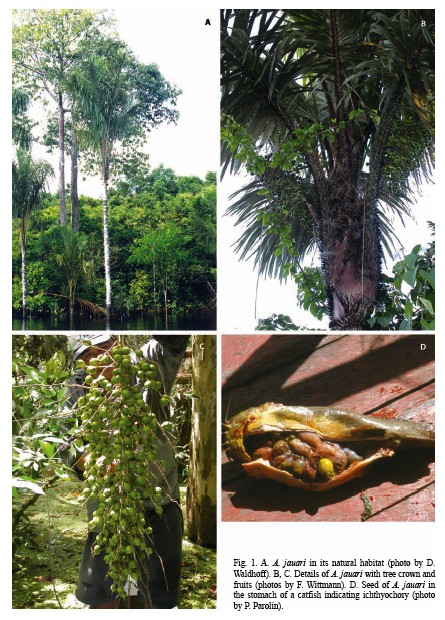
</front><body><![CDATA[ <div style="text-align: center; font-family: arial;"><span  style="font-weight: bold;">Phenology, fruit production and seed dispersal of</span> <span style="font-style: italic;">Astrocaryum jauari</span> <span style="font-weight: bold;">(Arecaceae) in Amazonian black water floodplains</span><br style="font-weight: bold;"> </div> <small><br style="font-family: arial;"> <!-- big --><span style="font-family: arial;"><small>Maria Teresa F. Piedade<sup>1</sup>, Pia Parolin<sup>2</sup> &amp; Wolfgang J. Junk</small><sup><small>2</small>    <br> <br style="font-family: arial;"> </sup></span><!-- /big --><span style="font-family: arial;">1 INPA/Max Planck, C.P. 478, 69011 Manaus, Am, Brazil.    <br> <br style="font-family: arial;"> </span><span style="font-family: arial;">2 Max-Planck-Institute for Limnology, Tropical Ecology, P.O. Box 165, 24302 Pl&ouml;n, Germany; <a href="mailto:pparolin@mpil-ploen.mpg.de">pparolin@mpil-ploen.mpg.de</a></span><br  style="font-family: arial;"> <br style="font-family: arial;"> </small>     <div style="text-align: center; font-family: arial;"><small>Received 28-VII-2004. Corrected 14-VII-2005. Accepted 09-VIII-2006.    <br> </small></div>     <p align="justify"> <small><br style="font-family: arial;"> </small></p>     <div style="text-align: left;"><small><span style="font-family: arial;"><span  style="font-weight: bold;">Abstract</span>: <span style="font-style: italic;">Astrocaryum jauari</span> Mart. (Arecaceae) is one of the commonest palm species occurring in nutritionally </span><span style="font-family: arial;">poor Amazonian black water floodplains. It is an emergent or subcanopy tree that grows on river banks and&nbsp; slands, with a wide distribution along the entire flooding gradient, tolerating flood durations between 30 and 340 days. The species is important for fish nutrition in the floodplains, and is also used for hearts of palm. In the present study, the auto-ecology of <span style="font-style: italic;">A. jauari</span> w,as analysed over a period of&nbsp; two years in the Anavilhanas Archipelago, Rio Negro, Brazil, with a focus on phenology, fruit production, and seed dispersal. Fruit fall is annual and synchronized with high water levels, with a production of 1.6 ton of fruit ha<sup>-1</sup>. The fruits are eaten by at least 16 species of fish which either gnaw the pulp, fragment the seed, or ingest the entire fruit, thus acting as dispersal agents. Besides ichthyocory, barochory (with subsequent vegetative propagation) is an important dispersal mode, enhancing the occurrence of large masses of individuals in the Anavilhanas islands and in the region of maximum </span><span  style="font-family: arial;">palm heart extraction near Barcelos. Rev. Biol. Trop. 54 (4): 1171-1178. Epub 2006 Dec. 15.</span></small><br  style="font-family: arial;"> <small></small><br style="font-family: arial;"> <small><span style="font-family: arial;"><span  style="font-weight: bold;">Key words</span>: <span style="font-style: italic;">Astrocaryum jauari</span>, floodplains, Amazonia, Anavilhanas, Brazil, ichthyocory, barochory.</span></small><br  style="font-family: arial;"> <small></small><br style="font-family: arial;"> <small><span style="font-family: arial;">Floodplain forests of large rivers in the </span><span style="font-family: arial;">Amazon region are subjected to water level </span><span style="font-family: arial;">fluctuations of about 10 m every year, as the </span><span  style="font-family: arial;">result of the sum of the precipitation in the&nbsp; </span><span style="font-family: arial;">catchment area (Goulding 1983). The regular </span><span style="font-family: arial;">annual occurrence of an aquatic and a terrestrial </span><span  style="font-family: arial;">phase is of high ecological importance </span><span  style="font-family: arial;">(Junk <span style="font-style: italic;">et al.</span> 1989) and led to the evolution of </span><span  style="font-family: arial;">a specific vegetation (Kubitzki 1989, Prance </span><span style="font-family: arial;">1979) highly adapted to survive partially or </span><span style="font-family: arial;">totally submerged periods of up to 210 days,&nbsp; </span><span  style="font-family: arial;">depending on the position of the individuals in </span><span style="font-family: arial;">the flooding gradient (Junk 1993).</span></small><br style="font-family: arial;"> <small></small><br style="font-family: arial;"> <small><span style="font-family: arial;">According to the water properties of the </span><span style="font-family: arial;">related rivers and the flora, two major floodplain </span><span style="font-family: arial;">ecosystems can be distinguished, the </span><span style="font-family: arial;">nutritionally rich &#8222;v&aacute;rzea&#8220; associated to white&nbsp; </span><span  style="font-family: arial;">water rivers like the Amazon, and the nutritionally </span><span style="font-family: arial;">poor &#8222;igap&oacute;s&#8220;, associated to black </span><span  style="font-family: arial;">water rivers like the Rio Negro (Sioli 1975, </span><span style="font-family: arial;">Prance 1980). Owing to the high acidity, mineral </span><span style="font-family: arial;">content and low light penetration in the </span><span style="font-family: arial;">igap&oacute;s, aquatic herbaceous vegetation (Junk </span><span  style="font-family: arial;">and Piedade 1997) and phytoplancton production&nbsp; </span><span style="font-family: arial;">(Sioli 1976, Schmidt 1973) are very </span><span style="font-family: arial;">poor. Life in this ecosystem therefore strongly </span><span  style="font-family: arial;">depends on the allochtone primary production </span><span style="font-family: arial;">of the riparian forests (Erwin and Adis 1982, </span><span style="font-family: arial;">Junk <span style="font-style: italic;">et al</span>. 1989, Junk and Piedade 1997).</span></small><br style="font-family: arial;"> <small></small><br style="font-family: arial;"> <small><span style="font-family: arial;">In flooded forests, several plants dispersed </span><span style="font-family: arial;">by animals developed hard pericarps to protect </span><span  style="font-family: arial;">the seeds against the acids of their digestive </span><span style="font-family: arial;">apparatus (Cronquist 1974). In such environments, </span><span  style="font-family: arial;">the sound of fruit falling into the water </span><span  style="font-family: arial;">can attract dispersors like fish (van der Pijl </span><span style="font-family: arial;">1969), particularly if the fruits are heavy like </span><span style="font-family: arial;">those of palm trees. One of these, <span style="font-style: italic;">Astrocaryum </span></span><span style="font-family: arial;"><span  style="font-style: italic;">jauari</span> Mart. (<a href="#figura1">Fig. 1A</a>, <a href="#figura1">B</a>), which is frequent </span><span style="font-family: arial;">in the black water floodplains of the Rio </span><span style="font-family: arial;">Negro and its affluents, produces fruits which are consumed by fish (<a  href="#figura1">Fig. 1C</a>; Gottsberger </span><span  style="font-family: arial;">1978, Goulding 1980, 1983). The commercially </span><span style="font-family: arial;">important Characidae family, and especially </span><span  style="font-family: arial;">two of the most important fish in terms of local </span><span style="font-family: arial;">consumption and exportation, <span style="font-style: italic;">Colossoma bidens</span> </span><span style="font-family: arial;">(pirapitinga) and <span  style="font-style: italic;">Colossoma macropomum</span> (tambaqu&iacute;), </span><span style="font-family: arial;">feed on <span  style="font-style: italic;">A. jauari</span> and disperse its seeds </span><span  style="font-family: arial;">(Goulding 1980). However, the fish may act also </span><span style="font-family: arial;">as predators, since they posses strong mandibles </span><span style="font-family: arial;">able to triturate the hard seeds.</span></small></div>     <p align="center"><a name="figura1"><img  style="border: 0px solid ; width: 445px; height: 620px;"  src="/img/fbpe/rbt/v54n4/3501i1.JPG" title="" alt=""></a></p>     
<p align="justify"><small><br style="font-family: arial;"> <br style="font-family: arial;"> </small></p>     <div style="text-align: left;"><small><span style="font-family: arial;">Also     ]]></body>
<body><![CDATA[the species&#8217; exploitation by man     is </span><span style="font-family: arial;">considerable. The     traditional use by indigenous </span><span style="font-family: arial;">people     has been documented: <span style="font-style: italic;">A. jauari</span>     provides </span><span style="font-family: arial;">fiber, food, and     shelter (Gragson 1992). </span><span style="font-family: arial;">In     Puerto Ayacucho in the State of Amazonas, </span><span      style="font-family: arial;">venezuela, at least four indigenous groups     </span><span style="font-family: arial;">(Piaroa, Curripaco, Guahibo     and Baniva) from </span><span style="font-family: arial;">ten     ]]></body>
<body><![CDATA[neighboring communities, include palm </span><span      style="font-family: arial;">products in the economic support of their </span><span      style="font-family: arial;">families (Narvaez and Stauffer 1999).     Owing&nbsp; </span><span style="font-family: arial;">to the high     quality and tenderness of the hearts </span><span      style="font-family: arial;">of palm, this species was exploited for     more </span><span style="font-family: arial;">than 20 years, supplying     all hearts of palm </span><span style="font-family: arial;">commercialized     in Central Amazonia between </span><span style="font-family: arial;">1978     and 1998 (Piedade 1985, Piedade <span style="font-style: italic;">et&nbsp;     ]]></body>
<body><![CDATA[</span></span><span style="font-family: arial;"><span      style="font-style: italic;">al</span>. 2003) before being replaced by <span      style="font-style: italic;">Bactris</span> </span><span      style="font-family: arial;"><span style="font-style: italic;">gasipaes</span>     from plantations (Al&iacute;rio Rocha, pers. </span><span      style="font-family: arial;">comm. SHARP S/A).</span></small><br      style="font-family: arial;">     <small></small><br style="font-family: arial;">     <small><span style="font-family: arial;">Although the species is common     and of     ]]></body>
<body><![CDATA[</span><span style="font-family: arial;">high ecological importance,     information about </span><span style="font-family: arial;">the     vegetative and reproductive phenologies, </span><span      style="font-family: arial;">and their timing with respect </span><span      style="font-family: arial;">to the flood pulse, is completely </span><span      style="font-family: arial;">missing. Dispersal mechanisms </span><span      style="font-family: arial;">and their relationship </span><span      style="font-family: arial;">with the local distribution and </span><span      style="font-family: arial;">population structure as well </span><span      style="font-family: arial;">as the contribution of fruits to </span><span     ]]></body>
<body><![CDATA[ style="font-family: arial;">the food chains are analyzed </span><span      style="font-family: arial;">in the present study. </span></small><br      style="font-family: arial;">     <small></small><br style="font-family: arial;">     <small><small><b>     <!-- big --><span style="font-family: arial;">Material and methods</span><!-- /big --></b></small></small><br      style="font-family: arial;">     <small><b></b>     </small><br style="font-family: arial;">     <small><span style="font-family: arial;"><span     ]]></body>
<body><![CDATA[ style="font-weight: bold;">Study     sites</span>: Data on </span><span style="font-family: arial;">phenology     and on fruit production </span><span style="font-family: arial;">were     collected in the Anavilhanas Archipelago, Rio Negro, Central </span><span      style="font-family: arial;">Amazon, at the Anavilhanas Ecological     Floating&nbsp; </span><span style="font-family: arial;">Station (AEFE)     of the Brazilian Institute of </span><span style="font-family: arial;">Environment     (Instituto Brasileiro de Meio </span><span style="font-family: arial;">Ambiente     - IBAMA), about 100 km from the </span><span      style="font-family: arial;">city of Manaus (between 2<sup>o</sup>00&#8217;     ]]></body>
<body><![CDATA[and 3<sup>o</sup>02&#8217; S&nbsp; of </span><span      style="font-family: arial;">latitude and 60<sup>o</sup> 27&#8217; to 61<sup>o</sup>07&#8217;     W of longitude). </span><span style="font-family: arial;">The main     period of data collection was </span><span style="font-family: arial;">from     August 1980 to November 1982. From this </span><span      style="font-family: arial;">year to 1998 irregular field trips added     occasional </span><span style="font-family: arial;">observations, and     data about the commercial </span><span style="font-family: arial;">extraction     of the palm tree were collected.</span></small><br      style="font-family: arial;">     ]]></body>
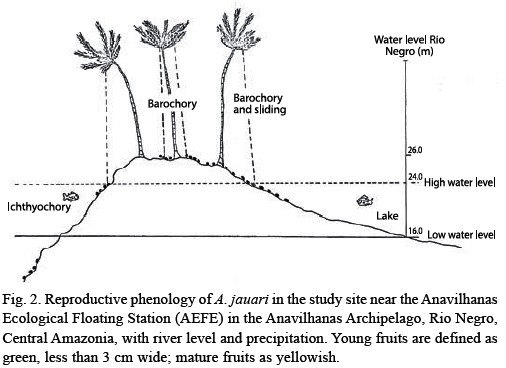
<body><![CDATA[<small></small><br style="font-family: arial;">     <small><span style="font-family: arial;"><span      style="font-weight: bold;">Climate</span>:     The climate is hot and humid </span><span style="font-family: arial;">with     mean minimum temperatures above 18 &ordm;C </span><span      style="font-family: arial;">(Ribeiro 1976). The most arid month     (October) </span><span style="font-family: arial;">has a relative     humidity above 60 %. Mean </span><span style="font-family: arial;">annual     precipitation ranges between 1 000 </span><span      style="font-family: arial;">and 2 500 mm (<a href="#figura2">Fig. 2</a>;     ]]></body>
<body><![CDATA[Irmler 1975). Annual     </span><span style="font-family: arial;">river level fluctuations in     the Anavilhanas </span><span style="font-family: arial;">Archipelago     show a similar pattern and amplitudes </span><span      style="font-family: arial;">like those measured at the harbour in </span><span      style="font-family: arial;">Manaus, with an annual mean amplitude of     10 </span><span style="font-family: arial;">m (<a href="#figura2">Fig.     2</a>; Schmidt 1973).</span></small><br style="font-family: arial;">     <small></small><br style="font-family: arial;">     <small><span style="font-family: arial;"><span     ]]></body>
<body><![CDATA[ style="font-weight: bold;">Vegetation</span>:     In the study sites, the vegetation </span><span      style="font-family: arial;">forms three strata and has low plant     densities. </span><span style="font-family: arial;">The taller trees     reach 15 to 20 m height, </span><span style="font-family: arial;">with     some emergent individuals about 25 m </span><span      style="font-family: arial;">high (Piedade 1985). During high water     levels, </span><span style="font-family: arial;">the vegetation is     partially or totally inundated. Medium height of mature <span      style="font-style: italic;">A. jauari</span> is 20 m, with </span><span     ]]></body>
<body><![CDATA[ style="font-family: arial;">dense tree crowns, which have 6 to 14     leaves </span><span style="font-family: arial;">(Boer 1965), each one     with a mean length of </span><span style="font-family: arial;">3 m. <span      style="font-style: italic;">A. jauari</span> may occur isolated but     more </span><span style="font-family: arial;">frequently the species     forms huge stands along </span><span style="font-family: arial;">the     margins of rivers or lakes (Corr&ecirc;a 1969, </span><span      style="font-family: arial;">Goulding 1980). The species may form     clones </span><span style="font-family: arial;">with 4 to 6     individuals differing in size but </span><span     ]]></body>
<body><![CDATA[ style="font-family: arial;">belonging to a single rhizome (Boer 1965).</span></small><br      style="font-family: arial;">     </div>     <p align="justify"><small>&nbsp;</small></p>     <p align="center"><a name="figura2"> <img style="border: 0px solid ; width: 506px; height: 368px;"  src="/img/fbpe/rbt/v54n4/3501i2.JPG" title="" alt=""></a></p>     
<p align="justify"><small> <br style="font-family: arial;"> </small></p>     <div style="text-align: left;"><small><span style="font-family: arial;"><span      style="font-weight: bold;">Phenology     and fruit production</span>: Nine </span><span      style="font-family: arial;">healthy, adult individuals of <span     ]]></body>
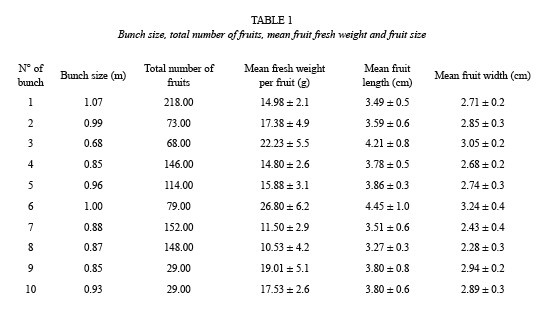
<body><![CDATA[ style="font-style: italic;">A. jauari</span> were </span><span      style="font-family: arial;">marked and the phenological status was     recorded </span><span style="font-family: arial;">once a month.     Presence or absence of flowers, </span><span      style="font-family: arial;">young and mature fruits were recorded </span><span      style="font-family: arial;">as well as fruit maturation time. In the     period </span><span style="font-family: arial;">of fruit maturation,     phenology was recorded </span><span style="font-family: arial;">at     weekly intervals. Ten fruit bunches were </span><span      style="font-family: arial;">collected from different individual trees,     ]]></body>
<body><![CDATA[to </span><span style="font-family: arial;">ascertain total number of     produced fruits and </span><span style="font-family: arial;">fruit     weight and size. Twenty fruits per bunch </span><span      style="font-family: arial;">were weighed. Additionally, 250 seeds were     </span><span style="font-family: arial;">collected from different     bunches for chemical </span><span style="font-family: arial;">analyses     which were performed in the INPA, </span><span      style="font-family: arial;">Manaus. Water content (in percent, after     oven </span><span style="font-family: arial;">drying at 80 &deg;C to     constant weight), and the </span><span style="font-family: arial;">contents     ]]></body>
<body><![CDATA[of protein, fat, ash, carbohydrates, </span><span      style="font-family: arial;">calories and vitamin A were measured.</span></small><br      style="font-family: arial;">     <small></small><br style="font-family: arial;">     <small><span style="font-family: arial;"><span      style="font-weight: bold;">Dispersal</span>:     Dispersal syndromes were </span><span style="font-family: arial;">observed     on the marked trees. To estimate </span><span      style="font-family: arial;">predation, fruits were monitored for ten     weeks </span><span style="font-family: arial;">as follows: 1 000     ]]></body>
<body><![CDATA[fruits were collected from the </span><span style="font-family: arial;">bunches     (pre-dispersal predation), and 3 000 </span><span      style="font-family: arial;">fruits were collected from the soil     (post-dispersal </span><span style="font-family: arial;">predation).     In order to establish the efficiency </span><span      style="font-family: arial;">of water as a dispersal agent, 1 000 seeds     </span><span style="font-family: arial;">were collected floating at the     water surface </span><span style="font-family: arial;">and opened to     analyse the embrional integrity. </span><span      style="font-family: arial;">Systematical analyses of fish stomach     ]]></body>
<body><![CDATA[content </span><span style="font-family: arial;">were performed at the     Ecological Station. To </span><span style="font-family: arial;">this     information were added bibliographical </span><span      style="font-family: arial;">data and interviews with local people.</span></small><br      style="font-family: arial;">     <small></small><br style="font-family: arial;">     <small><span style="font-family: arial;"><span      style="font-weight: bold;">Exploitation</span>:     Data on palm extractivism </span><span style="font-family: arial;">until     1998 were gained from the technicians </span><span     ]]></body>
<body><![CDATA[ style="font-family: arial;">of the F&aacute;brica de Palmito Jauari,     SHARP do </span><span style="font-family: arial;">Brasil S.A.,     Manaus/AM.</span></small><br style="font-family: arial;">     <small></small><br style="font-family: arial;">     <small><small><!-- big --><span style="font-family: arial; font-weight: 700;">Results</span><!-- /big --></small></small><br      style="font-family: arial;">     <small></small><br style="font-family: arial;">     <small><span style="font-family: arial;"><span      style="font-weight: bold;">Phenology     and fruit production</span>: The </span><span     ]]></body>
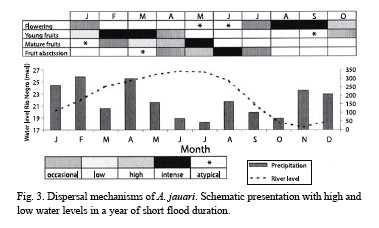
<body><![CDATA[ style="font-family: arial;">production of flowers and fruits of <span      style="font-style: italic;">A. jauari</span> </span><span      style="font-family: arial;">occurs once every year. The great majority     of </span><span style="font-family: arial;">the adult palms starts the     production of flowers </span><span style="font-family: arial;">when     the water of the rivers are sinking and </span><span      style="font-family: arial;">precipitation is not very intense yet,     especially </span><span style="font-family: arial;">in August and     September (<a href="#figura2">Fig. 2</a>). The flowering </span><span      style="font-family: arial;">period is short and is soon substituted by     ]]></body>
<body><![CDATA[the </span><span style="font-family: arial;">presence of small fruits     which develop slowly. </span><span style="font-family: arial;">The     fruits are mature when the river levels rise </span><span      style="font-family: arial;">again, after about nine months, with     abscission </span><span style="font-family: arial;">occurring mainly     at high water levels in the </span><span style="font-family: arial;">months     May to July (<a href="#figura2">Fig. 2</a>). No pre-dispersal </span><span      style="font-family: arial;">predation was detected.</span></small><br      style="font-family: arial;">     <small></small><br style="font-family: arial;">     ]]></body>
<body><![CDATA[<small><span style="font-family: arial;">Every individual of<span      style="font-style: italic;"> A. jauari</span> produces four </span><span      style="font-family: arial;">fruit bunchs every year, which are 90 cm     long on </span><span style="font-family: arial;">average and have a     mean fruit number of 106, </span><span style="font-family: arial;">with     a mean weight per fruit of 17 g (<a href="#tabla1">Table 1</a>). </span></small><br      style="font-family: arial;">     <small></small><br style="font-family: arial;">     <small><span style="font-family: arial;">The chemical analyses of     fruits of <span style="font-style: italic;">A. jauari&nbsp; </span></span><span     ]]></body>
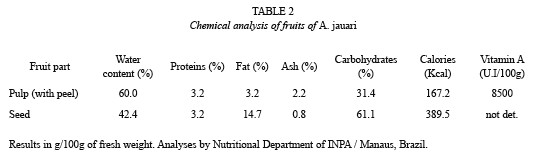
<body><![CDATA[ style="font-family: arial;">(<a href="#tabla2">Table 2</a>) show that     the pulp and the seed     consist </span><span style="font-family: arial;">mainly of water and     carbohydrates, with a </span><span style="font-family: arial;">high     percentage of fat (14.7 %) in the seed.</span></small><br      style="font-family: arial;">     <small></small><br style="font-family: arial;">     <small><span style="font-family: arial;"><span      style="font-weight: bold;">Dispersal</span>:     Since mean fruit weight is </span><span style="font-family: arial;">high     ]]></body>
<body><![CDATA[(<a href="#tabla1">Table 1</a>), and morphological features </span><span      style="font-family: arial;">enhancing flotation are completely     lacking, </span><span style="font-family: arial;">the fruits sink to     the bottom when they fall </span><span style="font-family: arial;">into     water. If fruits were found floating, then </span><span      style="font-family: arial;">the seeds were not viable and all     deteriorated. </span><span style="font-family: arial;">As a     consequence of topographical conditions, </span><span      style="font-family: arial;">after abscission the fruits may fall     and&nbsp; </span><span style="font-family: arial;">be accumulated     ]]></body>
<body><![CDATA[close to the mother plant </span><span style="font-family: arial;">(barochoric     dispersal, <a href="#figura3">Fig. 3</a>). under such </span><span      style="font-family: arial;">conditions,     some of the seeds may be predated </span><span      style="font-family: arial;">by small coleoptera. They may also     roll&nbsp; </span><span style="font-family: arial;">away from the     mother plant, in many cases </span><span style="font-family: arial;">aided     by the action of water. The fruits found </span><span      style="font-family: arial;">in these conditions are less in number,     and&nbsp; </span><span style="font-family: arial;">are located in     ]]></body>
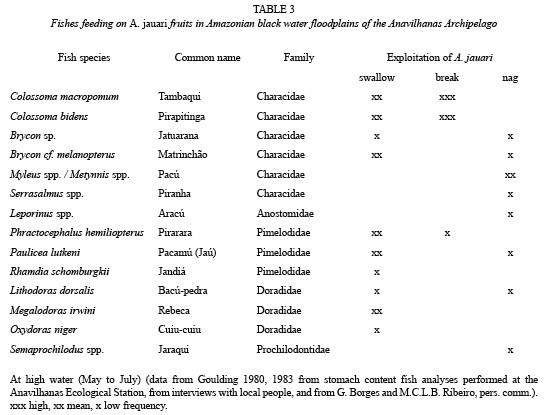
<body><![CDATA[isolated points on the islands. </span><span      style="font-family: arial;">Ichthyochoric dispersal plays a major     role: </span><span style="font-family: arial;">a total of 16 fish     species feed on the fruits </span><span style="font-family: arial;">of     <span style="font-style: italic;">A. jauari</span> (<a href="#tabla3">Table     3</a>). These     belong to five </span><span style="font-family: arial;">families,     mainly to the Characidae. Ten of </span><span      style="font-family: arial;">the 16 species were categorized as     possible </span><span style="font-family: arial;">dispersers, although     ]]></body>
<body><![CDATA[three (<span style="font-style: italic;">C. macropomum, </span></span><span      style="font-family: arial;"><span style="font-style: italic;">C. bidens</span>     and <span style="font-style: italic;">Prachtocephalus hemiliopterus</span>)     may also act as predators since they </span><span      style="font-family: arial;">do not only swallow the whole fruits,     but&nbsp; </span><span style="font-family: arial;">sometimes chew and     destroy them with their&nbsp; </span><span style="font-family: arial;">strong     mandibles and teeth (Goulding 1980). </span><span      style="font-family: arial;">This could not be measured and quantified     in </span><span style="font-family: arial;">the present study. In the     ]]></body>
<body><![CDATA[whole study period, </span><span style="font-family: arial;">we did     not observe any indications of other&nbsp; </span><span      style="font-family: arial;">vertebrates feeding on fruits of <span      style="font-style: italic;">A. jauari.</span></span></small></div>     <p align="center"><a name="tabla1"> <img style="border: 0px solid ; width: 549px; height: 309px;"  src="/img/fbpe/rbt/v54n4/3501i3.JPG" title="" alt=""></a></p>     
<p align="center"><a name="tabla2"> <img style="border: 0px solid ; width: 540px; height: 157px;"  src="/img/fbpe/rbt/v54n4/3501i4.JPG" title="" alt=""></a></p>     
<p align="justify"><small> <br style="font-family: arial;"> <br style="font-family: arial;"> </small></p>     <div style="text-align: left;"><small><span style="font-family: arial;"><span  style="font-weight: bold;">Exploitation</span>: Regarding </span><span style="font-family: arial;">the economic exploitation </span><span style="font-family: arial;">of <span  style="font-style: italic;">A. jauari</span>, the information </span><span  style="font-family: arial;">provided by the F&aacute;brica de </span><span  style="font-family: arial;">Palmito Jauari-SHARP do </span><span  style="font-family: arial;">Brasil S.A. indicate that in the </span><span  style="font-family: arial;">region of the Municipality of </span><span  style="font-family: arial;">Barcelos where the extractivism </span><span  style="font-family: arial;">occurs, the density of the </span><span  style="font-family: arial;">palms varies widely between </span><span  style="font-family: arial;">river islands, from 250 to </span><span  style="font-family: arial;">2 000 individuals/ha. One </span><span  style="font-family: arial;">single worker can fell and </span><span  style="font-family: arial;">pre-clean up to 90 palm trees in the high water season in the months of May </span><span  style="font-family: arial;">to June and about 25 in the low-water season </span><span style="font-family: arial;">(December, January). Calculating a number of </span><span style="font-family: arial;">ten workers in the area of Barcelos, 250 to 900 </span><span  style="font-family: arial;">palms are exploited every day, corresponding </span><span style="font-family: arial;">to 0.5-1 ha. From one palm 0.5-1 bin of hearts </span><span  style="font-family: arial;">of palm may be obtained. From October 1998 </span><span style="font-family: arial;">on, due to difficulties in keeping up a constant </span><span style="font-family: arial;">production, hearts of palm production of the </span><span  style="font-family: arial;">SHARP S.A. was completely substituted by </span><span  style="font-family: arial;">the palm <span style="font-style: italic;">B. gasipaes</span> H.B.K (pupunha) which </span><span  style="font-family: arial;">were planted on a 45 ha area with a total of </span><span style="font-family: arial;">225 000 palm trees.</span></small></div>     <p align="center"><a name="figura3"> <img style="border: 0px solid ; width: 379px; height: 228px;"  src="/img/fbpe/rbt/v54n4/3501i5.JPG" title="" alt=""></a></p>     
<p align="center">&nbsp;</p>     ]]></body>
<body><![CDATA[<p align="center"><a name="tabla3"> <img style="border: 0px solid ; width: 548px; height: 415px;"  src="/img/fbpe/rbt/v54n4/3501i6.JPG" title="" alt=""></a></p>     
<div style="text-align: left;"><small><small><!-- big --><span      style="font-family: arial; font-weight: 700;">Discussion</span><!-- /big --></small></small><br      style="font-family: arial;">     <small></small><br style="font-family: arial;">     <small><span style="font-family: arial;">The distribution of<span      style="font-style: italic;"> A. jauari</span> was quite </span><span      style="font-family: arial;">variable among different islands,     occurring </span><span style="font-family: arial;">on sites flooded     for 270 to 340 days per year </span><span style="font-family: arial;">on     ]]></body>
<body><![CDATA[one island, while on an adjacent island </span><span      style="font-family: arial;">they dominated in areas flooded for 30 to </span><span      style="font-family: arial;">200 days per year. This high amplitude of </span><span      style="font-family: arial;">distribution was already pointed out by     Huber </span><span style="font-family: arial;">(1906) for populations     of <span style="font-style: italic;">A. jauari </span>along the </span><span      style="font-family: arial;">Rio Purus. It is possible because the palm     is </span><span style="font-family: arial;">well-adapted anatomically     and physiologically </span><span style="font-family: arial;">to     hypoxic conditions (Schl&uuml;ter <span style="font-style: italic;">et     ]]></body>
<body><![CDATA[al</span>. 1993). </span><span style="font-family: arial;">Annual     inundation for as long as 300 days, at </span><span      style="font-family: arial;">water temperatures of 28 &deg;C, produce     neither </span><span style="font-family: arial;">leaf loss nor rotting     of the roots. Well-developed </span><span style="font-family: arial;">aerenchyma     permits gas transport from </span><span style="font-family: arial;">the     branches to the roots. At a depth of 1.2 m </span><span      style="font-family: arial;">beneath black waters, the leaves in the     crowns </span><span style="font-family: arial;">of the plants show     little decrease in the amount </span><span style="font-family: arial;">of     ]]></body>
<body><![CDATA[chlorophyll.</span></small><br style="font-family: arial;">     <small></small><br style="font-family: arial;">     <small><span style="font-family: arial;">Phenological patterns between     sites     are </span><span style="font-family: arial;">quite similar. <span      style="font-style: italic;">A. jauari</span> synchronizes its     flowering </span><span style="font-family: arial;">with the period in     which precipitation is </span><span style="font-family: arial;">less     intense. With the onset of high precipitations, </span><span      style="font-family: arial;">the fruits are growing already -a process </span><span     ]]></body>
<body><![CDATA[ style="font-family: arial;">which may last nine months- and at     highestwater levels the abscission of mature fruits is </span><span      style="font-family: arial;">at its maximum. Perhaps this long period     of </span><span style="font-family: arial;">maturation is necessary to     reach the high energetic </span><span style="font-family: arial;">and     vitaminic level of the fruits (<a href="#tabla2">Table 2</a>), </span><span      style="font-family: arial;">since the soils of the black water     floodplains </span><span style="font-family: arial;">are extremely     poor in nutrients (Sioli 1976). </span><span      style="font-family: arial;">The long maturation phase is also     ]]></body>
<body><![CDATA[necessary </span><span style="font-family: arial;">for the     synchronization of fruit production with </span><span      style="font-family: arial;">high water levels and the related seed     dispersal </span><span style="font-family: arial;">by fish. The high     nutritional value of the fruits </span><span      style="font-family: arial;">(<a href="#tabla2">Table 2</a>) may be     related to the ichthyochoric </span><span style="font-family: arial;">dispersal     syndrome. The especially high content </span><span      style="font-family: arial;">of vitamin A may be advantageous for </span><span      style="font-family: arial;">fish to put up stock reserves in the form     ]]></body>
<body><![CDATA[of </span><span style="font-family: arial;">fat which are needed for     gonads development </span><span style="font-family: arial;">in the low     water period when food resources </span><span      style="font-family: arial;">are scarce. Goulding (1980) found 52     entire </span><span style="font-family: arial;">fruits of <span      style="font-style: italic;">A. jauari</span> in only one individual of     </span><span style="font-family: arial;"><span      style="font-style: italic;">C. macropomum</span>, and in one     individual of <span style="font-style: italic;">C. </span></span><span      style="font-family: arial;"><span style="font-style: italic;">bidens</span>     ]]></body>
<body><![CDATA[he found 1 kg of <span style="font-style: italic;">A. jauari</span>     fruits. The </span><span style="font-family: arial;">noise of fruits     falling into the water attracts </span><span      style="font-family: arial;">fish and thus contribuites to the success     of the </span><span style="font-family: arial;">propagation mechanism.</span></small><br      style="font-family: arial;">     <small></small><br style="font-family: arial;">     <small><span style="font-family: arial;">All floating fruits were no     longer     viable, </span><span style="font-family: arial;">indicating that     ]]></body>
<body><![CDATA[hydrochory does not play a role </span><span      style="font-family: arial;">in <span style="font-style: italic;">A.     jauari</span>. Although Corner (1966) emphasizes </span><span      style="font-family: arial;">that in the genus <span      style="font-style: italic;">Astrocaryum</span> dispersal </span><span      style="font-family: arial;">by flotation is frequent and apparent, in     the </span><span style="font-family: arial;">case of <span      style="font-style: italic;">A. jauari</span> the heavy fruits may     eventually </span><span style="font-family: arial;">be transported     submerged by currents, but </span><span style="font-family: arial;">definitely     ]]></body>
<body><![CDATA[not by flotation. </span></small><br style="font-family: arial;">     <small></small><br style="font-family: arial;">     <small><span style="font-family: arial;">The observed local increases     of     population </span><span style="font-family: arial;">density probably     result from barochory, and </span><span style="font-family: arial;">from     vegetative propagation which enhances </span><span      style="font-family: arial;">the occurrence of large masses of     individuals </span><span style="font-family: arial;">in the     Anavilhanas islands, and of even higher </span><span     ]]></body>
<body><![CDATA[ style="font-family: arial;">densities in the region of maximum     extractivism, </span><span style="font-family: arial;">near Barcelos.</span></small><br      style="font-family: arial;">     <small></small><br style="font-family: arial;">     <small><span style="font-family: arial;">Hydrochory is probably of     neglectable     </span><span style="font-family: arial;">importance, and ichthyochory     is responsible </span><span style="font-family: arial;">for long     distance dispersal helping to colonize </span><span      style="font-family: arial;">new habitats. Van der Pijl (1969) states     ]]></body>
<body><![CDATA[that </span><span style="font-family: arial;">ichthyochory is a     primitive dispersal mechanism </span><span style="font-family: arial;">which     in floodplains of Amazonia and </span><span style="font-family: arial;">Borneo     has been maintained in ancient plant </span><span      style="font-family: arial;">groups. These primitive mechanisms of     dispersal </span><span style="font-family: arial;">usually imply a     huge production and loss </span><span style="font-family: arial;">of     fruits, since these mechanisms are highly </span><span      style="font-family: arial;">hazardous in terms of the possibility of     finding </span><span style="font-family: arial;">an appropriate place     ]]></body>
<body><![CDATA[for germination, and </span><span style="font-family: arial;">they     allow several opportunists to exploit the </span><span      style="font-family: arial;">resource (Janzen 1970 1971, Fleming and </span><span      style="font-family: arial;">Heithaus 1981).</span></small><br      style="font-family: arial;">     <small></small><br style="font-family: arial;">     <small><span style="font-family: arial;">Finally both, the intensive     extraction of the </span><span style="font-family: arial;">palm, and     the pressure over the populations of </span><span      style="font-family: arial;">the most probable fish acting as     ]]></body>
<body><![CDATA[dispersors may </span><span style="font-family: arial;">lead to the     impoverishment of food chains in </span><span      style="font-family: arial;">black water Amazonian floodplains, and to     the </span><span style="font-family: arial;">decline of densities of <span      style="font-style: italic;">A. jauari</span> and some of the </span><span      style="font-family: arial;">economically important fish species. </span></small><br      style="font-family: arial;">     <small></small><br style="font-family: arial;">     <small><small><!-- big --><span style="font-family: arial; font-weight: 700;">Resumen    <!-- ref --><br> <br style="font-family: arial;"> </span><!-- /big --></small></small><small><span style="font-family: arial;"><span  style="font-style: italic;">Astrocaryum jauari</span> Mart. (Arecaceae) es una de las </span><span  style="font-family: arial;">especies m&aacute;s comunes de palma en las llanuras de inundaci&oacute;n </span><span  style="font-family: arial;">por las llamadas &#8220;aguas negras&#8221;, aguas ricas en </span><span style="font-family: arial;">taninos que tienen pocos nutrientes para la fauna. Habita el </span><span  style="font-family: arial;">subdosel que se desarrolla en riberas e islas, con una distribuci&oacute;n </span><span  style="font-family: arial;">amplia en toda la gradiente de inundaci&oacute;n (resiste </span><span style="font-family: arial;">entre 30 y 340 d&iacute;as bajo el agua). La especie es importante </span><span  style="font-family: arial;">para la nutrici&oacute;n de los peces y en la producci&oacute;n de palmito. </span><span  style="font-family: arial;">La autoecolog&iacute;a de <span  style="font-style: italic;">A. jauari</span> fue analizada por dos </span><span  style="font-family: arial;">a&ntilde;os en el Archipi&eacute;lago Anavilhanas, r&iacute;o Negro, Brazil, con </span><span  style="font-family: arial;">&eacute;nfasis en fenolog&iacute;a, producci&oacute;n de frutas, y dispersores de </span><span  style="font-family: arial;">semillas. La ca&iacute;da de los frutos es anual y sincronizada con </span><span style="font-family: arial;">el aumento de los niveles de agua, con una producci&oacute;n de </span><span  style="font-family: arial;">1.6 ton de fruta ha<sup>-1</sup>. Las frutas son comidas por al menos </span><span  style="font-family: arial;">de 16 especies de peces que roen la pulpa o fragmentos de </span><span style="font-family: arial;">semilla, o ingieren la fruta entera y act&uacute;an como agentes </span><span  style="font-family: arial;">dispersores. Adem&aacute;s de la ictiocoria, la barocoria y la </span><span style="font-family: arial;">subsecuente progragaci&oacute;n asexual son b&aacute;sicos para la alta </span><span  style="font-family: arial;">densidad de la especie.</span></small><br  style="font-family: arial;"> <small></small><br style="font-family: arial;"> <small><span style="font-family: arial;"><span  style="font-weight: bold;">Palabras clave</span>: <span style="font-style: italic;">Astrocaryum jauari</span>, llanura de inundaci&oacute;n, </span><span style="font-family: arial;">Amazon&iacute;a, Anavilhanas, Brasil, ictiocoria, barocoria.</span></small><br  style="font-family: arial;"> <small></small><br style="font-family: arial;"> <small><small><!-- big --><span style="font-family: arial; font-weight: 700;">References</span><!-- /big --></small></small><br  style="font-family: arial;"> <small></small><br style="font-family: arial;"> <small><span style="font-family: arial;">Boer, J.E.W. 1965. Palmae 5, p. 125-141.<span style="font-style: italic;"> In </span>J. Lanjouw </span><span  style="font-family: arial;">(ed.). Flora of Suriname. E.J. Brill, Leiden, Holland.</span></small><br style="font-family: arial;"> <small></small><br style="font-family: arial;"> <small><span style="font-family: arial;">    &nbsp;&nbsp;&nbsp;&nbsp;&nbsp;&nbsp;&nbsp;&nbsp;[&#160;<a href="javascript:void(0);" onclick="javascript: window.open('/scielo.php?script=sci_nlinks&ref=1355688&pid=S0034-7744200600040001500001&lng=','','width=640,height=500,resizable=yes,scrollbars=1,menubar=yes,');">Links</a>&#160;]<!-- end-ref --><!-- ref -->Corner, E.J.H. 1966. The natural history of palms. </span><span style="font-family: arial;">Weidenfeld and Nicholson, London, England. 393 p.</span></small><br  style="font-family: arial;"> <small></small><br style="font-family: arial;"> <small><span style="font-family: arial;">    &nbsp;&nbsp;&nbsp;&nbsp;&nbsp;&nbsp;&nbsp;&nbsp;[&#160;<a href="javascript:void(0);" onclick="javascript: window.open('/scielo.php?script=sci_nlinks&ref=1355689&pid=S0034-7744200600040001500002&lng=','','width=640,height=500,resizable=yes,scrollbars=1,menubar=yes,');">Links</a>&#160;]<!-- end-ref --><!-- ref -->Corr&ecirc;a, M.P. 1969. Dicion&aacute;rio de plantas &uacute;teis do Brasil. </span><span  style="font-family: arial;">IBDF, Rio de Janeiro, Brasil. 765 p.</span></small><br  style="font-family: arial;"> <small></small><br style="font-family: arial;"> <small><span style="font-family: arial;">    &nbsp;&nbsp;&nbsp;&nbsp;&nbsp;&nbsp;&nbsp;&nbsp;[&#160;<a href="javascript:void(0);" onclick="javascript: window.open('/scielo.php?script=sci_nlinks&ref=1355690&pid=S0034-7744200600040001500003&lng=','','width=640,height=500,resizable=yes,scrollbars=1,menubar=yes,');">Links</a>&#160;]<!-- end-ref --><!-- ref -->Cronquist, A. 1974. The evolution and classification </span><span style="font-family: arial;">of flowering plants. Houghton Mifflin, Boston, </span><span  style="font-family: arial;">Massachussetts, USA. 396 p.</span></small><br  style="font-family: arial;"> <small></small><br style="font-family: arial;"> <small><span style="font-family: arial;">    &nbsp;&nbsp;&nbsp;&nbsp;&nbsp;&nbsp;&nbsp;&nbsp;[&#160;<a href="javascript:void(0);" onclick="javascript: window.open('/scielo.php?script=sci_nlinks&ref=1355691&pid=S0034-7744200600040001500004&lng=','','width=640,height=500,resizable=yes,scrollbars=1,menubar=yes,');">Links</a>&#160;]<!-- end-ref --><!-- ref -->Erwin, T. &amp; J. Adis. 1982. Amazonian inundation forests: </span><span style="font-family: arial;">their role as short-term refuges and generators of species </span><span  style="font-family: arial;">richness and taxon pulses, p. 358-371. <span  style="font-style: italic;">In</span> G.T. </span><span  style="font-family: arial;">Prance&nbsp; (ed.). Biological diversification in the tropics. </span><span  style="font-family: arial;">Columbia, New York, USA.</span></small><br  style="font-family: arial;"> <small></small><br style="font-family: arial;"> <small><span style="font-family: arial;">    &nbsp;&nbsp;&nbsp;&nbsp;&nbsp;&nbsp;&nbsp;&nbsp;[&#160;<a href="javascript:void(0);" onclick="javascript: window.open('/scielo.php?script=sci_nlinks&ref=1355692&pid=S0034-7744200600040001500005&lng=','','width=640,height=500,resizable=yes,scrollbars=1,menubar=yes,');">Links</a>&#160;]<!-- end-ref --><!-- ref -->Fleming, T.H. &amp; E.R. Heithaus. 1981. Frugivorous bats, </span><span style="font-family: arial;">seed shadows and the structure of tropical forests. </span><span  style="font-family: arial;">Biotropica 13: 45-53.</span></small><br  style="font-family: arial;"> <small></small><br style="font-family: arial;"> <small><span style="font-family: arial;">    &nbsp;&nbsp;&nbsp;&nbsp;&nbsp;&nbsp;&nbsp;&nbsp;[&#160;<a href="javascript:void(0);" onclick="javascript: window.open('/scielo.php?script=sci_nlinks&ref=1355693&pid=S0034-7744200600040001500006&lng=','','width=640,height=500,resizable=yes,scrollbars=1,menubar=yes,');">Links</a>&#160;]<!-- end-ref --><!-- ref -->Gottsberger, G. 1978. Seed dispersal by fish in the inundated </span><span style="font-family: arial;">regions of Humait&aacute;, Amazonia. Biotropica 10: </span><span  style="font-family: arial;">170-183.</span></small><br  style="font-family: arial;"> <small></small><br style="font-family: arial;"> <small><span style="font-family: arial;">    &nbsp;&nbsp;&nbsp;&nbsp;&nbsp;&nbsp;&nbsp;&nbsp;[&#160;<a href="javascript:void(0);" onclick="javascript: window.open('/scielo.php?script=sci_nlinks&ref=1355694&pid=S0034-7744200600040001500007&lng=','','width=640,height=500,resizable=yes,scrollbars=1,menubar=yes,');">Links</a>&#160;]<!-- end-ref --><!-- ref -->Goulding, M. 1980. Interactions of fish with fruits and </span><span style="font-family: arial;">seeds, p. 217-232.<span style="font-style: italic;"> In</span> M. Goulding (ed.). The fishes </span><span style="font-family: arial;">and the forest. Explorations in Amazonian natural </span><span  style="font-family: arial;">history. California, California, USA.</span></small><br  style="font-family: arial;"> <small></small><br style="font-family: arial;"> <small><span style="font-family: arial;">    &nbsp;&nbsp;&nbsp;&nbsp;&nbsp;&nbsp;&nbsp;&nbsp;[&#160;<a href="javascript:void(0);" onclick="javascript: window.open('/scielo.php?script=sci_nlinks&ref=1355695&pid=S0034-7744200600040001500008&lng=','','width=640,height=500,resizable=yes,scrollbars=1,menubar=yes,');">Links</a>&#160;]<!-- end-ref --><!-- ref -->Goulding, M. 1983. The role of fishes in seed dispersal </span><span style="font-family: arial;">and plant distribution in Amazonian floodplain ecosystems. </span><span  style="font-family: arial;">Sonderbd. Naturwiss.Hamburg, Germany </span><span  style="font-family: arial;">7: 271-283.</span></small><br  style="font-family: arial;"> <small></small><br style="font-family: arial;"> <small><span style="font-family: arial;">    &nbsp;&nbsp;&nbsp;&nbsp;&nbsp;&nbsp;&nbsp;&nbsp;[&#160;<a href="javascript:void(0);" onclick="javascript: window.open('/scielo.php?script=sci_nlinks&ref=1355696&pid=S0034-7744200600040001500009&lng=','','width=640,height=500,resizable=yes,scrollbars=1,menubar=yes,');">Links</a>&#160;]<!-- end-ref --><!-- ref -->Gragson, T.L. 1992. The use of palms by the Pume Indians </span><span style="font-family: arial;">of southwestern Venezuela. Principes 36: 133-142.</span></small><br  style="font-family: arial;"> <small></small><br style="font-family: arial;"> <small><span style="font-family: arial;">    &nbsp;&nbsp;&nbsp;&nbsp;&nbsp;&nbsp;&nbsp;&nbsp;[&#160;<a href="javascript:void(0);" onclick="javascript: window.open('/scielo.php?script=sci_nlinks&ref=1355697&pid=S0034-7744200600040001500010&lng=','','width=640,height=500,resizable=yes,scrollbars=1,menubar=yes,');">Links</a>&#160;]<!-- end-ref --><!-- ref -->Huber, J. 1906. La v&eacute;g&eacute;tation de la vall&eacute;e du rio Purus </span><span  style="font-family: arial;">(Amazone). Bull. Herb. Boissier 4: 249-276.</span></small><br  style="font-family: arial;"> <small></small><br style="font-family: arial;"> <small><span style="font-family: arial;">    &nbsp;&nbsp;&nbsp;&nbsp;&nbsp;&nbsp;&nbsp;&nbsp;[&#160;<a href="javascript:void(0);" onclick="javascript: window.open('/scielo.php?script=sci_nlinks&ref=1355698&pid=S0034-7744200600040001500011&lng=','','width=640,height=500,resizable=yes,scrollbars=1,menubar=yes,');">Links</a>&#160;]<!-- end-ref --><!-- ref -->Irmler, u. 1975. Ecological studies of the aquatic soil </span><span style="font-family: arial;">invertebrates in three inundation forests of Central </span><span  style="font-family: arial;">Amazonia. Amazoniana 3: 337-409.</span></small><br  style="font-family: arial;"> <small></small><br style="font-family: arial;"> <small><span style="font-family: arial;">    &nbsp;&nbsp;&nbsp;&nbsp;&nbsp;&nbsp;&nbsp;&nbsp;[&#160;<a href="javascript:void(0);" onclick="javascript: window.open('/scielo.php?script=sci_nlinks&ref=1355699&pid=S0034-7744200600040001500012&lng=','','width=640,height=500,resizable=yes,scrollbars=1,menubar=yes,');">Links</a>&#160;]<!-- end-ref --><!-- ref -->Janzen, D.H. 1970. Herbivores and the number of tree species </span><span style="font-family: arial;">in tropical forests. Am. Nat. 104: 501-528.</span></small><br  style="font-family: arial;"> <small></small><br style="font-family: arial;"> <small><span style="font-family: arial;">    &nbsp;&nbsp;&nbsp;&nbsp;&nbsp;&nbsp;&nbsp;&nbsp;[&#160;<a href="javascript:void(0);" onclick="javascript: window.open('/scielo.php?script=sci_nlinks&ref=1355700&pid=S0034-7744200600040001500013&lng=','','width=640,height=500,resizable=yes,scrollbars=1,menubar=yes,');">Links</a>&#160;]<!-- end-ref --><!-- ref -->Janzen, D.H. 1971. Seed predation by animals. Ann. Rev. </span><span style="font-family: arial;">Ecol. Syst. 2: 465-492.</span></small><br style="font-family: arial;"> <small></small><br style="font-family: arial;"> <small><span style="font-family: arial;">    &nbsp;&nbsp;&nbsp;&nbsp;&nbsp;&nbsp;&nbsp;&nbsp;[&#160;<a href="javascript:void(0);" onclick="javascript: window.open('/scielo.php?script=sci_nlinks&ref=1355701&pid=S0034-7744200600040001500014&lng=','','width=640,height=500,resizable=yes,scrollbars=1,menubar=yes,');">Links</a>&#160;]<!-- end-ref --><!-- ref -->Junk, W.J., P.B. Bayley &amp; R.E. Sparks 1989. The flood </span><span style="font-family: arial;">pulse concept in river-floodplain systems. Can. Publ. </span><span  style="font-family: arial;">Fish. Aquat. Sci. 106: 110-127.</span></small><br  style="font-family: arial;"> <small></small><br style="font-family: arial;"> <small><span style="font-family: arial;">    &nbsp;&nbsp;&nbsp;&nbsp;&nbsp;&nbsp;&nbsp;&nbsp;[&#160;<a href="javascript:void(0);" onclick="javascript: window.open('/scielo.php?script=sci_nlinks&ref=1355702&pid=S0034-7744200600040001500015&lng=','','width=640,height=500,resizable=yes,scrollbars=1,menubar=yes,');">Links</a>&#160;]<!-- end-ref --><!-- ref -->Junk, W.J. &amp; M.T.F. Piedade 1997. Plant life in the </span><span style="font-family: arial;">floodplain with special reference to herbaceous </span><span  style="font-family: arial;">plants, p. 147-186. <span  style="font-style: italic;">In</span> W.J. Junk (ed.). The Central </span><span  style="font-family: arial;">Amazonian Floodplain: Ecology of a Pulsing </span><span style="font-family: arial;">System. Ecological Studies, Vol. 126. Springer, </span><span style="font-family: arial;">Berlin, Germany.</span></small><br style="font-family: arial;"> <small></small><br style="font-family: arial;"> <small><span style="font-family: arial;">    &nbsp;&nbsp;&nbsp;&nbsp;&nbsp;&nbsp;&nbsp;&nbsp;[&#160;<a href="javascript:void(0);" onclick="javascript: window.open('/scielo.php?script=sci_nlinks&ref=1355703&pid=S0034-7744200600040001500016&lng=','','width=640,height=500,resizable=yes,scrollbars=1,menubar=yes,');">Links</a>&#160;]<!-- end-ref --><!-- ref -->Junk, W.J. 1993. Wetlands of tropical South America, p. </span><span style="font-family: arial;">679-739.<span  style="font-style: italic;"> In</span> D.F. Whigham, D. Dykyjov&aacute; &amp; S. Hejn&yacute; </span><span  style="font-family: arial;">(eds.). Wetlands of the World I. Kluwer Academic, </span><span style="font-family: arial;">Holland.</span></small><br  style="font-family: arial;"> <small></small><br style="font-family: arial;"> <small><span style="font-family: arial;">    &nbsp;&nbsp;&nbsp;&nbsp;&nbsp;&nbsp;&nbsp;&nbsp;[&#160;<a href="javascript:void(0);" onclick="javascript: window.open('/scielo.php?script=sci_nlinks&ref=1355704&pid=S0034-7744200600040001500017&lng=','','width=640,height=500,resizable=yes,scrollbars=1,menubar=yes,');">Links</a>&#160;]<!-- end-ref --><!-- ref -->Kubitzki, K. 1989. The ecogeographical differentiation of </span><span  style="font-family: arial;">Amazonian inundation forests. Plant Syst. Evol. 162: </span><span style="font-family: arial;">285-304.</span></small><br  style="font-family: arial;"> <small></small><br style="font-family: arial;"> <small><span style="font-family: arial;">    &nbsp;&nbsp;&nbsp;&nbsp;&nbsp;&nbsp;&nbsp;&nbsp;[&#160;<a href="javascript:void(0);" onclick="javascript: window.open('/scielo.php?script=sci_nlinks&ref=1355705&pid=S0034-7744200600040001500018&lng=','','width=640,height=500,resizable=yes,scrollbars=1,menubar=yes,');">Links</a>&#160;]<!-- end-ref --><!-- ref -->Narvaez, A. &amp; F. Stauffer. 1999. Products derived from </span><span style="font-family: arial;">palms at the Puerto Ayacucho markets in Amazonas </span><span  style="font-family: arial;">State, Venezuela. Palms 43: 122-129.</span></small><br  style="font-family: arial;"> <small></small><br style="font-family: arial;"> <small><span style="font-family: arial;">    &nbsp;&nbsp;&nbsp;&nbsp;&nbsp;&nbsp;&nbsp;&nbsp;[&#160;<a href="javascript:void(0);" onclick="javascript: window.open('/scielo.php?script=sci_nlinks&ref=1355706&pid=S0034-7744200600040001500019&lng=','','width=640,height=500,resizable=yes,scrollbars=1,menubar=yes,');">Links</a>&#160;]<!-- end-ref --><!-- ref -->Piedade, M.T.F. 1985. Ecologia e biologia reprodutiva de </span><span style="font-family: arial;"><span  style="font-style: italic;">Astrocaryum jauari</span> Mart. (Palmae) como exemplo de </span><span style="font-family: arial;">popula&ccedil;ao adaptada as &aacute;reas inund&aacute;veis do rio Negro. </span><span  style="font-family: arial;">Master Thesis, INPA Manaus, Brasil. 184 p. </span></small>    &nbsp;&nbsp;&nbsp;&nbsp;&nbsp;&nbsp;&nbsp;&nbsp;[&#160;<a href="javascript:void(0);" onclick="javascript: window.open('/scielo.php?script=sci_nlinks&ref=1355707&pid=S0034-7744200600040001500020&lng=','','width=640,height=500,resizable=yes,scrollbars=1,menubar=yes,');">Links</a>&#160;]<!-- end-ref --><br> <small><span style="font-family: arial;"></span></small>    ]]></body>
<body><![CDATA[<!-- ref --><br> <small><span style="font-family: arial;">Piedade, M.T.F., P. Parolin &amp; W.J. Junk. 2003. Estrat&eacute;gias </span><span  style="font-family: arial;">de dispers&atilde;o, produ&ccedil;&atilde;o de frutos e extrativismo da </span><span  style="font-family: arial;">palmeira <span style="font-style: italic;">Astrocaryum jauari</span> Mart. nos igap&oacute;s do </span><span  style="font-family: arial;">Rio Negro: implica&ccedil;&otilde;es para a ictiofauna. Ecol Appl </span><span style="font-family: arial;">2: 31-40.</span></small><br style="font-family: arial;"> <small></small><br style="font-family: arial;"> <small><span style="font-family: arial;">    &nbsp;&nbsp;&nbsp;&nbsp;&nbsp;&nbsp;&nbsp;&nbsp;[&#160;<a href="javascript:void(0);" onclick="javascript: window.open('/scielo.php?script=sci_nlinks&ref=1355709&pid=S0034-7744200600040001500021&lng=','','width=640,height=500,resizable=yes,scrollbars=1,menubar=yes,');">Links</a>&#160;]<!-- end-ref --><!-- ref -->Prance, G.T. 1979. Notes on the vegetation of Amazonia. </span><span style="font-family: arial;">III. Terminology of Amazonian forest types subjected </span><span  style="font-family: arial;">to inundation. Brittonia 31: 26-38.</span></small><br  style="font-family: arial;"> <small></small><br style="font-family: arial;"> <small><span style="font-family: arial;">    &nbsp;&nbsp;&nbsp;&nbsp;&nbsp;&nbsp;&nbsp;&nbsp;[&#160;<a href="javascript:void(0);" onclick="javascript: window.open('/scielo.php?script=sci_nlinks&ref=1355710&pid=S0034-7744200600040001500022&lng=','','width=640,height=500,resizable=yes,scrollbars=1,menubar=yes,');">Links</a>&#160;]<!-- end-ref --><!-- ref -->Prance, G.T. 1980. A terminologia dos tipos de florestas </span><span style="font-family: arial;">amazonicas sujeitas a inunda&ccedil;&atilde;o. Acta Amazonica </span><span  style="font-family: arial;">10: 495-504.</span></small><br  style="font-family: arial;"> <small></small><br style="font-family: arial;"> <small><span style="font-family: arial;">    &nbsp;&nbsp;&nbsp;&nbsp;&nbsp;&nbsp;&nbsp;&nbsp;[&#160;<a href="javascript:void(0);" onclick="javascript: window.open('/scielo.php?script=sci_nlinks&ref=1355711&pid=S0034-7744200600040001500023&lng=','','width=640,height=500,resizable=yes,scrollbars=1,menubar=yes,');">Links</a>&#160;]<!-- end-ref --><!-- ref -->Ribeiro, M.N.G. 1976. Aspectos climatol&oacute;gicos de Manaus. </span><span  style="font-family: arial;">Acta Amazonica 6: 229-233.</span></small><br  style="font-family: arial;"> <small></small><br style="font-family: arial;"> <small><span style="font-family: arial;">    &nbsp;&nbsp;&nbsp;&nbsp;&nbsp;&nbsp;&nbsp;&nbsp;[&#160;<a href="javascript:void(0);" onclick="javascript: window.open('/scielo.php?script=sci_nlinks&ref=1355712&pid=S0034-7744200600040001500024&lng=','','width=640,height=500,resizable=yes,scrollbars=1,menubar=yes,');">Links</a>&#160;]<!-- end-ref --><!-- ref -->Schl&uuml;ter, u.B., B. Furch &amp; C.A. Joly. 1993. Physiological </span><span style="font-family: arial;">and anatomical adaptations by young <span style="font-style: italic;">Astrocaryum </span></span><span style="font-family: arial;"><span  style="font-style: italic;">jauari</span> Mart. (Arecaceae) in periodically inundated biotopes </span><span  style="font-family: arial;">of Central Amazonia. Biotropica 25: 384-396. </span></small><br style="font-family: arial;"> <small></small><br style="font-family: arial;"> <small><span style="font-family: arial;">    &nbsp;&nbsp;&nbsp;&nbsp;&nbsp;&nbsp;&nbsp;&nbsp;[&#160;<a href="javascript:void(0);" onclick="javascript: window.open('/scielo.php?script=sci_nlinks&ref=1355713&pid=S0034-7744200600040001500025&lng=','','width=640,height=500,resizable=yes,scrollbars=1,menubar=yes,');">Links</a>&#160;]<!-- end-ref --><!-- ref -->Schmidt, G.W. 1973. Primary production of phytoplankton </span><span style="font-family: arial;">in the three types of Amazonian waters. Amazoniana </span><span  style="font-family: arial;">4: 135-203.</span></small><br  style="font-family: arial;"> <small></small><br style="font-family: arial;"> <small><span style="font-family: arial;">    &nbsp;&nbsp;&nbsp;&nbsp;&nbsp;&nbsp;&nbsp;&nbsp;[&#160;<a href="javascript:void(0);" onclick="javascript: window.open('/scielo.php?script=sci_nlinks&ref=1355714&pid=S0034-7744200600040001500026&lng=','','width=640,height=500,resizable=yes,scrollbars=1,menubar=yes,');">Links</a>&#160;]<!-- end-ref --><!-- ref -->Sioli, H. 1975. Tropical river: The Amazon, p. 461-488<span style="font-style: italic;"> </span></span><span  style="font-family: arial;"><span style="font-style: italic;">In </span>B.A. Whitton (ed.). River Ecology. California, </span><span  style="font-family: arial;">California, uSA.</span></small><br  style="font-family: arial;"> <small></small><br style="font-family: arial;"> <small><span style="font-family: arial;">    &nbsp;&nbsp;&nbsp;&nbsp;&nbsp;&nbsp;&nbsp;&nbsp;[&#160;<a href="javascript:void(0);" onclick="javascript: window.open('/scielo.php?script=sci_nlinks&ref=1355715&pid=S0034-7744200600040001500027&lng=','','width=640,height=500,resizable=yes,scrollbars=1,menubar=yes,');">Links</a>&#160;]<!-- end-ref --><!-- ref -->Sioli, H. 1976. A limnologia na regiao amaz&ocirc;nica brasileira. </span><span  style="font-family: arial;">Anais do Encontro Nacional sobre Limnologia, </span><span style="font-family: arial;">Piscicultura e Pesca Continental. Belo Horizonte, </span><span  style="font-family: arial;">Brazil. p.153-169.</span></small><br  style="font-family: arial;"> <small></small><br style="font-family: arial;"> <small><span style="font-family: arial;">    &nbsp;&nbsp;&nbsp;&nbsp;&nbsp;&nbsp;&nbsp;&nbsp;[&#160;<a href="javascript:void(0);" onclick="javascript: window.open('/scielo.php?script=sci_nlinks&ref=1355716&pid=S0034-7744200600040001500028&lng=','','width=640,height=500,resizable=yes,scrollbars=1,menubar=yes,');">Links</a>&#160;]<!-- end-ref --><!-- ref -->Van der Pijl, L. 1969. Principles of dispersal in higher </span><span style="font-family: arial;">plants. Springer, Berlin, Germany. 153 p.</span></small>    &nbsp;&nbsp;&nbsp;&nbsp;&nbsp;&nbsp;&nbsp;&nbsp;[&#160;<a href="javascript:void(0);" onclick="javascript: window.open('/scielo.php?script=sci_nlinks&ref=1355717&pid=S0034-7744200600040001500029&lng=','','width=640,height=500,resizable=yes,scrollbars=1,menubar=yes,');">Links</a>&#160;]<!-- end-ref --><br> </div>     ]]></body>
<body><![CDATA[ ]]></body><back>
<ref-list>
<ref id="B1">
<nlm-citation citation-type="book">
<person-group person-group-type="author">
<name>
<surname><![CDATA[Boer]]></surname>
<given-names><![CDATA[J.E.W]]></given-names>
</name>
</person-group>
<article-title xml:lang="en"><![CDATA[Palmae 5]]></article-title>
<person-group person-group-type="editor">
<name>
<surname><![CDATA[Lanjouw]]></surname>
<given-names><![CDATA[J]]></given-names>
</name>
</person-group>
<source><![CDATA[Flora of Suriname]]></source>
<year>1965</year>
<page-range>125-141</page-range><publisher-loc><![CDATA[^eLeiden Leiden]]></publisher-loc>
<publisher-name><![CDATA[E.J. Brill]]></publisher-name>
</nlm-citation>
</ref>
<ref id="B2">
<nlm-citation citation-type="book">
<person-group person-group-type="author">
<name>
<surname><![CDATA[Corner]]></surname>
<given-names><![CDATA[E.J.H]]></given-names>
</name>
</person-group>
<source><![CDATA[The natural history of palms]]></source>
<year>1966</year>
<page-range>393</page-range><publisher-loc><![CDATA[^eLondon London]]></publisher-loc>
<publisher-name><![CDATA[Weidenfeld and Nicholson]]></publisher-name>
</nlm-citation>
</ref>
<ref id="B3">
<nlm-citation citation-type="book">
<person-group person-group-type="author">
<name>
<surname><![CDATA[Corrêa]]></surname>
<given-names><![CDATA[M.P]]></given-names>
</name>
</person-group>
<source><![CDATA[Dicionário de plantas úteis do Brasil]]></source>
<year>1969</year>
<page-range>765</page-range><publisher-loc><![CDATA[^eRio de Janeiro Rio de Janeiro]]></publisher-loc>
<publisher-name><![CDATA[IBDF]]></publisher-name>
</nlm-citation>
</ref>
<ref id="B4">
<nlm-citation citation-type="book">
<person-group person-group-type="author">
<name>
<surname><![CDATA[Cronquist]]></surname>
<given-names><![CDATA[A]]></given-names>
</name>
</person-group>
<source><![CDATA[The evolution and classification of flowering plants]]></source>
<year>1974</year>
<page-range>396</page-range><publisher-loc><![CDATA[Boston^eMassachussetts Massachussetts]]></publisher-loc>
<publisher-name><![CDATA[Houghton Mifflin]]></publisher-name>
</nlm-citation>
</ref>
<ref id="B5">
<nlm-citation citation-type="book">
<person-group person-group-type="author">
<name>
<surname><![CDATA[Erwin]]></surname>
<given-names><![CDATA[T]]></given-names>
</name>
<name>
<surname><![CDATA[Adis]]></surname>
<given-names><![CDATA[J]]></given-names>
</name>
</person-group>
<article-title xml:lang="en"><![CDATA[Amazonian inundation forests: their role as short-term refuges and generators of species richness and taxon pulses]]></article-title>
<person-group person-group-type="editor">
<name>
<surname><![CDATA[Prance]]></surname>
<given-names><![CDATA[G.T]]></given-names>
</name>
</person-group>
<source><![CDATA[Biological diversification in the tropics]]></source>
<year>1982</year>
<page-range>358-371</page-range><publisher-loc><![CDATA[^eNew York New York]]></publisher-loc>
<publisher-name><![CDATA[Columbia]]></publisher-name>
</nlm-citation>
</ref>
<ref id="B6">
<nlm-citation citation-type="journal">
<person-group person-group-type="author">
<name>
<surname><![CDATA[Fleming]]></surname>
<given-names><![CDATA[T.H]]></given-names>
</name>
<name>
<surname><![CDATA[Heithaus]]></surname>
<given-names><![CDATA[E.R]]></given-names>
</name>
</person-group>
<article-title xml:lang="en"><![CDATA[Frugivorous bats, seed shadows and the structure of tropical forests]]></article-title>
<source><![CDATA[Biotropica]]></source>
<year>1981</year>
<volume>13</volume>
<page-range>45-53</page-range></nlm-citation>
</ref>
<ref id="B7">
<nlm-citation citation-type="journal">
<person-group person-group-type="author">
<name>
<surname><![CDATA[Gottsberger]]></surname>
<given-names><![CDATA[G]]></given-names>
</name>
</person-group>
<article-title xml:lang="en"><![CDATA[Seed dispersal by fish in the inundated regions of Humaitá, Amazonia]]></article-title>
<source><![CDATA[Biotropica]]></source>
<year>1978</year>
<volume>10</volume>
<page-range>170-183</page-range></nlm-citation>
</ref>
<ref id="B8">
<nlm-citation citation-type="book">
<person-group person-group-type="author">
<name>
<surname><![CDATA[Goulding]]></surname>
<given-names><![CDATA[M]]></given-names>
</name>
</person-group>
<article-title xml:lang="en"><![CDATA[Interactions of fish with fruits and seeds]]></article-title>
<person-group person-group-type="editor">
<name>
<surname><![CDATA[Goulding]]></surname>
<given-names><![CDATA[M]]></given-names>
</name>
</person-group>
<source><![CDATA[The fishes and the forest: Explorations in Amazonian natural history]]></source>
<year>1980</year>
<page-range>. 217-232</page-range><publisher-loc><![CDATA[^eCalifornia California]]></publisher-loc>
<publisher-name><![CDATA[California]]></publisher-name>
</nlm-citation>
</ref>
<ref id="B9">
<nlm-citation citation-type="journal">
<person-group person-group-type="author">
<name>
<surname><![CDATA[Goulding]]></surname>
<given-names><![CDATA[M]]></given-names>
</name>
</person-group>
<article-title xml:lang="en"><![CDATA[The role of fishes in seed dispersal and plant distribution in Amazonian floodplain ecosystems]]></article-title>
<source><![CDATA[Sonderbd. Naturwiss. Hamburg]]></source>
<year>1983</year>
<volume>7</volume>
<page-range>271-283</page-range></nlm-citation>
</ref>
<ref id="B10">
<nlm-citation citation-type="journal">
<person-group person-group-type="author">
<name>
<surname><![CDATA[Gragson]]></surname>
<given-names><![CDATA[T.L]]></given-names>
</name>
</person-group>
<article-title xml:lang="en"><![CDATA[The use of palms by the Pume Indians of southwestern Venezuela]]></article-title>
<source><![CDATA[Principes]]></source>
<year>1992</year>
<volume>36</volume>
<page-range>133-142</page-range></nlm-citation>
</ref>
<ref id="B11">
<nlm-citation citation-type="journal">
<person-group person-group-type="author">
<name>
<surname><![CDATA[Huber]]></surname>
<given-names><![CDATA[J]]></given-names>
</name>
</person-group>
<article-title xml:lang="en"><![CDATA[La végétation de la vallée du rio Purus (Amazone)]]></article-title>
<source><![CDATA[Bull. Herb. Boissier]]></source>
<year>1906</year>
<volume>4</volume>
<page-range>249-276</page-range></nlm-citation>
</ref>
<ref id="B12">
<nlm-citation citation-type="journal">
<person-group person-group-type="author">
<name>
<surname><![CDATA[Irmler]]></surname>
<given-names><![CDATA[U]]></given-names>
</name>
</person-group>
<article-title xml:lang="en"><![CDATA[Ecological studies of the aquatic soil invertebrates in three inundation forests of Central Amazonia]]></article-title>
<source><![CDATA[Amazoniana]]></source>
<year>1975</year>
<volume>3</volume>
<page-range>337-409</page-range></nlm-citation>
</ref>
<ref id="B13">
<nlm-citation citation-type="journal">
<person-group person-group-type="author">
<name>
<surname><![CDATA[Janzen]]></surname>
<given-names><![CDATA[D.H]]></given-names>
</name>
</person-group>
<article-title xml:lang="en"><![CDATA[Herbivores and the number of tree species in tropical forests]]></article-title>
<source><![CDATA[Am. Nat]]></source>
<year>1970</year>
<volume>104</volume>
<page-range>501-528</page-range></nlm-citation>
</ref>
<ref id="B14">
<nlm-citation citation-type="journal">
<person-group person-group-type="author">
<name>
<surname><![CDATA[Janzen]]></surname>
<given-names><![CDATA[D.H]]></given-names>
</name>
</person-group>
<article-title xml:lang="en"><![CDATA[Seed predation by animals]]></article-title>
<source><![CDATA[Ann. Rev. Ecol. Syst]]></source>
<year>1971</year>
<volume>2</volume>
<page-range>465-492</page-range></nlm-citation>
</ref>
<ref id="B15">
<nlm-citation citation-type="journal">
<person-group person-group-type="author">
<name>
<surname><![CDATA[Junk]]></surname>
<given-names><![CDATA[W.J]]></given-names>
</name>
<name>
<surname><![CDATA[Bayley]]></surname>
<given-names><![CDATA[P.B]]></given-names>
</name>
<name>
<surname><![CDATA[Sparks]]></surname>
<given-names><![CDATA[R.E]]></given-names>
</name>
</person-group>
<article-title xml:lang="en"><![CDATA[The flood pulse concept in river-floodplain systems]]></article-title>
<source><![CDATA[Can. Publ. Fish. Aquat. Sci]]></source>
<year>1989</year>
<volume>106</volume>
<page-range>110-127</page-range></nlm-citation>
</ref>
<ref id="B16">
<nlm-citation citation-type="book">
<person-group person-group-type="author">
<name>
<surname><![CDATA[Junk]]></surname>
<given-names><![CDATA[W.J]]></given-names>
</name>
<name>
<surname><![CDATA[Piedade]]></surname>
<given-names><![CDATA[M.T.F]]></given-names>
</name>
</person-group>
<article-title xml:lang="en"><![CDATA[Plant life in the floodplain with special reference to herbaceous plants]]></article-title>
<person-group person-group-type="editor">
<name>
<surname><![CDATA[Junk]]></surname>
<given-names><![CDATA[W.J]]></given-names>
</name>
</person-group>
<source><![CDATA[The Central Amazonian Floodplain: Ecology of a Pulsing System]]></source>
<year>1997</year>
<volume>126</volume>
<page-range>147-186</page-range><publisher-loc><![CDATA[^eBerlin Berlin]]></publisher-loc>
<publisher-name><![CDATA[Springer]]></publisher-name>
</nlm-citation>
</ref>
<ref id="B17">
<nlm-citation citation-type="book">
<person-group person-group-type="author">
<name>
<surname><![CDATA[Junk]]></surname>
<given-names><![CDATA[W.J]]></given-names>
</name>
</person-group>
<article-title xml:lang="en"><![CDATA[Wetlands of tropical South America]]></article-title>
<person-group person-group-type="editor">
<name>
<surname><![CDATA[Whigham]]></surname>
<given-names><![CDATA[D.F]]></given-names>
</name>
<name>
<surname><![CDATA[Dykyjová]]></surname>
<given-names><![CDATA[D]]></given-names>
</name>
<name>
<surname><![CDATA[Hejný]]></surname>
<given-names><![CDATA[S]]></given-names>
</name>
</person-group>
<source><![CDATA[Wetlands of the World I]]></source>
<year>1993</year>
<page-range>679-739</page-range><publisher-name><![CDATA[Kluwer Academic]]></publisher-name>
</nlm-citation>
</ref>
<ref id="B18">
<nlm-citation citation-type="journal">
<person-group person-group-type="author">
<name>
<surname><![CDATA[Kubitzki]]></surname>
<given-names><![CDATA[K]]></given-names>
</name>
</person-group>
<article-title xml:lang="en"><![CDATA[The ecogeographical differentiation of Amazonian inundation forests]]></article-title>
<source><![CDATA[Plant Syst. Evol]]></source>
<year>1989</year>
<volume>162</volume>
<page-range>285-304</page-range></nlm-citation>
</ref>
<ref id="B19">
<nlm-citation citation-type="journal">
<person-group person-group-type="author">
<name>
<surname><![CDATA[Narvaez]]></surname>
<given-names><![CDATA[A]]></given-names>
</name>
<name>
<surname><![CDATA[Stauffer]]></surname>
<given-names><![CDATA[F]]></given-names>
</name>
</person-group>
<article-title xml:lang="en"><![CDATA[Products derived from palms at the Puerto Ayacucho markets in Amazonas State, Venezuela]]></article-title>
<source><![CDATA[Palms]]></source>
<year>1999</year>
<volume>43</volume>
<page-range>122-129</page-range></nlm-citation>
</ref>
<ref id="B20">
<nlm-citation citation-type="">
<person-group person-group-type="author">
<name>
<surname><![CDATA[Piedade]]></surname>
<given-names><![CDATA[M.T.F]]></given-names>
</name>
</person-group>
<source><![CDATA[Ecologia e biologia reprodutiva de Astrocaryum jauari Mart. (Palmae) como exemplo de populaçao adaptada as áreas inundáveis do rio Negro]]></source>
<year>1985</year>
<page-range>184</page-range></nlm-citation>
</ref>
<ref id="B21">
<nlm-citation citation-type="journal">
<person-group person-group-type="author">
<name>
<surname><![CDATA[Piedade]]></surname>
<given-names><![CDATA[M.T.F]]></given-names>
</name>
<name>
<surname><![CDATA[Parolin]]></surname>
<given-names><![CDATA[P]]></given-names>
</name>
<name>
<surname><![CDATA[Junk]]></surname>
<given-names><![CDATA[W.J]]></given-names>
</name>
</person-group>
<article-title xml:lang="pt"><![CDATA[Estratégias de dispersão, produção de frutos e extrativismo da palmeira Astrocaryum jauari Mart. nos igapós do Rio Negro: implicações para a ictiofauna]]></article-title>
<source><![CDATA[Ecol Appl]]></source>
<year>2003</year>
<volume>2</volume>
<page-range>31-40</page-range></nlm-citation>
</ref>
<ref id="B22">
<nlm-citation citation-type="journal">
<person-group person-group-type="author">
<name>
<surname><![CDATA[Prance]]></surname>
<given-names><![CDATA[G.T]]></given-names>
</name>
</person-group>
<article-title xml:lang="en"><![CDATA[Notes on the vegetation of Amazonia: III. Terminology of Amazonian forest types subjected to inundation]]></article-title>
<source><![CDATA[Brittonia]]></source>
<year>1979</year>
<volume>31</volume>
<page-range>26-38</page-range></nlm-citation>
</ref>
<ref id="B23">
<nlm-citation citation-type="journal">
<person-group person-group-type="author">
<name>
<surname><![CDATA[Prance]]></surname>
<given-names><![CDATA[G.T]]></given-names>
</name>
</person-group>
<article-title xml:lang="pt"><![CDATA[A terminologia dos tipos de florestas amazonicas sujeitas a inundação]]></article-title>
<source><![CDATA[Acta Amazonica]]></source>
<year>1980</year>
<volume>10</volume>
<page-range>495-504</page-range></nlm-citation>
</ref>
<ref id="B24">
<nlm-citation citation-type="journal">
<person-group person-group-type="author">
<name>
<surname><![CDATA[Ribeiro]]></surname>
<given-names><![CDATA[M.N.G]]></given-names>
</name>
</person-group>
<article-title xml:lang="es"><![CDATA[Aspectos climatológicos de Manaus]]></article-title>
<source><![CDATA[Acta Amazonica]]></source>
<year>1976</year>
<volume>6</volume>
<page-range>229-233</page-range></nlm-citation>
</ref>
<ref id="B25">
<nlm-citation citation-type="journal">
<person-group person-group-type="author">
<name>
<surname><![CDATA[Schlüter]]></surname>
<given-names><![CDATA[U.B]]></given-names>
</name>
<name>
<surname><![CDATA[Furch]]></surname>
<given-names><![CDATA[B]]></given-names>
</name>
<name>
<surname><![CDATA[Joly]]></surname>
<given-names><![CDATA[C.A]]></given-names>
</name>
</person-group>
<article-title xml:lang="en"><![CDATA[Physiological and anatomical adaptations by young Astrocaryum jauari Mart. (Arecaceae) in periodically inundated biotopes of Central Amazonia]]></article-title>
<source><![CDATA[Biotropica]]></source>
<year>1993</year>
<volume>25</volume>
<page-range>384-396</page-range></nlm-citation>
</ref>
<ref id="B26">
<nlm-citation citation-type="journal">
<person-group person-group-type="author">
<name>
<surname><![CDATA[Schmidt]]></surname>
<given-names><![CDATA[G.W]]></given-names>
</name>
</person-group>
<article-title xml:lang="en"><![CDATA[Primary production of phytoplankton in the three types of Amazonian waters]]></article-title>
<source><![CDATA[Amazoniana]]></source>
<year>1973</year>
<volume>4</volume>
<page-range>135-203</page-range></nlm-citation>
</ref>
<ref id="B27">
<nlm-citation citation-type="book">
<person-group person-group-type="author">
<name>
<surname><![CDATA[Sioli]]></surname>
<given-names><![CDATA[H]]></given-names>
</name>
</person-group>
<article-title xml:lang="en"><![CDATA[Tropical river: The Amazon]]></article-title>
<person-group person-group-type="editor">
<name>
<surname><![CDATA[Whitton]]></surname>
<given-names><![CDATA[B.A]]></given-names>
</name>
</person-group>
<source><![CDATA[River Ecology]]></source>
<year>1975</year>
<page-range>461-488</page-range><publisher-loc><![CDATA[^eCalifornia California]]></publisher-loc>
<publisher-name><![CDATA[California]]></publisher-name>
</nlm-citation>
</ref>
<ref id="B28">
<nlm-citation citation-type="">
<person-group person-group-type="author">
<name>
<surname><![CDATA[Sioli]]></surname>
<given-names><![CDATA[H]]></given-names>
</name>
</person-group>
<source><![CDATA[A limnologia na regiao amazônica brasileira: Anais do Encontro Nacional sobre Limnologia, Piscicultura e Pesca Continental]]></source>
<year>1976</year>
<page-range>153-169</page-range><publisher-loc><![CDATA[^eBelo Horizonte Belo Horizonte]]></publisher-loc>
</nlm-citation>
</ref>
<ref id="B29">
<nlm-citation citation-type="book">
<person-group person-group-type="author">
<name>
<surname><![CDATA[Van der Pijl]]></surname>
<given-names><![CDATA[L]]></given-names>
</name>
</person-group>
<source><![CDATA[Principles of dispersal in higher plants]]></source>
<year>1969</year>
<page-range>153</page-range><publisher-loc><![CDATA[^eBerlin^eGermany BerlinGermany]]></publisher-loc>
<publisher-name><![CDATA[Springer]]></publisher-name>
</nlm-citation>
</ref>
</ref-list>
</back>
</article>