<?xml version="1.0" encoding="ISO-8859-1"?><article xmlns:mml="http://www.w3.org/1998/Math/MathML" xmlns:xlink="http://www.w3.org/1999/xlink" xmlns:xsi="http://www.w3.org/2001/XMLSchema-instance">
<front>
<journal-meta>
<journal-id>0034-7744</journal-id>
<journal-title><![CDATA[Revista de Biología Tropical]]></journal-title>
<abbrev-journal-title><![CDATA[Rev. biol. trop]]></abbrev-journal-title>
<issn>0034-7744</issn>
<publisher>
<publisher-name><![CDATA[Universidad de Costa Rica]]></publisher-name>
</publisher>
</journal-meta>
<article-meta>
<article-id>S0034-77442006000400014</article-id>
<title-group>
<article-title xml:lang="es"><![CDATA[Anatomía de seis especies de helechos del género Dryopteris (Dryopteridaceae) de México]]></article-title>
</title-group>
<contrib-group>
<contrib contrib-type="author">
<name>
<surname><![CDATA[Hernández]]></surname>
<given-names><![CDATA[Victoria]]></given-names>
</name>
<xref ref-type="aff" rid="A01"/>
</contrib>
<contrib contrib-type="author">
<name>
<surname><![CDATA[Terrazas]]></surname>
<given-names><![CDATA[Teresa]]></given-names>
</name>
</contrib>
<contrib contrib-type="author">
<name>
<surname><![CDATA[Angeles]]></surname>
<given-names><![CDATA[Guillermo]]></given-names>
</name>
<xref ref-type="aff" rid="A02"/>
</contrib>
</contrib-group>
<aff id="A01">
<institution><![CDATA[,Colegio de Postgraduados Programa de Botánica ]]></institution>
<addr-line><![CDATA[ Estado de México]]></addr-line>
<country>México</country>
</aff>
<aff id="A02">
<institution><![CDATA[,Instituto de Ecología Departamento Productos Forestales ]]></institution>
<addr-line><![CDATA[ Veracruz]]></addr-line>
<country>México</country>
</aff>
<pub-date pub-type="pub">
<day>00</day>
<month>12</month>
<year>2006</year>
</pub-date>
<pub-date pub-type="epub">
<day>00</day>
<month>12</month>
<year>2006</year>
</pub-date>
<volume>54</volume>
<numero>4</numero>
<fpage>1157</fpage>
<lpage>1169</lpage>
<copyright-statement/>
<copyright-year/>
<self-uri xlink:href="http://www.scielo.sa.cr/scielo.php?script=sci_arttext&amp;pid=S0034-77442006000400014&amp;lng=en&amp;nrm=iso"></self-uri><self-uri xlink:href="http://www.scielo.sa.cr/scielo.php?script=sci_abstract&amp;pid=S0034-77442006000400014&amp;lng=en&amp;nrm=iso"></self-uri><self-uri xlink:href="http://www.scielo.sa.cr/scielo.php?script=sci_pdf&amp;pid=S0034-77442006000400014&amp;lng=en&amp;nrm=iso"></self-uri><abstract abstract-type="short" xml:lang="en"><p><![CDATA[Anatomy of six species of Dryopteris ferns (Dryopteridaceae) from Mexico. Rhizome and foliar anatomy of the Mexican Dryopteris Adans. species were studied and compared with other Dryopteridaceae and other fern families to identify anatomical features with diagnostic value. The anatomy of rhizome, stipe, and blade is similar in species of the Dryopteris patula complex. The cells with un-lignified, thickened wall, with cap or U-shape around the meristeles belong to the collenchyma, in contrast with other fern families. Dryopteris wallichiana (Spreng.) Hyl. is anatomically distinguished from the other studied species by having more layers of sclerenchyma and meristeles on the stipe, and by the lack of sclereid nests on the rhizome. Dryopteris rossii C. Chr. and D. maxonii Underw. & C. Chr. are characterized by the presence of crystals on the periphery of rhizome nests. D. maxonni and D. wallichiana lack blade glands. Rev. Biol. Trop. 54 (4): 1157-1169. Epub 2006 Dec. 15]]></p></abstract>
<abstract abstract-type="short" xml:lang="es"><p><![CDATA[Se estudió la anatomía del rizoma y hoja de especies mexicanas de Dryopteris Adans. y se comparó con la información disponible para Dryopteridaceae y otras familias de helechos en busca de caracteres anatómicos con valor diagnóstico. La anatomía de rizoma, pecíolo y lámina es similar en las especies del complejo Dryopteris patula. Las células con pared engrosada, no lignificada y en forma de casquete o de "U" presentes alrededor de las meristelas corresponden a colénquima, a diferencia de lo informado para otras familias de helechos. Dryopteris wallichiana (Spreng.) Hyl. se distingue anatómicamente de las otras especies estudiadas por presentar un mayor número de capas de esclerénquima y de meristelas en el pecíolo, además de carecer de nidos de esclereidas en el rizoma. Dryopteris rossii y D. maxonii se caracterizan por la presencia de cristales en la periferia de los nidos en el rizoma. Las glándulas en la lámina están ausentes en D. maxonii y D. wallichiana]]></p></abstract>
<kwd-group>
<kwd lng="en"><![CDATA[anatomy]]></kwd>
<kwd lng="en"><![CDATA[blade]]></kwd>
<kwd lng="en"><![CDATA[Dryopteris]]></kwd>
<kwd lng="en"><![CDATA[Dryopteridaceae]]></kwd>
<kwd lng="es"><![CDATA[Mexico]]></kwd>
<kwd lng="es"><![CDATA[rhizome]]></kwd>
<kwd lng="es"><![CDATA[stipe]]></kwd>
<kwd lng="es"><![CDATA[anatomía]]></kwd>
<kwd lng="es"><![CDATA[lámina]]></kwd>
<kwd lng="es"><![CDATA[Dryopteris]]></kwd>
<kwd lng="es"><![CDATA[Dryopteridaceae]]></kwd>
<kwd lng="es"><![CDATA[México]]></kwd>
<kwd lng="es"><![CDATA[rizoma]]></kwd>
<kwd lng="es"><![CDATA[pecíolo]]></kwd>
</kwd-group>
</article-meta>
</front><body><![CDATA[ <div style="text-align: center; font-family: arial;"><span  style="font-weight: bold;">Anatom&iacute;a de seis especies de helechos del g&eacute;nero</span> <span style="font-style: italic;">Dryopteris</span> <span style="font-weight: bold;">(Dryopteridaceae) de M&eacute;xico</span>    <br> </div> <small><br style="font-family: arial;"> <!-- big --><span style="font-family: arial;"><small>Victoria Hern&aacute;ndez<sup>1</sup>, Teresa Terrazas<sup>1</sup> &amp; Guillermo Angeles</small><sup><small>2</small>    <br> <br style="font-family: arial;"> </sup></span><!-- /big --><span style="font-family: arial;">1 Colegio de Postgraduados, Programa de Bot&aacute;nica, Montecillo, 56230. Estado de M&eacute;xico, M&eacute;xico. <a href="mailto:winchi@colpos.mx">winchi@colpos.mx</a></span><br  style="font-family: arial;"> <span style="font-family: arial;">    <br> 2 Instituto de Ecolog&iacute;a, A.C., Departamento Productos Forestales Km. 2.5 antigua carretera a Coatepec No. 351, </span><span style="font-family: arial;">Congregaci&oacute;n El Haya, Xalapa 91070, Veracruz, M&eacute;xico</span><br  style="font-family: arial;"> <br style="font-family: arial;"> </small>     <div style="text-align: center; font-family: arial;"><small>Recibido 13-I-2003. Corregido 27-XI-2005. Aceptado 02-V-2006.    <br> </small></div>     <p align="justify"> <small><br style="font-family: arial;"> </small></p>     <div style="text-align: left;"><small><span style="font-family: arial;"><span  style="font-weight: bold;">Abstract</span>:<span  style="font-weight: bold;"> Anatomy of six species of</span> <span  style="font-style: italic;">Dryopteris</span> <span  style="font-weight: bold;">ferns (Dryopteridaceae) from Mexico</span>. Rhizome and foliar </span><span style="font-family: arial;">anatomy of the Mexican <span style="font-style: italic;">Dryopteris</span> Adans. species were studied and compared with other Dryopteridaceae and other fern families to identify anatomical features with diagnostic value. The anatomy of rhizome, stipe, and blade is similar in species of the <span style="font-style: italic;">Dryopteris patula</span> complex. The cells with un-lignified, thickened wall, with cap or U-shape around the meristeles belong to the collenchyma, in contrast with other fern families. <span  style="font-style: italic;">Dryopteris wallichiana</span> (Spreng.) Hyl. is anatomically distinguished from the other studied species by having more layers of sclerenchyma and meristeles on the stipe, and by the lack of sclereid nests on the rhizome. <span  style="font-style: italic;">Dryopteris rossii </span>C. Chr. and <span style="font-style: italic;">D. maxonii</span> Underw. &amp; C. Chr. are characterized by the presence of crystals on the periphery of rhizome nests. <span style="font-style: italic;">D. maxonni</span> and <span style="font-style: italic;">D. wallichiana</span> lack blade glands. Rev. Biol. Trop. 54 (4): </span><span style="font-family: arial;">1157-1169. Epub 2006 Dec. 15.</span></small><br style="font-family: arial;"> <small></small><br style="font-family: arial;"> <small><span style="font-family: arial;"><span  style="font-weight: bold;">Key words</span>: anatomy, blade, <span style="font-style: italic;">Dryopteris</span>, Dryopteridaceae, Mexico, rhizome, stipe.</span></small><br  style="font-family: arial;"> <small></small><br style="font-family: arial;"> <small><span style="font-family: arial;">Los estudios anat&oacute;micos de pteridofitas </span><span style="font-family: arial;">han permitido comparar y separar familias, </span><span style="font-family: arial;">g&eacute;neros y especies (Ogura 1972, Lin y DeVol </span><span  style="font-family: arial;">1977, 1978, Moran 1987). White (1974) menciona </span><span style="font-family: arial;">la importancia de investigar la anatom&iacute;a </span><span style="font-family: arial;">de los helechos enfocada a los meristemos </span><span  style="font-family: arial;">del v&aacute;stago, tejido vascular y tipos de estela, </span><span style="font-family: arial;">as&iacute; como la ontogenia de los estomas. Para </span><span  style="font-family: arial;">el rizoma la presencia o ausencia de nidos de </span><span style="font-family: arial;">esclereidas, las meristelas rodeadas o no por </span><span style="font-family: arial;">una banda esclerosada y la presencia de c&eacute;lulas </span><span  style="font-family: arial;">de muc&iacute;lago son caracteres importantes para </span><span style="font-family: arial;">distinguir entre especies (Sen y Mittra 1966, </span><span  style="font-family: arial;">Zlotnik 1991, Pacheco y Moran 1999). Otros </span><span style="font-family: arial;">autores han encontrado caracteres anat&oacute;micos&nbsp; </span><span  style="font-family: arial;">diagn&oacute;sticos en el pec&iacute;olo como son el n&uacute;mero, </span><span style="font-family: arial;">forma, arreglo y configuraci&oacute;n del xilema </span><span  style="font-family: arial;">de las meristelas y la presencia de la banda </span><span style="font-family: arial;">esclerosada alrededor de &eacute;stos. En la l&aacute;mina </span><span  style="font-family: arial;">se considera, para distinguir entre especies la </span><span style="font-family: arial;">forma y tama&ntilde;o de las c&eacute;lulas epid&eacute;rmicas; los tipos de estomas, su posici&oacute;n, tama&ntilde;o y abundancia; </span><span  style="font-family: arial;">la composici&oacute;n del mesofilo y la presencia </span><span style="font-family: arial;">de col&eacute;nquima asociado a las meristelas (Riba </span><span  style="font-family: arial;">1967, Velasco 1971, Lin y DeVol 1977, 1978, </span><span style="font-family: arial;">Vel&aacute;squez 1983, Moran 1987, Saiki <span style="font-style: italic;">et al</span>. 1988, </span><span style="font-family: arial;">Guantay y Hern&aacute;ndez 1990, Kramer y Green </span><span  style="font-family: arial;">1990, Zlotnik 1991, Herrera 1993, Aguilar <span  style="font-style: italic;">et </span></span><span  style="font-family: arial;"><span style="font-style: italic;">al</span>. 1994, P&eacute;rez-Garc&iacute;a <span style="font-style: italic;">et al</span>. 1995, Zavaro <span style="font-style: italic;">et al</span>. </span><span style="font-family: arial;">1995, Mendoza <span  style="font-style: italic;">et al</span>. 1998, Zhang y Nooteboom </span><span  style="font-family: arial;">1998, Silva <span  style="font-style: italic;">et al</span>. 2001). Recientemente, la </span><span  style="font-family: arial;">microscop&iacute;a electr&oacute;nica de barrido permiti&oacute; </span><span style="font-family: arial;">reconocer la presencia de elementos de vaso en </span><span  style="font-family: arial;">algunas familias, g&eacute;neros y especies de helechos </span><span style="font-family: arial;">(Carlquist y Schneider 1997, 1999, 2000, 2001, </span><span  style="font-family: arial;">Li <span style="font-style: italic;">et al</span>. 1999, Schneider y Carlquist 1998a, b, c, </span><span  style="font-family: arial;">1999a, b, 2000).</span></small><br  style="font-family: arial;"> <small></small><br style="font-family: arial;"> <small><span style="font-family: arial;">En la familia Dryopteridaceae se ha estudiado </span><span style="font-family: arial;">la anatom&iacute;a del tallo (rizoma) y es descrita </span><span  style="font-family: arial;">como dictiostela al igual que en Davalliaceae </span><span style="font-family: arial;">y Lomariopsidaceae (Kramer y Green 1990). </span><span  style="font-family: arial;">Adem&aacute;s, Li <span  style="font-style: italic;">et al.</span> (2000) citan elementos devasos en las ra&iacute;ces y el rizoma de <span  style="font-style: italic;">Dryopteris</span> </span><span  style="font-family: arial;"><span style="font-style: italic;">crassirhizoma</span> Nakai, 1920. </span></small>    <br>     <small><span style="font-family: arial;"></span></small><br     ]]></body>
<body><![CDATA[ style="font-family: arial;">     <small><span style="font-family: arial;"></span><span      style="font-family: arial;">En M&eacute;xico, el     g&eacute;nero <span style="font-style: italic;">Dryopteris</span>     Adans., </span><span style="font-family: arial;">1763 est&aacute;     representado por 12 especies (Riba y </span><span      style="font-family: arial;">P&eacute;rez-Garc&iacute;a 1999). En el     g&eacute;nero se reconocen </span><span style="font-family: arial;">varios     complejos, uno de ellos es el complejo </span><span      style="font-family: arial;"><span style="font-style: italic;">Dryopteris     ]]></body>
<body><![CDATA[patula</span> (Sw.) Underw., 1893. </span><span      style="font-family: arial;">Recientemente Mickel y Smith (2004)     se&ntilde;alan </span><span style="font-family: arial;">que <span      style="font-style: italic;">D. rosea</span> (Fourn.) Mickel &amp;     Beitel, 1988, </span><span style="font-family: arial;">es     sin&oacute;nimo de <span style="font-style: italic;">D. cinnamomea</span>     (Cav.) C. Chr., </span><span style="font-family: arial;">1911; sin     embargo, Hern&aacute;ndez (2003) muestra </span><span      style="font-family: arial;">con base en un an&aacute;lisis de     caracteres morfol&oacute;gicos, </span><span     ]]></body>
<body><![CDATA[ style="font-family: arial;">que las especies del complejo se pueden </span><span      style="font-family: arial;">separar como v&aacute;lidas. Las especies     de <span style="font-style: italic;">Dryopteris</span> </span><span      style="font-family: arial;">habitan bosques de encino, pino-encino,     pino y </span><span style="font-family: arial;">otras     con&iacute;feras, mesofilo de monta&ntilde;a y tropical </span><span      style="font-family: arial;">caducifolio, as&iacute; como matorral     subtropical. </span><span style="font-family: arial;">Crecen en suelos     rocosos de origen volc&aacute;nico, </span><span      style="font-family: arial;">oscuro arcilloso con abundante materia     ]]></body>
<body><![CDATA[org&aacute;nica </span><span style="font-family: arial;">y poco     profundos, en altitudes que van desde </span><span      style="font-family: arial;">los 1 010 hasta 3 100 msnm. Generalmente </span><span      style="font-family: arial;">est&aacute;n asociadas con <span      style="font-style: italic;">Elaphoglossum</span> Schott </span><span      style="font-family: arial;">ex J. Sm., 1841, <span      style="font-style: italic;">Selaginella</span> P. Beauv., 1804 </span><span      style="font-family: arial;">y l&iacute;quenes (Rzedowski 1978, Tryon y     Tryon </span><span style="font-family: arial;">1982). Los estudios     monogr&aacute;ficos del g&eacute;nero </span><span     ]]></body>
<body><![CDATA[ style="font-family: arial;"><span style="font-style: italic;">Dryopteris     </span>y flor&iacute;sticos en M&eacute;xico detallan los </span><span      style="font-family: arial;">caracteres morfol&oacute;gicos vegetativos     y reproductivos </span><span style="font-family: arial;">(Knobloch y     Correll 1962, Smith 1981, </span><span style="font-family: arial;">Mickel     y Beitel 1988, D&iacute;az-Barriga y Palacios- </span><span      style="font-family: arial;">Rios 1992, Mickel 1992, Palacios-Rios     1992, </span><span style="font-family: arial;">Moran 1995, Riba y     P&eacute;rez-Garc&iacute;a 1999), pero </span><span      style="font-family: arial;">no presentan atributos anat&oacute;micos     ]]></body>
<body><![CDATA[que permitan </span><span style="font-family: arial;">comparar las     especies presentes en M&eacute;xico. El </span><span      style="font-family: arial;">objetivo del presente estudio fue comparar     la </span><span style="font-family: arial;">anatom&iacute;a del     rizoma, pec&iacute;olo y l&aacute;mina de seis </span><span      style="font-family: arial;">especies de <span      style="font-style: italic;">Dryopteris</span> en M&eacute;xico, en     busca de </span><span style="font-family: arial;">caracteres     diagn&oacute;sticos con valor taxon&oacute;mico </span><span      style="font-family: arial;">para la delimitaci&oacute;n de las     ]]></body>
<body><![CDATA[especies del complejo </span><span style="font-family: arial;"><span      style="font-style: italic;">Dryopteris patula</span> y adem&aacute;s     cotejar los</span><span style="font-family: arial;"> caracteres     anat&oacute;micos de <span style="font-style: italic;">Dryopteris</span>     con los de </span><span style="font-family: arial;">otros     g&eacute;neros de Dryopteridaceae y otras familias </span><span      style="font-family: arial;">de pteridofitas.</span></small><br      style="font-family: arial;">     <small></small><br style="font-family: arial;">     <small><small><b>     ]]></body>
<body><![CDATA[<!-- big --><span style="font-family: arial;">M</span><!-- /big --><font size="3"><small><span      style="font-family: arial;">ateriales y m&eacute;todos</span></small></font></b></small></small><br      style="font-family: arial;">     <small></small><br style="font-family: arial;">     <small><span style="font-family: arial;">Parte del material estudiado     se     recolect&oacute; </span><span style="font-family: arial;">en los     estados de Guerrero, Estado de M&eacute;xico, </span><span      style="font-family: arial;">Michoac&aacute;n, Morelos y Veracruz (V.     Hern&aacute;ndez </span><span style="font-family: arial;"><span     ]]></body>
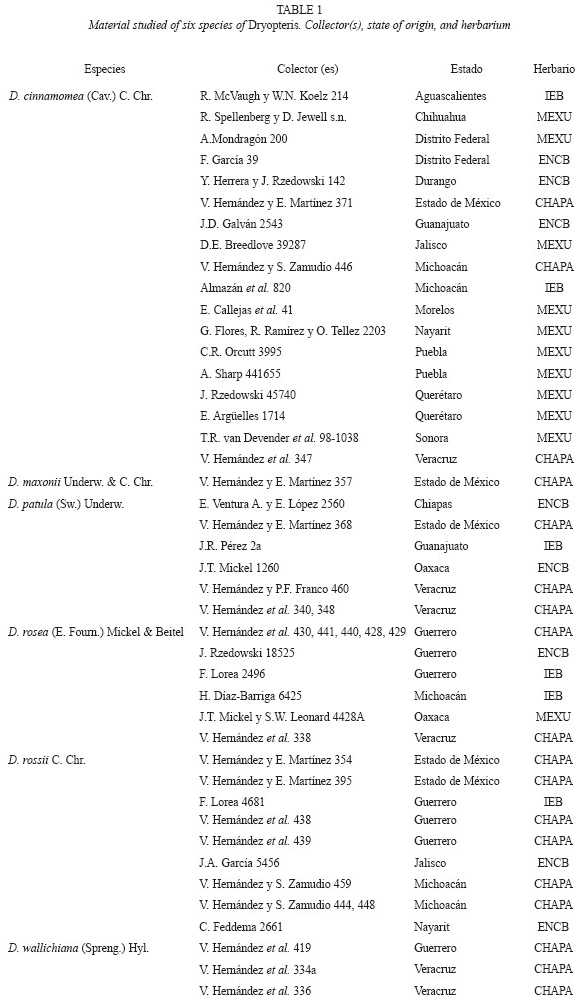
<body><![CDATA[ style="font-style: italic;">et al.</span> ejemplares depositados en     CHAPA), el </span><span style="font-family: arial;">resto procede de     ejemplares de diferentes herbarios </span><span      style="font-family: arial;">(<a href="#tabla1">Cuadro 1</a>). El     material vivo se separ&oacute; en </span><span      style="font-family: arial;">rizoma,     pec&iacute;olo y l&aacute;mina y se fijaron en FAA </span><span      style="font-family: arial;">(formaldeh&iacute;do, &aacute;cido     ac&eacute;tico glacial y alcohol </span><span      style="font-family: arial;">et&iacute;lico). El material de herbario     ]]></body>
<body><![CDATA[(pec&iacute;olo, l&aacute;mina) </span><span      style="font-family: arial;">se hidrat&oacute; en una soluci&oacute;n     de NaOH al 5 % por </span><span style="font-family: arial;">5 min y     despu&eacute;s se coloc&oacute; en FAA durante 24 h. </span></small><br      style="font-family: arial;">     <small></small><br style="font-family: arial;">     <small><span style="font-family: arial;">Se realizaron cortes     transversales a     mano </span><span style="font-family: arial;">del pec&iacute;olo y la     mitad de los cortes se aclararon </span><span     ]]></body>
<body><![CDATA[ style="font-family: arial;">con hipoclorito de sodio (cloro comercial     al </span><span style="font-family: arial;">50 %) para eliminar los     contenidos. Todos los </span><span style="font-family: arial;">cortes     se deshidrataron en concentraciones de </span><span      style="font-family: arial;">alcohol et&iacute;lico (50, 70, 95 %), se     ti&ntilde;eron con </span><span style="font-family: arial;">safranina-verde     fijo y montaron en resina sint&eacute;tica. </span><span      style="font-family: arial;">Adem&aacute;s, se realizaron cortes de la     l&aacute;mina y </span><span style="font-family: arial;">el     pec&iacute;olo de material herborizado; este material </span><span     ]]></body>
<body><![CDATA[ style="font-family: arial;">se deshidrat&oacute; en un cambiador     autom&aacute;tico Leica </span><span style="font-family: arial;">TP1020     y se incluy&oacute; en parafina. Una vez incluidos </span><span      style="font-family: arial;">en parafina se hicieron cortes     transversales </span><span style="font-family: arial;">y paradermales     en un micr&oacute;tomo rotatorio a </span><span      style="font-family: arial;">12 &micro;m de grosor, se ti&ntilde;eron     con safranina-verde </span><span style="font-family: arial;">fijo y     montaron en resina sint&eacute;tica (Johansen </span><span      style="font-family: arial;">1940). Los cortes transversales de rizoma     ]]></body>
<body><![CDATA[(material </span><span style="font-family: arial;">recolectado) se     efectuaron en el micr&oacute;tomo </span><span      style="font-family: arial;">de deslizamiento a un grosor de 80     &micro;m; una </span><span style="font-family: arial;">parte de los     cortes se aclararon con hipoclorito </span><span      style="font-family: arial;">de sodio (cloro comercial al 50 %) durante     24 h, </span><span style="font-family: arial;">se ti&ntilde;eron y     montaron con la misma t&eacute;cnica </span><span      style="font-family: arial;">usada para los cortes de pec&iacute;olo.     En cuanto a la </span><span style="font-family: arial;">l&aacute;mina     ]]></body>
<body><![CDATA[del material recolectado, &eacute;sta se cort&oacute; en&nbsp; </span><span      style="font-family: arial;">el micr&oacute;tomo rotatorio a un grosor     de 20 &micro;m. </span><span style="font-family: arial;">Una parte de     los cortes se montaron sin te&ntilde;ir en </span><span      style="font-family: arial;">gelatina glicerinada y la otra parte se     deshidrat&oacute;, </span><span style="font-family: arial;">ti&ntilde;&oacute;     y mont&oacute; con la t&eacute;cnica ya mencionada.</span></small><br      style="font-family: arial;">     <small></small><br style="font-family: arial;">     <small><span style="font-family: arial;">La pinna basal se     ]]></body>
<body><![CDATA[diafaniz&oacute;     con NaOH al </span><span style="font-family: arial;">5 % durante 24-48     h y con hipoclorito de sodio </span><span style="font-family: arial;">(cloro     comercial al 50 %) por 15 min, hasta </span><span      style="font-family: arial;">eliminar por completo los pigmentos. Se     deshidrat&oacute; </span><span style="font-family: arial;">y     ti&ntilde;&oacute; con safranina en alcohol al 95 % </span><span      style="font-family: arial;">durante 15 min, se continu&oacute; la     deshidrataci&oacute;n </span><span style="font-family: arial;">con     alcohol absoluto por 10 min, xileno-aceite </span><span     ]]></body>
<body><![CDATA[ style="font-family: arial;">de clavo (2:1) por 1 h y xileno puro por 2     h </span><span style="font-family: arial;">para montar en resina     sint&eacute;tica (Gardner 1975, </span><span      style="font-family: arial;">D&#8217;Ambrogio 1986).</span></small></div>     <p align="center"><a name="tabla1">     <br> </a><img src="/img/fbpe/rbt/v54n4/3500i1.JPG" title="" alt=""  style="width: 577px; height: 1005px;">    
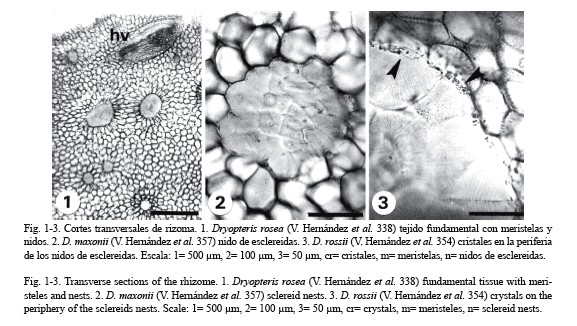
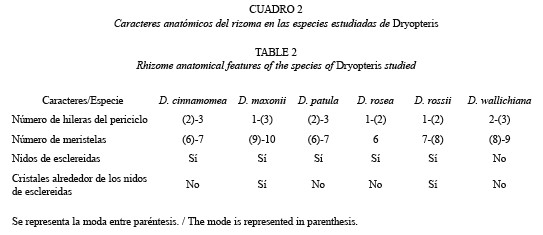
<br>     <br> </p> <small><span style="font-family: arial;">Para la elaboraci&oacute;n de las descripciones </span><span style="font-family: arial;">anat&oacute;micas del rizoma, pec&iacute;olo y l&aacute;mina, segeneraron y cuantificaron caracteres del tejido </span><span style="font-family: arial;">d&eacute;rmico, fundamental y vascular. En el pec&iacute;olo </span><span  style="font-family: arial;">se cuantific&oacute; el largo y ancho de las c&eacute;lulas </span><span style="font-family: arial;">epid&eacute;rmicas, el ancho y largo de las c&eacute;lulas del </span><span  style="font-family: arial;">escler&eacute;nquima y el n&uacute;mero de estratos; adem&aacute;s </span><span style="font-family: arial;">se cont&oacute; el n&uacute;mero de meristelas y el n&uacute;mero </span><span  style="font-family: arial;">de hileras de c&eacute;lulas del periciclo. En la l&aacute;mina </span><span style="font-family: arial;">se midieron las gl&aacute;ndulas, el largo de las c&eacute;lulas </span><span  style="font-family: arial;">oclusivas y se cont&oacute; el n&uacute;mero de hileras </span><span style="font-family: arial;">de par&eacute;nquima en empalizada y esponjoso. Se </span><span  style="font-family: arial;">hicieron 20 mediciones o conteos por car&aacute;cter </span><span style="font-family: arial;">se&ntilde;alado por individuo, con la ayuda del programa </span><span  style="font-family: arial;">Image Pro-Plus&reg; versi&oacute;n 3.1 adaptado a una </span><span style="font-family: arial;">c&aacute;mara de video Hitachi KP-D51 y a un microscopio </span><span  style="font-family: arial;">Olympus BX50. &Uacute;nicamente se sintetizan </span><span style="font-family: arial;">los valores cuantitativos a trav&eacute;s de la media o </span><span  style="font-family: arial;">la moda, debido a que el n&uacute;mero de muestra fue </span><span style="font-family: arial;">escaso y no permiti&oacute; realizar ning&uacute;n an&aacute;lisis </span><span  style="font-family: arial;">estad&iacute;stico. La terminolog&iacute;a utilizada en las descripciones </span><span style="font-family: arial;">se bas&oacute; en la literatura&nbsp; evisada para </span><span  style="font-family: arial;">pteridofitas (Sen y Mittra 1966, Ogura 1972, Lin </span><span style="font-family: arial;">y DeVol 1977, 1978, Sen y Hennipman 1981, </span><span style="font-family: arial;">Zlotnik 1991, Herrera 1993).</span></small><br style="font-family: arial;">     <div style="text-align: left;"><small></small><br  style="font-family: arial;"> <small><small><!-- big --><span style="font-family: arial; font-weight: 700;">Resultados</span><!-- /big --></small></small><br  style="font-family: arial;"> <small></small><br style="font-family: arial;"> <small><span style="font-family: arial;"><span  style="font-weight: bold;">Descripci&oacute;n anat&oacute;mica del rizoma</span>: La </span><span  style="font-family: arial;">epidermis es simple con c&eacute;lulas de diferente </span><span style="font-family: arial;">forma, desde cuadrada, rectangular a poligonal. </span><span  style="font-family: arial;">Las especies <span  style="font-style: italic;">D. cinnamomea, D. patula, </span></span><span  style="font-family: arial;"><span style="font-style: italic;">D. rosea y D. rossii</span> C. Chr., 1922 presentan </span><span  style="font-family: arial;">gl&aacute;ndulas y escamas en el margen; sin embargo, </span><span style="font-family: arial;"><span  style="font-style: italic;">D. maxonii</span> Underw. &amp; C. Chr., 1911 y <span style="font-style: italic;">D. </span></span><span  style="font-family: arial;"><span style="font-style: italic;">wallichiana</span> (Spreng.) Hyl., 1953 carecen de </span><span  style="font-family: arial;">gl&aacute;ndulas. La corteza primaria est&aacute; constituida </span><span style="font-family: arial;">por par&eacute;nquima y grupos de esclereidas </span><span  style="font-family: arial;">denominados nidos (<a href="#FIGURA1-3">Fig. 1</a>). Las c&eacute;lulas del </span><span style="font-family: arial;">par&eacute;nquima son isodiam&eacute;tricas con paredes </span><span  style="font-family: arial;">delgadas y peque&ntilde;os espacios intercelulares y </span><span style="font-family: arial;">com&uacute;nmente con contenidos de color oscuro. </span><span  style="font-family: arial;">Los nidos de esclereidas sin espacios intercelulares </span><span style="font-family: arial;">entre ellas caracterizan a <span style="font-style: italic;">D. cinnamomea</span> </span><span  style="font-family: arial;">y <span style="font-style: italic;">D. rosea</span> (<a href="#FIGURA1-3">Fig. 2</a>), mientras que en <span  style="font-style: italic;">D. patula</span> </span><span  style="font-family: arial;">se observan espacios intercelulares abundantes. </span><span style="font-family: arial;">Se detectaron cristales en la periferia de los </span><span  style="font-family: arial;">nidos de esclereidas en <span  style="font-style: italic;">D. rossii </span>y <span  style="font-style: italic;">D. maxonii</span> </span><span  style="font-family: arial;">(<a href="#FIGURA1-3">Fig. 3</a>) y en <span  style="font-style: italic;">D. wallichiana</span> no se observaron </span><span  style="font-family: arial;">los nidos de esclereidas. La estela es del tipo </span><span style="font-family: arial;">dictiostela; el n&uacute;mero de meristelas es seis en </span><span  style="font-family: arial;"><span style="font-style: italic;">D. rosea</span> y nueve en <span style="font-style: italic;">D. maxonii</span> (<a  href="#CUADRO2">Cuadro 2</a>). </span><span style="font-family: arial;">Alrededor de las meristelas se presenta la endodermis, </span><span  style="font-family: arial;">distintiva por las c&eacute;lulas rectangulares </span><span style="font-family: arial;">y la banda de Caspari en sus paredes radiales. </span><span  style="font-family: arial;">La estela est&aacute; formada por el periciclo con un&nbsp; </span><span style="font-family: arial;">m&aacute;ximo de tres hileras de c&eacute;lulas (<a href="#CUADRO2">Cuadro 2</a>), </span><span  style="font-family: arial;">el xilema est&aacute; constituido por elementos vasoy el floema por c&eacute;lulas peque&ntilde;as y par&eacute;nquima </span><span style="font-family: arial;">floem&aacute;tico con contenidos oscuros, taninos. </span></small><br  style="font-family: arial;"> </div>     <p align="justify"><small>&nbsp;</small></p>     ]]></body>
<body><![CDATA[<p align="center"><a name="FIGURA1-3"> <img style="border: 0px solid ; width: 577px; height: 326px;"  src="/img/fbpe/rbt/v54n4/3500i3.JPG" title="" alt=""></a></p>     
<p align="center"><a name="CUADRO2"> <img style="border: 0px solid ; width: 543px; height: 235px;"  src="/img/fbpe/rbt/v54n4/3500i4.JPG" title="" alt=""></a></p>     
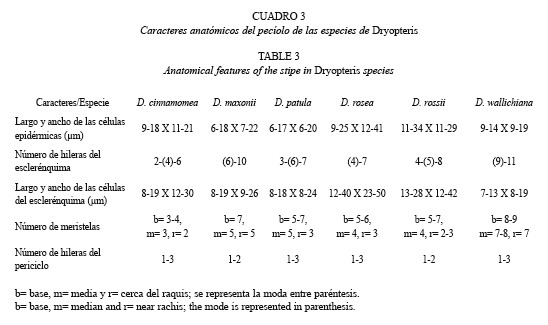
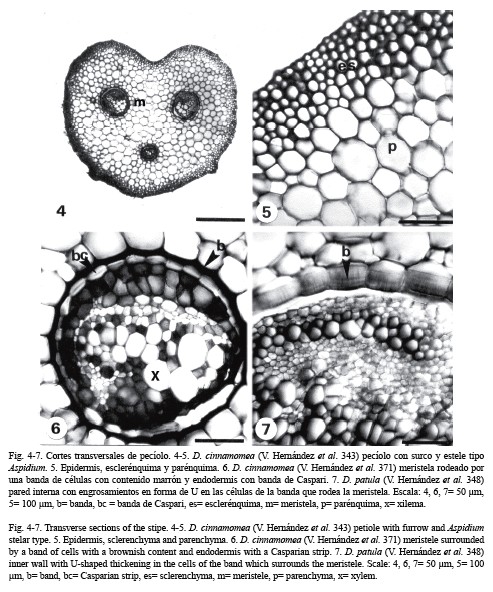
<p align="justify"><small> <br style="font-family: arial;"> </small></p>     <div style="text-align: left;"><small><span style="font-family: arial;"><span  style="font-weight: bold;">Descripci&oacute;n anat&oacute;mica de pec&iacute;olo</span>: El </span><span  style="font-family: arial;">pec&iacute;olo es cil&iacute;ndrico con un surco en la cara </span><span style="font-family: arial;">adaxial que se prolonga hacia el raquis (<a href="#FIGURA4-7">Fig. 4</a>), con escamas en la base y con gl&aacute;ndulas, </span><span style="font-family: arial;">excepto en <span  style="font-style: italic;">D. maxonii</span> y<span  style="font-style: italic;"> D. wallichiana</span>. En el </span><span  style="font-family: arial;">corte transversal, la cut&iacute;cula es delgada y lisa </span><span style="font-family: arial;">en todas las especies estudiadas. La epidermis </span><span  style="font-family: arial;">es simple (<a href="#FIGURA4-7">Fig. 5</a>), con c&eacute;lulas de pared delgada, </span><span style="font-family: arial;">cuadradas a rectangulares que var&iacute;an en <span style="font-style: italic;">D. </span></span><span style="font-family: arial;"><span  style="font-style: italic;">patula</span> de 6-17 &micro;m de longitud por 6-20 &micro;m </span><span style="font-family: arial;">de ancho hasta 11-34 &micro;m de longitud por </span><span  style="font-family: arial;">11-29 &micro;m de ancho en <span  style="font-style: italic;">D. rossii</span> (<a href="#CUADRO3">Cuadro 3</a>).</span></small><br style="font-family: arial;"> <small></small><br style="font-family: arial;"> <small><span style="font-family: arial;">La corteza est&aacute; compuesta por escler&eacute;nquima </span><span style="font-family: arial;">y par&eacute;nquima (<a href="#FIGURA4-7">Fig. 5</a>). En la parte </span><span  style="font-family: arial;">externa subyacente a la epidermis se observa el </span><span style="font-family: arial;">escler&eacute;nquima, constituido de varias hileras de </span><span  style="font-family: arial;">c&eacute;lulas que fluct&uacute;an de cuatro en <span style="font-style: italic;">D. cinnamomea</span> </span><span  style="font-family: arial;">y <span style="font-style: italic;">D. rosea</span> hasta nueve en <span style="font-style: italic;">D. wallichiana</span> </span><span style="font-family: arial;">(<a  href="#CUADRO3">Cuadro 3</a>); de forma cuadrada, pentagonal a </span><span  style="font-family: arial;">poligonal, con paredes gruesas y sin espacios </span><span style="font-family: arial;">intercelulares. Las c&eacute;lulas del par&eacute;nquima son </span><span  style="font-family: arial;">isodiam&eacute;tricas con paredes delgadas y se observan </span><span style="font-family: arial;">espacios intercelulares peque&ntilde;os. La parte m&aacute;s interna de la corteza se diferencia en una </span><span style="font-family: arial;">banda, donde los engrosamientos en las c&eacute;lulas </span><span  style="font-family: arial;">de &eacute;sta, pueden ser en la pared periclinal en </span><span style="font-family: arial;">forma de casquete y en otras c&eacute;lulas el engrosamiento </span><span  style="font-family: arial;">se extiende hacia las paredes anticlinales </span><span style="font-family: arial;">en forma de &#8220;U&#8221; (<a  href="#FIGURA4-7">Fig. 6</a>). Esta banda uniseriada </span><span style="font-family: arial;">es distintiva por los dep&oacute;sitos color marr&oacute;n en </span><span  style="font-family: arial;">la pared engrosada no lignificada (<a  href="#FIGURA4-7">Fig. 7</a>). La </span><span style="font-family: arial;">endodermis se caracteriza por la forma de las </span><span  style="font-family: arial;">c&eacute;lulas rectangulares con la banda de Caspari </span><span style="font-family: arial;">en sus paredes radiales (<a href="#FIGURA4-7">Fig. 6</a>). El periciclo se </span><span  style="font-family: arial;">constituye por uno a tres estratos de c&eacute;lulas en </span><span style="font-family: arial;">cinco especies y s&oacute;lo <span style="font-style: italic;">D. rossii</span> presenta de una a </span><span style="font-family: arial;">dos hileras de c&eacute;lulas (<a href="#CUADRO3">Cuadro 3</a>) y con paredes </span><span  style="font-family: arial;">delgadas. El n&uacute;mero de meristelas var&iacute;a a lo </span><span style="font-family: arial;">largo del pec&iacute;olo; por ejemplo en <span style="font-style: italic;">D. cinnamomea</span> </span><span style="font-family: arial;">se presentan de tres a cuatro en la base y </span><span  style="font-family: arial;">dos hacia el raquis (<a href="#CUADRO3">Cuadro 3</a>). El arreglo de&nbsp; </span><span style="font-family: arial;">las meristelas adquiere forma de arco, con los </span><span  style="font-family: arial;">haces de mayor tama&ntilde;o hacia la cara adaxial y </span><span style="font-family: arial;">entre ellos los peque&ntilde;os. En las meristelas de </span><span  style="font-family: arial;">mayor tama&ntilde;o el xilema termina en un gancho </span><span style="font-family: arial;">curvado hacia adentro, denominado hipocampo. </span><span style="font-family: arial;">Los elementos de vasos con punteaduras </span><span  style="font-family: arial;">escalariformes; el floema se constituye de </span><span style="font-family: arial;">c&eacute;lulas peque&ntilde;as, con grosor de pared primaria </span><span  style="font-family: arial;">diferente y algunas con contenidos oscuros en </span><span style="font-family: arial;">el lumen celular. La anatom&iacute;a del raquis es </span><span style="font-family: arial;">muy parecida a lo anteriormente descrito; sin </span><span  style="font-family: arial;">embargo, el n&uacute;mero de las meristelas se reduce </span><span style="font-family: arial;">en todas las especies estudiadas. Algunas veces </span><span  style="font-family: arial;">&eacute;stos se fusionan como es el caso de D. rossii </span><span style="font-family: arial;">que puede presentar dos o tres.</span></small><br style="font-family: arial;"> </div>     <p align="justify"><small>&nbsp;</small></p>     <p align="center"><a name="CUADRO3"> <img style="border: 0px solid ; width: 548px; height: 325px;"  src="/img/fbpe/rbt/v54n4/3500i5.JPG" title="" alt=""></a></p>     
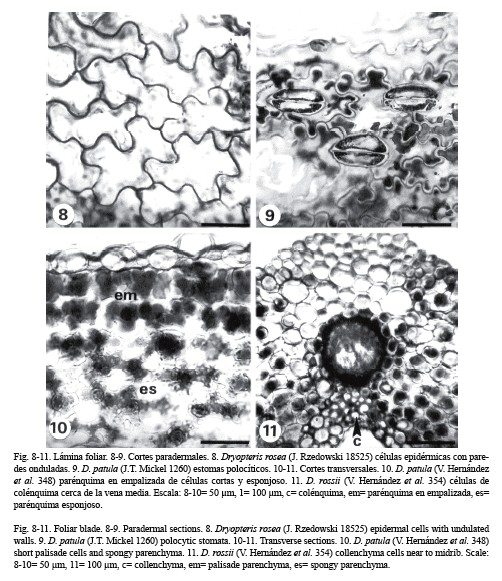
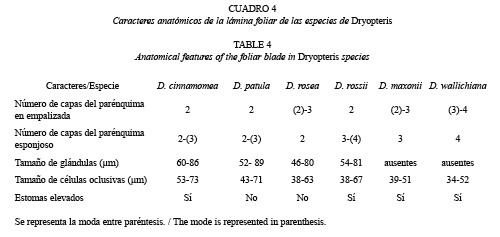
<p style="text-align: left;"><small><span style="font-family: arial;"> <span style="font-weight: bold;">Patr&oacute;n de venaci&oacute;n y anatom&iacute;a foliar</span>: El </span><span  style="font-family: arial;">patr&oacute;n de venaci&oacute;n es libre, la vena principal o </span><span style="font-family: arial;">costa central y las venas secundarias se distinguen </span><span  style="font-family: arial;">por sus diferencias en espesor; las secundarias </span><span style="font-family: arial;">se bifurcan dos a tres veces terminando muy cerca del margen. La posici&oacute;n de los soros es submarginal y se encuentran en la parte media de las venas. La l&aacute;mina en vista superficial (corte paradermal) tiene las paredes de las c&eacute;lulas epid&eacute;rmicas onduladas (<a href="#FIGURA8-11">Fig. 8</a>). Los estomas son del tipo poloc&iacute;tico, porque las c&eacute;lulas oclusivas tienen una c&eacute;lula subsidiaria en forma de herradura en todas las especies estudiadas (<a href="#FIGURA8-11">Fig. 9</a>). Sin embargo, hay una amplia variaci&oacute;n en el </span><span style="font-family: arial;">tama&ntilde;o de las c&eacute;lulas oclusivas, en <span style="font-style: italic;">D. wallichiana</span> </span><span  style="font-family: arial;">de 34-52 &micro;m y <span  style="font-style: italic;">D. cinnamomea</span> de 53-73 &micro;m </span><span  style="font-family: arial;">(<a href="#CUADRO4">Cuadro 4</a>). En ambas caras se observan gl&aacute;ndulas </span><span style="font-family: arial;">en las especies <span style="font-style: italic;">D. cinnamomea, D. patula, </span></span><span  style="font-family: arial;"><span style="font-style: italic;">D. rosea </span>y<span style="font-style: italic;"> D. rossii</span>, pero &eacute;stas no se detectaron </span><span style="font-family: arial;">en <span style="font-style: italic;">D. maxonii</span> y <span  style="font-style: italic;">D. wallichiana</span>. </span></small></p>     <p align="center"><small><span style="font-family: arial;">     <br> <a name="FIGURA4-7"> <img style="border: 0px solid ; width: 493px; height: 592px;"  src="/img/fbpe/rbt/v54n4/3500i6.JPG" title="" alt=""></a></span></small></p>     
<p align="center"><a name="FIGURA8-11"> <img style="border: 0px solid ; width: 502px; height: 581px;"  src="/img/fbpe/rbt/v54n4/3500i7.JPG" title="" alt=""></a></p>     
]]></body>
<body><![CDATA[<p align="justify"><small><span style="font-family: arial;"> <br style="font-family: arial;"> </span></small></p>     <div style="text-align: left;"><small><span style="font-family: arial;">En corte transversal la epidermis de ambas </span><span style="font-family: arial;">caras tiene c&eacute;lulas de forma cuadrada a rectangular </span><span  style="font-family: arial;">y con paredes delgadas; los estomas </span><span  style="font-family: arial;">hipostom&aacute;ticos son elevados, con la&nbsp; excepci&oacute;n </span><span style="font-family: arial;">de <span  style="font-style: italic;">D. patula</span> y<span  style="font-style: italic;"> D. rosea</span>. El mesofilo est&aacute; constituido </span><span style="font-family: arial;">por par&eacute;nquima en empalizada y esponjoso </span><span  style="font-family: arial;">(<a href="#FIGURA8-11">Fig. 10</a>). El primero presenta c&eacute;lulas de </span><span style="font-family: arial;">forma irregular con abundantes cloroplastos </span><span  style="font-family: arial;">y el n&uacute;mero de estratos var&iacute;a de dos en cinco </span><span style="font-family: arial;">especies a tres en <span style="font-style: italic;">D. wallichiana</span> (<a href="#CUADRO4">Cuadro 4</a>). </span><span  style="font-family: arial;">El par&eacute;nquima esponjoso se distingue por presentar&nbsp; </span><span  style="font-family: arial;">c&eacute;lulas de forma irregular con espacios </span><span style="font-family: arial;">intercelulares grandes (<a href="#FIGURA8-11">Fig. 10</a>), el n&uacute;mero de </span><span  style="font-family: arial;">hileras var&iacute;a de dos en <span  style="font-style: italic;">D. rosea</span> a cuatro en <span  style="font-style: italic;">D. rossii</span> y <span  style="font-style: italic;">D. wallichiana</span> (<a href="#CUADRO4">Cuadro 4</a>). El haz </span><span style="font-family: arial;">vascular de la vena principal y las c&eacute;lulas asociadas </span><span style="font-family: arial;">a &eacute;ste son muy parecidas al arreglo descrito </span><span  style="font-family: arial;">en el pec&iacute;olo con una banda de c&eacute;lulas con </span><span style="font-family: arial;">paredes engrosadas color marr&oacute;n; endodermis, </span><span  style="font-family: arial;">periciclo, xilema y floema. Adem&aacute;s se observ&oacute; </span><span style="font-family: arial;">col&eacute;nquima formado por dos a tres hileras </span><span style="font-family: arial;">cerca a la vena principal (<a href="#FIGURA8-11">Fig. 11</a>). </span></small><br  style="font-family: arial;"> <small></small><br style="font-family: arial;"> <small><small><!-- big --><span style="font-family: arial; font-weight: 700;">Discusi&oacute;n</span><!-- /big --></small></small><br  style="font-family: arial;"> <small></small><br style="font-family: arial;"> <small><span style="font-family: arial;">La anatom&iacute;a del rizoma, pec&iacute;olo y l&aacute;mina </span><span style="font-family: arial;">result&oacute; ser similar en las seis especies, con </span><span  style="font-family: arial;">algunas excepciones. Respecto a la anatom&iacute;a </span><span style="font-family: arial;">del rizoma, <span  style="font-style: italic;">D. wallichiana</span> se distingue del </span><span  style="font-family: arial;">resto de las especies estudiadas por la ausencia </span><span style="font-family: arial;">de nidos de esclereidas en &eacute;ste; mientras <span style="font-style: italic;">D. rossii </span>y <span style="font-style: italic;">D. maxonii </span>se separan por presentar </span><span style="font-family: arial;">cristales en la periferia de los nidos de esclereidas. </span><span  style="font-family: arial;">Estos caracteres aparentemente podr&iacute;an ser </span><span style="font-family: arial;">importantes para delimitar grupos de especies, </span><span  style="font-family: arial;">por lo que se recomienda continuar el estudio&nbsp; </span><span style="font-family: arial;">anat&oacute;mico del rizoma de las especies del g&eacute;nero </span><span  style="font-family: arial;"><span style="font-style: italic;">Dryopteris</span> y otros g&eacute;neros de la familia </span><span  style="font-family: arial;">Dryopteridaceae. Los nidos de esclereidas en </span><span style="font-family: arial;">el rizoma tambi&eacute;n se han observado en especies </span><span style="font-family: arial;">del g&eacute;nero <span style="font-style: italic;">Campyloneurum</span> C. Presl, 1836 </span><span style="font-family: arial;">(Zlotnik 1991).</span></small><br  style="font-family: arial;"> </div>     <p align="justify"><small>&nbsp;</small></p>     <p align="center"><a name="CUADRO4"> <img style="border: 0px solid ; width: 500px; height: 237px;"  src="/img/fbpe/rbt/v54n4/3500i8.JPG" title="" alt=""></a></p>     
<p align="justify"><small> <br style="font-family: arial;"> </small></p>     <div style="text-align: left;"><small><span style="font-family: arial;">La     forma, n&uacute;mero y arreglo de     los haces </span><span style="font-family: arial;">vasculares del     pec&iacute;olo son caracteres importantes </span><span      style="font-family: arial;">para la identificaci&oacute;n de familias,     ]]></body>
<body><![CDATA[g&eacute;neros </span><span style="font-family: arial;">y especies de     helechos (Lin y DeVol 1977, </span><span style="font-family: arial;">1978).     Ogura (1972) propuso una clasificaci&oacute;n </span><span      style="font-family: arial;">del tipo estelar para pec&iacute;olo y     raquis; y de </span><span style="font-family: arial;">acuerdo con     &eacute;sta, el g&eacute;nero <span style="font-style: italic;">Dryopteris</span>     presenta </span><span style="font-family: arial;">el tipo <span      style="font-style: italic;">Aspidium</span>. Este tipo consiste de     m&aacute;s de </span><span style="font-family: arial;">tres meristelas     arreglados en forma de arco, </span><span style="font-family: arial;">los     ]]></body>
<body><![CDATA[dos haces m&aacute;s grandes orientados hacia la </span><span      style="font-family: arial;">cara adaxial y el xilema es de la forma     hipocampo </span><span style="font-family: arial;">con la     terminaci&oacute;n curvada en gancho; </span><span      style="font-family: arial;">mientras que los otros haces m&aacute;s     peque&ntilde;os </span><span style="font-family: arial;">son     circulares o el&iacute;pticos como se observ&oacute; </span><span      style="font-family: arial;">en las seis especies estudiadas.     Adem&aacute;s del&nbsp; </span><span style="font-family: arial;">g&eacute;nero     <span style="font-style: italic;">Dryopteris</span> la estela de tipo <span     ]]></body>
<body><![CDATA[ style="font-style: italic;">Aspidium</span> </span><span      style="font-family: arial;">se encuentra en los g&eacute;neros <span      style="font-style: italic;">Blechnum</span> L., 1753 </span><span      style="font-family: arial;">y <span style="font-style: italic;">Polystichum     Roth</span>, 1799. A pesar de la variaci&oacute;n </span><span      style="font-family: arial;">en el n&uacute;mero meristelas en las     especies </span><span style="font-family: arial;">de <span      style="font-style: italic;">Dryopteris</span>, &eacute;sta     permiti&oacute; delimitar entre </span><span      style="font-family: arial;">especies; por ejemplo <span     ]]></body>
<body><![CDATA[ style="font-style: italic;">D. wallichiana</span> presenta </span><span      style="font-family: arial;">ocho a nueve meristelas en la base y siete     hacia </span><span style="font-family: arial;">el raquis y puede     separarse de las otras cinco </span><span style="font-family: arial;">especies     estudiadas con un menor n&uacute;mero de </span><span      style="font-family: arial;">meristelas, por ejemplo en <span      style="font-style: italic;">D. cinnamomea</span> </span><span      style="font-family: arial;">con tres a cuatro en la base y dos hacia     el </span><span style="font-family: arial;">raquis. Adem&aacute;s, la     familia Dryopteridaceae se </span><span style="font-family: arial;">caracteriza     ]]></body>
<body><![CDATA[por presentar tres o m&aacute;s meristelas. </span><span      style="font-family: arial;">Este car&aacute;cter permite separarla de     las familias </span><span style="font-family: arial;">Aspleniaceae,     Athyriaceae y&nbsp; Thelypteridaceae </span><span      style="font-family: arial;">que s&oacute;lo tienen dos meristelas     (Pacheco y </span><span style="font-family: arial;">Lorea 1985,     Palacios-Rios 1992). De acuerdo </span><span      style="font-family: arial;">con Moran (1987), el arreglo de las     meristelas </span><span style="font-family: arial;">es distinto en los     g&eacute;neros de Dryopteridaceae; </span><span     ]]></body>
<body><![CDATA[ style="font-family: arial;">por ejemplo en<span      style="font-style: italic;"> Cyrtomium</span> C. Presl, 1930, </span><span      style="font-family: arial;"><span style="font-style: italic;">Dryopteris</span>     y <span style="font-style: italic;">Polystichum</span> muestran forma     de </span><span style="font-family: arial;">&#8220;C&#8221;; este arreglo se     confirm&oacute; en las especies&nbsp; </span><span      style="font-family: arial;">estudiadas de <span      style="font-style: italic;">Dryopteris</span>; mientras en </span><span      style="font-family: arial;"><span style="font-style: italic;">Polybotrya</span>     Humb. &amp; Bonpl. ex Willd., 1810 </span><span     ]]></body>
<body><![CDATA[ style="font-family: arial;">es muy semejante a la forma de hongo con     la </span><span style="font-family: arial;">base hacia la cara     adaxial. En este &uacute;ltimo g&eacute;nero </span><span      style="font-family: arial;">tambi&eacute;n el n&uacute;mero de     meristelas es mayor </span><span style="font-family: arial;">a tres.     Una variaci&oacute;n similar se ha informado </span><span      style="font-family: arial;">para los g&eacute;neros <span      style="font-style: italic;">Marattia</span> Sw., 1788 (Velasco </span><span      style="font-family: arial;">1971), <span style="font-style: italic;">Tectaria</span>     Cav., 1799 (Vel&aacute;squez 1983) y </span><span     ]]></body>
<body><![CDATA[ style="font-family: arial;"><span style="font-style: italic;">Cheilanthes</span>     Sw., 1867 (Herrera 1993).</span></small><br style="font-family: arial;">     <small></small><br style="font-family: arial;">     <small><span style="font-family: arial;">Las seis especies de <span      style="font-style: italic;">Dryopteris</span> presentaron </span><span      style="font-family: arial;">en el pec&iacute;olo y la l&aacute;mina     una banda </span><span style="font-family: arial;">alrededor de las     meristelas. Las c&eacute;lulas de esta </span><span      style="font-family: arial;">banda tuvieron paredes engrosadas de color     </span><span style="font-family: arial;">marr&oacute;n en cortes no     ]]></body>
<body><![CDATA[aclarados; sin embargo,en los cortes donde este contenido se     elimin&oacute;,&nbsp; </span><span style="font-family: arial;">se     apreci&oacute; s&oacute;lo la pared engrosada formando </span><span      style="font-family: arial;">un casquete o en &#8220;U&#8221;. En el g&eacute;nero <span      style="font-style: italic;">Tectaria</span> la </span><span      style="font-family: arial;">banda se describe como una hilera de la     corteza </span><span style="font-family: arial;">interna con     engrosamientos en las paredes </span><span style="font-family: arial;">radiales     (Vel&aacute;squez 1983), por lo que difiere </span><span      style="font-family: arial;">de lo observado en las especies de <span     ]]></body>
<body><![CDATA[ style="font-style: italic;">Dryopteris</span> </span><span      style="font-family: arial;">donde se encontraron arreglados en forma     de&nbsp; </span><span style="font-family: arial;">&#8220;casquete&#8221; o en &#8220;U&#8221;.     Posiblemente la composici&oacute;n </span><span      style="font-family: arial;">de esta pared sea exclusivamente&nbsp; </span><span      style="font-family: arial;">elul&oacute;sica debido a que se     ti&ntilde;&oacute; de verde con la </span><span      style="font-family: arial;">doble tinci&oacute;n safranina-verde fijo.     En la literatura </span><span style="font-family: arial;">se denomina     a esta banda, vaina, anillo o </span><span style="font-family: arial;">banda     ]]></body>
<body><![CDATA[esclerosada o escler&oacute;tica (Ogura 1972, </span><span      style="font-family: arial;">Lin y DeVol 1977, 1978, Vel&aacute;squez     1983, </span><span style="font-family: arial;">Zlotnik 1991).     Considerando que en las especies </span><span      style="font-family: arial;">estudiadas de <span      style="font-style: italic;">Dryopteris</span> las paredes de las&nbsp;     </span><span style="font-family: arial;">c&eacute;lulas no estuvieron     lignificadas no se debe </span><span style="font-family: arial;">emplear     el t&eacute;rmino esclerosada para denominar </span><span      style="font-family: arial;">la banda. Ogura (1972) se&ntilde;ala que     ]]></body>
<body><![CDATA[esta banda es </span><span style="font-family: arial;">una vaina de     soporte y la considera como tejido </span><span      style="font-family: arial;">mec&aacute;nico alrededor de las     meristelas del rizoma </span><span style="font-family: arial;">y     pec&iacute;olo, por estar constituida por esclereidas&nbsp; </span><span      style="font-family: arial;">con paredes gruesas de color     marr&oacute;n. </span><span style="font-family: arial;">La banda     conserv&oacute; las paredes no lignificadas </span><span      style="font-family: arial;">en <span style="font-style: italic;">Dryopteris</span>,     por ello se interpret&oacute; como </span><span     ]]></body>
<body><![CDATA[ style="font-family: arial;">col&eacute;nquima, contribuyendo al     sost&eacute;n y proporcionando&nbsp; </span><span      style="font-family: arial;">flexibilidad al pec&iacute;olo y     l&aacute;mina (Esau </span><span style="font-family: arial;">1976,     Niklas 1992); ser&iacute;a interesante confirmar&nbsp; </span><span      style="font-family: arial;">la presencia de col&eacute;nquima en otras     especies </span><span style="font-family: arial;">de helechos, debido     a que tambi&eacute;n la banda </span><span style="font-family: arial;">se     ha observado en las familias Blechnaceae, </span><span      style="font-family: arial;">Davalliaceae, Polypodiaceae,     ]]></body>
<body><![CDATA[Oleandraceae&nbsp; </span><span style="font-family: arial;">(Lin y     DeVol 1977, 1978) y Lomariopsidaceae </span><span      style="font-family: arial;">(Rojas, en prep.). Los contenidos color     marr&oacute;n </span><span style="font-family: arial;">en la     c&eacute;lulas de la banda se observaron en </span><span      style="font-family: arial;">las seis especies estudiadas y,     seguramente, </span><span style="font-family: arial;">corresponden a     los taninos descritos para otras </span><span      style="font-family: arial;">especies de pteridofitas (Bell 1951). A     pesar </span><span style="font-family: arial;">de pertenecer a la     ]]></body>
<body><![CDATA[familia Dryopteridaceae el </span><span style="font-family: arial;">g&eacute;nero     <span style="font-style: italic;">Polybotrya</span> no presenta esta     banda en el </span><span style="font-family: arial;">pec&iacute;olo y     la l&aacute;mina; sin embargo, Moran (1987) </span><span      style="font-family: arial;">menciona la presencia de un anillo o vaina     de&nbsp; </span><span style="font-family: arial;">scler&eacute;nquima     formado por varias hileras de </span><span style="font-family: arial;">fibras     en el rizoma y las ra&iacute;ces de<span style="font-style: italic;">     Polybotrya</span>. </span><span style="font-family: arial;">En las     especies estudiadas de <span style="font-style: italic;">Dryopteris</span>     ]]></body>
<body><![CDATA[no se </span><span style="font-family: arial;">observ&oacute; dicha     banda asociada a las meristelas&nbsp; </span><span      style="font-family: arial;">en el rizoma. Por lo anterior, puede     se&ntilde;alarse </span><span style="font-family: arial;">que la banda     es com&uacute;n en la familia </span><span style="font-family: arial;">Dryopteridaceae;     sin embargo, esto no significa </span><span style="font-family: arial;">que     todos los g&eacute;neros y todos los &oacute;rganos de la </span><span      style="font-family: arial;">planta la presentan. Se sugiere estudiar     la anatom&iacute;a&nbsp; </span><span style="font-family: arial;">de     los seis taxa restantes de <span style="font-style: italic;">Dryopteris</span>     ]]></body>
<body><![CDATA[</span><span style="font-family: arial;">en M&eacute;xico y de otras     regiones para corroborar </span><span style="font-family: arial;">su     presencia en los diferentes &oacute;rganos.</span></small>    <br> <small><span style="font-family: arial;"></span></small>    <br>     <small><span style="font-family: arial;">&nbsp;</span><span      style="font-family: arial;">Las especies estudiadas     de <span style="font-style: italic;">Dryopteris</span> presentaron </span><span      style="font-family: arial;">un patr&oacute;n de venaci&oacute;n libre     y simple&nbsp; </span><span style="font-family: arial;">semejante a <span     ]]></body>
<body><![CDATA[ style="font-style: italic;">Marattia</span> y Cheilanthes (Velasco </span><span      style="font-family: arial;">1971, Herrera 1993); sin embargo, en los     g&eacute;neros </span><span style="font-family: arial;"><span      style="font-style: italic;">Campyloneurum</span>, <span      style="font-style: italic;">Microgramma</span> C. Presl, </span><span      style="font-family: arial;">1836, <span style="font-style: italic;">Niphidium</span>     J. Sm., 1875 y <span style="font-style: italic;">Pleopeltis</span> </span><span      style="font-family: arial;">Humb. &amp; Bonpl. ex Willd., 1810, la     venaci&oacute;n </span><span style="font-family: arial;">es reticulada     con areolas (Zlotnik 1991) y en </span><span     ]]></body>
<body><![CDATA[ style="font-family: arial;"><span style="font-style: italic;">Polybotrya</span>     puede ser libre o anastomosada </span><span style="font-family: arial;">(Moran     1987). El mesofilo estuvo formado por </span><span      style="font-family: arial;">par&eacute;nquima en empalizada y     esponjoso en las </span><span style="font-family: arial;">especies     estudiadas, similar a lo informado para </span><span      style="font-family: arial;">especies de <span      style="font-style: italic;">Marattia, Pleopeltis, Cheilanthes, </span></span><span      style="font-family: arial;"><span style="font-style: italic;">Elaphoglossum</span>     y <span style="font-style: italic;">Woodwardia</span> J. E. Sm., 1793 </span><span     ]]></body>
<body><![CDATA[ style="font-family: arial;">(Velasco 1971, Lucansky 1981, Zlotnik     1991, </span><span style="font-family: arial;">Guantay y     Hern&aacute;ndez 1990, Herrera 1993). En </span><span      style="font-family: arial;">los helechos acu&aacute;ticos los espacios     intercelulares </span><span style="font-family: arial;">suelen ser     m&aacute;s grandes y abundantes; a veces </span><span      style="font-family: arial;">las c&eacute;lulas del par&eacute;nquima     en empalizada tienen </span><span style="font-family: arial;">forma de     &#8220;H&#8221; y en el esponjoso las c&eacute;lulas son </span><span      style="font-family: arial;">redondas; en otras especies s&oacute;lo se     ]]></body>
<body><![CDATA[menciona </span><span style="font-family: arial;">como mesofilo (Ogura     1972). La anatom&iacute;a de la </span><span      style="font-family: arial;">l&aacute;mina de las especies de <span      style="font-style: italic;">Dryopteris</span> estudiadas </span><span      style="font-family: arial;">es diferente a la del g&eacute;nero <span      style="font-style: italic;">Polybotrya</span> donde el </span><span      style="font-family: arial;">par&eacute;nquima en empalizada     est&aacute; ausente, s&oacute;lo presenta </span><span      style="font-family: arial;">c&eacute;lulas de par&eacute;nquima     cil&iacute;ndricas y grandes </span><span style="font-family: arial;">espacios     ]]></body>
<body><![CDATA[intercelulares; en el lado adaxial </span><span      style="font-family: arial;">tiene brazos de col&eacute;nquima (Moran     1987); en </span><span style="font-family: arial;">los     g&eacute;neros&nbsp; <span style="font-style: italic;">Campyloneurum,     Microgramma, </span></span><span style="font-family: arial;"><span      style="font-style: italic;">Niphidium</span> y <span      style="font-style: italic;">Tectaria</span> s&oacute;lo tienen     par&eacute;nquima </span><span style="font-family: arial;">esponjoso     (Vel&aacute;squez 1983, Zlotnik 1991). Se </span><span      style="font-family: arial;">confirma la presencia de col&eacute;nquima     ]]></body>
<body><![CDATA[en la l&aacute;mina </span><span style="font-family: arial;">de las     especies de <span style="font-style: italic;">Dryopteris</span>, cerca     de la </span><span style="font-family: arial;">vena principal en el     cara abaxial. En <span style="font-style: italic;">Asplenium</span> </span><span      style="font-family: arial;">L., 1753, el col&eacute;nquima se     inform&oacute; tambi&eacute;n alrededor </span><span      style="font-family: arial;">de las venas, formando una conexi&oacute;n     con&nbsp; </span><span style="font-family: arial;">la hipodermis     (Chaerle y Viane 2004).</span></small><br style="font-family: arial;">     <small></small><br style="font-family: arial;">     ]]></body>
<body><![CDATA[<small><span style="font-family: arial;">En conclusi&oacute;n, los     caracteres     anat&oacute;micos </span><span style="font-family: arial;">de rizoma,     pec&iacute;olo y l&aacute;mina de las seis especies de <span      style="font-style: italic;">Dryopteris</span> resultaron ser     homog&eacute;neos y </span><span style="font-family: arial;">proporcionan     por s&iacute; mismos poca informaci&oacute;n </span><span      style="font-family: arial;">para separar las especies. Sin embargo,     las </span><span style="font-family: arial;">diferencias     anat&oacute;micas encontradas en los dos </span><span     ]]></body>
<body><![CDATA[ style="font-family: arial;">&oacute;rganos deber&aacute;n corroborarse     al estudiar en </span><span style="font-family: arial;">otras especies     del g&eacute;nero <span style="font-style: italic;">Dryopteris</span>     tanto a </span><span style="font-family: arial;">nivel nacional como     mundial para confirmar </span><span style="font-family: arial;">valor     diagn&oacute;stico.</span></small><br style="font-family: arial;">     <small></small><br style="font-family: arial;">     <small><small><!-- big --><span style="font-family: arial; font-weight: 700;">Agradecimientos</span><!-- /big --></small></small><br      style="font-family: arial;">     <small></small><br style="font-family: arial;">     ]]></body>
<body><![CDATA[<small><span style="font-family: arial;">Se agradece a los curadores de     CHAPA,     </span><span style="font-family: arial;">ENCB, IEB, MEXU por     permitirnos remover </span><span style="font-family: arial;">material     para realizar este estudio. Al </span><span style="font-family: arial;">CONACyT     por la beca otorgada a VHH (No. </span><span      style="font-family: arial;">de registro: 162688) para realizar     estudios de </span><span style="font-family: arial;">Maestr&iacute;a y     al Colegio de Postgraduados por las </span><span      style="font-family: arial;">facilidades. A Ren&eacute;     ]]></body>
<body><![CDATA[Hern&aacute;ndez-G&oacute;mez, Pedro </span><span      style="font-family: arial;">Franco H., Enrique Mart&iacute;nez V.,     Valent&iacute;n J. </span><span style="font-family: arial;">Reyes H. y     Ces&aacute;reo Catal&aacute;n-Hevar&iacute;stico por </span><span      style="font-family: arial;">su valiosa ayuda en la recolecta de campo     y </span><span style="font-family: arial;">a dos revisores     an&oacute;nimos por sus comentarios </span><span      style="font-family: arial;">favorables y sugerencias.</span></small><br      style="font-family: arial;">     <small></small><br style="font-family: arial;">     ]]></body>
<body><![CDATA[<small><small><!-- big --><span style="font-family: arial; font-weight: 700;">Resumen</span><!-- /big --></small></small><br      style="font-family: arial;">     <small></small><br style="font-family: arial;">     <small><span style="font-family: arial;">Se estudi&oacute; la     anatom&iacute;a     del rizoma y hoja de especies </span><span style="font-family: arial;">mexicanas     de <span style="font-style: italic;">Dryopteris</span> Adans. y se     compar&oacute; con </span><span style="font-family: arial;">la     informaci&oacute;n disponible para Dryopteridaceae y otras </span><span      style="font-family: arial;">familias de helechos en busca de     ]]></body>
<body><![CDATA[caracteres anat&oacute;micos </span><span style="font-family: arial;">con     valor diagn&oacute;stico. La anatom&iacute;a de rizoma, pec&iacute;olo     y </span><span style="font-family: arial;">l&aacute;mina es similar en     las especies del complejo <span style="font-style: italic;">Dryopteris     </span></span><span style="font-family: arial;"><span      style="font-style: italic;">patula</span>. Las c&eacute;lulas con     pared engrosada, no lignificada </span><span      style="font-family: arial;">y en forma de casquete o de &#8220;U&#8221; presentes     alrededor de </span><span style="font-family: arial;">las meristelas     corresponden a col&eacute;nquima, a diferencia de </span><span     ]]></body>
<body><![CDATA[ style="font-family: arial;">lo informado para otras familias de     helechos. <span style="font-style: italic;">Dryopteris </span></span><span      style="font-family: arial;"><span style="font-style: italic;">wallichiana</span>     (Spreng.) Hyl. se distingue anat&oacute;micamente </span><span      style="font-family: arial;">de las otras especies estudiadas por     presentar un mayor </span><span style="font-family: arial;">n&uacute;mero     de capas de escler&eacute;nquima y de meristelas en el </span><span      style="font-family: arial;">pec&iacute;olo, adem&aacute;s de carecer     de nidos de esclereidas en el </span><span style="font-family: arial;">rizoma.     <span style="font-style: italic;">Dryopteris rossii</span> y <span     ]]></body>
<body><![CDATA[ style="font-style: italic;">D. maxonii</span> se caracterizan por </span><span      style="font-family: arial;">la presencia de cristales en la periferia     de los nidos en el </span><span style="font-family: arial;">rizoma.     Las gl&aacute;ndulas en la l&aacute;mina est&aacute;n ausentes en <span      style="font-style: italic;">D. </span></span><span      style="font-family: arial;"><span style="font-style: italic;">maxonii</span>     y <span style="font-style: italic;">D. wallichiana</span>.</span></small><br      style="font-family: arial;">     <small></small><br style="font-family: arial;">     <small><span style="font-family: arial;"><span     ]]></body>
<body><![CDATA[ style="font-weight: bold;">Palabras     clave</span>: anatom&iacute;a, l&aacute;mina, <span      style="font-style: italic;">Dryopteris</span>, Dryopteridaceae,     M&eacute;xico, rizoma, pec&iacute;olo.</span></small><br      style="font-family: arial;">     <small></small><br style="font-family: arial;">     <small><small><!-- big --><span style="font-family: arial; font-weight: 700;">Referencias</span><!-- /big --></small></small><br      style="font-family: arial;">     <small></small><br style="font-family: arial;">     <small><span style="font-family: arial;">Aguilar-P&eacute;rez, C., L.     ]]></body>
<body><![CDATA[Pacheco     &amp; L. Zelaya-Molina. 1994. </span><span style="font-family: arial;">Estudio     anat&oacute;mico de <span style="font-style: italic;">Diplazium     plantaginifolium</span> </span><span style="font-family: arial;">(L.)     Urban, <span style="font-style: italic;">D. ternatum</span> y <span      style="font-style: italic;">D. striatum</span> (L.) Presl., p. </span><span      style="font-family: arial;">903. <span style="font-style: italic;">In</span>     VII Congreso Latinoamericano de Bot&aacute;nica. </span><span      style="font-family: arial;">Mar del Plata, Buenos Aires, Argentina.</span></small><br      style="font-family: arial;">     ]]></body>
<body><![CDATA[<small></small><br style="font-family: arial;">     <!-- ref --><small><span style="font-family: arial;">    &nbsp;&nbsp;&nbsp;&nbsp;&nbsp;&nbsp;&nbsp;&nbsp;[&#160;<a href="javascript:void(0);" onclick="javascript: window.open('/scielo.php?script=sci_nlinks&ref=1359089&pid=S0034-7744200600040001400001&lng=','','width=640,height=500,resizable=yes,scrollbars=1,menubar=yes,');">Links</a>&#160;]<!-- end-ref --><!-- ref -->Bell, P.R. 1951. Studies in the genus <span style="font-style: italic;">Elaphoglossum</span>. III. </span><span  style="font-family: arial;">Anatomy of the rhizome and frond. Ann. Bot. 15: </span><span style="font-family: arial;">347-357.</span></small><br  style="font-family: arial;"> <small></small><br style="font-family: arial;"> <small><span style="font-family: arial;">    &nbsp;&nbsp;&nbsp;&nbsp;&nbsp;&nbsp;&nbsp;&nbsp;[&#160;<a href="javascript:void(0);" onclick="javascript: window.open('/scielo.php?script=sci_nlinks&ref=1359090&pid=S0034-7744200600040001400002&lng=','','width=640,height=500,resizable=yes,scrollbars=1,menubar=yes,');">Links</a>&#160;]<!-- end-ref --><!-- ref -->Carlquist, S. &amp; E.L. Schneider. 1997. SEM studies on </span><span style="font-family: arial;">vessels in ferns 1. <span style="font-style: italic;">Woodsia obtusa</span>. Amer. Fern J. </span><span style="font-family: arial;">87: 1-8.</span></small><br  style="font-family: arial;"> <small></small><br style="font-family: arial;"> <small><span style="font-family: arial;">    &nbsp;&nbsp;&nbsp;&nbsp;&nbsp;&nbsp;&nbsp;&nbsp;[&#160;<a href="javascript:void(0);" onclick="javascript: window.open('/scielo.php?script=sci_nlinks&ref=1359091&pid=S0034-7744200600040001400003&lng=','','width=640,height=500,resizable=yes,scrollbars=1,menubar=yes,');">Links</a>&#160;]<!-- end-ref --><!-- ref -->Carlquist, S. &amp; E.L. Schneider. 1999. SEM studies on </span><span style="font-family: arial;">vessels in ferns. 12. Marattiaceae, with comments on </span><span  style="font-family: arial;">vessel patterns in Eusporangiate ferns. Amer. J. Bot. </span><span style="font-family: arial;">86: 457-464.</span></small><br  style="font-family: arial;"> <small></small><br style="font-family: arial;"> <small><span style="font-family: arial;">    &nbsp;&nbsp;&nbsp;&nbsp;&nbsp;&nbsp;&nbsp;&nbsp;[&#160;<a href="javascript:void(0);" onclick="javascript: window.open('/scielo.php?script=sci_nlinks&ref=1359092&pid=S0034-7744200600040001400004&lng=','','width=640,height=500,resizable=yes,scrollbars=1,menubar=yes,');">Links</a>&#160;]<!-- end-ref --><!-- ref -->Carlquist, S. &amp; E.L. Schneider. 2000. SEM studies on </span><span style="font-family: arial;">vessels in fern 18. Montane Cheilanthoid ferns </span><span  style="font-family: arial;">(Pteridaceae) on North America. Aliso 19: 31-39. </span></small>    &nbsp;&nbsp;&nbsp;&nbsp;&nbsp;&nbsp;&nbsp;&nbsp;[&#160;<a href="javascript:void(0);" onclick="javascript: window.open('/scielo.php?script=sci_nlinks&ref=1359093&pid=S0034-7744200600040001400005&lng=','','width=640,height=500,resizable=yes,scrollbars=1,menubar=yes,');">Links</a>&#160;]<!-- end-ref --><!-- ref --><br> <small><span style="font-family: arial;"></span></small><br  style="font-family: arial;"> <small><span style="font-family: arial;"></span><span  style="font-family: arial;">Carlquist, S. &amp; E.L. Schneider. 2001. Vessels in ferns: </span><span  style="font-family: arial;">structural, ecological, and evolutionary significance. </span><span style="font-family: arial;">Amer. J. Bot. 88: 1-13.</span></small><br style="font-family: arial;"> <small></small><br style="font-family: arial;"> <small><span style="font-family: arial;">    &nbsp;&nbsp;&nbsp;&nbsp;&nbsp;&nbsp;&nbsp;&nbsp;[&#160;<a href="javascript:void(0);" onclick="javascript: window.open('/scielo.php?script=sci_nlinks&ref=1359094&pid=S0034-7744200600040001400006&lng=','','width=640,height=500,resizable=yes,scrollbars=1,menubar=yes,');">Links</a>&#160;]<!-- end-ref --><!-- ref -->Chaerle, P. &amp; R.L.L. Viane. 2004. Leaf anatomy and the </span><span style="font-family: arial;">occurrence of false veins in <span style="font-style: italic;">Asplenium</span> (Aspleniaceae, </span><span style="font-family: arial;">Pterydophyta). Bot. J. Linn. Soc. 145: 187-194.</span></small><br  style="font-family: arial;"> <small></small><br style="font-family: arial;"> <small><span style="font-family: arial;">    &nbsp;&nbsp;&nbsp;&nbsp;&nbsp;&nbsp;&nbsp;&nbsp;[&#160;<a href="javascript:void(0);" onclick="javascript: window.open('/scielo.php?script=sci_nlinks&ref=1359095&pid=S0034-7744200600040001400007&lng=','','width=640,height=500,resizable=yes,scrollbars=1,menubar=yes,');">Links</a>&#160;]<!-- end-ref --><!-- ref -->D&#8217;Ambrogio, A.A. 1986. Manual de t&eacute;cnicas de histolog&iacute;a </span><span  style="font-family: arial;">vegetal. Hemisferio Sur, Buenos Aires, </span><span  style="font-family: arial;">Argentina. 83 p.</span></small><br  style="font-family: arial;"> <small></small><br style="font-family: arial;"> <small><span style="font-family: arial;">    &nbsp;&nbsp;&nbsp;&nbsp;&nbsp;&nbsp;&nbsp;&nbsp;[&#160;<a href="javascript:void(0);" onclick="javascript: window.open('/scielo.php?script=sci_nlinks&ref=1359096&pid=S0034-7744200600040001400008&lng=','','width=640,height=500,resizable=yes,scrollbars=1,menubar=yes,');">Links</a>&#160;]<!-- end-ref --><!-- ref -->D&iacute;az-Barriga, H. &amp; M. Palacios-Rios. 1992. Listado </span><span style="font-family: arial;">preliminar de especies pteridofitas de los estados </span><span  style="font-family: arial;">de Guanajuato, Michoac&aacute;n y Quer&eacute;taro, M&eacute;xico, </span><span  style="font-family: arial;">p. 1-45. <span style="font-style: italic;">In</span> J. Rzedowski &amp; G.C. de Rzedowski. </span><span  style="font-family: arial;">Flora del Baj&iacute;o y de regiones adyacentes. Fasc&iacute;culo </span><span style="font-family: arial;">Complementario III. Xalapa, Veracruz, M&eacute;xico.</span></small><br  style="font-family: arial;"> <small></small><br style="font-family: arial;"> <small><span style="font-family: arial;">    &nbsp;&nbsp;&nbsp;&nbsp;&nbsp;&nbsp;&nbsp;&nbsp;[&#160;<a href="javascript:void(0);" onclick="javascript: window.open('/scielo.php?script=sci_nlinks&ref=1359097&pid=S0034-7744200600040001400009&lng=','','width=640,height=500,resizable=yes,scrollbars=1,menubar=yes,');">Links</a>&#160;]<!-- end-ref --><!-- ref -->Esau, K. 1976. Anatom&iacute;a vegetal. Omega, Madrid, Espa&ntilde;a. </span><span  style="font-family: arial;">779 p.</span></small><br  style="font-family: arial;"> <small></small><br style="font-family: arial;"> <small><span style="font-family: arial;">    &nbsp;&nbsp;&nbsp;&nbsp;&nbsp;&nbsp;&nbsp;&nbsp;[&#160;<a href="javascript:void(0);" onclick="javascript: window.open('/scielo.php?script=sci_nlinks&ref=1359098&pid=S0034-7744200600040001400010&lng=','','width=640,height=500,resizable=yes,scrollbars=1,menubar=yes,');">Links</a>&#160;]<!-- end-ref --><!-- ref -->Gardner, R.O. 1975. An overview of botanical clearing </span><span style="font-family: arial;">technique. Stain Technol. 50: 99-105.</span></small><br style="font-family: arial;"> <small></small><br style="font-family: arial;"> <small><span style="font-family: arial;">    &nbsp;&nbsp;&nbsp;&nbsp;&nbsp;&nbsp;&nbsp;&nbsp;[&#160;<a href="javascript:void(0);" onclick="javascript: window.open('/scielo.php?script=sci_nlinks&ref=1359099&pid=S0034-7744200600040001400011&lng=','','width=640,height=500,resizable=yes,scrollbars=1,menubar=yes,');">Links</a>&#160;]<!-- end-ref --><!-- ref -->Guantay, M.E. &amp; M. Hern&aacute;ndez. 1990. Estudio morfoanat&oacute;mico </span><span  style="font-family: arial;">de las especies del g&eacute;nero <span  style="font-style: italic;">Elaphoglossum</span> </span><span  style="font-family: arial;">Schott de Tucum&aacute;n. Lilloa 38: 73-84.</span></small><br  style="font-family: arial;"> <small></small><br style="font-family: arial;"> <small><span style="font-family: arial;">    &nbsp;&nbsp;&nbsp;&nbsp;&nbsp;&nbsp;&nbsp;&nbsp;[&#160;<a href="javascript:void(0);" onclick="javascript: window.open('/scielo.php?script=sci_nlinks&ref=1359100&pid=S0034-7744200600040001400012&lng=','','width=640,height=500,resizable=yes,scrollbars=1,menubar=yes,');">Links</a>&#160;]<!-- end-ref --><!-- ref -->Hern&aacute;ndez H., V. 2003. Anatom&iacute;a y morfolog&iacute;a del complejo </span><span  style="font-family: arial;"><span style="font-style: italic;">Dryopteris patula</span> (Pteridophyta: Dryopteridaceae) en </span><span  style="font-family: arial;">M&eacute;xico. Tesis de Maestr&iacute;a, Colegio de Postgraduados, </span><span style="font-family: arial;">Montecillo, M&eacute;xico. 88 p.</span></small><br style="font-family: arial;"> <small></small><br style="font-family: arial;"> <small><span style="font-family: arial;">    &nbsp;&nbsp;&nbsp;&nbsp;&nbsp;&nbsp;&nbsp;&nbsp;[&#160;<a href="javascript:void(0);" onclick="javascript: window.open('/scielo.php?script=sci_nlinks&ref=1359101&pid=S0034-7744200600040001400013&lng=','','width=640,height=500,resizable=yes,scrollbars=1,menubar=yes,');">Links</a>&#160;]<!-- end-ref --><!-- ref -->Herrera, M.C.M. 1993. Anatom&iacute;a de dos especies de </span><span style="font-family: arial;"><span  style="font-style: italic;">Cheilanthes</span> Swartz. Tesis de Maestr&iacute;a, Colegio de </span><span style="font-family: arial;">Postgraduados, Montecillo, M&eacute;xico. 107 p.</span></small><br  style="font-family: arial;"> <small></small><br style="font-family: arial;"> <small><span style="font-family: arial;">    &nbsp;&nbsp;&nbsp;&nbsp;&nbsp;&nbsp;&nbsp;&nbsp;[&#160;<a href="javascript:void(0);" onclick="javascript: window.open('/scielo.php?script=sci_nlinks&ref=1359102&pid=S0034-7744200600040001400014&lng=','','width=640,height=500,resizable=yes,scrollbars=1,menubar=yes,');">Links</a>&#160;]<!-- end-ref --><!-- ref -->Johansen, D.A. 1940. Plant microtechnique. McGraw-Hill, </span><span style="font-family: arial;">Nueva York, EEUU. 523 p. </span></small>    &nbsp;&nbsp;&nbsp;&nbsp;&nbsp;&nbsp;&nbsp;&nbsp;[&#160;<a href="javascript:void(0);" onclick="javascript: window.open('/scielo.php?script=sci_nlinks&ref=1359103&pid=S0034-7744200600040001400015&lng=','','width=640,height=500,resizable=yes,scrollbars=1,menubar=yes,');">Links</a>&#160;]<!-- end-ref --><br> <small><span style="font-family: arial;"></span></small>    <!-- ref --><br> <small><span style="font-family: arial;"></span><span  style="font-family: arial;">Knobloch, I.W. &amp; D.S. Correll. 1962. Ferns and fern allies </span><span  style="font-family: arial;">of Chihuahua, Mexico. Texas Research Foundation, </span><span style="font-family: arial;">Texas, EEUU. 198 p.</span></small><br style="font-family: arial;"> <small></small><br style="font-family: arial;"> <small><span style="font-family: arial;">    &nbsp;&nbsp;&nbsp;&nbsp;&nbsp;&nbsp;&nbsp;&nbsp;[&#160;<a href="javascript:void(0);" onclick="javascript: window.open('/scielo.php?script=sci_nlinks&ref=1359105&pid=S0034-7744200600040001400016&lng=','','width=640,height=500,resizable=yes,scrollbars=1,menubar=yes,');">Links</a>&#160;]<!-- end-ref --><!-- ref -->Kramer, K.U. &amp; P.S. Green. 1990. Pteridophytes and </span><span style="font-family: arial;">gymnosperms, p. 101-112. <span style="font-style: italic;">In</span> K. Kubitzki (ed.). The </span><span style="font-family: arial;">families and genera of vascular plants. Springer, </span><span  style="font-family: arial;">Berl&iacute;n, Alemania.</span></small><br  style="font-family: arial;"> <small></small><br style="font-family: arial;"> <small><span style="font-family: arial;">    &nbsp;&nbsp;&nbsp;&nbsp;&nbsp;&nbsp;&nbsp;&nbsp;[&#160;<a href="javascript:void(0);" onclick="javascript: window.open('/scielo.php?script=sci_nlinks&ref=1359106&pid=S0034-7744200600040001400017&lng=','','width=640,height=500,resizable=yes,scrollbars=1,menubar=yes,');">Links</a>&#160;]<!-- end-ref --><!-- ref -->Li, R., D. Zhang &amp; H. Zhang. 1999. Scanning electron&nbsp; </span><span style="font-family: arial;">microscope observations on the vessels of </span><span style="font-family: arial;">ferns: <span style="font-style: italic;">Adiantum, Matteuccia</span> and <span  style="font-style: italic;">Osmunda</span> from </span><span  style="font-family: arial;">Heilongjiang Province, China. Int. J. Plant Sci. 160: </span><span style="font-family: arial;">595-602.</span></small><br  style="font-family: arial;"> <small></small><br style="font-family: arial;"> <small><span style="font-family: arial;">    &nbsp;&nbsp;&nbsp;&nbsp;&nbsp;&nbsp;&nbsp;&nbsp;[&#160;<a href="javascript:void(0);" onclick="javascript: window.open('/scielo.php?script=sci_nlinks&ref=1359107&pid=S0034-7744200600040001400018&lng=','','width=640,height=500,resizable=yes,scrollbars=1,menubar=yes,');">Links</a>&#160;]<!-- end-ref --><!-- ref -->Li, R., X. Yan &amp; D. Zhang. 2000. Vessel in root and rhizomes </span><span style="font-family: arial;">of <span style="font-style: italic;">Dryopteris crassirhizoma</span> (Dryopteridaceae) </span><span style="font-family: arial;">from Heilongjiang Province, China. Amer. Fern J. 90: </span><span  style="font-family: arial;">24-31.</span></small><br  style="font-family: arial;"> <small></small><br style="font-family: arial;"> <small><span style="font-family: arial;">    &nbsp;&nbsp;&nbsp;&nbsp;&nbsp;&nbsp;&nbsp;&nbsp;[&#160;<a href="javascript:void(0);" onclick="javascript: window.open('/scielo.php?script=sci_nlinks&ref=1359108&pid=S0034-7744200600040001400019&lng=','','width=640,height=500,resizable=yes,scrollbars=1,menubar=yes,');">Links</a>&#160;]<!-- end-ref --><!-- ref -->Lin, B.L. &amp; C.D. DeVol. 1977. The use of stipe characters </span><span style="font-family: arial;">in fern taxonomy I. Taiwania 22: 91-99. </span></small>    &nbsp;&nbsp;&nbsp;&nbsp;&nbsp;&nbsp;&nbsp;&nbsp;[&#160;<a href="javascript:void(0);" onclick="javascript: window.open('/scielo.php?script=sci_nlinks&ref=1359109&pid=S0034-7744200600040001400020&lng=','','width=640,height=500,resizable=yes,scrollbars=1,menubar=yes,');">Links</a>&#160;]<!-- end-ref --><br> <small><span style="font-family: arial;"></span></small>    <!-- ref --><br> <small><span style="font-family: arial;"></span><span  style="font-family: arial;">Lin, B.L. &amp; C.D. DeVol. 1978. The use of stipe characters </span><span  style="font-family: arial;">in fern taxonomy II. Taiwania 23: 77-95.</span></small><br  style="font-family: arial;"> <small></small><br style="font-family: arial;"> <small><span style="font-family: arial;">    &nbsp;&nbsp;&nbsp;&nbsp;&nbsp;&nbsp;&nbsp;&nbsp;[&#160;<a href="javascript:void(0);" onclick="javascript: window.open('/scielo.php?script=sci_nlinks&ref=1359111&pid=S0034-7744200600040001400021&lng=','','width=640,height=500,resizable=yes,scrollbars=1,menubar=yes,');">Links</a>&#160;]<!-- end-ref --><!-- ref -->Lucansky, T.W. 1981. Chain ferns of Florida. Amer. Fern </span><span style="font-family: arial;">J. 71: 101-108.</span></small><br style="font-family: arial;"> <small></small><br style="font-family: arial;"> <small><span style="font-family: arial;">    &nbsp;&nbsp;&nbsp;&nbsp;&nbsp;&nbsp;&nbsp;&nbsp;[&#160;<a href="javascript:void(0);" onclick="javascript: window.open('/scielo.php?script=sci_nlinks&ref=1359112&pid=S0034-7744200600040001400022&lng=','','width=640,height=500,resizable=yes,scrollbars=1,menubar=yes,');">Links</a>&#160;]<!-- end-ref --><!-- ref -->Mendoza, C.S., L. Zelaya, L. Pacheco &amp; C. Aguilar. 1998. </span><span style="font-family: arial;">Anatom&iacute;a de varias especies del g&eacute;nero <span style="font-style: italic;">Diplazium</span> </span><span style="font-family: arial;">Swartz., p. 4. In VII Congreso Latinoamericano de </span><span style="font-family: arial;">Bot&aacute;nica. XIV Congreso Mexicano de Bot&aacute;nica, </span><span  style="font-family: arial;">Diversidad y Conservaci&oacute;n de los Recursos Vegetales </span><span style="font-family: arial;">en Latinoam&eacute;rica. M&eacute;xico, DF, M&eacute;xico. </span></small><br  style="font-family: arial;"> <small></small><br style="font-family: arial;"> <small><span style="font-family: arial;">    &nbsp;&nbsp;&nbsp;&nbsp;&nbsp;&nbsp;&nbsp;&nbsp;[&#160;<a href="javascript:void(0);" onclick="javascript: window.open('/scielo.php?script=sci_nlinks&ref=1359113&pid=S0034-7744200600040001400023&lng=','','width=640,height=500,resizable=yes,scrollbars=1,menubar=yes,');">Links</a>&#160;]<!-- end-ref --><!-- ref -->Mickel, J.T. 1992. <span  style="font-style: italic;">Dryopteris</span>, p. 258-265.<span  style="font-style: italic;"> In</span> R. McVaugh </span><span  style="font-family: arial;">&amp; W.R. Anderson (eds.). Flora Novo-Galiciana. Univ. </span><span style="font-family: arial;">of Michigan, Michigan, EEUU.</span></small><br style="font-family: arial;"> <small></small><br style="font-family: arial;"> <small><span style="font-family: arial;">    &nbsp;&nbsp;&nbsp;&nbsp;&nbsp;&nbsp;&nbsp;&nbsp;[&#160;<a href="javascript:void(0);" onclick="javascript: window.open('/scielo.php?script=sci_nlinks&ref=1359114&pid=S0034-7744200600040001400024&lng=','','width=640,height=500,resizable=yes,scrollbars=1,menubar=yes,');">Links</a>&#160;]<!-- end-ref --><!-- ref -->Mickel, J.T. &amp; J.E. Beitel. 1988. Pteridophyte Flora of </span><span style="font-family: arial;">Oaxaca, Mexico. Mem. N. Y. Bot. Gard. 46: 320-327.</span></small><br  style="font-family: arial;"> <small></small><br style="font-family: arial;"> <small><span style="font-family: arial;">    &nbsp;&nbsp;&nbsp;&nbsp;&nbsp;&nbsp;&nbsp;&nbsp;[&#160;<a href="javascript:void(0);" onclick="javascript: window.open('/scielo.php?script=sci_nlinks&ref=1359115&pid=S0034-7744200600040001400025&lng=','','width=640,height=500,resizable=yes,scrollbars=1,menubar=yes,');">Links</a>&#160;]<!-- end-ref --><!-- ref -->Mickel, J.T. &amp; A.R. Smith. 2004. The Pteridophytes of&nbsp; </span><span style="font-family: arial;">Mexico. Mem. N. Y. Bot. Gard. 88: 1-1054.</span></small><br  style="font-family: arial;"> <small></small><br style="font-family: arial;"> <small><span style="font-family: arial;">    &nbsp;&nbsp;&nbsp;&nbsp;&nbsp;&nbsp;&nbsp;&nbsp;[&#160;<a href="javascript:void(0);" onclick="javascript: window.open('/scielo.php?script=sci_nlinks&ref=1359116&pid=S0034-7744200600040001400026&lng=','','width=640,height=500,resizable=yes,scrollbars=1,menubar=yes,');">Links</a>&#160;]<!-- end-ref --><!-- ref -->Moran, R.C. 1987. Monograph of the neotropical fern </span><span style="font-family: arial;">genus <span  style="font-style: italic;">Polybotrya</span> (Dryopteridaceae). III. Nat. Hist. </span><span style="font-family: arial;">Surv. Bull. 34: 1-138.</span></small><br style="font-family: arial;"> <small></small><br style="font-family: arial;"> <small><span style="font-family: arial;">    &nbsp;&nbsp;&nbsp;&nbsp;&nbsp;&nbsp;&nbsp;&nbsp;[&#160;<a href="javascript:void(0);" onclick="javascript: window.open('/scielo.php?script=sci_nlinks&ref=1359117&pid=S0034-7744200600040001400027&lng=','','width=640,height=500,resizable=yes,scrollbars=1,menubar=yes,');">Links</a>&#160;]<!-- end-ref --><!-- ref -->Moran, R.C. 1995. <span  style="font-style: italic;">Dryopteris</span>, p. 212-214. <span  style="font-style: italic;">In</span> R. Moran </span><span  style="font-family: arial;">&amp; R. Riba (eds.). Flora Mesoamericana, Psilotaceae </span><span style="font-family: arial;">a Salviniaceae. Instituto de Biolog&iacute;a, Missouri&nbsp; </span><span  style="font-family: arial;">Botanical Garden y The Natural History Museum, </span><span style="font-family: arial;">M&eacute;xico, DF, M&eacute;xico.</span></small><br style="font-family: arial;"> <small></small><br style="font-family: arial;"> <small><span style="font-family: arial;">    &nbsp;&nbsp;&nbsp;&nbsp;&nbsp;&nbsp;&nbsp;&nbsp;[&#160;<a href="javascript:void(0);" onclick="javascript: window.open('/scielo.php?script=sci_nlinks&ref=1359118&pid=S0034-7744200600040001400028&lng=','','width=640,height=500,resizable=yes,scrollbars=1,menubar=yes,');">Links</a>&#160;]<!-- end-ref --><!-- ref -->Niklas, K.J. 1992. Plant biomechanics. Chicago, Illinois, </span><span  style="font-family: arial;">EEUU. 607 p.</span></small><br  style="font-family: arial;"> <small></small><br style="font-family: arial;"> <small><span style="font-family: arial;">    &nbsp;&nbsp;&nbsp;&nbsp;&nbsp;&nbsp;&nbsp;&nbsp;[&#160;<a href="javascript:void(0);" onclick="javascript: window.open('/scielo.php?script=sci_nlinks&ref=1359119&pid=S0034-7744200600040001400029&lng=','','width=640,height=500,resizable=yes,scrollbars=1,menubar=yes,');">Links</a>&#160;]<!-- end-ref --><!-- ref -->Ogura, Y. 1972. Comparative anatomy of the vegetative </span><span style="font-family: arial;">organs of the Pteridophytes. Handbuch der </span><span  style="font-family: arial;">Pflanzenanatomie. Borntraeger, Berl&iacute;n, Alemania. </span><span style="font-family: arial;">502 p.</span></small><br style="font-family: arial;"> <small></small><br style="font-family: arial;"> <small><span style="font-family: arial;">    &nbsp;&nbsp;&nbsp;&nbsp;&nbsp;&nbsp;&nbsp;&nbsp;[&#160;<a href="javascript:void(0);" onclick="javascript: window.open('/scielo.php?script=sci_nlinks&ref=1359120&pid=S0034-7744200600040001400030&lng=','','width=640,height=500,resizable=yes,scrollbars=1,menubar=yes,');">Links</a>&#160;]<!-- end-ref --><!-- ref -->Pacheco, L. &amp; F. Lorea. 1985. Clave para la identificaci&oacute;n </span><span  style="font-family: arial;">de los g&eacute;neros de Pteridofitas de Veracruz. M&eacute;xico. </span><span style="font-family: arial;">Biotica 10: 157-175.</span></small><br style="font-family: arial;"> <small></small><br style="font-family: arial;"> <small><span style="font-family: arial;">    &nbsp;&nbsp;&nbsp;&nbsp;&nbsp;&nbsp;&nbsp;&nbsp;[&#160;<a href="javascript:void(0);" onclick="javascript: window.open('/scielo.php?script=sci_nlinks&ref=1359121&pid=S0034-7744200600040001400031&lng=','','width=640,height=500,resizable=yes,scrollbars=1,menubar=yes,');">Links</a>&#160;]<!-- end-ref --><!-- ref -->Pacheco, L. &amp; R.C. Moran. 1999. Monograph of the </span><span style="font-family: arial;">neotropical species of <span style="font-style: italic;">Callipteris</span> with anastomosing </span><span style="font-family: arial;">veins (Woodsiaceae). Brittonia 51: 343-388.&nbsp; </span><span  style="font-family: arial;">    &nbsp;&nbsp;&nbsp;&nbsp;&nbsp;&nbsp;&nbsp;&nbsp;[&#160;<a href="javascript:void(0);" onclick="javascript: window.open('/scielo.php?script=sci_nlinks&ref=1359122&pid=S0034-7744200600040001400032&lng=','','width=640,height=500,resizable=yes,scrollbars=1,menubar=yes,');">Links</a>&#160;]<!-- end-ref --><!-- ref -->Palacios-Rios, M.&nbsp; 1992. Las Pteridofitas del estado de </span><span style="font-family: arial;">Veracruz, M&eacute;xico. Tesis de Maestr&iacute;a, Universidad </span><span  style="font-family: arial;">Nacional Aut&oacute;noma de M&eacute;xico, M&eacute;xico, DF, M&eacute;xico. </span><span  style="font-family: arial;">364 p.</span></small><br  style="font-family: arial;"> <small></small><br style="font-family: arial;"> <small><span style="font-family: arial;">    &nbsp;&nbsp;&nbsp;&nbsp;&nbsp;&nbsp;&nbsp;&nbsp;[&#160;<a href="javascript:void(0);" onclick="javascript: window.open('/scielo.php?script=sci_nlinks&ref=1359123&pid=S0034-7744200600040001400033&lng=','','width=640,height=500,resizable=yes,scrollbars=1,menubar=yes,');">Links</a>&#160;]<!-- end-ref --><!-- ref -->P&eacute;rez-Garc&iacute;a, M., B. P&eacute;rez-Garc&iacute;a &amp; R. Riba. 1995. </span><span  style="font-family: arial;">Anatom&iacute;a foliar de especies mexicanas de <span style="font-style: italic;">Pleopeltis</span> </span><span  style="font-family: arial;">(Filicales: Polypodiaceae), p. 7. In XIII Congreso </span><span style="font-family: arial;">Mexicano de&nbsp; Bot&aacute;nica, Diversidad vegetal de M&eacute;xico. </span><span  style="font-family: arial;">Cuernavaca, Morelos, M&eacute;xico.</span></small><br  style="font-family: arial;"> <small></small><br style="font-family: arial;"> <small><span style="font-family: arial;">    &nbsp;&nbsp;&nbsp;&nbsp;&nbsp;&nbsp;&nbsp;&nbsp;[&#160;<a href="javascript:void(0);" onclick="javascript: window.open('/scielo.php?script=sci_nlinks&ref=1359124&pid=S0034-7744200600040001400034&lng=','','width=640,height=500,resizable=yes,scrollbars=1,menubar=yes,');">Links</a>&#160;]<!-- end-ref --><!-- ref -->Riba, R. 1967. Revisi&oacute;n monogr&aacute;fica del complejo </span><span  style="font-family: arial;"><span style="font-style: italic;">Alsophila artziana</span> Martius (Cyatheaceae). An. Ins. </span><span  style="font-family: arial;">Biol. Univ. Nal. Aut&oacute;n. M&eacute;xico. 38. Ser. Bot. 1: </span><span  style="font-family: arial;">61-100.</span></small><br  style="font-family: arial;"> <small></small><br style="font-family: arial;"> <small><span style="font-family: arial;">    &nbsp;&nbsp;&nbsp;&nbsp;&nbsp;&nbsp;&nbsp;&nbsp;[&#160;<a href="javascript:void(0);" onclick="javascript: window.open('/scielo.php?script=sci_nlinks&ref=1359125&pid=S0034-7744200600040001400035&lng=','','width=640,height=500,resizable=yes,scrollbars=1,menubar=yes,');">Links</a>&#160;]<!-- end-ref --><!-- ref -->Riba, R. &amp; B. P&eacute;rez-Garc&iacute;a. 1999. Pteridofitas familia </span><span  style="font-family: arial;">Dryopteridaceae, p. 1-48. <span  style="font-style: italic;">In</span> R. Riba, N. Esparza, </span><span  style="font-family: arial;">R.Galv&aacute;n, F. Flores &amp; H. Hern&aacute;ndez (eds.). Flora </span><span style="font-family: arial;">de M&eacute;xico. Consejo Nac. Fl. M&eacute;xico, M&eacute;xico, DF,&nbsp; </span><span style="font-family: arial;">M&eacute;xico.</span></small><br  style="font-family: arial;"> <small></small><br style="font-family: arial;"> <small><span style="font-family: arial;">    &nbsp;&nbsp;&nbsp;&nbsp;&nbsp;&nbsp;&nbsp;&nbsp;[&#160;<a href="javascript:void(0);" onclick="javascript: window.open('/scielo.php?script=sci_nlinks&ref=1359126&pid=S0034-7744200600040001400036&lng=','','width=640,height=500,resizable=yes,scrollbars=1,menubar=yes,');">Links</a>&#160;]<!-- end-ref --><!-- ref -->Rzedowski, J. 1978. Vegetaci&oacute;n de M&eacute;xico. Limusa, </span><span style="font-family: arial;">M&eacute;xico, DF, M&eacute;xico. 432 p.</span></small><br style="font-family: arial;"> <small></small><br style="font-family: arial;"> <small><span style="font-family: arial;">    &nbsp;&nbsp;&nbsp;&nbsp;&nbsp;&nbsp;&nbsp;&nbsp;[&#160;<a href="javascript:void(0);" onclick="javascript: window.open('/scielo.php?script=sci_nlinks&ref=1359127&pid=S0034-7744200600040001400037&lng=','','width=640,height=500,resizable=yes,scrollbars=1,menubar=yes,');">Links</a>&#160;]<!-- end-ref --><!-- ref -->Saiki, Y., M. Matsumoto &amp; Y. Mitsuda. 1988. Vascular </span><span style="font-family: arial;">patterns in the petiole of Aspleniaceae. Proceeding of </span><span  style="font-family: arial;">the ISSP: 273-278. </span></small><br  style="font-family: arial;"> <small></small><br style="font-family: arial;"> <small><span style="font-family: arial;">    &nbsp;&nbsp;&nbsp;&nbsp;&nbsp;&nbsp;&nbsp;&nbsp;[&#160;<a href="javascript:void(0);" onclick="javascript: window.open('/scielo.php?script=sci_nlinks&ref=1359128&pid=S0034-7744200600040001400038&lng=','','width=640,height=500,resizable=yes,scrollbars=1,menubar=yes,');">Links</a>&#160;]<!-- end-ref --><!-- ref -->Schneider, E.L. &amp; S. Carlquist. 1998a. SEM studies on </span><span style="font-family: arial;">vessels in ferns 7. <span style="font-style: italic;">Microgramma nitida</span>. An. Ins. Biol. </span><span style="font-family: arial;">Univ. Nal. Auton. M&eacute;xico. Ser. Bot. 69: 1-7. </span></small><br  style="font-family: arial;"> <small></small><br style="font-family: arial;"> <small><span style="font-family: arial;">    &nbsp;&nbsp;&nbsp;&nbsp;&nbsp;&nbsp;&nbsp;&nbsp;[&#160;<a href="javascript:void(0);" onclick="javascript: window.open('/scielo.php?script=sci_nlinks&ref=1359129&pid=S0034-7744200600040001400039&lng=','','width=640,height=500,resizable=yes,scrollbars=1,menubar=yes,');">Links</a>&#160;]<!-- end-ref --><!-- ref -->Schneider, E.L. &amp; S. Carlquist. 1998b. SEM studies on </span><span style="font-family: arial;">vessels in ferns 9. <span style="font-style: italic;">Dicranopteris</span> (Gleicheniaceae) </span><span style="font-family: arial;">and vessel patterns in leptosporangiate ferns. Amer. </span><span  style="font-family: arial;">J. Bot. 85: 1028-1032.</span></small><br  style="font-family: arial;"> <small></small><br style="font-family: arial;"> <small><span style="font-family: arial;">    &nbsp;&nbsp;&nbsp;&nbsp;&nbsp;&nbsp;&nbsp;&nbsp;[&#160;<a href="javascript:void(0);" onclick="javascript: window.open('/scielo.php?script=sci_nlinks&ref=1359130&pid=S0034-7744200600040001400040&lng=','','width=640,height=500,resizable=yes,scrollbars=1,menubar=yes,');">Links</a>&#160;]<!-- end-ref --><!-- ref -->Schneider, E.L. &amp; S. Carlquist. 1998c. SEM studies on </span><span style="font-family: arial;">vessels in fern 5. <span style="font-style: italic;">Woodsia scopulina</span>. Amer. Fern J. </span><span style="font-family: arial;">88: 17-23.</span></small><br  style="font-family: arial;"> <small></small><br style="font-family: arial;"> <small><span style="font-family: arial;">    &nbsp;&nbsp;&nbsp;&nbsp;&nbsp;&nbsp;&nbsp;&nbsp;[&#160;<a href="javascript:void(0);" onclick="javascript: window.open('/scielo.php?script=sci_nlinks&ref=1359131&pid=S0034-7744200600040001400041&lng=','','width=640,height=500,resizable=yes,scrollbars=1,menubar=yes,');">Links</a>&#160;]<!-- end-ref --><!-- ref -->Schneider, E.L. &amp; S. Carlquist. 1999a. SEM studies on </span><span style="font-family: arial;">vessels in ferns 11. <span style="font-style: italic;">Ophioglossum</span>. Bot. J. Linn. Soc. </span><span style="font-family: arial;">129: 105-114.</span></small><br style="font-family: arial;"> <small></small><br style="font-family: arial;"> <small><span style="font-family: arial;">    &nbsp;&nbsp;&nbsp;&nbsp;&nbsp;&nbsp;&nbsp;&nbsp;[&#160;<a href="javascript:void(0);" onclick="javascript: window.open('/scielo.php?script=sci_nlinks&ref=1359132&pid=S0034-7744200600040001400042&lng=','','width=640,height=500,resizable=yes,scrollbars=1,menubar=yes,');">Links</a>&#160;]<!-- end-ref --><!-- ref -->Schneider, E.L. &amp; S. Carlquist. 1999b. SEM studies on </span><span style="font-family: arial;">vessel in ferns 13. <span style="font-style: italic;">Nephrolepis</span>. Amer. J. Bot. 89: </span><span style="font-family: arial;">171-177.</span></small><br  style="font-family: arial;"> <small></small><br style="font-family: arial;"> <small><span style="font-family: arial;">    &nbsp;&nbsp;&nbsp;&nbsp;&nbsp;&nbsp;&nbsp;&nbsp;[&#160;<a href="javascript:void(0);" onclick="javascript: window.open('/scielo.php?script=sci_nlinks&ref=1359133&pid=S0034-7744200600040001400043&lng=','','width=640,height=500,resizable=yes,scrollbars=1,menubar=yes,');">Links</a>&#160;]<!-- end-ref --><!-- ref -->Schneider, E.L. &amp; S. Carlquist. 2000. SEM studies on vessels </span><span style="font-family: arial;">in ferns 19. <span style="font-style: italic;">Marsilea</span>. Amer. Fern J. 90: 32-41.</span></small><br style="font-family: arial;"> <small></small><br style="font-family: arial;"> <small><span style="font-family: arial;">    &nbsp;&nbsp;&nbsp;&nbsp;&nbsp;&nbsp;&nbsp;&nbsp;[&#160;<a href="javascript:void(0);" onclick="javascript: window.open('/scielo.php?script=sci_nlinks&ref=1359134&pid=S0034-7744200600040001400044&lng=','','width=640,height=500,resizable=yes,scrollbars=1,menubar=yes,');">Links</a>&#160;]<!-- end-ref --><!-- ref -->Sen, U. &amp; E. Hennipman. 1981. Structure and ontogeny of </span><span style="font-family: arial;">stomata in Polypodiaceae. Blumea 27: 175-201. </span></small>    &nbsp;&nbsp;&nbsp;&nbsp;&nbsp;&nbsp;&nbsp;&nbsp;[&#160;<a href="javascript:void(0);" onclick="javascript: window.open('/scielo.php?script=sci_nlinks&ref=1359135&pid=S0034-7744200600040001400045&lng=','','width=640,height=500,resizable=yes,scrollbars=1,menubar=yes,');">Links</a>&#160;]<!-- end-ref --><!-- ref --><br> <small><span style="font-family: arial;"></span></small><br  style="font-family: arial;"> <small><span style="font-family: arial;"></span><span  style="font-family: arial;">Sen, U. &amp; D. Mittra. 1966. The anatomy of <span style="font-style: italic;">Cystodium</span>. </span><span  style="font-family: arial;">Amer. Fern J. 56: 97-101.</span></small><br  style="font-family: arial;"> <small></small><br style="font-family: arial;"> <small><span style="font-family: arial;">    &nbsp;&nbsp;&nbsp;&nbsp;&nbsp;&nbsp;&nbsp;&nbsp;[&#160;<a href="javascript:void(0);" onclick="javascript: window.open('/scielo.php?script=sci_nlinks&ref=1359136&pid=S0034-7744200600040001400046&lng=','','width=640,height=500,resizable=yes,scrollbars=1,menubar=yes,');">Links</a>&#160;]<!-- end-ref --><!-- ref -->Silva, P.D., L. Pacheco M. &amp; S. Mendoza. 2001. </span><span style="font-family: arial;">Morfolog&iacute;a y anatom&iacute;a foliar de dos g&eacute;neros </span><span  style="font-family: arial;"><span style="font-style: italic;">Diplazium</span> y <span style="font-style: italic;">Callipteris</span> (Woodsiaceae), CD-ROM. </span><span style="font-family: arial;"><span  style="font-style: italic;">In</span> XV Congreso Mexicano de Bot&aacute;nica. Quer&eacute;taro, </span><span  style="font-family: arial;">M&eacute;xico.</span></small><br  style="font-family: arial;"> <small></small><br style="font-family: arial;"> <small><span style="font-family: arial;">    &nbsp;&nbsp;&nbsp;&nbsp;&nbsp;&nbsp;&nbsp;&nbsp;[&#160;<a href="javascript:void(0);" onclick="javascript: window.open('/scielo.php?script=sci_nlinks&ref=1359137&pid=S0034-7744200600040001400047&lng=','','width=640,height=500,resizable=yes,scrollbars=1,menubar=yes,');">Links</a>&#160;]<!-- end-ref --><!-- ref -->Smith, A.R. 1981. Flora of Chiapas, p. 101-103. <span style="font-style: italic;">In</span> D.S. </span><span  style="font-family: arial;">Breedlove (ed.). California Academy of Sciences, </span><span style="font-family: arial;">California, EEUU.</span></small><br  style="font-family: arial;"> <small></small><br style="font-family: arial;"> <small><span style="font-family: arial;">    &nbsp;&nbsp;&nbsp;&nbsp;&nbsp;&nbsp;&nbsp;&nbsp;[&#160;<a href="javascript:void(0);" onclick="javascript: window.open('/scielo.php?script=sci_nlinks&ref=1359138&pid=S0034-7744200600040001400048&lng=','','width=640,height=500,resizable=yes,scrollbars=1,menubar=yes,');">Links</a>&#160;]<!-- end-ref --><!-- ref -->Tryon, R.M. &amp; A.F. Tryon. 1982. Ferns and allied plants </span><span style="font-family: arial;">with special reference to tropical America. Springer,&nbsp; </span><span  style="font-family: arial;">Nueva York, EEUU. 857 p.</span></small><br  style="font-family: arial;"> <small></small><br style="font-family: arial;"> <small><span style="font-family: arial;">    &nbsp;&nbsp;&nbsp;&nbsp;&nbsp;&nbsp;&nbsp;&nbsp;[&#160;<a href="javascript:void(0);" onclick="javascript: window.open('/scielo.php?script=sci_nlinks&ref=1359139&pid=S0034-7744200600040001400049&lng=','','width=640,height=500,resizable=yes,scrollbars=1,menubar=yes,');">Links</a>&#160;]<!-- end-ref --><!-- ref -->Velasco, R.C. 1971. Estudio anat&oacute;mico comparativo </span><span style="font-family: arial;">de dos especies del g&eacute;nero <span style="font-style: italic;">Marattia</span> (Marattiales, </span><span style="font-family: arial;">Pteridophyta). Tesis profesional, Universidad Nacional </span><span  style="font-family: arial;">Aut&oacute;noma de M&eacute;xico, M&eacute;xico, DF, M&eacute;xico. 63 p.</span></small><br  style="font-family: arial;"> <small></small><br style="font-family: arial;"> <small><span style="font-family: arial;">    &nbsp;&nbsp;&nbsp;&nbsp;&nbsp;&nbsp;&nbsp;&nbsp;[&#160;<a href="javascript:void(0);" onclick="javascript: window.open('/scielo.php?script=sci_nlinks&ref=1359140&pid=S0034-7744200600040001400050&lng=','','width=640,height=500,resizable=yes,scrollbars=1,menubar=yes,');">Links</a>&#160;]<!-- end-ref --><!-- ref -->Vel&aacute;squez, F.E.M. 1983. Anatom&iacute;a comparada de dos </span><span  style="font-family: arial;">especies del g&eacute;nero <span  style="font-style: italic;">Tectaria</span> Cav. (Filicales, </span><span  style="font-family: arial;">Pteridophyta). Tesis de Licenciatura, Universidad </span><span style="font-family: arial;">Nacional Aut&oacute;noma&nbsp; de M&eacute;xico, M&eacute;xico, DF, </span><span  style="font-family: arial;">M&eacute;xico. 62 p.</span></small><br  style="font-family: arial;"> <small></small><br style="font-family: arial;"> <small><span style="font-family: arial;">    &nbsp;&nbsp;&nbsp;&nbsp;&nbsp;&nbsp;&nbsp;&nbsp;[&#160;<a href="javascript:void(0);" onclick="javascript: window.open('/scielo.php?script=sci_nlinks&ref=1359141&pid=S0034-7744200600040001400051&lng=','','width=640,height=500,resizable=yes,scrollbars=1,menubar=yes,');">Links</a>&#160;]<!-- end-ref --><!-- ref -->White, R.A. 1974. Comparative anatomical studies of the </span><span style="font-family: arial;">ferns. Ann. Mo. Bot. Gard. 61: 379-387.</span></small><br  style="font-family: arial;"> <small></small><br style="font-family: arial;"> <small><span style="font-family: arial;">    &nbsp;&nbsp;&nbsp;&nbsp;&nbsp;&nbsp;&nbsp;&nbsp;[&#160;<a href="javascript:void(0);" onclick="javascript: window.open('/scielo.php?script=sci_nlinks&ref=1359142&pid=S0034-7744200600040001400052&lng=','','width=640,height=500,resizable=yes,scrollbars=1,menubar=yes,');">Links</a>&#160;]<!-- end-ref --><!-- ref -->Zavaro, P.C.A., C. S&aacute;nchez &amp; J. Boz&aacute;n. 1995. Anatom&iacute;a </span><span  style="font-family: arial;">de las especies cubanas del g&eacute;nero <span  style="font-style: italic;">Thelypteris</span> </span><span  style="font-family: arial;">Schmidel, subg&eacute;nero cyclosorus Morton. Fontqueria </span><span style="font-family: arial;">42: 195-198.</span></small><br style="font-family: arial;"> <small></small><br style="font-family: arial;"> <small><span style="font-family: arial;">    &nbsp;&nbsp;&nbsp;&nbsp;&nbsp;&nbsp;&nbsp;&nbsp;[&#160;<a href="javascript:void(0);" onclick="javascript: window.open('/scielo.php?script=sci_nlinks&ref=1359143&pid=S0034-7744200600040001400053&lng=','','width=640,height=500,resizable=yes,scrollbars=1,menubar=yes,');">Links</a>&#160;]<!-- end-ref --><!-- ref -->Zhang, X.C. &amp; H.P. Nooteboom. 1998. A taxonomic revision </span><span style="font-family: arial;">of Plagiogyriaceae (Pteridophyta). Blumea 43: </span><span  style="font-family: arial;">401-469.</span></small><br  style="font-family: arial;"> <small></small><br style="font-family: arial;"> <small><span style="font-family: arial;">    &nbsp;&nbsp;&nbsp;&nbsp;&nbsp;&nbsp;&nbsp;&nbsp;[&#160;<a href="javascript:void(0);" onclick="javascript: window.open('/scielo.php?script=sci_nlinks&ref=1359144&pid=S0034-7744200600040001400054&lng=','','width=640,height=500,resizable=yes,scrollbars=1,menubar=yes,');">Links</a>&#160;]<!-- end-ref --><!-- ref -->Zlotnik, E.A. 1991. Anatom&iacute;a de Polypodiaceae s. str. Tesis </span><span style="font-family: arial;">de Maestr&iacute;a, Universidad Nacional Aut&oacute;noma de </span><span  style="font-family: arial;">M&eacute;xico, M&eacute;xico, DF, M&eacute;xico. 103 p. </span></small></div>    &nbsp;&nbsp;&nbsp;&nbsp;&nbsp;&nbsp;&nbsp;&nbsp;[&#160;<a href="javascript:void(0);" onclick="javascript: window.open('/scielo.php?script=sci_nlinks&ref=1359145&pid=S0034-7744200600040001400055&lng=','','width=640,height=500,resizable=yes,scrollbars=1,menubar=yes,');">Links</a>&#160;]<!-- end-ref --> ]]></body><back>
<ref-list>
<ref id="B1">
<nlm-citation citation-type="confpro">
<person-group person-group-type="author">
<name>
<surname><![CDATA[Aguilar-Pérez]]></surname>
<given-names><![CDATA[C]]></given-names>
</name>
<name>
<surname><![CDATA[Pacheco]]></surname>
<given-names><![CDATA[L]]></given-names>
</name>
<name>
<surname><![CDATA[Zelaya-Molina]]></surname>
<given-names><![CDATA[L]]></given-names>
</name>
</person-group>
<source><![CDATA[Estudio anatómico de Diplazium plantaginifolium (L.) Urban, D. ternatum y D. striatum (L.) Presl]]></source>
<year>1994</year>
<conf-name><![CDATA[VII Congreso Latinoamericano de Botánica]]></conf-name>
<conf-loc>Mar del Plata Buenos Aires</conf-loc>
<page-range>903</page-range></nlm-citation>
</ref>
<ref id="B2">
<nlm-citation citation-type="journal">
<person-group person-group-type="author">
<name>
<surname><![CDATA[Bell]]></surname>
<given-names><![CDATA[P.R]]></given-names>
</name>
</person-group>
<source><![CDATA[Ann. BotStudies in the genus Elaphoglossum: III. Anatomy of the rhizome and frond]]></source>
<year>1951</year>
<volume>15</volume>
<page-range>347-357</page-range></nlm-citation>
</ref>
<ref id="B3">
<nlm-citation citation-type="journal">
<person-group person-group-type="author">
<name>
<surname><![CDATA[Carlquist]]></surname>
<given-names><![CDATA[S]]></given-names>
</name>
<name>
<surname><![CDATA[Schneider]]></surname>
<given-names><![CDATA[E.L]]></given-names>
</name>
</person-group>
<article-title xml:lang="en"><![CDATA[SEM studies on vessels in ferns: 1. Woodsia obtusa]]></article-title>
<source><![CDATA[Amer. Fern J]]></source>
<year>1997</year>
<volume>87</volume>
<page-range>1-8</page-range></nlm-citation>
</ref>
<ref id="B4">
<nlm-citation citation-type="journal">
<person-group person-group-type="author">
<name>
<surname><![CDATA[Carlquist]]></surname>
<given-names><![CDATA[S]]></given-names>
</name>
<name>
<surname><![CDATA[Schneider]]></surname>
<given-names><![CDATA[E.L]]></given-names>
</name>
</person-group>
<article-title xml:lang="en"><![CDATA[SEM studies on vessels in ferns: 12. Marattiaceae, with comments on vessel patterns in Eusporangiate ferns]]></article-title>
<source><![CDATA[Amer. J. Bot]]></source>
<year>1999</year>
<volume>86</volume>
<page-range>457-464</page-range></nlm-citation>
</ref>
<ref id="B5">
<nlm-citation citation-type="journal">
<person-group person-group-type="author">
<name>
<surname><![CDATA[Carlquist]]></surname>
<given-names><![CDATA[S]]></given-names>
</name>
<name>
<surname><![CDATA[Schneider]]></surname>
<given-names><![CDATA[E.L]]></given-names>
</name>
</person-group>
<article-title xml:lang="en"><![CDATA[SEM studies on vessels in fern]]></article-title>
<source><![CDATA[Aliso]]></source>
<year>2000</year>
<volume>19</volume>
<page-range>31-39</page-range></nlm-citation>
</ref>
<ref id="B6">
<nlm-citation citation-type="journal">
<person-group person-group-type="author">
<name>
<surname><![CDATA[Carlquist]]></surname>
<given-names><![CDATA[S]]></given-names>
</name>
<name>
<surname><![CDATA[Schneider]]></surname>
<given-names><![CDATA[E.L]]></given-names>
</name>
</person-group>
<article-title xml:lang="en"><![CDATA[Vessels in ferns: structural, ecological, and evolutionary significance]]></article-title>
<source><![CDATA[Amer. J. Bot]]></source>
<year>2001</year>
<volume>88</volume>
<page-range>1-13</page-range></nlm-citation>
</ref>
<ref id="B7">
<nlm-citation citation-type="journal">
<person-group person-group-type="author">
<name>
<surname><![CDATA[Chaerle]]></surname>
<given-names><![CDATA[P]]></given-names>
</name>
<name>
<surname><![CDATA[Viane]]></surname>
<given-names><![CDATA[R.L.L]]></given-names>
</name>
</person-group>
<article-title xml:lang="en"><![CDATA[Leaf anatomy and the occurrence of false veins in Asplenium (Aspleniaceae, Pterydophyta)]]></article-title>
<source><![CDATA[Bot. J. Linn. Soc]]></source>
<year>2004</year>
<volume>145</volume>
<page-range>187-194</page-range></nlm-citation>
</ref>
<ref id="B8">
<nlm-citation citation-type="book">
<person-group person-group-type="author">
<name>
<surname><![CDATA[D’Ambrogio]]></surname>
<given-names><![CDATA[A.A]]></given-names>
</name>
</person-group>
<source><![CDATA[Manual de técnicas de histología vegetal]]></source>
<year>1986</year>
<page-range>83</page-range><publisher-loc><![CDATA[^eBuenos Aires Buenos Aires]]></publisher-loc>
<publisher-name><![CDATA[Hemisferio Sur]]></publisher-name>
</nlm-citation>
</ref>
<ref id="B9">
<nlm-citation citation-type="">
<person-group person-group-type="author">
<name>
<surname><![CDATA[Díaz-Barriga]]></surname>
<given-names><![CDATA[H]]></given-names>
</name>
<name>
<surname><![CDATA[Palacios-Rios]]></surname>
<given-names><![CDATA[M]]></given-names>
</name>
</person-group>
<article-title xml:lang="es"><![CDATA[Listado preliminar de especies pteridofitas de los estados de Guanajuato, Michoacán y Querétaro, México]]></article-title>
<person-group person-group-type="editor">
<name>
<surname><![CDATA[Rzedowski]]></surname>
<given-names><![CDATA[J]]></given-names>
</name>
<name>
<surname><![CDATA[Rzedowski]]></surname>
<given-names><![CDATA[G.C]]></given-names>
</name>
</person-group>
<source><![CDATA[Flora del Bajío y de regiones adyacentes]]></source>
<year>1992</year>
<volume>III</volume>
<page-range>1-45</page-range><publisher-loc><![CDATA[Xalapa^eVeracruz Veracruz]]></publisher-loc>
</nlm-citation>
</ref>
<ref id="B10">
<nlm-citation citation-type="book">
<person-group person-group-type="author">
<name>
<surname><![CDATA[Esau]]></surname>
<given-names><![CDATA[K]]></given-names>
</name>
</person-group>
<source><![CDATA[Anatomía vegetal]]></source>
<year>1976</year>
<page-range>779</page-range><publisher-loc><![CDATA[^eMadrid Madrid]]></publisher-loc>
<publisher-name><![CDATA[Omega]]></publisher-name>
</nlm-citation>
</ref>
<ref id="B11">
<nlm-citation citation-type="journal">
<person-group person-group-type="author">
<name>
<surname><![CDATA[Gardner]]></surname>
<given-names><![CDATA[R.O]]></given-names>
</name>
</person-group>
<article-title xml:lang="es"><![CDATA[An overview of botanical clearing technique]]></article-title>
<source><![CDATA[Stain Technol]]></source>
<year>1975</year>
<volume>50</volume>
<page-range>99-105</page-range></nlm-citation>
</ref>
<ref id="B12">
<nlm-citation citation-type="journal">
<person-group person-group-type="author">
<name>
<surname><![CDATA[Guantay]]></surname>
<given-names><![CDATA[M.E]]></given-names>
</name>
<name>
<surname><![CDATA[Hernández]]></surname>
<given-names><![CDATA[M]]></given-names>
</name>
</person-group>
<article-title xml:lang="en"><![CDATA[Estudio morfoanatómico de las especies del género Elaphoglossum Schott de Tucumán]]></article-title>
<source><![CDATA[Lilloa]]></source>
<year>1990</year>
<volume>38</volume>
<page-range>73-84</page-range></nlm-citation>
</ref>
<ref id="B13">
<nlm-citation citation-type="">
<person-group person-group-type="author">
<name>
<surname><![CDATA[Hernández H]]></surname>
<given-names><![CDATA[V]]></given-names>
</name>
</person-group>
<source><![CDATA[Anatomía y morfología del complejo Dryopteris patula (Pteridophyta: Dryopteridaceae) en México]]></source>
<year>2003</year>
<page-range>88</page-range></nlm-citation>
</ref>
<ref id="B14">
<nlm-citation citation-type="">
<person-group person-group-type="author">
<name>
<surname><![CDATA[Herrera]]></surname>
<given-names><![CDATA[M.C.M]]></given-names>
</name>
</person-group>
<source><![CDATA[Anatomía de dos especies de Cheilanthes Swartz]]></source>
<year>1993</year>
<page-range>107</page-range></nlm-citation>
</ref>
<ref id="B15">
<nlm-citation citation-type="book">
<person-group person-group-type="author">
<name>
<surname><![CDATA[Johansen]]></surname>
<given-names><![CDATA[D.A]]></given-names>
</name>
</person-group>
<source><![CDATA[Plant microtechnique]]></source>
<year>1940</year>
<page-range>523</page-range><publisher-loc><![CDATA[^eNueva York Nueva York]]></publisher-loc>
<publisher-name><![CDATA[McGraw-Hill]]></publisher-name>
</nlm-citation>
</ref>
<ref id="B16">
<nlm-citation citation-type="book">
<person-group person-group-type="author">
<name>
<surname><![CDATA[Knobloch]]></surname>
<given-names><![CDATA[I.W]]></given-names>
</name>
<name>
<surname><![CDATA[Correll]]></surname>
<given-names><![CDATA[D.S]]></given-names>
</name>
</person-group>
<source><![CDATA[Ferns and fern allies of Chihuahua, Mexico]]></source>
<year>1962</year>
<page-range>198</page-range><publisher-loc><![CDATA[^eTexas Texas]]></publisher-loc>
<publisher-name><![CDATA[Texas Research Foundation]]></publisher-name>
</nlm-citation>
</ref>
<ref id="B17">
<nlm-citation citation-type="book">
<person-group person-group-type="author">
<name>
<surname><![CDATA[Kramer]]></surname>
<given-names><![CDATA[K.U]]></given-names>
</name>
<name>
<surname><![CDATA[Green]]></surname>
<given-names><![CDATA[P.S]]></given-names>
</name>
</person-group>
<article-title xml:lang="en"><![CDATA[Pteridophytes and gymnosperms]]></article-title>
<person-group person-group-type="editor">
<name>
<surname><![CDATA[Kubitzki]]></surname>
<given-names><![CDATA[K]]></given-names>
</name>
</person-group>
<source><![CDATA[The families and genera of vascular plants]]></source>
<year>1990</year>
<page-range>101-112</page-range><publisher-loc><![CDATA[^eBerlín Berlín]]></publisher-loc>
<publisher-name><![CDATA[Springer]]></publisher-name>
</nlm-citation>
</ref>
<ref id="B18">
<nlm-citation citation-type="journal">
<person-group person-group-type="author">
<name>
<surname><![CDATA[Li]]></surname>
<given-names><![CDATA[R]]></given-names>
</name>
<name>
<surname><![CDATA[Zhang]]></surname>
<given-names><![CDATA[D]]></given-names>
</name>
<name>
<surname><![CDATA[Zhang]]></surname>
<given-names><![CDATA[H]]></given-names>
</name>
</person-group>
<article-title xml:lang="en"><![CDATA[Scanning electron microscope observations on the vessels of ferns: Adiantum, Matteuccia and Osmunda from Heilongjiang Province, China]]></article-title>
<source><![CDATA[Int. J. Plant Sci]]></source>
<year>1999</year>
<volume>160</volume>
<page-range>595-602</page-range></nlm-citation>
</ref>
<ref id="B19">
<nlm-citation citation-type="journal">
<person-group person-group-type="author">
<name>
<surname><![CDATA[Li]]></surname>
<given-names><![CDATA[R]]></given-names>
</name>
<name>
<surname><![CDATA[Yan]]></surname>
<given-names><![CDATA[X]]></given-names>
</name>
<name>
<surname><![CDATA[Zhang]]></surname>
<given-names><![CDATA[D]]></given-names>
</name>
</person-group>
<article-title xml:lang="en"><![CDATA[Vessel in root and rhizomes of Dryopteris crassirhizoma (Dryopteridaceae) from Heilongjiang Province, China]]></article-title>
<source><![CDATA[Amer. Fern J]]></source>
<year>2000</year>
<volume>90</volume>
<page-range>24-31</page-range></nlm-citation>
</ref>
<ref id="B20">
<nlm-citation citation-type="journal">
<person-group person-group-type="author">
<name>
<surname><![CDATA[Lin]]></surname>
<given-names><![CDATA[B.L]]></given-names>
</name>
<name>
<surname><![CDATA[DeVol]]></surname>
<given-names><![CDATA[C.D]]></given-names>
</name>
</person-group>
<article-title xml:lang="en"><![CDATA[The use of stipe characters in fern taxonomy I]]></article-title>
<source><![CDATA[Taiwania]]></source>
<year>1977</year>
<volume>22</volume>
<page-range>91-99</page-range></nlm-citation>
</ref>
<ref id="B21">
<nlm-citation citation-type="journal">
<person-group person-group-type="author">
<name>
<surname><![CDATA[Lin]]></surname>
<given-names><![CDATA[B.L]]></given-names>
</name>
<name>
<surname><![CDATA[DeVol]]></surname>
<given-names><![CDATA[C.D]]></given-names>
</name>
</person-group>
<article-title xml:lang="en"><![CDATA[The use of stipe characters in fern taxonomy II]]></article-title>
<source><![CDATA[Taiwania]]></source>
<year>1978</year>
<volume>23</volume>
<page-range>77-95</page-range></nlm-citation>
</ref>
<ref id="B22">
<nlm-citation citation-type="journal">
<person-group person-group-type="author">
<name>
<surname><![CDATA[Lucansky]]></surname>
<given-names><![CDATA[T.W]]></given-names>
</name>
</person-group>
<article-title xml:lang="en"><![CDATA[Chain ferns of Florida]]></article-title>
<source><![CDATA[Amer. Fern J]]></source>
<year>1981</year>
<volume>71</volume>
<page-range>101-108</page-range></nlm-citation>
</ref>
<ref id="B23">
<nlm-citation citation-type="confpro">
<person-group person-group-type="author">
<name>
<surname><![CDATA[Mendoza]]></surname>
<given-names><![CDATA[C.S]]></given-names>
</name>
<name>
<surname><![CDATA[Zelaya]]></surname>
<given-names><![CDATA[L]]></given-names>
</name>
<name>
<surname><![CDATA[Pacheco]]></surname>
<given-names><![CDATA[L]]></given-names>
</name>
<name>
<surname><![CDATA[Aguilar]]></surname>
<given-names><![CDATA[C]]></given-names>
</name>
</person-group>
<article-title xml:lang="es"><![CDATA[Anatomía de varias especies del género Diplazium Swartz]]></article-title>
<source><![CDATA[]]></source>
<year>1998</year>
<conf-name><![CDATA[VIIXIV Congreso Latinoamericano de BotánicaCongreso Mexicano de Botánica, Diversidad y Conservación de los Recursos Vegetales en Latinoamérica]]></conf-name>
<conf-loc>México, DF México, DF</conf-loc>
<page-range>4</page-range></nlm-citation>
</ref>
<ref id="B24">
<nlm-citation citation-type="book">
<person-group person-group-type="author">
<name>
<surname><![CDATA[Mickel]]></surname>
<given-names><![CDATA[J.T]]></given-names>
</name>
</person-group>
<article-title xml:lang="en"><![CDATA[Dryopteris]]></article-title>
<person-group person-group-type="editor">
<name>
<surname><![CDATA[McVaugh]]></surname>
<given-names><![CDATA[R]]></given-names>
</name>
<name>
<surname><![CDATA[Anderson]]></surname>
<given-names><![CDATA[W.R]]></given-names>
</name>
</person-group>
<source><![CDATA[Flora Novo-Galiciana]]></source>
<year>1992</year>
<page-range>258-265</page-range><publisher-loc><![CDATA[^eMichigan Michigan]]></publisher-loc>
<publisher-name><![CDATA[Univ. of Michigan]]></publisher-name>
</nlm-citation>
</ref>
<ref id="B25">
<nlm-citation citation-type="journal">
<person-group person-group-type="author">
<name>
<surname><![CDATA[Mickel]]></surname>
<given-names><![CDATA[J.T]]></given-names>
</name>
<name>
<surname><![CDATA[Beitel]]></surname>
<given-names><![CDATA[J.E]]></given-names>
</name>
</person-group>
<article-title xml:lang="en"><![CDATA[Pteridophyte Flora of Oaxaca, Mexico]]></article-title>
<source><![CDATA[Mem. N. Y. Bot. Gard]]></source>
<year>1988</year>
<volume>46</volume>
<page-range>320-327</page-range></nlm-citation>
</ref>
<ref id="B26">
<nlm-citation citation-type="journal">
<person-group person-group-type="author">
<name>
<surname><![CDATA[Mickel]]></surname>
<given-names><![CDATA[J.T]]></given-names>
</name>
<name>
<surname><![CDATA[Smith]]></surname>
<given-names><![CDATA[A.R]]></given-names>
</name>
</person-group>
<article-title xml:lang="en"><![CDATA[The Pteridophytes of Mexico]]></article-title>
<source><![CDATA[Mem. N. Y. Bot. Gard]]></source>
<year>2004</year>
<volume>88</volume>
<page-range>1-1054</page-range></nlm-citation>
</ref>
<ref id="B27">
<nlm-citation citation-type="journal">
<person-group person-group-type="author">
<name>
<surname><![CDATA[Moran]]></surname>
<given-names><![CDATA[R.C]]></given-names>
</name>
</person-group>
<article-title xml:lang="en"><![CDATA[Monograph of the neotropical fern genus Polybotrya (Dryopteridaceae)]]></article-title>
<source><![CDATA[Nat. Hist. Surv. Bull]]></source>
<year>1987</year>
<volume>34</volume>
<page-range>1-138</page-range></nlm-citation>
</ref>
<ref id="B28">
<nlm-citation citation-type="book">
<person-group person-group-type="author">
<name>
<surname><![CDATA[Moran]]></surname>
<given-names><![CDATA[R.C]]></given-names>
</name>
</person-group>
<article-title xml:lang="en"><![CDATA[Dryopteris]]></article-title>
<person-group person-group-type="editor">
<name>
<surname><![CDATA[Moran]]></surname>
<given-names><![CDATA[R]]></given-names>
</name>
<name>
<surname><![CDATA[Riba]]></surname>
<given-names><![CDATA[R]]></given-names>
</name>
</person-group>
<source><![CDATA[Flora Mesoamericana, Psilotaceae a Salviniaceae]]></source>
<year>1995</year>
<page-range>212-214</page-range><publisher-loc><![CDATA[^eMéxico, DF México, DF]]></publisher-loc>
<publisher-name><![CDATA[Instituto de Biología, Missouri Botanical Garden y The Natural History Museum]]></publisher-name>
</nlm-citation>
</ref>
<ref id="B29">
<nlm-citation citation-type="">
<person-group person-group-type="author">
<name>
<surname><![CDATA[Niklas]]></surname>
<given-names><![CDATA[K.J]]></given-names>
</name>
</person-group>
<source><![CDATA[Plant biomechanics]]></source>
<year>1992</year>
<page-range>607</page-range><publisher-loc><![CDATA[Chicago^eIllinois Illinois]]></publisher-loc>
</nlm-citation>
</ref>
<ref id="B30">
<nlm-citation citation-type="">
<person-group person-group-type="author">
<name>
<surname><![CDATA[Ogura]]></surname>
<given-names><![CDATA[Y]]></given-names>
</name>
</person-group>
<source><![CDATA[Comparative anatomy of the vegetative organs of the Pteridophytes: Handbuch der Pflanzenanatomie]]></source>
<year>1972</year>
<page-range>502</page-range><publisher-loc><![CDATA[Borntraeger^eBerlín Berlín]]></publisher-loc>
</nlm-citation>
</ref>
<ref id="B31">
<nlm-citation citation-type="journal">
<person-group person-group-type="author">
<name>
<surname><![CDATA[Pacheco]]></surname>
<given-names><![CDATA[L]]></given-names>
</name>
<name>
<surname><![CDATA[Lorea]]></surname>
<given-names><![CDATA[F]]></given-names>
</name>
</person-group>
<article-title xml:lang="es"><![CDATA[Clave para la identificación de los géneros de Pteridofitas de Veracruz. México]]></article-title>
<source><![CDATA[Biotica]]></source>
<year>1985</year>
<volume>10</volume>
<page-range>157-175</page-range></nlm-citation>
</ref>
<ref id="B32">
<nlm-citation citation-type="journal">
<person-group person-group-type="author">
<name>
<surname><![CDATA[Pacheco]]></surname>
<given-names><![CDATA[L]]></given-names>
</name>
<name>
<surname><![CDATA[Moran]]></surname>
<given-names><![CDATA[R.C]]></given-names>
</name>
</person-group>
<article-title xml:lang="es"><![CDATA[Monograph of the neotropical species of Callipteris with anastomosing veins (Woodsiaceae)]]></article-title>
<source><![CDATA[Brittonia]]></source>
<year>1999</year>
<volume>51</volume>
<page-range>343-388</page-range></nlm-citation>
</ref>
<ref id="B33">
<nlm-citation citation-type="">
<person-group person-group-type="author">
<name>
<surname><![CDATA[Palacios-Rios]]></surname>
<given-names><![CDATA[M]]></given-names>
</name>
</person-group>
<source><![CDATA[Las Pteridofitas del estado de Veracruz, México]]></source>
<year>1992</year>
<page-range>364</page-range></nlm-citation>
</ref>
<ref id="B34">
<nlm-citation citation-type="confpro">
<person-group person-group-type="author">
<name>
<surname><![CDATA[Pérez-García]]></surname>
<given-names><![CDATA[M]]></given-names>
</name>
<name>
<surname><![CDATA[Pérez-García]]></surname>
<given-names><![CDATA[B]]></given-names>
</name>
<name>
<surname><![CDATA[Riba]]></surname>
<given-names><![CDATA[R]]></given-names>
</name>
</person-group>
<source><![CDATA[Anatomía foliar de especies mexicanas de Pleopeltis (Filicales: Polypodiaceae)]]></source>
<year>1995</year>
<conf-name><![CDATA[XIII Congreso Mexicano de Botánica, Diversidad vegetal de México]]></conf-name>
<conf-loc>Cuernavaca Morelos</conf-loc>
<page-range>7</page-range></nlm-citation>
</ref>
<ref id="B35">
<nlm-citation citation-type="journal">
<person-group person-group-type="author">
<name>
<surname><![CDATA[Riba]]></surname>
<given-names><![CDATA[R]]></given-names>
</name>
</person-group>
<article-title xml:lang="es"><![CDATA[Revisión monográfica del complejo Alsophila artziana Martius (Cyatheaceae)]]></article-title>
<source><![CDATA[An. Ins. Biol. Univ. Nal. Autón. México]]></source>
<year>1967</year>
<volume>38</volume>
</nlm-citation>
</ref>
<ref id="B36">
<nlm-citation citation-type="book">
<person-group person-group-type="author">
<name>
<surname><![CDATA[Riba]]></surname>
<given-names><![CDATA[R]]></given-names>
</name>
<name>
<surname><![CDATA[Pérez-García]]></surname>
<given-names><![CDATA[B]]></given-names>
</name>
</person-group>
<article-title xml:lang="es"><![CDATA[Pteridofitas familia Dryopteridaceae]]></article-title>
<person-group person-group-type="editor">
<name>
<surname><![CDATA[Riba]]></surname>
<given-names><![CDATA[R]]></given-names>
</name>
<name>
<surname><![CDATA[Esparza]]></surname>
<given-names><![CDATA[N]]></given-names>
</name>
<name>
<surname><![CDATA[Galván]]></surname>
<given-names><![CDATA[R]]></given-names>
</name>
<name>
<surname><![CDATA[Flores]]></surname>
<given-names><![CDATA[F]]></given-names>
</name>
<name>
<surname><![CDATA[Hernández]]></surname>
<given-names><![CDATA[H]]></given-names>
</name>
</person-group>
<source><![CDATA[Flora de México]]></source>
<year>1999</year>
<page-range>1-48</page-range><publisher-loc><![CDATA[^eMéxico, DF México, DF]]></publisher-loc>
<publisher-name><![CDATA[Consejo Nac. Fl. México]]></publisher-name>
</nlm-citation>
</ref>
<ref id="B37">
<nlm-citation citation-type="book">
<person-group person-group-type="author">
<name>
<surname><![CDATA[Rzedowski]]></surname>
<given-names><![CDATA[J]]></given-names>
</name>
</person-group>
<source><![CDATA[Vegetación de México]]></source>
<year>1978</year>
<page-range>432</page-range><publisher-loc><![CDATA[^eMéxico, DF México, DF]]></publisher-loc>
<publisher-name><![CDATA[Limusa]]></publisher-name>
</nlm-citation>
</ref>
<ref id="B38">
<nlm-citation citation-type="journal">
<person-group person-group-type="author">
<name>
<surname><![CDATA[Saiki]]></surname>
<given-names><![CDATA[Y]]></given-names>
</name>
<name>
<surname><![CDATA[Matsumoto]]></surname>
<given-names><![CDATA[M]]></given-names>
</name>
<name>
<surname><![CDATA[Mitsuda]]></surname>
<given-names><![CDATA[Y]]></given-names>
</name>
</person-group>
<article-title xml:lang="en"><![CDATA[Vascular patterns in the petiole of Aspleniaceae]]></article-title>
<source><![CDATA[Proceeding of the ISSP]]></source>
<year>1988</year>
<page-range>273-278</page-range></nlm-citation>
</ref>
<ref id="B39">
<nlm-citation citation-type="journal">
<person-group person-group-type="author">
<name>
<surname><![CDATA[Schneider]]></surname>
<given-names><![CDATA[E.L]]></given-names>
</name>
<name>
<surname><![CDATA[Carlquist]]></surname>
<given-names><![CDATA[S]]></given-names>
</name>
</person-group>
<source><![CDATA[An. Ins. Biol. Univ. Nal. Auton. México. Ser. BotMicrogramma nitida]]></source>
<year>1998</year>
<volume>69</volume>
<page-range>1-7</page-range></nlm-citation>
</ref>
<ref id="B40">
<nlm-citation citation-type="journal">
<person-group person-group-type="author">
<name>
<surname><![CDATA[Schneider]]></surname>
<given-names><![CDATA[E.L]]></given-names>
</name>
<name>
<surname><![CDATA[Carlquist]]></surname>
<given-names><![CDATA[S]]></given-names>
</name>
</person-group>
<source><![CDATA[Amer. J. BotDicranopteris (Gleicheniaceae) and vessel patterns in leptosporangiate ferns]]></source>
<year>1998</year>
<volume>85</volume>
<page-range>1028-1032</page-range></nlm-citation>
</ref>
<ref id="B41">
<nlm-citation citation-type="journal">
<person-group person-group-type="author">
<name>
<surname><![CDATA[Schneider]]></surname>
<given-names><![CDATA[E.L]]></given-names>
</name>
<name>
<surname><![CDATA[Carlquist]]></surname>
<given-names><![CDATA[S]]></given-names>
</name>
</person-group>
<source><![CDATA[Amer. Fern JWoodsia scopulina]]></source>
<year>1998</year>
<volume>88</volume>
<page-range>17-23</page-range></nlm-citation>
</ref>
<ref id="B42">
<nlm-citation citation-type="journal">
<person-group person-group-type="author">
<name>
<surname><![CDATA[Schneider]]></surname>
<given-names><![CDATA[E.L]]></given-names>
</name>
<name>
<surname><![CDATA[Carlquist]]></surname>
<given-names><![CDATA[S]]></given-names>
</name>
</person-group>
<source><![CDATA[Bot. J. Linn. SocOphioglossum]]></source>
<year>1999</year>
<volume>129</volume>
<page-range>105-114</page-range></nlm-citation>
</ref>
<ref id="B43">
<nlm-citation citation-type="journal">
<person-group person-group-type="author">
<name>
<surname><![CDATA[Schneider]]></surname>
<given-names><![CDATA[E.L]]></given-names>
</name>
<name>
<surname><![CDATA[Carlquist]]></surname>
<given-names><![CDATA[S]]></given-names>
</name>
</person-group>
<source><![CDATA[Amer. J. BotNephrolepis]]></source>
<year>1999</year>
<volume>89</volume>
<page-range>171-177</page-range></nlm-citation>
</ref>
<ref id="B44">
<nlm-citation citation-type="journal">
<person-group person-group-type="author">
<name>
<surname><![CDATA[Schneider]]></surname>
<given-names><![CDATA[E.L]]></given-names>
</name>
<name>
<surname><![CDATA[Carlquist]]></surname>
<given-names><![CDATA[S]]></given-names>
</name>
</person-group>
<source><![CDATA[Amer. Fern JMarsilea]]></source>
<year>2000</year>
<volume>90</volume>
<page-range>32-41</page-range></nlm-citation>
</ref>
<ref id="B45">
<nlm-citation citation-type="journal">
<person-group person-group-type="author">
<name>
<surname><![CDATA[Sen]]></surname>
<given-names><![CDATA[U]]></given-names>
</name>
<name>
<surname><![CDATA[Hennipman]]></surname>
<given-names><![CDATA[E]]></given-names>
</name>
</person-group>
<article-title xml:lang="en"><![CDATA[Structure and ontogeny of stomata in Polypodiaceae]]></article-title>
<source><![CDATA[Blumea]]></source>
<year>1981</year>
<volume>27</volume>
<page-range>175-201</page-range></nlm-citation>
</ref>
<ref id="B46">
<nlm-citation citation-type="">
<person-group person-group-type="author">
<name>
<surname><![CDATA[Sen]]></surname>
<given-names><![CDATA[U]]></given-names>
</name>
<name>
<surname><![CDATA[Mittra]]></surname>
<given-names><![CDATA[D]]></given-names>
</name>
</person-group>
<source><![CDATA[]]></source>
<year>1966</year>
</nlm-citation>
</ref>
<ref id="B47">
<nlm-citation citation-type="confpro">
<person-group person-group-type="author">
<name>
<surname><![CDATA[Silva]]></surname>
<given-names><![CDATA[P.D]]></given-names>
</name>
<name>
<surname><![CDATA[Pacheco M]]></surname>
<given-names><![CDATA[L]]></given-names>
</name>
<name>
<surname><![CDATA[Mendoza]]></surname>
<given-names><![CDATA[S]]></given-names>
</name>
</person-group>
<article-title xml:lang="en"><![CDATA[Morfología y anatomía foliar de dos géneros Diplazium y Callipteris (Woodsiaceae)]]></article-title>
<source><![CDATA[]]></source>
<year>2001</year>
<conf-name><![CDATA[XV Congreso Mexicano de Botánica]]></conf-name>
<conf-loc>Querétaro Querétaro</conf-loc>
</nlm-citation>
</ref>
<ref id="B48">
<nlm-citation citation-type="">
<person-group person-group-type="author">
<name>
<surname><![CDATA[Smith]]></surname>
<given-names><![CDATA[A.R]]></given-names>
</name>
</person-group>
<article-title xml:lang="en"><![CDATA[Flora of Chiapas]]></article-title>
<person-group person-group-type="editor">
<name>
<surname><![CDATA[Breedlove]]></surname>
<given-names><![CDATA[D.S]]></given-names>
</name>
</person-group>
<source><![CDATA[California Academy of Sciences]]></source>
<year>1981</year>
<publisher-loc><![CDATA[^eCalifornia California]]></publisher-loc>
</nlm-citation>
</ref>
<ref id="B49">
<nlm-citation citation-type="book">
<person-group person-group-type="author">
<name>
<surname><![CDATA[Tryon]]></surname>
<given-names><![CDATA[R.M]]></given-names>
</name>
<name>
<surname><![CDATA[Tryon]]></surname>
<given-names><![CDATA[A.F]]></given-names>
</name>
</person-group>
<source><![CDATA[Ferns and allied plants with special reference to tropical America]]></source>
<year>1982</year>
<publisher-loc><![CDATA[^eNueva York Nueva York]]></publisher-loc>
<publisher-name><![CDATA[Springer]]></publisher-name>
</nlm-citation>
</ref>
<ref id="B50">
<nlm-citation citation-type="">
<person-group person-group-type="author">
<name>
<surname><![CDATA[Velasco]]></surname>
<given-names><![CDATA[R.C]]></given-names>
</name>
</person-group>
<source><![CDATA[Estudio anatómico comparativo de dos especies del género Marattia (Marattiales, Pteridophyta)]]></source>
<year>1971</year>
<page-range>63</page-range></nlm-citation>
</ref>
<ref id="B51">
<nlm-citation citation-type="">
<person-group person-group-type="author">
<name>
<surname><![CDATA[Velásquez]]></surname>
<given-names><![CDATA[F.E.M]]></given-names>
</name>
</person-group>
<source><![CDATA[Anatomía comparada de dos especies del género Tectaria Cav. (Filicales, Pteridophyta)]]></source>
<year>1983</year>
<page-range>62</page-range></nlm-citation>
</ref>
<ref id="B52">
<nlm-citation citation-type="journal">
<person-group person-group-type="author">
<name>
<surname><![CDATA[White]]></surname>
<given-names><![CDATA[R.A]]></given-names>
</name>
</person-group>
<article-title xml:lang="en"><![CDATA[Comparative anatomical studies of the ferns]]></article-title>
<source><![CDATA[Ann. Mo. Bot. Gard]]></source>
<year>1974</year>
<volume>61</volume>
<page-range>379-387</page-range></nlm-citation>
</ref>
<ref id="B53">
<nlm-citation citation-type="journal">
<person-group person-group-type="author">
<name>
<surname><![CDATA[Zavaro]]></surname>
<given-names><![CDATA[P.C.A]]></given-names>
</name>
<name>
<surname><![CDATA[Sánchez]]></surname>
<given-names><![CDATA[C]]></given-names>
</name>
<name>
<surname><![CDATA[Bozán]]></surname>
<given-names><![CDATA[J]]></given-names>
</name>
</person-group>
<article-title xml:lang="es"><![CDATA[Anatomía de las especies cubanas del género Thelypteris Schmidel, subgénero cyclosorus Morton]]></article-title>
<source><![CDATA[Fontqueria]]></source>
<year>1995</year>
<volume>42</volume>
<page-range>195-198</page-range></nlm-citation>
</ref>
<ref id="B54">
<nlm-citation citation-type="journal">
<person-group person-group-type="author">
<name>
<surname><![CDATA[Zhang]]></surname>
<given-names><![CDATA[X.C]]></given-names>
</name>
<name>
<surname><![CDATA[Nooteboom]]></surname>
<given-names><![CDATA[H.P]]></given-names>
</name>
</person-group>
<article-title xml:lang="es"><![CDATA[A taxonomic revision of Plagiogyriaceae (Pteridophyta)]]></article-title>
<source><![CDATA[Blumea]]></source>
<year>1998</year>
<volume>43</volume>
<page-range>401-469</page-range></nlm-citation>
</ref>
<ref id="B55">
<nlm-citation citation-type="">
<person-group person-group-type="author">
<name>
<surname><![CDATA[Zlotnik]]></surname>
<given-names><![CDATA[E.A]]></given-names>
</name>
</person-group>
<source><![CDATA[Anatomía de Polypodiaceae s. str]]></source>
<year>1991</year>
<page-range>103</page-range></nlm-citation>
</ref>
</ref-list>
</back>
</article>