<?xml version="1.0" encoding="ISO-8859-1"?><article xmlns:mml="http://www.w3.org/1998/Math/MathML" xmlns:xlink="http://www.w3.org/1999/xlink" xmlns:xsi="http://www.w3.org/2001/XMLSchema-instance">
<front>
<journal-meta>
<journal-id>0034-7744</journal-id>
<journal-title><![CDATA[Revista de Biología Tropical]]></journal-title>
<abbrev-journal-title><![CDATA[Rev. biol. trop]]></abbrev-journal-title>
<issn>0034-7744</issn>
<publisher>
<publisher-name><![CDATA[Universidad de Costa Rica]]></publisher-name>
</publisher>
</journal-meta>
<article-meta>
<article-id>S0034-77442006000400013</article-id>
<title-group>
<article-title xml:lang="en"><![CDATA[A mast fruiting episode of the tropical tree Peltogyne purpurea(Caesalpinaceae)in the Osa Peninsula, Costa Rica]]></article-title>
</title-group>
<contrib-group>
<contrib contrib-type="author">
<name>
<surname><![CDATA[Rocha]]></surname>
<given-names><![CDATA[Oscar J]]></given-names>
</name>
<xref ref-type="aff" rid="A01"/>
</contrib>
<contrib contrib-type="author">
<name>
<surname><![CDATA[Vílchez]]></surname>
<given-names><![CDATA[Braulio]]></given-names>
</name>
<xref ref-type="aff" rid="A03"/>
</contrib>
<contrib contrib-type="author">
<name>
<surname><![CDATA[Araya Anchetta]]></surname>
<given-names><![CDATA[Ana L]]></given-names>
</name>
<xref ref-type="aff" rid="A02"/>
</contrib>
</contrib-group>
<aff id="A01">
<institution><![CDATA[,Universidad de Costa Rica Escuela de Biología ]]></institution>
<addr-line><![CDATA[ San José]]></addr-line>
<country>Costa Rica</country>
</aff>
<aff id="A02">
<institution><![CDATA[,Kent State University Department of Biological Sciences ]]></institution>
<addr-line><![CDATA[Kent Ohio]]></addr-line>
</aff>
<aff id="A03">
<institution><![CDATA[,Instituto Tecnológico de Costa Rica Departamento de Biología ]]></institution>
<addr-line><![CDATA[Cartago Cartago]]></addr-line>
<country>Costa Rica</country>
</aff>
<pub-date pub-type="pub">
<day>00</day>
<month>12</month>
<year>2006</year>
</pub-date>
<pub-date pub-type="epub">
<day>00</day>
<month>12</month>
<year>2006</year>
</pub-date>
<volume>54</volume>
<numero>4</numero>
<fpage>1151</fpage>
<lpage>1155</lpage>
<copyright-statement/>
<copyright-year/>
<self-uri xlink:href="http://www.scielo.sa.cr/scielo.php?script=sci_arttext&amp;pid=S0034-77442006000400013&amp;lng=en&amp;nrm=iso"></self-uri><self-uri xlink:href="http://www.scielo.sa.cr/scielo.php?script=sci_abstract&amp;pid=S0034-77442006000400013&amp;lng=en&amp;nrm=iso"></self-uri><self-uri xlink:href="http://www.scielo.sa.cr/scielo.php?script=sci_pdf&amp;pid=S0034-77442006000400013&amp;lng=en&amp;nrm=iso"></self-uri><abstract abstract-type="short" xml:lang="en"><p><![CDATA[The existence of mast fruiting has not been well documented in the Neotropics. The occurrence of a mast fruiting episode in the population of the tree Peltogyne purpurea in the Osa Peninsula of Costa Rica is described. In February and March of 2000 most of the trees of this species produced a large fruit crop, compared with 1995-1999, when the number of fruit producing trees was very low or zero and those that did bear fruit, did so at a low intensity. In contrast, the fruit crop of 2000 was massive, all trees examined produced fruits and the intensity of fruiting was maximal. There is not enough information on the event for a hypothesis to be formed because the climatic or biological cues that triggered this sporadic flowering are unknown and there is no meteorological data available for this area. Populations with this mode of reproduction may experience local extinction bacause of logging operations. Rev. Biol. Trop. 54 (4): 1151-1155. Epub 2006 Dec. 15]]></p></abstract>
<abstract abstract-type="short" xml:lang="es"><p><![CDATA[Se describe un episodio de fructificación en masa en una población de Peltogyne purpurea de la Península de Osa, Costa Rica. En febrero y marzo de 2000, la mayor parte de los árboles de esta especie tuvo una gran cosecha de frutos. En los años anteriores, desde 1995, ninguno o muy pocos árboles produjeron frutos y la producción por árbol fue escasa. La cosecha del año 2000 fue masiva y todos los árboles examinados produjeron frutos abundantes. Este patrón reproductivo podría producir extinciones locales si la extracción maderera no lo toma en cuenta]]></p></abstract>
<kwd-group>
<kwd lng="en"><![CDATA[fruit production]]></kwd>
<kwd lng="en"><![CDATA[masting]]></kwd>
<kwd lng="en"><![CDATA[phenology]]></kwd>
<kwd lng="en"><![CDATA[supraanual reproduction]]></kwd>
<kwd lng="en"><![CDATA[Peltogyne purpurea]]></kwd>
<kwd lng="es"><![CDATA[producción de frutos]]></kwd>
<kwd lng="es"><![CDATA[fructificación mastal]]></kwd>
<kwd lng="es"><![CDATA[fenología]]></kwd>
<kwd lng="es"><![CDATA[reproducción supra-anual]]></kwd>
<kwd lng="es"><![CDATA[Peltogyne purpurea]]></kwd>
</kwd-group>
</article-meta>
</front><body><![CDATA[ <div style="text-align: center;"><span style="font-family: arial;"><span  style="font-weight: bold;">A mast fruiting episode of the tropical tree</span> <span style="font-style: italic;">Peltogyne purpurea</span></span><span  style="font-family: arial;"> <span style="font-weight: bold;">(Caesalpinaceae) in the Osa Peninsula, Costa Rica</span></span><br  style="font-family: arial;"> </div> <small><br style="font-family: arial;"> <!-- big --><span style="font-family: arial;"><small>Oscar J. Rocha<sup>1,2</sup>, Braulio V&iacute;lchez<sup>3</sup> &amp; Ana L. Araya Anchetta</small><sup><small>1,2</small>    <br> <br style="font-family: arial;"> </sup></span><!-- /big --><span style="font-family: arial;">1 Escuela de Biolog&iacute;a, Universidad de Costa Rica, Ciudad Universitaria Rodrigo Facio, San Pedro de Montes de Oca,</span><span  style="font-family: arial;"> 2060 San Jos&eacute;, Costa Rica    <br> <br style="font-family: arial;"> </span><span style="font-family: arial;">2 Department of Biological Sciences, Kent State University, P.O. Box 5190, Kent, Ohio, 44242; <a href="mailto:orocha@kent.edu">orocha@kent.edu</a>; </span><a href="mailto:aaraya@kent.edu"><span  style="font-family: arial;">aaraya@kent.edu</span></a><br  style="font-family: arial;"> <span style="font-family: arial;">    <br> 3 Departamento de Biolog&iacute;a, Instituto Tecnol&oacute;gico de Costa Rica, Cartago, Cartago, Costa Rica; <a  href="mailto:bvilchez@itcr.ac.cr">bvilchez@itcr.ac.cr</a></span><br  style="font-family: arial;"> <br style="font-family: arial;"> </small>     <div style="text-align: center;"><small><span  style="font-family: arial;">Received 21-VIII-2003. Corrected 08-IX-2005. Accepted 02-VI-2006.</span></small><br  style="font-family: arial;"> </div>     <p align="justify"> <small><br style="font-family: arial;"> </small></p>     <div style="text-align: left;"><small><span style="font-family: arial;"><span  style="font-weight: bold;">Abstract</span>: The existence of mast fruiting has not been well documented in the Neotropics. The occurrence of </span><span  style="font-family: arial;">a mast fruiting episode in the population of the tree <span style="font-style: italic;">Peltogyne</span> <span  style="font-style: italic;">purpurea</span> in the Osa Peninsula of Costa Rica is </span><span style="font-family: arial;">described. In February and March of 2000 most of the trees of this species produced a large fruit crop, compared </span><span  style="font-family: arial;">with 1995-1999, when the number of fruit producing trees was very low or zero and those that did bear fruit, </span><span  style="font-family: arial;">did so at a low intensity. In contrast, the fruit crop of 2000 was massive, all trees examined produced fruits </span><span  style="font-family: arial;">and the intensity of fruiting was maximal. There is not enough information on the event for a hypothesis to be </span><span  style="font-family: arial;">formed because the climatic or biological cues that triggered this sporadic flowering are unknown and there is </span><span  style="font-family: arial;">no meteorological data available for this area. Populations with this mode of reproduction may experience local </span><span  style="font-family: arial;">extinction bacause of logging operations. Rev. Biol. Trop. 54 (4): 1151-1155. Epub 2006 Dec. 15.</span></small><br  style="font-family: arial;"> <small></small><br style="font-family: arial;"> <small><span style="font-family: arial;"><span  style="font-weight: bold;">Key words</span>: fruit production, masting, phenology, supra-annual reproduction, <span style="font-style: italic;">Peltogyne purpurea</span>.</span></small><br  style="font-family: arial;"> <small></small><br style="font-family: arial;"> <small><span style="font-family: arial;">It is known that some trees have mast </span><span style="font-family: arial;">fruiting years (Janzen 1967, 1971, Ratchke </span><span style="font-family: arial;">and Lacey 1985, Kelly 1994, Kelly and Sork 2002). This is the synchronous intermittent production of large seed crops in perennial&nbsp; plants (Kelly and Sork 2002). Typically, years with vigorous seed production are interspersed among years in which trees are&nbsp; terile or nearly so (Bawa and Ng 1990, Kelly and Sork 2002)Evolution of this reproductive pattern may be attributed to the pressure of seed predators (Janzen 1974, Silvertown 1980) or to pollination efficiency (Kelly 1994). The former hypothesis is particularly important in those species that suffer high seed predation, and </span><span style="font-family: arial;">where the chance of escaping predation are </span><span  style="font-family: arial;">much higher in masting years than in any other </span><span style="font-family: arial;">year (Janzen 1971, 1974, Silvertown 1980). </span><span style="font-family: arial;">The latter is important in those species where </span><span  style="font-family: arial;">pollination is limited and masting results in a </span><span style="font-family: arial;">disproportionate increase in fertilization and </span><span style="font-family: arial;">seed set (Smith <span style="font-style: italic;">et al</span>. 1990, Kelly 1994). </span></small>    <br>     <small><span style="font-family: arial;"></span></small><br      style="font-family: arial;">     ]]></body>
<body><![CDATA[<small><span style="font-family: arial;"></span><span      style="font-family: arial;">The existence of mast fruiting     has not </span><span style="font-family: arial;">been well documented     in the Neotropics. The </span><span style="font-family: arial;">phenology     of neotropical trees has been studied </span><span      style="font-family: arial;">by several authors (Frankie <span      style="font-style: italic;">et al</span>. 1974, </span><span      style="font-family: arial;">Opler <span style="font-style: italic;">et     al</span>. 1976, Opler 1980, van Schaik <span      style="font-style: italic;">et </span></span><span     ]]></body>
<body><![CDATA[ style="font-family: arial;"><span style="font-style: italic;">al</span>.     1993). Newstrom <span style="font-style: italic;">et al</span>.     (1994a, b) classified </span><span style="font-family: arial;">the     long-term patterns of flowering of humid </span><span      style="font-family: arial;">lowland tropical plants at La Selva&nbsp;     Biological </span><span style="font-family: arial;">Station in Costa     Rica. They found that the most </span><span style="font-family: arial;">common     pattern at La Selva is irregular subannual </span><span      style="font-family: arial;">flowering, followed by regular annual </span><span      style="font-family: arial;">flowering, and that continual and     ]]></body>
<body><![CDATA[supra-annual </span><span style="font-family: arial;">patterns are not     well represented there. Other </span><span style="font-family: arial;">studies     have shown that flowering and fruiting </span><span      style="font-family: arial;">of some tree species do not follow annual </span><span      style="font-family: arial;">cycles, making it difficult to predict     fruiting episodes (Ng and Loh     1974, Newstrom <span style="font-style: italic;">et al</span>. </span><span      style="font-family: arial;">1994a, b).</span></small><br      style="font-family: arial;">     <small></small><br style="font-family: arial;">     ]]></body>
<body><![CDATA[<small><span style="font-family: arial;">It is not clear what triggers     flowering and </span><span style="font-family: arial;">seeding in     plants showing supra-annual patterns. </span><span      style="font-family: arial;">In the Old World family Dipterocarpaceae, </span><span      style="font-family: arial;">mast fruiting is infrequent, and it is     synchronized </span><span style="font-family: arial;">at intervals of     several years, but there </span><span style="font-family: arial;">is     out of phase sporadic fruiting by one or </span><span      style="font-family: arial;">several individuals (Chan 1980, Manokaran </span><span      style="font-family: arial;">and Swaine 1994, Sakai <span     ]]></body>
<body><![CDATA[ style="font-style: italic;">et al</span>. 1999). Mast </span><span      style="font-family: arial;">fruiting in Dipterocarps is assumed to     result </span><span style="font-family: arial;">from a drop of     approximately 2 &deg;C or more in </span><span      style="font-family: arial;">minimum night-time temperature for three     or </span><span style="font-family: arial;">more nights in a row     (Ashton <span style="font-style: italic;">et al</span>. 1988). Rain </span><span      style="font-family: arial;">may also be an important factor for timing     and </span><span style="font-family: arial;">spacing for flowering at     least in some tropical </span><span style="font-family: arial;">plants     ]]></body>
<body><![CDATA[(Tyrrel and Coe 1974, Opler <span style="font-style: italic;">et al</span>.     1976, </span><span style="font-family: arial;">Monasterio and     Sarmiento 1976, Reich and </span><span style="font-family: arial;">Borchert     1982). However, others have argued </span><span      style="font-family: arial;">that weather alone can not be responsible     for </span><span style="font-family: arial;">masting (Kelly 1994,     Kelly and Sork 2002).</span></small><br style="font-family: arial;">     <small></small><br style="font-family: arial;">     <small><span style="font-family: arial;">Janzen (1967, 1971) provides     alternative </span><span style="font-family: arial;">hypotheses for     ]]></body>
<body><![CDATA[induction of flowering and </span><span style="font-family: arial;">seeding     trees. He proposes that the peak of </span><span      style="font-family: arial;">flowering in dry forest trees is the     result of </span><span style="font-family: arial;">selection for     sexual reproduction at the most </span><span      style="font-family: arial;">opportune time of the year, and not the     result </span><span style="font-family: arial;">of &#8220;immutable     physiological processes which </span><span style="font-family: arial;">can     only occur at that time of the year&#8221;. He </span><span      style="font-family: arial;">claims that flowering and seeding during     ]]></body>
<body><![CDATA[the </span><span style="font-family: arial;">dry season eliminates     interference of sexual </span><span style="font-family: arial;">reproduction     with vegetative processes and </span><span style="font-family: arial;">allows     for the maximization of the use of pollinators </span><span      style="font-family: arial;">and dispersal agents (Janzen 1967). He </span><span      style="font-family: arial;">also proposes that the intermittent seed     crop </span><span style="font-family: arial;">may reduce losses of     seeds due to predation </span><span style="font-family: arial;">(predator     satiation hypothesis) (Janzen 1971, </span><span      style="font-family: arial;">1974, Silvertown 1980). However, Reich and     ]]></body>
<body><![CDATA[</span><span style="font-family: arial;">Borchert (1982) argue that     there is no reason </span><span style="font-family: arial;">to assume     that flowering in the dry forest tree </span><span      style="font-family: arial;">T. chrysantha might have evolved as a     consequence </span><span style="font-family: arial;">to the     interaction with biotic factors </span><span      style="font-family: arial;">such as the availability of pollinators as     proposed </span><span style="font-family: arial;">by other authors     (Janzen 1967, Frankie </span><span style="font-family: arial;"><span      style="font-style: italic;">et al</span>. 1974, Gentry 1974).</span></small><br     ]]></body>
<body><![CDATA[ style="font-family: arial;">     <small></small><br style="font-family: arial;">     <small><span style="font-family: arial;"><span      style="font-style: italic;">P.     purpurea</span> (Pittier) (Caesalpinaceae) </span><span      style="font-family: arial;">is an important timber species in Costa </span><span      style="font-family: arial;">Rica. It is restricted to few forest     patches in </span><span style="font-family: arial;">Southwestern Costa     Rica and Northwestern </span><span style="font-family: arial;">Panama     (Holdridge and Poveda 1975, Jim&eacute;nez </span><span     ]]></body>
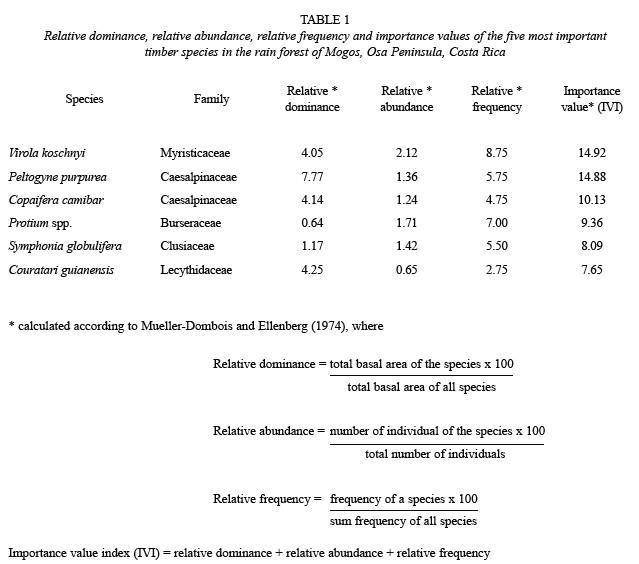
<body><![CDATA[ style="font-family: arial;">and Poveda 1991). <span      style="font-style: italic;">P. purpurea</span> is often a dominant </span><span      style="font-family: arial;">species. In the region of Mogos in the Osa     </span><span style="font-family: arial;">Peninsula of Costa Rica, the     importance value </span><span style="font-family: arial;">index (IVI)     of this species is second among </span><span      style="font-family: arial;">all timber trees (<a href="#TABLA1">Table 1</a>).     Because of its     economic </span><span style="font-family: arial;">value, <span      style="font-style: italic;">P. purpurea</span> is being intensively </span><span     ]]></body>
<body><![CDATA[ style="font-family: arial;">harvested in the Osa Peninsula of Costa     Rica, </span><span style="font-family: arial;">despite being     considered a threatened species </span><span      style="font-family: arial;">(Jim&eacute;nez 1993). Here, we report the     occurrence </span><span style="font-family: arial;">of a mast fruiting     episode in <span style="font-style: italic;">P. purpurea</span> in </span><span      style="font-family: arial;">the Osa Peninsula. In addition, we discuss     the </span><span style="font-family: arial;">implications of this     finding for the adequate </span><span style="font-family: arial;">conservation,     utilization, and management of </span><span style="font-family: arial;">this     ]]></body>
<body><![CDATA[species.</span></small><br style="font-family: arial;">     <small></small><br style="font-family: arial;">     <small><span style="font-family: arial;">In 1989, one of us (BV)     started a     project to </span><span style="font-family: arial;">evaluate the     impact of selective logging on the </span><span      style="font-family: arial;">population dynamics of <span      style="font-style: italic;">P. purpurea</span>. As part </span><span      style="font-family: arial;">of this study, the phenology of 12 trees     in the </span><span style="font-family: arial;">region of Mogos was     ]]></body>
<body><![CDATA[monitored for two years, </span><span style="font-family: arial;">using     the methodology proposed by Fournier </span><span      style="font-family: arial;">(1974). Four phenological events were     defined: </span><span style="font-family: arial;">leaf flushing, leaf     shedding, flowering, and </span><span style="font-family: arial;">fruiting     (green and mature fruits) with each </span><span      style="font-family: arial;">rated according to an arbitrary scale     indicating </span><span style="font-family: arial;">the intensity of     the phenological stage. </span><span style="font-family: arial;">Sampling     size and scoring frequency were </span><span     ]]></body>
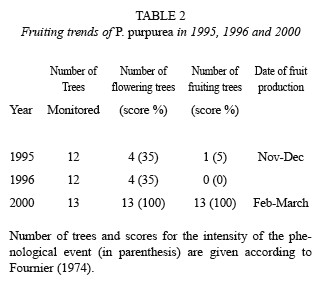
<body><![CDATA[ style="font-family: arial;">conducted as proposed by Fournier (1974)     and </span><span style="font-family: arial;">Fournier and Charpantier     (1975).</span></small><br style="font-family: arial;">     <small></small><br style="font-family: arial;">     <small><span style="font-family: arial;">In 1995 and 1996, only four of     the     twelve </span><span style="font-family: arial;">trees flowered.     However, in 1995 only one </span><span style="font-family: arial;">tree     produced mature fruits, and the intensity </span><span      style="font-family: arial;">of fruiting was low (only 5 % of the crown     ]]></body>
<body><![CDATA[</span><span style="font-family: arial;">exhibited fruits). In 1996,     only one tree flowered, </span><span style="font-family: arial;">but     it did not produce fruits. In contrast, </span><span      style="font-family: arial;">in 2000, all trees examined produced </span><span      style="font-family: arial;">fruits (a total of thirteen trees were     scored </span><span style="font-family: arial;">for phenological     intensity, but we collected </span><span style="font-family: arial;">seeds     for more than forty trees), and the </span><span      style="font-family: arial;">scores obtained for this phenological     event </span><span style="font-family: arial;">indicated that the     ]]></body>
<body><![CDATA[entire crown was producing </span><span style="font-family: arial;">fruits     (<a href="#TABLA2">Table 2</a>). In 2001 and 2002, fruit and </span><span      style="font-family: arial;">seed production were similar to that     observed </span><span style="font-family: arial;">during prior years.     These findings indicate </span><span style="font-family: arial;">that     in 2000 the reproduction of <span style="font-style: italic;">P.     purpurea</span> </span><span style="font-family: arial;">was well     synchronized and the intensity of </span><span      style="font-family: arial;">flowering and fruiting was maximal. </span></small></div>     <p align="justify"></p>     ]]></body>
<body><![CDATA[<p align="center"><a name="TABLA1"> <img style="border: 0px solid ; width: 639px; height: 564px;"  src="/img/fbpe/rbt/v54n4/3499i1.JPG" title="" alt=""></a></p>     
<p align="justify">&nbsp;</p>     <p align="center"><a name="TABLA2"> <img style="border: 0px solid ; width: 322px; height: 283px;"  src="/img/fbpe/rbt/v54n4/3499i2.JPG" title="" alt=""></a></p>     
<div style="text-align: left;"><small><span style="font-family: arial;">The     observation presented here seems     to </span><span style="font-family: arial;">fit within the category of     supra-annual fruiting </span><span style="font-family: arial;">proposed     by Newstrom <span style="font-style: italic;">et al</span>. (1994a).     The last fruiting event might have occurred between </span><span      style="font-family: arial;">nine and twelve years prior to 2000. We     ]]></body>
<body><![CDATA[base </span><span style="font-family: arial;">this assumption in two     observations. First, one </span><span style="font-family: arial;">of     us (BV) initiated a demographic study of </span><span      style="font-family: arial;"><span style="font-style: italic;">P.     purpurea</span> in 1990 and found only saplings </span><span      style="font-family: arial;">in the understory (Vilchez-Alvarado1998). </span><span      style="font-family: arial;">Second, the first two authors searched for     </span><span style="font-family: arial;">seedlings every year since     that time, and never </span><span style="font-family: arial;">found a     single one until 2000. In contrast, in </span><span     ]]></body>
<body><![CDATA[ style="font-family: arial;">2000, seeds were visible on the forest     floor, as </span><span style="font-family: arial;">never observed in     previous years and later it </span><span style="font-family: arial;">was     possible to find hundreds of seedlings per </span><span      style="font-family: arial;">square&nbsp; meter around reproductive     trees.</span></small><br style="font-family: arial;">     <small></small><br style="font-family: arial;">     <small><span style="font-family: arial;">There is not enough     information on     the </span><span style="font-family: arial;">event for a hypothesis to     ]]></body>
<body><![CDATA[be formed because the </span><span style="font-family: arial;">climatic     or biological cues that triggered this </span><span      style="font-family: arial;">sporadic flowering are unknown and there     is no </span><span style="font-family: arial;">meteorological data     available for this area.</span></small><br style="font-family: arial;">     <small></small><br style="font-family: arial;">     <small><span style="font-family: arial;">This species is selectively     logged in     Costa </span><span style="font-family: arial;">Rica. However, logging     operations do not take </span><span style="font-family: arial;">into     ]]></body>
<body><![CDATA[account major reproductive events as the </span><span      style="font-family: arial;">one described above. Typically, it is     assumed </span><span style="font-family: arial;">that the target     species follows an irregular </span><span style="font-family: arial;">sub-annual     or regular annual reproductive pattern. </span><span      style="font-family: arial;">Therefore, it is important to study the </span><span      style="font-family: arial;">impacts of such practices on species that     show </span><span style="font-family: arial;">supra-annual patterns in     their reproduction. </span><span style="font-family: arial;">Depending     on the magnitude of the impact, </span><span     ]]></body>
<body><![CDATA[ style="font-family: arial;">targeted populations showing this mode of </span><span      style="font-family: arial;">reproduction may experience local     extinction. </span><span style="font-family: arial;">However,     insufficient data makes it difficult to </span><span      style="font-family: arial;">predict the outcome of these practices. </span></small><br      style="font-family: arial;">     <small></small><br style="font-family: arial;">     <small><span style="font-family: arial; font-weight: 700;">Acknowledgments</span></small><br      style="font-family: arial;">     <small></small><br style="font-family: arial;">     ]]></body>
<body><![CDATA[<small><span style="font-family: arial;">The authors thank M.E.     Zald&iacute;var, M.V. </span><span style="font-family: arial;">Guti&eacute;rrez,     and one anonymous reviewer for </span><span style="font-family: arial;">advice,     comments, and/or criticisms on a previous </span><span      style="font-family: arial;">version of this manuscript; L.     Castro,&nbsp; </span><span style="font-family: arial;">E. Castro and     G. Aguilar for field assistance. </span><span      style="font-family: arial;">This work was supported by the     International </span><span style="font-family: arial;">Foundation for     Science grant (grant IFS 1943- </span><span style="font-family: arial;">2),     ]]></body>
<body><![CDATA[the International Plant Genetic Resources </span><span      style="font-family: arial;">Institute and the Center for International     </span><span style="font-family: arial;">Forestry Research (grants 96/     073, 97/052, and </span><span style="font-family: arial;">98/049), and     a University of Costa Rica grant </span><span      style="font-family: arial;">(VI-111-91-223) to O.J.&nbsp; Rocha.</span></small><br      style="font-family: arial;">     <small></small><br style="font-family: arial;">     <small><span style="font-family: arial; font-weight: 700;">Resumen</span></small><br      style="font-family: arial;">     ]]></body>
<body><![CDATA[<small></small><br style="font-family: arial;">     <small><span style="font-family: arial;">Se describe un episodio de     fructificaci&oacute;n en masa </span><span style="font-family: arial;">en     una poblaci&oacute;n de <span style="font-style: italic;">Peltogyne     purpurea</span> de la Pen&iacute;nsula </span><span      style="font-family: arial;">de Osa, Costa Rica. En febrero y marzo de     2000, la </span><span style="font-family: arial;">mayor parte de los     &aacute;rboles de esta especie tuvo una </span><span      style="font-family: arial;">gran cosecha de frutos. En los a&ntilde;os     anteriores, desde </span><span style="font-family: arial;">1995,     ]]></body>
<body><![CDATA[ninguno o muy pocos &aacute;rboles produjeron frutos y </span><span      style="font-family: arial;">la producci&oacute;n por &aacute;rbol fue     escasa. La cosecha del a&ntilde;o </span><span      style="font-family: arial;">2000 fue masiva y todos los &aacute;rboles     examinados produjeron </span><span style="font-family: arial;">frutos     abundantes. Este patr&oacute;n reproductivo podr&iacute;a </span><span      style="font-family: arial;">producir extinciones locales si la     extracci&oacute;n maderera no </span><span style="font-family: arial;">lo     toma en cuenta.</span></small><br style="font-family: arial;">     <small></small><br style="font-family: arial;">     ]]></body>
<body><![CDATA[<small><span style="font-family: arial;"><span      style="font-weight: bold;">Palabras     clave</span>: producci&oacute;n de frutos, fructificaci&oacute;n     mastal, </span><span style="font-family: arial;">fenolog&iacute;a,     reproducci&oacute;n supra-anual, <span style="font-style: italic;">Peltogyne     purpurea</span>.</span></small><br style="font-family: arial;">     <small></small><br style="font-family: arial;">     <small><span style="font-family: arial; font-weight: 700;">References</span></small><br      style="font-family: arial;">     <small></small><br style="font-family: arial;">     ]]></body>
<body><![CDATA[<small><span style="font-family: arial;">Ashton, P.S., T.J. Givnish     &amp; S.     Appanah. 1988. Staggered </span><span style="font-family: arial;">flowering     in the Dipterocarpaceae: New insights into </span><span      style="font-family: arial;">floral induction and the evolution of mast     fruiting in </span><span style="font-family: arial;">the seasonal     tropics. Am. Nat. 132: 44-60.</span></small><br      style="font-family: arial;">     <small></small><br style="font-family: arial;">     <!-- ref --><small><span style="font-family: arial;">    &nbsp;&nbsp;&nbsp;&nbsp;&nbsp;&nbsp;&nbsp;&nbsp;[&#160;<a href="javascript:void(0);" onclick="javascript: window.open('/scielo.php?script=sci_nlinks&ref=1359905&pid=S0034-7744200600040001300001&lng=','','width=640,height=500,resizable=yes,scrollbars=1,menubar=yes,');">Links</a>&#160;]<!-- end-ref --><!-- ref -->Bawa, K.S. &amp; F.S.P. Ng. 1990. Phenology-commentary, </span><span style="font-family: arial;">p. 17-20. <span style="font-style: italic;">In</span> K.S. Bawa &amp; M. Hadley (eds.). </span><span style="font-family: arial;">Reproductive ecology of tropical forest plants. </span><span  style="font-family: arial;">Parthenon, Paris, France.</span></small><br  style="font-family: arial;"> <small></small><br style="font-family: arial;"> <small><span style="font-family: arial;">    &nbsp;&nbsp;&nbsp;&nbsp;&nbsp;&nbsp;&nbsp;&nbsp;[&#160;<a href="javascript:void(0);" onclick="javascript: window.open('/scielo.php?script=sci_nlinks&ref=1359906&pid=S0034-7744200600040001300002&lng=','','width=640,height=500,resizable=yes,scrollbars=1,menubar=yes,');">Links</a>&#160;]<!-- end-ref --><!-- ref -->Chan, H.T. 1980. Reproductive biology of some malaysian </span><span style="font-family: arial;">dipterocarps. II. Fruitng and seedling studies. Malay. </span><span  style="font-family: arial;">For. 43: 438-451.</span></small><br  style="font-family: arial;"> <small></small><br style="font-family: arial;"> <small><span style="font-family: arial;">    &nbsp;&nbsp;&nbsp;&nbsp;&nbsp;&nbsp;&nbsp;&nbsp;[&#160;<a href="javascript:void(0);" onclick="javascript: window.open('/scielo.php?script=sci_nlinks&ref=1359907&pid=S0034-7744200600040001300003&lng=','','width=640,height=500,resizable=yes,scrollbars=1,menubar=yes,');">Links</a>&#160;]<!-- end-ref --><!-- ref -->Fournier, L.A. 1974. Un m&eacute;todo cuantitativo para la </span><span style="font-family: arial;">medici&oacute;n de caracter&iacute;sticas fenol&oacute;gicas de &aacute;rboles. </span><span  style="font-family: arial;">Turrialba 24: 422-423.</span></small><br  style="font-family: arial;"> <small></small><br style="font-family: arial;"> <small><span style="font-family: arial;">    &nbsp;&nbsp;&nbsp;&nbsp;&nbsp;&nbsp;&nbsp;&nbsp;[&#160;<a href="javascript:void(0);" onclick="javascript: window.open('/scielo.php?script=sci_nlinks&ref=1359908&pid=S0034-7744200600040001300004&lng=','','width=640,height=500,resizable=yes,scrollbars=1,menubar=yes,');">Links</a>&#160;]<!-- end-ref --><!-- ref -->Fournier, L.A. &amp; C. Charpantier. 1975. El tama&ntilde;o de la </span><span style="font-family: arial;">muestra y la frecuencia de las observaciones en el </span><span  style="font-family: arial;">estudio de caracter&iacute;sticas fenol&oacute;gicas de los &aacute;rboles </span><span  style="font-family: arial;">tropicales. Turrialba 25: 45-48.</span></small><br  style="font-family: arial;"> <small></small><br style="font-family: arial;"> <small><span style="font-family: arial;">    &nbsp;&nbsp;&nbsp;&nbsp;&nbsp;&nbsp;&nbsp;&nbsp;[&#160;<a href="javascript:void(0);" onclick="javascript: window.open('/scielo.php?script=sci_nlinks&ref=1359909&pid=S0034-7744200600040001300005&lng=','','width=640,height=500,resizable=yes,scrollbars=1,menubar=yes,');">Links</a>&#160;]<!-- end-ref --><!-- ref -->Frankie, G.W., H.G. Baker &amp; P.A. Opler. 1974. Comparative&nbsp; </span><span style="font-family: arial;">phenological studies of trees in tropical wet and dry </span><span  style="font-family: arial;">forests in the lowlands of Costa Rica. J. Ecol. 62: </span><span style="font-family: arial;">881-919.</span></small><br  style="font-family: arial;"> <small></small><br style="font-family: arial;"> <small><span style="font-family: arial;">    &nbsp;&nbsp;&nbsp;&nbsp;&nbsp;&nbsp;&nbsp;&nbsp;[&#160;<a href="javascript:void(0);" onclick="javascript: window.open('/scielo.php?script=sci_nlinks&ref=1359910&pid=S0034-7744200600040001300006&lng=','','width=640,height=500,resizable=yes,scrollbars=1,menubar=yes,');">Links</a>&#160;]<!-- end-ref --><!-- ref -->Gentry, A.H. 1974. Flowering phenology and diversity in </span><span style="font-family: arial;">tropical Bignoniaceae. Biotropica 6: 64-68.</span></small><br  style="font-family: arial;"> <small></small><br style="font-family: arial;"> <small><span style="font-family: arial;">    &nbsp;&nbsp;&nbsp;&nbsp;&nbsp;&nbsp;&nbsp;&nbsp;[&#160;<a href="javascript:void(0);" onclick="javascript: window.open('/scielo.php?script=sci_nlinks&ref=1359911&pid=S0034-7744200600040001300007&lng=','','width=640,height=500,resizable=yes,scrollbars=1,menubar=yes,');">Links</a>&#160;]<!-- end-ref --><!-- ref -->Holdridge, L.R. &amp; L.J. Poveda. 1975. &Aacute;rboles de Costa </span><span style="font-family: arial;">Rica. Vol. 1. Palmas, otras monocotiled&oacute;neas y </span><span  style="font-family: arial;">&aacute;rboles con hojas compuestas o lobuladas. Centro </span><span style="font-family: arial;">Cient&iacute;fico Tropical, San Jos&eacute;, Costa Rica. 546 p.</span></small><br  style="font-family: arial;"> <small></small><br style="font-family: arial;"> <small><span style="font-family: arial;">    &nbsp;&nbsp;&nbsp;&nbsp;&nbsp;&nbsp;&nbsp;&nbsp;[&#160;<a href="javascript:void(0);" onclick="javascript: window.open('/scielo.php?script=sci_nlinks&ref=1359912&pid=S0034-7744200600040001300008&lng=','','width=640,height=500,resizable=yes,scrollbars=1,menubar=yes,');">Links</a>&#160;]<!-- end-ref --><!-- ref -->Janzen, D.H. 1967. Synchrony of sexual reproduction </span><span style="font-family: arial;">of trees within the dry season in Central America. </span><span  style="font-family: arial;">Evolution 21: 620-637.</span></small><br  style="font-family: arial;"> <small></small><br style="font-family: arial;"> <small><span style="font-family: arial;">    &nbsp;&nbsp;&nbsp;&nbsp;&nbsp;&nbsp;&nbsp;&nbsp;[&#160;<a href="javascript:void(0);" onclick="javascript: window.open('/scielo.php?script=sci_nlinks&ref=1359913&pid=S0034-7744200600040001300009&lng=','','width=640,height=500,resizable=yes,scrollbars=1,menubar=yes,');">Links</a>&#160;]<!-- end-ref --><!-- ref -->Janzen, D.H. 1971. Seed predation by animals. Ann. Rev. </span><span style="font-family: arial;">Ecol. Syst. 2: 465-492.</span></small><br style="font-family: arial;"> <small></small><br style="font-family: arial;"> <small><span style="font-family: arial;">    &nbsp;&nbsp;&nbsp;&nbsp;&nbsp;&nbsp;&nbsp;&nbsp;[&#160;<a href="javascript:void(0);" onclick="javascript: window.open('/scielo.php?script=sci_nlinks&ref=1359914&pid=S0034-7744200600040001300010&lng=','','width=640,height=500,resizable=yes,scrollbars=1,menubar=yes,');">Links</a>&#160;]<!-- end-ref --><!-- ref -->Janzen, D.H. 1974. Tropical black water rivers, animals </span><span style="font-family: arial;">and mast fruiting by Dipterocarpaceae. Biotropica </span><span  style="font-family: arial;">4: 69-103.</span></small><br  style="font-family: arial;"> <small></small><br style="font-family: arial;"> <small><span style="font-family: arial;">    &nbsp;&nbsp;&nbsp;&nbsp;&nbsp;&nbsp;&nbsp;&nbsp;[&#160;<a href="javascript:void(0);" onclick="javascript: window.open('/scielo.php?script=sci_nlinks&ref=1359915&pid=S0034-7744200600040001300011&lng=','','width=640,height=500,resizable=yes,scrollbars=1,menubar=yes,');">Links</a>&#160;]<!-- end-ref --><!-- ref -->Jim&eacute;nez, Q. 1993. &Aacute;rboles maderables en peligro de </span><span  style="font-family: arial;">extinci&oacute;n en Costa Rica. INCAFO, San Jos&eacute;, Costa </span><span style="font-family: arial;">Rica. 121 p.</span></small><br style="font-family: arial;"> <small></small><br style="font-family: arial;"> <small><span style="font-family: arial;">    &nbsp;&nbsp;&nbsp;&nbsp;&nbsp;&nbsp;&nbsp;&nbsp;[&#160;<a href="javascript:void(0);" onclick="javascript: window.open('/scielo.php?script=sci_nlinks&ref=1359916&pid=S0034-7744200600040001300012&lng=','','width=640,height=500,resizable=yes,scrollbars=1,menubar=yes,');">Links</a>&#160;]<!-- end-ref --><!-- ref -->Jim&eacute;nez, Q. &amp; L.J. Poveda. 1991. &Aacute;rboles maderables nativos </span><span  style="font-family: arial;">de Costa Rica. Museo Nacional de Costa Rica, </span><span style="font-family: arial;">San Jos&eacute;, Costa Rica. 32 p.</span></small><br style="font-family: arial;"> <small></small><br style="font-family: arial;"> <small><span style="font-family: arial;">    &nbsp;&nbsp;&nbsp;&nbsp;&nbsp;&nbsp;&nbsp;&nbsp;[&#160;<a href="javascript:void(0);" onclick="javascript: window.open('/scielo.php?script=sci_nlinks&ref=1359917&pid=S0034-7744200600040001300013&lng=','','width=640,height=500,resizable=yes,scrollbars=1,menubar=yes,');">Links</a>&#160;]<!-- end-ref --><!-- ref -->Kelly, D. 1994. The evolutionary ecology of mast seeding. Trends Ecol. Evol. 9: 465-470.</span></small><br  style="font-family: arial;"> <small></small><br style="font-family: arial;"> <small><span style="font-family: arial;">    &nbsp;&nbsp;&nbsp;&nbsp;&nbsp;&nbsp;&nbsp;&nbsp;[&#160;<a href="javascript:void(0);" onclick="javascript: window.open('/scielo.php?script=sci_nlinks&ref=1359918&pid=S0034-7744200600040001300014&lng=','','width=640,height=500,resizable=yes,scrollbars=1,menubar=yes,');">Links</a>&#160;]<!-- end-ref --><!-- ref -->Kelly, D. &amp; V.L. Sork. 2002. Mast seeding in perennial </span><span style="font-family: arial;">plants: why, how, where? Ann. Rev. Ecol Syst. 33: </span><span  style="font-family: arial;">427-447.</span></small><br  style="font-family: arial;"> <small></small><br style="font-family: arial;"> <small><span style="font-family: arial;">    &nbsp;&nbsp;&nbsp;&nbsp;&nbsp;&nbsp;&nbsp;&nbsp;[&#160;<a href="javascript:void(0);" onclick="javascript: window.open('/scielo.php?script=sci_nlinks&ref=1359919&pid=S0034-7744200600040001300015&lng=','','width=640,height=500,resizable=yes,scrollbars=1,menubar=yes,');">Links</a>&#160;]<!-- end-ref --><!-- ref -->Manokaran, N. &amp; M.D. Swaine. 1994. Population </span><span style="font-family: arial;">dynamics of trees in dipterocarp forests of peninsular </span><span  style="font-family: arial;">Malaysia. Malaysian Forests Records 40. </span><span  style="font-family: arial;">Forest Research Institute Malaysia, Kuala Lumpur, </span><span style="font-family: arial;">Malaysia. 173 p.</span></small><br  style="font-family: arial;"> <small></small><br style="font-family: arial;"> <small><span style="font-family: arial;">    &nbsp;&nbsp;&nbsp;&nbsp;&nbsp;&nbsp;&nbsp;&nbsp;[&#160;<a href="javascript:void(0);" onclick="javascript: window.open('/scielo.php?script=sci_nlinks&ref=1359920&pid=S0034-7744200600040001300016&lng=','','width=640,height=500,resizable=yes,scrollbars=1,menubar=yes,');">Links</a>&#160;]<!-- end-ref --><!-- ref -->Monasterio, M. &amp; M. Sarmiento. 1976. Phenological strategies </span><span style="font-family: arial;">of plant species in the tropical savanna and the </span><span  style="font-family: arial;">semi-deciduous forest of the Venezuelan Llanos. J. </span><span style="font-family: arial;">Biogeogr. 3: 325-355.</span></small><br style="font-family: arial;"> <small></small><br style="font-family: arial;"> <small><span style="font-family: arial;">    &nbsp;&nbsp;&nbsp;&nbsp;&nbsp;&nbsp;&nbsp;&nbsp;[&#160;<a href="javascript:void(0);" onclick="javascript: window.open('/scielo.php?script=sci_nlinks&ref=1359921&pid=S0034-7744200600040001300017&lng=','','width=640,height=500,resizable=yes,scrollbars=1,menubar=yes,');">Links</a>&#160;]<!-- end-ref --><!-- ref -->Newstrom, L.E., G.W. Frankie &amp; H.G. Baker. 1994a. </span><span style="font-family: arial;">A new classification for plant phenology based on </span><span  style="font-family: arial;">flowering patterns in lowland tropical rain forest at </span><span style="font-family: arial;">La Selva, Costa Rica. Biotropica 26: 141-159.</span></small><br  style="font-family: arial;"> <small></small><br style="font-family: arial;"> <small><span style="font-family: arial;">    &nbsp;&nbsp;&nbsp;&nbsp;&nbsp;&nbsp;&nbsp;&nbsp;[&#160;<a href="javascript:void(0);" onclick="javascript: window.open('/scielo.php?script=sci_nlinks&ref=1359922&pid=S0034-7744200600040001300018&lng=','','width=640,height=500,resizable=yes,scrollbars=1,menubar=yes,');">Links</a>&#160;]<!-- end-ref --><!-- ref -->Newstrom, L.E., G.W. Frankie, H.G. Baker &amp; R.K. </span><span style="font-family: arial;">Colwell. 1994b. Diversity of long-term flowering </span><span  style="font-family: arial;">patterns, p. 142-160. <span  style="font-style: italic;">In</span> L.A. McDade , K.S. Bawa, </span><span  style="font-family: arial;">H.A. Hespenheide &amp; G.S. Hartshron (eds.). La Selva: </span><span style="font-family: arial;">ecology and natural history of a neotropical rain forest. </span><span  style="font-family: arial;">Chicago, Chicago, USA.</span></small><br  style="font-family: arial;"> <small></small><br style="font-family: arial;"> <small><span style="font-family: arial;">    &nbsp;&nbsp;&nbsp;&nbsp;&nbsp;&nbsp;&nbsp;&nbsp;[&#160;<a href="javascript:void(0);" onclick="javascript: window.open('/scielo.php?script=sci_nlinks&ref=1359923&pid=S0034-7744200600040001300019&lng=','','width=640,height=500,resizable=yes,scrollbars=1,menubar=yes,');">Links</a>&#160;]<!-- end-ref --><!-- ref -->Ng, F.S.P. &amp; H.S. Loh. 1974. Flowering-to fruiting periods </span><span style="font-family: arial;">of Malaysian trees. Malayan Forester 37: 127-132.</span></small><br  style="font-family: arial;"> <small></small><br style="font-family: arial;"> <small><span style="font-family: arial;">    &nbsp;&nbsp;&nbsp;&nbsp;&nbsp;&nbsp;&nbsp;&nbsp;[&#160;<a href="javascript:void(0);" onclick="javascript: window.open('/scielo.php?script=sci_nlinks&ref=1359924&pid=S0034-7744200600040001300020&lng=','','width=640,height=500,resizable=yes,scrollbars=1,menubar=yes,');">Links</a>&#160;]<!-- end-ref --><!-- ref -->Opler, P.A. 1980. Comparative phenological studies of </span><span style="font-family: arial;">treelet and shrub species in tropical wet and dry </span><span  style="font-family: arial;">forests in the lowlands of Costa Rica. J. Ecol. 68: </span><span style="font-family: arial;">167-188.</span></small><br  style="font-family: arial;"> <small></small><br style="font-family: arial;"> <small><span style="font-family: arial;">    &nbsp;&nbsp;&nbsp;&nbsp;&nbsp;&nbsp;&nbsp;&nbsp;[&#160;<a href="javascript:void(0);" onclick="javascript: window.open('/scielo.php?script=sci_nlinks&ref=1359925&pid=S0034-7744200600040001300021&lng=','','width=640,height=500,resizable=yes,scrollbars=1,menubar=yes,');">Links</a>&#160;]<!-- end-ref --><!-- ref -->Opler, P.A., G.W. Frankie &amp; H.G. Baker. 1976. Rainfall as </span><span style="font-family: arial;">a factor in the release, timing, and synchronization </span><span  style="font-family: arial;">of anthesis by tropical trees and shrubs. J. Biogeogr. </span><span style="font-family: arial;">3:231-236.</span></small><br  style="font-family: arial;"> <small></small><br style="font-family: arial;"> <small><span style="font-family: arial;">    &nbsp;&nbsp;&nbsp;&nbsp;&nbsp;&nbsp;&nbsp;&nbsp;[&#160;<a href="javascript:void(0);" onclick="javascript: window.open('/scielo.php?script=sci_nlinks&ref=1359926&pid=S0034-7744200600040001300022&lng=','','width=640,height=500,resizable=yes,scrollbars=1,menubar=yes,');">Links</a>&#160;]<!-- end-ref --><!-- ref -->Rathcke, B. &amp; E.P. Lacey. 1985. Phenological patterns of</span>&nbsp; <span style="font-family: arial;">terrestrial plants. Ann. Rev. Ecol. Syst. 16: 179-214.</span></small><br  style="font-family: arial;"> <small></small><br style="font-family: arial;"> <small><span style="font-family: arial;">    &nbsp;&nbsp;&nbsp;&nbsp;&nbsp;&nbsp;&nbsp;&nbsp;[&#160;<a href="javascript:void(0);" onclick="javascript: window.open('/scielo.php?script=sci_nlinks&ref=1359927&pid=S0034-7744200600040001300023&lng=','','width=640,height=500,resizable=yes,scrollbars=1,menubar=yes,');">Links</a>&#160;]<!-- end-ref --><!-- ref -->Reich, P.B. &amp; R. Borchert. 1982. Phenology and ecophysiology </span><span style="font-family: arial;">of the tropical tree, <span style="font-style: italic;">Tabebuia neochrysantha</span> </span><span style="font-family: arial;">(Bignoniaceae). Ecology 63: 294-299.</span></small><br style="font-family: arial;"> <small></small><br style="font-family: arial;"> <small><span style="font-family: arial;">    &nbsp;&nbsp;&nbsp;&nbsp;&nbsp;&nbsp;&nbsp;&nbsp;[&#160;<a href="javascript:void(0);" onclick="javascript: window.open('/scielo.php?script=sci_nlinks&ref=1359928&pid=S0034-7744200600040001300024&lng=','','width=640,height=500,resizable=yes,scrollbars=1,menubar=yes,');">Links</a>&#160;]<!-- end-ref --><!-- ref -->Sakai, S., K. Momose, T. Yumoto, T. Nagamitsu, H. </span><span style="font-family: arial;">Nagamasu, A.A. Hamid &amp; T. Nakashizuka. 1999. </span><span  style="font-family: arial;">Plant reproductive phenology over four years including </span><span style="font-family: arial;">an episode of general flowering in a lowland </span><span style="font-family: arial;">Dipterocarp forest, Sarawak, Malaysia. Am. J. Bot. </span><span  style="font-family: arial;">80: 1414-1436.</span></small><br  style="font-family: arial;"> <small></small><br style="font-family: arial;"> <small><span style="font-family: arial;">    &nbsp;&nbsp;&nbsp;&nbsp;&nbsp;&nbsp;&nbsp;&nbsp;[&#160;<a href="javascript:void(0);" onclick="javascript: window.open('/scielo.php?script=sci_nlinks&ref=1359929&pid=S0034-7744200600040001300025&lng=','','width=640,height=500,resizable=yes,scrollbars=1,menubar=yes,');">Links</a>&#160;]<!-- end-ref --><!-- ref -->Silvertown, J.W. 1980. The evolutionary ecology of mast </span><span style="font-family: arial;">seeding in trees. Biol. J. Linnean Soc. 14: 235-250.</span></small><br  style="font-family: arial;"> <small></small><br style="font-family: arial;"> <small><span style="font-family: arial;">    &nbsp;&nbsp;&nbsp;&nbsp;&nbsp;&nbsp;&nbsp;&nbsp;[&#160;<a href="javascript:void(0);" onclick="javascript: window.open('/scielo.php?script=sci_nlinks&ref=1359930&pid=S0034-7744200600040001300026&lng=','','width=640,height=500,resizable=yes,scrollbars=1,menubar=yes,');">Links</a>&#160;]<!-- end-ref --><!-- ref -->Smith, C.C., J.L. Hamrick &amp; C.L. Kramer. 1990. The </span><span style="font-family: arial;">advantage of mast years for wind-pollination. Am. </span><span  style="font-family: arial;">Nat. 136: 154-166.</span></small><br  style="font-family: arial;"> <small></small><br style="font-family: arial;"> <small><span style="font-family: arial;">    &nbsp;&nbsp;&nbsp;&nbsp;&nbsp;&nbsp;&nbsp;&nbsp;[&#160;<a href="javascript:void(0);" onclick="javascript: window.open('/scielo.php?script=sci_nlinks&ref=1359931&pid=S0034-7744200600040001300027&lng=','','width=640,height=500,resizable=yes,scrollbars=1,menubar=yes,');">Links</a>&#160;]<!-- end-ref --><!-- ref -->Tyrrel, J.G. &amp; M.J. Coe. 1974. The rainfall regime of Tsavo </span><span style="font-family: arial;">National Park, Kenya and its potential phenological </span><span  style="font-family: arial;">significance. J. Biogeography 1: 187-192.</span></small><br  style="font-family: arial;"> <small></small><br style="font-family: arial;"> <small><span style="font-family: arial;">    &nbsp;&nbsp;&nbsp;&nbsp;&nbsp;&nbsp;&nbsp;&nbsp;[&#160;<a href="javascript:void(0);" onclick="javascript: window.open('/scielo.php?script=sci_nlinks&ref=1359932&pid=S0034-7744200600040001300028&lng=','','width=640,height=500,resizable=yes,scrollbars=1,menubar=yes,');">Links</a>&#160;]<!-- end-ref --><!-- ref -->Van Schaik, C.P., J.W. Terborgh &amp; S.J. Wright. 1993. The </span><span style="font-family: arial;">phenology of tropical forests: adaptive and consequences </span><span  style="font-family: arial;">for primary consumers. Ann. Rev. Ecol. Syst. </span><span style="font-family: arial;">24: 353-377.</span></small><br  style="font-family: arial;"> <small></small><br style="font-family: arial;"> <small><span style="font-family: arial;">    &nbsp;&nbsp;&nbsp;&nbsp;&nbsp;&nbsp;&nbsp;&nbsp;[&#160;<a href="javascript:void(0);" onclick="javascript: window.open('/scielo.php?script=sci_nlinks&ref=1359933&pid=S0034-7744200600040001300029&lng=','','width=640,height=500,resizable=yes,scrollbars=1,menubar=yes,');">Links</a>&#160;]<!-- end-ref --><!-- ref -->Vilchez-Alvarado, B. 1998. Estudio de una poblaci&oacute;n de </span><span style="font-family: arial;"><span  style="font-style: italic;">Peltogyne purpurea</span> (Pittier) en un bosque intervenido </span><span style="font-family: arial;">de la Pen&iacute;nsula de Osa, Costa Rica, Am&eacute;rica </span><span  style="font-family: arial;">Central. Tesis de MSc., Universidad de Costa Rica, </span><span style="font-family: arial;">San Jos&eacute;, Costa Rica. 74 p.</span></small></div>    &nbsp;&nbsp;&nbsp;&nbsp;&nbsp;&nbsp;&nbsp;&nbsp;[&#160;<a href="javascript:void(0);" onclick="javascript: window.open('/scielo.php?script=sci_nlinks&ref=1359934&pid=S0034-7744200600040001300030&lng=','','width=640,height=500,resizable=yes,scrollbars=1,menubar=yes,');">Links</a>&#160;]<!-- end-ref --><p align="justify"></p>     ]]></body>
<body><![CDATA[ ]]></body><back>
<ref-list>
<ref id="B1">
<nlm-citation citation-type="journal">
<person-group person-group-type="author">
<name>
<surname><![CDATA[Ashton]]></surname>
<given-names><![CDATA[P.S]]></given-names>
</name>
<name>
<surname><![CDATA[Givnish]]></surname>
<given-names><![CDATA[T.J]]></given-names>
</name>
<name>
<surname><![CDATA[Appanah]]></surname>
<given-names><![CDATA[S]]></given-names>
</name>
</person-group>
<article-title xml:lang="en"><![CDATA[Staggered flowering in the Dipterocarpaceae: New insights into floral induction and the evolution of mast fruiting in the seasonal tropics]]></article-title>
<source><![CDATA[Am. Nat]]></source>
<year>1988</year>
<volume>132</volume>
<page-range>44-60</page-range></nlm-citation>
</ref>
<ref id="B2">
<nlm-citation citation-type="book">
<person-group person-group-type="author">
<name>
<surname><![CDATA[Bawa]]></surname>
<given-names><![CDATA[K.S]]></given-names>
</name>
<name>
<surname><![CDATA[Ng]]></surname>
<given-names><![CDATA[F.S.P]]></given-names>
</name>
</person-group>
<article-title xml:lang="en"><![CDATA[Phenology-commentary]]></article-title>
<person-group person-group-type="editor">
<name>
<surname><![CDATA[Bawa]]></surname>
<given-names><![CDATA[K.S]]></given-names>
</name>
<name>
<surname><![CDATA[Hadley]]></surname>
<given-names><![CDATA[M]]></given-names>
</name>
</person-group>
<source><![CDATA[Reproductive ecology of tropical forest plants]]></source>
<year>1990</year>
<page-range>17-20</page-range><publisher-loc><![CDATA[^eParis Paris]]></publisher-loc>
<publisher-name><![CDATA[Parthenon]]></publisher-name>
</nlm-citation>
</ref>
<ref id="B3">
<nlm-citation citation-type="journal">
<person-group person-group-type="author">
<name>
<surname><![CDATA[Chan]]></surname>
<given-names><![CDATA[H.T]]></given-names>
</name>
</person-group>
<article-title xml:lang="en"><![CDATA[Reproductive biology of some malaysian dipterocarps: II. Fruitng and seedling studies]]></article-title>
<source><![CDATA[Malay. For]]></source>
<year>1980</year>
<volume>43</volume>
<page-range>438-451</page-range></nlm-citation>
</ref>
<ref id="B4">
<nlm-citation citation-type="journal">
<person-group person-group-type="author">
<name>
<surname><![CDATA[Fournier]]></surname>
<given-names><![CDATA[L.A]]></given-names>
</name>
</person-group>
<article-title xml:lang="en"><![CDATA[Un método cuantitativo para la medición de características fenológicas de árboles]]></article-title>
<source><![CDATA[Turrialba]]></source>
<year>1974</year>
<volume>24</volume>
<page-range>422-423</page-range></nlm-citation>
</ref>
<ref id="B5">
<nlm-citation citation-type="journal">
<person-group person-group-type="author">
<name>
<surname><![CDATA[Fournier]]></surname>
<given-names><![CDATA[L.A]]></given-names>
</name>
<name>
<surname><![CDATA[Charpantier]]></surname>
<given-names><![CDATA[C]]></given-names>
</name>
</person-group>
<article-title xml:lang="es"><![CDATA[El tamaño de la muestra y la frecuencia de las observaciones en el estudio de características fenológicas de los árboles tropicales]]></article-title>
<source><![CDATA[Turrialba]]></source>
<year>1975</year>
<volume>25</volume>
<page-range>45-48</page-range></nlm-citation>
</ref>
<ref id="B6">
<nlm-citation citation-type="journal">
<person-group person-group-type="author">
<name>
<surname><![CDATA[Frankie]]></surname>
<given-names><![CDATA[G.W]]></given-names>
</name>
<name>
<surname><![CDATA[Baker]]></surname>
<given-names><![CDATA[H.G]]></given-names>
</name>
<name>
<surname><![CDATA[Opler]]></surname>
<given-names><![CDATA[P.A]]></given-names>
</name>
</person-group>
<article-title xml:lang="en"><![CDATA[Comparative phenological studies of trees in tropical wet and dry forests in the lowlands of Costa Rica]]></article-title>
<source><![CDATA[J. Ecol]]></source>
<year>1974</year>
<volume>62</volume>
<page-range>881-919</page-range></nlm-citation>
</ref>
<ref id="B7">
<nlm-citation citation-type="journal">
<person-group person-group-type="author">
<name>
<surname><![CDATA[Gentry]]></surname>
<given-names><![CDATA[A.H]]></given-names>
</name>
</person-group>
<article-title xml:lang="en"><![CDATA[Flowering phenology and diversity in tropical Bignoniaceae]]></article-title>
<source><![CDATA[Biotropica]]></source>
<year>1974</year>
<volume>6</volume>
<page-range>64-68</page-range></nlm-citation>
</ref>
<ref id="B8">
<nlm-citation citation-type="book">
<person-group person-group-type="author">
<name>
<surname><![CDATA[Holdridge]]></surname>
<given-names><![CDATA[L.R]]></given-names>
</name>
<name>
<surname><![CDATA[Poveda]]></surname>
<given-names><![CDATA[L.J]]></given-names>
</name>
</person-group>
<source><![CDATA[]]></source>
<year>1975</year>
<volume>Vol. 1</volume>
<page-range>546</page-range><publisher-loc><![CDATA[^eSan José San José]]></publisher-loc>
<publisher-name><![CDATA[Centro Científico Tropical]]></publisher-name>
</nlm-citation>
</ref>
<ref id="B9">
<nlm-citation citation-type="journal">
<person-group person-group-type="author">
<name>
<surname><![CDATA[Janzen]]></surname>
<given-names><![CDATA[D.H]]></given-names>
</name>
</person-group>
<article-title xml:lang="en"><![CDATA[Synchrony of sexual reproduction of trees within the dry season in Central America]]></article-title>
<source><![CDATA[Evolution]]></source>
<year>1967</year>
<volume>21</volume>
<page-range>620-637</page-range></nlm-citation>
</ref>
<ref id="B10">
<nlm-citation citation-type="journal">
<person-group person-group-type="author">
<name>
<surname><![CDATA[Janzen]]></surname>
<given-names><![CDATA[D.H]]></given-names>
</name>
</person-group>
<article-title xml:lang="en"><![CDATA[Seed predation by animals]]></article-title>
<source><![CDATA[Ann. Rev. Ecol. Syst]]></source>
<year>1971</year>
<volume>2</volume>
<page-range>465-492</page-range></nlm-citation>
</ref>
<ref id="B11">
<nlm-citation citation-type="journal">
<person-group person-group-type="author">
<name>
<surname><![CDATA[Janzen]]></surname>
<given-names><![CDATA[D.H]]></given-names>
</name>
</person-group>
<article-title xml:lang="en"><![CDATA[Tropical black water rivers, animals and mast fruiting by Dipterocarpaceae]]></article-title>
<source><![CDATA[Biotropica]]></source>
<year>1974</year>
<volume>4</volume>
<page-range>69-103</page-range></nlm-citation>
</ref>
<ref id="B12">
<nlm-citation citation-type="book">
<person-group person-group-type="author">
<name>
<surname><![CDATA[Jiménez]]></surname>
<given-names><![CDATA[Q]]></given-names>
</name>
</person-group>
<source><![CDATA[Árboles maderables en peligro de extinción en Costa Rica]]></source>
<year>1993</year>
<page-range>121</page-range><publisher-loc><![CDATA[^eSan José^eCosta Rica San JoséCosta Rica]]></publisher-loc>
<publisher-name><![CDATA[INCAFO]]></publisher-name>
</nlm-citation>
</ref>
<ref id="B13">
<nlm-citation citation-type="book">
<person-group person-group-type="author">
<name>
<surname><![CDATA[Jiménez]]></surname>
<given-names><![CDATA[Q]]></given-names>
</name>
<name>
<surname><![CDATA[Poveda]]></surname>
<given-names><![CDATA[L.J]]></given-names>
</name>
</person-group>
<source><![CDATA[Árboles maderables nativos de Costa Rica]]></source>
<year>1991</year>
<page-range>32</page-range><publisher-loc><![CDATA[^eSan José San José]]></publisher-loc>
<publisher-name><![CDATA[Museo Nacional de Costa Rica]]></publisher-name>
</nlm-citation>
</ref>
<ref id="B14">
<nlm-citation citation-type="journal">
<person-group person-group-type="author">
<name>
<surname><![CDATA[Kelly]]></surname>
<given-names><![CDATA[D]]></given-names>
</name>
</person-group>
<article-title xml:lang="en"><![CDATA[The evolutionary ecology of mast seeding]]></article-title>
<source><![CDATA[Trends Ecol. Evol]]></source>
<year>1994</year>
<volume>9</volume>
<page-range>465-470</page-range></nlm-citation>
</ref>
<ref id="B15">
<nlm-citation citation-type="journal">
<person-group person-group-type="author">
<name>
<surname><![CDATA[Kelly]]></surname>
<given-names><![CDATA[D]]></given-names>
</name>
<name>
<surname><![CDATA[Sork]]></surname>
<given-names><![CDATA[V.L]]></given-names>
</name>
</person-group>
<article-title xml:lang="en"><![CDATA[Mast seeding in perennial plants: why, how, where?]]></article-title>
<source><![CDATA[Ann. Rev. Ecol Syst]]></source>
<year>2002</year>
<volume>33</volume>
<page-range>427-447</page-range></nlm-citation>
</ref>
<ref id="B16">
<nlm-citation citation-type="book">
<person-group person-group-type="author">
<name>
<surname><![CDATA[Manokaran]]></surname>
<given-names><![CDATA[N]]></given-names>
</name>
<name>
<surname><![CDATA[Swaine]]></surname>
<given-names><![CDATA[M.D]]></given-names>
</name>
</person-group>
<source><![CDATA[Population dynamics of trees in dipterocarp forests of peninsular Malaysia]]></source>
<year>1994</year>
<page-range>173</page-range><publisher-loc><![CDATA[^eKuala Lumpur Kuala Lumpur]]></publisher-loc>
<publisher-name><![CDATA[Forest Research Institute Malaysia]]></publisher-name>
</nlm-citation>
</ref>
<ref id="B17">
<nlm-citation citation-type="journal">
<person-group person-group-type="author">
<name>
<surname><![CDATA[Monasterio]]></surname>
<given-names><![CDATA[M]]></given-names>
</name>
<name>
<surname><![CDATA[Sarmiento]]></surname>
<given-names><![CDATA[M]]></given-names>
</name>
</person-group>
<article-title xml:lang="en"><![CDATA[Phenological strategies of plant species in the tropical savanna and the semi-deciduous forest of the Venezuelan Llanos]]></article-title>
<source><![CDATA[J. Biogeogr]]></source>
<year>1976</year>
<volume>3</volume>
<page-range>325-355</page-range></nlm-citation>
</ref>
<ref id="B18">
<nlm-citation citation-type="journal">
<person-group person-group-type="author">
<name>
<surname><![CDATA[Newstrom]]></surname>
<given-names><![CDATA[L.E]]></given-names>
</name>
<name>
<surname><![CDATA[Frankie]]></surname>
<given-names><![CDATA[G.W]]></given-names>
</name>
<name>
<surname><![CDATA[Baker]]></surname>
<given-names><![CDATA[H.G]]></given-names>
</name>
</person-group>
<article-title xml:lang="en"><![CDATA[A new classification for plant phenology based on flowering patterns in lowland tropical rain forest at La Selva, Costa Rica]]></article-title>
<source><![CDATA[Biotropica]]></source>
<year>1994</year>
<volume>26</volume>
<page-range>141-159</page-range></nlm-citation>
</ref>
<ref id="B19">
<nlm-citation citation-type="book">
<person-group person-group-type="author">
<name>
<surname><![CDATA[Newstrom]]></surname>
<given-names><![CDATA[L.E]]></given-names>
</name>
<name>
<surname><![CDATA[Frankie]]></surname>
<given-names><![CDATA[G.W]]></given-names>
</name>
<name>
<surname><![CDATA[Baker]]></surname>
<given-names><![CDATA[H.G]]></given-names>
</name>
<name>
<surname><![CDATA[Colwell]]></surname>
<given-names><![CDATA[R.K]]></given-names>
</name>
</person-group>
<article-title xml:lang="en"><![CDATA[Diversity of long-term flowering patterns]]></article-title>
<person-group person-group-type="editor">
<name>
<surname><![CDATA[McDade]]></surname>
<given-names><![CDATA[L.A]]></given-names>
</name>
<name>
<surname><![CDATA[Bawa]]></surname>
<given-names><![CDATA[K.S]]></given-names>
</name>
<name>
<surname><![CDATA[Hespenheide]]></surname>
<given-names><![CDATA[H.A]]></given-names>
</name>
<name>
<surname><![CDATA[Hartshron]]></surname>
<given-names><![CDATA[G.S]]></given-names>
</name>
</person-group>
<source><![CDATA[La Selva: ecology and natural history of a neotropical rain forest]]></source>
<year>1994</year>
<page-range>142-160</page-range><publisher-loc><![CDATA[^eChicago Chicago]]></publisher-loc>
<publisher-name><![CDATA[ChicagoUSA]]></publisher-name>
</nlm-citation>
</ref>
<ref id="B20">
<nlm-citation citation-type="journal">
<person-group person-group-type="author">
<name>
<surname><![CDATA[Ng]]></surname>
<given-names><![CDATA[F.S.P]]></given-names>
</name>
<name>
<surname><![CDATA[Loh]]></surname>
<given-names><![CDATA[H.S]]></given-names>
</name>
</person-group>
<article-title xml:lang="en"><![CDATA[Flowering-to fruiting periods of Malaysian trees]]></article-title>
<source><![CDATA[Malayan Forester]]></source>
<year>1974</year>
<volume>37</volume>
<page-range>127-132</page-range></nlm-citation>
</ref>
<ref id="B21">
<nlm-citation citation-type="journal">
<person-group person-group-type="author">
<name>
<surname><![CDATA[Opler]]></surname>
<given-names><![CDATA[P.A]]></given-names>
</name>
</person-group>
<article-title xml:lang="en"><![CDATA[Comparative phenological studies of treelet and shrub species in tropical wet and dry forests in the lowlands of Costa Rica]]></article-title>
<source><![CDATA[J. Ecol]]></source>
<year>1980</year>
<volume>68</volume>
<page-range>167-188</page-range></nlm-citation>
</ref>
<ref id="B22">
<nlm-citation citation-type="journal">
<person-group person-group-type="author">
<name>
<surname><![CDATA[Opler]]></surname>
<given-names><![CDATA[P.A]]></given-names>
</name>
<name>
<surname><![CDATA[Frankie]]></surname>
<given-names><![CDATA[G.W]]></given-names>
</name>
<name>
<surname><![CDATA[Baker]]></surname>
<given-names><![CDATA[H.G]]></given-names>
</name>
</person-group>
<article-title xml:lang="en"><![CDATA[Rainfall as a factor in the release, timing, and synchronization of anthesis by tropical trees and shrubs]]></article-title>
<source><![CDATA[J. Biogeogr]]></source>
<year>1976</year>
<volume>3</volume>
<page-range>231-236</page-range></nlm-citation>
</ref>
<ref id="B23">
<nlm-citation citation-type="journal">
<person-group person-group-type="author">
<name>
<surname><![CDATA[Rathcke]]></surname>
<given-names><![CDATA[B]]></given-names>
</name>
<name>
<surname><![CDATA[Lacey]]></surname>
<given-names><![CDATA[E.P]]></given-names>
</name>
</person-group>
<article-title xml:lang="en"><![CDATA[Phenological patterns of terrestrial plants]]></article-title>
<source><![CDATA[Ann. Rev. Ecol. Syst]]></source>
<year>1985</year>
<volume>16</volume>
<page-range>179-214</page-range></nlm-citation>
</ref>
<ref id="B24">
<nlm-citation citation-type="journal">
<person-group person-group-type="author">
<name>
<surname><![CDATA[Reich]]></surname>
<given-names><![CDATA[P.B]]></given-names>
</name>
<name>
<surname><![CDATA[Borchert]]></surname>
<given-names><![CDATA[R]]></given-names>
</name>
</person-group>
<article-title xml:lang="en"><![CDATA[Phenology and ecophysiology of the tropical tree, Tabebuia neochrysantha (Bignoniaceae)]]></article-title>
<source><![CDATA[Ecology]]></source>
<year>1982</year>
<volume>63</volume>
<page-range>294-299</page-range></nlm-citation>
</ref>
<ref id="B25">
<nlm-citation citation-type="journal">
<person-group person-group-type="author">
<name>
<surname><![CDATA[Sakai]]></surname>
<given-names><![CDATA[S]]></given-names>
</name>
<name>
<surname><![CDATA[Momose]]></surname>
<given-names><![CDATA[K]]></given-names>
</name>
<name>
<surname><![CDATA[Yumoto]]></surname>
<given-names><![CDATA[T]]></given-names>
</name>
<name>
<surname><![CDATA[Nagamitsu]]></surname>
<given-names><![CDATA[T]]></given-names>
</name>
<name>
<surname><![CDATA[Nagamasu]]></surname>
<given-names><![CDATA[H]]></given-names>
</name>
<name>
<surname><![CDATA[Hamid]]></surname>
<given-names><![CDATA[A.A]]></given-names>
</name>
<name>
<surname><![CDATA[Nakashizuka]]></surname>
<given-names><![CDATA[T]]></given-names>
</name>
</person-group>
<article-title xml:lang="en"><![CDATA[Plant reproductive phenology over four years including an episode of general flowering in a lowland Dipterocarp forest, Sarawak, Malaysia]]></article-title>
<source><![CDATA[Am. J. Bot]]></source>
<year>1999</year>
<volume>80</volume>
<page-range>1414-1436</page-range></nlm-citation>
</ref>
<ref id="B26">
<nlm-citation citation-type="journal">
<person-group person-group-type="author">
<name>
<surname><![CDATA[Silvertown]]></surname>
<given-names><![CDATA[J.W]]></given-names>
</name>
</person-group>
<article-title xml:lang="en"><![CDATA[The evolutionary ecology of mast seeding in trees]]></article-title>
<source><![CDATA[Biol. J. Linnean Soc]]></source>
<year>1980</year>
<volume>14</volume>
<page-range>235-250</page-range></nlm-citation>
</ref>
<ref id="B27">
<nlm-citation citation-type="journal">
<person-group person-group-type="author">
<name>
<surname><![CDATA[Smith]]></surname>
<given-names><![CDATA[C.C]]></given-names>
</name>
<name>
<surname><![CDATA[Hamrick]]></surname>
<given-names><![CDATA[J.L]]></given-names>
</name>
<name>
<surname><![CDATA[Kramer]]></surname>
<given-names><![CDATA[C.L]]></given-names>
</name>
</person-group>
<article-title xml:lang="en"><![CDATA[The advantage of mast years for wind-pollination]]></article-title>
<source><![CDATA[Am. Nat]]></source>
<year>1990</year>
<volume>136</volume>
<page-range>154-166</page-range></nlm-citation>
</ref>
<ref id="B28">
<nlm-citation citation-type="journal">
<person-group person-group-type="author">
<name>
<surname><![CDATA[Tyrrel]]></surname>
<given-names><![CDATA[J.G]]></given-names>
</name>
<name>
<surname><![CDATA[Coe]]></surname>
<given-names><![CDATA[M.J]]></given-names>
</name>
</person-group>
<article-title xml:lang="en"><![CDATA[The rainfall regime of Tsavo National Park, Kenya and its potential phenological significance]]></article-title>
<source><![CDATA[J. Biogeography]]></source>
<year>1974</year>
<volume>1</volume>
<page-range>187-192</page-range></nlm-citation>
</ref>
<ref id="B29">
<nlm-citation citation-type="journal">
<person-group person-group-type="author">
<name>
<surname><![CDATA[Van Schaik]]></surname>
<given-names><![CDATA[C.P]]></given-names>
</name>
<name>
<surname><![CDATA[Terborgh]]></surname>
<given-names><![CDATA[J.W]]></given-names>
</name>
<name>
<surname><![CDATA[Wright]]></surname>
<given-names><![CDATA[S.J]]></given-names>
</name>
</person-group>
<article-title xml:lang="en"><![CDATA[The phenology of tropical forests: adaptive and consequences for primary consumers]]></article-title>
<source><![CDATA[Ann. Rev. Ecol. Syst]]></source>
<year>1993</year>
<volume>24</volume>
<page-range>353-377</page-range></nlm-citation>
</ref>
<ref id="B30">
<nlm-citation citation-type="">
<person-group person-group-type="author">
<name>
<surname><![CDATA[Vilchez-Alvarado]]></surname>
<given-names><![CDATA[B]]></given-names>
</name>
</person-group>
<source><![CDATA[Estudio de una población de Peltogyne purpurea (Pittier) en un bosque intervenido de la Península de Osa, Costa Rica, América Central]]></source>
<year>1998</year>
<page-range>74</page-range></nlm-citation>
</ref>
</ref-list>
</back>
</article>