<?xml version="1.0" encoding="ISO-8859-1"?><article xmlns:mml="http://www.w3.org/1998/Math/MathML" xmlns:xlink="http://www.w3.org/1999/xlink" xmlns:xsi="http://www.w3.org/2001/XMLSchema-instance">
<front>
<journal-meta>
<journal-id>0034-7744</journal-id>
<journal-title><![CDATA[Revista de Biología Tropical]]></journal-title>
<abbrev-journal-title><![CDATA[Rev. biol. trop]]></abbrev-journal-title>
<issn>0034-7744</issn>
<publisher>
<publisher-name><![CDATA[Universidad de Costa Rica]]></publisher-name>
</publisher>
</journal-meta>
<article-meta>
<article-id>S0034-77442006000400011</article-id>
<title-group>
<article-title xml:lang="es"><![CDATA[Incidencia y distribución altitudinal de 13 virus en cultivos de Solanum tuberosum (Solanaceae) en Costa Rica]]></article-title>
</title-group>
<contrib-group>
<contrib contrib-type="author">
<name>
<surname><![CDATA[Vásquez]]></surname>
<given-names><![CDATA[Viviana]]></given-names>
</name>
<xref ref-type="aff" rid="A01"/>
</contrib>
<contrib contrib-type="author">
<name>
<surname><![CDATA[Montero-Astúa]]></surname>
<given-names><![CDATA[Mauricio]]></given-names>
</name>
</contrib>
<contrib contrib-type="author">
<name>
<surname><![CDATA[Rivera]]></surname>
<given-names><![CDATA[Carmen]]></given-names>
</name>
<xref ref-type="aff" rid="A02"/>
</contrib>
</contrib-group>
<aff id="A01">
<institution><![CDATA[,Universidad de Costa Rica Centro de Investigación en Biología Celular y Molecular ]]></institution>
<addr-line><![CDATA[ San José]]></addr-line>
<country>Costa Rica</country>
</aff>
<aff id="A02">
<institution><![CDATA[,Universidad de Costa Rica Facultad de Microbiología ]]></institution>
<addr-line><![CDATA[ San José]]></addr-line>
<country>Costa Rica</country>
</aff>
<pub-date pub-type="pub">
<day>00</day>
<month>12</month>
<year>2006</year>
</pub-date>
<pub-date pub-type="epub">
<day>00</day>
<month>12</month>
<year>2006</year>
</pub-date>
<volume>54</volume>
<numero>4</numero>
<fpage>1135</fpage>
<lpage>1141</lpage>
<copyright-statement/>
<copyright-year/>
<self-uri xlink:href="http://www.scielo.sa.cr/scielo.php?script=sci_arttext&amp;pid=S0034-77442006000400011&amp;lng=en&amp;nrm=iso"></self-uri><self-uri xlink:href="http://www.scielo.sa.cr/scielo.php?script=sci_abstract&amp;pid=S0034-77442006000400011&amp;lng=en&amp;nrm=iso"></self-uri><self-uri xlink:href="http://www.scielo.sa.cr/scielo.php?script=sci_pdf&amp;pid=S0034-77442006000400011&amp;lng=en&amp;nrm=iso"></self-uri><abstract abstract-type="short" xml:lang="en"><p><![CDATA[Incidence and altitudinal distribution of 13 virus cultures in Solanum tuberosum (Solanaceae) from Costa Rica. A survey was conducted in 30 fields located at three different altitudes in Cartago, Costa Rica’s main potato producing area. Twenty plants were sampled per farm, for a total of 600 samples with 200 samples per altitude. ELISA was used with commercial reagents to independently test for PVX, PVY, PVM, PVA, PVS, PLRV, PMTV, PAMV, PVV, PVT, APLV, APMoV and TRSV. The presence of the following viruses was determined: PVX (77 %), PAMV (62 %), PLRV (42 %), TRSV (42 %), PVT (39 %), PVV (37 %), PMTV (31 %), PVY (30 %), PVS (19 %), PVM (13 %), PVA (8 %), and APMoV (8 %). APLV was not detected in any sample. This is the first report in Costa Rica of the presence of the viruses PMTV, PAMV, PVV, PVT and APMoV. A high viral incidence in the tuber seed production area as well as a high rate of mixed infections is reported. Rev. Biol. Trop. 54 (4): 1135-1141. Epub 2006 Dec. 29]]></p></abstract>
<abstract abstract-type="short" xml:lang="es"><p><![CDATA[En Cartago, la zona productora de papa más importante de Costa Rica, se realizó un muestreo en 30 fincas ubicadas a tres altitudes. Se recolectaron 20 plantas por finca y 200 muestras por altitud. Todas las muestras se analizaron independientemente mediante ELISA, para PVX, PVY, PVM, PVA, PVS, PLRV, PMTV, PAMV, PVV, PVT, APLV, APMoV y TRSV, utilizando reactivos comerciales. Se identificó la presencia de PVX (77 %), PAMV (62 %), PLRV (42 %), TRSV (42 %), PVT (39 %), PVV (37 %), PMTV (31 %), PVY (30 %), PVS (19 %), PVM (13 %), PVA (8 %), y APMoV (8 %). No se detectó APLV en ninguna de las muestras analizadas. Se informan por primera vez la presencia en Costa Rica de los virus PMTV, PAMV, PVV, PVT y APMoV. Se informa la alta incidencia viral en la zona dedicada a la producción de tubérculos como semilla y la alta tasa de infecciones mixtas]]></p></abstract>
<kwd-group>
<kwd lng="en"><![CDATA[potato viruses]]></kwd>
<kwd lng="en"><![CDATA[diagnosis]]></kwd>
<kwd lng="en"><![CDATA[DAS ELISA]]></kwd>
<kwd lng="en"><![CDATA[TAS ELISA]]></kwd>
<kwd lng="en"><![CDATA[epidemiology]]></kwd>
<kwd lng="en"><![CDATA[seed potato]]></kwd>
<kwd lng="es"><![CDATA[virus de la papa]]></kwd>
<kwd lng="es"><![CDATA[diagnosis]]></kwd>
<kwd lng="es"><![CDATA[DAS ELISA]]></kwd>
<kwd lng="es"><![CDATA[TAS ELISA]]></kwd>
<kwd lng="es"><![CDATA[epidemiología]]></kwd>
<kwd lng="es"><![CDATA[semilla de papa]]></kwd>
</kwd-group>
</article-meta>
</front><body><![CDATA[ <div style="text-align: center;"><small><!-- big --><span  style="font-family: arial; font-weight: bold;">Incidencia y distribuci&oacute;n altitudinal de 13 virus en cultivos de </span><span  style="font-family: arial;"><span style="font-style: italic;">Solanum tuberosum</span> <span style="font-weight: bold;">(Solanaceae) en Costa Rica</span></span><!-- /big --></small><br style="font-family: arial;"> </div> <small><!-- big --><br style="font-family: arial;"> <span style="font-family: arial;"><small>Viviana V&aacute;squez<sup>1&#8224;</sup>, Mauricio Montero-Ast&uacute;a &amp; Carmen Rivera</small><sup><small>1, 2</small>    <br> <br style="font-family: arial;"> </sup></span><!-- /big --><span style="font-family: arial;">1 Centro de Investigaci&oacute;n en Biolog&iacute;a Celular y Molecular, Universidad de Costa Rica, 2060 San Jos&eacute;, Costa Rica. Fax:</span><span  style="font-family: arial;">(506) 207 3190.    <br> <br style="font-family: arial;"> </span><span style="font-family: arial;">2 Facultad de Microbiolog&iacute;a, Universidad de Costa Rica, 2060 San Jos&eacute;, Costa Rica; <a href="mailto:crivera@racsa.co.cr">crivera@racsa.co.cr</a>    <br> <br style="font-family: arial;"> </span><span style="font-family: arial;">&#8224; Fallecida 14-XII-2005.</span><br  style="font-family: arial;"> <br style="font-family: arial;"> </small>     <div style="text-align: center;"><small><span  style="font-family: arial;">Recibido 14-VI-2004. Corregido 20-X-2005. Aceptado 07-III-2006.</span></small><br style="font-family: arial;"> </div>     <p align="justify"> <small><br style="font-family: arial;"> </small></p>     <div style="text-align: left;"><small><span style="font-family: arial;"><span      style="font-weight: bold;">Abstract:     Incidence and altitudinal distribution of 13 virus cultures in</span> <span      style="font-style: italic;">Solanum tuberosum</span> <span     ]]></body>
<body><![CDATA[ style="font-weight: bold;">(Solanaceae) </span></span><span      style="font-family: arial;"><span style="font-weight: bold;">from     Costa Rica</span>. A survey was conducted in 30 fields located at three     different altitudes in Cartago, Costa Rica&#8217;s main potato producing     area. Twenty     plants were sampled per farm, for a total of 600 samples with 200     samples per altitude. ELISA was used with     commercial reagents to independently test for PVX, PVY, PVM, PVA, PVS,     PLRV, PMTV, PAMV, PVV, PVT,     APLV, APMoV and TRSV. The presence of the following viruses was     ]]></body>
<body><![CDATA[determined: PVX (77 %), PAMV (62 %),     PLRV (42 %), TRSV (42 %), PVT (39 %), PVV (37 %), PMTV (31 %), PVY (30     %), PVS (19 %), PVM (13     %), PVA (8 %), and APMoV (8 %). APLV was not detected in any sample.     This is the first report in     Costa Rica of the presence of the viruses PMTV, PAMV, PVV, PVT and     APMoV. A high viral incidence in the tuber     seed production area as well as a high rate of mixed infections is </span><span      style="font-family: arial;">reported.&nbsp; Rev. Biol. Trop. 54 (4):     1135-1141. Epub 2006 Dec. 29.</span></small><br     ]]></body>
<body><![CDATA[ style="font-family: arial;">     <small></small><br style="font-family: arial;">     <small><span style="font-family: arial;"><span      style="font-weight: bold;">Key     words</span>: potato viruses, diagnosis, DAS-ELISA, TAS-ELISA,     epidemiology, seed-potato.</span></small><br style="font-family: arial;">     <small></small><br style="font-family: arial;">     <small><span style="font-family: arial;">La producci&oacute;n comercial     de     papa en Costa </span><span style="font-family: arial;">Rica, se     ]]></body>
<body><![CDATA[realiza principalmente mediante propagaci&oacute;n </span><span      style="font-family: arial;">vegetativa, tomando tub&eacute;rculos     aparentemente </span><span style="font-family: arial;">sanos, de una     cosecha previa de </span><span style="font-family: arial;">papa     comercial y utiliz&aacute;ndolos como semilla </span><span      style="font-family: arial;">para la siguiente siembra. A trav&eacute;s     de este </span><span style="font-family: arial;">tipo de material de     siembra son transmitidas </span><span style="font-family: arial;">muchas     enfermedades, principalmente virales, </span><span      style="font-family: arial;">de una generaci&oacute;n a otra.     ]]></body>
<body><![CDATA[Adem&aacute;s el uso </span><span style="font-family: arial;">continuo     de materiales infectados por virus </span><span      style="font-family: arial;">incrementa la incidencia de ellos en el     campo </span><span style="font-family: arial;">y degenera el cultivo     (Salazar 1995).</span></small><br style="font-family: arial;">     <small></small><br style="font-family: arial;">     <small><span style="font-family: arial;">En Costa Rica, se     inform&oacute; la     incidencia </span><span style="font-family: arial;">de: &#8220;<span      style="font-style: italic;">Potato virus X</span>&#8221; (PVX), &#8220;<span     ]]></body>
<body><![CDATA[ style="font-style: italic;">Potato virus </span></span><span      style="font-family: arial;"><span style="font-style: italic;">Y</span>&#8221;     (PVY), &#8220;<span style="font-style: italic;">Potato virus S</span>&#8221; (PVS),     &#8220;<span style="font-style: italic;">Potato </span></span><span      style="font-family: arial;"><span style="font-style: italic;">virus M</span>&#8221;     (PVM), &#8221;<span style="font-style: italic;">Potato virus A</span>&#8221; (PVA)     y </span><span style="font-family: arial;">del &#8220;<span      style="font-style: italic;">Potato leafroll virus</span>&#8221; (PLRV)     (Espinoza </span><span style="font-family: arial;">y G&aacute;mez     1977, Ram&iacute;rez-Mart&iacute;nez y G&aacute;mez </span><span     ]]></body>
<body><![CDATA[ style="font-family: arial;">1980, Hord y Rivera 1998). Estos virus     junto </span><span style="font-family: arial;">con el virus del     &aacute;pice fasciculado de la papa o </span><span      style="font-family: arial;">&#8220;<span style="font-style: italic;">Potato     mop-top virus</span>&#8221; (PMTV), son conocidos </span><span      style="font-family: arial;">en el &aacute;mbito mundial por su efecto     en el </span><span style="font-family: arial;">rendimiento de este     cultivo. Tambi&eacute;n se han </span><span style="font-family: arial;">informado     para Costa Rica el &#8220;<span style="font-style: italic;">Tobacco mosaic </span></span><span      style="font-family: arial;"><span style="font-style: italic;">virus</span>&#8221;     ]]></body>
<body><![CDATA[(TMV) y el &#8220;<span style="font-style: italic;">Tobacco ringspot virus</span>&#8221;     </span><span style="font-family: arial;">(TRSV) (Sol&iacute;s 1989).</span></small><br      style="font-family: arial;">     <small></small><br style="font-family: arial;">     <small><span style="font-family: arial;">En Centroam&eacute;rica y     Sudam&eacute;rica, se han </span><span style="font-family: arial;">registrado     adem&aacute;s, otros virus tales como: </span><span      style="font-family: arial;">el &#8220;<span style="font-style: italic;">Potato     virus V</span>&#8221; (PVV), el &#8220;<span style="font-style: italic;">Potato     virus </span></span><span style="font-family: arial;"><span     ]]></body>
<body><![CDATA[ style="font-style: italic;">T</span>&#8221; (PVT), el &#8220;<span      style="font-style: italic;">Andean potato mottle virus</span>&#8221; </span><span      style="font-family: arial;">(APMoV), el &#8220;<span      style="font-style: italic;">Potato aucuba mosaic virus</span>&#8221; </span><span      style="font-family: arial;">(PAMV) y &#8220;<span style="font-style: italic;">Andean     latent mosaic virus</span>&#8221; </span><span style="font-family: arial;">(APLV)     (Brunt <span style="font-style: italic;">et al</span>. 1996).</span></small><br      style="font-family: arial;">     <small></small><br style="font-family: arial;">     <small><span style="font-family: arial;">Como la mayor&iacute;a de los     ]]></body>
<body><![CDATA[virus     de la papa </span><span style="font-family: arial;">son     f&aacute;cilmente transmitidos por los tub&eacute;rculos </span><span      style="font-family: arial;">y varios de ellos pueden afectar la     producci&oacute;n </span><span style="font-family: arial;">o la     calidad del tub&eacute;rculo, es necesario identificar </span><span      style="font-family: arial;">cu&aacute;les virus est&aacute;n en el     pa&iacute;s y cu&aacute;l es su </span><span      style="font-family: arial;">distribuci&oacute;n. Esto     contribuir&aacute; a fortalecer el </span><span     ]]></body>
<body><![CDATA[ style="font-family: arial;">programa nacional de certificaci&oacute;n     de semilla,para lograr reducir los porcentajes de infecci&oacute;n </span><span      style="font-family: arial;">viral y obtener un cultivo de papa de     mejor </span><span style="font-family: arial;">calidad y mayor     rendimiento.</span></small><br style="font-family: arial;">     <small></small><br style="font-family: arial;">     <small><span style="font-family: arial;">Los principales objetivos de     este     trabajo </span><span style="font-family: arial;">fueron determinar la     presencia, incidencia y&nbsp; </span><span style="font-family: arial;">distribuci&oacute;n     ]]></body>
<body><![CDATA[de los virus TRSV, PMTV, PVV, </span><span style="font-family: arial;">PVT,     APMoV, APLV y PAMV en tres zonas </span><span      style="font-family: arial;">altitudinales, en la regi&oacute;n de     mayor producci&oacute;n </span><span style="font-family: arial;">de     papa; adem&aacute;s comparar la prevalencia actual </span><span      style="font-family: arial;">de los virus PVX, PVY, PLRV, PVA, PVS, </span><span      style="font-family: arial;">PVM con la encontrada durante 1998.</span></small><br      style="font-family: arial;">     <small></small><br style="font-family: arial;">     <small><small><span style="font-family: arial; font-weight: 700;"><font     ]]></body>
<body><![CDATA[ size="3"><small>Materiales y m&eacute;todos</small></font></span></small></small><br      style="font-family: arial;">     <small></small><br style="font-family: arial;">     <small><span style="font-family: arial;"><span      style="font-weight: bold;">Recolecci&oacute;n     de muestras</span>: Se realiz&oacute; un </span><span      style="font-family: arial;">muestreo en la zona norte de Cartago, de     enero </span><span style="font-family: arial;">a julio del a&ntilde;o     2001, en tres diferentes altitudes: </span><span      style="font-family: arial;">zona alta, a m&aacute;s de 2 500 msnm,     ]]></body>
<body><![CDATA[dedicadas </span><span style="font-family: arial;">principalmente a la     producci&oacute;n de semilla; zona </span><span      style="font-family: arial;">media, de 1 800 a 2 500 msnm, y zona baja,     que </span><span style="font-family: arial;">abarca aquellos cultivos     que se encuentren a </span><span style="font-family: arial;">menos de     1 800 msnm. En las altitudes media </span><span      style="font-family: arial;">y baja se siembra papa principalmente para     </span><span style="font-family: arial;">consumo fresco e industrial.     Se utilizaron como </span><span style="font-family: arial;">criterios     para definir los lugares de &nbsp; muestreo, </span><span     ]]></body>
<body><![CDATA[ style="font-family: arial;">la ubicaci&oacute;n geogr&aacute;fica de     la finca, el estado </span><span style="font-family: arial;">fisiol&oacute;gico     del cultivo (plantas en flor) y la disponibilidad </span><span      style="font-family: arial;">de los agricultores para colaborar </span><span      style="font-family: arial;">en el proyecto. En cada altitud se     seleccionaron&nbsp; </span><span style="font-family: arial;">diez     parcelas, cada una de 500 a 750 m2. Para </span><span      style="font-family: arial;">el muestreo se dividi&oacute; cada parcela     en cuatro </span><span style="font-family: arial;">subparcelas     semejantes. En cada subparcela se </span><span     ]]></body>
<body><![CDATA[ style="font-family: arial;">seleccionaron aleatoriamente cinco plantas     en </span><span style="font-family: arial;">floraci&oacute;n, de las     cuales se recolectaron entre </span><span style="font-family: arial;">diez     y 12 hojas distribuidas en la parte media y </span><span      style="font-family: arial;">la parte superior de la planta. En total     se muestrearon </span><span style="font-family: arial;">20 plantas por     parcela. Se muestrearon </span><span style="font-family: arial;">un     total 30 parcelas y 200 plantas por altitud.</span></small><br      style="font-family: arial;">     <small></small><br style="font-family: arial;">     ]]></body>
<body><![CDATA[<small><span style="font-family: arial;"><span      style="font-weight: bold;">Procesamiento     y an&aacute;lisis de las muestras</span>: </span><span      style="font-family: arial;">Las hojas recolectadas se empacaron en </span><span      style="font-family: arial;">bolsas individuales y se trasportaron al     laboratorio. </span><span style="font-family: arial;">Luego se     congelaron a -70 &ordm;C por un </span><span      style="font-family: arial;">per&iacute;odo m&aacute;ximo de tres     semanas. Las muestras </span><span style="font-family: arial;">se     maceraron a una diluci&oacute;n de 1:3 p/v en una </span><span     ]]></body>
<body><![CDATA[ style="font-family: arial;">soluci&oacute;n amortiguador de fosfato de     potasio </span><span style="font-family: arial;">0.01 M, pH 7.4, que     conten&iacute;a cloruro de sodio </span><span      style="font-family: arial;">al 0.85 % (PBS), sulfito de sodio al 0.13     %, </span><span style="font-family: arial;">polivinilpirrolidona (PVP)     al 2 %, alb&uacute;mina </span><span style="font-family: arial;">s&eacute;rica     bovina (BSA) al 0.2 %, y Tween-20 al </span><span      style="font-family: arial;">2 %, en un macerador de rodillo. Los     extractos </span><span style="font-family: arial;">de las muestras de     las 20 plantas por parcela, </span><span style="font-family: arial;">se     ]]></body>
<body><![CDATA[analizaron individualmente para la presencia </span><span      style="font-family: arial;">de PVA, PVM, PVS, PLRV, PVX, PVY, APLV, </span><span      style="font-family: arial;">PAMV, PVT, PVV y TRSV, utilizando el </span><span      style="font-family: arial;">m&eacute;todo DAS-ELISA (&#8220;double antibody     sandwich </span><span style="font-family: arial;">enzyme-linked     immunosorbent assay&#8221;), </span><span style="font-family: arial;">con     anticuerpos de recubrimiento, anticuerpos </span><span      style="font-family: arial;">conjugados con fosfatasa alcalina,     controles </span><span style="font-family: arial;">positivos y     negativos, y los protocolos de </span><span style="font-family: arial;">la     ]]></body>
<body><![CDATA[casa comercial AGDIA (Elkhart, Indiana, </span><span      style="font-family: arial;">USA). Las muestras se analizaron     adem&aacute;s para </span><span style="font-family: arial;">PMTV y     APMoV mediante TAS-ELISA (&#8220;triple </span><span      style="font-family: arial;">antibody sandwich enzyme&#8211;linked     immunosorbent </span><span style="font-family: arial;">assay&#8221;) con     reactivos y protocolos </span><span style="font-family: arial;">de la     casa comercial ADGEN (Scotland, UK). </span><span      style="font-family: arial;">Las lecturas de absorbancia a 460 nm se     tomaron </span><span style="font-family: arial;">en un lector de     ]]></body>
<body><![CDATA[placas de ELISA Dynex </span><span style="font-family: arial;">MRX,     120 min despu&eacute;s de a&ntilde;adir el sustrato.&nbsp; </span><span      style="font-family: arial;">Como sustrato se utiliz&oacute;     p-nitrofenil fosfato a </span><span style="font-family: arial;">una     concentraci&oacute;n de 1 mg/ml, en una soluci&oacute;n </span><span      style="font-family: arial;">amortiguadora de pH 9.8, que     conten&iacute;a 9.7 % </span><span style="font-family: arial;">de     dietanolamina y 0.01 % de cloruro de magnesio </span><span      style="font-family: arial;">hexahidratado. Se consideraron como </span><span      style="font-family: arial;">plantas infectadas o positivas, todas     ]]></body>
<body><![CDATA[aquellas </span><span style="font-family: arial;">muestras con un     valor de absorbancia mayor </span><span style="font-family: arial;">o     igual a la media de la absorbancia de las </span><span      style="font-family: arial;">muestras sanas control (n=2), m&aacute;s     tres veces la </span><span style="font-family: arial;">desviaci&oacute;n     est&aacute;ndar. Todos los valores menores </span><span      style="font-family: arial;">a este criterio se consideraron plantas no     infectadas o negativas.</span></small><br style="font-family: arial;">     <small></small><br style="font-family: arial;">     <small><small><span style="font-family: arial; font-weight: 700;"><font     ]]></body>
<body><![CDATA[ size="3"><small>Resultados</small></font></span></small></small><br      style="font-family: arial;">     <small></small><br style="font-family: arial;">     <small><span style="font-family: arial;">De los trece virus analizados     en las     plantaciones </span><span style="font-family: arial;">de papa de la     zona de Cartago, se </span><span style="font-family: arial;">detectaron     12 de ellos. El PVX se encontr&oacute; en </span><span      style="font-family: arial;">el 77 % de las muestras analizadas,     seguido </span><span style="font-family: arial;">del PAMV con un 62 %,     ]]></body>
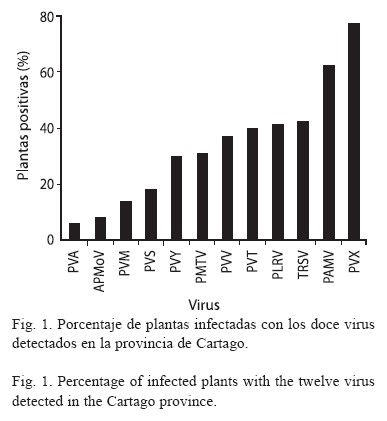
<body><![CDATA[TRSV con un 42 %, </span><span style="font-family: arial;">PLRV 41 %,     PVT 39 %, PVV 37 %, PMTV </span><span style="font-family: arial;">31     %, PVY 30 %, PVS 19 %, PVM 13 %, </span><span      style="font-family: arial;">APMoV 8 % y PVA en el 6 % No se     encontr&oacute; </span><span style="font-family: arial;">APLV en     ninguna de las muestras analizadas </span><span      style="font-family: arial;">(<a href="#FIG1">Fig. 1</a>).</span></small><br      style="font-family: arial;">     <small></small><br style="font-family: arial;">     <small><span style="font-family: arial;">Del total de las muestras     ]]></body>
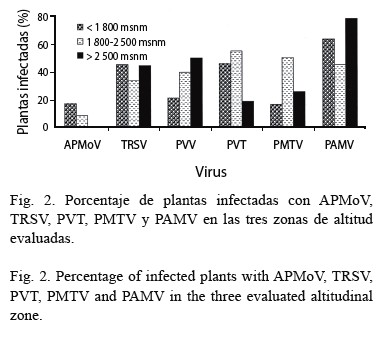
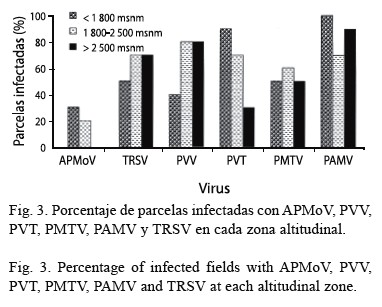
<body><![CDATA[analizadas     para el </span><span style="font-family: arial;">virus PAMV, se     detectaron infectadas el 77.5 % </span><span      style="font-family: arial;">en la zona alta, un 44 % en la zona media     y </span><span style="font-family: arial;">el 63 % de la zona baja     (<a href="#FIG2">Fig. 2</a>). Este virus se </span><span      style="font-family: arial;">detect&oacute;     en el 90 % de las parcelas de la zona </span><span      style="font-family: arial;">alta, en el 70 % de las parcelas de la     zona media </span><span style="font-family: arial;">y en el 100 % de     ]]></body>
<body><![CDATA[las parcelas en la zona baja </span><span style="font-family: arial;">(<a      href="#FIG3">Fig.     3</a>). En 11 de las 30 parcelas analizadas se </span><span      style="font-family: arial;">encontr&oacute; en el 100 % de las     muestras y en las </span><span style="font-family: arial;">dem&aacute;s     parcelas super&oacute; el 50 %.</span></small><br      style="font-family: arial;">     <small></small><br style="font-family: arial;">     <small><span style="font-family: arial;">El PMTV se encontr&oacute; en     el 25 %     ]]></body>
<body><![CDATA[de las </span><span style="font-family: arial;">muestras analizadas en     la zona alta, en el 50 % </span><span style="font-family: arial;">de     la zona media y 15 % de la zona baja. En la </span><span      style="font-family: arial;">zona alta se detect&oacute; en el 50 % de     las parcelas, </span><span style="font-family: arial;">en el 60 % de     la zona media y en el 50 % de la </span><span      style="font-family: arial;">zona baja. La incidencia de plantas     infectadas </span><span style="font-family: arial;">por parcela fue de     un 45 % en la zona alta,&nbsp; </span><span style="font-family: arial;">17     % en la zona media y un 15 % en la zona </span><span     ]]></body>
<body><![CDATA[ style="font-family: arial;">baja (<a href="#FIG2">Fig. 2</a>, <a      href="#FIG3">3</a>).</span></small><br style="font-family: arial;">     <small></small><br style="font-family: arial;">     <small><span style="font-family: arial;">La cantidad de muestras     positivas     para </span><span style="font-family: arial;">PVT alcanz&oacute; un 18     % en los cultivos de la zona </span><span style="font-family: arial;">alta     y se encontr&oacute; en el 30 % de las parcelas. </span><span      style="font-family: arial;">En la zona media se detect&oacute; en el     70 % de las </span><span style="font-family: arial;">parcelas, en     ]]></body>
<body><![CDATA[m&aacute;s del 50 % de las plantas por </span><span      style="font-family: arial;">parcela. En la zona baja se detect&oacute;     en m&aacute;s del </span><span style="font-family: arial;">40 % de las     muestras y en el 90 % de las parcelas </span><span      style="font-family: arial;">(<a href="#FIG2">Fig. 2</a>, <a      href="#FIG3">3</a>).</span></small><br style="font-family: arial;">     <small></small><br style="font-family: arial;">     <small><span style="font-family: arial;">El PVV se detect&oacute; en el     80 %     de las parcelas </span><span style="font-family: arial;">estudiadas en     ]]></body>
<body><![CDATA[la zona alta con un promedio </span><span style="font-family: arial;">de     infecci&oacute;n del 50 % por parcela. Adem&aacute;s, se </span><span      style="font-family: arial;">detect&oacute; en el 80 % de las parcelas     de la zona </span><span style="font-family: arial;">media infectando     el 40 % de las plantas. En la </span><span style="font-family: arial;">zona     baja fue m&aacute;s escaso, se detect&oacute; en el 40 % </span><span      style="font-family: arial;">de las parcelas con un 20 % de promedio de     </span><span style="font-family: arial;">infecci&oacute;n por parcela     (<a href="#FIG2">Fig. 2</a>, <a href="#FIG3">3</a>).</span></small><br      style="font-family: arial;">     ]]></body>
<body><![CDATA[<small></small><br style="font-family: arial;">     <small><span style="font-family: arial;">El virus TRSV se     detect&oacute; en el     70 % </span><span style="font-family: arial;">de las parcelas de las     zonas media y alta, y </span><span style="font-family: arial;">en el     50 % en la zona baja. El promedio de </span><span      style="font-family: arial;">infecci&oacute;n fue alrededor del 45 % en     todas las&nbsp; </span><span style="font-family: arial;">parcelas     (<a href="#FIG2">Fig. 2</a>, <a href="#FIG3">3</a>).</span></small><br      style="font-family: arial;">     ]]></body>
<body><![CDATA[<small></small><br style="font-family: arial;">     <small><span style="font-family: arial;">El APMoV no se encontr&oacute;     en la     zona alta. </span><span style="font-family: arial;">En la zona baja se     encontr&oacute; en el 30 % de las </span><span      style="font-family: arial;">parcelas con una infecci&oacute;n del 15 %     por parcela.&nbsp; </span><span style="font-family: arial;">En la zona     media se detect&oacute; en el 20 % de </span><span      style="font-family: arial;">las parcelas con una infecci&oacute;n     inferior al 10 % </span><span style="font-family: arial;">por parcela     ]]></body>
<body><![CDATA[(<a href="#FIG2">Fig. 2</a>, <a href="#FIG3">3</a>).</span></small><br      style="font-family: arial;">     <small></small><br style="font-family: arial;">     <small><span style="font-family: arial;">Todas las parcelas estuvieron     infectadas </span><span style="font-family: arial;">con al menos dos     de los virus analizados. El n&uacute;mero de virus encontrados por     parcela analizada </span><span style="font-family: arial;">vari&oacute;     de dos a diez, con un promedio de </span><span      style="font-family: arial;">cinco virus. El 44 % de las parcelas     presentaron </span><span style="font-family: arial;">m&aacute;s de     ]]></body>
<body><![CDATA[siete virus. Las infecciones mixtas en </span><span      style="font-family: arial;">plantas individuales fueron muy comunes.     En </span><span style="font-family: arial;">promedio se detectaron     cuatro virus por planta.</span></small></div>     <p align="center"><a name="FIG1"> <img style="border: 0px solid ; width: 387px; height: 421px;"  src="/img/fbpe/rbt/v54n4/3497i1.JPG" title="" alt=""></a><a name="FIG2"><img  style="border: 0px solid ; width: 385px; height: 339px;"  src="/img/fbpe/rbt/v54n4/3497i2.JPG" title="" alt=""></a></p>     
<p align="center"><a name="FIG3"> <img style="border: 0px solid ; width: 382px; height: 307px;"  src="/img/fbpe/rbt/v54n4/3497i3.JPG" title="" alt=""></a></p>     
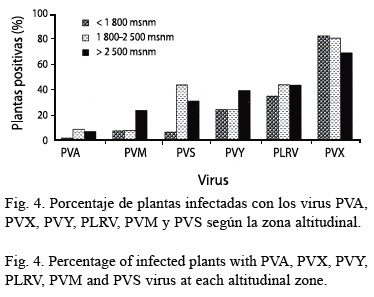
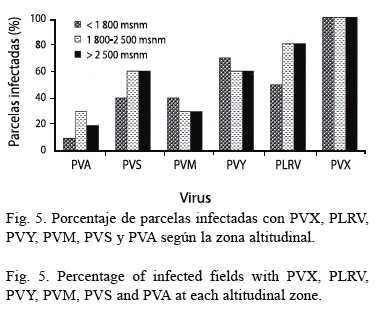
<p align="justify"><small><br style="font-family: arial;"> <br style="font-family: arial;"> </small></p>     <div style="text-align: left;"><small><span style="font-family: arial;">De los seis virus previamente informados </span><span style="font-family: arial;">para Costa Rica, el PVX se detect&oacute; en el 100 % </span><span  style="font-family: arial;">de las fincas analizadas. La infecci&oacute;n en la zona&nbsp; </span><span  style="font-family: arial;">baja fue de 85 % por parcela. En la zona alta hubo </span><span style="font-family: arial;">un promedio de 65 % de infecci&oacute;n por parcela. En </span><span  style="font-family: arial;">el 50 % de las fincas analizadas, todas las plantas </span><span style="font-family: arial;">fueron positivas para este virus (<a href="#FIG4">Fig. 4</a>, <a href="#FIG5">5</a>).</span></small><br  style="font-family: arial;"> <small></small><br style="font-family: arial;"> <small><span style="font-family: arial;">El PLRV se detect&oacute; en el 80 % de las parcelas </span><span style="font-family: arial;">de la zona alta y media, y en el 50 % de </span><span style="font-family: arial;">las parcelas de la zona baja. El porcentaje de </span><span  style="font-family: arial;">infecci&oacute;n por parcela, fue similar en todas las </span><span style="font-family: arial;">zonas con un promedio de 50 %. El PVY se </span><span style="font-family: arial;">encontr&oacute; en el 70 % de las parcelas de la zona </span><span  style="font-family: arial;">baja y en el 60 % de las de la zona alta y media. </span><span style="font-family: arial;">La infecci&oacute;n promedio por parcela en la zona </span><span  style="font-family: arial;">alta fue de 65 % y en las zonas baja y media fue </span><span style="font-family: arial;">de 35 % (<a  href="#FIG4">Fig. 4</a>, <a href="#FIG5">5</a>).</span></small><br  style="font-family: arial;"> <small></small><br style="font-family: arial;"> <small><span style="font-family: arial;">El PVS se detect&oacute; principalmente en la zona </span><span style="font-family: arial;">media, en el 60 % de las parcelas con una infecci&oacute;n </span><span  style="font-family: arial;">promedio por parcela de 75 %. La zona baja </span><span style="font-family: arial;">tuvo 40 % de parcelas infectadas con un promedio </span><span style="font-family: arial;">de infecci&oacute;n por parcela menor al 10 %. El </span><span  style="font-family: arial;">PVM se encuentra en el 40 % de las parcelas de la </span><span style="font-family: arial;">zona baja y en el 30 % de las parcelas de la zona </span><span  style="font-family: arial;">media y alta, pero el promedio de infecci&oacute;n por </span><span style="font-family: arial;">parcela en la zona alta fue de 18 % en promedio </span><span  style="font-family: arial;">y para la zona baja un 6 % (<a href="#FIG4">Fig. 4</a>, <a href="#FIG5">5</a>).</span></small><br  style="font-family: arial;"> <small></small><br style="font-family: arial;"> <small><span style="font-family: arial;">El PVA se detect&oacute; en el 30 % de las parcelas </span><span style="font-family: arial;">de la zona media con un promedio de infecci&oacute;n </span><span  style="font-family: arial;">del 8 %. El 20 % de las parcelas de la zona alta&nbsp; </span><span style="font-family: arial;">presentaron un promedio de infecci&oacute;n del 9 % y </span><span  style="font-family: arial;">las parcelas de la zona baja un 10 % (<a  href="#FIG4">Fig. 4</a>, <a href="#FIG5">5</a>).</span></small><br  style="font-family: arial;"> <small></small><br style="font-family: arial;"> <small><b> <small><span style="font-family: arial;"><font size="3"><small>Discusi&oacute;n</small></font></span></small></b></small><br  style="font-family: arial;"> <small><b><font size="3"></font></b> </small><br style="font-family: arial;"> <small><span style="font-family: arial;">Nuestros resultados evidencian la presencia </span><span style="font-family: arial;">de 12 de los 13 virus analizados en el cultivo de </span><span  style="font-family: arial;">la papa, en la zona norte de Cartago en Costa&nbsp; </span><span style="font-family: arial;">Rica (<a  href="#FIG1">Fig. 1</a>). De estos doce virus, PAMV, </span><span  style="font-family: arial;">APMoV, PVV, PVT y PMTV se informan por&nbsp; </span><span  style="font-family: arial;">primera vez para Costa Rica en este estudio, el resto de los virus se informaron previamente </span><span  style="font-family: arial;">(Espinoza y G&aacute;mez 1977, Ram&iacute;rez-Mart&iacute;nez </span><span style="font-family: arial;">1980, Sol&iacute;s 1989, Hord y Rivera 1998).</span></small><br  style="font-family: arial;"> </div>     <p align="justify"><small>&nbsp;</small></p>     <p align="center"><a name="FIG4"> <img style="border: 0px solid ; width: 374px; height: 297px;"  src="/img/fbpe/rbt/v54n4/3497i4.JPG" title="" alt=""></a> <a name="FIG5"><img  style="border: 0px solid ; width: 384px; height: 312px;"  src="/img/fbpe/rbt/v54n4/3497i5.JPG" title="" alt=""></a></p>     
]]></body>
<body><![CDATA[<p align="justify"><small> <br style="font-family: arial;"> </small></p>     <div style="text-align: left;"><small><span style="font-family: arial;">Estos     resultados tambi&eacute;n     evidencian la </span><span style="font-family: arial;">amplia     distribuci&oacute;n que estos virus tienen </span><span      style="font-family: arial;">en las tres zonas altitudinales estudiadas     en </span><span style="font-family: arial;">Cartago (<a href="#FIG2">Fig.     2</a>, <a href="#FIG4">4</a>). Los doce virus encontrados </span><span      style="font-family: arial;">en     esta zona fueron detectados en las tres altitudes, </span><span     ]]></body>
<body><![CDATA[ style="font-family: arial;">con excepci&oacute;n del APMoV, el cual no     se </span><span style="font-family: arial;">detect&oacute; en ninguna     de las parcelas de la zona </span><span style="font-family: arial;">alta     (<a href="#FIG2">Fig. 2</a>, <a href="#FIG3">3</a>). En general, en     todas las parcelas </span><span style="font-family: arial;">estudiadas     se detectaron por lo menos dos     virus </span><span style="font-family: arial;">y en la mayor&iacute;a     de cinco a siete.</span></small><br style="font-family: arial;">     <small></small><br style="font-family: arial;">     <small><span style="font-family: arial;">Entre los nuevos virus     ]]></body>
<body><![CDATA[estudiados, el     PAMV </span><span style="font-family: arial;">fue el m&aacute;s     frecuente (<a href="#FIG2">Fig. 2</a>). El PAMV adem&aacute;s </span><span      style="font-family: arial;">de encontrarse en la mayor&iacute;a de las     parcelas de </span><span style="font-family: arial;">las tres     altitudes, present&oacute; una alta incidencia </span><span      style="font-family: arial;">por parcela, incidencia que fue del 100 %     en&nbsp; </span><span style="font-family: arial;">11 parcelas y     m&aacute;s del 50 % en el resto de ellas. El PAMV presenta una amplia     distribuci&oacute;n </span><span style="font-family: arial;">en Centro     ]]></body>
<body><![CDATA[y Sudam&eacute;rica (Brunt et al. 1996), </span><span      style="font-family: arial;">por lo que no es extra&ntilde;o que se     encuentre en </span><span style="font-family: arial;">Costa Rica con     tan alta incidencia. Este virus se </span><span      style="font-family: arial;">transmite por contacto entre plantas,     tub&eacute;rculosemilla </span><span style="font-family: arial;">y en     forma mec&aacute;nica mediante herramientas </span><span      style="font-family: arial;">y maquinaria (Salazar 1995), por lo </span><span      style="font-family: arial;">que su diseminaci&oacute;n en el campo     puede ocurrir </span><span style="font-family: arial;">f&aacute;cilmente     ]]></body>
<body><![CDATA[si no se realiza un manejo adecuado </span><span      style="font-family: arial;">del cultivo. Seg&uacute;n Baulcombe et al.     (1993) el </span><span style="font-family: arial;">PAMV tambi&eacute;n     es transmitido por &aacute;fidos en </span><span      style="font-family: arial;">forma asistida por PVY o PVA,     situaci&oacute;n que </span><span style="font-family: arial;">podr&iacute;a     explicar&nbsp; por qu&eacute; en la mayor&iacute;a de las </span><span      style="font-family: arial;">parcelas donde se detect&oacute; el PVY     tambi&eacute;n se </span><span style="font-family: arial;">encontr&oacute;     PAMV.</span></small><br style="font-family: arial;">     ]]></body>
<body><![CDATA[<small></small><br style="font-family: arial;">     <small><span style="font-family: arial;">El PVV present&oacute; una     incidencia     del 36 % </span><span style="font-family: arial;">(<a href="#FIG1">Fig.     1</a>). Este virus     se transmite en forma </span><span style="font-family: arial;">mec&aacute;nica     y mediante &aacute;fidos de manera no </span><span      style="font-family: arial;">persistente, por semilla sexual y polen     (Brunt </span><span style="font-family: arial;"><span      style="font-style: italic;">et al</span>. 1996). Est&aacute;     ]]></body>
<body><![CDATA[relacionado serol&oacute;gicamente </span><span      style="font-family: arial;">con algunas razas de PVY (Spetz <span      style="font-style: italic;">et al</span>. 2003). </span><span      style="font-family: arial;">Posiblemente, debido a esto en la     mayor&iacute;a de </span><span style="font-family: arial;">las     parcelas donde estuvo presente el PVT, </span><span      style="font-family: arial;">tambi&eacute;n se encontr&oacute; PVV.</span></small><br      style="font-family: arial;">     <small></small><br style="font-family: arial;">     <small><span style="font-family: arial;">El PMTV es transmitido     ]]></body>
<body><![CDATA[principalmente     </span><span style="font-family: arial;">por <span      style="font-style: italic;">Spongospora subterranea</span> (Savenkov <span      style="font-style: italic;">et al</span>. </span><span      style="font-family: arial;">1999). Este plasmodioforomicete es muy     dif&iacute;cil </span><span style="font-family: arial;">de combatir,     sus esporas de resistencia son </span><span style="font-family: arial;">capaces     de permanecer en el campo por a&ntilde;os, </span><span      style="font-family: arial;">portar el virus y transmitirlo a los     tub&eacute;rculos en </span><span style="font-family: arial;">el campo     ]]></body>
<body><![CDATA[(Arly Sokmen <span style="font-style: italic;">et al</span>. 1998). Su     dispersi&oacute;n </span><span style="font-family: arial;">se ve&nbsp;     favorecida en terrenos h&uacute;medos y a </span><span      style="font-family: arial;">bajas temperaturas. La presencia de <span      style="font-style: italic;">S. subterranea</span> </span><span      style="font-family: arial;">se inform&oacute; en varias parcelas     ubicadas </span><span style="font-family: arial;">en las zonas media y     alta (Montero-Ast&uacute;a <span style="font-style: italic;">et al</span>.     </span><span style="font-family: arial;">2002), zonas con una     precipitaci&oacute;n y humedad </span><span style="font-family: arial;">mayor     ]]></body>
<body><![CDATA[que las presentes en la zona baja. Este </span><span      style="font-family: arial;">hallazgo se puede relacionar con la mayor     incidencia </span><span style="font-family: arial;">del PMTV en las     zonas media y alta en </span><span style="font-family: arial;">comparaci&oacute;n     con la zona baja (<a href="#FIG2">Fig. 2</a>).</span></small><br      style="font-family: arial;">     <small></small><br style="font-family: arial;">     <small><span style="font-family: arial;">El APMoV present&oacute; una     baja     incidencia </span><span style="font-family: arial;">en este estudio     ]]></body>
<body><![CDATA[(<a href="#FIG1">Fig. 1</a>), situaci&oacute;n similar a la </span><span      style="font-family: arial;">que se presenta en otros pa&iacute;ses y a     diferencia </span><span style="font-family: arial;">de la zona andina     donde es muy abundante </span><span style="font-family: arial;">(Brunt     <span style="font-style: italic;">et al</span>. 1996, Stevenson 2001) y     donde </span><span style="font-family: arial;">se inform&oacute; por     primera vez. Se transmite por </span><span style="font-family: arial;">cole&oacute;pteros,     por contacto entre plantas y en </span><span      style="font-family: arial;">forma mec&aacute;nica. La baja&nbsp;     incidencia que se </span><span style="font-family: arial;">encontr&oacute;     ]]></body>
<body><![CDATA[en Costa Rica podr&iacute;a deberse entre </span><span      style="font-family: arial;">otros factores, a que el APMoV haya sido     de </span><span style="font-family: arial;">muy reciente     introducci&oacute;n al pa&iacute;s y que a&uacute;n no </span><span      style="font-family: arial;">se haya diseminado por toda la     regi&oacute;n papera, </span><span style="font-family: arial;">o que     las variedades sembradas posean cierta </span><span      style="font-family: arial;">resistencia a este virus.</span></small><br      style="font-family: arial;">     <small></small><br style="font-family: arial;">     ]]></body>
<body><![CDATA[<small><span style="font-family: arial;">Al comparar los resultados     obtenidos     por </span><span style="font-family: arial;">Hord y Rivera (1998), con     la informaci&oacute;n de </span><span style="font-family: arial;">este     estudio, se comprob&oacute; que el virus PVX </span><span      style="font-family: arial;">contin&uacute;a siendo el m&aacute;s     abundante. Adem&aacute;s, se </span><span style="font-family: arial;">observ&oacute;     un aumento en la incidencia del PVS y </span><span      style="font-family: arial;">se not&oacute; una disminuci&oacute;n en     PVA, PLRV, PVY </span><span style="font-family: arial;">y PVM. La     ]]></body>
<body><![CDATA[disminuci&oacute;n de estos virus podr&iacute;a </span><span      style="font-family: arial;">deberse a los esfuerzos de los     &uacute;ltimos a&ntilde;os, por </span><span      style="font-family: arial;">ense&ntilde;ar al agricultor sobre la     importancia de </span><span style="font-family: arial;">utilizar una     semilla libre de virus.</span></small><br style="font-family: arial;">     <small></small><br style="font-family: arial;">     <small><span style="font-family: arial;">Las infecciones mixtas fueron     muy     frecuentes, </span><span style="font-family: arial;">en promedio     ]]></body>
<body><![CDATA[cuatro virus por planta </span><span style="font-family: arial;">(datos     no mostrados). Este tipo de infecciones </span><span      style="font-family: arial;">pueden provocar un efecto sin&eacute;rgico     y agravar </span><span style="font-family: arial;">los s&iacute;ntomas     en la planta, y como consecuencia </span><span      style="font-family: arial;">una mayor disminuci&oacute;n en el     rendimiento. </span><span style="font-family: arial;">Una de las     hip&oacute;tesis para entender este tipo </span><span      style="font-family: arial;">de infecci&oacute;n, es la posibilidad de     que los &aacute;fidos </span><span style="font-family: arial;">est&eacute;n     ]]></body>
<body><![CDATA[infectados con varios virus, y en el </span><span      style="font-family: arial;">momento de realizar las pruebas de     alimentaci&oacute;n </span><span style="font-family: arial;">o     alimentarse efectivamente, los transmitan a la&nbsp; </span><span      style="font-family: arial;">vez. Otra de las posibilidades es la     encapsidaci&oacute;n </span><span style="font-family: arial;">heter&oacute;loga,     que consiste en que dos virus </span><span style="font-family: arial;">diferentes     se encapsidan dentro de la misma </span><span      style="font-family: arial;">cubierta proteica y son transmitidos     simult&aacute;neamente </span><span style="font-family: arial;">por     ]]></body>
<body><![CDATA[&aacute;fidos. Esta condici&oacute;n es transitoria, </span><span      style="font-family: arial;">y ocurre en la naturaleza entre virus     compatibles </span><span style="font-family: arial;">(Nelson y Wheeler     1981). La compatibilidad de </span><span style="font-family: arial;">los&nbsp;     virus no est&aacute; bien definida, aunque se sabe </span><span      style="font-family: arial;">que la estructura del virus es     determinante, pues </span><span style="font-family: arial;">es muy     poco probable encontrar encapsidaci&oacute;n </span><span      style="font-family: arial;">heter&oacute;loga entre un virus     esf&eacute;rico y uno alargado </span><span style="font-family: arial;">(Elnagar     ]]></body>
<body><![CDATA[y Murant 1976). Esto coincide con que </span><span      style="font-family: arial;">la mayor&iacute;a de las infecciones     mixtas detectadas </span><span style="font-family: arial;">en este     estudio ocurrieron entre virus alargados </span><span      style="font-family: arial;">como PAMV, PVX, PVY, PVV y PVT.</span></small><br      style="font-family: arial;">     <small></small><br style="font-family: arial;">     <small><span style="font-family: arial;">Es interesante destacar que en     la     zona dedicada </span><span style="font-family: arial;">a la     ]]></body>
<body><![CDATA[producci&oacute;n de semilla, la incidencia </span><span      style="font-family: arial;">de virus transmitidos por &aacute;fidos,     tales como </span><span style="font-family: arial;">PVM, PVS, PVY,     PRLV y PVV, as&iacute; como, la </span><span      style="font-family: arial;">del potexvirus PAMV, que puede ser     transmitido </span><span style="font-family: arial;">por &aacute;fidos     a partir de plantas con infecci&oacute;nmixta de PVA o PVY, fue del 20     % hasta un </span><span style="font-family: arial;">77.5 %. Esto se     observ&oacute; a pesar de que varios </span><span      style="font-family: arial;">estudios indican que las poblaciones de     ]]></body>
<body><![CDATA[&aacute;fidos </span><span style="font-family: arial;">vectores     disminuyen a altitudes mayores a </span><span      style="font-family: arial;">2 500 msnm (Chac&oacute;n 1980, Meneses y     Amador </span><span style="font-family: arial;">1990). Por&nbsp; esta     raz&oacute;n, se acostumbra ubicar </span><span      style="font-family: arial;">las parcelas para producci&oacute;n de     semilla a una </span><span style="font-family: arial;">altitud mayor a     2 500 msnm, regi&oacute;n donde se </span><span      style="font-family: arial;">considera que el riesgo de     infecci&oacute;n es m&iacute;nimo. </span><span     ]]></body>
<body><![CDATA[ style="font-family: arial;">Sin embargo, la presencia de &aacute;fidos     vectores en </span><span style="font-family: arial;">la zona de     producci&oacute;n de semilla, aunque en </span><span      style="font-family: arial;">poblaciones bajas, parece ser suficiente     para la </span><span style="font-family: arial;">transmisi&oacute;n de     virus, con un aumento paulatino </span><span      style="font-family: arial;">en la incidencia a trav&eacute;s de varias     siembras </span><span style="font-family: arial;">sucesivas (Hord y     Rivera 1998). El hecho de </span><span style="font-family: arial;">que     estos virus se detecten en la zona alta con </span><span     ]]></body>
<body><![CDATA[ style="font-family: arial;">una incidencia alta, puede deberse     tambi&eacute;n, a </span><span style="font-family: arial;">la siembra     de tub&eacute;rculos infectados en los campos, </span><span      style="font-family: arial;">lo que facilita la diseminaci&oacute;n por     &aacute;fidos.</span></small><br style="font-family: arial;">     <small></small><br style="font-family: arial;">     <small><span style="font-family: arial;">Debido a la alta incidencia de     virus     informada </span><span style="font-family: arial;">en este estudio, es     indispensable crearle </span><span style="font-family: arial;">conciencia     ]]></body>
<body><![CDATA[al agricultor de iniciar su siembra con </span><span      style="font-family: arial;">semilla libre de virus y renovar la     semilla peri&oacute;dicamente, </span><span style="font-family: arial;">para     lograr reducir la dispersi&oacute;n de </span><span      style="font-family: arial;">las enfermedades virales en el campo.     Asimismo, </span><span style="font-family: arial;">es necesario     fortalecer el Programa Nacional de </span><span      style="font-family: arial;">Certificaci&oacute;n de Semilla, para     facilitar a los agricultores </span><span style="font-family: arial;">el     acceso a semilla libre de virus.</span></small><br     ]]></body>
<body><![CDATA[ style="font-family: arial;">     <small></small><br style="font-family: arial;">     <small><span style="font-family: arial;">Este estudio demostr&oacute;     la alta     incidencia </span><span style="font-family: arial;">de virus en la     zona norte de Cartago y no se </span><span style="font-family: arial;">descarta     la posible presencia de otros virus no </span><span      style="font-family: arial;">estudiados hasta ahora.</span></small><br      style="font-family: arial;">     <small></small><br style="font-family: arial;">     ]]></body>
<body><![CDATA[<small><small><span style="font-family: arial; font-weight: 700;"><font      size="3"><small>Agradecimientos</small></font></span></small></small><br      style="font-family: arial;">     <small></small><br style="font-family: arial;">     <small><span style="font-family: arial;">Se agradece el financiamiento     de este     </span><span style="font-family: arial;">proyecto al convenio Costa     Rica-Pa&iacute;ses </span><span style="font-family: arial;">Bajos     (Fundecooperaci&oacute;n), al Programa de </span><span      style="font-family: arial;">Caracterizaci&oacute;n y     ]]></body>
<body><![CDATA[Diagn&oacute;stico de Virus y </span><span style="font-family: arial;">Viroides     en Cultivos de Importancia Econ&oacute;mica&nbsp; </span><span      style="font-family: arial;">y Alimentaria del Centro de     Investigaci&oacute;n en </span><span style="font-family: arial;">Biolog&iacute;a     Celular y Molecular (PCDV-CIBCM) </span><span      style="font-family: arial;">y a la Universidad de Costa Rica (UCR).</span></small><br      style="font-family: arial;">     <small></small><br style="font-family: arial;">     <small><small><span style="font-family: arial; font-weight: 700;"><font      size="3"><small>Resumen</small></font></span></small></small><br     ]]></body>
<body><![CDATA[ style="font-family: arial;">     <small></small><br style="font-family: arial;">     <small><span style="font-family: arial;">En Cartago, la zona productora     de     papa m&aacute;s importante </span><span style="font-family: arial;">de     Costa Rica, se realiz&oacute; un muestreo en 30 fincas </span><span      style="font-family: arial;">ubicadas a tres altitudes. Se recolectaron     20 plantas por </span><span style="font-family: arial;">finca y 200     muestras por altitud. Todas las muestras se </span><span      style="font-family: arial;">analizaron independientemente mediante     ]]></body>
<body><![CDATA[ELISA, para PVX, </span><span style="font-family: arial;">PVY, PVM,     PVA, PVS, PLRV, PMTV, PAMV, PVV, PVT, </span><span      style="font-family: arial;">APLV, APMoV y TRSV, utilizando reactivos     comerciales. </span><span style="font-family: arial;">Se     identific&oacute; la presencia de PVX (77 %), PAMV (62 %), </span><span      style="font-family: arial;">PLRV (42 %), TRSV (42 %), PVT (39 %), PVV     (37 %),&nbsp; </span><span style="font-family: arial;">PMTV (31 %),     PVY (30 %), PVS (19 %), PVM (13 %),&nbsp; </span><span      style="font-family: arial;">PVA (8 %), y APMoV (8 %). No se     detect&oacute; APLV en ninguna </span><span style="font-family: arial;">de     ]]></body>
<body><![CDATA[las muestras analizadas. Se informan por primera vez la presencia en     Costa Rica de los     virus PMTV, PAMV, </span><span style="font-family: arial;">PVV, PVT y     APMoV. Se informa la alta incidencia viral en </span><span      style="font-family: arial;">la zona dedicada a la producci&oacute;n de     tub&eacute;rculos como semilla </span><span style="font-family: arial;">y     la alta tasa de infecciones mixtas.</span></small><br      style="font-family: arial;">     <small></small><br style="font-family: arial;">     <small><span style="font-family: arial;"><span     ]]></body>
<body><![CDATA[ style="font-weight: bold;">Palabras     clave</span>: virus de la papa, diagnosis, DAS-ELISA, </span><span      style="font-family: arial;">TAS-ELISA, epidemiolog&iacute;a, semilla     de papa.</span></small><br style="font-family: arial;">     <small></small><br style="font-family: arial;">     <small><small><span style="font-family: arial; font-weight: 700;"><font      size="3"><small>Referencias</small></font></span></small></small><br      style="font-family: arial;">     <small></small><br style="font-family: arial;">     <small><span style="font-family: arial;">Arly Sokmen, M., H. Barker     ]]></body>
<body><![CDATA[&amp; L.     Torrance. 1998. Factors </span><span style="font-family: arial;">affecting     the detection of <span style="font-style: italic;">Potato mop-top</span>     virus in </span><span style="font-family: arial;">potato tubers and     improvement of test procedures for </span><span      style="font-family: arial;">more reliable assays. Ann. Appl. Biol.     133: 55-63.</span></small><br style="font-family: arial;">     <small></small><br style="font-family: arial;">     <!-- ref --><small><span style="font-family: arial;">    &nbsp;&nbsp;&nbsp;&nbsp;&nbsp;&nbsp;&nbsp;&nbsp;[&#160;<a href="javascript:void(0);" onclick="javascript: window.open('/scielo.php?script=sci_nlinks&ref=1361070&pid=S0034-7744200600040001100001&lng=','','width=640,height=500,resizable=yes,scrollbars=1,menubar=yes,');">Links</a>&#160;]<!-- end-ref --><!-- ref -->Baulcombe, D.C., J. Lloyd, I.N. Manousopolus, I.M. </span><span style="font-family: arial;">Roberts &amp; B.D. Harrison. 1993. Signal for Potyvirus depend </span><span  style="font-family: arial;">aphid transmission of <span  style="font-style: italic;">Potato aucuba mosaic </span></span><span  style="font-family: arial;"><span style="font-style: italic;">virus</span> and the effect of its transfer to potato virus X. J. </span><span  style="font-family: arial;">Gen. Virol. 74: 1245-1253.</span></small><br  style="font-family: arial;"> <small></small><br style="font-family: arial;"> <small><span style="font-family: arial;">    &nbsp;&nbsp;&nbsp;&nbsp;&nbsp;&nbsp;&nbsp;&nbsp;[&#160;<a href="javascript:void(0);" onclick="javascript: window.open('/scielo.php?script=sci_nlinks&ref=1361071&pid=S0034-7744200600040001100002&lng=','','width=640,height=500,resizable=yes,scrollbars=1,menubar=yes,');">Links</a>&#160;]<!-- end-ref --><!-- ref -->Brunt, A., K. Crabtree, M. Dallwitz, A. Gibbs &amp; L. Watson. </span><span style="font-family: arial;">1996. Viruses of plants; descriptions and list from </span><span  style="font-family: arial;">the Video Database. CAB International. Cambridge </span><span style="font-family: arial;">University, Cambridge, Reino Unido. p. 150-151</span></small><br  style="font-family: arial;"> <small></small><br style="font-family: arial;"> <small><span style="font-family: arial;">    &nbsp;&nbsp;&nbsp;&nbsp;&nbsp;&nbsp;&nbsp;&nbsp;[&#160;<a href="javascript:void(0);" onclick="javascript: window.open('/scielo.php?script=sci_nlinks&ref=1361072&pid=S0034-7744200600040001100003&lng=','','width=640,height=500,resizable=yes,scrollbars=1,menubar=yes,');">Links</a>&#160;]<!-- end-ref --><!-- ref -->Chac&oacute;n, M.C. 1980. Evaluaci&oacute;n de la poblaci&oacute;n de &aacute;fidos </span><span  style="font-family: arial;">alados en cultivos de papa para semilla en la zona </span><span style="font-family: arial;">norte de Cartago. Tesis de Grado, Universidad de </span><span style="font-family: arial;">Costa Rica, San Jos&eacute;, Costa Rica. 185 p.</span></small><br  style="font-family: arial;"> <small></small><br style="font-family: arial;"> <small><span style="font-family: arial;">    &nbsp;&nbsp;&nbsp;&nbsp;&nbsp;&nbsp;&nbsp;&nbsp;[&#160;<a href="javascript:void(0);" onclick="javascript: window.open('/scielo.php?script=sci_nlinks&ref=1361073&pid=S0034-7744200600040001100004&lng=','','width=640,height=500,resizable=yes,scrollbars=1,menubar=yes,');">Links</a>&#160;]<!-- end-ref --><!-- ref -->Elnagar, S. &amp; A.F. Murant. 1976. The role of the helper </span><span style="font-family: arial;">virus, anthriscus yellows, in the transmission of </span><span  style="font-family: arial;">parsnip yellow fleck virus by the aphid <span  style="font-style: italic;">Cavariella</span> </span><span  style="font-family: arial;"><span style="font-style: italic;">aegopodii</span>. Ann. Appl. Biol. 84: 169-181.</span></small><br  style="font-family: arial;"> <small></small><br style="font-family: arial;"> <small><span style="font-family: arial;">    &nbsp;&nbsp;&nbsp;&nbsp;&nbsp;&nbsp;&nbsp;&nbsp;[&#160;<a href="javascript:void(0);" onclick="javascript: window.open('/scielo.php?script=sci_nlinks&ref=1361074&pid=S0034-7744200600040001100005&lng=','','width=640,height=500,resizable=yes,scrollbars=1,menubar=yes,');">Links</a>&#160;]<!-- end-ref --><!-- ref -->Espinoza, A.M. &amp; R. G&aacute;mez. 1977. Incidencia del virus del </span><span style="font-family: arial;">enrollamiento de las hojas de la papa en lotes comerciales </span><span  style="font-family: arial;">de semilla en Costa Rica. Fitopatolog&iacute;a 12: 97-98.</span></small><br  style="font-family: arial;"> <small></small><br style="font-family: arial;"> <small><span style="font-family: arial;">    &nbsp;&nbsp;&nbsp;&nbsp;&nbsp;&nbsp;&nbsp;&nbsp;[&#160;<a href="javascript:void(0);" onclick="javascript: window.open('/scielo.php?script=sci_nlinks&ref=1361075&pid=S0034-7744200600040001100006&lng=','','width=640,height=500,resizable=yes,scrollbars=1,menubar=yes,');">Links</a>&#160;]<!-- end-ref --><!-- ref -->Hord, M. &amp; C. Rivera. 1998. Prevalencia y distribuci&oacute;n </span><span  style="font-family: arial;">geogr&aacute;fica de los virus PVX, PVY, PVA, PVM, PVS, </span><span style="font-family: arial;">y PLRV en el cultivo de la papa en la zona norte </span><span  style="font-family: arial;">de Cartago, Costa Rica. Agron. Costarricense 22: </span><span style="font-family: arial;">137-143.</span></small><br  style="font-family: arial;"> <small></small><br style="font-family: arial;"> <small><span style="font-family: arial;">    &nbsp;&nbsp;&nbsp;&nbsp;&nbsp;&nbsp;&nbsp;&nbsp;[&#160;<a href="javascript:void(0);" onclick="javascript: window.open('/scielo.php?script=sci_nlinks&ref=1361076&pid=S0034-7744200600040001100007&lng=','','width=640,height=500,resizable=yes,scrollbars=1,menubar=yes,');">Links</a>&#160;]<!-- end-ref --><!-- ref -->Meneses, R. &amp; R. Amador. 1990. Monitoreo de &aacute;fidos y su </span><span  style="font-family: arial;">relaci&oacute;n con el programa de semilla de papa en Costa </span><span style="font-family: arial;">Rica. Manejo Integr. Plagas 15: 45-52.</span></small><br style="font-family: arial;"> <small></small><br style="font-family: arial;"> <small><span style="font-family: arial;">    &nbsp;&nbsp;&nbsp;&nbsp;&nbsp;&nbsp;&nbsp;&nbsp;[&#160;<a href="javascript:void(0);" onclick="javascript: window.open('/scielo.php?script=sci_nlinks&ref=1361077&pid=S0034-7744200600040001100008&lng=','','width=640,height=500,resizable=yes,scrollbars=1,menubar=yes,');">Links</a>&#160;]<!-- end-ref --><!-- ref -->Montero-Ast&uacute;a, M., V. V&aacute;squez &amp; C. Rivera. 2002. </span><span  style="font-family: arial;">Ocurrence of potato Powdery Scab, caused by<span  style="font-style: italic;"> </span></span><span  style="font-family: arial;"><span style="font-style: italic;">Spongospora subterranea</span> f.sp. <span style="font-style: italic;">subterranea</span>, in Costa </span><span style="font-family: arial;">Rica. Plant Dis. 86: 1161.</span></small><br style="font-family: arial;"> <small></small><br style="font-family: arial;"> <small><span style="font-family: arial;">    &nbsp;&nbsp;&nbsp;&nbsp;&nbsp;&nbsp;&nbsp;&nbsp;[&#160;<a href="javascript:void(0);" onclick="javascript: window.open('/scielo.php?script=sci_nlinks&ref=1361078&pid=S0034-7744200600040001100009&lng=','','width=640,height=500,resizable=yes,scrollbars=1,menubar=yes,');">Links</a>&#160;]<!-- end-ref --><!-- ref -->Nelson, M.R. &amp; R.E. Wheeler. 1981. Variation in phenotypic </span><span style="font-family: arial;">mixing among pepper-infecting potyviruses. </span><span  style="font-family: arial;">Phytopathology 71: 245.</span></small><br  style="font-family: arial;"> <small></small><br style="font-family: arial;"> <small><span style="font-family: arial;">    &nbsp;&nbsp;&nbsp;&nbsp;&nbsp;&nbsp;&nbsp;&nbsp;[&#160;<a href="javascript:void(0);" onclick="javascript: window.open('/scielo.php?script=sci_nlinks&ref=1361079&pid=S0034-7744200600040001100010&lng=','','width=640,height=500,resizable=yes,scrollbars=1,menubar=yes,');">Links</a>&#160;]<!-- end-ref --><!-- ref -->Ram&iacute;rez- Mart&iacute;nez, C. &amp; R. G&aacute;mez. 1980. Prevalencia del </span><span  style="font-family: arial;">virus X en plantaciones comerciales de papa en la </span><span style="font-family: arial;">zona del Volc&aacute;n Iraz&uacute;, Cartago, Costa Rica. Agron.&nbsp; </span><span  style="font-family: arial;">Costarricense 4: 79-82.</span></small><br  style="font-family: arial;"> <small></small><br style="font-family: arial;"> <small><span style="font-family: arial;">    &nbsp;&nbsp;&nbsp;&nbsp;&nbsp;&nbsp;&nbsp;&nbsp;[&#160;<a href="javascript:void(0);" onclick="javascript: window.open('/scielo.php?script=sci_nlinks&ref=1361080&pid=S0034-7744200600040001100011&lng=','','width=640,height=500,resizable=yes,scrollbars=1,menubar=yes,');">Links</a>&#160;]<!-- end-ref --><!-- ref -->Salazar, L.F. 1995. Los Virus de la Papa y su Control. </span><span style="font-family: arial;">Centro Internacional de la Papa, Lima, Per&uacute;. 226 p.</span></small><br  style="font-family: arial;"> <small></small><br style="font-family: arial;"> <small><span style="font-family: arial;">    &nbsp;&nbsp;&nbsp;&nbsp;&nbsp;&nbsp;&nbsp;&nbsp;[&#160;<a href="javascript:void(0);" onclick="javascript: window.open('/scielo.php?script=sci_nlinks&ref=1361081&pid=S0034-7744200600040001100012&lng=','','width=640,height=500,resizable=yes,scrollbars=1,menubar=yes,');">Links</a>&#160;]<!-- end-ref --><!-- ref -->Savenkov, E., M. Sandgren &amp; P. Valkonen. 1999. Complete </span><span style="font-family: arial;">sequence of RNA 1 and the presence of tRNA-like </span><span  style="font-family: arial;">structures in all RNAs of <span  style="font-style: italic;">Potato mop-top</span> virus, genus </span><span  style="font-family: arial;"><span style="font-style: italic;">Pomovirus</span>. J. Gen. Virol. 80: 2779-2784.</span></small><br  style="font-family: arial;"> <small></small><br style="font-family: arial;"> <small><span style="font-family: arial;">    &nbsp;&nbsp;&nbsp;&nbsp;&nbsp;&nbsp;&nbsp;&nbsp;[&#160;<a href="javascript:void(0);" onclick="javascript: window.open('/scielo.php?script=sci_nlinks&ref=1361082&pid=S0034-7744200600040001100013&lng=','','width=640,height=500,resizable=yes,scrollbars=1,menubar=yes,');">Links</a>&#160;]<!-- end-ref --><!-- ref -->Sol&iacute;s, V.C. 1989. Indice de enfermedades de los cultivos </span><span style="font-family: arial;">agr&iacute;colas de Costa Rica. Ministerio de Agricultura y </span><span  style="font-family: arial;">Ganader&iacute;a-Direcci&oacute;n de Sanidad Vegetal. Convenio </span><span style="font-family: arial;">Costarricense Alem&aacute;n de Sanidad Vegetal MAGGTZ, </span><span  style="font-family: arial;">San Jos&eacute;, Costa Rica. 112 p.</span></small><br  style="font-family: arial;"> <small></small><br style="font-family: arial;"> <small><span style="font-family: arial;">    &nbsp;&nbsp;&nbsp;&nbsp;&nbsp;&nbsp;&nbsp;&nbsp;[&#160;<a href="javascript:void(0);" onclick="javascript: window.open('/scielo.php?script=sci_nlinks&ref=1361083&pid=S0034-7744200600040001100014&lng=','','width=640,height=500,resizable=yes,scrollbars=1,menubar=yes,');">Links</a>&#160;]<!-- end-ref --><!-- ref -->Spetz, C., A.M. Taboada, S. Darwich, J. Ramsell, L.F. </span><span style="font-family: arial;">Salazar &amp; J.P.T. Valkonen. 2003. Molecular resolution </span><span  style="font-family: arial;">of a complex of potyviruses infecting solanaceous </span><span style="font-family: arial;">crops at the centre of origin in Peru. J. Gen. </span><span  style="font-family: arial;">Virol. 84: 2565-2578.</span></small><br  style="font-family: arial;"> <small></small><br style="font-family: arial;"> <small><span style="font-family: arial;">    &nbsp;&nbsp;&nbsp;&nbsp;&nbsp;&nbsp;&nbsp;&nbsp;[&#160;<a href="javascript:void(0);" onclick="javascript: window.open('/scielo.php?script=sci_nlinks&ref=1361084&pid=S0034-7744200600040001100015&lng=','','width=640,height=500,resizable=yes,scrollbars=1,menubar=yes,');">Links</a>&#160;]<!-- end-ref --><!-- ref -->Stevenson, W. 2001. Compendium of potato diseases. </span><span style="font-family: arial;">American Phytopathological Society. St. Paul, </span><span  style="font-family: arial;">Minnesota, EEUU. p. 57-72.</span></small></div>    &nbsp;&nbsp;&nbsp;&nbsp;&nbsp;&nbsp;&nbsp;&nbsp;[&#160;<a href="javascript:void(0);" onclick="javascript: window.open('/scielo.php?script=sci_nlinks&ref=1361085&pid=S0034-7744200600040001100016&lng=','','width=640,height=500,resizable=yes,scrollbars=1,menubar=yes,');">Links</a>&#160;]<!-- end-ref --> ]]></body><back>
<ref-list>
<ref id="B1">
<nlm-citation citation-type="journal">
<person-group person-group-type="author">
<name>
<surname><![CDATA[Arly]]></surname>
<given-names><![CDATA[Sokmen]]></given-names>
</name>
<name>
<surname><![CDATA[Barker]]></surname>
<given-names><![CDATA[M]]></given-names>
</name>
<name>
<surname><![CDATA[Torrance]]></surname>
<given-names><![CDATA[L]]></given-names>
</name>
</person-group>
<article-title xml:lang="en"><![CDATA[Factors affecting the detection of Potato mop-top virus in potato tubers and improvement of test procedures for more reliable assays]]></article-title>
<source><![CDATA[Ann. Appl. Biol]]></source>
<year>1998</year>
<volume>133</volume>
<page-range>55-63</page-range></nlm-citation>
</ref>
<ref id="B2">
<nlm-citation citation-type="journal">
<person-group person-group-type="author">
<name>
<surname><![CDATA[Baulcombe]]></surname>
<given-names><![CDATA[D.C]]></given-names>
</name>
<name>
<surname><![CDATA[Lloyd]]></surname>
<given-names><![CDATA[J]]></given-names>
</name>
<name>
<surname><![CDATA[Manousopolus]]></surname>
<given-names><![CDATA[I.N]]></given-names>
</name>
<name>
<surname><![CDATA[Roberts]]></surname>
<given-names><![CDATA[I.M]]></given-names>
</name>
<name>
<surname><![CDATA[Harrison]]></surname>
<given-names><![CDATA[B.D]]></given-names>
</name>
</person-group>
<article-title xml:lang="en"><![CDATA[Signal for Potyvirus depend aphid transmission of Potato aucuba mosaic virus and the effect of its transfer to potato virus X]]></article-title>
<source><![CDATA[J. Gen. Virol]]></source>
<year>1993</year>
<volume>74</volume>
<page-range>1245-1253</page-range></nlm-citation>
</ref>
<ref id="B3">
<nlm-citation citation-type="book">
<person-group person-group-type="author">
<name>
<surname><![CDATA[Brunt]]></surname>
<given-names><![CDATA[A]]></given-names>
</name>
<name>
<surname><![CDATA[Crabtree]]></surname>
<given-names><![CDATA[K]]></given-names>
</name>
<name>
<surname><![CDATA[Dallwitz]]></surname>
<given-names><![CDATA[M]]></given-names>
</name>
<name>
<surname><![CDATA[Gibbs]]></surname>
<given-names><![CDATA[A]]></given-names>
</name>
<name>
<surname><![CDATA[Watson]]></surname>
<given-names><![CDATA[L]]></given-names>
</name>
</person-group>
<source><![CDATA[Viruses of plants: descriptions and list from the Video Database]]></source>
<year>1996</year>
<page-range>150-151</page-range><publisher-loc><![CDATA[^eCambridge Cambridge]]></publisher-loc>
<publisher-name><![CDATA[CAB International. Cambridge University]]></publisher-name>
</nlm-citation>
</ref>
<ref id="B4">
<nlm-citation citation-type="">
<person-group person-group-type="author">
<name>
<surname><![CDATA[Chacón]]></surname>
<given-names><![CDATA[M.C]]></given-names>
</name>
</person-group>
<source><![CDATA[Evaluación de la población de áfidos alados en cultivos de papa para semilla en la zona norte de Cartago]]></source>
<year>1980</year>
<page-range>185</page-range></nlm-citation>
</ref>
<ref id="B5">
<nlm-citation citation-type="journal">
<person-group person-group-type="author">
<name>
<surname><![CDATA[Elnagar]]></surname>
<given-names><![CDATA[S]]></given-names>
</name>
<name>
<surname><![CDATA[Murant]]></surname>
<given-names><![CDATA[A.F]]></given-names>
</name>
</person-group>
<article-title xml:lang="en"><![CDATA[The role of the helper virus, anthriscus yellows, in the transmission of parsnip yellow fleck virus by the aphid Cavariella aegopodii]]></article-title>
<source><![CDATA[Ann. Appl. Biol]]></source>
<year></year>
<volume>84</volume>
<page-range>1976</page-range><page-range>169-181</page-range></nlm-citation>
</ref>
<ref id="B6">
<nlm-citation citation-type="journal">
<person-group person-group-type="author">
<name>
<surname><![CDATA[Espinoza]]></surname>
<given-names><![CDATA[A.M]]></given-names>
</name>
<name>
<surname><![CDATA[Gámez]]></surname>
<given-names><![CDATA[R]]></given-names>
</name>
</person-group>
<article-title xml:lang="es"><![CDATA[Incidencia del virus del enrollamiento de las hojas de la papa en lotes comerciales de semilla en Costa Rica]]></article-title>
<source><![CDATA[Fitopatología]]></source>
<year>1977</year>
<volume>12</volume>
<page-range>97-98</page-range></nlm-citation>
</ref>
<ref id="B7">
<nlm-citation citation-type="journal">
<person-group person-group-type="author">
<name>
<surname><![CDATA[Hord]]></surname>
<given-names><![CDATA[M]]></given-names>
</name>
<name>
<surname><![CDATA[Rivera]]></surname>
<given-names><![CDATA[C]]></given-names>
</name>
</person-group>
<article-title xml:lang="es"><![CDATA[Prevalencia y distribución geográfica de los virus PVX, PVY, PVA, PVM, PVS, y PLRV en el cultivo de la papa en la zona norte de Cartago, Costa Rica]]></article-title>
<source><![CDATA[Agron. Costarricense]]></source>
<year>1998</year>
<volume>22</volume>
<page-range>137-143</page-range></nlm-citation>
</ref>
<ref id="B8">
<nlm-citation citation-type="journal">
<person-group person-group-type="author">
<name>
<surname><![CDATA[Meneses]]></surname>
<given-names><![CDATA[R]]></given-names>
</name>
<name>
<surname><![CDATA[Amador]]></surname>
<given-names><![CDATA[R]]></given-names>
</name>
</person-group>
<article-title xml:lang="es"><![CDATA[Monitoreo de áfidos y su relación con el programa de semilla de papa en Costa Rica]]></article-title>
<source><![CDATA[Manejo Integr. Plagas]]></source>
<year>1990</year>
<volume>15</volume>
<page-range>45-52</page-range></nlm-citation>
</ref>
<ref id="B9">
<nlm-citation citation-type="journal">
<person-group person-group-type="author">
<name>
<surname><![CDATA[Montero-Astúa]]></surname>
<given-names><![CDATA[M]]></given-names>
</name>
<name>
<surname><![CDATA[Vásquez]]></surname>
<given-names><![CDATA[V]]></given-names>
</name>
<name>
<surname><![CDATA[Rivera]]></surname>
<given-names><![CDATA[C]]></given-names>
</name>
</person-group>
<article-title xml:lang="en"><![CDATA[Ocurrence of potato Powdery Scab, caused by Spongospora subterranea f. sp. subterranea, in Costa Rica]]></article-title>
<source><![CDATA[Plant Dis]]></source>
<year>2002</year>
<volume>86</volume>
<page-range>1161</page-range></nlm-citation>
</ref>
<ref id="B10">
<nlm-citation citation-type="journal">
<person-group person-group-type="author">
<name>
<surname><![CDATA[Nelson]]></surname>
<given-names><![CDATA[M.R]]></given-names>
</name>
<name>
<surname><![CDATA[Wheeler]]></surname>
<given-names><![CDATA[R.E]]></given-names>
</name>
</person-group>
<source><![CDATA[Phytopathology]]></source>
<year>1981</year>
<volume>71</volume>
<page-range>245</page-range></nlm-citation>
</ref>
<ref id="B11">
<nlm-citation citation-type="journal">
<person-group person-group-type="author">
<name>
<surname><![CDATA[Ramírez- Martínez]]></surname>
<given-names><![CDATA[C]]></given-names>
</name>
<name>
<surname><![CDATA[Gámez]]></surname>
<given-names><![CDATA[R]]></given-names>
</name>
</person-group>
<article-title xml:lang="es"><![CDATA[Prevalencia del virus X en plantaciones comerciales de papa en la zona del Volcán Irazú, Cartago, Costa Rica]]></article-title>
<source><![CDATA[Agron. Costarricense]]></source>
<year>1980</year>
<volume>4</volume>
<page-range>79-82</page-range></nlm-citation>
</ref>
<ref id="B12">
<nlm-citation citation-type="book">
<person-group person-group-type="author">
<name>
<surname><![CDATA[Salazar]]></surname>
<given-names><![CDATA[L.F]]></given-names>
</name>
</person-group>
<source><![CDATA[Los Virus de la Papa y su Control]]></source>
<year>1995</year>
<page-range>226</page-range><publisher-loc><![CDATA[^eLima Lima]]></publisher-loc>
<publisher-name><![CDATA[Centro Internacional de la Papa]]></publisher-name>
</nlm-citation>
</ref>
<ref id="B13">
<nlm-citation citation-type="journal">
<person-group person-group-type="author">
<name>
<surname><![CDATA[Savenkov]]></surname>
<given-names><![CDATA[E]]></given-names>
</name>
<name>
<surname><![CDATA[Sandgren]]></surname>
<given-names><![CDATA[M]]></given-names>
</name>
<name>
<surname><![CDATA[Valkonen]]></surname>
<given-names><![CDATA[P]]></given-names>
</name>
</person-group>
<article-title xml:lang="en"><![CDATA[Complete sequence of RNA 1 and the presence of tRNA-like structures in all RNAs of Potato mop-top virus, genus Pomovirus]]></article-title>
<source><![CDATA[J. Gen. Virol]]></source>
<year>1999</year>
<volume>80</volume>
<page-range>2779-2784</page-range></nlm-citation>
</ref>
<ref id="B14">
<nlm-citation citation-type="book">
<person-group person-group-type="author">
<name>
<surname><![CDATA[Solís]]></surname>
<given-names><![CDATA[V.C]]></given-names>
</name>
</person-group>
<source><![CDATA[Indice de enfermedades de los cultivos agrícolas de Costa Rica]]></source>
<year>1989</year>
<page-range>112</page-range><publisher-loc><![CDATA[^eSan José San José]]></publisher-loc>
<publisher-name><![CDATA[Ministerio de Agricultura y Ganadería-Dirección de Sanidad Vegetal. Convenio Costarricense Alemán de Sanidad Vegetal MAGGTZ]]></publisher-name>
</nlm-citation>
</ref>
<ref id="B15">
<nlm-citation citation-type="journal">
<person-group person-group-type="author">
<name>
<surname><![CDATA[Spetz]]></surname>
<given-names><![CDATA[C]]></given-names>
</name>
<name>
<surname><![CDATA[Taboada]]></surname>
<given-names><![CDATA[A.M]]></given-names>
</name>
<name>
<surname><![CDATA[Darwich]]></surname>
<given-names><![CDATA[S]]></given-names>
</name>
<name>
<surname><![CDATA[Ramsell]]></surname>
<given-names><![CDATA[J]]></given-names>
</name>
<name>
<surname><![CDATA[Salazar]]></surname>
<given-names><![CDATA[L.F]]></given-names>
</name>
<name>
<surname><![CDATA[Valkonen]]></surname>
<given-names><![CDATA[J.P.T]]></given-names>
</name>
</person-group>
<article-title xml:lang="en"><![CDATA[Molecular resolution of a complex of potyviruses infecting solanaceous crops at the centre of origin in Peru]]></article-title>
<source><![CDATA[J. Gen. Virol]]></source>
<year>2003</year>
<volume>84</volume>
<page-range>2565-2578</page-range></nlm-citation>
</ref>
<ref id="B16">
<nlm-citation citation-type="book">
<person-group person-group-type="author">
<name>
<surname><![CDATA[Stevenson]]></surname>
<given-names><![CDATA[W]]></given-names>
</name>
</person-group>
<source><![CDATA[Compendium of potato diseases]]></source>
<year>2001</year>
<page-range>57-72</page-range><publisher-loc><![CDATA[St. Paul^eMinnesota Minnesota]]></publisher-loc>
<publisher-name><![CDATA[American Phytopathological Society]]></publisher-name>
</nlm-citation>
</ref>
</ref-list>
</back>
</article>