<?xml version="1.0" encoding="ISO-8859-1"?><article xmlns:mml="http://www.w3.org/1998/Math/MathML" xmlns:xlink="http://www.w3.org/1999/xlink" xmlns:xsi="http://www.w3.org/2001/XMLSchema-instance">
<front>
<journal-meta>
<journal-id>0034-7744</journal-id>
<journal-title><![CDATA[Revista de Biología Tropical]]></journal-title>
<abbrev-journal-title><![CDATA[Rev. biol. trop]]></abbrev-journal-title>
<issn>0034-7744</issn>
<publisher>
<publisher-name><![CDATA[Universidad de Costa Rica]]></publisher-name>
</publisher>
</journal-meta>
<article-meta>
<article-id>S0034-77442006000400009</article-id>
<title-group>
<article-title xml:lang="en"><![CDATA[Hemidactylus frenatus (Squamata: Gekkonidae): call frequency, movement and condition of tail in Costa Rica]]></article-title>
</title-group>
<contrib-group>
<contrib contrib-type="author">
<name>
<surname><![CDATA[Frenkel]]></surname>
<given-names><![CDATA[Caty]]></given-names>
</name>
<xref ref-type="aff" rid="A01"/>
</contrib>
</contrib-group>
<aff id="A01">
<institution><![CDATA[,Ecuador Cuenca ]]></institution>
<addr-line><![CDATA[Cuenca ]]></addr-line>
<country>Ecuador</country>
</aff>
<pub-date pub-type="pub">
<day>00</day>
<month>12</month>
<year>2006</year>
</pub-date>
<pub-date pub-type="epub">
<day>00</day>
<month>12</month>
<year>2006</year>
</pub-date>
<volume>54</volume>
<numero>4</numero>
<fpage>1125</fpage>
<lpage>1130</lpage>
<copyright-statement/>
<copyright-year/>
<self-uri xlink:href="http://www.scielo.sa.cr/scielo.php?script=sci_arttext&amp;pid=S0034-77442006000400009&amp;lng=en&amp;nrm=iso"></self-uri><self-uri xlink:href="http://www.scielo.sa.cr/scielo.php?script=sci_abstract&amp;pid=S0034-77442006000400009&amp;lng=en&amp;nrm=iso"></self-uri><self-uri xlink:href="http://www.scielo.sa.cr/scielo.php?script=sci_pdf&amp;pid=S0034-77442006000400009&amp;lng=en&amp;nrm=iso"></self-uri><abstract abstract-type="short" xml:lang="en"><p><![CDATA[Call frequency and movements of the gecko Hemidactylus frenatus were studied in Punta Morales, Costa Rica from April 1999 through May 2000. Call activity of H. frenatus was positively related to air temperature at night and throughout the year. Higher activity was at dusk, dawn, and during the hottest months. Call frequency was related with gecko abundance per month, although not during the night. More males and females had a regenerated tail compared to juveniles, the last ones could have it complete or regenerated. Females moved longer distances than males and juveniles. Adults were found higher on walls. Males and females were recaptured more times than juveniles, and the period of time between their recaptures was longer. Members of this population do not seem to be as aggressive to other geckos as mentioned in the literature. Rev. Biol. Trop. 54 (4): 1125-1130. Epub 2006 Dec. 15]]></p></abstract>
<abstract abstract-type="short" xml:lang="es"><p><![CDATA[Estudié la frecuencia de canto y el desplazamiento de la lagartija Hemidactylus frenatus en Punta Morales, CostaRica. La frecuencia de canto se corelaciona positivamente con la temperatura ambiental durante la noche y con la temperatura a lo largo del año. La mayor actividad fue al anochecer, al amanecer y durante los meses más calurosos. La abundancia mensual de lagartijas se relacionó con la frecuencia de canto, no así la abundancia por noche. Las colas regeneradas son más frecuentes en hembras y machos que en las lagartijas jóvenes. Las hembras se desplazaron mayores distancias que machos y jóvenes. Los adultos se encontraban más alto en las paredes de los edificios. Los machos y hembras se recapturaron más veces que los jóvenes, y el tiempo entre recapturas fue mayor. Esta población no parece ser tan agresiva como se menciona en la literatura]]></p></abstract>
<kwd-group>
<kwd lng="en"><![CDATA[call frequency]]></kwd>
<kwd lng="en"><![CDATA[gecko distribution]]></kwd>
<kwd lng="en"><![CDATA[Hemidactylus frenatus]]></kwd>
<kwd lng="en"><![CDATA[autotomy]]></kwd>
<kwd lng="en"><![CDATA[temperature]]></kwd>
<kwd lng="en"><![CDATA[seasonality]]></kwd>
<kwd lng="es"><![CDATA[frecuencia de canto]]></kwd>
<kwd lng="es"><![CDATA[distribución]]></kwd>
<kwd lng="es"><![CDATA[temperatura]]></kwd>
<kwd lng="es"><![CDATA[estacionalidad]]></kwd>
<kwd lng="es"><![CDATA[Hemidactylus frenatus]]></kwd>
<kwd lng="es"><![CDATA[autotomía]]></kwd>
</kwd-group>
</article-meta>
</front><body><![CDATA[ <div style="text-align: center; font-family: arial;"><small><span  style="font-style: italic;">Hemidactylus frenatus</span> <span  style="font-weight: bold;">(Squamata: Gekkonidae): call frequency, movement and condition of tail in Costa Rica</span>    <br> </small></div> <br style="font-family: arial;"> <span style="font-family: arial;">Caty Frenkel<sup>1    <br> <br style="font-family: arial;"> </sup></span><small><span style="font-family: arial;">1 Tarqui 19-26 y E. Espejo, Cuenca, Ecuador; <a href="mailto:caty_frenkel@yahoo.com">caty_frenkel@yahoo.com</a></span><br  style="font-family: arial;"> <br style="font-family: arial;"> </small>     <div style="text-align: center; font-family: arial;"><small>Received 10-VIII-2004. Corrected 06-II-2006. Accepted 09-VIII-2006.    <br> </small></div>     <p align="justify"><small> <br style="font-family: arial;"> </small></p>     <div style="text-align: left;"><small><span style="font-family: arial;"><span  style="font-weight: bold;">Abstract</span>: Call frequency and movements of the gecko <span  style="font-style: italic;">Hemidactylus frenatus</span> were studied in Punta Morales, </span><span style="font-family: arial;">Costa Rica from April 1999 through May 2000. Call activity of <span  style="font-style: italic;">H. frenatus</span> was positively related to air temperature </span><span style="font-family: arial;">at night and throughout the year. Higher activity was at dusk, dawn, and during the hottest months. Call </span><span style="font-family: arial;">frequency was related with gecko abundance per month, although not during the night. More males and females </span><span style="font-family: arial;">had a regenerated tail compared to juveniles, the last ones could have it complete or regenerated. Females </span><span  style="font-family: arial;">moved longer distances than males and juveniles. Adults were found higher on walls. Males and females were </span><span  style="font-family: arial;">recaptured more times than juveniles, and the period of time between their recaptures was longer. Members of </span><span  style="font-family: arial;">this population do not seem to be as aggressive to other geckos as mentioned in the literature. Rev. Biol. Trop. </span><span style="font-family: arial;">54 (4): 1125-1130. Epub 2006 Dec. 15.</span><br style="font-family: arial;"> <br style="font-family: arial;"> <span style="font-family: arial;"><span style="font-weight: bold;">Key words</span>: call frequency, gecko distribution, <span  style="font-style: italic;">Hemidactylus frenatus</span>, autotomy, temperature, seasonality.</span><br style="font-family: arial;"> <br style="font-family: arial;"> <span style="font-family: arial;"><span style="font-style: italic;">Hemidactylus frenatus</span> (Schlegel, 1836) </span><span  style="font-family: arial;">is one of the 70 species of this genus. It has</span><span style="font-family: arial;">a world wide distribution (Church and Chun- </span><span style="font-family: arial;">Sim 1961, Hunsaker II 1966, Bustard 1970, </span><span  style="font-family: arial;">Synder and Weathers 1976, Cheng and Lin </span><span  style="font-family: arial;">1977, 1978, Frankenberg 1982) and is reported </span><span style="font-family: arial;">in the new continent in Mexico, Panama and </span><span style="font-family: arial;">some places of the United States (Marcellini 1970, McCoy and Busack 1970, Poulin <span style="font-style: italic;">et al</span>. 1995). In Costa Rica this species has been reported but there are no studies about its natural history or activity. </span>    <br>     <br style="font-family: arial;">     <span style="font-family: arial;">As mentioned somewhere else     ]]></body>
<body><![CDATA[(Marcellini</span> <span style="font-family: arial;">1970), this     nocturnal gecko is mostly associated to human edifications and is often     found     near artificial lights. For     this and other species of geckos     daily and seasonal activity have been studied, including data of number     of     individuals, call frequency,     and movement range of captive animals.     In <span style="font-style: italic;">H. frenatus</span> the activity     ]]></body>
<body><![CDATA[range varies daily and     annually both in tropical and temperate areas (Bustard 1970, Marcellini     1971,     1974, Frankenberg and Werner     1981), probably being correlated to luminosity, temperature,     rain, and </span><span style="font-family: arial;">human activity     (Marcellini 1970).</span><br style="font-family: arial;">     <br style="font-family: arial;">     <span style="font-family: arial;">Several authors mention that <span      style="font-style: italic;">H. frenatus</span> </span><span     ]]></body>
<body><![CDATA[ style="font-family: arial;">is aggressive (Hunsaker II 1966,     Marcellini </span><span style="font-family: arial;">1970, McCoy and     Busack 1970, Bolger and Case     1992, Petren <span style="font-style: italic;">et al</span>. 1993,     Case <span style="font-style: italic;">et al</span>. </span><span      style="font-family: arial;">1994), and fights or encounters may result     in </span><span style="font-family: arial;">persecutions, tail loss or     scars resulting from </span><span style="font-family: arial;">bites     (Marcellini 1970, Bolger and Case 1992).</span><span      style="font-family: arial;"> Besides its autotomic characteristic, the     ]]></body>
<body><![CDATA[tail has </span><span style="font-family: arial;">an important role in     the natural history of this </span><span style="font-family: arial;">species.     Males and females use the tail during </span><span      style="font-family: arial;">courtship, as part of an advertisement     signal </span><span style="font-family: arial;">to other geckos, and     when they localize a prey </span><span style="font-family: arial;">(Marcellini     1970).</span><br style="font-family: arial;">     <br style="font-family: arial;">     <span style="font-family: arial;">Some authors mention that <span      style="font-style: italic;">H. frenatus</span> is </span><span     ]]></body>
<body><![CDATA[ style="font-family: arial;">territorial and has a social hierarchy,     aspects</span><span style="font-family: arial;">closely related to     movement and distribution of </span><span style="font-family: arial;">the     individuals. Dominant adults can determine </span><span      style="font-family: arial;">the distribution of young or other species     of </span><span style="font-family: arial;">geckos that cohabit the     same area (Hunsaker </span><span style="font-family: arial;">II 1966,     Marcellini 1970, Lin and Cheng </span><span style="font-family: arial;">1984,     McCoid and Hensley 1993, Hanley <span style="font-style: italic;">et al</span>.     1998). This distribution and displacement </span><span     ]]></body>
<body><![CDATA[ style="font-family: arial;">of animals can be related to animal     density, </span><span style="font-family: arial;">aggressiveness,     dominance or tolerance among </span><span style="font-family: arial;">each     other (Marcellini 1970). </span><br style="font-family: arial;">     <br style="font-family: arial;">     <span style="font-family: arial;">Because there is no study that     analyzes </span><span style="font-family: arial;">these     characteristics of the natural history and </span><span      style="font-family: arial;">ecology of <span      style="font-style: italic;">H. frenatus</span> in Costa Rica, and the </span><span     ]]></body>
<body><![CDATA[ style="font-family: arial;">aspects related to tail loss and movement     range </span><span style="font-family: arial;">still need to be     understood, the purpose of this </span><span      style="font-family: arial;">study was to determine the period of     higher calling </span><span style="font-family: arial;">activity     during the night and along the year </span><span      style="font-family: arial;">on a population of <span      style="font-style: italic;">H. frenatus</span> in Costa Rica, </span><span      style="font-family: arial;">and if this is related to air temperature     and animal </span><span style="font-family: arial;">abundance;     ]]></body>
<body><![CDATA[determine the tail condition by </span><span      style="font-family: arial;">sex and size of the animals; and finally     analyze </span><span style="font-family: arial;">some aspects related     to the displacement on the </span><span style="font-family: arial;">building     where this population inhabit.</span><br style="font-family: arial;">     <br style="font-family: arial;">     <span style="font-family: arial; font-weight: 700;">Materials     and methods</span></small><small><br style="font-family: arial;">     <br style="font-family: arial;">     <span style="font-family: arial;">The study was done in the     ]]></body>
<body><![CDATA[Universidad     </span><span style="font-family: arial;">Nacional Field Station in     Punta Morales, Costa </span><span style="font-family: arial;">Rica.     Call frequency at night was measured</span><span      style="font-family: arial;">counting the number of calls during the     first </span><span style="font-family: arial;">15 min of each hour.     Simultaneously, air and </span><span style="font-family: arial;">surface     temperature (building wall) were also </span><span      style="font-family: arial;">measured. Calling activity and number of     individuals </span><span style="font-family: arial;">were related by     ]]></body>
<body><![CDATA[counting the number of </span><span style="font-family: arial;">individuals     immediately after measuring surface </span><span      style="font-family: arial;">temperature. Geckos were captured and data     </span><span style="font-family: arial;">were recorded: sex, snout-vent     length (SVL), </span><span style="font-family: arial;">tail length     (from the cloaca to the distal part of </span><span      style="font-family: arial;">the tail), and tail condition as complete     (a tail </span><span style="font-family: arial;">that had not been cut     or regenerated) or regenerated </span><span style="font-family: arial;">(it     had been cut or had a regeneration scar), </span><span     ]]></body>
<body><![CDATA[ style="font-family: arial;">in three different points: the base, in     the middle </span><span style="font-family: arial;">or in the tip.     Each gecko was marked by cutting </span><span      style="font-family: arial;">phalanx. For each gecko observation     (captures </span><span style="font-family: arial;">and recaptures),     the exact place in the building </span><span      style="font-family: arial;">where the gecko was found was logged. The </span><span      style="font-family: arial;">position was measured as the horizontal     distance </span><span style="font-family: arial;">from one extreme of     the wall to the place were </span><span style="font-family: arial;">the     ]]></body>
<body><![CDATA[gecko was, and the vertical distance from </span><span      style="font-family: arial;">the base of the wall to the height on the     gecko. </span><span style="font-family: arial;">The movement between     two capture points was </span><span style="font-family: arial;">calculated     as the minimum linear distance the </span><span      style="font-family: arial;">gecko could have moved using the walls.</span><br      style="font-family: arial;">     <br style="font-family: arial;">     <span style="font-family: arial; font-weight: 700;">Results</span><br      style="font-family: arial;">     ]]></body>
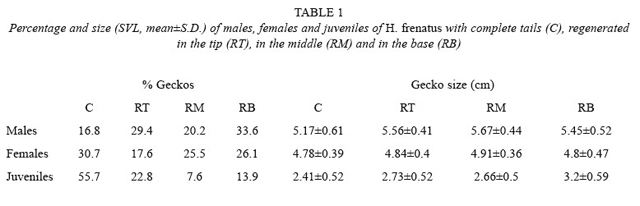
<body><![CDATA[<br style="font-family: arial;">     <span style="font-family: arial;">Daily patterns for air and     surface     temperature were very similar,     having a higher peak at </span><span style="font-family: arial;">dusk     and dawn (F= 42.730, p&lt;0.001, df= 13.210; <a href="#IMG1">Fig. 1</a>).     These peaks coincided with the     ones for </span><span style="font-family: arial;">gecko calling     activity (F= 13.748, p&lt;0.001, </span><span      style="font-family: arial;">df= 13.143; <a href="#IMG1">Fig. 1</a>).     ]]></body>
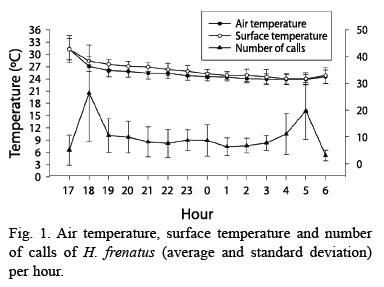
<body><![CDATA[Calling production     was </span><span style="font-family: arial;">seasonally related to air     temperature, when the </span><span style="font-family: arial;">mean     temperature was higher geckos called </span><span      style="font-family: arial;">more often (F= 4.991, p= 0.027, df= 1.143;     Fig. </span><span style="font-family: arial;">2). Air and surface     temperatures were lower in </span><span style="font-family: arial;">February     2000, followed by higher temperature </span><span      style="font-family: arial;">in March, April, and May (F= 32.673,     p&lt;0.001, </span><span style="font-family: arial;">df= 12.210; <a     ]]></body>
<body><![CDATA[ href="#IMG2">Fig.     2</a>). Calling activity was low </span><span      style="font-family: arial;">in     April, but increased in May of both years. </span><span      style="font-family: arial;">In September and December 1999 it rained, </span><span      style="font-family: arial;">the temperatures were lower, and there was     a</span><span style="font-family: arial;"> decrease in calling activity     (<a href="#IMG2">Fig. 2</a>). </span></small></div>     <p align="center"><small><a name="IMG1"> <img style="border: 0px solid ; width: 384px; height: 287px;"  src="/img/fbpe/rbt/v54n4/3495i1.JPG" title="" alt=""></a><span  style="font-family: arial;"><a name="IMG2"><img  style="border: 0px solid ; width: 382px; height: 344px;"  src="/img/fbpe/rbt/v54n4/3495i2.JPG" title="" alt=""></a></span></small></p>     
<p align="justify"><small><br style="font-family: arial;"> <br style="font-family: arial;"> </small></p>     ]]></body>
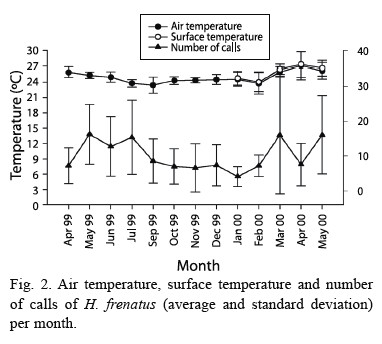
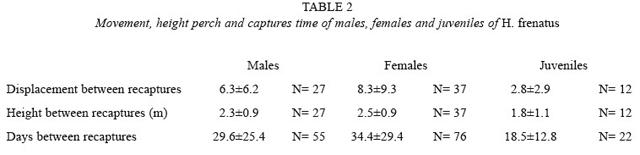
<body><![CDATA[<div style="text-align: left;"><small><span style="font-family: arial;">Considering gecko abundance in relation</span><span style="font-family: arial;"> to calling production (general linear model, </span><span style="font-family: arial;">Lindsey 1999), both factors were positive </span><span  style="font-family: arial;">related (t= 7.960, p&lt;0.001, df= 1). Geckos&nbsp; </span><span style="font-family: arial;">alled more at dusk than at midnight (t= -7.330, </span><span  style="font-family: arial;">p&lt;0.001, df= 1). Months with higher number of</span><span style="font-family: arial;">geckos had higher calling activity. Numbers of calls were higher in March (t= 4.380, p&lt;0.001, df= 3) and May (t= 3.360, p&lt;0.001, df= 3), and also the number of geckos for both months (March: t= 2.460, p= 0.014, df= 3; May: t= 2.800, p= 0.005, df= 3). Gecko abundance was not different between dusk and midnight (t= -1.700, p= 0.089, df= 1), but it varied between months. It was lower in April and February (t= 1.410, p= 0.160, df= 3). The decrease of calling activity seen at midnight was not related to a decrease in gecko abundance. April had more geckos at midnight (contrary to February, March, and May) and fewer calls. However, the decrease in calls per month was related to low gecko abundance.</span><br style="font-family: arial;"> <br style="font-family: arial;"> <span style="font-family: arial;">Having a regenerated tail was more common in adults (83 % of males and 69 % of females) than in juveniles (45 %) (X<sup><sub>2</sub></sup> = 33.312,p&lt;0.001, df= 2). More males had a tail regenerated at the base than males with a complete tail. (X<sup>2</sup> = 8.765, p= 0.033, df= 3). Females couldhave it complete or regenerated at any point (X<sup>2</sup> = 5.405, p= 0.144, df= 3), and juveniles with complete tails were more common than juveniles with a tail regenerated at any point (X<sup>2</sup> = 43.380, p&lt;0.001, df= 3; <a  href="#TABLA1">Table 1</a>). If we include the factor of gecko size, individuals of different sizes had different conditions (F= 3.544, p= 0.002, df= 6.339; <a  href="#TABLA1">Table 1</a>). Males with the tail regenerated in the middle had a higher average size than males with complete tails (LSD, p&lt;0.001). Females of any size could have complete </span><span style="font-family: arial;">or regenerated tails at any point (LSD, </span><span style="font-family: arial;">p&lt;0.05). Juveniles with the tail regenerated in </span><span  style="font-family: arial;">the base had a larger average length than the </span><span style="font-family: arial;">ones with complete tails (LSD, p&lt;0.001). </span><br style="font-family: arial;"> <br style="font-family: arial;"> <span style="font-family: arial;">In the building, the distance geckos moved</span><span style="font-family: arial;">varied per sex (F=4.481, p= 0.014, df=2.77; <a href="#TABLA2">Table 2</a>). Females moved farther than males </span><span  style="font-family: arial;">(LSD, p= 0.019) and than juveniles (LSD, p= </span><span style="font-family: arial;">0.017), but the last two moved similar distances </span><span style="font-family: arial;">(LSD, p&lt;0.05). Although females moved longer </span><span  style="font-family: arial;">distances than males and juveniles (<a  href="#TABLA2">Table 2</a>),</span><span style="font-family: arial;">adults of both sexes and also juveniles have been </span><span style="font-family: arial;">captured close to each other.</span></small></div>     <p align="center"><small><a name="TABLA1">     <br> </a><img src="/img/fbpe/rbt/v54n4/3495i3.JPG" title="" alt=""  style="width: 640px; height: 206px;">    
<br>     <br> </small></p>     <p align="justify"><small><a name="TABLA2">     <br> </a></small></p>     <div style="text-align: center;"><small><img  src="/img/fbpe/rbt/v54n4/3495i4.JPG" title="" alt=""  style="width: 640px; height: 155px;">    
<br> </small></div>     <p style="text-align: left;">    ]]></body>
<body><![CDATA[<br>     <span style="font-family: arial;">The height where geckos were     located     also</span><span style="font-family: arial;"> varied per sex (F=9.873,     p&lt;0.001, df=2.154; <a href="#TABLA2">Table     2</a>). Juveniles were at lower heights </span><span      style="font-family: arial;">than males (LSD, p= 0.001) and females     (LSD, p&lt;0.001), but adults of both sexes were at similar heights     (LSD, p= 0.624).</span><br style="font-family: arial;">     <br style="font-family: arial;">     ]]></body>
<body><![CDATA[<span style="font-family: arial;">The distances geckos displaced among     recaptures were not correlated to the time     between</span><span style="font-family: arial;">captures in males (r=     0.006, p= 0.963, N= 55), </span><span style="font-family: arial;">females     (r= -0.03, p= 0.775, N= 76) or juveniles </span><span      style="font-family: arial;">(r= 0.330, p=0.134, N= 22). Otherwise, the     time </span><span style="font-family: arial;">between recaptures did     vary per sex (F=3.168, </span><span style="font-family: arial;">p=     0.040, df= 2.150; <a href="#TABLA2">Table 2</a>). It was longer in </span><span      style="font-family: arial;">females than in juveniles (LSD, p= 0.013),     ]]></body>
<body><![CDATA[but </span><span style="font-family: arial;">did not defer between     males and females (LSD, </span><span style="font-family: arial;">p=     0.302). It tended to be higher in males than in </span><span      style="font-family: arial;">juveniles (LSD, p= 0.096). </span><br      style="font-family: arial;">     <br style="font-family: arial;">     <span style="font-family: arial; font-weight: 700;">Discussion</span><br      style="font-family: arial;">     <br style="font-family: arial;">     <span style="font-family: arial;">The relation between temperature and </span><span     ]]></body>
<body><![CDATA[ style="font-family: arial;">gecko activity (<a href="#IMG1">Fig. 1</a>),     represented as a     higher </span><span style="font-family: arial;">temperature and higher     activity at dusk and </span><span style="font-family: arial;">dawn,     also occurs in other species of geckos, </span><span      style="font-family: arial;">for example <span      style="font-style: italic;">Thecadactylus, Gehyra, Ptenopus</span>, </span><span      style="font-family: arial;">and <span style="font-style: italic;">Hemidactylus     turcicus</span> (Frankenberg 1982). </span><span      style="font-family: arial;">Seasonally, months with higher     ]]></body>
<body><![CDATA[temperatures </span><span style="font-family: arial;">had more geckos     and higher calling activity, </span><span style="font-family: arial;">pattern     also found by Marcellini (1970). It is </span><span      style="font-family: arial;">suggested that the temperature during the     day </span><span style="font-family: arial;">could determine the     degree of gecko activity </span><span style="font-family: arial;">at     night, where higher temperatures during the </span><span      style="font-family: arial;">day are related to higher activity at     night. Gecko </span><span style="font-family: arial;">shelters have     high temperatures during the day, </span><span     ]]></body>
<body><![CDATA[ style="font-family: arial;">which can increase gecko body temperature </span><span      style="font-family: arial;">and accelerate digestion process, causing     more </span><span style="font-family: arial;">animals to forage at     night (Marcellini 1970).</span><br style="font-family: arial;">     <br style="font-family: arial;">     <span style="font-family: arial;">Although temperature and number of     calls </span><span style="font-family: arial;">is related, another     factor, such as gecko abundance,</span><span style="font-family: arial;">is     also involved to calling activity of </span><span      style="font-family: arial;">this species. The relationship between     ]]></body>
<body><![CDATA[abundance </span><span style="font-family: arial;">and calling     activity could explain why in </span><span style="font-family: arial;">April     the number of geckos and calls were low </span><span      style="font-family: arial;">although temperature was high (<a      href="#IMG2">Fig. 2</a>).</span><br style="font-family: arial;">     <br style="font-family: arial;">     <span style="font-family: arial;">The higher percentage of adults     compared </span><span style="font-family: arial;">to juveniles having     the tail regenerated at any </span><span style="font-family: arial;">point     (<a href="#TABLA1">Table 1</a>) is also common in other species. </span><span     ]]></body>
<body><![CDATA[ style="font-family: arial;">In <span style="font-style: italic;">H.     garnotii</span> and <span style="font-style: italic;">H. turcicus</span>,     54 % and 65 % </span><span style="font-family: arial;">of adults,     respectively, had tails in regeneration, </span><span      style="font-family: arial;">compared with 10 % and 31 % in juveniles </span><span      style="font-family: arial;">(Marcellini 1970). It is not known the     reason for </span><span style="font-family: arial;">tail breakage at     the base, the middle, or the tip. </span><span      style="font-family: arial;">Greer (1989) says that tail loss in     geckonids is </span><span style="font-family: arial;">mainly at the     ]]></body>
<body><![CDATA[base (the first five non autotomic </span><span      style="font-family: arial;">vertebrae are followed by vertebrae that     are&nbsp; </span><span style="font-family: arial;">autotomic),     although it can also be broken at different</span><span      style="font-family: arial;">parts. Tail loss can occur because of     fights </span><span style="font-family: arial;">between individuals or     predator attacks. This </span><span style="font-family: arial;">loss     allows the survival of the gecko at the cost </span><span      style="font-family: arial;">of losing the tail (Marcellini 1970, Greer     1989).</span><br style="font-family: arial;">     ]]></body>
<body><![CDATA[<br style="font-family: arial;">     <span style="font-family: arial;">It is possible that males are not as     aggressive </span><span style="font-family: arial;">as mentioned in     previous literature, because </span><span style="font-family: arial;">they     would move farther apart or to another</span><span      style="font-family: arial;">building to avoid contact with the     aggressive </span><span style="font-family: arial;">males, (a same     gecko was never captured in a </span><span style="font-family: arial;">different     building), and as a consequence there </span><span      style="font-family: arial;">would be males that could disappear during     ]]></body>
<body><![CDATA[</span><span style="font-family: arial;">the study, but it did not     happen. The movement </span><span style="font-family: arial;">of males     reported by Marcellini (1970) is </span><span      style="font-family: arial;">similar to those found here, but females     in this </span><span style="font-family: arial;">study seam to move     farther away. Brattstrom </span><span style="font-family: arial;">(1974)     and Wilson (1975) say that an increase </span><span      style="font-family: arial;">in density could produce an increase of     aggressive </span><span style="font-family: arial;">interactions     between animals. Although </span><span style="font-family: arial;">there     ]]></body>
<body><![CDATA[are persecutions and aggressions between </span><span      style="font-family: arial;">individuals (Marcellini 1970, pers. obs.),     there </span><span style="font-family: arial;">is a possibility that     this species has a social </span><span style="font-family: arial;">hierarchy     system.</span><br style="font-family: arial;">     <br style="font-family: arial;">     <span style="font-family: arial;">Marcellini (1970) also found that     males </span><span style="font-family: arial;">and females remain in     higher places, and that </span><span style="font-family: arial;">higher     locations have better thermoregulation</span><span     ]]></body>
<body><![CDATA[ style="font-family: arial;"> properties and provide more shelter for     rain and </span><span style="font-family: arial;">wind. The     temperature is also a little bit higher </span><span      style="font-family: arial;">and because the presence of artificial     lights, </span><span style="font-family: arial;">insects are more     abundant. Because juveniles </span><span style="font-family: arial;">remained     in lower places, they could not have </span><span      style="font-family: arial;">much contact with adults. The occurrence     of </span><span style="font-family: arial;">fights between adults and     juveniles were therefore </span><span style="font-family: arial;">reduced,     ]]></body>
<body><![CDATA[lowering instances of tail loss in </span><span      style="font-family: arial;">juveniles. Adults also eat juveniles of     the same </span><span style="font-family: arial;">species (Bolger and     Case 1992, pers. obs.,</span><span style="font-family: arial;"> McCoid     and Hensley 1993), therefore, being </span><span      style="font-family: arial;">in lower places can avoid cannibalism.     Fights </span><span style="font-family: arial;">between juveniles had     not been reported in literature </span><span      style="font-family: arial;">and in this study was not observed. This </span><span      style="font-family: arial;">could also explain the lower tail     ]]></body>
<body><![CDATA[regeneration </span><span style="font-family: arial;">proportion in     juveniles as compared to adults.</span><br style="font-family: arial;">     <br style="font-family: arial;">     <span style="font-family: arial;">Geckos do not necessarily move longer     </span><span style="font-family: arial;">distances apart when the time     passed is longer (<a href="#TABLA2">Table 2</a>), suggesting that they     remain within </span><span style="font-family: arial;">certain ranges.     Males and females     hadlonger </span><span style="font-family: arial;">periods of time     without being re-observed </span><span style="font-family: arial;">(<a     ]]></body>
<body><![CDATA[ href="#TABLA2">Table     2</a>), probably because they remained </span><span      style="font-family: arial;">in places with difficult access, as the     roof. </span><span style="font-family: arial;">Because juveniles were     in lower parts of the </span><span style="font-family: arial;">building,     it was possible that they did not </span><span      style="font-family: arial;">move to the roof, where adults could stay     for </span><span style="font-family: arial;">a certain period, reason     to have a longer time </span><span style="font-family: arial;">between     adult recaptures. It has been reported </span><span     ]]></body>
<body><![CDATA[ style="font-family: arial;">that <span style="font-style: italic;">H.     frenatus</span> is aggressive with individuals </span><span      style="font-family: arial;">of the same species and others (Church and     </span><span style="font-family: arial;">Chun-Sim 1961, Hunsaker II     1966, Marcellini </span><span style="font-family: arial;">1970, McCoy     and Busack 1970, Bolger and </span><span style="font-family: arial;">Case     1992, Petren <span style="font-style: italic;">et al</span>. 1993,     Case <span style="font-style: italic;">et al</span>. 1994, </span><span      style="font-family: arial;">Schmidt <span style="font-style: italic;">et     al</span>. 1996), and that is dominant </span><span     ]]></body>
<body><![CDATA[ style="font-family: arial;">over other species that live in the same     habitat, </span><span style="font-family: arial;">sometimes forcing     them to re-locate (such </span><span style="font-family: arial;">as <span      style="font-style: italic;">H. garnotii</span>, <span      style="font-style: italic;">Lepidodactylus lugubris</span> and </span><span      style="font-family: arial;"><span style="font-style: italic;">Leiolopisma     metallica</span>). They pursue and bite </span><span      style="font-family: arial;">other geckos, eat their young, and prevent     other </span><span style="font-family: arial;">species from reaching     the refuges and feeding </span><span style="font-family: arial;">places.     ]]></body>
<body><![CDATA[Marcellini (1970), Bolger and Case </span><span      style="font-family: arial;">(1992), and Case <span      style="font-style: italic;">et al</span>. (1994) say that within&nbsp;     </span><span style="font-family: arial;">the species, males tolerate     other individuals of </span><span style="font-family: arial;">the same     sex less, but they tolerate females and </span><span      style="font-family: arial;">juveniles, while females tolerate     individuals of&nbsp; </span><span style="font-family: arial;">both     sexes and juveniles.</span><br style="font-family: arial;">     <br style="font-family: arial;">     ]]></body>
<body><![CDATA[<span style="font-family: arial; font-weight: 700;">Acknowledgments</span><br      style="font-family: arial;">     <br style="font-family: arial;">     <span style="font-family: arial;">I specially thank F. Bola&ntilde;os     and W. </span><span style="font-family: arial;">Eberhard for their     assistance and guidance during</span><span style="font-family: arial;">the     research, R. Acu&ntilde;a for his useful knowledge </span><span      style="font-family: arial;">and M. Sasa and L.D. G&oacute;mez for     their </span><span style="font-family: arial;">comments and     corrections. I also thank the staff </span><span     ]]></body>
<body><![CDATA[ style="font-family: arial;">from the National University station in     Punta </span><span style="font-family: arial;">Morales, Puntarenas and     the Organization for </span><span style="font-family: arial;">Tropical     Studies for financial support.&nbsp; </span><span      style="font-family: arial;">    <br>     <br> <b>Resumen</b>    <br> <br style="font-family: arial;"> </span><span style="font-family: arial;">Estudi&eacute; la frecuencia de canto y el desplazamiento de </span><span  style="font-family: arial;">la lagartija <span  style="font-style: italic;">Hemidactylus frenatus</span> en Punta Morales, Costa</span><span style="font-family: arial;">Rica. La frecuencia de canto se corelaciona positivamente </span><span  style="font-family: arial;">con la temperatura ambiental durante la noche y con la </span><span style="font-family: arial;">temperatura a lo largo del a&ntilde;o. La mayor actividad fue al </span><span  style="font-family: arial;">anochecer, al amanecer y durante los meses m&aacute;s calurosos. </span><span style="font-family: arial;">La abundancia mensual de lagartijas se relacion&oacute; con la </span><span  style="font-family: arial;">frecuencia de canto, no as&iacute; la abundancia por noche. Las </span><span style="font-family: arial;">colas regeneradas son m&aacute;s frecuentes en hembras y machos </span><span  style="font-family: arial;">que en las lagartijas j&oacute;venes. Las hembras se desplazaron </span><span style="font-family: arial;">mayores distancias que machos y j&oacute;venes. Los adultos </span><span  style="font-family: arial;">se encontraban m&aacute;s alto en las paredes de los edificios. </span><span style="font-family: arial;">Los machos y hembras se recapturaron m&aacute;s veces que </span><span  style="font-family: arial;">los j&oacute;venes, y el tiempo entre recapturas fue mayor. Esta </span><span style="font-family: arial;">poblaci&oacute;n no parece ser tan agresiva como se menciona</span><span  style="font-family: arial;"> en la literatura. </span><br  style="font-family: arial;"> <br style="font-family: arial;"> <span style="font-family: arial;"><b>Palabras clave:</b> frecuencia de canto, distribuci&oacute;n, temperatura,</span><span  style="font-family: arial;"> estacionalidad, <span  style="font-style: italic;">Hemidactylus frenatus</span>, autotom&iacute;a. </span><br style="font-family: arial;"> <br style="font-family: arial;"> <span style="font-family: arial; font-weight: 700;">References</span><br  style="font-family: arial;">     <!-- ref --><p style="font-family: arial;"> <span style="font-family: arial;">Bolger, D.T. &amp; T.J. Case. 1992. Intra and interspecific </span><span style="font-family: arial;">behaviour among sexual and asexual geckos. Anim.</span><span  style="font-family: arial;"> Behav. 44: 21-30. </span>&nbsp;&nbsp;&nbsp;&nbsp;&nbsp;&nbsp;&nbsp;&nbsp;[&#160;<a href="javascript:void(0);" onclick="javascript: window.open('/scielo.php?script=sci_nlinks&ref=1357826&pid=S0034-7744200600040000900001&lng=','','width=640,height=500,resizable=yes,scrollbars=1,menubar=yes,');">Links</a>&#160;]<!-- end-ref --><!-- ref --><p style="font-family: arial;"> <span style="font-family: arial;">Brattstrom, B. 1974. The evolution of reptilian social </span><span style="font-family: arial;">behavior. Amer. Zool. 14: 35-49.</span>&nbsp;&nbsp;&nbsp;&nbsp;&nbsp;&nbsp;&nbsp;&nbsp;[&#160;<a href="javascript:void(0);" onclick="javascript: window.open('/scielo.php?script=sci_nlinks&ref=1357827&pid=S0034-7744200600040000900002&lng=','','width=640,height=500,resizable=yes,scrollbars=1,menubar=yes,');">Links</a>&#160;]<!-- end-ref --><!-- ref --><p style="font-family: arial;"> <span style="font-family: arial;">Bustard, H.R. 1970. Activity cycle of the tropical house </span><span style="font-family: arial;">gecko <span  style="font-style: italic;">Hemidactylus frenatus</span>. Copeia 1970: 173-176.</span>&nbsp;&nbsp;&nbsp;&nbsp;&nbsp;&nbsp;&nbsp;&nbsp;[&#160;<a href="javascript:void(0);" onclick="javascript: window.open('/scielo.php?script=sci_nlinks&ref=1357828&pid=S0034-7744200600040000900003&lng=','','width=640,height=500,resizable=yes,scrollbars=1,menubar=yes,');">Links</a>&#160;]<!-- end-ref --><!-- ref --><p style="font-family: arial;"> <span style="font-family: arial;">Case, T.J., D.T. Bolger &amp; K. Petren. 1994. Invasions and </span><span style="font-family: arial;">competitive displacement among house geckos in the </span><span  style="font-family: arial;">tropical Pacific. Ecology 75: 464-477.</span>&nbsp;&nbsp;&nbsp;&nbsp;&nbsp;&nbsp;&nbsp;&nbsp;[&#160;<a href="javascript:void(0);" onclick="javascript: window.open('/scielo.php?script=sci_nlinks&ref=1357829&pid=S0034-7744200600040000900004&lng=','','width=640,height=500,resizable=yes,scrollbars=1,menubar=yes,');">Links</a>&#160;]<!-- end-ref --><!-- ref --><p style="font-family: arial;"> <span style="font-family: arial;">Cheng, H.Y. &amp; J.I. Lin. 1977. Comparative reproductive </span><span style="font-family: arial;">biology of the lizards <span style="font-style: italic;">Japalura swinhonis formosensis, </span></span><span style="font-family: arial;"><span  style="font-style: italic;">Takydromus septentrionalis</span> and <span  style="font-style: italic;">Hemidactylus </span></span><span  style="font-family: arial;"><span style="font-style: italic;">frenatus</span> in Taiwan. I. Male reproductive cycles. Bull. </span><span  style="font-family: arial;">Inst. Zool. Acad. Sinica 17: 107-121.</span>&nbsp;&nbsp;&nbsp;&nbsp;&nbsp;&nbsp;&nbsp;&nbsp;[&#160;<a href="javascript:void(0);" onclick="javascript: window.open('/scielo.php?script=sci_nlinks&ref=1357830&pid=S0034-7744200600040000900005&lng=','','width=640,height=500,resizable=yes,scrollbars=1,menubar=yes,');">Links</a>&#160;]<!-- end-ref --><!-- ref --><p style="font-family: arial;"> <span style="font-family: arial;">Cheng, H.Y. &amp; J.I. Lin . 1978. Comparative reproductive </span><span style="font-family: arial;">biology of the lizards <span style="font-style: italic;">Japalura swinhonis formosensis, </span></span><span style="font-family: arial;"><span  style="font-style: italic;">Takydromusseptentrionalis</span> and <span  style="font-style: italic;">Hemidactylus </span></span><span  style="font-family: arial;"><span style="font-style: italic;">frenatus</span> in Taiwan. II. Fat body and liver cycles in </span><span  style="font-family: arial;">males. Bull. Inst. Zool. Acad. Sinica 17: 67-74.</span>&nbsp;&nbsp;&nbsp;&nbsp;&nbsp;&nbsp;&nbsp;&nbsp;[&#160;<a href="javascript:void(0);" onclick="javascript: window.open('/scielo.php?script=sci_nlinks&ref=1357831&pid=S0034-7744200600040000900006&lng=','','width=640,height=500,resizable=yes,scrollbars=1,menubar=yes,');">Links</a>&#160;]<!-- end-ref --><!-- ref --><p style="font-family: arial;"> <span style="font-family: arial;">Church, G. &amp; L. Chun-Sim. 1961. The distribution of</span>&nbsp; <span style="font-family: arial;">three species of house gecko in Bandung (Java). </span><span  style="font-family: arial;">Herpetologica 17: 199-201.</span>&nbsp;&nbsp;&nbsp;&nbsp;&nbsp;&nbsp;&nbsp;&nbsp;[&#160;<a href="javascript:void(0);" onclick="javascript: window.open('/scielo.php?script=sci_nlinks&ref=1357832&pid=S0034-7744200600040000900007&lng=','','width=640,height=500,resizable=yes,scrollbars=1,menubar=yes,');">Links</a>&#160;]<!-- end-ref --><!-- ref --><p style="font-family: arial;"> <span style="font-family: arial;">Frankenberg, E. 1982. vocal behavior of the mediterranean </span><span style="font-family: arial;">house gecko, <span style="font-style: italic;">Hemidactylus turcicus</span>. Copeia 1982: </span><span style="font-family: arial;">770-775.</span>&nbsp;&nbsp;&nbsp;&nbsp;&nbsp;&nbsp;&nbsp;&nbsp;[&#160;<a href="javascript:void(0);" onclick="javascript: window.open('/scielo.php?script=sci_nlinks&ref=1357833&pid=S0034-7744200600040000900008&lng=','','width=640,height=500,resizable=yes,scrollbars=1,menubar=yes,');">Links</a>&#160;]<!-- end-ref --><!-- ref --><p style="font-family: arial;"> <span style="font-family: arial;">Frankenberg, E. &amp; Y.L.Werner. 1981. Adaptability of the </span><span style="font-family: arial;">daily activity pattern to changes in longitude, in a </span><span  style="font-family: arial;">colonizing lizard, <span  style="font-style: italic;">Hemidactylus frenatus</span>. J. Herp. </span><span  style="font-family: arial;">15: 373-376.</span>&nbsp;&nbsp;&nbsp;&nbsp;&nbsp;&nbsp;&nbsp;&nbsp;[&#160;<a href="javascript:void(0);" onclick="javascript: window.open('/scielo.php?script=sci_nlinks&ref=1357834&pid=S0034-7744200600040000900009&lng=','','width=640,height=500,resizable=yes,scrollbars=1,menubar=yes,');">Links</a>&#160;]<!-- end-ref --><!-- ref --><p style="font-family: arial;"> <span style="font-family: arial;">Greer, A.E. 1989. The biology &amp; evolution of australian </span><span style="font-family: arial;">lizards. Surrey Beaty,Sidney, Australia. 264p. </span>&nbsp;&nbsp;&nbsp;&nbsp;&nbsp;&nbsp;&nbsp;&nbsp;[&#160;<a href="javascript:void(0);" onclick="javascript: window.open('/scielo.php?script=sci_nlinks&ref=1357835&pid=S0034-7744200600040000900010&lng=','','width=640,height=500,resizable=yes,scrollbars=1,menubar=yes,');">Links</a>&#160;]<!-- end-ref --><!-- ref --><p style="font-family: arial;"> <span style="font-family: arial;">Hanley, K.A., K. Petren &amp; T.J. Case. 1998. An experimental </span><span style="font-family: arial;">investigation of the competitive displacement </span><span  style="font-family: arial;">of a native gecko by an invading gecko: no role of</span><span style="font-family: arial;"> parasites. Oecologia 115: 196-205. </span>&nbsp;&nbsp;&nbsp;&nbsp;&nbsp;&nbsp;&nbsp;&nbsp;[&#160;<a href="javascript:void(0);" onclick="javascript: window.open('/scielo.php?script=sci_nlinks&ref=1357836&pid=S0034-7744200600040000900011&lng=','','width=640,height=500,resizable=yes,scrollbars=1,menubar=yes,');">Links</a>&#160;]<!-- end-ref --><!-- ref --><p style="font-family: arial;"> <span style="font-family: arial;">Hunsaker II, D. 1966. Notes on the population expansion </span><span style="font-family: arial;">of the house gecko, <span style="font-style: italic;">Hemidactylus frenatus</span>. Phillip. J. </span><span style="font-family: arial;">Sc. 95: 121-122.</span>&nbsp;&nbsp;&nbsp;&nbsp;&nbsp;&nbsp;&nbsp;&nbsp;[&#160;<a href="javascript:void(0);" onclick="javascript: window.open('/scielo.php?script=sci_nlinks&ref=1357837&pid=S0034-7744200600040000900012&lng=','','width=640,height=500,resizable=yes,scrollbars=1,menubar=yes,');">Links</a>&#160;]<!-- end-ref --><!-- ref --><p style="font-family: arial;"> <span style="font-family: arial;">Lin, J. &amp; H. Cheng. 1984. Ovarian cycle in the house </span><span style="font-family: arial;">gecko,<span  style="font-style: italic;"> Hemidactylus frenatus</span> in Taiwan with reference </span><span style="font-family: arial;">to food stress in winter. Bull. Inst. Zool., Acad.</span><span  style="font-family: arial;">Sicina 23: 21-28.</span>&nbsp;&nbsp;&nbsp;&nbsp;&nbsp;&nbsp;&nbsp;&nbsp;[&#160;<a href="javascript:void(0);" onclick="javascript: window.open('/scielo.php?script=sci_nlinks&ref=1357838&pid=S0034-7744200600040000900013&lng=','','width=640,height=500,resizable=yes,scrollbars=1,menubar=yes,');">Links</a>&#160;]<!-- end-ref --><!-- ref --><p style="font-family: arial;"> <span style="font-family: arial;">Lindsey, J.K. 1999. Applying generalised linear models.</span><span style="font-family: arial;"> Springer, Berlin, Germany. 257 p. </span>&nbsp;&nbsp;&nbsp;&nbsp;&nbsp;&nbsp;&nbsp;&nbsp;[&#160;<a href="javascript:void(0);" onclick="javascript: window.open('/scielo.php?script=sci_nlinks&ref=1357839&pid=S0034-7744200600040000900014&lng=','','width=640,height=500,resizable=yes,scrollbars=1,menubar=yes,');">Links</a>&#160;]<!-- end-ref --><!-- ref --><p style="font-family: arial;"> <span style="font-family: arial;">Marcellini, D.L. 1970. Ethoecology of <span style="font-style: italic;">Hemidactylus frenatus</span> </span><span  style="font-family: arial;">(Sauria, Gekkonidae) with emphasis on acoustic </span><span style="font-family: arial;">behavior. PhD. Dissertation, University of Oklahoma, </span><span  style="font-family: arial;">Oklahoma, USA. 200 p.</span>&nbsp;&nbsp;&nbsp;&nbsp;&nbsp;&nbsp;&nbsp;&nbsp;[&#160;<a href="javascript:void(0);" onclick="javascript: window.open('/scielo.php?script=sci_nlinks&ref=1357840&pid=S0034-7744200600040000900015&lng=','','width=640,height=500,resizable=yes,scrollbars=1,menubar=yes,');">Links</a>&#160;]<!-- end-ref --><!-- ref --><p style="font-family: arial;"> <span style="font-family: arial;">Marcellini, D.L. 1971. Activity patterns of the gecko </span><span style="font-family: arial;"><span  style="font-style: italic;">Hemidactylus frenatus</span>. Copeia 1971: 631-635.</span>&nbsp;&nbsp;&nbsp;&nbsp;&nbsp;&nbsp;&nbsp;&nbsp;[&#160;<a href="javascript:void(0);" onclick="javascript: window.open('/scielo.php?script=sci_nlinks&ref=1357841&pid=S0034-7744200600040000900016&lng=','','width=640,height=500,resizable=yes,scrollbars=1,menubar=yes,');">Links</a>&#160;]<!-- end-ref --><!-- ref --><p style="font-family: arial;"> <span style="font-family: arial;">Marcellini, D.L. 1974. Acoustic behavior of the gekkonid lizard, </span><span  style="font-family: arial;"><span style="font-style: italic;">Hemidactylus frenatus</span>. Herpetologica 30: 44-52.</span>&nbsp;&nbsp;&nbsp;&nbsp;&nbsp;&nbsp;&nbsp;&nbsp;[&#160;<a href="javascript:void(0);" onclick="javascript: window.open('/scielo.php?script=sci_nlinks&ref=1357842&pid=S0034-7744200600040000900017&lng=','','width=640,height=500,resizable=yes,scrollbars=1,menubar=yes,');">Links</a>&#160;]<!-- end-ref --><!-- ref --><p style="font-family: arial;"> <span style="font-family: arial;">McCoid, M.J. &amp; R.A. Hensley. 1993. Shifts in activity patterns </span><span  style="font-family: arial;">in lizards. Herp. Rev. 24: 87-88.</span>&nbsp;&nbsp;&nbsp;&nbsp;&nbsp;&nbsp;&nbsp;&nbsp;[&#160;<a href="javascript:void(0);" onclick="javascript: window.open('/scielo.php?script=sci_nlinks&ref=1357843&pid=S0034-7744200600040000900018&lng=','','width=640,height=500,resizable=yes,scrollbars=1,menubar=yes,');">Links</a>&#160;]<!-- end-ref --><!-- ref --><p style="font-family: arial;"> <span style="font-family: arial;">McCoy, C.J. &amp; S.D. Busack. 1970. The lizards <span style="font-style: italic;">Hemidactylus </span></span><span  style="font-family: arial;"><span style="font-style: italic;">frenatus</span> and <span style="font-style: italic;">Leiolopisma metallica</span> on the island of </span><span style="font-family: arial;">Hawaii. Herpetologica 26: 303.</span>&nbsp;&nbsp;&nbsp;&nbsp;&nbsp;&nbsp;&nbsp;&nbsp;[&#160;<a href="javascript:void(0);" onclick="javascript: window.open('/scielo.php?script=sci_nlinks&ref=1357844&pid=S0034-7744200600040000900019&lng=','','width=640,height=500,resizable=yes,scrollbars=1,menubar=yes,');">Links</a>&#160;]<!-- end-ref --><!-- ref --><p style="font-family: arial;"> <span style="font-family: arial;">Petren, K.D.T. Bolger &amp; T.J. Case. 1993. Mechanisms in </span><span style="font-family: arial;">the competitive succes of an invading sexual gecko </span><span  style="font-family: arial;">over as asexual native. Science 259: 354-358.</span>&nbsp;&nbsp;&nbsp;&nbsp;&nbsp;&nbsp;&nbsp;&nbsp;[&#160;<a href="javascript:void(0);" onclick="javascript: window.open('/scielo.php?script=sci_nlinks&ref=1357845&pid=S0034-7744200600040000900020&lng=','','width=640,height=500,resizable=yes,scrollbars=1,menubar=yes,');">Links</a>&#160;]<!-- end-ref --><!-- ref --><p style="font-family: arial;"> <span style="font-family: arial;">Poulin, B., G. Lefevbre &amp; A.S. Rand. 1995. <span style="font-style: italic;">Hemidactylus </span></span><span  style="font-family: arial;"><span style="font-style: italic;">frenatus</span> (house gecko): foraging. Herp. Review 26: </span><span  style="font-family: arial;">205.</span>&nbsp;&nbsp;&nbsp;&nbsp;&nbsp;&nbsp;&nbsp;&nbsp;[&#160;<a href="javascript:void(0);" onclick="javascript: window.open('/scielo.php?script=sci_nlinks&ref=1357846&pid=S0034-7744200600040000900021&lng=','','width=640,height=500,resizable=yes,scrollbars=1,menubar=yes,');">Links</a>&#160;]<!-- end-ref --><!-- ref --><p style="font-family: arial;"> <span style="font-family: arial;">Schmidt, W.F. Mendoza &amp; M.E. Mart&iacute;nez. 1996. Range </span><span style="font-family: arial;">extensions for <span style="font-style: italic;">Hemidactylus frenatus</span> in Mexico. </span><span style="font-family: arial;">Herp. Rev. 27: 30.</span>&nbsp;&nbsp;&nbsp;&nbsp;&nbsp;&nbsp;&nbsp;&nbsp;[&#160;<a href="javascript:void(0);" onclick="javascript: window.open('/scielo.php?script=sci_nlinks&ref=1357847&pid=S0034-7744200600040000900022&lng=','','width=640,height=500,resizable=yes,scrollbars=1,menubar=yes,');">Links</a>&#160;]<!-- end-ref --><!-- ref --><p style="font-family: arial;"> <span style="font-family: arial;">Synder, G.K. &amp; W.W. Weathers. 1976. Physiological </span><span style="font-family: arial;">responses to temperature in the tropical lizard,</span><span  style="font-family: arial;"> <span style="font-style: italic;">Hemidactylus frenatus</span> (Sauria: Gekkonidae).&nbsp; </span><span  style="font-family: arial;">Herpetologica 32: 252-257.</span>&nbsp;&nbsp;&nbsp;&nbsp;&nbsp;&nbsp;&nbsp;&nbsp;[&#160;<a href="javascript:void(0);" onclick="javascript: window.open('/scielo.php?script=sci_nlinks&ref=1357848&pid=S0034-7744200600040000900023&lng=','','width=640,height=500,resizable=yes,scrollbars=1,menubar=yes,');">Links</a>&#160;]<!-- end-ref --><!-- ref --><p style="font-family: arial;"> <span style="font-family: arial;">Wilson, O.E. 1975. Sociobiology: The new synthesis. </span><span style="font-family: arial;">Belkap, Harvard University, Massachussetts, USA. </span><span  style="font-family: arial;">697 p.</span>&nbsp;&nbsp;&nbsp;&nbsp;&nbsp;&nbsp;&nbsp;&nbsp;[&#160;<a href="javascript:void(0);" onclick="javascript: window.open('/scielo.php?script=sci_nlinks&ref=1357849&pid=S0034-7744200600040000900024&lng=','','width=640,height=500,resizable=yes,scrollbars=1,menubar=yes,');">Links</a>&#160;]<!-- end-ref --> ]]></body><back>
<ref-list>
<ref id="B1">
<nlm-citation citation-type="journal">
<person-group person-group-type="author">
<name>
<surname><![CDATA[Bolger]]></surname>
<given-names><![CDATA[D.T]]></given-names>
</name>
<name>
<surname><![CDATA[Case]]></surname>
<given-names><![CDATA[T.J]]></given-names>
</name>
</person-group>
<article-title xml:lang="en"><![CDATA[Intra and interspecific behaviour among sexual and asexual geckos]]></article-title>
<source><![CDATA[Anim. Behav]]></source>
<year>1992</year>
<volume>44</volume>
<page-range>21-30</page-range></nlm-citation>
</ref>
<ref id="B2">
<nlm-citation citation-type="journal">
<person-group person-group-type="author">
<name>
<surname><![CDATA[Brattstrom]]></surname>
<given-names><![CDATA[B]]></given-names>
</name>
</person-group>
<article-title xml:lang="en"><![CDATA[The evolution of reptilian social behavior]]></article-title>
<source><![CDATA[Amer. Zool]]></source>
<year>1974</year>
<volume>14</volume>
<page-range>35-49</page-range></nlm-citation>
</ref>
<ref id="B3">
<nlm-citation citation-type="journal">
<person-group person-group-type="author">
<name>
<surname><![CDATA[Bustard]]></surname>
<given-names><![CDATA[H.R]]></given-names>
</name>
</person-group>
<article-title xml:lang="en"><![CDATA[Activity cycle of the tropical house gecko Hemidactylus frenatus]]></article-title>
<source><![CDATA[Copeia]]></source>
<year>1970</year>
<month>19</month>
<day>70</day>
<page-range>173-176</page-range></nlm-citation>
</ref>
<ref id="B4">
<nlm-citation citation-type="journal">
<person-group person-group-type="author">
<name>
<surname><![CDATA[Case]]></surname>
<given-names><![CDATA[T.J]]></given-names>
</name>
<name>
<surname><![CDATA[Bolger]]></surname>
<given-names><![CDATA[D.T]]></given-names>
</name>
<name>
<surname><![CDATA[Petren]]></surname>
<given-names><![CDATA[K]]></given-names>
</name>
</person-group>
<article-title xml:lang="en"><![CDATA[Invasions and competitive displacement among house geckos in the tropical Pacific]]></article-title>
<source><![CDATA[Ecology]]></source>
<year>1994</year>
<volume>75</volume>
<page-range>464-477</page-range></nlm-citation>
</ref>
<ref id="B5">
<nlm-citation citation-type="journal">
<person-group person-group-type="author">
<name>
<surname><![CDATA[Cheng]]></surname>
<given-names><![CDATA[H.Y]]></given-names>
</name>
<name>
<surname><![CDATA[Lin]]></surname>
<given-names><![CDATA[J.I]]></given-names>
</name>
</person-group>
<article-title xml:lang="en"><![CDATA[Comparative reproductive biology of the lizards Japalura swinhonis formosensis, Takydromus septentrionalis and Hemidactylus frenatus in Taiwan. I. Male reproductive cycles]]></article-title>
<source><![CDATA[Bull. Inst. Zool. Acad. Sinica]]></source>
<year>1977</year>
<volume>17</volume>
<page-range>107-121</page-range></nlm-citation>
</ref>
<ref id="B6">
<nlm-citation citation-type="journal">
<person-group person-group-type="author">
<name>
<surname><![CDATA[Cheng]]></surname>
<given-names><![CDATA[H.Y]]></given-names>
</name>
<name>
<surname><![CDATA[Lin]]></surname>
<given-names><![CDATA[J.I]]></given-names>
</name>
</person-group>
<article-title xml:lang="en"><![CDATA[Comparative reproductive biology of the lizards Japalura swinhonis formosensis, Takydromusseptentrionalis and Hemidactylus frenatus in Taiwan. II. Fat body and liver cycles in males]]></article-title>
<source><![CDATA[Bull. Inst. Zool. Acad. Sinica]]></source>
<year>1978</year>
<volume>17</volume>
<page-range>67-74</page-range></nlm-citation>
</ref>
<ref id="B7">
<nlm-citation citation-type="journal">
<person-group person-group-type="author">
<name>
<surname><![CDATA[Church]]></surname>
<given-names><![CDATA[G]]></given-names>
</name>
<name>
<surname><![CDATA[Chun-Sim]]></surname>
<given-names><![CDATA[L]]></given-names>
</name>
</person-group>
<article-title xml:lang="en"><![CDATA[The distribution of three species of house gecko in Bandung (Java)]]></article-title>
<source><![CDATA[Herpetologica]]></source>
<year>1961</year>
<volume>17</volume>
<page-range>199-201</page-range></nlm-citation>
</ref>
<ref id="B8">
<nlm-citation citation-type="journal">
<person-group person-group-type="author">
<name>
<surname><![CDATA[Frankenberg]]></surname>
<given-names><![CDATA[E]]></given-names>
</name>
</person-group>
<article-title xml:lang="en"><![CDATA[vocal behavior of the mediterranean house gecko, Hemidactylus turcicus]]></article-title>
<source><![CDATA[Copeia]]></source>
<year>1982</year>
<month>19</month>
<day>82</day>
<page-range>770-775</page-range></nlm-citation>
</ref>
<ref id="B9">
<nlm-citation citation-type="journal">
<person-group person-group-type="author">
<name>
<surname><![CDATA[Frankenberg]]></surname>
<given-names><![CDATA[E]]></given-names>
</name>
<name>
<surname><![CDATA[Werner]]></surname>
<given-names><![CDATA[Y.L]]></given-names>
</name>
</person-group>
<article-title xml:lang="en"><![CDATA[Adaptability of the daily activity pattern to changes in longitude, in a colonizing lizard, Hemidactylus frenatus]]></article-title>
<source><![CDATA[J. Herp]]></source>
<year>1981</year>
<volume>15</volume>
<page-range>373-376</page-range></nlm-citation>
</ref>
<ref id="B10">
<nlm-citation citation-type="">
<person-group person-group-type="author">
<name>
<surname><![CDATA[Greer]]></surname>
<given-names><![CDATA[A.E]]></given-names>
</name>
</person-group>
<source><![CDATA[The biology & evolution of australian lizards. Surrey Beaty]]></source>
<year>1989</year>
<page-range>264</page-range><publisher-loc><![CDATA[Sidney ]]></publisher-loc>
</nlm-citation>
</ref>
<ref id="B11">
<nlm-citation citation-type="journal">
<person-group person-group-type="author">
<name>
<surname><![CDATA[Hanley]]></surname>
<given-names><![CDATA[K.A]]></given-names>
</name>
<name>
<surname><![CDATA[Petren]]></surname>
<given-names><![CDATA[K]]></given-names>
</name>
<name>
<surname><![CDATA[Case]]></surname>
<given-names><![CDATA[T.J]]></given-names>
</name>
</person-group>
<article-title xml:lang="en"><![CDATA[An experimental investigation of the competitive displacement of a native gecko by an invading gecko: no role of parasites]]></article-title>
<source><![CDATA[Oecologia]]></source>
<year>1998</year>
<volume>115</volume>
<page-range>196-205</page-range></nlm-citation>
</ref>
<ref id="B12">
<nlm-citation citation-type="journal">
<person-group person-group-type="author">
<name>
<surname><![CDATA[Hunsaker II]]></surname>
<given-names><![CDATA[D]]></given-names>
</name>
</person-group>
<article-title xml:lang="en"><![CDATA[Notes on the population expansion of the house gecko, Hemidactylus frenatus]]></article-title>
<source><![CDATA[Phillip. J. Sc]]></source>
<year>1966</year>
<volume>95</volume>
<page-range>121-122</page-range></nlm-citation>
</ref>
<ref id="B13">
<nlm-citation citation-type="journal">
<person-group person-group-type="author">
<name>
<surname><![CDATA[Lin]]></surname>
<given-names><![CDATA[J]]></given-names>
</name>
<name>
<surname><![CDATA[Cheng]]></surname>
<given-names><![CDATA[H]]></given-names>
</name>
</person-group>
<article-title xml:lang="en"><![CDATA[Ovarian cycle in the house gecko, Hemidactylus frenatus in Taiwan with reference to food stress in winter]]></article-title>
<source><![CDATA[Bull. Inst. Zool., Acad. Sicina]]></source>
<year>1984</year>
<volume>23</volume>
<page-range>21-28</page-range></nlm-citation>
</ref>
<ref id="B14">
<nlm-citation citation-type="book">
<person-group person-group-type="author">
<name>
<surname><![CDATA[Lindsey]]></surname>
<given-names><![CDATA[J.K]]></given-names>
</name>
</person-group>
<source><![CDATA[Applying generalised linear models]]></source>
<year>1999</year>
<page-range>257</page-range><publisher-loc><![CDATA[^eBerlin Berlin]]></publisher-loc>
<publisher-name><![CDATA[Springer]]></publisher-name>
</nlm-citation>
</ref>
<ref id="B15">
<nlm-citation citation-type="">
<person-group person-group-type="author">
<name>
<surname><![CDATA[Marcellini]]></surname>
<given-names><![CDATA[D.L]]></given-names>
</name>
</person-group>
<source><![CDATA[Ethoecology of Hemidactylus frenatus (Sauria, Gekkonidae) with emphasis on acoustic behavior]]></source>
<year>1970</year>
<page-range>200</page-range></nlm-citation>
</ref>
<ref id="B16">
<nlm-citation citation-type="journal">
<person-group person-group-type="author">
<name>
<surname><![CDATA[Marcellini]]></surname>
<given-names><![CDATA[D.L]]></given-names>
</name>
</person-group>
<article-title xml:lang="en"><![CDATA[Activity patterns of the gecko Hemidactylus frenatus]]></article-title>
<source><![CDATA[Copeia]]></source>
<year>1971</year>
<month>19</month>
<day>71</day>
<page-range>631-635</page-range></nlm-citation>
</ref>
<ref id="B17">
<nlm-citation citation-type="journal">
<person-group person-group-type="author">
<name>
<surname><![CDATA[Marcellini]]></surname>
<given-names><![CDATA[D.L]]></given-names>
</name>
</person-group>
<article-title xml:lang="en"><![CDATA[Acoustic behavior of the gekkonid lizard, Hemidactylus frenatus]]></article-title>
<source><![CDATA[Herpetologica]]></source>
<year>1974</year>
<volume>30</volume>
<page-range>44-52</page-range></nlm-citation>
</ref>
<ref id="B18">
<nlm-citation citation-type="journal">
<person-group person-group-type="author">
<name>
<surname><![CDATA[McCoid]]></surname>
<given-names><![CDATA[M.J]]></given-names>
</name>
<name>
<surname><![CDATA[Hensley]]></surname>
<given-names><![CDATA[R.A]]></given-names>
</name>
</person-group>
<article-title xml:lang="en"><![CDATA[Shifts in activity patterns in lizards]]></article-title>
<source><![CDATA[Herp. Rev]]></source>
<year>1993</year>
<volume>24</volume>
<page-range>87-88</page-range></nlm-citation>
</ref>
<ref id="B19">
<nlm-citation citation-type="journal">
<person-group person-group-type="author">
<name>
<surname><![CDATA[McCoy]]></surname>
<given-names><![CDATA[C.J]]></given-names>
</name>
<name>
<surname><![CDATA[Busack]]></surname>
<given-names><![CDATA[S.D]]></given-names>
</name>
</person-group>
<article-title xml:lang="en"><![CDATA[The lizards Hemidactylus frenatus and Leiolopisma metallica on the island of Hawaii]]></article-title>
<source><![CDATA[Herpetologica]]></source>
<year>1970</year>
<volume>26</volume>
<page-range>303</page-range></nlm-citation>
</ref>
<ref id="B20">
<nlm-citation citation-type="journal">
<person-group person-group-type="author">
<name>
<surname><![CDATA[Petren]]></surname>
<given-names><![CDATA[K.D.T]]></given-names>
</name>
<name>
<surname><![CDATA[Bolger]]></surname>
</name>
<name>
<surname><![CDATA[Case]]></surname>
<given-names><![CDATA[T.J]]></given-names>
</name>
</person-group>
<article-title xml:lang="en"><![CDATA[Mechanisms in the competitive succes of an invading sexual gecko over as asexual native]]></article-title>
<source><![CDATA[Science]]></source>
<year>1993</year>
<volume>259</volume>
<page-range>354-358</page-range></nlm-citation>
</ref>
<ref id="B21">
<nlm-citation citation-type="journal">
<person-group person-group-type="author">
<name>
<surname><![CDATA[Poulin]]></surname>
<given-names><![CDATA[B]]></given-names>
</name>
<name>
<surname><![CDATA[Lefevbre]]></surname>
<given-names><![CDATA[G]]></given-names>
</name>
<name>
<surname><![CDATA[Rand]]></surname>
<given-names><![CDATA[A.S]]></given-names>
</name>
</person-group>
<article-title xml:lang="en"><![CDATA[Hemidactylus frenatus (house gecko):: foraging]]></article-title>
<source><![CDATA[Herp. Review]]></source>
<year>1995</year>
<volume>26</volume>
<page-range>205</page-range></nlm-citation>
</ref>
<ref id="B22">
<nlm-citation citation-type="journal">
<person-group person-group-type="author">
<name>
<surname><![CDATA[Schmidt]]></surname>
<given-names><![CDATA[W.F]]></given-names>
</name>
<name>
<surname><![CDATA[Mendoza]]></surname>
</name>
<name>
<surname><![CDATA[Martínez]]></surname>
<given-names><![CDATA[M.E]]></given-names>
</name>
</person-group>
<article-title xml:lang="en"><![CDATA[Range extensions for Hemidactylus frenatus in Mexico]]></article-title>
<source><![CDATA[Herp. Rev]]></source>
<year>1996</year>
<volume>27</volume>
<page-range>30</page-range></nlm-citation>
</ref>
<ref id="B23">
<nlm-citation citation-type="journal">
<person-group person-group-type="author">
<name>
<surname><![CDATA[Synder]]></surname>
<given-names><![CDATA[G.K]]></given-names>
</name>
<name>
<surname><![CDATA[Weathers]]></surname>
<given-names><![CDATA[W.W]]></given-names>
</name>
</person-group>
<article-title xml:lang="en"><![CDATA[Physiological responses to temperature in the tropical lizard, Hemidactylus frenatus (Sauria: Gekkonidae)]]></article-title>
<source><![CDATA[Herpetologica]]></source>
<year>1976</year>
<volume>32</volume>
<page-range>252-257</page-range></nlm-citation>
</ref>
<ref id="B24">
<nlm-citation citation-type="book">
<person-group person-group-type="author">
<name>
<surname><![CDATA[Wilson]]></surname>
<given-names><![CDATA[O.E]]></given-names>
</name>
</person-group>
<source><![CDATA[Sociobiology: The new synthesis]]></source>
<year>1975</year>
<page-range>697</page-range><publisher-loc><![CDATA[^eMassachussetts Massachussetts]]></publisher-loc>
<publisher-name><![CDATA[Harvard University]]></publisher-name>
</nlm-citation>
</ref>
</ref-list>
</back>
</article>