<?xml version="1.0" encoding="ISO-8859-1"?><article xmlns:mml="http://www.w3.org/1998/Math/MathML" xmlns:xlink="http://www.w3.org/1999/xlink" xmlns:xsi="http://www.w3.org/2001/XMLSchema-instance">
<front>
<journal-meta>
<journal-id>0034-7744</journal-id>
<journal-title><![CDATA[Revista de Biología Tropical]]></journal-title>
<abbrev-journal-title><![CDATA[Rev. biol. trop]]></abbrev-journal-title>
<issn>0034-7744</issn>
<publisher>
<publisher-name><![CDATA[Universidad de Costa Rica]]></publisher-name>
</publisher>
</journal-meta>
<article-meta>
<article-id>S0034-77442006000400008</article-id>
<title-group>
<article-title xml:lang="en"><![CDATA[Lunar phobia in the greater fishing bat Noctilio leporinus (Chiroptera: Noctilionidae)]]></article-title>
</title-group>
<contrib-group>
<contrib contrib-type="author">
<name>
<surname><![CDATA[Börk]]></surname>
<given-names><![CDATA[Karrigan S]]></given-names>
</name>
<xref ref-type="aff" rid="A01"/>
</contrib>
</contrib-group>
<aff id="A01">
<institution><![CDATA[,University of Kansas Department of Biodiversity ]]></institution>
<addr-line><![CDATA[ ]]></addr-line>
<country>USA</country>
</aff>
<pub-date pub-type="pub">
<day>00</day>
<month>12</month>
<year>2006</year>
</pub-date>
<pub-date pub-type="epub">
<day>00</day>
<month>12</month>
<year>2006</year>
</pub-date>
<volume>54</volume>
<numero>4</numero>
<fpage>1117</fpage>
<lpage>1123</lpage>
<copyright-statement/>
<copyright-year/>
<self-uri xlink:href="http://www.scielo.sa.cr/scielo.php?script=sci_arttext&amp;pid=S0034-77442006000400008&amp;lng=en&amp;nrm=iso"></self-uri><self-uri xlink:href="http://www.scielo.sa.cr/scielo.php?script=sci_abstract&amp;pid=S0034-77442006000400008&amp;lng=en&amp;nrm=iso"></self-uri><self-uri xlink:href="http://www.scielo.sa.cr/scielo.php?script=sci_pdf&amp;pid=S0034-77442006000400008&amp;lng=en&amp;nrm=iso"></self-uri><abstract abstract-type="short" xml:lang="en"><p><![CDATA[The nightly activity patterns of Noctilio leporinus, a piscivorous neotropical bat, were documented by visual observation over one lunar cycle at a large dock in Golfito, Costa Rica. The activity patterns were compared to the intensity of the moonlight, and a strong correlation between darkness and activity was observed (n = 776, r² = 0.96). This correlation has been observed in many species of mammals and may indicate adaptation by potential prey species to avoid predation by visually oriented nighttime predators and/or an adaptation by predators to maximize hunting success. Rev. Biol. Trop. 54 (4): 1117-1123. Epub 2006 Dec. 15.]]></p></abstract>
<abstract abstract-type="short" xml:lang="es"><p><![CDATA[Documenté los patrones de actividad nocturna de Noctilio leporinus, murciélago piscívoro neotropical, mediante observaciones visuales durante un ciclo lunar en un muelle de Golfito, Costa Rica. Considerando la intensidad de la luz lunar, hubo una fuerte correlación entre la oscuridad y la actividad (n = 776, r² = 0.96). Esta correlación ha sido observada en muchas especies de mamíferos y puede indicar una adaptación de presas potenciales para evadir los depredadores nocturnos y/o una adaptación de los depredadores para maximizar el éxito de cacería]]></p></abstract>
<kwd-group>
<kwd lng="en"><![CDATA[Noctilio]]></kwd>
<kwd lng="en"><![CDATA[piscivore]]></kwd>
<kwd lng="en"><![CDATA[lunar phobia]]></kwd>
<kwd lng="en"><![CDATA[moonlight]]></kwd>
<kwd lng="en"><![CDATA[predation]]></kwd>
<kwd lng="en"><![CDATA[bat]]></kwd>
<kwd lng="en"><![CDATA[foraging]]></kwd>
<kwd lng="es"><![CDATA[Noctilio]]></kwd>
<kwd lng="es"><![CDATA[piscívoro]]></kwd>
<kwd lng="es"><![CDATA[fobia lunar]]></kwd>
<kwd lng="es"><![CDATA[luz de luna]]></kwd>
<kwd lng="es"><![CDATA[depredación]]></kwd>
<kwd lng="es"><![CDATA[murciélago]]></kwd>
<kwd lng="es"><![CDATA[búsqueda de alimento]]></kwd>
</kwd-group>
</article-meta>
</front><body><![CDATA[ <div style="text-align: center;"><span style="font-family: arial;"><span  style="font-weight: bold;">Lunar phobia in the greater fishing bat</span> <span style="font-style: italic;">Noctilio leporinus</span> </span><span  style="font-family: arial; font-weight: bold;">(Chiroptera: Noctilionidae)</span><br style="font-family: arial; font-weight: bold;"> </div> <small><br style="font-family: arial;"> <!-- big --><span style="font-family: arial;"><small>Karrigan S. B&ouml;rk<sup>1</sup></small>    <br> <br style="font-family: arial;"> </span><!-- /big --><span style="font-family: arial;">1 Department of Biodiversity, Ecology, and Evolutionary Biology, University of Kansas, Lawrence, KS 66045, USA; </span><a href="mailto:karrigan_bork@email.com"><span  style="font-family: arial;">karrigan_bork@email.com</span></a><br  style="font-family: arial;"> <br style="font-family: arial;"> </small>     <div style="text-align: center;"><small><span  style="font-family: arial;">Received 21-XI-2002. Corrected 29-I-2006. Accepted 09-VIII-2006.</span></small><br style="font-family: arial;"> </div>     <p align="justify"> <small><br style="font-family: arial;"> </small></p>     <div style="text-align: left;"><small><span style="font-family: arial;"><span  style="font-weight: bold;">Abstract</span>: The nightly activity patterns of <span style="font-style: italic;">Noctilio leporinus</span>, a piscivorous neotropical bat, were documented by </span><span  style="font-family: arial;">visual observation over one lunar cycle at a large dock in Golfito, Costa Rica. The activity patterns were compared </span><span style="font-family: arial;">to the intensity of the moonlight, and a strong correlation between darkness and activity was observed (n </span><span style="font-family: arial;">= 776, r<sup>2</sup> = 0.96). This correlation has been observed in many species of mammals and may indicate adaptation </span><span style="font-family: arial;">by potential prey species to avoid predation by visually oriented nighttime predators and/or an adaptation by </span><span  style="font-family: arial;">predators to maximize hunting success. Rev. Biol. Trop. 54 (4): 1117-1123. Epub 2006 Dec. 15. </span></small>    <br> <small><span style="font-family: arial;"></span></small>    <br>     <small><span style="font-family: arial;"><span      style="font-weight: bold;">Key Words</span>: <span      style="font-style: italic;">Noctilio</span>, piscivore, lunar phobia,     ]]></body>
<body><![CDATA[moonlight, predation, bat, foraging.</span></small><br      style="font-family: arial;">     <small></small><br style="font-family: arial;">     <small><span style="font-family: arial;">Avoidance of bright moonlight     has     been </span><span style="font-family: arial;">documented in small     terrestrial mammals, </span><span style="font-family: arial;">including     Allenby&#8217;s gerbil, <span style="font-style: italic;">Gerbillus allenbyi</span>     </span><span style="font-family: arial;">(Kotler <span      style="font-style: italic;">et al</span>. 1991); bannertail kangaroo     ]]></body>
<body><![CDATA[rat, </span><span style="font-family: arial;"><span      style="font-style: italic;">Dipodomys spectabilis</span> (Lockard and     Owings </span><span style="font-family: arial;">1974); greater     Egyptian sand gerbil, <span style="font-style: italic;">Gerbillus </span></span><span      style="font-family: arial;"><span style="font-style: italic;">pyramidum</span>     (Kotler <span style="font-style: italic;">et al</span>. 1991);     Merriam&#8217;s kangaroo </span><span style="font-family: arial;">rat, <span      style="font-style: italic;">Dipodomys merriami</span> (Schwab 1966); </span><span      style="font-family: arial;">in the southern flying squirrel, <span      style="font-style: italic;">Glaucomys</span></span><span     ]]></body>
<body><![CDATA[ style="font-family: arial;"><span style="font-style: italic;">volans</span>     (Wildlife Rescue League, unpublished); </span><span      style="font-family: arial;">and in a number of species of bats.     Examples </span><span style="font-family: arial;">include one     megachiropteran (Indian false&nbsp; </span><span      style="font-family: arial;">vampire bat,<span      style="font-style: italic;"> Megaderma lyra</span> (Subbaraj and</span><span      style="font-family: arial;"> Balasingh 1996)), andthree     microchiropterans </span><span style="font-family: arial;">(Jamaican     fruit-eating bat, <span style="font-style: italic;">Artibeus     ]]></body>
<body><![CDATA[jamaicensis</span>, </span><span style="font-family: arial;">(Morrison     1978)); pond bat, <span style="font-style: italic;">Myotis dasycneme</span>     </span><span style="font-family: arial;">(Vo&ucirc;te <span      style="font-style: italic;">et al</span>. 1974); and common vampire </span><span      style="font-family: arial;">bat, <span style="font-style: italic;">Desmodus     rotundus</span> (Turner 1975). The </span><span      style="font-family: arial;">broad occurrence of lunar phobia suggests     strong selective pressures in nocturnal     animals for moonlight     avoidance. Safety from predators and availability of prey could both     ]]></body>
<body><![CDATA[provide the necessary     selective&nbsp; pressure.</span></small><br style="font-family: arial;">     <small></small><br style="font-family: arial;">     <small><span style="font-family: arial;">Several studies indicate that     reduced     light impairs the hunting     ability of visually oriented nocturnal     predators (red fox, <span style="font-style: italic;">Vulpes vulpes</span>,     Kruuk 1964; Western Gull, <span style="font-style: italic;">Larus</span>     <span style="font-style: italic;">occidentali</span>, Nelson 1989, Barn     ]]></body>
<body><![CDATA[Owl, <span style="font-style: italic;">Tyto alba</span>, Eagle Owl, <span      style="font-style: italic;">Bubo bubo</span>,     Little Owl, <span style="font-style: italic;">Athene noctua</span>,     Kotler <span style="font-style: italic;">et al</span>. 1991). Barred     Owls (<span style="font-style: italic;">Strix varia</span>) and Great     Horned Owls (<span style="font-style: italic;">Bubo virginianis</span>)     both spent a significantly longer time hunting     on dark nights, perhaps due     to decreased predator effectiveness     (O&#8217;Donnell 1999). Decreased predator     ]]></body>
<body><![CDATA[effectiveness would encourage potential prey items to become more     active in low light conditions. Bats may feed longer on     dark nights due to decreased     danger from predators.</span></small><br style="font-family: arial;">     <small></small><br style="font-family: arial;">     <small><span style="font-family: arial;">Carnivorous bats such as <span      style="font-style: italic;">Megaderma lyra</span> or the greater     fishing bat, <span style="font-style: italic;">Noctilio leporinus</span>,     could adopt a lunar phobic behavior in     order to feed when they are     ]]></body>
<body><![CDATA[more likely to detect and     capture prey. Many marine organisms are more active in low light     conditions, and     thus prey availability may     cause apparent lunar phobia,     as has been suggested for petrels thatfeed on bioluminescent squid and     other sea life (Imber 1975).     This study investigates lunar     phobia in <span style="font-style: italic;">N. leporinus</span> and     suggests several possible     ]]></body>
<body><![CDATA[causes.</span></small><br style="font-family: arial;">     <small></small><br style="font-family: arial;">     <small><span style="font-family: arial;"><span      style="font-style: italic;">Noctilio     leporinus</span> is one of the few bats that </span><span      style="font-family: arial;">depend on fish as a primary food source     (Hood </span><span style="font-family: arial;">and Jones 1984). It     possesses highly specialized </span><span style="font-family: arial;">body     attributes for feeding extensively on </span><span      style="font-family: arial;">fish, the most characteristic of which are     ]]></body>
<body><![CDATA[highly </span><span style="font-family: arial;">modified feet with     long, laterally flattened toes </span><span style="font-family: arial;">and     sharply curved claws for gaffing fish (Fish </span><span      style="font-family: arial;">1991). Other attributes include its large     size (50 </span><span style="font-family: arial;">- 90 g (Brooke     1994), body length 98 - 132 mm </span><span style="font-family: arial;">(Nowack     1999)) and wingspan (forearm length </span><span      style="font-family: arial;">&gt;75 mm, wingspan 500 mm) (Hood and     Jones </span><span style="font-family: arial;">1984). The fishing     bat&#8217;s large wings allow it to </span><span style="font-family: arial;">drag     ]]></body>
<body><![CDATA[its feet through the water over long distances </span><span      style="font-family: arial;">and lift heavy prey free of the surface, </span><span      style="font-family: arial;">and are coated with reflective     water-shedding </span><span style="font-family: arial;">oil (Malino     1994). The combination of large </span><span      style="font-family: arial;">wing size, large body, unique feeding     behavior, </span><span style="font-family: arial;">and reflective     wings generally permits </span><span style="font-family: arial;">differentiation     of <span style="font-style: italic;">N. leporinus</span> from the only     </span><span style="font-family: arial;">similar congeneric species, <span     ]]></body>
<body><![CDATA[ style="font-style: italic;">Noctilio albiventris</span> </span><span      style="font-family: arial;">(Nowak 1994). <span      style="font-style: italic;">N. albiventris</span> does occasionally</span><span      style="font-family: arial;"> pursue insects in the water, but it has     not been </span><span style="font-family: arial;">reported to     have&nbsp; taken fish in the wild (Lewis-</span><span      style="font-family: arial;">Oritt <span style="font-style: italic;">et     al</span>. 2001).</span></small><br style="font-family: arial;">     <small></small><br style="font-family: arial;">     <small><span style="font-family: arial;">Female <span     ]]></body>
<body><![CDATA[ style="font-style: italic;">Noctilio leporinus</span> congregate at </span><span      style="font-family: arial;">day roosts in harem groups of one male and     3- </span><span style="font-family: arial;">10 females. Bachelor males     roost individually </span><span style="font-family: arial;">or in     small groups. Day roosts include caves, </span><span      style="font-family: arial;">hollow trees, and abandoned buildings.     Harem </span><span style="font-family: arial;">females usually forage     as a group, although </span><span style="font-family: arial;">males     forage independently with no regard </span><span      style="font-family: arial;">to their daytime associations (Brooke     ]]></body>
<body><![CDATA[1997). </span><span style="font-family: arial;">Night roosts are     occupied only when the bats </span><span style="font-family: arial;">are     between hunting bouts, and are used as a </span><span      style="font-family: arial;">perch while chewing and swallowing food     and for rest between&nbsp; feeding forays.</span></small><br      style="font-family: arial;">     <small></small><br style="font-family: arial;">     <small><span style="font-family: arial;"><span      style="font-style: italic;">Noctilio     leporinus</span> uses two basic feeding </span><span     ]]></body>
<body><![CDATA[ style="font-family: arial;">styles, search flight and trawling     (Altringham </span><span style="font-family: arial;">1998). Search     flight involves extended flights </span><span      style="font-family: arial;">at varying heights above the water with     echolocation </span><span style="font-family: arial;">calls to detect     both the ripples made by </span><span style="font-family: arial;">fish     and the fins which extend above the water </span><span      style="font-family: arial;">when the fish breach. After locating a     fish, the </span><span style="font-family: arial;">bat makes pointed     dips in flight to gaff the fish </span><span     ]]></body>
<body><![CDATA[ style="font-family: arial;">on its claws. Trawling, or raking,     consists of </span><span style="font-family: arial;">long drags of the     claws through the water to </span><span style="font-family: arial;">capture     fish. The bats trawl both at random and </span><span      style="font-family: arial;">through areas of past productivity     (Schnitzler et </span><span style="font-family: arial;">al. 1994).     Fishing bats average one catch every 50-200 passes (Schnitzler <span      style="font-style: italic;">et al</span>. 1994). </span></small><br      style="font-family: arial;">     <small></small><br style="font-family: arial;">     ]]></body>
<body><![CDATA[<small><span style="font-family: arial; font-weight: 700;">Materials     and     methods</span></small><br style="font-family: arial;">     <small></small><br style="font-family: arial;">     <small><span style="font-family: arial;">Golfito (8&ordm;40&#8217; N,     84&ordm;5&#8217;W)     is a small city </span><span style="font-family: arial;">in a bay off     Golfo Dulce, Puntarenas Province, </span><span      style="font-family: arial;">Costa Rica The temperature averages     27.5&ordm;C </span><span style="font-family: arial;">with little     ]]></body>
<body><![CDATA[seasonal change, although the majority </span><span      style="font-family: arial;">of the 4 000-5 000 mm of rain/year falls </span><span      style="font-family: arial;">between March and December. The heavy     rainfall </span><span style="font-family: arial;">supports tall,     multistratal, lowland tropical </span><span style="font-family: arial;">rain     forests (Cort&eacute;s 1990). Much of the land </span><span      style="font-family: arial;">in the immediate vicinity of Golfito is     still </span><span style="font-family: arial;">primary growth,     although there are patches of secondary     growth in old cocoa plantations. </span></small><br     ]]></body>
<body><![CDATA[ style="font-family: arial;">     <small></small><br style="font-family: arial;">     <small><span style="font-family: arial;">The study was conducted on a     large     industrial </span><span style="font-family: arial;">dock, 200 m long     by 50 m wide and 5-10 </span><span style="font-family: arial;">m high.     The dock overlooks the saltwater bay </span><span      style="font-family: arial;">surrounded by the city of Golfito.     The working&nbsp; </span><span style="font-family: arial;">dock has     lights lit through the night that attract fish to the water below. The     ]]></body>
<body><![CDATA[phenomenon of </span><span style="font-family: arial;">fish attraction     to lights over     the water is well </span><span style="font-family: arial;">documented     (Verheijen 1958). The understructure </span><span      style="font-family: arial;">of the dock is dark and is seldom     disturbed </span><span style="font-family: arial;">by human activity.     It affords numerous night </span><span style="font-family: arial;">roost     opportunities for bats but does not appear </span><span      style="font-family: arial;">to be used as a daytime roost. </span></small><br      style="font-family: arial;">     ]]></body>
<body><![CDATA[<small></small><br style="font-family: arial;">     <small><span style="font-family: arial;">Following the method of     Watanuki     (1986), </span><span style="font-family: arial;">a rectangular prism     with imagined dimensions </span><span style="font-family: arial;">10 m     wide by 20 m tall by 40 m long was </span><span      style="font-family: arial;">oriented with the short end toward the     open </span><span style="font-family: arial;">ocean from a fixed     position on the dock. This </span><span style="font-family: arial;">was     designated the activity zone, and each </span><span     ]]></body>
<body><![CDATA[ style="font-family: arial;">bat passing through the zone was     counted&nbsp; as an activity incident. Bats passing     through </span><span style="font-family: arial;">multiple times     indicated heightened activity </span><span style="font-family: arial;">in     the area and were counted as multiple </span><span      style="font-family: arial;">activity incidents. However, some bats     circled </span><span style="font-family: arial;">repeatedly in and out     of the activity zone in </span><span style="font-family: arial;">a     short time period (&lt;10 s), and these bats </span><span      style="font-family: arial;">were counted only once, as in the Watanuki     ]]></body>
<body><![CDATA[</span><span style="font-family: arial;">study (1986), in order to     avoid artificially high activity numbers created solely by the location     </span><span style="font-family: arial;">of the bat activity on the     edge of the     activity </span><span style="font-family: arial;">zone. Activity     incidents were tallied in 15 min </span><span      style="font-family: arial;">activity periods.</span></small><br      style="font-family: arial;">     <small></small><br style="font-family: arial;">     <small><span style="font-family: arial;">Bats were detected with a     ]]></body>
<body><![CDATA[Belfry Bat </span><span style="font-family: arial;">Detector     (Convergence Technologies,     Pleasantville, New York, USA), and<span style="font-style: italic;"> N.     leporinus</span> </span><span style="font-family: arial;">was     identified on the fly by its     distinctive </span><span style="font-family: arial;">features and     behaviors. Identification was </span><span style="font-family: arial;">confirmed     with a mist net capture. The device </span><span      style="font-family: arial;">detected bats up to 40 m away, but only     those </span><span style="font-family: arial;">bats identified as     ]]></body>
<body><![CDATA[fishing bats were counted as</span><span style="font-family: arial;">     activity incidents.</span></small><br style="font-family: arial;">     <small></small><br style="font-family: arial;">     <small><span style="font-family: arial;">Moonlight intensity was ranked     at the     </span><span style="font-family: arial;">beginning of each activity     period according to the     following scale: </span></small><br style="font-family: arial;">     <small></small><br style="font-family: arial;">     <small><span style="font-family: arial;">5 - Full moon, no clouds</span></small><br     ]]></body>
<body><![CDATA[ style="font-family: arial;">     <small><span style="font-family: arial;">4 - Full moon light clouds,     gibbous     moon</span></small><br style="font-family: arial;">     <small><span style="font-family: arial;">3 - Quarter moon, obscured     full moon</span></small><br style="font-family: arial;">     <small><span style="font-family: arial;">2 - Obscured gibbous moon,     quarter     moon </span><span style="font-family: arial;">and light clouds, very     obscured full moon</span></small><br style="font-family: arial;">     ]]></body>
<body><![CDATA[<small><span style="font-family: arial;">1 - Very little ambient light</span></small><br      style="font-family: arial;">     <small><span style="font-family: arial;">0 - No light, new moon</span></small><br      style="font-family: arial;">     <small></small><br style="font-family: arial;">     <small><span style="font-family: arial;">The numerical rankings allow     for     statistical </span><span style="font-family: arial;">comparison of     light levels and bat activity. </span><span style="font-family: arial;">Rain     may affect bat activity, so activity periods with rainfall were     ]]></body>
<body><![CDATA[discarded to allow a     direct </span><span style="font-family: arial;">examination of the     relationship between moonlight </span><span style="font-family: arial;">levels     and fishing bat activity. Using the </span><span      style="font-family: arial;">model from Morrison&#8217;s (1978) experiment on     </span><span style="font-family: arial;">lunar phobia in <span      style="font-style: italic;">A. jamaicensis</span>, data also were </span><span      style="font-family: arial;">grouped based on the light and dark half     of the </span><span style="font-family: arial;">lunar cycle.</span></small><br      style="font-family: arial;">     ]]></body>
<body><![CDATA[<small></small><br style="font-family: arial;">     <small><span style="font-family: arial;">Data groups were subjected to     an     f-test</span><span style="font-family: arial;"> for sameness of     variance between the light and </span><span style="font-family: arial;">dark     cycles, and a t-test for sameness of mean </span><span      style="font-family: arial;">activity incidents in the light and dark     cycle. </span><span style="font-family: arial;">Within the daily data,     mean activity incidents </span><span style="font-family: arial;">per     activity period for each level of light intensity </span><span     ]]></body>
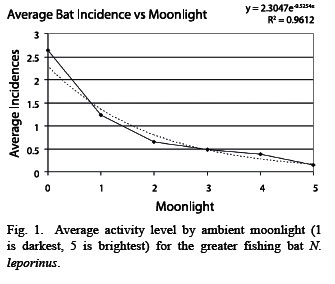
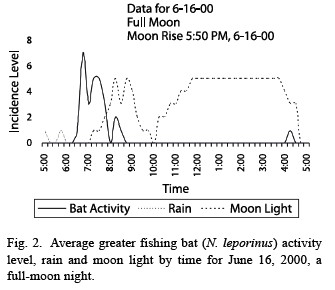
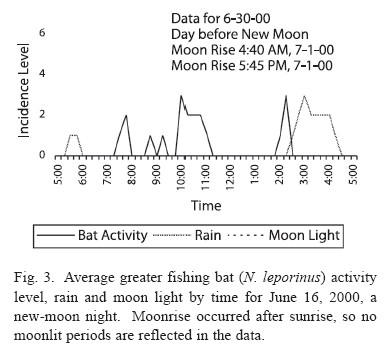
<body><![CDATA[ style="font-family: arial;">were computed and tested for correlation </span><span      style="font-family: arial;">between moonlight indices and activity     levels. </span></small>    <br> <small><span style="font-family: arial;"></span></small><br  style="font-family: arial;"> <small><span style="font-family: arial;"></span><span  style="font-family: arial;">Data were collected from 5:00 PM to 5:00 </span><span style="font-family: arial;">AM, three nights per week, for the duration of </span><span style="font-family: arial;">one lunar cycle. Observation began on 13 June</span><span  style="font-family: arial;"> 2000 and continued through the night of 6 July </span><span style="font-family: arial;">2000. First quarter moon was 9 June 2000, full </span><span style="font-family: arial;">moon was 16 June 2000, last quarter was 25 </span><span  style="font-family: arial;">June 2000, and new moon was 1 July 2000. </span></small>    <br> <small><span style="font-family: arial;"></span></small><br  style="font-family: arial;"> <small><span style="font-family: arial;"></span><span  style="font-family: arial; font-weight: 700;">Results</span></small><br  style="font-family: arial;"> <small></small><br style="font-family: arial;"> <small><span style="font-family: arial;">A total of&nbsp; 776 activity incidents were </span><span style="font-family: arial;">observed in dry conditions.</span></small><br style="font-family: arial;"> <small></small><br style="font-family: arial;"> <small><span style="font-family: arial;"><span  style="font-weight: bold;">Foraging behavior</span>: <span style="font-style: italic;">Noctilio leporinus</span> </span><span style="font-family: arial;">generally arrived at the study site around 5:00 </span><span style="font-family: arial;">PM, 45 min after sundown. In the absence of </span><span  style="font-family: arial;">moonlight and rain, the activity continuedfor </span><span style="font-family: arial;">up to four hours and then declined. The morning </span><span style="font-family: arial;">hours occasionally brought an additional </span><span  style="font-family: arial;">feeding period, between 1:30 AM and 3:30 </span><span  style="font-family: arial;">AM, although the second feeding period also </span><span style="font-family: arial;">varied according to environmental factors. On </span><span style="font-family: arial;">nights when the usual feeding period was very </span><span  style="font-family: arial;">bright or rainy, the bulk of feeding activity shifted </span><span style="font-family: arial;">to a later time. Bats generally fed in a manner </span><span  style="font-family: arial;">well documented in other population studies </span><span style="font-family: arial;">(Brooke 1997). They often were seen flying </span><span style="font-family: arial;">in groups of up to six bats, and would fly in a </span><span  style="font-family: arial;">line, with 5-7 m between each bat, following the </span><span style="font-family: arial;">lead bats flight patterns. These bats, presumably </span><span  style="font-family: arial;">females (Brooke 1997), would dip in the same </span><span style="font-family: arial;">areas as the lead bat, and followed the lead bat&#8217;s </span><span style="font-family: arial;">side-to-side flight path as well. Other bats, presumably </span><span  style="font-family: arial;">male (Brooke 1997), fed independently </span><span  style="font-family: arial;">but appeared to home in on other bats&#8217; activity&nbsp; </span><span style="font-family: arial;">to locate concentrations of fish.</span></small><br style="font-family: arial;"> <small></small><br style="font-family: arial;"> <small><span style="font-family: arial;">Individual bats employed high and low </span><span style="font-family: arial;">search flights to detect small fish, and made </span><span style="font-family: arial;">pointed dips in the areas of fish activity, but </span><span  style="font-family: arial;">they did not exhibit the long rakes or trawls that are considered characteristic (Schnitzler </span><span style="font-family: arial;"><span  style="font-style: italic;">et al</span>. 1994). All contacts with the water were </span><span style="font-family: arial;">snatches that lasted &lt;0.5 s. Additionally, the </span><span  style="font-family: arial;">bats often waited under the dock and flew out </span><span style="font-family: arial;">to investigate splashes in the water, although </span><span style="font-family: arial;">they did not leave the night roosts for large flying </span><span  style="font-family: arial;">insects passing under the lights.</span></small><br  style="font-family: arial;"> <small></small><br style="font-family: arial;"> <small><span style="font-family: arial;">The bats concentrated their feeding in </span><span style="font-family: arial;">areas well lit by dock lights or by lights from </span><span style="font-family: arial;">large boats in the area. These areas were generally close to centers of human activity, but the </span><span style="font-family: arial;">bats were apparently not influenced by these disturbances. The well-lit areas appeared to </span><span  style="font-family: arial;">have the highest concentration of surface disturbances </span><span style="font-family: arial;">from fish activity, and the bats tended </span><span style="font-family: arial;">to cruise from one lit area to another to find </span><span  style="font-family: arial;">active fish. When the bats detected fish in one </span><span style="font-family: arial;">area, they tended to concentrate their efforts in </span><span style="font-family: arial;">that area until the fish activity declined.</span></small><br  style="font-family: arial;"> <small></small><br style="font-family: arial;"> <small><span style="font-family: arial;"><span  style="font-weight: bold;">Predators</span>: Several large birds of prey </span><span style="font-family: arial;">were seen in the area, but the species could not </span><span  style="font-family: arial;">be determined because of the low light conditions. </span><span style="font-family: arial;">Possibilities may include severalgulls </span><span style="font-family: arial;">(Laridae) or typical owls (Strigidae) (Stiles </span><span  style="font-family: arial;">and Skutch 1989). The Black and White Owl </span><span  style="font-family: arial;">is known to take fishing bats (Stiles and Skutch </span><span style="font-family: arial;">1989). The guards on the dock reported seeing </span><span style="font-family: arial;">numerous &#8220;Buhos&#8221;, a generic term for an owl </span><span  style="font-family: arial;">that suggests the latter possibility, although </span><span style="font-family: arial;">numerous gulls of unknown species were present </span><span style="font-family: arial;">in the area in the late evenings. The guards </span><span  style="font-family: arial;">also reported a decline in the number of bats </span><span style="font-family: arial;">at the dock over the last five years, beginning </span><span style="font-family: arial;">after they began seeing owls in the area. </span></small>    <br> <small><span style="font-family: arial;"></span></small>    <br> <small><span style="font-family: arial;">One attempted capture of a bat by a large </span><span style="font-family: arial;">fish of unidentified species was observed, but</span><span style="font-family: arial;"> it appeared to be an isolated incident. No other </span><span style="font-family: arial;">predators on <span style="font-style: italic;">Noctilio leporinus</span> were noted in </span><span style="font-family: arial;">the area. </span></small><br  style="font-family: arial;"> <small></small><br style="font-family: arial;"> <small><span style="font-family: arial;"><span  style="font-weight: bold;">Lunar phobia</span>: <span style="font-style: italic;">Noctilio leporinus</span> demonstrated </span><span style="font-family: arial;">strong lunar phobia. The bats are significantly more active in low light conditions than </span><span style="font-family: arial;">when the moon shines brightly (<a href="#IMG1">Fig. 1</a>), based </span><span style="font-family: arial;">on activity period comparisons. On a lunar cycle </span><span style="font-family: arial;">basis, the same number of bats was active during </span><span  style="font-family: arial;">the light and dark cycles (n = 376 for light </span><span style="font-family: arial;">cycle, 391 for dark cycle). However, the variance </span><span style="font-family: arial;">was much higher in the light cycle (light s<sup>2</sup> </span><span  style="font-family: arial;">= 15.50, dark s<sup>2</sup> = 8.727, p &lt; 0.01). These findings </span><span style="font-family: arial;">suggest that the bats had the same overall level of activity during the light and dark cycles, </span><span style="font-family: arial;">although the activity during the light cycle was </span><span  style="font-family: arial;">clumped in the darker activity periods and the </span><span style="font-family: arial;">activity during the dark cycle was more evenly </span><span style="font-family: arial;">distributed throughout the night, which supports </span><span  style="font-family: arial;">the hypothesis that the bats are more active in </span><span style="font-family: arial;">periods of low light (<a href="#IMG2">Fig. 2</a>, <a href="#IMG3">3</a>).</span></small><br  style="font-family: arial;"> <small></small><br style="font-family: arial;"> <small><span style="font-family: arial;">Although the dock lights were on throughout </span><span style="font-family: arial;">the experiment, the bats showed no fear of the light from these sources and fed in </span><span  style="font-family: arial;">and around the light, not in the dark areas&nbsp; </span><span style="font-family: arial;">away from the dock. This pattern mirrored the apparent activity patterns of the small fish </span><span style="font-family: arial;">eaten by the bats.</span></small></div>     <p align="justify">&nbsp;</p>     <p align="center"><a name="IMG1"> <img style="border: 0px solid ; width: 335px; height: 284px;"  src="/img/fbpe/rbt/v54n4/3494i1.JPG" title="" alt=""></a><small><font size="3">&nbsp;     
<br>     ]]></body>
<body><![CDATA[<br> <a name="IMG2"><img  style="border: 0px solid ; width: 335px; height: 290px;"  src="/img/fbpe/rbt/v54n4/3494i2.JPG" title="" alt=""></a></font></small></p>     
<p align="center"><a name="IMG3"> <img style="border: 0px solid ; width: 385px; height: 347px;"  src="/img/fbpe/rbt/v54n4/3494i3.JPG" title="" alt=""></a></p>     
<p align="justify"><small><br style="font-family: arial;"> <br style="font-family: arial;"> </small></p>     <div style="text-align: left;"><small><span style="font-family: arial;"><span  style="font-weight: bold;">Foraging behavior</span>: Although <span style="font-style: italic;">Noctilio </span></span><span  style="font-family: arial;"><span style="font-style: italic;">leporinus</span> is generally classified as a piscivore,</span><span  style="font-family: arial;"> its diet in Culebra, Puerto Rico during the wet </span><span style="font-family: arial;">season was dominated by moths, beetles,&nbsp; and other insects (Brooke 1994). Another study, carried out in Tortuguero, Costa Rica, noted only two insect captures in hundreds of hours of foraging study and stated that <span style="font-style: italic;">N. leporinus</span> would not deviate from its course to pursue insects that would invite a chase in insectivorous bats (Schnitzler <span style="font-style: italic;">et al</span>. 1994). In this study, </span><span style="font-family: arial;"><span  style="font-style: italic;">N. leporinus</span> was not seen chasing or feeding on </span><span style="font-family: arial;">insects. Bats did not respond to large insects in </span><span  style="font-family: arial;">flight near the night roosts, only to splashes in </span><span style="font-family: arial;">the water, reinforcing the view of <span style="font-style: italic;">N.</span> <span  style="font-style: italic;">leporinus</span> </span><span  style="font-family: arial;">as a piscivore and further suggesting reliance </span><span style="font-family: arial;">on hearing as opposed to vision for long-range </span><span  style="font-family: arial;">prey detection. The night perch was in an area </span><span style="font-family: arial;">frequented by large beetles, cockroaches, crickets, </span><span  style="font-family: arial;">and crabs, all items noted as significant to </span><span style="font-family: arial;">the bats&#8217; diet in Puerto Rico (Brooke 1994). </span><span style="font-family: arial;">The bats might depend more on this resource </span><span  style="font-family: arial;">when they cannot spend as much time hunting </span><span style="font-family: arial;">due to rain. <span  style="font-style: italic;">N. leporinus</span> appears to concentrate </span><span style="font-family: arial;">on fish as its primary food source while feeding </span><span style="font-family: arial;">opportunistically on other organisms.</span></small><br style="font-family: arial;"> <small></small><br style="font-family: arial;"> <small><span style="font-family: arial;">The bats in this study did not perform </span><span style="font-family: arial;">the long trawls described by Schnitzler <span style="font-style: italic;">et</span></span><span  style="font-family: arial;"><span style="font-style: italic;"> al.</span> (1994). The water surrounding the dock </span><span  style="font-family: arial;">generally had mild chop throughout the night, </span><span style="font-family: arial;">which may make the long rake significantly </span><span style="font-family: arial;">less effective, accounting for its absence in</span><span  style="font-family: arial;"> this population. </span></small><br  style="font-family: arial;"> <small></small><br style="font-family: arial;"> <small><span style="font-family: arial;"><span  style="font-weight: bold;">Lunar phobia</span>: Many nocturnal creatures </span><span  style="font-family: arial;">correlate their behavior to moonlight intensity.</span><span style="font-family: arial;"> Based on the data presented in this study, </span><span style="font-family: arial;"><span  style="font-style: italic;">Noctilio leporinus</span> follows this trend by becoming </span><span style="font-family: arial;">more active in low light situations. </span></small>    <br>     <small><span style="font-family: arial;"></span></small><br      style="font-family: arial;">     <small><span style="font-family: arial;"></span><span      style="font-family: arial;">Previous study of lunar phobia     in bats </span><span style="font-family: arial;">has concentrated on     ]]></body>
<body><![CDATA[the relation of bat activity</span><span style="font-family: arial;">     levels to the lunar cycle (Morrison 1978, </span><span      style="font-family: arial;">Subbaraj and Balasingh 1986). The     existence </span><span style="font-family: arial;">of an internal     lunar clock in several bat species </span><span      style="font-family: arial;">has been hypothesized, but this hypothesis     fails </span><span style="font-family: arial;">for <span      style="font-style: italic;">Noctilio leporinus</span> because the bats     were just</span><span style="font-family: arial;">as active in the     light cycle as in the dark cycle, </span><span     ]]></body>
<body><![CDATA[ style="font-family: arial;">although the activity was grouped     differently in </span><span style="font-family: arial;">each period     (<a href="#IMG2">Fig. 2</a> and <a href="#IMG3">3</a>). This variation     results </span><span style="font-family: arial;">from the uniform     darkness of the dark     cycle </span><span style="font-family: arial;">nights, which permitted     activity throughout the </span><span style="font-family: arial;">night,     and the irregular darkness of the light </span><span      style="font-family: arial;">cycle, which permitted only &#8220;clumps&#8221; of     activity </span><span style="font-family: arial;">in the intermittent     ]]></body>
<body><![CDATA[dark periods. The lunar cycle </span><span style="font-family: arial;">appears     to play no role in the overall activity </span><span      style="font-family: arial;">level of <span style="font-style: italic;">N.     leporinus</span>, consistent with Haussler </span><span      style="font-family: arial;">and Erkert&#8217;s study (1978) showing that     activity </span><span style="font-family: arial;">patterns in     Neotropical bats change with exposure </span><span      style="font-family: arial;">to light, not moon cycles. </span></small><br      style="font-family: arial;">     <small></small><br style="font-family: arial;">     ]]></body>
<body><![CDATA[<small><span style="font-family: arial;">The owl predation studies     (Kotler     1991, </span><span style="font-family: arial;">O&#8217;Donnell 1999) suggest     that owls are more</span><span style="font-family: arial;">successful     in well-lit conditions. If bats learn </span><span      style="font-family: arial;">that brighter moonlight brings increased     predator </span><span style="font-family: arial;">activity, or if     those bats that fail to associate </span><span      style="font-family: arial;">bright light with predator activity are     more likely </span><span style="font-family: arial;">to be eaten, the     ]]></body>
<body><![CDATA[bats will eventually exhibit </span><span style="font-family: arial;">lunar     phobia. This lunar phobia contrasts with </span><span      style="font-family: arial;">the apparent preference for artificially     lit areas </span><span style="font-family: arial;">for feeding,     although this preference seems </span><span style="font-family: arial;">likely     to be a result of prey behavior.</span></small><br      style="font-family: arial;">     <small></small><br style="font-family: arial;">     <small><span style="font-family: arial;">Lunar phobia in <span      style="font-style: italic;">N. leporinus</span> may be </span><span     ]]></body>
<body><![CDATA[ style="font-family: arial;">a response to the activity patterns of     prey items. A similar observation was made in <span      style="font-style: italic;">M. </span></span><span      style="font-family: arial;"><span style="font-style: italic;">lyra</span>     (Subbaraj and Balasingh 1996), but this </span><span      style="font-family: arial;">influence in that study was dismissed     without </span><span style="font-family: arial;">discussion. <span      style="font-style: italic;">N. leporinus</span> does ignore its lunar     phobic tendencies when prey items present </span><span      style="font-family: arial;">themselves in the bats&#8217; immediate area.     ]]></body>
<body><![CDATA[Dark </span><span style="font-family: arial;">periods increase the     contrast between the surface </span><span style="font-family: arial;">areas     lit by artificial sources and non-lit </span><span      style="font-family: arial;">areas, concentrating fish in lit areas     during </span><span style="font-family: arial;">darker cycles     (Verheijen 1958, Pet <span style="font-style: italic;">et al</span>.     1997, </span><span style="font-family: arial;">Parrish 1999). A higher     concentration of fish </span><span style="font-family: arial;">increases     the chance of a bat catching a fish, </span><span      style="font-family: arial;">which could encourage the bat to     ]]></body>
<body><![CDATA[concentrate </span><span style="font-family: arial;">its activity     spatially in lit areas and temporally </span><span      style="font-family: arial;">during dark periods. The light periods     results </span><span style="font-family: arial;">in decreased contrast     and may result in a dispersion </span><span style="font-family: arial;">of     the fish, encouraging the bats to </span><span      style="font-family: arial;">wait for more productive hunting periods.     A </span><span style="font-family: arial;">similar phenomena is found     in light fisheries, with human     fishing efforts concentrated in </span><span     ]]></body>
<body><![CDATA[ style="font-family: arial;">the low light periods of the lunar cycle     (van Oostenbrugge 2002) The higher concentration </span><span      style="font-family: arial;">of fish activity in lit areas would also     account </span><span style="font-family: arial;">for the bats&#8217;     apparent fearlessness under the </span><span      style="font-family: arial;">dock lights. Prey activity was not     measured in </span><span style="font-family: arial;">this study, and     this hypothesis merits further </span><span style="font-family: arial;">exploration.     This possibility would also suggest </span><span      style="font-family: arial;">that the lunar phobia in this population </span><span     ]]></body>
<body><![CDATA[ style="font-family: arial;">might be a result of human disturbance; a </span><span      style="font-family: arial;">similar study on a more isolated bat     population </span><span style="font-family: arial;">would clarify the     origin of this behavior.</span></small><br style="font-family: arial;">     <small></small><br style="font-family: arial;">     <small><span style="font-family: arial;">Prey availability seems to     account     for the </span><span style="font-family: arial;">bats&#8217; occasional     flights in bright moonlight.B ats     seldom left their night roosts in periods </span><span     ]]></body>
<body><![CDATA[ style="font-family: arial;">of high moonlight levels, except when     induced </span><span style="font-family: arial;">to do so by large     amounts of activity at the </span><span style="font-family: arial;">water&#8217;s     surface. This response may be a result </span><span      style="font-family: arial;">of hunger or of a need to capitalize on a     feeding </span><span style="font-family: arial;">opportunity, not     sudden reduction in lunar </span><span style="font-family: arial;">phobia.     The bats in this study made at least </span><span      style="font-family: arial;">one attempt to feed every night,     regardless </span><span style="font-family: arial;">of overall light     ]]></body>
<body><![CDATA[conditions. A similar explanation </span><span      style="font-family: arial;">was suggested for periods of apparent </span><span      style="font-family: arial;">disregard for moonlight in other lunar     phobic </span><span style="font-family: arial;">bats (Morrison 1978,     Subbaraj and Balasingh </span><span style="font-family: arial;">1996).     When an easy feeding opportunity </span><span      style="font-family: arial;">presents itself, the benefits outweigh the     risks </span><span style="font-family: arial;">involved in exposure to     the moonlight, and the </span><span style="font-family: arial;">bats     will feed, even on well-lit nights. These </span><span     ]]></body>
<body><![CDATA[ style="font-family: arial;">results suggest that lunar phobia in <span      style="font-style: italic;">Noctilio </span></span><span      style="font-family: arial;"><span style="font-style: italic;">leporinus</span>     is likely a function of predator </span><span      style="font-family: arial;">avoidance and prey availability.</span></small><br      style="font-family: arial;">     <small></small><br style="font-family: arial;">     <small><span style="font-family: arial; font-weight: 700;">Acknowledgments</span></small><br      style="font-family: arial;">     <small></small><br style="font-family: arial;">     ]]></body>
<body><![CDATA[<small><span style="font-family: arial;">I thank Barbara Schowen and     the     Honors </span><span style="font-family: arial;">Program at the     University of Kansas for providing </span><span      style="font-family: arial;">funding for this project. I appreciate the     guidance and instruction I received     from </span><span style="font-family: arial;">Gloriana Chaverri. I am     indebted to Laura </span><span style="font-family: arial;">Bork and     Jos&eacute; Cordero for dockside support. Finally, I thank Thor Holmes     and Robert </span><span style="font-family: arial;">Timm for their     ]]></body>
<body><![CDATA[reviews. </span></small><br style="font-family: arial;">     <small></small><br style="font-family: arial;">     <small><span style="font-family: arial; font-weight: 700;">Resumen</span></small><br      style="font-family: arial;">     <small></small><br style="font-family: arial;">     <small><span style="font-family: arial;">Document&eacute; los patrones     de     actividad nocturna de </span><span style="font-family: arial;"><span      style="font-style: italic;">Noctilio leporinus</span>,     murci&eacute;lago pisc&iacute;voro neotropical, </span><span     ]]></body>
<body><![CDATA[ style="font-family: arial;">mediante observaciones visuales durante un     ciclo lunar en </span><span style="font-family: arial;">un muelle de     Golfito, Costa Rica. Considerando la intensidad </span><span      style="font-family: arial;">de la luz lunar, hubo una fuerte     correlaci&oacute;n entre la </span><span style="font-family: arial;">oscuridad     y la actividad (n = 776, r<sup>2</sup> = 0.96). Esta correlaci&oacute;n     </span><span style="font-family: arial;">ha sido observada en muchas     especies de mam&iacute;feros </span><span style="font-family: arial;">y     puede indicar una adaptaci&oacute;n de presas potenciales para </span><span      style="font-family: arial;">evadir los depredadores nocturnos y/o una     ]]></body>
<body><![CDATA[adaptaci&oacute;n de </span><span style="font-family: arial;">los     depredadores para maximizar el &eacute;xito de cacer&iacute;a. </span></small><br      style="font-family: arial;">     <small></small><br style="font-family: arial;">     <small><span style="font-family: arial;"><span      style="font-weight: bold;">Palabras     clave</span>: <span style="font-style: italic;">Noctilio</span>,     pisc&iacute;voro, fobia lunar, luz de luna, depredaci&oacute;n,     murci&eacute;lago, b&uacute;squeda de alimento.</span></small><br      style="font-family: arial;">     ]]></body>
<body><![CDATA[<small></small><br style="font-family: arial;">     <small><span style="font-family: arial; font-weight: 700;">References</span></small><br      style="font-family: arial;">     <small></small><br style="font-family: arial;">     <small><span style="font-family: arial;">Altringham, J.D. 1998. Bats:     Biology     and Behavior. Oxford </span><span style="font-family: arial;">University,     London, England. 272 p.</span></small><br style="font-family: arial;">     <small></small><br style="font-family: arial;">     <!-- ref --><small><span style="font-family: arial;">    &nbsp;&nbsp;&nbsp;&nbsp;&nbsp;&nbsp;&nbsp;&nbsp;[&#160;<a href="javascript:void(0);" onclick="javascript: window.open('/scielo.php?script=sci_nlinks&ref=1352049&pid=S0034-7744200600040000800001&lng=','','width=640,height=500,resizable=yes,scrollbars=1,menubar=yes,');">Links</a>&#160;]<!-- end-ref --><!-- ref -->Brooke, A.P. 1994. Diet of the fishing bat, <span style="font-style: italic;">Noctilio leporinus</span> </span><span style="font-family: arial;">(Chiroptera: Noctilionidae). J. Mammal. 75: 212-218.</span></small><br style="font-family: arial;"> <small></small><br style="font-family: arial;"> <small><span style="font-family: arial;">    &nbsp;&nbsp;&nbsp;&nbsp;&nbsp;&nbsp;&nbsp;&nbsp;[&#160;<a href="javascript:void(0);" onclick="javascript: window.open('/scielo.php?script=sci_nlinks&ref=1352050&pid=S0034-7744200600040000800002&lng=','','width=640,height=500,resizable=yes,scrollbars=1,menubar=yes,');">Links</a>&#160;]<!-- end-ref --><!-- ref -->Brooke, A.P. 1997. Social organization and foraging behavior </span><span  style="font-family: arial;">of the fishing bat, <span  style="font-style: italic;">Noctilio leporinus</span> (Chiroptera: </span><span  style="font-family: arial;">Noctilionidae). Ethology 103: 421-436.</span></small><br  style="font-family: arial;"> <small></small><br style="font-family: arial;"> <small><span style="font-family: arial;">    &nbsp;&nbsp;&nbsp;&nbsp;&nbsp;&nbsp;&nbsp;&nbsp;[&#160;<a href="javascript:void(0);" onclick="javascript: window.open('/scielo.php?script=sci_nlinks&ref=1352051&pid=S0034-7744200600040000800003&lng=','','width=640,height=500,resizable=yes,scrollbars=1,menubar=yes,');">Links</a>&#160;]<!-- end-ref --><!-- ref -->Cort&eacute;s, J. 1990. Coral reef decline in Golfo Dulce, Costa </span><span style="font-family: arial;">Rica, eastern Pacific: anthropogenic and natural disturbances. </span><span  style="font-family: arial;">Ph.D. Dissertation. University of Miami, </span><span  style="font-family: arial;">Miami, Florida, USA. 147 p.</span></small><br  style="font-family: arial;"> <small></small><br style="font-family: arial;"> <small><span style="font-family: arial;">    &nbsp;&nbsp;&nbsp;&nbsp;&nbsp;&nbsp;&nbsp;&nbsp;[&#160;<a href="javascript:void(0);" onclick="javascript: window.open('/scielo.php?script=sci_nlinks&ref=1352052&pid=S0034-7744200600040000800004&lng=','','width=640,height=500,resizable=yes,scrollbars=1,menubar=yes,');">Links</a>&#160;]<!-- end-ref --><!-- ref -->Fish, F.E., B.R. Blood &amp; B.D. Clark. 1991. Hydrodynamics </span><span style="font-family: arial;">of the feet of the fish-catching bats: Influence of the </span><span  style="font-family: arial;">water surface on drag and morphological design. J. </span><span style="font-family: arial;">Exp. Zool. 258: 164-173.</span></small><br style="font-family: arial;"> <small></small><br style="font-family: arial;"> <small><span style="font-family: arial;">    &nbsp;&nbsp;&nbsp;&nbsp;&nbsp;&nbsp;&nbsp;&nbsp;[&#160;<a href="javascript:void(0);" onclick="javascript: window.open('/scielo.php?script=sci_nlinks&ref=1352053&pid=S0034-7744200600040000800005&lng=','','width=640,height=500,resizable=yes,scrollbars=1,menubar=yes,');">Links</a>&#160;]<!-- end-ref --><!-- ref -->Haussler, U. &amp; H. Erkert. 1978. Different direct effects </span><span style="font-family: arial;">of light intensity on the entrained activity rhythm in </span><span  style="font-family: arial;">Neotropical bats. Behav. Process. 3: 223-239. </span></small>    &nbsp;&nbsp;&nbsp;&nbsp;&nbsp;&nbsp;&nbsp;&nbsp;[&#160;<a href="javascript:void(0);" onclick="javascript: window.open('/scielo.php?script=sci_nlinks&ref=1352054&pid=S0034-7744200600040000800006&lng=','','width=640,height=500,resizable=yes,scrollbars=1,menubar=yes,');">Links</a>&#160;]<!-- end-ref --><br> <small><span style="font-family: arial;"></span></small>    <!-- ref --><br> <small><span style="font-family: arial;"></span><span  style="font-family: arial;">Hood, C.S. &amp; J.K. Jones Jr. 1984.<span style="font-style: italic;"> Noctilio leporinus</span>. </span><span  style="font-family: arial;">Mamm. Species 216: 1-7.</span></small><br  style="font-family: arial;"> <small></small><br style="font-family: arial;"> <small><span style="font-family: arial;">    &nbsp;&nbsp;&nbsp;&nbsp;&nbsp;&nbsp;&nbsp;&nbsp;[&#160;<a href="javascript:void(0);" onclick="javascript: window.open('/scielo.php?script=sci_nlinks&ref=1352056&pid=S0034-7744200600040000800007&lng=','','width=640,height=500,resizable=yes,scrollbars=1,menubar=yes,');">Links</a>&#160;]<!-- end-ref --><!-- ref -->Imber, M. J. 1975. Behaviour of petrels in relation to the </span><span style="font-family: arial;">moon and artificial lights. Notornis 22: 302-306.</span></small><br  style="font-family: arial;"> <small></small><br style="font-family: arial;"> <small><span style="font-family: arial;">    &nbsp;&nbsp;&nbsp;&nbsp;&nbsp;&nbsp;&nbsp;&nbsp;[&#160;<a href="javascript:void(0);" onclick="javascript: window.open('/scielo.php?script=sci_nlinks&ref=1352057&pid=S0034-7744200600040000800008&lng=','','width=640,height=500,resizable=yes,scrollbars=1,menubar=yes,');">Links</a>&#160;]<!-- end-ref --><!-- ref -->Kotler, B.P., J.S. Brown &amp; O. Hasson. 1991. Factors affecting </span><span  style="font-family: arial;">gerbil foraging behavior and rates of owl predation. </span><span style="font-family: arial;">Ecology 72: 2 249-2 260.</span></small><br style="font-family: arial;"> <small></small><br style="font-family: arial;"> <small><span style="font-family: arial;">    &nbsp;&nbsp;&nbsp;&nbsp;&nbsp;&nbsp;&nbsp;&nbsp;[&#160;<a href="javascript:void(0);" onclick="javascript: window.open('/scielo.php?script=sci_nlinks&ref=1352058&pid=S0034-7744200600040000800009&lng=','','width=640,height=500,resizable=yes,scrollbars=1,menubar=yes,');">Links</a>&#160;]<!-- end-ref --><!-- ref -->Kruuk, H. 1964. Predators and anti-predator behavior of </span><span style="font-family: arial;">the Black-headed Gull (<span style="font-style: italic;">Larus ridibundis L</span>.). Behav. </span><span style="font-family: arial;">Suppl. XI.</span></small><br  style="font-family: arial;"> <small></small><br style="font-family: arial;"> <small><span style="font-family: arial;">    &nbsp;&nbsp;&nbsp;&nbsp;&nbsp;&nbsp;&nbsp;&nbsp;[&#160;<a href="javascript:void(0);" onclick="javascript: window.open('/scielo.php?script=sci_nlinks&ref=1352059&pid=S0034-7744200600040000800010&lng=','','width=640,height=500,resizable=yes,scrollbars=1,menubar=yes,');">Links</a>&#160;]<!-- end-ref --><!-- ref -->Lewis-Oritt, N., R. Van Den Bussche &amp; R. Baker. 2001. </span><span style="font-family: arial;">Molecular evidence for piscivory in Noctilio </span><span  style="font-family: arial;">(Chiroptera: Noctilionidae). J. Mamm. 82: 749-759.</span></small><br style="font-family: arial;"> <small></small><br style="font-family: arial;"> <small><span style="font-family: arial;">    &nbsp;&nbsp;&nbsp;&nbsp;&nbsp;&nbsp;&nbsp;&nbsp;[&#160;<a href="javascript:void(0);" onclick="javascript: window.open('/scielo.php?script=sci_nlinks&ref=1352060&pid=S0034-7744200600040000800011&lng=','','width=640,height=500,resizable=yes,scrollbars=1,menubar=yes,');">Links</a>&#160;]<!-- end-ref --><!-- ref -->Lockard, R.B. &amp; D.H. Owins. 1974. Moon-related surface </span><span style="font-family: arial;">activity of bannertail (<span style="font-style: italic;">Dipodomys spectabilis</span>) and</span><span style="font-family: arial;"> Fresno (<span  style="font-style: italic;">D. nitratoides</span>) kangaroo rats. Anim. Behav.&nbsp; </span><span style="font-family: arial;">22: 262-273.</span></small><br style="font-family: arial;"> <small></small><br style="font-family: arial;"> <small><span style="font-family: arial;">    &nbsp;&nbsp;&nbsp;&nbsp;&nbsp;&nbsp;&nbsp;&nbsp;[&#160;<a href="javascript:void(0);" onclick="javascript: window.open('/scielo.php?script=sci_nlinks&ref=1352061&pid=S0034-7744200600040000800012&lng=','','width=640,height=500,resizable=yes,scrollbars=1,menubar=yes,');">Links</a>&#160;]<!-- end-ref --><!-- ref -->Malino, E. 1994. Costa Rican adventure. Bats 12: 16-17.</span></small><br style="font-family: arial;"> <small></small><br style="font-family: arial;"> <small><span style="font-family: arial;">    &nbsp;&nbsp;&nbsp;&nbsp;&nbsp;&nbsp;&nbsp;&nbsp;[&#160;<a href="javascript:void(0);" onclick="javascript: window.open('/scielo.php?script=sci_nlinks&ref=1352062&pid=S0034-7744200600040000800013&lng=','','width=640,height=500,resizable=yes,scrollbars=1,menubar=yes,');">Links</a>&#160;]<!-- end-ref --><!-- ref -->Morrison, D. 1978. Lunar phobia in a Neotropical fruit bat, </span><span style="font-family: arial;"><span  style="font-style: italic;">Artibeus jamaicensis</span> (Chiroptera: Phyllostomidae).</span><span style="font-family: arial;"> Anim. Behav. 26: 852-855. </span></small><br style="font-family: arial;"> <small></small><br style="font-family: arial;"> <small><span style="font-family: arial;">    &nbsp;&nbsp;&nbsp;&nbsp;&nbsp;&nbsp;&nbsp;&nbsp;[&#160;<a href="javascript:void(0);" onclick="javascript: window.open('/scielo.php?script=sci_nlinks&ref=1352063&pid=S0034-7744200600040000800014&lng=','','width=640,height=500,resizable=yes,scrollbars=1,menubar=yes,');">Links</a>&#160;]<!-- end-ref --><!-- ref -->Nelson, D.A. 1989. Gull predation on Cassin&#8217;s Auklet with </span><span style="font-family: arial;">the lunar cycle. Auk 106: 495-497.</span></small><br  style="font-family: arial;"> <small></small><br style="font-family: arial;"> <small><span style="font-family: arial;">    &nbsp;&nbsp;&nbsp;&nbsp;&nbsp;&nbsp;&nbsp;&nbsp;[&#160;<a href="javascript:void(0);" onclick="javascript: window.open('/scielo.php?script=sci_nlinks&ref=1352064&pid=S0034-7744200600040000800015&lng=','','width=640,height=500,resizable=yes,scrollbars=1,menubar=yes,');">Links</a>&#160;]<!-- end-ref --><!-- ref -->Nowack, R. 1994. Walker&#8217;s Bats of the World. John Hopkins </span><span style="font-family: arial;">University, Baltimore,Maryland, USA. 296 p.</span></small><br  style="font-family: arial;"> <small></small><br style="font-family: arial;"> <small><span style="font-family: arial;">    &nbsp;&nbsp;&nbsp;&nbsp;&nbsp;&nbsp;&nbsp;&nbsp;[&#160;<a href="javascript:void(0);" onclick="javascript: window.open('/scielo.php?script=sci_nlinks&ref=1352065&pid=S0034-7744200600040000800016&lng=','','width=640,height=500,resizable=yes,scrollbars=1,menubar=yes,');">Links</a>&#160;]<!-- end-ref --><!-- ref -->Nowack, R. 1999. Bulldog Bats, or Fisherman Bats. </span><span style="font-family: arial;">Walker&#8217;s Mammals of the World. John Hopkins </span><span  style="font-family: arial;">University, Baltimore,Maryland, USA. 347-349.</span></small><br style="font-family: arial;"> <small></small><br style="font-family: arial;"> <small><span style="font-family: arial;">    &nbsp;&nbsp;&nbsp;&nbsp;&nbsp;&nbsp;&nbsp;&nbsp;[&#160;<a href="javascript:void(0);" onclick="javascript: window.open('/scielo.php?script=sci_nlinks&ref=1352066&pid=S0034-7744200600040000800017&lng=','','width=640,height=500,resizable=yes,scrollbars=1,menubar=yes,');">Links</a>&#160;]<!-- end-ref --><!-- ref -->O&#8217;Donnell, R.P. 1999. The effects of moon phase and </span><span style="font-family: arial;">moonlight intensity on the activity of Barred Owls </span><span  style="font-family: arial;">and Great Horned Owls. Poster, Meeting of the </span><span style="font-family: arial;">Northeast RegionalAnimal Behavior Society. </span></small><br style="font-family: arial;"> <small></small><br style="font-family: arial;"> <small><span style="font-family: arial;">    &nbsp;&nbsp;&nbsp;&nbsp;&nbsp;&nbsp;&nbsp;&nbsp;[&#160;<a href="javascript:void(0);" onclick="javascript: window.open('/scielo.php?script=sci_nlinks&ref=1352067&pid=S0034-7744200600040000800018&lng=','','width=640,height=500,resizable=yes,scrollbars=1,menubar=yes,');">Links</a>&#160;]<!-- end-ref --><!-- ref -->Parrish, J.K. 1999. Using behavior and ecology to exploit </span><span style="font-family: arial;">schooling fishes. Environ. Biol. Fish. 55: 89-103.</span></small><br  style="font-family: arial;"> <small></small><br style="font-family: arial;"> <small><span style="font-family: arial;">    &nbsp;&nbsp;&nbsp;&nbsp;&nbsp;&nbsp;&nbsp;&nbsp;[&#160;<a href="javascript:void(0);" onclick="javascript: window.open('/scielo.php?script=sci_nlinks&ref=1352068&pid=S0034-7744200600040000800019&lng=','','width=640,height=500,resizable=yes,scrollbars=1,menubar=yes,');">Links</a>&#160;]<!-- end-ref --><!-- ref -->Pet, J.S., W.L. T van Densen, M.A.M. Machiels, M. </span><span style="font-family: arial;">Sukkel, D. Setyohadi &amp; A. Tumuljadi 1997. Catch, </span><span  style="font-family: arial;">effort, and sampling strategies in the highly variable </span><span style="font-family: arial;">sardine fisheriesaround East Java, Indonesia. Fish&nbsp; </span><span  style="font-family: arial;">Res. 31: 121-137.</span></small><br  style="font-family: arial;"> <small></small><br style="font-family: arial;"> <small><span style="font-family: arial;">    &nbsp;&nbsp;&nbsp;&nbsp;&nbsp;&nbsp;&nbsp;&nbsp;[&#160;<a href="javascript:void(0);" onclick="javascript: window.open('/scielo.php?script=sci_nlinks&ref=1352069&pid=S0034-7744200600040000800020&lng=','','width=640,height=500,resizable=yes,scrollbars=1,menubar=yes,');">Links</a>&#160;]<!-- end-ref --><!-- ref -->Schnitzler, H.U., E.KV. Kalko, I. Kaipf &amp; A.D. Grinnell. </span><span style="font-family: arial;">1994. Fishing and echolocation behavior of the </span><span  style="font-family: arial;">greater bulldog bat, <span  style="font-style: italic;">Noctilio leporinus</span>, in the field. </span><span  style="font-family: arial;">Behav. Ecol. Sociobiol. 35: 327-345.</span></small><br  style="font-family: arial;"> <small></small><br style="font-family: arial;"> <small><span style="font-family: arial;">    &nbsp;&nbsp;&nbsp;&nbsp;&nbsp;&nbsp;&nbsp;&nbsp;[&#160;<a href="javascript:void(0);" onclick="javascript: window.open('/scielo.php?script=sci_nlinks&ref=1352070&pid=S0034-7744200600040000800021&lng=','','width=640,height=500,resizable=yes,scrollbars=1,menubar=yes,');">Links</a>&#160;]<!-- end-ref --><!-- ref -->Stiles, G.F. &amp; A.F. Skutch. 1989. A Guide to the Birds of </span><span style="font-family: arial;">Costa Rica. Comstock. Ithaca, New York, New York, </span><span  style="font-family: arial;">USA. 656 p.</span></small><br  style="font-family: arial;"> <small></small><br style="font-family: arial;"> <small><span style="font-family: arial;">    &nbsp;&nbsp;&nbsp;&nbsp;&nbsp;&nbsp;&nbsp;&nbsp;[&#160;<a href="javascript:void(0);" onclick="javascript: window.open('/scielo.php?script=sci_nlinks&ref=1352071&pid=S0034-7744200600040000800022&lng=','','width=640,height=500,resizable=yes,scrollbars=1,menubar=yes,');">Links</a>&#160;]<!-- end-ref --><!-- ref -->Subbaraj, R. &amp; J. Balasingh. 1986. Night roosting and </span><span style="font-family: arial;">&#8216;lunar phobia&#8217; in Indian false vampire bat <span style="font-style: italic;">Megaderma </span></span><span style="font-family: arial;"><span  style="font-style: italic;">Lyra</span>. J. Bombay Nat. Hist. Soc. 93: 1-7.</span></small><br style="font-family: arial;"> <small></small><br style="font-family: arial;"> <small><span style="font-family: arial;">    &nbsp;&nbsp;&nbsp;&nbsp;&nbsp;&nbsp;&nbsp;&nbsp;[&#160;<a href="javascript:void(0);" onclick="javascript: window.open('/scielo.php?script=sci_nlinks&ref=1352072&pid=S0034-7744200600040000800023&lng=','','width=640,height=500,resizable=yes,scrollbars=1,menubar=yes,');">Links</a>&#160;]<!-- end-ref --><!-- ref -->Turner, D.C. 1975. The Vampire Bat: A Field Study in </span><span style="font-family: arial;">behavior and ecology. John Hopkins University, </span><span  style="font-family: arial;">Baltimore, Maryland, USA. 159 p.</span></small><br  style="font-family: arial;"> <small></small><br style="font-family: arial;"> <small><span style="font-family: arial;">    &nbsp;&nbsp;&nbsp;&nbsp;&nbsp;&nbsp;&nbsp;&nbsp;[&#160;<a href="javascript:void(0);" onclick="javascript: window.open('/scielo.php?script=sci_nlinks&ref=1352073&pid=S0034-7744200600040000800024&lng=','','width=640,height=500,resizable=yes,scrollbars=1,menubar=yes,');">Links</a>&#160;]<!-- end-ref --><!-- ref -->Van Oostenbrugge, J.A.E., J.J. Poos, W.L.T. van Densen &amp; </span><span style="font-family: arial;">M.A.M. Machiels. 2002. In search of a better unit of </span><span  style="font-family: arial;">effort in the coastal liftnet fishery with lights for small </span><span style="font-family: arial;">pelagics in Indonesia. Fisheries Res. 59: 43-56.</span></small><br  style="font-family: arial;"> <small></small><br style="font-family: arial;"> <small><span style="font-family: arial;">    &nbsp;&nbsp;&nbsp;&nbsp;&nbsp;&nbsp;&nbsp;&nbsp;[&#160;<a href="javascript:void(0);" onclick="javascript: window.open('/scielo.php?script=sci_nlinks&ref=1352074&pid=S0034-7744200600040000800025&lng=','','width=640,height=500,resizable=yes,scrollbars=1,menubar=yes,');">Links</a>&#160;]<!-- end-ref --><!-- ref -->Verheijen, F.J. 1958. The mechanisms of the trapping effect </span><span style="font-family: arial;">of artificial light sources upon animals. Ext. Arch.s </span><span  style="font-family: arial;">Neerl. Zool. 13: 1-107.</span></small><br  style="font-family: arial;"> <small></small><br style="font-family: arial;"> <small><span style="font-family: arial;">    &nbsp;&nbsp;&nbsp;&nbsp;&nbsp;&nbsp;&nbsp;&nbsp;[&#160;<a href="javascript:void(0);" onclick="javascript: window.open('/scielo.php?script=sci_nlinks&ref=1352075&pid=S0034-7744200600040000800026&lng=','','width=640,height=500,resizable=yes,scrollbars=1,menubar=yes,');">Links</a>&#160;]<!-- end-ref --><!-- ref -->Vo&ucirc;te, A.M., J.W. Sluiter &amp; M.P. Grimm. 1974. The influence </span><span  style="font-family: arial;">of the natural light-dark cycle on the activity rhythm </span><span style="font-family: arial;">of pond bats (<span  style="font-style: italic;">Myotis dasycneme</span> Boie, 1825) during </span><span style="font-family: arial;">summer. Oecologia (Berlin) 17: 221-243.</span></small><br style="font-family: arial;"> <small></small><br style="font-family: arial;"> <small><span style="font-family: arial;">    &nbsp;&nbsp;&nbsp;&nbsp;&nbsp;&nbsp;&nbsp;&nbsp;[&#160;<a href="javascript:void(0);" onclick="javascript: window.open('/scielo.php?script=sci_nlinks&ref=1352076&pid=S0034-7744200600040000800027&lng=','','width=640,height=500,resizable=yes,scrollbars=1,menubar=yes,');">Links</a>&#160;]<!-- end-ref --><!-- ref -->Watanuki, Y. 1986. Moonlight avoidance behavior in </span><span style="font-family: arial;">Leach&#8217;s Storm-Petrels as a defense against Slatybacked</span><span  style="font-family: arial;">Gulls. Auk 103: 14-22. </span></small></div>    &nbsp;&nbsp;&nbsp;&nbsp;&nbsp;&nbsp;&nbsp;&nbsp;[&#160;<a href="javascript:void(0);" onclick="javascript: window.open('/scielo.php?script=sci_nlinks&ref=1352077&pid=S0034-7744200600040000800028&lng=','','width=640,height=500,resizable=yes,scrollbars=1,menubar=yes,');">Links</a>&#160;]<!-- end-ref --> ]]></body><back>
<ref-list>
<ref id="B1">
<nlm-citation citation-type="book">
<person-group person-group-type="author">
<name>
<surname><![CDATA[Altringham]]></surname>
<given-names><![CDATA[J.D]]></given-names>
</name>
</person-group>
<source><![CDATA[Bats: Biology and Behavior]]></source>
<year>1998</year>
<page-range>272</page-range><publisher-loc><![CDATA[^eLondon London]]></publisher-loc>
<publisher-name><![CDATA[Oxford University]]></publisher-name>
</nlm-citation>
</ref>
<ref id="B2">
<nlm-citation citation-type="journal">
<person-group person-group-type="author">
<name>
<surname><![CDATA[Brooke]]></surname>
<given-names><![CDATA[A.P]]></given-names>
</name>
</person-group>
<article-title xml:lang="en"><![CDATA[Diet of the fishing bat, Noctilio leporinus (Chiroptera: Noctilionidae)]]></article-title>
<source><![CDATA[J. Mammal]]></source>
<year>1994</year>
<volume>75</volume>
<page-range>212-218</page-range></nlm-citation>
</ref>
<ref id="B3">
<nlm-citation citation-type="journal">
<person-group person-group-type="author">
<name>
<surname><![CDATA[Brooke]]></surname>
<given-names><![CDATA[A.P]]></given-names>
</name>
</person-group>
<article-title xml:lang="en"><![CDATA[Social organization and foraging behavior of the fishing bat, Noctilio leporinus (Chiroptera: Noctilionidae)]]></article-title>
<source><![CDATA[Ethology]]></source>
<year>1997</year>
<volume>103</volume>
<page-range>421-436</page-range></nlm-citation>
</ref>
<ref id="B4">
<nlm-citation citation-type="">
<person-group person-group-type="author">
<name>
<surname><![CDATA[Cortés]]></surname>
<given-names><![CDATA[J]]></given-names>
</name>
</person-group>
<source><![CDATA[Coral reef decline in Golfo Dulce, Costa Rica, eastern Pacific: anthropogenic and natural disturbances]]></source>
<year>1990</year>
<page-range>147</page-range></nlm-citation>
</ref>
<ref id="B5">
<nlm-citation citation-type="journal">
<person-group person-group-type="author">
<name>
<surname><![CDATA[Fish]]></surname>
<given-names><![CDATA[F.E]]></given-names>
</name>
<name>
<surname><![CDATA[Blood]]></surname>
<given-names><![CDATA[B.R]]></given-names>
</name>
<name>
<surname><![CDATA[Clark]]></surname>
<given-names><![CDATA[B.D]]></given-names>
</name>
</person-group>
<article-title xml:lang="en"><![CDATA[Hydrodynamics of the feet of the fish-catching bats: Influence of the water surface on drag and morphological design]]></article-title>
<source><![CDATA[J. Exp. Zool]]></source>
<year>1991</year>
<volume>258</volume>
<page-range>164-173</page-range></nlm-citation>
</ref>
<ref id="B6">
<nlm-citation citation-type="journal">
<person-group person-group-type="author">
<name>
<surname><![CDATA[Haussler]]></surname>
<given-names><![CDATA[U]]></given-names>
</name>
<name>
<surname><![CDATA[Erkert]]></surname>
<given-names><![CDATA[H]]></given-names>
</name>
</person-group>
<article-title xml:lang="en"><![CDATA[Different direct effects of light intensity on the entrained activity rhythm in Neotropical bats]]></article-title>
<source><![CDATA[Behav. Process]]></source>
<year>1978</year>
<volume>3</volume>
<page-range>223-239</page-range></nlm-citation>
</ref>
<ref id="B7">
<nlm-citation citation-type="journal">
<person-group person-group-type="author">
<name>
<surname><![CDATA[Hood]]></surname>
<given-names><![CDATA[C.S]]></given-names>
</name>
<name>
<surname><![CDATA[Jones]]></surname>
<given-names><![CDATA[J.K]]></given-names>
</name>
</person-group>
<article-title xml:lang="en"><![CDATA[Noctilio leporinus]]></article-title>
<source><![CDATA[Mamm. Species]]></source>
<year>1984</year>
<volume>216</volume>
<page-range>1-7</page-range></nlm-citation>
</ref>
<ref id="B8">
<nlm-citation citation-type="journal">
<person-group person-group-type="author">
<name>
<surname><![CDATA[Imber]]></surname>
<given-names><![CDATA[M. J]]></given-names>
</name>
</person-group>
<article-title xml:lang="en"><![CDATA[Behaviour of petrels in relation to the moon and artificial lights]]></article-title>
<source><![CDATA[Notornis]]></source>
<year>1975</year>
<volume>22</volume>
<page-range>302-306</page-range></nlm-citation>
</ref>
<ref id="B9">
<nlm-citation citation-type="journal">
<person-group person-group-type="author">
<name>
<surname><![CDATA[Kotler]]></surname>
<given-names><![CDATA[B.P]]></given-names>
</name>
<name>
<surname><![CDATA[Brown]]></surname>
<given-names><![CDATA[J.S]]></given-names>
</name>
<name>
<surname><![CDATA[Hasson]]></surname>
<given-names><![CDATA[O]]></given-names>
</name>
</person-group>
<article-title xml:lang="en"><![CDATA[Factors affecting gerbil foraging behavior and rates of owl predation]]></article-title>
<source><![CDATA[Ecology]]></source>
<year>1991</year>
<volume>72</volume>
<page-range>2 249-2 260</page-range></nlm-citation>
</ref>
<ref id="B10">
<nlm-citation citation-type="journal">
<person-group person-group-type="author">
<name>
<surname><![CDATA[Kruuk]]></surname>
<given-names><![CDATA[H]]></given-names>
</name>
</person-group>
<article-title xml:lang="en"><![CDATA[Predators and anti-predator behavior of the Black-headed Gull (Larus ridibundis L.)]]></article-title>
<source><![CDATA[Behav]]></source>
<year>1964</year>
<numero>Suppl. XI</numero>
<issue>Suppl. XI</issue>
</nlm-citation>
</ref>
<ref id="B11">
<nlm-citation citation-type="journal">
<person-group person-group-type="author">
<name>
<surname><![CDATA[Lewis-Oritt]]></surname>
<given-names><![CDATA[N]]></given-names>
</name>
<name>
<surname><![CDATA[Den Bussche]]></surname>
<given-names><![CDATA[R.]]></given-names>
</name>
<name>
<surname><![CDATA[Baker]]></surname>
<given-names><![CDATA[R]]></given-names>
</name>
</person-group>
<article-title xml:lang="en"><![CDATA[Molecular evidence for piscivory in Noctilio (Chiroptera: Noctilionidae)]]></article-title>
<source><![CDATA[J. Mamm]]></source>
<year>2001</year>
<volume>82</volume>
<page-range>749-759</page-range></nlm-citation>
</ref>
<ref id="B12">
<nlm-citation citation-type="journal">
<person-group person-group-type="author">
<name>
<surname><![CDATA[Lockard]]></surname>
<given-names><![CDATA[R.B]]></given-names>
</name>
<name>
<surname><![CDATA[Owins]]></surname>
<given-names><![CDATA[D.H]]></given-names>
</name>
</person-group>
<article-title xml:lang="en"><![CDATA[Moon-related surface activity of bannertail (Dipodomys spectabilis) and Fresno (D. nitratoides) kangaroo rats]]></article-title>
<source><![CDATA[Anim. Behav]]></source>
<year>1974</year>
<volume>22</volume>
<page-range>262-273</page-range></nlm-citation>
</ref>
<ref id="B13">
<nlm-citation citation-type="journal">
<person-group person-group-type="author">
<name>
<surname><![CDATA[Malino]]></surname>
<given-names><![CDATA[E]]></given-names>
</name>
</person-group>
<article-title xml:lang="en"><![CDATA[Costa Rican adventure]]></article-title>
<source><![CDATA[Bats]]></source>
<year>1994</year>
<volume>12</volume>
<page-range>16-17</page-range></nlm-citation>
</ref>
<ref id="B14">
<nlm-citation citation-type="journal">
<person-group person-group-type="author">
<name>
<surname><![CDATA[Morrison]]></surname>
<given-names><![CDATA[D]]></given-names>
</name>
</person-group>
<article-title xml:lang="en"><![CDATA[Lunar phobia in a Neotropical fruit bat, Artibeus jamaicensis (Chiroptera: Phyllostomidae)]]></article-title>
<source><![CDATA[Anim. Behav]]></source>
<year>1978</year>
<volume>26</volume>
<page-range>852-855</page-range></nlm-citation>
</ref>
<ref id="B15">
<nlm-citation citation-type="journal">
<person-group person-group-type="author">
<name>
<surname><![CDATA[Nelson]]></surname>
<given-names><![CDATA[D.A]]></given-names>
</name>
</person-group>
<article-title xml:lang="en"><![CDATA[Gull predation on Cassin’s Auklet with the lunar cycle]]></article-title>
<source><![CDATA[Auk]]></source>
<year>1989</year>
<volume>106</volume>
<page-range>495-497</page-range></nlm-citation>
</ref>
<ref id="B16">
<nlm-citation citation-type="book">
<person-group person-group-type="author">
<name>
<surname><![CDATA[Nowack]]></surname>
<given-names><![CDATA[R]]></given-names>
</name>
</person-group>
<source><![CDATA[Walker’s Bats of the World]]></source>
<year>1994</year>
<page-range>296</page-range><publisher-loc><![CDATA[Baltimore^eMaryland Maryland]]></publisher-loc>
<publisher-name><![CDATA[John Hopkins University]]></publisher-name>
</nlm-citation>
</ref>
<ref id="B17">
<nlm-citation citation-type="book">
<person-group person-group-type="author">
<name>
<surname><![CDATA[Nowack]]></surname>
<given-names><![CDATA[R]]></given-names>
</name>
</person-group>
<source><![CDATA[Bulldog Bats, or Fisherman Bats: Walker’s Mammals of the World]]></source>
<year>1999</year>
<page-range>347-349</page-range><publisher-loc><![CDATA[Baltimore^eMaryland Maryland]]></publisher-loc>
<publisher-name><![CDATA[John Hopkins University]]></publisher-name>
</nlm-citation>
</ref>
<ref id="B18">
<nlm-citation citation-type="confpro">
<person-group person-group-type="author">
<name>
<surname><![CDATA[O’Donnell]]></surname>
<given-names><![CDATA[R.P]]></given-names>
</name>
</person-group>
<source><![CDATA[The effects of moon phase and moonlight intensity on the activity of Barred Owls and Great Horned Owls: Poster]]></source>
<year>1999</year>
<conf-name><![CDATA[ Meeting of the Northeast RegionalAnimal Behavior Society]]></conf-name>
<conf-loc> </conf-loc>
</nlm-citation>
</ref>
<ref id="B19">
<nlm-citation citation-type="journal">
<person-group person-group-type="author">
<name>
<surname><![CDATA[Parrish]]></surname>
<given-names><![CDATA[J.K]]></given-names>
</name>
</person-group>
<article-title xml:lang="en"><![CDATA[Using behavior and ecology to exploit schooling fishes]]></article-title>
<source><![CDATA[Environ. Biol. Fish]]></source>
<year>1999</year>
<volume>55</volume>
<page-range>89-103</page-range></nlm-citation>
</ref>
<ref id="B20">
<nlm-citation citation-type="journal">
<person-group person-group-type="author">
<name>
<surname><![CDATA[Pet]]></surname>
<given-names><![CDATA[J.S]]></given-names>
</name>
<name>
<surname><![CDATA[Densen]]></surname>
<given-names><![CDATA[W.L. T]]></given-names>
</name>
<name>
<surname><![CDATA[Machiels]]></surname>
<given-names><![CDATA[M.A.M]]></given-names>
</name>
<name>
<surname><![CDATA[Sukkel]]></surname>
<given-names><![CDATA[M]]></given-names>
</name>
<name>
<surname><![CDATA[Setyohadi]]></surname>
<given-names><![CDATA[D]]></given-names>
</name>
<name>
<surname><![CDATA[Tumuljadi]]></surname>
<given-names><![CDATA[A]]></given-names>
</name>
</person-group>
<article-title xml:lang="en"><![CDATA[Catch, effort, and sampling strategies in the highly variable sardine fisheriesaround East Java, Indonesia]]></article-title>
<source><![CDATA[Fish Res]]></source>
<year>1997</year>
<volume>31</volume>
<page-range>121-137</page-range></nlm-citation>
</ref>
<ref id="B21">
<nlm-citation citation-type="journal">
<person-group person-group-type="author">
<name>
<surname><![CDATA[Schnitzler]]></surname>
<given-names><![CDATA[H.U]]></given-names>
</name>
<name>
<surname><![CDATA[Kalko]]></surname>
<given-names><![CDATA[E.KV]]></given-names>
</name>
<name>
<surname><![CDATA[Kaipf]]></surname>
<given-names><![CDATA[I]]></given-names>
</name>
<name>
<surname><![CDATA[Grinnell]]></surname>
<given-names><![CDATA[A.D]]></given-names>
</name>
</person-group>
<article-title xml:lang="en"><![CDATA[Fishing and echolocation behavior of the greater bulldog bat, Noctilio leporinus, in the field]]></article-title>
<source><![CDATA[Behav. Ecol. Sociobiol]]></source>
<year>1994</year>
<volume>35</volume>
<page-range>327-345</page-range></nlm-citation>
</ref>
<ref id="B22">
<nlm-citation citation-type="book">
<person-group person-group-type="author">
<name>
<surname><![CDATA[Stiles]]></surname>
<given-names><![CDATA[G.F]]></given-names>
</name>
<name>
<surname><![CDATA[Skutch]]></surname>
<given-names><![CDATA[A.F]]></given-names>
</name>
</person-group>
<source><![CDATA[A Guide to the Birds of Costa Rica]]></source>
<year>1989</year>
<page-range>656</page-range><publisher-loc><![CDATA[New York^eNew York New York]]></publisher-loc>
<publisher-name><![CDATA[Comstock. Ithaca]]></publisher-name>
</nlm-citation>
</ref>
<ref id="B23">
<nlm-citation citation-type="journal">
<person-group person-group-type="author">
<name>
<surname><![CDATA[Subbaraj]]></surname>
<given-names><![CDATA[R]]></given-names>
</name>
<name>
<surname><![CDATA[Balasingh]]></surname>
<given-names><![CDATA[J]]></given-names>
</name>
</person-group>
<article-title xml:lang="en"><![CDATA[Night roosting and ‘lunar phobia’ in Indian false vampire bat Megaderma Lyra]]></article-title>
<source><![CDATA[J. Bombay Nat. Hist. Soc]]></source>
<year>1986</year>
<volume>93</volume>
<page-range>1-7</page-range></nlm-citation>
</ref>
<ref id="B24">
<nlm-citation citation-type="book">
<person-group person-group-type="author">
<name>
<surname><![CDATA[Turner]]></surname>
<given-names><![CDATA[D.C]]></given-names>
</name>
</person-group>
<source><![CDATA[The Vampire Bat: A Field Study in behavior and ecology]]></source>
<year>1975</year>
<page-range>159</page-range><publisher-loc><![CDATA[Baltimore^eMaryland Maryland]]></publisher-loc>
<publisher-name><![CDATA[John Hopkins University]]></publisher-name>
</nlm-citation>
</ref>
<ref id="B25">
<nlm-citation citation-type="journal">
<person-group person-group-type="author">
<name>
<surname><![CDATA[Van Oostenbrugge]]></surname>
<given-names><![CDATA[J.A.E]]></given-names>
</name>
<name>
<surname><![CDATA[Poos]]></surname>
<given-names><![CDATA[J.J]]></given-names>
</name>
<name>
<surname><![CDATA[Densen]]></surname>
<given-names><![CDATA[W.L.T]]></given-names>
</name>
<name>
<surname><![CDATA[Machiels]]></surname>
<given-names><![CDATA[M.A.M]]></given-names>
</name>
</person-group>
<article-title xml:lang="en"><![CDATA[In search of a better unit of effort in the coastal liftnet fishery with lights for small pelagics in Indonesia]]></article-title>
<source><![CDATA[Fisheries Res]]></source>
<year>2002</year>
<volume>59</volume>
<page-range>43-56</page-range></nlm-citation>
</ref>
<ref id="B26">
<nlm-citation citation-type="journal">
<person-group person-group-type="author">
<name>
<surname><![CDATA[Verheijen]]></surname>
<given-names><![CDATA[F.J]]></given-names>
</name>
</person-group>
<article-title xml:lang="en"><![CDATA[The mechanisms of the trapping effect of artificial light sources upon animals]]></article-title>
<source><![CDATA[Ext. Arch.s Neerl. Zool]]></source>
<year>1958</year>
<volume>13</volume>
<page-range>1-107</page-range></nlm-citation>
</ref>
<ref id="B27">
<nlm-citation citation-type="journal">
<person-group person-group-type="author">
<name>
<surname><![CDATA[Voûte]]></surname>
<given-names><![CDATA[A.M]]></given-names>
</name>
<name>
<surname><![CDATA[Sluiter]]></surname>
<given-names><![CDATA[J.W]]></given-names>
</name>
<name>
<surname><![CDATA[Grimm]]></surname>
<given-names><![CDATA[M.P]]></given-names>
</name>
</person-group>
<article-title xml:lang="en"><![CDATA[The influence of the natural light-dark cycle on the activity rhythm of pond bats (Myotis dasycneme Boie, 1825) during summer]]></article-title>
<source><![CDATA[Oecologia (Berlin)]]></source>
<year>1974</year>
<volume>17</volume>
<page-range>221-243</page-range></nlm-citation>
</ref>
<ref id="B28">
<nlm-citation citation-type="journal">
<person-group person-group-type="author">
<name>
<surname><![CDATA[Watanuki]]></surname>
<given-names><![CDATA[Y]]></given-names>
</name>
</person-group>
<article-title xml:lang="en"><![CDATA[Moonlight avoidance behavior in Leach’s Storm-Petrels as a defense against Slatybacked]]></article-title>
<source><![CDATA[Gulls. Auk]]></source>
<year>1986</year>
<volume>103</volume>
<page-range>14-22</page-range></nlm-citation>
</ref>
</ref-list>
</back>
</article>