<?xml version="1.0" encoding="ISO-8859-1"?><article xmlns:mml="http://www.w3.org/1998/Math/MathML" xmlns:xlink="http://www.w3.org/1999/xlink" xmlns:xsi="http://www.w3.org/2001/XMLSchema-instance">
<front>
<journal-meta>
<journal-id>0034-7744</journal-id>
<journal-title><![CDATA[Revista de Biología Tropical]]></journal-title>
<abbrev-journal-title><![CDATA[Rev. biol. trop]]></abbrev-journal-title>
<issn>0034-7744</issn>
<publisher>
<publisher-name><![CDATA[Universidad de Costa Rica]]></publisher-name>
</publisher>
</journal-meta>
<article-meta>
<article-id>S0034-77442006000400007</article-id>
<title-group>
<article-title xml:lang="en"><![CDATA[Initial sexual maturity and fecundity of the goldfish Carassius auratus (Perciformes: Cyprynidae) under semi-controlled conditions]]></article-title>
</title-group>
<contrib-group>
<contrib contrib-type="author">
<name>
<surname><![CDATA[Ortega-Salas]]></surname>
<given-names><![CDATA[A.A]]></given-names>
</name>
<xref ref-type="aff" rid="A01"/>
</contrib>
<contrib contrib-type="author">
<name>
<surname><![CDATA[Reyes-Bustamante]]></surname>
<given-names><![CDATA[H]]></given-names>
</name>
</contrib>
</contrib-group>
<aff id="A01">
<institution><![CDATA[,UNAM  ]]></institution>
<addr-line><![CDATA[ ]]></addr-line>
<country>México</country>
</aff>
<pub-date pub-type="pub">
<day>00</day>
<month>12</month>
<year>2006</year>
</pub-date>
<pub-date pub-type="epub">
<day>00</day>
<month>12</month>
<year>2006</year>
</pub-date>
<volume>54</volume>
<numero>4</numero>
<fpage>1113</fpage>
<lpage>1116</lpage>
<copyright-statement/>
<copyright-year/>
<self-uri xlink:href="http://www.scielo.sa.cr/scielo.php?script=sci_arttext&amp;pid=S0034-77442006000400007&amp;lng=en&amp;nrm=iso"></self-uri><self-uri xlink:href="http://www.scielo.sa.cr/scielo.php?script=sci_abstract&amp;pid=S0034-77442006000400007&amp;lng=en&amp;nrm=iso"></self-uri><self-uri xlink:href="http://www.scielo.sa.cr/scielo.php?script=sci_pdf&amp;pid=S0034-77442006000400007&amp;lng=en&amp;nrm=iso"></self-uri><abstract abstract-type="short" xml:lang="en"><p><![CDATA[We studied the time of initial sexual maturity and the fecundity of the goldfish Carassius auratus under semi-controlled conditions. During the study the water temperature fluctuated from 21 to 30 ºC, the pH between 7 and 8, and the dissolved oxygen between 5.5 and 7 ppm. Sixty days old juvenile fish received prophylactic treatments of brackish water (15 ‰) and methylene blue baths (1 %), and they were fed with live Daphnia magna. The initial sexual maturity occurred between 225 and 233 days of captivity. Mean absolute fecundity was 2 347 (&plusmn; 302.2 SD) ova per gonad, and mean relative fecundity was 63.44 eggs/g fish weight. Gonadosomatic index was between 7.5 and 9.0. Our data will allow ornamental fish producers to calculate the time of initial maturity and fecundity for this species. Rev. Biol. Trop. 54 (4): 1113-1116. Epub 2006 Dec. 15.]]></p></abstract>
<abstract abstract-type="short" xml:lang="es"><p><![CDATA[Estudiamos el tiempo inicial de madurez sexual y la fecundidad del pez dorado Carassius auratus en condiciones semi-controladas. Durante el estudio la temperatura del gua varió de 21 a 30 ºC, el pH entre 7 y 8, y el oxígeno disuelto entre 5.5 y 7 ppm. Jóvenes de 60 días de edad recibieron tratamiento profiláctico con agua salobre (15 ‰), y baños de azul de metileno (1 %). Se les alimentó con Daphnia magna. La madurez sexual inicial fue tras 225 a 233 días en cautiverio. La fecundidad absoluta media fue de 2 347 (&plusmn;302.2 DS) óvulos por gónada y la fecundidad relativa fue de 63.44 óvulos/g del peso del pez. El índice gonadosomático se calculó entre 7.5 and 9.0.]]></p></abstract>
<kwd-group>
<kwd lng="en"><![CDATA[gold fish]]></kwd>
<kwd lng="en"><![CDATA[Carassius auratus]]></kwd>
<kwd lng="en"><![CDATA[initial maturity]]></kwd>
<kwd lng="en"><![CDATA[fecundity]]></kwd>
<kwd lng="es"><![CDATA[pez dorado]]></kwd>
<kwd lng="es"><![CDATA[Carassius auratus]]></kwd>
<kwd lng="es"><![CDATA[madurez inicial]]></kwd>
<kwd lng="es"><![CDATA[fecundidad]]></kwd>
</kwd-group>
</article-meta>
</front><body><![CDATA[ <div style="text-align: center;"><span style="font-family: arial;"><span  style="font-weight: bold;">Initial sexual maturity and fecundity of the goldfish</span> <span style="font-style: italic;">Carassius auratus</span> </span><span style="font-family: arial; font-weight: bold;">(Perciformes: Cyprynidae) under semi-controlled conditions</span><br  style="font-family: arial; font-weight: bold;"> </div> <br style="font-family: arial;"> <span style="font-family: arial;"><small>A.A. Ortega-Salas<sup>1</sup> &amp; H. Reyes-Bustamante</small>    <br> <br style="font-family: arial;"> </span><small><span style="font-family: arial;">1 Instituto de Ciencias del Mar y Limnolog&iacute;a, UNAM. Calzada Joel M. Camarena s/n, Mazatl&aacute;n 82240, Sinaloa Apdo. </span><span  style="font-family: arial;">Post: 811, M&eacute;xico; <a href="mailto:ortsal@mar.icmyl.unam.mx">ortsal@mar.icmyl.unam.mx</a></span><br  style="font-family: arial;"> <br style="font-family: arial;"> </small>     <div style="text-align: center;"><small><span  style="font-family: arial;">Received 10-IX-2001. Corrected 14-XI-2005. Accepted 11-vIII-2006.</span></small><br style="font-family: arial;"> </div>     <p align="justify"> <small><br style="font-family: arial;"> </small></p>     <div style="text-align: left;"><small><span style="font-family: arial;"><span  style="font-weight: bold;">Abstract</span>: We studied the time of initial sexual maturity and the fecundity of the goldfish <span style="font-style: italic;">Carassius auratus</span> </span><span  style="font-family: arial;">under semi-controlled conditions. During the study the water temperature fluctuated from 21 to 30 <sup>o</sup>C, the </span><span style="font-family: arial;">pH between 7 and 8, and the dissolved oxygen between 5.5 and 7 ppm. Sixty days old juvenile fish received </span><span style="font-family: arial;">prophylactic treatments of brackish water (15 &#8240;) and methylene blue baths (1 %), and they were fed with live </span><span style="font-family: arial;"><span  style="font-style: italic;">Daphnia magna</span>. The initial sexual maturity occurred between 225 and 233 days of captivity. Mean absolute </span><span  style="font-family: arial;">fecundity was 2 347 (&plusmn; 302.2 SD) ova per gonad, and mean relative fecundity was 63.44 eggs/g fish weight. </span><span style="font-family: arial;">Gonadosomatic index was between 7.5 and 9.0. Our data will allow ornamental fish producers to calculate the </span><span style="font-family: arial;">time of initial maturity and fecundity for this species. Rev. Biol. Trop. 54 (4): 1113-1116. Epub 2006 Dec. 15.</span></small><br  style="font-family: arial;"> <small></small><br style="font-family: arial;"> <small><span style="font-family: arial;"><span  style="font-weight: bold;">Key words</span>: gold fish, <span style="font-style: italic;">Carassius auratus</span>, initial maturity, fecundity.</span></small><br  style="font-family: arial;"> <small></small><br style="font-family: arial;"> <small><span style="font-family: arial;">One of the oldest of domesticated fishes is the goldfish <span style="font-style: italic;">Carassius auratus</span>, the first aquarium fish. Its history as a pet goes back for many centuries. Originally from East Asia, it is called &#8220;wakin&#8221; in China, and &#8220;kin-yu&#8221; in Japan (Aries 1966). Matsubara presented a tropical fish culture in 1905 in Washington D.C. and described the reproduction of the lion head <span style="font-style: italic;">C. auratus</span> (Axelrod 1976). Temperature changes are important to trigger spawning, which generally occurs from winter to spring (Axelrod </span><span style="font-family: arial;">and Burgess 1973).&nbsp; </span></small>    <br>     <small></small><br style="font-family: arial;">     <small><span style="font-family: arial;">Ornamental fish producers need     to     know </span><span style="font-family: arial;">the time of initial     ]]></body>
<body><![CDATA[maturity, and the period of </span><span style="font-family: arial;">fecundity     of the most important commercial </span><span      style="font-family: arial;">species to predict their reproduction. We     determined </span><span style="font-family: arial;">the time of     initial sexual maturity and calculated     fecundity of the goldfish <span style="font-style: italic;">C. auratus</span>     </span><span style="font-family: arial;">under semi-controlled     conditions. </span></small><br style="font-family: arial;">     <br style="font-family: arial;">     <small><!-- big --><small><span style="font-family: arial; font-weight: 700;">Materials     ]]></body>
<body><![CDATA[and methods</span></small><!-- /big --></small><br style="font-family: arial;">     <small><!-- big --><!-- /big --></small><br style="font-family: arial;">     <small><span style="font-family: arial;">This study was carried out     near the </span><span style="font-family: arial;">Presidio River,     Pozole, Sinaloa, Mexico, </span><span style="font-family: arial;">where     there are ten cement tanks 3.0 m x     1.5 </span><span style="font-family: arial;">m x 0.8 m for growing     fish outdoors. The </span><span style="font-family: arial;">water     temperature outdoors fluctuate from </span><span      style="font-family: arial;">21 <sup>o</sup>C in January and February     ]]></body>
<body><![CDATA[to 30<sup> o</sup>C in </span><span style="font-family: arial;">August     and September, the pH between 7 </span><span      style="font-family: arial;">and 8, and the dissolved oxygen between </span><span      style="font-family: arial;">5.5 and 7 ppm. The rainy season lasts from     </span><span style="font-family: arial;">July to September and the     driest months are </span><span style="font-family: arial;">from April     to June. The predominant winds </span><span style="font-family: arial;">are     NW in winter and SW in summer with </span><span      style="font-family: arial;">an average of 2.6 m/s (&plusmn; 0.5).     Every ten </span><span style="font-family: arial;">days over 7 months     ]]></body>
<body><![CDATA[water temperature was </span><span style="font-family: arial;">measured     with a scale thermometer &#8211;20 to </span><span      style="font-family: arial;">110 <sup>o</sup>C, oxygen was measured     with a YSI-57 </span><span style="font-family: arial;">oxymeter     accuracy and pH (&plusmn; 1) measured with a Corning potentiometer.     Rearing also </span><span style="font-family: arial;">took place under     laboratory conditions.</span></small><br style="font-family: arial;">     <small></small><br style="font-family: arial;">     <small><span style="font-family: arial;">Before the 60 days old     juveniles were     ]]></body>
<body><![CDATA[</span><span style="font-family: arial;">taken to the rearing site to     mature they had a </span><span style="font-family: arial;">prophylactic     treatment of brackish water of 15 </span><span      style="font-family: arial;">&#8240; for 5 min, then methylene blue baths (1     %) </span><span style="font-family: arial;">were used. Due to stress,     the fish remained </span><span style="font-family: arial;">without     food for the first 24 h. Later, they were </span><span      style="font-family: arial;">fed with live <span      style="font-style: italic;">Daphnia magna</span>.</span></small><br      style="font-family: arial;">     ]]></body>
<body><![CDATA[<small></small><br style="font-family: arial;">     <small><span style="font-family: arial;"><span      style="font-weight: bold;">Reproduction     technique</span>: <span style="font-style: italic;">C. auratus</span>     were </span><span style="font-family: arial;">fed live <span      style="font-style: italic;">D. magna</span> ad libitum. A pair of     mature </span><span style="font-family: arial;">fish was introduced,     together with three aquatic </span><span style="font-family: arial;">plants     (<span style="font-style: italic;">Eichornia crassipes</span>), for ova     deposition </span><span style="font-family: arial;">site in a 400 l     ]]></body>
<body><![CDATA[aerated container with filtered </span><span      style="font-family: arial;">(10.5 and 0.5 &micro;m filters) and     disinfected water </span><span style="font-family: arial;">treated     with 0.25 ml of commercial sodium </span><span      style="font-family: arial;">hypochlorite (13 % active chlorine) for 24     h, and 0.25 ml of sodium     thiosulfate (10 % normal </span><span style="font-family: arial;">solution)     was added. After 12 h, the ova </span><span style="font-family: arial;">were     laid on the plant roots and fertilization </span><span      style="font-family: arial;">had occurred. The aquatic plants with eggs     ]]></body>
<body><![CDATA[</span><span style="font-family: arial;">were transferred to another     aquarium of 40 1. </span><span style="font-family: arial;">The eggs     hatched after 48 h at 23 &ordm;C (&plusmn; 1); 8.5 </span><span      style="font-family: arial;">ppm (&plusmn; 1.3) was dissolved oxygen     and pH was </span><span style="font-family: arial;">7.5, after hatch     three to four more days they </span><span style="font-family: arial;">were     free swimming. </span></small><br style="font-family: arial;">     <small></small><br style="font-family: arial;">     <small><span style="font-family: arial;">The fish were weighed, their     scales     ]]></body>
<body><![CDATA[were </span><span style="font-family: arial;">separated from the     ventral median line, and </span><span style="font-family: arial;">skin     and muscle cut up to the anus to examine </span><span      style="font-family: arial;">the coelomic cavity where the gonads </span><span      style="font-family: arial;">were located. The sexual maturity method of</span><span      style="font-family: arial;"> Nikolsky (1963) was used, the scale 1. It     is </span><span style="font-family: arial;">when the gonads are     virgin. 2 to 4. Gonads start </span><span style="font-family: arial;">development     5. Ripe gonad: before spawning </span><span style="font-family: arial;">occurs     with a gentle pressure few ova came out, </span><span     ]]></body>
<body><![CDATA[ style="font-family: arial;">and 6. It is a relaxing gonad. The gonads     were </span><span style="font-family: arial;">weighed; the ripe ova     were counted one by one using a magnifying glass. The gonadosomatic </span><span      style="font-family: arial;">index was calculated from ripened fish by:     </span><span style="font-family: arial;">GSI= Wg100/Wt where GSI:     gonadosomatic </span><span style="font-family: arial;">index, Wg:     gonad weight (g), Wt: total fish </span><span      style="font-family: arial;">weight (g). Absolute fecundity was     calculated </span><span style="font-family: arial;">as the number of     ripe ova found in the fish </span><span style="font-family: arial;">gonad,     ]]></body>
<body><![CDATA[and relative fecundity was the number </span><span      style="font-family: arial;">of ripe ova per gram of fish weight. The     least</span><span style="font-family: arial;"> squares method was used     to develop predictive </span><span style="font-family: arial;">relationships     among fish and gonad weight; </span><span style="font-family: arial;">fecundity     indices were also calculated. </span></small><br      style="font-family: arial;">     <!-- big --><br style="font-family: arial;">     <!-- /big --><!-- big --><small><span style="font-family: arial; font-weight: 700;">Results</span></small><br      style="font-family: arial;">     ]]></body>
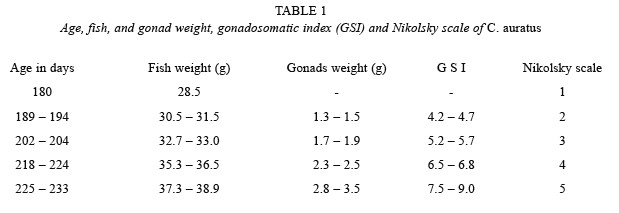
<body><![CDATA[<!-- /big --><br style="font-family: arial;">     <small><span style="font-family: arial;">Increase of gonad weight, fish     weight, </span><span style="font-family: arial;">gonadosomatic index,     and Nikolsky scale in </span><span style="font-family: arial;">time to     reach initial maturity is shown in <a href="#TABLA1">Table 1</a>. <span      style="font-style: italic;">C.     auratus </span>reached initial sexual maturity at</span><span      style="font-family: arial;"> 225 days of age with a fish weight of     37.3 g,&nbsp; </span><span style="font-family: arial;">gonad weight of     2.8 g, and a gonadosomatic </span><span style="font-family: arial;">index     ]]></body>
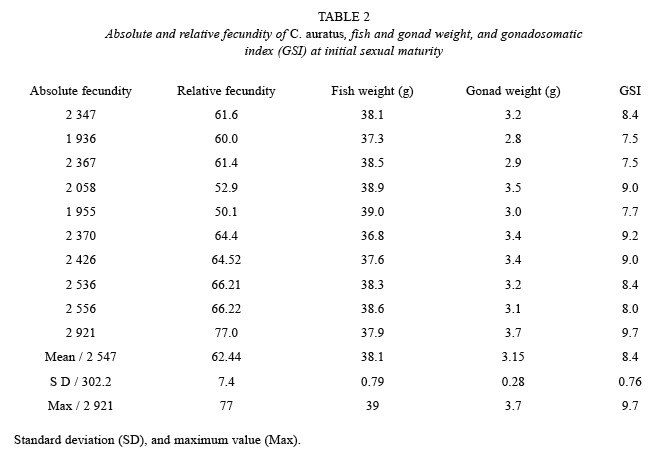
<body><![CDATA[of 7.5, according to the Nikolsky scale.</span></small><br      style="font-family: arial;">     <small></small><br style="font-family: arial;">     <small><span style="font-family: arial;">At initial sexual maturity, <span      style="font-style: italic;">C. auratus</span> </span><span      style="font-family: arial;">reached a mean gonad weight of 3.15 g,     mean </span><span style="font-family: arial;">fish weight of 38.1 g,     mean absolute fecundity </span><span style="font-family: arial;">of 2     547 (&plusmn; 302.2 SD) ova per gonad. The </span><span      style="font-family: arial;">maximum absolute fecundity was of 2 921 </span><span     ]]></body>
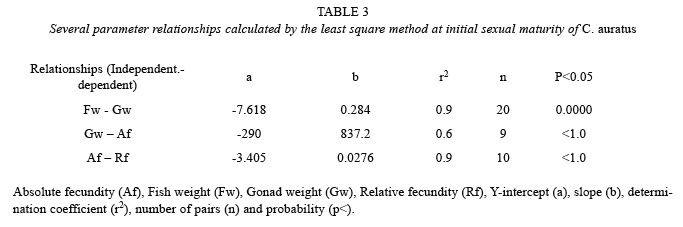
<body><![CDATA[ style="font-family: arial;">ova per gonad (<a href="#TABLA2">Table 2</a>).     In general, when     the </span><span style="font-family: arial;">gonad is heavier, fish is     heavier, and absolute </span><span style="font-family: arial;">and     relative fecundity increase the number of&nbsp; </span><span      style="font-family: arial;">ova. Since the results are from ten     samples at </span><span style="font-family: arial;">the initial     maturity stages the correlations show </span><span      style="font-family: arial;">that the determination coefficient (r<sup>2</sup>)     is low, </span><span style="font-family: arial;">because maturity is     ]]></body>
<body><![CDATA[starting and the gonads are </span><span style="font-family: arial;">just     developing, however according to the relationships </span><span      style="font-family: arial;">shown in <a href="#TABLA3">Table 3</a>,     the rate of absolute </span><span style="font-family: arial;">and     relative fecundity increased when     gonad </span><span style="font-family: arial;">and fish weight     increased.</span></small></div>     <p align="center"><a name="TABLA1"> <img style="border: 0px solid ; width: 619px; height: 213px;"  src="/img/fbpe/rbt/v54n4/3493i1.JPG" title="" alt=""></a></p>     
<p align="center"><a name="TABLA2"> <img style="border: 0px solid ; width: 670px; height: 451px;"  src="/img/fbpe/rbt/v54n4/3493i2.JPG" title="" alt=""></a></p>     
<p align="center">&nbsp;</p>     ]]></body>
<body><![CDATA[<p align="center"><a name="TABLA3"> <img style="border: 0px solid ; width: 683px; height: 227px;"  src="/img/fbpe/rbt/v54n4/3493i3.JPG" title="" alt=""></a></p>     
<p align="justify"><small><br style="font-family: arial;"> <br style="font-family: arial;"> </small></p>     <!-- ref --><div style="text-align: left;"><small><span  style="font-family: arial; font-weight: 700;">Discussion</span></small><br  style="font-family: arial;"> <small></small><br style="font-family: arial;"> <small><span style="font-family: arial;">Martty and Couto (1973) mentioned that <span style="font-style: italic;">Carassius</span> developed well at temperatures between 18 and 25<sup> o</sup>C. In our study the temperature fluctuated between 18 and 25<sup> o</sup>C. Temperature influences growth and gonad ripeness (Huet 1973). At 14 <sup>o</sup>C, <span style="font-style: italic;">C. auratus</span> maintain the last state of vitelogenesis and ovulation can be induced by increasing temperature to 20 <sup>o</sup>C (Harvey and Hoar 1980). Spieler <span style="font-style: italic;">et al</span>.(1977) found that heat applied during the last 4 h of darkness was particularly conducive to weight gain and gonad growth.</span></small><br style="font-family: arial;"> <small></small><br style="font-family: arial;"> <small><span style="font-family: arial;">Swingle (1961) mentioned that a pH between 6.5 and 9 was adequate for reproduction in many fish species such as carp, striped bass and tilapia, but those around the Amazon River (such as discus and angelfish) preferred apH lower than 7 (Axelrod 1976). The species in our study required a pH between 7 and 8, which Huet (1973) also recommended. </span></small><br style="font-family: arial;"> <small></small><br style="font-family: arial;"> <small><span style="font-family: arial;">Boyd (1989) mentioned that <span  style="font-style: italic;">C. auratus</span> survived at very low oxygen concentrations. Swingle(1961) confirmed that fish grew and reproduced from 5 mg/l up to oxygen saturation.</span></small><br style="font-family: arial;"> <small></small><br style="font-family: arial;"> <small><span style="font-family: arial;">According to the Nikolsky (1963) method the maximum sexual maturity value reached by the gonads is 5 which was when the gonad fills up the coelomic cavity and coincides with the migration of the nucleus from the centre of the ovum to its periphery (Rodr&iacute;guez 1992); in our </span><span  style="font-family: arial;">study maturity was reached between 225 and </span><span style="font-family: arial;">233 days old.</span></small><br  style="font-family: arial;"> <small></small><br style="font-family: arial;"> <small><span style="font-family: arial;">The species studied here was patch spawners, </span><span style="font-family: arial;">where ova had different grades of development, </span><span  style="font-family: arial;">which could be in batches of different </span><span  style="font-family: arial;">modal sizes (West 1990).</span></small><br  style="font-family: arial;"> <small></small><br style="font-family: arial;"> <small><span style="font-family: arial;">The initial sexual maturity gives to the </span><span style="font-family: arial;">ornamental fish producers the days when fish </span><span style="font-family: arial;">starts to be mature, thus they will prepare the </span><span  style="font-family: arial;">reproduction and an appropriate nourishment </span><span style="font-family: arial;">environment for the fish to spawn and obtain </span><span style="font-family: arial;">the maximum number of fry, depending on how many female fish are required for this purpose. </span><span style="font-family: arial;">In general, heavier fish have heavier gonads, </span><span style="font-family: arial;">which produce more ova per fish gonad.</span></small><br  style="font-family: arial;"> <small></small><br style="font-family: arial;"> <!-- big --><small><span style="font-family: arial; font-weight: 700;">Acknowledgments</span></small><br  style="font-family: arial;"> <!-- /big --><br style="font-family: arial;"> <small><span style="font-family: arial;">We thank B. Mart&iacute;nez G., K. L. Moran S., </span><span style="font-family: arial;">L. Cervantes L. and A. Alamilla G. for their </span><span style="font-family: arial;">devoted participation in this work, and A. Nu&ntilde;ez </span><span  style="font-family: arial;">P. and C. Ram&iacute;rez for their collaboration.</span></small><br style="font-family: arial;"> <small></small><br style="font-family: arial;"> <small><span style="font-family: arial; font-weight: 700;">Resumen</span></small><br  style="font-family: arial;"> <small></small><br style="font-family: arial;"> <small><span style="font-family: arial;">Estudiamos el tiempo inicial de madurez sexual y la </span><span style="font-family: arial;">fecundidad del pez dorado <span style="font-style: italic;">Carassius auratus</span> en condiciones </span><span style="font-family: arial;">semi-controladas. Durante el estudio la temperatura del </span><span  style="font-family: arial;">gua vari&oacute; de 21 a 30 <sup>o</sup>C, el pH entre 7 y 8, y el ox&iacute;geno </span><span  style="font-family: arial;">disuelto entre 5.5 y 7 ppm. J&oacute;venes de 60 d&iacute;as de edad recibieron </span><span  style="font-family: arial;">tratamiento profil&aacute;ctico con agua salobre (15 &#8240;), </span><span style="font-family: arial;">y ba&ntilde;os de azul de metileno (1 %). Se les aliment&oacute; con </span><span  style="font-family: arial;"><span style="font-style: italic;">Daphnia magna</span>. La madurez sexual inicial fue tras 225 a </span><span  style="font-family: arial;">233 d&iacute;as en cautiverio. La fecundidad absoluta media fue </span><span style="font-family: arial;">de 2 347 (&plusmn;302.2 DS) &oacute;vulos por g&oacute;nada y la fecundidad </span><span style="font-family: arial;">relativa fue de 63.44 &oacute;vulos/g del peso del pez. El &iacute;ndice </span><span  style="font-family: arial;">gonadosom&aacute;tico se calcul&oacute; entre 7.5 and 9.0.</span></small><br style="font-family: arial;"> <small></small><br style="font-family: arial;"> <small><span style="font-family: arial;"><span  style="font-weight: bold;">Palabras clave</span>: pez dorado,<span style="font-style: italic;"> Carassius auratus</span>, madurez </span><span style="font-family: arial;">inicial, fecundidad.</span></small><br style="font-family: arial;"> <small></small><br style="font-family: arial;"> <small><span style="font-family: arial; font-weight: 700;">References</span></small><br  style="font-family: arial;"> <small></small><br style="font-family: arial;"> <small><span style="font-family: arial;">Aries, S.S. 1966. Ud. y el acuario. Albatros, Buenos Aires, </span><span style="font-family: arial;">Argentina. 480 p.</span></small><br style="font-family: arial;"> <small></small><br style="font-family: arial;"> <small><span style="font-family: arial;">    &nbsp;&nbsp;&nbsp;&nbsp;&nbsp;&nbsp;&nbsp;&nbsp;[&#160;<a href="javascript:void(0);" onclick="javascript: window.open('/scielo.php?script=sci_nlinks&ref=1361198&pid=S0034-7744200600040000700001&lng=','','width=640,height=500,resizable=yes,scrollbars=1,menubar=yes,');">Links</a>&#160;]<!-- end-ref --><!-- ref -->Axelrod, H.R. 1976. Breeding aquarium fishes. TFH, New </span><span style="font-family: arial;">York, USA. 480 p.</span></small><br style="font-family: arial;"> <small></small><br style="font-family: arial;"> <small><span style="font-family: arial;">    &nbsp;&nbsp;&nbsp;&nbsp;&nbsp;&nbsp;&nbsp;&nbsp;[&#160;<a href="javascript:void(0);" onclick="javascript: window.open('/scielo.php?script=sci_nlinks&ref=1361199&pid=S0034-7744200600040000700002&lng=','','width=640,height=500,resizable=yes,scrollbars=1,menubar=yes,');">Links</a>&#160;]<!-- end-ref --><!-- ref -->Axelrod, H &amp; L. Burgess. 1973. Breeding Aquarium Fishes </span><span style="font-family: arial;">Book 3. TFH, New York, USA. 197 p.</span></small><br  style="font-family: arial;"> <small></small><br style="font-family: arial;"> <small><span style="font-family: arial;">    &nbsp;&nbsp;&nbsp;&nbsp;&nbsp;&nbsp;&nbsp;&nbsp;[&#160;<a href="javascript:void(0);" onclick="javascript: window.open('/scielo.php?script=sci_nlinks&ref=1361200&pid=S0034-7744200600040000700003&lng=','','width=640,height=500,resizable=yes,scrollbars=1,menubar=yes,');">Links</a>&#160;]<!-- end-ref --><!-- ref -->Boyd, C.E. 1989. Water quality management and aeration </span><span style="font-family: arial;">in shrimp farming. Fish and Shrimp. Allied. </span><span  style="font-family: arial;">University of Alabama, Alabama, USA. 83 p.</span></small><br  style="font-family: arial;"> <small></small><br style="font-family: arial;"> <small><span style="font-family: arial;">    &nbsp;&nbsp;&nbsp;&nbsp;&nbsp;&nbsp;&nbsp;&nbsp;[&#160;<a href="javascript:void(0);" onclick="javascript: window.open('/scielo.php?script=sci_nlinks&ref=1361201&pid=S0034-7744200600040000700004&lng=','','width=640,height=500,resizable=yes,scrollbars=1,menubar=yes,');">Links</a>&#160;]<!-- end-ref --><!-- ref -->Harvey, B.J. &amp; W.S. Hoar. 1980. Teor&iacute;a y pr&aacute;ctica de la </span><span  style="font-family: arial;">reproducci&oacute;n inducida en los peces. CLL, Ontario, </span><span style="font-family: arial;">Canada. 48 p.</span></small><br  style="font-family: arial;"> <small></small><br style="font-family: arial;"> <small><span style="font-family: arial;">    &nbsp;&nbsp;&nbsp;&nbsp;&nbsp;&nbsp;&nbsp;&nbsp;[&#160;<a href="javascript:void(0);" onclick="javascript: window.open('/scielo.php?script=sci_nlinks&ref=1361202&pid=S0034-7744200600040000700005&lng=','','width=640,height=500,resizable=yes,scrollbars=1,menubar=yes,');">Links</a>&#160;]<!-- end-ref --><!-- ref -->Huet, M. 1973. Tratado de piscicultura. Mundiprensa, </span><span style="font-family: arial;">Madrid, Spain. 753 p.</span></small><br style="font-family: arial;"> <small></small><br style="font-family: arial;"> <small><span style="font-family: arial;">    &nbsp;&nbsp;&nbsp;&nbsp;&nbsp;&nbsp;&nbsp;&nbsp;[&#160;<a href="javascript:void(0);" onclick="javascript: window.open('/scielo.php?script=sci_nlinks&ref=1361203&pid=S0034-7744200600040000700006&lng=','','width=640,height=500,resizable=yes,scrollbars=1,menubar=yes,');">Links</a>&#160;]<!-- end-ref --><!-- ref -->Martty, H. &amp; D.D.Couto. 1973. Peces tropicales. Albatros, </span><span style="font-family: arial;">Buenos Aires, Argentina. 129 p.</span></small><br style="font-family: arial;"> <small></small><br style="font-family: arial;"> <small><span style="font-family: arial;">    &nbsp;&nbsp;&nbsp;&nbsp;&nbsp;&nbsp;&nbsp;&nbsp;[&#160;<a href="javascript:void(0);" onclick="javascript: window.open('/scielo.php?script=sci_nlinks&ref=1361204&pid=S0034-7744200600040000700007&lng=','','width=640,height=500,resizable=yes,scrollbars=1,menubar=yes,');">Links</a>&#160;]<!-- end-ref --><!-- ref -->Nikolsky, G.v. 1963. The ecology of fishes. Academic, </span><span style="font-family: arial;">London, England. 352 p.</span></small><br style="font-family: arial;"> <small></small><br style="font-family: arial;"> <small><span style="font-family: arial;">    &nbsp;&nbsp;&nbsp;&nbsp;&nbsp;&nbsp;&nbsp;&nbsp;[&#160;<a href="javascript:void(0);" onclick="javascript: window.open('/scielo.php?script=sci_nlinks&ref=1361205&pid=S0034-7744200600040000700008&lng=','','width=640,height=500,resizable=yes,scrollbars=1,menubar=yes,');">Links</a>&#160;]<!-- end-ref --><!-- ref -->Rodr&iacute;guez, G.M. 1992. T&eacute;cnicas de evaluaci&oacute;n cuantitativa </span><span  style="font-family: arial;">de la madurez gonadal en peces. A G T. Editor. </span><span style="font-family: arial;">M&eacute;xico, DF., M&eacute;xico. 79 p.</span></small><br style="font-family: arial;"> <small></small><br style="font-family: arial;"> <small><span style="font-family: arial;">    &nbsp;&nbsp;&nbsp;&nbsp;&nbsp;&nbsp;&nbsp;&nbsp;[&#160;<a href="javascript:void(0);" onclick="javascript: window.open('/scielo.php?script=sci_nlinks&ref=1361206&pid=S0034-7744200600040000700009&lng=','','width=640,height=500,resizable=yes,scrollbars=1,menubar=yes,');">Links</a>&#160;]<!-- end-ref --><!-- ref -->Spieler, R.E., T.A. Noeske, v. de vlaming &amp; A.H. Meier. </span><span style="font-family: arial;">1977. Effects of thermocycles on body weight gain </span><span  style="font-family: arial;">and gonadal growth in the goldfish, <span  style="font-style: italic;">Carassius auratus</span> </span><span  style="font-family: arial;">Trans. Am. Fish. Soc. 106: 440-444.</span></small><br  style="font-family: arial;"> <small></small><br style="font-family: arial;"> <small><span style="font-family: arial;">    &nbsp;&nbsp;&nbsp;&nbsp;&nbsp;&nbsp;&nbsp;&nbsp;[&#160;<a href="javascript:void(0);" onclick="javascript: window.open('/scielo.php?script=sci_nlinks&ref=1361207&pid=S0034-7744200600040000700010&lng=','','width=640,height=500,resizable=yes,scrollbars=1,menubar=yes,');">Links</a>&#160;]<!-- end-ref --><!-- ref -->Swingle, H.S. 1961. Relationships of pH of pond waters </span><span style="font-family: arial;">to their suitability for fish culture. Proc. Pac. Sci. </span><span  style="font-family: arial;">Congr. 10: 72-75.</span></small><br  style="font-family: arial;"> <small></small><br style="font-family: arial;"> <small><span style="font-family: arial;">    &nbsp;&nbsp;&nbsp;&nbsp;&nbsp;&nbsp;&nbsp;&nbsp;[&#160;<a href="javascript:void(0);" onclick="javascript: window.open('/scielo.php?script=sci_nlinks&ref=1361208&pid=S0034-7744200600040000700011&lng=','','width=640,height=500,resizable=yes,scrollbars=1,menubar=yes,');">Links</a>&#160;]<!-- end-ref --><!-- ref -->West, G. 1990. Methods of assessing ovarian development </span><span style="font-family: arial;">in fishes a review. Australian J. Mar. Fresh. Res. 41:</span><span  style="font-family: arial;">199-222. </span></small></div>    &nbsp;&nbsp;&nbsp;&nbsp;&nbsp;&nbsp;&nbsp;&nbsp;[&#160;<a href="javascript:void(0);" onclick="javascript: window.open('/scielo.php?script=sci_nlinks&ref=1361209&pid=S0034-7744200600040000700012&lng=','','width=640,height=500,resizable=yes,scrollbars=1,menubar=yes,');">Links</a>&#160;]<!-- end-ref --> ]]></body><back>
<ref-list>
<ref id="B1">
<nlm-citation citation-type="book">
<person-group person-group-type="author">
<name>
<surname><![CDATA[Aries]]></surname>
<given-names><![CDATA[S.S]]></given-names>
</name>
</person-group>
<source><![CDATA[Ud. y el acuario]]></source>
<year>1966</year>
<page-range>480</page-range><publisher-loc><![CDATA[Buenos Aires ]]></publisher-loc>
<publisher-name><![CDATA[Albatros]]></publisher-name>
</nlm-citation>
</ref>
<ref id="B2">
<nlm-citation citation-type="book">
<person-group person-group-type="author">
<name>
<surname><![CDATA[Axelrod]]></surname>
<given-names><![CDATA[H.R]]></given-names>
</name>
</person-group>
<source><![CDATA[Breeding aquarium fishes]]></source>
<year>1976</year>
<page-range>480</page-range><publisher-loc><![CDATA[^eNew York New York]]></publisher-loc>
<publisher-name><![CDATA[TFH]]></publisher-name>
</nlm-citation>
</ref>
<ref id="B3">
<nlm-citation citation-type="book">
<person-group person-group-type="author">
<name>
<surname><![CDATA[Axelrod]]></surname>
<given-names><![CDATA[H]]></given-names>
</name>
<name>
<surname><![CDATA[Burgess]]></surname>
<given-names><![CDATA[L]]></given-names>
</name>
</person-group>
<source><![CDATA[Breeding Aquarium Fishes Book 3]]></source>
<year>1973</year>
<page-range>197</page-range><publisher-loc><![CDATA[^eNew York New York]]></publisher-loc>
<publisher-name><![CDATA[TFH]]></publisher-name>
</nlm-citation>
</ref>
<ref id="B4">
<nlm-citation citation-type="book">
<person-group person-group-type="author">
<name>
<surname><![CDATA[Boyd]]></surname>
<given-names><![CDATA[C.E]]></given-names>
</name>
</person-group>
<source><![CDATA[Water quality management and aeration in shrimp farming: Fish and Shrimp]]></source>
<year>1989</year>
<page-range>83</page-range><publisher-loc><![CDATA[^eAlabama Alabama]]></publisher-loc>
<publisher-name><![CDATA[University of Alabama]]></publisher-name>
</nlm-citation>
</ref>
<ref id="B5">
<nlm-citation citation-type="book">
<person-group person-group-type="author">
<name>
<surname><![CDATA[Harvey]]></surname>
<given-names><![CDATA[B.J]]></given-names>
</name>
<name>
<surname><![CDATA[Hoar]]></surname>
<given-names><![CDATA[W.S]]></given-names>
</name>
</person-group>
<source><![CDATA[Teoría y práctica de la reproducción inducida en los peces]]></source>
<year>1980</year>
<page-range>48</page-range><publisher-loc><![CDATA[^eOntario Ontario]]></publisher-loc>
<publisher-name><![CDATA[CLL]]></publisher-name>
</nlm-citation>
</ref>
<ref id="B6">
<nlm-citation citation-type="book">
<person-group person-group-type="author">
<name>
<surname><![CDATA[Huet]]></surname>
<given-names><![CDATA[M]]></given-names>
</name>
</person-group>
<source><![CDATA[Tratado de piscicultura]]></source>
<year>1973</year>
<page-range>753</page-range><publisher-loc><![CDATA[^eMadrid Madrid]]></publisher-loc>
<publisher-name><![CDATA[Mundiprensa]]></publisher-name>
</nlm-citation>
</ref>
<ref id="B7">
<nlm-citation citation-type="book">
<person-group person-group-type="author">
<name>
<surname><![CDATA[Martty]]></surname>
<given-names><![CDATA[H]]></given-names>
</name>
<name>
<surname><![CDATA[Couto]]></surname>
<given-names><![CDATA[D.D]]></given-names>
</name>
</person-group>
<source><![CDATA[Peces tropicales]]></source>
<year>1973</year>
<page-range>129</page-range><publisher-loc><![CDATA[^eBuenos Aires Buenos Aires]]></publisher-loc>
<publisher-name><![CDATA[Albatros]]></publisher-name>
</nlm-citation>
</ref>
<ref id="B8">
<nlm-citation citation-type="book">
<person-group person-group-type="author">
<name>
<surname><![CDATA[Nikolsky]]></surname>
<given-names><![CDATA[G.V]]></given-names>
</name>
</person-group>
<source><![CDATA[The ecology of fishes]]></source>
<year>1963</year>
<page-range>352</page-range><publisher-loc><![CDATA[^eLondon London]]></publisher-loc>
<publisher-name><![CDATA[Academic]]></publisher-name>
</nlm-citation>
</ref>
<ref id="B9">
<nlm-citation citation-type="book">
<person-group person-group-type="author">
<name>
<surname><![CDATA[Rodríguez]]></surname>
<given-names><![CDATA[G.M]]></given-names>
</name>
</person-group>
<source><![CDATA[Técnicas de evaluación cuantitativa de la madurez gonadal en peces]]></source>
<year>1992</year>
<page-range>79</page-range><publisher-loc><![CDATA[^eMéxico, DF México, DF]]></publisher-loc>
<publisher-name><![CDATA[A G T. Editor]]></publisher-name>
</nlm-citation>
</ref>
<ref id="B10">
<nlm-citation citation-type="journal">
<person-group person-group-type="author">
<name>
<surname><![CDATA[Spieler]]></surname>
<given-names><![CDATA[R.E]]></given-names>
</name>
<name>
<surname><![CDATA[Noeske]]></surname>
<given-names><![CDATA[T.A]]></given-names>
</name>
<name>
<surname><![CDATA[Vlaming]]></surname>
<given-names><![CDATA[V]]></given-names>
</name>
<name>
<surname><![CDATA[Meier]]></surname>
<given-names><![CDATA[A.H]]></given-names>
</name>
</person-group>
<article-title xml:lang="en"><![CDATA[Effects of thermocycles on body weight gain and gonadal growth in the goldfish, Carassius auratus]]></article-title>
<source><![CDATA[Trans. Am. Fish. Soc]]></source>
<year>1977</year>
<volume>106</volume>
<page-range>440-444</page-range></nlm-citation>
</ref>
<ref id="B11">
<nlm-citation citation-type="journal">
<person-group person-group-type="author">
<name>
<surname><![CDATA[Swingle]]></surname>
<given-names><![CDATA[H.S]]></given-names>
</name>
</person-group>
<article-title xml:lang="en"><![CDATA[Relationships of pH of pond waters to their suitability for fish culture]]></article-title>
<source><![CDATA[Proc. Pac. Sci. Congr]]></source>
<year>1961</year>
<volume>10</volume>
<page-range>72-75</page-range></nlm-citation>
</ref>
<ref id="B12">
<nlm-citation citation-type="journal">
<person-group person-group-type="author">
<name>
<surname><![CDATA[West]]></surname>
<given-names><![CDATA[G]]></given-names>
</name>
</person-group>
<source><![CDATA[Australian J. Mar. Fresh. ResMethods of assessing ovarian development in fishes a review]]></source>
<year>1990</year>
<volume>41</volume>
<page-range>199-222</page-range></nlm-citation>
</ref>
</ref-list>
</back>
</article>