<?xml version="1.0" encoding="ISO-8859-1"?><article xmlns:mml="http://www.w3.org/1998/Math/MathML" xmlns:xlink="http://www.w3.org/1999/xlink" xmlns:xsi="http://www.w3.org/2001/XMLSchema-instance">
<front>
<journal-meta>
<journal-id>0034-7744</journal-id>
<journal-title><![CDATA[Revista de Biología Tropical]]></journal-title>
<abbrev-journal-title><![CDATA[Rev. biol. trop]]></abbrev-journal-title>
<issn>0034-7744</issn>
<publisher>
<publisher-name><![CDATA[Universidad de Costa Rica]]></publisher-name>
</publisher>
</journal-meta>
<article-meta>
<article-id>S0034-77442006000400006</article-id>
<title-group>
<article-title xml:lang="es"><![CDATA[Reproducción, distribución y abundancia del pez Pseudupeneus grandisquamis (Perciformes: Mullidae), en el Golfo de Tehuantepec, México]]></article-title>
</title-group>
<contrib-group>
<contrib contrib-type="author">
<name>
<surname><![CDATA[Ramos-Santiago]]></surname>
<given-names><![CDATA[Eduardo]]></given-names>
</name>
<xref ref-type="aff" rid="A01"/>
</contrib>
<contrib contrib-type="author">
<name>
<surname><![CDATA[Ramírez-Gutiérrez]]></surname>
<given-names><![CDATA[José Martín]]></given-names>
</name>
<xref ref-type="aff" rid="A01"/>
</contrib>
<contrib contrib-type="author">
<name>
<surname><![CDATA[Mendoza-Rodríguez]]></surname>
<given-names><![CDATA[Ricardo]]></given-names>
</name>
<xref ref-type="aff" rid="A01"/>
</contrib>
<contrib contrib-type="author">
<name>
<surname><![CDATA[Tapia-García]]></surname>
<given-names><![CDATA[Margarito]]></given-names>
</name>
<xref ref-type="aff" rid="A01"/>
</contrib>
</contrib-group>
<aff id="A01">
<institution><![CDATA[,Universidad Autónoma Metropolitana-Iztapalapa  ]]></institution>
<addr-line><![CDATA[ México D.F]]></addr-line>
</aff>
<pub-date pub-type="pub">
<day>00</day>
<month>12</month>
<year>2006</year>
</pub-date>
<pub-date pub-type="epub">
<day>00</day>
<month>12</month>
<year>2006</year>
</pub-date>
<volume>54</volume>
<numero>4</numero>
<fpage>1103</fpage>
<lpage>1112</lpage>
<copyright-statement/>
<copyright-year/>
<self-uri xlink:href="http://www.scielo.sa.cr/scielo.php?script=sci_arttext&amp;pid=S0034-77442006000400006&amp;lng=en&amp;nrm=iso"></self-uri><self-uri xlink:href="http://www.scielo.sa.cr/scielo.php?script=sci_abstract&amp;pid=S0034-77442006000400006&amp;lng=en&amp;nrm=iso"></self-uri><self-uri xlink:href="http://www.scielo.sa.cr/scielo.php?script=sci_pdf&amp;pid=S0034-77442006000400006&amp;lng=en&amp;nrm=iso"></self-uri><abstract abstract-type="short" xml:lang="en"><p><![CDATA[Reproduction, distribution and abundance of the fish Pseudupeneus grandisquamis (Perciformes: Mullidae), in the Gulf of Tehuantepec, Mexico. As result of its biological and ecological strategies, Pseudupeneus grandisquamis is a dominant species in the demersal community of the Gulf of Tehuantepec, Mexico. Our main objective was to understand these strategies with respect to distribution, abundance and reproduction. We analyzed 5 175 individuals representing partial collections from five oceanographic expeditions between 1989 and 1990. It is a typical demersal marine species, with a wide distribution on the continental shelf. The highest abundance of P. grandisquamis occurs in March and November, around the 40 m isobath, facing the Superior-Inferior lake systems and Mar Muerto Lagoon. Reproduction occurred during all of the months studied, particularly from August to October, corresponding to the rainy season, when the salinity and temperature is lower. The presence of juveniles, principally in November and March, suggests a long period of recruitment; they are distributed mainly in the Superior-Inferior Lagoons, which serves as a nursery area where they remain until they are adults. The total female to male sex ratio was nearly 1:1 throughout the year. The maximum total length was 213 mm and the size at first maturity was 138 mm TL. The high abundance and reproduction occur when the gulf has a high level of ecological production, in accordance with the dynamics of the system, where the influence of coastal lagoons is important. Protection strategies for the area above the continental shelf of the Gulf of Tehuantepec are recommended for the estuary processes and for the reproduction and rearing of a large number of species, including P. grandisquamis. Rev. Biol. Trop. 54 (4): 1103-1112. Epub 2006 Dec. 15.]]></p></abstract>
<abstract abstract-type="short" xml:lang="es"><p><![CDATA[Como resultado de sus estrategias biológicas y ecológicas, el pez Pseudupeneus grandisquamis es una especie dominante en la comunidad demersal del Golfo de Tehuantepec. Nuestro principal objetivo fue conocer estas estrategias con base en su distribución, abundancia y reproducción. Se analizaron un total de 5 175 individuos que forman parte de las recolectas de peces obtenidas en cinco cruceros oceanográficos realizados en el Golfo de Tehuantepec, México, entre 1989-1990. Es una especie demersal típicamente marina, con amplia distribución en la plataforma continental. La mayor abundancia de P. grandisquamis se presenta en marzo y noviembre, alrededor de la isobata de los 40 m y frente a los sistemas lagunares Superior-Inferior y Laguna del Mar Muerto. La reproducción de la especie se presenta durante todos los meses analizados, principalmente durante los meses de agosto a octubre, correspondiente a la época de lluvias. La presencia de jóvenes, principalmente en noviembre y marzo, sugiere un amplio periodo de reclutamiento durante estos meses cuya distribución se refleja principalmente en el área influenciada por las lagunas Superior-Inferior, que representa un área de crianza. La proporción sexual total hembras:machos fue prácticamente 1:1. La talla máxima en la región es de 213 mm y la talla de primera madurez es de 138 mm LT. La alta abundancia y reproducción se presentan cuando el golfo tiene alta producción, acorde con la dinámica del sistema, donde tiene gran relevancia la influencia de las lagunas costeras. Se sugiere aplicar estrategias de protección a las zonas sobre la plataforma continental del Golfo de Tehuantepec influenciadas por procesos estuarinos y que representan áreas de reproducción y crianza para un gran número de especies, entre las que se encuentra P. grandisquamis.]]></p></abstract>
<kwd-group>
<kwd lng="en"><![CDATA[Pseudupeneus grandisquamis]]></kwd>
<kwd lng="en"><![CDATA[reproduction]]></kwd>
<kwd lng="en"><![CDATA[demersal]]></kwd>
<kwd lng="en"><![CDATA[Tehuantepec]]></kwd>
<kwd lng="en"><![CDATA[ecology]]></kwd>
<kwd lng="en"><![CDATA[dominance]]></kwd>
<kwd lng="en"><![CDATA[lagoons]]></kwd>
<kwd lng="es"><![CDATA[Pseudupeneus grandisquamis]]></kwd>
<kwd lng="es"><![CDATA[reproducción]]></kwd>
<kwd lng="es"><![CDATA[demersal]]></kwd>
<kwd lng="es"><![CDATA[Tehuantepec]]></kwd>
<kwd lng="es"><![CDATA[ecología]]></kwd>
<kwd lng="es"><![CDATA[dominancia]]></kwd>
<kwd lng="es"><![CDATA[lagunas]]></kwd>
</kwd-group>
</article-meta>
</front><body><![CDATA[ <div style="text-align: center;"><span style="font-family: arial;"><span  style="font-weight: bold;">Reproducci&oacute;n, distribuci&oacute;n y abundancia del pez</span> </span><span  style="font-family: arial;"><span style="font-style: italic;">Pseudupeneus grandisquamis</span><span style="font-weight: bold;"> (Perciformes: Mullidae), </span></span><span  style="font-family: arial; font-weight: bold;">en el Golfo de Tehuantepec, M&eacute;xico</span><small><br style="font-family: arial;"> </small></div> <small><br style="font-family: arial;"> <span style="font-family: arial;">Eduardo Ramos-Santiago, Jos&eacute; Mart&iacute;n Ram&iacute;rez-Guti&eacute;rrez, Ricardo Mendoza-Rodr&iacute;guez &amp; Margarito Tapia-Garc&iacute;a</span><span  style="font-family: arial;">     <br> <br style="font-family: arial;"> </span><span style="font-family: arial;">Departamento de Hidrobiolog&iacute;a. D.C.B.S. Universidad Aut&oacute;noma Metropolitana-Iztapalapa. Apartado Postal 55-535,</span><br style="font-family: arial;"> <span style="font-family: arial;">M&eacute;xico D.F. Fax 58044738; <a href="mailto:mtg@xanum.uam.mx">mtg@xanum.uam.mx</a></span><br  style="font-family: arial;"> <br style="font-family: arial;"> </small>     <div style="text-align: center;"><small><span  style="font-family: arial;">Recibido 08-VII-2003. Corregido 07-VII-2005. Aceptado 26-VI-2006.</span><br style="font-family: arial;"> </small></div>     <p align="justify"><small> <br style="font-family: arial;"> </small></p>     <div style="text-align: left;"><small><span style="font-family: arial;"><span      style="font-weight: bold;">Abstract:     Reproduction, distribution and abundance of the fish</span> <span      style="font-style: italic;">Pseudupeneus grandisquamis</span> <span      style="font-weight: bold;">(Perciformes: </span></span><span      style="font-family: arial;"><span style="font-weight: bold;">Mullidae),     ]]></body>
<body><![CDATA[in the Gulf of Tehuantepec, Mexico</span>. As result of its biological     and ecological strategies, </span><span style="font-family: arial;"><span      style="font-style: italic;">Pseudupeneus grandisquamis</span> is a     dominant species in the demersal community of the Gulf of Tehuantepec, </span><span      style="font-family: arial;">Mexico. Our main objective was to     understand these strategies with respect to distribution, abundance and     reproduction. </span><span style="font-family: arial;">We analyzed 5     175 individuals representing partial collections from five     oceanographic expeditions </span><span style="font-family: arial;">between     1989 and 1990. It is a typical demersal marine species, with a wide     ]]></body>
<body><![CDATA[distribution on the continental shelf. </span><span      style="font-family: arial;">The highest abundance of <span      style="font-style: italic;">P. grandisquamis</span> occurs in March     and November, around the 40 m isobath, facing the </span><span      style="font-family: arial;">Superior-Inferior lake systems and Mar     Muerto Lagoon. Reproduction occurred during all of the months studied, </span><span      style="font-family: arial;">particularly from August to October,     corresponding to the rainy season, when the salinity and temperature is     </span><span style="font-family: arial;">lower. The presence of     juveniles, principally in November and March, suggests a long period of     ]]></body>
<body><![CDATA[recruitment; </span><span style="font-family: arial;">they are     distributed mainly in the Superior-Inferior Lagoons, which serves as a     nursery area where they remain </span><span style="font-family: arial;">until     they are adults. The total female to male sex ratio was nearly 1:1     throughout the year. The maximum total </span><span      style="font-family: arial;">length was 213 mm and the size at first     maturity was 138 mm TL. The high abundance and reproduction occur </span><span      style="font-family: arial;">when the gulf has a high level of     ecological production, in accordance with the dynamics of the system,     where </span><span style="font-family: arial;">the influence of     ]]></body>
<body><![CDATA[coastal lagoons is important. Protection strategies for the area above     the continental shelf of the </span><span style="font-family: arial;">Gulf     of Tehuantepec are recommended for the estuary processes and for the     reproduction and rearing of a large </span><span      style="font-family: arial;">number of species, including <span      style="font-style: italic;">P. grandisquamis</span>. Rev. Biol. Trop.     54 (4): 1103-1112. Epub 2006 Dec. 15.</span><br      style="font-family: arial;">     <br style="font-family: arial;">     <span style="font-family: arial;"><span style="font-weight: bold;">Key     ]]></body>
<body><![CDATA[words</span>: Pseudupeneus grandisquamis, reproduction, demersal,     Tehuantepec, ecology, dominance, </span><span      style="font-family: arial;">lagoons.</span><br      style="font-family: arial;">     <br style="font-family: arial;">     <span style="font-family: arial;">El Golfo de Tehuantepec, en la     costa     sur </span><span style="font-family: arial;">del Pac&iacute;fico     mexicano, es una zona de intensa </span><span      style="font-family: arial;">actividad pesquera e industrial     ]]></body>
<body><![CDATA[(petr&oacute;leo), que </span><span style="font-family: arial;">lo     coloca en una situaci&oacute;n prioritaria en cuanto a la necesidad de     evaluaci&oacute;n     ecol&oacute;gica de sus recursos.     En esta regi&oacute;n, la actividad pesquera est&aacute; orientada     principalmente al     recurso camar&oacute;n y por     lo tanto a las especies demersales asociadas o fauna de     acompa&ntilde;amiento, y esta actividad     representa el cuarto lugar en cuanto a la producci&oacute;n nacional de     ]]></body>
<body><![CDATA[camar&oacute;n que es la divisa     pesquera m&aacute;s importante en M&eacute;xico.</span><br      style="font-family: arial;">     <br style="font-family: arial;">     <span style="font-family: arial;">Los recursos demersales de     alta     diversidad del Golfo de     Tehuantepec, caracter&iacute;sticos de&aacute;reas tropicales,     est&aacute;n constituidos por m&aacute;s de 170 especies de peces, que     en el     ]]></body>
<body><![CDATA[&aacute;mbito comunitario     tienen patrones de distribuci&oacute;n y abundancia que responden a la     din&aacute;mica ecol&oacute;gica de la regi&oacute;n, entre las que     sobresalen 20 especies     dominantes (Tapia Garc&iacute;a 1998). Las especies dominantes, por su     importancia     biol&oacute;gica y     ecol&oacute;gica, tienen un papel clave en la estructura y     funci&oacute;n de las     comunidades, lo que ha     ]]></body>
<body><![CDATA[determinado que las investigaciones sobre recursos demersales costeros     de alta     diversidad se orienten a la     informaci&oacute;n que aportan estas especies como un reflejo de la     din&aacute;mica de toda la     comunidad. Esta estrategia de investigaci&oacute;nse menciona en los     trabajos de Pauly (1982) y Y&aacute;&ntilde;ez-Arancibia     y S&aacute;nchez-Gil (1988), donde se considera como punto importante     el     conocimiento de las     ]]></body>
<body><![CDATA[diferentes etapas biol&oacute;gicas y de din&aacute;mica poblacional de     las     especies clave para el     entendimiento de la estructura y funci&oacute;n de las comunidades     demersales.</span><br style="font-family: arial;">     <br style="font-family: arial;">     <span style="font-family: arial;">La informaci&oacute;n que     existe     sobre las poblaciones de     peces demersales dominantes en el Golfo de Tehuantepec ha abierto una     ]]></body>
<body><![CDATA[ruta     de investigaci&oacute;n con     grandes perspectivas, donde se     han detectado necesidades de estudios sobre la estructura y     funci&oacute;n de las     poblaciones y su     relaci&oacute;n con la din&aacute;mica del ecosistema. Entre las 20     especies dominantes     informadas, se encuentra <span style="font-style: italic;">Pseudupeneus     grandisquamis</span> por su alta abundancia e incidencia en las     ]]></body>
<body><![CDATA[capturas demersales. El     estudio de esta especie es de gran     relevancia ante su importancia biol&oacute;gica y ecol&oacute;gica, y     su potencial     econ&oacute;mico como una especie     susceptible de ser explotada.</span><br style="font-family: arial;">     <br style="font-family: arial;">     <span style="font-family: arial;"><span style="font-style: italic;">P.     grandisquamis</span> se caracteriza por ser t&iacute;picamente marina,     ya que no hay     ]]></body>
<body><![CDATA[informes que indiquen su     distribuci&oacute;n dentro de sistemasestuarinos. En el Pac&iacute;fico     mexicano, existen diversos     trabajos que informan a esta especie como un componente     caracter&iacute;stico     de la ictiofauna demersal, y     Allen y Robertson (1998) mencionan     su presencia en fondos lodosos, arenosos, rocosos y en praderas de     pastos asociadas a arrecifes coralinos. Sin     embargo, no existen     ]]></body>
<body><![CDATA[antecedentes biol&oacute;gicos y de din&aacute;mica </span><span      style="font-family: arial;">poblacional a pesar de su importancia </span><span      style="font-family: arial;">biol&oacute;gica, ecol&oacute;gica y como     recurso pesquero </span><span style="font-family: arial;">potencial.     Por lo anterior, el objetivo del presente </span><span      style="font-family: arial;">trabajo es caracterizar el patr&oacute;n     espacial </span><span style="font-family: arial;">y temporal de la     distribuci&oacute;n y abundancia de<span style="font-style: italic;"> </span></span><span      style="font-family: arial;"><span style="font-style: italic;">P.     grandisquamis</span> con relaci&oacute;n a su reproducci&oacute;n </span><span     ]]></body>
<body><![CDATA[ style="font-family: arial;">y reclutamiento.</span><br      style="font-family: arial;">     <br style="font-family: arial;">     <span style="font-family: arial; font-weight: 700;">M</span><font      size="3"><small><span style="font-family: arial; font-weight: 700;">ateriales     y m&eacute;todos</span></small></font><br style="font-family: arial;">     <br style="font-family: arial;">     <span style="font-family: arial;">La plataforma continental del     Golfo     de </span><span style="font-family: arial;">Tehuantepec se encuentra     ]]></body>
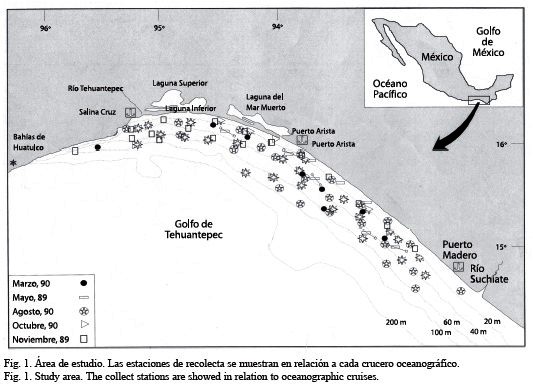
<body><![CDATA[localizada en el </span><span style="font-family: arial;">sureste del     Pac&iacute;fico mexicano, entre las Bah&iacute;as </span><span      style="font-family: arial;">de Huatulco, Oaxaca, y el R&iacute;o     Suchiate, Chiapas </span><span style="font-family: arial;">(<a      href="#figura1">Fig. 1</a>).     Se analizaron las recolectas obtenidasen cinco cruceros     oceanogr&aacute;ficos en mayo y </span><span      style="font-family: arial;">noviembre de 1989, y marzo, agosto y     octubre </span><span style="font-family: arial;">de 1990. Las     recolectas de mayo, agosto y </span><span style="font-family: arial;">noviembre     ]]></body>
<body><![CDATA[se realizaron en el buque oceanogr&aacute;fico </span><span      style="font-family: arial;">&#8220;El Puma&#8221;, y la de marzo y octubre en </span><span      style="font-family: arial;">el buque motor &#8220;Don Nachito&#8221;. Se     realizaron </span><span style="font-family: arial;">un total de 86     puntos de muestreo entre los 15 </span><span      style="font-family: arial;">y 80 m de profundidad (<a href="#figura1">Fig.     1</a>). Se utiliz&oacute; una </span><span style="font-family: arial;">red     de     arrastre camaronera con un tama&ntilde;o de </span><span      style="font-family: arial;">boca de 9 (B/M Don Nachito) y 12 m (B/O El     ]]></body>
<body><![CDATA[</span><span style="font-family: arial;">Puma), luz de malla de 4.45 cm     a una velocidad </span><span style="font-family: arial;">promedio de 3     nudos durante 30 min. El </span><span style="font-family: arial;">&aacute;rea     de arrastre, la captura de los peces y el </span><span      style="font-family: arial;">procesamiento de los datos se hizo con     base a </span><span style="font-family: arial;">los criterios     discutidos por Stevenson (1982) y </span><span      style="font-family: arial;">S&aacute;nchez-Gil y     Y&aacute;&ntilde;ez-Arancibia (1985).</span></small></div>     <p align="center"><small><a name="figura1"><img  style="border: 0px solid ; width: 533px; height: 385px;"  src="/img/fbpe/rbt/v54n4/3492i1.JPG" title="" alt=""></a></small></p>     
]]></body>
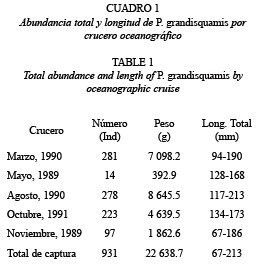
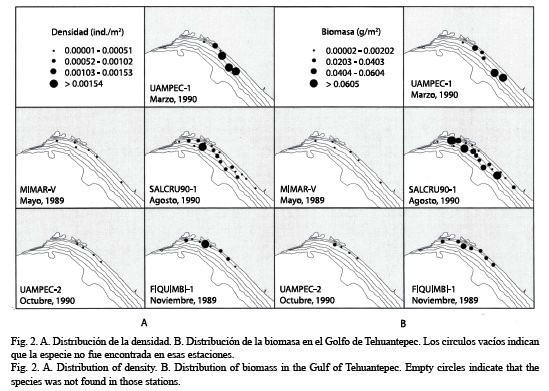
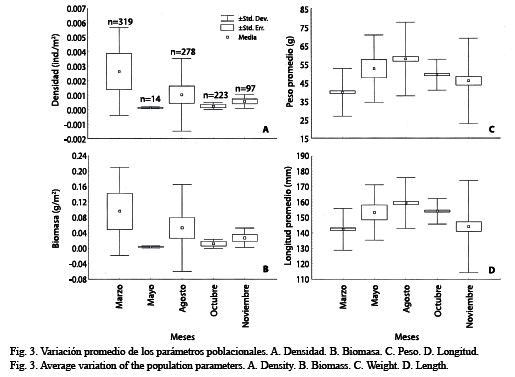
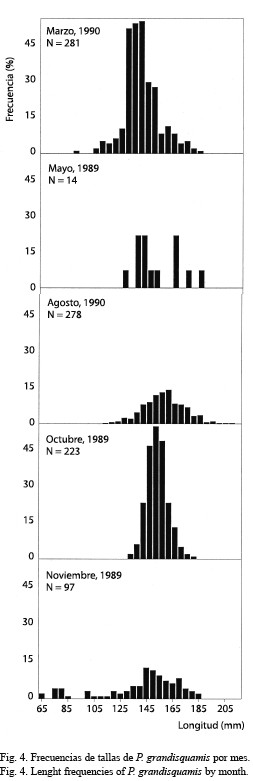
<body><![CDATA[<p align="justify"><small><br style="font-family: arial;"> <br style="font-family: arial;"> </small></p>     <div style="text-align: left;"><small><span style="font-family: arial;">Cada individuo se sex&oacute; y se le midi&oacute; la longitud </span><span style="font-family: arial;">total (mm), el peso total (g) (peso h&uacute;medo), </span><span  style="font-family: arial;">peso sin v&iacute;sceras, peso de g&oacute;nadas, y se determinaron </span><span  style="font-family: arial;">los par&aacute;metros poblacionales de densidad </span><span style="font-family: arial;">(individuos/m<sup>2</sup>), biomasa (g/m<sup>2</sup>), longitud y peso </span><span  style="font-family: arial;">promedio. El &iacute;ndice visceral y el gonadosom&aacute;tico </span><span style="font-family: arial;">fueron determinados por sexo, estaci&oacute;n y mes </span><span  style="font-family: arial;">de recolecta. Los datos corresponden a dos a&ntilde;os </span><span style="font-family: arial;">diferentes, y fueron ordenados mensualmente </span><span style="font-family: arial;">para asumir un periodo anual.</span><br style="font-family: arial;"> <br style="font-family: arial;"> <span style="font-family: arial;"><span style="font-weight: bold;">Madurez gon&aacute;dica</span>: Para conocer el estado </span><span  style="font-family: arial;">de madurez gon&aacute;dica se utiliz&oacute; la clave presentada </span><span  style="font-family: arial;">en Laevastu (1971). Estadio I = inmaduro </span><span  style="font-family: arial;">(j&oacute;venes), sexualmente indeterminados; II inmaduros </span><span style="font-family: arial;">(j&oacute;venes), sexualmente determinados; III </span><span style="font-family: arial;">en maduraci&oacute;n; IV maduros; V en reproducci&oacute;n; </span><span  style="font-family: arial;">VI desovados y VII en descanso.</span><br  style="font-family: arial;"> <br style="font-family: arial;"> <span style="font-family: arial;"><span style="font-weight: bold;">Talla de primera madurez</span>: Se determin&oacute; </span><span  style="font-family: arial;">por medio del punto intermedio, entre la longitud </span><span style="font-family: arial;">de la hembra inmadura m&aacute;s grande (II) </span><span  style="font-family: arial;">y la hembra madura m&aacute;s peque&ntilde;a (III) (Tapia-</span><span style="font-family: arial;">Garc&iacute;a <span style="font-style: italic;">et al</span>. 1995).</span><br  style="font-family: arial;"> <br style="font-family: arial;"> <span style="font-family: arial;"><span style="font-weight: bold;">&Iacute;ndice gonadosom&aacute;tico (GSI)</span>: Fue evaluado </span><span  style="font-family: arial;">de acuerdo a Cailliet <span  style="font-style: italic;">et al</span>. (1986):</span><br  style="font-family: arial;"> <br style="font-family: arial;"> <span style="font-family: arial;">GSI = B/W</span><br  style="font-family: arial;"> <br style="font-family: arial;"> <span style="font-family: arial;">donde W es el peso h&uacute;medo del organismo, y B </span><span style="font-family: arial;">es el peso h&uacute;medo de ambas g&oacute;nadas.</span><br  style="font-family: arial;"> <br style="font-family: arial;"> <span style="font-family: arial;"><span style="font-weight: bold;">&Iacute;ndice visceral (VI)</span>: Se evalu&oacute; con la </span><span  style="font-family: arial;">siguiente ecuaci&oacute;n:</span><br  style="font-family: arial;"> <br style="font-family: arial;"> <span style="font-family: arial;">VI = V/W</span><br  style="font-family: arial;"> <br style="font-family: arial;"> <span style="font-family: arial;">donde W es el peso del individuo y V es el peso </span><span style="font-family: arial;">de las v&iacute;sceras.</span><br style="font-family: arial;"> <br style="font-family: arial;"> </small><span style="font-family: arial; font-weight: 700;">R</span><small><font  size="3"><small><span style="font-family: arial; font-weight: 700;">esultados</span></small></font><br  style="font-family: arial;">     <br> <span style="font-family: arial;"><span style="font-weight: bold;">Distribuci&oacute;n y abundancia</span>: Se capturaron </span><span  style="font-family: arial;">un total de 5 175 individuos de <span  style="font-style: italic;">P. grandisquamis</span>, </span><span  style="font-family: arial;">con un peso total de 201.9 kg, y un </span><span  style="font-family: arial;">intervalo de tallas de 67 a 213 mm de longitud </span><span style="font-family: arial;">total (<a  href="#cuadro1">Cuadro 1</a>). Se distribuye en profundidades </span><span  style="font-family: arial;">menores a los 60 m, sobre sedimentos arenosos </span><span  style="font-family: arial;">y lodosos. La mayor densidad (&gt;0.00154 </span><span  style="font-family: arial;">ind/m<sup>2)</sup> y biomasa (&gt;0.0605 gr/m<sup>2)</sup> se presenta </span><span style="font-family: arial;">alrededor de la isobata de los 40 m, frente a </span><span style="font-family: arial;">la Laguna del Mar Muerto, principalmente en </span><span  style="font-family: arial;">marzo, agosto y noviembre (Figs. <a  href="#figura2">2A</a>, <a href="#figura2">B</a>). La </span><span style="font-family: arial;">densidad indica una alta concentraci&oacute;n de individuos </span><span  style="font-family: arial;">durante los meses de marzo y noviembre </span><span  style="font-family: arial;">(x= 0.0082 y x= 0.0015 ind/m<sup>2</sup> respectivamente), </span><span style="font-family: arial;">y en mayo la concentraci&oacute;n mas baja (x=</span><span  style="font-family: arial;">0.0002 ind/m<sup>2</sup>). La biomasa tiene un comportamiento </span><span style="font-family: arial;">similar a la densidad, el valor m&aacute;s </span><span style="font-family: arial;">alto se presenta en marzo y agosto (</span><span style="font-family: Arial;"> x </span><span style="font-family: arial;">= 0.0959)</span><span  style="font-family: arial;"> y el m&iacute;nimo en mayo (x= 0.0033 gr/m<sup>2</sup>) (<a href="#figura3">Fig.3B</a>). La talla y peso promedio m<u>u</u>estran un marcado incremento progresivo durante los </span><span  style="font-family: arial;">primeros meses analizados, alcanzando el valor </span><span style="font-family: arial;">m&aacute;ximo en agosto y octubre (x= 159.5 mm yx= 57.65 gr, respectivamente), y decrecen en </span><span  style="font-family: arial;">los meses posteriores (Figs. 3c, 3d). La distribuci&oacute;n </span><span style="font-family: arial;">espacial de la longitud muestra que </span><span style="font-family: arial;">los individuos de mayor talla se distribuyen </span><span  style="font-family: arial;">al sureste del Golfo de Tehuantepec, cercanos </span><span style="font-family: arial;">a la isobata de los 60 m, y los individuos de </span><span style="font-family: arial;">menor talla se distribuyen frente a los principales </span><span  style="font-family: arial;">sistemas estuarinos de la zona (Laguna </span><span  style="font-family: arial;">Superior-Inferior y Laguna del Mar Muerto). </span><span style="font-family: arial;">El an&aacute;lisis de frecuencia de tallas muestra una </span><span  style="font-family: arial;">posible distribuci&oacute;n modal para los meses de </span><span style="font-family: arial;">marzo, agosto y octubre, con una distribuci&oacute;n </span><span  style="font-family: arial;">bimodal y multimodal para los meses de mayo </span><span style="font-family: arial;">y noviembre respectivamente (<a href="#figura4">Fig. 4</a>).</span><br  style="font-family: arial;"> </small></div>     <p align="justify"><small>&nbsp;</small></p>     <p align="center"><small><a name="cuadro1"><img  style="border: 0px solid ; width: 259px; height: 269px;"  src="/img/fbpe/rbt/v54n4/3492i2.JPG" title="" alt=""></a></small></p>     
<p align="center"><small>&nbsp;</small></p>     <p align="center"><small><a name="figura2"><img  style="border: 0px solid ; width: 549px; height: 391px;"  src="/img/fbpe/rbt/v54n4/3492i3.JPG" title="" alt=""></a></small></p>     
<p align="center"><small><a name="figura3"><img  style="border: 0px solid ; width: 515px; height: 377px;"  src="/img/fbpe/rbt/v54n4/3492i4.JPG" title="" alt=""></a></small></p>     
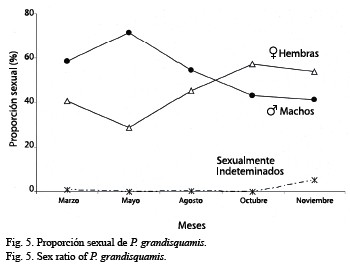
<p align="center"><small>&nbsp;</small></p>     <div style="text-align: left;"><small><span style="font-family: arial;"> <span style="font-weight: bold;">Reproducci&oacute;n</span>: El an&aacute;lisis de proporci&oacute;n </span><span  style="font-family: arial;">sexual hembras:machos, para todos los meses </span><span style="font-family: arial;">analizados, presenta una relaci&oacute;n cercana a 1:1, </span><span  style="font-family: arial;">correspondiendo el 44 % hembras, el 51 % a </span><span style="font-family: arial;">machos y el 5 % a indeterminados (j&oacute;venes). </span><span  style="font-family: arial;">Durante los meses analizados la proporci&oacute;n de </span><span style="font-family: arial;">machos es alta en marzo, mayo y agosto, disminuyendo en octubre y noviembre. Las hembras </span><span style="font-family: arial;">presentan un comportamiento inverso al de los </span><span style="font-family: arial;">machos, con la m&aacute;xima proporci&oacute;n en octubre </span><span  style="font-family: arial;">y noviembre y menor proporci&oacute;n para el resto </span><span style="font-family: arial;">de los meses. En estos &uacute;ltimos meses la proporci&oacute;n </span><span  style="font-family: arial;">hembras:machos llega a ser cercana a 1:1, </span><span  style="font-family: arial;">y es m&aacute;s evidente durante el mes de noviembre. </span><span style="font-family: arial;">Los individuos sexualmente indeterminados </span><span style="font-family: arial;">(j&oacute;venes) representan una fracci&oacute;n peque&ntilde;a </span><span  style="font-family: arial;">(5 %) del total analizado, con la mayor abundancia </span><span style="font-family: arial;">en marzo y noviembre (<a href="#figura5">Fig. 5</a>). </span>    ]]></body>
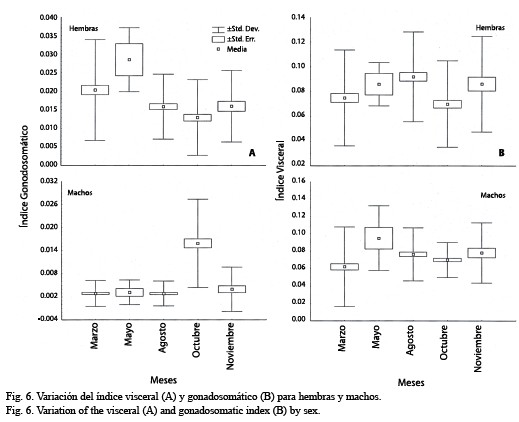
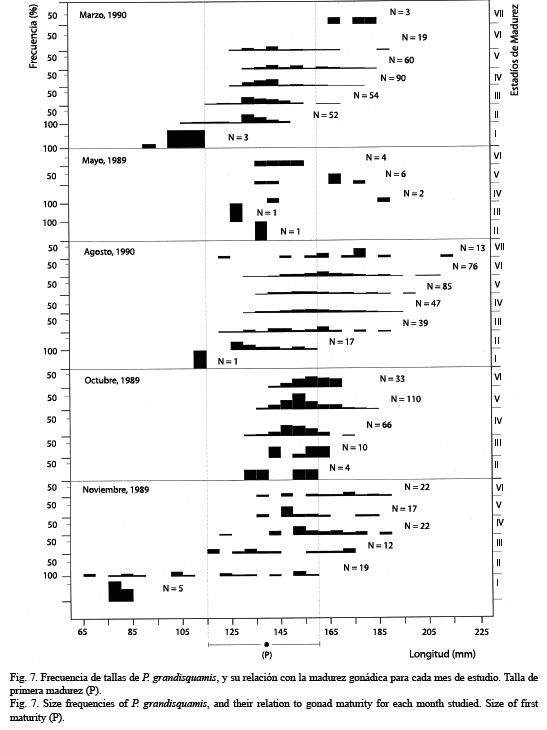
<body><![CDATA[<br> <br style="font-family: arial;"> <span style="font-family: arial;">El &iacute;ndice gonadosom&aacute;tico presenta un </span><span  style="font-family: arial;">patr&oacute;n diferente en ambos sexos. Para los </span><span style="font-family: arial;">machos, el valor promedio m&aacute;ximo corresponde </span><span  style="font-family: arial;">al mes de octubre (x_= 0.0158), con valores </span><span style="font-family: arial;">bajos para el resto de los meses. Para las hembras </span><span style="font-family: arial;">el valor promedio m&aacute;ximo se presenta </span><span  style="font-family: arial;">durante el mes de mayo (x_= 0.0284) con valores </span><span style="font-family: arial;">bajos para el resto de los meses analizados </span><span style="font-family: arial;">(Figs. <a href="#figura6">6A</a>, <a href="#figura6">B</a>).</span><br  style="font-family: arial;"> <br style="font-family: arial;"> <span style="font-family: arial;">El &iacute;ndice visceral tiene, para las hembras, </span><span style="font-family: arial;">el valor promedio m&aacute;ximo en agosto(x_= 0.092) y el valor promedio m&iacute;nimo en octubre (x_= 0.072). Los machos presentan el valor promedio m&aacute;ximo en mayo (x</span><span  style="font-family: arial;">_= 0.095) y el m&iacute;nimo en marzo (x_ = 0.061) (Figs. <a href="#figura6">6C</a>, <a href="#figura6">D</a>).</span><br  style="font-family: arial;"> <br style="font-family: arial;"> <span style="font-family: arial;">Todos los estadios de madurez se presentan </span><span style="font-family: arial;">en todos los meses en diferente proporci&oacute;n; incluyendo los individuos </span><span  style="font-family: arial;">sexualmente indeterminados </span><span  style="font-family: arial;">(I). En octubre y mayo </span><span  style="font-family: arial;">los organismos m&aacute;s peque&ntilde;os </span><span  style="font-family: arial;">(j&oacute;venes) se encuentran </span><span  style="font-family: arial;">sexualmente determinados </span><span  style="font-family: arial;">(II), sin presentarse estadios </span><span  style="font-family: arial;">en descanso (VII) (<a href="#figura7">Fig.7</a>).</span><br  style="font-family: arial;"> </small></div>     <p align="justify"><small>&nbsp;</small></p>     <p align="center"><small><a name="figura4"> <img style="border: 0px solid ; width: 253px; height: 781px;"  src="/img/fbpe/rbt/v54n4/3492i5.JPG" title="" alt=""></a></small></p>     
<p align="center"><small><a name="figura5"> <img style="border: 0px solid ; width: 350px; height: 265px;"  src="/img/fbpe/rbt/v54n4/3492i6.JPG" title="" alt=""></a></small></p>     
<p align="justify"><small> <br style="font-family: arial;"> </small></p>     <div style="text-align: left;"><small><span style="font-family: arial;">La talla de primera madurez </span><span style="font-family: arial;">para <span style="font-style: italic;">P. grandisquamis</span> fue </span><span style="font-family: arial;">de 138 mm, debido a que la </span><span style="font-family: arial;">talla del individuo inmaduro </span><span style="font-family: arial;">m&aacute;s grande (II) fue de 161 </span><span style="font-family: arial;">mm de longitud total (noviembre) </span><span style="font-family: arial;">y el m&aacute;s peque&ntilde;o en </span><span  style="font-family: arial;">proceso de maduraci&oacute;n (III) </span><span  style="font-family: arial;">alcanz&oacute; una talla de 115 mm </span><span  style="font-family: arial;">(noviembre) (<a href="#figura7">Fig. 7</a>). La distribuci&oacute;n </span><span style="font-family: arial;">espacial de los individuos maduros </span><span style="font-family: arial;">muestra que se distribuyen a lo largo del Golfo </span><span  style="font-family: arial;">de Tehuantepec, y se concentra la mayor parte </span><span style="font-family: arial;">frente a los sistemas lagunares de la regi&oacute;n. Al respecto, los individuos sexualmente indeterminados </span><span style="font-family: arial;">presentan una distribuci&oacute;n asociada a </span><span style="font-family: arial;">procesos estuarinos, ocurriendo principalmente </span><span  style="font-family: arial;">frente al sistema lagunar Superior-Inferior.</span><br style="font-family: arial;"> </small></div>     <p align="justify"><small>&nbsp;</small></p>     <p align="center"><small><a name="figura6"> <img style="border: 0px solid ; width: 519px; height: 422px;"  src="/img/fbpe/rbt/v54n4/3492i7.JPG" title="" alt=""></a></small></p>     
<p align="center"><small>&nbsp;</small></p>     <p align="center"><small> <br style="font-family: arial;"> <a name="figura7"><img  style="border: 0px solid ; width: 547px; height: 730px;"  src="/img/fbpe/rbt/v54n4/3492i8.JPG" title="" alt=""></a></small></p>     
]]></body>
<body><![CDATA[<p align="justify"><small>&nbsp;</small></p>     <p style="text-align: left;"> <span style="font-family: arial; font-weight: 700;">D</span><font  size="3"><span style="font-family: arial; font-weight: 700;">iscusi&oacute;n</span></font><br  style="font-family: arial;"> <br style="font-family: arial;"> <span style="font-family: arial;"><span style="font-weight: bold;">Distribuci&oacute;n y abundancia:</span> De acuerdo a </span><span style="font-family: arial;">Tapia-Garc&iacute;a (1998), <span style="font-style: italic;">P. grandisquamis</span> es una </span><span style="font-family: arial;">de las especies consideradas como dominantes </span><span style="font-family: arial;">dentro del Golfo de Tehuantepec, y en conjunto </span><span style="font-family: arial;">con otras especies dominantes, aportan m&aacute;s del </span><span  style="font-family: arial;">80 % de abundancia num&eacute;rica en las capturas, </span><span style="font-family: arial;">durante los meses de marzo y agosto, con una </span><span style="font-family: arial;">frecuencia mayor al 45 % durante los meses de </span><span  style="font-family: arial;">marzo, agosto y noviembre.    <br>     <br style="font-family: arial;">     </span><span style="font-family: arial;">La mayor abundancia alrededor     de la isobata </span><span style="font-family: arial;">de los 40 m,     frente a los sistemas     lagunares </span><span style="font-family: arial;">y hacia el sudeste     del Golfo, sobre     fondo arenoso </span><span style="font-family: arial;">y lodoso, hace     ]]></body>
<body><![CDATA[evidente su relaci&oacute;n a &aacute;reas </span><span      style="font-family: arial;">influenciadas por sistemas     lagunares-estuarinos, </span><span style="font-family: arial;">lo que     concuerda con lo informado por </span><span style="font-family: arial;">Amezcua-Linares     (1996) y Allen y     Robertson&nbsp; </span><span style="font-family: arial;">(1998). Este     patr&oacute;n de     relaci&oacute;n a zonas de </span><span style="font-family: arial;">influencia     por procesos estuarinos es     una estrategia </span><span style="font-family: arial;">biol&oacute;gica     ]]></body>
<body><![CDATA[y ecol&oacute;gica     que permite a las </span><span style="font-family: arial;">especies     aprovechar la alta     producci&oacute;n de origen&nbsp; </span><span      style="font-family: arial;">epicontinental. No existen informes     de que </span><span style="font-family: arial;">esta especie se     distribuya dentro de     sistemas </span><span style="font-family: arial;">lagunares-estuarinos     (Schneider 1995,     Tapia- </span><span style="font-family: arial;">Garc&iacute;a 1997,     ]]></body>
<body><![CDATA[Castro-Aguirre     1999), por lo que </span><span style="font-family: arial;">es una     especie t&iacute;pica marina     que se distribuye </span><span style="font-family: arial;">preferentemente     hacia la plataforma     continental </span><span style="font-family: arial;">interna. Este     patr&oacute;n es     diferente al informado </span><span style="font-family: arial;">para <span      style="font-style: italic;">Mulloidichthys dentatus</span>, especie     de </span><span style="font-family: arial;">la misma familia, que se     ]]></body>
<body><![CDATA[reporta para     el &aacute;rea </span><span style="font-family: arial;">de estudio y     que se distribuye     principalmente </span><span style="font-family: arial;">sobre fondos     rocosos y arenosos,     cerca de arrecifes </span><span style="font-family: arial;">coralinos     (Allen y Robertson 1998).</span><br style="font-family: arial;">     <br style="font-family: arial;">     <span style="font-family: arial;">La alta abundancia de <span      style="font-style: italic;">P. grandisquamis</span> </span><span     ]]></body>
<body><![CDATA[ style="font-family: arial;">en marzo est&aacute; determinada     principalmente por </span><span style="font-family: arial;">individuos     de tallas juveniles, que     se asocia a </span><span style="font-family: arial;">un fuerte     reclutamiento. La alta abundancia en </span><span      style="font-family: arial;">agosto se atribuye principalmente a     individuos </span><span style="font-family: arial;">adultos de tallas     m&aacute;s grandes     respecto a marzo, </span><span style="font-family: arial;">lo que     implica un crecimiento en los     ]]></body>
<body><![CDATA[individuos </span><span style="font-family: arial;">de la     poblaci&oacute;n. La     disminuci&oacute;n de la biomasa </span><span      style="font-family: arial;">en mayo y noviembre es resultado del     escaso </span><span style="font-family: arial;">n&uacute;mero de     organismos     recolectados y por la </span><span style="font-family: arial;">presencia     de individuos de tallas peque&ntilde;as, </span><span      style="font-family: arial;">principalmente durante el mes de     noviembre, </span><span style="font-family: arial;">como resultado del     ]]></body>
<body><![CDATA[reclutamiento de     j&oacute;venes.</span><br style="font-family: arial;">     <br style="font-family: arial;">     <span style="font-family: arial;">La frecuencia de tallas muestra una     progresi&oacute;n </span><span style="font-family: arial;">modal en     los meses analizados, lo cual </span><span style="font-family: arial;">es     un reflejo de un amplio proceso de     crecimiento </span><span style="font-family: arial;">y reclutamiento     de los organismos. La </span><span style="font-family: arial;">distribuci&oacute;n     multimodal     ]]></body>
<body><![CDATA[durante los meses de </span><span style="font-family: arial;">noviembre     a marzo muestra un amplio     periodo </span><span style="font-family: arial;">de     reproducci&oacute;n y     reclutamiento asociado a la </span><span style="font-family: arial;">presencia     constante de individuos     sexualmente </span><span style="font-family: arial;">indeterminados     (Fase I). </span><br style="font-family: arial;">     <br style="font-family: arial;">     <span style="font-family: arial;">La talla m&aacute;xima fue de 213 mm,     ]]></body>
<body><![CDATA[y al </span><span style="font-family: arial;">respecto Amezcua-Linares     (1996) y     Allen y </span><span style="font-family: arial;">Robertson (1998)     informan una talla     m&aacute;xima </span><span style="font-family: arial;">de 250 mm y 280     mm respectivamente     para el </span><span style="font-family: arial;">Pac&iacute;fico     Central Mexicano.</span><br style="font-family: arial;">     <br style="font-family: arial;">     <span style="font-family: arial;"><span style="font-weight: bold;">Reproducci&oacute;n</span>:     ]]></body>
<body><![CDATA[La     proporci&oacute;n sexual </span><span style="font-family: arial;">total     hembras:machos fue     pr&aacute;cticamente 1:1 </span><span style="font-family: arial;">durante     el ciclo anual. Sin embargo,     en mayo </span><span style="font-family: arial;">donde la     proporci&oacute;n es     diferente respecto a </span><span style="font-family: arial;">los     otros meses, puede deberse al     bajo n&uacute;mero </span><span style="font-family: arial;">de     ]]></body>
<body><![CDATA[individuos recolectados. Por otro     lado, </span><span style="font-family: arial;">en ambos sexos se     presenta una     diferenciaci&oacute;n </span><span style="font-family: arial;">en     cuanto a la madurez, lo cual puede </span><span      style="font-family: arial;">indicar una posible separaci&oacute;n     de h&aacute;bitat</span><span style="font-family: arial;"> entre     &aacute;reas reproductivas y no     reproductivas,&nbsp; </span><span style="font-family: arial;">acerc&aacute;ndose     a la l&iacute;nea     ]]></body>
<body><![CDATA[de costa para la reproducci&oacute;n </span><span      style="font-family: arial;">y la alimentaci&oacute;n.</span><br      style="font-family: arial;">     <br style="font-family: arial;">     <span style="font-family: arial;">La presencia de individuos     indeterminados, </span><span style="font-family: arial;">principalmente     en noviembre y marzo, </span><span style="font-family: arial;">sugiere     un amplio periodo de     reclutamiento. </span><span style="font-family: arial;">Esto se asume     por la presencia de     ]]></body>
<body><![CDATA[individuos </span><span style="font-family: arial;">en     maduraci&oacute;n (III), maduros     (IV), en reproducci&oacute;n </span><span style="font-family: arial;">(V)     y desovados (VI), lo que indica </span><span      style="font-family: arial;">que la reproducci&oacute;n ocurre     todo el a&ntilde;o, principalmente </span><span      style="font-family: arial;">durante el periodo comprendido en </span><span      style="font-family: arial;">mayo a octubre, periodo que     corresponde a la </span><span style="font-family: arial;">&eacute;poca     de lluvias y que se     ]]></body>
<body><![CDATA[caracteriza por una </span><span style="font-family: arial;">mayor     disponibilidad de alimento y     mejores </span><span style="font-family: arial;">condiciones     ambientales que garantiza     en gran </span><span style="font-family: arial;">medida el     &eacute;xito de la     sobrevivencia de los </span><span style="font-family: arial;">organismos.     El periodo de desove     m&aacute;s activo </span><span style="font-family: arial;">durante los     meses de mayo a octubre,     ]]></body>
<body><![CDATA[coincide </span><span style="font-family: arial;">con lo reportado por     Wahbeh (1992)     para </span><span style="font-family: arial;"><span      style="font-style: italic;">Mulloides flavolineatus</span> y <span      style="font-style: italic;">M.     vanicolensis</span> en el Mar Rojo donde se informan desoves cortos </span><span      style="font-family: arial;">estacionales de junio a agosto. El     reclutamiento </span><span style="font-family: arial;">de     j&oacute;venes asociado a su alta     abundancia </span><span style="font-family: arial;">frente a las     ]]></body>
<body><![CDATA[Lagunas Inferior y del     Mar Muerto </span><span style="font-family: arial;">permite inferir     que estas     &aacute;reas son de alimentaci&oacute;n </span><span      style="font-family: arial;">y crianza de los j&oacute;venes de la     especie </span><span style="font-family: arial;">y probablemente     &aacute;reas     reproductivas de los </span><span style="font-family: arial;">adultos,     que permiten asegurar la     continuidad </span><span style="font-family: arial;">de la especie por     ]]></body>
<body><![CDATA[la     producci&oacute;n que exportan </span><span style="font-family: arial;">los     sistemas lagunares. </span><br style="font-family: arial;">     <br style="font-family: arial;">     <span style="font-family: arial;">El an&aacute;lisis del &iacute;ndice     gonadosom&aacute;tico tambi&eacute;n </span><span      style="font-family: arial;">indica un amplio periodo reproductivo     a </span><span style="font-family: arial;">partir de mayo hasta     octubre. Esta     conducta </span><span style="font-family: arial;">es     ]]></body>
<body><![CDATA[caracter&iacute;stica de peces     tropicales los cuales </span><span style="font-family: arial;">muestran     un reclutamiento constante     de j&oacute;venes, </span><span style="font-family: arial;">ciclos de     vida cortos y     reproducci&oacute;n durante </span><span style="font-family: arial;">casi     todo el a&ntilde;o     (Tapia-Garc&iacute;a <span style="font-style: italic;">et al</span>.     2000). </span><span style="font-family: arial;">Por el n&uacute;mero     de modas que se     ]]></body>
<body><![CDATA[presentan en </span><span style="font-family: arial;">la frecuencia de     tallas es muy     probable que </span><span style="font-family: arial;"><span      style="font-style: italic;">P. grandisquamis</span> tenga una     longevidad     mayor </span><span style="font-family: arial;">a tres a&ntilde;os.</span><br      style="font-family: arial;">     <br style="font-family: arial;">     <span style="font-family: arial;">La talla de primera madurez sexual     fue </span><span style="font-family: arial;">de 138 mm de longitud     ]]></body>
<body><![CDATA[total, y     tomando como </span><span style="font-family: arial;">referencia esta     longitud, los     individuos menores </span><span style="font-family: arial;">a esta     talla tienden a distribuirsefrente a las </span><span      style="font-family: arial;">Lagunas Inferior y Mar Muerto, lo que     corrobora</span><span style="font-family: arial;"> a &eacute;stas como     &aacute;reas de     crianza. </span><br style="font-family: arial;">     <br style="font-family: arial;">     ]]></body>
<body><![CDATA[<span style="font-family: arial;">Se puede resumir que esta especie     t&iacute;picamente </span><span style="font-family: arial;">marina se     distribuye hasta 60 m de     profundidad, </span><span style="font-family: arial;">donde los     individuos de tallas mayores </span><span style="font-family: arial;">alcanzan     las m&aacute;ximas profundidades para madurar. </span><span      style="font-family: arial;">Posteriormente se dirigen hacia aguas     someras </span><span style="font-family: arial;">frente a sistemas     lagunares-estuarinos para </span><span style="font-family: arial;">reproducirse     durante todo el     ]]></body>
<body><![CDATA[a&ntilde;o, principalmente</span><span style="font-family: arial;">en     el periodo de mayo a octubre,     periodo en </span><span style="font-family: arial;">el cual se     registra la mayor     producci&oacute;n de los </span><span style="font-family: arial;">sistemas     lagunares. En estas zonas,     por su alta </span><span style="font-family: arial;">producci&oacute;nconstituyen     &aacute;reas de crianza, donde </span><span style="font-family: arial;">se     desarrollan los j&oacute;venes     hasta alcanzar su talla </span><span style="font-family: arial;">de     ]]></body>
<body><![CDATA[primera madurez y se reclutan a la     poblaci&oacute;n </span><span style="font-family: arial;">adulta     colonizando aguas de mayor     profundidad, </span><span style="font-family: arial;">para completar     su ciclo vital,     principalmente </span><span style="font-family: arial;">en marzo y     noviembre. La veda para la     pesca </span><span style="font-family: arial;">de camar&oacute;n en la     regi&oacute;n     se aplica de mayo a </span><span style="font-family: arial;">septiembre,     ]]></body>
<body><![CDATA[lo que determina que esta     actividad </span><span style="font-family: arial;">no tenga un fuerte     impacto durante el     periodo </span><span style="font-family: arial;">reproductivo de la     especie. De     acuerdo con la </span><span style="font-family: arial;">informaci&oacute;n     brindada por Tapia-Garc&iacute;a (1997, </span><span      style="font-family: arial;">1998) Tapia-Garc&iacute;a <span      style="font-style: italic;">et al</span>.     (2000) y el presente </span><span style="font-family: arial;">trabajo,     ]]></body>
<body><![CDATA[se sugiere aplicar     estrategias de protecci&oacute;n </span><span      style="font-family: arial;">a las zonas sobre la plataforma     continental </span><span style="font-family: arial;">del Golfode     Tehuantepec     influenciadas por </span><span style="font-family: arial;">procesos     estuarinos y que representan     &aacute;reas de </span><span style="font-family: arial;">reproducci&oacute;n     y crianza para un     gran n&uacute;mero de </span><span style="font-family: arial;">especies,     ]]></body>
<body><![CDATA[para garantizar la permanencia de &eacute;stas </span><span      style="font-family: arial;">en el sistema.</span>     <br style="font-family: arial;">     <br style="font-family: arial;">     <b><span style="font-family: arial;">A</span><font size="3"><span      style="font-family: arial;">gradecimientos</span></font></b><br      style="font-family: arial;">     <br style="font-family: arial;">     <span style="font-family: arial;">El presente estudio deriva del apoyo     obtenido </span><span style="font-family: arial;">a trav&eacute;s del     ]]></body>
<body><![CDATA[proyecto de     investigaci&oacute;n </span><span style="font-family: arial;">&#8220;Composici&oacute;n     taxon&oacute;mica, distribuci&oacute;n y </span><span      style="font-family: arial;">abundancia de las comunidades de     peces de </span><span style="font-family: arial;">la zona costera de     M&eacute;xico:     Bah&iacute;as del Parque</span><span style="font-family: arial;">     Nacional Huatulco. Universidad     Aut&oacute;noma </span><span style="font-family: arial;">Metropolitana-Iztapalapa/CBS&#8221;.</span><br      style="font-family: arial;">     ]]></body>
<body><![CDATA[<br style="font-family: arial;">     <span style="font-family: arial; font-weight: 700;">Resumen</span><br      style="font-family: arial;">     <br style="font-family: arial;">     <span style="font-family: arial;">Como resultado de sus estrategias     biol&oacute;gicas y ecol&oacute;gicas, </span><span      style="font-family: arial;">el pez <span style="font-style: italic;">Pseudupeneus</span>     <span style="font-style: italic;">grandisquamis</span> es     una especie </span><span style="font-family: arial;">dominante en la     comunidad demersal     ]]></body>
<body><![CDATA[del Golfo de </span><span style="font-family: arial;">Tehuantepec.     Nuestro principal     objetivo fue conocer estas</span><span style="font-family: arial;">     estrategias con base en su     distribuci&oacute;n, abundancia y </span><span      style="font-family: arial;">reproducci&oacute;n. Se analizaron un     total de 5 175 individuos </span><span style="font-family: arial;">que     forman parte de las recolectas de     peces obtenidas en</span><span style="font-family: arial;"> cinco     cruceros oceanogr&aacute;ficos     ]]></body>
<body><![CDATA[realizados en el Golfo de </span><span style="font-family: arial;">Tehuantepec,     M&eacute;xico, entre     1989-1990. Es una especie </span><span style="font-family: arial;">demersal     t&iacute;picamente marina,     con amplia distribuci&oacute;n </span><span style="font-family: arial;">en     la plataforma continental. La     mayor abundancia de<span style="font-style: italic;"> </span></span><span      style="font-family: arial;"><span style="font-style: italic;">P.     grandisquamis</span> se presenta en marzo     y noviembre, </span><span style="font-family: arial;">alrededor de la     ]]></body>
<body><![CDATA[isobata de los 40 m y     frente a los sistemas </span><span style="font-family: arial;">lagunares     Superior-Inferior y Laguna     del Mar Muerto. La </span><span style="font-family: arial;">reproducci&oacute;n     de la especie se     presenta durante todos los </span><span style="font-family: arial;">meses     analizados, principalmente     durante los meses de </span><span style="font-family: arial;">agosto a     octubre, correspondiente a     la &eacute;poca de lluvias. </span><span style="font-family: arial;">La     ]]></body>
<body><![CDATA[presencia de j&oacute;venes,     principalmente en noviembre y </span><span style="font-family: arial;">marzo,     sugiere un amplio periodo de     reclutamiento durante </span><span style="font-family: arial;">estos     meses cuya distribuci&oacute;n     se refleja principalmente en </span><span style="font-family: arial;">el     &aacute;rea influenciada por las     lagunas Superior-Inferior, que&nbsp; </span><span      style="font-family: arial;">representa un &aacute;rea de crianza.     La proporci&oacute;n sexual total</span><span     ]]></body>
<body><![CDATA[ style="font-family: arial;"> hembras:machos fue     pr&aacute;cticamente 1:1. La talla m&aacute;xima </span><span      style="font-family: arial;">en la regi&oacute;n es de 213 mm y la     talla de primera madurez </span><span style="font-family: arial;">es     de 138 mm LT. La alta abundancia y     reproducci&oacute;n se </span><span style="font-family: arial;">presentan     cuando el golfo tiene alta     producci&oacute;n, acorde </span><span style="font-family: arial;">con     la din&aacute;mica del sistema,     donde tiene gran relevancia </span><span style="font-family: arial;">la     ]]></body>
<body><![CDATA[influencia de las lagunas     costeras. Se sugiere aplicar </span><span style="font-family: arial;">estrategias     de protecci&oacute;n a     las zonas sobre la plataforma </span><span style="font-family: arial;">continental     del Golfo de Tehuantepec     influenciadas por procesos estuarinos y que representan &aacute;reas de     reproducci&oacute;n </span><span style="font-family: arial;">y crianza     para un gran n&uacute;mero     de especies, entre las </span><span style="font-family: arial;">que se     encuentra <span style="font-style: italic;">P. grandisquamis.</span></span>     ]]></body>
<body><![CDATA[<br style="font-family: arial; font-style: italic;">     <br style="font-family: arial;">     <span style="font-family: arial;"><span style="font-weight: bold;">Palabras     clave</span>: <span style="font-style: italic;">Pseudupeneus     grandisquamis,</span> reproducci&oacute;n, </span><span      style="font-family: arial;">demersal, Tehuantepec,     ecolog&iacute;a, dominancia, </span><span style="font-family: arial;">lagunas.</span><br      style="font-family: arial;">     <p style="font-family: arial;"> <span style="font-family: arial; font-weight: 700;">Referencias</span></p>     <!-- ref --><p style="font-family: arial;"> <span style="font-family: arial;">Allen, G.R. &amp; D.R. Robertson. 1998. Peces del Pac&iacute;fico </span><span  style="font-family: arial;">Oriental Tropical. Comisi&oacute;n Nacional para el </span><span style="font-family: arial;">Conocimiento y Uso de la Biodiversidad y Agrupaci&oacute;n </span><span  style="font-family: arial;">Sierra Madre, &eacute;xico, DF., M&eacute;xico. 327 p. &nbsp;&nbsp;&nbsp;&nbsp;&nbsp;&nbsp;&nbsp;&nbsp;[&#160;<a href="javascript:void(0);" onclick="javascript: window.open('/scielo.php?script=sci_nlinks&ref=1356664&pid=S0034-7744200600040000600001&lng=','','width=640,height=500,resizable=yes,scrollbars=1,menubar=yes,');">Links</a>&#160;]<!-- end-ref --><!-- ref --><p> <span style="font-family: arial;">Amezcua-Linares, F. 1996. Peces Demersales de la </span><span style="font-family: arial;">Plataforma Continental del Pac&iacute;fico Central de </span><span style="font-family: arial;">M&eacute;xico. Inst. de Cienc. del Mar y Limnolog&iacute;a. UNAM, </span><span style="font-family: arial;">Comisi&oacute;n Nacional para el Conocimiento y Uso de la </span><span style="font-family: arial;">Biodiversidad. M&eacute;xico, DF., M&eacute;xico. 184 p.</span>&nbsp;&nbsp;&nbsp;&nbsp;&nbsp;&nbsp;&nbsp;&nbsp;[&#160;<a href="javascript:void(0);" onclick="javascript: window.open('/scielo.php?script=sci_nlinks&ref=1356665&pid=S0034-7744200600040000600002&lng=','','width=640,height=500,resizable=yes,scrollbars=1,menubar=yes,');">Links</a>&#160;]<!-- end-ref --><!-- ref --><p style="font-family: arial;"> <span style="font-family: arial;">Cailliet, G.M., M.S. Love &amp; A.W. Ebeling. 1986. Fishes: A </span><span style="font-family: arial;">field and laboratory manual on their structure, identification </span><span style="font-family: arial;">and natural study. Wadsworth, California, </span><span style="font-family: arial;">EEUU. 194 p.</span>&nbsp;&nbsp;&nbsp;&nbsp;&nbsp;&nbsp;&nbsp;&nbsp;[&#160;<a href="javascript:void(0);" onclick="javascript: window.open('/scielo.php?script=sci_nlinks&ref=1356666&pid=S0034-7744200600040000600003&lng=','','width=640,height=500,resizable=yes,scrollbars=1,menubar=yes,');">Links</a>&#160;]<!-- end-ref --><!-- ref --><p style="font-family: arial;"> <span style="font-family: arial;">Castro-Aguirre, J. 1999. Ictiofauna estuarino-lagunar y </span><span style="font-family: arial;">vicaria de M&eacute;xico. Colecci&oacute;n Textos Polit&eacute;cnico. </span><span  style="font-family: arial;">Limusa, M&eacute;xico, DF., M&eacute;xico. 705 p.</span>&nbsp;&nbsp;&nbsp;&nbsp;&nbsp;&nbsp;&nbsp;&nbsp;[&#160;<a href="javascript:void(0);" onclick="javascript: window.open('/scielo.php?script=sci_nlinks&ref=1356667&pid=S0034-7744200600040000600004&lng=','','width=640,height=500,resizable=yes,scrollbars=1,menubar=yes,');">Links</a>&#160;]<!-- end-ref --><!-- ref --><p style="font-family: arial;"> <span style="font-family: arial;">Laevastu, T. 1971. Manual de m&eacute;todos de Biolog&iacute;a </span><span  style="font-family: arial;">Pesquera. FAO. Acribia, Zaragoza, Espa&ntilde;a. 243 p.</span>&nbsp;&nbsp;&nbsp;&nbsp;&nbsp;&nbsp;&nbsp;&nbsp;[&#160;<a href="javascript:void(0);" onclick="javascript: window.open('/scielo.php?script=sci_nlinks&ref=1356668&pid=S0034-7744200600040000600005&lng=','','width=640,height=500,resizable=yes,scrollbars=1,menubar=yes,');">Links</a>&#160;]<!-- end-ref --><!-- ref --><p style="font-family: arial;"> <span style="font-family: arial;">Pauly, D. 1982. Studying single &#8211; dynamics in a tropical </span><span style="font-family: arial;">multispecies context, p. 33-70. <span style="font-style: italic;">In </span>D. Pauly &amp; G.I. </span><span style="font-family: arial;">Murphy (eds.). Theory and management of tropical </span><span style="font-family: arial;">fisheries. ICLARM Conference Proceedings 9. </span><span style="font-family: arial;">Manila, Filipinas.</span>&nbsp;&nbsp;&nbsp;&nbsp;&nbsp;&nbsp;&nbsp;&nbsp;[&#160;<a href="javascript:void(0);" onclick="javascript: window.open('/scielo.php?script=sci_nlinks&ref=1356669&pid=S0034-7744200600040000600006&lng=','','width=640,height=500,resizable=yes,scrollbars=1,menubar=yes,');">Links</a>&#160;]<!-- end-ref --><!-- ref --><p style="font-family: arial;"> <span style="font-family: arial;">S&aacute;nchez-Gil, P. &amp; A. Y&aacute;&ntilde;ez-Arancibia. 1985. Evaluaci&oacute;n </span><span  style="font-family: arial;">ecol&oacute;gica de recursos demersales costeros Tropicales; </span><span  style="font-family: arial;">un enfoque metodol&oacute;gico en el Sur del Golfo de </span><span style="font-family: arial;">M&eacute;xico, p. 175-314.<span style="font-style: italic;"> In</span> A. Y&aacute;&ntilde;ez-Arancibia (ed.). </span><span  style="font-family: arial;">Recursos pesqueros potenciales de M&eacute;xico: La pesca </span><span style="font-family: arial;">acompa&ntilde;ante del camar&oacute;n. Progr. Univ. de Alimentos. </span><span  style="font-family: arial;">Inst. Cienc. del Mar y Limnol., Inst. Nal. de pesca. </span><span style="font-family: arial;">UNAM, M&eacute;xico, DF., M&eacute;xico.</span>&nbsp;&nbsp;&nbsp;&nbsp;&nbsp;&nbsp;&nbsp;&nbsp;[&#160;<a href="javascript:void(0);" onclick="javascript: window.open('/scielo.php?script=sci_nlinks&ref=1356670&pid=S0034-7744200600040000600007&lng=','','width=640,height=500,resizable=yes,scrollbars=1,menubar=yes,');">Links</a>&#160;]<!-- end-ref --><!-- ref --><p style="font-family: arial;"> <span style="font-family: arial;">Schneider, M. 1995. Mullidae, p. 1299-1300. <span style="font-style: italic;">In</span> W. Fischer, F. </span><span  style="font-family: arial;">Krupp, W. Schneider, C. Sommer, K.E. Carpenter &amp; V.H </span><span style="font-family: arial;">Niem (eds.). Gu&iacute;a FAO para la identificaci&oacute;n de especies </span><span  style="font-family: arial;">para los fines de la pesca. Pacifico centro-oriental. </span><span style="font-family: arial;">Volumen II. Vertebrados&#8211;Parte I. FAO, Roma, Italia.</span>&nbsp;&nbsp;&nbsp;&nbsp;&nbsp;&nbsp;&nbsp;&nbsp;[&#160;<a href="javascript:void(0);" onclick="javascript: window.open('/scielo.php?script=sci_nlinks&ref=1356671&pid=S0034-7744200600040000600008&lng=','','width=640,height=500,resizable=yes,scrollbars=1,menubar=yes,');">Links</a>&#160;]<!-- end-ref --><!-- ref --><p style="font-family: arial;"> <span style="font-family: arial;">Stevenson, D.K. 1982. Una revisi&oacute;n de los recursos marinos </span><span  style="font-family: arial;">de la regi&oacute;n de la Comisi&oacute;n de Pesca para el </span><span  style="font-family: arial;">Atl&aacute;ntico centro occidental (COPACO). FAO Doc. </span><span style="font-family: arial;">Tec. de Pesca. 211:1-146.</span>&nbsp;&nbsp;&nbsp;&nbsp;&nbsp;&nbsp;&nbsp;&nbsp;[&#160;<a href="javascript:void(0);" onclick="javascript: window.open('/scielo.php?script=sci_nlinks&ref=1356672&pid=S0034-7744200600040000600009&lng=','','width=640,height=500,resizable=yes,scrollbars=1,menubar=yes,');">Links</a>&#160;]<!-- end-ref --><!-- ref --><p style="font-family: arial;"> <span style="font-family: arial;">Tapia-Garc&iacute;a, M. 1997. Estructura e interacciones ecol&oacute;gicas </span><span  style="font-family: arial;">de las comunidades de peces de la plataforma </span><span style="font-family: arial;">continental y la Laguna del Mar Muerto, en el Golfo </span><span style="font-family: arial;">de Tehuantepec al sur del Pac&iacute;fico Mexicano. Tesis </span><span  style="font-family: arial;">de Doctorado en Ciencias del Mar, Universidad </span><span style="font-family: arial;">Aut&oacute;noma de M&eacute;xico, M&eacute;xico, D.F. 135 p.</span>&nbsp;&nbsp;&nbsp;&nbsp;&nbsp;&nbsp;&nbsp;&nbsp;[&#160;<a href="javascript:void(0);" onclick="javascript: window.open('/scielo.php?script=sci_nlinks&ref=1356673&pid=S0034-7744200600040000600010&lng=','','width=640,height=500,resizable=yes,scrollbars=1,menubar=yes,');">Links</a>&#160;]<!-- end-ref --><!-- ref --><p style="font-family: arial;"> <span style="font-family: arial;">Tapia-Garc&iacute;a, M. 1998. Evaluaci&oacute;n ecol&oacute;gica de la fauna </span><span  style="font-family: arial;">demersal, p. 129-148. <span  style="font-style: italic;">In</span> M. Tapia-Garc&iacute;a (ed.). El </span><span style="font-family: arial;">Golfo de Tehuantepec: el ecosistema y sus recursos. </span><span style="font-family: arial;">Universidad Aut&oacute;noma Metropolitana-Iztapalapa, </span><span style="font-family: arial;">M&eacute;xico, DF., M&eacute;xico.</span>&nbsp;&nbsp;&nbsp;&nbsp;&nbsp;&nbsp;&nbsp;&nbsp;[&#160;<a href="javascript:void(0);" onclick="javascript: window.open('/scielo.php?script=sci_nlinks&ref=1356674&pid=S0034-7744200600040000600011&lng=','','width=640,height=500,resizable=yes,scrollbars=1,menubar=yes,');">Links</a>&#160;]<!-- end-ref --><!-- ref --><p style="font-family: arial;"> <span style="font-family: arial;">Tapia-Garc&iacute;a, M., A. Y&aacute;&ntilde;ez-Arancibia, P. S&aacute;nchez-Gil &amp; </span><span  style="font-family: arial;">M.C. Garc&iacute;a-Abad. 1995. Distribuci&oacute;n, abundancia y </span><span  style="font-family: arial;">reproducci&oacute;n de <span  style="font-style: italic;">Priacanthus arenatus</span> Cuvier (Pisces: </span><span  style="font-family: arial;">Priacanthidae), en la plataforma continental del sur </span><span style="font-family: arial;">del Golfo de M&eacute;xico. Biotropica 27: 232-237. </span><span style="font-family: arial;">&nbsp;&nbsp;&nbsp;&nbsp;&nbsp;&nbsp;&nbsp;&nbsp;[&#160;<a href="javascript:void(0);" onclick="javascript: window.open('/scielo.php?script=sci_nlinks&ref=1356675&pid=S0034-7744200600040000600012&lng=','','width=640,height=500,resizable=yes,scrollbars=1,menubar=yes,');">Links</a>&#160;]<!-- end-ref --><!-- ref --><p> Tapia-Garc&iacute;a, M., M.C. Garc&iacute;a-Abad &amp; G. Cerdenares </span><span  style="font-family: arial;">Ladr&oacute;n de Guevara. 2000. Reproduction, distribution </span><span style="font-family: arial;">and abundance of <span style="font-style: italic;">Bothus constellatus</span> (Pisces: </span><span style="font-family: arial;">Bothidae), in the Gulf of Tehuantepec, M&eacute;xico. Rev. </span><span  style="font-family: arial;">Biol. Trop. 48: 205-213.</span>&nbsp;&nbsp;&nbsp;&nbsp;&nbsp;&nbsp;&nbsp;&nbsp;[&#160;<a href="javascript:void(0);" onclick="javascript: window.open('/scielo.php?script=sci_nlinks&ref=1356676&pid=S0034-7744200600040000600013&lng=','','width=640,height=500,resizable=yes,scrollbars=1,menubar=yes,');">Links</a>&#160;]<!-- end-ref --><!-- ref --><p style="font-family: arial;"> <span style="font-family: arial;">Wahbeh, M.I. 1992. Aspects of the reproduction biology </span><span style="font-family: arial;">and growth of two species of goatfish (Mullidae) </span><span style="font-family: arial;">from Aqaba, Red Sea. Senckenbergiana Maritima. </span><span style="font-family: arial;">Frankfurt/Main, Alemania. 22: 255-264.</span>&nbsp;&nbsp;&nbsp;&nbsp;&nbsp;&nbsp;&nbsp;&nbsp;[&#160;<a href="javascript:void(0);" onclick="javascript: window.open('/scielo.php?script=sci_nlinks&ref=1356677&pid=S0034-7744200600040000600014&lng=','','width=640,height=500,resizable=yes,scrollbars=1,menubar=yes,');">Links</a>&#160;]<!-- end-ref --><!-- ref --><p style="font-family: arial;"> <span style="font-family: arial;">Y&aacute;&ntilde;ez-Arancibia, A. &amp; P. S&aacute;nchez-Gil. 1988. Ecolog&iacute;a de </span><span  style="font-family: arial;">los recursos demersales marinos: fundamentos en </span> <span style="font-family: arial;">costas tropicales. AGT. M&eacute;xico, DF., M&eacute;xico. 228 p. </span>&nbsp;&nbsp;&nbsp;&nbsp;&nbsp;&nbsp;&nbsp;&nbsp;[&#160;<a href="javascript:void(0);" onclick="javascript: window.open('/scielo.php?script=sci_nlinks&ref=1356678&pid=S0034-7744200600040000600015&lng=','','width=640,height=500,resizable=yes,scrollbars=1,menubar=yes,');">Links</a>&#160;]<!-- end-ref --> ]]></body><back>
<ref-list>
<ref id="B1">
<nlm-citation citation-type="book">
<person-group person-group-type="author">
<name>
<surname><![CDATA[Allen]]></surname>
<given-names><![CDATA[G.R]]></given-names>
</name>
<name>
<surname><![CDATA[Robertson]]></surname>
<given-names><![CDATA[D.R]]></given-names>
</name>
</person-group>
<source><![CDATA[Peces del Pacífico Oriental Tropical]]></source>
<year>1998</year>
<page-range>327</page-range><publisher-loc><![CDATA[^eéxico, DF éxico, DF]]></publisher-loc>
<publisher-name><![CDATA[Comisión Nacional para el Conocimiento y Uso de la Biodiversidad y Agrupación Sierra Madre]]></publisher-name>
</nlm-citation>
</ref>
<ref id="B2">
<nlm-citation citation-type="book">
<person-group person-group-type="author">
<name>
<surname><![CDATA[Amezcua-Linares]]></surname>
<given-names><![CDATA[F]]></given-names>
</name>
</person-group>
<source><![CDATA[Peces Demersales de la Plataforma Continental del Pacífico Central de México]]></source>
<year>1996</year>
<page-range>184</page-range><publisher-loc><![CDATA[^eMéxico, DF México, DF]]></publisher-loc>
<publisher-name><![CDATA[Inst. de Cienc. del Mar y Limnología. UNAM, Comisión Nacional para el Conocimiento y Uso de la Biodiversidad]]></publisher-name>
</nlm-citation>
</ref>
<ref id="B3">
<nlm-citation citation-type="book">
<person-group person-group-type="author">
<name>
<surname><![CDATA[Cailliet]]></surname>
<given-names><![CDATA[G.M]]></given-names>
</name>
<name>
<surname><![CDATA[Love]]></surname>
<given-names><![CDATA[M.S]]></given-names>
</name>
<name>
<surname><![CDATA[Ebeling]]></surname>
<given-names><![CDATA[A.W]]></given-names>
</name>
</person-group>
<source><![CDATA[Fishes: A field and laboratory manual on their structure, identification and natural study]]></source>
<year>1986</year>
<page-range>194</page-range><publisher-loc><![CDATA[^eCalifornia California]]></publisher-loc>
<publisher-name><![CDATA[Wadsworth]]></publisher-name>
</nlm-citation>
</ref>
<ref id="B4">
<nlm-citation citation-type="book">
<person-group person-group-type="author">
<name>
<surname><![CDATA[Castro-Aguirre]]></surname>
<given-names><![CDATA[J]]></given-names>
</name>
</person-group>
<source><![CDATA[Ictiofauna estuarino-lagunar y vicaria de México]]></source>
<year>1999</year>
<page-range>705</page-range><publisher-loc><![CDATA[^eMéxico, DF México, DF]]></publisher-loc>
<publisher-name><![CDATA[Limusa]]></publisher-name>
</nlm-citation>
</ref>
<ref id="B5">
<nlm-citation citation-type="book">
<person-group person-group-type="author">
<name>
<surname><![CDATA[Laevastu]]></surname>
<given-names><![CDATA[T]]></given-names>
</name>
</person-group>
<source><![CDATA[Manual de métodos de Biología Pesquera]]></source>
<year>1971</year>
<page-range>243</page-range><publisher-loc><![CDATA[Zaragoza ]]></publisher-loc>
<publisher-name><![CDATA[FAO]]></publisher-name>
</nlm-citation>
</ref>
<ref id="B6">
<nlm-citation citation-type="">
<person-group person-group-type="author">
<name>
<surname><![CDATA[Pauly]]></surname>
<given-names><![CDATA[D]]></given-names>
</name>
</person-group>
<article-title xml:lang="en"><![CDATA[Studying single - dynamics in a tropical multispecies context]]></article-title>
<person-group person-group-type="editor">
<name>
<surname><![CDATA[Pauly]]></surname>
<given-names><![CDATA[D]]></given-names>
</name>
<name>
<surname><![CDATA[Murphy]]></surname>
<given-names><![CDATA[G.I]]></given-names>
</name>
</person-group>
<source><![CDATA[Theory and management of tropical fisheries]]></source>
<year>1982</year>
<page-range>33-70</page-range><publisher-loc><![CDATA[Manila ]]></publisher-loc>
</nlm-citation>
</ref>
<ref id="B7">
<nlm-citation citation-type="book">
<person-group person-group-type="author">
<name>
<surname><![CDATA[Sánchez-Gil]]></surname>
<given-names><![CDATA[P]]></given-names>
</name>
<name>
<surname><![CDATA[Yáñez-Arancibia]]></surname>
<given-names><![CDATA[A]]></given-names>
</name>
</person-group>
<article-title xml:lang="es"><![CDATA[Evaluación ecológica de recursos demersales costeros Tropicales; un enfoque metodológico en el Sur del Golfo de México]]></article-title>
<person-group person-group-type="editor">
<name>
<surname><![CDATA[Yáñez-Arancibia]]></surname>
<given-names><![CDATA[A]]></given-names>
</name>
</person-group>
<source><![CDATA[Recursos pesqueros potenciales de México: La pesca acompañante del camarón]]></source>
<year>1985</year>
<page-range>175-314</page-range><publisher-loc><![CDATA[^eMéxico, DF México, DF]]></publisher-loc>
<publisher-name><![CDATA[Progr. Univ. de Alimentos. Inst. Cienc. del Mar y Limnol., Inst. Nal. de pesca]]></publisher-name>
</nlm-citation>
</ref>
<ref id="B8">
<nlm-citation citation-type="book">
<person-group person-group-type="author">
<name>
<surname><![CDATA[Schneider]]></surname>
<given-names><![CDATA[M]]></given-names>
</name>
</person-group>
<article-title xml:lang="es"><![CDATA[Mullidae]]></article-title>
<person-group person-group-type="editor">
<name>
<surname><![CDATA[Fischer]]></surname>
<given-names><![CDATA[W]]></given-names>
</name>
<name>
<surname><![CDATA[Krupp]]></surname>
<given-names><![CDATA[F]]></given-names>
</name>
<name>
<surname><![CDATA[Schneider]]></surname>
<given-names><![CDATA[W]]></given-names>
</name>
<name>
<surname><![CDATA[Sommer]]></surname>
<given-names><![CDATA[C]]></given-names>
</name>
<name>
<surname><![CDATA[Carpenter]]></surname>
<given-names><![CDATA[K.E]]></given-names>
</name>
<name>
<surname><![CDATA[Niem]]></surname>
<given-names><![CDATA[V.H]]></given-names>
</name>
</person-group>
<source><![CDATA[Guía FAO para la identificación de especies para los fines de la pesca. Pacifico centro-oriental. Volumen II. Vertebrados-Parte I]]></source>
<year>1995</year>
<page-range>1299-1300</page-range><publisher-loc><![CDATA[Roma ]]></publisher-loc>
<publisher-name><![CDATA[FAO]]></publisher-name>
</nlm-citation>
</ref>
<ref id="B9">
<nlm-citation citation-type="journal">
<person-group person-group-type="author">
<name>
<surname><![CDATA[Stevenson]]></surname>
<given-names><![CDATA[D.K]]></given-names>
</name>
</person-group>
<article-title xml:lang="es"><![CDATA[Una revisión de los recursos marinos de la región de la Comisión de Pesca para el Atlántico centro occidental (COPACO)]]></article-title>
<source><![CDATA[FAO Doc. Tec. de Pesca]]></source>
<year>1982</year>
<volume>211</volume>
<page-range>1-146</page-range></nlm-citation>
</ref>
<ref id="B10">
<nlm-citation citation-type="">
<person-group person-group-type="author">
<name>
<surname><![CDATA[Tapia-García]]></surname>
<given-names><![CDATA[M]]></given-names>
</name>
</person-group>
<source><![CDATA[Estructura e interacciones ecológicas de las comunidades de peces de la plataforma continental y la Laguna del Mar Muerto, en el Golfo de Tehuantepec al sur del Pacífico Mexicano]]></source>
<year>1997</year>
<page-range>135</page-range></nlm-citation>
</ref>
<ref id="B11">
<nlm-citation citation-type="book">
<person-group person-group-type="author">
<name>
<surname><![CDATA[Tapia-García]]></surname>
<given-names><![CDATA[M]]></given-names>
</name>
</person-group>
<article-title xml:lang="es"><![CDATA[Evaluación ecológica de la fauna demersal]]></article-title>
<person-group person-group-type="editor">
<name>
<surname><![CDATA[Tapia-García]]></surname>
<given-names><![CDATA[M]]></given-names>
</name>
</person-group>
<source><![CDATA[El Golfo de Tehuantepec: el ecosistema y sus recursos]]></source>
<year>1998</year>
<page-range>129-148</page-range><publisher-loc><![CDATA[^eMéxico, DF México, DF]]></publisher-loc>
<publisher-name><![CDATA[Universidad Autónoma Metropolitana-Iztapalapa]]></publisher-name>
</nlm-citation>
</ref>
<ref id="B12">
<nlm-citation citation-type="journal">
<person-group person-group-type="author">
<name>
<surname><![CDATA[Tapia-García]]></surname>
<given-names><![CDATA[M]]></given-names>
</name>
<name>
<surname><![CDATA[Yáñez-Arancibia]]></surname>
<given-names><![CDATA[A]]></given-names>
</name>
<name>
<surname><![CDATA[Sánchez-Gil]]></surname>
<given-names><![CDATA[P]]></given-names>
</name>
<name>
<surname><![CDATA[García-Abad]]></surname>
<given-names><![CDATA[M.C]]></given-names>
</name>
</person-group>
<article-title xml:lang="es"><![CDATA[Distribución, abundancia y reproducción de Priacanthus arenatus Cuvier (Pisces: Priacanthidae), en la plataforma continental del sur del Golfo de México]]></article-title>
<source><![CDATA[Biotropica]]></source>
<year>1995</year>
<volume>27</volume>
<page-range>232-237</page-range></nlm-citation>
</ref>
<ref id="B13">
<nlm-citation citation-type="journal">
<person-group person-group-type="author">
<name>
<surname><![CDATA[Tapia-García]]></surname>
<given-names><![CDATA[M]]></given-names>
</name>
<name>
<surname><![CDATA[García-Abad]]></surname>
<given-names><![CDATA[M.C]]></given-names>
</name>
<name>
<surname><![CDATA[Cerdenares Ladrón de Guevara]]></surname>
<given-names><![CDATA[G]]></given-names>
</name>
</person-group>
<article-title xml:lang="en"><![CDATA[Reproduction, distribution and abundance of Bothus constellatus (Pisces: Bothidae), in the Gulf of Tehuantepec, México]]></article-title>
<source><![CDATA[Rev. Biol. Trop]]></source>
<year>2000</year>
<volume>48</volume>
<page-range>205-213</page-range></nlm-citation>
</ref>
<ref id="B14">
<nlm-citation citation-type="">
<person-group person-group-type="author">
<name>
<surname><![CDATA[Wahbeh]]></surname>
<given-names><![CDATA[M.I]]></given-names>
</name>
</person-group>
<source><![CDATA[Aspects of the reproduction biology and growth of two species of goatfish (Mullidae) from Aqaba, Red Sea]]></source>
<year>1992</year>
<volume>22</volume>
<page-range>255-264</page-range></nlm-citation>
</ref>
<ref id="B15">
<nlm-citation citation-type="book">
<person-group person-group-type="author">
<name>
<surname><![CDATA[Yáñez-Arancibia]]></surname>
<given-names><![CDATA[A]]></given-names>
</name>
<name>
<surname><![CDATA[Sánchez-Gil]]></surname>
<given-names><![CDATA[P]]></given-names>
</name>
</person-group>
<source><![CDATA[Ecología de los recursos demersales marinos: fundamentos en costas tropicales]]></source>
<year>1988</year>
<page-range>228</page-range><publisher-loc><![CDATA[^eMéxico, DF México, DF]]></publisher-loc>
<publisher-name><![CDATA[AGT]]></publisher-name>
</nlm-citation>
</ref>
</ref-list>
</back>
</article>
