<?xml version="1.0" encoding="ISO-8859-1"?><article xmlns:mml="http://www.w3.org/1998/Math/MathML" xmlns:xlink="http://www.w3.org/1999/xlink" xmlns:xsi="http://www.w3.org/2001/XMLSchema-instance">
<front>
<journal-meta>
<journal-id>0034-7744</journal-id>
<journal-title><![CDATA[Revista de Biología Tropical]]></journal-title>
<abbrev-journal-title><![CDATA[Rev. biol. trop]]></abbrev-journal-title>
<issn>0034-7744</issn>
<publisher>
<publisher-name><![CDATA[Universidad de Costa Rica]]></publisher-name>
</publisher>
</journal-meta>
<article-meta>
<article-id>S0034-77442006000400005</article-id>
<title-group>
<article-title xml:lang="en"><![CDATA[Fecundity, survival, and growth of the seahorse Hippocampus ingens (Pisces: Syngnathidae) under semi-controlled conditions]]></article-title>
</title-group>
<contrib-group>
<contrib contrib-type="author">
<name>
<surname><![CDATA[Ortega-Salas]]></surname>
<given-names><![CDATA[A.A]]></given-names>
</name>
<xref ref-type="aff" rid="A01"/>
</contrib>
<contrib contrib-type="author">
<name>
<surname><![CDATA[Reyes-Bustamante]]></surname>
<given-names><![CDATA[H]]></given-names>
</name>
<xref ref-type="aff" rid="A02"/>
</contrib>
</contrib-group>
<aff id="A01">
<institution><![CDATA[,UNAM  ]]></institution>
<addr-line><![CDATA[ ]]></addr-line>
</aff>
<aff id="A02">
<institution><![CDATA[,Universidad Autónoma de Sinaloa  ]]></institution>
<addr-line><![CDATA[ Sinaloa]]></addr-line>
<country>México</country>
</aff>
<pub-date pub-type="pub">
<day>00</day>
<month>12</month>
<year>2006</year>
</pub-date>
<pub-date pub-type="epub">
<day>00</day>
<month>12</month>
<year>2006</year>
</pub-date>
<volume>54</volume>
<numero>4</numero>
<fpage>1099</fpage>
<lpage>1102</lpage>
<copyright-statement/>
<copyright-year/>
<self-uri xlink:href="http://www.scielo.sa.cr/scielo.php?script=sci_arttext&amp;pid=S0034-77442006000400005&amp;lng=en&amp;nrm=iso"></self-uri><self-uri xlink:href="http://www.scielo.sa.cr/scielo.php?script=sci_abstract&amp;pid=S0034-77442006000400005&amp;lng=en&amp;nrm=iso"></self-uri><self-uri xlink:href="http://www.scielo.sa.cr/scielo.php?script=sci_pdf&amp;pid=S0034-77442006000400005&amp;lng=en&amp;nrm=iso"></self-uri><abstract abstract-type="short" xml:lang="en"><p><![CDATA[We studied fecundity, survival, and growth of the seahorse Hippocampus ingens under semi-controlled conditions. Three wild brood stock mature males of 14.8, 24.5, and 32.0 g released 1 598, 1 703, and 1 658 juveniles. Juvenile stocking densities of 12 were settled in 60-l aquariums in groups of 1, 12, and 20 days old organisms. The rate of survival was 21.5, 61.9, and 59.0 %, respectively, in 35 days. Juveniles were fed a mix diet of rotifers B. plicatilis and Artemia nauplii, then they were transferred to a cement tank of 100 000 l at a density of 50/1 000 l and fed with live adult Artemia for 60 days more. They grew from an average of 0.7, 1.5, and 2.7 to 4.5, 5.4, and 6.7 cm, respectively, in 95 days. The seawater temperature varied from 17 to 23 ºC. Rev. Biol. Trop. 54 (4): 1099-1102. Epub 2006 Dec. 15.]]></p></abstract>
<abstract abstract-type="short" xml:lang="es"><p><![CDATA[Estudiamos la fecundidad, supervivencia, y crecimiento del caballito de mar, Hippocampus ingens en condiciones semi-controladas. Tres machos reproductores silvestres de 14.8, 24.5 y 32.0 g produjeron 1 598, 1 703 y 1 658 jóvenes. La densidad utilizada fue de 12 jóvenes por acuario de 60 l. Se agruparon en 1, 12 y 20 días de nacidos por acuario. La supervivencia fue de 78.5, 38.1 y 41.0 % en 35 días. Se les alimentó con una mezcla de rotíferos B. plicatilis y nauplios de Artemia para después transferirlos a estanques de 100 000 l a una densidad de 50/1 000 l, donde se les alimentó con Artemia adulta durante 60 días más. Crecieron de un promedio de 0.7, 1.5, y 2.7 a 4.5, 5.4 6.7 cm, respectivamente, en 95 días. La temperatura del agua marina utilizada varió de 17 a 23 ºC.]]></p></abstract>
<kwd-group>
<kwd lng="en"><![CDATA[seahorse]]></kwd>
<kwd lng="en"><![CDATA[Hippocampus ingens]]></kwd>
<kwd lng="en"><![CDATA[aquaculture]]></kwd>
<kwd lng="en"><![CDATA[growth]]></kwd>
<kwd lng="en"><![CDATA[mortality]]></kwd>
<kwd lng="es"><![CDATA[caballito de mar]]></kwd>
<kwd lng="es"><![CDATA[Hippocampus ingens]]></kwd>
<kwd lng="es"><![CDATA[acuicultura]]></kwd>
<kwd lng="es"><![CDATA[crecimiento]]></kwd>
<kwd lng="es"><![CDATA[mortalidad]]></kwd>
</kwd-group>
</article-meta>
</front><body><![CDATA[ <div style="text-align: center;"><small><span  style="font-family: arial;"><span style="font-weight: bold;">Fecundity, survival, and growth of the seahorse</span><span style="font-style: italic;"> Hippocampus ingens</span> </span><span style="font-family: arial; font-weight: bold;">(Pisces: Syngnathidae) under semi-controlled conditions</span><br  style="font-family: arial;"> </small></div> <small><br style="font-family: arial;"> <span style="font-family: arial;">A.A. Ortega-Salas<sup>1</sup> &amp; H. Reyes-Bustamante<sup>2    <br> <br style="font-family: arial;"> </sup></span><span style="font-family: arial;">1 Instituto de Ciencias del Mar y Limnolog&iacute;a, UNAM. Calz. Joel M. Camarena s/n, Mazatl&aacute;n 82040, Sinaloa Apdo.</span><br  style="font-family: arial;"> <span style="font-family: arial;">Post. 811; <a  href="mailto:ortsal@mar.icmyl.unam.mx">ortsal@mar.icmyl.unam.mx</a>    <br> <br style="font-family: arial;"> </span><span style="font-family: arial;">2 Facultad de Ciencias del Mar, Universidad Aut&oacute;noma de Sinaloa, Sinaloa, M&eacute;xico</span><br  style="font-family: arial;"> <br style="font-family: arial;"> </small>     <div style="text-align: center;"><small><span  style="font-family: arial;">Received 24-II-2006. Corrected 27-III-2006. Accepted 11-VIII-2006.</span><br  style="font-family: arial;"> </small></div>     <p align="justify"><small> <br style="font-family: arial;"> </small></p>     <div style="text-align: left;"><small><span style="font-family: arial;"><span      style="font-weight: bold;">Abstract</span>:     We studied fecundity, survival, and growth of the seahorse <span      style="font-style: italic;">Hippocampus ingens</span> under     semi-controlled </span><span style="font-family: arial;">conditions.     ]]></body>
<body><![CDATA[Three wild brood stock mature males of 14.8, 24.5, and 32.0 g released     1 598, 1 703, and 1 </span><span style="font-family: arial;">658     juveniles. Juvenile stocking densities of 12 were settled in 60-l     aquariums in groups of 1, 12, and 20 days </span><span      style="font-family: arial;">old organisms. The rate of survival was     21.5, 61.9, and 59.0 %, respectively, in 35 days. Juveniles were fed a </span><span      style="font-family: arial;">mix diet of rotifers <span      style="font-style: italic;">B. plicatilis</span> and <span      style="font-style: italic;">Artemia nauplii</span>, then they were     transferred to a cement tank of 100 000 l</span> <span     ]]></body>
<body><![CDATA[ style="font-family: arial;">at a density of 50/1 000 l and fed with     live adult <span style="font-style: italic;">Artemia</span> for 60     days more. They grew from an average of&nbsp; 0.7, </span><span      style="font-family: arial;">1.5, and 2.7 to 4.5, 5.4, and 6.7 cm,     respectively, in 95 days. The seawater temperature varied from 17 to 23     <sup>o</sup>C. </span><span style="font-family: arial;">Rev. Biol.     Trop. 54 (4): 1099-1102. Epub 2006 Dec. 15.</span><br      style="font-family: arial;">     <br style="font-family: arial;">     <span style="font-family: arial;"><span style="font-weight: bold;">Key     ]]></body>
<body><![CDATA[words</span>: seahorse, <span style="font-style: italic;">Hippocampus     ingens</span>, aquaculture, growth, mortality.</span><br      style="font-family: arial;">     <br style="font-family: arial;">     <span style="font-family: arial;">Several species of <span      style="font-style: italic;">Hippocampus</span> have </span><span      style="font-family: arial;">been commercially exploited for several     years </span><span style="font-family: arial;">without proper     knowledge of culture techniques. </span><span      style="font-family: arial;">Seahorses have been mainly caught in </span><span     ]]></body>
<body><![CDATA[ style="font-family: arial;">China, Thailand, India, and the     Philippines for </span><span style="font-family: arial;">many years     (Mi 1992). Commercial demands </span><span style="font-family: arial;">for     seahorses, mainly for medical purposes, are </span><span      style="font-family: arial;">increasing by 20 % per year and the price     per </span><span style="font-family: arial;">kilogram of dried     seahorse varies from US$ </span><span style="font-family: arial;">400.00     to 1 300.00 (Vincent 1994).</span><br style="font-family: arial;">     <br style="font-family: arial;">     <span style="font-family: arial;">Liang (1992) studied <span     ]]></body>
<body><![CDATA[ style="font-style: italic;">H. ramalassus</span> </span><span      style="font-family: arial;">reproduction and assured that artificial     production </span><span style="font-family: arial;">would allow the     preservation of this </span><span style="font-family: arial;"><span      style="font-style: italic;">Hippocampus</span> species. The aim of     this paper </span><span style="font-family: arial;">was to count and     calculate fecundity, survival, </span><span style="font-family: arial;">and     growth of the seahorse <span style="font-style: italic;">Hippocampus</span><i>     ingens</i> under semi-controlled     conditions.</span><br style="font-family: arial;">     ]]></body>
<body><![CDATA[<br style="font-family: arial;">     <span style="font-family: arial; font-weight: 700;">M</span><span      style="font-family: arial; font-weight: 700;">aterials and methods</span><br      style="font-family: arial;">     <br style="font-family: arial;">     <span style="font-family: arial;">Three wild brood stock mature     male were </span><span style="font-family: arial;">used in this study.     They were weighed just </span><span style="font-family: arial;">before     they released the juveniles, and after </span><span      style="font-family: arial;">they released them to estimate the total     ]]></body>
<body><![CDATA[weight. </span><span style="font-family: arial;">The average     individual weight was estimated </span><span      style="font-family: arial;">dividing the total larval weight by the     number </span><span style="font-family: arial;">of juveniles released.     All the released juveniles </span><span style="font-family: arial;">per     each mature male were counted; the relative </span><span      style="font-family: arial;">fecundity was calculated dividing the     number </span><span style="font-family: arial;">of juveniles per gram     of seahorse body weight </span><span style="font-family: arial;">before     release of the juveniles. After 35 days the </span><span     ]]></body>
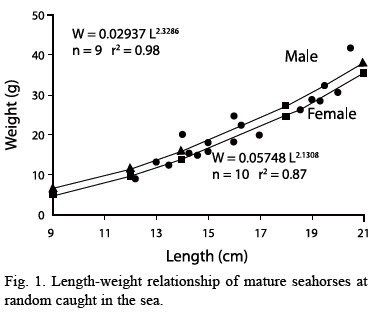
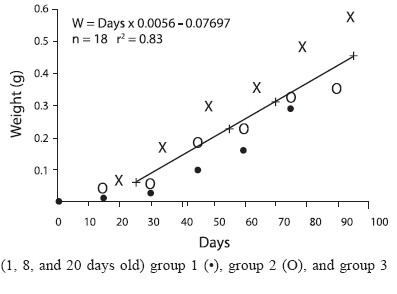
<body><![CDATA[ style="font-family: arial;">juveniles were counted to calculate     mortality.</span><br style="font-family: arial;">     <br style="font-family: arial;">     <span style="font-family: arial;">Three groups of juveniles aged     1, 12,     and </span><span style="font-family: arial;">20 days old were used (60     organisms each) to </span><span style="font-family: arial;">calculate     growth every 15 days for the 95 daysduration </span><span      style="font-family: arial;">of this study (<a href="#fig2">Fig. 2</a>).     The length (mm) </span><span style="font-family: arial;">and weight     ]]></body>
<body><![CDATA[(g) parameters from the three     groups </span><span style="font-family: arial;">of released juveniles     were used to calculate </span><span style="font-family: arial;">growth     by the least square method to estimate </span><span      style="font-family: arial;">changes in length and weight with time.</span><br      style="font-family: arial;">     <br style="font-family: arial;">     <span style="font-family: arial;">The seahorse juveniles at a     stocking density </span><span style="font-family: arial;">of 12 were     settled in 60 l aquariums </span><span style="font-family: arial;">in     ]]></body>
<body><![CDATA[groups of 1, 8, and 20 days old organisms </span><span      style="font-family: arial;">with a mixture of microalgae culture of </span><span      style="font-family: arial;">Chaetoceros and Tetracelmis between 500     000and 100 000 cells/ml; they were fed at a density </span><span      style="font-family: arial;">rate of 75 rotifers/ml, and Artemia     nauplii at </span><span style="font-family: arial;">a density of 1 to     2/ml for 35 days. Then they </span><span style="font-family: arial;">were     transfer to a cement tank of 100 000 l at a </span><span      style="font-family: arial;">density of 50/1 000 l and fed with live     Artemia </span><span style="font-family: arial;">adult at a rate of     ]]></body>
<body><![CDATA[2/ml for 60 days more. The </span><span style="font-family: arial;">seawater     temperature registered in this study </span><span      style="font-family: arial;">varied from 17 to 23 <sup>o</sup>C.</span><br      style="font-family: arial;">     <br style="font-family: arial;">     <span style="font-family: arial; font-weight: 700;">Results</span><br      style="font-family: arial;">     <br style="font-family: arial;">     <span style="font-family: arial;"><a href="#fig1">Figure 1</a>     shows the     ]]></body>
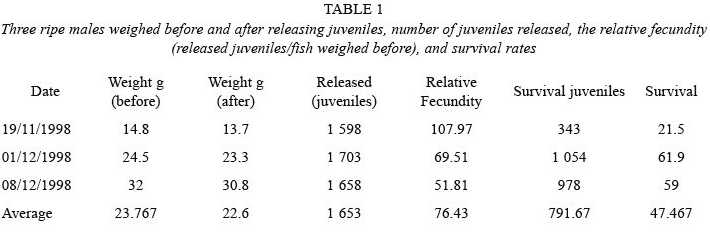
<body><![CDATA[length-weight relationship of     9 males and 10 females caught at random in the sea.</span><br      style="font-family: arial;">     <br style="font-family: arial;">     <span style="font-family: arial;">The equations show that for a     given     length males are heavier.     Average length of males was 16.6     cm (&plusmn; 2.83 SD). Average length of females was 15.3 cm (&plusmn;     3.21 SD). A t-test     ]]></body>
<body><![CDATA[and mean differences revealed     a significant difference between     sexes according to the mean lengthwith 6.01; 95 % confidence interval;     d.f.= 17; t= -1.51;     significance level= 0.34, even with </span><span      style="font-family: arial;">mean weight there were significant     differences </span><span style="font-family: arial;">between sexes     with &#8211;1.3; 95 %; d.f.= 17; t= - </span><span      style="font-family: arial;">096; significance level= 0.14, at p&lt;     .05.</span></small></div>     ]]></body>
<body><![CDATA[<p align="center"><small><br style="font-family: arial;"> <br style="font-family: arial;"> <a name="fig1"><img  style="border: 0px solid ; width: 377px; height: 312px;"  src="/img/fbpe/rbt/v54n4/3491i1.JPG" title="" alt=""></a> </small></p>     
<p align="center"><small><a name="fig2"> <img style="border: 0px solid ; width: 384px; height: 297px;"  src="/img/fbpe/rbt/v54n4/3491i2.JPG" title="" alt=""></a><img  style="border: 0px solid ; width: 397px; height: 294px;"  src="/img/fbpe/rbt/v54n4/3491i3.JPG" title="" alt=""></small></p>     
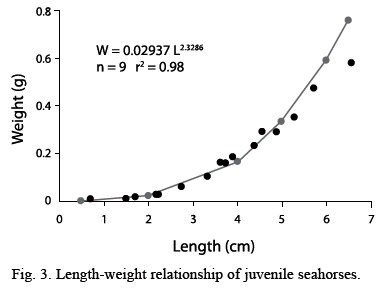
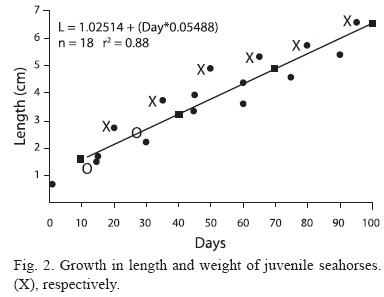
<p align="justify"><small>&nbsp;</small></p>     <p style="text-align: left;"><span style="font-family: arial;">Three mature males released 1 598, 1 703, </span><span style="font-family: arial;">and 1 658 juveniles giving a total of 4 959 </span><span style="font-family: arial;">juveniles in 20 days, which gave an averageweight </span><span  style="font-family: arial;">male of 23.7 g, a larval release of 1 653, </span><span style="font-family: arial;">and a relative fecundity of 76.43 juveniles per </span><span style="font-family: arial;">gram of seahorse (<a href="#tabla1">Table 1</a>). Survival registered </span><span  style="font-family: arial;">for 1 598, 1 703 and 1 658 released juveniles </span><span style="font-family: arial;">was 343, 1 054 and 978 juveniles, respectively, </span><span style="font-family: arial;">which means 78.5, 38.1 and 41.0% survival </span><span  style="font-family: arial;">rates, respectively.</span> <br style="font-family: arial;"> <br style="font-family: arial;"> <span style="font-family: arial;"><a href="#fig2">Figure 2</a> shows the increase of the average </span><span style="font-family: arial;">length and weight from the three groups </span><span style="font-family: arial;">of juveniles, every 15 days. The equations </span><span  style="font-family: arial;">indicate that the average length and growth </span><span style="font-family: arial;">rate from the three groups were 0.05 cm and </span><span style="font-family: arial;">0.005 g per unit of time (days), respectively.</span><br  style="font-family: arial;"> <br style="font-family: arial;"> <span style="font-family: arial;"><a href="#fig3">Figure 3 </a>shows the average growth in </span><span style="font-family: arial;">length and weight of juveniles from the three </span><span style="font-family: arial;">groups, from which a length-weight relationship </span><span style="font-family: arial;">was calculated; starting with the 3 cm </span><span  style="font-family: arial;">length, weights increased geometrically.</span><br  style="font-family: arial;"> <br style="font-family: arial;"> <span style="font-family: arial;">Sexual differences in juveniles were </span><span  style="font-family: arial;">observed at 95 days of age at a length range </span><span style="font-family: arial;">between 6 and 7 cm.</span> <br style="font-family: arial;"> <br style="font-family: arial;"> <span style="font-family: arial; font-weight: 700;">Discussion</span><br  style="font-family: arial;"> <br style="font-family: arial;"> <span style="font-family: arial;">The temperature of the seawater reported </span><span style="font-family: arial;">in this paper ranged between 17 to 23<sup> o</sup>C,although Tawil (1994) reported temperatures </span> <span style="font-family: arial;">for this species from 3 to 27 <sup>o</sup>C. In other species Vincent and Clifton (1989) found an optimal temperature of 27<sup> o</sup>C for H. erectus, and Fam (1992) reported an optimal temperature of 21<sup> o</sup>C for H. kuda. </span></p>     <p align="center"><small><a name="tabla1">     <br> </a><img src="/img/fbpe/rbt/v54n4/3491i4.JPG" title="" alt=""  style="width: 710px; height: 232px;">    
<br> <a name="tabla1"></a></small></p>     <p align="center"><small><a name="fig3"> <img style="border: 0px solid ; width: 384px; height: 292px;"  src="/img/fbpe/rbt/v54n4/3491i5.JPG" title="" alt=""></a></small></p>     
<p align="justify"><small><span style="font-family: arial;">     <br> <br style="font-family: arial;"> </span></small></p>     ]]></body>
<body><![CDATA[<div style="text-align: left;"><small><span style="font-family: arial;">In     this work three mature     males of 14.8, 24.5 and 32.0     g released 1 598, 1 703, and 1     658 juveniles, respectively, which is not very different from the     results obtained     by Reyes-Bustamante and     Ortega-Salas (1999) who     reported that four ripe males with a length between 18.9 to 20.3 cm and     weighting     ]]></body>
<body><![CDATA[between 25.1 to 26.5 g.     released 1 200, 1 450, 1 600, and 1 600 juveniles in five days, giving     an     average of 1 462 juveniles     per male; although Tawil (1994)     mentioned that <span style="font-style: italic;">H. ingens</span>     could release up to 6 000     juveniles from heavier ripe males. In other species, Axelrod <span      style="font-style: italic;">et al</span>. (1969) found a release from     150 to 600 juveniles by <span style="font-style: italic;">H. guttatus</span>;     ]]></body>
<body><![CDATA[Pivnicka and Cemy (1991) reported between 100 to 200 juveniles in <span      style="font-style: italic;">H. ramalassus</span>; Mi (1993) estimated     between 20 to 1 000     juvenilesin <span style="font-style: italic;">H. kuda</span> after     20&#8211;28 days in the brood pouch; and     Vincent (1994) reported between 1 572 to 1 753 juveniles in <span      style="font-style: italic;">H. hippocampus.</span></span><br      style="font-family: arial; font-style: italic;">     <br style="font-family: arial;">     <span style="font-family: arial;">Vincent (1994) calculated an     ]]></body>
<body><![CDATA[average     length at hatching of 0.9 cm for <span style="font-style: italic;">H.     ingens</span>; Graff (1968) estimated 2.5 cm in <span      style="font-style: italic;">H. enano</span>; Karel and Karel (1991)     found 2.52 cm in <span style="font-style: italic;">H. gluttatus</span>;     Minelli (1985) reported a length of 0.3 cm     in <span style="font-style: italic;">H. hippocampus</span>,     and Fam (1992) calculated 1 cm for<span style="font-style: italic;"> H.     kuda</span>. This study showed that <span style="font-style: italic;">H.     ingens</span> juveniles were hatched with a length of     ]]></body>
<body><![CDATA[0.7 and reach 1.5 cm the     first week, and 2.18 cm in one month;     they were fed with rotifers. Under similar conditions, Reyes-Bustamante     and Ortega- Salas (1999) calculated a better growth     from an initial length of     0.69 cm to reach 2.84 cm in one month; they were fed with a variety of     live food such as rotifers,     copepods, and <span style="font-style: italic;">Artemia nauplii</span>.     In <span style="font-style: italic;">H. erectus</span>, Correa <span      style="font-style: italic;">et al</span>. (1989) registered 1.3 cm of     ]]></body>
<body><![CDATA[initial length that grew to 3.47     cm in 35 days; they were fed     with <span style="font-style: italic;">Artemia nauplii</span>. </span><span      style="font-family: arial;">Liang (1992) mentioned that <span      style="font-style: italic;">H. japonicus</span> </span><span      style="font-family: arial;">is larger than 4.5 cm after one month.     Tawil </span><span style="font-family: arial;">(1994) estimated that <span      style="font-style: italic;">H. ingens</span> reached 3.5 cm </span><span      style="font-family: arial;">in one month.</span><br      style="font-family: arial;">     ]]></body>
<body><![CDATA[<br style="font-family: arial;">     <span style="font-family: arial;">As observed<span      style="font-style: italic;"> H. ingens</span> and <span      style="font-style: italic;">H. kuda</span> are </span><span      style="font-family: arial;">the largest species reaching a 30 cm     length but </span><span style="font-family: arial;">hatching smaller     juveniles as compared with </span><span style="font-family: arial;">the     other species that are smaller in adult length </span><span      style="font-family: arial;">but hatch bigger juveniles, such as <span      style="font-style: italic;">H. enano</span>. </span><span     ]]></body>
<body><![CDATA[ style="font-family: arial;">Reyes-Bustamante and Ortega-Salas (1999) </span><span      style="font-family: arial;">calculated from the length-weight     relationship </span><span style="font-family: arial;">of juveniles, a     slope of 2.98, which compared </span><span style="font-family: arial;">with     the 3.09 slope obtained in this study, </span><span      style="font-family: arial;">indicates a slightly heavier body weight     for a </span><span style="font-family: arial;">given length.</span>     <br style="font-family: arial;">     <br style="font-family: arial;">     <span style="font-family: arial;">In this study, mortality was     ]]></body>
<body><![CDATA[38.1,     41.0, and </span><span style="font-family: arial;">78.5 % in 95 days     (<a href="#tabla1">Table 1</a>). Reyes-Bustamante </span><span      style="font-family: arial;">and     Ortega-Salas (1999) calculated a mortality </span><span      style="font-family: arial;">rate between 20 to 40 % in 63 days;     juveniles </span><span style="font-family: arial;">were fed with live     food in both cases. In other </span><span style="font-family: arial;">species     Fam (1992) and Liang (1992) mentioned </span><span      style="font-family: arial;">for <span style="font-style: italic;">Hippocampus     ]]></body>
<body><![CDATA[kuda</span> that food supply </span><span style="font-family: arial;">such     as fresh and live copepods at the fry </span><span      style="font-family: arial;">stage is good for growth promotion,     disease </span><span style="font-family: arial;">resistance, and     survival. Correa <span style="font-style: italic;">et al</span>.     (1989) </span><span style="font-family: arial;">calculated a mortality     of 50.67 % for <span style="font-style: italic;">H. erectus</span> </span><span      style="font-family: arial;">in 35 days; however if water and quality     food </span><span style="font-family: arial;">improved, survival rate     increased to 97.08 % </span><span style="font-family: arial;">for     ]]></body>
<body><![CDATA[juveniles and 70 % for adults.</span><br style="font-family: arial;">     <br style="font-family: arial;">     <span style="font-family: arial;">The success of rearing at     least 50%     of the </span><span style="font-family: arial;">seahorse juveniles to     young commercial stages </span><span style="font-family: arial;">at     temperatures between 17 and 23 &ordm;C was due </span><span      style="font-family: arial;">to the good quality and quantity of live     food </span><span style="font-family: arial;">under appropriate     seawater conditions in the </span><span style="font-family: arial;">laboratory     ]]></body>
<body><![CDATA[and using open-air tanks.</span><br style="font-family: arial;">     <br style="font-family: arial;">     <span style="font-family: arial; font-weight: 700;">Acknowledgments</span><br      style="font-family: arial;">     <br style="font-family: arial;">     <span style="font-family: arial;">We thank A. Nu&ntilde;ez P,     J.L. Beltr&aacute;n M., J.A. </span><span style="font-family: arial;">Ortega     R. and C. Ram&iacute;rez for their devoted </span><span      style="font-family: arial;">participation in this study.</span><br      style="font-family: arial;">     ]]></body>
<body><![CDATA[<br style="font-family: arial;">     <span style="font-family: arial; font-weight: 700;">Resumen</span><br      style="font-family: arial;">     <br style="font-family: arial;">     <span style="font-family: arial;">Estudiamos la fecundidad,     supervivencia, y crecimiento </span><span style="font-family: arial;">del     caballito de mar, <span style="font-style: italic;">Hippocampus ingens</span>     en </span><span style="font-family: arial;">condiciones     semi-controladas. Tres machos reproductores </span><span      style="font-family: arial;">silvestres de 14.8, 24.5 y 32.0 g     ]]></body>
<body><![CDATA[produjeron 1 598, 1 703 y </span><span style="font-family: arial;">1     658 j&oacute;venes. La densidad utilizada fue de 12 j&oacute;venes por </span><span      style="font-family: arial;">acuario de 60 l. Se agruparon en 1, 12 y     20 d&iacute;as de nacidos&nbsp; </span><span      style="font-family: arial;">por acuario. La supervivencia fue de 78.5,     38.1 y 41.0 % </span><span style="font-family: arial;">en 35     d&iacute;as. Se les aliment&oacute; con una mezcla de rot&iacute;feros </span><span      style="font-family: arial;"><span style="font-style: italic;">B.     plicatilis </span>y nauplios de <span style="font-style: italic;">Artemia</span>     para despu&eacute;s transferirlos </span><span     ]]></body>
<body><![CDATA[ style="font-family: arial;">a estanques de 100 000 l a una densidad de     50/1 000 l, </span><span style="font-family: arial;">donde se les     aliment&oacute; con <span style="font-style: italic;">Artemia</span>     adulta durante 60 d&iacute;as </span><span style="font-family: arial;">m&aacute;s.     Crecieron de un promedio de 0.7, 1.5, y 2.7 a 4.5, 5.4</span><span      style="font-family: arial;"> 6.7 cm, respectivamente, en 95     d&iacute;as. La temperatura del </span><span      style="font-family: arial;">agua marina utilizada vari&oacute; de 17 a     23 <sup>o</sup>C.</span><br style="font-family: arial;">     <br style="font-family: arial;">     ]]></body>
<body><![CDATA[<span style="font-family: arial;"><span style="font-weight: bold;">Palabras     clave</span>: caballito de mar, Hippocampus ingens, </span><span      style="font-family: arial;">acuicultura, crecimiento, mortalidad.</span><br      style="font-family: arial;">     <br style="font-family: arial;">     <span style="font-family: arial; font-weight: 700;">References</span>     <!-- ref --><p style="font-family: arial;"> <span style="font-family: arial;">Axelrod, H., W. Burges &amp; C. Emmens. 1969. Exotic marine </span><span style="font-family: arial;">fishes. TFH, New York, USA. p. 400-409.</span>&nbsp;&nbsp;&nbsp;&nbsp;&nbsp;&nbsp;&nbsp;&nbsp;[&#160;<a href="javascript:void(0);" onclick="javascript: window.open('/scielo.php?script=sci_nlinks&ref=1350725&pid=S0034-7744200600040000500001&lng=','','width=640,height=500,resizable=yes,scrollbars=1,menubar=yes,');">Links</a>&#160;]<!-- end-ref --><!-- ref --><p style="font-family: arial;"> <span style="font-family: arial;">Correa, M., K.S. Chung &amp; R. Manrique. 1989. Experimental </span><span style="font-family: arial;">culture of the seahorse, <span style="font-style: italic;">Hippocampus erectus</span>. Bol. </span><span style="font-family: arial;">Inst. Oceanog. de Venezuela 28: 91-196.</span>&nbsp;&nbsp;&nbsp;&nbsp;&nbsp;&nbsp;&nbsp;&nbsp;[&#160;<a href="javascript:void(0);" onclick="javascript: window.open('/scielo.php?script=sci_nlinks&ref=1350726&pid=S0034-7744200600040000500002&lng=','','width=640,height=500,resizable=yes,scrollbars=1,menubar=yes,');">Links</a>&#160;]<!-- end-ref --><!-- ref --><p style="font-family: arial;"> <span style="font-family: arial;">Fam, T.M. 1992. Rearing of the seahorse <span style="font-style: italic;">Hippocampus</span> </span><span  style="font-family: arial;"><span style="font-style: italic;">kuda</span>. Biol. Morya Mar. Biol. 56: 93-96.</span>&nbsp;&nbsp;&nbsp;&nbsp;&nbsp;&nbsp;&nbsp;&nbsp;[&#160;<a href="javascript:void(0);" onclick="javascript: window.open('/scielo.php?script=sci_nlinks&ref=1350727&pid=S0034-7744200600040000500003&lng=','','width=640,height=500,resizable=yes,scrollbars=1,menubar=yes,');">Links</a>&#160;]<!-- end-ref --><!-- ref --><p style="font-family: arial;"> <span style="font-family: arial;">Graff, F. 1968. Marine Aquarium Guide. Pet Library, </span><span style="font-family: arial;">London, England. 184-187 p.</span>&nbsp;&nbsp;&nbsp;&nbsp;&nbsp;&nbsp;&nbsp;&nbsp;[&#160;<a href="javascript:void(0);" onclick="javascript: window.open('/scielo.php?script=sci_nlinks&ref=1350728&pid=S0034-7744200600040000500004&lng=','','width=640,height=500,resizable=yes,scrollbars=1,menubar=yes,');">Links</a>&#160;]<!-- end-ref --><!-- ref --><p style="font-family: arial;"> <span style="font-family: arial;">Karel, P. &amp; C. Karel 1991. Caballito de Mar<span style="font-style: italic;"> Hippocampus </span></span><span  style="font-family: arial;"><span style="font-style: italic;">guttatus</span>. El Gran Libro de los Peces. Susaeta, Madrid, </span><span  style="font-family: arial;">Spain. 176 p.</span>&nbsp;&nbsp;&nbsp;&nbsp;&nbsp;&nbsp;&nbsp;&nbsp;[&#160;<a href="javascript:void(0);" onclick="javascript: window.open('/scielo.php?script=sci_nlinks&ref=1350729&pid=S0034-7744200600040000500005&lng=','','width=640,height=500,resizable=yes,scrollbars=1,menubar=yes,');">Links</a>&#160;]<!-- end-ref --><!-- ref --><p style="font-family: arial;"> <span style="font-family: arial;">Liang, B. 1992. Research on the culture of <span style="font-style: italic;">Hippocampus</span>. </span><span  style="font-family: arial;">J. Oceanol. Univ. Qingdao Peopl. Rep. China 22: </span><span style="font-family: arial;">39-44.</span>&nbsp;&nbsp;&nbsp;&nbsp;&nbsp;&nbsp;&nbsp;&nbsp;[&#160;<a href="javascript:void(0);" onclick="javascript: window.open('/scielo.php?script=sci_nlinks&ref=1350730&pid=S0034-7744200600040000500006&lng=','','width=640,height=500,resizable=yes,scrollbars=1,menubar=yes,');">Links</a>&#160;]<!-- end-ref --><!-- ref --><p style="font-family: arial;"> <span style="font-family: arial;">Mi, P.T. 1992. Raising the sea horse <span style="font-style: italic;">Hippocampus kuda</span>. </span><span  style="font-family: arial;">Russ. Jour. Mar. Biol. 18: 93-96.</span>&nbsp;&nbsp;&nbsp;&nbsp;&nbsp;&nbsp;&nbsp;&nbsp;[&#160;<a href="javascript:void(0);" onclick="javascript: window.open('/scielo.php?script=sci_nlinks&ref=1350731&pid=S0034-7744200600040000500007&lng=','','width=640,height=500,resizable=yes,scrollbars=1,menubar=yes,');">Links</a>&#160;]<!-- end-ref --><!-- ref --><p style="font-family: arial;"> <span style="font-family: arial;">Mi, P.T. 1993. Raising the sea horse <span style="font-style: italic;">Hippocampus kuda</span>. </span><span  style="font-family: arial;">Biol. Mor. 18: 203-205.</span>&nbsp;&nbsp;&nbsp;&nbsp;&nbsp;&nbsp;&nbsp;&nbsp;[&#160;<a href="javascript:void(0);" onclick="javascript: window.open('/scielo.php?script=sci_nlinks&ref=1350732&pid=S0034-7744200600040000500008&lng=','','width=640,height=500,resizable=yes,scrollbars=1,menubar=yes,');">Links</a>&#160;]<!-- end-ref --><!-- ref --><p style="font-family: arial;"> <span style="font-family: arial;">Minelli, A. 1985. Nueva enciclopedia del reino animal. </span><span style="font-family: arial;">Inst. Bi&oacute;l. Anim., Universidad de Padua, Padua, Italy. </span><span  style="font-family: arial;">180 p.</span>&nbsp;&nbsp;&nbsp;&nbsp;&nbsp;&nbsp;&nbsp;&nbsp;[&#160;<a href="javascript:void(0);" onclick="javascript: window.open('/scielo.php?script=sci_nlinks&ref=1350733&pid=S0034-7744200600040000500009&lng=','','width=640,height=500,resizable=yes,scrollbars=1,menubar=yes,');">Links</a>&#160;]<!-- end-ref --><!-- ref --><p style="font-family: arial;"> <span style="font-family: arial;">Pivnicka, K &amp; K. Cemy. 1991. Caballito de mar, </span><span style="font-family: arial;"><span  style="font-style: italic;">Hippocampus guttulatus</span>. El gran libro de los peces. </span><span style="font-family: arial;">SUSAETA, Madrid, Spain. 304 p.</span>&nbsp;&nbsp;&nbsp;&nbsp;&nbsp;&nbsp;&nbsp;&nbsp;[&#160;<a href="javascript:void(0);" onclick="javascript: window.open('/scielo.php?script=sci_nlinks&ref=1350734&pid=S0034-7744200600040000500010&lng=','','width=640,height=500,resizable=yes,scrollbars=1,menubar=yes,');">Links</a>&#160;]<!-- end-ref --><!-- ref --><p style="font-family: arial;"> <span style="font-family: arial;">Reyes-Bustamante, H. &amp; A.A.Ortega-Salas. 1999. Cultivo </span><span  style="font-family: arial;">del caballito de mar, <span  style="font-style: italic;">Hippocampus ingens</span> (Pisces: </span><span  style="font-family: arial;">Syngnathidae) (Girard, 1859) en condiciones artificiales. </span><span style="font-family: arial;">Rev. Biol. Trop. 47: 1045-1049.</span>&nbsp;&nbsp;&nbsp;&nbsp;&nbsp;&nbsp;&nbsp;&nbsp;[&#160;<a href="javascript:void(0);" onclick="javascript: window.open('/scielo.php?script=sci_nlinks&ref=1350735&pid=S0034-7744200600040000500011&lng=','','width=640,height=500,resizable=yes,scrollbars=1,menubar=yes,');">Links</a>&#160;]<!-- end-ref --><!-- ref --><p style="font-family: arial;"> <span style="font-family: arial;">Tawil, G.A. 1994. Aqua Gu&iacute;a M&eacute;x. 2: 28-33.</span>&nbsp;&nbsp;&nbsp;&nbsp;&nbsp;&nbsp;&nbsp;&nbsp;[&#160;<a href="javascript:void(0);" onclick="javascript: window.open('/scielo.php?script=sci_nlinks&ref=1350736&pid=S0034-7744200600040000500012&lng=','','width=640,height=500,resizable=yes,scrollbars=1,menubar=yes,');">Links</a>&#160;]<!-- end-ref --><!-- ref --><p style="font-family: arial;"> <span style="font-family: arial;">Vincent, A. 1994. The improbable Sea horse. Natl. Geogr. </span><span style="font-family: arial;">186: 126-140.</span>&nbsp;&nbsp;&nbsp;&nbsp;&nbsp;&nbsp;&nbsp;&nbsp;[&#160;<a href="javascript:void(0);" onclick="javascript: window.open('/scielo.php?script=sci_nlinks&ref=1350737&pid=S0034-7744200600040000500013&lng=','','width=640,height=500,resizable=yes,scrollbars=1,menubar=yes,');">Links</a>&#160;]<!-- end-ref --><!-- ref --><p style="font-family: arial;"> <span style="font-family: arial;">Vincent, A.C.J. &amp; H.R.S. Clifton. 1989. Parasitic infection </span><span style="font-family: arial;">of the sea horse <span style="font-style: italic;">Hippocampus ingens</span> a case report. J. </span> <span style="font-family: arial;">Wild Dis. 25: 404-406.&nbsp;&nbsp;&nbsp;&nbsp;&nbsp;&nbsp;&nbsp;&nbsp;[&#160;<a href="javascript:void(0);" onclick="javascript: window.open('/scielo.php?script=sci_nlinks&ref=1350738&pid=S0034-7744200600040000500014&lng=','','width=640,height=500,resizable=yes,scrollbars=1,menubar=yes,');">Links</a>&#160;]<!-- end-ref --> ]]></body><back>
<ref-list>
<ref id="B1">
<nlm-citation citation-type="book">
<person-group person-group-type="author">
<name>
<surname><![CDATA[Axelrod]]></surname>
<given-names><![CDATA[H]]></given-names>
</name>
<name>
<surname><![CDATA[Burges]]></surname>
<given-names><![CDATA[W]]></given-names>
</name>
<name>
<surname><![CDATA[Emmens]]></surname>
<given-names><![CDATA[C]]></given-names>
</name>
</person-group>
<source><![CDATA[Exotic marine fishes]]></source>
<year>1969</year>
<page-range>400-409</page-range><publisher-loc><![CDATA[^eNew York New York]]></publisher-loc>
<publisher-name><![CDATA[TFH]]></publisher-name>
</nlm-citation>
</ref>
<ref id="B2">
<nlm-citation citation-type="journal">
<person-group person-group-type="author">
<name>
<surname><![CDATA[Correa]]></surname>
<given-names><![CDATA[M]]></given-names>
</name>
<name>
<surname><![CDATA[Chung]]></surname>
<given-names><![CDATA[K.S]]></given-names>
</name>
<name>
<surname><![CDATA[Manrique]]></surname>
<given-names><![CDATA[R]]></given-names>
</name>
</person-group>
<article-title xml:lang="en"><![CDATA[Experimental culture of the seahorse, Hippocampus erectus]]></article-title>
<source><![CDATA[Bol. Inst. Oceanog. de Venezuela]]></source>
<year>1989</year>
<volume>28</volume>
<page-range>91-196</page-range></nlm-citation>
</ref>
<ref id="B3">
<nlm-citation citation-type="journal">
<person-group person-group-type="author">
<name>
<surname><![CDATA[Fam]]></surname>
<given-names><![CDATA[T.M]]></given-names>
</name>
</person-group>
<article-title xml:lang="en"><![CDATA[Rearing of the seahorse Hippocampus kuda]]></article-title>
<source><![CDATA[Biol. Morya Mar. Biol]]></source>
<year>1992</year>
<volume>56</volume>
<page-range>93-96</page-range></nlm-citation>
</ref>
<ref id="B4">
<nlm-citation citation-type="book">
<person-group person-group-type="author">
<name>
<surname><![CDATA[Graff]]></surname>
<given-names><![CDATA[F]]></given-names>
</name>
</person-group>
<source><![CDATA[Marine Aquarium Guide]]></source>
<year>1968</year>
<page-range>184-187</page-range><publisher-loc><![CDATA[London ]]></publisher-loc>
<publisher-name><![CDATA[Pet Library]]></publisher-name>
</nlm-citation>
</ref>
<ref id="B5">
<nlm-citation citation-type="book">
<person-group person-group-type="author">
<name>
<surname><![CDATA[Karel]]></surname>
<given-names><![CDATA[P]]></given-names>
</name>
<name>
<surname><![CDATA[Karel]]></surname>
<given-names><![CDATA[C]]></given-names>
</name>
</person-group>
<source><![CDATA[Caballito de Mar Hippocampus guttatus. El Gran Libro de los Peces]]></source>
<year>1991</year>
<page-range>176</page-range><publisher-loc><![CDATA[Madrid ]]></publisher-loc>
<publisher-name><![CDATA[Susaeta]]></publisher-name>
</nlm-citation>
</ref>
<ref id="B6">
<nlm-citation citation-type="journal">
<person-group person-group-type="author">
<name>
<surname><![CDATA[Liang]]></surname>
<given-names><![CDATA[B]]></given-names>
</name>
</person-group>
<article-title xml:lang="en"><![CDATA[Research on the culture of Hippocampus]]></article-title>
<source><![CDATA[J. Oceanol. Univ. Qingdao Peopl. Rep]]></source>
<year>1992</year>
<volume>22</volume>
<page-range>39-44</page-range></nlm-citation>
</ref>
<ref id="B7">
<nlm-citation citation-type="journal">
<person-group person-group-type="author">
<name>
<surname><![CDATA[Mi]]></surname>
<given-names><![CDATA[P.T]]></given-names>
</name>
</person-group>
<article-title xml:lang="en"><![CDATA[Raising the sea horse Hippocampus kuda]]></article-title>
<source><![CDATA[Russ. Jour. Mar. Biol]]></source>
<year>1992</year>
<volume>18</volume>
<page-range>93-96</page-range></nlm-citation>
</ref>
<ref id="B8">
<nlm-citation citation-type="journal">
<person-group person-group-type="author">
<name>
<surname><![CDATA[Mi]]></surname>
<given-names><![CDATA[P.T]]></given-names>
</name>
</person-group>
<article-title xml:lang="en"><![CDATA[Raising the sea horse Hippocampus kuda]]></article-title>
<source><![CDATA[Biol. Mor]]></source>
<year>1993</year>
<volume>18</volume>
<page-range>203-205</page-range></nlm-citation>
</ref>
<ref id="B9">
<nlm-citation citation-type="book">
<person-group person-group-type="author">
<name>
<surname><![CDATA[Minelli]]></surname>
<given-names><![CDATA[A]]></given-names>
</name>
</person-group>
<source><![CDATA[Nueva enciclopedia del reino animal]]></source>
<year>1985</year>
<page-range>180</page-range><publisher-loc><![CDATA[Padua ]]></publisher-loc>
<publisher-name><![CDATA[Inst. Biól. Anim., Universidad de Padua]]></publisher-name>
</nlm-citation>
</ref>
<ref id="B10">
<nlm-citation citation-type="book">
<person-group person-group-type="author">
<name>
<surname><![CDATA[Pivnicka]]></surname>
<given-names><![CDATA[K]]></given-names>
</name>
<name>
<surname><![CDATA[Cemy]]></surname>
<given-names><![CDATA[K]]></given-names>
</name>
</person-group>
<source><![CDATA[Caballito de mar, Hippocampus guttulatus. El gran libro de los peces]]></source>
<year>1991</year>
<page-range>304</page-range><publisher-loc><![CDATA[Madrid ]]></publisher-loc>
<publisher-name><![CDATA[SUSAETA]]></publisher-name>
</nlm-citation>
</ref>
<ref id="B11">
<nlm-citation citation-type="journal">
<person-group person-group-type="author">
<name>
<surname><![CDATA[Reyes-Bustamante]]></surname>
<given-names><![CDATA[H]]></given-names>
</name>
<name>
<surname><![CDATA[Ortega-Salas]]></surname>
<given-names><![CDATA[A.A]]></given-names>
</name>
</person-group>
<article-title xml:lang="es"><![CDATA[Cultivo del caballito de mar, Hippocampus ingens (Pisces: Syngnathidae) (Girard, 1859) en condiciones artificiales]]></article-title>
<source><![CDATA[Rev. Biol. Trop]]></source>
<year>1999</year>
<volume>47</volume>
<page-range>1045-1049</page-range></nlm-citation>
</ref>
<ref id="B12">
<nlm-citation citation-type="journal">
<person-group person-group-type="author">
<name>
<surname><![CDATA[Tawil]]></surname>
<given-names><![CDATA[G.A]]></given-names>
</name>
</person-group>
<source><![CDATA[Aqua Guía Méx]]></source>
<year>1994</year>
<volume>2</volume>
<page-range>28-33</page-range></nlm-citation>
</ref>
<ref id="B13">
<nlm-citation citation-type="journal">
<person-group person-group-type="author">
<name>
<surname><![CDATA[Vincent]]></surname>
<given-names><![CDATA[A]]></given-names>
</name>
</person-group>
<article-title xml:lang="en"><![CDATA[The improbable Sea horse]]></article-title>
<source><![CDATA[Natl. Geogr]]></source>
<year>1994</year>
<volume>186</volume>
<page-range>126-140</page-range></nlm-citation>
</ref>
<ref id="B14">
<nlm-citation citation-type="journal">
<person-group person-group-type="author">
<name>
<surname><![CDATA[Vincent]]></surname>
<given-names><![CDATA[A.C.J]]></given-names>
</name>
<name>
<surname><![CDATA[Clifton]]></surname>
<given-names><![CDATA[H.R.S]]></given-names>
</name>
</person-group>
<article-title xml:lang="en"><![CDATA[Parasitic infection of the sea horse Hippocampus ingens a case report]]></article-title>
<source><![CDATA[J. Wild Dis]]></source>
<year>1989</year>
<volume>25</volume>
<page-range>404-406</page-range></nlm-citation>
</ref>
</ref-list>
</back>
</article>