<?xml version="1.0" encoding="ISO-8859-1"?><article xmlns:mml="http://www.w3.org/1998/Math/MathML" xmlns:xlink="http://www.w3.org/1999/xlink" xmlns:xsi="http://www.w3.org/2001/XMLSchema-instance">
<front>
<journal-meta>
<journal-id>0034-7744</journal-id>
<journal-title><![CDATA[Revista de Biología Tropical]]></journal-title>
<abbrev-journal-title><![CDATA[Rev. biol. trop]]></abbrev-journal-title>
<issn>0034-7744</issn>
<publisher>
<publisher-name><![CDATA[Universidad de Costa Rica]]></publisher-name>
</publisher>
</journal-meta>
<article-meta>
<article-id>S0034-77442006000400004</article-id>
<title-group>
<article-title xml:lang="es"><![CDATA[Alimentación del pez tropical Gobioides broussonnetii (Pisces: Gobiidae) en la Laguna de Unare, Venezuela]]></article-title>
</title-group>
<contrib-group>
<contrib contrib-type="author">
<name>
<surname><![CDATA[Rodríguez]]></surname>
<given-names><![CDATA[José]]></given-names>
</name>
<xref ref-type="aff" rid="A02"/>
</contrib>
<contrib contrib-type="author">
<name>
<surname><![CDATA[Villamizar]]></surname>
<given-names><![CDATA[Estrella]]></given-names>
</name>
<xref ref-type="aff" rid="A01"/>
</contrib>
</contrib-group>
<aff id="A02">
<institution><![CDATA[,Universidad de Carabobo  ]]></institution>
<addr-line><![CDATA[ ]]></addr-line>
<country>Venezuela</country>
</aff>
<aff id="A01">
<institution><![CDATA[,Universidad Central de Venezuela  ]]></institution>
<addr-line><![CDATA[ ]]></addr-line>
</aff>
<pub-date pub-type="pub">
<day>00</day>
<month>12</month>
<year>2006</year>
</pub-date>
<pub-date pub-type="epub">
<day>00</day>
<month>12</month>
<year>2006</year>
</pub-date>
<volume>54</volume>
<numero>4</numero>
<fpage>1093</fpage>
<lpage>1098</lpage>
<copyright-statement/>
<copyright-year/>
<self-uri xlink:href="http://www.scielo.sa.cr/scielo.php?script=sci_arttext&amp;pid=S0034-77442006000400004&amp;lng=en&amp;nrm=iso"></self-uri><self-uri xlink:href="http://www.scielo.sa.cr/scielo.php?script=sci_abstract&amp;pid=S0034-77442006000400004&amp;lng=en&amp;nrm=iso"></self-uri><self-uri xlink:href="http://www.scielo.sa.cr/scielo.php?script=sci_pdf&amp;pid=S0034-77442006000400004&amp;lng=en&amp;nrm=iso"></self-uri><abstract abstract-type="short" xml:lang="en"><p><![CDATA[Diet of the tropical fish Gobioides broussonnetii (Pisces: Gobiidae) at Laguna de Unare, Venezuela. Unare Lagoon is one of the most important fishery coastal ecosystems in Venezuela. For the past 10 years, changes in its hydrological regime have affected the physiochemical characteristics of the water with important consequences on its faunal composition and abundance. An example of such variation is the abundant presence of a fish species, Gobioides broussonnetii, recently registered in this ecosystem. The ecology of this species must be studied to identify new ecological processes occurring in the lagoon. Detritus is the most important component of the G. broussonnetii diet, followed by plant and animal items. The species is a primary detritivorous consumer and this may be associated with its activity pattern (morning): It may be an occasional visitor because it was not captured regularly in the monthly samplings. Rev. Biol. Trop. 54 (4): 1093-1098. Epub 2006 Dec. 15.]]></p></abstract>
<kwd-group>
<kwd lng="en"><![CDATA[Gobioides broussonnetii]]></kwd>
<kwd lng="en"><![CDATA[detritivorous]]></kwd>
<kwd lng="en"><![CDATA[coastal lagoon]]></kwd>
<kwd lng="en"><![CDATA[diet]]></kwd>
<kwd lng="en"><![CDATA[trophic status]]></kwd>
</kwd-group>
</article-meta>
</front><body><![CDATA[ <div style="text-align: center;"><small><span  style="font-family: arial;"><span style="font-weight: bold;">Alimentaci&oacute;n del pez tropical</span> <span style="font-style: italic;">Gobioides broussonnetii </span></span><span  style="font-family: arial; font-weight: bold;">(Pisces: Gobiidae) en la Laguna de Unare, Venezuela</span><br  style="font-family: arial; font-weight: bold;"> </small></div> <small><br style="font-family: arial;"> </small>     <div style="text-align: left;"><small><span style="font-family: arial;">Jos&eacute; Rodr&iacute;guez<sup>1,2</sup> &amp; Estrella Villamizar<sup>1</sup></span>    <br> <br style="font-family: arial;"> <span style="font-family: arial;">1 Departamento de Biolog&iacute;a, Facultad de Ciencias y Tecnolog&iacute;a, Apartado 2005, Universidad de Carabobo, Valencia,</span><br  style="font-family: arial;"> <span style="font-family: arial;">Venezuela. Tel: (058241) 868-84-62; <a href="mailto:stegastes@hotmail.com">stegastes@hotmail.com</a>; <a  href="mailto:jgrodrigu@uc.edu.ve">jgrodrigu@uc.edu.ve</a></span>    <br> <br style="font-family: arial;"> <span style="font-family: arial;">2 Laboratorio de Ecosistemas Marino Costeros (LEMAC), IZT, Facultad de Ciencias, Universidad Central de Venezuela,</span><br style="font-family: arial;"> <span style="font-family: arial;">Apartado 47058, Caracas 1041-A Venezuela. Fax: (058212) 605-12-04; <a  href="mailto:evillami@strix.ciens.ucv.ve">evillami@strix.ciens.ucv.ve</a></span><br  style="font-family: arial;"> <br style="font-family: arial;"> </small></div>     <div style="text-align: center;"><small><span  style="font-family: arial;">Recibido 13-III-2002. Corregido 26-VIII-2005. Aceptado 09-VIII-2006.</span><br  style="font-family: arial;"> </small></div>     <p style="text-align: left;"><br style="font-family: arial;">     <span style="font-family: arial;"><span style="font-weight: bold;">Abstract:</span>     Diet of the tropical fish</span> <span      style="font-style: italic; font-family: arial;">Gobioides     broussonnetii</span><span style="font-weight: bold;"><span     ]]></body>
<body><![CDATA[ style="font-family: arial;"> (Pisces:     Gobiidae) at Laguna de Unare</span>, </span><span      style="font-family: arial;"><span style="font-weight: bold;">Venezuela</span>.     Unare Lagoon is one of the most important fishery coastal     ecosystems in     Venezuela. For the past&nbsp; 10     years, changes in its hydrological regime have affected the     physiochemical characteristics of the water with important consequences     on its faunal     composition and abundance. An example of such variation is the abundant     ]]></body>
<body><![CDATA[presence of a fish species, <span style="font-style: italic;">Gobioides     broussonnetii</span>, recently     registered in this ecosystem. The ecology of this species must be     studied to identify     new ecological processes occurring in the lagoon. Detritus is the most </span><span      style="font-family: arial;">important component of the <span      style="font-style: italic;">G. broussonnetii</span> diet, followed by     plant and animal items. The species is a primary </span><span      style="font-family: arial;">detritivorous consumer and this may be     associated with its activity pattern (morning): It may be an occasional     ]]></body>
<body><![CDATA[</span><span style="font-family: arial;">visitor because it was not     captured regularly in the monthly samplings. Rev. Biol. Trop. 54 (4):     1093-1098. </span><span style="font-family: arial;">Epub 2006 Dec. 15.</span><br      style="font-family: arial;">     <br style="font-family: arial;">     <span style="font-family: arial;"><span style="font-weight: bold;">Key     words</span>: Gobioides broussonnetii, detritivorous, coastal lagoon,     diet, trophic status.</span><br style="font-family: arial;">     <br style="font-family: arial;">     <span style="font-family: arial;">Las lagunas costeras son     ]]></body>
<body><![CDATA[consideradas </span><span style="font-family: arial;">entre los     ecosistemas de mayor productividad </span><span      style="font-family: arial;">en el planeta y las mismas representan     &aacute;reas </span><span style="font-family: arial;">de gran     potencial pesquero. Sin embargo, </span><span      style="font-family: arial;">esta productividad puede verse afectada     producto </span><span style="font-family: arial;">de las actividades     antr&oacute;picas que se </span><span style="font-family: arial;">desarrollan     en las mismas lagunas o en sus </span><span style="font-family: arial;">adyacencias.     Este es el caso de la Laguna de </span><span     ]]></body>
<body><![CDATA[ style="font-family: arial;">Unare, la cual se encuentra localizada en     la </span><span style="font-family: arial;">costa centro-oriental de     Venezuela, entre los </span><span style="font-family: arial;">8&ordm;44&#8217;00&#8217;&#8217;-10&ordm;06&#8217;27&#8217;&#8217;     N, 65&ordm;12&#8217;49&#8217;&#8217;-65&ordm;75&#8217;40&#8217;&#8217; </span><span      style="font-family: arial;">W. Presenta un &aacute;rea superficial de     4 750 ha con </span><span style="font-family: arial;">22 km de     longitud y 6 km de ancho m&aacute;ximo </span><span      style="font-family: arial;">(Roa 1989). Esta laguna se separa del     oc&eacute;ano </span><span style="font-family: arial;">mediante una     barra arenosa de 300 a 600 m </span><span style="font-family: arial;">de     ]]></body>
<body><![CDATA[ancho, y presenta dos bocas de comunicaci&oacute;n </span><span      style="font-family: arial;">con el mar, las cuales se encuentran en la     </span><span style="font-family: arial;">actualidad completamente     cerradas, producto </span><span style="font-family: arial;">de una     carretera que se construy&oacute; sobre la misma. Esta condici&oacute;n     y un continuo     aporte </span><span style="font-family: arial;">de agua dulce desde el     r&iacute;o Unare producto </span><span style="font-family: arial;">de     su represamiento, ha generado cambios en </span><span      style="font-family: arial;">este sistema estuarino, siendo el     ]]></body>
<body><![CDATA[m&aacute;s notorio </span><span style="font-family: arial;">de todos     la disminuci&oacute;n de la salinidad (Roa </span><span      style="font-family: arial;">1993). Esto ha generado variaciones en la     composici&oacute;n </span><span style="font-family: arial;">y     abundancia relativa de las especies, </span><span      style="font-family: arial;">siendo un ejemplo de esto la     aparici&oacute;n del pez </span><span style="font-family: arial;"><span      style="font-style: italic;">Gobioides broussonnetii</span>     (Lacep&eacute;de 1800), una </span><span style="font-family: arial;">especie     perteneciente a la familia Gobiidae, </span><span     ]]></body>
<body><![CDATA[ style="font-family: arial;">cuyo g&eacute;nero se caracteriza por     tener una sola </span><span style="font-family: arial;">aleta dorsal     larga y continua (Cervig&oacute;n 1994) y </span><span      style="font-family: arial;">que dentro de la familia es la especie que     suele </span><span style="font-family: arial;">alcanzar las mayores     tallas.</span><br style="font-family: arial;">     <br style="font-family: arial;">     <span style="font-family: arial;">Esta especie no fue informada por     Mago </span><span style="font-family: arial;">(1965) en su     contribuci&oacute;n a la sistem&aacute;tica de </span><span     ]]></body>
<body><![CDATA[ style="font-family: arial;">los peces de la Laguna de Unare, lo que     hace </span><span style="font-family: arial;">pensar que es de     aparici&oacute;n reciente. La presencia </span><span      style="font-family: arial;">y reciente incremento en la abundanciade <span      style="font-style: italic;">G. broussonnetii</span> puede ser     atribuido a </span><span style="font-family: arial;">los cambios en     los par&aacute;metros fisicoqu&iacute;micos </span><span      style="font-family: arial;">mencionados anteriormente. Por esta     raz&oacute;n es </span><span style="font-family: arial;">importante     estudiar la ecolog&iacute;a de esta especie, </span><span     ]]></body>
<body><![CDATA[ style="font-family: arial;">a fin de obtener datos que contribuyan al     conocimiento </span><span style="font-family: arial;">de nuevos     procesos ecol&oacute;gicos que </span><span style="font-family: arial;">pudiesen     estar ocurriendo en este sistema.</span><br style="font-family: arial;">     <br style="font-family: arial;">     <span style="font-family: arial;">El objetivo principal de este trabajo     es </span><span style="font-family: arial;">estudiar los     h&aacute;bitos alimentarios de <span style="font-style: italic;">G.     broussonnetii</span>, </span><span style="font-family: arial;">con el     fin de determinar su posici&oacute;n </span><span     ]]></body>
<body><![CDATA[ style="font-family: arial;">tr&oacute;fica en la laguna as&iacute;     como el papel ecol&oacute;gico </span><span style="font-family: arial;">que     esta especie pueda estar desempe&ntilde;ando en </span><span      style="font-family: arial;">este sistema.</span><br      style="font-family: arial;">     <br style="font-family: arial;">     <b><span style="font-family: arial;">Materiales y m&eacute;todos</span><br      style="font-family: arial;">     </b><br style="font-family: arial;">     <span style="font-family: arial;">Con el fin de evaluar la dieta     ]]></body>
<body><![CDATA[de <span style="font-style: italic;">G. broussonnetii</span>, </span><span      style="font-family: arial;">se analizaron 93 individuos recolectados </span><span      style="font-family: arial;">mensualmente en horas del amanecer, </span><span      style="font-family: arial;">desde agosto de 1993 hasta marzo de 1994     en </span><span style="font-family: arial;">la boca occidental de la     Laguna de Unare, en </span><span style="font-family: arial;">una zona     conocida como la Cerca. Los individuos </span><span      style="font-family: arial;">fueron capturados con una atarraya de </span><span      style="font-family: arial;">apertura de malla de 3.5 cm y preservados     con </span><span style="font-family: arial;">formalina al 10 % para su     ]]></body>
<body><![CDATA[traslado al laboratorio. </span><span style="font-family: arial;">El     horario de captura se seleccion&oacute; considerando&nbsp; </span><span      style="font-family: arial;">las observaciones de dos seguimientos </span><span      style="font-family: arial;">previos de las pesquer&iacute;as en la     zona por un </span><span style="font-family: arial;">periodo de 24 h.</span><br      style="font-family: arial;">     <br style="font-family: arial;">     <span style="font-family: arial;">Se analizaron los contenidos     estomacales </span><span style="font-family: arial;">utilizando el     &iacute;ndice de Dominancia num&eacute;rica </span><span     ]]></body>
<body><![CDATA[ style="font-family: arial;">(DN), tambi&eacute;n conocido como     Frecuencia </span><span style="font-family: arial;">num&eacute;rica     (Fn) y la Frecuencia de aparici&oacute;n </span><span      style="font-family: arial;">estomacal (Fa) (Hyslop 1980). Para el     c&aacute;lculo </span><span style="font-family: arial;">de estos     &iacute;ndices, se requiere contabilizar el </span><span      style="font-family: arial;">n&uacute;mero de individuos de cada uno de     los &iacute;tems </span><span style="font-family: arial;">alimenticios.     El n&uacute;mero de c&eacute;lulas del componente </span><span      style="font-family: arial;">fitoplanct&oacute;nico se estim&oacute;     ]]></body>
<body><![CDATA[con la metodolog&iacute;a </span><span style="font-family: arial;">propuesta     por Wetzel y Linkens (1991) </span><span style="font-family: arial;">con     c&aacute;maras de sedimentaci&oacute;n y microscopio </span><span      style="font-family: arial;">invertido. Esta misma metodolog&iacute;a     se utiliz&oacute; </span><span style="font-family: arial;">para     determinar el n&uacute;mero de organismos del </span><span      style="font-family: arial;">componente zooplanct&oacute;nico, donde se     cuenta </span><span style="font-family: arial;">el total de organismos     contenidos en el volumen </span><span style="font-family: arial;">de     una c&aacute;mara de Sedwick-Rafter. Tanto </span><span     ]]></body>
<body><![CDATA[ style="font-family: arial;">para el fitoplancton como el zooplancton     se </span><span style="font-family: arial;">analizaron tres     al&iacute;cuotas por est&oacute;mago.</span><br      style="font-family: arial;">     <br style="font-family: arial;">     <span style="font-family: arial;">Para establecer la importancia de     cada </span><span style="font-family: arial;">&iacute;tem alimenticio     en la dieta de una especie, es </span><span style="font-family: arial;">aconsejable,     adem&aacute;s de la frecuencia num&eacute;rica </span><span      style="font-family: arial;">y la frecuencia de aparici&oacute;n,     ]]></body>
<body><![CDATA[estimarun tercer </span><span style="font-family: arial;">par&aacute;metro     que mida la importancia de los mismos, </span><span      style="font-family: arial;">e integrar los tres par&aacute;metros en     un &iacute;ndice </span><span style="font-family: arial;">de     importancia relativa. Por lo general suele&nbsp; </span><span      style="font-family: arial;">incluirse como tercer par&aacute;metro el     porcentaje </span><span style="font-family: arial;">volum&eacute;trico     o gravim&eacute;trico de cada &iacute;tem. El </span><span      style="font-family: arial;">problema en nuestro caso radica en que el </span><span      style="font-family: arial;">componente planct&oacute;nico est&aacute;     ]]></body>
<body><![CDATA[representado por </span><span style="font-family: arial;">individuos     de muy peque&ntilde;o tama&ntilde;o y escasas </span><span      style="font-family: arial;">cantidades, lo que dificulta separarlo por     especies </span><span style="font-family: arial;">y hacer     determinaciones de volumen o </span><span style="font-family: arial;">peso.     Adicionalmente, uno de los componentes </span><span      style="font-family: arial;">m&aacute;s importantes en la dieta de esta     especie </span><span style="font-family: arial;">es el detritus, tal     como lo informan Acero y </span><span style="font-family: arial;">Granados     (1989-1900), el cual no se puede </span><span     ]]></body>
<body><![CDATA[ style="font-family: arial;">contar. Por ambas razones se estim&oacute;     la importancia </span><span style="font-family: arial;">relativa de     los &iacute;tems en la dieta de esta </span><span      style="font-family: arial;">especie utilizando el m&eacute;todo de     superficie de </span><span style="font-family: arial;">&#8220;punto     intercepto&#8221; (POSU) de Weinberg (1981) </span><span      style="font-family: arial;">tilizado para estudios en comunidades     marinas, </span><span style="font-family: arial;">pero modificado para     el an&aacute;lisis de estos </span><span style="font-family: arial;">contenidos     estomacales. As&iacute;, se utiliz&oacute; una </span><span     ]]></body>
<body><![CDATA[ style="font-family: arial;">c&aacute;mara de Sedwick-Rafter     cuadriculada, con </span><span style="font-family: arial;">un total de     48 interceptos o puntos de muestreo. </span><span      style="font-family: arial;">Para cada contenido estomacal se     tom&oacute; una </span><span style="font-family: arial;">al&iacute;cuota     de 0.2 ml la cual se homogeneiz&oacute; con </span><span      style="font-family: arial;">agua destilada al volumen de la     c&aacute;mara (1 ml) </span><span style="font-family: arial;">y una     vez colocada la al&iacute;cuota en la c&aacute;mara se </span><span      style="font-family: arial;">determin&oacute; la frecuencia de cada     ]]></body>
<body><![CDATA[&iacute;tem (detritus, </span><span style="font-family: arial;">zooplancton     y fitoplancton) bajo el microscopio, </span><span      style="font-family: arial;">contando el n&uacute;mero de interceptos     ocupados </span><span style="font-family: arial;">por un determinado     &iacute;tem con relaci&oacute;n </span><span      style="font-family: arial;">al total de puntos. Con estos datos se     calcul&oacute; </span><span style="font-family: arial;">una frecuencia     absoluta y luego la frecuencia </span><span style="font-family: arial;">relativa     de todos los &iacute;tems.</span><br style="font-family: arial;">     <br style="font-family: arial;">     ]]></body>
<body><![CDATA[<span style="font-family: arial;">Con los datos de DN, Fa estomacal y </span><span      style="font-family: arial;">Frecuencia relativa de los diferentes     &iacute;tems, se </span><span style="font-family: arial;">procedi&oacute;     a calcular el &iacute;ndice de importancia </span><span      style="font-family: arial;">relativa de Windell, IRI (Hyslop 1980),     realizando </span><span style="font-family: arial;">una     modificaci&oacute;n, siendo los datos volum&eacute;tricos </span><span      style="font-family: arial;">o gravim&eacute;tricos sustituidos por     losvalores obtenidos con el m&eacute;todo de Frecuencia </span><span      style="font-family: arial;">de superficie de punto intercepto. Se     ]]></body>
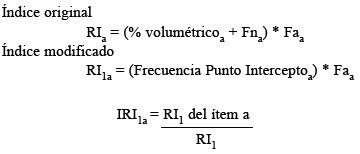
<body><![CDATA[calcul&oacute; </span><span style="font-family: arial;">un primer IRI<sub>1</sub>     para cada uno de los &iacute;tems, sin </span><span      style="font-family: arial;">tomar en cuenta la frecuencia     num&eacute;rica, talcomo lo hizo Ponte (1990), ya que este     par&aacute;metro </span><span style="font-family: arial;">no es     posible estimarlo para el componente </span><span      style="font-family: arial;">detritus. Este primer &iacute;ndice nos     permite </span><span style="font-family: arial;">establecer la     importancia del detritus dentro de </span><span      style="font-family: arial;">la dieta de esta especie.</span>     ]]></body>
<body><![CDATA[</p>     <div style="text-align: center;"><img  style="border: 0px solid ; width: 360px; height: 154px;"  src="/img/fbpe/rbt/v54n4/3490i1.JPG" align="left" title="" alt=""><br  style="font-family: arial;"> </div>     
<p align="center">&nbsp;</p>     <p style="text-align: left;"><span style="font-family: arial;">    <br> </span></small></p>     <p style="text-align: left;"><span style="font-family: arial;">    <br> </span></p>     <p style="text-align: left;"><span style="font-family: arial;">    <br> </span></p>     <p style="text-align: left;"><span style="font-family: arial;">    ]]></body>
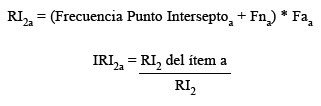
<body><![CDATA[<br> </span></p>     <p style="text-align: left;"><span style="font-family: arial;">Para el componente planct&oacute;nico, si bien se </span><span style="font-family: arial;">puede establecer la importancia de cada &iacute;tem con </span><span  style="font-family: arial;">este primer &iacute;ndice (IRI<sub>1</sub>), se calcul&oacute; un segundo </span><span style="font-family: arial;">IRI<sub>2</sub>, donde si se toman encuenta los valores </span><span  style="font-family: arial;">de Fn, lo que hace m&aacute;s confiable el c&aacute;lculo, al </span><span style="font-family: arial;">menos para estos &iacute;tems.</span></p>     <p align="justify"><img  style="border: 0px solid ; width: 321px; height: 106px;"  src="/img/fbpe/rbt/v54n4/3490i2.JPG" title="" alt=""><br  style="font-family: arial;"> <br style="font-family: arial;"> </p>     
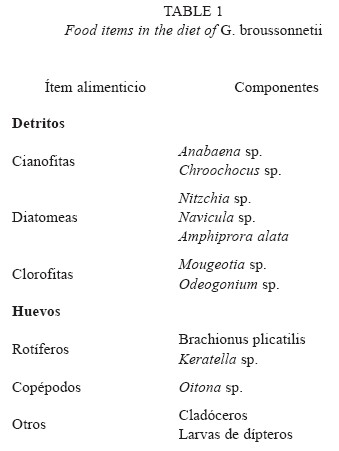
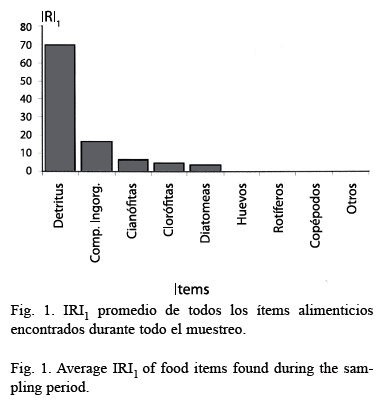
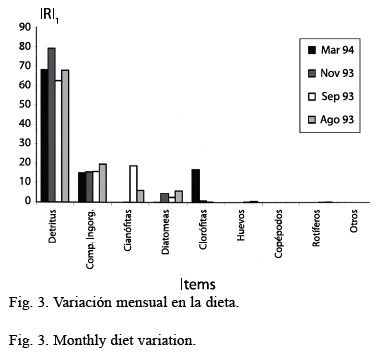
<div style="text-align: left;"><small><span style="font-family: arial;">Combinando ambos &iacute;ndices, se procedi&oacute; a </span><span  style="font-family: arial;">determinar la importancia de cada uno de los </span><span style="font-family: arial;">&iacute;tems alimenticios en la dieta de <span style="font-style: italic;">G. broussonnetii</span>. </span><span style="font-family: arial;">El IRI<sub>1</sub> permite establecer la importancia </span><span style="font-family: arial;">del detritus con respecto a los dem&aacute;s &iacute;tems y </span><span  style="font-family: arial;">con el IRI<sub>2</sub> se ordena la importancia de los </span><span style="font-family: arial;">diferentes &iacute;tems que conforman el componente </span><span  style="font-family: arial;">planct&oacute;nico.</span><br  style="font-family: arial;"> <br style="font-family: arial;"> <span style="font-family: arial;">Para establecer si existen variaciones mensuales </span><span style="font-family: arial;">en la dieta de esta especie, se utilizaron </span><span  style="font-family: arial;">los datos de frecuencia de punto intercepto </span><span style="font-family: arial;">(POSU) y se aplic&oacute; un an&aacute;lisis de tablas de </span><span  style="font-family: arial;">contingencia (Grillet y Barrera 1997).</span><br  style="font-family: arial;"> <br style="font-family: arial;"> <span style="font-family: arial;">El horario de mayor actividad alimentaria </span><span style="font-family: arial;">de esta especie se cuantific&oacute; con el peso seco de </span><span  style="font-family: arial;">cada contenido estomacal, valor con el que se </span><span style="font-family: arial;">calcul&oacute; el &iacute;ndice de cantidad de alimento (Ica) </span><span  style="font-family: arial;">(Hyslop 1980), verificando la significancia de </span><span style="font-family: arial;">los mismos con el an&aacute;lisis de Kruskal-Wallis.</span><br  style="font-family: arial;"> <br style="font-family: arial;"> <span style="font-family: arial;">Para establecer el horario de mayor actividad </span><span style="font-family: arial;">de esta especie se grafic&oacute; el n&uacute;mero </span><span  style="font-family: arial;">de ejemplares capturados en los diferentes </span><span style="font-family: arial;">horarios (N&ordm; peces/horario), y se realiz&oacute; una </span><span  style="font-family: arial;">correlaci&oacute;n con el &iacute;ndice de cantidad de alimento </span><span style="font-family: arial;">para verificar si la mayor actividad est&aacute; </span><span  style="font-family: arial;">relacionada con su proceso alimentario.</span><br  style="font-family: arial;"> <br style="font-family: arial;"> <b><span style="font-family: arial;">Resultados</span></b><br  style="font-family: arial;"> <br style="font-family: arial;"> <span style="font-family: arial;">Los resultados del &Iacute;ndice de Windell, tanto </span><span  style="font-family: arial;">el IRI1 como el IRI<sub>2</sub>, obtenidos en el an&aacute;lisis de </span><span style="font-family: arial;">la dieta de <span style="font-style: italic;">G. broussonnetii</span> permiten agrupar </span><span style="font-family: arial;">las presas consumidas en ocho categor&iacute;as o </span><span  style="font-family: arial;">&iacute;tems alimenticios (<a  href="#CUADRO1">Cuadro 1</a>).</span><br style="font-family: arial;"> <br style="font-family: arial;"> <span style="font-family: arial;">Es importante se&ntilde;alar que se incluy&oacute; en </span><span style="font-family: arial;">los an&aacute;lisis un noveno componente, denominado </span><span  style="font-family: arial;">componente inorg&aacute;nico, representado </span><span style="font-family: arial;">principalmente por arena, el cual aunque no </span><span style="font-family: arial;">representa un recurso energ&eacute;tico para el pez, es </span><span  style="font-family: arial;">importante en el proceso digestivo de muchas </span><span style="font-family: arial;">especies por su acci&oacute;n fragmentadora, lo cual </span><span  style="font-family: arial;">facilita el proceso digestivo en peces detrit&iacute;voros </span><span style="font-family: arial;">y planct&iacute;voros.</span><br style="font-family: arial;"> <br style="font-family: arial;"> <span style="font-family: arial;">Los resultados del &Iacute;ndice de Windell (IRI<sub>1</sub>) </span><span style="font-family: arial;">(<a  href="#FIG1">Fig. 1</a>) indican que el detritus, con un valor </span><span  style="font-family: arial;">promedio de 69.38 % es el componente m&aacute;s </span><span style="font-family: arial;">importante en la dieta de esta especie, seguido luego por el componente fitoplanct&oacute;nico (cianofitas, </span><span  style="font-family: arial;">clorofilas y diatomeas 3.31 %) y por </span><span  style="font-family: arial;">&uacute;ltimo el componente zooplanct&oacute;nico, con </span><span style="font-family: arial;">valores bastante bajos con relaci&oacute;n a los otros </span><span  style="font-family: arial;">&iacute;tems (huevos, rot&iacute;feros y cop&eacute;podos). Los </span><span style="font-family: arial;">resultados del IRI2 (<a href="#FIG2">Fig. 2</a>), reordenan la importancia </span><span  style="font-family: arial;">de los &iacute;temes contables dando como </span><span  style="font-family: arial;">resultado que las diatomeas con un valor de </span><span style="font-family: arial;">IRI<sub>2</sub> de 31.32 % son m&aacute;s importantes que las </span><span  style="font-family: arial;">clorofitas con un valor de 28.74 %, mientras </span><span style="font-family: arial;">que las cianofitas se mantienen como las m&aacute;s </span><span  style="font-family: arial;">importantes con un 39.24 % de IRI<sub>2</sub>. Para </span><span style="font-family: arial;">el componente zooplanct&oacute;nico la importancia </span><span  style="font-family: arial;">relativa no cambia.</span></small></div>     <p align="center"><small><a name="CUADRO1"> <img style="border: 0px solid ; width: 339px; height: 451px;"  src="/img/fbpe/rbt/v54n4/3490i3.JPG" title="" alt=""></a></small></p>     
<p align="center"><small><a name="FIG1"> <img style="border: 0px solid ; width: 383px; height: 401px;"  src="/img/fbpe/rbt/v54n4/3490i4.JPG" title="" alt=""></a>&nbsp; <a name="FIG2"><img  style="border: 0px solid ; width: 385px; height: 366px;"  src="/img/fbpe/rbt/v54n4/3490i5.JPG" title="" alt=""></a></small></p>     
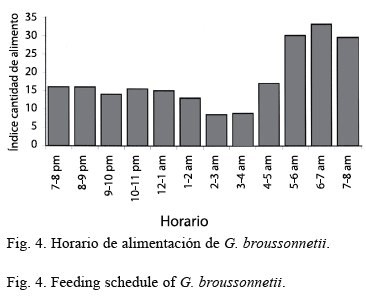
<p align="justify"><small><br style="font-family: arial;"> <br style="font-family: arial;"> </small></p>     <div style="text-align: left;"><small><span style="font-family: arial;">Tomando en cuenta los resultados de ambos </span><span style="font-family: arial;">&iacute;ndices, se puede establecer el siguiente orden </span><span  style="font-family: arial;">de importancia para los &iacute;tems consumidos por </span><span  style="font-family: arial; font-style: italic;">G. broussonnetii:</span><br  style="font-family: arial;"> <br style="font-family: arial;"> <span style="font-family: arial;">Detritus &gt; Cianofitas &gt; Diatomeas &gt; Clorofitas </span><span style="font-family: arial;">&gt; Huevos &gt; Rot&iacute;feros &gt; Cop&eacute;podos.</span><br  style="font-family: arial;"> <br style="font-family: arial;"> <span style="font-family: arial;">Con relaci&oacute;n al componente inorg&aacute;nico </span><span style="font-family: arial;">(arena), su incorporaci&oacute;n es bastante alta, con </span><span  style="font-family: arial;">un promedio de 16.44 %, siendo solo superado </span><span style="font-family: arial;">por el valor del detritus (<a href="#FIG1">Fig. 1</a>).</span><br  style="font-family: arial;"> <br style="font-family: arial;"> <span style="font-family: arial;">Los resultados del an&aacute;lisis mensual </span><span style="font-family: arial;">de la dieta revelan perfiles de consumo </span><span style="font-family: arial;">significativamente diferentes (X<sup>2</sup>= 5724.93, </span><span  style="font-family: arial;">df= 24, p&lt;0.05), existiendo diferencias temporales </span><span style="font-family: arial;">en el consumo de los diferentes &iacute;tems </span><span style="font-family: arial;">alimenticios, donde la mayor incorporaci&oacute;n </span><span  style="font-family: arial;">de detritus se da durante el mes de noviembre </span><span style="font-family: arial;">(<a href="#FIG3">Fig. 3</a>). Igualmente se da una mayor ingesta de </span><span  style="font-family: arial;">cianofitas en septiembre y de clorofilas para el </span><span style="font-family: arial;">mes de marzo (<a  href="#FIG3">Fig. 3</a>).</span><br style="font-family: arial;"> <br style="font-family: arial;"> <span style="font-family: arial;">Los resultados del &iacute;ndice de cantidad de </span><span style="font-family: arial;">alimento (Ica) (<a href="#FIG4">Fig. 4</a>) revelan la presencia de </span><span  style="font-family: arial;">un m&aacute;ximo de alimentaci&oacute;n entre las 5:00 y </span><span style="font-family: arial;">8:00 am, donde el mayor valor se alcanza entre </span><span  style="font-family: arial;">las 6:00 y 7:00 am. Estos valores son significativamente </span><span style="font-family: arial;">superiores a los obtenidos en los otros </span><span style="font-family: arial;">horarios (Kruskal-Wallis, H= 19.71; p=0.0198), </span><span  style="font-family: arial;">por lo cual podemos decir que estas son las horas </span><span style="font-family: arial;">de m&aacute;xima alimentaci&oacute;n de <span style="font-style: italic;">G. broussonnetii</span>.</span><br style="font-family: arial;"> </small></div>     <p align="justify"><small>&nbsp;</small></p>     <p align="center"><small><a name="FIG3"> <img style="border: 0px solid ; width: 376px; height: 360px;"  src="/img/fbpe/rbt/v54n4/3490i6.JPG" title="" alt=""></a>&nbsp;&nbsp; <a name="FIG4"><img  style="border: 0px solid ; width: 366px; height: 300px;"  src="/img/fbpe/rbt/v54n4/3490i7.JPG" title="" alt=""></a></small></p>     
]]></body>
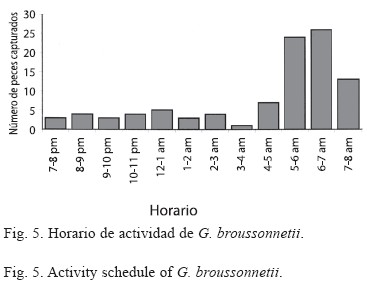
<body><![CDATA[<p align="justify"><small> <br style="font-family: arial;"> </small></p>     <div style="text-align: left;"><small><span style="font-family: arial;">Un resultado similar se obtiene con el </span><span style="font-family: arial;">horario de actividad de esta especie, donde </span><span style="font-family: arial;">las mayores capturas se dan entre las 5:00 </span><span  style="font-family: arial;">y 8:00 am. (<a href="#FIG5">Fig. 5</a>). La correlaci&oacute;n entre el </span><span style="font-family: arial;">horario de actividad de la especie y el horario </span><span style="font-family: arial;">de alimentaci&oacute;n fue significativa (Spearman, </span><span  style="font-family: arial;">r= 0.92). Entre las 8:00 am. y 7:00 pm. no se </span><span style="font-family: arial;">capturaron ejemplares en ning&uacute;n muestreo, a </span><span style="font-family: arial;">pesar de que estos fueron realizados durante </span><span  style="font-family: arial;">24 h. Igualmente a pesar de haberse realizado </span><span style="font-family: arial;">muestreos mensuales la especie no fue capturada </span><span style="font-family: arial;">durante todos los meses.</span><br style="font-family: arial;"> </small></div>     <p align="center"><small><a name="FIG5"> <img style="border: 0px solid ; width: 367px; height: 293px;"  src="/img/fbpe/rbt/v54n4/3490i8.JPG" title="" alt=""></a></small></p>     
<p align="justify"> <small><br style="font-family: arial;"> </small></p>     <div style="text-align: left;"><span      style="font-family: arial; font-weight: 700;">Discusi&oacute;n</span><small><br      style="font-family: arial;">     <br style="font-family: arial;">     <span style="font-family: arial;">Estos resultados indican que <span      style="font-style: italic;">G. broussonnetii</span> </span><span     ]]></body>
<body><![CDATA[ style="font-family: arial;">es un consumidor primario del tipo     detrit&iacute;voro, </span><span style="font-family: arial;">seg&uacute;n     la clasificaci&oacute;n de Y&aacute;&ntilde;ez-Arancibia </span><span      style="font-family: arial;">(1978), que incorpora junto al detritus un     componente vegetal y animal complementario, </span><span      style="font-family: arial;">probablemente asociado a este detritus.     As&iacute;, </span><span style="font-family: arial;">la presencia de     microalgas y del componente </span><span style="font-family: arial;">animal     en la dieta de esta especie, parece estar </span><span      style="font-family: arial;">determinada m&aacute;s que por     ]]></body>
<body><![CDATA[selectividad, a la </span><span style="font-family: arial;">asociaci&oacute;n     de dichos componentes al detritus. </span><span      style="font-family: arial;">Estos resultados concuerdan con los     obtenidos </span><span style="font-family: arial;">por Acero y     Granados (1989-1990), quienes </span><span style="font-family: arial;">concluyeron     que <span style="font-style: italic;">G. broussonnetii</span> es un     consumidor </span><span style="font-family: arial;">primario     detrit&iacute;voro, aunque las proporciones </span><span      style="font-family: arial;">e &iacute;tems complementarios son     diferentes </span><span style="font-family: arial;">a los encontrados     ]]></body>
<body><![CDATA[en este trabajo.</span><br style="font-family: arial;">     <br style="font-family: arial;">     <span style="font-family: arial;">Esta especie cumple un papel     ecol&oacute;gico </span><span style="font-family: arial;">relevante,     transformando el potencial energ&eacute;tico </span><span      style="font-family: arial;">del detritus por consumo directo,     permitiendo </span><span style="font-family: arial;">as&iacute; la     progresi&oacute;n de los nutrientes en la </span><span      style="font-family: arial;">trama tr&oacute;fica hacia niveles     superiores, tal como </span><span style="font-family: arial;">lo     ]]></body>
<body><![CDATA[se&ntilde;alan Y&aacute;&ntilde;ez-Arancibia y Nugent (1977). </span><span      style="font-family: arial;">Dicha importancia se incrementa al tomar     en </span><span style="font-family: arial;">cuenta lo abundante que es     el detritus en este </span><span style="font-family: arial;">ecosistema     costero, dado el gran aporte de </span><span      style="font-family: arial;">material al&oacute;ctono proveniente del     r&iacute;o Unare, </span><span style="font-family: arial;">el cual     representa en la actualidad el cuerpo </span><span      style="font-family: arial;">de agua con mayor influencia sobre la     laguna, </span><span style="font-family: arial;">ya que las bocas de     ]]></body>
<body><![CDATA[comunicaci&oacute;n con el mar </span><span style="font-family: arial;">est&aacute;n     cerradas.</span><br style="font-family: arial;">     <br style="font-family: arial;">     <span style="font-family: arial;">Esta especie manifiesta     variaciones     mensuales </span><span style="font-family: arial;">en la dieta, sin     embargo estas variaciones </span><span style="font-family: arial;">est&aacute;n     principalmente referidas a las </span><span style="font-family: arial;">proporciones     de consumo de los diferentes </span><span style="font-family: arial;">&iacute;tems     alimenticios, lo cual pudiese estar directamente </span><span     ]]></body>
<body><![CDATA[ style="font-family: arial;">relacionado a la disponibilidad de los </span><span      style="font-family: arial;">mismos en el ambiente, ya que es un     sistema </span><span style="font-family: arial;">estuarino donde el     aporte de material aloctono </span><span style="font-family: arial;">proveniente     del r&iacute;o var&iacute;a con la &eacute;poca del a&ntilde;o, </span><span      style="font-family: arial;">dependiendo de la intensidad de las     precipitaciones </span><span style="font-family: arial;">a lo largo de     toda la cuenca del r&iacute;o </span><span style="font-family: arial;">Unare.     As&iacute; la mayor ingesta de detritus hacia </span><span      style="font-family: arial;">el mes de noviembre puede estar asociada a     ]]></body>
<body><![CDATA[los </span><span style="font-family: arial;">m&aacute;ximos de     precipitaci&oacute;n que tambi&eacute;n se dan </span><span      style="font-family: arial;">en estos meses en las cabeceras del     r&iacute;o Unare, </span><span style="font-family: arial;">lo que     puede generar un mayor aporte de este </span><span      style="font-family: arial;">material a la laguna.</span></small><br      style="font-family: arial;">     <br style="font-family: arial;">     <small>     <span style="font-family: arial;">Finalmente, <span     ]]></body>
<body><![CDATA[ style="font-style: italic;">G. broussonnetii</span> se puede </span><span      style="font-family: arial;">caracterizar como una especie de     h&aacute;bitos matutinos, </span><span style="font-family: arial;">ya     que su mayor actividad se presenta en </span><span      style="font-family: arial;">las primeras horas de la ma&ntilde;ana y     la misma est&aacute; </span><span style="font-family: arial;">relacionada     a su proceso alimentario tal comolo revelan los resultados. El resto     del d&iacute;a no se </span><span style="font-family: arial;">pudo     determinar la ubicaci&oacute;n de esta especie, </span><span      style="font-family: arial;">ya que la misma no fue capturada y no     ]]></body>
<body><![CDATA[sabemos </span><span style="font-family: arial;">si permanece en la     laguna, remonta el r&iacute;o o </span><span      style="font-family: arial;">vuelve al mar. Por otro lado, la alta     turbidez del </span><span style="font-family: arial;">sistema impide     hacer seguimientos visuales de </span><span style="font-family: arial;">la     misma. Adicionalmente esta especie no fue </span><span      style="font-family: arial;">capturada durante todos los meses de     muestreo, </span><span style="font-family: arial;">por lo cual puede     catalogarse como un visitante </span><span style="font-family: arial;">ocasional     de la laguna m&aacute;s que un residente </span><span     ]]></body>
<body><![CDATA[ style="font-family: arial;">estuarino; sin embargo, este resultado     puede ser </span><span style="font-family: arial;">el reflejo del arte     de pesca empleado y quiz&aacute;s </span><span      style="font-family: arial;">se requiera de un mayor esfuerzo de     muestreo </span><span style="font-family: arial;">para llegar a una     conclusi&oacute;n m&aacute;s acertada.</span></small><br      style="font-family: arial;">     <small><br style="font-family: arial;">     <span style="font-family: arial; font-weight: 700;">Agradecimientos</span><br      style="font-family: arial;">     ]]></body>
<body><![CDATA[<br style="font-family: arial;">     <span style="font-family: arial;">A Carmen Teresa     Rodr&iacute;guez por su valiosa </span><span      style="font-family: arial;">colaboraci&oacute;n en la captura de los     ejemplares </span><span style="font-family: arial;">durante todos los     muestreos. A Pedro Roa, <span style="font-style: italic;">in</span> </span><span      style="font-family: arial;"><span style="font-style: italic;">memoriam</span>,     por habernos dado a conocer la </span><span style="font-family: arial;">importancia     de los sistemas lagunares costeros </span><span      style="font-family: arial;">de Venezuela.</span><br     ]]></body>
<body><![CDATA[ style="font-family: arial;">     <br style="font-family: arial;">     <span style="font-family: arial; font-weight: 700;">Resumen</span><br      style="font-family: arial;">     <br style="font-family: arial;">     <span style="font-family: arial;">La Laguna de Unare es uno de     los ecosistemas costeros </span><span style="font-family: arial;">m&aacute;s     importantes de Venezuela desde el punto de vista </span><span      style="font-family: arial;">pesquero. Durante las d&eacute;cadas de     1980 y 1990, los cambios </span><span style="font-family: arial;">en     ]]></body>
<body><![CDATA[su r&eacute;gimen hidrol&oacute;gico han afectado las     caracter&iacute;sticas </span><span style="font-family: arial;">fisicoqu&iacute;micas     del agua, con consecuencias sobre la composici&oacute;n </span><span      style="font-family: arial;">y abundancia de la fauna asociada. Un     ejemplo de </span><span style="font-family: arial;">estas variaciones     es la abundante presencia de <span style="font-style: italic;">Gobioides     </span></span><span style="font-family: arial;"><span      style="font-style: italic;">broussonnetii</span>, una especie de pez     registrada recientemente </span><span style="font-family: arial;">en     este sistema. Por tal raz&oacute;n es importante identificar </span><span     ]]></body>
<body><![CDATA[ style="font-family: arial;">nuevos procesos ecol&oacute;gicos que     pudiesen estarse dando en </span><span style="font-family: arial;">la     laguna. El detrito es el componente m&aacute;s importante en </span><span      style="font-family: arial;">la dieta de <span      style="font-style: italic;">G. broussonnetii</span>, seguido por un     componente </span><span style="font-family: arial;">vegetal y animal     asociado a este detrito: esta especie es un </span><span      style="font-family: arial;">consumidor primario detrit&iacute;voro, lo     que podr&iacute;a relacionarse </span><span style="font-family: arial;">con     su horario matutino de actividad. Esta especie no es </span><span     ]]></body>
<body><![CDATA[ style="font-family: arial;">capturada regularmente en los muestreos     mensuales, lo cual </span><span style="font-family: arial;">hacer     pensar que es un visitante ocasional de la laguna.</span><br      style="font-family: arial;">     <br style="font-family: arial;">     <span style="font-family: arial;"><span style="font-weight: bold;">Palabras     clave</span>: Gobioides broussonnetii, detrit&iacute;voro, </span><span      style="font-family: arial;">laguna costera, alimentaci&oacute;n,     estado tr&oacute;fico.</span><br style="font-family: arial;">     <br style="font-family: arial;">     ]]></body>
<body><![CDATA[<span style="font-family: arial;"><b><font size="3"><small>Referencias</small></font></b></span>    <!-- ref --><br> <br style="font-family: arial;"> <span style="font-family: arial;">Acero, A. &amp; P. Granados. 1989-1990. <span style="font-style: italic;">Gobioides broussoneti</span> </span><span style="font-family: arial;">Lacepede (Pisces: Gobiidae) en el Caribe </span><span  style="font-family: arial;">Colombiano. An. Inst. Invest. Mar. Punta Betin. 19- </span><span style="font-family: arial;">20: 197-200.</span><br  style="font-family: arial;"> <br style="font-family: arial;"> <span style="font-family: arial;">    &nbsp;&nbsp;&nbsp;&nbsp;&nbsp;&nbsp;&nbsp;&nbsp;[&#160;<a href="javascript:void(0);" onclick="javascript: window.open('/scielo.php?script=sci_nlinks&ref=1354325&pid=S0034-7744200600040000400001&lng=','','width=640,height=500,resizable=yes,scrollbars=1,menubar=yes,');">Links</a>&#160;]<!-- end-ref --><!-- ref -->Cervig&oacute;n, F. 1994. Los Peces Marinos de Venezuela. Tomo </span><span style="font-family: arial;">III. Ex-Libris, Caracas, Venezuela. 295 p.</span><br  style="font-family: arial;"> <br style="font-family: arial;"> <span style="font-family: arial;">    &nbsp;&nbsp;&nbsp;&nbsp;&nbsp;&nbsp;&nbsp;&nbsp;[&#160;<a href="javascript:void(0);" onclick="javascript: window.open('/scielo.php?script=sci_nlinks&ref=1354326&pid=S0034-7744200600040000400002&lng=','','width=640,height=500,resizable=yes,scrollbars=1,menubar=yes,');">Links</a>&#160;]<!-- end-ref --><!-- ref -->Grillet, M. &amp; R. Barrera. 1997. Spatial and temporal abundance, </span><span  style="font-family: arial;">substrate partitioning and species co-ocurrence </span><span style="font-family: arial;">in a guild of Neotropical blackflies (Diptera: </span><span  style="font-family: arial;">Simuliidae). Hidrobiol. 345: 197-208.</span><br  style="font-family: arial;"> <br style="font-family: arial;"> <span style="font-family: arial;">    &nbsp;&nbsp;&nbsp;&nbsp;&nbsp;&nbsp;&nbsp;&nbsp;[&#160;<a href="javascript:void(0);" onclick="javascript: window.open('/scielo.php?script=sci_nlinks&ref=1354327&pid=S0034-7744200600040000400003&lng=','','width=640,height=500,resizable=yes,scrollbars=1,menubar=yes,');">Links</a>&#160;]<!-- end-ref --><!-- ref -->Hyslop, E. 1980. Stomach contents analysis-a review </span><span style="font-family: arial;">of methods and their application. J. Fish Biol. 17: </span><span  style="font-family: arial;">411-429.</span><br  style="font-family: arial;"> <br style="font-family: arial;"> <span style="font-family: arial;">    &nbsp;&nbsp;&nbsp;&nbsp;&nbsp;&nbsp;&nbsp;&nbsp;[&#160;<a href="javascript:void(0);" onclick="javascript: window.open('/scielo.php?script=sci_nlinks&ref=1354328&pid=S0034-7744200600040000400004&lng=','','width=640,height=500,resizable=yes,scrollbars=1,menubar=yes,');">Links</a>&#160;]<!-- end-ref --><!-- ref -->Lacep&eacute;de, B.G.E. 1800. Histoire Naturelle des poissons.Muse&eacute; </span><span  style="font-family: arial;">National d&#8217;Histoire Naturelle, Paris, Francia. 632 p.</span><br style="font-family: arial;"> <br style="font-family: arial;"> <span style="font-family: arial;">    &nbsp;&nbsp;&nbsp;&nbsp;&nbsp;&nbsp;&nbsp;&nbsp;[&#160;<a href="javascript:void(0);" onclick="javascript: window.open('/scielo.php?script=sci_nlinks&ref=1354329&pid=S0034-7744200600040000400005&lng=','','width=640,height=500,resizable=yes,scrollbars=1,menubar=yes,');">Links</a>&#160;]<!-- end-ref --><!-- ref -->Mago, F. 1965. Contribuci&oacute;n a la sistem&aacute;tica y ecolog&iacute;a </span><span  style="font-family: arial;">de los peces de la Laguna de Unare, Venezuela. Bull. </span><span style="font-family: arial;">Mar. Sci. 15: 274-330.</span><br style="font-family: arial;"> <br style="font-family: arial;"> <span style="font-family: arial;">    &nbsp;&nbsp;&nbsp;&nbsp;&nbsp;&nbsp;&nbsp;&nbsp;[&#160;<a href="javascript:void(0);" onclick="javascript: window.open('/scielo.php?script=sci_nlinks&ref=1354330&pid=S0034-7744200600040000400006&lng=','','width=640,height=500,resizable=yes,scrollbars=1,menubar=yes,');">Links</a>&#160;]<!-- end-ref --><!-- ref -->Ponte, V. 1990. Recurso tr&oacute;fico utilizado por peces juveniles </span><span  style="font-family: arial;">en dos &aacute;reas del delta inferior del R&iacute;o Orinoco. </span><span style="font-family: arial;">Tesis de Licenciatura, Univ. Central de Venezuela, </span><span  style="font-family: arial;">Venezuela. 89 p.</span><br  style="font-family: arial;"> <br style="font-family: arial;"> <span style="font-family: arial;">    &nbsp;&nbsp;&nbsp;&nbsp;&nbsp;&nbsp;&nbsp;&nbsp;[&#160;<a href="javascript:void(0);" onclick="javascript: window.open('/scielo.php?script=sci_nlinks&ref=1354331&pid=S0034-7744200600040000400007&lng=','','width=640,height=500,resizable=yes,scrollbars=1,menubar=yes,');">Links</a>&#160;]<!-- end-ref --><!-- ref -->Roa, P. 1989. Resumen de las caracter&iacute;sticas generales de </span><span  style="font-family: arial;">las lagunas costeras de Tacarigua, Unare y Piritu. <span style="font-style: italic;">In</span> </span><span  style="font-family: arial;">Proyecto &#8220;Aquila&#8221; GCP/RLA/075/ITA. Convenio </span><span style="font-family: arial;">FAO-Univ. Sim&oacute;n Bol&iacute;var. Caracas, Venezuela. </span><span  style="font-family: arial;">17 p.</span><br style="font-family: arial;"> <br style="font-family: arial;"> <span style="font-family: arial;">    &nbsp;&nbsp;&nbsp;&nbsp;&nbsp;&nbsp;&nbsp;&nbsp;[&#160;<a href="javascript:void(0);" onclick="javascript: window.open('/scielo.php?script=sci_nlinks&ref=1354332&pid=S0034-7744200600040000400008&lng=','','width=640,height=500,resizable=yes,scrollbars=1,menubar=yes,');">Links</a>&#160;]<!-- end-ref --><!-- ref -->Roa, P. 1993. La Transgresi&oacute;n Flamenca y la evoluci&oacute;n de </span><span  style="font-family: arial;">la Laguna de Unare, Venezuela. Bol. Inst. Oceanogr. </span><span style="font-family: arial;">Venez. Universidad de Oriente, Venezuela 29: 11-25.</span><br style="font-family: arial;"> <br style="font-family: arial;"> <span style="font-family: arial;">    &nbsp;&nbsp;&nbsp;&nbsp;&nbsp;&nbsp;&nbsp;&nbsp;[&#160;<a href="javascript:void(0);" onclick="javascript: window.open('/scielo.php?script=sci_nlinks&ref=1354333&pid=S0034-7744200600040000400009&lng=','','width=640,height=500,resizable=yes,scrollbars=1,menubar=yes,');">Links</a>&#160;]<!-- end-ref --><!-- ref -->Weinberg, S. 1981. A comparison of coral reef survey </span><span style="font-family: arial;">methods. Bijdr. Dierk. 51: 199-218.</span><br style="font-family: arial;"> <br style="font-family: arial;"> <span style="font-family: arial;">    &nbsp;&nbsp;&nbsp;&nbsp;&nbsp;&nbsp;&nbsp;&nbsp;[&#160;<a href="javascript:void(0);" onclick="javascript: window.open('/scielo.php?script=sci_nlinks&ref=1354334&pid=S0034-7744200600040000400010&lng=','','width=640,height=500,resizable=yes,scrollbars=1,menubar=yes,');">Links</a>&#160;]<!-- end-ref --><!-- ref -->Wetzel, R. &amp; G.E. Likens. 1991. Limnological analyses. </span><span style="font-family: arial;">Springer, Nueva York, EEUU. 391 p.</span><br style="font-family: arial;"> <br style="font-family: arial;"> <span style="font-family: arial;">    &nbsp;&nbsp;&nbsp;&nbsp;&nbsp;&nbsp;&nbsp;&nbsp;[&#160;<a href="javascript:void(0);" onclick="javascript: window.open('/scielo.php?script=sci_nlinks&ref=1354335&pid=S0034-7744200600040000400011&lng=','','width=640,height=500,resizable=yes,scrollbars=1,menubar=yes,');">Links</a>&#160;]<!-- end-ref --><!-- ref -->Y&aacute;&ntilde;ez-Arancibia, A. 1978. Taxonom&iacute;a, ecolog&iacute;a y estructura </span><span  style="font-family: arial;">de las comunidades de peces en lagunas costeras </span><span style="font-family: arial;">con bocas ef&iacute;meras del Pacifico de M&eacute;xico. Centro </span><span  style="font-family: arial;">Cien. del Mar y Limnol. Univ. Nal. Aut&oacute;n. M&eacute;xico. </span><span style="font-family: arial;">2303 p.</span><br style="font-family: arial;"> <br style="font-family: arial;"> <span style="font-family: arial;">    &nbsp;&nbsp;&nbsp;&nbsp;&nbsp;&nbsp;&nbsp;&nbsp;[&#160;<a href="javascript:void(0);" onclick="javascript: window.open('/scielo.php?script=sci_nlinks&ref=1354336&pid=S0034-7744200600040000400012&lng=','','width=640,height=500,resizable=yes,scrollbars=1,menubar=yes,');">Links</a>&#160;]<!-- end-ref --><!-- ref -->Y&aacute;&ntilde;ez-Arancibia, A. &amp; R. Nugent. 1977. El papel ecol&oacute;gico </span><span  style="font-family: arial;">de los peces en estuarios y lagunas costeras. An. </span><span style="font-family: arial;">Centro Cien. del Mar y Limnol. Univ. Nal. Aut&oacute;n. </span><span  style="font-family: arial;">M&eacute;xico 4: 107-114.</span> </small></div>    &nbsp;&nbsp;&nbsp;&nbsp;&nbsp;&nbsp;&nbsp;&nbsp;[&#160;<a href="javascript:void(0);" onclick="javascript: window.open('/scielo.php?script=sci_nlinks&ref=1354337&pid=S0034-7744200600040000400013&lng=','','width=640,height=500,resizable=yes,scrollbars=1,menubar=yes,');">Links</a>&#160;]<!-- end-ref --> ]]></body><back>
<ref-list>
<ref id="B1">
<nlm-citation citation-type="journal">
<person-group person-group-type="author">
<name>
<surname><![CDATA[Acero]]></surname>
<given-names><![CDATA[A]]></given-names>
</name>
<name>
<surname><![CDATA[Granados]]></surname>
<given-names><![CDATA[P]]></given-names>
</name>
</person-group>
<article-title xml:lang="es"><![CDATA[Gobioides broussoneti Lacepede (Pisces: Gobiidae) en el Caribe Colombiano]]></article-title>
<source><![CDATA[An. Inst. Invest. Mar. Punta Betin]]></source>
<year>1989</year>
<month>-1</month>
<day>99</day>
<volume>19- 20</volume>
<page-range>197-200</page-range></nlm-citation>
</ref>
<ref id="B2">
<nlm-citation citation-type="book">
<person-group person-group-type="author">
<name>
<surname><![CDATA[Cervigón]]></surname>
<given-names><![CDATA[F]]></given-names>
</name>
</person-group>
<source><![CDATA[Los Peces Marinos de Venezuela. Tomo III]]></source>
<year>1994</year>
<page-range>295</page-range><publisher-loc><![CDATA[Caracas ]]></publisher-loc>
<publisher-name><![CDATA[Ex-Libris]]></publisher-name>
</nlm-citation>
</ref>
<ref id="B3">
<nlm-citation citation-type="journal">
<person-group person-group-type="author">
<name>
<surname><![CDATA[Grillet]]></surname>
<given-names><![CDATA[M]]></given-names>
</name>
<name>
<surname><![CDATA[Barrera]]></surname>
<given-names><![CDATA[R]]></given-names>
</name>
</person-group>
<article-title xml:lang="en"><![CDATA[Spatial and temporal abundance, substrate partitioning and species co-ocurrence in a guild of Neotropical blackflies (Diptera: Simuliidae)]]></article-title>
<source><![CDATA[Hidrobiol]]></source>
<year>1997</year>
<volume>345</volume>
<page-range>197-208</page-range></nlm-citation>
</ref>
<ref id="B4">
<nlm-citation citation-type="journal">
<person-group person-group-type="author">
<name>
<surname><![CDATA[Hyslop]]></surname>
<given-names><![CDATA[E]]></given-names>
</name>
</person-group>
<article-title xml:lang="en"><![CDATA[Stomach contents analysis-a review of methods and their application]]></article-title>
<source><![CDATA[J. Fish Biol]]></source>
<year>1980</year>
<volume>17</volume>
<page-range>411-429</page-range></nlm-citation>
</ref>
<ref id="B5">
<nlm-citation citation-type="book">
<person-group person-group-type="author">
<name>
<surname><![CDATA[Lacepéde]]></surname>
<given-names><![CDATA[B.G.E]]></given-names>
</name>
</person-group>
<source><![CDATA[Histoire Naturelle des poissons]]></source>
<year>1800</year>
<page-range>632</page-range><publisher-loc><![CDATA[Paris ]]></publisher-loc>
<publisher-name><![CDATA[Museé National d’Histoire Naturelle]]></publisher-name>
</nlm-citation>
</ref>
<ref id="B6">
<nlm-citation citation-type="journal">
<person-group person-group-type="author">
<name>
<surname><![CDATA[Mago]]></surname>
<given-names><![CDATA[F]]></given-names>
</name>
</person-group>
<article-title xml:lang="es"><![CDATA[Contribución a la sistemática y ecología de los peces de la Laguna de Unare, Venezuela]]></article-title>
<source><![CDATA[Bull. Mar. Sci]]></source>
<year>1965</year>
<volume>15</volume>
<page-range>274-330</page-range></nlm-citation>
</ref>
<ref id="B7">
<nlm-citation citation-type="">
<person-group person-group-type="author">
<name>
<surname><![CDATA[Ponte]]></surname>
<given-names><![CDATA[V]]></given-names>
</name>
</person-group>
<source><![CDATA[Recurso trófico utilizado por peces juveniles en dos áreas del delta inferior del Río Orinoco]]></source>
<year>1990</year>
<page-range>89</page-range></nlm-citation>
</ref>
<ref id="B8">
<nlm-citation citation-type="book">
<person-group person-group-type="author">
<name>
<surname><![CDATA[Roa]]></surname>
<given-names><![CDATA[P]]></given-names>
</name>
</person-group>
<article-title xml:lang="es"><![CDATA[Resumen de las características generales de las lagunas costeras de Tacarigua, Unare y Piritu]]></article-title>
<source><![CDATA[Proyecto "Aquila" GCP/RLA/075/ITA. Convenio FAO-Univ]]></source>
<year>1989</year>
<page-range>17</page-range><publisher-loc><![CDATA[Caracas ]]></publisher-loc>
<publisher-name><![CDATA[Simón Bolívar]]></publisher-name>
</nlm-citation>
</ref>
<ref id="B9">
<nlm-citation citation-type="journal">
<person-group person-group-type="author">
<name>
<surname><![CDATA[Roa]]></surname>
<given-names><![CDATA[P]]></given-names>
</name>
</person-group>
<article-title xml:lang="es"><![CDATA[La Transgresión Flamenca y la evolución de la Laguna de Unare, Venezuela]]></article-title>
<source><![CDATA[Bol. Inst. Oceanogr. Venez]]></source>
<year>1993</year>
<volume>29</volume>
<page-range>11-25</page-range><publisher-name><![CDATA[Universidad de Oriente]]></publisher-name>
</nlm-citation>
</ref>
<ref id="B10">
<nlm-citation citation-type="journal">
<person-group person-group-type="author">
<name>
<surname><![CDATA[Weinberg]]></surname>
<given-names><![CDATA[S]]></given-names>
</name>
</person-group>
<article-title xml:lang="en"><![CDATA[A comparison of coral reef survey methods]]></article-title>
<source><![CDATA[Bijdr. Dierk]]></source>
<year>1981</year>
<volume>51</volume>
<page-range>199-218</page-range></nlm-citation>
</ref>
<ref id="B11">
<nlm-citation citation-type="book">
<person-group person-group-type="author">
<name>
<surname><![CDATA[Wetzel]]></surname>
<given-names><![CDATA[R]]></given-names>
</name>
<name>
<surname><![CDATA[Likens]]></surname>
<given-names><![CDATA[G.E]]></given-names>
</name>
</person-group>
<source><![CDATA[Limnological analyses]]></source>
<year>1991</year>
<page-range>391</page-range><publisher-loc><![CDATA[^eNueva York Nueva York]]></publisher-loc>
<publisher-name><![CDATA[Springer]]></publisher-name>
</nlm-citation>
</ref>
<ref id="B12">
<nlm-citation citation-type="journal">
<person-group person-group-type="author">
<name>
<surname><![CDATA[Yáñez-Arancibia]]></surname>
<given-names><![CDATA[A]]></given-names>
</name>
</person-group>
<article-title xml:lang="es"><![CDATA[Taxonomía, ecología y estructura de las comunidades de peces en lagunas costeras con bocas efímeras del Pacifico de México]]></article-title>
<source><![CDATA[Centro Cien. del Mar y Limnol. Univ. Nal. Autón]]></source>
<year>1978</year>
<page-range>2303</page-range></nlm-citation>
</ref>
<ref id="B13">
<nlm-citation citation-type="journal">
<person-group person-group-type="author">
<name>
<surname><![CDATA[Yáñez-Arancibia]]></surname>
<given-names><![CDATA[A]]></given-names>
</name>
<name>
<surname><![CDATA[Nugent]]></surname>
<given-names><![CDATA[R]]></given-names>
</name>
</person-group>
<article-title xml:lang="es"><![CDATA[El papel ecológico de los peces en estuarios y lagunas costeras]]></article-title>
<source><![CDATA[An. Centro Cien. del Mar y Limnol. Univ. Nal. Autón]]></source>
<year>1977</year>
<volume>4</volume>
<page-range>107-114</page-range></nlm-citation>
</ref>
</ref-list>
</back>
</article>