<?xml version="1.0" encoding="ISO-8859-1"?><article xmlns:mml="http://www.w3.org/1998/Math/MathML" xmlns:xlink="http://www.w3.org/1999/xlink" xmlns:xsi="http://www.w3.org/2001/XMLSchema-instance">
<front>
<journal-meta>
<journal-id>0034-7744</journal-id>
<journal-title><![CDATA[Revista de Biología Tropical]]></journal-title>
<abbrev-journal-title><![CDATA[Rev. biol. trop]]></abbrev-journal-title>
<issn>0034-7744</issn>
<publisher>
<publisher-name><![CDATA[Universidad de Costa Rica]]></publisher-name>
</publisher>
</journal-meta>
<article-meta>
<article-id>S0034-77442006000400002</article-id>
<title-group>
<article-title xml:lang="en"><![CDATA[Population structure and accompanying biota of the snail Turbo (Callopoma) funiculosus (Gastropoda: Turbinidae), on Socorro Island, Revillagigedo Archipelago, Mexico]]></article-title>
</title-group>
<contrib-group>
<contrib contrib-type="author">
<name>
<surname><![CDATA[Holguin Quiñones]]></surname>
<given-names><![CDATA[Oscar E]]></given-names>
</name>
<xref ref-type="aff" rid="A01"/>
</contrib>
<contrib contrib-type="author">
<name>
<surname><![CDATA[Michel-Morfín]]></surname>
<given-names><![CDATA[Jesús E]]></given-names>
</name>
<xref ref-type="aff" rid="A02"/>
</contrib>
</contrib-group>
<aff id="A01">
<institution><![CDATA[,Centro Interdisciplinario de Ciencias Marinas-IPN  ]]></institution>
<addr-line><![CDATA[ ]]></addr-line>
<country>México</country>
</aff>
<aff id="A02">
<institution><![CDATA[,Universidad de Guadalajara  ]]></institution>
<addr-line><![CDATA[ ]]></addr-line>
</aff>
<pub-date pub-type="pub">
<day>00</day>
<month>12</month>
<year>2006</year>
</pub-date>
<pub-date pub-type="epub">
<day>00</day>
<month>12</month>
<year>2006</year>
</pub-date>
<volume>54</volume>
<numero>4</numero>
<fpage>1079</fpage>
<lpage>1084</lpage>
<copyright-statement/>
<copyright-year/>
<self-uri xlink:href="http://www.scielo.sa.cr/scielo.php?script=sci_arttext&amp;pid=S0034-77442006000400002&amp;lng=en&amp;nrm=iso"></self-uri><self-uri xlink:href="http://www.scielo.sa.cr/scielo.php?script=sci_abstract&amp;pid=S0034-77442006000400002&amp;lng=en&amp;nrm=iso"></self-uri><self-uri xlink:href="http://www.scielo.sa.cr/scielo.php?script=sci_pdf&amp;pid=S0034-77442006000400002&amp;lng=en&amp;nrm=iso"></self-uri><abstract abstract-type="short" xml:lang="en"><p><![CDATA[The porcelain snail, Turbo funiculosus, is a potential fishery resource that almost has not been studied or used commercially. In March of 1992, we sampled T. funiculosus in Bahía Binners and Bahía Blanca, Socorro Island, Revillagigedo Archipelago, using 25 m² quadrants. We found that total length varies between 3.0 and 85 mm, proportional weight between 3.0 and 228 g, and density between 6.21 and 9.87 ind/m². The largest organisms (over 50 mm) contain 30.6 % of soft parts. Porcelain snail populations remain unexploited on Revillagedo Archipelago and could be a potential resource under an adequate management strategy. Rev. Biol. Trop. 54 (4): 1079-1084. Epub 2006 Dec. 15.]]></p></abstract>
<abstract abstract-type="short" xml:lang="es"><p><![CDATA[El caracol porcelana, Turbo funiculosus, es un recurso pesquero potencial que casi no ha sido estudiado ni se ha utilizado comercialmente. En marzo de 1992, se realizó un muestreo de T. funiculosus en Bahía Binners y Bahía Blanca, isla Socorro, archipiélago Revillagigedo, empleando cuadrantes de 25 m2. Se encontraron variaciones en la longitud total entre 3.0 y 85 mm, el peso proporcional entre 3.0 y 228 g, y la densidad entre 6.21 y 9.87 ind/m2. Los organismos de mayor tamaño (más de 50 mm) contienen 30.6 % de partes suaves. Las poblaciones del caracol porcelana siguen siendo inexplotadas en el archipiélago Revillagedo y podrían ser un recurso potencial de la industria pesquera bajo un adecuado plan de manejo.]]></p></abstract>
<kwd-group>
<kwd lng="en"><![CDATA[Turbo funiculosus]]></kwd>
<kwd lng="en"><![CDATA[mollusk]]></kwd>
<kwd lng="en"><![CDATA[density]]></kwd>
<kwd lng="en"><![CDATA[weight]]></kwd>
<kwd lng="en"><![CDATA[length]]></kwd>
<kwd lng="en"><![CDATA[Socorro Island]]></kwd>
<kwd lng="es"><![CDATA[Turbo funiculosus]]></kwd>
<kwd lng="es"><![CDATA[molusco]]></kwd>
<kwd lng="es"><![CDATA[densidad]]></kwd>
<kwd lng="es"><![CDATA[peso]]></kwd>
<kwd lng="es"><![CDATA[longitud]]></kwd>
<kwd lng="es"><![CDATA[Isla Socorro]]></kwd>
</kwd-group>
</article-meta>
</front><body><![CDATA[ <div style="text-align: center; font-family: arial;">     <div style="text-align: left;"><span  style="font-weight: bold; font-family: arial;">Population structure and accompanying biota of the snail</span><span style="font-family: arial;"> </span><span  style="font-style: italic; font-family: arial;">Turbo (Callopoma) funiculosus</span><span style="font-family: arial;"> </span><span  style="font-weight: bold;"><span style="font-family: arial;">(Gastropoda: Turbinidae), on Socorro Island, Revillagigedo Archipelago, Mexico</span></span>    <br> </div> <span style="font-weight: bold;">    <br> </span>     <div style="text-align: left;">Oscar E. Holguin Qui&ntilde;ones<sup>1</sup> &amp; Jes&uacute;s E. Michel-Morf&iacute;n<sup>2</sup>    <br>     <br> 1 Centro Interdisciplinario de Ciencias Marinas-IPN. A.P. 592, La Paz, B.C.S., CP 23096, M&eacute;xico. Fax: (612) 122 53 22; <a href="mailto:oholguin@ipn.mx">oholguin@ipn.mx</a>    <br> 2 Departamento de Estudios para el desarrollo sustentable de zonas costeras. Universidad de Guadalajara. G&oacute;mez Farias 82, San Patricio-Melaque, Jal. C.P. 48980, M&eacute;xico. Fax (315) 355-6331; <a href="mailto:michel@costera.melaque.udg.mx">michel@costera.melaque.udg.mx</a>    <br>     <br>     ]]></body>
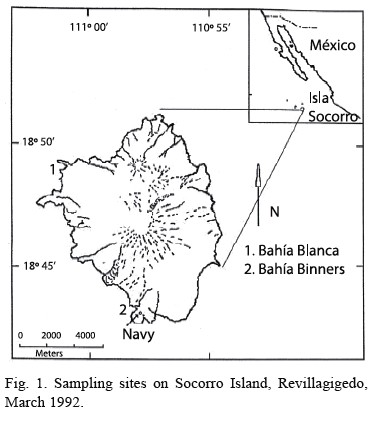
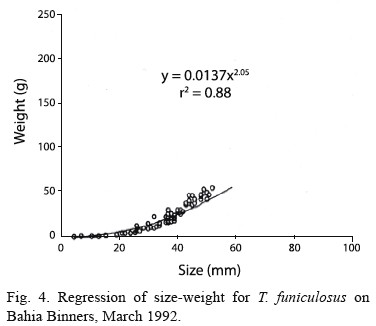
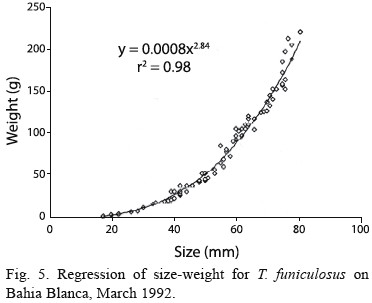
<body><![CDATA[<div style="text-align: center;">Received 10-VI-2002. Corrected 13-I-2004. Accepted 29-V-2006.    <br>     <br>     <br>     <div style="text-align: left;"><span style="font-weight: bold;">Abstract</span>: The porcelain snail, <span style="font-style: italic;">Turbo funiculosus</span>, is a potential fishery resource that almost has not been studied or used commercially. In March of 1992, we sampled <span style="font-style: italic;">T. funiculosus</span> in Bah&iacute;a Binners and Bah&iacute;a Blanca, Socorro Island, Revillagigedo Archipelago, using 25 m<sup>2</sup> quadrants. We found that total length varies between 3.0 and 85 mm, proportional weight between 3.0 and 228 g, and density between 6.21 and 9.87 ind/m<sup>2</sup>. The largest organisms (over 50 mm) contain 30.6 % of soft parts. Porcelain snail populations remain unexploited on Revillagedo Archipelago and could be a potential resource under an adequate management strategy. Rev. Biol. Trop. 54 (4): 1079-1084. Epub 2006 Dec. 15.    <br>     <br> <span style="font-weight: bold;">Key words:</span> <span  style="font-style: italic;">Turbo funiculosus</span>, mollusk, density, weight, length, Socorro Island.    <br>     <br> <span style="font-family: arial;">Among the marine invertebrates, mollusks are one of the most important groups on Socorro Island. Turban shells are benthic marine animals, fairly common on the Revillagigedo Islands, which can also be found in tidal pools, shallow rocky bottoms, and weed-covered reefs. They are members of the order Archeogastropoda, family Turbinidae. They are primitive prosobranchs with radula modified for herbivory (Brusca and Brusca 1990) and possess a single snail-like shell. They also possess a thick operculum, a calcareous plate used to protect the animal when it withdraws into its shell.</span><br  style="font-family: arial;"> <br style="font-family: arial;"> <span style="font-family: arial;">The porcelain snail, or turban shell </span><span style="font-style: italic; font-family: arial;">Turbo funiculosus</span><span style="font-family: arial;">, stands out because of its abundance and its possible integral uses in this insular place. This is also true of the indopacific species </span><span  style="font-style: italic; font-family: arial;">T. marmoratus</span><span  style="font-family: arial;"> and </span><span  style="font-style: italic; font-family: arial;">T. brunneus</span><span  style="font-family: arial;"> (Devaraj 1996, Castell and Sweatman 1997, Dorairaj and Soundararajan 1998, Kikutani </span><span  style="font-style: italic; font-family: arial;">et al</span><span  style="font-family: arial;">. 2002), the foot and shell of which have a high market value. Other internal parts are also used as food for domestic animals. The foot is actually utilized in Socorro Island only in subsistence fisheries. It is still an important resource since it has not been fished commercially (Holguin 1991). Keen (l971) states that this species is widely distributed on the islands of the Revillagigedo Archipelago. He also mentions that it can be found, though less frequently, in the area of Cape San Lucas B.C.S.</span><br  style="font-family: arial;"> <br style="font-family: arial;"> <span style="font-family: arial;">The faraway location of the Revillagigedo Archipelago from the continental coasts had been one of the factors that has made it difficult to complete any scientific study. The biological or ecological aspects of the population of </span><span  style="font-style: italic; font-family: arial;">T. funiculosus</span><span  style="font-family: arial;"> were not studied by researchers. The state of the populations of this mollusk is practically unknown in its area of geographical distribution. Knowledge of this species on Socorro Island is limited to the references made by Strong and Hanna 1930 (</span><span  style="font-style: italic; font-family: arial;">as T. fluctuosum</span><span  style="font-family: arial;">), Keen 1971, Chan l974, Holguin 1991, Holgu&iacute;n </span><span  style="font-style: italic; font-family: arial;">et al.</span><span  style="font-family: arial;"> 1992, Bautista-Romero et al. l994, Holguin 1994, Mille-Pagaza et al. l994, Emerson l995, and Reyes-Bonilla 1999. Nonetheless, these works do not address any aspects of its biology, fishery, or population status. Chan (1974) made 36 dives at depths between 3 and 23 m in Bah&iacute;a Braithwaite and found the species at approximately 15 fathoms. There is no additional information in the literature about the abundance and distribution of this species.</span><br  style="font-family: arial;"> <br style="font-family: arial;"> <span style="font-family: arial;">Many species coexist with overlapping ranges and food resources. very few reports exist about the fauna that accompanies </span><span  style="font-style: italic; font-family: arial;">T. funiculosus</span><span  style="font-family: arial;"> (Bautista-Romero </span><span  style="font-style: italic; font-family: arial;">et al</span><span  style="font-family: arial;">. 1994, Holguin 1994, Mille-Pagaza </span><span  style="font-style: italic; font-family: arial;">et al.</span><span  style="font-family: arial;"> 1994). Numerous species of algae, invertebrates, and fish occupy the intertidal and splash zones with partial overlapping ranges. A typical rocky shore setting might show the sequence Littorinidae, Acmaeidae, Mytilidae, Ostreidae, </span><span  style="font-style: italic; font-family: arial;">Turbo</span><span  style="font-family: arial;">, chitons, and Trochidae as the most conspicuous forms of mollusks from the splash zone (Engeman and Hegner 1981).</span><br style="font-family: arial;">     <br> <!-- big --><span style="font-family: arial; font-weight: 700;">M</span><span  style="font-weight: 700;">aterials and methods</span><!-- /big --><br  style="font-family: arial;"> <br style="font-family: arial;"> <span style="font-family: arial;">The Revillagigedo Archipelago (<a  href="#fig1">Fig. 1</a>) is located approximately 350-650 km southeast of the Baja California Peninsula, 580 km west of the Colima coast (Llinas-Gutierrez </span><span  style="font-style: italic; font-family: arial;">et al.</span><span  style="font-family: arial;"> 1993), and is comprised of Socorro, Clarion, San Benedicto, and Roca Partida islands. Socorro Island, with a surface area of 167 km2, is the largest of the islands and has a maximum diameter of 16 km in a NW-SW direction. Geographically, Socorro Island is located at 18&deg;41&#8217;57&#8217;&#8217; N and 110&deg;56&#8217;33&#8217;&#8217; W (Troyo-Di&eacute;guez and Pedr&iacute;n 1994). The island is composed primarily of braced igneous rock, with the presence of smooth stones and sandy or stone-sandy beaches (Holguin 1994).</span><br  style="font-family: arial;"> <br style="font-family: arial;"> <span style="font-family: arial;">In March of l992, some observations about the densities by area were done. They determined the relationship between size and weightof </span><span  style="font-style: italic; font-family: arial;">T. funiculosus</span><span  style="font-family: arial;"> in two locations of the island: Bah&iacute;a Binners in the southern part and Bah&iacute;a Blanca NW (or Playa Blanca) located in the northeast of the same island (<a  href="#fig1">Fig. 1</a>).</span><br style="font-family: arial;"> <br style="font-family: arial;"> <span style="font-family: arial;">The data was obtained out of a total of eight quadrants, which were made using a 20 m cord marked every 5 m. The squares were 5 x 5 m with an area of 25 m</span><sup  style="font-family: arial;">2</sup><span style="font-family: arial;"> each. The data about the relative abundance or density of the organisms is the result of the counting and gathering of all the live shells found in the eight quadrants (200 m</span><sup  style="font-family: arial;">2</sup><span style="font-family: arial;"> in total), situated in tide pools and rocky areas of the intertidal fringe.</span><br style="font-family: arial;"> <br style="font-family: arial;"> <span style="font-family: arial;">The sampled specimens in only one quadrant by location were used to elaborate histograms of size frequency. In Bah&iacute;a Blanca a small lot of 50 individuals was taken to get information of the proportion of the weight of the viscera and the weight of the foot respective to the total weight. The register of the size parameter was done using a 0.5 mm accuracy vernier calliper, considering the height or major dimension along the columellar axis. The total weight (including the shell) was taken by a 0.5 g accuracy triple arm scale. After being measured, all animals were liberated in the rocky intertidal zone.</span><br  style="font-family: arial;"> <br style="font-family: arial;"> <span style="font-family: arial;">The analysis of the weight and sizes was carried out using the computer program StatGraphic 3.0 and a multiplying model of simple&nbsp; regression: Y= ax</span><sup  style="font-family: arial;">b</sup><span style="font-family: arial;"> for size weight correlation, obtaining regressions by sampling areas.</span></div>     ]]></body>
<body><![CDATA[<div style="text-align: center;"><a name="fig1"> <img  style="border: 0px solid ; width: 374px; height: 423px;"  src="/img/fbpe/rbt/v54n4/3488i1.JPG" title="" alt=""></a>&nbsp;    
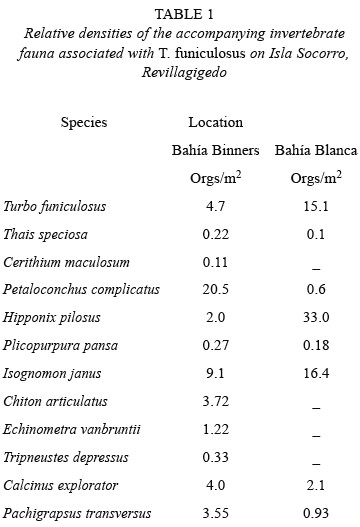
<br> </div>     <div style="text-align: left;"><span  style="font-family: arial; font-weight: 700;">R</span><font size="3"><span  style="font-weight: 700;">esults</span></font><br  style="font-family: arial;"> <br style="font-family: arial;"> <span style="font-family: arial;">In comparison to other zones that presented a high degree of difficulty and risk, the relative ease of disembarking at the two stations distant from one another made sampling possible. The basaltic coast exposed to continuous wave action is populated by </span><span  style="font-style: italic; font-family: arial;">T. funiculosus</span><span  style="font-family: arial;"> in the rocky intertidal zone and tide pools, as well as in the upper subtidal zone. It was observed that the small sizes have a gregarious distribution and it is well known that the juveniles (under 25 mm) are located in groups, usually in quiet tide pools, protected areas, between rocks and stones, or in those areas which are not very exposed to wave action. On the contrary, adults of bigger sizes live well dispersed and inhabit turbulent waters at midlittoral fringe to 15 fathoms of depth (Chan 1994). Shallow areas, such as tide pools with abundant small rubble, may represent good conditions for individuals of &lt;25 mm, but rocky coasts exposed to waves and deeper areas with larger rocks are better for individuals of greater than 25 mm.</span><br style="font-family: arial;"> <br style="font-family: arial;"> <span style="font-family: arial;">The porcelain shells feed predominantly on macro and microalgae, which they scrape with their radula. In the sampling locations, the tide wells and propitious areas for their development are frequently found. These gastropods interact in such an environment with numerous species of algae, invertebrates, and fish. </span><span style="font-style: italic; font-family: arial;">Turbo</span><span  style="font-family: arial;"> shells, especially the smallest, are part of the diet of the sea crown of thorn stars Acanthaster planci (Holguin </span> <span style="font-style: italic; font-family: arial;">et al</span><span  style="font-family: arial;">. 1992), and of predator gastropods: </span> <span style="font-style: italic; font-family: arial;">Conus tiaratus, Thais planospira, T. speciosa, Plicopurpurapansa</span><span  style="font-family: arial;">, the cephalopod </span> <span  style="font-style: italic; font-family: arial;">Octopus bimaculatus</span><span  style="font-family: arial;">&nbsp; (Holguin 1994) and the fishes </span> <span style="font-style: italic; font-family: arial;">Melichtys niger, Calotomus spinidens</span><span style="font-family: arial;"> and </span> <span style="font-style: italic; font-family: arial;">Diodon hystrix</span><span  style="font-family: arial;">, among others (Bautista-Romero </span> <span  style="font-style: italic; font-family: arial;">et al</span><span  style="font-family: arial;">.1994), all of which share their habitat. </span> <br style="font-family: arial;"> <br style="font-family: arial;"> <span style="font-family: arial;">Among the frequently found invertebrates which accompany the </span> <span  style="font-style: italic; font-family: arial;">Turbo</span><span  style="font-family: arial;"> shell are the mollusks </span> <span  style="font-style: italic; font-family: arial;">Barbatia bailyi, Isognomon janus, Chama squamuligera, Littorina spp., Nerita spp., Cerithium maculosum, Petaloconchus complicatus, Columbella socorroensis, Mitrella baccata, Hipponix pilosus, H. panamensis, C. tiaratus, Chiton articulatus and O. bimaculatus,</span><span  style="font-family: arial;"> the echinoderms </span> <span  style="font-style: italic; font-family: arial;">Echinometra vanbruntii, E. oblonga, Tripneustes depressus and Toxopneustes roseus</span><span  style="font-family: arial;">, the crustaceans </span> <span  style="font-style: italic; font-family: arial;">Pachygrapsus transversus,Calcinus explorator, Petrolistes</span><span  style="font-family: arial;"> spp. and </span> <span  style="font-style: italic; font-family: arial;">Ozius</span><span  style="font-family: arial;"> spp., among others. The algae which accompany the </span><span  style="font-style: italic; font-family: arial;">Turbo</span><span  style="font-family: arial;"> shell are </span> <span  style="font-style: italic; font-family: arial;">Enteromorpha flexuosa</span><span  style="font-family: arial;">, </span> <span  style="font-style: italic; font-family: arial;">Chaetomorpha gracilis, Caulerpa racemosa, Dictyota dichotoma, Hypnea cervicornis, Amphiroa</span><span  style="font-family: arial;"> spp., </span> <span  style="font-style: italic; font-family: arial;">Jania capillacea, Ceramium gracillillum, Centroceras clavulatum, Herposiphonia tenella</span><span  style="font-family: arial;"> and </span> <span  style="font-style: italic; font-family: arial;">Laurencia</span><span  style="font-family: arial;"> spp. (Holguin 1994).</span><br  style="font-family: arial;"> <br style="font-family: arial;"> <span style="font-family: arial;">Information about relative densities of the accompanying fauna was obtained. The density data obtained in the study of benthic communities in March l992 on Socorro Island is given in a genera level comparison (<a href="#tabla1">Table 1</a>). </span></div>     <p><a name="tabla1"> <img  style="border: 0px solid ; width: 360px; height: 527px;"  src="/img/fbpe/rbt/v54n4/3488i2.JPG" title="" alt=""></a></p>     
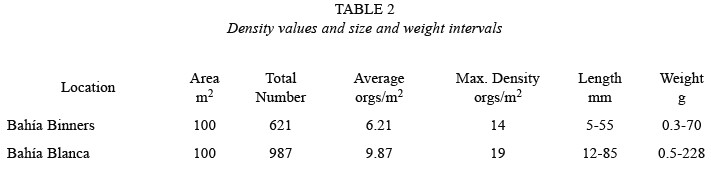
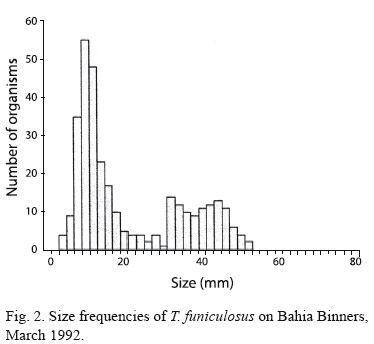
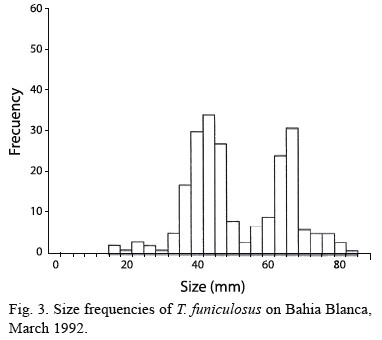
<p style="text-align: justify;"><br style="font-family: arial;"> <br style="font-family: arial;"> </p>     <div style="text-align: left;"><span style="font-family: arial;">The high density of the turban shell population in the intertidal fringe is due, amongother reasons, to the elevated availability of food, the stable conditions of the environment, and the moderated effect of certain predators in this level. For the month of March, the counting by quadrant of turbo shell in two locations gave the next density values, with the size and weight intervals shown in <a href="#tabla2">Table 2</a>.</span><br  style="font-family: arial;"> <br style="font-family: arial;"> <span style="font-family: arial;">Size frequency for both locations shows the separation of groups. In Bah&iacute;a Binners (<a href="#fig2">Fig. 2</a>) groupings of individuals of 3 and 24 mm and others of 24 and 54 were found. In Bah&iacute;a Blanca (<a href="#fig3">Fig. 3</a>). We observed three groups: 16 to 32, 32 to 56, and 56 to 85 mm.</span><br style="font-family: arial;"> <br style="font-family: arial;"> <span style="font-style: italic; font-family: arial;">T. funiculosus</span><span style="font-family: arial;"> is very well represented in all the series of sizes in the midlittoral, fluctuating between 3.0 and 85 mm of length (<a href="#fig2">Fig. 2</a>, <a href="#fig3">3</a>) and the proportional weight varies between 3.0 and 228 g. The <a href="#fig4">Fig. 4</a> and <a href="#fig5">5</a> showthe regression of size-weight found in two concentrations of living organisms, belonging to the two study locations.</span><br style="font-family: arial;"> <br style="font-family: arial;"> <span style="font-family: arial;">The relation of weight in the soft parts in sizes bigger than 50 mm is 30.6 % of the total weight of the living organism, 7.44 % corresponds to the foot or callus, and 23.16 % to the viscera. These proportions were not previously reported in the literature for this species.</span></div>     <p style="text-align: justify;">&nbsp;</p>     <p><a name="tabla2"> <img  style="border: 0px solid ; width: 711px; height: 170px;"  src="/img/fbpe/rbt/v54n4/3488i3.JPG" title="" alt=""></a></p>     
<p>&nbsp;</p>     <p><a name="fig2"> <img  style="border: 0px solid ; width: 374px; height: 344px;"  src="/img/fbpe/rbt/v54n4/3488i4.JPG" title="" alt=""></a>&nbsp;&nbsp;     
]]></body>
<body><![CDATA[<br>     <br> </p>     <p> <a name="fig3"><img  style="border: 0px solid ; width: 382px; height: 340px;"  src="/img/fbpe/rbt/v54n4/3488i5.JPG" title="" alt="">    
<br>     <br> </a></p>     <p><a name="fig4"> <img  style="border: 0px solid ; width: 376px; height: 326px;"  src="/img/fbpe/rbt/v54n4/3488i6.JPG" title="" alt=""></a>     
<br> </p>     <p> <a name="fig5"><img  style="border: 0px solid ; width: 372px; height: 303px;"  src="/img/fbpe/rbt/v54n4/3488i7.JPG" title="" alt=""></a><br  style="font-family: arial;"> <br style="font-family: arial;"> </p>     
<p style="text-align: left;"> <span style="font-family: arial;"><b>Discussion</b></span><br  style="font-family: arial;"> <br style="font-family: arial;"> <span style="font-family: arial;">As a result of the observation of the coastal strip of the superior midlittoral and the infralittoral parts of Socorro Island, the abundance of </span><span  style="font-style: italic; font-family: arial;">T. funiculosus</span><span  style="font-family: arial;"> was determined. The densities of some important species that occupy the same area were also determined. The turban shell is abundant on Socorro Island and has an elevated commercial value because of its meat and its shell. various accompanying species like </span><span  style="font-style: italic; font-family: arial;">P. pansa</span><span  style="font-family: arial;"> (Michel-Morf&iacute;n </span><span  style="font-style: italic; font-family: arial;">et al</span><span  style="font-family: arial;">. 2002) and </span><span  style="font-style: italic; font-family: arial;">C. articulatus</span><span  style="font-family: arial;"> (Holguin and Michel-Morf&iacute;n 2002), have commercial value and represent potential resources on Socorro Island.</span><br style="font-family: arial;"> <br style="font-family: arial;"> <span style="font-family: arial;">It is evident in the location of Bah&iacute;a Binners that the sizes larger than 40 mm are less represented. On the contrary, in the samplings of Bah&iacute;a Blanca they are predominant. This is due to the fact that the first location is very close and very accessible to an island village (naval sector), which in the year 1992, before an Everman volcano eruption, had an average population of 150 people. This caused the extraction for food consumption of the major sizes in the intertidal zone (this is possible to verify observing the shells left on the beach). On the other side, Bah&iacute;a Blanca is very far from any populated zone and it is not accessible by land, which is why the population structure of the </span><span  style="font-style: italic; font-family: arial;">Turbo</span><span  style="font-family: arial;"> shell in this location remains unaltered.</span><br  style="font-family: arial;"> <br style="font-family: arial;"> <span style="font-family: arial;">Some parts of the island are inaccessible by land and barely accessible by sea. For that reason the population of this species remains unaltered by exploitation and its harvesting could be only possible under strict measures of protection and under an adequate management plan. However, new population studies are required in order to know some aspects about population dynamics, like growth, mortality, recruitment and reproduction, beside new population abundance estimations around all island rocky shores are important.</span> <br style="font-family: arial;"> <br style="font-family: arial;"> <span style="font-family: arial; font-weight: bold;">Acknowledgments</span></p>     <p style="text-align: left;"> <span style="font-family: arial;">We are grateful to the Direcci&oacute;n de Estudios de Posgrado e Investigaci&oacute;n del Instituto Polit&eacute;cnico Nacional and Consejo Nacional de Ciencia y Tecnolog&iacute;a for funding&nbsp; this work. Thanks to the Comisi&oacute;n de Operaci&oacute;n y Fomento de Actividades Acad&eacute;micas. Thanks to Silvia Mille P., Alicia P&eacute;rez and Ma. de Jes&uacute;s Parra for their help with the field work, and Ma. Consuelo Gonz&aacute;lez and Bryan Keagle for the help on the English manuscript.</span><br style="font-family: arial;"> <br style="font-family: arial;"> <span style="font-family: arial;"><b>Resumen</b></span><br  style="font-family: arial;"> <br style="font-family: arial;"> <span style="font-family: arial;">El caracol porcelana, </span><span  style="font-style: italic; font-family: arial;">Turbo funiculosus</span><span  style="font-family: arial;">, es un recurso pesquero potencial que casi no ha sido estudiado ni se ha utilizado comercialmente. En marzo de 1992, se realiz&oacute; un muestreo de </span><span  style="font-style: italic; font-family: arial;">T. funiculosus</span><span  style="font-family: arial;"> en Bah&iacute;a Binners y Bah&iacute;a Blanca, isla Socorro, archipi&eacute;lago Revillagigedo, empleando cuadrantes de 25 m</span><sup style="font-family: arial;">2</sup><span  style="font-family: arial;">. Se encontraron variaciones en la longitud total entre 3.0 y 85 mm, el peso proporcional entre 3.0 y 228 g, y la densidad entre 6.21 y 9.87 ind/m</span><sup  style="font-family: arial;">2</sup><span style="font-family: arial;">. Los organismos de mayor tama&ntilde;o (m&aacute;s de 50 mm) contienen 30.6 % de partes suaves. Las poblaciones del caracol porcelana siguen siendo inexplotadas en el archipi&eacute;lago Revillagedo y podr&iacute;an ser un recurso potencial de la industria pesquera bajo un adecuado plan de manejo.</span> <br style="font-family: arial;"> <br style="font-family: arial;"> <span style="font-weight: bold; font-family: arial;">Palabras clave</span><span style="font-family: arial;">: Turbo funiculosus, molusco, densidad, peso, longitud, Isla Socorro.</span><br style="font-family: arial;"> </p>     ]]></body>
<body><![CDATA[<p style="font-family: arial; text-align: left;"><b>Referencias</b></p> <span style="" font-family="" arial=""> </span>     <div style="text-align: left;"><span style="" font-family="" arial="">     <!-- ref --><p>Bautista-Romero, J., H. Reyes-Bonilla, D.B. Lluch-Cota &amp; S.E. Lluch-Cota. 1994. Aspectos generales sobre la fauna marina, p 247-275. In A. Ortega R. &amp; A. Castellanos v. (eds.). La Isla Socorro, Reserva de la Biosfera. Archipi&eacute;lago de Revillagigedo, M&eacute;xico. Publ. No. 8. CIBNor, S.C. La Paz, BCS, Mexico. &nbsp;&nbsp;&nbsp;&nbsp;&nbsp;&nbsp;&nbsp;&nbsp;[&#160;<a href="javascript:void(0);" onclick="javascript: window.open('/scielo.php?script=sci_nlinks&ref=1353601&pid=S0034-7744200600040000200001&lng=','','width=640,height=500,resizable=yes,scrollbars=1,menubar=yes,');">Links</a>&#160;]<!-- end-ref --><br> <span style="" font-family="" arial="">     <p></p>     <!-- ref --><p>Brusca, R.C. &amp; G.J. Brusca. 1990. Invertebrates. Sinauer, Sunderland, Massachussetts, USA. 922 p. &nbsp;&nbsp;&nbsp;&nbsp;&nbsp;&nbsp;&nbsp;&nbsp;[&#160;<a href="javascript:void(0);" onclick="javascript: window.open('/scielo.php?script=sci_nlinks&ref=1353604&pid=S0034-7744200600040000200002&lng=','','width=640,height=500,resizable=yes,scrollbars=1,menubar=yes,');">Links</a>&#160;]<!-- end-ref --><br> <span style="" font-family="" arial="">     <p></p>     <!-- ref --><p>Castell, L.L. &amp; H.P.A. Sweatman. 1997. Predator-prey interactions among some intertidal gastropods on the Great Barrier Reef. J. Zool. 241: 145-159. &nbsp;&nbsp;&nbsp;&nbsp;&nbsp;&nbsp;&nbsp;&nbsp;[&#160;<a href="javascript:void(0);" onclick="javascript: window.open('/scielo.php?script=sci_nlinks&ref=1353607&pid=S0034-7744200600040000200003&lng=','','width=640,height=500,resizable=yes,scrollbars=1,menubar=yes,');">Links</a>&#160;]<!-- end-ref --><br> <span style="" font-family="" arial="">     ]]></body>
<body><![CDATA[<p></p>     <!-- ref --><p>Chan, G.L. 1974. Report on biological observations of the Revillagigedos expeditions. NAUI Bio-marine Exploration Seminar. College of Main. Kentfield, California, USA. 41 p. &nbsp;&nbsp;&nbsp;&nbsp;&nbsp;&nbsp;&nbsp;&nbsp;[&#160;<a href="javascript:void(0);" onclick="javascript: window.open('/scielo.php?script=sci_nlinks&ref=1353610&pid=S0034-7744200600040000200004&lng=','','width=640,height=500,resizable=yes,scrollbars=1,menubar=yes,');">Links</a>&#160;]<!-- end-ref --><br> <span style="" font-family="" arial="">     <p></p>     <!-- ref --><p>Devaraj, M. 1996. Sea-farming and conservation of molluscan resources of India. In J. Hylleberg &amp; K. Ayyakkannu (eds). Proceedings of the Sixth Workshop of the Tropical Marine Mollusc Programme, Annamalai University, Chidambaram, India, 12-20 June 1995, 16: 71-78. &nbsp;&nbsp;&nbsp;&nbsp;&nbsp;&nbsp;&nbsp;&nbsp;[&#160;<a href="javascript:void(0);" onclick="javascript: window.open('/scielo.php?script=sci_nlinks&ref=1353613&pid=S0034-7744200600040000200005&lng=','','width=640,height=500,resizable=yes,scrollbars=1,menubar=yes,');">Links</a>&#160;]<!-- end-ref --><br> <span style="" font-family="" arial="">     <p></p>     <!-- ref --><p>Dorairaj, K. &amp; R. Soundararajan. 1998. Status of molluscan resources of the Andaman Islands, p 106-115. In B. Gangwar, K. Chandra &amp; K. Andaman (eds). Island Ecosystem and Sustainable Development. Science Association, Port Blair, India. &nbsp;&nbsp;&nbsp;&nbsp;&nbsp;&nbsp;&nbsp;&nbsp;[&#160;<a href="javascript:void(0);" onclick="javascript: window.open('/scielo.php?script=sci_nlinks&ref=1353616&pid=S0034-7744200600040000200006&lng=','','width=640,height=500,resizable=yes,scrollbars=1,menubar=yes,');">Links</a>&#160;]<!-- end-ref --><br> <span style="" font-family="" arial="">     <p></p>     ]]></body>
<body><![CDATA[<!-- ref --><p>Emerson, W.K. 1995. A Zoogeographic Summary of the Marine Mollusks of the Revillagigedo Island (tropical eastern Pacific Ocean). Festivus 27: 3-18.    &nbsp;&nbsp;&nbsp;&nbsp;&nbsp;&nbsp;&nbsp;&nbsp;[&#160;<a href="javascript:void(0);" onclick="javascript: window.open('/scielo.php?script=sci_nlinks&ref=1353619&pid=S0034-7744200600040000200007&lng=','','width=640,height=500,resizable=yes,scrollbars=1,menubar=yes,');">Links</a>&#160;]<!-- end-ref --><!-- ref --> Holguin, Q.O. 1991. Notas sobre especies de moluscos de inter&eacute;s comercial del Pac&iacute;fico mexicano. Zool. Inf. 23: 19-41. &nbsp;&nbsp;&nbsp;&nbsp;&nbsp;&nbsp;&nbsp;&nbsp;[&#160;<a href="javascript:void(0);" onclick="javascript: window.open('/scielo.php?script=sci_nlinks&ref=1353620&pid=S0034-7744200600040000200008&lng=','','width=640,height=500,resizable=yes,scrollbars=1,menubar=yes,');">Links</a>&#160;]<!-- end-ref --><br> <span style="" font-family="" arial="">     <p></p>     <!-- ref --><p>Holguin, Q.O. 1994. Comunidades marinas bent&oacute;nicas, p. 225-245. In A. Ortega R. &amp; A. Castellanos v. (eds.). La Isla Socorro, Reserva de la Biosfera, Archipi&eacute;lago de Revillagigedo, M&eacute;xico. Publ. No. 8. CIBNor, S.C. La Paz, BCS, Mexico. &nbsp;&nbsp;&nbsp;&nbsp;&nbsp;&nbsp;&nbsp;&nbsp;[&#160;<a href="javascript:void(0);" onclick="javascript: window.open('/scielo.php?script=sci_nlinks&ref=1353623&pid=S0034-7744200600040000200009&lng=','','width=640,height=500,resizable=yes,scrollbars=1,menubar=yes,');">Links</a>&#160;]<!-- end-ref --><br> <span style="" font-family="" arial="">     <p></p>     <!-- ref --><p>Holguin, Q.O. &amp; E. Michel-Morf&iacute;n. 2002. Distribution, density and length-weight relationship of Chiton articulatus Sowerby, 1832 (Mollusca-Polyplacophora) on Isla Socorro, Revillagigedo Archipelago, Mexico. J. Shellfish Res. 1: 239-241. &nbsp;&nbsp;&nbsp;&nbsp;&nbsp;&nbsp;&nbsp;&nbsp;[&#160;<a href="javascript:void(0);" onclick="javascript: window.open('/scielo.php?script=sci_nlinks&ref=1353626&pid=S0034-7744200600040000200010&lng=','','width=640,height=500,resizable=yes,scrollbars=1,menubar=yes,');">Links</a>&#160;]<!-- end-ref --><br> <span style="" font-family="" arial="">     <p></p>     ]]></body>
<body><![CDATA[<!-- ref --><p>Holguin, Q.O., S. Mille-Pagaza &amp; A. P&eacute;rez-Chi. 1992. Resultado de las campa&ntilde;as de muestreo de 1991 para el estudio del bentos marino de isla Socorro, Revillagigedo, Colima, M&eacute;xico. Zool. Inf. 24: 1-20. &nbsp;&nbsp;&nbsp;&nbsp;&nbsp;&nbsp;&nbsp;&nbsp;[&#160;<a href="javascript:void(0);" onclick="javascript: window.open('/scielo.php?script=sci_nlinks&ref=1353629&pid=S0034-7744200600040000200011&lng=','','width=640,height=500,resizable=yes,scrollbars=1,menubar=yes,');">Links</a>&#160;]<!-- end-ref --><br> <span style="" font-family="" arial="">     <p></p>     <!-- ref --><p>Keen, M.A. 1971. Sea Shells of Tropical West America. Marine Mollusks from Baja California to Peru. Stanford, California, USA. 1065 p. &nbsp;&nbsp;&nbsp;&nbsp;&nbsp;&nbsp;&nbsp;&nbsp;[&#160;<a href="javascript:void(0);" onclick="javascript: window.open('/scielo.php?script=sci_nlinks&ref=1353632&pid=S0034-7744200600040000200012&lng=','','width=640,height=500,resizable=yes,scrollbars=1,menubar=yes,');">Links</a>&#160;]<!-- end-ref --><br> <span style="" font-family="" arial="">     <p></p>     <!-- ref --><p>Kikutani, K., H. Ohba &amp; H. Yamakawa. 2002. Distribution and gut contents of the green snail Turbo marmoratus in Tokunoshima Island, Ryukyus (Southern Japan). J. Tokyo U. Fish. 88: 47-52. &nbsp;&nbsp;&nbsp;&nbsp;&nbsp;&nbsp;&nbsp;&nbsp;[&#160;<a href="javascript:void(0);" onclick="javascript: window.open('/scielo.php?script=sci_nlinks&ref=1353635&pid=S0034-7744200600040000200013&lng=','','width=640,height=500,resizable=yes,scrollbars=1,menubar=yes,');">Links</a>&#160;]<!-- end-ref --><br> <span style="" font-family="" arial="">     <p></p>     <!-- ref --><p>Llinas-Gutierrez, J., D. Lluch &amp; A. Castellanos. 1993. Isla Socorro, Revillagigedo, p 520-534. In S.I. Salazarvallejo &amp; N.E. Gonz&aacute;lez (eds). Biodiversidad Marina y Costera de M&eacute;xico. CONABIO-CIQRO, Mexico, DF, Mexico. &nbsp;&nbsp;&nbsp;&nbsp;&nbsp;&nbsp;&nbsp;&nbsp;[&#160;<a href="javascript:void(0);" onclick="javascript: window.open('/scielo.php?script=sci_nlinks&ref=1353638&pid=S0034-7744200600040000200014&lng=','','width=640,height=500,resizable=yes,scrollbars=1,menubar=yes,');">Links</a>&#160;]<!-- end-ref --><br> <span style="" font-family="" arial="">     <p></p>     <!-- ref --><p>Michel-Morf&iacute;n, J.E., E.A. Ch&aacute;vez &amp; L. Gonz&aacute;lez. 2002. Population structura, effort and dye yielding of the snail Plicopurpura pansa (Gould, 1853) in the Mexican Pacific.&nbsp; Ciencias Marinas 28: 357-368. &nbsp;&nbsp;&nbsp;&nbsp;&nbsp;&nbsp;&nbsp;&nbsp;[&#160;<a href="javascript:void(0);" onclick="javascript: window.open('/scielo.php?script=sci_nlinks&ref=1353641&pid=S0034-7744200600040000200015&lng=','','width=640,height=500,resizable=yes,scrollbars=1,menubar=yes,');">Links</a>&#160;]<!-- end-ref --><br> <span style="" font-family="" arial="">     <p></p>     <!-- ref --><p>Mille-Pagaza, S., A. P&eacute;rez-Chi &amp; O. Holguin Q. 1994. Fauna malacol&oacute;gica bent&oacute;nica del litoral de la Isla Socorro, Revillagigedo, M&eacute;xico. Ciencias Marinas 20: 467-486. &nbsp;&nbsp;&nbsp;&nbsp;&nbsp;&nbsp;&nbsp;&nbsp;[&#160;<a href="javascript:void(0);" onclick="javascript: window.open('/scielo.php?script=sci_nlinks&ref=1353644&pid=S0034-7744200600040000200016&lng=','','width=640,height=500,resizable=yes,scrollbars=1,menubar=yes,');">Links</a>&#160;]<!-- end-ref --><br> <span style="" font-family="" arial="">     <p></p>     <!-- ref --><p>Reyes-Bonilla, H. 1999. Additions to the summary of marine mollusks of the Islas Revillagigedo (Tropical Eastern Pacific Ocean, Mexico). Festivus 31: 31-40. &nbsp;&nbsp;&nbsp;&nbsp;&nbsp;&nbsp;&nbsp;&nbsp;[&#160;<a href="javascript:void(0);" onclick="javascript: window.open('/scielo.php?script=sci_nlinks&ref=1353647&pid=S0034-7744200600040000200017&lng=','','width=640,height=500,resizable=yes,scrollbars=1,menubar=yes,');">Links</a>&#160;]<!-- end-ref --><br> <span style="" font-family="" arial="">     ]]></body>
<body><![CDATA[<p></p>     <!-- ref --><p>Strong, A.M. &amp; G.D. Hanna. 1930. Marine Mollusca of the Revillagigedo Islands, Mexico. Proc. Cal. Acad. Sci. Ser. 4. 19: 7-12. &nbsp;&nbsp;&nbsp;&nbsp;&nbsp;&nbsp;&nbsp;&nbsp;[&#160;<a href="javascript:void(0);" onclick="javascript: window.open('/scielo.php?script=sci_nlinks&ref=1353650&pid=S0034-7744200600040000200018&lng=','','width=640,height=500,resizable=yes,scrollbars=1,menubar=yes,');">Links</a>&#160;]<!-- end-ref --><br> <span style="" font-family="" arial="">     <p></p>     <!-- ref --><p>Troyo-Di&eacute;guez, E. &amp; S. Pedr&iacute;n. 1994. Aspectos hidro-fisiogr&aacute;ficos y geol&oacute;gicos, p. 43-53. In A. Ortega R. &amp; A. Castellanos v. (eds.). La Isla Socorro, Reserva de la Biosfera, Archipi&eacute;lago de Revillagigedo, M&eacute;xico. Publ. No. 8. CIBNor, S.C. La Paz, BCS. Mexico.&nbsp;&nbsp;&nbsp;&nbsp;&nbsp;&nbsp;&nbsp;&nbsp;[&#160;<a href="javascript:void(0);" onclick="javascript: window.open('/scielo.php?script=sci_nlinks&ref=1353653&pid=S0034-7744200600040000200019&lng=','','width=640,height=500,resizable=yes,scrollbars=1,menubar=yes,');">Links</a>&#160;]<!-- end-ref --><p></p> </div> </div> </div>      ]]></body><back>
<ref-list>
<ref id="B1">
<nlm-citation citation-type="">
<person-group person-group-type="author">
<name>
<surname><![CDATA[Bautista-Romero]]></surname>
<given-names><![CDATA[J]]></given-names>
</name>
<name>
<surname><![CDATA[Reyes-Bonilla]]></surname>
<given-names><![CDATA[H]]></given-names>
</name>
<name>
<surname><![CDATA[Lluch-Cota]]></surname>
<given-names><![CDATA[D.B]]></given-names>
</name>
<name>
<surname><![CDATA[Lluch-Cota]]></surname>
<given-names><![CDATA[S.E]]></given-names>
</name>
</person-group>
<article-title xml:lang="es"><![CDATA[Aspectos generales sobre la fauna marina]]></article-title>
<person-group person-group-type="editor">
<name>
<surname><![CDATA[Ortega R]]></surname>
<given-names><![CDATA[A]]></given-names>
</name>
<name>
<surname><![CDATA[Castellanos v]]></surname>
<given-names><![CDATA[A]]></given-names>
</name>
</person-group>
<source><![CDATA[La Isla Socorro, Reserva de la Biosfera]]></source>
<year>1994</year>
<page-range>247-275</page-range></nlm-citation>
</ref>
<ref id="B2">
<nlm-citation citation-type="book">
<person-group person-group-type="author">
<name>
<surname><![CDATA[Brusca]]></surname>
<given-names><![CDATA[R.C]]></given-names>
</name>
<name>
<surname><![CDATA[Brusca]]></surname>
<given-names><![CDATA[G.J]]></given-names>
</name>
</person-group>
<source><![CDATA[Invertebrates]]></source>
<year>1990</year>
<page-range>922</page-range><publisher-loc><![CDATA[Sunderland^eMassachussetts Massachussetts]]></publisher-loc>
<publisher-name><![CDATA[Sinauer]]></publisher-name>
</nlm-citation>
</ref>
<ref id="B3">
<nlm-citation citation-type="journal">
<person-group person-group-type="author">
<name>
<surname><![CDATA[Castell]]></surname>
<given-names><![CDATA[L.L]]></given-names>
</name>
<name>
<surname><![CDATA[Sweatman]]></surname>
<given-names><![CDATA[H.P.A]]></given-names>
</name>
</person-group>
<article-title xml:lang="en"><![CDATA[Predator-prey interactions among some intertidal gastropods on the Great Barrier Reef]]></article-title>
<source><![CDATA[J. Zool]]></source>
<year>1997</year>
<volume>241</volume>
<page-range>145-159</page-range></nlm-citation>
</ref>
<ref id="B4">
<nlm-citation citation-type="book">
<person-group person-group-type="author">
<name>
<surname><![CDATA[Chan]]></surname>
<given-names><![CDATA[G.L]]></given-names>
</name>
</person-group>
<source><![CDATA[Report on biological observations of the Revillagigedos expeditions. NAUI Bio-marine Exploration Seminar]]></source>
<year>1974</year>
<page-range>41</page-range><publisher-loc><![CDATA[Kentfield^eCalifornia California]]></publisher-loc>
<publisher-name><![CDATA[College of Main]]></publisher-name>
</nlm-citation>
</ref>
<ref id="B5">
<nlm-citation citation-type="">
<person-group person-group-type="author">
<name>
<surname><![CDATA[Devaraj]]></surname>
<given-names><![CDATA[M]]></given-names>
</name>
</person-group>
<article-title xml:lang="en"><![CDATA[Sea-farming and conservation of molluscan resources of India]]></article-title>
<person-group person-group-type="editor">
<name>
<surname><![CDATA[Hylleberg]]></surname>
<given-names><![CDATA[J]]></given-names>
</name>
<name>
<surname><![CDATA[Ayyakkannu]]></surname>
<given-names><![CDATA[K]]></given-names>
</name>
</person-group>
<source><![CDATA[Proceedings of the Sixth Workshop of the Tropical Marine Mollusc Programme, Annamalai University, Chidambaram, India, 12-20 June 1995]]></source>
<year>1996</year>
<volume>16</volume>
<page-range>71-78</page-range></nlm-citation>
</ref>
<ref id="B6">
<nlm-citation citation-type="book">
<person-group person-group-type="author">
<name>
<surname><![CDATA[Dorairaj]]></surname>
<given-names><![CDATA[K]]></given-names>
</name>
<name>
<surname><![CDATA[Soundararajan]]></surname>
<given-names><![CDATA[R]]></given-names>
</name>
</person-group>
<article-title xml:lang="en"><![CDATA[Status of molluscan resources of the Andaman Islands]]></article-title>
<person-group person-group-type="editor">
<name>
<surname><![CDATA[Gangwar]]></surname>
<given-names><![CDATA[B]]></given-names>
</name>
<name>
<surname><![CDATA[Chandra]]></surname>
<given-names><![CDATA[K]]></given-names>
</name>
<name>
<surname><![CDATA[Andaman]]></surname>
<given-names><![CDATA[K]]></given-names>
</name>
</person-group>
<source><![CDATA[Island Ecosystem and Sustainable Development]]></source>
<year>1998</year>
<page-range>106-115</page-range><publisher-loc><![CDATA[Port Blair ]]></publisher-loc>
<publisher-name><![CDATA[Science Association]]></publisher-name>
</nlm-citation>
</ref>
<ref id="B7">
<nlm-citation citation-type="journal">
<person-group person-group-type="author">
<name>
<surname><![CDATA[Emerson]]></surname>
<given-names><![CDATA[W.K]]></given-names>
</name>
</person-group>
<article-title xml:lang="en"><![CDATA[A Zoogeographic Summary of the Marine Mollusks of the Revillagigedo Island (tropical eastern Pacific Ocean)]]></article-title>
<source><![CDATA[Festivus]]></source>
<year>1995</year>
<volume>27</volume>
<page-range>3-18</page-range></nlm-citation>
</ref>
<ref id="B8">
<nlm-citation citation-type="journal">
<person-group person-group-type="author">
<name>
<surname><![CDATA[Holguin]]></surname>
<given-names><![CDATA[Q.O]]></given-names>
</name>
</person-group>
<article-title xml:lang="es"><![CDATA[Notas sobre especies de moluscos de interés comercial del Pacífico mexicano]]></article-title>
<source><![CDATA[Zool. Inf]]></source>
<year>1991</year>
<volume>23</volume>
<page-range>19-41</page-range></nlm-citation>
</ref>
<ref id="B9">
<nlm-citation citation-type="">
<person-group person-group-type="author">
<name>
<surname><![CDATA[Holguin]]></surname>
<given-names><![CDATA[Q.O]]></given-names>
</name>
</person-group>
<article-title xml:lang="es"><![CDATA[Comunidades marinas bentónicas]]></article-title>
<person-group person-group-type="editor">
<name>
<surname><![CDATA[Ortega R]]></surname>
<given-names><![CDATA[A]]></given-names>
</name>
<name>
<surname><![CDATA[Castellanos v]]></surname>
<given-names><![CDATA[A]]></given-names>
</name>
</person-group>
<source><![CDATA[La Isla Socorro, Reserva de la Biosfera, Archipiélago de Revillagigedo, México]]></source>
<year>1994</year>
<page-range>225-245</page-range></nlm-citation>
</ref>
<ref id="B10">
<nlm-citation citation-type="journal">
<person-group person-group-type="author">
<name>
<surname><![CDATA[Holguin]]></surname>
<given-names><![CDATA[Q.O]]></given-names>
</name>
<name>
<surname><![CDATA[Michel-Morfín]]></surname>
<given-names><![CDATA[E]]></given-names>
</name>
</person-group>
<article-title xml:lang="en"><![CDATA[Distribution, density and length-weight relationship of Chiton articulatus Sowerby, 1832 (Mollusca-Polyplacophora) on Isla Socorro, Revillagigedo Archipelago, Mexico]]></article-title>
<source><![CDATA[J. Shellfish Res]]></source>
<year>2002</year>
<volume>1</volume>
<page-range>239-241</page-range></nlm-citation>
</ref>
<ref id="B11">
<nlm-citation citation-type="journal">
<person-group person-group-type="author">
<name>
<surname><![CDATA[Holguin]]></surname>
<given-names><![CDATA[Q.O]]></given-names>
</name>
<name>
<surname><![CDATA[Mille-Pagaza]]></surname>
<given-names><![CDATA[S]]></given-names>
</name>
<name>
<surname><![CDATA[Pérez-Chi]]></surname>
<given-names><![CDATA[A]]></given-names>
</name>
</person-group>
<article-title xml:lang="es"><![CDATA[Resultado de las campañas de muestreo de 1991 para el estudio del bentos marino de isla Socorro, Revillagigedo, Colima, México]]></article-title>
<source><![CDATA[Zool. Inf]]></source>
<year>1992</year>
<volume>24</volume>
<page-range>1-20</page-range></nlm-citation>
</ref>
<ref id="B12">
<nlm-citation citation-type="">
<person-group person-group-type="author">
<name>
<surname><![CDATA[Keen]]></surname>
<given-names><![CDATA[M.A]]></given-names>
</name>
</person-group>
<source><![CDATA[Sea Shells of Tropical West America. Marine Mollusks from Baja California to Peru]]></source>
<year>1971</year>
<page-range>1065</page-range><publisher-loc><![CDATA[Stanford^eCalifornia California]]></publisher-loc>
</nlm-citation>
</ref>
<ref id="B13">
<nlm-citation citation-type="journal">
<person-group person-group-type="author">
<name>
<surname><![CDATA[Kikutani]]></surname>
<given-names><![CDATA[K]]></given-names>
</name>
<name>
<surname><![CDATA[Ohba]]></surname>
<given-names><![CDATA[H]]></given-names>
</name>
<name>
<surname><![CDATA[Yamakawa]]></surname>
<given-names><![CDATA[H]]></given-names>
</name>
</person-group>
<article-title xml:lang="en"><![CDATA[Distribution and gut contents of the green snail Turbo marmoratus in Tokunoshima Island, Ryukyus (Southern Japan)]]></article-title>
<source><![CDATA[J. Tokyo U. Fish]]></source>
<year>2002</year>
<volume>88</volume>
<page-range>47-52</page-range></nlm-citation>
</ref>
<ref id="B14">
<nlm-citation citation-type="book">
<person-group person-group-type="author">
<name>
<surname><![CDATA[Llinas-Gutierrez]]></surname>
<given-names><![CDATA[J]]></given-names>
</name>
<name>
<surname><![CDATA[Lluch]]></surname>
<given-names><![CDATA[D]]></given-names>
</name>
<name>
<surname><![CDATA[Castellanos]]></surname>
<given-names><![CDATA[A]]></given-names>
</name>
</person-group>
<article-title xml:lang="es"><![CDATA[Isla Socorro, Revillagigedo]]></article-title>
<person-group person-group-type="editor">
<name>
<surname><![CDATA[Salazarvallejo]]></surname>
<given-names><![CDATA[S.I]]></given-names>
</name>
<name>
<surname><![CDATA[González]]></surname>
<given-names><![CDATA[N.E]]></given-names>
</name>
</person-group>
<source><![CDATA[Biodiversidad Marina y Costera de México]]></source>
<year>1993</year>
<page-range>520-534</page-range><publisher-loc><![CDATA[^eMexico, DF Mexico, DF]]></publisher-loc>
<publisher-name><![CDATA[CONABIO-CIQRO]]></publisher-name>
</nlm-citation>
</ref>
<ref id="B15">
<nlm-citation citation-type="journal">
<person-group person-group-type="author">
<name>
<surname><![CDATA[Michel-Morfín]]></surname>
<given-names><![CDATA[J.E]]></given-names>
</name>
<name>
<surname><![CDATA[Chávez]]></surname>
<given-names><![CDATA[E.A]]></given-names>
</name>
<name>
<surname><![CDATA[González]]></surname>
<given-names><![CDATA[L]]></given-names>
</name>
</person-group>
<article-title xml:lang="en"><![CDATA[Population structura, effort and dye yielding of the snail Plicopurpura pansa (Gould, 1853) in the Mexican Pacific]]></article-title>
<source><![CDATA[Ciencias Marinas]]></source>
<year>2002</year>
<volume>28</volume>
<page-range>357-368</page-range></nlm-citation>
</ref>
<ref id="B16">
<nlm-citation citation-type="journal">
<person-group person-group-type="author">
<name>
<surname><![CDATA[Mille-Pagaza]]></surname>
<given-names><![CDATA[S]]></given-names>
</name>
<name>
<surname><![CDATA[Pérez-Chi]]></surname>
<given-names><![CDATA[A]]></given-names>
</name>
<name>
<surname><![CDATA[Holguin Q]]></surname>
<given-names><![CDATA[O]]></given-names>
</name>
</person-group>
<article-title xml:lang="es"><![CDATA[Fauna malacológica bentónica del litoral de la Isla Socorro, Revillagigedo, México]]></article-title>
<source><![CDATA[Ciencias Marinas]]></source>
<year>1994</year>
<volume>20</volume>
<page-range>467-486</page-range></nlm-citation>
</ref>
<ref id="B17">
<nlm-citation citation-type="journal">
<person-group person-group-type="author">
<name>
<surname><![CDATA[Reyes-Bonilla]]></surname>
<given-names><![CDATA[H]]></given-names>
</name>
</person-group>
<article-title xml:lang="en"><![CDATA[Additions to the summary of marine mollusks of the Islas Revillagigedo (Tropical Eastern Pacific Ocean, Mexico)]]></article-title>
<source><![CDATA[Festivus]]></source>
<year>1999</year>
<volume>31</volume>
<page-range>31-40</page-range></nlm-citation>
</ref>
<ref id="B18">
<nlm-citation citation-type="journal">
<person-group person-group-type="author">
<name>
<surname><![CDATA[Strong]]></surname>
<given-names><![CDATA[A.M]]></given-names>
</name>
<name>
<surname><![CDATA[Hanna]]></surname>
<given-names><![CDATA[G.D]]></given-names>
</name>
</person-group>
<article-title xml:lang="en"><![CDATA[Marine Mollusca of the Revillagigedo Islands, Mexico]]></article-title>
<source><![CDATA[Proc. Cal. Acad. Sci. Ser]]></source>
<year>1930</year>
<volume>19</volume>
<page-range>7-12</page-range></nlm-citation>
</ref>
<ref id="B19">
<nlm-citation citation-type="">
<person-group person-group-type="author">
<name>
<surname><![CDATA[Troyo-Diéguez]]></surname>
<given-names><![CDATA[E]]></given-names>
</name>
<name>
<surname><![CDATA[Pedrín]]></surname>
<given-names><![CDATA[S]]></given-names>
</name>
</person-group>
<article-title xml:lang="es"><![CDATA[Aspectos hidro-fisiográficos y geológicos]]></article-title>
<person-group person-group-type="editor">
<name>
<surname><![CDATA[Ortega R]]></surname>
<given-names><![CDATA[A]]></given-names>
</name>
<name>
<surname><![CDATA[Castellanos v]]></surname>
<given-names><![CDATA[A]]></given-names>
</name>
</person-group>
<source><![CDATA[La Isla Socorro, Reserva de la Biosfera, Archipiélago de Revillagigedo, México]]></source>
<year>1994</year>
<page-range>43-53</page-range></nlm-citation>
</ref>
</ref-list>
</back>
</article>