<?xml version="1.0" encoding="ISO-8859-1"?><article xmlns:mml="http://www.w3.org/1998/Math/MathML" xmlns:xlink="http://www.w3.org/1999/xlink" xmlns:xsi="http://www.w3.org/2001/XMLSchema-instance">
<front>
<journal-meta>
<journal-id>0034-7744</journal-id>
<journal-title><![CDATA[Revista de Biología Tropical]]></journal-title>
<abbrev-journal-title><![CDATA[Rev. biol. trop]]></abbrev-journal-title>
<issn>0034-7744</issn>
<publisher>
<publisher-name><![CDATA[Universidad de Costa Rica]]></publisher-name>
</publisher>
</journal-meta>
<article-meta>
<article-id>S0034-77442006000300030</article-id>
<title-group>
<article-title xml:lang="en"><![CDATA[Polychaeta (Annelida) associated with Thalassia testudinum in the northeastern coastal waters of Venezuela]]></article-title>
</title-group>
<contrib-group>
<contrib contrib-type="author">
<name>
<surname><![CDATA[Liñero Arana]]></surname>
<given-names><![CDATA[Ildefonso]]></given-names>
</name>
<xref ref-type="aff" rid="A01"/>
</contrib>
<contrib contrib-type="author">
<name>
<surname><![CDATA[Díaz Díaz]]></surname>
<given-names><![CDATA[Oscar]]></given-names>
</name>
<xref ref-type="aff" rid="A01"/>
</contrib>
</contrib-group>
<aff id="A01">
<institution><![CDATA[,Instituto Oceanográfico de Venezuela  ]]></institution>
<addr-line><![CDATA[Cumaná Estado Sucre]]></addr-line>
<country>Venezuela</country>
</aff>
<pub-date pub-type="pub">
<day>00</day>
<month>09</month>
<year>2006</year>
</pub-date>
<pub-date pub-type="epub">
<day>00</day>
<month>09</month>
<year>2006</year>
</pub-date>
<volume>54</volume>
<numero>3</numero>
<fpage>971</fpage>
<lpage>978</lpage>
<copyright-statement/>
<copyright-year/>
<self-uri xlink:href="http://www.scielo.sa.cr/scielo.php?script=sci_arttext&amp;pid=S0034-77442006000300030&amp;lng=en&amp;nrm=iso"></self-uri><self-uri xlink:href="http://www.scielo.sa.cr/scielo.php?script=sci_abstract&amp;pid=S0034-77442006000300030&amp;lng=en&amp;nrm=iso"></self-uri><self-uri xlink:href="http://www.scielo.sa.cr/scielo.php?script=sci_pdf&amp;pid=S0034-77442006000300030&amp;lng=en&amp;nrm=iso"></self-uri><abstract abstract-type="short" xml:lang="es"><p><![CDATA[Seasonal variations of polychaetes in a Thalassia testudinum bed were studied from June 2000 to April 2001 in Chacopata, northeastern Venezuela. Eight replicate samples were taken monthly with a 15 cm diameter core and the sediment was passed through a 0.5 mm mesh sieve. A total of 1 013 specimens, belonging to 35 species, was collected. The monthly density ranged from 387 ind/m² (September) to 1 735 ind/m² in May (<IMG SRC="Image223.jpg" WIDTH=11 HEIGHT=11> = 989±449 ind/m²). Species richness was lowest in August and September (8) and highest (25) in April (<IMG SRC="Image223.jpg" WIDTH=11 HEIGHT=11> = 18.00±5.29). The shoot density of Thalassia showed an average of 284±77.60 shoots/m², with extreme values in February (164) and May (422). Species diversity ranged from 1.25 in August and 3.33 bits/ind in December (<IMG SRC="Image223.jpg" WIDTH=11 HEIGHT=11> = 2.47±0.64). Significant positive correlations were detected among the number of Thalassia shoots, polychaete abundance and species richness, as well as among species richness, polychaete abundance and species diversity. Species number and average density were found within the intervals of mean values reported in similar studies. The higher number of species and organisms obtained in March-April and June-July can be attributed to the recruitment correlated with the regional up-welling. Rev. Biol. Trop. 54 (3): 971-978. Epub 2006 Sept. 29.]]></p></abstract>
<abstract abstract-type="short" xml:lang="es"><p><![CDATA[Desde junio 2000 hasta abril 2001 se estudió la variación temporal de los poliquetos en una pradera de Thalassia testudinum en Chacopata, costa nororiental de Venezuela. Se recolectó un total de 1 013 especímenes pertenecientes a 35 especies. La densidad mensual estuvo comprendida entre 387 ind/m² (septiembre) y 1 735 ind/m² en mayo (<IMG SRC="Image223.jpg" WIDTH=11 HEIGHT=11 > o =  989±449 ind/m²). La riqueza específica mensual fue mínima en agosto y septiembre (8) y máxima (25) en abril (<IMG SRC="Image223.jpg" WIDTH=11 HEIGHT=11 > o =  18.00±5.29). La densidad promedio de tallos de Thalassia fue de 284±77.60 tallos/m², con valores extremos en febrero (164) y mayo (422). La diversidad de especies presentó valores comprendidos entre 1.25 en agosto y 3.33 bits/ind en diciembre (<IMG SRC="Image223.jpg" WIDTH=11 HEIGHT=11 > o =  2.47±0.64). Se apreciaron correlaciones positivas entre el número de tallos de Thalassia, la abundancia de poliquetos y la riqueza específica, así como de la riqueza específica con la abundancia de poliquetos y con la diversidad de especies. El número de especies recolectadas y la densidad promedio se encuentran en la zona media de los intervalos respectivos registrados en estudios similares. El elevado número de especies y organismos recolectados en marzo-abril y junio-julio puede ser atribuido a reclutamientos relacionados con el fenómeno de surgencia que se presenta en la costa oriental de Venezuela.]]></p></abstract>
<kwd-group>
<kwd lng="es"><![CDATA[macrofauna]]></kwd>
<kwd lng="es"><![CDATA[benthos]]></kwd>
<kwd lng="es"><![CDATA[Thalassia testudinum]]></kwd>
<kwd lng="es"><![CDATA[Annelida]]></kwd>
<kwd lng="es"><![CDATA[Polychaeta]]></kwd>
<kwd lng="es"><![CDATA[macrofauna]]></kwd>
<kwd lng="es"><![CDATA[bentos]]></kwd>
<kwd lng="es"><![CDATA[Thalassia testudinum]]></kwd>
<kwd lng="es"><![CDATA[Annelida]]></kwd>
<kwd lng="es"><![CDATA[Polychaeta]]></kwd>
</kwd-group>
</article-meta>
</front><body><![CDATA[  <b><font face="Arial">     <p align="center">Polychaeta (Annelida) associated with <i>Thalassia</i> <i>testudinum </i>in the northeastern coastal waters of Venezuela</p> </font></b><font face="Arial" size="2"></font>     <p><font face="Arial" size="2">Ildefonso Liñero Arana &amp; Oscar Díaz Díaz</font></p>     <p><font face="Arial" size="2">Instituto Oceanográfico de Venezuela, Cumaná, Estado Sucre, Venezuela, Apdo. 245; <a  href="mailto:ilinero@cantv.net">ilinero@cantv.net</a></font></p>     <p align="center"><font face="Arial" size="2">Received 20-XI-2002. Corrected 12-III-2004. Accepted 09-III-2006.</font></p> <font face="Arial" size="2"><b></b></font>     <p><font face="Arial" size="2"><b>Abstract:</b> Seasonal variations of polychaetes in a <i>Thalassia testudinum</i> bed were studied from June 2000 to April 2001 in Chacopata, northeastern Venezuela. Eight replicate samples were taken monthly with a 15 cm diameter core and the sediment was passed through a 0.5 mm mesh sieve. A total of 1 013 specimens, belonging to 35 species, was collected. The monthly density ranged from 387 ind/m<sup>2</sup> (September) to 1 735 ind/m<sup>2</sup> in May (<img src="/img/fbpe/rbt/v54n3/Image223.jpg" width="11" height="11"> = 989±449 ind/m<sup>2</sup>). Species richness was lowest in August and September (8) and highest (25) in April (<img src="/img/fbpe/rbt/v54n3/Image223.jpg" width="11" height="11"> = 18.00±5.29). The shoot density of <i>Thalassia</i> showed an average of 284±77.60 shoots/m<sup>2</sup>, with extreme values in February (164) and May (422). Species diversity ranged from 1.25 in August and 3.33 bits/ind in December (<img src="/img/fbpe/rbt/v54n3/Image223.jpg" width="11"  height="11"> = 2.47±0.64). Significant positive correlations were detected among the number of <i>Thalassia </i>shoots, polychaete abundance and species richness, as well as among species richness, polychaete abundance and species diversity. Species number and average density were found within the intervals of mean values reported in similar studies. The higher number of species and organisms obtained in March-April and June-July can be attributed to the recruitment correlated with the regional up-welling. Rev. Biol. Trop. 54 (3): 971-978. Epub 2006 Sept. 29.</font></p> <font face="Arial" size="2"><b></b></font>     
<p><font face="Arial" size="2"><b>Key words:</b> macrofauna, benthos, <i>Thalassia testudinum</i>, Annelida, Polychaeta.</font></p>     <p><font face="Arial" size="2">Coastal seagrass meadows are recognized as highly productive ecosystems (Lewis 1977, Kitting 1984, Kjerfve <i>et al.</i> 1998). These seagrasses develop as a result of the combined action of several local factors, such as light, temperature, salinity, sediment type and nutrient availability (Orth and Moore 1986, Short 1987, Giesen <i>et al</i>. 1990, Pedersen and Borum 1993, Hemminga <i>et</i> <i>al</i>. 1994, Terrados <i>et al</i>. 1998). Seagrasses are the refuge and breeding grounds of numerous invertebrates and fishes (den Hartog 1967, Lewis and Stoner 1983), which is why species abundance and diversity are higher there than in areas without this vegetation (Stoner 1980, Lewis and Stoner 1983, Virnstein <i>et al</i>. 1983, Orth <i>et al</i>. 1984, Summerson and Peterson 1984, Schneider and Mann 1991, Connolly 1997). Polychaetes are often the group with the highest species richness and/or abundance in the invertebrate community of seagrass beds (O’Gower and Wacasey 1967, Lewis and Stoner 1983, Cruz-Ábrego <i>et al</i>. 1994), and they play a remarkably important role in the structure of these communities.</font></p>     <p><font face="Arial" size="2">In the coastal waters of the Gulf of Mexico and the Caribbean Sea, <i>T</i>. <i>testudinum </i>is the most extensive seagrass, and its ecological importance is comparable to that of coral reefs and swamps; however, its beds are being progressively disturbed by coastal development and other human activities (Kjerfve <i>et al</i>. 1998). Venezuela, where an increase in the indiscriminate use coastal areas has had a severe impact on shallow communities, is no exception.</font></p>     <p><font face="Arial" size="2">For this reason, it was considered of interest to begin a series of studies to gather information on the community structure of the macrofauna found in <i>T. testudinum </i>beds off the northeastern coast of Venezuela, where some meadows have not yet been impacted anthropogenically. In this study, we will analyze the seasonal variations of polychaetes in a seagrass bed located far from any source of pollution or human interference. We selected this group because among the dominant groups of benthic macrofauna, they are possibly the most vulnerable to predators and natural or anthropogenic perturbations. In addition, the polychaetes lack a protective exoskeleton and lack or have poor displacement capacities.</font></p> <font face="Arial" size="2"><b>     ]]></body>
<body><![CDATA[<p>Materials and methods</p> </b></font>     <p><font face="Arial" size="2">The Chacopata beach (10°40’00" N, 63°49’18" W) has highly turbid waters and sandy sediment with a high content of biogenic material, especially rich in bivalve shell fragments. In Venezuela there are two clearly differentiated climatic seasons, a dry period from November to April, with relatively low temperatures and strong trade winds, and a rainy period during the remaining months, with opposite characteristics.</font></p>     <p><font face="Arial" size="2">Monthly benthic samples were collected from a <i>Thalassia</i> bed from June 2000 to May 2001 at depths of between 0.5 and 1.5 m. Eight replicate samples were taken with a 15 cm diameter core and forced approximately 25 cm deep into the sediment. Core samples were passed through a 0.5 mm mesh sieve, the number of <i>T. testudinum</i> shoots was counted, and the polychaetes were preserved in an 8 % formaline seawater solution. During each sampling, measures of salinity (using a temperature compensated refractometer) and the bottom water temperature were taken. Temperature was measured at approximately the same time every day (09:00), since this parameter presents diurnal variations as a consequence of shallow depth. An additional 15 cm sample from the superficial sediment layer was taken with the same core for granulometric analysis. </font></p>     <p><font face="Arial" size="2">We calculated species constancy, the biological dominance index (McCloskey 1970), Shannon’s species diversity H’<img src="/img/fbpe/rbt/v54n3/Image224.jpg" width="97" height="22">, and evenness E = H’/log<sub>2</sub>S (Pielou 1966). A one-way ANOVA was applied to evaluate temporal variations in polychaetes counts. To achieve homogeneity of variances, densities were transformed to log10 (n + 1). Pearson’s correlation analysis among the different variables was performed. The Jaccard’s similarity index was calculated, as well as the corresponding dendrogram, using the group-average clustering method.</font></p> <font face="Arial" size="2"><b>     
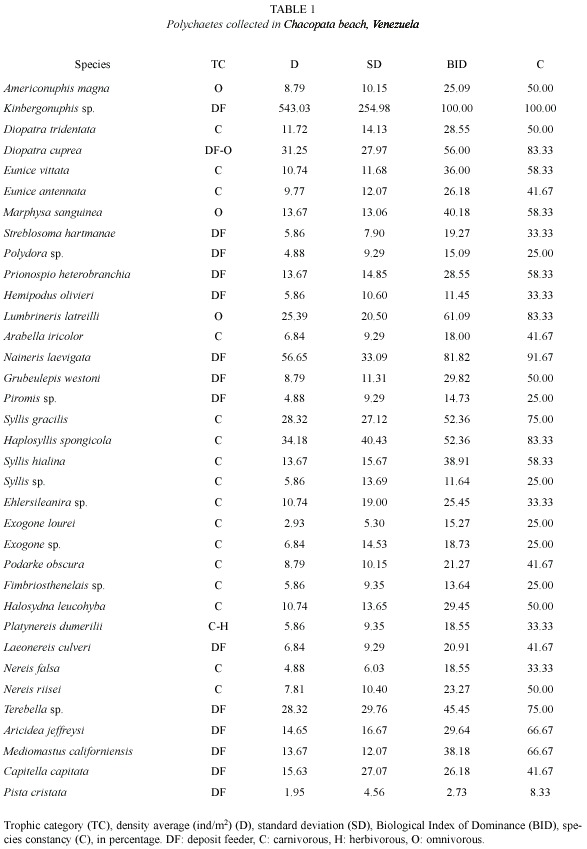
<p>Results</p> </b></font>     <p><font face="Arial" size="2">Bottom water temperature varied seasonally with a maximum (27.5-29.1°C) between June and October, and a minimum (26.1-27.4°C) between November and May. Salinity ranged from 35 to 37 ‰, with its highest values between January and April. Granulometric analyses showed moderately to poorly sorted sediments, with mean grain sizes corresponding to medium and fine sands, with averages of 31.37 % and 25.81 % respectively.</font></p>     <p><font face="Arial" size="2">Species composition and polychaete abundance averages are shown in <a href="#t1">Table I</a>. Thirty five species from 1 013 organisms were collected. Average density was 989.36±448.36 ind/m<sup>2</sup>, and <i>Kinbergonuphis</i> sp. was the species that recorded the highest density (<img src="/img/fbpe/rbt/v54n3/Image225.jpg" width="18" height="16">= 543.03±254.98 ind/m<sup>2</sup>, 54.89 %). This species also recorded the highest constancy of occurrence (100 %), followed by <i>Naineris laevigata </i>(Grube 1855)<i> </i>(91.67 %) and <i>Diopatra cuprea </i>Bosc 1802, <i>Lumbrineris latreilli</i> (Audouin and Milne-Edwards 1834) and three species, <i>Haplosyllis spongicola</i> (Grube 1855) with equal constancies (83.33 %). <i>Kinbergonuphis</i> sp. was the most abundant species as measured using the McCloskey (1970) dominance index, with a value of 100; other dominant species included <i>N. laevigata</i> (81.82), <i>L. latreilli</i> (61.09) and <i>D. cuprea</i> (56). Onuphids constituted the most important family, since their four species contributed to 60.12 % of total abundance. Polychaetes that build emergent tubes (onuphids, terebellids) made up 63.57 % of the polychaete fauna.</font></p> <a name="t1"></a>     
<div style="text-align: center;"><img src="/img/fbpe/rbt/v54n3/3887i1.JPG" title=""  alt="" style="width: 587px; height: 849px;"></div>     
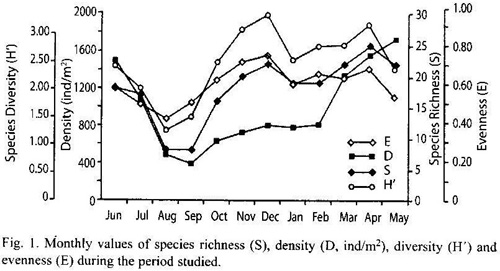
<p><font face="Arial" size="2">The monthly species richness average was 18±5.29 species (<a href="#f1">Fig. 1</a>), with its lowest values in August and September (eight species) and highest values in April (25), and 22 in December, March and May. Monthly density ranged from 387 ind/m<sup>2</sup> (October 2001) to 1 735 ind/m<sup>2</sup> (May 2001). Species richness and density showed similar monthly trends (<a href="#f1">Fig. 1</a>), decreasing from the beginning of June until August-September and then progressively increasing in November and December.</font></p> <a name="f1"></a>     <div style="text-align: center;"><img src="/img/fbpe/rbt/v54n3/3886i1.JPG" title=""  alt="" style="width: 500px; height: 271px;"></div>     
]]></body>
<body><![CDATA[<p><font face="Arial" size="2">Species diversity, as measured by the Shannon diversity index, ranged from 1.25 in August to 3.33 bits/ind in December (<img src="/img/fbpe/rbt/v54n3/Image226.jpg" width="15" height="14">= 2.47±0.64). Evenness, as measured by the Pielou index, showed a minimum in August (0.42) and a maximum in December (0.75) (<img src="/img/fbpe/rbt/v54n3/Image226.jpg"  width="15" height="14">= 0.60±010). Monthly changes in these two parameters occurred in parallel (<a href="#f1">Fig. 1</a>). Monthly shoot density of <i>Thalassia</i> presented an average of 284±77.60 shoots/m<sup>2</sup>, with values ranging from 164 in February to 422 in May.</font></p>     
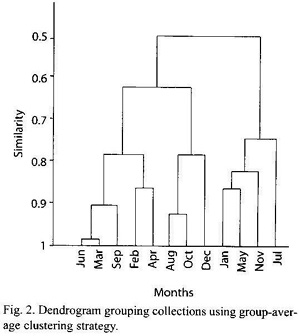
<p><font face="Arial" size="2">Significant differences in density were detected among the different months (Fisher, p&lt;0.05). A significant positive Pearson’s correlation was found with the number of <i>Thalassia</i> shoots, polychaete abundance (r = 0.59, p&lt;0.05) and species richness (r = 0.58, p&lt;0.05), and also with species richness, abundance (r = 0.74, p&lt;0.01) and diversity (r = 0.89, p&lt;0.001).</font></p>     <p><font face="Arial" size="2">Cluster analysis produced five poorly separated groups (<a href="#f2">Fig. 2</a>) with the exception of December; the main group consisted of 7 months.</font></p> <a name="f2"></a>     <div style="text-align: center;"><img src="/img/fbpe/rbt/v54n3/3886i2.JPG" title=""  alt="" style="width: 300px; height: 336px;"></div> <font face="Arial" size="2"><b>     
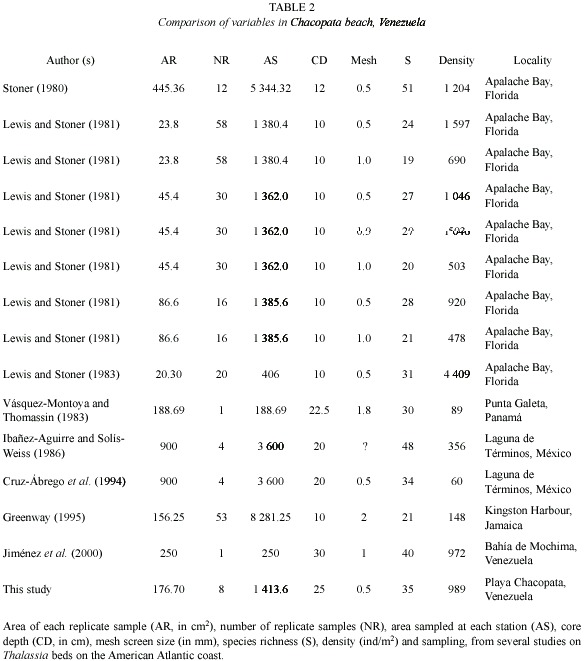
<p>Discussion</p> </b></font>     <p><font face="Arial" size="2">The efficiency of macrofauna collection, particularly in relation to species composition and abundance, may be influenced by the sampling methodology (Lewis and Stoner 1983). In previous studies done on <i>Thalassia </i>beds, different collection methodologies linked with sample size, number of replicate samples, screen mesh size, core depth, etc., have been used (Table 1), which makes the comparisons between species composition and abundance of different species, as well as other related community parameters, such as diversity and evenness, difficult.</font></p>     <p><font face="Arial" size="2">Lewis and Stoner (1981) obtained significant differences in abundance by using different sieve sizes (0.5 and 1.0 mm screen), collecting only 51-57 % of the total macrofauna with the 1.0 mm screen. They also observed differences in abundances with core sizes (5.5, 7.6 and 10.5 cm in diameter), collecting more organisms per area sampled using the smallest core.</font></p>     <p><font face="Arial" size="2">In this study, a 15 cm diameter core was chosen because relatively large organisms live in the grassbed community under investigation. These include as holothuroids, echinoids (<i>Lytechinus variegatus </i>(Lamarck 1816), <i>Echinometra lucunter </i>(Linnaeus 1758)), molluscs (sometimes bivalves cemented to each other), and crustaceans (<i>Callinectes</i> spp.), whose collection would be difficult or impossible using a smaller core. Also, the cores were taken at a depth of 25 cm due to the presence of <i>Americonuphis magna </i>(Andrews 1891), whose tubes can be buried at more than 60 cm in the sediment.</font></p>     <p><font face="Arial" size="2">The range in the number of species recorded in <i>Thalassia</i> beds from the Atlantic American coast is relatively wide, varying from 21 to 51 species (<a href="#t2">Table 2</a>), with an average of 35.71±10.71 species. The range of densities is even wider, between 60 and 4 409 ind/m<sup>2</sup> (<img src="/img/fbpe/rbt/v54n3/Image227.jpg"  width="15" height="12">= 1 036.43±1 554.99). According to these average values, species richness and average density values obtained in this study are within the mean of the respective intervals.</font></p> <a name="t2"></a>     
<div style="text-align: center;"><img src="/img/fbpe/rbt/v54n3/3887i2.JPG" title=""  alt="" style="width: 587px; height: 661px;"></div>     
]]></body>
<body><![CDATA[<p><font face="Arial" size="2">The relatively high densities obtained in March-May and in June-July coincide with those observed in several studies carried out on invertebrates of the northeastern coast of Venezuela. Gómez <i>et al</i>. (1995) reported a maximum of reproduction between January and April, with a secondary peak from May to August. These two periods of reproduction coincide with the behavior of the up-welling in the northeastern coast of Venezuela that begins in November and reaches its greatest intensity from January to April and has another peak of lower intensity in July-August (Bonells <i>et al</i>. 1990).</font></p>     <p><font face="Arial" size="2">Cluster analyses did not produce a clear separation among sampling months; however, the most important group (seven months) is constituted mainly by collections made during the warmer rainy period, which could suggest a certain influence of climatological parameters.</font></p>     <p><font face="Arial" size="2">The high percentage of tubicolous species allows us to presume the efficiency of tubes against predators (Woodin 1978, 1981). <i>Kinbergonuphis</i> sp. has tubes that are very close to one another, providing it a more effective protection. <i>Diopatra tridentata </i>and <i>D. cuprea</i> have tubes on their external surfaces that incorporate alien material, mainly bivalve shell fragments, which protects them against possible predators. The absence of suspension feeder species can be attributed to the high turbidity in the zone (Stoner and Acevedo 1990) which interferes with the feeding and breathing processes of this trophic category. Also, the prevalence in the number of carnivorous species is obvious, to the detriment of deposit feeding species (40 %); however, the deposit feeders represent 68.51 % of total abundance. In Stoner’s (1980) study, 11 % of the species were suspension feeders, 45 % deposit feeders and 41 % carnivorous and/or omnivorous; while Ibañez-Aguirre and Solís-Weiss (1986) reported 13 %, 48 % and 40 % respectively.</font></p>     <p><font face="Arial" size="2">The significant correlation obtained between the number of <i>Thalassia</i> shoots and polychaete abundance confirms that the greater biomass of this seagrass bears a greater macrofauna abundance and diversity, consequence of better protection against predators, which is consistent with the results of other studies (Stoner 1980, Lewis and Stoner 1983, Virnstein <i>et al</i>. 1983, Orth <i>et al</i>. 1984, Summerson and Peterson 1984, Schneider and Mann 1991, Connolly 1997). Further protection is provided by other biogenic structures such as the emergent tubes of several species, mainly onuphids, as well as other sessile invertebrates present in the collections, such as porifera and anemones.</font></p>     <p><font face="Arial" size="2">In this study, the density of <i>Thalassia </i>shoots was lower than that recorded by Ibañez-Aguirre and Solís-Weiss (1986) in Términos Lagoon, Mexico (609), but higher than that recorded by Lewis and Stoner (1983) in Apalache Bay, Florida (184); however, in this last study, polychaete density was higher. When comparing the correlations between seagrass density or biomass and macrofauna abundance recorded in different studies, it is necessary to consider that each bed, including those located at the same latitude, possess its own unique conditions that differ from others. Water and sediment chemistry, species biology, inter- and intraspecific relationships, and the proximity of other environments (coralline, rocky, swamps, etc.), all influence the structure of the macrobenthos which can result in the dissimilar values of abundance and species richness recorded in the different studies. The influence of seagrass density or biomass on macrofaunal abundance or any other community parameter can be analyzed in the same bed, but the presence of other biogenic structures that provide refuge and microhabitats to other species must also be taken into consideration.</font></p> <font face="Arial" size="2"><b>     <p>Resumen</p> </b></font>     <p><font face="Arial" size="2">Desde junio 2000 hasta abril 2001 se estudió la variación temporal de los poliquetos en una pradera de <i>Thalassia testudinum</i> en Chacopata, costa nororiental de Venezuela. Se recolectó un total de 1 013 especímenes pertenecientes a 35 especies. La densidad mensual estuvo comprendida entre 387 ind/m<sup>2</sup> (septiembre) y 1 735 ind/m<sup>2</sup> en mayo (<img src="/img/fbpe/rbt/v54n3/Image223.jpg"  width="11" height="11">= 989±449 ind/m<sup>2</sup>). La riqueza específica mensual fue mínima en agosto y septiembre (8) y máxima (25) en abril (<img src="/img/fbpe/rbt/v54n3/Image223.jpg" width="11" height="11">= 18.00±5.29). La densidad promedio de tallos de <i>Thalassia</i> fue de 284±77.60 tallos/m<sup>2</sup>, con valores extremos en febrero (164) y mayo (422). La diversidad de especies presentó valores comprendidos entre 1.25 en agosto y 3.33 bits/ind en diciembre (<img src="/img/fbpe/rbt/v54n3/Image223.jpg"  width="11" height="11">= 2.47±0.64). Se apreciaron correlaciones positivas entre el número de tallos de <i>Thalassia</i>, la abundancia de poliquetos y la riqueza específica, así como de la riqueza específica con la abundancia de poliquetos y con la diversidad de especies. El número de especies recolectadas y la densidad promedio se encuentran en la zona media de los intervalos respectivos registrados en estudios similares. El elevado número de especies y organismos recolectados en marzo-abril y junio-julio puede ser atribuido a reclutamientos relacionados con el fenómeno de surgencia que se presenta en la costa oriental de Venezuela.</font></p> <font face="Arial" size="2"><b></b></font>     
<p><font face="Arial" size="2"><b>Palabras clave:</b> macrofauna, bentos, <i>Thalassia testudinum</i>, Annelida, Polychaeta.</font></p> <font face="Arial" size="2"><b>     <p>References</p> </b></font>     <!-- ref --><p><font face="Arial" size="2">Bonells, D., T. Okuda, J. Bonilla &amp; G. Cedeño. 1990. Algunas características hidrográficas en la región circunvecina a la Isla de Margarita, Venezuela. Bol. Inst. Oceanogr. Venezuela, Univ. Oriente 29: 27-41.</font>&nbsp;&nbsp;&nbsp;&nbsp;&nbsp;&nbsp;&nbsp;&nbsp;[&#160;<a href="javascript:void(0);" onclick="javascript: window.open('/scielo.php?script=sci_nlinks&ref=1321192&pid=S0034-7744200600030003000001&lng=','','width=640,height=500,resizable=yes,scrollbars=1,menubar=yes,');">Links</a>&#160;]<!-- end-ref --><!-- ref --><p><font face="Arial" size="2">Connolly, R.M. 1997. Differences in composition of small, motile invertebrate assemblages from seagrass and unvegetated habitats in a southern Australian estuary. Hydrobiol. 346: 137-148.</font>&nbsp;&nbsp;&nbsp;&nbsp;&nbsp;&nbsp;&nbsp;&nbsp;[&#160;<a href="javascript:void(0);" onclick="javascript: window.open('/scielo.php?script=sci_nlinks&ref=1321193&pid=S0034-7744200600030003000002&lng=','','width=640,height=500,resizable=yes,scrollbars=1,menubar=yes,');">Links</a>&#160;]<!-- end-ref --><!-- ref --><p><font face="Arial" size="2">Cruz-Ábrego, F.M., P. Hernández-Alcántara &amp; V. Solís-Weiss. 1994. Estudio de la fauna de poliquetos (Annelida) y moluscos (Gastropoda y Bivalvia) asociada con ambientes de pastos marinos (<i>Thalassia testudinum</i>) y manglares (<i>Rhizophora mangle</i>) en la Laguna de Términos, Campeche, México. An. Inst. Cienc. del Mar y Limnol. UNAM 21: 1-13.</font>&nbsp;&nbsp;&nbsp;&nbsp;&nbsp;&nbsp;&nbsp;&nbsp;[&#160;<a href="javascript:void(0);" onclick="javascript: window.open('/scielo.php?script=sci_nlinks&ref=1321194&pid=S0034-7744200600030003000003&lng=','','width=640,height=500,resizable=yes,scrollbars=1,menubar=yes,');">Links</a>&#160;]<!-- end-ref --><!-- ref --><p><font face="Arial" size="2">den Hartog, C. 1967. The structural aspect in the ecology of sea-grass communities. Helgolander wiss. Meeresunters 15: 648-659.</font>&nbsp;&nbsp;&nbsp;&nbsp;&nbsp;&nbsp;&nbsp;&nbsp;[&#160;<a href="javascript:void(0);" onclick="javascript: window.open('/scielo.php?script=sci_nlinks&ref=1321195&pid=S0034-7744200600030003000004&lng=','','width=640,height=500,resizable=yes,scrollbars=1,menubar=yes,');">Links</a>&#160;]<!-- end-ref --><!-- ref --><p><font face="Arial" size="2">Giesen, W.B.J.T., M.M. van Katwijk &amp; C. den Hartog. 1990. Eelgrass condition and turbidity in the Dutch Wadden Sea. Aqu. Bot. 37: 71-85.</font>&nbsp;&nbsp;&nbsp;&nbsp;&nbsp;&nbsp;&nbsp;&nbsp;[&#160;<a href="javascript:void(0);" onclick="javascript: window.open('/scielo.php?script=sci_nlinks&ref=1321196&pid=S0034-7744200600030003000005&lng=','','width=640,height=500,resizable=yes,scrollbars=1,menubar=yes,');">Links</a>&#160;]<!-- end-ref --><!-- ref --><p><font face="Arial" size="2">Gómez, J.A., I. Liñero &amp; J. Fermín. 1995. Estudios ecológicos sobre <i>Lima scabra</i> (Born, 1768) (Pelecypoda: Limidae) en el Golfo de Cariaco, Venezuela. I. Censo y Relaciones Morfométricas. Bol. Inst. Oceanogr. Venezuela, Univ. Oriente 34 : 109-119.</font>&nbsp;&nbsp;&nbsp;&nbsp;&nbsp;&nbsp;&nbsp;&nbsp;[&#160;<a href="javascript:void(0);" onclick="javascript: window.open('/scielo.php?script=sci_nlinks&ref=1321197&pid=S0034-7744200600030003000006&lng=','','width=640,height=500,resizable=yes,scrollbars=1,menubar=yes,');">Links</a>&#160;]<!-- end-ref --><!-- ref --><p><font face="Arial" size="2">Greenway, M. 1995. Trophic relationships of macrofauna within a Jamaican seagrass meadow and the role of the echinoid <i>Lytechinus variegatus </i>(Lamarck). Bull. Mar. Sci. 56: 719-736.</font>&nbsp;&nbsp;&nbsp;&nbsp;&nbsp;&nbsp;&nbsp;&nbsp;[&#160;<a href="javascript:void(0);" onclick="javascript: window.open('/scielo.php?script=sci_nlinks&ref=1321198&pid=S0034-7744200600030003000007&lng=','','width=640,height=500,resizable=yes,scrollbars=1,menubar=yes,');">Links</a>&#160;]<!-- end-ref --><!-- ref --><p><font face="Arial" size="2">Hemminga, M.A., B.P. Koutstaal, J. van Soelen &amp; G.A. Merks. 1994. The nitrogen supply to intertidal eelgrass (<i>Zostera marina</i>). Mar. Biol. 118: 223-227.</font>&nbsp;&nbsp;&nbsp;&nbsp;&nbsp;&nbsp;&nbsp;&nbsp;[&#160;<a href="javascript:void(0);" onclick="javascript: window.open('/scielo.php?script=sci_nlinks&ref=1321199&pid=S0034-7744200600030003000008&lng=','','width=640,height=500,resizable=yes,scrollbars=1,menubar=yes,');">Links</a>&#160;]<!-- end-ref --><!-- ref --><p><font face="Arial" size="2">Ibáñez-Aguirre, A.L. &amp; V. Solís-Weiss. 1986. Anélidos poliquetos de las praderas de <i>Thalassia testudinum </i>del Noroeste de la Laguna de Términos, Campeche, México. Rev. Biol. Trop. 34: 35-47.</font>&nbsp;&nbsp;&nbsp;&nbsp;&nbsp;&nbsp;&nbsp;&nbsp;[&#160;<a href="javascript:void(0);" onclick="javascript: window.open('/scielo.php?script=sci_nlinks&ref=1321200&pid=S0034-7744200600030003000009&lng=','','width=640,height=500,resizable=yes,scrollbars=1,menubar=yes,');">Links</a>&#160;]<!-- end-ref --><!-- ref --><p><font face="Arial" size="2">Jiménez-Prieto, M., I. Liñero-Arana, J.P. Blanco-Rambla &amp; J. Fermín. 2000. Macrofauna asociada con <i>Thalassia testudinum </i>en Bahía de Mochima, Sucre, Venezuela. Rev. Biol. Trop. 48 (Supl. 1): 223-242.</font>&nbsp;&nbsp;&nbsp;&nbsp;&nbsp;&nbsp;&nbsp;&nbsp;[&#160;<a href="javascript:void(0);" onclick="javascript: window.open('/scielo.php?script=sci_nlinks&ref=1321201&pid=S0034-7744200600030003000010&lng=','','width=640,height=500,resizable=yes,scrollbars=1,menubar=yes,');">Links</a>&#160;]<!-- end-ref --><!-- ref --><p><font face="Arial" size="2">Kitting, C.L. 1984. Selectivity by dense populations of small invertebrates foraging among seagrass blade surfaces. Estuaries 7: 276-288.</font>&nbsp;&nbsp;&nbsp;&nbsp;&nbsp;&nbsp;&nbsp;&nbsp;[&#160;<a href="javascript:void(0);" onclick="javascript: window.open('/scielo.php?script=sci_nlinks&ref=1321202&pid=S0034-7744200600030003000011&lng=','','width=640,height=500,resizable=yes,scrollbars=1,menubar=yes,');">Links</a>&#160;]<!-- end-ref --><!-- ref --><p><font face="Arial" size="2">Kjerfve, B., J.O. Ogden, J. Garzón-Ferreira, E. Jordán-Dahlgren, K. De Meyer, P. Penchaszadeh, W.J. Wiebe, J.D. Woodley &amp; J.C. Zieman. 1998. CARICOMP: A Caribbean Network of Marine Laboratories, Parks, and Reserves for Coastal Monitoring and Scientific Collaboration, p. 1-16. <i>In</i> B. Kjerfve (ed.). CARICOMP - Caribbean Coral Reef, Seagrass and Mangrove Sites. UNESCO, Paris, France.</font>&nbsp;&nbsp;&nbsp;&nbsp;&nbsp;&nbsp;&nbsp;&nbsp;[&#160;<a href="javascript:void(0);" onclick="javascript: window.open('/scielo.php?script=sci_nlinks&ref=1321203&pid=S0034-7744200600030003000012&lng=','','width=640,height=500,resizable=yes,scrollbars=1,menubar=yes,');">Links</a>&#160;]<!-- end-ref --><!-- ref --><p><font face="Arial" size="2">Lewis, J.B. 1977. Processes of organic production on coral reefs. Biol. Rev. 52: 305-347.</font>&nbsp;&nbsp;&nbsp;&nbsp;&nbsp;&nbsp;&nbsp;&nbsp;[&#160;<a href="javascript:void(0);" onclick="javascript: window.open('/scielo.php?script=sci_nlinks&ref=1321204&pid=S0034-7744200600030003000013&lng=','','width=640,height=500,resizable=yes,scrollbars=1,menubar=yes,');">Links</a>&#160;]<!-- end-ref --><!-- ref --><p><font face="Arial" size="2">Lewis, F.G. &amp; A.W. Stoner. 1981. An examination of methods for sampling macrobenthos in seagrass meadows. Bull. Mar. Sci. 31: 116-124.</font>&nbsp;&nbsp;&nbsp;&nbsp;&nbsp;&nbsp;&nbsp;&nbsp;[&#160;<a href="javascript:void(0);" onclick="javascript: window.open('/scielo.php?script=sci_nlinks&ref=1321205&pid=S0034-7744200600030003000014&lng=','','width=640,height=500,resizable=yes,scrollbars=1,menubar=yes,');">Links</a>&#160;]<!-- end-ref --><!-- ref --><p><font face="Arial" size="2">Lewis, F.G. &amp; A.W. Stoner. 1983. Distribution of macrofauna within seagrass beds: an explanation for patterns of abundance. Bull. Mar. Sci. 33: 296-304.</font>&nbsp;&nbsp;&nbsp;&nbsp;&nbsp;&nbsp;&nbsp;&nbsp;[&#160;<a href="javascript:void(0);" onclick="javascript: window.open('/scielo.php?script=sci_nlinks&ref=1321206&pid=S0034-7744200600030003000015&lng=','','width=640,height=500,resizable=yes,scrollbars=1,menubar=yes,');">Links</a>&#160;]<!-- end-ref --><!-- ref --><p><font face="Arial" size="2">McCloskey, L.R. 1970. The dynamics of the community associated with a marine scleractinian coral. Int. Revue. Ges. Hydrobiol. 55: 13-81.</font>&nbsp;&nbsp;&nbsp;&nbsp;&nbsp;&nbsp;&nbsp;&nbsp;[&#160;<a href="javascript:void(0);" onclick="javascript: window.open('/scielo.php?script=sci_nlinks&ref=1321207&pid=S0034-7744200600030003000016&lng=','','width=640,height=500,resizable=yes,scrollbars=1,menubar=yes,');">Links</a>&#160;]<!-- end-ref --><!-- ref --><p><font face="Arial" size="2">O’Gower, A.K. &amp; J.W. Wacasey 1967. Animal communities associated with <i>Thalassia</i>, <i>Diplanthera</i>, and sand beds in Biscayne Bay. I. Analysis of communities in relation to water movements. Bull. Mar. Sci. 17: 175-210.</font>&nbsp;&nbsp;&nbsp;&nbsp;&nbsp;&nbsp;&nbsp;&nbsp;[&#160;<a href="javascript:void(0);" onclick="javascript: window.open('/scielo.php?script=sci_nlinks&ref=1321208&pid=S0034-7744200600030003000017&lng=','','width=640,height=500,resizable=yes,scrollbars=1,menubar=yes,');">Links</a>&#160;]<!-- end-ref --><!-- ref --><p><font face="Arial" size="2">Orth, R.J., K.L. Heck Jr. &amp; J. Van Montfrans. 1984. Faunal communities in seagrass beds: a review of the influence of plant structure and prey characteristics on predator-prey relationships. Estuaries 7: 339-350.</font>&nbsp;&nbsp;&nbsp;&nbsp;&nbsp;&nbsp;&nbsp;&nbsp;[&#160;<a href="javascript:void(0);" onclick="javascript: window.open('/scielo.php?script=sci_nlinks&ref=1321209&pid=S0034-7744200600030003000018&lng=','','width=640,height=500,resizable=yes,scrollbars=1,menubar=yes,');">Links</a>&#160;]<!-- end-ref --><!-- ref --><p><font face="Arial" size="2">Orth, R.J. &amp; K.A. Moore. 1986. Seasonal and year to year variations in the growth of <i>Zostera marina </i>L. (eelgrass) in the lower Chesapeake Bay. Aq. Bot. 15: 117-131.</font>&nbsp;&nbsp;&nbsp;&nbsp;&nbsp;&nbsp;&nbsp;&nbsp;[&#160;<a href="javascript:void(0);" onclick="javascript: window.open('/scielo.php?script=sci_nlinks&ref=1321210&pid=S0034-7744200600030003000019&lng=','','width=640,height=500,resizable=yes,scrollbars=1,menubar=yes,');">Links</a>&#160;]<!-- end-ref --><!-- ref --><p><font face="Arial" size="2">Pedersen, M.F. &amp; J. Borum. 1993. An annual nitrogen budget for a seagrass <i>Zostera marina </i>population. Mar. Ecol. Prog. Series 101: 169-177.</font>&nbsp;&nbsp;&nbsp;&nbsp;&nbsp;&nbsp;&nbsp;&nbsp;[&#160;<a href="javascript:void(0);" onclick="javascript: window.open('/scielo.php?script=sci_nlinks&ref=1321211&pid=S0034-7744200600030003000020&lng=','','width=640,height=500,resizable=yes,scrollbars=1,menubar=yes,');">Links</a>&#160;]<!-- end-ref --><!-- ref --><p><font face="Arial" size="2">Pielou, E.C. 1966. The measurement of diversity in different types of biological collections. J. Theor. Biol. 13: 131-144.</font>&nbsp;&nbsp;&nbsp;&nbsp;&nbsp;&nbsp;&nbsp;&nbsp;[&#160;<a href="javascript:void(0);" onclick="javascript: window.open('/scielo.php?script=sci_nlinks&ref=1321212&pid=S0034-7744200600030003000021&lng=','','width=640,height=500,resizable=yes,scrollbars=1,menubar=yes,');">Links</a>&#160;]<!-- end-ref --><!-- ref --><p><font face="Arial" size="2">Schneider, F.I. &amp; K.H. Mann. 1991. Species specific relationships of invertebrates to vegetation in a seagrass bed. I. Correlational studies. J. Exp. Mar. Biol. Ecol. 145: 101-117.</font>&nbsp;&nbsp;&nbsp;&nbsp;&nbsp;&nbsp;&nbsp;&nbsp;[&#160;<a href="javascript:void(0);" onclick="javascript: window.open('/scielo.php?script=sci_nlinks&ref=1321213&pid=S0034-7744200600030003000022&lng=','','width=640,height=500,resizable=yes,scrollbars=1,menubar=yes,');">Links</a>&#160;]<!-- end-ref --><!-- ref --><p><font face="Arial" size="2">Short, F.T. 1987. Effects of sediment nutrients on seagrasses: Literature review and mesocosm experiments. Aquat. Bot. 27: 41-57.</font>&nbsp;&nbsp;&nbsp;&nbsp;&nbsp;&nbsp;&nbsp;&nbsp;[&#160;<a href="javascript:void(0);" onclick="javascript: window.open('/scielo.php?script=sci_nlinks&ref=1321214&pid=S0034-7744200600030003000023&lng=','','width=640,height=500,resizable=yes,scrollbars=1,menubar=yes,');">Links</a>&#160;]<!-- end-ref --><!-- ref --><p><font face="Arial" size="2">Stoner, A.W. 1980. The role of seagrass biomass in the organization of benthic macrofaunal assemblages. Bull. Mar. Sci. 30: 537-551.</font>&nbsp;&nbsp;&nbsp;&nbsp;&nbsp;&nbsp;&nbsp;&nbsp;[&#160;<a href="javascript:void(0);" onclick="javascript: window.open('/scielo.php?script=sci_nlinks&ref=1321215&pid=S0034-7744200600030003000024&lng=','','width=640,height=500,resizable=yes,scrollbars=1,menubar=yes,');">Links</a>&#160;]<!-- end-ref --><!-- ref --><p><font face="Arial" size="2">Stoner, A.W. &amp; C. Acevedo. 1990. The macroinfaunal community of a tropical estuarine lagoon. Estuaries 13: 174-181.</font>&nbsp;&nbsp;&nbsp;&nbsp;&nbsp;&nbsp;&nbsp;&nbsp;[&#160;<a href="javascript:void(0);" onclick="javascript: window.open('/scielo.php?script=sci_nlinks&ref=1321216&pid=S0034-7744200600030003000025&lng=','','width=640,height=500,resizable=yes,scrollbars=1,menubar=yes,');">Links</a>&#160;]<!-- end-ref --><!-- ref --><p><font face="Arial" size="2">Summerson, H. &amp; C. Peterson. 1984. Role of predation in organizing benthic communities of a temperate-zone sea grass bed. Mar. Ecol. Prog. Ser. 15: 63-77.</font>&nbsp;&nbsp;&nbsp;&nbsp;&nbsp;&nbsp;&nbsp;&nbsp;[&#160;<a href="javascript:void(0);" onclick="javascript: window.open('/scielo.php?script=sci_nlinks&ref=1321217&pid=S0034-7744200600030003000026&lng=','','width=640,height=500,resizable=yes,scrollbars=1,menubar=yes,');">Links</a>&#160;]<!-- end-ref --><!-- ref --><p><font face="Arial" size="2">Terrados, J., C.M. Duarte, M.D. Fortes, J. Borum, N.S.R. Agawin, S. Bach, L. Kamp-Nielsen, W.J. Wenworthy, O. Geertz-Hansen &amp; J. Vermaat. 1998. Changes in community structure and biomass of seagrass communities along gradients of siltation in SE Asia. Estuar. Coast. Shelf Sci. 46: 757-768.</font>&nbsp;&nbsp;&nbsp;&nbsp;&nbsp;&nbsp;&nbsp;&nbsp;[&#160;<a href="javascript:void(0);" onclick="javascript: window.open('/scielo.php?script=sci_nlinks&ref=1321218&pid=S0034-7744200600030003000027&lng=','','width=640,height=500,resizable=yes,scrollbars=1,menubar=yes,');">Links</a>&#160;]<!-- end-ref --><!-- ref --><p><font face="Arial" size="2">Vásquez-Montoya, R. &amp; B. Thomassin. 1983. Contribución al conocimiento de los anélidos poliquetos de las praderas de <i>Thalassia testudinum </i>y <i>Halodule </i>sp. del sector de Punta Galeta (Panamá, Provincia de Colón). An. Inst. Cienc. Mar Limnol. UNAM 10: 1-10.</font>&nbsp;&nbsp;&nbsp;&nbsp;&nbsp;&nbsp;&nbsp;&nbsp;[&#160;<a href="javascript:void(0);" onclick="javascript: window.open('/scielo.php?script=sci_nlinks&ref=1321219&pid=S0034-7744200600030003000028&lng=','','width=640,height=500,resizable=yes,scrollbars=1,menubar=yes,');">Links</a>&#160;]<!-- end-ref --><!-- ref --><p><font face="Arial" size="2">Virnstein, R.W., P.S. Mikkelsen, K.D. Cairns &amp; M. Capone. 1983. Seagrass beds versus sand bottoms: the trophic importance of their associated benthic invertebrates. Florida Sci. 46: 67-82.</font>&nbsp;&nbsp;&nbsp;&nbsp;&nbsp;&nbsp;&nbsp;&nbsp;[&#160;<a href="javascript:void(0);" onclick="javascript: window.open('/scielo.php?script=sci_nlinks&ref=1321220&pid=S0034-7744200600030003000029&lng=','','width=640,height=500,resizable=yes,scrollbars=1,menubar=yes,');">Links</a>&#160;]<!-- end-ref --><!-- ref --><p><font face="Arial" size="2">Woodin, S.A. 1978. Refuges, disturbance, and community structure: a marine soft-bottom example. Ecology 59: 274-284.</font>&nbsp;&nbsp;&nbsp;&nbsp;&nbsp;&nbsp;&nbsp;&nbsp;[&#160;<a href="javascript:void(0);" onclick="javascript: window.open('/scielo.php?script=sci_nlinks&ref=1321221&pid=S0034-7744200600030003000030&lng=','','width=640,height=500,resizable=yes,scrollbars=1,menubar=yes,');">Links</a>&#160;]<!-- end-ref --><!-- ref --><p><font face="Arial" size="2">Woodin, S.A. 1981. Disturbance and community structure in a shallow water sand flat. Ecology 62: 1052-1066.</font>&nbsp;&nbsp;&nbsp;&nbsp;&nbsp;&nbsp;&nbsp;&nbsp;[&#160;<a href="javascript:void(0);" onclick="javascript: window.open('/scielo.php?script=sci_nlinks&ref=1321222&pid=S0034-7744200600030003000031&lng=','','width=640,height=500,resizable=yes,scrollbars=1,menubar=yes,');">Links</a>&#160;]<!-- end-ref --> ]]></body><back>
<ref-list>
<ref id="B1">
<nlm-citation citation-type="journal">
<person-group person-group-type="author">
<name>
<surname><![CDATA[Bonells]]></surname>
<given-names><![CDATA[D]]></given-names>
</name>
<name>
<surname><![CDATA[Okuda]]></surname>
<given-names><![CDATA[T]]></given-names>
</name>
<name>
<surname><![CDATA[Bonilla]]></surname>
<given-names><![CDATA[J]]></given-names>
</name>
<name>
<surname><![CDATA[Cedeño]]></surname>
<given-names><![CDATA[G]]></given-names>
</name>
</person-group>
<article-title xml:lang="es"><![CDATA[Algunas características hidrográficas en la región circunvecina a la Isla de Margarita, Venezuela]]></article-title>
<source><![CDATA[Bol. Inst. Oceanogr. Venezuela, Univ. Oriente]]></source>
<year>1990</year>
<volume>29</volume>
<page-range>27-41</page-range></nlm-citation>
</ref>
<ref id="B2">
<nlm-citation citation-type="journal">
<person-group person-group-type="author">
<name>
<surname><![CDATA[Connolly]]></surname>
<given-names><![CDATA[R.M]]></given-names>
</name>
</person-group>
<article-title xml:lang="en"><![CDATA[Differences in composition of small, motile invertebrate assemblages from seagrass and unvegetated habitats in a southern Australian estuary]]></article-title>
<source><![CDATA[Hydrobiol]]></source>
<year>1997</year>
<volume>346</volume>
<page-range>137-148</page-range></nlm-citation>
</ref>
<ref id="B3">
<nlm-citation citation-type="journal">
<person-group person-group-type="author">
<name>
<surname><![CDATA[Cruz-Ábrego]]></surname>
<given-names><![CDATA[F.M]]></given-names>
</name>
<name>
<surname><![CDATA[Hernández-Alcántara]]></surname>
<given-names><![CDATA[P]]></given-names>
</name>
<name>
<surname><![CDATA[Solís-Weiss]]></surname>
<given-names><![CDATA[V]]></given-names>
</name>
</person-group>
<article-title xml:lang="es"><![CDATA[Estudio de la fauna de poliquetos (Annelida) y moluscos (Gastropoda y Bivalvia) asociada con ambientes de pastos marinos (Thalassia testudinum) y manglares (Rhizophora mangle) en la Laguna de Términos, Campeche, México]]></article-title>
<source><![CDATA[An. Inst. Cienc. del Mar y Limnol. UNAM]]></source>
<year>1994</year>
<volume>21</volume>
<page-range>1-13</page-range></nlm-citation>
</ref>
<ref id="B4">
<nlm-citation citation-type="journal">
<person-group person-group-type="author">
<name>
<surname><![CDATA[den Hartog]]></surname>
<given-names><![CDATA[C]]></given-names>
</name>
</person-group>
<article-title xml:lang="en"><![CDATA[The structural aspect in the ecology of sea-grass communities]]></article-title>
<source><![CDATA[Helgolander wiss. Meeresunters]]></source>
<year>1967</year>
<volume>15</volume>
<page-range>648-659</page-range></nlm-citation>
</ref>
<ref id="B5">
<nlm-citation citation-type="journal">
<person-group person-group-type="author">
<name>
<surname><![CDATA[Giesen]]></surname>
<given-names><![CDATA[W.B.J.T]]></given-names>
</name>
<name>
<surname><![CDATA[van Katwijk]]></surname>
<given-names><![CDATA[M.M]]></given-names>
</name>
<name>
<surname><![CDATA[den Hartog]]></surname>
<given-names><![CDATA[C]]></given-names>
</name>
</person-group>
<article-title xml:lang="de"><![CDATA[Eelgrass condition and turbidity in the Dutch Wadden]]></article-title>
<source><![CDATA[Sea. Aqu. Bot]]></source>
<year>1990</year>
<volume>37</volume>
<page-range>71-85</page-range></nlm-citation>
</ref>
<ref id="B6">
<nlm-citation citation-type="journal">
<person-group person-group-type="author">
<name>
<surname><![CDATA[Gómez]]></surname>
<given-names><![CDATA[J.A]]></given-names>
</name>
<name>
<surname><![CDATA[Liñero]]></surname>
<given-names><![CDATA[I]]></given-names>
</name>
<name>
<surname><![CDATA[Fermín]]></surname>
<given-names><![CDATA[J]]></given-names>
</name>
</person-group>
<article-title xml:lang="es"><![CDATA[Estudios ecológicos sobre Lima scabra (Born, 1768) (Pelecypoda: Limidae) en el Golfo de Cariaco, Venezuela. I. Censo y Relaciones Morfométricas]]></article-title>
<source><![CDATA[Bol. Inst. Oceanogr. Venezuela, Univ. Oriente]]></source>
<year>1995</year>
<volume>34</volume>
<page-range>109-119</page-range></nlm-citation>
</ref>
<ref id="B7">
<nlm-citation citation-type="journal">
<person-group person-group-type="author">
<name>
<surname><![CDATA[Greenway]]></surname>
<given-names><![CDATA[M]]></given-names>
</name>
</person-group>
<article-title xml:lang="en"><![CDATA[Trophic relationships of macrofauna within a Jamaican seagrass meadow and the role of the echinoid Lytechinus variegatus (Lamarck)]]></article-title>
<source><![CDATA[Bull. Mar. Sci]]></source>
<year>1995</year>
<volume>56</volume>
<page-range>719-736</page-range></nlm-citation>
</ref>
<ref id="B8">
<nlm-citation citation-type="journal">
<person-group person-group-type="author">
<name>
<surname><![CDATA[Hemminga]]></surname>
<given-names><![CDATA[M.A]]></given-names>
</name>
<name>
<surname><![CDATA[Koutstaal]]></surname>
<given-names><![CDATA[B.P]]></given-names>
</name>
<name>
<surname><![CDATA[van Soelen]]></surname>
<given-names><![CDATA[J]]></given-names>
</name>
<name>
<surname><![CDATA[Merks]]></surname>
<given-names><![CDATA[G.A]]></given-names>
</name>
</person-group>
<article-title xml:lang="en"><![CDATA[The nitrogen supply to intertidal eelgrass (Zostera marina)]]></article-title>
<source><![CDATA[Mar. Biol]]></source>
<year>1994</year>
<volume>118</volume>
<page-range>223-227</page-range></nlm-citation>
</ref>
<ref id="B9">
<nlm-citation citation-type="journal">
<person-group person-group-type="author">
<name>
<surname><![CDATA[Ibáñez-Aguirre]]></surname>
<given-names><![CDATA[A.L]]></given-names>
</name>
<name>
<surname><![CDATA[Solís-Weiss]]></surname>
<given-names><![CDATA[V]]></given-names>
</name>
</person-group>
<article-title xml:lang="es"><![CDATA[Anélidos poliquetos de las praderas de Thalassia testudinum del Noroeste de la Laguna de Términos, Campeche, México]]></article-title>
<source><![CDATA[Rev. Biol. Trop]]></source>
<year>1986</year>
<volume>34</volume>
<page-range>35-47</page-range></nlm-citation>
</ref>
<ref id="B10">
<nlm-citation citation-type="journal">
<person-group person-group-type="author">
<name>
<surname><![CDATA[Jiménez-Prieto]]></surname>
<given-names><![CDATA[M]]></given-names>
</name>
<name>
<surname><![CDATA[Liñero-Arana]]></surname>
<given-names><![CDATA[I]]></given-names>
</name>
<name>
<surname><![CDATA[Blanco-Rambla]]></surname>
<given-names><![CDATA[J.P]]></given-names>
</name>
<name>
<surname><![CDATA[Fermín]]></surname>
<given-names><![CDATA[J]]></given-names>
</name>
</person-group>
<article-title xml:lang="es"><![CDATA[Macrofauna asociada con Thalassia testudinum en Bahía de Mochima, Sucre, Venezuela]]></article-title>
<source><![CDATA[Rev. Biol. Trop]]></source>
<year>2000</year>
<volume>48</volume>
<numero>^s1</numero>
<issue>^s1</issue>
<supplement>1</supplement>
<page-range>223-242</page-range></nlm-citation>
</ref>
<ref id="B11">
<nlm-citation citation-type="journal">
<person-group person-group-type="author">
<name>
<surname><![CDATA[Kitting]]></surname>
<given-names><![CDATA[C.L]]></given-names>
</name>
</person-group>
<article-title xml:lang="en"><![CDATA[Selectivity by dense populations of small invertebrates foraging among seagrass blade surfaces]]></article-title>
<source><![CDATA[Estuaries]]></source>
<year>1984</year>
<volume>7</volume>
<page-range>276-288</page-range></nlm-citation>
</ref>
<ref id="B12">
<nlm-citation citation-type="book">
<person-group person-group-type="author">
<name>
<surname><![CDATA[Kjerfve]]></surname>
<given-names><![CDATA[B]]></given-names>
</name>
<name>
<surname><![CDATA[Ogden]]></surname>
<given-names><![CDATA[J.O]]></given-names>
</name>
<name>
<surname><![CDATA[Garzón-Ferreira]]></surname>
<given-names><![CDATA[J]]></given-names>
</name>
<name>
<surname><![CDATA[Jordán-Dahlgren]]></surname>
<given-names><![CDATA[E]]></given-names>
</name>
<name>
<surname><![CDATA[De Meyer]]></surname>
<given-names><![CDATA[K]]></given-names>
</name>
<name>
<surname><![CDATA[Penchaszadeh]]></surname>
<given-names><![CDATA[P]]></given-names>
</name>
<name>
<surname><![CDATA[Wiebe]]></surname>
<given-names><![CDATA[W.J]]></given-names>
</name>
<name>
<surname><![CDATA[Woodley]]></surname>
<given-names><![CDATA[J.D]]></given-names>
</name>
<name>
<surname><![CDATA[Zieman]]></surname>
<given-names><![CDATA[J.C]]></given-names>
</name>
</person-group>
<article-title xml:lang="en"><![CDATA[CARICOMP: A Caribbean Network of Marine Laboratories, Parks, and Reserves for Coastal Monitoring and Scientific Collaboration]]></article-title>
<person-group person-group-type="editor">
<name>
<surname><![CDATA[Kjerfve]]></surname>
<given-names><![CDATA[B]]></given-names>
</name>
</person-group>
<source><![CDATA[CARICOMP - Caribbean Coral Reef, Seagrass and Mangrove Sites]]></source>
<year>1998</year>
<page-range>1-16</page-range><publisher-loc><![CDATA[Paris ]]></publisher-loc>
<publisher-name><![CDATA[UNESCO]]></publisher-name>
</nlm-citation>
</ref>
<ref id="B13">
<nlm-citation citation-type="journal">
<person-group person-group-type="author">
<name>
<surname><![CDATA[Lewis]]></surname>
<given-names><![CDATA[J.B]]></given-names>
</name>
</person-group>
<article-title xml:lang="en"><![CDATA[Processes of organic production on coral reefs]]></article-title>
<source><![CDATA[Biol. Rev]]></source>
<year>1977</year>
<volume>52</volume>
<page-range>305-347</page-range></nlm-citation>
</ref>
<ref id="B14">
<nlm-citation citation-type="journal">
<person-group person-group-type="author">
<name>
<surname><![CDATA[Lewis]]></surname>
<given-names><![CDATA[F.G]]></given-names>
</name>
<name>
<surname><![CDATA[Stoner]]></surname>
<given-names><![CDATA[A.W]]></given-names>
</name>
</person-group>
<article-title xml:lang="en"><![CDATA[An examination of methods for sampling macrobenthos in seagrass meadows]]></article-title>
<source><![CDATA[Bull. Mar. Sci]]></source>
<year>1981</year>
<volume>31</volume>
<page-range>116-124</page-range></nlm-citation>
</ref>
<ref id="B15">
<nlm-citation citation-type="journal">
<person-group person-group-type="author">
<name>
<surname><![CDATA[Lewis]]></surname>
<given-names><![CDATA[F.G]]></given-names>
</name>
<name>
<surname><![CDATA[Stoner]]></surname>
<given-names><![CDATA[A.W]]></given-names>
</name>
</person-group>
<article-title xml:lang="en"><![CDATA[Distribution of macrofauna within seagrass beds: an explanation for patterns of abundance]]></article-title>
<source><![CDATA[Bull. Mar. Sci]]></source>
<year>1983</year>
<volume>33</volume>
<page-range>296-304</page-range></nlm-citation>
</ref>
<ref id="B16">
<nlm-citation citation-type="journal">
<person-group person-group-type="author">
<name>
<surname><![CDATA[McCloskey]]></surname>
<given-names><![CDATA[L.R]]></given-names>
</name>
</person-group>
<article-title xml:lang="en"><![CDATA[The dynamics of the community associated with a marine scleractinian coral]]></article-title>
<source><![CDATA[Int. Revue. Ges. Hydrobiol]]></source>
<year>1970</year>
<volume>55</volume>
<page-range>13-81</page-range></nlm-citation>
</ref>
<ref id="B17">
<nlm-citation citation-type="journal">
<person-group person-group-type="author">
<name>
<surname><![CDATA[O’Gower]]></surname>
<given-names><![CDATA[A.K]]></given-names>
</name>
<name>
<surname><![CDATA[Wacasey]]></surname>
<given-names><![CDATA[J.W]]></given-names>
</name>
</person-group>
<article-title xml:lang="en"><![CDATA[Animal communities associated with Thalassia, Diplanthera, and sand beds in Biscayne Bay. I. Analysis of communities in relation to water movements]]></article-title>
<source><![CDATA[Bull. Mar. Sci]]></source>
<year>1967</year>
<volume>17</volume>
<page-range>175-210</page-range></nlm-citation>
</ref>
<ref id="B18">
<nlm-citation citation-type="journal">
<person-group person-group-type="author">
<name>
<surname><![CDATA[Orth]]></surname>
<given-names><![CDATA[R.J]]></given-names>
</name>
<name>
<surname><![CDATA[Heck Jr]]></surname>
<given-names><![CDATA[K.L]]></given-names>
</name>
<name>
<surname><![CDATA[Montfrans]]></surname>
<given-names><![CDATA[J. Van]]></given-names>
</name>
</person-group>
<article-title xml:lang="en"><![CDATA[Faunal communities in seagrass beds: a review of the influence of plant structure and prey characteristics on predator-prey relationships]]></article-title>
<source><![CDATA[Estuaries]]></source>
<year>1984</year>
<volume>7</volume>
<page-range>339-350</page-range></nlm-citation>
</ref>
<ref id="B19">
<nlm-citation citation-type="journal">
<person-group person-group-type="author">
<name>
<surname><![CDATA[Orth]]></surname>
<given-names><![CDATA[R.J]]></given-names>
</name>
<name>
<surname><![CDATA[Moore]]></surname>
<given-names><![CDATA[K.A]]></given-names>
</name>
</person-group>
<article-title xml:lang="en"><![CDATA[Seasonal and year to year variations in the growth of Zostera marina L. (eelgrass) in the lower Chesapeake Bay]]></article-title>
<source><![CDATA[Aq. Bot]]></source>
<year>1986</year>
<volume>15</volume>
<page-range>117-131</page-range></nlm-citation>
</ref>
<ref id="B20">
<nlm-citation citation-type="journal">
<person-group person-group-type="author">
<name>
<surname><![CDATA[Pedersen]]></surname>
<given-names><![CDATA[M.F]]></given-names>
</name>
<name>
<surname><![CDATA[Borum]]></surname>
<given-names><![CDATA[J]]></given-names>
</name>
</person-group>
<article-title xml:lang="en"><![CDATA[An annual nitrogen budget for a seagrass Zostera marina population]]></article-title>
<source><![CDATA[Mar. Ecol. Prog. Series]]></source>
<year>1993</year>
<volume>101</volume>
<page-range>169-177</page-range></nlm-citation>
</ref>
<ref id="B21">
<nlm-citation citation-type="journal">
<person-group person-group-type="author">
<name>
<surname><![CDATA[Pielou]]></surname>
<given-names><![CDATA[E.C]]></given-names>
</name>
</person-group>
<article-title xml:lang="en"><![CDATA[The measurement of diversity in different types of biological collections]]></article-title>
<source><![CDATA[J. Theor. Biol]]></source>
<year>1966</year>
<volume>13</volume>
<page-range>131-144</page-range></nlm-citation>
</ref>
<ref id="B22">
<nlm-citation citation-type="journal">
<person-group person-group-type="author">
<name>
<surname><![CDATA[Schneider]]></surname>
<given-names><![CDATA[F.I]]></given-names>
</name>
<name>
<surname><![CDATA[Mann]]></surname>
<given-names><![CDATA[K.H]]></given-names>
</name>
</person-group>
<article-title xml:lang="en"><![CDATA[Species specific relationships of invertebrates to vegetation in a seagrass bed. I. Correlational studies]]></article-title>
<source><![CDATA[J. Exp. Mar. Biol. Ecol]]></source>
<year>1991</year>
<volume>145</volume>
<page-range>101-117</page-range></nlm-citation>
</ref>
<ref id="B23">
<nlm-citation citation-type="journal">
<person-group person-group-type="author">
<name>
<surname><![CDATA[Short]]></surname>
<given-names><![CDATA[F.T]]></given-names>
</name>
</person-group>
<article-title xml:lang="en"><![CDATA[Effects of sediment nutrients on seagrasses: Literature review and mesocosm experiments]]></article-title>
<source><![CDATA[Aquat. Bot]]></source>
<year>1987</year>
<volume>27</volume>
<page-range>41-57</page-range></nlm-citation>
</ref>
<ref id="B24">
<nlm-citation citation-type="journal">
<person-group person-group-type="author">
<name>
<surname><![CDATA[Stoner]]></surname>
<given-names><![CDATA[A.W]]></given-names>
</name>
</person-group>
<article-title xml:lang="en"><![CDATA[The role of seagrass biomass in the organization of benthic macrofaunal assemblages]]></article-title>
<source><![CDATA[Bull. Mar. Sci]]></source>
<year>1980</year>
<volume>30</volume>
<page-range>537-551</page-range></nlm-citation>
</ref>
<ref id="B25">
<nlm-citation citation-type="journal">
<person-group person-group-type="author">
<name>
<surname><![CDATA[Stoner]]></surname>
<given-names><![CDATA[A.W]]></given-names>
</name>
<name>
<surname><![CDATA[Acevedo]]></surname>
<given-names><![CDATA[C]]></given-names>
</name>
</person-group>
<article-title xml:lang="en"><![CDATA[The macroinfaunal community of a tropical estuarine lagoon]]></article-title>
<source><![CDATA[Estuaries]]></source>
<year>1990</year>
<volume>13</volume>
<page-range>174-181</page-range></nlm-citation>
</ref>
<ref id="B26">
<nlm-citation citation-type="journal">
<person-group person-group-type="author">
<name>
<surname><![CDATA[Summerson]]></surname>
<given-names><![CDATA[H]]></given-names>
</name>
<name>
<surname><![CDATA[Peterson]]></surname>
<given-names><![CDATA[C]]></given-names>
</name>
</person-group>
<article-title xml:lang="en"><![CDATA[Role of predation in organizing benthic communities of a temperate-zone sea grass bed]]></article-title>
<source><![CDATA[Mar. Ecol. Prog. Ser]]></source>
<year>1984</year>
<volume>15</volume>
<page-range>63-77</page-range></nlm-citation>
</ref>
<ref id="B27">
<nlm-citation citation-type="journal">
<person-group person-group-type="author">
<name>
<surname><![CDATA[Terrados]]></surname>
<given-names><![CDATA[J]]></given-names>
</name>
<name>
<surname><![CDATA[Duarte]]></surname>
<given-names><![CDATA[C.M]]></given-names>
</name>
<name>
<surname><![CDATA[Fortes]]></surname>
<given-names><![CDATA[M.D]]></given-names>
</name>
<name>
<surname><![CDATA[Borum]]></surname>
<given-names><![CDATA[J]]></given-names>
</name>
<name>
<surname><![CDATA[Agawin]]></surname>
<given-names><![CDATA[N.S.R]]></given-names>
</name>
<name>
<surname><![CDATA[Bach]]></surname>
<given-names><![CDATA[S]]></given-names>
</name>
<name>
<surname><![CDATA[Kamp-Nielsen]]></surname>
<given-names><![CDATA[L]]></given-names>
</name>
<name>
<surname><![CDATA[Wenworthy]]></surname>
<given-names><![CDATA[W.J]]></given-names>
</name>
<name>
<surname><![CDATA[Geertz-Hansen]]></surname>
<given-names><![CDATA[O]]></given-names>
</name>
<name>
<surname><![CDATA[Vermaat]]></surname>
<given-names><![CDATA[J]]></given-names>
</name>
</person-group>
<article-title xml:lang="en"><![CDATA[Changes in community structure and biomass of seagrass communities along gradients of siltation in SE Asia]]></article-title>
<source><![CDATA[Estuar. Coast. Shelf Sci]]></source>
<year>1998</year>
<volume>46</volume>
<page-range>757-768</page-range></nlm-citation>
</ref>
<ref id="B28">
<nlm-citation citation-type="journal">
<person-group person-group-type="author">
<name>
<surname><![CDATA[Vásquez-Montoya]]></surname>
<given-names><![CDATA[R]]></given-names>
</name>
<name>
<surname><![CDATA[Thomassin]]></surname>
<given-names><![CDATA[B]]></given-names>
</name>
</person-group>
<article-title xml:lang="es"><![CDATA[Contribución al conocimiento de los anélidos poliquetos de las praderas de Thalassia testudinum y Halodule sp. del sector de Punta Galeta (Panamá, Provincia de Colón)]]></article-title>
<source><![CDATA[An. Inst. Cienc. Mar Limnol. UNAM]]></source>
<year>1983</year>
<volume>10</volume>
<page-range>1-10</page-range></nlm-citation>
</ref>
<ref id="B29">
<nlm-citation citation-type="journal">
<person-group person-group-type="author">
<name>
<surname><![CDATA[Virnstein]]></surname>
<given-names><![CDATA[R.W]]></given-names>
</name>
<name>
<surname><![CDATA[Mikkelsen]]></surname>
<given-names><![CDATA[P.S]]></given-names>
</name>
<name>
<surname><![CDATA[Cairns]]></surname>
<given-names><![CDATA[K.D]]></given-names>
</name>
<name>
<surname><![CDATA[Capone]]></surname>
<given-names><![CDATA[M]]></given-names>
</name>
</person-group>
<article-title xml:lang="en"><![CDATA[Seagrass beds versus sand bottoms: the trophic importance of their associated benthic invertebrates]]></article-title>
<source><![CDATA[Florida Sci]]></source>
<year>1983</year>
<volume>46</volume>
<page-range>67-82</page-range></nlm-citation>
</ref>
<ref id="B30">
<nlm-citation citation-type="journal">
<person-group person-group-type="author">
<name>
<surname><![CDATA[Woodin]]></surname>
<given-names><![CDATA[S.A]]></given-names>
</name>
</person-group>
<article-title xml:lang="en"><![CDATA[Refuges, disturbance, and community structure: a marine soft-bottom example]]></article-title>
<source><![CDATA[Ecology]]></source>
<year>1978</year>
<volume>59</volume>
<page-range>274-284</page-range></nlm-citation>
</ref>
<ref id="B31">
<nlm-citation citation-type="journal">
<person-group person-group-type="author">
<name>
<surname><![CDATA[Woodin]]></surname>
<given-names><![CDATA[S.A]]></given-names>
</name>
</person-group>
<article-title xml:lang="en"><![CDATA[Disturbance and community structure in a shallow water sand flat]]></article-title>
<source><![CDATA[Ecology]]></source>
<year>1981</year>
<volume>62</volume>
<page-range>1052-1066</page-range></nlm-citation>
</ref>
</ref-list>
</back>
</article>