<?xml version="1.0" encoding="ISO-8859-1"?><article xmlns:mml="http://www.w3.org/1998/Math/MathML" xmlns:xlink="http://www.w3.org/1999/xlink" xmlns:xsi="http://www.w3.org/2001/XMLSchema-instance">
<front>
<journal-meta>
<journal-id>0034-7744</journal-id>
<journal-title><![CDATA[Revista de Biología Tropical]]></journal-title>
<abbrev-journal-title><![CDATA[Rev. biol. trop]]></abbrev-journal-title>
<issn>0034-7744</issn>
<publisher>
<publisher-name><![CDATA[Universidad de Costa Rica]]></publisher-name>
</publisher>
</journal-meta>
<article-meta>
<article-id>S0034-77442006000300026</article-id>
<title-group>
<article-title xml:lang="en"><![CDATA[The floristic compositions of vascular epiphytes of a seasonally inundated forest on the coastal plain of Ilha do Mel Island, Brazil]]></article-title>
</title-group>
<contrib-group>
<contrib contrib-type="author">
<name>
<surname><![CDATA[de Andrade Kersten]]></surname>
<given-names><![CDATA[Rodrigo]]></given-names>
</name>
<xref ref-type="aff" rid="A01"/>
</contrib>
<contrib contrib-type="author">
<name>
<surname><![CDATA[Menezes Silva]]></surname>
<given-names><![CDATA[Sandro]]></given-names>
</name>
<xref ref-type="aff" rid="A01"/>
</contrib>
</contrib-group>
<aff id="A01">
<institution><![CDATA[,Pontifícia Universidade Católica do Paraná (PUC-PR)  ]]></institution>
<addr-line><![CDATA[ ]]></addr-line>
</aff>
<pub-date pub-type="pub">
<day>00</day>
<month>09</month>
<year>2006</year>
</pub-date>
<pub-date pub-type="epub">
<day>00</day>
<month>09</month>
<year>2006</year>
</pub-date>
<volume>54</volume>
<numero>3</numero>
<fpage>935</fpage>
<lpage>942</lpage>
<copyright-statement/>
<copyright-year/>
<self-uri xlink:href="http://www.scielo.sa.cr/scielo.php?script=sci_arttext&amp;pid=S0034-77442006000300026&amp;lng=en&amp;nrm=iso"></self-uri><self-uri xlink:href="http://www.scielo.sa.cr/scielo.php?script=sci_abstract&amp;pid=S0034-77442006000300026&amp;lng=en&amp;nrm=iso"></self-uri><self-uri xlink:href="http://www.scielo.sa.cr/scielo.php?script=sci_pdf&amp;pid=S0034-77442006000300026&amp;lng=en&amp;nrm=iso"></self-uri><abstract abstract-type="short" xml:lang="en"><p><![CDATA[A 3 000 m² area of seasonally inundated forest on the island of Ilha do Mel (25º30" S 48º23" W) in Paraná, Brazil, was sampled by collecting plants from all strata, using climbing equipment when necessary. The area harbors 103 species of epiphytes, in 49 genera and 20 families, of which 28 species are pteridophytes and 75 magnoliophytes (64 Liliopsida, 11 Magnoliopsida). The most common families are Orchidaceae, Bromeliaceae, Polypodiaceae and Araceae, and frequent genera are Vriesea, Epidendrum, Maxillaria, Pleurothallis and Prosthechea. Eight families were represented by one species each. Most species were classified as obligatory holoepiphytes (62 %), followed by the relatively more rare preferential holoepiphytes (13 %), facultative epiphytes (11 %), hemiepiphytes (9 %) and accidental epiphytes (6 %). Rev. Biol. Trop. 54 (3): 935-942. Epub 2006 Sept. 29.]]></p></abstract>
<abstract abstract-type="short" xml:lang="es"><p><![CDATA[Se muestreó plantas de todos los estratos en una área de 3 000 m² de selva estacionalmente inundada en Ilha do Mel (25º30 "S 48º23’ W), Paraná, Brazil. El área tiene 103 especies de epífitas en 49 géneros y 20 familias, de las cuales 28 especies son pteridófitas y 75 magnoliófitas (64 Liliopsida, 11 Magnoliopsida). Las familias más comunes son Orchidaceae, Bromeliaceae, Polypodiaceae y Araceae, y los géneros más frecuentes Vriesea, Epidendrum, Maxillaria, Encyclia y Pleurothallis. Ocho familias solamente están representadas por una especie cada una. La mayoría de las especies son loepífitas obligadas (62 %), seguidas de las relativamente escasas holoepífitas preferenciales (13 %), epífitas facultativas (11 %), hemiepífitas (9 %) y epífitas accidentales (6 %).]]></p></abstract>
<kwd-group>
<kwd lng="en"><![CDATA[Brazil]]></kwd>
<kwd lng="en"><![CDATA[Atlantic rain forest]]></kwd>
<kwd lng="en"><![CDATA[coastal plain forest]]></kwd>
<kwd lng="en"><![CDATA[floristic composition]]></kwd>
<kwd lng="en"><![CDATA[Orchidaceae]]></kwd>
<kwd lng="en"><![CDATA[Restinga]]></kwd>
<kwd lng="en"><![CDATA[vascular epiphytes]]></kwd>
<kwd lng="es"><![CDATA[Brazil]]></kwd>
<kwd lng="es"><![CDATA[selva lluviosa atlántica]]></kwd>
<kwd lng="es"><![CDATA[selva de planicie costera]]></kwd>
<kwd lng="es"><![CDATA[composición florística]]></kwd>
<kwd lng="es"><![CDATA[Orchidaceae]]></kwd>
<kwd lng="es"><![CDATA[Restinga]]></kwd>
<kwd lng="es"><![CDATA[epifitas vasculares]]></kwd>
</kwd-group>
</article-meta>
</front><body><![CDATA[  <b><font face="Arial">     <p align="center">The floristic compositions of vascular epiphytes of a seasonally inundated forest on the coastal plain of Ilha do Mel Island, Brazil</p> </font></b><font face="Arial" size="2"></font>     <p><font face="Arial" size="2">Rodrigo de Andrade Kersten &amp; Sandro Menezes Silva</font></p>     <p><font face="Arial" size="2">Pontifícia Universidade Católica do Paraná (PUC-PR), Centro de Ciências Biológicas e da Saúde (CCBS). Rua Imaculada Conceição, 1155 - Prado Velho - Curitiba - PR - BR. CEP: 80215-901. <a href="mailto:kersten@pop.com.br">kersten@pop.com.br</a></font></p>     <p align="center"><font face="Arial" size="2">Received 13-I-2003. Corrected 16-IV-2004. Accepted 08-VII-2005.</font></p> <font face="Arial" size="2"><b></b></font>     <p><font face="Arial" size="2"><b>Abstract:</b> A 3 000 m<sup>2</sup> area of seasonally inundated forest on the island of Ilha do Mel (25º30" S 48º23" W) in Paraná, Brazil, was sampled by collecting plants from all strata, using climbing equipment when necessary. The area harbors 103 species of epiphytes, in 49 genera and 20 families, of which 28 species are pteridophytes and 75 magnoliophytes (64 Liliopsida, 11 Magnoliopsida). The most common families are Orchidaceae, Bromeliaceae, Polypodiaceae and Araceae, and frequent genera are <i>Vriesea, Epidendrum, Maxillaria, Pleurothallis</i> and <i>Prosthechea</i>. Eight families were represented by one species each. Most species were classified as obligatory holoepiphytes (62 %), followed by the relatively more rare preferential holoepiphytes (13 %), facultative epiphytes (11 %), hemiepiphytes (9 %) and accidental epiphytes (6 %). Rev. Biol. Trop. 54 (3): 935-942. Epub 2006 Sept. 29.</font></p> <font face="Arial" size="2"><b></b></font>     <p><font face="Arial" size="2"><b>Key words:</b> Brazil, Atlantic rain forest, coastal plain forest, floristic composition, Orchidaceae, Restinga, vascular epiphytes.</font></p>     <p><font face="Arial" size="2">Epiphytes comprise a significant proportion of the plant diversity of tropical forests and may represent as much as 50 % of the plant species in these forests (Gentry and Dodson 1987b). Humid tropical forests are exceptionally notable due to the richness and abundance of epiphytes (Madison 1977). Diversity and richness of epiphytic orchids, for example, is great in the tropics and declines rapidly as the latitude approaches 30o, which is the limit of the influence of tropical air masses (Waechter 1998b). However, many endemic temperate epiphytes occur in the Southern Hemisphere, in strong contrast to the Northern Hemisphere, where mostly outlying species representing large tropical genera occurs (Benzing 1990).</font></p>     <p><font face="Arial" size="2">While several studies have examined epiphyte floristic in Brazil (Gottsberger and Morawetz 1993 in the Amazon; Aguiar <i>et al.</i> 1981, Cervi and Dombrowski 1985, Cervi <i>et al.</i> 1988, Waechter 1992, 1998a, Dittrich <i>et al</i>. 1999, Kersten and Silva 2002 in subtropical forests; Pinto <i>et al.</i> 1995, Dislich and Mantovani 1998 in seasonal forests; Waechter 1986, 1992, Fontoura <i>et al.</i> 1997, Labiak and Prado 1998, Piliackas <i>et al.</i> 2000, Kersten and Silva 2001 in tropical formations), this study addresses the epiphytic community of a seasonally inundated coastal plain forest on the island of Ilha do Mel in the state of Paraná, in southern Brazil. This forest, has close affinities with the threatened and poorly studied Atlantic Coastal Forest of southeastern Brazil, and is an area of endemism for many plant and animal species (Pimm 2001). Identification of epiphytic species in this forest provides the first step in understanding their distribution and abundance as well as paving the way for further studies of the ecology and evolution of this community. </font></p> <font face="Arial" size="2"><b>     <p>Materials and methods</p> </b></font>     ]]></body>
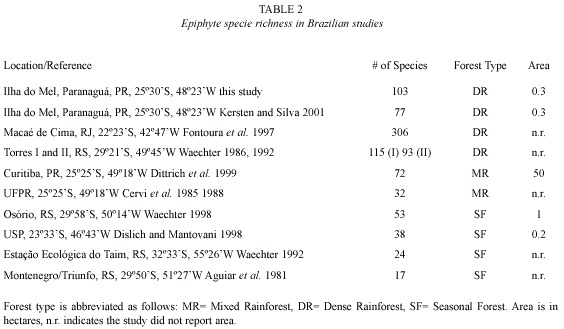
<body><![CDATA[<p><font face="Arial" size="2">The study area comprises 3 000 m<sup>2</sup> of the coastal plain of the island Ilha do Mel, in the state of Paraná, Brazil. Flooded during the rainy seasons, this relatively closed forest contains three main strata: the lower stratum contains herbaceous plants, leaf litter and shoots, the middle stratum bushes and samplings, and the upper stratum, which may reach over 20 m, with few dominant species (Silva 1998).</font></p>     <p><font face="Arial" size="2">Plants were collected from all strata, using climbing equipment when necessary (Ingram and Lowman 1995), samples of each fertile species were collected as a reference collection to be maintained in herbaria. Collected epiphytes were identified by specialist, using published literature, or by comparison with herbaria specimens in the UPCB (Herbarium of the Botany Department at the Federal University of Paraná) and MBM (Herbarium of the Municipal Botanical Museum). All the material gathered was prepared for and placed in the UPCB. Floristic similarity was compared among sites using the Jaccard Similarity Index.</font></p>     <p><font face="Arial" size="2">Taxonomy followed Cronquist (1988) for Magnoliophyta and Moran (1995) for Pteridophyta. Epiphytes, based on their observed relationship with their host plant, were characterized as obligatory holoepiphyte, preferential holoepiphytes, facultative holoepiphyte, accidental holoepiphyte, primary and secondary hemiepiphyte, based on Benzing (1990).</font></p> <font face="Arial" size="2"><b>     <p>Results</p> </b></font>     <p><font face="Arial" size="2">The many species (n = 103) of epiphytes were distributed among 20 families, in 49 genera. Pteridophyta contributed 10 families, 15 genera and 28 species. The rest were within the Magnoliophyta, and included 10 families: Liliopsida contained three families, with 27 genera and 64 species; Magnoliopsida contained seven families, with seven genera and 11 species. The most speciose families were Orchidaceae (18 genera and 42 species), Bromeliaceae (six genera and 16 species), Polypodiaceae (five genera with 11 species), and Araceae (three genera and six species). Eight families were represented by one species each (four dicots and four pteridophytes, <a href="#t1">Table 1</a>).</font></p> <a name="t1"></a>     <div style="text-align: center;"><img src="/img/fbpe/rbt/v54n3/3882i1.JPG" title=""  alt="" style="width: 577px; height: 1553px;"></div>     
<p><font face="Arial" size="2">Seven species classified as accidental epiphytes or climbing lianas, (<i>Marcgravia polyantha</i>, <i>Norantea brasiliensis</i> - Marcgraviaceae, <i>Polybotrya cylindrica</i> - Dryopteridaceae, <i>Prunus mirtyfolia - </i>Rosaceae, <i>Mikania </i>sp. - Asteraceae and <i>Conomorpha peruviana</i> - Myrsinaceae) were not included in the species list discussed here in, even though similar species were included in epiphyte checklist by Ingram <i>et al.</i> (1996) and Nadkarni (1986).</font></p>     <p><font face="Arial" size="2">The most species rich genera were <i>Vriesea</i> (Bromeliaceae) and <i>Maxillaria </i>(Orchidaceae), each with eight species. Next was <i>Epidendrum</i> (Orchidaceae) with six species, <i>Pleurothallis </i>(Orchidaceae) with five species and<i> Trichomanes</i> (Hymenophyllaceae) and <i>Prosthechea</i> (Orchidaceae) with four species each. Five genera had three species each (<i>Elaphoglossum, Octomeria, Campyloneurum, Polypodium </i>and<i> Tillandsia</i>), and 11 genera had two species, while the remaining 28 genera were each represented by one species. The epiphytic categories were distributed among obligatory holoepiphytes (62 %, including all of the Orchidaceae), preferential holoepiphytes (13 %), facultative epiphytes (11 %), hemiepiphytes (9%) and accidental holoepiphytes (6 %).</font></p> <font face="Arial" size="2"><b>     <p>Discussion</p> </b></font>     <p><font face="Arial" size="2">A total of 201 vascular plant species have been identified to date in the study area (M.C.M. Marques pers. com., Silva 1998), of which 51 % (103 spp.) are epiphytes and 41 % (86 spp.) are characteristic holoepiphyte. Indeed, over 59 % of the species are canopy dependent (including climbing lianas). This high proportion of epiphytes is greater than that reported in any other forest studied (Gentry and Dodson 1987a). In Jamaica (Kelly 1985) only 25 % of the total flora were epiphytes, in La Selva they comprise 25 % and in Centinela Ridge this proportion grows to 35 % (Both in Gentry and Dodson 1987b), in Costa Rica (Ingram <i>et al</i> 1996) 25 % of total species were expected to grow epiphytically and in Macaé de Cima (Fontoura <i>et al</i>. 1997) 27 % of the flora was epiphytic. This epiphyte quotient (Hosokawa 1950) is even greater than the presented in Engwald (2000) who found that the 191 species documented comprises 45 % of total flora species. Nearby in Brazil, in an Araucaria forest, epiphytes constitute 22 % of the flora (Dittrich <i>et al</i>. 1999). Nearby, in a seasonal forest in Argentina, epiphytes were reported to be represented by fewer species than were trees, while no precise numbers were provided (Brown 1990). Hence, the flora of Ilha do Mel includes surprisingly many epiphytes, and supports the premise that characteristic epiphytes are an important part of the tropical forest plant communities (Madison 1977), and that they are responsible for an important part of the diversity of these complex ecosystems (Gentry and Dodson 1987b).</font></p>     ]]></body>
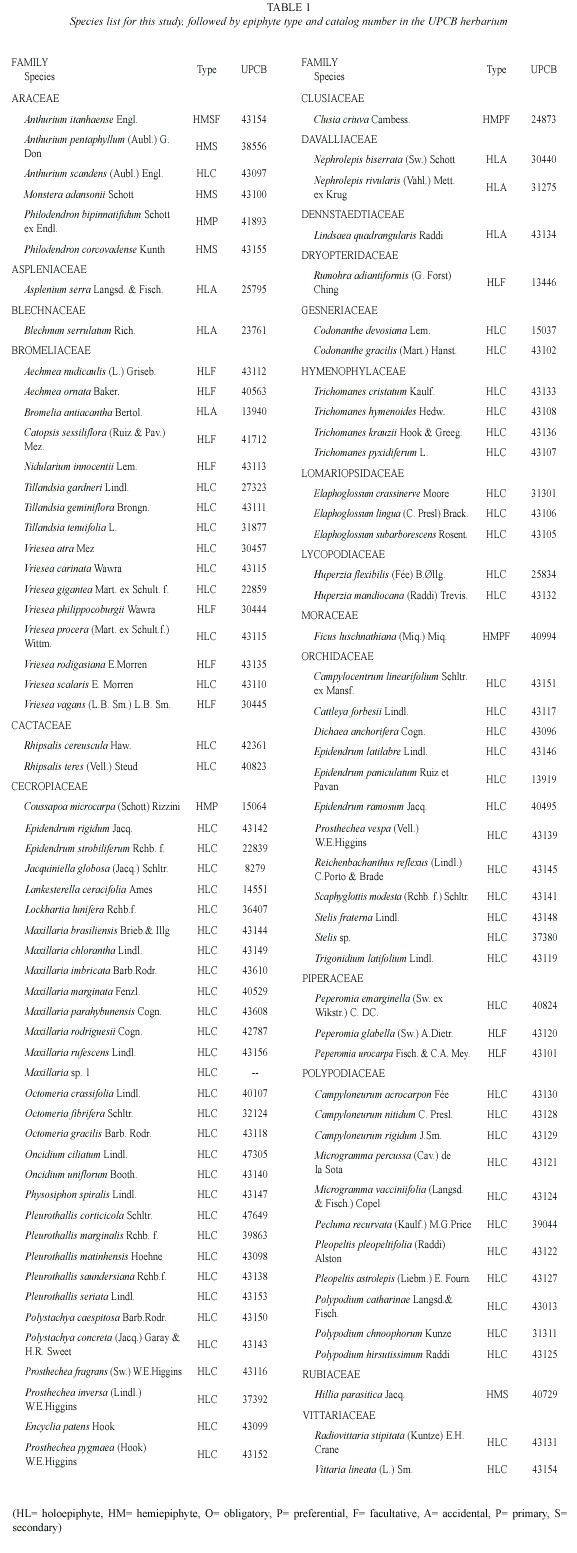
<body><![CDATA[<p><font face="Arial" size="2">The four most species rich families (Orchidaceae, Bromeliaceae, Polypodiaceae, Araceae) together are represented here by 75 species being the largest families elsewhere (Benzing 1990, Gentry and Dodson 1987b, Kress 1986, Madison 1977). Orchidaceae that worldwide represents 10 % of the total terrestrial vascular flora (Atwood 1986) represents 40 % of the epiphytic and 20 % of the total species on our work. The absence of the family Ericaceae in this study as in many others areas in Brazil (Cervi and Dombrowski 1985, Cervi <i>et al.</i> 1988, Waechter 1986, 1992, 1998a, Fontoura <i>et al.</i> 1997, Dislich and Mantovani 1998, Dittrich <i>et al.</i> 1999, Kersten and Silva 2001, 2002) should be surprising according to Kress (1986), given that it is a common family in Central America (Sudgen and Robins 1979, Nadkarni 1986, Ingram <i>et al.</i> 1996).</font></p>     <p><font face="Arial" size="2">Only two areas studied in Brazil had greater species-richness than that presented here (<a href="#t2">Table 2</a>). One study (Torres, Waechter 1986) is located approximately 400 km south of Ilha do Mel at 30o S. This region is described as a transition zone (Takhtajan 1986), at the interface of seasonal forests and mixed rainforests, and so contains species that are typical of both (eg <i>Blechnum binervatum</i> - Blechnaceae<i>, Tillandsia stricta</i> and <i>T. mallemontii</i> - Bromeliaceae) and of Atlantic Forests (eg <i>Hymenophyllum vestitum</i> in the family Hymenophyllaceae). The second (Fontoura<i> et al.</i> 1997) located on Rio de Janeiro is much larger and includes montana and altomontana forest having a high ecosystem diversity and so a higher species diversity. The area studied here is more species-rich than any other coastal plains in southern Brazil (Kersten and Silva 2001), any other area outside of the influence of the Atlantic Ocean in southern Brazil (Cervi and Dombrowski 1985, Cervi <i>et al.</i> 1988, Dislich and Mantovani 1998, Dittrich <i>et al.</i> 1999, Kersten and Silva 2002), as well as areas under the influence of temperate air masses (Aguiar <i>et al.</i> 1981, Waechter 1998a). This pattern is probably due to the tropical origins of the epiphytic component of this forest. Four study sites in Central America (Kelly 1995, Nadkarni <i>et al.</i> 1995, Ingram <i>et al.</i> 1996, Engwald <i>et al.</i> 2000) had greater species-richness than this study but all of them had a much greater study area, varying from 5 times greater (1.5 ha in Engwald <i>et al.</i> 2000) to more than 13 times greater (4 ha in Nadkarni <i>et al.</i> 1995, Ingram <i>et al</i>. 1996).</font></p> <a name="t2"></a>     <div style="text-align: center;"><img src="/img/fbpe/rbt/v54n3/3882i2.JPG" title=""  alt="" style="width: 564px; height: 329px;"></div>     
<p><font face="Arial" size="2">The epiphytic community of Ilha do Mel (here and Kersten and Silva 2001) was most similar (<a href="#t2">Table 2</a>) to Torres (Waechter 1986, 1992) and Ubatuba (Piliackas <i>et al</i>. 2000), and less so with Macaé de Cima (Fontoura <i>et al.</i> 1997) and Montenegro and Triunfo (Aguiar <i>et al.</i> 1981). Torres and Ubatuba owe their similarities to their similar formations and their proximity with Ilha do Mel. Macaé was less similar to Ilha do Mel due to its greater number of species, and Montenegro and Triunfo due to fewer species.</font></p>     <p><font face="Arial" size="2">Holoepiphytes formed the vast majority of species here, a trend that is apparently common (Kelly 1985, Pinto <i>et al.</i> 1995, Dittrich <i>et al.</i> 1999, Kersten and Silva 2001, 2002). Facultative epiphytes, with 10-15 % of the total, form the second most important group of epiphytes. In this second group, <i>Aechmea nudicaulis</i>, <i>Codonanthe gracilis</i>,<i> Peperomia glabella,</i> and <i>Clusia criuva</i> were often found as free living plants as well as epiphytes (Silva 1998). Hemiepiphytes comprised nine species, with three being primary hemiepiphytes (<i>Clusia criuva</i>, <i>Ficus </i>cf.<i> luschnathiana</i> and <i>Coussapoa microcarpa</i>) and the remainder were secondary epiphytes.</font></p>     <p><font face="Arial" size="2">Seven other species were accidental epiphytes, mentioned here but not considered in comparisons of communities. Examples are <i>Bromelia antiacantha</i> in spite of its usually terrestrial life style, was found as an epiphyte (see Aguiar <i>et al.</i> 1981, Waechter 1998a). Two species normally found as terrestrial trees (<i>Prunus myrtifolia</i> and <i>Conomorpha peruviana</i>) and one vine (<i>Micania</i> sp.) were also observed as epiphytes. It is unknown whether these accidental epiphytes may survive to reproduce as epiphytes. Perhaps they represent the type of transition from free-living plant to the epiphytic habit that may have been important in the evolution of some epiphytic plants. </font></p>     <p><font face="Arial" size="2">In summary, the vascular epiphyte component of this plant community in southern Brazil comprises over half (51 %) of the vascular plant species in the community. Orchidaceae and Bromeliaceae are the two most species-rich families. While most species are characteristic holoepiphytes, 25 % of this community is divided between hemiepiphytes, facultative holoepiphytes and accidental epiphytes.</font></p> <font face="Arial" size="2"><b>     <p>Resumen</p> </b></font>     <p><font face="Arial" size="2">Se muestreó plantas de todos los estratos en una área de 3 000 m<sup>2</sup> de selva estacionalmente inundada en Ilha do Mel (25º30 "S 48º23’ W), Paraná, Brazil. El área tiene 103 especies de epífitas en 49 géneros y 20 familias, de las cuales 28 especies son pteridófitas y 75 magnoliófitas (64 Liliopsida, 11 Magnoliopsida). Las familias más comunes son Orchidaceae, Bromeliaceae, Polypodiaceae y Araceae, y los géneros más frecuentes <i>Vriesea, Epidendrum, Maxillaria, Encyclia</i> y <i>Pleurothallis</i>. Ocho familias solamente están representadas por una especie cada una. La mayoría de las especies son loepífitas obligadas (62 %), seguidas de las relativamente escasas holoepífitas preferenciales (13 %), epífitas facultativas (11 %), hemiepífitas (9 %) y epífitas accidentales (6 %).</font></p> <font face="Arial" size="2"><b></b></font>     <p><font face="Arial" size="2"><b>Palabras clave: </b>Brazil, selva lluviosa atlántica, selva de planicie costera, composición florística, Orchidaceae, Restinga, epifitas vasculares.</font></p> <font face="Arial" size="2"><b>     ]]></body>
<body><![CDATA[<p>References</p> </b></font>     <!-- ref --><p><font face="Arial" size="2">Aguiar, L.W., V. Citadini-Zanette, L. Martau &amp; A. Backes. 1981. Composição florística de epífitos vasculares numa area localizada nos municípios de Montenegro e Triunfo, Rio Grande do Sul, Brazil. Iheringia 28: 55-93. </font>&nbsp;&nbsp;&nbsp;&nbsp;&nbsp;&nbsp;&nbsp;&nbsp;[&#160;<a href="javascript:void(0);" onclick="javascript: window.open('/scielo.php?script=sci_nlinks&ref=1315354&pid=S0034-7744200600030002600001&lng=','','width=640,height=500,resizable=yes,scrollbars=1,menubar=yes,');">Links</a>&#160;]<!-- end-ref --><!-- ref --><p><font face="Arial" size="2">Atwood, J.T. 1986. The size of Orchidaceae and the systematic distribution of epiphytic orchids. Selbyana 9: 171-186.</font>&nbsp;&nbsp;&nbsp;&nbsp;&nbsp;&nbsp;&nbsp;&nbsp;[&#160;<a href="javascript:void(0);" onclick="javascript: window.open('/scielo.php?script=sci_nlinks&ref=1315355&pid=S0034-7744200600030002600002&lng=','','width=640,height=500,resizable=yes,scrollbars=1,menubar=yes,');">Links</a>&#160;]<!-- end-ref --><!-- ref --><p><font face="Arial" size="2">Benzing, D.H. 1990. Vascular epiphytes. Cambridge University, Cambridge, England. </font>&nbsp;&nbsp;&nbsp;&nbsp;&nbsp;&nbsp;&nbsp;&nbsp;[&#160;<a href="javascript:void(0);" onclick="javascript: window.open('/scielo.php?script=sci_nlinks&ref=1315356&pid=S0034-7744200600030002600003&lng=','','width=640,height=500,resizable=yes,scrollbars=1,menubar=yes,');">Links</a>&#160;]<!-- end-ref --><!-- ref --><p><font face="Arial" size="2">Brown, D.A. 1990. El epifitismo en las selvas montanas del Parque Nacional "El Rey" Argentina: Composición florística y padrón de distribución. Rev. Biol. Trop. 38: 155-166.</font>&nbsp;&nbsp;&nbsp;&nbsp;&nbsp;&nbsp;&nbsp;&nbsp;[&#160;<a href="javascript:void(0);" onclick="javascript: window.open('/scielo.php?script=sci_nlinks&ref=1315357&pid=S0034-7744200600030002600004&lng=','','width=640,height=500,resizable=yes,scrollbars=1,menubar=yes,');">Links</a>&#160;]<!-- end-ref --><!-- ref --><p><font face="Arial" size="2">Cervi, A.C. &amp; L.T.D. Dombrowski. 1985. Bromeliaceae de um capão de floresta primária do Centro Politécnico de Curitiba (Paraná, Brazil). Fontqueria 9: 09-11. </font>&nbsp;&nbsp;&nbsp;&nbsp;&nbsp;&nbsp;&nbsp;&nbsp;[&#160;<a href="javascript:void(0);" onclick="javascript: window.open('/scielo.php?script=sci_nlinks&ref=1315358&pid=S0034-7744200600030002600005&lng=','','width=640,height=500,resizable=yes,scrollbars=1,menubar=yes,');">Links</a>&#160;]<!-- end-ref --><!-- ref --><p><font face="Arial" size="2">Cervi, A.C., L.A. Acra, L. Rodrigues, S. Train, S.L Ivachechen &amp; A.L.O.R. Moreira. 1988. Contribuição ao conhecimento das epífitas (exclusive Bromeliaceae) de uma floresta de araucária do primeiro planalto paranaense. Ínsula 18: 75-82.</font>&nbsp;&nbsp;&nbsp;&nbsp;&nbsp;&nbsp;&nbsp;&nbsp;[&#160;<a href="javascript:void(0);" onclick="javascript: window.open('/scielo.php?script=sci_nlinks&ref=1315359&pid=S0034-7744200600030002600006&lng=','','width=640,height=500,resizable=yes,scrollbars=1,menubar=yes,');">Links</a>&#160;]<!-- end-ref --><!-- ref --><p><font face="Arial" size="2">Cronquist, A. 1988. The evolution and classification of flowering plants. The New York Botanical Garden, New York, USA.</font>&nbsp;&nbsp;&nbsp;&nbsp;&nbsp;&nbsp;&nbsp;&nbsp;[&#160;<a href="javascript:void(0);" onclick="javascript: window.open('/scielo.php?script=sci_nlinks&ref=1315360&pid=S0034-7744200600030002600007&lng=','','width=640,height=500,resizable=yes,scrollbars=1,menubar=yes,');">Links</a>&#160;]<!-- end-ref --><!-- ref --><p><font face="Arial" size="2">Dislich, R. &amp; W. Mantovani. 1998. Flora de epífítas vasculares da Reserva da Cidade Universitária Armando de Salles Oliveira (São Paulo, Brazil). Bol. Bot. Univ. S. Paulo 17: 61-83.</font>&nbsp;&nbsp;&nbsp;&nbsp;&nbsp;&nbsp;&nbsp;&nbsp;[&#160;<a href="javascript:void(0);" onclick="javascript: window.open('/scielo.php?script=sci_nlinks&ref=1315361&pid=S0034-7744200600030002600008&lng=','','width=640,height=500,resizable=yes,scrollbars=1,menubar=yes,');">Links</a>&#160;]<!-- end-ref --><!-- ref --><p><font face="Arial" size="2">Dittrich, V.A.O., C. Kozera &amp; S.M. Silva. 1999. Levantamento florístico de epífitos vasculares no Parque Barigüi, Paraná, Brazil. Iheringia 52: 11-22. </font>&nbsp;&nbsp;&nbsp;&nbsp;&nbsp;&nbsp;&nbsp;&nbsp;[&#160;<a href="javascript:void(0);" onclick="javascript: window.open('/scielo.php?script=sci_nlinks&ref=1315362&pid=S0034-7744200600030002600009&lng=','','width=640,height=500,resizable=yes,scrollbars=1,menubar=yes,');">Links</a>&#160;]<!-- end-ref --><!-- ref --><p><font face="Arial" size="2">Engwald, S., V. Schimit-Neuerburg &amp; W. Barthlott. 2000. Epiphytes in rain forest of Venezuela - diversity and dynamics of a biocenosis, p. 425-434. <i>In</i> S.W. Breckle, B. Schweizer &amp; U. Arndt (eds.). Results of worldwide ecological studies. Proceedings of the first symposium by the AFW Foundation. Günter Heimbach, Hoheneim, Holland.</font>&nbsp;&nbsp;&nbsp;&nbsp;&nbsp;&nbsp;&nbsp;&nbsp;[&#160;<a href="javascript:void(0);" onclick="javascript: window.open('/scielo.php?script=sci_nlinks&ref=1315363&pid=S0034-7744200600030002600010&lng=','','width=640,height=500,resizable=yes,scrollbars=1,menubar=yes,');">Links</a>&#160;]<!-- end-ref --><!-- ref --><p><font face="Arial" size="2">Fontoura, T., L.S. Sylvestre, A.M.S. Vaz &amp; C.M. Vieira. 1997. Epífitas vasculares, hemiepífitas e hemiparasitas da Reserva Ecológica de Macaé de Cima, p. 89-101. <i>In</i> H.C. Lima &amp; R.R. Guedes-Bruni (eds.). Serra de Macaé de Cima: diversidade florística e conservação da Mata Atlântica. Editora do Jardim Botânico do Rio de Janeiro, Rio de Janeiro, Brasil.</font>&nbsp;&nbsp;&nbsp;&nbsp;&nbsp;&nbsp;&nbsp;&nbsp;[&#160;<a href="javascript:void(0);" onclick="javascript: window.open('/scielo.php?script=sci_nlinks&ref=1315364&pid=S0034-7744200600030002600011&lng=','','width=640,height=500,resizable=yes,scrollbars=1,menubar=yes,');">Links</a>&#160;]<!-- end-ref --><!-- ref --><p><font face="Arial" size="2">Gentry, A.H. &amp; C.H. Dodson. 1987a. Contribution of non-trees to species richness of a tropical rain forest. Biotropica 19: 149-156.</font>&nbsp;&nbsp;&nbsp;&nbsp;&nbsp;&nbsp;&nbsp;&nbsp;[&#160;<a href="javascript:void(0);" onclick="javascript: window.open('/scielo.php?script=sci_nlinks&ref=1315365&pid=S0034-7744200600030002600012&lng=','','width=640,height=500,resizable=yes,scrollbars=1,menubar=yes,');">Links</a>&#160;]<!-- end-ref --><!-- ref --><p><font face="Arial" size="2">Gentry, A.H. &amp; C.H. Dodson. 1987b. Diversity and biogeography of neotropical vascular epiphytes. Ann. Miss. Bot. Gar. 74: 205-233.</font>&nbsp;&nbsp;&nbsp;&nbsp;&nbsp;&nbsp;&nbsp;&nbsp;[&#160;<a href="javascript:void(0);" onclick="javascript: window.open('/scielo.php?script=sci_nlinks&ref=1315366&pid=S0034-7744200600030002600013&lng=','','width=640,height=500,resizable=yes,scrollbars=1,menubar=yes,');">Links</a>&#160;]<!-- end-ref --><!-- ref --><p><font face="Arial" size="2">Gottsberger, G. &amp; W. Morawetz. 1993. Development and distribution of the epiphytic flora in an Amazonian savanna in Brazil. Flora 188: 145-151.</font>&nbsp;&nbsp;&nbsp;&nbsp;&nbsp;&nbsp;&nbsp;&nbsp;[&#160;<a href="javascript:void(0);" onclick="javascript: window.open('/scielo.php?script=sci_nlinks&ref=1315367&pid=S0034-7744200600030002600014&lng=','','width=640,height=500,resizable=yes,scrollbars=1,menubar=yes,');">Links</a>&#160;]<!-- end-ref --><!-- ref --><p><font face="Arial" size="2">Hosokawa, T. 1950. Epyphyte-quotient. Bot. Mag. Tokyo 63: 18-19.</font>&nbsp;&nbsp;&nbsp;&nbsp;&nbsp;&nbsp;&nbsp;&nbsp;[&#160;<a href="javascript:void(0);" onclick="javascript: window.open('/scielo.php?script=sci_nlinks&ref=1315368&pid=S0034-7744200600030002600015&lng=','','width=640,height=500,resizable=yes,scrollbars=1,menubar=yes,');">Links</a>&#160;]<!-- end-ref --><!-- ref --><p><font face="Arial" size="2">Ingram, S.W. &amp; M.D. Lowman. 1995. The collection and preservation of plant material from the tropical forest canopy. p. 5-15. <i>In</i> M.D. Lowman &amp; N.M. Nadkarni (eds.). Forest Canopies Academic, San Diego, California, USA.</font>&nbsp;&nbsp;&nbsp;&nbsp;&nbsp;&nbsp;&nbsp;&nbsp;[&#160;<a href="javascript:void(0);" onclick="javascript: window.open('/scielo.php?script=sci_nlinks&ref=1315369&pid=S0034-7744200600030002600016&lng=','','width=640,height=500,resizable=yes,scrollbars=1,menubar=yes,');">Links</a>&#160;]<!-- end-ref --><!-- ref --><p><font face="Arial" size="2">Ingram, S.W., A. Ferrell, K. Ingram &amp; N.M. Nadkarni. 1996. Floristic composition of vascular epiphytes in a neotropical cloud forest, Monteverde, Costa Rica. Selbyana 17: 88-103.</font>&nbsp;&nbsp;&nbsp;&nbsp;&nbsp;&nbsp;&nbsp;&nbsp;[&#160;<a href="javascript:void(0);" onclick="javascript: window.open('/scielo.php?script=sci_nlinks&ref=1315370&pid=S0034-7744200600030002600017&lng=','','width=640,height=500,resizable=yes,scrollbars=1,menubar=yes,');">Links</a>&#160;]<!-- end-ref --><!-- ref --><p><font face="Arial" size="2">Kelly, D.L. 1985. Epiphytes and climbers of a Jamaican rain forest: vertical distributions, life forms and life history. J. Biogeogr. 2: 233-243. </font>&nbsp;&nbsp;&nbsp;&nbsp;&nbsp;&nbsp;&nbsp;&nbsp;[&#160;<a href="javascript:void(0);" onclick="javascript: window.open('/scielo.php?script=sci_nlinks&ref=1315371&pid=S0034-7744200600030002600018&lng=','','width=640,height=500,resizable=yes,scrollbars=1,menubar=yes,');">Links</a>&#160;]<!-- end-ref --><!-- ref --><p><font face="Arial" size="2">Kersten, R.A. &amp; S.M. Silva. 2001. Composição florística e distribuição espacial de epífitas vasculares em floresta da planície litorânea da Ilha do Mel, Paraná, Brazil. Rev. Bras. Bot. 24:213-226. </font>&nbsp;&nbsp;&nbsp;&nbsp;&nbsp;&nbsp;&nbsp;&nbsp;[&#160;<a href="javascript:void(0);" onclick="javascript: window.open('/scielo.php?script=sci_nlinks&ref=1315372&pid=S0034-7744200600030002600019&lng=','','width=640,height=500,resizable=yes,scrollbars=1,menubar=yes,');">Links</a>&#160;]<!-- end-ref --><!-- ref --><p><font face="Arial" size="2">Kersten, R.A. &amp; S.M. Silva. 2002. Florística e estrutura do componente epifítico vascular em floresta ombrófila mista aluvial do rio Barigüi, Paraná, Brazil. Rev. Bras. Bot. 25: 259-267</font>&nbsp;&nbsp;&nbsp;&nbsp;&nbsp;&nbsp;&nbsp;&nbsp;[&#160;<a href="javascript:void(0);" onclick="javascript: window.open('/scielo.php?script=sci_nlinks&ref=1315373&pid=S0034-7744200600030002600020&lng=','','width=640,height=500,resizable=yes,scrollbars=1,menubar=yes,');">Links</a>&#160;]<!-- end-ref --><!-- ref --><p><font face="Arial" size="2">Kress, W.J. 1986. The systematic distribution of vascular epiphytes: an update. Selbyana 9: 2-22.</font>&nbsp;&nbsp;&nbsp;&nbsp;&nbsp;&nbsp;&nbsp;&nbsp;[&#160;<a href="javascript:void(0);" onclick="javascript: window.open('/scielo.php?script=sci_nlinks&ref=1315374&pid=S0034-7744200600030002600021&lng=','','width=640,height=500,resizable=yes,scrollbars=1,menubar=yes,');">Links</a>&#160;]<!-- end-ref --><!-- ref --><p><font face="Arial" size="2">Labiak, P.H. &amp; J. Prado. 1998. Pteridófitas epífitas da Reserva Volta Velha, Itapoá - Santa Catarina, Brazil. Bol. Inst. Bot. 11: 1-79.</font>&nbsp;&nbsp;&nbsp;&nbsp;&nbsp;&nbsp;&nbsp;&nbsp;[&#160;<a href="javascript:void(0);" onclick="javascript: window.open('/scielo.php?script=sci_nlinks&ref=1315375&pid=S0034-7744200600030002600022&lng=','','width=640,height=500,resizable=yes,scrollbars=1,menubar=yes,');">Links</a>&#160;]<!-- end-ref --><!-- ref --><p><font face="Arial" size="2">Madison, M. 1977. Vascular epiphytes: their systematic occurrence and salient features. Selbyana 2: 1-13.</font>&nbsp;&nbsp;&nbsp;&nbsp;&nbsp;&nbsp;&nbsp;&nbsp;[&#160;<a href="javascript:void(0);" onclick="javascript: window.open('/scielo.php?script=sci_nlinks&ref=1315376&pid=S0034-7744200600030002600023&lng=','','width=640,height=500,resizable=yes,scrollbars=1,menubar=yes,');">Links</a>&#160;]<!-- end-ref --><!-- ref --><p><font face="Arial" size="2">Moran, R.C. 1995. Clave para las familias de pteridofitas. Flora Mesoamericana. Vol. 1: Psilotaceae a Salviniaceae. UNAM, Mexico, DF, Mexico.</font>&nbsp;&nbsp;&nbsp;&nbsp;&nbsp;&nbsp;&nbsp;&nbsp;[&#160;<a href="javascript:void(0);" onclick="javascript: window.open('/scielo.php?script=sci_nlinks&ref=1315377&pid=S0034-7744200600030002600024&lng=','','width=640,height=500,resizable=yes,scrollbars=1,menubar=yes,');">Links</a>&#160;]<!-- end-ref --><!-- ref --><p><font face="Arial" size="2">Nadkarni, N.M. 1986. An ecological overview and checklist of vascular epiphytes in the Monteverde cloud forest reserve, Costa Rica. Brenesia 24: 55-632. </font>&nbsp;&nbsp;&nbsp;&nbsp;&nbsp;&nbsp;&nbsp;&nbsp;[&#160;<a href="javascript:void(0);" onclick="javascript: window.open('/scielo.php?script=sci_nlinks&ref=1315378&pid=S0034-7744200600030002600025&lng=','','width=640,height=500,resizable=yes,scrollbars=1,menubar=yes,');">Links</a>&#160;]<!-- end-ref --><!-- ref --><p><font face="Arial" size="2">Nadkarni, N.M., T.J. Matelson &amp; W.A. Haber. 1995. Structural characteristics &amp; floristic composition of a Neotropical cloud forest, Monteverde, Costa Rica. J. Trop. Ecol. 11:481-495.</font>&nbsp;&nbsp;&nbsp;&nbsp;&nbsp;&nbsp;&nbsp;&nbsp;[&#160;<a href="javascript:void(0);" onclick="javascript: window.open('/scielo.php?script=sci_nlinks&ref=1315379&pid=S0034-7744200600030002600026&lng=','','width=640,height=500,resizable=yes,scrollbars=1,menubar=yes,');">Links</a>&#160;]<!-- end-ref --><!-- ref --><p><font face="Arial" size="2">Piliackas, J.M., L.M. Barbosa &amp; E.L.M. Catharino. 2000. Levantamento das epífitas vasculares do manguezal do Rio Picinguaba, Ubatuba, São Paulo. Anais, V Simpósio de Ecossistemas Brasileiros: Conservação. ACIESP 109: 2.</font>&nbsp;&nbsp;&nbsp;&nbsp;&nbsp;&nbsp;&nbsp;&nbsp;[&#160;<a href="javascript:void(0);" onclick="javascript: window.open('/scielo.php?script=sci_nlinks&ref=1315380&pid=S0034-7744200600030002600027&lng=','','width=640,height=500,resizable=yes,scrollbars=1,menubar=yes,');">Links</a>&#160;]<!-- end-ref --><!-- ref --><p><font face="Arial" size="2">Pimm, S.L. 2001. The World According to Pimm: a scientist audits the earth. McGraw-Hill, New York, New York, USA.</font>&nbsp;&nbsp;&nbsp;&nbsp;&nbsp;&nbsp;&nbsp;&nbsp;[&#160;<a href="javascript:void(0);" onclick="javascript: window.open('/scielo.php?script=sci_nlinks&ref=1315381&pid=S0034-7744200600030002600028&lng=','','width=640,height=500,resizable=yes,scrollbars=1,menubar=yes,');">Links</a>&#160;]<!-- end-ref --><!-- ref --><p><font face="Arial" size="2">Pinto, A.C., M.E.S.P. Demattê &amp; M.C.M.D. Pavani. 1995. Composição florística de epífitas (Magnoliophyta) em fragmento de floresta no município de Jaboticabal, SP, Brazil. Cientifica 22: 283-289.</font>&nbsp;&nbsp;&nbsp;&nbsp;&nbsp;&nbsp;&nbsp;&nbsp;[&#160;<a href="javascript:void(0);" onclick="javascript: window.open('/scielo.php?script=sci_nlinks&ref=1315382&pid=S0034-7744200600030002600029&lng=','','width=640,height=500,resizable=yes,scrollbars=1,menubar=yes,');">Links</a>&#160;]<!-- end-ref --><!-- ref --><p><font face="Arial" size="2">Silva, S.M. 1998. As formações vegetais da planície litorânea da Ilha do Mel, Paraná: composição florística e principais características estruturais. Ph.D. Thesis. Universidade Estadual de Campinas. Campinas, Brazil.</font>&nbsp;&nbsp;&nbsp;&nbsp;&nbsp;&nbsp;&nbsp;&nbsp;[&#160;<a href="javascript:void(0);" onclick="javascript: window.open('/scielo.php?script=sci_nlinks&ref=1315383&pid=S0034-7744200600030002600030&lng=','','width=640,height=500,resizable=yes,scrollbars=1,menubar=yes,');">Links</a>&#160;]<!-- end-ref --><!-- ref --><p><font face="Arial" size="2">Sudgen, A.M. &amp; R.J. Robins. 1979. Aspects of the ecology of vascular epiphytes in Colombian cloud forests, I. distribution of the epiphytic flora. Biotropica 11: 173-188.</font>&nbsp;&nbsp;&nbsp;&nbsp;&nbsp;&nbsp;&nbsp;&nbsp;[&#160;<a href="javascript:void(0);" onclick="javascript: window.open('/scielo.php?script=sci_nlinks&ref=1315384&pid=S0034-7744200600030002600031&lng=','','width=640,height=500,resizable=yes,scrollbars=1,menubar=yes,');">Links</a>&#160;]<!-- end-ref --><!-- ref --><p><font face="Arial" size="2">Takhtajan, A. 1986. Floristic Regions of the World. University of California, Berkeley, California, USA.</font>&nbsp;&nbsp;&nbsp;&nbsp;&nbsp;&nbsp;&nbsp;&nbsp;[&#160;<a href="javascript:void(0);" onclick="javascript: window.open('/scielo.php?script=sci_nlinks&ref=1315385&pid=S0034-7744200600030002600032&lng=','','width=640,height=500,resizable=yes,scrollbars=1,menubar=yes,');">Links</a>&#160;]<!-- end-ref --><!-- ref --><p><font face="Arial" size="2">Waechter, J.L. 1986. Epífitos vasculares da mata paludosa do Faxinal, Torres, Rio Grande do Sul, Brazil. Iheringia 34: 39-49.</font>&nbsp;&nbsp;&nbsp;&nbsp;&nbsp;&nbsp;&nbsp;&nbsp;[&#160;<a href="javascript:void(0);" onclick="javascript: window.open('/scielo.php?script=sci_nlinks&ref=1315386&pid=S0034-7744200600030002600033&lng=','','width=640,height=500,resizable=yes,scrollbars=1,menubar=yes,');">Links</a>&#160;]<!-- end-ref --><!-- ref --><p><font face="Arial" size="2">Waechter, J.L. 1992. O epifitismo vascular na planície costeira do Rio Grande do Sul. Ph.D. Thesis. Universidade Federal de São Carlos, São Carlos, Brazil. </font>&nbsp;&nbsp;&nbsp;&nbsp;&nbsp;&nbsp;&nbsp;&nbsp;[&#160;<a href="javascript:void(0);" onclick="javascript: window.open('/scielo.php?script=sci_nlinks&ref=1315387&pid=S0034-7744200600030002600034&lng=','','width=640,height=500,resizable=yes,scrollbars=1,menubar=yes,');">Links</a>&#160;]<!-- end-ref --><!-- ref --><p><font face="Arial" size="2">Waechter, J.L. 1998a. Epifitismo vascular em uma floresta de restinga do Brasil Subtropical. Rev. Ciên. Nat. 20: 43-66.</font>&nbsp;&nbsp;&nbsp;&nbsp;&nbsp;&nbsp;&nbsp;&nbsp;[&#160;<a href="javascript:void(0);" onclick="javascript: window.open('/scielo.php?script=sci_nlinks&ref=1315388&pid=S0034-7744200600030002600035&lng=','','width=640,height=500,resizable=yes,scrollbars=1,menubar=yes,');">Links</a>&#160;]<!-- end-ref --><!-- ref --><p><font face="Arial" size="2">Waechter, J.L. 1998b. Epiphytic Orchids in eastern subtropical America. Proc. World. Conference 15: 332-341.</font>&nbsp;&nbsp;&nbsp;&nbsp;&nbsp;&nbsp;&nbsp;&nbsp;[&#160;<a href="javascript:void(0);" onclick="javascript: window.open('/scielo.php?script=sci_nlinks&ref=1315389&pid=S0034-7744200600030002600036&lng=','','width=640,height=500,resizable=yes,scrollbars=1,menubar=yes,');">Links</a>&#160;]<!-- end-ref --> ]]></body><back>
<ref-list>
<ref id="B1">
<nlm-citation citation-type="journal">
<person-group person-group-type="author">
<name>
<surname><![CDATA[Aguiar]]></surname>
<given-names><![CDATA[L.W]]></given-names>
</name>
<name>
<surname><![CDATA[Citadini-Zanette]]></surname>
<given-names><![CDATA[V]]></given-names>
</name>
<name>
<surname><![CDATA[Martau]]></surname>
<given-names><![CDATA[L]]></given-names>
</name>
<name>
<surname><![CDATA[Backes]]></surname>
<given-names><![CDATA[A]]></given-names>
</name>
</person-group>
<article-title xml:lang="pt"><![CDATA[Composição florística de epífitos vasculares numa area localizada nos municípios de Montenegro e Triunfo, Rio Grande do Sul, Brazil]]></article-title>
<source><![CDATA[Iheringia]]></source>
<year>1981</year>
<volume>28</volume>
<page-range>55-93</page-range></nlm-citation>
</ref>
<ref id="B2">
<nlm-citation citation-type="journal">
<person-group person-group-type="author">
<name>
<surname><![CDATA[Atwood]]></surname>
<given-names><![CDATA[J.T]]></given-names>
</name>
</person-group>
<article-title xml:lang="en"><![CDATA[The size of Orchidaceae and the systematic distribution of epiphytic orchids]]></article-title>
<source><![CDATA[Selbyana]]></source>
<year>1986</year>
<volume>9</volume>
<page-range>171-186</page-range></nlm-citation>
</ref>
<ref id="B3">
<nlm-citation citation-type="book">
<person-group person-group-type="author">
<name>
<surname><![CDATA[Benzing]]></surname>
<given-names><![CDATA[D.H]]></given-names>
</name>
</person-group>
<source><![CDATA[Vascular epiphytes]]></source>
<year>1990</year>
<publisher-loc><![CDATA[Cambridge ]]></publisher-loc>
<publisher-name><![CDATA[Cambridge University]]></publisher-name>
</nlm-citation>
</ref>
<ref id="B4">
<nlm-citation citation-type="journal">
<person-group person-group-type="author">
<name>
<surname><![CDATA[Brown]]></surname>
<given-names><![CDATA[D.A]]></given-names>
</name>
</person-group>
<article-title xml:lang="es"><![CDATA[El epifitismo en las selvas montanas del Parque Nacional "El Rey" Argentina: Composición florística y padrón de distribución]]></article-title>
<source><![CDATA[Rev. Biol. Trop]]></source>
<year>1990</year>
<volume>38</volume>
<page-range>155-166</page-range></nlm-citation>
</ref>
<ref id="B5">
<nlm-citation citation-type="journal">
<person-group person-group-type="author">
<name>
<surname><![CDATA[Cervi]]></surname>
<given-names><![CDATA[A.C]]></given-names>
</name>
<name>
<surname><![CDATA[Dombrowski]]></surname>
<given-names><![CDATA[L.T.D]]></given-names>
</name>
</person-group>
<article-title xml:lang="pt"><![CDATA[Bromeliaceae de um capão de floresta primária do Centro Politécnico de Curitiba (Paraná, Brazil)]]></article-title>
<source><![CDATA[Fontqueria]]></source>
<year>1985</year>
<volume>9</volume>
<page-range>09-11</page-range></nlm-citation>
</ref>
<ref id="B6">
<nlm-citation citation-type="journal">
<person-group person-group-type="author">
<name>
<surname><![CDATA[Cervi]]></surname>
<given-names><![CDATA[A.C]]></given-names>
</name>
<name>
<surname><![CDATA[Acra]]></surname>
<given-names><![CDATA[L.A]]></given-names>
</name>
<name>
<surname><![CDATA[Rodrigues]]></surname>
<given-names><![CDATA[L]]></given-names>
</name>
<name>
<surname><![CDATA[Train]]></surname>
<given-names><![CDATA[S]]></given-names>
</name>
<name>
<surname><![CDATA[Ivachechen]]></surname>
<given-names><![CDATA[S.L]]></given-names>
</name>
<name>
<surname><![CDATA[Moreira]]></surname>
<given-names><![CDATA[A.L.O.R]]></given-names>
</name>
</person-group>
<article-title xml:lang="pt"><![CDATA[Contribuição ao conhecimento das epífitas (exclusive Bromeliaceae) de uma floresta de araucária do primeiro planalto paranaense]]></article-title>
<source><![CDATA[Ínsula]]></source>
<year>1988</year>
<volume>18</volume>
<page-range>75-82</page-range></nlm-citation>
</ref>
<ref id="B7">
<nlm-citation citation-type="book">
<person-group person-group-type="author">
<name>
<surname><![CDATA[Cronquist]]></surname>
<given-names><![CDATA[A]]></given-names>
</name>
</person-group>
<source><![CDATA[The evolution and classification of flowering plants]]></source>
<year>1988</year>
<publisher-loc><![CDATA[^eNew York New York]]></publisher-loc>
<publisher-name><![CDATA[The New York Botanical Garden]]></publisher-name>
</nlm-citation>
</ref>
<ref id="B8">
<nlm-citation citation-type="journal">
<person-group person-group-type="author">
<name>
<surname><![CDATA[Dislich]]></surname>
<given-names><![CDATA[R]]></given-names>
</name>
<name>
<surname><![CDATA[Mantovani]]></surname>
<given-names><![CDATA[W]]></given-names>
</name>
</person-group>
<article-title xml:lang="es"><![CDATA[Flora de epífítas vasculares da Reserva da Cidade Universitária Armando de Salles Oliveira (São Paulo, Brazil)]]></article-title>
<source><![CDATA[Bol. Bot. Univ. S. Paulo]]></source>
<year>1998</year>
<volume>17</volume>
<page-range>61-83</page-range></nlm-citation>
</ref>
<ref id="B9">
<nlm-citation citation-type="journal">
<person-group person-group-type="author">
<name>
<surname><![CDATA[Dittrich]]></surname>
<given-names><![CDATA[V.A.O]]></given-names>
</name>
<name>
<surname><![CDATA[Kozera]]></surname>
<given-names><![CDATA[C]]></given-names>
</name>
<name>
<surname><![CDATA[Silva]]></surname>
<given-names><![CDATA[S.M]]></given-names>
</name>
</person-group>
<article-title xml:lang="es"><![CDATA[Levantamento florístico de epífitos vasculares no Parque Barigüi, Paraná, Brazil]]></article-title>
<source><![CDATA[Iheringia]]></source>
<year>1999</year>
<volume>52</volume>
<page-range>11-22</page-range></nlm-citation>
</ref>
<ref id="B10">
<nlm-citation citation-type="book">
<person-group person-group-type="author">
<name>
<surname><![CDATA[Engwald]]></surname>
<given-names><![CDATA[S]]></given-names>
</name>
<name>
<surname><![CDATA[Schimit-Neuerburg]]></surname>
<given-names><![CDATA[V]]></given-names>
</name>
<name>
<surname><![CDATA[Barthlott]]></surname>
<given-names><![CDATA[W]]></given-names>
</name>
</person-group>
<article-title xml:lang="en"><![CDATA[Epiphytes in rain forest of Venezuela - diversity and dynamics of a biocenosis]]></article-title>
<person-group person-group-type="editor">
<name>
<surname><![CDATA[Breckle]]></surname>
<given-names><![CDATA[S.W]]></given-names>
</name>
<name>
<surname><![CDATA[Schweizer]]></surname>
<given-names><![CDATA[B]]></given-names>
</name>
<name>
<surname><![CDATA[Arndt]]></surname>
<given-names><![CDATA[U]]></given-names>
</name>
</person-group>
<source><![CDATA[Results of worldwide ecological studies. Proceedings of the first symposium by the AFW Foundation]]></source>
<year>2000</year>
<page-range>425-434</page-range><publisher-loc><![CDATA[Hoheneim ]]></publisher-loc>
<publisher-name><![CDATA[Günter Heimbach]]></publisher-name>
</nlm-citation>
</ref>
<ref id="B11">
<nlm-citation citation-type="book">
<person-group person-group-type="author">
<name>
<surname><![CDATA[Fontoura]]></surname>
<given-names><![CDATA[T]]></given-names>
</name>
<name>
<surname><![CDATA[Sylvestre]]></surname>
<given-names><![CDATA[L.S]]></given-names>
</name>
<name>
<surname><![CDATA[Vaz]]></surname>
<given-names><![CDATA[A.M.S]]></given-names>
</name>
<name>
<surname><![CDATA[Vieira]]></surname>
<given-names><![CDATA[C.M]]></given-names>
</name>
</person-group>
<article-title xml:lang="pt"><![CDATA[Epífitas vasculares, hemiepífitas e hemiparasitas da Reserva Ecológica de Macaé de Cima]]></article-title>
<person-group person-group-type="editor">
<name>
<surname><![CDATA[Lima]]></surname>
<given-names><![CDATA[H.C]]></given-names>
</name>
<name>
<surname><![CDATA[Guedes-Bruni]]></surname>
<given-names><![CDATA[R.R]]></given-names>
</name>
</person-group>
<source><![CDATA[Serra de Macaé de Cima: diversidade florística e conservação da Mata Atlântica]]></source>
<year>1997</year>
<page-range>89-101</page-range><publisher-loc><![CDATA[Rio de Janeiro ]]></publisher-loc>
<publisher-name><![CDATA[Editora do Jardim Botânico do Rio de Janeiro]]></publisher-name>
</nlm-citation>
</ref>
<ref id="B12">
<nlm-citation citation-type="journal">
<person-group person-group-type="author">
<name>
<surname><![CDATA[Gentry]]></surname>
<given-names><![CDATA[A.H]]></given-names>
</name>
<name>
<surname><![CDATA[Dodson]]></surname>
<given-names><![CDATA[C.H]]></given-names>
</name>
</person-group>
<article-title xml:lang="en"><![CDATA[Contribution of non-trees to species richness of a tropical rain forest]]></article-title>
<source><![CDATA[Biotropica]]></source>
<year>1987</year>
<volume>19</volume>
<page-range>149-156</page-range></nlm-citation>
</ref>
<ref id="B13">
<nlm-citation citation-type="journal">
<person-group person-group-type="author">
<name>
<surname><![CDATA[Gentry]]></surname>
<given-names><![CDATA[A.H]]></given-names>
</name>
<name>
<surname><![CDATA[Dodson]]></surname>
<given-names><![CDATA[C.H]]></given-names>
</name>
</person-group>
<article-title xml:lang="en"><![CDATA[Diversity and biogeography of neotropical vascular epiphytes]]></article-title>
<source><![CDATA[Ann. Miss. Bot. Gar]]></source>
<year>1987</year>
<volume>74</volume>
<page-range>205-233</page-range></nlm-citation>
</ref>
<ref id="B14">
<nlm-citation citation-type="journal">
<person-group person-group-type="author">
<name>
<surname><![CDATA[Gottsberger]]></surname>
<given-names><![CDATA[G]]></given-names>
</name>
<name>
<surname><![CDATA[Morawetz]]></surname>
<given-names><![CDATA[W]]></given-names>
</name>
</person-group>
<article-title xml:lang="en"><![CDATA[Development and distribution of the epiphytic flora in an Amazonian savanna in Brazil]]></article-title>
<source><![CDATA[Flora]]></source>
<year>1993</year>
<volume>188</volume>
<page-range>145-151</page-range></nlm-citation>
</ref>
<ref id="B15">
<nlm-citation citation-type="journal">
<person-group person-group-type="author">
<name>
<surname><![CDATA[Hosokawa]]></surname>
<given-names><![CDATA[T]]></given-names>
</name>
</person-group>
<article-title xml:lang="en"><![CDATA[Epyphyte-quotient]]></article-title>
<source><![CDATA[Bot. Mag. Tokyo]]></source>
<year>1950</year>
<volume>63</volume>
<page-range>18-19</page-range></nlm-citation>
</ref>
<ref id="B16">
<nlm-citation citation-type="book">
<person-group person-group-type="author">
<name>
<surname><![CDATA[Ingram]]></surname>
<given-names><![CDATA[S.W]]></given-names>
</name>
<name>
<surname><![CDATA[Lowman]]></surname>
<given-names><![CDATA[M.D]]></given-names>
</name>
</person-group>
<article-title xml:lang="en"><![CDATA[The collection and preservation of plant material from the tropical forest canopy]]></article-title>
<person-group person-group-type="editor">
<name>
<surname><![CDATA[Lowman]]></surname>
<given-names><![CDATA[M.D]]></given-names>
</name>
<name>
<surname><![CDATA[Nadkarni]]></surname>
<given-names><![CDATA[N.M]]></given-names>
</name>
</person-group>
<source><![CDATA[Forest Canopies]]></source>
<year>1995</year>
<page-range>5-15</page-range><publisher-loc><![CDATA[San Diego^eCalifornia California]]></publisher-loc>
<publisher-name><![CDATA[Academic]]></publisher-name>
</nlm-citation>
</ref>
<ref id="B17">
<nlm-citation citation-type="journal">
<person-group person-group-type="author">
<name>
<surname><![CDATA[Ingram]]></surname>
<given-names><![CDATA[S.W]]></given-names>
</name>
<name>
<surname><![CDATA[Ferrell]]></surname>
<given-names><![CDATA[A]]></given-names>
</name>
<name>
<surname><![CDATA[Ingram]]></surname>
<given-names><![CDATA[K]]></given-names>
</name>
<name>
<surname><![CDATA[Nadkarni]]></surname>
<given-names><![CDATA[N.M]]></given-names>
</name>
</person-group>
<article-title xml:lang="en"><![CDATA[Floristic composition of vascular epiphytes in a neotropical cloud forest, Monteverde, Costa Rica]]></article-title>
<source><![CDATA[Selbyana]]></source>
<year>1996</year>
<volume>17</volume>
<page-range>88-103</page-range></nlm-citation>
</ref>
<ref id="B18">
<nlm-citation citation-type="journal">
<person-group person-group-type="author">
<name>
<surname><![CDATA[Kelly]]></surname>
<given-names><![CDATA[D.L]]></given-names>
</name>
</person-group>
<article-title xml:lang="en"><![CDATA[Epiphytes and climbers of a Jamaican rain forest: vertical distributions, life forms and life history]]></article-title>
<source><![CDATA[J. Biogeogr]]></source>
<year>1985</year>
<volume>2</volume>
<page-range>233-243</page-range></nlm-citation>
</ref>
<ref id="B19">
<nlm-citation citation-type="journal">
<person-group person-group-type="author">
<name>
<surname><![CDATA[Kersten]]></surname>
<given-names><![CDATA[R.A]]></given-names>
</name>
<name>
<surname><![CDATA[Silva]]></surname>
<given-names><![CDATA[S.M]]></given-names>
</name>
</person-group>
<article-title xml:lang="pt"><![CDATA[Composição florística e distribuição espacial de epífitas vasculares em floresta da planície litorânea da Ilha do Mel, Paraná, Brazil]]></article-title>
<source><![CDATA[Rev. Bras. Bot]]></source>
<year>2001</year>
<volume>24</volume>
<page-range>213-226</page-range></nlm-citation>
</ref>
<ref id="B20">
<nlm-citation citation-type="journal">
<person-group person-group-type="author">
<name>
<surname><![CDATA[Kersten]]></surname>
<given-names><![CDATA[R.A]]></given-names>
</name>
<name>
<surname><![CDATA[Silva]]></surname>
<given-names><![CDATA[S.M]]></given-names>
</name>
</person-group>
<article-title xml:lang="pt"><![CDATA[Florística e estrutura do componente epifítico vascular em floresta ombrófila mista aluvial do rio Barigüi, Paraná, Brazil]]></article-title>
<source><![CDATA[Rev. Bras. Bot]]></source>
<year>2002</year>
<volume>25</volume>
<page-range>259-267</page-range></nlm-citation>
</ref>
<ref id="B21">
<nlm-citation citation-type="journal">
<person-group person-group-type="author">
<name>
<surname><![CDATA[Kress]]></surname>
<given-names><![CDATA[W.J]]></given-names>
</name>
</person-group>
<article-title xml:lang="en"><![CDATA[The systematic distribution of vascular epiphytes: an update]]></article-title>
<source><![CDATA[Selbyana]]></source>
<year>1986</year>
<volume>9</volume>
<page-range>2-22</page-range></nlm-citation>
</ref>
<ref id="B22">
<nlm-citation citation-type="journal">
<person-group person-group-type="author">
<name>
<surname><![CDATA[Labiak]]></surname>
<given-names><![CDATA[P.H]]></given-names>
</name>
<name>
<surname><![CDATA[Prado]]></surname>
<given-names><![CDATA[J]]></given-names>
</name>
</person-group>
<article-title xml:lang="pt"><![CDATA[Pteridófitas epífitas da Reserva Volta Velha, Itapoá - Santa Catarina, Brazil]]></article-title>
<source><![CDATA[Bol. Inst. Bot]]></source>
<year>1998</year>
<volume>11</volume>
<page-range>1-79</page-range></nlm-citation>
</ref>
<ref id="B23">
<nlm-citation citation-type="journal">
<person-group person-group-type="author">
<name>
<surname><![CDATA[Madison]]></surname>
<given-names><![CDATA[M]]></given-names>
</name>
</person-group>
<article-title xml:lang="en"><![CDATA[Vascular epiphytes: their systematic occurrence and salient features]]></article-title>
<source><![CDATA[Selbyana]]></source>
<year>1977</year>
<volume>2</volume>
<page-range>1-13</page-range></nlm-citation>
</ref>
<ref id="B24">
<nlm-citation citation-type="book">
<person-group person-group-type="author">
<name>
<surname><![CDATA[Moran]]></surname>
<given-names><![CDATA[R.C]]></given-names>
</name>
</person-group>
<source><![CDATA[Clave para las familias de pteridofitas. Flora Mesoamericana. Vol. 1: Psilotaceae a Salviniaceae]]></source>
<year>1995</year>
<publisher-loc><![CDATA[^eMexico, DF Mexico, DF]]></publisher-loc>
<publisher-name><![CDATA[UNAM]]></publisher-name>
</nlm-citation>
</ref>
<ref id="B25">
<nlm-citation citation-type="journal">
<person-group person-group-type="author">
<name>
<surname><![CDATA[Nadkarni]]></surname>
<given-names><![CDATA[N.M]]></given-names>
</name>
</person-group>
<article-title xml:lang="en"><![CDATA[An ecological overview and checklist of vascular epiphytes in the Monteverde cloud forest reserve, Costa Rica]]></article-title>
<source><![CDATA[Brenesia]]></source>
<year>1986</year>
<volume>24</volume>
<page-range>55-632</page-range></nlm-citation>
</ref>
<ref id="B26">
<nlm-citation citation-type="journal">
<person-group person-group-type="author">
<name>
<surname><![CDATA[Nadkarni]]></surname>
<given-names><![CDATA[N.M]]></given-names>
</name>
<name>
<surname><![CDATA[Matelson]]></surname>
<given-names><![CDATA[T.J]]></given-names>
</name>
<name>
<surname><![CDATA[Haber]]></surname>
<given-names><![CDATA[W.A]]></given-names>
</name>
</person-group>
<article-title xml:lang="en"><![CDATA[Structural characteristics & floristic composition of a Neotropical cloud forest, Monteverde, Costa Rica]]></article-title>
<source><![CDATA[J. Trop. Ecol]]></source>
<year>1995</year>
<volume>11</volume>
<page-range>481-495</page-range></nlm-citation>
</ref>
<ref id="B27">
<nlm-citation citation-type="journal">
<person-group person-group-type="author">
<name>
<surname><![CDATA[Piliackas]]></surname>
<given-names><![CDATA[J.M]]></given-names>
</name>
<name>
<surname><![CDATA[Barbosa]]></surname>
<given-names><![CDATA[L.M]]></given-names>
</name>
<name>
<surname><![CDATA[Catharino]]></surname>
<given-names><![CDATA[E.L.M]]></given-names>
</name>
</person-group>
<article-title xml:lang="pt"><![CDATA[Levantamento das epífitas vasculares do manguezal do Rio Picinguaba, Ubatuba, São Paulo. Anais, V Simpósio de Ecossistemas Brasileiros: Conservação]]></article-title>
<source><![CDATA[ACIESP]]></source>
<year>2000</year>
<volume>109</volume>
<page-range>2</page-range></nlm-citation>
</ref>
<ref id="B28">
<nlm-citation citation-type="book">
<person-group person-group-type="author">
<name>
<surname><![CDATA[Pimm]]></surname>
<given-names><![CDATA[S.L]]></given-names>
</name>
</person-group>
<source><![CDATA[The World According to Pimm: a scientist audits the earth]]></source>
<year>2001</year>
<publisher-loc><![CDATA[New York^eNew York New York]]></publisher-loc>
<publisher-name><![CDATA[McGraw-Hill]]></publisher-name>
</nlm-citation>
</ref>
<ref id="B29">
<nlm-citation citation-type="journal">
<person-group person-group-type="author">
<name>
<surname><![CDATA[Pinto]]></surname>
<given-names><![CDATA[A.C]]></given-names>
</name>
<name>
<surname><![CDATA[Demattê]]></surname>
<given-names><![CDATA[M.E.S.P]]></given-names>
</name>
<name>
<surname><![CDATA[Pavani]]></surname>
<given-names><![CDATA[M.C.M.D]]></given-names>
</name>
</person-group>
<article-title xml:lang="pt"><![CDATA[Composição florística de epífitas (Magnoliophyta) em fragmento de floresta no município de Jaboticabal, SP, Brazil]]></article-title>
<source><![CDATA[Cientifica]]></source>
<year>1995</year>
<volume>22</volume>
<page-range>283-289</page-range></nlm-citation>
</ref>
<ref id="B30">
<nlm-citation citation-type="">
<person-group person-group-type="author">
<name>
<surname><![CDATA[Silva]]></surname>
<given-names><![CDATA[S.M]]></given-names>
</name>
</person-group>
<source><![CDATA[As formações vegetais da planície litorânea da Ilha do Mel, Paraná: composição florística e principais características estruturais]]></source>
<year>1998</year>
</nlm-citation>
</ref>
<ref id="B31">
<nlm-citation citation-type="journal">
<person-group person-group-type="author">
<name>
<surname><![CDATA[Sudgen]]></surname>
<given-names><![CDATA[A.M]]></given-names>
</name>
<name>
<surname><![CDATA[Robins]]></surname>
<given-names><![CDATA[R.J]]></given-names>
</name>
</person-group>
<article-title xml:lang="en"><![CDATA[Aspects of the ecology of vascular epiphytes in Colombian cloud forests, I. distribution of the epiphytic flora]]></article-title>
<source><![CDATA[Biotropica]]></source>
<year>1979</year>
<volume>11</volume>
<page-range>173-188</page-range></nlm-citation>
</ref>
<ref id="B32">
<nlm-citation citation-type="book">
<person-group person-group-type="author">
<name>
<surname><![CDATA[Takhtajan]]></surname>
<given-names><![CDATA[A]]></given-names>
</name>
</person-group>
<source><![CDATA[Floristic Regions of the World]]></source>
<year>1986</year>
<publisher-loc><![CDATA[Berkeley^eCalifornia California]]></publisher-loc>
<publisher-name><![CDATA[University of California]]></publisher-name>
</nlm-citation>
</ref>
<ref id="B33">
<nlm-citation citation-type="journal">
<person-group person-group-type="author">
<name>
<surname><![CDATA[Waechter]]></surname>
<given-names><![CDATA[J.L]]></given-names>
</name>
</person-group>
<article-title xml:lang="pt"><![CDATA[Epífitos vasculares da mata paludosa do Faxinal, Torres, Rio Grande do Sul, Brazil]]></article-title>
<source><![CDATA[Iheringia]]></source>
<year>1986</year>
<volume>34</volume>
<page-range>39-49</page-range></nlm-citation>
</ref>
<ref id="B34">
<nlm-citation citation-type="">
<person-group person-group-type="author">
<name>
<surname><![CDATA[Waechter]]></surname>
<given-names><![CDATA[J.L]]></given-names>
</name>
</person-group>
<source><![CDATA[O epifitismo vascular na planície costeira do Rio Grande do Sul]]></source>
<year>1992</year>
</nlm-citation>
</ref>
<ref id="B35">
<nlm-citation citation-type="journal">
<person-group person-group-type="author">
<name>
<surname><![CDATA[Waechter]]></surname>
<given-names><![CDATA[J.L]]></given-names>
</name>
</person-group>
<article-title xml:lang="pt"><![CDATA[Epifitismo vascular em uma floresta de restinga do Brasil Subtropical]]></article-title>
<source><![CDATA[Rev. Ciên. Nat]]></source>
<year>1998</year>
<volume>20</volume>
<page-range>43-66</page-range></nlm-citation>
</ref>
<ref id="B36">
<nlm-citation citation-type="journal">
<person-group person-group-type="author">
<name>
<surname><![CDATA[Waechter]]></surname>
<given-names><![CDATA[J.L]]></given-names>
</name>
</person-group>
<article-title xml:lang="en"><![CDATA[Epiphytic Orchids in eastern subtropical America]]></article-title>
<source><![CDATA[Proc. World. Conference]]></source>
<year>1998</year>
<volume>15</volume>
<page-range>332-341</page-range></nlm-citation>
</ref>
</ref-list>
</back>
</article>