<?xml version="1.0" encoding="ISO-8859-1"?><article xmlns:mml="http://www.w3.org/1998/Math/MathML" xmlns:xlink="http://www.w3.org/1999/xlink" xmlns:xsi="http://www.w3.org/2001/XMLSchema-instance">
<front>
<journal-meta>
<journal-id>0034-7744</journal-id>
<journal-title><![CDATA[Revista de Biología Tropical]]></journal-title>
<abbrev-journal-title><![CDATA[Rev. biol. trop]]></abbrev-journal-title>
<issn>0034-7744</issn>
<publisher>
<publisher-name><![CDATA[Universidad de Costa Rica]]></publisher-name>
</publisher>
</journal-meta>
<article-meta>
<article-id>S0034-77442006000300024</article-id>
<title-group>
<article-title xml:lang="en"><![CDATA[Scarlet Macaw, Ara macao, (Psittaciformes: Psittacidae) diet in Central Pacific Costa Rica]]></article-title>
</title-group>
<contrib-group>
<contrib contrib-type="author">
<name>
<surname><![CDATA[Vaughan]]></surname>
<given-names><![CDATA[Christopher]]></given-names>
</name>
<xref ref-type="aff" rid="A01"/>
</contrib>
<contrib contrib-type="author">
<name>
<surname><![CDATA[Nemeth]]></surname>
<given-names><![CDATA[Nicole]]></given-names>
</name>
<xref ref-type="aff" rid="A04"/>
</contrib>
<contrib contrib-type="author">
<name>
<surname><![CDATA[Marineros]]></surname>
<given-names><![CDATA[Leonel]]></given-names>
</name>
<xref ref-type="aff" rid="A01"/>
</contrib>
</contrib-group>
<aff id="A01">
<institution><![CDATA[,Universidad Nacional  ]]></institution>
<addr-line><![CDATA[Heredia ]]></addr-line>
<country>Costa Rica</country>
</aff>
<aff id="A04">
<institution><![CDATA[,Colorado State University  ]]></institution>
<addr-line><![CDATA[ ]]></addr-line>
<country>USA</country>
</aff>
<pub-date pub-type="pub">
<day>00</day>
<month>09</month>
<year>2006</year>
</pub-date>
<pub-date pub-type="epub">
<day>00</day>
<month>09</month>
<year>2006</year>
</pub-date>
<volume>54</volume>
<numero>3</numero>
<fpage>919</fpage>
<lpage>926</lpage>
<copyright-statement/>
<copyright-year/>
<self-uri xlink:href="http://www.scielo.sa.cr/scielo.php?script=sci_arttext&amp;pid=S0034-77442006000300024&amp;lng=en&amp;nrm=iso"></self-uri><self-uri xlink:href="http://www.scielo.sa.cr/scielo.php?script=sci_abstract&amp;pid=S0034-77442006000300024&amp;lng=en&amp;nrm=iso"></self-uri><self-uri xlink:href="http://www.scielo.sa.cr/scielo.php?script=sci_pdf&amp;pid=S0034-77442006000300024&amp;lng=en&amp;nrm=iso"></self-uri><abstract abstract-type="short" xml:lang="en"><p><![CDATA[From 1993 to 1997, we observed Scarlet Macaw (Ara macao) feeding behavior in Central Pacific Costa Rica. Feeding data acquired in this study were not collected systematically, but opportunistically whenever macaws were observed feeding. To supplement feeding observations, we conducted interviews with local residents. Scarlet Macaws fed on seeds, fruits, leaves, flowers and/or bark of 43 plant species. Various plant parts eaten by macaws from several tree species contain secondary compounds toxic to humans, and additional species included in their diet are nonnative, introduced for agricultural purposes. Important macaw feeding tree species are Ceiba pentandra, Schizolobium parahybum, and Hura crepitans; these species are also crucial to this macaw population because of nest cavities they provide. The results of this study contribute to the conservation of Scarlet Macaws in Central Pacific Costa Rica through promoting protection of individual trees, and through local elementary school reforestation programs focusing on tree species that macaws use for feeding and/or nesting. Scarlet Macaw conservation is extremely important, as numerous population pressures have caused significant declines in macaw numbers in Costa Rica. Rev. Biol. Trop. 54 (3): 919-926. Epub 2006 Sept. 29.]]></p></abstract>
<abstract abstract-type="short" xml:lang="es"><p><![CDATA[Entre 1993-97, observamos el comportamiento de alimentación de la lapa roja (Ara macao) en el Pacifico Central de Costa Rica. La lapa roja se alimentó de semillas, frutas, hojas, flores y corteza de 43 especies de plantas. Varias partes de las plantas comidas por las lapas contienen compuestos secundarios tóxicos al ser humano, y especies adicionales incluidas en la dieta son exóticas; introducidas por razones agrícolas, forestales o estéticas. Especies de árboles importantes como alimento de la lapa roja incluyen: Ceiba pentandra, Schizolobium parahybum, y Hura crepitans; también son criticas para la población de la lapa roja debido a proveen cavidades para anidación. Los resultados de este estudio contribuyen a la conservación de la lapa roja en el Pacifico Central de Costa Rica a través de la promoción de la protección de árboles individuales y programas de reforestación a nivel de escuela primaria que se enfocan en especies de árboles que la lapa utiliza para alimentación o anidación. La conservación de la lapa roja es importante, debido al declive de sus números en Costa Rica.]]></p></abstract>
<kwd-group>
<kwd lng="en"><![CDATA[conservation]]></kwd>
<kwd lng="en"><![CDATA[Costa Rica]]></kwd>
<kwd lng="en"><![CDATA[diet]]></kwd>
<kwd lng="en"><![CDATA[feeding]]></kwd>
<kwd lng="en"><![CDATA[Scarlet Macaws]]></kwd>
<kwd lng="en"><![CDATA[Ara macao]]></kwd>
<kwd lng="es"><![CDATA[alimentación]]></kwd>
<kwd lng="es"><![CDATA[Ara macao]]></kwd>
<kwd lng="es"><![CDATA[conservación]]></kwd>
<kwd lng="es"><![CDATA[Costa Rica]]></kwd>
<kwd lng="es"><![CDATA[dieta]]></kwd>
<kwd lng="es"><![CDATA[lapa roja]]></kwd>
</kwd-group>
</article-meta>
</front><body><![CDATA[  <b><font face="Arial">     <p align="center">Scarlet Macaw, <i>Ara macao</i>, (Psittaciformes: Psittacidae) diet in Central Pacific Costa Rica</p> </font></b><font face="Arial" size="2"></font>     <p><font face="Arial" size="2">Christopher Vaughan<sup><a href="#a1">1</a>,<a  href="#a2">2</a>,<a href="#a3">3</a></sup>, Nicole Nemeth<sup><a  href="#a1">1</a>,<a href="#a4">4</a></sup> &amp; Leonel Marineros<a  href="#a1"><sup>1</sup></a></font></p>     <p><font face="Arial" size="2"><a name="a1"></a>1 International Institute for Wildlife Conservation and Management, Universidad Nacional, Heredia, Costa Rica.</font></p>     <p><font face="Arial" size="2"><a name="a2"></a>2 Department of Wildlife Ecology, University of Wisconsin, Madison, WI 53706, USA.</font></p>     <p><font face="Arial" size="2"><a name="a3"></a>3 Milwaukee Public Museum, Milwaukee, WI 53233, USA; <a href="mailto:cvaughan@wisc.edu">cvaughan@wisc.edu</a></font></p>     <p><font face="Arial" size="2"><a name="a4"></a>4 College of Veterinary Medicine and Biomedical Sciences, Colorado State University, Fort Collins, CO 80523, USA; <a href="mailto:nnemeth@colostate.edu">nnemeth@colostate.edu</a></font></p>     <p align="center"><font face="Arial" size="2">Received 01-IV-2003. Corrected 15-IV-2005. Accepted 29-III-2006.</font></p> <font face="Arial" size="2"><b></b></font>     <p><font face="Arial" size="2"><b>Abstract:</b> From 1993 to 1997, we observed Scarlet Macaw (<i>Ara macao</i>) feeding behavior in Central Pacific Costa Rica. Feeding data acquired in this study were not collected systematically, but opportunistically whenever macaws were observed feeding. To supplement feeding observations, we conducted interviews with local residents. Scarlet Macaws fed on seeds, fruits, leaves, flowers and/or bark of 43 plant species. Various plant parts eaten by macaws from several tree species contain secondary compounds toxic to humans, and additional species included in their diet are nonnative, introduced for agricultural purposes. Important macaw feeding tree species are <i>Ceiba pentandra</i>, <i>Schizolobium parahybum</i>, and <i>Hura crepitans</i>; these species are also crucial to this macaw population because of nest cavities they provide. The results of this study contribute to the conservation of Scarlet Macaws in Central Pacific Costa Rica through promoting protection of individual trees, and through local elementary school reforestation programs focusing on tree species that macaws use for feeding and/or nesting. Scarlet Macaw conservation is extremely important, as numerous population pressures have caused significant declines in macaw numbers in Costa Rica. Rev. Biol. Trop. 54 (3): 919-926. Epub 2006 Sept. 29.</font></p> <font face="Arial" size="2"><b></b></font>     <p><font face="Arial" size="2"><b>Key words:</b> conservation, Costa Rica, diet, feeding, Scarlet Macaws, <i>Ara macao.</i></font></p>     ]]></body>
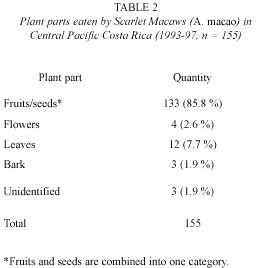
<body><![CDATA[<p><font face="Arial" size="2">Scarlet Macaws <i>Ara macao</i> are classified as threatened (Appendix I) under the Convention on International Trade in Endangered Species (CITES). Scarlet Macaw numbers have declined throughout its range because of habitat loss, direct hunting, and capture for the pet trade (Forshaw 1989, Vaughan <i>et al. </i>1991, Wiedenfeld 1994, Iñigo-Elías 1996). In Costa Rica, Scarlet Macaws once resided on both the Pacific and Caribbean slopes between sea level and approximately 1 500 m elevation (Vaughan 1983). Small groups of macaws (&lt;25 individuals) have been observed in the Estrella Valley, Tempisque Conservation Area and in Northeastern Costa Rica. However, approximately 700 individuals live in the Osa Conservation Area and approximately 400 individuals in the Central Pacific Conservation Area (ACOPAC) (Stiles and Skutch 1989, Vaughan <i>et al. </i>1991, Vaughan <i>et al. </i>2005). We studied the diet and feeding habits of the latter population. While macaw species are known to feed on fruits, seeds, nuts, and vegetable matter (Forshaw 1989), information on the food habits of Scarlet Macaws are scarce (Munn 1988, Marineros and Vaughan 1995, Nycander <i>et al. </i>1995, Gilardi 1996, Iñigo-Elías 1996). The objective of this study was to document Scarlet Macaw diet in Central Pacific Costa Rica.</font></p> <font face="Arial" size="2"><b>     <p>Materials and methods</p> </b></font>     <p><font face="Arial" size="2">Scarlet Macaw home range in the Central Pacific Conservation Areas was estimated in 1995 at approximately 560 km<sup>2</sup> (84o37’ W, 9º47’ N) and includes four life zones: tropical dry forest with transition to humid, tropical humid forest, premontane and montane forest, and tropical wet forest (Tosi 1969, Marineros and Vaughan 1995). Approximately 90 % of the study area contained altered habitats, which included cattle pasture, fruit orchards, timber harvesting areas, rice fields and abandoned farmland/pasture; forest remnants &gt; 40-ha were scarce among all habitats in this study. Range annual temperatures were between 25-30 °C (Coen 1983). There is a moderate dry season from November to April, and a severe wet to torrential wet season from May to December, in which 90 % of annual precipitation falls (2 487 mm in lowlands to 3 299 mm in higher elevations) (Cifuentes <i>et al. </i>1983).</font></p>     <p><font face="Arial" size="2">From 1993 to 1997, we made Scarlet Macaw feeding observations with 7 x 35 binoculars from roads and forest trails. Feeding data acquired in this study were not collected systematically, but opportunistically whenever macaws were observed feeding. To supplement feeding observations, we conducted interviews with local residents concerning Scarlet Macaw feeding habits. During both observations and interviews, we recorded the tree species fed upon by macaws, plant parts eaten, and date observed. Unidentified fruits dropped by macaws while feeding were recovered for identification by botanists (see acknowledgments). We pooled fruits and seeds into one category under plant parts eaten, since it was difficult to distinguish them from each other when macaws were feeding (<a href="#t2">Table 2</a>).</font></p>     <div style="text-align: center;"><font face="Arial" size="2"><a  name="t2"></a><img src="/img/fbpe/rbt/v54n3/3880i2.JPG" title=""  alt="" style="width: 256px; height: 268px;"></font></div> <font face="Arial" size="2"><b>     
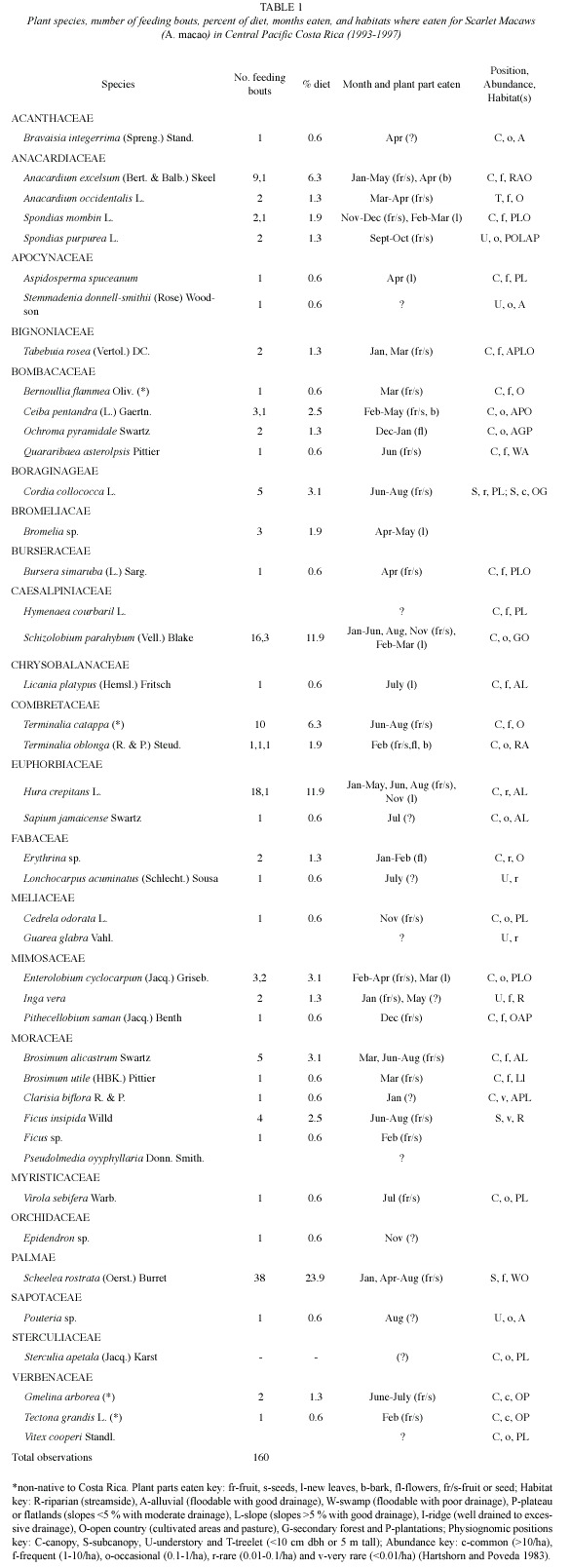
<p>Results</p> </b></font>     <p><font face="Arial" size="2">Observations occurred during peak Scarlet Macaw feeding hours, which took place immediately after early morning movements from Guacalillo Mangrove Reserve (0630-0800 h), and just prior to return flights to roosting sites (1500-1700 h) (Marineros and Vaughan 1995). Birds were most often seen feeding atop the forest canopy, in trees along forest edge, and in isolated trees or tree clusters within cattle ranches.</font></p>     <p><font face="Arial" size="2">From a total of 160 feeding observations, Scarlet Macaws fed on 43 different plant species (41 trees, one bromeliad, and one orchid) (<a href="#t1">Table 1</a>). Fruits and seeds accounted for the majority of observations (85.4 %), while young leaves, flowers, bark, and unknown plant parts were much less frequently observed. Fruits and/or seeds were eaten from 25 tree species, leaves from seven species, bark from three species, flowers from three species, and unknown plant parts from nine species. Fourteen of 20 plant species (70 %) cited by locals for macaw feeding were confirmed by our observations. Six unconfirmed plant species reported by locals were <i>Brosimum utile, Guarea glabra, Hymenaea courbaril, Pseudolmedia </i>sp.<i>, Sterculia apetala, </i>and<i> Vitex cooperi</i> (Vaughan <i>et al. </i>1991, Marineros and Vaughan 1995) (<a  href="#t1">Table 1</a>).</font></p> <a name="t1"></a>     <div style="text-align: center;"><img  src="/img/fbpe/rbt/v54n3/3880i1.JPG" title="" alt=""  style="width: 585px; height: 1609px;"></div>     
<p><font face="Arial" size="2">Various tree species used by macaws for food in this study were unique in that they contained secondary compounds toxic to human plant parts, were nonnative to Costa Rica, or served the dual purpose of feeding and nesting trees. Tree species fed upon by macaws in this study that contain secondary compounds toxic to humans within their bark, seeds or fruit included: <i>Hura crepitans</i>, <i>Cedrela odorata</i>, <i>Bursera simaruba</i>, and <i>Anacardium occidentalis</i>. Beach almond (<i>Terminalia catappa</i>), Teak (<i>Tectona grandis</i>), and <i>Gmelina arborea</i> are introduced tree species that form part of Scarlet Macaws’ diet in Central Pacific Costa Rica. Finally, <i>Ceiba pentandra, Schizolobium parahybum, H. crepitans,</i> and <i>Terminalia oblonga </i>provide food for macaws, as well as nesting cavities (Vaughan <i>et al. </i>2003b). Tree species included in our study were most often located within open areas partially cleared for agriculture or other human activities due to a higher frequency of observations in these areas (<a href="#t1">Table 1</a>).</font></p> <font face="Arial" size="2"><b></b></font>     ]]></body>
<body><![CDATA[<p><font face="Arial" size="2"><b>Discussion</b></font></p>     <p><font face="Arial" size="2"><b>General diet information:</b><i> </i>According to previous studies, Scarlet Macaws feed on a diverse variety of plant species and plant parts among available habitats (Munn 1992, Marineros and Vaughan 1995, Nycander <i>et al. </i>1995, Gilardi 1996). In our study, fruits and seeds of <i>Brosimum alicastrum</i>, <i>Scheelea rostrata</i>, and <i>H. crepitans</i> were common food sources for macaws, and were utilized during both wet and dry seasons (<a href="#t1">Table 1</a>). Fruits of <i>C. pentandra</i> and <i>Anacardium excelsum</i> were heavily consumed during the dry season when macaws rear their offspring; we found <i>A. excelsum</i> fruit parts in chick crops in March. Cultivated tree species fed upon by macaws in our study included <i>A. occidentalis</i> and <i>Spondias purpurea</i>.</font></p>     <p><font face="Arial" size="2">Our results may represent certain biases, and are somewhat inconsistent with other macaw diet studies. Macaw feeding behavior was easiest to observe in scattered trees among pasture or forest edges. Therefore, our study may represent a bias toward plant species that are common in edge or open habitat, other important plant species found exclusively within forests may be under-represented. <i>Socratea</i>, <i>Calycophyllum</i>, and <i>Apeiba</i> are plant genera native to Costa Rica and the study area, and while eaten by macaws in Manu, Peru (Nycander <i>et al. </i>1995), are still unconfirmed food sources for Scarlet Macaws in Central Pacific Costa Rica</font></p> <font face="Arial" size="2"><b></b></font>     <p><font face="Arial" size="2"><b>Plant parts eaten:</b> Scarlet Macaws fed mostly on fruits and seeds in our study, consistent with previous findings (Janzen 1983) (<a href="#t2">Table 2</a>). Fruits and/or seeds of <i>A. excelsum</i>, <i>C. pentandra</i>, and <i>H. crepitans</i> were eaten relatively often during the dry season. <i>B. alicastrum</i> and <i>S. rostrata</i> were common species fed upon during the wet season, when generally fewer tree species produce flowers or fruits (Coen 1983, McCoy <i>et al. </i>1990). As with many deciduous tree species, <i>S. parahybum</i> dropped its leaves and produces fruits in the dry season; Scarlet Macaws fed on its fruits and/or seeds during the dry season and on its young, tender leaves during the wet season (<a  href="#t1">Table 1</a>).    <br> </font></p> <font face="Arial" size="2"></font>     <p><font face="Arial" size="2"><b>Plants with secondary compounds toxic to humans:</b> The sap of <i>H. crepitans</i> has secondary compounds toxic to humans (Hartshorn 1983), and in our study area, whole fruits fell from trees and eventually decayed on the ground, untouched by most wildlife. However, we observed Scarlet Macaws eating fruits, seeds, and bark of <i>H. crepitans</i> throughout most of the year in Central Pacific Costa Rica, consistent with previous observations (Janzen 1983). Scarlet Macaws also feed upon this species in Belize (Kainer 1991), Peru (Munn 1992), and Columbia (Forshaw 1989). According to Janzen (1983), <i>C. odorata</i> and <i>B. simaruba</i> seeds and fruits were not eaten by some psittacine species because of their secondary compounds toxic to humans. However, Scarlet Macaws in ACOPAC ate plant parts from both tree species, as well as from <i>A. occidentalis</i>, which is also known to contain toxins (Hartshorn and Gentry 1983) (<a href="#t1">Table 1</a>).</font></p> <font face="Arial" size="2"><b></b></font>     <p><font face="Arial" size="2"><b>Introduced tree species:</b> A variety of nonnative tree species have been documented as providing quality nesting cavity and food sources to various psittacine species (Braby and Rantzau 1988, Beissinger and Bucher 1992, Wood 1992, Galetti 1993, Woodall 1993). Scarlet Macaws in our study have been observed feeding on Beach Almond (<i>T. catappa</i>), Teak (<i>T. grandis</i>) and <i>G. arborea</i>, all exotic species to Costa Rica. The latter two have been extensively planted as forestry trees in lowland Costa Rica (C.S.V., pers. obs.). Scarlet Macaws feed heavily on <i>T. catappa</i> on the Osa Peninsula, Costa Rica (Janzen 1983). <i>T. catappa</i> is a relatively low growing tree species, and is common along beaches and in city parks in lowland coastal areas. Therefore, macaws are highly visible while feeding on this species. Cultivated plant species could potentially help sustain Scarlet Macaws in ACOPAC as habitat destruction continues to remove native food sources, as apparently occurred with endangered Orange-bellied Parrots (<i>Neophema chrysogaster</i>) feeding on cultivated sunflowers (<i>Helianthus annus</i>) in Australia (Eckert 1990).</font></p> <font face="Arial" size="2"><b></b></font>     <p><font face="Arial" size="2"><b>Nesting and feeding tree species:</b> Scarlet Macaws used many nesting tree species as food sources in our study (Marineros and Vaughan 1995, Vaughan <i>et al. </i>1999, Bonadie and Bacon 2000). <i>Ceiba pentandra</i>, <i>S. parahybum</i>, <i>H. crepitans</i> and <i>T. oblonga</i> are tree species that provide both food and nesting cavities for macaws in ACOPAC (Vaughan <i>et al. </i>2003b). These species are crucial to Scarlet Macaw conservation in ACOPAC because of their abundance in the region, their use as nest sites, and because they are food sources during both wet and dry seasons.</font></p> <font face="Arial" size="2"><b></b></font>     <p><font face="Arial" size="2"><b>Ecotourism:</b><i> </i>Nature guides lead tourists to specific nesting and fruiting trees in and around Carara National Park to observe macaws and other wildlife species feeding. Scarlet Macaw activity in itself attracts tourists to the region, potentially increasing economic gains for local people (Marineros and Vaughan 1995). However, additional work is needed to develop tourism on a local level, as currently most tourism dollars funnel into large tourist companies (Vaughan 1999).</font></p> <font face="Arial" size="2"><b></b></font>     <p><font face="Arial" size="2"><b>Management related to diet:</b> Knowledge of diet has facilitated widespread conservation efforts in the study region. We have provided local landowners with lists of tree species used by macaws for feeding and nesting in hopes that they will protect existing trees, as well as plant additional trees. This list includes exotic tree species: <i>T. catappa</i>, <i>T. grandis</i> and <i>G. arborea</i>. However, these exotic species should be cultivated with caution within controlled areas, in which they do not infringe upon native forest plant species. Planting <i>Terminalia catappa</i> along coastlines and in towns has encouraged feeding by macaws. Finally, forestry nurseries that specialize on key macaw nesting and feeding tree species have been initiated in the towns of Quebrada Ganado, Tarcoles and Bijagual, each of which lies within or borders the study area. Adult community members help guide local elementary school children in these efforts. These nurseries, as well as macaw presence within meters of homes, encourages a positive attitude towards macaws and conservation (Vaughan <i>et al</i>. 2003a).</font></p> <font face="Arial" size="2"><b></b></font>     ]]></body>
<body><![CDATA[<p><font face="Arial" size="2"><b>Future studies:</b> Further studies on Scarlet Macaw diet are needed. These might include: a) a systematic diet study conducted over a 12-month period, b) detailing local temporal and spatial macaw movements to food sources through radio telemetry, c) studying effects of the availability of exotic species on macaw feeding habits, and d) examining the mechanism that allows macaws to consume plants with secondary compounds toxic to humans.</font></p> <font face="Arial" size="2"><b>     <p>Acknowledgments</p> </b></font>     <p><font face="Arial" size="2">We are grateful to M. Fisher for assistance in data collection and to Quirico Jimenez and Nelson Zamora, from INBio, for plant identification. We also thank the administrators at Carara National Park for housing us during the study and Mark Myers, who helped improve earlier versions of the manuscript. The Organization of American States, The Parrot Society-UK, Idea Wild, Wildlife Trust and Universidad Nacional of Costa Rica provided financial support and we are appreciative to them. </font></p> <font face="Arial" size="2"><b>     <p>Resumen</p> </b></font>     <p><font face="Arial" size="2">Entre 1993-97, observamos el comportamiento de alimentación de la lapa roja (<i>Ara macao</i>) en el Pacifico Central de Costa Rica. La lapa roja se alimentó de semillas, frutas, hojas, flores y corteza de 43 especies de plantas. Varias partes de las plantas comidas por las lapas contienen compuestos secundarios tóxicos al ser humano, y especies adicionales incluidas en la dieta son exóticas; introducidas por razones agrícolas, forestales o estéticas. Especies de árboles importantes como alimento de la lapa roja incluyen: <i>Ceiba pentandra, Schizolobium parahybum, </i>y<i> Hura crepitans</i>; también son criticas para la población de la lapa roja debido a proveen cavidades para anidación. Los resultados de este estudio contribuyen a la conservación de la lapa roja en el Pacifico Central de Costa Rica a través de la promoción de la protección de árboles individuales y programas de reforestación a nivel de escuela primaria que se enfocan en especies de árboles que la lapa utiliza para alimentación o anidación. La conservación de la lapa roja es importante, debido al declive de sus números en Costa Rica. </font></p> <font face="Arial" size="2"><b></b></font>     <p><font face="Arial" size="2"><b>Palabras clave:</b> alimentación, <i>Ara macao</i>, conservación, Costa Rica, dieta, lapa roja.</font></p> <font face="Arial" size="2"><b>     <p>References</p> </b></font>     <!-- ref --><p><font face="Arial" size="2">Beissinger, S. &amp; E. Bucher. 1992. Sustainable harvesting of parrots for conservation, p. 73-115. <i>In</i> S. Beissinger &amp; N. Snyder (eds.). New World Parrots in Crisis: Solutions from Conservation Biology. Smithsonian Institution, Washington, D.C., EEUU.</font>&nbsp;&nbsp;&nbsp;&nbsp;&nbsp;&nbsp;&nbsp;&nbsp;[&#160;<a href="javascript:void(0);" onclick="javascript: window.open('/scielo.php?script=sci_nlinks&ref=1315180&pid=S0034-7744200600030002400001&lng=','','width=640,height=500,resizable=yes,scrollbars=1,menubar=yes,');">Links</a>&#160;]<!-- end-ref --><!-- ref --><p><font face="Arial" size="2">Bonadie, W.A. &amp; P.R. Bacon. 2000. Year-round utilization of fragmented palm swamp forest by Red-bellied macaws (<i>Ara manilata</i>) and Orange-winged parrots (<i>Amazona amazonica</i>) in the Nariva Swamp (Trinidad). Biol. Conserv.<i> </i>95: 1-5.</font>&nbsp;&nbsp;&nbsp;&nbsp;&nbsp;&nbsp;&nbsp;&nbsp;[&#160;<a href="javascript:void(0);" onclick="javascript: window.open('/scielo.php?script=sci_nlinks&ref=1315181&pid=S0034-7744200600030002400002&lng=','','width=640,height=500,resizable=yes,scrollbars=1,menubar=yes,');">Links</a>&#160;]<!-- end-ref --><!-- ref --><p><font face="Arial" size="2">Braby, M. &amp; C. Rantzau. 1988. Observations on feeding flocks of the red-rumped parrot <i>Psephotus haematonotus</i> in Parklands near Melbourne, Victoria. Aust. Bird Watcher 12: 150-153.</font>&nbsp;&nbsp;&nbsp;&nbsp;&nbsp;&nbsp;&nbsp;&nbsp;[&#160;<a href="javascript:void(0);" onclick="javascript: window.open('/scielo.php?script=sci_nlinks&ref=1315182&pid=S0034-7744200600030002400003&lng=','','width=640,height=500,resizable=yes,scrollbars=1,menubar=yes,');">Links</a>&#160;]<!-- end-ref --><!-- ref --><p><font face="Arial" size="2">Cifuentes, M., W. Alpizar &amp; F. Barroso. 1983. Plan de manejo y desarrollo: Reserva Biológica Carara. Servicio de Parques Nacionales, Ministerio de Recursos Naturales, San José, Costa Rica. 72 p.</font>&nbsp;&nbsp;&nbsp;&nbsp;&nbsp;&nbsp;&nbsp;&nbsp;[&#160;<a href="javascript:void(0);" onclick="javascript: window.open('/scielo.php?script=sci_nlinks&ref=1315183&pid=S0034-7744200600030002400004&lng=','','width=640,height=500,resizable=yes,scrollbars=1,menubar=yes,');">Links</a>&#160;]<!-- end-ref --><!-- ref --><p><font face="Arial" size="2">Coen, E. 1983. Climate, p. 35-46. <i>In </i>D. Janzen (ed.). Costa Rican Natural History. University of Chicago, Chicago, Illinois, USA.</font>&nbsp;&nbsp;&nbsp;&nbsp;&nbsp;&nbsp;&nbsp;&nbsp;[&#160;<a href="javascript:void(0);" onclick="javascript: window.open('/scielo.php?script=sci_nlinks&ref=1315184&pid=S0034-7744200600030002400005&lng=','','width=640,height=500,resizable=yes,scrollbars=1,menubar=yes,');">Links</a>&#160;]<!-- end-ref --><!-- ref --><p><font face="Arial" size="2">Eckert, J. 1990. Orange-bellied parrots feeding on a cultivated crop. S. Aust. Ornithol. 31: 16-17.</font>&nbsp;&nbsp;&nbsp;&nbsp;&nbsp;&nbsp;&nbsp;&nbsp;[&#160;<a href="javascript:void(0);" onclick="javascript: window.open('/scielo.php?script=sci_nlinks&ref=1315185&pid=S0034-7744200600030002400006&lng=','','width=640,height=500,resizable=yes,scrollbars=1,menubar=yes,');">Links</a>&#160;]<!-- end-ref --><!-- ref --><p><font face="Arial" size="2">Forshaw, J. 1989. Parrots of the World. Landsdowne, Melbourne, Australia. 584 p.</font>&nbsp;&nbsp;&nbsp;&nbsp;&nbsp;&nbsp;&nbsp;&nbsp;[&#160;<a href="javascript:void(0);" onclick="javascript: window.open('/scielo.php?script=sci_nlinks&ref=1315186&pid=S0034-7744200600030002400007&lng=','','width=640,height=500,resizable=yes,scrollbars=1,menubar=yes,');">Links</a>&#160;]<!-- end-ref --><!-- ref --><p><font face="Arial" size="2">Galetti, M. 1993. Diet of the scaly-headed parrot (<i>Pionus maximiliani</i>) in a semideciduous forest in southeastern Brazil. Biotropica 25: 419-425.</font>&nbsp;&nbsp;&nbsp;&nbsp;&nbsp;&nbsp;&nbsp;&nbsp;[&#160;<a href="javascript:void(0);" onclick="javascript: window.open('/scielo.php?script=sci_nlinks&ref=1315187&pid=S0034-7744200600030002400008&lng=','','width=640,height=500,resizable=yes,scrollbars=1,menubar=yes,');">Links</a>&#160;]<!-- end-ref --><!-- ref --><p><font face="Arial" size="2">Gilardi, J. 1996. Ecology of parrots in the Peruvian Amazon: Habitat use, nutrition, and geography. Ph.D. Thesis, University of California, Davis, California, USA. 103 p. </font>&nbsp;&nbsp;&nbsp;&nbsp;&nbsp;&nbsp;&nbsp;&nbsp;[&#160;<a href="javascript:void(0);" onclick="javascript: window.open('/scielo.php?script=sci_nlinks&ref=1315188&pid=S0034-7744200600030002400009&lng=','','width=640,height=500,resizable=yes,scrollbars=1,menubar=yes,');">Links</a>&#160;]<!-- end-ref --><!-- ref --><p><font face="Arial" size="2">Hartshorn, G. 1983. <i>Hura crepitans</i> (jabillo, sandbox tree), p. 251-252. <i>In </i>D. Janzen (ed.). Costa Rican Natural History. University of Chicago, Chicago, Illinois, USA.</font>&nbsp;&nbsp;&nbsp;&nbsp;&nbsp;&nbsp;&nbsp;&nbsp;[&#160;<a href="javascript:void(0);" onclick="javascript: window.open('/scielo.php?script=sci_nlinks&ref=1315189&pid=S0034-7744200600030002400010&lng=','','width=640,height=500,resizable=yes,scrollbars=1,menubar=yes,');">Links</a>&#160;]<!-- end-ref --><!-- ref --><p><font face="Arial" size="2">Hartshorn, G. &amp; A. Gentry. 1983. <i>Anacardium excelsum</i> (Espavel, Espave, Acajou), p. 189-190. <i>In</i> D. Janzen (ed.). Costa Rican Natural History. University of Chicago, Chicago, Illinois, USA.</font>&nbsp;&nbsp;&nbsp;&nbsp;&nbsp;&nbsp;&nbsp;&nbsp;[&#160;<a href="javascript:void(0);" onclick="javascript: window.open('/scielo.php?script=sci_nlinks&ref=1315190&pid=S0034-7744200600030002400011&lng=','','width=640,height=500,resizable=yes,scrollbars=1,menubar=yes,');">Links</a>&#160;]<!-- end-ref --><!-- ref --><p><font face="Arial" size="2">Hartshorn, G. &amp; L. Poveda. 1983. Checklist of trees, p. 158-183. <i>In</i> D. Janzen (ed.). Costa Rican Natural History. University of Chicago, Chicago, Illinois.</font>&nbsp;&nbsp;&nbsp;&nbsp;&nbsp;&nbsp;&nbsp;&nbsp;[&#160;<a href="javascript:void(0);" onclick="javascript: window.open('/scielo.php?script=sci_nlinks&ref=1315191&pid=S0034-7744200600030002400012&lng=','','width=640,height=500,resizable=yes,scrollbars=1,menubar=yes,');">Links</a>&#160;]<!-- end-ref --><!-- ref --><p><font face="Arial" size="2">Iñigo-Elías, E. 1996. Ecology and breeding biology of the Scarlet macaw (<i>Ara macao</i>) in the Usumacinta drainage basin of Mexico and Guatemala, Ph.D. Thesis, University of Florida, Gainesville, Florida, USA. 117 p. </font>&nbsp;&nbsp;&nbsp;&nbsp;&nbsp;&nbsp;&nbsp;&nbsp;[&#160;<a href="javascript:void(0);" onclick="javascript: window.open('/scielo.php?script=sci_nlinks&ref=1315192&pid=S0034-7744200600030002400013&lng=','','width=640,height=500,resizable=yes,scrollbars=1,menubar=yes,');">Links</a>&#160;]<!-- end-ref --><!-- ref --><p><font face="Arial" size="2">Janzen, D. 1983. Costa Rican Natural History. University of Chicago, Chicago, Illinois, USA. 823 p.</font>&nbsp;&nbsp;&nbsp;&nbsp;&nbsp;&nbsp;&nbsp;&nbsp;[&#160;<a href="javascript:void(0);" onclick="javascript: window.open('/scielo.php?script=sci_nlinks&ref=1315193&pid=S0034-7744200600030002400014&lng=','','width=640,height=500,resizable=yes,scrollbars=1,menubar=yes,');">Links</a>&#160;]<!-- end-ref --><!-- ref --><p><font face="Arial" size="2">Kainer, M. 1991. Conservation of the Scarlet Macaw (<i>Ara macao</i>) in a subtropical moist forest life zone, Belize, Central America, p. 5-10. <i>In</i> J. Clinton-Eitniear (ed.). The Proceedings of the First Mesoamerican Workshop on the Conservation and Management of Macaws, Center for the Study of Tropical Birds, San Antonio, Texas, USA.</font>&nbsp;&nbsp;&nbsp;&nbsp;&nbsp;&nbsp;&nbsp;&nbsp;[&#160;<a href="javascript:void(0);" onclick="javascript: window.open('/scielo.php?script=sci_nlinks&ref=1315194&pid=S0034-7744200600030002400015&lng=','','width=640,height=500,resizable=yes,scrollbars=1,menubar=yes,');">Links</a>&#160;]<!-- end-ref --><!-- ref --><p><font face="Arial" size="2">Marineros, L. &amp; C. Vaughan. 1995. Scarlet macaws of Carara, p. 445-467. <i>In </i>J. Abramson, B. Speer &amp; J. Thomsen (eds.). The large macaws: their care, breeding and conservation. Raintree, Fort Bragg, California, USA.</font>&nbsp;&nbsp;&nbsp;&nbsp;&nbsp;&nbsp;&nbsp;&nbsp;[&#160;<a href="javascript:void(0);" onclick="javascript: window.open('/scielo.php?script=sci_nlinks&ref=1315195&pid=S0034-7744200600030002400016&lng=','','width=640,height=500,resizable=yes,scrollbars=1,menubar=yes,');">Links</a>&#160;]<!-- end-ref --><!-- ref --><p><font face="Arial" size="2">McCoy, M., C. Vaughan, M. Rodriguez &amp; D. Kitchen. 1990. Seasonal movement, home range, activity and diet of collared peccaries (<i>Tayassu tajacu</i>) in Costa Rican dry forest. Vida Silv. Neotrop. 2: 6-20.</font>&nbsp;&nbsp;&nbsp;&nbsp;&nbsp;&nbsp;&nbsp;&nbsp;[&#160;<a href="javascript:void(0);" onclick="javascript: window.open('/scielo.php?script=sci_nlinks&ref=1315196&pid=S0034-7744200600030002400017&lng=','','width=640,height=500,resizable=yes,scrollbars=1,menubar=yes,');">Links</a>&#160;]<!-- end-ref --><!-- ref --><p><font face="Arial" size="2">Munn, C. 1988. The real macaws. Animal Kingdom 91: 20-26.</font>&nbsp;&nbsp;&nbsp;&nbsp;&nbsp;&nbsp;&nbsp;&nbsp;[&#160;<a href="javascript:void(0);" onclick="javascript: window.open('/scielo.php?script=sci_nlinks&ref=1315197&pid=S0034-7744200600030002400018&lng=','','width=640,height=500,resizable=yes,scrollbars=1,menubar=yes,');">Links</a>&#160;]<!-- end-ref --><!-- ref --><p><font face="Arial" size="2">Munn, C. 1992. Macaw biology and ecotourism or "when a bird in the hand is worth two in the bush", p. 47-72. <i>In</i> S. Beissinger &amp; N. Snyder (eds.). New World Parrots in crisis: solutions from conservation biology. Smithsonian Institution, Washington, D.C., USA.</font>&nbsp;&nbsp;&nbsp;&nbsp;&nbsp;&nbsp;&nbsp;&nbsp;[&#160;<a href="javascript:void(0);" onclick="javascript: window.open('/scielo.php?script=sci_nlinks&ref=1315198&pid=S0034-7744200600030002400019&lng=','','width=640,height=500,resizable=yes,scrollbars=1,menubar=yes,');">Links</a>&#160;]<!-- end-ref --><!-- ref --><p><font face="Arial" size="2">Nycander, E., D. Blanco, K. Holle, A. Del Campo, C. Munn, J. Moscoso &amp; D. Ricalde. 1995. Manu and Tamopata: Nesting success and techniques for increasing reproduction in wild macaws in Southeastern Peru, p. 423-443. <i>In</i> J. Abramson, B. Speer &amp; J. Thomsen (eds.). The large macaws: their care, breeding and conservation. Raintree, Fort Bragg, California, USA.</font>&nbsp;&nbsp;&nbsp;&nbsp;&nbsp;&nbsp;&nbsp;&nbsp;[&#160;<a href="javascript:void(0);" onclick="javascript: window.open('/scielo.php?script=sci_nlinks&ref=1315199&pid=S0034-7744200600030002400020&lng=','','width=640,height=500,resizable=yes,scrollbars=1,menubar=yes,');">Links</a>&#160;]<!-- end-ref --><!-- ref --><p><font face="Arial" size="2">Stiles, G. &amp; A. Skutch. 1989. Birds of Costa Rica. Cornell University, Ithaca, New York, USA. 511 p.</font>&nbsp;&nbsp;&nbsp;&nbsp;&nbsp;&nbsp;&nbsp;&nbsp;[&#160;<a href="javascript:void(0);" onclick="javascript: window.open('/scielo.php?script=sci_nlinks&ref=1315200&pid=S0034-7744200600030002400021&lng=','','width=640,height=500,resizable=yes,scrollbars=1,menubar=yes,');">Links</a>&#160;]<!-- end-ref --><!-- ref --><p><font face="Arial" size="2">Tosi, J. &amp; L. Holdridge. 1966. Ecological map of Costa Rica. Tropical Science Center, San José, Costa Rica.</font>&nbsp;&nbsp;&nbsp;&nbsp;&nbsp;&nbsp;&nbsp;&nbsp;[&#160;<a href="javascript:void(0);" onclick="javascript: window.open('/scielo.php?script=sci_nlinks&ref=1315201&pid=S0034-7744200600030002400022&lng=','','width=640,height=500,resizable=yes,scrollbars=1,menubar=yes,');">Links</a>&#160;]<!-- end-ref --><!-- ref --><p><font face="Arial" size="2">Vaughan, C. 1983. Potential habitat for endangered species in Costa Rica. Universidad Nacional, Heredia, Costa Rica, 49 p.</font>&nbsp;&nbsp;&nbsp;&nbsp;&nbsp;&nbsp;&nbsp;&nbsp;[&#160;<a href="javascript:void(0);" onclick="javascript: window.open('/scielo.php?script=sci_nlinks&ref=1315202&pid=S0034-7744200600030002400023&lng=','','width=640,height=500,resizable=yes,scrollbars=1,menubar=yes,');">Links</a>&#160;]<!-- end-ref --><!-- ref --><p><font face="Arial" size="2">Vaughan, C. 1999. Do local communities in developing countries benefit from ecotourism in national parks and protected areas? Vida Silv. Neotrop. 8: 3-9.</font>&nbsp;&nbsp;&nbsp;&nbsp;&nbsp;&nbsp;&nbsp;&nbsp;[&#160;<a href="javascript:void(0);" onclick="javascript: window.open('/scielo.php?script=sci_nlinks&ref=1315203&pid=S0034-7744200600030002400024&lng=','','width=640,height=500,resizable=yes,scrollbars=1,menubar=yes,');">Links</a>&#160;]<!-- end-ref --><!-- ref --><p><font face="Arial" size="2">Vaughan, C., M. McCoy &amp; J. Liske. 1991. Ecology and management of the Scarlet Macaw in Carara Biological Reserve, p. 23-34. <i>In</i> J. Clinton-Eitniear (ed.). Proceedings of the First Mesoamerican Workshop on the Conservation and Management of Macaws, Center for the Study of Tropical Birds, San Antonio, Texas, USA.</font>&nbsp;&nbsp;&nbsp;&nbsp;&nbsp;&nbsp;&nbsp;&nbsp;[&#160;<a href="javascript:void(0);" onclick="javascript: window.open('/scielo.php?script=sci_nlinks&ref=1315204&pid=S0034-7744200600030002400025&lng=','','width=640,height=500,resizable=yes,scrollbars=1,menubar=yes,');">Links</a>&#160;]<!-- end-ref --><!-- ref --><p><font face="Arial" size="2">Vaughan, C., J. Gack, H. Solorzano &amp; R. Ray. 2003a. The effect of environmental education on school children, their parents and community members: A study of intergenerational and intercommunity learning<i>. </i>J. Environm. Ed. 34: 12-21.</font>&nbsp;&nbsp;&nbsp;&nbsp;&nbsp;&nbsp;&nbsp;&nbsp;[&#160;<a href="javascript:void(0);" onclick="javascript: window.open('/scielo.php?script=sci_nlinks&ref=1315205&pid=S0034-7744200600030002400026&lng=','','width=640,height=500,resizable=yes,scrollbars=1,menubar=yes,');">Links</a>&#160;]<!-- end-ref --><!-- ref --><p><font face="Arial" size="2">Vaughan, C., N. Nemeth, J. Cary &amp; S. Temple. 2005. Response of a Scarlet Macaw (<i>Ara macao</i>) population to conservation measures. Birdlife Int. 15:119-130.</font>&nbsp;&nbsp;&nbsp;&nbsp;&nbsp;&nbsp;&nbsp;&nbsp;[&#160;<a href="javascript:void(0);" onclick="javascript: window.open('/scielo.php?script=sci_nlinks&ref=1315206&pid=S0034-7744200600030002400027&lng=','','width=640,height=500,resizable=yes,scrollbars=1,menubar=yes,');">Links</a>&#160;]<!-- end-ref --><!-- ref --><p><font face="Arial" size="2">Vaughan, C., N. Nemeth &amp; L. Marineros 2003b. Ecology and management of natural and artificial scarlet macaw (<i>Ara macao</i>) nest cavities in Costa Rica. Ornitol. Neotrop. 14: 381-396.</font>&nbsp;&nbsp;&nbsp;&nbsp;&nbsp;&nbsp;&nbsp;&nbsp;[&#160;<a href="javascript:void(0);" onclick="javascript: window.open('/scielo.php?script=sci_nlinks&ref=1315207&pid=S0034-7744200600030002400028&lng=','','width=640,height=500,resizable=yes,scrollbars=1,menubar=yes,');">Links</a>&#160;]<!-- end-ref --><!-- ref --><p><font face="Arial" size="2">Wiedenfeld, D. 1994. A new subspecies of scarlet macaw (<i>Ara macao</i>) and its status and conservation. Ornitol. Neotrop. 5: 99-104.</font>&nbsp;&nbsp;&nbsp;&nbsp;&nbsp;&nbsp;&nbsp;&nbsp;[&#160;<a href="javascript:void(0);" onclick="javascript: window.open('/scielo.php?script=sci_nlinks&ref=1315208&pid=S0034-7744200600030002400029&lng=','','width=640,height=500,resizable=yes,scrollbars=1,menubar=yes,');">Links</a>&#160;]<!-- end-ref --><!-- ref --><p><font face="Arial" size="2">Wood, K. 1992. Cockatoos, parrots and lorikeets eating food from introduced trees and shrubs in the Illawarra region. Aust. Birds 25: 79-81.</font>&nbsp;&nbsp;&nbsp;&nbsp;&nbsp;&nbsp;&nbsp;&nbsp;[&#160;<a href="javascript:void(0);" onclick="javascript: window.open('/scielo.php?script=sci_nlinks&ref=1315209&pid=S0034-7744200600030002400030&lng=','','width=640,height=500,resizable=yes,scrollbars=1,menubar=yes,');">Links</a>&#160;]<!-- end-ref --><!-- ref --><p><font face="Arial" size="2">Woodall, P. 1993. Australian king-parrot feeding on the climbing vine <i>Pothos longpipes</i>. Sunbird 23: 107-108.</font>&nbsp;&nbsp;&nbsp;&nbsp;&nbsp;&nbsp;&nbsp;&nbsp;[&#160;<a href="javascript:void(0);" onclick="javascript: window.open('/scielo.php?script=sci_nlinks&ref=1315210&pid=S0034-7744200600030002400031&lng=','','width=640,height=500,resizable=yes,scrollbars=1,menubar=yes,');">Links</a>&#160;]<!-- end-ref --> ]]></body><back>
<ref-list>
<ref id="B1">
<nlm-citation citation-type="book">
<person-group person-group-type="author">
<name>
<surname><![CDATA[Beissinger]]></surname>
<given-names><![CDATA[S]]></given-names>
</name>
<name>
<surname><![CDATA[Bucher]]></surname>
<given-names><![CDATA[E]]></given-names>
</name>
</person-group>
<article-title xml:lang="en"><![CDATA[Sustainable harvesting of parrots for conservation]]></article-title>
<person-group person-group-type="editor">
<name>
<surname><![CDATA[Beissinger]]></surname>
<given-names><![CDATA[S]]></given-names>
</name>
<name>
<surname><![CDATA[Snyder]]></surname>
<given-names><![CDATA[N]]></given-names>
</name>
</person-group>
<source><![CDATA[New World Parrots in Crisis: Solutions from Conservation Biology]]></source>
<year>1992</year>
<page-range>73-115</page-range><publisher-loc><![CDATA[^eWashington, D.C Washington, D.C]]></publisher-loc>
<publisher-name><![CDATA[Smithsonian Institution]]></publisher-name>
</nlm-citation>
</ref>
<ref id="B2">
<nlm-citation citation-type="journal">
<person-group person-group-type="author">
<name>
<surname><![CDATA[Bonadie]]></surname>
<given-names><![CDATA[W.A]]></given-names>
</name>
<name>
<surname><![CDATA[Bacon]]></surname>
<given-names><![CDATA[P.R]]></given-names>
</name>
</person-group>
<article-title xml:lang="en"><![CDATA[Year-round utilization of fragmented palm swamp forest by Red-bellied macaws (Ara manilata) and Orange-winged parrots (Amazona amazonica) in the Nariva Swamp (Trinidad)]]></article-title>
<source><![CDATA[Biol. Conserv]]></source>
<year>2000</year>
<volume>95</volume>
<page-range>1-5</page-range></nlm-citation>
</ref>
<ref id="B3">
<nlm-citation citation-type="journal">
<person-group person-group-type="author">
<name>
<surname><![CDATA[Braby]]></surname>
<given-names><![CDATA[M]]></given-names>
</name>
<name>
<surname><![CDATA[Rantzau]]></surname>
<given-names><![CDATA[C]]></given-names>
</name>
</person-group>
<article-title xml:lang="en"><![CDATA[Observations on feeding flocks of the red-rumped parrot Psephotus haematonotus in Parklands near Melbourne, Victoria]]></article-title>
<source><![CDATA[Aust. Bird Watcher]]></source>
<year>1988</year>
<volume>12</volume>
<page-range>150-153</page-range></nlm-citation>
</ref>
<ref id="B4">
<nlm-citation citation-type="book">
<person-group person-group-type="author">
<name>
<surname><![CDATA[Cifuentes]]></surname>
<given-names><![CDATA[M]]></given-names>
</name>
<name>
<surname><![CDATA[Alpizar]]></surname>
<given-names><![CDATA[W]]></given-names>
</name>
<name>
<surname><![CDATA[Barroso]]></surname>
<given-names><![CDATA[F]]></given-names>
</name>
</person-group>
<source><![CDATA[Plan de manejo y desarrollo: Reserva Biológica Carara]]></source>
<year>1983</year>
<page-range>72</page-range><publisher-loc><![CDATA[San José ]]></publisher-loc>
<publisher-name><![CDATA[Servicio de Parques Nacionales, Ministerio de Recursos Naturales]]></publisher-name>
</nlm-citation>
</ref>
<ref id="B5">
<nlm-citation citation-type="book">
<person-group person-group-type="author">
<name>
<surname><![CDATA[Coen]]></surname>
<given-names><![CDATA[E]]></given-names>
</name>
</person-group>
<article-title xml:lang="en"><![CDATA[Climate]]></article-title>
<person-group person-group-type="editor">
<name>
<surname><![CDATA[Janzen]]></surname>
<given-names><![CDATA[D]]></given-names>
</name>
</person-group>
<source><![CDATA[Costa Rican Natural History]]></source>
<year>1983</year>
<page-range>35-46</page-range><publisher-loc><![CDATA[Chicago^eIllinois Illinois]]></publisher-loc>
<publisher-name><![CDATA[University of Chicago]]></publisher-name>
</nlm-citation>
</ref>
<ref id="B6">
<nlm-citation citation-type="journal">
<person-group person-group-type="author">
<name>
<surname><![CDATA[Eckert]]></surname>
<given-names><![CDATA[J]]></given-names>
</name>
</person-group>
<article-title xml:lang="en"><![CDATA[Orange-bellied parrots feeding on a cultivated crop]]></article-title>
<source><![CDATA[S. Aust. Ornithol]]></source>
<year>1990</year>
<volume>31</volume>
<page-range>16-17</page-range></nlm-citation>
</ref>
<ref id="B7">
<nlm-citation citation-type="book">
<person-group person-group-type="author">
<name>
<surname><![CDATA[Forshaw]]></surname>
<given-names><![CDATA[J]]></given-names>
</name>
</person-group>
<source><![CDATA[Parrots of the World]]></source>
<year>1989</year>
<page-range>584</page-range><publisher-loc><![CDATA[Melbourne ]]></publisher-loc>
<publisher-name><![CDATA[Landsdowne]]></publisher-name>
</nlm-citation>
</ref>
<ref id="B8">
<nlm-citation citation-type="journal">
<person-group person-group-type="author">
<name>
<surname><![CDATA[Galetti]]></surname>
<given-names><![CDATA[M]]></given-names>
</name>
</person-group>
<article-title xml:lang="en"><![CDATA[Diet of the scaly-headed parrot (Pionus maximiliani) in a semideciduous forest in southeastern Brazil]]></article-title>
<source><![CDATA[Biotropica]]></source>
<year>1993</year>
<volume>25</volume>
<page-range>419-425</page-range></nlm-citation>
</ref>
<ref id="B9">
<nlm-citation citation-type="">
<person-group person-group-type="author">
<name>
<surname><![CDATA[Gilardi]]></surname>
<given-names><![CDATA[J]]></given-names>
</name>
</person-group>
<source><![CDATA[Ecology of parrots in the Peruvian Amazon: Habitat use, nutrition, and geography]]></source>
<year>1996</year>
<page-range>103</page-range></nlm-citation>
</ref>
<ref id="B10">
<nlm-citation citation-type="book">
<person-group person-group-type="author">
<name>
<surname><![CDATA[Hartshorn]]></surname>
<given-names><![CDATA[G]]></given-names>
</name>
</person-group>
<article-title xml:lang="en"><![CDATA[Hura crepitans (jabillo, sandbox tree)]]></article-title>
<person-group person-group-type="editor">
<name>
<surname><![CDATA[Janzen]]></surname>
<given-names><![CDATA[D]]></given-names>
</name>
</person-group>
<source><![CDATA[Costa Rican Natural History]]></source>
<year>1983</year>
<page-range>251-252</page-range><publisher-loc><![CDATA[Chicago^eIllinois Illinois]]></publisher-loc>
<publisher-name><![CDATA[University of Chicago]]></publisher-name>
</nlm-citation>
</ref>
<ref id="B11">
<nlm-citation citation-type="book">
<person-group person-group-type="author">
<name>
<surname><![CDATA[Hartshorn]]></surname>
<given-names><![CDATA[G]]></given-names>
</name>
<name>
<surname><![CDATA[Gentry]]></surname>
<given-names><![CDATA[A]]></given-names>
</name>
</person-group>
<article-title xml:lang="en"><![CDATA[Anacardium excelsum (Espavel, Espave, Acajou)]]></article-title>
<person-group person-group-type="editor">
<name>
<surname><![CDATA[Janzen]]></surname>
<given-names><![CDATA[D]]></given-names>
</name>
</person-group>
<source><![CDATA[Costa Rican Natural History]]></source>
<year>1983</year>
<page-range>189-190</page-range><publisher-loc><![CDATA[Chicago^eIllinois Illinois]]></publisher-loc>
<publisher-name><![CDATA[University of Chicago]]></publisher-name>
</nlm-citation>
</ref>
<ref id="B12">
<nlm-citation citation-type="book">
<person-group person-group-type="author">
<name>
<surname><![CDATA[Hartshorn]]></surname>
<given-names><![CDATA[G]]></given-names>
</name>
<name>
<surname><![CDATA[Poveda]]></surname>
<given-names><![CDATA[L]]></given-names>
</name>
</person-group>
<article-title xml:lang="en"><![CDATA[Checklist of trees]]></article-title>
<person-group person-group-type="editor">
<name>
<surname><![CDATA[Janzen]]></surname>
<given-names><![CDATA[D]]></given-names>
</name>
</person-group>
<source><![CDATA[Costa Rican Natural History]]></source>
<year>1983</year>
<page-range>158-183</page-range><publisher-loc><![CDATA[Chicago^eIllinois Illinois]]></publisher-loc>
<publisher-name><![CDATA[University of Chicago]]></publisher-name>
</nlm-citation>
</ref>
<ref id="B13">
<nlm-citation citation-type="">
<person-group person-group-type="author">
<name>
<surname><![CDATA[Iñigo-Elías]]></surname>
<given-names><![CDATA[E]]></given-names>
</name>
</person-group>
<source><![CDATA[Ecology and breeding biology of the Scarlet macaw (Ara macao) in the Usumacinta drainage basin of Mexico and Guatemala]]></source>
<year>1996</year>
<page-range>117</page-range></nlm-citation>
</ref>
<ref id="B14">
<nlm-citation citation-type="book">
<person-group person-group-type="author">
<name>
<surname><![CDATA[Janzen]]></surname>
<given-names><![CDATA[D]]></given-names>
</name>
</person-group>
<source><![CDATA[Costa Rican Natural History]]></source>
<year>1983</year>
<page-range>823</page-range><publisher-loc><![CDATA[Chicago^eIllinois Illinois]]></publisher-loc>
<publisher-name><![CDATA[University of Chicago]]></publisher-name>
</nlm-citation>
</ref>
<ref id="B15">
<nlm-citation citation-type="">
<person-group person-group-type="author">
<name>
<surname><![CDATA[Kainer]]></surname>
<given-names><![CDATA[M]]></given-names>
</name>
</person-group>
<article-title xml:lang="en"><![CDATA[Conservation of the Scarlet Macaw (Ara macao) in a subtropical moist forest life zone, Belize, Central America]]></article-title>
<person-group person-group-type="editor">
<name>
<surname><![CDATA[Clinton-Eitniear]]></surname>
<given-names><![CDATA[J]]></given-names>
</name>
</person-group>
<source><![CDATA[The Proceedings of the First Mesoamerican Workshop on the Conservation and Management of Macaws, Center for the Study of Tropical Birds, San Antonio, Texas, USA]]></source>
<year>1991</year>
<page-range>5-10</page-range></nlm-citation>
</ref>
<ref id="B16">
<nlm-citation citation-type="book">
<person-group person-group-type="author">
<name>
<surname><![CDATA[Marineros]]></surname>
<given-names><![CDATA[L]]></given-names>
</name>
<name>
<surname><![CDATA[Vaughan]]></surname>
<given-names><![CDATA[C]]></given-names>
</name>
</person-group>
<article-title xml:lang="en"><![CDATA[Scarlet macaws of Carara]]></article-title>
<person-group person-group-type="editor">
<name>
<surname><![CDATA[Abramson]]></surname>
<given-names><![CDATA[J]]></given-names>
</name>
<name>
<surname><![CDATA[Speer]]></surname>
<given-names><![CDATA[B]]></given-names>
</name>
<name>
<surname><![CDATA[Thomsen]]></surname>
<given-names><![CDATA[J]]></given-names>
</name>
</person-group>
<source><![CDATA[The large macaws: their care, breeding and conservation]]></source>
<year>1995</year>
<page-range>445-467</page-range><publisher-loc><![CDATA[Fort Bragg^eCalifornia California]]></publisher-loc>
<publisher-name><![CDATA[Raintree]]></publisher-name>
</nlm-citation>
</ref>
<ref id="B17">
<nlm-citation citation-type="journal">
<person-group person-group-type="author">
<name>
<surname><![CDATA[McCoy]]></surname>
<given-names><![CDATA[M]]></given-names>
</name>
<name>
<surname><![CDATA[Vaughan]]></surname>
<given-names><![CDATA[C]]></given-names>
</name>
<name>
<surname><![CDATA[Rodriguez]]></surname>
<given-names><![CDATA[M]]></given-names>
</name>
<name>
<surname><![CDATA[Kitchen]]></surname>
<given-names><![CDATA[D]]></given-names>
</name>
</person-group>
<article-title xml:lang="en"><![CDATA[Seasonal movement, home range, activity and diet of collared peccaries (Tayassu tajacu) in Costa Rican dry forest]]></article-title>
<source><![CDATA[Vida Silv. Neotrop]]></source>
<year>1990</year>
<volume>2</volume>
<page-range>6-20</page-range></nlm-citation>
</ref>
<ref id="B18">
<nlm-citation citation-type="journal">
<person-group person-group-type="author">
<name>
<surname><![CDATA[Munn]]></surname>
<given-names><![CDATA[C]]></given-names>
</name>
</person-group>
<article-title xml:lang="en"><![CDATA[The real macaws]]></article-title>
<source><![CDATA[Animal Kingdom]]></source>
<year>1988</year>
<volume>91</volume>
<page-range>20-26</page-range></nlm-citation>
</ref>
<ref id="B19">
<nlm-citation citation-type="book">
<person-group person-group-type="author">
<name>
<surname><![CDATA[Munn]]></surname>
<given-names><![CDATA[C]]></given-names>
</name>
</person-group>
<article-title xml:lang="en"><![CDATA[Macaw biology and ecotourism or "when a bird in the hand is worth two in the bush"]]></article-title>
<person-group person-group-type="editor">
<name>
<surname><![CDATA[Beissinger]]></surname>
<given-names><![CDATA[S]]></given-names>
</name>
<name>
<surname><![CDATA[Snyder]]></surname>
<given-names><![CDATA[N]]></given-names>
</name>
</person-group>
<source><![CDATA[New World Parrots in crisis: solutions from conservation biology]]></source>
<year>1992</year>
<page-range>47-72</page-range><publisher-loc><![CDATA[^eWashington, D.C Washington, D.C]]></publisher-loc>
<publisher-name><![CDATA[Smithsonian Institution]]></publisher-name>
</nlm-citation>
</ref>
<ref id="B20">
<nlm-citation citation-type="book">
<person-group person-group-type="author">
<name>
<surname><![CDATA[Nycander]]></surname>
<given-names><![CDATA[E]]></given-names>
</name>
<name>
<surname><![CDATA[Blanco]]></surname>
<given-names><![CDATA[D]]></given-names>
</name>
<name>
<surname><![CDATA[Holle]]></surname>
<given-names><![CDATA[K]]></given-names>
</name>
<name>
<surname><![CDATA[Del Campo]]></surname>
<given-names><![CDATA[A]]></given-names>
</name>
<name>
<surname><![CDATA[Munn]]></surname>
<given-names><![CDATA[C]]></given-names>
</name>
<name>
<surname><![CDATA[Moscoso]]></surname>
<given-names><![CDATA[J]]></given-names>
</name>
<name>
<surname><![CDATA[Ricalde]]></surname>
<given-names><![CDATA[D]]></given-names>
</name>
</person-group>
<article-title xml:lang="en"><![CDATA[Manu and Tamopata: Nesting success and techniques for increasing reproduction in wild macaws in Southeastern Peru]]></article-title>
<person-group person-group-type="editor">
<name>
<surname><![CDATA[Abramson]]></surname>
<given-names><![CDATA[J]]></given-names>
</name>
<name>
<surname><![CDATA[Speer]]></surname>
<given-names><![CDATA[B]]></given-names>
</name>
<name>
<surname><![CDATA[Thomsen]]></surname>
<given-names><![CDATA[J]]></given-names>
</name>
</person-group>
<source><![CDATA[The large macaws: their care, breeding and conservation]]></source>
<year>1995</year>
<page-range>423-443</page-range><publisher-loc><![CDATA[Fort Bragg^eCalifornia California]]></publisher-loc>
<publisher-name><![CDATA[Raintree]]></publisher-name>
</nlm-citation>
</ref>
<ref id="B21">
<nlm-citation citation-type="book">
<person-group person-group-type="author">
<name>
<surname><![CDATA[Stiles]]></surname>
<given-names><![CDATA[G]]></given-names>
</name>
<name>
<surname><![CDATA[Skutch]]></surname>
<given-names><![CDATA[A]]></given-names>
</name>
</person-group>
<source><![CDATA[Birds of Costa Rica]]></source>
<year>1989</year>
<page-range>511</page-range><publisher-loc><![CDATA[Ithaca^eNew York New York]]></publisher-loc>
<publisher-name><![CDATA[Cornell University]]></publisher-name>
</nlm-citation>
</ref>
<ref id="B22">
<nlm-citation citation-type="book">
<person-group person-group-type="author">
<name>
<surname><![CDATA[Tosi]]></surname>
<given-names><![CDATA[J]]></given-names>
</name>
<name>
<surname><![CDATA[Holdridge]]></surname>
<given-names><![CDATA[L]]></given-names>
</name>
</person-group>
<source><![CDATA[Ecological map of Costa Rica]]></source>
<year>1966</year>
<publisher-loc><![CDATA[San José ]]></publisher-loc>
<publisher-name><![CDATA[Tropical Science Center]]></publisher-name>
</nlm-citation>
</ref>
<ref id="B23">
<nlm-citation citation-type="book">
<person-group person-group-type="author">
<name>
<surname><![CDATA[Vaughan]]></surname>
<given-names><![CDATA[C]]></given-names>
</name>
</person-group>
<source><![CDATA[Potential habitat for endangered species in Costa Rica]]></source>
<year>1983</year>
<page-range>49</page-range><publisher-loc><![CDATA[Heredia ]]></publisher-loc>
<publisher-name><![CDATA[Universidad Nacional]]></publisher-name>
</nlm-citation>
</ref>
<ref id="B24">
<nlm-citation citation-type="journal">
<person-group person-group-type="author">
<name>
<surname><![CDATA[Vaughan]]></surname>
<given-names><![CDATA[C]]></given-names>
</name>
</person-group>
<article-title xml:lang="en"><![CDATA[Do local communities in developing countries benefit from ecotourism in national parks and protected areas?]]></article-title>
<source><![CDATA[Vida Silv. Neotrop]]></source>
<year>1999</year>
<volume>8</volume>
<page-range>3-9</page-range></nlm-citation>
</ref>
<ref id="B25">
<nlm-citation citation-type="book">
<person-group person-group-type="author">
<name>
<surname><![CDATA[Vaughan]]></surname>
<given-names><![CDATA[C]]></given-names>
</name>
<name>
<surname><![CDATA[McCoy]]></surname>
<given-names><![CDATA[M]]></given-names>
</name>
<name>
<surname><![CDATA[Liske]]></surname>
<given-names><![CDATA[J]]></given-names>
</name>
</person-group>
<article-title xml:lang="en"><![CDATA[Ecology and management of the Scarlet Macaw in Carara Biological Reserve]]></article-title>
<person-group person-group-type="editor">
<name>
<surname><![CDATA[Clinton-Eitniear]]></surname>
<given-names><![CDATA[J]]></given-names>
</name>
</person-group>
<source><![CDATA[Proceedings of the First Mesoamerican Workshop on the Conservation and Management of Macaws]]></source>
<year>1991</year>
<page-range>23-34</page-range><publisher-loc><![CDATA[San Antonio^eTexas Texas]]></publisher-loc>
<publisher-name><![CDATA[Center for the Study of Tropical Birds]]></publisher-name>
</nlm-citation>
</ref>
<ref id="B26">
<nlm-citation citation-type="journal">
<person-group person-group-type="author">
<name>
<surname><![CDATA[Vaughan]]></surname>
<given-names><![CDATA[C]]></given-names>
</name>
<name>
<surname><![CDATA[Gack]]></surname>
<given-names><![CDATA[J]]></given-names>
</name>
<name>
<surname><![CDATA[Solorzano]]></surname>
<given-names><![CDATA[H]]></given-names>
</name>
<name>
<surname><![CDATA[Ray]]></surname>
<given-names><![CDATA[R]]></given-names>
</name>
</person-group>
<article-title xml:lang="en"><![CDATA[The effect of environmental education on school children, their parents and community members: A study of intergenerational and intercommunity learning]]></article-title>
<source><![CDATA[J. Environm. Ed]]></source>
<year>2003</year>
<volume>34</volume>
<page-range>12-21</page-range></nlm-citation>
</ref>
<ref id="B27">
<nlm-citation citation-type="journal">
<person-group person-group-type="author">
<name>
<surname><![CDATA[Vaughan]]></surname>
<given-names><![CDATA[C]]></given-names>
</name>
<name>
<surname><![CDATA[Nemeth]]></surname>
<given-names><![CDATA[N]]></given-names>
</name>
<name>
<surname><![CDATA[Cary]]></surname>
<given-names><![CDATA[J]]></given-names>
</name>
<name>
<surname><![CDATA[Temple]]></surname>
<given-names><![CDATA[S]]></given-names>
</name>
</person-group>
<article-title xml:lang="en"><![CDATA[Response of a Scarlet Macaw (Ara macao) population to conservation measures]]></article-title>
<source><![CDATA[Birdlife Int]]></source>
<year>2005</year>
<volume>15</volume>
<page-range>119-130</page-range></nlm-citation>
</ref>
<ref id="B28">
<nlm-citation citation-type="journal">
<person-group person-group-type="author">
<name>
<surname><![CDATA[Vaughan]]></surname>
<given-names><![CDATA[C]]></given-names>
</name>
<name>
<surname><![CDATA[Nemeth]]></surname>
<given-names><![CDATA[N]]></given-names>
</name>
<name>
<surname><![CDATA[Marineros]]></surname>
<given-names><![CDATA[L]]></given-names>
</name>
</person-group>
<article-title xml:lang="en"><![CDATA[Ecology and management of natural and artificial scarlet macaw (Ara macao) nest cavities in Costa Rica]]></article-title>
<source><![CDATA[Ornitol. Neotrop]]></source>
<year>2003</year>
<volume>14</volume>
<page-range>381-396</page-range></nlm-citation>
</ref>
<ref id="B29">
<nlm-citation citation-type="journal">
<person-group person-group-type="author">
<name>
<surname><![CDATA[Wiedenfeld]]></surname>
<given-names><![CDATA[D]]></given-names>
</name>
</person-group>
<article-title xml:lang="en"><![CDATA[A new subspecies of scarlet macaw (Ara macao) and its status and conservation]]></article-title>
<source><![CDATA[Ornitol. Neotrop]]></source>
<year>1994</year>
<volume>5</volume>
<page-range>99-104</page-range></nlm-citation>
</ref>
<ref id="B30">
<nlm-citation citation-type="journal">
<person-group person-group-type="author">
<name>
<surname><![CDATA[Wood]]></surname>
<given-names><![CDATA[K]]></given-names>
</name>
</person-group>
<article-title xml:lang="en"><![CDATA[Cockatoos, parrots and lorikeets eating food from introduced trees and shrubs in the Illawarra region]]></article-title>
<source><![CDATA[Aust. Birds]]></source>
<year>1992</year>
<volume>25</volume>
<page-range>79-81</page-range></nlm-citation>
</ref>
<ref id="B31">
<nlm-citation citation-type="journal">
<person-group person-group-type="author">
<name>
<surname><![CDATA[Woodall]]></surname>
<given-names><![CDATA[P]]></given-names>
</name>
</person-group>
<article-title xml:lang="en"><![CDATA[Australian king-parrot feeding on the climbing vine Pothos longpipes]]></article-title>
<source><![CDATA[Sunbird]]></source>
<year>1993</year>
<volume>23</volume>
<page-range>107-108</page-range></nlm-citation>
</ref>
</ref-list>
</back>
</article>