<?xml version="1.0" encoding="ISO-8859-1"?><article xmlns:mml="http://www.w3.org/1998/Math/MathML" xmlns:xlink="http://www.w3.org/1999/xlink" xmlns:xsi="http://www.w3.org/2001/XMLSchema-instance">
<front>
<journal-meta>
<journal-id>0034-7744</journal-id>
<journal-title><![CDATA[Revista de Biología Tropical]]></journal-title>
<abbrev-journal-title><![CDATA[Rev. biol. trop]]></abbrev-journal-title>
<issn>0034-7744</issn>
<publisher>
<publisher-name><![CDATA[Universidad de Costa Rica]]></publisher-name>
</publisher>
</journal-meta>
<article-meta>
<article-id>S0034-77442006000300015</article-id>
<title-group>
<article-title xml:lang="en"><![CDATA[Scanning electron microscopy of damage caused by Mesocyclops thermocyclopoides (Copepoda: Cyclopoidea) on larvae of the Dengue fever vector Aedes aegypti (Diptera: Culicidae)]]></article-title>
</title-group>
<contrib-group>
<contrib contrib-type="author">
<name>
<surname><![CDATA[Schaper]]></surname>
<given-names><![CDATA[Stefan]]></given-names>
</name>
<xref ref-type="aff" rid="A01"/>
</contrib>
<contrib contrib-type="author">
<name>
<surname><![CDATA[Hernández-Chavarría]]></surname>
<given-names><![CDATA[Francisco]]></given-names>
</name>
<xref ref-type="aff" rid="A02"/>
</contrib>
</contrib-group>
<aff id="A01">
<institution><![CDATA[,Institut für Zoologie  ]]></institution>
<addr-line><![CDATA[Hannover ]]></addr-line>
<country>Germany</country>
</aff>
<aff id="A02">
<institution><![CDATA[,Universidad de Costa Rica  ]]></institution>
<addr-line><![CDATA[San José ]]></addr-line>
<country>Costa Rica</country>
</aff>
<pub-date pub-type="pub">
<day>00</day>
<month>09</month>
<year>2006</year>
</pub-date>
<pub-date pub-type="epub">
<day>00</day>
<month>09</month>
<year>2006</year>
</pub-date>
<volume>54</volume>
<numero>3</numero>
<fpage>843</fpage>
<lpage>846</lpage>
<copyright-statement/>
<copyright-year/>
<self-uri xlink:href="http://www.scielo.sa.cr/scielo.php?script=sci_arttext&amp;pid=S0034-77442006000300015&amp;lng=en&amp;nrm=iso"></self-uri><self-uri xlink:href="http://www.scielo.sa.cr/scielo.php?script=sci_abstract&amp;pid=S0034-77442006000300015&amp;lng=en&amp;nrm=iso"></self-uri><self-uri xlink:href="http://www.scielo.sa.cr/scielo.php?script=sci_pdf&amp;pid=S0034-77442006000300015&amp;lng=en&amp;nrm=iso"></self-uri><abstract abstract-type="short" xml:lang="en"><p><![CDATA[Dengue fever is a mosquito-borne viral disease, whose main biological vector is Aedes aegypti. This mosquito colonizes tropical areas where the disease is endemic. The most obvious action against dengue is attacking its vector. Biological control appears to be an alternative approach, using natural enemies of the mosquitoes, such as predatory copepods. Thus, the morphological study of the damage caused by copepods is important to understand its predatory capacity. Twenty-five A. aegypti larvae were exposed to the copepod Mesocyclops thermocyclopoides and the damage caused by the copepods was evaluated using scanning electron microscopy. The larvae showed damage mainly at the anal segment, the siphon and the abdomen; only three attacks to the head were observed. The size of the siphon might be of importance in determining whether or not a copepod will attack a mosquito larva. Rev. Biol. Trop. 54 (3): 843-846. Epub 2006 Sept. 29.]]></p></abstract>
<abstract abstract-type="short" xml:lang="es"><p><![CDATA[El dengue es una enfermedad viral transmitida por mosquitos, cuyo principal vector es Aedes aegypti. Este mosquito coloniza muchas áreas tropicales donde la enfermedad es endémica. La acción más obvia contra el dengue es el ataque a su vector. El control biológico parece una buena alternativa, empleando enemigos naturales de los mosquitos, como los copépodos. Por lo tanto, es importante el estudio morfológico del daño causado por los copépodos para comprender su capacidad depredadora. Veinticinco larvas de A. aegypti fueron expuestas a la actividad depredadora del copépodo Mesocyclops thermocyclopoides. Mediante microscopia electrónica de rastreo se evaluó el daño causado por los copépodos. Éstos atacaron principalmente el segmento anal, el sifón y el abdomen de las larvas; sólo vimos tres ataques a la cabeza. El tamaño del sifón podría ser de importancia para predecir si los copépodos pudiesen atacar larvas de determinado mosquito.]]></p></abstract>
<kwd-group>
<kwd lng="en"><![CDATA[Mesocyclops thermocyclopoides]]></kwd>
<kwd lng="en"><![CDATA[Aedes aegypti]]></kwd>
<kwd lng="en"><![CDATA[predation]]></kwd>
<kwd lng="en"><![CDATA[larval damage]]></kwd>
<kwd lng="es"><![CDATA[Mesocyclops thermocyclopoides]]></kwd>
<kwd lng="es"><![CDATA[Aedes aegypti]]></kwd>
<kwd lng="es"><![CDATA[depredación]]></kwd>
<kwd lng="es"><![CDATA[daño larval]]></kwd>
</kwd-group>
</article-meta>
</front><body><![CDATA[  <b><font face="Arial">     <p align="center">Scanning electron microscopy of damage caused by <i>Mesocyclops thermocyclopoides</i> (Copepoda: Cyclopoidea) on larvae of the Dengue fever vector <i>Aedes aegypti</i> (Diptera: Culicidae)</p> </font></b><font face="Arial" size="2"></font>     <p><font face="Arial" size="2">Stefan Schaper<a href="#a1"><sup>1</sup></a> &amp; Francisco Hernández-Chavarría<a href="#a2"><sup>2</sup></a></font></p>     <p><font face="Arial" size="2"><a name="a1"></a>1 Institut für Zoologie, Tierärztliche Hochschule, Hannover, Germany. </font></p>     <p><font face="Arial" size="2"><a name="a2"></a>2 Centro de Investigación en Estructuras Microscópicas (CIEMIC) y Facultad de Microbiología, Universidad de Costa Rica, San José, Costa Rica; <a  href="mailto:hchavarr@cariari.ucr.ac.cr">hchavarr@cariari.ucr.ac.cr</a></font></p>     <p align="center"><font face="Arial" size="2">Received 13-VIII-2003. Corrected 08-IX-2005. Accepted 23-III-2006.</font></p> <font face="Arial" size="2"><b></b></font>     <p><font face="Arial" size="2"><b>Abstract:</b> Dengue fever is a mosquito-borne viral disease, whose main biological vector is <i>Aedes aegypti</i>. This mosquito colonizes tropical areas where the disease is endemic. The most obvious action against dengue is attacking its vector. Biological control appears to be an alternative approach, using natural enemies of the mosquitoes, such as predatory copepods. Thus, the morphological study of the damage caused by copepods is important to understand its predatory capacity. Twenty-five <i>A. aegypti</i> larvae were exposed to the copepod <i>Mesocyclops thermocyclopoides</i> and the damage caused by the copepods was evaluated using scanning electron microscopy. The larvae showed damage mainly at the anal segment, the siphon and the abdomen; only three attacks to the head were observed. The size of the siphon might be of importance in determining whether or not a copepod will attack a mosquito larva. Rev. Biol. Trop. 54 (3): 843-846. Epub 2006 Sept. 29.</font></p> <font face="Arial" size="2"><b></b></font>     <p><font face="Arial" size="2"><b>Key words:</b> <i>Mesocyclops thermocyclopoides, Aedes aegypti,</i> predation, larval damage.</font></p>     <p><font face="Arial" size="2">Dengue and dengue hemorrhagic fever are mosquito-borne viral diseases, which are endemic in more than 100 countries in the tropical and sub-tropical territories of the world, causing an estimated 100 million cases annually (Gubler 1998, Keating 2001). Since there are neither antiviral drugs available to eliminate this virus nor an effective vaccine, the logical approach against these diseases is controlling the mosquito vector (Gubler 1998). During the 1950s, chemicals such as DDT were the main weapons used in this battle (Breakley <i>et al</i>. 1984), and whose apparent success was evident 30 years ago with the eradication of<i> Aedes aegypti</i> from 18 countries of the American continent (Kuno 1995, Guzman and Kouri 2002). At the present time, the mosquito has once again colonized these territories and dengue has re-emerged as an endemic disease. There are many causes that explain the re-emergence of dengue, such as the natural selection of strains resistant to insecticides, as well as global changes, such as an increase in international flight, the migration of people from rural to urban areas and uncontrolled re-urbanization (Guzman and Kouri 2002). The peak of the plastics industry around the world could be another factor associated with the re-emergence of dengue, because of the huge quantity of discarded plastic containers that provide an infinite number of artificial breeding grounds for the mosquitoes. </font></p>     <p><font face="Arial" size="2">Biological control, using the natural enemies of <i>Aedes</i>, appears to be an alternative approach to the systematic failure of use of insecticides (Lardeux <i>et al</i>. 2002). There is a vast array of agents used in the biological control of mosquitoes, including copepods. </font></p>     ]]></body>
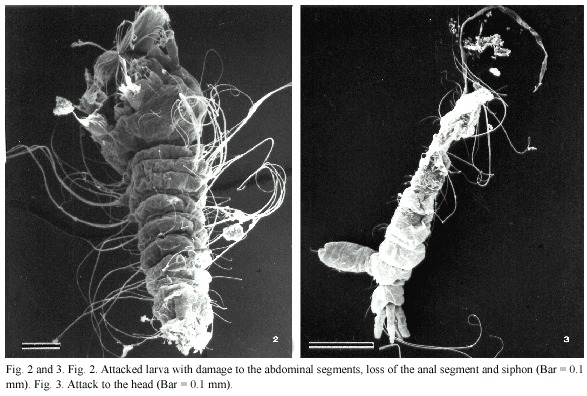
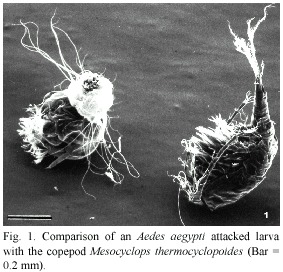
<body><![CDATA[<p><font face="Arial" size="2">These agents are microcrustacea, present in fresh water worldwide. <i>Mesocyclops </i>is one of the genus of copepods that has most been studied as an antagonist of mosquito larvae and whose effectiveness has been demonstrated in different countries, including the United States (Marten 1990), Honduras (Marten <i>et al</i>. 1994), Vietnam (Nam <i>et al</i>. 1998), and the French Polynesia (Lardeux <i>et al</i>. 2002). </font></p> <font face="Arial" size="2"><i></i></font>     <p><font face="Arial" size="2"><i>Mesocyclops thermocyclopoides</i> is a very common species in Costa Rica (Collado <i>et al</i>. 1984, Hernández-Chavarría and Schaper 2000) and was evaluated as a biological control agent against <i>Aedes</i>. This copepod feeds on the 1st and 2nd instars of the mosquito larvae, fatally wounding about seven individuals per day (Shaper and Hernández 1998). Although there has been considerable work done on the effects of this and other species of copepods on the populations of <i>A. aegypti</i> and <i>A. albopictus</i> (Brown <i>et al</i>. 1991, 1996, Marten <i>et al</i>. 1994, Tietze <i>et al</i>. 1994, Schaper and Hernández 1998, Dieng <i>et al</i>. 2002), more detailed studies of the effects on the individual seem to be necessary. So far, little is known about the morphological damage caused by the copepod. It is assumed that an evaluation of the injury caused by the copepod might help to explain why some species of mosquitoes are attacked (such as <i>Anopheles</i> and <i>Aedes</i> spp.) and others, such as <i>Culex</i> spp., are not.</font></p>     <p><font face="Arial" size="2">Over the span of three days, five <i>A. aegypti</i> larvae at the 1st instar stage were placed in plastic capsules with 0.5 ml of water and one adult female <i>M. thermocyclopoides</i>. After 5 h of incubation at room temperature, the organisms inside the capsule were fixed with 0.1 ml of 25 % gluteraldehyde for at least 2 h at 4 °C. Then the samples were washed in 0.1 mM phosphate buffer three times and post fixed in 1 % OsO<sub>4 </sub>for 1 h, washed again and dehydrated in ethanol (30 to 100 %), dried in a critical point dryer, mounted on aluminum studs, covered with gold and analyzed under a Hitachi S-570 scanning electron microscope.</font></p>     <p><font face="Arial" size="2">Adult copepods (<i>M. thermocyclopoides</i>) and the 1st instars of <i>A. Aegypti</i> are almost the same size, as is shown in <a href="#f1">Fig. 1</a>. The majority (76 %) of the larvae attacked showed damage on the anal segment, the siphon and the last abdominal segments (19 of 25 cases) as is shown in <a href="#f1">Fig. 1</a> and <a href="#f2-3">2</a>. In two cases (8 %), the thorax was also eaten, so that only the head capsule remained (<a href="#f1">Fig. 1</a>). In three (12 %) cases an attack to the head was observed (<a  href="#f2-3">Fig. 3</a>). Three (12 %) individuals showed lateral bites on the thorax and abdomen. In the 1st instars larvae, the siphon is not strongly sclerotized as in the later instars. Apart from the smaller size, this might make the 1st instars more susceptible to copepod attacks.</font></p> <a name="f1"></a>     <div style="text-align: center;"><img src="/img/fbpe/rbt/v54n3/3871i1.JPG" title=""  alt="" style="width: 283px; height: 272px;">    
<br> </div>     <br> <a name="f2-3"></a>     <div style="text-align: center;"><img src="/img/fbpe/rbt/v54n3/3871i2.JPG" title=""  alt="" style="width: 587px; height: 396px;">    
<br> </div>     <p><font face="Arial" size="2">If the copepod bites the larvae at the anal segment and the siphon, the consequences are obviously fatal for <i>A. aegypti</i> because the siphon is essential for breathing. Also, the lateral damage detected on the larvae could be the result of primary attacks, as several times the copepod was observed to strike the larva several times to immobilize it before starting to feed on it.</font></p>     ]]></body>
<body><![CDATA[<p><font face="Arial" size="2">The small size of the siphon of a mosquito larva might be important to predict if a copepod can attack the larva or not. <i>A. aegypti</i> is susceptible to copepod predation but long siphoned species like <i>Culex quinquefasciatus</i> suffer only insignificant attacks by <i>M. thermocyclopoides</i>. <i>Anopheles albimanus</i>, which does not have a siphon at all, is also susceptible to copepod predation (S. Schaper, pers. obs.).</font></p>     <p><font face="Arial" size="2">As Nam <i>et al</i>. (1998) demonstrated in Vietnam, a combination of both biological control using copepods and active community participation proved the most effective intervention to eradicate <i>Aedes</i> from an infested territory. An environmental education campaign raised awareness, while recycling programs were established to recycle materials such as used tires, glass bottles, aluminum cans and some plastic recipients. In the experience of Nam <i>et al</i>. (1998), copepods were used for biological control, but any isolated intervention would have been effective to eradicate this vector. Nonetheless, it has been determined that an integrated use of all strategies is best in the battle against dengue. A low cost and highly efficient strategy to control <i>Aedes</i> and Dengue should include four elements: 1) A combined vertical and horizontal approach that depends on community understanding, 2) Prioritized control according to the larval productivity of major habitat types, 3) Use of copepods (<i>Mesocyclops</i>) as biological control agent, 4) Community activities of health volunteers in schools and for the public. As a result of such a strategy, <i>Aedes</i> was eradicated from 32 of 37 communities (population 309 730) where no dengue cases have been detected since 2002 (F.H.-C., unp.data). </font></p> <font face="Arial" size="2"><b>     <p>Acknowledgments</p> </b></font>     <p><font face="Arial" size="2">The authors are grateful to Jorge D. García and Belinda Dick for their suggestions and critical review of the manuscript. Thanks to Leda Muñoz for her support. This study was funded by the Vicerrectoría de Acción Social, Vicerrectoría de Investigación, Universidad de Costa Rica, and PNUD.</font></p> <font face="Arial" size="2"><b>     <p>Resumen</p> </b></font>     <p><font face="Arial" size="2">El dengue es una enfermedad viral transmitida por mosquitos, cuyo principal vector es <i>Aedes aegypti</i>. Este mosquito coloniza muchas áreas tropicales donde la enfermedad es endémica. La acción más obvia contra el dengue es el ataque a su vector. El control biológico parece una buena alternativa, empleando enemigos naturales de los mosquitos, como los copépodos. Por lo tanto, es importante el estudio morfológico del daño causado por los copépodos para comprender su capacidad depredadora. Veinticinco larvas de <i>A. aegypti</i> fueron expuestas a la actividad depredadora del copépodo <i>Mesocyclops thermocyclopoides</i>. Mediante microscopia electrónica de rastreo se evaluó el daño causado por los copépodos. Éstos atacaron principalmente el segmento anal, el sifón y el abdomen de las larvas; sólo vimos tres ataques a la cabeza. El tamaño del sifón podría ser de importancia para predecir si los copépodos pudiesen atacar larvas de determinado mosquito.</font></p> <font face="Arial" size="2"><b></b></font>     <p><font face="Arial" size="2"><b>Palabras clave:</b> <i>Mesocyclops thermocyclopoides, Aedes aegypti,</i> depredación, daño larval.</font></p> <font face="Arial" size="2"><b>     <p>References</p> </b></font>     <!-- ref --><p><font face="Arial" size="2">Breakley, C.J., P.L. Crampton, F.E. Ricket &amp; P.R. Chadwick. 1984. Resistance mechanisms to DDT and Transpermethrin in <i>Aedes aegypti</i>. Pestic. Sci. 15: 121-133.</font>&nbsp;&nbsp;&nbsp;&nbsp;&nbsp;&nbsp;&nbsp;&nbsp;[&#160;<a href="javascript:void(0);" onclick="javascript: window.open('/scielo.php?script=sci_nlinks&ref=1323894&pid=S0034-7744200600030001500001&lng=','','width=640,height=500,resizable=yes,scrollbars=1,menubar=yes,');">Links</a>&#160;]<!-- end-ref --><!-- ref --><p><font face="Arial" size="2">Brown, M.D., B.H. Kay &amp; J.K. Hendrikz. 1991. Evaluation of Australian <i>Mesocyclops</i> for mosquito control. J. Med. Entomol. 28: 618-623.</font>&nbsp;&nbsp;&nbsp;&nbsp;&nbsp;&nbsp;&nbsp;&nbsp;[&#160;<a href="javascript:void(0);" onclick="javascript: window.open('/scielo.php?script=sci_nlinks&ref=1323895&pid=S0034-7744200600030001500002&lng=','','width=640,height=500,resizable=yes,scrollbars=1,menubar=yes,');">Links</a>&#160;]<!-- end-ref --><!-- ref --><p><font face="Arial" size="2">Brown, M.D., J.H. Hendrikz, J.G. Greenwood &amp; B.H. Kay. 1996. Evaluation of <i>Mesocyclops aspericornis</i> and <i>Toxorhynchites speciosus</i> as integrated Predators of mosquitoes in tire habitats in Queensland. J. Am. Mosq. Control Assoc. 12: 414-420.</font>&nbsp;&nbsp;&nbsp;&nbsp;&nbsp;&nbsp;&nbsp;&nbsp;[&#160;<a href="javascript:void(0);" onclick="javascript: window.open('/scielo.php?script=sci_nlinks&ref=1323896&pid=S0034-7744200600030001500003&lng=','','width=640,height=500,resizable=yes,scrollbars=1,menubar=yes,');">Links</a>&#160;]<!-- end-ref --><!-- ref --><p><font face="Arial" size="2">Collado, C.D., D. Defaye, B.H. Dussart &amp; C.H. Fernando. 1984. The freshwater Copepoda of Costa Rica with notes on some species. Hidrobiologia 119: 89-99.</font>&nbsp;&nbsp;&nbsp;&nbsp;&nbsp;&nbsp;&nbsp;&nbsp;[&#160;<a href="javascript:void(0);" onclick="javascript: window.open('/scielo.php?script=sci_nlinks&ref=1323897&pid=S0034-7744200600030001500004&lng=','','width=640,height=500,resizable=yes,scrollbars=1,menubar=yes,');">Links</a>&#160;]<!-- end-ref --><!-- ref --><p><font face="Arial" size="2">Dieng, H., M. Boots, N. Tuno, Y. Tsuda &amp; M. Takagi. 2002. A laboratory and field evaluation of <i>Macrocyclops distinctus, Megacyclops viridis</i> and <i>Mesocyclops pehpeiensis</i> as a control agents of the dengue vector <i>Aedes albopictus</i> in peridomestic area in Nagasaki, Japan. Med. Vet. Entomol. 16: 285-291.</font>&nbsp;&nbsp;&nbsp;&nbsp;&nbsp;&nbsp;&nbsp;&nbsp;[&#160;<a href="javascript:void(0);" onclick="javascript: window.open('/scielo.php?script=sci_nlinks&ref=1323898&pid=S0034-7744200600030001500005&lng=','','width=640,height=500,resizable=yes,scrollbars=1,menubar=yes,');">Links</a>&#160;]<!-- end-ref --><!-- ref --><p><font face="Arial" size="2">Gubler, D.J. 1998. Dengue and dengue hemorrhagic fever. Clin. Microbiol. Rev. 11: 480-496.</font>&nbsp;&nbsp;&nbsp;&nbsp;&nbsp;&nbsp;&nbsp;&nbsp;[&#160;<a href="javascript:void(0);" onclick="javascript: window.open('/scielo.php?script=sci_nlinks&ref=1323899&pid=S0034-7744200600030001500006&lng=','','width=640,height=500,resizable=yes,scrollbars=1,menubar=yes,');">Links</a>&#160;]<!-- end-ref --><!-- ref --><p><font face="Arial" size="2">Guzmán, M.G. &amp; G. Kouri. 2002. Dengue: an update. Lancet Infect. Dis. 2: 33-42.</font>&nbsp;&nbsp;&nbsp;&nbsp;&nbsp;&nbsp;&nbsp;&nbsp;[&#160;<a href="javascript:void(0);" onclick="javascript: window.open('/scielo.php?script=sci_nlinks&ref=1323900&pid=S0034-7744200600030001500007&lng=','','width=640,height=500,resizable=yes,scrollbars=1,menubar=yes,');">Links</a>&#160;]<!-- end-ref --><!-- ref --><p><font face="Arial" size="2">Hernández-Chavarría, F. &amp; S. Schaper. 2000. <i>Mesocyclops thermocyclopoides</i> (Copepoda: Cyclopoidea): A scanning electron microscopy study. Rev. Latinoamer. Microbiol. 42: 53-56.</font>&nbsp;&nbsp;&nbsp;&nbsp;&nbsp;&nbsp;&nbsp;&nbsp;[&#160;<a href="javascript:void(0);" onclick="javascript: window.open('/scielo.php?script=sci_nlinks&ref=1323901&pid=S0034-7744200600030001500008&lng=','','width=640,height=500,resizable=yes,scrollbars=1,menubar=yes,');">Links</a>&#160;]<!-- end-ref --><!-- ref --><p><font face="Arial" size="2">Keating, J. 2001. An investigation into the cyclical incidence of dengue fever. Soc. Sci. Med. 53: 1587-1597.</font>&nbsp;&nbsp;&nbsp;&nbsp;&nbsp;&nbsp;&nbsp;&nbsp;[&#160;<a href="javascript:void(0);" onclick="javascript: window.open('/scielo.php?script=sci_nlinks&ref=1323902&pid=S0034-7744200600030001500009&lng=','','width=640,height=500,resizable=yes,scrollbars=1,menubar=yes,');">Links</a>&#160;]<!-- end-ref --><!-- ref --><p><font face="Arial" size="2">Kuno, G. 1995. Review of the factors modulating dengue transmission. Epidemiol. Rev. 17: 321-335.</font>&nbsp;&nbsp;&nbsp;&nbsp;&nbsp;&nbsp;&nbsp;&nbsp;[&#160;<a href="javascript:void(0);" onclick="javascript: window.open('/scielo.php?script=sci_nlinks&ref=1323903&pid=S0034-7744200600030001500010&lng=','','width=640,height=500,resizable=yes,scrollbars=1,menubar=yes,');">Links</a>&#160;]<!-- end-ref --><!-- ref --><p><font face="Arial" size="2">Lardeux, F., F. Riviere, Y. Séchan &amp; S. Loncke. 2002. Control of the <i>Aedes</i> vector of the dengue viruses and <i>Wuchereria bancrofti</i>: The French Polynesian experience. Ann. Trop. Med. Parasitol. 96: S105-S116.</font>&nbsp;&nbsp;&nbsp;&nbsp;&nbsp;&nbsp;&nbsp;&nbsp;[&#160;<a href="javascript:void(0);" onclick="javascript: window.open('/scielo.php?script=sci_nlinks&ref=1323904&pid=S0034-7744200600030001500011&lng=','','width=640,height=500,resizable=yes,scrollbars=1,menubar=yes,');">Links</a>&#160;]<!-- end-ref --><!-- ref --><p><font face="Arial" size="2">Marten, G.G. 1990. Elimination of <i>Aedes albopictus</i> from tire piles by introducing <i>Macrocyclops albidus</i> (Copepoda, Cyclopidae). J. Amer. Mosq. Control Assoc. 6: 689-693.</font>&nbsp;&nbsp;&nbsp;&nbsp;&nbsp;&nbsp;&nbsp;&nbsp;[&#160;<a href="javascript:void(0);" onclick="javascript: window.open('/scielo.php?script=sci_nlinks&ref=1323905&pid=S0034-7744200600030001500012&lng=','','width=640,height=500,resizable=yes,scrollbars=1,menubar=yes,');">Links</a>&#160;]<!-- end-ref --><!-- ref --><p><font face="Arial" size="2">Marten, G.G., G. Borjas, M. Cush, E. Fernández &amp; J.W. Reid. 1994. Control of larval <i>Aedes aegypti </i>in peridomestic breeding Containers. J. Med. Entomol. 31: 36-44.</font>&nbsp;&nbsp;&nbsp;&nbsp;&nbsp;&nbsp;&nbsp;&nbsp;[&#160;<a href="javascript:void(0);" onclick="javascript: window.open('/scielo.php?script=sci_nlinks&ref=1323906&pid=S0034-7744200600030001500013&lng=','','width=640,height=500,resizable=yes,scrollbars=1,menubar=yes,');">Links</a>&#160;]<!-- end-ref --><!-- ref --><p><font face="Arial" size="2">Nam, V.S., N.T. Yen, B.H. Kay, G.G. Marten &amp; J.W. Reid. 1998. Eradication of <i>Aedes aegypti</i> from a village in Vietnam, using copepods and community participation. Am. J. Trop. Med. Hyg. 59: 657-660.</font>&nbsp;&nbsp;&nbsp;&nbsp;&nbsp;&nbsp;&nbsp;&nbsp;[&#160;<a href="javascript:void(0);" onclick="javascript: window.open('/scielo.php?script=sci_nlinks&ref=1323907&pid=S0034-7744200600030001500014&lng=','','width=640,height=500,resizable=yes,scrollbars=1,menubar=yes,');">Links</a>&#160;]<!-- end-ref --><!-- ref --><p><font face="Arial" size="2">Schaper, S. &amp; F. Hernández. 1998. La Lucha contra el Dengue y <i>Mesocyclops thermocyclopoides</i>: un posible control biológico para larvas de<i> Aedes aegypti</i>. Rev. Cost. Cienc. Med. 19: 119-125.</font>&nbsp;&nbsp;&nbsp;&nbsp;&nbsp;&nbsp;&nbsp;&nbsp;[&#160;<a href="javascript:void(0);" onclick="javascript: window.open('/scielo.php?script=sci_nlinks&ref=1323908&pid=S0034-7744200600030001500015&lng=','','width=640,height=500,resizable=yes,scrollbars=1,menubar=yes,');">Links</a>&#160;]<!-- end-ref --><!-- ref --><p><font face="Arial" size="2">Tietze, N.S., P.G. Hester, K.R. Shaffer, S.J. Prescott &amp; E.T. Schreiber. 1994. Integrated management of waste tire mosquito utilizing <i>Mesocyclops longisetus, Bacillus thuringiensis</i> var. <i>israelensis </i>and Methoprene. J. Am. Mosq. Control Assoc. 10: 363-373.</font>&nbsp;&nbsp;&nbsp;&nbsp;&nbsp;&nbsp;&nbsp;&nbsp;[&#160;<a href="javascript:void(0);" onclick="javascript: window.open('/scielo.php?script=sci_nlinks&ref=1323909&pid=S0034-7744200600030001500016&lng=','','width=640,height=500,resizable=yes,scrollbars=1,menubar=yes,');">Links</a>&#160;]<!-- end-ref --> ]]></body><back>
<ref-list>
<ref id="B1">
<nlm-citation citation-type="journal">
<person-group person-group-type="author">
<name>
<surname><![CDATA[Breakley]]></surname>
<given-names><![CDATA[C.J]]></given-names>
</name>
<name>
<surname><![CDATA[Crampton]]></surname>
<given-names><![CDATA[P.L]]></given-names>
</name>
<name>
<surname><![CDATA[Ricket]]></surname>
<given-names><![CDATA[F.E]]></given-names>
</name>
<name>
<surname><![CDATA[Chadwick]]></surname>
<given-names><![CDATA[P.R]]></given-names>
</name>
</person-group>
<article-title xml:lang="en"><![CDATA[Resistance mechanisms to DDT and Transpermethrin in Aedes aegypti]]></article-title>
<source><![CDATA[Pestic. Sci]]></source>
<year>1984</year>
<volume>15</volume>
<page-range>121-133</page-range></nlm-citation>
</ref>
<ref id="B2">
<nlm-citation citation-type="journal">
<person-group person-group-type="author">
<name>
<surname><![CDATA[Brown]]></surname>
<given-names><![CDATA[M.D]]></given-names>
</name>
<name>
<surname><![CDATA[Kay]]></surname>
<given-names><![CDATA[B.H]]></given-names>
</name>
<name>
<surname><![CDATA[Hendrikz]]></surname>
<given-names><![CDATA[J.K]]></given-names>
</name>
</person-group>
<article-title xml:lang="en"><![CDATA[Evaluation of Australian Mesocyclops for mosquito control]]></article-title>
<source><![CDATA[J. Med. Entomol]]></source>
<year>1991</year>
<volume>28</volume>
<page-range>618-623</page-range></nlm-citation>
</ref>
<ref id="B3">
<nlm-citation citation-type="journal">
<person-group person-group-type="author">
<name>
<surname><![CDATA[Brown]]></surname>
<given-names><![CDATA[M.D]]></given-names>
</name>
<name>
<surname><![CDATA[Hendrikz]]></surname>
<given-names><![CDATA[J.H]]></given-names>
</name>
<name>
<surname><![CDATA[Greenwood]]></surname>
<given-names><![CDATA[J.G]]></given-names>
</name>
<name>
<surname><![CDATA[Kay]]></surname>
<given-names><![CDATA[B.H]]></given-names>
</name>
</person-group>
<article-title xml:lang="en"><![CDATA[Evaluation of Mesocyclops aspericornis and Toxorhynchites speciosus as integrated Predators of mosquitoes in tire habitats in Queensland]]></article-title>
<source><![CDATA[J. Am. Mosq. Control Assoc]]></source>
<year>1996</year>
<volume>12</volume>
<page-range>414-420</page-range></nlm-citation>
</ref>
<ref id="B4">
<nlm-citation citation-type="journal">
<person-group person-group-type="author">
<name>
<surname><![CDATA[Collado]]></surname>
<given-names><![CDATA[C.D]]></given-names>
</name>
<name>
<surname><![CDATA[Defaye]]></surname>
<given-names><![CDATA[D]]></given-names>
</name>
<name>
<surname><![CDATA[Dussart]]></surname>
<given-names><![CDATA[B.H]]></given-names>
</name>
<name>
<surname><![CDATA[Fernando]]></surname>
<given-names><![CDATA[C.H]]></given-names>
</name>
</person-group>
<article-title xml:lang="en"><![CDATA[The freshwater Copepoda of Costa Rica with notes on some species]]></article-title>
<source><![CDATA[Hidrobiologia]]></source>
<year>1984</year>
<volume>119</volume>
<page-range>89-99</page-range></nlm-citation>
</ref>
<ref id="B5">
<nlm-citation citation-type="journal">
<person-group person-group-type="author">
<name>
<surname><![CDATA[Dieng]]></surname>
<given-names><![CDATA[H]]></given-names>
</name>
<name>
<surname><![CDATA[Boots]]></surname>
<given-names><![CDATA[M]]></given-names>
</name>
<name>
<surname><![CDATA[Tuno]]></surname>
<given-names><![CDATA[N]]></given-names>
</name>
<name>
<surname><![CDATA[Tsuda]]></surname>
<given-names><![CDATA[Y]]></given-names>
</name>
<name>
<surname><![CDATA[Takagi]]></surname>
<given-names><![CDATA[M]]></given-names>
</name>
</person-group>
<article-title xml:lang="en"><![CDATA[A laboratory and field evaluation of Macrocyclops distinctus, Megacyclops viridis and Mesocyclops pehpeiensis as a control agents of the dengue vector Aedes albopictus in peridomestic area in Nagasaki, Japan]]></article-title>
<source><![CDATA[Med. Vet. Entomol]]></source>
<year>2002</year>
<volume>16</volume>
<page-range>285-291</page-range></nlm-citation>
</ref>
<ref id="B6">
<nlm-citation citation-type="journal">
<person-group person-group-type="author">
<name>
<surname><![CDATA[Gubler]]></surname>
<given-names><![CDATA[D.J]]></given-names>
</name>
</person-group>
<article-title xml:lang="en"><![CDATA[Dengue and dengue hemorrhagic fever]]></article-title>
<source><![CDATA[Clin. Microbiol. Rev]]></source>
<year>1998</year>
<volume>11</volume>
<page-range>480-496</page-range></nlm-citation>
</ref>
<ref id="B7">
<nlm-citation citation-type="journal">
<person-group person-group-type="author">
<name>
<surname><![CDATA[Guzmán]]></surname>
<given-names><![CDATA[M.G]]></given-names>
</name>
<name>
<surname><![CDATA[Kouri]]></surname>
<given-names><![CDATA[G]]></given-names>
</name>
</person-group>
<article-title xml:lang="en"><![CDATA[Dengue: an update]]></article-title>
<source><![CDATA[Lancet Infect. Dis]]></source>
<year>2002</year>
<volume>2</volume>
<page-range>33-42</page-range></nlm-citation>
</ref>
<ref id="B8">
<nlm-citation citation-type="journal">
<person-group person-group-type="author">
<name>
<surname><![CDATA[Hernández-Chavarría]]></surname>
<given-names><![CDATA[F]]></given-names>
</name>
<name>
<surname><![CDATA[Schaper]]></surname>
<given-names><![CDATA[S]]></given-names>
</name>
</person-group>
<article-title xml:lang="en"><![CDATA[Mesocyclops thermocyclopoides (Copepoda: Cyclopoidea): A scanning electron microscopy study]]></article-title>
<source><![CDATA[Rev. Latinoamer. Microbiol]]></source>
<year>2000</year>
<volume>42</volume>
<page-range>53-56</page-range></nlm-citation>
</ref>
<ref id="B9">
<nlm-citation citation-type="journal">
<person-group person-group-type="author">
<name>
<surname><![CDATA[Keating]]></surname>
<given-names><![CDATA[J]]></given-names>
</name>
</person-group>
<article-title xml:lang="en"><![CDATA[An investigation into the cyclical incidence of dengue fever]]></article-title>
<source><![CDATA[Soc. Sci. Med]]></source>
<year>2001</year>
<volume>53</volume>
<page-range>1587-1597</page-range></nlm-citation>
</ref>
<ref id="B10">
<nlm-citation citation-type="journal">
<person-group person-group-type="author">
<name>
<surname><![CDATA[Kuno]]></surname>
<given-names><![CDATA[G]]></given-names>
</name>
</person-group>
<article-title xml:lang="en"><![CDATA[Review of the factors modulating dengue transmission]]></article-title>
<source><![CDATA[Epidemiol. Rev]]></source>
<year>1995</year>
<volume>17</volume>
<page-range>321-335</page-range></nlm-citation>
</ref>
<ref id="B11">
<nlm-citation citation-type="journal">
<person-group person-group-type="author">
<name>
<surname><![CDATA[Lardeux]]></surname>
<given-names><![CDATA[F]]></given-names>
</name>
<name>
<surname><![CDATA[Riviere]]></surname>
<given-names><![CDATA[F]]></given-names>
</name>
<name>
<surname><![CDATA[Séchan]]></surname>
<given-names><![CDATA[Y]]></given-names>
</name>
<name>
<surname><![CDATA[Loncke]]></surname>
<given-names><![CDATA[S]]></given-names>
</name>
</person-group>
<article-title xml:lang="en"><![CDATA[Control of the Aedes vector of the dengue viruses and Wuchereria bancrofti: The French Polynesian experience]]></article-title>
<source><![CDATA[Ann. Trop. Med. Parasitol]]></source>
<year>2002</year>
<volume>96</volume>
<page-range>S105-S116</page-range></nlm-citation>
</ref>
<ref id="B12">
<nlm-citation citation-type="journal">
<person-group person-group-type="author">
<name>
<surname><![CDATA[Marten]]></surname>
<given-names><![CDATA[G.G]]></given-names>
</name>
</person-group>
<article-title xml:lang="en"><![CDATA[Elimination of Aedes albopictus from tire piles by introducing Macrocyclops albidus (Copepoda, Cyclopidae)]]></article-title>
<source><![CDATA[J. Amer. Mosq. Control Assoc]]></source>
<year>1990</year>
<volume>6</volume>
<page-range>689-693</page-range></nlm-citation>
</ref>
<ref id="B13">
<nlm-citation citation-type="journal">
<person-group person-group-type="author">
<name>
<surname><![CDATA[Marten]]></surname>
<given-names><![CDATA[G.G]]></given-names>
</name>
<name>
<surname><![CDATA[Borjas]]></surname>
<given-names><![CDATA[G]]></given-names>
</name>
<name>
<surname><![CDATA[Cush]]></surname>
<given-names><![CDATA[M]]></given-names>
</name>
<name>
<surname><![CDATA[Fernández]]></surname>
<given-names><![CDATA[E]]></given-names>
</name>
<name>
<surname><![CDATA[Reid]]></surname>
<given-names><![CDATA[J.W]]></given-names>
</name>
</person-group>
<article-title xml:lang="en"><![CDATA[Control of larval Aedes aegypti in peridomestic breeding Containers]]></article-title>
<source><![CDATA[J. Med. Entomol]]></source>
<year>1994</year>
<volume>31</volume>
<page-range>36-44</page-range></nlm-citation>
</ref>
<ref id="B14">
<nlm-citation citation-type="journal">
<person-group person-group-type="author">
<name>
<surname><![CDATA[Nam]]></surname>
<given-names><![CDATA[V.S]]></given-names>
</name>
<name>
<surname><![CDATA[Yen]]></surname>
<given-names><![CDATA[N.T]]></given-names>
</name>
<name>
<surname><![CDATA[Kay]]></surname>
<given-names><![CDATA[B.H]]></given-names>
</name>
<name>
<surname><![CDATA[Marten]]></surname>
<given-names><![CDATA[G.G]]></given-names>
</name>
<name>
<surname><![CDATA[Reid]]></surname>
<given-names><![CDATA[J.W]]></given-names>
</name>
</person-group>
<article-title xml:lang="en"><![CDATA[Eradication of Aedes aegypti from a village in Vietnam, using copepods and community participation]]></article-title>
<source><![CDATA[Am. J. Trop. Med. Hyg]]></source>
<year>1998</year>
<volume>59</volume>
<page-range>657-660</page-range></nlm-citation>
</ref>
<ref id="B15">
<nlm-citation citation-type="journal">
<person-group person-group-type="author">
<name>
<surname><![CDATA[Schaper]]></surname>
<given-names><![CDATA[S]]></given-names>
</name>
<name>
<surname><![CDATA[Hernández]]></surname>
<given-names><![CDATA[F]]></given-names>
</name>
</person-group>
<article-title xml:lang="es"><![CDATA[La Lucha contra el Dengue y Mesocyclops thermocyclopoides: un posible control biológico para larvas de Aedes aegypti]]></article-title>
<source><![CDATA[Rev. Cost. Cienc. Med]]></source>
<year>1998</year>
<volume>19</volume>
<page-range>119-125</page-range></nlm-citation>
</ref>
<ref id="B16">
<nlm-citation citation-type="journal">
<person-group person-group-type="author">
<name>
<surname><![CDATA[Tietze]]></surname>
<given-names><![CDATA[N.S]]></given-names>
</name>
<name>
<surname><![CDATA[Hester]]></surname>
<given-names><![CDATA[P.G]]></given-names>
</name>
<name>
<surname><![CDATA[Shaffer]]></surname>
<given-names><![CDATA[K.R]]></given-names>
</name>
<name>
<surname><![CDATA[Prescott]]></surname>
<given-names><![CDATA[S.J]]></given-names>
</name>
<name>
<surname><![CDATA[Schreiber]]></surname>
<given-names><![CDATA[E.T]]></given-names>
</name>
</person-group>
<article-title xml:lang="en"><![CDATA[Integrated management of waste tire mosquito utilizing Mesocyclops longisetus, Bacillus thuringiensis var. israelensis and Methoprene]]></article-title>
<source><![CDATA[J. Am. Mosq. Control Assoc]]></source>
<year>1994</year>
<volume>10</volume>
<page-range>363-373</page-range></nlm-citation>
</ref>
</ref-list>
</back>
</article>