<?xml version="1.0" encoding="ISO-8859-1"?><article xmlns:mml="http://www.w3.org/1998/Math/MathML" xmlns:xlink="http://www.w3.org/1999/xlink" xmlns:xsi="http://www.w3.org/2001/XMLSchema-instance">
<front>
<journal-meta>
<journal-id>0034-7744</journal-id>
<journal-title><![CDATA[Revista de Biología Tropical]]></journal-title>
<abbrev-journal-title><![CDATA[Rev. biol. trop]]></abbrev-journal-title>
<issn>0034-7744</issn>
<publisher>
<publisher-name><![CDATA[Universidad de Costa Rica]]></publisher-name>
</publisher>
</journal-meta>
<article-meta>
<article-id>S0034-77442006000300008</article-id>
<title-group>
<article-title xml:lang="en"><![CDATA[Deep-water polychaetes (Annelida) from the southeastern Gulf of California, Mexico]]></article-title>
</title-group>
<contrib-group>
<contrib contrib-type="author">
<name>
<surname><![CDATA[Méndez]]></surname>
<given-names><![CDATA[Nuria]]></given-names>
</name>
<xref ref-type="aff" rid="A01"/>
</contrib>
</contrib-group>
<aff id="A01">
<institution><![CDATA[,UNAM  ]]></institution>
<addr-line><![CDATA[Sinaloa ]]></addr-line>
<country>México</country>
</aff>
<pub-date pub-type="pub">
<day>00</day>
<month>09</month>
<year>2006</year>
</pub-date>
<pub-date pub-type="epub">
<day>00</day>
<month>09</month>
<year>2006</year>
</pub-date>
<volume>54</volume>
<numero>3</numero>
<fpage>773</fpage>
<lpage>785</lpage>
<copyright-statement/>
<copyright-year/>
<self-uri xlink:href="http://www.scielo.sa.cr/scielo.php?script=sci_arttext&amp;pid=S0034-77442006000300008&amp;lng=en&amp;nrm=iso"></self-uri><self-uri xlink:href="http://www.scielo.sa.cr/scielo.php?script=sci_abstract&amp;pid=S0034-77442006000300008&amp;lng=en&amp;nrm=iso"></self-uri><self-uri xlink:href="http://www.scielo.sa.cr/scielo.php?script=sci_pdf&amp;pid=S0034-77442006000300008&amp;lng=en&amp;nrm=iso"></self-uri><abstract abstract-type="short" xml:lang="en"><p><![CDATA[Polychaetes inhabiting deep-sea soft bottoms from the southeastern Gulf of California were collected during four oceanographic cruises during 2000 and 2001. Sampling of benthic organisms was performed with a benthic sledge to collect epifauna and a Karling dredge for epifauna and infauna, in a depth range from 732 to 2 250 m. A list of the polychaetes that were collected and their distribution are presented here. A total of 73 species (distributed among 33 families) were identified. Moreover, 11 species were identified only to genus level and 20 species only to family level. With the exception of Ancistrosyllis hartmanae and Melinnampharete eoa, all identified species have been previously reported in soft bottoms of the Gulf of California or in adjacent areas. Additional previously unreported information is provided herein regarding depth ranges, geographical distribution, morphology and tubes inhabited by the organisms. The morphology of the ampharetids Amage sp. and Samytha sp. does not coincide with that of other species in these genera reported for the Gulf of California, which suggests that they are probably undescribed species. Rev. Biol. Trop. 54 (3): 773-785. Epub 2006 Sept. 29.]]></p></abstract>
<abstract abstract-type="short" xml:lang="es"><p><![CDATA[Se recolectaron anélidos poliquetos de fondos profundos del SE del golfo de California durante cuatro campañas oceanográficas entre 2000 y 2001. El muestreo de organismos bentónicos se llevó a cabo mediante una draga de arrastre bentónica para recolectar epifauna y una draga tipo Karling para epifauna y endofauna, en un intervalo de profundidad de 732 a 2 250 m. Se presenta un listado de poliquetos con su distribución dentro del área de estudio. En total se identificaron 73 especies (distribuidas en 33 familias). Además, 11 especies fueron identificadas a nivel genérico y 20 a nivel de familia. Con excepción de Ancistrosyllis hartmanae y Melinnampharete eoa, todas las especies habían sido registradas en fondos blandos del golfo de California o zonas adyacentes. Se proporciona nueva información sobre los intervalos de profundidad, la distribución geográfica, la morfología y la descripción de tubos donde los organismos fueron encontrados. Las características morfológicas de Amage sp. y Samytha sp. no coinciden con las especies de estos géneros registradas en el golfo de California, lo que sugiere que podría tratarse de especies no descritas.]]></p></abstract>
<kwd-group>
<kwd lng="en"><![CDATA[Polychaeta]]></kwd>
<kwd lng="en"><![CDATA[deep-sea]]></kwd>
<kwd lng="en"><![CDATA[tubes of polychaetes]]></kwd>
<kwd lng="en"><![CDATA[bathymetric distribution]]></kwd>
<kwd lng="en"><![CDATA[southeastern Gulf of California]]></kwd>
<kwd lng="en"><![CDATA[Mexico]]></kwd>
<kwd lng="es"><![CDATA[poliquetos]]></kwd>
<kwd lng="es"><![CDATA[océano profundo]]></kwd>
<kwd lng="es"><![CDATA[tubos de poliquetos]]></kwd>
<kwd lng="es"><![CDATA[distribución batimétrica]]></kwd>
<kwd lng="es"><![CDATA[sureste del Golfo de California]]></kwd>
<kwd lng="es"><![CDATA[México]]></kwd>
</kwd-group>
</article-meta>
</front><body><![CDATA[  <b><font face="Arial">     <p align="center">Deep-water polychaetes (Annelida) from the southeastern Gulf of California, Mexico</p> </font></b><font face="Arial" size="2"></font>     <p><font face="Arial" size="2">Nuria Méndez</font></p>     <p><font face="Arial" size="2">Unidad Académica Mazatlán. Instituto de Ciencias del Mar y Limnología, UNAM. P.O. Box 811, Mazatlán 82000, Sinaloa, México. Fax: +52(69)826133; <a  href="mailto:nuri@ola.icmyl.unam.mx">nuri@ola.icmyl.unam.mx</a></font></p>     <p align="center"><font face="Arial" size="2">Received 20-I-2002. Corrected 02-II-2005. Accepted 17-III-2006.</font></p> <font face="Arial" size="2"><b></b></font>     <p><font face="Arial" size="2"><b>Abstract:</b> Polychaetes inhabiting deep-sea soft bottoms from the southeastern Gulf of California were collected during four oceanographic cruises during 2000 and 2001. Sampling of benthic organisms was performed with a benthic sledge to collect epifauna and a Karling dredge for epifauna and infauna, in a depth range from 732 to 2 250 m. A list of the polychaetes that were collected and their distribution are presented here. A total of 73 species (distributed among 33 families) were identified. Moreover, 11 species were identified only to genus level and 20 species only to family level. With the exception of <i>Ancistrosyllis hartmanae</i> and<i> Melinnampharete eoa</i>, all identified species have been previously reported in soft bottoms of the Gulf of California or in adjacent areas. Additional previously unreported information is provided herein regarding depth ranges, geographical distribution, morphology and tubes inhabited by the organisms. The morphology of the ampharetids <i>Amage</i> sp. and <i>Samytha</i> sp. does not coincide with that of other species in these genera reported for the Gulf of California, which suggests that they are probably undescribed species. Rev. Biol. Trop. 54 (3): 773-785. Epub 2006 Sept. 29.Key words: Polychaeta, deep-sea, tubes of polychaetes, bathymetric distribution, southeastern Gulf of California, Mexico.</font></p>     <p><font face="Arial" size="2">&nbsp;The southern Gulf of California meets the Pacific Ocean at depths greater than 3&#8200;000 m, while the northern part is relatively shallow (Parker 1964, Alvarez-Borrego and Schwartzlose 1979). Dissolved oxygen level is one of the major limiting factors affecting the presence of benthic and demersal species, as with most marine invertebrates which are affected by extremely low oxygen concentrations (Rosenberg <i>et al. </i>1991, Diaz and Rosenberg 1995).</font></p>     <p><font face="Arial" size="2">Numerous studies on the polychaetes inhabiting the continental shelf of southern California have been conducted (ie. Hartman 1938, 1939a,b, 1944a,b,c, 1951, 1955, 1961, 1966, 1968, 1969, Fauchald 1968, 1970, Kudenov 1975a,b, 1980, Williams 1987, among others). Polychaetes from the Gulf of California continental shelf have been studied by Sarti-Martínez (1984), Lezcano-Bustamante (1989), Hernández-Alcántara (1992) and Hernández-Alcántara and Solís-Weiss (1999). Literature of other studies in the area is included in Salazar-Vallejo <i>et al</i>. (1989). Nevertheless, polychaetes from deep-sea waters in the Gulf of California and adjacent areas have been hardly investigated. The first studies of the polychaetes from deep basins off southern California were by Hartman (1960, 1963). Fauchald (1972) later identified 227 species (of which 66 were new) from material collected during the ALBATROSS expedition as reported by Chamberlin (1919a) and Treadwell (1923), and from material collected during two cruises with the VELERO IV in 1967 and 1970. The most recent studies in the hydrothermal vents from the Guaymas basin were reported by Blake (1985), Solís-Weiss and Hilbig (1992) and Solís-Weiss and Hernández-Alcántara (1994). Other recent studies concerning deep-sea polychaetes in the northern Pacific were performed by Fauchald and Hanckock (1981) in Central Oregon, and Blake and Hilbig (1990) in the Juan de Fuca and the Explorer Ridge systems in the northeast Pacific. Recently, Blake and other collaborators (1994-2000) compiled information related to polychaetes from the Point Conception region of southern California at depths from 50 to 1 000 m, which includes four volumes of a Taxonomic Atlas of the benthic fauna of the Santa Maria Basin and Western Santa Barbara Channel.</font></p>     <p><font face="Arial" size="2">The TALUD project, organized by the Laboratory of Invertebrates of the Mazatlán Marine Station (Instituto de Ciencias del Mar y Limnología, UNAM), is a multidisciplinary project encompassing the study of crustaceans, mollusks, polychaetes, fish and meiofauna in the southern Gulf of California. Prospective cruises were conducted in 1989-1991 (TALUD 1 to 3) wherein no grabs were used and the polychaete fauna was not studied. Four additional cruises (TALUD 4 to 7) were organized in 2000 and 2001, which did include the collection of polychaetes.</font></p>     <p><font face="Arial" size="2">During the last decade, few studies of polychaetes inhabiting deep-water have been performed in southern California or the Gulf of California. The purpose of this paper is to contribute to the knowledge of the polychaete fauna occurring offshore in soft sediments at a depth range from 732 to 2 250 m in the Southeastern Gulf of California. </font></p> <font face="Arial" size="2"><b>     ]]></body>
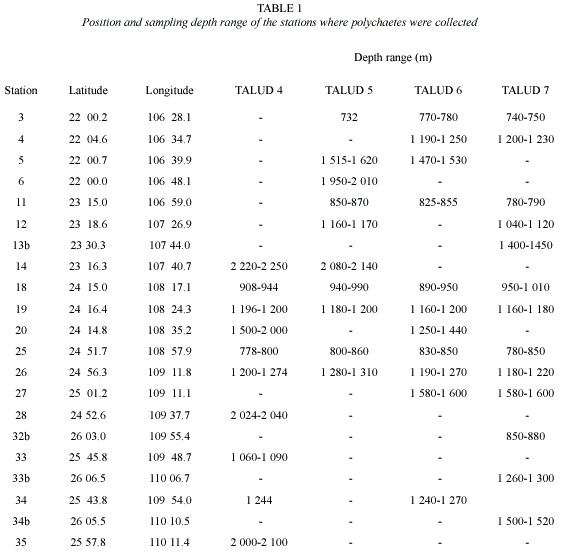
<body><![CDATA[<p>Materials and methods</p> </b></font>     <p><font face="Arial" size="2">Benthic organisms associated with deep soft bottoms (732 to 2 250 m depth) were collected aboard the R/V "El Puma" (Universidad Nacional Autónoma de México) during four oceanographic cruises: TALUD 4 in August 2000 (11 stations), TALUD 5 during December 2000 (ten stations), TALUD 6 in March 2001 (12 stations), and TALUD 7 in June 2001 (13 stations). Two types of gear were used at most stations: a) a 2.35 m wide by 0.95 m high modified benthic sledge equipped with a collecting net of ca. 5.5 cm (2 1/4") stretch mesh lined with ca. 2 cm (3/4") mesh net in the mouth area, and b) a 110x40x14 cm Karling dredge used to collect sediments to a depth of 7 cm, with a capacity of 851.</font></p>     <p><font face="Arial" size="2">Polychaetes retained in the benthic sledge were directly collected with forceps and fixed with 10 % formaldehyde solution. The sediment collected with the Karling dredge was washed through a 0.5 mm sieve and the polychaetes were sorted and fixed on board. Specimens found inside thick muddy tubes were fixed by adding 10 % formaldehyde solution through one of the tube openings using a syringe.</font></p>     <p><font face="Arial" size="2">In the laboratory, polychaetes were washed and preserved in 70&#8200;% ethanol and identified to the specific level, as possible, following the keys of Chamberlin (1919b), Hartman (1944a, 1957, 1960, 1968, 1969), Pettibone (1966), Fauchald (1968, 1970, 1972, 1977), Fauchald and Hancock (1981), Paxton (1986), Hernández-Alcántara (1992) and Petersen (2000).</font></p> <font face="Arial" size="2"><b>     <p>Results</p> </b></font>     <p><font face="Arial" size="2">The position and depth range of stations in which polychaetes were collected are included in Table 1.</font></p> <a name="t1"></a>     <div style="text-align: center;"><img src="/img/fbpe/rbt/v54n3/3864i1.JPG" title=""  alt="" style="width: 563px; height: 553px;"></div>     
<p><font face="Arial" size="2">A total of 73 species, representing 33 families, were identified. Additional specimens belonging to the genera <i>Polydora, Cirratulus, Tharyx, Notomastus, Eumida, Sthenolepis, Sigambra, Pareurythoe </i>(?)<i>, Amage, Samytha </i>and<i> Thelepus </i>were not identified to species due to their poor condition. Important taxonomic structures from several specimens from the families Spionidae, Maldanidae, Opheliidae, Phyllodocidae, Nereididae, Glyceridae, Lumbrineridae, Ampharetidae, Sabellidae and Serpulidae were absent, making further identification impossible. They were catalogued as "indeterminable" (<a href="#t2">Table 2</a>).</font></p> <a name="t2"></a>     <div style="text-align: center;"><img src="/img/fbpe/rbt/v54n3/3864i2.JPG" title=""  alt="" style="width: 611px; height: 3821px;"></div>     
<p><font face="Arial" size="2">The families best represented in the study area are Ampharetidae (13 taxa), Maldanidae (11 taxa), and Cirratulidae and Phyllodocidae (eight taxa each). Based on their occurrence for different stations and cruises, the most representative species for the study area are: <i>Melinna exilia</i>, <i>Melinnampharete eoa</i>, <i>Thelepus hamatus</i>, <i>Mexamage corrugata</i>, <i>Terebellides stroemi</i>, <i>Fauveliopsis rugosa</i>, <i>Nothria iridiscens</i>, <i>Califia calida</i>, <i>Neoheteromastus lineus</i> and <i>Maldane cristata</i>. Except for <i>Ancistrosyllis hartmanae</i> and <i>M. eoa</i>, all identified species have been previously reported for the Gulf of California or adjacent areas in soft bottoms.</font></p>     ]]></body>
<body><![CDATA[<p><font face="Arial" size="2">Comparing the two sampling methods, higher numbers of taxa were collected with the Karling dredge during the four cruises: TALUD 4, 44 taxa (Karling) vs. 25 taxa (benthic sledge); TALUD 5, 28 taxa vs. 17; TALUD 6, 42 taxa vs. 20; TALUD 7, 50 taxa vs. 19.</font></p>     <p><font face="Arial" size="2">Only species for which new information was obtained were treated individually. New data related to depth range, distribution, morphology or tube description (or other protective structures in which the animals were found) are provided here.</font></p> <font face="Arial" size="2"><b>     <p>Family Chaetopteridae</p> </b><i></i></font>     <p><font face="Arial" size="2"><i>Phyllochaetopterus limicolus</i>. This species lives in a slender, smooth, cylindrical, unbranched tube measuring 20 cm long by 0.5-0.6 cm wide (Hartman 1969). One specimen from station 4 (TALUD 6) was found inside a 1.8 cm long tube with a mucoid base, externally covered by mud. It is probable that the worm abandoned its own tube (a typical chaetopterid tube was found in the same sample) and invaded this empty tube, which may have been produced by another polychaete.</font></p> <font face="Arial" size="2"><b>     <p>Family Maldanidae</p> </b><i></i></font>     <p><font face="Arial" size="2"><i>Maldane cristata</i>. The tubes are thick and mucoid, covered with compact mud (0.5 cm external diameter).</font></p>     <p><font face="Arial" size="2">Maldanidae sp. 1 to sp. 8. Several maldanids lacked the posterior end which made species identification impossible. According to the characteristics of the prostomium, eight different species were tentatively distinguished.</font></p> <font face="Arial" size="2"><b>     <p>Family Phyllodocidae</p> </b><i></i></font>     <p><font face="Arial" size="2"><i>Eteone</i> cf. <i>dilatae</i>. One specimen fits the description of <i>E.</i> <i>dilatae</i> but appears to be a juvenile because the tentacular and dorsal cirri are not well developed. The eyes are absent, while <i>E. dilatae</i> has two small eyes. Although this species has been reported from the intertidal zone to 177 m (Hartman 1936, 1963, 1968, Reish 1968), our sample was collected at a depth range of 1 580 to 1 600 m. </font></p> <font face="Arial" size="2"><i></i></font>     <p><font face="Arial" size="2"><i>Eumida sanguinea</i>. Was found at depths between 2 000 and 2 100 m. This species has previously been considered cosmopolitan in shelf depths on rocky or mixed sediments (Hartman 1968), from the intertidal zone to 177 m (Rioja 1947, 1962, Hartman 1963, Hernández-Alcántara 1992, Bastida-Zavala 1993) and had not been previously reported in depths greater than 175 m (Eibye-Jacobsen, pers.comm.).</font></p> <font face="Arial" size="2"><i></i></font>     ]]></body>
<body><![CDATA[<p><font face="Arial" size="2"><i>Steggoa gracilior</i>. This species<i> </i>has been reported for the Gulf of California by Chamberlin (1919b) and Hartman (1968), but depth of occurrence was not provided. The unique specimen found during this study was collected at 1 244 m depth.</font></p> <font face="Arial" size="2"><b>     <p>Family Polynoidae</p> </b><i></i></font>     <p><font face="Arial" size="2"><i>Halosydna johnsoni</i>. It has been reported from the intertidal zone to 531 m, in sand, mud or reefs (Hartman 1939a, 1968, Berkeley and Berkeley 1939, 1941, Rioja 1941, 1962) and amongst basalt boulders (Kudenov 1975a). In this study, this species was found between 1 160 and 1 230 m depth.</font></p> <font face="Arial" size="2"><i></i></font>     <p><font face="Arial" size="2"><i>Polynoidae</i> sp. 1, sp. 2, sp. 3. Three different species of polynoids were recognised but they were too incomplete to make identification possible.</font></p> <font face="Arial" size="2"><b>     <p>Family Pilargidae</p> </b><i></i></font>     <p><font face="Arial" size="2"><i>Ancistrocyllis</i> <i>hartmanae</i>. Two specimens were collected in depths ranging from 1 500 to 2 040 m, while this species had been reported in the Chesapeake Bay at 12.8 m by Pettibone (1966) and by Fiege and Bogemann (1999).</font></p> <font face="Arial" size="2"><b>     <p>Family Amphinomidae</p> </b><i></i></font>     <p><font face="Arial" size="2"><i>Pareurythoe</i> (?) sp. Three specimens were found: two from 778-800 m and one from 1 060-1 090 m. Placement of these specimens in this genus is dubious since they have slender notoseate, suggesting that all of them are epitokous forms. All specimens have bifid neurosetae, yellow aciculae, three smooth antennae and smooth dorsal cirri, which fits with <i>P. californica,</i> described from the Gulf of California (Hartman 1968)<i>.</i> Nevertheless, the presence of dendritic branchiae from setiger three to the end of the body, and the absence of eyes suggests that they could be a different species.</font></p> <font face="Arial" size="2"><i></i></font>     <p><font face="Arial" size="2"><i>Pseudeurythoe </i>(=<i>Linopherus;</i> Salazar-Vallejo 1987)<i> ambigua</i>. It was collected at several stations: one specimen from station 14 at 2 080-2 140 m (TALUD 5), two specimens from station 18 at 890-950 m (TALUD 6) and one individual from station 18 at 950-1 010 m (TALUD 7). The species is reported from southern California from 1 645 to 1 900 m by Hartman (1968). This author indicates that two different branchial arrangements can be found in this species: a) branchiae present at setiger four and continuing for seven segments, and b) branchiae present at setiger three and continuing for 43 segments. The specimens collected at station 18 (both cruises) correspond to the first branchial arrangement, while those from station 14 correspond to the second branchial arrangement, perhaps due to clinal variation.</font></p> <font face="Arial" size="2"><b>     <p>Family Onuphidae</p> </b><i></i></font>     ]]></body>
<body><![CDATA[<p><font face="Arial" size="2"><i>Anchinothria fissurata</i>. The tube had not been previously described. In cross section, it consists of a series of transparent hyaline layers with a very hard consistency. It measures about 12 cm long and 0.5 cm external diameter. Sometimes, they have attached anemones or serpulid tubes.</font></p> <font face="Arial" size="2"><b>     <p>Family Eunicidae</p> </b><i></i></font>     <p><font face="Arial" size="2"><i>Eunice megabranchia</i>. The specimens were found inside the oscula of sponges and a tube with the specimen was found inside a sponge attached to a tube of the ampharetid <i>Shistocomus hiltoni.</i></font></p> <font face="Arial" size="2"><b>     <p>Family Fauveliopsidae</p> </b><i></i></font>     <p><font face="Arial" size="2"><i>Fauveliopsis rugosa</i>. Members of the genus <i>Fauveliopsis</i> have been found inside shells of mollusks and tubular tests of foraminifera (Petersen 2000). In the present study, <i>F.</i> <i>rugosa</i> was found inside shells of the scaphopods <i>Fissidentalium megathyris</i> and <i>Rhabdus dalli,</i> surrounded by mud.</font></p> <font face="Arial" size="2"><b>     <p>Family Ampharetidae</p> </b><i></i></font>     <p><font face="Arial" size="2"><i>Paramage scutata</i>. The tube consists of an inner hyaline layer covered with mud, conically shaped, with incrustations of large foraminifera. The animal occupies 1/3 to 1/2 the length of the tube.</font></p> <font face="Arial" size="2"><i></i></font>     <p><font face="Arial" size="2"><i>Ampharete acutifrons</i>. The tube is a hard mucoid inner layer externally covered with compact mud. It is thick (about 1.5 cm external diameter) and tapers proximally. The animal occupies about 1/7 of the tube length.</font></p> <font face="Arial" size="2"><i></i></font>     <p><font face="Arial" size="2"><i>Ampharete arctica</i>. The tube was described by Hartman (1969) as long, tapering proximally, externally covered with fragments of algae, small sticks and debris. Most of the tubes found in the present study are covered with mud, and are similar to those described by Hartman (1969), but specimens were also found in tubes constructed with sand with bands of algae or debris, similar to typical onuphid tubes.</font></p> <font face="Arial" size="2"><i></i></font>     <p><font face="Arial" size="2"><i>Amphicteis scaphobranchiata</i>. This species builds tubes which are up to 25 cm long and about 1 cm external diameter, with a thick mucoid inner layer covered with ring-like compact mud of different colour. The tubes taper proximally and the animal occupies about 1/3 its length.</font></p> <font face="Arial" size="2"><i></i></font>     ]]></body>
<body><![CDATA[<p><font face="Arial" size="2"><i>Egamella quadribranchiata</i>. The tube is thin, made on a mucoid layer covered with bands of mud and fine sand and foraminifera attached to the outer surface. Animals occupy about 1/6 of the tube.</font></p> <font face="Arial" size="2"><i></i></font>     <p><font face="Arial" size="2"><i>Melinna exilia</i>. The tubes are made of mud, with an external diameter of about 0.3 cm.</font></p> <font face="Arial" size="2"><i></i></font>     <p><font face="Arial" size="2"><i>Melinnampharete eoa</i>. This species builds tubes that are up to 30 cm long and about 0.2 cm external diameter made of fine sand and mud. Animals occupy 1/5 to 1/10 of tube length. <i>M. eoa</i> has been reported in deep-water of the Northwest Pacific (Hartman 1960), thus this is the first record of this species in the Gulf of California. </font></p> <font face="Arial" size="2"><i></i></font>     <p><font face="Arial" size="2"><i>Mexamage corrugata</i>. This species has a tube about 1 cm external diameter with a mucoid layer covered with compact mud.</font></p> <font face="Arial" size="2"><i></i></font>     <p><font face="Arial" size="2"><i>Schistocomus hiltoni</i>. Chamberlin (1919b) described the tube of this species as 3.3 cm long, with the wall thickened by the adhesion of fine particles of sand, shell fragments, etc. Hartman (1969) described the tube as having a mucoid inner layer, externally covered with sticks set crosswise. The tubes found in the present study are about 15 cm long and about 1 cm external diameter, and the animal occupies about 1/10 the length. Some tubes have attached fragments of sponges and foraminifera.</font></p>     <p><font face="Arial" size="2">Two species of the ampharetid genera <i>Amage</i> and <i>Samytha</i> have not been reported from the Gulf of California, and their detailed description will be reported elsewhere. Five ovigerous females of <i>Amage</i> sp. were collected at depths between 830-850 m. They differ from the six species previously reported by Hartman (1969) and Fauchald (1972) from the Gulf of California and northeast Pacific. The specimens have 14 thoracic segments, and setigers one to three are asetigerous (as <i>A. anops,</i> but different from the other species). They have eleven thoracic segments with notosetae and neuropodial uncini, two pairs of short branchiae (different from <i>A. longibranchiata, </i>which has long branchiae), ten abdominal setigers (as <i>A. scutata</i> and <i>A. sculpta</i> and different from <i>A. delus </i>(=<i>perfecta</i>),<i> A. arieticornuta</i> and <i>A. anops</i>), notopodia with notopodial lobes (as <i>A. arieticornuta</i> and <i>A. anops</i>), and prostomium trilobed (as <i>A. arieticornuta</i> and <i>A. anops</i> and different from <i>A. delus </i>and<i> A. longibranchiata, </i>which is bifid). The tubes are thick and mud-walled (as <i>A. anops </i>and different from <i>A. arieticornuta</i>).</font></p>     <p><font face="Arial" size="2">Fourteen individuals of <i>Samytha</i> sp. were collected at depths of 850-870 m. They have three pairs of smooth branchiae; 17 thoracic setigers of which 14 are uncinigerous and seven to eight abdominal setigers. The prostomium is trilobed and paleae are absent. The specimens differ from the two species reported from California (Hartman 1969) in the number of abdominal setigers (<i>S. californiensis</i> with 20 and <i>S. sexcirrata</i> with 13). The tubes (about 55 cm long) are covered with mud and have attached anemones and foraminifera. The animal occupies about 1/7 part of the tube.</font></p> <font face="Arial" size="2"><b>     <p>Discussion</p> </b></font>     <p><font face="Arial" size="2">Few studies about deep-water polychaetes from the Gulf of California or adjacent areas have been performed, thus results found here are a contribution to their knowledge. This study comprises a list of polychaete taxa collected between 732 and 2 250 m depth, most of them previously collected and described by other authors. Nevertheless, new distribution and depth information is provided. All the species determined at the specific level found in this study have been previously reported for the Gulf of California or adjacent areas except for the pilargid <i>A.</i> <i>hartmanae</i> and the ampharetid <i>M.</i> <i>eoa</i>, which constitute new distribution records. New depth records are provided for <i>E.</i> cf. <i>dilatae, E. sanguinea, S. gracilior, H. johnsoni, A.</i> <i>hartmanae, </i>and <i>P. ambigua.</i></font></p>     <p><font face="Arial" size="2">In order to facilitate further taxonomic studies, the descriptions of the tubes or other protective structures, which had not been previously mentioned in the literature are provided for <i>M. cristata, A. fissurata, E. megabranchia, P. scutata, A. acutifrons, A. scaphobranchiata, E. quadribranchiata, M. exilia, M. eoa,</i> and<i> M. corrugata </i>This study also includes new descriptions of the tubes of <i>P. limicolus, F. rugosa, A. arctica, </i>and <i>S. hiltoni, </i>which differ from previous descriptions.</font></p>     ]]></body>
<body><![CDATA[<p><font face="Arial" size="2">The descriptions of ampharetids belonging to the genera <i>Amage</i> and <i>Samytha </i>and comparisons with species reported from adjacent areas suggest that they are probably undescribed species.</font></p>     <p><font face="Arial" size="2">Based on the number of taxa found during this study, the Karling dredge was more effective than the benthic sledge for collecting polychaetes inhabiting soft bottom, since it is able to collect species representing both, infauna and epifauna, while the benthic sledge only collects mostly large specimens from the epifauna. Moreover, the smaller mesh used for sieving sediments collected with the Karling dredge allowed the capture of smaller animals.</font></p> <font face="Arial" size="2"><b>     <p>Acknowledgments</p> </b></font>     <p><font face="Arial" size="2">This study is part of the project CONACyT number 31805-N with support from PAPIIT-IN217306-3. I want to thank Michel Hendrickx, director of the projects, for his advice and review of the manuscript. Collection of samples was performed thanks to the crew members of the R/V "El Puma", students and technical staff from the Mazatlan Marine Station (Instituto de Ciencias del Mar y Limnología, UNAM). I am especially grateful to Arturo Toledano, José Salgado, Héctor Nava, Benjamín Yáñez, Ernesto Sánchez and Alejandro Nava for their help during sampling. Thanks are also given to Leslie Harris, Kristian Fauchald, Sergio Salazar and Luis Carrera for their help in identification of dubious polychaete specimens. Arturo Toledano identified the scaphopods <i>F. megathyris</i> and <i>R. dalli.</i></font></p> <font face="Arial" size="2"><b>     <p>Resumen</p> </b></font>     <p><font face="Arial" size="2">Se recolectaron anélidos poliquetos de fondos profundos del SE del golfo de California durante cuatro campañas oceanográficas entre 2000 y 2001. El muestreo de organismos bentónicos se llevó a cabo mediante una draga de arrastre bentónica para recolectar epifauna y una draga tipo Karling para epifauna y endofauna, en un intervalo de profundidad de 732 a 2 250 m. Se presenta un listado de poliquetos con su distribución dentro del área de estudio. En total se identificaron 73 especies (distribuidas en 33 familias). Además, 11 especies fueron identificadas a nivel genérico y 20 a nivel de familia. Con excepción de <i>Ancistrosyllis hartmanae</i> y<i> Melinnampharete eoa</i>, todas las especies habían sido registradas en fondos blandos del golfo de California o zonas adyacentes. Se proporciona nueva información sobre los intervalos de profundidad, la distribución geográfica, la morfología y la descripción de tubos donde los organismos fueron encontrados. Las características morfológicas de <i>Amage</i> sp. y <i>Samytha</i> sp. no coinciden con las especies de estos géneros registradas en el golfo de California, lo que sugiere que podría tratarse de especies no descritas.</font></p> <font face="Arial" size="2"><b></b></font>     <p><font face="Arial" size="2"><b>Palabras clave:</b> poliquetos, océano profundo, tubos de poliquetos, distribución batimétrica, sureste del Golfo de California, México.</font></p> <font face="Arial" size="2"><b>     <p>References</p> </b></font>     <!-- ref --><p><font face="Arial" size="2">Alvarez-Borrego, S. &amp; R.A. Schwartzlose. 1979. Masas de agua del Golfo de California. Cienc. Mar. 6: 43-63.</font>&nbsp;&nbsp;&nbsp;&nbsp;&nbsp;&nbsp;&nbsp;&nbsp;[&#160;<a href="javascript:void(0);" onclick="javascript: window.open('/scielo.php?script=sci_nlinks&ref=1313383&pid=S0034-7744200600030000800001&lng=','','width=640,height=500,resizable=yes,scrollbars=1,menubar=yes,');">Links</a>&#160;]<!-- end-ref --><!-- ref --><p><font face="Arial" size="2">Bastida-Zavala, J.R. 1993. Taxonomía y composición biogeográfica de los poliquetos (Annelida: Polychaeta) de la bahía de La Paz, B.C.S., México. Rev. Inv. Cient. 4: 11-39.</font>&nbsp;&nbsp;&nbsp;&nbsp;&nbsp;&nbsp;&nbsp;&nbsp;[&#160;<a href="javascript:void(0);" onclick="javascript: window.open('/scielo.php?script=sci_nlinks&ref=1313384&pid=S0034-7744200600030000800002&lng=','','width=640,height=500,resizable=yes,scrollbars=1,menubar=yes,');">Links</a>&#160;]<!-- end-ref --><!-- ref --><p><font face="Arial" size="2">Berkeley, E. &amp; C. Berkeley. 1939. On a collection of Polychaeta, chiefly from the West Coast of Mexico. Ann. Mag. N. Hist. Ser. 11. 3: 321-346.</font>&nbsp;&nbsp;&nbsp;&nbsp;&nbsp;&nbsp;&nbsp;&nbsp;[&#160;<a href="javascript:void(0);" onclick="javascript: window.open('/scielo.php?script=sci_nlinks&ref=1313385&pid=S0034-7744200600030000800003&lng=','','width=640,height=500,resizable=yes,scrollbars=1,menubar=yes,');">Links</a>&#160;]<!-- end-ref --><!-- ref --><p><font face="Arial" size="2">Berkeley, E. &amp; C. Berkeley. 1941. On a collection of Polychaeta from Southern California. Bull. So. Calif. Acad. Sci. 40: 16-59.</font>&nbsp;&nbsp;&nbsp;&nbsp;&nbsp;&nbsp;&nbsp;&nbsp;[&#160;<a href="javascript:void(0);" onclick="javascript: window.open('/scielo.php?script=sci_nlinks&ref=1313386&pid=S0034-7744200600030000800004&lng=','','width=640,height=500,resizable=yes,scrollbars=1,menubar=yes,');">Links</a>&#160;]<!-- end-ref --><!-- ref --><p><font face="Arial" size="2">Blake, J.A. 1985. Polychaeta from the vicinity of deep-sea geothermal vents in the eastern Pacific I: Euphrosinidae, Phyllodocidae, Hesionidae, Nereidae, Glyceridae, Dorvilleidae, Orbiniidae, and Maldanidae. Bull. Biol. Soc. Wash. 6: 67-101.</font>&nbsp;&nbsp;&nbsp;&nbsp;&nbsp;&nbsp;&nbsp;&nbsp;[&#160;<a href="javascript:void(0);" onclick="javascript: window.open('/scielo.php?script=sci_nlinks&ref=1313387&pid=S0034-7744200600030000800005&lng=','','width=640,height=500,resizable=yes,scrollbars=1,menubar=yes,');">Links</a>&#160;]<!-- end-ref --><!-- ref --><p><font face="Arial" size="2">Blake, J.A. &amp; B. Hilbig. 1990. Polychaeta from the vicinity of deep-sea hydrothermal vents in the eastern Pacific. II: New species and records from the Juan de Fuca and Explorer ridge systems. Pac. Sci. 44: 219-253.</font>&nbsp;&nbsp;&nbsp;&nbsp;&nbsp;&nbsp;&nbsp;&nbsp;[&#160;<a href="javascript:void(0);" onclick="javascript: window.open('/scielo.php?script=sci_nlinks&ref=1313388&pid=S0034-7744200600030000800006&lng=','','width=640,height=500,resizable=yes,scrollbars=1,menubar=yes,');">Links</a>&#160;]<!-- end-ref --><!-- ref --><p><font face="Arial" size="2">Blake, J.A (ed.). 1994-2000. Taxonomic Atlas of the benthic fauna of the Santa Maria Basin and Western Santa Barbara Channel. Volumes 4-7. Santa Barbara Museum of Natural History, Santa Barbara, California, USA.</font>&nbsp;&nbsp;&nbsp;&nbsp;&nbsp;&nbsp;&nbsp;&nbsp;[&#160;<a href="javascript:void(0);" onclick="javascript: window.open('/scielo.php?script=sci_nlinks&ref=1313389&pid=S0034-7744200600030000800007&lng=','','width=640,height=500,resizable=yes,scrollbars=1,menubar=yes,');">Links</a>&#160;]<!-- end-ref --><!-- ref --><p><font face="Arial" size="2">Chamberlin, R.V. 1919a. The Annelida Polychaeta. Harvard Mus. Comp. Zool., Mem. 48: 1-514.</font>&nbsp;&nbsp;&nbsp;&nbsp;&nbsp;&nbsp;&nbsp;&nbsp;[&#160;<a href="javascript:void(0);" onclick="javascript: window.open('/scielo.php?script=sci_nlinks&ref=1313390&pid=S0034-7744200600030000800008&lng=','','width=640,height=500,resizable=yes,scrollbars=1,menubar=yes,');">Links</a>&#160;]<!-- end-ref --><!-- ref --><p><font face="Arial" size="2">Chamberlin, R.V. 1919b. New polychaetous annelids from Laguna Beach, California. J. Ent. &amp; Zool. 11: 1-23.</font>&nbsp;&nbsp;&nbsp;&nbsp;&nbsp;&nbsp;&nbsp;&nbsp;[&#160;<a href="javascript:void(0);" onclick="javascript: window.open('/scielo.php?script=sci_nlinks&ref=1313391&pid=S0034-7744200600030000800009&lng=','','width=640,height=500,resizable=yes,scrollbars=1,menubar=yes,');">Links</a>&#160;]<!-- end-ref --><!-- ref --><p><font face="Arial" size="2">Diaz, R.J. &amp; R. Rosenberg. 1995. Marine benthic hypoxia: a review of its ecological effects and the behavioural responses of benthic macrofauna. Oceanogr. &amp; Mar. Biol.: An Annual Rev. 33: 245-303.</font>&nbsp;&nbsp;&nbsp;&nbsp;&nbsp;&nbsp;&nbsp;&nbsp;[&#160;<a href="javascript:void(0);" onclick="javascript: window.open('/scielo.php?script=sci_nlinks&ref=1313392&pid=S0034-7744200600030000800010&lng=','','width=640,height=500,resizable=yes,scrollbars=1,menubar=yes,');">Links</a>&#160;]<!-- end-ref --><!-- ref --><p><font face="Arial" size="2">Fauchald, K. 1968. Onuphidae (Polychaeta) from Western Mexico. Allan Hancock Monogr. Mar. Biol. 3: 1-82.</font>&nbsp;&nbsp;&nbsp;&nbsp;&nbsp;&nbsp;&nbsp;&nbsp;[&#160;<a href="javascript:void(0);" onclick="javascript: window.open('/scielo.php?script=sci_nlinks&ref=1313393&pid=S0034-7744200600030000800011&lng=','','width=640,height=500,resizable=yes,scrollbars=1,menubar=yes,');">Links</a>&#160;]<!-- end-ref --><!-- ref --><p><font face="Arial" size="2">Fauchald, K. 1970. Polychaetous annelids of the families Eunicidae, Lumbrineridae, Iphitimidae, Arabellidae, Lysaretidae and Dorvilleidae from western Mexico. Allan Hancock Monogr. Mar. Biol. 5: 1-335.</font>&nbsp;&nbsp;&nbsp;&nbsp;&nbsp;&nbsp;&nbsp;&nbsp;[&#160;<a href="javascript:void(0);" onclick="javascript: window.open('/scielo.php?script=sci_nlinks&ref=1313394&pid=S0034-7744200600030000800012&lng=','','width=640,height=500,resizable=yes,scrollbars=1,menubar=yes,');">Links</a>&#160;]<!-- end-ref --><!-- ref --><p><font face="Arial" size="2">Fauchald, K. 1972. Benthic polychaetous annelids from deep water off western Mexico and adjacent areas in the Eastern Pacific Ocean. Allan Hancock Monogr. Mar. Biol. 7: 1-575.</font>&nbsp;&nbsp;&nbsp;&nbsp;&nbsp;&nbsp;&nbsp;&nbsp;[&#160;<a href="javascript:void(0);" onclick="javascript: window.open('/scielo.php?script=sci_nlinks&ref=1313395&pid=S0034-7744200600030000800013&lng=','','width=640,height=500,resizable=yes,scrollbars=1,menubar=yes,');">Links</a>&#160;]<!-- end-ref --><!-- ref --><p><font face="Arial" size="2">Fauchald, K. 1977. The polychaete worms. Definitions and keys to the orders, families and genera. Nat. Hist. Mus. of Los Angeles County, and Allan Hancock Found. Science Ser. 8: 1-188.</font>&nbsp;&nbsp;&nbsp;&nbsp;&nbsp;&nbsp;&nbsp;&nbsp;[&#160;<a href="javascript:void(0);" onclick="javascript: window.open('/scielo.php?script=sci_nlinks&ref=1313396&pid=S0034-7744200600030000800014&lng=','','width=640,height=500,resizable=yes,scrollbars=1,menubar=yes,');">Links</a>&#160;]<!-- end-ref --><!-- ref --><p><font face="Arial" size="2">Fauchald, K. &amp; D.R. Hancock. 1981. Deep-water polychaetes from a transect off central Oregon. Allan Hancock Found. Monogr. Mar. Biol. 11: 1-73.</font>&nbsp;&nbsp;&nbsp;&nbsp;&nbsp;&nbsp;&nbsp;&nbsp;[&#160;<a href="javascript:void(0);" onclick="javascript: window.open('/scielo.php?script=sci_nlinks&ref=1313397&pid=S0034-7744200600030000800015&lng=','','width=640,height=500,resizable=yes,scrollbars=1,menubar=yes,');">Links</a>&#160;]<!-- end-ref --><!-- ref --><p><font face="Arial" size="2">Fiege, D. &amp; M. Boggemann. 1999. <i>Ancistrosyllis fioronii</i>, a new species of Pilargidae from the North Sea, with a key and synoptic table of characters for all species of the genus <i>Ancistrosyllis</i> McIntosh 1879 (Annelida, Polychaeta, Pilargidae). Senckenb. Biol. 78: 135-140.</font>&nbsp;&nbsp;&nbsp;&nbsp;&nbsp;&nbsp;&nbsp;&nbsp;[&#160;<a href="javascript:void(0);" onclick="javascript: window.open('/scielo.php?script=sci_nlinks&ref=1313398&pid=S0034-7744200600030000800016&lng=','','width=640,height=500,resizable=yes,scrollbars=1,menubar=yes,');">Links</a>&#160;]<!-- end-ref --><!-- ref --><p><font face="Arial" size="2">Hartman, O. 1936. A review of the Phyllodocidae (Annelida Polychaeta) of the coast of California, with descriptions of nine new species. Univ. Calif. Publ. &#65533;&#65533;&#65533;&#65533;&#65533;&#65533;Zool. 41: 117-132.</font>&nbsp;&nbsp;&nbsp;&nbsp;&nbsp;&nbsp;&nbsp;&nbsp;[&#160;<a href="javascript:void(0);" onclick="javascript: window.open('/scielo.php?script=sci_nlinks&ref=1313399&pid=S0034-7744200600030000800017&lng=','','width=640,height=500,resizable=yes,scrollbars=1,menubar=yes,');">Links</a>&#160;]<!-- end-ref --><!-- ref --><p><font face="Arial" size="2">Hartman, O. 1938. Descriptions of new species and new generic records of Polychaetous annelids from California of the families Glyceridae, Eunicidae, Stauronereidae, and Opheliidae. Univ. Calif. Publ. Zool. 43: 93-111.</font>&nbsp;&nbsp;&nbsp;&nbsp;&nbsp;&nbsp;&nbsp;&nbsp;[&#160;<a href="javascript:void(0);" onclick="javascript: window.open('/scielo.php?script=sci_nlinks&ref=1313400&pid=S0034-7744200600030000800018&lng=','','width=640,height=500,resizable=yes,scrollbars=1,menubar=yes,');">Links</a>&#160;]<!-- end-ref --><!-- ref --><p><font face="Arial" size="2">Hartman, O. 1939a. Polychaetous annelids. Allan Hancock Pac. Exped. 7: 1-156.</font>&nbsp;&nbsp;&nbsp;&nbsp;&nbsp;&nbsp;&nbsp;&nbsp;[&#160;<a href="javascript:void(0);" onclick="javascript: window.open('/scielo.php?script=sci_nlinks&ref=1313401&pid=S0034-7744200600030000800019&lng=','','width=640,height=500,resizable=yes,scrollbars=1,menubar=yes,');">Links</a>&#160;]<!-- end-ref --><!-- ref --><p><font face="Arial" size="2">Hartman, O. 1939b. New species of polychaetous annelids from Southern California. Allan Hancock Pac. Exped. 7: 157-172.</font>&nbsp;&nbsp;&nbsp;&nbsp;&nbsp;&nbsp;&nbsp;&nbsp;[&#160;<a href="javascript:void(0);" onclick="javascript: window.open('/scielo.php?script=sci_nlinks&ref=1313402&pid=S0034-7744200600030000800020&lng=','','width=640,height=500,resizable=yes,scrollbars=1,menubar=yes,');">Links</a>&#160;]<!-- end-ref --><!-- ref --><p><font face="Arial" size="2">Hartman, O. 1944aPolychaetous annelids. Allan Hancock Pac. Exped. 10: 1-237.</font>&nbsp;&nbsp;&nbsp;&nbsp;&nbsp;&nbsp;&nbsp;&nbsp;[&#160;<a href="javascript:void(0);" onclick="javascript: window.open('/scielo.php?script=sci_nlinks&ref=1313403&pid=S0034-7744200600030000800021&lng=','','width=640,height=500,resizable=yes,scrollbars=1,menubar=yes,');">Links</a>&#160;]<!-- end-ref --><!-- ref --><p><font face="Arial" size="2">Hartman, O. 1944b. Polychaetous annelids from California, including the descriptions of two new genera and nine new species. Allan Hancock Pac. Exped. 10: 239-307.</font>&nbsp;&nbsp;&nbsp;&nbsp;&nbsp;&nbsp;&nbsp;&nbsp;[&#160;<a href="javascript:void(0);" onclick="javascript: window.open('/scielo.php?script=sci_nlinks&ref=1313404&pid=S0034-7744200600030000800022&lng=','','width=640,height=500,resizable=yes,scrollbars=1,menubar=yes,');">Links</a>&#160;]<!-- end-ref --><!-- ref --><p><font face="Arial" size="2">Hartman, O. 1944c. Polychaetous annelids. Allan Hancock Pac. Exped.10: 311-389.</font>&nbsp;&nbsp;&nbsp;&nbsp;&nbsp;&nbsp;&nbsp;&nbsp;[&#160;<a href="javascript:void(0);" onclick="javascript: window.open('/scielo.php?script=sci_nlinks&ref=1313405&pid=S0034-7744200600030000800023&lng=','','width=640,height=500,resizable=yes,scrollbars=1,menubar=yes,');">Links</a>&#160;]<!-- end-ref --><!-- ref --><p><font face="Arial" size="2">Hartman, O. 1951. Literature of the polychaetous annelids. Allan Hancock Found, University of Southern California, Los Angeles, California, USA. p. 1-290.</font>&nbsp;&nbsp;&nbsp;&nbsp;&nbsp;&nbsp;&nbsp;&nbsp;[&#160;<a href="javascript:void(0);" onclick="javascript: window.open('/scielo.php?script=sci_nlinks&ref=1313406&pid=S0034-7744200600030000800024&lng=','','width=640,height=500,resizable=yes,scrollbars=1,menubar=yes,');">Links</a>&#160;]<!-- end-ref --><!-- ref --><p><font face="Arial" size="2">Hartman, O. 1955. Quantitative survey of the benthos of San Pedro Basin, southern California. Allan Hancock Pac. Exped. 19: 1-185.</font>&nbsp;&nbsp;&nbsp;&nbsp;&nbsp;&nbsp;&nbsp;&nbsp;[&#160;<a href="javascript:void(0);" onclick="javascript: window.open('/scielo.php?script=sci_nlinks&ref=1313407&pid=S0034-7744200600030000800025&lng=','','width=640,height=500,resizable=yes,scrollbars=1,menubar=yes,');">Links</a>&#160;]<!-- end-ref --><!-- ref --><p><font face="Arial" size="2">Hartman, O. 1957. Orbiniidae, Apistobranchidae, Paraonidae and Longosomidae. Allan Hancock Pac. Exped. 15: 207-393.</font>&nbsp;&nbsp;&nbsp;&nbsp;&nbsp;&nbsp;&nbsp;&nbsp;[&#160;<a href="javascript:void(0);" onclick="javascript: window.open('/scielo.php?script=sci_nlinks&ref=1313408&pid=S0034-7744200600030000800026&lng=','','width=640,height=500,resizable=yes,scrollbars=1,menubar=yes,');">Links</a>&#160;]<!-- end-ref --><!-- ref --><p><font face="Arial" size="2">Hartman, O. 1960. Systematic account of some marine invertebrate animals from the deep Basins off southern California. Allan Hancock Pac. Exped. 22: 69-215.</font>&nbsp;&nbsp;&nbsp;&nbsp;&nbsp;&nbsp;&nbsp;&nbsp;[&#160;<a href="javascript:void(0);" onclick="javascript: window.open('/scielo.php?script=sci_nlinks&ref=1313409&pid=S0034-7744200600030000800027&lng=','','width=640,height=500,resizable=yes,scrollbars=1,menubar=yes,');">Links</a>&#160;]<!-- end-ref --><!-- ref --><p><font face="Arial" size="2">Hartman, O. 1961. Polychaetous annelids from California. Allan Hancock Pac. Exped. 25: 1-226.</font>&nbsp;&nbsp;&nbsp;&nbsp;&nbsp;&nbsp;&nbsp;&nbsp;[&#160;<a href="javascript:void(0);" onclick="javascript: window.open('/scielo.php?script=sci_nlinks&ref=1313410&pid=S0034-7744200600030000800028&lng=','','width=640,height=500,resizable=yes,scrollbars=1,menubar=yes,');">Links</a>&#160;]<!-- end-ref --><!-- ref --><p><font face="Arial" size="2">Hartman, O. 1963. Submarine canyons of southern California Polychaetous annelids. Allan Hancock Pac. Exped. 27: 1-93.</font>&nbsp;&nbsp;&nbsp;&nbsp;&nbsp;&nbsp;&nbsp;&nbsp;[&#160;<a href="javascript:void(0);" onclick="javascript: window.open('/scielo.php?script=sci_nlinks&ref=1313411&pid=S0034-7744200600030000800029&lng=','','width=640,height=500,resizable=yes,scrollbars=1,menubar=yes,');">Links</a>&#160;]<!-- end-ref --><!-- ref --><p><font face="Arial" size="2">Hartman, O. 1966. Quantitative survey of the benthos of San Pedro Basin, Southern California. Allan Hancock Pac. Exped.19: 187-456.</font>&nbsp;&nbsp;&nbsp;&nbsp;&nbsp;&nbsp;&nbsp;&nbsp;[&#160;<a href="javascript:void(0);" onclick="javascript: window.open('/scielo.php?script=sci_nlinks&ref=1313412&pid=S0034-7744200600030000800030&lng=','','width=640,height=500,resizable=yes,scrollbars=1,menubar=yes,');">Links</a>&#160;]<!-- end-ref --><!-- ref --><p><font face="Arial" size="2">Hartman, O. 1968. Atlas of errantiate polychaetous annelids from California. Allan Hancock Found, University of Southern California, Los Angeles, California, USA. 828 p.</font>&nbsp;&nbsp;&nbsp;&nbsp;&nbsp;&nbsp;&nbsp;&nbsp;[&#160;<a href="javascript:void(0);" onclick="javascript: window.open('/scielo.php?script=sci_nlinks&ref=1313413&pid=S0034-7744200600030000800031&lng=','','width=640,height=500,resizable=yes,scrollbars=1,menubar=yes,');">Links</a>&#160;]<!-- end-ref --><!-- ref --><p><font face="Arial" size="2">Hartman, O. 1969. Atlas of sedentariate polychaetous annelids from California. Allan Hancock Found. University of Southern California, Los Angeles, California, USA. 812 p.</font>&nbsp;&nbsp;&nbsp;&nbsp;&nbsp;&nbsp;&nbsp;&nbsp;[&#160;<a href="javascript:void(0);" onclick="javascript: window.open('/scielo.php?script=sci_nlinks&ref=1313414&pid=S0034-7744200600030000800032&lng=','','width=640,height=500,resizable=yes,scrollbars=1,menubar=yes,');">Links</a>&#160;]<!-- end-ref --><!-- ref --><p><font face="Arial" size="2">Hernández-Alcántara, P. 1992. Los poliquetos (Annelida: Polychaeta) de la plataforma continental del Golfo de California, México. Taxonomía, Abundancia numérica y distribución geográfica. Tesis de Maestría, UNAM, México D.F., México. 427 p.</font>&nbsp;&nbsp;&nbsp;&nbsp;&nbsp;&nbsp;&nbsp;&nbsp;[&#160;<a href="javascript:void(0);" onclick="javascript: window.open('/scielo.php?script=sci_nlinks&ref=1313415&pid=S0034-7744200600030000800033&lng=','','width=640,height=500,resizable=yes,scrollbars=1,menubar=yes,');">Links</a>&#160;]<!-- end-ref --><!-- ref --><p><font face="Arial" size="2">Hernández-Alcántara, P. &amp; V. Solís-Weiss. 1999. Systematics and distribution of the polychaetes (Annelida: Polychaeta) from the sublittoral zone in the Gulf of California. Oceánides 13, 14: 25-38.</font>&nbsp;&nbsp;&nbsp;&nbsp;&nbsp;&nbsp;&nbsp;&nbsp;[&#160;<a href="javascript:void(0);" onclick="javascript: window.open('/scielo.php?script=sci_nlinks&ref=1313416&pid=S0034-7744200600030000800034&lng=','','width=640,height=500,resizable=yes,scrollbars=1,menubar=yes,');">Links</a>&#160;]<!-- end-ref --><!-- ref --><p><font face="Arial" size="2">Kudenov, J.D. 1975a. Errant polychaetes from the Gulf of California, Mexico. J. Nat. Hist. London 9: 65-91</font>&nbsp;&nbsp;&nbsp;&nbsp;&nbsp;&nbsp;&nbsp;&nbsp;[&#160;<a href="javascript:void(0);" onclick="javascript: window.open('/scielo.php?script=sci_nlinks&ref=1313417&pid=S0034-7744200600030000800035&lng=','','width=640,height=500,resizable=yes,scrollbars=1,menubar=yes,');">Links</a>&#160;]<!-- end-ref --><!-- ref --><p><font face="Arial" size="2">Kudenov, J.D. 1975b. Sedentary polychaetes from the Gulf of California, Mexico. J. Nat. Hist. London 9: 205-231.</font>&nbsp;&nbsp;&nbsp;&nbsp;&nbsp;&nbsp;&nbsp;&nbsp;[&#160;<a href="javascript:void(0);" onclick="javascript: window.open('/scielo.php?script=sci_nlinks&ref=1313418&pid=S0034-7744200600030000800036&lng=','','width=640,height=500,resizable=yes,scrollbars=1,menubar=yes,');">Links</a>&#160;]<!-- end-ref --><!-- ref --><p><font face="Arial" size="2">Kudenov, J.D. 1980. Annelida: Polychaeta (Bristleworms), p. 77-123. <i>In</i> R. Brusca (ed.). Common intertidal invertebrates of the Gulf of California, University of Arizona. Tucson, Arizona, USA.</font>&nbsp;&nbsp;&nbsp;&nbsp;&nbsp;&nbsp;&nbsp;&nbsp;[&#160;<a href="javascript:void(0);" onclick="javascript: window.open('/scielo.php?script=sci_nlinks&ref=1313419&pid=S0034-7744200600030000800037&lng=','','width=640,height=500,resizable=yes,scrollbars=1,menubar=yes,');">Links</a>&#160;]<!-- end-ref --><!-- ref --><p><font face="Arial" size="2">Lezcano-Bustamante, B.G. 1989. Estudio prospectivo de la distribución, diversidad y abundancia de las poblaciones de anélidos poliquetos en la porción sur del golfo de California. Tesis Profesional, UNAM, Mexico D.F., Mexico. 98 p.</font>&nbsp;&nbsp;&nbsp;&nbsp;&nbsp;&nbsp;&nbsp;&nbsp;[&#160;<a href="javascript:void(0);" onclick="javascript: window.open('/scielo.php?script=sci_nlinks&ref=1313420&pid=S0034-7744200600030000800038&lng=','','width=640,height=500,resizable=yes,scrollbars=1,menubar=yes,');">Links</a>&#160;]<!-- end-ref --><!-- ref --><p><font face="Arial" size="2">Parker, R.H. 1964. Zoogeography and ecology of some macro-invertebrates particularly mollusks, in the Gulf of California and the continental slope off Mexico. Vidensk. Medd. Fra Dansk Naturh. 126: 1-178.</font>&nbsp;&nbsp;&nbsp;&nbsp;&nbsp;&nbsp;&nbsp;&nbsp;[&#160;<a href="javascript:void(0);" onclick="javascript: window.open('/scielo.php?script=sci_nlinks&ref=1313421&pid=S0034-7744200600030000800039&lng=','','width=640,height=500,resizable=yes,scrollbars=1,menubar=yes,');">Links</a>&#160;]<!-- end-ref --><!-- ref --><p><font face="Arial" size="2">Paxton, H. 1986. Generic revision and relationships of the family Onuphidae (Annelida: Polychaeta). Rec. Aus. Mus. 38: 1-74.</font>&nbsp;&nbsp;&nbsp;&nbsp;&nbsp;&nbsp;&nbsp;&nbsp;[&#160;<a href="javascript:void(0);" onclick="javascript: window.open('/scielo.php?script=sci_nlinks&ref=1313422&pid=S0034-7744200600030000800040&lng=','','width=640,height=500,resizable=yes,scrollbars=1,menubar=yes,');">Links</a>&#160;]<!-- end-ref --><!-- ref --><p><font face="Arial" size="2">Petersen, M.E. 2000. A new genus of Fauveliopsidae (Annelida: Polychaeta), with a review of its species and description of some described taxa. Bull. Mar. Sci. 67: 491-515.</font>&nbsp;&nbsp;&nbsp;&nbsp;&nbsp;&nbsp;&nbsp;&nbsp;[&#160;<a href="javascript:void(0);" onclick="javascript: window.open('/scielo.php?script=sci_nlinks&ref=1313423&pid=S0034-7744200600030000800041&lng=','','width=640,height=500,resizable=yes,scrollbars=1,menubar=yes,');">Links</a>&#160;]<!-- end-ref --><!-- ref --><p><font face="Arial" size="2">Pettibone, M.H. 1966. Revision of the Pilargidae (Annelida: Polychaeta) including descriptions of new species, and redescription of the pelagic <i>Podarmus</i> <i>ploa</i> Chamberlin (Polynoidae). Proc. U.S. Nat. Mus. 118: 155-208.</font>&nbsp;&nbsp;&nbsp;&nbsp;&nbsp;&nbsp;&nbsp;&nbsp;[&#160;<a href="javascript:void(0);" onclick="javascript: window.open('/scielo.php?script=sci_nlinks&ref=1313424&pid=S0034-7744200600030000800042&lng=','','width=640,height=500,resizable=yes,scrollbars=1,menubar=yes,');">Links</a>&#160;]<!-- end-ref --><!-- ref --><p><font face="Arial" size="2">Reish, D.J. 1968. A biological survey of Bahia de los Angeles, Gulf of California, Mexico. Trans. San Diego Soc. Nat. Hist. 15: 67-106.</font>&nbsp;&nbsp;&nbsp;&nbsp;&nbsp;&nbsp;&nbsp;&nbsp;[&#160;<a href="javascript:void(0);" onclick="javascript: window.open('/scielo.php?script=sci_nlinks&ref=1313425&pid=S0034-7744200600030000800043&lng=','','width=640,height=500,resizable=yes,scrollbars=1,menubar=yes,');">Links</a>&#160;]<!-- end-ref --><!-- ref --><p><font face="Arial" size="2">Rioja, E. 1941. Estudios Anelidológicos. An. Inst. Biol. Mex. 12: 669-746.</font>&nbsp;&nbsp;&nbsp;&nbsp;&nbsp;&nbsp;&nbsp;&nbsp;[&#160;<a href="javascript:void(0);" onclick="javascript: window.open('/scielo.php?script=sci_nlinks&ref=1313426&pid=S0034-7744200600030000800044&lng=','','width=640,height=500,resizable=yes,scrollbars=1,menubar=yes,');">Links</a>&#160;]<!-- end-ref --><!-- ref --><p><font face="Arial" size="2">Rioja, E. 1947. Estudios Anelidológicos. An. lnst. Biol. Mex. 18: 198-224.</font>&nbsp;&nbsp;&nbsp;&nbsp;&nbsp;&nbsp;&nbsp;&nbsp;[&#160;<a href="javascript:void(0);" onclick="javascript: window.open('/scielo.php?script=sci_nlinks&ref=1313427&pid=S0034-7744200600030000800045&lng=','','width=640,height=500,resizable=yes,scrollbars=1,menubar=yes,');">Links</a>&#160;]<!-- end-ref --><!-- ref --><p><font face="Arial" size="2">Rioja, E. 1962. Estudios Anelidológicos. An. Inst. Biol. Mex. 33: 131-229.</font>&nbsp;&nbsp;&nbsp;&nbsp;&nbsp;&nbsp;&nbsp;&nbsp;[&#160;<a href="javascript:void(0);" onclick="javascript: window.open('/scielo.php?script=sci_nlinks&ref=1313428&pid=S0034-7744200600030000800046&lng=','','width=640,height=500,resizable=yes,scrollbars=1,menubar=yes,');">Links</a>&#160;]<!-- end-ref --><!-- ref --><p><font face="Arial" size="2">Rosenberg, R., B. Hellman &amp; B. Johansson. 1991. Hypoxic tolerance on marine benthic fauna. Mar. Ecol. Progr. Ser. 79: 127-131.</font>&nbsp;&nbsp;&nbsp;&nbsp;&nbsp;&nbsp;&nbsp;&nbsp;[&#160;<a href="javascript:void(0);" onclick="javascript: window.open('/scielo.php?script=sci_nlinks&ref=1313429&pid=S0034-7744200600030000800047&lng=','','width=640,height=500,resizable=yes,scrollbars=1,menubar=yes,');">Links</a>&#160;]<!-- end-ref --><!-- ref --><p><font face="Arial" size="2">Salazar-Vallejo, S.I. 1987. A new amphinomid polychaete (Annelida: Polychaeta) from Western Mexico. Rev. Biol. Trop. 35: 77-82.</font>&nbsp;&nbsp;&nbsp;&nbsp;&nbsp;&nbsp;&nbsp;&nbsp;[&#160;<a href="javascript:void(0);" onclick="javascript: window.open('/scielo.php?script=sci_nlinks&ref=1313430&pid=S0034-7744200600030000800048&lng=','','width=640,height=500,resizable=yes,scrollbars=1,menubar=yes,');">Links</a>&#160;]<!-- end-ref --><!-- ref --><p><font face="Arial" size="2">Salazar-Vallejo, S.I., J.A. de León-González &amp; H. Salaices-Polanco. 1989. Poliquetos (Annelida: Polychaeta) de México. Libros Universitarios, Universidad Autónoma de Baja California Sur. La Paz, Mexico. 212 p.</font>&nbsp;&nbsp;&nbsp;&nbsp;&nbsp;&nbsp;&nbsp;&nbsp;[&#160;<a href="javascript:void(0);" onclick="javascript: window.open('/scielo.php?script=sci_nlinks&ref=1313431&pid=S0034-7744200600030000800049&lng=','','width=640,height=500,resizable=yes,scrollbars=1,menubar=yes,');">Links</a>&#160;]<!-- end-ref --><!-- ref --><p><font face="Arial" size="2">Sarti-Martínez, A.L. 1984. Estudio prospectivo de la distribución, abundancia y diversidad de los anélidos poliquetos de la zona norte del golfo de California. Tesis Profesional, UNAM, Mexico D.F., Mexico. 53 p.</font>&nbsp;&nbsp;&nbsp;&nbsp;&nbsp;&nbsp;&nbsp;&nbsp;[&#160;<a href="javascript:void(0);" onclick="javascript: window.open('/scielo.php?script=sci_nlinks&ref=1313432&pid=S0034-7744200600030000800050&lng=','','width=640,height=500,resizable=yes,scrollbars=1,menubar=yes,');">Links</a>&#160;]<!-- end-ref --><!-- ref --><p><font face="Arial" size="2">Solís-Weiss, V. &amp; B. Hilbig. 1992. Redescription of <i>Ophryotrocha platykephale</i> Blake (Polychaeta, Dorvilleidae) from the Guaymas Basin hydrothermal vents. Bull. Southern Calif. Acad. Sci. 91: 92-96.</font>&nbsp;&nbsp;&nbsp;&nbsp;&nbsp;&nbsp;&nbsp;&nbsp;[&#160;<a href="javascript:void(0);" onclick="javascript: window.open('/scielo.php?script=sci_nlinks&ref=1313433&pid=S0034-7744200600030000800051&lng=','','width=640,height=500,resizable=yes,scrollbars=1,menubar=yes,');">Links</a>&#160;]<!-- end-ref --><!-- ref --><p><font face="Arial" size="2">Solís-Weiss, V. &amp; P. Hernández-Alcántara. 1994. <i>Amphisamytha fauchaldi</i>: a new species of Ampharetid (Annelida: Polychaeta) from the hydrothermal vents at Guaymas Basin, Mexico. Bull. Southern Calif. Acad. Sci. 93: 127-134.</font>&nbsp;&nbsp;&nbsp;&nbsp;&nbsp;&nbsp;&nbsp;&nbsp;[&#160;<a href="javascript:void(0);" onclick="javascript: window.open('/scielo.php?script=sci_nlinks&ref=1313434&pid=S0034-7744200600030000800052&lng=','','width=640,height=500,resizable=yes,scrollbars=1,menubar=yes,');">Links</a>&#160;]<!-- end-ref --><!-- ref --><p><font face="Arial" size="2">Treadwell, A.L. 1923. Polychaetous annelids from lower California with descriptions of new species. Amer. Mus. Novitat. 74: 1-11.</font>&nbsp;&nbsp;&nbsp;&nbsp;&nbsp;&nbsp;&nbsp;&nbsp;[&#160;<a href="javascript:void(0);" onclick="javascript: window.open('/scielo.php?script=sci_nlinks&ref=1313435&pid=S0034-7744200600030000800053&lng=','','width=640,height=500,resizable=yes,scrollbars=1,menubar=yes,');">Links</a>&#160;]<!-- end-ref --><!-- ref --><p><font face="Arial" size="2">Williams, S.J. 1987. Taxonomic notes on some Ampharetidae (Polychaeta) from Southern California. Bull. Biol. Soc. Wash. 7: 251-258.</font>&nbsp;&nbsp;&nbsp;&nbsp;&nbsp;&nbsp;&nbsp;&nbsp;[&#160;<a href="javascript:void(0);" onclick="javascript: window.open('/scielo.php?script=sci_nlinks&ref=1313436&pid=S0034-7744200600030000800054&lng=','','width=640,height=500,resizable=yes,scrollbars=1,menubar=yes,');">Links</a>&#160;]<!-- end-ref --> ]]></body><back>
<ref-list>
<ref id="B1">
<nlm-citation citation-type="journal">
<person-group person-group-type="author">
<name>
<surname><![CDATA[Alvarez-Borrego]]></surname>
<given-names><![CDATA[S]]></given-names>
</name>
<name>
<surname><![CDATA[Schwartzlose]]></surname>
<given-names><![CDATA[R.A]]></given-names>
</name>
</person-group>
<article-title xml:lang="es"><![CDATA[Masas de agua del Golfo de California]]></article-title>
<source><![CDATA[Cienc. Mar]]></source>
<year>1979</year>
<volume>6</volume>
<page-range>43-63</page-range></nlm-citation>
</ref>
<ref id="B2">
<nlm-citation citation-type="journal">
<person-group person-group-type="author">
<name>
<surname><![CDATA[Bastida-Zavala]]></surname>
<given-names><![CDATA[J.R]]></given-names>
</name>
</person-group>
<article-title xml:lang="es"><![CDATA[Taxonomía y composición biogeográfica de los poliquetos (Annelida: Polychaeta) de la bahía de La Paz, B.C.S., México]]></article-title>
<source><![CDATA[Rev. Inv. Cient]]></source>
<year>1993</year>
<volume>4</volume>
<page-range>11-39</page-range></nlm-citation>
</ref>
<ref id="B3">
<nlm-citation citation-type="journal">
<person-group person-group-type="author">
<name>
<surname><![CDATA[Berkeley]]></surname>
<given-names><![CDATA[E]]></given-names>
</name>
<name>
<surname><![CDATA[Berkeley]]></surname>
<given-names><![CDATA[C]]></given-names>
</name>
</person-group>
<article-title xml:lang="en"><![CDATA[On a collection of Polychaeta, chiefly from the West Coast of Mexico]]></article-title>
<source><![CDATA[Ann. Mag. N. Hist. Ser]]></source>
<year>1939</year>
<volume>11</volume>
<page-range>321-346</page-range></nlm-citation>
</ref>
<ref id="B4">
<nlm-citation citation-type="journal">
<person-group person-group-type="author">
<name>
<surname><![CDATA[Berkeley]]></surname>
<given-names><![CDATA[E]]></given-names>
</name>
<name>
<surname><![CDATA[Berkeley]]></surname>
<given-names><![CDATA[C]]></given-names>
</name>
</person-group>
<article-title xml:lang="en"><![CDATA[On a collection of Polychaeta from Southern California]]></article-title>
<source><![CDATA[Bull. So. Calif. Acad. Sci]]></source>
<year>1941</year>
<volume>40</volume>
<page-range>16-59</page-range></nlm-citation>
</ref>
<ref id="B5">
<nlm-citation citation-type="journal">
<person-group person-group-type="author">
<name>
<surname><![CDATA[Blake]]></surname>
<given-names><![CDATA[J.A]]></given-names>
</name>
</person-group>
<article-title xml:lang="en"><![CDATA[Polychaeta from the vicinity of deep-sea geothermal vents in the eastern Pacific I: Euphrosinidae, Phyllodocidae, Hesionidae, Nereidae, Glyceridae, Dorvilleidae, Orbiniidae, and Maldanidae]]></article-title>
<source><![CDATA[Bull. Biol. Soc. Wash]]></source>
<year>1985</year>
<volume>6</volume>
<page-range>67-101</page-range></nlm-citation>
</ref>
<ref id="B6">
<nlm-citation citation-type="journal">
<person-group person-group-type="author">
<name>
<surname><![CDATA[Blake]]></surname>
<given-names><![CDATA[J.A]]></given-names>
</name>
<name>
<surname><![CDATA[Hilbig]]></surname>
<given-names><![CDATA[B]]></given-names>
</name>
</person-group>
<article-title xml:lang="en"><![CDATA[Polychaeta from the vicinity of deep-sea hydrothermal vents in the eastern Pacific. II: New species and records from the Juan de Fuca and Explorer ridge systems]]></article-title>
<source><![CDATA[Pac. Sci]]></source>
<year>1990</year>
<volume>44</volume>
<page-range>219-253</page-range></nlm-citation>
</ref>
<ref id="B7">
<nlm-citation citation-type="book">
<person-group person-group-type="author">
<name>
<surname><![CDATA[Blake]]></surname>
<given-names><![CDATA[J.A]]></given-names>
</name>
</person-group>
<source><![CDATA[Taxonomic Atlas of the benthic fauna of the Santa Maria Basin and Western Santa Barbara Channel]]></source>
<year>1994</year>
<month>-2</month>
<day>00</day>
<volume>Volumes 4-7</volume>
<publisher-loc><![CDATA[Santa Barbara^eCalifornia California]]></publisher-loc>
<publisher-name><![CDATA[Santa Barbara Museum of Natural History]]></publisher-name>
</nlm-citation>
</ref>
<ref id="B8">
<nlm-citation citation-type="journal">
<person-group person-group-type="author">
<name>
<surname><![CDATA[Chamberlin]]></surname>
<given-names><![CDATA[R.V]]></given-names>
</name>
</person-group>
<article-title xml:lang="en"><![CDATA[The Annelida Polychaeta]]></article-title>
<source><![CDATA[Harvard Mus. Comp. Zool., Mem]]></source>
<year>1919</year>
<volume>48</volume>
<page-range>1-514</page-range></nlm-citation>
</ref>
<ref id="B9">
<nlm-citation citation-type="journal">
<person-group person-group-type="author">
<name>
<surname><![CDATA[Chamberlin]]></surname>
<given-names><![CDATA[R.V]]></given-names>
</name>
</person-group>
<article-title xml:lang="en"><![CDATA[New polychaetous annelids from Laguna Beach, California]]></article-title>
<source><![CDATA[J. Ent. & Zool]]></source>
<year>1919</year>
<volume>11</volume>
<page-range>1-23</page-range></nlm-citation>
</ref>
<ref id="B10">
<nlm-citation citation-type="journal">
<person-group person-group-type="author">
<name>
<surname><![CDATA[Diaz]]></surname>
<given-names><![CDATA[R.J]]></given-names>
</name>
<name>
<surname><![CDATA[Rosenberg]]></surname>
<given-names><![CDATA[R]]></given-names>
</name>
</person-group>
<article-title xml:lang="en"><![CDATA[Marine benthic hypoxia: a review of its ecological effects and the behavioural responses of benthic macrofauna]]></article-title>
<source><![CDATA[Oceanogr. & Mar. Biol.: An Annual Rev]]></source>
<year>1995</year>
<volume>33</volume>
<page-range>245-303</page-range></nlm-citation>
</ref>
<ref id="B11">
<nlm-citation citation-type="journal">
<person-group person-group-type="author">
<name>
<surname><![CDATA[Fauchald]]></surname>
<given-names><![CDATA[K]]></given-names>
</name>
</person-group>
<article-title xml:lang="en"><![CDATA[Onuphidae (Polychaeta) from Western Mexico]]></article-title>
<source><![CDATA[Allan Hancock Monogr. Mar. Biol]]></source>
<year>1968</year>
<volume>3</volume>
<page-range>1-82</page-range></nlm-citation>
</ref>
<ref id="B12">
<nlm-citation citation-type="journal">
<person-group person-group-type="author">
<name>
<surname><![CDATA[Fauchald]]></surname>
<given-names><![CDATA[K]]></given-names>
</name>
</person-group>
<article-title xml:lang="en"><![CDATA[Polychaetous annelids of the families Eunicidae, Lumbrineridae, Iphitimidae, Arabellidae, Lysaretidae and Dorvilleidae from western Mexico]]></article-title>
<source><![CDATA[Allan Hancock Monogr. Mar. Biol]]></source>
<year>1970</year>
<volume>5</volume>
<page-range>1-335</page-range></nlm-citation>
</ref>
<ref id="B13">
<nlm-citation citation-type="journal">
<person-group person-group-type="author">
<name>
<surname><![CDATA[Fauchald]]></surname>
<given-names><![CDATA[K]]></given-names>
</name>
</person-group>
<article-title xml:lang="en"><![CDATA[Benthic polychaetous annelids from deep water off western Mexico and adjacent areas in the Eastern Pacific Ocean]]></article-title>
<source><![CDATA[Allan Hancock Monogr. Mar. Biol]]></source>
<year>1972</year>
<volume>7</volume>
<page-range>1-575</page-range></nlm-citation>
</ref>
<ref id="B14">
<nlm-citation citation-type="journal">
<person-group person-group-type="author">
<name>
<surname><![CDATA[Fauchald]]></surname>
<given-names><![CDATA[K]]></given-names>
</name>
</person-group>
<article-title xml:lang="en"><![CDATA[The polychaete worms. Definitions and keys to the orders, families and genera]]></article-title>
<source><![CDATA[Science Ser]]></source>
<year>1977</year>
<volume>8</volume>
<page-range>1-188</page-range></nlm-citation>
</ref>
<ref id="B15">
<nlm-citation citation-type="journal">
<person-group person-group-type="author">
<name>
<surname><![CDATA[Fauchald]]></surname>
<given-names><![CDATA[K]]></given-names>
</name>
<name>
<surname><![CDATA[Hancock]]></surname>
<given-names><![CDATA[D.R]]></given-names>
</name>
</person-group>
<article-title xml:lang="en"><![CDATA[Deep-water polychaetes from a transect off central Oregon]]></article-title>
<source><![CDATA[Allan Hancock Found. Monogr. Mar. Biol]]></source>
<year>1981</year>
<volume>11</volume>
<page-range>1-73</page-range></nlm-citation>
</ref>
<ref id="B16">
<nlm-citation citation-type="journal">
<person-group person-group-type="author">
<name>
<surname><![CDATA[Fiege]]></surname>
<given-names><![CDATA[D]]></given-names>
</name>
<name>
<surname><![CDATA[Boggemann]]></surname>
<given-names><![CDATA[M]]></given-names>
</name>
</person-group>
<article-title xml:lang="en"><![CDATA[Ancistrosyllis fioronii, a new species of Pilargidae from the North Sea, with a key and synoptic table of characters for all species of the genus Ancistrosyllis McIntosh 1879 (Annelida, Polychaeta, Pilargidae)]]></article-title>
<source><![CDATA[Senckenb. Biol]]></source>
<year>1999</year>
<volume>78</volume>
<page-range>135-140</page-range></nlm-citation>
</ref>
<ref id="B17">
<nlm-citation citation-type="journal">
<person-group person-group-type="author">
<name>
<surname><![CDATA[Hartman]]></surname>
<given-names><![CDATA[O]]></given-names>
</name>
</person-group>
<article-title xml:lang="en"><![CDATA[A review of the Phyllodocidae (Annelida Polychaeta) of the coast of California, with descriptions of nine new species]]></article-title>
<source><![CDATA[Univ. Calif. Publ. Zool]]></source>
<year>1936</year>
<volume>41</volume>
<page-range>117-132</page-range></nlm-citation>
</ref>
<ref id="B18">
<nlm-citation citation-type="journal">
<person-group person-group-type="author">
<name>
<surname><![CDATA[Hartman]]></surname>
<given-names><![CDATA[O]]></given-names>
</name>
</person-group>
<article-title xml:lang="en"><![CDATA[Descriptions of new species and new generic records of Polychaetous annelids from California of the families Glyceridae, Eunicidae, Stauronereidae, and Opheliidae]]></article-title>
<source><![CDATA[Univ. Calif. Publ. Zool]]></source>
<year>1938</year>
<volume>43</volume>
<page-range>93-111</page-range></nlm-citation>
</ref>
<ref id="B19">
<nlm-citation citation-type="journal">
<person-group person-group-type="author">
<name>
<surname><![CDATA[Hartman]]></surname>
<given-names><![CDATA[O]]></given-names>
</name>
</person-group>
<article-title xml:lang="en"><![CDATA[Polychaetous annelids]]></article-title>
<source><![CDATA[Allan Hancock Pac. Exped]]></source>
<year>1939</year>
<volume>7</volume>
<page-range>1-156</page-range></nlm-citation>
</ref>
<ref id="B20">
<nlm-citation citation-type="journal">
<person-group person-group-type="author">
<name>
<surname><![CDATA[Hartman]]></surname>
<given-names><![CDATA[O]]></given-names>
</name>
</person-group>
<article-title xml:lang="en"><![CDATA[New species of polychaetous annelids from Southern California]]></article-title>
<source><![CDATA[Allan Hancock Pac. Exped]]></source>
<year>1939</year>
<volume>7</volume>
<page-range>157-172</page-range></nlm-citation>
</ref>
<ref id="B21">
<nlm-citation citation-type="journal">
<person-group person-group-type="author">
<name>
<surname><![CDATA[Hartman]]></surname>
<given-names><![CDATA[O]]></given-names>
</name>
</person-group>
<article-title xml:lang="en"><![CDATA[Polychaetous annelids]]></article-title>
<source><![CDATA[Allan Hancock Pac. Exped]]></source>
<year>1944</year>
<volume>10</volume>
<page-range>1-237</page-range></nlm-citation>
</ref>
<ref id="B22">
<nlm-citation citation-type="journal">
<person-group person-group-type="author">
<name>
<surname><![CDATA[Hartman]]></surname>
<given-names><![CDATA[O]]></given-names>
</name>
</person-group>
<article-title xml:lang="en"><![CDATA[Polychaetous annelids from California, including the descriptions of two new genera and nine new species]]></article-title>
<source><![CDATA[Allan Hancock Pac. Exped]]></source>
<year>1944</year>
<volume>10</volume>
<page-range>239-307</page-range></nlm-citation>
</ref>
<ref id="B23">
<nlm-citation citation-type="journal">
<person-group person-group-type="author">
<name>
<surname><![CDATA[Hartman]]></surname>
<given-names><![CDATA[O]]></given-names>
</name>
</person-group>
<article-title xml:lang="en"><![CDATA[Polychaetous annelids]]></article-title>
<source><![CDATA[Allan Hancock Pac. Exped]]></source>
<year>1944</year>
<volume>10</volume>
<page-range>311-389</page-range></nlm-citation>
</ref>
<ref id="B24">
<nlm-citation citation-type="book">
<person-group person-group-type="author">
<name>
<surname><![CDATA[Hartman]]></surname>
<given-names><![CDATA[O]]></given-names>
</name>
</person-group>
<source><![CDATA[Literature of the polychaetous annelids]]></source>
<year>1951</year>
<page-range>1-290</page-range><publisher-loc><![CDATA[Los Angeles^eCalifornia California]]></publisher-loc>
<publisher-name><![CDATA[Allan Hancock Found, University of Southern California]]></publisher-name>
</nlm-citation>
</ref>
<ref id="B25">
<nlm-citation citation-type="journal">
<person-group person-group-type="author">
<name>
<surname><![CDATA[Hartman]]></surname>
<given-names><![CDATA[O]]></given-names>
</name>
</person-group>
<article-title xml:lang="en"><![CDATA[Quantitative survey of the benthos of San Pedro Basin, southern California]]></article-title>
<source><![CDATA[Allan Hancock Pac. Exped]]></source>
<year>1955</year>
<volume>19</volume>
<page-range>1-185</page-range></nlm-citation>
</ref>
<ref id="B26">
<nlm-citation citation-type="journal">
<person-group person-group-type="author">
<name>
<surname><![CDATA[Hartman]]></surname>
<given-names><![CDATA[O]]></given-names>
</name>
</person-group>
<article-title xml:lang="en"><![CDATA[Orbiniidae, Apistobranchidae, Paraonidae and Longosomidae]]></article-title>
<source><![CDATA[Allan Hancock Pac. Exped]]></source>
<year>1957</year>
<volume>15</volume>
<page-range>207-393</page-range></nlm-citation>
</ref>
<ref id="B27">
<nlm-citation citation-type="journal">
<person-group person-group-type="author">
<name>
<surname><![CDATA[Hartman]]></surname>
<given-names><![CDATA[O]]></given-names>
</name>
</person-group>
<article-title xml:lang="en"><![CDATA[Systematic account of some marine invertebrate animals from the deep Basins off southern California]]></article-title>
<source><![CDATA[Allan Hancock Pac. Exped]]></source>
<year>1960</year>
<volume>22</volume>
<page-range>69-215</page-range></nlm-citation>
</ref>
<ref id="B28">
<nlm-citation citation-type="journal">
<person-group person-group-type="author">
<name>
<surname><![CDATA[Hartman]]></surname>
<given-names><![CDATA[O]]></given-names>
</name>
</person-group>
<article-title xml:lang="en"><![CDATA[Polychaetous annelids from California]]></article-title>
<source><![CDATA[Allan Hancock Pac. Exped]]></source>
<year>1961</year>
<volume>25</volume>
<page-range>1-226</page-range></nlm-citation>
</ref>
<ref id="B29">
<nlm-citation citation-type="journal">
<person-group person-group-type="author">
<name>
<surname><![CDATA[Hartman]]></surname>
<given-names><![CDATA[O]]></given-names>
</name>
</person-group>
<article-title xml:lang="en"><![CDATA[Submarine canyons of southern California Polychaetous annelids]]></article-title>
<source><![CDATA[Allan Hancock Pac. Exped]]></source>
<year>1963</year>
<volume>27</volume>
<page-range>1-93</page-range></nlm-citation>
</ref>
<ref id="B30">
<nlm-citation citation-type="journal">
<person-group person-group-type="author">
<name>
<surname><![CDATA[Hartman]]></surname>
<given-names><![CDATA[O]]></given-names>
</name>
</person-group>
<article-title xml:lang="en"><![CDATA[Quantitative survey of the benthos of San Pedro Basin, Southern California]]></article-title>
<source><![CDATA[Allan Hancock Pac. Exped]]></source>
<year>1966</year>
<volume>19</volume>
<page-range>187-456</page-range></nlm-citation>
</ref>
<ref id="B31">
<nlm-citation citation-type="book">
<person-group person-group-type="author">
<name>
<surname><![CDATA[Hartman]]></surname>
<given-names><![CDATA[O]]></given-names>
</name>
</person-group>
<source><![CDATA[Atlas of errantiate polychaetous annelids from California]]></source>
<year>1968</year>
<page-range>828</page-range><publisher-loc><![CDATA[Los Angeles^eCalifornia California]]></publisher-loc>
<publisher-name><![CDATA[Allan Hancock Found, University of Southern California]]></publisher-name>
</nlm-citation>
</ref>
<ref id="B32">
<nlm-citation citation-type="book">
<person-group person-group-type="author">
<name>
<surname><![CDATA[Hartman]]></surname>
<given-names><![CDATA[O]]></given-names>
</name>
</person-group>
<source><![CDATA[Atlas of sedentariate polychaetous annelids from California]]></source>
<year>1969</year>
<page-range>812</page-range><publisher-loc><![CDATA[Los Angeles^eCalifornia California]]></publisher-loc>
<publisher-name><![CDATA[Allan Hancock Found. University of Southern California]]></publisher-name>
</nlm-citation>
</ref>
<ref id="B33">
<nlm-citation citation-type="">
<person-group person-group-type="author">
<name>
<surname><![CDATA[Hernández-Alcántara]]></surname>
<given-names><![CDATA[P]]></given-names>
</name>
</person-group>
<source><![CDATA[Los poliquetos (Annelida: Polychaeta) de la plataforma continental del Golfo de California, México. Taxonomía, Abundancia numérica y distribución geográfica]]></source>
<year>1992</year>
<page-range>427</page-range></nlm-citation>
</ref>
<ref id="B34">
<nlm-citation citation-type="journal">
<person-group person-group-type="author">
<name>
<surname><![CDATA[Hernández-Alcántara]]></surname>
<given-names><![CDATA[P]]></given-names>
</name>
<name>
<surname><![CDATA[Solís-Weiss]]></surname>
<given-names><![CDATA[V]]></given-names>
</name>
</person-group>
<article-title xml:lang="en"><![CDATA[Systematics and distribution of the polychaetes (Annelida: Polychaeta) from the sublittoral zone in the Gulf of California]]></article-title>
<source><![CDATA[Oceánides]]></source>
<year>1999</year>
<volume>13, 14</volume>
<page-range>25-38</page-range></nlm-citation>
</ref>
<ref id="B35">
<nlm-citation citation-type="journal">
<person-group person-group-type="author">
<name>
<surname><![CDATA[Kudenov]]></surname>
<given-names><![CDATA[J.D]]></given-names>
</name>
</person-group>
<article-title xml:lang="en"><![CDATA[Errant polychaetes from the Gulf of California, Mexico]]></article-title>
<source><![CDATA[J. Nat. Hist. London]]></source>
<year>1975</year>
<volume>9</volume>
<page-range>65-91</page-range></nlm-citation>
</ref>
<ref id="B36">
<nlm-citation citation-type="journal">
<person-group person-group-type="author">
<name>
<surname><![CDATA[Kudenov]]></surname>
<given-names><![CDATA[J.D]]></given-names>
</name>
</person-group>
<article-title xml:lang="en"><![CDATA[Sedentary polychaetes from the Gulf of California, Mexico]]></article-title>
<source><![CDATA[J. Nat. Hist. London]]></source>
<year>1975</year>
<volume>9</volume>
<page-range>205-231</page-range></nlm-citation>
</ref>
<ref id="B37">
<nlm-citation citation-type="">
<person-group person-group-type="author">
<name>
<surname><![CDATA[Kudenov]]></surname>
<given-names><![CDATA[J.D]]></given-names>
</name>
</person-group>
<article-title xml:lang="en"><![CDATA[Annelida: Polychaeta (Bristleworms)]]></article-title>
<person-group person-group-type="editor">
<name>
<surname><![CDATA[Brusca]]></surname>
<given-names><![CDATA[R]]></given-names>
</name>
</person-group>
<source><![CDATA[Common intertidal invertebrates of the Gulf of California, University of Arizona]]></source>
<year>1980</year>
<page-range>77-123</page-range><publisher-loc><![CDATA[Tucson^eArizona Arizona]]></publisher-loc>
</nlm-citation>
</ref>
<ref id="B38">
<nlm-citation citation-type="">
<person-group person-group-type="author">
<name>
<surname><![CDATA[Lezcano-Bustamante]]></surname>
<given-names><![CDATA[B.G]]></given-names>
</name>
</person-group>
<source><![CDATA[Estudio prospectivo de la distribución, diversidad y abundancia de las poblaciones de anélidos poliquetos en la porción sur del golfo de California]]></source>
<year>1989</year>
<page-range>98</page-range></nlm-citation>
</ref>
<ref id="B39">
<nlm-citation citation-type="journal">
<person-group person-group-type="author">
<name>
<surname><![CDATA[Parker]]></surname>
<given-names><![CDATA[R.H]]></given-names>
</name>
</person-group>
<article-title xml:lang="en"><![CDATA[Zoogeography and ecology of some macro-invertebrates particularly mollusks, in the Gulf of California and the continental slope off Mexico]]></article-title>
<source><![CDATA[Vidensk. Medd. Fra Dansk Naturh]]></source>
<year>1964</year>
<volume>126</volume>
<page-range>1-178</page-range></nlm-citation>
</ref>
<ref id="B40">
<nlm-citation citation-type="journal">
<person-group person-group-type="author">
<name>
<surname><![CDATA[Paxton]]></surname>
<given-names><![CDATA[H]]></given-names>
</name>
</person-group>
<article-title xml:lang="en"><![CDATA[Generic revision and relationships of the family Onuphidae (Annelida: Polychaeta)]]></article-title>
<source><![CDATA[Rec. Aus. Mus]]></source>
<year>1986</year>
<volume>38</volume>
<page-range>1-74</page-range></nlm-citation>
</ref>
<ref id="B41">
<nlm-citation citation-type="journal">
<person-group person-group-type="author">
<name>
<surname><![CDATA[Petersen]]></surname>
<given-names><![CDATA[M.E]]></given-names>
</name>
</person-group>
<article-title xml:lang="en"><![CDATA[A new genus of Fauveliopsidae (Annelida: Polychaeta), with a review of its species and description of some described taxa]]></article-title>
<source><![CDATA[Bull. Mar. Sci]]></source>
<year>2000</year>
<volume>67</volume>
<page-range>491-515</page-range></nlm-citation>
</ref>
<ref id="B42">
<nlm-citation citation-type="journal">
<person-group person-group-type="author">
<name>
<surname><![CDATA[Pettibone]]></surname>
<given-names><![CDATA[M.H]]></given-names>
</name>
</person-group>
<article-title xml:lang="en"><![CDATA[Revision of the Pilargidae (Annelida: Polychaeta) including descriptions of new species, and redescription of the pelagic Podarmus ploa Chamberlin (Polynoidae)]]></article-title>
<source><![CDATA[Proc. U.S. Nat. Mus]]></source>
<year>1966</year>
<volume>118</volume>
<page-range>155-208</page-range></nlm-citation>
</ref>
<ref id="B43">
<nlm-citation citation-type="journal">
<person-group person-group-type="author">
<name>
<surname><![CDATA[Reish]]></surname>
<given-names><![CDATA[D.J]]></given-names>
</name>
</person-group>
<article-title xml:lang="en"><![CDATA[A biological survey of Bahia de los Angeles, Gulf of California, Mexico]]></article-title>
<source><![CDATA[Trans. San Diego Soc. Nat. Hist]]></source>
<year>1968</year>
<volume>15</volume>
<page-range>67-106</page-range></nlm-citation>
</ref>
<ref id="B44">
<nlm-citation citation-type="journal">
<person-group person-group-type="author">
<name>
<surname><![CDATA[Rioja]]></surname>
<given-names><![CDATA[E]]></given-names>
</name>
</person-group>
<article-title xml:lang="es"><![CDATA[Estudios Anelidológicos]]></article-title>
<source><![CDATA[An. Inst. Biol. Mex]]></source>
<year>1941</year>
<volume>12</volume>
<page-range>669-746</page-range></nlm-citation>
</ref>
<ref id="B45">
<nlm-citation citation-type="journal">
<person-group person-group-type="author">
<name>
<surname><![CDATA[Rioja]]></surname>
<given-names><![CDATA[E]]></given-names>
</name>
</person-group>
<article-title xml:lang="es"><![CDATA[Estudios Anelidológicos]]></article-title>
<source><![CDATA[An. lnst. Biol. Mex]]></source>
<year>1947</year>
<volume>18</volume>
<page-range>198-224</page-range></nlm-citation>
</ref>
<ref id="B46">
<nlm-citation citation-type="journal">
<person-group person-group-type="author">
<name>
<surname><![CDATA[Rioja]]></surname>
<given-names><![CDATA[E]]></given-names>
</name>
</person-group>
<article-title xml:lang="es"><![CDATA[Estudios Anelidológicos]]></article-title>
<source><![CDATA[An. Inst. Biol. Mex]]></source>
<year>1962</year>
<volume>33</volume>
<page-range>131-229</page-range></nlm-citation>
</ref>
<ref id="B47">
<nlm-citation citation-type="journal">
<person-group person-group-type="author">
<name>
<surname><![CDATA[Rosenberg]]></surname>
<given-names><![CDATA[R]]></given-names>
</name>
<name>
<surname><![CDATA[Hellman]]></surname>
<given-names><![CDATA[B]]></given-names>
</name>
<name>
<surname><![CDATA[Johansson]]></surname>
<given-names><![CDATA[B]]></given-names>
</name>
</person-group>
<article-title xml:lang="en"><![CDATA[Hypoxic tolerance on marine benthic fauna]]></article-title>
<source><![CDATA[Mar. Ecol. Progr. Ser]]></source>
<year>1991</year>
<volume>79</volume>
<page-range>127-131</page-range></nlm-citation>
</ref>
<ref id="B48">
<nlm-citation citation-type="journal">
<person-group person-group-type="author">
<name>
<surname><![CDATA[Salazar-Vallejo]]></surname>
<given-names><![CDATA[S.I]]></given-names>
</name>
</person-group>
<article-title xml:lang="en"><![CDATA[A new amphinomid polychaete (Annelida: Polychaeta) from Western Mexico]]></article-title>
<source><![CDATA[Rev. Biol. Trop]]></source>
<year>1987</year>
<volume>35</volume>
<page-range>77-82</page-range></nlm-citation>
</ref>
<ref id="B49">
<nlm-citation citation-type="book">
<person-group person-group-type="author">
<name>
<surname><![CDATA[Salazar-Vallejo]]></surname>
<given-names><![CDATA[S.I]]></given-names>
</name>
<name>
<surname><![CDATA[de León-González]]></surname>
<given-names><![CDATA[J.A]]></given-names>
</name>
<name>
<surname><![CDATA[Salaices-Polanco]]></surname>
<given-names><![CDATA[H]]></given-names>
</name>
</person-group>
<source><![CDATA[Poliquetos (Annelida: Polychaeta) de México]]></source>
<year>1989</year>
<page-range>212</page-range><publisher-loc><![CDATA[La Paz ]]></publisher-loc>
<publisher-name><![CDATA[Universidad Autónoma de Baja California Sur]]></publisher-name>
</nlm-citation>
</ref>
<ref id="B50">
<nlm-citation citation-type="">
<person-group person-group-type="author">
<name>
<surname><![CDATA[Sarti-Martínez]]></surname>
<given-names><![CDATA[A.L]]></given-names>
</name>
</person-group>
<source><![CDATA[Estudio prospectivo de la distribución, abundancia y diversidad de los anélidos poliquetos de la zona norte del golfo de California]]></source>
<year>1984</year>
<page-range>53</page-range></nlm-citation>
</ref>
<ref id="B51">
<nlm-citation citation-type="journal">
<person-group person-group-type="author">
<name>
<surname><![CDATA[Solís-Weiss]]></surname>
<given-names><![CDATA[V]]></given-names>
</name>
<name>
<surname><![CDATA[Hilbig]]></surname>
<given-names><![CDATA[B]]></given-names>
</name>
</person-group>
<article-title xml:lang="en"><![CDATA[Redescription of Ophryotrocha platykephale Blake (Polychaeta, Dorvilleidae) from the Guaymas Basin hydrothermal vents]]></article-title>
<source><![CDATA[Bull. Southern Calif. Acad. Sci]]></source>
<year>1992</year>
<volume>91</volume>
<page-range>92-96</page-range></nlm-citation>
</ref>
<ref id="B52">
<nlm-citation citation-type="journal">
<person-group person-group-type="author">
<name>
<surname><![CDATA[Solís-Weiss]]></surname>
<given-names><![CDATA[V]]></given-names>
</name>
<name>
<surname><![CDATA[Hernández-Alcántara]]></surname>
<given-names><![CDATA[P]]></given-names>
</name>
</person-group>
<article-title xml:lang="en"><![CDATA[Amphisamytha fauchaldi: a new species of Ampharetid (Annelida: Polychaeta) from the hydrothermal vents at Guaymas Basin, Mexico]]></article-title>
<source><![CDATA[Bull. Southern Calif. Acad. Sci]]></source>
<year>1994</year>
<volume>93</volume>
<page-range>127-134</page-range></nlm-citation>
</ref>
<ref id="B53">
<nlm-citation citation-type="journal">
<person-group person-group-type="author">
<name>
<surname><![CDATA[Treadwell]]></surname>
<given-names><![CDATA[A.L]]></given-names>
</name>
</person-group>
<article-title xml:lang="en"><![CDATA[Polychaetous annelids from lower California with descriptions of new species]]></article-title>
<source><![CDATA[Amer. Mus. Novitat]]></source>
<year>1923</year>
<volume>74</volume>
<page-range>1-11</page-range></nlm-citation>
</ref>
<ref id="B54">
<nlm-citation citation-type="journal">
<person-group person-group-type="author">
<name>
<surname><![CDATA[Williams]]></surname>
<given-names><![CDATA[S.J]]></given-names>
</name>
</person-group>
<article-title xml:lang="en"><![CDATA[Taxonomic notes on some Ampharetidae (Polychaeta) from Southern California]]></article-title>
<source><![CDATA[Bull. Biol. Soc. Wash]]></source>
<year>1987</year>
<volume>7</volume>
<page-range>251-258</page-range></nlm-citation>
</ref>
</ref-list>
</back>
</article>
