<?xml version="1.0" encoding="ISO-8859-1"?><article xmlns:mml="http://www.w3.org/1998/Math/MathML" xmlns:xlink="http://www.w3.org/1999/xlink" xmlns:xsi="http://www.w3.org/2001/XMLSchema-instance">
<front>
<journal-meta>
<journal-id>0034-7744</journal-id>
<journal-title><![CDATA[Revista de Biología Tropical]]></journal-title>
<abbrev-journal-title><![CDATA[Rev. biol. trop]]></abbrev-journal-title>
<issn>0034-7744</issn>
<publisher>
<publisher-name><![CDATA[Universidad de Costa Rica]]></publisher-name>
</publisher>
</journal-meta>
<article-meta>
<article-id>S0034-77442006000300005</article-id>
<title-group>
<article-title xml:lang="en"><![CDATA[Osmoregulatory capacity of the shrimp Litopenaeus vannamei at different temperatures and salinities, and optimal culture environment]]></article-title>
</title-group>
<contrib-group>
<contrib contrib-type="author">
<name>
<surname><![CDATA[Bückle]]></surname>
<given-names><![CDATA[L. Fernando]]></given-names>
</name>
<xref ref-type="aff" rid="A01"/>
</contrib>
<contrib contrib-type="author">
<name>
<surname><![CDATA[Barón]]></surname>
<given-names><![CDATA[Benjamín]]></given-names>
</name>
</contrib>
<contrib contrib-type="author">
<name>
<surname><![CDATA[Hernández]]></surname>
<given-names><![CDATA[Mónica]]></given-names>
</name>
</contrib>
</contrib-group>
<aff id="A01">
<institution><![CDATA[,Departamento de Acuicultura, Centro de Investigación Científica y Educación Superior de Ensenada (CICESE)  ]]></institution>
<addr-line><![CDATA[ ]]></addr-line>
</aff>
<pub-date pub-type="pub">
<day>00</day>
<month>09</month>
<year>2006</year>
</pub-date>
<pub-date pub-type="epub">
<day>00</day>
<month>09</month>
<year>2006</year>
</pub-date>
<volume>54</volume>
<numero>3</numero>
<fpage>745</fpage>
<lpage>753</lpage>
<copyright-statement/>
<copyright-year/>
<self-uri xlink:href="http://www.scielo.sa.cr/scielo.php?script=sci_arttext&amp;pid=S0034-77442006000300005&amp;lng=en&amp;nrm=iso"></self-uri><self-uri xlink:href="http://www.scielo.sa.cr/scielo.php?script=sci_abstract&amp;pid=S0034-77442006000300005&amp;lng=en&amp;nrm=iso"></self-uri><self-uri xlink:href="http://www.scielo.sa.cr/scielo.php?script=sci_pdf&amp;pid=S0034-77442006000300005&amp;lng=en&amp;nrm=iso"></self-uri><abstract abstract-type="short" xml:lang="en"><p><![CDATA[Osmoregulation in Litopenaeus vannamei was studied in a factorial experiment at four temperatures (20, 24, 28 and 32 °C) and six salinities (10, 16, 22, 28, 34 and 40 ‰). The isosmotic related points for 20, 24, 28, and 32 °C were 754, 711, 822, and 763 mmol/kg, respectively. This species hyperregulates between at salinities of 10 and 20 ‰ and hyporegulates between 20 and 40 ‰. The isosmotic point in L. vannamei exposed to constant salinities changed in relation to temperature from 717 to 823 mmol/kg. For these experimental conditions, the T-S combination of 32 °C and 28 ‰ produced the best growth. Rev. Biol. Trop. 54 (3): 745-753. Epub 2006 Sept. 29.]]></p></abstract>
<abstract abstract-type="short" xml:lang="es"><p><![CDATA[La respuesta osmorreguladora de Litopenaeus vannamei se estudió en un experimento factorial con cuatro temperaturas (20, 24, 28 y 32 ºC) y seis salinidades (10, 16, 22, 28, 34 y 40 ‰). Los puntos isosmóticos relacionados para 20, 24, 28, y 32 ºC fueron 754, 711, 822, y 763 mmol/kg, respectivamente. Esta especie hiperregula dentro del intervalo de 10 y 20 ‰ e hiporegula entre 20 y 40 ‰. El punto isosmótico de L. vannamei expuesto a salinidades constantes cambia en relación a la temperatura desde 717 a 823 mmol/kg. Para estas condiciones experimentales, la combinación T-S de 32 ºC y 28 ‰ produjo el mejor crecimiento.]]></p></abstract>
<kwd-group>
<kwd lng="en"><![CDATA[Physiology]]></kwd>
<kwd lng="en"><![CDATA[salinity-temperature]]></kwd>
<kwd lng="en"><![CDATA[shrimp culture]]></kwd>
<kwd lng="en"><![CDATA[Litopenaeus vannamei]]></kwd>
<kwd lng="es"><![CDATA[Fisiología]]></kwd>
<kwd lng="es"><![CDATA[salinidad-temperatura]]></kwd>
<kwd lng="es"><![CDATA[cultivo de camarón]]></kwd>
<kwd lng="es"><![CDATA[Litopenaeus vannamei]]></kwd>
</kwd-group>
</article-meta>
</front><body><![CDATA[  <b><font face="Arial">     <p align="center">Osmoregulatory capacity of the shrimp <i>Litopenaeus vannamei</i> at different temperatures and salinities, and optimal culture environment</p> </font></b><font face="Arial" size="2"></font>     <p><font face="Arial" size="2">L. Fernando Bückle*, Benjamín Barón &amp; Mónica Hernández</font></p>     <p><font face="Arial" size="2">Departamento de Acuicultura, Centro de Investigación Científica y Educación Superior de Ensenada (CICESE). Apdo. 2732, 22800 Ensenada, Baja California, México. P.O. Box 434844, San Diego, Ca. 92143-4844 USA. Tel: (52-61) 175-0500, Tel./Fax: (61) 75-05-34. *Corresponding author: fbuckle@cicese.mx</font></p>     <p align="center"><font face="Arial" size="2">Received 16-IX-2005. Corrected 22-II-2006. Accepted 23-V-2006.</font></p> <font face="Arial" size="2"><b></b></font>     <p><font face="Arial" size="2"><b>Abstract:</b> Osmoregulation in <i>Litopenaeus vannamei </i>was studied in a factorial experiment at four temperatures (20, 24, 28 and 32 °C) and six salinities (10, 16, 22, 28, 34 and 40 ‰). The isosmotic related points for 20, 24, 28, and 32 °C were 754, 711, 822, and 763 mmol/kg, respectively. This species hyperregulates between at salinities of 10 and 20 ‰ and hyporegulates between 20 and 40 ‰. The isosmotic point in <i>L. vannamei</i> exposed to constant salinities changed in relation to temperature from 717 to 823 mmol/kg. For these experimental conditions, the T-S combination of 32 °C and 28 ‰ produced the best growth. Rev. Biol. Trop. 54 (3): 745-753. Epub 2006 Sept. 29.</font></p> <font face="Arial" size="2"></font>     <p><font face="Arial" size="2"><b>Key words:</b> Physiology,<i> </i>salinity-temperature, shrimp culture, <i>Litopenaeus vannamei.</i></font></p>     <p><font face="Arial" size="2"><i>Litopenaeus vannamei </i>is the most important commercially farmed shrimp species in the western hemisphere. It is distributed in the Eastern Pacific rim from the State of Sonora Mexico, to Tumbes in Northern Peru (Perez-Farfante and Kensley 1997). It inhabits the muddy bottoms of the coastline to a depth of approximately 70 m (Dore and Frimodt 1987). This species matures and spawns in the waters of the tropical coasts; the planktonic postlarvae migrate to the estuaries where they remain up to a total length of 10 to 20 mm. While in the estuaries juveniles tolerate wide variations in temperature and salinity (Wickins 1976).</font></p>     <p><font face="Arial" size="2">In order for juvenile shrimp to cope with salinity variations they must have the capability to regulate the concentration of haemolymph in spite of external salinity variations which may range from hypersaline to fresh water as reported for <i>Litopenaeus setiferus, Farfantepenaeus aztecus </i>and <i>F. duorarum </i>(Gunter and Shell 1958, Tabb <i>et al</i>. 1962, Gunter and Hall 1963). For <i>L. vannamei</i> cultivated extensively or intensively, it is important to maintain the optimum temperature and salinity in order to obtain a maximum production. Techniques have been reported for shrimp reared from low salinities to marine environment. Such methods are summarized for <i>L. stylirostris</i> and <i>L. vannamei</i> pond culture involving pond water quality productivity and feeding (Hernandez and Villareal 1999, Jory and Dixon 2000). Complete control is practically impossible to attain due to the natural environmental fluctuations. However, sites can be selected for a range of salinity and temperature. </font></p>     <p><font face="Arial" size="2">Under pond production conditions temperature is difficult to control, salinity can be adjusted using different sources of water or through water exchange. In contrast, shrimp culture in recirculating systems allows a major control of temperature and salinity and has become a very important issue to control the culture and in order to protect the environment by water discharge treatment. </font></p>     ]]></body>
<body><![CDATA[<p><font face="Arial" size="2">Research of the effects taken place by different combinations of salinity and temperature on the physiological responses of crustaceans have been centered in species of commercial importance. Temperature affects the osmotic characteristics of fluids, particularly in living systems by influencing water movements across cell membranes and in the uptake and loss of ions (Vernberg and Silverthorn 1979). </font></p>     <p><font face="Arial" size="2">Mantel and Farmer (1983) and Péqueux (1995) review, state that "Osmoregulation, which is one of the most important regulatory functions an aquatic animal has to perform, has been extensively studied in many crustaceans". Lignot <i>et al</i>. (2000) consider that osmoregulation might also be considered in aquaculture in the early detection of adverse rearing conditions from different origins, including water quality. It constitutes an important energy expense to maintain in their body solute concentrations constant in an environment that changes, as it happens in shrimp pond cultivation. </font></p>     <p><font face="Arial" size="2">To know the temperature and salinity effect on the physiology of shrimp it is necessary to evaluate the osmoregulatory capacity (OC), which was defined by Charmantier <i>et al</i>. (1989) as the difference between the osmotic pressures of the hemolymph and of the external medium, at a given salinity. Consequently several researches have been centered to find the isosmotic point, where the organism doesn’t use the energy for osmoregulation and therefore it channels it to growth. This research evaluated the osmoregulatory responses in <i>L. vannamei</i> exposed to different temperatures and salinities to find the isosmotic point that reflects the condition for optimum growth in controlled conditions.</font></p> <font face="Arial" size="2"><b>     <p>Materials and methods</p> </b></font>     <p><font face="Arial" size="2">Shrimp were acquired from a "Genesis" aquaculture facility in the State of Sonora, Mexico (28°48’ N, 112°00’ W). Postlarvae of 0.09-0.24 g were maintained in 1 500 l reservoirs with seawater (24±1 °C; 34±1 ‰; 6.5±1 mg I<sup>-1</sup> O<sub>2</sub>) during three months. The seawater was re-circulated through a biological filter, mechanical filter filled with silica sand, zeolite filters and an ultraviolet light system. Additionally, all tanks where aerated and shrimp were fed daily ad libitum with Camaronina (35&#8200;% protein), a diet formulated by Purina Company, Mexico.</font></p>     <p><font face="Arial" size="2">After the shrimp reached the adequate size for haemolimph extraction (59.8±0.82 mm T.L. and 1.64±0.06 g), 500 shrimp were apportioned to four circular reservoirs of 400 I each, in order to acclimate them at 20, 24, 28 and 32±1&#8200;°C during one month. The temperature (±1 ºC) was controlled with 1 000 watt stainless steel heaters, each regulated with an electronic unit. The salinity was maintained at 34±1 ‰ with a continuous re-circulating water exchange. Each reservoir was aerated with air stones. Shrimps were exposed to the natural winter photoperiod. </font></p>     <p><font face="Arial" size="2">After temperature acclimation, shrimp were transferred from the 400 l tanks (34 ‰) to 40 l aquariums in the laboratory. In order to avoid osmotic shock, the change of the water salinity was 6 ‰ per day until the factorial experiment of six salinities (10, 16, 22, 28, 34 and 40 ‰) and four temperatures (20, 24, 28 and 32 °C) was completed. The different water salinity concentrations were obtained by the addition of Fritz Super Salt Concentration (Made in the USA). A total of 24 groups of 20 shrimp per group were apportioned and chosen at random (N total = 480). Once the adjustment to the desired temperature and salinity was completed, the shrimp remained for an additional seven days period for full acclimation. This procedure was recommended by Weber and Spaargaren (1970) for Crangon crangon shrimp. Every day, the dissolved oxygen content in the aquariums was measured with an oxygen meter (YSI 50B, 0.01 mg l<sup>-1</sup>), the temperature with a thermometer (±0.1 ºC) and the salinity with a temperature compensated refractometer (Vista, A366ATC, ±1 ‰). Once the measurements were made, salinity was reestablished to the required levels by adding tap water or brine at the required salinity. All aquariums where aerated through a hydro sponge filter acting as mechanical and biological filter that was cleaned every other day. The laboratory photoperiod was controlled by a 12L: 12D electronic timer with 30 min transition period between them. The shrimp were fed at 5 % of the wet weight per day. Faeces and unconsumed food were removed from the aquariums on a daily basis.</font></p>     <p><font face="Arial" size="2">The haemolymph osmotic pressure (OP) of each of the specimens was measured at the end of the acclimation period for the different salinity/temperature combinations. Using a pipette, puncture was made in the abdominal membrane, which was previously dried with absorbent paper to prevent contamination of the haemolymph with water. A ten µl sample of haemolymph was obtained from each shrimp. The sample was analyzed in a Wescor 5500 vapor osmometer and the data expressed in mmol/kg. The osmometer was recalibrated between each T-S haemolymph group measurement. By observing the uropods only intermolting specimens were sampled (Robertson <i>et al</i>. 1987). Each sampled shrimp was weighed (Ohaus balance ± 0.001 g) after haemolimph sampling and total length measured with a ruler (mm) from the tip of the rostrum to the telson.</font></p>     <p><font face="Arial" size="2">The data for the osmotic pressure of <i>L. vannamei </i>were normalized with the square root function and compared by a two-way analysis of variance. Multiple comparisons were done with the Tukey test. Measurements of the osmotic concentration in shrimp haemolymph were adjusted with polynomial functions (Zar 1984) and the isosmotic point was calculated in the intersection with the line of equality. The final weight and total length of the shrimp exposed for seven days at the temperature-salinity combinations were compared with the Dunn´s Method (Zar 1984).</font></p> <font face="Arial" size="2"><b>     <p>Results</p> </b></font>     ]]></body>
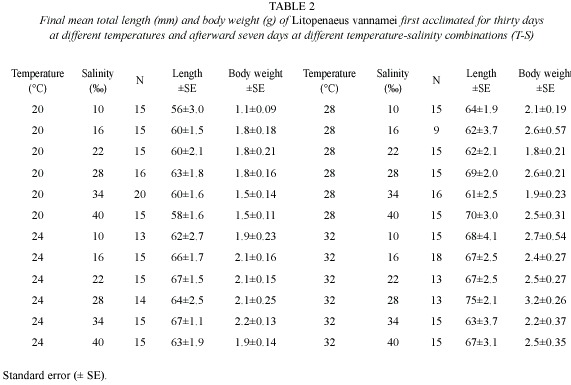
<body><![CDATA[<p><font face="Arial" size="2">During the seven days when <i>L. vannamei</i> individuals were exposed to different temperature-salinity combinations; the temperature, salinity and dissolved oxygen were stable (<a href="#t1">Table 1</a>). Dissolved oxygen concentration of the experiments changed with water temperature and salinity. The mean dissolved oxygen concentration for 20, 24, 28 and 32 ºC were 7.0, 6.3, 5.5 and 5.3 mg l<sup>-1</sup>, respectively (<a href="#t1">Table 1</a>).</font></p> <a name="t1"></a>     <div style="text-align: center;"><img  src="/img/fbpe/rbt/v54n3/3861i1.JPG" title="" alt=""  style="width: 576px; height: 391px;"></div>     
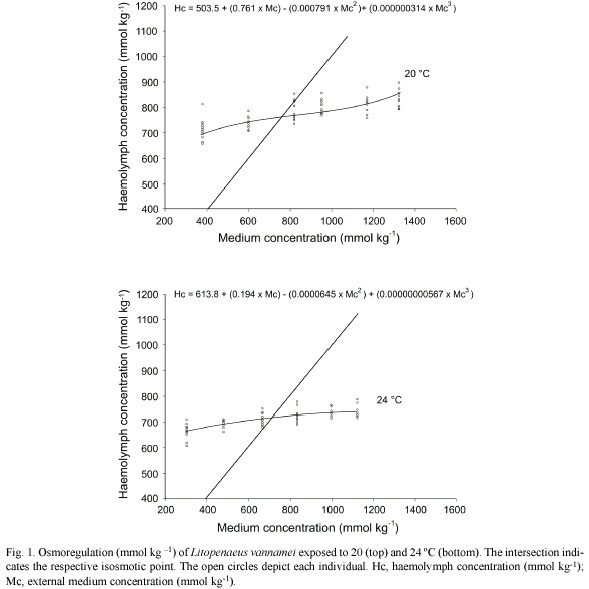
<p><font face="Arial" size="2">The final weight and total length of the shrimp that were acclimated at 20, 24, 28 and 32±1 °C; and exposed for seven days at the temperature-salinity combinations were significantly different (p&lt;0.05). The pairwise multiple comparisons (Dunn´s Method) indicate that the weight and total length of the organisms acclimated at 20 °C were significantly different (p&lt;0.05) compared to treatments of 24, 28 and 32 °C (<a href="#t2">Table 2</a>). The means of total length and wet weight (including all salinities) at 20 °C were 59.5 mm (±1.93 SE) and 1.58 g (±0.14 SE); at 24 °C, 64.8 mm (±1.90 SE) and 2.05 g (±0.17 SE); at 28 °C, 64.6 mm (±2.53 SE) and 2.25 g (±0.28 SE) and at 32 °C, 67.8 mm (±3.00 SE) and 2.58 g (±0.34 SE).</font></p> <a name="t2"></a>     <div style="text-align: center;"><img  src="/img/fbpe/rbt/v54n3/3861i2.JPG" title="" alt=""  style="width: 571px; height: 385px;"></div>     
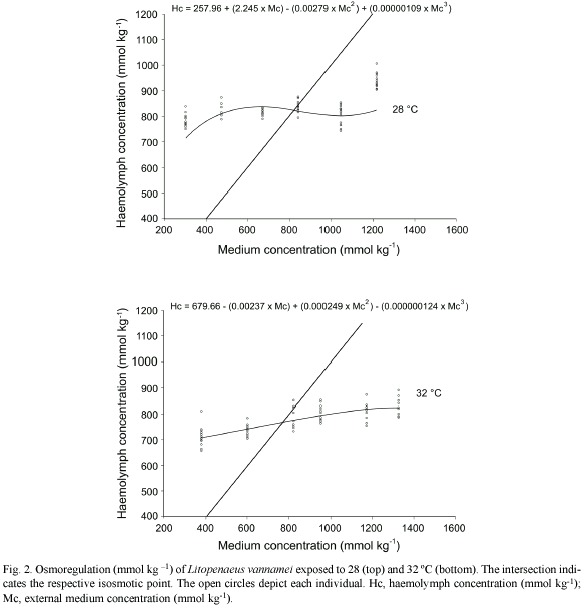
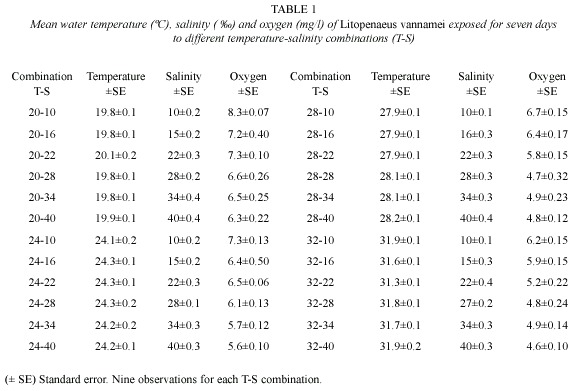
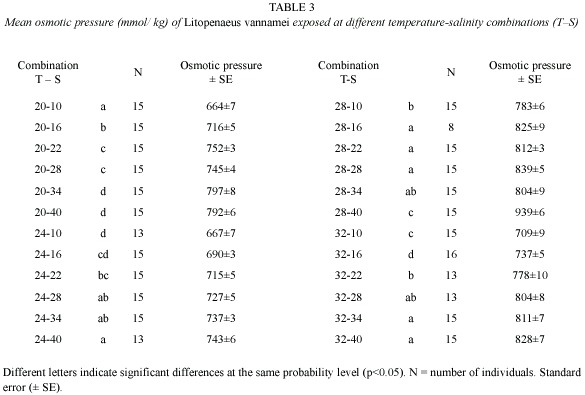
<p><font face="Arial" size="2">The OP in the <i>L. vannamei</i> haemolymph<i> </i>when exposed to four temperatures and six salinities are shown in <a href="#f1">Fig. 1</a>, <a href="#f2">2</a>. The points where the OP of the haemolymph crosses the isosmotic line were 763 mmol/kg for 20 °C; 717 mmol/kg for 24&#8200;°C; 823 mmol/kg for 28 °C and 768 mmol/kg for 32 °C. The isosmotic point varies in relation to temperature, it decreased 46 mmol/kg between 20 and 24 °C and increased 106 mmol/kg when the temperature was increased to 28 °C and decreased 55 mmol/kg at 32 °C (<a href="#t3">Table 3</a>). The difference between the lowest (24 °C) and the highest isosmotic pressure (28 °C) in terms of salinity was 3.5 ‰. </font></p> <a name="t3"></a>     <div style="text-align: center;"><img  src="/img/fbpe/rbt/v54n3/3861i3.JPG" title="" alt=""  style="width: 585px; height: 395px;">    
<br> </div>     <p><font face="Arial" size="2">&nbsp;</font></p> <a name="f1"></a>     <div style="text-align: center;"><img  src="/img/fbpe/rbt/v54n3/3861i4.JPG" title="" alt=""  style="width: 589px; height: 589px;">    
<br>     ]]></body>
<body><![CDATA[<br> <a name="f2"></a><img src="/img/fbpe/rbt/v54n3/3862i2.JPG" title=""  alt="" style="width: 584px; height: 609px;">    
<br> </div> <font face="Arial" size="2"><b>     <p>Discussion</p> </b></font>     <p><font face="Arial" size="2">Chen <i>et al</i>. (1995) studied the survival, growth and osmolality of the haemolymph and the water content in the tissues of Fenneropenaeus chinensis juveniles, concluding that the osmolality of the haemolymph increased with an increase in salinity, and decreased with an increase in temperature. The results of this study indicate that <i>L. vannamei</i> does not follow that pattern with regards to temperature. The shrimp used in this research regulated the osmotic pressure of the haemolymph within a very narrow interval (hyper-hyporegulation) even when the salinity interval was 10 to 40 ‰ and the temperature interval 20 to 32 °C. The isosmotic point in <i>L. vannamei</i> exposed to constant salinities changed in relation to temperature from 717 to 823 mmol/kg. Castille and Lawrence (1981) reported an isosmotic point of 718 mOsm kg<sup>-1</sup> in the same species when evaluated the effect of salinity on the osmotic concentration at 23 °C. Díaz <i>et al</i>. (2001) mention that juveniles exposed to osmotic stress at different temperatures experiences less stress in salinities close to the isosmotic point. Our results denote that the best T-S combination that could be used in <i>L. vannamei </i>cultivation is 28 °C and the isosmotic point of 823 mmol/kg. However, considering the results of weight and total length, the major increment was observed at 32 °C (Table 2); the combination of salinities above 28 ‰ and temperatures from 28 to 32 ºC could be a promising T-S combination that could apply in the culture of this species.</font></p>     <p><font face="Arial" size="2">Diverse authors have studied the effect of temperature and salinity on the osmoregulatory capacity in species of commercial importance such as shrimps, with the purpose of establishing the optimal conditions and specifically the isosmotic point. In this sense, Charmantier <i>et al</i>. (1988) reported the salinity tolerance of Marsupenaeus japonicus and <i>F. chinensis </i>postlarvae finding the smallest rate of mortality when the haemolymph was isosmotic to seawater. In our study the mortality of juveniles exposed at different T-S combinations was 25-30 %, except in 28 °C and 16 ‰ (55 %) combination.</font></p>     <p><font face="Arial" size="2">When <i>L. vannamei</i> was exposed to different combinations of temperature-salinity we found a change in osmotic pressure (OP) that was significantly different between 24 and 28 °C, also reflected in the isosmotic point that changed in relation to temperature acclimation between 20 and 27 ‰. The OP of the shrimp at all temperatures was maintained between 664 and 939 mmol kg <sup>-1</sup>, and the difference was equivalent to 24.8 % of the water salinity interval (10-40 ‰). The percentage between the maximum and minimum interval value of the OP compared with the external water salinity interval (1 108 mmol/kg = 100 %) was 20.5 % for 20 °C; 16.8 % for 24 °C; 13.7 % for 28 °C and 21.4 % for 32 °C. <i>L. vannamei </i>is an species which hyper-hyporegulates when exposed to salinities ranging from 10 to 40 ‰. </font></p>     <p><font face="Arial" size="2">The osmoregulatory responses of <i>L. vannamei </i>juveniles may explain the adjustment to estuaries and coastal lagoons environments. Evaporation due to temperature effect is high, and salinity may vary from 40 to 50 ‰ and drop to 10 ‰ after the intense intermittent rainy season (Holtschmit and Romero 1991). Palafox <i>et al</i>. (1997) established that approximately 28 to 33 °C and 40 ‰ is the best environmental culture conditions for survival and growth for this species.</font></p>     <p><font face="Arial" size="2">A captive maturation survey in 1988 also indicated that 27-29 °C and 28-32 ‰ were the most common "industry standards" in the Americas and Caribbean basin (Ogle 1991a, b). Wyban <i>et</i> <i>al</i>. (1995) mention that the optimal temperature for shrimp smaller than 5 g could be higher than 30 ºC and about 27 ºC for large shrimp. Our results, in accordance with these authors can be applied to pond cultures. Survival and growth determines the good or poor performance of shrimp culture in closed systems. Barón <i>et al</i>. (2004) and Anaya (2005) successfully applied these results to intensive culture of <i>L. vannnamei</i> in recirculation seawater systems. </font></p> <font face="Arial" size="2"><b>     <p>Acknowledgments</p> </b></font>     <p><font face="Arial" size="2">This work was supported by the Federal Government of Mexico through regular funding of the Centro de Investigación Científica y Educación Superior de Ensenada (CICESE) and the Consejo Nacional de Ciencia y Tecnología (CONACYT), grant: 4050P-B.</font></p> <font face="Arial" size="2"><b>     ]]></body>
<body><![CDATA[<p>Resumen</p> </b></font>     <p><font face="Arial" size="2">La respuesta osmorreguladora de <i>Litopenaeus vannamei</i> se estudió en un experimento factorial con cuatro temperaturas (20, 24, 28 y 32 ºC) y seis salinidades (10, 16, 22, 28, 34 y 40 ‰). Los puntos isosmóticos relacionados para 20, 24, 28, y 32 ºC fueron 754, 711, 822, y 763 mmol/kg, respectivamente. Esta especie hiperregula dentro del intervalo de 10 y 20 ‰ e hiporegula entre 20 y 40 ‰. El punto isosmótico de <i>L. vannamei</i> expuesto a salinidades constantes cambia en relación a la temperatura desde 717 a 823 mmol/kg. Para estas condiciones experimentales, la combinación T-S de 32 ºC y 28 ‰ produjo el mejor crecimiento. </font></p> <font face="Arial" size="2"><b></b></font>     <p><font face="Arial" size="2"><b>Palabras clave:</b> Fisiología, salinidad-temperatura, cultivo de camarón, <i>Litopenaeus vannamei.</i></font></p> <font face="Arial" size="2"><b>     <p>References</p> </b></font>     <!-- ref --><p><font face="Arial" size="2">Anaya, R.R. 2005. Cultivo del camarón blanco,<i>Litopenaeus vannamei</i>, Boone (1931), en sistema cerrado a alta densidad. Tesis de Maestría. Centro de Investigación Científica y Educación Superior de Ensenada. 65 p.</font>&nbsp;&nbsp;&nbsp;&nbsp;&nbsp;&nbsp;&nbsp;&nbsp;[&#160;<a href="javascript:void(0);" onclick="javascript: window.open('/scielo.php?script=sci_nlinks&ref=1318417&pid=S0034-7744200600030000500001&lng=','','width=640,height=500,resizable=yes,scrollbars=1,menubar=yes,');">Links</a>&#160;]<!-- end-ref --><!-- ref --><p><font face="Arial" size="2">Barón, B.S., R.L.F. Bückle &amp; R.M. Hernández. 2004. Intensive culture of <i>Litopenaeus vannamei</i> Boone 1931, in recirculating seawater system. Cien. Mar. 30: 179-188.</font>&nbsp;&nbsp;&nbsp;&nbsp;&nbsp;&nbsp;&nbsp;&nbsp;[&#160;<a href="javascript:void(0);" onclick="javascript: window.open('/scielo.php?script=sci_nlinks&ref=1318418&pid=S0034-7744200600030000500002&lng=','','width=640,height=500,resizable=yes,scrollbars=1,menubar=yes,');">Links</a>&#160;]<!-- end-ref --><!-- ref --><p><font face="Arial" size="2">Castille, F.L. &amp; A.L. Lawrence. 1981. The effect of salinity on the osmotic and chloride concentration in the hemolymph of eurihaline shrimp of the genus <i>Penaeus</i>. Comp. Biochem. Physiol. 68: 75-85.</font>&nbsp;&nbsp;&nbsp;&nbsp;&nbsp;&nbsp;&nbsp;&nbsp;[&#160;<a href="javascript:void(0);" onclick="javascript: window.open('/scielo.php?script=sci_nlinks&ref=1318419&pid=S0034-7744200600030000500003&lng=','','width=640,height=500,resizable=yes,scrollbars=1,menubar=yes,');">Links</a>&#160;]<!-- end-ref --><!-- ref --><p><font face="Arial" size="2">Charmantier, D.M., P. Thuet, G.P. Charmantier &amp; J. Trilles. 1988. Tolérance à la salinité et osmorégulation chez les post-larves de <i>Penaeus japonicus</i> et <i>P. chinensis</i>. Effet de la température. Aquat. Living Resour. &#65533;&#65533;&#65533;1: 267-276.</font>&nbsp;&nbsp;&nbsp;&nbsp;&nbsp;&nbsp;&nbsp;&nbsp;[&#160;<a href="javascript:void(0);" onclick="javascript: window.open('/scielo.php?script=sci_nlinks&ref=1318420&pid=S0034-7744200600030000500004&lng=','','width=640,height=500,resizable=yes,scrollbars=1,menubar=yes,');">Links</a>&#160;]<!-- end-ref --><!-- ref --><p><font face="Arial" size="2">Charmantier G., N. Bouaricha, M. Charmantier-Daures, P. Thuet &amp; J.P. Trilles. 1989. Salinity tolerance and osmoregulatory capacity as indicators of the physiological state of peneid shrimps. Eur. Aquat. Soc. Spec. Publ. 10: 65-66.</font>&nbsp;&nbsp;&nbsp;&nbsp;&nbsp;&nbsp;&nbsp;&nbsp;[&#160;<a href="javascript:void(0);" onclick="javascript: window.open('/scielo.php?script=sci_nlinks&ref=1318421&pid=S0034-7744200600030000500005&lng=','','width=640,height=500,resizable=yes,scrollbars=1,menubar=yes,');">Links</a>&#160;]<!-- end-ref --><!-- ref --><p><font face="Arial" size="2">Chen, J.C., M.N. Lin, Y.Y. Ting &amp; J.N. Lin. 1995. Survival, haemolymph osmolality and tissue water of <i>Penaeus chinensis </i>juveniles acclimated to different salinity and temperature levels. Comp. Biochem. Physiol. 110: 253-258.</font>&nbsp;&nbsp;&nbsp;&nbsp;&nbsp;&nbsp;&nbsp;&nbsp;[&#160;<a href="javascript:void(0);" onclick="javascript: window.open('/scielo.php?script=sci_nlinks&ref=1318422&pid=S0034-7744200600030000500006&lng=','','width=640,height=500,resizable=yes,scrollbars=1,menubar=yes,');">Links</a>&#160;]<!-- end-ref --><!-- ref --><p><font face="Arial" size="2">Díaz, H., C. Farfán, E. Sierra &amp; A.D. Re. 2001. Effects of temperature and salinity fluctuation on the ammonium excretion and osmoregulation of juveniles of <i>Penaeus vannamei</i>, Boone 1931. Mar. Fresh. Behav. Physiol. 34: 93-104.</font>&nbsp;&nbsp;&nbsp;&nbsp;&nbsp;&nbsp;&nbsp;&nbsp;[&#160;<a href="javascript:void(0);" onclick="javascript: window.open('/scielo.php?script=sci_nlinks&ref=1318423&pid=S0034-7744200600030000500007&lng=','','width=640,height=500,resizable=yes,scrollbars=1,menubar=yes,');">Links</a>&#160;]<!-- end-ref --><!-- ref --><p><font face="Arial" size="2">Dore, I. &amp; C. Frimodt. 1987. An Illustrated Guide to Shrimp of the World. Osprey Books, Huntington, New York, USA. </font>&nbsp;&nbsp;&nbsp;&nbsp;&nbsp;&nbsp;&nbsp;&nbsp;[&#160;<a href="javascript:void(0);" onclick="javascript: window.open('/scielo.php?script=sci_nlinks&ref=1318424&pid=S0034-7744200600030000500008&lng=','','width=640,height=500,resizable=yes,scrollbars=1,menubar=yes,');">Links</a>&#160;]<!-- end-ref --><!-- ref --><p><font face="Arial" size="2">Gunter, G. &amp; W.E. Jr. Shell. 1958. A study of an estuarine area with water-level control in the Louisiana marsh. Proc. LA Acad. Sci. 21: 5-34.</font>&nbsp;&nbsp;&nbsp;&nbsp;&nbsp;&nbsp;&nbsp;&nbsp;[&#160;<a href="javascript:void(0);" onclick="javascript: window.open('/scielo.php?script=sci_nlinks&ref=1318425&pid=S0034-7744200600030000500009&lng=','','width=640,height=500,resizable=yes,scrollbars=1,menubar=yes,');">Links</a>&#160;]<!-- end-ref --><!-- ref --><p><font face="Arial" size="2">Gunter, G. &amp; G.E. Hall. 1963. Biological investigations of the St. Lucie estuary (Florida) in connection with Lake Okeechobee discharges through the St. Lucie canal. Gulf Res. Rep. 1: 189-307.</font>&nbsp;&nbsp;&nbsp;&nbsp;&nbsp;&nbsp;&nbsp;&nbsp;[&#160;<a href="javascript:void(0);" onclick="javascript: window.open('/scielo.php?script=sci_nlinks&ref=1318426&pid=S0034-7744200600030000500010&lng=','','width=640,height=500,resizable=yes,scrollbars=1,menubar=yes,');">Links</a>&#160;]<!-- end-ref --><!-- ref --><p><font face="Arial" size="2">Hernández, L.A. &amp; C.H. Villareal. 1999. TEMA a software reference to shrimp <i>Litopenaeus</i> <i>vannamei</i> farming practices. Aquacult. Econ. Manage. 3: 267-280.</font>&nbsp;&nbsp;&nbsp;&nbsp;&nbsp;&nbsp;&nbsp;&nbsp;[&#160;<a href="javascript:void(0);" onclick="javascript: window.open('/scielo.php?script=sci_nlinks&ref=1318427&pid=S0034-7744200600030000500011&lng=','','width=640,height=500,resizable=yes,scrollbars=1,menubar=yes,');">Links</a>&#160;]<!-- end-ref --><!-- ref --><p><font face="Arial" size="2">Holtschmit, H.K. &amp; J.M. Romero. 1991. Maturation and spawning of blue shrimp <i>Penaeus stylirostris</i> (Stimpson) under hypersaline conditions. J. World Aquac. Soc. 22: 45-50</font>&nbsp;&nbsp;&nbsp;&nbsp;&nbsp;&nbsp;&nbsp;&nbsp;[&#160;<a href="javascript:void(0);" onclick="javascript: window.open('/scielo.php?script=sci_nlinks&ref=1318428&pid=S0034-7744200600030000500012&lng=','','width=640,height=500,resizable=yes,scrollbars=1,menubar=yes,');">Links</a>&#160;]<!-- end-ref --><!-- ref --><p><font face="Arial" size="2">Jory, D.E. &amp; H.M. Dixon. 2000. General concerns for management of in progress shrimp ponds. Aquacult. Mag<i>.</i> 26: 76-80.</font>&nbsp;&nbsp;&nbsp;&nbsp;&nbsp;&nbsp;&nbsp;&nbsp;[&#160;<a href="javascript:void(0);" onclick="javascript: window.open('/scielo.php?script=sci_nlinks&ref=1318429&pid=S0034-7744200600030000500013&lng=','','width=640,height=500,resizable=yes,scrollbars=1,menubar=yes,');">Links</a>&#160;]<!-- end-ref --><!-- ref --><p><font face="Arial" size="2">Lignot, J.H., C. Spanings-Pierrot &amp; G. Charmantier. 2000. Osmoregulatory capacity as a tool in monitoring the physiological condition and the effect of stress in crustaceans. Aquaculture 191: 209-245.</font>&nbsp;&nbsp;&nbsp;&nbsp;&nbsp;&nbsp;&nbsp;&nbsp;[&#160;<a href="javascript:void(0);" onclick="javascript: window.open('/scielo.php?script=sci_nlinks&ref=1318430&pid=S0034-7744200600030000500014&lng=','','width=640,height=500,resizable=yes,scrollbars=1,menubar=yes,');">Links</a>&#160;]<!-- end-ref --><!-- ref --><p><font face="Arial" size="2">Mantel, L.H. &amp; L.L. Farmer. 1983. Osmotic and ionic regulation. The Biology of Crustacea, p. 53-161. <i>In </i>D.E. Bliss &amp; L.H. Mantel (eds.). Internal Anatomy and Physiological Regulations vol. 5 Academic, New York, New York, USA.</font>&nbsp;&nbsp;&nbsp;&nbsp;&nbsp;&nbsp;&nbsp;&nbsp;[&#160;<a href="javascript:void(0);" onclick="javascript: window.open('/scielo.php?script=sci_nlinks&ref=1318431&pid=S0034-7744200600030000500015&lng=','','width=640,height=500,resizable=yes,scrollbars=1,menubar=yes,');">Links</a>&#160;]<!-- end-ref --><!-- ref --><p><font face="Arial" size="2">Ogle, T.J. 1991a. Design and operation of small tank system for ovarian maturation and spawning of <i>Penaeus vannamei</i>. Gulf Res. Rep<i>.</i> 8: 285-289.</font>&nbsp;&nbsp;&nbsp;&nbsp;&nbsp;&nbsp;&nbsp;&nbsp;[&#160;<a href="javascript:void(0);" onclick="javascript: window.open('/scielo.php?script=sci_nlinks&ref=1318432&pid=S0034-7744200600030000500016&lng=','','width=640,height=500,resizable=yes,scrollbars=1,menubar=yes,');">Links</a>&#160;]<!-- end-ref --><!-- ref --><p><font face="Arial" size="2">Ogle, T.J. 1991b. Maturation of <i>Penaeus vannamei</i> based upon survey. Gulf Res. Rep. 8: 295-297.</font>&nbsp;&nbsp;&nbsp;&nbsp;&nbsp;&nbsp;&nbsp;&nbsp;[&#160;<a href="javascript:void(0);" onclick="javascript: window.open('/scielo.php?script=sci_nlinks&ref=1318433&pid=S0034-7744200600030000500017&lng=','','width=640,height=500,resizable=yes,scrollbars=1,menubar=yes,');">Links</a>&#160;]<!-- end-ref --><!-- ref --><p><font face="Arial" size="2">Palafox, P.J., P.C.A. Martinez &amp; G.L. Ross. 1997. &#65533;&#65533;&#65533;&#65533;The effects of salinity and temperature on the growth and survival rates of juvenile white shrimp, <i>Penaeus vannamei</i>, Boone. 1931. Aquaculture 157: 107-115.</font>&nbsp;&nbsp;&nbsp;&nbsp;&nbsp;&nbsp;&nbsp;&nbsp;[&#160;<a href="javascript:void(0);" onclick="javascript: window.open('/scielo.php?script=sci_nlinks&ref=1318434&pid=S0034-7744200600030000500018&lng=','','width=640,height=500,resizable=yes,scrollbars=1,menubar=yes,');">Links</a>&#160;]<!-- end-ref --><!-- ref --><p><font face="Arial" size="2">Péqueux, A. 1995. Osmotic regulation in crustaceans. J. Crustacean Biol. 15: 1-60.</font>&nbsp;&nbsp;&nbsp;&nbsp;&nbsp;&nbsp;&nbsp;&nbsp;[&#160;<a href="javascript:void(0);" onclick="javascript: window.open('/scielo.php?script=sci_nlinks&ref=1318435&pid=S0034-7744200600030000500019&lng=','','width=640,height=500,resizable=yes,scrollbars=1,menubar=yes,');">Links</a>&#160;]<!-- end-ref --><!-- ref --><p><font face="Arial" size="2">Perez Farfante, I. &amp; B. Kensley. 1997. <i>Penaeoid</i> and <i>Sergestoid</i> shrimps and prawns of the World. Keys and Diagnoses for the Families and Genera. Mem. Mus. Natl. D`Hist. Nat. Paris, France. 233 p.</font>&nbsp;&nbsp;&nbsp;&nbsp;&nbsp;&nbsp;&nbsp;&nbsp;[&#160;<a href="javascript:void(0);" onclick="javascript: window.open('/scielo.php?script=sci_nlinks&ref=1318436&pid=S0034-7744200600030000500020&lng=','','width=640,height=500,resizable=yes,scrollbars=1,menubar=yes,');">Links</a>&#160;]<!-- end-ref --><!-- ref --><p><font face="Arial" size="2">Robertson, L., W.A. Bray, J.L. Leung-Trujillo &amp; A. Lawrence. 1987. Practical molt staging of <i>Penaeus setiferus</i> and <i>P. stylirostris</i>. J. World Aquac. Soc<i>.</i> 18: 180-185.</font>&nbsp;&nbsp;&nbsp;&nbsp;&nbsp;&nbsp;&nbsp;&nbsp;[&#160;<a href="javascript:void(0);" onclick="javascript: window.open('/scielo.php?script=sci_nlinks&ref=1318437&pid=S0034-7744200600030000500021&lng=','','width=640,height=500,resizable=yes,scrollbars=1,menubar=yes,');">Links</a>&#160;]<!-- end-ref --><!-- ref --><p><font face="Arial" size="2">Tabb, D.C., D.L. Dubrow &amp; R.B. Manning. 1962. The ecology of northern Florida Bay and adjacent estuaries. Fla. St. Bd. Conserv. Tech. Ser<i>.</i> 39: 1-79.</font>&nbsp;&nbsp;&nbsp;&nbsp;&nbsp;&nbsp;&nbsp;&nbsp;[&#160;<a href="javascript:void(0);" onclick="javascript: window.open('/scielo.php?script=sci_nlinks&ref=1318438&pid=S0034-7744200600030000500022&lng=','','width=640,height=500,resizable=yes,scrollbars=1,menubar=yes,');">Links</a>&#160;]<!-- end-ref --><!-- ref --><p><font face="Arial" size="2">Vernberg, F.J. &amp; S.U. Silverthorn. 1979. Temperature and osmoregulation in aquatic species, p. 537-562. <i>In</i> R. Gilles (ed.). Mechanisms of Osmoregulation in Animals. Wiley, New York, New York, USA.</font>&nbsp;&nbsp;&nbsp;&nbsp;&nbsp;&nbsp;&nbsp;&nbsp;[&#160;<a href="javascript:void(0);" onclick="javascript: window.open('/scielo.php?script=sci_nlinks&ref=1318439&pid=S0034-7744200600030000500023&lng=','','width=640,height=500,resizable=yes,scrollbars=1,menubar=yes,');">Links</a>&#160;]<!-- end-ref --><!-- ref --><p><font face="Arial" size="2">Weber, R.E. &amp; D.H. Spaargaren. 1970. On the influence of temperature on the osmoregulation of <i>Crangon crangon </i>and its significance under estuarine conditions. Nether. J. Sea Res. 5: 108-120.</font>&nbsp;&nbsp;&nbsp;&nbsp;&nbsp;&nbsp;&nbsp;&nbsp;[&#160;<a href="javascript:void(0);" onclick="javascript: window.open('/scielo.php?script=sci_nlinks&ref=1318440&pid=S0034-7744200600030000500024&lng=','','width=640,height=500,resizable=yes,scrollbars=1,menubar=yes,');">Links</a>&#160;]<!-- end-ref --><!-- ref --><p><font face="Arial" size="2">Wickins, J.F. 1976. Prawn biology and culture<i>. </i>Oceanogr. Mar. Biol. A. Rev. 14: 435-507.</font>&nbsp;&nbsp;&nbsp;&nbsp;&nbsp;&nbsp;&nbsp;&nbsp;[&#160;<a href="javascript:void(0);" onclick="javascript: window.open('/scielo.php?script=sci_nlinks&ref=1318441&pid=S0034-7744200600030000500025&lng=','','width=640,height=500,resizable=yes,scrollbars=1,menubar=yes,');">Links</a>&#160;]<!-- end-ref --><!-- ref --><p><font face="Arial" size="2">Wyban, J., W.A. Walsh &amp; D.M. Godin. 1995. Temperature effects on growth, feeding rate and feed conversion of the Pacific white shrimp (<i>Penaeus vannamei</i>). Aquaculture<i>.</i> 138: 267- 279.</font>&nbsp;&nbsp;&nbsp;&nbsp;&nbsp;&nbsp;&nbsp;&nbsp;[&#160;<a href="javascript:void(0);" onclick="javascript: window.open('/scielo.php?script=sci_nlinks&ref=1318442&pid=S0034-7744200600030000500026&lng=','','width=640,height=500,resizable=yes,scrollbars=1,menubar=yes,');">Links</a>&#160;]<!-- end-ref --><!-- ref --><p><font face="Arial" size="2">Zar, J.H. 1984. Biostatistical analysis. Prentice Hall. New Jersey, USA. 718 p.</font>&nbsp;&nbsp;&nbsp;&nbsp;&nbsp;&nbsp;&nbsp;&nbsp;[&#160;<a href="javascript:void(0);" onclick="javascript: window.open('/scielo.php?script=sci_nlinks&ref=1318443&pid=S0034-7744200600030000500027&lng=','','width=640,height=500,resizable=yes,scrollbars=1,menubar=yes,');">Links</a>&#160;]<!-- end-ref --> ]]></body><back>
<ref-list>
<ref id="B1">
<nlm-citation citation-type="">
<person-group person-group-type="author">
<name>
<surname><![CDATA[Anaya]]></surname>
<given-names><![CDATA[R.R]]></given-names>
</name>
</person-group>
<source><![CDATA[Cultivo del camarón blanco,Litopenaeus vannamei, Boone (1931), en sistema cerrado a alta densidad]]></source>
<year>2005</year>
<page-range>65</page-range></nlm-citation>
</ref>
<ref id="B2">
<nlm-citation citation-type="journal">
<person-group person-group-type="author">
<name>
<surname><![CDATA[Barón]]></surname>
<given-names><![CDATA[B.S]]></given-names>
</name>
<name>
<surname><![CDATA[Bückle]]></surname>
<given-names><![CDATA[R.L.F]]></given-names>
</name>
<name>
<surname><![CDATA[Hernández]]></surname>
<given-names><![CDATA[R.M]]></given-names>
</name>
</person-group>
<article-title xml:lang="en"><![CDATA[Intensive culture of Litopenaeus vannamei Boone 1931, in recirculating seawater system]]></article-title>
<source><![CDATA[Cien. Mar]]></source>
<year>2004</year>
<volume>30</volume>
<page-range>179-188</page-range></nlm-citation>
</ref>
<ref id="B3">
<nlm-citation citation-type="journal">
<person-group person-group-type="author">
<name>
<surname><![CDATA[Castille]]></surname>
<given-names><![CDATA[F.L]]></given-names>
</name>
<name>
<surname><![CDATA[Lawrence]]></surname>
<given-names><![CDATA[A.L]]></given-names>
</name>
</person-group>
<article-title xml:lang="en"><![CDATA[The effect of salinity on the osmotic and chloride concentration in the hemolymph of eurihaline shrimp of the genus Penaeus]]></article-title>
<source><![CDATA[Comp. Biochem. Physiol]]></source>
<year>1981</year>
<volume>68</volume>
<page-range>75-85</page-range></nlm-citation>
</ref>
<ref id="B4">
<nlm-citation citation-type="journal">
<person-group person-group-type="author">
<name>
<surname><![CDATA[Charmantier]]></surname>
<given-names><![CDATA[D.M]]></given-names>
</name>
<name>
<surname><![CDATA[Thuet]]></surname>
<given-names><![CDATA[P]]></given-names>
</name>
<name>
<surname><![CDATA[Charmantier]]></surname>
<given-names><![CDATA[G.P]]></given-names>
</name>
<name>
<surname><![CDATA[Trilles]]></surname>
<given-names><![CDATA[J]]></given-names>
</name>
</person-group>
<article-title xml:lang="fr"><![CDATA[Tolérance à la salinité et osmorégulation chez les post-larves de Penaeus japonicus et P. chinensis. Effet de la température]]></article-title>
<source><![CDATA[Aquat. Living Resour]]></source>
<year>1988</year>
<volume>1</volume>
<page-range>267-276</page-range></nlm-citation>
</ref>
<ref id="B5">
<nlm-citation citation-type="journal">
<person-group person-group-type="author">
<name>
<surname><![CDATA[Charmantier]]></surname>
<given-names><![CDATA[G]]></given-names>
</name>
<name>
<surname><![CDATA[Bouaricha]]></surname>
<given-names><![CDATA[N]]></given-names>
</name>
<name>
<surname><![CDATA[Charmantier-Daures]]></surname>
<given-names><![CDATA[M]]></given-names>
</name>
<name>
<surname><![CDATA[Thuet]]></surname>
<given-names><![CDATA[P]]></given-names>
</name>
<name>
<surname><![CDATA[Trilles]]></surname>
<given-names><![CDATA[J.P]]></given-names>
</name>
</person-group>
<article-title xml:lang="en"><![CDATA[Salinity tolerance and osmoregulatory capacity as indicators of the physiological state of peneid shrimps]]></article-title>
<source><![CDATA[Eur. Aquat. Soc. Spec. Publ]]></source>
<year>1989</year>
<volume>10</volume>
<page-range>65-66</page-range></nlm-citation>
</ref>
<ref id="B6">
<nlm-citation citation-type="journal">
<person-group person-group-type="author">
<name>
<surname><![CDATA[Chen]]></surname>
<given-names><![CDATA[J.C]]></given-names>
</name>
<name>
<surname><![CDATA[Lin]]></surname>
<given-names><![CDATA[M.N]]></given-names>
</name>
<name>
<surname><![CDATA[Ting]]></surname>
<given-names><![CDATA[Y.Y]]></given-names>
</name>
<name>
<surname><![CDATA[Lin]]></surname>
<given-names><![CDATA[J.N]]></given-names>
</name>
</person-group>
<article-title xml:lang="en"><![CDATA[Survival, haemolymph osmolality and tissue water of Penaeus chinensis juveniles acclimated to different salinity and temperature levels]]></article-title>
<source><![CDATA[Comp. Biochem. Physiol]]></source>
<year>1995</year>
<volume>110</volume>
<page-range>253-258</page-range></nlm-citation>
</ref>
<ref id="B7">
<nlm-citation citation-type="journal">
<person-group person-group-type="author">
<name>
<surname><![CDATA[Díaz]]></surname>
<given-names><![CDATA[H]]></given-names>
</name>
<name>
<surname><![CDATA[Farfán]]></surname>
<given-names><![CDATA[C]]></given-names>
</name>
<name>
<surname><![CDATA[Sierra]]></surname>
<given-names><![CDATA[E]]></given-names>
</name>
<name>
<surname><![CDATA[Re]]></surname>
<given-names><![CDATA[A.D]]></given-names>
</name>
</person-group>
<article-title xml:lang="en"><![CDATA[Effects of temperature and salinity fluctuation on the ammonium excretion and osmoregulation of juveniles of Penaeus vannamei, Boone 1931]]></article-title>
<source><![CDATA[Mar. Fresh. Behav. Physiol]]></source>
<year>2001</year>
<volume>34</volume>
<page-range>93-104</page-range></nlm-citation>
</ref>
<ref id="B8">
<nlm-citation citation-type="book">
<person-group person-group-type="author">
<name>
<surname><![CDATA[Dore]]></surname>
<given-names><![CDATA[I]]></given-names>
</name>
<name>
<surname><![CDATA[Frimodt]]></surname>
<given-names><![CDATA[C]]></given-names>
</name>
</person-group>
<source><![CDATA[An Illustrated Guide to Shrimp of the World]]></source>
<year>1987</year>
<publisher-loc><![CDATA[Huntington^eNew York New York]]></publisher-loc>
<publisher-name><![CDATA[Osprey Books]]></publisher-name>
</nlm-citation>
</ref>
<ref id="B9">
<nlm-citation citation-type="journal">
<person-group person-group-type="author">
<name>
<surname><![CDATA[Gunter]]></surname>
<given-names><![CDATA[G]]></given-names>
</name>
<name>
<surname><![CDATA[Shell]]></surname>
<given-names><![CDATA[W.E. Jr]]></given-names>
</name>
</person-group>
<article-title xml:lang="en"><![CDATA[A study of an estuarine area with water-level control in the Louisiana marsh]]></article-title>
<source><![CDATA[Proc. LA Acad. Sci]]></source>
<year>1958</year>
<volume>21</volume>
<page-range>5-34</page-range></nlm-citation>
</ref>
<ref id="B10">
<nlm-citation citation-type="journal">
<person-group person-group-type="author">
<name>
<surname><![CDATA[Gunter]]></surname>
<given-names><![CDATA[G]]></given-names>
</name>
<name>
<surname><![CDATA[Hall]]></surname>
<given-names><![CDATA[G.E]]></given-names>
</name>
</person-group>
<article-title xml:lang="en"><![CDATA[Biological investigations of the St. Lucie estuary (Florida) in connection with Lake Okeechobee discharges through the St. Lucie canal]]></article-title>
<source><![CDATA[Gulf Res. Rep]]></source>
<year>1963</year>
<volume>1</volume>
<page-range>189-307</page-range></nlm-citation>
</ref>
<ref id="B11">
<nlm-citation citation-type="journal">
<person-group person-group-type="author">
<name>
<surname><![CDATA[Hernández]]></surname>
<given-names><![CDATA[L.A]]></given-names>
</name>
<name>
<surname><![CDATA[Villareal]]></surname>
<given-names><![CDATA[C.H]]></given-names>
</name>
</person-group>
<article-title xml:lang="en"><![CDATA[TEMA a software reference to shrimp Litopenaeus vannamei farming practices]]></article-title>
<source><![CDATA[Aquacult. Econ. Manage]]></source>
<year>1999</year>
<volume>3</volume>
<page-range>267-280</page-range></nlm-citation>
</ref>
<ref id="B12">
<nlm-citation citation-type="journal">
<person-group person-group-type="author">
<name>
<surname><![CDATA[Holtschmit]]></surname>
<given-names><![CDATA[H.K]]></given-names>
</name>
<name>
<surname><![CDATA[Romero]]></surname>
<given-names><![CDATA[J.M]]></given-names>
</name>
</person-group>
<article-title xml:lang="en"><![CDATA[Maturation and spawning of blue shrimp Penaeus stylirostris (Stimpson) under hypersaline conditions]]></article-title>
<source><![CDATA[J. World Aquac. Soc]]></source>
<year>1991</year>
<volume>22</volume>
<page-range>45-50</page-range></nlm-citation>
</ref>
<ref id="B13">
<nlm-citation citation-type="journal">
<person-group person-group-type="author">
<name>
<surname><![CDATA[Jory]]></surname>
<given-names><![CDATA[D.E]]></given-names>
</name>
<name>
<surname><![CDATA[Dixon]]></surname>
<given-names><![CDATA[H.M]]></given-names>
</name>
</person-group>
<article-title xml:lang="en"><![CDATA[General concerns for management of in progress shrimp ponds]]></article-title>
<source><![CDATA[Aquacult. Mag]]></source>
<year>2000</year>
<volume>26</volume>
<page-range>76-80</page-range></nlm-citation>
</ref>
<ref id="B14">
<nlm-citation citation-type="journal">
<person-group person-group-type="author">
<name>
<surname><![CDATA[Lignot]]></surname>
<given-names><![CDATA[J.H]]></given-names>
</name>
<name>
<surname><![CDATA[Spanings-Pierrot]]></surname>
<given-names><![CDATA[C]]></given-names>
</name>
<name>
<surname><![CDATA[Charmantier]]></surname>
<given-names><![CDATA[G]]></given-names>
</name>
</person-group>
<article-title xml:lang="en"><![CDATA[Osmoregulatory capacity as a tool in monitoring the physiological condition and the effect of stress in crustaceans]]></article-title>
<source><![CDATA[Aquaculture]]></source>
<year>2000</year>
<volume>191</volume>
<page-range>209-245</page-range></nlm-citation>
</ref>
<ref id="B15">
<nlm-citation citation-type="book">
<person-group person-group-type="author">
<name>
<surname><![CDATA[Mantel]]></surname>
<given-names><![CDATA[L.H]]></given-names>
</name>
<name>
<surname><![CDATA[Farmer]]></surname>
<given-names><![CDATA[L.L]]></given-names>
</name>
</person-group>
<article-title xml:lang="en"><![CDATA[Osmotic and ionic regulation. The Biology of Crustacea]]></article-title>
<person-group person-group-type="editor">
<name>
<surname><![CDATA[Bliss]]></surname>
<given-names><![CDATA[D.E]]></given-names>
</name>
<name>
<surname><![CDATA[Mantel]]></surname>
<given-names><![CDATA[L.H]]></given-names>
</name>
</person-group>
<source><![CDATA[Internal Anatomy and Physiological Regulations vol. 5]]></source>
<year>1983</year>
<page-range>53-161</page-range><publisher-loc><![CDATA[New York^eNew York New York]]></publisher-loc>
<publisher-name><![CDATA[Academic]]></publisher-name>
</nlm-citation>
</ref>
<ref id="B16">
<nlm-citation citation-type="journal">
<person-group person-group-type="author">
<name>
<surname><![CDATA[Ogle]]></surname>
<given-names><![CDATA[T.J]]></given-names>
</name>
</person-group>
<article-title xml:lang="en"><![CDATA[Design and operation of small tank system for ovarian maturation and spawning of Penaeus vannamei]]></article-title>
<source><![CDATA[Gulf Res. Rep]]></source>
<year>1991</year>
<volume>8</volume>
<page-range>285-289</page-range></nlm-citation>
</ref>
<ref id="B17">
<nlm-citation citation-type="journal">
<person-group person-group-type="author">
<name>
<surname><![CDATA[Ogle]]></surname>
<given-names><![CDATA[T.J]]></given-names>
</name>
</person-group>
<article-title xml:lang="en"><![CDATA[Maturation of Penaeus vannamei based upon survey]]></article-title>
<source><![CDATA[Gulf Res. Rep]]></source>
<year>1991</year>
<volume>8</volume>
<page-range>295-297</page-range></nlm-citation>
</ref>
<ref id="B18">
<nlm-citation citation-type="journal">
<person-group person-group-type="author">
<name>
<surname><![CDATA[Palafox]]></surname>
<given-names><![CDATA[P.J]]></given-names>
</name>
<name>
<surname><![CDATA[Martinez]]></surname>
<given-names><![CDATA[P.C.A]]></given-names>
</name>
<name>
<surname><![CDATA[Ross]]></surname>
<given-names><![CDATA[G.L]]></given-names>
</name>
</person-group>
<article-title xml:lang="en"><![CDATA[The effects of salinity and temperature on the growth and survival rates of juvenile white shrimp, Penaeus vannamei, Boone. 1931]]></article-title>
<source><![CDATA[Aquaculture]]></source>
<year>1997</year>
<volume>157</volume>
<page-range>107-115</page-range></nlm-citation>
</ref>
<ref id="B19">
<nlm-citation citation-type="journal">
<person-group person-group-type="author">
<name>
<surname><![CDATA[Péqueux]]></surname>
<given-names><![CDATA[A]]></given-names>
</name>
</person-group>
<article-title xml:lang="en"><![CDATA[Osmotic regulation in crustaceans]]></article-title>
<source><![CDATA[J. Crustacean Biol]]></source>
<year>1995</year>
<volume>15</volume>
<page-range>1-60</page-range></nlm-citation>
</ref>
<ref id="B20">
<nlm-citation citation-type="journal">
<person-group person-group-type="author">
<name>
<surname><![CDATA[Perez Farfante]]></surname>
<given-names><![CDATA[I]]></given-names>
</name>
<name>
<surname><![CDATA[Kensley]]></surname>
<given-names><![CDATA[B]]></given-names>
</name>
</person-group>
<article-title xml:lang="en"><![CDATA[Penaeoid and Sergestoid shrimps and prawns of the World. Keys and Diagnoses for the Families and Genera]]></article-title>
<source><![CDATA[Mem. Mus. Natl. D`Hist. Nat. Paris]]></source>
<year>1997</year>
<page-range>233</page-range></nlm-citation>
</ref>
<ref id="B21">
<nlm-citation citation-type="journal">
<person-group person-group-type="author">
<name>
<surname><![CDATA[Robertson]]></surname>
<given-names><![CDATA[L]]></given-names>
</name>
<name>
<surname><![CDATA[Bray]]></surname>
<given-names><![CDATA[W.A]]></given-names>
</name>
<name>
<surname><![CDATA[Leung-Trujillo]]></surname>
<given-names><![CDATA[J.L]]></given-names>
</name>
<name>
<surname><![CDATA[Lawrence]]></surname>
<given-names><![CDATA[A]]></given-names>
</name>
</person-group>
<article-title xml:lang="en"><![CDATA[Practical molt staging of Penaeus setiferus and P. stylirostris]]></article-title>
<source><![CDATA[J. World Aquac. Soc]]></source>
<year>1987</year>
<volume>18</volume>
<page-range>180-185</page-range></nlm-citation>
</ref>
<ref id="B22">
<nlm-citation citation-type="journal">
<person-group person-group-type="author">
<name>
<surname><![CDATA[Tabb]]></surname>
<given-names><![CDATA[D.C]]></given-names>
</name>
<name>
<surname><![CDATA[Dubrow]]></surname>
<given-names><![CDATA[D.L]]></given-names>
</name>
<name>
<surname><![CDATA[Manning]]></surname>
<given-names><![CDATA[R.B]]></given-names>
</name>
</person-group>
<article-title xml:lang="en"><![CDATA[The ecology of northern Florida Bay and adjacent estuaries]]></article-title>
<source><![CDATA[Fla. St. Bd. Conserv. Tech. Ser]]></source>
<year>1962</year>
<volume>39</volume>
<page-range>1-79</page-range></nlm-citation>
</ref>
<ref id="B23">
<nlm-citation citation-type="book">
<person-group person-group-type="author">
<name>
<surname><![CDATA[Vernberg]]></surname>
<given-names><![CDATA[F.J]]></given-names>
</name>
<name>
<surname><![CDATA[Silverthorn]]></surname>
<given-names><![CDATA[S.U]]></given-names>
</name>
</person-group>
<article-title xml:lang="en"><![CDATA[Temperature and osmoregulation in aquatic species]]></article-title>
<person-group person-group-type="editor">
<name>
<surname><![CDATA[Gilles]]></surname>
<given-names><![CDATA[R]]></given-names>
</name>
</person-group>
<source><![CDATA[Mechanisms of Osmoregulation in Animals]]></source>
<year>1979</year>
<page-range>537-562</page-range><publisher-loc><![CDATA[New York^eNew York New York]]></publisher-loc>
<publisher-name><![CDATA[Wiley]]></publisher-name>
</nlm-citation>
</ref>
<ref id="B24">
<nlm-citation citation-type="journal">
<person-group person-group-type="author">
<name>
<surname><![CDATA[Weber]]></surname>
<given-names><![CDATA[R.E]]></given-names>
</name>
<name>
<surname><![CDATA[Spaargaren]]></surname>
<given-names><![CDATA[D.H]]></given-names>
</name>
</person-group>
<article-title xml:lang="en"><![CDATA[On the influence of temperature on the osmoregulation of Crangon crangon and its significance under estuarine conditions]]></article-title>
<source><![CDATA[Nether. J. Sea Res]]></source>
<year>1970</year>
<volume>5</volume>
<page-range>108-120</page-range></nlm-citation>
</ref>
<ref id="B25">
<nlm-citation citation-type="journal">
<person-group person-group-type="author">
<name>
<surname><![CDATA[Wickins]]></surname>
<given-names><![CDATA[J.F]]></given-names>
</name>
</person-group>
<article-title xml:lang="en"><![CDATA[Prawn biology and culture]]></article-title>
<source><![CDATA[Oceanogr. Mar. Biol. A. Rev]]></source>
<year>1976</year>
<volume>14</volume>
<page-range>435-507</page-range></nlm-citation>
</ref>
<ref id="B26">
<nlm-citation citation-type="journal">
<person-group person-group-type="author">
<name>
<surname><![CDATA[Wyban]]></surname>
<given-names><![CDATA[J]]></given-names>
</name>
<name>
<surname><![CDATA[Walsh]]></surname>
<given-names><![CDATA[W.A]]></given-names>
</name>
<name>
<surname><![CDATA[Godin]]></surname>
<given-names><![CDATA[D.M]]></given-names>
</name>
</person-group>
<article-title xml:lang="en"><![CDATA[Temperature effects on growth, feeding rate and feed conversion of the Pacific white shrimp (Penaeus vannamei)]]></article-title>
<source><![CDATA[Aquaculture]]></source>
<year>1995</year>
<volume>138</volume>
<page-range>267- 279</page-range></nlm-citation>
</ref>
<ref id="B27">
<nlm-citation citation-type="book">
<person-group person-group-type="author">
<name>
<surname><![CDATA[Zar]]></surname>
<given-names><![CDATA[J.H]]></given-names>
</name>
</person-group>
<source><![CDATA[Biostatistical analysis]]></source>
<year>1984</year>
<page-range>718</page-range><publisher-loc><![CDATA[^eNew Jersey New Jersey]]></publisher-loc>
<publisher-name><![CDATA[Prentice Hall]]></publisher-name>
</nlm-citation>
</ref>
</ref-list>
</back>
</article>