<?xml version="1.0" encoding="ISO-8859-1"?><article xmlns:mml="http://www.w3.org/1998/Math/MathML" xmlns:xlink="http://www.w3.org/1999/xlink" xmlns:xsi="http://www.w3.org/2001/XMLSchema-instance">
<front>
<journal-meta>
<journal-id>0034-7744</journal-id>
<journal-title><![CDATA[Revista de Biología Tropical]]></journal-title>
<abbrev-journal-title><![CDATA[Rev. biol. trop]]></abbrev-journal-title>
<issn>0034-7744</issn>
<publisher>
<publisher-name><![CDATA[Universidad de Costa Rica]]></publisher-name>
</publisher>
</journal-meta>
<article-meta>
<article-id>S0034-77442006000200015</article-id>
<title-group>
<article-title xml:lang="en"><![CDATA[Ultrastructure of the wild rice Oryza grandiglumis (Gramineae) in Costa Rica]]></article-title>
</title-group>
<contrib-group>
<contrib contrib-type="author">
<name>
<surname><![CDATA[Sánchez]]></surname>
<given-names><![CDATA[Ethel]]></given-names>
</name>
<xref ref-type="aff" rid="A01"/>
</contrib>
<contrib contrib-type="author">
<name>
<surname><![CDATA[Quesada]]></surname>
<given-names><![CDATA[Tania]]></given-names>
</name>
<xref ref-type="aff" rid="A02"/>
</contrib>
<contrib contrib-type="author">
<name>
<surname><![CDATA[Espinoza]]></surname>
<given-names><![CDATA[Ana M]]></given-names>
</name>
<xref ref-type="aff" rid="A03"/>
</contrib>
</contrib-group>
<aff id="A01">
<institution><![CDATA[,Universidad de Costa Rica Centro de Investigación en Estructuras Microscópicas ]]></institution>
<addr-line><![CDATA[San José ]]></addr-line>
<country>Costa Rica</country>
</aff>
<aff id="A02">
<institution><![CDATA[,Universidad de Costa Rica Centro de Investigación en Biología Celular y Molecular ]]></institution>
<addr-line><![CDATA[San José ]]></addr-line>
<country>Costa Rica</country>
</aff>
<aff id="A03">
<institution><![CDATA[,Universidad de Costa Rica Facultad de Ciencias Agroalimentarias Escuela de Agronomía]]></institution>
<addr-line><![CDATA[San José ]]></addr-line>
<country>Costa Rica</country>
</aff>
<pub-date pub-type="pub">
<day>00</day>
<month>06</month>
<year>2006</year>
</pub-date>
<pub-date pub-type="epub">
<day>00</day>
<month>06</month>
<year>2006</year>
</pub-date>
<volume>54</volume>
<numero>2</numero>
<fpage>377</fpage>
<lpage>385</lpage>
<copyright-statement/>
<copyright-year/>
<self-uri xlink:href="http://www.scielo.sa.cr/scielo.php?script=sci_arttext&amp;pid=S0034-77442006000200015&amp;lng=en&amp;nrm=iso"></self-uri><self-uri xlink:href="http://www.scielo.sa.cr/scielo.php?script=sci_abstract&amp;pid=S0034-77442006000200015&amp;lng=en&amp;nrm=iso"></self-uri><self-uri xlink:href="http://www.scielo.sa.cr/scielo.php?script=sci_pdf&amp;pid=S0034-77442006000200015&amp;lng=en&amp;nrm=iso"></self-uri><abstract abstract-type="short" xml:lang="en"><p><![CDATA[Oryza grandiglumis is a wild species of rice endemic to tropical America. This species was first found in 1998 in the wetlands of Caño Negro, located in the northern part of Costa Rica. Twenty five plants of O. grandiglumis were processed for scanning electron microscope. An ultrastructural description of the leaf blade, ligule, auricles, spikelet and caryopsis, with an emphasis on structures of taxonomic value. The leaf blade has a characteristic cuticular wax pattern, composed of dense rod-like structures, and is surrounded by papillae, zipper- like silica cells, abundant bulky prickle trichomes, and hooked trichomes. The blade’s edge has three rows of hooked prickle trichomes of various sizes. The auricles wrapped the culm, with long attenuated trichomes at the edges; the base was surrounded by oblong cells. The ligule is a blunt membrane covered by short prickle trichomes. Spikelet morphology is characteristic of the Poaceae family, but the sterile lemmas were nearly as long as the fertile lemmas, and they have an unique crown-like structure of lignified spines between the rachilla and the fertile lemmas. Comparison with Brazilian specimens of O. grandiglumis revealed little differences in the ultrastructural characteristics. Rev. Biol. Trop. 54(2): 377-385. Epub 2006 Jun 01.]]></p></abstract>
<abstract abstract-type="short" xml:lang="es"><p><![CDATA[El arroz silvestre Oryza grandiglumis es endémico de América. Se localiza en la zona norte de Costa Rica, principalmente en el humedal de Caño Negro y del Río Medio Queso. Es una planta vigorosa y grande. Su nombre deriva del gran tamaño de las lemas estériles (glumas). Presentamos una descripción ultraestructural de la lámina foliar, lígula, aurículas, espiguilla y cariópside, con énfasis en las estructuras de valor taxonómico, usando el microscopio electrónico de barrido. La lámina foliar se caracteriza por presentar un patrón de cera cuticular en forma de densos bastoncillos. Presenta estomas rodeados de papilas, células de sílice en forma crenada, varias formas de papilas de cera, distribuidas en forma muy regular, y tricomas espinosos abultados en la base y tricomas ganchudos. En el borde de la lámina hay tres hileras de tricomas espinosos ganchudos de diferente tamaño. Las aurículas son envolventes y los bordes presentan tricomas atenuados largos cubiertos en la base por células alargadas. La lígula es truncada y cubierta de tricomas espinosos pequeños. La morfología de la espiguilla es algo similar a las de las otras especies de la familia Poaceae, pero las lemas estériles son casi del mismo tamaño que las fértiles. Además se observó entre la raquilla y las lemas fértiles una corona de espinas lignificadas. Ultraestructuralmente, esta población es similar a las brasileñas.]]></p></abstract>
<kwd-group>
<kwd lng="en"><![CDATA[wild rice]]></kwd>
<kwd lng="en"><![CDATA[Neotropical endemic]]></kwd>
<kwd lng="en"><![CDATA[Oryza grandiglumis]]></kwd>
<kwd lng="en"><![CDATA[Costa Rica]]></kwd>
<kwd lng="en"><![CDATA[ultrastructure]]></kwd>
<kwd lng="en"><![CDATA[morphology]]></kwd>
<kwd lng="es"><![CDATA[arroz silvestre]]></kwd>
<kwd lng="es"><![CDATA[endémico]]></kwd>
<kwd lng="es"><![CDATA[neotropical]]></kwd>
<kwd lng="es"><![CDATA[Oryza grandiglumis]]></kwd>
<kwd lng="es"><![CDATA[Costa Rica]]></kwd>
<kwd lng="es"><![CDATA[ultraestructura]]></kwd>
<kwd lng="es"><![CDATA[morfología]]></kwd>
</kwd-group>
</article-meta>
</front><body><![CDATA[  <b><font face="Arial"></font></b>     <p align="center"><b><font face="Arial">Ultrastructure of the wild rice </font></b><font face="Arial"><i>Oryza grandiglumis </i><b>(Gramineae) in Costa Rica</b></font></p> <b><font face="Arial" size="2"> </font></b>     <p><font face="Arial" size="2">Ethel Sánchez<a href="#autor1"><sup>1</sup></a>, Tania Quesada<a href="#autor2"><sup>2</sup></a> &amp; Ana M. Espinoza<sup><a href="#autor2">2</a>,<a href="#autor3">3</a></sup></font></p>     <p><font face="Arial" size="2"><a name="autor1"></a>1 Centro de Investigación en Estructuras Microscópicas, Universidad de Costa Rica, San José, Costa Rica. E-mail: <a href="mailto:ethels@cariari.ucr.ac.cr">ethels@cariari.ucr.ac.cr</a></font></p>     <p><font face="Arial" size="2"><a name="autor2"></a>2 Centro de Investigación en Biología Celular y Molecular, Universidad de Costa Rica, San José, Costa Rica.</font></p>     <p><font face="Arial" size="2"><a name="autor3"></a>3 Escuela de Agronomía, Facultad de Ciencias Agroalimentarias, Universidad de Costa Rica, San José, Costa Rica.</font></p>     <p align="center"><font face="Arial" size="2">Received 21-III-2003. Corrected 16-VI-2004. Accepted 23-XI-2004.</font></p> <font face="Arial" size="2"><b></b></font>     <p><font face="Arial" size="2"><b>Abstract. </b><i>Oryza grandiglumis </i>is a wild species of rice endemic to tropical America. This species was first found in 1998 in the wetlands of Caño Negro, located in the northern part of Costa Rica. Twenty five plants of O. grandiglumis were processed for scanning electron microscope. An ultrastructural description of the leaf blade, ligule, auricles, spikelet and caryopsis, with an emphasis on structures of taxonomic value. The leaf blade has a characteristic cuticular wax pattern, composed of dense rod-like structures, and is surrounded by papillae, zipper- like silica cells, abundant bulky prickle trichomes, and hooked trichomes. The blade’s edge has three rows of hooked prickle trichomes of various sizes. The auricles wrapped the culm, with long attenuated trichomes at the edges; the base was surrounded by oblong cells. The ligule is a blunt membrane covered by short prickle trichomes. Spikelet morphology is characteristic of the Poaceae family, but the sterile lemmas were nearly as long as the fertile lemmas, and they have an unique crown-like structure of lignified spines between the rachilla and the fertile lemmas. Comparison with Brazilian specimens of <i>O. grandiglumis </i>revealed little differences in the ultrastructural characteristics. Rev. Biol. Trop. 54(2): 377-385. Epub 2006 Jun 01.</font></p> <font face="Arial" size="2"><b> </b></font>     <p><font face="Arial" size="2"><b>Key words: </b>wild rice, Neotropical endemic, <i>Oryza grandiglumis</i>, Costa Rica, ultrastructure, morphology.</font></p>     <p><font face="Arial" size="2"><i>Oryza grandiglumis </i>(Döell) Prod. is a tetraploid wild <i>Oryza </i>species with a CCDD genome type (Oka 1961, 1988, Kihara 1963 in Vaughan 1989, Akimoto 1998). It is endemic to the Neotropics (Morishima and Martins 1993) and belongs to the <i>O. officinalis </i>complex (Tateoka 1962a, 1962b, Vaughan 1989, 1994). This species is found in Argentina, Bolivia, Brazil, Colombia, Ecuador, French Guyana, Paraguay, Venezuela and Peru (Pohl 1978, 1980, Morishima 1994, Vaughan 1994, Akimoto 1998, Vaughan and Tomooka 1999), at altitudes between 0 m and 230 m above sea level (Vaughan 1994). In Costa Rica, <i>O. grandiglumis </i>was first analyzed in 2001 and is distributed in the wetlands of Caño Negro, along the muddy shores of Río Frío, in San Carlos, province of Alajuela (Zamora <i>et al</i>. 1998). It grows sympatrically with the native <i>Oryza </i>species, <i>O. glumaepatula </i>(Sánchez and Espinoza 2005).</font></p>     ]]></body>
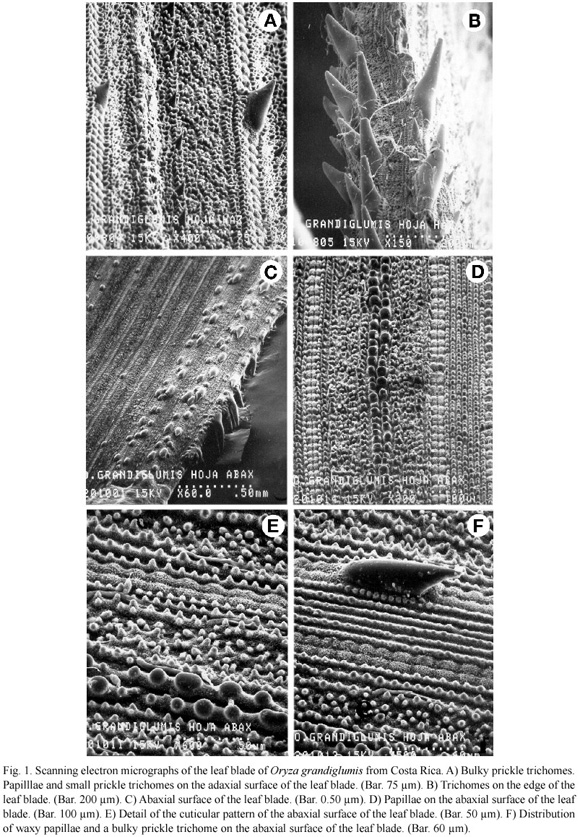
<body><![CDATA[<p><font face="Arial" size="2">This species grows in areas subject to seasonal flooding, such as open fields, muddy river banks and wetlands where the water is clear. During the rainy season, plants are dispersed vegetatively by the river currents, aided by their culms which have developed aerenchyma that allow the plant to float along the river current. Seeds are produced at the end of the rainy season and germinate when the water levels are low (Akimoto 1998, Zamora <i>et al</i>. 1998, 2003).</font></p> <font face="Arial" size="2"><i> </i></font>     <p><font face="Arial" size="2"><i>O. grandiglumis </i>in Costa Rica may reach up to 760 cm in length, the product of culm elongation due to changes in water level. The leaf blades are broad, between 3 and 5 cm wide, and the ligule is blunt and pubescent. Auricles embrace the culm and are completely white, unlike other <i>Oryza </i>species that present purple-colored auricles (Zamora <i>et al. </i>2002).</font></p>     <p><font face="Arial" size="2">Panicles are prominent and have many thin ramifications. The sterile lemmas may reach the same length as the fertile lemmas (palea and lemma), a trait that distiguishes <i>O. grandiglumis </i>from other <i>Oryza </i>species (Akimoto 1998). The spikelets are the largest among the wild <i>Oryza </i>species found in Costa Rica, measuring an average of 8.9 mm </font><font face="Arial"  size="2">±</font><font face="Arial" size="2">&#61472;S.D. Anthers are large and have a brilliant yellow coloring, visible even through the lemma and palea. The flowering period in Costa Rica occurs between March and July, and again from November to December (Zamora 2001).</font></p>     <p><font face="Arial" size="2">The aim of this work is to carry out an ultrastructure description of the leaf blade, ligule, auricles, inflorescence and caryopsis of <i>O. grandiglumis</i>.</font></p> <font face="Arial" size="2"><b> </b></font>     <p><font face="Arial" size="2"><b>Materials and methods</b></font></p>     <p><font face="Arial" size="2"><b>Plant material. </b>Plants and spikelets of <i>O. grandiglumis</i>, accession numbers 277, 280, 275 were collected from Caño Negro Biological Reserve, in San Carlos, Alajuela (10º52’16.1’’ N; 84º47’48.9’’ W). The spikelets of <i>O. grandiglumis </i>from Brazil were provided by M. Akimoto and the International Rice Research Institute (IRRI) germplasm bank (Philippines), accession numbers 105155, 105156 and 105157. The latter were planted in the greenhouse for later ultrastructural analyses of the vegetative structures.</font></p> <font face="Arial" size="2"><b> </b></font>     <p><font face="Arial" size="2"><b>Sample preparation for scanning electron microscopy. </b>Samples of the adaxial and abaxial surfaces of the leaf blade, auricles, ligule and spikelets were fixed in a 2.5% glutaraldehyde and 2% paraformaldehyde solution in 0.1M sodium phosphate buffer, pH 7.4 (Karnovsky 1965), and were then washed with the sodium phosphate buffer. The samples were post-fixed with 1% osmium tetraoxide in the sodium phosphate buffer, washed with distilled water and dehydrated in an ethanol gradient. Four washes with terbutilic alcohol were later performed and the samples were dried by sublimation (Sublimator Eiko ID-2). The material was mounted on aluminum bases and covered with 20 nm of platinum (Ionic Cover Eiko IB-5). The samples were observed by scanning electron microscopes (Hitachi S-570 and S-2360N), with an acceleration voltage of 15 Kv.</font></p> <font face="Arial" size="2"><b> </b></font>     <p><font face="Arial" size="2"><b>Pollen and spikelet analyses. </b>Anthers were homogenized in a 10% sodium hydroxide solution, were washed with distilled water, centrifuged (Hitachi 05 PR-22 centrifuge) and cleaned using ultrasound (Astrason sonicator, 11H). The material was fixed with 1% osmium tetraoxide in the 0.1M sodium phosphate buffer and samples were processed as described previously (Sánchez 1999). The spikelets were placed in an incubator for 48 hours at 37ºC and were then mounted and observed through the scanning electron microscope. </font></p> <font face="Arial" size="2"><b>     <p>Results</p> </b> </font>     <p><font face="Arial" size="2">In the Costa Rican and Brazilian accessions, adaxial and abaxial surfaces of the leaf blade presented the same ultrastructural patterns (<a href="#figura1">Fig. 1</a>): several rows of silica cells alternating with bulky prickle trichomes (<a href="#figura1">Fig. 1a, 1c, 1f</a>); oblong and bilobular papillae (<a href="#figura1">Fig 1d, 1e, 1f</a>); stomata of <i>ca</i>. 5.4 </font><font face="Arial" size="2">&#956;</font><font face="Arial"  size="2">m in length which are surrounded by waxy papillae (<a  href="#figura1">Fig. 1f</a>); bilobular papillae that present a very abundant waxy pattern with alternating bulky erect trichomes (<i>ca</i>. 18 </font><font  face="Arial" size="2">&#956;</font><font face="Arial" size="2">m in length); bilobular papillae and rows of stomata (<a href="#figura1">Fig 1a</a>). This pattern was repeated throughout the blade surface (<a href="#figura1">Fig. 1a</a>).    ]]></body>
<body><![CDATA[<br> </font></p>     <p style="text-align: center;"><font face="Arial" size="2"><a  name="figura1"></a><img src="/img/fbpe/rbt/v54n2/3829i1.JPG" title="" alt=""  style="width: 803px; height: 1159px;">    
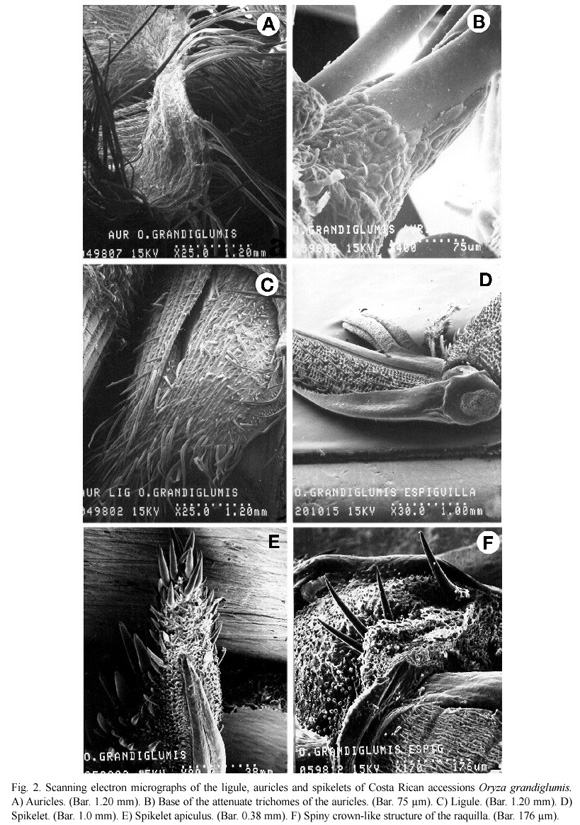
<br> </font></p>     <p><font face="Arial" size="2">The edge of the leaf blade presented three types of prickle trichomes: an abundant type of elongated trichomes that measured <i>ca. </i>243 </font><font face="Arial"  size="2">&#956;</font><font face="Arial" size="2">m (<a href="#figura1">Fig 1b</a>); and two types of small bulky trichomes, organized in a heterogeneous pattern (<a  href="#figura1">Fig. 1b</a> y <a href="#figura1">1c</a>) towards the inner part of the surface. Of the latter two types, one type measured <i>ca</i>. 48 </font><font face="Arial" size="2">&#956;</font><font  face="Arial" size="2">m and was surrounded by silica cells and the smaller, more abundant type was tilted, measuring <i>ca. </i>17 </font><font  face="Arial" size="2">&#956;</font><font face="Arial" size="2">m and was surrounded by bilobed papillae.</font></p>     <p><font face="Arial" size="2">The leaf blade was covered by cuticular wax, composed of diverse waxy rods, that formed a very dense layer on both adaxial and abaxial surfaces (<a href="#figura1">Figs. 1a, e, f</a>), a trait that was not observed in any other wild <i>Oryza </i>species in Costa Rica (Sánchez 1999).</font></p>     <p><font face="Arial" size="2">The ligule and auricles could be observed by separating the leaf blade from the sheath. The auricles embraced the culm and measured <i>ca</i>. 5 mm (<a href="#figura2">Fig. 2a</a>). These surrounded the leaf blade and presented numerous spiny trichomes that measured <i>ca</i>. 35 </font><font face="Arial" size="2">&#956;</font><font  face="Arial" size="2">m (<a href="#figura2">Fig. 2a</a>). The auricle edges showed large, attenuate trichomes of <i>ca. </i>2 mm in length with oblong cells of different sizes covering its base (<a href="#figura2">Fig. 2b</a>).    <br> </font></p>     <p style="text-align: center;"><font face="Arial" size="2"><a  name="figura2"></a><img src="/img/fbpe/rbt/v54n2/3829i2.JPG" title="" alt=""  style="width: 819px; height: 1165px;">    
<br> </font></p>     <p><font face="Arial" size="2">The ligule was blunt in the distal end and measured <i>ca</i>. 3 to 6 mm. It was covered by prickle and attenuate trichomes that were more abundant in the distal end (<a  href="#figura2">Fig. 2c</a>). Ligule and auricles of the Costa Rican and Brazilian specimens did not show significant morphological differences at the ultrastructural level.    ]]></body>
<body><![CDATA[<br> </font></p>     <p style="text-align: center;"><font face="Arial" size="2"><a  name="figura3"></a><img src="/img/fbpe/rbt/v54n2/3829i3.JPG" title="" alt=""  style="width: 809px; height: 1169px;">    
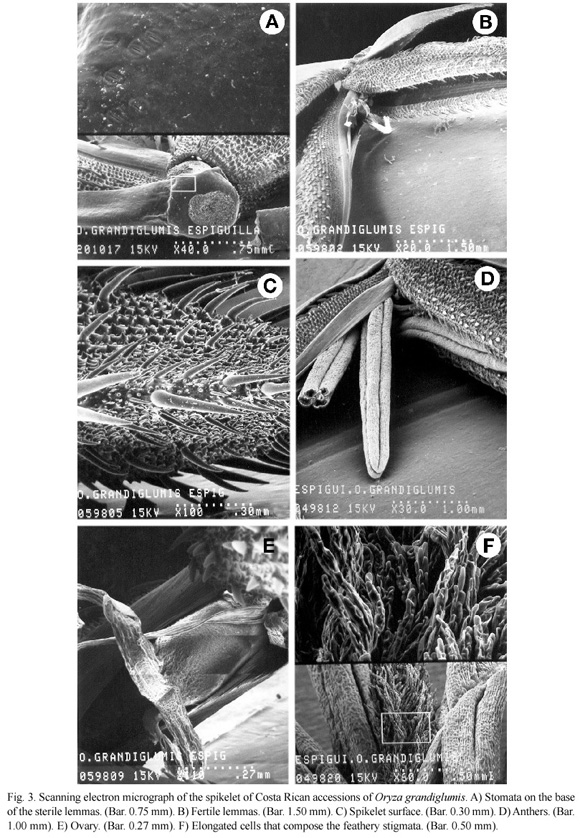
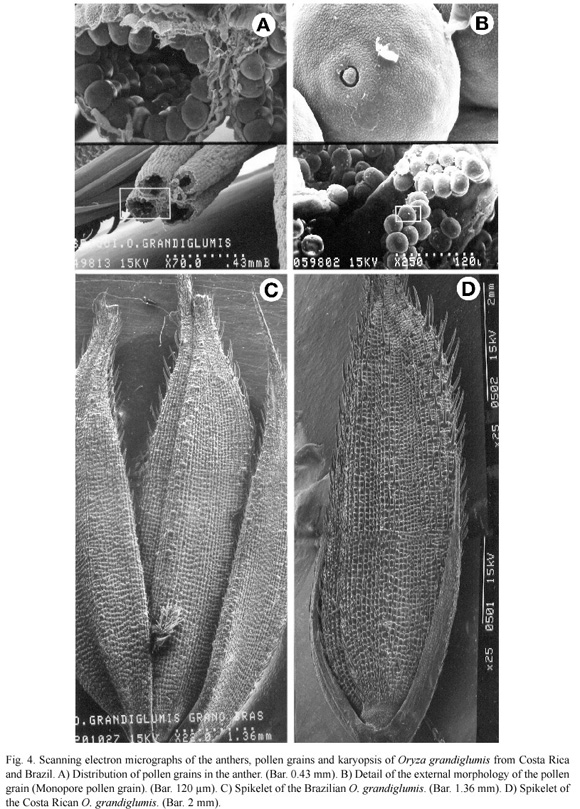
<br> </font></p>     <p><font face="Arial" size="2">The spikelet (<a href="#figura2">Fig. 2d</a>) is awned and the lemma and palea were covered by spiny trichomes and lignified papillae, and the apiculus presented abundant large prickle trichomes in the distal end of the palea (<a href="#figura2">Fig. 2e</a>). In addition, the rachilla that joins the fertile lemmas with the sterile lemmas was clearly observed (<a  href="#figura2">Fig. 2d</a>), as well as a spiny crown-like structure, located between the rachilla and the fertile lemmas (<a href="#figura2">Fig. 2f</a>). The raquilla was covered by small, spiny trichomes (<a href="#figura2">Fig. 2f</a>), whereas the sterile lemmas were smooth, with a serrated edge (<a href="#figura2">Fig. 2d</a>) and stomata at the base (<a href="#figura3">Fig. 3a</a>). Furthermore, the fertile lemmas (lemma and palea) presented a cellular structure similar to a fine-woven mesh (<a href="#figura3">Fig. 3b</a>), and were composed of rows of lignified structures, with one or two spine-like projections (<a href="#figura3">Fig. 3c</a>). Prickle trichomes were also observed between these rigid structures, due to the presence of lignin and silica (<a  href="#figura3">Figs. 3b, c</a>). The spikelet presented six bassifix anthers that measure <i>ca</i>. 4 to 5 mm, each one formed by four lobes and its filament (<a  href="#figura3">Fig. 3d</a>). The ovary (<a href="#figura3">Fig. 3e</a>) was composed of two feathery stigmata, constituted by an array of short cells of different shapes (<a href="#figura3">Figs. 3e, f</a>). Pollen grains are characteristic of the genus <i>Oryza</i>. These were monopore and measured <i>ca</i>. 36 </font><font face="Arial" size="2">&#956;</font><font  face="Arial" size="2">m in diameter, with a very simple exin ornamentation (<a href="#figura4">Figs. 4a, b</a>).    <br> </font></p>     <div style="text-align: center;"><a name="figura4"></a><img  src="/img/fbpe/rbt/v54n2/3829i4.JPG" title="" alt=""  style="width: 815px; height: 1137px;">    
<br> </div>     <p><font face="Arial" size="2"><a href="#figura4">Figure 4c</a> shows the caryopsis of the species <i>O. grandiglumis </i>from Brazil, and <a href="#figura4">figure 4d</a> shows the caryopsis of <i>O. grandiglumis </i>from Costa Rica. Macroscopically, it seemed that the sterile lemmas did not have the same morphology, however, when the ultrastructure was analyzed, it was observed that both species have a very similar anatomy. Brazilian sterile lemmas are of equal length as the fertile lemmas as well as having a very similar external morphology. Costa Rican sterile lemmas are asymmetric and rarely cover over 50% of the fertile lemmas. These appeared smooth on the surface, but when higher magnification was used, the structural pattern was similar to the Brazilian sterile lemmas.</font></p> <font face="Arial" size="2"><b>     <p>Discussion</p> </b><i> </i></font>     <p><font face="Arial" size="2"><i>O. grandiglumis </i>presented an epidermal pattern very similar to that of other <i>Oryza </i>species, as was confirmed by previous works done by Sony Parry (1973), Hoagland and Paul (1978), Terrel and collaborators (2001) and Sánchez <i>et al</i>. (2003). Although the morphology of the cuticular wax pattern was similar to that of other <i>Oryza </i>species (Juniper and Bradley 1958, Eglinton and Hamilton 1967), <i>O. grandiglumis </i>presented a higher wax density (Stant 1993, Sánchez 1999), compared to other <i>Oryza </i>species (DeBary 1972 in Hoagland and Paul 1978). In addition, structures observed on the edge of the leaf blade were unique for this species; therefore, these could be useful for diagnostic purposes (Sánchez 1999).</font></p> <font face="Arial" size="2"><i> </i></font>     ]]></body>
<body><![CDATA[<p><font face="Arial" size="2"><i>O. grandiglumis </i>presented similarities to some structures of <i>O. latifolia</i>, such as the ligule and auricles, traits that they do not share with other <i>Oryza </i>species found in Costa Rica (Sánchez <i>et al</i>. 2003). This was highly expected since <i>O. grandiglumis </i>and <i>O. latifolia </i>are tetraploid species that share the CCDD genome (Kihara 1963 in Vaughan 1994). Therefore, the genotypical closeness is reflected at the phenotypical level. <i>O. grandiglumis </i>is the only <i>Oryza </i>species that presents large sterile lemmas that partially cover the fertile lemmas. In addition, the unique spiny crown-like structure observed between the fertile lemmas, is an important taxonomic characteristic since it was absent in other Costa Rican <i>Oryza </i>species. </font></p>     <p><font face="Arial" size="2">The comparison of the Brazilian and Costa Rican spikelet morphology revealed that the sterile lemmas of the former are larger and more robust, and that the epidermis presents a more prominent cuticular pattern than that of the Costa Rican species. The large sterile lemmas of the Brazilian <i>O. grandiglumis </i>are believed to facilitate the floating capacity of the seed, an adaptation that is absent the Costa Rican species (Zamora 2001). Nevertheless, in observing other anatomical structures by scanning electron microscope, both Brazilian and Costa Rican species were morphologically similar.</font></p>     <p><font face="Arial" size="2">Although the inhabitants of the area where this species is found have occasionally used <i>O. glumaepatula </i>as an alternative food source for several years, the recent report of this species in Costa Rica and Central America offers the possibility of increasing the rice gene pool as a source of useful genes that could be potentially incorporated in rice improvement and could represent a new source of income, as a "gourmet rice", for the inhabitants of the area where this species is found.</font></p>     <p><font face="Arial" size="2">This study was part of a comprehensive research project on the characterization of wild <i>Oryza </i>species in Costa Rica. Complementing this ultrastructural study, the morphological, genetic, and life history studies were also performed (Zamora 2001). The ultrastructural comparison between the Brazilian and Costa Rican accessions of <i>O. grandiglumis </i>suggested that both are the same species, results that were later confirmed by genetic studies using molecular markers (Zamora 2001). Although <i>O. grandiglumis </i>is partly protected, we hope that this information could contribute to help increase the knowledge of this species, and to highlight its importance among the local community.</font></p> <font face="Arial" size="2"><b>     <p>Acknowledgments</p> </b> </font>     <p><font face="Arial" size="2">The authors thank Enrique Freer and Francisco Hernández for their valuable collaboration.</font></p> <font face="Arial" size="2"><b>     <p>Resumen</p> </b> </font>     <p><font face="Arial" size="2">El arroz silvestre <i>Oryza grandiglumis </i>es endémico de América. Se localiza en la zona norte de Costa Rica, principalmente en el humedal de Caño Negro y del Río Medio Queso. Es una planta vigorosa y grande. Su nombre deriva del gran tamaño de las lemas estériles (glumas). Presentamos una descripción ultraestructural de la lámina foliar, lígula, aurículas, espiguilla y cariópside, con énfasis en las estructuras de valor taxonómico, usando el microscopio electrónico de barrido. La lámina foliar se caracteriza por presentar un patrón de cera cuticular en forma de densos bastoncillos. Presenta estomas rodeados de papilas, células de sílice en forma crenada, varias formas de papilas de cera, distribuidas en forma muy regular, y tricomas espinosos abultados en la base y tricomas ganchudos. En el borde de la lámina hay tres hileras de tricomas espinosos ganchudos de diferente tamaño. Las aurículas son envolventes y los bordes presentan tricomas atenuados largos cubiertos en la base por células alargadas. La lígula es truncada y cubierta de tricomas espinosos pequeños. La morfología de la espiguilla es algo similar a las de las otras especies de la familia Poaceae, pero las lemas estériles son casi del mismo tamaño que las fértiles. Además se observó entre la raquilla y las lemas fértiles una corona de espinas lignificadas. Ultraestructuralmente, esta población es similar a las brasileñas.</font></p> <font face="Arial" size="2"><b> </b></font>     <p><font face="Arial" size="2"><b>Palabras clave: </b>arroz silvestre, endémico, neotropical, <i>Oryza grandiglumis</i>, Costa Rica, ultraestructura, morfología.</font></p> <font face="Arial" size="2"><b>     <p>References</p> </b> </font>     ]]></body>
<body><![CDATA[<!-- ref --><p><font face="Arial" size="2">Akimoto, M. 1998. Population genetic structure of the wild rice <i>Oryza glumaepatula </i>Steud. distributed in the Amazon flood area influenced by-history traits. Molec. Ecol. 7: 1371-1381.</font>&nbsp;&nbsp;&nbsp;&nbsp;&nbsp;&nbsp;&nbsp;&nbsp;[&#160;<a href="javascript:void(0);" onclick="javascript: window.open('/scielo.php?script=sci_nlinks&ref=1279853&pid=S0034-7744200600020001500001&lng=','','width=640,height=500,resizable=yes,scrollbars=1,menubar=yes,');">Links</a>&#160;]<!-- end-ref --><!-- ref --><p><font face="Arial" size="2">Eglinton, G. &amp; R. Hamilton. 1967. Leaf cuticular waxes. Science 156: 1322-1335.</font>&nbsp;&nbsp;&nbsp;&nbsp;&nbsp;&nbsp;&nbsp;&nbsp;[&#160;<a href="javascript:void(0);" onclick="javascript: window.open('/scielo.php?script=sci_nlinks&ref=1279854&pid=S0034-7744200600020001500002&lng=','','width=640,height=500,resizable=yes,scrollbars=1,menubar=yes,');">Links</a>&#160;]<!-- end-ref --><!-- ref --><p><font face="Arial" size="2">Hoagland, R.E. &amp; R.N. Paul. 1978. A Comparative SEM study of red rice and several commercial rice (<i>Oryza sativa</i>) varieties. Weed Sci. 26: 619-625.</font>&nbsp;&nbsp;&nbsp;&nbsp;&nbsp;&nbsp;&nbsp;&nbsp;[&#160;<a href="javascript:void(0);" onclick="javascript: window.open('/scielo.php?script=sci_nlinks&ref=1279855&pid=S0034-7744200600020001500003&lng=','','width=640,height=500,resizable=yes,scrollbars=1,menubar=yes,');">Links</a>&#160;]<!-- end-ref --><!-- ref --><p><font face="Arial" size="2">Juniper, B.E. &amp; D.E. Bradley. 1958. The carbon replica technique in the study of the ultrastructure of leaf surfaces. J. Ultrastruct. Res. 21: 16-27.</font>&nbsp;&nbsp;&nbsp;&nbsp;&nbsp;&nbsp;&nbsp;&nbsp;[&#160;<a href="javascript:void(0);" onclick="javascript: window.open('/scielo.php?script=sci_nlinks&ref=1279856&pid=S0034-7744200600020001500004&lng=','','width=640,height=500,resizable=yes,scrollbars=1,menubar=yes,');">Links</a>&#160;]<!-- end-ref --><!-- ref --><p><font face="Arial" size="2">Karnovsky, M.J. 1965. A formaldehyde-glutaraldehyde fixative of high osmolarity for use in electron microscopy. J. Cell Biol. 27: 137.</font>&nbsp;&nbsp;&nbsp;&nbsp;&nbsp;&nbsp;&nbsp;&nbsp;[&#160;<a href="javascript:void(0);" onclick="javascript: window.open('/scielo.php?script=sci_nlinks&ref=1279857&pid=S0034-7744200600020001500005&lng=','','width=640,height=500,resizable=yes,scrollbars=1,menubar=yes,');">Links</a>&#160;]<!-- end-ref --><!-- ref --><p><font face="Arial" size="2">Morishima, H. 1994. Background information about <i>Oryza </i>species in tropical America. <i>In </i>Investigations of plant genetic resources in the American basin with emphasis on the genus <i>Oryza</i>: Report of 1992/ 93 Amazon Project; Monbusho Int. Sci. Res. Prog. 102 p.</font>&nbsp;&nbsp;&nbsp;&nbsp;&nbsp;&nbsp;&nbsp;&nbsp;[&#160;<a href="javascript:void(0);" onclick="javascript: window.open('/scielo.php?script=sci_nlinks&ref=1279858&pid=S0034-7744200600020001500006&lng=','','width=640,height=500,resizable=yes,scrollbars=1,menubar=yes,');">Links</a>&#160;]<!-- end-ref --><!-- ref --><p><font face="Arial" size="2">Morishima, H. &amp; P. Martins. 1993. Investigations of plant genetic resources in the Amazon Basin with the emphasis on the genus <i>Oryza</i>. Report of 1992/93 Amazon Project. The Mombusho Int. Sci. Res. Prog. Japan Research Support Foundation of the State of Sao Paulo, Brazil. 96 p.</font>&nbsp;&nbsp;&nbsp;&nbsp;&nbsp;&nbsp;&nbsp;&nbsp;[&#160;<a href="javascript:void(0);" onclick="javascript: window.open('/scielo.php?script=sci_nlinks&ref=1279859&pid=S0034-7744200600020001500007&lng=','','width=640,height=500,resizable=yes,scrollbars=1,menubar=yes,');">Links</a>&#160;]<!-- end-ref --><!-- ref --><p><font face="Arial" size="2">Oka, H. 1961. Report of trip for investigation of rice in Latin America. (mimeo; without data). 158 p.</font>&nbsp;&nbsp;&nbsp;&nbsp;&nbsp;&nbsp;&nbsp;&nbsp;[&#160;<a href="javascript:void(0);" onclick="javascript: window.open('/scielo.php?script=sci_nlinks&ref=1279860&pid=S0034-7744200600020001500008&lng=','','width=640,height=500,resizable=yes,scrollbars=1,menubar=yes,');">Links</a>&#160;]<!-- end-ref --><!-- ref --><p><font face="Arial" size="2">Oka, H. 1988. Origin of cultivated rice. Blavier/ Sci. Soc. Amsterdam. Tokyo. 179 p.</font>&nbsp;&nbsp;&nbsp;&nbsp;&nbsp;&nbsp;&nbsp;&nbsp;[&#160;<a href="javascript:void(0);" onclick="javascript: window.open('/scielo.php?script=sci_nlinks&ref=1279861&pid=S0034-7744200600020001500009&lng=','','width=640,height=500,resizable=yes,scrollbars=1,menubar=yes,');">Links</a>&#160;]<!-- end-ref --><!-- ref --><p><font face="Arial" size="2">Pohl, W.R. 1978. How to know the grasses. Wm. C. Brown. Bubuque, Iowa, USA.</font>&nbsp;&nbsp;&nbsp;&nbsp;&nbsp;&nbsp;&nbsp;&nbsp;[&#160;<a href="javascript:void(0);" onclick="javascript: window.open('/scielo.php?script=sci_nlinks&ref=1279862&pid=S0034-7744200600020001500010&lng=','','width=640,height=500,resizable=yes,scrollbars=1,menubar=yes,');">Links</a>&#160;]<!-- end-ref --><!-- ref --><p><font face="Arial" size="2">Pohl, W.R. 1980. Flora costaricensis, Family Nº 15, Gramineae. W. Burger, Fieldiana Botany. 680 p.</font>&nbsp;&nbsp;&nbsp;&nbsp;&nbsp;&nbsp;&nbsp;&nbsp;[&#160;<a href="javascript:void(0);" onclick="javascript: window.open('/scielo.php?script=sci_nlinks&ref=1279863&pid=S0034-7744200600020001500011&lng=','','width=640,height=500,resizable=yes,scrollbars=1,menubar=yes,');">Links</a>&#160;]<!-- end-ref --><!-- ref --><p><font face="Arial" size="2">Sánchez, E. 1999. Comparación morfológica ultraestructural de las especies silvestres de arroz <i>Oryza</i>: Poaceae en Costa Rica. Tesis de Licenciatura en Biología. Escuela de Biología, Universidad de Costa Rica, San José, Costa Rica. 114 p.</font>&nbsp;&nbsp;&nbsp;&nbsp;&nbsp;&nbsp;&nbsp;&nbsp;[&#160;<a href="javascript:void(0);" onclick="javascript: window.open('/scielo.php?script=sci_nlinks&ref=1279864&pid=S0034-7744200600020001500012&lng=','','width=640,height=500,resizable=yes,scrollbars=1,menubar=yes,');">Links</a>&#160;]<!-- end-ref --><!-- ref --><p><font face="Arial" size="2">Sánchez, E. &amp; A.M. Espinoza. 2005. Description of the ultrastructure of <i>Oryza glumaepatula, </i>a wild rice species endemic of tropical America. Rev. Biol. Trop. 53: 15-22.</font>&nbsp;&nbsp;&nbsp;&nbsp;&nbsp;&nbsp;&nbsp;&nbsp;[&#160;<a href="javascript:void(0);" onclick="javascript: window.open('/scielo.php?script=sci_nlinks&ref=1279865&pid=S0034-7744200600020001500013&lng=','','width=640,height=500,resizable=yes,scrollbars=1,menubar=yes,');">Links</a>&#160;]<!-- end-ref --><!-- ref --><p><font face="Arial" size="2">Stant, M.Y. 1973. Scanning electron microscopic silica bodies and other epidermal features in basis (Tradescantia) leaf. Bot. J. Linn. Soc. 233-244.</font>&nbsp;&nbsp;&nbsp;&nbsp;&nbsp;&nbsp;&nbsp;&nbsp;[&#160;<a href="javascript:void(0);" onclick="javascript: window.open('/scielo.php?script=sci_nlinks&ref=1279866&pid=S0034-7744200600020001500014&lng=','','width=640,height=500,resizable=yes,scrollbars=1,menubar=yes,');">Links</a>&#160;]<!-- end-ref --><!-- ref --><p><font face="Arial" size="2">Tateoka, T. 1962a. Taxonomic studies of <i>Oryza </i>I, <i>O. latifolia </i>complex. Bot. Mag. Tokyo 75: 418-427.</font>&nbsp;&nbsp;&nbsp;&nbsp;&nbsp;&nbsp;&nbsp;&nbsp;[&#160;<a href="javascript:void(0);" onclick="javascript: window.open('/scielo.php?script=sci_nlinks&ref=1279867&pid=S0034-7744200600020001500015&lng=','','width=640,height=500,resizable=yes,scrollbars=1,menubar=yes,');">Links</a>&#160;]<!-- end-ref --><!-- ref --><p><font face="Arial" size="2">Tateoka, T. 1962b. Taxonomic studies of <i>Oryza </i>II. Several species Complex. Bot. Mag. Tokyo 75: 455-461.</font>&nbsp;&nbsp;&nbsp;&nbsp;&nbsp;&nbsp;&nbsp;&nbsp;[&#160;<a href="javascript:void(0);" onclick="javascript: window.open('/scielo.php?script=sci_nlinks&ref=1279868&pid=S0034-7744200600020001500016&lng=','','width=640,height=500,resizable=yes,scrollbars=1,menubar=yes,');">Links</a>&#160;]<!-- end-ref --><!-- ref --><p><font face="Arial" size="2">Terrel, E.E., P.M. Peterson &amp; W.P. Wergin. 2001. Epidermal Features and Spiketel Micromorphology in <i>Oryza </i>and Related Genera (Poaceae: Oryzeae). Smith. Contr. Bot. 91: 50 p.</font>&nbsp;&nbsp;&nbsp;&nbsp;&nbsp;&nbsp;&nbsp;&nbsp;[&#160;<a href="javascript:void(0);" onclick="javascript: window.open('/scielo.php?script=sci_nlinks&ref=1279869&pid=S0034-7744200600020001500017&lng=','','width=640,height=500,resizable=yes,scrollbars=1,menubar=yes,');">Links</a>&#160;]<!-- end-ref --><!-- ref --><p><font face="Arial" size="2">Vaughan, D.A. 1989. The genus <i>Oryza </i>L. Current status of taxonomy. IRPS. 138: 1-21. IRRI, Manila, Philippines.</font>&nbsp;&nbsp;&nbsp;&nbsp;&nbsp;&nbsp;&nbsp;&nbsp;[&#160;<a href="javascript:void(0);" onclick="javascript: window.open('/scielo.php?script=sci_nlinks&ref=1279870&pid=S0034-7744200600020001500018&lng=','','width=640,height=500,resizable=yes,scrollbars=1,menubar=yes,');">Links</a>&#160;]<!-- end-ref --><!-- ref --><p><font face="Arial" size="2">Vaughan, D.A. 1994. The wild relatives of rice, a genetic resources handbook. International Rice Research Institute (IRRI). Manila, Philippines. 130 p.</font>&nbsp;&nbsp;&nbsp;&nbsp;&nbsp;&nbsp;&nbsp;&nbsp;[&#160;<a href="javascript:void(0);" onclick="javascript: window.open('/scielo.php?script=sci_nlinks&ref=1279871&pid=S0034-7744200600020001500019&lng=','','width=640,height=500,resizable=yes,scrollbars=1,menubar=yes,');">Links</a>&#160;]<!-- end-ref --><!-- ref --><p><font face="Arial" size="2">Vaughan, D.A. &amp; N. Tomooka. 1999. Wild rice in Venezuela. Rice Genetic Newsletter. 16: 15-17.</font>&nbsp;&nbsp;&nbsp;&nbsp;&nbsp;&nbsp;&nbsp;&nbsp;[&#160;<a href="javascript:void(0);" onclick="javascript: window.open('/scielo.php?script=sci_nlinks&ref=1279872&pid=S0034-7744200600020001500020&lng=','','width=640,height=500,resizable=yes,scrollbars=1,menubar=yes,');">Links</a>&#160;]<!-- end-ref --><!-- ref --><p><font face="Arial" size="2">Zamora, A., E. Sánchez, T. Quesada &amp; A.M. Espinoza 1997. Especies silvestres, reserva de genes para el mejoramiento de arroz. RedBio’ 98. p 57.</font>&nbsp;&nbsp;&nbsp;&nbsp;&nbsp;&nbsp;&nbsp;&nbsp;[&#160;<a href="javascript:void(0);" onclick="javascript: window.open('/scielo.php?script=sci_nlinks&ref=1279873&pid=S0034-7744200600020001500021&lng=','','width=640,height=500,resizable=yes,scrollbars=1,menubar=yes,');">Links</a>&#160;]<!-- end-ref --><!-- ref --><p><font face="Arial" size="2">Zamora, A., E. Sánchez, T. Quesada, C. Muñoz, P. Porras, C. Quesada &amp; A.M. Espinoza 1998. Wild species, reservoirs of useful genes for the genetic improvement of rice. In International Symposium on Rice Germplasm Evaluation and enhacement. Stuttgart, Arkansas, U.S.A.</font>&nbsp;&nbsp;&nbsp;&nbsp;&nbsp;&nbsp;&nbsp;&nbsp;[&#160;<a href="javascript:void(0);" onclick="javascript: window.open('/scielo.php?script=sci_nlinks&ref=1279874&pid=S0034-7744200600020001500022&lng=','','width=640,height=500,resizable=yes,scrollbars=1,menubar=yes,');">Links</a>&#160;]<!-- end-ref --><!-- ref --><p><font face="Arial" size="2">Zamora, A., C. Barboza, J. Lobo &amp; A. M. Espinoza. 2003. Diversity of native rice (<i>Oryza</i>: Poaceae) species of Costa Rica. Gen. Res. Crop Evol. 50: 855-870.</font>&nbsp;&nbsp;&nbsp;&nbsp;&nbsp;&nbsp;&nbsp;&nbsp;[&#160;<a href="javascript:void(0);" onclick="javascript: window.open('/scielo.php?script=sci_nlinks&ref=1279875&pid=S0034-7744200600020001500023&lng=','','width=640,height=500,resizable=yes,scrollbars=1,menubar=yes,');">Links</a>&#160;]<!-- end-ref --><!-- ref --><p><font face="Arial" size="2">Zamora, A. 2001. Diversidad morfológica y genética del género <i>Oryza </i>(Poaceae) en Costa Rica. M.Sc. Thesis. University of Costa Rica, San José, Costa Rica.</font>&nbsp;&nbsp;&nbsp;&nbsp;&nbsp;&nbsp;&nbsp;&nbsp;[&#160;<a href="javascript:void(0);" onclick="javascript: window.open('/scielo.php?script=sci_nlinks&ref=1279876&pid=S0034-7744200600020001500024&lng=','','width=640,height=500,resizable=yes,scrollbars=1,menubar=yes,');">Links</a>&#160;]<!-- end-ref --> ]]></body><back>
<ref-list>
<ref id="B1">
<nlm-citation citation-type="journal">
<person-group person-group-type="author">
<name>
<surname><![CDATA[Akimoto]]></surname>
<given-names><![CDATA[M]]></given-names>
</name>
</person-group>
<article-title xml:lang="en"><![CDATA[Population genetic structure of the wild rice Oryza glumaepatula Steud. distributed in the Amazon flood area influenced by-history traits]]></article-title>
<source><![CDATA[Molec. Ecol]]></source>
<year>1998</year>
<volume>7</volume>
<page-range>1371-1381</page-range></nlm-citation>
</ref>
<ref id="B2">
<nlm-citation citation-type="journal">
<person-group person-group-type="author">
<name>
<surname><![CDATA[Eglinton]]></surname>
<given-names><![CDATA[G]]></given-names>
</name>
<name>
<surname><![CDATA[Hamilton]]></surname>
<given-names><![CDATA[R]]></given-names>
</name>
</person-group>
<article-title xml:lang="en"><![CDATA[Leaf cuticular waxes]]></article-title>
<source><![CDATA[Science]]></source>
<year>1967</year>
<volume>156</volume>
<page-range>1322-1335</page-range></nlm-citation>
</ref>
<ref id="B3">
<nlm-citation citation-type="journal">
<person-group person-group-type="author">
<name>
<surname><![CDATA[Hoagland]]></surname>
<given-names><![CDATA[R.E]]></given-names>
</name>
<name>
<surname><![CDATA[Paul]]></surname>
<given-names><![CDATA[R.N]]></given-names>
</name>
</person-group>
<article-title xml:lang="en"><![CDATA[A Comparative SEM study of red rice and several commercial rice (Oryza sativa) varieties]]></article-title>
<source><![CDATA[Weed Sci]]></source>
<year>1978</year>
<volume>26</volume>
<page-range>619-625</page-range></nlm-citation>
</ref>
<ref id="B4">
<nlm-citation citation-type="journal">
<person-group person-group-type="author">
<name>
<surname><![CDATA[Juniper]]></surname>
<given-names><![CDATA[B.E]]></given-names>
</name>
<name>
<surname><![CDATA[Bradley]]></surname>
<given-names><![CDATA[D.E]]></given-names>
</name>
</person-group>
<article-title xml:lang="en"><![CDATA[The carbon replica technique in the study of the ultrastructure of leaf surfaces]]></article-title>
<source><![CDATA[J. Ultrastruct. Res]]></source>
<year>1958</year>
<volume>21</volume>
<page-range>16-27</page-range></nlm-citation>
</ref>
<ref id="B5">
<nlm-citation citation-type="journal">
<person-group person-group-type="author">
<name>
<surname><![CDATA[Karnovsky]]></surname>
<given-names><![CDATA[M.J]]></given-names>
</name>
</person-group>
<article-title xml:lang="en"><![CDATA[A formaldehyde-glutaraldehyde fixative of high osmolarity for use in electron microscopy]]></article-title>
<source><![CDATA[J. Cell Biol]]></source>
<year>1965</year>
<volume>27</volume>
<numero>137</numero>
<issue>137</issue>
</nlm-citation>
</ref>
<ref id="B6">
<nlm-citation citation-type="">
<person-group person-group-type="author">
<name>
<surname><![CDATA[Morishima]]></surname>
<given-names><![CDATA[H]]></given-names>
</name>
</person-group>
<article-title xml:lang="en"><![CDATA[Background information about Oryza species in tropical America]]></article-title>
<source><![CDATA[Investigations of plant genetic resources in the American basin with emphasis on the genus Oryza: Report of 1992/ 93 Amazon Project]]></source>
<year>1994</year>
<volume>102</volume>
</nlm-citation>
</ref>
<ref id="B7">
<nlm-citation citation-type="book">
<person-group person-group-type="author">
<name>
<surname><![CDATA[Morishima,]]></surname>
<given-names><![CDATA[H]]></given-names>
</name>
<name>
<surname><![CDATA[Martins]]></surname>
<given-names><![CDATA[P]]></given-names>
</name>
</person-group>
<source><![CDATA[Investigations of plant genetic resources in the Amazon Basin with the emphasis on the genus Oryza. Report of 1992/93 Amazon Project]]></source>
<year>1993</year>
<page-range>96</page-range><publisher-name><![CDATA[Japan Research Support Foundation of the State of Sao Paulo]]></publisher-name>
</nlm-citation>
</ref>
<ref id="B8">
<nlm-citation citation-type="">
<person-group person-group-type="author">
<name>
<surname><![CDATA[Oka]]></surname>
<given-names><![CDATA[H]]></given-names>
</name>
</person-group>
<source><![CDATA[Report of trip for investigation of rice in Latin America. (mimeo; without data)]]></source>
<year>1961</year>
<page-range>158</page-range></nlm-citation>
</ref>
<ref id="B9">
<nlm-citation citation-type="">
<person-group person-group-type="author">
<name>
<surname><![CDATA[Oka]]></surname>
<given-names><![CDATA[H]]></given-names>
</name>
</person-group>
<source><![CDATA[Origin of cultivated rice]]></source>
<year>1988</year>
<page-range>179</page-range><publisher-loc><![CDATA[Amsterdam ]]></publisher-loc>
</nlm-citation>
</ref>
<ref id="B10">
<nlm-citation citation-type="book">
<person-group person-group-type="author">
<name>
<surname><![CDATA[Pohl]]></surname>
<given-names><![CDATA[W.R]]></given-names>
</name>
</person-group>
<source><![CDATA[How to know the grasses]]></source>
<year>1978</year>
<publisher-loc><![CDATA[Iowa ]]></publisher-loc>
<publisher-name><![CDATA[Wm. C. Brown]]></publisher-name>
</nlm-citation>
</ref>
<ref id="B11">
<nlm-citation citation-type="book">
<person-group person-group-type="author">
<name>
<surname><![CDATA[Pohl]]></surname>
<given-names><![CDATA[W.R]]></given-names>
</name>
</person-group>
<source><![CDATA[Flora costaricensis, Family Nº 15, Gramineae]]></source>
<year>1980</year>
<page-range>680</page-range><publisher-name><![CDATA[W. Burger]]></publisher-name>
</nlm-citation>
</ref>
<ref id="B12">
<nlm-citation citation-type="">
<person-group person-group-type="author">
<name>
<surname><![CDATA[Sánchez]]></surname>
<given-names><![CDATA[E]]></given-names>
</name>
</person-group>
<source><![CDATA[Comparación morfológica ultraestructural de las especies silvestres de arroz Oryza: Poaceae en Costa Rica]]></source>
<year>1999</year>
<page-range>114</page-range></nlm-citation>
</ref>
<ref id="B13">
<nlm-citation citation-type="journal">
<person-group person-group-type="author">
<name>
<surname><![CDATA[Sánchez]]></surname>
<given-names><![CDATA[E]]></given-names>
</name>
<name>
<surname><![CDATA[Espinoza]]></surname>
<given-names><![CDATA[A.M]]></given-names>
</name>
</person-group>
<article-title xml:lang="en"><![CDATA[Description of the ultrastructure of Oryza glumaepatula, a wild rice species endemic of tropical America]]></article-title>
<source><![CDATA[Rev. Biol. Trop]]></source>
<year>2005</year>
<volume>53</volume>
<page-range>15-22</page-range></nlm-citation>
</ref>
<ref id="B14">
<nlm-citation citation-type="journal">
<person-group person-group-type="author">
<name>
<surname><![CDATA[Stant]]></surname>
<given-names><![CDATA[M.Y]]></given-names>
</name>
</person-group>
<article-title xml:lang="en"><![CDATA[Scanning electron microscopic silica bodies and other epidermal features in basis (Tradescantia) leaf]]></article-title>
<source><![CDATA[Bot. J. Linn. Soc]]></source>
<year>1973</year>
<page-range>233-244</page-range></nlm-citation>
</ref>
<ref id="B15">
<nlm-citation citation-type="journal">
<person-group person-group-type="author">
<name>
<surname><![CDATA[Tateoka]]></surname>
<given-names><![CDATA[T]]></given-names>
</name>
</person-group>
<article-title xml:lang="en"><![CDATA[Taxonomic studies of Oryza I, O. latifolia complex]]></article-title>
<source><![CDATA[Bot. Mag]]></source>
<year>1962</year>
<volume>75</volume>
<page-range>418-427</page-range><publisher-loc><![CDATA[Tokyo ]]></publisher-loc>
</nlm-citation>
</ref>
<ref id="B16">
<nlm-citation citation-type="journal">
<person-group person-group-type="author">
<name>
<surname><![CDATA[Tateoka]]></surname>
<given-names><![CDATA[T]]></given-names>
</name>
</person-group>
<article-title xml:lang="en"><![CDATA[Taxonomic studies of Oryza II. Several species Complex]]></article-title>
<source><![CDATA[Bot. Mag]]></source>
<year>1962</year>
<volume>75</volume>
<page-range>455-461</page-range><publisher-loc><![CDATA[Tokyo ]]></publisher-loc>
</nlm-citation>
</ref>
<ref id="B17">
<nlm-citation citation-type="journal">
<person-group person-group-type="author">
<name>
<surname><![CDATA[Terrel]]></surname>
<given-names><![CDATA[E.E]]></given-names>
</name>
<name>
<surname><![CDATA[Peterson]]></surname>
<given-names><![CDATA[P.M]]></given-names>
</name>
<name>
<surname><![CDATA[Wergin]]></surname>
<given-names><![CDATA[W.P]]></given-names>
</name>
</person-group>
<article-title xml:lang="en"><![CDATA[Epidermal Features and Spiketel Micromorphology in Oryza and Related Genera (Poaceae: Oryzeae)]]></article-title>
<source><![CDATA[Smith. Contr. Bot]]></source>
<year>2001</year>
<volume>91</volume>
<page-range>50</page-range></nlm-citation>
</ref>
<ref id="B18">
<nlm-citation citation-type="book">
<person-group person-group-type="author">
<name>
<surname><![CDATA[Vaughan]]></surname>
<given-names><![CDATA[D.A]]></given-names>
</name>
</person-group>
<source><![CDATA[The genus Oryza L. Current status of taxonomy]]></source>
<year>1989</year>
<volume>138</volume>
<page-range>1-21</page-range><publisher-loc><![CDATA[Manila ]]></publisher-loc>
<publisher-name><![CDATA[IRRI]]></publisher-name>
</nlm-citation>
</ref>
<ref id="B19">
<nlm-citation citation-type="book">
<person-group person-group-type="author">
<name>
<surname><![CDATA[Vaughan]]></surname>
<given-names><![CDATA[D.A]]></given-names>
</name>
</person-group>
<source><![CDATA[The wild relatives of rice, a genetic resources handbook]]></source>
<year>1994</year>
<page-range>130</page-range><publisher-loc><![CDATA[Manila ]]></publisher-loc>
<publisher-name><![CDATA[International Rice Research Institute (IRRI)]]></publisher-name>
</nlm-citation>
</ref>
<ref id="B20">
<nlm-citation citation-type="journal">
<person-group person-group-type="author">
<name>
<surname><![CDATA[Vaughan]]></surname>
<given-names><![CDATA[D.A]]></given-names>
</name>
<name>
<surname><![CDATA[Tomooka]]></surname>
<given-names><![CDATA[N]]></given-names>
</name>
</person-group>
<article-title xml:lang="en"><![CDATA[Wild rice in Venezuel]]></article-title>
<source><![CDATA[Rice Genetic Newsletter]]></source>
<year>1999</year>
<volume>16</volume>
<page-range>15-17</page-range></nlm-citation>
</ref>
<ref id="B21">
<nlm-citation citation-type="journal">
<person-group person-group-type="author">
<name>
<surname><![CDATA[Zamora]]></surname>
<given-names><![CDATA[A]]></given-names>
</name>
<name>
<surname><![CDATA[Sánchez]]></surname>
<given-names><![CDATA[E]]></given-names>
</name>
<name>
<surname><![CDATA[Quesada]]></surname>
<given-names><![CDATA[T]]></given-names>
</name>
<name>
<surname><![CDATA[Espinoza]]></surname>
<given-names><![CDATA[A.M]]></given-names>
</name>
</person-group>
<article-title xml:lang="es"><![CDATA[Especies silvestres, reserva de genes para el mejoramiento de arroz]]></article-title>
<source><![CDATA[RedBio]]></source>
<year>1997</year>
<volume>98</volume>
<page-range>57</page-range></nlm-citation>
</ref>
<ref id="B22">
<nlm-citation citation-type="">
<person-group person-group-type="author">
<name>
<surname><![CDATA[Zamora]]></surname>
<given-names><![CDATA[A]]></given-names>
</name>
<name>
<surname><![CDATA[Sánchez]]></surname>
<given-names><![CDATA[E]]></given-names>
</name>
<name>
<surname><![CDATA[Quesada]]></surname>
<given-names><![CDATA[T]]></given-names>
</name>
<name>
<surname><![CDATA[Muñoz]]></surname>
<given-names><![CDATA[C]]></given-names>
</name>
<name>
<surname><![CDATA[Porras]]></surname>
<given-names><![CDATA[P]]></given-names>
</name>
<name>
<surname><![CDATA[Quesada]]></surname>
<given-names><![CDATA[C]]></given-names>
</name>
<name>
<surname><![CDATA[Espinoza]]></surname>
<given-names><![CDATA[A.M]]></given-names>
</name>
</person-group>
<article-title xml:lang="en"><![CDATA[Wild species, reservoirs of useful genes for the genetic improvement of rice]]></article-title>
<source><![CDATA[International Symposium on Rice Germplasm Evaluation and enhacement]]></source>
<year>1998</year>
<publisher-loc><![CDATA[Arkansas ]]></publisher-loc>
</nlm-citation>
</ref>
<ref id="B23">
<nlm-citation citation-type="journal">
<person-group person-group-type="author">
<name>
<surname><![CDATA[Zamora]]></surname>
<given-names><![CDATA[A]]></given-names>
</name>
<name>
<surname><![CDATA[Barboza]]></surname>
<given-names><![CDATA[C]]></given-names>
</name>
<name>
<surname><![CDATA[Lobo]]></surname>
<given-names><![CDATA[J]]></given-names>
</name>
<name>
<surname><![CDATA[Espinoza]]></surname>
<given-names><![CDATA[A. M]]></given-names>
</name>
</person-group>
<article-title xml:lang="en"><![CDATA[Diversity of native rice (Oryza: Poaceae) species of Costa Rica]]></article-title>
<source><![CDATA[Gen. Res. Crop Evol]]></source>
<year>2003</year>
<volume>50</volume>
<page-range>855-870</page-range></nlm-citation>
</ref>
<ref id="B24">
<nlm-citation citation-type="">
<person-group person-group-type="author">
<name>
<surname><![CDATA[Zamora]]></surname>
<given-names><![CDATA[A]]></given-names>
</name>
</person-group>
<source><![CDATA[Diversidad morfológica y genética del género Oryza (Poaceae) en Costa Rica]]></source>
<year>2001</year>
</nlm-citation>
</ref>
</ref-list>
</back>
</article>