<?xml version="1.0" encoding="ISO-8859-1"?><article xmlns:mml="http://www.w3.org/1998/Math/MathML" xmlns:xlink="http://www.w3.org/1999/xlink" xmlns:xsi="http://www.w3.org/2001/XMLSchema-instance">
<front>
<journal-meta>
<journal-id>0034-7744</journal-id>
<journal-title><![CDATA[Revista de Biología Tropical]]></journal-title>
<abbrev-journal-title><![CDATA[Rev. biol. trop]]></abbrev-journal-title>
<issn>0034-7744</issn>
<publisher>
<publisher-name><![CDATA[Universidad de Costa Rica]]></publisher-name>
</publisher>
</journal-meta>
<article-meta>
<article-id>S0034-77442006000200012</article-id>
<title-group>
<article-title xml:lang="en"><![CDATA[Leaf and soil nitrogen and phosphorus availability in a neotropical rain forest of nutrient-rich soil]]></article-title>
</title-group>
<contrib-group>
<contrib contrib-type="author">
<name>
<surname><![CDATA[Martínez-Sánchez]]></surname>
<given-names><![CDATA[José Luis]]></given-names>
</name>
</contrib>
</contrib-group>
<aff id="A">
<institution><![CDATA[,  ]]></institution>
<addr-line><![CDATA[ ]]></addr-line>
</aff>
<pub-date pub-type="pub">
<day>00</day>
<month>06</month>
<year>2006</year>
</pub-date>
<pub-date pub-type="epub">
<day>00</day>
<month>06</month>
<year>2006</year>
</pub-date>
<volume>54</volume>
<numero>2</numero>
<fpage>357</fpage>
<lpage>361</lpage>
<copyright-statement/>
<copyright-year/>
<self-uri xlink:href="http://www.scielo.sa.cr/scielo.php?script=sci_arttext&amp;pid=S0034-77442006000200012&amp;lng=en&amp;nrm=iso"></self-uri><self-uri xlink:href="http://www.scielo.sa.cr/scielo.php?script=sci_abstract&amp;pid=S0034-77442006000200012&amp;lng=en&amp;nrm=iso"></self-uri><self-uri xlink:href="http://www.scielo.sa.cr/scielo.php?script=sci_pdf&amp;pid=S0034-77442006000200012&amp;lng=en&amp;nrm=iso"></self-uri><abstract abstract-type="short" xml:lang="en"><p><![CDATA[The nitrogen and phosphorus supply in a lowland rain forest with a nutrient-rich soil was investigated by means of the leaf N/P quotient. It was hypothesised a high N and P supply to the forest ecosystem with a N and P rich soil. Total N and extractable P were determined in the surface (10 cm) soil of three plots of the forest. Total N was analysed by the Kjeldahl method, and P was extracted with HCl and NH4F. The leaf N/P quotient was evaluated from the senesced leaves of 11 dominant tree species from the mature forest. Samples of 5 g of freshly fallen leaves were collected from three trees of each species. Nitrogen was analysed by microkjeldahl digestion with sulphuric acid and distilled with boric acid, and phosphorus was analysed by digestion with nitric acid and perchloric acid, and determined by photometry. Concentrations of total N (0.50%, n = 30) and extractable P (4.11 &#956;g g-1, n = 30) in the soil were high. As expected, P supply was sufficient, but contrary to expected, N supply was low (N/P = 11.8, n = 11). Rev. Biol. Trop. 54(2): 357-361. Epub 2006 Jun 01.]]></p></abstract>
<abstract abstract-type="short" xml:lang="es"><p><![CDATA[A través del cociente foliar N/P, se investigó la disponibilidad de nitrógeno y fósforo en una selva húmeda tropical con suelo fértil. Como hipótesis se esperaba encontrar una alta disponibilidad de N y P en el ecosistema debido a un suelo rico en N y P. Se determinó el N total y el P extraible en el suelo superficial (10 cm) en tres sitios de la selva. El N total se analizó por el método Kjeldahl y el P por extracción con HCl y NH4F. El cociente foliar N/P se evaluó a partir de hojas seniles de 11 especies arbóreas dominantes de la selva madura. Se recolectaron muestras de 5 g de hojas recién caídas de tres árboles de cada especie. El nitrógeno se analizó por digestión microkjeldahl con ácido sulfúrico y destilación con ácido bórico, y el fósforo por digestión con ácido nítrico y ácido perclórico, y determinación con fotometría. Las concetraciones de N total (0.50%, n = 30) y P extraible (4.11 &#956;g g-1, n = 30) en el suelo fueron altas. Tal como se esperaba, la disponibilidad de P fue suficiente, pero contrariamente a lo esperado, la disponibilidad de N fue baja (N/P = 11.8, n = 11).]]></p></abstract>
<kwd-group>
<kwd lng="en"><![CDATA[Los Tuxtlas]]></kwd>
<kwd lng="en"><![CDATA[lowland forest]]></kwd>
<kwd lng="en"><![CDATA[Mexico]]></kwd>
<kwd lng="en"><![CDATA[N/P ratio]]></kwd>
<kwd lng="en"><![CDATA[senescent leaves]]></kwd>
<kwd lng="es"><![CDATA[cociente N/P]]></kwd>
<kwd lng="es"><![CDATA[hojas seniles]]></kwd>
<kwd lng="es"><![CDATA[Los Tuxtlas]]></kwd>
<kwd lng="es"><![CDATA[México]]></kwd>
<kwd lng="es"><![CDATA[selva húmeda tropical]]></kwd>
</kwd-group>
</article-meta>
</front><body><![CDATA[  <b><font face="Arial">     <p align="center">Leaf and soil nitrogen and phosphorus availability in a neotropical rain forest of nutrient-rich soil</p> </font><font face="Arial" size="2"> </font></b>     <p><font face="Arial" size="2">José Luis Martínez-Sánchez</font></p>     <p><font face="Arial" size="2">Department of Biological Sciences, University of Stirling, Scotland FK9 4LA.    <br> Present address: División Académica de Ciencias Biológicas, Universidad Juárez Autónoma de Tabasco, km 0.5 Carr. VHS-Cardenas, Villahermosa, Tab. México. <a  href="mailto:jlmart@cicea.ujat.mx">jlmart@cicea.ujat.mx</a></font></p>     <p align="center"><font face="Arial" size="2">Received 31-V-2002. Corrected 05-VIII-2005. Accepted 09-XII-2005.</font></p> <font face="Arial" size="2"><b></b></font>     <p><font face="Arial" size="2"><b>Abstract. </b>The nitrogen and phosphorus supply in a lowland rain forest with a nutrient-rich soil was investigated by means of the leaf N/P quotient. It was hypothesised a high N and P supply to the forest ecosystem with a N and P rich soil. Total N and extractable P were determined in the surface (10 cm) soil of three plots of the forest. Total N was analysed by the Kjeldahl method, and P was extracted with HCl and NH<sub>4</sub>F. The leaf N/P quotient was evaluated from the senesced leaves of 11 dominant tree species from the mature forest. Samples of 5 g of freshly fallen leaves were collected from three trees of each species. Nitrogen was analysed by microkjeldahl digestion with sulphuric acid and distilled with boric acid, and phosphorus was analysed by digestion with nitric acid and perchloric acid, and determined by photometry. Concentrations of total N (0.50%, n = 30) and extractable P (4.11 </font><font face="Arial"  size="2">&#956;</font><font face="Arial" size="2">g g<sup>-1</sup>, n = 30) in the soil were high. As expected, P supply was sufficient, but contrary to expected, N supply was low (N/P = 11.8, n = 11). Rev. Biol. Trop. 54(2): 357-361. Epub 2006 Jun 01.</font></p> <font face="Arial" size="2"><b> </b></font>     <p><font face="Arial" size="2"><b>Key words: </b>Los Tuxtlas, lowland forest, Mexico, N/P ratio, senescent leaves.</font></p>     <p><font face="Arial" size="2">Nitrogen (N) and phosphorus (P) have been recognised as the essential nutrient elements for productivity in the natural ecosystems (Vitousek 1984, Koeuselman and Meuleman 1996, Aidar <i>et al</i>. 2003, Martínez- Sánchez 2005). Foliar nutrient concentrations provide an alternative means of characterizing nutrient availability in tropical forests (Grubb 1977). The leaf N/P quotient indicates the nutrient availability in the plant tissue and hence in the soil (Koeuselman and Meuleman 1996). Other forms of estimating nutrient supply to the plants like the nutrient use efficiency (dry aboveground mass/nutrient mass), have been used. However Grubb (1989) has pointed out the inconveniences of this method.</font></p>     <p><font face="Arial" size="2">The aim of this paper was to analyse the nitrogen and phosphorus supply to the forest in a nutrient-rich soil, by means of the leaf N/P quotient. It was hypothesised that N and P supply to the forest ecosystem in a nutrient-rich soil, would be high.</font></p>     ]]></body>
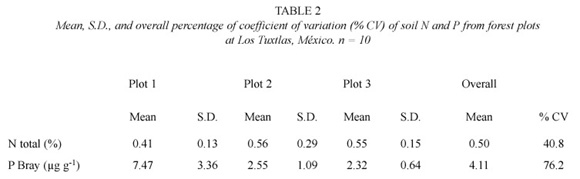
<body><![CDATA[<p><font face="Arial" size="2">The study site was located in the undisturbed forest reserve "Estación de Biología Los Tuxtlas" on the east coast of Mexico (18°34’ - 18º36’ N, 95º04’ - 95º09’ W), belonging to the Universidad Nacional Autónoma de Mexico. Los Tuxtlas is the northernmost extension of the lowland evergreen tropical rain-forest formation in the neotropics. Most of the forest reserve lies over basaltic rocks of about 800 000 yr old (Nelson and González-Caver 1992). However, soil development and fertility may have been influenced by relatively recent (in 1664 and 1793) volcanic activity with significant quantities of ash and a small volume of lava flows, as well as by climate (Nelson and González-Caver 1992, Friedlaender and Sander 1923 as cited in Martin- Del Pozzo 1997). Soils in the region are classified as well-drained, coarse-textured, vitric Andosols mixed with volcanic ash (Anonymous 1975). Surface (0-10 cm) soil in the undisturbed forest is relatively nutrient-rich. It has a clay to clay/loamy texture, a pH<sub>H20</sub> of 6.9, 0.63 cmolc kg<sup>-1</sup> of K<sup>+</sup>, 0.55 of Na<sup>+</sup>, 14.2 of Ca<sup>2+</sup>, 8.6 of Mg<sup>2+</sup>, 0.3 of H<sup>+</sup>, 0.14 of Al<sup>3+</sup>, and 24.3 cmol<sub>c</sub> kg<sup>- 1</sup> of CEC (Martínez- Sánchez 2003). Mean annual temperature at the forest reserve (110 m altitude, &#8776;&#61472;2 100 d of data from 1988 to 1997) is 25.1 ºC. Mean annual rainfall from 1972 to 1997 (data missing for three complete years) was 4 487 mm; 48% spans August to November. Evaporation at Sontecomapan (<i>c</i>. 10 km SE from the reserve) from 1976 to 1997, measured as the amount (mm) of water evaporated in a sink in 24-h terms, had an annual mean of 1 390 mm.</font></p>     <p><font face="Arial" size="2">Three 50 x 50-m plots were placed in the mature forest of the reserve. Total basal areas of the plots were 8.0, 8.1, and 8.8 m<sup>2</sup> (Martínez- Sánchez 1999). During May and October 1996 ten soil samples (0-10 cm deep) in each plot were collected for chemical analyses, in a stratified random way with an 8-cm-diameter soil corer. The samples were immediately airdried and passed through a 1.2-mm mesh. Samples were kept in polythene bags at 20ºC until the laboratory analyses. Soil analyses were conducted in the Instituto de Geología of the Universidad Nacional Autónoma de México. Analyses were all made in duplicate and checked with international standards. Total N was analysed by the Kjeldahl method, and P was extracted by 0.025 M HCl and 0.03 M NH<sub>4</sub>F (Black 1965). </font></p>     <p><font face="Arial" size="2">Estimation of ultimate leaf nutrient concentrations on senesced leaves are preferred over estimation on fresh leaves which have the problem of spatial and temporal variation in nutrient concentrations (Killingbeck 1996). During September 1997 (rainy season) freshly fallen leaves of 11 tree species (<a  href="#tabla1">Table 1</a>) were collected for nutrient-element analysis, in about 10 ha of the east side of the reserve including two of the soil plots. Species accounted for 48% of the plots basal area and for 44% of the total leaf litterfall (Martínez-Sánchez 1999). Three trees (&#8805;&#61472;10 cm dbh) of each species were randomly selected. Forest canopy structure around the selected trees ranged from small gap to mature phase. Samples of 5 g of freshly (&lt;3 d) fallen leaves were collected from the ground below each tree. All leaves were dried at <i>c</i>. 40ºC for 3 d.    <br> </font></p>     <p style="text-align: center;"><font face="Arial" size="2"><a  name="tabla1"></a><img src="/img/fbpe/rbt/v54n2/3826i1.JPG" title="" alt=""  style="width: 746px; height: 739px;">    
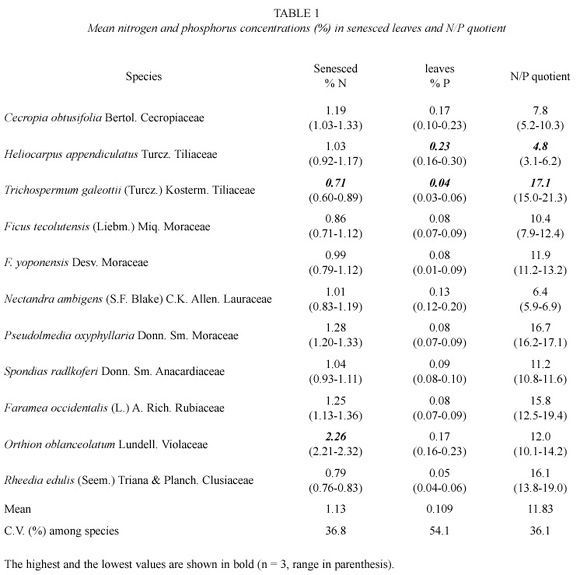
<br> </font></p>     <p><font face="Arial" size="2">Nutrient analyses of leaf material were done in the Laboratorio de Edafología, Colegio de Postgraduados at Montecillos, Mexico. All material was oven-dried at 105ºC. Nitrogen was analysed by microkjeldahl digestion with sulphuric acid and distillation with boric acid (Bremmer 1975, Chapman and Pratt 1979). Phosphorus was analysed by digestion with nitric acid and perchloric acid (2:1) for a minimum of 12 h, and determined in 7.5 ml of vanadomolybdenum- phosphorus complex by photometry at 470 nm.</font></p>     <p><font face="Arial" size="2">The leaf N/P ratio for the 11 species was calculated and had a mean value of 11.8 (<a href="#tabla1">Table 1</a>). The forest soil was rich in total N and extractable P (<a href="#tabla2">Table 2</a>).    <br> </font></p>     <p style="text-align: center;"><font face="Arial" size="2"><a  name="tabla2"></a><img src="/img/fbpe/rbt/v54n2/3826i2.JPG" title="" alt=""  style="width: 753px; height: 233px;">    
]]></body>
<body><![CDATA[<br> </font></p>     <p><font face="Arial" size="2">Extrapolating from aquatic ecology and agricultural sciences where the low N/P ratio indicates a nutrient deficiency in the ecosystems, Koeuselman and Meuleman (1996) proposed that the N/P ratio in the plant tissue in terrestrial ecosystems can be a good predictor of limitation of these nutrients in the soil. They proposed that a N/P ratio &lt;14 indicates N limitation, a ratio &gt;16 indicates P limitation, and a ratio between 14 and 16 indicates N and P limitation. Based on this assumption, the mean leaf-litter N/P ratio at Los Tuxtlas (11.8) indicates a N-deficiency in the soil. As expected, P availability in the ecosystem does not seem to be limited, but contrary to expected, N availability seems to be limited. It is noteworthy that this index never leads to a non-limited condition of soil nutrients however.</font></p>     <p><font face="Arial" size="2">Concentrations of total N in the soil from a range of lowland rain forests around the world were 0.02-1.0% (Proctor 1983). Total N availability in the soil at Los Tuxtlas is high (0.50%), however the low N/P ratio points out that there is a low N supply to the vegetation. A possible explanation is that some critical forms of N are limited in the soil at Los Tuxtlas. Nitrogen in its ion form is the most useful form to plant growth, and soil total N could be mostly organic N. Nitrogen is lost in the ecosystems by denitrification and NH<sub>3</sub> volatilization. Unlike mineral-N in the ammonium form, nitrate is extremely mobile through leaching and readily available to denitrifiers for conversion to nitrogen gases (Robertson 1984). In a Costa Rican tropical rain forest at 1 000 m altitude, Marrs <i>et al</i>. (1988) found that denitrification may be a limiting factor for mineral-N availability. Very wet soils (moisture content of 80%) with low aeration may increase denitrification and may limit N-mineralisation (Marrs <i>et al</i>. 1988). N-mineralisation rates in tropical forests varies widely, and a volcanic soil in Costa Rica are towards the high end of the spectrum of tropical soils (Robertson 1984). Nsupply at Los Tuxtlas has to be experimentally assessed. Some stages of the N-pathway like mineralisation, nitrification, denitrification and direct ammonium assimilation, may be interesting topics to investigate in this forest.</font></p> <font face="Arial" size="2"><b>     <p>Acknowledgments</p> </b> </font>     <p><font face="Arial" size="2">I am grateful to Ian Turner and one anonymous reviewer for their suggestions. Thanks to Silvia Sánchez B. for the soil analyses. This study was part of my Ph.D. thesis supported by scholarships from CONACYT and SEMARNAP in México. </font></p> <font face="Arial" size="2"><b>     <p>Resumen</p> </b> </font>     <p><font face="Arial" size="2">A través del cociente foliar N/P, se investigó la disponibilidad de nitrógeno y fósforo en una selva húmeda tropical con suelo fértil. Como hipótesis se esperaba encontrar una alta disponibilidad de N y P en el ecosistema debido a un suelo rico en N y P. Se determinó el N total y el P extraible en el suelo superficial (10 cm) en tres sitios de la selva. El N total se analizó por el método Kjeldahl y el P por extracción con HCl y NH<sub>4</sub>F. El cociente foliar N/P se evaluó a partir de hojas seniles de 11 especies arbóreas dominantes de la selva madura. Se recolectaron muestras de 5 g de hojas recién caídas de tres árboles de cada especie. El nitrógeno se analizó por digestión microkjeldahl con ácido sulfúrico y destilación con ácido bórico, y el fósforo por digestión con ácido nítrico y ácido perclórico, y determinación con fotometría. Las concetraciones de N </font><font  face="Arial" size="2">total (0.50%, n = 30) y P extraible (4.11 &#956;g g<sup>-1</sup>, n = 30) en </font><font face="Arial" size="2"> el suelo fueron altas. Tal como se esperaba, la disponibilidad de P fue suficiente, pero contrariamente a lo esperado, la disponibilidad de N fue baja (N/P = 11.8, n = 11).</font></p> <font face="Arial" size="2"><b> </b></font>     <p><font face="Arial" size="2"><b>Palabras clave: </b>cociente N/P, hojas seniles, Los Tuxtlas, México, selva húmeda tropical.</font></p> <font face="Arial" size="2"><b>     <p>References</p> </b> </font>     <!-- ref --><p><font face="Arial" size="2">Aidar, M.P.M., S. Schmidt, G. Moss, G. R. Stewart &amp; C.A. Joly. 2003. Nitrogen use strategies of neotropical rainforest trees in threatened Atlantic Forest. Plant. Cell. Envir. 26: 389-400.</font>&nbsp;&nbsp;&nbsp;&nbsp;&nbsp;&nbsp;&nbsp;&nbsp;[&#160;<a href="javascript:void(0);" onclick="javascript: window.open('/scielo.php?script=sci_nlinks&ref=1279579&pid=S0034-7744200600020001200001&lng=','','width=640,height=500,resizable=yes,scrollbars=1,menubar=yes,');">Links</a>&#160;]<!-- end-ref --><!-- ref --><p><font face="Arial" size="2">Anonymous. 1975. Soil maps of the world. Vol. III. Mexico and Central America. FAO/UNESCO, Paris.</font>&nbsp;&nbsp;&nbsp;&nbsp;&nbsp;&nbsp;&nbsp;&nbsp;[&#160;<a href="javascript:void(0);" onclick="javascript: window.open('/scielo.php?script=sci_nlinks&ref=1279580&pid=S0034-7744200600020001200002&lng=','','width=640,height=500,resizable=yes,scrollbars=1,menubar=yes,');">Links</a>&#160;]<!-- end-ref --><!-- ref --><p><font face="Arial" size="2">Black, C.A. 1965. Methods of soil chemical analysis and microbiological properties. Agronomy No. 9. American Society of Agronomy, Madison, Wisconsin, USA.</font>&nbsp;&nbsp;&nbsp;&nbsp;&nbsp;&nbsp;&nbsp;&nbsp;[&#160;<a href="javascript:void(0);" onclick="javascript: window.open('/scielo.php?script=sci_nlinks&ref=1279581&pid=S0034-7744200600020001200003&lng=','','width=640,height=500,resizable=yes,scrollbars=1,menubar=yes,');">Links</a>&#160;]<!-- end-ref --><!-- ref --><p><font face="Arial" size="2">Bremmer, J.M. 1975. Total nitrogen, p. 1149-1178. <i>In </i>C.A. Black (ed.). Methods of soil analysis, Part 2. Agronomy. American Society of Agronomy, Madison, Wisconsin, USA.</font>&nbsp;&nbsp;&nbsp;&nbsp;&nbsp;&nbsp;&nbsp;&nbsp;[&#160;<a href="javascript:void(0);" onclick="javascript: window.open('/scielo.php?script=sci_nlinks&ref=1279582&pid=S0034-7744200600020001200004&lng=','','width=640,height=500,resizable=yes,scrollbars=1,menubar=yes,');">Links</a>&#160;]<!-- end-ref --><!-- ref --><p><font face="Arial" size="2">Chapman, H.D. &amp; P.F. Pratt. 1979. Métodos de análisis para suelos, plantas y agua. Trillas, México, D.F.</font>&nbsp;&nbsp;&nbsp;&nbsp;&nbsp;&nbsp;&nbsp;&nbsp;[&#160;<a href="javascript:void(0);" onclick="javascript: window.open('/scielo.php?script=sci_nlinks&ref=1279583&pid=S0034-7744200600020001200005&lng=','','width=640,height=500,resizable=yes,scrollbars=1,menubar=yes,');">Links</a>&#160;]<!-- end-ref --><!-- ref --><p><font face="Arial" size="2">Grubb, P.J. 1977. Control of forest growth and distribution on wet tropical mountains: with special reference to mineral nutrition. Annu. Rev. Ecol. Syst. 8: 83-107.</font>&nbsp;&nbsp;&nbsp;&nbsp;&nbsp;&nbsp;&nbsp;&nbsp;[&#160;<a href="javascript:void(0);" onclick="javascript: window.open('/scielo.php?script=sci_nlinks&ref=1279584&pid=S0034-7744200600020001200006&lng=','','width=640,height=500,resizable=yes,scrollbars=1,menubar=yes,');">Links</a>&#160;]<!-- end-ref --><!-- ref --><p><font face="Arial" size="2">Grubb, P.J. 1989. The role of mineral nutrients in the tropics: a plant ecologist´s view. pp. 417-439. <i>In </i>J. Proctor (ed.). Mineral nutrients in tropical forest and savanna ecosystems. BES Special publ. No. 9. Blackwell, Oxford, England.</font>&nbsp;&nbsp;&nbsp;&nbsp;&nbsp;&nbsp;&nbsp;&nbsp;[&#160;<a href="javascript:void(0);" onclick="javascript: window.open('/scielo.php?script=sci_nlinks&ref=1279585&pid=S0034-7744200600020001200007&lng=','','width=640,height=500,resizable=yes,scrollbars=1,menubar=yes,');">Links</a>&#160;]<!-- end-ref --><!-- ref --><p><font face="Arial" size="2">Killingbeck, K.T. 1996. Nutrients in senesced leaves: keys to the search for potential resorption and resorption proficiency. Ecology 77: 1716-1727.</font>&nbsp;&nbsp;&nbsp;&nbsp;&nbsp;&nbsp;&nbsp;&nbsp;[&#160;<a href="javascript:void(0);" onclick="javascript: window.open('/scielo.php?script=sci_nlinks&ref=1279586&pid=S0034-7744200600020001200008&lng=','','width=640,height=500,resizable=yes,scrollbars=1,menubar=yes,');">Links</a>&#160;]<!-- end-ref --><!-- ref --><p><font face="Arial" size="2">Koeuselman, W. &amp; A.F.M. Meuleman. 1996. The vegetation N:P ratio: a new tool to detect the nature of nutrient limitation. J. Appl. Ecol. 33: 1441-1450.</font>&nbsp;&nbsp;&nbsp;&nbsp;&nbsp;&nbsp;&nbsp;&nbsp;[&#160;<a href="javascript:void(0);" onclick="javascript: window.open('/scielo.php?script=sci_nlinks&ref=1279587&pid=S0034-7744200600020001200009&lng=','','width=640,height=500,resizable=yes,scrollbars=1,menubar=yes,');">Links</a>&#160;]<!-- end-ref --><!-- ref --><p><font face="Arial" size="2">Marrs, R.H., J. Proctor, A. Heaney &amp; M.D. Mountford. 1988. Changes in soil nitrogen-mineralization and nitrification along an altitudinal transect in tropical rain forest in Costa Rica. J. Ecol. 76: 466-482.</font>&nbsp;&nbsp;&nbsp;&nbsp;&nbsp;&nbsp;&nbsp;&nbsp;[&#160;<a href="javascript:void(0);" onclick="javascript: window.open('/scielo.php?script=sci_nlinks&ref=1279588&pid=S0034-7744200600020001200010&lng=','','width=640,height=500,resizable=yes,scrollbars=1,menubar=yes,');">Links</a>&#160;]<!-- end-ref --><!-- ref --><p><font face="Arial" size="2">Martin del Pozzo, A.L. 1997. Geología, p. 25-31. <i>In </i>E. González, R. Dirzo &amp; R.C. Vogt (eds.). Historia natural de Los Tuxtlas. Universidad Nacional Autónoma de Mexico. CONABIO, México, D.F.</font>&nbsp;&nbsp;&nbsp;&nbsp;&nbsp;&nbsp;&nbsp;&nbsp;[&#160;<a href="javascript:void(0);" onclick="javascript: window.open('/scielo.php?script=sci_nlinks&ref=1279589&pid=S0034-7744200600020001200011&lng=','','width=640,height=500,resizable=yes,scrollbars=1,menubar=yes,');">Links</a>&#160;]<!-- end-ref --><!-- ref --><p><font face="Arial" size="2">Martínez-Sánchez, J.L. 1999. Nutrient dynamics in the tropical rain forest and pastures of Los Tuxtlas, México. Ph.D. thesis. University of Stirling, United Kingdom. 145 p.</font>&nbsp;&nbsp;&nbsp;&nbsp;&nbsp;&nbsp;&nbsp;&nbsp;[&#160;<a href="javascript:void(0);" onclick="javascript: window.open('/scielo.php?script=sci_nlinks&ref=1279590&pid=S0034-7744200600020001200012&lng=','','width=640,height=500,resizable=yes,scrollbars=1,menubar=yes,');">Links</a>&#160;]<!-- end-ref --><!-- ref --><p><font face="Arial" size="2">Martínez-Sánchez, J.L. 2003. The effect of time of use of tropical pastures on soil fertility and cattle productivity. Ecotropicos 16(1): 17-26.</font>&nbsp;&nbsp;&nbsp;&nbsp;&nbsp;&nbsp;&nbsp;&nbsp;[&#160;<a href="javascript:void(0);" onclick="javascript: window.open('/scielo.php?script=sci_nlinks&ref=1279591&pid=S0034-7744200600020001200013&lng=','','width=640,height=500,resizable=yes,scrollbars=1,menubar=yes,');">Links</a>&#160;]<!-- end-ref --><!-- ref --><p><font face="Arial" size="2">Martínez-Sánchez, J.L. 2005. Nitrogen and phosphorus resorption in a neotropical rain forest of a nutrientrich soil. Rev. Biol. Trop. 53: 353-359.</font>&nbsp;&nbsp;&nbsp;&nbsp;&nbsp;&nbsp;&nbsp;&nbsp;[&#160;<a href="javascript:void(0);" onclick="javascript: window.open('/scielo.php?script=sci_nlinks&ref=1279592&pid=S0034-7744200600020001200014&lng=','','width=640,height=500,resizable=yes,scrollbars=1,menubar=yes,');">Links</a>&#160;]<!-- end-ref --><!-- ref --><p><font face="Arial" size="2">Nelson, S.A. &amp; E. González-Caver. 1992. Geology and K-Ar dating of the Tuxtla volcanic field, Veracruz, México. Bull. Vulcanology 55: 85-96.</font>&nbsp;&nbsp;&nbsp;&nbsp;&nbsp;&nbsp;&nbsp;&nbsp;[&#160;<a href="javascript:void(0);" onclick="javascript: window.open('/scielo.php?script=sci_nlinks&ref=1279593&pid=S0034-7744200600020001200015&lng=','','width=640,height=500,resizable=yes,scrollbars=1,menubar=yes,');">Links</a>&#160;]<!-- end-ref --><!-- ref --><p><font face="Arial" size="2">Proctor, J., J.M. Anderson, P. Chai &amp; H.W. Vallack. 1983. Ecological studies in four contrasting lowland rain forest in Gunung Mulu National Park, Sarawak. I. Forest environment, structure and floristics. J. Ecol. 71: 237-260.</font>&nbsp;&nbsp;&nbsp;&nbsp;&nbsp;&nbsp;&nbsp;&nbsp;[&#160;<a href="javascript:void(0);" onclick="javascript: window.open('/scielo.php?script=sci_nlinks&ref=1279594&pid=S0034-7744200600020001200016&lng=','','width=640,height=500,resizable=yes,scrollbars=1,menubar=yes,');">Links</a>&#160;]<!-- end-ref --><!-- ref --><p><font face="Arial" size="2">Robertson, P.G. 1984. Nitrification and nitrogen mineralization in a lowland rainforest succession in Costa Rica, Central America. Oecologia 61: 99-104.</font>&nbsp;&nbsp;&nbsp;&nbsp;&nbsp;&nbsp;&nbsp;&nbsp;[&#160;<a href="javascript:void(0);" onclick="javascript: window.open('/scielo.php?script=sci_nlinks&ref=1279595&pid=S0034-7744200600020001200017&lng=','','width=640,height=500,resizable=yes,scrollbars=1,menubar=yes,');">Links</a>&#160;]<!-- end-ref --><!-- ref --><p><font face="Arial" size="2">Vitousek, P.M. 1984. Litterfall, nutrient cycling and nutrient limitation in tropical forests. Ecology 65: 285-298.</font>&nbsp;&nbsp;&nbsp;&nbsp;&nbsp;&nbsp;&nbsp;&nbsp;[&#160;<a href="javascript:void(0);" onclick="javascript: window.open('/scielo.php?script=sci_nlinks&ref=1279596&pid=S0034-7744200600020001200018&lng=','','width=640,height=500,resizable=yes,scrollbars=1,menubar=yes,');">Links</a>&#160;]<!-- end-ref --> ]]></body><back>
<ref-list>
<ref id="B1">
<nlm-citation citation-type="journal">
<person-group person-group-type="author">
<name>
<surname><![CDATA[Aidar]]></surname>
<given-names><![CDATA[M.P.M]]></given-names>
</name>
<name>
<surname><![CDATA[Schmidt]]></surname>
<given-names><![CDATA[S]]></given-names>
</name>
<name>
<surname><![CDATA[Moss]]></surname>
<given-names><![CDATA[G]]></given-names>
</name>
<name>
<surname><![CDATA[Stewart]]></surname>
<given-names><![CDATA[G. R]]></given-names>
</name>
<name>
<surname><![CDATA[Joly]]></surname>
<given-names><![CDATA[C.A]]></given-names>
</name>
</person-group>
<article-title xml:lang="en"><![CDATA[Nitrogen use strategies of neotropical rainforest trees in threatened Atlantic Forest]]></article-title>
<source><![CDATA[Plant. Cell. Envir]]></source>
<year>2003</year>
<volume>26</volume>
<page-range>389-400</page-range></nlm-citation>
</ref>
<ref id="B2">
<nlm-citation citation-type="book">
<person-group person-group-type="author">
<name>
</name>
<name>
</name>
</person-group>
<source><![CDATA[Soil maps of the world]]></source>
<year>1975</year>
<volume>III</volume>
<publisher-loc><![CDATA[Paris ]]></publisher-loc>
<publisher-name><![CDATA[FAO/UNESCO]]></publisher-name>
</nlm-citation>
</ref>
<ref id="B3">
<nlm-citation citation-type="book">
<person-group person-group-type="author">
<name>
<surname><![CDATA[Black]]></surname>
<given-names><![CDATA[C.A]]></given-names>
</name>
</person-group>
<source><![CDATA[Methods of soil chemical analysis and microbiological properties]]></source>
<year>1965</year>
<volume>9</volume>
<publisher-loc><![CDATA[^eWisconsin Wisconsin]]></publisher-loc>
<publisher-name><![CDATA[American Society of Agronomy]]></publisher-name>
</nlm-citation>
</ref>
<ref id="B4">
<nlm-citation citation-type="book">
<person-group person-group-type="author">
<name>
<surname><![CDATA[Bremmer]]></surname>
<given-names><![CDATA[J.M]]></given-names>
</name>
</person-group>
<article-title xml:lang="en"><![CDATA[Total nitrogen]]></article-title>
<person-group person-group-type="editor">
<name>
<surname><![CDATA[Black]]></surname>
<given-names><![CDATA[C.A]]></given-names>
</name>
</person-group>
<source><![CDATA[Methods of soil analysis, Part 2]]></source>
<year>1975</year>
<page-range>1149-1178</page-range><publisher-loc><![CDATA[^eWisconsin Wisconsin]]></publisher-loc>
<publisher-name><![CDATA[American Society of Agronomy]]></publisher-name>
</nlm-citation>
</ref>
<ref id="B5">
<nlm-citation citation-type="">
<person-group person-group-type="author">
<name>
<surname><![CDATA[Chapman]]></surname>
<given-names><![CDATA[H.D]]></given-names>
</name>
<name>
<surname><![CDATA[Pratt]]></surname>
<given-names><![CDATA[P.F]]></given-names>
</name>
</person-group>
<source><![CDATA[Métodos de análisis para suelos, plantas y agua]]></source>
<year>1979</year>
<publisher-loc><![CDATA[México, D.F ]]></publisher-loc>
</nlm-citation>
</ref>
<ref id="B6">
<nlm-citation citation-type="journal">
<person-group person-group-type="author">
<name>
<surname><![CDATA[Grubb]]></surname>
<given-names><![CDATA[P.J]]></given-names>
</name>
</person-group>
<article-title xml:lang="es"><![CDATA[Control of forest growth and distribution on wet tropical mountains: with special reference to mineral nutritio]]></article-title>
<source><![CDATA[Annu. Rev. Ecol. Syst]]></source>
<year>1977</year>
<volume>8</volume>
<page-range>83-107</page-range></nlm-citation>
</ref>
<ref id="B7">
<nlm-citation citation-type="">
<person-group person-group-type="author">
<name>
<surname><![CDATA[Grubb]]></surname>
<given-names><![CDATA[P.J]]></given-names>
</name>
</person-group>
<article-title xml:lang="en"><![CDATA[The role of mineral nutrients in the tropics: a plant ecologist´s view]]></article-title>
<person-group person-group-type="editor">
<name>
<surname><![CDATA[Proctor]]></surname>
<given-names><![CDATA[J]]></given-names>
</name>
</person-group>
<source><![CDATA[Mineral nutrients in tropical forest and savanna ecosystems]]></source>
<year>1989</year>
<volume>9</volume>
<page-range>417-439</page-range><publisher-loc><![CDATA[Oxford ]]></publisher-loc>
</nlm-citation>
</ref>
<ref id="B8">
<nlm-citation citation-type="journal">
<person-group person-group-type="author">
<name>
<surname><![CDATA[Killingbeck]]></surname>
<given-names><![CDATA[K.T]]></given-names>
</name>
</person-group>
<article-title xml:lang="en"><![CDATA[Nutrients in senesced leaves: keys to the search for potential resorption and resorption proficiency]]></article-title>
<source><![CDATA[Ecology]]></source>
<year>1996</year>
<volume>77</volume>
<page-range>1716-1727</page-range></nlm-citation>
</ref>
<ref id="B9">
<nlm-citation citation-type="journal">
<person-group person-group-type="author">
<name>
<surname><![CDATA[Koeuselman]]></surname>
<given-names><![CDATA[W]]></given-names>
</name>
<name>
<surname><![CDATA[Meuleman]]></surname>
<given-names><![CDATA[A.F.M]]></given-names>
</name>
</person-group>
<article-title xml:lang="en"><![CDATA[The vegetation N:P ratio: a new tool to detect the nature of nutrient limitation]]></article-title>
<source><![CDATA[J. Appl. Ecol]]></source>
<year>1996</year>
<volume>33</volume>
<page-range>1441-1450</page-range></nlm-citation>
</ref>
<ref id="B10">
<nlm-citation citation-type="journal">
<person-group person-group-type="author">
<name>
<surname><![CDATA[Marrs]]></surname>
<given-names><![CDATA[R.H]]></given-names>
</name>
<name>
<surname><![CDATA[Proctor]]></surname>
<given-names><![CDATA[J]]></given-names>
</name>
<name>
<surname><![CDATA[Heaney]]></surname>
<given-names><![CDATA[A]]></given-names>
</name>
<name>
<surname><![CDATA[Mountford]]></surname>
<given-names><![CDATA[M.D]]></given-names>
</name>
</person-group>
<article-title xml:lang="en"><![CDATA[Changes in soil nitrogen-mineralization and nitrification along an altitudinal transect in tropical rain forest in Costa Rica]]></article-title>
<source><![CDATA[J. Ecol]]></source>
<year>1988</year>
<volume>76</volume>
<page-range>466-482</page-range></nlm-citation>
</ref>
<ref id="B11">
<nlm-citation citation-type="book">
<person-group person-group-type="author">
<name>
<surname><![CDATA[Martin del Pozzo]]></surname>
<given-names><![CDATA[A.L]]></given-names>
</name>
</person-group>
<article-title xml:lang="es"><![CDATA[Geología]]></article-title>
<person-group person-group-type="editor">
<name>
<surname><![CDATA[González]]></surname>
<given-names><![CDATA[E]]></given-names>
</name>
<name>
<surname><![CDATA[Dirzo]]></surname>
<given-names><![CDATA[R]]></given-names>
</name>
<name>
<surname><![CDATA[Vogt]]></surname>
<given-names><![CDATA[R.C]]></given-names>
</name>
</person-group>
<source><![CDATA[Historia natural de Los Tuxtlas]]></source>
<year>1997</year>
<page-range>25-31</page-range><publisher-loc><![CDATA[México, D.F ]]></publisher-loc>
<publisher-name><![CDATA[Universidad Nacional Autónoma de Mexico. CONABIO]]></publisher-name>
</nlm-citation>
</ref>
<ref id="B12">
<nlm-citation citation-type="">
<person-group person-group-type="author">
<name>
<surname><![CDATA[Martínez-Sánchez]]></surname>
<given-names><![CDATA[J.L]]></given-names>
</name>
</person-group>
<source><![CDATA[Nutrient dynamics in the tropical rain forest and pastures of Los Tuxtlas, México]]></source>
<year>1999</year>
<page-range>145</page-range></nlm-citation>
</ref>
<ref id="B13">
<nlm-citation citation-type="journal">
<person-group person-group-type="author">
<name>
<surname><![CDATA[Martínez-Sánchez]]></surname>
<given-names><![CDATA[J.L]]></given-names>
</name>
</person-group>
<article-title xml:lang="en"><![CDATA[The effect of time of use of tropical pastures on soil fertility and cattle productivity]]></article-title>
<source><![CDATA[Ecotropicos]]></source>
<year>2003</year>
<volume>16</volume>
<numero>1</numero>
<issue>1</issue>
<page-range>17-26</page-range></nlm-citation>
</ref>
<ref id="B14">
<nlm-citation citation-type="journal">
<person-group person-group-type="author">
<name>
<surname><![CDATA[Martínez-Sánchez]]></surname>
<given-names><![CDATA[J.L]]></given-names>
</name>
</person-group>
<article-title xml:lang="en"><![CDATA[Nitrogen and phosphorus resorption in a neotropical rain forest of a nutrientrich soil]]></article-title>
<source><![CDATA[Rev. Biol. Trop]]></source>
<year>2005</year>
<volume>53</volume>
<page-range>353-359</page-range></nlm-citation>
</ref>
<ref id="B15">
<nlm-citation citation-type="journal">
<person-group person-group-type="author">
<name>
<surname><![CDATA[Nelson]]></surname>
<given-names><![CDATA[S.A]]></given-names>
</name>
<name>
<surname><![CDATA[González-Caver]]></surname>
<given-names><![CDATA[E]]></given-names>
</name>
</person-group>
<article-title xml:lang="en"><![CDATA[Geology and K-Ar dating of the Tuxtla volcanic field, Veracruz, México]]></article-title>
<source><![CDATA[Bull. Vulcanology]]></source>
<year>1992</year>
<volume>55</volume>
<page-range>85-96</page-range></nlm-citation>
</ref>
<ref id="B16">
<nlm-citation citation-type="journal">
<person-group person-group-type="author">
<name>
<surname><![CDATA[Proctor]]></surname>
</name>
<name>
<surname><![CDATA[Anderson]]></surname>
<given-names><![CDATA[J.M]]></given-names>
</name>
<name>
<surname><![CDATA[Chai]]></surname>
<given-names><![CDATA[P]]></given-names>
</name>
<name>
<surname><![CDATA[Vallack]]></surname>
<given-names><![CDATA[H.W]]></given-names>
</name>
</person-group>
<article-title xml:lang="en"><![CDATA[Ecological studies in four contrasting lowland rain forest in Gunung Mulu National Park, Sarawak. I. Forest environment, structure and floristics]]></article-title>
<source><![CDATA[J. Ecol]]></source>
<year>1983</year>
<volume>71</volume>
<page-range>237-260</page-range></nlm-citation>
</ref>
<ref id="B17">
<nlm-citation citation-type="journal">
<person-group person-group-type="author">
<name>
<surname><![CDATA[Robertson]]></surname>
<given-names><![CDATA[P.G]]></given-names>
</name>
</person-group>
<article-title xml:lang="en"><![CDATA[Nitrification and nitrogen mineralization in a lowland rainforest succession in Costa Rica, Central America]]></article-title>
<source><![CDATA[Oecologia]]></source>
<year>1984</year>
<volume>61</volume>
<page-range>99-104</page-range></nlm-citation>
</ref>
<ref id="B18">
<nlm-citation citation-type="journal">
<person-group person-group-type="author">
<name>
<surname><![CDATA[Vitousek]]></surname>
<given-names><![CDATA[P.M]]></given-names>
</name>
</person-group>
<article-title xml:lang="en"><![CDATA[Litterfall, nutrient cycling and nutrient limitation in tropical forests]]></article-title>
<source><![CDATA[Ecology]]></source>
<year>1984</year>
<volume>65</volume>
<page-range>285-298</page-range></nlm-citation>
</ref>
</ref-list>
</back>
</article>