<?xml version="1.0" encoding="ISO-8859-1"?><article xmlns:mml="http://www.w3.org/1998/Math/MathML" xmlns:xlink="http://www.w3.org/1999/xlink" xmlns:xsi="http://www.w3.org/2001/XMLSchema-instance">
<front>
<journal-meta>
<journal-id>0034-7744</journal-id>
<journal-title><![CDATA[Revista de Biología Tropical]]></journal-title>
<abbrev-journal-title><![CDATA[Rev. biol. trop]]></abbrev-journal-title>
<issn>0034-7744</issn>
<publisher>
<publisher-name><![CDATA[Universidad de Costa Rica]]></publisher-name>
</publisher>
</journal-meta>
<article-meta>
<article-id>S0034-77442006000200001</article-id>
<title-group>
<article-title xml:lang="en"><![CDATA[Edema induced by Bothrops asper (Squamata: Viperidae) snake venom and its inhibition by Costa Rican plant extracts]]></article-title>
</title-group>
<contrib-group>
<contrib contrib-type="author">
<name>
<surname><![CDATA[Badilla]]></surname>
<given-names><![CDATA[Beatriz]]></given-names>
</name>
<xref ref-type="aff" rid="A01"/>
</contrib>
<contrib contrib-type="author">
<name>
<surname><![CDATA[Chaves]]></surname>
<given-names><![CDATA[Fernando]]></given-names>
</name>
<xref ref-type="aff" rid="A02"/>
</contrib>
<contrib contrib-type="author">
<name>
<surname><![CDATA[Mora]]></surname>
<given-names><![CDATA[Gerardo]]></given-names>
</name>
<xref ref-type="aff" rid="A03"/>
</contrib>
<contrib contrib-type="author">
<name>
<surname><![CDATA[Poveda]]></surname>
<given-names><![CDATA[Luis J]]></given-names>
</name>
<xref ref-type="aff" rid="A04"/>
</contrib>
</contrib-group>
<aff id="A01">
<institution><![CDATA[,Universidad de Costa Rica Facultad de Farmacia INIFAR]]></institution>
<addr-line><![CDATA[ ]]></addr-line>
</aff>
<aff id="A02">
<institution><![CDATA[,Universidad de Costa Rica Facultad de Microbiología Instituto Clodomiro Picado]]></institution>
<addr-line><![CDATA[ ]]></addr-line>
</aff>
<aff id="A03">
<institution><![CDATA[,Universidad de Costa Rica CIPRONA ]]></institution>
<addr-line><![CDATA[ ]]></addr-line>
</aff>
<aff id="A04">
<institution><![CDATA[,Universidad Nacional Facultad de Ciencias de la Tierra y el Mar Escuela de Ciencias Ambientales]]></institution>
<addr-line><![CDATA[Heredia ]]></addr-line>
<country>Costa Rica</country>
</aff>
<pub-date pub-type="pub">
<day>00</day>
<month>06</month>
<year>2006</year>
</pub-date>
<pub-date pub-type="epub">
<day>00</day>
<month>06</month>
<year>2006</year>
</pub-date>
<volume>54</volume>
<numero>2</numero>
<fpage>245</fpage>
<lpage>252</lpage>
<copyright-statement/>
<copyright-year/>
<self-uri xlink:href="http://www.scielo.sa.cr/scielo.php?script=sci_arttext&amp;pid=S0034-77442006000200001&amp;lng=en&amp;nrm=iso"></self-uri><self-uri xlink:href="http://www.scielo.sa.cr/scielo.php?script=sci_abstract&amp;pid=S0034-77442006000200001&amp;lng=en&amp;nrm=iso"></self-uri><self-uri xlink:href="http://www.scielo.sa.cr/scielo.php?script=sci_pdf&amp;pid=S0034-77442006000200001&amp;lng=en&amp;nrm=iso"></self-uri><abstract abstract-type="short" xml:lang="en"><p><![CDATA[We tested the capacity of leaf (Urera baccifera, Loasa speciosa, Urtica leptuphylla, Chaptalia nutans, and Satureja viminea) and root (Uncaria tomentosa) extracts to inhibit edema induced by Bothrops asper snake venom. Edema-forming activity was studied plethysmographically in the rat hind paw model. Groups of rats were injected intraperitoneally with various doses of each extract and, one hour later, venom was injected subcutaneously in the right hind paw. Edema was assessed at various time intervals. The edematogenic activity was inhibited in those animals that received an injection U. tomentosa, C. nutans or L. speciosa extract. The extract of U. baccifera showed a slight inhibition of the venom effect. Extract from S. viminea and, to a lesser extent that of U. leptuphylla, induced a pro-inflammatory effect, increasing the edema at doses of 250 mg/kg at one and two hours. Rev. Biol. Trop. 54(2): 245-252. Epub 2006 Jun 01.]]></p></abstract>
<abstract abstract-type="short" xml:lang="es"><p><![CDATA[Se investigó la capacidad de los extractos de las hojas de Urera baccifera, Loasa speciosa, Urtica leptuphylla, Chaptalia nutans, Satureja viminea y de la raíz de Uncaria tomentosa para inhibir el edema inducido por el veneno de Bothrops asper por métodos pletismométricos. Los grupos de ratas fueron inyectados intraperitonealmente con varias dosis de cada extracto y una hora mas tarde se inyectó veneno por vía subcutánea en la pata trasera derecha de la rata. Se evaluó el edema en distintos intervalos de tiempo. Los resultados muestran que la actividad edematogénica fue inhibida en los animales que recibieron los extractos de raíz de U. tomentosa, hojas de C. nutans y L. speciosa. Los extractos de hojas de U. baccifera mostraron leve inhibición del efecto del veneno. El extracto de hojas de S. viminea y en menor grado el de U. leptuphylla indujeron un efecto pro inflamatorio.]]></p></abstract>
<kwd-group>
<kwd lng="en"><![CDATA[anti-edematogenic activity]]></kwd>
<kwd lng="en"><![CDATA[plant extracts]]></kwd>
<kwd lng="en"><![CDATA[snake venom]]></kwd>
<kwd lng="en"><![CDATA[Bothrops asper]]></kwd>
<kwd lng="es"><![CDATA[actividad anti-edematogénica]]></kwd>
<kwd lng="es"><![CDATA[extractos de plantas]]></kwd>
<kwd lng="es"><![CDATA[venenos]]></kwd>
<kwd lng="es"><![CDATA[serpientes]]></kwd>
<kwd lng="es"><![CDATA[Bothrops asper]]></kwd>
</kwd-group>
</article-meta>
</front><body><![CDATA[ <p align="center"><b><font face="Arial">Edema induced by </font></b><font  face="Arial"><i>Bothrops asper </i><b>(Squamata: Viperidae) snake venom and its inhibition by Costa Rican plant extracts</b></font></p> <b><font face="Arial" size="2"> </font></b>     <p><font face="Arial" size="2">Beatriz Badilla<a href="#autor1"><sup>1*</sup></a>, Fernando Chaves<a href="#autor2"><sup>2</sup></a>, Gerardo Mora<a href="#autor3"><sup>3</sup></a> &amp; Luis J. Poveda<a href="#autor4"><sup>4</sup></a></font></p>     <p><font face="Arial" size="2"><a name="autor1"></a>1 Instituto de Investigaciones Farmacéuticas, INIFAR, Facultad de Farmacia, Universidad de Costa Rica.</font><font  face="Arial" size="2">     <br> * Corrresponding author: Beatriz Badilla INIFAR, Facultad de Farmacia, Universidad de Costa Rica. Fax (506)-225-35-74; <a href="mailto:bbadilla@cariari.ucr.ac.cr">bbadilla@cariari.ucr.ac.cr</a></font></p>     <p><font face="Arial" size="2"><a name="autor2"></a>2 Instituto Clodomiro Picado, Facultad de Microbiología, Universidad de Costa Rica; <a  href="mailto:fchaves@icp.ucr.ac.cr">fchaves@icp.ucr.ac.cr</a></font></p>     <p><font face="Arial" size="2"><a name="autor3"></a>3 Centro de Investigaciones en Productos Naturales, CIPRONA, Universidad de Costa Rica; <a  href="mailto:gamora@cariari.ucr.ac.cr">gamora@cariari.ucr.ac.cr</a></font></p>     <p><font face="Arial" size="2"><a name="autor4"></a>4 Escuela de Ciencias Ambientales, Facultad de Ciencias de la Tierra y el Mar, Universidad Nacional, Heredia, Costa Rica; <a href="mailto:ljpoveda@una.ac.cr">ljpoveda@una.ac.cr</a>    <br> </font></p>     <p align="center"><font face="Arial" size="2">Received 31-I-2004. Corrected 19-VIII-2004. Accepted 08-VII-2005.</font></p> <font face="Arial" size="2"><b></b></font>     <p><font face="Arial" size="2"><b>Abstract. </b>We tested the capacity of leaf (<i>Urera baccifera, Loasa speciosa, Urtica leptuphylla, Chaptalia nutans</i>, and <i>Satureja viminea</i>) and root (<i>Uncaria tomentosa</i>) extracts to inhibit edema induced by <i>Bothrops asper </i>snake venom. Edema-forming activity was studied plethysmographically in the rat hind paw model. Groups of rats were injected intraperitoneally with various doses of each extract and, one hour later, venom was injected subcutaneously in the right hind paw. Edema was assessed at various time intervals. The edematogenic activity was inhibited in those animals that received an injection <i>U. tomentosa</i>, <i>C. nutans </i>or <i>L. speciosa </i>extract. The extract of <i>U. baccifera </i>showed a slight inhibition of the venom effect. Extract from <i>S. viminea </i>and, to a lesser extent that of <i>U. leptuphylla</i>, induced a pro-inflammatory effect, increasing the edema at doses of 250 mg/kg at one and two hours. Rev. Biol. Trop. 54(2): 245-252. Epub 2006 Jun 01.</font></p> <font face="Arial" size="2"><b> </b></font>     ]]></body>
<body><![CDATA[<p><font face="Arial" size="2"><b>Key words: </b>anti-edematogenic activity, plant extracts, snake venom, <i>Bothrops asper.</i></font></p>     <p><font face="Arial" size="2">The bites by crotaline snakes induce a prominent local tissue damage characterized by edema, hemorrhage and myonecrosis (Ownby 1982, Gutiérrez and Lomonte 1989, Gutiérrez 2002, Lamar and Sasa 2003, Pinto <i>et al. </i>2003). <i>Bothrops asper, </i>the specie responsible for most of the snakebites in Central America (Gutiérrez 1995), causes a very important local edema (Chaves <i>et al. </i>1989). The mouse or rat foot pad assay is the principal model used in order to study antiinflammatory activity. Previous studies dealing with edema induced by <i>B. asper </i>venom, using the mouse foot pad assay, showed different results when lower doses (1 µg per mouse) rather than higher doses (50 µg per mouse) of venom were used (Lomonte <i>et al. </i>1993). Higher doses also induced prominent myonecrosis and hemorrhage (Gutiérrez and Chaves 1980). The edema model, as measured by plethysmographic procedures in rats, is one of the best <i>in vivo </i>models used in order to determine anti-inflammatory activity. Trebien and Calixto (1989) applied this model using rats and concluded that the edema induced by <i>B. jararaca </i>venom is mediated by cyclooxygenase and lipoxygenase eicosanoid products and by the activation of </font><font face="Arial"  size="2">&#945;</font><font face="Arial" size="2">1 and </font><font  face="Arial" size="2">&#945;</font><font face="Arial" size="2">2 adrenergic receptors. The early edema induced in mice by <i>B. asper </i>myotoxin I, a basic phospholipase A<sub>2</sub>, is partially due to histamine and/or serotonin, whereas the last phase of this response is owing to eicosanoids (Gutiérrez <i>et al. </i>1986, Chaves <i>et al. </i>1998).</font></p>     <p><font face="Arial" size="2">Inflammatory effects caused by <i>B. asper </i>are poorly neutralized by commercial antivenoms used for the treatment of these envenomations (Gutiérrez <i>et al. </i>1981, Lomonte 1985, Gutiérrez and Lomonte 1989). Thus, there is a need to find new therapeutic alternatives to alleviate inflammation, which is an important feature in these envenomations.</font></p>     <p><font face="Arial" size="2">Plants have been used successfully for the treatment of many diseases (Senior 1996, Ahlemeyer and Krieglsteim 2003). Ferreira <i>et al. </i>(1992) have shown, that extracts and fractions obtained from <i>Curcuma longa</i>, used in traditional medicine, have anti-inflammatory, and immuno-modulatory activities. Ethnomedically, many plants have been suggested to have anti- venom activity in several countries. A recent investigation described that at least 578 species of higher plants had some anti-venom action (Martz 1992), so plants constitute an extremely rich source of potential venom-inhibitory substances.</font></p>     <p><font face="Arial" size="2">In the present work we investigated the characteristics of the edema induced by <i>B. asper </i>venom and the anti-inflammatory activity of the leaves extracts from <i>U. baccifera (</i>Urticaceae), <i>L. speciosa </i>(Urticaceae<i>), U. leptuphylla </i>(Urticaceae<i>), C. nutans </i>(Asteraceae<i>)</i>, and <i>S. viminea </i>(Lamiaceae), and the roots of <i>U. tomentosa </i>(Rubiaceae).</font></p> <font face="Arial" size="2"><b></b></font>     <p><font face="Arial" size="2"><b>Materials and methods</b></font></p>     <p><font face="Arial" size="2"><b>Venom. </b>It was obtained from adult specimens of <i>B. asper </i>collected in the Pacific Region of Costa Rica and corresponding to pools from more than 40 individuals. After freeze-drying, the venom was maintained at -20ºC.</font></p> <font face="Arial" size="2"><b> </b></font>     <p><font face="Arial" size="2"><b>Plant extracts. </b>The plants <i>U. baccifera, L. speciosa, U. leptuphylla, C. nutans, S. viminea </i>and <i>U. tomentosa </i>were collected during January and March of 1999 in Cartago, Limón and San José (Costa Rica). The plants were identified at source by Luis Poveda and voucher specimens were deposited at the Herbarium of the Universidad Nacional in the following numbers JVR 6997, JVR 7001, JVR 6998, JVR 6995. Specimens of <i>S. viminea </i>and <i>U. tomentosa </i>were deposited at the Herbarium of the Universidad de Costa Rica with the numbers USJ 0057229 and USJ 63390.</font></p>     <p><font face="Arial" size="2">Collected material was washed, chopped and dried for 3 days at about 40º C, and was ground to a fine dust with a Wiley-type mill. An infusion (10% w/v) was made at 70°C for 30 minutes. The solution was filtered out and concentrated using a rotary evaporator at 40ºC. Finally, all plant extracts were freeze-dried and kept at 5ºC until used.</font></p> <font face="Arial" size="2"><b> </b></font>     <p><font face="Arial" size="2"><b>Experimental animals. </b>Adult male Sprague-Dawley rats (<i>Rattus norvegicus</i>) with a body weight ranging from 180 to 220 g were used throughout the experiments. These animals were supplied by the Animal Care Unit (Universidad de Costa Rica). The animal protocol was approved by the Committee for the Use and Care of Animals of the University of Costa Rica.</font></p> <font face="Arial" size="2"><b> </b></font>     ]]></body>
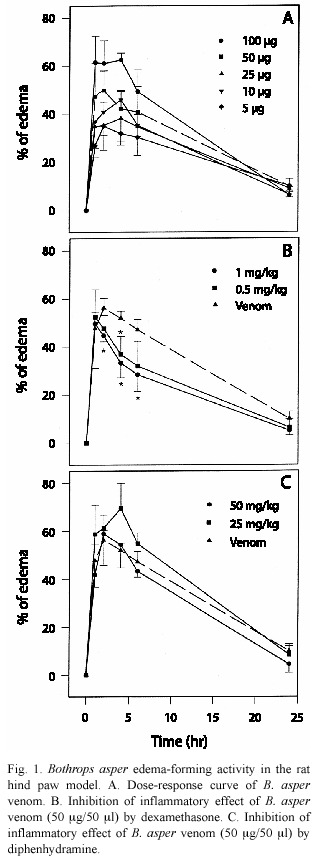
<body><![CDATA[<p><font face="Arial" size="2"><b>Drugs and chemicals. </b>Indomethacin (Merck), dexamethasone (Merck), diphenhydramine (Merck), sodium chloride (Merck) and sodium bicarbonate (Merck) were used throughout the study.</font></p> <font face="Arial" size="2"><b> </b></font>     <p><font face="Arial" size="2"><b>Evaluation of the of edema induced by </b><i>B. asper</i><b>. </b>In order to evaluate the edema induced by <i>B. asper </i>and establish the challenge- dose, groups of six male rats were injected s.c. in the right hind paw with 100, 50, 25, 10 and 5 µg/50 µl of <i>B. asper </i>venom dissolved in 0.15M NaCl, whereas the left hind paw was injected with 50 µl of 0.15M NaCl. The paw volume was measured plethysmographically (Ugo Basile, model 7140, Italy) at 1, 2, 4, 6 and 24 hours after <i>B. asper </i>venom injection. In addition, groups of six male rats were injected i.p. with various doses of dexamethasone (1 and 0.5 mg/kg) or with diphenhydramine (50 and 25 mg/kg). One hour later, animals were injected s.c. in the right hind paw with 50 µg/50 µl of <i>B. asper </i>venom, whereas the left hind paw was injected with 50 µl of 0.15M NaCl. The paw volume was measured as described above.</font></p> <font face="Arial" size="2"><b> </b></font>     <p><font face="Arial" size="2"><b>Anti-inflammatory activity. </b>The antiedematogenic properties of the extracts were quantified in the rat paw edema model (Di Rosa <i>et al. </i>1971). Groups of six male rats were injected i.p. with either 250 or 500 mg/kg of each extract. One hour later, the animals were injected s.c. in the right hind paw with 50 </font><font face="Arial" size="2">&#956;</font><font face="Arial"  size="2">g/50</font><font face="Arial" size="2">&#956;</font><font  face="Arial" size="2">l of <i>B. asper </i>venom, whereas the left hind paw was injected with 50</font><font face="Arial" size="2">&#956;</font><font  face="Arial" size="2">l of 0.15M NaCl. The paw volume was measured at 1, 2, 4, 6 and 24 hours after venom injection. The control group was injected only with venom (50 </font><font face="Arial" size="2">&#956;</font><font  face="Arial" size="2">g/50 </font><font face="Arial" size="2">&#956;</font><font  face="Arial" size="2">l) in the right hind paw and with saline solution in the left paw. A group of six rats were treated with indomethacin (100 mg/kg i.p.) as control for the anti-inflammatory activity. Edema was expressed as percentage of the difference between the left paw and the right paw volumes and compared with venom control.</font></p> <font face="Arial" size="2"><b> </b></font>     <p><font face="Arial" size="2"><b>Statistical analysis. </b>Results are presented as mean ±</font><font face="Arial" size="2"> S.E.M. (n= 6) and the Student’s <i>t </i>test was used to determine the significance of the differences between the mean values of two experimental groups. p values &lt; 0.05 were considered significant.</font></p> <font face="Arial" size="2"><b></b></font>     <p><font face="Arial" size="2"><b>Results</b></font></p>     <p><font face="Arial" size="2"><b>Evaluation of the edema induced by </b><i>B. asper</i><b>. </b>Animals treated with increasing doses of <i>B. asper </i>venom, showed a dose-related effect. Maximum effects were obtained with 100 µg/rat. The dose of 50 µg was selected as challenge dose for the determination of the anti- inflammatory activity of plant extracts (<a href="#figura1">Fig. 1A</a>). The results obtained with treatment with dexamethasone and diphenhydramine are shown in <a href="#figura1">Fig. 1B</a> and <a href="#figura1">Fig. 1C</a>. Only dexamethasone was able to significantly reduce venominduced edema.    <br> </font></p>     <p style="text-align: center;"><font face="Arial" size="2"><a  name="figura1"></a><img src="/img/fbpe/rbt/v54n2/3815i1.JPG" title="" alt=""  style="width: 317px; height: 863px;">    
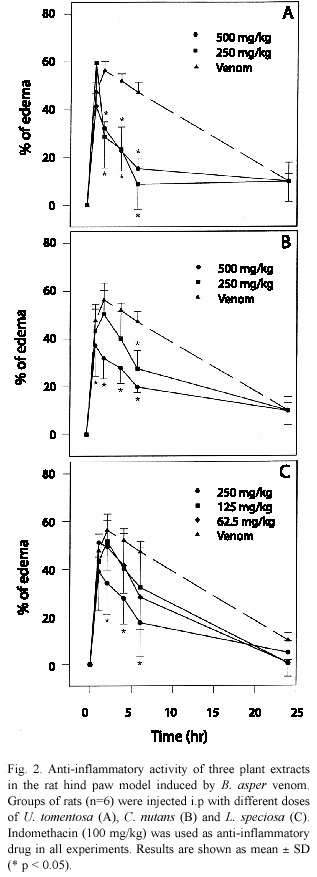
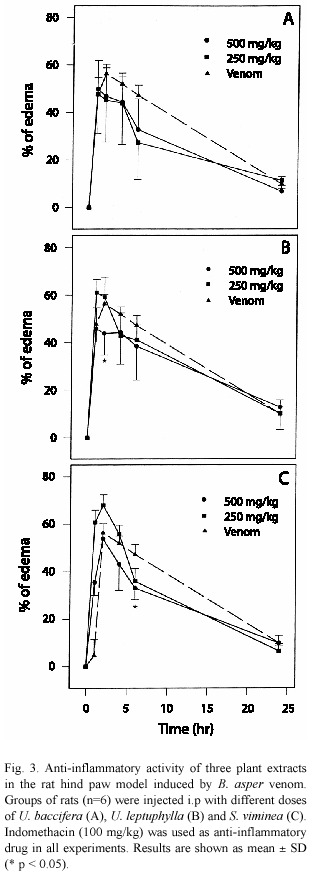
<br> </font></p> <font face="Arial" size="2"><b></b></font>     <p><font face="Arial" size="2"><b>Anti-inflammatory activity. </b>Pretreatment with the extract of <i>U. tomentosa </i>diminished considerably the edema-forming activity of <i>B. asper </i>venom. The doses of 250 mg/kg and 500 mg/kg showed an antiinflammatory effect at all times, except for the dose of 250 mg/kg at one hour (<a href="#figura2">Fig. 2A</a>). The extract of <i>C. nutans </i>showed an important dose-dependent reduction of the edematogenic activity of <i>B. asper </i>venom at all times measured. Maximum inhibition was achieved with the highest dose tested (500 mg/ kg) (<a href="#figura2">Fig. 2B</a>).<a href="#figura2"> Figure 2C</a> shows the time-course of the edema after pretreatment with the extract of <i>L. speciosa</i>. In this case, animals evidenced a sedative effect. Those treated with 500 mg/kg died after 4 hours, therefore two more groups were treated with 125 and 62.5 mg/kg. The higher inhibitory effect was observed at a dose of 250 mg/kg (<a href="#figura2">Fig. 2C</a>). Furthermore, a not significant inhibition of edema was observed in animals pretreated with extracts at doses of 125 and 62.5 mg/kg (<a href="#figura2">Fig. 2C</a>). <i>U. baccifera </i>induced an important reduction of the edema induced by <i>B. asper </i>venom at all times measured (<a href="#figura3">Fig. 3A</a>). A partial inhibition was observed in the animals treated with extracts of <i>U. leptuphylla </i>and <i>S. viminea</i>. Animals pretreated with <i>U. leptuphylla </i>(250 mg/kg) presented a pro-inflammatory effect at 1 and 2 hours. This effect was not observed in animals treated with the dose of 500 mg/kg (<a href="#figura3">Fig. 3B</a>). In the case of <i>S. viminea, </i>a pro-inflammatory effect was observed at 1, 2 and 4 hours with 250 mg/kg. At the other times of measurement the results were similar to those of <i>U. leptuphylla </i>(<a href="#figura3">Fig. 3C</a>). Indomethacin inhibited the edema at all times after venom injection (results not shown).    ]]></body>
<body><![CDATA[<br> </font></p>     <p style="text-align: center;"><font face="Arial" size="2"><a  name="figura2"></a><img src="/img/fbpe/rbt/v54n2/3815i2.JPG" title="" alt=""  style="width: 317px; height: 877px;">    
<br> </font></p>     <p style="text-align: center;"><font face="Arial" size="2"><a  name="figura3"></a><img src="/img/fbpe/rbt/v54n2/3815i3.JPG" title="" alt=""  style="width: 313px; height: 874px;">    
<br> </font></p> <font face="Arial" size="2"><b>     <p>Discussion</p> </b> </font>     <p><font face="Arial" size="2">In this work we demonstrated the characteristics of the edema induced by <i>B. asper </i>venom in rats, showing the classical two phases that were described in mice (Chaves <i>et al. </i>1995). We also demonstrated that extracts of <i>U. tomentosa, C. nutans </i>and <i>L. speciosa </i>were able to neutralize the edema induced by <i>B. asper </i>venom. These two last species have been previously found to have anti-inflammatory activity in the carrageenan induced model (Badilla <i>et al. </i>1999a).</font></p>     <p><font face="Arial" size="2">One of the consequences of snakebites is local inflammation, especially in the crotaline species (Rosenfeld 1971, Ownby 1982, Gutiérrez <i>et al. </i>1986; Chaves <i>et al. </i>1995). <i>B. asper, </i>the most important snake in Central America (Campbell and Lamar 1989, Hardy 1994), induces a striking immediate dosedependent edema in mice (Lomonte <i>et al. </i>1993, Chaves <i>et al. </i>1995). This snakebite may lead to shock, because of the loss of fluid, and to tissue compression (Garfín <i>et al. </i>1985) which would contribute to the development of cardiovascular disturbances (Carlson <i>et al. </i>1975). There are many inflammatory mediators which participate in the production of edema in a variety of inflammatory conditions (Posadas <i>et al. </i>2000). Among others, histamine, prostaglandins, kinins and leukotrienes, could be implicated in the resulting edema in the case of snake venoms (Trebien and Calixto 1989, Chaves <i>et al. </i>1995).</font></p>     <p><font face="Arial" size="2">Edema induced by <i>B. asper </i>venom in rats follows the same pattern to the one induced in mice, characterized by a rapid initial first phase produced by mediators such as histamine and serotonin, and a delayed second phase mediated by prostaglandins (Chaves <i>et al. </i>1995). On the basis of dose- response experiments, a dose of 50 µg/rat was chosen as the challenge- dose, due to its effective inflammatory result without damaging the animal’s overall physical integrity, and allowing to show the inhibitory effect of the plant extracts.</font></p>     <p><font face="Arial" size="2">Edema seems to be clearly related with prostaglandin production, because an important reduction of the inflammatory effect is induced by dexamethasone, which is a PLA<sub>2</sub> inhibitor and by indomethacin a known inhibitor of cyclooxygenase. No histamine effect was shown in this animal model, because the doses of diphenhydramine used (50 and 25 mg/kg), were not able to inhibit the first phase of the model.</font></p> <font face="Arial" size="2"><i> </i></font>     ]]></body>
<body><![CDATA[<p><font face="Arial" size="2"><i>U. tomentosa, C. nutans </i>and <i>L. speciosa </i>extracts significantly reduced venom- induced edema. Since inhibition was observed from 1 to 6 hours, it is likely that the compounds in these extracts are acting both the first and second phases of this inflammatory response (Gutiérrez <i>et al. </i>1986, Trebien and Calixto 1989, Chaves <i>et al</i>. 1995, Badilla <i>et al. </i>1999b, Posadas <i>et al </i>2000). <i>U. tomentosa </i>has already been reported as a plant that inhibits the carrageenan- induced edema (Kiuchi <i>et al. </i>1983, Aquino <i>et al. </i>1991, Aguilar <i>et al</i>. 2002); our studies confirm its effect with <i>B. asper </i>venom as inflammation inductor.</font></p>     <p><font face="Arial" size="2">The effects found in the first 2 hours with 250 mg/kg of <i>S. viminea </i>extracts could suggest an effect on serotonine and histamine liberation, although the effects at 4 to 6 hours suggest an action on prostaglandin production. These effects were not observed at 500 mg/kg. The <i>U. leptuphylla </i>had a similar behavior.</font></p>     <p><font face="Arial" size="2">Although this study was not designed to investigate the mechanism of inhibition, it might be said that aqueous extracts from <i>U. tomentosa, C. nutans </i>and <i>L. speciosa </i>are capable of inhibiting the production of mediators involved in the inflammation process induced by <i>B. asper </i>venom, effects that had been found in studies made with plant extracts (Kiuchi <i>et al. </i>1983).</font></p>     <p><font face="Arial" size="2">Currently, the mainstream scientific treatment for snakebite envenomations is the parenteral administration of antivenoms (Warrell 1992). Polyvalent (Crotalinae) antivenom is highly effective in the neutralization of the systemic effects in the case of <i>B. asper </i>bites, while local injurious effects are neutralized only to a partial extent (Gutiérrez <i>et al. </i>1981, 1985). This is attributed to the quick development of local hemorrhage, edema and myonecrosis after venom injection (Gutiérrez <i>et al. </i>1981, Moreira <i>et al. </i>1992; Lomonte <i>et al. </i>1994, Chaves <i>et al. </i>1995). Therefore, it is necessary to find out complementary treatments aimed at the inhibition of toxins responsible of local tissue damage. Plant extracts constitute a rich source of novel compounds of potential therapeutic interest in the inhibition of venom toxins. In this regard, previous studies performed with crude extracts and fractions of various plants have shown that they posses anti- snake venom activity (Martz 1992). Recently, Borges <i>et al. </i>(2000) demonstrated the ability of extract from <i>Cassearia sylvestris </i>to inhibit phospholipase A<sub>2</sub>, myotoxic, anticoagulant, and edema-forming activities of some snake and bee venoms and of various phospholipases A<sub>2</sub> isolated from these venoms. Our results suggest that the plant extracts investigated contain anti-inflammatory agents that reduce the extent of <i>B. asper </i>venom-induced edema.</font></p> <font face="Arial" size="2"><b>     <p>Acknowledgments</p> </b> </font>     <p><font face="Arial" size="2">The authors thank Lorena Chavarría, Alexis Torres, members of the staff of the Department of Pharmacology and Toxicology, School of Pharmacy, Universidad de Costa Rica and Juan Carlos Brenes, of CIPRONA, for their technical assistance. This work was supported by CONICIT, Ministerio de Ciencia y Tecnología, Costa Rica and Vicerrectoría de Investigación (No 817-98-514), Universidad de Costa Rica. We also thank Norman Farnsworth and NAPRALERT, of the University of Illinois in Chicago, for kindly allowing our access to the database.</font></p> <font face="Arial" size="2"><b>     <p>Resumen</p> </b> </font>     <p><font face="Arial" size="2">Se investigó la capacidad de los extractos de las hojas <i>de Urera baccifera</i>, <i>Loasa speciosa</i>, <i>Urtica leptuphylla</i>, <i>Chaptalia nutans</i>, <i>Satureja viminea </i>y de la raíz de <i>Uncaria tomentosa </i>para inhibir el edema inducido por el veneno de <i>Bothrops asper </i>por métodos pletismométricos. Los grupos de ratas fueron inyectados intraperitonealmente con varias dosis de cada extracto y una hora mas tarde se inyectó veneno por vía subcutánea en la pata trasera derecha de la rata. Se evaluó el edema en distintos intervalos de tiempo. Los resultados muestran que la actividad edematogénica fue inhibida en los animales que recibieron los extractos de raíz de <i>U. tomentosa</i>, hojas de <i>C. nutans </i>y <i>L. speciosa</i>. Los extractos de hojas de <i>U. baccifera </i>mostraron leve inhibición del efecto del veneno. El extracto de hojas de <i>S. viminea </i>y en menor grado el de <i>U. leptuphylla </i>indujeron un efecto pro inflamatorio.</font></p> <font face="Arial" size="2"><b> </b></font>     <p><font face="Arial" size="2"><b>Palabras clave: </b>actividad anti-edematogénica, extractos de plantas, venenos, serpientes, <i>Bothrops asper.</i></font></p> <font face="Arial" size="2"><b>     <p>References</p> </b> </font>     ]]></body>
<body><![CDATA[<!-- ref --><p><font face="Arial" size="2">Aguilar, J.L., P. Rojas, A. Marcelo, A. Plaza, R. Bauer, E. Reininger, C.A. Klaas &amp; I. Merfort. 2002. Antiinflammatory activity of two different extracts of <i>Uncaria tomentosa </i>(Rubiaceae) J. Ethnophar. 81: 271-276.</font>&nbsp;&nbsp;&nbsp;&nbsp;&nbsp;&nbsp;&nbsp;&nbsp;[&#160;<a href="javascript:void(0);" onclick="javascript: window.open('/scielo.php?script=sci_nlinks&ref=1273880&pid=S0034-7744200600020000100001&lng=','','width=640,height=500,resizable=yes,scrollbars=1,menubar=yes,');">Links</a>&#160;]<!-- end-ref --><!-- ref --><p><font face="Arial" size="2">Ahlemeyer, B. &amp; J. Krieglstein. 2003. Pharmacological studies supporting the therapeutic use of <i>Gingo biloba </i>extract for Alzheimer`s disease. Pharmacopsychiatry 36: S8-14.</font>&nbsp;&nbsp;&nbsp;&nbsp;&nbsp;&nbsp;&nbsp;&nbsp;[&#160;<a href="javascript:void(0);" onclick="javascript: window.open('/scielo.php?script=sci_nlinks&ref=1273881&pid=S0034-7744200600020000100002&lng=','','width=640,height=500,resizable=yes,scrollbars=1,menubar=yes,');">Links</a>&#160;]<!-- end-ref --><!-- ref --><p><font face="Arial" size="2">Aquino, R., V. De Feo, F. De Simone, C. Pizza &amp; G. Cirino. 1991. Plant metabolites and antiinflammatory activity of <i>Uncaria tomentosa</i>. J. Nat. Prod. 54: 453-459.</font>&nbsp;&nbsp;&nbsp;&nbsp;&nbsp;&nbsp;&nbsp;&nbsp;[&#160;<a href="javascript:void(0);" onclick="javascript: window.open('/scielo.php?script=sci_nlinks&ref=1273882&pid=S0034-7744200600020000100003&lng=','','width=640,height=500,resizable=yes,scrollbars=1,menubar=yes,');">Links</a>&#160;]<!-- end-ref --><!-- ref --><p><font face="Arial" size="2">Atkinson,T. &amp; M. Witte. 1992. Histamine and serotonins, p. 193-209. <i>In </i>Inflammation: Basic Principles and Clinical Correlates, Raven, New York.</font>&nbsp;&nbsp;&nbsp;&nbsp;&nbsp;&nbsp;&nbsp;&nbsp;[&#160;<a href="javascript:void(0);" onclick="javascript: window.open('/scielo.php?script=sci_nlinks&ref=1273883&pid=S0034-7744200600020000100004&lng=','','width=640,height=500,resizable=yes,scrollbars=1,menubar=yes,');">Links</a>&#160;]<!-- end-ref --><!-- ref --><p><font face="Arial" size="2">Badilla, B., G. Mora &amp; L.J. Poveda. 1999a. Anti-inflammatory activity of aqueous extracts of five Costa Rican medicinal plants in Sprague-Dawley rats. Rev. Biol. Trop<i>. </i>47: 723-727.</font>&nbsp;&nbsp;&nbsp;&nbsp;&nbsp;&nbsp;&nbsp;&nbsp;[&#160;<a href="javascript:void(0);" onclick="javascript: window.open('/scielo.php?script=sci_nlinks&ref=1273884&pid=S0034-7744200600020000100005&lng=','','width=640,height=500,resizable=yes,scrollbars=1,menubar=yes,');">Links</a>&#160;]<!-- end-ref --><!-- ref --><p><font face="Arial" size="2">Badilla B., G. Mora, A.J. Lapa. &amp; J.A. Silva-Emmin. 1999b. Anti-inflammatory activity of <i>Urera baccifera </i>(Urticaceae) in Sprague-Dawley rats. Rev. Biol. Trop<i>. </i>47: 365-371.</font>&nbsp;&nbsp;&nbsp;&nbsp;&nbsp;&nbsp;&nbsp;&nbsp;[&#160;<a href="javascript:void(0);" onclick="javascript: window.open('/scielo.php?script=sci_nlinks&ref=1273885&pid=S0034-7744200600020000100006&lng=','','width=640,height=500,resizable=yes,scrollbars=1,menubar=yes,');">Links</a>&#160;]<!-- end-ref --><!-- ref --><p><font face="Arial" size="2">Borges, M., A. Soares &amp; V. Rodrigues. 2000. Effects of aqueous extract on <i>Cassearia sylvestris </i>(Flacoutiaceae) on actions of snake and bee venoms and on activity of phospholipases A2. Comp. Biochem Physiol. 127: 21-30.</font>&nbsp;&nbsp;&nbsp;&nbsp;&nbsp;&nbsp;&nbsp;&nbsp;[&#160;<a href="javascript:void(0);" onclick="javascript: window.open('/scielo.php?script=sci_nlinks&ref=1273886&pid=S0034-7744200600020000100007&lng=','','width=640,height=500,resizable=yes,scrollbars=1,menubar=yes,');">Links</a>&#160;]<!-- end-ref --><!-- ref --><p><font face="Arial" size="2">Campbell, J.A. &amp; W.W. Lamar. 1989. The venomous reptiles of Latin America. Cornell Univ., Ithaca, New York, 425 p.</font>&nbsp;&nbsp;&nbsp;&nbsp;&nbsp;&nbsp;&nbsp;&nbsp;[&#160;<a href="javascript:void(0);" onclick="javascript: window.open('/scielo.php?script=sci_nlinks&ref=1273887&pid=S0034-7744200600020000100008&lng=','','width=640,height=500,resizable=yes,scrollbars=1,menubar=yes,');">Links</a>&#160;]<!-- end-ref --><!-- ref --><p><font face="Arial" size="2">Carlsson, R.W., R.C. Shaeffer, H. Whigham, S. Michaelis, F.R. Russell &amp; M.H. Weil. 1975. Rattlesnake venom shock in the rat: development of a method. Am. J. Physiol. 229: 1668-1674</font><font face="Arial" size="2" color="#0000ff">.</font>&nbsp;&nbsp;&nbsp;&nbsp;&nbsp;&nbsp;&nbsp;&nbsp;[&#160;<a href="javascript:void(0);" onclick="javascript: window.open('/scielo.php?script=sci_nlinks&ref=1273888&pid=S0034-7744200600020000100009&lng=','','width=640,height=500,resizable=yes,scrollbars=1,menubar=yes,');">Links</a>&#160;]<!-- end-ref --><!-- ref --><p><font face="Arial" size="2">Chaves, F., J.M. Gutiérrez, B. Lomonte &amp; L. Cerdas. 1989. Histopathological and biochemical alterations induced by intramuscular injection of <i>Bothrops asper </i>(Terciopelo) venom in mice. Toxicon 27: 1085-1093.</font>&nbsp;&nbsp;&nbsp;&nbsp;&nbsp;&nbsp;&nbsp;&nbsp;[&#160;<a href="javascript:void(0);" onclick="javascript: window.open('/scielo.php?script=sci_nlinks&ref=1273889&pid=S0034-7744200600020000100010&lng=','','width=640,height=500,resizable=yes,scrollbars=1,menubar=yes,');">Links</a>&#160;]<!-- end-ref --><!-- ref --><p><font face="Arial" size="2">Chaves, F., M. Barboza &amp; J.M. Gutiérrez. 1995. Pharmacological study of edema induced by venom of snake <i>Bothrops asper </i>(Terciopelo) in mice<i>. </i>Toxicon 33: 31-39.</font>&nbsp;&nbsp;&nbsp;&nbsp;&nbsp;&nbsp;&nbsp;&nbsp;[&#160;<a href="javascript:void(0);" onclick="javascript: window.open('/scielo.php?script=sci_nlinks&ref=1273890&pid=S0034-7744200600020000100011&lng=','','width=640,height=500,resizable=yes,scrollbars=1,menubar=yes,');">Links</a>&#160;]<!-- end-ref --><!-- ref --><p><font face="Arial" size="2">Chaves, F., G. León, V.H. Alvarado &amp; J.M. Gutiérrez. 1998. Pharmacological modulation of edema induced by Lys-49 and Asp-49 myotoxic phospholipases A2 isolated from the venom of the snake <i>Bothrops asper </i>(Terciopelo). Toxicon 36: 1861-1869.    &nbsp;&nbsp;&nbsp;&nbsp;&nbsp;&nbsp;&nbsp;&nbsp;[&#160;<a href="javascript:void(0);" onclick="javascript: window.open('/scielo.php?script=sci_nlinks&ref=1273891&pid=S0034-7744200600020000100012&lng=','','width=640,height=500,resizable=yes,scrollbars=1,menubar=yes,');">Links</a>&#160;]<!-- end-ref --><br> </font></p>     <!-- ref --><p><font face="Arial" size="2">Di Rosa M., P.J. Giroud &amp; B.A. Willoughby. 1971. Studies of the mediators of the acute inflammatory response induced in rats in differents sites by carrageenan and turpine. J. Pathol. 101: 15-29.</font>&nbsp;&nbsp;&nbsp;&nbsp;&nbsp;&nbsp;&nbsp;&nbsp;[&#160;<a href="javascript:void(0);" onclick="javascript: window.open('/scielo.php?script=sci_nlinks&ref=1273893&pid=S0034-7744200600020000100013&lng=','','width=640,height=500,resizable=yes,scrollbars=1,menubar=yes,');">Links</a>&#160;]<!-- end-ref --><!-- ref --><p><font face="Arial" size="2">Ferreira, L., O. Henriques, A. Andreoni, G. Vital, M. Campos, G. Habermehls &amp; V. Moraes. 1992. Antivenom and biological effects of ar-turmerone isolated from <i>Curcuma longa </i>(Zingiberaceae). Toxicon 30: 1211-1218</font><font face="Arial" size="2" color="#0000ff">.</font>&nbsp;&nbsp;&nbsp;&nbsp;&nbsp;&nbsp;&nbsp;&nbsp;[&#160;<a href="javascript:void(0);" onclick="javascript: window.open('/scielo.php?script=sci_nlinks&ref=1273894&pid=S0034-7744200600020000100014&lng=','','width=640,height=500,resizable=yes,scrollbars=1,menubar=yes,');">Links</a>&#160;]<!-- end-ref --><!-- ref --><p><font face="Arial" size="2">Garfín, S.R., R.R. Castilonia, S.J. Mubarak, A.R. Hargens, W.H. Akeson &amp; F.E. Russell. 1985. The effect of antivenon on intramuscular pressure elevations induced by rattlesnake venom. Toxicon 23: 677-680</font><font face="Arial" size="2"  color="#0000ff">.</font>&nbsp;&nbsp;&nbsp;&nbsp;&nbsp;&nbsp;&nbsp;&nbsp;[&#160;<a href="javascript:void(0);" onclick="javascript: window.open('/scielo.php?script=sci_nlinks&ref=1273895&pid=S0034-7744200600020000100015&lng=','','width=640,height=500,resizable=yes,scrollbars=1,menubar=yes,');">Links</a>&#160;]<!-- end-ref --><!-- ref --><p><font face="Arial" size="2">Gutiérrez, J.M. &amp; F. Chaves. 1980. Efecto proteolítico, hemorrágico y mionecrótico de los venenos de serpientes costarricenses del género <i>Bothrops</i>. Toxicon 18: 603-610.</font>&nbsp;&nbsp;&nbsp;&nbsp;&nbsp;&nbsp;&nbsp;&nbsp;[&#160;<a href="javascript:void(0);" onclick="javascript: window.open('/scielo.php?script=sci_nlinks&ref=1273896&pid=S0034-7744200600020000100016&lng=','','width=640,height=500,resizable=yes,scrollbars=1,menubar=yes,');">Links</a>&#160;]<!-- end-ref --><!-- ref --><p><font face="Arial" size="2">Gutiérrez, J.M., F. Chaves, R. Bolaños, L. Cerdas, G. Rojas, O. Arroyo &amp; E. Portilla. 1981. Neutralization of the local effects of venom <i>Bothrops asper </i>by polyvalent antivenom. Toxicon 19: 493-500.</font>&nbsp;&nbsp;&nbsp;&nbsp;&nbsp;&nbsp;&nbsp;&nbsp;[&#160;<a href="javascript:void(0);" onclick="javascript: window.open('/scielo.php?script=sci_nlinks&ref=1273897&pid=S0034-7744200600020000100017&lng=','','width=640,height=500,resizable=yes,scrollbars=1,menubar=yes,');">Links</a>&#160;]<!-- end-ref --><!-- ref --><p><font face="Arial" size="2">Gutiérrez, J.M., J.A. Gené &amp; G. Rojas. 1985. Neutalization of proteolytic and hemorrhagic activities of Costa Rica snake venoms by polyvalent antivenom. Toxicon 23: 887-893.</font>&nbsp;&nbsp;&nbsp;&nbsp;&nbsp;&nbsp;&nbsp;&nbsp;[&#160;<a href="javascript:void(0);" onclick="javascript: window.open('/scielo.php?script=sci_nlinks&ref=1273898&pid=S0034-7744200600020000100018&lng=','','width=640,height=500,resizable=yes,scrollbars=1,menubar=yes,');">Links</a>&#160;]<!-- end-ref --><!-- ref --><p><font face="Arial" size="2">Gutiérrez J.M., F. Chaves &amp; L. Cerdas. 1986. Inflammatory infiltrate in skeletal muscle injected with <i>Bothrops asper </i>venom. Rev. Biol. Trop. 34: 209-219</font><font face="Arial"  size="2" color="#0000ff">.</font>&nbsp;&nbsp;&nbsp;&nbsp;&nbsp;&nbsp;&nbsp;&nbsp;[&#160;<a href="javascript:void(0);" onclick="javascript: window.open('/scielo.php?script=sci_nlinks&ref=1273899&pid=S0034-7744200600020000100019&lng=','','width=640,height=500,resizable=yes,scrollbars=1,menubar=yes,');">Links</a>&#160;]<!-- end-ref --><!-- ref --><p><font face="Arial" size="2">Gutiérrez, J. M. &amp; B. Lomonte. 1989. Local tissue damage induced by <i>Bothrops asper </i>snake venom. A review<i>. </i>Mem. Inst. Butantan 51: 211-223.</font>&nbsp;&nbsp;&nbsp;&nbsp;&nbsp;&nbsp;&nbsp;&nbsp;[&#160;<a href="javascript:void(0);" onclick="javascript: window.open('/scielo.php?script=sci_nlinks&ref=1273900&pid=S0034-7744200600020000100020&lng=','','width=640,height=500,resizable=yes,scrollbars=1,menubar=yes,');">Links</a>&#160;]<!-- end-ref --><!-- ref --><p><font face="Arial" size="2">Gutiérrez, J.M. 1995. Clinical toxicology of snake bite in Central America, p. 645-665. <i>In </i>J. Meir (ed.). Handbook of Clinical Toxicology of Animal Venoms and Poisons. CRC, Boca Raton, Florida.</font>&nbsp;&nbsp;&nbsp;&nbsp;&nbsp;&nbsp;&nbsp;&nbsp;[&#160;<a href="javascript:void(0);" onclick="javascript: window.open('/scielo.php?script=sci_nlinks&ref=1273901&pid=S0034-7744200600020000100021&lng=','','width=640,height=500,resizable=yes,scrollbars=1,menubar=yes,');">Links</a>&#160;]<!-- end-ref --><!-- ref --><p><font face="Arial" size="2">Gutierrez, J.M. 2002. Comprendiendo los venenos de serpientes: 50 años de investigaciones en America Latina. Rev. Biol. Trop. 50: 377-394.</font>&nbsp;&nbsp;&nbsp;&nbsp;&nbsp;&nbsp;&nbsp;&nbsp;[&#160;<a href="javascript:void(0);" onclick="javascript: window.open('/scielo.php?script=sci_nlinks&ref=1273902&pid=S0034-7744200600020000100022&lng=','','width=640,height=500,resizable=yes,scrollbars=1,menubar=yes,');">Links</a>&#160;]<!-- end-ref --><!-- ref --><p><font face="Arial" size="2">Hardy, D.L. 1994. <i>Bothrops asper </i>(Viperidae) snakebite and field researches in Middle America. Biotropica 26: 198-207.</font>&nbsp;&nbsp;&nbsp;&nbsp;&nbsp;&nbsp;&nbsp;&nbsp;[&#160;<a href="javascript:void(0);" onclick="javascript: window.open('/scielo.php?script=sci_nlinks&ref=1273903&pid=S0034-7744200600020000100023&lng=','','width=640,height=500,resizable=yes,scrollbars=1,menubar=yes,');">Links</a>&#160;]<!-- end-ref --><!-- ref --><p><font face="Arial" size="2">Kiuchi, F., M. Shibuya, T. Kinoshita &amp; U. Samkawa. 1983. Inhibition of prostaglandin biosynthesis by the constituents of Medicinal Plants. Chem. Pharm. Bull. 31: 3391-3396.</font>&nbsp;&nbsp;&nbsp;&nbsp;&nbsp;&nbsp;&nbsp;&nbsp;[&#160;<a href="javascript:void(0);" onclick="javascript: window.open('/scielo.php?script=sci_nlinks&ref=1273904&pid=S0034-7744200600020000100024&lng=','','width=640,height=500,resizable=yes,scrollbars=1,menubar=yes,');">Links</a>&#160;]<!-- end-ref --><!-- ref --><p><font face="Arial" size="2">Lamar, W.W. &amp; M. Sasa. 2003. A new species of hognose pitviper, genus <i>Porthidium</i>, from the southwestern Pacific of Costa Rica (Serpentes: Viperidae). Rev. Biol. Trop. 51: 797-804.</font>&nbsp;&nbsp;&nbsp;&nbsp;&nbsp;&nbsp;&nbsp;&nbsp;[&#160;<a href="javascript:void(0);" onclick="javascript: window.open('/scielo.php?script=sci_nlinks&ref=1273905&pid=S0034-7744200600020000100025&lng=','','width=640,height=500,resizable=yes,scrollbars=1,menubar=yes,');">Links</a>&#160;]<!-- end-ref --><!-- ref --><p><font face="Arial" size="2">Lomonte, B. 1985. Edema-forming activity of bushmaster (<i>Lachesis muta stenophrys</i>) and Central American rattlesnake (<i>Crotalus durissus durissus</i>) venoms and neutralization by a polyvalent antivenom. Toxicon 23: 173-176.</font>&nbsp;&nbsp;&nbsp;&nbsp;&nbsp;&nbsp;&nbsp;&nbsp;[&#160;<a href="javascript:void(0);" onclick="javascript: window.open('/scielo.php?script=sci_nlinks&ref=1273906&pid=S0034-7744200600020000100026&lng=','','width=640,height=500,resizable=yes,scrollbars=1,menubar=yes,');">Links</a>&#160;]<!-- end-ref --><!-- ref --><p><font face="Arial" size="2">Lomonte, B., A. Tarkowski &amp; L.A. Hanson. 1993. Host response to <i>Bothrops asper </i>snake venom: analysis of edema formation, inflammatory cells and cytokine release in a mouse model. Inflammation 17: 93-105.</font>&nbsp;&nbsp;&nbsp;&nbsp;&nbsp;&nbsp;&nbsp;&nbsp;[&#160;<a href="javascript:void(0);" onclick="javascript: window.open('/scielo.php?script=sci_nlinks&ref=1273907&pid=S0034-7744200600020000100027&lng=','','width=640,height=500,resizable=yes,scrollbars=1,menubar=yes,');">Links</a>&#160;]<!-- end-ref --><!-- ref --><p><font face="Arial" size="2">Lomonte, B., J. Lundgren, B. Johanson &amp; U. Bagge. 1994. The dynamics of local tissue damage induced by <i>Bothrops asper </i>snake venom and myotoxin II on the mouse cremaster muscle: an intravital and electron microscopic study. Toxicon 32: 41-55.</font>&nbsp;&nbsp;&nbsp;&nbsp;&nbsp;&nbsp;&nbsp;&nbsp;[&#160;<a href="javascript:void(0);" onclick="javascript: window.open('/scielo.php?script=sci_nlinks&ref=1273908&pid=S0034-7744200600020000100028&lng=','','width=640,height=500,resizable=yes,scrollbars=1,menubar=yes,');">Links</a>&#160;]<!-- end-ref --><!-- ref --><p><font face="Arial" size="2">Martz, W. 1992. Plants with a reputation against snakebite. Toxicon 30: 1131-1142. </font>&nbsp;&nbsp;&nbsp;&nbsp;&nbsp;&nbsp;&nbsp;&nbsp;[&#160;<a href="javascript:void(0);" onclick="javascript: window.open('/scielo.php?script=sci_nlinks&ref=1273909&pid=S0034-7744200600020000100029&lng=','','width=640,height=500,resizable=yes,scrollbars=1,menubar=yes,');">Links</a>&#160;]<!-- end-ref --><!-- ref --><p><font face="Arial" size="2">Moreira, L., J.M. Gutiérrez, G. Borkow &amp; M. Ovadia. 1992. Ultrastructural alterations in mouse capillary blood vessels after experimental injection of venom from the snake <i>Bothrops asper </i>(terciopelo). Exp. Mol. Pathol. 57: 124-133.</font>&nbsp;&nbsp;&nbsp;&nbsp;&nbsp;&nbsp;&nbsp;&nbsp;[&#160;<a href="javascript:void(0);" onclick="javascript: window.open('/scielo.php?script=sci_nlinks&ref=1273910&pid=S0034-7744200600020000100030&lng=','','width=640,height=500,resizable=yes,scrollbars=1,menubar=yes,');">Links</a>&#160;]<!-- end-ref --><!-- ref --><p><font face="Arial" size="2">Moore, B.D., E. Isidoro &amp; J.R. Seemann. 1993. Distribution of 2-carboxyarabinitol among plants. Phytochemistry 34: 703-707.</font>&nbsp;&nbsp;&nbsp;&nbsp;&nbsp;&nbsp;&nbsp;&nbsp;[&#160;<a href="javascript:void(0);" onclick="javascript: window.open('/scielo.php?script=sci_nlinks&ref=1273911&pid=S0034-7744200600020000100031&lng=','','width=640,height=500,resizable=yes,scrollbars=1,menubar=yes,');">Links</a>&#160;]<!-- end-ref --><!-- ref --><p><font face="Arial" size="2">Ownby, C.L. 1982. Pathology of rattlesnake envenomation, p. 163-209. <i>In </i>Rattlesnake Venoms. Their actions and treatment. New York.</font>&nbsp;&nbsp;&nbsp;&nbsp;&nbsp;&nbsp;&nbsp;&nbsp;[&#160;<a href="javascript:void(0);" onclick="javascript: window.open('/scielo.php?script=sci_nlinks&ref=1273912&pid=S0034-7744200600020000100032&lng=','','width=640,height=500,resizable=yes,scrollbars=1,menubar=yes,');">Links</a>&#160;]<!-- end-ref --><!-- ref --><p><font face="Arial" size="2">Pinto, A., Y. Angulo, R. Jiménez &amp; B. Lomonte. 2003. Isolation of bothrasperin, a disintegrin with potent platelet aggregation inhibitory activity, from the venom of the snake <i>Bothrops asper. </i>Rev. Biol. Trop. 51: 253-260.</font>&nbsp;&nbsp;&nbsp;&nbsp;&nbsp;&nbsp;&nbsp;&nbsp;[&#160;<a href="javascript:void(0);" onclick="javascript: window.open('/scielo.php?script=sci_nlinks&ref=1273913&pid=S0034-7744200600020000100033&lng=','','width=640,height=500,resizable=yes,scrollbars=1,menubar=yes,');">Links</a>&#160;]<!-- end-ref --><!-- ref --><p><font face="Arial" size="2">Posadas, I., M.C. Terencio, I. Guillén, M.L. Ferrandiz, J. Coloma. M. Payá &amp; M.J. Alcaraz. 2000. Co- regulation between cyclo-oxygenase-2 and inducible nitric oxide synthase expression in the time-course of murine inflammation. Arch. Pharmacol. 361: 98-106.</font>&nbsp;&nbsp;&nbsp;&nbsp;&nbsp;&nbsp;&nbsp;&nbsp;[&#160;<a href="javascript:void(0);" onclick="javascript: window.open('/scielo.php?script=sci_nlinks&ref=1273914&pid=S0034-7744200600020000100034&lng=','','width=640,height=500,resizable=yes,scrollbars=1,menubar=yes,');">Links</a>&#160;]<!-- end-ref --><!-- ref --><p><font face="Arial" size="2">Rosenfeld, G. 1971. Symptomatology, pathology and treatment of snake bites in South America, p. 345-384. <i>In </i>Venomous animals and their venoms. Academic, New York.</font>&nbsp;&nbsp;&nbsp;&nbsp;&nbsp;&nbsp;&nbsp;&nbsp;[&#160;<a href="javascript:void(0);" onclick="javascript: window.open('/scielo.php?script=sci_nlinks&ref=1273915&pid=S0034-7744200600020000100035&lng=','','width=640,height=500,resizable=yes,scrollbars=1,menubar=yes,');">Links</a>&#160;]<!-- end-ref --><!-- ref --><p><font face="Arial" size="2">Senior, K. 1996. Pharmaceuticals from plants: promise and progress. Mol. Medic. Today 2: 60-64.</font>&nbsp;&nbsp;&nbsp;&nbsp;&nbsp;&nbsp;&nbsp;&nbsp;[&#160;<a href="javascript:void(0);" onclick="javascript: window.open('/scielo.php?script=sci_nlinks&ref=1273916&pid=S0034-7744200600020000100036&lng=','','width=640,height=500,resizable=yes,scrollbars=1,menubar=yes,');">Links</a>&#160;]<!-- end-ref --><!-- ref --><p><font face="Arial" size="2">Trebien, H.A. &amp; J.B. Calixto. 1989. Pharmacological evaluation of rat paw edema induced by <i>Bothrops jararaca </i>venom. Agents and Actions 26: 292-300</font><font  face="Arial" size="2" color="#0000ff">. </font>&nbsp;&nbsp;&nbsp;&nbsp;&nbsp;&nbsp;&nbsp;&nbsp;[&#160;<a href="javascript:void(0);" onclick="javascript: window.open('/scielo.php?script=sci_nlinks&ref=1273917&pid=S0034-7744200600020000100037&lng=','','width=640,height=500,resizable=yes,scrollbars=1,menubar=yes,');">Links</a>&#160;]<!-- end-ref --><!-- ref --><p>Warrell, D.A. 1992. The global problem of snake bite: its prevention and treatment, p. 121-153. <i>In </i>P. Gopalakrishnakone &amp; C.R. Tan (eds.). Recent advances in Toxicology Research, 1. National University of Singapore, Singapore.&nbsp;&nbsp;&nbsp;&nbsp;&nbsp;&nbsp;&nbsp;&nbsp;[&#160;<a href="javascript:void(0);" onclick="javascript: window.open('/scielo.php?script=sci_nlinks&ref=1273918&pid=S0034-7744200600020000100038&lng=','','width=640,height=500,resizable=yes,scrollbars=1,menubar=yes,');">Links</a>&#160;]<!-- end-ref --> ]]></body><back>
<ref-list>
<ref id="B1">
<nlm-citation citation-type="journal">
<person-group person-group-type="author">
<name>
<surname><![CDATA[Aguilar]]></surname>
<given-names><![CDATA[J.L]]></given-names>
</name>
<name>
<surname><![CDATA[Rojas]]></surname>
<given-names><![CDATA[P]]></given-names>
</name>
<name>
<surname><![CDATA[Marcelo]]></surname>
<given-names><![CDATA[A]]></given-names>
</name>
<name>
<surname><![CDATA[Plaza]]></surname>
<given-names><![CDATA[A]]></given-names>
</name>
<name>
<surname><![CDATA[Bauer]]></surname>
<given-names><![CDATA[R]]></given-names>
</name>
<name>
<surname><![CDATA[Reininger]]></surname>
<given-names><![CDATA[E]]></given-names>
</name>
<name>
<surname><![CDATA[Klaas]]></surname>
<given-names><![CDATA[C.A]]></given-names>
</name>
<name>
<surname><![CDATA[Merfort]]></surname>
<given-names><![CDATA[I]]></given-names>
</name>
</person-group>
<article-title xml:lang="en"><![CDATA[Antiinflammatory activity of two different extracts of Uncaria tomentosa (Rubiaceae)]]></article-title>
<source><![CDATA[J. Ethnophar]]></source>
<year>2002</year>
<volume>81</volume>
<page-range>271-276</page-range></nlm-citation>
</ref>
<ref id="B2">
<nlm-citation citation-type="journal">
<person-group person-group-type="author">
<name>
<surname><![CDATA[Ahlemeyer]]></surname>
<given-names><![CDATA[B]]></given-names>
</name>
<name>
<surname><![CDATA[Krieglstein]]></surname>
<given-names><![CDATA[J]]></given-names>
</name>
</person-group>
<article-title xml:lang="en"><![CDATA[Pharmacological studies supporting the therapeutic use of Gingo biloba extract for Alzheimer`s disease]]></article-title>
<source><![CDATA[Pharmacopsychiatry]]></source>
<year>2003</year>
<volume>36</volume>
<page-range>S8-14</page-range></nlm-citation>
</ref>
<ref id="B3">
<nlm-citation citation-type="journal">
<person-group person-group-type="author">
<name>
<surname><![CDATA[Aquino]]></surname>
<given-names><![CDATA[R]]></given-names>
</name>
<name>
<surname><![CDATA[De Feo]]></surname>
<given-names><![CDATA[V]]></given-names>
</name>
<name>
<surname><![CDATA[De Simone]]></surname>
<given-names><![CDATA[F]]></given-names>
</name>
<name>
<surname><![CDATA[Pizza]]></surname>
<given-names><![CDATA[C]]></given-names>
</name>
<name>
<surname><![CDATA[Cirino]]></surname>
<given-names><![CDATA[G]]></given-names>
</name>
</person-group>
<article-title xml:lang="en"><![CDATA[Plant metabolites and antiinflammatory activity of Uncaria tomentosa]]></article-title>
<source><![CDATA[J. Nat. Prod]]></source>
<year>1991</year>
<volume>54</volume>
<page-range>453-459</page-range></nlm-citation>
</ref>
<ref id="B4">
<nlm-citation citation-type="">
<person-group person-group-type="author">
<name>
<surname><![CDATA[Atkinson]]></surname>
<given-names><![CDATA[T]]></given-names>
</name>
<name>
<surname><![CDATA[Witte]]></surname>
<given-names><![CDATA[M]]></given-names>
</name>
</person-group>
<article-title xml:lang="en"><![CDATA[Histamine and serotonins]]></article-title>
<source><![CDATA[Inflammation: Basic Principles and Clinical Correlates]]></source>
<year>1992</year>
<page-range>193-209</page-range><publisher-loc><![CDATA[New York ]]></publisher-loc>
</nlm-citation>
</ref>
<ref id="B5">
<nlm-citation citation-type="journal">
<person-group person-group-type="author">
<name>
<surname><![CDATA[Badilla]]></surname>
<given-names><![CDATA[B]]></given-names>
</name>
<name>
<surname><![CDATA[Mora]]></surname>
<given-names><![CDATA[G]]></given-names>
</name>
<name>
<surname><![CDATA[Poveda]]></surname>
<given-names><![CDATA[L.J]]></given-names>
</name>
</person-group>
<article-title xml:lang="en"><![CDATA[Anti-inflammatory activity of aqueous extracts of five Costa Rican medicinal plants in Sprague-Dawley rats]]></article-title>
<source><![CDATA[Rev. Biol. Trop]]></source>
<year>1999</year>
<volume>47</volume>
<page-range>723-727</page-range></nlm-citation>
</ref>
<ref id="B6">
<nlm-citation citation-type="journal">
<person-group person-group-type="author">
<name>
<surname><![CDATA[Badilla]]></surname>
<given-names><![CDATA[B]]></given-names>
</name>
<name>
<surname><![CDATA[Mora]]></surname>
<given-names><![CDATA[G]]></given-names>
</name>
<name>
<surname><![CDATA[Lapa]]></surname>
<given-names><![CDATA[A.J]]></given-names>
</name>
<name>
<surname><![CDATA[Silva-Emmin]]></surname>
<given-names><![CDATA[J.A]]></given-names>
</name>
</person-group>
<article-title xml:lang="en"><![CDATA[Anti-inflammatory activity of Urera baccifera (Urticaceae) in Sprague-Dawley rats]]></article-title>
<source><![CDATA[Rev. Biol. Trop]]></source>
<year>1999</year>
<volume>47</volume>
<page-range>365-371</page-range></nlm-citation>
</ref>
<ref id="B7">
<nlm-citation citation-type="journal">
<person-group person-group-type="author">
<name>
<surname><![CDATA[Borges]]></surname>
<given-names><![CDATA[M]]></given-names>
</name>
<name>
<surname><![CDATA[Soares]]></surname>
<given-names><![CDATA[A]]></given-names>
</name>
<name>
<surname><![CDATA[Rodrigues]]></surname>
<given-names><![CDATA[V]]></given-names>
</name>
</person-group>
<article-title xml:lang="en"><![CDATA[Effects of aqueous extract on Cassearia sylvestris (Flacoutiaceae) on actions of snake and bee venoms and on activity of phospholipases A2]]></article-title>
<source><![CDATA[Comp. Biochem Physiol]]></source>
<year>2000</year>
<volume>127</volume>
<page-range>21-30</page-range></nlm-citation>
</ref>
<ref id="B8">
<nlm-citation citation-type="book">
<person-group person-group-type="author">
<name>
<surname><![CDATA[Campbell]]></surname>
<given-names><![CDATA[J.A]]></given-names>
</name>
<name>
<surname><![CDATA[Lamar]]></surname>
<given-names><![CDATA[W.W]]></given-names>
</name>
</person-group>
<source><![CDATA[The venomous reptiles of Latin America]]></source>
<year>1989</year>
<page-range>425</page-range><publisher-loc><![CDATA[Ithaca^eNew York New York]]></publisher-loc>
<publisher-name><![CDATA[Cornell Univ]]></publisher-name>
</nlm-citation>
</ref>
<ref id="B9">
<nlm-citation citation-type="journal">
<person-group person-group-type="author">
<name>
<surname><![CDATA[Carlsson]]></surname>
<given-names><![CDATA[R.W]]></given-names>
</name>
<name>
<surname><![CDATA[Shaeffer]]></surname>
<given-names><![CDATA[R.C]]></given-names>
</name>
<name>
<surname><![CDATA[Whigham]]></surname>
<given-names><![CDATA[H]]></given-names>
</name>
<name>
<surname><![CDATA[Michaelis]]></surname>
<given-names><![CDATA[S]]></given-names>
</name>
<name>
<surname><![CDATA[Russell]]></surname>
<given-names><![CDATA[F.R]]></given-names>
</name>
<name>
<surname><![CDATA[Weil]]></surname>
<given-names><![CDATA[M.H]]></given-names>
</name>
</person-group>
<article-title xml:lang="en"><![CDATA[Rattlesnake venom shock in the rat: development of a method]]></article-title>
<source><![CDATA[Am. J. Physiol]]></source>
<year>1975</year>
<volume>229</volume>
<page-range>1668-1674</page-range></nlm-citation>
</ref>
<ref id="B10">
<nlm-citation citation-type="journal">
<person-group person-group-type="author">
<name>
<surname><![CDATA[Chaves]]></surname>
<given-names><![CDATA[F]]></given-names>
</name>
<name>
<surname><![CDATA[Gutiérrez]]></surname>
<given-names><![CDATA[J.M]]></given-names>
</name>
<name>
<surname><![CDATA[Lomonte]]></surname>
<given-names><![CDATA[B]]></given-names>
</name>
<name>
<surname><![CDATA[Cerdas]]></surname>
<given-names><![CDATA[L]]></given-names>
</name>
</person-group>
<article-title xml:lang="en"><![CDATA[Histopathological and biochemical alterations induced by intramuscular injection of Bothrops asper (Terciopelo) venom in mice]]></article-title>
<source><![CDATA[Toxicon]]></source>
<year>1989</year>
<volume>27</volume>
<page-range>1085-1093</page-range></nlm-citation>
</ref>
<ref id="B11">
<nlm-citation citation-type="journal">
<person-group person-group-type="author">
<name>
<surname><![CDATA[Chaves]]></surname>
<given-names><![CDATA[F]]></given-names>
</name>
<name>
<surname><![CDATA[Barboza]]></surname>
<given-names><![CDATA[M]]></given-names>
</name>
<name>
<surname><![CDATA[Gutiérrez]]></surname>
<given-names><![CDATA[J.M]]></given-names>
</name>
</person-group>
<article-title xml:lang="en"><![CDATA[Pharmacological study of edema induced by venom of snake Bothrops asper (Terciopelo) in mice]]></article-title>
<source><![CDATA[Toxicon]]></source>
<year>1995</year>
<volume>33</volume>
<page-range>31-39</page-range></nlm-citation>
</ref>
<ref id="B12">
<nlm-citation citation-type="journal">
<person-group person-group-type="author">
<name>
<surname><![CDATA[Chaves]]></surname>
<given-names><![CDATA[F]]></given-names>
</name>
<name>
<surname><![CDATA[León]]></surname>
<given-names><![CDATA[G]]></given-names>
</name>
<name>
<surname><![CDATA[Alvarado]]></surname>
<given-names><![CDATA[V.H]]></given-names>
</name>
<name>
<surname><![CDATA[Gutiérrez]]></surname>
<given-names><![CDATA[J.M]]></given-names>
</name>
</person-group>
<article-title xml:lang="en"><![CDATA[Pharmacological modulation of edema induced by Lys-49 and Asp-49 myotoxic phospholipases A2 isolated from the venom of the snake Bothrops asper (Terciopelo)]]></article-title>
<source><![CDATA[Toxicon]]></source>
<year>1998</year>
<volume>36</volume>
<page-range>1861-1869</page-range></nlm-citation>
</ref>
<ref id="B13">
<nlm-citation citation-type="journal">
<person-group person-group-type="author">
<name>
<surname><![CDATA[Di Rosa]]></surname>
<given-names><![CDATA[M]]></given-names>
</name>
<name>
<surname><![CDATA[Giroud]]></surname>
<given-names><![CDATA[P.J]]></given-names>
</name>
<name>
<surname><![CDATA[Willoughby]]></surname>
<given-names><![CDATA[B.A]]></given-names>
</name>
</person-group>
<article-title xml:lang="en"><![CDATA[Studies of the mediators of the acute inflammatory response induced in rats in differents sites by carrageenan and turpine]]></article-title>
<source><![CDATA[J. Pathol]]></source>
<year>1971</year>
<volume>101</volume>
<page-range>15-29</page-range></nlm-citation>
</ref>
<ref id="B14">
<nlm-citation citation-type="journal">
<person-group person-group-type="author">
<name>
<surname><![CDATA[Ferreira]]></surname>
<given-names><![CDATA[L]]></given-names>
</name>
<name>
<surname><![CDATA[Henriques]]></surname>
<given-names><![CDATA[O]]></given-names>
</name>
<name>
<surname><![CDATA[Andreoni]]></surname>
<given-names><![CDATA[A]]></given-names>
</name>
<name>
<surname><![CDATA[Vital]]></surname>
<given-names><![CDATA[G]]></given-names>
</name>
<name>
<surname><![CDATA[Campos]]></surname>
<given-names><![CDATA[M]]></given-names>
</name>
<name>
<surname><![CDATA[Habermehls]]></surname>
<given-names><![CDATA[G]]></given-names>
</name>
<name>
<surname><![CDATA[Moraes]]></surname>
<given-names><![CDATA[V]]></given-names>
</name>
</person-group>
<article-title xml:lang="en"><![CDATA[Antivenom and biological effects of ar-turmerone isolated from Curcuma longa (Zingiberaceae)]]></article-title>
<source><![CDATA[Toxicon]]></source>
<year>1992</year>
<volume>30</volume>
<page-range>1211-1218</page-range></nlm-citation>
</ref>
<ref id="B15">
<nlm-citation citation-type="journal">
<person-group person-group-type="author">
<name>
<surname><![CDATA[Garfín]]></surname>
<given-names><![CDATA[S.R]]></given-names>
</name>
<name>
<surname><![CDATA[Castilonia]]></surname>
<given-names><![CDATA[R.R]]></given-names>
</name>
<name>
<surname><![CDATA[Mubarak]]></surname>
<given-names><![CDATA[S.J]]></given-names>
</name>
<name>
<surname><![CDATA[Hargens]]></surname>
<given-names><![CDATA[A.R]]></given-names>
</name>
<name>
<surname><![CDATA[Akeson]]></surname>
<given-names><![CDATA[W.H]]></given-names>
</name>
<name>
<surname><![CDATA[Russell]]></surname>
<given-names><![CDATA[F.E]]></given-names>
</name>
</person-group>
<article-title xml:lang="en"><![CDATA[The effect of antivenon on intramuscular pressure elevations induced by rattlesnake venom]]></article-title>
<source><![CDATA[Toxicon]]></source>
<year>1985</year>
<volume>23</volume>
<page-range>677-680</page-range></nlm-citation>
</ref>
<ref id="B16">
<nlm-citation citation-type="journal">
<person-group person-group-type="author">
<name>
<surname><![CDATA[Gutiérrez]]></surname>
<given-names><![CDATA[J.M]]></given-names>
</name>
<name>
<surname><![CDATA[Chaves]]></surname>
<given-names><![CDATA[F]]></given-names>
</name>
</person-group>
<article-title xml:lang="es"><![CDATA[Efecto proteolítico, hemorrágico y mionecrótico de los venenos de serpientes costarricenses del género Bothrops]]></article-title>
<source><![CDATA[Toxicon]]></source>
<year>1980</year>
<volume>18</volume>
<page-range>603-610</page-range></nlm-citation>
</ref>
<ref id="B17">
<nlm-citation citation-type="journal">
<person-group person-group-type="author">
<name>
<surname><![CDATA[Gutiérrez]]></surname>
<given-names><![CDATA[J.M]]></given-names>
</name>
<name>
<surname><![CDATA[Chaves]]></surname>
<given-names><![CDATA[F]]></given-names>
</name>
<name>
<surname><![CDATA[Bolaños]]></surname>
<given-names><![CDATA[R]]></given-names>
</name>
<name>
<surname><![CDATA[Cerdas]]></surname>
<given-names><![CDATA[L]]></given-names>
</name>
<name>
<surname><![CDATA[Rojas]]></surname>
<given-names><![CDATA[G]]></given-names>
</name>
<name>
<surname><![CDATA[Arroyo]]></surname>
<given-names><![CDATA[O]]></given-names>
</name>
<name>
<surname><![CDATA[Portilla]]></surname>
<given-names><![CDATA[E]]></given-names>
</name>
</person-group>
<article-title xml:lang="en"><![CDATA[Neutralization of the local effects of venom Bothrops asper by polyvalent antivenom]]></article-title>
<source><![CDATA[Toxicon]]></source>
<year>1981</year>
<volume>19</volume>
<page-range>493-500</page-range></nlm-citation>
</ref>
<ref id="B18">
<nlm-citation citation-type="journal">
<person-group person-group-type="author">
<name>
<surname><![CDATA[Gutiérrez]]></surname>
<given-names><![CDATA[J.M]]></given-names>
</name>
<name>
<surname><![CDATA[Gené]]></surname>
<given-names><![CDATA[J. A]]></given-names>
</name>
<name>
<surname><![CDATA[Rojas]]></surname>
<given-names><![CDATA[G]]></given-names>
</name>
</person-group>
<article-title xml:lang="en"><![CDATA[Neutalization of proteolytic and hemorrhagic activities of Costa Rica snake venoms by polyvalent antivenom]]></article-title>
<source><![CDATA[Toxicon]]></source>
<year>1985</year>
<volume>23</volume>
<page-range>887-893</page-range></nlm-citation>
</ref>
<ref id="B19">
<nlm-citation citation-type="journal">
<person-group person-group-type="author">
<name>
<surname><![CDATA[Gutiérrez]]></surname>
<given-names><![CDATA[J.M]]></given-names>
</name>
<name>
<surname><![CDATA[Chaves]]></surname>
<given-names><![CDATA[F]]></given-names>
</name>
<name>
<surname><![CDATA[Cerdas]]></surname>
<given-names><![CDATA[L]]></given-names>
</name>
</person-group>
<article-title xml:lang="en"><![CDATA[Inflammatory infiltrate in skeletal muscle injected with Bothrops asper venom]]></article-title>
<source><![CDATA[Rev. Biol. Trop]]></source>
<year>1986</year>
<volume>34</volume>
<page-range>209-219</page-range></nlm-citation>
</ref>
<ref id="B20">
<nlm-citation citation-type="journal">
<person-group person-group-type="author">
<name>
<surname><![CDATA[Gutiérrez]]></surname>
<given-names><![CDATA[J. M]]></given-names>
</name>
<name>
<surname><![CDATA[Lomonte]]></surname>
<given-names><![CDATA[B]]></given-names>
</name>
</person-group>
<article-title xml:lang="en"><![CDATA[Local tissue damage induced by Bothrops asper snake venom: A review]]></article-title>
<source><![CDATA[Mem. Inst. Butantan]]></source>
<year>1989</year>
<volume>51</volume>
<page-range>211-223</page-range></nlm-citation>
</ref>
<ref id="B21">
<nlm-citation citation-type="">
<person-group person-group-type="author">
<name>
<surname><![CDATA[Gutiérrez]]></surname>
<given-names><![CDATA[J.M]]></given-names>
</name>
</person-group>
<article-title xml:lang="en"><![CDATA[Clinical toxicology of snake bite in Central America]]></article-title>
<person-group person-group-type="editor">
<name>
<surname><![CDATA[Meir]]></surname>
<given-names><![CDATA[J]]></given-names>
</name>
</person-group>
<source><![CDATA[Handbook of Clinical Toxicology of Animal Venoms and Poisons. CRC, Boca Raton, Florida]]></source>
<year>1995</year>
<page-range>645-665</page-range></nlm-citation>
</ref>
<ref id="B22">
<nlm-citation citation-type="journal">
<person-group person-group-type="author">
<name>
<surname><![CDATA[Gutierrez]]></surname>
<given-names><![CDATA[J.M]]></given-names>
</name>
</person-group>
<article-title xml:lang="es"><![CDATA[Comprendiendo los venenos de serpientes: 50 años de investigaciones en America Latina]]></article-title>
<source><![CDATA[Rev. Biol. Trop]]></source>
<year>2002</year>
<volume>50</volume>
<page-range>377-394</page-range></nlm-citation>
</ref>
<ref id="B23">
<nlm-citation citation-type="journal">
<person-group person-group-type="author">
<name>
<surname><![CDATA[Hardy]]></surname>
<given-names><![CDATA[D.L]]></given-names>
</name>
</person-group>
<article-title xml:lang="en"><![CDATA[Bothrops asper (Viperidae) snakebite and field researches in Middle America]]></article-title>
<source><![CDATA[Biotropica]]></source>
<year>1994</year>
<volume>26</volume>
<page-range>198-207</page-range></nlm-citation>
</ref>
<ref id="B24">
<nlm-citation citation-type="journal">
<person-group person-group-type="author">
<name>
<surname><![CDATA[Kiuchi]]></surname>
<given-names><![CDATA[F]]></given-names>
</name>
<name>
<surname><![CDATA[Shibuya]]></surname>
<given-names><![CDATA[M]]></given-names>
</name>
<name>
<surname><![CDATA[Kinoshita]]></surname>
<given-names><![CDATA[T]]></given-names>
</name>
<name>
<surname><![CDATA[Samkawa]]></surname>
<given-names><![CDATA[U]]></given-names>
</name>
</person-group>
<article-title xml:lang="en"><![CDATA[Inhibition of prostaglandin biosynthesis by the constituents of Medicinal Plants]]></article-title>
<source><![CDATA[Chem. Pharm. Bull]]></source>
<year>1983</year>
<volume>31</volume>
<page-range>3391-3396</page-range></nlm-citation>
</ref>
<ref id="B25">
<nlm-citation citation-type="journal">
<person-group person-group-type="author">
<name>
<surname><![CDATA[Lamar]]></surname>
<given-names><![CDATA[W.W]]></given-names>
</name>
<name>
<surname><![CDATA[Sasa]]></surname>
<given-names><![CDATA[M]]></given-names>
</name>
</person-group>
<article-title xml:lang="en"><![CDATA[A new species of hognose pitviper, genus Porthidium, from the southwestern Pacific of Costa Rica (Serpentes: Viperidae)]]></article-title>
<source><![CDATA[Rev. Biol. Trop]]></source>
<year>2003</year>
<volume>51</volume>
<page-range>797-804</page-range></nlm-citation>
</ref>
<ref id="B26">
<nlm-citation citation-type="journal">
<person-group person-group-type="author">
<name>
<surname><![CDATA[Lomonte]]></surname>
<given-names><![CDATA[B]]></given-names>
</name>
</person-group>
<article-title xml:lang="en"><![CDATA[Edema-forming activity of bushmaster (Lachesis muta stenophrys) and Central American rattlesnake (Crotalus durissus durissus) venoms and neutralization by a polyvalent antivenom]]></article-title>
<source><![CDATA[Toxicon]]></source>
<year>1985</year>
<volume>23</volume>
<page-range>173-176</page-range></nlm-citation>
</ref>
<ref id="B27">
<nlm-citation citation-type="journal">
<person-group person-group-type="author">
<name>
<surname><![CDATA[Lomonte]]></surname>
<given-names><![CDATA[B]]></given-names>
</name>
<name>
<surname><![CDATA[Tarkowski]]></surname>
<given-names><![CDATA[A]]></given-names>
</name>
<name>
<surname><![CDATA[Hanson]]></surname>
<given-names><![CDATA[L.A]]></given-names>
</name>
</person-group>
<article-title xml:lang="en"><![CDATA[Host response to Bothrops asper snake venom: analysis of edema formation, inflammatory cells and cytokine release in a mouse model]]></article-title>
<source><![CDATA[Inflammation]]></source>
<year>1993</year>
<volume>17</volume>
<page-range>93-105</page-range></nlm-citation>
</ref>
<ref id="B28">
<nlm-citation citation-type="journal">
<person-group person-group-type="author">
<name>
<surname><![CDATA[Lomonte]]></surname>
<given-names><![CDATA[B]]></given-names>
</name>
<name>
<surname><![CDATA[Lundgren]]></surname>
<given-names><![CDATA[J]]></given-names>
</name>
<name>
<surname><![CDATA[Johanson]]></surname>
<given-names><![CDATA[B]]></given-names>
</name>
<name>
<surname><![CDATA[Bagge]]></surname>
<given-names><![CDATA[U]]></given-names>
</name>
</person-group>
<article-title xml:lang="en"><![CDATA[The dynamics of local tissue damage induced by Bothrops asper snake venom and myotoxin II on the mouse cremaster muscle: an intravital and electron microscopic study]]></article-title>
<source><![CDATA[Toxicon]]></source>
<year>1994</year>
<volume>32</volume>
<page-range>41-55</page-range></nlm-citation>
</ref>
<ref id="B29">
<nlm-citation citation-type="journal">
<person-group person-group-type="author">
<name>
<surname><![CDATA[Martz]]></surname>
<given-names><![CDATA[W]]></given-names>
</name>
</person-group>
<article-title xml:lang="en"><![CDATA[Plants with a reputation against snakebite]]></article-title>
<source><![CDATA[Toxicon]]></source>
<year>1992</year>
<volume>30</volume>
<page-range>1131-1142</page-range></nlm-citation>
</ref>
<ref id="B30">
<nlm-citation citation-type="journal">
<person-group person-group-type="author">
<name>
<surname><![CDATA[Moreira]]></surname>
<given-names><![CDATA[L]]></given-names>
</name>
<name>
<surname><![CDATA[Gutiérrez]]></surname>
<given-names><![CDATA[J.M]]></given-names>
</name>
<name>
<surname><![CDATA[Borkow]]></surname>
<given-names><![CDATA[G]]></given-names>
</name>
<name>
<surname><![CDATA[Ovadia]]></surname>
<given-names><![CDATA[M]]></given-names>
</name>
</person-group>
<article-title xml:lang="en"><![CDATA[Ultrastructural alterations in mouse capillary blood vessels after experimental injection of venom from the snake Bothrops asper (terciopelo)]]></article-title>
<source><![CDATA[Exp. Mol. Pathol]]></source>
<year>1992</year>
<volume>57</volume>
<page-range>124-133</page-range></nlm-citation>
</ref>
<ref id="B31">
<nlm-citation citation-type="journal">
<person-group person-group-type="author">
<name>
<surname><![CDATA[Moore]]></surname>
<given-names><![CDATA[B.D]]></given-names>
</name>
<name>
<surname><![CDATA[Isidoro]]></surname>
<given-names><![CDATA[E]]></given-names>
</name>
<name>
<surname><![CDATA[Seemann]]></surname>
<given-names><![CDATA[J.R]]></given-names>
</name>
</person-group>
<article-title xml:lang="en"><![CDATA[Distribution of 2-carboxyarabinitol among plants]]></article-title>
<source><![CDATA[Phytochemistry]]></source>
<year>1993</year>
<volume>34</volume>
<page-range>703-707</page-range></nlm-citation>
</ref>
<ref id="B32">
<nlm-citation citation-type="">
<person-group person-group-type="author">
<name>
<surname><![CDATA[Ownby]]></surname>
<given-names><![CDATA[C.L]]></given-names>
</name>
</person-group>
<article-title xml:lang="en"><![CDATA[Pathology of rattlesnake envenomation]]></article-title>
<source><![CDATA[Rattlesnake Venoms: Their actions and treatment]]></source>
<year>1982</year>
<page-range>163-209</page-range><publisher-loc><![CDATA[^eNew York New York]]></publisher-loc>
</nlm-citation>
</ref>
<ref id="B33">
<nlm-citation citation-type="journal">
<person-group person-group-type="author">
<name>
<surname><![CDATA[Pinto]]></surname>
<given-names><![CDATA[A]]></given-names>
</name>
<name>
<surname><![CDATA[Angulo]]></surname>
<given-names><![CDATA[Y]]></given-names>
</name>
<name>
<surname><![CDATA[Jiménez]]></surname>
<given-names><![CDATA[R]]></given-names>
</name>
<name>
<surname><![CDATA[Lomonte]]></surname>
<given-names><![CDATA[B]]></given-names>
</name>
</person-group>
<article-title xml:lang="en"><![CDATA[Isolation of bothrasperin, a disintegrin with potent platelet aggregation inhibitory activity, from the venom of the snake Bothrops asper]]></article-title>
<source><![CDATA[Rev. Biol. Trop]]></source>
<year>2003</year>
<volume>51</volume>
<page-range>253-260</page-range></nlm-citation>
</ref>
<ref id="B34">
<nlm-citation citation-type="journal">
<person-group person-group-type="author">
<name>
<surname><![CDATA[Posadas]]></surname>
<given-names><![CDATA[I]]></given-names>
</name>
<name>
<surname><![CDATA[Terencio]]></surname>
<given-names><![CDATA[M.C]]></given-names>
</name>
<name>
<surname><![CDATA[Guillén]]></surname>
<given-names><![CDATA[I]]></given-names>
</name>
<name>
<surname><![CDATA[Ferrandiz]]></surname>
<given-names><![CDATA[M.L]]></given-names>
</name>
<name>
<surname><![CDATA[Coloma]]></surname>
<given-names><![CDATA[J]]></given-names>
</name>
<name>
<surname><![CDATA[Payá]]></surname>
<given-names><![CDATA[M]]></given-names>
</name>
<name>
<surname><![CDATA[Alcaraz]]></surname>
<given-names><![CDATA[M.J]]></given-names>
</name>
</person-group>
<article-title xml:lang="en"><![CDATA[Co- regulation between cyclo-oxygenase-2 and inducible nitric oxide synthase expression in the time-course of murine inflammation]]></article-title>
<source><![CDATA[Arch. Pharmacol]]></source>
<year>2000</year>
<volume>361</volume>
<page-range>98-106</page-range></nlm-citation>
</ref>
<ref id="B35">
<nlm-citation citation-type="book">
<person-group person-group-type="author">
<name>
<surname><![CDATA[Rosenfeld]]></surname>
<given-names><![CDATA[G]]></given-names>
</name>
</person-group>
<article-title xml:lang="en"><![CDATA[Symptomatology, pathology and treatment of snake bites in South America]]></article-title>
<source><![CDATA[Venomous animals and their venoms]]></source>
<year>1971</year>
<page-range>345-384</page-range><publisher-loc><![CDATA[^eNew York New York]]></publisher-loc>
<publisher-name><![CDATA[Academic]]></publisher-name>
</nlm-citation>
</ref>
<ref id="B36">
<nlm-citation citation-type="journal">
<person-group person-group-type="author">
<name>
<surname><![CDATA[Senior]]></surname>
<given-names><![CDATA[K]]></given-names>
</name>
</person-group>
<article-title xml:lang="en"><![CDATA[Pharmaceuticals from plants: promise and progress]]></article-title>
<source><![CDATA[Mol. Medic. Today]]></source>
<year>1996</year>
<volume>2</volume>
<page-range>60-64</page-range></nlm-citation>
</ref>
<ref id="B37">
<nlm-citation citation-type="journal">
<person-group person-group-type="author">
<name>
<surname><![CDATA[Trebien]]></surname>
<given-names><![CDATA[H.A]]></given-names>
</name>
<name>
<surname><![CDATA[Calixto]]></surname>
<given-names><![CDATA[J.B]]></given-names>
</name>
</person-group>
<article-title xml:lang="en"><![CDATA[Pharmacological evaluation of rat paw edema induced by Bothrops jararaca venom]]></article-title>
<source><![CDATA[Agents and Actions]]></source>
<year>1989</year>
<volume>26</volume>
<page-range>292-300</page-range></nlm-citation>
</ref>
<ref id="B38">
<nlm-citation citation-type="book">
<person-group person-group-type="author">
<name>
<surname><![CDATA[Warrell]]></surname>
<given-names><![CDATA[D.A]]></given-names>
</name>
</person-group>
<article-title xml:lang="en"><![CDATA[The global problem of snake bite: its prevention and treatment]]></article-title>
<person-group person-group-type="editor">
<name>
<surname><![CDATA[Gopalakrishnakone]]></surname>
<given-names><![CDATA[P]]></given-names>
</name>
<name>
<surname><![CDATA[Tan]]></surname>
<given-names><![CDATA[C.R]]></given-names>
</name>
</person-group>
<source><![CDATA[Recent advances in Toxicology Research, 1]]></source>
<year>1992</year>
<page-range>121-153</page-range><publisher-name><![CDATA[National University of Singapore]]></publisher-name>
</nlm-citation>
</ref>
</ref-list>
</back>
</article>