<?xml version="1.0" encoding="ISO-8859-1"?><article xmlns:mml="http://www.w3.org/1998/Math/MathML" xmlns:xlink="http://www.w3.org/1999/xlink" xmlns:xsi="http://www.w3.org/2001/XMLSchema-instance">
<front>
<journal-meta>
<journal-id>0034-7744</journal-id>
<journal-title><![CDATA[Revista de Biología Tropical]]></journal-title>
<abbrev-journal-title><![CDATA[Rev. biol. trop]]></abbrev-journal-title>
<issn>0034-7744</issn>
<publisher>
<publisher-name><![CDATA[Universidad de Costa Rica]]></publisher-name>
</publisher>
</journal-meta>
<article-meta>
<article-id>S0034-77442006000100011</article-id>
<title-group>
<article-title xml:lang="en"><![CDATA[Helminth Parasites of Clarias gariepinus (Clariidae) in Lekki Lagoon, Lagos, Nigeria]]></article-title>
</title-group>
<contrib-group>
<contrib contrib-type="author">
<name>
<surname><![CDATA[Akinsanya]]></surname>
<given-names><![CDATA[B]]></given-names>
</name>
<xref ref-type="aff" rid="A01"/>
</contrib>
<contrib contrib-type="author">
<name>
<surname><![CDATA[Otubanjo]]></surname>
<given-names><![CDATA[O. A]]></given-names>
</name>
<xref ref-type="aff" rid="A01"/>
</contrib>
</contrib-group>
<aff id="A01">
<institution><![CDATA[,University of Lagos  ]]></institution>
<addr-line><![CDATA[Lagos ]]></addr-line>
<country>Nigeria</country>
</aff>
<pub-date pub-type="pub">
<day>00</day>
<month>03</month>
<year>2006</year>
</pub-date>
<pub-date pub-type="epub">
<day>00</day>
<month>03</month>
<year>2006</year>
</pub-date>
<volume>54</volume>
<numero>1</numero>
<fpage>93</fpage>
<lpage>99</lpage>
<copyright-statement/>
<copyright-year/>
<self-uri xlink:href="http://www.scielo.sa.cr/scielo.php?script=sci_arttext&amp;pid=S0034-77442006000100011&amp;lng=en&amp;nrm=iso"></self-uri><self-uri xlink:href="http://www.scielo.sa.cr/scielo.php?script=sci_abstract&amp;pid=S0034-77442006000100011&amp;lng=en&amp;nrm=iso"></self-uri><self-uri xlink:href="http://www.scielo.sa.cr/scielo.php?script=sci_pdf&amp;pid=S0034-77442006000100011&amp;lng=en&amp;nrm=iso"></self-uri><abstract abstract-type="short" xml:lang="en"><p><![CDATA[A total of 360 randomly selected specimens of Clarias gariepinus (Clariidae) recovered from Lekki Lagoon were examined for intestinal helminth parasites. Parasite prevalence and worm burden were low; 17 (4.72%) of the specimens examined were infected with gastrointestinal helminths. The helminth worms recovered include, three cestodes Polyonchobothrium clarias, S tocksia pujehuni and Wenyonia acuminata and a nematode, Paracamallanus cyathopharynx. There was no statistically significant difference in the infection of the male and female Clarias gariepinus; the infection rates in male and female samples were 5.75% and 3.76% respectively. Parasite prevalence was related to the length and weight of the specimens. The fish samples were observed to show negative allometric growth and smaller samples recorded higher helminth infection. Rev.Biol. Trop. 54(1): 93-99. Epub 2006 Mar 31.]]></p></abstract>
<kwd-group>
<kwd lng="en"><![CDATA[Helminth parasites]]></kwd>
<kwd lng="en"><![CDATA[Clarias gariepinus]]></kwd>
<kwd lng="en"><![CDATA[Lagos]]></kwd>
</kwd-group>
</article-meta>
</front><body><![CDATA[  <b><font face="Arial"></font></b>     <p align="center"><b><font face="Arial">Helminth Parasites of </font></b><font  face="Arial"><i>Clarias gariepinus </i><b>(Clariidae) in Lekki Lagoon, Lagos, Nigeria</b></font></p> <b><font face="Arial" size="2"> </font></b>     <p><font face="Arial" size="2">Akinsanya B. &amp; O. A. Otubanjo</font></p>     <p><font face="Arial" size="2">Department of Zoology, Parasitology Unit, University of Lagos, Lagos, Nigeria.</font></p>     <p><font face="Arial" size="2">Corresponding author: Akinsanya,B.: <a  href="mailto:akinbami2000@yahoo.com">akinbami2000@yahoo.com</a></font></p>     <p align="center"><font face="Arial" size="2">Received 06-V-2005. Corrected 15-VIII-2005. Accepted 30-IX-2005.</font></p> <font face="Arial" size="2"><b></b></font>     <p><font face="Arial" size="2"><b>Abstract: </b>A total of 360 randomly selected specimens of <i>Clarias gariepinus </i>(Clariidae) recovered from Lekki Lagoon were examined for intestinal helminth parasites. Parasite prevalence and worm burden were low; 17 (4.72%) of the specimens examined were infected with gastrointestinal helminths. The helminth worms recovered include, three cestodes <i>Polyonchobothrium clarias</i>, S <i>tocksia pujehuni </i>and <i>Wenyonia acuminata </i>and a nematode, <i>Paracamallanus cyathopharynx</i>. There was no statistically significant difference in the infection of the male and female <i>Clarias gariepinus; </i>the infection rates in male and female samples were 5.75% and 3.76% respectively. Parasite prevalence was related to the length and weight of the specimens. The fish samples were observed to show negative allometric growth and smaller samples recorded higher helminth infection. Rev.Biol. Trop. 54(1): 93-99. Epub 2006 Mar 31.</font></p> <font face="Arial" size="2"><b></b></font>     <p><font face="Arial" size="2"><b>Keywords: </b>Helminth parasites, <i>Clarias gariepinus</i>, Lagos.</font></p> <font face="Arial" size="2"><i></i></font>     <p><font face="Arial" size="2"><i>Clarias gariepinus </i>(Burchell, 1822) family Clariidae is generally considered to be one of the most important tropical catfish species for aquaculture in West Africa (<a  href="#cl79">Clay 1979</a>). <i>Clarias </i>species inhabit calm freshwaters ranging from lakes, streams, rivers, swamps to flood plains, many of which are subject to seasonal drying. The most common habitats of the catfish are flood plains, swamps and pools. The catfish can survive during the dry seasons due to the possession of accessory air breathing organ (<a href="#br79a">Bruton 1979a</a>, <a href="#cl79">Clay 1979</a>). Since the last three decades, <i>Clarias gariepinus </i>has been considered to hold great promise for fish farming in Africa; the fish having a wide geographical spread, a high growth rate, resistant to handling and stress, and well appreciated in a wide number of African countries.</font></p>     <p><font face="Arial" size="2">The males and females of <i>Clarias gariepinus </i>are readily distinguishable. The males possess a distinct sexual papilla that is conspicuously located behind the anus. The sexual papillae are absent in females.</font></p>     ]]></body>
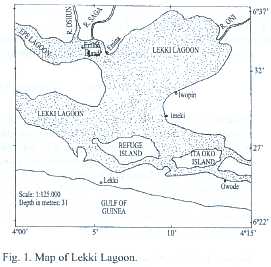
<body><![CDATA[<p><font face="Arial" size="2">The fish is generally classified as omnivores or predators feeding mainly on aquatic insects, fish and higher plants debris as reported for catfishes in the River Ubangui, Central African Republic (<a href="#mi73">Micha 1973</a>). They have also been found to feed on terrestrial insects, molluscs and fruits. Bruton (1977b) found that adult catfishes in Lake Sibaya (South Africa) fed mainly on fish or crustacean, while terrestrial and aquatic insects were the important diet of juvenile and adult fishes inhabiting shallow areas. The catfishes utilize various kinds of food resources available in their habitats.</font></p>     <p><font face="Arial" size="2">Documentation of parasite fauna of fishes especially used in aquaculture is on the increase. In northern Nigeria, a number of gastrointestinal helminth worms have been documented, in <i>C. gariepinus </i>by <a href="#on04">Oniye <i>et al. </i>(2004)</a> in Zaria and Yakubu <i>et al. </i>(2002) in Plateau state. Oniye <i>et al. </i>reported the occurrence of cestodes, <i>Anomotaenia </i>sp.(2.5%), <i>Monobothrium </i>sp.(13.33%) and <i>Polyonchobothrium clarias </i>(1.67%); the nematode, <i>Procamallanus laevionchus </i>and an acanthocephalan, <i>Neoechinorhynchus rutli </i>(0.83%).</font></p>     <p><font face="Arial" size="2">As a consequence of the wide geographic spread, the diverse and non-specific food types or diet, the commercial and aquaculture values of the catfish, <i>C. gariepinus</i>, an investigation of the helminth fauna was undertaken to evaluate the nature and impact of helminth infections in the southern part of the country. The present study was carried out in Lekki Lagoon which serves as an important fishing zone to the inhabitants of Epe and metropolitan Lagos at large. </font></p> <font face="Arial" size="2"><b>     <p>Materials and methods </p> </b> <b></b></font>     <p><font face="Arial" size="2"><b>Study Area: </b>Lekki lagoon supports a major fishery in Nigeria. The Lekki lagoon located in Lagos State Nigeria lies between longitudes 4º00’ and 4º15’ E and between latitudes 6º25’ and 6º37’ N, has a surface area of about 247 km<sup>2</sup> with a maximum depth of 6.4 m. A large portion of the lagoon is shallow and less than 3.0 m deep. The Lekki lagoon is part of an intricate system of waterways made up of lagoons and creeks that are found along the coast of South-western Nigeria from the Dahomey border to the Niger Delta stretching over a distance of about 200 km. It is fed by the River Oni discharging to the North-eastern and the Rivers Oshun and Saga discharging into the North-western parts of the lagoon.</font></p>     <p><font face="Arial" size="2">The vegetation around the lagoon is characterised by shrub and raphia palms, <i>Raphia sudanica</i>, and oil palms <i>Elaeis guineensis</i>. Floating grass occur on the periphery of the lagoon while coconut palms <i>Cocos nucifera </i>are widespread in the surrounding villages.</font></p>     <p><font face="Arial" size="2">The lagoon which experiences both dry and rainy seasons typical of the southern part of Nigeria supports a major fishery in Nigeria. The rich fish fauna of the lagoon includes <i>Heterotis niloticus</i>, <i>Gymnarchus niloticus</i>, <i>Clarias gariepinus</i>, <i>Malapterurus electricus</i>, <i>Synodontis clarias</i>, <i>Chrysichthys nigrodigitatus</i>, <i>Channa obscura</i>, <i>Mormyrus rume</i>, <i>Calabaricus calamoichthys</i>, <i>Tilapia zilli</i>, <i>Tilapia galilae</i>, <i>Hemichromis fasciatus </i>and <i>Sarotherodon melanotheron </i>(<a href="#ku81">Kusemiju 1981</a>). The map of Lekki Lagoon is shown in <a href="#f1">figure 1</a>.</font></p> <a name="f1"></a>     <div style="text-align: center;"><img src="/img/fbpe/rbt/v54n1/3360i7.JPG" title=""  alt="" style="width: 271px; height: 267px;"></div>     
<p><font face="Arial" size="2">&nbsp;</font></p> <font face="Arial" size="2"><b></b></font>     <p><font face="Arial" size="2"><b>Collection and Examination of specimens for Parasites: </b>From early, 2003 to late, 2004, 360 randomly selected fresh specimens of <i>Clarias gariepinus </i>recovered from Lekki lagoon were purchased at Oluwo Market at Epe, Lagos, Nigeria and were examined for parasites. The weights, standard lengths and total lengths of the fishes were recorded. The fishes were dissected and the alimentary canals were removed and cut into parts in physiological saline for parasite recovery. The intestines were further carefully slit open to aid the emergence of parasites. The recognition of the worms was enhanced by the wriggling movements on emergence.</font></p> <font face="Arial" size="2"><b></b></font>     ]]></body>
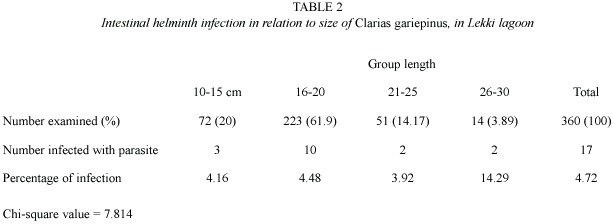
<body><![CDATA[<p><font face="Arial" size="2"><b>Processing of Parasites Recovered: </b>The recovered helminth parasites were fixed in 70% alcohol, counted and recorded. Whole mount histological preparations of worms stained with Haematoxylin and eosin were prepared. Identification of specimens to species level was undertaken and confirmed at the British Museum (Natural History), United Kingdom. </font></p> <font face="Arial" size="2"><b>     <p>Results </p> </b> </font>     <p><font face="Arial" size="2">Three hundred and sixty specimens of <i>Clarias gariepinus </i>were subjected to parasitologic investigations. All helminthic infections observed and recorded were restricted to the intestine. Three gastrointestinal helminth worms recovered included a nematode, <i>Paracamallanus cyathopharynx </i>(Baylis, 1923) (Camallanidae) and three cestodes, <i>Polyonchobothrium clarias </i>(Woodland, 1925) (Ptychobothriidae), <i>Wenyonia acuminata </i>(Woodland, 1923) (Caryophyllaeiidae) and <i>Stocksia </i>pujehuni (Woodland 1937) (Caryophyllaeidae). No acanthocephalan was recovered.</font></p>     <p><font face="Arial" size="2">Seventeen samples were infected. A prevalence of 4.72% was recorded. Single and mixed infections with 2 helminth worms were observed. <a href="#t1">Table 1</a> presents the prevalence of helminthic infections with the male showing a slightly higher prevalence (5.75%) than the females (3.76%). The variation in size of the catfishes in relation to helminthic infection of <i>Clarias gariepinus </i>is presented in <a href="#t2">Table 2</a>. Fishes in length categories 16-20 cm and 26- 30 cm recorded significantly higher helminth prevalence than the other length categories.The prevalence of parasitic infections was minimal in the length group 10-15 cm and 21-25 cm.</font></p> <a name="t1"></a>     <div style="text-align: center;"><img src="/img/fbpe/rbt/v54n1/3360i1.JPG" title=""  alt="" style="width: 298px; height: 242px;">    
<br> </div>     <br> <a name="t2"></a>     <div style="text-align: center;"><img src="/img/fbpe/rbt/v54n1/3360i2.JPG" title=""  alt="" style="width: 613px; height: 224px;">    
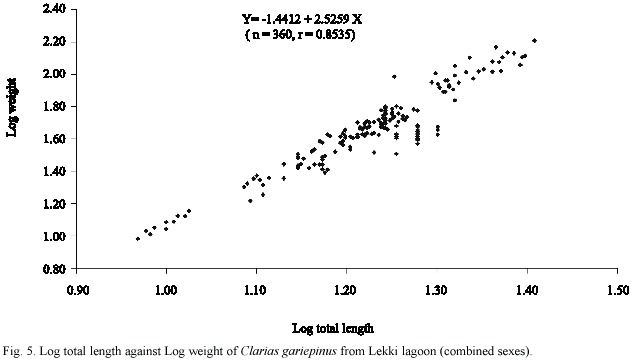
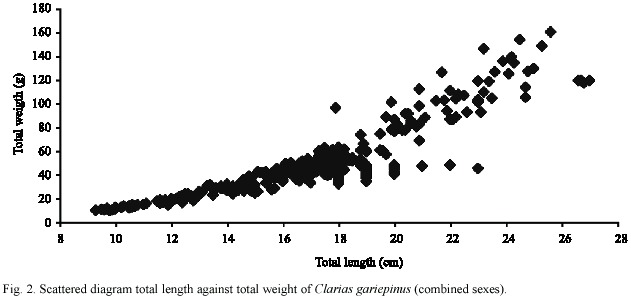
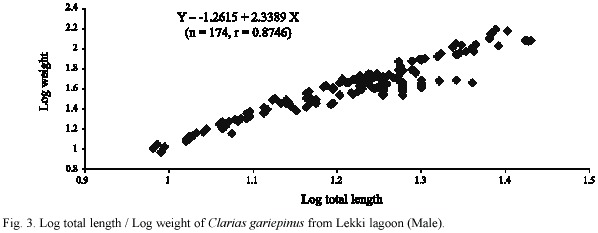
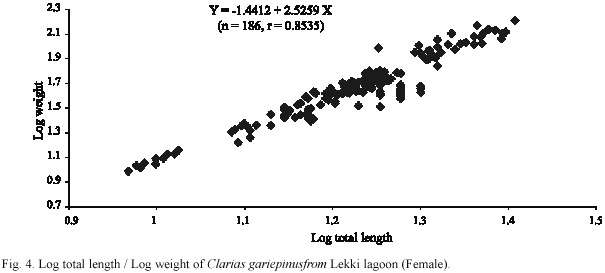
<br> </div>     <p><font face="Arial" size="2">The weight of the fish samples examined ranged from 13.46 g to 160.33 g. Parasitic helminthes were observed in all weight categories. The results also showed that smaller specimens are more liable to infections than the bigger ones. <a href="#f2">Figures 2</a>, <a href="#f3">3</a>, <a href="#f4">4</a> and <a href="#f5">5</a> showed scattered diagrams of total length against weight of males, females and combined sexes. The specimens of <i>Clarias gariepinus </i>showed negative allometric growth; this implies that growth is proportional to increase weight. Observations indicate that the smaller fishes recorded higher infection than bigger fishes.    ]]></body>
<body><![CDATA[<br> </font></p>     <p style="text-align: center;"><font face="Arial" size="2"><a name="f2"></a><img  src="/img/fbpe/rbt/v54n1/3360i3.JPG" title="" alt=""  style="width: 631px; height: 299px;">    
<br>     <br> </font></p>     <p style="text-align: center;"><font face="Arial" size="2"><a name="f3"></a><img  src="/img/fbpe/rbt/v54n1/3360i4.JPG" title="" alt=""  style="width: 598px; height: 233px;">    
<br>     <br> </font></p>     <p style="text-align: center;"><font face="Arial" size="2"><a name="f4"></a><img  src="/img/fbpe/rbt/v54n1/3360i5.JPG" title="" alt=""  style="width: 605px; height: 273px;">    
<br>     <br> </font></p>     ]]></body>
<body><![CDATA[<p style="text-align: center;"><font face="Arial" size="2"><a name="f5"></a><img  src="/img/fbpe/rbt/v54n1/3360i6.JPG" title="" alt=""  style="width: 632px; height: 360px;">    
<br> </font></p> <font face="Arial" size="2"><b>     <p>Discussion </p> </b> </font>     <p><font face="Arial" size="2">The gastrointestinal helminth parasites of <i>Clarias gariepinus </i>in Lekki lagoon, Lagos, Nigeria were investigated.A prevalence of 4.72%gastrointestinal helminthic infections was recorded. The parasites recovered from the present study are <i>Polyonchobothrium clarias</i>, (Woodland 1925) <i>Stocksia pujehuni</i>, (Woodland 1937) <i>Paracamallanus cyathopharynx (Baylis 1923) </i>and <i>Wenyonia acuminata (Woodland 1923)</i>. According to the host parasite checklist on African freshwater fishes of <a  href="#kh97">Khalil and Polling (1997)</a>, <i>P. clarias </i>has been documented in <i>Clarias gariepinus </i>.However,the present study is the first record of <i>P.cyathopharynx </i>and <i>Wenyonia acuminata </i>in <i>Clarias gariepinus. </i><a href="#on04">Oniye <i>et al</i>.(2004)</a> in Zaria, Nigeria, isolated five species of helminth parasites comprising three cestodes,one nematode, and one acanthocephala. In the present study no acanthocephalan species was recorded. The parasite fauna of <i>C. gariepinus </i>varied from the southern and northern hemisphere of the country. This is significant from the aquaculture viewpoint.</font></p>     <p><font face="Arial" size="2">Diverse prevalence of <i>Polyonchobothrium clarias </i>are documented in the literature. <a href="#im71">Imam (1971)</a>, reported an incidence of <i>Polyonchobothrium clarias </i>as high as 42% for <i>Clarias gariepinus </i>dwelling in the Nile, in mid Egypt (Cairo and Guiza provinces) while <a href="#sa82">Sawa (1982)</a> recorded the prevalence of 22% in Manzalla Lake, Egypt. However, a low parasite prevalence and burden were observed in this survey. <a  href="#ya02">Yakubu <i>et al. </i>(2002)</a> in a comparative study of the helminths of <i>Tilapia zilli </i>(Gervais, 1848) and <i>Clarias gariepinus </i>from River Uke, Plateau State, Nigeria, reported a 55% prevalence of helminth infections in <i>Clarias gariepinus</i>. The nature of the lagoon,inclusive of its physical and physcio-chemical parameters may influence the low prevalence of intestinal helminth in the catfishes compared to those of inland waters. Climatological factors which influence the fauna and flora of the water body and hence the feeding patterns and habits of the fishes may be responsible for the variable parasite fauna and intensity in the different zones in the country. While the climate in the south is equatorial the northern zone experiences savannah conditions. Geo-climatic factors apart from influencing the prevalence and intensity of the helminthic infection probably play a significant role in the parasite fauna of <i>Clarias gariepinus in Nigeria.</i></font></p>     <p><font face="Arial" size="2"><i>Paracamallanus cyathopharynx </i>is an ovoviviparous camallanid nematode whose larvae are liberated into the gut of the host and pass out with the faeces (<a href="#mo74">Moravec 1974</a>). The first moult of the parasite takes place in the copepod intermediate host and the last two moults take place in the fish. It is speculated that the utilization of the copepods as food by the catfishes in the lagoon is minimal and higher in the small sized fishes; other food types being readily accessible for fish consumption. Available physical space, the geographical position, physico-chemical factors of the water body, the nature of diet will influence the nature and the frequency and intensity of helminth infections in the aquaculture of catfishes.</font></p>     <p><font face="Arial" size="2">In the present study, <i>Wenyonia acuminata </i>was isolated from the intestine of <i>Clarias gariepinus</i>. In West Africa, species of <i>Wenyonia </i>have been reported in <i>Synodontis </i>species (<a href="#kh97">Khalil and Polling 1997</a>). For instance, <a href="#ba75">Banhawy <i>et al. </i>(1975)</a> isolated <i>Wenyonia virilis </i>from the ileum of the silurid fish, <i>Synodontis schall</i>.</font></p>     <p><font face="Arial" size="2">The occurrence of these parasites also in <i>Clarias gariepinus </i>may be indicative of similar diets, feeding habits and patterns amongst the freshwater fishes.The documented host for <i>Wenyomia acuminata </i>include S <i>ynodontis membranaceus.</i></font></p>     <p><font face="Arial" size="2">It is important to note that many helminth parasites in the alimentary canal of fish are pathogenic.The pathological effects of these helminths are as a result of the mechanical damage caused by the attachment organs. <i>Polyonchobothrium clarias </i>has been known to induce series of pathological lesions on the intestines of <i>Clarias gariepinus</i>. <a href="#ba75">Banhawy <i>et </i>al (1975)</a> reported degenerative changes in the gut wall of <i>Synodontis schall</i>. Some pseudophylid cestodes are known to cause irritation of gastric mucosa of fish (<a href="#wi69">William 1969</a>, <a  href="#eu59">Euzet 1959</a>). The impact of worm burden and prevalence on fish size needs to be assessed.</font></p>     <p><font face="Arial" size="2">Parasites were recovered from fishes in all weight categories. The report of <a href="#on04">Oniye <i>et al. </i>(2004)</a> indicated that fishes with weight (150-299.9 g) were free of infection. Also, the higher prevalence of helminthic infection in fishes weighing between 350.0-399.0 g and 450.0-500.0 g) could be related to the larger sized fishes recovered in the north. Large-scale fishing in the Lekki Lagoon may account for the medium sized nature of the prevalent fishes compared to those from Zaria.</font></p>     ]]></body>
<body><![CDATA[<p><font face="Arial" size="2">Variations in the infections of the different length categories were recorded. The prevalence of parasitic infections correlates with fish length which in turn corresponds to fish age as reported by Lagler <i>et al</i>. (1979). Low infection was found in fish length 10-15 cm (4.16%) and 21-25 (3.92%). This may be attributed to probable differences in feeding habits with fish age and immunity. <a href="#on04">Oniye <i>et al. </i>(2004)</a> had also indicated the importance of changing feeding habits of the fish with age on the parasite prevalence and intensity.</font></p>     <p><font face="Arial" size="2">Further studies are required to establish the diverse factors that influence the prevalence of gastrointestinal helminths, considering the consequent pathogenicity and the aquaculture value of <i>Clarias gariepinus </i>in Nigeria. </font></p> <font face="Arial" size="2"><b>     <p>Acknowledgment </p> </b> </font>     <p><font face="Arial" size="2">The authors express sincere gratitude to David Gibson of the British Museum, Parasitic Worms Division, United Kingdom, for identifying the parasites to species level. </font></p> <font face="Arial" size="2"><b>     <p>References </p> </b> </font>     <!-- ref --><p><font face="Arial" size="2"><a name="ba75"></a>Banhawy, M. A., M. F. A. Saoud, I. M. Anwar &amp; M. K. El-Naffar. 1975.The histopathological effects of the parasitic tapeworm <i>Wenyonia virilis </i>on the ileum and liver of the silurid fish <i>Synodontis schall</i>. Ann. Zool. 11:83-101.    &nbsp;&nbsp;&nbsp;&nbsp;&nbsp;&nbsp;&nbsp;&nbsp;[&#160;<a href="javascript:void(0);" onclick="javascript: window.open('/scielo.php?script=sci_nlinks&ref=1653383&pid=S0034-7744200600010001100001&lng=','','width=640,height=500,resizable=yes,scrollbars=1,menubar=yes,');">Links</a>&#160;]<!-- end-ref --></font></p>     <!-- ref --><p><font face="Arial" size="2"><a name="br79a"></a>Bruton, M. N. 1979a. The breeding biology and early development of <i>Clarias gariepinus </i>(<i>Pisces claridae </i>) in Lake Sibaya, South Africa, with a review of breeding species of the subgenus <i>Clarias </i>(<i>clarices </i>). Trans. Zool. Soc. London 35:1-45.    &nbsp;&nbsp;&nbsp;&nbsp;&nbsp;&nbsp;&nbsp;&nbsp;[&#160;<a href="javascript:void(0);" onclick="javascript: window.open('/scielo.php?script=sci_nlinks&ref=1653385&pid=S0034-7744200600010001100002&lng=','','width=640,height=500,resizable=yes,scrollbars=1,menubar=yes,');">Links</a>&#160;]<!-- end-ref --></font></p>     <!-- ref --><p><font face="Arial" size="2"><a name="br79b"></a>Bruton, M. N. 1979b. The food and feeding behaviour of <i>Clarias gariepinus </i>(<i>pisces, claridae</i>) in Lake Sibaya, South Africa, with its emphasis on its role as a predator of cochleds. Trans. Zool. Soc. London 35: 47-114.    &nbsp;&nbsp;&nbsp;&nbsp;&nbsp;&nbsp;&nbsp;&nbsp;[&#160;<a href="javascript:void(0);" onclick="javascript: window.open('/scielo.php?script=sci_nlinks&ref=1653387&pid=S0034-7744200600010001100003&lng=','','width=640,height=500,resizable=yes,scrollbars=1,menubar=yes,');">Links</a>&#160;]<!-- end-ref --></font></p>     <!-- ref --><p><font face="Arial" size="2"><a name="cl79"></a>Clay, D. 1979. Population biology, growth and feeding of the African Catfish, <i>Clarias gariepinus </i>,with special reference to juveniles and their importance in fish culture. Arch. Hydrobiol. 87 (4): 453-482.    &nbsp;&nbsp;&nbsp;&nbsp;&nbsp;&nbsp;&nbsp;&nbsp;[&#160;<a href="javascript:void(0);" onclick="javascript: window.open('/scielo.php?script=sci_nlinks&ref=1653389&pid=S0034-7744200600010001100004&lng=','','width=640,height=500,resizable=yes,scrollbars=1,menubar=yes,');">Links</a>&#160;]<!-- end-ref --></font></p>     <!-- ref --><p><font face="Arial" size="2"><a name="eu59"></a>Euzet, L. 1959. Researches Sur les cestodes tetraphyllides des selaciens cotes de France. Thesis. University of Montpellier, 263 pp.    &nbsp;&nbsp;&nbsp;&nbsp;&nbsp;&nbsp;&nbsp;&nbsp;[&#160;<a href="javascript:void(0);" onclick="javascript: window.open('/scielo.php?script=sci_nlinks&ref=1653391&pid=S0034-7744200600010001100005&lng=','','width=640,height=500,resizable=yes,scrollbars=1,menubar=yes,');">Links</a>&#160;]<!-- end-ref --></font></p>     <!-- ref --><p><font face="Arial" size="2"><a name="im71"></a>Imam, E. A. 1971. Morphological and biological studies on the enteric helminths infecting some of the Egyptian Nile fishes particularly <i>Polyonchobothrim clarias </i>of <i>Karmot clarias lazera </i>and <i>Clarias anguillaris</i>. Ph. D. Thesis, Parasitology. Cairo University.    &nbsp;&nbsp;&nbsp;&nbsp;&nbsp;&nbsp;&nbsp;&nbsp;[&#160;<a href="javascript:void(0);" onclick="javascript: window.open('/scielo.php?script=sci_nlinks&ref=1653393&pid=S0034-7744200600010001100006&lng=','','width=640,height=500,resizable=yes,scrollbars=1,menubar=yes,');">Links</a>&#160;]<!-- end-ref --></font></p>     <!-- ref --><p><font face="Arial" size="2"><a name="kh97"></a>Khalil, L. F. &amp; L. Polling. 1997. Checklist of the helminth parasites of African freshwater fishes. University of the North Republic of South Africa, 161 pages.    &nbsp;&nbsp;&nbsp;&nbsp;&nbsp;&nbsp;&nbsp;&nbsp;[&#160;<a href="javascript:void(0);" onclick="javascript: window.open('/scielo.php?script=sci_nlinks&ref=1653395&pid=S0034-7744200600010001100007&lng=','','width=640,height=500,resizable=yes,scrollbars=1,menubar=yes,');">Links</a>&#160;]<!-- end-ref --></font></p>     <!-- ref --><p><font face="Arial" size="2"><a name="ku81"></a>Kusemiju, K. 1981. The hydrobiology and fishes of the Lekki Lagoon, Nigeria. Nig. J. Nat. Sci. 3(1-2): 135-146.    &nbsp;&nbsp;&nbsp;&nbsp;&nbsp;&nbsp;&nbsp;&nbsp;[&#160;<a href="javascript:void(0);" onclick="javascript: window.open('/scielo.php?script=sci_nlinks&ref=1653397&pid=S0034-7744200600010001100008&lng=','','width=640,height=500,resizable=yes,scrollbars=1,menubar=yes,');">Links</a>&#160;]<!-- end-ref --></font></p>     <!-- ref --><p><font face="Arial" size="2"><a name="la97"></a>Lagler, K. F. , J. E. Bardach &amp; R. R. Miller. 1997. Ichthyology. John Wiley, New York.    &nbsp;&nbsp;&nbsp;&nbsp;&nbsp;&nbsp;&nbsp;&nbsp;[&#160;<a href="javascript:void(0);" onclick="javascript: window.open('/scielo.php?script=sci_nlinks&ref=1653399&pid=S0034-7744200600010001100009&lng=','','width=640,height=500,resizable=yes,scrollbars=1,menubar=yes,');">Links</a>&#160;]<!-- end-ref --></font></p>     <!-- ref --><p><font face="Arial" size="2"><a name="mi73"></a>Micha, J. C. 1973. Etude des populations piscicoles de l ’ubangui et tentative de selection et d’ adaptation de quelques especes a l’etang de pisceculture. Centre Technique Forestiere Tropical, Nogent Sur Marne, 100 pp.    &nbsp;&nbsp;&nbsp;&nbsp;&nbsp;&nbsp;&nbsp;&nbsp;[&#160;<a href="javascript:void(0);" onclick="javascript: window.open('/scielo.php?script=sci_nlinks&ref=1653401&pid=S0034-7744200600010001100010&lng=','','width=640,height=500,resizable=yes,scrollbars=1,menubar=yes,');">Links</a>&#160;]<!-- end-ref --></font></p>     <!-- ref --><p><font face="Arial" size="2"><a name="mo74"></a>Moravec, F. 1974. The development of <i>Paracamallanus cyathopharynx </i>(Baylis,1923) Nematoda: Camallanidae. Folia Parasit. 21: 333-343.    &nbsp;&nbsp;&nbsp;&nbsp;&nbsp;&nbsp;&nbsp;&nbsp;[&#160;<a href="javascript:void(0);" onclick="javascript: window.open('/scielo.php?script=sci_nlinks&ref=1653403&pid=S0034-7744200600010001100011&lng=','','width=640,height=500,resizable=yes,scrollbars=1,menubar=yes,');">Links</a>&#160;]<!-- end-ref --></font></p>     <!-- ref --><p><font face="Arial" size="2"><a name="on04"></a>Oniye, S. J., D. A. Adebote &amp; O. I. Ayanda. 2004. Helminth parasites of <i>Clarias gariepinus </i>in Zaria, Nigeria. J. Aquatic Sci. 19 (2): 71-76.    &nbsp;&nbsp;&nbsp;&nbsp;&nbsp;&nbsp;&nbsp;&nbsp;[&#160;<a href="javascript:void(0);" onclick="javascript: window.open('/scielo.php?script=sci_nlinks&ref=1653405&pid=S0034-7744200600010001100012&lng=','','width=640,height=500,resizable=yes,scrollbars=1,menubar=yes,');">Links</a>&#160;]<!-- end-ref --></font></p>     <!-- ref --><p><font face="Arial" size="2"><a name="sa82"></a>Sahlab, A. 1982. Studies on the enteric helminth parasites of fish from Lake Manzalla, M. Sc. Thesis (Parasitology). Cairo University, Egypt.    &nbsp;&nbsp;&nbsp;&nbsp;&nbsp;&nbsp;&nbsp;&nbsp;[&#160;<a href="javascript:void(0);" onclick="javascript: window.open('/scielo.php?script=sci_nlinks&ref=1653407&pid=S0034-7744200600010001100013&lng=','','width=640,height=500,resizable=yes,scrollbars=1,menubar=yes,');">Links</a>&#160;]<!-- end-ref --></font></p>     <!-- ref --><p><font face="Arial" size="2"><a name="ya02"></a>Yakubu D. P., E. Omoregie &amp; J. W. Wade. 2002. A comparative study of gut helminths of <i>Tilapia Zilli and Clarias gariepinus </i>from river uke, plateau state, Nigeria. J. Aquatic Sci. 17 (2): 137-139.    &nbsp;&nbsp;&nbsp;&nbsp;&nbsp;&nbsp;&nbsp;&nbsp;[&#160;<a href="javascript:void(0);" onclick="javascript: window.open('/scielo.php?script=sci_nlinks&ref=1653409&pid=S0034-7744200600010001100014&lng=','','width=640,height=500,resizable=yes,scrollbars=1,menubar=yes,');">Links</a>&#160;]<!-- end-ref --></font></p>     <!-- ref --><p><font face="Arial" size="2"><a name="wi69"></a>Williams, H. H. 1969. Some observations on <i>Parabothrium gadipollachii </i>(Rudolphi,1810) and <i>Abothrium gadi </i>van Beneden, 1870 (Cestoda:Pseudophyllidae) including an account of their mode of attachment and variation in the two species. Parasitology: 303-322.    &nbsp;&nbsp;&nbsp;&nbsp;&nbsp;&nbsp;&nbsp;&nbsp;[&#160;<a href="javascript:void(0);" onclick="javascript: window.open('/scielo.php?script=sci_nlinks&ref=1653411&pid=S0034-7744200600010001100015&lng=','','width=640,height=500,resizable=yes,scrollbars=1,menubar=yes,');">Links</a>&#160;]<!-- end-ref --> </font></p>      ]]></body><back>
<ref-list>
<ref id="B1">
<nlm-citation citation-type="journal">
<person-group person-group-type="author">
<name>
<surname><![CDATA[Banhawy]]></surname>
<given-names><![CDATA[M. A]]></given-names>
</name>
<name>
<surname><![CDATA[Saoud]]></surname>
<given-names><![CDATA[M. F. A]]></given-names>
</name>
<name>
<surname><![CDATA[Anwar]]></surname>
<given-names><![CDATA[I. M]]></given-names>
</name>
<name>
<surname><![CDATA[El-Naffar]]></surname>
<given-names><![CDATA[M. K]]></given-names>
</name>
</person-group>
<article-title xml:lang="en"><![CDATA[The histopathological effects of the parasitic tapeworm Wenyonia virilis on the ileum and liver of the silurid fish Synodontis schall]]></article-title>
<source><![CDATA[Ann. Zool]]></source>
<year>1975</year>
<volume>11</volume>
<page-range>83-101</page-range></nlm-citation>
</ref>
<ref id="B2">
<nlm-citation citation-type="journal">
<person-group person-group-type="author">
<name>
<surname><![CDATA[Bruton]]></surname>
<given-names><![CDATA[M. N]]></given-names>
</name>
</person-group>
<article-title xml:lang="en"><![CDATA[The breeding biology and early development of Clarias gariepinus (Pisces claridae ) in Lake Sibaya, South Africa, with a review of breeding species of the subgenus Clarias (clarices )]]></article-title>
<source><![CDATA[Trans. Zool. Soc. London]]></source>
<year>1979</year>
<month>a</month>
<volume>35</volume>
<page-range>1-45</page-range></nlm-citation>
</ref>
<ref id="B3">
<nlm-citation citation-type="journal">
<person-group person-group-type="author">
<name>
<surname><![CDATA[Bruton]]></surname>
<given-names><![CDATA[M. N]]></given-names>
</name>
</person-group>
<article-title xml:lang="en"><![CDATA[The food and feeding behaviour of Clarias gariepinus (pisces, claridae) in Lake Sibaya, South Africa, with its emphasis on its role as a predator of cochleds]]></article-title>
<source><![CDATA[Trans. Zool. Soc. London]]></source>
<year>1979</year>
<month>b</month>
<volume>35</volume>
<page-range>47-114</page-range></nlm-citation>
</ref>
<ref id="B4">
<nlm-citation citation-type="journal">
<person-group person-group-type="author">
<name>
<surname><![CDATA[Clay]]></surname>
<given-names><![CDATA[D]]></given-names>
</name>
</person-group>
<article-title xml:lang="en"><![CDATA[Population biology, growth and feeding of the African Catfish, Clarias gariepinus ,with special reference to juveniles and their importance in fish culture]]></article-title>
<source><![CDATA[Arch. Hydrobiol]]></source>
<year>1979</year>
<volume>87</volume>
<numero>4</numero>
<issue>4</issue>
<page-range>453-482</page-range></nlm-citation>
</ref>
<ref id="B5">
<nlm-citation citation-type="">
<person-group person-group-type="author">
<name>
<surname><![CDATA[Euzet]]></surname>
<given-names><![CDATA[L]]></given-names>
</name>
</person-group>
<source><![CDATA[Researches Sur les cestodes tetraphyllides des selaciens cotes de France]]></source>
<year>1959</year>
<page-range>263</page-range></nlm-citation>
</ref>
<ref id="B6">
<nlm-citation citation-type="">
<person-group person-group-type="author">
<name>
<surname><![CDATA[Imam]]></surname>
<given-names><![CDATA[E. A]]></given-names>
</name>
</person-group>
<source><![CDATA[Morphological and biological studies on the enteric helminths infecting some of the Egyptian Nile fishes particularly Polyonchobothrim clarias of Karmot clarias lazera and Clarias anguillaris]]></source>
<year>1971</year>
</nlm-citation>
</ref>
<ref id="B7">
<nlm-citation citation-type="book">
<person-group person-group-type="author">
<name>
<surname><![CDATA[Khalil]]></surname>
<given-names><![CDATA[L. F]]></given-names>
</name>
<name>
<surname><![CDATA[Polling]]></surname>
<given-names><![CDATA[L]]></given-names>
</name>
</person-group>
<source><![CDATA[Checklist of the helminth parasites of African freshwater fishes]]></source>
<year>1997</year>
<page-range>161</page-range><publisher-name><![CDATA[University of the North Republic of South Africa]]></publisher-name>
</nlm-citation>
</ref>
<ref id="B8">
<nlm-citation citation-type="journal">
<person-group person-group-type="author">
<name>
<surname><![CDATA[Kusemiju]]></surname>
<given-names><![CDATA[K]]></given-names>
</name>
</person-group>
<article-title xml:lang="en"><![CDATA[The hydrobiology and fishes of the Lekki Lagoon, Nigeria]]></article-title>
<source><![CDATA[Nig. J. Nat. Sci]]></source>
<year>1981</year>
<volume>3</volume>
<numero>1-2</numero>
<issue>1-2</issue>
<page-range>135-146</page-range></nlm-citation>
</ref>
<ref id="B9">
<nlm-citation citation-type="book">
<person-group person-group-type="author">
<name>
<surname><![CDATA[Lagler]]></surname>
<given-names><![CDATA[K. F]]></given-names>
</name>
<name>
<surname><![CDATA[Bardach]]></surname>
<given-names><![CDATA[J. E]]></given-names>
</name>
<name>
<surname><![CDATA[Miller]]></surname>
<given-names><![CDATA[R. R]]></given-names>
</name>
</person-group>
<source><![CDATA[Ichthyology]]></source>
<year>1997</year>
<publisher-loc><![CDATA[^eNew York New York]]></publisher-loc>
<publisher-name><![CDATA[John Wiley]]></publisher-name>
</nlm-citation>
</ref>
<ref id="B10">
<nlm-citation citation-type="book">
<person-group person-group-type="author">
<name>
<surname><![CDATA[Micha]]></surname>
<given-names><![CDATA[J. C]]></given-names>
</name>
</person-group>
<source><![CDATA[Etude des populations piscicoles de l ’ubangui et tentative de selection et d’ adaptation de quelques especes a l’etang de pisceculture]]></source>
<year>1973</year>
<page-range>100</page-range><publisher-name><![CDATA[Centre Technique Forestiere Tropical, Nogent Sur Marne]]></publisher-name>
</nlm-citation>
</ref>
<ref id="B11">
<nlm-citation citation-type="journal">
<person-group person-group-type="author">
<name>
<surname><![CDATA[Moravec]]></surname>
<given-names><![CDATA[F]]></given-names>
</name>
</person-group>
<article-title xml:lang="en"><![CDATA[The development of Paracamallanus cyathopharynx (Baylis,1923) Nematoda: Camallanidae]]></article-title>
<source><![CDATA[Folia Parasit]]></source>
<year>1974</year>
<volume>21</volume>
<page-range>333-343</page-range></nlm-citation>
</ref>
<ref id="B12">
<nlm-citation citation-type="journal">
<person-group person-group-type="author">
<name>
<surname><![CDATA[Oniye]]></surname>
<given-names><![CDATA[S. J]]></given-names>
</name>
<name>
<surname><![CDATA[Adebote]]></surname>
<given-names><![CDATA[D. A]]></given-names>
</name>
<name>
<surname><![CDATA[Ayanda]]></surname>
<given-names><![CDATA[O. I]]></given-names>
</name>
</person-group>
<article-title xml:lang="en"><![CDATA[Helminth parasites of Clarias gariepinus in Zaria, Nigeria]]></article-title>
<source><![CDATA[J. Aquatic Sci]]></source>
<year>2004</year>
<volume>19</volume>
<numero>2</numero>
<issue>2</issue>
<page-range>71-76</page-range></nlm-citation>
</ref>
<ref id="B13">
<nlm-citation citation-type="">
<person-group person-group-type="author">
<name>
<surname><![CDATA[Sahlab]]></surname>
<given-names><![CDATA[A]]></given-names>
</name>
</person-group>
<source><![CDATA[Studies on the enteric helminth parasites of fish from Lake Manzalla]]></source>
<year>1982</year>
</nlm-citation>
</ref>
<ref id="B14">
<nlm-citation citation-type="journal">
<person-group person-group-type="author">
<name>
<surname><![CDATA[Yakubu]]></surname>
<given-names><![CDATA[D. P]]></given-names>
</name>
<name>
<surname><![CDATA[Omoregie]]></surname>
<given-names><![CDATA[E]]></given-names>
</name>
<name>
<surname><![CDATA[Wade]]></surname>
<given-names><![CDATA[J. W]]></given-names>
</name>
</person-group>
<article-title xml:lang="en"><![CDATA[A comparative study of gut helminths of Tilapia Zilli and Clarias gariepinus from river uke, plateau state, Nigeria]]></article-title>
<source><![CDATA[J. Aquatic Sci]]></source>
<year>2002</year>
<volume>17</volume>
<numero>2</numero>
<issue>2</issue>
<page-range>137-139</page-range></nlm-citation>
</ref>
<ref id="B15">
<nlm-citation citation-type="journal">
<person-group person-group-type="author">
<name>
<surname><![CDATA[Williams]]></surname>
<given-names><![CDATA[H. H]]></given-names>
</name>
</person-group>
<article-title xml:lang="en"><![CDATA[Some observations on Parabothrium gadipollachii (Rudolphi,1810) and Abothrium gadi van Beneden, 1870 (Cestoda:Pseudophyllidae) including an account of their mode of attachment and variation in the two species]]></article-title>
<source><![CDATA[Parasitology]]></source>
<year>1969</year>
<page-range>303-322</page-range></nlm-citation>
</ref>
</ref-list>
</back>
</article>