<?xml version="1.0" encoding="ISO-8859-1"?><article xmlns:mml="http://www.w3.org/1998/Math/MathML" xmlns:xlink="http://www.w3.org/1999/xlink" xmlns:xsi="http://www.w3.org/2001/XMLSchema-instance">
<front>
<journal-meta>
<journal-id>0034-7744</journal-id>
<journal-title><![CDATA[Revista de Biología Tropical]]></journal-title>
<abbrev-journal-title><![CDATA[Rev. biol. trop]]></abbrev-journal-title>
<issn>0034-7744</issn>
<publisher>
<publisher-name><![CDATA[Universidad de Costa Rica]]></publisher-name>
</publisher>
</journal-meta>
<article-meta>
<article-id>S0034-77442006000100009</article-id>
<title-group>
<article-title xml:lang="en"><![CDATA[A Comparison of Sap Flow Measurements and Potometry in Two Tropical Lowland Tree Species with Contrasting Wood Properties]]></article-title>
</title-group>
<contrib-group>
<contrib contrib-type="author">
<name>
<surname><![CDATA[Gutiérrez]]></surname>
<given-names><![CDATA[Marco V]]></given-names>
</name>
<xref ref-type="aff" rid="A01"/>
</contrib>
<contrib contrib-type="author">
<name>
<surname><![CDATA[Santiago]]></surname>
<given-names><![CDATA[Louis S]]></given-names>
</name>
<xref ref-type="aff" rid="A02"/>
</contrib>
</contrib-group>
<aff id="A01">
<institution><![CDATA[,Universidad de Costa Rica  ]]></institution>
<addr-line><![CDATA[Alajuela ]]></addr-line>
<country>Costa Rica</country>
</aff>
<aff id="A02">
<institution><![CDATA[,University of Hawaii  ]]></institution>
<addr-line><![CDATA[Honolulu ]]></addr-line>
<country>USA</country>
</aff>
<pub-date pub-type="pub">
<day>00</day>
<month>03</month>
<year>2006</year>
</pub-date>
<pub-date pub-type="epub">
<day>00</day>
<month>03</month>
<year>2006</year>
</pub-date>
<volume>54</volume>
<numero>1</numero>
<fpage>73</fpage>
<lpage>81</lpage>
<copyright-statement/>
<copyright-year/>
<self-uri xlink:href="http://www.scielo.sa.cr/scielo.php?script=sci_arttext&amp;pid=S0034-77442006000100009&amp;lng=en&amp;nrm=iso"></self-uri><self-uri xlink:href="http://www.scielo.sa.cr/scielo.php?script=sci_abstract&amp;pid=S0034-77442006000100009&amp;lng=en&amp;nrm=iso"></self-uri><self-uri xlink:href="http://www.scielo.sa.cr/scielo.php?script=sci_pdf&amp;pid=S0034-77442006000100009&amp;lng=en&amp;nrm=iso"></self-uri><abstract abstract-type="short" xml:lang="en"><p><![CDATA[We evaluated the performance of the Heat Dissipation Technique (HDT) to measure sap flow in whole trees by comparison with potometric water uptake. Two tropical lowland species, Ochroma lagopus (balsa), a pioneer species with light wood and Hyeronima alchorneoides (pilón), a late-successional species with hard wood were examined. Diurnal courses of sap flow measured with the HDT showed good agreement with potometry. At the low sap flow rates (below 1 Kg h-1) occurring during nocturnal recharge HDT consistently underestimated sap flow rates. This resulted in the failure of the current version of the HDT to measure nocturnal water uptake, an important component of the water budget of at least one of the two species examined. Rev. Biol. Trop. 54(1): 73-81. Epub 2006 Mar 31.]]></p></abstract>
<kwd-group>
<kwd lng="en"><![CDATA[heat dissipation technique]]></kwd>
<kwd lng="en"><![CDATA[nocturnal uptake]]></kwd>
<kwd lng="en"><![CDATA[potometer]]></kwd>
<kwd lng="en"><![CDATA[tropical trees]]></kwd>
<kwd lng="en"><![CDATA[sap flow]]></kwd>
<kwd lng="en"><![CDATA[stomatal conductance]]></kwd>
<kwd lng="en"><![CDATA[wood density]]></kwd>
</kwd-group>
</article-meta>
</front><body><![CDATA[  <b><font face="Arial">     <p align="center">A Comparison of Sap Flow Measurements and Potometry in Two Tropical Lowland Tree Species with Contrasting Wood Properties</p> </font><font face="Arial" size="2"> </font></b>     <p><font face="Arial" size="2">Marco V.Gutiérrez<a name="1"></a><a  href="#2"><sup>1</sup>*</a> &amp; Louis S. Santiago<sup><a href="#2">2</a>,<a  href="#2">3</a></sup> </font></p>     <p><font face="Arial" size="2"><a name="2"></a><a href="#1">1</a> Universidad de Costa Rica, Estación Experimental Fabio Baudrit, Alajuela, Costa Rica. </font></p>     <p><font face="Arial" size="2"><a href="#1">2</a> University of Hawaii, Department of Botany, Honolulu, HI, 96822 USA. </font></p>     <p><font face="Arial" size="2"><a href="#1">3</a> Present address: University of Florida, Department of Botany, 220 Bartram Hall, P. O. Box 118526, Gainesville, FL 32611-8526, USA. </font></p>     <p><font face="Arial" size="2"><a href="#1">*</a> Corresponding author: Universidad de Costa Rica, Facultad de Agronomía, San José, Costa Rica. Phone: (506) 433- 9111. Fax: (506) 433-9086; <a  href="mailto:surdo26@racsa.co.cr">surdo26@racsa.co.cr</a></font></p>     <p align="center"><font face="Arial" size="2">Received 31-V-2002. Corrected 13-VII-2005. Accepted 16-XII-2005.</font></p> <font face="Arial" size="2"><b></b></font>     <p><font face="Arial" size="2"><b>Abstract: </b>We evaluated the performance of the Heat Dissipation Technique (HDT) to measure sap flow in whole trees by comparison with potometric water uptake. Two tropical lowland species, <i>Ochroma lagopus </i>(balsa), a pioneer species with light wood and <i>Hyeronima alchorneoides </i>(pilón), a late-successional species with hard wood were examined. Diurnal courses of sap flow measured with the HDT showed good agreement with potometry. At the low sap flow rates (below 1 Kg h<sup>-1</sup>) occurring during nocturnal recharge HDT consistently underestimated sap flow rates. This resulted in the failure of the current version of the HDT to measure nocturnal water uptake, an important component of the water budget of at least one of the two species examined. Rev. Biol. Trop. 54(1): 73-81. Epub 2006 Mar 31.</font></p> <font face="Arial" size="2"><b></b></font>     <p><font face="Arial" size="2"><b>Key words: </b>heat dissipation technique, nocturnal uptake, potometer, tropical trees, sap flow, stomatal conductance, wood density.</font></p>     ]]></body>
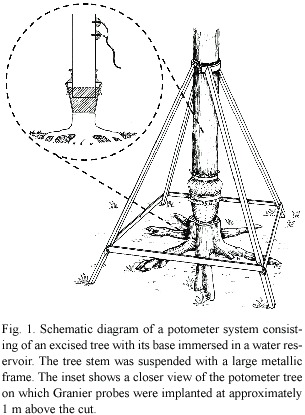
<body><![CDATA[<p><font face="Arial" size="2">Current interest in measuring the exchange of water (and carbon dioxide) between whole ecosystems and the atmosphere has resulted in an increasing need to accurately measure fluxes at the whole tree level for analysis at larger scales. The development and refinement of techniques involving trunk sector heat balance (<a href="#ce73">Cerma k <i>et al. </i>1973</a>), stem heat balance (<a href="#sa81">Sakuratani 1981</a>), heat pulses (<a  href="#cl58">Closs 1958</a>, <a href="#ma58">Marshall 1958</a>), and heat dissipation (<a href="#gr85">Granier 1985</a>) to measure whole plant water use have followed because of their inexpensive and non-destructive nature.</font></p>     <p><font face="Arial" size="2">Heat dissipation has been especially promising to those wishing to measure water use in very large trees growing in the field. In contrast to heat balance methods (see <a  href="#he97">Herzog <i>et al</i>. 1997</a>), heat dissipation techniques have performed well in model systems as well as under field conditions (<a href="#ve97">Vertessy <i>et al</i>. 1997</a>). Errors due to radial (<a href="#ph96">Phillips <i>et al</i>. 1996</a>) and angular (<a href="#ca97">Cabibel <i>et al</i>. 1997</a>) variations in sap flow velocity, and to the determination of the conducting xylem area (<a href="#ph96">Phillips <i>et al</i>. 1996</a>) have been previously examined. Sap flow estimates based on heat dissipation measurements have shown errors in the range of 2-12% (<a href="#wu98">Wullschleger <i>et al</i>. 1998</a>). However, because of the empirical assumptions involved in these approaches, it is important to address divergences between measurements obtained by different techniques.</font></p>     <p><font face="Arial" size="2">Our objective was to test the capacity of the Heat Dissipation Technique to accurately measure water use of tropical trees, by comparing it with water uptake of trees held in potometers. Potometers are a useful tool for measuring water uptake (<a  href="#f1">Fig.1</a>), facilitating comparisons with other techniques (<a  href="#kn81">Knight <i>et al</i>. 1981</a>, <a href="#ve97">Vertessy <i>et al. </i>1997</a>). We also hoped to gain information on whether HDT can detect nocturnal water movement since the technique relies on the occurrence of zero flow during the night to calculate daily rates (<a  href="#gr85">Granier 1985</a>). Because of the low rates typically associated with nocturnal uptake (<a href="#gr89">Green <i>et al</i>. 1989</a>), and the influence of wood density and stem capacitance on this process (<a href="#wa78">Waring and Running 1978</a>, <a  href="#go97">Goldstein <i>et al</i>. 1997</a>), a specific objective was to asses the capacity of HDT to measure stem recharge in trees with contrasting wood properties. </font></p> <a name="f1"></a>     <div style="text-align: center;"><img src="/img/fbpe/rbt/v54n1/3358i1.JPG" title=""  alt="" style="width: 305px; height: 415px;"></div>     
<p><font face="Arial" size="2">&nbsp;</font></p> <font face="Arial" size="2"><b>     <p>Materials and methods    <br> <font face="Arial" size="2">    <br> <b>Experimental site and plant materia: </b><span  style="font-weight: normal;">The experiment was carried out at La Selva Biological Station (Organization for Tropical Studies)in the northern lowlands of Costa Rica, at an elevation of approximately 40 m and an average temperature of 24ºC. Annual precipitation is approximately 4000 mm with a short drier season in February-March. The site is on an alluvial terrace with a deep, well- drained fertile soil.Experiments were conducted on </span><i  style="font-weight: normal;">Ochroma lagopus </i><span  style="font-weight: normal;">(Bombacaceae) and </span><i  style="font-weight: normal;">Hyeronima alchorneoides </i><span  style="font-weight: normal;">(Euphorbiaceae) growing in plantations.Details of the establishment of the experimental plantations are given by Haggar and Ewel (1995).Experiments on </span><i  style="font-weight: normal;">Ochroma </i><span  style="font-weight: normal;">were conducted from 25-29 March, 1997, and observations on </span><i style="font-weight: normal;">Hyeronima </i><span  style="font-weight: normal;">were conducted from 12-16 June, 1997.</span></font> </p> </b> </font>     <p><font face="Arial" size="2"><i>Ochroma </i>is a very common, fast-growing pioneer species and the source of the lightest of commercial woods. Basic specific gravity (ovendry weight/fresh volume) is 0.10 to 0.17 g cm<sup>-3</sup> (<a href="#ch84">Chudnoff 1984</a>). The hartwood is pale brown or reddish and the sapwood, which comprises most of the commercial timber is nearly white (<a href="#ch84">Chudnoff 1984</a>). It exhibits no distinct growth rings in its cross section (<a  href="#wh83">Whitmore 1983</a>).</font></p> <font face="Arial" size="2"><i></i></font>     <p><font face="Arial" size="2"><i>Hyeronima </i>is an evergreen, late successional hardwood. No periodicity in growth increment is observed (L. Newsom, unpublished data). The hartwood is a light reddish brown to dark red and the sapwood is pinkish white and 2 to 5 cm wide. Basic specific gravity is 0.60 to 0.67 g cm<sup>-3</sup> (<a href="#ch84">Chudnoff 1984</a>).</font></p>     ]]></body>
<body><![CDATA[<p><font face="Arial" size="2">Two-year old <i>Ochroma </i>and four-year old <i>Hyeronima </i>trees were selected.Two trees of each species were chosen for potometers and two more trees were kept as controls. <i>Ochroma </i>trees were approximately 18 m tall, and <i>Hyeronima </i>trees were 15 to 16 m tall at the time of the experiment. For <i>Ochroma</i>, diameter at 1.5 m height was 9.9 and 13.6 cm for control trees, and 13.5 and 15.2 cm for trees in potometers. For <i>Hyeronima</i>, diameter at 1.5 m was 15.6 and 18.3 cm for control trees, and 12.0 and 12.6 cm for trees in potometers.</font></p> <font face="Arial" size="2"><b></b></font>     <p><font face="Arial" size="2"><b>Sap flow measurements: </b>We used the heat dissipation technique (HDT; <a href="#gr85">Granier 1985</a>) to measure sap flow of intact trees and trees installed in potometers. This technique measures the temperature of a line heat source implanted in the sapwood of a tree, referenced to the sapwood temperature measured 2 cm below the heated needle. The probe measures the sapwood heat dissipation, which increases with sap flow and the resultant cooling of the heat source.When the sap flow velocity is minimal, the temperature difference (dT) between the two sensors is maximal (dT<sub>max</sub>). For practical purposes, dT<sub>max</sub> is assumed to correspond to zero flow. When flow increases, dT between the two sensors decreases. This approach enables the measurement of sap flow velocity with inexpensive equipment from the empirical relationships between dT and sap velocity as defined by a dimensionless parameter K (<a href="#gr85">Granier 1985</a>): </font></p>     <p align="center"></p> <font face="Arial" size="2"><i></i></font>     <p align="center"><font face="Arial" size="2"><i>K= <u>(dT<sub>max</sub> - dT)</u></i></font></p>     <p align="center"><font face="Arial" size="2"><i> dT</i></font></p>     <p><font face="Arial" size="2">Granier also found empirically that the average sap flow velocity V (cm s<sup>-1</sup>) could be related to K by an exponential expression:</font></p> <font face="Arial" size="2"><i></i></font>     <p align="center"><font face="Arial" size="2"><i>V </i>= 0.00199 <font  face="Symbol">×</font> <i>K</i><sup>1.231</sup></font></p>     <p><font face="Arial" size="2">To convert velocity to sap flow rate, one uses:</font></p> <font face="Arial" size="2"><i></i></font>     <p align="center"><font face="Arial" size="2"><i>F<sub>s</sub>=A<sub>t</sub> <font face="Symbol">×</font> </i> <i>V </i>· 3600</font></p>     <p><font face="Arial" size="2">Where F<sub>S</sub> is sap flow rate (cm<sup>3</sup> h<sup>-1</sup>),A S is the cross-sectional area of conducting sapwood (cm<sup>2</sup>) and 3600 has units of s h<sup>-1</sup>.Typical mid-day values for V range from 10 to 80 cm h<sup>-1</sup> (<a href="#gr85">Granier 1985</a>, <a href="#gr92">Granier <i>et al</i>. 1992</a>, <a  href="#ve97">Vertessy <i>et al</i>. 1997</a>, <a href="#be98">Becker 1998</a>).</font></p>     ]]></body>
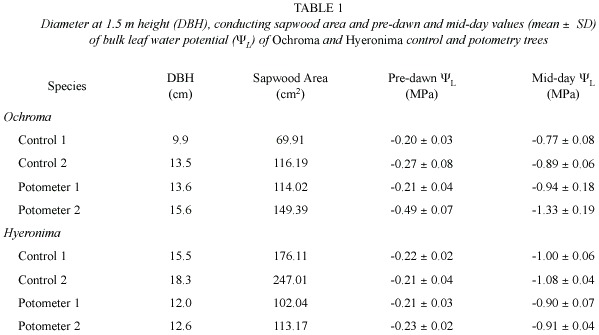
<body><![CDATA[<p><font face="Arial" size="2">Nocturnal water uptake was calculated using the same empirical relation described above. In water-storing tree stems, nocturnal stem recharge is expected to cause dT values to reach their typical nocturnal plateau later than in non-water storing stems. The dT<sub>max</sub> values observed during the night once dT had reached its pre-dawn plateau was considered dT<sub>max</sub>. Values of nocturnal water uptake were summed for the periods between 1800 and 0600 h.</font></p>     <p><font face="Arial" size="2">We used 30-mm long heat dissipation probes (Model TS30; Dynamax Inc., Houston, TX) implanted at 1.5 m height on the stems of intact trees and approximately 1 m above the cut in potometer trees. We placed two sets of probes in each tree on opposite sides of the stem. The probes were operated through a data- logger (Model CR10X; Campbell Scientific, Inc., Logan, UT) programmed to obtain hourly averages of sap flow. Insulation was applied to prevent the development of environmentally induced stem temperature gradients capable of affecting the performance of the probes (<a  href="#gu94">Gutiérrez <i>et al</i>. 1994</a>).</font></p>     <p><font face="Arial" size="2">Microclimatic conditions were measured by an automated weather station. Relative humidity and air temperature were measured with a shielded temperature/humidity sensor (Model HMP35C; Vaisala, Inc., Helsinki, Finland). Photosynthetically active radiation (PAR at 400-700 nm) was measured with a quantum sensor (Model 190S; Li-Cor, Inc., Lincoln, NE). Data were recorded every 15 s and averaged every hour with a datalogger (Model 21X; Campbell Scientific, Logan, UT). Volumetric soil water content was measured with a TDR Trase System (Model 6050X1; SoilMoisture, Santa Barbara, CA).Soil water content measurements were obtained using 3 sets of 0.5 m long stainless steel rods located in the neighborhood of the experimental trees.</font></p> <font face="Arial" size="2"><b></b></font>     <p><font face="Arial" size="2"><b>Potometry: </b>Large metallic frames (<a href="#kn81">Knight <i>et al</i>. 1981</a>) were attached to the potometer trees at approximately 1.75 m height. Guy cables additionally secured the potometers to neighboring trees to avoid tipping. The bases of the selected tree stems were cleaned and cut at 0600 h before any sign of sap flow was observed in the control trees, reducing the risk of xylem embolism upon cutting. The trees were placed in potometers by making two cuts near the base with a chainsaw, so that a stem segment could be removed and a water reservoir placed between the tree stump and the suspended stem. The whole operation usually took less than 5 min.</font></p>     <p><font face="Arial" size="2">Cut trees in potometers had their bases in 10 l reservoirs containing a solution of formaldehyde (0.05%) to delay the development of microorganisms and plugging of the xylem (<a  href="#sp88">Sperry <i>et al</i>. 1988</a>). The reservoir was covered with a plastic film to prevent evaporation and refilled every hour from 0600 to 1800 h, and the amount of water added each time was recorded as uptake. Any water uptake occurring after 1800 h and before 0600 h of the next day was considered nocturnal and measured at 0600 h.</font></p>     <p><font face="Arial" size="2">At the end of the observation period, the trees were fed with a solution of Saphranin dye (1%) to determine the area of conducting sapwood. Twenty-four h later the trees were dissected to determine the conducting sapwood area of the stem. The extent of stained tissue in stem cross-sections was traced onto paper and its area was measured with a portable area meter (Model 3100,Li-Cor,Inc.) and results revealed that all sapwood was conductive (Table 1).</font></p> <a name="t1"></a>     <div style="text-align: center;"><img src="/img/fbpe/rbt/v54n1/3358i2.JPG" title=""  alt="" style="width: 599px; height: 335px;"></div>     
<p><font face="Arial" size="2"><b>Leaf water potential and stomatal conductance: </b>In order to evaluate whether trees in potometers behaved similarly to intact trees, we conducted leaf-level measurements of water status. Sixteen-m tall construction scaffolds were used to access the canopy of the experimental trees. Pre-dawn and mid-day bulk leaf water potential (</font><b><font face="Arial" size="2"  color="#ff0000"><img src="/img/fbpe/rbt/v54n1/y.JPG" title="" alt=""  style="width: 13px; height: 13px;"></font></b><small><sub><font  face="Arial" size="2"><small>L</small></font></sub></small><font  face="Arial" size="2">) measurements were taken on intact trees and trees in potometers. </font><b><font face="Arial" size="2"  color="#ff0000"><img src="/img/fbpe/rbt/v54n1/y.JPG"  title="" alt="" style="width: 13px; height: 13px;"></font></b><small><sub><font  face="Arial" size="2"><small>L</small></font></sub></small><font  face="Arial" size="2"> was measured using a Scholander pressure chamber (Model 1000; PMS, Inc.,Corvallis,OR) according to the protocol of <a href="#ri75">Ritchie and Hinckley (1975)</a>. Leaves small enough to fit within the pressure chamber were selected, which sometimes required the sampling of leaves not fully expanded since Ochroma leaves are extremely large. Six leaves were sampled from each tree at every measurement period. Selected leaves were enclosed in plastic bags before excision, cut, and placed in a cooler for a period no longer than 30 min until they were measured in the pressure chamber.</font></p>     
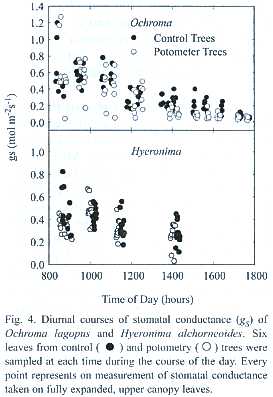
<p><font face="Arial" size="2">Diurnal courses of stomatal conductance (<i>g<sub>S</sub></i>)were taken on leaves of intact trees and trees in potometers, using a steady-state porometer (Model 1600; Li-Cor, Inc.).Six young, fully expanded sun leaves located at the top of the canopy were labeled on each tree and measured during the course of two consecutive days. </font></p> <font face="Arial" size="2"><b>     <p>Results and discussion </p> </b> <b></b></font>     ]]></body>
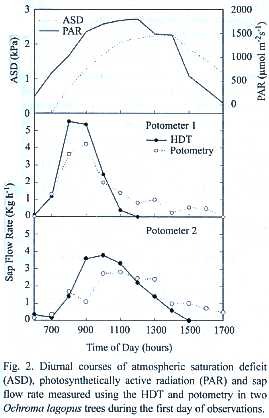
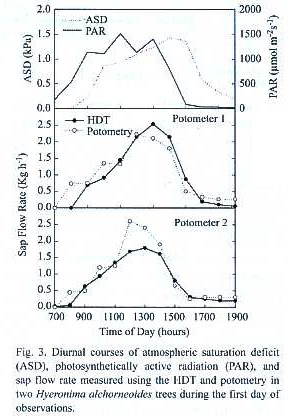
<body><![CDATA[<p><font face="Arial" size="2"><b>Microclimatic conditions: </b>Environmental conditions during the experiment on Ochroma were characterized by clear skies and high evaporative demand (<a href="#f2">Fig.2</a>). Observations on Hyeronima were conducted during partly cloudy skies and high evaporative demand (<a href="#f3">Fig.3</a>). For all experiments, maximum PAR flux rates were between 1500 and 1900 µmol m<sup>-2</sup> s<sup>-1</sup> and peak atmospheric saturation deficit (ASD) ranged from 1.5 to 2.5 kPa. These conditions favored the maintenance of high sap flow rates in the xylem of the tall trees used in this study. Heavy rain fell only during the night at least once during each experimental period. Volumetric soil water content in the top 50 m was 43% and 36% during experiments with Ochroma and Hyeronima, respectively.</font></p>     <p style="text-align: center;"><font face="Arial" size="2">&nbsp;<a  name="f2"></a><img src="/img/fbpe/rbt/v54n1/3358i5.JPG" title="" alt=""  style="width: 269px; height: 418px;">    
<br> </font></p>     <p style="text-align: center;"><font face="Arial" size="2"><a name="f3"></a><img  src="/img/fbpe/rbt/v54n1/3358i6.JPG" title="" alt=""  style="width: 288px; height: 418px;">    
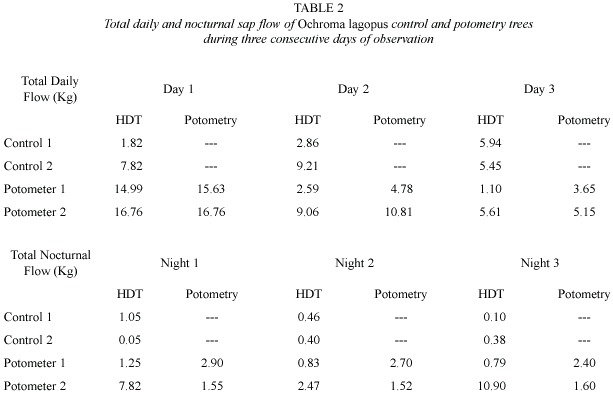
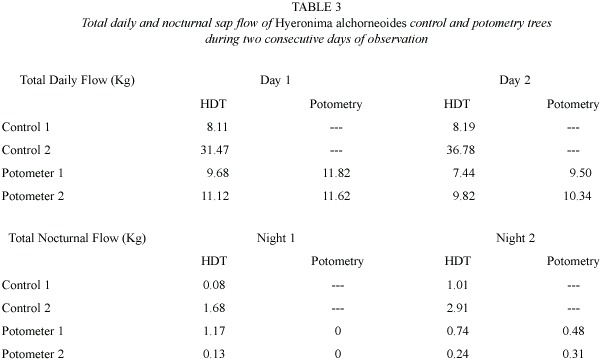
<br> </font></p> <font face="Arial" size="2"></font>     <p><font face="Arial" size="2"><b>Sap flow and potometry: </b>Total daily water use by intact trees of both species examined was a function of size (<a href="#t1">Tables 1</a> through <a href="#t3">3</a>).Trees held in potomers showed higher total daily water uptake than intact trees of similar size, which was attributed to differences in leaf area; this trend was more pronounced in the lightwood <i>Ochroma </i>than in the hardwood <i>Hyeronima </i>(<a href="#t1">Tables 1</a> and <a  href="#t2">2</a>).</font></p>     <p style="text-align: center;"><font face="Arial" size="2">&nbsp;<a  name="t2"></a><img src="/img/fbpe/rbt/v54n1/3358i3.JPG" title="" alt=""  style="width: 613px; height: 394px;">    
<br> </font></p>     <p style="text-align: center;"><font face="Arial" size="2"><a name="t3"></a><img  src="/img/fbpe/rbt/v54n1/3358i4.JPG" title="" alt=""  style="width: 602px; height: 361px;">    
<br> </font></p>     ]]></body>
<body><![CDATA[<p><font face="Arial" size="2">Diurnal courses of sap flow measured using the HDT showed good agreement with potometric measurements (<a  href="#f2">Figs. 2</a> and <a href="#f3">3</a>). This good agreement persisted for as long as <i>g<sub>S</sub> </i>and <img src="/img/fbpe/rbt/v54n1/y.JPG" title="" alt=""  style="width: 13px; height: 13px;"></font><i><small><sub><font  face="Arial" size="2"><small>L</small></font></sub></small><font  face="Arial" size="2"> </font></i><font face="Arial" size="2">of trees in potometers were similar to those observed in intact trees (<a href="#f4">Fig.4</a>, <a href="#t3">Table 3</a>).Some divergences were observed during peak hourly sap flow rates and under low flow conditions such as those found in wilting <i>Ochroma </i>trees and during nocturnal water uptake (<a href="#t1">Table 1</a>).</font></p>     
<p style="text-align: center;"><font face="Arial" size="2">&nbsp;<a  name="f4"></a><img src="/img/fbpe/rbt/v54n1/3358i7.JPG" title="" alt=""  style="width: 273px; height: 397px;"></font></p>     
<p><font face="Arial" size="2">A very close agreement between the two techniques was found along the course of two days of observation during which <i>Hyeronima </i>trees in potometers did not show any visible signs of wilting (<a href="#t2">Table 2</a>).Potometric determinations of total daily tree water use in <i>Hyeronima </i>were slightly higher than sap flow estimates (<a href="#t2">Table 2</a>).At peak sap flow rates (2 to 2.5 Kg h<sup>-1</sup>)observed between 1200 and 1400 h, HDT diverged more from potometric water uptake than at lower flow rates (<a href="#f3">Fig.3</a>). Measurements of <i>g<sub>S</sub> </i>and&nbsp;</font><b><font  face="Arial" size="2" color="#ff0000"><img src="/img/fbpe/rbt/v54n1/y.JPG" title=""  alt="" style="width: 13px; height: 13px;"></font></b><i><small><sub><font  face="Arial" size="2"><small>L</small></font></sub></small><font  face="Arial" size="2"> </font></i><font face="Arial" size="2">confirmed that the experimental trees were performing similarly to control trees (<a href="#f4">Fig.4</a>; <a href="#t3">Table 3</a>).</font></p> <font face="Arial" size="2">The patterns were more complex in <i>Ochroma</i>. In this lightwood tree,the agreement between measurements of total daily water uptake obtained by the two methods was also remarkably good, particularly under conditions of high sap flow rates observed during the first day of observations (<a href="#f2">Fig.2</a>; <a  href="#t1">Table 1</a>). As in <i>Hyeronima</i>, potometric determinations of total daily water use during three days of observations were higher than HDT estimates. However, at peak sap flow rates (4 to 5 Kg h<sup>-1</sup>) observed during the morning hours, and in contrast to the pattern observed in <i>Hyeronima</i>, HDT overestimated potometric water uptake in <i>Ochroma </i>(<a  href="#f2">Fig.2</a>). This pattern was reversed during the afternoon when lower sap flow rates (less than 2 Kg h<sup>-1</sup>) prevailed; at such low flows, HDT consistently underestimated actual sap flow rates (<a href="#f2">Fig.2</a>).</font>     
<p><font face="Arial" size="2">The dT values typically observed in the low wood density <i>Ochroma </i>were generally higher than dT measured in the hardwood <i>Hyeronima </i>(data not shown). This could be the result of abundant air spaces in <i>Ochroma </i>wood (<a  href="#ch84">Chudnoff 1984</a>)which could dissipate heat more slowly than water-filled sapwood. Since this technique assumes that the probes are in contact with the conducting sapwood, the presence of these air spaces could amplify the error in the measurement of sap flow in species with very low wood densities, and may account for the night time fluctuations in dT observed in <i>Ochroma.</i></font></p>     <p><font face="Arial" size="2">The larger <i>Ochroma </i>tree in potometer 2 (DBH =15.6 cm) exhibited visible signs of wilting by 1000 h of the first day of observation. The remaining potometer <i>Ochroma </i>remained turgid but experienced increasing water stress as the experiment progressed (<a href="#t1">Table 1</a>). As indicated above, wilting was not observed in <i>Hyeronima </i>trees, which maintained high water status during the course of two days of observations (<a href="#t2">Table 2</a>).</font></p>     <p><font face="Arial" size="2">Sap flow rates in <i>Ochroma </i>decreased earlier than in <i>Hyeronima </i>.A pronounced reduction in sap flow to values lower than 1 Kg h<sup>-1</sup> was observed by 1000 to 1100 h,even though PAR and ASD remained high during the rest of the afternoon (<a href="#f2">Fig.2</a>). In <i>Hyeronima </i>trees, in contrast, diurnal sap flow courses measured at 1.5 m height showed a strong dependence on PAR courses, and lagged behind PAR by approximately 1 to 2 hr (<a  href="#f3">Fig.3</a>). Sap flow at 1.5 m height rose only after 0800 h and peaked between 1200 and 1400 h,and remained high for a large part of the afternoon. Transpiration in <i>Hyeronima </i>remained at peak rates later in the day and followed ASD more closely in the afternoon.</font></p> <font face="Arial" size="2"><b></b></font>     <p><font face="Arial" size="2"><b>Leaf water potential and stomatal conductance: </b>In Ochroma, leaves of the control trees exhibited average predawn and midday </font><b><font face="Arial" size="2"  color="#ff0000"><img src="/img/fbpe/rbt/v54n1/y.JPG" title="" alt=""  style="width: 13px; height: 13px;"></font></b><small><sub><font  face="Arial" size="2"><small>L</small></font></sub></small><font  face="Arial" size="2"> values of –0.24 and –0.83 MPa, while leaves from trees in potometers reached </font><b><font face="Arial" size="2"  color="#ff0000"><img src="/img/fbpe/rbt/v54n1/y.JPG"  title="" alt="" style="width: 13px; height: 13px;"></font></b><small><sub><font  face="Arial" size="2"><small>L</small></font></sub></small><font  face="Arial" size="2"> values of –0.35 and –1.13 MPa (<a href="#t3">Table 3</a>), respectively. One wilting balsa tree remark- ably recovered during the night to exhibit average predawn </font><b><font  face="Arial" size="2" color="#ff0000"><img  src="/img/fbpe/rbt/v54n1/y.JPG" title="" alt=""  style="width: 13px; height: 13px;"></font></b><small><sub><font  face="Arial" size="2"><small>L</small></font></sub></small><font  face="Arial" size="2"> values very similar to those of control trees (data not shown).In Hyeronima, average pre-dawn </font><b><font  face="Arial" size="2" color="#ff0000"><img  src="/img/fbpe/rbt/v54n1/y.JPG" title="" alt=""  style="width: 13px; height: 13px;"></font></b><small><sub><font  face="Arial" size="2"><small>L</small></font></sub></small><font  face="Arial" size="2"> values of leaves of control trees (–0.215 MPa) and trees in potometers (–0.22 MPa) did not differ. Average midday </font><b><font  face="Arial" size="2" color="#ff0000"><img  src="/img/fbpe/rbt/v54n1/y.JPG" title="" alt=""  style="width: 13px; height: 13px;"></font></b><b><font face="Arial"  size="2" color="#ff0000"></font></b><small><sub><font face="Arial"  size="2"><small>L</small></font></sub></small><font face="Arial"  size="2"> values of leaves of control trees (–1.04 MPa) were virtually indistinguishable from </font><b><font face="Arial" size="2"  color="#ff0000"><img src="/img/fbpe/rbt/v54n1/y.JPG"  title="" alt="" style="width: 13px; height: 13px;"></font></b><small><sub><font  face="Arial" size="2"><small>L</small></font></sub></small><font  face="Arial" size="2"> values of leaves of trees in potometers (–0.91 MPa).</font></p>     
<p><font face="Arial" size="2">The diurnal trend as well as the maximum <i>g<sub>S</sub> </i>values of control trees and trees in potometers of the two species examined were virtually indistinguishable during the first day of observations (<a href="#f4">Fig.4</a>). In <i>Ochroma </i>potometers only, <i>g<sub>S</sub> </i>showed the first signs of reduction during the afternoon of the first day (<a href="#f4">Fig.4</a>), and drastically decreased during the second day of observation as compared to control trees (data not shown),which resulted in progressively lower values of total tree water use during the course of the experiment (<a href="#t1">Table 1</a>). Despite the precautions employed to control microbial growth, it is likely that high temperatures and the severity of the operations performed on the potometric trees favored progressive xylem dysfunction.</font></p>     <p><font face="Arial" size="2">Average and maximum <i>g<sub>S</sub> </i>values of both the hardwood <i>Hyeronima </i>and the lighter <i>Ochroma </i>were similar.Maximum <i>g<sub>S</sub> </i>values in the order of 1.3 and 0.8 mol m<sup>-2</sup> s<sup>-1</sup> were observed between 0800 and 1000 h in <i>Ochroma </i>and <i>Hyeronima</i>, respectively. After this time, <i>g<sub>S</sub> </i>declined during the rest of the day and behaved similarly for both species (<a href="#f4">Fig.4</a>). De-rooted trees held in potometers exhibited similar trends in stomatal behavior.</font></p> <font face="Arial" size="2"><b></b></font>     <p><font face="Arial" size="2"><b>Nocturnal water uptake: </b>Our potometric measurements indicate that both species exhibited nocturnal water uptake (<a href="#t1">Tables 1</a> and <a href="#t2">2</a>). Nocturnal water uptake was an important fraction of diurnal water uptake in <i>Ochroma</i>, but less so in <i>Hyeronima</i>. Nocturnal water uptake in Ochroma ranged from 1.5 to 2.9 l and was apparently responsible for the recovery of wilting trees during consecutive nights. However, HDT performed poorly at measuring nocturnal water uptake, as estimates did not show any consistent relationship with the values measured in potometer trees (<a href="#t1">Tables 1</a> and <a  href="#t2">2</a>).</font></p>     ]]></body>
<body><![CDATA[<p><font face="Arial" size="2">Possible reasons underlying the failure of HDT to measure low flows have been recently discussed by <a  href="#be98">Becker (1998)</a> in relation to heat pulse techniques. Sources of error have been related to problems of contact between the probes and the sapwood, and to the low thermal conductivity of the materials currently employed in probe construction.</font></p>     <p><font face="Arial" size="2">The magnitude of nocturnal uptake as a proportion of the water budget can be considerable (<a href="#gr89">Green <i>et al</i>. 1989</a>), and has been frequently implicated in xylem recovery from cavitation (<a href="#pi89">Pickard 1989</a>) and recharge of stem capacitance (<a href="#wa78">Waring and Running 1978</a>, <a href="#kn81">Knight <i>et al</i>. 1981</a>, <a href="#go97">Goldstein <i>et al</i>. 1997</a>). However, the techniques currently available to measure sap flow rates in stems appear to perform poorly under the low flows typically associated to nocturnal water uptake (<a href="#be98">Becker 1998</a>). </font></p> <font face="Arial" size="2"><b>     <p>Conclusions </p> </b> </font>     <p><font face="Arial" size="2">The results of our comparison suggest that HDT represents a useful method for estimating transpiration rates above 1.0 Kg h<sup>-1</sup> in large trees.In <i>Ochroma </i>,error values relative to potometry ranged between 4% in actively transpiring individuals (Day 1 in <a href="#t1">Table 1</a>) to 70% at low flow rates observed in wilting trees (Day 3 in <a href="#t1">Table 1</a>). In <i>Hyeronima</i>, maximum error values observed were in the order of 20%.</font></p>     <p><font face="Arial" size="2">In its current version, the HDT is not useful to measure low flows such as those commonly found at night, or in wilting and shaded plants. Nocturnal water uptake was an important component of the water budget of the tree species examined, particularly of <i>Ochroma</i>, whose recovery from wilting seemed to be related to high rates of nocturnal water uptake. </font></p> <font face="Arial" size="2"><b>     <p>Acknowledgments </p> </b> </font>     <p><font face="Arial" size="2">This research was supported by grants D/2462-1 from the International Foundation for Science (Sweden)and the Mellon Foundation to M. V. Gutiérrez, and a STRI-OTS Tropical Exploratory award to L. S. Santiago. We gratefully acknowledge the collaboration of Jack Ewel,Miguel Cifuentes and the Huertos Project staff at La Selva for their help during field work and data collection.We thank F. C. Meinzer and S.M.Mulkey for helpful comments on an earlier draft of the manuscript. </font></p> <font face="Arial" size="2"><b>     <p>References </p> </b> </font>     <!-- ref --><p><font face="Arial" size="2"><a name="be98"></a>Becker, P. 1998. Limitations of a compensation heat pulse velocity system at low sap flow: implications for measurements at night and in shaded trees. Tree Physiol. 18: 177-84.    &nbsp;&nbsp;&nbsp;&nbsp;&nbsp;&nbsp;&nbsp;&nbsp;[&#160;<a href="javascript:void(0);" onclick="javascript: window.open('/scielo.php?script=sci_nlinks&ref=1658428&pid=S0034-7744200600010000900001&lng=','','width=640,height=500,resizable=yes,scrollbars=1,menubar=yes,');">Links</a>&#160;]<!-- end-ref --></font></p>     ]]></body>
<body><![CDATA[<!-- ref --><p><font face="Arial" size="2"><a name="ca97"></a>Cabibel, B., C. Isbérie &amp; J. Horoyan. 1997. Flux de seve et alimentation hydrique de cerisiers irrigués ou non en localisation. Agronomie 17:97-112.    &nbsp;&nbsp;&nbsp;&nbsp;&nbsp;&nbsp;&nbsp;&nbsp;[&#160;<a href="javascript:void(0);" onclick="javascript: window.open('/scielo.php?script=sci_nlinks&ref=1658430&pid=S0034-7744200600010000900002&lng=','','width=640,height=500,resizable=yes,scrollbars=1,menubar=yes,');">Links</a>&#160;]<!-- end-ref --></font></p>     <!-- ref --><p><font face="Arial" size="2"><a name="ce73"></a>Cerma k, J., M. Deml, &amp; M. Penka. 1973. A new method of sap flow determination in trees<i>. </i>Biologia Plantarum 15:171-8.    &nbsp;&nbsp;&nbsp;&nbsp;&nbsp;&nbsp;&nbsp;&nbsp;[&#160;<a href="javascript:void(0);" onclick="javascript: window.open('/scielo.php?script=sci_nlinks&ref=1658432&pid=S0034-7744200600010000900003&lng=','','width=640,height=500,resizable=yes,scrollbars=1,menubar=yes,');">Links</a>&#160;]<!-- end-ref --></font></p>     <!-- ref --><p><font face="Arial" size="2"><a name="ch84"></a>Chudnoff, M. 1984. Tropical Timbers of the World. USDA., Forest Service, Agriculture Handbook No. 607.    &nbsp;&nbsp;&nbsp;&nbsp;&nbsp;&nbsp;&nbsp;&nbsp;[&#160;<a href="javascript:void(0);" onclick="javascript: window.open('/scielo.php?script=sci_nlinks&ref=1658434&pid=S0034-7744200600010000900004&lng=','','width=640,height=500,resizable=yes,scrollbars=1,menubar=yes,');">Links</a>&#160;]<!-- end-ref --></font></p>     <!-- ref --><p><font face="Arial" size="2"><a name="cl58"></a>Closs, R. L. 1958. The heat pulse method for measuring rate of sap flow in plant stems. New Zealand J. Sci. 1:281-8.    &nbsp;&nbsp;&nbsp;&nbsp;&nbsp;&nbsp;&nbsp;&nbsp;[&#160;<a href="javascript:void(0);" onclick="javascript: window.open('/scielo.php?script=sci_nlinks&ref=1658436&pid=S0034-7744200600010000900005&lng=','','width=640,height=500,resizable=yes,scrollbars=1,menubar=yes,');">Links</a>&#160;]<!-- end-ref --></font></p>     <!-- ref --><p><font face="Arial" size="2"><a name="go97"></a>Goldstein, G., J. L. Andrade, F. C. Meinzer, N. M. Holbrook, P. Jackson, J. Cavelier &amp; A. Celis. 1997. Stem water storage and diurnal patterns of water use in tropical forest trees. Plant, Cell &amp; Environ. 21: 397-406.    &nbsp;&nbsp;&nbsp;&nbsp;&nbsp;&nbsp;&nbsp;&nbsp;[&#160;<a href="javascript:void(0);" onclick="javascript: window.open('/scielo.php?script=sci_nlinks&ref=1658438&pid=S0034-7744200600010000900006&lng=','','width=640,height=500,resizable=yes,scrollbars=1,menubar=yes,');">Links</a>&#160;]<!-- end-ref --></font></p>     ]]></body>
<body><![CDATA[<!-- ref --><p><font face="Arial" size="2"><a name="gr85"></a>Granier, A. 1985. Une novelle methode pour la mesure du flux de seve brute dans le tronc des arbres. Ann. Sci. Forest: 42: 193-200.    &nbsp;&nbsp;&nbsp;&nbsp;&nbsp;&nbsp;&nbsp;&nbsp;[&#160;<a href="javascript:void(0);" onclick="javascript: window.open('/scielo.php?script=sci_nlinks&ref=1658440&pid=S0034-7744200600010000900007&lng=','','width=640,height=500,resizable=yes,scrollbars=1,menubar=yes,');">Links</a>&#160;]<!-- end-ref --></font></p>     <!-- ref --><p><font face="Arial" size="2"><a name="gr92"></a>Granier, A., R. Huc &amp; F. Colin. 1992. Transpiration and stomatal conductance of two rainforest species growing in plantations (<i>Simarouba amara </i>and <i>Goupia glabra </i>) in French Guyana. Ann. Sci. Forest. 49: 17-24.    &nbsp;&nbsp;&nbsp;&nbsp;&nbsp;&nbsp;&nbsp;&nbsp;[&#160;<a href="javascript:void(0);" onclick="javascript: window.open('/scielo.php?script=sci_nlinks&ref=1658442&pid=S0034-7744200600010000900008&lng=','','width=640,height=500,resizable=yes,scrollbars=1,menubar=yes,');">Links</a>&#160;]<!-- end-ref --></font></p>     <!-- ref --><p><font face="Arial" size="2"><a name="gr89"></a>Green, S. R., K. G. McNaughton &amp; B. E. Clotier. 1989. Observations of night-time water use in kiwifruit vines and apple trees. Agri. Forest Meteorol. 48<b>: </b>251-61.    &nbsp;&nbsp;&nbsp;&nbsp;&nbsp;&nbsp;&nbsp;&nbsp;[&#160;<a href="javascript:void(0);" onclick="javascript: window.open('/scielo.php?script=sci_nlinks&ref=1658444&pid=S0034-7744200600010000900009&lng=','','width=640,height=500,resizable=yes,scrollbars=1,menubar=yes,');">Links</a>&#160;]<!-- end-ref --></font></p>     <!-- ref --><p><font face="Arial" size="2"><a name="gu94"></a>Gutiérrez, M. V., R. A. Harrington, F. C. Meinzer &amp; J. H. Fownes. 1994. The effect of environmentally induced stem temperature gradients on transpiration estimates from the heat balance method in two tropical woody species. Tree Physiol. B: 179-90.    &nbsp;&nbsp;&nbsp;&nbsp;&nbsp;&nbsp;&nbsp;&nbsp;[&#160;<a href="javascript:void(0);" onclick="javascript: window.open('/scielo.php?script=sci_nlinks&ref=1658446&pid=S0034-7744200600010000900010&lng=','','width=640,height=500,resizable=yes,scrollbars=1,menubar=yes,');">Links</a>&#160;]<!-- end-ref --></font></p>     <!-- ref --><p><font face="Arial" size="2"><a name="ha95"></a>Haggar, J. P. &amp; J. J. Ewel. 1995. Establishment, resource acquisition and early productivity as determined by biomass allocation patterns of three tropical tree species. Forest Sci. 41: 681-708.    &nbsp;&nbsp;&nbsp;&nbsp;&nbsp;&nbsp;&nbsp;&nbsp;[&#160;<a href="javascript:void(0);" onclick="javascript: window.open('/scielo.php?script=sci_nlinks&ref=1658448&pid=S0034-7744200600010000900011&lng=','','width=640,height=500,resizable=yes,scrollbars=1,menubar=yes,');">Links</a>&#160;]<!-- end-ref --></font></p>     ]]></body>
<body><![CDATA[<!-- ref --><p><font face="Arial" size="2"><a name="he97"></a>Herzog, K. M., R. Thum, R. Zweifel &amp; R. Hasler. 1997. Heat balance measurements —to quantify sap flow in thin stems only? Agri. and Forest Meteorol. 83: 75-94.    &nbsp;&nbsp;&nbsp;&nbsp;&nbsp;&nbsp;&nbsp;&nbsp;[&#160;<a href="javascript:void(0);" onclick="javascript: window.open('/scielo.php?script=sci_nlinks&ref=1658450&pid=S0034-7744200600010000900012&lng=','','width=640,height=500,resizable=yes,scrollbars=1,menubar=yes,');">Links</a>&#160;]<!-- end-ref --></font></p>     <!-- ref --><p><font face="Arial" size="2"><a name="kn81"></a>Knight, D. H., T. J. Fahey, S. W. Running, A. T. Harrison &amp; L. L. Wallace. 1981. Transpiration from 100-yr-old lodgepole pine forests estimated with whole-tree potometers. Ecology 62:717-26.    &nbsp;&nbsp;&nbsp;&nbsp;&nbsp;&nbsp;&nbsp;&nbsp;[&#160;<a href="javascript:void(0);" onclick="javascript: window.open('/scielo.php?script=sci_nlinks&ref=1658452&pid=S0034-7744200600010000900013&lng=','','width=640,height=500,resizable=yes,scrollbars=1,menubar=yes,');">Links</a>&#160;]<!-- end-ref --></font></p>     <!-- ref --><p><font face="Arial" size="2"><a name="ma58"></a>Marshall, D. C. 1958. Measurement of sap flow in conifers by heat transport. Plant Physiol. 33: 385-96.    &nbsp;&nbsp;&nbsp;&nbsp;&nbsp;&nbsp;&nbsp;&nbsp;[&#160;<a href="javascript:void(0);" onclick="javascript: window.open('/scielo.php?script=sci_nlinks&ref=1658454&pid=S0034-7744200600010000900014&lng=','','width=640,height=500,resizable=yes,scrollbars=1,menubar=yes,');">Links</a>&#160;]<!-- end-ref --></font></p>     <!-- ref --><p><font face="Arial" size="2"><a name="ph96"></a>Phillips, N., R. Oren &amp; R. Zimmerman. 1996. Radial patterns of xylem sap flow in non-,diffuse-and ring-porous tree species. Plant, Cell &amp; Environ. 19: 983-90.    &nbsp;&nbsp;&nbsp;&nbsp;&nbsp;&nbsp;&nbsp;&nbsp;[&#160;<a href="javascript:void(0);" onclick="javascript: window.open('/scielo.php?script=sci_nlinks&ref=1658456&pid=S0034-7744200600010000900015&lng=','','width=640,height=500,resizable=yes,scrollbars=1,menubar=yes,');">Links</a>&#160;]<!-- end-ref --></font></p>     <!-- ref --><p><font face="Arial" size="2"><a name="pi89"></a>Pickard, W. F. 1989. How might a tracheary element that is embolized by day be healed by night? J. Theoretical Biol. 141: 259-79.    &nbsp;&nbsp;&nbsp;&nbsp;&nbsp;&nbsp;&nbsp;&nbsp;[&#160;<a href="javascript:void(0);" onclick="javascript: window.open('/scielo.php?script=sci_nlinks&ref=1658458&pid=S0034-7744200600010000900016&lng=','','width=640,height=500,resizable=yes,scrollbars=1,menubar=yes,');">Links</a>&#160;]<!-- end-ref --></font></p>     ]]></body>
<body><![CDATA[<!-- ref --><p><font face="Arial" size="2"><a name="ri75"></a>Ritchie, G. A. &amp; T. M. Hinckley. 1975. The pressure chamber as an instrument for ecological research. Advance Bot. Res. 9: 165-224.    &nbsp;&nbsp;&nbsp;&nbsp;&nbsp;&nbsp;&nbsp;&nbsp;[&#160;<a href="javascript:void(0);" onclick="javascript: window.open('/scielo.php?script=sci_nlinks&ref=1658460&pid=S0034-7744200600010000900017&lng=','','width=640,height=500,resizable=yes,scrollbars=1,menubar=yes,');">Links</a>&#160;]<!-- end-ref --></font></p>     <!-- ref --><p><font face="Arial" size="2"><a name="sa81"></a>Sakuratani, T. 1981. A heat balance method for measuring water flux in the stems of intact plants. J. Agri. Meteorol<i>. </i>37: 9-17.    &nbsp;&nbsp;&nbsp;&nbsp;&nbsp;&nbsp;&nbsp;&nbsp;[&#160;<a href="javascript:void(0);" onclick="javascript: window.open('/scielo.php?script=sci_nlinks&ref=1658462&pid=S0034-7744200600010000900018&lng=','','width=640,height=500,resizable=yes,scrollbars=1,menubar=yes,');">Links</a>&#160;]<!-- end-ref --></font></p>     <!-- ref --><p><font face="Arial" size="2"><a name="sp88"></a>Sperry, J. S., R. J. Donnelly &amp; M. T. Tyree. 1988. A method for measuring hydraulic conductivity and embolism in xylem. Plant, Cell &amp; Environ. 11: 35-40.    &nbsp;&nbsp;&nbsp;&nbsp;&nbsp;&nbsp;&nbsp;&nbsp;[&#160;<a href="javascript:void(0);" onclick="javascript: window.open('/scielo.php?script=sci_nlinks&ref=1658464&pid=S0034-7744200600010000900019&lng=','','width=640,height=500,resizable=yes,scrollbars=1,menubar=yes,');">Links</a>&#160;]<!-- end-ref --></font></p>     <!-- ref --><p><font face="Arial" size="2"><a name="ve97"></a>Vertessy, R. A., T. J. Hatton, P. Reece, S. K. O ’Sullivan &amp; R. G. Benyon. 1997. Estimating stand water use of large mountain ash trees and validation of the sap flow measurement technique. Tree Physiol. 17: 747-56.    &nbsp;&nbsp;&nbsp;&nbsp;&nbsp;&nbsp;&nbsp;&nbsp;[&#160;<a href="javascript:void(0);" onclick="javascript: window.open('/scielo.php?script=sci_nlinks&ref=1658466&pid=S0034-7744200600010000900020&lng=','','width=640,height=500,resizable=yes,scrollbars=1,menubar=yes,');">Links</a>&#160;]<!-- end-ref --></font></p>     <!-- ref --><p><font face="Arial" size="2"><a name="wa78"></a>Waring, R. H. &amp; S. W. Running. 1978. Sapwood water storage: its contribution to transpiration and effect upon water conductance through the stems of old growth Douglas fir. Plant, Cell &amp; Environ. 1: 131-140.    &nbsp;&nbsp;&nbsp;&nbsp;&nbsp;&nbsp;&nbsp;&nbsp;[&#160;<a href="javascript:void(0);" onclick="javascript: window.open('/scielo.php?script=sci_nlinks&ref=1658468&pid=S0034-7744200600010000900021&lng=','','width=640,height=500,resizable=yes,scrollbars=1,menubar=yes,');">Links</a>&#160;]<!-- end-ref --></font></p>     ]]></body>
<body><![CDATA[<!-- ref --><p><font face="Arial" size="2"><a name="wh83"></a>Whitmore, J. L. 1983. <i>Ochroma lagopus </i>(Balsa). <i>In </i>Janzen D. H., ed. Costa Rican Natural History. Chicago: University of Chicago, 281-82.    &nbsp;&nbsp;&nbsp;&nbsp;&nbsp;&nbsp;&nbsp;&nbsp;[&#160;<a href="javascript:void(0);" onclick="javascript: window.open('/scielo.php?script=sci_nlinks&ref=1658470&pid=S0034-7744200600010000900022&lng=','','width=640,height=500,resizable=yes,scrollbars=1,menubar=yes,');">Links</a>&#160;]<!-- end-ref --></font></p>     <!-- ref --><p><font face="Arial" size="2"><a name="wu98"></a>Wullschleger, S. D., F. C. Meinzer &amp; R. A. Vertessy. 1998. A critique of whole-plant water use studies in trees. Tree Physiol. 18: 499-512.    &nbsp;&nbsp;&nbsp;&nbsp;&nbsp;&nbsp;&nbsp;&nbsp;[&#160;<a href="javascript:void(0);" onclick="javascript: window.open('/scielo.php?script=sci_nlinks&ref=1658472&pid=S0034-7744200600010000900023&lng=','','width=640,height=500,resizable=yes,scrollbars=1,menubar=yes,');">Links</a>&#160;]<!-- end-ref --> </font></p>      ]]></body><back>
<ref-list>
<ref id="B1">
<nlm-citation citation-type="journal">
<person-group person-group-type="author">
<name>
<surname><![CDATA[Becker]]></surname>
<given-names><![CDATA[P]]></given-names>
</name>
</person-group>
<article-title xml:lang="en"><![CDATA[Limitations of a compensation heat pulse velocity system at low sap flow: implications for measurements at night and in shaded trees]]></article-title>
<source><![CDATA[Tree Physiol]]></source>
<year>1998</year>
<volume>18</volume>
<page-range>177-84</page-range></nlm-citation>
</ref>
<ref id="B2">
<nlm-citation citation-type="journal">
<person-group person-group-type="author">
<name>
<surname><![CDATA[Cabibel]]></surname>
<given-names><![CDATA[B]]></given-names>
</name>
<name>
<surname><![CDATA[Isbérie]]></surname>
<given-names><![CDATA[C]]></given-names>
</name>
<name>
<surname><![CDATA[Horoyan]]></surname>
<given-names><![CDATA[J]]></given-names>
</name>
</person-group>
<article-title xml:lang="fr"><![CDATA[Flux de seve et alimentation hydrique de cerisiers irrigués ou non en localisation]]></article-title>
<source><![CDATA[Agronomie]]></source>
<year>1997</year>
<volume>17</volume>
<page-range>97-112</page-range></nlm-citation>
</ref>
<ref id="B3">
<nlm-citation citation-type="journal">
<person-group person-group-type="author">
<name>
<surname><![CDATA[Cerma]]></surname>
<given-names><![CDATA[k, J]]></given-names>
</name>
<name>
<surname><![CDATA[Deml]]></surname>
<given-names><![CDATA[M]]></given-names>
</name>
<name>
<surname><![CDATA[Penka]]></surname>
<given-names><![CDATA[M]]></given-names>
</name>
</person-group>
<article-title xml:lang="en"><![CDATA[A new method of sap flow determination in trees]]></article-title>
<source><![CDATA[Biologia Plantarum]]></source>
<year>1973</year>
<volume>15</volume>
<page-range>171-8</page-range></nlm-citation>
</ref>
<ref id="B4">
<nlm-citation citation-type="book">
<person-group person-group-type="author">
<name>
<surname><![CDATA[Chudnoff]]></surname>
<given-names><![CDATA[M]]></given-names>
</name>
</person-group>
<source><![CDATA[Tropical Timbers of the World]]></source>
<year>1984</year>
<publisher-name><![CDATA[USDA., Forest Service]]></publisher-name>
</nlm-citation>
</ref>
<ref id="B5">
<nlm-citation citation-type="journal">
<person-group person-group-type="author">
<name>
<surname><![CDATA[Closs]]></surname>
<given-names><![CDATA[R. L]]></given-names>
</name>
</person-group>
<article-title xml:lang="en"><![CDATA[The heat pulse method for measuring rate of sap flow in plant stems]]></article-title>
<source><![CDATA[New Zealand J. Sci]]></source>
<year>1958</year>
<volume>1</volume>
<page-range>281-8</page-range></nlm-citation>
</ref>
<ref id="B6">
<nlm-citation citation-type="journal">
<person-group person-group-type="author">
<name>
<surname><![CDATA[Goldstein]]></surname>
<given-names><![CDATA[G]]></given-names>
</name>
<name>
<surname><![CDATA[Andrade]]></surname>
<given-names><![CDATA[J. L]]></given-names>
</name>
<name>
<surname><![CDATA[Meinzer]]></surname>
<given-names><![CDATA[F. C]]></given-names>
</name>
<name>
<surname><![CDATA[Holbrook]]></surname>
<given-names><![CDATA[N. M]]></given-names>
</name>
<name>
<surname><![CDATA[Jackson]]></surname>
<given-names><![CDATA[P]]></given-names>
</name>
<name>
<surname><![CDATA[Cavelier]]></surname>
<given-names><![CDATA[J]]></given-names>
</name>
<name>
<surname><![CDATA[Celis]]></surname>
<given-names><![CDATA[A]]></given-names>
</name>
</person-group>
<article-title xml:lang="en"><![CDATA[Stem water storage and diurnal patterns of water use in tropical forest trees]]></article-title>
<source><![CDATA[Plant, Cell & Environ]]></source>
<year>1997</year>
<volume>21</volume>
<page-range>397-406</page-range></nlm-citation>
</ref>
<ref id="B7">
<nlm-citation citation-type="journal">
<person-group person-group-type="author">
<name>
<surname><![CDATA[Granier]]></surname>
<given-names><![CDATA[A]]></given-names>
</name>
</person-group>
<article-title xml:lang="fr"><![CDATA[Une novelle methode pour la mesure du flux de seve brute dans le tronc des arbres]]></article-title>
<source><![CDATA[Ann. Sci. Forest]]></source>
<year>1985</year>
<volume>42</volume>
<page-range>193-200</page-range></nlm-citation>
</ref>
<ref id="B8">
<nlm-citation citation-type="journal">
<person-group person-group-type="author">
<name>
<surname><![CDATA[Granier]]></surname>
<given-names><![CDATA[A]]></given-names>
</name>
<name>
<surname><![CDATA[Huc]]></surname>
<given-names><![CDATA[R]]></given-names>
</name>
<name>
<surname><![CDATA[Colin]]></surname>
<given-names><![CDATA[F]]></given-names>
</name>
</person-group>
<article-title xml:lang="en"><![CDATA[Transpiration and stomatal conductance of two rainforest species growing in plantations (Simarouba amara and Goupia glabra ) in French Guyana]]></article-title>
<source><![CDATA[Ann. Sci. Forest]]></source>
<year>1992</year>
<volume>49</volume>
<page-range>17-24</page-range></nlm-citation>
</ref>
<ref id="B9">
<nlm-citation citation-type="journal">
<person-group person-group-type="author">
<name>
<surname><![CDATA[Green]]></surname>
<given-names><![CDATA[S. R]]></given-names>
</name>
<name>
<surname><![CDATA[McNaughton]]></surname>
<given-names><![CDATA[K. G]]></given-names>
</name>
<name>
<surname><![CDATA[Clotier]]></surname>
<given-names><![CDATA[B. E]]></given-names>
</name>
</person-group>
<article-title xml:lang="en"><![CDATA[Observations of night-time water use in kiwifruit vines and apple trees]]></article-title>
<source><![CDATA[Agri. Forest Meteorol]]></source>
<year>1989</year>
<volume>48</volume>
<page-range>251-61</page-range></nlm-citation>
</ref>
<ref id="B10">
<nlm-citation citation-type="journal">
<person-group person-group-type="author">
<name>
<surname><![CDATA[Gutiérrez]]></surname>
<given-names><![CDATA[M. V]]></given-names>
</name>
<name>
<surname><![CDATA[Harrington]]></surname>
<given-names><![CDATA[R. A]]></given-names>
</name>
<name>
<surname><![CDATA[Meinzer]]></surname>
<given-names><![CDATA[F. C]]></given-names>
</name>
<name>
<surname><![CDATA[Fownes]]></surname>
<given-names><![CDATA[J. H]]></given-names>
</name>
</person-group>
<article-title xml:lang="en"><![CDATA[The effect of environmentally induced stem temperature gradients on transpiration estimates from the heat balance method in two tropical woody species]]></article-title>
<source><![CDATA[Tree Physiol]]></source>
<year>1994</year>
<volume>B</volume>
<page-range>179-90</page-range></nlm-citation>
</ref>
<ref id="B11">
<nlm-citation citation-type="journal">
<person-group person-group-type="author">
<name>
<surname><![CDATA[Haggar]]></surname>
<given-names><![CDATA[J. P]]></given-names>
</name>
<name>
<surname><![CDATA[Ewel]]></surname>
<given-names><![CDATA[J. J]]></given-names>
</name>
</person-group>
<article-title xml:lang="en"><![CDATA[Establishment, resource acquisition and early productivity as determined by biomass allocation patterns of three tropical tree species]]></article-title>
<source><![CDATA[Forest Sci]]></source>
<year>1995</year>
<volume>41</volume>
<page-range>681-708</page-range></nlm-citation>
</ref>
<ref id="B12">
<nlm-citation citation-type="journal">
<person-group person-group-type="author">
<name>
<surname><![CDATA[Herzog]]></surname>
<given-names><![CDATA[K. M]]></given-names>
</name>
<name>
<surname><![CDATA[Thum]]></surname>
<given-names><![CDATA[R]]></given-names>
</name>
<name>
<surname><![CDATA[Zweifel]]></surname>
<given-names><![CDATA[R]]></given-names>
</name>
<name>
<surname><![CDATA[Hasler]]></surname>
<given-names><![CDATA[R]]></given-names>
</name>
</person-group>
<article-title xml:lang="en"><![CDATA[Heat balance measurements -to quantify sap flow in thin stems only?]]></article-title>
<source><![CDATA[Agri. and Forest Meteorol]]></source>
<year>1997</year>
<volume>83</volume>
<page-range>75-94</page-range></nlm-citation>
</ref>
<ref id="B13">
<nlm-citation citation-type="journal">
<person-group person-group-type="author">
<name>
<surname><![CDATA[Knight]]></surname>
<given-names><![CDATA[D. H]]></given-names>
</name>
<name>
<surname><![CDATA[Fahey]]></surname>
<given-names><![CDATA[T. J]]></given-names>
</name>
<name>
<surname><![CDATA[Running]]></surname>
<given-names><![CDATA[S. W]]></given-names>
</name>
<name>
<surname><![CDATA[Harrison]]></surname>
<given-names><![CDATA[A. T]]></given-names>
</name>
<name>
<surname><![CDATA[Wallace]]></surname>
<given-names><![CDATA[L. L]]></given-names>
</name>
</person-group>
<article-title xml:lang="en"><![CDATA[Transpiration from 100-yr-old lodgepole pine forests estimated with whole-tree potometers]]></article-title>
<source><![CDATA[Ecology]]></source>
<year>1981</year>
<volume>62</volume>
<page-range>717-26</page-range></nlm-citation>
</ref>
<ref id="B14">
<nlm-citation citation-type="journal">
<person-group person-group-type="author">
<name>
<surname><![CDATA[Marshall]]></surname>
<given-names><![CDATA[D. C]]></given-names>
</name>
</person-group>
<article-title xml:lang="en"><![CDATA[Measurement of sap flow in conifers by heat transport]]></article-title>
<source><![CDATA[Plant Physiol]]></source>
<year>1958</year>
<volume>33</volume>
<page-range>385-96</page-range></nlm-citation>
</ref>
<ref id="B15">
<nlm-citation citation-type="journal">
<person-group person-group-type="author">
<name>
<surname><![CDATA[Phillips]]></surname>
<given-names><![CDATA[N]]></given-names>
</name>
<name>
<surname><![CDATA[Oren]]></surname>
<given-names><![CDATA[R]]></given-names>
</name>
<name>
<surname><![CDATA[Zimmerman]]></surname>
<given-names><![CDATA[R]]></given-names>
</name>
</person-group>
<article-title xml:lang="en"><![CDATA[Radial patterns of xylem sap flow in non-,diffuse-and ring-porous tree species]]></article-title>
<source><![CDATA[Plant, Cell & Environ]]></source>
<year>1996</year>
<volume>19</volume>
<page-range>983-90</page-range></nlm-citation>
</ref>
<ref id="B16">
<nlm-citation citation-type="journal">
<person-group person-group-type="author">
<name>
<surname><![CDATA[Pickard]]></surname>
<given-names><![CDATA[W. F]]></given-names>
</name>
</person-group>
<article-title xml:lang="en"><![CDATA[How might a tracheary element that is embolized by day be healed by night?]]></article-title>
<source><![CDATA[J. Theoretical Biol]]></source>
<year>1989</year>
<volume>141</volume>
<page-range>259-79</page-range></nlm-citation>
</ref>
<ref id="B17">
<nlm-citation citation-type="journal">
<person-group person-group-type="author">
<name>
<surname><![CDATA[Ritchie]]></surname>
<given-names><![CDATA[G. A]]></given-names>
</name>
<name>
<surname><![CDATA[Hinckley]]></surname>
<given-names><![CDATA[T. M]]></given-names>
</name>
</person-group>
<article-title xml:lang="en"><![CDATA[The pressure chamber as an instrument for ecological research]]></article-title>
<source><![CDATA[Advance Bot. Res]]></source>
<year>1975</year>
<volume>9</volume>
<page-range>165-224</page-range></nlm-citation>
</ref>
<ref id="B18">
<nlm-citation citation-type="journal">
<person-group person-group-type="author">
<name>
<surname><![CDATA[Sakuratani]]></surname>
<given-names><![CDATA[T]]></given-names>
</name>
</person-group>
<article-title xml:lang="en"><![CDATA[A heat balance method for measuring water flux in the stems of intact plants]]></article-title>
<source><![CDATA[J. Agri. Meteorol]]></source>
<year>1981</year>
<volume>37</volume>
<page-range>9-17</page-range></nlm-citation>
</ref>
<ref id="B19">
<nlm-citation citation-type="journal">
<person-group person-group-type="author">
<name>
<surname><![CDATA[Sperry]]></surname>
<given-names><![CDATA[J. S]]></given-names>
</name>
<name>
<surname><![CDATA[Donnelly]]></surname>
<given-names><![CDATA[R. J]]></given-names>
</name>
<name>
<surname><![CDATA[Tyree]]></surname>
<given-names><![CDATA[M. T]]></given-names>
</name>
</person-group>
<article-title xml:lang="en"><![CDATA[A method for measuring hydraulic conductivity and embolism in xylem]]></article-title>
<source><![CDATA[Plant, Cell & Environ]]></source>
<year>1988</year>
<volume>11</volume>
<page-range>35-40</page-range></nlm-citation>
</ref>
<ref id="B20">
<nlm-citation citation-type="journal">
<person-group person-group-type="author">
<name>
<surname><![CDATA[Vertessy]]></surname>
<given-names><![CDATA[R. A]]></given-names>
</name>
<name>
<surname><![CDATA[Hatton]]></surname>
<given-names><![CDATA[T. J]]></given-names>
</name>
<name>
<surname><![CDATA[Reece]]></surname>
<given-names><![CDATA[P]]></given-names>
</name>
<name>
<surname><![CDATA[O ’Sullivan]]></surname>
<given-names><![CDATA[S. K]]></given-names>
</name>
<name>
<surname><![CDATA[Benyon]]></surname>
<given-names><![CDATA[R. G]]></given-names>
</name>
</person-group>
<article-title xml:lang="en"><![CDATA[Estimating stand water use of large mountain ash trees and validation of the sap flow measurement technique]]></article-title>
<source><![CDATA[Tree Physiol]]></source>
<year>1997</year>
<volume>17</volume>
<page-range>747-56</page-range></nlm-citation>
</ref>
<ref id="B21">
<nlm-citation citation-type="journal">
<person-group person-group-type="author">
<name>
<surname><![CDATA[Waring]]></surname>
<given-names><![CDATA[R. H]]></given-names>
</name>
<name>
<surname><![CDATA[Running]]></surname>
<given-names><![CDATA[S. W]]></given-names>
</name>
</person-group>
<article-title xml:lang="en"><![CDATA[Sapwood water storage: its contribution to transpiration and effect upon water conductance through the stems of old growth Douglas fir]]></article-title>
<source><![CDATA[Plant, Cell & Environ]]></source>
<year>1978</year>
<volume>1</volume>
<page-range>131-140</page-range></nlm-citation>
</ref>
<ref id="B22">
<nlm-citation citation-type="book">
<person-group person-group-type="author">
<name>
<surname><![CDATA[Whitmore]]></surname>
<given-names><![CDATA[J. L]]></given-names>
</name>
</person-group>
<article-title xml:lang="en"><![CDATA[Ochroma lagopus (Balsa)]]></article-title>
<person-group person-group-type="editor">
<name>
<surname><![CDATA[Janzen]]></surname>
<given-names><![CDATA[D. H]]></given-names>
</name>
</person-group>
<source><![CDATA[Costa Rican Natural History]]></source>
<year>1983</year>
<page-range>281-82</page-range><publisher-loc><![CDATA[^eChicago Chicago]]></publisher-loc>
<publisher-name><![CDATA[University of Chicago]]></publisher-name>
</nlm-citation>
</ref>
<ref id="B23">
<nlm-citation citation-type="journal">
<person-group person-group-type="author">
<name>
<surname><![CDATA[Wullschleger]]></surname>
<given-names><![CDATA[S. D]]></given-names>
</name>
<name>
<surname><![CDATA[Meinzer]]></surname>
<given-names><![CDATA[F. C]]></given-names>
</name>
<name>
<surname><![CDATA[Vertessy]]></surname>
<given-names><![CDATA[R. A]]></given-names>
</name>
</person-group>
<article-title xml:lang="en"><![CDATA[A critique of whole-plant water use studies in trees]]></article-title>
<source><![CDATA[Tree Physiol]]></source>
<year>1998</year>
<volume>18</volume>
<page-range>499-512</page-range></nlm-citation>
</ref>
</ref-list>
</back>
</article>