<?xml version="1.0" encoding="ISO-8859-1"?><article xmlns:mml="http://www.w3.org/1998/Math/MathML" xmlns:xlink="http://www.w3.org/1999/xlink" xmlns:xsi="http://www.w3.org/2001/XMLSchema-instance">
<front>
<journal-meta>
<journal-id>0034-7744</journal-id>
<journal-title><![CDATA[Revista de Biología Tropical]]></journal-title>
<abbrev-journal-title><![CDATA[Rev. biol. trop]]></abbrev-journal-title>
<issn>0034-7744</issn>
<publisher>
<publisher-name><![CDATA[Universidad de Costa Rica]]></publisher-name>
</publisher>
</journal-meta>
<article-meta>
<article-id>S0034-77442005000300027</article-id>
<title-group>
<article-title xml:lang="en"><![CDATA[The structure and productivity of the Thalassia testudinum community in Bon Accord Lagoon,Tobago]]></article-title>
</title-group>
<contrib-group>
<contrib contrib-type="author">
<name>
<surname><![CDATA[Juman]]></surname>
<given-names><![CDATA[Rahanna A]]></given-names>
</name>
<xref ref-type="aff" rid="A01"/>
</contrib>
</contrib-group>
<aff id="A01">
<institution><![CDATA[,Institute of Marine Affairs  ]]></institution>
<addr-line><![CDATA[ Chaguaramas]]></addr-line>
<country>Trinidad and Tobago</country>
</aff>
<pub-date pub-type="pub">
<day>00</day>
<month>05</month>
<year>2005</year>
</pub-date>
<pub-date pub-type="epub">
<day>00</day>
<month>05</month>
<year>2005</year>
</pub-date>
<volume>53</volume>
<fpage>219</fpage>
<lpage>227</lpage>
<copyright-statement/>
<copyright-year/>
<self-uri xlink:href="http://www.scielo.sa.cr/scielo.php?script=sci_arttext&amp;pid=S0034-77442005000300027&amp;lng=en&amp;nrm=iso"></self-uri><self-uri xlink:href="http://www.scielo.sa.cr/scielo.php?script=sci_abstract&amp;pid=S0034-77442005000300027&amp;lng=en&amp;nrm=iso"></self-uri><self-uri xlink:href="http://www.scielo.sa.cr/scielo.php?script=sci_pdf&amp;pid=S0034-77442005000300027&amp;lng=en&amp;nrm=iso"></self-uri><abstract abstract-type="short" xml:lang="en"><p><![CDATA[The Thalassia testudinum dominated seagrass community in the Buccoo Reef/Bon Accord Lagoon Marine Park,measures 0.5 km² and is part of a contiguous coral reef,seagrass bed and mangrove swamp system in southwest Tobago.T.testudinum coverage,productivity and percent turnover rates were measured from February 1998 to February 1999 at four sample locations,while total T.testudinum biomass was measured at two locations in the lagoon from 1992-2002.Productivity and turnover rates varied spatially and seasonally. They were higher in the back-reef area than in the mangrove-fringed lagoon,and were lowest at locations near to a sewage outfall.T.testudinum coverage ranged from 6.6%in the lagoon to 68.5%in the back-reef area while productivity ranged from 3.9 to 4.9 g dry wt m-2 d-1 .Productivity and percentage turnover rates were higher in the dry season (January -June)than in the wet season (July -December).Productivity ranged from 3.0 in the wet season to 5.0 g dry wt m-2 d-1 in the dry season while percentage turnover rates ranged from 4.2%to 5.6%.Total Thalassia biomass and productivity in Bon Accord Lagoon were compared to six similar sites in the Caribbean that also participate in the Caribbean Coastal Marine Productivity Program (CARICOMP).This seagrass community is being negatively impacted by nutrient-enriched conditions.]]></p></abstract>
<abstract abstract-type="short" xml:lang="es"><p><![CDATA[La comunidad de pastos marinos de Buccoo Reef/ Parque Nacional Bon Accord Lagoon,dominado por Thalassia testudinum,mide 0.5 km² y es parte de un complejo de arrecifes,lechos de pastos marinos y manglares en el suroeste de Tobago.La cobertura,productividad y tasa de recambio de T.testudinum fueron medidas de febrero 1998 a febrero 1999 en cuatro localidades,mientras que la biomasa total de T.testudinum fue medida en dos localidades en la laguna,entre 1992-2002.La productividad y la tasa de recambio variaron espacialmente y estacionalmente.Fueron mayores en la parte trasera del arrecife que en el manglar y la laguna del arrecife marginal,y fueron menores en localidades cerca de un emisario de aguas negras.La cobertura de T.testudinum tuvo un ámbito de 6.6%en la laguna a 68.5%en la parte trasera del arrecife, mientras que la productividad tuvo un ámbito de 3.9 a 4.9 g peso seco m-2 d-1.La productividad y las tasas de recambio fueron mayores en la época seca (enero a junio)que en la época lluviosa (julio-diciembre).La productividad tuvo un ámbito entre 3.0 en la época húmeda y 5.0 g peso seco m-2 d-1 en la época seca,mientras que las tasas de recambio variaron entre 4.2 y 5.6%.La biomasa total de Thalassia y la productividad en Bon Accord Lagoon fueron comparadas con seis sitios similares en el Caribe que también participan en el Programa de Productividad Marino-Costera del Caribe (CARICOMP).La comunidad de pastos de Bon Accord Lagoon está siendo afectada negativamente por enriquecimiento de nutrimentos.]]></p></abstract>
<kwd-group>
<kwd lng="en"><![CDATA[Thalassia testudinum]]></kwd>
<kwd lng="en"><![CDATA[Bon Accord Lagoon]]></kwd>
<kwd lng="en"><![CDATA[CARICOMP]]></kwd>
<kwd lng="en"><![CDATA[productivity]]></kwd>
<kwd lng="en"><![CDATA[biomass]]></kwd>
<kwd lng="es"><![CDATA[Thalassia testudinum]]></kwd>
<kwd lng="es"><![CDATA[Laguna Bon Accord]]></kwd>
<kwd lng="es"><![CDATA[CARICOMP]]></kwd>
<kwd lng="es"><![CDATA[productividad]]></kwd>
<kwd lng="es"><![CDATA[biomasa]]></kwd>
</kwd-group>
</article-meta>
</front><body><![CDATA[  <b><font face="Arial"></font></b>     <p align="center"><b><font face="Arial">The structure and productivity of the </font></b><font face="Arial"><i>Thalassia testudinum </i><b>community in Bon Accord Lagoon,Tobago</b></font></p> <font face="Arial" size="2"></font>     <p><font face="Arial" size="2">Rahanna A.Juman</font></p>     <p><font face="Arial" size="2">Institute of Marine Affairs,Hilltop Lane,Chaguaramas,Trinidad and Tobago;<a href="mailto:Rjuman@ima.gov.tt">Rjuman@ima.gov.tt</a></font></p>     <p align="center"><font face="Arial" size="2">Received 15-I-2004. Corrected 10-IX-2004. Accepted 29-III-2005.</font></p> <font face="Arial" size="2"><b></b></font>     <p><font face="Arial" size="2"><b>Abstract:</b>The <i>Thalassia testudinum </i>dominated seagrass community in the Buccoo Reef/Bon Accord Lagoon Marine Park,measures 0.5 km<sup>2</sup> and is part of a contiguous coral reef,seagrass bed and mangrove swamp system in southwest Tobago.<i>T.testudinum </i>coverage,productivity and percent turnover rates were measured from February 1998 to February 1999 at four sample locations,while total <i>T.testudinum </i>biomass was measured at two locations in the lagoon from 1992-2002.Productivity and turnover rates varied spatially and seasonally. They were higher in the back-reef area than in the mangrove-fringed lagoon,and were lowest at locations near to a sewage outfall.<i>T.testudinum </i>coverage ranged from 6.6%in the lagoon to 68.5%in the back-reef area while productivity ranged from 3.9 to 4.9 g dry wt m<sup>-2</sup> d<sup>-1</sup> .Productivity and percentage turnover rates were higher in the dry season (January –June)than in the wet season (July –December).Productivity ranged from 3.0 in the wet season to 5.0 g dry wt m<sup>-2</sup> d<sup>-1</sup> in the dry season while percentage turnover rates ranged from 4.2%to 5.6%.Total <i>Thalassia </i>biomass and productivity in Bon Accord Lagoon were compared to six similar sites in the Caribbean that also participate in the Caribbean Coastal Marine Productivity Program (CARICOMP).This seagrass community is being negatively impacted by nutrient-enriched conditions.</font></p> <font face="Arial" size="2"><b></b></font>     <p><font face="Arial" size="2"><b>Key words:</b><i>Thalassia testudinum </i>,Bon Accord Lagoon,CARICOMP,productivity,biomass. </font></p>     <p><font face="Arial" size="2">Seagrasses are an important marine resource (<a href="#he00">Hemminga and Duarte 2000</a>, <a href="#na01">Nagelkerken <i>et al.</i>2001</a>)that continues to decline worldwide.While this decline has been caused by both natural and human-induced disturbances,nutrient over-enrichment of coastal waters has been mostly cited as the main reason (<a href="#or83">Orth and Moore 1983</a>,<a href="#sh96">Short and Wyllie-Echeverria 1996</a>).Nutrient loading is derived from the watersheds (<a href="#va92">Valiela <i>et al.</i>1992</a>,<a  href="#sh96">Short and Burdick 1996</a>)as a result of increased human population in the coastal zone.Increase in dredge and fill,coastal construction,damage associated with commercial exploitation of coastal resource and recreational boating,have also led to reduced seagrass cover (<a href="#sh96">Short and Wyllie-Echeverria 1996</a>).</font></p>     <p><font face="Arial" size="2">Loss of seagrass beds impact on fisheries productivity (<a href="#wa89">Walker 1989</a>),as organic production and nursery habitats are decreased.This is especially important in the Caribbean,where fisheries are already stressed from over-fishing and mismanagement of the natural resources (<a href="#mu89">Muehlstein and Beets 1989</a>).Limited research has been conducted on seagrass communities around Trinidad and Tobago.Most of the information available has been on their location with brief qualitative descriptions in some instances (<a href="#go67">Goreau 1967</a>,<a href="#ma76">Massiah 1976</a>,<a  href="#al80">Alkins and Kenny 1980</a>,<a href="#an90">Anonymous 1990</a>,<a  href="#an92">1992</a>).In 1997,Alleng and Juman (unpublished)reported the disappearance of five <i>Thalassia </i>dominated communities around the islands.</font></p>     <p><font face="Arial" size="2">The seagrass community within,and adjacent to the Bon Accord Lagoon (BAL)is one of the largest in Trinidad and Tobago,and part of a mangrove-seagrass-coral reef continuum. While some baseline data for this system were provided by Alleng and Juman (unpublished)and productivity and biomass data are available for one sample site within the lagoon (<a href="#an97">Anonymous 1997</a>),a detailed assessment is lacking.This study assesses seagrass structure and productivity in the lagoon.The data collected are compared to existing monitoring datasets from CARICOMP.</font></p> <font face="Arial" size="2"><b>     ]]></body>
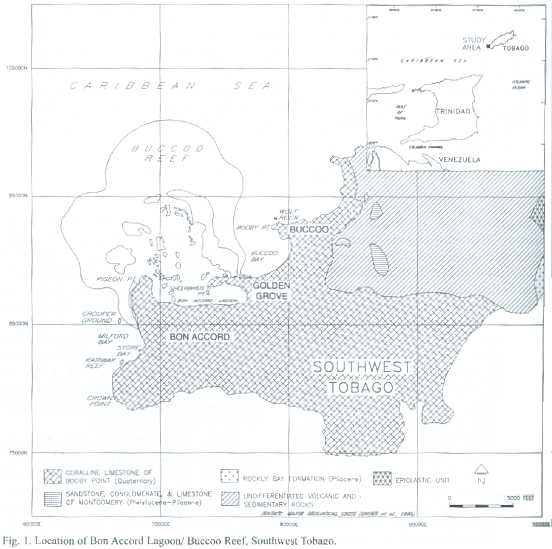
<body><![CDATA[<p align="center">Materials and methods</p>     <p>Site description</p> </b></font>     <p><font face="Arial" size="2">The BAL and adjacent Buccoo Reef (BR) are located on the leeward coast of south Tobago between 11 °08 ’ to 11 °12 ’N and 60 °40 ’ to 60 °51 ’W (<a href="#f1">Fig.1</a>).BAL has a surface area of 1.2 km<sup>2</sup> and forms the southern boundary of the BR marine park.This ecosystem complex covers an area of 7 km<sup>2</sup> ,and drains a terrestrial area of 7.7 km<sup>2</sup> in a built-up part of south-west Tobago.The seagrass community within and adjacent to BAL covers 0.5 km<sup>2</sup>.Turtle Grass,<i>Thalassia testudinum </i>Banks ex König is the dominant species in the lagoon,comprising 80%of the community.Smaller areas of <i>Halophila decipiens </i>Ostenfeld and <i>Halodule wrightii </i>Ascherson are also found interspersed among the turtle grass <i>.</i>The dominant algal species were from <i>Acanthophora </i>,<i>Dictyota, Halimeda,Padina.Bryopsis,Codium </i>and <i>Caulerpa </i>genera.</font></p> <a name="f1"></a>     <div style="text-align: center;"><img src="/img/fbpe/rbt/v53s1/3184i8.JPG" title=""  alt="" style="width: 552px; height: 549px;"></div>     
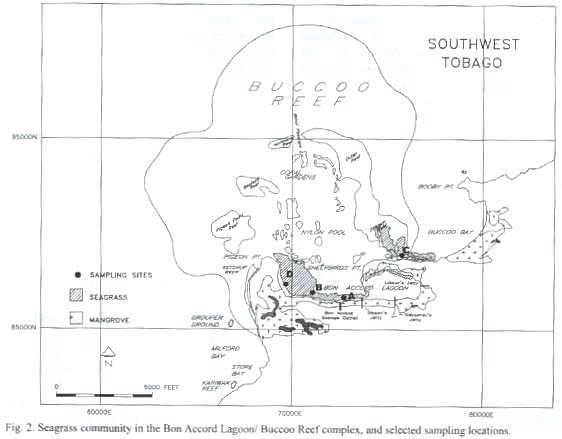
<p><font face="Arial" size="2">BAL is on average 2 m deep and is a well-flushed,marine coastal lagoon with a reasonably high rate of tidal exchange between the lagoon and the adjacent coral reef (<a href="#ju04">Juman 2004</a>).The tide is mixed,mainly semidiurnal with a significant diurnal inequality.Because of its geographical setting,BAL is also subjected to wind-generated waves that cause re-suspension of bottom sediment. Tobago experiences a tropical climate with pronounced dry (January to April)and wet seasons (June to November)and a mean annual ambient temperature of 25.7 °C (<a href="#be81">Berridge 1981</a>).Southwest Tobago receives a mean total rainfall of 1415 mm yr<sup>-1</sup> ,84%of which occurs during the wet season,based on rainfall statistics for Crown Point from 1969-1978 (<a href="#an82">Anonymous 1982</a>).</font></p> <font face="Arial" size="2"><b>     <p>Sampling methods</p> </b></font>     <p><font face="Arial" size="2">Aerial photographs (taken by Survair International Limited in 1994,at elevation 1800 m.a.s.l.,at scale 1:12 500;FS160,f/4.0) were used to map the extent of the seagrass ecosystem as well as geographical and man-made features.This was then corroborated by ground truthing.The resultant maps were used to measure the extent of the ecosystem,and to select sampling sites.Four seagrass study locations,A-D (<a href="#f2">Fig.2</a>)were randomly selected. Sample locations A,B and D were within the mangrove-fringed lagoon while location C was in the back-reef area.Locations B and D were west of the Bon Accord sewage outfall.    <br> </font></p> <a name="f2"></a>     <div style="text-align: center;"><img src="/img/fbpe/rbt/v53s1/3184i9.JPG" title=""  alt="" style="width: 562px; height: 439px;"></div>     
<p><font face="Arial" size="2">    ]]></body>
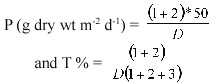
<body><![CDATA[<br> </font></p> <font face="Arial" size="2"><b>     <p>Structure of seagrass/macroalgae beds</p> </b></font>     <p><font face="Arial" size="2">The percentage cover by seagrasses and algae was determined using 50 x 50 cm (0.25 m<sup>2</sup>)quadrats placed at 10 m intervals along permanent 100 m transect lines.One transect line was randomly established at each of the four study locations,perpendicular to the shore (<a href="#f2">Fig.2</a>).Two replicate quadrats were measured at each sampling interval.Each quadrat was divided into 10 x 10 cm grids and percentage cover by seagrasses and algae was determined in each grid.Twenty quadrats were surveyed per transect line and estimation of coverage was calculated according to <a href="#en94">English <i>et al.</i>(1994)</a>. This estimation was done once within the sampling year between May and June 1998.</font></p>     <p><font face="Arial" size="2"><b><i>Thalassia testudinum </i>productivity</b></font></p>     <p><font face="Arial" size="2">The productivity of the seagrasses in the lagoon was determined using a biomass accumulation method adapted from <a href="#zi74">Zieman (1974)</a> and <a href="#an94">Anonymous (1994)</a>.At the four seagrass location, six 10 x 20 cm (0.2 m<sup>2</sup>)PVC quadrats were randomly deployed.All the seagrass shoots in each of the quadrats were marked at the sediment surface by punching holes in the middle of the leaf blade using hypodermic needles.The seagrass was allowed to grow for seven days,after which they were harvested and taken back to the laboratory for analysis. </font></p>     <p><font face="Arial" size="2">In the laboratory,the leaves of the shoots were sorted into three groups:(1)new leaves (leaves that had emerged since the time of marking),(2)old growth (this was the length of the leaf from the point of marking down to the base where the leaf was harvested)and (3)old standing crop (this is the section above where the leaf was marked).Leaves were cleaned of epiphytes by soaking in 5%phosphoric acid and then dried to constant weight at 60 °C.Total dry weight was measured and these weights were then used to calculate productivity (P)and turnover rate (T).</font></p>     <div style="text-align: center;"><img src="/img/fbpe/rbt/v53s1/formula3.JPG" title=""  alt="" style="width: 216px; height: 84px;"></div>     
<p><font face="Arial" size="2">where D is number of days;1=dry wt of new leaves;2=dry wt of old growth and 3=dry wt of old standing crop (<a href="#an94">Anonymous 1994</a>). The inverse of turnover rate is turnover time,which is the number of days required to replace the standing crop.Productivity and turnover rate were measured in March,June, September and December 1998.Analysis of variance (ANOVA)was used to examine spatial and temporal differences.</font></p> <font face="Arial" size="2"><b>     <p>Total <i>Thalassia testudinum </i>biomass</p> </b></font>     <p><font face="Arial" size="2">Total <i>T.testudinum </i>biomass has been measured at locations A and B in BAL as part of the CARICOMP program.A polyvinylchloride (PVC)corer (diameter 20 cm and length 60-80 cm)with a serrated edge was used to sample <i>Thalassia </i>biomass (<a href="#an94">Anonymous 1994</a>).The corer was forced into the sediment to at least 45-50 cm to obtain over 90%of <i>Thalassia </i>rhizomes and roots.Four random cores were taken per sample location.Core samples were placed in individual buckets.Coarse sorting was done on a sieve with a mesh of about 2 mm.Samples were washed with seawater <i>.Thalassia </i>was then sorted into green leaves,non-green leaves and short shoots,live rhizomes,live roots,and dead belowground material.After sorting,epiphytes on the leaves were removed by soaking in 5%phosphoric acid.The sorted sample is then washed to remove salt and put onto pre-weighed foil and dried to constant weight at 60 ºC.Total biomass is reported as g dry wt m<sup>-2</sup> . <i>Thalassia </i>biomass was measured at sample location A from 1992-2002 and at sample location B from 1997-2002.This was compared to other seagrass location in southwest Tobago and northwestern Trinidad.</font></p> <font face="Arial" size="2"><b>     ]]></body>
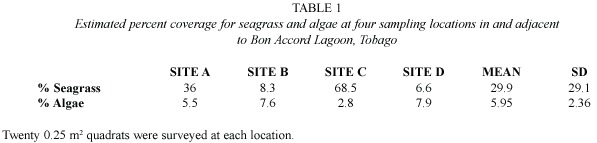
<body><![CDATA[<p align="center">Results</p> </b></font>     <p><font face="Arial" size="2">The mean percentage coverage by seagrass and algae at the four seagrass sampling locations was 29.9 ±29.1%and 6.0 ±2.4%,respectively (<a href="#t1">Table 1</a>).Eighty percent of the seagrass plant community was turtle grass.Sampling location C had the highest percent coverage of seagrasses (68.5%)and the lowest percent coverage of algae (2.8%).The dominant algal genus at this location was <i>Halimeda </i>.Sampling locations B and D had the lowest percent coverage of seagrasses (6.6-8.3%)and the highest coverage of algae (7.9%).The dominant algal species found at sites located in the lagoon were <i>Acanthophera spicifera,Dictyota divarcata </i>,<i>Caulerpa mexicana,C.sertularoides </i>,<i>Sargassum </i>spp.and <i>Padina </i>spp.    <br>     <br> </font></p>     <p style="text-align: center;"><font face="Arial" size="2">&nbsp;<a  name="t1"></a><img src="/img/fbpe/rbt/v53s1/3183i1.JPG" title="" alt=""  style="width: 597px; height: 143px;"></font></p> <font face="Arial" size="2"></font>     
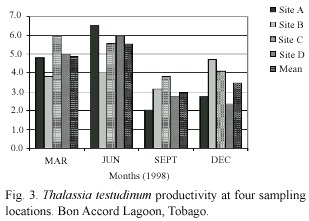
<p><font face="Arial" size="2"><i>    <br> T.testudinum </i>productivity showed seasonal variation (F=6.4,p&lt;0.05)(<a href="#F3">Fig.3</a>). Productivity was highest in March and June at locations A,C and D,and was lowest in September at all locations.Highest values for both variables were recorded from March to June,the dry season to early wet season, with lowest values in the wet season,July to December.Productivity in BAL varied slightly between sampling locations (<a href="#F3">Fig.3</a>).Sample location C had the highest mean productivity [4.9 g dry wt m<sup>-2</sup> d<sup>-1</sup> ]for the four sample periods while B,which was adjacent to the mangrove swamp and west of the Bon Accord Sewage outfall (<a href="#f2">Fig.2</a>),had the lowest [3.9 g dry wt m<sup>-2</sup> d<sup>-1</sup>].</font></p> <a name="F3"></a>     <div style="text-align: center;"><img src="/img/fbpe/rbt/v53s1/3186i1.JPG" title=""  alt="" style="width: 309px; height: 221px;"></div>     
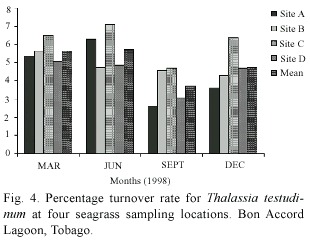
<p><font face="Arial" size="2">The estimated mean annual productivity for the seagrass communities in the BAL in 1998 was 4.2 g dry wt m<sup>-2</sup> d<sup>-1</sup> .The actual area covered by seagrasses in the lagoon is 16.2 ha (29.9%of 54.3 ha).Then total production for the beds is 682 kg dry wt d<sup>-1</sup> ,and annual production is 249 t dry wt.The mean seagrass nutrient concentration measured in other studies (Klumpp <a  href="#kl89"><i>et al.</i>1989</a>,<a href="#du92">Duarte 1992</a>,<a href="#ag96">Agawin <i>et al.</i>1996</a>,<a href="#ma97">Mateo and Romero 1997</a>,<a href="#st97">Stapel <i>et al.</i>1997</a>)yielded 34%C,2%N and 0.2%P,the corresponding total nutrient input for the seagrasses in and adjacent to BAL,is calculated at 83.9 t C,5.1 t N and 0.4 t P.</font></p>     <p><font face="Arial" size="2">Percentage turnover rate showed a similar trend to productivity.It was highest in March and June (5.6%)for all sampling sites and lowest in September (3.7%),the midst of the wet season (<a href="#f4">Fig.4</a>).Location C had the highest turnover rate for all the sampling months. Yearly averaged percentage turnover rate for seagrasses in the lagoon measured 5%in 1998. If turnover rate is 5%,turnover time is 20 days, which indicates the production of an average of 18 crops of leaves per year.    ]]></body>
<body><![CDATA[<br> </font></p> <a name="f4"></a>     <div style="text-align: center;"><img src="/img/fbpe/rbt/v53s1/3186i2.JPG" title=""  alt="" style="width: 310px; height: 240px;"></div>     
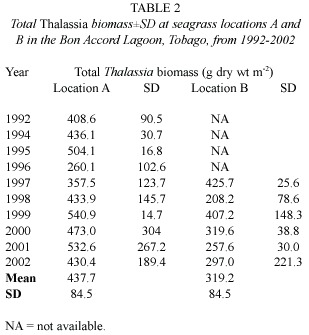
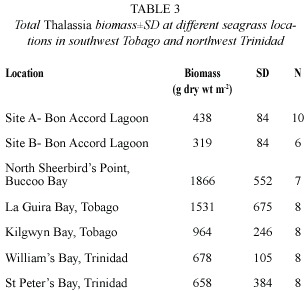
<p><font face="Arial" size="2">Total <i>T.testudinum </i>biomass at sample location A,varied between 260 ±102 g m<sup>-2</sup> in 1996 to 541 ±15 g m<sup>-2</sup> in 1999,while at location B it ranged between 208 ±79 g m<sup>-2</sup> in 1998 and 426 ±26 g m<sup>-2</sup> in 1997 (<a href="#t2">Table 2</a>).Average biomass during the period 1992-2002 was 378.5 ±83.8 g m<sup>-2 </sup>(n=16).Total <i>Thalassia </i>biomass at these stations (A and B)were the lowest compared with other seagrass locations in northwest Trinidad and southwest Tobago (<a href="#t3">Table 3</a>).    <br> </font></p>     <div style="text-align: center;"><font face="Arial" size="2"><a  name="t2"></a><img src="/img/fbpe/rbt/v53s1/3183i2.JPG" title="" alt=""  style="width: 309px; height: 335px;"></font>    
<br> </div>     <p><font face="Arial" size="2">    <br> </font></p>     <p style="text-align: center;"><font face="Arial" size="2">&nbsp;<a  name="t3"></a><img src="/img/fbpe/rbt/v53s1/3183i3.JPG" title="" alt=""  style="width: 305px; height: 291px;"></font></p>     
<div style="text-align: center;"><small style="font-weight: bold;"><span  style="font-family: arial;">Discussion</span></small></div> <font face="Arial" size="2"><b></b></font>     ]]></body>
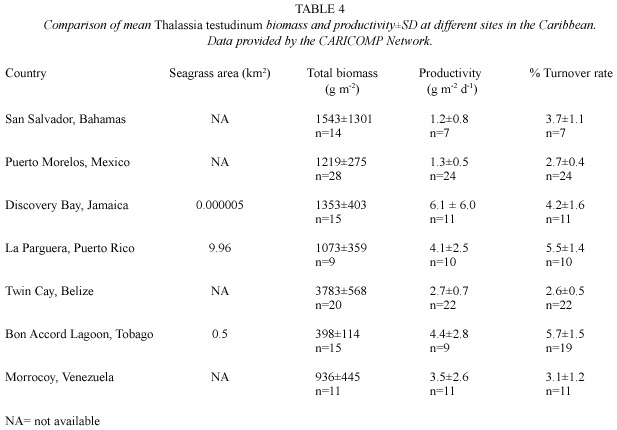
<body><![CDATA[<p><font face="Arial" size="2"><i>T.testudinum </i>productivity and turnover rates in the BAL varied seasonally and spatially.These parameters were higher during the dry season months (January to June)compared to the wet season months (July to December). Productivity ranged from 3.0 in the wet season to 5.0 g dry wt m<sup>-2</sup> d<sup>-1</sup> in the dry season,while percentage turnover rates ranged from 4.2 to 5.6%.Seasonal differences in <i>T.testudinum </i>density,biomass,and primary production were also reported by <a href="#jo68">Jones (1968)</a>,<a  href="#zi75">Zieman (1975)</a>, and <a href="#th77">Thorhaug and Roesler (1977)</a>for Florida, and by van Tussenbroek (1995)for Puerto Morelos Lagoon,Mexico.They reported summer maximum and winter minimum values, which they related to temperature,salinity and length of day.</font></p>     <p><font face="Arial" size="2">Variations in depth and day-length in this area were insignificant.Productivity and percentage turnover rate were higher when the water was less turbid.In the wet season there is increased run-off from the mangrove and adjoining land,resulting in increased sediment and nutrient loading.High nitrate and phosphate concentrations were recorded close to,and west of the Bon Accord sewage outfall (<a href="#ju04">Juman 2004</a>).High total suspended solids concentrations were also reported near to the Bon Accord sewage outfall and close to sampling location B (<a href="#ju04">Juman 2004</a>).At this location, the bed was heterogeneous with large sandy patches;therefore bottom sediment would be more easily re-suspended especially during heavy wind conditions.</font></p>     <p><font face="Arial" size="2">In Puerto Morelos,Mexico,<i>Thalassia </i>biomass and productivity were highest at the station in the vicinity of mangrove discharge, and were lowest at the back-reef station (<a  href="#va95">van Tussenbroek 1995</a>).In BAL,the opposite trend is observed.The back-reef sampling location (C)had the highest percentage cover by seagrasses,mean areal productivity and percentage turnover rates while B,which was adjacent to the mangrove swamp and sewage outfall, had the lowest.Total <i>T.testudinum </i>biomass in BAL was low compared to other locations in southwest Tobago and Northwest Trinidad (<a  href="#t3">Table 3</a>). <i>T. testudinum </i>biomass in BAL was more than 200%lower than other CARICOMP sites,though productivity was amongst the highest (<a  href="#t4">Table 4</a>).</font></p> <a name="t4"></a>     <div style="text-align: center;"><img src="/img/fbpe/rbt/v53s1/3183i4.JPG" title=""  alt="" style="width: 617px; height: 430px;"></div>     
<p><font face="Arial" size="2">Nutrient loading within the BAL may have enhanced the proliferation of faster growing phytoplankton,epiphytic and macro-algae that compete with seagrasses for light and space. Competition with algae leads to diminished growth and stature;increased shoot mortality and decline in shoot density and total habitat area of seagrasses (<a href="#ta95">Taylor <i>et al. </i>1995</a>,<a  href="#ke96">Kenworthy and Fonseca 1996</a>,<a href="#sh96">Short and Burdick 1996</a>).In nutrient enriched areas where seagrass meadows have been mapped over time,the spatial configuration of the meadow usually becomes more fragmented, with large distances between patches compared to initial conditions (<a href="#co88">Costa 1988</a>,<a  href="#ba92">Batiuk <i>et al. </i>1992</a>).This was observed at locations (B and D)within BAL,in the vicinity of the sewage effluent drain.Colonization of the <i>Thalassia </i>community by <i>Halodule wrightii </i>has been reported as a consequence of long-term enrichment (<a href="#re91">Reyes and Merino 1991</a>,<a  href="#la94">Lapointe <i>et al. </i>1994</a>)and this was also observed in the BAL.</font></p> <font face="Arial" size="2"><b>     <p align="center">Conclusion</p> </b><i></i></font>     <p><font face="Arial" size="2"><i>T.testudinum </i>dominated seagrass community within BAL,is diminishing.This is reflected in the low percent cover by seagrasses measured at sampling locations within the lagoon (B and D),and low <i>T.testudinum </i>biomass when compared to other sites in Trinidad and Tobago and the Wider Caribbean.The seagrass bed in the lagoon is becoming patchy and there is a higher macro-algae cover.</font></p> <font face="Arial" size="2"><b>     <p>Acknowledgments</p> </b></font>     <p><font face="Arial" size="2">I thank the Institute of Marine Affairs for providing funding and Peter Bacon (deceased) of the University of the West Indies,who supervised and guided my work.I thank David Shim and Gerard Alleng for their valuable advice.I am also grateful to the staff of the Tobago House of Assembly who provided logistical support while conducting field surveys,and the staff of the Institute of Marine Affairs,who assisted with data analysis.I also acknowledge the CARICOMP network for information provided.</font></p> <font face="Arial" size="2"><b>     <p>Resumen</p> </b></font>     ]]></body>
<body><![CDATA[<p><font face="Arial" size="2">La comunidad de pastos marinos de Buccoo Reef/ Parque Nacional Bon Accord Lagoon,dominado por <i>Thalassia testudinum,</i>mide 0.5 km<sup>2</sup> y es parte de un complejo de arrecifes,lechos de pastos marinos y manglares en el suroeste de Tobago.La cobertura,productividad y tasa de recambio de <i>T.testudinum </i>fueron medidas de febrero 1998 a febrero 1999 en cuatro localidades,mientras que la biomasa total de <i>T.testudinum </i>fue medida en dos localidades en la laguna,entre 1992-2002.La productividad y la tasa de recambio variaron espacialmente y estacionalmente.Fueron mayores en la parte trasera del arrecife que en el manglar y la laguna del arrecife marginal,y fueron menores en localidades cerca de un emisario de aguas negras.La cobertura de <i>T.testudinum </i>tuvo un ámbito de 6.6%en la laguna a 68.5%en la parte trasera del arrecife, mientras que la productividad tuvo un ámbito de 3.9 a 4.9 g peso seco m<sup>-2</sup> d<sup>-1</sup>.La productividad y las tasas de recambio fueron mayores en la época seca (enero a junio)que en la época lluviosa (julio-diciembre).La productividad tuvo un ámbito entre 3.0 en la época húmeda y 5.0 g peso seco m<sup>-2</sup> d<sup>-1</sup> en la época seca,mientras que las tasas de recambio variaron entre 4.2 y 5.6%.La biomasa total de <i>Thalassia </i>y la productividad en Bon Accord Lagoon fueron comparadas con seis sitios similares en el Caribe que también participan en el Programa de Productividad Marino-Costera del Caribe (CARICOMP).La comunidad de pastos de Bon Accord Lagoon está siendo afectada negativamente por enriquecimiento de nutrimentos.</font></p> <font face="Arial" size="2"><b></b></font>     <p><font face="Arial" size="2"><b>Palabras clave:</b><i>Thalassia testudinum,</i>Laguna Bon Accord,CARICOMP,productividad,biomasa.</font></p> <font face="Arial" size="2"><b>     <p>References</p> </b></font>     <!-- ref --><p><font face="Arial" size="2"><a name="ag96"></a>Agawin, N.S.R.,C.M.Duarte &amp;M.D.Fortes.1996. Nutrient limitation of Philippine seagrasses (Cape Bolinao,NW Philippines):<i>in situ </i>experimental evidence.Mar.Ecol.Prog.Ser.138:233-243.</font>&nbsp;&nbsp;&nbsp;&nbsp;&nbsp;&nbsp;&nbsp;&nbsp;[&#160;<a href="javascript:void(0);" onclick="javascript: window.open('/scielo.php?script=sci_nlinks&ref=1233908&pid=S0034-7744200500030002700001&lng=','','width=640,height=500,resizable=yes,scrollbars=1,menubar=yes,');">Links</a>&#160;]<!-- end-ref --><!-- ref --><p><font face="Arial" size="2"><a name="al80"></a>Alkins,M.E.&amp;J.S.Kenny.1980.A Baseline Survey of Scotland Bay,Chaguaramas.Occas.Papers,Inst. Mar.Affairs,Trinidad and Tobago.68 p.</font>&nbsp;&nbsp;&nbsp;&nbsp;&nbsp;&nbsp;&nbsp;&nbsp;[&#160;<a href="javascript:void(0);" onclick="javascript: window.open('/scielo.php?script=sci_nlinks&ref=1233909&pid=S0034-7744200500030002700002&lng=','','width=640,height=500,resizable=yes,scrollbars=1,menubar=yes,');">Links</a>&#160;]<!-- end-ref --><!-- ref --><p><font face="Arial" size="2"><a name="an82"></a>Anonymous.1982.Averages and Extremes of Meteorological Elements 2,Rainfall and other elements. Caribbean Meteorological Institute (CMI).No page numbers.</font>&nbsp;&nbsp;&nbsp;&nbsp;&nbsp;&nbsp;&nbsp;&nbsp;[&#160;<a href="javascript:void(0);" onclick="javascript: window.open('/scielo.php?script=sci_nlinks&ref=1233910&pid=S0034-7744200500030002700003&lng=','','width=640,height=500,resizable=yes,scrollbars=1,menubar=yes,');">Links</a>&#160;]<!-- end-ref --><!-- ref --><p><font face="Arial" size="2"><a name="an90"></a>Anonymous.1990.Environmental Impact Assessment of the extension of the Crown Point Airport Runway, Tobago.Institute of Marine Affairs (IMA), Chaguaramas,Trinidad.123 p.</font>&nbsp;&nbsp;&nbsp;&nbsp;&nbsp;&nbsp;&nbsp;&nbsp;[&#160;<a href="javascript:void(0);" onclick="javascript: window.open('/scielo.php?script=sci_nlinks&ref=1233911&pid=S0034-7744200500030002700004&lng=','','width=640,height=500,resizable=yes,scrollbars=1,menubar=yes,');">Links</a>&#160;]<!-- end-ref --><!-- ref --><p><font face="Arial" size="2"><a name="an92"></a>Anonymous.1992.Feasibility and impact studies for a resort and marina development at Lowlands Estate, Tobago.Final Rep.Institute of Marine Affairs (IMA), Chaguaramas,Trinidad.216 p.</font>&nbsp;&nbsp;&nbsp;&nbsp;&nbsp;&nbsp;&nbsp;&nbsp;[&#160;<a href="javascript:void(0);" onclick="javascript: window.open('/scielo.php?script=sci_nlinks&ref=1233912&pid=S0034-7744200500030002700005&lng=','','width=640,height=500,resizable=yes,scrollbars=1,menubar=yes,');">Links</a>&#160;]<!-- end-ref --><!-- ref --><p><font face="Arial" size="2"><a name="an94"></a>Anonymous.1994.CARICOMP Methods Manual- Level I.Manual of Methods for Mapping and Monitoring of Physical and Biological Parameters in the Coastal Zone of the Caribbean.CARICOMP Data Management Centre,UWI,Mona,Kingston, Jamaica.54 p.</font>&nbsp;&nbsp;&nbsp;&nbsp;&nbsp;&nbsp;&nbsp;&nbsp;[&#160;<a href="javascript:void(0);" onclick="javascript: window.open('/scielo.php?script=sci_nlinks&ref=1233913&pid=S0034-7744200500030002700006&lng=','','width=640,height=500,resizable=yes,scrollbars=1,menubar=yes,');">Links</a>&#160;]<!-- end-ref --><!-- ref --><p><font face="Arial" size="2"><a name="an97"></a>Anonymous.1997.Variation in ecological parameters of <i>Thalassia testudinum </i>across the CARICOMP Network.Proc.8 th Int.Coral Reef Symp.,Panama 1:663-668.</font>&nbsp;&nbsp;&nbsp;&nbsp;&nbsp;&nbsp;&nbsp;&nbsp;[&#160;<a href="javascript:void(0);" onclick="javascript: window.open('/scielo.php?script=sci_nlinks&ref=1233914&pid=S0034-7744200500030002700007&lng=','','width=640,height=500,resizable=yes,scrollbars=1,menubar=yes,');">Links</a>&#160;]<!-- end-ref --><!-- ref --><p><font face="Arial" size="2"><a name="ba92"></a>Batiuk,R.A.,R.J.Orth,K.A.Moore,W.C.Dennison, J.C.Stevenson,L.Staver,V.Carter,N.Rybicki, R.E. Hickman, S. Kollar, S. Bieber,P.Heasly &amp; P.Bergstrom.1992.Submerged aquatic vegetation habitat requirements and restoration targets:A technical synthesis.CBP/TRS 83/92. Annapolis,Maryland: U.S.Environmental Protection Agency.185 p.</font>&nbsp;&nbsp;&nbsp;&nbsp;&nbsp;&nbsp;&nbsp;&nbsp;[&#160;<a href="javascript:void(0);" onclick="javascript: window.open('/scielo.php?script=sci_nlinks&ref=1233915&pid=S0034-7744200500030002700008&lng=','','width=640,height=500,resizable=yes,scrollbars=1,menubar=yes,');">Links</a>&#160;]<!-- end-ref --><!-- ref --><p><font face="Arial" size="2"><a name="be81"></a>Berridge,C.E.1981.Climate,p.3-8.<i>In </i>S.G.C.Copper &amp; P.R Bacon (eds.).The Natural Resources of Trinidad and Tobago.Edward Arnold,London,U.K. </font>&nbsp;&nbsp;&nbsp;&nbsp;&nbsp;&nbsp;&nbsp;&nbsp;[&#160;<a href="javascript:void(0);" onclick="javascript: window.open('/scielo.php?script=sci_nlinks&ref=1233916&pid=S0034-7744200500030002700009&lng=','','width=640,height=500,resizable=yes,scrollbars=1,menubar=yes,');">Links</a>&#160;]<!-- end-ref --><!-- ref --><p><font face="Arial" size="2"><a name="co88"></a>Costa,J.E.1988.Eelgrass in Buzzards Bay:Distribution, production,and historical changes in abundance.U.S. Environmental Protection Agency Tech.Rep.,EPA 503/4-88-002:30-61.</font>&nbsp;&nbsp;&nbsp;&nbsp;&nbsp;&nbsp;&nbsp;&nbsp;[&#160;<a href="javascript:void(0);" onclick="javascript: window.open('/scielo.php?script=sci_nlinks&ref=1233917&pid=S0034-7744200500030002700010&lng=','','width=640,height=500,resizable=yes,scrollbars=1,menubar=yes,');">Links</a>&#160;]<!-- end-ref --><!-- ref --><p><font face="Arial" size="2"><a name="du92"></a>Duarte,C.M.1992.Nutrient concentrations of aquatic plants:patterns across species.Limnol.Oceanogr. 37:882-889.</font>&nbsp;&nbsp;&nbsp;&nbsp;&nbsp;&nbsp;&nbsp;&nbsp;[&#160;<a href="javascript:void(0);" onclick="javascript: window.open('/scielo.php?script=sci_nlinks&ref=1233918&pid=S0034-7744200500030002700011&lng=','','width=640,height=500,resizable=yes,scrollbars=1,menubar=yes,');">Links</a>&#160;]<!-- end-ref --><!-- ref --><p><font face="Arial" size="2"><a name="en94"></a>English,S.,C.Wilkinson &amp;B.Baker (eds.).1994.Survey Manual for Tropical Marine Resources.Aust.Inst. Mar. Sci., Townsville.368 p.</font>&nbsp;&nbsp;&nbsp;&nbsp;&nbsp;&nbsp;&nbsp;&nbsp;[&#160;<a href="javascript:void(0);" onclick="javascript: window.open('/scielo.php?script=sci_nlinks&ref=1233919&pid=S0034-7744200500030002700012&lng=','','width=640,height=500,resizable=yes,scrollbars=1,menubar=yes,');">Links</a>&#160;]<!-- end-ref --><!-- ref --><p><font face="Arial" size="2"><a name="go67"></a>Goreau,T.1967.Buccoo Reef and Bon Accord Lagoon, Tobago.Observation and recommendations concerning the preservation of the reef and its lagoon in relation to urbanization of the neighbouring coastal islands. Memorandum to Permanent Secretary (Agriculture), Economics Planning Unit,Prime Minister ’s Office, Government of Trinidad and Tobago.8 p.</font>&nbsp;&nbsp;&nbsp;&nbsp;&nbsp;&nbsp;&nbsp;&nbsp;[&#160;<a href="javascript:void(0);" onclick="javascript: window.open('/scielo.php?script=sci_nlinks&ref=1233920&pid=S0034-7744200500030002700013&lng=','','width=640,height=500,resizable=yes,scrollbars=1,menubar=yes,');">Links</a>&#160;]<!-- end-ref --><!-- ref --><p><font face="Arial" size="2"><a name="he00"></a>Hemminga,M.A.&amp;C.M.Duarte.2000.Seagrass Ecology. Cambridge Univ.Press,UK.298 p.</font>&nbsp;&nbsp;&nbsp;&nbsp;&nbsp;&nbsp;&nbsp;&nbsp;[&#160;<a href="javascript:void(0);" onclick="javascript: window.open('/scielo.php?script=sci_nlinks&ref=1233921&pid=S0034-7744200500030002700014&lng=','','width=640,height=500,resizable=yes,scrollbars=1,menubar=yes,');">Links</a>&#160;]<!-- end-ref --><!-- ref --><p><font face="Arial" size="2"><a name="jo68"></a>Jones,J.A.1968.Primary productivity by the tropical marine turtle grass,<i>Thalassia testudinum </i>,Konig, and its epiphytes.Ph.D.dissertation,Univ.Miami,Miami Florida.196 p.</font>&nbsp;&nbsp;&nbsp;&nbsp;&nbsp;&nbsp;&nbsp;&nbsp;[&#160;<a href="javascript:void(0);" onclick="javascript: window.open('/scielo.php?script=sci_nlinks&ref=1233922&pid=S0034-7744200500030002700015&lng=','','width=640,height=500,resizable=yes,scrollbars=1,menubar=yes,');">Links</a>&#160;]<!-- end-ref --><!-- ref --><p><font face="Arial" size="2"><a name="ju04"></a>Juman,R.A.2004.The characterisation and ecology of the Bon Accord Lagoon,Tobago,West Indies. Ph. D. Dissertation, Univ. West Indies,St Augustine, Trinidad.261 p.</font>&nbsp;&nbsp;&nbsp;&nbsp;&nbsp;&nbsp;&nbsp;&nbsp;[&#160;<a href="javascript:void(0);" onclick="javascript: window.open('/scielo.php?script=sci_nlinks&ref=1233923&pid=S0034-7744200500030002700016&lng=','','width=640,height=500,resizable=yes,scrollbars=1,menubar=yes,');">Links</a>&#160;]<!-- end-ref --><!-- ref --><p><font face="Arial" size="2"><a name="ke96"></a>Kenworthy,W.J.&amp;M.S.Fonseca.1996.Light requirements of seagrasses <i>Halodule wrightii </i>and <i>Syringodium filiforme </i>derived from the relationship between diffuse light attenuation and maximum depth distribution. Estuaries 19:740-750.</font>&nbsp;&nbsp;&nbsp;&nbsp;&nbsp;&nbsp;&nbsp;&nbsp;[&#160;<a href="javascript:void(0);" onclick="javascript: window.open('/scielo.php?script=sci_nlinks&ref=1233924&pid=S0034-7744200500030002700017&lng=','','width=640,height=500,resizable=yes,scrollbars=1,menubar=yes,');">Links</a>&#160;]<!-- end-ref --><!-- ref --><p><font face="Arial" size="2"><a name="kl89"></a>Klumpp,D.W.,R.K.Howard &amp;D.A.Pollard.1989. Trophodynamics and nutritional ecology of seagrass communities,p.394-457.<i>In </i>A.W.D.Larkum, A.J.McComb &amp;S.A.Shepherd (eds.).Biology of Seagrasses:A Treatise on the Biology of Seagrasses with Special Reference to the Australian Region. Elsevier,Amsterdam.</font>&nbsp;&nbsp;&nbsp;&nbsp;&nbsp;&nbsp;&nbsp;&nbsp;[&#160;<a href="javascript:void(0);" onclick="javascript: window.open('/scielo.php?script=sci_nlinks&ref=1233925&pid=S0034-7744200500030002700018&lng=','','width=640,height=500,resizable=yes,scrollbars=1,menubar=yes,');">Links</a>&#160;]<!-- end-ref --><!-- ref --><p><font face="Arial" size="2"><a name="la94"></a>Lapointe,B.E.,D.A.Tomasko &amp;W.R.Matzie.1994. Eutrophication and trophic state classification of seagrass communities in the Florida Keys.Bull.Mar. Sci.54:696-717.</font>&nbsp;&nbsp;&nbsp;&nbsp;&nbsp;&nbsp;&nbsp;&nbsp;[&#160;<a href="javascript:void(0);" onclick="javascript: window.open('/scielo.php?script=sci_nlinks&ref=1233926&pid=S0034-7744200500030002700019&lng=','','width=640,height=500,resizable=yes,scrollbars=1,menubar=yes,');">Links</a>&#160;]<!-- end-ref --><!-- ref --><p><font face="Arial" size="2"><a name="ma76"></a>Massiah,J.A.1976.West Indian <i>Thalassia </i>communities with special reference to Trinidad communities. Zoology Department,University of the West Indies, St.Augustine.69 p.</font>&nbsp;&nbsp;&nbsp;&nbsp;&nbsp;&nbsp;&nbsp;&nbsp;[&#160;<a href="javascript:void(0);" onclick="javascript: window.open('/scielo.php?script=sci_nlinks&ref=1233927&pid=S0034-7744200500030002700020&lng=','','width=640,height=500,resizable=yes,scrollbars=1,menubar=yes,');">Links</a>&#160;]<!-- end-ref --><!-- ref --><p><font face="Arial" size="2"><a name="ma97"></a>Mateo,M.A.&amp;J.Romero.1997.Detritus dynamics in the seagrass <i>Posidonia oceanica </i>:elements for an ecosystem carbon and nutrient budget.Mar.Ecol.Prog. Ser.151:43-53.</font>&nbsp;&nbsp;&nbsp;&nbsp;&nbsp;&nbsp;&nbsp;&nbsp;[&#160;<a href="javascript:void(0);" onclick="javascript: window.open('/scielo.php?script=sci_nlinks&ref=1233928&pid=S0034-7744200500030002700021&lng=','','width=640,height=500,resizable=yes,scrollbars=1,menubar=yes,');">Links</a>&#160;]<!-- end-ref --><!-- ref --><p><font face="Arial" size="2"><a name="mu89"></a>Muehlstein,L.K.&amp;J.Beets.1989.Seagrass declines and their impacts on fisheries.Proc.42 nd Gulf Carib.Fish. Inst.,Ocho Rios,Jamaica.Pp.55-65.</font>&nbsp;&nbsp;&nbsp;&nbsp;&nbsp;&nbsp;&nbsp;&nbsp;[&#160;<a href="javascript:void(0);" onclick="javascript: window.open('/scielo.php?script=sci_nlinks&ref=1233929&pid=S0034-7744200500030002700022&lng=','','width=640,height=500,resizable=yes,scrollbars=1,menubar=yes,');">Links</a>&#160;]<!-- end-ref --><!-- ref --><p><font face="Arial" size="2"><a name="na01"></a>Nagelkerken,I.,S.Kleijnen,T.Klop,R.A.C.J.Van Den Brand,E.Cocheret De La Morinière &amp;G.van Der Velde. 2001. Dependence of Caribbean reef fishes on mangroves and seagrass beds as nursery habitats: a comparison of fish faunas between bays with and without mangroves/seagrass beds.Mar.Ecol.Prog. Ser.214:225-235.</font>&nbsp;&nbsp;&nbsp;&nbsp;&nbsp;&nbsp;&nbsp;&nbsp;[&#160;<a href="javascript:void(0);" onclick="javascript: window.open('/scielo.php?script=sci_nlinks&ref=1233930&pid=S0034-7744200500030002700023&lng=','','width=640,height=500,resizable=yes,scrollbars=1,menubar=yes,');">Links</a>&#160;]<!-- end-ref --><!-- ref --><p><font face="Arial" size="2"><a name="or83"></a>Orth,R.J.&amp;K.A.Moore.1983.Chesapeake Bay:An unprecedented decline in submerged aquatic vegetation. Science 22:51-52.</font>&nbsp;&nbsp;&nbsp;&nbsp;&nbsp;&nbsp;&nbsp;&nbsp;[&#160;<a href="javascript:void(0);" onclick="javascript: window.open('/scielo.php?script=sci_nlinks&ref=1233931&pid=S0034-7744200500030002700024&lng=','','width=640,height=500,resizable=yes,scrollbars=1,menubar=yes,');">Links</a>&#160;]<!-- end-ref --><!-- ref --><p><font face="Arial" size="2"><a name="re91"></a>Reyes,E.&amp;M.Merino.1991.Diel dissolved oxygen dynamics and eutrophication in a shallow well-mixed tropical lagoon (Cancun,Mexico).Estuaries 14: 372-381.</font>&nbsp;&nbsp;&nbsp;&nbsp;&nbsp;&nbsp;&nbsp;&nbsp;[&#160;<a href="javascript:void(0);" onclick="javascript: window.open('/scielo.php?script=sci_nlinks&ref=1233932&pid=S0034-7744200500030002700025&lng=','','width=640,height=500,resizable=yes,scrollbars=1,menubar=yes,');">Links</a>&#160;]<!-- end-ref --><!-- ref --><p><font face="Arial" size="2"><a name="sh96"></a></font><font  face="Arial" size="2">Short,F.T.&amp;D.M.Burdick.1996.Quantifying eelgrass loss in relation to housing development and nitrogen loading in Waquoit Bay,Massachusetts.Estuaries 19:17-27.</font>&nbsp;&nbsp;&nbsp;&nbsp;&nbsp;&nbsp;&nbsp;&nbsp;[&#160;<a href="javascript:void(0);" onclick="javascript: window.open('/scielo.php?script=sci_nlinks&ref=1233933&pid=S0034-7744200500030002700026&lng=','','width=640,height=500,resizable=yes,scrollbars=1,menubar=yes,');">Links</a>&#160;]<!-- end-ref --><!-- ref --><p><font face="Arial" size="2">Short,F.T.&amp;S.Wyllie-Echeverria.1996.Natural and human-induced disturbances of seagrass.Environ. Conser.23:17-27.</font>&nbsp;&nbsp;&nbsp;&nbsp;&nbsp;&nbsp;&nbsp;&nbsp;[&#160;<a href="javascript:void(0);" onclick="javascript: window.open('/scielo.php?script=sci_nlinks&ref=1233934&pid=S0034-7744200500030002700027&lng=','','width=640,height=500,resizable=yes,scrollbars=1,menubar=yes,');">Links</a>&#160;]<!-- end-ref --><!-- ref --><p><font face="Arial" size="2"><a name="st97"></a>Stapel,J.,R.Manuntun &amp;M.A.Hemminga.1997.Biomass loss and nutrient redistribution in an Indonesian <i>Thalassia hemprichii </i>seagrass bed following seasonal low tide exposure during daylight. Mar. Ecol. Prog. Ser.148:251-262.</font>&nbsp;&nbsp;&nbsp;&nbsp;&nbsp;&nbsp;&nbsp;&nbsp;[&#160;<a href="javascript:void(0);" onclick="javascript: window.open('/scielo.php?script=sci_nlinks&ref=1233935&pid=S0034-7744200500030002700028&lng=','','width=640,height=500,resizable=yes,scrollbars=1,menubar=yes,');">Links</a>&#160;]<!-- end-ref --><!-- ref --><p><font face="Arial" size="2"><a name="ta95"></a>Taylor,D.I.,S.W.Nixon,S.L.Granger,B.A.Buckely,J.P. McMahon &amp;H.J.Lin.1995.Responses of coastal lagoon plant communities to different form of nutrient enrichment –a mesocosm experiment.Aquat. Bot.52:19-34.</font>&nbsp;&nbsp;&nbsp;&nbsp;&nbsp;&nbsp;&nbsp;&nbsp;[&#160;<a href="javascript:void(0);" onclick="javascript: window.open('/scielo.php?script=sci_nlinks&ref=1233936&pid=S0034-7744200500030002700029&lng=','','width=640,height=500,resizable=yes,scrollbars=1,menubar=yes,');">Links</a>&#160;]<!-- end-ref --><!-- ref --><p><font face="Arial" size="2"><a name="th77"></a>Thorhaug,A.&amp;M.A.Roesler.1977.Seagrass community dynamics in a subtropical estuarine lagoon. Aquaculture 12:253-277.</font>&nbsp;&nbsp;&nbsp;&nbsp;&nbsp;&nbsp;&nbsp;&nbsp;[&#160;<a href="javascript:void(0);" onclick="javascript: window.open('/scielo.php?script=sci_nlinks&ref=1233937&pid=S0034-7744200500030002700030&lng=','','width=640,height=500,resizable=yes,scrollbars=1,menubar=yes,');">Links</a>&#160;]<!-- end-ref --><!-- ref --><p><font face="Arial" size="2"><a name="va92"></a>Valiela,I.,K.Foreman &amp;M.La Montagne.1992.Coupling of watersheds and coastal waters:Sources and consequences of nutrient enrichment in Waquoit Bay, Massachusetts.Estuaries 15:443-457.</font>&nbsp;&nbsp;&nbsp;&nbsp;&nbsp;&nbsp;&nbsp;&nbsp;[&#160;<a href="javascript:void(0);" onclick="javascript: window.open('/scielo.php?script=sci_nlinks&ref=1233938&pid=S0034-7744200500030002700031&lng=','','width=640,height=500,resizable=yes,scrollbars=1,menubar=yes,');">Links</a>&#160;]<!-- end-ref --><!-- ref --><p><font face="Arial" size="2"><a name="va95"></a>van Tussenbroek,B.I.1995.<i>Thalassia testudinum </i>leaf dynamics in a Mexican Caribbean coral reef lagoon <i>. </i>Mar. Biol. 122:33-40.</font>&nbsp;&nbsp;&nbsp;&nbsp;&nbsp;&nbsp;&nbsp;&nbsp;[&#160;<a href="javascript:void(0);" onclick="javascript: window.open('/scielo.php?script=sci_nlinks&ref=1233939&pid=S0034-7744200500030002700032&lng=','','width=640,height=500,resizable=yes,scrollbars=1,menubar=yes,');">Links</a>&#160;]<!-- end-ref --><!-- ref --><p><font face="Arial" size="2"><a name="wa89"></a>Walker,D.I.1989.Regional studies-Seagrass in Shark Bay,the foundation of an ecosystem,p.182-210. <i>In </i>A.W.D.Larkum,A.J.McComb &amp;S.A.Shepherd (eds.).Biology of Seagrass.Elsevier,Amsterdam.</font>&nbsp;&nbsp;&nbsp;&nbsp;&nbsp;&nbsp;&nbsp;&nbsp;[&#160;<a href="javascript:void(0);" onclick="javascript: window.open('/scielo.php?script=sci_nlinks&ref=1233940&pid=S0034-7744200500030002700033&lng=','','width=640,height=500,resizable=yes,scrollbars=1,menubar=yes,');">Links</a>&#160;]<!-- end-ref --><!-- ref --><p><font face="Arial" size="2"><a name="zi74"></a>Zieman,J.C.1974.Methods for the study of growth and production of turtle grass,<i>Thalassia testudinum </i>Konig.Aquaculture 4:139-142.</font>&nbsp;&nbsp;&nbsp;&nbsp;&nbsp;&nbsp;&nbsp;&nbsp;[&#160;<a href="javascript:void(0);" onclick="javascript: window.open('/scielo.php?script=sci_nlinks&ref=1233941&pid=S0034-7744200500030002700034&lng=','','width=640,height=500,resizable=yes,scrollbars=1,menubar=yes,');">Links</a>&#160;]<!-- end-ref --><!-- ref --><p><font face="Arial" size="2"><a name="zi75"></a>Zieman,J.C.1975.Quantitative and dynamic aspects of the ecology of turtle grass,<i>Thalassia testudinum </i>Konig, p.554-562.<i>In </i>L.E.Cronin (ed.).Estuarine Research, Vol.1.Academic Press,New York.</font>&nbsp;&nbsp;&nbsp;&nbsp;&nbsp;&nbsp;&nbsp;&nbsp;[&#160;<a href="javascript:void(0);" onclick="javascript: window.open('/scielo.php?script=sci_nlinks&ref=1233942&pid=S0034-7744200500030002700035&lng=','','width=640,height=500,resizable=yes,scrollbars=1,menubar=yes,');">Links</a>&#160;]<!-- end-ref --> ]]></body><back>
<ref-list>
<ref id="B1">
<nlm-citation citation-type="journal">
<person-group person-group-type="author">
<name>
<surname><![CDATA[Agawin]]></surname>
<given-names><![CDATA[N.S.R]]></given-names>
</name>
<name>
<surname><![CDATA[Duarte]]></surname>
<given-names><![CDATA[C.M]]></given-names>
</name>
<name>
<surname><![CDATA[Fortes]]></surname>
<given-names><![CDATA[M.D]]></given-names>
</name>
</person-group>
<article-title xml:lang="en"><![CDATA[Nutrient limitation of Philippine seagrasses (Cape Bolinao,NW Philippines): in situ experimental evidence]]></article-title>
<source><![CDATA[Mar.Ecol.Prog.Ser]]></source>
<year>1996</year>
<volume>138</volume>
<page-range>233-243</page-range></nlm-citation>
</ref>
<ref id="B2">
<nlm-citation citation-type="book">
<person-group person-group-type="author">
<name>
<surname><![CDATA[Alkins]]></surname>
<given-names><![CDATA[M.E]]></given-names>
</name>
<name>
<surname><![CDATA[Kenny]]></surname>
<given-names><![CDATA[J.S]]></given-names>
</name>
</person-group>
<source><![CDATA[A Baseline Survey of Scotland Bay,Chaguaramas]]></source>
<year>1980</year>
<page-range>68</page-range><publisher-name><![CDATA[Occas.Papers,Inst. Mar.Affairs]]></publisher-name>
</nlm-citation>
</ref>
<ref id="B3">
<nlm-citation citation-type="book">
<person-group person-group-type="author">
<name>
</name>
<name>
</name>
</person-group>
<source><![CDATA[Averages and Extremes of Meteorological Elements 2,Rainfall and other elements]]></source>
<year>1982</year>
<publisher-name><![CDATA[Caribbean Meteorological Institute (CMI)]]></publisher-name>
</nlm-citation>
</ref>
<ref id="B4">
<nlm-citation citation-type="book">
<person-group person-group-type="author">
<name>
</name>
<name>
</name>
</person-group>
<source><![CDATA[Environmental Impact Assessment of the extension of the Crown Point Airport Runway, Tobago]]></source>
<year>1990</year>
<page-range>123</page-range><publisher-loc><![CDATA[Chaguaramas ]]></publisher-loc>
<publisher-name><![CDATA[Institute of Marine Affairs (IMA)]]></publisher-name>
</nlm-citation>
</ref>
<ref id="B5">
<nlm-citation citation-type="book">
<person-group person-group-type="author">
<name>
</name>
<name>
</name>
</person-group>
<source><![CDATA[Feasibility and impact studies for a resort and marina development at Lowlands Estate, Tobago.Final Rep]]></source>
<year>1992</year>
<page-range>216</page-range><publisher-loc><![CDATA[Chaguaramas ]]></publisher-loc>
<publisher-name><![CDATA[Institute of Marine Affairs (IMA)]]></publisher-name>
</nlm-citation>
</ref>
<ref id="B6">
<nlm-citation citation-type="book">
<person-group person-group-type="author">
<name>
</name>
<name>
</name>
</person-group>
<source><![CDATA[CARICOMP Methods Manual- Level I.Manual of Methods for Mapping and Monitoring of Physical and Biological Parameters in the Coastal Zone of the Caribbean]]></source>
<year>1994</year>
<publisher-loc><![CDATA[Mona^eKingston Kingston]]></publisher-loc>
<publisher-name><![CDATA[CARICOMP Data Management Centre]]></publisher-name>
</nlm-citation>
</ref>
<ref id="B7">
<nlm-citation citation-type="journal">
<person-group person-group-type="author">
<name>
</name>
<name>
</name>
</person-group>
<article-title xml:lang="en"><![CDATA[Variation in ecological parameters of Thalassia testudinum across the CARICOMP Network]]></article-title>
<source><![CDATA[Proc.8 th Int.Coral Reef Symp]]></source>
<year>1997</year>
<volume>1</volume>
<page-range>663-668</page-range></nlm-citation>
</ref>
<ref id="B8">
<nlm-citation citation-type="book">
<person-group person-group-type="author">
<name>
<surname><![CDATA[Batiuk]]></surname>
<given-names><![CDATA[R.A]]></given-names>
</name>
<name>
<surname><![CDATA[Orth]]></surname>
<given-names><![CDATA[R.J.]]></given-names>
</name>
<name>
<surname><![CDATA[Moore]]></surname>
<given-names><![CDATA[K.A]]></given-names>
</name>
<name>
<surname><![CDATA[Dennison]]></surname>
<given-names><![CDATA[W.C]]></given-names>
</name>
<name>
<surname><![CDATA[Stevenson]]></surname>
<given-names><![CDATA[J.C]]></given-names>
</name>
<name>
<surname><![CDATA[Staver]]></surname>
<given-names><![CDATA[L]]></given-names>
</name>
<name>
<surname><![CDATA[Carter]]></surname>
<given-names><![CDATA[V]]></given-names>
</name>
<name>
<surname><![CDATA[Rybicki]]></surname>
<given-names><![CDATA[N]]></given-names>
</name>
<name>
<surname><![CDATA[Hickman]]></surname>
<given-names><![CDATA[R.E]]></given-names>
</name>
<name>
<surname><![CDATA[Kollar]]></surname>
<given-names><![CDATA[S]]></given-names>
</name>
<name>
<surname><![CDATA[Bieber]]></surname>
<given-names><![CDATA[S]]></given-names>
</name>
<name>
<surname><![CDATA[Heasly]]></surname>
<given-names><![CDATA[P]]></given-names>
</name>
<name>
<surname><![CDATA[Bergstrom]]></surname>
<given-names><![CDATA[P]]></given-names>
</name>
</person-group>
<source><![CDATA[Submerged aquatic vegetation habitat requirements and restoration targets: A technical synthesis.CBP/TRS 83/92]]></source>
<year>1992</year>
<page-range>185</page-range><publisher-loc><![CDATA[Annapolis^eMaryland Maryland]]></publisher-loc>
<publisher-name><![CDATA[U.S.Environmental Protection Agency]]></publisher-name>
</nlm-citation>
</ref>
<ref id="B9">
<nlm-citation citation-type="book">
<person-group person-group-type="author">
<name>
<surname><![CDATA[Berridge]]></surname>
<given-names><![CDATA[C.E]]></given-names>
</name>
</person-group>
<article-title xml:lang="en"><![CDATA[Climate]]></article-title>
<person-group person-group-type="editor">
<name>
<surname><![CDATA[Copper]]></surname>
<given-names><![CDATA[S.G.C]]></given-names>
</name>
<name>
<surname><![CDATA[Bacon]]></surname>
<given-names><![CDATA[P.R]]></given-names>
</name>
</person-group>
<source><![CDATA[The Natural Resources of Trinidad and Tobago]]></source>
<year>1981</year>
<page-range>3-8</page-range><publisher-loc><![CDATA[London ]]></publisher-loc>
<publisher-name><![CDATA[Edward Arnold]]></publisher-name>
</nlm-citation>
</ref>
<ref id="B10">
<nlm-citation citation-type="">
<person-group person-group-type="author">
<name>
<surname><![CDATA[Costa]]></surname>
<given-names><![CDATA[J.E]]></given-names>
</name>
</person-group>
<source><![CDATA[Eelgrass in Buzzards Bay: Distribution, production,and historical changes in abundance]]></source>
<year>1988</year>
<page-range>30-61</page-range></nlm-citation>
</ref>
<ref id="B11">
<nlm-citation citation-type="journal">
<person-group person-group-type="author">
<name>
<surname><![CDATA[Duarte]]></surname>
<given-names><![CDATA[C.M]]></given-names>
</name>
</person-group>
<article-title xml:lang="en"><![CDATA[Nutrient concentrations of aquatic plants: patterns across species]]></article-title>
<source><![CDATA[Limnol.Oceanogr]]></source>
<year>1992</year>
<volume>37</volume>
<page-range>882-889</page-range></nlm-citation>
</ref>
<ref id="B12">
<nlm-citation citation-type="book">
<person-group person-group-type="author">
<name>
<surname><![CDATA[English]]></surname>
<given-names><![CDATA[S]]></given-names>
</name>
<name>
<surname><![CDATA[Wilkinson]]></surname>
<given-names><![CDATA[C]]></given-names>
</name>
<name>
<surname><![CDATA[Baker]]></surname>
<given-names><![CDATA[B]]></given-names>
</name>
</person-group>
<source><![CDATA[Survey Manual for Tropical Marine Resources]]></source>
<year>1994</year>
<page-range>368</page-range><publisher-loc><![CDATA[Townsville ]]></publisher-loc>
<publisher-name><![CDATA[Aust.Inst. Mar. Sci]]></publisher-name>
</nlm-citation>
</ref>
<ref id="B13">
<nlm-citation citation-type="">
<person-group person-group-type="author">
<name>
<surname><![CDATA[Goreau]]></surname>
<given-names><![CDATA[T]]></given-names>
</name>
</person-group>
<source><![CDATA[Buccoo Reef and Bon Accord Lagoon, Tobago.Observation and recommendations concerning the preservation of the reef and its lagoon in relation to urbanization of the neighbouring coastal islands. Memorandum to Permanent Secretary (Agriculture), Economics Planning Unit,Prime Minister ’s Office, Government of Trinidad and Tobago]]></source>
<year>1967</year>
<page-range>8</page-range></nlm-citation>
</ref>
<ref id="B14">
<nlm-citation citation-type="book">
<person-group person-group-type="author">
<name>
<surname><![CDATA[Hemminga]]></surname>
<given-names><![CDATA[M.A]]></given-names>
</name>
<name>
<surname><![CDATA[Duarte]]></surname>
<given-names><![CDATA[C.M]]></given-names>
</name>
</person-group>
<source><![CDATA[Seagrass Ecology]]></source>
<year>2000</year>
<page-range>298</page-range><publisher-name><![CDATA[Cambridge Univ.Press]]></publisher-name>
</nlm-citation>
</ref>
<ref id="B15">
<nlm-citation citation-type="">
<person-group person-group-type="author">
<name>
<surname><![CDATA[Jones]]></surname>
<given-names><![CDATA[J.A]]></given-names>
</name>
</person-group>
<source><![CDATA[Primary productivity by the tropical marine turtle grass,Thalassia testudinum ,Konig, and its epiphytes]]></source>
<year>1968</year>
<page-range>196</page-range></nlm-citation>
</ref>
<ref id="B16">
<nlm-citation citation-type="">
<person-group person-group-type="author">
<name>
<surname><![CDATA[Juman]]></surname>
<given-names><![CDATA[R.A]]></given-names>
</name>
</person-group>
<source><![CDATA[The characterisation and ecology of the Bon Accord Lagoon,Tobago,West Indies]]></source>
<year>2004</year>
<page-range>261</page-range></nlm-citation>
</ref>
<ref id="B17">
<nlm-citation citation-type="journal">
<person-group person-group-type="author">
<name>
<surname><![CDATA[Kenworthy]]></surname>
<given-names><![CDATA[W.J]]></given-names>
</name>
<name>
<surname><![CDATA[Fonseca]]></surname>
<given-names><![CDATA[M.S]]></given-names>
</name>
</person-group>
<article-title xml:lang="en"><![CDATA[Light requirements of seagrasses Halodule wrightii and Syringodium filiforme derived from the relationship between diffuse light attenuation and maximum depth distribution]]></article-title>
<source><![CDATA[Estuaries]]></source>
<year>1996</year>
<volume>19</volume>
<page-range>740-750</page-range></nlm-citation>
</ref>
<ref id="B18">
<nlm-citation citation-type="book">
<person-group person-group-type="author">
<name>
<surname><![CDATA[Klumpp]]></surname>
<given-names><![CDATA[D.W]]></given-names>
</name>
<name>
<surname><![CDATA[Howard]]></surname>
<given-names><![CDATA[R.K]]></given-names>
</name>
<name>
<surname><![CDATA[Pollard]]></surname>
<given-names><![CDATA[D.A]]></given-names>
</name>
</person-group>
<article-title xml:lang="en"><![CDATA[Trophodynamics and nutritional ecology of seagrass communities]]></article-title>
<person-group person-group-type="editor">
<name>
<surname><![CDATA[Larkum]]></surname>
<given-names><![CDATA[A.W.D]]></given-names>
</name>
<name>
<surname><![CDATA[McComb]]></surname>
<given-names><![CDATA[A.J]]></given-names>
</name>
<name>
<surname><![CDATA[Shepherd]]></surname>
<given-names><![CDATA[S.A]]></given-names>
</name>
</person-group>
<source><![CDATA[Biology of Seagrasses: A Treatise on the Biology of Seagrasses with Special Reference to the Australian Region]]></source>
<year>1989</year>
<page-range>394-457</page-range><publisher-loc><![CDATA[Amsterdam ]]></publisher-loc>
<publisher-name><![CDATA[Elsevier]]></publisher-name>
</nlm-citation>
</ref>
<ref id="B19">
<nlm-citation citation-type="journal">
<person-group person-group-type="author">
<name>
<surname><![CDATA[Lapointe]]></surname>
<given-names><![CDATA[B.E]]></given-names>
</name>
<name>
<surname><![CDATA[Tomasko]]></surname>
<given-names><![CDATA[D.A]]></given-names>
</name>
<name>
<surname><![CDATA[Matzie]]></surname>
<given-names><![CDATA[W.R]]></given-names>
</name>
</person-group>
<article-title xml:lang="en"><![CDATA[Eutrophication and trophic state classification of seagrass communities in the Florida Keys]]></article-title>
<source><![CDATA[Bull.Mar. Sci]]></source>
<year>1994</year>
<volume>54</volume>
<page-range>696-717</page-range></nlm-citation>
</ref>
<ref id="B20">
<nlm-citation citation-type="book">
<person-group person-group-type="author">
<name>
<surname><![CDATA[Massiah]]></surname>
<given-names><![CDATA[J.A]]></given-names>
</name>
</person-group>
<source><![CDATA[West Indian Thalassia communities with special reference to Trinidad communities]]></source>
<year>1976</year>
<page-range>69</page-range><publisher-loc><![CDATA[St.Augustine ]]></publisher-loc>
<publisher-name><![CDATA[Zoology Department,University of the West Indies]]></publisher-name>
</nlm-citation>
</ref>
<ref id="B21">
<nlm-citation citation-type="journal">
<person-group person-group-type="author">
<name>
<surname><![CDATA[Mateo]]></surname>
<given-names><![CDATA[M.A]]></given-names>
</name>
<name>
<surname><![CDATA[Romero]]></surname>
<given-names><![CDATA[J]]></given-names>
</name>
</person-group>
<article-title xml:lang="en"><![CDATA[Detritus dynamics in the seagrass Posidonia oceanica: elements for an ecosystem carbon and nutrient budget]]></article-title>
<source><![CDATA[Mar.Ecol.Prog. Ser]]></source>
<year>1997</year>
<volume>151</volume>
<page-range>43-53</page-range></nlm-citation>
</ref>
<ref id="B22">
<nlm-citation citation-type="">
<person-group person-group-type="author">
<name>
<surname><![CDATA[Muehlstein]]></surname>
<given-names><![CDATA[L.K]]></given-names>
</name>
<name>
<surname><![CDATA[Beets]]></surname>
<given-names><![CDATA[J]]></given-names>
</name>
</person-group>
<source><![CDATA[Seagrass declines and their impacts on fisheries]]></source>
<year>1989</year>
<page-range>55-65</page-range></nlm-citation>
</ref>
<ref id="B23">
<nlm-citation citation-type="journal">
<person-group person-group-type="author">
<name>
<surname><![CDATA[Nagelkerken]]></surname>
<given-names><![CDATA[I]]></given-names>
</name>
<name>
<surname><![CDATA[Kleijnen]]></surname>
<given-names><![CDATA[S]]></given-names>
</name>
<name>
<surname><![CDATA[Klop]]></surname>
<given-names><![CDATA[T]]></given-names>
</name>
<name>
<surname><![CDATA[Van Den Brand]]></surname>
<given-names><![CDATA[R.A.C.J]]></given-names>
</name>
<name>
<surname><![CDATA[Cocheret De La Morinière]]></surname>
<given-names><![CDATA[E]]></given-names>
</name>
<name>
<surname><![CDATA[van Der Velde]]></surname>
<given-names><![CDATA[G]]></given-names>
</name>
</person-group>
<source><![CDATA[Mar.Ecol.Prog. SerDependence of Caribbean reef fishes on mangroves and seagrass beds as nursery habitats: a comparison of fish faunas between bays with and without mangroves/seagrass beds]]></source>
<year>2001</year>
<volume>214</volume>
<page-range>225-235</page-range></nlm-citation>
</ref>
<ref id="B24">
<nlm-citation citation-type="journal">
<person-group person-group-type="author">
<name>
<surname><![CDATA[Orth]]></surname>
<given-names><![CDATA[R.J]]></given-names>
</name>
<name>
<surname><![CDATA[Moore]]></surname>
<given-names><![CDATA[K.A]]></given-names>
</name>
</person-group>
<article-title xml:lang="en"><![CDATA[Chesapeake Bay: An unprecedented decline in submerged aquatic vegetation]]></article-title>
<source><![CDATA[Science]]></source>
<year>1983</year>
<volume>22</volume>
<page-range>51-52</page-range></nlm-citation>
</ref>
<ref id="B25">
<nlm-citation citation-type="journal">
<person-group person-group-type="author">
<name>
<surname><![CDATA[Reyes]]></surname>
<given-names><![CDATA[E]]></given-names>
</name>
<name>
<surname><![CDATA[Merino]]></surname>
<given-names><![CDATA[M]]></given-names>
</name>
</person-group>
<article-title xml:lang="en"><![CDATA[Diel dissolved oxygen dynamics and eutrophication in a shallow well-mixed tropical lagoon (Cancun,Mexico)]]></article-title>
<source><![CDATA[Estuaries]]></source>
<year>1991</year>
<volume>14</volume>
<page-range>372-381</page-range></nlm-citation>
</ref>
<ref id="B26">
<nlm-citation citation-type="journal">
<person-group person-group-type="author">
<name>
<surname><![CDATA[Short]]></surname>
<given-names><![CDATA[F.T]]></given-names>
</name>
<name>
<surname><![CDATA[Burdick]]></surname>
<given-names><![CDATA[D.M]]></given-names>
</name>
</person-group>
<article-title xml:lang="en"><![CDATA[Quantifying eelgrass loss in relation to housing development and nitrogen loading in Waquoit Bay,Massachusetts]]></article-title>
<source><![CDATA[Estuaries]]></source>
<year>1996</year>
<volume>19</volume>
<page-range>17-27</page-range></nlm-citation>
</ref>
<ref id="B27">
<nlm-citation citation-type="journal">
<person-group person-group-type="author">
<name>
<surname><![CDATA[Short]]></surname>
<given-names><![CDATA[F.T]]></given-names>
</name>
<name>
<surname><![CDATA[Wyllie-Echeverria]]></surname>
<given-names><![CDATA[S]]></given-names>
</name>
</person-group>
<article-title xml:lang="en"><![CDATA[Natural and human-induced disturbances of seagrass]]></article-title>
<source><![CDATA[Environ. Conser]]></source>
<year>1996</year>
<volume>23</volume>
<page-range>17-27</page-range></nlm-citation>
</ref>
<ref id="B28">
<nlm-citation citation-type="journal">
<person-group person-group-type="author">
<name>
<surname><![CDATA[Stapel]]></surname>
<given-names><![CDATA[J]]></given-names>
</name>
<name>
<surname><![CDATA[Manuntun]]></surname>
<given-names><![CDATA[R]]></given-names>
</name>
<name>
<surname><![CDATA[Hemminga]]></surname>
<given-names><![CDATA[M.A]]></given-names>
</name>
</person-group>
<article-title xml:lang="en"><![CDATA[Biomass loss and nutrient redistribution in an Indonesian Thalassia hemprichii seagrass bed following seasonal low tide exposure during daylight]]></article-title>
<source><![CDATA[Mar. Ecol. Prog. Ser]]></source>
<year>1997</year>
<volume>148</volume>
<page-range>251-262</page-range></nlm-citation>
</ref>
<ref id="B29">
<nlm-citation citation-type="journal">
<person-group person-group-type="author">
<name>
<surname><![CDATA[Taylor]]></surname>
<given-names><![CDATA[D.I]]></given-names>
</name>
<name>
<surname><![CDATA[Nixon]]></surname>
<given-names><![CDATA[S.W]]></given-names>
</name>
<name>
<surname><![CDATA[Granger]]></surname>
<given-names><![CDATA[S.L]]></given-names>
</name>
<name>
<surname><![CDATA[Buckely]]></surname>
<given-names><![CDATA[B.A]]></given-names>
</name>
<name>
<surname><![CDATA[McMahon]]></surname>
<given-names><![CDATA[J.P]]></given-names>
</name>
<name>
<surname><![CDATA[Lin]]></surname>
<given-names><![CDATA[H.J]]></given-names>
</name>
</person-group>
<article-title xml:lang="en"><![CDATA[Responses of coastal lagoon plant communities to different form of nutrient enrichment -a mesocosm experiment]]></article-title>
<source><![CDATA[Aquat. Bot]]></source>
<year>1995</year>
<volume>52</volume>
<page-range>19-34</page-range></nlm-citation>
</ref>
<ref id="B30">
<nlm-citation citation-type="journal">
<person-group person-group-type="author">
<name>
<surname><![CDATA[Thorhaug]]></surname>
<given-names><![CDATA[A]]></given-names>
</name>
<name>
<surname><![CDATA[Roesler]]></surname>
<given-names><![CDATA[M.A]]></given-names>
</name>
</person-group>
<article-title xml:lang="en"><![CDATA[Seagrass community dynamics in a subtropical estuarine lagoon]]></article-title>
<source><![CDATA[Aquaculture]]></source>
<year>1977</year>
<volume>12</volume>
<page-range>253-277</page-range></nlm-citation>
</ref>
<ref id="B31">
<nlm-citation citation-type="journal">
<person-group person-group-type="author">
<name>
<surname><![CDATA[Valiela]]></surname>
<given-names><![CDATA[I]]></given-names>
</name>
<name>
<surname><![CDATA[Foreman]]></surname>
<given-names><![CDATA[K]]></given-names>
</name>
<name>
<surname><![CDATA[La Montagne]]></surname>
<given-names><![CDATA[M]]></given-names>
</name>
</person-group>
<article-title xml:lang="en"><![CDATA[Coupling of watersheds and coastal waters: Sources and consequences of nutrient enrichment in Waquoit Bay, Massachusetts]]></article-title>
<source><![CDATA[Estuaries]]></source>
<year>1992</year>
<volume>15</volume>
<page-range>443-457</page-range></nlm-citation>
</ref>
<ref id="B32">
<nlm-citation citation-type="journal">
<person-group person-group-type="author">
<name>
<surname><![CDATA[van Tussenbroek]]></surname>
<given-names><![CDATA[B.I]]></given-names>
</name>
</person-group>
<article-title xml:lang="en"><![CDATA[Thalassia testudinum leaf dynamics in a Mexican Caribbean coral reef lagoon]]></article-title>
<source><![CDATA[Mar. Biol]]></source>
<year>1995</year>
<volume>122</volume>
<page-range>33-40</page-range></nlm-citation>
</ref>
<ref id="B33">
<nlm-citation citation-type="book">
<person-group person-group-type="author">
<name>
<surname><![CDATA[Walker]]></surname>
<given-names><![CDATA[D.I]]></given-names>
</name>
</person-group>
<article-title xml:lang="en"><![CDATA[Regional studies-Seagrass in Shark Bay,the foundation of an ecosystem]]></article-title>
<person-group person-group-type="editor">
<name>
<surname><![CDATA[Larkum]]></surname>
<given-names><![CDATA[A.W.D]]></given-names>
</name>
<name>
<surname><![CDATA[McComb]]></surname>
<given-names><![CDATA[A.J]]></given-names>
</name>
<name>
<surname><![CDATA[Shepherd]]></surname>
<given-names><![CDATA[S.A]]></given-names>
</name>
</person-group>
<source><![CDATA[Biology of Seagrass]]></source>
<year>1989</year>
<page-range>182-210</page-range><publisher-loc><![CDATA[Amsterdam ]]></publisher-loc>
<publisher-name><![CDATA[Elsevier]]></publisher-name>
</nlm-citation>
</ref>
<ref id="B34">
<nlm-citation citation-type="journal">
<person-group person-group-type="author">
<name>
<surname><![CDATA[Zieman]]></surname>
<given-names><![CDATA[J.C]]></given-names>
</name>
</person-group>
<article-title xml:lang="en"><![CDATA[Methods for the study of growth and production of turtle grass,Thalassia testudinum]]></article-title>
<source><![CDATA[Konig.Aquaculture]]></source>
<year>1974</year>
<volume>4</volume>
<page-range>139-142</page-range></nlm-citation>
</ref>
<ref id="B35">
<nlm-citation citation-type="book">
<person-group person-group-type="author">
<name>
<surname><![CDATA[Zieman]]></surname>
<given-names><![CDATA[J.C]]></given-names>
</name>
</person-group>
<article-title xml:lang="en"><![CDATA[Quantitative and dynamic aspects of the ecology of turtle grass,Thalassia testudinum Konig]]></article-title>
<person-group person-group-type="editor">
<name>
<surname><![CDATA[Cronin]]></surname>
<given-names><![CDATA[L.E]]></given-names>
</name>
</person-group>
<source><![CDATA[Estuarine Research, Vol.1]]></source>
<year>1975</year>
<page-range>554-562</page-range><publisher-loc><![CDATA[^eNew York New York]]></publisher-loc>
<publisher-name><![CDATA[Academic Press]]></publisher-name>
</nlm-citation>
</ref>
</ref-list>
</back>
</article>