<?xml version="1.0" encoding="ISO-8859-1"?><article xmlns:mml="http://www.w3.org/1998/Math/MathML" xmlns:xlink="http://www.w3.org/1999/xlink" xmlns:xsi="http://www.w3.org/2001/XMLSchema-instance">
<front>
<journal-meta>
<journal-id>0034-7744</journal-id>
<journal-title><![CDATA[Revista de Biología Tropical]]></journal-title>
<abbrev-journal-title><![CDATA[Rev. biol. trop]]></abbrev-journal-title>
<issn>0034-7744</issn>
<publisher>
<publisher-name><![CDATA[Universidad de Costa Rica]]></publisher-name>
</publisher>
</journal-meta>
<article-meta>
<article-id>S0034-77442005000300011</article-id>
<title-group>
<article-title xml:lang="es"><![CDATA[The occurrence of black corals in Jamaican reef environments, with special reference to Stichopathes lutkeni (Antipatharia:Antipathidae)]]></article-title>
</title-group>
<contrib-group>
<contrib contrib-type="author">
<name>
<surname><![CDATA[Warner]]></surname>
<given-names><![CDATA[G.F]]></given-names>
</name>
<xref ref-type="aff" rid="A01"/>
</contrib>
</contrib-group>
<aff id="A01">
<institution><![CDATA[,University of the West Indies  ]]></institution>
<addr-line><![CDATA[Mona Kingston 7]]></addr-line>
<country>Jamaica</country>
</aff>
<pub-date pub-type="pub">
<day>00</day>
<month>05</month>
<year>2005</year>
</pub-date>
<pub-date pub-type="epub">
<day>00</day>
<month>05</month>
<year>2005</year>
</pub-date>
<volume>53</volume>
<fpage>61</fpage>
<lpage>66</lpage>
<copyright-statement/>
<copyright-year/>
<self-uri xlink:href="http://www.scielo.sa.cr/scielo.php?script=sci_arttext&amp;pid=S0034-77442005000300011&amp;lng=en&amp;nrm=iso"></self-uri><self-uri xlink:href="http://www.scielo.sa.cr/scielo.php?script=sci_abstract&amp;pid=S0034-77442005000300011&amp;lng=en&amp;nrm=iso"></self-uri><self-uri xlink:href="http://www.scielo.sa.cr/scielo.php?script=sci_pdf&amp;pid=S0034-77442005000300011&amp;lng=en&amp;nrm=iso"></self-uri><abstract abstract-type="short" xml:lang="en"><p><![CDATA[The purpose of this study was to record the species of Antipatharia on Jamaican reefs and to carry out limited studies on densities and sizes of the common species.In addition,a cliff face created by dredging in 2002 provided the opportunity to study growth of newly settled colonies.Observations since 1998 and measurements since 2001 were made using SCUBA at depths down to 35 m.Seven species of Antipatharia were observed on steep coral reef escarpments below 25 m depth.The commonest species was the unbranched "wire coral " Stichopathes lutkeni .Other common species included the fan-shaped black corals Antipathes atlantica and A. gracilis .Frequently encountered species included commercially important A.caribbeana and a species with an unusual,scrambling growth form, A. rubusiformis.The other major commercial species in the Caribbean, Plumapathes pennacea ,and a cave-dwelling species,A.umbratica ,were rarely observed.Greatest black coral abundance occurred on steep slopes of hard substrata in low light intensity but exposed to the long-shore current. Combined densities of the commoner Antipatharia at 30 m deep at Rio Bueno on the north coast,ranged from 0.1 to 2.5 m-2 (eleven 10 m x 1 m belt transects,1-25 colonies per transect,68 colonies in total).Forty-six of the 68 colonies were S.lutkeni ,while nearby at Discovery Bay at 30-35 m,55 out of 59 colonies were S.lutkeni. There was a significant difference between the mean length of colonies in these two populations of S.lutkeni (100 cm and 80 cm,respectively),probably relating to habitat.A third population of S.lutkeni growing at 15-20 m deep on the recently dredged cliff had a much smaller mean length of 36.6 cm (n=27).The largest individual measured 83 cm long,indicating a minimum growth rate of the unbranched corallum of 2.1 mm per day.]]></p></abstract>
<abstract abstract-type="short" xml:lang="es"><p><![CDATA[El propósito de este estudio fue registrar las especies de Antipatharia en los arrecifes de Jamaica y realizar estudios preliminares sobre densidades y tamaños de las especies comunes.Además,una pared vertical creada por dragado en el 2002 permitió determinar el crecimiento de colonias recién asentadas.Hice observaciones desde 1998 y medidas desde el 2001 con equipo de buceo tipo "SCUBA "hasta 35 m de profundidad.Se identificaron siete especies de Antipatharia en paredes empinadas de arrecifes coralinos a más de 25 m de profundidad.La especie más común fue el coral negro no ramificado Stichopathes lutkeni .Otras especies comunes incluyen el coral negro con forma de abanico Antipathes atlantica y Antipathes gracilis .Las especies frecuentes incluyen una comercialmente importante,Antipathes caribbeana y una especie con un crecimiento inusual en forma de trepadora, Antipathes rubusiformis.Se observó poco la otra especie de importancia comercial en el Caribe,Plumapathes pennacea ,y la cavernícola Antipathes umbratica .La mayor abundancia de corales negros se dio en paredes empinadas de sustratos duros con poca iluminación pero expuestos a la corriente a lo largo de la costa.Las densidades combinadas de las especies más comunes de Antipatharia a 30 m de profundidad en Río Bueno en la costa norte,tenían un ámbito entre 0.1 y 2.5 m-2 (once transectos de 10 m x 1 m, 1-25 colonias por transecto,68 colonias en total).Cuarenta y seis de las 68 colonias eran S.lutkeni ,mientras cerca de allí,en Discovery Bay a 30-35 m,55 de las 59 colonias eran S.lutkeni .Había una diferencia significativa entre el tamaño promedio de colonias en estas dos poblaciones de S.lutkeni (100 cm y 80 cm,respectivamente),probablemente relacionada al hábitat.Una tercera población de S. lutkeni creciendo a 15-20 m de profundidad en la pared recién dragada tenía un tamaño promedio mucho más pequeño,36.6 cm (n=27).El individuo más grande midió 83 cm de largo,indicando un crecimiento mínimo del corallum sin ramificar de 2.1 mm por día.]]></p></abstract>
<kwd-group>
<kwd lng="en"><![CDATA[Black coral]]></kwd>
<kwd lng="en"><![CDATA[Antipatharia]]></kwd>
<kwd lng="en"><![CDATA[Jamaica]]></kwd>
<kwd lng="en"><![CDATA[Stichopathes]]></kwd>
<kwd lng="en"><![CDATA[Antipathes]]></kwd>
<kwd lng="en"><![CDATA[Discovery Bay]]></kwd>
<kwd lng="en"><![CDATA[Rio Bueno]]></kwd>
<kwd lng="es"><![CDATA[Coral negro]]></kwd>
<kwd lng="es"><![CDATA[Antipatharia]]></kwd>
<kwd lng="es"><![CDATA[Jamaica]]></kwd>
<kwd lng="es"><![CDATA[Stichopathes]]></kwd>
<kwd lng="es"><![CDATA[Antipathes]]></kwd>
<kwd lng="es"><![CDATA[Bahía Discovery Bay]]></kwd>
<kwd lng="es"><![CDATA[Rio Bueno]]></kwd>
</kwd-group>
</article-meta>
</front><body><![CDATA[  <b><font face="Arial"></font></b>     <p align="center"><b><font face="Arial">The occurrence of black corals in Jamaican reef environments, with special reference to </font></b><font  face="Arial"><i>Stichopathes lutkeni </i><b>(Antipatharia:Antipathidae)</b></font></p> <font face="Arial" size="2"></font>     <p><font face="Arial" size="2">G.F.Warner</font></p>     <p><font face="Arial" size="2">Centre for Marine Sciences,University of the West Indies,Mona,Kingston 7, Jamaica; <a  href="mailto:george.warner@uwimona.edu.jm">george.warner@uwimona.edu.jm</a></font></p>     <p align="center"><font face="Arial" size="2">Received 15-I-2004. Corrected 21-IX-2004. Accepted 29-III-2005.</font></p> <font face="Arial" size="2"><b></b></font>     <p><font face="Arial" size="2"><b>Abstract:</b>The purpose of this study was to record the species of Antipatharia on Jamaican reefs and to carry out limited studies on densities and sizes of the common species.In addition,a cliff face created by dredging in 2002 provided the opportunity to study growth of newly settled colonies.Observations since 1998 and measurements since 2001 were made using SCUBA at depths down to 35 m.Seven species of Antipatharia were observed on steep coral reef escarpments below 25 m depth.The commonest species was the unbranched "wire coral " <i>Stichopathes lutkeni </i>.Other common species included the fan-shaped black corals <i>Antipathes atlantica </i>and <i>A. gracilis </i>.Frequently encountered species included commercially important <i>A.caribbeana </i>and a species with an unusual,scrambling growth form, <i>A. rubusiformis.</i>The other major commercial species in the Caribbean, <i>Plumapathes pennacea </i>,and a cave-dwelling species,<i>A.umbratica </i>,were rarely observed.Greatest black coral abundance occurred on steep slopes of hard substrata in low light intensity but exposed to the long-shore current. Combined densities of the commoner Antipatharia at 30 m deep at Rio Bueno on the north coast,ranged from 0.1 to 2.5 m<sup>-2</sup> (eleven 10 m x 1 m belt transects,1-25 colonies per transect,68 colonies in total).Forty-six of the 68 colonies were <i>S.lutkeni </i>,while nearby at Discovery Bay at 30-35 m,55 out of 59 colonies were <i>S.lutkeni</i>. There was a significant difference between the mean length of colonies in these two populations of <i>S.lutkeni </i>(100 cm and 80 cm,respectively),probably relating to habitat.A third population of <i>S.lutkeni </i>growing at 15-20 m deep on the recently dredged cliff had a much smaller mean length of 36.6 cm (n=27).The largest individual measured 83 cm long,indicating a minimum growth rate of the unbranched corallum of 2.1 mm per day.</font></p> <font face="Arial" size="2"><b></b></font>     <p><font face="Arial" size="2"><b>Key words:</b>Black coral,Antipatharia,Jamaica,<i>Stichopathes </i>,<i>Antipathes,</i>Discovery Bay,Rio Bueno.</font></p>     <p><font face="Arial" size="2">Antipatharians or black corals are modular,hexacorallian cnidarians with flexible, spiny skeletons and small,simple polyps with six tentacles.They are suspension feeders on zooplankton (<a href="#wa81">Warner 1981</a>)and grow in shady or dark habitats,anchored to hard substrata by means of a holdfast.They are believed to grow very slowly,but relatively few measurements of only a few species have been published (<a href="#gr74">Grigg 1974</a>,<a  href="#oa88">Oakley 1988</a>).Species are distinguished by the overall morphology of the corallum (e.g.tree,fan,unbranched whip),the branching pattern (e.g.arrangement of branches,degree of regularity),the form of the spines (e.g.size,shape,arrangement,ornamentation) and the size,arrangement and color of the polyps (<a href="#op72">Opresko 1972</a>).A few species of black corals grow large enough to be used for making jewelry and ornaments.Over-exploitation of these stocks led to the listing of all antipatharians in Appendix II of the Convention on International Trade in Endangered Species of Wild Flora and Fauna (CITES).</font></p>     <p><font face="Arial" size="2">Black corals have been recorded from a range of depths in the Caribbean,mostly below the euphotic zone (<a  href="#op72">Opresko 1972</a>). However, several species have been recorded from depths accessible by SCUBA,often in coral reef habitats (<a  href="#wa81">Warner 1981</a>,<a href="#hu96">Humann 1996</a>,<a  href="#op96">Opresko 1996</a>,<a href="#gu98">Guzman 1998</a>,<a  href="#sa99">Sanchez 1999</a>).The work presented here is the first report from Jamaica of the occurrence of several species,and includes data on the size and growth of the unbranched "wire coral "<i>Stichopathes lutkeni </i><a href="#br89">Brook,1889</a>.</font></p> <font face="Arial" size="2"><b>     <p align="center">Materials and methods</p> </b></font>     ]]></body>
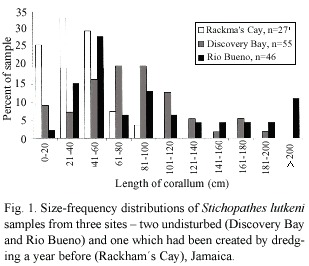
<body><![CDATA[<p><font face="Arial" size="2">Commencing in 1998,occurrence of black coral species was noted qualitatively at less than 40 m depth at various sites along the north coast of Jamaica.More systematic sampling since 2001 was carried out at two north coast sites (Discovery Bay and Rio Bueno)and at one site close to Kingston on the south coast (Rackham ’s Cay).The Discovery Bay site, roughly midway along the north coast (18 º28 ´ N,77 º24 ´W),was on the fore reef escarpment at 30-35 m deep on the reef known locally as LTS;at this depth the reef slopes steeply but with few cliffs or overhangs.The Rio Bueno site,on the western side of that bay and some 7 km to the west of Discovery Bay (18 º28 ´N, 77 º28 ´W),was at approximately 30 m deep on a much steeper reef escarpment with sections consisting largely of cliffs and overhangs, dropping vertically into deep water.The water was very clear at both Discovery Bay and Rio Bueno with underwater visibility frequently in excess of 30 m,typical of fore reef sites on the north coast of Jamaica.The Rackham ’s Cay site (17 º56 ´N,76 º50 ´W)was also a cliff, approximately 150 m long,dropping from 2- 20 m deep along its central 50 m section and tailing down into the surrounding seabed at 20 m deep at both eastern and western ends. This cliff was cut through the reef deposits which constitute Rackham ’s Cay in the period June 8-27,2002,by a cutter-dredger which cut off the northern end of the Cay to widen the ship channel into Kingston Harbour (<a href="#ga05">Gayle <i>et al.</i>2005</a>).The hard substrata on this newly cut cliff consisted of coral rubble (mainly <i>Acropora </i>spp.);at the base of the cliff scattered boulders resulting from the dredging occurred on a gently sloping mud bottom.Underwater visibility at this site was low at 5 m or less,and the north facing cliff was correspondingly dark even at relatively shallow depths.</font></p>     <p><font face="Arial" size="2">Identification and measurements were carried out <i>in situ </i>using SCUBA at the depths stated above.Measurements of colony length to the nearest centimeter were made with a ruler (data presented for <i>S.lutkeni </i>only). The distinctions between the two common, Caribbean,fan-shaped black coral species are subtle,including details of branching,polyp size and color (<a  href="#wa81">Warner 1981</a>)and were not readily apparent in the field.Consequently these species were not separated during <i>in situ </i>sampling and are referred to collectively here as <i>Antipathes </i>"fans ".Population densities were measured at Rio Bueno using 10 m belt transects 1 m wide,laid contiguously along the cliff at a depth of 30 ±1 m;all colonies were recorded.However,because of time constraints on dive duration at this depth,transect lines were not used at the other sites,and colony sizes and relative abundance of different species were obtained by swimming along a depth band and recording all colonies encountered.The depth bands were 30-35 m at Discovery Bay and 15-20 m at Rackham ’s Cay;there were no indications of significant habitat changes within these depth bands.No attempt was made to randomize sites where measurements were made since these sites were chosen as being representative of the habitat in that area. Qualitative observations were made on habitat characteristics,points of attachment of antipatharians, and associated biota.</font></p> <font face="Arial" size="2"><b>     <p align="center">Results</p>     <p>General observations</p> </b></font>     <p><font face="Arial" size="2">The seven species of antipatharians recorded in Jamaica during this study were found growing on hard substrata,usually on more-or-less steep reef escarpments below 20 m deep.Associated biota in this habitat included sponges, gorgonians, scleractinian corals, calcareous algae,bryozoans and serpulid worms. The commonest antipatharian species observed was the unbranched "wire coral "<i>S.lutkeni </i>, which was seen at all sites below 25 m,often in large numbers.This species occurred in two color varieties,grey-brown and yellow-green. On the north coast,<i>S.lutkeni </i>colonies were not generally found shallower than 25 m except on steep slopes or beneath overhangs where light intensity was reduced.The holdfasts of colonies were always found attached in dark,cryptic locations below projecting pieces of coral or within crevices.At Rackham ’s Cay,however, colonies of <i>S.lutkeni </i>were growing on the recently exposed cliff at depths ranging from 5 m down to the bottom at 20 m.Shallower than 15 m, holdfasts were cryptically located,but at 20 m where the light intensity was very low, the holdfasts were often fully exposed on the tops of boulders.</font></p>     <p><font face="Arial" size="2">Two fan-shaped species,<i>Antipathes atlantica </i><a href="#gr57">Gray,1857</a> and <i>Antipathes gracilis </i><a href="#gr60">Gray, 1860</a>,were commonly seen below about 25 m and could always be found at north coast sites. These fans can grow to 50 cm in diameter but are generally smaller.Two species which can grow to form "trees "a meter or more in height and are used for black coral jewelry, <i>Antipathes caribbeana </i><a href="#op96">Opresko,1996</a> and <i>Plumapathes pennacea </i>(<a href="#pa66">Pallas,1766</a>),were observed at different frequencies.<i>A.caribbeana </i>was not uncommon and colonies were often found on the edges of steep spurs,exposed to the long-shore current,where they co-occurred with large gorgonian fans <i>.</i>However,colonies of <i>A.caribbeana </i>more than one meter tall were scarce.<i>P.pennacea </i>was rarely seen,isolated colonies being occasionally observed at sites near Discovery Bay.Two low-growing species were also found.Colonies of <i>Antipathes rubusiformis </i><a  href="#wa04">Warner and Opresko,2004</a> were observed at several north coast sites attached by multiple holdfasts to the undersides of overhangs,in which environment this species was sometimes abundant.A low growing, cave-dwelling species <i>Antipathes umbratica </i><a  href="#op96">Opresko 1996</a> was found once at Discovery Bay,inside a crevice.</font></p> <font face="Arial" size="2"><b>     <p>Species abundance and distribution at three sites</p> </b></font>     <p><font face="Arial" size="2"><a href="#t1">Table 1</a> shows the results from the belt transects at Rio Bueno from which it is clear that there were large differences between species in population density and distribution.Four species of antipatharian were present in these transects.<i>S.lutkeni </i>was by far the commonest species;<i>Antipathes </i>"fans "were frequent;<i>A. rubusiformis </i>was very patchy while <i>A.caribbeana </i>was represented by just one specimen. The sample of measured Antipatharia at Discovery Bay comprised 55 colonies of <i>S.lutkeni </i>,one <i>Antipathes </i>"fan "and three <i>A.caribbeana </i>colonies.<i>S.lutkeni </i>was the only black coral species present at the Rackham ’s Cay site where 27 colonies were measured.Colonies were not as common as at the north coast sites,but appeared clustered with two to four often found together in a group.</font></p>     <p style="text-align: center;"><font face="Arial" size="2">&nbsp;<a  name="t1"></a><img src="/img/fbpe/rbt/v53s1/3167i1.JPG" title=""  alt="" style="width: 618px; height: 177px;"></font></p> <font face="Arial" size="2"><b>     
<p>Population characteristics of <i>S.lutkeni </i>at three sites</p> </b></font>     ]]></body>
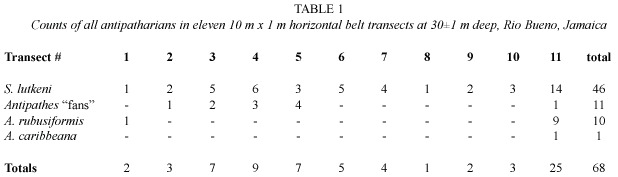
<body><![CDATA[<p><font face="Arial" size="2">Because of the relatively large number of <i>S.lutkeni </i>colonies sampled and measured, it was possible to analyze and compare the size structure of the three populations (<a  href="#f1">Fig. 1</a>)and significant differences between the mean lengths were found (ANOVA,p&lt;0.001). The most obvious difference is that the mean length of the population from Rackham ’s Cay (36.6 cm)was much less than that of either of the north coast populations.However,the latter also differed slightly from each other: the mean length at Rio Bueno (100.3 cm) was significantly greater than the mean length at Discovery Bay (79.8 cm)(t-test,p&lt;0.05). Shorter colonies (10-100 cm)were gently curved or more of less straight whereas longer colonies (&gt;100 cm)were often coiled in a loose spiral towards the distal end.Some colonies showed small but sharp changes of growth direction possibly representing earlier damage which had healed.    <br> </font></p>     <p></p>     <p style="text-align: center;"><font face="Arial" size="2">&nbsp;<a  name="f1"></a><img src="/img/fbpe/rbt/v53s1/3169i2.JPG" title=""  alt="" style="width: 309px; height: 266px;">     
<br> </font></p> <font face="Arial" size="2">The two color varieties were only recorded separately at Discovery Bay.The 55 measured colonies comprised 19 yellow-green specimens and 36 grey-brown;the mean length of the yellow-green colonies was 69 cm (range 10-130 cm) compared to 85 cm (range 5- 200 cm)for the grey-brown but this difference was not significant.Large specimens of both colors were usually coiled in a loose spiral.</font>     <p><font face="Arial" size="2">Colonies with the two different colors often grew side-by-side with no indication of any separation of habitat.However,the <i>S.lutkeni </i>from Rackham ’s Cay were entirely of the grey- brown variety.</font></p>     <p><font face="Arial" size="2">The length range of the <i>S.lutkeni </i>sample from Rackham ’s Cay was 11-83 cm.The occurrence of different length colonies appeared random both along the cliff and at different depths.The 83 cm colony was found at about 18 m depth near the centre of the dredge cut, and since the dredging operation took 20 days to completion on the 27<sup>th</sup> June 2002 and the sampling was carried out on the 7<sup>th</sup> July 2003, this colony could not have been older than 395 days.The minimum mean growth rate of this colony was therefore 2.1 mm per day. </font></p> <font face="Arial" size="2"><b>     <p align="center">Discussion</p> </b></font>     <p><font face="Arial" size="2">Most exploratory dives were carried out at sites on the north coast of Jamaica and at depths of less than 40 m.It is likely that additional species may be found with more intensive and deeper exploration at more sites, especially on the south coast.Similarly,the relative abundances described here are specific to the north coast sites and to the 30-35 m depth range,and may be different elsewhere.For instance <i>P.pennacea </i>was rarely found in the present study,but it was recorded by <a href="#oa88">Oakley (1988)</a>on the south coast of Jamaica growing abundantly on a shipwreck.Some species,such as <i>A.umbratica </i>and <i>A rubusiformis </i>,appear to have very specific habitat requirements.<i>A. umbratica </i>is found in caves (<a href="#op96">Opresko 1996</a>) and may be found more commonly in Jamaica when this habitat is searched more thoroughly. <i>A.rubusiformis </i>was not found at the Discovery Bay site probably because its preferred habitat of overhanging cliffs (Warner and Opresko 2004)was absent in that study area.</font></p>     <p><font face="Arial" size="2">The limited data-sets and qualitative observations presented here suggest that antipatharian species richness is greatest on steep slopes, on spurs and under overhangs.Transect 11 (<a  href="#t1">Table 1</a>)had the highest species richness and was entirely located beneath a large overhang: dimly lit,but exposed to long-shore currents. Low light intensity appears to be a common feature of antipatharian habitats, suggesting negative phototaxis at settlement (<a href="#go77">Goenaga 1977</a>,<a href="#wa81">Warner 1981</a>, <a  href="#oa88">Oakley 1988</a>,<a href="#sa99">Sanchez     ]]></body>
<body><![CDATA[<br> 1999</a>). This is supported by observations here that the attachment sites of colonies of <i>S.lutkeni </i>were normally cryptically located within crevices in the clear waters of the north coast, but occurred on open rock surfaces in the very dim light at the base of the Rackham ’s Cay cliff. The low light intensity at this site,caused by shading from the vertical,north facing cliff and by the high turbidity of the water, probably also explains the unusual occurrence of <i>S.lutkeni </i>at this site as shallow as 5 m deep.The low antipatharian diversity at Rackham ’s Cay was probably due to the fact that this cliff had only been available for settlement for a single year.</font></p>     <p><font face="Arial" size="2">This fact also explains the small mean length of colonies of <i>S.lutkeni </i>at Rackham ’s Cay.All individuals had settled within the last thirteen months,whereas the communities at the north coast sites were long-established. The small difference in mean length between the two north coast populations of <i>S.lutkeni </i>was mainly caused by the occurrence of several very long colonies at Rio Bueno (200-300 cm, <a href="#f1">Fig.1</a>),and perhaps is a reflection of a better habitat for this species (steeper,darker cliffs)leading to greater age in some individuals.Previous estimates of black coral growth rates are in the region of 3-6 cm per year for branched colonies (<a href="#gr74">Grigg 1974</a>,<a href="#oa88">Oakley 1988</a>) while <a  href="#go77">Goenaga (1977)</a>reported annual growth rates to be 8 cm in the laboratory and 7 cm in the field for what he referred to as the brown variety of <i>Stichopathes </i>,and 6 cm in the laboratory and 3 cm in the field for the yellow-green variety. The lengths of the mainly less than one-year-old colonies of <i>S.lutkeni </i>at Rackham ’s Cay (11-83 cm)show that,at least as juveniles, colonies of this species are capable of growth an order of magnitude faster than this.</font></p> <font face="Arial" size="2"></font>     <p><font face="Arial" size="2"><b>Taxonomic considerations concerning <i>Stichopathes lutkeni</i></b></font></p>     <p><font face="Arial" size="2">Colonies belonging to the genus <i>Stichopathes </i>on coral reefs in the Caribbean have generally been referred to <i>Stichopathes lutkeni </i>.However, it is possible that the two color varieties,grey-brown and yellow-green,represent two different species.<a  href="#go77">Goenaga (1977)</a>considered them to be distinct species and described several differences between them apart from color,but no formal descriptions or new scientific names have yet been published.Both color varieties correspond to Brook ’s description of <i>S.lutkeni </i>, which was somewhat imprecise and apparently based mainly on features of the corallum of a single specimen (<a href="#br89">Brook 1889</a>).</font></p> <font face="Arial" size="2"><b>     <p>Acknowledgments</p> </b></font>     <p><font face="Arial" size="2">I am grateful to Peter Gayle,Anthony Downes and Norman Quinn for assistance underwater.This is contribution number 766 from the Discovery Bay Marine Laboratory.</font></p> <font face="Arial" size="2"><b>     <p>Resumen</p> </b></font>     <p><font face="Arial" size="2">El propósito de este estudio fue registrar las especies de Antipatharia en los arrecifes de Jamaica y realizar estudios preliminares sobre densidades y tamaños de las especies comunes.Además,una pared vertical creada por dragado en el 2002 permitió determinar el crecimiento de colonias recién asentadas.Hice observaciones desde 1998 y medidas desde el 2001 con equipo de buceo tipo "SCUBA "hasta 35 m de profundidad.Se identificaron siete especies de Antipatharia en paredes empinadas de arrecifes coralinos a más de 25 m de profundidad.La especie más común fue el coral negro no ramificado <i>Stichopathes lutkeni </i>.Otras especies comunes incluyen el coral negro con forma de abanico <i>Antipathes atlantica </i>y <i>Antipathes gracilis </i>.Las especies frecuentes incluyen una comercialmente importante,<i>Antipathes caribbeana </i>y una especie con un crecimiento inusual en forma de trepadora, <i>Antipathes rubusiformis.</i>Se observó poco la otra especie de importancia comercial en el Caribe,<i>Plumapathes pennacea </i>,y la cavernícola <i>Antipathes umbratica </i>.La mayor abundancia de corales negros se dio en paredes empinadas de sustratos duros con poca iluminación pero expuestos a la corriente a lo largo de la costa.Las densidades combinadas de las especies más comunes de Antipatharia a 30 m de profundidad en Río Bueno en la costa norte,tenían un ámbito entre 0.1 y 2.5 m<sup>-2</sup> (once transectos de 10 m x 1 m, 1-25 colonias por transecto,68 colonias en total).Cuarenta y seis de las 68 colonias eran <i>S.lutkeni </i>,mientras cerca de allí,en Discovery Bay a 30-35 m,55 de las 59 colonias eran <i>S.lutkeni </i>.Había una diferencia significativa entre el tamaño promedio de colonias en estas dos poblaciones de <i>S.lutkeni </i>(100 cm y 80 cm,respectivamente),probablemente relacionada al hábitat.Una tercera población de <i>S. lutkeni </i>creciendo a 15-20 m de profundidad en la pared recién dragada tenía un tamaño promedio mucho más pequeño,36.6 cm (n=27).El individuo más grande midió 83 cm de largo,indicando un crecimiento mínimo del corallum sin ramificar de 2.1 mm por día.</font></p> <font face="Arial" size="2"><b></b></font>     <p><font face="Arial" size="2"><b>Palabras clave:</b>Coral negro,Antipatharia,Jamaica, <i>Stichopathes </i>,<i>Antipathes </i>,Bahía Discovery Bay,Rio Bueno.</font></p> <font face="Arial" size="2"><b>     <p>References</p> </b></font>     ]]></body>
<body><![CDATA[<!-- ref --><p><font face="Arial" size="2"><a name="br89"></a>Brook, G.1889.Antipatharia.Results of the exploring voyage of HMS Challenger 1873-76,Zoology.32(80):1-222.</font>&nbsp;&nbsp;&nbsp;&nbsp;&nbsp;&nbsp;&nbsp;&nbsp;[&#160;<a href="javascript:void(0);" onclick="javascript: window.open('/scielo.php?script=sci_nlinks&ref=1239474&pid=S0034-7744200500030001100001&lng=','','width=640,height=500,resizable=yes,scrollbars=1,menubar=yes,');">Links</a>&#160;]<!-- end-ref --><!-- ref --><p><font face="Arial" size="2"><a name="ga05"></a>Gayle,P.M.H.,S.O.Green &amp;P.H.Wilson-Kelly.2005. Transplantation of benthic species as a strategy for mitigating the anthropogenic impacts of coastal development.Proc.31 st AMLC Scient.Meet.,Trinidad &amp; Tobago.Rev.Biol.Trop.53 (Suppl.1):105-115.</font>&nbsp;&nbsp;&nbsp;&nbsp;&nbsp;&nbsp;&nbsp;&nbsp;[&#160;<a href="javascript:void(0);" onclick="javascript: window.open('/scielo.php?script=sci_nlinks&ref=1239475&pid=S0034-7744200500030001100002&lng=','','width=640,height=500,resizable=yes,scrollbars=1,menubar=yes,');">Links</a>&#160;]<!-- end-ref --><!-- ref --><p><font face="Arial" size="2"><a name="go77"></a>Goenaga,C.1977.Two new species of <i>Stichopathes </i>(Zoantharia:Antipatharia)with observations on their biology. M. Sc. Thesis, University of Puerto Rico, Mayaguez,Puerto Rico.80 p.</font>&nbsp;&nbsp;&nbsp;&nbsp;&nbsp;&nbsp;&nbsp;&nbsp;[&#160;<a href="javascript:void(0);" onclick="javascript: window.open('/scielo.php?script=sci_nlinks&ref=1239476&pid=S0034-7744200500030001100003&lng=','','width=640,height=500,resizable=yes,scrollbars=1,menubar=yes,');">Links</a>&#160;]<!-- end-ref --><!-- ref --><p><font face="Arial" size="2"><a name="gr57"></a>Gray,J.E.1857.Synopsis of the families and genera of axiferous zoophytes or barked corals.Proc.Zool. Soc.Lond.25:278-294.</font>&nbsp;&nbsp;&nbsp;&nbsp;&nbsp;&nbsp;&nbsp;&nbsp;[&#160;<a href="javascript:void(0);" onclick="javascript: window.open('/scielo.php?script=sci_nlinks&ref=1239477&pid=S0034-7744200500030001100004&lng=','','width=640,height=500,resizable=yes,scrollbars=1,menubar=yes,');">Links</a>&#160;]<!-- end-ref --><!-- ref --><p><font face="Arial" size="2"><a name="gr60"></a>Gray,J.E.1860.Notice of new corals from Madeira.Ann. Mag.Nat.Hist.6:311.</font>&nbsp;&nbsp;&nbsp;&nbsp;&nbsp;&nbsp;&nbsp;&nbsp;[&#160;<a href="javascript:void(0);" onclick="javascript: window.open('/scielo.php?script=sci_nlinks&ref=1239478&pid=S0034-7744200500030001100005&lng=','','width=640,height=500,resizable=yes,scrollbars=1,menubar=yes,');">Links</a>&#160;]<!-- end-ref --><!-- ref --><p><font face="Arial" size="2"><a name="gr74"></a>Grigg,R.W.1974.Distribution and abundance of precious corals in Hawaii.Proc.2 nd Int.Coral Reef Symp., Brisbane,Australia 2:235-240.</font>&nbsp;&nbsp;&nbsp;&nbsp;&nbsp;&nbsp;&nbsp;&nbsp;[&#160;<a href="javascript:void(0);" onclick="javascript: window.open('/scielo.php?script=sci_nlinks&ref=1239479&pid=S0034-7744200500030001100006&lng=','','width=640,height=500,resizable=yes,scrollbars=1,menubar=yes,');">Links</a>&#160;]<!-- end-ref --><!-- ref --><p><font face="Arial" size="2"><a name="gu98"></a>Guzmán,H.M.1998.Diversity of stony,soft and black corals at Cayos Cochinos Bay,Honduras.Rev.Biol. Trop.46 (Suppl.4):75-78.</font>&nbsp;&nbsp;&nbsp;&nbsp;&nbsp;&nbsp;&nbsp;&nbsp;[&#160;<a href="javascript:void(0);" onclick="javascript: window.open('/scielo.php?script=sci_nlinks&ref=1239480&pid=S0034-7744200500030001100007&lng=','','width=640,height=500,resizable=yes,scrollbars=1,menubar=yes,');">Links</a>&#160;]<!-- end-ref --><!-- ref --><p><font face="Arial" size="2"><a name="hu96"></a>Humann,P.1996.Reef Coral Identification.New World, Jacksonville,Florida.239 p.</font>&nbsp;&nbsp;&nbsp;&nbsp;&nbsp;&nbsp;&nbsp;&nbsp;[&#160;<a href="javascript:void(0);" onclick="javascript: window.open('/scielo.php?script=sci_nlinks&ref=1239481&pid=S0034-7744200500030001100008&lng=','','width=640,height=500,resizable=yes,scrollbars=1,menubar=yes,');">Links</a>&#160;]<!-- end-ref --><!-- ref --><p><font face="Arial" size="2"><a name="oa88"></a>Oakley,S.G.1988.Settlement and growth of <i>Antipathes pennacea </i>on a shipwreck.Coral Reefs 7:77-79.</font>&nbsp;&nbsp;&nbsp;&nbsp;&nbsp;&nbsp;&nbsp;&nbsp;[&#160;<a href="javascript:void(0);" onclick="javascript: window.open('/scielo.php?script=sci_nlinks&ref=1239482&pid=S0034-7744200500030001100009&lng=','','width=640,height=500,resizable=yes,scrollbars=1,menubar=yes,');">Links</a>&#160;]<!-- end-ref --><!-- ref --><p><font face="Arial" size="2"><a name="op72"></a>Opresko,D.M.1972.Redescriptions and reevaluations of the antipatharians described by L.F.de Pourtalès. Bull.Mar.Sci.22:950-1017.</font>&nbsp;&nbsp;&nbsp;&nbsp;&nbsp;&nbsp;&nbsp;&nbsp;[&#160;<a href="javascript:void(0);" onclick="javascript: window.open('/scielo.php?script=sci_nlinks&ref=1239483&pid=S0034-7744200500030001100010&lng=','','width=640,height=500,resizable=yes,scrollbars=1,menubar=yes,');">Links</a>&#160;]<!-- end-ref --><!-- ref --><p><font face="Arial" size="2"><a name="op96"></a>Opresko,D.M.1996.New species of black coral (Cnidaria: Anthozoa:Antipatharia)from the Caribbean.Bull. Mar.Sci.58:289-300.</font>&nbsp;&nbsp;&nbsp;&nbsp;&nbsp;&nbsp;&nbsp;&nbsp;[&#160;<a href="javascript:void(0);" onclick="javascript: window.open('/scielo.php?script=sci_nlinks&ref=1239484&pid=S0034-7744200500030001100011&lng=','','width=640,height=500,resizable=yes,scrollbars=1,menubar=yes,');">Links</a>&#160;]<!-- end-ref --><!-- ref --><p><font face="Arial" size="2"><a name="pa66"></a>Pallas,P.S.1766.Elenchus Zoophytorum Sistens Generum Adumbrationes Generaliores et Specierum Cognitarum Succinctas Descriptiones cum Selectis Auctorum Synonymis:i-xvi,I 28,I 451.-Hagae-Comitum.</font>&nbsp;&nbsp;&nbsp;&nbsp;&nbsp;&nbsp;&nbsp;&nbsp;[&#160;<a href="javascript:void(0);" onclick="javascript: window.open('/scielo.php?script=sci_nlinks&ref=1239485&pid=S0034-7744200500030001100012&lng=','','width=640,height=500,resizable=yes,scrollbars=1,menubar=yes,');">Links</a>&#160;]<!-- end-ref --><!-- ref --><p><font face="Arial" size="2"><a name="sa99"></a>Sánchez,J.A.1999.Black coral-octocoral distribution patterns on Imelda Bank,a deep-water reef,Colombia, Caribbean Sea.Bull.Mar.Sci.65:215-225.</font>&nbsp;&nbsp;&nbsp;&nbsp;&nbsp;&nbsp;&nbsp;&nbsp;[&#160;<a href="javascript:void(0);" onclick="javascript: window.open('/scielo.php?script=sci_nlinks&ref=1239486&pid=S0034-7744200500030001100013&lng=','','width=640,height=500,resizable=yes,scrollbars=1,menubar=yes,');">Links</a>&#160;]<!-- end-ref --><!-- ref --><p><font face="Arial" size="2"><a name="wa81"></a>Warner,G.F.1981.Species descriptions and ecological observations of black corals (Antipatharia)from Trinidad. Bull. Mar. Sci. 31:147-163.</font>&nbsp;&nbsp;&nbsp;&nbsp;&nbsp;&nbsp;&nbsp;&nbsp;[&#160;<a href="javascript:void(0);" onclick="javascript: window.open('/scielo.php?script=sci_nlinks&ref=1239487&pid=S0034-7744200500030001100014&lng=','','width=640,height=500,resizable=yes,scrollbars=1,menubar=yes,');">Links</a>&#160;]<!-- end-ref --><!-- ref --><p><font face="Arial" size="2"><a name="wa04"></a>Warner,G.F.&amp;D.M.Opresko.2004.A new black coral (Anthozoa:Antipatharia)from a reef wall environment in Jamaica. Bull. Mar. Sci.74:169-174.</font>&nbsp;&nbsp;&nbsp;&nbsp;&nbsp;&nbsp;&nbsp;&nbsp;[&#160;<a href="javascript:void(0);" onclick="javascript: window.open('/scielo.php?script=sci_nlinks&ref=1239488&pid=S0034-7744200500030001100015&lng=','','width=640,height=500,resizable=yes,scrollbars=1,menubar=yes,');">Links</a>&#160;]<!-- end-ref --> ]]></body><back>
<ref-list>
<ref id="B1">
<nlm-citation citation-type="journal">
<person-group person-group-type="author">
<name>
<surname><![CDATA[Brook]]></surname>
<given-names><![CDATA[G]]></given-names>
</name>
</person-group>
<article-title xml:lang="en"><![CDATA[Antipatharia.Results of the exploring voyage of HMS Challenger 1873-76]]></article-title>
<source><![CDATA[Zoology]]></source>
<year>1889</year>
<volume>32</volume>
<numero>80</numero>
<issue>80</issue>
<page-range>1-222</page-range></nlm-citation>
</ref>
<ref id="B2">
<nlm-citation citation-type="journal">
<person-group person-group-type="author">
<name>
<surname><![CDATA[Gayle]]></surname>
<given-names><![CDATA[P.M.H]]></given-names>
</name>
<name>
<surname><![CDATA[Green]]></surname>
<given-names><![CDATA[S.O]]></given-names>
</name>
<name>
<surname><![CDATA[Wilson-Kelly]]></surname>
<given-names><![CDATA[P.H]]></given-names>
</name>
</person-group>
<article-title xml:lang="en"><![CDATA[Transplantation of benthic species as a strategy for mitigating the anthropogenic impacts of coastal development.Proc.31 st AMLC Scient.Meet.,Trinidad & Tobago]]></article-title>
<source><![CDATA[Rev.Biol.Trop]]></source>
<year>2005</year>
<volume>53</volume>
<numero>^sSuppl.1</numero>
<issue>^sSuppl.1</issue>
<supplement>Suppl.1</supplement>
<page-range>105-115</page-range></nlm-citation>
</ref>
<ref id="B3">
<nlm-citation citation-type="">
<person-group person-group-type="author">
<name>
<surname><![CDATA[Goenaga]]></surname>
<given-names><![CDATA[C]]></given-names>
</name>
</person-group>
<source><![CDATA[Two new species of Stichopathes (Zoantharia:Antipatharia)with observations on their biology]]></source>
<year>1977</year>
<page-range>80</page-range></nlm-citation>
</ref>
<ref id="B4">
<nlm-citation citation-type="journal">
<person-group person-group-type="author">
<name>
<surname><![CDATA[Gray]]></surname>
<given-names><![CDATA[J.E]]></given-names>
</name>
</person-group>
<article-title xml:lang="en"><![CDATA[Synopsis of the families and genera of axiferous zoophytes or barked corals]]></article-title>
<source><![CDATA[Proc.Zool. Soc.Lond]]></source>
<year>1857</year>
<volume>25</volume>
<page-range>278-294</page-range></nlm-citation>
</ref>
<ref id="B5">
<nlm-citation citation-type="journal">
<person-group person-group-type="author">
<name>
<surname><![CDATA[Gray]]></surname>
<given-names><![CDATA[J.E]]></given-names>
</name>
</person-group>
<article-title xml:lang="en"><![CDATA[Notice of new corals from Madeira]]></article-title>
<source><![CDATA[Ann. Mag.Nat.Hist]]></source>
<year>1860</year>
<volume>6</volume>
<page-range>311</page-range></nlm-citation>
</ref>
<ref id="B6">
<nlm-citation citation-type="confpro">
<person-group person-group-type="author">
<name>
<surname><![CDATA[Grigg]]></surname>
<given-names><![CDATA[R.W]]></given-names>
</name>
</person-group>
<source><![CDATA[Distribution and abundance of precious corals in Hawaii]]></source>
<year>1974</year>
<volume>2</volume>
<conf-name><![CDATA[2 Int.Coral Reef Symp]]></conf-name>
<conf-loc>Brisbane </conf-loc>
<page-range>235-240</page-range></nlm-citation>
</ref>
<ref id="B7">
<nlm-citation citation-type="journal">
<person-group person-group-type="author">
<name>
<surname><![CDATA[Guzmán]]></surname>
<given-names><![CDATA[H.M]]></given-names>
</name>
</person-group>
<article-title xml:lang="en"><![CDATA[Diversity of stony,soft and black corals at Cayos Cochinos Bay,Honduras]]></article-title>
<source><![CDATA[Rev.Biol. Trop]]></source>
<year>1998</year>
<volume>46</volume>
<numero>^sSuppl.4</numero>
<issue>^sSuppl.4</issue>
<supplement>Suppl.4</supplement>
<page-range>75-78</page-range></nlm-citation>
</ref>
<ref id="B8">
<nlm-citation citation-type="book">
<person-group person-group-type="author">
<name>
<surname><![CDATA[Humann]]></surname>
<given-names><![CDATA[P]]></given-names>
</name>
</person-group>
<source><![CDATA[Reef Coral Identification]]></source>
<year>1996</year>
<page-range>239</page-range><publisher-loc><![CDATA[Jacksonville^eFlorida Florida]]></publisher-loc>
<publisher-name><![CDATA[New World]]></publisher-name>
</nlm-citation>
</ref>
<ref id="B9">
<nlm-citation citation-type="journal">
<person-group person-group-type="author">
<name>
<surname><![CDATA[Oakley]]></surname>
<given-names><![CDATA[S.G]]></given-names>
</name>
</person-group>
<article-title xml:lang="en"><![CDATA[Settlement and growth of Antipathes pennacea on a shipwreck]]></article-title>
<source><![CDATA[Coral Reefs]]></source>
<year>1988</year>
<volume>7</volume>
<page-range>77-79</page-range></nlm-citation>
</ref>
<ref id="B10">
<nlm-citation citation-type="journal">
<person-group person-group-type="author">
<name>
<surname><![CDATA[Opresko]]></surname>
<given-names><![CDATA[D.M]]></given-names>
</name>
</person-group>
<article-title xml:lang="en"><![CDATA[Redescriptions and reevaluations of the antipatharians described by L.F.de Pourtalès]]></article-title>
<source><![CDATA[Bull.Mar.Sci]]></source>
<year>1972</year>
<volume>22</volume>
<page-range>950-1017</page-range></nlm-citation>
</ref>
<ref id="B11">
<nlm-citation citation-type="journal">
<person-group person-group-type="author">
<name>
<surname><![CDATA[Opresko]]></surname>
<given-names><![CDATA[D.M]]></given-names>
</name>
</person-group>
<article-title xml:lang="en"><![CDATA[New species of black coral (Cnidaria: Anthozoa:Antipatharia)from the Caribbean]]></article-title>
<source><![CDATA[Bull. Mar.Sci]]></source>
<year>1996</year>
<volume>58</volume>
<page-range>289-300</page-range></nlm-citation>
</ref>
<ref id="B12">
<nlm-citation citation-type="">
<person-group person-group-type="author">
<name>
<surname><![CDATA[Pallas]]></surname>
<given-names><![CDATA[P.S]]></given-names>
</name>
</person-group>
<source><![CDATA[Elenchus Zoophytorum Sistens Generum Adumbrationes Generaliores et Specierum Cognitarum Succinctas Descriptiones cum Selectis Auctorum Synonymis:i-xvi,I 28,I 451.-Hagae-Comitum]]></source>
<year>1766</year>
</nlm-citation>
</ref>
<ref id="B13">
<nlm-citation citation-type="journal">
<person-group person-group-type="author">
<name>
<surname><![CDATA[Sánchez]]></surname>
<given-names><![CDATA[J.A]]></given-names>
</name>
</person-group>
<article-title xml:lang="en"><![CDATA[Black coral-octocoral distribution patterns on Imelda Bank,a deep-water reef,Colombia, Caribbean Sea]]></article-title>
<source><![CDATA[Bull.Mar.Sci]]></source>
<year>1999</year>
<volume>65</volume>
<page-range>215-225</page-range></nlm-citation>
</ref>
<ref id="B14">
<nlm-citation citation-type="journal">
<person-group person-group-type="author">
<name>
<surname><![CDATA[Warner]]></surname>
<given-names><![CDATA[G.F]]></given-names>
</name>
</person-group>
<article-title xml:lang="en"><![CDATA[Species descriptions and ecological observations of black corals (Antipatharia)from Trinidad]]></article-title>
<source><![CDATA[Bull. Mar. Sci]]></source>
<year>1981</year>
<volume>31</volume>
<page-range>147-163</page-range></nlm-citation>
</ref>
<ref id="B15">
<nlm-citation citation-type="journal">
<person-group person-group-type="author">
<name>
<surname><![CDATA[Warner]]></surname>
<given-names><![CDATA[G.F]]></given-names>
</name>
<name>
<surname><![CDATA[Opresko]]></surname>
<given-names><![CDATA[D.M]]></given-names>
</name>
</person-group>
<article-title xml:lang="en"><![CDATA[A new black coral (Anthozoa:Antipatharia)from a reef wall environment in Jamaica]]></article-title>
<source><![CDATA[Bull. Mar. Sci]]></source>
<year>2004</year>
<volume>74</volume>
<page-range>169-174</page-range></nlm-citation>
</ref>
</ref-list>
</back>
</article>