<?xml version="1.0" encoding="ISO-8859-1"?><article xmlns:mml="http://www.w3.org/1998/Math/MathML" xmlns:xlink="http://www.w3.org/1999/xlink" xmlns:xsi="http://www.w3.org/2001/XMLSchema-instance">
<front>
<journal-meta>
<journal-id>0034-7744</journal-id>
<journal-title><![CDATA[Revista de Biología Tropical]]></journal-title>
<abbrev-journal-title><![CDATA[Rev. biol. trop]]></abbrev-journal-title>
<issn>0034-7744</issn>
<publisher>
<publisher-name><![CDATA[Universidad de Costa Rica]]></publisher-name>
</publisher>
</journal-meta>
<article-meta>
<article-id>S0034-77442005000300010</article-id>
<title-group>
<article-title xml:lang="en"><![CDATA[Effects of herbicide on the kidneys of two Venezuelan cultured fish: Caquetaia kraussii and Colossoma macropomum (Pisces:Ciclidae and Characeae)]]></article-title>
</title-group>
<contrib-group>
<contrib contrib-type="author">
<name>
<surname><![CDATA[Segnini de Bravo]]></surname>
<given-names><![CDATA[M.I]]></given-names>
</name>
<xref ref-type="aff" rid="A01"/>
</contrib>
<contrib contrib-type="author">
<name>
<surname><![CDATA[Medina]]></surname>
<given-names><![CDATA[J]]></given-names>
</name>
<xref ref-type="aff" rid="A02"/>
</contrib>
<contrib contrib-type="author">
<name>
<surname><![CDATA[Marcano]]></surname>
<given-names><![CDATA[S]]></given-names>
</name>
<xref ref-type="aff" rid="A03"/>
</contrib>
<contrib contrib-type="author">
<name>
<surname><![CDATA[Finol]]></surname>
<given-names><![CDATA[H.J]]></given-names>
</name>
<xref ref-type="aff" rid="A04"/>
</contrib>
<contrib contrib-type="author">
<name>
<surname><![CDATA[Boada-Sucre]]></surname>
<given-names><![CDATA[A]]></given-names>
</name>
<xref ref-type="aff" rid="A05"/>
</contrib>
</contrib-group>
<aff id="A01">
<institution><![CDATA[,Universidad de Oriente  ]]></institution>
<addr-line><![CDATA[Cumaná Estado Sucre]]></addr-line>
<country>Venezuela</country>
</aff>
<aff id="A02">
<institution><![CDATA[,Instituto de Investigaciones Agrícolas de Venezuela  ]]></institution>
<addr-line><![CDATA[Guanapito Estado Guárico]]></addr-line>
<country>Venezuela</country>
</aff>
<aff id="A03">
<institution><![CDATA[,Universidad Central de Venezuela  ]]></institution>
<addr-line><![CDATA[Caracas ]]></addr-line>
<country>Venezuela</country>
</aff>
<aff id="A04">
<institution><![CDATA[,Universidad Central de Venezuela  ]]></institution>
<addr-line><![CDATA[Caracas ]]></addr-line>
<country>Venezuela</country>
</aff>
<aff id="A05">
<institution><![CDATA[,Universidad Simón Rodríguez  ]]></institution>
<addr-line><![CDATA[Caracas ]]></addr-line>
<country>Venezuela</country>
</aff>
<pub-date pub-type="pub">
<day>00</day>
<month>05</month>
<year>2005</year>
</pub-date>
<pub-date pub-type="epub">
<day>00</day>
<month>05</month>
<year>2005</year>
</pub-date>
<volume>53</volume>
<fpage>55</fpage>
<lpage>60</lpage>
<copyright-statement/>
<copyright-year/>
<self-uri xlink:href="http://www.scielo.sa.cr/scielo.php?script=sci_arttext&amp;pid=S0034-77442005000300010&amp;lng=en&amp;nrm=iso"></self-uri><self-uri xlink:href="http://www.scielo.sa.cr/scielo.php?script=sci_abstract&amp;pid=S0034-77442005000300010&amp;lng=en&amp;nrm=iso"></self-uri><self-uri xlink:href="http://www.scielo.sa.cr/scielo.php?script=sci_pdf&amp;pid=S0034-77442005000300010&amp;lng=en&amp;nrm=iso"></self-uri><abstract abstract-type="short" xml:lang="en"><p><![CDATA[The use of chemical pesticides and herbicides has increased environmental pollution and affected ichthyofauna in the watersheds where they are used.We studied the effect of an herbicide, triazine, on the kidneys of two species (Caquetaia kraussii and Colossoma macropomum )widely found in Caribbean and South American rivers.In Venezuela,these species are abundant and have a high aquaculture potential because they may be cultured and reproduced in captivity.Four kidney samples from juveniles of each species exposed to the herbicide were examined by Transmission Electron Microscopy.Kidney tubule alterations included loss of plasmalemma and cell interdigitations, misshaped mitochondria,decrease in rough endoplasmic reticulum and free polysomes,and the presence of autophagic vacuoles and primary lysosomes.These alterations at the cellular level may explain fish behaviour in terms of kidney tubule pathology,and relative amounts and conditions of organelles within affected cells.]]></p></abstract>
<abstract abstract-type="short" xml:lang="es"><p><![CDATA[El uso de compuestos químicos como plaguicidas y como herbicidas ha incrementado la contaminación ambiental,afectando la ictiofauna que vive en ríos y depósitos de agua.Estudiamos el efecto de un herbicida (2-cloro-4,6-bis-etlamina-s-triazina)sobre el riñón de dos especies de peces (Caquetaia kraussii y Colossoma macropomum ),ampliamente encontradas en los ríos caribeños y sudamericanos.En Venezuela son abundantes y tienen un alto potencial en acuacultura debido a que pueden ser cultivados y reproducidos en cautiverio.Se disectó el riñón a cuatro individuos jóvenes de cada especie que habían sido expuestos al herbicida y se les examinó con Microscopía Electrónica de Transmisión.Se encontraron alteraciones en los túbulos del riñón que incluían pérdida de plasmalema e interdigitaciones celulares,mitocondrias alteradas, disminución en el retículo endoplásmico,polisomas libres y la presencia de vacuolas autofágicas y lisosomas primarios.Estas alteraciones a nivel celular pueden explicar la conducta de los peces en términos de patología de los túbulos del riñón y las cantidades relativas y condiciones de organelas dentro de las células afectadas.]]></p></abstract>
<kwd-group>
<kwd lng="en"><![CDATA[Caquetaia kraussii]]></kwd>
<kwd lng="en"><![CDATA[Colossoma macropomum]]></kwd>
<kwd lng="en"><![CDATA[kidney]]></kwd>
<kwd lng="en"><![CDATA[herbicide]]></kwd>
<kwd lng="en"><![CDATA[ultrastructure]]></kwd>
<kwd lng="en"><![CDATA[pathology]]></kwd>
<kwd lng="en"><![CDATA[stress markers]]></kwd>
<kwd lng="es"><![CDATA[Caquetaia kraussii]]></kwd>
<kwd lng="es"><![CDATA[Colossoma macropomum]]></kwd>
<kwd lng="es"><![CDATA[riñón]]></kwd>
<kwd lng="es"><![CDATA[hierbicida]]></kwd>
<kwd lng="es"><![CDATA[ultraestructura]]></kwd>
<kwd lng="es"><![CDATA[patología]]></kwd>
<kwd lng="es"><![CDATA[marcadores de estrés]]></kwd>
</kwd-group>
</article-meta>
</front><body><![CDATA[  <b><font face="Arial"></font></b>     <p align="center"><b><font face="Arial">Effects of herbicide on the kidneys of two Venezuelan cultured fish: </font></b><font face="Arial"><i>Caquetaia kraussii </i><b>and </b><i>Colossoma macropomum </i><b>(Pisces:Ciclidae and Characeae)</b></font></p> <font face="Arial" size="2"></font>     <p><font face="Arial" size="2">M.I.Segnini de Bravo<a name="1"></a><a  href="#2"><sup>1</sup></a> ,J.Medina<sup><a href="#2">2</a>,<a  href="#2">3</a></sup> ,S.Marcano<a href="#2"><sup>3</sup></a> ,H.J.Finol<a href="#2"><sup>4</sup></a> &amp;A.Boada-Sucre<sup><a  href="#2">3</a>,<a href="#2">5</a></sup></font></p>     <p><font face="Arial" size="2"><sup><a name="2"></a><a href="#1">1</a></sup> Departamento de Biología Marina.Instituto Oceanográfico de Venezuela,Universidad de Oriente,Cumaná,Estado Sucre, 6101, Venezuela;<a  href="mailto:msegnini@cantv.net">msegnini@cantv.net</a>;<a  href="mailto:fobravo@cantv.net">fobravo@cantv.net</a>;<a  href="mailto:msegnini@sucre.udo.edu.ve">msegnini@sucre.udo.edu.ve</a></font></p> <font face="Arial" size="2"><sup></sup></font>     <p><font face="Arial" size="2"><a href="#1"><sup>2</sup></a> Instituto de Investigaciones Agrícolas de Venezuela.Guanapito,Estado Guárico, Venezuela; <a href="mailto:medinagj@cantv.net">medinagj@cantv.net</a></font></p> <font face="Arial" size="2"><sup></sup></font>     <p><font face="Arial" size="2"><a href="#1"><sup>3</sup></a> Postgrado en Zoología,Facultad de Ciencias,Universidad Central de Venezuela,Caracas,Venezuela; <a href="mailto:solmarcano@hotmail.com">solmarcano@hotmail.com</a></font></p> <font face="Arial" size="2"><sup></sup></font>     <p><font face="Arial" size="2"><a href="#1"><sup>4</sup></a> Centro de Microscopia Electrónica,Facultad de Ciencias,Universidad Central de Venezuela, Caracas, Venezuela; <a  href="mailto:hfinol@electra.ciens.ucv.ve">hfinol@electra.ciens.ucv.ve</a></font></p> <font face="Arial" size="2"><sup></sup></font>     <p><font face="Arial" size="2"><a href="#1"><sup>5</sup></a> Instituto de Estudios Científicos y Tecnológicos,Universidad Simón Rodríguez,Caracas,Venezuela; <a href="mailto:alboada@hotmail.com">alboada@hotmail.com</a></font></p>     <p align="center"><font face="Arial" size="2">Received 15-I-2004. Corrected 20-VIII-2004. Accepted 29-III-2005.</font></p> <font face="Arial" size="2"><b></b></font>     <p><font face="Arial" size="2"><b>Abstract:</b>The use of chemical pesticides and herbicides has increased environmental pollution and affected ichthyofauna in the watersheds where they are used.We studied the effect of an herbicide, triazine, on the kidneys of two species (<i>Caquetaia kraussii </i>and <i>Colossoma macropomum </i>)widely found in Caribbean and South American rivers.In Venezuela,these species are abundant and have a high aquaculture potential because they may be cultured and reproduced in captivity.Four kidney samples from juveniles of each species exposed to the herbicide were examined by Transmission Electron Microscopy.Kidney tubule alterations included loss of plasmalemma and cell interdigitations, misshaped mitochondria,decrease in rough endoplasmic reticulum and free polysomes,and the presence of autophagic vacuoles and primary lysosomes.These alterations at the cellular level may explain fish behaviour in terms of kidney tubule pathology,and relative amounts and conditions of organelles within affected cells.</font></p> <font face="Arial" size="2"><b></b></font>     ]]></body>
<body><![CDATA[<p><font face="Arial" size="2"><b>Key words:</b><i>Caquetaia kraussii </i>,<i>Colossoma macropomum</i>, kidney, herbicide, ultrastructure, pathology, stress markers.</font></p>     <p><font face="Arial" size="2">The widespread use of chemical agents as pesticides and herbicides to control the plague and weeds every year,does not necessarily translate to ecological crisis,but there has been considerable recent discussion in both the scientific literature and the lay press regarding the possibility that environmental chemicals,through their effects on endocrine function,are responsible for a number of reproductive and developmental anomalies in a wide range of wildlife species,from invertebrates through fish, reptiles, birds and mammals, an even including humans (<a href="#co97">Cooper and Kaviock 1997</a>).</font></p>     <p><font face="Arial" size="2">Herbicides such as atrazine at concentrations known to be directly toxic only to plants have been reported to affect animals in complex communities when an additional stressor was added to the system (<a href="#ha02">Hayes <i>et al.</i>2002</a>). Atrazine is a systemic triazine herbicide that has been currently used for over 40 years in more than 80 countries.It can be detected in nearly every surface water system in the world, yet a consortium of university scientists concluded that this posed no significant long term ecological risk because of its negligible bioaccumulation and biomagnification (<a href="#di00">Diana <i>et al. </i>2000</a>, <a  href="#fe01">Felsot 2001</a>).</font></p>     <p><font face="Arial" size="2">Atrazine is transported within plants via the xylem,and accumulated in apical meristems and leaves,and acts primarily by binding to specific proteins in the thylakoid membranes of chloroplasts,inhibiting the Hill reaction (photolysis of water)and thus blocking photosynthesis. However, it has been reported that this herbicide may produce some pathological changes at certain levels of concentration in animals (<a href="#wi00">Wiegand <i>et al.</i>2000</a>,<a  href="#wi01">2001</a>).A decrease in biomass of larval <i>Rana catesheiana </i>was noted in ponds treated with commercial or reagent-grade atrazine at concentrations as low as 20 µg l<sup>-1</sup> ,when grass carp were also present (<a href="#de89">DeNoyelles <i>et al.</i>1989</a>).<a href="#ha02">Hayes <i>et al. </i>(2002)</a> examined the effects of atrazine on sexual development in African clawed frogs (<i>Xenopus laevis </i>)and studied the effect on larvae exposed to atrazine (0.01-200 ppb)by immersion,throughout larval development. When gonadal histology and laryngeal size at metamorphosis were examined,the compound in concentrations higher than 0.1 ppb induced hermaphroditism and demasculinized the larynges of exposed males at concentrations higher than 1.0 ppb.</font></p>     <p><font face="Arial" size="2">Fewer renal histological studies have been conducted with organic pollutants than with metals. <a  href="#we86">Wester and Canton (1986) </a>exposed a fish,medaka,to an isomer of the insecticide lindane (i.e.</font><span  style="font-family: arial;"><img src="/img/fbpe/rbt/v53s1/Beta.JPG" title="" alt=""  style="width: 7px; height: 14px;"></span><font face="Arial" size="2">-hexachlorocyclohexane)and examined several tissues.They found prominent glomerular hyalonosis to be an indicator of renal toxicity,but the more interesting observation was that of an apparent estrogen-like activity that resulted in hermaphroditism in males and vitellogenesis in both sexes after three months of exposure.This same exposure to diazinon resulted in decreases in hatch success,swim bladder inflation and the total length of larvae as well as increases in the incidence of edemas of the pericardial sac and vitelline veins (<a href="#ha00">Hamm and Hinton 2000</a>).Several commercial antibiotics also produce renal lesions. <a href="#la89">Lauren <i>et al.</i>(1989)</a>found tubular degeneration and eosinophilic, proteinacious, intratubular casts and hyaline droplets,and an increase in the amount of hemosiderin or melanin-like intertubular deposits in rainbow trout fed with the antibiotic fumagilin.Hyaline droplet formation results from tubular reabsorption of plasma protein lost to the urine by glomerular damage.Intratubular casts are markers of damage to the tubule cells themselves. Intramuscular injection of gentamycin sulphate resulted in thickening and sloughing of the glomerular epithelium in channel catfish,<i>Ictalurus punctatus </i>(<a  href="#ro86">Rolf <i>et al.</i>1986</a>).Coho salmon,<i>Oncorhynchus kisutch,</i>treated with intraperitoneal injections of tobramycin also showed epithelial necrosis, sloughing of the epithelium,and the accumulation of necrotic debris within the tubule lumen. In Venezuela,the herbicide 2-chloro-4,6-bisethylamine-s-triazine is commonly used in seaweed control in ponds of cultured fishes and there are a few studies of effects of atrazine in cultured fish kidneys at ultrastructural level.It is believed that they are a sensitive indicator of environmental pollution because they act as the primary osmoregulatory organs and function in cellular immunity.</font></p>     
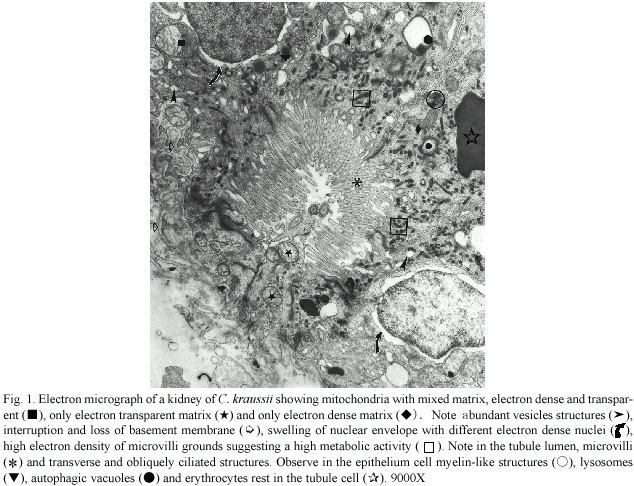
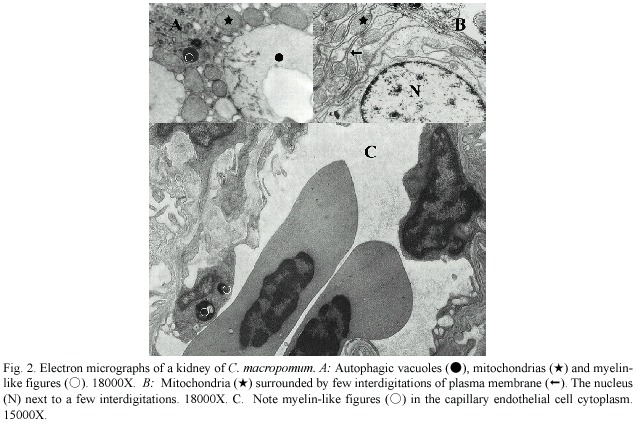
<p><font face="Arial" size="2">The aim of this research is to study the effect of this herbicide on the kidney of <i>Caquetaia kraussii </i>(Steindachner, 1878), (Pisces:Ciclidae) which is a great food source for its excellent flavour,not very bony axial skeleton,low fat and high protein contents (<a  href="#se01">Segnini de Bravo and Chung 2001</a>)and <i>Colossoma macropomum </i>(Cuvier,1818),(Pisces:Characeae),a species widely found in South America from the Orinoco to Amazon rivers.In Venezuela, they are abundant in the Guanare, Portuguesa, Meta,Apure,Caroní and Orinoco rivers.Also, they have a high aquaculture potential because they can be cultured and reproduced in captivity (<a href="#go98">González and Heredia 1998</a>).</font></p> <font face="Arial" size="2"><b>     <p>Materials and methods</p> </b><i></i></font>     <p><font face="Arial" size="2"><i>C.kraussii </i>and <i>C.macropomum </i>(20 organisms of each species)were exposed during 72 hr to sublethal doses of the herbicide 2-chloro-4,6-bis-ethylamine-s-triazine (2.5 ppm).This concentration was taken as the mean of the limit values recommended for the industry (1.6 to 3.3 ppm).The average lethal concentration is 70 ppm for <i>C.kraussii </i>and 62 ppm for <i>C.macropomum </i>(<a  href="#me95">Medina 1995</a>).After that,four juvenile specimens of each species,taken at random, were decapitated. From each fish beheaded, one kidney sample was rapidly dissected,fixed with glutaraldehyde (2.5%)in Millonig buffer (pH=7.8,320 mOsm)for 45 min,trimmed to a block of approximately 1 mm<sup>3</sup> which was washed three times with Millonig buffer (pH=7.8)for 1 min.The resulting blocks were postfixed for 1 hr in osmium tetroxide (1%)in the same buffer for 1 hr at 4 ºC,washed for 15 min in distilled water and dehydrated gradually through an ascending concentration of ethanol at 4 ºC for 5 min in each stage.They were submerged twice in propylene oxide (15 min at room temperature)and infiltrated with a 1:1 mixture of propylene oxide-resin for 30 min and four changes of pure resin (LX-112)in each stage.Finally,they were placed in plastic moulds for 48 hr at 60 ºC.Sections of 80 nm were cut on an ultramicrotome Porter-Blum MT2-B, transferred to copper grids (200 mesh), stained with uranyl acetate and lead citrate and observed in a Hitachi H-7100 electron microscope at 75 kV.</font></p> <font face="Arial" size="2"><b>     <p>Results</p> </b></font>     <p><font face="Arial" size="2">The kidney of <i>C.kraussii </i>and <i>C.macropomum </i>is usually a fused organ lying in a retroperitoneal location just ventral to the spinal column and often intermeshed with its processes.The herbicide 2-chloro-4,6-bis-ethylamine-s-triazine,is commonly used in weed control in ponds of cultured fishes.On 2.5 ppm concentrations,it affected the kidney of animals studied in the present research.Ultrastructural observation on <i>C.kraussii </i>treated with herbicide showed abundant vesicle structures, interruption and loss of basement membrane, swelling of nuclear envelope with different electron dense nuclei, mitochondria with mixed electron density matrix,myelin-like structures, lysosomes,autophagic vacuoles and high electron density of microvilli grounds suggesting a high metabolic activity (<a href="#f1">Fig.1</a>).Different alterations were observed at the ultrastructural level for <i>C.macropomum </i>,including cytoplasmatic vacuolation of epithelial cells from convoluted proximal tubules and increased autophagic vacuoles (<a href="#f2">Fig.2A</a>).Other cells showed less abundant mitochondria interdigitations on the area nuclei near the basal border (<a href="#f2">Fig.2B</a>). Myelin-like figures were observed in the capillary endothelial cell citoplasm (<a  href="#f2">Fig.2C</a>).</font></p> <a name="f1"></a>     ]]></body>
<body><![CDATA[<div style="text-align: center;"><img src="/img/fbpe/rbt/v53s1/3166i1.JPG" title=""  alt="" style="width: 634px; height: 486px;"></div> <font face="Arial" size="2"><b>     
<p>    <br> <a name="f2"></a></p> </b></font>     <div style="text-align: center;"><img src="/img/fbpe/rbt/v53s1/3166i2.JPG" title=""  alt="" style="width: 637px; height: 423px;">    
<br> </div> <font face="Arial" size="2"><b>     <p></p> </b></font><font face="Arial" size="2"><b>     <p>Discussion</p> </b></font>     <p><font face="Arial" size="2">The use of chemical agents such as pesticides and herbicides has increased environmental risk to fishes.The kidney of <i>C.kraussii </i>and <i>C.macropomum </i>has been believed to provide a monitoring tool as a sensitive indicator of environmental pollution.This study noted some alterations at cellular level including misshaped mitochondria and an increased vacuole number with large diameters.</font></p>     <p><font face="Arial" size="2">Pesticide studies have been carried out to determine effects the chemical compounds produce on reproductive functions through the endocrine system.It is known that atrazine,2,4,d-metribuzin and mancozelo produce endocrine disruption (<a  href="#st97">Struger and Painter 1997</a>).Studies carried out on medaka and guppy exposed to Bis (tris-n-butyltin)oxide (TBTO)and Di-n-butyltindi-chloride (DBTC) (<a href="#we90">Wester <i>et al.</i>1990</a>),found that proximal tubules produced misshaped mitochondria and an increased number of lysosomes.Adults of <i>Leopomis macrochirus </i>,exposed to sublethal doses of Diazinon exhibited lifting of the epithelial layer,epithelial rupture,hyperplasia and necrosis,shortening of the lamellae,lamellar fusion and mucous cell hypertrophy (<a href="#la00">Larkin and Tjeerdema 2000</a>).Acute exposure of tench (<i>Tinca tinca </i>)to the herbicide 2,4 dichloro-phenoxiacetic acid caused marked alteration of haematopoietic tissue,characterized by progressive swelling and cell necrosis,activation of the phagocyte system,and subsequent formation of myelin-like figures (<a href="#gom98">Gomez <i>et al.</i>1998</a>).Studies on carp (<i>Cyprinus carpio) </i>exposed by emersion in Roundup super TM (205 mg glyphosate/l or 410 mg of glyphosate/l)in concentrations of 40 to 20 fold lower than those used in practice revealed that the herbicide caused the appearance of myelin-like structures in hepatocytes,swelling of mitochondria and disappearance of internal membrane of mitochondria at both exposure concentrations, meaning that Roundup was harmful to carp when used at the recommended application concentrations (Szarek <i>et al.</i>2000).All of these results are consistent with our findings.Because the triazine concentration used in our research (2.5 ppm)is below the highest level (3.3 ppm) recommended by the manufacturer,we recommend to use lower levels of doses of 2-chloro-4,6-bis-ethylamine-S-triazine for weed control to avoid irreversible damages to fishes.Future additional studies to determine the efficacy of lower doses as well as presumably less severe effects on fishes are appropriate.</font></p>     <p><font face="Arial" size="2">The types of changes found in our study may also serve as biological markers of environmental stress.When the magnitude of the stressor is enough to cause cellular lesions but not the death of the organism,changes may be observed with light or electron microscopy. Quantitative changes within specific organelles of affected cells are often responsible for the cellular lesions characteristic of chronic or adaptive cellular lesions.These changes include degeneration (cellular swelling), accumulation of cytoplasm inclusions,and changes in cell and nuclear volumes.</font></p>     ]]></body>
<body><![CDATA[<p><font face="Arial" size="2">Accumulation of triglycerides in the cytoplasm of affected cells is a common indicator of acute,subacute and chronic activity. Triglycerides accumulate in vacuoles within the cytosol and may occupy large portions of cytoplasm.<a href="#po95">Powell <i>et al.</i>(1995)</a>used Chloramine T as prophylactic and therapeutic agent in freshwater aquaculture ponds and found that morphological changes are consistent with a compensatory mechanism for the remedial uptake of ions,suggesting that Chloramine T increased epithelial ion permeability coincident with a possible influx of water leading to intercellular edema.Chloride cell proliferation and intercellular edema may also have affected gas exchange across the branchial epithelium. Also,another chlorinated insecticide,Kepone (chlordecone) altered mitochondrial volume by compensatory effect (<a  href="#ma95">Mallat <i>et al.</i>1995</a>).In many fishes and aquatic invertebrates,sublethal doses of herbicide decreased translation of normal genes while increasing the translation of stress protein genes (<a  href="#la00">Larkin and Tjeerdema 2000</a>).In carp <i>(Cyprinus carpio),</i>diazinon increased both renal metal-binding proteins (such as metallothionein)and heme oxygenase levels while depressing activity of the latter in both liver and pancreas (<a href="#ar90">Ariyoshi <i>et al.</i>1990</a>). </font></p>     <p><font face="Arial" size="2">It is clear therefore pathological renal changes in <i>C.kraussii </i>and <i>C.macropomum </i>can be used as markers of environmental pollution and monitored by transmission electron microscopy (TEM).</font></p> <font face="Arial" size="2"><b>     <p>Acknowledgments</p> </b></font>     <p><font face="Arial" size="2">We thank Consejo de Investigación, Universidad de Oriente,Proyecto CI-5-1803- 0978/1 and CDCH-Universidad Central de Venezuela for the financial support given to this work and Gordon Hart from Universidad de Oriente for his assistance.</font></p> <font face="Arial" size="2"><b>     <p>Resumen</p> </b></font>     <p><font face="Arial" size="2">El uso de compuestos químicos como plaguicidas y como herbicidas ha incrementado la contaminación ambiental,afectando la ictiofauna que vive en ríos y depósitos de agua.Estudiamos el efecto de un herbicida (2-cloro-4,6-bis-etlamina-s-triazina)sobre el riñón de dos especies de peces (<i>Caquetaia kraussii </i>y <i>Colossoma macropomum </i>),ampliamente encontradas en los ríos caribeños y sudamericanos.En Venezuela son abundantes y tienen un alto potencial en acuacultura debido a que pueden ser cultivados y reproducidos en cautiverio.Se disectó el riñón a cuatro individuos jóvenes de cada especie que habían sido expuestos al herbicida y se les examinó con Microscopía Electrónica de Transmisión.Se encontraron alteraciones en los túbulos del riñón que incluían pérdida de plasmalema e interdigitaciones celulares,mitocondrias alteradas, disminución en el retículo endoplásmico,polisomas libres y la presencia de vacuolas autofágicas y lisosomas primarios.Estas alteraciones a nivel celular pueden explicar la conducta de los peces en términos de patología de los túbulos del riñón y las cantidades relativas y condiciones de organelas dentro de las células afectadas.</font></p> <font face="Arial" size="2"><b></b></font>     <p><font face="Arial" size="2"><b>Palabras clave:</b><i>Caquetaia kraussii,Colossoma macropomum, </i>riñón, hierbicida, ultraestructura, patología, marcadores de estrés.</font></p> <font face="Arial" size="2"><b>     <p>References</p> </b></font>     <!-- ref --><p><font face="Arial" size="2"><a name="ar90"></a>Arisyoshi,T.,S.Shiiba,H.Hasegawa &amp;K.Arizono.1990. Profile of metal binding proteins and heme oxygenase in red carp treated with heavy metals,pesticides and surfactants. Bull. Environ. Contam. Toxic. 44: 643-649.</font>&nbsp;&nbsp;&nbsp;&nbsp;&nbsp;&nbsp;&nbsp;&nbsp;[&#160;<a href="javascript:void(0);" onclick="javascript: window.open('/scielo.php?script=sci_nlinks&ref=1226854&pid=S0034-7744200500030001000001&lng=','','width=640,height=500,resizable=yes,scrollbars=1,menubar=yes,');">Links</a>&#160;]<!-- end-ref --><!-- ref --><p><font face="Arial" size="2"><a name="co97"></a>Cooper,R.L.&amp;R.J.Kaviock.1997.Endocrine disruptors and reproductive development:a weight-of-evidence overview. J. Endocrin. 152:159-166.</font>&nbsp;&nbsp;&nbsp;&nbsp;&nbsp;&nbsp;&nbsp;&nbsp;[&#160;<a href="javascript:void(0);" onclick="javascript: window.open('/scielo.php?script=sci_nlinks&ref=1226855&pid=S0034-7744200500030001000002&lng=','','width=640,height=500,resizable=yes,scrollbars=1,menubar=yes,');">Links</a>&#160;]<!-- end-ref --><!-- ref --><p><font face="Arial" size="2"><a name="de89"></a>Denoyelles,F.,W.D.Kettle,C.H.Fromm,M.F.Moffett &amp;S.L.Dewey.1989.Use of experimental ponds to assess the effects of a pesticide on the aquatic environment.Miscel.Publ.No.75,34th Ann.Meet. Entomol.Soc.Amer.,Nov.29 -Dec.3,1987. MPPEAL 75:1-88.</font>&nbsp;&nbsp;&nbsp;&nbsp;&nbsp;&nbsp;&nbsp;&nbsp;[&#160;<a href="javascript:void(0);" onclick="javascript: window.open('/scielo.php?script=sci_nlinks&ref=1226856&pid=S0034-7744200500030001000003&lng=','','width=640,height=500,resizable=yes,scrollbars=1,menubar=yes,');">Links</a>&#160;]<!-- end-ref --><!-- ref --><p><font face="Arial" size="2"><a name="di00"></a>Diana,S.G.,W.J.Resetarits Jr.,D.J.Schaeffer,K.B. Beckmen &amp;V.R.Beasley.2000.Effects of atrazine on amphibian growth and survival in artificial aquatic communities.Environ.Toxic.Chem.19:2961-2967.</font>&nbsp;&nbsp;&nbsp;&nbsp;&nbsp;&nbsp;&nbsp;&nbsp;[&#160;<a href="javascript:void(0);" onclick="javascript: window.open('/scielo.php?script=sci_nlinks&ref=1226857&pid=S0034-7744200500030001000004&lng=','','width=640,height=500,resizable=yes,scrollbars=1,menubar=yes,');">Links</a>&#160;]<!-- end-ref --><!-- ref --><p><font face="Arial" size="2"><a name="fe01"></a>Felsot,A.S.2001.Herbicide tolerant genes,Part 4.Withering wildlife?.Agrichem.Environ.News 178:1-8.</font>&nbsp;&nbsp;&nbsp;&nbsp;&nbsp;&nbsp;&nbsp;&nbsp;[&#160;<a href="javascript:void(0);" onclick="javascript: window.open('/scielo.php?script=sci_nlinks&ref=1226858&pid=S0034-7744200500030001000005&lng=','','width=640,height=500,resizable=yes,scrollbars=1,menubar=yes,');">Links</a>&#160;]<!-- end-ref --><!-- ref --><p><font face="Arial" size="2"><a name="gom98"></a>Gomez,L.,J.Masot,S.Martínez,E.Durán,F.Soler &amp; V.Roncero.1998.Acute 2,4-D poisoning in tench. (<i>Tinca tinca L.</i>):Lesions in the haematopoietic portion of the kidney.Archiv.Environ.Contam.Toxic. 35:479-483.</font>&nbsp;&nbsp;&nbsp;&nbsp;&nbsp;&nbsp;&nbsp;&nbsp;[&#160;<a href="javascript:void(0);" onclick="javascript: window.open('/scielo.php?script=sci_nlinks&ref=1226859&pid=S0034-7744200500030001000006&lng=','','width=640,height=500,resizable=yes,scrollbars=1,menubar=yes,');">Links</a>&#160;]<!-- end-ref --><!-- ref --><p><font face="Arial" size="2"><a name="go98"></a>Gonzalez,J.&amp;B.Heredia.1998.El cultivo de la cachama (<i>Colossoma macropomum </i>). Maracay, Venezuela, FONAIAP. Centro de Investigaciones Agropecuarias del Estado Guárico.134 p.</font>&nbsp;&nbsp;&nbsp;&nbsp;&nbsp;&nbsp;&nbsp;&nbsp;[&#160;<a href="javascript:void(0);" onclick="javascript: window.open('/scielo.php?script=sci_nlinks&ref=1226860&pid=S0034-7744200500030001000007&lng=','','width=640,height=500,resizable=yes,scrollbars=1,menubar=yes,');">Links</a>&#160;]<!-- end-ref --><!-- ref --><p><font face="Arial" size="2"><a name="ha00"></a>Hamm,J.T.&amp;D.E.Hinton.2000.The role of development and duration of exposure to the embryotoxicity of diazinon. Aquat.Toxic.48:403 418.</font>&nbsp;&nbsp;&nbsp;&nbsp;&nbsp;&nbsp;&nbsp;&nbsp;[&#160;<a href="javascript:void(0);" onclick="javascript: window.open('/scielo.php?script=sci_nlinks&ref=1226861&pid=S0034-7744200500030001000008&lng=','','width=640,height=500,resizable=yes,scrollbars=1,menubar=yes,');">Links</a>&#160;]<!-- end-ref --><!-- ref --><p><font face="Arial" size="2"><a name="ha02"></a>Hayes,T.B.,A.Collins,M.Lee,M.Mendoza,N.Noriega, A.A.Stuart &amp;A.Vonk.2002.Hermaphroditic, demasculinized frogs after exposure to the herbicide atrazine at low ecologically relevant doses.Proc.Nat. Acad.Sci.(U.S.A.)99:5476-5480.</font>&nbsp;&nbsp;&nbsp;&nbsp;&nbsp;&nbsp;&nbsp;&nbsp;[&#160;<a href="javascript:void(0);" onclick="javascript: window.open('/scielo.php?script=sci_nlinks&ref=1226862&pid=S0034-7744200500030001000009&lng=','','width=640,height=500,resizable=yes,scrollbars=1,menubar=yes,');">Links</a>&#160;]<!-- end-ref --><!-- ref --><p><font face="Arial" size="2"><a name="la00"></a>Larkin,D.J.&amp;R.S.Tjeerdema.2000.Fate and effects of diazinon.Review Environ.Contam.Toxic.166: 49-82.</font>&nbsp;&nbsp;&nbsp;&nbsp;&nbsp;&nbsp;&nbsp;&nbsp;[&#160;<a href="javascript:void(0);" onclick="javascript: window.open('/scielo.php?script=sci_nlinks&ref=1226863&pid=S0034-7744200500030001000010&lng=','','width=640,height=500,resizable=yes,scrollbars=1,menubar=yes,');">Links</a>&#160;]<!-- end-ref --><!-- ref --><p><font face="Arial" size="2"><a name="la89"></a>Lauren,D.J.,A.Wishkovsky,J.M.Groff,R.P.Hedrick &amp; D.E.Hinton.1989.Toxicity and pharmacokinetics of the antibiotic fumagillin,in yearling rainbow trout (<i>Salmo gairdneri </i>).Toxic.App.Pharmac.98:444-453.</font>&nbsp;&nbsp;&nbsp;&nbsp;&nbsp;&nbsp;&nbsp;&nbsp;[&#160;<a href="javascript:void(0);" onclick="javascript: window.open('/scielo.php?script=sci_nlinks&ref=1226864&pid=S0034-7744200500030001000011&lng=','','width=640,height=500,resizable=yes,scrollbars=1,menubar=yes,');">Links</a>&#160;]<!-- end-ref --><!-- ref --><p><font face="Arial" size="2"><a name="me95"></a>Medina,J.1995.Informe de Gestión.FONAIAP.Estación Experimental Guárico.Sub-Estación Guanapito.56 p.</font>&nbsp;&nbsp;&nbsp;&nbsp;&nbsp;&nbsp;&nbsp;&nbsp;[&#160;<a href="javascript:void(0);" onclick="javascript: window.open('/scielo.php?script=sci_nlinks&ref=1226865&pid=S0034-7744200500030001000012&lng=','','width=640,height=500,resizable=yes,scrollbars=1,menubar=yes,');">Links</a>&#160;]<!-- end-ref --><!-- ref --><p><font face="Arial" size="2"><a name="ma95"></a>Mallat,J.,J.F.Bailey,S.J.Lampa,M.A.Evans &amp;S. Brumbaugh.1995.A fish gill system for quantifying the ultrastructural effects of environmental stressors: methylmercury,Kepone and heat schock.Canad.J. Fish.Aquat.Sci.52:1165-1182.</font>&nbsp;&nbsp;&nbsp;&nbsp;&nbsp;&nbsp;&nbsp;&nbsp;[&#160;<a href="javascript:void(0);" onclick="javascript: window.open('/scielo.php?script=sci_nlinks&ref=1226866&pid=S0034-7744200500030001000013&lng=','','width=640,height=500,resizable=yes,scrollbars=1,menubar=yes,');">Links</a>&#160;]<!-- end-ref --><!-- ref --><p><font face="Arial" size="2"><a name="po95"></a>Powell,M.D.,G.M.Wright &amp;D.J.Speare.1995. Morphological changes in rainbow trout (<i>Oncorhynchus mykiss </i>)gill epithelia following repeated intermittent exposure to chloramines T. Canad.J.Zool.73:154-165.</font>&nbsp;&nbsp;&nbsp;&nbsp;&nbsp;&nbsp;&nbsp;&nbsp;[&#160;<a href="javascript:void(0);" onclick="javascript: window.open('/scielo.php?script=sci_nlinks&ref=1226867&pid=S0034-7744200500030001000014&lng=','','width=640,height=500,resizable=yes,scrollbars=1,menubar=yes,');">Links</a>&#160;]<!-- end-ref --><!-- ref --><p><font face="Arial" size="2"><a name="ro86"></a>Rolf,L.L.,M.D.Setser &amp;J.L.Walker.1986. Pharmacokinetics and tissues residues in chanel catfish,<i>Ictalurus punctatus </i>,given intracardiac and intramuscular injections of gentamicin sulphate.Vet. Hum.Toxic.28 (Suppl 1):25-31.</font>&nbsp;&nbsp;&nbsp;&nbsp;&nbsp;&nbsp;&nbsp;&nbsp;[&#160;<a href="javascript:void(0);" onclick="javascript: window.open('/scielo.php?script=sci_nlinks&ref=1226868&pid=S0034-7744200500030001000015&lng=','','width=640,height=500,resizable=yes,scrollbars=1,menubar=yes,');">Links</a>&#160;]<!-- end-ref --><!-- ref --><p><font face="Arial" size="2"><a name="se01"></a>Segnini de Bravo M.I.&amp;K.S.Chung.2001 Ecophysiological Behavior of <i>Caquetaia kraussi </i>exposed to different temperatures and salinities.Rev.Biol.Trop.49:141-156.</font>&nbsp;&nbsp;&nbsp;&nbsp;&nbsp;&nbsp;&nbsp;&nbsp;[&#160;<a href="javascript:void(0);" onclick="javascript: window.open('/scielo.php?script=sci_nlinks&ref=1226869&pid=S0034-7744200500030001000016&lng=','','width=640,height=500,resizable=yes,scrollbars=1,menubar=yes,');">Links</a>&#160;]<!-- end-ref --><!-- ref --><p><font face="Arial" size="2"><a name="st97"></a>Struger,J.&amp;S.Painter.1997.Endocrine disruptions in the great lakes basin:an assessment of agricultural and industrial inputs.Soc.Environ.Toxic.Chem.SETAC 18 th Ann.Meet.Abstract Book.PWA140.Pp.255.</font>&nbsp;&nbsp;&nbsp;&nbsp;&nbsp;&nbsp;&nbsp;&nbsp;[&#160;<a href="javascript:void(0);" onclick="javascript: window.open('/scielo.php?script=sci_nlinks&ref=1226870&pid=S0034-7744200500030001000017&lng=','','width=640,height=500,resizable=yes,scrollbars=1,menubar=yes,');">Links</a>&#160;]<!-- end-ref --><!-- ref --><p><font face="Arial" size="2"><a name="sz02"></a>Szarek,J.,A.Siwicki,A.Andrzejewska,E.Terech-Majewska &amp;T.Banaszkiewicz.2000.Effect of herbicide roundup super TM on the structural pattern of hepatocytes in carp.Mar.Environ.Res.50:263-266.</font>&nbsp;&nbsp;&nbsp;&nbsp;&nbsp;&nbsp;&nbsp;&nbsp;[&#160;<a href="javascript:void(0);" onclick="javascript: window.open('/scielo.php?script=sci_nlinks&ref=1226871&pid=S0034-7744200500030001000018&lng=','','width=640,height=500,resizable=yes,scrollbars=1,menubar=yes,');">Links</a>&#160;]<!-- end-ref --><!-- ref --><p><font face="Arial" size="2"><a name="we86"></a>Wester,P.W.&amp;J.H.Canton.1986.Histopathological study of <i>Oryzias latipes </i>(medaka)after long term <font  face="Symbol">b</font> -hexa-chlorocyclohexane exposure.Aquat.Toxic.9:21-45.</font>&nbsp;&nbsp;&nbsp;&nbsp;&nbsp;&nbsp;&nbsp;&nbsp;[&#160;<a href="javascript:void(0);" onclick="javascript: window.open('/scielo.php?script=sci_nlinks&ref=1226872&pid=S0034-7744200500030001000019&lng=','','width=640,height=500,resizable=yes,scrollbars=1,menubar=yes,');">Links</a>&#160;]<!-- end-ref --><!-- ref --><p><font face="Arial" size="2"><a name="we90"></a>Wester,P.W.,J.H.Canton,A.A.J.van Lersel,E.I.Krajnc &amp;H.A.M.G.Vaessen.1990.The toxicity of bis(tris-n-butyltin)oxide (TBTO)and di-n-butyltindi-chloride (DBTC)in the small fish species <i>Oryzias latipes </i>(medaka)and <i>Poecilia reticulata </i>(guppy).Aquat. Toxic.16:53-72.</font>&nbsp;&nbsp;&nbsp;&nbsp;&nbsp;&nbsp;&nbsp;&nbsp;[&#160;<a href="javascript:void(0);" onclick="javascript: window.open('/scielo.php?script=sci_nlinks&ref=1226873&pid=S0034-7744200500030001000020&lng=','','width=640,height=500,resizable=yes,scrollbars=1,menubar=yes,');">Links</a>&#160;]<!-- end-ref --><!-- ref --><p><font face="Arial" size="2"><a name="wi00"></a>Wiegand,C.,S.Pflugmacher,M.Giese,H.Frank &amp;C. Steinberg.2000.Uptake,toxicity and effects on detoxication enzymes of atrazine and trifluoroacetate in embryios of Zebrafish.Ecotox.Environ.Safety 45:122-131.</font>&nbsp;&nbsp;&nbsp;&nbsp;&nbsp;&nbsp;&nbsp;&nbsp;[&#160;<a href="javascript:void(0);" onclick="javascript: window.open('/scielo.php?script=sci_nlinks&ref=1226874&pid=S0034-7744200500030001000021&lng=','','width=640,height=500,resizable=yes,scrollbars=1,menubar=yes,');">Links</a>&#160;]<!-- end-ref --><!-- ref --><p><font face="Arial" size="2"><a name="wi01"></a>Wiegand,C.,E.Krause,C.Steinberg &amp;S.Plugmacher. 2001.Toxicokinetics of atrazine in embryos of the zebrafish (<i>Danio rerio </i>).Ecotox.Environ.Safety 49: 199-205.</font>&nbsp;&nbsp;&nbsp;&nbsp;&nbsp;&nbsp;&nbsp;&nbsp;[&#160;<a href="javascript:void(0);" onclick="javascript: window.open('/scielo.php?script=sci_nlinks&ref=1226875&pid=S0034-7744200500030001000022&lng=','','width=640,height=500,resizable=yes,scrollbars=1,menubar=yes,');">Links</a>&#160;]<!-- end-ref --> ]]></body><back>
<ref-list>
<ref id="B1">
<nlm-citation citation-type="journal">
<person-group person-group-type="author">
<name>
<surname><![CDATA[Arisyoshi]]></surname>
<given-names><![CDATA[T]]></given-names>
</name>
<name>
<surname><![CDATA[Shiiba]]></surname>
<given-names><![CDATA[S]]></given-names>
</name>
<name>
<surname><![CDATA[Hasegawa]]></surname>
<given-names><![CDATA[H]]></given-names>
</name>
<name>
<surname><![CDATA[Arizono]]></surname>
<given-names><![CDATA[K]]></given-names>
</name>
</person-group>
<article-title xml:lang="en"><![CDATA[Profile of metal binding proteins and heme oxygenase in red carp treated with heavy metals,pesticides and surfactants]]></article-title>
<source><![CDATA[Bull. Environ. Contam. Toxic]]></source>
<year>1990</year>
<volume>44</volume>
<page-range>643-649</page-range></nlm-citation>
</ref>
<ref id="B2">
<nlm-citation citation-type="journal">
<person-group person-group-type="author">
<name>
<surname><![CDATA[Cooper]]></surname>
<given-names><![CDATA[R.L]]></given-names>
</name>
<name>
<surname><![CDATA[Kaviock]]></surname>
<given-names><![CDATA[R.J]]></given-names>
</name>
</person-group>
<article-title xml:lang="en"><![CDATA[Endocrine disruptors and reproductive development: a weight-of-evidence overview]]></article-title>
<source><![CDATA[J. Endocrin]]></source>
<year>1997</year>
<volume>152</volume>
<page-range>159-166</page-range></nlm-citation>
</ref>
<ref id="B3">
<nlm-citation citation-type="journal">
<person-group person-group-type="author">
<name>
<surname><![CDATA[Denoyelles]]></surname>
<given-names><![CDATA[F]]></given-names>
</name>
<name>
<surname><![CDATA[Kettle]]></surname>
<given-names><![CDATA[W.D]]></given-names>
</name>
<name>
<surname><![CDATA[Fromm]]></surname>
<given-names><![CDATA[C.H]]></given-names>
</name>
<name>
<surname><![CDATA[Moffett]]></surname>
<given-names><![CDATA[M.F]]></given-names>
</name>
<name>
<surname><![CDATA[Dewey]]></surname>
<given-names><![CDATA[S.L]]></given-names>
</name>
</person-group>
<article-title xml:lang="en"><![CDATA[Use of experimental ponds to assess the effects of a pesticide on the aquatic environment.Miscel.Publ.No.75,34th Ann.Meet. Entomol.Soc.Amer.,Nov.29 -Dec.3,1987]]></article-title>
<source><![CDATA[MPPEAL]]></source>
<year>1989</year>
<volume>75</volume>
<page-range>1-88</page-range></nlm-citation>
</ref>
<ref id="B4">
<nlm-citation citation-type="journal">
<person-group person-group-type="author">
<name>
<surname><![CDATA[Diana]]></surname>
<given-names><![CDATA[S.G]]></given-names>
</name>
<name>
<surname><![CDATA[Resetarits Jr]]></surname>
<given-names><![CDATA[W.J]]></given-names>
</name>
<name>
<surname><![CDATA[Schaeffer]]></surname>
<given-names><![CDATA[D.J]]></given-names>
</name>
<name>
<surname><![CDATA[Beckmen]]></surname>
<given-names><![CDATA[K.B]]></given-names>
</name>
<name>
<surname><![CDATA[Beasley]]></surname>
<given-names><![CDATA[V.R]]></given-names>
</name>
</person-group>
<article-title xml:lang="en"><![CDATA[Effects of atrazine on amphibian growth and survival in artificial aquatic communities]]></article-title>
<source><![CDATA[Environ.Toxic.Chem]]></source>
<year>2000</year>
<volume>19</volume>
<page-range>2961-2967</page-range></nlm-citation>
</ref>
<ref id="B5">
<nlm-citation citation-type="journal">
<person-group person-group-type="author">
<name>
<surname><![CDATA[Felsot]]></surname>
<given-names><![CDATA[A.S]]></given-names>
</name>
</person-group>
<article-title xml:lang="en"><![CDATA[Herbicide tolerant genes,Part 4.Withering wildlife?]]></article-title>
<source><![CDATA[Agrichem.Environ.News]]></source>
<year>2001</year>
<volume>178</volume>
<page-range>1-8</page-range></nlm-citation>
</ref>
<ref id="B6">
<nlm-citation citation-type="journal">
<person-group person-group-type="author">
<name>
<surname><![CDATA[Gomez]]></surname>
<given-names><![CDATA[L]]></given-names>
</name>
<name>
<surname><![CDATA[Masot]]></surname>
<given-names><![CDATA[J]]></given-names>
</name>
<name>
<surname><![CDATA[Martínez]]></surname>
<given-names><![CDATA[S]]></given-names>
</name>
<name>
<surname><![CDATA[Durán]]></surname>
<given-names><![CDATA[E]]></given-names>
</name>
<name>
<surname><![CDATA[Soler]]></surname>
<given-names><![CDATA[F]]></given-names>
</name>
<name>
<surname><![CDATA[Roncero]]></surname>
<given-names><![CDATA[V]]></given-names>
</name>
</person-group>
<article-title xml:lang="en"><![CDATA[Acute 2,4-D poisoning in tench. (Tinca tinca L.): Lesions in the haematopoietic portion of the kidney]]></article-title>
<source><![CDATA[Archiv.Environ.Contam.Toxic]]></source>
<year>1998</year>
<volume>35</volume>
<page-range>479-483</page-range></nlm-citation>
</ref>
<ref id="B7">
<nlm-citation citation-type="book">
<person-group person-group-type="author">
<name>
<surname><![CDATA[Gonzalez]]></surname>
<given-names><![CDATA[J]]></given-names>
</name>
<name>
<surname><![CDATA[Heredia]]></surname>
<given-names><![CDATA[B]]></given-names>
</name>
</person-group>
<source><![CDATA[El cultivo de la cachama (Colossoma macropomum )]]></source>
<year>1998</year>
<page-range>134</page-range><publisher-loc><![CDATA[Maracay ]]></publisher-loc>
<publisher-name><![CDATA[FONAIAP. Centro de Investigaciones Agropecuarias del Estado Guárico]]></publisher-name>
</nlm-citation>
</ref>
<ref id="B8">
<nlm-citation citation-type="journal">
<person-group person-group-type="author">
<name>
<surname><![CDATA[Hamm]]></surname>
<given-names><![CDATA[J.T]]></given-names>
</name>
<name>
<surname><![CDATA[Hinton]]></surname>
<given-names><![CDATA[D.E]]></given-names>
</name>
</person-group>
<article-title xml:lang="en"><![CDATA[The role of development and duration of exposure to the embryotoxicity of diazinon]]></article-title>
<source><![CDATA[Aquat.Toxic]]></source>
<year>2000</year>
<volume>48</volume>
<page-range>403 418</page-range></nlm-citation>
</ref>
<ref id="B9">
<nlm-citation citation-type="journal">
<person-group person-group-type="author">
<name>
<surname><![CDATA[Hayes]]></surname>
<given-names><![CDATA[T.B]]></given-names>
</name>
<name>
<surname><![CDATA[Collins]]></surname>
<given-names><![CDATA[A]]></given-names>
</name>
<name>
<surname><![CDATA[Lee]]></surname>
<given-names><![CDATA[M]]></given-names>
</name>
<name>
<surname><![CDATA[Mendoza]]></surname>
<given-names><![CDATA[M]]></given-names>
</name>
<name>
<surname><![CDATA[Noriega]]></surname>
<given-names><![CDATA[N]]></given-names>
</name>
<name>
<surname><![CDATA[Stuart]]></surname>
<given-names><![CDATA[A.A]]></given-names>
</name>
<name>
<surname><![CDATA[Vonk]]></surname>
<given-names><![CDATA[A]]></given-names>
</name>
</person-group>
<article-title xml:lang="en"><![CDATA[Hermaphroditic, demasculinized frogs after exposure to the herbicide atrazine at low ecologically relevant doses]]></article-title>
<source><![CDATA[Proc.Nat. Acad.Sci.(U.S.A.)]]></source>
<year>2002</year>
<volume>99</volume>
<page-range>5476-5480</page-range></nlm-citation>
</ref>
<ref id="B10">
<nlm-citation citation-type="journal">
<person-group person-group-type="author">
<name>
<surname><![CDATA[Larkin]]></surname>
<given-names><![CDATA[D.J]]></given-names>
</name>
<name>
<surname><![CDATA[Tjeerdema]]></surname>
<given-names><![CDATA[R.S]]></given-names>
</name>
</person-group>
<article-title xml:lang="en"><![CDATA[Fate and effects of diazinon]]></article-title>
<source><![CDATA[Review Environ.Contam.Toxic]]></source>
<year>2000</year>
<volume>166</volume>
<page-range>49-82</page-range></nlm-citation>
</ref>
<ref id="B11">
<nlm-citation citation-type="journal">
<person-group person-group-type="author">
<name>
<surname><![CDATA[Lauren]]></surname>
<given-names><![CDATA[D.J]]></given-names>
</name>
<name>
<surname><![CDATA[Wishkovsky]]></surname>
<given-names><![CDATA[A]]></given-names>
</name>
<name>
<surname><![CDATA[Groff]]></surname>
<given-names><![CDATA[J.M]]></given-names>
</name>
<name>
<surname><![CDATA[Hedrick]]></surname>
<given-names><![CDATA[R.P]]></given-names>
</name>
<name>
<surname><![CDATA[Hinton]]></surname>
<given-names><![CDATA[D.E]]></given-names>
</name>
</person-group>
<article-title xml:lang="en"><![CDATA[Toxicity and pharmacokinetics of the antibiotic fumagillin,in yearling rainbow trout (Salmo gairdneri )]]></article-title>
<source><![CDATA[Toxic.App.Pharmac]]></source>
<year>1989</year>
<volume>98</volume>
<page-range>444-453</page-range></nlm-citation>
</ref>
<ref id="B12">
<nlm-citation citation-type="">
<person-group person-group-type="author">
<name>
<surname><![CDATA[Medina]]></surname>
<given-names><![CDATA[J]]></given-names>
</name>
</person-group>
<source><![CDATA[Informe de Gestión.FONAIAP.Estación Experimental Guárico.Sub-Estación Guanapito]]></source>
<year>1995</year>
<page-range>56</page-range></nlm-citation>
</ref>
<ref id="B13">
<nlm-citation citation-type="journal">
<person-group person-group-type="author">
<name>
<surname><![CDATA[Mallat]]></surname>
<given-names><![CDATA[J]]></given-names>
</name>
<name>
<surname><![CDATA[Bailey]]></surname>
<given-names><![CDATA[J.F]]></given-names>
</name>
<name>
<surname><![CDATA[Lampa]]></surname>
<given-names><![CDATA[S.J]]></given-names>
</name>
<name>
<surname><![CDATA[Evans]]></surname>
<given-names><![CDATA[M.A]]></given-names>
</name>
<name>
<surname><![CDATA[Brumbaugh]]></surname>
<given-names><![CDATA[S]]></given-names>
</name>
</person-group>
<article-title xml:lang="en"><![CDATA[A fish gill system for quantifying the ultrastructural effects of environmental stressors: methylmercury,Kepone and heat schock]]></article-title>
<source><![CDATA[Canad.J. Fish.Aquat.Sci]]></source>
<year>1995</year>
<volume>52</volume>
<page-range>1165-1182</page-range></nlm-citation>
</ref>
<ref id="B14">
<nlm-citation citation-type="journal">
<person-group person-group-type="author">
<name>
<surname><![CDATA[Powell]]></surname>
<given-names><![CDATA[M.D]]></given-names>
</name>
<name>
<surname><![CDATA[Wright]]></surname>
<given-names><![CDATA[G.M]]></given-names>
</name>
<name>
<surname><![CDATA[Speare]]></surname>
<given-names><![CDATA[D.J]]></given-names>
</name>
</person-group>
<article-title xml:lang="en"><![CDATA[Morphological changes in rainbow trout (Oncorhynchus mykiss )gill epithelia following repeated intermittent exposure to chloramines T]]></article-title>
<source><![CDATA[Canad.J.Zool]]></source>
<year>1995</year>
<volume>73</volume>
<page-range>154-165</page-range></nlm-citation>
</ref>
<ref id="B15">
<nlm-citation citation-type="journal">
<person-group person-group-type="author">
<name>
<surname><![CDATA[Rolf,]]></surname>
<given-names><![CDATA[L.L]]></given-names>
</name>
<name>
<surname><![CDATA[Setser]]></surname>
<given-names><![CDATA[M.D]]></given-names>
</name>
<name>
<surname><![CDATA[Walker]]></surname>
<given-names><![CDATA[J.L]]></given-names>
</name>
</person-group>
<article-title xml:lang="en"><![CDATA[Pharmacokinetics and tissues residues in chanel catfish,Ictalurus punctatus ,given intracardiac and intramuscular injections of gentamicin sulphate]]></article-title>
<source><![CDATA[Vet. Hum.Toxic]]></source>
<year>1986</year>
<volume>28</volume>
<numero>^sSuppl 1</numero>
<issue>^sSuppl 1</issue>
<supplement>Suppl 1</supplement>
<page-range>25-31</page-range></nlm-citation>
</ref>
<ref id="B16">
<nlm-citation citation-type="journal">
<person-group person-group-type="author">
<name>
<surname><![CDATA[Segnini de Bravo]]></surname>
<given-names><![CDATA[M.I]]></given-names>
</name>
<name>
<surname><![CDATA[Chung]]></surname>
<given-names><![CDATA[K.S]]></given-names>
</name>
</person-group>
<article-title xml:lang="en"><![CDATA[Ecophysiological Behavior of Caquetaia kraussi exposed to different temperatures and salinities]]></article-title>
<source><![CDATA[Rev.Biol.Trop]]></source>
<year>2001</year>
<volume>49</volume>
<page-range>141-156</page-range></nlm-citation>
</ref>
<ref id="B17">
<nlm-citation citation-type="">
<person-group person-group-type="author">
<name>
<surname><![CDATA[Struger]]></surname>
<given-names><![CDATA[J]]></given-names>
</name>
<name>
<surname><![CDATA[Painter]]></surname>
<given-names><![CDATA[S]]></given-names>
</name>
</person-group>
<source><![CDATA[Endocrine disruptions in the great lakes basin: an assessment of agricultural and industrial inputs.Soc.Environ.Toxic.Chem.SETAC 18 th Ann.Meet.Abstract Book.PWA140]]></source>
<year>1997</year>
<page-range>255</page-range></nlm-citation>
</ref>
<ref id="B18">
<nlm-citation citation-type="journal">
<person-group person-group-type="author">
<name>
<surname><![CDATA[Szarek]]></surname>
<given-names><![CDATA[J]]></given-names>
</name>
<name>
<surname><![CDATA[Siwicki]]></surname>
<given-names><![CDATA[A]]></given-names>
</name>
<name>
<surname><![CDATA[Andrzejewska]]></surname>
<given-names><![CDATA[A]]></given-names>
</name>
<name>
<surname><![CDATA[Terech-Majewska]]></surname>
<given-names><![CDATA[E]]></given-names>
</name>
<name>
<surname><![CDATA[Banaszkiewicz]]></surname>
<given-names><![CDATA[T]]></given-names>
</name>
</person-group>
<article-title xml:lang="en"><![CDATA[Effect of herbicide roundup super TM on the structural pattern of hepatocytes in carp]]></article-title>
<source><![CDATA[Mar.Environ.Res]]></source>
<year>2000</year>
<volume>50</volume>
<page-range>263-266</page-range></nlm-citation>
</ref>
<ref id="B19">
<nlm-citation citation-type="journal">
<person-group person-group-type="author">
<name>
<surname><![CDATA[Wester]]></surname>
<given-names><![CDATA[P.W]]></given-names>
</name>
<name>
<surname><![CDATA[Canton]]></surname>
<given-names><![CDATA[J.H]]></given-names>
</name>
</person-group>
<article-title xml:lang="en"><![CDATA[Histopathological study of Oryzias latipes (medaka)after long term beta -hexa-chlorocyclohexane exposure]]></article-title>
<source><![CDATA[Aquat.Toxic]]></source>
<year>1986</year>
<volume>9</volume>
<page-range>21-45</page-range></nlm-citation>
</ref>
<ref id="B20">
<nlm-citation citation-type="journal">
<person-group person-group-type="author">
<name>
<surname><![CDATA[Wester]]></surname>
<given-names><![CDATA[P.W]]></given-names>
</name>
<name>
<surname><![CDATA[Canton]]></surname>
<given-names><![CDATA[J.H]]></given-names>
</name>
<name>
<surname><![CDATA[van Lersel]]></surname>
<given-names><![CDATA[A.A.J]]></given-names>
</name>
<name>
<surname><![CDATA[Krajnc]]></surname>
<given-names><![CDATA[E.I]]></given-names>
</name>
<name>
<surname><![CDATA[Vaessen]]></surname>
<given-names><![CDATA[H.A.M.G]]></given-names>
</name>
</person-group>
<article-title xml:lang="en"><![CDATA[The toxicity of bis(tris-n-butyltin)oxide (TBTO)and di-n-butyltindi-chloride (DBTC)in the small fish species Oryzias latipes (medaka)and Poecilia reticulata (guppy)]]></article-title>
<source><![CDATA[Aquat. Toxic]]></source>
<year>1990</year>
<volume>16</volume>
<page-range>53-72</page-range></nlm-citation>
</ref>
<ref id="B21">
<nlm-citation citation-type="journal">
<person-group person-group-type="author">
<name>
<surname><![CDATA[Wiegand]]></surname>
<given-names><![CDATA[C]]></given-names>
</name>
<name>
<surname><![CDATA[Pflugmacher]]></surname>
<given-names><![CDATA[S]]></given-names>
</name>
<name>
<surname><![CDATA[Giese]]></surname>
<given-names><![CDATA[M]]></given-names>
</name>
<name>
<surname><![CDATA[Frank]]></surname>
<given-names><![CDATA[H]]></given-names>
</name>
<name>
<surname><![CDATA[Steinberg]]></surname>
<given-names><![CDATA[C]]></given-names>
</name>
</person-group>
<article-title xml:lang="en"><![CDATA[Uptake,toxicity and effects on detoxication enzymes of atrazine and trifluoroacetate in embryios of Zebrafish]]></article-title>
<source><![CDATA[Ecotox.Environ.Safety]]></source>
<year>2000</year>
<volume>45</volume>
<page-range>122-131</page-range></nlm-citation>
</ref>
<ref id="B22">
<nlm-citation citation-type="journal">
<person-group person-group-type="author">
<name>
<surname><![CDATA[Wiegand]]></surname>
<given-names><![CDATA[C]]></given-names>
</name>
<name>
<surname><![CDATA[Krause]]></surname>
<given-names><![CDATA[E]]></given-names>
</name>
<name>
<surname><![CDATA[Steinberg]]></surname>
<given-names><![CDATA[C]]></given-names>
</name>
<name>
<surname><![CDATA[Plugmacher]]></surname>
<given-names><![CDATA[S]]></given-names>
</name>
</person-group>
<article-title xml:lang="en"><![CDATA[Toxicokinetics of atrazine in embryos of the zebrafish (Danio rerio )]]></article-title>
<source><![CDATA[Ecotox.Environ.Safety]]></source>
<year>2001</year>
<volume>49</volume>
<page-range>199-205</page-range></nlm-citation>
</ref>
</ref-list>
</back>
</article>