<?xml version="1.0" encoding="ISO-8859-1"?><article xmlns:mml="http://www.w3.org/1998/Math/MathML" xmlns:xlink="http://www.w3.org/1999/xlink" xmlns:xsi="http://www.w3.org/2001/XMLSchema-instance">
<front>
<journal-meta>
<journal-id>0034-7744</journal-id>
<journal-title><![CDATA[Revista de Biología Tropical]]></journal-title>
<abbrev-journal-title><![CDATA[Rev. biol. trop]]></abbrev-journal-title>
<issn>0034-7744</issn>
<publisher>
<publisher-name><![CDATA[Universidad de Costa Rica]]></publisher-name>
</publisher>
</journal-meta>
<article-meta>
<article-id>S0034-77442005000200017</article-id>
<title-group>
<article-title xml:lang="en"><![CDATA[Life history and systematics of Albusambia elaphoglossumae (Lepidoptera:Crambidae): A new genus and species of musotimine with leaf-mining biology from Costa Rica]]></article-title>
</title-group>
<contrib-group>
<contrib contrib-type="author">
<name>
<surname><![CDATA[Alma Solis]]></surname>
<given-names><![CDATA[M]]></given-names>
</name>
<xref ref-type="aff" rid="A01"/>
</contrib>
<contrib contrib-type="author">
<name>
<surname><![CDATA[Davis]]></surname>
<given-names><![CDATA[Donald R]]></given-names>
</name>
<xref ref-type="aff" rid="A02"/>
</contrib>
<contrib contrib-type="author">
<name>
<surname><![CDATA[Nishida]]></surname>
<given-names><![CDATA[Kenji]]></given-names>
</name>
<xref ref-type="aff" rid="A03"/>
</contrib>
</contrib-group>
<aff id="A01">
<institution><![CDATA[,U.S.Department of Agriculture  ]]></institution>
<addr-line><![CDATA[ Washington,D.C]]></addr-line>
<country>U.S.A</country>
</aff>
<aff id="A02">
<institution><![CDATA[,Smithsonian Institution  ]]></institution>
<addr-line><![CDATA[ Washington,D.C]]></addr-line>
<country>U.S.A</country>
</aff>
<aff id="A03">
<institution><![CDATA[,Universidad de Costa Rica  ]]></institution>
<addr-line><![CDATA[San José ]]></addr-line>
<country>Costa Rica</country>
</aff>
<pub-date pub-type="pub">
<day>00</day>
<month>09</month>
<year>2005</year>
</pub-date>
<pub-date pub-type="epub">
<day>00</day>
<month>09</month>
<year>2005</year>
</pub-date>
<volume>53</volume>
<numero>3-4</numero>
<fpage>487</fpage>
<lpage>501</lpage>
<copyright-statement/>
<copyright-year/>
<self-uri xlink:href="http://www.scielo.sa.cr/scielo.php?script=sci_arttext&amp;pid=S0034-77442005000200017&amp;lng=en&amp;nrm=iso"></self-uri><self-uri xlink:href="http://www.scielo.sa.cr/scielo.php?script=sci_abstract&amp;pid=S0034-77442005000200017&amp;lng=en&amp;nrm=iso"></self-uri><self-uri xlink:href="http://www.scielo.sa.cr/scielo.php?script=sci_pdf&amp;pid=S0034-77442005000200017&amp;lng=en&amp;nrm=iso"></self-uri><abstract abstract-type="short" xml:lang="en"><p><![CDATA[Albusambia elaphoglossumae Solis &Davis,a new genus and species,is described.It was discov- ered mining the fronds of the fern Elaphoglossum conspersum in Costa Rica (San José and Cartago Provinces, at elevations of 2300-3100 m).The type series was obtained by rearing of the immature stages in laboratory. The adult is defined by unique genital characters,and the pupa with a medial depression on the vertex and with two anterolateral horn-like structures on the prothorax.The larva is a gregarious leaf miner with its body flat- tened dorsoventrally and head prognathous; morphological adaptations to its leaf-mining habit are new to the Musotiminae.Fern-feeding musotimines are important to the discovery of new biological control agents for invasive ferns.Rev.Biol.Trop.53(3-4):487-501.Epub 2005 Oct 3.]]></p></abstract>
<abstract abstract-type="short" xml:lang="es"><p><![CDATA[Se describen un género y especie nuevos de Musotiminae,Albusambia elaphoglossumae Solis and Davis,de Costa Rica.Esta especie mina las frondas del helecho Elaphoglossum conspersum .La serie tipo se obtuvo mediante la recolección de las minas y mediante crianza en laboratorio.El adulto se define por caracteres específicos en el aparato genital;la pupa se caracteriza por una depresión media en el vértex y por dos estructuras anterolaterales en forma de cuernos en el protórax.La larva es un minador gregario de la fronda,con su cuerpo aplanado dorsoventralmente y su cabeza prognata;ambas adaptaciones morfológicas para minar frondas (vistas por primera vez en Musotiminae). Actualmente,Musotiminae es de alta prioridad en la búsqueda de nuevos agentes para el control biológico de helechos invasores.]]></p></abstract>
<kwd-group>
<kwd lng="en"><![CDATA[Elaphoglossum conspersum]]></kwd>
<kwd lng="en"><![CDATA[E.biolleyi]]></kwd>
<kwd lng="en"><![CDATA[gregarious larvae]]></kwd>
<kwd lng="en"><![CDATA[fern]]></kwd>
<kwd lng="en"><![CDATA[leaf miner]]></kwd>
<kwd lng="en"><![CDATA[Neotropical]]></kwd>
<kwd lng="en"><![CDATA[Neurophyseta]]></kwd>
<kwd lng="en"><![CDATA[Proacrias]]></kwd>
<kwd lng="en"><![CDATA[Undulambia]]></kwd>
<kwd lng="es"><![CDATA[Elaphoglossum conspersum]]></kwd>
<kwd lng="es"><![CDATA[larvas grega- rias]]></kwd>
<kwd lng="es"><![CDATA[helecho]]></kwd>
<kwd lng="es"><![CDATA[minador de hojas]]></kwd>
<kwd lng="es"><![CDATA[neotropical]]></kwd>
<kwd lng="es"><![CDATA[Neurophyseta]]></kwd>
<kwd lng="es"><![CDATA[Proacrias]]></kwd>
<kwd lng="es"><![CDATA[Undulambia]]></kwd>
</kwd-group>
</article-meta>
</front><body><![CDATA[  <b><font face="Arial"></font></b>     <p style="text-align: center;"><b><font face="Arial">Life history and systematics of </font></b><font face="Arial"><i>Albusambia elaphoglossumae </i><b>(Lepidoptera:Crambidae):A new genus and species of musotimine with leaf-mining biology from Costa Rica</b></font></p> <font face="Arial" size="2"></font>     <p><font face="Arial" size="2">M.Alma Solis<sup><a name="1"></a><a  href="#2">1</a></sup>, Donald R.Davis<a href="#2"><sup>2</sup></a> &amp;Kenji Nishida<a href="#2"><sup>3</sup></a> </font></p> <font face="Arial" size="2"><sup></sup></font>     <p><font face="Arial" size="2"><sup><a name="2"></a><a href="#1">1</a></sup> Systematic Entomology Laboratory,PSI,Agricultural Research Service,U.S.Department of Agriculture,c/o National Museum of Natural History,Washington,D.C.,20560-0168,U.S.A.,<a  href="mailto:asolis@sel.barc.usda.gov">asolis@sel.barc.usda.gov</a> </font></p> <font face="Arial" size="2"><sup></sup></font>     <p><font face="Arial" size="2"><a href="#1"><sup>2</sup></a> Department of Entomology,Smithsonian Institution,Washington,D.C.,20560-0127,U.S.A., <a  href="mailto:davis.don@nmnh.si.edu">davis.don@nmnh.si.edu</a>     <br> </font></p>     <p><font face="Arial" size="2"><a href="#1"><sup>3</sup></a> Sistema de Estudios de Posgrado en Biología,Escuela de Biología, Universidad de Costa Rica,2060 San José,Costa Rica. <a  href="mailto:knishida@cariari.ucr.ac.cr">knishida@cariari.ucr.ac.cr</a></font></p>     <p align="center"><font face="Arial" size="2">Received 15-V-2004. Corrected 09-II-2005. Accepted 10-II-2005.</font></p> <font face="Arial" size="2"><b></b></font>     <p><font face="Arial" size="2"><b>Abstract:</b><i>Albusambia elaphoglossumae </i>Solis &amp;Davis,a new genus and species,is described.It was discov- ered mining the fronds of the fern <i>Elaphoglossum conspersum </i>in Costa Rica (San José and Cartago Provinces, at elevations of 2300-3100 m).The type series was obtained by rearing of the immature stages in laboratory. The adult is defined by unique genital characters,and the pupa with a medial depression on the vertex and with two anterolateral horn-like structures on the prothorax. The larva is a gregarious leaf miner with its body flat- tened dorsoventrally and head prognathous; morphological adaptations to its leaf-mining habit are new to the Musotiminae.Fern-feeding musotimines are important to the discovery of new biological control agents for invasive ferns.Rev.Biol.Trop.53(3-4):487-501.Epub 2005 Oct 3.</font></p> <font face="Arial" size="2"><b></b></font>     <p><font face="Arial" size="2"><b>Key words:</b><i>Elaphoglossum conspersum </i>,<i>E.biolleyi </i>,gregarious larvae,fern,leaf miner,Neotropical, <i>Neurophyseta </i>,<i>Proacrias </i>,<i>Undulambia.</i></font></p>     ]]></body>
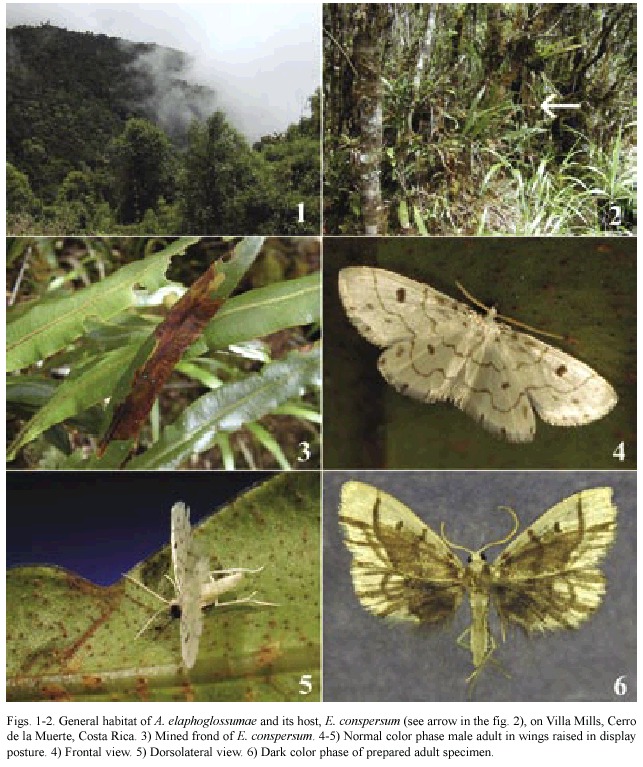
<body><![CDATA[<p><font face="Arial" size="2">Recent collecting in the Cordillera de Talamanca of Costa Rica resulted in the discovery of a new genus and species of a musotimine crambid mining fronds of the fern,<i>Elaphoglossum conspersum </i>H.Christ (Pteridophyta: Lomariopsidaceae) (<a  href="#f1-6">Figs.1-3</a>). The mining habit in the Pyraloidea is not common.Other New World musotimines have been reared feeding on ferns.These are <i>Undulambia polystichalis </i>(Capps),reared from leather leaf fern,<i>Rumohra adiantiformis </i>[=<i>Polystichum adiantiforme </i>(G.Forst)Small] Ching (Dryopteridaceae)(<a  href="#ku62">Kuitert and Dekle 1962</a>).In 2002,<i>Neurophyseta camptogram- malis </i>(Hampson)was reared from <i>Alsophila firma </i>(Baker)D.S.Conant (Cyatheaceae) (Janzen and Hallwachs database homepage). Musotiminae is comprised of 18 genera and about 200 species worldwide;50 or more species and five to seven genera from Asia and the South Pacific are still undescribed (S.H.Yen,pers.comm.).There are nine genera and 82 species of Musotiminae in the Western Hemisphere,including <i>Albusambia</i>. Musotimines are defined by their laterally compressed antennae with flattened segments, R<sub>2</sub> stalked with R<sub>3</sub> +R<sub>4</sub> (but not in <i>Albusambia </i>), a reduced coecum in the aedeagus of the male genitalia,and enlarged tympanal cases (<a href="#mi85">Minet 1985</a>,<a href="#yo85">Yoshiyasu 1985</a>,<a href="#ye96">Yen 1996</a>).The relationship of <i>Albusambia </i>to other genera is unknown, although it is externally most similar to <i>Neurophyseta </i>Hampson.The genus <i>Undulambia </i>Lange contains three species from Florida and is the only genus of Musotiminae found in the U.S.<a href="#la56">Lange (1956)</a>placed it in Nymphulinae,a subfamily known for its true aquatic caterpillars.<a href="#mu72">Munroe (1972)</a>later placed <i>Undulambia </i>in a new,separate tribe,Ambiini, within Nymphulinae,because <i>U.polystichalis </i>was terrestrial and fed on ferns.<a href="#mu72">Munroe (1972)</a>also noted that <i>Musotima </i>Meyrick (in Musotimini)larvae were terrestrial and fed on ferns.<a href="#sp84">Speidel (1984)</a>separated and raised to subfamily rank the Musotiminae, including Ambiini from Nymphulinae,based on characters of the genitalia and immatures.    <br> </font></p>     <p style="text-align: center;"><font face="Arial" size="2"><a  name="f1-6"></a><img src="/img/fbpe/rbt/v53n3-4/3248i2.JPG"  title="" alt="" style="width: 643px; height: 767px;">    
<br> </font></p>     <p><font face="Arial" size="2">In this paper,we describe the life history of <i>Albusambia elaphoglossumae </i>as well as all life-stages in detail.The species is compared to <i>U.polystichalis </i>and species of <i>Neurophyseta </i>. </font></p> <font face="Arial" size="2"><b>     <p>Materials and methods </p> </b></font>     <p><font face="Arial" size="2">The eggs,larvae,and pupae were collected in Costa Rica in an oak forest near the Pan American Highway at Villa Mills,Cerro de la Muerte (San José province)(<a href="#f1-6">Fig.1</a>),and CATIE (Centro Agronómico Tropical de Investigación y Enseñanza)Biological Station in Cuericí (Cartago province),at elevations between 2800 and 3100 m.Larvae from <i>E.conspersum </i>were first collected in January 1998 at the end of the wet season and reared by Donald R.Davis (DRD).The wet season in this area extends from April through December or January. Heavy rains are common during these months, with a yearly annual rainfall of 2 812 mm (<a href="#ka96">Kappelle 1996</a>).During the dry season in the year 2000,Kenji Nishida (KN)visited the same area and began collecting additional material, by inspecting fronds and conducting extensive observations in the field.In this region,the dry season starts in December or January and ends in mid-to late April.Although the rain is infrequent,the humidity remains high and dense fog is common in the afternoons.The annual aver- age temperature is 10.9 °C,and the temperature sometimes decreases to -3 °C during the dry season (<a href="#ka96">Kappelle 1996</a>).</font></p> <font face="Arial" size="2">Immature stages with the fronds collected by KN were placed in transparent plas- tic bags and taken into an air-conditioned room (16-18 °C)in the Museo de Insectos, Universidad de Costa Rica,UCR (San Pedro de Montes de Oca,1150 m),or were placed in a refrigerator (7.0-8.0 °C)for approximately 16 hours and then at room temperature (20 °C) for eight hours daily.A subset of specimens of immature stages were preserved in alcohol and deposited in the USNM.</font>     <p><font face="Arial" size="2">The host plant,<i>E.conspersum </i>,is common in dense understory growth at several moist, well-shaded sites along roads (<a href="#f1-6">Fig.2</a>).Vegetation associated with <i>E.conspersum </i>consists of a tropical montane rain forest densely populated by temperate elements such as black oaks (<i>Quercus costaricensis </i>Liebm.)(Fagaceae),with more scattered white oak (<i>Q.copeyensis </i>C. H.Muller)(<a  href="#ha83">Hartshorn 1983</a>).Other abundant, principally understory species in this association include <i>Schefflera rodriguesiana </i>Frodin ex M. Cannon and Cannon (Araliaceae),<i>Weinmannia pinnata </i>L.(Cunoniaceae),<i>Cavendishia bracteata </i>(Ruiz and Pav.ex J.St.-Hil.)Hoerold, <i>Vaccinium consanguineum </i>Klotzsch (Ericaceae); <i>Miconia biperulifera </i>Cogn.,<i>M.schnellii </i>Wurdack (Melastomataceae);and several species of <i>Chusquea </i>(Poaceae)(KN,pers.observ.). </font></p> <font face="Arial" size="2"><b>     <p>Results </p> </b><i>     <p>Albusambia</p> </i></font>     ]]></body>
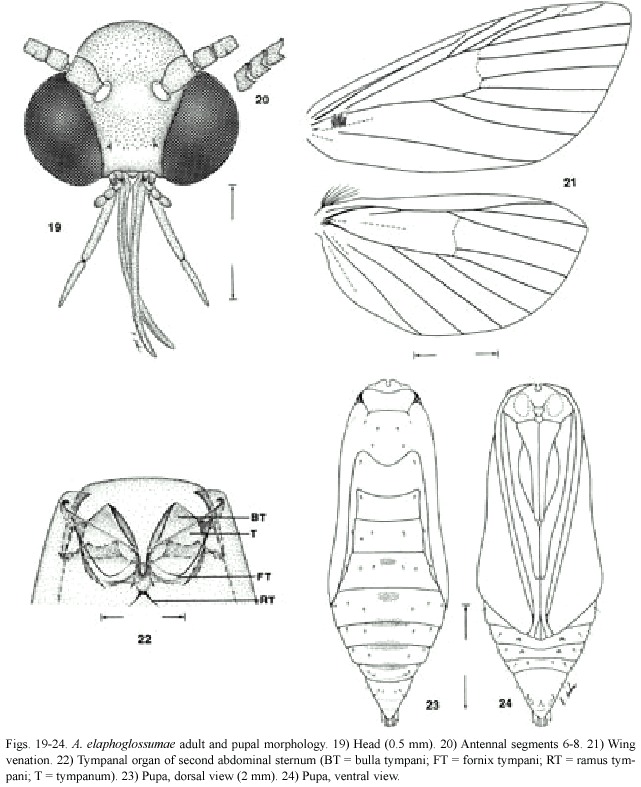
<body><![CDATA[<p><font face="Arial" size="2">Solis and Davis <b>,</b>n.gen.</font></p> <font face="Arial" size="2"><b></b></font>     <p><font face="Arial" size="2"><b>Diagnosis:</b>Base color of body shiny white;wing margins not incised;forewing costal swelling absent;male genitalia with valva curved in above junction of tegumen and vinculum and continuing less broadly to anterior end.Larva dorsoventrally flattened; head prognathous,mandibles with two rows of serrations.Pupa with vertex of head round and with prominent medial dorsoventral depression;prothorax smooth dorsally,not square, with two anterolateral horn-like structures that protrude only slightly;anus posteriorly with lateral conical depressions.</font></p> <font face="Arial" size="2"><b></b></font>     <p><font face="Arial" size="2"><b>Comparison to other taxa:</b><i>Albusambia </i>is compared to <i>Undulambia </i>in <a href="#ca65">Capps (1965)</a> and <i>Neurophyseta </i>in <a href="#ph96">Phillips and Solis (1996)</a>. The basal color of <i>Undulambia </i>adults is brown, not white,as in <i>Albusambia </i>and <i>Neurophyseta. </i>Wings of <i>Undulambia </i>are incised,and those of <i>Albusambia </i>and <i>Neurophyseta </i>are entire.Forewing costal swelling is absent in <i>Albusambia </i>and <i>Neurophyseta </i>,but present in <i>Undulambia.</i>In the male genitalia of <i>Undulambia </i>the valva is long and equal in width throughout,not widened posteriorly as in <i>Albusambia </i>and some <i>Neurophyseta </i>species <i>.</i>The body of <i>Undulambia </i>larva is round, not dorsoventrally flattened,and not intersegmentally constricted as in <i>Albusambia </i>.In <i>Undulambia </i>the mandible consists of one line of teeth,not two as in that of <i>Albusambia. </i>Other than the host plant record,the biological and morphological data of the larvae of <i>Neurophyseta </i>are not available.Unlike the vertex of the pupal head of <i>Albusambia</i>, <i>Undulambia </i>does not have a prominent medial dorsoventral depression.<i>Undulambia </i>has a somewhat rugose,broadly flattened prothorax with two anterolateral horn-like structures that protrude twice as much as in the smooth prothorax of <i>Albusambia </i>.<i>Albusambia </i>has lateral conical depressions posterior to the anus,but <i>Undulambia </i>lacks these depressions.Pupal data on <i>Neurophyseta </i>is incomplete.</font></p> <font face="Arial" size="2"><b></b></font>     <p><font face="Arial" size="2"><b>Etymology:</b>The prefix of the generic epithet is derived from the Latin "<i>albus </i>" referring to the white base color of the adult moths,and "<i>ambia </i>" meaning "around " in Latin and referring to its relatedness to other genera in the subfamily.The gender of the genus is feminine.</font></p> <font face="Arial" size="2"><b></b></font>     <p><font face="Arial" size="2"><b>Type species </b>:<i>Albusambia elaphoglossumae </i>Solis and Davis.</font></p> <font face="Arial" size="2"><i>     <p>Albusambia elaphoglossumae</p> </i></font>     <p><font face="Arial" size="2">Solis and Davis,n.sp.</font></p> <font face="Arial" size="2"><b></b></font>     <p><font face="Arial" size="2"><b>Adult </b>(<a href="#f1-6">Figs.4-6</a>):Head (<a href="#f19-24">Figs.19-20</a>): </font><font face="Arial" size="2">Frons and vertex white,vertex protruding from head higher than eye;labial and maxillary palpi three-segmented,white,black laterally; third labial palpus acute,third maxillary palpus round.Proboscis short,only slightly longer than labial palpi.Antennae prismatic,laterally compressed.Chaetosemata and ocelli absent.</font></p>     <p style="text-align: center;"><font face="Arial" size="2">&nbsp;<a  name="f19-24"></a><img src="/img/fbpe/rbt/v53n3-4/3248i3.JPG"  title="" alt="" style="width: 641px; height: 787px;"></font></p> <font face="Arial" size="2"></font>     
<p><font face="Arial" size="2"><i>Thorax:</i>Dorsally white;patagium and tegula white,a few specimens with tegula grey and metathorax dorsally grey.Forelegs white,mediolaterally black;midleg and hindleg white,midleg with one pair of tibial spurs, hindleg with two pairs of tibial spurs.</font></p> <font face="Arial" size="2"><i></i></font>     ]]></body>
<body><![CDATA[<p><font face="Arial" size="2"><i>Forewing </i>(<a href="#f19-24">Fig.21</a>)[Refer to Phillips and Solis,1996,<a href="#f7-12">Fig.7</a> for venation terminology]: length =6.91 mm (range:6.0-8.1 mm)(n=36); margins not incised.Costal swelling absent.R<sub>1</sub> and R<sub>2</sub> from discal cell;R<sub>5</sub> short stalked with R<sub>3</sub> <sub>+ 4</sub> ,stalked about two-thirds its length.Basal band black,basal area white with scattered black scale,antemedial band black,antemedial area white,reniform spot black,postmedial line black,black spots between R<sub>4</sub> and R<sub>5</sub> and on M<sub>3</sub> ,fringe white with black patches on M<sub>3</sub> and CuA<sub>2</sub>; a few specimens mostly black posterior to and slightly above M-CuA line to posterior margin, antemedial and postmedial lines broader, black lines to outer margin from postmedial line on M<sub>3</sub> and CuA<sub>2</sub>,a black line parallel to postmedial line from M<sub>3</sub> to posterior margin.Underside white with postmedial line slightly visible with black scales,some black at basal area near costa; slightly darker specimens with similar color and pattern on underside as on upperside.    <br> </font></p>     <p style="text-align: center;"><font face="Arial" size="2"><a  name="f7-12"></a><img src="/img/fbpe/rbt/v53n3-4/3248i4.JPG"  title="" alt="" style="width: 643px; height: 793px;">    
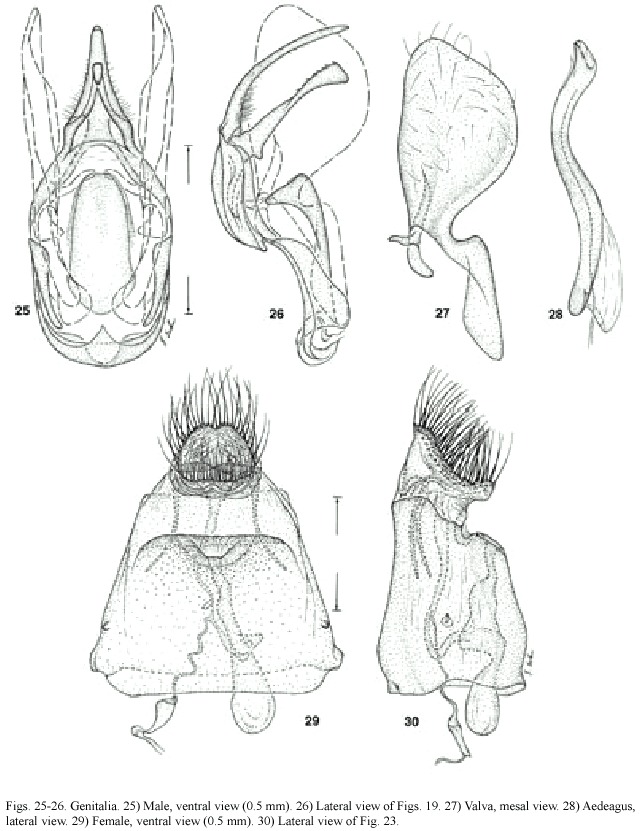
<br> </font></p> <font face="Arial" size="2"><i></i></font>     <p><font face="Arial" size="2"><i>Hindwing </i>(<a href="#f19-24">Fig.21</a>):Antemedial and post- medial line black,black discal spot,c-shaped mark from Rs to costal margin at intersection of Sc+R<sub>1</sub> and Rs,fringe white with black patches on R<sub>5</sub> ,M<sub>3</sub>,and CuA<sub>2</sub>; a few specimens black basally to postmedial line,with broad black lines to outer margin including fringe at Rs, M<sub>3</sub> ,and CuA<sub>2</sub>, less broad black lines at M<sub>1</sub> and CuA<sub>1</sub>, and fringe from base to postmedial line.</font></p>     <p><font face="Arial" size="2">Underside white with antemedial and postmedial line slightly visible with black scales;slightly darker specimens with similar color and pattern on underside as on upperside.Female frenulum with three setae,male with one seta.</font></p> <font face="Arial" size="2"><i></i></font>     <p><font face="Arial" size="2"><i>Abdomen:</i>White.Tympanal organs (<a  href="#f19-24">Fig. 22</a>):Tympanal cases (=bulla tympani,caisses tympaniques) enlarged,processes tympani (=sailles tympaniques)absent,ramus tympani short,highly sclerotized.</font></p> <font face="Arial" size="2"><i></i></font>     <p><font face="Arial" size="2"><i>Male genitalia </i>(<a href="#f25-30">Figs.25-28</a>):Uncus long and finger-like;gnathos broadened posteriorly with sclerotized teeth dorsally;juxta simple, oblong;transtilla membranous medially;valva simple,broad posteriorly,curved in above junction of tegumen and vinculum and continuing less broadly to anterior end.Aedeagus simple without cornuti,almost as long as genital capsule;coecum extremely short,almost absent.    <br> </font></p>     <p style="text-align: center;"><font face="Arial" size="2"><a  name="f25-30"></a><img src="/img/fbpe/rbt/v53n3-4/3248i5.JPG"  title="" alt="" style="width: 641px; height: 831px;">    
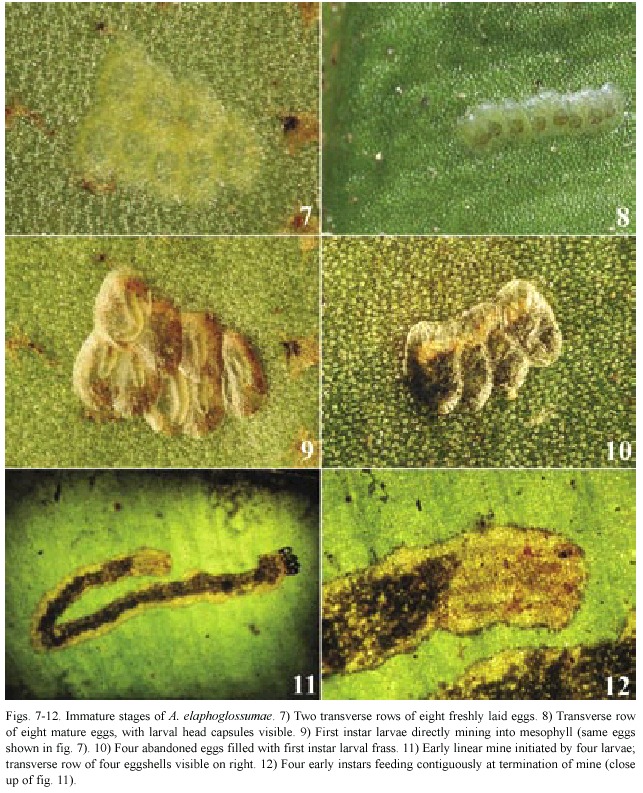
]]></body>
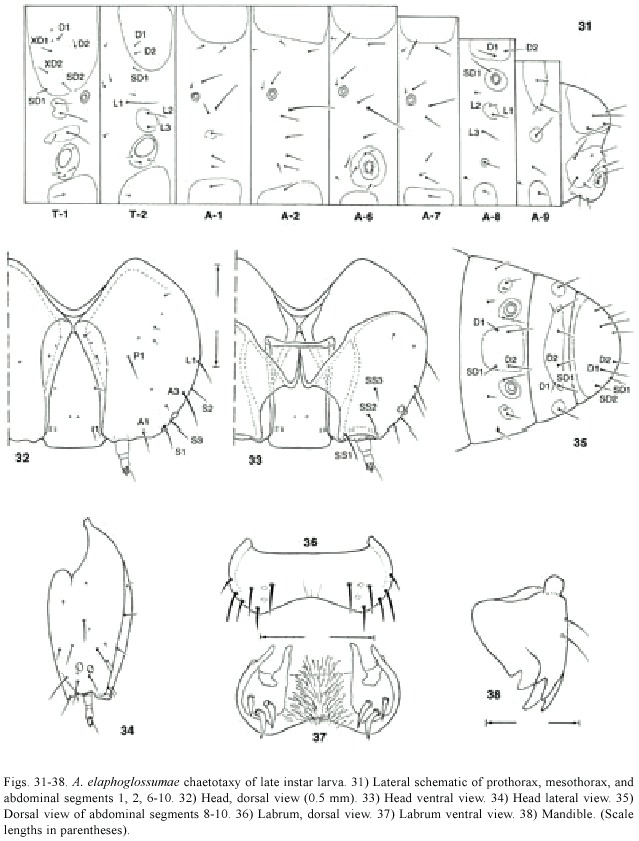
<body><![CDATA[<br> </font></p> <font face="Arial" size="2"><i></i></font>     <p><font face="Arial" size="2"><i>Female genitalia </i>(<a  href="#f25-30">Figs.29-30</a>):Corpus bursae only slightly longer than seventh segment,without signum,no clear distinction between ductus bursae and corpus bursae, ductus seminalis at about halfway between ostium bursae and corpus bursae,ostium bursae membranous,anterior apophyses four times as long as posterior apophyses,papillae analis dorsoventrally flattened.</font></p> <font face="Arial" size="2"><b></b></font>     <p><font face="Arial" size="2"><b>Egg </b>(<a href="#f7-12">Figs.7-10</a>):Flat,oval shape,size ca. 1.0 mm x 0.5 mm,pale creamy-yellow in clusters;empty egg shells grayish-brown.</font></p> <font face="Arial" size="2"><b></b></font>     <p><font face="Arial" size="2"><b>Larva </b>(<a href="#f7-12">Figs.11</a>-<a  href="#f13-18">15</a>,<a href="#f31-38">31-38</a>):Five larval instars present.Last instar length 11.6 mm- 12.0 mm (n=4)(penultimate instar:6.38 mm; range:6.1-6.5 mm;n=5),dorsoventrally flattened.Head prognathous,yellowish with dark brown sutures;epicranial suture not present; frontoclypeus and labrum brown,more than twice as long as wide;two stemmata;C1 and C2 approximate,F1 at middle of frons,AF1 and AF2 located dorsally on adfrontal area;labrum with six setae on each side externally and three setae on each side internally,medially setose; mandible with two rows of serrations.T1-3 and A1-10 integument smooth,all segments with medially located dorsal and ventral sclerotized plates,prothoracic shield twice as wide as other dorsally sclerotized plates,setae with concolorous pinacula,intersegmentally constricted. Prothoracic shield yellow with clear platelets; T1 with two L setae anterior to spiracle.A1 and A7 with D1 on membrane or on margin of pinaculum,L1 and L2 on same pinaculum,L1 more than seven times as long as L2 on all segments. A8 D1 and D2 approximate on pinaculum, SD1 approximate to spiracle,spiracle six times larger than other abdominal spiracles,dorsally located,two L setae on same pinaculum.A9 with D1 just anterior to SD1 sometimes located on membrane and not on pinaculum,1 L setae. A10 with D2,SD1,and SD2 at outer margin of anal shield.Prolegs with crochets uniordinal in an incomplete circle (in a few specimens circle appears complete or in transverse bands);A1, A2,and A7 segments with ventral proleg-like protuberances without crochets.    <br> </font></p>     <p style="text-align: center;"><font face="Arial" size="2"><a  name="f13-18"></a><img src="/img/fbpe/rbt/v53n3-4/3248i6.JPG"  title="" alt="" style="width: 647px; height: 779px;">    
<br> </font></p>     <p style="text-align: center;"><font face="Arial" size="2"><a  name="f31-38"></a><img src="/img/fbpe/rbt/v53n3-4/3248i7.JPG"  title="" alt="" style="width: 639px; height: 841px;"></font></p>     
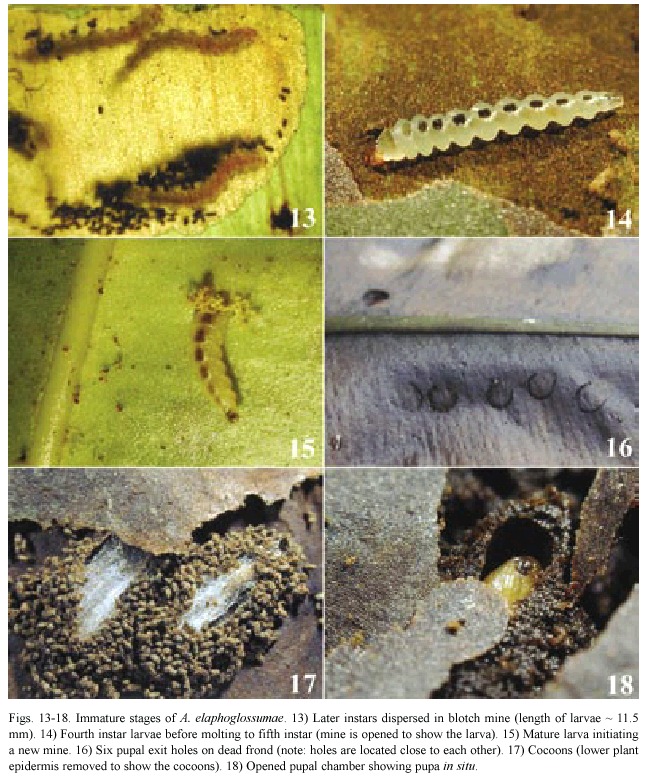
<p><font face="Arial" size="2"><b>Pupa </b>(Figs.<a href="#f13-18">17-18</a>,<a  href="#f19-24">23-24</a>):Length:6.83 mm (range:6.0-7.7 mm;n=10).Ventral view: Round top of head with a prominent medial dorsoventral depression;labial palpus a small triangle posterior to labrum;labrum bilobed; pilifers not prominent;maxillary palpus absent; forefemur visible,prothoracic legs (foreleg) three-quarters length of forewing,mesothoracic leg (midleg)extends entire length of forewing and antenna extending about seven-eighths length of forewing;hind tarsus extends just beyond length of forewing;abdominal segments 5 and 6 with vestigial prolegs;abdominal segment 8-10 with genital orifice anteriorly, anus posteriorly with lateral conical depressions.Dorsal view:prothorax smooth,not square-shaped with two dorsolateral horn-like structures that protrude only slightly;mesothorax with four and metathorax with two tiny setae;abdominal segments with spiracles extruded slightly,abdominal segments three to seven dorsally with short medially located setae;cremaster round with four pairs of curved setae.    <br> </font></p> <font face="Arial" size="2"><b>Life history:</b>The host is <i>E.conspersum </i>(<a href="#f1-6">Figs.2-3</a>).Eggs were adhered to the lower epidermis (abaxial)of the fronds,usually laid in a row or cluster of three to nine,slightly overlapping each other (<a href="#f7-12">Figs.7-10</a>),rarely in two rows.The mean number of eggs in each cluster was 4.5 (S.D.=1.15;n=42).Usually one or two clusters of eggs were found per frond.However,in several cases up to four clusters were found in approximately 150 collected samples.The egg masses were observed between margin and midrib and in the mid-to upper portion of a frond.The pale,creamy-yellow egg color became translucent as the eggs aged.When larvae hatched,they directly started mining by breaking through the chorion, then the plant epidermis and mesophyll.At this stage, frass was deposited in eggshells (<a href="#f7-12">Figs. 9-10</a>)as larvae commenced mining.Time of larval hatching,starting point,and direction of mine were usually synchronized.Thus,larvae gregariously started mining in the same direction,in a line "shoulder to shoulder" (<a  href="#f7-12">Figs. 11-12</a>).Late instars were scattered throughout the mine (<a href="#f13-18">Figs.13-14</a>)and their frass pellets were clustered loosely,more along the midrib portion than the margin of the frond.</font>     ]]></body>
<body><![CDATA[<p><font face="Arial" size="2">The leaf mine was formed initially as a broad linear-serpentine which eventually broadened more to a linear blotch,and finally a full blotch.In rare instances,early stage linear miners separated to form two linear mines.The mines fused when several batches of eggs were laid on the same frond.In a single case a new mine was formed in the remaining fresh part of an old mine. Additionally, under rearing conditions,from a batch of eight eggs laid in two rows,the larvae formed three linear-serpentine mines. As larvae continued mining,the final blotch mine obliterated the earlier linear-serpentine mine.</font></p>     <p><font face="Arial" size="2">The mines were easily recognized by the brown-colored upper epidermis of the fronds. Recently mined portions were yellowish. Mature mines covered the width of midrib to the margin or the entire frond passing through the midrib.Occasionally,fronds were bent down from the base of the mature mine or the entire frond was dried and hanging down. Fronds with the eggs or leaf mines were seen more often in shady areas of the forest and were positioned at lower parts of a mass of ferns where mature and old fronds occur.</font></p>     <p><font face="Arial" size="2">More than 30 specimens of an undescribed gregarious <i>Proacrias </i>sp.wasp (Eulophidae: Entedoninae), and a few specimens of an ich-neumonid,<i>Scambus emeritae </i>Gauld (Pimplinae), were reared from the <i>A </i>.<i>elaphoglossumae </i>larvae.</font></p>     <p><font face="Arial" size="2">Several leaf mines collected at early stages contained dead and desiccated early instar larvae.Under rearing and natural conditions, mid-to late instars were observed switching to different fronds by perforating the lower epidermis (<a href="#f13-18">Fig.15</a>).The larvae in mid-to late instars regurgitated a clear brown liquid when they were poked with an insect pin on their abdominal or thoracic segments.Five instars are believed to exist,based upon examination of larval head capsules and collections of preserved larvae.</font></p>     <p><font face="Arial" size="2">The last instar mature larva made an elliptical to penelliptical exit hole or operculum (diameter:ca.2 mm)on the upper epidermis of fronds prior to pupation (<a href="#f13-18">Fig.16</a>).The larva spun a cocoon and pupated,position- ing their head close to the operculum;when an operculum was opened manually,the pupa was observed easily through the hole (<a href="#f13-18">Figs. 17-18</a>).The cremaster was attached with silk at the base of the cocoon.The pupal stage took about one month in the laboratory.The pupa protruded slightly,about 1 mm or less,from the operculum at the adult emergence.The major- ity of the cocoons were found in close proximity;each cocoon was about 13 mm long and 6 mm wide,constructed with silk,and laterally intermixed with frass pellet fragments which were accumulated at the midrib area.</font></p>     <p><font face="Arial" size="2">Evidence suggests three generations per year:October-January,February-May,and June-September.Late instars collected in July, 2000,pupated in August,and adults emerged in September.Middle to late instars collected between January and early March,2001 pupat- ed from March to April and adults emerged from April to May.A few early stage live larvae were collected in late October,2001.In early March,2002,several mines with empty pupal shells (from which adults had emerged)and approximately 50 middle to late stage mines were collected with live third,fourth,and fifth instars and pupae.</font></p>     <p><font face="Arial" size="2">In the field,no adults were observed flying or resting on or near host plants during the day- time.Adults of <i>A.elaphoglossumae </i>have not been collected at light —all the adult specimens have been reared.</font></p>     <p><font face="Arial" size="2">Another host plant for <i>A.elaphoglossumae </i>is <i>E.biolleyi </i>H.Christ.Two mature pupae were found in a blotch mine at the Genesis II Cloud Forest Reserve (2300 m elevation)in Cerro de la Muerte when this paper was in press.</font></p> <font face="Arial" size="2"><b></b></font>     <p><font face="Arial" size="2"><b>Holotype: </b>Male;COSTA RICA:San José Province:Cordillera de Talamanca,Cerro de la Muerte:Villa Mills,Georgina,3000 m:larva coll. 9 Feb 2000,em.28 Mar 2000,ex <i>Elaphoglossum conspersum </i>,K.Nishida (USNM).</font></p> <font face="Arial" size="2"><b></b></font>     <p><font face="Arial" size="2"><b>Paratypes: </b>COSTA RICA:Cartago Province,Turrialba:near CATIE Biological Station,3000 m:1 male,larva 31 Jan 1998, em.30 Mar 1998;1 male,em.31 Mar 1998, D.R.Davis,slide USNM 32006.Same data as holotype except:1 male,larva 2 Feb 2000,em. 25 Mar 2000;1 male,em.26 Mar 2000,slide USNM 110178;2 males,1 female,em.28 Mar 2000,slide USNM 110167;1 male,1 female, em.31 Mar 2000;2 females,em.3 Apr 2000; 2 males,5 females,em.5 Apr 2000;3 males, em.11 Apr 2000;2 males ,1 female,em.13 Apr 2000,slide USNM 32274;2 females,em. 19 Apr 2000;1 male,1 female,em.21 Apr 2000;1 male,em.26 Apr 2000;3 males,em. 2 May 2000;2 males,2 females,em.4 May 2000;1 male,em.6 May 2000.Paratypes deposited in The Natural History Museum, London, England;Universidad de Costa Rica, San Jose;Instituto Nacional de Biodiversidad (INBio),Santo Domingo de Heredia,Costa Rica;and the National Museum of Natural History,Smithsonian Institution,Washington, D.C.,U.S.A..</font></p> <font face="Arial" size="2"><b></b></font>     ]]></body>
<body><![CDATA[<p><font face="Arial" size="2"><b>Distribution:</b>Cerro de la Muerte in Cordillera de Talamanca,Costa Rica,at high elevations between 2300 and 3100 m.</font></p> <font face="Arial" size="2"><b></b></font>     <p><font face="Arial" size="2"><b>Etymology:</b>The specific name is derived from the generic name of the host, <i>Elaphoglossum </i>and is feminine.</font></p> <font face="Arial" size="2"><b></b></font>     <p><font face="Arial" size="2"><b>Comparison to other taxa:</b><i>A.elaphoglossumae </i>is compared to <i>U.polystichalis </i>and species of <i>Neurophyseta</i>. Adults of <i>U.polystichalis </i>are much larger,12-15 mm in wing length.The postmedial line of <i>Neurophyseta </i>curves basally,joining the medial line at M<sub>2</sub>. In <i>U.polystichalis </i>and <i>A.elaphoglossumae </i>the postmedial line continues to the posterior margin of the forewing.In the male genitalia of <i>A.elaphoglossumae </i>the sacculus is not prominent,but it is prominent in <i>Neurophyseta</i>; the gnathos is weakly dentate in <i>U.polystichalis </i>, and either dentate or entire in <i>Neurophyseta</i>. In the female genitalia of <i>U.polystichalis </i>the posterior apophyses are almost as long as the anterior apophyses,and in <i>A.elaphoglossumae </i>and <i>Neurophyseta </i>the anterior apophyses are four times as long as posterior apophyses.In <i>A.elaphoglossumae </i>the corpus bursae is membranous without a signum,in <i>U.polystichalis </i>it is densely and finely spinulate,without a signum;and in <i>Neurophyseta </i>it is membranous or not,with or without a signum.In <i>A.elaphoglossumae </i>and <i>Neurophyseta </i>both sexes have bullae tympani that are the same size,but in <i>U.polystichalis </i>they are more enlarged in the female than the male.Processus tympani are present and prominent in <i>U.polystichalis </i>and <i>Neurophyseta </i>,but absent in A.<i>elaphoglossumae.</i>Ramus tympani are present,and highly sclerotized in <i>A. elaphoglossumae </i>,but absent in <i>U.polystichalis </i>and <i>Neurophyseta </i>.The larval segments of <i>U. polystichalis </i>do not have medially located dorsal and ventral sclerotized plates as in <i>A. elaphoglossumae </i>.The head of <i>U.polystichalis </i>is semiprognathous;in <i>A. elaphoglossumae </i>it is prognathous.The pupa of <i>U.polystichalis </i>has a round cremaster with two dorsal,mediolateral conical protuberances with straight setae.</font></p>     <p><font face="Arial" size="2">The biology of <i>U.polystichalis </i>on the leather-leaf fern was described by <a href="#ku62">Kuitert and Dekle (1962)</a>.They did not observe the egg so it is not known whether <i>U.polystichalis </i>lays eggs singly or in clusters.The larvae of <i>U.polystichalis </i>bore the midvein of tender fronds,and the larvae of <i>A.elaphoglossumae </i>mine mid-to upper portion of mature old frond entirely.The larval behavior of <i>A.elaphoglossumae </i>and <i>U.polystichalis </i>are somewhat similar,being endophagous,and the larva cuts an operculum for eclosion of the adult.However, <i>A.elaphoglossumae </i>pupates right at the exit hole in the frond and <i>U.polystichalis </i>pupates approximately one to two inches below the exit hole in the petiole.</font></p>     <p><font face="Arial" size="2">The gregarious mining behavior of <i>A.elaphoglossumae </i>is remarkably similar to that of an undescribed species of <i>Chrysaster </i>Kumata (Gracillaridae),discovered by D.Wagner and D.Davis in Florida,USA,and by D.Davis in Cuba (unpublished).Larvae of this <i>Chrysaster </i>species also emerge synchronously from a single row of eggs to mine initially in a contiguous group and later disperse to form a large blotch mine. </font></p> <font face="Arial" size="2"><b>     <p>Discussion </p> </b></font>     <p><font face="Arial" size="2">Although pteridophagy,or fern-feeding, is considered uncommon among Lepidoptera, there are examples of fern-feeders throughout the most diverse superfamilies of Ditrysia,the Noctuoidea, Geometroidea,and Pyraloidea, and also in primitive moth groups such as Tineoidea and Gelechioidea (e.g.<a href="#ba78">Balick <i>et al.</i>1978</a>,<a href="#ki82">Kirk 1982</a>,<a href="#we95">Weintraub <i>et al.</i>1995</a>). In the Western Hemisphere there are very few well-documented studies of pyraloid fern-feeders,but well-known examples in the U.S.of <i>Herpetogramma </i>Lederer (Crambidae: Spilomelinae)include <i>H.aeglealis </i>(Walker) (<a href="#fo23">Forbes 1923</a>,<a href="#ru88">Ruehlmann 1988</a>)and <i>H.the- seusalis </i>(Walker)(<a  href="#fo23">Forbes 1923</a>).There are records of pyraloids feeding on aquatic ferns of the family Salvinaceae,i.e.<i>Samea multi- plicalis </i>(Guenée) (Crambidae:Spilomelinae) on <i>Salvinia </i>Séguier and <i>Azolla </i>Lam.(<a href="#kn76">Knopf and Habeck 1976</a>)and <i>Parapoynx allionealis </i>Walker (Crambidae:Nymphulinae)on <i>Salvinia rotundifolia </i>Willd.(<a href="#ha74">Habeck 1974</a>).The latter were discovered during exploration for biological control agents of invasive aquatic weeds.</font></p>     <p><font face="Arial" size="2">Other published feeding records for the Musotiminae until the late 1990 ’s include <i>Musotima dryopterisivora </i>Yoshiyasu (orginally identified as M.acclaralis Walker)reared on <i>Dryopteris </i>prob.<i>chinensis </i>(Baker)Koidz. (Dryopteridaceae)in Japan (<a  href="#na77">Nakamura 1977</a>), <i>Musotima nitidalis </i>Walker on <i>Adiantum </i>L. (Pteridaceae),<i>Histiopteris incisa </i>(Thunb.) J.Sm.(Dennstaedtiaceae)(<a href="#me85">Meyrick 1885</a>, <a  href="#ph17">Philpott 1917</a>),and <i>Musotima aduncalis </i>Felder and Rogenhofer on <i>Adiantum </i>sp.from New Zealand (<a href="#hu28">Hudson 1928</a>).A species of <i>Panotima Meyrick </i>from South Africa was reared on <i>Pteridium aquilinum </i>(L.)(Kuhn) (Dennstaedtiaceae),known as bracken fern, during exploration for biological control agents (<a href="#la88">Lawton <i>et al </i>.1988</a>).</font></p>     <p><font face="Arial" size="2">Recent research indicates that Musotiminae may harbor more undiscovered fern-feeders.In Costa Rica extensive UV light collecting by INBio parataxonomists did not produce large numbers of specimens of Musotiminae,with the exception perhaps of <i>Neurophyseta </i>.M. Alma Solis (MAS)and Eugenie Phillips (INBio) discovered during fieldwork in Costa Rica that musotimine species,particularly of <i>Undulambia,</i> attracted by ultraviolet light did not rest on the collecting sheet,but on surrounding vegetation, which may explain the low numbers collected by UV light.The current success in discovery of new species in this subfamily has been through visual inspection of host plants for larval damage.In 2002,a <i>N.camptogrammalis </i>(determined by MAS)was reared from <i>Alsophila firma </i>fern (voucher no.02-SNRP-602 in Janzen and Hallwachs database homepage).In south- east Asia and Australia recent exploration by visual inspection for biological control agents of <i>Lygodium microphyllum </i>(Cav.)R.Br.,the Old World climbing fern,resulted in the discovery of other new fern-feeding genera of Musotiminae by the Agriculture Research Service,Australian Biological Control Laboratory (USDA)in Indooroopilly,Queensland (<a href="#so04">Solis <i>et al.</i>2004</a>, <a href="#ye04">Yen <i>et al.</i>2004</a>).</font></p>     <p><font face="Arial" size="2">Further exploration by visual inspection of <i>Elaphoglossum </i>species worldwide may uncover more new species of <i>Albusambia </i>and other Pyraloidea species.KN recently discovered mines on several species of <i>Elaphoglossum </i>and reared some other Pyraloidea species. <i>Elaphoglossum </i>,host of <i>A.elaphoglossumae </i>in Costa Rica,contains over 600 species,with approximately 90%occurring in the Neotropics and the remainder in tropical Africa,Asia, Australia,and certain Pacific islands (<a href="#mi80">Mickel and Atehortua 1980</a>).Herbarium specimens of <i>E.conspersum </i>at the INBio indicate a broad distribution in Costa Rica,and with further exploration,perhaps for <i>A.elaphoglossumae </i>.</font></p>     ]]></body>
<body><![CDATA[<p><font face="Arial" size="2">Finally,it is noteworthy to report the discovery of one or two species of <i>Bradysia </i>(Diptera: Sciaridae),a gregarious frond-miner on <i>E. biolleyi </i>and other species of <i>Elaphoglossum </i>in mid-elevation cloud forests between 2000 and 2300 m,in Volcán Barva and Cordillera de Talamanca.The leaf-mining biology of these sciarids is similar to that of the <i>Albusambia </i>(W. Mohrig and K.Nishida,in preparation). </font></p> <font face="Arial" size="2"><b>     <p>Acknowledgments </p> </b></font>     <p><font face="Arial" size="2">Research on Costa Rican Pyraloidea by MAS is supported by the Systematic Entomology Laboratory, PSI, ARS, USDA, and INBio. The fieldwork of DRD in Costa Rica was supported by a Research Opportunity Fund award from the Smithsonian Institution and the ALAS III project (supported by National Science Foundation grant DEB-9706976). David Wagner (University of Connecticut, Storrs,U.S.A.)accompanied DRD in the initial discovery of this species. David B.Lellinger,Department of Systematic Biology,Smithsonian Institution, identified the host fern and provided related information.Christer Hansson, Department of Zoology,Lund University,and Paul Hanson, Escuela de Biología, UCR, identified the parasitoid wasps. </font></p> <font face="Arial" size="2"><b>     <p>Resumen </p> </b></font>     <p><font face="Arial" size="2">Se describen un género y especie nuevos de Musotiminae,<i>Albusambia elaphoglossumae </i>Solis and Davis,de Costa Rica.Esta especie mina las frondas del helecho <i>Elaphoglossum conspersum </i>.La serie tipo se obtuvo mediante la recolección de las minas y mediante crianza en laboratorio.El adulto se define por caracteres específicos en el aparato genital;la pupa se caracteriza por una depresión media en el vértex y por dos estructuras anterolaterales en forma de cuernos en el protórax.La larva es un minador gregario de la fronda,con su cuerpo aplanado dorsoventralmente y su cabeza prognata;ambas adaptaciones morfológicas para minar frondas (vistas por primera vez en Musotiminae). Actualmente,Musotiminae es de alta prioridad en la búsqueda de nuevos agentes para el control biológico de helechos invasores.</font></p> <font face="Arial" size="2"><b></b></font>     <p><font face="Arial" size="2"><b>Palabras claves:</b><i>Elaphoglossum conspersum </i>,larvas grega- rias,helecho,minador de hojas, neotropical, <i>Neurophyseta</i>, <i>Proacrias </i>,<i>Undulambia. </i></font></p> <font face="Arial" size="2"><b>     <p>References </p> </b></font>     <!-- ref --><p><font face="Arial" size="2"><a name="ba78"></a>Balick, M.J.,D.G.Furth &amp;G.Cooper-Driver.1978. Biochemical and evolutionary aspects of arthropod predation on ferns.Oecol.35:55-89.</font>&nbsp;&nbsp;&nbsp;&nbsp;&nbsp;&nbsp;&nbsp;&nbsp;[&#160;<a href="javascript:void(0);" onclick="javascript: window.open('/scielo.php?script=sci_nlinks&ref=1230296&pid=S0034-7744200500020001700001&lng=','','width=640,height=500,resizable=yes,scrollbars=1,menubar=yes,');">Links</a>&#160;]<!-- end-ref --><!-- ref --><p><font face="Arial" size="2"><a name="ca65"></a>Capps,H.W.1965.A new <i>Undulambia </i>species on leather-leaf fern in Florida,and note on a closely related Central American species (Lepidoptera:Pyraustidae, Nymphulinae).Fl.Ent.48:155-157.</font>&nbsp;&nbsp;&nbsp;&nbsp;&nbsp;&nbsp;&nbsp;&nbsp;[&#160;<a href="javascript:void(0);" onclick="javascript: window.open('/scielo.php?script=sci_nlinks&ref=1230297&pid=S0034-7744200500020001700002&lng=','','width=640,height=500,resizable=yes,scrollbars=1,menubar=yes,');">Links</a>&#160;]<!-- end-ref --><!-- ref --><p><font face="Arial" size="2"><a name="fo23"></a>Forbes,W.T.M.1923.The Lepidoptera of New York and neighboring states.Cornell Univ, Agr. Exp. Sta.68: 1-729.</font>&nbsp;&nbsp;&nbsp;&nbsp;&nbsp;&nbsp;&nbsp;&nbsp;[&#160;<a href="javascript:void(0);" onclick="javascript: window.open('/scielo.php?script=sci_nlinks&ref=1230298&pid=S0034-7744200500020001700003&lng=','','width=640,height=500,resizable=yes,scrollbars=1,menubar=yes,');">Links</a>&#160;]<!-- end-ref --><!-- ref --><p><font face="Arial" size="2"><a name="ha74"></a>Habeck,D.H.1974.Caterpillars of <i>Parapoynx </i>in relation to aquatic plants in Florida.Hyacinth Cont.J.12:15-18.</font>&nbsp;&nbsp;&nbsp;&nbsp;&nbsp;&nbsp;&nbsp;&nbsp;[&#160;<a href="javascript:void(0);" onclick="javascript: window.open('/scielo.php?script=sci_nlinks&ref=1230299&pid=S0034-7744200500020001700004&lng=','','width=640,height=500,resizable=yes,scrollbars=1,menubar=yes,');">Links</a>&#160;]<!-- end-ref --><!-- ref --><p><font face="Arial" size="2"><a name="ha83"></a>Hartshorn,G.S.1983.Plants:Introduction,p.118-157. <i>In </i>D.H.Janzen,(ed.)Costa Rican Natural History. Chicago University Press,Chicago.xi +816 p.</font>&nbsp;&nbsp;&nbsp;&nbsp;&nbsp;&nbsp;&nbsp;&nbsp;[&#160;<a href="javascript:void(0);" onclick="javascript: window.open('/scielo.php?script=sci_nlinks&ref=1230300&pid=S0034-7744200500020001700005&lng=','','width=640,height=500,resizable=yes,scrollbars=1,menubar=yes,');">Links</a>&#160;]<!-- end-ref --><!-- ref --><p><font face="Arial" size="2"><a name="hu28"></a>Hudson,G.V.1928.<i>The butterflies and moths of New Zealand.</i>Ferguson and Osborn Ltd.,Wellington. 386 p.</font>&nbsp;&nbsp;&nbsp;&nbsp;&nbsp;&nbsp;&nbsp;&nbsp;[&#160;<a href="javascript:void(0);" onclick="javascript: window.open('/scielo.php?script=sci_nlinks&ref=1230301&pid=S0034-7744200500020001700006&lng=','','width=640,height=500,resizable=yes,scrollbars=1,menubar=yes,');">Links</a>&#160;]<!-- end-ref --><!-- ref --><p><font face="Arial" size="2"><a name="ka96"></a>Kappelle,M.1996.Los bosques de roble (<i>Quercus)</i>de la Cordillera de Talamanca,Costa Rica:Biodiversidad, Ecología, Conservación y Desarollo.Unversidad de Amsterdam/Instituto Nacional de Biodiversidad, Costa Rica.XVI +391 p.</font>&nbsp;&nbsp;&nbsp;&nbsp;&nbsp;&nbsp;&nbsp;&nbsp;[&#160;<a href="javascript:void(0);" onclick="javascript: window.open('/scielo.php?script=sci_nlinks&ref=1230302&pid=S0034-7744200500020001700007&lng=','','width=640,height=500,resizable=yes,scrollbars=1,menubar=yes,');">Links</a>&#160;]<!-- end-ref --><!-- ref --><p><font face="Arial" size="2"><a name="ki82"></a>Kirk,A.A.1982.Insects associated with bracken fern <i>Pteridium aquilinum </i>(Polypodiaceae)in Papua New Guinea and their possible use in biological control. Act.Oecol./Oecol.Appl.3:342-359.</font>&nbsp;&nbsp;&nbsp;&nbsp;&nbsp;&nbsp;&nbsp;&nbsp;[&#160;<a href="javascript:void(0);" onclick="javascript: window.open('/scielo.php?script=sci_nlinks&ref=1230303&pid=S0034-7744200500020001700008&lng=','','width=640,height=500,resizable=yes,scrollbars=1,menubar=yes,');">Links</a>&#160;]<!-- end-ref --><!-- ref --><p><font face="Arial" size="2"><a name="kn76"></a>Knopf,K.W.&amp;D.H.Habeck.1976 <b>.</b>Life history and biology of <i>Samea multiplicalis </i>.Env.Entomol.5: 539-542.</font>&nbsp;&nbsp;&nbsp;&nbsp;&nbsp;&nbsp;&nbsp;&nbsp;[&#160;<a href="javascript:void(0);" onclick="javascript: window.open('/scielo.php?script=sci_nlinks&ref=1230304&pid=S0034-7744200500020001700009&lng=','','width=640,height=500,resizable=yes,scrollbars=1,menubar=yes,');">Links</a>&#160;]<!-- end-ref --><!-- ref --><p><font face="Arial" size="2"><a name="ku62"></a>Kuitert,L.C.&amp;G.W.Dekle.1962.Mysterious invader. Sunshine State Agricultural Report,Agricultural Experiment Station,University of Florida,Gainesville, Florida.7(3):10-12.</font>&nbsp;&nbsp;&nbsp;&nbsp;&nbsp;&nbsp;&nbsp;&nbsp;[&#160;<a href="javascript:void(0);" onclick="javascript: window.open('/scielo.php?script=sci_nlinks&ref=1230305&pid=S0034-7744200500020001700010&lng=','','width=640,height=500,resizable=yes,scrollbars=1,menubar=yes,');">Links</a>&#160;]<!-- end-ref --><!-- ref --><p><font face="Arial" size="2"><a name="la56"></a>Lange,W.Harry,Jr.1956.A generic revision of the aquatic moths of North America (Lepidoptera: Pyralidae: Nymphulinae). Wasmann J.Biol.14(1):59-144.</font>&nbsp;&nbsp;&nbsp;&nbsp;&nbsp;&nbsp;&nbsp;&nbsp;[&#160;<a href="javascript:void(0);" onclick="javascript: window.open('/scielo.php?script=sci_nlinks&ref=1230306&pid=S0034-7744200500020001700011&lng=','','width=640,height=500,resizable=yes,scrollbars=1,menubar=yes,');">Links</a>&#160;]<!-- end-ref --><!-- ref --><p><font face="Arial" size="2"><a name="la88"></a>Lawton,J.H.,V.K.Rashbrook &amp;S.G.Compton.1988. Biocontrol of British bracken:the potential of two moths from Southern Africa.Ann.Appl.Biol.112: 479-490.</font>&nbsp;&nbsp;&nbsp;&nbsp;&nbsp;&nbsp;&nbsp;&nbsp;[&#160;<a href="javascript:void(0);" onclick="javascript: window.open('/scielo.php?script=sci_nlinks&ref=1230307&pid=S0034-7744200500020001700012&lng=','','width=640,height=500,resizable=yes,scrollbars=1,menubar=yes,');">Links</a>&#160;]<!-- end-ref --><!-- ref --><p><font face="Arial" size="2"><a name="me85"></a>Meyrick,E.1885.Descriptions of New Zealand Microlepidoptera.6.Pyralidina.Trans and Proc.New Zealand Inst.17:121-140.</font>&nbsp;&nbsp;&nbsp;&nbsp;&nbsp;&nbsp;&nbsp;&nbsp;[&#160;<a href="javascript:void(0);" onclick="javascript: window.open('/scielo.php?script=sci_nlinks&ref=1230308&pid=S0034-7744200500020001700013&lng=','','width=640,height=500,resizable=yes,scrollbars=1,menubar=yes,');">Links</a>&#160;]<!-- end-ref --><!-- ref --><p><font face="Arial" size="2"><a name="mi80"></a>Mickel,J.T.&amp;L.Atehortua.1980.Subdivision of the genus <i>Elaphoglossum </i>.Am.Fern J.70:47-68.</font>&nbsp;&nbsp;&nbsp;&nbsp;&nbsp;&nbsp;&nbsp;&nbsp;[&#160;<a href="javascript:void(0);" onclick="javascript: window.open('/scielo.php?script=sci_nlinks&ref=1230309&pid=S0034-7744200500020001700014&lng=','','width=640,height=500,resizable=yes,scrollbars=1,menubar=yes,');">Links</a>&#160;]<!-- end-ref --><!-- ref --><p><font face="Arial" size="2"><a name="mi85"></a>Minet,J.1985.Étude morphologique et phylogénétique des organs tympanique des Pyraloidea.2-Pyralidae: Crambinae,première partie.(Lepidoptera:Glossata). Annls.Soc.ent.Fr.21(1):69-86.</font>&nbsp;&nbsp;&nbsp;&nbsp;&nbsp;&nbsp;&nbsp;&nbsp;[&#160;<a href="javascript:void(0);" onclick="javascript: window.open('/scielo.php?script=sci_nlinks&ref=1230310&pid=S0034-7744200500020001700015&lng=','','width=640,height=500,resizable=yes,scrollbars=1,menubar=yes,');">Links</a>&#160;]<!-- end-ref --><!-- ref --><p><font face="Arial" size="2"><a name="mu72"></a>Munroe,E.G.1972.Pyraloidea (in part).In R.B. Dominick,<i>et al.</i>The Moths of America North of Mexico.Fasc.13.1A.Curwen,London,134 p.</font>&nbsp;&nbsp;&nbsp;&nbsp;&nbsp;&nbsp;&nbsp;&nbsp;[&#160;<a href="javascript:void(0);" onclick="javascript: window.open('/scielo.php?script=sci_nlinks&ref=1230311&pid=S0034-7744200500020001700016&lng=','','width=640,height=500,resizable=yes,scrollbars=1,menubar=yes,');">Links</a>&#160;]<!-- end-ref --><!-- ref --><p><font face="Arial" size="2"><a name="na77"></a>Nakamura,M.1977.Notes on the immature stage of <i>Musotima acclaralis </i>Walker (Lep.:Pyralidae). Kita-Kyushu no Konchu.23:3-36.</font>&nbsp;&nbsp;&nbsp;&nbsp;&nbsp;&nbsp;&nbsp;&nbsp;[&#160;<a href="javascript:void(0);" onclick="javascript: window.open('/scielo.php?script=sci_nlinks&ref=1230312&pid=S0034-7744200500020001700017&lng=','','width=640,height=500,resizable=yes,scrollbars=1,menubar=yes,');">Links</a>&#160;]<!-- end-ref --><!-- ref --><p><font face="Arial" size="2"><a name="ph96"></a>Phillips,E.&amp;M.A.Solis.1996.<i>Neurophyseta </i>(Lepidoptera: Crambidae)de Costa Rica.Rev.Biol.Trop.44: 693-717.</font>&nbsp;&nbsp;&nbsp;&nbsp;&nbsp;&nbsp;&nbsp;&nbsp;[&#160;<a href="javascript:void(0);" onclick="javascript: window.open('/scielo.php?script=sci_nlinks&ref=1230313&pid=S0034-7744200500020001700018&lng=','','width=640,height=500,resizable=yes,scrollbars=1,menubar=yes,');">Links</a>&#160;]<!-- end-ref --><!-- ref --><p><font face="Arial" size="2"><a name="ph17"></a>Philpott,A.1917.A list of Lepidoptera of Otago.Trans and Proc.New Zealand Inst.49:195-238.</font>&nbsp;&nbsp;&nbsp;&nbsp;&nbsp;&nbsp;&nbsp;&nbsp;[&#160;<a href="javascript:void(0);" onclick="javascript: window.open('/scielo.php?script=sci_nlinks&ref=1230314&pid=S0034-7744200500020001700019&lng=','','width=640,height=500,resizable=yes,scrollbars=1,menubar=yes,');">Links</a>&#160;]<!-- end-ref --><!-- ref --><p><font face="Arial" size="2"><a name="ru88"></a>Ruehlmann,T.E.,R.W.Matthews &amp;J.R.Matthews.1988. Roles for structural and temporal shelter-changing by fern-feeding lepidopteran larvae.Oecol.75: 228-232.</font>&nbsp;&nbsp;&nbsp;&nbsp;&nbsp;&nbsp;&nbsp;&nbsp;[&#160;<a href="javascript:void(0);" onclick="javascript: window.open('/scielo.php?script=sci_nlinks&ref=1230315&pid=S0034-7744200500020001700020&lng=','','width=640,height=500,resizable=yes,scrollbars=1,menubar=yes,');">Links</a>&#160;]<!-- end-ref --><!-- ref --><p><font face="Arial" size="2"><a name="so04"></a>Solis,M.A.,S.-H.Yen &amp;J.H.Goolsby.2004.Species of <i>Lygomusotima </i>new genus and <i>Neomusotima </i>Yoshiyasu (Lepidoptera:Crambidae)form Australia and southeastern Asia feeding on <i>Lygodium microphyl- lum </i>(Schizaceae).Ann.Entomol.Soc.Am.97:64-76.</font>&nbsp;&nbsp;&nbsp;&nbsp;&nbsp;&nbsp;&nbsp;&nbsp;[&#160;<a href="javascript:void(0);" onclick="javascript: window.open('/scielo.php?script=sci_nlinks&ref=1230316&pid=S0034-7744200500020001700021&lng=','','width=640,height=500,resizable=yes,scrollbars=1,menubar=yes,');">Links</a>&#160;]<!-- end-ref --><!-- ref --><p><font face="Arial" size="2"><a name="sp84"></a>Speidel,W.1984.Die Abgrenzung der Unterfamilie Acentropinae (Lepidoptera:Pyraloidea).Atalanta. 12(2):117-128.</font>&nbsp;&nbsp;&nbsp;&nbsp;&nbsp;&nbsp;&nbsp;&nbsp;[&#160;<a href="javascript:void(0);" onclick="javascript: window.open('/scielo.php?script=sci_nlinks&ref=1230317&pid=S0034-7744200500020001700022&lng=','','width=640,height=500,resizable=yes,scrollbars=1,menubar=yes,');">Links</a>&#160;]<!-- end-ref --><!-- ref --><p><font face="Arial" size="2"><a name="we95"></a>Weintraub,J.D.,J.H.Lawton &amp;M.J.Scoble.1995.Lithinine moths on ferns:a phylogenetic study of insect-plant interactions.Biol.J.Linn.Soc.55:239-250.</font>&nbsp;&nbsp;&nbsp;&nbsp;&nbsp;&nbsp;&nbsp;&nbsp;[&#160;<a href="javascript:void(0);" onclick="javascript: window.open('/scielo.php?script=sci_nlinks&ref=1230318&pid=S0034-7744200500020001700023&lng=','','width=640,height=500,resizable=yes,scrollbars=1,menubar=yes,');">Links</a>&#160;]<!-- end-ref --><!-- ref --><p><font face="Arial" size="2"><a name="ye96"></a>Yen,S.-H.1996.<i>Aeolopetra lanyuensis </i>Yen,a new pyralid moth (Pyralidae:Musotiminae)from Taiwan.Tinea. 14(4):29-299.</font>&nbsp;&nbsp;&nbsp;&nbsp;&nbsp;&nbsp;&nbsp;&nbsp;[&#160;<a href="javascript:void(0);" onclick="javascript: window.open('/scielo.php?script=sci_nlinks&ref=1230319&pid=S0034-7744200500020001700024&lng=','','width=640,height=500,resizable=yes,scrollbars=1,menubar=yes,');">Links</a>&#160;]<!-- end-ref --><!-- ref --><p><font face="Arial" size="2"><a name="ye04"></a>Yen,S.-H.,M.A.Solis &amp;J.H.Goolsby.2004.<i>Austromusotima </i>, a new musotimine genus (Lepidoptera:Crambidae) feeding on Old World climbing fern (<i>Lygodium microphyllum </i>(Schizaeaceae).Ann.Entomol.Soc. Am.97:397-410.</font>&nbsp;&nbsp;&nbsp;&nbsp;&nbsp;&nbsp;&nbsp;&nbsp;[&#160;<a href="javascript:void(0);" onclick="javascript: window.open('/scielo.php?script=sci_nlinks&ref=1230320&pid=S0034-7744200500020001700025&lng=','','width=640,height=500,resizable=yes,scrollbars=1,menubar=yes,');">Links</a>&#160;]<!-- end-ref --><!-- ref --><p><font face="Arial" size="2"><a name="yo85"></a>Yoshiyasu,Y.1985.A systematic study of the Nymphulinae and the Musotiminae of Japan (Lepidoptera: Pyralidae).Scient.Rep.Kyoto.prefect.Univ.(Agr.). 37:1-162. </font>&nbsp;&nbsp;&nbsp;&nbsp;&nbsp;&nbsp;&nbsp;&nbsp;[&#160;<a href="javascript:void(0);" onclick="javascript: window.open('/scielo.php?script=sci_nlinks&ref=1230321&pid=S0034-7744200500020001700026&lng=','','width=640,height=500,resizable=yes,scrollbars=1,menubar=yes,');">Links</a>&#160;]<!-- end-ref --><p>Internet references </p> </b></font>     <!-- ref --><p><font face="Arial" size="2">Janzen,D.H.&amp;W.Hallwachs.2005.Database homep- age.Caterpillars,pupae,butterflies and moths of the ACG.<a  href="http://janzen.sas.upenn.edu/caterpillars/data-%20base.lasso">http://janzen.sas.upenn.edu/caterpillars/data- base.lasso</a>;downloaded 2-II-2005. </font>&nbsp;&nbsp;&nbsp;&nbsp;&nbsp;&nbsp;&nbsp;&nbsp;[&#160;<a href="javascript:void(0);" onclick="javascript: window.open('/scielo.php?script=sci_nlinks&ref=1230323&pid=S0034-7744200500020001700027&lng=','','width=640,height=500,resizable=yes,scrollbars=1,menubar=yes,');">Links</a>&#160;]<!-- end-ref --> ]]></body><back>
<ref-list>
<ref id="B1">
<nlm-citation citation-type="journal">
<person-group person-group-type="author">
<name>
<surname><![CDATA[Balick]]></surname>
<given-names><![CDATA[M.J]]></given-names>
</name>
<name>
<surname><![CDATA[Furth]]></surname>
<given-names><![CDATA[D.G]]></given-names>
</name>
<name>
<surname><![CDATA[Cooper-Driver]]></surname>
<given-names><![CDATA[G]]></given-names>
</name>
</person-group>
<article-title xml:lang="en"><![CDATA[Biochemical and evolutionary aspects of arthropod predation on ferns]]></article-title>
<source><![CDATA[Oecol]]></source>
<year>1978</year>
<volume>35</volume>
<page-range>55-89</page-range></nlm-citation>
</ref>
<ref id="B2">
<nlm-citation citation-type="journal">
<person-group person-group-type="author">
<name>
<surname><![CDATA[Capps]]></surname>
<given-names><![CDATA[H.W]]></given-names>
</name>
</person-group>
<article-title xml:lang="en"><![CDATA[A new Undulambia species on leather-leaf fern in Florida,and note on a closely related Central American species (Lepidoptera:Pyraustidae, Nymphulinae)]]></article-title>
<source><![CDATA[Fl.Ent]]></source>
<year>1965</year>
<volume>48</volume>
<page-range>155-157</page-range></nlm-citation>
</ref>
<ref id="B3">
<nlm-citation citation-type="journal">
<person-group person-group-type="author">
<name>
<surname><![CDATA[Forbes]]></surname>
<given-names><![CDATA[W.T.M]]></given-names>
</name>
</person-group>
<article-title xml:lang="en"><![CDATA[The Lepidoptera of New York and neighboring states]]></article-title>
<source><![CDATA[Cornell Univ, Agr. Exp. Sta]]></source>
<year>1923</year>
<volume>68</volume>
<page-range>1-729</page-range></nlm-citation>
</ref>
<ref id="B4">
<nlm-citation citation-type="journal">
<person-group person-group-type="author">
<name>
<surname><![CDATA[Habeck]]></surname>
<given-names><![CDATA[D.H]]></given-names>
</name>
</person-group>
<article-title xml:lang="en"><![CDATA[Caterpillars of Parapoynx in relation to aquatic plants in Florida]]></article-title>
<source><![CDATA[Hyacinth Cont.J]]></source>
<year>1974</year>
<volume>12</volume>
<page-range>15-18</page-range></nlm-citation>
</ref>
<ref id="B5">
<nlm-citation citation-type="book">
<person-group person-group-type="author">
<name>
<surname><![CDATA[Hartshorn]]></surname>
<given-names><![CDATA[G.S]]></given-names>
</name>
</person-group>
<article-title xml:lang="en"><![CDATA[Plants: Introduction]]></article-title>
<person-group person-group-type="editor">
<name>
<surname><![CDATA[Janzen]]></surname>
<given-names><![CDATA[D.H]]></given-names>
</name>
</person-group>
<source><![CDATA[Costa Rican Natural History]]></source>
<year>1983</year>
<page-range>118-157</page-range><page-range>xi +816</page-range><publisher-loc><![CDATA[^eChicago Chicago]]></publisher-loc>
<publisher-name><![CDATA[Chicago University Press]]></publisher-name>
</nlm-citation>
</ref>
<ref id="B6">
<nlm-citation citation-type="book">
<person-group person-group-type="author">
<name>
<surname><![CDATA[Hudson]]></surname>
<given-names><![CDATA[G.V]]></given-names>
</name>
</person-group>
<source><![CDATA[The butterflies and moths of New Zealand]]></source>
<year>1928</year>
<page-range>386</page-range><publisher-loc><![CDATA[Wellington ]]></publisher-loc>
<publisher-name><![CDATA[Ferguson and Osborn Ltd]]></publisher-name>
</nlm-citation>
</ref>
<ref id="B7">
<nlm-citation citation-type="book">
<person-group person-group-type="author">
<name>
<surname><![CDATA[Kappelle]]></surname>
<given-names><![CDATA[M]]></given-names>
</name>
</person-group>
<source><![CDATA[Los bosques de roble (Quercus)de la Cordillera de Talamanca,Costa Rica: Biodiversidad, Ecología,Conservación y Desarollo]]></source>
<year>1996</year>
<page-range>XVI +391</page-range><publisher-name><![CDATA[Unversidad de Amsterdam/Instituto Nacional de Biodiversidad]]></publisher-name>
</nlm-citation>
</ref>
<ref id="B8">
<nlm-citation citation-type="journal">
<person-group person-group-type="author">
<name>
<surname><![CDATA[Kirk]]></surname>
<given-names><![CDATA[A.A]]></given-names>
</name>
</person-group>
<article-title xml:lang="en"><![CDATA[Insects associated with bracken fern Pteridium aquilinum (Polypodiaceae)in Papua New Guinea and their possible use in biological control]]></article-title>
<source><![CDATA[Act.Oecol./Oecol.Appl]]></source>
<year>1982</year>
<volume>3</volume>
<page-range>342-359</page-range></nlm-citation>
</ref>
<ref id="B9">
<nlm-citation citation-type="journal">
<person-group person-group-type="author">
<name>
<surname><![CDATA[Knopf]]></surname>
<given-names><![CDATA[K.W]]></given-names>
</name>
<name>
<surname><![CDATA[Habeck]]></surname>
<given-names><![CDATA[D.H]]></given-names>
</name>
</person-group>
<article-title xml:lang="en"><![CDATA[Life history and biology of Samea multiplicalis]]></article-title>
<source><![CDATA[Env.Entomol]]></source>
<year>1976</year>
<volume>5</volume>
<page-range>539-542</page-range></nlm-citation>
</ref>
<ref id="B10">
<nlm-citation citation-type="book">
<person-group person-group-type="author">
<name>
<surname><![CDATA[Kuitert]]></surname>
<given-names><![CDATA[L.C]]></given-names>
</name>
<name>
<surname><![CDATA[Dekle]]></surname>
<given-names><![CDATA[G.W]]></given-names>
</name>
</person-group>
<source><![CDATA[Mysterious invader]]></source>
<year>1962</year>
<volume>7</volume>
<page-range>10-12</page-range><publisher-loc><![CDATA[Gainesville^eFlorida Florida]]></publisher-loc>
<publisher-name><![CDATA[Sunshine State Agricultural Report,Agricultural Experiment Station,University of Florida]]></publisher-name>
</nlm-citation>
</ref>
<ref id="B11">
<nlm-citation citation-type="journal">
<person-group person-group-type="author">
<name>
<surname><![CDATA[Lange]]></surname>
<given-names><![CDATA[W]]></given-names>
</name>
<name>
<surname><![CDATA[Harry]]></surname>
<given-names><![CDATA[Jr]]></given-names>
</name>
</person-group>
<article-title xml:lang="en"><![CDATA[A generic revision of the aquatic moths of North America (Lepidoptera: Pyralidae: Nymphulinae)]]></article-title>
<source><![CDATA[Wasmann J.Biol]]></source>
<year>1956</year>
<volume>14</volume>
<numero>1</numero>
<issue>1</issue>
<page-range>59-144</page-range></nlm-citation>
</ref>
<ref id="B12">
<nlm-citation citation-type="journal">
<person-group person-group-type="author">
<name>
<surname><![CDATA[Lawton]]></surname>
<given-names><![CDATA[J.H]]></given-names>
</name>
<name>
<surname><![CDATA[Rashbrook]]></surname>
<given-names><![CDATA[V.K]]></given-names>
</name>
<name>
<surname><![CDATA[Compton]]></surname>
<given-names><![CDATA[S.G]]></given-names>
</name>
</person-group>
<article-title xml:lang="en"><![CDATA[Biocontrol of British bracken: the potential of two moths from Southern Africa]]></article-title>
<source><![CDATA[Ann.Appl.Biol]]></source>
<year>1988</year>
<volume>112</volume>
<page-range>479-490</page-range></nlm-citation>
</ref>
<ref id="B13">
<nlm-citation citation-type="journal">
<person-group person-group-type="author">
<name>
<surname><![CDATA[Meyrick]]></surname>
<given-names><![CDATA[E]]></given-names>
</name>
</person-group>
<article-title xml:lang="en"><![CDATA[Descriptions of New Zealand Microle- pidoptera.6.Pyralidina]]></article-title>
<source><![CDATA[Trans and Proc.New Zealand Inst]]></source>
<year>1885</year>
<volume>17</volume>
<page-range>121-140</page-range></nlm-citation>
</ref>
<ref id="B14">
<nlm-citation citation-type="journal">
<person-group person-group-type="author">
<name>
<surname><![CDATA[Mickel]]></surname>
<given-names><![CDATA[J.T]]></given-names>
</name>
<name>
<surname><![CDATA[Atehortua]]></surname>
<given-names><![CDATA[L]]></given-names>
</name>
</person-group>
<article-title xml:lang="en"><![CDATA[Subdivision of the genus Elaphoglossum]]></article-title>
<source><![CDATA[Am.Fern J]]></source>
<year>1980</year>
<volume>70</volume>
<page-range>47-68</page-range></nlm-citation>
</ref>
<ref id="B15">
<nlm-citation citation-type="journal">
<person-group person-group-type="author">
<name>
<surname><![CDATA[Minet]]></surname>
<given-names><![CDATA[J]]></given-names>
</name>
</person-group>
<article-title xml:lang="fr"><![CDATA[Étude morphologique et phylogénétique des organs tympanique des Pyraloidea.2-Pyralidae: Crambinae,première partie.(Lepidoptera:Glossata)]]></article-title>
<source><![CDATA[Annls.Soc.ent.Fr]]></source>
<year>1985</year>
<volume>21</volume>
<numero>1</numero>
<issue>1</issue>
<page-range>69-86</page-range></nlm-citation>
</ref>
<ref id="B16">
<nlm-citation citation-type="">
<person-group person-group-type="author">
<name>
<surname><![CDATA[Munroe]]></surname>
<given-names><![CDATA[E.G]]></given-names>
</name>
</person-group>
<article-title xml:lang="en"><![CDATA[Pyraloidea (in part)]]></article-title>
<person-group person-group-type="editor">
<name>
<surname><![CDATA[Dominick]]></surname>
<given-names><![CDATA[R.B]]></given-names>
</name>
</person-group>
<source><![CDATA[The Moths of America North of Mexico]]></source>
<year>1972</year>
<page-range>134</page-range><publisher-loc><![CDATA[Curwen ]]></publisher-loc>
</nlm-citation>
</ref>
<ref id="B17">
<nlm-citation citation-type="journal">
<person-group person-group-type="author">
<name>
<surname><![CDATA[Nakamura]]></surname>
<given-names><![CDATA[M]]></given-names>
</name>
</person-group>
<article-title xml:lang="en"><![CDATA[Notes on the immature stage of Musotima acclaralis Walker (Lep.:Pyralidae)]]></article-title>
<source><![CDATA[Kita-Kyushu no Konchu]]></source>
<year>1977</year>
<volume>23</volume>
<page-range>3-36</page-range></nlm-citation>
</ref>
<ref id="B18">
<nlm-citation citation-type="journal">
<person-group person-group-type="author">
<name>
<surname><![CDATA[Phillips]]></surname>
<given-names><![CDATA[E]]></given-names>
</name>
<name>
<surname><![CDATA[Solis]]></surname>
<given-names><![CDATA[M.A]]></given-names>
</name>
</person-group>
<article-title xml:lang="es"><![CDATA[Neurophyseta (Lepidoptera: Crambidae)de Costa Rica]]></article-title>
<source><![CDATA[Rev.Biol.Trop]]></source>
<year>1996</year>
<volume>44</volume>
<page-range>693-717</page-range></nlm-citation>
</ref>
<ref id="B19">
<nlm-citation citation-type="journal">
<person-group person-group-type="author">
<name>
<surname><![CDATA[Philpott]]></surname>
<given-names><![CDATA[A]]></given-names>
</name>
</person-group>
<article-title xml:lang="en"><![CDATA[A list of Lepidoptera of Otago]]></article-title>
<source><![CDATA[Trans and Proc.New Zealand Inst]]></source>
<year>1917</year>
<volume>49</volume>
<page-range>195-238</page-range></nlm-citation>
</ref>
<ref id="B20">
<nlm-citation citation-type="journal">
<person-group person-group-type="author">
<name>
<surname><![CDATA[Ruehlmann]]></surname>
<given-names><![CDATA[T.E]]></given-names>
</name>
<name>
<surname><![CDATA[Matthews]]></surname>
<given-names><![CDATA[R.W]]></given-names>
</name>
<name>
<surname><![CDATA[Matthews]]></surname>
<given-names><![CDATA[J.R]]></given-names>
</name>
</person-group>
<article-title xml:lang="en"><![CDATA[Roles for structural and temporal shelter-changing by fern-feeding lepidopteran larvae]]></article-title>
<source><![CDATA[Oecol]]></source>
<year>1988</year>
<volume>75</volume>
<page-range>228-232</page-range></nlm-citation>
</ref>
<ref id="B21">
<nlm-citation citation-type="journal">
<person-group person-group-type="author">
<name>
<surname><![CDATA[Solis]]></surname>
<given-names><![CDATA[M.A]]></given-names>
</name>
<name>
<surname><![CDATA[Yen]]></surname>
<given-names><![CDATA[S.-H]]></given-names>
</name>
<name>
<surname><![CDATA[Goolsby]]></surname>
<given-names><![CDATA[J.H]]></given-names>
</name>
</person-group>
<article-title xml:lang="en"><![CDATA[Species of Lygomusotima new genus and Neomusotima Yoshiyasu (Lepidoptera:Crambidae)form Australia and southeastern Asia feeding on Lygodium microphyl- lum (Schizaceae)]]></article-title>
<source><![CDATA[Ann.Entomol.Soc.Am]]></source>
<year>2004</year>
<volume>97</volume>
<page-range>64-76</page-range></nlm-citation>
</ref>
<ref id="B22">
<nlm-citation citation-type="journal">
<person-group person-group-type="author">
<name>
<surname><![CDATA[Speidel]]></surname>
<given-names><![CDATA[W]]></given-names>
</name>
</person-group>
<article-title xml:lang="de"><![CDATA[Die Abgrenzung der Unterfamilie Acentropinae (Lepidoptera:Pyraloidea)]]></article-title>
<source><![CDATA[Atalanta]]></source>
<year>1984</year>
<volume>12</volume>
<numero>2</numero>
<issue>2</issue>
<page-range>117-128</page-range></nlm-citation>
</ref>
<ref id="B23">
<nlm-citation citation-type="journal">
<person-group person-group-type="author">
<name>
<surname><![CDATA[Weintraub]]></surname>
<given-names><![CDATA[J.D]]></given-names>
</name>
<name>
<surname><![CDATA[Lawton]]></surname>
<given-names><![CDATA[J.H]]></given-names>
</name>
<name>
<surname><![CDATA[Scoble]]></surname>
<given-names><![CDATA[M.J]]></given-names>
</name>
</person-group>
<article-title xml:lang="en"><![CDATA[Lithinine moths on ferns: a phylogenetic study of insect-plant interactions]]></article-title>
<source><![CDATA[Biol.J.Linn.Soc]]></source>
<year>1995</year>
<volume>55</volume>
<page-range>239-250</page-range></nlm-citation>
</ref>
<ref id="B24">
<nlm-citation citation-type="journal">
<person-group person-group-type="author">
<name>
<surname><![CDATA[Yen]]></surname>
<given-names><![CDATA[S.-H]]></given-names>
</name>
</person-group>
<article-title xml:lang="en"><![CDATA[Aeolopetra lanyuensis Yen,a new pyralid moth (Pyralidae:Musotiminae)from Taiwan]]></article-title>
<source><![CDATA[Tinea]]></source>
<year>1996</year>
<volume>14</volume>
<numero>4</numero>
<issue>4</issue>
<page-range>29-299</page-range></nlm-citation>
</ref>
<ref id="B25">
<nlm-citation citation-type="journal">
<person-group person-group-type="author">
<name>
<surname><![CDATA[Yen]]></surname>
<given-names><![CDATA[S.-H]]></given-names>
</name>
<name>
<surname><![CDATA[Solis]]></surname>
<given-names><![CDATA[M.A]]></given-names>
</name>
<name>
<surname><![CDATA[Goolsby]]></surname>
<given-names><![CDATA[J.H]]></given-names>
</name>
</person-group>
<article-title xml:lang="en"><![CDATA[Austromusotima , a new musotimine genus (Lepidoptera:Crambidae) feeding on Old World climbing fern (Lygodium microphyllum (Schizaeaceae)]]></article-title>
<source><![CDATA[Ann.Entomol.Soc. Am]]></source>
<year>2004</year>
<volume>97</volume>
<page-range>397-410</page-range></nlm-citation>
</ref>
<ref id="B26">
<nlm-citation citation-type="journal">
<person-group person-group-type="author">
<name>
<surname><![CDATA[Yoshiyasu]]></surname>
<given-names><![CDATA[Y]]></given-names>
</name>
</person-group>
<article-title xml:lang="en"><![CDATA[A systematic study of the Nymphulinae and the Musotiminae of Japan (Lepidoptera: Pyralidae)]]></article-title>
<source><![CDATA[Scient.Rep.Kyoto.prefect.Univ.(Agr.)]]></source>
<year>1985</year>
<volume>37</volume>
<page-range>1-162</page-range></nlm-citation>
</ref>
<ref id="B27">
<nlm-citation citation-type="">
<person-group person-group-type="author">
<name>
<surname><![CDATA[Janzen]]></surname>
<given-names><![CDATA[D.H]]></given-names>
</name>
<name>
<surname><![CDATA[Hallwachs]]></surname>
<given-names><![CDATA[W]]></given-names>
</name>
</person-group>
<source><![CDATA[Database homep- age.Caterpillars,pupae,butterflies and moths of the ACG]]></source>
<year>2005</year>
</nlm-citation>
</ref>
</ref-list>
</back>
</article>