<?xml version="1.0" encoding="ISO-8859-1"?><article xmlns:mml="http://www.w3.org/1998/Math/MathML" xmlns:xlink="http://www.w3.org/1999/xlink" xmlns:xsi="http://www.w3.org/2001/XMLSchema-instance">
<front>
<journal-meta>
<journal-id>0034-7744</journal-id>
<journal-title><![CDATA[Revista de Biología Tropical]]></journal-title>
<abbrev-journal-title><![CDATA[Rev. biol. trop]]></abbrev-journal-title>
<issn>0034-7744</issn>
<publisher>
<publisher-name><![CDATA[Universidad de Costa Rica]]></publisher-name>
</publisher>
</journal-meta>
<article-meta>
<article-id>S0034-77442005000200016</article-id>
<title-group>
<article-title xml:lang="en"><![CDATA[Decadal variability in growth of the Caribbean spiny lobster Panulirus argus (Decapoda: Paniluridae) in Cuban waters]]></article-title>
</title-group>
<contrib-group>
<contrib contrib-type="author">
<name>
<surname><![CDATA[de León]]></surname>
<given-names><![CDATA[Maria Estela]]></given-names>
</name>
<xref ref-type="aff" rid="A01"/>
</contrib>
<contrib contrib-type="author">
<name>
<surname><![CDATA[López Martínez]]></surname>
<given-names><![CDATA[Juana]]></given-names>
</name>
<xref ref-type="aff" rid="A02"/>
</contrib>
<contrib contrib-type="author">
<name>
<surname><![CDATA[Lluch Cota]]></surname>
<given-names><![CDATA[Daniel]]></given-names>
</name>
<xref ref-type="aff" rid="A03"/>
</contrib>
<contrib contrib-type="author">
<name>
<surname><![CDATA[Hernández Vázquez]]></surname>
<given-names><![CDATA[Sergio]]></given-names>
</name>
<xref ref-type="aff" rid="A03"/>
</contrib>
<contrib contrib-type="author">
<name>
<surname><![CDATA[Puga]]></surname>
<given-names><![CDATA[Rafael]]></given-names>
</name>
<xref ref-type="aff" rid="A01"/>
</contrib>
</contrib-group>
<aff id="A01">
<institution><![CDATA[,Centro de Investigaciones Pesqueras  ]]></institution>
<addr-line><![CDATA[Ciudad de La Habana ]]></addr-line>
<country>Cuba</country>
</aff>
<aff id="A02">
<institution><![CDATA[,Centro de Investigaciones Biológicas del Noroeste  ]]></institution>
<addr-line><![CDATA[ Sonora]]></addr-line>
<country>México</country>
</aff>
<aff id="A03">
<institution><![CDATA[,Centro de Investigaciones Biológicas del Noroeste  ]]></institution>
<addr-line><![CDATA[ ]]></addr-line>
<country>México</country>
</aff>
<pub-date pub-type="pub">
<day>00</day>
<month>09</month>
<year>2005</year>
</pub-date>
<pub-date pub-type="epub">
<day>00</day>
<month>09</month>
<year>2005</year>
</pub-date>
<volume>53</volume>
<numero>3-4</numero>
<fpage>475</fpage>
<lpage>486</lpage>
<copyright-statement/>
<copyright-year/>
<self-uri xlink:href="http://www.scielo.sa.cr/scielo.php?script=sci_arttext&amp;pid=S0034-77442005000200016&amp;lng=en&amp;nrm=iso"></self-uri><self-uri xlink:href="http://www.scielo.sa.cr/scielo.php?script=sci_abstract&amp;pid=S0034-77442005000200016&amp;lng=en&amp;nrm=iso"></self-uri><self-uri xlink:href="http://www.scielo.sa.cr/scielo.php?script=sci_pdf&amp;pid=S0034-77442005000200016&amp;lng=en&amp;nrm=iso"></self-uri><abstract abstract-type="short" xml:lang="en"><p><![CDATA[Annual von Bertalanffy growth parameters of the Caribbean spiny lobster (Panulirus argus) in Cuban waters were estimated from a long term study (40 years) by length-based methods ELEFAN and the new version of SLCA. Data of around 800 000 lobsters (with carapace length ranging 14 to 199mm) were randomly sampled in artificial shelters (a non selective fishing gear very common in the lobster fishery), through the field monitory program established for this species since 1963 in 14 localities of southwestern Cuban shelf. The software ELEFAN showed problems to converge in an optimal combination of the instantaneous growth coefficient (K) and the asymptotic length (L8) of the von Bertalanffy equation, whereas the new SLCA software produced value estimates of K between 0.20 and 0.27 year-1 and values of L8 between 177 and 190 mm carapace length, all within the range reported in the literature. The standardized anomalies of both parameters showed the presence of cycles along the analyzed time series. Decadal variability in growth parameters was revealed through the spectral analysis indicating cycles of 16 and 20 years for K and of 16 years for L8. The incidence of some factors such as biomass and temperature that modulate growth in this crustacean was explored, using a nonlinear multiple regression model. These combined factors explained 33% and 69% of the variability of K and L8 respectively. The growth coefficient appeared to be maximum with annual mean sea surface temperature of 28.1º C and the largest L 8is reached at a annual men biomass level of 23 000 t. These results should be the basis to understand the Cuban lobster population dynamics. Rev. Biol. Trop. 53(3-4): 475-486. Epub 2005 Oct 3.]]></p></abstract>
<abstract abstract-type="short" xml:lang="es"><p><![CDATA[Los parámetros de crecimiento anuales para la langosta espinosa del Caribe (Panulirus argus) en aguas cubanas se estimaron para una serie de 40 años de datos de composición por longitud, a través de los métodos indirectos basados en la talla ELEFAN y el nuevo SLCA. Las composiciones por talla de alrededor de 800 000 langostas (con un ámbito de longitud de cefalotórax entre 14 y 199 mm) fueron obtenidas en muestreos aleatorios, realizados en arrecifes artificiales (arte de pesca muy común en esta pesquería cubana), a través del programa de monitoreo de campo establecido para esta especie desde 1963 en 14 localidades del Golfo de Batabanó, plataforma suroccidental de Cuba. El método ELEFAN mostró problemas para convergir en una combinación óptima del coeficiente de crecimiento (K) y el largo asintótico (L8) de la ecuación de von Bertalanffy, mientras que el método nuevo SLCA proporcionó valores de K entre 0.20 y 0.27 año-1 y de L8 entre 177 y 190 mm de longitud de cefalotórax, todos dentro del ámbito reportado en la literatura. Las anomalías estandarizadas de ambos parámetros mostraron la existencia de ciclos a lo largo de la serie de tiempo analizada. El análisis espectral demostró una variabilidad decadal en los parámetros de crecimiento, con ciclos significativos de 16 y 20 años para K y de 16 años para L8. La incidencia de algunos factores, que modulan el crecimiento en este valioso crustáceo, como la biomasa y la temperatura fue explorada usando un modelo nolineal de regresión múltiple. Los resultados indicaron que ambos factores combinados explican el 33% y el 69% de la variabilidad de la K y del L8 respectivamente. El coeficiente de crecimiento alcanzó su máximo con temperaturas medias anuales de superficie del mar de 28.1º C y el mayor valor de L 8se alcanza con niveles en la biomasa media anual de 23 000 t. La consideración de estos resultados debe ser la base para estudios posteriores en el conocimiento y predicción de la dinámica de la población de langosta en Cuba.]]></p></abstract>
<kwd-group>
<kwd lng="en"><![CDATA[Growth parameters]]></kwd>
<kwd lng="en"><![CDATA[decadal variability]]></kwd>
<kwd lng="en"><![CDATA[Panulirus argus]]></kwd>
<kwd lng="en"><![CDATA[Cuba]]></kwd>
<kwd lng="es"><![CDATA[Parámetros de crecimiento]]></kwd>
<kwd lng="es"><![CDATA[variabilidad por década]]></kwd>
<kwd lng="es"><![CDATA[Panulirus argus]]></kwd>
<kwd lng="es"><![CDATA[Cuba]]></kwd>
</kwd-group>
</article-meta>
</front><body><![CDATA[  <b><font face="Arial"></font></b>     <p align="center"><b><font face="Arial">Decadal variability in growth of the Caribbean spiny lobster </font></b><font face="Arial"><i>Panulirus argus </i><b>(Decapoda: Paniluridae) in Cuban waters</b></font></p> <font face="Arial" size="2"></font>     <p><font face="Arial" size="2">Maria Estela de León<a name="1"></a><a  href="#2"><sup>1</sup></a><a href="#2">*</a> , Juana López Martínez<a  href="#2"><sup>2</sup></a>, Daniel Lluch Cota<a href="#2"><sup>3</sup></a>, Sergio Hernández Vázquez<a href="#2"><sup>3</sup></a> &amp; Rafael Puga<a  href="#2"><sup>1</sup></a> </font></p> <font face="Arial" size="2"><sup></sup></font>     <p><font face="Arial" size="2"><sup><a name="2"></a><a href="#1">1</a></sup> Centro de Investigaciones Pesqueras. 5a Avenida y Calle 246, Barlovento, Sta. Fe, Playa. Apartado Postal 19 100. Ciudad de La Habana. Cuba. <a href="mailto:mestela@cip.telemar.cu">mestela@cip.telemar.cu</a> </font></p> <font face="Arial" size="2"><sup></sup></font>     <p><font face="Arial" size="2"><a href="#1"><sup>2</sup></a> Centro de Investigaciones Biológicas del Noroeste, S.C. Unidad Guaymas. Apartado Postal 349, Guaymas 85465, Sonora, México. </font></p> <font face="Arial" size="2"><sup></sup></font>     <p><font face="Arial" size="2"><a href="#1"><sup>3</sup></a> Centro de Investigaciones Biológicas del Noroeste, S.C. Apartado Postal 128. La Paz, B.C.S., 23000, México.</font></p>     <p align="center"><font face="Arial" size="2">Received 15-IV-2005. Corrected 12-VII-2005. Accepted 20-VII-2005.</font></p> <font face="Arial" size="2"><b></b></font>     <p><font face="Arial" size="2"><b>Abstract: </b>Annual von Bertalanffy growth parameters of the Caribbean spiny lobster <i>(Panulirus argu</i>s) in Cuban waters were estimated from a long term study (40 years) by length-based methods ELEFAN and the new version of SLCA. Data of around 800 000 lobsters (with carapace length ranging 14 to 199mm) were randomly sampled in artificial shelters (a non selective fishing gear very common in the lobster fishery), through the field monitory program established for this species since 1963 in 14 localities of southwestern Cuban shelf. The software ELEFAN showed problems to converge in an optimal combination of the instantaneous growth coefficient <i>(</i>K) and the asymptotic length <i>(<img  src="/img/fbpe/rbt/v53n3-4/3248i1.JPG" title="" alt=""  style="width: 16px; height: 17px;"></i></font><b><font face="Arial"  size="2" color="#ff0000"></font></b><font face="Arial" size="2">) of the von Bertalanffy equation, whereas the new SLCA software produced value estimates of <i>K </i>between 0.20 and 0.27 year<sup>-1</sup> and values of </font><font face="Arial" size="2"><i><img  src="/img/fbpe/rbt/v53n3-4/3248i1.JPG" title="" alt=""  style="width: 16px; height: 17px;"></i></font><b><font face="Arial"  size="2" color="#ff0000"></font></b><font face="Arial" size="2"> between 177 and 190 mm carapace length, all within the range reported in the literature. The standardized anomalies of both parameters showed the presence of cycles along the analyzed time series. Decadal variability in growth parameters was revealed through the spectral analysis indicating cycles of 16 and 20 years for <i>K </i>and of 16 years for </font><font face="Arial" size="2"><i><img  src="/img/fbpe/rbt/v53n3-4/3248i1.JPG" title="" alt=""  style="width: 16px; height: 17px;"></i></font><b><font face="Arial"  size="2" color="#ff0000"></font></b><font face="Arial" size="2">. The incidence of some factors such as biomass and temperature that modulate growth in this crustacean was explored, using a nonlinear multiple regression model. These combined factors explained 33% and 69% of the variability of <i>K </i>and </font><font  face="Arial" size="2"><i><img  src="/img/fbpe/rbt/v53n3-4/3248i1.JPG" title="" alt=""  style="width: 16px; height: 17px;"></i></font><b><font face="Arial"  size="2" color="#ff0000"></font></b><font face="Arial" size="2"> respectively. The growth coefficient appeared to be maximum with annual mean sea surface temperature of 28.1º C and the largest </font><font  face="Arial" size="2"><i><img  src="/img/fbpe/rbt/v53n3-4/3248i1.JPG" title="" alt=""  style="width: 16px; height: 17px;"></i></font><font face="Arial"  size="2"> is reached at a annual men biomass level of 23 000 t. These results should be the basis to understand the Cuban lobster population dynamics. Rev. Biol. Trop. 53(3-4): 475-486. Epub 2005 Oct 3.</font></p> <font face="Arial" size="2"><b></b></font>     
<p><font face="Arial" size="2"><b>Key words: </b>Growth parameters, decadal variability, <i>Panulirus argu</i>s, Cuba.</font></p>     <p><font face="Arial" size="2">The Caribbean spiny lobster, <i>Panulirus argus </i>(Latreille, 1804), is widely distributed throughout the tropical and subtropical waters of the Western Central Atlantic Ocean, ranging from North Carolina, U.S.A., to Sao Paulo in Brazil, and extending through the Bahamas, Bermudas and the Greater and Lesser Antilles. It is usually recorded from shallow waters, but may occur down to about 90 m (<a href="#ta02">Tavares 2002</a>). The fishery of this crustacean has significant importance for the countries of the region. The attractiveness of this low cost and high revenue activity has lead the resource to be in a fully to over-exploited conditions along its entire distribution range (<a href="#pu03">Puga and de León 2003</a>).</font></p>     ]]></body>
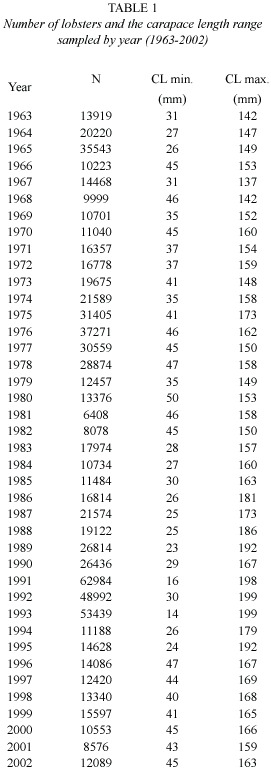
<body><![CDATA[<p><font face="Arial" size="2">Cuba, one of the largest producers of <i>P. argu</i>s, carry out their fisheries all around the country, but this activity is particularly important in the South-west shelf, commonly named Gulf of Batabano. This area produce 60% of the total national catch and is characterized by shallow-water rocky habitats, mangroves and seagrass beds (<a href="#pa91">Páez and Revilla 1991</a>), where the Caribbean spiny lobster found the adequate habitat to develop the benthic stages of its life history. The most important features on the biology, fisheries and management of the species in Cuban waters are examined by <a href="#ba94">Baisre and Cruz (1994)</a>.</font></p>     <p><font face="Arial" size="2">Since 1963, a biological sampling program in Cuban fishing grounds provides monthly information on size, sex-ratios, reproductive activity and molting frequency of <i>P. argus </i>stock. Fishery information is also available through a detailed data-collection system. Both sources are systematically analyzed at the Fisheries Research Centre, which gives off the recommendations to be annually included in the management plan for the sustainable use of the stock (<a href="#pu03">Puga and de León 2003</a>).</font></p>     <p><font face="Arial" size="2">Age of crustaceans cannot be directly determined due to the lack of permanent hard body parts, so most growth studies on Caribbean spiny lobster have relied on length-frequency analysis. More than 20 estimates of <i>P. argus </i>growth parameters, adjusting the von Bertalanffy growth function (VBGF), have been obtained in different areas of the Western Central Atlantic in several times. The obtained parameters are listed in <a href="#ar01">Arce and de León (2001)</a>, including those from Cuba during the 60´s (<a  href="#bu72">Buesa 1972</a>), the 70´s (<a href="#cr81">Cruz <i>et al. </i>1981</a>), the 80´s (<a href="#ba91">Baez <i>et al. </i>1991</a>, <a href="#de93">de León <i>et al. </i>1993</a>) and the 90´s (<a  href="#de95">de León <i>et al. </i>1995</a>). Only a few studies have explored other functions to describe growth in Caribbean spiny lobster (<a href="#ar91">Arce <i>et al. </i>1991</a>, <a href="#ze99">Zetina and Rios 1999</a>).</font></p>     <p><font face="Arial" size="2">Taking into account the longterm series available of biological information (1963-2002), this study was conducted to obtain annual growth parameter of <i>P. argus </i>in Cuban waters using a single methodology to adjust VBGF, to determinate periods of particularly fast or slow growth and the existence of some kind of interannual to decadal patterns in their behavior. The incidence of some factors that modulate growth in this valuable crustacean is explored. </font></p> <font face="Arial" size="2"><b></b></font>     <p><font face="Arial" size="2"><b>Materials and methods </b></font></p>     <p><font face="Arial" size="2"><b>Data sources: </b>The biological data collection system on <i>P. argus </i>was designed to obtain random samples of lobsters from artificial shelters, a non-selective fishing gear very common in the Cuban lobster fishery. Details of the sampling methodology are described by <a href="#cr02">Cruz (2002)</a>. Monthly field samples in the Gulf of Batabano from 1963-2002 were carried out in 14 localities. The information of about 800 000 lobsters has been processed at the Centro de Investigaciones Pesqueras (C.I.P.) between 1963-2002 to generate monthly frequency distributions of carapace length <i>(C</i>L),considering 5 mm class intervals. The <a  href="#t1">Table 1</a> shows the number of lobsters and the length range sampled by year.</font></p> <a name="t1"></a>     <div style="text-align: center;"><img  src="/img/fbpe/rbt/v53n3-4/3247i1.JPG" title="" alt=""  style="width: 271px; height: 773px;"></div>     
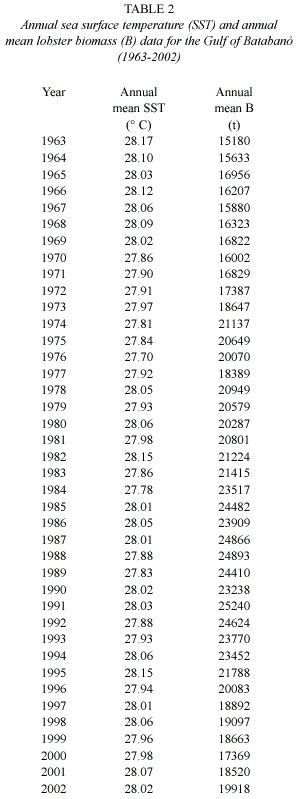
<p><font face="Arial" size="2">&nbsp;    <br> While local conditions (temperature, food, etc) may affect the precise course of the growth, data of monthly mean sea surface temperature <i>(SS</i>T) in the Gulf of Batabanó (22.5º N and 82.5º W) was average over the year for the period 1963 – 2002 (<a href="#t2">Table 2</a>) to test the relevance of temperature over growth parameters. The <i>SST </i>data series were kindly provided by the Centro de Investigaciones Biológicas del Noroeste, México, originally obtained from <a  href="http://ftp.cdc.noaa.gov">ftp://ftp.cdc.noaa.gov</a> and based on optimal interpolation sea surface temperature according to <a href="#re02">Reynolds <i>et al. </i>(2002)</a>.    <br> </font></p>     ]]></body>
<body><![CDATA[<p style="text-align: center;"><font face="Arial" size="2"><a name="t2"></a><img  src="/img/fbpe/rbt/v53n3-4/3247i2.JPG" title="" alt=""  style="width: 299px; height: 799px;">    
<br> </font></p>     <p><font face="Arial" size="2">To explore the relationship between <i>K </i>and&nbsp;<i><img src="/img/fbpe/rbt/v53n3-4/3248i1.JPG"  title="" alt="" style="width: 16px; height: 17px;"></i></font><i><font  face="Arial" size="2"> </font></i><font face="Arial" size="2">with lobster biomass, annual mean lobster biomass <i>(</i>B) for the analyzed period (<a href="#t2">Table 2</a>) was gently contributed by Puga as an extension of his previous paper (<a href="#pu05">Puga <i>et al. </i>2005</a>) based on a sequential population analysis (SPA) with the ADAPT framework.</font></p> <font face="Arial" size="2"><b></b></font>     
<p><font face="Arial" size="2"><b>Growth parameters estimation: </b>Despite of being criticized (<a href="#kn68">Knight 1968</a>, <a href="#ro80">Roff 1980</a>), the simple VBGF continues being the most commonly used growth model in fishery science, because of its easy way to be incorporated in many stock assessment techniques:</font></p>     <div style="text-align: center;"><img  src="/img/fbpe/rbt/v53n3-4/formula.JPG" title="" alt=""  style="width: 181px; height: 28px;"></div> <font face="Arial" size="2"><i></i></font>     
<p><font face="Arial" size="2">Where:</font></p> <font face="Arial" size="2"><i></i></font>     <p><font face="Arial" size="2"><i><img  src="/img/fbpe/rbt/v53n3-4/3248i1.JPG" title="" alt=""  style="width: 16px; height: 17px;"></i></font><b><font face="Arial"  size="2" color="#ff0000"></font></b><font face="Arial" size="2"> is the asymptotic average maximum body size.</font></p> <font face="Arial" size="2"><i></i></font>     
<p><font face="Arial" size="2"><i>K </i>is the growth coefficient which determines how quickly </font><font face="Arial" size="2"><i><img  src="/img/fbpe/rbt/v53n3-4/3248i1.JPG" title="" alt=""  style="width: 16px; height: 17px;"></i></font><b><font face="Arial"  size="2" color="#ff0000"></font></b><font face="Arial" size="2"> is attained. </font></p> <font face="Arial" size="2"><i></i></font>     
<p><font face="Arial" size="2"><i>t<sub>0</sub> </i>is the hypothetical age when <i>L<sub>t</sub> </i>is cero. data-requirements such as high expensive tagging programs and/or lab studies.</font></p>     <p><font face="Arial" size="2">Taking into account the nature of the information available, the three-parameter VBGF was fitted to length-frequency data by two</font></p>     ]]></body>
<body><![CDATA[<p><font face="Arial" size="2">Other models concerning growth have been developed; this is the case of molt-based model which has apparently a more realistic fit to represent growth in lobster (<a href="#ca77">Caddy 1977</a>), however, it is more rigorous regarding data-requirements such as high expensive taging programs and/or lab studies.</font></p>     <p><font face="Arial" size="2">Taking into account the nature of the information available, the three-parameter VBGF was fitted to length-frequency data by two indirect methods to estimate growth parameters: Electronic Length Frequency Analysis, ELEFAN 1 (<a  href="#pa81">Pauly and David 1981</a>) and New Shepherd’s Length Composition Analysis, NSLCA (<a href="#sh87">Shepherd 1987</a>, <a  href="#pa95">Pauly and Arreguín-Sánchez 1995</a>). Both routines are available in FAO ICLARM stock assessment tools, FISAT, in its Windows version (<a href="#ga96">Gayanilo <i>et al. </i>1996</a>).</font></p>     <p><font face="Arial" size="2">The ELEFAN routine in FISAT suit of programs fits VBGF by a non-parametric method where an optimum curve, which cross through the most number of modes, is selected based on a goodness of fit value.</font></p>     <p><font face="Arial" size="2">The NSLCA method is similar to ELEFAN, maximizing a non-parametric scoring function. It fits a circular function to the overall length-frequency distribution of each sample, and in the process, computes a total score function for a set of samples. At the maximum score function, the growth curve with the testing </font><font face="Arial" size="2"><i><img  src="/img/fbpe/rbt/v53n3-4/3248i1.JPG" title="" alt=""  style="width: 16px; height: 17px;"></i></font><font face="Arial"  size="2"> and <i>K </i>values predicts the modal lengths closer to the observed values.</font></p>     
<p><font face="Arial" size="2">Annual values of <i>t<sub>0</sub> </i>were obtained by the inverse VBGF: <i>t<sub>0</sub> = t + 1/K * ln[(1– L t )/</i></font><font face="Arial" size="2"><i><img  src="/img/fbpe/rbt/v53n3-4/3248i1.JPG" title="" alt=""  style="width: 16px; height: 17px;"></i></font><font face="Arial"  size="2">], considering the analysis proposed by <a href="#cr91">Cruz <i>et al. </i>(1991)</a> in puerulus collectors in Cuban waters, where puerulus stage of <i>P. argus </i>returns to the SW Cuban shelf seven months after larval release, attaining a length of 5.78 mm of carapace length <i>(C</i>L).</font></p>     
<p><font face="Arial" size="2">The values of </font><font face="Arial"  size="2"><i><img src="/img/fbpe/rbt/v53n3-4/3248i1.JPG" title=""  alt="" style="width: 16px; height: 17px;"></i></font><font face="Arial"  size="2"> expressed in <i>CL </i>were transformed into total lengths <i>(T</i>L) according the relationship published by <a href="#cr02">Cruz (2002)</a> <i>(TL = 2.5402 * CL + 36.353</i>5) to calculate the overall growth performance index&nbsp;</font><b><font face="Arial"  size="2" color="#ff0000"><img src="/img/fbpe/rbt/v53n3-4/o.JPG"  title="" alt="" style="width: 14px; height: 13px;"></font></b><font  face="Arial" size="2"> <i>´ </i>(<a href="#pa84">Pauly and Munro 1984</a>): </font><b><font face="Arial" size="2" color="#ff0000"><img  src="/img/fbpe/rbt/v53n3-4/o.JPG" title="" alt=""  style="width: 14px; height: 13px;"></font></b><font face="Arial"  size="2"> <i>´= log<sub>10</sub> K + 2 log<sub>10</sub> </i></font><font  face="Arial" size="2"><i><img  src="/img/fbpe/rbt/v53n3-4/3248i1.JPG" title="" alt=""  style="width: 16px; height: 17px;"></i></font><font face="Arial"  size="2">.</font></p>     
<p><font face="Arial" size="2">The overall growth performance indexes </font><b><font  face="Arial" size="2" color="#ff0000"><img  src="/img/fbpe/rbt/v53n3-4/o.JPG" title="" alt=""  style="width: 14px; height: 13px;"></font></b><font face="Arial"  size="2"> <i>´ </i>were also calculated with </font><font  face="Arial" size="2"><i><img  src="/img/fbpe/rbt/v53n3-4/3248i1.JPG" title="" alt=""  style="width: 16px; height: 17px;"></i></font><b><font face="Arial"  size="2" color="#ff0000"></font></b><font face="Arial" size="2"> and <i>K </i>values listed in <a href="#ar01">Arce and de Leon (2001)</a> concerning growth studies of Caribbean spiny lobster in Western Central Atlantic. The index </font><b><font face="Arial"  size="2" color="#ff0000"><img src="/img/fbpe/rbt/v53n3-4/o.JPG"  title="" alt="" style="width: 14px; height: 13px;"></font></b><font  face="Arial" size="2"> <i>´ </i>were used as a tool to examine differences among the present annual estimates as well as with others <i>P. argus </i>growth parameters in other areas and/or periods.</font></p> <font face="Arial" size="2"><b></b></font>     
<p><font face="Arial" size="2"><b>Time series analysis of growth parameters: </b>The presence of fluctuations and patterns in the annual growth parameters were examined along the 40 year series. A preliminary searching was done through the standard anomalies (SA) behavior around the mean values of K, </font><font face="Arial"  size="2"><i><img src="/img/fbpe/rbt/v53n3-4/3248i1.JPG" title=""  alt="" style="width: 16px; height: 17px;"></i></font><b><font  face="Arial" size="2" color="#ff0000"></font></b><font face="Arial"  size="2"> and </font><b><font face="Arial" size="2" color="#ff0000"><img  src="/img/fbpe/rbt/v53n3-4/o.JPG" title="" alt=""  style="width: 14px; height: 13px;"></font></b><font face="Arial"  size="2"> <i>’ </i>for the analyzed period: <i>SA </i>= <i>(X<sub>i</sub> – X<sub>m</sub> )/</i>S, where <i>X<sub>i</sub> </i>is the value of the parameter in the year i, <i>X<sub>m</sub> </i>is the mean value of the parameter for the considered period and <i>S </i>is the standard deviation. Notwithstanding the close statistical relation between <i>K </i>and </font><font face="Arial" size="2"><i><img  src="/img/fbpe/rbt/v53n3-4/3248i1.JPG" title="" alt=""  style="width: 16px; height: 17px;"></i></font><b><font face="Arial"  size="2" color="#ff0000"></font></b><font face="Arial" size="2"> as a result of metabolism and growth across species (<a href="#je97">Jensen 1997</a>), the average maximum size always will be strongly sensitive on the nature of the length range sampled available (<a  href="#gu92">Gulland and Rosenberg 1992</a>), then the decision was focused to investigate the temporal patterns on the time series of <i>K </i>and </font><font face="Arial" size="2"><i><img  src="/img/fbpe/rbt/v53n3-4/3248i1.JPG" title="" alt=""  style="width: 16px; height: 17px;"></i></font><i><font face="Arial"  size="2"> </font></i><font face="Arial" size="2">instead off explore </font><b><font face="Arial" size="2" color="#ff0000"><img  src="/img/fbpe/rbt/v53n3-4/o.JPG" title="" alt=""  style="width: 14px; height: 13px;"></font></b><font face="Arial"  size="2"> <i>´ </i>patterns directly.</font></p>     
<p><font face="Arial" size="2">Rhythmic cycles in the annual data of both time series were explored using autocorrelation function. Dominant periodicities were inspected by single spectrum (Fourier) analysis to decompose each series into the energy spectra that shows the concentration of energy or variance under the curve, using a Hamming filter to smooth the periodogram value. All time-series analyses were performed using the computer program Statistica 6.0 (StatSoft 2001).</font></p> <font face="Arial" size="2"><b>     <p>Relation with temperature and biomass:</p> </b></font>     ]]></body>
<body><![CDATA[<p><font face="Arial" size="2">Present knowledge of the relationship between <i>P. argus </i>growth parameters <i>(K </i>and </font><font  face="Arial" size="2"><i><img  src="/img/fbpe/rbt/v53n3-4/3248i1.JPG" title="" alt=""  style="width: 16px; height: 17px;"></i></font><b><font face="Arial"  size="2" color="#ff0000"></font></b><font face="Arial" size="2">) and environmental variables is not sufficient to know a priori their correct form. For that reason, it was applied a nonlinear multiple regression model (or generalized additive model) using Alternating Conditional Expectations algorithm, ACE (<a href="#br85">Briedman and Friedman 1985</a>) to explore the relationships between the response <i>(K </i>and </font><font face="Arial" size="2"><i><img  src="/img/fbpe/rbt/v53n3-4/3248i1.JPG" title="" alt=""  style="width: 16px; height: 17px;"></i></font><b><font face="Arial"  size="2" color="#ff0000"></font></b><font face="Arial" size="2">) and the predictor variables <i>(SST </i>and B). This methodology was successfully applied to analyze the relation between recruitment and climatic factors in pelagic stocks of Californian anchovy (Cury <i>et al. </i>1995) to obtain an "optimal environmental window". </font></p> <font face="Arial" size="2"><b>     
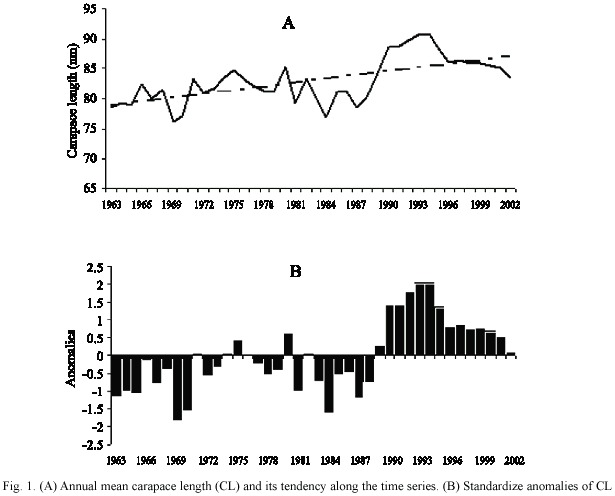
<p>Results </p> </b></font>     <p><font face="Arial" size="2">Lobster sizes sampled through the four decades has a mean <i>CL </i>of 83.02 mm and a minimum and maximum <i>CL </i>of 14 and 199 mm respectively. An evidence of a positive tendency of mean <i>CL </i>is observed along the time series (y = 0.22092 + 78.737, <a href="#f1">Fig. 1a</a>), reaching the highest values during the 1990´s. Obvious differences are observed between the average lengths of each year. Moreover, at first glance the standardize anomalies of average <i>CL </i>series (<a href="#f1">Fig. 1b</a>) reveals the possible presence of periods: two with values generally below the mean (1963-1970 and 1980-1988), one around the mean (1971-1979) and the last (1990-2002), with values greater than the general average <i>C</i>L.</font></p> <a name="f1"></a>     <div style="text-align: center;"><img  src="/img/fbpe/rbt/v53n3-4/3247i4.JPG" title="" alt=""  style="width: 615px; height: 496px;"></div>     
<p><font face="Arial" size="2">Annual growth parameters by ELEFAN routine does not converge in an optimal estimation in the 25% of the years analyzed. The rest of the years show a tendency to overestimate </font><font  face="Arial" size="2"><i><img  src="/img/fbpe/rbt/v53n3-4/3248i1.JPG" title="" alt=""  style="width: 16px; height: 17px;"></i></font><b><font face="Arial"  size="2" color="#ff0000"></font></b><font face="Arial" size="2">, in the 50% of the cases, with values very far from maximum <i>CL </i>reported for the species, 225 mm <i>CL </i>in SE Cuba (<a  href="#de95">de León <i>et al. </i>1995</a>) and in the Mujeres Island, Mexico (<a href="#go91">González-Cano 1991</a>).</font></p>     
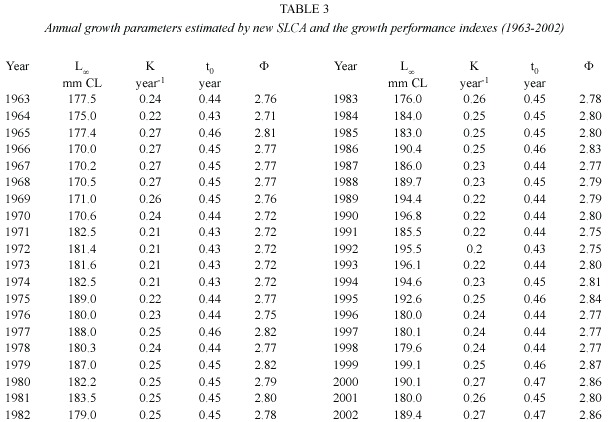
<p><font face="Arial" size="2">The results obtained with NSLCA routine are better, due to a good convergence of growth parameter in all cases. The </font><font face="Arial" size="2"><i><img  src="/img/fbpe/rbt/v53n3-4/3248i1.JPG" title="" alt=""  style="width: 16px; height: 17px;"></i></font><font face="Arial"  size="2"> values obtained by NSLCA vary between 170 and 199.1 mm <i>CL </i>and parameter <i>K </i>fluctuates from 0.20 to 0.27 year<sup>-1</sup>. Average values for </font><font face="Arial" size="2"><i><img  src="/img/fbpe/rbt/v53n3-4/3248i1.JPG" title="" alt=""  style="width: 16px; height: 17px;"></i></font><b><font face="Arial"  size="2" color="#ff0000"></font></b><font face="Arial" size="2"> and <i>K </i>were 183.6 mm <i>CL </i>and 0.2405 year<sup>-1</sup> respectively.</font></p>     
<p><font face="Arial" size="2">The combination of annual growth parameters provided indexes </font><b><font face="Arial" size="2"  color="#ff0000"><img src="/img/fbpe/rbt/v53n3-4/o.JPG" title=""  alt="" style="width: 14px; height: 13px;"></font></b><font face="Arial"  size="2"> <i>’ </i>oscillating from 2.71 and 2.87 with an average of 2.78. In other localities and/or periods, index </font><b><font  face="Arial" size="2" color="#ff0000"><img  src="/img/fbpe/rbt/v53n3-4/o.JPG" title="" alt=""  style="width: 14px; height: 13px;"></font></b><font face="Arial"  size="2"> <i>´ </i>ranged from 2.54 and 3.18 and the average value is 2.79 (papers cited by <a href="#ar01">Arce and de León 2001</a>). A summary of present results of annual estimates for <i>L </i>8and <i>K </i>as well as <i>t<sub>0</sub> </i>and </font><b><font face="Arial"  size="2" color="#ff0000"><img src="/img/fbpe/rbt/v53n3-4/o.JPG"  title="" alt="" style="width: 14px; height: 13px;"></font></b><font  face="Arial" size="2"> <i>´ </i>parameters calculated are presented in <a href="#t3">Table 3</a>.</font></p> <a name="t3"></a>     
<div style="text-align: center;"><img  src="/img/fbpe/rbt/v53n3-4/3247i5.JPG" title="" alt=""  style="width: 608px; height: 422px;"></div>     
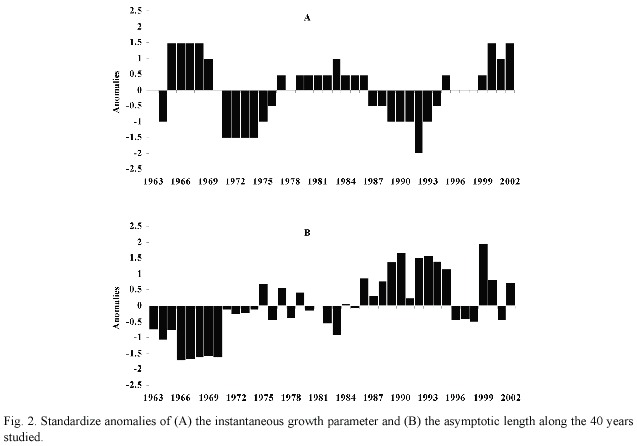
<p><font face="Arial" size="2">Since there is much interannual variability in <i>K </i>and <i>L </i>8time series, there are significant features exposed in the plots of standardized anomalies of <i>K </i>(<a href="#f2">Fig. 2a</a>) and </font><font face="Arial" size="2"><i><img  src="/img/fbpe/rbt/v53n3-4/3248i1.JPG" title="" alt=""  style="width: 16px; height: 17px;"></i></font><b><font face="Arial"  size="2" color="#ff0000"></font></b><font face="Arial" size="2">(<a  href="#f2">Fig. 2b</a>) along the 40 years analyzed. Both parameters denote cyclic patterns, although it is more evident in the case of K, presenting well defined periods of low and high values, whereas </font><font face="Arial" size="2"><i><img  src="/img/fbpe/rbt/v53n3-4/3248i1.JPG" title="" alt=""  style="width: 16px; height: 17px;"></i></font><font face="Arial"  size="2"> also seems to have incorporated some positive trend.</font></p>     
<p style="text-align: center;"><font face="Arial" size="2">&nbsp;<a  name="f2"></a><img src="/img/fbpe/rbt/v53n3-4/3247i6.JPG" title=""  alt="" style="width: 637px; height: 446px;"></font></p>     
]]></body>
<body><![CDATA[<p><font face="Arial" size="2">The autocorrelation function indicated cycling around 15 years for </font><font face="Arial" size="2"><i><img  src="/img/fbpe/rbt/v53n3-4/3248i1.JPG" title="" alt=""  style="width: 16px; height: 17px;"></i></font><b><font face="Arial"  size="2" color="#ff0000"></font></b><font face="Arial" size="2"> and 18 years for <i>K.</i></font></p>     
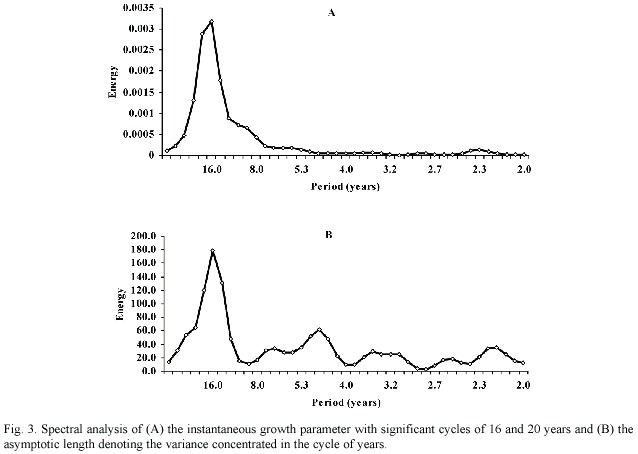
<p><font face="Arial" size="2">To carry out time series analysis, previously both series were transformed by tapering at 10% to reduce linkage in the periodogram and also the respectively mean and tendency <i>(</i>K: mean = 0.2405, tendency = 0; </font><font face="Arial" size="2"><i><img  src="/img/fbpe/rbt/v53n3-4/3248i1.JPG" title="" alt=""  style="width: 16px; height: 17px;"></i></font><font face="Arial"  size="2">: mean = 183.6, tendency = x-[-9.074 + 0.4426*t]) were removed. Spectrum (Fourier) analysis of parameter <i>K </i>series indicated the presence of low-frequency patterns, with significant cycles of 16 and 20 years (</font><b><font face="Arial" size="2"  color="#ff0000"><img src="/img/fbpe/rbt/v53n3-4/ALFA_P%D1A.JPG"  title="" alt="" style="width: 12px; height: 11px;"></font></b><font  face="Arial" size="2"> = 0.05) (<a href="#f3">Fig. 3a</a>). Similar results were observed in the spectrum of <i>L </i>8 series, but the variance was only significantly concentrated in the cycle of 16 years (<a href="#f3">Fig. 3b</a>). </font></p> <a name="f3"></a>     
<div style="text-align: center;"><img  src="/img/fbpe/rbt/v53n3-4/3247i7.JPG" title="" alt=""  style="width: 638px; height: 454px;"></div>     
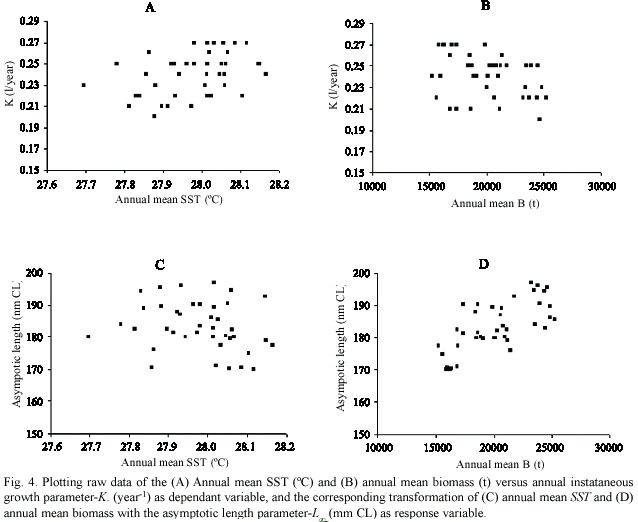
<p><font face="Arial" size="2">The relationships between <i>K </i>and </font><font face="Arial" size="2"><i><img  src="/img/fbpe/rbt/v53n3-4/3248i1.JPG" title="" alt=""  style="width: 16px; height: 17px;"></i></font><font face="Arial"  size="2"> as response factors, with annual means <i>SST </i>and <i>B </i>as predictors, were explored by plotting the raw data (<a href="#f4">Fig. 4</a>). No significant relationships between <i>K </i>with annual mean <i>SST </i>(<a href="#f4">Fig. 4a</a>) and with <i>B </i>(<a  href="#f4">Fig. 4b</a>) were observed, but a positive trend is observed in the first case and a negative in the second one. Asymptotic length and annual mean <i>SST </i>(<a href="#f4">Fig. 4c</a>) also show no significant relation, however, it seems to have a positive correlation between </font><font face="Arial" size="2"><i><img  src="/img/fbpe/rbt/v53n3-4/3248i1.JPG" title="" alt=""  style="width: 16px; height: 17px;"></i></font><b><font face="Arial"  size="2" color="#ff0000"></font></b><font face="Arial" size="2"> with annual mean <i>B </i>(<a href="#f4">Fig. 4d</a>).    
<br> </font></p>     <p style="text-align: center;"><font face="Arial" size="2"><a name="f4"></a><img  src="/img/fbpe/rbt/v53n3-4/3247i8.JPG" title="" alt=""  style="width: 638px; height: 522px;">    
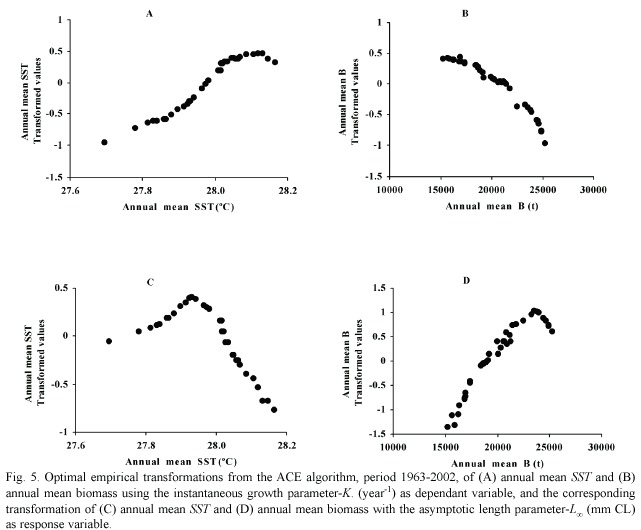
<br> </font></p>     <p><font face="Arial" size="2">Using the ACE algorithm, the shape of the optimal empirical transformation of the predictor variables from this model are presented in <a href="#f5">Fig. 5</a>, corresponding 5a and 5b to response variable <i>K </i>and 5c and 5b with response variable </font><font face="Arial" size="2"><i><img  src="/img/fbpe/rbt/v53n3-4/3248i1.JPG" title="" alt=""  style="width: 16px; height: 17px;"></i></font><b><font face="Arial"  size="2" color="#ff0000"></font></b><font face="Arial" size="2">. Predictor variables explain the 33% of the variability of <i>K </i>and the 69% of </font><font face="Arial" size="2"><i><img  src="/img/fbpe/rbt/v53n3-4/3248i1.JPG" title="" alt=""  style="width: 16px; height: 17px;"></i></font><b><font face="Arial"  size="2" color="#ff0000"></font></b><font face="Arial" size="2">. However, when both predictors are considered separately in the analysis for each response, the temperature is responsible of the 22% of the variability of <i>K </i>and annual mean <i>B </i>explain the 61% of variance of </font><font face="Arial" size="2"><i><img  src="/img/fbpe/rbt/v53n3-4/3248i1.JPG" title="" alt=""  style="width: 16px; height: 17px;"></i></font><font face="Arial"  size="2">. Growth coefficient looks like to be maximum with annual mean <i>SST </i>of 28.1°C, and the largest </font><font face="Arial"  size="2"><i><img src="/img/fbpe/rbt/v53n3-4/3248i1.JPG" title=""  alt="" style="width: 16px; height: 17px;"></i></font><font face="Arial"  size="2"> are reached with levels of annual mean <i>B </i>of 23 000 t.    
<br> </font></p>     <p style="text-align: center;"><font face="Arial" size="2"><a name="f5"></a><img  src="/img/fbpe/rbt/v53n3-4/3247i9.JPG" title="" alt=""  style="width: 641px; height: 530px;">    
]]></body>
<body><![CDATA[<br> </font></p> <font face="Arial" size="2"><b>     <p>Discussion </p> </b></font>     <p><font face="Arial" size="2">Many studies focus on growth estimates have been made for <i>P. argus </i>in the Western Central Atlantic, but growth patterns seem to vary markedly between localities probably due to differences in environmental conditions, length composition of the lobsters examined and the method used to estimate growth parameters. It is important to highlight the differences between present results and those obtained by <a href="#iv96">Ivo and Pereira (1996)</a> through ELEFAN routine in Brazilian waters <i>(<img  src="/img/fbpe/rbt/v53n3-4/3248i1.JPG" title="" alt=""  style="width: 16px; height: 17px;"></i></font><font face="Arial"  size="2">= 257 mm <i>C</i>L; <i>K=</i>0.32 year<sup>-1</sup>;&nbsp;</font><b><font  face="Arial" size="2" color="#ff0000"><img  src="/img/fbpe/rbt/v53n3-4/o.JPG" title="" alt=""  style="width: 14px; height: 13px;"></font></b><font face="Arial"  size="2"> ´= 3.18), by <a href="#ar90">Arce (1990)</a> with SLCA and data of Yucatan Bank in Mexico <i>(</i></font><font face="Arial"  size="2"><i><img src="/img/fbpe/rbt/v53n3-4/3248i1.JPG" title=""  alt="" style="width: 16px; height: 17px;"></i></font><font face="Arial"  size="2"> = 142 mm <i>C</i>L; <i>K=</i>0.22 year<sup>-1</sup>; </font><b><font  face="Arial" size="2" color="#ff0000"><img  src="/img/fbpe/rbt/v53n3-4/o.JPG" title="" alt=""  style="width: 14px; height: 13px;"></font></b><font face="Arial"  size="2"> ´= 2.54), by <a href="#bu72">Buesa (1972)</a> with data from the 60´s of SW Cuban shelf using Bhattacharya <i>(</i></font><font  face="Arial" size="2"><i><img  src="/img/fbpe/rbt/v53n3-4/3248i1.JPG" title="" alt=""  style="width: 16px; height: 17px;"></i></font><font face="Arial"  size="2">= 174 mm <i>C</i>L; <i>K=</i>0.16 year<sup>-1</sup>; </font><b><font  face="Arial" size="2" color="#ff0000"><img  src="/img/fbpe/rbt/v53n3-4/o.JPG" title="" alt=""  style="width: 14px; height: 13px;"></font></b><font face="Arial"  size="2"> ´= 2.56) and those from <a href="#ba91">Baez <i>et al. </i>(1991)</a> through ELEFAN routine based on data from the 80´s in the last mentioned area <i>(<img src="../img/3248i1.JPG" title="" alt=""  style="width: 16px; height: 17px;"></i></font><font face="Arial"  size="2">= 228 mm <i>C</i>L; <i>K=</i>0.30 year<sup>-1</sup>; </font><b><font face="Arial" size="2"  color="#ff0000"><img src="/img/fbpe/rbt/v53n3-4/o.JPG" title=""  alt="" style="width: 14px; height: 13px;"></font></b><font face="Arial"  size="2"> ´= 3.06).</font></p>     
<p><font face="Arial" size="2">The results provide evidence of a decadal pattern in the growth of spiny lobster. Decadal cycles in the growth and recruitment have been documented for halibut in the Pacific (<a  href="#cl99">Clark <i>et al. </i>1999</a>), but no details of this kind of cycles has been found in literature for a tropical organism such as the Caribbean spiny lobster, perhaps due to a lack of longterm biological studies. <a href="#ac97">Acosta <i>et al. </i>(1997)</a> determined temporal patterns in <i>P. argus </i>puerulus recruitment in Florida Keys identifying weekly annual patterns in the supply of postlarvae. They also observed an interannual variability in the magnitude of the puerulus recruitment, but the time series of 8 years data used was not suitable for determining low frequency cycles.</font></p>     <p><font face="Arial" size="2">Many are the reasons that could cause this growth pattern in the spiny lobster. As growth also depends on biomass via food competition (<a href="#pi82">Pitcher and Hart 1982</a>), an apparent dependence of growth on population density is common in studies of population dynamics.</font></p>     <p><font face="Arial" size="2">However, the results here presented, based on the physiological concept underlying the von Bertalanffy growth function (<a href="#be57">Beverton and Holt 1957</a>), density-dependence growth is revealed on the asymptotic length (or asymptotic weight) behavior, but not on the growth rate at which this size is approached. Although spiny lobsters are communal in nature, at very high densities, their growth can be depressed (<a href="#po91">Pollock 1991</a>, <a href="#br03">Briones-Fourzan and Lozano-Alvarez 2003</a>), suggesting a density-dependent regulation of growth rate.</font></p>     <p><font face="Arial" size="2">The evidence of decadal cycles in the growth coefficient of Caribbean spiny lobster perhaps has their origins in decadal environment variations. If we review the environmental conditions in Cuban waters, located in the North Atlantic sector, they must have an influence of three interconnected phenomena (<a  href="#hu01">Hurrell <i>et al. </i>2001</a>, <a href="#ma01">Marshall <i>et al. </i>2001</a>). The interannual climatic variability is determined by the easterly trade winds and has the influence of the prevailing ocean-atmosphere interaction in the northern sector of tropical Atlantic, where longterm time <i>SST </i>series contains low-frequency cycles in the scale of 10 to 20 years (<a href="#ca96">Carton <i>et al. </i>1996</a>, <a href="#xi04">Xie and Carton 2004</a>).</font></p>     <p><font face="Arial" size="2">Temperature is a decisive factor for growth (<a href="#fr71">Fry 1971</a>), because it controls the rate of metabolism. Caribbean spiny lobster, as a tropical crustacean, do not have an specific molting season, even though it has been proved that the process goes on faster in summer than in winter (<a href="#mu74">Munro 1974</a>, Davis 1981, <a href="#hu86">Hunt and Lyons 1986</a>, <a  href="#fo94">Forcucci <i>et al. </i>1994</a>).</font></p>     <p><font face="Arial" size="2">Present results agree with the range reported for the optimum temperature for growth and survival in palinurids (<a href="#ch77">Chittleborough 1977</a>) in the range of 25°- 28°C, but temperatures higher than this maximum are detrimental for lobster growth.</font></p>     <p><font face="Arial" size="2">It seems that the optimal "window" for a successful growth rate in <i>P. argus </i>in Cuban waters according to temperature is around the 28°C, but it will be necessary to explore other abiotic (like photoperiod, oxygen and salinity) and biotic (food availability and food quality) factors that limit the growth of organism (<a href="#fr71">Fry 1971</a>, <a href="#pi82">Pitcher and Hart 1982</a>). An additional motive of further investigation will be long-term field studies of these factors and their relation with juvenile stage abundance in nursery areas, where the changes could be more dramatic.</font></p>     ]]></body>
<body><![CDATA[<p><font face="Arial" size="2">The traditional practice of predictive models used for fish resources is to consider population parameters such as growth, natural mortality, and recruitment as averages (stationary models). To take in consideration these results should be the basis for further advances in the understanding and prediction of Cuban lobster fishery dynamics and the role that could be played from now on in suitable management policies depending on the kind of variation observed. </font></p> <font face="Arial" size="2"><b>     <p>Acknowledgments </p> </b></font>     <p><font face="Arial" size="2">The present study is part of a Ph. D. thesis of the first author developed at Centro de Investigaciones Biológicas del Noroeste (CIBNOR) and granted by Consejo Nacional de Ciencia y Técnica of Mexico, CONACYT (Scholarship Nº 182843). Our thanks extend to the technical staff of our own institutions and to the Ministerio de la Industria Pesquera, M.I.P. of Cuba for the financial support. We gratefully acknowledge Akim Abel González (C.I.P., Cuba), Silvia Salas (CINVESTAV, Mexico) and the anonymous reviewers, for their valuable comments on the manuscript. </font></p> <font face="Arial" size="2"><b>     <p>Resumen </p> </b></font>     <p><font face="Arial" size="2">Los parámetros de crecimiento anuales para la langosta espinosa del Caribe <i>(Panulirus argu</i>s) en aguas cubanas se estimaron para una serie de 40 años de datos de composición por longitud, a través de los métodos indirectos basados en la talla ELEFAN y el nuevo SLCA. Las composiciones por talla de alrededor de 800 000 langostas (con un ámbito de longitud de cefalotórax entre 14 y 199 mm) fueron obtenidas en muestreos aleatorios, realizados en arrecifes artificiales (arte de pesca muy común en esta pesquería cubana), a través del programa de monitoreo de campo establecido para esta especie desde 1963 en 14 localidades del Golfo de Batabanó, plataforma suroccidental de Cuba. El método ELEFAN mostró problemas para convergir en una combinación óptima del coeficiente de crecimiento <i>(</i>K) y el largo asintótico <i>(<img  src="/img/fbpe/rbt/v53n3-4/3248i1.JPG" title="" alt=""  style="width: 16px; height: 17px;"></i></font><b><font face="Arial"  size="2" color="#ff0000"></font></b><font face="Arial" size="2">) de la ecuación de von Bertalanffy, mientras que el método nuevo SLCA proporcionó valores de <i>K </i>entre 0.20 y 0.27 año<sup>-1</sup> y de </font><font face="Arial" size="2"><i><img  src="/img/fbpe/rbt/v53n3-4/3248i1.JPG" title="" alt=""  style="width: 16px; height: 17px;"></i></font><b><font face="Arial"  size="2" color="#ff0000"></font></b><font face="Arial" size="2"> entre 177 y 190 mm de longitud de cefalotórax, todos dentro del ámbito reportado en la literatura. Las anomalías estandarizadas de ambos parámetros mostraron la existencia de ciclos a lo largo de la serie de tiempo analizada. El análisis espectral demostró una variabilidad decadal en los parámetros de crecimiento, con ciclos significativos de 16 y 20 años para <i>K </i>y de 16 años para </font><font  face="Arial" size="2"><i><img  src="/img/fbpe/rbt/v53n3-4/3248i1.JPG" title="" alt=""  style="width: 16px; height: 17px;"></i></font><b><font face="Arial"  size="2" color="#ff0000"></font></b><font face="Arial" size="2">. La incidencia de algunos factores, que modulan el crecimiento en este valioso crustáceo, como la biomasa y la temperatura fue explorada usando un modelo nolineal de regresión múltiple. Los resultados indicaron que ambos factores combinados explican el 33% y el 69% de la variabilidad de la <i>K </i>y del </font><font face="Arial"  size="2"><i><img src="/img/fbpe/rbt/v53n3-4/3248i1.JPG" title=""  alt="" style="width: 16px; height: 17px;"></i></font><font face="Arial"  size="2"> respectivamente. El coeficiente de crecimiento alcanzó su máximo con temperaturas medias anuales de superficie del mar de 28.1º C y el mayor valor de <i>L </i>8se alcanza con niveles en la biomasa media anual de 23 000 t. La consideración de estos resultados debe ser la base para estudios posteriores en el conocimiento y predicción de la dinámica de la población de langosta en Cuba.</font></p> <font face="Arial" size="2"><b></b></font>     
<p><font face="Arial" size="2"><b>Palabras clave: </b>Parámetros de crecimiento, variabilidad por década, <i>Panulirus argu</i>s, Cuba. </font></p> <font face="Arial" size="2"><b>     <p>References </p> </b></font>     <!-- ref --><p><font face="Arial" size="2"><a name="ac97"></a>Acosta, A., T.R. Matthews &amp; M.J. Butler, IV. 1997. Temporal patterns and transport processes in recruitment of spiny lobster <i>(Panulirus argu</i>s) postlarvae to south Florida. Mar. Biol. 129 (1): 79-85.</font>&nbsp;&nbsp;&nbsp;&nbsp;&nbsp;&nbsp;&nbsp;&nbsp;[&#160;<a href="javascript:void(0);" onclick="javascript: window.open('/scielo.php?script=sci_nlinks&ref=1230121&pid=S0034-7744200500020001600001&lng=','','width=640,height=500,resizable=yes,scrollbars=1,menubar=yes,');">Links</a>&#160;]<!-- end-ref --><!-- ref --><p><font face="Arial" size="2"><a name="ar01"></a>Arce, A.M. &amp; M.E. de León. 2001. Biology, p. 17-25. <i>In </i>P. Medley &amp; S. Venema (Eds.). Report on the FAO/DANIDA/ CFRAMP/WECAFC regional workshops on the assessment of the Caribbean spiny lobster <i>(Panulirus argu</i>s). FAO Fish. Rep. 619.</font>&nbsp;&nbsp;&nbsp;&nbsp;&nbsp;&nbsp;&nbsp;&nbsp;[&#160;<a href="javascript:void(0);" onclick="javascript: window.open('/scielo.php?script=sci_nlinks&ref=1230122&pid=S0034-7744200500020001600002&lng=','','width=640,height=500,resizable=yes,scrollbars=1,menubar=yes,');">Links</a>&#160;]<!-- end-ref --><!-- ref --><p><font face="Arial" size="2"><a name="ar90"></a>Arce, A.M. 1990. Estimación del crecimiento de langosta <i>Panulirus argus </i>(Latreille) con metodologías convencionales y a través de funciones de singularidad. Tesis de Maestria en Ciencias. Centro de Investigaciones de Estudios Avanzados (CINVESTAV)-Unidad Mérida. 94 p.</font>&nbsp;&nbsp;&nbsp;&nbsp;&nbsp;&nbsp;&nbsp;&nbsp;[&#160;<a href="javascript:void(0);" onclick="javascript: window.open('/scielo.php?script=sci_nlinks&ref=1230123&pid=S0034-7744200500020001600003&lng=','','width=640,height=500,resizable=yes,scrollbars=1,menubar=yes,');">Links</a>&#160;]<!-- end-ref --><!-- ref --><p><font face="Arial" size="2"><a name="ar91"></a>Arce, A.M., J.C. Seijo &amp; S. Salas. 1991. Cálculo del crecimiento de la langosta espinosa <i>Panulirus argus </i>Latreille, mediante funciones de singularidad. Rev. Invest. Mar 12: 184-192.</font>&nbsp;&nbsp;&nbsp;&nbsp;&nbsp;&nbsp;&nbsp;&nbsp;[&#160;<a href="javascript:void(0);" onclick="javascript: window.open('/scielo.php?script=sci_nlinks&ref=1230124&pid=S0034-7744200500020001600004&lng=','','width=640,height=500,resizable=yes,scrollbars=1,menubar=yes,');">Links</a>&#160;]<!-- end-ref --><!-- ref --><p><font face="Arial" size="2"><a name="ba91"></a>Báez, M., E. Díaz, R. Brito &amp; R. Cruz. 1991. Edad y crecimiento de la langosta en la plataforma suroccidental de Cuba. Rev. Invest. Mar. 12: 193-201.</font>&nbsp;&nbsp;&nbsp;&nbsp;&nbsp;&nbsp;&nbsp;&nbsp;[&#160;<a href="javascript:void(0);" onclick="javascript: window.open('/scielo.php?script=sci_nlinks&ref=1230125&pid=S0034-7744200500020001600005&lng=','','width=640,height=500,resizable=yes,scrollbars=1,menubar=yes,');">Links</a>&#160;]<!-- end-ref --><!-- ref --><p><font face="Arial" size="2"><a name="ba94"></a>Baisre, J.A. &amp; R. Cruz, 1994. The Cuban spiny lobster fishery. p. 119-132 <i>In </i>Phillips, B. F., J.,S. Cobb &amp; J. Kittaka. (Eds.). Spiny Lobster Management. London, Blackwell Sci. Oxford, Fishing New Books.</font>&nbsp;&nbsp;&nbsp;&nbsp;&nbsp;&nbsp;&nbsp;&nbsp;[&#160;<a href="javascript:void(0);" onclick="javascript: window.open('/scielo.php?script=sci_nlinks&ref=1230126&pid=S0034-7744200500020001600006&lng=','','width=640,height=500,resizable=yes,scrollbars=1,menubar=yes,');">Links</a>&#160;]<!-- end-ref --><!-- ref --><p><font face="Arial" size="2"><a name="be57"></a>Beverton, R.J.H. &amp; S.J. Holt. 1957. On the dynamics of exploited fish populations. Fish. Invest. Ser. II Vol. 19. 533 p.</font>&nbsp;&nbsp;&nbsp;&nbsp;&nbsp;&nbsp;&nbsp;&nbsp;[&#160;<a href="javascript:void(0);" onclick="javascript: window.open('/scielo.php?script=sci_nlinks&ref=1230127&pid=S0034-7744200500020001600007&lng=','','width=640,height=500,resizable=yes,scrollbars=1,menubar=yes,');">Links</a>&#160;]<!-- end-ref --><!-- ref --><p><font face="Arial" size="2"><a name="br85"></a>Breiman, L. &amp; J.H. Friedman. 1985. Estimating optimal transformation for multiple regression and correlation. J. Am. Stat. Ass. 80(391): 580-619.</font>&nbsp;&nbsp;&nbsp;&nbsp;&nbsp;&nbsp;&nbsp;&nbsp;[&#160;<a href="javascript:void(0);" onclick="javascript: window.open('/scielo.php?script=sci_nlinks&ref=1230128&pid=S0034-7744200500020001600008&lng=','','width=640,height=500,resizable=yes,scrollbars=1,menubar=yes,');">Links</a>&#160;]<!-- end-ref --><!-- ref --><p><font face="Arial" size="2"><a name="br03"></a>Briones-Fourzán, P. &amp; E. Lozano-Alvarez. 2003. Factors affecting growth of the spiny lobsters <i>Panulirus gracilis </i>and <i>Panulirus inflatus </i>in Guerrero, Mexico. Rev. Biol. Trop. 51: 165-174.</font>&nbsp;&nbsp;&nbsp;&nbsp;&nbsp;&nbsp;&nbsp;&nbsp;[&#160;<a href="javascript:void(0);" onclick="javascript: window.open('/scielo.php?script=sci_nlinks&ref=1230129&pid=S0034-7744200500020001600009&lng=','','width=640,height=500,resizable=yes,scrollbars=1,menubar=yes,');">Links</a>&#160;]<!-- end-ref --><!-- ref --><p><font face="Arial" size="2"><a name="bu72"></a>Buesa, R. 1972. La langosta espinosa <i>Panulirus argu</i>s: su pesca y biología en aguas cubanas. INP/CIP, Cuba. Reun. Balance de Trab. 3(1): 29-78.</font>&nbsp;&nbsp;&nbsp;&nbsp;&nbsp;&nbsp;&nbsp;&nbsp;[&#160;<a href="javascript:void(0);" onclick="javascript: window.open('/scielo.php?script=sci_nlinks&ref=1230130&pid=S0034-7744200500020001600010&lng=','','width=640,height=500,resizable=yes,scrollbars=1,menubar=yes,');">Links</a>&#160;]<!-- end-ref --><!-- ref --><p><font face="Arial" size="2"><a name="ca77"></a>Caddy, J.F. 1977. Approaches to a simplified yield-per-recruit model for Crustacea, with particular reference to the American lobster <i>Homarus americanu</i>s. Fish. Mar. Serv. Rep. 1445, 14 p.</font>&nbsp;&nbsp;&nbsp;&nbsp;&nbsp;&nbsp;&nbsp;&nbsp;[&#160;<a href="javascript:void(0);" onclick="javascript: window.open('/scielo.php?script=sci_nlinks&ref=1230131&pid=S0034-7744200500020001600011&lng=','','width=640,height=500,resizable=yes,scrollbars=1,menubar=yes,');">Links</a>&#160;]<!-- end-ref --><!-- ref --><p><font face="Arial" size="2"><a name="ca96"></a>Carton, J.A., X.H. Cao, B.S. Giese &amp; D.A. da Silva. 1996. Decadal and interannual SST variability in the tropical Atlantic Ocean. J. Phys. Oceanogr. 26: 1162-1175.</font>&nbsp;&nbsp;&nbsp;&nbsp;&nbsp;&nbsp;&nbsp;&nbsp;[&#160;<a href="javascript:void(0);" onclick="javascript: window.open('/scielo.php?script=sci_nlinks&ref=1230132&pid=S0034-7744200500020001600012&lng=','','width=640,height=500,resizable=yes,scrollbars=1,menubar=yes,');">Links</a>&#160;]<!-- end-ref --><!-- ref --><p><font face="Arial" size="2"><a name="ch77"></a>Chittleborough, R.G., 1977. Environmental factors affecting growth and survival of juvenile <i>Western </i>rock lobster. Aust. J. Mar. Freshw. Res. 26: 177-196.</font>&nbsp;&nbsp;&nbsp;&nbsp;&nbsp;&nbsp;&nbsp;&nbsp;[&#160;<a href="javascript:void(0);" onclick="javascript: window.open('/scielo.php?script=sci_nlinks&ref=1230133&pid=S0034-7744200500020001600013&lng=','','width=640,height=500,resizable=yes,scrollbars=1,menubar=yes,');">Links</a>&#160;]<!-- end-ref --><!-- ref --><p><font face="Arial" size="2"><a name="cl99"></a>Clark, W.G., S.R. Hare, A.M. Parma, P.J. Sullivan &amp; R.J. Trumble. 1999. Decadal changes in halibut growth and recruitment. Can. J. Fish. Aquat. Sci. 56: 242-252.</font>&nbsp;&nbsp;&nbsp;&nbsp;&nbsp;&nbsp;&nbsp;&nbsp;[&#160;<a href="javascript:void(0);" onclick="javascript: window.open('/scielo.php?script=sci_nlinks&ref=1230134&pid=S0034-7744200500020001600014&lng=','','width=640,height=500,resizable=yes,scrollbars=1,menubar=yes,');">Links</a>&#160;]<!-- end-ref --><!-- ref --><p><font face="Arial" size="2"><a name="cr02"></a>Cruz, R. 2002. Manual de métodos de muestreo para la evaluación de poblaciones de langosta espinosa. FAO Fish. Tech. Pap. 399, 43 p.</font>&nbsp;&nbsp;&nbsp;&nbsp;&nbsp;&nbsp;&nbsp;&nbsp;[&#160;<a href="javascript:void(0);" onclick="javascript: window.open('/scielo.php?script=sci_nlinks&ref=1230135&pid=S0034-7744200500020001600015&lng=','','width=640,height=500,resizable=yes,scrollbars=1,menubar=yes,');">Links</a>&#160;]<!-- end-ref --><!-- ref --><p><font face="Arial" size="2"><a name="cr91"></a>Cruz, R., M.E. de León, E. Díaz, R. Brito &amp; R. Puga. 1991. Reclutamiento de puerulus de langosta <i>(Panulirus argu</i>s) a la plataforma cubana. Rev. Invest. Mar. 12: 66-75.</font>&nbsp;&nbsp;&nbsp;&nbsp;&nbsp;&nbsp;&nbsp;&nbsp;[&#160;<a href="javascript:void(0);" onclick="javascript: window.open('/scielo.php?script=sci_nlinks&ref=1230136&pid=S0034-7744200500020001600016&lng=','','width=640,height=500,resizable=yes,scrollbars=1,menubar=yes,');">Links</a>&#160;]<!-- end-ref --><!-- ref --><p><font face="Arial" size="2"><a name="cr81"></a>Cruz, R., R. Coyula &amp; A.T. Ramírez. 1981. Crecimiento y mortalidad de la langosta espinosa <i>(Panulirus argu</i>s) en la plataforma suroccidental de Cuba: Rev. Cub. Inv. Pesq. 6(4): 89-119.</font>&nbsp;&nbsp;&nbsp;&nbsp;&nbsp;&nbsp;&nbsp;&nbsp;[&#160;<a href="javascript:void(0);" onclick="javascript: window.open('/scielo.php?script=sci_nlinks&ref=1230137&pid=S0034-7744200500020001600017&lng=','','width=640,height=500,resizable=yes,scrollbars=1,menubar=yes,');">Links</a>&#160;]<!-- end-ref --><!-- ref --><p><font face="Arial" size="2"><a name="cu85"></a>Cury, P., C. Roy, R. Mendelssohn, A. Bakun, D.M. Husby &amp; R.H. Parrish. 1985. Moderate is better: exploring non-linear climatic effect on Californian anchovy <i>(Engraulis morda</i>x). Can. J. Mar. Aquat. Sci. 127: 417-424. </font>&nbsp;&nbsp;&nbsp;&nbsp;&nbsp;&nbsp;&nbsp;&nbsp;[&#160;<a href="javascript:void(0);" onclick="javascript: window.open('/scielo.php?script=sci_nlinks&ref=1230138&pid=S0034-7744200500020001600018&lng=','','width=640,height=500,resizable=yes,scrollbars=1,menubar=yes,');">Links</a>&#160;]<!-- end-ref --><!-- ref --><p><font face="Arial" size="2"><a name="de95"></a>de León, M.E. de, R. Cruz &amp; R. Puga. 1995. Actualización de la edad y el crecimiento de la langosta espinosa <i>Panulirus argu</i>s. Rev. Cub. Inv. Pesq. 19(2): 3-8. </font>&nbsp;&nbsp;&nbsp;&nbsp;&nbsp;&nbsp;&nbsp;&nbsp;[&#160;<a href="javascript:void(0);" onclick="javascript: window.open('/scielo.php?script=sci_nlinks&ref=1230139&pid=S0034-7744200500020001600019&lng=','','width=640,height=500,resizable=yes,scrollbars=1,menubar=yes,');">Links</a>&#160;]<!-- end-ref --><!-- ref --><p><font face="Arial" size="2"><a name="de93"></a>de León, M.E. de, R. Puga &amp; R. Cruz. 1993. Estimación de los parámetros de crecimiento de <i>Panulirus argus </i>en el Golfo de Batabanó, Cuba. Rev. Cub. Inv. Pesq. 18(1): 9-12.</font>&nbsp;&nbsp;&nbsp;&nbsp;&nbsp;&nbsp;&nbsp;&nbsp;[&#160;<a href="javascript:void(0);" onclick="javascript: window.open('/scielo.php?script=sci_nlinks&ref=1230140&pid=S0034-7744200500020001600020&lng=','','width=640,height=500,resizable=yes,scrollbars=1,menubar=yes,');">Links</a>&#160;]<!-- end-ref --><!-- ref --><p><font face="Arial" size="2"><a name="fo94"></a>Forcucci, D., M.J. Butler IV &amp; J.H. Hunt. 1994. Population dynamics of juvenile Caribbean spiny lobster, <i>Panulirus arg</i>us, in Florida Bay, Florida. Bull. Mar. Sci. 54: 805-818.</font>&nbsp;&nbsp;&nbsp;&nbsp;&nbsp;&nbsp;&nbsp;&nbsp;[&#160;<a href="javascript:void(0);" onclick="javascript: window.open('/scielo.php?script=sci_nlinks&ref=1230141&pid=S0034-7744200500020001600021&lng=','','width=640,height=500,resizable=yes,scrollbars=1,menubar=yes,');">Links</a>&#160;]<!-- end-ref --><!-- ref --><p><font face="Arial" size="2"><a name="fr71"></a>Fry, F.E.J. 1971. The effect of environmental factors on the physiology of fish, pp.1-98 In: Hoar, W.S. &amp; D.J. Randall (eds.), Fish Physiology Vol. 6. Academic, New York.</font>&nbsp;&nbsp;&nbsp;&nbsp;&nbsp;&nbsp;&nbsp;&nbsp;[&#160;<a href="javascript:void(0);" onclick="javascript: window.open('/scielo.php?script=sci_nlinks&ref=1230142&pid=S0034-7744200500020001600022&lng=','','width=640,height=500,resizable=yes,scrollbars=1,menubar=yes,');">Links</a>&#160;]<!-- end-ref --><!-- ref --><p><font face="Arial" size="2"><a name="ga96"></a>Gayanilo, F.C., P. Sparre &amp; D. Pauly, 1996. The FAO-ICLARM Stock Assessment Tools (FISAT). FAO Computerized Information Series (Fisheries) No. 8.</font>&nbsp;&nbsp;&nbsp;&nbsp;&nbsp;&nbsp;&nbsp;&nbsp;[&#160;<a href="javascript:void(0);" onclick="javascript: window.open('/scielo.php?script=sci_nlinks&ref=1230143&pid=S0034-7744200500020001600023&lng=','','width=640,height=500,resizable=yes,scrollbars=1,menubar=yes,');">Links</a>&#160;]<!-- end-ref --><!-- ref --><p><font face="Arial" size="2"><a name="go91"></a>González-Cano, J.M. 1991. Migration and refuge in the assessment and management of the spiny lobster <i>Panulirus argus </i>in the Mexican Caribbean. Ph.D. Thesis, Imperial College, London. 448 p.</font>&nbsp;&nbsp;&nbsp;&nbsp;&nbsp;&nbsp;&nbsp;&nbsp;[&#160;<a href="javascript:void(0);" onclick="javascript: window.open('/scielo.php?script=sci_nlinks&ref=1230144&pid=S0034-7744200500020001600024&lng=','','width=640,height=500,resizable=yes,scrollbars=1,menubar=yes,');">Links</a>&#160;]<!-- end-ref --><!-- ref --><p><font face="Arial" size="2"><a name="gu92"></a>Gulland, J.A. &amp; A.A. Rosenberg. 1992. Examen de los métodos que se basan en la talla para evaluar las poblaciones de peces. FAO Fish. Tech. Pap. 323: 113 p.</font>&nbsp;&nbsp;&nbsp;&nbsp;&nbsp;&nbsp;&nbsp;&nbsp;[&#160;<a href="javascript:void(0);" onclick="javascript: window.open('/scielo.php?script=sci_nlinks&ref=1230145&pid=S0034-7744200500020001600025&lng=','','width=640,height=500,resizable=yes,scrollbars=1,menubar=yes,');">Links</a>&#160;]<!-- end-ref --><!-- ref --><p><font face="Arial" size="2"><a name="hu86"></a>Hunt, J.H. &amp; W.G. Lyons. 1986. Factors affecting growth and maturation of spiny lobsters, <i>Panulirus arg</i>us, in the Florida Keys. Can. J. Fish. Aquat. Sci. 43: 2243-2247.</font>&nbsp;&nbsp;&nbsp;&nbsp;&nbsp;&nbsp;&nbsp;&nbsp;[&#160;<a href="javascript:void(0);" onclick="javascript: window.open('/scielo.php?script=sci_nlinks&ref=1230146&pid=S0034-7744200500020001600026&lng=','','width=640,height=500,resizable=yes,scrollbars=1,menubar=yes,');">Links</a>&#160;]<!-- end-ref --><!-- ref --><p><font face="Arial" size="2"><a name="hu01"></a>Hurrell, J.W., Hoerling, M.P., C.K. Folland. 2001. Climatic variability over the North Atlantic, p. 143-151. <i>In </i>Pearce, R. Meteorology at the Millennium. Academic London.</font>&nbsp;&nbsp;&nbsp;&nbsp;&nbsp;&nbsp;&nbsp;&nbsp;[&#160;<a href="javascript:void(0);" onclick="javascript: window.open('/scielo.php?script=sci_nlinks&ref=1230147&pid=S0034-7744200500020001600027&lng=','','width=640,height=500,resizable=yes,scrollbars=1,menubar=yes,');">Links</a>&#160;]<!-- end-ref --><!-- ref --><p><font face="Arial" size="2"><a name="iv96"></a>Ivo, C.T.C. &amp; J.A. Pereira. 1996. Crescimento e idade das lagostas <i>Panulirus argus </i>(Latreille) e <i>Panulirus laevicauda </i>(Latreille), no norte e nordeste do Brasil. Arq. Cien. Mar. 30: 33-39.</font>&nbsp;&nbsp;&nbsp;&nbsp;&nbsp;&nbsp;&nbsp;&nbsp;[&#160;<a href="javascript:void(0);" onclick="javascript: window.open('/scielo.php?script=sci_nlinks&ref=1230148&pid=S0034-7744200500020001600028&lng=','','width=640,height=500,resizable=yes,scrollbars=1,menubar=yes,');">Links</a>&#160;]<!-- end-ref --><!-- ref --><p><font face="Arial" size="2"><a name="je97"></a>Jensen, A.L. 1997. Origin of the relation between K and L inf and synthesis of relations among life history parameters. Can. J. Fish. Aquat. Sci. 54: 987-989.</font>&nbsp;&nbsp;&nbsp;&nbsp;&nbsp;&nbsp;&nbsp;&nbsp;[&#160;<a href="javascript:void(0);" onclick="javascript: window.open('/scielo.php?script=sci_nlinks&ref=1230149&pid=S0034-7744200500020001600029&lng=','','width=640,height=500,resizable=yes,scrollbars=1,menubar=yes,');">Links</a>&#160;]<!-- end-ref --><!-- ref --><p><font face="Arial" size="2"><a name="kn68"></a>Knight, W. 1968. Asymptotic growth: An example of non-sense disguised as mathematics. J. Fish. Res. Board Can. 25: 1303-1307.</font>&nbsp;&nbsp;&nbsp;&nbsp;&nbsp;&nbsp;&nbsp;&nbsp;[&#160;<a href="javascript:void(0);" onclick="javascript: window.open('/scielo.php?script=sci_nlinks&ref=1230150&pid=S0034-7744200500020001600030&lng=','','width=640,height=500,resizable=yes,scrollbars=1,menubar=yes,');">Links</a>&#160;]<!-- end-ref --><!-- ref --><p><font face="Arial" size="2"><a name="ma01"></a>Marshall J., Y. Kushnir, D. Battisti, P. Chang, A. Czaja, R. Dickson, J. Hurrel, M. McCartney, R. Saravanan &amp; M. Visbeck. 2001. North Atlantic climate variability; Phenomena, impacts and mechanisms. Int. J. Climatol. 21: 1863-1898.</font>&nbsp;&nbsp;&nbsp;&nbsp;&nbsp;&nbsp;&nbsp;&nbsp;[&#160;<a href="javascript:void(0);" onclick="javascript: window.open('/scielo.php?script=sci_nlinks&ref=1230151&pid=S0034-7744200500020001600031&lng=','','width=640,height=500,resizable=yes,scrollbars=1,menubar=yes,');">Links</a>&#160;]<!-- end-ref --><!-- ref --><p><font face="Arial" size="2"><a name="mu74"></a>Munro, J.L. 1974. The biology, ecology, exploitation, and management of Caribbean reef fishes. Part V. 1. The biology, ecology and bionomics of Caribbean reef fishes: Crustaceans (spiny lobsters and crabs). Univ. West Indies Zool. Dep. Res. Rep. 3: 1-57.    &nbsp;&nbsp;&nbsp;&nbsp;&nbsp;&nbsp;&nbsp;&nbsp;[&#160;<a href="javascript:void(0);" onclick="javascript: window.open('/scielo.php?script=sci_nlinks&ref=1230152&pid=S0034-7744200500020001600032&lng=','','width=640,height=500,resizable=yes,scrollbars=1,menubar=yes,');">Links</a>&#160;]<!-- end-ref --><!-- ref --> Davis, G. E. 1981. Effect of injuries on spiny lobster, <i>Panulirus arg</i>us, and implications for fishery management. Fish. Bull. 78: 979-984.</font>&nbsp;&nbsp;&nbsp;&nbsp;&nbsp;&nbsp;&nbsp;&nbsp;[&#160;<a href="javascript:void(0);" onclick="javascript: window.open('/scielo.php?script=sci_nlinks&ref=1230153&pid=S0034-7744200500020001600033&lng=','','width=640,height=500,resizable=yes,scrollbars=1,menubar=yes,');">Links</a>&#160;]<!-- end-ref --><!-- ref --><p><font face="Arial" size="2"><a name="pa91"></a>Páez, J. &amp; N. Revilla, 1991. Relación entre la captura por unidad de área de la langosta <i>(Panulirus argu</i>s) y los diferentes biotopos en el Golfo de Batabanó, Cuba. Rev. Invest. Mar. 12: 269-279.</font>&nbsp;&nbsp;&nbsp;&nbsp;&nbsp;&nbsp;&nbsp;&nbsp;[&#160;<a href="javascript:void(0);" onclick="javascript: window.open('/scielo.php?script=sci_nlinks&ref=1230154&pid=S0034-7744200500020001600034&lng=','','width=640,height=500,resizable=yes,scrollbars=1,menubar=yes,');">Links</a>&#160;]<!-- end-ref --><!-- ref --><p><font face="Arial" size="2"><a name="pa95"></a>Pauly, D. &amp; F. Arreguín-Sánchez. 1995. Improving Shepherd’s length composition analysis (SLCA) Method for growth parameter estimations. NAGA ICLARM Q. 18(4), 31-33.</font>&nbsp;&nbsp;&nbsp;&nbsp;&nbsp;&nbsp;&nbsp;&nbsp;[&#160;<a href="javascript:void(0);" onclick="javascript: window.open('/scielo.php?script=sci_nlinks&ref=1230155&pid=S0034-7744200500020001600035&lng=','','width=640,height=500,resizable=yes,scrollbars=1,menubar=yes,');">Links</a>&#160;]<!-- end-ref --><!-- ref --><p><font face="Arial" size="2"><a name="pa81"></a>Pauly, D. &amp; N. David. 1981. ELEFAN I. a BASIC program for the objective extraction of growth parameters from length frequency data. Meeresforsch. 28(4): 205-211.</font>&nbsp;&nbsp;&nbsp;&nbsp;&nbsp;&nbsp;&nbsp;&nbsp;[&#160;<a href="javascript:void(0);" onclick="javascript: window.open('/scielo.php?script=sci_nlinks&ref=1230156&pid=S0034-7744200500020001600036&lng=','','width=640,height=500,resizable=yes,scrollbars=1,menubar=yes,');">Links</a>&#160;]<!-- end-ref --><!-- ref --><p><font face="Arial" size="2"><a name="pa84"></a>Pauly, D. &amp; G.R. Munro. 1984. Once more in the comparison of growth in fish and invertebrates. Fishbyte 2(1): 21.</font>&nbsp;&nbsp;&nbsp;&nbsp;&nbsp;&nbsp;&nbsp;&nbsp;[&#160;<a href="javascript:void(0);" onclick="javascript: window.open('/scielo.php?script=sci_nlinks&ref=1230157&pid=S0034-7744200500020001600037&lng=','','width=640,height=500,resizable=yes,scrollbars=1,menubar=yes,');">Links</a>&#160;]<!-- end-ref --><!-- ref --><p><font face="Arial" size="2"><a name="pi82"></a>Pitcher, T.J. &amp; P.J.B. Hart. 1982. Fishery Ecology. The AVI, Westport, Connecticut. 414 p.</font>&nbsp;&nbsp;&nbsp;&nbsp;&nbsp;&nbsp;&nbsp;&nbsp;[&#160;<a href="javascript:void(0);" onclick="javascript: window.open('/scielo.php?script=sci_nlinks&ref=1230158&pid=S0034-7744200500020001600038&lng=','','width=640,height=500,resizable=yes,scrollbars=1,menubar=yes,');">Links</a>&#160;]<!-- end-ref --><!-- ref --><p><font face="Arial" size="2"><a name="po91"></a>Pollock, D.E. 1991. Spiny lobsters at Tristan da Cunha, South Atlantic: inter-island variations in growth and population structure. S. Afr. J. Mar. Sci. 10: 1-12.</font>&nbsp;&nbsp;&nbsp;&nbsp;&nbsp;&nbsp;&nbsp;&nbsp;[&#160;<a href="javascript:void(0);" onclick="javascript: window.open('/scielo.php?script=sci_nlinks&ref=1230159&pid=S0034-7744200500020001600039&lng=','','width=640,height=500,resizable=yes,scrollbars=1,menubar=yes,');">Links</a>&#160;]<!-- end-ref --><!-- ref --><p><font face="Arial" size="2"><a name="pu03"></a>Puga, R. &amp; M.E. de León,. 2003. La pesquería de la langosta en Cuba. In: Report of the Second Workshop on the Management of Caribbean Spiny Lobster Fisheries in the WECAF Area. FAO Fish. Rep. 715: 85-91.</font>&nbsp;&nbsp;&nbsp;&nbsp;&nbsp;&nbsp;&nbsp;&nbsp;[&#160;<a href="javascript:void(0);" onclick="javascript: window.open('/scielo.php?script=sci_nlinks&ref=1230160&pid=S0034-7744200500020001600040&lng=','','width=640,height=500,resizable=yes,scrollbars=1,menubar=yes,');">Links</a>&#160;]<!-- end-ref --><!-- ref --><p><font face="Arial" size="2"><a name="pu05"></a>Puga, R., S. Hernández-Vázquez, J. López-Martínez &amp; M.E. de León. 2005. Bioeconomic modelling and risk assessment of the Cuban fishery for spiny lobster <i>Panulirus argu</i>s. Fish. Res. 75(1-3): 149-163.</font>&nbsp;&nbsp;&nbsp;&nbsp;&nbsp;&nbsp;&nbsp;&nbsp;[&#160;<a href="javascript:void(0);" onclick="javascript: window.open('/scielo.php?script=sci_nlinks&ref=1230161&pid=S0034-7744200500020001600041&lng=','','width=640,height=500,resizable=yes,scrollbars=1,menubar=yes,');">Links</a>&#160;]<!-- end-ref --><!-- ref --><p><font face="Arial" size="2"><a name="re02"></a>Reynolds, R.W., T.M. Rayner, D.C. Stokes &amp; W. Wang. 2002. An improved <i>in situ </i>and satellite SST analysis for climate. J. Climate, 16: 1609-1625.</font>&nbsp;&nbsp;&nbsp;&nbsp;&nbsp;&nbsp;&nbsp;&nbsp;[&#160;<a href="javascript:void(0);" onclick="javascript: window.open('/scielo.php?script=sci_nlinks&ref=1230162&pid=S0034-7744200500020001600042&lng=','','width=640,height=500,resizable=yes,scrollbars=1,menubar=yes,');">Links</a>&#160;]<!-- end-ref --><!-- ref --><p><font face="Arial" size="2"><a name="ro80"></a>Roff, D.A. 1980. A motion to retire the von Bertalanffy function. Can. J. of Fish. Aquat. Sci. 37: 127-129.</font>&nbsp;&nbsp;&nbsp;&nbsp;&nbsp;&nbsp;&nbsp;&nbsp;[&#160;<a href="javascript:void(0);" onclick="javascript: window.open('/scielo.php?script=sci_nlinks&ref=1230163&pid=S0034-7744200500020001600043&lng=','','width=640,height=500,resizable=yes,scrollbars=1,menubar=yes,');">Links</a>&#160;]<!-- end-ref --><!-- ref --><p><font face="Arial" size="2"><a name="sh87"></a>Shepherd, J.G., 1987. A weakly parametric method for estimating growth parameters from length composition data, pp.113-119. In: D. Pauly &amp; G.R. Morgan. (eds.). Length-based methods in fisheries research. ICLARM Conference Proceedings, 13: 468 p.</font>&nbsp;&nbsp;&nbsp;&nbsp;&nbsp;&nbsp;&nbsp;&nbsp;[&#160;<a href="javascript:void(0);" onclick="javascript: window.open('/scielo.php?script=sci_nlinks&ref=1230164&pid=S0034-7744200500020001600044&lng=','','width=640,height=500,resizable=yes,scrollbars=1,menubar=yes,');">Links</a>&#160;]<!-- end-ref --><!-- ref --><p><font face="Arial" size="2"><a name="ta02"></a>Tavares, M. 2002. Lobsters. (pp. 294-325) <i>In </i>K.E. Carpenter (ed.). The living marine resources of the Western Central Atlantic. Vol. 1, FAO Species Identification guide for fishery purposes and American Society of Ichthyologists and Herpetologists Spec. Publ. No. 5, FAO Roma; 600 p.</font>&nbsp;&nbsp;&nbsp;&nbsp;&nbsp;&nbsp;&nbsp;&nbsp;[&#160;<a href="javascript:void(0);" onclick="javascript: window.open('/scielo.php?script=sci_nlinks&ref=1230165&pid=S0034-7744200500020001600045&lng=','','width=640,height=500,resizable=yes,scrollbars=1,menubar=yes,');">Links</a>&#160;]<!-- end-ref --><!-- ref --><p><font face="Arial" size="2"><a name="xi04"></a>Xie, S.P. &amp; J.A Carton. 2004. Tropical Atlantic variability. Patterns, mechanisms and impacts (pp 121-142) <i>In </i>Wang, C., S.P. Xie &amp; J.A. Carton. Earth climate: The ocean-atmosphere interaction. Geophysical Monograph, 147. AGU, Washington DC.</font>&nbsp;&nbsp;&nbsp;&nbsp;&nbsp;&nbsp;&nbsp;&nbsp;[&#160;<a href="javascript:void(0);" onclick="javascript: window.open('/scielo.php?script=sci_nlinks&ref=1230166&pid=S0034-7744200500020001600046&lng=','','width=640,height=500,resizable=yes,scrollbars=1,menubar=yes,');">Links</a>&#160;]<!-- end-ref --><!-- ref --><p><font face="Arial" size="2"><a name="ze99"></a>Zetina-Moguel, C.E. &amp; G.V. Ríos-Lara. 1999. Modelos de crecimiento de langosta <i>(Panulirus argu</i>s) y un método para calcular la edad. Ciencia Pesquera 14: 57-61. </font>&nbsp;&nbsp;&nbsp;&nbsp;&nbsp;&nbsp;&nbsp;&nbsp;[&#160;<a href="javascript:void(0);" onclick="javascript: window.open('/scielo.php?script=sci_nlinks&ref=1230167&pid=S0034-7744200500020001600047&lng=','','width=640,height=500,resizable=yes,scrollbars=1,menubar=yes,');">Links</a>&#160;]<!-- end-ref --> ]]></body><back>
<ref-list>
<ref id="B1">
<nlm-citation citation-type="journal">
<person-group person-group-type="author">
<name>
<surname><![CDATA[Acosta]]></surname>
<given-names><![CDATA[A]]></given-names>
</name>
<name>
<surname><![CDATA[Matthews]]></surname>
<given-names><![CDATA[T.R]]></given-names>
</name>
<name>
<surname><![CDATA[Butler, IV]]></surname>
<given-names><![CDATA[M.J]]></given-names>
</name>
</person-group>
<article-title xml:lang="en"><![CDATA[Temporal patterns and transport processes in recruitment of spiny lobster (Panulirus argus) postlarvae to south Florida]]></article-title>
<source><![CDATA[Mar. Biol]]></source>
<year>1997</year>
<volume>129</volume>
<numero>1</numero>
<issue>1</issue>
<page-range>79-85</page-range></nlm-citation>
</ref>
<ref id="B2">
<nlm-citation citation-type="book">
<person-group person-group-type="author">
<name>
<surname><![CDATA[Arce]]></surname>
<given-names><![CDATA[A.M]]></given-names>
</name>
<name>
<surname><![CDATA[de León]]></surname>
<given-names><![CDATA[M.E]]></given-names>
</name>
</person-group>
<article-title xml:lang="en"><![CDATA[Biology]]></article-title>
<person-group person-group-type="editor">
<name>
<surname><![CDATA[Medley]]></surname>
<given-names><![CDATA[P]]></given-names>
</name>
<name>
<surname><![CDATA[Venema]]></surname>
<given-names><![CDATA[S]]></given-names>
</name>
</person-group>
<source><![CDATA[Report on the FAO/DANIDA/ CFRAMP/WECAFC regional workshops on the assessment of the Caribbean spiny lobster (Panulirus argus)]]></source>
<year>2001</year>
<page-range>17-25</page-range><page-range>619</page-range><publisher-name><![CDATA[FAO Fish. Rep]]></publisher-name>
</nlm-citation>
</ref>
<ref id="B3">
<nlm-citation citation-type="">
<person-group person-group-type="author">
<name>
<surname><![CDATA[Arce]]></surname>
<given-names><![CDATA[A.M]]></given-names>
</name>
</person-group>
<source><![CDATA[Estimación del crecimiento de langosta Panulirus argus (Latreille) con metodologías convencionales y a través de funciones de singularidad]]></source>
<year>1990</year>
<page-range>94</page-range></nlm-citation>
</ref>
<ref id="B4">
<nlm-citation citation-type="journal">
<person-group person-group-type="author">
<name>
<surname><![CDATA[Arce]]></surname>
<given-names><![CDATA[A.M]]></given-names>
</name>
<name>
<surname><![CDATA[Seijo]]></surname>
<given-names><![CDATA[J.C]]></given-names>
</name>
<name>
<surname><![CDATA[Salas]]></surname>
<given-names><![CDATA[S]]></given-names>
</name>
</person-group>
<article-title xml:lang="es"><![CDATA[Cálculo del crecimiento de la langosta espinosa Panulirus argus Latreille, mediante funciones de singularidad]]></article-title>
<source><![CDATA[Rev. Invest. Mar]]></source>
<year>1991</year>
<volume>12</volume>
<page-range>184-192</page-range></nlm-citation>
</ref>
<ref id="B5">
<nlm-citation citation-type="journal">
<person-group person-group-type="author">
<name>
<surname><![CDATA[Báez]]></surname>
<given-names><![CDATA[M]]></given-names>
</name>
<name>
<surname><![CDATA[Díaz]]></surname>
<given-names><![CDATA[E]]></given-names>
</name>
<name>
<surname><![CDATA[Brito]]></surname>
<given-names><![CDATA[R]]></given-names>
</name>
<name>
<surname><![CDATA[Cruz]]></surname>
<given-names><![CDATA[R]]></given-names>
</name>
</person-group>
<article-title xml:lang="es"><![CDATA[Edad y crecimiento de la langosta en la plataforma suroccidental de Cuba]]></article-title>
<source><![CDATA[Rev. Invest. Mar]]></source>
<year>1991</year>
<volume>12</volume>
<page-range>193-201</page-range></nlm-citation>
</ref>
<ref id="B6">
<nlm-citation citation-type="book">
<person-group person-group-type="author">
<name>
<surname><![CDATA[Baisre]]></surname>
<given-names><![CDATA[J.A]]></given-names>
</name>
<name>
<surname><![CDATA[Cruz]]></surname>
<given-names><![CDATA[R]]></given-names>
</name>
</person-group>
<article-title xml:lang="en"><![CDATA[The Cuban spiny lobster fishery]]></article-title>
<person-group person-group-type="editor">
<name>
<surname><![CDATA[Phillips]]></surname>
<given-names><![CDATA[B. F]]></given-names>
</name>
<name>
<surname><![CDATA[Cobb]]></surname>
<given-names><![CDATA[J.,S]]></given-names>
</name>
<name>
<surname><![CDATA[Kittaka]]></surname>
<given-names><![CDATA[J]]></given-names>
</name>
</person-group>
<source><![CDATA[Spiny Lobster Management]]></source>
<year>1994</year>
<page-range>119-132</page-range><publisher-name><![CDATA[Blackwell Sci. Oxford]]></publisher-name>
</nlm-citation>
</ref>
<ref id="B7">
<nlm-citation citation-type="journal">
<person-group person-group-type="author">
<name>
<surname><![CDATA[Beverton]]></surname>
<given-names><![CDATA[R.J.H]]></given-names>
</name>
<name>
<surname><![CDATA[Holt]]></surname>
<given-names><![CDATA[S.J]]></given-names>
</name>
</person-group>
<article-title xml:lang="en"><![CDATA[On the dynamics of exploited fish populations]]></article-title>
<source><![CDATA[Fish. Invest. Ser. II]]></source>
<year>1957</year>
<volume>19</volume>
<page-range>533</page-range></nlm-citation>
</ref>
<ref id="B8">
<nlm-citation citation-type="journal">
<person-group person-group-type="author">
<name>
<surname><![CDATA[Breiman]]></surname>
<given-names><![CDATA[L]]></given-names>
</name>
<name>
<surname><![CDATA[Friedman]]></surname>
<given-names><![CDATA[J.H]]></given-names>
</name>
</person-group>
<article-title xml:lang="en"><![CDATA[Estimating optimal transformation for multiple regression and correlation]]></article-title>
<source><![CDATA[J. Am. Stat. Ass]]></source>
<year>1985</year>
<volume>80</volume>
<numero>391</numero>
<issue>391</issue>
<page-range>580-619</page-range></nlm-citation>
</ref>
<ref id="B9">
<nlm-citation citation-type="journal">
<person-group person-group-type="author">
<name>
<surname><![CDATA[Briones-Fourzán]]></surname>
<given-names><![CDATA[P]]></given-names>
</name>
<name>
<surname><![CDATA[Lozano-Alvarez]]></surname>
<given-names><![CDATA[E]]></given-names>
</name>
</person-group>
<article-title xml:lang="en"><![CDATA[Factors affecting growth of the spiny lobsters Panulirus gracilis and Panulirus inflatus in Guerrero, Mexico]]></article-title>
<source><![CDATA[Rev. Biol. Trop]]></source>
<year>2003</year>
<volume>51</volume>
<page-range>165-174</page-range></nlm-citation>
</ref>
<ref id="B10">
<nlm-citation citation-type="journal">
<person-group person-group-type="author">
<name>
<surname><![CDATA[Buesa]]></surname>
<given-names><![CDATA[R]]></given-names>
</name>
</person-group>
<article-title xml:lang="es"><![CDATA[La langosta espinosa Panulirus argus: su pesca y biología en aguas cubanas]]></article-title>
<source><![CDATA[Reun. Balance de Trab]]></source>
<year>1972</year>
<volume>3</volume>
<numero>1</numero>
<issue>1</issue>
<page-range>29-78</page-range></nlm-citation>
</ref>
<ref id="B11">
<nlm-citation citation-type="journal">
<person-group person-group-type="author">
<name>
<surname><![CDATA[Caddy]]></surname>
<given-names><![CDATA[J.F]]></given-names>
</name>
</person-group>
<article-title xml:lang="en"><![CDATA[Approaches to a simplified yield-per-recruit model for Crustacea, with particular reference to the American lobster Homarus americanus]]></article-title>
<source><![CDATA[Fish. Mar. Serv. Rep]]></source>
<year>1977</year>
<volume>1445</volume>
<page-range>14</page-range></nlm-citation>
</ref>
<ref id="B12">
<nlm-citation citation-type="journal">
<person-group person-group-type="author">
<name>
<surname><![CDATA[Carton]]></surname>
<given-names><![CDATA[J.A]]></given-names>
</name>
<name>
<surname><![CDATA[Cao]]></surname>
<given-names><![CDATA[X.H]]></given-names>
</name>
<name>
<surname><![CDATA[Giese]]></surname>
<given-names><![CDATA[B.S]]></given-names>
</name>
<name>
<surname><![CDATA[da Silva]]></surname>
<given-names><![CDATA[D.A]]></given-names>
</name>
</person-group>
<article-title xml:lang="en"><![CDATA[Decadal and interannual SST variability in the tropical Atlantic Ocean]]></article-title>
<source><![CDATA[J. Phys. Oceanogr]]></source>
<year>1996</year>
<volume>26</volume>
<page-range>1162-1175</page-range></nlm-citation>
</ref>
<ref id="B13">
<nlm-citation citation-type="journal">
<person-group person-group-type="author">
<name>
<surname><![CDATA[Chittleborough]]></surname>
<given-names><![CDATA[R.G]]></given-names>
</name>
</person-group>
<article-title xml:lang="en"><![CDATA[Environmental factors affecting growth and survival of juvenile Western rock lobster]]></article-title>
<source><![CDATA[Aust. J. Mar. Freshw. Res]]></source>
<year>1977</year>
<volume>26</volume>
<page-range>177-196</page-range></nlm-citation>
</ref>
<ref id="B14">
<nlm-citation citation-type="journal">
<person-group person-group-type="author">
<name>
<surname><![CDATA[Clark]]></surname>
<given-names><![CDATA[W.G]]></given-names>
</name>
<name>
<surname><![CDATA[Hare]]></surname>
<given-names><![CDATA[S.R]]></given-names>
</name>
<name>
<surname><![CDATA[Parma]]></surname>
<given-names><![CDATA[A.M]]></given-names>
</name>
<name>
<surname><![CDATA[Sullivan]]></surname>
<given-names><![CDATA[P.J]]></given-names>
</name>
<name>
<surname><![CDATA[Trumble]]></surname>
<given-names><![CDATA[R.J]]></given-names>
</name>
</person-group>
<article-title xml:lang="en"><![CDATA[Decadal changes in halibut growth and recruitment]]></article-title>
<source><![CDATA[Can. J. Fish. Aquat. Sci]]></source>
<year>1999</year>
<volume>56</volume>
<page-range>242-252</page-range></nlm-citation>
</ref>
<ref id="B15">
<nlm-citation citation-type="journal">
<person-group person-group-type="author">
<name>
<surname><![CDATA[Cruz]]></surname>
<given-names><![CDATA[R]]></given-names>
</name>
</person-group>
<article-title xml:lang="es"><![CDATA[Manual de métodos de muestreo para la evaluación de poblaciones de langosta espinosa]]></article-title>
<source><![CDATA[FAO Fish. Tech. Pap]]></source>
<year>2002</year>
<volume>399</volume>
<page-range>43</page-range></nlm-citation>
</ref>
<ref id="B16">
<nlm-citation citation-type="journal">
<person-group person-group-type="author">
<name>
<surname><![CDATA[Cruz]]></surname>
<given-names><![CDATA[R]]></given-names>
</name>
<name>
<surname><![CDATA[de León]]></surname>
<given-names><![CDATA[M.E]]></given-names>
</name>
<name>
<surname><![CDATA[Díaz]]></surname>
<given-names><![CDATA[E]]></given-names>
</name>
<name>
<surname><![CDATA[Brito]]></surname>
<given-names><![CDATA[R]]></given-names>
</name>
<name>
<surname><![CDATA[Puga]]></surname>
<given-names><![CDATA[R]]></given-names>
</name>
</person-group>
<article-title xml:lang="es"><![CDATA[Reclutamiento de puerulus de langosta (Panulirus argus) a la plataforma cubana]]></article-title>
<source><![CDATA[Rev. Invest. Mar]]></source>
<year>1991</year>
<volume>12</volume>
<page-range>66-75</page-range></nlm-citation>
</ref>
<ref id="B17">
<nlm-citation citation-type="journal">
<person-group person-group-type="author">
<name>
<surname><![CDATA[Cruz]]></surname>
<given-names><![CDATA[R]]></given-names>
</name>
<name>
<surname><![CDATA[Coyula]]></surname>
<given-names><![CDATA[R]]></given-names>
</name>
<name>
<surname><![CDATA[Ramírez]]></surname>
<given-names><![CDATA[A.T]]></given-names>
</name>
</person-group>
<article-title xml:lang="es"><![CDATA[Crecimiento y mortalidad de la langosta espinosa (Panulirus argus) en la plataforma suroccidental de Cuba]]></article-title>
<source><![CDATA[Rev. Cub. Inv. Pesq]]></source>
<year>1981</year>
<volume>6</volume>
<numero>4</numero>
<issue>4</issue>
<page-range>89-119</page-range></nlm-citation>
</ref>
<ref id="B18">
<nlm-citation citation-type="journal">
<person-group person-group-type="author">
<name>
<surname><![CDATA[Cury]]></surname>
<given-names><![CDATA[P]]></given-names>
</name>
<name>
<surname><![CDATA[Roy]]></surname>
<given-names><![CDATA[C]]></given-names>
</name>
<name>
<surname><![CDATA[Mendelssohn]]></surname>
<given-names><![CDATA[R]]></given-names>
</name>
<name>
<surname><![CDATA[Bakun]]></surname>
<given-names><![CDATA[A]]></given-names>
</name>
<name>
<surname><![CDATA[Husby]]></surname>
<given-names><![CDATA[D.M]]></given-names>
</name>
<name>
<surname><![CDATA[Parrish]]></surname>
<given-names><![CDATA[R.H]]></given-names>
</name>
</person-group>
<article-title xml:lang="en"><![CDATA[Moderate is better: exploring non-linear climatic effect on Californian anchovy (Engraulis mordax)]]></article-title>
<source><![CDATA[Can. J. Mar. Aquat. Sci]]></source>
<year>1985</year>
<volume>127</volume>
<page-range>417-424</page-range></nlm-citation>
</ref>
<ref id="B19">
<nlm-citation citation-type="journal">
<person-group person-group-type="author">
<name>
<surname><![CDATA[de León]]></surname>
<given-names><![CDATA[M.E. de]]></given-names>
</name>
<name>
<surname><![CDATA[Cruz]]></surname>
<given-names><![CDATA[R]]></given-names>
</name>
<name>
<surname><![CDATA[Puga]]></surname>
<given-names><![CDATA[R]]></given-names>
</name>
</person-group>
<article-title xml:lang="es"><![CDATA[Actualización de la edad y el crecimiento de la langosta espinosa Panulirus argus]]></article-title>
<source><![CDATA[Rev. Cub. Inv. Pesq]]></source>
<year>1995</year>
<volume>19</volume>
<numero>2</numero>
<issue>2</issue>
<page-range>3-8</page-range></nlm-citation>
</ref>
<ref id="B20">
<nlm-citation citation-type="journal">
<person-group person-group-type="author">
<name>
<surname><![CDATA[de León]]></surname>
<given-names><![CDATA[M.E. de]]></given-names>
</name>
<name>
<surname><![CDATA[Puga]]></surname>
<given-names><![CDATA[R]]></given-names>
</name>
<name>
<surname><![CDATA[Cruz]]></surname>
<given-names><![CDATA[R]]></given-names>
</name>
</person-group>
<article-title xml:lang="es"><![CDATA[Estimación de los parámetros de crecimiento de Panulirus argus en el Golfo de Batabanó, Cuba]]></article-title>
<source><![CDATA[Rev. Cub. Inv. Pesq]]></source>
<year>1993</year>
<volume>18</volume>
<numero>1</numero>
<issue>1</issue>
<page-range>9-12</page-range></nlm-citation>
</ref>
<ref id="B21">
<nlm-citation citation-type="journal">
<person-group person-group-type="author">
<name>
<surname><![CDATA[Forcucci]]></surname>
<given-names><![CDATA[D]]></given-names>
</name>
<name>
<surname><![CDATA[Butler IV]]></surname>
<given-names><![CDATA[M.J]]></given-names>
</name>
<name>
<surname><![CDATA[Hunt]]></surname>
<given-names><![CDATA[J.H]]></given-names>
</name>
</person-group>
<article-title xml:lang="en"><![CDATA[Population dynamics of juvenile Caribbean spiny lobster, Panulirus argus, in Florida Bay, Florida]]></article-title>
<source><![CDATA[Bull. Mar. Sci]]></source>
<year>1994</year>
<volume>54</volume>
<page-range>805-818</page-range></nlm-citation>
</ref>
<ref id="B22">
<nlm-citation citation-type="book">
<person-group person-group-type="author">
<name>
<surname><![CDATA[Fry]]></surname>
<given-names><![CDATA[F.E.J]]></given-names>
</name>
</person-group>
<article-title xml:lang="en"><![CDATA[The effect of environmental factors on the physiology of fish]]></article-title>
<person-group person-group-type="editor">
<name>
<surname><![CDATA[Hoar]]></surname>
<given-names><![CDATA[W.S]]></given-names>
</name>
<name>
<surname><![CDATA[Randall]]></surname>
<given-names><![CDATA[D.J]]></given-names>
</name>
</person-group>
<source><![CDATA[Fish Physiology]]></source>
<year>1971</year>
<volume>6</volume>
<page-range>1-98</page-range><publisher-loc><![CDATA[^eNew York New York]]></publisher-loc>
<publisher-name><![CDATA[Academic]]></publisher-name>
</nlm-citation>
</ref>
<ref id="B23">
<nlm-citation citation-type="journal">
<person-group person-group-type="author">
<name>
<surname><![CDATA[Gayanilo]]></surname>
<given-names><![CDATA[F.C]]></given-names>
</name>
<name>
<surname><![CDATA[Sparre]]></surname>
<given-names><![CDATA[P]]></given-names>
</name>
<name>
<surname><![CDATA[Pauly]]></surname>
<given-names><![CDATA[D]]></given-names>
</name>
</person-group>
<article-title xml:lang="en"><![CDATA[The FAO-ICLARM Stock Assessment Tools (FISAT)]]></article-title>
<source><![CDATA[FAO Computerized Information Series (Fisheries)]]></source>
<year>1996</year>
<numero>8</numero>
<issue>8</issue>
</nlm-citation>
</ref>
<ref id="B24">
<nlm-citation citation-type="">
<person-group person-group-type="author">
<name>
<surname><![CDATA[González-Cano]]></surname>
<given-names><![CDATA[J.M]]></given-names>
</name>
</person-group>
<source><![CDATA[Migration and refuge in the assessment and management of the spiny lobster Panulirus argus in the Mexican Caribbean]]></source>
<year>1991</year>
<page-range>448</page-range></nlm-citation>
</ref>
<ref id="B25">
<nlm-citation citation-type="journal">
<person-group person-group-type="author">
<name>
<surname><![CDATA[Gulland]]></surname>
<given-names><![CDATA[J.A]]></given-names>
</name>
<name>
<surname><![CDATA[Rosenberg]]></surname>
<given-names><![CDATA[A.A]]></given-names>
</name>
</person-group>
<article-title xml:lang="es"><![CDATA[Examen de los métodos que se basan en la talla para evaluar las poblaciones de peces]]></article-title>
<source><![CDATA[FAO Fish. Tech. Pap]]></source>
<year>1992</year>
<volume>323</volume>
<page-range>113</page-range></nlm-citation>
</ref>
<ref id="B26">
<nlm-citation citation-type="journal">
<person-group person-group-type="author">
<name>
<surname><![CDATA[Hunt]]></surname>
<given-names><![CDATA[J.H]]></given-names>
</name>
<name>
<surname><![CDATA[Lyons]]></surname>
<given-names><![CDATA[W.G]]></given-names>
</name>
</person-group>
<article-title xml:lang="en"><![CDATA[Factors affecting growth and maturation of spiny lobsters, Panulirus argus, in the Florida Keys]]></article-title>
<source><![CDATA[Can. J. Fish. Aquat. Sci]]></source>
<year>1986</year>
<volume>43</volume>
<page-range>2243-2247</page-range></nlm-citation>
</ref>
<ref id="B27">
<nlm-citation citation-type="book">
<person-group person-group-type="author">
<name>
<surname><![CDATA[Hurrell]]></surname>
<given-names><![CDATA[J.W]]></given-names>
</name>
<name>
<surname><![CDATA[Hoerling]]></surname>
<given-names><![CDATA[M.P]]></given-names>
</name>
<name>
<surname><![CDATA[Folland]]></surname>
<given-names><![CDATA[C.K]]></given-names>
</name>
</person-group>
<article-title xml:lang="en"><![CDATA[Climatic variability over the North Atlantic]]></article-title>
<person-group person-group-type="editor">
<name>
<surname><![CDATA[Pearce]]></surname>
<given-names><![CDATA[R]]></given-names>
</name>
</person-group>
<source><![CDATA[Meteorology at the Millennium]]></source>
<year>2001</year>
<page-range>143-151</page-range><publisher-loc><![CDATA[London ]]></publisher-loc>
<publisher-name><![CDATA[Academic]]></publisher-name>
</nlm-citation>
</ref>
<ref id="B28">
<nlm-citation citation-type="journal">
<person-group person-group-type="author">
<name>
<surname><![CDATA[Ivo]]></surname>
<given-names><![CDATA[C.T.C]]></given-names>
</name>
<name>
<surname><![CDATA[Pereira]]></surname>
<given-names><![CDATA[J.A]]></given-names>
</name>
</person-group>
<article-title xml:lang="pt"><![CDATA[Crescimento e idade das lagostas Panulirus argus (Latreille) e Panulirus laevicauda (Latreille), no norte e nordeste do Brasil]]></article-title>
<source><![CDATA[Arq. Cien. Mar]]></source>
<year>1996</year>
<volume>30</volume>
<page-range>33-39</page-range></nlm-citation>
</ref>
<ref id="B29">
<nlm-citation citation-type="journal">
<person-group person-group-type="author">
<name>
<surname><![CDATA[Jensen]]></surname>
<given-names><![CDATA[A.L]]></given-names>
</name>
</person-group>
<article-title xml:lang="en"><![CDATA[Origin of the relation between K and L inf and synthesis of relations among life history parameters]]></article-title>
<source><![CDATA[Can. J. Fish. Aquat. Sci]]></source>
<year>1997</year>
<volume>54</volume>
<page-range>987-989</page-range></nlm-citation>
</ref>
<ref id="B30">
<nlm-citation citation-type="journal">
<person-group person-group-type="author">
<name>
<surname><![CDATA[Knight]]></surname>
<given-names><![CDATA[W]]></given-names>
</name>
</person-group>
<article-title xml:lang="en"><![CDATA[Asymptotic growth: An example of non-sense disguised as mathematics]]></article-title>
<source><![CDATA[J. Fish. Res. Board Can]]></source>
<year>1968</year>
<volume>25</volume>
<page-range>1303-1307</page-range></nlm-citation>
</ref>
<ref id="B31">
<nlm-citation citation-type="journal">
<person-group person-group-type="author">
<name>
<surname><![CDATA[Marshall]]></surname>
<given-names><![CDATA[J]]></given-names>
</name>
<name>
<surname><![CDATA[Kushnir]]></surname>
<given-names><![CDATA[Y]]></given-names>
</name>
<name>
<surname><![CDATA[Battisti]]></surname>
<given-names><![CDATA[D]]></given-names>
</name>
<name>
<surname><![CDATA[Chang]]></surname>
<given-names><![CDATA[P]]></given-names>
</name>
<name>
<surname><![CDATA[Czaja]]></surname>
<given-names><![CDATA[A]]></given-names>
</name>
<name>
<surname><![CDATA[Dickson]]></surname>
<given-names><![CDATA[R]]></given-names>
</name>
<name>
<surname><![CDATA[Hurrel]]></surname>
<given-names><![CDATA[J]]></given-names>
</name>
<name>
<surname><![CDATA[McCartney]]></surname>
<given-names><![CDATA[M]]></given-names>
</name>
<name>
<surname><![CDATA[Saravanan]]></surname>
<given-names><![CDATA[R]]></given-names>
</name>
<name>
<surname><![CDATA[Visbeck]]></surname>
<given-names><![CDATA[M]]></given-names>
</name>
</person-group>
<article-title xml:lang="en"><![CDATA[North Atlantic climate variability; Phenomena, impacts and mechanisms]]></article-title>
<source><![CDATA[Int. J. Climatol]]></source>
<year>2001</year>
<volume>21</volume>
<page-range>1863-1898</page-range></nlm-citation>
</ref>
<ref id="B32">
<nlm-citation citation-type="journal">
<person-group person-group-type="author">
<name>
<surname><![CDATA[Munro]]></surname>
<given-names><![CDATA[J.L]]></given-names>
</name>
</person-group>
<article-title xml:lang="en"><![CDATA[The biology, ecology, exploitation, and management of Caribbean reef fishes. Part V. 1. The biology, ecology and bionomics of Caribbean reef fishes: Crustaceans (spiny lobsters and crabs)]]></article-title>
<source><![CDATA[Univ. West Indies Zool. Dep. Res. Rep]]></source>
<year>1974</year>
<volume>3</volume>
<page-range>1-57</page-range></nlm-citation>
</ref>
<ref id="B33">
<nlm-citation citation-type="journal">
<person-group person-group-type="author">
<name>
<surname><![CDATA[Davis]]></surname>
<given-names><![CDATA[G. E]]></given-names>
</name>
</person-group>
<article-title xml:lang="en"><![CDATA[Effect of injuries on spiny lobster, Panulirus argus, and implications for fishery management]]></article-title>
<source><![CDATA[Fish. Bull]]></source>
<year>1981</year>
<volume>78</volume>
<page-range>979-984</page-range></nlm-citation>
</ref>
<ref id="B34">
<nlm-citation citation-type="journal">
<person-group person-group-type="author">
<name>
<surname><![CDATA[Páez]]></surname>
<given-names><![CDATA[J]]></given-names>
</name>
<name>
<surname><![CDATA[Revilla]]></surname>
<given-names><![CDATA[N]]></given-names>
</name>
</person-group>
<article-title xml:lang="es"><![CDATA[Relación entre la captura por unidad de área de la langosta (Panulirus argus) y los diferentes biotopos en el Golfo de Batabanó, Cuba]]></article-title>
<source><![CDATA[Rev. Invest. Mar]]></source>
<year>1991</year>
<volume>12</volume>
<page-range>269-279</page-range></nlm-citation>
</ref>
<ref id="B35">
<nlm-citation citation-type="journal">
<person-group person-group-type="author">
<name>
<surname><![CDATA[Pauly]]></surname>
<given-names><![CDATA[D]]></given-names>
</name>
<name>
<surname><![CDATA[Arreguín-Sánchez]]></surname>
<given-names><![CDATA[F]]></given-names>
</name>
</person-group>
<article-title xml:lang="en"><![CDATA[Improving Shepherd’s length composition analysis (SLCA) Method for growth parameter estimations]]></article-title>
<source><![CDATA[NAGA ICLARM Q]]></source>
<year>1995</year>
<volume>18</volume>
<numero>4</numero>
<issue>4</issue>
<page-range>31-33</page-range></nlm-citation>
</ref>
<ref id="B36">
<nlm-citation citation-type="journal">
<person-group person-group-type="author">
<name>
<surname><![CDATA[Pauly]]></surname>
<given-names><![CDATA[D]]></given-names>
</name>
<name>
<surname><![CDATA[David]]></surname>
<given-names><![CDATA[N]]></given-names>
</name>
</person-group>
<article-title xml:lang="en"><![CDATA[ELEFAN I. a BASIC program for the objective extraction of growth parameters from length frequency data]]></article-title>
<source><![CDATA[Meeresforsch]]></source>
<year>1981</year>
<volume>28</volume>
<numero>4</numero>
<issue>4</issue>
<page-range>205-211</page-range></nlm-citation>
</ref>
<ref id="B37">
<nlm-citation citation-type="journal">
<person-group person-group-type="author">
<name>
<surname><![CDATA[Pauly]]></surname>
<given-names><![CDATA[D]]></given-names>
</name>
<name>
<surname><![CDATA[Munro]]></surname>
<given-names><![CDATA[G.R]]></given-names>
</name>
</person-group>
<article-title xml:lang="en"><![CDATA[Once more in the comparison of growth in fish and invertebrates]]></article-title>
<source><![CDATA[Fishbyte]]></source>
<year>1984</year>
<volume>2</volume>
<numero>1</numero>
<issue>1</issue>
<page-range>21</page-range></nlm-citation>
</ref>
<ref id="B38">
<nlm-citation citation-type="book">
<person-group person-group-type="author">
<name>
<surname><![CDATA[Pitcher]]></surname>
<given-names><![CDATA[T.J]]></given-names>
</name>
<name>
<surname><![CDATA[Hart]]></surname>
<given-names><![CDATA[P.J.B]]></given-names>
</name>
</person-group>
<source><![CDATA[Fishery Ecology]]></source>
<year>1982</year>
<page-range>414</page-range><publisher-loc><![CDATA[Westport^eConnecticut Connecticut]]></publisher-loc>
<publisher-name><![CDATA[The AVI]]></publisher-name>
</nlm-citation>
</ref>
<ref id="B39">
<nlm-citation citation-type="journal">
<person-group person-group-type="author">
<name>
<surname><![CDATA[Pollock]]></surname>
<given-names><![CDATA[D.E]]></given-names>
</name>
</person-group>
<article-title xml:lang="en"><![CDATA[Spiny lobsters at Tristan da Cunha, South Atlantic: inter-island variations in growth and population structure]]></article-title>
<source><![CDATA[S. Afr. J. Mar. Sci]]></source>
<year>1991</year>
<volume>10</volume>
<page-range>1-12</page-range></nlm-citation>
</ref>
<ref id="B40">
<nlm-citation citation-type="">
<person-group person-group-type="author">
<name>
<surname><![CDATA[Puga]]></surname>
<given-names><![CDATA[R]]></given-names>
</name>
<name>
<surname><![CDATA[de León]]></surname>
<given-names><![CDATA[M.E]]></given-names>
</name>
</person-group>
<article-title xml:lang="es"><![CDATA[La pesquería de la langosta en Cuba]]></article-title>
<source><![CDATA[Report of the Second Workshop on the Management of Caribbean Spiny Lobster Fisheries in the WECAF Area]]></source>
<year>2003</year>
<volume>715</volume>
<page-range>85-91</page-range></nlm-citation>
</ref>
<ref id="B41">
<nlm-citation citation-type="journal">
<person-group person-group-type="author">
<name>
<surname><![CDATA[Puga]]></surname>
<given-names><![CDATA[R]]></given-names>
</name>
<name>
<surname><![CDATA[Hernández-Vázquez]]></surname>
<given-names><![CDATA[S]]></given-names>
</name>
<name>
<surname><![CDATA[López-Martínez]]></surname>
<given-names><![CDATA[J]]></given-names>
</name>
<name>
<surname><![CDATA[de León]]></surname>
<given-names><![CDATA[M.E]]></given-names>
</name>
</person-group>
<article-title xml:lang="en"><![CDATA[Bioeconomic modelling and risk assessment of the Cuban fishery for spiny lobster Panulirus argus]]></article-title>
<source><![CDATA[Fish. Res]]></source>
<year>2005</year>
<volume>75</volume>
<numero>1-3</numero>
<issue>1-3</issue>
<page-range>149-163</page-range></nlm-citation>
</ref>
<ref id="B42">
<nlm-citation citation-type="journal">
<person-group person-group-type="author">
<name>
<surname><![CDATA[Reynolds]]></surname>
<given-names><![CDATA[R.W]]></given-names>
</name>
<name>
<surname><![CDATA[Rayner]]></surname>
<given-names><![CDATA[T.M]]></given-names>
</name>
<name>
<surname><![CDATA[Stokes]]></surname>
<given-names><![CDATA[D.C]]></given-names>
</name>
<name>
<surname><![CDATA[Wang]]></surname>
<given-names><![CDATA[W]]></given-names>
</name>
</person-group>
<article-title xml:lang="en"><![CDATA[An improved in situ and satellite SST analysis for climate]]></article-title>
<source><![CDATA[J. Climate]]></source>
<year>2002</year>
<volume>16</volume>
<page-range>1609-1625</page-range></nlm-citation>
</ref>
<ref id="B43">
<nlm-citation citation-type="journal">
<person-group person-group-type="author">
<name>
<surname><![CDATA[Roff]]></surname>
<given-names><![CDATA[D.A]]></given-names>
</name>
</person-group>
<article-title xml:lang="en"><![CDATA[A motion to retire the von Bertalanffy function]]></article-title>
<source><![CDATA[Can. J. of Fish. Aquat. Sci]]></source>
<year>1980</year>
<volume>37</volume>
<page-range>127-129</page-range></nlm-citation>
</ref>
<ref id="B44">
<nlm-citation citation-type="">
<person-group person-group-type="author">
<name>
<surname><![CDATA[Shepherd]]></surname>
<given-names><![CDATA[J.G]]></given-names>
</name>
</person-group>
<article-title xml:lang="en"><![CDATA[A weakly parametric method for estimating growth parameters from length composition data]]></article-title>
<person-group person-group-type="editor">
<name>
<surname><![CDATA[Pauly]]></surname>
<given-names><![CDATA[D]]></given-names>
</name>
<name>
<surname><![CDATA[Morgan]]></surname>
<given-names><![CDATA[G.R]]></given-names>
</name>
</person-group>
<source><![CDATA[Length-based methods in fisheries research]]></source>
<year>1987</year>
<volume>13</volume>
<page-range>113-119</page-range><page-range>468</page-range></nlm-citation>
</ref>
<ref id="B45">
<nlm-citation citation-type="book">
<person-group person-group-type="author">
<name>
<surname><![CDATA[Tavares]]></surname>
<given-names><![CDATA[M]]></given-names>
</name>
</person-group>
<article-title xml:lang="en"><![CDATA[Lobsters]]></article-title>
<person-group person-group-type="editor">
<name>
<surname><![CDATA[Carpenter]]></surname>
<given-names><![CDATA[K.E]]></given-names>
</name>
</person-group>
<source><![CDATA[The living marine resources of the Western Central Atlantic]]></source>
<year>2002</year>
<volume>1</volume>
<page-range>294-325</page-range><page-range>600</page-range><publisher-name><![CDATA[FAO]]></publisher-name>
</nlm-citation>
</ref>
<ref id="B46">
<nlm-citation citation-type="book">
<person-group person-group-type="author">
<name>
<surname><![CDATA[Xie]]></surname>
<given-names><![CDATA[S.P]]></given-names>
</name>
<name>
<surname><![CDATA[Carton]]></surname>
<given-names><![CDATA[J.A]]></given-names>
</name>
</person-group>
<article-title xml:lang="en"><![CDATA[Tropical Atlantic variability. Patterns, mechanisms and impacts]]></article-title>
<person-group person-group-type="editor">
<name>
<surname><![CDATA[Wang]]></surname>
<given-names><![CDATA[C]]></given-names>
</name>
<name>
<surname><![CDATA[Xie]]></surname>
<given-names><![CDATA[S.P]]></given-names>
</name>
<name>
<surname><![CDATA[Carton]]></surname>
<given-names><![CDATA[J.A]]></given-names>
</name>
</person-group>
<source><![CDATA[Earth climate: The ocean-atmosphere interaction]]></source>
<year>2004</year>
<volume>147</volume>
<page-range>121-142</page-range><publisher-loc><![CDATA[^eWashington DC Washington DC]]></publisher-loc>
<publisher-name><![CDATA[AGU]]></publisher-name>
</nlm-citation>
</ref>
<ref id="B47">
<nlm-citation citation-type="journal">
<person-group person-group-type="author">
<name>
<surname><![CDATA[Zetina-Moguel]]></surname>
<given-names><![CDATA[C.E]]></given-names>
</name>
<name>
<surname><![CDATA[Ríos-Lara]]></surname>
<given-names><![CDATA[G.V]]></given-names>
</name>
</person-group>
<article-title xml:lang="es"><![CDATA[Modelos de crecimiento de langosta (Panulirus argus) y un método para calcular la edad]]></article-title>
<source><![CDATA[Ciencia Pesquera]]></source>
<year>1999</year>
<volume>14</volume>
<page-range>57-61</page-range></nlm-citation>
</ref>
</ref-list>
</back>
</article>