<?xml version="1.0" encoding="ISO-8859-1"?><article xmlns:mml="http://www.w3.org/1998/Math/MathML" xmlns:xlink="http://www.w3.org/1999/xlink" xmlns:xsi="http://www.w3.org/2001/XMLSchema-instance">
<front>
<journal-meta>
<journal-id>0034-7744</journal-id>
<journal-title><![CDATA[Revista de Biología Tropical]]></journal-title>
<abbrev-journal-title><![CDATA[Rev. biol. trop]]></abbrev-journal-title>
<issn>0034-7744</issn>
<publisher>
<publisher-name><![CDATA[Universidad de Costa Rica]]></publisher-name>
</publisher>
</journal-meta>
<article-meta>
<article-id>S0034-77442005000200011</article-id>
<title-group>
<article-title xml:lang="en"><![CDATA[Essential oil of trees of the genus Ocotea (Lauraceae) in Costa Rica. I. Ocotea brenesii]]></article-title>
</title-group>
<contrib-group>
<contrib contrib-type="author">
<name>
<surname><![CDATA[Chaverri]]></surname>
<given-names><![CDATA[Carlos]]></given-names>
</name>
<xref ref-type="aff" rid="A01"/>
</contrib>
<contrib contrib-type="author">
<name>
<surname><![CDATA[Cicció]]></surname>
<given-names><![CDATA[José F]]></given-names>
</name>
<xref ref-type="aff" rid="A01"/>
</contrib>
</contrib-group>
<aff id="A01">
<institution><![CDATA[,Universidad de Costa Rica  ]]></institution>
<addr-line><![CDATA[San José ]]></addr-line>
<country>Costa Rica</country>
</aff>
<pub-date pub-type="pub">
<day>00</day>
<month>09</month>
<year>2005</year>
</pub-date>
<pub-date pub-type="epub">
<day>00</day>
<month>09</month>
<year>2005</year>
</pub-date>
<volume>53</volume>
<numero>3-4</numero>
<fpage>431</fpage>
<lpage>436</lpage>
<copyright-statement/>
<copyright-year/>
<self-uri xlink:href="http://www.scielo.sa.cr/scielo.php?script=sci_arttext&amp;pid=S0034-77442005000200011&amp;lng=en&amp;nrm=iso"></self-uri><self-uri xlink:href="http://www.scielo.sa.cr/scielo.php?script=sci_abstract&amp;pid=S0034-77442005000200011&amp;lng=en&amp;nrm=iso"></self-uri><self-uri xlink:href="http://www.scielo.sa.cr/scielo.php?script=sci_pdf&amp;pid=S0034-77442005000200011&amp;lng=en&amp;nrm=iso"></self-uri><abstract abstract-type="short" xml:lang="en"><p><![CDATA[The chemical composition of the essential oils from leaves and wood of Ocotea brenesii Standl. growing wild in Costa Rica was determined by capillary GC/FID and GC/MS. From the leaves, 4 compounds were identified, corresponding to 85.9% of the oil, and from the wood 57 compounds were identified corresponding to 69.0% of the oil. The major constituents identified in the leaf oil were &#945; -copaene (21.1%), &#948; -cadinene (9.2%), spathulenol (7.3%), globulol (5.6%) and &#946; -caryophyllene (5.2%). The major constituents of the wood oil were &#945; -copaene (6.6%), caryophyllene oxide (6.3%), &#946; -caryophyllene (6.1%) and humulene epoxide (4.6%). Rev. Biol. Trop. 53(3-4): 431-436. Epub 2005 Oct 3.]]></p></abstract>
<abstract abstract-type="short" xml:lang="es"><p><![CDATA[Se determinó la composición química de los aceites esenciales obtenidos de las hojas y de la madera del árbol Ocotea brenesii Standl., perteneciente a la familia Lauraceae, que crece en forma silvestre en Costa Rica. Para el estudio se utilizaron técnicas de cromatografía de gases capilar con detector de ionización de flama (GC/FID) y cromatografía de gases capilar acoplada a un detector de espectrometría de masas (GC/MS). Del aceite volátil de las hojas fueron identificados 64 constituyentes, que correspondieron a un 85.9% del aceite. Del aceite de la madera se identificaron 57 compuestos que correspondieron a un 69.0% del aceite. Los constituyentes mayoritarios que se identificaron en el aceite de las hojas fueron &#945; -copaeno (21.1%), &#948; -cadineno (9.2%), espatulenol (7.3%), globulol (5.6%) y &#946; -cariofileno (5.2%). Los constituyentes mayoritarios del aceite de la madera fueron &#945; -copaeno (6.6%), &#963;xido de cariofileno (6.3%), &#946; -cariofileno (6.1%) y el ep&#963;xido del humuleno (4.6%). La composici&#963;n de los aceites es de naturaleza terp&#953;nica y no presentaron compuestos del tipo fenilpropanoide o bencenoide que son constituyentes característicos de la mayoría de los aceites de plantas del género Ocotea investigados anteriormente.]]></p></abstract>
<kwd-group>
<kwd lng="en"><![CDATA[Ocotea brenesii]]></kwd>
<kwd lng="en"><![CDATA[Lauraceae]]></kwd>
<kwd lng="en"><![CDATA[essential oils composition]]></kwd>
<kwd lng="en"><![CDATA[-copaene]]></kwd>
<kwd lng="en"><![CDATA[-cadinene]]></kwd>
<kwd lng="en"><![CDATA[spathulenol]]></kwd>
<kwd lng="en"><![CDATA[caryophyllene oxide]]></kwd>
<kwd lng="en"><![CDATA[-caryophyllene]]></kwd>
<kwd lng="en"><![CDATA[globulol]]></kwd>
<kwd lng="es"><![CDATA[Ocotea brenesii]]></kwd>
<kwd lng="es"><![CDATA[Lauraceae]]></kwd>
<kwd lng="es"><![CDATA[aceites esenciales]]></kwd>
<kwd lng="es"><![CDATA[composición]]></kwd>
<kwd lng="es"><![CDATA[-copaeno]]></kwd>
<kwd lng="es"><![CDATA[-cadineno]]></kwd>
<kwd lng="es"><![CDATA[espatulenol]]></kwd>
<kwd lng="es"><![CDATA[xido de cariofileno]]></kwd>
<kwd lng="es"><![CDATA[-cariofileno]]></kwd>
<kwd lng="es"><![CDATA[globulol]]></kwd>
</kwd-group>
</article-meta>
</front><body><![CDATA[  <b><font face="Arial,Helvetica"></font></b>     <p align="center"><b><font face="Arial,Helvetica">Essential oil of trees of the genus </font></b><font face="Arial,Helvetica"><i>Ocotea </i><b>(Lauraceae) in Costa Rica. I. </b><i>Ocotea brenesii</i></font></p> <font face="Arial,Helvetica" size="2"></font>     <p><font face="Arial,Helvetica" size="2">Carlos Chaverri &amp; José F. Cicció<a name="1"></a><a href="#2">*</a></font></p>     <p><font face="Arial,Helvetica" size="2">Centro de Investigaciones en Productos Naturales (CIPRONA), Escuela de Química, Universidad de Costa Rica, 2060 San José, Costa Rica; <a name="2"></a><a href="#1">*</a> <a  href="mailto:jfciccio@equi.ucr.ac.cr">jfciccio@equi.ucr.ac.cr</a> y <a  href="mailto:cchaverri@formuquisa.com">cchaverri@formuquisa.com</a></font></p>     <p align="center"><font face="Arial,Helvetica" size="2">Received 08-I-2005. Corrected 22-VII-2005. Accepted 05-IX-2005.</font></p> <font face="Arial,Helvetica" size="2"><b></b></font>     <p><font face="Arial,Helvetica" size="2"><b>Abstract: </b>The chemical composition of the essential oils from leaves and wood of <i>Ocotea brenesii </i>Standl. growing wild in Costa Rica was determined by capillary GC/FID and GC/MS. From the leaves, 4 compounds were identified, corresponding to 85.9% of the oil, and from the wood 57 compounds were identified corresponding to 69.0% of the oil. The major constituents identified in the </font><font face="Arial,Helvetica"  size="2">leaf oil were&nbsp;<img src="/img/fbpe/rbt/v53n3-4/ALFA_P%D1A.JPG" title=""  alt="" style="width: 12px; height: 11px;"> -copaene (21.1%),&nbsp;<img  src="/img/fbpe/rbt/v53n3-4/DE.JPG" title="" alt="" style="width: 9px; height: 14px;"> -cadinene (9.2%), spathulenol (7.3%), globulol (5.6%) and&nbsp;<img  src="/img/fbpe/rbt/v53n3-4/Beta.JPG" title="" alt="" style="width: 7px; height: 14px;"> -caryophyllene (5.2%). The major constituents of the wood oil were </font><font  face="Arial,Helvetica" size="2"><img  src="/img/fbpe/rbt/v53n3-4/ALFA_P%D1A.JPG" title=""  alt="" style="width: 12px; height: 11px;"></font><font  face="Arial,Helvetica" size="2"> -copaene (6.6%), caryophyllene oxide (6.3%), </font><font face="Arial,Helvetica" size="2"><img  src="/img/fbpe/rbt/v53n3-4/Beta.JPG" title="" alt=""  style="width: 7px; height: 14px;"></font><font face="Arial,Helvetica"  size="2"> -caryophyllene (6.1%) and humulene epoxide </font><font  face="Arial,Helvetica" size="2">(4.6%). Rev. Biol. Trop. 53(3-4): 431-436. Epub 2005 Oct 3.</font></p> <font face="Arial,Helvetica" size="2"><b></b></font>     
<p><font face="Arial,Helvetica" size="2"><b>Key words: </b><i>Ocotea brenesi</i></font><font face="Arial,Helvetica" size="2">i, Lauraceae, essential oils composition, </font><font face="Arial,Helvetica"  size="2"><img  src="/img/fbpe/rbt/v53n3-4/ALFA_P%D1A.JPG" title=""  alt="" style="width: 12px; height: 11px;"></font><font  face="Arial,Helvetica" size="2"> -copaene, </font><font  face="Arial,Helvetica" size="2"><img  src="/img/fbpe/rbt/v53n3-4/DE.JPG" title="" alt=""  style="width: 9px; height: 14px;"></font><font face="Arial,Helvetica"  size="2"> -cadinene, spathulenol, caryophyllene oxide, </font><font  face="Arial,Helvetica" size="2"><img  src="/img/fbpe/rbt/v53n3-4/Beta.JPG" title="" alt=""  style="width: 7px; height: 14px;"></font><font face="Arial,Helvetica"  size="2"> -caryophyllene, globulol.</font></p> <font face="Arial,Helvetica" size="2"></font>     
<p><font face="Arial,Helvetica" size="2">The Lauraceae is a family of about 2000- 2200 species of mostly tropical trees. The family is an important component of cloud forests in Costa Rica where they occur in high abundance and diversity (<a href="#bu90">Burger and van der Werff 1990</a>, <a href="#ha96">Haber 1996</a>). This family is recognized by the simple, alternate, stiff and aromatic elliptic to obovate leaves, and by the fruits often borne in a cup.</font></p> <font face="Arial,Helvetica" size="2"><i></i></font>     <p><font face="Arial,Helvetica" size="2"><i>Ocotea </i>is a genus of 300-400 species growing mainly in the American tropics. The genus <i>Ocotea </i>belongs to the family Lauraceae and it is the largest genus of this family in Mesoamerica with 102 species (<a href="#va02">van der Werff 2002</a>). </font></p> <font face="Arial,Helvetica" size="2"><i></i></font>     <p><font face="Arial,Helvetica" size="2"><i>Ocotea brenesii </i>is a tree of evergreen montane forest formations, from 700 to 2000 m elevation. The geographic distribution in Costa Rica ranges from near the "Alberto M. Brenes" Biological Preserve, San Ramón, to the area between Poás and Barva volcanoes in Alajuela Province (<a href="#bu90">Burger and van der Werff 1990</a>) and also is reported in Panama (<a  href="#va02">van der Werff 2002</a>). <i>O. brenesii </i>is recognized by the relatively broad leaves with a few secondary veins that appear thin in texture and dark in color when dry. Also it is characterized by racemose inflorescences and appressed indumenta on the young twigs (<a href="#va02">van der Werff 2002</a>).</font></p>     ]]></body>
<body><![CDATA[<p><font face="Arial,Helvetica" size="2">Chemically, the genus <i>Ocotea </i>is known mainly as a source of neolignans and benzyl-isoquinoline alkaloids (<a href="#go74">Gottlieb 1974</a>, <a href="#fr75">Franca <i>et a</i>l. 1975</a>, <a href="#is91">Ishige <i>et a</i>l. 1991</a>, <a  href="#ca93">Castro 1993</a>, <a href="#lo95">López <i>et a</i>l. 1995</a>). The chemical composition of the oils of some species belonging to this genus has been the subject of several studies (<a  href="#mo59">Mors 1959</a>, <a href="#go60">Gottlieb and Magalhães 1960</a>, <a href="#go60a">Gottlieb <i>et a</i>l. 1960a</a>, <a  href="#go60b">1960b</a>, <a href="#br69">Brooks and Campbell 1969</a>, <a href="#go81">Gottlieb <i>et a</i>l. 1981</a>, <a href="#de91">de Díaz <i>et a</i>l. 1991</a>, <a href="#te94">Terreaux et al. 1994</a>, <a href="#re95">Reynolds and Kite 1995</a>, <a href="#lo01">Lorenzo <i>et a</i>l. 2001</a>, <a href="#br04">Bruni <i>et a</i>l. 2004</a>).</font></p>     <p><font face="Arial,Helvetica" size="2">Previously, from the leaf of <i>Ocotea brenesi</i>i, from Costa Rica, the isoquinoline alkaloids (+)-isocorydine, (-)-3-hydroxynuciferine and 3-hydroxy-6a,7-dehydronuciferine have been isolated (<a href="#lo96">Lopez <i>et a</i>l. 1996</a>).</font></p>     <p><font face="Arial,Helvetica" size="2">To the best of our knowledge no previous reports on the chemical composition of the oils of <i>O. brenesii </i>have been published.</font></p> <font face="Arial,Helvetica" size="2"><b>     <p>Materials and methods</p> </b></font>     <p><font face="Arial,Helvetica" size="2">Fresh leaves and twigs of <i>Ocotea brenesii </i>Standl. <i>[Syn: Nectandra brenesii </i>(Standl.) C. K. Allen], Lauraceae, growing wild in Costa Rica were collected in April 2001, in San Ramón, Bajo Los Rodríguez, Province of Alajuela, Costa Rica. A voucher specimen was deposited at the Herbarium of the University of Costa Rica at the School of Biology (USJ 45808). </font></p>     <p><font face="Arial,Helvetica" size="2">The leaves and dried wood were subject to hydrodistillation for 3 h using a modified Clevenger-type apparatus. The distilled oils were collected and dried over anhydrous sodium sulphate and stored in a freezer (0-10°C). The yield of the colorless oil from the leaf was 0.06% (v/w) and from the wood 0.02% (v/w). </font></p>     <p><font face="Arial,Helvetica" size="2">The oils of <i>O. brenesii </i>were analyzed by GC/FID using a Shimadzu GC-17 gas chromatograph. The data were obtained on a 5% phenyl methylpolysiloxane fused silica capillary column (30 m x 0.25 mm; film thickness 0.20 µm), Heliflex (Alltech) AT-5, with a Shimadzu Class-VP, version 4.3 software.</font></p>     <p><font face="Arial,Helvetica" size="2">Operating conditions were: carrier gas N<sub>2</sub>, flow 1.0 mL/min; oven temperature program: 60-220°C at 3°C/min, 220°C (10 min); sample injection port temperature 250°C; detector temperature 275°C; split 1:50.</font></p>     <p><font face="Arial,Helvetica" size="2">The analysis by GC/MS was performed using a Shimadzu GC-17A gas chromatograph coupled with GCMS-QP5050 apparatus and CLASS 5000 software with Wiley138 computer database. The data were obtained on a 5% phenyl methylpolysiloxane fused silica capillary column (30 m x 0.25 mm; film thickness 0.25 µm). Operating conditions were: carrier gas He, flow 1.0 mL/min; oven temperature</font></p>     <p><font face="Arial,Helvetica" size="2">program: 60-240°C at 3°C/min; sample injection port temperature 250°C; detector temperature 260°C; ionization voltage: 70eV; ionization current 60 µA; scanning speed 0.5 s over 38-400 amu range; split 1:70. </font></p>     ]]></body>
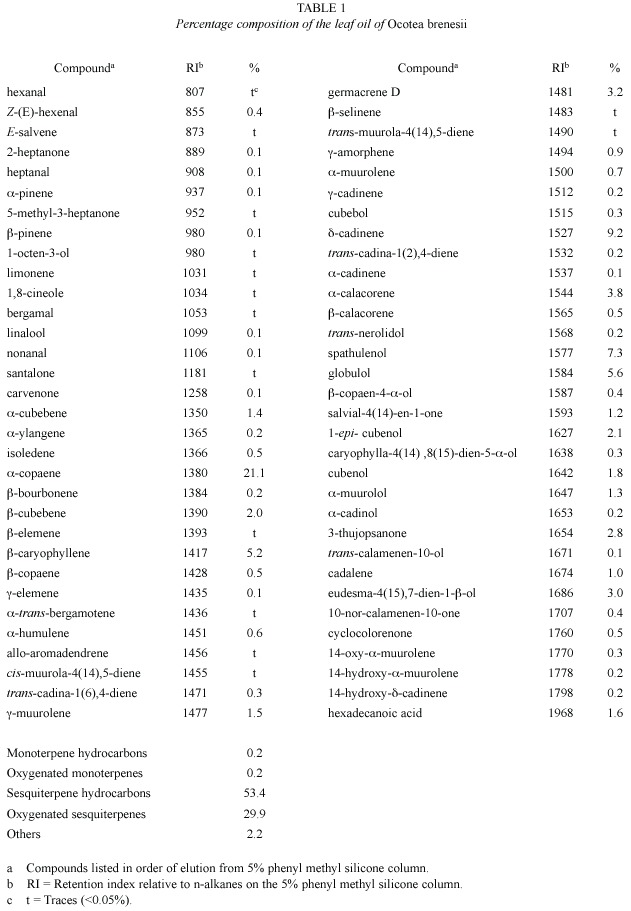
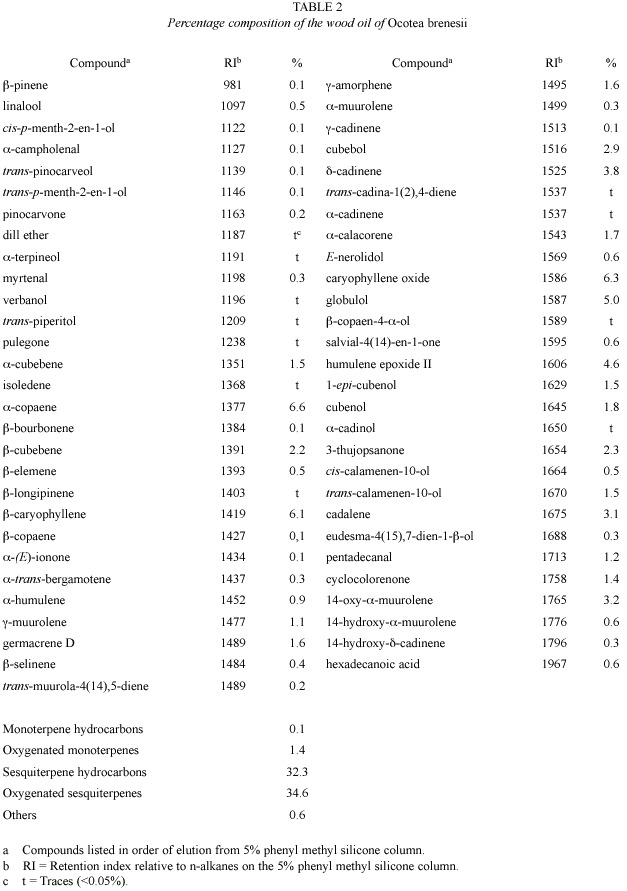
<body><![CDATA[<p><font face="Arial,Helvetica" size="2">Identification of the components of the oils were performed using the retention indices on DB-5 type column, and by comparison of their mass spectra with those published in the literature (<a href="#mc93">McLafferty 1993</a>, <a  href="#ad95">Adams 1995</a>, <a href="#ad01">2001</a>) or those of our own database. Integration of the total chromatogram, expressed as area percent, has been used to obtain quantitative compositional data. </font></p> <font face="Arial,Helvetica" size="2"><b>     <p>Results</p> </b></font>     <p><font face="Arial,Helvetica" size="2">The chemical compositions of the leaf and wood oils of <i>O. brenesii </i>are presented in <a  href="#t1">Tables 1</a> and <a href="#t2">2</a>. As it can be observed, 64 components were identified from leaves, representing <i>c</i></font><font  face="Arial,Helvetica" size="2">a. 86% of the oil. Sesquiterpenic hydrocarbons were the main constituents (53.4%) of the oil and contained&nbsp;<img src="/img/fbpe/rbt/v53n3-4/ALFA_P%D1A.JPG" title="" alt=""  style="width: 12px; height: 11px;"> -copaene (21.1%),&nbsp;<img  src="/img/fbpe/rbt/v53n3-4/DE.JPG" title="" alt="" style="width: 9px; height: 14px;"> -cadinene (9.2%) and&nbsp;<img src="/img/fbpe/rbt/v53n3-4/Beta.JPG" title="" alt=""  style="width: 7px; height: 14px;"> -caryophyllene (5.2%) as the main compounds. The second group in qu</font><font face="Arial,Helvetica"  size="2">antity was constituted by oxygenated sesquiterpenes (29.9%); spathulenol (7.3%) and globulol (5.6%) are the main constituents.</font></p> <a name="t1"></a>     
<div style="text-align: center;"><img src="/img/fbpe/rbt/v53n3-4/3241i8.JPG" title=""  alt="" style="width: 631px; height: 911px;"></div>     
<p><font face="Arial,Helvetica" size="2">    <br> <a name="t2"></a></font></p>     <div style="text-align: center;"><font face="Arial,Helvetica" size="2"><img  src="/img/fbpe/rbt/v53n3-4/3242i1.JPG" title="" alt=""  style="width: 627px; height: 891px;"></font>    
<br> </div>     <p><font face="Arial,Helvetica" size="2">    <br> From the wood, 57 compounds were identified, representing <i>c</i>a. 70% of the oil. The oxygenated sesquiterpenes (34.6%) and sesquiterpenic hydrocarbons (32.3<b>%) </b></font><font  face="Arial,Helvetica" size="2">are the principal constituents identified. The main oxide (6.3%),&nbsp;<img src="/img/fbpe/rbt/v53n3-4/Beta.JPG"  title="" alt="" style="width: 7px; height: 14px;"> -caryophyllene (6.1%), globulol (5.0%) and humulene epoxide II (4.6%). </font></p> <b><font face="Arial,Helvetica" size="2"></font></b>     
]]></body>
<body><![CDATA[<p><b><font face="Arial,Helvetica" size="2">Discussion</font></b></p>     <p><font face="Arial,Helvetica" size="2">There are several reports on the composition of the oils of plants of the genus <i>Ocotea </i>from South America (<a href="#mo59">Mors 1959</a>, <a href="#go60">Gottlieb and Magalhães 1960</a>, <a href="#go60a">Gottlieb <i>et a</i>l. 1960a</a>, <a href="#go60b">1960b</a>, <a href="#br69">Brooks and Campbell 1969</a>, <a href="#go81">Gottlieb <i>et a</i>l. 1981</a>, <a href="#de91">de Díaz <i>et a</i>l. 1991</a>, <a href="#re95">Reynolds and Kite 1995</a>, <a href="#lo01">Lorenzo <i>et a</i>l. 2001</a>, <a href="#br04">Bruni <i>et a</i>l. 2004</a>) and Africa (<a href="#te94">Terreaux <i>et a</i>l. 1994</a>, <a href="#me02">Menut <i>et a</i>l. 2002</a>). The majority of them are characterized by the presence of phenylpropanoids like safrole and <i>O</i>-methyleugenol, cinnamaldehydes and some other benzenoid derivatives. The results obtained in this study showed that the oils of <i>O. brenesii </i>are characterized by compounds of terpenic chemical nature and are lacking of phenylpropanoids or benzenoid constituents that are typical of the majority of the <i>Ocotea </i>essential oils investigated previously.</font></p> <font face="Arial,Helvetica" size="2"><b>     <p>Acknowledgments</p> </b></font>     <p><font face="Arial,Helvetica" size="2">The authors are grateful to Vicerrectoría de Investigación (UCR) (Project 809-A4-006) for financial support, to L. J. Poveda (Escuela de Ciencias Ambientales, UNA, Heredia) for the botanical identification, to L. Hernández (CIPRONA) for her technical assistance and to N. R. Farnsworth (College of Pharmacy, University of Illinois, USA at Chicago) for his help to access the NAPRALERT database. </font></p> <font face="Arial,Helvetica" size="2"><b>     <p>Resumen</p> </b></font>     <p><font face="Arial,Helvetica" size="2">Se determinó la composición química de los aceites esenciales obtenidos de las hojas y de la madera del árbol <i>Ocotea brenesii </i>Standl., perteneciente a la familia Lauraceae, que crece en forma silvestre en Costa Rica. Para el estudio se utilizaron técnicas de cromatografía de gases capilar con detector de ionización de flama (GC/FID) y cromatografía de gases capilar acoplada a un detector de espectrometría de masas (GC/MS). Del aceite volátil de las hojas fueron identificados 64 constituyentes, que correspo</font><font face="Arial,Helvetica" size="2">ndieron a un 85.9% del aceite. Del aceite de la madera se identificaron 57 compuestos que correspondieron a un 69.0% del aceite. Los constituyentes mayoritarios que se identificaron en el aceite de las hojas fueron </font><font  face="Arial,Helvetica" size="2"><img  src="/img/fbpe/rbt/v53n3-4/ALFA_P%D1A.JPG" title=""  alt="" style="width: 12px; height: 11px;"></font><font  face="Arial,Helvetica" size="2"> -copaeno (21.1%),&nbsp;<img  src="/img/fbpe/rbt/v53n3-4/DE.JPG" title="" alt="" style="width: 9px; height: 14px;"> -cadineno (9.2%), espatulenol (7.3%), globulol (5.6%) y&nbsp;<img  src="/img/fbpe/rbt/v53n3-4/Beta.JPG" title="" alt="" style="width: 7px; height: 14px;"> -cariofileno (5.2%). Los constituyentes mayoritarios del aceite de la madera fueron&nbsp;<img src="/img/fbpe/rbt/v53n3-4/ALFA_P%D1A.JPG" title="" alt=""  style="width: 12px; height: 11px;"> -copaeno (6.6%), óxido de cariofileno (6.3%), &#946; -cariofileno (6.1%) y el epóxido del humuleno (4.6%). La composici&#963;</font><font face="Arial,Helvetica" size="2">n de los aceites es de naturaleza terpénica y no presentaron compuestos del tipo fenilpropanoide o bencenoide que son constituyentes característicos de la mayoría de los aceites de plantas del género <i>Ocotea </i>investigados anteriormente.</font></p> <font face="Arial,Helvetica" size="2"><b></b></font>     
<p><font face="Arial,Helvetica" size="2"><b>Palabras clave: </b>Ocotea brenesii, Lauraceae, aceites esenciales, composición, </font><font  face="Arial,Helvetica" size="2"><img  src="/img/fbpe/rbt/v53n3-4/ALFA_P%D1A.JPG" title=""  alt="" style="width: 12px; height: 11px;"></font><font  face="Arial,Helvetica" size="2"> -copaeno, </font><font  face="Arial,Helvetica" size="2"><img  src="/img/fbpe/rbt/v53n3-4/DE.JPG" title="" alt=""  style="width: 9px; height: 14px;"></font><font face="Arial,Helvetica"  size="2"> -cadineno, espatulenol, óxido de cariofileno, </font><font  face="Arial,Helvetica" size="2"><img  src="/img/fbpe/rbt/v53n3-4/Beta.JPG" title="" alt=""  style="width: 7px; height: 14px;"></font><font face="Arial,Helvetica"  size="2"> -cariofileno, globulol.</font></p> <b><font face="Arial,Helvetica" size="2">     
<p>References</p> </font></b>     <!-- ref --><p><font face="Arial,Helvetica" size="2"><a name="ad95"></a>Adams, R.P. 1995. Identification of Essential Oil Components by Gas Chromatography/Mass Spectroscopy. Allured, Carol Stream, Illinois, USA. 475 p. </font>&nbsp;&nbsp;&nbsp;&nbsp;&nbsp;&nbsp;&nbsp;&nbsp;[&#160;<a href="javascript:void(0);" onclick="javascript: window.open('/scielo.php?script=sci_nlinks&ref=1224155&pid=S0034-7744200500020001100001&lng=','','width=640,height=500,resizable=yes,scrollbars=1,menubar=yes,');">Links</a>&#160;]<!-- end-ref --><!-- ref --><p><font face="Arial,Helvetica" size="2"><a name="ad01"></a>Adams, R.P. 2001. Identification of Essential Oil Components by Gas Chromatography / Quadrupole Mass Spectroscop<i>y. </i>Allured, Carol Stream, Illinois, USA. 462 p.</font>&nbsp;&nbsp;&nbsp;&nbsp;&nbsp;&nbsp;&nbsp;&nbsp;[&#160;<a href="javascript:void(0);" onclick="javascript: window.open('/scielo.php?script=sci_nlinks&ref=1224156&pid=S0034-7744200500020001100002&lng=','','width=640,height=500,resizable=yes,scrollbars=1,menubar=yes,');">Links</a>&#160;]<!-- end-ref --><!-- ref --><p><font face="Arial,Helvetica" size="2"><a name="br69"></a>Brooks, C.J. W. &amp; M.M. Campbell. 1969. Caparrapi oxide, a new sesquiterpenoid from caparrapi oil. Phytochemistry 8: 215-218.</font>&nbsp;&nbsp;&nbsp;&nbsp;&nbsp;&nbsp;&nbsp;&nbsp;[&#160;<a href="javascript:void(0);" onclick="javascript: window.open('/scielo.php?script=sci_nlinks&ref=1224157&pid=S0034-7744200500020001100003&lng=','','width=640,height=500,resizable=yes,scrollbars=1,menubar=yes,');">Links</a>&#160;]<!-- end-ref --><!-- ref --><p><font face="Arial,Helvetica" size="2"><a name="br04"></a>Bruni, R., A. Medici, E. Andreotti, C. Fantin, M. Muzzoli, M. Dehesa, C. Romagnoli &amp; G. Sacchetti. 2004. Chemical composition and biological activities of Ishpingo essential oil, a traditional Ecuadorian spice from <i>Ocotea quixos </i>(Lam.) Kosterm. (Lauraceae) flower calices. Food Chem. 85: 415-421.</font>&nbsp;&nbsp;&nbsp;&nbsp;&nbsp;&nbsp;&nbsp;&nbsp;[&#160;<a href="javascript:void(0);" onclick="javascript: window.open('/scielo.php?script=sci_nlinks&ref=1224158&pid=S0034-7744200500020001100004&lng=','','width=640,height=500,resizable=yes,scrollbars=1,menubar=yes,');">Links</a>&#160;]<!-- end-ref --><!-- ref --><p><font face="Arial,Helvetica" size="2"><a name="bu90"></a>Burger, W. &amp; H. van der Werff. 1990. Lauraceae. <i>In </i>Flora costaricensi<i>s. </i>Fieldiana, Bot., n.s. 23: 1-129.</font>&nbsp;&nbsp;&nbsp;&nbsp;&nbsp;&nbsp;&nbsp;&nbsp;[&#160;<a href="javascript:void(0);" onclick="javascript: window.open('/scielo.php?script=sci_nlinks&ref=1224159&pid=S0034-7744200500020001100005&lng=','','width=640,height=500,resizable=yes,scrollbars=1,menubar=yes,');">Links</a>&#160;]<!-- end-ref --><!-- ref --><p><font face="Arial,Helvetica" size="2"><a name="ca93"></a>Castro, O.C. 1993. Chemical and biological extractives of Lauraceae species in Costa Rican tropical forests, pp. 65-87. <i>In </i>K. R. Downum, J. T. Romeo &amp; H. A. Stafford (eds.). Phytochemical Potential of Tropical Plants. Plenum, New York, New York, USA.</font>&nbsp;&nbsp;&nbsp;&nbsp;&nbsp;&nbsp;&nbsp;&nbsp;[&#160;<a href="javascript:void(0);" onclick="javascript: window.open('/scielo.php?script=sci_nlinks&ref=1224160&pid=S0034-7744200500020001100006&lng=','','width=640,height=500,resizable=yes,scrollbars=1,menubar=yes,');">Links</a>&#160;]<!-- end-ref --><!-- ref --><p><font face="Arial,Helvetica" size="2"><a name="de91"></a>de Díaz, A.M.P., P.P. Díaz &amp; P. Joseph-Nathan. 1991. C6- C3 and C6C1 metabolites from the essential oil of the wood bark of <i>Ocotea caparrap</i>i. Rev. Latinoamer. Quím. 22: 60-62.</font>&nbsp;&nbsp;&nbsp;&nbsp;&nbsp;&nbsp;&nbsp;&nbsp;[&#160;<a href="javascript:void(0);" onclick="javascript: window.open('/scielo.php?script=sci_nlinks&ref=1224161&pid=S0034-7744200500020001100007&lng=','','width=640,height=500,resizable=yes,scrollbars=1,menubar=yes,');">Links</a>&#160;]<!-- end-ref --><!-- ref --><p><font face="Arial,Helvetica" size="2"><a name="fr75"></a>Franca, N.C., A.M. Giesbrecht, O.R. Gottlieb, A.F. Magalhães, E.G. Magalhães &amp; J.G.S. Maia. 1975. Chemistry of Brazilian Lauraceae. Part 32. Benzylisoquinolines from <i>Ocotea </i>species. Phytochemistry 14: 1671-1672.</font>&nbsp;&nbsp;&nbsp;&nbsp;&nbsp;&nbsp;&nbsp;&nbsp;[&#160;<a href="javascript:void(0);" onclick="javascript: window.open('/scielo.php?script=sci_nlinks&ref=1224162&pid=S0034-7744200500020001100008&lng=','','width=640,height=500,resizable=yes,scrollbars=1,menubar=yes,');">Links</a>&#160;]<!-- end-ref --><!-- ref --><p><font face="Arial,Helvetica" size="2"><a name="go74"></a>Gottlieb, O.R. 1974. Lignans and neolignans. Rev. Latinoamer. Quím. 5: 1-11.</font>&nbsp;&nbsp;&nbsp;&nbsp;&nbsp;&nbsp;&nbsp;&nbsp;[&#160;<a href="javascript:void(0);" onclick="javascript: window.open('/scielo.php?script=sci_nlinks&ref=1224163&pid=S0034-7744200500020001100009&lng=','','width=640,height=500,resizable=yes,scrollbars=1,menubar=yes,');">Links</a>&#160;]<!-- end-ref --><!-- ref --><p><font face="Arial,Helvetica" size="2"><a name="go60"></a>Gottlieb, O.R. &amp; M.T. Magalhães. 1960. Physiological varieties of <i>Ocotea pretiosa. </i>II. Perfum. Essent. Oil Rec. 51: 18-21.</font>&nbsp;&nbsp;&nbsp;&nbsp;&nbsp;&nbsp;&nbsp;&nbsp;[&#160;<a href="javascript:void(0);" onclick="javascript: window.open('/scielo.php?script=sci_nlinks&ref=1224164&pid=S0034-7744200500020001100010&lng=','','width=640,height=500,resizable=yes,scrollbars=1,menubar=yes,');">Links</a>&#160;]<!-- end-ref --><!-- ref --><p><font face="Arial,Helvetica" size="2"><a name="go60a"></a>Gottlieb, O.R., M. Fineberg and M.T. Magalhães. 1960a. Physiological varieties of <i>Ocotea pretios</i>a. III. Perfum. Essent. Oil Rec. 53: 219-221.</font>&nbsp;&nbsp;&nbsp;&nbsp;&nbsp;&nbsp;&nbsp;&nbsp;[&#160;<a href="javascript:void(0);" onclick="javascript: window.open('/scielo.php?script=sci_nlinks&ref=1224165&pid=S0034-7744200500020001100011&lng=','','width=640,height=500,resizable=yes,scrollbars=1,menubar=yes,');">Links</a>&#160;]<!-- end-ref --><!-- ref --><p><font face="Arial,Helvetica" size="2"><a name="go60b"></a>Gottlieb, O.R., M. Fineberg &amp; M.T. Magalhães. 1960b. Physiological varieties of <i>Ocotea pretios</i>a. IV. Perfum. Essent. Oil Rec. 53: 299-301.</font>&nbsp;&nbsp;&nbsp;&nbsp;&nbsp;&nbsp;&nbsp;&nbsp;[&#160;<a href="javascript:void(0);" onclick="javascript: window.open('/scielo.php?script=sci_nlinks&ref=1224166&pid=S0034-7744200500020001100012&lng=','','width=640,height=500,resizable=yes,scrollbars=1,menubar=yes,');">Links</a>&#160;]<!-- end-ref --><!-- ref --><p><font face="Arial,Helvetica" size="2"><a name="go81"></a>Gottlieb, O.R., M. Koketsu, M.T. Magalhães, S.M.J. Guilherme, P.H. Mendes, A.I. Da Rocha, M.L. Da Silva &amp; V.C. Wilberg. 1981. Óleos esenciais da Amazônia VII. Acta Amazonica 11: 143-148.</font>&nbsp;&nbsp;&nbsp;&nbsp;&nbsp;&nbsp;&nbsp;&nbsp;[&#160;<a href="javascript:void(0);" onclick="javascript: window.open('/scielo.php?script=sci_nlinks&ref=1224167&pid=S0034-7744200500020001100013&lng=','','width=640,height=500,resizable=yes,scrollbars=1,menubar=yes,');">Links</a>&#160;]<!-- end-ref --><!-- ref --><p><font face="Arial,Helvetica" size="2"><a name="ha96"></a>Haber, W.A., W. Zuchowski &amp; E. Bello. 1996. An introduction to Cloud forest trees: Monteverde, Costa Rica. La Nación (newspaper), San José, Costa Rica. 204 p.</font>&nbsp;&nbsp;&nbsp;&nbsp;&nbsp;&nbsp;&nbsp;&nbsp;[&#160;<a href="javascript:void(0);" onclick="javascript: window.open('/scielo.php?script=sci_nlinks&ref=1224168&pid=S0034-7744200500020001100014&lng=','','width=640,height=500,resizable=yes,scrollbars=1,menubar=yes,');">Links</a>&#160;]<!-- end-ref --><!-- ref --><p><font face="Arial,Helvetica" size="2"><a name="is91"></a>Ishige, M., M. Motidome, M. Yoshida &amp; O.R. Gottlieb. 1991. Neolignans from <i>Ocotea catharinensi</i>s. Phytochemistry 30: 4121-4128.</font>&nbsp;&nbsp;&nbsp;&nbsp;&nbsp;&nbsp;&nbsp;&nbsp;[&#160;<a href="javascript:void(0);" onclick="javascript: window.open('/scielo.php?script=sci_nlinks&ref=1224169&pid=S0034-7744200500020001100015&lng=','','width=640,height=500,resizable=yes,scrollbars=1,menubar=yes,');">Links</a>&#160;]<!-- end-ref --><!-- ref --><p><font face="Arial,Helvetica" size="2"><a name="lo95"></a>López, J.A., W. Barillas, J. Gómez-Laurito, F.T. Lin, A.J. Al-Rehaily, M.H.M. Sharaf &amp; P.L. Schiff Jr. 1995. Aporphine alkaloids of selected species of <i>Nectandra </i>and <i>Ocote</i>a. Planta Med. 61: 589.</font>&nbsp;&nbsp;&nbsp;&nbsp;&nbsp;&nbsp;&nbsp;&nbsp;[&#160;<a href="javascript:void(0);" onclick="javascript: window.open('/scielo.php?script=sci_nlinks&ref=1224170&pid=S0034-7744200500020001100016&lng=','','width=640,height=500,resizable=yes,scrollbars=1,menubar=yes,');">Links</a>&#160;]<!-- end-ref --><!-- ref --><p><font face="Arial,Helvetica" size="2"><a name="lo96"></a>López, J.A., W. Barillas, J. Gómez-Laurito, F.T. Lin, A.J. Al-Rehaily, M.H.M. Sharaf &amp; P.L. Schiff Jr. 1996. Aporphine alkaloids of <i>Ocotea brenesi</i>i. Int. J. Pharmacog. 34:145-147.</font>&nbsp;&nbsp;&nbsp;&nbsp;&nbsp;&nbsp;&nbsp;&nbsp;[&#160;<a href="javascript:void(0);" onclick="javascript: window.open('/scielo.php?script=sci_nlinks&ref=1224171&pid=S0034-7744200500020001100017&lng=','','width=640,height=500,resizable=yes,scrollbars=1,menubar=yes,');">Links</a>&#160;]<!-- end-ref --><!-- ref --><p><font face="Arial,Helvetica" size="2"><a name="lo01"></a>Lorenzo, D., I. Loayza, L. Leigue, C. Frizzo, E. Dellacassa &amp; P. Moyna. 2001. Asaricin, the main component of <i>Ocotea opifera </i>Mart. essential oil. Nat. Prod. Lett. 15: 163-170.</font>&nbsp;&nbsp;&nbsp;&nbsp;&nbsp;&nbsp;&nbsp;&nbsp;[&#160;<a href="javascript:void(0);" onclick="javascript: window.open('/scielo.php?script=sci_nlinks&ref=1224172&pid=S0034-7744200500020001100018&lng=','','width=640,height=500,resizable=yes,scrollbars=1,menubar=yes,');">Links</a>&#160;]<!-- end-ref --><!-- ref --><p><font face="Arial,Helvetica" size="2"><a name="mc93"></a>McLafferty, F.W. 1993. Registry of Mass Spectral Data. Wiley, New York, New York, USA.</font>&nbsp;&nbsp;&nbsp;&nbsp;&nbsp;&nbsp;&nbsp;&nbsp;[&#160;<a href="javascript:void(0);" onclick="javascript: window.open('/scielo.php?script=sci_nlinks&ref=1224173&pid=S0034-7744200500020001100019&lng=','','width=640,height=500,resizable=yes,scrollbars=1,menubar=yes,');">Links</a>&#160;]<!-- end-ref --><!-- ref --><p><font face="Arial,Helvetica" size="2"><a name="me02"></a>Menut, C., J.M. Bessière, M. Said Hassani, G. Buchbauer &amp; B. Schopper. 2002. Chemical and biological studies of <i>Ocotea comoriensis </i>bark essential oil. Flav. Fragr. J. 17: 459-461.</font>&nbsp;&nbsp;&nbsp;&nbsp;&nbsp;&nbsp;&nbsp;&nbsp;[&#160;<a href="javascript:void(0);" onclick="javascript: window.open('/scielo.php?script=sci_nlinks&ref=1224174&pid=S0034-7744200500020001100020&lng=','','width=640,height=500,resizable=yes,scrollbars=1,menubar=yes,');">Links</a>&#160;]<!-- end-ref --><!-- ref --><p><font face="Arial,Helvetica" size="2"><a name="mo59"></a>Mors, W.B., M.T. Magalhães &amp; O.R. Gottlieb. 1959. Physiological varieties <i>of Ocotea pretiosa. </i>I. Perfum. Essent. Oil Rec. 50: 26-27.</font>&nbsp;&nbsp;&nbsp;&nbsp;&nbsp;&nbsp;&nbsp;&nbsp;[&#160;<a href="javascript:void(0);" onclick="javascript: window.open('/scielo.php?script=sci_nlinks&ref=1224175&pid=S0034-7744200500020001100021&lng=','','width=640,height=500,resizable=yes,scrollbars=1,menubar=yes,');">Links</a>&#160;]<!-- end-ref --><!-- ref --><p><font face="Arial,Helvetica" size="2"><a name="re95"></a>Reynolds, T. &amp; G. Kite. 1995. Volatile constituens of <i>Ocotea porosa (Phoebe poros</i>a) Mez. J. Essent. Oil Res. 7: 415-416.</font>&nbsp;&nbsp;&nbsp;&nbsp;&nbsp;&nbsp;&nbsp;&nbsp;[&#160;<a href="javascript:void(0);" onclick="javascript: window.open('/scielo.php?script=sci_nlinks&ref=1224176&pid=S0034-7744200500020001100022&lng=','','width=640,height=500,resizable=yes,scrollbars=1,menubar=yes,');">Links</a>&#160;]<!-- end-ref --><!-- ref --><p><font face="Arial,Helvetica" size="2"><a name="te94"></a>Terreaux, C., M. Maillard, K. Hostettmann, G. Lodi &amp; E. Hakizamung<i>u. </i>1994. Analysis of the fungicidal constituents from the bark of <i>Ocotea usambarensis </i>Engl. (Lauraceae). Phytochem. Anal. 5: 233-238.</font>&nbsp;&nbsp;&nbsp;&nbsp;&nbsp;&nbsp;&nbsp;&nbsp;[&#160;<a href="javascript:void(0);" onclick="javascript: window.open('/scielo.php?script=sci_nlinks&ref=1224177&pid=S0034-7744200500020001100023&lng=','','width=640,height=500,resizable=yes,scrollbars=1,menubar=yes,');">Links</a>&#160;]<!-- end-ref --><!-- ref --><p><font face="Arial,Helvetica" size="2"><a name="va02"></a>van der Werff, H. 2002. A synopsis of <i>Ocotea </i>(Lauraceae) in Central America and Southern Mexico. Ann. Missouri Bot. Gard. 89: 429-451.</font>&nbsp;&nbsp;&nbsp;&nbsp;&nbsp;&nbsp;&nbsp;&nbsp;[&#160;<a href="javascript:void(0);" onclick="javascript: window.open('/scielo.php?script=sci_nlinks&ref=1224178&pid=S0034-7744200500020001100024&lng=','','width=640,height=500,resizable=yes,scrollbars=1,menubar=yes,');">Links</a>&#160;]<!-- end-ref --> ]]></body><back>
<ref-list>
<ref id="B1">
<nlm-citation citation-type="book">
<person-group person-group-type="author">
<name>
<surname><![CDATA[Adams]]></surname>
<given-names><![CDATA[R.P]]></given-names>
</name>
</person-group>
<source><![CDATA[Identification of Essential Oil Components by Gas Chromatography/Mass Spectroscopy]]></source>
<year>1995</year>
<page-range>475</page-range><publisher-loc><![CDATA[^eIllinois Illinois]]></publisher-loc>
<publisher-name><![CDATA[Allured]]></publisher-name>
</nlm-citation>
</ref>
<ref id="B2">
<nlm-citation citation-type="book">
<person-group person-group-type="author">
<name>
<surname><![CDATA[Adams]]></surname>
<given-names><![CDATA[R.P]]></given-names>
</name>
</person-group>
<source><![CDATA[Identification of Essential Oil Components by Gas Chromatography / Quadrupole Mass Spectroscopy]]></source>
<year>2001</year>
<page-range>462</page-range><publisher-loc><![CDATA[^eIllinois Illinois]]></publisher-loc>
<publisher-name><![CDATA[Allured]]></publisher-name>
</nlm-citation>
</ref>
<ref id="B3">
<nlm-citation citation-type="journal">
<person-group person-group-type="author">
<name>
<surname><![CDATA[Brooks]]></surname>
<given-names><![CDATA[C.J. W]]></given-names>
</name>
<name>
<surname><![CDATA[Campbell]]></surname>
<given-names><![CDATA[M.M]]></given-names>
</name>
</person-group>
<article-title xml:lang="en"><![CDATA[Caparrapi oxide, a new sesquiterpenoid from caparrapi oil]]></article-title>
<source><![CDATA[Phytochemistry]]></source>
<year>1969</year>
<volume>8</volume>
<page-range>215-218</page-range></nlm-citation>
</ref>
<ref id="B4">
<nlm-citation citation-type="journal">
<person-group person-group-type="author">
<name>
<surname><![CDATA[Bruni]]></surname>
<given-names><![CDATA[R]]></given-names>
</name>
<name>
<surname><![CDATA[Medici]]></surname>
<given-names><![CDATA[A]]></given-names>
</name>
<name>
<surname><![CDATA[Andreotti]]></surname>
<given-names><![CDATA[E]]></given-names>
</name>
<name>
<surname><![CDATA[Fantin]]></surname>
<given-names><![CDATA[C]]></given-names>
</name>
<name>
<surname><![CDATA[Muzzoli]]></surname>
<given-names><![CDATA[M]]></given-names>
</name>
<name>
<surname><![CDATA[Dehesa]]></surname>
<given-names><![CDATA[M]]></given-names>
</name>
<name>
<surname><![CDATA[Romagnoli]]></surname>
<given-names><![CDATA[C]]></given-names>
</name>
<name>
<surname><![CDATA[Sacchetti]]></surname>
<given-names><![CDATA[G]]></given-names>
</name>
</person-group>
<article-title xml:lang="en"><![CDATA[Chemical composition and biological activities of Ishpingo essential oil, a traditional Ecuadorian spice from Ocotea quixos (Lam.) Kosterm. (Lauraceae) flower calices]]></article-title>
<source><![CDATA[Food Chem]]></source>
<year>2004</year>
<volume>85</volume>
<page-range>415-421</page-range></nlm-citation>
</ref>
<ref id="B5">
<nlm-citation citation-type="">
<person-group person-group-type="author">
<name>
<surname><![CDATA[Burger]]></surname>
<given-names><![CDATA[W]]></given-names>
</name>
<name>
<surname><![CDATA[van der Werff]]></surname>
<given-names><![CDATA[H]]></given-names>
</name>
</person-group>
<article-title xml:lang="en"><![CDATA[Lauraceae]]></article-title>
<source><![CDATA[Flora costaricensis]]></source>
<year>1990</year>
<volume>23</volume>
<page-range>1-129</page-range></nlm-citation>
</ref>
<ref id="B6">
<nlm-citation citation-type="book">
<person-group person-group-type="author">
<name>
<surname><![CDATA[Castro]]></surname>
<given-names><![CDATA[O.C]]></given-names>
</name>
</person-group>
<article-title xml:lang="en"><![CDATA[Chemical and biological extractives of Lauraceae species in Costa Rican tropical forests]]></article-title>
<person-group person-group-type="editor">
<name>
<surname><![CDATA[Downum]]></surname>
<given-names><![CDATA[K. R]]></given-names>
</name>
<name>
<surname><![CDATA[Romeo]]></surname>
<given-names><![CDATA[J. T]]></given-names>
</name>
<name>
<surname><![CDATA[Stafford]]></surname>
<given-names><![CDATA[H. A]]></given-names>
</name>
</person-group>
<source><![CDATA[Phytochemical Potential of Tropical Plants]]></source>
<year>1993</year>
<page-range>65-87</page-range><publisher-loc><![CDATA[New York^eNew York New York]]></publisher-loc>
<publisher-name><![CDATA[Plenum]]></publisher-name>
</nlm-citation>
</ref>
<ref id="B7">
<nlm-citation citation-type="journal">
<person-group person-group-type="author">
<name>
<surname><![CDATA[de Díaz]]></surname>
<given-names><![CDATA[A.M.P]]></given-names>
</name>
<name>
<surname><![CDATA[Díaz]]></surname>
<given-names><![CDATA[P.P]]></given-names>
</name>
<name>
<surname><![CDATA[Joseph-Nathan]]></surname>
<given-names><![CDATA[P]]></given-names>
</name>
</person-group>
<article-title xml:lang="en"><![CDATA[C6- C3 and C6C1 metabolites from the essential oil of the wood bark of Ocotea caparrapi]]></article-title>
<source><![CDATA[Rev. Latinoamer. Quím]]></source>
<year>1991</year>
<volume>22</volume>
<page-range>60-62</page-range></nlm-citation>
</ref>
<ref id="B8">
<nlm-citation citation-type="journal">
<person-group person-group-type="author">
<name>
<surname><![CDATA[Franca]]></surname>
<given-names><![CDATA[N.C]]></given-names>
</name>
<name>
<surname><![CDATA[Giesbrecht]]></surname>
<given-names><![CDATA[A.M]]></given-names>
</name>
<name>
<surname><![CDATA[Gottlieb]]></surname>
<given-names><![CDATA[O.R]]></given-names>
</name>
<name>
<surname><![CDATA[Magalhães]]></surname>
<given-names><![CDATA[A.F]]></given-names>
</name>
<name>
<surname><![CDATA[Magalhães]]></surname>
<given-names><![CDATA[E.G]]></given-names>
</name>
<name>
<surname><![CDATA[Maia]]></surname>
<given-names><![CDATA[J.G.S]]></given-names>
</name>
</person-group>
<article-title xml:lang="en"><![CDATA[Chemistry of Brazilian Lauraceae. Part 32. Benzylisoquinolines from Ocotea species]]></article-title>
<source><![CDATA[Phytochemistry]]></source>
<year>1975</year>
<volume>14</volume>
<page-range>1671-1672</page-range></nlm-citation>
</ref>
<ref id="B9">
<nlm-citation citation-type="journal">
<person-group person-group-type="author">
<name>
<surname><![CDATA[Gottlieb]]></surname>
<given-names><![CDATA[O.R]]></given-names>
</name>
</person-group>
<article-title xml:lang="en"><![CDATA[Lignans and neolignans]]></article-title>
<source><![CDATA[Rev. Latinoamer. Quím]]></source>
<year>1974</year>
<volume>5</volume>
<page-range>1-11</page-range></nlm-citation>
</ref>
<ref id="B10">
<nlm-citation citation-type="journal">
<person-group person-group-type="author">
<name>
<surname><![CDATA[Gottlieb]]></surname>
<given-names><![CDATA[O.R]]></given-names>
</name>
<name>
<surname><![CDATA[Magalhães]]></surname>
<given-names><![CDATA[M.T]]></given-names>
</name>
</person-group>
<article-title xml:lang="en"><![CDATA[Physiological varieties of Ocotea pretiosa. II]]></article-title>
<source><![CDATA[Perfum. Essent. Oil Rec]]></source>
<year>1960</year>
<volume>51</volume>
<page-range>18-21</page-range></nlm-citation>
</ref>
<ref id="B11">
<nlm-citation citation-type="journal">
<person-group person-group-type="author">
<name>
<surname><![CDATA[Gottlieb]]></surname>
<given-names><![CDATA[O.R]]></given-names>
</name>
<name>
<surname><![CDATA[Fineberg]]></surname>
<given-names><![CDATA[M]]></given-names>
</name>
<name>
<surname><![CDATA[Magalhães]]></surname>
<given-names><![CDATA[M.T]]></given-names>
</name>
</person-group>
<article-title xml:lang="en"><![CDATA[Physiological varieties of Ocotea pretiosa. III]]></article-title>
<source><![CDATA[Perfum. Essent. Oil Rec]]></source>
<year>1960</year>
<month>a</month>
<volume>53</volume>
<page-range>219-221</page-range></nlm-citation>
</ref>
<ref id="B12">
<nlm-citation citation-type="journal">
<person-group person-group-type="author">
<name>
<surname><![CDATA[Gottlieb]]></surname>
<given-names><![CDATA[O.R]]></given-names>
</name>
<name>
<surname><![CDATA[Fineberg]]></surname>
<given-names><![CDATA[M]]></given-names>
</name>
<name>
<surname><![CDATA[Magalhães]]></surname>
<given-names><![CDATA[M.T]]></given-names>
</name>
</person-group>
<article-title xml:lang="en"><![CDATA[Physiological varieties of Ocotea pretiosa. IV]]></article-title>
<source><![CDATA[Perfum. Essent. Oil Rec]]></source>
<year>1960</year>
<month>b</month>
<volume>53</volume>
<page-range>299-301</page-range></nlm-citation>
</ref>
<ref id="B13">
<nlm-citation citation-type="journal">
<person-group person-group-type="author">
<name>
<surname><![CDATA[Gottlieb]]></surname>
<given-names><![CDATA[O.R]]></given-names>
</name>
<name>
<surname><![CDATA[Koketsu]]></surname>
<given-names><![CDATA[M]]></given-names>
</name>
<name>
<surname><![CDATA[Magalhães]]></surname>
<given-names><![CDATA[M.T]]></given-names>
</name>
<name>
<surname><![CDATA[Guilherme]]></surname>
<given-names><![CDATA[S.M.J]]></given-names>
</name>
<name>
<surname><![CDATA[Mendes]]></surname>
<given-names><![CDATA[P.H]]></given-names>
</name>
<name>
<surname><![CDATA[Da Rocha]]></surname>
<given-names><![CDATA[A.I]]></given-names>
</name>
<name>
<surname><![CDATA[Da Silva]]></surname>
<given-names><![CDATA[M.L]]></given-names>
</name>
<name>
<surname><![CDATA[Wilberg]]></surname>
<given-names><![CDATA[V.C]]></given-names>
</name>
</person-group>
<article-title xml:lang="pt"><![CDATA[Óleos esenciais da Amazônia VII]]></article-title>
<source><![CDATA[Acta Amazonica]]></source>
<year>1981</year>
<volume>11</volume>
<page-range>143-148</page-range></nlm-citation>
</ref>
<ref id="B14">
<nlm-citation citation-type="book">
<person-group person-group-type="author">
<name>
<surname><![CDATA[Haber]]></surname>
<given-names><![CDATA[W.A]]></given-names>
</name>
<name>
<surname><![CDATA[Zuchowski]]></surname>
<given-names><![CDATA[W]]></given-names>
</name>
<name>
<surname><![CDATA[Bello]]></surname>
<given-names><![CDATA[E]]></given-names>
</name>
</person-group>
<source><![CDATA[An introduction to Cloud forest trees: Monteverde, Costa Rica]]></source>
<year>1996</year>
<page-range>204</page-range><publisher-loc><![CDATA[San José ]]></publisher-loc>
<publisher-name><![CDATA[La Nación (newspaper)]]></publisher-name>
</nlm-citation>
</ref>
<ref id="B15">
<nlm-citation citation-type="journal">
<person-group person-group-type="author">
<name>
<surname><![CDATA[Ishige]]></surname>
<given-names><![CDATA[M]]></given-names>
</name>
<name>
<surname><![CDATA[Motidome]]></surname>
<given-names><![CDATA[M]]></given-names>
</name>
<name>
<surname><![CDATA[Yoshida]]></surname>
<given-names><![CDATA[M]]></given-names>
</name>
<name>
<surname><![CDATA[Gottlieb]]></surname>
<given-names><![CDATA[O.R]]></given-names>
</name>
</person-group>
<article-title xml:lang="en"><![CDATA[Neolignans from Ocotea catharinensis]]></article-title>
<source><![CDATA[Phytochemistry]]></source>
<year>1991</year>
<volume>30</volume>
<page-range>4121-4128</page-range></nlm-citation>
</ref>
<ref id="B16">
<nlm-citation citation-type="journal">
<person-group person-group-type="author">
<name>
<surname><![CDATA[López]]></surname>
<given-names><![CDATA[J.A]]></given-names>
</name>
<name>
<surname><![CDATA[Barillas]]></surname>
<given-names><![CDATA[W]]></given-names>
</name>
<name>
<surname><![CDATA[Gómez-Laurito]]></surname>
<given-names><![CDATA[J]]></given-names>
</name>
<name>
<surname><![CDATA[Lin]]></surname>
<given-names><![CDATA[F.T]]></given-names>
</name>
<name>
<surname><![CDATA[Al-Rehaily]]></surname>
<given-names><![CDATA[A.J]]></given-names>
</name>
<name>
<surname><![CDATA[Sharaf]]></surname>
<given-names><![CDATA[M.H.M]]></given-names>
</name>
<name>
<surname><![CDATA[Schiff Jr]]></surname>
<given-names><![CDATA[P.L]]></given-names>
</name>
</person-group>
<article-title xml:lang="en"><![CDATA[Aporphine alkaloids of selected species of Nectandra and Ocotea]]></article-title>
<source><![CDATA[Planta Med]]></source>
<year>1995</year>
<volume>61</volume>
<page-range>589</page-range></nlm-citation>
</ref>
<ref id="B17">
<nlm-citation citation-type="journal">
<person-group person-group-type="author">
<name>
<surname><![CDATA[López]]></surname>
<given-names><![CDATA[J.A]]></given-names>
</name>
<name>
<surname><![CDATA[Barillas]]></surname>
<given-names><![CDATA[W]]></given-names>
</name>
<name>
<surname><![CDATA[Gómez-Laurito]]></surname>
<given-names><![CDATA[J]]></given-names>
</name>
<name>
<surname><![CDATA[Lin]]></surname>
<given-names><![CDATA[F.T]]></given-names>
</name>
<name>
<surname><![CDATA[Al-Rehaily]]></surname>
<given-names><![CDATA[A.J]]></given-names>
</name>
<name>
<surname><![CDATA[Sharaf]]></surname>
<given-names><![CDATA[M.H.M]]></given-names>
</name>
<name>
<surname><![CDATA[Schiff Jr]]></surname>
<given-names><![CDATA[P.L]]></given-names>
</name>
</person-group>
<article-title xml:lang="en"><![CDATA[Aporphine alkaloids of Ocotea brenesii]]></article-title>
<source><![CDATA[Int. J. Pharmacog]]></source>
<year>1996</year>
<volume>34</volume>
<page-range>145-147</page-range></nlm-citation>
</ref>
<ref id="B18">
<nlm-citation citation-type="journal">
<person-group person-group-type="author">
<name>
<surname><![CDATA[Lorenzo]]></surname>
<given-names><![CDATA[D]]></given-names>
</name>
<name>
<surname><![CDATA[Loayza]]></surname>
<given-names><![CDATA[I]]></given-names>
</name>
<name>
<surname><![CDATA[Leigue]]></surname>
<given-names><![CDATA[L]]></given-names>
</name>
<name>
<surname><![CDATA[Frizzo]]></surname>
<given-names><![CDATA[C]]></given-names>
</name>
<name>
<surname><![CDATA[Dellacassa]]></surname>
<given-names><![CDATA[E]]></given-names>
</name>
<name>
<surname><![CDATA[Moyna]]></surname>
<given-names><![CDATA[P]]></given-names>
</name>
</person-group>
<article-title xml:lang="en"><![CDATA[Asaricin, the main component of Ocotea opifera Mart. essential oil]]></article-title>
<source><![CDATA[Nat. Prod. Lett]]></source>
<year>2001</year>
<volume>15</volume>
<page-range>163-170</page-range></nlm-citation>
</ref>
<ref id="B19">
<nlm-citation citation-type="book">
<person-group person-group-type="author">
<name>
<surname><![CDATA[McLafferty]]></surname>
<given-names><![CDATA[F.W]]></given-names>
</name>
</person-group>
<source><![CDATA[Registry of Mass Spectral Data]]></source>
<year>1993</year>
<publisher-loc><![CDATA[New York^eNew York New York]]></publisher-loc>
<publisher-name><![CDATA[Wiley]]></publisher-name>
</nlm-citation>
</ref>
<ref id="B20">
<nlm-citation citation-type="journal">
<person-group person-group-type="author">
<name>
<surname><![CDATA[Menut]]></surname>
<given-names><![CDATA[C]]></given-names>
</name>
<name>
<surname><![CDATA[Bessière]]></surname>
<given-names><![CDATA[J.M]]></given-names>
</name>
<name>
<surname><![CDATA[Said Hassani]]></surname>
<given-names><![CDATA[M]]></given-names>
</name>
<name>
<surname><![CDATA[Buchbauer]]></surname>
<given-names><![CDATA[G]]></given-names>
</name>
<name>
<surname><![CDATA[Schopper]]></surname>
<given-names><![CDATA[B]]></given-names>
</name>
</person-group>
<article-title xml:lang="en"><![CDATA[Chemical and biological studies of Ocotea comoriensis bark essential oil]]></article-title>
<source><![CDATA[Flav. Fragr. J]]></source>
<year>2002</year>
<volume>17</volume>
<page-range>459-461</page-range></nlm-citation>
</ref>
<ref id="B21">
<nlm-citation citation-type="journal">
<person-group person-group-type="author">
<name>
<surname><![CDATA[Mors]]></surname>
<given-names><![CDATA[W.B]]></given-names>
</name>
<name>
<surname><![CDATA[Magalhães]]></surname>
<given-names><![CDATA[M.T]]></given-names>
</name>
<name>
<surname><![CDATA[Gottlieb]]></surname>
<given-names><![CDATA[O.R]]></given-names>
</name>
</person-group>
<article-title xml:lang="en"><![CDATA[Physiological varieties of Ocotea pretiosa. I]]></article-title>
<source><![CDATA[Perfum. Essent. Oil Rec]]></source>
<year>1959</year>
<volume>50</volume>
<page-range>26-27</page-range></nlm-citation>
</ref>
<ref id="B22">
<nlm-citation citation-type="journal">
<person-group person-group-type="author">
<name>
<surname><![CDATA[Reynolds]]></surname>
<given-names><![CDATA[T]]></given-names>
</name>
<name>
<surname><![CDATA[Kite]]></surname>
<given-names><![CDATA[G]]></given-names>
</name>
</person-group>
<article-title xml:lang="en"><![CDATA[Volatile constituens of Ocotea porosa (Phoebe porosa)]]></article-title>
<source><![CDATA[Mez. J. Essent. Oil Res]]></source>
<year>1995</year>
<volume>7</volume>
<page-range>415-416</page-range></nlm-citation>
</ref>
<ref id="B23">
<nlm-citation citation-type="journal">
<person-group person-group-type="author">
<name>
<surname><![CDATA[Terreaux]]></surname>
<given-names><![CDATA[C]]></given-names>
</name>
<name>
<surname><![CDATA[Maillard]]></surname>
<given-names><![CDATA[M]]></given-names>
</name>
<name>
<surname><![CDATA[Hostettmann]]></surname>
<given-names><![CDATA[K]]></given-names>
</name>
<name>
<surname><![CDATA[Lodi]]></surname>
<given-names><![CDATA[G]]></given-names>
</name>
<name>
<surname><![CDATA[Hakizamungu]]></surname>
<given-names><![CDATA[E]]></given-names>
</name>
</person-group>
<article-title xml:lang="en"><![CDATA[Analysis of the fungicidal constituents from the bark of Ocotea usambarensis Engl. (Lauraceae)]]></article-title>
<source><![CDATA[Phytochem. Anal]]></source>
<year>1994</year>
<volume>5</volume>
<page-range>233-238</page-range></nlm-citation>
</ref>
<ref id="B24">
<nlm-citation citation-type="journal">
<person-group person-group-type="author">
<name>
<surname><![CDATA[van der Werff]]></surname>
<given-names><![CDATA[H]]></given-names>
</name>
</person-group>
<article-title xml:lang="en"><![CDATA[A synopsis of Ocotea (Lauraceae) in Central America and Southern Mexico]]></article-title>
<source><![CDATA[Ann. Missouri Bot. Gard]]></source>
<year>2002</year>
<volume>89</volume>
<page-range>429-451</page-range></nlm-citation>
</ref>
</ref-list>
</back>
</article>
