<?xml version="1.0" encoding="ISO-8859-1"?><article xmlns:mml="http://www.w3.org/1998/Math/MathML" xmlns:xlink="http://www.w3.org/1999/xlink" xmlns:xsi="http://www.w3.org/2001/XMLSchema-instance">
<front>
<journal-meta>
<journal-id>0034-7744</journal-id>
<journal-title><![CDATA[Revista de Biología Tropical]]></journal-title>
<abbrev-journal-title><![CDATA[Rev. biol. trop]]></abbrev-journal-title>
<issn>0034-7744</issn>
<publisher>
<publisher-name><![CDATA[Universidad de Costa Rica]]></publisher-name>
</publisher>
</journal-meta>
<article-meta>
<article-id>S0034-77442005000100033</article-id>
<title-group>
<article-title xml:lang="en"><![CDATA[Pheidole in the New World: A Dominant, Hyperdiverse Ant Genus]]></article-title>
</title-group>
<contrib-group>
<contrib contrib-type="author">
<name>
<surname><![CDATA[Zara]]></surname>
<given-names><![CDATA[F. J]]></given-names>
</name>
<xref ref-type="aff" rid="A01"/>
</contrib>
<contrib contrib-type="author">
<name>
<surname><![CDATA[Fowler]]></surname>
<given-names><![CDATA[H. G]]></given-names>
</name>
<xref ref-type="aff" rid="A02"/>
</contrib>
</contrib-group>
<aff id="A01">
<institution><![CDATA[,Campus do Litoral Paulista -Unidade de São Vicente  ]]></institution>
<addr-line><![CDATA[São Vicente SP]]></addr-line>
<country>Brazil</country>
</aff>
<aff id="A02">
<institution><![CDATA[,Depto de Ecologia UNESP  ]]></institution>
<addr-line><![CDATA[Rio Claro SP]]></addr-line>
<country>Brazil</country>
</aff>
<pub-date pub-type="pub">
<day>00</day>
<month>06</month>
<year>2005</year>
</pub-date>
<pub-date pub-type="epub">
<day>00</day>
<month>06</month>
<year>2005</year>
</pub-date>
<volume>53</volume>
<numero>1-2</numero>
<fpage>297</fpage>
<lpage>304</lpage>
<copyright-statement/>
<copyright-year/>
<self-uri xlink:href="http://www.scielo.sa.cr/scielo.php?script=sci_arttext&amp;pid=S0034-77442005000100033&amp;lng=en&amp;nrm=iso"></self-uri><self-uri xlink:href="http://www.scielo.sa.cr/scielo.php?script=sci_abstract&amp;pid=S0034-77442005000100033&amp;lng=en&amp;nrm=iso"></self-uri><self-uri xlink:href="http://www.scielo.sa.cr/scielo.php?script=sci_pdf&amp;pid=S0034-77442005000100033&amp;lng=en&amp;nrm=iso"></self-uri></article-meta>
</front><body><![CDATA[ <p style="text-align: center;"><font face="Arial" size="2">Wilson, E. O. 2003</font></p> <font face="Arial" size="2"><i> </i></font><i><font face="Arial"></font></i><font face="Arial" size="2"></font>     <p align="center"><i><font face="Arial">Pheidole </font></i><font  face="Arial"><b>in the New World: A Dominant, Hyperdiverse Ant Genus</b></font></p>     <p style="text-align: center;"><font face="Arial" size="2">Harvard University Press, Cambridge, 794 p +CD ROM. ISBN 0-674-00293. Price US$110.00.    <br> Review with a special emphasis on the Brazilian <i>Pheidole </i>ant fauna and megadiversity distribution in American countries    <br> </font></p>     <p><font face="Arial" size="2">F. J. Zara <a name="1"></a><a  href="file:///C:/SciELO/serial/rbt/v53n1-2/body/3043.htm#2"><sup>1</sup></a> &amp; H. G. Fowler <a  href="file:///C:/SciELO/serial/rbt/v53n1-2/body/3043.htm#2"><sup>2</sup></a></font></p>     <p><font face="Arial" size="2"><a name="2"></a><a  href="file:///C:/SciELO/serial/rbt/v53n1-2/body/3043.htm#1">1</a> UNESP, Campus do Litoral Paulista –Unidade de São Vicente, CEP 11330-900, São Vicente, SP, Brazil; <a  href="mailto:fjzara@csv.unesp.br">fjzara@csv.unesp.br</a></font></p>     <p><font face="Arial" size="2"><a  href="file:///C:/SciELO/serial/rbt/v53n1-2/body/3043.htm#1">2</a> Depto de Ecologia UNESP, Rio Claro -C.P.199,CEP 13506-900, Rio Claro, SP, Brazil; <a  href="mailto:hgfowler@rc.unesp.br">hgfowler@rc.unesp.br</a></font></p>     <p><font face="Arial" size="2">Completing his academic career the way he began, one of the most outstanding scientists of this century, Edward O. Wilson, published his formidable monographic revision of the New World <i>Pheidole</i>. Though formally retired since 1997, Wilson continues to labor as Emeritus Pellegrino University Research Professor of the Museum of Comparative Zoology of Harvard University. Dr. Wilson is well known to biologists and ecologists as the author of <i>Sociobiology, Biophilia, Island Biogeography</i>, among others. Wilson, in spite of this breadth of vision and synthesis, is the foremost living myrmecologist. To those who know him, the sheer passion that he shares for ants he extends to all other living beings, and it is this commitment which has highlighted his Biodiversity advocacy, and he is now one of its principle spokesmen. His monumental revisionary monograph of <i>Pheidole </i>follows last year’s publication of <i>The Future of Life </i>(<a href="#wi02">Wilson 2002</a>), the most accessible and impassioned of his appeals to humans to take heed of the millions of other species that make the planet habitable.</font></p> <font face="Arial" size="2"><i></i></font>     <p><font face="Arial" size="2"><i>Pheidole in the New World </i>is Wilson’s masterful revision of the species rich ant genus that he has scrutinized for 16 years, as known to all friends and myrmecologists. To deal with the enormous number of species, Wilson defines the term "Hyperdiversity" to describe the species-richness of <i>Pheidole. </i>Hyperdiversity is employed by Wilson to discuss "when a genus or family …contains exceptionally large number of species with reference to plant and animal diversity as a whole." The large number of species is to be expected as <i>Pheidole </i>is the dominant taxon of New World ant ground ant assemblages (<a href="#fo94">Fowler 1994</a>), but some species are also arboreal and others have symbiotic relationships with myrmecophytes. Indeed, <i>Pheidole </i>is now the most species-diverse group of New World organisms after beetles (Chrysomelidae and Curculionidae). Placed in another light, <a  href="#le02">Levi (2002)</a>, Wilson’s colleague at the Museum of Comparative Zoology, estimates 1500 species of araenid spiders divided into 65 genera, 47 in Brazil, as occurring in the New World and these data show how hyperdiverse is the genus <i>Pheidole</i>.</font></p>     ]]></body>
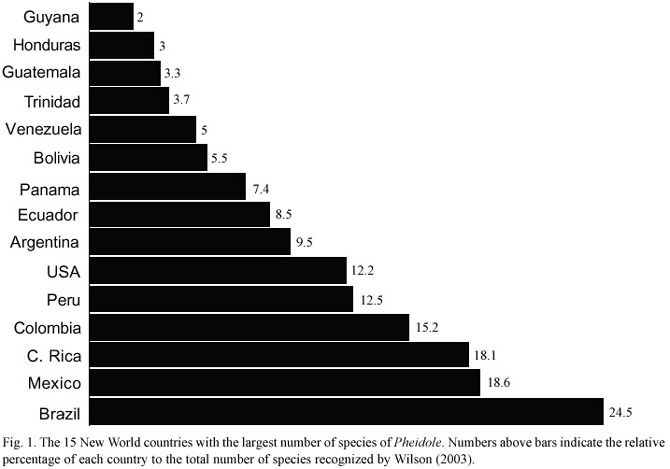
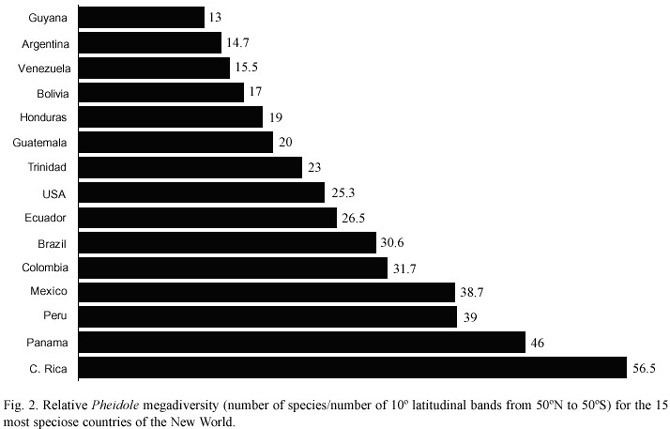
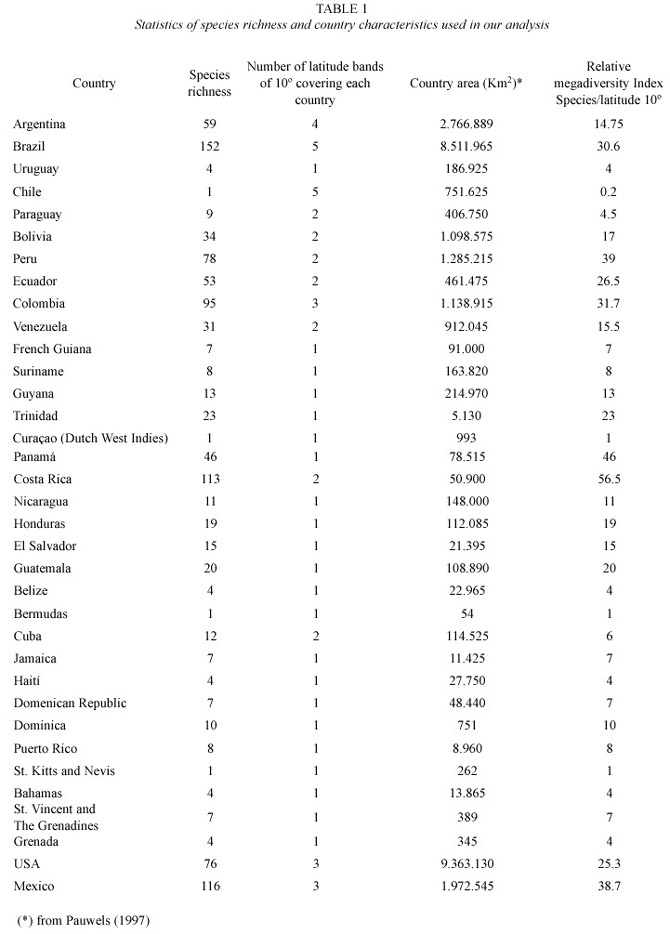
<body><![CDATA[<p><font face="Arial" size="2">The origin of these omnipresent faunal elements is still unclear. <i>Pheidole </i>has a world-wide distribution, although it is apparently dominant in the New World (<a  href="#wi76">Wilson 1976</a>, <a href="#fo94">Fowler 1994</a>). The oldest fossil is from Oligocene shales of North America (<a href="#ca30">Carpenter 1930</a>), and is not common in the Dominician ambers (<a href="#ba95">Baroni Urbani 1995</a>). 2N chromosome numbers of the studied species range in the neighborhood of 20,although an Indian species has a diploid number of 42, not allowing for a clear interpretation. Old World diversification is however much lower than that found in the New World. Sister groups are presently interpreted as being <i>Aphaenogaster, </i>or the Indonesian <i>Chimaeridris</i>. Thus, much more research is needed to clarify the origin of this highly successful genus. </font></p>     <p><font face="Arial" size="2">Wilson recognizes 624 <i>Pheidole </i>species in the Western Hemisphere. However, he notes that "undescribed species …were still pouring in to the Harvard Collection as (this) monograph went to press" suggesting that many more species undoubtedly exist. This monumental binary key revision was in part supported by the world’s taxonomists, which provided type specimens, the oldest dating from 1826.Wilson’s research depended upon local collaborators who shipped him samples from collections throughout the United States, Latin America, and Europe, resulting in 337 new species. But, how does one organize such a monumental venture? Wilson began by dividing the taxa into 19 species groups, 2 of which are of Old World origin (<i>megacephala </i>and <i>teneriffana </i>both from Africa) but represented in the New World. One species group includes social parasitic forms, most of which are from Argentina and should grow as more myrmecological research continues in the New World. </font></p> <font face="Arial" size="2"><i></i></font>     <p><font face="Arial" size="2"><i>Pheidole </i>is spread through 35 New World countries, but the number of species, as well as the relative percentage of all species, varies greatly (<a href="#t1">Table 1</a>). How does Brazil fit into the distribution of New World <i>Pheidole</i>? Is the mega-diversity of Brazil (<a href="#mi90">Mittermeier and Werner 1990</a>) also found in this highly speciose group? Indeed, the documented Brazilian <i>Pheidole </i>fauna represents 24.3% of its total diversity (152 species), followed by Mexico 18.6% (116 species), Costa Rica 18.1% (113 species), Colombia 15.2% (95 species), Peru 12.5% (78 species) and the USA 12.2% (76 species) (<a href="#f1">Fig.1</a>). These values, however, only consider the absolute number of species for each country. Furthermore, the superficial area and the collecting effort varies greatly among countries. In order to minimize differences in the number of species per area of any country, we created an index to estimate the relative megadiversity of species of New World <i>Pheidole, </i>by dividing the total number of recorded species per country by the number of 10º latitudinal bands of each country from 50º N to 50ºS. The highest relative megadiversity of species of <i>Pheidole </i>was found in Costa Rica, followed by Panama, Peru, Mexico, Colombia, Brazil, Ecuador, EUA, Trinidad, and Guatemala independently of their surface area (<a href="#f2">Fig.2</a>,<a href="#t1">Table 1</a>). These data clearly show the high collecting effort in Costa Rica and Panama, two countries well studied by Wilson. Brazil’s sixth position indicates that this country may exhibit a large <i>Pheidole </i>diversity, depending on increased collecting effort.</font></p>     <p style="text-align: center;"><font face="Arial" size="2">&nbsp;<a  name="t1"></a></font></p>     <p style="text-align: center;"><font face="Arial" size="2"><img  src="/img/fbpe/rbt/v53n1-2/3043i5.JPG" title="" alt=""  style="width: 670px; height: 934px;">    
<br> </font></p> <a name="f1"></a>     <div style="text-align: center;"><img src="/img/fbpe/rbt/v53n1-2/3043i1.JPG" title=""  alt="" style="width: 670px; height: 469px;">    
<br>     <br>     <br>     ]]></body>
<body><![CDATA[<br> </div> <a name="f2"></a>     <div style="text-align: center;"><img src="/img/fbpe/rbt/v53n1-2/3043i2.JPG" title=""  alt="" style="width: 670px; height: 429px;">    
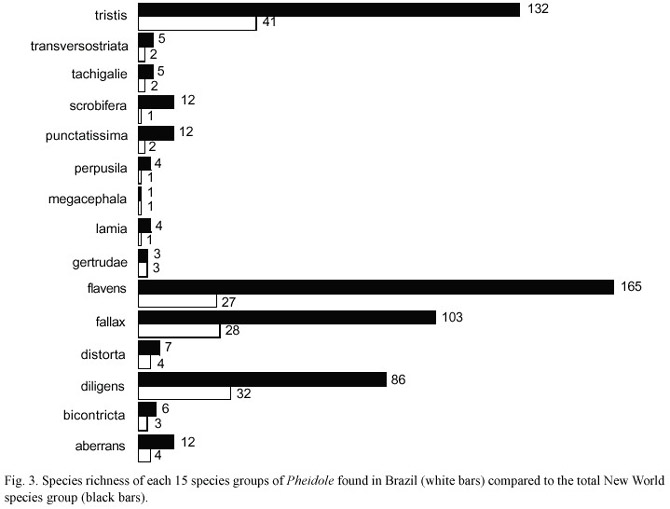
<br> </div>     <p><font face="Arial" size="2">In Brazil, of the 19 species groups of <i>Pheidole </i>recognized by Wilson, only four are not present. The species groups <i>crassicornis</i>, <i>granulata </i>and <i>pilifera </i>are almost exclusively Nearctic. Additionally, the species group <i>teneriffana</i>, which is native to North Africa, has turned up in disturbed habitats in Cuba, Peru and California. Of the 15 species groups of <i>Pheidole </i>found in Brazil, <i>tristis</i>, <i>diligens</i>, <i>fallax </i>and <i>flavens </i>are, respectively, the most speciose and encompass 84% of the fauna. These species groups also represent the highest number of New World species, with <i>flavens </i>being the most species rich, followed by <i>tristis</i>, <i>fallax </i>and <i>diligens </i>(<a  href="#f3">Fig.3</a>).    <br>     <br> </font></p>     <p style="text-align: center;"><font face="Arial" size="2">&nbsp;<a  name="f3"></a>    <br> <img src="/img/fbpe/rbt/v53n1-2/3043i3.JPG" title="" alt=""  style="width: 670px; height: 509px;">    
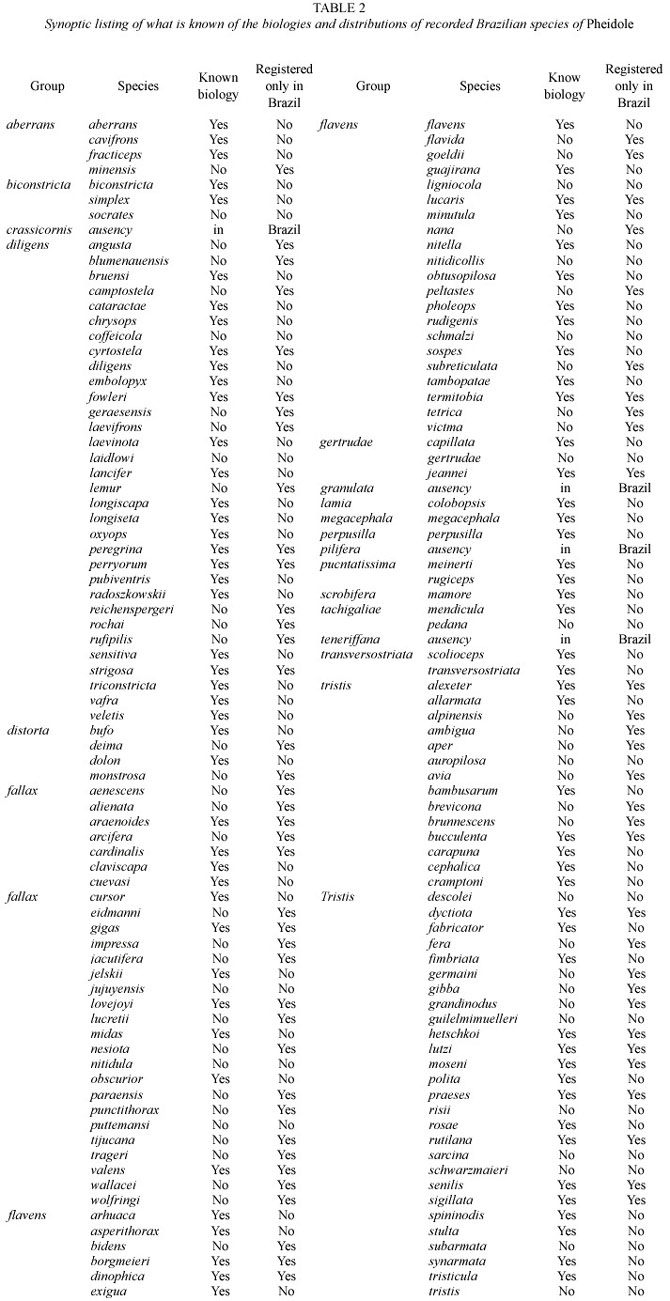
<br> </font></p>     <p><font face="Arial" size="2">Of the 152 Brazilian species of <i>Pheidole</i>, 45.4% are apparently endemic to Brazil. Of these, 71% are known only from type localities, suggesting a broader geographic distribution, due to lack of systematic collections, or conversely restricted distributions which could lead to their rapid extinction without ever knowing their natural history. Of the total documented Brazilian fauna, 42.1% have unknown biologies, or in another words, 65.2% of the Brazilian species are endemic and with unknown biologies (<a href="#t2">Table 2</a>), suggesting a formidable amount of natural history still ahead, as well as the probable discovery of more species. In spite of this fact, no <i>Pheidole </i>appear in the Red List of Threatened Species for Brazil (MMA 2003), which surprisingly has only three ant species listed.    ]]></body>
<body><![CDATA[<br>     <br> </font></p> <a name="t2"></a>     <div style="text-align: center;"><img src="/img/fbpe/rbt/v53n1-2/3043i6.JPG" title=""  alt="" style="width: 670px; height: 1301px;">    
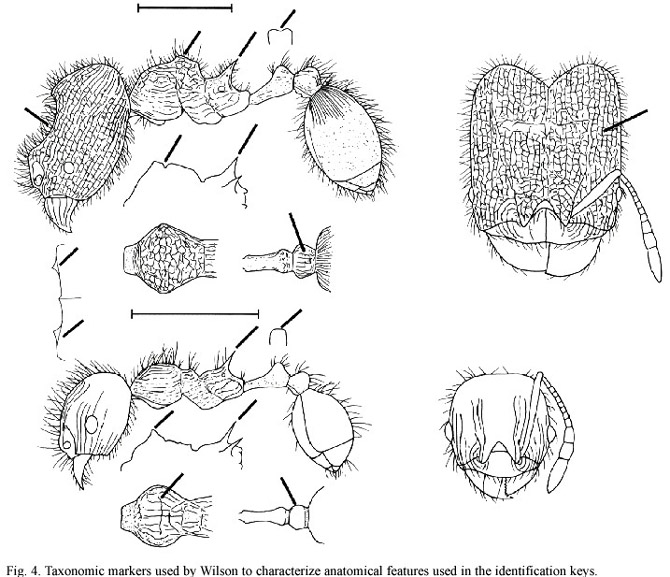
<br> </div>     <p><font face="Arial" size="2">Wilson graciously recognized many prominent myrmecologists who have worked largely solitarily in Latin America, by naming species after them, including the masters W. L. Brown and N. Kusnezov, and the present generation of myrmecologists J. Trager, W. MacKay, J. Lattke, C. R. F. Brandão, P. Oliveira, and H. G. Fowler. Wilson recognized the importance of the contributions in support of tropical conservation by Harrison Ford, Peter A. Seligmann and Sal Roush. Indeed, Wilson dedicated the book to his deceased mentor, W. L. Brown, who began the revision of this genus with Wilson more than 20 years ago (<a href="#br81">Brown 1981</a>).</font></p>     <p><font face="Arial" size="2">Wilson meticulously illustrated by hand all species, and showed another innovation (<a href="#f4">Fig.4</a>). Wilson introduced anatomical markers which highlight keyed taxonomic characters and should greatly assist new myrmecologists, as well as more experienced ones by making explicit identifying traits.</font></p> <a name="f4"></a>     <div style="text-align: center;"><img src="/img/fbpe/rbt/v53n1-2/3043i4.JPG" title=""  alt="" style="width: 670px; height: 577px;">    
<br> </div>     <p><font face="Arial" size="2">A CD accompanies the printed book. The CD micrographically illustrates the species and should facilitate production of local and regional faunal keys. Combined with work underway at the Museum of Comparative Zoology and elsewhere, this additional innovation assures that such painstaking research will henceforth be refined and accelerated using digital imaging and genomics techniques, and then promptly disseminated to users worldwide by the Internet. In scholarly terms, it bridges the established science of biological systematics and its imminent future. However, the CD contains a mistake concerning the total number of <i>Pheidole </i>species in Brazil. Instead of 150 species presented in the CD list, we have detected that the book shows 152 species for Brazil, including <i>P. laevinota </i>(<i>diligens </i>group) and <i>P. nitidicollis </i>(<i>flavens </i>group).    <br> </font></p> <font face="Arial" size="2"><b>     ]]></body>
<body><![CDATA[<p>Acknowledgments</p> </b> </font>     <p><font face="Arial" size="2">The authors are grateful to Cynthia P. A. Prado for the valuable suggestions on the manuscript and Thiago S. de Azevedo for the help with the figures. </font></p> <font face="Arial" size="2"><b>     <p>References</p> </b> </font>     <!-- ref --><p><font face="Arial" size="2"><a name="ba95"></a>Baroni Urbani, C. 1995. Invasion and extinction in the West Indian ant fauna revisited: the example of <i>Pheidole </i>(Amber Collection Stutgart Hymenoptera: Formicidae, VII: Myrmicinae, partim). Stutg. Beitr. Naturkd. Ser. B <i>.</i>(Geol. Palaontol.) 62:1-10.    &nbsp;&nbsp;&nbsp;&nbsp;&nbsp;&nbsp;&nbsp;&nbsp;[&#160;<a href="javascript:void(0);" onclick="javascript: window.open('/scielo.php?script=sci_nlinks&ref=1687250&pid=S0034-7744200500010003300001&lng=','','width=640,height=500,resizable=yes,scrollbars=1,menubar=yes,');">Links</a>&#160;]<!-- end-ref --></font></p>     <!-- ref --><p><font face="Arial" size="2"><a name="br81"></a>Brown, W. L. Jr. 1981. Preliminary contributions toward a revision of the ant genus <i>Pheidole </i>(Hymenoptera: Formicidae), Part I. J. Kansas Entomol. Soc. 54: 523-530.    &nbsp;&nbsp;&nbsp;&nbsp;&nbsp;&nbsp;&nbsp;&nbsp;[&#160;<a href="javascript:void(0);" onclick="javascript: window.open('/scielo.php?script=sci_nlinks&ref=1687252&pid=S0034-7744200500010003300002&lng=','','width=640,height=500,resizable=yes,scrollbars=1,menubar=yes,');">Links</a>&#160;]<!-- end-ref --></font></p>     <!-- ref --><p><font face="Arial" size="2"><a name="ca30"></a>Carpenter, F. M. 1930. The fossil ants of North America. Bull. Mus. Comp. Zool. 70:1-66.    &nbsp;&nbsp;&nbsp;&nbsp;&nbsp;&nbsp;&nbsp;&nbsp;[&#160;<a href="javascript:void(0);" onclick="javascript: window.open('/scielo.php?script=sci_nlinks&ref=1687254&pid=S0034-7744200500010003300003&lng=','','width=640,height=500,resizable=yes,scrollbars=1,menubar=yes,');">Links</a>&#160;]<!-- end-ref --></font></p>     <!-- ref --><p><font face="Arial" size="2"><a name="fo94"></a>Fowler, H. G. 1994. Relative representation of <i>Pheidole </i>(Hymenoptera:Formicidae) in local ground ant assemblages of the Americas. An. Biol. 19:29-37.    &nbsp;&nbsp;&nbsp;&nbsp;&nbsp;&nbsp;&nbsp;&nbsp;[&#160;<a href="javascript:void(0);" onclick="javascript: window.open('/scielo.php?script=sci_nlinks&ref=1687256&pid=S0034-7744200500010003300004&lng=','','width=640,height=500,resizable=yes,scrollbars=1,menubar=yes,');">Links</a>&#160;]<!-- end-ref --></font></p>     <!-- ref --><p><font face="Arial" size="2"><a name="le02"></a>Levi, H. W. 2002. Keys to the genera of araneid orbweavers (Araneae, Araneidae) of the Americas<i>. </i>J. Arachnol. 30:527-562.    &nbsp;&nbsp;&nbsp;&nbsp;&nbsp;&nbsp;&nbsp;&nbsp;[&#160;<a href="javascript:void(0);" onclick="javascript: window.open('/scielo.php?script=sci_nlinks&ref=1687258&pid=S0034-7744200500010003300005&lng=','','width=640,height=500,resizable=yes,scrollbars=1,menubar=yes,');">Links</a>&#160;]<!-- end-ref --></font></p>     <!-- ref --><p><font face="Arial" size="2"><a name="mi03"></a>Ministério do Meio Ambiente, IBAMA, Brazil. 2003. Lista de espécies ameaçadas de extinção.    &nbsp;&nbsp;&nbsp;&nbsp;&nbsp;&nbsp;&nbsp;&nbsp;[&#160;<a href="javascript:void(0);" onclick="javascript: window.open('/scielo.php?script=sci_nlinks&ref=1687260&pid=S0034-7744200500010003300006&lng=','','width=640,height=500,resizable=yes,scrollbars=1,menubar=yes,');">Links</a>&#160;]<!-- end-ref --></font></p>     <!-- ref --><p><font face="Arial" size="2"><a name="mi90"></a>Mittermeier, R. A. &amp; T. B. Werner. 1990. Wealth of plants and animals unites ‘megadiversity’ countries. Tropicus 4:4-5.    &nbsp;&nbsp;&nbsp;&nbsp;&nbsp;&nbsp;&nbsp;&nbsp;[&#160;<a href="javascript:void(0);" onclick="javascript: window.open('/scielo.php?script=sci_nlinks&ref=1687262&pid=S0034-7744200500010003300007&lng=','','width=640,height=500,resizable=yes,scrollbars=1,menubar=yes,');">Links</a>&#160;]<!-- end-ref --></font></p>     <!-- ref --><p><font face="Arial" size="2"><a name="pa97"></a>Pauwels, G. J. 1997. Atlas geográfico melhoramentos. Melhoramentos, São Paulo. 80 p.    &nbsp;&nbsp;&nbsp;&nbsp;&nbsp;&nbsp;&nbsp;&nbsp;[&#160;<a href="javascript:void(0);" onclick="javascript: window.open('/scielo.php?script=sci_nlinks&ref=1687264&pid=S0034-7744200500010003300008&lng=','','width=640,height=500,resizable=yes,scrollbars=1,menubar=yes,');">Links</a>&#160;]<!-- end-ref --></font></p>     <!-- ref --><p><font face="Arial" size="2"><a name="wi76"></a>Wilson, E. O. 1976. Which are the most prevalent ant genera? Stud. Entomol<i>. </i>19:187-200.    &nbsp;&nbsp;&nbsp;&nbsp;&nbsp;&nbsp;&nbsp;&nbsp;[&#160;<a href="javascript:void(0);" onclick="javascript: window.open('/scielo.php?script=sci_nlinks&ref=1687266&pid=S0034-7744200500010003300009&lng=','','width=640,height=500,resizable=yes,scrollbars=1,menubar=yes,');">Links</a>&#160;]<!-- end-ref --></font></p>     <!-- ref --><p><font face="Arial" size="2"><a name="wi02"></a>Wilson, E. O. 2002. The Future of Life <i>.</i>Harvard University, Cambridge.    &nbsp;&nbsp;&nbsp;&nbsp;&nbsp;&nbsp;&nbsp;&nbsp;[&#160;<a href="javascript:void(0);" onclick="javascript: window.open('/scielo.php?script=sci_nlinks&ref=1687268&pid=S0034-7744200500010003300010&lng=','','width=640,height=500,resizable=yes,scrollbars=1,menubar=yes,');">Links</a>&#160;]<!-- end-ref --></font></p>     <br>      ]]></body><back>
<ref-list>
<ref id="B1">
<nlm-citation citation-type="journal">
<person-group person-group-type="author">
<name>
<surname><![CDATA[Baroni Urbani]]></surname>
<given-names><![CDATA[C]]></given-names>
</name>
</person-group>
<article-title xml:lang="en"><![CDATA[Invasion and extinction in the West Indian ant fauna revisited: the example of Pheidole (Amber Collection Stutgart Hymenoptera: Formicidae, VII: Myrmicinae, partim)]]></article-title>
<source><![CDATA[Stutg. Beitr. Naturkd. Ser. B .(Geol. Palaontol.)]]></source>
<year>1995</year>
<volume>62</volume>
<page-range>1-10</page-range></nlm-citation>
</ref>
<ref id="B2">
<nlm-citation citation-type="journal">
<person-group person-group-type="author">
<name>
<surname><![CDATA[Brown]]></surname>
<given-names><![CDATA[W. L. Jr]]></given-names>
</name>
</person-group>
<article-title xml:lang="en"><![CDATA[Preliminary contributions toward a revision of the ant genus Pheidole (Hymenoptera: Formicidae), Part I]]></article-title>
<source><![CDATA[J. Kansas Entomol. Soc]]></source>
<year>1981</year>
<volume>54</volume>
<page-range>523-530</page-range></nlm-citation>
</ref>
<ref id="B3">
<nlm-citation citation-type="journal">
<person-group person-group-type="author">
<name>
<surname><![CDATA[Carpenter]]></surname>
<given-names><![CDATA[F. M]]></given-names>
</name>
</person-group>
<article-title xml:lang="en"><![CDATA[The fossil ants of North America]]></article-title>
<source><![CDATA[Bull. Mus. Comp. Zool]]></source>
<year>1930</year>
<volume>70</volume>
<page-range>1-66</page-range></nlm-citation>
</ref>
<ref id="B4">
<nlm-citation citation-type="journal">
<person-group person-group-type="author">
<name>
<surname><![CDATA[Fowler]]></surname>
<given-names><![CDATA[H. G]]></given-names>
</name>
</person-group>
<article-title xml:lang="en"><![CDATA[Relative representation of Pheidole (Hymenoptera:Formicidae) in local ground ant assemblages of the Americas]]></article-title>
<source><![CDATA[An. Biol]]></source>
<year>1994</year>
<volume>19</volume>
<page-range>29-37</page-range></nlm-citation>
</ref>
<ref id="B5">
<nlm-citation citation-type="journal">
<person-group person-group-type="author">
<name>
<surname><![CDATA[Levi]]></surname>
<given-names><![CDATA[H. W]]></given-names>
</name>
</person-group>
<article-title xml:lang="en"><![CDATA[Keys to the genera of araneid orbweavers (Araneae, Araneidae) of the Americas]]></article-title>
<source><![CDATA[J. Arachnol]]></source>
<year>2002</year>
<volume>30</volume>
<page-range>527-562</page-range></nlm-citation>
</ref>
<ref id="B6">
<nlm-citation citation-type="">
<collab>Ministério do Meio Ambiente</collab>
<source><![CDATA[Lista de espécies ameaçadas de extinção]]></source>
<year>2003</year>
</nlm-citation>
</ref>
<ref id="B7">
<nlm-citation citation-type="journal">
<person-group person-group-type="author">
<name>
<surname><![CDATA[Mittermeier]]></surname>
<given-names><![CDATA[R. A]]></given-names>
</name>
<name>
<surname><![CDATA[Werner]]></surname>
<given-names><![CDATA[T. B]]></given-names>
</name>
</person-group>
<article-title xml:lang="en"><![CDATA[Wealth of plants and animals unites ‘megadiversity’ countries]]></article-title>
<source><![CDATA[Tropicus]]></source>
<year>1990</year>
<volume>4</volume>
<page-range>4-5</page-range></nlm-citation>
</ref>
<ref id="B8">
<nlm-citation citation-type="">
<person-group person-group-type="author">
<name>
<surname><![CDATA[Pauwels]]></surname>
<given-names><![CDATA[G. J]]></given-names>
</name>
</person-group>
<source><![CDATA[Atlas geográfico melhoramentos]]></source>
<year>1997</year>
<page-range>80</page-range><publisher-loc><![CDATA[Melhoramentos^eSão Paulo São Paulo]]></publisher-loc>
</nlm-citation>
</ref>
<ref id="B9">
<nlm-citation citation-type="journal">
<person-group person-group-type="author">
<name>
<surname><![CDATA[Wilson]]></surname>
<given-names><![CDATA[E. O]]></given-names>
</name>
</person-group>
<article-title xml:lang="en"><![CDATA[Which are the most prevalent ant genera?]]></article-title>
<source><![CDATA[Stud. Entomol]]></source>
<year>1976</year>
<volume>19</volume>
<page-range>187-200</page-range></nlm-citation>
</ref>
<ref id="B10">
<nlm-citation citation-type="book">
<person-group person-group-type="author">
<name>
<surname><![CDATA[Wilson]]></surname>
<given-names><![CDATA[E. O]]></given-names>
</name>
</person-group>
<source><![CDATA[The Future of Life]]></source>
<year>2002</year>
<publisher-loc><![CDATA[Cambridge ]]></publisher-loc>
<publisher-name><![CDATA[Harvard University]]></publisher-name>
</nlm-citation>
</ref>
</ref-list>
</back>
</article>