<?xml version="1.0" encoding="ISO-8859-1"?><article xmlns:mml="http://www.w3.org/1998/Math/MathML" xmlns:xlink="http://www.w3.org/1999/xlink" xmlns:xsi="http://www.w3.org/2001/XMLSchema-instance">
<front>
<journal-meta>
<journal-id>0034-7744</journal-id>
<journal-title><![CDATA[Revista de Biología Tropical]]></journal-title>
<abbrev-journal-title><![CDATA[Rev. biol. trop]]></abbrev-journal-title>
<issn>0034-7744</issn>
<publisher>
<publisher-name><![CDATA[Universidad de Costa Rica]]></publisher-name>
</publisher>
</journal-meta>
<article-meta>
<article-id>S0034-77442005000100027</article-id>
<title-group>
<article-title xml:lang="en"><![CDATA[Patterns of cetacean sighting distribution in the Pacific Exclusive Economic Zone of Costa Rica based on data collected from 1979-2001]]></article-title>
</title-group>
<contrib-group>
<contrib contrib-type="author">
<name>
<surname><![CDATA[May-Collado]]></surname>
<given-names><![CDATA[Laura]]></given-names>
</name>
<xref ref-type="aff" rid="A01"/>
</contrib>
<contrib contrib-type="author">
<name>
<surname><![CDATA[Gerrodette]]></surname>
<given-names><![CDATA[Tim]]></given-names>
</name>
<xref ref-type="aff" rid="A03"/>
</contrib>
<contrib contrib-type="author">
<name>
<surname><![CDATA[Calambokidis]]></surname>
<given-names><![CDATA[John]]></given-names>
</name>
<xref ref-type="aff" rid="A04"/>
</contrib>
<contrib contrib-type="author">
<name>
<surname><![CDATA[Rasmussen]]></surname>
<given-names><![CDATA[Kristin]]></given-names>
</name>
<xref ref-type="aff" rid="A04"/>
</contrib>
<contrib contrib-type="author">
<name>
<surname><![CDATA[Sereg]]></surname>
<given-names><![CDATA[Irena]]></given-names>
</name>
<xref ref-type="aff" rid="A05"/>
</contrib>
</contrib-group>
<aff id="A01">
<institution><![CDATA[,Universidad de Costa Rica  ]]></institution>
<addr-line><![CDATA[San José ]]></addr-line>
<country>Costa Rica</country>
</aff>
<aff id="A03">
<institution><![CDATA[,National Marine Fisheries Service  ]]></institution>
<addr-line><![CDATA[ ]]></addr-line>
</aff>
<aff id="A04">
<institution><![CDATA[,Cascadia Research Collective  ]]></institution>
<addr-line><![CDATA[ ]]></addr-line>
</aff>
<aff id="A05">
<institution><![CDATA[,American University  ]]></institution>
<addr-line><![CDATA[ Washington D.C]]></addr-line>
</aff>
<pub-date pub-type="pub">
<day>00</day>
<month>06</month>
<year>2005</year>
</pub-date>
<pub-date pub-type="epub">
<day>00</day>
<month>06</month>
<year>2005</year>
</pub-date>
<volume>53</volume>
<numero>1-2</numero>
<fpage>249</fpage>
<lpage>263</lpage>
<copyright-statement/>
<copyright-year/>
<self-uri xlink:href="http://www.scielo.sa.cr/scielo.php?script=sci_arttext&amp;pid=S0034-77442005000100027&amp;lng=en&amp;nrm=iso"></self-uri><self-uri xlink:href="http://www.scielo.sa.cr/scielo.php?script=sci_abstract&amp;pid=S0034-77442005000100027&amp;lng=en&amp;nrm=iso"></self-uri><self-uri xlink:href="http://www.scielo.sa.cr/scielo.php?script=sci_pdf&amp;pid=S0034-77442005000100027&amp;lng=en&amp;nrm=iso"></self-uri><abstract abstract-type="short" xml:lang="en"><p><![CDATA[Nineteen species of cetaceans (families Balaenopteridae, Kogiidae, Physeteridae, Ziphiidae and Delphinidae) occur in the Costa Rican Pacific Exclusive Economic Zone (EEZ). Based on data recorded from the EEZ by the Southwest Fisheries Service Center, Cascadia Research Collective, and CIMAR between 1979- 2001, we mapped the distribution of 18 cetacean species. Our results suggest that the majority of the cetacean species use primarily oceanic waters, particularly those species within the families Balaenopteridae, Kogiidae, Physeteridae and Ziphiidae. Members of the family Delphinidae showed a wide variety of distribution patterns: seven species are widespread throughout the EEZ, four appear to be exclusively pelagic, and two are primarily coastal. Overall, three cetacean species appear to have populations concentrated in coastal waters: Stenella attenuata graffmani, Tursiops truncatus, and Megaptera novaeangliae. These three may be more susceptible to human activities due to the overlap of their ranges with fishery areas (tuna and artisanal fisheries), and an uncontrolled increase of touristic whale watching activities in several parts of their range. The distribution maps represent the first comprehensive representation of cetacean species that inhabit Costa Rican Pacific waters. They provide essential base-line information that may be used to initiate conservation and management efforts of the habitats where these animals reproduce and forage. Rev. Biol. Trop. 53(1-2):249-263.Epub 2005 Jun 24]]></p></abstract>
<abstract abstract-type="short" xml:lang="es"><p><![CDATA[Diecinueve especies de cetáceos distribuídos en cinco familias (Balaenopteridae, Kogiidae, Physeteridae, Ziphiidae and Delphinidae) habitan en la Zona Económica Exclusiva del Pacífico de Costa Rica (ZEEP). Con base a datos tomados en esta zona por el Southwest Fisheries Service Center, Cascadia Research Collective y CIMAR entre 1979 y 2001 construímos mapas de distribución de avistamientos para 18 especies. Nuestros resultados sugieren que la mayoría de las especies de cetáceos habitan en aguas oceánicas, particularmente miembros de las familias Balaenopteridae, Kogiidae, Physeteridae y Ziphiidae. Miembros de la familia Delphinidae mostraron una variedad de patrones de distribución, siete mostraron una distribución amplia en el ZEEP, cuatro parecen ser exclusivamente oceánicas y dos principalmente costeras. Adicionalmente, tres especies de cetáceos tienen poblaciones concentradas en la costa: Stenella attenuata graffmani, Tursiops truncatus y Megaptera novaeangliae. Estas tres especies son por lo tanto más suceptibles debido a que su hábitat traslapa considerablemnte con áreas importantes para la pesca artesanal y atunera, y áreas de observación de ballenas (las cuales a incrementado considerablemente en los últimos años). Los mapas de distribución de avistamientos de cetáceos presentados en este trabajo son los primeros en su tipo para Costa Rica. Estos aportan información esencial y básica para iniciativas de conservación y manejo de estos animals y los habitats donde estos se reproducen y alimentan]]></p></abstract>
<kwd-group>
<kwd lng="en"><![CDATA[Conservation]]></kwd>
<kwd lng="en"><![CDATA[Central America]]></kwd>
<kwd lng="en"><![CDATA[dolphins]]></kwd>
<kwd lng="en"><![CDATA[marine mammals]]></kwd>
<kwd lng="en"><![CDATA[whales]]></kwd>
<kwd lng="es"><![CDATA[conservación]]></kwd>
<kwd lng="es"><![CDATA[América Central]]></kwd>
<kwd lng="es"><![CDATA[delfines]]></kwd>
<kwd lng="es"><![CDATA[mamíferos marinos]]></kwd>
<kwd lng="es"><![CDATA[ballenas]]></kwd>
</kwd-group>
</article-meta>
</front><body><![CDATA[  <b><font face="Arial">     <p align="center">Patterns of cetacean sighting distribution in the Pacific Exclusive Economic Zone of Costa Rica based on data collected from 1979-2001</p> </font><font face="Arial" size="2"> </font></b>     <p><font face="Arial" size="2">Laura May-Collado <sup><a name="1"></a><a  href="#2">1</a>,<a href="#2">2</a></sup>, Tim Gerrodette <a href="#2"><sup>3</sup></a>, John Calambokidis <a href="#2"><sup>4</sup></a>, Kristin Rasmussen <a  href="#2"><sup>4</sup></a> &amp; Irena Sereg <a href="#2"><sup>5</sup></a></font></p>     <p><font face="Arial" size="2"><a name="2"></a><a href="#1">1</a> CIMAR, Ciudad de la Investigación, Universidad de Costa Rica, 2060 San José, Costa Rica.</font></p>     <p><font face="Arial" size="2"><a href="#1">2</a> Department of Biological Sciences, Florida International University. 11200 SW 8th St. Miami, Florida 33199; <a href="mailto:lmayc002@fiu.edu">lmayc002@fiu.edu</a></font></p>     <p><font face="Arial" size="2"><a href="#1">3</a> National Marine Fisheries Service, National Marine Fisheries Service, Center 8604 La Jolla Shores Dr. CA 92037.</font></p>     <p><font face="Arial" size="2"><a href="#1">4</a> Cascadia Research Collective, Water Street Building, 218 ½ West Fourth Avenue, Olympia, Washington 98501, USA.</font></p>     <p><font face="Arial" size="2"><a href="#1">5</a> American University, Department of Environmental Sciences, 4400 Massachusetts Avenue NW, Washington D.C. 20016-8007.</font></p>     <p style="text-align: center;"><font face="Arial" size="2">Received 19-III-2004.&nbsp;&nbsp;&nbsp;&nbsp; Corrected 18-XII-2004.&nbsp;&nbsp;&nbsp;&nbsp; Accepted 17-I-2005.</font></p> <font face="Arial" size="2"><b>     <p>Abstract</p> </b> </font>     ]]></body>
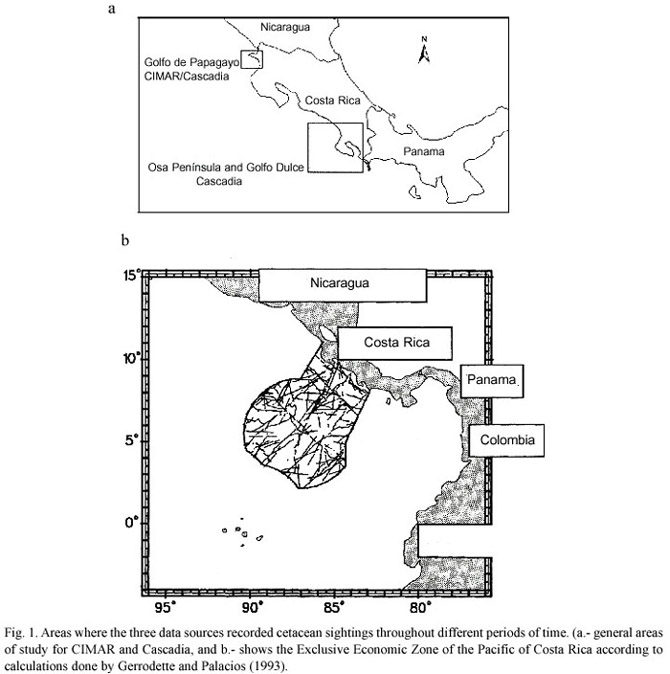
<body><![CDATA[<p><font face="Arial" size="2">Nineteen species of cetaceans (families Balaenopteridae, Kogiidae, Physeteridae, Ziphiidae and Delphinidae) occur in the Costa Rican Pacific Exclusive Economic Zone (EEZ). Based on data recorded from the EEZ by the Southwest Fisheries Service Center, Cascadia Research Collective, and CIMAR between 1979- 2001, we mapped the distribution of 18 cetacean species. Our results suggest that the majority of the cetacean species use primarily oceanic waters, particularly those species within the families Balaenopteridae, Kogiidae, Physeteridae and Ziphiidae. Members of the family Delphinidae showed a wide variety of distribution patterns: seven species are widespread throughout the EEZ, four appear to be exclusively pelagic, and two are primarily coastal. Overall, three cetacean species appear to have populations concentrated in coastal waters: <i>Stenella attenuata graffmani, Tursiops truncatus, </i>and <i>Megaptera novaeangliae</i>. These three may be more susceptible to human activities due to the overlap of their ranges with fishery areas (tuna and artisanal fisheries), and an uncontrolled increase of touristic whale watching activities in several parts of their range. The distribution maps represent the first comprehensive representation of cetacean species that inhabit Costa Rican Pacific waters. They provide essential base-line information that may be used to initiate conservation and management efforts of the habitats where these animals reproduce and forage. Rev. Biol. Trop. 53(1-2):249-263.Epub 2005 Jun 24.</font></p> <font face="Arial" size="2"><b> </b></font>     <p><font face="Arial" size="2"><b>Key words: </b>Conservation, Central America, dolphins, marine mammals, whales.</font></p>     <p><font face="Arial" size="2">Costa Rican waters support 32 species of marine mammals belonging to the orders Sirenia, Carnivora (Sub-order Pinnipedia) and Cetacea (<a href="#ro02">Rodríguez-Herrera <i>et al. </i>2002</a>). About 30 cetacean species within the Delphinidae, Ziphiidae, Physeteridae, Kogiidae and Balaenopteridae inhabit or are expected to be found in the Pacific and Caribbean economical waters of Costa Rica (<a  href="#maip">May-Collado <i>in press</i></a>). According to <a  href="#ge96">Gerrodette and Palacios (1996)</a> <i>Delphinus delphis</i>, <i>Stenella coeruleoalba</i>, beaked whales (Ziphiidae), and <i>Tursiops truncatus </i>are the most abundant cetaceans in Costa Rican Pacific waters. Based on reports of distribution patterns (throughout the Eastern Tropical Pacific) in Costa Rica, cetaceans are more likely to inhabit oceanic waters (<i>e.g.</i>, <a href="#di94">Dizon <i>et al. </i>1994</a>, <a href="#ki99">Kinzey <i>et al. </i>1999</a>, <a href="#ki00a">2000a</a>, <a href="#ki01">2001</a>). However, some species may have populations in both, oceanic and neritic waters (<i>e.g.</i>, <i>Stenella attenuata</i>) (<a href="#ro01">Rodríguez-Fonseca 2001</a>, <a href="#ma05">MayCollado and Morales 2005</a>).</font></p>     <p><font face="Arial" size="2">In Costa Rica, cetacean research has focused primarily on the biology of three resident species, the bottlenose dolphin, <i>Tursiops truncatus</i>, (<i>e.g.</i>, <a  href="#ac91">Acevedo-Gutierrez and Würsig 1991</a>, <a href="#ac96">Acevedo-Gutierrez 1996</a>, <a href="#ac98">Acevedo- Gutierrez and Burkhart 1998</a>, <a  href="#cu98">Cubero-Pardo 1998</a>), the coastal spotted dolphin, <i>Stenella attenuata graffmani </i>(<i>e.g.</i>, <a href="#cu98">Cubero-Pardo 1998</a>, <a href="#ma01">May-Collado 2001</a>, <a href="#ma01">May-Collado and Forcada 2001</a>, <a href="#ma05">May-Collado and Morales 2005</a>, <a href="#ro04">Rodríguez Sáenz and Rodríguez-Fonseca 2004</a>), and the humpback whale, <i>Megaptera novaeangliae </i>(<i>e.g.</i>, <a  href="#ac95">Acevedo and Smultea 1995</a>, <a href="#ca99">Calambokidis <i>et al. </i>1999</a>, <a href="#ca00">2000</a>, <a href="#ra01">Rasmussen <i>et al. </i>2001</a>, <a href="#ra02">2002</a>). Available information suggests that in the northern Pacific environmental factors such as water transparency and dissolved oxygen concentrations play an important role in the abundance of the local population of coastal spotted dolphins (<a href="#ma01">May-Collado 2001</a>, <a href="#ma01">May-Collado and Forcada 2001</a>). In addition, the feeding activities of this population are associated with the seasonality of the area (<a  href="#ma01">MayCollado 2001</a>, <a href="#ma05">May-Collado and Morales 2005</a>). Studies on the bottlenose dolphins indicate that in some areas they have very restricted movement patterns and therefore depend on the local habitat to reproduce and feed (<a href="#ac98">Acevedo- Gutierrez and Burkhart 1998</a>, <a href="#cu98">Cubero-Pardo 1998</a>). Finally, recent studies indicate that humpback whales observed in different seasons of the year, along the Pacific coast of Costa Rica, are migrating primarily from feeding grounds off California (January-April) and Antarctica Peninsula (June to October) to breed and give birth in national waters (<a href="#st91">Steiger <i>et al.</i>1991</a>, <a href="#ca99">Calambokidis <i>et al. </i>1999</a>, <a href="#ca00">2000</a>, <a href="#ra01">Rasmussen <i>et al. </i>2001</a>, <a href="#ra02">2002</a>).</font></p>     <p><font face="Arial" size="2">Even as the knowledge of cetacean natural history is increasing in Costa Rican waters, relevant information for conservation purposes such as distribution pattern is scarce. The existent information on their distribution is either to the scale of the Eastern Tropical Pacific (ETP) (<i>e.g.</i>, <a  href="#pe85">Perrin <i>et al. </i>1985</a>, <a href="#au85">Au and Perryman 1985</a>, <a href="#po87">Polacheck 1987</a>, <a href="#re90">Reilly 1990</a>, <a href="#re94">Reilly and Fiedler 1994</a>, <a href="#re02">Reilly <i>et al. </i>2002</a>, <a href="#wa93">Wade and Gerrodette 1993</a>, <a href="#di94">Dizon <i>et al. </i>1994</a>, <i>et al. </i>1999, 2000a, 2001), or to very localized areas (<i>e.g.</i>, <a href="#ac95">Acevedo-Gutierrez and Smultea 1995</a>,<a href="#ac98">Acevedo-Gutierrez and Burkhart 1998</a>). Although <a href="#ro01">Rodríguez-Fonseca (2001)</a> and <a  href="#maip">May- Collado (<i>in press </i>)</a> summarized published cetacean sightings in Costa Rican waters, detailed maps of cetacean sighting distribution in the EEZ Pacific of Costa Rica are lacking. Because understanding the distribution patterns at different scales is important in the planning of conservation and management plans, our main goal is to provide an up to date species check-list and maps of all cetaceans sightings reported during twenty two years of surveying the Pacific EEZ of Costa Rica.</font></p>     <p><font face="Arial" size="2">This study is based on data collected by the National Marine Fisheries Service Southwest, Fisheries Science Center (from 1979 to 2000), the Cascadia Research Collective (from 1996 to 2001) and Proyecto Cetacea-CIMAR (from 1998 to 2001). It should be noted, however, that these three entities vary in their methodologies, sample and season effort, and area studied, thus results from each may not be strictly comparable, limiting the strength of our conclusions.</font></p> <font face="Arial" size="2"><b></b></font>     <p><font face="Arial" size="2"><b>Materials and methods</b></font></p>     <p><font face="Arial" size="2"><b>Study Site: </b>The Costa Rican Pacific Exclusive Economic Zone (EEZ) is a part of the Eastern Tropical Pacific (ETP), an area that contains some of the most productive oceans of the world (<a href="#ph01">Philbrick <i>et al. </i>2001</a>). The Pacific EEZ of Costa Rica is part of the so called "Central American Bight" (referring to the coastal waters from Guatemala to Ecuador) an area that contains the most variable waters within the Tropical Surface Water Province, because of the influence of the Inter-tropical Convergent Zone (ITCZ) (<a href="#au85">Au and Perryman 1985</a>). During the first half of the year, north-eastern winds blow across Central America from the Atlantic, producing coastal upwelling, wind stirring, and complex temperature patterns (<a href="#au85">Au and Perryman 1985</a>). In the second half of the year the ITCZ migrates north, bringing southerly winds, rain that reduced water salinity, and intensified the Equatorial Countercurrent (<a href="#wy67">Wyrtki 1967</a>, <a href="#wy74">1974</a>). </font></p> <font face="Arial" size="2"><b></b></font>     <p><font face="Arial" size="2"><b>Surveys: </b>This paper is based on a matrix constructed with data from three sources:the Southwest Fisheries Service Center (SWFSC), Cascadia Research Collective (CRC)and the Centro de Investigaciones del Mar y Limnología (CIMAR) throughout the entire Costa Rican EEZ at different times of year and using different methodologies. Here we provide a brief description of the goals of each research entity and their respective survey methods.</font></p>     <p><font face="Arial" size="2">(1) The SWFSC is a laboratory of the US National Marine Fisheries Service that has conducted research on cetacean populations of the ETP since the mid-1970’s (<a href="#ki00a">Kinzey <i>et al. </i>2000a</a>), focusing on those species believed to be most affected by the purse-seine fishery for yellowfin tuna, <i>Thunnus albacares </i>(<a href="#wa92">Wade and Gerrodette 1992</a>, <a  href="#wa02">Wade <i>et al.</i>2002</a>). They have produced abundance estimates of 24 stocks of cetaceans by implementing in the most part of their surveys, stratified analysis with line-transects (see <a href="#wa92">Wade and Gerrodette 1992</a>, <a href="#wa93">1993</a>, <a href="#ki00b">Kinzey <i>et al. </i>2000b</a>). Surveys have been conducted throughout the entire Eastern Tropical Pacific using two to three ships along pre-determined track lines (which vary in length) (<a  href="#f1">Fig.1</a>) (<a href="#ki99">Kinzey <i>et al. </i>1999</a>, <a href="#ki00a">2000a</a>, <a href="#ki01">2001</a>). Observers actively search for marine mammals from 6:00 a.m.to 6:00 p.m. and report the geographical position, bearing, species ID, distance and group size of each sighting, including environmental data (<i>e.g.</i>, sea water temperature, salinity, and thermocline depth). We used a total of 1029 sightings of cetaceans reported by the SWFS from 1979 to 2000 in the EEZ of Costa Rica.</font></p>     ]]></body>
<body><![CDATA[<p style="text-align: center;"><font face="Arial" size="2">&nbsp;<a  name="f1"></a></font></p>     <p style="text-align: center;"><font face="Arial" size="2"><img  src="/img/fbpe/rbt/v53n1-2/3037i1.JPG" title="" alt=""  style="width: 670px; height: 674px;">&nbsp;    
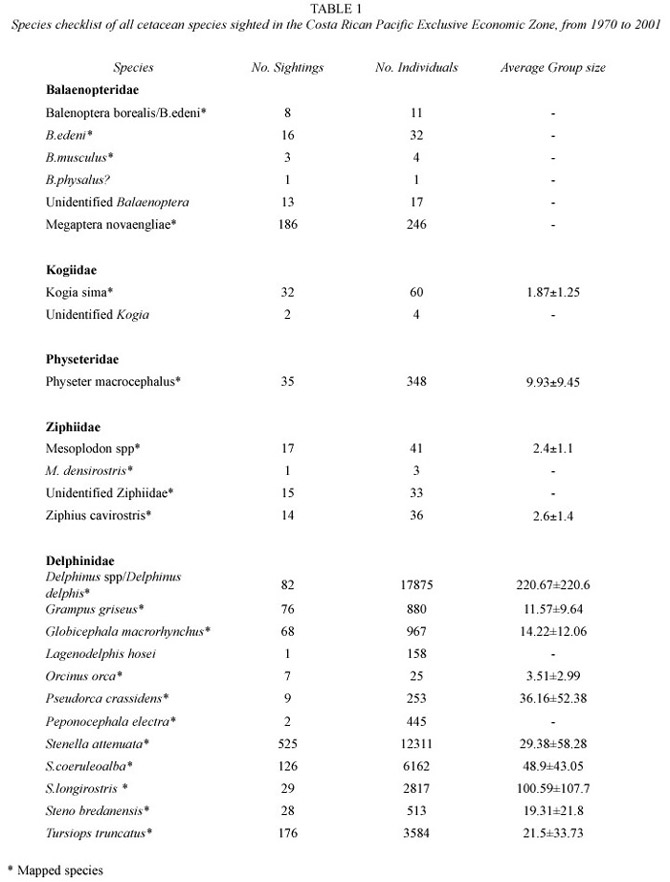
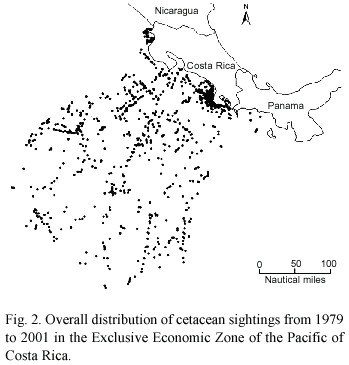
<br> </font></p>     <p><font face="Arial" size="2">(2) The CRC is a non-profit organization that is conducting a long-term study on humpback whales (<i>Megaptera novaeangliae </i>) and other marine mammals particularly off the south Pacific shore of Costa Rica since 1996 (<a href="#ca99">Calambokidis <i>et al. </i>1999</a>). Using two small boats (~7m) they have surveyed the coastal waters from north Dominical and Drake Bay to waters offshore Caño’s Island and Golfo Dulce (<a href="#f1">Fig.1</a>). Survey effort in all years was consistent in all areas, with a total number of 18 to 27 surveys covering from 2229.25 to 3207.9 km per year. No predetermined-transects are used during these surveys, instead photo-ID surveys are used. The direction of the survey is based on information from previous whales sightings (see <a href="#ra01">Rasmussen <i>et al. </i>2001</a>, <a  href="#ra02">2002</a>). Data recorded includes geographical position, species ID, approximate group size, environmental data (<i>e.g.</i>, sea state, swell height, etc.), and photo identification. We include in the matrix a total of 612 sightings documented by CRC from 1997 to 2001 in the south Pacific of Costa Rica. </font></p>     <p><font face="Arial" size="2">(3) <i>Proyecto Cetacea </i>is a project developed by the CIMAR, University of Costa Rica to study the abundance trends, habitat use, acoustics and photo-identification of the marine mammals that inhabit the coastal waters of the north Pacific of Costa Rica (Cuajiniquil Bay, Murciélago’s Islands and Papagayo Gulf and surrounding waters). The study focused on the spotted dolphins (<i>Stenella attenuata </i>) and humpback whales (<i>M. novaeangliae</i>). Using a small boat (~7m), pre-determined strip transects were surveyed monthly from 1998 to 2001 (from 6:00 a.m to 6:00 p.m.) (see May-Collado 2001). For every encounter the following data were recorded: geographical position, group size, and environmental variables (<i>e.g.</i>, superficial water temperature, salinity, dissolved oxygen, thermocline depth, and sea state). A total of 130 sightings was included in the matrix.</font></p> <font face="Arial" size="2"><b></b></font>     <p><font face="Arial" size="2"><b>Analysis: </b>We plotted a total of 1771 sightings of 19 species and 3 genera using the software Arc GIS 8.1. The maps show the geographical position of all cetacean sightings made from 1979 to 2001 collected by the three sources combined. We also constructed sighting maps for the subspecies of the dolphin species <i>Stenella attenuata </i>and <i>S. longirostris</i>. Throughout this paper we will describe cetacean sighting distribution based on water depth, by approximately assigning species to neritic and oceanic waters (also referred as pelagic or offshore waters) (<a href="#le95">Levinton 1995</a>, <a href="#we99">Wells <i>et al. </i>1999</a>). Neritic waters are shallower than 200 m and include inshore (<i>e.g.</i>, bays, gulfs) and coastal (habitat along the open shoreline) waters (<a href="#le95">Levinton 1995</a>, <a href="#we99">Wells <i>et al. </i>1999</a>). Oceanic waters are deeper than 200m (<a href="#le95">Levinton 1995</a>, <a  href="#we99">Wells <i>et al. </i>1999</a>). More specifically, cetaceans with more than 60% of their sightings in shallow waters will be refer as neritic species and those with more than 60% of their sightings in deep waters will be refer as offshore or oceanic species. Taxonomic nomenclature is based on <a href="#ri98">Rice (1998)</a>. </font></p> <font face="Arial" size="2"><b>     <p>Results</p> </b> </font>     <p><font face="Arial" size="2">Delphinidae was the family most commonly observed (76% of all sightings), followed by Balaenopteridae (13%), Ziphiidae (3%), Physeteridae (2%), and Kogiidae (2%). About 4% of the sightings corresponded to unidentified cetaceans. We observed a total of 12 dolphin species, three rorqual species, two ziphiid species, and one Kogia species. Among delphinids <i>Stenella coeruleoalba </i>and <i>Tursiops truncatus </i>were the most commonly observe. Large average group size was observed on <i>Delphinus delphis</i>, <i>S. attenuata graffmani</i>, <i>S. longirostris orientalis </i>and <i>S. longirostris </i>unid subspecies. Within Balaenopteridae, <i>M. novaeangliae </i>was the most commonly encountered species (<a href="#t1">Table 1</a>). Overall, cetacean sightings were widely distributed throughout the EEZ Pacific waters, with concentrations of some species sightings (and stocks) in the coastal waters at northern and southern ends of Costa Rica (<a  href="#f2">Fig.2</a>).</font></p> <a name="t1"></a>     <div style="text-align: center;">     <div style="text-align: center;"></div> <img src="/img/fbpe/rbt/v53n1-2/3037i10.JPG" title="" alt=""  style="width: 670px; height: 882px;">    
]]></body>
<body><![CDATA[<br>     <br>     <br> </div>     <p style="text-align: center;"><font face="Arial" size="2">&nbsp;<a  name="f2"></a><img src="/img/fbpe/rbt/v53n1-2/3037i2.JPG" title=""  alt="" style="width: 349px; height: 365px;"></font></p>     
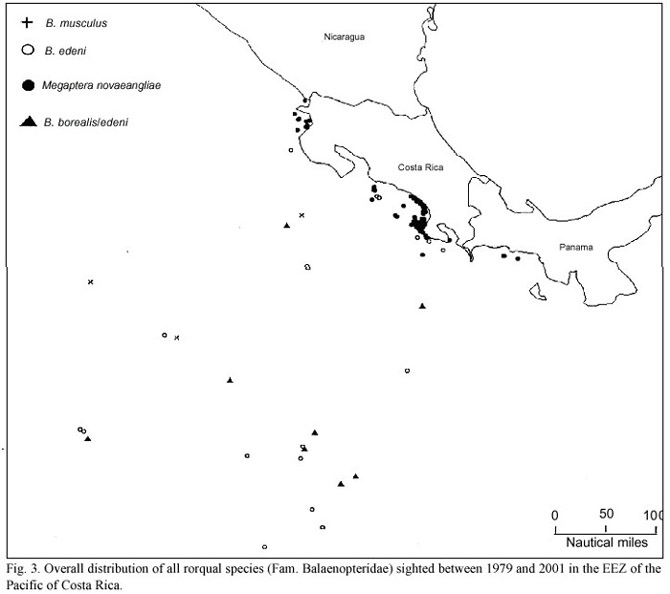
<p><font face="Arial" size="2">&nbsp;</font></p> <font face="Arial" size="2"><b></b></font>     <p><font face="Arial" size="2"><b>SubOrder Mysticeti Family Balaenopteridae </b>(rorquals)</font></p>     <p><font face="Arial" size="2">In addition to <i>Balaenoptera edeni, B. musculus</i>, and <i>Megaptera novaeangliae </i>we mapped sightings of animals categorized as <i>B. borealis</i> / <i>B. edeni, </i>meaning that we were not able to confirm the presence of one or three ridges on the rostrum. However, these sightings most likely correspond to <i>B. edeni </i>that is commonly found in the northern and western of the Costa Rican EEZ. It is unlikely that any include <i>B. borealis </i>since the SWFSC has not been able to confirm the presence of this species during twenty-two years of surveying Costa Rican waters (T. Gerrodette pers. comm. 2003). Additionally, CRC in 1997 reported a possible sighting of <i>B. physalus </i>at 8.408N/-83.558W, the interpretation of this sighting should also be treated carefully, because it was not confirmed.</font></p>     <p><font face="Arial" size="2">Humpback whales were seen primarily during two time periods: January to March and August to early October. Unlike sightings of other whales, all sightings of humpback whales were close to shore and within the neritic zone. Sightings were heavily concentrated in the area around Osa Peninsula in southern Costa Rica where dedicated photo-ID surveys conducted by Cascadia Research were based. The other two species sightings were primarily in oceanic waters (<a href="#f3">Fig.3</a>).</font></p>     <p style="text-align: center;"><font face="Arial" size="2">&nbsp;<a  name="f3"></a></font></p> <font face="Arial" size="2"><b> </b></font>     <div style="text-align: center;"><font face="Arial" size="2"><b>     ]]></body>
<body><![CDATA[<p><img src="/img/fbpe/rbt/v53n1-2/3037i3.JPG" title="" alt=""  style="width: 670px; height: 594px;"></p> </b></font></div> <font face="Arial" size="2"><b>     
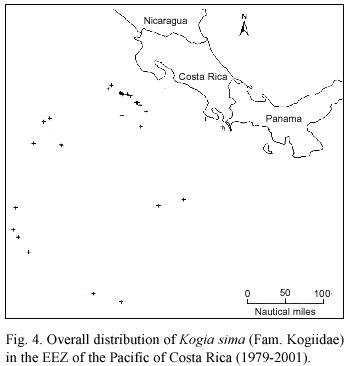
<p>SubOrder Odontoceti Family Kogiidae</p> </b></font>     <p><font face="Arial" size="2">(Dwarf and Pygmy Sperm Whales)</font></p>     <p><font face="Arial" size="2">The dwarf sperm whale, <i>Kogia sima</i>, was the only confirmed Kogiidae species. Although this species has been reported in the central and south Pacific coastal waters, most of our sightings occurred in offshore waters (<a href="#f4">Fig.4</a>).</font></p>     <p style="text-align: center;"><font face="Arial" size="2">&nbsp;<a  name="f4"></a><img src="/img/fbpe/rbt/v53n1-2/3037i4.JPG" title=""  alt="" style="width: 348px; height: 366px;"></font></p> <font face="Arial" size="2"></font>     
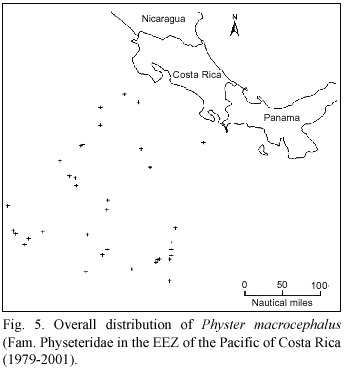
<p><font face="Arial" size="2"><b>Family Physeteridae </b>(Sperm Whale)</font></p> <font face="Arial" size="2"><i> </i></font>     <p><font face="Arial" size="2"><i>Physeter macrocephalus </i>sightings were widely distributed in offshore waters, particularly in the southeastern portion of the EEZ, including Coco Island (<a href="#f5">Fig.5</a>).</font></p> <a name="f5"></a>     <div style="text-align: center;"><img  src="/img/fbpe/rbt/v53n1-2/3037i5.JPG" title="" alt=""  style="width: 347px; height: 368px;"></div>     
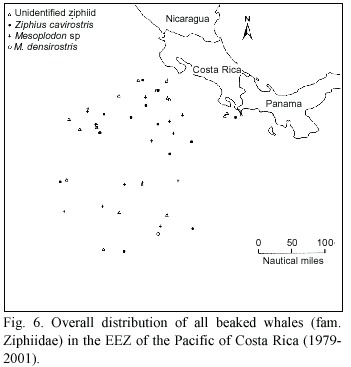
<p><font face="Arial" size="2"><b>Family Ziphiidae </b>(Beaked-whales)</font></p>     <p><font face="Arial" size="2">Two species of beaked whales were confirmed: <i>Mesoplodon densirostris </i>and <i>Ziphius cavirostris</i>. However, other <i>Mesoplodon </i>species and unidentified ziphiids were also commonly observed in the area. Although, <i>Z. cavirostris, Mesoplodon </i>spp. and unidentified ziphiids were occasionally observed in neritic waters, overall, ziphiids sightings showed a wide distribution throughout oceanic waters (<a href="#f6">Fig.6</a>).</font></p>     ]]></body>
<body><![CDATA[<p style="text-align: center;"><font face="Arial" size="2">&nbsp;<a  name="f6"></a><img src="/img/fbpe/rbt/v53n1-2/3037i6.JPG" title=""  alt="" style="width: 351px; height: 367px;"></font></p> <font face="Arial" size="2"></font>     
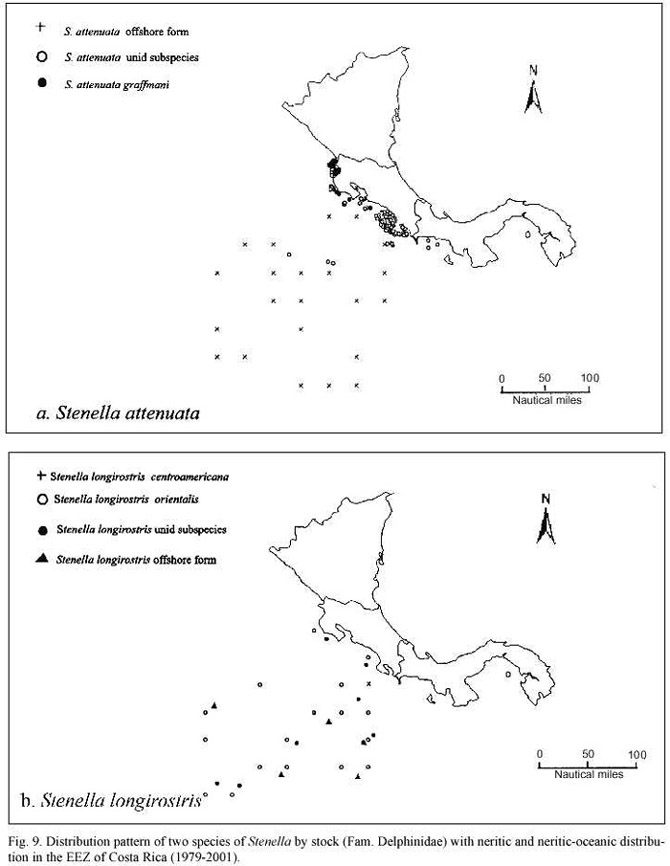
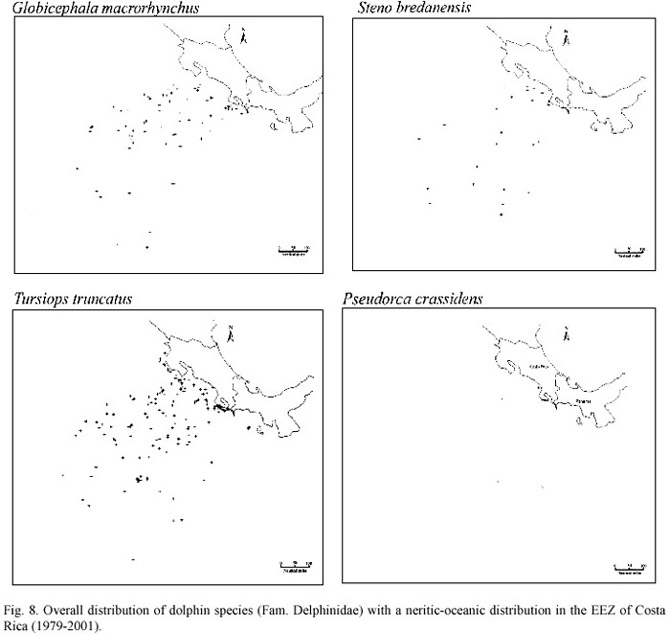
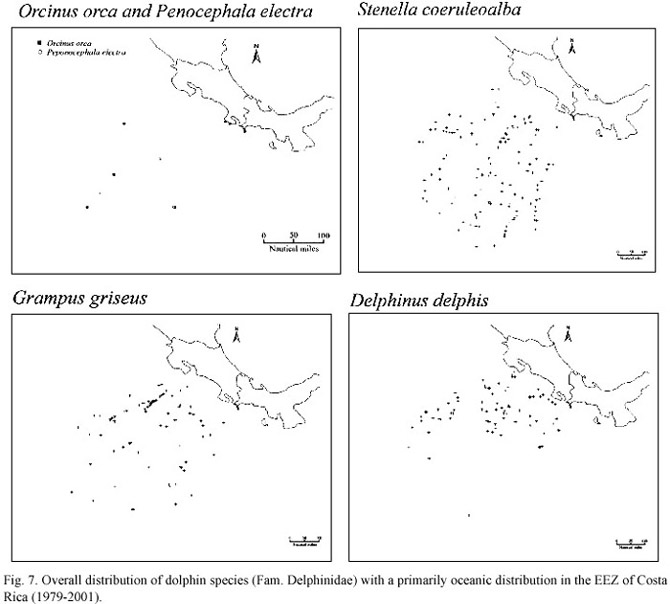
<p><font face="Arial" size="2"><b>Family Delphinidae </b>(Dolphins)</font></p>     <p><font face="Arial" size="2">With the exception of <i>Lagenodelphis hosei </i>which was observed only once in oceanic waters (8.408 N/-88.558 W), we constructed distribution maps for all dolphin species. Based on the percentage of sightings in neritic and oceanic waters, dolphin species were grouped into three categories:</font></p>     <p><font face="Arial" size="2">(1) Species with sightings primarily in oceanic waters: <i>Orcinus orca, Peponocephala electra, Stenella coeruleoalba, Grampus griseus, Delphinus delphis, S. longirostris </i>(<a  href="#f7">Fig.7</a>,<a href="#f9">9</a>).</font></p>     <div style="text-align: center;"><a name="f7"></a>    <br>     <div style="text-align: center;"><img src="/img/fbpe/rbt/v53n1-2/3037i7.JPG" title=""  alt="" style="width: 670px; height: 604px;">    
<br> </div>     <br>     <br> </div> <a name="f9"></a>     ]]></body>
<body><![CDATA[<div style="text-align: center;"><img src="/img/fbpe/rbt/v53n1-2/3037i9.JPG" title=""  alt="" style="width: 670px; height: 866px;">    
<br> </div>     <p><font face="Arial" size="2">(2) Species with sightings in both offshore and neritic waters: <i>G. macrorhynchus, Steno bredanensis</i>, <i>Tursiops truncatus, Pseudorca crassidens, </i>and <i>S. attenuata </i>offshore stock (<a href="#f8">Fig.8</a>,<a href="#f9">9</a>). It is important to notice that none of the data sources regularly surveyed the Gulf of Dulce where there is a resident population of <i>T. truncatus</i>. However, such surveys would probably not change the consideration of <i>T. truncatus </i>as an offshore-neritic species in the Costa Rican EEZ.</font></p> <a name="f8"></a>     <div style="text-align: center;"><img src="/img/fbpe/rbt/v53n1-2/3037i8.JPG" title=""  alt="" style="width: 670px; height: 635px;">    
<br> </div>     <p><font face="Arial" size="2">(3) Species with sightings primarily in neritic waters: <i>S. attenuata graffmani </i>(<a href="#f9">Fig.9</a>)<i>.</i></font></p>     <p><font face="Arial" size="2"><i>S. attenuata graffmani </i>sightings were widely distributed in neritic waters, particularly concentrated in north Pacific (Papagayo Gulf and Cuajiniquil Bay) and in the south Pacific (Dominical, Drake Bay, and Osa Peninsula). This may be artifact of concentrated survey effort in these two areas.</font></p> <font face="Arial" size="2"><b>     <p>Discussion</p> </b> </font>     <p><font face="Arial" size="2">Twenty years of surveys in the Pacific Exclusive Economic Zone of Costa Rica reveal a cetacean community that encompasses 19 species. Mysticetes were represented only by three species members of the family Balaenopteridae that with the exception of <i>Megaptera novaeangliae </i>may inhabit primarily oceanic waters. <a href="#ro01">Rodriguez-Fonseca (2001)</a> indicated that both <i>Balaenoptera edeni </i>and <i>B. musculus </i>are common in the EEZ of Costa Rica. However, our study does not support this conclusion and careful considerations should be taken when treating these species. In fact long term studies by SWFSC in the Eastern Tropical Pacific have indicated that <i>B. edeni </i>is more commonly found at 150º W between 20º N and 10º S and <i>B. musculus </i>appears to be more frequently along of Baja California, Mexico (<a href="#ki99">Kinzey <i>et al. </i>1999</a>, <a href="#ki00a">2000a</a>, <a href="#ki01">2001</a>).</font></p>     <p><font face="Arial" size="2">Humpback whales from both the northern and southern hemispheres utilize the waters of Costa Rica as a wintering area (Steiger <i>et al. </i>1993, <a href="#ca99">Calambokidis <i>et al. </i>1999</a>, <a href="#ca00">2000</a>, <a href="#ra01">Rasmussen <i>et al. </i>2001</a>, <a href="#ra02">2002</a>, <a href="#ac95">Acevedo and Smultea 1995</a>). The humpback whale sightings we report are from January to March and August to October, which correspond with the northern and southern Hemisphere humpback whale wintering seasons, respectively. Photographic identification has shown that whales seen during the Northern hemisphere wintering season are primarily migrating from feeding grounds off California, and whales seen during the southern hemisphere season are migrating from Antarctic. In addition to the concentration of sightings we report in the Gulf of Papagayo and the Osa Peninsula, sightings of humpback whales have also been reported in the Golfo Dulce during the southern hemisphere wintering season and off Cocos Island during the northern hemisphere season (<a href="#ac95">Acevedo and Smultea 1995</a>, Photographer Marco Tulio Saborío pers. comm. 2004).</font></p>     ]]></body>
<body><![CDATA[<p><font face="Arial" size="2">Odontocetes were represented by four families Ziphiidae, Kogiidae, Physeteridae and Delphinidae. The three first families were represented by two and one species respectively, with sightings primarily in oceanic waters, occasionally observed in neritic waters. <a href="#ro01">Rodriguez-Fonseca (2001)</a> reported two species of Kogiidae, <i>Kogia breviceps </i>and <i>K. sima</i>. The first one, he listed as resident species for Costa Rica. However, we did not observe this species in our surveys and again careful considerations must be taken on this species. It is important to notice that sperm whales were observed once in Islas Murciélagos, Area de Conservación Guanacaste (Biol. Giovanni Basey comm. pers. 2004) and are occasionally observed in Golfo de Nicoya (Biol. José Palacios comm. pers. 2004). As for the ziphiids, we expect to find more species of ziphiids as detection techniques for these shy animals improve in the future. </font></p>     <p><font face="Arial" size="2">Delphinidae had the highest number of species. Some were widely distributed in oceanic waters (<i>e.g.</i>, <i>S. coeruleoalba</i>), others in both oceanic and neritic waters (<i>e.g.</i>, <i>Tursiops truncatus </i>), and some primarily in neritic waters (<i>S. attenuata graffmani </i>). For <i>Peponocephala electra, Orcinus orca</i>, and <i>Lagenodelphis hosei </i>similar distribution patterns have been described in other parts of the Eastern Tropical Pacific, where sightings are occasional and occur primarily in oceanic waters (<a  href="#au85">Au and Perryman 1985</a>, <a href="#re94">Reilly and Fiedler 1994</a>, Wade and Gerrodette 1996, <a href="#ki99">Kinzey <i>et al. </i>1999</a>, <a href="#ki00a">2000a</a>, <a href="#ki01">2001</a>). It is important to notice that <i>Orcinus orca </i>and <i>Globicephala macrorhynchus </i>have been informally reported by local artisanal fisherman, sport fishing and diving tours in Montezuma, Cabo Blanco, Isla Catalina (in Golfo de Papagayo), Islas Murciélagos and Isla del Caño and along Osa Peninsula (Biol. Frank Garita, Biol. José Martínez, fisherman Minor Lara, and a number of local captains comm. pers. 1998-2004) and <i>Steno bredanensis </i>was observed once inside Bahía Culebra actively interacting with <i>S. attenuata graffmani </i>(Laura May-Collado and Alvaro Morales pers. observ. 2001).</font></p>     <p><font face="Arial" size="2">Our distribution maps provide further support to previous studies in which the Gulf of Papagayo (including the Mucielago’s Islands) and Osa Península (particularly Caño Island) have been described as important breeding grounds for the northern and southern hemisphere <i>M </i>. <i>novaeangliae </i>whales (<a  href="#ca99">Calambokidis <i>et al. </i>1999</a>, 2001, <a  href="#ra01">Rasmussen <i>et al. </i>2001</a>, <a href="#ra02">2002</a>), and the local population of <i>Stenella attenuata graffmani </i>(<i>e.g.</i>, <a href="#ma01">May-Collado 2001</a>, <a href="#ma05">May- Collado and Morales 2005</a>). Similarly, Gulf of Dulce and Cocos Island have been proposed as year-round reproductive and foraging areas for <i>Tursiops truncatus </i>(<a href="#ac96">Acevedo-Gutierrez 1996</a>, <a  href="#ac98">Acevedo-Gutierrez and Burkhart 1998</a>, <a href="#cu98">Cubero-Pardo 1998</a>). Although our study does not show patterns to support Cocos Island as important site for <i>Pseudorca crassidens </i>(<a  href="#ac97">Acevedo-Gutierrez 1997</a>) and <i>Ziphius cavirostris </i>(<a  href="#ac96">Acevedo-Gutierrez 1996</a>) it is important to consider these sites as potential habitats for these two species, until future studies of abundance and habitat use are available. </font></p>     <p><font face="Arial" size="2">Furthermore, our data provides evidence that dolphin habitats largely overlap with important fishing areas,a situation that must be taken into account for conservation and management purposes. In fact, incidental kills by artisanal fisheries and pursue-seine tuna fishery is suggested to be important in Costa Rican waters (<a href="#vi94">Vidal <i>et al. </i>1994</a>, <a  href="#pa96">Palacios and Gerrodette 1996</a>, <a href="#wa02">Wade <i>et al. </i>2002</a>). The SWFSC has been estimating annual mortality rates due to artisanal fisheries for most of the EEZ of Central American countries. In Costa Rican waters annual mortality is about 9.5% of the population size for all small cetaceans combined (<a  href="#pa96">Palacios and Gerrodette 1996</a>, <a href="#wa02">Wade <i>et al. </i>2002</a>). According to IWC (1996) anthropogenic mortality rates should not exceed 1-2% of population size, based on the low reproductive rate of cetaceans (<a href="#pe94">Perrin <i>et al. </i>1994</a>, <a href="#in96">IWC 1996</a>).</font></p>     <p><font face="Arial" size="2">These numbers are particularly important for the subpopulations (or stocks) of <i>S. longirostris </i>and <i>S. attenuata</i>, which in the past have been dramatically reduced by the tuna fishery industry (<a href="#pe02a">Perrin <i>et al. </i>2002a</a>,<a  href="#pe02b">b</a>). Tuna industry is particularly significant in the Eastern Tropical Pacific because it supports one the world ’s largest fisheries ground of yellowfin tuna (<i>Thunnus albacares</i>). Yellowfin tuna tends to associate with mixed schools of <i>S. longirostris </i>and <i>S. attenuata</i>; this aggregation is follow by several seabird species which make it very conspicuous to fishermen (<a  href="#au86">Au and Pitman 1986</a>). This tuna detection technique is so successful that it has resulted in large tuna catch, but simultaneously has caused dolphin populations to decline (<a  href="#ba02">Ballance <i>et al. </i>2002</a>). For instance, <i>Stenella longirostris orientalis</i>, populations have decreased 70% of their original size (<a href="#wa02">Wade <i>et al.</i>2002</a>). In addition to these two type of fisheries, whale watching activities also appear to have a negative impact, particularly on coastal dolphin populations due to lack of proper training of the operators (<a  href="#cu01">Cubero-Pardo 2001</a>).</font></p>     <p><font face="Arial" size="2">Although most of the dolphin species listed in this paper are not considered in endangered or vulnerable by CITES II (Convention on International Trade in Endangered Species of Wild Fauna and Flora), it states that trade must be controlled (<a  href="http://www.cities.org">http://www.cities.org</a>). Several of these species are also listed in the IUCN Red list (The World Conservation Union, <a href="http://www.redlist.org">http://www.redlist.org</a>). We believe that the level of localism of cetacean species in Costa Rica and in the rest of Central American countries should be considered for their protection. Work done by <a href="#es02">Escorza-Treviño <i>et al. </i>(2002)</a> on the genetics of <i>S. attenuata graffmani </i>populations along Central America suggests that these coincide with jurisdictional waters of each country. They indicate the existence of six distinct coastal populations, which should be treated as independent units for management purposes. Additionally, the Central America Bight is the most important area of overlap for <i>S. longirostris, S. attenuata, S. coeruleoalba and Delphinus delphis</i>, and protection of these species in Costa Rican waters will reverberate in other Central America countries. The family Balaenopteridae is also listed by the IUCN red list, but it is <i>Megaptera novaengliae </i>the one consider a vulnerable species. Therefore, we believe that future conservation and management efforts should initiate on whales and dolphin species that occupy neritic waters where human activities are most intense and more likely to affect their populations.</font></p>     <p><font face="Arial" size="2">In conclusion, here we reported 19 cetacean species and constructed distribution maps for 17 species. However, more information needs to be generated to have a better understanding of the influence of abiotic and biotic factors, seasonality, and human activities that may influence the distribution patterns of these animals. Cetaceans are animals that have a very low population growth rate. Therefore they are very susceptible to any kind of exploitation that affect their behavior (<i>e.g.</i>, whale watching, anthropogenic noise, etc.) and immediate population size (<i>e.g.</i>, tuna and artisanal fisheries, pollution, etc.). In the immediate future, the protection of these animals and their habitats should be a top priority in Costa Rican marine conservation. These first maps of sighting distribution may provide base-line information to initiate the protection for these animals and their habitat. </font></p> <font face="Arial" size="2"><b>     <p>Acknowledgments</p> </b> </font>     <p><font face="Arial" size="2">We thank MINAE for research permits, CIMAR and the Area de Conservación Guanacaste for logistic and institutional support. Special thanks to Jorge Cortes,Alvaro Morales, Carmen Durán, Roger Blanco, Frank Joyce, Federico Chinchilla and Geovanni Bassey. Thanks to The Nature Conservancy and the Society for Marine Mammalogy (Emily Shane for providing funding to study dolphins in the Gulf of Papagayo and the Oceanic Society Expeditions for supporting humpback whale field work. Numerous people assisted in the data gathering: Gretchen Steiger, Frank Garita, Isidoro Szczepaniak, Heather Harding, Oceanic Society Expeditions participants from Elderhostel, Minor Lara, Frank Lara father and son, Guicha, Samba, Freddy, Andrea Montero, Marian Portillo, Marco Tulio Saborio, Monica Gamboa, Marco Quesada, Alvaro Morales, Frank Garita, Augusta Anderson, SWFSC crew members and marine mammal observ-EAP and Escuela de Biologia students, OTS Biocursos participants. Special thanks to Federico Chinchilla for inspiring this paper and to Ingi Agnarsson and anonymous reviewers for valuable comments and corrections to the manuscript.</font></p> <font face="Arial" size="2"><b>     <p>Resumen</p> </b> </font>     ]]></body>
<body><![CDATA[<p><font face="Arial" size="2">Diecinueve especies de cetáceos distribuídos en cinco familias (Balaenopteridae, Kogiidae, Physeteridae, Ziphiidae and Delphinidae) habitan en la Zona Económica Exclusiva del Pacífico de Costa Rica (ZEEP). Con base a datos tomados en esta zona por el Southwest Fisheries Service Center, Cascadia Research Collective y CIMAR entre 1979 y 2001 construímos mapas de distribución de avistamientos para 18 especies. Nuestros resultados sugieren que la mayoría de las especies de cetáceos habitan en aguas oceánicas, particularmente miembros de las familias Balaenopteridae, Kogiidae, Physeteridae y Ziphiidae. Miembros de la familia Delphinidae mostraron una variedad de patrones de distribución, siete mostraron una distribución amplia en el ZEEP, cuatro parecen ser exclusivamente oceánicas y dos principalmente costeras. Adicionalmente, tres especies de cetáceos tienen poblaciones concentradas en la costa: <i>Stenella attenuata graffmani, Tursiops truncatus </i>y <i>Megaptera novaeangliae. </i>Estas tres especies son por lo tanto más suceptibles debido a que su hábitat traslapa considerablemnte con áreas importantes para la pesca artesanal y atunera, y áreas de observación de ballenas (las cuales a incrementado considerablemente en los últimos años). Los mapas de distribución de avistamientos de cetáceos presentados en este trabajo son los primeros en su tipo para Costa Rica. Estos aportan información esencial y básica para iniciativas de conservación y manejo de estos animals y los habitats donde estos se reproducen y alimentan.</font></p> <font face="Arial" size="2"><b></b></font>     <p><font face="Arial" size="2"><b>Palabras clave: </b>conservación, América Central, delfines, mamíferos marinos, ballenas.</font></p> <font face="Arial" size="2"><b>     <p>References</p> </b> </font>     <!-- ref --><p><font face="Arial" size="2"><a name="ac91"></a>Acevedo-Gutierrez, A. &amp; B. Wursig. 1991. Preliminary observations on bottlenose dolphins, <i>Tursiops truncatus</i>, at Isla del Coco, Costa Rica. Aquatic Mamm. 17:148-151.    &nbsp;&nbsp;&nbsp;&nbsp;&nbsp;&nbsp;&nbsp;&nbsp;[&#160;<a href="javascript:void(0);" onclick="javascript: window.open('/scielo.php?script=sci_nlinks&ref=1679284&pid=S0034-7744200500010002700001&lng=','','width=640,height=500,resizable=yes,scrollbars=1,menubar=yes,');">Links</a>&#160;]<!-- end-ref --></font></p>     <!-- ref --><p><font face="Arial" size="2"><a name="ac95"></a>Acevedo-Gutierrez, A. &amp; M. A. Smultea. 1995. First records of humpback whales including calves at Golfo Dulce and Isla del Coco, Costa Rica, suggesting geographical overlap of northern and southern Hemisphere populations. Mar. Mamm. Sci. 11:554-560.    &nbsp;&nbsp;&nbsp;&nbsp;&nbsp;&nbsp;&nbsp;&nbsp;[&#160;<a href="javascript:void(0);" onclick="javascript: window.open('/scielo.php?script=sci_nlinks&ref=1679286&pid=S0034-7744200500010002700002&lng=','','width=640,height=500,resizable=yes,scrollbars=1,menubar=yes,');">Links</a>&#160;]<!-- end-ref --></font></p>     <!-- ref --><p><font face="Arial" size="2"><a name="ac96"></a>Acevedo-Gutierrez, A. 1996. Lista de mamíferos marinos en Golfo Dulce e Isla del Coco, Costa Rica. Rev. Biol.Trop.44:933-934.    &nbsp;&nbsp;&nbsp;&nbsp;&nbsp;&nbsp;&nbsp;&nbsp;[&#160;<a href="javascript:void(0);" onclick="javascript: window.open('/scielo.php?script=sci_nlinks&ref=1679288&pid=S0034-7744200500010002700003&lng=','','width=640,height=500,resizable=yes,scrollbars=1,menubar=yes,');">Links</a>&#160;]<!-- end-ref --></font></p>     <!-- ref --><p><font face="Arial" size="2"><a name="ac97"></a>Acevedo-Gutierrez, A. 1997. Resightings and behavior of false killer whales (<i>Pseudorca crassidens</i>) in Costa Rica. Mar. Mamm. Sci. 13:307-314.    &nbsp;&nbsp;&nbsp;&nbsp;&nbsp;&nbsp;&nbsp;&nbsp;[&#160;<a href="javascript:void(0);" onclick="javascript: window.open('/scielo.php?script=sci_nlinks&ref=1679290&pid=S0034-7744200500010002700004&lng=','','width=640,height=500,resizable=yes,scrollbars=1,menubar=yes,');">Links</a>&#160;]<!-- end-ref --></font></p>     <!-- ref --><p><font face="Arial" size="2"><a name="ac98"></a>Acevedo-Gutierrez, A. &amp; S. Burkhart. 1998. Seasonal distribution of bottlenose (<i>Tursiops truncatus</i>) and pantropical spotted (<i>Stenella attenuata</i>)dolphins (Cetacea: Delphinidae) in Golfo Dulce, Costa Rica. Rev. Biol. Trop.46:91-101.    &nbsp;&nbsp;&nbsp;&nbsp;&nbsp;&nbsp;&nbsp;&nbsp;[&#160;<a href="javascript:void(0);" onclick="javascript: window.open('/scielo.php?script=sci_nlinks&ref=1679292&pid=S0034-7744200500010002700005&lng=','','width=640,height=500,resizable=yes,scrollbars=1,menubar=yes,');">Links</a>&#160;]<!-- end-ref --></font></p>     <!-- ref --><p><font face="Arial" size="2"><a name="au85"></a>Au, D. W. K. &amp; W. L. Perryman. 1985. Dolphin habitats in the Eastern Tropical Pacific. Fish. Bull. 83:623-643.    &nbsp;&nbsp;&nbsp;&nbsp;&nbsp;&nbsp;&nbsp;&nbsp;[&#160;<a href="javascript:void(0);" onclick="javascript: window.open('/scielo.php?script=sci_nlinks&ref=1679294&pid=S0034-7744200500010002700006&lng=','','width=640,height=500,resizable=yes,scrollbars=1,menubar=yes,');">Links</a>&#160;]<!-- end-ref --></font></p>     <!-- ref --><p><font face="Arial" size="2"><a name="au86"></a>Au, D. W. K. &amp; R. L. Pitman. 1986. Seabird interactions with dolphins and tuna in the Eastern Tropical Pacific. Condor 88:304-317.    &nbsp;&nbsp;&nbsp;&nbsp;&nbsp;&nbsp;&nbsp;&nbsp;[&#160;<a href="javascript:void(0);" onclick="javascript: window.open('/scielo.php?script=sci_nlinks&ref=1679296&pid=S0034-7744200500010002700007&lng=','','width=640,height=500,resizable=yes,scrollbars=1,menubar=yes,');">Links</a>&#160;]<!-- end-ref --></font></p>     <!-- ref --><p><font face="Arial" size="2"><a name="ba02"></a>Ballance, L. T. , P. C. Fiedler, T. Gerrodette, R. L. Pitman &amp; S. B. Reilly. 2002. An overview of Eastern Tropical Pacific ecosystem studies within the context of international dolphin conservation program act research. SWFSC Administrative Report, La Jolla, LJ-02-14.9 p.    &nbsp;&nbsp;&nbsp;&nbsp;&nbsp;&nbsp;&nbsp;&nbsp;[&#160;<a href="javascript:void(0);" onclick="javascript: window.open('/scielo.php?script=sci_nlinks&ref=1679298&pid=S0034-7744200500010002700008&lng=','','width=640,height=500,resizable=yes,scrollbars=1,menubar=yes,');">Links</a>&#160;]<!-- end-ref --> </font></p>     <!-- ref --><p><font face="Arial" size="2"><a name="ca99"></a>Calambokidis, J., K. Rasmussen &amp; G. H. Steiger. 1999. Humpback whales and other marine mammals off Costa Rica, 1996-1999. Report of research during Oceanic Society Expeditions in 1999 in cooperation with Elderhostel volunteers. Cascadia Res. Collec. 35 p.    &nbsp;&nbsp;&nbsp;&nbsp;&nbsp;&nbsp;&nbsp;&nbsp;[&#160;<a href="javascript:void(0);" onclick="javascript: window.open('/scielo.php?script=sci_nlinks&ref=1679300&pid=S0034-7744200500010002700009&lng=','','width=640,height=500,resizable=yes,scrollbars=1,menubar=yes,');">Links</a>&#160;]<!-- end-ref --></font></p>     <!-- ref --><p><font face="Arial" size="2"><a name="ca00"></a>Calambokidis, J., G. H. Steiger, Rasmussen, K. Urbán, J. R. Balcomb, K. C. Ladrón de Guevara, P. Salinas, M. Jacobsern J. K. Herman, L. M. Cerchio &amp; J. D. Darling. 2000. Migratory destinations of humpback whales that feed off California, Oregon and Washington. Mar. Ecol. Prog. Ser. 192:295-304.    &nbsp;&nbsp;&nbsp;&nbsp;&nbsp;&nbsp;&nbsp;&nbsp;[&#160;<a href="javascript:void(0);" onclick="javascript: window.open('/scielo.php?script=sci_nlinks&ref=1679302&pid=S0034-7744200500010002700010&lng=','','width=640,height=500,resizable=yes,scrollbars=1,menubar=yes,');">Links</a>&#160;]<!-- end-ref --></font></p>     <!-- ref --><p><font face="Arial" size="2"><a name="ca02"></a>Calambokidis, J., K. Rasmussen &amp; G. H. Steiger. 2002. Humpback whales and other marine mammals off Costa Rica, 1996-1999. Report of research during Oceanic Society Expeditions in 2002 in cooperation with Elderhostel volunteers.Cascadia Res. Collec. 33 p.    &nbsp;&nbsp;&nbsp;&nbsp;&nbsp;&nbsp;&nbsp;&nbsp;[&#160;<a href="javascript:void(0);" onclick="javascript: window.open('/scielo.php?script=sci_nlinks&ref=1679304&pid=S0034-7744200500010002700011&lng=','','width=640,height=500,resizable=yes,scrollbars=1,menubar=yes,');">Links</a>&#160;]<!-- end-ref --></font></p>     <!-- ref --><p><font face="Arial" size="2"><a name="cu98"></a>Cubero-Pardo, P. 1998. Patrones de comportamiento diurnos y estacionales de <i>Tursiops truncatus </i>y <i>Stenella attenuata </i>(Mammalia: Delphinidae) en el Golfo Dulce, Costa Rica. Rev. Biol. Trop. 46:103-110.    &nbsp;&nbsp;&nbsp;&nbsp;&nbsp;&nbsp;&nbsp;&nbsp;[&#160;<a href="javascript:void(0);" onclick="javascript: window.open('/scielo.php?script=sci_nlinks&ref=1679306&pid=S0034-7744200500010002700012&lng=','','width=640,height=500,resizable=yes,scrollbars=1,menubar=yes,');">Links</a>&#160;]<!-- end-ref --></font></p>     <!-- ref --><p><font face="Arial" size="2"><a name="cu01"></a>Cubero-Pardo, P. 2001. Assesing the impact of whale- watching activities on wild cetaceans in Costa Rica. 14<sup>th</sup> Biennial Conference on the Biology of Marine Mammals, Vancouver Nov. 28-Dec. 2, 2001.    &nbsp;&nbsp;&nbsp;&nbsp;&nbsp;&nbsp;&nbsp;&nbsp;[&#160;<a href="javascript:void(0);" onclick="javascript: window.open('/scielo.php?script=sci_nlinks&ref=1679308&pid=S0034-7744200500010002700013&lng=','','width=640,height=500,resizable=yes,scrollbars=1,menubar=yes,');">Links</a>&#160;]<!-- end-ref --></font></p>     <!-- ref --><p><font face="Arial" size="2"><a name="di94"></a>Dizon, A. E., W. F. Perrin, &amp; P. A. Akin. 1994. Stocks of dolphins (<i>Stenella </i>spp.and <i>Delphinus delphis</i>) in the Eastern Tropical Pacific: A phylogeographical classification. NOAA Technical Report. NMFS 119. 20 p.    &nbsp;&nbsp;&nbsp;&nbsp;&nbsp;&nbsp;&nbsp;&nbsp;[&#160;<a href="javascript:void(0);" onclick="javascript: window.open('/scielo.php?script=sci_nlinks&ref=1679310&pid=S0034-7744200500010002700014&lng=','','width=640,height=500,resizable=yes,scrollbars=1,menubar=yes,');">Links</a>&#160;]<!-- end-ref --></font></p>     <!-- ref --><p><font face="Arial" size="2"><a name="es02"></a>Escorza-Trevino, S., A. Lang &amp; A. E. Dizon. 2002. Genetic differentiation and intraspecific structure of eastern tropical Pacific spotted dolphins, <i>Stenella attenuata </i>revealed by mitochondrial and microsatellite DNA analyses. SWFSC Administrative Report, La Jolla, LJ-02-38.20 p</font><font  face="Arial" size="2" color="#008000">.    &nbsp;&nbsp;&nbsp;&nbsp;&nbsp;&nbsp;&nbsp;&nbsp;[&#160;<a href="javascript:void(0);" onclick="javascript: window.open('/scielo.php?script=sci_nlinks&ref=1679312&pid=S0034-7744200500010002700015&lng=','','width=640,height=500,resizable=yes,scrollbars=1,menubar=yes,');">Links</a>&#160;]<!-- end-ref --></font></p> <font face="Arial" size="2"></font>     <!-- ref --><p><font face="Arial" size="2"><a name="ge96"></a>Gerrodette, T. &amp; D. M. Palacios. 1996. Estimates of cetacean abundance in EEZ waters of the Eastern Tropical Pacific. National Marine Fisheries Service, Southwest Fisheries Science Center, Administrative Report JL-96-10.27 p.    &nbsp;&nbsp;&nbsp;&nbsp;&nbsp;&nbsp;&nbsp;&nbsp;[&#160;<a href="javascript:void(0);" onclick="javascript: window.open('/scielo.php?script=sci_nlinks&ref=1679314&pid=S0034-7744200500010002700016&lng=','','width=640,height=500,resizable=yes,scrollbars=1,menubar=yes,');">Links</a>&#160;]<!-- end-ref --></font></p>     <!-- ref --><p><font face="Arial" size="2"><a name="in96"></a>International Whaling Commission. 1996. Report of the Scientific Committee, Annex G. Report of the Sub-Committee on Small Cetaceans. Rep. Int. Whaling Comm. 45:165-186.    &nbsp;&nbsp;&nbsp;&nbsp;&nbsp;&nbsp;&nbsp;&nbsp;[&#160;<a href="javascript:void(0);" onclick="javascript: window.open('/scielo.php?script=sci_nlinks&ref=1679316&pid=S0034-7744200500010002700017&lng=','','width=640,height=500,resizable=yes,scrollbars=1,menubar=yes,');">Links</a>&#160;]<!-- end-ref --></font></p>     <!-- ref --><p><font face="Arial" size="2"><a name="ki99"></a>Kinzey, D., T. Gerrodette, J. Barlow, A. Dizon, W. Perryman, P. Olson &amp; A. Von Saunder. 1999. Marine Mammal Data Collected during a survey in the Eastern Tropical Pacific ocean aboard the NOAA ships McArthur and David Starr Jordan, July 31- December 9, 1998. U. S. Department of Commerce, NOAA Technical Memorandum NMFS-283.113 p.    &nbsp;&nbsp;&nbsp;&nbsp;&nbsp;&nbsp;&nbsp;&nbsp;[&#160;<a href="javascript:void(0);" onclick="javascript: window.open('/scielo.php?script=sci_nlinks&ref=1679318&pid=S0034-7744200500010002700018&lng=','','width=640,height=500,resizable=yes,scrollbars=1,menubar=yes,');">Links</a>&#160;]<!-- end-ref --></font></p>     <!-- ref --><p><font face="Arial" size="2"><a name="ki00a"></a>Kinzey, D., T. Gerrodette, J. Barlow, A. Dizon, W. Perryman &amp; P. Olson. 2000a. Marine Mammal Data Collected during a survey in the Eastern Tropical Pacific ocean aboard the NOAA ships McArthur and David Starr Jordan, July 28-December 9, 1999. Department of Commerce. NOAA Technical Memorandum NMFS- 293. U. S. 89 p.    &nbsp;&nbsp;&nbsp;&nbsp;&nbsp;&nbsp;&nbsp;&nbsp;[&#160;<a href="javascript:void(0);" onclick="javascript: window.open('/scielo.php?script=sci_nlinks&ref=1679320&pid=S0034-7744200500010002700019&lng=','','width=640,height=500,resizable=yes,scrollbars=1,menubar=yes,');">Links</a>&#160;]<!-- end-ref --></font></p>     <!-- ref --><p><font face="Arial" size="2"><a name="ki00b"></a>Kinzey, D., P. Olson, &amp; T. Gerrodette. 2000b. Marine mammal data collection procedures on research ship line-transect surveys by the Southwest Fisheries Science Center. Southwest Fisheries Science Center, Administrative Report LJ-00-08, 32 p.    &nbsp;&nbsp;&nbsp;&nbsp;&nbsp;&nbsp;&nbsp;&nbsp;[&#160;<a href="javascript:void(0);" onclick="javascript: window.open('/scielo.php?script=sci_nlinks&ref=1679322&pid=S0034-7744200500010002700020&lng=','','width=640,height=500,resizable=yes,scrollbars=1,menubar=yes,');">Links</a>&#160;]<!-- end-ref --></font></p>     <!-- ref --><p><font face="Arial" size="2"><a name="ki01"></a>Kinzey, D., T. Gerrodette, A. Dizon, W. Perryman, P. Olson, &amp; S. Rankin. 2001. Marine Mammal Data Collected during a survey in the Eastern Tropical Pacific ocean aboard the NOAA ships McArthur and David Starr Jordan, July 28-December 9, 2000. U. S. Department of Commerce. NOAA Technical Memorandum NMFS-303. 99 p.    &nbsp;&nbsp;&nbsp;&nbsp;&nbsp;&nbsp;&nbsp;&nbsp;[&#160;<a href="javascript:void(0);" onclick="javascript: window.open('/scielo.php?script=sci_nlinks&ref=1679324&pid=S0034-7744200500010002700021&lng=','','width=640,height=500,resizable=yes,scrollbars=1,menubar=yes,');">Links</a>&#160;]<!-- end-ref --></font></p>     <!-- ref --><p><font face="Arial" size="2"><a name="le95"></a>Levinton, J. S. 1995. Marine Biology: Function, Biodiversity, Ecology. Oxford University, New York. Pp.11.    &nbsp;&nbsp;&nbsp;&nbsp;&nbsp;&nbsp;&nbsp;&nbsp;[&#160;<a href="javascript:void(0);" onclick="javascript: window.open('/scielo.php?script=sci_nlinks&ref=1679326&pid=S0034-7744200500010002700022&lng=','','width=640,height=500,resizable=yes,scrollbars=1,menubar=yes,');">Links</a>&#160;]<!-- end-ref --></font></p>     <!-- ref --><p><font face="Arial" size="2"><a name="ma01"></a>May-Collado, L. J. 2001. Ecología y comportamiento del delfín manchado costero, <i>Stenella attenuata graffmani </i>(CETACEA: DELPHINIDAE) del Pacifico norte de Costa Rica. Tesis de Maestría, Universidad de Costa Rica. 78 p.    &nbsp;&nbsp;&nbsp;&nbsp;&nbsp;&nbsp;&nbsp;&nbsp;[&#160;<a href="javascript:void(0);" onclick="javascript: window.open('/scielo.php?script=sci_nlinks&ref=1679328&pid=S0034-7744200500010002700023&lng=','','width=640,height=500,resizable=yes,scrollbars=1,menubar=yes,');">Links</a>&#160;]<!-- end-ref --></font></p>     <!-- ref --><p><font face="Arial" size="2">May-Collado, L. J. &amp; J. Forcada. 2001. Abundance, Occurrence and Behavior of the coastal spotted dolphin (<i>Stenella attenuata graffmani </i>) in the northern Pacific of Costa Rica. 14<sup>th</sup> Biennial Conference on the Biology of Marine Mammals, Vancouver Nov. 28- Dec.2, 2001.    &nbsp;&nbsp;&nbsp;&nbsp;&nbsp;&nbsp;&nbsp;&nbsp;[&#160;<a href="javascript:void(0);" onclick="javascript: window.open('/scielo.php?script=sci_nlinks&ref=1679330&pid=S0034-7744200500010002700024&lng=','','width=640,height=500,resizable=yes,scrollbars=1,menubar=yes,');">Links</a>&#160;]<!-- end-ref --></font></p>     <!-- ref --><p><font face="Arial" size="2"><a name="maip"></a>May-Collado, L. J. Marine Mammals. <i>In </i>Wehrtmann, I. &amp; J. Cortes (eds.). Marine biodiversity of Costa Rica, Central America.Monographiae Biologicae.Kluwer Academic.<i>In press.    &nbsp;&nbsp;&nbsp;&nbsp;&nbsp;&nbsp;&nbsp;&nbsp;[&#160;<a href="javascript:void(0);" onclick="javascript: window.open('/scielo.php?script=sci_nlinks&ref=1679332&pid=S0034-7744200500010002700025&lng=','','width=640,height=500,resizable=yes,scrollbars=1,menubar=yes,');">Links</a>&#160;]<!-- end-ref --> </i></font></p>     <!-- ref --><p><font face="Arial" size="2"><a name="ma05"></a>May-Collado, L. J. &amp; A. R. Morales. 2005. Presencia y patrones de comportamiento del delfin manchado costero, <i>Stenella attenuata graffmani </i>(Cetacea: Delphinidae)en el Golfo de Papagayo, Costa Rica. Rev. Biol. Trop. 53:265-276.    &nbsp;&nbsp;&nbsp;&nbsp;&nbsp;&nbsp;&nbsp;&nbsp;[&#160;<a href="javascript:void(0);" onclick="javascript: window.open('/scielo.php?script=sci_nlinks&ref=1679334&pid=S0034-7744200500010002700026&lng=','','width=640,height=500,resizable=yes,scrollbars=1,menubar=yes,');">Links</a>&#160;]<!-- end-ref --></font></p>     <!-- ref --><p><font face="Arial" size="2"><a name="pa96"></a>Palacios, D. M. &amp; T. Gerrodette. 1996. Potential impact of artisanal gillnet fisheres on small cetaceans populations in the Eastern Tropical Pacific. National Marine Fisheries Service, Southwest Fisheries Science Center, Administrative Report JL-96-11. 17 p.    &nbsp;&nbsp;&nbsp;&nbsp;&nbsp;&nbsp;&nbsp;&nbsp;[&#160;<a href="javascript:void(0);" onclick="javascript: window.open('/scielo.php?script=sci_nlinks&ref=1679336&pid=S0034-7744200500010002700027&lng=','','width=640,height=500,resizable=yes,scrollbars=1,menubar=yes,');">Links</a>&#160;]<!-- end-ref --></font></p>     <!-- ref --><p><font face="Arial" size="2"><a name="pe85"></a>Perrin, W. P., P. A. Scott, G. J. Walker, F. M. Ralston &amp; D. W. K. Au. 1985. Distribution of four dolphins (<i>Stenella </i>spp.and <i>Delphinus delphis </i>) in the eastern Pacific, with an annotated catalog of data sources. U. S. Dep. Comm. NOAA Tech Rep. NMFS-SWFSC- 38. X p.    &nbsp;&nbsp;&nbsp;&nbsp;&nbsp;&nbsp;&nbsp;&nbsp;[&#160;<a href="javascript:void(0);" onclick="javascript: window.open('/scielo.php?script=sci_nlinks&ref=1679338&pid=S0034-7744200500010002700028&lng=','','width=640,height=500,resizable=yes,scrollbars=1,menubar=yes,');">Links</a>&#160;]<!-- end-ref --></font></p>     <!-- ref --><p><font face="Arial" size="2"><a name="pe94"></a>Perrin, W. F., G. P. Donovan &amp; J. Barlow. 1994. The mortality of cetaceans in passive fishing nets and traps. Rep. Int. Whaling Comm.(special issue)15:6 57.    &nbsp;&nbsp;&nbsp;&nbsp;&nbsp;&nbsp;&nbsp;&nbsp;[&#160;<a href="javascript:void(0);" onclick="javascript: window.open('/scielo.php?script=sci_nlinks&ref=1679340&pid=S0034-7744200500010002700029&lng=','','width=640,height=500,resizable=yes,scrollbars=1,menubar=yes,');">Links</a>&#160;]<!-- end-ref --></font></p>     <!-- ref --><p><font face="Arial" size="2"><a name="pe02a"></a>Perrin, W. P. 2002a. Pantropial Spotted Dolphins (<i>Stenella attenuata </i>). <i>In </i>W. Perrin, B. Würsig &amp; J. G. M. Thewissen (eds.). Encyclopedia of Marine Mammals. Academic. 865-867 p.    &nbsp;&nbsp;&nbsp;&nbsp;&nbsp;&nbsp;&nbsp;&nbsp;[&#160;<a href="javascript:void(0);" onclick="javascript: window.open('/scielo.php?script=sci_nlinks&ref=1679342&pid=S0034-7744200500010002700030&lng=','','width=640,height=500,resizable=yes,scrollbars=1,menubar=yes,');">Links</a>&#160;]<!-- end-ref --></font></p>     <!-- ref --><p><font face="Arial" size="2"><a name="pe02b"></a>Perrin, W. P. 2002b. Spinner Dolphins (<i>Stenella longirostris </i>). <i>In </i>W. Perrin, B. Würsig &amp; J. G. M. Thewissen (eds.). Encyclopedia of Marine Mammals. Academic. 1174-1178 p.    &nbsp;&nbsp;&nbsp;&nbsp;&nbsp;&nbsp;&nbsp;&nbsp;[&#160;<a href="javascript:void(0);" onclick="javascript: window.open('/scielo.php?script=sci_nlinks&ref=1679344&pid=S0034-7744200500010002700031&lng=','','width=640,height=500,resizable=yes,scrollbars=1,menubar=yes,');">Links</a>&#160;]<!-- end-ref --></font></p>     <!-- ref --><p><font face="Arial" size="2"><a name="ph01"></a>Philbrick, V. A., P. C. Fiedler, J. T. Fluty &amp; S. B. Reilly. 2001. Report of oceanographic studies conducted during the 2000 eastern tropical Pacific Ocean survey on the research vessels David Star Jordan and McArthur. NOAA Technical Memorandum NMFS-SWFSC- 309.20 p.    &nbsp;&nbsp;&nbsp;&nbsp;&nbsp;&nbsp;&nbsp;&nbsp;[&#160;<a href="javascript:void(0);" onclick="javascript: window.open('/scielo.php?script=sci_nlinks&ref=1679346&pid=S0034-7744200500010002700032&lng=','','width=640,height=500,resizable=yes,scrollbars=1,menubar=yes,');">Links</a>&#160;]<!-- end-ref --></font></p>     <!-- ref --><p><font face="Arial" size="2"><a name="po87"></a>Polacheck, T. 1987. Relative abundance, distribution and inter-specific relationships of cetacean schools in the Eastern Tropical Pacific. Mar. Mamm. Sci.3:54-77.    &nbsp;&nbsp;&nbsp;&nbsp;&nbsp;&nbsp;&nbsp;&nbsp;[&#160;<a href="javascript:void(0);" onclick="javascript: window.open('/scielo.php?script=sci_nlinks&ref=1679348&pid=S0034-7744200500010002700033&lng=','','width=640,height=500,resizable=yes,scrollbars=1,menubar=yes,');">Links</a>&#160;]<!-- end-ref --></font></p>     <!-- ref --><p><font face="Arial" size="2"><a name="ra01"></a>Rasmussen, K., J. Calambokidis, G. Steiger, M. Saborío, L. J. May-Collado &amp; T. Gerrodette. 2001. Extent of Geographic Overlap of North Pacific and South Pacific Humpback Whales on their Central America wintering grounds. 14<sup>th</sup> Biennial Conference on the Biology of Marine Mammals, Vancouver Nov.28- Dec.2, 2001.    &nbsp;&nbsp;&nbsp;&nbsp;&nbsp;&nbsp;&nbsp;&nbsp;[&#160;<a href="javascript:void(0);" onclick="javascript: window.open('/scielo.php?script=sci_nlinks&ref=1679350&pid=S0034-7744200500010002700034&lng=','','width=640,height=500,resizable=yes,scrollbars=1,menubar=yes,');">Links</a>&#160;]<!-- end-ref --></font></p>     <!-- ref --><p><font face="Arial" size="2"><a name="ra02"></a>Rasmussen, K., J. Calambokidis &amp; G. Steiger. 2002. Humpback whales and other marine mammals off Costa Rica and surrounding waters,1996-2002. Report of the Oceanic Society 2001 field season in cooperation with Elderhostel volunteers. Dec. 2001.21 p.    &nbsp;&nbsp;&nbsp;&nbsp;&nbsp;&nbsp;&nbsp;&nbsp;[&#160;<a href="javascript:void(0);" onclick="javascript: window.open('/scielo.php?script=sci_nlinks&ref=1679352&pid=S0034-7744200500010002700035&lng=','','width=640,height=500,resizable=yes,scrollbars=1,menubar=yes,');">Links</a>&#160;]<!-- end-ref --></font></p>     <!-- ref --><p><font face="Arial" size="2"><a name="re90"></a>Reilly, S. B. 1990. Seasonal changes in distribution and habitat differences among dolphins in the eastern tropical Pacific. Mar. Ecol. Prog. Ser. 66:1-11.    &nbsp;&nbsp;&nbsp;&nbsp;&nbsp;&nbsp;&nbsp;&nbsp;[&#160;<a href="javascript:void(0);" onclick="javascript: window.open('/scielo.php?script=sci_nlinks&ref=1679354&pid=S0034-7744200500010002700036&lng=','','width=640,height=500,resizable=yes,scrollbars=1,menubar=yes,');">Links</a>&#160;]<!-- end-ref --></font></p>     <!-- ref --><p><font face="Arial" size="2"><a name="re94"></a>Reilly, S. B. &amp; P. C. Fiedler. 1994. Inter-annual variability of dolphin habitats in the Eastern Tropical Pacific. I: Research vessel surveys, 1986-1990. Fish. Bull. 92:434-450.    &nbsp;&nbsp;&nbsp;&nbsp;&nbsp;&nbsp;&nbsp;&nbsp;[&#160;<a href="javascript:void(0);" onclick="javascript: window.open('/scielo.php?script=sci_nlinks&ref=1679356&pid=S0034-7744200500010002700037&lng=','','width=640,height=500,resizable=yes,scrollbars=1,menubar=yes,');">Links</a>&#160;]<!-- end-ref --></font></p>     <!-- ref --><p><font face="Arial" size="2"><a name="re02"></a>Reilly, S. B., Fiedler, P. C., T. Gerrodette &amp; L. T. Balance. 2002. Eastern Tropical Pacific dolphin habitats-interannual variability 1986-2000. SWFSC Admin.Rep., La Jolla, LJ-02-22,21 p.    &nbsp;&nbsp;&nbsp;&nbsp;&nbsp;&nbsp;&nbsp;&nbsp;[&#160;<a href="javascript:void(0);" onclick="javascript: window.open('/scielo.php?script=sci_nlinks&ref=1679358&pid=S0034-7744200500010002700038&lng=','','width=640,height=500,resizable=yes,scrollbars=1,menubar=yes,');">Links</a>&#160;]<!-- end-ref --></font></p>     <!-- ref --><p><font face="Arial" size="2"><a name="ri98"></a>Rice, D. W. 1998. Marine Mammals of the World: Systematics and Distribution. Special Publication No. 4. The Society for Marine Mammalogy. Allen, Lawrence, KS.    &nbsp;&nbsp;&nbsp;&nbsp;&nbsp;&nbsp;&nbsp;&nbsp;[&#160;<a href="javascript:void(0);" onclick="javascript: window.open('/scielo.php?script=sci_nlinks&ref=1679360&pid=S0034-7744200500010002700039&lng=','','width=640,height=500,resizable=yes,scrollbars=1,menubar=yes,');">Links</a>&#160;]<!-- end-ref --></font></p>     <!-- ref --><p><font face="Arial" size="2"><a name="ro01"></a>Rodríguez-Fonseca, J. 2001. Diversidad y distribución de los cetáceos de Costa Rica (Cetacea: Delphinidae, Physeteridae, Ziphiidae y Balaenopteridae). Rev. Biol. Trop.49:135-143.    &nbsp;&nbsp;&nbsp;&nbsp;&nbsp;&nbsp;&nbsp;&nbsp;[&#160;<a href="javascript:void(0);" onclick="javascript: window.open('/scielo.php?script=sci_nlinks&ref=1679362&pid=S0034-7744200500010002700040&lng=','','width=640,height=500,resizable=yes,scrollbars=1,menubar=yes,');">Links</a>&#160;]<!-- end-ref --></font></p>     <!-- ref --><p><font face="Arial" size="2"><a name="ro02"></a>Rodríguez-Herrera, B., F. A. Chinchilla &amp; L. J. May- Collado. 2002. Lista de especies, endemismo, y conservación de los mamíferos de Costa Rica. Rev. Mex. Mastozool.6:19-41.    &nbsp;&nbsp;&nbsp;&nbsp;&nbsp;&nbsp;&nbsp;&nbsp;[&#160;<a href="javascript:void(0);" onclick="javascript: window.open('/scielo.php?script=sci_nlinks&ref=1679364&pid=S0034-7744200500010002700041&lng=','','width=640,height=500,resizable=yes,scrollbars=1,menubar=yes,');">Links</a>&#160;]<!-- end-ref --></font></p>     <!-- ref --><p><font face="Arial" size="2"><a name="ro04"></a>Rodríguez Sáenz, K. &amp; J. Rodríguez-Fonseca. 2004. Avistamientos del delfín manchado, <i>Stenella attenuata </i>(Cetacea: Delphinidae) en Bahía Culebra, Costa Rica, 1999-2000. Rev. Biol. Trop. 52 (Suppl.2):189-193.    &nbsp;&nbsp;&nbsp;&nbsp;&nbsp;&nbsp;&nbsp;&nbsp;[&#160;<a href="javascript:void(0);" onclick="javascript: window.open('/scielo.php?script=sci_nlinks&ref=1679366&pid=S0034-7744200500010002700042&lng=','','width=640,height=500,resizable=yes,scrollbars=1,menubar=yes,');">Links</a>&#160;]<!-- end-ref --></font></p>     <!-- ref --><p><font face="Arial" size="2"><a name="st91"></a>Steiger, G. H.; J. Calambokidis, R. Sears; K. C. Balcomb &amp; J. C. Cubbage. 1991. Movements of humpback whales between California and Costa Rica. Marine Mammal Sci. 7:306-310.    &nbsp;&nbsp;&nbsp;&nbsp;&nbsp;&nbsp;&nbsp;&nbsp;[&#160;<a href="javascript:void(0);" onclick="javascript: window.open('/scielo.php?script=sci_nlinks&ref=1679368&pid=S0034-7744200500010002700043&lng=','','width=640,height=500,resizable=yes,scrollbars=1,menubar=yes,');">Links</a>&#160;]<!-- end-ref --></font></p>     <!-- ref --><p><font face="Arial" size="2"><a name="vi94"></a>Vidal, O., K. Van Waerebeek &amp; L. T. Findley. 1994. Cetaceans and gillnets fisheries in Mexico, Central America and Wider Caribbean: a preliminary review. Rep. Int. Whal. Commn. (special issue 15): 221-233.    &nbsp;&nbsp;&nbsp;&nbsp;&nbsp;&nbsp;&nbsp;&nbsp;[&#160;<a href="javascript:void(0);" onclick="javascript: window.open('/scielo.php?script=sci_nlinks&ref=1679370&pid=S0034-7744200500010002700044&lng=','','width=640,height=500,resizable=yes,scrollbars=1,menubar=yes,');">Links</a>&#160;]<!-- end-ref --></font></p>     <!-- ref --><p><font face="Arial" size="2"><a name="wa92"></a>Wade, P. R. &amp; T. Gerrodette. 1992. Estimates of dolphin abundance in the Eastern Tropical Pacific: preliminary analysis of five years of data. Rep. Int. Whaling Comm. 42:533-539.    &nbsp;&nbsp;&nbsp;&nbsp;&nbsp;&nbsp;&nbsp;&nbsp;[&#160;<a href="javascript:void(0);" onclick="javascript: window.open('/scielo.php?script=sci_nlinks&ref=1679372&pid=S0034-7744200500010002700045&lng=','','width=640,height=500,resizable=yes,scrollbars=1,menubar=yes,');">Links</a>&#160;]<!-- end-ref --></font></p>     <!-- ref --><p><font face="Arial" size="2"><a name="wa93"></a>Wade, P. R. &amp; T. Gerrodette. 1993. Estimates of cetacean abundance and distribution in the eastern tropical pacific. Rep. Int. Whaling Comm. 43:477-493.    &nbsp;&nbsp;&nbsp;&nbsp;&nbsp;&nbsp;&nbsp;&nbsp;[&#160;<a href="javascript:void(0);" onclick="javascript: window.open('/scielo.php?script=sci_nlinks&ref=1679374&pid=S0034-7744200500010002700046&lng=','','width=640,height=500,resizable=yes,scrollbars=1,menubar=yes,');">Links</a>&#160;]<!-- end-ref --></font></p>     <!-- ref --><p><font face="Arial" size="2"><a name="wa02"></a>Wade, P. R., S. B. Reilly &amp; T. Gerrodette. 2002. Assessment of the population dynamics of the northeastern offshore spotted and the eastern spinner dolphin populations through 2002. SWFSC Admin. Rep., La Jolla, LJ-02-13.58 p.    &nbsp;&nbsp;&nbsp;&nbsp;&nbsp;&nbsp;&nbsp;&nbsp;[&#160;<a href="javascript:void(0);" onclick="javascript: window.open('/scielo.php?script=sci_nlinks&ref=1679376&pid=S0034-7744200500010002700047&lng=','','width=640,height=500,resizable=yes,scrollbars=1,menubar=yes,');">Links</a>&#160;]<!-- end-ref --></font></p>     <!-- ref --><p><font face="Arial" size="2"><a name="we99"></a>Wells, R. S., D. J. Boness, &amp; G. B. Rathbun. 1999. Behavior. <i>In </i>Reynolds III, E. J. and S. A. Sommel (eds). Biology of marine mammals. Smithsonian Institution Press, Washington and London. Pg.353.    &nbsp;&nbsp;&nbsp;&nbsp;&nbsp;&nbsp;&nbsp;&nbsp;[&#160;<a href="javascript:void(0);" onclick="javascript: window.open('/scielo.php?script=sci_nlinks&ref=1679378&pid=S0034-7744200500010002700048&lng=','','width=640,height=500,resizable=yes,scrollbars=1,menubar=yes,');">Links</a>&#160;]<!-- end-ref --></font></p>     <!-- ref --><p><font face="Arial" size="2"><a name="wy67"></a>Wyrtki, K. 1967. Circulation and water masses in the Eastern Tropical Pacific Ocean. Int. J. Oceanogr. Limnol. 1:117-147.    &nbsp;&nbsp;&nbsp;&nbsp;&nbsp;&nbsp;&nbsp;&nbsp;[&#160;<a href="javascript:void(0);" onclick="javascript: window.open('/scielo.php?script=sci_nlinks&ref=1679380&pid=S0034-7744200500010002700049&lng=','','width=640,height=500,resizable=yes,scrollbars=1,menubar=yes,');">Links</a>&#160;]<!-- end-ref --></font></p>     <!-- ref --><p><font face="Arial" size="2"><a name="wy74"></a>Wyrtki, K. 1974. Equatorial currents in the Pacific 1950 to 1970 and their relations to the trade winds. J. Phys. Oceanogr.4:372-380.    &nbsp;&nbsp;&nbsp;&nbsp;&nbsp;&nbsp;&nbsp;&nbsp;[&#160;<a href="javascript:void(0);" onclick="javascript: window.open('/scielo.php?script=sci_nlinks&ref=1679382&pid=S0034-7744200500010002700050&lng=','','width=640,height=500,resizable=yes,scrollbars=1,menubar=yes,');">Links</a>&#160;]<!-- end-ref --></font></p> <font face="Arial" size="2"><b>     <p>Internet references</p> </b> </font>     <!-- ref --><p><font face="Arial" size="2">CITES II (Convention on International Trade in Endangered Species of Wild Fauna and Flora), (Downlauded: Mar/18/2004 http://www.cities.org).    &nbsp;&nbsp;&nbsp;&nbsp;&nbsp;&nbsp;&nbsp;&nbsp;[&#160;<a href="javascript:void(0);" onclick="javascript: window.open('/scielo.php?script=sci_nlinks&ref=1679385&pid=S0034-7744200500010002700051&lng=','','width=640,height=500,resizable=yes,scrollbars=1,menubar=yes,');">Links</a>&#160;]<!-- end-ref --> </font></p>     <!-- ref --><p><font face="Arial" size="2">IUCN Red list (The World Conservation Union, (Downlauded:Mar/18/2004 http://www.redlist.org).    &nbsp;&nbsp;&nbsp;&nbsp;&nbsp;&nbsp;&nbsp;&nbsp;[&#160;<a href="javascript:void(0);" onclick="javascript: window.open('/scielo.php?script=sci_nlinks&ref=1679387&pid=S0034-7744200500010002700052&lng=','','width=640,height=500,resizable=yes,scrollbars=1,menubar=yes,');">Links</a>&#160;]<!-- end-ref --></font></p>      ]]></body><back>
<ref-list>
<ref id="B1">
<nlm-citation citation-type="journal">
<person-group person-group-type="author">
<name>
<surname><![CDATA[Acevedo-Gutierrez]]></surname>
<given-names><![CDATA[A]]></given-names>
</name>
<name>
<surname><![CDATA[Wursig]]></surname>
<given-names><![CDATA[B]]></given-names>
</name>
</person-group>
<article-title xml:lang="en"><![CDATA[Preliminary observations on bottlenose dolphins, Tursiops truncatus, at Isla del Coco, Costa Rica]]></article-title>
<source><![CDATA[Aquatic Mamm]]></source>
<year>1991</year>
<volume>17</volume>
<page-range>148-151</page-range></nlm-citation>
</ref>
<ref id="B2">
<nlm-citation citation-type="journal">
<person-group person-group-type="author">
<name>
<surname><![CDATA[Acevedo-Gutierrez]]></surname>
<given-names><![CDATA[A]]></given-names>
</name>
<name>
<surname><![CDATA[Smultea]]></surname>
<given-names><![CDATA[M. A]]></given-names>
</name>
</person-group>
<article-title xml:lang="en"><![CDATA[First records of humpback whales including calves at Golfo Dulce and Isla del Coco, Costa Rica, suggesting geographical overlap of northern and southern Hemisphere populations]]></article-title>
<source><![CDATA[Mar. Mamm. Sci]]></source>
<year>1995</year>
<volume>11</volume>
<page-range>554-560</page-range></nlm-citation>
</ref>
<ref id="B3">
<nlm-citation citation-type="journal">
<person-group person-group-type="author">
<name>
<surname><![CDATA[Acevedo-Gutierrez]]></surname>
<given-names><![CDATA[A]]></given-names>
</name>
</person-group>
<article-title xml:lang="es"><![CDATA[Lista de mamíferos marinos en Golfo Dulce e Isla del Coco, Costa Rica]]></article-title>
<source><![CDATA[Rev. Biol.Trop]]></source>
<year>1996</year>
<volume>44</volume>
<page-range>933-934</page-range></nlm-citation>
</ref>
<ref id="B4">
<nlm-citation citation-type="journal">
<person-group person-group-type="author">
<name>
<surname><![CDATA[Acevedo-Gutierrez]]></surname>
<given-names><![CDATA[A]]></given-names>
</name>
</person-group>
<article-title xml:lang="en"><![CDATA[Resightings and behavior of false killer whales (Pseudorca crassidens) in Costa Rica]]></article-title>
<source><![CDATA[Mar. Mamm. Sci]]></source>
<year>1997</year>
<volume>13</volume>
<page-range>307-314</page-range></nlm-citation>
</ref>
<ref id="B5">
<nlm-citation citation-type="journal">
<person-group person-group-type="author">
<name>
<surname><![CDATA[Acevedo-Gutierrez]]></surname>
<given-names><![CDATA[A]]></given-names>
</name>
<name>
<surname><![CDATA[Burkhart]]></surname>
<given-names><![CDATA[S]]></given-names>
</name>
</person-group>
<article-title xml:lang="en"><![CDATA[Seasonal distribution of bottlenose (Tursiops truncatus) and pantropical spotted (Stenella attenuata)dolphins (Cetacea: Delphinidae) in Golfo Dulce, Costa Rica]]></article-title>
<source><![CDATA[Rev. Biol. Trop]]></source>
<year>1998</year>
<volume>46</volume>
<page-range>91-101</page-range></nlm-citation>
</ref>
<ref id="B6">
<nlm-citation citation-type="journal">
<person-group person-group-type="author">
<name>
<surname><![CDATA[Au]]></surname>
<given-names><![CDATA[D. W. K]]></given-names>
</name>
<name>
<surname><![CDATA[Perryman]]></surname>
<given-names><![CDATA[W. L]]></given-names>
</name>
</person-group>
<article-title xml:lang="en"><![CDATA[Dolphin habitats in the Eastern Tropical Pacific]]></article-title>
<source><![CDATA[Fish. Bull]]></source>
<year>1985</year>
<volume>83</volume>
<page-range>623-643</page-range></nlm-citation>
</ref>
<ref id="B7">
<nlm-citation citation-type="journal">
<person-group person-group-type="author">
<name>
<surname><![CDATA[Au]]></surname>
<given-names><![CDATA[D. W. K]]></given-names>
</name>
<name>
<surname><![CDATA[Pitman]]></surname>
<given-names><![CDATA[R. L]]></given-names>
</name>
</person-group>
<article-title xml:lang="en"><![CDATA[Seabird interactions with dolphins and tuna in the Eastern Tropical Pacific]]></article-title>
<source><![CDATA[Condor]]></source>
<year>1986</year>
<volume>88</volume>
<page-range>304-317</page-range></nlm-citation>
</ref>
<ref id="B8">
<nlm-citation citation-type="book">
<person-group person-group-type="author">
<name>
<surname><![CDATA[Ballance]]></surname>
<given-names><![CDATA[L. T]]></given-names>
</name>
<name>
<surname><![CDATA[Fiedler]]></surname>
<given-names><![CDATA[P. C]]></given-names>
</name>
<name>
<surname><![CDATA[Gerrodette]]></surname>
<given-names><![CDATA[T]]></given-names>
</name>
<name>
<surname><![CDATA[Pitman]]></surname>
<given-names><![CDATA[R. L]]></given-names>
</name>
<name>
<surname><![CDATA[Reilly]]></surname>
<given-names><![CDATA[S. B]]></given-names>
</name>
</person-group>
<source><![CDATA[An overview of Eastern Tropical Pacific ecosystem studies within the context of international dolphin conservation program act research]]></source>
<year>2002</year>
<page-range>9</page-range><publisher-loc><![CDATA[La Jolla, LJ-02-14 ]]></publisher-loc>
<publisher-name><![CDATA[SWFSC Administrative Report]]></publisher-name>
</nlm-citation>
</ref>
<ref id="B9">
<nlm-citation citation-type="journal">
<person-group person-group-type="author">
<name>
<surname><![CDATA[Calambokidis]]></surname>
<given-names><![CDATA[J]]></given-names>
</name>
<name>
<surname><![CDATA[Rasmussen]]></surname>
<given-names><![CDATA[K]]></given-names>
</name>
<name>
<surname><![CDATA[Steiger]]></surname>
<given-names><![CDATA[G. H]]></given-names>
</name>
</person-group>
<article-title xml:lang="en"><![CDATA[Humpback whales and other marine mammals off Costa Rica, 1996-1999: Report of research during Oceanic Society Expeditions in 1999 in cooperation with Elderhostel volunteers]]></article-title>
<source><![CDATA[Cascadia Res. Collec]]></source>
<year>1999</year>
<page-range>35</page-range></nlm-citation>
</ref>
<ref id="B10">
<nlm-citation citation-type="journal">
<person-group person-group-type="author">
<name>
<surname><![CDATA[Calambokidis]]></surname>
<given-names><![CDATA[J]]></given-names>
</name>
<name>
<surname><![CDATA[Steiger]]></surname>
<given-names><![CDATA[G. H]]></given-names>
</name>
<name>
<surname><![CDATA[Rasmussen]]></surname>
</name>
<name>
<surname><![CDATA[Urbán]]></surname>
<given-names><![CDATA[K]]></given-names>
</name>
<name>
<surname><![CDATA[Balcomb]]></surname>
<given-names><![CDATA[J. R]]></given-names>
</name>
<name>
<surname><![CDATA[Ladrón de Guevara]]></surname>
<given-names><![CDATA[K. C]]></given-names>
</name>
<name>
<surname><![CDATA[Salinas]]></surname>
<given-names><![CDATA[P]]></given-names>
</name>
<name>
<surname><![CDATA[Jacobsern]]></surname>
<given-names><![CDATA[M]]></given-names>
</name>
<name>
<surname><![CDATA[Herman]]></surname>
<given-names><![CDATA[J. K]]></given-names>
</name>
<name>
<surname><![CDATA[Cerchio]]></surname>
<given-names><![CDATA[L. M]]></given-names>
</name>
<name>
<surname><![CDATA[Darling]]></surname>
<given-names><![CDATA[J. D]]></given-names>
</name>
</person-group>
<article-title xml:lang="en"><![CDATA[Migratory destinations of humpback whales that feed off California, Oregon and Washington]]></article-title>
<source><![CDATA[Mar. Ecol. Prog. Ser]]></source>
<year>2000</year>
<volume>192</volume>
<page-range>295-304</page-range></nlm-citation>
</ref>
<ref id="B11">
<nlm-citation citation-type="journal">
<person-group person-group-type="author">
<name>
<surname><![CDATA[Calambokidis]]></surname>
<given-names><![CDATA[J]]></given-names>
</name>
<name>
<surname><![CDATA[Rasmussen]]></surname>
<given-names><![CDATA[K]]></given-names>
</name>
<name>
<surname><![CDATA[Steiger]]></surname>
<given-names><![CDATA[G. H]]></given-names>
</name>
</person-group>
<article-title xml:lang="en"><![CDATA[Humpback whales and other marine mammals off Costa Rica, 1996-1999: Report of research during Oceanic Society Expeditions in 2002 in cooperation with Elderhostel volunteers]]></article-title>
<source><![CDATA[Cascadia Res. Collec]]></source>
<year>2002</year>
<page-range>33</page-range></nlm-citation>
</ref>
<ref id="B12">
<nlm-citation citation-type="journal">
<person-group person-group-type="author">
<name>
<surname><![CDATA[Cubero-Pardo]]></surname>
<given-names><![CDATA[P]]></given-names>
</name>
</person-group>
<article-title xml:lang="es"><![CDATA[Patrones de comportamiento diurnos y estacionales de Tursiops truncatus y Stenella attenuata (Mammalia: Delphinidae) en el Golfo Dulce, Costa Rica]]></article-title>
<source><![CDATA[Rev. Biol. Trop]]></source>
<year>1998</year>
<volume>46</volume>
<page-range>103-110</page-range></nlm-citation>
</ref>
<ref id="B13">
<nlm-citation citation-type="confpro">
<person-group person-group-type="author">
<name>
<surname><![CDATA[Cubero-Pardo]]></surname>
<given-names><![CDATA[P]]></given-names>
</name>
</person-group>
<source><![CDATA[Assesing the impact of whale- watching activities on wild cetaceans in Costa Rica]]></source>
<year>2001</year>
<conf-name><![CDATA[ 14th Biennial Conference on the Biology of Marine Mammals]]></conf-name>
<conf-date>Nov. 28-Dec. 2, 2001</conf-date>
<conf-loc>Vancouver </conf-loc>
</nlm-citation>
</ref>
<ref id="B14">
<nlm-citation citation-type="journal">
<person-group person-group-type="author">
<name>
<surname><![CDATA[Dizon]]></surname>
<given-names><![CDATA[A. E]]></given-names>
</name>
<name>
<surname><![CDATA[Perrin]]></surname>
<given-names><![CDATA[W. F]]></given-names>
</name>
<name>
<surname><![CDATA[Akin]]></surname>
<given-names><![CDATA[P. A]]></given-names>
</name>
</person-group>
<article-title xml:lang="en"><![CDATA[Stocks of dolphins (Stenella spp.and Delphinus delphis) in the Eastern Tropical Pacific: A phylogeographical classification]]></article-title>
<source><![CDATA[NOAA Technical Report]]></source>
<year>1994</year>
<numero>119</numero>
<issue>119</issue>
<page-range>20</page-range></nlm-citation>
</ref>
<ref id="B15">
<nlm-citation citation-type="book">
<person-group person-group-type="author">
<name>
<surname><![CDATA[Escorza-Trevino]]></surname>
<given-names><![CDATA[S]]></given-names>
</name>
<name>
<surname><![CDATA[Lang]]></surname>
<given-names><![CDATA[A]]></given-names>
</name>
<name>
<surname><![CDATA[Dizon]]></surname>
<given-names><![CDATA[A. E]]></given-names>
</name>
</person-group>
<source><![CDATA[Genetic differentiation and intraspecific structure of eastern tropical Pacific spotted dolphins, Stenella attenuata revealed by mitochondrial and microsatellite DNA analyses]]></source>
<year>2002</year>
<page-range>20</page-range><publisher-loc><![CDATA[La Jolla, LJ-02-38 ]]></publisher-loc>
<publisher-name><![CDATA[SWFSC Administrative Report]]></publisher-name>
</nlm-citation>
</ref>
<ref id="B16">
<nlm-citation citation-type="">
<person-group person-group-type="author">
<name>
<surname><![CDATA[Gerrodette]]></surname>
<given-names><![CDATA[T]]></given-names>
</name>
<name>
<surname><![CDATA[Palacios]]></surname>
<given-names><![CDATA[D. M]]></given-names>
</name>
</person-group>
<source><![CDATA[Estimates of cetacean abundance in EEZ waters of the Eastern Tropical Pacific. National Marine Fisheries Service, Southwest Fisheries Science Center, Administrative Report JL-96-10]]></source>
<year>1996</year>
<page-range>27</page-range></nlm-citation>
</ref>
<ref id="B17">
<nlm-citation citation-type="journal">
<collab>International Whaling Commission</collab>
<article-title xml:lang="en"><![CDATA[Report of the Scientific Committee, Annex G. Report of the Sub-Committee on Small Cetaceans]]></article-title>
<source><![CDATA[Rep. Int. Whaling Comm]]></source>
<year>1996</year>
<volume>45</volume>
<page-range>165-186</page-range></nlm-citation>
</ref>
<ref id="B18">
<nlm-citation citation-type="">
<person-group person-group-type="author">
<name>
<surname><![CDATA[Kinzey]]></surname>
<given-names><![CDATA[D]]></given-names>
</name>
<name>
<surname><![CDATA[Gerrodette]]></surname>
<given-names><![CDATA[T]]></given-names>
</name>
<name>
<surname><![CDATA[Barlow]]></surname>
<given-names><![CDATA[J]]></given-names>
</name>
<name>
<surname><![CDATA[Dizon]]></surname>
<given-names><![CDATA[A]]></given-names>
</name>
<name>
<surname><![CDATA[Perryman]]></surname>
<given-names><![CDATA[W]]></given-names>
</name>
<name>
<surname><![CDATA[Olson]]></surname>
<given-names><![CDATA[P]]></given-names>
</name>
<name>
<surname><![CDATA[Von Saunder]]></surname>
<given-names><![CDATA[A]]></given-names>
</name>
</person-group>
<source><![CDATA[Marine Mammal Data Collected during a survey in the Eastern Tropical Pacific ocean aboard the NOAA ships McArthur and David Starr Jordan, July 31- December 9, 1998: U. S. Department of Commerce, NOAA Technical Memorandum NMFS-283]]></source>
<year>1999</year>
<page-range>113</page-range></nlm-citation>
</ref>
<ref id="B19">
<nlm-citation citation-type="">
<person-group person-group-type="author">
<name>
<surname><![CDATA[Kinzey]]></surname>
<given-names><![CDATA[D]]></given-names>
</name>
<name>
<surname><![CDATA[Gerrodette]]></surname>
<given-names><![CDATA[T]]></given-names>
</name>
<name>
<surname><![CDATA[Barlow]]></surname>
<given-names><![CDATA[J]]></given-names>
</name>
<name>
<surname><![CDATA[Dizon]]></surname>
<given-names><![CDATA[A]]></given-names>
</name>
<name>
<surname><![CDATA[Perryman]]></surname>
<given-names><![CDATA[W]]></given-names>
</name>
<name>
<surname><![CDATA[Olson]]></surname>
<given-names><![CDATA[P]]></given-names>
</name>
</person-group>
<source><![CDATA[Marine Mammal Data Collected during a survey in the Eastern Tropical Pacific ocean aboard the NOAA ships McArthur and David Starr Jordan, July 28-December 9, 1999: Department of Commerce. NOAA Technical Memorandum NMFS- 293]]></source>
<year>2000</year>
<month>a</month>
<page-range>89</page-range></nlm-citation>
</ref>
<ref id="B20">
<nlm-citation citation-type="">
<person-group person-group-type="author">
<name>
<surname><![CDATA[Kinzey]]></surname>
<given-names><![CDATA[D]]></given-names>
</name>
<name>
<surname><![CDATA[Olson]]></surname>
<given-names><![CDATA[P]]></given-names>
</name>
<name>
<surname><![CDATA[Gerrodette]]></surname>
<given-names><![CDATA[T]]></given-names>
</name>
</person-group>
<source><![CDATA[Marine mammal data collection procedures on research ship line-transect surveys by the Southwest Fisheries Science Center: Southwest Fisheries Science Center, Administrative Report LJ-00-08]]></source>
<year>2000</year>
<month>b</month>
<page-range>32</page-range></nlm-citation>
</ref>
<ref id="B21">
<nlm-citation citation-type="">
<person-group person-group-type="author">
<name>
<surname><![CDATA[Kinzey]]></surname>
<given-names><![CDATA[D]]></given-names>
</name>
<name>
<surname><![CDATA[Gerrodette]]></surname>
<given-names><![CDATA[T]]></given-names>
</name>
<name>
<surname><![CDATA[Dizon]]></surname>
<given-names><![CDATA[A]]></given-names>
</name>
<name>
<surname><![CDATA[Perryman]]></surname>
<given-names><![CDATA[W]]></given-names>
</name>
<name>
<surname><![CDATA[Olson]]></surname>
<given-names><![CDATA[P]]></given-names>
</name>
<name>
<surname><![CDATA[Rankin]]></surname>
<given-names><![CDATA[S]]></given-names>
</name>
</person-group>
<source><![CDATA[Marine Mammal Data Collected during a survey in the Eastern Tropical Pacific ocean aboard the NOAA ships McArthur and David Starr Jordan, July 28-December 9, 2000: U. S. Department of Commerce. NOAA Technical Memorandum NMFS-303]]></source>
<year>2001</year>
<page-range>99</page-range></nlm-citation>
</ref>
<ref id="B22">
<nlm-citation citation-type="book">
<person-group person-group-type="author">
<name>
<surname><![CDATA[Levinton]]></surname>
<given-names><![CDATA[J. S]]></given-names>
</name>
</person-group>
<source><![CDATA[Marine Biology: Function, Biodiversity, Ecology]]></source>
<year>1995</year>
<page-range>11</page-range><publisher-loc><![CDATA[^eNew York New York]]></publisher-loc>
<publisher-name><![CDATA[Oxford University]]></publisher-name>
</nlm-citation>
</ref>
<ref id="B23">
<nlm-citation citation-type="">
<person-group person-group-type="author">
<name>
<surname><![CDATA[May-Collado]]></surname>
<given-names><![CDATA[L. J]]></given-names>
</name>
</person-group>
<source><![CDATA[Ecología y comportamiento del delfín manchado costero, Stenella attenuata graffmani (CETACEA: DELPHINIDAE) del Pacifico norte de Costa Rica]]></source>
<year>2001</year>
<page-range>78</page-range></nlm-citation>
</ref>
<ref id="B24">
<nlm-citation citation-type="confpro">
<person-group person-group-type="author">
<name>
<surname><![CDATA[May-Collado]]></surname>
<given-names><![CDATA[L. J]]></given-names>
</name>
<name>
<surname><![CDATA[Forcada]]></surname>
<given-names><![CDATA[J]]></given-names>
</name>
</person-group>
<source><![CDATA[Abundance, Occurrence and Behavior of the coastal spotted dolphin (Stenella attenuata graffmani ) in the northern Pacific of Costa Rica]]></source>
<year>2001</year>
<conf-name><![CDATA[ 14th Biennial Conference on the Biology of Marine Mammals]]></conf-name>
<conf-date>Nov. 28- Dec.2, 2001</conf-date>
<conf-loc>Vancouver </conf-loc>
</nlm-citation>
</ref>
<ref id="B25">
<nlm-citation citation-type="book">
<person-group person-group-type="author">
<name>
<surname><![CDATA[May-Collado]]></surname>
<given-names><![CDATA[L. J]]></given-names>
</name>
</person-group>
<article-title xml:lang="en"><![CDATA[Marine Mammals]]></article-title>
<person-group person-group-type="editor">
<name>
<surname><![CDATA[Wehrtmann]]></surname>
<given-names><![CDATA[I]]></given-names>
</name>
<name>
<surname><![CDATA[Cortes]]></surname>
<given-names><![CDATA[J]]></given-names>
</name>
</person-group>
<source><![CDATA[Marine biodiversity of Costa Rica, Central America: Monographiae Biologicae]]></source>
<year></year>
<publisher-name><![CDATA[Kluwer Academic]]></publisher-name>
</nlm-citation>
</ref>
<ref id="B26">
<nlm-citation citation-type="journal">
<person-group person-group-type="author">
<name>
<surname><![CDATA[May-Collado]]></surname>
<given-names><![CDATA[L. J]]></given-names>
</name>
<name>
<surname><![CDATA[Morales]]></surname>
<given-names><![CDATA[A. R]]></given-names>
</name>
</person-group>
<article-title xml:lang="es"><![CDATA[Presencia y patrones de comportamiento del delfin manchado costero, Stenella attenuata graffmani (Cetacea: Delphinidae)en el Golfo de Papagayo, Costa Rica]]></article-title>
<source><![CDATA[Rev. Biol. Trop]]></source>
<year>2005</year>
<volume>53</volume>
<page-range>265-276</page-range></nlm-citation>
</ref>
<ref id="B27">
<nlm-citation citation-type="">
<person-group person-group-type="author">
<name>
<surname><![CDATA[Palacios]]></surname>
<given-names><![CDATA[D. M]]></given-names>
</name>
<name>
<surname><![CDATA[Gerrodette]]></surname>
<given-names><![CDATA[T]]></given-names>
</name>
</person-group>
<source><![CDATA[Potential impact of artisanal gillnet fisheres on small cetaceans populations in the Eastern Tropical Pacific: National Marine Fisheries Service, Southwest Fisheries Science Center, Administrative Report JL-96-11]]></source>
<year>1996</year>
<page-range>17</page-range></nlm-citation>
</ref>
<ref id="B28">
<nlm-citation citation-type="">
<person-group person-group-type="author">
<name>
<surname><![CDATA[Perrin]]></surname>
<given-names><![CDATA[W. P]]></given-names>
</name>
<name>
<surname><![CDATA[Scott]]></surname>
<given-names><![CDATA[P. A]]></given-names>
</name>
<name>
<surname><![CDATA[Walker]]></surname>
<given-names><![CDATA[G. J]]></given-names>
</name>
<name>
<surname><![CDATA[Ralston]]></surname>
<given-names><![CDATA[F. M]]></given-names>
</name>
<name>
<surname><![CDATA[Au]]></surname>
<given-names><![CDATA[D. W. K]]></given-names>
</name>
</person-group>
<source><![CDATA[Distribution of four dolphins (Stenella spp.and Delphinus delphis ) in the eastern Pacific, with an annotated catalog of data sources: U. S. Dep. Comm. NOAA Tech Rep. NMFS-SWFSC- 38]]></source>
<year>1985</year>
<page-range>X</page-range></nlm-citation>
</ref>
<ref id="B29">
<nlm-citation citation-type="journal">
<person-group person-group-type="author">
<name>
<surname><![CDATA[Perrin]]></surname>
<given-names><![CDATA[W. F]]></given-names>
</name>
<name>
<surname><![CDATA[Donovan]]></surname>
<given-names><![CDATA[G. P]]></given-names>
</name>
<name>
<surname><![CDATA[Barlow]]></surname>
<given-names><![CDATA[J]]></given-names>
</name>
</person-group>
<article-title xml:lang="en"><![CDATA[The mortality of cetaceans in passive fishing nets and traps]]></article-title>
<source><![CDATA[Rep. Int. Whaling Comm.(special issue)]]></source>
<year>1994</year>
<volume>15</volume>
<page-range>6 57</page-range></nlm-citation>
</ref>
<ref id="B30">
<nlm-citation citation-type="book">
<person-group person-group-type="author">
<name>
<surname><![CDATA[Perrin]]></surname>
<given-names><![CDATA[W. P]]></given-names>
</name>
</person-group>
<article-title xml:lang="en"><![CDATA[Pantropial Spotted Dolphins (Stenella attenuata )]]></article-title>
<person-group person-group-type="editor">
<name>
<surname><![CDATA[Perrin]]></surname>
<given-names><![CDATA[W]]></given-names>
</name>
<name>
<surname><![CDATA[Würsig]]></surname>
<given-names><![CDATA[B]]></given-names>
</name>
<name>
<surname><![CDATA[Thewissen]]></surname>
<given-names><![CDATA[J. G. M]]></given-names>
</name>
</person-group>
<source><![CDATA[Encyclopedia of Marine Mammals]]></source>
<year>2002</year>
<month>a</month>
<page-range>865-867</page-range><publisher-name><![CDATA[Academic]]></publisher-name>
</nlm-citation>
</ref>
<ref id="B31">
<nlm-citation citation-type="book">
<person-group person-group-type="author">
<name>
<surname><![CDATA[Perrin]]></surname>
<given-names><![CDATA[W. P]]></given-names>
</name>
</person-group>
<article-title xml:lang="en"><![CDATA[Spinner Dolphins (Stenella longirostris )]]></article-title>
<person-group person-group-type="editor">
<name>
<surname><![CDATA[Perrin]]></surname>
<given-names><![CDATA[W]]></given-names>
</name>
<name>
<surname><![CDATA[Würsig]]></surname>
<given-names><![CDATA[B]]></given-names>
</name>
<name>
<surname><![CDATA[Thewissen]]></surname>
<given-names><![CDATA[J. G. M]]></given-names>
</name>
</person-group>
<source><![CDATA[Encyclopedia of Marine Mammals]]></source>
<year>2002</year>
<month>b</month>
<page-range>1174-1178</page-range><publisher-name><![CDATA[Academic]]></publisher-name>
</nlm-citation>
</ref>
<ref id="B32">
<nlm-citation citation-type="">
<person-group person-group-type="author">
<name>
<surname><![CDATA[Philbrick]]></surname>
<given-names><![CDATA[V. A]]></given-names>
</name>
<name>
<surname><![CDATA[Fiedler]]></surname>
<given-names><![CDATA[P. C]]></given-names>
</name>
<name>
<surname><![CDATA[Fluty]]></surname>
<given-names><![CDATA[J. T]]></given-names>
</name>
<name>
<surname><![CDATA[Reilly]]></surname>
<given-names><![CDATA[S. B]]></given-names>
</name>
</person-group>
<source><![CDATA[Report of oceanographic studies conducted during the 2000 eastern tropical Pacific Ocean survey on the research vessels David Star Jordan and McArthur: NOAA Technical Memorandum NMFS-SWFSC- 309]]></source>
<year>2001</year>
<page-range>20</page-range></nlm-citation>
</ref>
<ref id="B33">
<nlm-citation citation-type="journal">
<person-group person-group-type="author">
<name>
<surname><![CDATA[Polacheck]]></surname>
<given-names><![CDATA[T]]></given-names>
</name>
</person-group>
<article-title xml:lang="en"><![CDATA[Relative abundance, distribution and inter-specific relationships of cetacean schools in the Eastern Tropical Pacific]]></article-title>
<source><![CDATA[Mar. Mamm. Sci]]></source>
<year>1987</year>
<volume>3</volume>
<page-range>54-77</page-range></nlm-citation>
</ref>
<ref id="B34">
<nlm-citation citation-type="confpro">
<person-group person-group-type="author">
<name>
<surname><![CDATA[Rasmussen]]></surname>
<given-names><![CDATA[K]]></given-names>
</name>
<name>
<surname><![CDATA[Calambokidis]]></surname>
<given-names><![CDATA[J]]></given-names>
</name>
<name>
<surname><![CDATA[Steiger]]></surname>
<given-names><![CDATA[G]]></given-names>
</name>
<name>
<surname><![CDATA[Saborío]]></surname>
<given-names><![CDATA[M]]></given-names>
</name>
<name>
<surname><![CDATA[May-Collado]]></surname>
<given-names><![CDATA[L. J]]></given-names>
</name>
<name>
<surname><![CDATA[Gerrodette]]></surname>
<given-names><![CDATA[T]]></given-names>
</name>
</person-group>
<source><![CDATA[Extent of Geographic Overlap of North Pacific and South Pacific Humpback Whales on their Central America wintering grounds]]></source>
<year>2001</year>
<conf-name><![CDATA[ 14th Biennial Conference on the Biology of Marine Mammals]]></conf-name>
<conf-date>Nov.28- Dec.2, 2001</conf-date>
<conf-loc>Vancouver </conf-loc>
</nlm-citation>
</ref>
<ref id="B35">
<nlm-citation citation-type="">
<person-group person-group-type="author">
<name>
<surname><![CDATA[Rasmussen]]></surname>
<given-names><![CDATA[K]]></given-names>
</name>
<name>
<surname><![CDATA[Calambokidis]]></surname>
<given-names><![CDATA[J]]></given-names>
</name>
<name>
<surname><![CDATA[Steiger]]></surname>
<given-names><![CDATA[G]]></given-names>
</name>
</person-group>
<source><![CDATA[Humpback whales and other marine mammals off Costa Rica and surrounding waters,1996-2002: Report of the Oceanic Society 2001 field season in cooperation with Elderhostel volunteers. Dec. 2001]]></source>
<year>2002</year>
<page-range>21</page-range></nlm-citation>
</ref>
<ref id="B36">
<nlm-citation citation-type="journal">
<person-group person-group-type="author">
<name>
<surname><![CDATA[Reilly]]></surname>
<given-names><![CDATA[S. B]]></given-names>
</name>
</person-group>
<article-title xml:lang="en"><![CDATA[Seasonal changes in distribution and habitat differences among dolphins in the eastern tropical Pacific]]></article-title>
<source><![CDATA[Mar. Ecol. Prog. Ser]]></source>
<year>1990</year>
<volume>66</volume>
<page-range>1-11</page-range></nlm-citation>
</ref>
<ref id="B37">
<nlm-citation citation-type="journal">
<person-group person-group-type="author">
<name>
<surname><![CDATA[Reilly]]></surname>
<given-names><![CDATA[S. B]]></given-names>
</name>
<name>
<surname><![CDATA[Fiedler]]></surname>
<given-names><![CDATA[P. C]]></given-names>
</name>
</person-group>
<article-title xml:lang="en"><![CDATA[Inter-annual variability of dolphin habitats in the Eastern Tropical Pacific: I: Research vessel surveys, 1986-1990]]></article-title>
<source><![CDATA[Fish. Bull]]></source>
<year>1994</year>
<volume>92</volume>
<page-range>434-450</page-range></nlm-citation>
</ref>
<ref id="B38">
<nlm-citation citation-type="book">
<person-group person-group-type="author">
<name>
<surname><![CDATA[Reilly]]></surname>
<given-names><![CDATA[S. B]]></given-names>
</name>
<name>
<surname><![CDATA[Fiedler]]></surname>
<given-names><![CDATA[P. C]]></given-names>
</name>
<name>
<surname><![CDATA[Gerrodette]]></surname>
<given-names><![CDATA[T]]></given-names>
</name>
<name>
<surname><![CDATA[Balance]]></surname>
<given-names><![CDATA[L. T]]></given-names>
</name>
</person-group>
<source><![CDATA[Eastern Tropical Pacific dolphin habitats-interannual variability 1986-2000]]></source>
<year>2002</year>
<page-range>21</page-range><publisher-name><![CDATA[SWFSC Admin.Rep., La Jolla, LJ-02-22]]></publisher-name>
</nlm-citation>
</ref>
<ref id="B39">
<nlm-citation citation-type="book">
<person-group person-group-type="author">
<name>
<surname><![CDATA[Rice]]></surname>
<given-names><![CDATA[D. W]]></given-names>
</name>
</person-group>
<source><![CDATA[Marine Mammals of the World: Systematics and Distribution. Special Publication No. 4. The Society for Marine Mammalogy]]></source>
<year>1998</year>
<publisher-loc><![CDATA[Lawrence ]]></publisher-loc>
<publisher-name><![CDATA[Allen]]></publisher-name>
</nlm-citation>
</ref>
<ref id="B40">
<nlm-citation citation-type="journal">
<person-group person-group-type="author">
<name>
<surname><![CDATA[Rodríguez-Fonseca]]></surname>
<given-names><![CDATA[J]]></given-names>
</name>
</person-group>
<article-title xml:lang="es"><![CDATA[Diversidad y distribución de los cetáceos de Costa Rica (Cetacea: Delphinidae, Physeteridae, Ziphiidae y Balaenopteridae)]]></article-title>
<source><![CDATA[Rev. Biol. Trop]]></source>
<year>2001</year>
<volume>49</volume>
<page-range>135-143</page-range></nlm-citation>
</ref>
<ref id="B41">
<nlm-citation citation-type="journal">
<person-group person-group-type="author">
<name>
<surname><![CDATA[Rodríguez-Herrera]]></surname>
<given-names><![CDATA[B]]></given-names>
</name>
<name>
<surname><![CDATA[Chinchilla]]></surname>
<given-names><![CDATA[F. A]]></given-names>
</name>
<name>
<surname><![CDATA[May- Collado]]></surname>
<given-names><![CDATA[L. J]]></given-names>
</name>
</person-group>
<article-title xml:lang="es"><![CDATA[Lista de especies, endemismo, y conservación de los mamíferos de Costa Rica]]></article-title>
<source><![CDATA[Rev. Mex. Mastozool]]></source>
<year>2002</year>
<volume>6</volume>
<page-range>19-41</page-range></nlm-citation>
</ref>
<ref id="B42">
<nlm-citation citation-type="journal">
<person-group person-group-type="author">
<name>
<surname><![CDATA[Rodríguez Sáenz]]></surname>
<given-names><![CDATA[K]]></given-names>
</name>
<name>
<surname><![CDATA[Rodríguez-Fonseca]]></surname>
<given-names><![CDATA[J]]></given-names>
</name>
</person-group>
<article-title xml:lang="es"><![CDATA[Avistamientos del delfín manchado, Stenella attenuata (Cetacea: Delphinidae) en Bahía Culebra, Costa Rica, 1999-2000]]></article-title>
<source><![CDATA[Rev. Biol. Trop]]></source>
<year>2004</year>
<volume>52</volume><volume>Suppl.2</volume>
<page-range>189-193</page-range></nlm-citation>
</ref>
<ref id="B43">
<nlm-citation citation-type="journal">
<person-group person-group-type="author">
<name>
<surname><![CDATA[Steiger]]></surname>
<given-names><![CDATA[G. H]]></given-names>
</name>
<name>
<surname><![CDATA[Calambokidis]]></surname>
<given-names><![CDATA[J]]></given-names>
</name>
<name>
<surname><![CDATA[Sears]]></surname>
<given-names><![CDATA[R]]></given-names>
</name>
<name>
<surname><![CDATA[Balcomb]]></surname>
<given-names><![CDATA[K. C]]></given-names>
</name>
<name>
<surname><![CDATA[Cubbage]]></surname>
<given-names><![CDATA[J. C]]></given-names>
</name>
</person-group>
<article-title xml:lang="en"><![CDATA[Movements of humpback whales between California and Costa Rica]]></article-title>
<source><![CDATA[Marine Mammal Sci]]></source>
<year>1991</year>
<volume>7</volume>
<page-range>306-310</page-range></nlm-citation>
</ref>
<ref id="B44">
<nlm-citation citation-type="journal">
<person-group person-group-type="author">
<name>
<surname><![CDATA[Vidal]]></surname>
<given-names><![CDATA[O]]></given-names>
</name>
<name>
<surname><![CDATA[Van Waerebeek]]></surname>
<given-names><![CDATA[K]]></given-names>
</name>
<name>
<surname><![CDATA[Findley]]></surname>
<given-names><![CDATA[L. T]]></given-names>
</name>
</person-group>
<article-title xml:lang="en"><![CDATA[Cetaceans and gillnets fisheries in Mexico, Central America and Wider Caribbean: a preliminary review]]></article-title>
<source><![CDATA[Rep. Int. Whal. Commn]]></source>
<year>1994</year>
<numero>special issue 15</numero>
<issue>special issue 15</issue>
<page-range>221-233</page-range></nlm-citation>
</ref>
<ref id="B45">
<nlm-citation citation-type="journal">
<person-group person-group-type="author">
<name>
<surname><![CDATA[Wade]]></surname>
<given-names><![CDATA[P. R]]></given-names>
</name>
<name>
<surname><![CDATA[Gerrodette]]></surname>
<given-names><![CDATA[T]]></given-names>
</name>
</person-group>
<article-title xml:lang="en"><![CDATA[Estimates of dolphin abundance in the Eastern Tropical Pacific: preliminary analysis of five years of data]]></article-title>
<source><![CDATA[Rep. Int. Whaling Comm]]></source>
<year>1992</year>
<volume>42</volume>
<page-range>533-539</page-range></nlm-citation>
</ref>
<ref id="B46">
<nlm-citation citation-type="journal">
<person-group person-group-type="author">
<name>
<surname><![CDATA[Wade]]></surname>
<given-names><![CDATA[P. R]]></given-names>
</name>
<name>
<surname><![CDATA[Gerrodette]]></surname>
<given-names><![CDATA[T]]></given-names>
</name>
</person-group>
<article-title xml:lang="en"><![CDATA[Estimates of cetacean abundance and distribution in the eastern tropical pacific]]></article-title>
<source><![CDATA[Rep. Int. Whaling Comm]]></source>
<year>1993</year>
<volume>43</volume>
<page-range>477-493</page-range></nlm-citation>
</ref>
<ref id="B47">
<nlm-citation citation-type="">
<person-group person-group-type="author">
<name>
<surname><![CDATA[Wade]]></surname>
<given-names><![CDATA[P. R]]></given-names>
</name>
<name>
<surname><![CDATA[Reilly]]></surname>
<given-names><![CDATA[S. B]]></given-names>
</name>
<name>
<surname><![CDATA[Gerrodette]]></surname>
<given-names><![CDATA[T]]></given-names>
</name>
</person-group>
<source><![CDATA[Assessment of the population dynamics of the northeastern offshore spotted and the eastern spinner dolphin populations through 2002: SWFSC Admin. Rep., La Jolla, LJ-02-13]]></source>
<year>2002</year>
<page-range>58</page-range></nlm-citation>
</ref>
<ref id="B48">
<nlm-citation citation-type="book">
<person-group person-group-type="author">
<name>
<surname><![CDATA[Wells]]></surname>
<given-names><![CDATA[R. S]]></given-names>
</name>
<name>
<surname><![CDATA[Boness]]></surname>
<given-names><![CDATA[D. J]]></given-names>
</name>
<name>
<surname><![CDATA[Rathbun]]></surname>
<given-names><![CDATA[G. B]]></given-names>
</name>
</person-group>
<article-title xml:lang="en"><![CDATA[Behavior]]></article-title>
<person-group person-group-type="editor">
<name>
<surname><![CDATA[Reynolds III]]></surname>
<given-names><![CDATA[E. J]]></given-names>
</name>
<name>
<surname><![CDATA[Sommel]]></surname>
<given-names><![CDATA[S. A]]></given-names>
</name>
</person-group>
<source><![CDATA[Biology of marine mammals]]></source>
<year>1999</year>
<page-range>353</page-range><publisher-loc><![CDATA[Washington and London ]]></publisher-loc>
<publisher-name><![CDATA[Smithsonian Institution Press]]></publisher-name>
</nlm-citation>
</ref>
<ref id="B49">
<nlm-citation citation-type="journal">
<person-group person-group-type="author">
<name>
<surname><![CDATA[Wyrtki]]></surname>
<given-names><![CDATA[K]]></given-names>
</name>
</person-group>
<article-title xml:lang="en"><![CDATA[Circulation and water masses in the Eastern Tropical Pacific Ocean]]></article-title>
<source><![CDATA[Int. J. Oceanogr. Limnol]]></source>
<year>1967</year>
<volume>1</volume>
<page-range>117-147</page-range></nlm-citation>
</ref>
<ref id="B50">
<nlm-citation citation-type="journal">
<person-group person-group-type="author">
<name>
<surname><![CDATA[Wyrtki]]></surname>
<given-names><![CDATA[K]]></given-names>
</name>
</person-group>
<article-title xml:lang="en"><![CDATA[Equatorial currents in the Pacific 1950 to 1970 and their relations to the trade winds]]></article-title>
<source><![CDATA[J. Phys. Oceanogr]]></source>
<year>1974</year>
<volume>4</volume>
<page-range>372-380</page-range></nlm-citation>
</ref>
<ref id="B51">
<nlm-citation citation-type="">
<collab>CITES II</collab>
<source><![CDATA[Convention on International Trade in Endangered Species of Wild Fauna and Flora]]></source>
<year></year>
</nlm-citation>
</ref>
<ref id="B52">
<nlm-citation citation-type="">
<collab>IUCN Red list</collab>
<source><![CDATA[The World Conservation Union]]></source>
<year></year>
</nlm-citation>
</ref>
</ref-list>
</back>
</article>