<?xml version="1.0" encoding="ISO-8859-1"?><article xmlns:mml="http://www.w3.org/1998/Math/MathML" xmlns:xlink="http://www.w3.org/1999/xlink" xmlns:xsi="http://www.w3.org/2001/XMLSchema-instance">
<front>
<journal-meta>
<journal-id>0034-7744</journal-id>
<journal-title><![CDATA[Revista de Biología Tropical]]></journal-title>
<abbrev-journal-title><![CDATA[Rev. biol. trop]]></abbrev-journal-title>
<issn>0034-7744</issn>
<publisher>
<publisher-name><![CDATA[Universidad de Costa Rica]]></publisher-name>
</publisher>
</journal-meta>
<article-meta>
<article-id>S0034-77442005000100003</article-id>
<title-group>
<article-title xml:lang="en"><![CDATA[Ultrastructure of Oryza glumaepatula , a wild rice species endemic of tropical America]]></article-title>
</title-group>
<contrib-group>
<contrib contrib-type="author">
<name>
<surname><![CDATA[Sánchez]]></surname>
<given-names><![CDATA[Ethel]]></given-names>
</name>
<xref ref-type="aff" rid="A01"/>
</contrib>
<contrib contrib-type="author">
<name>
<surname><![CDATA[Espinoza]]></surname>
<given-names><![CDATA[Ana M]]></given-names>
</name>
<xref ref-type="aff" rid="A02"/>
</contrib>
</contrib-group>
<aff id="A01">
<institution><![CDATA[,Universidad de Costa Rica  ]]></institution>
<addr-line><![CDATA[San Pedro de Montes de Oca San José]]></addr-line>
<country>Costa Rica</country>
</aff>
<aff id="A02">
<institution><![CDATA[,Universidad de Costa Rica  ]]></institution>
<addr-line><![CDATA[San José ]]></addr-line>
<country>Costa Rica</country>
</aff>
<pub-date pub-type="pub">
<day>00</day>
<month>06</month>
<year>2005</year>
</pub-date>
<pub-date pub-type="epub">
<day>00</day>
<month>06</month>
<year>2005</year>
</pub-date>
<volume>53</volume>
<numero>1-2</numero>
<fpage>15</fpage>
<lpage>22</lpage>
<copyright-statement/>
<copyright-year/>
<self-uri xlink:href="http://www.scielo.sa.cr/scielo.php?script=sci_arttext&amp;pid=S0034-77442005000100003&amp;lng=en&amp;nrm=iso"></self-uri><self-uri xlink:href="http://www.scielo.sa.cr/scielo.php?script=sci_abstract&amp;pid=S0034-77442005000100003&amp;lng=en&amp;nrm=iso"></self-uri><self-uri xlink:href="http://www.scielo.sa.cr/scielo.php?script=sci_pdf&amp;pid=S0034-77442005000100003&amp;lng=en&amp;nrm=iso"></self-uri><abstract abstract-type="short" xml:lang="en"><p><![CDATA[Oryza glumaepatula is a perennial wild rice species,endemic to tropical America, previously known as the Latin American race of Oryza rufipogon .In Costa Rica, it is found in the northern region of the country, mainly in the wetland of the Medio Queso River, Los Chiles, Alajuela. It is diploid, of AA type genome and because of its genetic relatedness to cultivated rice it is included in the O.sativa complex. We describe the ultrastructure of leaf blade, spikelet, ligule and auricles. Special emphasis is given to those traits of major taxonomic value for O.glumaepatula and to those characters that distinguish this species from O. rufipogon and O. sativa . O. glumaepatula has a leaf blade covered with tombstone-shaped, oblong and spheroid epicuticular wax papillae. It has diamond-shaped stomata surrounded by spherical papillae, rows of zipper-like silica cells, bulky prickle trichomes of ca .40 m m in length and small hirsute trichomes of ca. 32 m m in length.The central vein is covered with large,globular papillae of ca. 146 m m in length,a characteristic that distinguishes this species from O.rufipogon and O.sativa. The border of the leaf blade exhibits a row of even-sized bulky prickle trichomes of ca .42.5 m m in length.Auricles have attenuated trichomes of ca .5.5 mm in length on the edges and small bicellular trichomes of 120 m m in length on the surface.The ligule has a large number of short attenuated trichomes on its surface of 100 m m in length.These latter two traits have important taxonomic value since they were found in O.glumaepatula but not found in O.sativa or in O.rufipogon . The spikelet has the typical morphology of the Oryza genus. Fertile lemmas have abundant spines, a trait shared with O.rufipogon but not with O.sativa. The sterile lemmas are wing-shaped with serrated borders,a characteristic that distinguishes this species from O. rufipogon and O.sativa. All the ultrastructure characters observed in O.glumaepatula from Costa Rica are also common to the specimens from Brazil. Rev. Biol. Trop. 53(1-2):15-22. Epub 2005 Jun 24]]></p></abstract>
<abstract abstract-type="short" xml:lang="es"><p><![CDATA[O.glumaepatula es una especie de arroz silvestre perenne, endémica de América Tropical, conocida anteriormente como la O.rufipogon americana. En Costa Rica se le encuentra en la zona norte del país, principalmente en los humedales del río Medio Queso, Los Chiles, Alajuela. Es una especie diploide de genoma AA y por su cercanía genética con el arroz cultivado se le incluye en el complejo de O.sativa. El propósito de este trabajo es realizar una descripción ultraestructural de la morfología de la lámina foliar, espiguilla, lígula y aurículas. Se enfatizó en aquellas características de valor taxonómico para O.glumaepatula , destacando las características que la distinguen de O.rufipogon y O.sativa. Esta especie presenta la lámina foliar cubierta de papilas de cera en forma de lápida, alargadas y esferoides, tiene estomas romboidales rodeados de papilas esféricas, hileras de células de sílice de forma crenada, tricomas espinosos abultados de ca.40 m m y tricomas hirsutos pequeños de ca.32 m m. La vena central se encuentra cubierta de papilas globulares de ca.146 m m, característica que la distingue de O.rufipogon y O.sativa. El borde de la lámina presenta una hilera de tricomas espinosos abultados de tamaño homogéneo de ca. 42.5 m m. Las aurículas rizoides tienen tricomas atenuados largos en los bordes de ca. 5.5 mm y tricomas bicelulares en la superficie de ca.120 m m, esta última característica es de valor taxonómico. La lígula presenta en su superficie gran cantidad de tricomas atenuados cortos de ca.100 m m. La espiguilla presenta la morfología típica del género, las lemas fértiles tienen espinas abundantes y largas, característica que la comparte con O.rufipogon pero no con O.sativa. Las lemas estériles son aladas, de bordes dentados, característica que la distingue de O.rufipogon y de O.sativa. Las características ultraestructurales observadas en O.glumaepatula son comunes con la O.glumaepatula de Brasil]]></p></abstract>
<kwd-group>
<kwd lng="en"><![CDATA[Oryza glumaepatula]]></kwd>
<kwd lng="en"><![CDATA[Oryza]]></kwd>
<kwd lng="en"><![CDATA[rice]]></kwd>
<kwd lng="en"><![CDATA[ultrastructure]]></kwd>
<kwd lng="en"><![CDATA[anatomy]]></kwd>
<kwd lng="en"><![CDATA[morphology]]></kwd>
<kwd lng="en"><![CDATA[Oryzeae]]></kwd>
<kwd lng="en"><![CDATA[Poaceae]]></kwd>
<kwd lng="es"><![CDATA[Oryza glumaepatula]]></kwd>
<kwd lng="es"><![CDATA[Oryza]]></kwd>
<kwd lng="es"><![CDATA[arroz]]></kwd>
<kwd lng="es"><![CDATA[ultrastructura]]></kwd>
<kwd lng="es"><![CDATA[anatomía]]></kwd>
<kwd lng="es"><![CDATA[morpfología]]></kwd>
<kwd lng="es"><![CDATA[Oryzeae]]></kwd>
<kwd lng="es"><![CDATA[Poaceae]]></kwd>
</kwd-group>
</article-meta>
</front><body><![CDATA[ <p></p> <b><font face="Arial"></font></b>     <p align="center"><b><font face="Arial">Ultrastructure of </font></b><font  face="Arial"><i>Oryza glumaepatula </i><b>, a wild rice species endemic of tropical America</b></font></p> <font face="Arial" size="2"></font>     <p><font face="Arial" size="2">Ethel Sánchez <a name="BM1"></a></font><a  href="#3"><sup><font face="Arial" size="2">1</font></sup></a><font  face="Arial" size="2"> &amp; Ana M. Espinoza <a name="BM2"></a></font><a  href="#3"><sup><font face="Arial" size="2">2</font></sup></a><sup><font  face="Arial" size="2">,</font></sup><a href="#3"><sup><font  face="Arial" size="2">3</font></sup></a></p>     <p><a name="BM3"></a><a href="#1"><font face="Arial" size="2">1</font></a><font  face="Arial" size="2"> Centro de Investigación en Estructuras Microscópicas (CIEMIC),Universidad de Costa Rica, Apdo. Postal 2060 San Pedro de Montes de Oca, San José, Costa Rica. Fax: (506) 2073182; <a  href="mailto:ethels@cariari.ucr.ac.cr">ethels@cariari.ucr.ac.cr</a></font></p>     <p><a href="#1"><font face="Arial" size="2">2</font></a><font  face="Arial" size="2"> Centro de Investigación en Biología Celular y Molecular (CIBCM),Universidad de Costa Rica, San José, Costa Rica. Fax:(506)207-3190; <a href="mailto:amespino@racsa.co.cr">amespino@racsa.co.cr</a>.</font></p>     <p><a href="#1"><font face="Arial" size="2">3</font></a><font  face="Arial" size="2"> Escuela de Agronomía, Facultad de Ciencias Agroalimentarias, Universidad de Costa Rica, San José, Costa Rica.</font></p>     <p><font face="Arial" size="2">Received 01-VI-2003. Corrected 13-X-2003. Accepted 07-XI-2003.</font></p> <font face="Arial" size="2"><b>     <p>Abstract</p> </b><i></i></font>     <p><font face="Arial" size="2"><i>Oryza glumaepatula </i>is a perennial wild rice species,endemic to tropical America, previously known as the Latin American race of <i>Oryza rufipogon </i>.In Costa Rica, it is found in the northern region of the country, mainly in the wetland of the Medio Queso River, Los Chiles, Alajuela. It is diploid, of AA type genome and because of its genetic relatedness to cultivated rice it is included in the <i>O.sativa </i>complex. We describe the ultrastructure of leaf blade, spikelet, ligule and auricles. Special emphasis is given to those traits of major taxonomic value for <i>O.glumaepatula </i>and to those characters that distinguish this species from <i>O. rufipogon </i>and <i>O. sativa </i>. <i>O. glumaepatula </i>has a leaf blade covered with tombstone-shaped, oblong and spheroid epicuticular wax papillae. It has diamond-shaped stomata surrounded by spherical papillae, rows of zipper-like silica cells, bulky prickle trichomes of <i>ca </i>.40 </font><font face="Symbol" size="2">µ</font><font  face="Arial" size="2">m in length and small hirsute trichomes of <i>ca. </i>32 </font><font face="Symbol" size="2">µ</font><font face="Arial"  size="2">m in length.The central vein is covered with large,globular papillae of <i>ca</i>. 146 </font><font face="Symbol" size="2">µ</font><font  face="Arial" size="2">m in length,a characteristic that distinguishes this species from <i>O.rufipogon </i>and <i>O.sativa</i>. The border of the leaf blade exhibits a row of even-sized bulky prickle trichomes of <i>ca </i>.42.5 </font><font face="Symbol" size="2">µ</font><font  face="Arial" size="2">m in length.Auricles have attenuated trichomes of <i>ca </i>.5.5 mm in length on the edges and small bicellular trichomes of 120 </font><font face="Symbol" size="2">µ</font><font  face="Arial" size="2">m in length on the surface.The ligule has a large number of short attenuated trichomes on its surface of 100 </font><font  face="Symbol" size="2">µ</font><font face="Arial" size="2">m in length.These latter two traits have important taxonomic value since they were found in <i>O.glumaepatula </i>but not found in <i>O.sativa </i>or in <i>O.rufipogon </i>. The spikelet has the typical morphology of the <i>Oryza </i>genus. Fertile lemmas have abundant spines, a trait shared with <i>O.rufipogon </i>but not with <i>O.sativa</i>. The sterile lemmas are wing-shaped with serrated borders,a characteristic that distinguishes this species from <i>O. rufipogon </i>and <i>O.sativa</i>. All the ultrastructure characters observed in <i>O.glumaepatula </i>from Costa Rica are also common to the specimens from Brazil. Rev. Biol. Trop. 53(1-2):15-22. Epub 2005 Jun 24.</font></p> <font face="Arial" size="2"><b></b></font>     <p><font face="Arial" size="2"><b>Key words: </b><i>Oryza glumaepatula, Oryza, </i>rice<i>, </i>ultrastructure, anatomy, morphology, Oryzeae, Poaceae.</font></p> <font face="Arial" size="2"><i></i></font>     ]]></body>
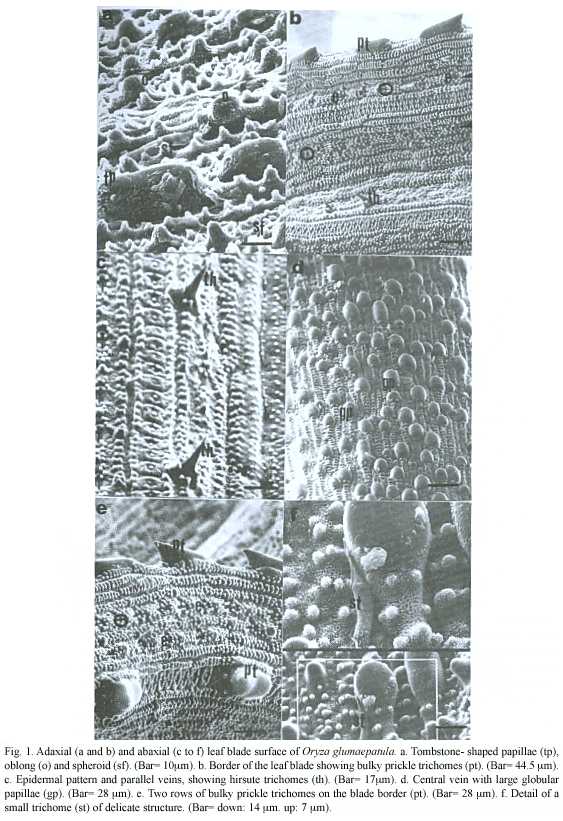
<body><![CDATA[<p><font face="Arial" size="2"><i>Oryza glumaepatula </i>is a diploid (AA type genome)wild rice species, endemic to tropical America and belonging to the <i>O.sativa </i>group (<a href="#ta62a">Tateoka 1962a</a>,<a  href="#ta62b">1962b</a>,<a href="#mo93">Morishima and Martins 1993</a>, <a href="#ak98">Akimoto <i>et al.</i>1998</a>).It has previously been reported in Venezuela, Brazil and Cuba (Morishima 1994,<a href="#va94">Vaughan 1994</a>,<a href="#ak98">Akimoto <i>et al.</i>1998</a>),and more recently in Costa Rica (<a href="#za98">Zamora <i>et al. </i>1998</a>, <a href="#za99a">1999a</a>, 1999c,<a href="#za01">Zamora 2001</a>).This species presents some morphological characteristics that are very similar to those of the Asian wild species <i>Oryza rufipogon </i>Griff,a species that is believed to have been introduced into America along with cultivated rice (<a href="#ju98">Juliano <i>et al.</i>1998</a>,<a  href="#na98">Naredo <i>et al.</i>1998</a>,<a href="#za99b">Zamora <i>et al. </i>1999b</a>,<a href="#za01">Zamora 2001</a>).In Costa Rica,<i>O.rufipogon </i>is part of the weedy rice complex associated with rice fields (<a  href="#ar00">Arrieta <i>et al.</i>2000</a>),but it has never been found in natural ecosystems (<a href="#za98">Zamora <i>et al.</i>1998</a>,<a  href="#za01">Zamora 2001</a>).Isozyme assays have shown that the species found in the rice fields corresponds to <i>O.rufipogon </i>(<a  href="#ak98">Akimoto <i>et al.</i>1998</a>,<a href="#za01">Zamora 2001</a>).</font></p>     <p><font face="Arial" size="2">Since <i>O.glumaepatula </i>is closely related to cultivated rice, it is of great importance to know the ultrastructure of this species, especially because of its potential use as a source of useful genes for the genetic improvement of rice (<a  href="#ju98">Juliano <i>et al.</i>1998</a>,<a href="#za99b">Zamora <i>et al.</i>1999b</a>, <a href="#za01">Zamora 2001</a>).</font></p>     <p><font face="Arial" size="2">In Costa Rica, only two wild populations of <i>O.glumaepatula </i>are known. One is a group of thousands of plants, restricted to the Delirios plain, on the margins of the Medio Queso River, Los Chiles, Alajuela. The other is a small group located on the road to Murciélago, Península Santa Elena, Guanacaste (<a  href="#za98">Zamora <i>et al.</i>1998</a>, <a href="#za01">Zamora 2001</a>).Specimens of <i>O. glumaepatula </i>from Costa Rica can be identified during their vegetative cycle by their long ligule (23 5.6 mm)and their long thin auricles (0.13 0.11 mm)(<a href="#za99a">Zamora <i>et al.</i>1999a</a>,<a href="#za01">Zamora 2001</a>).These specimens have narrow leaves 10 mm)and short panicles (31 ± 8.5 mm) with few branches. Spikelets measure <i>ca.</i>8 mm;awns can be 80 mm long and are red in colour (<a href="#za98">Zamora <i>et al.</i>1998</a>,<a href="#za01">Zamora 2001</a>). Nevertheless,some of the morphological traits previously described by <a href="#za01">Zamora (2001)</a> for <i>O.glumaepatula </i>from Costa Rica differ from specimens of Brazil (<a href="#ak98">Akimoto <i>et al.</i>1998</a>, <a href="#sa99">Sánchez <i>et al.</i>1999</a>,<a  href="#za01">Zamora 2001</a>).</font></p>     <p><font face="Arial" size="2">The aim of this study is to describe the ultrastructure of leaves,ligule,auricles and spikelets accessions of <i>O.glumaepatula </i>from Costa Rica.</font></p> <font face="Arial" size="2"><b></b></font>     <p><font face="Arial" size="2"><b>Materials and methods</b></font></p>     <p><font face="Arial" size="2"><b>Material sampling:</b> Samples were collected at the Delirios plain, at the margins of the Medio Queso River, Los Chiles, Alajuela. Collection took place during December and January (1998-1999).</font></p>     <p><font face="Arial" size="2">Electron microscopy samples of the leaf blade,auricles,ligule and spikelets were fixed in Karnovsky ’s solution (<a href="#ka65">Karnovsky 1965</a>). They were then post-fixed with 1% osmium tetraoxide and dehydrated in an increasing gradient of ethanol solutions. Furthermore, four rinses with terbutylic alcohol were performed and the samples were then dried by sublimation (Eiko ID-2, Japan).The samples were mounted on aluminiun bases and covered with 30 nm of platinum (Eiko IB-5,Japan). </font></p>     <p><font face="Arial" size="2">To obtain the pollen,the anthers were homogenized in a 10% sodium hydroxide solution and rinsed with distilled water.They were concentrated by centrifugation and washed by ultrasound (Astrason sonicator 11 H,Japan). These samples were fixed with osmium tetraoxide and processed as detailed above.The dry caryopses were placed in an incubator at 37 ºC during 48 hours; mounted and covered with 30 nm of platinum. Finally, the samples were observed with scanning electron microscopes (models Hitachi S-570 and S-2360N) at 15 000 V. Micrographs were taken at a magnification of 25-3000X.</font></p> <font face="Arial" size="2"><b>     <p>Results</p> </b></font>     <p><font face="Arial" size="2">The adaxial surface of the leaf blade of <i>Oryza glumaepatula </i>showed three types of epicuticular wax, which according to their shape, were defined as tombstone, oblong and spheroid papillae. Tombstone papillae were about 10.5 µm in length and 15.5 µm wide, oblong were 12.0 µm in length (<a href="#f1">Fig.1a</a>). The most abundant spheroid papillae were 3 µm in diameter. The border of the leaf blade had one row of bulky prickle trichomes <i>ca.</i>42.5 </font><font face="Arial" size="2">µ</font><font face="Arial" size="2">m in length (<a href="#f1">Fig.1b</a>,<a href="#f1">1e</a>). The epidermal pattern was composed of several rows of the three kinds of papillae described above with the stomata located at two of these rows. There were also rows of silica cells, flanked by two rows of tombstone papillae. Along the silica cell rows, bulky prickle trichomes were seen together small hirsute trichomes of 42.5 </font><font face="Arial"  size="2">µ</font><font face="Arial" size="2">m in length (<a href="#f1">Fig.1b</a>). This pattern was repeated throughout the adaxial surface of the blade. Each of the silica cells exhibited a small central papilla, giving the row a zipper-like appearance (<a href="#f1">Fig.1c</a>). The stomata were surrounded by four to eight papillae, giving them a rosette-like appearance at low magnifications (<a href="#f1">Fig.1b</a>).</font></p>     ]]></body>
<body><![CDATA[<p><font face="Arial" size="2">On the abaxial surface of the leaf blade, the central vein was decorated with globular papillae measuring approximately 146 </font><font face="Arial" size="2">µ</font><font  face="Arial" size="2">m on the horizontal axis and 138 </font><font  face="Arial" size="2">µ</font><font face="Arial" size="2">m on the vertical axis (<a href="#f1">Fig.1d</a>). From the border of the leaf blade towards the central vein the pattern of the abaxial surface showed: several rows of groups of bilobed papillae, the papillae on the edges of each group were small but increased reaching their maximum size in the central region (<a href="#f1">Fig.1e</a>). Between each group there is a small area devoid of papillae.There were also three rows of hirsute trichomes, each one surrounded by spherical papillae (<a  href="#f1">Fig.1c</a>) and larger bilobed papillae between the stomata (<a href="#f1">Fig.1e</a>). In addition, there were two rows of papillae and one row of silica cells that alternates with bulky prickle trichomes. The described pattern was repeated beyond this row, throughout the leaf blade (<a href="#f1">Fig.1e</a>). This area showed unicellular trichomes that have a delicate structure, since they collapsed easily (<a href="#f1">Fig.1f</a>).    <br> </font></p>     <div style="text-align: center;"><img  src="/img/fbpe/rbt/v53n1-2/3013i1.JPG" title="" alt=""  style="width: 563px; height: 821px;"><a name="f1"></a></div>     
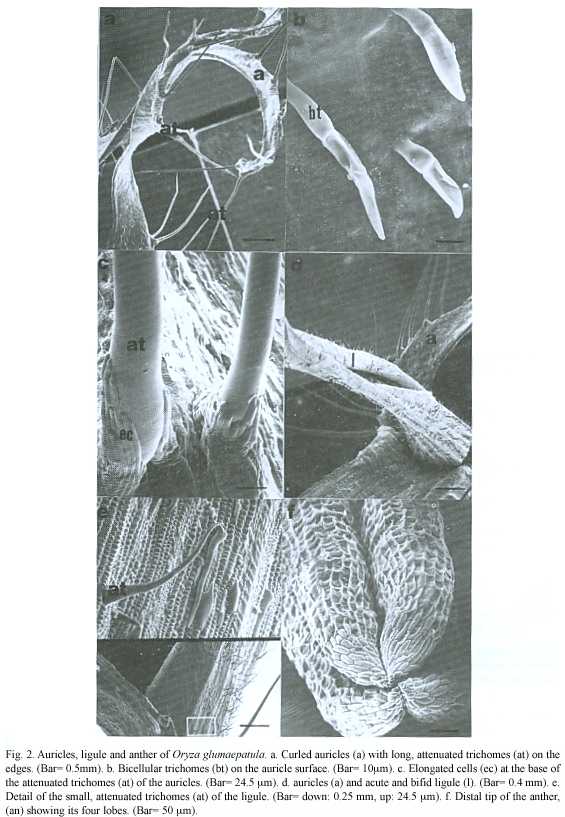
<p><font face="Arial" size="2">The curled ciliated auricles showed bicellular trichomes of <i>ca</i>. 5.5 </font><font face="Arial"  size="2">µ</font><font face="Arial" size="2">m long on its surface (<a  href="#f2">Fig.2b</a>) and long attenuated trichomes on the edges. These latter trichomes measure <i>ca</i>.16 mm (<a href="#f2">Fig.2c</a>) and their bases were covered with oblong cells (<a href="#f2">Fig.2c</a>).The ligule exhibits the same pattern of epidermal cells as the leaf blade. However, a conspicuous aspect of the pattern was the bulky prickle trichomes, with the numerous papillae and a large number of unicellular attenuated trichomes of <i>ca</i>.1 mm in length (<a href="#f2">Fig.2e</a>).</font></p>     <p style="text-align: center;"><font face="Arial" size="2">&nbsp;<img  src="/img/fbpe/rbt/v53n1-2/3013i2.JPG" title="" alt=""  style="width: 565px; height: 817px;"><a name="f2"></a></font></p>     
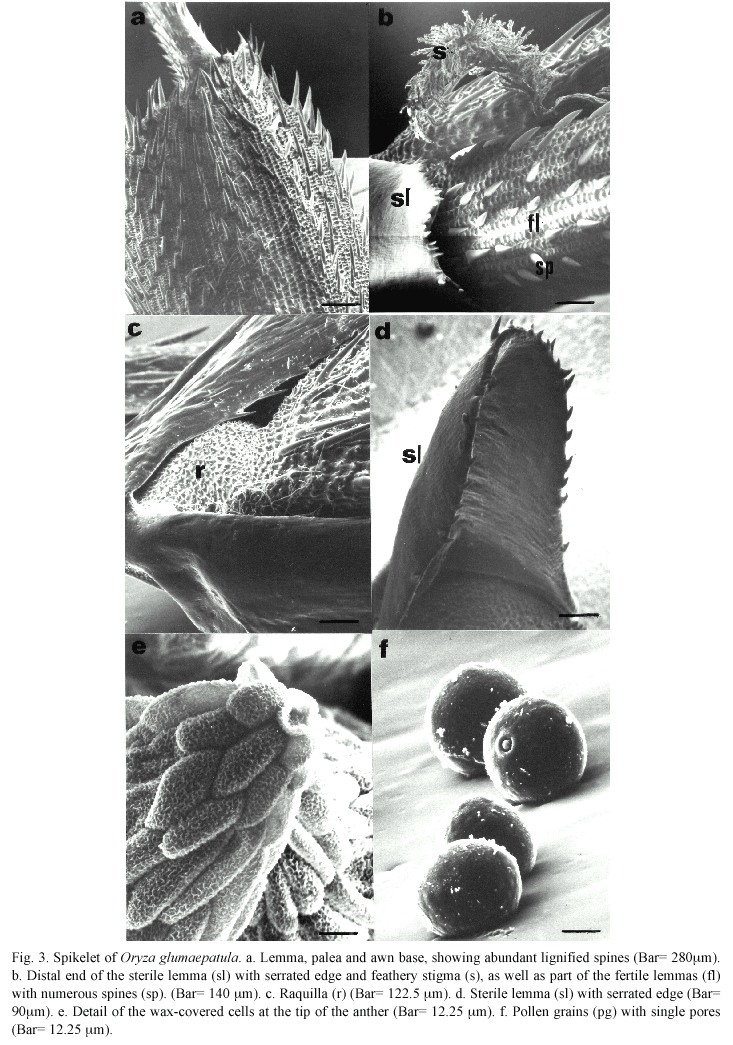
<p><font face="Arial" size="2">&nbsp;</font></p>     <p><font face="Arial" size="2">The appresed spikelet had six anthers and four lobes were fixed at the base (<a href="#f2">Fig.2f</a>). The awn originates at the sterile lemma (<a href="#f3">Fig.3a</a>) and the fertile lemmas (lemma and palea) were covered by rows of lignified papillae that exhibited one or two projections and spines <i>ca</i>. 2 mm long (<a href="#f3">Fig.3a</a>).There were two feathery stigmata (<a  href="#f3">Fig.3b</a>) joined to the ovary by the stylum.These species showed the spikelet having a prominent raquilla that joins the sterile with the fertile lemmas (<a href="#f3">Fig.3c</a>). The sterile lemmas were wing-shaped, coriaceous with serrated borders (<a href="#f3">Fig.3d</a>) and presented stomata at the base.The anthers presented oblong cells covered with wax (<a href="#f3">Fig. 3e</a>) and the pollen grains were monoporate with simple ornamentation and measured <i>ca </i>. 36 </font><font  face="Arial" size="2">µ</font><font face="Arial" size="2">m in diameter (<a href="#f3">Fig.3f</a>).</font></p> <a name="f3"></a>    <br>     <br>     <div style="text-align: center;"><a href="/img/fbpe/rbt/v53n1-2/3013i3.JPG"><img  src="/img/fbpe/rbt/v53n1-2/3013i3-2.JPG" title="" alt=""  style="border: 0px solid ; width: 627px; height: 894px;"></a>    
]]></body>
<body><![CDATA[<br> </div>     <br> <font face="Arial" size="2">All the ultrastructure characters observed in <i>O.glumaepatula </i>from Costa Rica are also common to the specimens from Brazil.</font> <font face="Arial" size="2"><b>     <p>Discussion</p> </b></font>     <p><font face="Arial" size="2">The above results agree with those reported by <a href="#me60">Metcalfe (1960)</a> for <i>O.sativa, </i><a  href="#ho78">Hoagland and Paul (1978)</a> for four <i>O. sativa </i>varieties and red rice biotype,and <a href="#te01">Terrel <i>et al.</i>(2001)</a> on <i>O.sativa </i>(a,c,P.I. 391823, b,cv, Strawhull Red; d, P. I. 373210, <i>O. sativa </i>(a,cv.Notai). However,bulky prickle trichomes were found on both surfaces of the leaf blade,differing from those reported by <a  href="#ho78">Hoagland and Paul (1978)</a> who found these type of trichomes only in the abaxial surface of the leaf blade.</font></p> <font face="Arial" size="2"><i></i></font>     <p><font face="Arial" size="2"><i>O.glumaepatula has </i>hirsute trichomes and curled auricles as do <i>O.rufipogon </i>and <i>O.sativa </i>var.CR -5272,characteristics which distinguish them from the tetraploid species <i>O.latifolia </i>and <i>O.grandiglumis </i>(<a  href="#sa99">Sánchez 1999</a>, <a href="#za01">Zamora 2001</a>, <a  href="#sa05">Sánchez <i>et al. </i>2005</a>).There are different traits in <i>O.glumaepatula </i>of taxonomic value because they are present in <i>O.glumaepatula </i>but absent in <i>O.rufipogon </i>and <i>O.sativa</i>: the globular papillae on the central vein, the bicellular trichomes of the auricles, the small attenuated trichomes of the ligule, the wing-shaped sterile lemma with serrated border (<a  href="#sa99">Sánchez 1999</a>). </font></p>     <p><font face="Arial" size="2">It is possible to distinguish ultrastructurally the spikelet of <i>O.sativa </i>because its fertile lemmas exhibit few small spines (<a href="#te01">Terrel <i>et al.</i>2001</a>), while those of <i>O.glumaepatula </i>and <i>O.rufipogon </i>have abundant large spines (<a href="#sa99">Sánchez 1999</a>,<a href="#te01">Terrel <i>et al.</i>2001</a>). Additionally, <i>O. sativa </i>can be recognized for its leaf blade by the presence of long unicellular trichomes that are absent in the two other species mentioned above (<a  href="#ak98">Akimoto <i>et al. </i>1994</a>,<a href="#sa99">Sánchez 1999</a>). In conclusion, our results confirm that <i>O.glumaepatula </i>is a different species from <i>O.rufipogon.</i></font></p> <font face="Arial" size="2"><b>     <p>Acknowledgments</p> </b></font>     <p><font face="Arial" size="2">The authors want to acknowledge Enrique Freer and Francisco Hernández for valued collaboration, to Tania Quesada for the translation of the manuscript to English, to Alejandro Zamora for valuable discussions, to Jéssica Coto for the artwork.</font></p> <font face="Arial" size="2"><b>     <p>Resumen</p> </b><i></i></font>     <p><font face="Arial" size="2"><i>O.glumaepatula </i>es una especie de arroz silvestre perenne, endémica de América Tropical, conocida anteriormente como la <i>O.rufipogon </i>americana. En Costa Rica se le encuentra en la zona norte del país, principalmente en los humedales del río Medio Queso, Los Chiles, Alajuela. Es una especie diploide de genoma AA y por su cercanía genética con el arroz cultivado se le incluye en el complejo de <i>O.sativa. </i>El propósito de este trabajo es realizar una descripción ultraestructural de la morfología de la lámina foliar, espiguilla, lígula y aurículas. Se enfatizó en aquellas características de valor taxonómico para <i>O.glumaepatula </i>, destacando las características que la distinguen de <i>O.rufipogon </i>y <i>O.sativa. </i>Esta especie presenta la lámina foliar cubierta de papilas de cera en forma de lápida, alargadas y esferoides, tiene estomas romboidales rodeados de papilas esféricas, hileras de células de sílice de forma crenada, tricomas espinosos abultados de <i>ca.</i>40 </font><font face="Symbol" size="2">m</font><font face="Arial" size="2"> m y tricomas hirsutos pequeños de <i>ca.</i>32 </font><font  face="Symbol" size="2">m</font><font face="Arial" size="2"> m. La vena central se encuentra cubierta de papilas globulares de <i>ca.</i>146 </font><font  face="Symbol" size="2">m</font><font face="Arial" size="2"> m, característica que la distingue de <i>O.rufipogon </i>y <i>O.sativa. </i>El borde de la lámina presenta una hilera de tricomas espinosos abultados de tamaño homogéneo de <i>ca. </i>42.5 </font><font  face="Symbol" size="2">m</font><font face="Arial" size="2"> m. Las aurículas rizoides tienen tricomas atenuados largos en los bordes de <i>ca. </i>5.5 mm y tricomas bicelulares en la superficie de <i>ca.</i>120 </font><font  face="Symbol" size="2">m</font><font face="Arial" size="2"> m, esta última característica es de valor taxonómico. La lígula presenta en su superficie gran cantidad de tricomas atenuados cortos de <i>ca.</i>100 </font><font face="Symbol" size="2">m</font><font face="Arial" size="2"> m. La espiguilla presenta la morfología típica del género, las lemas fértiles tienen espinas abundantes y largas, característica que la comparte con <i>O.rufipogon </i>pero no con <i>O.sativa. </i>Las lemas estériles son aladas, de bordes dentados, característica que la distingue de <i>O.rufipogon </i>y de <i>O.sativa. </i>Las características ultraestructurales observadas en <i>O.glumaepatula </i>son comunes con la <i>O.glumaepatula </i>de Brasil.</font></p> <font face="Arial" size="2"><b></b></font>     ]]></body>
<body><![CDATA[<p><font face="Arial" size="2"><b>Palabras clave: </b><i>Oryza glumaepatula, Oryza, </i>arroz<i>, </i>ultrastructura, anatomía, morpfología, Oryzeae, Poaceae.</font></p> <font face="Arial" size="2"><b>     <p>References</p> </b></font>     <!-- ref --><p><font face="Arial" size="2"><a name="ak98"></a>Akimoto, M., Y. Shimamoto &amp; H. Morishima. 1998. Population genetic structure of wild rice <i>Oryza glumaepatula </i>Steud distributed in the Amazon flood area influenced by its life-history traits. Mol. Ecol. 7:1371-1381.    &nbsp;&nbsp;&nbsp;&nbsp;&nbsp;&nbsp;&nbsp;&nbsp;[&#160;<a href="javascript:void(0);" onclick="javascript: window.open('/scielo.php?script=sci_nlinks&ref=1678165&pid=S0034-7744200500010000300001&lng=','','width=640,height=500,resizable=yes,scrollbars=1,menubar=yes,');">Links</a>&#160;]<!-- end-ref --></font></p>     <!-- ref --><p><font face="Arial" size="2"><a name="ar00"></a>Arrieta, G. ,A. Zamora, M. Muñoz, W. González &amp; A. M. Espinoza. 2000. Caracterización morfológica y molecular de las variantes de arroz contaminante en las zonas arroceras de Costa Rica y su relación con otras especies del género <i>Oryza</i>, p.263. <i>In </i>I Congreso de Investigación CONINVES-2000, Los retos y propuestas de la investigación en el III milenio. CENAT, Universidad Estatal a Distancia, San José, Costa Rica.    &nbsp;&nbsp;&nbsp;&nbsp;&nbsp;&nbsp;&nbsp;&nbsp;[&#160;<a href="javascript:void(0);" onclick="javascript: window.open('/scielo.php?script=sci_nlinks&ref=1678167&pid=S0034-7744200500010000300002&lng=','','width=640,height=500,resizable=yes,scrollbars=1,menubar=yes,');">Links</a>&#160;]<!-- end-ref --></font></p>     <!-- ref --><p><font face="Arial" size="2"><a name="ho78"></a>Hoaglan, R. E.&amp; R. N. Paul. 1978. Comparative SEM study of red rice and several commercial rice (<i>Oryza sativa </i>) varieties. Issue 26:619-625.    &nbsp;&nbsp;&nbsp;&nbsp;&nbsp;&nbsp;&nbsp;&nbsp;[&#160;<a href="javascript:void(0);" onclick="javascript: window.open('/scielo.php?script=sci_nlinks&ref=1678169&pid=S0034-7744200500010000300003&lng=','','width=640,height=500,resizable=yes,scrollbars=1,menubar=yes,');">Links</a>&#160;]<!-- end-ref --></font></p>     <!-- ref --><p><font face="Arial" size="2"><a name="ju98"></a>Juliano, A. B., M. E. Naredo &amp; M. T. Jackson. 1998. Taxonomic status of <i>Oryza glumaepatula </i>Steud.1. Comparative morphological studies of New World diploids and Asian AA genome species.Genet. Resour.Crop Evol.45:215-223</font>&nbsp;&nbsp;&nbsp;&nbsp;&nbsp;&nbsp;&nbsp;&nbsp;[&#160;<a href="javascript:void(0);" onclick="javascript: window.open('/scielo.php?script=sci_nlinks&ref=1678171&pid=S0034-7744200500010000300004&lng=','','width=640,height=500,resizable=yes,scrollbars=1,menubar=yes,');">Links</a>&#160;]<!-- end-ref --><!-- ref --><p><font face="Arial" size="2"><a name="ka65"></a>Karnovsky, M. J. 1965. A formaldehyde-glutaraldehyde fixative of high osmolarity for use in electron microscopy. J. Cell Biol. 27: 137.    &nbsp;&nbsp;&nbsp;&nbsp;&nbsp;&nbsp;&nbsp;&nbsp;[&#160;<a href="javascript:void(0);" onclick="javascript: window.open('/scielo.php?script=sci_nlinks&ref=1678172&pid=S0034-7744200500010000300005&lng=','','width=640,height=500,resizable=yes,scrollbars=1,menubar=yes,');">Links</a>&#160;]<!-- end-ref --></font></p>     <!-- ref --><p><font face="Arial" size="2"><a name="me60"></a>Metcalfe, C. R. 1960. Anatomy of the Monocotyledons I. Gramineae. Clarendon. Royal Botanic Gardens, p. 340-343.    &nbsp;&nbsp;&nbsp;&nbsp;&nbsp;&nbsp;&nbsp;&nbsp;[&#160;<a href="javascript:void(0);" onclick="javascript: window.open('/scielo.php?script=sci_nlinks&ref=1678174&pid=S0034-7744200500010000300006&lng=','','width=640,height=500,resizable=yes,scrollbars=1,menubar=yes,');">Links</a>&#160;]<!-- end-ref --></font></p>     <!-- ref --><p><font face="Arial" size="2"><a name="mo93"></a>Morishima, H. &amp; P. Martins. 1993. Investigations of plant genetic resources in the Amazon Basin with the emphasis on the genus <i>Oryza</i>. Report of 1992/1993 Amazon Proyect. The Mombusho International Scientific Research Program. Japan Research Suppor Foundation of the State of Sao Paulo,Brasil.96 p.    &nbsp;&nbsp;&nbsp;&nbsp;&nbsp;&nbsp;&nbsp;&nbsp;[&#160;<a href="javascript:void(0);" onclick="javascript: window.open('/scielo.php?script=sci_nlinks&ref=1678176&pid=S0034-7744200500010000300007&lng=','','width=640,height=500,resizable=yes,scrollbars=1,menubar=yes,');">Links</a>&#160;]<!-- end-ref --></font></p>     <!-- ref --><p><font face="Arial" size="2"><a name="na98"></a>Naredo, M.E.B., A.B. Juliano, B. R. Lu &amp; M. T. Jackson. 1998. Taxonomic status of <i>Oryza glumaepatula </i>Steud. II-Hybridization between New World diploids and AA genome species from Asia and Australia. Genet. Resour. Crop Evol. 45:205-214.    &nbsp;&nbsp;&nbsp;&nbsp;&nbsp;&nbsp;&nbsp;&nbsp;[&#160;<a href="javascript:void(0);" onclick="javascript: window.open('/scielo.php?script=sci_nlinks&ref=1678178&pid=S0034-7744200500010000300008&lng=','','width=640,height=500,resizable=yes,scrollbars=1,menubar=yes,');">Links</a>&#160;]<!-- end-ref --></font></p>     <!-- ref --><p><font face="Arial" size="2"><a name="sa99"></a>Sánchez, E. 1999. Comparación morfológica estructural de las especies silvestres de arroz (<i>Oryza </i>): Poaceae en Costa Rica. Universidad de Costa Rica. San Pedro de Montes de Oca, San José, Costa Rica. 114 p.    &nbsp;&nbsp;&nbsp;&nbsp;&nbsp;&nbsp;&nbsp;&nbsp;[&#160;<a href="javascript:void(0);" onclick="javascript: window.open('/scielo.php?script=sci_nlinks&ref=1678180&pid=S0034-7744200500010000300009&lng=','','width=640,height=500,resizable=yes,scrollbars=1,menubar=yes,');">Links</a>&#160;]<!-- end-ref --></font></p>     <!-- ref --><p><font face="Arial" size="2"><a name="sa05"></a>Sánchez, E., T. Quesada &amp; A. M. Espinoza. 2005. Ultrastructural description of the wild species of rice <i>Oryza grandiglumis </i>in Costa Rica. Rev. Biol. Trop. 53: in press.    &nbsp;&nbsp;&nbsp;&nbsp;&nbsp;&nbsp;&nbsp;&nbsp;[&#160;<a href="javascript:void(0);" onclick="javascript: window.open('/scielo.php?script=sci_nlinks&ref=1678182&pid=S0034-7744200500010000300010&lng=','','width=640,height=500,resizable=yes,scrollbars=1,menubar=yes,');">Links</a>&#160;]<!-- end-ref --></font></p>     <!-- ref --><p><font face="Arial" size="2"><a name="ta62a"></a>Tateoka, T. 1962a. Taxonomic studies of <i>Oryza </i>I.<i>O.latifolia </i>Complex. Bot. Mag. Tokyo.75:418-427.    &nbsp;&nbsp;&nbsp;&nbsp;&nbsp;&nbsp;&nbsp;&nbsp;[&#160;<a href="javascript:void(0);" onclick="javascript: window.open('/scielo.php?script=sci_nlinks&ref=1678184&pid=S0034-7744200500010000300011&lng=','','width=640,height=500,resizable=yes,scrollbars=1,menubar=yes,');">Links</a>&#160;]<!-- end-ref --></font></p>     <!-- ref --><p><font face="Arial" size="2"><a name="ta62b"></a>Tateoka, T. 1962b. Taxonomic studies of <i>Oryza </i>II. Several species Complex. Bot. Mag. Tokyo. 75:455-4.    &nbsp;&nbsp;&nbsp;&nbsp;&nbsp;&nbsp;&nbsp;&nbsp;[&#160;<a href="javascript:void(0);" onclick="javascript: window.open('/scielo.php?script=sci_nlinks&ref=1678186&pid=S0034-7744200500010000300012&lng=','','width=640,height=500,resizable=yes,scrollbars=1,menubar=yes,');">Links</a>&#160;]<!-- end-ref --></font></p>     <!-- ref --><p><font face="Arial" size="2"><a name="te01"></a>Terrel, E. E., P. M. Peterson &amp; W. P. Wergin. 2001. Epidermal Features and Spikelet Micromorphology in <i>Oryza </i>and Related Genera (Poaceae: Oryzeae). Smithsonian Contributions to Botany N° 91. 50 p.    &nbsp;&nbsp;&nbsp;&nbsp;&nbsp;&nbsp;&nbsp;&nbsp;[&#160;<a href="javascript:void(0);" onclick="javascript: window.open('/scielo.php?script=sci_nlinks&ref=1678188&pid=S0034-7744200500010000300013&lng=','','width=640,height=500,resizable=yes,scrollbars=1,menubar=yes,');">Links</a>&#160;]<!-- end-ref --></font></p>     <!-- ref --><p><font face="Arial" size="2"><a name="va94"></a>Vaughan, D. A. 1994. The wild relatives of rice. A genetic resources Hand Book. International Rice Research Institute (IRRI). Manila, Filipinas. 130 p.    &nbsp;&nbsp;&nbsp;&nbsp;&nbsp;&nbsp;&nbsp;&nbsp;[&#160;<a href="javascript:void(0);" onclick="javascript: window.open('/scielo.php?script=sci_nlinks&ref=1678190&pid=S0034-7744200500010000300014&lng=','','width=640,height=500,resizable=yes,scrollbars=1,menubar=yes,');">Links</a>&#160;]<!-- end-ref --></font></p>     <!-- ref --><p><font face="Arial" size="2"><a name="za98"></a>Zamora, A., E. Sánchez, T. Quesada, C. Muñoz, P. Porras, C. Quesada &amp; A. M. Espinoza. 1998. Wild species, reservoirs of useful genes for the genetic improvement of rice.<i>In </i>International Symposium on Rice Germplasm Evaluation and Enhancement. Stuttgart, Arkansas, USA.    &nbsp;&nbsp;&nbsp;&nbsp;&nbsp;&nbsp;&nbsp;&nbsp;[&#160;<a href="javascript:void(0);" onclick="javascript: window.open('/scielo.php?script=sci_nlinks&ref=1678192&pid=S0034-7744200500010000300015&lng=','','width=640,height=500,resizable=yes,scrollbars=1,menubar=yes,');">Links</a>&#160;]<!-- end-ref --></font></p>     <!-- ref --><p><font face="Arial" size="2"><a name="za99a"></a>Zamora, A., T. Quesada, P. González, J. Lobo &amp; A. M. Espioza. 1999a. Wild rice species of Costa Rica: diversity, distribution and potential use as source of genes for rice improvement. International Meeting of the Rice Biotechnology Program of the Rockefeller Foundation. Phuket, Thailand. 85 p.    &nbsp;&nbsp;&nbsp;&nbsp;&nbsp;&nbsp;&nbsp;&nbsp;[&#160;<a href="javascript:void(0);" onclick="javascript: window.open('/scielo.php?script=sci_nlinks&ref=1678194&pid=S0034-7744200500010000300016&lng=','','width=640,height=500,resizable=yes,scrollbars=1,menubar=yes,');">Links</a>&#160;]<!-- end-ref --></font></p>     <!-- ref --><p><font face="Arial" size="2"><a name="za99b"></a>Zamora, A., E. Sánchez, T. Quesada, P. González, C. Quesada, R. Gámez &amp; A. M. Espinoza. 1999b. Especies silvestres, reserva de genes útiles para el mejoramiento del arroz, p.37. <i>In </i>Memorias de las Jornadas de Investigación. Jornadas de Investigación de la Universidad de Costa Rica.    &nbsp;&nbsp;&nbsp;&nbsp;&nbsp;&nbsp;&nbsp;&nbsp;[&#160;<a href="javascript:void(0);" onclick="javascript: window.open('/scielo.php?script=sci_nlinks&ref=1678196&pid=S0034-7744200500010000300017&lng=','','width=640,height=500,resizable=yes,scrollbars=1,menubar=yes,');">Links</a>&#160;]<!-- end-ref --></font></p>     <!-- ref --><p><font face="Arial" size="2"><a name="za01"></a>Zamora, A. 2001. Diversidad morfológica y genética del género <i>Oryza </i>(Poaceae)en Costa Rica. Tesis de maestría. Programa de Estudios de Posgrado en Biología, Universidad de Costa Rica, San José, Costa Rica. 178 p.    &nbsp;&nbsp;&nbsp;&nbsp;&nbsp;&nbsp;&nbsp;&nbsp;[&#160;<a href="javascript:void(0);" onclick="javascript: window.open('/scielo.php?script=sci_nlinks&ref=1678198&pid=S0034-7744200500010000300018&lng=','','width=640,height=500,resizable=yes,scrollbars=1,menubar=yes,');">Links</a>&#160;]<!-- end-ref --></font></p>      ]]></body><back>
<ref-list>
<ref id="B1">
<nlm-citation citation-type="journal">
<person-group person-group-type="author">
<name>
<surname><![CDATA[Akimoto]]></surname>
<given-names><![CDATA[M]]></given-names>
</name>
<name>
<surname><![CDATA[Shimamoto]]></surname>
<given-names><![CDATA[Y]]></given-names>
</name>
<name>
<surname><![CDATA[Morishima]]></surname>
<given-names><![CDATA[H]]></given-names>
</name>
</person-group>
<article-title xml:lang="en"><![CDATA[Population genetic structure of wild rice Oryza glumaepatula Steud distributed in the Amazon flood area influenced by its life-history traits]]></article-title>
<source><![CDATA[Mol. Ecol]]></source>
<year>1998</year>
<volume>7</volume>
<page-range>1371-1381</page-range></nlm-citation>
</ref>
<ref id="B2">
<nlm-citation citation-type="confpro">
<person-group person-group-type="author">
<name>
<surname><![CDATA[Arrieta]]></surname>
<given-names><![CDATA[G]]></given-names>
</name>
<name>
<surname><![CDATA[Zamora]]></surname>
<given-names><![CDATA[A]]></given-names>
</name>
<name>
<surname><![CDATA[Muñoz]]></surname>
<given-names><![CDATA[M]]></given-names>
</name>
<name>
<surname><![CDATA[González]]></surname>
<given-names><![CDATA[W]]></given-names>
</name>
<name>
<surname><![CDATA[Espinoza]]></surname>
<given-names><![CDATA[A. M]]></given-names>
</name>
</person-group>
<article-title xml:lang="es"><![CDATA[Caracterización morfológica y molecular de las variantes de arroz contaminante en las zonas arroceras de Costa Rica y su relación con otras especies del género Oryza]]></article-title>
<source><![CDATA[]]></source>
<year>2000</year>
<conf-name><![CDATA[ I Congreso de Investigación CONINVES-2000, Los retos y propuestas de la investigación en el III milenio]]></conf-name>
<conf-loc>San José </conf-loc>
<page-range>263</page-range></nlm-citation>
</ref>
<ref id="B3">
<nlm-citation citation-type="journal">
<person-group person-group-type="author">
<name>
<surname><![CDATA[Hoaglan]]></surname>
<given-names><![CDATA[R. E]]></given-names>
</name>
<name>
<surname><![CDATA[Paul]]></surname>
<given-names><![CDATA[R. N]]></given-names>
</name>
</person-group>
<article-title xml:lang="en"><![CDATA[Comparative SEM study of red rice and several commercial rice (Oryza sativa ) varieties]]></article-title>
<source><![CDATA[Issue]]></source>
<year>1978</year>
<volume>26</volume>
<page-range>619-625</page-range></nlm-citation>
</ref>
<ref id="B4">
<nlm-citation citation-type="journal">
<person-group person-group-type="author">
<name>
<surname><![CDATA[Juliano]]></surname>
<given-names><![CDATA[A. B]]></given-names>
</name>
<name>
<surname><![CDATA[Naredo]]></surname>
<given-names><![CDATA[M. E]]></given-names>
</name>
<name>
<surname><![CDATA[Jackson]]></surname>
<given-names><![CDATA[M. T]]></given-names>
</name>
</person-group>
<article-title xml:lang="en"><![CDATA[Taxonomic status of Oryza glumaepatula Steud.1: Comparative morphological studies of New World diploids and Asian AA genome species]]></article-title>
<source><![CDATA[Genet. Resour.Crop Evol]]></source>
<year>1998</year>
<volume>45</volume>
<page-range>215-223</page-range></nlm-citation>
</ref>
<ref id="B5">
<nlm-citation citation-type="journal">
<person-group person-group-type="author">
<name>
<surname><![CDATA[Karnovsky]]></surname>
<given-names><![CDATA[M. J]]></given-names>
</name>
</person-group>
<article-title xml:lang="en"><![CDATA[A formaldehyde-glutaraldehyde fixative of high osmolarity for use in electron microscopy]]></article-title>
<source><![CDATA[J. Cell Biol]]></source>
<year>1965</year>
<volume>27</volume>
<page-range>137</page-range></nlm-citation>
</ref>
<ref id="B6">
<nlm-citation citation-type="book">
<person-group person-group-type="author">
<name>
<surname><![CDATA[Metcalfe]]></surname>
<given-names><![CDATA[C. R]]></given-names>
</name>
</person-group>
<source><![CDATA[Anatomy of the Monocotyledons I: Gramineae. Clarendon]]></source>
<year>1960</year>
<page-range>340-343</page-range><publisher-name><![CDATA[Royal Botanic Gardens]]></publisher-name>
</nlm-citation>
</ref>
<ref id="B7">
<nlm-citation citation-type="book">
<person-group person-group-type="author">
<name>
<surname><![CDATA[Morishima]]></surname>
<given-names><![CDATA[H]]></given-names>
</name>
<name>
<surname><![CDATA[Martins]]></surname>
<given-names><![CDATA[P]]></given-names>
</name>
</person-group>
<source><![CDATA[Investigations of plant genetic resources in the Amazon Basin with the emphasis on the genus Oryza: Report of 1992/1993 Amazon Proyect. The Mombusho International Scientific Research Program]]></source>
<year>1993</year>
<page-range>96</page-range><publisher-name><![CDATA[Japan Research Suppor Foundation of the State of Sao Paulo]]></publisher-name>
</nlm-citation>
</ref>
<ref id="B8">
<nlm-citation citation-type="journal">
<person-group person-group-type="author">
<name>
<surname><![CDATA[Naredo]]></surname>
<given-names><![CDATA[M.E.B]]></given-names>
</name>
<name>
<surname><![CDATA[Juliano]]></surname>
<given-names><![CDATA[A.B]]></given-names>
</name>
<name>
<surname><![CDATA[Lu]]></surname>
<given-names><![CDATA[B. R]]></given-names>
</name>
<name>
<surname><![CDATA[Jackson]]></surname>
<given-names><![CDATA[M. T]]></given-names>
</name>
</person-group>
<article-title xml:lang="en"><![CDATA[Taxonomic status of Oryza glumaepatula Steud. II-Hybridization between New World diploids and AA genome species from Asia and Australia]]></article-title>
<source><![CDATA[Genet. Resour. Crop Evol]]></source>
<year>1998</year>
<volume>45</volume>
<page-range>205-214</page-range></nlm-citation>
</ref>
<ref id="B9">
<nlm-citation citation-type="book">
<person-group person-group-type="author">
<name>
<surname><![CDATA[Sánchez]]></surname>
<given-names><![CDATA[E]]></given-names>
</name>
</person-group>
<source><![CDATA[Comparación morfológica estructural de las especies silvestres de arroz (Oryza ): Poaceae en Costa Rica]]></source>
<year>1999</year>
<page-range>114</page-range><publisher-loc><![CDATA[San Pedro de Montes de Oca^eSan José San José]]></publisher-loc>
<publisher-name><![CDATA[Universidad de Costa Rica]]></publisher-name>
</nlm-citation>
</ref>
<ref id="B10">
<nlm-citation citation-type="journal">
<person-group person-group-type="author">
<name>
<surname><![CDATA[Sánchez]]></surname>
<given-names><![CDATA[E]]></given-names>
</name>
<name>
<surname><![CDATA[Quesada]]></surname>
<given-names><![CDATA[T]]></given-names>
</name>
<name>
<surname><![CDATA[Espinoza]]></surname>
<given-names><![CDATA[A. M]]></given-names>
</name>
</person-group>
<article-title xml:lang="en"><![CDATA[Ultrastructural description of the wild species of rice Oryza grandiglumis in Costa Rica]]></article-title>
<source><![CDATA[Rev. Biol. Trop]]></source>
<year>2005</year>
<volume>53</volume>
</nlm-citation>
</ref>
<ref id="B11">
<nlm-citation citation-type="journal">
<person-group person-group-type="author">
<name>
<surname><![CDATA[Tateoka]]></surname>
<given-names><![CDATA[T]]></given-names>
</name>
</person-group>
<article-title xml:lang="en"><![CDATA[Taxonomic studies of Oryza I.O.latifolia Complex]]></article-title>
<source><![CDATA[Bot. Mag. Tokyo]]></source>
<year>1962</year>
<month>a</month>
<volume>75</volume>
<page-range>418-427</page-range></nlm-citation>
</ref>
<ref id="B12">
<nlm-citation citation-type="journal">
<person-group person-group-type="author">
<name>
<surname><![CDATA[Tateoka]]></surname>
<given-names><![CDATA[T]]></given-names>
</name>
</person-group>
<article-title xml:lang="en"><![CDATA[Taxonomic studies of Oryza II: Several species Complex]]></article-title>
<source><![CDATA[Bot. Mag. Tokyo]]></source>
<year>1962</year>
<month>b</month>
<volume>75</volume>
<page-range>455-4</page-range></nlm-citation>
</ref>
<ref id="B13">
<nlm-citation citation-type="journal">
<person-group person-group-type="author">
<name>
<surname><![CDATA[Terrel]]></surname>
<given-names><![CDATA[E. E]]></given-names>
</name>
<name>
<surname><![CDATA[Peterson]]></surname>
<given-names><![CDATA[P. M]]></given-names>
</name>
<name>
<surname><![CDATA[Wergin]]></surname>
<given-names><![CDATA[W. P]]></given-names>
</name>
</person-group>
<article-title xml:lang="en"><![CDATA[Epidermal Features and Spikelet Micromorphology in Oryza and Related Genera (Poaceae: Oryzeae)]]></article-title>
<source><![CDATA[Smithsonian Contributions to Botany]]></source>
<year>2001</year>
<numero>91</numero>
<issue>91</issue>
<page-range>50</page-range></nlm-citation>
</ref>
<ref id="B14">
<nlm-citation citation-type="book">
<person-group person-group-type="author">
<name>
<surname><![CDATA[Vaughan]]></surname>
<given-names><![CDATA[D. A]]></given-names>
</name>
</person-group>
<source><![CDATA[The wild relatives of rice. A genetic resources Hand Book]]></source>
<year>1994</year>
<page-range>130</page-range><publisher-loc><![CDATA[Manila ]]></publisher-loc>
<publisher-name><![CDATA[International Rice Research Institute (IRRI)]]></publisher-name>
</nlm-citation>
</ref>
<ref id="B15">
<nlm-citation citation-type="confpro">
<person-group person-group-type="author">
<name>
<surname><![CDATA[Zamora]]></surname>
<given-names><![CDATA[A]]></given-names>
</name>
<name>
<surname><![CDATA[Sánchez]]></surname>
<given-names><![CDATA[E]]></given-names>
</name>
<name>
<surname><![CDATA[Quesada]]></surname>
<given-names><![CDATA[T]]></given-names>
</name>
<name>
<surname><![CDATA[Muñoz]]></surname>
<given-names><![CDATA[C]]></given-names>
</name>
<name>
<surname><![CDATA[Porras]]></surname>
<given-names><![CDATA[P]]></given-names>
</name>
<name>
<surname><![CDATA[Quesada]]></surname>
<given-names><![CDATA[C]]></given-names>
</name>
<name>
<surname><![CDATA[Espinoza]]></surname>
<given-names><![CDATA[A. M]]></given-names>
</name>
</person-group>
<article-title xml:lang="en"><![CDATA[Wild species, reservoirs of useful genes for the genetic improvement of rice]]></article-title>
<source><![CDATA[]]></source>
<year>1998</year>
<conf-name><![CDATA[ International Symposium on Rice Germplasm Evaluation and Enhancement]]></conf-name>
<conf-loc>Stuttgart Arkansas</conf-loc>
</nlm-citation>
</ref>
<ref id="B16">
<nlm-citation citation-type="book">
<person-group person-group-type="author">
<name>
<surname><![CDATA[Zamora]]></surname>
<given-names><![CDATA[A]]></given-names>
</name>
<name>
<surname><![CDATA[Quesada]]></surname>
<given-names><![CDATA[T]]></given-names>
</name>
<name>
<surname><![CDATA[González]]></surname>
<given-names><![CDATA[P]]></given-names>
</name>
<name>
<surname><![CDATA[Lobo]]></surname>
<given-names><![CDATA[J]]></given-names>
</name>
<name>
<surname><![CDATA[Espioza]]></surname>
<given-names><![CDATA[A. M]]></given-names>
</name>
</person-group>
<source><![CDATA[Wild rice species of Costa Rica: diversity, distribution and potential use as source of genes for rice improvement]]></source>
<year>1999</year>
<month>a</month>
<page-range>85</page-range><publisher-loc><![CDATA[Phuket ]]></publisher-loc>
<publisher-name><![CDATA[International Meeting of the Rice Biotechnology Program of the Rockefeller Foundation]]></publisher-name>
</nlm-citation>
</ref>
<ref id="B17">
<nlm-citation citation-type="">
<person-group person-group-type="author">
<name>
<surname><![CDATA[Zamora]]></surname>
<given-names><![CDATA[A]]></given-names>
</name>
<name>
<surname><![CDATA[Sánchez]]></surname>
<given-names><![CDATA[E]]></given-names>
</name>
<name>
<surname><![CDATA[Quesada]]></surname>
<given-names><![CDATA[T]]></given-names>
</name>
<name>
<surname><![CDATA[González]]></surname>
<given-names><![CDATA[P]]></given-names>
</name>
<name>
<surname><![CDATA[Quesada]]></surname>
<given-names><![CDATA[C]]></given-names>
</name>
<name>
<surname><![CDATA[Gámez]]></surname>
<given-names><![CDATA[R]]></given-names>
</name>
<name>
<surname><![CDATA[Espinoza]]></surname>
<given-names><![CDATA[A. M]]></given-names>
</name>
</person-group>
<article-title xml:lang="es"><![CDATA[Especies silvestres, reserva de genes útiles para el mejoramiento del arroz]]></article-title>
<source><![CDATA[Memorias de las Jornadas de Investigación: Jornadas de Investigación de la Universidad de Costa Rica]]></source>
<year>1999</year>
<month>b</month>
<page-range>37</page-range></nlm-citation>
</ref>
<ref id="B18">
<nlm-citation citation-type="">
<person-group person-group-type="author">
<name>
<surname><![CDATA[Zamora]]></surname>
<given-names><![CDATA[A]]></given-names>
</name>
</person-group>
<source><![CDATA[Diversidad morfológica y genética del género Oryza (Poaceae)en Costa Rica]]></source>
<year>2001</year>
<page-range>178</page-range></nlm-citation>
</ref>
</ref-list>
</back>
</article>