<?xml version="1.0" encoding="ISO-8859-1"?><article xmlns:mml="http://www.w3.org/1998/Math/MathML" xmlns:xlink="http://www.w3.org/1999/xlink" xmlns:xsi="http://www.w3.org/2001/XMLSchema-instance">
<front>
<journal-meta>
<journal-id>0034-7744</journal-id>
<journal-title><![CDATA[Revista de Biología Tropical]]></journal-title>
<abbrev-journal-title><![CDATA[Rev. biol. trop]]></abbrev-journal-title>
<issn>0034-7744</issn>
<publisher>
<publisher-name><![CDATA[Universidad de Costa Rica]]></publisher-name>
</publisher>
</journal-meta>
<article-meta>
<article-id>S0034-77442005000100001</article-id>
<title-group>
<article-title xml:lang="en"><![CDATA[Differences on post-fire regeneration of the pioneer trees Cecropia glazioui and Trema micrantha in a lowland Brazilian Atlantic Forest]]></article-title>
</title-group>
<contrib-group>
<contrib contrib-type="author">
<name>
<surname><![CDATA[Silva-Matos]]></surname>
<given-names><![CDATA[Dalva M]]></given-names>
</name>
<xref ref-type="aff" rid="A01"/>
</contrib>
<contrib contrib-type="author">
<name>
<surname><![CDATA[Fonseca]]></surname>
<given-names><![CDATA[Giovana D.F.M]]></given-names>
</name>
</contrib>
<contrib contrib-type="author">
<name>
<surname><![CDATA[Silva-Lima]]></surname>
<given-names><![CDATA[Leonardo]]></given-names>
</name>
</contrib>
</contrib-group>
<aff id="A01">
<institution><![CDATA[,Universidade Federal do Rio de Janeiro  ]]></institution>
<addr-line><![CDATA[Rio de Janeiro ]]></addr-line>
<country>Brazil</country>
</aff>
<pub-date pub-type="pub">
<day>00</day>
<month>06</month>
<year>2005</year>
</pub-date>
<pub-date pub-type="epub">
<day>00</day>
<month>06</month>
<year>2005</year>
</pub-date>
<volume>53</volume>
<numero>1-2</numero>
<fpage>01</fpage>
<lpage>04</lpage>
<copyright-statement/>
<copyright-year/>
<self-uri xlink:href="http://www.scielo.sa.cr/scielo.php?script=sci_arttext&amp;pid=S0034-77442005000100001&amp;lng=en&amp;nrm=iso"></self-uri><self-uri xlink:href="http://www.scielo.sa.cr/scielo.php?script=sci_abstract&amp;pid=S0034-77442005000100001&amp;lng=en&amp;nrm=iso"></self-uri><self-uri xlink:href="http://www.scielo.sa.cr/scielo.php?script=sci_pdf&amp;pid=S0034-77442005000100001&amp;lng=en&amp;nrm=iso"></self-uri><abstract abstract-type="short" xml:lang="en"><p><![CDATA[A study of natural post-fire succession was carried out in a disturbed vegetation around fragments of the Atlantic Rain Forest (National Biological Reserve of Poço das Antas (22 °30 ’-22 °33 ’S,42 °15 ’-42 °19 ’W), Rio de Janeiro State).All the pre-fire individuals of Cecropia and Trema in the area were numbered with plastic labels.In order to check for the presence of new sprouts and mortality,two other censuses were carried out,at 3 and 12 months after the fire.The dominant species were:Pteridium aquilinum,Panicum maximum,Trema micrantha and Cecropia glazioui. Few days after the passage of fire, grasses and ferns spread their area,while the stands of Trema and Cecropia were completely burned. Most of individuals of Cecropia produced some sprouts while most of individuals of Trema died.However,a great number of seedlings of Trema were recruited while only one single seedling of Cecropia were observed during a period of one year.Most of these seedlings died through the year while the sprouts were already reproducing.The uses of Cecropia in places where fire is recurrent could be more appropriate because of its higher chance of survival and faster recovering ability after fire.Rev.Biol.Trop.53(1-2):1-4.Epub 2005 Jun 24]]></p></abstract>
<abstract abstract-type="short" xml:lang="es"><p><![CDATA[Se realizó un estudio sobre la sucesión natural después del fuego en una vegetación alrededor de fragmentos de la selva lluviosa atlántica (Reserva Biológica Nacional de Poço das Antas (22° 30 ’-22° 33 ’ S, 42° 15’- 42° 19’ W), Estado de Río de Janeiro).Todos los individuos de Cecropia y Trema previos del fuego en el área fueron numerados con marcas plásticas. Se realizaron otros dos censos, 3 y 12 meses después del fuego con el objetivo de detectar mortalidad y buscar la presencia de nuevos brotes. Las especies dominantes fueron: Pteridium aquilinum, Panicum maximum, Trema micrantha y Cecropia glazioui. Pocos días después del paso del fuego,los pastos y helechos se dispersaron por el área, mientras que los troncos de Trema y Cecropia estaban completamente quemados. La mayoría de los individuos de Cecropia produjeron algunos rebrotes mientras que la mayoría de los individuos de Trema murieron. Sin embargo, un gran número de plántulas de Trema fueron reclutadas mientras que únicamente una plántula de Cecropia fue observada durante el período de un año. La mayoría de estos plántulas murieron a lo largo del año, mientras que los brotes se estan ya reproduciendo. Los usos de Cecropia en lugares donde el fuego es recurrente puede ser más apropiado debido a su mayor chance de sobrevivir y a su habilidad de recuperarse más rápido después del fuego]]></p></abstract>
<kwd-group>
<kwd lng="en"><![CDATA[Post-fire]]></kwd>
<kwd lng="en"><![CDATA[succession]]></kwd>
<kwd lng="en"><![CDATA[recruitment]]></kwd>
<kwd lng="en"><![CDATA[cecropia]]></kwd>
<kwd lng="en"><![CDATA[Trema]]></kwd>
<kwd lng="en"><![CDATA[Brazil]]></kwd>
<kwd lng="es"><![CDATA[Fuego]]></kwd>
<kwd lng="es"><![CDATA[sucesión]]></kwd>
<kwd lng="es"><![CDATA[reclutamiento]]></kwd>
<kwd lng="es"><![CDATA[Cecropia]]></kwd>
<kwd lng="es"><![CDATA[Trema]]></kwd>
<kwd lng="es"><![CDATA[Brasil]]></kwd>
</kwd-group>
</article-meta>
</front><body><![CDATA[  <b><font face="Arial"></font></b>     <p align="center"><b><font face="Arial">Differences on post-fire regeneration of the pioneer trees </font></b><font face="Arial"><i>Cecropia glazioui </i><b>and </b><i>Trema micrantha </i><b>in a lowland Brazilian Atlantic Forest</b></font></p> <font face="Arial" size="2"></font>     <p><font face="Arial" size="2">Dalva M.Silva-Matos <a name="1"></a><a  href="#2"><sup>1</sup></a>, Giovana D.F.M. Fonseca &amp; Leonardo Silva-Lima</font></p>     <p><font face="Arial" size="2"><a name="2"></a><a href="#1">1</a> Departamento de Ecologia, Centro de Ciências da Saúde, Universidade Federal do Rio de Janeiro,Rio de Janeiro 21941-590,RJ,Brazil.1-Present address: Depto.de Botânica,Universidade Federal de São Carlos.Via Washington Luis Km 235, São Carlos -CEP 13 565-905, BRAZIL; <a  href="mailto:dmatos@power.ufscar.br">dmatos@power.ufscar.br</a></font></p>     <p><font face="Arial" size="2">Corresponding author: Dalva M. Silva-Matos. Depto. de Botânica, Universidade Federal de São Carlos. Via Washington Luis Km 235, São Carlos -CEP 13 565-905. BRAZIL; <a href="mailto:dmatos@power.ufscar.br">dmatos@power.ufscar.br</a></font></p>     <p style="text-align: center;"><font face="Arial" size="2">Received 23-I-2002.&nbsp;&nbsp;&nbsp;&nbsp;&nbsp;&nbsp; Corrected 12-II-2003.&nbsp;&nbsp;&nbsp;&nbsp;&nbsp;&nbsp;&nbsp; Accepted 28-II-2003.</font></p> <font face="Arial" size="2"><b>     <p>Abstract</p> </b></font>     <p><font face="Arial" size="2">A study of natural post-fire succession was carried out in a disturbed vegetation around fragments of the Atlantic Rain Forest (National Biological Reserve of Poço das Antas (22° 30’- 22° 33’S, 42° 15’- 42° 19’ W), Rio de Janeiro State). All the pre-fire individuals of <i>Cecropia </i>and <i>Trema </i>in the area were numbered with plastic labels.In order to check for the presence of new sprouts and mortality, two other censuses were carried out, at 3 and 12 months after the fire.The dominant species were:<i>Pteridium aquilinum,Panicum maximum,Trema micrantha </i>and <i>Cecropia glazioui. </i>Few days after the passage of fire, grasses and ferns spread their area,while the stands of <i>Trema </i>and <i>Cecropia </i>were completely burned. Most of individuals of <i>Cecropia </i>produced some sprouts while most of individuals of <i>Trema </i>died.However,a great number of seedlings of <i>Trema </i>were recruited while only one single seedling of <i>Cecropia </i>were observed during a period of one year.Most of these seedlings died through the year while the sprouts were already reproducing.The uses of <i>Cecropia </i>in places where fire is recurrent could be more appropriate because of its higher chance of survival and faster recovering ability after fire.Rev.Biol.Trop.53(1-2):1-4.Epub 2005 Jun 24.</font></p> <font face="Arial" size="2"><b></b></font>     <p><font face="Arial" size="2"><b>Key words:</b>Post-fire,succession,recruitment,<i>cecropia </i>,<i>Trema </i>,Brazil.</font></p>     <p><font face="Arial" size="2">The knowledge of how the species respond to fire is fundamental for the understanding of the population and community changes in response to a fire event or regime.According to <a  href="#wh95">Whelan (1995)</a> the survivorship of individuals that experienced the fire will be determined by various life-history,anatomical and physiological characteristics. Survival can be earned through different ways: 1) by the ability to resist the direct effects of fire and 2) by the ability to tolerate the changed post-fire conditions <a href="#wh95">(Whelan 1995)</a>. Post-fire flush of seedlings and sprouting are adaptative traits for recovery after fire that can produce changes in the community. However, the ability to resprout and recruitment from the soil seed bank will also depend on the characteristics of fire (in terms of frequency,extent,intensity and season of burning).</font></p>     ]]></body>
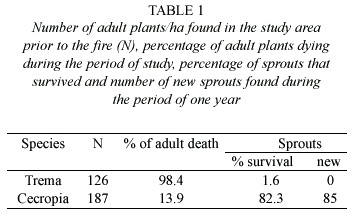
<body><![CDATA[<p><font face="Arial" size="2">The Atlantic Rain Forest,in the south- eastern of Brazil, is one of the richest world ecosystems <a  href="#my00">(Myers <i>et al </i>.2000</a>)which has been reduced to 7% of its original area (<a href="#so98">SOS Mata Atlântica 1998</a>). Consequently, many forest fragments are surrounded by new vegetation types where fire can easily spread (e.g. grasses and ferns). As fire is still not considered a common event in the Atlantic Rain Forest, the responses of species during a fire and consequences at community level have not been issues of research. This study reports the effect of fire in a matrix of grasslands and pioneer tree species where fragments of Atlantic Rain Forest are located. Three main processes affecting the pioneer trees are examined: 1) adult mortality caused by fire; 2) density of germination after fire, and 3) survivorship of seedlings and sprouts over time after fire.</font></p>     <p><font face="Arial" size="2">The study was carried out in the National Biological Reserve of Poço das Antas (22° 30’- 22° 33’ S, 42° 15’- 42° 19’ W), Rio de Janeiro State. The Reserve covers about 5000 ha and a maximum elevation of 205 m above sea level. Pastures,agriculture and secondary forests surround the area.The regional climate is classified as Walter and Lieth ’s Equatorial type (<a href="#wa71">Walter 1971</a>).The vegetation is typical of Atlantic Rain Forest of low altitude,being formed by fragments in different successional stages (<a  href="#li97">Lima <i>et al </i>.1997</a>)surrounded by dense stands of invasive species (<i>Cecropia glazioui </i>,<i>Trema micrantha </i>,<i>Pteridium aquilinum </i>var.<i>arachnoideum </i>(Klf.)Herter and <i>Panicum maximum </i>Jacquin. <a href="#li97">Lima <i>et al </i>.(1997)</a> argued that this reserve is one of the few remnants of lowland Atlantic Rain Forest in Rio de Janeiro State, and is also the habitat for the largest natural population of the golden lion tamarin,<i> Leontopithecus rosalia </i>(Primates: Callithichidae).</font></p>     <p><font face="Arial" size="2">Within the reserve 1.0 hectare was chosen within a matrix between a group of forest fragments (islands). The soil of the site is peat and the vegetation is exclusively formed by grasses (<i>Panicum maximum </i>), ferns (<i>Pteridium aquilinum</i>) and the tree species,<i> Cecropia glazioui </i>Sneth. (Cecropiaceae) and <i>Trema micrantha </i>(L.) Blume (Ulmaceae). However, the area was totally burnt in the August 1997 when the vegetation became apparently destroyed. Although fire at this site can ’t be predicted because is caused by antropic actions only (in general criminal actions), it can be considered frequent. Five other large fires were registered: 1984, 1986, 1990, 1991 and 1993 (<a href="#ol01">Oliveira 2001</a>). As the soil has a deep organic layer (typical of peat soils) the duration of the fire in deeper layers was more than 10 days.</font></p> <font face="Arial" size="2"><i></i></font>     <p><font face="Arial" size="2"><i>Trema micrantha </i>is widely distributed from the southern United States to Argentina (<a  href="#to96">Torres 1996</a>). Its presence is frequently associated to larger gaps where it grows very fast (<a href="#sw83">Swaine and Hall 1983</a>,<a href="#br87">Brokaw 1987</a>). Plants of the genus <i>Cecropia </i>are also related to the early phases of succession (<a href="#br87">Brokaw 1987</a>, <a href="#wh89">Whitmore 1989</a>,<a href="#al92">Alvarez-Buylla and Martínez- Ramos 1992</a>, <a href="#ca93">Castellani and Stubbebline 1993</a>).However,<a href="#br87">Brokaw (1987)</a>showed that <i>Trema micrantha </i>was only found in larger gaps (&gt;376 m<sup>2</sup> ) while <i>Cecropia insignis </i>was also found in smaller gaps (&gt;215 m<sup>2</sup> ).</font></p>     <p><font face="Arial" size="2">Prior to a fire in August 1997 (during the dry season), a study on the formation of new forest islands was being carried out. These islands could be characterised as small clumps (about 10 m in diameter) formed by <i>Cecropia </i>or <i>Trema </i>or both species<i>,</i> surrounded almost entirely by grasses<i>. </i>In general, individuals of <i>Cecropia </i>were located in the interior while <i>Trema </i>was found on the border of these islands. Grasses and ferns were absent or occurred in lower density within these islands.</font></p>     <p><font face="Arial" size="2">As soon as the fire was extinguished the regeneration process in terms of seedling recruitment and sprouting was quantified. All the pre-fire individuals of <i>Cecropia </i>and <i>Trema </i>in the area were numbered with plastic labels. In order to check for the presence of new sprouts and mortality, two other censuses were carried out, at 3 and 12 months after the fire. Three months after the fire grasses were tall and had already expanded. No seedlings of any other species were found under these grasses except in some sparse sites where <i>Panicum </i>and <i>Pteridium </i>were absent. Eight plots (1m x 1m) were randomly set up within these sites in which all seedlings found were similarly sampled. No other woody species were found in the study area. Seedlings were checked at three and twelve months later in order to quantify their survivorship.</font></p>     <p><font face="Arial" size="2">The number of individuals of <i>Cecropia </i>and <i>Trema </i>in the area before the fire were 187 and 126 ha<sup>-1</sup> respectively. Individuals of both species were about 5 m height. After the fire, no green leaves were observed, suggesting that all of the trees were dead. Two weeks later, the first species found in the area were <i>Panicum maximum </i>followed by <i>Pteridium aquilinum</i>. Both species were re-sprouting rather than germinating from seeds. New leaves of <i>Panicum </i>were about 10 cm in height. Three months after the fire most individuals of <i>Cecropia </i>(83.4%) had re-sprouted with a average of 3.0 sprouts/individual (total sprouts=476). Practically all of them had sprouted from roots (99.4%,N=473) while only 0.6% sprouted from stems. Conversely, most adult plants of <i>Trema </i>were dead (98.4%), only 1.6% individuals of <i>Trema </i>had some sprouts at the 3-month census (<a href="#t1">Table 1</a>). The 1-year census revealed that most adult plants of <i>Cecropia </i>and their sprouts survived during the period of study (<a href="#t1">Table 1</a>). Some of these sprouts were already producing fruits and 85 new sprouts (in individuals already sprouting) were found by the end of one year. No new deaths and no new sprouts of <i>Trema </i>were found at the 1-year census.</font></p>     <p style="text-align: center;"><font face="Arial" size="2">&nbsp;<a  name="t1"></a><img src="/img/fbpe/rbt/v53n1-2/3011i1.JPG" title="" alt=""  style="width: 355px; height: 214px;"></font></p>     
<p><font face="Arial" size="2">In terms of seedling regeneration,three months after fire,405 seedlings of <i>Trema </i>were found in the eight plots (about 50 seedlings/m<sup>2</sup> ) while a single seedling of <i>Cecropia </i>was found in the whole study area (1 ha). No seedlings of <i>Trema </i>or <i>Cecropia </i>were found in areas dominated by <i>Panicum </i>or <i>Pteridium </i>.Three months later, most seedlings of <i>Trema</i>: (96.3%) died and 28 new seedlings were found within the plots. The single seedling of <i>Cecropia </i>also died during this period. No new seedlings were found for either species at the 1-year census. </font></p> <font face="Arial" size="2"><i></i></font>     <p><font face="Arial" size="2"><i>Cecropia </i>can be considered a sprouter with vegetative regeneration while <i>Trema </i>is an obligate seeder from seeds storage in soil (<i>sensu </i><a  href="#wh95">Whelan 1995</a>).<a href="#ho82">Holthuijzen and Boerboom (1982)</a>showed that the amount of seeds of the congeners <i>Cecropia sciadophylla </i>and <i>C.obtusa </i>sharply decreases with depth and that most viable seeds germinated from the 0-1 cm soil layer.Consequently,those seeds buried in the soil surface experienced high soil temperatures during and after the passage of fire.As <i>Trema </i>is commonly found in larger gaps while <i>Cecropia </i>in small gaps (<a href="#br87">Brokaw 1987</a>),it is plausible that <i>Trema </i>seeds are more resistant to moderate heat than seeds of <i>Cecropia</i>. This resistance might be due to its ability to germinate in larger gaps where temperature is expected to be greater.The removal of competing vegetation could also have improved the recruitment while the high rate of seedling mortality was expected because of the rapid growth of competing vegetation over them.Sprouting,in the case of <i>Cecropia </i>,is a successful strategy of "escape " as sprouts of <i>Cecropia </i>are located over the fast growing vegetation present in the study site.In terms of community level,fire had a profound effect on the successional process by keeping the vegetation in a state in which grasses and ferns dominate the landscape.Fire destroyed the dense stands of adult <i>Trema </i>and <i>Cecropia </i>favouring the penetration of grasses and ferns in areas where they had already left (the subcanopy of these stands).</font></p> <font face="Arial" size="2"><b>     ]]></body>
<body><![CDATA[<p>Acknowledgments</p> </b></font>     <p><font face="Arial" size="2">The author thanks the Brazilian Government for the financial support through the CNPq, FAPERJ, Fundação "O Boticário de Proteção a Natureza ", IBAMA for the logistic support for field work, Pedro Carauta for the identification of <i>Cecropia</i>, Solange A. V. Pessoa, L. Fernando Moraes, Elidiomar R. da Silva and Michael Swaine for their important comments on the manuscript.</font></p> <font face="Arial" size="2"><b>     <p>Resumen</p> </b></font>     <p><font face="Arial" size="2">Se realizó un estudio sobre la sucesión natural después del fuego en una vegetación alrededor de fragmentos de la selva lluviosa atlántica (Reserva Biológica Nacional de Poço das Antas (22° 30’-22° 33’ S, 42° 15’- 42° 19’ W), Estado de Río de Janeiro).Todos los individuos de <i>Cecropia </i>y <i>Trema </i>previos del fuego en el área fueron numerados con marcas plásticas. Se realizaron otros dos censos, 3 y 12 meses después del fuego con el objetivo de detectar mortalidad y buscar la presencia de nuevos brotes. Las especies dominantes fueron: <i>Pteridium aquilinum, Panicum maximum, Trema micrantha </i>y <i>Cecropia glazioui. </i>Pocos días después del paso del fuego,los pastos y helechos se dispersaron por el área, mientras que los troncos de <i>Trema </i>y <i>Cecropia </i>estaban completamente quemados. La mayoría de los individuos de <i>Cecropia </i>produjeron algunos rebrotes mientras que la mayoría de los individuos de <i>Trema </i>murieron. Sin embargo, un gran número de plántulas de <i>Trema </i>fueron reclutadas mientras que únicamente una plántula de <i>Cecropia </i>fue observada durante el período de un año. La mayoría de estos plántulas murieron a lo largo del año, mientras que los brotes se estan ya reproduciendo. Los usos de <i>Cecropia </i>en lugares donde el fuego es recurrente puede ser más apropiado debido a su mayor chance de sobrevivir y a su habilidad de recuperarse más rápido después del fuego.</font></p> <font face="Arial" size="2"><b></b></font>     <p><font face="Arial" size="2"><b>Palabras clave: </b>Fuego, sucesión, reclutamiento, <i>Cecropia, Trema, </i>Brasil.</font></p> <font face="Arial" size="2"><b>     <p>References</p> </b></font>     <!-- ref --><p><font face="Arial" size="2"><a name="al92"></a>Alvarez-Buylla,E.R.&amp;M.Martines-Ramos.1992. Demography and allometry of <i>Cecropia obtusifolia </i>,a neotropical pioneer tree -an evaluation of the climax-pioneer paradigm for tropical rain forests.J. Ecol.80:275-290.    &nbsp;&nbsp;&nbsp;&nbsp;&nbsp;&nbsp;&nbsp;&nbsp;[&#160;<a href="javascript:void(0);" onclick="javascript: window.open('/scielo.php?script=sci_nlinks&ref=1677924&pid=S0034-7744200500010000100001&lng=','','width=640,height=500,resizable=yes,scrollbars=1,menubar=yes,');">Links</a>&#160;]<!-- end-ref --></font></p>     <!-- ref --><p><font face="Arial" size="2"><a name="br87"></a>Brokaw,N.V.L.1987.Gap-phase regeneration of three pioneer tree species in a tropical forest. J. Ecol. 75: 9-19.    &nbsp;&nbsp;&nbsp;&nbsp;&nbsp;&nbsp;&nbsp;&nbsp;[&#160;<a href="javascript:void(0);" onclick="javascript: window.open('/scielo.php?script=sci_nlinks&ref=1677926&pid=S0034-7744200500010000100002&lng=','','width=640,height=500,resizable=yes,scrollbars=1,menubar=yes,');">Links</a>&#160;]<!-- end-ref --></font></p>     ]]></body>
<body><![CDATA[<!-- ref --><p><font face="Arial" size="2"><a name="ca93"></a>Castellani, T. T. &amp; W. H. Stubbebline. 1993. Sucessão secundária inicial em mata tropical mesófila após perturbação por fogo. Rev. Bras. Bot. 16: 181-203.    &nbsp;&nbsp;&nbsp;&nbsp;&nbsp;&nbsp;&nbsp;&nbsp;[&#160;<a href="javascript:void(0);" onclick="javascript: window.open('/scielo.php?script=sci_nlinks&ref=1677928&pid=S0034-7744200500010000100003&lng=','','width=640,height=500,resizable=yes,scrollbars=1,menubar=yes,');">Links</a>&#160;]<!-- end-ref --></font></p>     <!-- ref --><p><font face="Arial" size="2"><a name="ho82"></a>Holthuijzen, A. M. A. &amp; J. H. A. Boerboom. 1982. The <i>Cecropia </i>seedbank in the Surinam lowland rain forest. Biotropica 14:62-68.    &nbsp;&nbsp;&nbsp;&nbsp;&nbsp;&nbsp;&nbsp;&nbsp;[&#160;<a href="javascript:void(0);" onclick="javascript: window.open('/scielo.php?script=sci_nlinks&ref=1677930&pid=S0034-7744200500010000100004&lng=','','width=640,height=500,resizable=yes,scrollbars=1,menubar=yes,');">Links</a>&#160;]<!-- end-ref --></font></p>     <!-- ref --><p><font face="Arial" size="2"><a name="li97"></a>Lima, H. C., S. Iwamoto, S. V. Gransoto, J. Di Ciero, R. R. Guedes-Bruni &amp; S. V. A. Pessoa. 1997. Mapeamento da cobertura Vegetal na Reserva Biológica de Poço das Antas,Silva Jardim, RJ. In:III Encontro de Pesquisadores da Reserva Biológica de Poço das Antas,(pp.31-32).Silva Jardim, Reserva Biológica de Poço das Antas: </font>&nbsp;&nbsp;&nbsp;&nbsp;&nbsp;&nbsp;&nbsp;&nbsp;[&#160;<a href="javascript:void(0);" onclick="javascript: window.open('/scielo.php?script=sci_nlinks&ref=1677932&pid=S0034-7744200500010000100005&lng=','','width=640,height=500,resizable=yes,scrollbars=1,menubar=yes,');">Links</a>&#160;]<!-- end-ref --><!-- ref --><p><font face="Arial" size="2"><a name="my00"></a>Myers, N., R. A. Mittermeier, C. G. Mittermeier, G. A. da Fonseca &amp; J. Kent. 2000. Biodiversity hotspots for conservation priorities.Nature 403:853-858.    &nbsp;&nbsp;&nbsp;&nbsp;&nbsp;&nbsp;&nbsp;&nbsp;[&#160;<a href="javascript:void(0);" onclick="javascript: window.open('/scielo.php?script=sci_nlinks&ref=1677933&pid=S0034-7744200500010000100006&lng=','','width=640,height=500,resizable=yes,scrollbars=1,menubar=yes,');">Links</a>&#160;]<!-- end-ref --></font></p>     <!-- ref --><p><font face="Arial" size="2"><a name="ol01"></a>Oliveira, L. C. 2001. Diversidade e composição de espécies de mamíferos em fragmentos de Mata Atlântica do Estado do Rio de Janeiro – RJ. MSc Thesis, Rio de Janeiro (Brazil), Universidade Federal do Rio de Janeiro.    &nbsp;&nbsp;&nbsp;&nbsp;&nbsp;&nbsp;&nbsp;&nbsp;[&#160;<a href="javascript:void(0);" onclick="javascript: window.open('/scielo.php?script=sci_nlinks&ref=1677935&pid=S0034-7744200500010000100007&lng=','','width=640,height=500,resizable=yes,scrollbars=1,menubar=yes,');">Links</a>&#160;]<!-- end-ref --> </font></p>     <!-- ref --><p><font face="Arial" size="2"><a name="so98"></a>SOS Mata Atlântica 1998.Atlas da Evolução dos Remanescentes Florestais e Ecossistemas Associados no Domínio da Mata Atlântica no Período de 1990- 1995. São Paulo.    &nbsp;&nbsp;&nbsp;&nbsp;&nbsp;&nbsp;&nbsp;&nbsp;[&#160;<a href="javascript:void(0);" onclick="javascript: window.open('/scielo.php?script=sci_nlinks&ref=1677937&pid=S0034-7744200500010000100008&lng=','','width=640,height=500,resizable=yes,scrollbars=1,menubar=yes,');">Links</a>&#160;]<!-- end-ref --></font></p>     <!-- ref --><p><font face="Arial" size="2"><a name="sw83"></a>Swaine, M. D. &amp; J. B. Hall.1983.Early succession on cleared forest land in Ghana. J. Ecol. 71:601-627.    &nbsp;&nbsp;&nbsp;&nbsp;&nbsp;&nbsp;&nbsp;&nbsp;[&#160;<a href="javascript:void(0);" onclick="javascript: window.open('/scielo.php?script=sci_nlinks&ref=1677939&pid=S0034-7744200500010000100009&lng=','','width=640,height=500,resizable=yes,scrollbars=1,menubar=yes,');">Links</a>&#160;]<!-- end-ref --></font></p>     <!-- ref --><p><font face="Arial" size="2"><a name="to96"></a>Torres, R.B. 1996. Biologia da Reprodução de <i>Trema micrantha </i>(L.)Blume (Ulmaceae).PhD Thesis, UNICAMP,Campinas,Brazil.    &nbsp;&nbsp;&nbsp;&nbsp;&nbsp;&nbsp;&nbsp;&nbsp;[&#160;<a href="javascript:void(0);" onclick="javascript: window.open('/scielo.php?script=sci_nlinks&ref=1677941&pid=S0034-7744200500010000100010&lng=','','width=640,height=500,resizable=yes,scrollbars=1,menubar=yes,');">Links</a>&#160;]<!-- end-ref --></font></p>     <!-- ref --><p><font face="Arial" size="2"><a name="wa71"></a>Walter, H. 1971.Ecology of Tropical and Subtropical Vegetation.Oliver and Boyd,Edinburgh.    &nbsp;&nbsp;&nbsp;&nbsp;&nbsp;&nbsp;&nbsp;&nbsp;[&#160;<a href="javascript:void(0);" onclick="javascript: window.open('/scielo.php?script=sci_nlinks&ref=1677943&pid=S0034-7744200500010000100011&lng=','','width=640,height=500,resizable=yes,scrollbars=1,menubar=yes,');">Links</a>&#160;]<!-- end-ref --></font></p>     <!-- ref --><p><font face="Arial" size="2"><a name="wh95"></a>Whelan, R. 1995. The Ecology of Fire. Cambridge, Cambridge University.    &nbsp;&nbsp;&nbsp;&nbsp;&nbsp;&nbsp;&nbsp;&nbsp;[&#160;<a href="javascript:void(0);" onclick="javascript: window.open('/scielo.php?script=sci_nlinks&ref=1677945&pid=S0034-7744200500010000100012&lng=','','width=640,height=500,resizable=yes,scrollbars=1,menubar=yes,');">Links</a>&#160;]<!-- end-ref --></font></p>     <!-- ref --><p><font face="Arial" size="2"><a name="wh89"></a>Whitmore,T. C. 1989. Canopy gaps and the two major groups of forest trees.Ecology 70:536-538.    &nbsp;&nbsp;&nbsp;&nbsp;&nbsp;&nbsp;&nbsp;&nbsp;[&#160;<a href="javascript:void(0);" onclick="javascript: window.open('/scielo.php?script=sci_nlinks&ref=1677947&pid=S0034-7744200500010000100013&lng=','','width=640,height=500,resizable=yes,scrollbars=1,menubar=yes,');">Links</a>&#160;]<!-- end-ref --></font></p>      ]]></body><back>
<ref-list>
<ref id="B1">
<nlm-citation citation-type="journal">
<person-group person-group-type="author">
<name>
<surname><![CDATA[Alvarez-Buylla]]></surname>
<given-names><![CDATA[E.R]]></given-names>
</name>
<name>
<surname><![CDATA[Martines-Ramos]]></surname>
<given-names><![CDATA[M]]></given-names>
</name>
</person-group>
<article-title xml:lang="en"><![CDATA[Demography and allometry of Cecropia obtusifolia ,a neotropical pioneer tree -an evaluation of the climax-pioneer paradigm for tropical rain forests]]></article-title>
<source><![CDATA[J. Ecol]]></source>
<year>1992</year>
<volume>80</volume>
<page-range>275-290</page-range></nlm-citation>
</ref>
<ref id="B2">
<nlm-citation citation-type="journal">
<person-group person-group-type="author">
<name>
<surname><![CDATA[Brokaw]]></surname>
<given-names><![CDATA[N.V.L]]></given-names>
</name>
</person-group>
<article-title xml:lang="en"><![CDATA[Gap-phase regeneration of three pioneer tree species in a tropical forest]]></article-title>
<source><![CDATA[J. Ecol]]></source>
<year>1987</year>
<volume>75</volume>
<page-range>9-19</page-range></nlm-citation>
</ref>
<ref id="B3">
<nlm-citation citation-type="journal">
<person-group person-group-type="author">
<name>
<surname><![CDATA[Castellani]]></surname>
<given-names><![CDATA[T. T]]></given-names>
</name>
<name>
<surname><![CDATA[Stubbebline]]></surname>
<given-names><![CDATA[W. H]]></given-names>
</name>
</person-group>
<article-title xml:lang="pt"><![CDATA[Sucessão secundária inicial em mata tropical mesófila após perturbação por fogo]]></article-title>
<source><![CDATA[Rev. Bras. Bot]]></source>
<year>1993</year>
<volume>16</volume>
<page-range>181-203</page-range></nlm-citation>
</ref>
<ref id="B4">
<nlm-citation citation-type="journal">
<person-group person-group-type="author">
<name>
<surname><![CDATA[Holthuijzen]]></surname>
<given-names><![CDATA[A. M. A]]></given-names>
</name>
<name>
<surname><![CDATA[Boerboom]]></surname>
<given-names><![CDATA[J. H. A]]></given-names>
</name>
</person-group>
<article-title xml:lang="en"><![CDATA[The Cecropia seedbank in the Surinam lowland rain forest]]></article-title>
<source><![CDATA[Biotropica]]></source>
<year>1982</year>
<volume>14</volume>
<page-range>62-68</page-range></nlm-citation>
</ref>
<ref id="B5">
<nlm-citation citation-type="book">
<person-group person-group-type="author">
<name>
<surname><![CDATA[Lima]]></surname>
<given-names><![CDATA[H. C]]></given-names>
</name>
<name>
<surname><![CDATA[Iwamoto]]></surname>
<given-names><![CDATA[S]]></given-names>
</name>
<name>
<surname><![CDATA[Gransoto]]></surname>
<given-names><![CDATA[S. V]]></given-names>
</name>
<name>
<surname><![CDATA[Di Ciero]]></surname>
<given-names><![CDATA[J]]></given-names>
</name>
<name>
<surname><![CDATA[Guedes-Bruni]]></surname>
<given-names><![CDATA[R. R]]></given-names>
</name>
<name>
<surname><![CDATA[Pessoa]]></surname>
<given-names><![CDATA[S. V. A]]></given-names>
</name>
</person-group>
<article-title xml:lang="es"><![CDATA[Mapeamento da cobertura Vegetal na Reserva Biológica de Poço das Antas,Silva Jardim, RJ]]></article-title>
<source><![CDATA[III Encontro de Pesquisadores da Reserva Biológica de Poço das Antas]]></source>
<year>1997</year>
<page-range>31-32</page-range><publisher-loc><![CDATA[Silva Jardim ]]></publisher-loc>
<publisher-name><![CDATA[Reserva Biológica de Poço das Antas]]></publisher-name>
</nlm-citation>
</ref>
<ref id="B6">
<nlm-citation citation-type="journal">
<person-group person-group-type="author">
<name>
<surname><![CDATA[Myers]]></surname>
<given-names><![CDATA[N]]></given-names>
</name>
<name>
<surname><![CDATA[Mittermeier]]></surname>
<given-names><![CDATA[R. A]]></given-names>
</name>
<name>
<surname><![CDATA[Mittermeier]]></surname>
<given-names><![CDATA[C. G]]></given-names>
</name>
<name>
<surname><![CDATA[da Fonseca]]></surname>
<given-names><![CDATA[G. A]]></given-names>
</name>
<name>
<surname><![CDATA[Kent]]></surname>
<given-names><![CDATA[J]]></given-names>
</name>
</person-group>
<article-title xml:lang="en"><![CDATA[Biodiversity hotspots for conservation priorities]]></article-title>
<source><![CDATA[Nature]]></source>
<year>2000</year>
<volume>403</volume>
<page-range>853-858</page-range></nlm-citation>
</ref>
<ref id="B7">
<nlm-citation citation-type="">
<person-group person-group-type="author">
<name>
<surname><![CDATA[Oliveira]]></surname>
<given-names><![CDATA[L. C]]></given-names>
</name>
</person-group>
<source><![CDATA[Diversidade e composição de espécies de mamíferos em fragmentos de Mata Atlântica do Estado do Rio de Janeiro - RJ]]></source>
<year>2001</year>
</nlm-citation>
</ref>
<ref id="B8">
<nlm-citation citation-type="">
<person-group person-group-type="author">
<name>
<surname><![CDATA[Mata Atlântica]]></surname>
<given-names><![CDATA[SOS]]></given-names>
</name>
</person-group>
<source><![CDATA[Atlas da Evolução dos Remanescentes Florestais e Ecossistemas Associados no Domínio da Mata Atlântica no Período de 1990- 1995]]></source>
<year>1998</year>
<publisher-loc><![CDATA[São Paulo ]]></publisher-loc>
</nlm-citation>
</ref>
<ref id="B9">
<nlm-citation citation-type="journal">
<person-group person-group-type="author">
<name>
<surname><![CDATA[Swaine]]></surname>
<given-names><![CDATA[M. D]]></given-names>
</name>
<name>
<surname><![CDATA[Hall]]></surname>
<given-names><![CDATA[J. B]]></given-names>
</name>
</person-group>
<article-title xml:lang="en"><![CDATA[Early succession on cleared forest land in Ghana]]></article-title>
<source><![CDATA[J. Ecol]]></source>
<year>1983</year>
<volume>71</volume>
<page-range>601-627</page-range></nlm-citation>
</ref>
<ref id="B10">
<nlm-citation citation-type="">
<person-group person-group-type="author">
<name>
<surname><![CDATA[Torres]]></surname>
<given-names><![CDATA[R.B]]></given-names>
</name>
</person-group>
<source><![CDATA[Biologia da Reprodução de Trema micrantha (L.)Blume (Ulmaceae)]]></source>
<year>1996</year>
</nlm-citation>
</ref>
<ref id="B11">
<nlm-citation citation-type="book">
<person-group person-group-type="author">
<name>
<surname><![CDATA[Walter]]></surname>
<given-names><![CDATA[H]]></given-names>
</name>
</person-group>
<source><![CDATA[Ecology of Tropical and Subtropical Vegetation]]></source>
<year>1971</year>
<publisher-loc><![CDATA[Edinburgh ]]></publisher-loc>
<publisher-name><![CDATA[Oliver and Boyd]]></publisher-name>
</nlm-citation>
</ref>
<ref id="B12">
<nlm-citation citation-type="book">
<person-group person-group-type="author">
<name>
<surname><![CDATA[Whelan]]></surname>
<given-names><![CDATA[R]]></given-names>
</name>
</person-group>
<source><![CDATA[The Ecology of Fire]]></source>
<year>1995</year>
<publisher-loc><![CDATA[Cambridge ]]></publisher-loc>
<publisher-name><![CDATA[Cambridge University]]></publisher-name>
</nlm-citation>
</ref>
<ref id="B13">
<nlm-citation citation-type="journal">
<person-group person-group-type="author">
<name>
<surname><![CDATA[Whitmore]]></surname>
<given-names><![CDATA[T. C]]></given-names>
</name>
</person-group>
<article-title xml:lang="en"><![CDATA[Canopy gaps and the two major groups of forest trees]]></article-title>
<source><![CDATA[Ecology]]></source>
<year>1989</year>
<volume>70</volume>
<page-range>536-538</page-range></nlm-citation>
</ref>
</ref-list>
</back>
</article>
