100m) waters in the northern part of the gulf, as well as within the sediment plume from the Rio Coto Colorado had intermediate values. Within the Rio Coto Colorado sediment plume the concentrations did decrease with increasing depth and the congeners showed a shift towards less chlorinated congeners with depth. However, the deep northern basin had some of the highest PCB concentrations and the shift towards less chlorinated congeners was not apparent or significant. Whether the anoxic conditions that exist in the deep waters are capable of initiating dechlorination is still unknown. Overall, the data from Golfo Dulce show moderate PCB contamination, despite the pristine nature of the gulf and surrounding lands]]>
100 m ) de las aguas de la parte norte del Golfo, así como las de la estela del Río Coto Colorado, tienen concentraciones intermedias. Dentro de la estela de sedimentos del Río Colorado las concentraciones aumentaron con la profundidad y los congéneres variaron con la profundidad hacia los menos clorinados. Sin embargo, la región profunda tuvo una de las más altas concentraciones de PCBs, pero la tendencia hacia los menos clorinados no fue aparente o significativa. No se conoce si las condiciones anóxicas en las aguas profundas son capaces de iniciar la declorización. En general, las muestras analizadas muestran concentraciones moderadas de PCBs, no obstante las condiciones pristinas del Golfo y su cuenca]]>
Alison L. Spongberg
Received 22-IV-2003. Corrected 02-III-2004. Accepted 07-IV-2004.
Abstract
Twenty-nine marine sediment samples collected from 1996 through 2002 from the Golfo Dulce embayment of Costa Rica were analyzed for PCB concentrations. The Esquinas River and Rincon Bay in the northern and western part of the gulf had relatively low overall concentrations of PCBs, with no samples having greater than 2.1 µg/g dw sediment. The Port of Golfito had the highest overall concentrations, ranging up to 15.7 µg/g dw sediment. These samples were also dominated by higher chlorinated congeners. Samples from the deeper (>100m) waters in the northern part of the gulf, as well as within the sediment plume from the Rio Coto Colorado had intermediate values. Within the Rio Coto Colorado sediment plume the concentrations did decrease with increasing depth and the congeners showed a shift towards less chlorinated congeners with depth. However, the deep northern basin had some of the highest PCB concentrations and the shift towards less chlorinated congeners was not apparent or significant. Whether the anoxic conditions that exist in the deep waters are capable of initiating dechlorination is still unknown. Overall, the data from Golfo Dulce show moderate PCB contamination, despite the pristine nature of the gulf and surrounding lands.
Keywords: Polychlorinated biphenyls (PCB), Golfo Dulce, organic contamination, marine pollution, Costa Rica.
]]> PCBs are a class of man-made non-polar hydrocarbons with a biphenyl nucleus on which one to ten hydrogen atoms have been replaced by chlorines. Commercial PCBs were manufactured as complex mixtures of congeners from the 1930’s through the 1960’s. These commercial products were clear viscous liquids that were used widely in many industrial applications, especially in North America. They are soluble in most organic solvents, oils and fats and are very stable. Under certain conditions, however, they may be destroyed, either chemically, thermally, or biochemically. However, these degradation reactions are difficult and slow. After PCB contamination was recognized their use was restricted to a limited number of applications and production was banned since 1976 (Erickson 1997).
PCBs are one of several truly global environmental pollutants, including mercury, lead, and certain pesticides. They are highly lipophilic, and therefore, most PCB mass is found in soil and sediments and not in the water column. However, continued dissolution and volatilization from spills, etc. result in measurable aqueous and atmospheric emissions. Murphy et al. (1985) estimated that 0.9 x 10⁹ g per year of PCBs cycle through the U.S. atmosphere. This is less that 1% of the total PCBs in the environment. Nevertheless, atmospheric transport is recognized as the primary mode of global PCB distribution. Eisenreich et al. (1981) estimated that the atmospheric pathway contributes 60-90% of PCB input into the Great Lakes. Therefore, their presence is recognizable in almost all sediment and biological samples from around the world. However, practically no research has been done in tropical areas.
The presence of even low concentrations of PCB pollutants can be a continued and future source of in place contamination of the water column. Thus, they may continue to be an ecological threat, and possible human threat as well. This paper provides the detailed analyses of PCB congeners from various locations within the sediments of Golfo Dulce on the southwestern coast of Costa Rica. This is the first paper reporting their presence and concentrations in this area. Asummary of previous PCB studies in other marine sediments in Costa Rica is included as an accompanying article for comparison (Spongberg 2004).
The gulf has become increasingly subjected to fishery, aquaculture, ecotourism, urbanization and port construction. Therefore, information on PCB concentrations in areas yet unaffected by extensive development is vital. As part of a larger project to evaluate the quality of Costa Rican waters, many samples/cores have been obtained from the coastal waters since 1997, including a more intensive investigation in Golfo Dulce. These sediment samples have been analyzed for many contaminants, including pesticides, heavy metals and polychlorinated biphenyls. The pesticide data were reported in Spongberg and Davis (1999). The PCB data for the complete sample set is presented as a companion to this paper (Spongberg, 2004). This paper presents a summary and details of the data collected from the Gulf of Dulce, as of 2003.
Materials and methods
Study area: Golfo Dulce is a deep fjord-like estuary at the southern end of the Pacific coast of Costa Rica. The depth exceeds 200 m in the inner basin and is sheltered against the open Pacific by a shallow sill (60 m) at the southern end. Water depths increase rapidly along fault scarp faces on the eastern side of the gulf (Hebbeln et al. 1996) and tidal ranges are as great as 6 m. Due to this morphology only a limited water exchange with the ocean takes place. Thus the deepest sediments are anoxic, at least temporarily, as compared to the shallow, well-oxygenated Golfo de Nicoya, further north along the Pacific coast (Richards et al. 1971). Thamdrup et al. (1996) re-investigated the geochemistry of the gulf and found steep gradients in both temperature and salinity to a depth of 60 m below a shallow mixed surface layer. The pycnocline is located about 10-20 m above the sill depth and rises about 10 m towards the head of the gulf. The photic zone extends to 30-40 m depth and surface water oxygen concentrations were 190-200 μmol.L-1 . A strong oxycline is associated with the pycnocline throughout the basin and no oxygen (<3 μmol L-1 ) is detected below 100 m. Nitrate increases with depth to only 10 μmol L-1 at the pycnocline and decreases below this depth to less than 1 μmol L-1 at the basin floor.
Kuever et al. (1996) found that the number of microorganisms within the water column did not change with depth, despite the reduction in oxygen. The highest numbers of sulfate-reducing bacteria were found in or close to the sediment surface. The anoxic bottom water also contains sulfide-oxidizing bacteria of the Thiovulum and Thiospira genera. Dalsgaard et al. (2003) recently discovered that the anaerobic oxidation of ammonium with nitrite, or the ‘anammox’ reaction performed by bacteria, was responsible for 19Œ35% of the total N2 formation in the deep water column in Golfo Dulce.
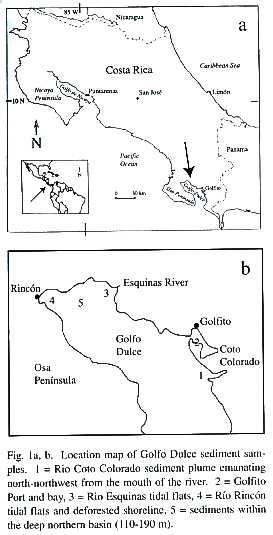
Analytical procedures: Details on the collection and analyses of the sediment samples is given in an adjoining paper (Spongberg 2004). Grab samples were prepared as follows. Estuary and shallow samples were collected by hand with a clean core barrel and immediately placed in either pre-washed glass jars or plastic bags, depending on the subsequent analyses. Samples were sealed and frozen immediately after collection and transferred to the University of Toledo, Toledo, Ohio still frozen. Samples were dried and re-frozen until analysis. Stations are indicated in Fig. 1.
]]>
The analysis of PCBs followed a modified version of EPA Methods 8081 and 3620 (USEPA, 1992). Approximately 10 to 20 g of dried, sieved sediment was extracted using a Soxtec Organic Extraction Unit, using methylene chloride or acetone:methylene chloride (1:1) as solvents. Separation and clean up wereachieved by passing the extract through a florisil-filled glass column with diethylether in hexane (3:1) as the eluant.
Analyses were performed on a Hewlett Packard 6890 gas chromatograph equipped with a SPB-5 fused silica capillary column (30 m length, 0.25 mm ID, 0.25 µm film thickness, Supelco, Inc.) attached to either a 63Ni electron capture detector (HP 5890 Series II) or a mass selective detector (HP 5972).
Quality control included reagent blank determination, matrix spike (0.2 and 1.0 µg/g) recovery, and precision analyses. 2,3,5- trichlorobenzene was used as an internal standard. Calibration was checked routinely. Quantification of individual PCB congeners in samples was made by comparison to standard mixtures and confirmed using the extensive library of mass signatures of individual congeners. Recovery efficiencies varied between 65 and 95%. Detection limits were calculated using the area of the baseline noise over the elution time of each congener using low concentration standards. Limits of detection were three times the standard deviation of the base- line noise, and averaged 0.2 ng/g. Relative standard deviation of data from five consecutive duplicate runs was 3-5%. Data reported are not corrected for blank concentrations or recovery efficiencies.
Results
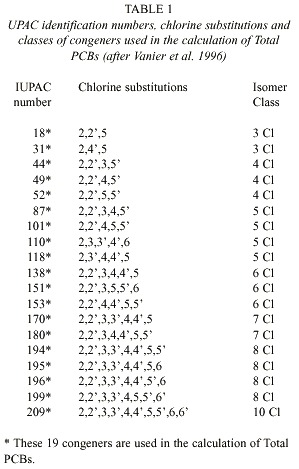
The data on these congeners are expressed in two ways. The sum of the congeners identified in this study is presented as S PCBs. Table 1 lists those congeners. However, because different studies usually identify different congeners and different numbers of congeners, these studies can be difficult to compare. In this study, twenty five chromatographic peaks could be definitively assigned to PCB congeners. Although the utmost care was taken to assign the correct IUPAC number to that peak, there often unavoidably are other congeners that may co-elute. Due to their geochemical characteristics and mass selective signatures, it is likely that the co-eluting compounds have an equal number of chlorine atoms on the molecule, however, their placement on the biphenyl structure might vary. Therefore, the data are also presented as Total PCBs. As stated in Vanier et al. (1996), 19 congeners make up about 50% by weight of all congeners in Arochlor 1242, 1253, 1262, 1254, and 1260 (Table 1). Therefore, the concentrations of these 19 congeners are summed and multiplied by 2 and reported as Total PCBs. This value can, hopefully, be more useful for comparisons in future studies.
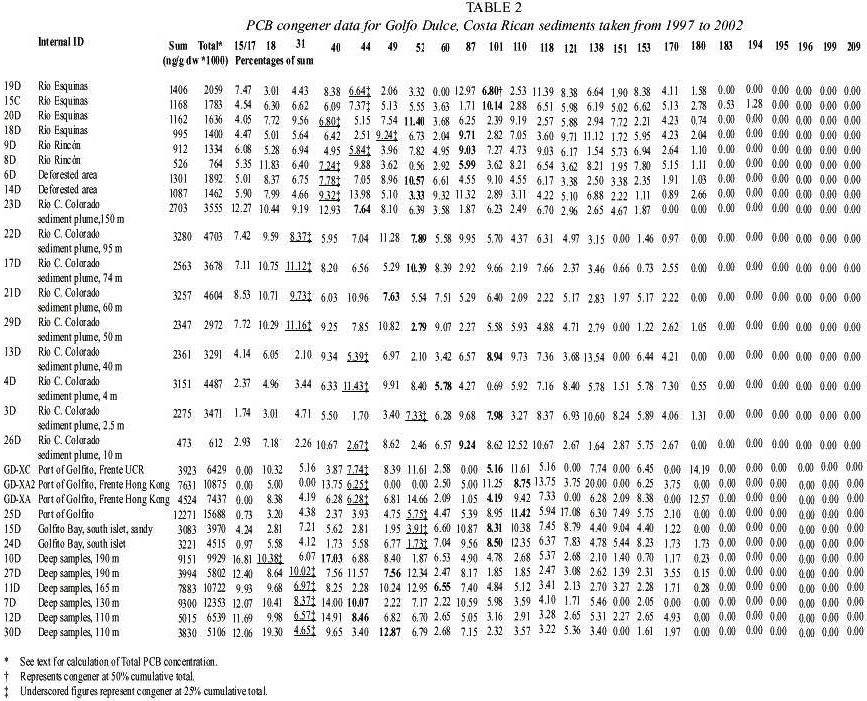
]]> Table 2 lists the PCB data for the Golfo Dulce sediments. Data are divided by geographic location and include the .PCB and Total PCB concentrations, as well as the percentage of the sum attributed to the specific identified congeners (given as the IUPAC number). The congener in bold type represents the IUPAC number where 50% of the total sample lies below (fewer Cl) and 50% heavier (more Cl atoms). The underscored congener percentage represents the 25% cumulative value.Discussion
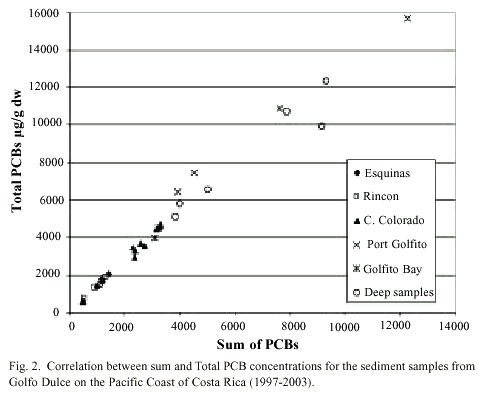
Figure 2 is a cross plot of the ΣPCB and Total PCB concentrations. The two calculated values correlate to each other positively with R-squared = 0.977. The sediments from the Port of Golfito stand out as having the highest concentrations (Average sum = 7.09 μg/g dw with S.E. = 1.91; Average total = 10.11 μg/g with S.E. 2.09). These samples consist of soupy black muds located within the port very near the large cargo boats. The presence of oils and other contaminants are visibly obvious. Within the Bay of Golfito, south of the port, the samples are sandier and show less than half the contamination of the port samples (Average sum = 2.15 μg/g , S.E. = 0.07; Average Total = 4.24 μg/g , S.E. = 0.03 μg/g dw). Evidently flow within the bay does not permit the transport of the contaminant-laden muds to this sheltered area of the bay.
The Río Rincón area, in the northwest part of Golfo Dulce is a pristine area, surrounded by National Parkland and little development, although the residents relied heavily on power generators and other less efficient or less environmentally-friendly power sources until very recently. Data on PCBs show some of the lowest values found in Costa Rica (Fig. 2), with average sum and total values of 0.96 and 1.05 (S.E. = 0.16 and 0.28) μg/g dw, respectively. These averages include samples from a deforested area only a few kilometers east of the mouth of the Río Rincón where erosion of the soils is fairly severe.
The Esquinas River in the Northeast of the Gulf and the Río Coto Colorado watersheds drain largely agricultural fields. The Esquinas River sediments were obtained on the tidal flats and among the mangrove roots and were fairly clay-rich. PCB contaminants had low overall concentrations averaging 1.18 and 1.72 (S.E. = 0.084 and 0.14 μg/g dw) for the sum and total, respectively (Fig. 2).
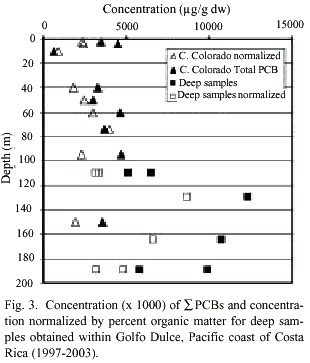
]]> The Coto Colorado samples were obtained offshore within the sediment plume that extended from the river mouth to the north-northwest into the deeper waters of the gulf. These samples were also clay-rich, however, at a water depth of ~60 m the clays turned greenish, as compared to the usual dark grey clays found elsewhere. Figure 3 shows the trend of these data, normalized for organic matter, with depth. The two shallowest samples (2.5 and 4 m) had relatively high concentrations. These samples were actually closer to the outlet of Golfito Bay and may reflect an influence from the port’s contaminants flowing from the bay into the main body of the gulf. The remaining plume samples showed an increase with depth, until the deepest samples where the values drop. In particular, when the data are normalized to organic matter content, the concentration seems to drop beneath a depth of 74 meters.Also shown in Figure 3 are the data from the sediments retrieved from the deepest parts of the northern end of the gulf. These deep samples are centered between the Rios Esquinas and Rincon and would be expected to contain the fine-grained sediments from these watersheds. However, the concentrations in these sediments are some of the highest found in the entire Costa Rican study. The average sum and total concentrations were 6.53 and 8.41 (S.E. 1.04 and 1.22) μg/g dw respectively, while the average Total PCBs normalized for %OM was still 4.96 (S.E. = 0.93) μg/g dw. These sediments were found to contain relatively high concentrations of pesticides also (Spongberg and Davis 1999). Possibly these deeper sediments are a sink for many of the contaminants that move through the basin. However, the trend found in the Coto Colorado plume would indicate that the contaminants are either not moving into the deeper waters of the plume, or possibly that the deeper anoxic waters create conditions amenable to their degradation.
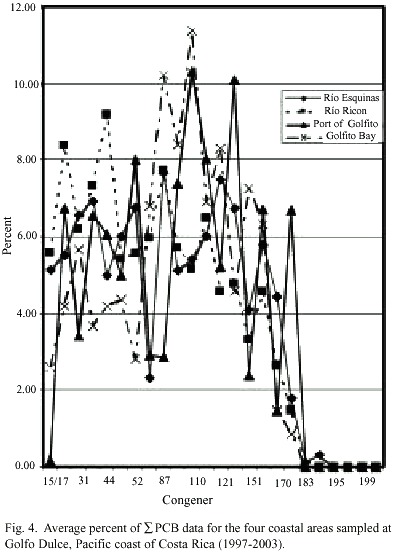
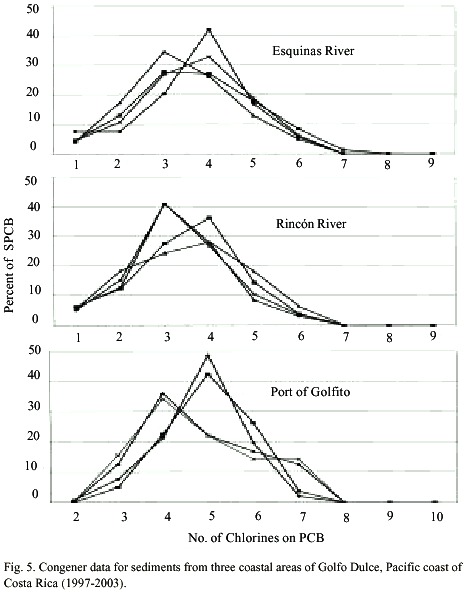
Figure 4 shows the average congener distribution for the four coastal areas sampled in Golfo Dulce. These data can also be evaluated in Table 2 by looking at the position of the 25th and 50th percentile groupings noted as the congener underscored and bold, respectively. None of the samples has a congener signature indicative of atmospheric deposition as was found in Golfo Papagayo (Spongberg 2004), or this signature is overwhelmed with congeners of higher chlorine numbers. Figure 5 illustrates the difference between the individual samples. The Rincon and Esquinas River samples show the distribution skewed somewhat to the lower chlorinated congeners. As degradation occurs the congeners lose their chlorines, however, these samples do not indicate extensive dechlorination. In fact, they may indicate that the contamination is recent, or that the compounds are not degrading in their present environment. However, the overall PCB concentrations of these samples were low. In comparison to this, the samples with the highest concentrations from the Port of Golfito show only a slightly higher degree of chlorination.
Table 2 shows the congener data for the deeper water samples both from sediment plume from the Coto Colorado River and the samples from the deep basin in the northern part of the gulf. Interestingly, the shallower samples have a preponderance of lower chlorinated congeners. However, in general the sediment plume shows an increase in congeners with lower chlorine atoms with increasing water depth. This trend is not apparent in the deep samples from the north part of the gulf. The Coto Colorado data is consistent with the lower concentrations found in the deeper samples and may indicate the capacity of the deep anoxic sediments in this area to degrade the compounds. This trend is not as apparent in the northern samples, however, these PCBs are more skewed towards the lower chlorinated congeners as compared to the PCBs within the Port of Golfito (Figure 5). However, if the deeper anoxic environment was indeed more amenable to dechlorination, the congeners would be expected to be more heavily skewed to the lighter congeners than is seen in these samples. Since the dechlorinated congeners have a higher water solubility, maybe they are being removed from the bottom sediments. We could be seeing concentrations more indicative of the lower K ow values of the lower chlorinated congeners in comparison to the higher chlorinated species.
]]> In contrast to data from the Golfo de Nicoya (Spongberg 2004), the Golfo Dulce samples show greater variability. This most likely is a result of the varying environments present within Golfo Dulce and the lack of thorough mixing of sediments throughout the gulf. Despite the pristine nature of the land surrounding the Golfo Dulce area and the anoxic conditions at depth, there were many sediments showing moderate PCB contamination. In comparison, many PCB contaminated sites within the temperate regions have concentrations in excess of 100 or even 1000 μg/g sediment (Erickson 1997). Unfortunately, this preliminary evaluation of PCB contamination within the coastal waters of coastal Costa Rica has presented more questions than answers, however, this database should provide a starting point for comparison as development of the coastal lands increases throughout the coming years.
Acknowledgements
For this and all work I have done in Costa Rica I sincerely thank the tremendous efforts and kindness of José Vargas, former Director of the Centro de Investigación en Ciencias del Mar y Limnología (CIMAR), and Jenaro Acuña, both at the University of Costa Rica, San Pedro. Eleazar, Davis, Ruth, and many others at CIMAR went out of their way to help make this research a success. Last, but certainly not least, I wish to thank the Costa Rica-United States of America Foundation for Cooperation (CR-USA) for partially funding this project.
Resumen
Un total de 29 muestras de sedimentos recolectadas de 1996 a 2002 en el Golfo Dulce, Costa Rica fueron analizadas determinar las concentraciones de bifenilos policlorinados (PCBs). La Bahía de Rincón y el Río Esquinas en la parte noroeste del Golfo tienen concentraciones relativamente bajas de PCBs, con ninguna muestras superando los 2.1 ug/ dw (peso seco) de sedimento. El puerto de Golfito tuvo las mayores concentraciones hasta un máximo de 15.7 ug/g dw de sedimento. Estas muestras también estuvieron dominadas por los congéneres más clorinados. Las muestras de los sedimentos profundos (>100 m ) de las aguas de la parte norte del Golfo, así como las de la estela del Río Coto Colorado, tienen concentraciones intermedias. Dentro de la estela de sedimentos del Río Colorado las concentraciones aumentaron con la profundidad y los congéneres variaron con la profundidad hacia los menos clorinados. Sin embargo, la región profunda tuvo una de las más altas concentraciones de PCBs, pero la tendencia hacia los menos clorinados no fue aparente o significativa. No se conoce si las condiciones anóxicas en las aguas profundas son capaces de iniciar la declorización. En general, las muestras analizadas muestran concentraciones moderadas de PCBs, no obstante las condiciones pristinas del Golfo y su cuenca.
References
Dalsgaard, T., D.E. Canfield, J. Petersen, B. Thamdrup, J. Acuña-González. 2003: N2 production by the anammox reaction in the anoxic water column of Golfo Dulce, Costa Rica. Nature 422: 606-608. [ Links ]
Eisenreich, S.J., B.B. Looney & J.D. Thornton. 1981: Airborne organic contaminants in the Great Lakes ecosystem. Env. Sci. and Technol. 15: 30-38. [ Links ]
Erickson, M.D. 1997: Analytical Chemistry of PCBs, 2nd Edition. Lewis Publishers, NY. 667 p. [ Links ]
Hebbeln, D., D. Ceese & J. Cortés. 1996: Morphology and sediment structures in Golfo Dulce, Costa Rica. Rev. Biol. Trop. 44: 1-10. [ Links ]
Kuever, J., C. Wawer & R. Lillebæk. 1996: Microbiological observations in the anoxic basin Golfo Dulce, Costa Rica. Rev. Biol. Trop. 11: 49-57. [ Links ]
Murphy, T.J., L.J. Formanski, B. Brownawell & J.A. Meyer. 1985: Polychlorinated biphenyl emissions to the atmosphere in the Great Lakes Region: municipal landfills and incinerators. Env. Sci. and Technol. 19: 942-946. [ Links ]
Richards, F.A., J.J. Anderson & J.D. Cline. 1971: Chemical and physical observations in Golfo Dulce, an anoxic basin on the Pacific coast of Costa Rica. Limnol. Oceanogr. 16: 43-50. [ Links ]
Spongberg, A.L. 2004: PCB Contamination in Surface Sediments in the Coastal Waters of Costa Rica. Rev. Biol. Trop. 52 (Supl. 3A): 1-10. [ Links ]
Spongberg, A.L. & P. Davis. 1999: Preliminary investigation of pesticide contamination in Golfo Dulce, Costa Rica. Rev. Biol. Trop. 46 (Suppl. 5): 111-124. [ Links ]
Thamdrup, B., D.E. Canfield, T.G. Ferdelman, R.N. Glud & J.K. Gundersen. 1996: A biogeochemical survey of the anoxic basin Golfo Dulce, Costa Rica. Rev. Biol. Trop. 44: 19-33. [ Links ]
United States Environmental Protection Agency. 1992: Test methods for evaluating solid waste: physical/chemical methods. Method 8081: Organochlorine pesticides, halowaxes and PCBs as Arochlors by gas chromatography: Capillary Column Technique. [ Links ]
Vanier, C., M. Sylvestre, & D. Planas. 1996: Persistence and fate of PCBs in sediments of the Saint Lawrence River. The Science of the Total Environment 192: 229-244. [ Links ] ]]>