<?xml version="1.0" encoding="ISO-8859-1"?><article xmlns:mml="http://www.w3.org/1998/Math/MathML" xmlns:xlink="http://www.w3.org/1999/xlink" xmlns:xsi="http://www.w3.org/2001/XMLSchema-instance">
<front>
<journal-meta>
<journal-id>0034-7744</journal-id>
<journal-title><![CDATA[Revista de Biología Tropical]]></journal-title>
<abbrev-journal-title><![CDATA[Rev. biol. trop]]></abbrev-journal-title>
<issn>0034-7744</issn>
<publisher>
<publisher-name><![CDATA[Universidad de Costa Rica]]></publisher-name>
</publisher>
</journal-meta>
<article-meta>
<article-id>S0034-77442004000500012</article-id>
<title-group>
<article-title xml:lang="en"><![CDATA[Paralytic Shellfish Poisoning (PSP) in Margarita Island, Venezuela]]></article-title>
</title-group>
<contrib-group>
<contrib contrib-type="author">
<name>
<surname><![CDATA[La Barbera-Sánchez]]></surname>
<given-names><![CDATA[Amelia]]></given-names>
</name>
<xref ref-type="aff" rid="A01"/>
</contrib>
<contrib contrib-type="author">
<name>
<surname><![CDATA[Soler]]></surname>
<given-names><![CDATA[Jose Franco]]></given-names>
</name>
<xref ref-type="aff" rid="A02"/>
</contrib>
<contrib contrib-type="author">
<name>
<surname><![CDATA[Rojas de Astudillo]]></surname>
<given-names><![CDATA[Luisa]]></given-names>
</name>
<xref ref-type="aff" rid="A03"/>
</contrib>
<contrib contrib-type="author">
<name>
<surname><![CDATA[Chang-Yen]]></surname>
<given-names><![CDATA[Ivan]]></given-names>
</name>
<xref ref-type="aff" rid="A03"/>
</contrib>
</contrib-group>
<aff id="A01">
<institution><![CDATA[,INIA Centro de Investigaciones Agropecuarias de Sucre ]]></institution>
<addr-line><![CDATA[Sucre ]]></addr-line>
<country>Venezuela</country>
</aff>
<aff id="A02">
<institution><![CDATA[,Instituto de Investigaciones Marinas  ]]></institution>
<addr-line><![CDATA[ ]]></addr-line>
<country>España</country>
</aff>
<aff id="A03">
<institution><![CDATA[,Universidad de Oriente Department of Chemistry ]]></institution>
<addr-line><![CDATA[ ]]></addr-line>
</aff>
<pub-date pub-type="pub">
<day>00</day>
<month>09</month>
<year>2004</year>
</pub-date>
<pub-date pub-type="epub">
<day>00</day>
<month>09</month>
<year>2004</year>
</pub-date>
<volume>52</volume>
<fpage>89</fpage>
<lpage>98</lpage>
<copyright-statement/>
<copyright-year/>
<self-uri xlink:href="http://www.scielo.sa.cr/scielo.php?script=sci_arttext&amp;pid=S0034-77442004000500012&amp;lng=en&amp;nrm=iso"></self-uri><self-uri xlink:href="http://www.scielo.sa.cr/scielo.php?script=sci_abstract&amp;pid=S0034-77442004000500012&amp;lng=en&amp;nrm=iso"></self-uri><self-uri xlink:href="http://www.scielo.sa.cr/scielo.php?script=sci_pdf&amp;pid=S0034-77442004000500012&amp;lng=en&amp;nrm=iso"></self-uri><abstract abstract-type="short" xml:lang="en"><p><![CDATA[A severe outbreak of Paralytic Shellfish Poisoning (PSP) occurred in Manzanillo and Guayacán, northwestern coast of Margarita Island, Venezuela, between August and October 1991. A bloom of dinoflagellates including Prorocentrum gracile, Gymnodinium catenatum and Alexandrium tamarense seemed to be responsible for this outbreak. Levels of PSP toxins in mussels (Perna perna) exceeded the international safety limit of saxitoxin, 80 µg STX/100 g meat. PSP toxin values varied between 2 548 and 115 µg STX/100 g meat in Manzanillo, and between 1 422 and 86 µg STX/100 g meat in Guayacán. At both locations, the highest levels were detected in August, when 24 patients exhibited typical symptoms of PSP toxicity after consuming cooked mussels (16 required hospitalization). A high pressure liquid chromatographic (HPLC) procedure was recently used on the 1991 samples. The major toxin detected in samples of both locations was decarbamoyl saxitoxin (dcSTX), but low concentrations of saxitoxin were also found in Manzanillo samples. Gonyautoxins GTX1, GTX2 and GTX3 were detected only at Guayacán, while in both locations, decarbamoylgonyatouxin (dcGTX2,3) toxins were detected. These findings represent the first time that causative toxins of PSP in Venezuela have been chemically identified, and confirm the presence of dcSTX and dcGTX in mussels from the Caribbean Sea. The presence of dcSTX and dcGTX in shellfish is indicative that Gymnodinium catenatum was a causative organism for outbreak of PSP]]></p></abstract>
<abstract abstract-type="short" xml:lang="es"><p><![CDATA[Un severo brote de intoxicación paralizante por moluscos (PSP en inglés) ocurrió en Manzanillo y Guayacán en la costa noroeste de la Isla de Margarita, Venezuela entre agosto y octubre de 1991. Una proliferación de Prorocentrum gracile, Gymnodinium catenatum y Alexandrium tamarense causó el brote. Los niveles de PSP en mejillón (Perna perna) superaron los niveles máximos permisibles de saxitoxina, 80 µg STX/100g carne. Los niveles de toxinas variaron entre 2 548 y 115 µg STX/100 g carne en Manzanillo y entre 1 422 y 86 µg STX/100g carne en Guayacán. En ambas localidades, los máximos niveles se detectaron en agosto, cuando 24 personas presentaron síntomas típicos de PSP después de consumir mejillones cocidos (16 fueron hospitalizados). Se aplicó recientemente cromatografía líquida de alta presión (HPLC) a muestras del año 1991 y la toxina más detectada fue decarbamoyl saxitoxina (dcSTX), pero también se encontró saxitoxinas en muestras de Manzanillo. Las gonyautoxinas GTX1, GTX2 y GTX3 solo se encontraron en Guayacán; en ambas localidades se detectó decarbamoylgonyatouxin (dcGTX2,3). Estos hallazgos representan la primera vez que las toxinas causantes de un brote de PSP en Venezuela han sido químicamente identificadas, confirmando la presencia de dcSTX y dcGTX en mejillones del mar Caribe. La presencia de dcSTX y dcGTX en moluscos, indica que G. catenatum fue el organismo responsable de la intoxicación]]></p></abstract>
<kwd-group>
<kwd lng="en"><![CDATA[Dinoflagellate]]></kwd>
<kwd lng="en"><![CDATA[Paralytic Shellfish Poisoning]]></kwd>
<kwd lng="en"><![CDATA[saxitoxin]]></kwd>
<kwd lng="en"><![CDATA[Prorocentrum]]></kwd>
<kwd lng="en"><![CDATA[Gymnodinium catenatum]]></kwd>
<kwd lng="en"><![CDATA[Alexandrium tamarense]]></kwd>
<kwd lng="es"><![CDATA[Dinoflagelado]]></kwd>
<kwd lng="es"><![CDATA[intoxicación paralizante por moluscos]]></kwd>
<kwd lng="es"><![CDATA[saxitoxina]]></kwd>
<kwd lng="es"><![CDATA[Prorocentrum]]></kwd>
<kwd lng="es"><![CDATA[Gymnodinium catenatum]]></kwd>
<kwd lng="es"><![CDATA[Alexandrium tamarense]]></kwd>
</kwd-group>
</article-meta>
</front><body><![CDATA[  <b><font face="Arial">     <p align="center">Paralytic Shellfish Poisoning (PSP) in Margarita Island, Venezuela</p> </font></b><font face="Arial" size="2"> </font>     <p><font face="Arial" size="2">&nbsp;</font></p>     <p><font face="Arial" size="2">Amelia La Barbera-Sánchez</font><font><b><font  face="Arial" size="2"><b><a name="1"></a></b></font></b></font><font  face="Arial" size="2"><a href="#2"><sup>1</sup></a> *, Jose Franco Soler<a href="#2"><sup>2</sup></a> , Luisa Rojas de Astudillo<a  href="#2"><sup>3</sup></a> &amp; Ivan Chang-Yen<a href="#2"><sup>4</sup></a></font></p>     <p><font><b><font face="Arial" size="2"><b><a name="2"></a></b></font></b></font><font  face="Arial" size="2"><a href="#1">1</a> Centro de Investigaciones Agropecuarias de Sucre/Nva. Esparta, INIA, MCT. Av. Carúpano, sector Caiguire, Cumaná, Estado Sucre, Venezuela. P.O. Box 236, Cumaná 6101. Fax: 58 (93)432-5385; <a href="mailto:alabarbe@hotmail.com">alabarbe@hotmail.com</a></font></p>     <p><font face="Arial" size="2"><a href="#1">2</a> Instituto de Investigaciones Marinas, (CSIC), Vigo, España;<a  href="mailto:%20jose.franco@vi.ieo.es"> jose.franco@vi.ieo.es</a></font></p>     <p><font face="Arial" size="2"><a href="#1">3</a> Department of Chemistry, Universidad de Oriente, Cumaná, Estado Sucre, Venezuela; lrojas40@yahoo.com 4 Department of Chemistry, The University of the West Indies, St. Augustine, WI. Fax: 868-663-9685; <a  href="mailto:icyen@carib-link.net">icyen@carib-link.net</a></font></p> <font face="Arial" size="2"><b> </b></font>     <p><font face="Arial" size="2">&nbsp;</font></p>     <p align="center"><font face="Arial" size="2">Recibido 31-X-2002. Corregido 08-IX-2003. Aceptado 11-XII-2003.</font></p> <font face="Arial" size="2"><b>     <p>&nbsp;</p>     ]]></body>
<body><![CDATA[<p>Abstract</p> </b></font>     <p><font face="Arial" size="2">A severe outbreak of Paralytic Shellfish Poisoning (PSP) occurred in Manzanillo and Guayacán, northwestern coast of Margarita Island, Venezuela, between August and October 1991. A bloom of dinoflagellates including <i>Prorocentrum gracil</i>e, <i>Gymnodinium catenatum </i>and <i>Alexandrium tamarense </i>seemed to be responsible for this outbreak. Levels of PSP toxins in mussels <i>(Perna pern</i>a) exceeded the international safety limit of saxitoxin, 80 µg STX/100 g meat. PSP toxin values varied between 2 548 and 115 µg STX/100 g meat in Manzanillo, and between 1 422 and 86 µg STX/100 g meat in Guayacán. At both locations, the highest levels were detected in August, when 24 patients exhibited typical symptoms of PSP toxicity after consuming cooked mussels (16 required hospitalization). A high pressure liquid chromatographic (HPLC) procedure was recently used on the 1991 samples. The major toxin detected in samples of both locations was decarbamoyl saxitoxin (dcSTX), but low concentrations of saxitoxin were also found in Manzanillo samples. Gonyautoxins GTX1, GTX2 and GTX3 were detected only at Guayacán, while in both locations, decarbamoylgonyatouxin (dcGTX2,3) toxins were detected. These findings represent the first time that causative toxins of PSP in Venezuela have been chemically identified, and confirm the presence of dcSTX and dcGTX in mussels from the Caribbean Sea. The presence of dcSTX and dcGTX in shellfish is indicative that <i>Gymnodinium catenatum </i>was a causative organism for outbreak of PSP.</font></p> <font face="Arial" size="2"><b></b></font>     <p><font face="Arial" size="2"><b>Key words: </b>Dinoflagellate, Paralytic Shellfish Poisoning, saxitoxin, <i>Prorocentru</i>m, <i>Gymnodinium catenatum, Alexandrium tamarense.</i></font></p> <font face="Arial" size="2"><b></b></font>     <p><font face="Arial" size="2"><b>Palabras clave: </b>Dinoflagelado, intoxicación paralizante por moluscos, saxitoxina, <i>Prorocentru</i>m, <i>Gymnodinium catenatum, Alexandrium tamarense.</i></font></p>     <p><font face="Arial" size="2">&nbsp;</font></p>     <p><font face="Arial" size="2">&nbsp;</font></p>     <p><font face="Arial" size="2">Margarita Island is located in northeastern Venezuela in the southern Caribbean. Upwellings occur around the island and its waters are characterized by a high productivity that supports a thriving fishing industry, which supplies seafood to the tourism sector of the island. The fishing villages in Manzanillo and Guayacán are located on the northwestern side of Margarita Island, on which natural banks of the <i>Perna perna </i>mussels thrive. Many villagers depend exclusively on mussel exploitation for a living.</font></p>     <p><font face="Arial" size="2">Unfortunately, toxic dinoflagellate blooms occur in the northern marine environment of Margarita. They represent a hazard to public health and cause significant economic losses to the shellfish industry. The first toxic outbreak in Manzanillo was recorded in April 1977 caused by <i>Gonyaulax tamarense </i>var. <i>excavata </i>(<a href="#re79">Reyes- Vásquez <i>et a</i>l. 1979</a>). During this event, twelve patients exhibited symptoms of PSP, including a two-years-old child who died after consuming contaminated mussels. Subsequently, in early August 1991, the inhabitants of Manzanillo and Guayacán reported water discoloration that covered a large area. About the same time, 24 patients showing severe symptoms of PSP were hospitalized in Porlamar, capital city of Nueva Esparta state.</font></p>     <p><font face="Arial" size="2">Dinoflagellate toxins are accumulated in shellfish, such as oysters, mussels and scallops, exposed to dinoflagellate blooms, and become toxic to humans and other organisms that consume such shellfish (<a href="#os87">Oshima <i>et a</i>l. 1987</a>). PSP causes muscular paralysis, respiratory difficulties, and can lead to death (<a href="#th91">Thibault <i>et a</i>l. 1991</a>). The neurotoxins belonging to the PSP toxin group are among the most notorious poisons found in the marine environment in many parts of the world (<a href="#ge81">Genenah and Shimizu 1981</a>, <a href="#pa86">Park <i>et a</i>l. 1986</a>). There are more than 20 different PSP toxins (<a  href="#os95">Oshima 1995</a>), with others being reported (<a  href="#qu01">Quilliam <i>et a</i>l. 2001</a>). Collectively, these PSP are termed saxitoxins, deriving the name from the butter clam, <i>Saxidomus giganteu</i>s, from which saxitoxins were originally extracted and identified (<a href="#ba75">Bates and Rapoport 1975</a>).</font></p>     <p><font face="Arial" size="2">Saxitoxins are neurotoxins that retard the movement of sodium ions through nerve cell membranes, and may block the flow of nerve impulses to cause the symptoms of PSP toxicity, which include paralysis and disorientation (<a href="#mo64">Mosher <i>et a</i>l. 1964</a>). There is no antidote for PSP, and all cases require immediate medical attention that may include application of life support equipment to save a victim’s life. (<a href="#ka93">Kao 1993</a>). Thus, the toxic event of 1991, in Margarita Island, resulted in the activation of an emergency monitoring plan to determine its causes.</font></p>     ]]></body>
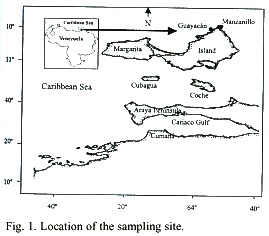
<body><![CDATA[<p><font face="Arial" size="2">The number of different PSP toxins and their tendency for chemical transformation into other toxic products are major factors hindering development of a simple field test kit for measuring PSP toxins (<a href="#su88">Sullivan and Wekell 1988</a>). Currently, only the mouse bioassay method (<a href="#ho80">Horwitz 1980</a>), adopted as the official method by the Association of Official Analytical Chemists (AOAC) in 1965, is approved by US Food and Drug Administration (USFDA), because it simultaneously measures the total toxicity of all the saxitoxins in a sample of shellfish tissue. However, mouse bioassays have a number of drawbacks, namely the inability to efficiently detect the low toxicity analogues of STX (toxins B and C) (<a href="#ca91">Casais 1991</a>). HPLC analyses of shellfish have thus been developed to confirm the causative toxins of PSP and to determine the toxin profiles of PSP-contaminated organisms (<a  href="#fr93">Franco and Fernández 1993</a>, <a href="#os95">Oshima 1995</a>, <a href="#la01">Lawrence and Niedzwiadek 2001</a>, <a  href="#va01">Vale and Sampayo 2001</a>).</font></p>     <p><font face="Arial" size="2">The most commonly used techniques for the analysis of PSP involve the conversion of non-fluorescent PSP toxins to fluorescent compounds by oxidation reactions. The fluorescent derivatives are then detected and quantified by fluorometry.</font></p>     <p><font face="Arial" size="2">The method of HPLC described by <a  href="#su85">Sullivan <i>et a</i>l. (1985)</a>, which incorporates post- column derivatization to carry out the chemical reaction and originally proposed by <a href="#ba75">Bates and Rapoport (1975)</a>, was used to determine PSP in mussels collected from Manzanillo and Guayacán on Margarita Island.</font></p> <font face="Arial" size="2"><b>     <p>&nbsp;</p>     <p>Materials and methods</p> </b> </font>     <p><font face="Arial" size="2">Mussel and phytoplankton samples were collected at Manzanillo and Guayacán, Margarita Island, during August to December 1991 (<a href="#f1">Fig. 1</a>). Phytoplankton samples were taken with Niskin bottles and with nets (30 µm), and fixed with lugol solution, and formalin (4%), respectively. The phytoplankton abundance was obtained following the technique described by <a href="#ut58">Utermöhl (1958)</a>. All shellfish were externally washed, with a brush and distilled water, to minimize contamination of their tissues and then frozen until analysis. Sampling frequency in the bivalve banks was increased until no PSP was detected by mouse bioassay. </font></p>     <p style="text-align: center;"><font face="Arial" size="2">&nbsp;<a  name="f1"></a><span style="font-weight: bold;"><img  src="/img/fbpe/rbt/v52s1/2707i1.JPG" title="" alt=""  style="width: 269px; height: 236px;"></span>    
<br> </font></p>     <p><font face="Arial" size="2">Extracts of the mussels were prepared according to the Official Method of the AOAC (<a href="#ho80">Horwitz 1980</a>). After boiling for 5 minutes and adjust pH between 2-4, the extract was centrifugated at 14 000 rpm for 20 min at 20ºC; 10 µl of the supernatant of each sample were used for HPLC analysis.</font></p>     <p><font face="Arial" size="2">Certified calibration solutions (STX; NEOSTX; GTX1; GTX2; GTX3; GTX4) from the National Research Council of Canada were used as diluted to prepare the calibration standards, using Milli-Q water as diluent. The dcSTX was provided from a BCR (European Union) program of PSP intercalibration. Two mixtures of toxin standards were prepared, one mixture contained, NeoSTX, dcSTX and STX, and another one contained GTX1, GTX2, GTX3 and GTX4.</font></p>     ]]></body>
<body><![CDATA[<p><font face="Arial" size="2">Analysis of the principal toxins was carried out on a HPLC with fluorescence detection using, with minor modifications, the post-column oxidative fluorescence method of <a  href="#fr93">Franco and Fernández (1993)</a>.</font></p>     <p><font face="Arial" size="2">The LC system used was composed of a high-pressure pump (Hitachi L-6000) with an intelligent autosampler (Hitachi AS-4000). The HPLC column used was a 5 µm Lichrospher 100 RP-18 cartridge (12.5 cm x 4 mm i.d), held in a LichroCART 125-4 (Merck) cartridge holder, enclosed in a column heater unit (Jones Chromatography, 7971) at 30°C. Two A-30- SW-2 Eldex pumps with inline degasser (Waters ILD) were used for both oxidizing reagent and acid. The postcolumn reaction was performed in a teflon coil (10 m x 0.5 mm i.d.) held in glass tube (at 65°C) and immersed in a water bath connected to a circulating temperature control unit (Ultratherm 6000383). The detector was a spectrofluorimeter (Jasco FP-920), set at 330 nm excitation and 390 nm emission. Millennium 2010 (v. 215.01) software was used for recording and integrating peaks.</font></p>     <p><font face="Arial" size="2">The first isocratic phase (for separation of neoSTX, dcsTX and STX) was 94% of 1 mmol/l sodium octanesulphonate in 10 mmol/l ammonium phosphate (pH 7.2) and 6% acetonitrile, at 1.0 ml/min. The second isocratic phase (for separation of GTX toxins) was 1.5 mmol/l sodium octansulphonate in 10 mmol/l ammoniumphosphate (pH 7.0), at 0.8 ml/min.</font></p>     <p><font face="Arial" size="2">The presence of toxins C, GTX5 and GTX6 were confirmed by boiling the sample extract with an equal volume of 0.4 mol/l HCl for 15 minutes. This procedure hydrolyses the sulphocarbamoyl groups. The hydrolysis of C toxins produces the corresponding GTX1 through 4, and GTX5 and GTX6 give rise to STX and neoSTX (<a href="#su85">Sullivan <i>et a</i>l. 1985</a>, <a  href="#os90">Oshima <i>et a</i>l. 1990</a>).</font></p>     <p><font face="Arial" size="2">The post-column oxidant was 7 mmol/l periodic acid in 50 mmol/l sodium phosphate buffer, adjusted with 1 mol/l ammonium hydroxide to pH 9. Acetic acid (0.5 mol/l) was used as acidifier. The flow rate of both oxidant and acid was 0.4 ml/min.</font></p>     <p><font face="Arial" size="2">Post-column oxidative fluorescence method was evaluated by injection of uncontaminated mussel samples with PSP toxin standards and by calculating the recovery values for these experiments.</font></p>     <p><font face="Arial" size="2">Toxin concentrations in samples extracts were determined by comparing the peak areas of each toxin with those of the prepared calibration standards.</font></p>     <p><font face="Arial" size="2">Toxicities were determined and compared with those obtained by mouse bioassay. To compare the toxicity calculated from the HPLC to that measured by bioassay, the individual toxicity of each toxin were added and converted to µg STX equivalents per 100 g shellfish meat by assuming a conversion factor (CF) (Horwitz 1980) of 0.2 µg STX per mouse unit. All HPLC analyses were run in duplicates and results presented are means of these duplicate determinations.</font></p> <font face="Arial" size="2"><b>     <p>&nbsp;</p>     <p>Results</p> </b> </font>     ]]></body>
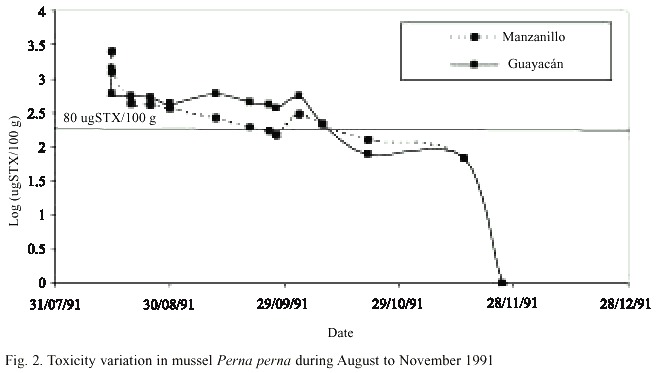
<body><![CDATA[<p><font face="Arial" size="2">Microscopic analysis of the water in the vicinity of the mussel banks showed the presence of <i>Gymnodinium catenatum </i>and <i>Alexandrium tamarens</i>e; at concentrations of <font  face="Symbol">£</font> 20 cell/ml. A member of the genus <i>Cochlodinium </i>s<i>p. </i>was also detected at very low densities. The most abundant diatoms were <i>Cyclotella </i>sp., <i>Navicula </i>sp., <i>Nitzchia seriata </i>and <i>Rhizosolenia delicatul</i>a, while the most abundant dinoflagellates were <i>Ceratium furca, Dinophysis </i>cf. <i>acuminata, Gonyaulax polygramma, Prorocentrum gracilis, </i>and <i>Polykrikos polikrikoide</i>s. At both locations, <i>Prorocentrum gracile </i>was the dominant species, and its density indicated that it was the major bloom-forming species. <i>Mesodinium rubru</i>m, a bloom-forming species in the Gulf of Cariaco, was also found at low abundance.</font></p>     <p><font face="Arial" size="2">Concentrations of PSP, analyzed by mouse bioassay, in 1991, were higher than the Maximum Permissible Level (MPL) established by USFDA for human consumption, this is 80 µg STX/100 g meat of shellfish. The ranges found were from 115 to 2 548 µg STX/100 g meat in Manzanillo and 86 to 1 422 µg STX/100 g meat in Guayacán. In both areas, toxin concentrations increased during the period August-September; and remained above the MPL until October 15<sup>th </sup>(<a  href="#f2">Fig. 2</a>). After that date, values decreased and became non-detectable in November and December 1991.</font></p>     <div style="text-align: center;"><span style="font-family: arial;"><a  name="f2"></a><img src="/img/fbpe/rbt/v52s1/2707i3.JPG" title="" alt=""  style="width: 656px; height: 373px;"></span>    
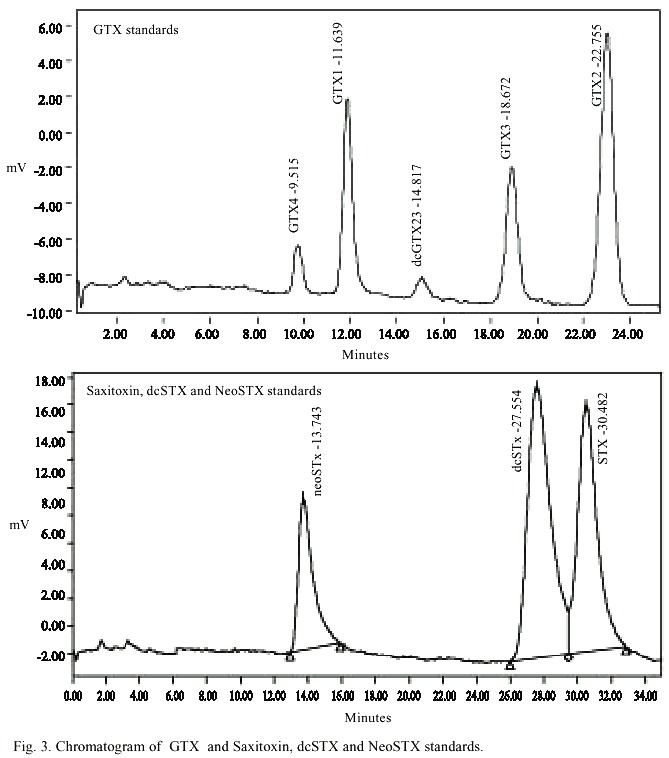
<br> </div>     <p><font face="Arial" size="2">Due to the unavailability of chemical confirmatory technology in Venezuela at the time of the PSP outbreak, samples of shellfish tested by standard mouse bioassay were held at -15ºC until recent acquisition of training in PSP toxins analysis by HPLC. No significant changes in the values of PSP were obtained by analyzing the samples once more by standard mouse bioassay, at the same time that the HPLC analyses were performed. </font></p>     <p><font face="Arial" size="2">HPLC analyses with post-column derivatization was carried out to identify and determine the toxins responsible for the outbreak of PSP in Manzanillo and Guayacán. This enabled the separation of the epimers GTX1,4 and GTX2,3 (<a href="#f3">Fig. 3</a>), as well as enabled toxin dc-STX to be distinguished from STX. The mean value of triplicate injection and the fluorescent intensity of each toxin was plotted against its concentrations.</font></p>     <div style="text-align: center;"><a name="f3"></a><img  src="/img/fbpe/rbt/v52s1/2707i4.JPG" title="" alt=""  style="width: 669px; height: 758px;">    
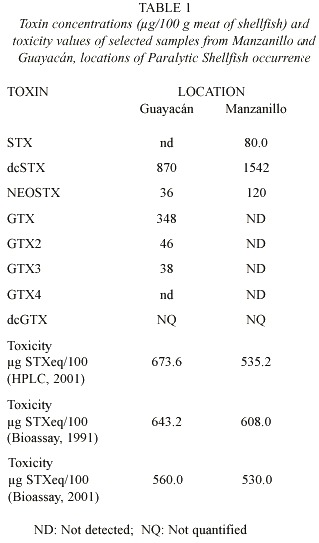
<br> </div>     <p><font face="Arial" size="2">Recoveries from injected samples were between 84-103%. Significant correlation (r = .90; p&lt;.05) between mouse bioassay and HPLC with fluorescence detection was obtained. However, the bioassay results were, in general, lower than those from HPLC, considering no quantified toxins (dcGTX) for lacking of quantitative standards (<a href="#t1">Table 1</a>). The cause of these differences is unclear, although the selection of toxicity factors (FC) for LC quantification may be implicated (<a href="#la95">Lawrence <i>et a</i>l. 1995</a>). It is also possible that the mouse bioassay underestimates the amount of toxicity present (<a href="#le00">Ledoux and Hall 2000</a>). </font></p>     <div style="text-align: center;"><font face="Arial" size="2"><a  name="t1"></a><img src="/img/fbpe/rbt/v52s1/2707i2.JPG" title="" alt=""  style="width: 319px; height: 543px;">&nbsp;</font></div>     
]]></body>
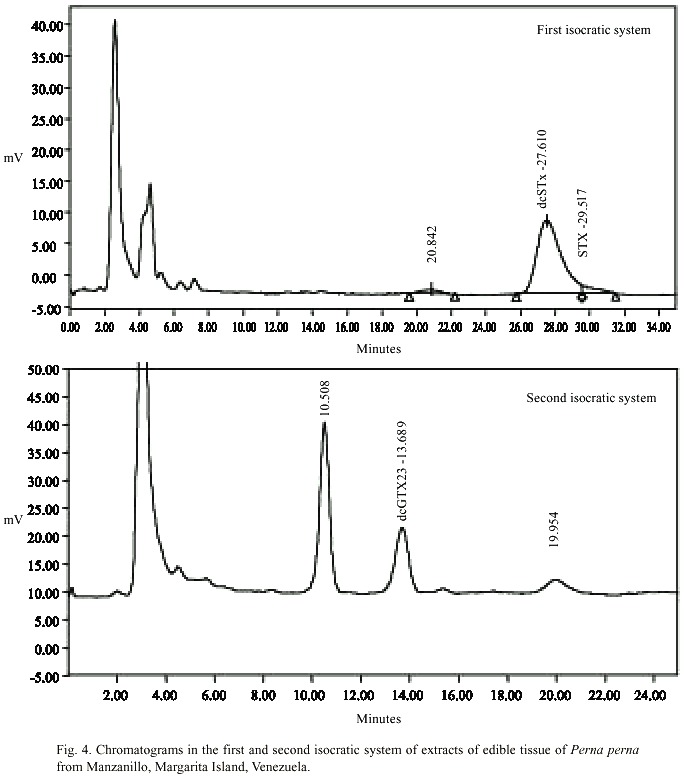
<body><![CDATA[<p><font face="Arial" size="2">Shellfish samples analyzed using HPLC were lethal to mice. Samples from Manzanillo contained STX, but dcSTX was found the highest concentration (1 542 µg/100 g meat) (<a href="#t1">Table 1</a>). The PSP toxin profiles of <i>P. perna </i>samples collected from Manzanillo (Margarita Island) showed that the major toxins present were dcGTX and dcSTX groups (<a href="#f4">Fig. 4</a>).</font></p>     <div style="text-align: center;"><a name="f4"></a><img  src="/img/fbpe/rbt/v52s1/2707i5.JPG" title="" alt=""  style="width: 684px; height: 778px;">    
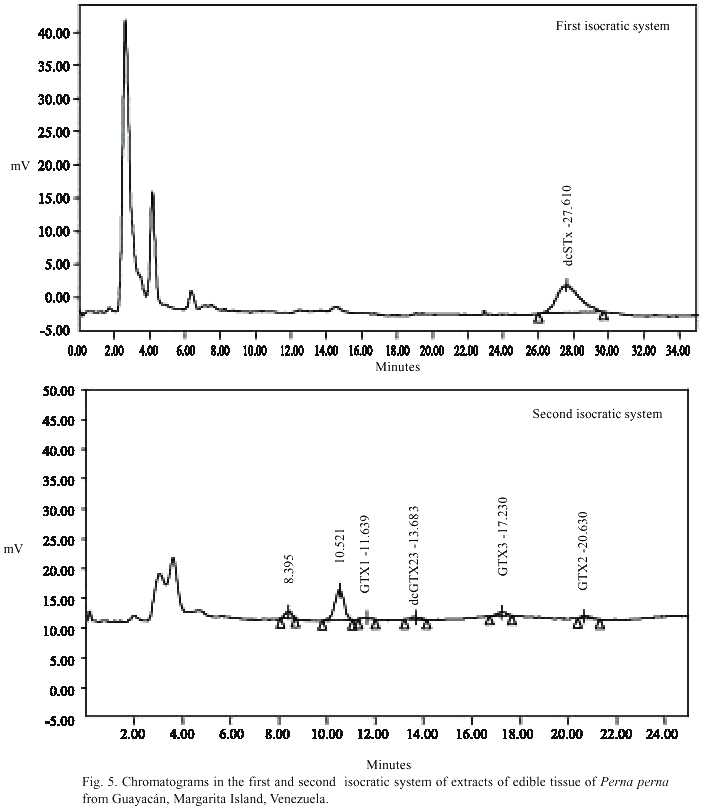
<br> </div>     <p><font face="Arial" size="2">The toxins dcGTXs were identified using a qualitative standard obtained from a collaborative study, but their presence could not be quantified because of the lack of calibrants. The availability of the calibrants for dcGTX is essential for wide use of the method, and attention should be given to projects aimed at the development of calibrants for decarbamoyl toxins (<a href="#va00">Van den Top <i>et a</i>l. 2000</a>).</font></p>     <p><font face="Arial" size="2">From Guayacán, dcSTX and dcGTX were also detected in samples of <i>P. perna, </i>but at lower concentration when compared with Manzanillo samples (<a href="#f5">Fig. 5</a>). Samples of mussels from Guayacán also contained GTX1, GTX2 and GTX3 at low concentrations (<a href="#f5">Fig. 5</a>). A large unidentified peak with retention time 10.5 min., near GTX6 and GTX4, was observed in samples from both locations (<a href="#f5">Figs. 5</a> and <a  href="#f4">4</a>), similar to that reported by Oshima <i>et a</i>l. 1995.</font></p>     <div style="text-align: center;"><a name="f5"></a><img  src="/img/fbpe/rbt/v52s1/2707i6.JPG" title="" alt=""  style="width: 705px; height: 809px;">    
<br> <span style="font-family: arial;"></span></div> <font face="Arial" size="2"><b>     <p>Discussion</p> </b> </font>     <p><font face="Arial" size="2">These findings agree with previous reports of toxins other than STX being dominant in contaminated shellfish (<a href="#no83">Noguchi <i>et a</i>l. 1983</a>, <a  href="#la89">Lassus <i>et a</i>l. 1989</a>, <a href="#ca96">Carreto <i>et a</i>l. 1996</a>, <a href="#am99">Amzil <i>et a</i>l. 1999</a>, <a  href="#ji00">Jiang <i>et a</i>l. 2000</a>).</font></p>     <p><font face="Arial" size="2">Our analyses have confirmed the presence of dcSTX in our mussel samples, following the outbreak of PSP toxicity in Manzanillo and Guayacán (Margarita Island). <a href="#ha83">Harada <i>et a</i>l. 1983</a> also found this toxin among tropical specimens.</font></p> <font face="Arial" size="2"><i></i></font>     ]]></body>
<body><![CDATA[<p><font face="Arial" size="2"><i>G. catenatum </i>and <i>A. tamarense </i>have been reported in Venezuela as toxigenic and have been associated with other toxic outbreaks (<a href="#la93">La Barbera-Sánchez <i>et a</i>l. 1993</a>). A characteristic feature of <i>G. catenatum </i>toxins is their production of decarbamoyl toxins (<a  href="#os90">Oshima <i>et a</i>l.1990</a>, <a href="#do97">Donker <i>et a</i>l. 1997</a>, <a href="#ne00">Negri <i>et a</i>l. 2000</a>). Mussels and oysters showed similar toxin profiles to those of the causative dinoflagellate, with a slightly higher amount of decarbamoyl and carbamoyl toxins (<a href="#os90">Oshima <i>et a</i>l. 1990</a>). Thus <i>G. catenatum </i>appears to be one of the organisms responsible for the incidence of PSP toxins initially investigated by standard mouse bioassay. The compilation of toxin profiles, as chemical signatures of <i>G. catenatum </i>populations, is the subject of continued investigation (<a href="#ha98">Hallegraeff and Fraga 1998</a>).</font></p>     <p><font face="Arial" size="2">Analysis of <i>A. tamarense </i>by <a  href="#hu97">Hummert <i>et a</i>l. 1997</a> showed only N-sulfocarbamoyl toxins in this species; it is likely that this species was also another contaminant dinoflagellate.</font></p>     <p><font face="Arial" size="2">With the results of this investigation, toxic profiles of shellfish from Venezuela coast are available and can be compared in detail with those obtained from other countries.</font></p> <font face="Arial" size="2"><b>     <p>&nbsp;</p>     <p>Acknowledgments</p> </b> </font>     <p><font face="Arial" size="2">We acknowledge the collaboration of Rommel Delgado from the Ministry of Health in Porlamar for providing the data on number of patients affected by the toxic outbreak in that locality during 1991. We also thank the cooperation of Simón Silva, Oswaldo Gallardo and Luis Gómez from the Toxicology Laboratory, Instituto Nacional de Investigaciones Agricolas (INIA-Sucre). We acknowledge the support of Technological Development Program, phase II, subscribed between Venezuelan Government and the Interamerican Development Bank, Instituto de Oceanografia, Spain, Intergovernmental Oceanographic Commision (IOC) of UNESCO, Consejo de Investigación of Universidad de Oriente, Venezuela, and The University of the West Indies, Trinidad.</font></p> <font face="Arial" size="2"><b>     <p>&nbsp;</p>     <p>Resumen</p> </b> </font>     <p><font face="Arial" size="2">Un severo brote de intoxicación paralizante por moluscos (PSP en inglés) ocurrió en Manzanillo y Guayacán en la costa noroeste de la Isla de Margarita, Venezuela entre agosto y octubre de 1991. Una proliferación de <i>Prorocentrum gracil</i>e, <i>Gymnodinium catenatum </i>y <i>Alexandrium tamarense </i>causó el brote. Los niveles de PSP en mejillón <i>(Perna pern</i>a) superaron los niveles máximos permisibles de saxitoxina, 80 µg STX/100g carne. Los niveles de toxinas variaron entre 2 548 y 115 µg STX/100 g carne en Manzanillo y entre 1 422 y 86 µg STX/100g carne en Guayacán. En ambas localidades, los máximos niveles se detectaron en agosto, cuando 24 personas presentaron síntomas típicos de PSP después de consumir mejillones cocidos (16 fueron hospitalizados). Se aplicó recientemente cromatografía líquida de alta presión (HPLC) a muestras del año 1991 y la toxina más detectada fue decarbamoyl saxitoxina (dcSTX), pero también se encontró saxitoxinas en muestras de Manzanillo. Las gonyautoxinas GTX1, GTX2 y GTX3 solo se encontraron en Guayacán; en ambas localidades se detectó decarbamoylgonyatouxin (dcGTX2,3). Estos hallazgos representan la primera vez que las toxinas causantes de un brote de PSP en Venezuela han sido químicamente identificadas, confirmando la presencia de dcSTX y dcGTX en mejillones del mar Caribe. La presencia de dcSTX y dcGTX en moluscos, indica que <i>G. catenatum </i>fue el organismo responsable de la intoxicación.</font></p> <font face="Arial" size="2"><b>     <p>&nbsp;</p>     ]]></body>
<body><![CDATA[<p>References</p> </b> </font>     <!-- ref --><p><font><b><font face="Arial" size="2"><b><a name="am99"></a></b></font></b></font><font  face="Arial" size="2">Amzil, Z., M. Quilliam, T. Hu &amp; J.L.C. Wright. 1999. Winter accumulation of paralytic shellfish toxins in digestive glands of mussels from Arcachon and Toulon (France) without detectable toxic plankton species revealed by interference in the mouse bioas say for lipophilic toxins. Nat. Toxins 7: 271-277.</font>&nbsp;&nbsp;&nbsp;&nbsp;&nbsp;&nbsp;&nbsp;&nbsp;[&#160;<a href="javascript:void(0);" onclick="javascript: window.open('/scielo.php?script=sci_nlinks&ref=1226402&pid=S0034-7744200400050001200001&lng=','','width=640,height=500,resizable=yes,scrollbars=1,menubar=yes,');">Links</a>&#160;]<!-- end-ref --><!-- ref --><p><font><b><font face="Arial" size="2"><b><a name="ba75"></a></b></font></b></font><font  face="Arial" size="2">Bates, H.A. &amp; H. Rapoport. 1975. A chemical assay for saxitoxin, the paralytic shellfish poison. J. Agric. Food Chem. 23: 237-239.</font>&nbsp;&nbsp;&nbsp;&nbsp;&nbsp;&nbsp;&nbsp;&nbsp;[&#160;<a href="javascript:void(0);" onclick="javascript: window.open('/scielo.php?script=sci_nlinks&ref=1226403&pid=S0034-7744200400050001200002&lng=','','width=640,height=500,resizable=yes,scrollbars=1,menubar=yes,');">Links</a>&#160;]<!-- end-ref --><!-- ref --><p><font><b><font face="Arial" size="2"><b><a name="ca96"></a></b></font></b></font><font  face="Arial" size="2">Carreto, J., C. Elbusto, H. Sancho, M. Carignan, T. Yasumoto &amp; Y. Oshima. 1996. Comparative studies on paralytic shellfish toxin profiles of marine snails, mussels and an Alexandrium tamarense isolate from the Mar del Plata coast (Argentina). Rev. Invest. Des. Pesq. 10: 101-107.</font>&nbsp;&nbsp;&nbsp;&nbsp;&nbsp;&nbsp;&nbsp;&nbsp;[&#160;<a href="javascript:void(0);" onclick="javascript: window.open('/scielo.php?script=sci_nlinks&ref=1226404&pid=S0034-7744200400050001200003&lng=','','width=640,height=500,resizable=yes,scrollbars=1,menubar=yes,');">Links</a>&#160;]<!-- end-ref --><!-- ref --><p><font><b><font face="Arial" size="2"><b><a name="ca91"></a></b></font></b></font><font  face="Arial" size="2">Casais, C. 1991. <i>Gymnodinium catenatum </i>toxins from mussels <i>(Mytilus galloprovinciali</i>s). Environ. Technol<i>. </i>12: 33-40.</font>&nbsp;&nbsp;&nbsp;&nbsp;&nbsp;&nbsp;&nbsp;&nbsp;[&#160;<a href="javascript:void(0);" onclick="javascript: window.open('/scielo.php?script=sci_nlinks&ref=1226405&pid=S0034-7744200400050001200004&lng=','','width=640,height=500,resizable=yes,scrollbars=1,menubar=yes,');">Links</a>&#160;]<!-- end-ref --><!-- ref --><p><font><b><font face="Arial" size="2"><b><a name="do97"></a></b></font></b></font><font  face="Arial" size="2">Donker, S., M.I. Reyero, B. Reguera &amp; J.M. Franco. 1997. Perfil de toxinas PSP de seis cepas de <i>Gymnodinium catenatum </i>de Galicia, pp. 69-76. <i>In </i>J.M Wyeites &amp; F. Leira (eds.). V Reunión Ibérica sobre Fitoplancton Tóxico y Biotoxinas, Vigo, España.</font>&nbsp;&nbsp;&nbsp;&nbsp;&nbsp;&nbsp;&nbsp;&nbsp;[&#160;<a href="javascript:void(0);" onclick="javascript: window.open('/scielo.php?script=sci_nlinks&ref=1226406&pid=S0034-7744200400050001200005&lng=','','width=640,height=500,resizable=yes,scrollbars=1,menubar=yes,');">Links</a>&#160;]<!-- end-ref --><!-- ref --><p><font><b><font face="Arial" size="2"><b><a name="fr93"></a></b></font></b></font><font  face="Arial" size="2">Franco, J.M. &amp; P. Fernández-Villa. 1993. Separation of paralytic shellfish toxins by reversed phase high performance liquid chromatography with postcolumn reaction and fluorimetric detection. Chromatographia 35: 613-620.</font>&nbsp;&nbsp;&nbsp;&nbsp;&nbsp;&nbsp;&nbsp;&nbsp;[&#160;<a href="javascript:void(0);" onclick="javascript: window.open('/scielo.php?script=sci_nlinks&ref=1226407&pid=S0034-7744200400050001200006&lng=','','width=640,height=500,resizable=yes,scrollbars=1,menubar=yes,');">Links</a>&#160;]<!-- end-ref --><!-- ref --><p><font><b><font face="Arial" size="2"><b><a name="ge81"></a></b></font></b></font><font  face="Arial" size="2">Genenah, A.A. &amp; Y. Shimizu. 1981. Specific toxicity of paralytic shellfish poisons. J. Agric. Food Chem. 29: 1281-1291.</font>&nbsp;&nbsp;&nbsp;&nbsp;&nbsp;&nbsp;&nbsp;&nbsp;[&#160;<a href="javascript:void(0);" onclick="javascript: window.open('/scielo.php?script=sci_nlinks&ref=1226408&pid=S0034-7744200400050001200007&lng=','','width=640,height=500,resizable=yes,scrollbars=1,menubar=yes,');">Links</a>&#160;]<!-- end-ref --><!-- ref --><p><a name="ha98"></a><font face="Arial" size="2">Hallegraeff, G.M. &amp; S. Fraga. 1998. Bloom dynamics of the toxic dinoflagellate <i>Gymnodinium catenatu</i>m, with emphasis on Tasmanian and Spanish coastal waters, pp. 125-152. <i>In </i>D.M. Anderson, A.D. Cembella &amp; G.M. Hallegraeff (eds.). Physiological ecology of harmful algal blooms, Berlin.</font>&nbsp;&nbsp;&nbsp;&nbsp;&nbsp;&nbsp;&nbsp;&nbsp;[&#160;<a href="javascript:void(0);" onclick="javascript: window.open('/scielo.php?script=sci_nlinks&ref=1226409&pid=S0034-7744200400050001200008&lng=','','width=640,height=500,resizable=yes,scrollbars=1,menubar=yes,');">Links</a>&#160;]<!-- end-ref --><!-- ref --><p><a name="ha83"></a><font face="Arial" size="2">Harada, T., Y. Oshima &amp; T. Yasumoto. 1983. Natural occurence of decarbamoylsaxitoxin in Tropical dinoflagellate and bivalves. Agric. Biol. Chem. 47: 191-193. </font>&nbsp;&nbsp;&nbsp;&nbsp;&nbsp;&nbsp;&nbsp;&nbsp;[&#160;<a href="javascript:void(0);" onclick="javascript: window.open('/scielo.php?script=sci_nlinks&ref=1226410&pid=S0034-7744200400050001200009&lng=','','width=640,height=500,resizable=yes,scrollbars=1,menubar=yes,');">Links</a>&#160;]<!-- end-ref --><!-- ref --><p><font><b><font face="Arial" size="2"><b><a name="ho80"></a></b></font></b></font><font  face="Arial" size="2">Horwitz, W. 1980. Official methods of Analysis of the Association of Official Analytical Chemists. Washington D.C. pp. 298-299.</font>&nbsp;&nbsp;&nbsp;&nbsp;&nbsp;&nbsp;&nbsp;&nbsp;[&#160;<a href="javascript:void(0);" onclick="javascript: window.open('/scielo.php?script=sci_nlinks&ref=1226411&pid=S0034-7744200400050001200010&lng=','','width=640,height=500,resizable=yes,scrollbars=1,menubar=yes,');">Links</a>&#160;]<!-- end-ref --><!-- ref --><p><font><b><font face="Arial" size="2"><b><a name="hu97"></a></b></font></b></font><font  face="Arial" size="2">Hummert, C., M. Ritscher, K. Reinhardt &amp; B. Luckas. 1997. Analysis of the characteristic PSP profiles of <i>Pyrodinium bahamense </i>and several strain of <i>Alexandrium </i>sp. by HPLC based on ion-pair chromatographic separation, post-column oxidation and fluorescence detection. Chromatographia 45: 312-316.</font>&nbsp;&nbsp;&nbsp;&nbsp;&nbsp;&nbsp;&nbsp;&nbsp;[&#160;<a href="javascript:void(0);" onclick="javascript: window.open('/scielo.php?script=sci_nlinks&ref=1226412&pid=S0034-7744200400050001200011&lng=','','width=640,height=500,resizable=yes,scrollbars=1,menubar=yes,');">Links</a>&#160;]<!-- end-ref --><!-- ref --><p><font><b><font face="Arial" size="2"><b><a name="ji00"></a></b></font></b></font><font  face="Arial" size="2">Jiang, T., Y. Yin, Z. Chen, Y. Luo, W. Huang &amp; Y. Qi. 2000. HPLC analysis of paralytic shellfish toxins in shellfish from Daya Bay. Mar. Environ. Sci. 19: 16-19.</font>&nbsp;&nbsp;&nbsp;&nbsp;&nbsp;&nbsp;&nbsp;&nbsp;[&#160;<a href="javascript:void(0);" onclick="javascript: window.open('/scielo.php?script=sci_nlinks&ref=1226413&pid=S0034-7744200400050001200012&lng=','','width=640,height=500,resizable=yes,scrollbars=1,menubar=yes,');">Links</a>&#160;]<!-- end-ref --><!-- ref --><p><font><b><font face="Arial" size="2"><b><a name="ka93"></a></b></font></b></font><font  face="Arial" size="2">Kao, D.Y. 1993. Paralytic shellfish poisoning, pp. 75-86. <i>In </i>I.R. Falconer (ed.). Algal toxins in seafood and drinking water. San Diego, CA.</font>&nbsp;&nbsp;&nbsp;&nbsp;&nbsp;&nbsp;&nbsp;&nbsp;[&#160;<a href="javascript:void(0);" onclick="javascript: window.open('/scielo.php?script=sci_nlinks&ref=1226414&pid=S0034-7744200400050001200013&lng=','','width=640,height=500,resizable=yes,scrollbars=1,menubar=yes,');">Links</a>&#160;]<!-- end-ref --><!-- ref --><p><font><b><font face="Arial" size="2"><b><a name="ko81"></a></b></font></b></font><font  face="Arial" size="2">Koehn, F.E., V.E Ghazarossian, E.J. Schantz, H.K Schnoes &amp; F.M. Strong. 1981. Derivatives of saxitoxin. Bioorg. Chem. 10: 412-428.</font>&nbsp;&nbsp;&nbsp;&nbsp;&nbsp;&nbsp;&nbsp;&nbsp;[&#160;<a href="javascript:void(0);" onclick="javascript: window.open('/scielo.php?script=sci_nlinks&ref=1226415&pid=S0034-7744200400050001200014&lng=','','width=640,height=500,resizable=yes,scrollbars=1,menubar=yes,');">Links</a>&#160;]<!-- end-ref --><!-- ref --><p><font><b><font face="Arial" size="2"><b><a name="la93"></a></b></font></b></font><font  face="Arial" size="2">La Barbera-Sánchez, A., S. Hall &amp; E. Ferraz-Reyes. 1993. <i>Alexandrium </i>sp., <i>Gymnodinium catenatum </i>and PSP in Venezuela, pp. 281-285. <i>In </i>T.J. Smayda &amp; Y. Shimizu (eds.). Toxic Phytoplankton Blooms in the Sea, Amsterdam.</font>&nbsp;&nbsp;&nbsp;&nbsp;&nbsp;&nbsp;&nbsp;&nbsp;[&#160;<a href="javascript:void(0);" onclick="javascript: window.open('/scielo.php?script=sci_nlinks&ref=1226416&pid=S0034-7744200400050001200015&lng=','','width=640,height=500,resizable=yes,scrollbars=1,menubar=yes,');">Links</a>&#160;]<!-- end-ref --><!-- ref --><p><font><b><font face="Arial" size="2"><b><a name="la89"></a></b></font></b></font><font  face="Arial" size="2">Lassus, P., J.M. Fremy, M. Ledoux, M. Bardouil &amp; M. Bohec. 1989. Patterns of experimental contamination by <i>Protogonyaulax tamarensis </i>in some french commercial shellfish. Toxicon 27: 1313-1321.</font>&nbsp;&nbsp;&nbsp;&nbsp;&nbsp;&nbsp;&nbsp;&nbsp;[&#160;<a href="javascript:void(0);" onclick="javascript: window.open('/scielo.php?script=sci_nlinks&ref=1226417&pid=S0034-7744200400050001200016&lng=','','width=640,height=500,resizable=yes,scrollbars=1,menubar=yes,');">Links</a>&#160;]<!-- end-ref --><!-- ref --><p><font><b><font face="Arial" size="2"><b><a name="la01"></a></b></font></b></font><font  face="Arial" size="2">Lawrence, J.F. &amp; B. Niedzwiadek. 2001. Quantitative determination of paralytic shellfish poisoning toxins in shellfish by using prechromatographic oxidation and liquid chromatography with fluorescence detection. J. AOAC Int. 84: 1099-1108.</font>&nbsp;&nbsp;&nbsp;&nbsp;&nbsp;&nbsp;&nbsp;&nbsp;[&#160;<a href="javascript:void(0);" onclick="javascript: window.open('/scielo.php?script=sci_nlinks&ref=1226418&pid=S0034-7744200400050001200017&lng=','','width=640,height=500,resizable=yes,scrollbars=1,menubar=yes,');">Links</a>&#160;]<!-- end-ref --><!-- ref --><p><font><b><font face="Arial" size="2"><b><a name="la95"></a></b></font></b></font><font  face="Arial" size="2">Lawrence, J.F., C. Ménard &amp; Ch. Cleroux. 1995. Evaluation of prechromatographic oxidation for liquid chromatography determination of Paralytic Shellfish Poisons in shellfish. J. AOAC Int<i>. </i>78: 514-520.</font>&nbsp;&nbsp;&nbsp;&nbsp;&nbsp;&nbsp;&nbsp;&nbsp;[&#160;<a href="javascript:void(0);" onclick="javascript: window.open('/scielo.php?script=sci_nlinks&ref=1226419&pid=S0034-7744200400050001200018&lng=','','width=640,height=500,resizable=yes,scrollbars=1,menubar=yes,');">Links</a>&#160;]<!-- end-ref --><!-- ref --><p><font><b><font face="Arial" size="2"><b><a name="le00"></a></b></font></b></font><font  face="Arial" size="2">LeDoux, M. &amp; S. Hall. 2000. Proficiency testing of eight french laboratories in using the AOAC mouse bioassay for paralytic shellfish poisoning: Interlaboratory collaborative study. J. AOAC Int<i>. </i>83: 305-310.</font>&nbsp;&nbsp;&nbsp;&nbsp;&nbsp;&nbsp;&nbsp;&nbsp;[&#160;<a href="javascript:void(0);" onclick="javascript: window.open('/scielo.php?script=sci_nlinks&ref=1226420&pid=S0034-7744200400050001200019&lng=','','width=640,height=500,resizable=yes,scrollbars=1,menubar=yes,');">Links</a>&#160;]<!-- end-ref --><!-- ref --><p><font><b><font face="Arial" size="2"><b><a name="mo64"></a></b></font></b></font><font  face="Arial" size="2">Mosher, H.S., E.A. Fuhrman, H.S. Buchwald &amp; H.G. Fischer. 1964. Tarichatoxin-Tetrodoxin: A potent neurotoxin. Science 144: 1100.</font>&nbsp;&nbsp;&nbsp;&nbsp;&nbsp;&nbsp;&nbsp;&nbsp;[&#160;<a href="javascript:void(0);" onclick="javascript: window.open('/scielo.php?script=sci_nlinks&ref=1226421&pid=S0034-7744200400050001200020&lng=','','width=640,height=500,resizable=yes,scrollbars=1,menubar=yes,');">Links</a>&#160;]<!-- end-ref --><!-- ref --><p><font><b><font face="Arial" size="2"><b><a name="no83"></a></b></font></b></font><font  face="Arial" size="2">Noguchi, T., J. Maruyama, Y. Onoue, K. Hashimoto &amp; T. Ikeda. 1983. Toxins of mussels infested with <i>Protogonyaulax catenella </i>isolated from Senzaki bay. Yamaguchi Prefecture. Bull. Japan. Soc. Sci. Fish. 49: 499.</font>&nbsp;&nbsp;&nbsp;&nbsp;&nbsp;&nbsp;&nbsp;&nbsp;[&#160;<a href="javascript:void(0);" onclick="javascript: window.open('/scielo.php?script=sci_nlinks&ref=1226422&pid=S0034-7744200400050001200021&lng=','','width=640,height=500,resizable=yes,scrollbars=1,menubar=yes,');">Links</a>&#160;]<!-- end-ref --><!-- ref --><p><font><b><font face="Arial" size="2"><b><a name="os95"></a></b></font></b></font><font  face="Arial" size="2">Oshima, Y. 1995. Post column derivatization liquid chromatographic method for paralytic shellfish toxins. J. AOAC Int<i>. </i>78: 528-532.</font>&nbsp;&nbsp;&nbsp;&nbsp;&nbsp;&nbsp;&nbsp;&nbsp;[&#160;<a href="javascript:void(0);" onclick="javascript: window.open('/scielo.php?script=sci_nlinks&ref=1226423&pid=S0034-7744200400050001200022&lng=','','width=640,height=500,resizable=yes,scrollbars=1,menubar=yes,');">Links</a>&#160;]<!-- end-ref --><!-- ref --><p><font><b><font face="Arial" size="2"><b><a name="os90"></a></b></font></b></font><font  face="Arial" size="2">Oshima, Y., K. Sugino, H. Itakura, M. Hirota &amp; T. Yasumoto. 1990. Comparative studies on paralytic shellfish toxin profile of dinoflagellates and bivalves, pp. 391-396. <i>In </i>E. Graneli, B. Sundstrom, L. Edler &amp; D.M. Anderson (eds.). Toxic marine Phytoplankton, New York.</font>&nbsp;&nbsp;&nbsp;&nbsp;&nbsp;&nbsp;&nbsp;&nbsp;[&#160;<a href="javascript:void(0);" onclick="javascript: window.open('/scielo.php?script=sci_nlinks&ref=1226424&pid=S0034-7744200400050001200023&lng=','','width=640,height=500,resizable=yes,scrollbars=1,menubar=yes,');">Links</a>&#160;]<!-- end-ref --><!-- ref --><p><font><b><font face="Arial" size="2"><b><a name="os87"></a></b></font></b></font><font  face="Arial" size="2">Oshima, Y., M. Hasegawa, T. Yasumoto, G. Hallegraeff &amp; S. Blackburn. 1987. Dinoflagellate <i>Gymnodinium catenatum </i>as the source of paralytic shellfish toxins in Tasmanian shellfish. Toxicon 25: 1105-1111.</font>&nbsp;&nbsp;&nbsp;&nbsp;&nbsp;&nbsp;&nbsp;&nbsp;[&#160;<a href="javascript:void(0);" onclick="javascript: window.open('/scielo.php?script=sci_nlinks&ref=1226425&pid=S0034-7744200400050001200024&lng=','','width=640,height=500,resizable=yes,scrollbars=1,menubar=yes,');">Links</a>&#160;]<!-- end-ref --><!-- ref --><p><font><b><font face="Arial" size="2"><b><a name="pa86"></a></b></font></b></font><font  face="Arial" size="2">Park, D., W.N. Adams, S. Graham &amp; R. Jackson. 1986. Variability of mouse bioassay for determination of paralytic shellfish poisoning toxins. J. AOAC Int<i>. </i>69: 547-549.</font>&nbsp;&nbsp;&nbsp;&nbsp;&nbsp;&nbsp;&nbsp;&nbsp;[&#160;<a href="javascript:void(0);" onclick="javascript: window.open('/scielo.php?script=sci_nlinks&ref=1226426&pid=S0034-7744200400050001200025&lng=','','width=640,height=500,resizable=yes,scrollbars=1,menubar=yes,');">Links</a>&#160;]<!-- end-ref --><!-- ref --><p><font><b><font face="Arial" size="2"><b><a name="qu01"></a></b></font></b></font><font  face="Arial" size="2">Quilliam, M.A., C. Dell' Aversaro &amp; P. Hess. 2001. Analysis of PSP toxins by liquid chromatographymass spectrometry. 15<sup>th</sup> AOAC International Annual Meetin<i>g. </i>September 9<sup>th</sup> -13<sup>th</sup> , Kansas City, Missouri. </font>&nbsp;&nbsp;&nbsp;&nbsp;&nbsp;&nbsp;&nbsp;&nbsp;[&#160;<a href="javascript:void(0);" onclick="javascript: window.open('/scielo.php?script=sci_nlinks&ref=1226427&pid=S0034-7744200400050001200026&lng=','','width=640,height=500,resizable=yes,scrollbars=1,menubar=yes,');">Links</a>&#160;]<!-- end-ref --><!-- ref --><p><font><b><font face="Arial" size="2"><b><a name="re79"></a></b></font></b></font><font  face="Arial" size="2">Reyes-Vásquez, E., E. Ferraz-Reyes &amp; E. Vásquez. 1979. Toxic dinoflagellate blooms in northeastern Venezuela during 1977, pp. 191. <i>In </i>D.L. Taylor, H.H. Seliger (eds.). Toxic Dinoflagellate Blooms, New York.</font>&nbsp;&nbsp;&nbsp;&nbsp;&nbsp;&nbsp;&nbsp;&nbsp;[&#160;<a href="javascript:void(0);" onclick="javascript: window.open('/scielo.php?script=sci_nlinks&ref=1226428&pid=S0034-7744200400050001200027&lng=','','width=640,height=500,resizable=yes,scrollbars=1,menubar=yes,');">Links</a>&#160;]<!-- end-ref --><!-- ref --><p><font><b><font face="Arial" size="2"><b><a name="su88"></a></b></font></b></font><font  face="Arial" size="2">Sullivan, J., &amp; M. Wekell. 1988. Detection of paralytic shellfish toxins, pp. 87-106. <i>In </i>T. Anthony (ed.). Handbook of Natural Toxin<i>s, </i>New York.</font>&nbsp;&nbsp;&nbsp;&nbsp;&nbsp;&nbsp;&nbsp;&nbsp;[&#160;<a href="javascript:void(0);" onclick="javascript: window.open('/scielo.php?script=sci_nlinks&ref=1226429&pid=S0034-7744200400050001200028&lng=','','width=640,height=500,resizable=yes,scrollbars=1,menubar=yes,');">Links</a>&#160;]<!-- end-ref --><!-- ref --><p><font><b><font face="Arial" size="2"><b><a name="su85"></a></b></font></b></font><font  face="Arial" size="2">Sullivan, J., M.M. Wekell &amp; L. Kentala. 1985. Application of HPLC for the Determination of PSP toxins in shellfish. J. Food. Sci. 50: 26-29.</font>&nbsp;&nbsp;&nbsp;&nbsp;&nbsp;&nbsp;&nbsp;&nbsp;[&#160;<a href="javascript:void(0);" onclick="javascript: window.open('/scielo.php?script=sci_nlinks&ref=1226430&pid=S0034-7744200400050001200029&lng=','','width=640,height=500,resizable=yes,scrollbars=1,menubar=yes,');">Links</a>&#160;]<!-- end-ref --><!-- ref --><p><font><b><font face="Arial" size="2"><b><a name="th91"></a></b></font></b></font><font  face="Arial" size="2">Thibault, P., S. Pleasance &amp; M.V. Laycock. 1991. Analysis of paralytic shellfish poisons by capillary electrophoresi<i>s. </i>J. Chromatog<i>r. </i>542: 483-501.</font>&nbsp;&nbsp;&nbsp;&nbsp;&nbsp;&nbsp;&nbsp;&nbsp;[&#160;<a href="javascript:void(0);" onclick="javascript: window.open('/scielo.php?script=sci_nlinks&ref=1226431&pid=S0034-7744200400050001200030&lng=','','width=640,height=500,resizable=yes,scrollbars=1,menubar=yes,');">Links</a>&#160;]<!-- end-ref --><!-- ref --><p><font><b><font face="Arial" size="2"><b><a name="ut58"></a></b></font></b></font><font  face="Arial" size="2">Utermöhl, H. 1958. Zur vervollkommung der quantitativen phytoplankton-methodic. Mitt. Int. Verein. Theor. Angrew. Limnol<i>. </i>9: 1-38.</font>&nbsp;&nbsp;&nbsp;&nbsp;&nbsp;&nbsp;&nbsp;&nbsp;[&#160;<a href="javascript:void(0);" onclick="javascript: window.open('/scielo.php?script=sci_nlinks&ref=1226432&pid=S0034-7744200400050001200031&lng=','','width=640,height=500,resizable=yes,scrollbars=1,menubar=yes,');">Links</a>&#160;]<!-- end-ref --><!-- ref --><p><font><b><font face="Arial" size="2"><b><a name="va01"></a></b></font></b></font><font  face="Arial" size="2">Vale, P. &amp; M.A.M. Sampayo. 2001. Determination of paralytic shellfish toxins in Portuguese shellfish by automated pre-column oxidation. Toxicon 39: 561-571.</font>&nbsp;&nbsp;&nbsp;&nbsp;&nbsp;&nbsp;&nbsp;&nbsp;[&#160;<a href="javascript:void(0);" onclick="javascript: window.open('/scielo.php?script=sci_nlinks&ref=1226433&pid=S0034-7744200400050001200032&lng=','','width=640,height=500,resizable=yes,scrollbars=1,menubar=yes,');">Links</a>&#160;]<!-- end-ref --><!-- ref --><p><font><b><font face="Arial" size="2"><b><a name="va00"></a></b></font></b></font><font  face="Arial" size="2">Van den Top, H.J., A. Boenke, P.A. Burdaspal, J. Bustos, H.P. Van Egmond, T. Legards, A. Mesego, A. Mouriño, W.E. Paulsch &amp; C. Salgado. 2000. The development of reference materials for paralytic shellfish poisoning toxins in lyophilized mussel. I: Interlaboratory studies of methods of analysis. Food Add. Contam<i>. </i>17: 419-433.</font>&nbsp;&nbsp;&nbsp;&nbsp;&nbsp;&nbsp;&nbsp;&nbsp;[&#160;<a href="javascript:void(0);" onclick="javascript: window.open('/scielo.php?script=sci_nlinks&ref=1226434&pid=S0034-7744200400050001200033&lng=','','width=640,height=500,resizable=yes,scrollbars=1,menubar=yes,');">Links</a>&#160;]<!-- end-ref --><p>&nbsp;</p>     <p>Internet References</p> </b> </font>     <!-- ref --><p><font><b><font face="Arial" size="2"><b><a name="ne00"></a></b></font></b></font><font  face="Arial" size="2">Negri A.P., C.J.S. Bolch, S.I. Blackburn, M. Dickman, L.E. Lewellyn &amp; S. Mendez. 2000. Paralityc shellfish toxins in <i>Gymnodinium catenatum </i>strains from six countries. Procceedings of the 9<sup>th</sup> International Conference on Harmful Algal Blooms (Tasmania). (Downloaded: September 8<sup>th</sup> , 2003, <a  href="http://www.utas.edu.au/docs/plant_science/HAB200%200/poster_abstracts/docs/Negri_Andrew_P.html">http://www.utas.edu.au/docs/plant_science/HAB200 0/poster_abstracts/docs/Negri_Andrew_P.html</a>)</font>&nbsp;&nbsp;&nbsp;&nbsp;&nbsp;&nbsp;&nbsp;&nbsp;[&#160;<a href="javascript:void(0);" onclick="javascript: window.open('/scielo.php?script=sci_nlinks&ref=1226437&pid=S0034-7744200400050001200034&lng=','','width=640,height=500,resizable=yes,scrollbars=1,menubar=yes,');">Links</a>&#160;]<!-- end-ref --> ]]></body><back>
<ref-list>
<ref id="B1">
<nlm-citation citation-type="journal">
<person-group person-group-type="author">
<name>
<surname><![CDATA[Amzil]]></surname>
<given-names><![CDATA[Z]]></given-names>
</name>
<name>
<surname><![CDATA[Quilliam]]></surname>
<given-names><![CDATA[M]]></given-names>
</name>
<name>
<surname><![CDATA[Hu]]></surname>
<given-names><![CDATA[T]]></given-names>
</name>
<name>
<surname><![CDATA[Wright]]></surname>
<given-names><![CDATA[J.L.C]]></given-names>
</name>
</person-group>
<article-title xml:lang="en"><![CDATA[Winter accumulation of paralytic shellfish toxins in digestive glands of mussels from Arcachon and Toulon (France) without detectable toxic plankton species revealed by interference in the mouse bioas say for lipophilic toxins]]></article-title>
<source><![CDATA[Nat. Toxins]]></source>
<year>1999</year>
<volume>7</volume>
<page-range>271-277</page-range></nlm-citation>
</ref>
<ref id="B2">
<nlm-citation citation-type="journal">
<person-group person-group-type="author">
<name>
<surname><![CDATA[Bates]]></surname>
<given-names><![CDATA[H.A]]></given-names>
</name>
<name>
<surname><![CDATA[Rapoport]]></surname>
<given-names><![CDATA[H]]></given-names>
</name>
</person-group>
<article-title xml:lang="en"><![CDATA[A chemical assay for saxitoxin, the paralytic shellfish poison]]></article-title>
<source><![CDATA[J. Agric. Food Chem]]></source>
<year>1975</year>
<volume>23</volume>
<page-range>237-239</page-range></nlm-citation>
</ref>
<ref id="B3">
<nlm-citation citation-type="journal">
<person-group person-group-type="author">
<name>
<surname><![CDATA[Carreto]]></surname>
<given-names><![CDATA[J]]></given-names>
</name>
<name>
<surname><![CDATA[Elbusto]]></surname>
<given-names><![CDATA[C]]></given-names>
</name>
<name>
<surname><![CDATA[Sancho]]></surname>
<given-names><![CDATA[H]]></given-names>
</name>
<name>
<surname><![CDATA[Carignan]]></surname>
<given-names><![CDATA[M]]></given-names>
</name>
<name>
<surname><![CDATA[Yasumoto]]></surname>
<given-names><![CDATA[T]]></given-names>
</name>
<name>
<surname><![CDATA[Oshima]]></surname>
<given-names><![CDATA[Y]]></given-names>
</name>
</person-group>
<article-title xml:lang="en"><![CDATA[Comparative studies on paralytic shellfish toxin profiles of marine snails, mussels and an Alexandrium tamarense isolate from the Mar del Plata coast (Argentina)]]></article-title>
<source><![CDATA[Rev. Invest. Des. Pesq]]></source>
<year>1996</year>
<volume>10</volume>
<page-range>101-107</page-range></nlm-citation>
</ref>
<ref id="B4">
<nlm-citation citation-type="journal">
<person-group person-group-type="author">
<name>
<surname><![CDATA[Casais]]></surname>
<given-names><![CDATA[C]]></given-names>
</name>
</person-group>
<article-title xml:lang="en"><![CDATA[Gymnodinium catenatum toxins from mussels (Mytilus galloprovincialis)]]></article-title>
<source><![CDATA[Environ. Technol]]></source>
<year>1991</year>
<volume>12</volume>
<page-range>33-40</page-range></nlm-citation>
</ref>
<ref id="B5">
<nlm-citation citation-type="confpro">
<person-group person-group-type="author">
<name>
<surname><![CDATA[Donker]]></surname>
<given-names><![CDATA[S]]></given-names>
</name>
<name>
<surname><![CDATA[Reyero]]></surname>
<given-names><![CDATA[M.I]]></given-names>
</name>
<name>
<surname><![CDATA[Reguera]]></surname>
<given-names><![CDATA[B]]></given-names>
</name>
<name>
<surname><![CDATA[Franco]]></surname>
<given-names><![CDATA[J.M]]></given-names>
</name>
<name>
<surname><![CDATA[Wyeites]]></surname>
<given-names><![CDATA[J.M]]></given-names>
</name>
<name>
<surname><![CDATA[Leira]]></surname>
<given-names><![CDATA[F]]></given-names>
</name>
</person-group>
<source><![CDATA[Perfil de toxinas PSP de seis cepas de Gymnodinium catenatum de Galicia]]></source>
<year>1997</year>
<conf-name><![CDATA[V Reunión Ibérica sobre Fitoplancton Tóxico y Biotoxinas]]></conf-name>
<conf-loc>Vigo </conf-loc>
<page-range>69-76</page-range></nlm-citation>
</ref>
<ref id="B6">
<nlm-citation citation-type="journal">
<person-group person-group-type="author">
<name>
<surname><![CDATA[Franco]]></surname>
<given-names><![CDATA[J.M]]></given-names>
</name>
<name>
<surname><![CDATA[Fernández-Villa]]></surname>
<given-names><![CDATA[P]]></given-names>
</name>
</person-group>
<article-title xml:lang="en"><![CDATA[Separation of paralytic shellfish toxins by reversed phase high performance liquid chromatography with postcolumn reaction and fluorimetric detection]]></article-title>
<source><![CDATA[Chromatographia]]></source>
<year>1993</year>
<volume>35</volume>
<page-range>613-620</page-range></nlm-citation>
</ref>
<ref id="B7">
<nlm-citation citation-type="journal">
<person-group person-group-type="author">
<name>
<surname><![CDATA[Genenah]]></surname>
<given-names><![CDATA[A.A]]></given-names>
</name>
<name>
<surname><![CDATA[Shimizu]]></surname>
<given-names><![CDATA[Y]]></given-names>
</name>
</person-group>
<article-title xml:lang="en"><![CDATA[Specific toxicity of paralytic shellfish poisons]]></article-title>
<source><![CDATA[J. Agric. Food Chem]]></source>
<year>1981</year>
<volume>29</volume>
<page-range>1281-1291</page-range></nlm-citation>
</ref>
<ref id="B8">
<nlm-citation citation-type="">
<person-group person-group-type="author">
<name>
<surname><![CDATA[Hallegraeff]]></surname>
<given-names><![CDATA[G.M]]></given-names>
</name>
<name>
<surname><![CDATA[Fraga]]></surname>
<given-names><![CDATA[S]]></given-names>
</name>
<name>
<surname><![CDATA[Anderson]]></surname>
<given-names><![CDATA[D.M]]></given-names>
</name>
<name>
<surname><![CDATA[Cembella]]></surname>
<given-names><![CDATA[A.D]]></given-names>
</name>
<name>
<surname><![CDATA[Hallegraeff]]></surname>
<given-names><![CDATA[G.M]]></given-names>
</name>
</person-group>
<source><![CDATA[Bloom dynamics of the toxic dinoflagellate Gymnodinium catenatum, with emphasis on Tasmanian and Spanish coastal waters]]></source>
<year>1998</year>
<page-range>125-152</page-range><publisher-loc><![CDATA[Berlin ]]></publisher-loc>
</nlm-citation>
</ref>
<ref id="B9">
<nlm-citation citation-type="journal">
<person-group person-group-type="author">
<name>
<surname><![CDATA[Harada]]></surname>
<given-names><![CDATA[T]]></given-names>
</name>
<name>
<surname><![CDATA[Oshima]]></surname>
<given-names><![CDATA[Y]]></given-names>
</name>
<name>
<surname><![CDATA[Yasumoto]]></surname>
<given-names><![CDATA[T]]></given-names>
</name>
</person-group>
<article-title xml:lang="en"><![CDATA[Natural occurence of decarbamoylsaxitoxin in Tropical dinoflagellate and bivalves]]></article-title>
<source><![CDATA[Agric. Biol. Chem]]></source>
<year>1983</year>
<volume>47</volume>
<page-range>191-193</page-range></nlm-citation>
</ref>
<ref id="B10">
<nlm-citation citation-type="">
<person-group person-group-type="author">
<name>
<surname><![CDATA[Horwitz]]></surname>
<given-names><![CDATA[W]]></given-names>
</name>
</person-group>
<source><![CDATA[Official methods of Analysis of the Association of Official Analytical Chemists]]></source>
<year>1980</year>
<page-range>298-299</page-range><publisher-loc><![CDATA[^eWashington D.C Washington D.C]]></publisher-loc>
</nlm-citation>
</ref>
<ref id="B11">
<nlm-citation citation-type="journal">
<person-group person-group-type="author">
<name>
<surname><![CDATA[Hummert]]></surname>
<given-names><![CDATA[C]]></given-names>
</name>
<name>
<surname><![CDATA[Ritscher]]></surname>
<given-names><![CDATA[M]]></given-names>
</name>
<name>
<surname><![CDATA[Reinhardt]]></surname>
<given-names><![CDATA[K]]></given-names>
</name>
<name>
<surname><![CDATA[Luckas]]></surname>
<given-names><![CDATA[B]]></given-names>
</name>
</person-group>
<article-title xml:lang="en"><![CDATA[Analysis of the characteristic PSP profiles of Pyrodinium bahamense and several strain of Alexandrium sp. by HPLC based on ion-pair chromatographic separation, post-column oxidation and fluorescence detection]]></article-title>
<source><![CDATA[Chromatographia]]></source>
<year>1997</year>
<volume>45</volume>
<page-range>312-316</page-range></nlm-citation>
</ref>
<ref id="B12">
<nlm-citation citation-type="journal">
<person-group person-group-type="author">
<name>
<surname><![CDATA[Jiang]]></surname>
<given-names><![CDATA[T]]></given-names>
</name>
<name>
<surname><![CDATA[Yin]]></surname>
<given-names><![CDATA[Y]]></given-names>
</name>
<name>
<surname><![CDATA[Chen]]></surname>
<given-names><![CDATA[Z]]></given-names>
</name>
<name>
<surname><![CDATA[Luo]]></surname>
<given-names><![CDATA[Y]]></given-names>
</name>
<name>
<surname><![CDATA[Huang]]></surname>
<given-names><![CDATA[W]]></given-names>
</name>
<name>
<surname><![CDATA[Qi]]></surname>
<given-names><![CDATA[Y]]></given-names>
</name>
</person-group>
<article-title xml:lang="en"><![CDATA[HPLC analysis of paralytic shellfish toxins in shellfish from Daya Bay]]></article-title>
<source><![CDATA[Mar. Environ. Sci]]></source>
<year>2000</year>
<volume>19</volume>
<page-range>16-19</page-range></nlm-citation>
</ref>
<ref id="B13">
<nlm-citation citation-type="">
<person-group person-group-type="author">
<name>
<surname><![CDATA[Kao]]></surname>
<given-names><![CDATA[D.Y]]></given-names>
</name>
<name>
<surname><![CDATA[Falconer]]></surname>
<given-names><![CDATA[I.R]]></given-names>
</name>
</person-group>
<source><![CDATA[Paralytic shellfish poisoning]]></source>
<year>1993</year>
<page-range>75-86</page-range><publisher-loc><![CDATA[San Diego^eCA CA]]></publisher-loc>
</nlm-citation>
</ref>
<ref id="B14">
<nlm-citation citation-type="journal">
<person-group person-group-type="author">
<name>
<surname><![CDATA[Koehn]]></surname>
<given-names><![CDATA[F.E]]></given-names>
</name>
<name>
<surname><![CDATA[Ghazarossian]]></surname>
<given-names><![CDATA[V.E]]></given-names>
</name>
<name>
<surname><![CDATA[Schantz]]></surname>
<given-names><![CDATA[E.J]]></given-names>
</name>
<name>
<surname><![CDATA[Schnoes]]></surname>
<given-names><![CDATA[H.K]]></given-names>
</name>
<name>
<surname><![CDATA[Strong]]></surname>
<given-names><![CDATA[F.M]]></given-names>
</name>
</person-group>
<article-title xml:lang="en"><![CDATA[Derivatives of saxitoxin]]></article-title>
<source><![CDATA[Bioorg. Chem]]></source>
<year>1981</year>
<volume>10</volume>
<page-range>412-428</page-range></nlm-citation>
</ref>
<ref id="B15">
<nlm-citation citation-type="">
<person-group person-group-type="author">
<name>
<surname><![CDATA[La Barbera-Sánchez]]></surname>
<given-names><![CDATA[A]]></given-names>
</name>
<name>
<surname><![CDATA[Hall]]></surname>
<given-names><![CDATA[S]]></given-names>
</name>
<name>
<surname><![CDATA[Ferraz-Reyes]]></surname>
<given-names><![CDATA[E]]></given-names>
</name>
<name>
<surname><![CDATA[Smayda]]></surname>
<given-names><![CDATA[T.J]]></given-names>
</name>
<name>
<surname><![CDATA[Shimizu]]></surname>
<given-names><![CDATA[Y]]></given-names>
</name>
</person-group>
<source><![CDATA[Alexandrium sp., Gymnodinium catenatum and PSP in Venezuela]]></source>
<year>1993</year>
<page-range>281-285</page-range><publisher-loc><![CDATA[Amsterdam ]]></publisher-loc>
</nlm-citation>
</ref>
<ref id="B16">
<nlm-citation citation-type="journal">
<person-group person-group-type="author">
<name>
<surname><![CDATA[Lassus]]></surname>
<given-names><![CDATA[P]]></given-names>
</name>
<name>
<surname><![CDATA[Fremy]]></surname>
<given-names><![CDATA[J.M]]></given-names>
</name>
<name>
<surname><![CDATA[Ledoux]]></surname>
<given-names><![CDATA[M]]></given-names>
</name>
<name>
<surname><![CDATA[Bardouil]]></surname>
<given-names><![CDATA[M]]></given-names>
</name>
<name>
<surname><![CDATA[Bohec]]></surname>
<given-names><![CDATA[M]]></given-names>
</name>
</person-group>
<article-title xml:lang="en"><![CDATA[Patterns of experimental contamination by Protogonyaulax tamarensis in some french commercial shellfish]]></article-title>
<source><![CDATA[Toxicon]]></source>
<year>1989</year>
<volume>27</volume>
<page-range>1313-1321</page-range></nlm-citation>
</ref>
<ref id="B17">
<nlm-citation citation-type="journal">
<person-group person-group-type="author">
<name>
<surname><![CDATA[Lawrence]]></surname>
<given-names><![CDATA[J.F]]></given-names>
</name>
<name>
<surname><![CDATA[Niedzwiadek]]></surname>
<given-names><![CDATA[B]]></given-names>
</name>
</person-group>
<article-title xml:lang="en"><![CDATA[Quantitative determination of paralytic shellfish poisoning toxins in shellfish by using prechromatographic oxidation and liquid chromatography with fluorescence detection]]></article-title>
<source><![CDATA[J. AOAC Int]]></source>
<year>2001</year>
<volume>84</volume>
<page-range>1099-1108</page-range></nlm-citation>
</ref>
<ref id="B18">
<nlm-citation citation-type="journal">
<person-group person-group-type="author">
<name>
<surname><![CDATA[Lawrence]]></surname>
<given-names><![CDATA[J.F]]></given-names>
</name>
<name>
<surname><![CDATA[Ménard]]></surname>
<given-names><![CDATA[C]]></given-names>
</name>
<name>
<surname><![CDATA[Cleroux]]></surname>
<given-names><![CDATA[Ch]]></given-names>
</name>
</person-group>
<article-title xml:lang="en"><![CDATA[Evaluation of prechromatographic oxidation for liquid chromatography determination of Paralytic Shellfish Poisons in shellfish]]></article-title>
<source><![CDATA[J. AOAC Int]]></source>
<year>1995</year>
<volume>78</volume>
<page-range>514-520</page-range></nlm-citation>
</ref>
<ref id="B19">
<nlm-citation citation-type="journal">
<person-group person-group-type="author">
<name>
<surname><![CDATA[LeDoux]]></surname>
<given-names><![CDATA[M]]></given-names>
</name>
<name>
<surname><![CDATA[Hall]]></surname>
<given-names><![CDATA[S]]></given-names>
</name>
</person-group>
<article-title xml:lang="en"><![CDATA[Proficiency testing of eight french laboratories in using the AOAC mouse bioassay for paralytic shellfish poisoning: Interlaboratory collaborative study]]></article-title>
<source><![CDATA[J. AOAC Int]]></source>
<year>2000</year>
<volume>83</volume>
<page-range>305-310</page-range></nlm-citation>
</ref>
<ref id="B20">
<nlm-citation citation-type="journal">
<person-group person-group-type="author">
<name>
<surname><![CDATA[Mosher]]></surname>
<given-names><![CDATA[H.S]]></given-names>
</name>
<name>
<surname><![CDATA[Fuhrman]]></surname>
<given-names><![CDATA[E.A]]></given-names>
</name>
<name>
<surname><![CDATA[Buchwald]]></surname>
<given-names><![CDATA[H.S]]></given-names>
</name>
<name>
<surname><![CDATA[Fischer]]></surname>
<given-names><![CDATA[H.G]]></given-names>
</name>
</person-group>
<article-title xml:lang="en"><![CDATA[Tarichatoxin-Tetrodoxin: A potent neurotoxin]]></article-title>
<source><![CDATA[Science]]></source>
<year>1964</year>
<volume>144</volume>
<page-range>1100</page-range></nlm-citation>
</ref>
<ref id="B21">
<nlm-citation citation-type="journal">
<person-group person-group-type="author">
<name>
<surname><![CDATA[Noguchi]]></surname>
<given-names><![CDATA[T]]></given-names>
</name>
<name>
<surname><![CDATA[Maruyama]]></surname>
<given-names><![CDATA[J]]></given-names>
</name>
<name>
<surname><![CDATA[Onoue]]></surname>
<given-names><![CDATA[Y]]></given-names>
</name>
<name>
<surname><![CDATA[Hashimoto]]></surname>
<given-names><![CDATA[K]]></given-names>
</name>
<name>
<surname><![CDATA[Ikeda]]></surname>
<given-names><![CDATA[T]]></given-names>
</name>
</person-group>
<article-title xml:lang="en"><![CDATA[Toxins of mussels infested with Protogonyaulax catenella isolated from Senzaki bay. Yamaguchi Prefecture]]></article-title>
<source><![CDATA[Bull. Japan. Soc. Sci. Fish]]></source>
<year>1983</year>
<volume>49</volume>
<page-range>499</page-range></nlm-citation>
</ref>
<ref id="B22">
<nlm-citation citation-type="journal">
<person-group person-group-type="author">
<name>
<surname><![CDATA[Oshima]]></surname>
<given-names><![CDATA[Y]]></given-names>
</name>
</person-group>
<article-title xml:lang="en"><![CDATA[Post column derivatization liquid chromatographic method for paralytic shellfish toxins]]></article-title>
<source><![CDATA[J. AOAC Int]]></source>
<year>1995</year>
<volume>78</volume>
<page-range>528-532</page-range></nlm-citation>
</ref>
<ref id="B23">
<nlm-citation citation-type="">
<person-group person-group-type="author">
<name>
<surname><![CDATA[Oshima]]></surname>
<given-names><![CDATA[Y]]></given-names>
</name>
<name>
<surname><![CDATA[Sugino]]></surname>
<given-names><![CDATA[K]]></given-names>
</name>
<name>
<surname><![CDATA[Itakura]]></surname>
<given-names><![CDATA[H]]></given-names>
</name>
<name>
<surname><![CDATA[Hirota]]></surname>
<given-names><![CDATA[M]]></given-names>
</name>
<name>
<surname><![CDATA[Yasumoto]]></surname>
<given-names><![CDATA[T]]></given-names>
</name>
<name>
<surname><![CDATA[Graneli]]></surname>
<given-names><![CDATA[E]]></given-names>
</name>
<name>
<surname><![CDATA[Sundstrom]]></surname>
<given-names><![CDATA[B]]></given-names>
</name>
<name>
<surname><![CDATA[Edler]]></surname>
<given-names><![CDATA[L]]></given-names>
</name>
<name>
<surname><![CDATA[Anderson]]></surname>
<given-names><![CDATA[D.M]]></given-names>
</name>
</person-group>
<source><![CDATA[Comparative studies on paralytic shellfish toxin profile of dinoflagellates and bivalves]]></source>
<year>1990</year>
<page-range>391-396</page-range><publisher-loc><![CDATA[New York ]]></publisher-loc>
</nlm-citation>
</ref>
<ref id="B24">
<nlm-citation citation-type="journal">
<person-group person-group-type="author">
<name>
<surname><![CDATA[Oshima]]></surname>
<given-names><![CDATA[Y]]></given-names>
</name>
<name>
<surname><![CDATA[Hasegawa]]></surname>
<given-names><![CDATA[M]]></given-names>
</name>
<name>
<surname><![CDATA[Yasumoto]]></surname>
<given-names><![CDATA[T]]></given-names>
</name>
<name>
<surname><![CDATA[Hallegraeff]]></surname>
<given-names><![CDATA[G]]></given-names>
</name>
<name>
<surname><![CDATA[Blackburn]]></surname>
<given-names><![CDATA[S]]></given-names>
</name>
</person-group>
<article-title xml:lang="en"><![CDATA[Dinoflagellate Gymnodinium catenatum as the source of paralytic shellfish toxins in Tasmanian shellfish]]></article-title>
<source><![CDATA[Toxicon]]></source>
<year>1987</year>
<volume>25</volume>
<page-range>1105-1111</page-range></nlm-citation>
</ref>
<ref id="B25">
<nlm-citation citation-type="journal">
<person-group person-group-type="author">
<name>
<surname><![CDATA[Park]]></surname>
<given-names><![CDATA[D]]></given-names>
</name>
<name>
<surname><![CDATA[Adams]]></surname>
<given-names><![CDATA[W.N]]></given-names>
</name>
<name>
<surname><![CDATA[Graham]]></surname>
<given-names><![CDATA[S]]></given-names>
</name>
<name>
<surname><![CDATA[Jackson]]></surname>
<given-names><![CDATA[R]]></given-names>
</name>
</person-group>
<article-title xml:lang="en"><![CDATA[Variability of mouse bioassay for determination of paralytic shellfish poisoning toxins]]></article-title>
<source><![CDATA[J. AOAC Int]]></source>
<year>1986</year>
<volume>69</volume>
<page-range>547-549</page-range></nlm-citation>
</ref>
<ref id="B26">
<nlm-citation citation-type="">
<person-group person-group-type="author">
<name>
<surname><![CDATA[Quilliam]]></surname>
<given-names><![CDATA[M.A]]></given-names>
</name>
<name>
<surname><![CDATA[Dell' Aversaro]]></surname>
<given-names><![CDATA[C]]></given-names>
</name>
<name>
<surname><![CDATA[Hess]]></surname>
<given-names><![CDATA[P]]></given-names>
</name>
</person-group>
<source><![CDATA[Analysis of PSP toxins by liquid chromatographymass spectrometry. 15th AOAC International Annual Meeting. September 9th -13th]]></source>
<year>2001</year>
<publisher-loc><![CDATA[Kansas City^eMissouri Missouri]]></publisher-loc>
</nlm-citation>
</ref>
<ref id="B27">
<nlm-citation citation-type="">
<person-group person-group-type="author">
<name>
<surname><![CDATA[Reyes-Vásquez]]></surname>
<given-names><![CDATA[E]]></given-names>
</name>
<name>
<surname><![CDATA[Ferraz-Reyes]]></surname>
<given-names><![CDATA[E]]></given-names>
</name>
<name>
<surname><![CDATA[Vásquez]]></surname>
<given-names><![CDATA[E]]></given-names>
</name>
<name>
<surname><![CDATA[Taylor]]></surname>
<given-names><![CDATA[D.L]]></given-names>
</name>
<name>
<surname><![CDATA[Seliger]]></surname>
<given-names><![CDATA[H.H]]></given-names>
</name>
</person-group>
<source><![CDATA[Toxic dinoflagellate blooms in northeastern Venezuela during 1977]]></source>
<year>1979</year>
<page-range>191</page-range><publisher-loc><![CDATA[New York ]]></publisher-loc>
</nlm-citation>
</ref>
<ref id="B28">
<nlm-citation citation-type="">
<person-group person-group-type="author">
<name>
<surname><![CDATA[Sullivan]]></surname>
<given-names><![CDATA[J]]></given-names>
</name>
<name>
<surname><![CDATA[Wekell]]></surname>
<given-names><![CDATA[M]]></given-names>
</name>
<name>
<surname><![CDATA[Anthony]]></surname>
<given-names><![CDATA[T]]></given-names>
</name>
</person-group>
<source><![CDATA[Detection of paralytic shellfish toxins]]></source>
<year>1988</year>
<page-range>87-106</page-range><publisher-loc><![CDATA[New York ]]></publisher-loc>
</nlm-citation>
</ref>
<ref id="B29">
<nlm-citation citation-type="journal">
<person-group person-group-type="author">
<name>
<surname><![CDATA[Sullivan]]></surname>
<given-names><![CDATA[J]]></given-names>
</name>
<name>
<surname><![CDATA[Wekell]]></surname>
<given-names><![CDATA[M.M]]></given-names>
</name>
<name>
<surname><![CDATA[Kentala]]></surname>
<given-names><![CDATA[L]]></given-names>
</name>
</person-group>
<article-title xml:lang="en"><![CDATA[Application of HPLC for the Determination of PSP toxins in shellfish]]></article-title>
<source><![CDATA[J. Food. Sci]]></source>
<year>1985</year>
<volume>50</volume>
<page-range>26-29</page-range></nlm-citation>
</ref>
<ref id="B30">
<nlm-citation citation-type="journal">
<person-group person-group-type="author">
<name>
<surname><![CDATA[Thibault]]></surname>
<given-names><![CDATA[P]]></given-names>
</name>
<name>
<surname><![CDATA[Pleasance]]></surname>
<given-names><![CDATA[S]]></given-names>
</name>
<name>
<surname><![CDATA[Laycock]]></surname>
<given-names><![CDATA[M.V]]></given-names>
</name>
</person-group>
<article-title xml:lang="en"><![CDATA[Analysis of paralytic shellfish poisons by capillary electrophoresis]]></article-title>
<source><![CDATA[J. Chromatogr]]></source>
<year>1991</year>
<volume>542</volume>
<page-range>483-501</page-range></nlm-citation>
</ref>
<ref id="B31">
<nlm-citation citation-type="journal">
<person-group person-group-type="author">
<name>
<surname><![CDATA[Utermöhl]]></surname>
<given-names><![CDATA[H]]></given-names>
</name>
</person-group>
<article-title xml:lang="en"><![CDATA[Zur vervollkommung der quantitativen phytoplanktonŒmethodic]]></article-title>
<source><![CDATA[Mitt. Int. Verein. Theor. Angrew. Limnol]]></source>
<year>1958</year>
<volume>9</volume>
<page-range>1-38</page-range></nlm-citation>
</ref>
<ref id="B32">
<nlm-citation citation-type="journal">
<person-group person-group-type="author">
<name>
<surname><![CDATA[Vale]]></surname>
<given-names><![CDATA[P]]></given-names>
</name>
<name>
<surname><![CDATA[Sampayo]]></surname>
<given-names><![CDATA[M.A.M]]></given-names>
</name>
</person-group>
<article-title xml:lang="en"><![CDATA[Determination of paralytic shellfish toxins in Portuguese shellfish by automated pre-column oxidation]]></article-title>
<source><![CDATA[Toxicon]]></source>
<year>2001</year>
<volume>39</volume>
<page-range>561-571</page-range></nlm-citation>
</ref>
<ref id="B33">
<nlm-citation citation-type="journal">
<person-group person-group-type="author">
<name>
<surname><![CDATA[Van den Top]]></surname>
<given-names><![CDATA[H.J]]></given-names>
</name>
<name>
<surname><![CDATA[Boenke]]></surname>
<given-names><![CDATA[A]]></given-names>
</name>
<name>
<surname><![CDATA[Burdaspal]]></surname>
<given-names><![CDATA[P.A]]></given-names>
</name>
<name>
<surname><![CDATA[Bustos]]></surname>
<given-names><![CDATA[J]]></given-names>
</name>
<name>
<surname><![CDATA[Van Egmond]]></surname>
<given-names><![CDATA[H.P]]></given-names>
</name>
<name>
<surname><![CDATA[Legards]]></surname>
<given-names><![CDATA[T]]></given-names>
</name>
<name>
<surname><![CDATA[Mesego]]></surname>
<given-names><![CDATA[A]]></given-names>
</name>
<name>
<surname><![CDATA[Mouriño]]></surname>
<given-names><![CDATA[A]]></given-names>
</name>
<name>
<surname><![CDATA[Paulsch]]></surname>
<given-names><![CDATA[W.E]]></given-names>
</name>
<name>
<surname><![CDATA[Salgado]]></surname>
<given-names><![CDATA[C]]></given-names>
</name>
</person-group>
<article-title xml:lang="en"><![CDATA[The development of reference materials for paralytic shellfish poisoning toxins in lyophilized mussel: I: Interlaboratory studies of methods of analysis]]></article-title>
<source><![CDATA[Food Add. Contam]]></source>
<year>2000</year>
<volume>17</volume>
<page-range>419-433</page-range></nlm-citation>
</ref>
<ref id="B34">
<nlm-citation citation-type="">
<person-group person-group-type="author">
<name>
<surname><![CDATA[Negri]]></surname>
<given-names><![CDATA[A.P]]></given-names>
</name>
<name>
<surname><![CDATA[Bolch]]></surname>
<given-names><![CDATA[C.J.S]]></given-names>
</name>
<name>
<surname><![CDATA[Blackburn]]></surname>
<given-names><![CDATA[S.I]]></given-names>
</name>
<name>
<surname><![CDATA[Dickman]]></surname>
<given-names><![CDATA[M]]></given-names>
</name>
<name>
<surname><![CDATA[Lewellyn]]></surname>
<given-names><![CDATA[L.E]]></given-names>
</name>
<name>
<surname><![CDATA[Mendez]]></surname>
<given-names><![CDATA[S]]></given-names>
</name>
</person-group>
<source><![CDATA[Paralityc shellfish toxins in Gymnodinium catenatum strains from six countries: Procceedings of the 9th International Conference on Harmful Algal Blooms (Tasmania)]]></source>
<year>2000</year>
</nlm-citation>
</ref>
</ref-list>
</back>
</article>