<?xml version="1.0" encoding="ISO-8859-1"?><article xmlns:mml="http://www.w3.org/1998/Math/MathML" xmlns:xlink="http://www.w3.org/1999/xlink" xmlns:xsi="http://www.w3.org/2001/XMLSchema-instance">
<front>
<journal-meta>
<journal-id>0034-7744</journal-id>
<journal-title><![CDATA[Revista de Biología Tropical]]></journal-title>
<abbrev-journal-title><![CDATA[Rev. biol. trop]]></abbrev-journal-title>
<issn>0034-7744</issn>
<publisher>
<publisher-name><![CDATA[Universidad de Costa Rica]]></publisher-name>
</publisher>
</journal-meta>
<article-meta>
<article-id>S0034-77442004000500005</article-id>
<title-group>
<article-title xml:lang="en"><![CDATA[The use of pigment "fingerprints" in the study of harmful algal blooms]]></article-title>
</title-group>
<contrib-group>
<contrib contrib-type="author">
<name>
<surname><![CDATA[Bustillos-Guzmán]]></surname>
<given-names><![CDATA[J]]></given-names>
</name>
<xref ref-type="aff" rid="A01"/>
</contrib>
<contrib contrib-type="author">
<name>
<surname><![CDATA[Gárate-Lizárraga]]></surname>
<given-names><![CDATA[I]]></given-names>
</name>
<xref ref-type="aff" rid="A02"/>
</contrib>
<contrib contrib-type="author">
<name>
<surname><![CDATA[López-Cortés]]></surname>
<given-names><![CDATA[D]]></given-names>
</name>
<xref ref-type="aff" rid="A01"/>
</contrib>
<contrib contrib-type="author">
<name>
<surname><![CDATA[Hernández-Sandoval]]></surname>
<given-names><![CDATA[F]]></given-names>
</name>
<xref ref-type="aff" rid="A01"/>
</contrib>
</contrib-group>
<aff id="A01">
<institution><![CDATA[,Centro de Investigaciones Biológicas del Noroeste  ]]></institution>
<addr-line><![CDATA[Baja California Sur ]]></addr-line>
<country>México</country>
</aff>
<aff id="A02">
<institution><![CDATA[,Departamento de Plancton y Ecología Marina  ]]></institution>
<addr-line><![CDATA[Baja California Sur ]]></addr-line>
<country>México</country>
</aff>
<pub-date pub-type="pub">
<day>00</day>
<month>09</month>
<year>2004</year>
</pub-date>
<pub-date pub-type="epub">
<day>00</day>
<month>09</month>
<year>2004</year>
</pub-date>
<volume>52</volume>
<fpage>17</fpage>
<lpage>26</lpage>
<copyright-statement/>
<copyright-year/>
<self-uri xlink:href="http://www.scielo.sa.cr/scielo.php?script=sci_arttext&amp;pid=S0034-77442004000500005&amp;lng=en&amp;nrm=iso"></self-uri><self-uri xlink:href="http://www.scielo.sa.cr/scielo.php?script=sci_abstract&amp;pid=S0034-77442004000500005&amp;lng=en&amp;nrm=iso"></self-uri><self-uri xlink:href="http://www.scielo.sa.cr/scielo.php?script=sci_pdf&amp;pid=S0034-77442004000500005&amp;lng=en&amp;nrm=iso"></self-uri><abstract abstract-type="short" xml:lang="en"><p><![CDATA[Along the Mexican coast, harmful algae blooms (HAB) have become more frequent, and therefore, there is an urgent need to establish monitoring programs to avoid the undesired consequences of HAB in human and natural ecosystems. In this work, we analyzed the pigment signatures and the species composition from phytoplankton samples to evaluate the utility of the specific pigment "fingerprints" in HAB monitoring programs. Vertical profiles from a coastal lagoon and temporal samples of a red tide occurring in a shrimp-culture pond and in a coastal zone were taken into consideration. Between 76% and 84% of dinoflagellate and diatom cell density was explained by their specific signature variation, in both vertical and temporal samples. Only the variation of zeaxanthin and the cyanobacteria Anabaena sp. showed a poor relationship, probably from difficulties in counting other cyanobacteria present in the samples examined with the microscopic method. These results suggest that inclusion of pigment analysis in the study and monitoring programs dealing with harmful algae would be very useful]]></p></abstract>
<abstract abstract-type="short" xml:lang="es"><p><![CDATA[A lo largo de las costas mexicanas, los florecimientos algales nocivos (FAN) se han vuelto cada vez mas frecuentes y por lo tanto, existe una necesidad urgente de establecer programas de monitoreo para evitar las consecuencias no deseadas por su desarrollo, sobre los ecosistemas naturales y el ser humano. En este trabajo, nosotros analizamos las huellas pigmentarias y la composición de especies de diversas muestras de fitoplancton para evaluar la utilidad que pueden representar estos pigmentos específicos o "huellas pigmentarias" en programas de monitoreo de florecimientos algales nocivos. Los perfiles verticales de muestras de fitoplancton de una laguna costera y muestras de mareas rojas que ocurrieron en un estanque de cultivo de camarón y en una laguna costera, fueron considerados en este estudio. Tanto en muestras verticales como en temporales, entre el 76% y 84% de la densidad celular de dinoflagelados y diatomeas fueron explicados por la variación de su huella específica, mientras que la variación de zeaxantina y la densidad de la cianobacteria Anabaena sp. mostró una relación pobre, la cual fue debida probablemente a la dificultad en el conteo que presenta este grupo al ser analizadas mediante un microscópico invertido. Estos resultados sugieren que la inclusión del análisis de las huellas pigmentarias en los programas del estudio y monitoreo de las algas nocivas sería de gran utilidad]]></p></abstract>
<kwd-group>
<kwd lng="en"><![CDATA[HPLC]]></kwd>
<kwd lng="en"><![CDATA[HAB]]></kwd>
<kwd lng="en"><![CDATA[pigments]]></kwd>
<kwd lng="en"><![CDATA[monitoring]]></kwd>
<kwd lng="en"><![CDATA[dinoflagellates]]></kwd>
<kwd lng="es"><![CDATA[HPLC]]></kwd>
<kwd lng="es"><![CDATA[PAN]]></kwd>
<kwd lng="es"><![CDATA[pigmentos]]></kwd>
<kwd lng="es"><![CDATA[monitoreo]]></kwd>
<kwd lng="es"><![CDATA[dinoflagelados]]></kwd>
</kwd-group>
</article-meta>
</front><body><![CDATA[  <b><font face="Arial"></font></b>     <p align="center"><b><font face="Arial">The use of pigment "fingerprints" in the study of harmful algal blooms</font></b></p>     <p align="center"></p> <font face="Arial" size="2"></font>     <p><font face="Arial" size="2">&nbsp;</font></p>     <p><font face="Arial" size="2">J. Bustillos-Guzmán<a name="1"></a><a  href="#2"><sup>1</sup></a> , I. Gárate-Lizárraga<a href="#2"><sup>2</sup></a> , D. López-Cortés<a href="#2"><sup>1</sup></a> &amp; F. Hernández-Sandoval<a href="#2"><sup>1</sup></a></font></p>     <p><font face="Arial" size="2"><a name="2"></a><a href="#1">1</a> Centro de Investigaciones Biológicas del Noroeste. POB 128, La Paz, Baja California Sur, México. Fax: +52 612 12 5 47 10; <a  href="mailto:jose@cibnor.mx">jose@cibnor.mx</a>.</font></p>     <p><font face="Arial" size="2"><a href="#1">2</a> Departamento de Plancton y Ecología Marina, CICIMAR-IPN, POB 592, La Paz, Baja California Sur, México.</font></p> <font face="Arial" size="2"><b> </b></font>     <p><font face="Arial" size="2">&nbsp;</font></p>     <p align="center"><font face="Arial" size="2">Recibido 31-X-2002. Corregido 11-VI-2003. Aceptado 11-XII-2003.</font></p> <font face="Arial" size="2"><b>     <p>&nbsp;</p>     ]]></body>
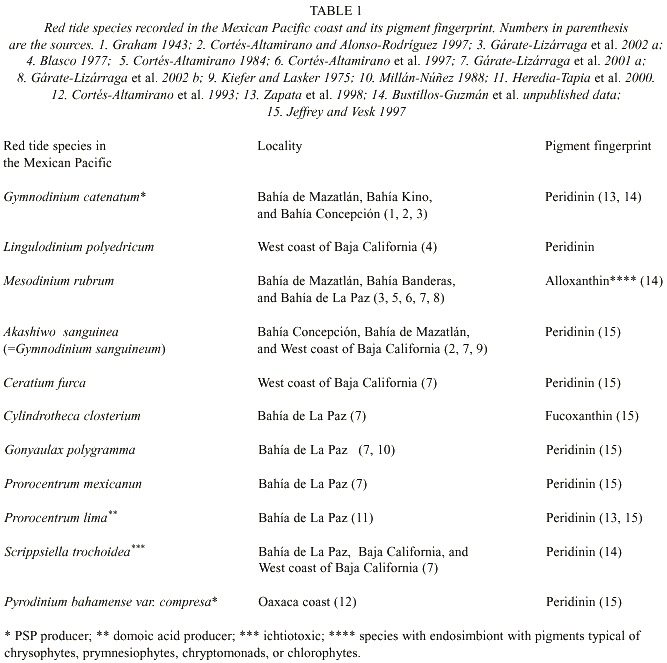
<body><![CDATA[<p>Abstract</p> </b></font>     <p><font face="Arial" size="2">Along the Mexican coast, harmful algae blooms (HAB) have become more frequent, and therefore, there is an urgent need to establish monitoring programs to avoid the undesired consequences of HAB in human and natural ecosystems. In this work, we analyzed the pigment signatures and the species composition from phytoplankton samples to evaluate the utility of the specific pigment "fingerprints" in HAB monitoring programs. Vertical profiles from a coastal lagoon and temporal samples of a red tide occurring in a shrimp-culture pond and in a coastal zone were taken into consideration. Between 76% and 84% of dinoflagellate and diatom cell density was explained by their specific signature variation, in both vertical and temporal samples. Only the variation of zeaxanthin and the cyanobacteria <i>Anabaena </i>sp. showed a poor relationship, probably from difficulties in counting other cyanobacteria present in the samples examined with the microscopic method. These results suggest that inclusion of pigment analysis in the study and monitoring programs dealing with harmful algae would be very useful.</font></p> <font face="Arial" size="2"><b></b></font>     <p><font face="Arial" size="2"><b>Key words: </b>HPLC, HAB, pigments, monitoring, dinoflagellates.</font></p> <font face="Arial" size="2"><b> </b></font>     <p><font face="Arial" size="2"><b>Palabras clave: </b>HPLC, PAN, pigmentos, monitoreo, dinoflagelados.</font></p>     <p><font face="Arial" size="2">&nbsp;</font></p>     <p><font face="Arial" size="2">&nbsp;</font></p>     <p><font face="Arial" size="2">Although the use of pigments in studies of distribution and abundance of phytoplankton in the oceans was suggested in the 1960s (<a href="#je61">Jeffrey 1961</a>, <a  href="#je68">1968</a>), its use was seriously limited because thin layer chromatography lacked instrumentation to get a better performance of the process. New developments in HPLC techniques permitted good separation and quantification of most of the algal pigments (<a  href="#ma83">Mantoura and Llewellyn 1983</a>). At present, improvements in HPLC methods have allowed the separation of a wide array of pigment, including both polar chlorophyll (chl), c-type pigments (chl <i>c</i><sub>1</sub> , chl <i>c</i><sub>2</sub> , chl <i>c</i><sub>3</sub> ) and non-polar (chl <i>a </i>and <i>b </i>plus its DV forms, non-polar chl c), as well as carotenoids in a single run (<a  href="#go93">Goericke and Repeta 1993</a>, Vidussi <i>et a</i>l. 1996, Zapata <i>et a</i>l. 1998). Among the estimated phytoplankton species, about 7% (300 species) are known to produce red tides and of those, only 2% are actually harmful or toxic (Smayda 1997).</font></p>     <p><font face="Arial" size="2">Dinoflagellates, diatoms, prymnesiophytes, and more recently, raphydophytes species are the main contributors to this list, and each of them has particular pigment "fingerprints" that, at the level group, can be identified (reviewed in <a href="#je97">Jeffrey and Vesk 1997</a>). Further, HPLC methods with mathematical tools (<a href="#ma96">Mackey <i>et a</i>l. 1996</a>) for interpreting data, have provided invaluable information about the variability of phytoplankton populations under changeable hydrographic conditions (<a href="#ba93">Barlow <i>et a</i>l. 1993</a>, <a  href="#cl94">Claustre <i>et a</i>l. 1994</a>, <a href="#bu95">Bustillos-Guzmán <i>et a</i>l. 1995</a>), and have permitted identification of "uncommon" phytoplanktonic groups (Bustillos-Guzmán <i>et a</i>l. 2001).</font></p>     <p><font face="Arial" size="2">Pigment signatures in the study of HABs have been very limited, particularly in monitoring programs (Yacobi <i>et a</i>l. 1996, <a href="#ga00">Gárate-Lizárraga <i>et a</i>l. 2000</a>, <a href="#lo03">López-Cortés <i>et al. </i>2003</a>). Along the Mexican Pacific coast, dinoflagellates are the main group responsible for red tides (<a href="#co96">Cortés-Altamirano <i>et a</i>l. 1996</a>, <a href="#ga01a">Gárate-Lizárraga <i>et a</i>l. 2001a</a>). Other groups, such as diatoms, particularly the <i>Pseudonitzschia </i>complex (a DSP-producer), prymnesophytes, and chlorophytes also form blooms, but with less frequency (<a href="#he98">Hernández-Becerril 1998</a>, <a  href="#ga01a">Gárate-Lizárraga <i>et a</i>l. 2001a</a>). All of the above-mentioned bloom-forming species, have pigment signatures (<a  href="#t1">Table 1</a>) that could be useful in tracking and following them as they occur in nature. We illustrate the use of pigment signatures to follow the spatial and temporal distribution of potential HAB species and how these signatures could be related to the variation of cell density.</font></p>     <p style="text-align: center;"><font face="Arial" size="2">&nbsp;<a  name="t1"></a><img src="/img/fbpe/rbt/v52s1/2700i1.JPG" title="" alt=""  style="width: 667px; height: 663px;"></font></p>     
]]></body>
<body><![CDATA[<p><font face="Arial" size="2">&nbsp;</font></p> <font face="Arial" size="2"><b>     <p>Materials and methods</p> </b> <b>     <p>Field Sampling</p> </b><i>     <p>Case 1: vertical distribution</p> </i> </font>     <p><font face="Arial" size="2">To obtain samples for pigment analysis of the phytoplankton community from Bahía Concepción, water was collected at 0, 8, 10, 20, 21, 22, 24, and 25 m depth with a van Dorn bottle. This bay is one of the largest on the west coast of the Gulf of California (located between the 26°33’ and 26°53’ N and 111°42’ and 112°56 W) with low human impact and well-known occurrences of HABs (<a  href="#le98">Lechuga-Deveze and Morquecho-Escamilla 1998</a>, <a  href="#bu00">Bustillos-Guzmán <i>et a</i>l. 2000</a>, <a  href="#ga01b">Gárate-Lizárraga <i>et a</i>l. 2001b</a>).</font></p> <font face="Arial" size="2"><i>     <p>Case 2a: temporal variation</p> </i> </font>     <p><font face="Arial" size="2">An intense-brown bloom was observed in a shrimp-culture pond located in Bahía de La Paz, Gulf of California (24 o 10’ N and 110 o 18’ W). From this pond, daily surface samples were taken for taxonomic identification, cell-counting, and pigment analysis. Sampling started on August 21 th and stopped on September 15<sup>th</sup> 1998 when the causative organism of this bloom was scarce. The pond was fertilized, as part of the shrimp-culture cycle, every week with phosphates and nitrates during the sampling period, to stimulate algal productivity.</font></p> <font face="Arial" size="2"><i>     <p>Case 2b: temporal variation</p> </i> </font>     <p><font face="Arial" size="2">On September 15<sup>th</sup> 2000, several small red tide areas were found in La Ensenada de La Paz. <i>Cochlodinium polykrikoides </i>Margalef was the responsible dinoflagellate (<a  href="#ga00">Gárate-Lizárraga <i>et a</i>l. 2000</a>). From September 15<sup>th</sup> to 29<sup>th</sup> (until the algal bloom was no longer visible), samples were taken from the middle of the algal bloom. Number of daily samples varied, since conditions, mainly wind and tidal dynamics, and dinoflagellate migration behavior (Park <i>et a</i>l. 2001), avoided the location of the red tide spots.</font></p> <font face="Arial" size="2"><b>     <p>&nbsp;</p>     ]]></body>
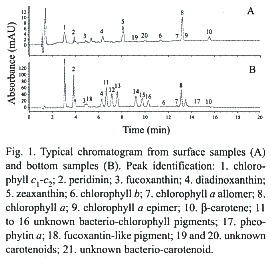
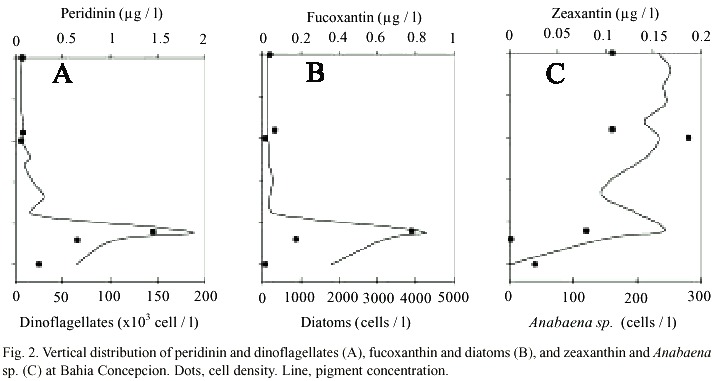
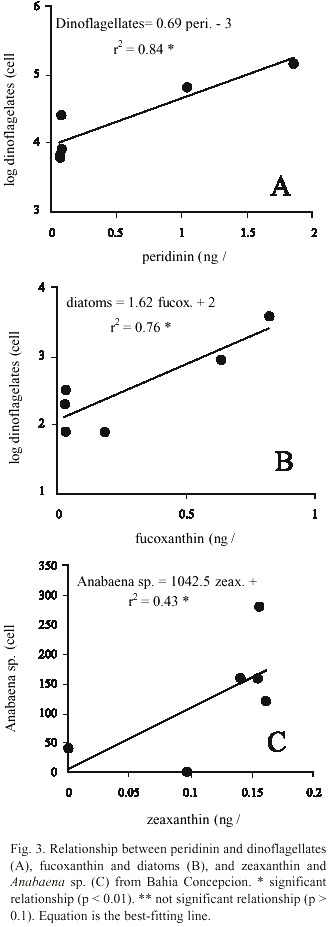
<body><![CDATA[<p>Laboratory Analysis</p> </b><i>     <p>Pigment analysis</p> </i> </font>     <p><font face="Arial" size="2">All water samples were ice cooled and kept in the dark for transportation to the laboratory (maximum of 1.5 hours). Water was GF/F filtered and the filters were extracted with 2 ml of 100% acetone in an ice bath, hand ground with a glass rod, and stored overnight at -40°C to fully extract. Extract was recovered after centrifugation (3 000 g for 5 min). The extract (200 µl) was mixed with 100 µl 0.5 N ammonium acetate and injected through a 100-µl loop into an HPLC system (Hewlett Packard series 1100) with a photodiode array detector (1.2 nm optical resolution). Pigments were separated and quantified by isocratic HPLC in a reverse-phase, as described in Vidussi <i>et a</i>l. (1996). Mobile phase consisted of MeOH: 0.5 N aqueous ammonium acetate, 70:30% v/v (solvent A), and MeOH (solvent B), with a gradient (minute; percent of solvent A- percent of solvent B): 0;75-25, 1;50-50, 15;0-100, and 19;75-25. Quantification was based on the absorbance at 440 nm and the factor response (peak area / pigment concentration) value for each pigment, as described in Mantoura and Repeta (1997). Identification of the pigment marker for each group (<a  href="#t1">Table 1</a>) considered retention time, spectral characteristics, and chromatography with certified commercial standards (International Agency for <sup>14</sup> C determinations, Denmark). Samples for identification and cell-counting were fixed and preserved with lugol. Samples were analyzed in 5-ml settling chambers and observed with a phase contrast inverted microscope (<a href="#ha78">Hasle 1978</a>).</font></p> <font face="Arial" size="2"><b>     <p>&nbsp;</p>     <p>Results</p> </b><i>     <p>Vertical variation</p> </i> </font>     <p><font face="Arial" size="2"><a href="#f1">Fig. 1</a> shows a representative chromatogram for each example from this work. In Bahía Concepción, surface pigments were chlorophyll a, zeaxanthin, fucoxanthin, chlorophyll <i>c</i><sub>1-2</sub> , and minor quantities of fucoxanthin-like carotenoids and <font face="Symbol">b</font> -carotene (<a href="#f1">Fig. 1A</a>). Below 20 m, a new series of pigments (peaks 11 to 16 and 20, <a href="#f1">Fig. 1B</a>), characteristics of anoxygenic phototrophic bacteria (<a href="#bu00">Bustillos-Guzmán <i>et a</i>l. 2000</a>) were present, together with peridinin and fucoxanthin. This vertical distribution of pigments shows that there exists a pigment subsurface maximum concentration between 20 and 25 m (<a  href="#f2">Fig. 2</a>). Maximum values are for peridinin and fucoxanthin (<a href="#f2">Fig. 2A</a>, <a href="#f2">B</a>). Above this maximum, zeaxanthin is the main pigment (<a href="#f2">Fig. 2C</a>). Maximal values of peridinin and fucoxanthin were related to the dinoflagellates, <i>Heterocapsa niei </i>Morril et Loeblich (&gt;130 000 cells/l) and <i>Prorocentrum dentatum </i>Stein (&gt;6 000 cells/l) and the diatom <i>Nitzschia longissima </i>Smith (&gt;3 000 cells/l). Cell density of dinoflagellates and diatoms was clearly related to their pigment signature variations (<a href="#f3">Fig. 3A</a>, <a href="#f3">B</a>). In the upper layer (&lt;20 m), the chain forming cyanobacteria <i>Anabaena </i>sp. was conspicuous, however, no significant relationship with zeaxanthin was found (<a href="#f3">Fig. 3C</a>).</font></p> <font face="Arial" size="2"><i> </i></font><font face="Arial" size="2"><i></i></font>     <p style="text-align: center;"><font face="Arial" size="2"><span  style="font-weight: bold;"><a name="f1"></a><img  src="/img/fbpe/rbt/v52s1/2700i2.JPG" title="" alt=""  style="width: 271px; height: 258px;"></span>    
<br> </font></p>     <p style="text-align: center;"><font face="Arial" size="2">&nbsp;<a  name="f2"></a><img src="/img/fbpe/rbt/v52s1/2700i3.JPG" title="" alt=""  style="width: 715px; height: 381px;">    
]]></body>
<body><![CDATA[<br> </font></p>     <p style="text-align: center;"><font face="Arial" size="2">    <br> </font></p>     <p style="text-align: center;"><font face="Arial" size="2">&nbsp;<a  name="f3"></a><img src="/img/fbpe/rbt/v52s1/2700i4.JPG" title="" alt=""  style="width: 333px; height: 927px;"></font></p> <span style="font-family: arial;">    
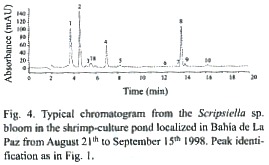
<br> </span><font face="Arial" size="2"><i>     <p>Temporal variation</p> </i> </font>     <p><font face="Arial" size="2">Pigments composition shows that phyto-plankton in these samples had peridinin, diadinoxanthin, and chlorophylls <i>a </i>and <i>c</i><sub>2</sub> (<a href="#f4">Fig. 4</a>). This pigment profile corresponds to the typical pigments of dinoflagellates (<a href="#jo74">Johansen <i>et a</i>l. 1974</a>, <a  href="#je75">Jeffrey <i>et a</i>l. 1975</a>). The dinoflagellate responsible for this bloom was <i>Scrippsiella </i>sp. Small amounts of fucoxanthin and chlorophyll <i>b </i>were present because of benthic diatoms <i>(Amphora </i>spp.) and the prasinophyte <i>Nephroselmis </i>sp.</font></p>     <div style="text-align: center;"></div>     <div style="text-align: center;"></div>     <div style="text-align: center;"><font face="Arial" size="2"><span  style="font-weight: bold;"><a name="f4"></a><img  src="/img/fbpe/rbt/v52s1/2700i6.JPG" title="" alt=""  style="width: 269px; height: 165px;"></span></font>    
]]></body>
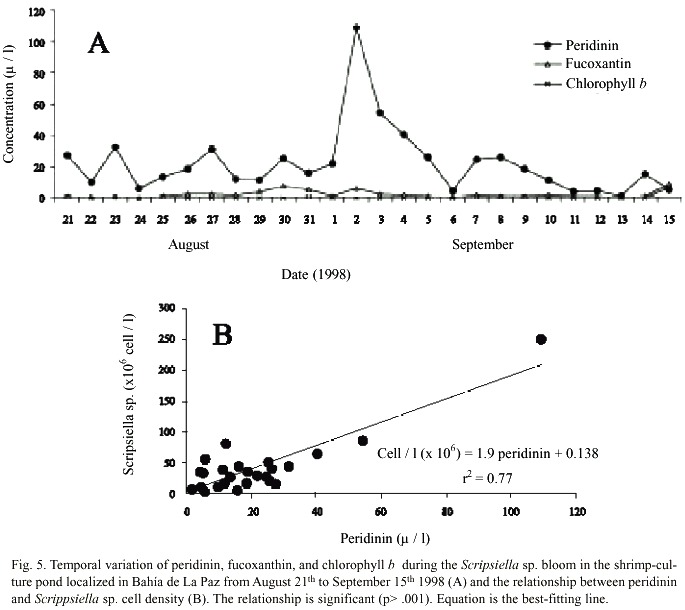
<body><![CDATA[<br> </div>     <p><font face="Arial" size="2">&nbsp;    <br> Temporal pigment variation shows that peridinin fluctuates between 8 and 50 µg peridinin/ l before and after the peak concentration (109 µg peridinin/l), on September 3<sup>rd</sup> (<a href="#f5">Fig. 5A</a>). The higher concentration of fucoxanthin and chlorophyll <i>b </i>did not coincide with the peak peridinin concentration and was relatively low, compared with peridinin concentrations. Density of <i>Scrippsiella </i>sp. and peridinin were closely related (<a href="#f5">Fig. 5B</a>).</font></p>     <div style="text-align: center;"><a name="f5"></a><img  src="/img/fbpe/rbt/v52s1/2700i5.JPG" title="" alt=""  style="width: 685px; height: 610px;">    
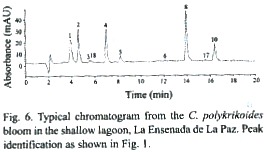
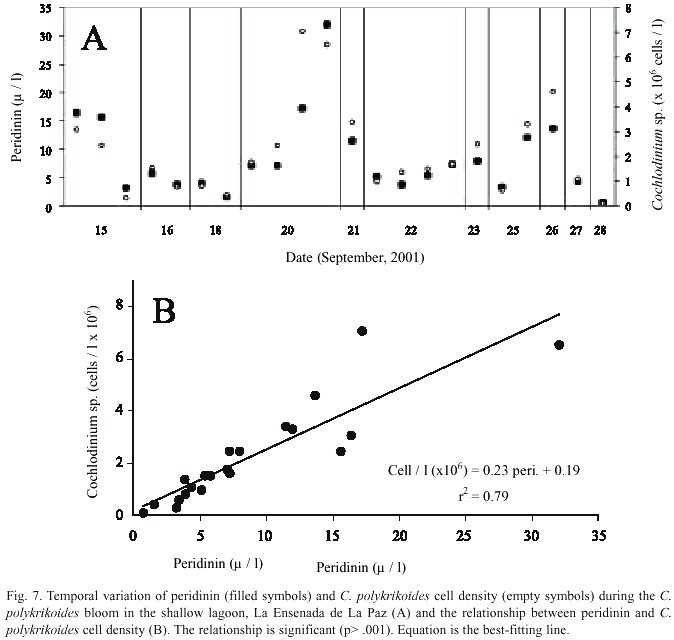
<br> </div> <span style="font-family: arial;">    <br> </span>     <p><font face="Arial" size="2"><i>C. polykrikoides </i>blooms also showed typical pigment composition of dinoflagellates. In addition, small amounts of fucoxanthin and chlorophyll <i>b </i>indicated the presence of tychoplanktonic diatoms and small flagellates (<a href="#f6">Fig. 6</a>). As stated earlier, small areas of <i>C. polykrikoides </i>were easily dispersed, so the number of daily samples was variable. Peridinin concentration reached values as high as 32 µg/l in one spot on September 20<sup>th</sup> (<a href="#f7">Fig. 7A</a>). Cell density was also high on this date and reached more than 7 x 10<sup>6</sup> cells/l. Both <i>C. polykrikoides </i>density and peridinin changes were related (<a href="#f7">Fig. 7B</a>).</font></p>     <div style="text-align: center;"><font face="Arial" size="2"><span  style="font-weight: bold;"><a name="f6"></a><img  src="/img/fbpe/rbt/v52s1/2700i7.JPG" title="" alt=""  style="width: 267px; height: 152px;">    
<br>     <br> <a name="f7"></a><img src="/img/fbpe/rbt/v52s1/2700i8.JPG" title="" alt=""  style="width: 674px; height: 640px;">    
]]></body>
<body><![CDATA[<br> </span></font></div> <font face="Arial" size="2"><b>     <p>    <br> Discussion</p> </b> </font>     <p><font face="Arial" size="2">Our results clearly show that pigment signatures varied with cell density of the phytoplankton group that contains the marker and supports this approach to monitoring HAB. However, although significant, the relationships were not perfect and 76 to 84% of the variability in cell-density was explained by the variations of the pigments. Conversely, the relationship between zeaxanthin concentration and <i>Anabaena </i>sp. in the vertical pigment profile in Bahía Concepción was not significant. Variations in cell pigment content in phytoplankton depend on factors, such as light (<a  href="#fa91">Falkowski and LaRoche 1991</a>, <a href="#jo93">Johansen and Sakshaug 1993</a>) and nutrient and species composition (<a  href="#bu98">Bustillos-Guzmán and Diogene 1998</a>, Tang 1996). Natural samples, include a mix of populations in different physiological stages, and hence, pigment content. These variables reasonably explain less-than-perfect correlations of pigments and cell density. The poor relationship between <i>Anabaena </i>sp. cell density and zeaxanthin could be explained because cyanobacteria identification is difficult. Some do not form chains and are very small. It is possible that other cyanobacterial species were present in the Bahía Concepción samples, but the above-mentioned difficulties make clear identification unlikely. Therefore, by not considering these species, the lower accuracy of zeaxanthin for biomass estimates must be considered for non-dominant cyanobacteria.</font></p>     <p><font face="Arial" size="2">Pigment utility in phytoplankton studies has been widely demonstrated and generated new knowledge in marine ecology (reviewed by <a href="#je97">Jeffrey <i>et a</i>l. 1997</a>). However, their use in monitoring programs (Yacobi <i>et a</i>l. 1996), particularly in HAB events in México has been very limited. As far as we know, monitoring of HAB by using pigments, has been limited to Bahía Concepción, and the Gulf of California (<a href="#ga01b">Gárate-Lizárraga <i>et a</i>l. 2001b</a>, <a href="#lo03">López-Cortés <i>et a</i>l. 2003</a>), although other programs, where traditional methods are used, are active (<a href="#co96">Cortés-Altamirano <i>et a</i>l. 1996</a>). In this bay, <a href="#ga02a">Gárate-Lizárraga <i>et a</i>l. (2002a)</a> have been able to track important densities of <i>Gymnodinium catenatum </i>and <i>Alexandrium affine </i>at the base of the nutricline by using the peridinin record. <i>G. catenatum </i>has been identified as the causative vector of human deaths in the Mazatlán area (Mee <i>et a</i>l. 1986). Thus, even under conditions in which the HAB species would not have a "visible" signal, the monitoring of the pigment marker is useful. The need to include this approach in monitoring programs is highly encouraging from these results. As an example, a high temporal and spatial sample stations zone can be monitored firstly to track HAB pigment signatures. When concentrations of pigment markers of HAB species are recorded, efforts to address this zone for taxonomic and toxin analysis can be undertaken. The pigment signature approach to studying HAB presents advantages because it requires a short time for sample analysis (20- 25 minutes) and can be used to study HABs that require considerable time and effort to identify particular species, especially when its taxonomical characteristics are difficult to discern under light microscopy. Further, in the pigment signature approach, the highest levels of technical skills are not needed, as is the case of taxonomic studies.</font></p> <font face="Arial" size="2"><b>     <p>&nbsp;</p>     <p>Acknowledgments</p> </b> </font>     <p><font face="Arial" size="2">The authors thank the National Council of Science and Technology (CONACyT) for financial and logistical support (grants 33684- V and 007PÑ-1297); F. Zapata-Vazquez for his assistance during fieldwork and I. Fogel for English language editing. This research was supported in part by CIBNOR Institutional Research Project AYCG-11 and AYCG3. IGL is COFAA, EDI, and CONACYT fellow (138138).</font></p> <font face="Arial" size="2"><b>     <p>&nbsp;</p>     <p>Resumen</p> </b> </font>     ]]></body>
<body><![CDATA[<p><font face="Arial" size="2">A lo largo de las costas mexicanas, los florecimientos algales nocivos (FAN) se han vuelto cada vez mas frecuentes y por lo tanto, existe una necesidad urgente de establecer programas de monitoreo para evitar las consecuencias no deseadas por su desarrollo, sobre los ecosistemas naturales y el ser humano. En este trabajo, nosotros analizamos las huellas pigmentarias y la composición de especies de diversas muestras de fitoplancton para evaluar la utilidad que pueden representar estos pigmentos específicos o "huellas pigmentarias" en programas de monitoreo de florecimientos algales nocivos. Los perfiles verticales de muestras de fitoplancton de una laguna costera y muestras de mareas rojas que ocurrieron en un estanque de cultivo de camarón y en una laguna costera, fueron considerados en este estudio. Tanto en muestras verticales como en temporales, entre el 76% y 84% de la densidad celular de dinoflagelados y diatomeas fueron explicados por la variación de su huella específica, mientras que la variación de zeaxantina y la densidad de la cianobacteria <i>Anabaena </i>sp. mostró una relación pobre, la cual fue debida probablemente a la dificultad en el conteo que presenta este grupo al ser analizadas mediante un microscópico invertido. Estos resultados sugieren que la inclusión del análisis de las huellas pigmentarias en los programas del estudio y monitoreo de las algas nocivas sería de gran utilidad.</font></p> <font face="Arial" size="2"><b>     <p>&nbsp;</p>     <p>References</p> </b> </font>     <!-- ref --><p><font face="Arial" size="2"><a name="ba93"></a></font><font  face="Arial" size="2">Barlow, R.G., R.F.C. Mantoura, M.A. Gough &amp; T.W. Fileman. 1993. Pigment signatures of the phytoplankton composition in the Northeastern Atlantic during the 1990 spring bloom. Deep-Sea Res. 40: 459-477.</font>&nbsp;&nbsp;&nbsp;&nbsp;&nbsp;&nbsp;&nbsp;&nbsp;[&#160;<a href="javascript:void(0);" onclick="javascript: window.open('/scielo.php?script=sci_nlinks&ref=1223226&pid=S0034-7744200400050000500001&lng=','','width=640,height=500,resizable=yes,scrollbars=1,menubar=yes,');">Links</a>&#160;]<!-- end-ref --><!-- ref --><p><font face="Arial" size="2"><a name="bl77"></a></font><font  face="Arial" size="2">Blasco, D. 1977. Red tide in the upwelling region of Baja California. Limnol. Oceanogr. 22: 255-263.</font>&nbsp;&nbsp;&nbsp;&nbsp;&nbsp;&nbsp;&nbsp;&nbsp;[&#160;<a href="javascript:void(0);" onclick="javascript: window.open('/scielo.php?script=sci_nlinks&ref=1223227&pid=S0034-7744200400050000500002&lng=','','width=640,height=500,resizable=yes,scrollbars=1,menubar=yes,');">Links</a>&#160;]<!-- end-ref --><!-- ref --><p><font face="Arial" size="2"><a name="bu95"></a></font><font  face="Arial" size="2">Bustillos-Guzmán, J., H. Claustre &amp; J.C. Marty. 1995. Specific phytoplankton signatures and their relationship to hydrographic conditions in the coastal north-western Mediterranean Sea. Mar. Ecol. Prog. Ser. 124: 247-258.</font>&nbsp;&nbsp;&nbsp;&nbsp;&nbsp;&nbsp;&nbsp;&nbsp;[&#160;<a href="javascript:void(0);" onclick="javascript: window.open('/scielo.php?script=sci_nlinks&ref=1223228&pid=S0034-7744200400050000500003&lng=','','width=640,height=500,resizable=yes,scrollbars=1,menubar=yes,');">Links</a>&#160;]<!-- end-ref --><!-- ref --><p><font face="Arial" size="2"><a name="bu98"></a></font><font  face="Arial" size="2">Bustillos-Guzmán, J. &amp; J. Diogene. 1998. Pigment content and toxicity in three strains of <i>Gambierdiscus toxicu</i>s: implications of cell volume differences, pp. 372-373. <i>In </i>B. Reguera, J. Blanco, M.L. Fernández &amp; T. Wyatt (eds.). Harmful Algae. Xunta de Galicia and IOC-UNESCO, Spain.</font>&nbsp;&nbsp;&nbsp;&nbsp;&nbsp;&nbsp;&nbsp;&nbsp;[&#160;<a href="javascript:void(0);" onclick="javascript: window.open('/scielo.php?script=sci_nlinks&ref=1223229&pid=S0034-7744200400050000500004&lng=','','width=640,height=500,resizable=yes,scrollbars=1,menubar=yes,');">Links</a>&#160;]<!-- end-ref --><!-- ref --><p><font face="Arial" size="2"><a name="bu00"></a></font><font  face="Arial" size="2">Bustillos-Guzmán, J., D. López-Cortés, F. Hernández &amp; I. Murillo. 2000. Pigment signatures associated with a coastal anoxic lagoon: Bahía Concepción, Gulf of California. J. Exp. Mar. Biol. Ecol. 249: 77-88.</font>&nbsp;&nbsp;&nbsp;&nbsp;&nbsp;&nbsp;&nbsp;&nbsp;[&#160;<a href="javascript:void(0);" onclick="javascript: window.open('/scielo.php?script=sci_nlinks&ref=1223230&pid=S0034-7744200400050000500005&lng=','','width=640,height=500,resizable=yes,scrollbars=1,menubar=yes,');">Links</a>&#160;]<!-- end-ref --><!-- ref --><p><font face="Arial" size="2"><a name="cl94"></a></font><font  face="Arial" size="2">Claustre, H., P. Kerherve, J.C. Marty, L. Prieur &amp; J.H. Hecq. 1994. Phytoplankton distribution associated with a geostrophic front: ecological and biogeochemical implications. J. Mar. Res. 52: 711-742.</font>&nbsp;&nbsp;&nbsp;&nbsp;&nbsp;&nbsp;&nbsp;&nbsp;[&#160;<a href="javascript:void(0);" onclick="javascript: window.open('/scielo.php?script=sci_nlinks&ref=1223231&pid=S0034-7744200400050000500006&lng=','','width=640,height=500,resizable=yes,scrollbars=1,menubar=yes,');">Links</a>&#160;]<!-- end-ref --><!-- ref --><p><font face="Arial" size="2"><a name="co84"></a></font><font  face="Arial" size="2">Cortés-Altamirano, R. 1984. Mareas rojas producidas por el ciliado <i>Mesodinium rubrum </i>(Lohman) en el litoral de Mazatlán, Sinaloa, México. Biotica 9: 259-269.</font>&nbsp;&nbsp;&nbsp;&nbsp;&nbsp;&nbsp;&nbsp;&nbsp;[&#160;<a href="javascript:void(0);" onclick="javascript: window.open('/scielo.php?script=sci_nlinks&ref=1223232&pid=S0034-7744200400050000500007&lng=','','width=640,height=500,resizable=yes,scrollbars=1,menubar=yes,');">Links</a>&#160;]<!-- end-ref --><!-- ref --><p><font face="Arial" size="2"><a name="co93"></a></font><font  face="Arial" size="2">Cortés-Altamirano, R., L. Muñoz-Cabrera &amp; O. Sotomayor-Navarro. 1993. Envenenamiento paralítico por mariscos (PSP), causado por <i>Pyrodinium bahamense </i>var. <i>compressum </i>en la costa suroeste de México. An. Inst. Cienc. Mar Limnol. 20: 43-54.</font>&nbsp;&nbsp;&nbsp;&nbsp;&nbsp;&nbsp;&nbsp;&nbsp;[&#160;<a href="javascript:void(0);" onclick="javascript: window.open('/scielo.php?script=sci_nlinks&ref=1223233&pid=S0034-7744200400050000500008&lng=','','width=640,height=500,resizable=yes,scrollbars=1,menubar=yes,');">Links</a>&#160;]<!-- end-ref --><!-- ref --><p><font face="Arial" size="2"><a name="co96"></a></font><font  face="Arial" size="2">Cortés-Altamirano, R., D.U. Hernandez-Becerril &amp; R. Luna-Soria. 1996. Red tides in México: A review, pp. 101-105. <i>In </i>T. Yasumoto, Y. Oshima &amp; Y. Fukuyo (eds.). Harmful and Toxic Algal Blooms. Intergovernmental Oceanographic Commission of UNESCO, Sendai, Japan.</font>&nbsp;&nbsp;&nbsp;&nbsp;&nbsp;&nbsp;&nbsp;&nbsp;[&#160;<a href="javascript:void(0);" onclick="javascript: window.open('/scielo.php?script=sci_nlinks&ref=1223234&pid=S0034-7744200400050000500009&lng=','','width=640,height=500,resizable=yes,scrollbars=1,menubar=yes,');">Links</a>&#160;]<!-- end-ref --><!-- ref --><p><font face="Arial" size="2"><a name="co97"></a></font><font  face="Arial" size="2">Cortés-Altamirano, R. &amp; R. Alonso-Rodríguez. 1997. Mareas rojas durante 1997 en la Bahía de Mazatlán, Sinaloa, México. Cien. Mar UAS 15: 31-37.</font>&nbsp;&nbsp;&nbsp;&nbsp;&nbsp;&nbsp;&nbsp;&nbsp;[&#160;<a href="javascript:void(0);" onclick="javascript: window.open('/scielo.php?script=sci_nlinks&ref=1223235&pid=S0034-7744200400050000500010&lng=','','width=640,height=500,resizable=yes,scrollbars=1,menubar=yes,');">Links</a>&#160;]<!-- end-ref --><!-- ref --><p><font face="Arial" size="2"><a name="fa91"></a></font><font  face="Arial" size="2">Falkowski, P. &amp; J. LaRoche. 1991. Acclimation to spectral irradiance in algae. J. Phycol. 27: 8-14.</font>&nbsp;&nbsp;&nbsp;&nbsp;&nbsp;&nbsp;&nbsp;&nbsp;[&#160;<a href="javascript:void(0);" onclick="javascript: window.open('/scielo.php?script=sci_nlinks&ref=1223236&pid=S0034-7744200400050000500011&lng=','','width=640,height=500,resizable=yes,scrollbars=1,menubar=yes,');">Links</a>&#160;]<!-- end-ref --><!-- ref --><p><font face="Arial" size="2"><a name="ga00"></a></font><font  face="Arial" size="2">Gárate-Lizárraga, I., J.J. Bustillos-Guzmán, L.M. Morquecho &amp; C.H. Lechuga-Deveze. 2000. First Outbreak of <i>Cochlodinium polykrikoides </i>in the Gulf of California. Harmful Algae News 21: 7.</font>&nbsp;&nbsp;&nbsp;&nbsp;&nbsp;&nbsp;&nbsp;&nbsp;[&#160;<a href="javascript:void(0);" onclick="javascript: window.open('/scielo.php?script=sci_nlinks&ref=1223237&pid=S0034-7744200400050000500012&lng=','','width=640,height=500,resizable=yes,scrollbars=1,menubar=yes,');">Links</a>&#160;]<!-- end-ref --><!-- ref --><p><font face="Arial" size="2"><a name="ga01a"></a></font><font  face="Arial" size="2">Gárate-Lizárraga, I., M.L. Hernández-Orozco, C. Band-Schmidt &amp; G. Serrano-Casillas. 2001a. Red tides along the coasts of Baja California Sur, México (1984 to 2001). Oceánides 16: 127-134.</font>&nbsp;&nbsp;&nbsp;&nbsp;&nbsp;&nbsp;&nbsp;&nbsp;[&#160;<a href="javascript:void(0);" onclick="javascript: window.open('/scielo.php?script=sci_nlinks&ref=1223238&pid=S0034-7744200400050000500013&lng=','','width=640,height=500,resizable=yes,scrollbars=1,menubar=yes,');">Links</a>&#160;]<!-- end-ref --><p><font face="Arial" size="2"><a name="ga01b"></a></font><font  face="Arial" size="2">Gárate-Lizárraga, I., D. López-Cortés, J. Bustillos-Guzmán, F. Hernández-Sandoval &amp; I. Murillo-Murillo. 2001b. El Niño 1997/1998: Impacto de la biomasa de dinoflagelados en Bahía Concepción, Golfo de California, pp. 153-162. <i>In </i>E. Escobar, M.    <br> Bonilla, A. Badan, M. Caballero &amp; A. Winckell (eds.). Los efectos del evento del fenómeno El Niño en México, 1997-1998. CONACyT, México.</font></p>     <!-- ref --><p><font face="Arial" size="2"><a name="ga02a"></a></font><font  face="Arial" size="2">Gárate-Lizárraga, I., D. López-Cortés, J. Bustillos-Guzmán, F. Hernández-Sandoval &amp; I. Murillo-Murillo. 2002a. Physicochemical characteristics and phytoplankton biomass during El Niño 1997-1998 in Bahía Concepción, Gulf of California. Mem. Symposium "North Pacific Transitional Areas". La Paz, B.C.S. México.</font>&nbsp;&nbsp;&nbsp;&nbsp;&nbsp;&nbsp;&nbsp;&nbsp;[&#160;<a href="javascript:void(0);" onclick="javascript: window.open('/scielo.php?script=sci_nlinks&ref=1223241&pid=S0034-7744200400050000500015&lng=','','width=640,height=500,resizable=yes,scrollbars=1,menubar=yes,');">Links</a>&#160;]<!-- end-ref --><!-- ref --><p><font face="Arial" size="2"><a name="ga02b"></a></font><font  face="Arial" size="2">Gárate-Lizárraga, I., C.J. Band-Schmidt, R. Cervantes-Duarte &amp; D. Escobedo-Urias. 2002b. Mareas rojas de <i>Mesodinium rubrum </i>(Lohmann) Hamburger and Budenbrock ocurridas en el Golfo de California, (Invierno de 1998). Hidrobiologia 16: 310-317.</font>&nbsp;&nbsp;&nbsp;&nbsp;&nbsp;&nbsp;&nbsp;&nbsp;[&#160;<a href="javascript:void(0);" onclick="javascript: window.open('/scielo.php?script=sci_nlinks&ref=1223242&pid=S0034-7744200400050000500016&lng=','','width=640,height=500,resizable=yes,scrollbars=1,menubar=yes,');">Links</a>&#160;]<!-- end-ref --><!-- ref --><p><font face="Arial" size="2"><a name="go93"></a></font><font  face="Arial" size="2">Goericke, R. &amp; D.J. Repeta. 1993. Chlorophylls <i>a </i>and <i>b </i>and divinyl-chlorophylls <i>a </i>and <i>b </i>in the open sub-tropical North Atlantic Ocean. Mar. Ecol. Progr. Ser. 101: 307-313.</font>&nbsp;&nbsp;&nbsp;&nbsp;&nbsp;&nbsp;&nbsp;&nbsp;[&#160;<a href="javascript:void(0);" onclick="javascript: window.open('/scielo.php?script=sci_nlinks&ref=1223243&pid=S0034-7744200400050000500017&lng=','','width=640,height=500,resizable=yes,scrollbars=1,menubar=yes,');">Links</a>&#160;]<!-- end-ref --><!-- ref --><p><font face="Arial" size="2"><a name="gr43"></a></font><font  face="Arial" size="2">Graham, H.W. 1943. <i>Gymnodinium catenatu</i>m, a new dinoflagellate from the Gulf of California. Trans. Am. Microsc. Soc. 62: 259-261.</font>&nbsp;&nbsp;&nbsp;&nbsp;&nbsp;&nbsp;&nbsp;&nbsp;[&#160;<a href="javascript:void(0);" onclick="javascript: window.open('/scielo.php?script=sci_nlinks&ref=1223244&pid=S0034-7744200400050000500018&lng=','','width=640,height=500,resizable=yes,scrollbars=1,menubar=yes,');">Links</a>&#160;]<!-- end-ref --><!-- ref --><p><font face="Arial" size="2"><a name="ha78"></a></font><font  face="Arial" size="2">Hasle, G.R. 1978. Using the inverted microscope, pp. 191- 196. <i>In </i>A. Sournia (ed.). Phytoplankton Manual. UNESCO.</font>&nbsp;&nbsp;&nbsp;&nbsp;&nbsp;&nbsp;&nbsp;&nbsp;[&#160;<a href="javascript:void(0);" onclick="javascript: window.open('/scielo.php?script=sci_nlinks&ref=1223245&pid=S0034-7744200400050000500019&lng=','','width=640,height=500,resizable=yes,scrollbars=1,menubar=yes,');">Links</a>&#160;]<!-- end-ref --><!-- ref --><p><font face="Arial" size="2"><a name="he00"></a></font><font  face="Arial" size="2">Heredia-Tapia, A., B.O. Arredondo-Vega, E. Nuñez-Vázquez &amp; J.L. Ochoa. 2000. Partial biochemical characterization and toxicological evaluation of the dinoflagellate <i>Exuviaella lima </i>isolated from El Pardito Island in Baja California Sur, México. Mem. 9<sup>th</sup> International Conference on Algal Blooms. Tasmania.</font>&nbsp;&nbsp;&nbsp;&nbsp;&nbsp;&nbsp;&nbsp;&nbsp;[&#160;<a href="javascript:void(0);" onclick="javascript: window.open('/scielo.php?script=sci_nlinks&ref=1223246&pid=S0034-7744200400050000500020&lng=','','width=640,height=500,resizable=yes,scrollbars=1,menubar=yes,');">Links</a>&#160;]<!-- end-ref --><!-- ref --><p><font face="Arial" size="2"><a name="he98"></a></font><font  face="Arial" size="2">Hernández-Becerril, D.U. 1998. Species of the planktonic diatom genus <i>Pseud</i>o<i>nitzschia </i>of the Pacific coasts of Mexico. Hidrobiologia 379: 77-84.</font>&nbsp;&nbsp;&nbsp;&nbsp;&nbsp;&nbsp;&nbsp;&nbsp;[&#160;<a href="javascript:void(0);" onclick="javascript: window.open('/scielo.php?script=sci_nlinks&ref=1223247&pid=S0034-7744200400050000500021&lng=','','width=640,height=500,resizable=yes,scrollbars=1,menubar=yes,');">Links</a>&#160;]<!-- end-ref --><!-- ref --><p><font face="Arial" size="2"><a name="je61"></a></font><font  face="Arial" size="2">Jeffrey, S.W. 1961. Paper-chromatography separation of chlorophylls and carotenoids from marine algae. Biochem. J. 80: 336-342.</font>&nbsp;&nbsp;&nbsp;&nbsp;&nbsp;&nbsp;&nbsp;&nbsp;[&#160;<a href="javascript:void(0);" onclick="javascript: window.open('/scielo.php?script=sci_nlinks&ref=1223248&pid=S0034-7744200400050000500022&lng=','','width=640,height=500,resizable=yes,scrollbars=1,menubar=yes,');">Links</a>&#160;]<!-- end-ref --><!-- ref --><p><font face="Arial" size="2"><a name="je68"></a></font><font  face="Arial" size="2">Jeffrey, S.W. 1968. Quantitative thin-layer chromatography of chlorophylls and carotenoids from marine algae. Bioch. Biophy. Acta 162: 271-285.</font>&nbsp;&nbsp;&nbsp;&nbsp;&nbsp;&nbsp;&nbsp;&nbsp;[&#160;<a href="javascript:void(0);" onclick="javascript: window.open('/scielo.php?script=sci_nlinks&ref=1223249&pid=S0034-7744200400050000500023&lng=','','width=640,height=500,resizable=yes,scrollbars=1,menubar=yes,');">Links</a>&#160;]<!-- end-ref --><!-- ref --><p><font face="Arial" size="2"><a name="je75"></a></font><font  face="Arial" size="2">Jeffrey, S.W., M. Sielicki &amp; F.T. Haxo. 1975. Chloroplast pigments patterns in dinoflagellates. J. Phycol<i>. </i>11: 374-384.</font>&nbsp;&nbsp;&nbsp;&nbsp;&nbsp;&nbsp;&nbsp;&nbsp;[&#160;<a href="javascript:void(0);" onclick="javascript: window.open('/scielo.php?script=sci_nlinks&ref=1223250&pid=S0034-7744200400050000500024&lng=','','width=640,height=500,resizable=yes,scrollbars=1,menubar=yes,');">Links</a>&#160;]<!-- end-ref --><!-- ref --><p><font face="Arial" size="2"><a name="je97"></a></font><font  face="Arial" size="2">Jeffrey, S.W. &amp; M. Vesk. 1997. Introduction to marine phytoplankton and their pigment signatures, pp. 37- 84. <i>In </i>S.W. Jeffrey, R.F.C. Mantoura &amp; S.W. Wright (eds.). Phytoplankton pigments in oceanography. Monogr. Oceanogr. Method. 10. UNESCO.</font>&nbsp;&nbsp;&nbsp;&nbsp;&nbsp;&nbsp;&nbsp;&nbsp;[&#160;<a href="javascript:void(0);" onclick="javascript: window.open('/scielo.php?script=sci_nlinks&ref=1223251&pid=S0034-7744200400050000500025&lng=','','width=640,height=500,resizable=yes,scrollbars=1,menubar=yes,');">Links</a>&#160;]<!-- end-ref --><!-- ref --><p><font face="Arial" size="2"><a name="jo74"></a></font><font  face="Arial" size="2">Johansen, J.E., W.A. Svec, S. Liaaen-Jensen &amp; F.T. Haxo. 1974. Carotenoids of the dinophyceae. Phytoch<i>. </i>13: 2261-2271.</font>&nbsp;&nbsp;&nbsp;&nbsp;&nbsp;&nbsp;&nbsp;&nbsp;[&#160;<a href="javascript:void(0);" onclick="javascript: window.open('/scielo.php?script=sci_nlinks&ref=1223252&pid=S0034-7744200400050000500026&lng=','','width=640,height=500,resizable=yes,scrollbars=1,menubar=yes,');">Links</a>&#160;]<!-- end-ref --><!-- ref --><p><font face="Arial" size="2"><a name="jo93"></a></font><font  face="Arial" size="2">Johansen, G. &amp; E. Sakshaug. 1993. Bio-optical characteristics and photoadaptative responses in the toxic and blooms-forming dinoflagellates <i>Gyrodinium aureolu</i>m, <i>Gymnodinium galatheau</i>m, and two strains of <i>Prorocentrum minimu</i>m. J. Phycol. 29: 267-642.</font>&nbsp;&nbsp;&nbsp;&nbsp;&nbsp;&nbsp;&nbsp;&nbsp;[&#160;<a href="javascript:void(0);" onclick="javascript: window.open('/scielo.php?script=sci_nlinks&ref=1223253&pid=S0034-7744200400050000500027&lng=','','width=640,height=500,resizable=yes,scrollbars=1,menubar=yes,');">Links</a>&#160;]<!-- end-ref --><!-- ref --><p><font face="Arial" size="2"><a name="ki75"></a></font><font  face="Arial" size="2">Kiefer, D. &amp; R. Lasker. 1975. Two blooms of <i>Gymnodinium splendens </i>an unarmored dinoflagellate. Fish. Bull<i>. </i>73: 675-678.</font>&nbsp;&nbsp;&nbsp;&nbsp;&nbsp;&nbsp;&nbsp;&nbsp;[&#160;<a href="javascript:void(0);" onclick="javascript: window.open('/scielo.php?script=sci_nlinks&ref=1223254&pid=S0034-7744200400050000500028&lng=','','width=640,height=500,resizable=yes,scrollbars=1,menubar=yes,');">Links</a>&#160;]<!-- end-ref --><!-- ref --><p><font face="Arial" size="2"><a name="le98"></a></font><font  face="Arial" size="2">Lechuga-Deveze, C. &amp; L. Morquecho-Escamilla. 1998. Early spring potentially harmful phytoplankton in Bahia Concepción, Gulf of California. Bull. Mar. Sci. 63: 503-512.</font>&nbsp;&nbsp;&nbsp;&nbsp;&nbsp;&nbsp;&nbsp;&nbsp;[&#160;<a href="javascript:void(0);" onclick="javascript: window.open('/scielo.php?script=sci_nlinks&ref=1223255&pid=S0034-7744200400050000500029&lng=','','width=640,height=500,resizable=yes,scrollbars=1,menubar=yes,');">Links</a>&#160;]<!-- end-ref --><!-- ref --><p><font face="Arial" size="2"><a name="lo03"></a></font><font  face="Arial" size="2">López-Cortés, D., J.J. Bustillos-Guzmán, I. Gárate-Lizárraga, F.E. Hernández-Sandoval &amp; I. Murillo-Murillo. 2003. Phytoplankton biomasses and hydrographic conditions during El Niño 1997-1998 in Bahía Concepción, Gulf of California. Geophysica Inter. 42: 495-504.</font>&nbsp;&nbsp;&nbsp;&nbsp;&nbsp;&nbsp;&nbsp;&nbsp;[&#160;<a href="javascript:void(0);" onclick="javascript: window.open('/scielo.php?script=sci_nlinks&ref=1223256&pid=S0034-7744200400050000500030&lng=','','width=640,height=500,resizable=yes,scrollbars=1,menubar=yes,');">Links</a>&#160;]<!-- end-ref --><!-- ref --><p><font face="Arial" size="2"><a name="ma96"></a></font><font  face="Arial" size="2">Mackey, M.D., D.J. Mackey, H.W. Higgins &amp; S.W. Wright. 1996. CHEMTAX- a program for estimating class abundances from chemical markers: application to HPLC measurements of phytoplankton. Mar. Ecol. Progr. Ser. 144: 265-283.</font>&nbsp;&nbsp;&nbsp;&nbsp;&nbsp;&nbsp;&nbsp;&nbsp;[&#160;<a href="javascript:void(0);" onclick="javascript: window.open('/scielo.php?script=sci_nlinks&ref=1223257&pid=S0034-7744200400050000500031&lng=','','width=640,height=500,resizable=yes,scrollbars=1,menubar=yes,');">Links</a>&#160;]<!-- end-ref --><!-- ref --><p><font face="Arial" size="2"><a name="ma83"></a></font><font  face="Arial" size="2">Mantoura, R.F.C. &amp; C.A. Llewellyn. 1983. The rapid determination of algal chlorophyll and carotenoid pigments and their breakdown products in natural waters by reverse-phase high-performance liquid chromatography. Anal. Chim. Acta 151:297-314.</font>&nbsp;&nbsp;&nbsp;&nbsp;&nbsp;&nbsp;&nbsp;&nbsp;[&#160;<a href="javascript:void(0);" onclick="javascript: window.open('/scielo.php?script=sci_nlinks&ref=1223258&pid=S0034-7744200400050000500032&lng=','','width=640,height=500,resizable=yes,scrollbars=1,menubar=yes,');">Links</a>&#160;]<!-- end-ref --><!-- ref --><p><font face="Arial" size="2"><a name="ma97"></a>Mantoura, R.F.C. &amp; D. Repeta. 1997. Calibration methods for HPLC, pp. 407-428 <i>In </i>S.W. Jeffrey, R.F.C. Mantoura &amp; S.W. Wright (eds.). Phytoplankton pigments in oceanography. Monographs in Oceanography Methodology 10. UNESCO.</font>&nbsp;&nbsp;&nbsp;&nbsp;&nbsp;&nbsp;&nbsp;&nbsp;[&#160;<a href="javascript:void(0);" onclick="javascript: window.open('/scielo.php?script=sci_nlinks&ref=1223259&pid=S0034-7744200400050000500033&lng=','','width=640,height=500,resizable=yes,scrollbars=1,menubar=yes,');">Links</a>&#160;]<!-- end-ref --> ]]></body><back>
<ref-list>
<ref id="B1">
<nlm-citation citation-type="journal">
<person-group person-group-type="author">
<name>
<surname><![CDATA[Barlow]]></surname>
<given-names><![CDATA[R.G]]></given-names>
</name>
<name>
<surname><![CDATA[Mantoura]]></surname>
<given-names><![CDATA[R.F.C]]></given-names>
</name>
<name>
<surname><![CDATA[Gough]]></surname>
<given-names><![CDATA[M.A]]></given-names>
</name>
<name>
<surname><![CDATA[Fileman]]></surname>
<given-names><![CDATA[T.W]]></given-names>
</name>
</person-group>
<article-title xml:lang="en"><![CDATA[Pigment signatures of the phytoplankton composition in the Northeastern Atlantic during the 1990 spring bloom]]></article-title>
<source><![CDATA[Deep-Sea Res]]></source>
<year>1993</year>
<volume>40</volume>
<page-range>459-477</page-range></nlm-citation>
</ref>
<ref id="B2">
<nlm-citation citation-type="journal">
<person-group person-group-type="author">
<name>
<surname><![CDATA[Blasco]]></surname>
<given-names><![CDATA[D]]></given-names>
</name>
</person-group>
<article-title xml:lang="en"><![CDATA[Red tide in the upwelling region of Baja California]]></article-title>
<source><![CDATA[Limnol. Oceanogr]]></source>
<year>1977</year>
<volume>22</volume>
<page-range>255-263</page-range></nlm-citation>
</ref>
<ref id="B3">
<nlm-citation citation-type="journal">
<person-group person-group-type="author">
<name>
<surname><![CDATA[Bustillos-Guzmán]]></surname>
<given-names><![CDATA[J]]></given-names>
</name>
<name>
<surname><![CDATA[Claustre]]></surname>
<given-names><![CDATA[H]]></given-names>
</name>
<name>
<surname><![CDATA[Marty]]></surname>
<given-names><![CDATA[J.C]]></given-names>
</name>
</person-group>
<article-title xml:lang="en"><![CDATA[Specific phytoplankton signatures and their relationship to hydrographic conditions in the coastal north-western Mediterranean Sea]]></article-title>
<source><![CDATA[Mar. Ecol. Prog. Ser]]></source>
<year>1995</year>
<volume>124</volume>
<page-range>247-258</page-range></nlm-citation>
</ref>
<ref id="B4">
<nlm-citation citation-type="book">
<person-group person-group-type="author">
<name>
<surname><![CDATA[Bustillos-Guzmán]]></surname>
<given-names><![CDATA[J]]></given-names>
</name>
<name>
<surname><![CDATA[Diogene]]></surname>
<given-names><![CDATA[J]]></given-names>
</name>
<name>
<surname><![CDATA[Reguera]]></surname>
<given-names><![CDATA[B]]></given-names>
</name>
<name>
<surname><![CDATA[Blanco]]></surname>
<given-names><![CDATA[J]]></given-names>
</name>
<name>
<surname><![CDATA[Fernández]]></surname>
<given-names><![CDATA[M.L]]></given-names>
</name>
<name>
<surname><![CDATA[Wyatt]]></surname>
<given-names><![CDATA[T]]></given-names>
</name>
</person-group>
<source><![CDATA[Pigment content and toxicity in three strains of Gambierdiscus toxicus: implications of cell volume differences]]></source>
<year>1998</year>
<page-range>372-373</page-range><publisher-name><![CDATA[Xunta de Galicia and IOC-UNESCO]]></publisher-name>
</nlm-citation>
</ref>
<ref id="B5">
<nlm-citation citation-type="journal">
<person-group person-group-type="author">
<name>
<surname><![CDATA[Bustillos-Guzmán]]></surname>
<given-names><![CDATA[J]]></given-names>
</name>
<name>
<surname><![CDATA[López-Cortés]]></surname>
<given-names><![CDATA[D]]></given-names>
</name>
<name>
<surname><![CDATA[Hernández]]></surname>
<given-names><![CDATA[F]]></given-names>
</name>
<name>
<surname><![CDATA[Murillo]]></surname>
<given-names><![CDATA[I]]></given-names>
</name>
</person-group>
<article-title xml:lang="en"><![CDATA[Pigment signatures associated with a coastal anoxic lagoon: Bahía Concepción, Gulf of California]]></article-title>
<source><![CDATA[J. Exp. Mar. Biol. Ecol]]></source>
<year>2000</year>
<volume>249</volume>
<page-range>77-88</page-range></nlm-citation>
</ref>
<ref id="B6">
<nlm-citation citation-type="journal">
<person-group person-group-type="author">
<name>
<surname><![CDATA[Claustre]]></surname>
<given-names><![CDATA[H]]></given-names>
</name>
<name>
<surname><![CDATA[Kerherve]]></surname>
<given-names><![CDATA[P]]></given-names>
</name>
<name>
<surname><![CDATA[Marty]]></surname>
<given-names><![CDATA[J.C]]></given-names>
</name>
<name>
<surname><![CDATA[Prieur]]></surname>
<given-names><![CDATA[L]]></given-names>
</name>
<name>
<surname><![CDATA[Hecq]]></surname>
<given-names><![CDATA[J.H]]></given-names>
</name>
</person-group>
<article-title xml:lang="en"><![CDATA[Phytoplankton distribution associated with a geostrophic front: ecological and biogeochemical implications]]></article-title>
<source><![CDATA[J. Mar. Res]]></source>
<year>1994</year>
<volume>52</volume>
<page-range>711-742</page-range></nlm-citation>
</ref>
<ref id="B7">
<nlm-citation citation-type="journal">
<person-group person-group-type="author">
<name>
<surname><![CDATA[Cortés-Altamirano]]></surname>
<given-names><![CDATA[R]]></given-names>
</name>
</person-group>
<article-title xml:lang="es"><![CDATA[Mareas rojas producidas por el ciliado Mesodinium rubrum (Lohman) en el litoral de Mazatlán, Sinaloa, México]]></article-title>
<source><![CDATA[Biotica]]></source>
<year>1984</year>
<volume>9</volume>
<page-range>259-269</page-range></nlm-citation>
</ref>
<ref id="B8">
<nlm-citation citation-type="journal">
<person-group person-group-type="author">
<name>
<surname><![CDATA[Cortés-Altamirano]]></surname>
<given-names><![CDATA[R]]></given-names>
</name>
<name>
<surname><![CDATA[Muñoz-Cabrera]]></surname>
<given-names><![CDATA[L]]></given-names>
</name>
<name>
<surname><![CDATA[Sotomayor-Navarro]]></surname>
<given-names><![CDATA[O]]></given-names>
</name>
</person-group>
<article-title xml:lang="es"><![CDATA[Envenenamiento paralítico por mariscos (PSP), causado por Pyrodinium bahamense var. compressum en la costa suroeste de México]]></article-title>
<source><![CDATA[An. Inst. Cienc. Mar Limnol]]></source>
<year>1993</year>
<volume>20</volume>
<page-range>43-54</page-range></nlm-citation>
</ref>
<ref id="B9">
<nlm-citation citation-type="book">
<person-group person-group-type="author">
<name>
<surname><![CDATA[Cortés-Altamirano]]></surname>
<given-names><![CDATA[R]]></given-names>
</name>
<name>
<surname><![CDATA[Hernandez-Becerril]]></surname>
<given-names><![CDATA[D.U]]></given-names>
</name>
<name>
<surname><![CDATA[Luna-Soria]]></surname>
<given-names><![CDATA[R]]></given-names>
</name>
<name>
<surname><![CDATA[Yasumoto]]></surname>
<given-names><![CDATA[T]]></given-names>
</name>
<name>
<surname><![CDATA[Oshima]]></surname>
<given-names><![CDATA[Y]]></given-names>
</name>
<name>
<surname><![CDATA[Fukuyo]]></surname>
<given-names><![CDATA[Y]]></given-names>
</name>
</person-group>
<source><![CDATA[Red tides in México: A review]]></source>
<year>1996</year>
<page-range>101-105</page-range><publisher-loc><![CDATA[Sendai ]]></publisher-loc>
<publisher-name><![CDATA[Intergovernmental Oceanographic Commission of UNESCO]]></publisher-name>
</nlm-citation>
</ref>
<ref id="B10">
<nlm-citation citation-type="journal">
<person-group person-group-type="author">
<name>
<surname><![CDATA[Cortés-Altamirano]]></surname>
<given-names><![CDATA[R]]></given-names>
</name>
<name>
<surname><![CDATA[Alonso-Rodríguez]]></surname>
<given-names><![CDATA[R]]></given-names>
</name>
</person-group>
<article-title xml:lang="es"><![CDATA[Mareas rojas durante 1997 en la Bahía de Mazatlán, Sinaloa, México]]></article-title>
<source><![CDATA[Cien. Mar UAS]]></source>
<year>1997</year>
<volume>15</volume>
<page-range>31-37</page-range></nlm-citation>
</ref>
<ref id="B11">
<nlm-citation citation-type="journal">
<person-group person-group-type="author">
<name>
<surname><![CDATA[Falkowski]]></surname>
<given-names><![CDATA[P]]></given-names>
</name>
<name>
<surname><![CDATA[LaRoche]]></surname>
<given-names><![CDATA[J]]></given-names>
</name>
</person-group>
<article-title xml:lang="en"><![CDATA[Acclimation to spectral irradiance in algae]]></article-title>
<source><![CDATA[J. Phycol]]></source>
<year>1991</year>
<volume>27</volume>
<page-range>8-14</page-range></nlm-citation>
</ref>
<ref id="B12">
<nlm-citation citation-type="journal">
<person-group person-group-type="author">
<name>
<surname><![CDATA[Gárate-Lizárraga]]></surname>
<given-names><![CDATA[I]]></given-names>
</name>
<name>
<surname><![CDATA[Bustillos-Guzmán]]></surname>
<given-names><![CDATA[J.J]]></given-names>
</name>
<name>
<surname><![CDATA[Morquecho]]></surname>
<given-names><![CDATA[L.M]]></given-names>
</name>
<name>
<surname><![CDATA[Lechuga-Deveze]]></surname>
<given-names><![CDATA[C.H]]></given-names>
</name>
</person-group>
<article-title xml:lang="en"><![CDATA[First Outbreak of Cochlodinium polykrikoides in the Gulf of California]]></article-title>
<source><![CDATA[Harmful Algae News]]></source>
<year>2000</year>
<volume>21</volume>
<page-range>7</page-range></nlm-citation>
</ref>
<ref id="B13">
<nlm-citation citation-type="journal">
<person-group person-group-type="author">
<name>
<surname><![CDATA[Gárate-Lizárraga]]></surname>
<given-names><![CDATA[I]]></given-names>
</name>
<name>
<surname><![CDATA[Hernández-Orozco]]></surname>
<given-names><![CDATA[M.L]]></given-names>
</name>
<name>
<surname><![CDATA[Band-Schmidt]]></surname>
<given-names><![CDATA[C]]></given-names>
</name>
<name>
<surname><![CDATA[Serrano-Casillas]]></surname>
<given-names><![CDATA[G]]></given-names>
</name>
</person-group>
<article-title xml:lang="en"><![CDATA[Red tides along the coasts of Baja California Sur, México (1984 to 2001)]]></article-title>
<source><![CDATA[Oceánides]]></source>
<year>2001</year>
<volume>16</volume>
<page-range>127-134</page-range></nlm-citation>
</ref>
<ref id="B14">
<nlm-citation citation-type="book">
<person-group person-group-type="author">
<name>
<surname><![CDATA[Gárate-Lizárraga]]></surname>
<given-names><![CDATA[I]]></given-names>
</name>
<name>
<surname><![CDATA[López-Cortés]]></surname>
<given-names><![CDATA[D]]></given-names>
</name>
<name>
<surname><![CDATA[Bustillos-Guzmán]]></surname>
<given-names><![CDATA[J]]></given-names>
</name>
<name>
<surname><![CDATA[Hernández-Sandoval]]></surname>
<given-names><![CDATA[F]]></given-names>
</name>
<name>
<surname><![CDATA[Murillo-Murillo]]></surname>
<given-names><![CDATA[I]]></given-names>
</name>
<name>
<surname><![CDATA[E. Escobar]]></surname>
<given-names><![CDATA[M.]]></given-names>
</name>
<name>
<surname><![CDATA[Bonilla]]></surname>
<given-names><![CDATA[A]]></given-names>
</name>
<name>
<surname><![CDATA[Badan]]></surname>
<given-names><![CDATA[M. Caballero]]></given-names>
</name>
<name>
<surname><![CDATA[Winckell]]></surname>
<given-names><![CDATA[A]]></given-names>
</name>
</person-group>
<source><![CDATA[El Niño 1997/1998: Impacto de la biomasa de dinoflagelados en Bahía Concepción, Golfo de California]]></source>
<year>2001</year>
<page-range>153-162</page-range><publisher-name><![CDATA[CONACyT]]></publisher-name>
</nlm-citation>
</ref>
<ref id="B15">
<nlm-citation citation-type="confpro">
<person-group person-group-type="author">
<name>
<surname><![CDATA[Gárate-Lizárraga]]></surname>
<given-names><![CDATA[I]]></given-names>
</name>
<name>
<surname><![CDATA[López-Cortés]]></surname>
<given-names><![CDATA[D]]></given-names>
</name>
<name>
<surname><![CDATA[Bustillos-Guzmán]]></surname>
<given-names><![CDATA[J]]></given-names>
</name>
<name>
<surname><![CDATA[Hernández-Sandoval]]></surname>
<given-names><![CDATA[F]]></given-names>
</name>
<name>
<surname><![CDATA[Murillo-Murillo]]></surname>
<given-names><![CDATA[I]]></given-names>
</name>
</person-group>
<source><![CDATA[Physicochemical characteristics and phytoplankton biomass during El Niño 1997-1998 in Bahía Concepción, Gulf of California]]></source>
<year>2002</year>
<conf-name><![CDATA[ Mem. Symposium "North Pacific Transitional Areas"]]></conf-name>
<conf-loc>La Paz </conf-loc>
</nlm-citation>
</ref>
<ref id="B16">
<nlm-citation citation-type="journal">
<person-group person-group-type="author">
<name>
<surname><![CDATA[Gárate-Lizárraga]]></surname>
<given-names><![CDATA[I]]></given-names>
</name>
<name>
<surname><![CDATA[Band-Schmidt]]></surname>
<given-names><![CDATA[C.J]]></given-names>
</name>
<name>
<surname><![CDATA[Cervantes-Duarte]]></surname>
<given-names><![CDATA[R]]></given-names>
</name>
<name>
<surname><![CDATA[Escobedo-Urias]]></surname>
<given-names><![CDATA[D]]></given-names>
</name>
</person-group>
<article-title xml:lang="es"><![CDATA[Mareas rojas de Mesodinium rubrum (Lohmann) Hamburger and Budenbrock ocurridas en el Golfo de California, (Invierno de 1998)]]></article-title>
<source><![CDATA[Hidrobiologia]]></source>
<year>2002</year>
<volume>16</volume>
<page-range>310-317</page-range></nlm-citation>
</ref>
<ref id="B17">
<nlm-citation citation-type="journal">
<person-group person-group-type="author">
<name>
<surname><![CDATA[Goericke]]></surname>
<given-names><![CDATA[R]]></given-names>
</name>
<name>
<surname><![CDATA[Repeta]]></surname>
<given-names><![CDATA[D.J]]></given-names>
</name>
</person-group>
<article-title xml:lang="en"><![CDATA[Chlorophylls a and b and divinyl-chlorophylls a and b in the open sub-tropical North Atlantic Ocean]]></article-title>
<source><![CDATA[Mar. Ecol. Progr. Ser]]></source>
<year>1993</year>
<volume>101</volume>
<page-range>307-313</page-range></nlm-citation>
</ref>
<ref id="B18">
<nlm-citation citation-type="journal">
<person-group person-group-type="author">
<name>
<surname><![CDATA[Graham]]></surname>
<given-names><![CDATA[H.W]]></given-names>
</name>
</person-group>
<article-title xml:lang="en"><![CDATA[Gymnodinium catenatum, a new dinoflagellate from the Gulf of California]]></article-title>
<source><![CDATA[Trans. Am. Microsc. Soc]]></source>
<year>1943</year>
<volume>62</volume>
<page-range>259-261</page-range></nlm-citation>
</ref>
<ref id="B19">
<nlm-citation citation-type="book">
<person-group person-group-type="author">
<name>
<surname><![CDATA[Hasle]]></surname>
<given-names><![CDATA[G.R]]></given-names>
</name>
<name>
<surname><![CDATA[Sournia]]></surname>
<given-names><![CDATA[A]]></given-names>
</name>
</person-group>
<source><![CDATA[Using the inverted microscope]]></source>
<year>1978</year>
<page-range>191- 196</page-range><publisher-name><![CDATA[UNESCO]]></publisher-name>
</nlm-citation>
</ref>
<ref id="B20">
<nlm-citation citation-type="confpro">
<person-group person-group-type="author">
<name>
<surname><![CDATA[Heredia-Tapia]]></surname>
<given-names><![CDATA[A]]></given-names>
</name>
<name>
<surname><![CDATA[Arredondo-Vega]]></surname>
<given-names><![CDATA[B.O]]></given-names>
</name>
<name>
<surname><![CDATA[Nuñez-Vázquez]]></surname>
<given-names><![CDATA[E]]></given-names>
</name>
<name>
<surname><![CDATA[Ochoa]]></surname>
<given-names><![CDATA[J.L]]></given-names>
</name>
</person-group>
<source><![CDATA[Partial biochemical characterization and toxicological evaluation of the dinoflagellate Exuviaella lima isolated from El Pardito Island in Baja California Sur, México]]></source>
<year>2000</year>
<conf-name><![CDATA[9th International Conference on Algal Blooms]]></conf-name>
<conf-loc>Tasmania </conf-loc>
</nlm-citation>
</ref>
<ref id="B21">
<nlm-citation citation-type="journal">
<person-group person-group-type="author">
<name>
<surname><![CDATA[Hernández-Becerril]]></surname>
<given-names><![CDATA[D.U]]></given-names>
</name>
</person-group>
<article-title xml:lang="en"><![CDATA[Species of the planktonic diatom genus Pseudonitzschia of the Pacific coasts of Mexico]]></article-title>
<source><![CDATA[Hidrobiologia]]></source>
<year>1998</year>
<volume>379</volume>
<page-range>77-84</page-range></nlm-citation>
</ref>
<ref id="B22">
<nlm-citation citation-type="journal">
<person-group person-group-type="author">
<name>
<surname><![CDATA[Jeffrey]]></surname>
<given-names><![CDATA[S.W]]></given-names>
</name>
</person-group>
<article-title xml:lang="en"><![CDATA[Paper-chromatography separation of chlorophylls and carotenoids from marine algae]]></article-title>
<source><![CDATA[Biochem. J]]></source>
<year>1961</year>
<volume>80</volume>
<page-range>336-342</page-range></nlm-citation>
</ref>
<ref id="B23">
<nlm-citation citation-type="journal">
<person-group person-group-type="author">
<name>
<surname><![CDATA[Jeffrey]]></surname>
<given-names><![CDATA[S.W]]></given-names>
</name>
</person-group>
<article-title xml:lang="en"><![CDATA[Quantitative thin-layer chromatography of chlorophylls and carotenoids from marine algae]]></article-title>
<source><![CDATA[Bioch. Biophy. Acta]]></source>
<year>1968</year>
<page-range>162</page-range><page-range>271-285</page-range></nlm-citation>
</ref>
<ref id="B24">
<nlm-citation citation-type="journal">
<person-group person-group-type="author">
<name>
<surname><![CDATA[Jeffrey]]></surname>
<given-names><![CDATA[S.W]]></given-names>
</name>
<name>
<surname><![CDATA[Sielicki]]></surname>
<given-names><![CDATA[M]]></given-names>
</name>
<name>
<surname><![CDATA[Haxo]]></surname>
<given-names><![CDATA[F.T]]></given-names>
</name>
</person-group>
<article-title xml:lang="en"><![CDATA[Chloroplast pigments patterns in dinoflagellates]]></article-title>
<source><![CDATA[J. Phycol]]></source>
<year>1975</year>
<volume>11</volume>
<page-range>374-384</page-range></nlm-citation>
</ref>
<ref id="B25">
<nlm-citation citation-type="book">
<person-group person-group-type="author">
<name>
<surname><![CDATA[Jeffrey]]></surname>
<given-names><![CDATA[S.W]]></given-names>
</name>
<name>
<surname><![CDATA[Vesk]]></surname>
<given-names><![CDATA[M]]></given-names>
</name>
<name>
<surname><![CDATA[Jeffrey]]></surname>
<given-names><![CDATA[S.W]]></given-names>
</name>
<name>
<surname><![CDATA[Mantoura]]></surname>
<given-names><![CDATA[R.F.C]]></given-names>
</name>
<name>
<surname><![CDATA[Wright]]></surname>
<given-names><![CDATA[S.W]]></given-names>
</name>
</person-group>
<source><![CDATA[Introduction to marine phytoplankton and their pigment signatures]]></source>
<year>1997</year>
<volume>10</volume>
<page-range>37- 84</page-range><publisher-name><![CDATA[Monogr. Oceanogr. MethodUNESCO]]></publisher-name>
</nlm-citation>
</ref>
<ref id="B26">
<nlm-citation citation-type="journal">
<person-group person-group-type="author">
<name>
<surname><![CDATA[Johansen]]></surname>
<given-names><![CDATA[J.E]]></given-names>
</name>
<name>
<surname><![CDATA[Svec]]></surname>
<given-names><![CDATA[W.A]]></given-names>
</name>
<name>
<surname><![CDATA[Liaaen-Jensen]]></surname>
<given-names><![CDATA[S]]></given-names>
</name>
<name>
<surname><![CDATA[Haxo]]></surname>
<given-names><![CDATA[F.T]]></given-names>
</name>
</person-group>
<article-title xml:lang="en"><![CDATA[Carotenoids of the dinophyceae]]></article-title>
<source><![CDATA[Phytoch]]></source>
<year>1974</year>
<volume>13</volume>
<page-range>2261-2271</page-range></nlm-citation>
</ref>
<ref id="B27">
<nlm-citation citation-type="journal">
<person-group person-group-type="author">
<name>
<surname><![CDATA[Johansen]]></surname>
<given-names><![CDATA[G]]></given-names>
</name>
<name>
<surname><![CDATA[Sakshaug]]></surname>
<given-names><![CDATA[E]]></given-names>
</name>
</person-group>
<article-title xml:lang="en"><![CDATA[Bio-optical characteristics and photoadaptative responses in the toxic and blooms-forming dinoflagellates Gyrodinium aureolum, Gymnodinium galatheaum, and two strains of Prorocentrum minimum]]></article-title>
<source><![CDATA[J. Phycol]]></source>
<year>1993</year>
<volume>29</volume>
<page-range>267-642</page-range></nlm-citation>
</ref>
<ref id="B28">
<nlm-citation citation-type="journal">
<person-group person-group-type="author">
<name>
<surname><![CDATA[Kiefer]]></surname>
<given-names><![CDATA[D]]></given-names>
</name>
<name>
<surname><![CDATA[Lasker]]></surname>
<given-names><![CDATA[R]]></given-names>
</name>
</person-group>
<article-title xml:lang="en"><![CDATA[Two blooms of Gymnodinium splendens an unarmored dinoflagellate]]></article-title>
<source><![CDATA[Fish. Bull]]></source>
<year>1975</year>
<volume>73</volume>
<page-range>675-678</page-range></nlm-citation>
</ref>
<ref id="B29">
<nlm-citation citation-type="journal">
<person-group person-group-type="author">
<name>
<surname><![CDATA[Lechuga-Deveze]]></surname>
<given-names><![CDATA[C]]></given-names>
</name>
<name>
<surname><![CDATA[Morquecho-Escamilla]]></surname>
<given-names><![CDATA[L]]></given-names>
</name>
</person-group>
<article-title xml:lang="en"><![CDATA[Early spring potentially harmful phytoplankton in Bahia Concepción, Gulf of California]]></article-title>
<source><![CDATA[Bull. Mar. Sci]]></source>
<year>1998</year>
<volume>63</volume>
<page-range>503-512</page-range></nlm-citation>
</ref>
<ref id="B30">
<nlm-citation citation-type="journal">
<person-group person-group-type="author">
<name>
<surname><![CDATA[López-Cortés]]></surname>
<given-names><![CDATA[D]]></given-names>
</name>
<name>
<surname><![CDATA[Bustillos-Guzmán]]></surname>
<given-names><![CDATA[J.J]]></given-names>
</name>
<name>
<surname><![CDATA[Gárate-Lizárraga]]></surname>
<given-names><![CDATA[I]]></given-names>
</name>
<name>
<surname><![CDATA[Hernández-Sandoval]]></surname>
<given-names><![CDATA[F.E]]></given-names>
</name>
<name>
<surname><![CDATA[Murillo-Murillo]]></surname>
<given-names><![CDATA[I]]></given-names>
</name>
</person-group>
<article-title xml:lang="en"><![CDATA[Phytoplankton biomasses and hydrographic conditions during El Niño 1997-1998 in Bahía Concepción, Gulf of California]]></article-title>
<source><![CDATA[Geophysica Inter]]></source>
<year>2003</year>
<volume>42</volume>
<page-range>495-504</page-range></nlm-citation>
</ref>
<ref id="B31">
<nlm-citation citation-type="journal">
<person-group person-group-type="author">
<name>
<surname><![CDATA[Mackey]]></surname>
<given-names><![CDATA[M.D]]></given-names>
</name>
<name>
<surname><![CDATA[Mackey]]></surname>
<given-names><![CDATA[D.J]]></given-names>
</name>
<name>
<surname><![CDATA[Higgins]]></surname>
<given-names><![CDATA[H.W]]></given-names>
</name>
<name>
<surname><![CDATA[Wright]]></surname>
<given-names><![CDATA[S.W]]></given-names>
</name>
</person-group>
<article-title xml:lang="en"><![CDATA[CHEMTAX- a program for estimating class abundances from chemical markers: application to HPLC measurements of phytoplankton]]></article-title>
<source><![CDATA[Mar. Ecol. Progr. Ser]]></source>
<year>1996</year>
<volume>144</volume>
<page-range>265-283</page-range></nlm-citation>
</ref>
<ref id="B32">
<nlm-citation citation-type="journal">
<person-group person-group-type="author">
<name>
<surname><![CDATA[Mantoura]]></surname>
<given-names><![CDATA[R.F.C]]></given-names>
</name>
<name>
<surname><![CDATA[Llewellyn]]></surname>
<given-names><![CDATA[C.A]]></given-names>
</name>
</person-group>
<article-title xml:lang="en"><![CDATA[The rapid determination of algal chlorophyll and carotenoid pigments and their breakdown products in natural waters by reverse-phase high-performance liquid chromatography]]></article-title>
<source><![CDATA[Anal. Chim. Acta]]></source>
<year>1983</year>
<volume>151</volume>
<page-range>297-314</page-range></nlm-citation>
</ref>
<ref id="B33">
<nlm-citation citation-type="book">
<person-group person-group-type="author">
<name>
<surname><![CDATA[Mantoura]]></surname>
<given-names><![CDATA[R.F.C]]></given-names>
</name>
<name>
<surname><![CDATA[Repeta]]></surname>
<given-names><![CDATA[D]]></given-names>
</name>
<name>
<surname><![CDATA[Jeffrey]]></surname>
<given-names><![CDATA[S.W]]></given-names>
</name>
<name>
<surname><![CDATA[Mantoura]]></surname>
<given-names><![CDATA[R.F.C]]></given-names>
</name>
<name>
<surname><![CDATA[Wright]]></surname>
<given-names><![CDATA[S.W]]></given-names>
</name>
</person-group>
<source><![CDATA[Calibration methods for HPLC]]></source>
<year>1997</year>
<volume>10</volume>
<page-range>407-428</page-range><publisher-name><![CDATA[UNESCO]]></publisher-name>
</nlm-citation>
</ref>
</ref-list>
</back>
</article>