<?xml version="1.0" encoding="ISO-8859-1"?><article xmlns:mml="http://www.w3.org/1998/Math/MathML" xmlns:xlink="http://www.w3.org/1999/xlink" xmlns:xsi="http://www.w3.org/2001/XMLSchema-instance">
<front>
<journal-meta>
<journal-id>0034-7744</journal-id>
<journal-title><![CDATA[Revista de Biología Tropical]]></journal-title>
<abbrev-journal-title><![CDATA[Rev. biol. trop]]></abbrev-journal-title>
<issn>0034-7744</issn>
<publisher>
<publisher-name><![CDATA[Universidad de Costa Rica]]></publisher-name>
</publisher>
</journal-meta>
<article-meta>
<article-id>S0034-77442004000500003</article-id>
<title-group>
<article-title xml:lang="en"><![CDATA[The red tide event in El Salvador, August 2001-January 2002]]></article-title>
</title-group>
<contrib-group>
<contrib contrib-type="author">
<name>
<surname><![CDATA[Barraza]]></surname>
<given-names><![CDATA[José Enrique]]></given-names>
</name>
<xref ref-type="aff" rid="A01"/>
</contrib>
<contrib contrib-type="author">
<name>
<surname><![CDATA[Armero-Guardado]]></surname>
<given-names><![CDATA[Julio Alberto]]></given-names>
</name>
<xref ref-type="aff" rid="A02"/>
</contrib>
<contrib contrib-type="author">
<name>
<surname><![CDATA[Valencia de Toledo]]></surname>
<given-names><![CDATA[Zobeyda Marisol]]></given-names>
</name>
<xref ref-type="aff" rid="A03"/>
</contrib>
</contrib-group>
<aff id="A01">
<institution><![CDATA[,Ministerio de Medio Ambiente y Recursos Naturales Dirección de Patrimonio Natural ]]></institution>
<addr-line><![CDATA[San Salvador ]]></addr-line>
<country>El Salvador</country>
</aff>
<aff id="A02">
<institution><![CDATA[,Ministerio de Salud y Asistencia Social Unidad de Epidemiología ]]></institution>
<addr-line><![CDATA[San Salvador ]]></addr-line>
<country>El Salvador</country>
</aff>
<aff id="A03">
<institution><![CDATA[,Ministerio de Agricultura y Ganadería Centro Nacional de Desarrollo Pesquero ]]></institution>
<addr-line><![CDATA[Nueva San Salvador ]]></addr-line>
<country>El Salvador</country>
</aff>
<pub-date pub-type="pub">
<day>00</day>
<month>09</month>
<year>2004</year>
</pub-date>
<pub-date pub-type="epub">
<day>00</day>
<month>09</month>
<year>2004</year>
</pub-date>
<volume>52</volume>
<fpage>1</fpage>
<lpage>4</lpage>
<copyright-statement/>
<copyright-year/>
<self-uri xlink:href="http://www.scielo.sa.cr/scielo.php?script=sci_arttext&amp;pid=S0034-77442004000500003&amp;lng=en&amp;nrm=iso"></self-uri><self-uri xlink:href="http://www.scielo.sa.cr/scielo.php?script=sci_abstract&amp;pid=S0034-77442004000500003&amp;lng=en&amp;nrm=iso"></self-uri><self-uri xlink:href="http://www.scielo.sa.cr/scielo.php?script=sci_pdf&amp;pid=S0034-77442004000500003&amp;lng=en&amp;nrm=iso"></self-uri><abstract abstract-type="short" xml:lang="en"><p><![CDATA[A red tide event occurred in El Salvador from August 2001 to January 2002. National health authorities usually measured toxin levels in Ostrea iridescens, however other species were analyzed during this microalgae bloom: Anadara similis, Anadara tuberculosa and Modiolus sp. El Salvador authorities consider 400 mouse units/100 g the highest value that is safe for human health. During this period toxin levels in O. iridescens and Modiolus sp. increased from values under 400 to 3 977 and 15 468 mouse units/100 g, respectively. Persistent and higher levels were recorded in oyster and mussel banks on the west part of the country. The Ministry of Health and Social Assistance treated 41 slight to moderate intoxications associated to bivalve mollusks consumption]]></p></abstract>
<abstract abstract-type="short" xml:lang="es"><p><![CDATA[Hubo una marea roja en El Salvador desde agosto de 2001 hasta enero de 2002. Las autoridades de salud usualmente medían niveles de toxinas en Ostrea iridescens, pero durante esta proliferación de microalgas se estudió también Anadara similis, Anadara tuberculosa y Modiolus sp. En El Salvador se consideran 400 unidades ratón/ 100 g como el límite sobre el cual el consumo de moluscos representa riesgo para la salud humana. Durante este período se detectó que los niveles de toxinas en O. iridescens y Modiolus sp. variaron desde niveles menores a 400 hasta 3 977 y 15 468 unidades ratón/100 g, respectivamente. Los niveles más altos y persistentes se registraron en los bancos de ostras y mejillones de la zona oeste del país. El Ministerio de Salud y Asistencia Social atendio 41 intoxicaciones de leves a moderadas atribuidas al consumo de moluscos bivalvos]]></p></abstract>
<kwd-group>
<kwd lng="en"><![CDATA[Anadara similis]]></kwd>
<kwd lng="en"><![CDATA[Anadara tuberculosa]]></kwd>
<kwd lng="en"><![CDATA[dinoflagellate]]></kwd>
<kwd lng="en"><![CDATA[El Salvador]]></kwd>
<kwd lng="en"><![CDATA[Modiolus sp.]]></kwd>
<kwd lng="en"><![CDATA[Ostrea iridescens]]></kwd>
<kwd lng="en"><![CDATA[red tide]]></kwd>
<kwd lng="en"><![CDATA[toxin]]></kwd>
<kwd lng="es"><![CDATA[Anadara similis]]></kwd>
<kwd lng="es"><![CDATA[Anadara tuberculosa]]></kwd>
<kwd lng="es"><![CDATA[dinoflagelado]]></kwd>
<kwd lng="es"><![CDATA[El Salvador]]></kwd>
<kwd lng="es"><![CDATA[Modiolus sp]]></kwd>
<kwd lng="es"><![CDATA[Ostrea iridescens]]></kwd>
<kwd lng="es"><![CDATA[marea roja]]></kwd>
<kwd lng="es"><![CDATA[toxina]]></kwd>
</kwd-group>
</article-meta>
</front><body><![CDATA[  <b><font face="Arial">     <p align="center">The red tide event in El Salvador, August 2001-January 2002</p> </font></b><font face="Arial" size="2"></font>     <p><font face="Arial" size="2">&nbsp;</font></p>     <p><font face="Arial" size="2">José Enrique Barraza<sup><a name="1"></a><a  href="#2">1</a></sup> , Julio Alberto Armero-Guardado<a href="#2"><sup>2</sup></a> &amp; Zobeyda Marisol Valencia de Toledo<a href="#2"><sup>3</sup></a></font></p>     <p><font face="Arial" size="2"><a name="2"></a></font><font face="Arial"  size="2"><a href="#1">1</a> Ministerio de Medio Ambiente y Recursos Naturales. Dirección de Patrimonio Natural, San Salvador, El Salvador. Fax: (503) 224 6926; <a href="mailto:ebarraza@marn.gob.sv">ebarraza@marn.gob.sv</a>, <a href="mailto:jenriquebarr@integra.com.sv">jenriquebarr@integra.com.sv</a></font></p>     <p><font face="Arial" size="2"><a href="#1">2</a> Ministerio de Salud y Asistencia Social. Unidad de Epidemiología, San Salvador, El Salvador. Fax: (503) 222 5405; <a href="mailto:jarmero@mspas.gob.sv">jarmero@mspas.gob.sv</a></font></p>     <p><font face="Arial" size="2"><a href="#2">3</a> Centro Nacional de Desarrollo Pesquero, Ministerio de Agricultura y Ganadería, Nueva San Salvador, El Salvador. Fax: (503) 228 0034; <a  href="mailto:zobeydavt@hotmail.com">zobeydavt@hotmail.com</a></font></p>     <p><font face="Arial" size="2">&nbsp;</font></p>     <p align="center"><font face="Arial" size="2">Received 31-X-2002. Corrected 19-VI-2003. Accepted 11-XII-2003.</font></p> <font face="Arial" size="2"><b>     <p>&nbsp;</p>     ]]></body>
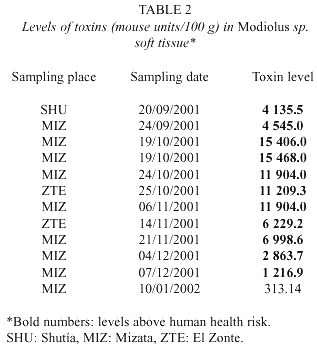
<body><![CDATA[<p>Abstract</p> </b></font>     <p><font face="Arial" size="2">A red tide event occurred in El Salvador from August 2001 to January 2002. National health authorities usually measured toxin levels in <i>Ostrea iridescen</i>s, however other species were analyzed during this microalgae bloom: <i>Anadara simili</i>s, <i>Anadara tuberculosa </i>and <i>Modiolus </i>sp. El Salvador authorities consider 400 mouse units/100 g the highest value that is safe for human health. During this period toxin levels in <i>O. iridescens </i>and <i>Modiolus </i>sp. increased from values under 400 to 3 977 and 15 468 mouse units/100 g, respectively. Persistent and higher levels were recorded in oyster and mussel banks on the west part of the country. The Ministry of Health and Social Assistance treated 41 slight to moderate intoxications associated to bivalve mollusks consumption.</font></p> <font face="Arial" size="2"><b></b></font>     <p><font face="Arial" size="2"><b>Key words: </b><i>Anadara simili</i>s, <i>Anadara tuberculos</i>a, dinoflagellate, El Salvador, <i>Modiolus </i>sp., <i>Ostrea iridescen</i>s, red tide, toxin.</font></p> <font face="Arial" size="2"><b></b></font>     <p><font face="Arial" size="2"><b>Palabras clave: </b><i>Anadara simili</i>s, <i>Anadara tuberculos</i>a, dinoflagelado, El Salvador, <i>Modiolus </i>sp., <i>Ostrea iridescen</i>s, marea roja, toxina.</font></p>     <p><font face="Arial" size="2">&nbsp;</font></p>     <p><font face="Arial" size="2">Red tides are caused by unicellular organisms (dinoflagellates) that can reach 50 000 individuals per milliliter of water during blooms. Recent episodes occurred in Central America during October-November 1989, March 1997, August 2001-January 2002. The most common of these organisms associated to Paralytic Shellfish Poisoning (PSP) include the genera: <i>Pyrodiniu</i>m, <i>Alexandriu</i>m, <i>Gymnodinium, </i>and occur from tropical to temperate seas, such as <i>Pyrodinium bahamense </i>Plate 1906, bloom in the Pacific coast of Costa Rica in October 1989 (<a href="#ma90">Mata <i>et a</i>l. 1990</a>). This dinoflagellate encompasses about 41% of all PSP events, whereas <i>Gymnodinium </i>species account 12% all over the world. (<a href="#az01">Azanza and Taylor 2001</a>). Those organisms produce toxins that may cause severe or mortal neurological disturbances when humans eat seafood (usually bivalves), which has been exposed to these algal blooms, effects could appear 30 minutes after food intake (<a href="#ar02">Armero-Guardado 2002</a>) and also, creates ecological and economical impacts (<a  href="#go90">Gocke <i>et a</i>l. 1990</a>). <a href="#az01">Azanza and Taylor (2001)</a> mentioned that "harmful algal blooms during 1989 to 1999 have affected Asia (55%), Europe (16%), North America (12%), Australasia (6%), South America (8%), Central America (2%) and Africa (1%)".</font></p>     <p><font face="Arial" size="2">This paper summarizes the main events registered and performed by national authorities (Health, Fisheries and Environment) during the red tide episode occurred in El Salvador coastal zone from August 2001 to January 2002. </font></p>     <p><font face="Arial" size="2">From 1992 to 2000 the Bromatology laboratory of the Ministry of Health and Social Assistance (MSPAS, in Spanish) monitored dinoflagellate toxins from oysters <i>(Ostrea iridescen</i>s) taken from three different sampling stations along the coastline. The median of analyses was 15 per year and the sample size varied from 7 to 50 specimens (<a href="#ar02">Armero-Guardado 2002</a>). Due to a significant toxin level increase in August 2001, Health Authorities decided to monitor red tide toxins in black clams <i>(Anadara simili</i>s, <i>Anadara tuberculos</i>a), and rock mussels <i>(Modiolus </i>sp.). Samples were carried within ice boxes or bags, sometimes frozen, and 100 g of the bivalves soft tissue were required for toxin isolation after hot-acid digestion, filtration and dilutions, similar to the protocol described by <a href="#al89">Alonso-Picón (1989)</a>. Toxin dilutions were injected in white male mice (15-20 g), time and effects (including death) were observed.</font></p>     <p><font face="Arial" size="2">Due to a red tide bloom at Las Lisas on the Pacific coast of Guatemala in August 2001, Salvadoran Health Authorities in coordination with the National Center for Promotion of Fisheries and Aquaculture, Ministry of the Environment and Natural Resources, National Police (CENDEPESCA, MARN, PNC, in Spanish, respectively) and Navy, focused on toxin levels in oyster samples from the west part of the country (Bocana El Zapote), close to the Guatemalan border (latter, the institutions mentioned before merged and created the Red Tide National Commission – CONAMAR - in December 2001). One aerial survey along the coastline (late August 2001) confirmed the elevated presence of sediments in water due to rainfall, and didn’t allow us to distinguish algal bloom patches on the ocean surface. Sediment runoff was very intense at the west part of La Libertad department (Mizata, Shutía, El Sunzal, El Tunco and La Libertad), where intertidal and subtidal rocky reefs are common. Previous red tide events have occurred in this area during the dry season (November 1989, March-April 1997), and the ocean turned maroon. During the 2001-2002 red tide event, results indicated levels of 509-612 mouse units/100 g, and represented a risk for the Salvadoran population, because they were above safe limits (400 mouse units/100g) according to MSPAS, national authorities banned the consumption and trade of marine mollusks.</font></p>     <p><font face="Arial" size="2">Toxin levels detected in <i>O. iridescens </i>and <i>Modiolus </i>sp. are presented in <a  href="#t1">Tables 1</a> and <a href="#t2">2</a>, respectively. Oysters from the western part of the country presented risk levels, however samples from the eastern part of the country didn’t reach such values, this reflects that the bloom affected the western coast only. <i>Modiolus </i>sp. presented the same pattern (<a href="#t2">Table 2</a>), but toxin amounts were much higher, indicating the accumulation ability for this species, and also, a threat to public health during dinoflagellate blooms. The first species is subtidal and commercially exploited, and occurs in many reef banks along the coastline. The other species proliferates on the lower intertidal of vertical walls, and also, has been only observed on the western part of the country. <i>Modiolus </i>sp. is collected by locals as food, although biomass is really small, in comparison to oysters. We considered that the low amount of biomass inside mussels and also, their daily exposure during low tide, reduces the mussels ability to metabolize dinoflagellates quickly, therefore high toxin concentrations were detected.</font></p>     ]]></body>
<body><![CDATA[<p style="text-align: center;"><font face="Arial" size="2">&nbsp;<a  name="t1"></a><img src="/img/fbpe/rbt/v52s1/2698i1.JPG" title="" alt=""  style="width: 611px; height: 547px;">    
<br> </font></p>     <p style="text-align: center;"><font face="Arial" size="2"><a name="t2"></a><img  src="/img/fbpe/rbt/v52s1/2698i2.JPG" title="" alt=""  style="width: 317px; height: 347px;">    
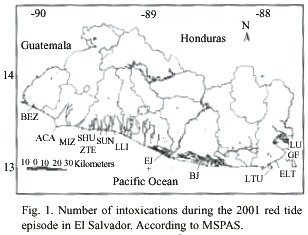
<br> </font></p>     <p><font face="Arial" size="2">&nbsp;</font>    <br> </p>     <p><font face="Arial" size="2">The reason that samples from La Libertad reefs (Shutía, El Zonte, Mizata) remained high in toxin could be associated to the presence of many rivers coming from coffee crops in the mountains and this may contribute with a higher presence of chemicals and sediments than any other coastal area in El Salvador. The latter was confirmed during the aerial survey mentioned before, however further investigations are required. Also, the vertical disturbance caused by winds and currents proposed by <a href="#az01">Azanza and Taylor (2001)</a> could be associated to this algal bloom.</font></p>     <p><font face="Arial" size="2">Black clams <i>(A. tuberculos</i>a, <i>A. simili</i>s) remained under safe levels (&lt;400 mouse unit/100 g) during this red tide event, therefore the Red Tide National Commission focused the ban on oysters and mussels from El Zonte to Acajutla in December 2002. <i>A. tuberculosa </i>contained toxin levels during a similar event in Costa Rica (<a href="#ma90">Mata <i>et a</i>l. 1990</a>). Toxin levels in oysters and mussels dropped and stabilized in January 2002, and CONAMAR lifted the ban completely in early February.</font></p>     <p><font face="Arial" size="2"><a href="#ar02">Armero-Guardado (2002)</a> reported 41 intoxications associated to seafood poisoning, from August to November 2001 (<a href="#f1">Fig. 1</a>). Most of them occurred in October (56%). Common symptoms appeared in a range from 1 to 24 hours, and they were: oral, arm and leg paralysis; also, intestinal disturbance. Human deaths did not occurred during this event. Most of the cases took place at La Libertad (88%), where people ingested mussels collected at Shutia, El Zonte and Mizata. In San Salvador, four persons (10%) got intoxicated when ingesting black clams at Estero de Jaltepeque, and one patient presenting similar symptoms was registered at the eastern part of the country (Jiquilisco Bay). These impacts on human health were slight when compared to former algal blooms in Costa Rica and Guatemala (<a  href="#ma90">Mata <i>et a</i>l. 1990</a>, <a href="#ro90">Rodríguez <i>et a</i>l. 1990</a>, respectively). The two latter cases are contradictory to the results observed in this red tide episode, since <i>A. similis </i>and <i>A. tuberculosa </i>never reached risk values. Also, it is important to mention that some people along the country ingested black clams despite of the ban.</font></p>     <div style="text-align: center;"><font face="Arial" size="2"><span  style="font-weight: bold;"><a name="f1"></a><img  src="/img/fbpe/rbt/v52s1/2698i3.JPG" title="" alt=""  style="width: 308px; height: 235px;"></span></font>    
]]></body>
<body><![CDATA[<br> <font face="Arial" size="2"></font></div>     <p><font face="Arial" size="2">&nbsp;    <br> Investigation and standarization of monitoring of red tide would be required for the Central American area, so that appropriate regional decisions could be implemented to reduce health and economic impacts.</font></p> <font face="Arial" size="2"><b>     <p>&nbsp;</p>     <p>Acknowledgments</p> </b></font>     <p><font face="Arial" size="2">Manuel Mayén reviewed the English translation. Wilfredo Fuentes determined geographical positions.</font></p> <font face="Arial" size="2"><b>     <p>&nbsp;</p>     <p>Resumen</p> </b></font>     <p><font face="Arial" size="2">Hubo una marea roja en El Salvador desde agosto de 2001 hasta enero de 2002. Las autoridades de salud usualmente medían niveles de toxinas en <i>Ostrea iridescen</i>s, pero durante esta proliferación de microalgas se estudió también <i>Anadara simili</i>s, <i>Anadara tuberculosa </i>y <i>Modiolus </i>sp. En El Salvador se consideran 400 unidades ratón/ 100 g como el límite sobre el cual el consumo de moluscos representa riesgo para la salud humana. Durante este período se detectó que los niveles de toxinas en <i>O. iridescens </i>y <i>Modiolus </i>sp. variaron desde niveles menores a 400 hasta 3 977 y 15 468 unidades ratón/100 g, respectivamente. Los niveles más altos y persistentes se registraron en los bancos de ostras y mejillones de la zona oeste del país. El Ministerio de Salud y Asistencia Social atendio 41 intoxicaciones de leves a moderadas atribuidas al consumo de moluscos bivalvos.</font></p> <font face="Arial" size="2"><b>     <p>&nbsp;</p>     ]]></body>
<body><![CDATA[<p>References</p> </b></font>     <!-- ref --><p><font face="Arial" size="2"><a name="al89"></a>Alonso Picón, J.A. 1989. Mareas Rojas y Biotoxinas: Química y Epidemiología. Servicio Galego de Saúde, Consellería de Sanidade, Xunta de Galicia. Santiago de Compostela. 120 p.</font>&nbsp;&nbsp;&nbsp;&nbsp;&nbsp;&nbsp;&nbsp;&nbsp;[&#160;<a href="javascript:void(0);" onclick="javascript: window.open('/scielo.php?script=sci_nlinks&ref=1217593&pid=S0034-7744200400050000300001&lng=','','width=640,height=500,resizable=yes,scrollbars=1,menubar=yes,');">Links</a>&#160;]<!-- end-ref --><!-- ref --><p><font face="Arial" size="2"><a name="ar02"></a>Armero-Guardado, J.A. 2002. Brote de intoxicaciones paralíticas por mariscos, El Salvador, Agosto 2001- Enero 2002. Ministerio de Salud Pública y Asistencia Social, Unidad Nacional de Epidemiología. 6 p.</font>&nbsp;&nbsp;&nbsp;&nbsp;&nbsp;&nbsp;&nbsp;&nbsp;[&#160;<a href="javascript:void(0);" onclick="javascript: window.open('/scielo.php?script=sci_nlinks&ref=1217594&pid=S0034-7744200400050000300002&lng=','','width=640,height=500,resizable=yes,scrollbars=1,menubar=yes,');">Links</a>&#160;]<!-- end-ref --><!-- ref --><p><font face="Arial" size="2"><a name="az01"></a></font><font  face="Arial" size="2">Azanza, R.V. &amp; M. Taylor. 2001. Are <i>Pyrodinium </i>blooms in the Southeast Asian region recurring and spreading? A view at the end of the millennium. Ambio 30: 356-362.</font>&nbsp;&nbsp;&nbsp;&nbsp;&nbsp;&nbsp;&nbsp;&nbsp;[&#160;<a href="javascript:void(0);" onclick="javascript: window.open('/scielo.php?script=sci_nlinks&ref=1217595&pid=S0034-7744200400050000300003&lng=','','width=640,height=500,resizable=yes,scrollbars=1,menubar=yes,');">Links</a>&#160;]<!-- end-ref --><!-- ref --><p><font face="Arial" size="2"><a name="go90"></a></font><font  face="Arial" size="2">Gocke, K., J. Cortés &amp; C. Villalobos. 1990. Effects of red tides on oxygen concentration and distribution in the Golfo de Nicoya, Costa Rica. Rev. Biol. Trop. 38: 401-408.</font>&nbsp;&nbsp;&nbsp;&nbsp;&nbsp;&nbsp;&nbsp;&nbsp;[&#160;<a href="javascript:void(0);" onclick="javascript: window.open('/scielo.php?script=sci_nlinks&ref=1217596&pid=S0034-7744200400050000300004&lng=','','width=640,height=500,resizable=yes,scrollbars=1,menubar=yes,');">Links</a>&#160;]<!-- end-ref --><!-- ref --><p><font face="Arial" size="2"><a name="ma90"></a></font><font  face="Arial" size="2">Mata, L., G. Abarca, L. Marranghello &amp; R. Víquez. 1990. Paralytic shellfish poisoning (PDSP) due to <i>Spondylus calcifer </i>contaminated by <i>Pyrodinium bahamens</i>e, Costa Rica, 1989-1990. Rev. Biol. Trop. 38: 129-136.</font>&nbsp;&nbsp;&nbsp;&nbsp;&nbsp;&nbsp;&nbsp;&nbsp;[&#160;<a href="javascript:void(0);" onclick="javascript: window.open('/scielo.php?script=sci_nlinks&ref=1217597&pid=S0034-7744200400050000300005&lng=','','width=640,height=500,resizable=yes,scrollbars=1,menubar=yes,');">Links</a>&#160;]<!-- end-ref --><!-- ref --><p><font face="Arial" size="2"><a name="ro90"></a></font><font  face="Arial" size="2">Rodríguez, D.C., R.A. Etzel, S. Hall, E. de Porras, O.H. Velásquez, R.V. Tauxe, E.M. Kilbourne &amp; P.A. Blake. 1990. Lethal Paralytic Shellfish Poisoning in Guatemala. Am. J. Trop. Med. Hyg. 42: 267-271.</font>&nbsp;&nbsp;&nbsp;&nbsp;&nbsp;&nbsp;&nbsp;&nbsp;[&#160;<a href="javascript:void(0);" onclick="javascript: window.open('/scielo.php?script=sci_nlinks&ref=1217598&pid=S0034-7744200400050000300006&lng=','','width=640,height=500,resizable=yes,scrollbars=1,menubar=yes,');">Links</a>&#160;]<!-- end-ref --> ]]></body><back>
<ref-list>
<ref id="B1">
<nlm-citation citation-type="">
<person-group person-group-type="author">
<name>
<surname><![CDATA[Alonso Picón]]></surname>
<given-names><![CDATA[J.A]]></given-names>
</name>
</person-group>
<source><![CDATA[Mareas Rojas y Biotoxinas: Química y Epidemiología. Servicio Galego de Saúde, Consellería de Sanidade, Xunta de Galicia]]></source>
<year>1989</year>
<page-range>120</page-range><publisher-loc><![CDATA[Santiago de Compostela ]]></publisher-loc>
</nlm-citation>
</ref>
<ref id="B2">
<nlm-citation citation-type="">
<person-group person-group-type="author">
<name>
<surname><![CDATA[Armero-Guardado]]></surname>
<given-names><![CDATA[J.A]]></given-names>
</name>
</person-group>
<source><![CDATA[Brote de intoxicaciones paralíticas por mariscos, El Salvador, Agosto 2001- Enero 2002: Ministerio de Salud Pública y Asistencia Social, Unidad Nacional de Epidemiología]]></source>
<year>2002</year>
<page-range>6</page-range></nlm-citation>
</ref>
<ref id="B3">
<nlm-citation citation-type="journal">
<person-group person-group-type="author">
<name>
<surname><![CDATA[Azanza]]></surname>
<given-names><![CDATA[R.V]]></given-names>
</name>
<name>
<surname><![CDATA[Taylor]]></surname>
<given-names><![CDATA[M]]></given-names>
</name>
</person-group>
<article-title xml:lang="en"><![CDATA[Are Pyrodinium blooms in the Southeast Asian region recurring and spreading?: A view at the end of the millennium]]></article-title>
<source><![CDATA[Ambio]]></source>
<year>2001</year>
<volume>30</volume>
<page-range>356-362</page-range></nlm-citation>
</ref>
<ref id="B4">
<nlm-citation citation-type="journal">
<person-group person-group-type="author">
<name>
<surname><![CDATA[Gocke]]></surname>
<given-names><![CDATA[K]]></given-names>
</name>
<name>
<surname><![CDATA[Cortés]]></surname>
<given-names><![CDATA[J]]></given-names>
</name>
<name>
<surname><![CDATA[Villalobos]]></surname>
<given-names><![CDATA[C.]]></given-names>
</name>
</person-group>
<article-title xml:lang="en"><![CDATA[Effects of red tides on oxygen concentration and distribution in the Golfo de Nicoya, Costa Rica]]></article-title>
<source><![CDATA[Rev. Biol. Trop]]></source>
<year>1990</year>
<volume>38</volume>
<page-range>401-408</page-range></nlm-citation>
</ref>
<ref id="B5">
<nlm-citation citation-type="journal">
<person-group person-group-type="author">
<name>
<surname><![CDATA[Mata]]></surname>
<given-names><![CDATA[L]]></given-names>
</name>
<name>
<surname><![CDATA[Abarca]]></surname>
<given-names><![CDATA[G]]></given-names>
</name>
<name>
<surname><![CDATA[Marranghello]]></surname>
<given-names><![CDATA[L]]></given-names>
</name>
<name>
<surname><![CDATA[Víquez]]></surname>
<given-names><![CDATA[R.]]></given-names>
</name>
</person-group>
<article-title xml:lang="en"><![CDATA[Paralytic shellfish poisoning (PDSP) due to Spondylus calcifer contaminated by Pyrodinium bahamense, Costa Rica, 1989-1990]]></article-title>
<source><![CDATA[Rev. Biol. Trop]]></source>
<year>1990</year>
<volume>38</volume>
<page-range>129-136</page-range></nlm-citation>
</ref>
<ref id="B6">
<nlm-citation citation-type="journal">
<person-group person-group-type="author">
<name>
<surname><![CDATA[Rodríguez]]></surname>
<given-names><![CDATA[D.C]]></given-names>
</name>
<name>
<surname><![CDATA[Etzel]]></surname>
<given-names><![CDATA[R.A.]]></given-names>
</name>
<name>
<surname><![CDATA[Hall]]></surname>
<given-names><![CDATA[S]]></given-names>
</name>
<name>
<surname><![CDATA[de Porras]]></surname>
<given-names><![CDATA[E]]></given-names>
</name>
<name>
<surname><![CDATA[Velásquez]]></surname>
<given-names><![CDATA[O.H]]></given-names>
</name>
<name>
<surname><![CDATA[Tauxe]]></surname>
<given-names><![CDATA[R.V]]></given-names>
</name>
<name>
<surname><![CDATA[Kilbourne]]></surname>
<given-names><![CDATA[E.M]]></given-names>
</name>
<name>
<surname><![CDATA[Blake]]></surname>
<given-names><![CDATA[P.A.]]></given-names>
</name>
</person-group>
<article-title xml:lang="en"><![CDATA[Lethal Paralytic Shellfish Poisoning in Guatemala]]></article-title>
<source><![CDATA[Am. J. Trop. Med. Hyg]]></source>
<year>1990</year>
<volume>42</volume>
<page-range>267-271</page-range></nlm-citation>
</ref>
</ref-list>
</back>
</article>