<?xml version="1.0" encoding="ISO-8859-1"?><article xmlns:mml="http://www.w3.org/1998/Math/MathML" xmlns:xlink="http://www.w3.org/1999/xlink" xmlns:xsi="http://www.w3.org/2001/XMLSchema-instance">
<front>
<journal-meta>
<journal-id>0034-7744</journal-id>
<journal-title><![CDATA[Revista de Biología Tropical]]></journal-title>
<abbrev-journal-title><![CDATA[Rev. biol. trop]]></abbrev-journal-title>
<issn>0034-7744</issn>
<publisher>
<publisher-name><![CDATA[Universidad de Costa Rica]]></publisher-name>
</publisher>
</journal-meta>
<article-meta>
<article-id>S0034-77442004000400023</article-id>
<title-group>
<article-title xml:lang="en"><![CDATA[Association of the "IUCN vulnerable "spiny rat Clyomys bishopi (Rodentia:Echimyidae)with palm trees and armadillo burrows in southeastern Brazil]]></article-title>
</title-group>
<contrib-group>
<contrib contrib-type="author">
<name>
<surname><![CDATA[Bueno]]></surname>
<given-names><![CDATA[Adriana A]]></given-names>
</name>
<xref ref-type="aff" rid="A01"/>
</contrib>
<contrib contrib-type="author">
<name>
<surname><![CDATA[Lapenta]]></surname>
<given-names><![CDATA[Marina J]]></given-names>
</name>
<xref ref-type="aff" rid="A01"/>
</contrib>
<contrib contrib-type="author">
<name>
<surname><![CDATA[Oliveira]]></surname>
<given-names><![CDATA[Fátima]]></given-names>
</name>
<xref ref-type="aff" rid="A02"/>
</contrib>
<contrib contrib-type="author">
<name>
<surname><![CDATA[Motta-Junior]]></surname>
<given-names><![CDATA[José C]]></given-names>
</name>
<xref ref-type="aff" rid="A01"/>
</contrib>
</contrib-group>
<aff id="A01">
<institution><![CDATA[,Instituto de Biociências-Universidade de São Paulo  ]]></institution>
<addr-line><![CDATA[São Paulo SP]]></addr-line>
<country>Brazil</country>
</aff>
<aff id="A02">
<institution><![CDATA[,Centro de Ciências Florestais  ]]></institution>
<addr-line><![CDATA[Curitiba PR]]></addr-line>
<country>Brazil</country>
</aff>
<pub-date pub-type="pub">
<day>00</day>
<month>12</month>
<year>2004</year>
</pub-date>
<pub-date pub-type="epub">
<day>00</day>
<month>12</month>
<year>2004</year>
</pub-date>
<volume>52</volume>
<numero>4</numero>
<fpage>1009</fpage>
<lpage>1011</lpage>
<copyright-statement/>
<copyright-year/>
<self-uri xlink:href="http://www.scielo.sa.cr/scielo.php?script=sci_arttext&amp;pid=S0034-77442004000400023&amp;lng=en&amp;nrm=iso"></self-uri><self-uri xlink:href="http://www.scielo.sa.cr/scielo.php?script=sci_abstract&amp;pid=S0034-77442004000400023&amp;lng=en&amp;nrm=iso"></self-uri><self-uri xlink:href="http://www.scielo.sa.cr/scielo.php?script=sci_pdf&amp;pid=S0034-77442004000400023&amp;lng=en&amp;nrm=iso"></self-uri><abstract abstract-type="short" xml:lang="en"><p><![CDATA[The globally vulnerable Clyomys bishopi ,a semi-fossorial and colonial rodent,is apparently limited to cerrado (savannah-like vegetation)physiognomies in São Paulo State,Brazil.The aim of the study was to verify whether the presence of C.bishopi is associated to the occurrence of palm trees (Attalea gearensis, Syagrus loefgrenii )and armadillo burrows.Thirty six quadrats were placed in different physiognomies of cerrado vegetation at Itirapina Ecological Station,southeastern Brazil to survey the number of C.bishopi burrows of individuals of palm trees and burrows of armadillos.There was a strong dependence and association between the number of C.bishopi burrows and all measured variables (Contingency tables and Spearman rank correlations).It is suggested that this rodent can be found in great numbers where palm trees are abundant.The use of armadillo burrows possibly makes the movement of the rodents easier inside their own galleries.Rev.Biol. Trop. 52(4):1009-1011.Epub 2005 Jun 24.]]></p></abstract>
<abstract abstract-type="short" xml:lang="es"><p><![CDATA[El roedor colonial Clyomys bishopi está aparentemente limitado a vegetación de semi-sabana (cerrado)en el estado de São Paulo,Brasil.El objetivo de este estudio fue verificar si la presencia de C.bishopi está asociada a la individuos de las palmeras Attalea gearensis,Syagrus loefgrenii y madrigueras de armadillos.El estudio fue realizado en la Estación Ecológica de Itirapina,en el sureste de Brasil.Treinta y seis cuadrantes fueron dispuestos en diferentes fisionomías del la vegetación del cerrado para encuestar el número de madrigueras de C.bishopi, árboles individuales de palma y madrigueras de armadillos.Se calcularon tablas de contingencia y correlaciones de Sperman para evaluar, respectivamente, la dependencia y asociación entre el número de madrigueras de C.bishopi y las otras variables.Se encontró una fuerte dependencia y asociación entre el número de madrigueras de C.bishopi y todas las variables medidas.Esto sugiere que este roedor alcanza grandes poblaciones cuando hay palmeras en abundancia. El uso de madrigueras de armadillos posiblemente facilita el movimiento de los roedores dentro de sus propias galerías.]]></p></abstract>
<kwd-group>
<kwd lng="en"><![CDATA[Clyomys bishopi]]></kwd>
<kwd lng="en"><![CDATA[semi-fossorial habit]]></kwd>
<kwd lng="en"><![CDATA[burrows]]></kwd>
<kwd lng="en"><![CDATA[savannah]]></kwd>
<kwd lng="en"><![CDATA[Palmae]]></kwd>
<kwd lng="en"><![CDATA[Brazil]]></kwd>
<kwd lng="es"><![CDATA[Clyomys bishopi]]></kwd>
<kwd lng="es"><![CDATA[madrigueras]]></kwd>
<kwd lng="es"><![CDATA[savana]]></kwd>
<kwd lng="es"><![CDATA[Palmae]]></kwd>
<kwd lng="es"><![CDATA[Brasil]]></kwd>
</kwd-group>
</article-meta>
</front><body><![CDATA[  <b><font face="Arial"></font></b>     <p align="center"><b><font face="Arial">Association of the "IUCN vulnerable "spiny rat </font></b><font face="Arial"><i>Clyomys bishopi </i><b>(Rodentia:Echimyidae)with palm trees and armadillo burrows in southeastern Brazil</b></font></p> <font face="Arial" size="2"></font>     <p><font face="Arial" size="2">Adriana A.Bueno<sup><a name="1"></a><a  href="#2">1</a></sup>, Marina J.Lapenta<a href="#2"><sup>1</sup></a>, Fátima Oliveira<a href="#2"><sup>2</sup></a> &amp;José C.Motta-Junior<a  href="#2"><sup>1</sup></a></font></p>     <p><font face="Arial" size="2"><sup><a name="2"></a><a href="#1">1</a></sup> Departamento de Ecologia,Instituto de Biociências-Universidade de São Paulo.C.P.11461.CEP 05422-970,São Paulo,SP,Brazil.<a  href="mailto:abueno@ib.usp.br">abueno@ib.usp.br</a></font></p> <font face="Arial" size="2"><sup></sup></font>     <p><font face="Arial" size="2"><a href="#1"><sup>2</sup></a> Laboratório de Manejo de Fauna,Centro de Ciências Florestais,UFPR,Curitiba,PR,Brazil.</font></p>     <p align="center"><font face="Arial" size="2">Received 15-II-2002. Corrected 17-XII-2003. Accepted 01-XII-2004.</font></p> <font face="Arial" size="2"><b></b></font>     <p><font face="Arial" size="2"><b>Abstract:</b>The globally vulnerable <i>Clyomys bishopi </i>,a semi-fossorial and colonial rodent,is apparently limited to cerrado (savannah-like vegetation)physiognomies in São Paulo State,Brazil.The aim of the study was to verify whether the presence of <i>C.bishopi </i>is associated to the occurrence of palm trees (<i>Attalea gearensis, Syagrus loefgrenii </i>)and armadillo burrows.Thirty six quadrats were placed in different physiognomies of cerrado vegetation at Itirapina Ecological Station,southeastern Brazil to survey the number of <i>C.bishopi </i>burrows of individuals of palm trees and burrows of armadillos.There was a strong dependence and association between the number of <i>C.bishopi </i>burrows and all measured variables (Contingency tables and Spearman rank correlations).It is suggested that this rodent can be found in great numbers where palm trees are abundant.The use of armadillo burrows possibly makes the movement of the rodents easier inside their own galleries.Rev.Biol. Trop. 52(4):1009-1011.Epub 2005 Jun 24.</font></p> <font face="Arial" size="2"><b></b></font>     <p><font face="Arial" size="2"><b>Key words:</b><i>Clyomys bishopi </i>,semi-fossorial habit,burrows,savannah,Palmae,Brazil.</font></p>     <p><font face="Arial" size="2">The rodent <i>Clyomys bishopi </i>(<a  href="#av81">Avila-Pires and Wutke 1981</a>)belongs to the family Echimyidae and subfamily Eumysopinae.The two species of this genus,<i>C.laticeps </i>and <i>C. bishopi </i>,are found in Brazil,and the latter is endemic of savannahs in São Paulo state (<a href="#av81">Avila-Pires and Wutke 1981</a>,<a href="#no99">Nowak 1999</a>). Its occurrence is limited to the southeast of São Paulo (<a href="#av81">Avila-Pires and Wutke 1981</a>,<a href="#vi97">Vieira 1997</a>,<a href="#no99">Nowak 1999</a>)and according to IUCN, it is vulnerable due to its very small range (<a href="#no99">Nowak 1999</a>).Additionally,its habitat has been heavily disturbed (<a href="#no99">Nowak 1999</a>).</font></p>     <p><font face="Arial" size="2">Individuals of <i>C </i>.<i>bishopi </i>are semi-fossorial and live in colonies (<a href="#av81">Avila-Pires and Wutke 1981</a>,<a href="#vi97">Vieira 1997</a>).According to <a  href="#vi97">Vieira (1997)</a>,<i>C.bishopi </i>is specialized in Monocotyledoneae,including fruit consumption.The burrow system of <i>C.bishopi </i>,which are linked to the ones of armadillos,have been described by <a  href="#cu00">Cunha and Belentani (2000)</a>. Among the fruits and leaves found in the galleries,<i>Attalea geraensis </i>(Barb.Rodr)and <i>Syagrus loefgrenii </i>(Glassman)were used as food items by <i>C.bishopi </i>(<a  href="#cu00">Cunha and Belentani 2000</a>). The aim of this study was to verify a possible association between the number of burrows of <i>C.bishopi </i>and the following environmental variables:number of individuals of palm trees (<i>A.geraensis </i>and <i>S.loefgrenii </i>)and the number of burrows of armadillos (Dasypodidae). Since this rodent appears to be heavily dependent on palm trees as food and it is semi-fossorial (<a href="#vi97">Vieira 1997</a>,<a href="#cu00">Cunha and Belentani 2000</a>),it is expected to be found a positive association between the number of <i>C.bishopi </i>burrows and those environmental variables.</font></p>     ]]></body>
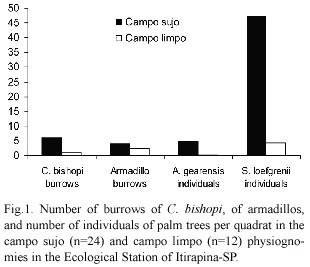
<body><![CDATA[<p><font face="Arial" size="2">The study was carried out in the Itirapina Ecological Station (22 º15 ’ S,47 º49 ’ W),located between the municipalities of Itirapina and Brotas,São Paulo state,southeastern Brazil. The Station consists of an area of 6580 ha with approximately 2400 ha of natural vegetation,mostly savannah (<a href="#gi88">Giannotti 1988</a>),including "campo limpo "(grassland),"campo sujo" (savannah grassland),"campo cerrado "(savannah-like vegetation),besides swamps and gallery forests (<a href="#ma87">Mantovani 1987</a>).The climate is mesotermic with dry winter (<a href="#vi97">Vieira 1997</a>).</font></p>     <p><font face="Arial" size="2">The data were collected in November 2000,in the two most common physiognomies of the Station (campo limpo and campo sujo). Thirty six quadrats (10m x 10m)were systematically placed in the field to survey burrows of <i>C.bishopi </i>,individuals of <i>A.geraensis </i>and <i>S. loefgrenii </i>,and burrows of armadillos: <i>Dasypus </i>spp.,<i>Cabassous unicinctus </i>and <i>Euphractus sexcinctus </i>.Twenty four quadrats were placed in campo sujo and 12 in campo limpo,since the area covered by the former habitat is roughly twice the latter.The quadrats were 20 m off paths and trails to reduce the border effect, and 50 m apart each other.The choice of areas recently burned in both physiognomies improved the visibility of the burrows due to less dense vegetation.<i>S.loefgrenii </i>plants possessing individualized trunks 20 cm apart each other were considered an individual.The dimensions and shape of the burrow entrance were taken into consideration to determine if the burrow was dug by armadillo or <i>C.bishopi</i>. It was assumed in this study that the number of <i>C.bishopi </i>burrows indirectly represents the abundance of the species in the field.</font></p>     <p><font face="Arial" size="2">Contingency tables (<a href="#za84">Zar 1984</a>)were performed to evaluate a possible dependence between the number of burrows of <i>C.bishopi </i>and the number of individuals of palm trees, and between burrows of <i>C.bishopi </i>and of armadillos. Additionally, Spearman rank order correlation (<a  href="#si88">Siegel and Castellan 1988</a>) was used to check the association between the above variables.</font></p>     <p><font face="Arial" size="2">Data from 36 quadrats showed 158 burrows of <i>C.bishopi </i>,136 burrows of armadillos,122 individuals of <i>A.geraensis </i>and 1,189 individuals of <i>S.loefgrenii </i>.Proportionally the number of <i>C.bishopi </i>burrows, individuals of <i>A.geraensis </i>and of <i>S. loefgrenii </i>were lower in campo limpo than in campo sujo (</font><span  style="font-family: arial;"><span style="font-weight: bold;"><img  src="/img/fbpe/rbt/v52n4/x.JPG" title="" alt="" style="width: 11px; height: 15px;"></span></span><sup><font  face="Arial" size="2">2</font></sup><font face="Arial" size="2"> = 71.59; d.f.=3;p &lt;0.0001).On the other hand,the number of armadillo burrows was similar in the studied physiognomies (<a href="#f1">Fig.1</a>).</font></p> <a name="f1"></a>     
<div style="text-align: center;"><img src="/img/fbpe/rbt/v52n4/3151i1.JPG" title=""  alt="" style="width: 310px; height: 267px;"></div>     
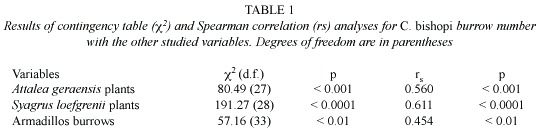
<p><font face="Arial" size="2">&nbsp;    <br> Contingency table and Spearman correlation analyses revealed heavy dependence and positive correlation, respectively, between the <i>C.bishopi </i>occurrence and the other environmental variables (<a href="#t1">Table 1</a>).Therefore,it is suggested that this rodent species can be found in the field in great number when both palm trees are also available in high abundance,since these are the bulk of the rodent ’s diet (<a  href="#vi97">Vieira 1997</a>).Individuals of <i>C. bishopi </i>were observed commonly using the burrows of armadillos inside their burrow systems,as revealed by the spool-and-line device technique (pers.obs.).The use of armadillo burrow systems possibly makes easier the movement of the rodents inside their own galleries, reducing their digging effort.</font></p>     <p style="text-align: center;"><font face="Arial" size="2">&nbsp;<a  name="t1"></a><img src="/img/fbpe/rbt/v52n4/3151i2.JPG" title="" alt=""  style="width: 538px; height: 132px;"></font></p>     
<p><font face="Arial" size="2">The number of burrows of <i>C.bishopi </i>in the physiognomies can certainly be related to other factors not considered in this work,such as texture and consistence of the soil,number of roots among others. Those factors should urgently receive attention in future studies. These preliminary data may be valuable to indicate tools to the management and conservation of <i>C.bishopi</i>.</font></p>     <p><font face="Arial" size="2">We are grateful to Márcio R.C.Martins and FAPESP for the logistical support.Sergio T.Meirelles and Roberto M.Shimizu helped with statistical analysis.Two anonymous referees made valuable suggestions.This is the publication number 14 of the project "Ecology of the Cerrados of Itirapina ".</font></p> <font face="Arial" size="2"><b>     ]]></body>
<body><![CDATA[<p>Resumen</p> </b></font>     <p><font face="Arial" size="2">El roedor colonial <i>Clyomys bishopi </i>está aparentemente limitado a vegetación de semi-sabana (cerrado)en el estado de São Paulo,Brasil.El objetivo de este estudio fue verificar si la presencia de <i>C.bishopi </i>está asociada a la individuos de las palmeras <i>Attalea gearensis,Syagrus loefgrenii </i>y madrigueras de armadillos.El estudio fue realizado en la Estación Ecológica de Itirapina,en el sureste de Brasil.Treinta y seis cuadrantes fueron dispuestos en diferentes fisionomías del la vegetación del cerrado para encuestar el número de madrigueras de <i>C.bishopi</i>, árboles individuales de palma y madrigueras de armadillos.Se calcularon tablas de contingencia y correlaciones de Sperman para evaluar, respectivamente, la dependencia y asociación entre el número de madrigueras de <i>C.bishopi </i>y las otras variables.Se encontró una fuerte dependencia y asociación entre el número de madrigueras de <i>C.bishopi </i>y todas las variables medidas.Esto sugiere que este roedor alcanza grandes poblaciones cuando hay palmeras en abundancia. El uso de madrigueras de armadillos posiblemente facilita el movimiento de los roedores dentro de sus propias galerías.</font></p>     <p><font face="Arial" size="2">&nbsp;</font></p> <font face="Arial" size="2"><b></b></font>     <p><font face="Arial" size="2"><b>Palabras clave:</b><i>Clyomys bishopi </i>,madrigueras,savana, Palmae,Brasil.</font></p> <font face="Arial" size="2"><b>     <p>References</p> </b></font>     <!-- ref --><p><font face="Arial" size="2"><a name="av81"></a>Avila-Pires,F.D.&amp;M.R.C.Wutke.1981.Taxonomia e evolução de <i>Clyomys </i>Thomas 1916 (Rodentia, Echymyidae). Rev. Brasil. Biol.41:529-534.</font>&nbsp;&nbsp;&nbsp;&nbsp;&nbsp;&nbsp;&nbsp;&nbsp;[&#160;<a href="javascript:void(0);" onclick="javascript: window.open('/scielo.php?script=sci_nlinks&ref=1230033&pid=S0034-7744200400040002300001&lng=','','width=640,height=500,resizable=yes,scrollbars=1,menubar=yes,');">Links</a>&#160;]<!-- end-ref --><!-- ref --><p><font face="Arial" size="2"><a name="cu00"></a>Cunha,M.J.&amp;S.C.Belentani.2000.Descrição das galerias de <i>Clyomys bishopi </i>(Rodentia,Echimyidae) p.142- 152.<i>In </i>M.R.C.Martins,W.Mantovani,J.P.Metzger (orgs.).Livro da Disciplina Ecologia de Campo. Universidade de São Paulo,São Paulo.Brasil.</font>&nbsp;&nbsp;&nbsp;&nbsp;&nbsp;&nbsp;&nbsp;&nbsp;[&#160;<a href="javascript:void(0);" onclick="javascript: window.open('/scielo.php?script=sci_nlinks&ref=1230034&pid=S0034-7744200400040002300002&lng=','','width=640,height=500,resizable=yes,scrollbars=1,menubar=yes,');">Links</a>&#160;]<!-- end-ref --><!-- ref --><p><font face="Arial" size="2"><a name="gi88"></a>Giannotti,E.1988.Composição florística e estrutura fitos-sociológica da vegetação de Cerrado e de transição entre Cerrado e Mata ciliar da Estação Experimental de Itirapina (SP). Dissertation. Universidade Estadual de Campinas. Campinas.Brasil.</font>&nbsp;&nbsp;&nbsp;&nbsp;&nbsp;&nbsp;&nbsp;&nbsp;[&#160;<a href="javascript:void(0);" onclick="javascript: window.open('/scielo.php?script=sci_nlinks&ref=1230035&pid=S0034-7744200400040002300003&lng=','','width=640,height=500,resizable=yes,scrollbars=1,menubar=yes,');">Links</a>&#160;]<!-- end-ref --><!-- ref --><p><font face="Arial" size="2"><a name="ma87"></a>Mantovani,W.1987.Análise florística e fitossociológica do estrato herbáceo-subarbustivo do Cerrado na reserva biológica de Guaçu e Itirapina.Ph. D.Thesis.Universidade Estadual de Campinas. Campinas. Brasil.</font>&nbsp;&nbsp;&nbsp;&nbsp;&nbsp;&nbsp;&nbsp;&nbsp;[&#160;<a href="javascript:void(0);" onclick="javascript: window.open('/scielo.php?script=sci_nlinks&ref=1230036&pid=S0034-7744200400040002300004&lng=','','width=640,height=500,resizable=yes,scrollbars=1,menubar=yes,');">Links</a>&#160;]<!-- end-ref --><!-- ref --><p><font face="Arial" size="2"><a name="no99"></a>Nowak,R.M.1999.Walker ´s Mammals of the World. Volume II.The John Hopkins University,Baltimore and London.1101 p.</font>&nbsp;&nbsp;&nbsp;&nbsp;&nbsp;&nbsp;&nbsp;&nbsp;[&#160;<a href="javascript:void(0);" onclick="javascript: window.open('/scielo.php?script=sci_nlinks&ref=1230037&pid=S0034-7744200400040002300005&lng=','','width=640,height=500,resizable=yes,scrollbars=1,menubar=yes,');">Links</a>&#160;]<!-- end-ref --><!-- ref --><p><font face="Arial" size="2"><a name="si88"></a>Siegel,S.&amp;N.J.Castellan-Jr.1988.Nonparametric statistics for the behavioural sciences.McGraw-Hill,New York.399 p.</font>&nbsp;&nbsp;&nbsp;&nbsp;&nbsp;&nbsp;&nbsp;&nbsp;[&#160;<a href="javascript:void(0);" onclick="javascript: window.open('/scielo.php?script=sci_nlinks&ref=1230038&pid=S0034-7744200400040002300006&lng=','','width=640,height=500,resizable=yes,scrollbars=1,menubar=yes,');">Links</a>&#160;]<!-- end-ref --><!-- ref --><p><font face="Arial" size="2"><a name="vi97"></a>Vieira,M.V.1997.Dynamics of a rodent assemblage in a cerrado of southeast Brazil.Rev.Brasil.Biol.57: 99-107. </font>&nbsp;&nbsp;&nbsp;&nbsp;&nbsp;&nbsp;&nbsp;&nbsp;[&#160;<a href="javascript:void(0);" onclick="javascript: window.open('/scielo.php?script=sci_nlinks&ref=1230039&pid=S0034-7744200400040002300007&lng=','','width=640,height=500,resizable=yes,scrollbars=1,menubar=yes,');">Links</a>&#160;]<!-- end-ref --><!-- ref --><p><font face="Arial" size="2"><a name="za84"></a>Zar,J.H.1984.Biostatistical analysis.Englewood Cliffs. 718 p.</font>&nbsp;&nbsp;&nbsp;&nbsp;&nbsp;&nbsp;&nbsp;&nbsp;[&#160;<a href="javascript:void(0);" onclick="javascript: window.open('/scielo.php?script=sci_nlinks&ref=1230040&pid=S0034-7744200400040002300008&lng=','','width=640,height=500,resizable=yes,scrollbars=1,menubar=yes,');">Links</a>&#160;]<!-- end-ref --> ]]></body><back>
<ref-list>
<ref id="B1">
<nlm-citation citation-type="journal">
<person-group person-group-type="author">
<name>
<surname><![CDATA[Avila-Pires]]></surname>
<given-names><![CDATA[F.D]]></given-names>
</name>
<name>
<surname><![CDATA[Wutke]]></surname>
<given-names><![CDATA[M.R.C]]></given-names>
</name>
</person-group>
<article-title xml:lang="pt"><![CDATA[Taxonomia e evolução de Clyomys Thomas 1916 (Rodentia, Echymyidae)]]></article-title>
<source><![CDATA[Rev. Brasil. Biol]]></source>
<year>1981</year>
<volume>41</volume>
<page-range>529-534</page-range></nlm-citation>
</ref>
<ref id="B2">
<nlm-citation citation-type="book">
<person-group person-group-type="author">
<name>
<surname><![CDATA[Cunha]]></surname>
<given-names><![CDATA[M.J]]></given-names>
</name>
<name>
<surname><![CDATA[Belentani]]></surname>
<given-names><![CDATA[S.C]]></given-names>
</name>
</person-group>
<article-title xml:lang="pt"><![CDATA[Descrição das galerias de Clyomys bishopi (Rodentia,Echimyidae)]]></article-title>
<person-group person-group-type="editor">
<name>
<surname><![CDATA[Martins]]></surname>
<given-names><![CDATA[M.R.C]]></given-names>
</name>
<name>
<surname><![CDATA[Mantovani]]></surname>
<given-names><![CDATA[W]]></given-names>
</name>
<name>
<surname><![CDATA[Metzger]]></surname>
<given-names><![CDATA[J.P]]></given-names>
</name>
</person-group>
<source><![CDATA[Livro da Disciplina Ecologia de Campo]]></source>
<year>2000</year>
<page-range>142- 152</page-range><publisher-loc><![CDATA[^eSão Paulo São Paulo]]></publisher-loc>
<publisher-name><![CDATA[Universidade de São Paulo]]></publisher-name>
</nlm-citation>
</ref>
<ref id="B3">
<nlm-citation citation-type="">
<person-group person-group-type="author">
<name>
<surname><![CDATA[Giannotti]]></surname>
<given-names><![CDATA[E]]></given-names>
</name>
</person-group>
<source><![CDATA[Composição florística e estrutura fitos-sociológica da vegetação de Cerrado e de transição entre Cerrado e Mata ciliar da Estação Experimental de Itirapina (SP)]]></source>
<year>1988</year>
</nlm-citation>
</ref>
<ref id="B4">
<nlm-citation citation-type="">
<person-group person-group-type="author">
<name>
<surname><![CDATA[Mantovani]]></surname>
<given-names><![CDATA[W]]></given-names>
</name>
</person-group>
<source><![CDATA[Análise florística e fitossociológica do estrato herbáceo-subarbustivo do Cerrado na reserva biológica de Guaçu e Itirapina]]></source>
<year>1987</year>
</nlm-citation>
</ref>
<ref id="B5">
<nlm-citation citation-type="book">
<person-group person-group-type="author">
<name>
<surname><![CDATA[Nowak]]></surname>
<given-names><![CDATA[R.M]]></given-names>
</name>
</person-group>
<source><![CDATA[Walker ´s Mammals of the World]]></source>
<year>1999</year>
<volume>II</volume>
<page-range>1101</page-range><publisher-loc><![CDATA[Baltimore and London ]]></publisher-loc>
<publisher-name><![CDATA[The John Hopkins University]]></publisher-name>
</nlm-citation>
</ref>
<ref id="B6">
<nlm-citation citation-type="book">
<person-group person-group-type="author">
<name>
<surname><![CDATA[Siegel]]></surname>
<given-names><![CDATA[S]]></given-names>
</name>
<name>
<surname><![CDATA[Castellan-Jr]]></surname>
<given-names><![CDATA[N.J]]></given-names>
</name>
</person-group>
<source><![CDATA[Nonparametric statistics for the behavioural sciences]]></source>
<year>1988</year>
<page-range>399</page-range><publisher-loc><![CDATA[^eNew York New York]]></publisher-loc>
<publisher-name><![CDATA[McGraw-Hill]]></publisher-name>
</nlm-citation>
</ref>
<ref id="B7">
<nlm-citation citation-type="journal">
<person-group person-group-type="author">
<name>
<surname><![CDATA[Vieira]]></surname>
<given-names><![CDATA[M.V]]></given-names>
</name>
</person-group>
<article-title xml:lang="en"><![CDATA[Dynamics of a rodent assemblage in a cerrado of southeast Brazil]]></article-title>
<source><![CDATA[Rev.Brasil.Biol]]></source>
<year>1997</year>
<volume>57</volume>
<page-range>99-107</page-range></nlm-citation>
</ref>
<ref id="B8">
<nlm-citation citation-type="book">
<person-group person-group-type="author">
<name>
<surname><![CDATA[Zar]]></surname>
<given-names><![CDATA[J.H]]></given-names>
</name>
</person-group>
<source><![CDATA[Biostatistical analysis]]></source>
<year>1984</year>
<page-range>718</page-range><publisher-name><![CDATA[Englewood Cliffs]]></publisher-name>
</nlm-citation>
</ref>
</ref-list>
</back>
</article>