<?xml version="1.0" encoding="ISO-8859-1"?><article xmlns:mml="http://www.w3.org/1998/Math/MathML" xmlns:xlink="http://www.w3.org/1999/xlink" xmlns:xsi="http://www.w3.org/2001/XMLSchema-instance">
<front>
<journal-meta>
<journal-id>0034-7744</journal-id>
<journal-title><![CDATA[Revista de Biología Tropical]]></journal-title>
<abbrev-journal-title><![CDATA[Rev. biol. trop]]></abbrev-journal-title>
<issn>0034-7744</issn>
<publisher>
<publisher-name><![CDATA[Universidad de Costa Rica]]></publisher-name>
</publisher>
</journal-meta>
<article-meta>
<article-id>S0034-77442004000400021</article-id>
<title-group>
<article-title xml:lang="en"><![CDATA[Factors associated with the catastrophic decline of a cloudforest frog fauna in Guatemala]]></article-title>
</title-group>
<contrib-group>
<contrib contrib-type="author">
<name>
<surname><![CDATA[Mendelson III]]></surname>
<given-names><![CDATA[J.R]]></given-names>
</name>
<xref ref-type="aff" rid="A01"/>
</contrib>
<contrib contrib-type="author">
<name>
<surname><![CDATA[Brodie,Jr]]></surname>
<given-names><![CDATA[E.D]]></given-names>
</name>
<xref ref-type="aff" rid="A02"/>
</contrib>
<contrib contrib-type="author">
<name>
<surname><![CDATA[Malone]]></surname>
<given-names><![CDATA[J.H]]></given-names>
</name>
<xref ref-type="aff" rid="A03"/>
</contrib>
<contrib contrib-type="author">
<name>
<surname><![CDATA[Acevedo]]></surname>
<given-names><![CDATA[M.E]]></given-names>
</name>
<xref ref-type="aff" rid="A04"/>
</contrib>
<contrib contrib-type="author">
<name>
<surname><![CDATA[Baker]]></surname>
<given-names><![CDATA[M.A]]></given-names>
</name>
<xref ref-type="aff" rid="A02"/>
</contrib>
<contrib contrib-type="author">
<name>
<surname><![CDATA[Smatresk]]></surname>
<given-names><![CDATA[N.J]]></given-names>
</name>
<xref ref-type="aff" rid="A03"/>
</contrib>
<contrib contrib-type="author">
<name>
<surname><![CDATA[Campbell]]></surname>
<given-names><![CDATA[J.A]]></given-names>
</name>
<xref ref-type="aff" rid="A03"/>
</contrib>
</contrib-group>
<aff id="A01">
<institution><![CDATA[,Zoo Atlanta  ]]></institution>
<addr-line><![CDATA[ ]]></addr-line>
<country>USA</country>
</aff>
<aff id="A02">
<institution><![CDATA[,Utah State University  ]]></institution>
<addr-line><![CDATA[ ]]></addr-line>
<country>USA</country>
</aff>
<aff id="A03">
<institution><![CDATA[,The University of Texas at Arlington  ]]></institution>
<addr-line><![CDATA[Arlington TX]]></addr-line>
<country>USA</country>
</aff>
<aff id="A04">
<institution><![CDATA[,Quinta Samayoa  ]]></institution>
<addr-line><![CDATA[Guatemala City ]]></addr-line>
<country>Guatemala</country>
</aff>
<pub-date pub-type="pub">
<day>00</day>
<month>12</month>
<year>2004</year>
</pub-date>
<pub-date pub-type="epub">
<day>00</day>
<month>12</month>
<year>2004</year>
</pub-date>
<volume>52</volume>
<numero>4</numero>
<fpage>991</fpage>
<lpage>1000</lpage>
<copyright-statement/>
<copyright-year/>
<self-uri xlink:href="http://www.scielo.sa.cr/scielo.php?script=sci_arttext&amp;pid=S0034-77442004000400021&amp;lng=en&amp;nrm=iso"></self-uri><self-uri xlink:href="http://www.scielo.sa.cr/scielo.php?script=sci_abstract&amp;pid=S0034-77442004000400021&amp;lng=en&amp;nrm=iso"></self-uri><self-uri xlink:href="http://www.scielo.sa.cr/scielo.php?script=sci_pdf&amp;pid=S0034-77442004000400021&amp;lng=en&amp;nrm=iso"></self-uri><abstract abstract-type="short" xml:lang="en"><p><![CDATA[Comparison of recent and historical surveys of frog populations in cloudforest habitat in Sierra de las Minas,Guatemala,indicated population declines and local extirpation of several species.Pathological exams of diseased tadpoles indicated infection by amphibian chytridiomycosis. The local habitat has been severely altered by recent establishment of large-scale leatherleaf fern production.Analysis of water chemistry at our study site suggested increased nitrogenation associated with the leatherleaf industry.Rev.Biol.Trop.52(4):991-1000. Epub 2005 Jun 24.]]></p></abstract>
<abstract abstract-type="short" xml:lang="es"><p><![CDATA[Una comparación entre un inventario anterior y otro reciente de poblaciones de ranas de bosque nublado en la Sierra de Las Minas de Guatemala demostró disminuciones poblacionales y ausencia localizada de varias especies.El examen patológico de un renacuajo muerto indicó infección por un hongo quítrido propio de los anfibios.El hábitat local ha sido gravemente alterado por el establecimiento reciente de producción a gran escala de helechos ornamentales.El análisis químico del agua en el área de estudio señaló un aumento en nitrogenación asociado al cultivo de helechos.]]></p></abstract>
<kwd-group>
<kwd lng="en"><![CDATA[Amphibian decline]]></kwd>
<kwd lng="en"><![CDATA[chytridiomycosis]]></kwd>
<kwd lng="en"><![CDATA[Guatemala]]></kwd>
<kwd lng="en"><![CDATA[Anura]]></kwd>
<kwd lng="en"><![CDATA[Plectrohyla]]></kwd>
<kwd lng="en"><![CDATA[Ptychohyla]]></kwd>
<kwd lng="en"><![CDATA[leatherleaf fern]]></kwd>
<kwd lng="es"><![CDATA[declinación de anfibios]]></kwd>
<kwd lng="es"><![CDATA[quitridiomicosis]]></kwd>
<kwd lng="es"><![CDATA[Guatemala]]></kwd>
<kwd lng="es"><![CDATA[Anura]]></kwd>
<kwd lng="es"><![CDATA[Plectrohyla]]></kwd>
<kwd lng="es"><![CDATA[Ptychohyla]]></kwd>
<kwd lng="es"><![CDATA[helechos ornamentales]]></kwd>
</kwd-group>
</article-meta>
</front><body><![CDATA[  <b><font face="Arial">     <p align="center">Factors associated with the catastrophic decline of a cloudforest frog fauna in Guatemala</p> </font></b><font face="Arial" size="2"></font>     <p><font face="Arial" size="2">J.R.Mendelson III<sup><a name="1"></a><a  href="#2">1</a></sup>, E.D.Brodie,Jr.<a href="#2"><sup>2</sup></a>, J.H.Malone<a href="#2"><sup>3</sup></a>, M.E.Acevedo<a href="#2"><sup>4</sup></a>, M.A.Baker<a href="#2"><sup>2</sup></a>, N.J. Smatresk<a href="#2"><sup>3</sup></a> &amp;J.A.Campbell<a href="#2"><sup>3</sup></a></font></p>     <p><font face="Arial" size="2"><sup><a name="2"></a><a href="#1">1</a></sup> Department of Herpetology,Zoo Atlanta,800 Cherokee Ave SE,Atlanta,GA 30315 USA,fax (404)624-5841; <a href="mailto:jmendelson@zooatlanta.org">jmendelson@zooatlanta.org</a></font></p> <font face="Arial" size="2"><sup></sup></font>     <p><font face="Arial" size="2"><a href="#1"><sup>2</sup></a> Department of Biology,Utah State University,Logan,UT 84322-5305 USA,fax (435)797-1575; <a href="mailto:sapo@biology.usu.edu">sapo@biology.usu.edu</a></font></p> <font face="Arial" size="2"><sup></sup></font>     <p><font face="Arial" size="2"><a href="#1"><sup>3</sup></a> Department of Biology,The University of Texas at Arlington,Arlington,TX 76019 USA.</font></p> <font face="Arial" size="2"><sup></sup></font>     <p><font face="Arial" size="2"><a href="#1"><sup>4</sup></a> 4a Calle 12-45 Zona 7,Quinta Samayoa,Guatemala City 01007,Guatemala.</font></p>     <p align="center"><font face="Arial" size="2">Received 20-V-2003. Corrected 24-XI-2003. Accepted 06-I-2004.</font></p> <font face="Arial" size="2"><b></b></font>     <p><font face="Arial" size="2"><b>Abstract:</b>Comparison of recent and historical surveys of frog populations in cloudforest habitat in Sierra de las Minas,Guatemala,indicated population declines and local extirpation of several species.Pathological exams of diseased tadpoles indicated infection by amphibian chytridiomycosis. The local habitat has been severely altered by recent establishment of large-scale leatherleaf fern production.Analysis of water chemistry at our study site suggested increased nitrogenation associated with the leatherleaf industry.Rev.Biol.Trop.52(4):991-1000. Epub 2005 Jun 24.</font></p> <font face="Arial" size="2"><b></b></font>     <p><font face="Arial" size="2"><b>Key words:</b>Amphibian decline,chytridiomycosis,Guatemala,Anura,<i>Plectrohyla </i>,<i>Ptychohyla,</i>leatherleaf fern.</font></p>     ]]></body>
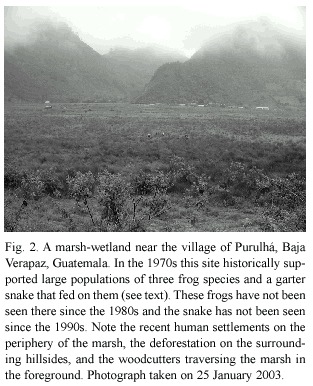
<body><![CDATA[<p><font face="Arial" size="2">Declines of amphibian populations around the planet in recent years have been documented sufficiently to establish that the phenomenon is real (<a href="#li98">Lips 1998</a>,<a  href="#li99">1999</a>,<a href="#al99">Alford and Richards 1999</a>, <a  href="#ho00">Houlahan <i>et al.</i>2000</a>)and that "natural" fluctuations in the size of local populations (<i>e.g.,</i><a  href="#pe91">Pechmann <i>et al.</i>1991</a>)are not generally causing temporary,apparent declines. In Mesoamerica and elsewhere,most of the documented declines have been associated with upland (&gt;600 m elevation) populations of frogs that are associated with streams (<i>e.g., </i><a href="#po97">Pounds <i>et al.</i>1997</a>,<a href="#li98">Lips 1998</a>,<a href="#li99">1999</a>).Beyond simple habitat destruction,many causal agents (<i>e.g </i>.,introduction of alien species,global climate change)have been suspected and investigated at a wide variety of sites (see <a href="#co03">Collins and Storfer 2003</a>,for review).Despite the real negative influence of some of these causal agents (<i>e.g.,</i>alien species,<a href="#ka03">Kats and Ferrer 2003</a>) the clearest link to amphibian declines (especially in protected regions)is with the fungal disease amphibian chytridiomycosis – perhaps in association with other pathogens (<a  href="#be98">Berger <i>et al.</i>1998</a>,<a href="#da03">Daszak <i>et al.</i>2003</a>).This disease is caused by the amphibian-specific aquatic fungus,<i>Batrachochytrium dendrobatidis,</i>which was only recently discovered and described (<a href="#lo99">Longcore <i>et al.</i>1999</a>).The pathogen has been clearly implicated in amphibian declines at disjunct sites around the world,and is considered to be an emerging infectious disease (see <a href="#da03">Daszak <i>et al.</i>2003</a>,for review).The recent documentation of this pathogen around the world (<a  href="#da03">Daszak <i>et al.</i>2003</a>)suggests a recent rapid invasion,which is corroborated by low levels of genetic variation among samples collected worldwide (<a href="#mo03">Morehouse <i>et al.</i>2003</a>); further work on this critical front is warranted. The origin of this fungus and the epidemic is unknown,as is its method of dispersal (<a  href="#mo03">Morehouse <i>et al.</i>2003</a>);simply put,the biology of this fungus is virtually unknown.</font></p>     <p><font face="Arial" size="2">In Mesoamerica,direct evidence of chytrid-associated declines in amphibians has been documented in Panama (<a href="#be98">Berger <i>et al.</i>1998</a>), Costa Rica (<a  href="#li03">Lips <i>et al.</i>2003</a>),and Mexico (<a href="#li04">Lips <i>et al.</i>2004</a>).Indirect evidence of the disease (missing and/or misshapen mouthparts in tadpoles,<a href="#fe01">Fellers <i>et al.</i>2001</a>)has been reported from Guatemala (<a href="#ca92">Campbell and Smith 1992</a>) and Honduras (<a href="#mc02">McCranie and Wilson 2002</a>). </font></p>     <p><font face="Arial" size="2">In this paper we report our observations of a severe die-off of tadpoles from a cloudforest site in the Sierra de las Minas of Guatemala,provide the first documented report of chytridiomycosis from that country,and report our long-term observations of declines of frogs from a montane wetland in the same region.We also briefly report on the establishment of commercial leatherleaf fern plantations in the region,and their potential effects on the local environment. </font></p> <font face="Arial" size="2"><b>     <p>Materials and methods</p> </b></font>     <p><font face="Arial" size="2">Diurnal and nocturnal visual surveys for frogs and tadpoles were conducted at Río Cafetal,Baja Verapaz,Guatemala (located in the Sierra de las Minas;see description below). Surveys were conducted on 22 –23 December 2002 (JHM,MEA),24 January 2003 (JRM, EDB,NJS,JAC),and 15 –16 March 2003 (JHM, MEA).We compared the approximate relative abundance of species of stream-associated frogs with historical observations from the site and general region (<a  href="#ca01">Campbell 2001</a>). Additional anecdotal observations are reported from a proximate wetland site near the village of Purulhá, Baja Verapaz,Guatemala.Pathological examination was conducted for chytrid fungi on a single tadpole of <i>Ptychohyla hypomykter </i>.Water samples from Río Cafetal were collected on 25 January 2003 and analyzed for evidence of pesticides,herbicides,and semivolatile compounds; these analyses were performed by Chemtech-Ford Analytical Laboratories (Salt Lake City, Utah, USA)in accordance with National Environmental Laboratory Accreditation Program, section 5.13.</font></p>     <p><font face="Arial" size="2">Additional samples were analyzed for nutrient chemistry.Samples were filtered (Whatman GF/F 0.7 </font><font  face="Arial" size="2">µm)and acidified to pH-2 in the field. These were analyzed for nitrate-nitrogen (NO<sub>3</sub>- N)and phosphate-phosphorus (PO<sub>4</sub> -P)using ion chromatography (<a  href="#he95">Hedin <i>et al.</i>1995</a>,<a href="#am98">APHA 1998</a>), total dissolved nitrogen (TDN)and total dissolved phosphorus (TDP)by persulfate oxidation followed by spectroscopic analysis (<a href="#va81">Valerrama 1981</a>,<a href="#am98">APHA 1998</a>),and dissolved organic carbon (DOC)by wet persulfate oxidation (<a href="#me64">Menzel and Vaccaro 1964</a>)by the Aquatic Biogeochemistry Lab at Utah State University.</font></p> <font face="Arial" size="2"><b></b></font>     <p><font face="Arial" size="2"><b>Study Sites:</b>The Sierra de las Minas is a massive east –west trending range on the Atlantic Versant of Guatemala that separates the humid Polochic Valley from the arid Motagua Valley.<a href="#ca01">Campbell (2001)</a> provided a thorough description of this mountain range,and the specific area in which our study took place. Our surveys took place along the Río Cafetal (Guatemala:Baja Verapaz:3.0 km N of La Unión Barrios,1680 m elevation).The section of the Río Cafetal in which our surveys took place is located in primary cloudforest adjacent to the eastern perimeter of the Biotopo "Mario Dary "preserve.Our surveys took place along a 300 m reach of the stream on the eastern side of highway CA-14,beginning at the highway itself.While our surveys were conducted along a section of stream running through primary cloud forest,the section just upstream (on the other side of the highway)lies adjacent to a massive,recently (since the mid-1980 ’s)established leatherleaf fern (<i>Rumohra adiantiformis </i>) plantation.Except for a small gallery of remnant vegetation directly along the stream, there is no remaining forest vegetation along that section of the stream (<a  href="#f1">Fig.1</a>).Additional surveys were also conducted at two unnamed streams located within a few km of the Río Cafetal:Stream 1)located 6.1 rd km N of La Unión Barrios on Hwy CA 14 (15 °12 ’42.1 "N; 90 °12 ’ 23.9 "W);Stream 2)located 2 –3 air km NNE of La Unión Barrios (15 °11 ’29.3 "N;90 ° 11 ’ 43.8 "W).Both of these streams run through secondary vegetation in cloudforest at similar elevations to the Río Cafetal study site.</font></p> <a name="f1"></a>     <div style="text-align: center;"><img src="/img/fbpe/rbt/v52n4/3149i1.JPG" title=""  alt="" style="width: 310px; height: 382px;"></div>     
<p><font face="Arial" size="2">&nbsp;    <br> The frog fauna of this region was documented by JAC in the 1970s (<a  href="#ca01">Campbell 2001</a>) and has been sampled by JAC and associates periodically since that time.Río Cafetal is a primary breeding site for an assemblage of forest-dwelling frogs including four hylid species (<i>Plectrohyla hartwegi, P. pokomchi, P. quecchi,Ptychohyla hypomykter </i>)and one ranid species (<i>Rana maculata </i>); the centrolenid species <i>Hyalinobatrachium fleischmanni </i>has been seen there sporadically.These species typically deposit eggs in pools (<i>e.g.,</i>splash pools below small waterfalls or between riffle zones)in streams during the dry season (January –May). In part because of the cool water temperatures, metamorphosis of tadpoles may take more than one year.Thus,at any time of the year,different stages of tadpoles of all species may be found in the streams in this area.Additional frogs, most notably several species in the leptodactylid genus <i>Eleutherodactylus,</i>are associated with streams in this area but do not use them to reproduce.The hylid species <i>Hyla bromeliacea </i>and <i>H.minera </i>are also known from the area, but these species deposit eggs in bromeliads and tree cavities.</font></p>     ]]></body>
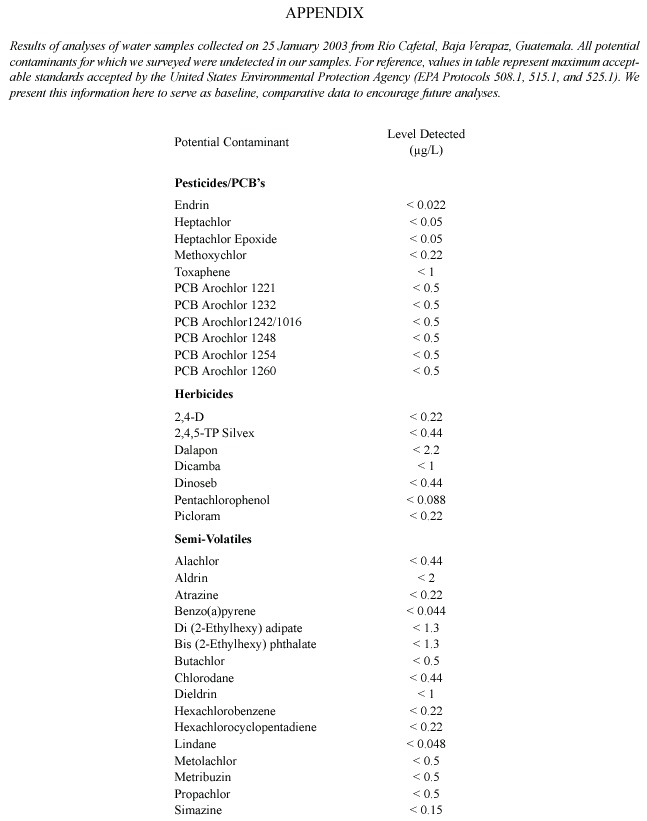
<body><![CDATA[<p><font face="Arial" size="2">The wetland extending north from the town of Purulhá (<a href="#f2">Fig.2</a>)is an open,mostly tree-less marsh dominated by reeds (<a href="#f2">Fig.2</a>).In the 1970s the hillsides around the marsh were covered in primary cloudforest,and enormous populations of the bufonid <i>Bufo ibarrai,</i>the hylid <i>Hyla bocourti </i>,and the microhylid <i>Hypopachus barberi </i>bred there (<a href="#ca01">Campbell 2001</a>).</font></p>     <p style="text-align: center;"><font face="Arial" size="2">&nbsp;<a  name="f2"></a><img src="/img/fbpe/rbt/v52n4/3149i2.JPG" title="" alt=""  style="width: 313px; height: 386px;"></font></p> <font face="Arial" size="2"><b>     
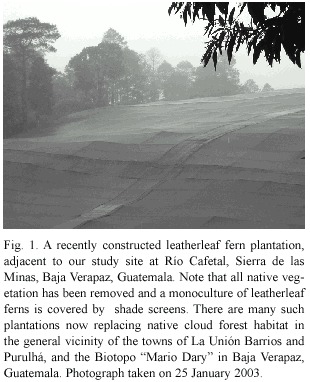
<p>Results</p> </b></font>     <p><font face="Arial" size="2">On 21 December 2003,tadpoles of <i>Ptychohyla hypomykter </i>(<i>n </i>=12)and <i>Plectrohyla quecchi </i>(<i>n </i>=5)were collected from Stream 1.No malformed mouthparts were observed in subsequent examination of these specimens.A nocturnal survey that night found adults of <i>Plectrohyla quecchi </i>(<i>n </i>=5)and <i>Eleutherodacylus </i>cf.<i>doddi </i>(<i>n </i>=2);males of <i>P. quecchi </i>were vocalizing.</font></p>     <p><font face="Arial" size="2">On 22 December 2002,we surveyed a 300 m stretch of Río Cafetal and observed an estimated several thousand tadpoles in the stream.Approximately 60-70%(a conservative estimate)of these tadpoles were either dead or in the process of dying.The dying tadpoles had white-colored tail tips,and the entire body was whitish in those that were dead.Dying tadpoles were observed to swim differently than did the apparently unaffected tadpoles.The discolored portion of the tail did not move when the rest of the tail musculature contracted,causing the tadpole to move irregularly.A random subsample of these tadpoles were all identified as <i>Ptychohyla hypomyketer;</i>it is possible that some individuals of <i>Plectrohyla </i>spp.were also present.No tadpoles of other species were observed.During a nocturnal survey conducted that night,apparently healthy adults of <i>Plectrohyla hartwegi </i>(<i>n </i>=3),<i> Ptychohyla hypomykte </i>r (<i>n </i>=9),and <i>Rana maculata </i>(<i>n </i>=2)were observed.Also observed were unusually long algal mats extending from submerged rocks and streaming in the water current.</font></p>     <p><font face="Arial" size="2">On 23 December 2003,tadpoles of <i>Plectrohyla hartwegi </i>(<i>n </i>=2),<i>Plectrohyla quecchi </i>(<i>n </i>=3),and <i>Ptychohyla hypomykter </i>(<i>n </i>= 11)were collected at Stream 2.Mouthparts of tadpoles of all <i>Plectrohyla </i>appeared normal,but 30 %of the <i>Ptychohyla </i>tadpoles had both missing denticle teeth and malformed jaw sheaths.Adults seen at this time included <i>Plectrohyla quecchi </i>(<i>n </i>=4;males calling sporadically), <i>Ptychyohyla hypomykter </i>(<i>n </i>=1), and <i>Rana maculata </i>(<i>n </i>=3). </font></p>     <p><font face="Arial" size="2">On 25 January 2003,a diurnal survey of approximately six person-hours on the same 300 m section of the Río Cafetal found only four tadpoles of <i>Ptychohyla hypomykter. </i>Three of these four tadpoles had obviously malformed keratinous jaw sheaths and were missing sections of their keratinous denticle rows. Subsequent pathological analysis of one tadpole provided direct confirmation of infection by the pathogenic fungus <i>B.dendrobatidis;</i>fungi were found in the oral tissues of this tadpole <i>.</i></font></p>     <p><font face="Arial" size="2">A follow-up visit to the Río Cafetal site on 15 –16 March 2003 observed approximately 500 –1000 tadpoles of <i>Ptychohyla hypomykter </i>; no tadpoles of any other species were observed. Sample collections of tadpoles of <i>Ptychohyla hypomykter </i>were made (<i>n </i>=56,representing Gosner Stages 25 –37)on 16 March 2003. Examination of the mouthparts of these tadpoles revealed that 46 %were missing denticle rows and/or had malformed jaw sheaths.A nocturnal survey on 16 March found adult <i>Ptychohyla hypomykter </i>(<i>n </i>=6)and <i>Plectrohyla hartwegi </i>(<i>n </i>=2),and juvenile <i>Rana maculata </i>(<i>n </i>=2).</font></p>     <p><font face="Arial" size="2">Analysis of water samples collected on 25 January 2003 found levels of PCBs, pesticides, herbicides,and semi-volatiles to be below limits established by the United States Environmental Protection Agency for all chemicals tested (<a href="#a">Appendix</a>).Nitrogen levels were relatively high for tropical streams,but well below EPA limits for drinking water quality; TDN was 1.22 +0.10 mgN/L and NO3-N was 0.960 +0.002 mgN/L.Phosphorus levels were below the detection limit (0.1 mgP/L for TDP and 0.002 mgP/L for PO4-P)for both analyses. DOC levels averaged 2.22 +0.05 mgC/L.</font></p>     <p><font face="Arial" size="2">We (JAC and associates)have opportunistically surveyed the frogs of the marsh near Purulhá at various times between 1975 –2003; these surveys clearly indicate that the three most common species (<i>Bufo ibarrai,Hyla bocourti </i>, and <i>Hypopachus barberi </i>)abruptly disappeared sometime in 1983 –1984.On several visits in the 1990s,teams of herpetologists were also unable to find the historically abundant garter snake <i>Thamnophis fulvus </i>;this snake frequently preys on frogs and tadpoles.</font></p> <font face="Arial" size="2"><b>     ]]></body>
<body><![CDATA[<p>Discussion</p> </b></font>     <p><font face="Arial" size="2">The Sierra de las Minas are certainly experiencing direct habitat alteration and contamination associated with both slash-and-burn and commercial agriculture,and they must be prone to the broader scale environmental influences that affect cloudforests regionally (<a href="#fo01">Foster 2001</a>)and forest ecosystems worldwide (<a href="#no03">Nosengo 2003</a>).Anurans in this area may well be affected in a synergistic fashion by both local and global effects of environmental and anthropogenic factors.Identifying and demonstrating the cause and direct effects of such synergistic influences is not possible at this time (<a href="#co03">Collins and Storfer 2003</a>).</font></p>     <p><font face="Arial" size="2">While we have observed evident declines in amphibian populations in Guatemala for years (<a href="#ca99">Campbell 1999</a>)and can associate many of these events with rampant deforestation, slash-and-burn agriculture, and pesticides,this is the first confirmed report of amphibian chytridiomycosis in the country.Our results augment recent reports from Mexico (<a href="#li04">Lips <i>et al.</i>2004</a>)in providing a spatio-temporal link between documented epidemics in lower Central America and North America.But note that indirect evidence of chytrid infection (missing mouthparts in tadpoles;see <a href="#fe01">Fellers <i>et al.</i>2001</a>)was first reported in Guatemala more than a decade ago by <a href="#ca92">Campbell and Smith (1992)</a>;at that time it was unknown that missing mouthparts in tadpoles was indicative of the presence of lethal pathogens.</font></p>     <p><font face="Arial" size="2">Our anuran surveys at Río Cafetal demonstrate much lower abundance of adults of three anuran species (<i>Plectrohyla hartwegi, Ptychohyla hypomykter,Rana maculata)</i>than was ever observed in the 1970 ’s,and the apparent absence of two species (<i>Plectrohyla pokomchi,P.quecchi </i>).Our surveys of tadpoles indicate that <i>Ptychohyla hypomykter </i>continues to reproduce there,but that <i>Rana maculata </i>and three species of <i>Plectrohyla </i>(<i>P.hartwegi, P.pokomchi,P.quecchi </i>)do not continue to reproduce there.We have demonstrated that the pathogenic fungus <i>Batrachochytrium dendrobatidis </i>is present at the site,and that it is affecting tadpoles.Because <i>B.dendrobatidis </i>has been identified as a lethal pathogen of anurans (<a href="#lo99">Longcore <i>et al.</i>1999</a>)and it has been directly associated with catastrophic declines of anurans in various regions of the neotropics (e.g.,<a href="#be98">Berger <i>et al.</i>1998</a>,<a href="#li03">Lips <i>et al.</i>2003</a>,<a  href="#ro03">Ron <i>et al.</i>2003</a>),we posit this pathogen as a direct cause of mortality to anurans at this site.We cannot rule out the possibility that tadpoles may also have been affected by a sudden pulse of contaminants in the stream.Nor can we directly evaluate the potential direct or synergistic effects of the increased nitrogenation of the stream may have had on anuran mortality. Note that our surveys of streams in nearby areas did locate adults of <i>Plectrohyla quecchi, </i>and also tadpoles of <i>Plectrohyla hartwegi </i>.</font></p>     <p><font face="Arial" size="2">The timing of our visits coincided with the known breeding and general activities of larval, juvenile,and adult cohorts of all species at our site;such was the case during this same season in the 1970s. However,it should be noted that <i>Plectrohyla quecchi </i>is usually more abundant in smaller tributaries (<i>e.g.</i>Stream 1),often little more than trickles of water.<i>Ptychohyla hypomykter </i>persists at the site,and some tadpoles still occur in the stream.Our discovery of a tadpole of <i>Ptychohyla hypomykter </i>that was</font></p>     <p><font face="Arial" size="2">positively infected by <i>B.dendrobatidis </i>indicates that this species does contract amphibian chytridiomycosis.Because <i>Ptychohyla hypomykter </i>appears to persist (though in vacillating numbers)at our site,our observations also suggest that this species may be more tolerant of the pathogen than are other species (<i>e.g </i>.species of <i>Plectrohyla </i>,whose declines at our site are presumably associated with chytrid infections).While there are no data regarding phylogenetic differences in the susceptibility of frogs to amphibian chytridiomycosis,we note that there is no evidence to suggest that <i>Plectrohyla </i>and <i>Ptychohyla </i>are each others closest relatives (<a href="#du92">Duellman and Campbell 1992</a>,<a href="#da98">da Silva 1998</a>). Species of <i>Plectrohyla </i>(and potentially their closest relatives)may be more susceptible to amphibian chytridiomycosis than are species of <i>Ptychohyla.</i></font></p>     <p><font face="Arial" size="2">The large marsh near Purulhá once harbored abundant populations of anurans,and a species of frog-eating garter snake (<i>Thamnophis fulvus </i>)was common (JAC,pers.obs.).As the frogs disappeared in the 1980s,we did not have the opportunity to assess the direct causes of their declines.Channels have been dug throughout this marsh for drainage,and these have clearly modified the local environment.</font></p>     <p><font face="Arial" size="2">However,sufficient water remains in some areas to support anuran populations,so it is not clear why these anurans disappeared from this site.In any case,it appears that the disappearance of an anuran prey-base has effected a subsequent decline of a predatory snake (see also <a href="#ma02">Matthews <i>et al.</i>2002</a>).</font></p>     <p><font face="Arial" size="2">Vast tracts of cloudforest habitat in the vicinity of the Biotopo "Mario Dary "and the villages of La Unión Barrios and Purulhá, Baja Verapaz,have been recently (beginning in the mid-1980s)cleared and converted into artificially-shaded leatherleaf fern plantations.Fronds of leatherleaf fern are commonly included as part of ornamental cut-flower arrangements;local people at our site indicated that fronds produced in this area are being exported to Europe.Leatherleaf ferns from this region are currently a 12-million dollar export crop (<a href="#ga96">Galinsky 1996</a>).Leatherleaf plantations are typically located on well-drained,fertile soils,with abundant water and mild temperatures (<a href="#mo01">Mo 2001</a>);conditions such as these</font></p>     <p><font face="Arial" size="2">that occur at our study site (<a  href="#ca01">Campbell 2001</a>). Cultivation of leatherleaf ferns in Costa Rica typically involves application high doses of a wide variety of fungicides,insecticides,and herbicides (<a href="#st97">Stamps and McColley 1997</a>,see <a href="#mo01">Mo 2001</a>,for review);many of these chemicals are prohibited in Europe and the United States. One predominant fungicide used in cultivation is chlorothalonil (<a  href="#st97">Stamps and McColley 1997</a>, <a href="#mo01">Mo 2001</a>);chlorothalonil is highly toxic to a variety of aquatic animals (<a href="#mo01">Mo 2001</a>). Because leatherleaf is an ornamental plant,rather than an edible plant,importing countries enforce</font></p>     ]]></body>
<body><![CDATA[<p><font face="Arial" size="2">no maximum allowable limits for chemical residues.In addition,precisely because it is an ornamental plant,specimens with the least damage from insects or fungal pathogens have the greatest value,thus encouraging massive application of pesticides and herbicides (<a href="#mo01">Mo 2001</a>).The primary nutrients required to cultivate leatherleaf ferns are nitrogen (in the form of urea,ammonium,or nitrate)and potassium (<a href="#st95">Stamps 1995</a>).Stamps specifically emphasized the risks of local environmental contamination associated with leatherleaf fern production: </font></p>     <p><font face="Arial" size="2">The high leaching potential of these soils places water resources in leatherleaf fern production areas at risk of contamination unless appropriate management practices are followed …This leachability is a cause for concern, since N [itrogen ]can end up in drinking water supplies where it may become a health hazard (<a href="#st95">Stamps 1995</a>:2 –3).</font></p>     <p><font face="Arial" size="2">We detected relatively high levels of nitrogen in the stream and we suspect that this reflects fertilizer use in the watershed.The long algal mats in the stream are also suggestive of unnaturally high levels of nitrogen in the water; such algal mats were not observed by J.A. Campbell in the 1970s.Information on NO<sub>3</sub>- N and TDN levels in neotropical streams is limited in the literature.The concentrations we report here are considerably higher than data published for high-elevation tropical streams at the Luquillo Experimental Forest Long Term Ecological Research site in Puerto Rico,where values for NO<sub>3</sub>-N range from 0.054 –0.066 mg/L and TDN range from 0.190 –0.223 mg/L (<a href="#mc94">McDowell and Asbury 1994</a>).A larger range for NO<sub>3</sub>-N (0 –0.229 mg/L)was reported from montane tropical streams in the Cordillera Central and the Cordillera de Tilarán of Costa Rica (<a href="#pr93">Pringle <i>et al.</i>1993</a>). The N levels we measured in the Río Cafetal are at least 4X higher than levels reported from similar sites in the neotropics.</font></p>     <p><font face="Arial" size="2">While a direct connection between increased nitogenation of stream systems and amphibian chytridiomycosis has not been demonstrated,direct mortality of tadpoles by nitrogen-based fertilizer contamination has been well documented (see Blaustein <i>et al.</i>2003,for review).The symptoms we observed among the dying tadpoles on 22 December 2002 were generally consistent with the effects of nitrogen poisoning documented by <a href="#ma99">Marco <i>et al.</i>(1999)</a>.</font></p>     <p><font face="Arial" size="2">The water samples we collected and analyzed did not show evidence of contamination by the specific fungicide mentioned above,nor by a broad spectrum of pesticides,herbicides, or other volatile compounds.In light of the exhaustive study by <a href="#mo01">Mo (2001)</a>in Costa Rica, we are forced to conclude that the plantations in Guatemala surely follow similar protocols of heavy applications of a variety of highly toxic chemicals to their crops.We did not detect these chemicals in our analyses,perhaps because they were applied at some unknown time prior to our sampling (i.e.,there was a temporary pulse of contamination that preceded our collecting activities).We note that <a href="#mo01">Mo (2001)</a>was careful to collect water samples from plantation effluents.We did not have sufficient information to organize our sampling in a similar manner.Owners and workers at fern plantations are not willing to discuss their agricultural practices,nor their application regime for agricultural chemicals (pers. obs.,<a  href="#mo01">Mo 2001</a>). Pesticide exposure can induce immunosuppression in frogs (<a href="#gi03">Gilbertson <i>et al. </i>2003</a>),and conceivably could have affected the tadpoles at our site.We do not know what potential effects various agricultural fungicides could possibly have on populations of the pathogenic chytrids in the region.</font></p>     <p><font face="Arial" size="2">In any case,our results clearly indicate that yet another assemblage of upland frogs in Mesoamerica has been severely impacted. The pathogenic chtyrid fungus <i>B.dendrobatidis </i>is present at the site,and is affecting tadpoles.As such it appears the declines we have documented have been caused,at least in part,by a local epidemic of amphibian chytridiomycosis.It is possible that local frog populations have also suffered negative effects (direct and/or indirect)from contamination of their natal stream —contamination in the form of increased nitrogenation,and possibly from agricultural chemicals.We cannot predict when,or if,populations at this site will recover from the recent,catastrophic declines. Of the species historically present at our site, <i>Plectrohyla quecchi </i>and <i>Plectrohyla pokomchi </i>have relatively restricted distributions in the highlands of eastern Guatemala;the remaining species have somewhat broader distributions in the uplands of nuclear Central America.We are confident that the recent construction of massive leatherleaf fern plantations in the area has fragmented native habitat and therefore may reduce the likelihood that this area can be recolonized by frogs from other drainages. We also suspect that the local leatherleaf plantations are contaminating the watershed with nitrogen-based fertilizers;our data indirectly suggest that such contamination is related to the local amphibian population declines.</font></p>     <p><font face="Arial" size="2">At our study site we have documented habitat destruction,apparent contamination from agricultural chemicals,presence of amphibian chytridiomycosis,a massive amphibian population decline,and the apparently associated decline of a snake species.Amphibian population declines are complex phenomena (<a  href="#ki01">Kiesecker <i>et al.</i>2001</a>).The probable synergistic links between the phenomenon we have documented in Guatemala —and indeed influences yet to be identified and considered — remain unclear at our site and globally.</font></p> <font face="Arial" size="2"><b>     <p>Acknowledgments</p> </b></font>     <p><font face="Arial" size="2">We thank Alison Kelly,Karen Lips, Claudette Mo,Robert Puschendorf,and Patricia Burrows for invaluable assistance on this project,and members of the USU Herpetology Group for their insightful critiques and discussions.Allan Pessier (University of Illinois Zoological Pathology Program,Loyola University Medical Center)examined the specimen for Chytrid fungi.Chemical analyses in the Baker lab were conducted by Agnes Chartier. This research was conducted in direct association with The Research Analysis Network for Neotropical Amphibians (RANA),which is supported by the National Science Foundation (DEB-0130273).This research was supported in part by a National Science Foundation grant to J.A.Campbell (DEB-0102383).</font></p> <font face="Arial" size="2"><b>     <p>Resumen</p> </b></font>     ]]></body>
<body><![CDATA[<p><font face="Arial" size="2">Una comparación entre un inventario anterior y otro reciente de poblaciones de ranas de bosque nublado en la Sierra de Las Minas de Guatemala demostró disminuciones poblacionales y ausencia localizada de varias especies.El examen patológico de un renacuajo muerto indicó infección por un hongo quítrido propio de los anfibios.El hábitat local ha sido gravemente alterado por el establecimiento reciente de producción a gran escala de helechos ornamentales.El análisis químico del agua en el área de estudio señaló un aumento en nitrogenación asociado al cultivo de helechos.</font></p> <font face="Arial" size="2"><b></b></font>     <p><font face="Arial" size="2"><b>Palabras clave:</b>declinación de anfibios,quitridiomicosis,Guatemala,Anura,<i>Plectrohyla</i>, <i>Ptychohyla, </i>helechos ornamentales.</font></p> <font face="Arial" size="2"><b>     <p>References</p> </b></font>     <!-- ref --><p><font face="Arial" size="2"><a name="al99"></a>Alford,R.A.&amp;S.J.Richards.1999.Global amphibian declines:a problem in applied ecology.Ann.Rev. Syst.Ecol.30:133-165.</font>&nbsp;&nbsp;&nbsp;&nbsp;&nbsp;&nbsp;&nbsp;&nbsp;[&#160;<a href="javascript:void(0);" onclick="javascript: window.open('/scielo.php?script=sci_nlinks&ref=1224799&pid=S0034-7744200400040002100001&lng=','','width=640,height=500,resizable=yes,scrollbars=1,menubar=yes,');">Links</a>&#160;]<!-- end-ref --><!-- ref --><p><font face="Arial" size="2"><a name="am98"></a>American Public Health Association (APHA).1998. Standard Methods for the Examination of Water and Waste Water 20<sup>th</sup> Edition.APHA,Washington DC.</font>&nbsp;&nbsp;&nbsp;&nbsp;&nbsp;&nbsp;&nbsp;&nbsp;[&#160;<a href="javascript:void(0);" onclick="javascript: window.open('/scielo.php?script=sci_nlinks&ref=1224800&pid=S0034-7744200400040002100002&lng=','','width=640,height=500,resizable=yes,scrollbars=1,menubar=yes,');">Links</a>&#160;]<!-- end-ref --><!-- ref --><p><font face="Arial" size="2"><a name="be98"></a>Berger,L.,R.Speare,P.Daszak,D.E.Green,A.A. Cunningham,R.Slocombe,C.L.Goggin,A.D. Hyatt, K.R. MacDonald, H.B. Hines, K.R.Lips,G. Marantelli &amp;H.H.Parkes.1998.Chytridiomycosis causes amphibian mortality associated with population declines in the rainforests of Australia and Central America.Proc.Nat.Acad.Sci.95:9031-9036.</font>&nbsp;&nbsp;&nbsp;&nbsp;&nbsp;&nbsp;&nbsp;&nbsp;[&#160;<a href="javascript:void(0);" onclick="javascript: window.open('/scielo.php?script=sci_nlinks&ref=1224801&pid=S0034-7744200400040002100003&lng=','','width=640,height=500,resizable=yes,scrollbars=1,menubar=yes,');">Links</a>&#160;]<!-- end-ref --><!-- ref --><p><font face="Arial" size="2"><a name="ba03"></a>Blaustein,A.R.,J.M.Romansic,J.M.Kiesecker &amp;A.C. Hatch.2003.Ultraviolet radiation,toxic chemicals and amphibian population declines.Diversity and Distributions 9:123-140.</font>&nbsp;&nbsp;&nbsp;&nbsp;&nbsp;&nbsp;&nbsp;&nbsp;[&#160;<a href="javascript:void(0);" onclick="javascript: window.open('/scielo.php?script=sci_nlinks&ref=1224802&pid=S0034-7744200400040002100004&lng=','','width=640,height=500,resizable=yes,scrollbars=1,menubar=yes,');">Links</a>&#160;]<!-- end-ref --><!-- ref --><p><font face="Arial" size="2"><a name="ca99"></a>Campbell,J.A.1999.Distribution patterns of amphibians in Middle America,p.111-209.<i>In </i>W.E.Duellman (ed.).Distribution Patterns of Amphibians:A Global Perspective.Johns Hopkins,Baltimore.</font>&nbsp;&nbsp;&nbsp;&nbsp;&nbsp;&nbsp;&nbsp;&nbsp;[&#160;<a href="javascript:void(0);" onclick="javascript: window.open('/scielo.php?script=sci_nlinks&ref=1224803&pid=S0034-7744200400040002100005&lng=','','width=640,height=500,resizable=yes,scrollbars=1,menubar=yes,');">Links</a>&#160;]<!-- end-ref --><!-- ref --><p><font face="Arial" size="2"><a name="ca01"></a>Campbell,J.A.2001.The herpetofauna of the mesic upland forests of the Sierra de las Minas and Montañas del Mico of Guatemala,pp.80-93.<i>In </i>J. D.Johnson,R.G.Webb &amp;O.Flores-Villela (eds.). Mesoamerican Herpetology: Systematics, Natural History,and Conservation.University Texas El Paso,El Paso,Texas <i>.</i></font>&nbsp;&nbsp;&nbsp;&nbsp;&nbsp;&nbsp;&nbsp;&nbsp;[&#160;<a href="javascript:void(0);" onclick="javascript: window.open('/scielo.php?script=sci_nlinks&ref=1224804&pid=S0034-7744200400040002100006&lng=','','width=640,height=500,resizable=yes,scrollbars=1,menubar=yes,');">Links</a>&#160;]<!-- end-ref --><!-- ref --><p><font face="Arial" size="2"><a name="ca92"></a>Campbell,J.A.&amp;E.N.Smith.1992.A new frog of the genus <i>Ptychohyla </i>(Hylidae)from the Sierra de Santa Cruz,Guatemala,and description of a new genus of Middle American stream-breeding treefrogs. Herpetologica 48:153-167.</font>&nbsp;&nbsp;&nbsp;&nbsp;&nbsp;&nbsp;&nbsp;&nbsp;[&#160;<a href="javascript:void(0);" onclick="javascript: window.open('/scielo.php?script=sci_nlinks&ref=1224805&pid=S0034-7744200400040002100007&lng=','','width=640,height=500,resizable=yes,scrollbars=1,menubar=yes,');">Links</a>&#160;]<!-- end-ref --><!-- ref --><p><font face="Arial" size="2"><a name="co03"></a>Collins,J.P.&amp;A.Storfer.2003.Global amphibian declines: sorting the hypotheses.Diversity and Distributions 9:89-98.</font>&nbsp;&nbsp;&nbsp;&nbsp;&nbsp;&nbsp;&nbsp;&nbsp;[&#160;<a href="javascript:void(0);" onclick="javascript: window.open('/scielo.php?script=sci_nlinks&ref=1224806&pid=S0034-7744200400040002100008&lng=','','width=640,height=500,resizable=yes,scrollbars=1,menubar=yes,');">Links</a>&#160;]<!-- end-ref --><!-- ref --><p><font face="Arial" size="2"><a name="da98"></a>da Silva,H.R.1998.Phylogenetic relationships of the family Hylidae with emphasis on the relationships within the subfamily Hylinae (Amphibia:Anura). Ph.D.dissertation,University of Kansas,Lawence, Kansas.175 p.</font>&nbsp;&nbsp;&nbsp;&nbsp;&nbsp;&nbsp;&nbsp;&nbsp;[&#160;<a href="javascript:void(0);" onclick="javascript: window.open('/scielo.php?script=sci_nlinks&ref=1224807&pid=S0034-7744200400040002100009&lng=','','width=640,height=500,resizable=yes,scrollbars=1,menubar=yes,');">Links</a>&#160;]<!-- end-ref --><!-- ref --><p><font face="Arial" size="2"><a name="da03"></a>Daszak,P.,A.A.Cunningham &amp;A.D.Hyatt.2003. Infectious disease and amphibian population declines. Diversity and Distributions 9:141-150.</font>&nbsp;&nbsp;&nbsp;&nbsp;&nbsp;&nbsp;&nbsp;&nbsp;[&#160;<a href="javascript:void(0);" onclick="javascript: window.open('/scielo.php?script=sci_nlinks&ref=1224808&pid=S0034-7744200400040002100010&lng=','','width=640,height=500,resizable=yes,scrollbars=1,menubar=yes,');">Links</a>&#160;]<!-- end-ref --><!-- ref --><p><font face="Arial" size="2"><a name="du92"></a>Duellman,W.E.&amp;J.A.Campbell.1992.Hylid frogs of the genus <i>Plectrohyla:</i>systematics and phylogenetic relationships. Misc. Publ.Mus.Zool.Univ.Michigan 181:1-32.</font>&nbsp;&nbsp;&nbsp;&nbsp;&nbsp;&nbsp;&nbsp;&nbsp;[&#160;<a href="javascript:void(0);" onclick="javascript: window.open('/scielo.php?script=sci_nlinks&ref=1224809&pid=S0034-7744200400040002100011&lng=','','width=640,height=500,resizable=yes,scrollbars=1,menubar=yes,');">Links</a>&#160;]<!-- end-ref --><!-- ref --><p><font face="Arial" size="2"><a name="fe01"></a>Fellers,G.M.,D.E.Green &amp;J.E.Longcore.2001.Oral chytridiomycosis in the mountain yellow-legged frog (<i>Rana muscosa</i>). Copeia 2001:945-953.</font>&nbsp;&nbsp;&nbsp;&nbsp;&nbsp;&nbsp;&nbsp;&nbsp;[&#160;<a href="javascript:void(0);" onclick="javascript: window.open('/scielo.php?script=sci_nlinks&ref=1224810&pid=S0034-7744200400040002100012&lng=','','width=640,height=500,resizable=yes,scrollbars=1,menubar=yes,');">Links</a>&#160;]<!-- end-ref --><!-- ref --><p><font face="Arial" size="2"><a name="fo01"></a>Foster,P.2001.The potential negative impacts of global climate change on tropical montane cloud forests. Earth Sci. Rev. 55:73-106.</font>&nbsp;&nbsp;&nbsp;&nbsp;&nbsp;&nbsp;&nbsp;&nbsp;[&#160;<a href="javascript:void(0);" onclick="javascript: window.open('/scielo.php?script=sci_nlinks&ref=1224811&pid=S0034-7744200400040002100013&lng=','','width=640,height=500,resizable=yes,scrollbars=1,menubar=yes,');">Links</a>&#160;]<!-- end-ref --><!-- ref --><p><font face="Arial" size="2"><a name="ga96"></a>Galinsky,B.1996 (July-August).Survey:American exports to Europe.Tropical Produce Marketing News:1-3. </font>&nbsp;&nbsp;&nbsp;&nbsp;&nbsp;&nbsp;&nbsp;&nbsp;[&#160;<a href="javascript:void(0);" onclick="javascript: window.open('/scielo.php?script=sci_nlinks&ref=1224812&pid=S0034-7744200400040002100014&lng=','','width=640,height=500,resizable=yes,scrollbars=1,menubar=yes,');">Links</a>&#160;]<!-- end-ref --><!-- ref --><p><font face="Arial" size="2"><a name="gi03"></a>Gilbertson,M.K,G.D.Haffner,K.G.Droulliard,A.Albert &amp;B.Dixon.2003.Immunosuppression in the northern leopard frog (<i>Rana pipiens </i>)induced by pesticide exposure.Environ.Toxicol.Chem.22:101-110.</font>&nbsp;&nbsp;&nbsp;&nbsp;&nbsp;&nbsp;&nbsp;&nbsp;[&#160;<a href="javascript:void(0);" onclick="javascript: window.open('/scielo.php?script=sci_nlinks&ref=1224813&pid=S0034-7744200400040002100015&lng=','','width=640,height=500,resizable=yes,scrollbars=1,menubar=yes,');">Links</a>&#160;]<!-- end-ref --><!-- ref --><p><font face="Arial" size="2"><a name="he95"></a>Hedin,L.O.,J.C.von Fischer,N.E.Ostrom,B.P.Kennedy, M.G.Brown &amp;G.P.Robertson.1995.Patterns of nutrient loss from unpolluted,old-growth temerate forests:tests of biogeochemical theory.Ecology 79: 684-703.</font>&nbsp;&nbsp;&nbsp;&nbsp;&nbsp;&nbsp;&nbsp;&nbsp;[&#160;<a href="javascript:void(0);" onclick="javascript: window.open('/scielo.php?script=sci_nlinks&ref=1224814&pid=S0034-7744200400040002100016&lng=','','width=640,height=500,resizable=yes,scrollbars=1,menubar=yes,');">Links</a>&#160;]<!-- end-ref --><!-- ref --><p><font face="Arial" size="2"><a name="ho00"></a>Houlahan,J.E.,C.S.Findlay,B.R.Schmidt,A.H.Meyer &amp;S.L.Kuzmin.2000.Quantitative evidence for global amphibian population declines.Nature 404: 752-755.</font>&nbsp;&nbsp;&nbsp;&nbsp;&nbsp;&nbsp;&nbsp;&nbsp;[&#160;<a href="javascript:void(0);" onclick="javascript: window.open('/scielo.php?script=sci_nlinks&ref=1224815&pid=S0034-7744200400040002100017&lng=','','width=640,height=500,resizable=yes,scrollbars=1,menubar=yes,');">Links</a>&#160;]<!-- end-ref --><!-- ref --><p><font face="Arial" size="2"><a name="ka03"></a>Kats,L.B.&amp;R.P.Ferrer.2003.Alien predators and amphibian declines:review of two decades of science and the transition to conservation.Diversity and Distributions 9:99-110.</font>&nbsp;&nbsp;&nbsp;&nbsp;&nbsp;&nbsp;&nbsp;&nbsp;[&#160;<a href="javascript:void(0);" onclick="javascript: window.open('/scielo.php?script=sci_nlinks&ref=1224816&pid=S0034-7744200400040002100018&lng=','','width=640,height=500,resizable=yes,scrollbars=1,menubar=yes,');">Links</a>&#160;]<!-- end-ref --><!-- ref --><p><font face="Arial" size="2"><a name="ki01"></a>Kiesecker,J.M.,A.R.Blaustein &amp;L.K.Belden.2001. Complex causes of amphibian population declines. Nature 410:681-684</font>&nbsp;&nbsp;&nbsp;&nbsp;&nbsp;&nbsp;&nbsp;&nbsp;[&#160;<a href="javascript:void(0);" onclick="javascript: window.open('/scielo.php?script=sci_nlinks&ref=1224817&pid=S0034-7744200400040002100019&lng=','','width=640,height=500,resizable=yes,scrollbars=1,menubar=yes,');">Links</a>&#160;]<!-- end-ref --><!-- ref --><p><font face="Arial" size="2"><a name="li98"></a>Lips,K.R.1998.Decline of a tropical amphibian fauna. Conserv.Biol.12:106-117.</font>&nbsp;&nbsp;&nbsp;&nbsp;&nbsp;&nbsp;&nbsp;&nbsp;[&#160;<a href="javascript:void(0);" onclick="javascript: window.open('/scielo.php?script=sci_nlinks&ref=1224818&pid=S0034-7744200400040002100020&lng=','','width=640,height=500,resizable=yes,scrollbars=1,menubar=yes,');">Links</a>&#160;]<!-- end-ref --><!-- ref --><p><font face="Arial" size="2"><a name="li99"></a>Lips,K.R.1999.Mass mortality of the anuran fauna at an upland site in Panama.Conserv.Biol.13:117-125.</font>&nbsp;&nbsp;&nbsp;&nbsp;&nbsp;&nbsp;&nbsp;&nbsp;[&#160;<a href="javascript:void(0);" onclick="javascript: window.open('/scielo.php?script=sci_nlinks&ref=1224819&pid=S0034-7744200400040002100021&lng=','','width=640,height=500,resizable=yes,scrollbars=1,menubar=yes,');">Links</a>&#160;]<!-- end-ref --><!-- ref --><p><font face="Arial" size="2"><a name="li03"></a>Lips,K.R.,D.E.Green &amp;R.Papendick.2003. Chytridiomycosis in wild frogs from southern Costa Rica.J.Herpetol.37:215-218.</font>&nbsp;&nbsp;&nbsp;&nbsp;&nbsp;&nbsp;&nbsp;&nbsp;[&#160;<a href="javascript:void(0);" onclick="javascript: window.open('/scielo.php?script=sci_nlinks&ref=1224820&pid=S0034-7744200400040002100022&lng=','','width=640,height=500,resizable=yes,scrollbars=1,menubar=yes,');">Links</a>&#160;]<!-- end-ref --><!-- ref --><p><font face="Arial" size="2"><a name="li04"></a>Lips,K.R.,J.R.Mendelson III,A.Muñoz-Alonso,L.Canseco- Márquez,&amp;D.G.Mulcahy.2004.Amphibian population declines in montane southern Mexico:resurveys of historical localities.Biological Conservation 119:555-564.</font>&nbsp;&nbsp;&nbsp;&nbsp;&nbsp;&nbsp;&nbsp;&nbsp;[&#160;<a href="javascript:void(0);" onclick="javascript: window.open('/scielo.php?script=sci_nlinks&ref=1224821&pid=S0034-7744200400040002100023&lng=','','width=640,height=500,resizable=yes,scrollbars=1,menubar=yes,');">Links</a>&#160;]<!-- end-ref --><!-- ref --><p><font face="Arial" size="2"><a name="lo99"></a>Longcore,J.E.,A.P.Pessier &amp;D.K.Nichols.1999. <i>Batrachochytrium dendrobatidis </i>gen.et sp.nov.,a chytrid pathogenic to amphibians.Mycologia 91: 219-227.</font>&nbsp;&nbsp;&nbsp;&nbsp;&nbsp;&nbsp;&nbsp;&nbsp;[&#160;<a href="javascript:void(0);" onclick="javascript: window.open('/scielo.php?script=sci_nlinks&ref=1224822&pid=S0034-7744200400040002100024&lng=','','width=640,height=500,resizable=yes,scrollbars=1,menubar=yes,');">Links</a>&#160;]<!-- end-ref --><!-- ref --><p><font face="Arial" size="2"><a name="ma99"></a>Marco,A.,C.Quilchano &amp;A.R.Blaustein.1999.Sensitivity to nitrate and nitrite in pond-breeding amphibians from the Pacific Northwest.Environ.Toxicol.Chem. 18:2836-2839.</font>&nbsp;&nbsp;&nbsp;&nbsp;&nbsp;&nbsp;&nbsp;&nbsp;[&#160;<a href="javascript:void(0);" onclick="javascript: window.open('/scielo.php?script=sci_nlinks&ref=1224823&pid=S0034-7744200400040002100025&lng=','','width=640,height=500,resizable=yes,scrollbars=1,menubar=yes,');">Links</a>&#160;]<!-- end-ref --><!-- ref --><p><font face="Arial" size="2"><a name="ma02"></a>Matthews,K.R.,R.A.Knapp &amp;K.L.Pope.2002.Garter snake distributions in high-elevation aquatic ecosystems:is there a link with declining amphibian populations and nonnative trout introductions?J.Herpetol. 36:16-22.</font>&nbsp;&nbsp;&nbsp;&nbsp;&nbsp;&nbsp;&nbsp;&nbsp;[&#160;<a href="javascript:void(0);" onclick="javascript: window.open('/scielo.php?script=sci_nlinks&ref=1224824&pid=S0034-7744200400040002100026&lng=','','width=640,height=500,resizable=yes,scrollbars=1,menubar=yes,');">Links</a>&#160;]<!-- end-ref --><!-- ref --><p><font face="Arial" size="2"><a name="mc02"></a>McCranie,J.R.&amp;L.D.Wilson.2002.Amphibians of Honduras.Society for the Study of Amphibians and Reptiles. Ithaca, NY, 625 p.</font>&nbsp;&nbsp;&nbsp;&nbsp;&nbsp;&nbsp;&nbsp;&nbsp;[&#160;<a href="javascript:void(0);" onclick="javascript: window.open('/scielo.php?script=sci_nlinks&ref=1224825&pid=S0034-7744200400040002100027&lng=','','width=640,height=500,resizable=yes,scrollbars=1,menubar=yes,');">Links</a>&#160;]<!-- end-ref --><!-- ref --><p><font face="Arial" size="2"><a name="mc94"></a>McDowell,W.H.&amp;C.E.Ashbury.1994.Export of carbon, nitrogen,and major ions from three tropical montane watersheds. Limnol.Oceanog.39:111-125.</font>&nbsp;&nbsp;&nbsp;&nbsp;&nbsp;&nbsp;&nbsp;&nbsp;[&#160;<a href="javascript:void(0);" onclick="javascript: window.open('/scielo.php?script=sci_nlinks&ref=1224826&pid=S0034-7744200400040002100028&lng=','','width=640,height=500,resizable=yes,scrollbars=1,menubar=yes,');">Links</a>&#160;]<!-- end-ref --><!-- ref --><p><font face="Arial" size="2"><a name="me64"></a>Menzel,D.W.&amp;R.F.Vacarro.1964.The measurement of dissolved and particulate organic carbon in sea water. Limnol. Oceanogr.9:138-142.</font>&nbsp;&nbsp;&nbsp;&nbsp;&nbsp;&nbsp;&nbsp;&nbsp;[&#160;<a href="javascript:void(0);" onclick="javascript: window.open('/scielo.php?script=sci_nlinks&ref=1224827&pid=S0034-7744200400040002100029&lng=','','width=640,height=500,resizable=yes,scrollbars=1,menubar=yes,');">Links</a>&#160;]<!-- end-ref --><!-- ref --><p><font face="Arial" size="2"><a name="mo01"></a>Mo,C.L.2001.Environmental impacts of leatherleaf fern farms in Costa Rica.Unpublished dissertation, University of Wisconsin Madison,132 p.</font>&nbsp;&nbsp;&nbsp;&nbsp;&nbsp;&nbsp;&nbsp;&nbsp;[&#160;<a href="javascript:void(0);" onclick="javascript: window.open('/scielo.php?script=sci_nlinks&ref=1224828&pid=S0034-7744200400040002100030&lng=','','width=640,height=500,resizable=yes,scrollbars=1,menubar=yes,');">Links</a>&#160;]<!-- end-ref --><!-- ref --><p><font face="Arial" size="2"><a name="mo03"></a>Morehouse,E.A.,T.Y.James,A.R.D.Ganley,R.Vilgalys, L.Berger,P.J.Murphy &amp;J.E.Longcore.2003. Multilocus sequence typing suggests the chytrid pathogen of amphibians is a recently emerged clone. Mol.Ecol.12:395-403.</font>&nbsp;&nbsp;&nbsp;&nbsp;&nbsp;&nbsp;&nbsp;&nbsp;[&#160;<a href="javascript:void(0);" onclick="javascript: window.open('/scielo.php?script=sci_nlinks&ref=1224829&pid=S0034-7744200400040002100031&lng=','','width=640,height=500,resizable=yes,scrollbars=1,menubar=yes,');">Links</a>&#160;]<!-- end-ref --><!-- ref --><p><font face="Arial" size="2"><a name="no03"></a>Nosengo,N.2003.Fertilized to death.Nature 425:894-895.    &nbsp;&nbsp;&nbsp;&nbsp;&nbsp;&nbsp;&nbsp;&nbsp;[&#160;<a href="javascript:void(0);" onclick="javascript: window.open('/scielo.php?script=sci_nlinks&ref=1224830&pid=S0034-7744200400040002100032&lng=','','width=640,height=500,resizable=yes,scrollbars=1,menubar=yes,');">Links</a>&#160;]<!-- end-ref --><br> </font></p>     <!-- ref --><p><font face="Arial" size="2"><a name="pe91"></a>Pechmann, J.H., D.E. Scott, R.D. Semlitsch, J.P. Caldwell, L.J.Vitt &amp;J.W.Gibbons.1991.Declining amphibian populations:the problem of separating human impacts from natural fluctuations.Science 253:892-895.</font>&nbsp;&nbsp;&nbsp;&nbsp;&nbsp;&nbsp;&nbsp;&nbsp;[&#160;<a href="javascript:void(0);" onclick="javascript: window.open('/scielo.php?script=sci_nlinks&ref=1224832&pid=S0034-7744200400040002100033&lng=','','width=640,height=500,resizable=yes,scrollbars=1,menubar=yes,');">Links</a>&#160;]<!-- end-ref --><!-- ref --><p><font face="Arial" size="2"><a name="po97"></a>Pounds,J.A.,M.P.Fogden,J.M.Savage &amp;G.C.Gorman. 1997.Test of null models for amphibian declines on a tropical mountain.Conserv.Biol.11:1307-1322.</font>&nbsp;&nbsp;&nbsp;&nbsp;&nbsp;&nbsp;&nbsp;&nbsp;[&#160;<a href="javascript:void(0);" onclick="javascript: window.open('/scielo.php?script=sci_nlinks&ref=1224833&pid=S0034-7744200400040002100034&lng=','','width=640,height=500,resizable=yes,scrollbars=1,menubar=yes,');">Links</a>&#160;]<!-- end-ref --><!-- ref --><p><font face="Arial" size="2"><a name="pr93"></a>Pringle,C.M.,G.L.Rowe,F.J.Triska,J.F.Fernandez &amp;J.West.1993.Landscape linkages between geothermal activity and solute composition and ecological response in surface waters draining the Atlantic slope of Costa Rica.Limnol.Oceanog. 38:753-774.</font>&nbsp;&nbsp;&nbsp;&nbsp;&nbsp;&nbsp;&nbsp;&nbsp;[&#160;<a href="javascript:void(0);" onclick="javascript: window.open('/scielo.php?script=sci_nlinks&ref=1224834&pid=S0034-7744200400040002100035&lng=','','width=640,height=500,resizable=yes,scrollbars=1,menubar=yes,');">Links</a>&#160;]<!-- end-ref --><!-- ref --><p><font face="Arial" size="2"><a name="ro03"></a>Ron,S.R.,W.E.Duellman,L.A.Coloma &amp;M.R.Bustamante. 2003.Population declines of the Jambato toad <i>Atelopus ignescens </i>(Anura:Bufonidae)in the Andes of Ecuador.J.Herpetol.37:116-126.</font>&nbsp;&nbsp;&nbsp;&nbsp;&nbsp;&nbsp;&nbsp;&nbsp;[&#160;<a href="javascript:void(0);" onclick="javascript: window.open('/scielo.php?script=sci_nlinks&ref=1224835&pid=S0034-7744200400040002100036&lng=','','width=640,height=500,resizable=yes,scrollbars=1,menubar=yes,');">Links</a>&#160;]<!-- end-ref --><!-- ref --><p><font face="Arial" size="2"><a name="st95"></a>Stamps,R.H.1995.Irrigation and nutrient management practices for commercial leatherleaf fern production in Florida. Univ. Florida Inst.Food Agric.Sci. Florida Coop.Ext.Serv.Bull.300:1-26.</font>&nbsp;&nbsp;&nbsp;&nbsp;&nbsp;&nbsp;&nbsp;&nbsp;[&#160;<a href="javascript:void(0);" onclick="javascript: window.open('/scielo.php?script=sci_nlinks&ref=1224836&pid=S0034-7744200400040002100037&lng=','','width=640,height=500,resizable=yes,scrollbars=1,menubar=yes,');">Links</a>&#160;]<!-- end-ref --><!-- ref --><p><font face="Arial" size="2"><a name="st97"></a>Stamps,R.H.&amp;D.W.McColley.1997.Chlorothional can reduce leatherleaf fern vase life.Cut Foliage Grower 12:1-4.</font>&nbsp;&nbsp;&nbsp;&nbsp;&nbsp;&nbsp;&nbsp;&nbsp;[&#160;<a href="javascript:void(0);" onclick="javascript: window.open('/scielo.php?script=sci_nlinks&ref=1224837&pid=S0034-7744200400040002100038&lng=','','width=640,height=500,resizable=yes,scrollbars=1,menubar=yes,');">Links</a>&#160;]<!-- end-ref --><!-- ref --><p><font face="Arial" size="2"><a name="va81"></a>Valderrama,J.C.1981.The simultaneous analysis of total nitrogen and phosphorus in natural waters.Marine Chem.16:8-97.</font>&nbsp;&nbsp;&nbsp;&nbsp;&nbsp;&nbsp;&nbsp;&nbsp;[&#160;<a href="javascript:void(0);" onclick="javascript: window.open('/scielo.php?script=sci_nlinks&ref=1224838&pid=S0034-7744200400040002100039&lng=','','width=640,height=500,resizable=yes,scrollbars=1,menubar=yes,');">Links</a>&#160;]<!-- end-ref --><div style="text-align: center;"><a name="a"></a><img  src="/img/fbpe/rbt/v52n4/3149i3.JPG" title="" alt=""  style="width: 647px; height: 821px;"></div>     
 ]]></body><back>
<ref-list>
<ref id="B1">
<nlm-citation citation-type="journal">
<person-group person-group-type="author">
<name>
<surname><![CDATA[Alford]]></surname>
<given-names><![CDATA[R.A]]></given-names>
</name>
<name>
<surname><![CDATA[Richards]]></surname>
<given-names><![CDATA[S.J]]></given-names>
</name>
</person-group>
<article-title xml:lang="en"><![CDATA[Global amphibian declines: a problem in applied ecology]]></article-title>
<source><![CDATA[Ann.Rev. Syst.Ecol]]></source>
<year>1999</year>
<volume>30</volume>
<page-range>133-165</page-range></nlm-citation>
</ref>
<ref id="B2">
<nlm-citation citation-type="book">
<collab>American Public Health Association (APHA)</collab>
<source><![CDATA[Standard Methods for the Examination of Water and Waste Water]]></source>
<year>1998</year>
<edition>20</edition>
<publisher-loc><![CDATA[^eWashington DC Washington DC]]></publisher-loc>
<publisher-name><![CDATA[APHA]]></publisher-name>
</nlm-citation>
</ref>
<ref id="B3">
<nlm-citation citation-type="journal">
<person-group person-group-type="author">
<name>
<surname><![CDATA[Berger]]></surname>
<given-names><![CDATA[L]]></given-names>
</name>
<name>
<surname><![CDATA[Speare]]></surname>
<given-names><![CDATA[R]]></given-names>
</name>
<name>
<surname><![CDATA[Daszak]]></surname>
<given-names><![CDATA[P]]></given-names>
</name>
<name>
<surname><![CDATA[Green]]></surname>
<given-names><![CDATA[D.E]]></given-names>
</name>
<name>
<surname><![CDATA[Cunningham]]></surname>
<given-names><![CDATA[A.A]]></given-names>
</name>
<name>
<surname><![CDATA[Slocombe]]></surname>
<given-names><![CDATA[R]]></given-names>
</name>
<name>
<surname><![CDATA[Goggin]]></surname>
<given-names><![CDATA[C.L]]></given-names>
</name>
<name>
<surname><![CDATA[Hyatt]]></surname>
<given-names><![CDATA[A.D]]></given-names>
</name>
<name>
<surname><![CDATA[MacDonald]]></surname>
<given-names><![CDATA[K.R]]></given-names>
</name>
<name>
<surname><![CDATA[Hines]]></surname>
<given-names><![CDATA[H.B]]></given-names>
</name>
<name>
<surname><![CDATA[Lips]]></surname>
<given-names><![CDATA[K.R]]></given-names>
</name>
<name>
<surname><![CDATA[Marantelli]]></surname>
<given-names><![CDATA[G]]></given-names>
</name>
<name>
<surname><![CDATA[Parkes]]></surname>
<given-names><![CDATA[H.H]]></given-names>
</name>
</person-group>
<article-title xml:lang="en"><![CDATA[Chytridiomycosis causes amphibian mortality associated with population declines in the rainforests of Australia and Central America]]></article-title>
<source><![CDATA[Proc.Nat.Acad.Sci]]></source>
<year>1998</year>
<volume>95</volume>
<page-range>9031-9036</page-range></nlm-citation>
</ref>
<ref id="B4">
<nlm-citation citation-type="journal">
<person-group person-group-type="author">
<name>
<surname><![CDATA[Blaustein]]></surname>
<given-names><![CDATA[A.R]]></given-names>
</name>
<name>
<surname><![CDATA[Romansic]]></surname>
<given-names><![CDATA[J.M]]></given-names>
</name>
<name>
<surname><![CDATA[Kiesecker]]></surname>
<given-names><![CDATA[J.M]]></given-names>
</name>
<name>
<surname><![CDATA[Hatch]]></surname>
<given-names><![CDATA[A.C]]></given-names>
</name>
</person-group>
<article-title xml:lang="en"><![CDATA[Ultraviolet radiation,toxic chemicals and amphibian population declines]]></article-title>
<source><![CDATA[Diversity and Distributions]]></source>
<year>2003</year>
<volume>9</volume>
<page-range>123-140</page-range></nlm-citation>
</ref>
<ref id="B5">
<nlm-citation citation-type="book">
<person-group person-group-type="author">
<name>
<surname><![CDATA[Campbell]]></surname>
<given-names><![CDATA[J.A]]></given-names>
</name>
</person-group>
<article-title xml:lang="en"><![CDATA[Distribution patterns of amphibians in Middle America]]></article-title>
<person-group person-group-type="editor">
<name>
<surname><![CDATA[Duellman]]></surname>
<given-names><![CDATA[W.E]]></given-names>
</name>
</person-group>
<source><![CDATA[Distribution Patterns of Amphibians: A Global Perspective]]></source>
<year>1999</year>
<page-range>111-209</page-range><publisher-loc><![CDATA[Baltimore ]]></publisher-loc>
<publisher-name><![CDATA[Johns Hopkins]]></publisher-name>
</nlm-citation>
</ref>
<ref id="B6">
<nlm-citation citation-type="book">
<person-group person-group-type="author">
<name>
<surname><![CDATA[Campbell]]></surname>
<given-names><![CDATA[J.A]]></given-names>
</name>
</person-group>
<article-title xml:lang="en"><![CDATA[The herpetofauna of the mesic upland forests of the Sierra de las Minas and Montañas del Mico of Guatemala]]></article-title>
<person-group person-group-type="editor">
<name>
<surname><![CDATA[Johnson]]></surname>
<given-names><![CDATA[J. D]]></given-names>
</name>
<name>
<surname><![CDATA[Webb]]></surname>
<given-names><![CDATA[R.G]]></given-names>
</name>
<name>
<surname><![CDATA[Flores-Villela]]></surname>
<given-names><![CDATA[O]]></given-names>
</name>
</person-group>
<source><![CDATA[Mesoamerican Herpetology: Systematics, Natural History,and Conservation]]></source>
<year>2001</year>
<page-range>80-93</page-range><publisher-loc><![CDATA[El Paso^eTexas Texas]]></publisher-loc>
<publisher-name><![CDATA[University Texas El Paso]]></publisher-name>
</nlm-citation>
</ref>
<ref id="B7">
<nlm-citation citation-type="journal">
<person-group person-group-type="author">
<name>
<surname><![CDATA[Campbell]]></surname>
<given-names><![CDATA[J.A]]></given-names>
</name>
<name>
<surname><![CDATA[Smith]]></surname>
<given-names><![CDATA[E.N]]></given-names>
</name>
</person-group>
<article-title xml:lang="en"><![CDATA[A new frog of the genus Ptychohyla (Hylidae)from the Sierra de Santa Cruz,Guatemala,and description of a new genus of Middle American stream-breeding treefrogs]]></article-title>
<source><![CDATA[Herpetologica]]></source>
<year>1992</year>
<volume>48</volume>
<page-range>153-167</page-range></nlm-citation>
</ref>
<ref id="B8">
<nlm-citation citation-type="journal">
<person-group person-group-type="author">
<name>
<surname><![CDATA[Collins]]></surname>
<given-names><![CDATA[J.P]]></given-names>
</name>
<name>
<surname><![CDATA[Storfer]]></surname>
<given-names><![CDATA[A]]></given-names>
</name>
</person-group>
<article-title xml:lang="en"><![CDATA[Global amphibian declines: sorting the hypotheses]]></article-title>
<source><![CDATA[Diversity and Distributions]]></source>
<year>2003</year>
<volume>9</volume>
<page-range>89-98</page-range></nlm-citation>
</ref>
<ref id="B9">
<nlm-citation citation-type="">
<person-group person-group-type="author">
<name>
<surname><![CDATA[da Silva]]></surname>
<given-names><![CDATA[H.R]]></given-names>
</name>
</person-group>
<source><![CDATA[Phylogenetic relationships of the family Hylidae with emphasis on the relationships within the subfamily Hylinae (Amphibia:Anura)]]></source>
<year>1998</year>
<page-range>175</page-range></nlm-citation>
</ref>
<ref id="B10">
<nlm-citation citation-type="journal">
<person-group person-group-type="author">
<name>
<surname><![CDATA[Daszak]]></surname>
<given-names><![CDATA[P]]></given-names>
</name>
<name>
<surname><![CDATA[Cunningham]]></surname>
<given-names><![CDATA[A.A]]></given-names>
</name>
<name>
<surname><![CDATA[Hyatt]]></surname>
<given-names><![CDATA[A.D]]></given-names>
</name>
</person-group>
<article-title xml:lang="en"><![CDATA[Infectious disease and amphibian population declines]]></article-title>
<source><![CDATA[Diversity and Distributions]]></source>
<year>2003</year>
<volume>9</volume>
<page-range>141-150</page-range></nlm-citation>
</ref>
<ref id="B11">
<nlm-citation citation-type="journal">
<person-group person-group-type="author">
<name>
<surname><![CDATA[Duellman]]></surname>
<given-names><![CDATA[W.E]]></given-names>
</name>
<name>
<surname><![CDATA[Campbell]]></surname>
<given-names><![CDATA[J.A]]></given-names>
</name>
</person-group>
<article-title xml:lang="en"><![CDATA[Hylid frogs of the genus Plectrohyla:systematics and phylogenetic relationships]]></article-title>
<source><![CDATA[Misc. Publ.Mus.Zool.Univ.Michigan]]></source>
<year>1992</year>
<volume>181</volume>
<page-range>1-32</page-range></nlm-citation>
</ref>
<ref id="B12">
<nlm-citation citation-type="journal">
<person-group person-group-type="author">
<name>
<surname><![CDATA[Fellers]]></surname>
<given-names><![CDATA[G.M]]></given-names>
</name>
<name>
<surname><![CDATA[Green]]></surname>
<given-names><![CDATA[D.E]]></given-names>
</name>
<name>
<surname><![CDATA[Longcore]]></surname>
<given-names><![CDATA[J.E]]></given-names>
</name>
</person-group>
<article-title xml:lang="en"><![CDATA[Oral chytridiomycosis in the mountain yellow-legged frog (Rana muscosa)]]></article-title>
<source><![CDATA[Copeia]]></source>
<year>2001</year>
<month>20</month>
<day>01</day>
<page-range>945-953</page-range></nlm-citation>
</ref>
<ref id="B13">
<nlm-citation citation-type="journal">
<person-group person-group-type="author">
<name>
<surname><![CDATA[Foster]]></surname>
<given-names><![CDATA[P]]></given-names>
</name>
</person-group>
<article-title xml:lang="en"><![CDATA[The potential negative impacts of global climate change on tropical montane cloud forests]]></article-title>
<source><![CDATA[Earth Sci. Rev]]></source>
<year>2001</year>
<volume>55</volume>
<page-range>73-106</page-range></nlm-citation>
</ref>
<ref id="B14">
<nlm-citation citation-type="journal">
<person-group person-group-type="author">
<name>
<surname><![CDATA[Galinsky]]></surname>
<given-names><![CDATA[B]]></given-names>
</name>
</person-group>
<article-title xml:lang="en"><![CDATA[Survey: American exports to Europe]]></article-title>
<source><![CDATA[Tropical Produce Marketing News]]></source>
<year>1996</year>
<page-range>1-3</page-range></nlm-citation>
</ref>
<ref id="B15">
<nlm-citation citation-type="journal">
<person-group person-group-type="author">
<name>
<surname><![CDATA[Gilbertson]]></surname>
<given-names><![CDATA[M.K]]></given-names>
</name>
<name>
<surname><![CDATA[Haffner]]></surname>
<given-names><![CDATA[G.D]]></given-names>
</name>
<name>
<surname><![CDATA[Droulliard]]></surname>
<given-names><![CDATA[K.G]]></given-names>
</name>
<name>
<surname><![CDATA[Albert]]></surname>
<given-names><![CDATA[A]]></given-names>
</name>
<name>
<surname><![CDATA[Dixon]]></surname>
<given-names><![CDATA[B]]></given-names>
</name>
</person-group>
<article-title xml:lang="en"><![CDATA[Immunosuppression in the northern leopard frog (Rana pipiens )induced by pesticide exposure]]></article-title>
<source><![CDATA[Environ.Toxicol.Chem]]></source>
<year>2003</year>
<volume>22</volume>
<page-range>101-110</page-range></nlm-citation>
</ref>
<ref id="B16">
<nlm-citation citation-type="journal">
<person-group person-group-type="author">
<name>
<surname><![CDATA[Hedin]]></surname>
<given-names><![CDATA[L.O]]></given-names>
</name>
<name>
<surname><![CDATA[von Fischer]]></surname>
<given-names><![CDATA[J.C]]></given-names>
</name>
<name>
<surname><![CDATA[Ostrom]]></surname>
<given-names><![CDATA[N.E]]></given-names>
</name>
<name>
<surname><![CDATA[Kennedy]]></surname>
<given-names><![CDATA[B.P]]></given-names>
</name>
<name>
<surname><![CDATA[Brown]]></surname>
<given-names><![CDATA[M.G]]></given-names>
</name>
<name>
<surname><![CDATA[Robertson]]></surname>
<given-names><![CDATA[G.P]]></given-names>
</name>
</person-group>
<article-title xml:lang="en"><![CDATA[Patterns of nutrient loss from unpolluted,old-growth temerate forests: tests of biogeochemical theory]]></article-title>
<source><![CDATA[Ecology]]></source>
<year>1995</year>
<volume>79</volume>
<page-range>684-703</page-range></nlm-citation>
</ref>
<ref id="B17">
<nlm-citation citation-type="journal">
<person-group person-group-type="author">
<name>
<surname><![CDATA[Houlahan]]></surname>
<given-names><![CDATA[J.E]]></given-names>
</name>
<name>
<surname><![CDATA[Findlay]]></surname>
<given-names><![CDATA[C.S]]></given-names>
</name>
<name>
<surname><![CDATA[Schmidt]]></surname>
<given-names><![CDATA[B.R]]></given-names>
</name>
<name>
<surname><![CDATA[Meyer]]></surname>
<given-names><![CDATA[A.H]]></given-names>
</name>
<name>
<surname><![CDATA[Kuzmin]]></surname>
<given-names><![CDATA[S.L]]></given-names>
</name>
</person-group>
<article-title xml:lang="en"><![CDATA[Quantitative evidence for global amphibian population declines]]></article-title>
<source><![CDATA[Nature]]></source>
<year>2000</year>
<volume>404</volume>
<page-range>752-755</page-range></nlm-citation>
</ref>
<ref id="B18">
<nlm-citation citation-type="journal">
<person-group person-group-type="author">
<name>
<surname><![CDATA[Kats]]></surname>
<given-names><![CDATA[L.B]]></given-names>
</name>
<name>
<surname><![CDATA[Ferrer]]></surname>
<given-names><![CDATA[R.P]]></given-names>
</name>
</person-group>
<article-title xml:lang="en"><![CDATA[Alien predators and amphibian declines: review of two decades of science and the transition to conservation]]></article-title>
<source><![CDATA[Diversity and Distributions]]></source>
<year>2003</year>
<volume>9</volume>
<page-range>99-110</page-range></nlm-citation>
</ref>
<ref id="B19">
<nlm-citation citation-type="journal">
<person-group person-group-type="author">
<name>
<surname><![CDATA[Kiesecker]]></surname>
<given-names><![CDATA[J.M]]></given-names>
</name>
<name>
<surname><![CDATA[Blaustein]]></surname>
<given-names><![CDATA[A.R]]></given-names>
</name>
<name>
<surname><![CDATA[Belden]]></surname>
<given-names><![CDATA[L.K]]></given-names>
</name>
</person-group>
<article-title xml:lang="en"><![CDATA[Complex causes of amphibian population declines]]></article-title>
<source><![CDATA[Nature]]></source>
<year>2001</year>
<volume>410</volume>
<page-range>681-684</page-range></nlm-citation>
</ref>
<ref id="B20">
<nlm-citation citation-type="journal">
<person-group person-group-type="author">
<name>
<surname><![CDATA[Lips]]></surname>
<given-names><![CDATA[K.R]]></given-names>
</name>
</person-group>
<article-title xml:lang="en"><![CDATA[Decline of a tropical amphibian fauna]]></article-title>
<source><![CDATA[Conserv.Biol]]></source>
<year>1998</year>
<volume>12</volume>
<page-range>106-117</page-range></nlm-citation>
</ref>
<ref id="B21">
<nlm-citation citation-type="journal">
<person-group person-group-type="author">
<name>
<surname><![CDATA[Lips]]></surname>
<given-names><![CDATA[K.R]]></given-names>
</name>
</person-group>
<article-title xml:lang="en"><![CDATA[Mass mortality of the anuran fauna at an upland site in Panama]]></article-title>
<source><![CDATA[Conserv.Biol]]></source>
<year>1999</year>
<volume>13</volume>
<page-range>117-125</page-range></nlm-citation>
</ref>
<ref id="B22">
<nlm-citation citation-type="journal">
<person-group person-group-type="author">
<name>
<surname><![CDATA[Lips]]></surname>
<given-names><![CDATA[K.R]]></given-names>
</name>
<name>
<surname><![CDATA[Green]]></surname>
<given-names><![CDATA[D.E]]></given-names>
</name>
<name>
<surname><![CDATA[Papendick]]></surname>
<given-names><![CDATA[R]]></given-names>
</name>
</person-group>
<article-title xml:lang="en"><![CDATA[Chytridiomycosis in wild frogs from southern Costa Rica]]></article-title>
<source><![CDATA[J.Herpetol]]></source>
<year>2003</year>
<volume>37</volume>
<page-range>215-218</page-range></nlm-citation>
</ref>
<ref id="B23">
<nlm-citation citation-type="journal">
<person-group person-group-type="author">
<name>
<surname><![CDATA[Lips]]></surname>
<given-names><![CDATA[K.R]]></given-names>
</name>
<name>
<surname><![CDATA[Mendelson III]]></surname>
<given-names><![CDATA[J.R]]></given-names>
</name>
<name>
<surname><![CDATA[Muñoz-Alonso]]></surname>
<given-names><![CDATA[A]]></given-names>
</name>
<name>
<surname><![CDATA[Canseco- Márquez]]></surname>
<given-names><![CDATA[L]]></given-names>
</name>
<name>
<surname><![CDATA[Mulcahy]]></surname>
<given-names><![CDATA[D.G]]></given-names>
</name>
</person-group>
<article-title xml:lang="en"><![CDATA[Amphibian population declines in montane southern Mexico: resurveys of historical localities]]></article-title>
<source><![CDATA[Biological Conservation]]></source>
<year>2004</year>
<volume>119</volume>
<page-range>555-564</page-range></nlm-citation>
</ref>
<ref id="B24">
<nlm-citation citation-type="journal">
<person-group person-group-type="author">
<name>
<surname><![CDATA[Longcore]]></surname>
<given-names><![CDATA[J.E]]></given-names>
</name>
<name>
<surname><![CDATA[Pessier]]></surname>
<given-names><![CDATA[A.P]]></given-names>
</name>
<name>
<surname><![CDATA[Nichols]]></surname>
<given-names><![CDATA[D.K]]></given-names>
</name>
</person-group>
<article-title xml:lang="en"><![CDATA[Batrachochytrium dendrobatidis gen.et sp.nov.,a chytrid pathogenic to amphibians]]></article-title>
<source><![CDATA[Mycologia]]></source>
<year>1999</year>
<volume>91</volume>
<page-range>219-227</page-range></nlm-citation>
</ref>
<ref id="B25">
<nlm-citation citation-type="journal">
<person-group person-group-type="author">
<name>
<surname><![CDATA[Marco]]></surname>
<given-names><![CDATA[A]]></given-names>
</name>
<name>
<surname><![CDATA[Quilchano]]></surname>
<given-names><![CDATA[C]]></given-names>
</name>
<name>
<surname><![CDATA[Blaustein]]></surname>
<given-names><![CDATA[A.R]]></given-names>
</name>
</person-group>
<article-title xml:lang="en"><![CDATA[Sensitivity to nitrate and nitrite in pond-breeding amphibians from the Pacific Northwest]]></article-title>
<source><![CDATA[Environ.Toxicol.Chem]]></source>
<year>1999</year>
<volume>18</volume>
<page-range>2836-2839</page-range></nlm-citation>
</ref>
<ref id="B26">
<nlm-citation citation-type="journal">
<person-group person-group-type="author">
<name>
<surname><![CDATA[Matthews]]></surname>
<given-names><![CDATA[K.R]]></given-names>
</name>
<name>
<surname><![CDATA[Knapp]]></surname>
<given-names><![CDATA[R.A]]></given-names>
</name>
<name>
<surname><![CDATA[Pope]]></surname>
<given-names><![CDATA[K.L]]></given-names>
</name>
</person-group>
<article-title xml:lang="en"><![CDATA[Garter snake distributions in high-elevation aquatic ecosystems:is there a link with declining amphibian populations and nonnative trout introductions?]]></article-title>
<source><![CDATA[J.Herpetol]]></source>
<year>2002</year>
<volume>36</volume>
<page-range>16-22</page-range></nlm-citation>
</ref>
<ref id="B27">
<nlm-citation citation-type="">
<person-group person-group-type="author">
<name>
<surname><![CDATA[McCranie]]></surname>
<given-names><![CDATA[J.R]]></given-names>
</name>
<name>
<surname><![CDATA[Wilson]]></surname>
<given-names><![CDATA[L.D]]></given-names>
</name>
</person-group>
<source><![CDATA[Amphibians of Honduras.Society for the Study of Amphibians and Reptiles]]></source>
<year>2002</year>
<page-range>625</page-range><publisher-loc><![CDATA[Ithaca^eNY NY]]></publisher-loc>
</nlm-citation>
</ref>
<ref id="B28">
<nlm-citation citation-type="journal">
<person-group person-group-type="author">
<name>
<surname><![CDATA[McDowell]]></surname>
<given-names><![CDATA[W.H]]></given-names>
</name>
<name>
<surname><![CDATA[Ashbury]]></surname>
<given-names><![CDATA[C.E]]></given-names>
</name>
</person-group>
<article-title xml:lang="en"><![CDATA[Export of carbon, nitrogen,and major ions from three tropical montane watersheds]]></article-title>
<source><![CDATA[Limnol.Oceanog]]></source>
<year>1994</year>
<volume>39</volume>
<page-range>111-125</page-range></nlm-citation>
</ref>
<ref id="B29">
<nlm-citation citation-type="journal">
<person-group person-group-type="author">
<name>
<surname><![CDATA[Menzel]]></surname>
<given-names><![CDATA[D.W]]></given-names>
</name>
<name>
<surname><![CDATA[Vacarro]]></surname>
<given-names><![CDATA[R.F]]></given-names>
</name>
</person-group>
<article-title xml:lang="en"><![CDATA[The measurement of dissolved and particulate organic carbon in sea water]]></article-title>
<source><![CDATA[Limnol. Oceanogr]]></source>
<year>1964</year>
<volume>9</volume>
<page-range>138-142</page-range></nlm-citation>
</ref>
<ref id="B30">
<nlm-citation citation-type="">
<person-group person-group-type="author">
<name>
<surname><![CDATA[Mo]]></surname>
<given-names><![CDATA[C.L]]></given-names>
</name>
</person-group>
<source><![CDATA[Environmental impacts of leatherleaf fern farms in Costa Rica]]></source>
<year>2001</year>
<page-range>132</page-range></nlm-citation>
</ref>
<ref id="B31">
<nlm-citation citation-type="journal">
<person-group person-group-type="author">
<name>
<surname><![CDATA[Morehouse]]></surname>
<given-names><![CDATA[E.A]]></given-names>
</name>
<name>
<surname><![CDATA[James]]></surname>
<given-names><![CDATA[T.Y]]></given-names>
</name>
<name>
<surname><![CDATA[Ganley]]></surname>
<given-names><![CDATA[A.R.D]]></given-names>
</name>
<name>
<surname><![CDATA[Vilgalys]]></surname>
<given-names><![CDATA[R]]></given-names>
</name>
<name>
<surname><![CDATA[Berger]]></surname>
<given-names><![CDATA[L]]></given-names>
</name>
<name>
<surname><![CDATA[Murphy]]></surname>
<given-names><![CDATA[P.J]]></given-names>
</name>
<name>
<surname><![CDATA[Longcore]]></surname>
<given-names><![CDATA[J.E]]></given-names>
</name>
</person-group>
<article-title xml:lang="en"><![CDATA[Multilocus sequence typing suggests the chytrid pathogen of amphibians is a recently emerged clone]]></article-title>
<source><![CDATA[Mol.Ecol]]></source>
<year>2003</year>
<volume>12</volume>
<page-range>395-403</page-range></nlm-citation>
</ref>
<ref id="B32">
<nlm-citation citation-type="journal">
<person-group person-group-type="author">
<name>
<surname><![CDATA[Nosengo]]></surname>
<given-names><![CDATA[N]]></given-names>
</name>
</person-group>
<article-title xml:lang="en"><![CDATA[Fertilized to death]]></article-title>
<source><![CDATA[Nature]]></source>
<year>2003</year>
<volume>425</volume>
<page-range>894-895</page-range></nlm-citation>
</ref>
<ref id="B33">
<nlm-citation citation-type="journal">
<person-group person-group-type="author">
<name>
<surname><![CDATA[Pechmann]]></surname>
<given-names><![CDATA[J.H]]></given-names>
</name>
<name>
<surname><![CDATA[Scott]]></surname>
<given-names><![CDATA[D.E]]></given-names>
</name>
<name>
<surname><![CDATA[Semlitsch]]></surname>
<given-names><![CDATA[R.D]]></given-names>
</name>
<name>
<surname><![CDATA[Caldwell]]></surname>
<given-names><![CDATA[J.P]]></given-names>
</name>
<name>
<surname><![CDATA[Vitt]]></surname>
<given-names><![CDATA[L.J]]></given-names>
</name>
<name>
<surname><![CDATA[Gibbons]]></surname>
<given-names><![CDATA[J.W]]></given-names>
</name>
</person-group>
<article-title xml:lang="en"><![CDATA[Declining amphibian populations: the problem of separating human impacts from natural fluctuations]]></article-title>
<source><![CDATA[Science]]></source>
<year>1991</year>
<volume>253</volume>
<page-range>892-895</page-range></nlm-citation>
</ref>
<ref id="B34">
<nlm-citation citation-type="journal">
<person-group person-group-type="author">
<name>
<surname><![CDATA[Pounds]]></surname>
<given-names><![CDATA[J.A]]></given-names>
</name>
<name>
<surname><![CDATA[Fogden]]></surname>
<given-names><![CDATA[M.P]]></given-names>
</name>
<name>
<surname><![CDATA[Savage]]></surname>
<given-names><![CDATA[J.M]]></given-names>
</name>
<name>
<surname><![CDATA[Gorman]]></surname>
<given-names><![CDATA[G.C]]></given-names>
</name>
</person-group>
<article-title xml:lang="en"><![CDATA[Test of null models for amphibian declines on a tropical mountain]]></article-title>
<source><![CDATA[Conserv.Biol]]></source>
<year>1997</year>
<volume>11</volume>
<page-range>1307-1322</page-range></nlm-citation>
</ref>
<ref id="B35">
<nlm-citation citation-type="journal">
<person-group person-group-type="author">
<name>
<surname><![CDATA[Pringle]]></surname>
<given-names><![CDATA[C.M]]></given-names>
</name>
<name>
<surname><![CDATA[Rowe]]></surname>
<given-names><![CDATA[G.L]]></given-names>
</name>
<name>
<surname><![CDATA[Triska]]></surname>
<given-names><![CDATA[F.J]]></given-names>
</name>
<name>
<surname><![CDATA[Fernandez]]></surname>
<given-names><![CDATA[J.F]]></given-names>
</name>
<name>
<surname><![CDATA[West]]></surname>
<given-names><![CDATA[J]]></given-names>
</name>
</person-group>
<article-title xml:lang="en"><![CDATA[Landscape linkages between geothermal activity and solute composition and ecological response in surface waters draining the Atlantic slope of Costa Rica]]></article-title>
<source><![CDATA[Limnol.Oceanog]]></source>
<year>1993</year>
<volume>38</volume>
<page-range>753-774</page-range></nlm-citation>
</ref>
<ref id="B36">
<nlm-citation citation-type="journal">
<person-group person-group-type="author">
<name>
<surname><![CDATA[Ron]]></surname>
<given-names><![CDATA[S.R]]></given-names>
</name>
<name>
<surname><![CDATA[Duellman]]></surname>
<given-names><![CDATA[W.E]]></given-names>
</name>
<name>
<surname><![CDATA[Coloma]]></surname>
<given-names><![CDATA[L.A]]></given-names>
</name>
<name>
<surname><![CDATA[Bustamante]]></surname>
<given-names><![CDATA[M.R]]></given-names>
</name>
</person-group>
<article-title xml:lang="en"><![CDATA[Population declines of the Jambato toad Atelopus ignescens (Anura:Bufonidae)in the Andes of Ecuador]]></article-title>
<source><![CDATA[J.Herpetol]]></source>
<year>2003</year>
<volume>37</volume>
<page-range>116-126</page-range></nlm-citation>
</ref>
<ref id="B37">
<nlm-citation citation-type="journal">
<person-group person-group-type="author">
<name>
<surname><![CDATA[Stamps]]></surname>
<given-names><![CDATA[R.H]]></given-names>
</name>
</person-group>
<article-title xml:lang="en"><![CDATA[Irrigation and nutrient management practices for commercial leatherleaf fern production in Florida]]></article-title>
<source><![CDATA[Univ. Florida Inst.Food Agric.Sci. Florida Coop.Ext.Serv.Bull]]></source>
<year>1995</year>
<volume>300</volume>
<page-range>1-26</page-range></nlm-citation>
</ref>
<ref id="B38">
<nlm-citation citation-type="journal">
<person-group person-group-type="author">
<name>
<surname><![CDATA[Stamps]]></surname>
<given-names><![CDATA[R.H]]></given-names>
</name>
<name>
<surname><![CDATA[McColley]]></surname>
<given-names><![CDATA[D.W]]></given-names>
</name>
</person-group>
<article-title xml:lang="en"><![CDATA[Chlorothional can reduce leatherleaf fern vase life]]></article-title>
<source><![CDATA[Cut Foliage Grower]]></source>
<year>1997</year>
<volume>12</volume>
<page-range>1-4</page-range></nlm-citation>
</ref>
<ref id="B39">
<nlm-citation citation-type="journal">
<person-group person-group-type="author">
<name>
<surname><![CDATA[Valderrama]]></surname>
<given-names><![CDATA[J.C]]></given-names>
</name>
</person-group>
<article-title xml:lang="en"><![CDATA[The simultaneous analysis of total nitrogen and phosphorus in natural waters]]></article-title>
<source><![CDATA[Marine Chem]]></source>
<year>1981</year>
<volume>16</volume>
<page-range>8-97</page-range></nlm-citation>
</ref>
</ref-list>
</back>
</article>