<?xml version="1.0" encoding="ISO-8859-1"?><article xmlns:mml="http://www.w3.org/1998/Math/MathML" xmlns:xlink="http://www.w3.org/1999/xlink" xmlns:xsi="http://www.w3.org/2001/XMLSchema-instance">
<front>
<journal-meta>
<journal-id>0034-7744</journal-id>
<journal-title><![CDATA[Revista de Biología Tropical]]></journal-title>
<abbrev-journal-title><![CDATA[Rev. biol. trop]]></abbrev-journal-title>
<issn>0034-7744</issn>
<publisher>
<publisher-name><![CDATA[Universidad de Costa Rica]]></publisher-name>
</publisher>
</journal-meta>
<article-meta>
<article-id>S0034-77442004000400014</article-id>
<title-group>
<article-title xml:lang="en"><![CDATA[A mass collection of Triatoma ryckmani (Hemiptera:Reduviidae)from Stenocereus eichlamii (Cactaceae)in the semiarid region of Guatemala]]></article-title>
</title-group>
<contrib-group>
<contrib contrib-type="author">
<name>
<surname><![CDATA[Marroquín M]]></surname>
<given-names><![CDATA[Ricardo]]></given-names>
</name>
<xref ref-type="aff" rid="A01"/>
</contrib>
<contrib contrib-type="author">
<name>
<surname><![CDATA[Bor A]]></surname>
<given-names><![CDATA[Silvia]]></given-names>
</name>
<xref ref-type="aff" rid="A01"/>
</contrib>
<contrib contrib-type="author">
<name>
<surname><![CDATA[Monroy E]]></surname>
<given-names><![CDATA[M.Carlota]]></given-names>
</name>
<xref ref-type="aff" rid="A01"/>
</contrib>
</contrib-group>
<aff id="A01">
<institution><![CDATA[,Universidad de San Carlos de Guatemala  ]]></institution>
<addr-line><![CDATA[Ciudad Guatemala ]]></addr-line>
<country>Guatemala</country>
</aff>
<pub-date pub-type="pub">
<day>00</day>
<month>12</month>
<year>2004</year>
</pub-date>
<pub-date pub-type="epub">
<day>00</day>
<month>12</month>
<year>2004</year>
</pub-date>
<volume>52</volume>
<numero>4</numero>
<fpage>931</fpage>
<lpage>936</lpage>
<copyright-statement/>
<copyright-year/>
<self-uri xlink:href="http://www.scielo.sa.cr/scielo.php?script=sci_arttext&amp;pid=S0034-77442004000400014&amp;lng=en&amp;nrm=iso"></self-uri><self-uri xlink:href="http://www.scielo.sa.cr/scielo.php?script=sci_abstract&amp;pid=S0034-77442004000400014&amp;lng=en&amp;nrm=iso"></self-uri><self-uri xlink:href="http://www.scielo.sa.cr/scielo.php?script=sci_pdf&amp;pid=S0034-77442004000400014&amp;lng=en&amp;nrm=iso"></self-uri><abstract abstract-type="short" xml:lang="en"><p><![CDATA[A population of 216 specimens of Stenocereus eichlamii (Cactaceae,Subfamily Cereoideae) was surveyed for Triatoma ryckmani (vector of Chagas disease)in a one hectare plot of semiarid habitat in Guatemala. Out of 44 plants that had dead and dry sections,24 plants had a total of 103 specimens of T.ryckmani .In comparison with other areas of Guatemala,T.ryckmani is well established in the semiarid ecosystem (Infestation index 54.5,density =2.3 and crowding index 4.3).The insects were mainly found (52.4%)in the dead portions of S.eichlamii 2.0 to 3.2 m above the ground (X² =26.0,P<0.00001),followed by dry cactus sections between 3.2 and 5.0 m (35.9%).They were less frequent 0.2 to 2.0 m above the ground.A considerable proportion (75.7%)had no aparent blood in their digestive systems.To determine the presence of flagellates,43 of the bugs were dissected,but none were found.This is the first report on T.ryckmani population dynamics in this habitat. Rev. Biol. Trop. 52(4):931-936.Epub 2005 Jun 24.]]></p></abstract>
<abstract abstract-type="short" xml:lang="es"><p><![CDATA[En Guatemala,en una hectárea de la región semiárida,se encontraron 216 cactus de Stenocereus eichlamii (Cactaceae),44 de ellos tenían alguna parte del tallo en condiciones secas.103 Triatoma ryckmani fueron halladas en 24 de esos 44 S.eichlamii .Una comparación de los índices entomológicos con otros vectores domiciliares de la enfermedad de Chagas en Guatemala,da la idea que T. ryckmani está bien establecida en el ecosistema semiárido (índice de infestación de 54.5,índice de densidad de 2.3 e índice de hacinamiento de 4.3).Los triatominos fueron hallados preferentemente en las partes muertas de S.eichlamii entre 2.0 a 3.2 m sobre el nivel del suelo (52.4%de triatominos colectados,X ²=26.0,p<0.00001),el siguiente entre 3.2 a 5.0 m (35.9%)y finalmente 0.2 a 2.0 m (11.6%). El 75.7 %estaba en condiciones de ayuno y 24.3 %estaban llenas de sangre.Para determinar la presencia de flagelados,43 T.ryckmani fueron disectadas, (primera evaluación de parasitemia en esta especie).Ningún flagelado fue hallado en estos triatominos.Este es el primer reporte de la dinámica poblacional de T.ryckmani en su hábitat silvestre.]]></p></abstract>
<kwd-group>
<kwd lng="en"><![CDATA[Triatoma ryckmani]]></kwd>
<kwd lng="en"><![CDATA[Stenocereus eichlamii]]></kwd>
<kwd lng="en"><![CDATA[semiarid region]]></kwd>
<kwd lng="en"><![CDATA[sylvan vectors]]></kwd>
<kwd lng="en"><![CDATA[behavior]]></kwd>
<kwd lng="en"><![CDATA[Guatemala]]></kwd>
<kwd lng="es"><![CDATA[Triatoma ryckmani]]></kwd>
<kwd lng="es"><![CDATA[Stenocereus eichlamii]]></kwd>
<kwd lng="es"><![CDATA[región semiárida]]></kwd>
<kwd lng="es"><![CDATA[vectores silvestres]]></kwd>
<kwd lng="es"><![CDATA[comportamiento]]></kwd>
<kwd lng="es"><![CDATA[Guatemala]]></kwd>
</kwd-group>
</article-meta>
</front><body><![CDATA[  <b><font face="Arial"></font></b>     <p align="center"><b><font face="Arial">A mass collection of </font></b><font  face="Arial"><i>Triatoma ryckmani </i><b>(Hemiptera:Reduviidae)from </b><i>Stenocereus eichlamii </i><b>(Cactaceae)in the semiarid region of Guatemala</b></font></p> <font face="Arial" size="2"></font>     <p><font face="Arial" size="2">Ricardo Marroquín M,Silvia Bor A.&amp;M.Carlota Monroy E.</font></p>     <p><font face="Arial" size="2">Laboratorio de Entomología Aplicada y Parasitología.Escuela de Biología.Facultad de Ciencias Químicas y Farmacia. Universidad de San Carlos de Guatemala,Ciudad Guatemala, Guatemala. Fax:(502)4769856 ;<a href="mailto:usaccqyf@usac.edu.gt">usaccqyf@usac.edu.gt</a>, <a href="ailto:cmonroy@usac.edu.gt">cmonroy@usac.edu.gt</a></font></p>     <p align="center"><font face="Arial" size="2">Received 07-III-2003. Corrected 14-V-2004. Accepted 03-VI-2004.</font></p> <font face="Arial" size="2"><b></b></font>     <p><font face="Arial" size="2"><b>Abstract:</b>A population of 216 specimens of <i>Stenocereus eichlamii </i>(Cactaceae,Subfamily Cereoideae) was surveyed for <i>Triatoma ryckmani </i>(vector of Chagas disease)in a one hectare plot of semiarid habitat in Guatemala. Out of 44 plants that had dead and dry sections,24 plants had a total of 103 specimens of <i>T.ryckmani </i>.In comparison with other areas of Guatemala,<i>T.ryckmani </i>is well established in the semiarid ecosystem (Infestation index 54.5,density =2.3 and crowding index 4.3).The insects were mainly found (52.4%)in the dead portions of <i>S.eichlamii </i>2.0 to 3.2 m above the ground (X<sup>2</sup> =26.0,P&lt;0.00001),followed by dry cactus sections between 3.2 and 5.0 m (35.9%).They were less frequent 0.2 to 2.0 m above the ground.A considerable proportion (75.7%)had no aparent blood in their digestive systems.To determine the presence of flagellates,43 of the bugs were dissected,but none were found.This is the first report on <i>T.ryckmani </i>population dynamics in this habitat. Rev. Biol. Trop. 52(4):931-936.Epub 2005 Jun 24.</font></p> <font face="Arial" size="2"><b></b></font>     <p><font face="Arial" size="2"><b>Key words:</b><i>Triatoma ryckmani,Stenocereus eichlamii </i>,semiarid region,sylvan vectors, behavior, Guatemala.</font></p>     <p><font face="Arial" size="2">Several haematophagous triatomines are regarded as vectors of Chagas disease in Latin America, (<a href="#sc94">Schofield 1994</a>,<a href="#al04">Aldana and Lizano 2004</a>);some of them are sylvan and there is a lack of information on their natural behavior and habitat.Some species have been described from accidental findings of specimens;for example,<i>Triatoma ryckmani </i><a href="#ze72">Zeledón &amp; Ponce (1972)</a>was first described from one female specimen found in an army barrack in Honduras.Later,three female specimens were seen in Miami,Florida:one on an airplane coming from Honduras,and the other two,in imported bromeliads from Guatemala (<a href="#le79">Lent and Wygodzinsky 1979</a>).In addition,a male specimen was found in Arado, Guanacaste province,Costa Rica,under the bark of an <i>Enterolobium cyclocarpum </i>tree (Mimosaceae) 1.5 m above ground (<a href="#sh88">Sherlock and Morera 1988</a>).Another specimen frm Costa Rica was studied by <a  href="#ca96">Carcavallo <i>et al.</i>(1996)</a>using scanning electron microscopy,especially the structure of the head,thorax and abdomen, to asses taxonomy.However,the biology and behavior of this species is not known.</font></p>     <p><font face="Arial" size="2">In the east of Guatemala there is a semiarid region with xerophitic vegetation (adapted to scarce precipitation);the plant families that predominate are Cactaceae, Mimosaceae, Caesalpinaceae, Zygophylaceae, and Bromeliaceae among others.<i>T.ryckmani </i>was previously described only from a dry forest in Valle,Honduras,where the hollotype was found (<a href="#ze72">Zeledon and Ponce 1972</a>)and Guanacaste, Costa Rica, where the allotype was found (<a href="#sh88">Sherlock and Morera 1988</a>).In this publication we report the species from semiarid regions in Guatemala,relating the natural ecotopes of the species,as well as the entomological indexes that characterizes the population, the nutritional status and the infection rates with flagellates.</font></p> <font face="Arial" size="2"><b>     <p>Material and methods</p> </b></font>     ]]></body>
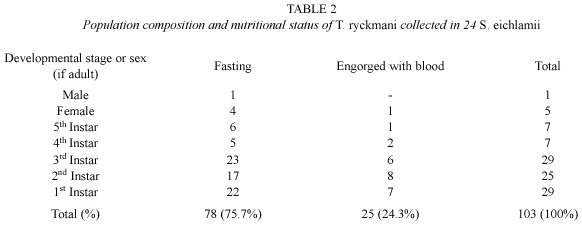
<body><![CDATA[<p><font face="Arial" size="2">The collection site is a wide plain in the village of Tulumaje,El Progreso,Guatemala,situated in W 90 °03 ´and N 14 °05 ´(<a href="#an66">Anonymous 1966</a>),at 360 -400 masl.It is 500 m east of the 89<sup>th</sup> km marker on the highway from Guatemala City to the department of Alta Verapaz.The area is used as source of medicinal plants,firewood and for hunting.</font></p>     <p><font face="Arial" size="2">The minimum and maximum temperatures were recorded at the beginning and at the end of the study with a digital thermo hygrometer (Testo 635,GM 295 14 770,reg des DM034 112).The Triatomines were collected over six successive days during the dry season (April 2000).</font></p>     <p><font face="Arial" size="2">One hectare was marked (100 X 100 m) and found to contain 216 specimens of <i>Stenocereus echlamii </i>Britt &amp;Rose (1920) (<a href="#st76">Stanley 1976</a>)(Subfamily Cereoideae).The heights of the dead portions of the cacti were measured,removed individually from each plant,placed on a white sheet and manually examined by two people for an average of 35 minutes to find triatomines.Chi-squared analysis was used to determine any significant differences in the insect ’s preferred height above ground and in the sex ratio.We recorded the height above ground of the dry portion of the cactus,the number of bugs collected in each dry portion,the development stage (for nymphs)or sex (for adults),the number of eggs,number of exuviae,and the nutritional status (fasting or engorged with blood)of each live bug was recorded. </font></p>     <p><font face="Arial" size="2">The principal entomological indexes as descriptors of the population were:the infestation index (number of cacti infested by triatomines/number of cacti examined x 100); the density index (number of triatomines captured/number of cacti);the crowding index (number of triatomines captured/number of cacti with triatomines).</font></p>     <p><font face="Arial" size="2">The developmental stage was recorded in three groups:counting the nymphs from the 1<sup>st</sup> to the 3<sup>rd</sup> stages, the nymphs from the 4<sup>th</sup> and 5<sup>th</sup> stages and the adults ’ females or males. The insects were transported alive to the laboratory.</font></p>     <p><font face="Arial" size="2">A portion of the rectum and the salivary gland was removed individually from each triatomine bug,dispersed in saline solution and analyzed by microscopy (400X)for several minutes looking for flagellates by technicians trained in detection of <i>Trypanosoma cruzi. </i>All the specimens were deposited in the "Museo de Historia Natural de la Universidad de San Carlos de Guatemala ",Calle Mariscal Cruz 1-56 Zona 10,telephone (502)3346065, and catalog No.24,Section Hemiptera. </font></p> <font face="Arial" size="2"><b>     <p>Results</p> </b></font>     <p><font face="Arial" size="2">The specimens of <i>T.ryckmani </i>were collected only in the senesced and dead portions of <i>S. eichlamii. </i>The temperature and relative humidity recorded during the six days of the study ranged from 25 to 41 °C,and 25 to 65%humidity. </font></p>     <p><font face="Arial" size="2">A total of 44 specimens (20.4%)of the cactus <i>S.eichlamii </i>had some senesced and dry portions (<a  href="#t1">Table 1</a>).These cacti were preferentially located in clusters near roads and partially cleared forest patches.In 29 of the specimens examined,the presence of triatomines was verified:24 with live bugs,four contained only exuviae and one only eggs.The entomological indexes for known descriptors of the population were,infestation index:54.5%;density index:2.3;and crowding index:4.3.</font></p> <a name="t1"></a>     <div style="text-align: center;"><img src="/img/fbpe/rbt/v52n4/3142i1.JPG" title=""  alt="" style="width: 629px; height: 173px;"></div>     
]]></body>
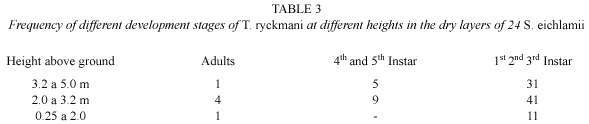
<body><![CDATA[<p><font face="Arial" size="2"><a href="#t2">Table 2</a> shows the results of the triatomines development stage and nutritional status analysis.The vast majority of the bugs collected were early nymphs (1<sup>st</sup> -3<sup>rd</sup> stages,80.6%),the next most frequently collected were the 4<sup>th</sup> and 5<sup>th</sup> stages (13.6%)and the least prevalent were the adults,only 5.8%of the population.Only one male specimen was found giving a highly significant difference in the sex ratio (X<sup>2</sup> =27.3, p&lt;0.00001).</font></p> <a name="t2"></a>     <div style="text-align: center;"><img src="/img/fbpe/rbt/v52n4/3142i2.JPG" title=""  alt="" style="width: 582px; height: 231px;"></div>     
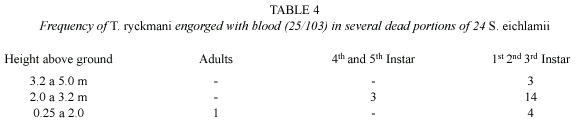
<p><font face="Arial" size="2">&nbsp;    <br> The majority of bugs of each stage were found in a fasting condition,75.7%,as compared to 24.3%engorged with blood.The biggest percentage of fasting was registered in the adults (83.3%);followed by the 4<sup>th</sup> and 5<sup>th</sup> stage (78.6%);and the 1<sup>st</sup> -3<sup>rd</sup> stage (74.7%).</font></p>     <p><font face="Arial" size="2"><a href="#t3">Table 3</a> shows the frequency of <i>T.ryckmani </i>found at different heights in the dead portions of <i>S.eichlamii </i>.Portions of the cacti were examined for the preferred location of triatomines.The smallest number of bugs were found at the lowest branches of the cacti (0.2 –2.0 m);4<sup>th</sup> or 5<sup>th</sup> stage nymphs weren ’t either seen at this level.All the stages clearly preferred the middle portion (2.0 – 3.2 m)of the <i>S.eichlamii </i>(52.4%)with an intermediate number of bugs (35.9%)residing in the highest portion of the cactus (3.2-5.0 m),only 12 cacti were found to have dried portions at this level above ground and were included in the evaluation.</font></p> <a name="t3"></a>     <div style="text-align: center;"><img src="/img/fbpe/rbt/v52n4/3142i3.JPG" title=""  alt="" style="width: 589px; height: 124px;"></div>     
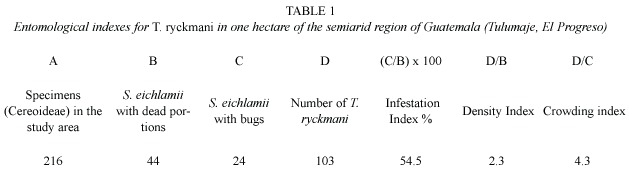
<p><font face="Arial" size="2">This difference in preferred microhabitat (middle)compared to the highest and lowest portions was statistically significant (X<sup>2</sup>=26.0, p&lt;0.00001).</font></p>     <p><font face="Arial" size="2">The composition of the population was then analyzed for each of the layers.The intermediate level (layer with the greatest infestation,2.0 to 3.2 m)contained almost all females and nymphs,and only one male.Only seventeen cacti were found to have dried portions at this level above ground and were included in the evaluation.At the highest level,3.2 –5.0 m,only one adult (out of 37 individuals) was found.Rodent excrement was present at all three heights of <i>S.eichlamii </i>. </font></p>     <p><font face="Arial" size="2"><a href="#t4">Table 4</a> shows the frequency of 25 <i>T.ryckmani </i>engorged with blood related to the height above ground in the cacti.At the lowest level (0.2 to 2.0 m)5 of the 25 triatomine (20%)were found and no 4<sup>th</sup> and 5<sup>th</sup> nymphs; 17 (68%)were found at the intermediate level (2.0-3.2m),no adults were present.Only three engorged triatomines were found at the highest level,all 2<sup>nd</sup> or 3<sup>rd</sup> nymphs.The dry portions from 24 <i>S.eichlamii </i>were evaluated,and the engorged bugs had a highly significant location preference for the middle layer (X<sup>2</sup>=13.8, p &lt;0.0001).</font></p> <a name="t4"></a>     <div style="text-align: center;"><img src="/img/fbpe/rbt/v52n4/3142i4.JPG" title=""  alt="" style="width: 581px; height: 124px;"></div>     
]]></body>
<body><![CDATA[<p><font face="Arial" size="2">&nbsp;    <br> No flagellates were identified in any of the 41 specimens analyzed,this results show that the species studied does not appear to represent a vector of <i>T.cruzi </i>in the Progreso province.</font></p> <font face="Arial" size="2"><b>     <p>Discussion</p> </b></font>     <p><font face="Arial" size="2">The semiarid region and dry forest where the insects were found,share these characteristics:The existence of:<i>E.cyclocarpum </i>(Mimosaceae),<i>S.eichlamii </i>(Cactaceae), <i>Tillandsia xerographica </i>(Bromeliaceae)among others.The altitude range (800 m)established by <a href="#ju96">Jurberg <i>et al.</i>(1996)</a>was widened with the finding of 103 specimens at 360 -400 m. </font></p>     <p><font face="Arial" size="2">A comparison between the entomological indexes of this species with other Guatemalan domiciliary vectors of Chagas disease was done,each cactus was considered equivalent to a human house.It is the first time that such comparison is done,the purpose is to have an idea of how well the population is established in the ecosystem.</font></p>     <p><font face="Arial" size="2">The infestation index for <i>T.ryckmani </i>in <i>S.eichlamii </i>(54.54)is greater than the infestation index (range of 0.6-34.5)found for three haematophagous triatomines in domiciliary conditions in Guatemala (<a href="#ta99">Tabaru <i>et al.</i>1999</a>). <i>T.ryckmani </i>is common in <i>S.eichlamii </i>,this suggests that this population is well adapted to live in this plant,which is found in a semiarid environment.</font></p>     <p><font face="Arial" size="2">The density index for <i>T.ryckmani </i>is high (2.34);this is comparable to the domiciliary index for <i>Rhodnius prolixus </i>in Chiquimula and <i>T.dimidiata </i>in Jutiapa (<a  href="#ta99">Tabaru <i>et al.</i>1999</a>). In other locations of the country, the density indexes in human houses were inferior to 1.17, which shows that the population of <i>T.ryckmani </i>under wild condition is as well adapted as the stable triatomines populations found in intradomiciliary conditions.</font></p>     <p><font face="Arial" size="2">The crowding index for <i>T.ryckmani </i>in <i>S.eichlamii </i>was 4.29,which is similar to the indexes for domiciliary <i>T.dimidiata </i>in the provinces of Santa Rosa (4.6),Suchitepequez (4.5),Baja Verapaz (4.0)and Guatemala (4.0). The majority (75.7%)of <i>T.ryckmani </i>was found in a fasting condition (<a href="#t2">Table 2</a>). This value suggests competition for survival, especially in the 1st,2nd,and 3rd stages of development.These insects are probably opportunistic organisms that obtain maximum profits up on the arrival of other animals near their host plants.</font></p>     <p><font face="Arial" size="2">The male-female proportion of <i>T.ryckmani </i>resembles that of <i>R.prolixus </i>in Guatemala, because more females than males were found. In contrast to <i>T.dimidiata </i>and <i>T.nitida </i>where the males are more abundant than females (Monroy, unpublished). This may indicate that <i>R.prolixus </i>in houses and <i>T.ryckmani </i>in wild conditions are well adapted.In blood sucking females need more blood for oviposition purposes,in <i>T.ryckmani </i>populations the abundance of females requires more blood sources.</font></p>     <p><font face="Arial" size="2">These populations are better adapted in comparison with <i>T.dimidiata </i>and <i>T.nitida </i>in Guatemala though these ones are in a process of establishment in domestic habitats.</font></p>     ]]></body>
<body><![CDATA[<p><font face="Arial" size="2"><a href="#t3">Table 3</a> demonstrates that,in the cacti,the tissues are not uniformly dry.The 0.2 to 2.0 m level showed the smallest number of insects because their thick greenish layer;<i>T.ryckmani </i>was mainly found at the level of 2.0 to 3.2 m were there are more dry layers. </font></p>     <p><font face="Arial" size="2">The age structure of triatomines was analyzed in groups:1st,2nd and 3rd nymphs,4th and 5th instars and adults (males,females), since the highest mortality usually occurs in the 1st-3rd instars.By the time they reach the 4th and 5th instars they have a higher probability of surviving and reach the adult stage.Insects in the adult stage are the ones that reproduces and perpetuate the population growth.</font></p>     <p><font face="Arial" size="2">This insect population shows a steep pyramidal structure with 80.6%of the whole group represented by the earliest stages,followed by only 13.6%in stages 4 and 5,and just a small amount of adults (5.8%).</font></p>     <p><font face="Arial" size="2">Since a blood meal is required for a triatominae to go into the next development stage,it is striking that so many of the insects were found with empty stomachs (74.7%of the 1st-3rd stag78.6%of the 4th and 5th stages and 83.3% of the adults).It can be that the insects prefer the dry portions of <i>S.eichlamii </i>(2.0-3.2 m height) because there is a great food supply for them at this level.A big proportion of bugs engorged with blood were found at this height compared with other levels in the cactus.</font></p>     <p><font face="Arial" size="2">In dried layers of <i>S.eichlamii </i>(<a  href="#t4">table 4</a>), most of the bugs with feeding blood were in the 1<sup>st</sup>,2<sup>nd</sup>,and 3<sup>rd</sup> stages,since these are phases in which more nutrients are needed for development.This layer is also preferred by the rodents to live,a coincidence that indicates the relationship between triatomines and this mammals that become a source of blood for the insects.</font></p>     <p><font face="Arial" size="2">Our data support the hypothesis of <a  href="#le79">Lent and Wygodzinsky (1979)</a>that <i>T.ryckmani </i>lives in arboreal habitats.In other studies,<i>T.ryckmani </i>was also found in the epiphyte <i>T.xerographica </i>(Bromeliaceae)at a branch of more than 5.00 m in height.</font></p>     <p><font face="Arial" size="2">More populations need to be sampled to exclude <i>T.ryckmani </i>as a Chagas disease vector. In the laboratory condition <i>T.ryckmani </i>accept bird (whitecap doves)and mammal (rodent) blood as food resource,which answers the <a  href="#sh88">Sherlock and Morera (1988)</a>questions.This is the first report of the natural environment of <i>T.ryckmani </i>and some information about the population structure.It seems that <i>T.ryckmani </i>is well adapted to the semiarid region of Guatemala and probably of Central America.</font></p> <font face="Arial" size="2"><b>     <p>Acknowledgments</p> </b></font>     <p><font face="Arial" size="2">For the collections:Geovani López, Armando Higueros and Carlos Avila of the Unidad de Biotopos del Centro de Estudios Conservacionistas (CECON)de la Universidad de San Carlos de Guatemala.Jaime A.Juarez for helping in the determination of the triatomine.Mario Véliz from Herbario de la Escuela de Biología for the determination of Cactaceae and Bromeliaceae.Sergio Melgar del Laboratorio de Investigación de Entomología Aplicada y Parasitología for advice and help in the statistical analysis.</font></p> <font face="Arial" size="2"><b>     <p>Resumen</p> </b></font>     ]]></body>
<body><![CDATA[<p><font face="Arial" size="2">En Guatemala,en una hectárea de la región semiárida,se encontraron 216 cactus de <i>Stenocereus eichlamii </i>(Cactaceae),44 de ellos tenían alguna parte del tallo en condiciones secas.103 <i>Triatoma ryckmani </i>fueron halladas en 24 de esos 44 <i>S.eichlamii </i>.Una comparación de los índices entomológicos con otros vectores domiciliares de la enfermedad de Chagas en Guatemala,da la idea que <i>T</i>. r<i>yckmani </i>está bien establecida en el ecosistema semiárido (índice de infestación de 54.5,índice de densidad de 2.3 e índice de hacinamiento de 4.3).Los triatominos fueron hallados preferentemente en las partes muertas de <i>S.eichlamii </i>entre 2.0 a 3.2 m sobre el nivel del suelo (52.4%de triatominos colectados,X ²=26.0,p&lt;0.00001),el siguiente entre 3.2 a 5.0 m (35.9%)y finalmente 0.2 a 2.0 m (11.6%). El 75.7 %estaba en condiciones de ayuno y 24.3 %estaban llenas de sangre.Para determinar la presencia de flagelados,43 <i>T.ryckmani </i>fueron disectadas<i>, </i>(primera evaluación de parasitemia en esta especie).Ningún flagelado fue hallado en estos triatominos.Este es el primer reporte de la dinámica poblacional de <i>T.ryckmani </i>en su hábitat silvestre.</font></p> <font face="Arial" size="2"><b></b></font>     <p><font face="Arial" size="2"><b>Palabras clave </b>:<i>Triatoma ryckmani,Stenocereus eichlamii </i>,región semiárida,vectores silvestres, comportamiento, Guatemala.</font></p> <font face="Arial" size="2"><b>     <p>References</p> </b></font>     <!-- ref --><p><font face="Arial" size="2"><a name="al04"></a>Aldana,E.&amp;E.Lizano.2004.Indice de defecación y éxito reproductivo de <i>Triatoma maculata </i>(Hemiptera, Reduviidae)en condiciones de laboratorio.Rev.Biol. Trop.52:927-930.</font>&nbsp;&nbsp;&nbsp;&nbsp;&nbsp;&nbsp;&nbsp;&nbsp;[&#160;<a href="javascript:void(0);" onclick="javascript: window.open('/scielo.php?script=sci_nlinks&ref=1221852&pid=S0034-7744200400040001400001&lng=','','width=640,height=500,resizable=yes,scrollbars=1,menubar=yes,');">Links</a>&#160;]<!-- end-ref --><!-- ref --><p><font face="Arial" size="2"><a name="an66"></a>Anonymous,1966.Hoja cartográfica El Progreso,no. 1612 II.Esc.1:50 000,color.Mapas topográficos de la república de Guatemala.Editorial Nacional. Guatemala.</font>&nbsp;&nbsp;&nbsp;&nbsp;&nbsp;&nbsp;&nbsp;&nbsp;[&#160;<a href="javascript:void(0);" onclick="javascript: window.open('/scielo.php?script=sci_nlinks&ref=1221853&pid=S0034-7744200400040001400002&lng=','','width=640,height=500,resizable=yes,scrollbars=1,menubar=yes,');">Links</a>&#160;]<!-- end-ref --><!-- ref --><p><font face="Arial" size="2"><a name="ca96"></a>Carcavallo R.,R.Zeledón,J.Jurberg &amp;I.Galindez. 1996.Morfología externa de <i>Triatoma ryckmani </i>Zeledón y Ponce, 1972. Vista através da Microscopia Electrónica de Varredura.Rev.Mem.Inst.Oswaldo Cruz.91(6):727-731.</font>&nbsp;&nbsp;&nbsp;&nbsp;&nbsp;&nbsp;&nbsp;&nbsp;[&#160;<a href="javascript:void(0);" onclick="javascript: window.open('/scielo.php?script=sci_nlinks&ref=1221854&pid=S0034-7744200400040001400003&lng=','','width=640,height=500,resizable=yes,scrollbars=1,menubar=yes,');">Links</a>&#160;]<!-- end-ref --><!-- ref --><p><font face="Arial" size="2"><a name="ju96"></a>Jurberg,J.,C.Galvao,I.Galindez,R.Carcavallo,C.Mena &amp;S.Curto.1996.Distribución geográfica y dispersión altitudinal de las especies del género <i>Triatoma </i>Laporte,1832 de Norte América,América Central y el Caribe.Rev.Entomol.&amp;Vect.3(4):87-117.</font>&nbsp;&nbsp;&nbsp;&nbsp;&nbsp;&nbsp;&nbsp;&nbsp;[&#160;<a href="javascript:void(0);" onclick="javascript: window.open('/scielo.php?script=sci_nlinks&ref=1221855&pid=S0034-7744200400040001400004&lng=','','width=640,height=500,resizable=yes,scrollbars=1,menubar=yes,');">Links</a>&#160;]<!-- end-ref --><!-- ref --><p><font face="Arial" size="2"><a name="le79"></a>Lent H &amp;P.Wygodzinsky.1979.Revision of the Triatominae (Hemiptera,Reduviidae)and their significance as vectors of Chagas disease.Bull.American.Mus.Nat. Hist.163:125-520.</font>&nbsp;&nbsp;&nbsp;&nbsp;&nbsp;&nbsp;&nbsp;&nbsp;[&#160;<a href="javascript:void(0);" onclick="javascript: window.open('/scielo.php?script=sci_nlinks&ref=1221856&pid=S0034-7744200400040001400005&lng=','','width=640,height=500,resizable=yes,scrollbars=1,menubar=yes,');">Links</a>&#160;]<!-- end-ref --><!-- ref --><p><font face="Arial" size="2"><a name="sc94"></a>Schofield,C.1994.Triatominae –Biology &amp;Control. Eurocommunica Publications,West Sussex,UK.</font>&nbsp;&nbsp;&nbsp;&nbsp;&nbsp;&nbsp;&nbsp;&nbsp;[&#160;<a href="javascript:void(0);" onclick="javascript: window.open('/scielo.php?script=sci_nlinks&ref=1221857&pid=S0034-7744200400040001400006&lng=','','width=640,height=500,resizable=yes,scrollbars=1,menubar=yes,');">Links</a>&#160;]<!-- end-ref --><!-- ref --><p><font face="Arial" size="2"><a name="sh88"></a>Sherlock I &amp;P.Morera.1988.Alótipo macho de <i>Triatoma ryckmani </i>Zeledón y Ponce, 1972. Rev. Biol. Trop. 36:423-428.</font>&nbsp;&nbsp;&nbsp;&nbsp;&nbsp;&nbsp;&nbsp;&nbsp;[&#160;<a href="javascript:void(0);" onclick="javascript: window.open('/scielo.php?script=sci_nlinks&ref=1221858&pid=S0034-7744200400040001400007&lng=','','width=640,height=500,resizable=yes,scrollbars=1,menubar=yes,');">Links</a>&#160;]<!-- end-ref --><!-- ref --><p><font face="Arial" size="2"><a name="st76"></a>Stanley P.1976.Flora de Guatemala.Chicago:Natural History Museum.Fieldana Botany.Vol 24(7): 208-210.</font>&nbsp;&nbsp;&nbsp;&nbsp;&nbsp;&nbsp;&nbsp;&nbsp;[&#160;<a href="javascript:void(0);" onclick="javascript: window.open('/scielo.php?script=sci_nlinks&ref=1221859&pid=S0034-7744200400040001400008&lng=','','width=640,height=500,resizable=yes,scrollbars=1,menubar=yes,');">Links</a>&#160;]<!-- end-ref --><!-- ref --><p><font face="Arial" size="2"><a name="ta99"></a>Tabaru,Y.,C.Monroy,A.Rodas,M.Mejía &amp;R.Rosales. 1999.The geographical distribution of vectors of Chagas ´disease and populations at risk of infection in Guatemala.Rev.Med.Entomol.Zool.50(1):9-17.</font>&nbsp;&nbsp;&nbsp;&nbsp;&nbsp;&nbsp;&nbsp;&nbsp;[&#160;<a href="javascript:void(0);" onclick="javascript: window.open('/scielo.php?script=sci_nlinks&ref=1221860&pid=S0034-7744200400040001400009&lng=','','width=640,height=500,resizable=yes,scrollbars=1,menubar=yes,');">Links</a>&#160;]<!-- end-ref --><!-- ref --><p><font face="Arial" size="2"><a name="ze72"></a>Zeledón R &amp;C.Ponce.1972.Descripción de una nueva especie de <i>Triatoma </i>de Honduras,América Central (Hemiptera, Reduviidae). Rev.Biol.Trop.20:275-279.</font>&nbsp;&nbsp;&nbsp;&nbsp;&nbsp;&nbsp;&nbsp;&nbsp;[&#160;<a href="javascript:void(0);" onclick="javascript: window.open('/scielo.php?script=sci_nlinks&ref=1221861&pid=S0034-7744200400040001400010&lng=','','width=640,height=500,resizable=yes,scrollbars=1,menubar=yes,');">Links</a>&#160;]<!-- end-ref --> ]]></body><back>
<ref-list>
<ref id="B1">
<nlm-citation citation-type="journal">
<person-group person-group-type="author">
<name>
<surname><![CDATA[Aldana]]></surname>
<given-names><![CDATA[E]]></given-names>
</name>
<name>
<surname><![CDATA[Lizano]]></surname>
<given-names><![CDATA[E]]></given-names>
</name>
</person-group>
<article-title xml:lang="es"><![CDATA[Indice de defecación y éxito reproductivo de Triatoma maculata (Hemiptera, Reduviidae)en condiciones de laboratorio]]></article-title>
<source><![CDATA[Rev.Biol. Trop]]></source>
<year>2004</year>
<volume>52</volume>
<page-range>927-930</page-range></nlm-citation>
</ref>
<ref id="B2">
<nlm-citation citation-type="book">
<person-group person-group-type="author">
<name>
</name>
<name>
</name>
</person-group>
<source><![CDATA[Hoja cartográfica El Progreso,no. 1612 II.Esc.1:50 000,color.Mapas topográficos de la república de Guatemala]]></source>
<year>1966</year>
<publisher-name><![CDATA[Editorial Nacional]]></publisher-name>
</nlm-citation>
</ref>
<ref id="B3">
<nlm-citation citation-type="journal">
<person-group person-group-type="author">
<name>
<surname><![CDATA[Carcavallo]]></surname>
<given-names><![CDATA[R]]></given-names>
</name>
<name>
<surname><![CDATA[Zeledón]]></surname>
<given-names><![CDATA[R]]></given-names>
</name>
<name>
<surname><![CDATA[Jurberg]]></surname>
<given-names><![CDATA[J]]></given-names>
</name>
<name>
<surname><![CDATA[Galindez]]></surname>
<given-names><![CDATA[I]]></given-names>
</name>
</person-group>
<article-title xml:lang="es"><![CDATA[Morfología externa de Triatoma ryckmani Zeledón y Ponce, 1972. Vista através da Microscopia Electrónica de Varredura]]></article-title>
<source><![CDATA[Rev.Mem.Inst.Oswaldo Cruz]]></source>
<year>1996</year>
<volume>91</volume>
<numero>6</numero>
<issue>6</issue>
<page-range>727-731</page-range></nlm-citation>
</ref>
<ref id="B4">
<nlm-citation citation-type="journal">
<person-group person-group-type="author">
<name>
<surname><![CDATA[Jurberg]]></surname>
<given-names><![CDATA[J]]></given-names>
</name>
<name>
<surname><![CDATA[Galvao]]></surname>
<given-names><![CDATA[C]]></given-names>
</name>
<name>
<surname><![CDATA[Galindez]]></surname>
<given-names><![CDATA[I]]></given-names>
</name>
<name>
<surname><![CDATA[Carcavallo]]></surname>
<given-names><![CDATA[R]]></given-names>
</name>
<name>
<surname><![CDATA[Mena]]></surname>
<given-names><![CDATA[C]]></given-names>
</name>
<name>
<surname><![CDATA[Curto]]></surname>
<given-names><![CDATA[S]]></given-names>
</name>
</person-group>
<article-title xml:lang="es"><![CDATA[Distribución geográfica y dispersión altitudinal de las especies del género Triatoma Laporte,1832 de Norte América,América Central y el Caribe]]></article-title>
<source><![CDATA[Rev.Entomol. & Vect]]></source>
<year>1996</year>
<volume>3</volume>
<numero>4</numero>
<issue>4</issue>
<page-range>87-117</page-range></nlm-citation>
</ref>
<ref id="B5">
<nlm-citation citation-type="journal">
<person-group person-group-type="author">
<name>
<surname><![CDATA[Lent]]></surname>
<given-names><![CDATA[H]]></given-names>
</name>
<name>
<surname><![CDATA[Wygodzinsky]]></surname>
<given-names><![CDATA[P]]></given-names>
</name>
</person-group>
<article-title xml:lang="en"><![CDATA[Revision of the Triatominae (Hemiptera,Reduviidae)and their significance as vectors of Chagas disease]]></article-title>
<source><![CDATA[Bull.American.Mus.Nat. Hist]]></source>
<year>1979</year>
<volume>163</volume>
<page-range>125-520</page-range></nlm-citation>
</ref>
<ref id="B6">
<nlm-citation citation-type="book">
<person-group person-group-type="author">
<name>
<surname><![CDATA[Schofield]]></surname>
<given-names><![CDATA[C]]></given-names>
</name>
</person-group>
<source><![CDATA[Triatominae -Biology & Control]]></source>
<year>1994</year>
<publisher-loc><![CDATA[West Sussex ]]></publisher-loc>
<publisher-name><![CDATA[Eurocommunica Publications]]></publisher-name>
</nlm-citation>
</ref>
<ref id="B7">
<nlm-citation citation-type="journal">
<person-group person-group-type="author">
<name>
<surname><![CDATA[Sherlock]]></surname>
<given-names><![CDATA[I]]></given-names>
</name>
<name>
<surname><![CDATA[Morera]]></surname>
<given-names><![CDATA[P]]></given-names>
</name>
</person-group>
<article-title xml:lang="es"><![CDATA[Alótipo macho de Triatoma ryckmani Zeledón y Ponce, 1972]]></article-title>
<source><![CDATA[Rev. Biol. Trop]]></source>
<year>1988</year>
<volume>36</volume>
<page-range>423-428</page-range></nlm-citation>
</ref>
<ref id="B8">
<nlm-citation citation-type="journal">
<person-group person-group-type="author">
<name>
<surname><![CDATA[Stanley]]></surname>
<given-names><![CDATA[P]]></given-names>
</name>
</person-group>
<article-title xml:lang="es"><![CDATA[Flora de Guatemala.Chicago: Natural History Museum]]></article-title>
<source><![CDATA[Fieldana Botany]]></source>
<year>1976</year>
<volume>24</volume>
<numero>7</numero>
<issue>7</issue>
<page-range>208-210</page-range></nlm-citation>
</ref>
<ref id="B9">
<nlm-citation citation-type="journal">
<person-group person-group-type="author">
<name>
<surname><![CDATA[Tabaru]]></surname>
<given-names><![CDATA[Y]]></given-names>
</name>
<name>
<surname><![CDATA[Monroy]]></surname>
<given-names><![CDATA[C]]></given-names>
</name>
<name>
<surname><![CDATA[Rodas]]></surname>
<given-names><![CDATA[A]]></given-names>
</name>
<name>
<surname><![CDATA[Mejía]]></surname>
<given-names><![CDATA[M]]></given-names>
</name>
<name>
<surname><![CDATA[Rosales]]></surname>
<given-names><![CDATA[R]]></given-names>
</name>
</person-group>
<article-title xml:lang="en"><![CDATA[The geographical distribution of vectors of Chagas ´disease and populations at risk of infection in Guatemala]]></article-title>
<source><![CDATA[Rev.Med.Entomol.Zool]]></source>
<year>1999</year>
<volume>50</volume>
<numero>1</numero>
<issue>1</issue>
<page-range>9-17</page-range></nlm-citation>
</ref>
<ref id="B10">
<nlm-citation citation-type="journal">
<person-group person-group-type="author">
<name>
<surname><![CDATA[Zeledón]]></surname>
<given-names><![CDATA[R]]></given-names>
</name>
<name>
<surname><![CDATA[Ponce]]></surname>
<given-names><![CDATA[C]]></given-names>
</name>
</person-group>
<article-title xml:lang="es"><![CDATA[Descripción de una nueva especie de Triatoma de Honduras,América Central (Hemiptera, Reduviidae)]]></article-title>
<source><![CDATA[Rev.Biol.Trop]]></source>
<year>1972</year>
<volume>20</volume>
<page-range>275-279</page-range></nlm-citation>
</ref>
</ref-list>
</back>
</article>