<?xml version="1.0" encoding="ISO-8859-1"?><article xmlns:mml="http://www.w3.org/1998/Math/MathML" xmlns:xlink="http://www.w3.org/1999/xlink" xmlns:xsi="http://www.w3.org/2001/XMLSchema-instance">
<front>
<journal-meta>
<journal-id>0034-7744</journal-id>
<journal-title><![CDATA[Revista de Biología Tropical]]></journal-title>
<abbrev-journal-title><![CDATA[Rev. biol. trop]]></abbrev-journal-title>
<issn>0034-7744</issn>
<publisher>
<publisher-name><![CDATA[Universidad de Costa Rica]]></publisher-name>
</publisher>
</journal-meta>
<article-meta>
<article-id>S0034-77442004000400012</article-id>
<title-group>
<article-title xml:lang="en"><![CDATA[The "windows ",scales,and bristles of the tropical moth Rothschildia lebeau (Lepidoptera:Saturniidae)]]></article-title>
</title-group>
<contrib-group>
<contrib contrib-type="author">
<name>
<surname><![CDATA[Hernández-Chavarría]]></surname>
<given-names><![CDATA[Francisco]]></given-names>
</name>
<xref ref-type="aff" rid="A02"/>
</contrib>
<contrib contrib-type="author">
<name>
<surname><![CDATA[Hernández]]></surname>
<given-names><![CDATA[Alejandro]]></given-names>
</name>
<xref ref-type="aff" rid="A03"/>
</contrib>
<contrib contrib-type="author">
<name>
<surname><![CDATA[Sittenfeld]]></surname>
<given-names><![CDATA[Ana]]></given-names>
</name>
<xref ref-type="aff" rid="A01"/>
</contrib>
</contrib-group>
<aff id="A01">
<institution><![CDATA[,Universidad de Costa Rica  ]]></institution>
<addr-line><![CDATA[San José ]]></addr-line>
<country>Costa Rica</country>
</aff>
<aff id="A02">
<institution><![CDATA[,Universidad de Costa Rica  ]]></institution>
<addr-line><![CDATA[San José ]]></addr-line>
<country>Costa Rica</country>
</aff>
<aff id="A03">
<institution><![CDATA[,Universidad de Costa Rica  ]]></institution>
<addr-line><![CDATA[San José ]]></addr-line>
<country>Costa Rica</country>
</aff>
<pub-date pub-type="pub">
<day>00</day>
<month>12</month>
<year>2004</year>
</pub-date>
<pub-date pub-type="epub">
<day>00</day>
<month>12</month>
<year>2004</year>
</pub-date>
<volume>52</volume>
<numero>4</numero>
<fpage>919</fpage>
<lpage>926</lpage>
<copyright-statement/>
<copyright-year/>
<self-uri xlink:href="http://www.scielo.sa.cr/scielo.php?script=sci_arttext&amp;pid=S0034-77442004000400012&amp;lng=en&amp;nrm=iso"></self-uri><self-uri xlink:href="http://www.scielo.sa.cr/scielo.php?script=sci_abstract&amp;pid=S0034-77442004000400012&amp;lng=en&amp;nrm=iso"></self-uri><self-uri xlink:href="http://www.scielo.sa.cr/scielo.php?script=sci_pdf&amp;pid=S0034-77442004000400012&amp;lng=en&amp;nrm=iso"></self-uri><abstract abstract-type="short" xml:lang="en"><p><![CDATA[The common Spanish name of the moth Rothschildia lebeau (Saturniidae)is cuatro ventanas (four ‘windows ’),because it exhibits a transparent oval path in each wing.The scales of the colored areas and the bristles from the "window "were analyzed.We developed a simple device to measure transmittance across the "windows "with an spectrophotometer.A square section of "window "was mounted onto a flat black card and placed onto a clamp that hung in the path of the light -beam of the spectrophotometer.Absorbance was measured at 350 and 550 nm,with the "window "positioned perpendicular to the light beam (incidence of 90 °);then the measurements were repeated with the "window "moved at an angle of 45 °.Each measurement was replicated 5 times.Wing color spots were analyzed with a light dissection microscope (stereoscope)and with scanning electron microscopy.The scales have a minimum of 4 morphological types,3 of them showed the typical appearance of unspecialized scales described for other butterflies; whereas the fourth has features particular to this species. On the "window "the scales are transformed in hair-like bristles that do not interfere with light, conferring the transparency that characterizes the "windows ".However,if the wing is illuminated at an almost grazing-incidence,they reflect the light as a mirror.Two hypothetical functional explanation for the windows are mimicry and interspecies communication.Rev.Biol.Trop.52(4):919-926.Epub 2005 Jun 24.]]></p></abstract>
<abstract abstract-type="short" xml:lang="es"><p><![CDATA[El nombre común de la mariposa nocturna Rothschildia lebeau (Saturniidae)es "cuatro ventanas ",porque exhibe una zona transparente en cada ala.Las escamas de las áreas coloreadas y las cerdas de las "ventanas "fueron analizadas al estereoscopio y al microscopio electrónico de rastreo. Al menos se identificaron cuatro tipos morfológicos de escamas similares a las escamas no especializadas de otras mariposas.En la "ventana "las escamas han sido sustituidas por cerdas que no interfieren el paso de la luz,confiriéndoles la transparencia que las caracteriza.No obstante,si el ala es iluminada en ángulo rasante refleja la luz como un espejo.Dos hipótesis para explicar la evolución de estas "ventanas "son el mimetismo y la comunicación.]]></p></abstract>
<kwd-group>
<kwd lng="en"><![CDATA[Scales microstructure]]></kwd>
<kwd lng="en"><![CDATA[bristles]]></kwd>
<kwd lng="en"><![CDATA[scanning electron microscopy]]></kwd>
<kwd lng="en"><![CDATA[moth]]></kwd>
<kwd lng="en"><![CDATA[interspecies communication]]></kwd>
<kwd lng="en"><![CDATA[light reflections]]></kwd>
<kwd lng="en"><![CDATA[Rothschildia lebeau]]></kwd>
<kwd lng="es"><![CDATA[Microestructura]]></kwd>
<kwd lng="es"><![CDATA[microscopía electrónica de rastreo]]></kwd>
<kwd lng="es"><![CDATA[escamas]]></kwd>
<kwd lng="es"><![CDATA[cerdas]]></kwd>
<kwd lng="es"><![CDATA[mariposa nocturna]]></kwd>
<kwd lng="es"><![CDATA[comunicación interespecífica]]></kwd>
<kwd lng="es"><![CDATA[reflectión de luz]]></kwd>
<kwd lng="es"><![CDATA[Rothschildia lebeau]]></kwd>
</kwd-group>
</article-meta>
</front><body><![CDATA[  <b><font face="Arial"></font></b>     <p align="center"><b><font face="Arial">The "windows ",scales,and bristles of the tropical moth </font></b><font face="Arial"><i>Rothschildia lebeau </i><b>(Lepidoptera:Saturniidae)</b></font></p> <font face="Arial" size="2"></font>     <p><font face="Arial" size="2">Francisco Hernández-Chavarría<a name="1"></a><sup><a  href="#2">1</a>,<a href="#2">2</a></sup><a href="#2">*</a> ,Alejandro Hernández<a href="#2"><sup>3</sup></a> &amp;Ana Sittenfeld<sup><a  href="#2">1</a>,<a href="#2">3</a></sup></font></p>     <p><font face="Arial" size="2"><sup><a name="2"></a><a href="#1">1</a></sup> Facultad de Microbiología,Universidad de Costa Rica,San José,Costa Rica.</font></p> <font face="Arial" size="2"><sup></sup></font>     <p><font face="Arial" size="2"><a href="#1"><sup>2</sup></a> Centro de Investigación en Estructuras Microscópicas (CIEMic),Universidad de Costa Rica,San José, Costa Rica.</font></p> <font face="Arial" size="2"><sup></sup></font>     <p><font face="Arial" size="2"><a href="#1"><sup>3</sup></a> Centro de Investigación en Biología Celular y Molecular (CIBCM),Universidad de Costa Rica,San José,Costa Rica.</font></p>     <p><font face="Arial" size="2"><a href="#1">*</a>Correspondence author:<a  href="mailto:hchavarr@cariari.ucr.ac.cr">hchavarr@cariari.ucr.ac.cr</a></font></p>     <p align="center"><font face="Arial" size="2">Received 29-VI-2004. Corrected 30-IX-2004. Accepted 06-XII-2004.</font></p> <font face="Arial" size="2"><b></b></font>     <p><font face="Arial" size="2"><b>Abstract:</b>The common Spanish name of the moth <i>Rothschildia lebeau </i>(Saturniidae)is <i>cuatro ventanas </i>(four ‘windows ’),because it exhibits a transparent oval path in each wing.The scales of the colored areas and the bristles from the "window "were analyzed.We developed a simple device to measure transmittance across the "windows "with an spectrophotometer.A square section of "window "was mounted onto a flat black card and placed onto a clamp that hung in the path of the light -beam of the spectrophotometer.Absorbance was measured at 350 and 550 nm,with the "window "positioned perpendicular to the light beam (incidence of 90 °);then the measurements were repeated with the "window "moved at an angle of 45 °.Each measurement was replicated 5 times.Wing color spots were analyzed with a light dissection microscope (stereoscope)and with scanning electron microscopy.The scales have a minimum of 4 morphological types,3 of them showed the typical appearance of unspecialized scales described for other butterflies; whereas the fourth has features particular to this species. On the "window "the scales are transformed in hair-like bristles that do not interfere with light, conferring the transparency that characterizes the "windows ".However,if the wing is illuminated at an almost grazing-incidence,they reflect the light as a mirror.Two hypothetical functional explanation for the windows are mimicry and interspecies communication.Rev.Biol.Trop.52(4):919-926.Epub 2005 Jun 24.</font></p> <font face="Arial" size="2"><b></b></font>     <p><font face="Arial" size="2"><b>Key words:</b>Scales microstructure,bristles,scanning electron microscopy,moth,interspecies communication, light reflections,<i>Rothschildia lebeau </i>.</font></p>     ]]></body>
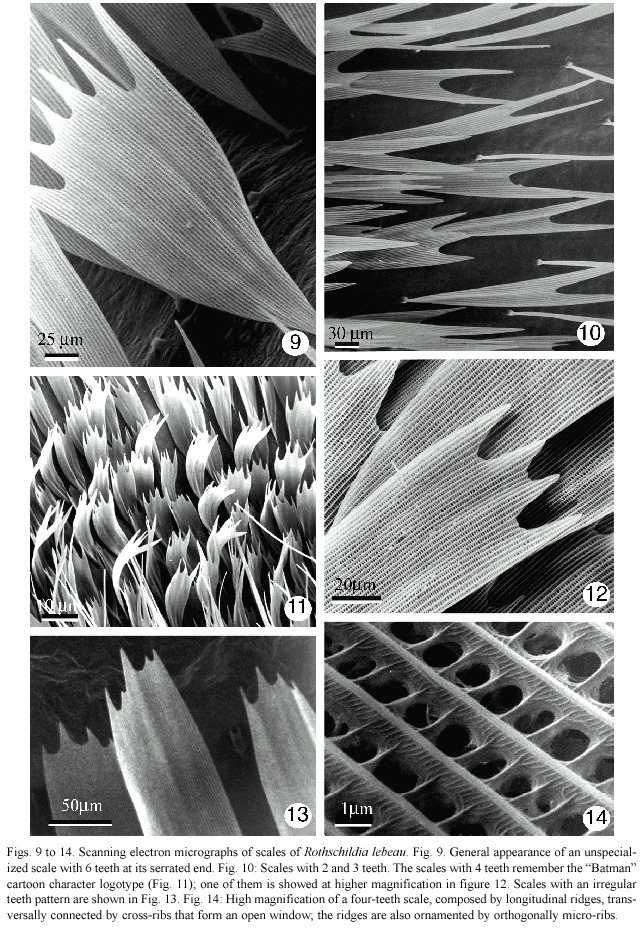
<body><![CDATA[<p><font face="Arial" size="2">The Lepidoptera is among the groups of insects that exhibit spectacular color patterns; the majority of these colors correspond to pigments incorporated inside scales or cuticle (<a  href="#gh98">Ghiradella 1998</a>). However,the most beautiful tonalities of iridescent color exhibited by some butterflies are generated by light interference in specialized scales (Giradella 1985, <a  href="#vu00">Vukusic <i>et al </i>.2000</a>).Some color patterns imitate environmental shapes and colors (crypsis or mimicry)and help avoid predators.Others may be used in intraspecific communication.</font></p>     <p><font face="Arial" size="2">An interesting example of mimetic adaptation is the moth <i>Rothschildia lebeau </i>,which rests on trees during the day and look like rotten leaves (<a href="#ja84">Janzen 1984</a>).To match different backgrounds, the moth exhibits different color patterns according to predominant seasonal colors;this originally lead to the misclassification of the same species as <i>R.aroma,R.morana </i>and <i>R.forbesi </i>.These species were later grouped under <i>R.lebeau </i>(<a href="#ja84">Janzen 1984</a>)<i>.</i>Janzen followed the development of pupae into adults in different weather conditions and obtained color patterns varying from bright orange to chocolate-rust or chocolate,depending on humidity,which is related to the predominant forest color. The work was conducted in Guanacaste, Northwestern Costa Rica,where the common name of the moth is <i>cuatro ventanas </i>(four "windows "),due to the presence of an oval transparent patch at each wing (<a href="#f1">Fig.1</a>).In this context the patch was called a "window ", which is written in quotation marks in order to differentiate it from the section of the scale called a window,according to the nomenclature proposed by <a href="#gh98">Ghiradella (1998)</a>.</font></p> <font face="Arial" size="2">The purpose of this paper is to describe the fine structure of the "window ",bristles and scales of the wings of <i>R.lebeau</i>.</font> <font face="Arial" size="2"><b>     <p>Materials and methods</p> </b></font>     <p><font face="Arial" size="2">Each "window "of <i>R.lebeau </i>appears as a transparent body,meaning that its transmittance would be around 100%;but,when tilted,it reflects incident light:transmittance is reduced and the transparent body acts then as a mirror.To document such a phenomenon we developed a simple device to measure transmittance across the "windows "of <i>R.lebeau </i>using a spectrophotometer (Shimatsu 300 UV).A square section of the wing with the "window " was mounted onto a flat black card and placed onto a clamp that hung in the path of the spectrophotometer ’s light -beam.Absorbance was measured at 350 and 550 nm,with the "window "positioned perpendicular to the light beam (incidence of 90 °);then the measurements were repeated with the "window "moved at an angle of 45 °.Each measurement was replicated 5 times.</font></p>     <p><font face="Arial" size="2">The different color spots of the wings of <i>R.lebeau </i>were analyzed whith a light dissection microscope (stereoscope)and with scanning electron microscopy (SEM)in order to describe the pattern of scales and bristles on the "windows "and around them.For stereoscopic analysis the wings were mounted directly.For SEM analysis,sections of each color spot of the wing were cut and mounted directly on aluminum studs,without fixing or dehydration.They were covered with gold (20 nm thick)by using an ion sputter cover (Eiko IB-3)and observed through a SEM (Hitachi S-570).</font></p> <font face="Arial" size="2"><b>     <p>Results</p> </b></font>     <p><font face="Arial" size="2">Macroscopically the color of <i>R.lebeau </i>varies from chocolate to a dark chocolate-rust; however,under the stereoscope different colors and designs arose.For example,the "windows " are edged by white (<a href="#f1">Fig.2</a>)or yellow scales (<a  href="#f1">Fig.3</a>)and near the lighter band there is a red and white spot (<a href="#f1">Fig.4</a>). Additionally,the fringes of the forewing and hind-wing have a marginal design of yellow spots with black lines (<a href="#f1">Figs.1</a> and <a href="#f1">5</a>).</font></p>     <p><font face="Arial" size="2">The transparency of the "window "is evident in <a href="#f1">Fig.2</a>:one can read through it.However, if the "window "is observed through the stereoscope with a grazing-incident light,it appears as brilliant as a mirror,reflecting light (<a href="#f1">Fig.6</a>). This observation was corroborated by analyzing wing fragments with "windows "through a spectrophotometer with a light wavelength of 550 </font><small><span  style="font-family: symbol;">µ</span></small><font face="Arial"  size="2">m (blue to green light).When the "window "was perpendicular to the light beam, the absorbance was 0.974 ±0.017,and when the wing was tilted around 45 °the absorbance changed to 1.127 ±0.043.However,at 350 </font><font face="Arial" size="2">µm (ultraviolet light),both measurements were 0.803 ±0.068 and 0.858 ±0.022,respectively. These data imply that the absorbance was altered when the "window "was illuminated at 90 °and 45 °using visible light but was not affected by ultraviolet light.</font></p>     <p><font face="Arial" size="2">The stereoscope showed than the "windows "covered by thin bristles do not interrupt the path of light (<a  href="#f1">Fig.7</a>).This observation was confirmed through the SEM (<a  href="#f1">Fig.8</a>).The "window "edge presents a row of two or three teeth scales.    <br> </font></p>     ]]></body>
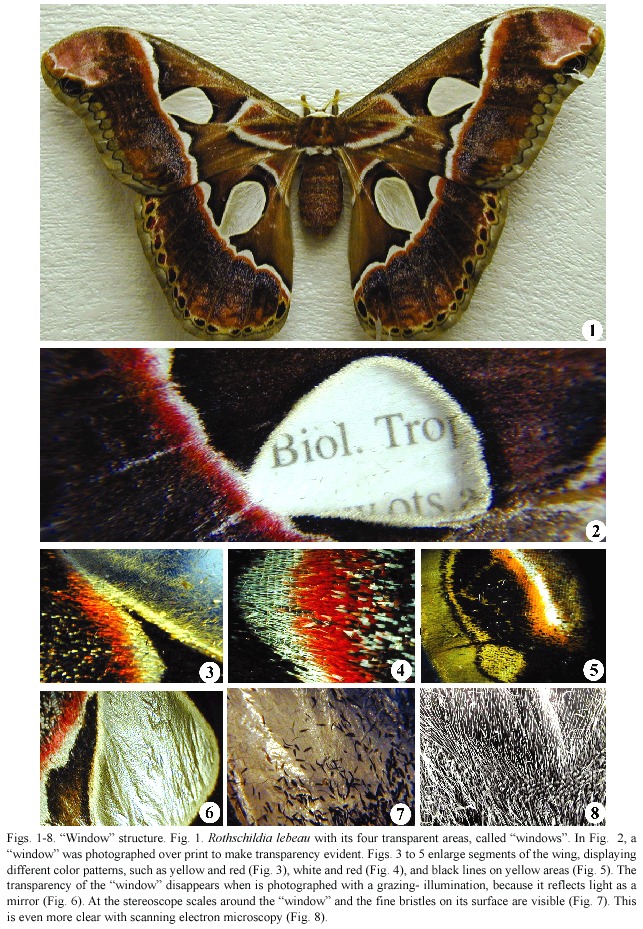
<body><![CDATA[<div style="text-align: center;"><a name="f1"></a><img  src="/img/fbpe/rbt/v52n4/3140i1.JPG" title="" alt=""  style="width: 643px; height: 929px;"></div> <font face="Arial" size="2">The difference between cover and ground scales was not evident;however,this moth has at least four morphological scale types;and each had a narrow pedicel and a flat main body with a serrated end (<a href="#f2">Fig.9</a>).The broader area of the wings had predominantly brown tones with yellow and red spots.The scales of these colored areas had the typical appearance of unspecialized scales;they are around 300 </font><font face="Arial"  size="2">µm long by 120 </font><small><span  style="font-family: arial;">µ</span></small><font face="Arial" size="2">m wide at the toothed border. Around the "window "there was a yellow or white line with scales of only two or three teeth,some of them projecting the toothed-end to the "window "(<a href="#f2">Fig.10</a>).The average width of these scales was 80 </font><font face="Arial" size="2">µm.A second morphological scale type was represented on the clear brown area near the "window "or on the red spots.These scales showed four picks;the central picks higher than the lateral picks (<a href="#f2">Figs.11</a> and <a href="#f2">12</a>).A third type of scale appeared on the dark brown areas.These scales had irregular patterns of 3 to 5 teeth (<a  href="#f2">Figs.9</a> and <a href="#f2">13</a>).</font>     
<p><font face="Arial" size="2">The fine structure of these scales,independent of their tooth pattern,showed a top surface with a lattice of parallel longitudinal ridges.The ridges are transversally connected by cross-ribs,forming square concave windows and partially obliterated with only a central round hole (<a href="#f2">Fig.14</a>).The border of the window is ornamented with micro-ribs,which were more evident when the wing was tilted around 30 ° in the SEM (<a href="#f3">Figs.15</a> and <a href="#f3">16</a>).</font></p>     <div style="text-align: center;"><a name="f2"></a><img  src="/img/fbpe/rbt/v52n4/3140i2.JPG" title="" alt=""  style="width: 641px; height: 929px;"></div>     
<p><font face="Arial" size="2">A fourth morphological type of scale was observed at the light brown area underneath the forewings,near their edges.These scales had a single pointed end (<a href="#f3">Fig.17</a>)and their fine structure was characterized by ridges with a prominent system of ridge-lamellae (<a href="#f3">Fig. 18</a>).The distance between ridges ranged from 1.4 to 1.8 </font><font face="Arial"  size="2">µm;but the cross-ribs measured around 1 </font><font  face="Arial" size="2">µm.For this reason,they do not connect to the adjacent ridge (Inset of <a href="#f3">figure 18</a>). Additionally,they delimited square windows with a small central oval hole.Their micro-ribs appear in only the side of the ridge that is not touched by the cross-ribs (<a href="#f3">Fig.18</a>).</font></p>     <p><font face="Arial" size="2">On the "windows ",bristles replace scales and appear as thin hair-like structures dispersed though a bare cuticle (<a href="#f1">Fig.8</a>).The bristles were hollow;they are only 5 µm wide and had eight spiny ridges,due to the presence of prominent ridge-lamellae (<a href="#f3">Fig.19</a>).The micro-ribs were evident around un-opened rounded windows; but the cross-ribs were not evident (<a href="#f3">Fig.20</a>). The bristles were almost perpendicular to the cuticle.For this reason,they do not interfere with the incident path of light that inside directly on the cuticle;thus it appears transparent or brilliant as a mirror depending of the incident angle.</font></p> <a name="f3"></a>     <div style="text-align: center;"><img src="/img/fbpe/rbt/v52n4/3140i3.JPG" title=""  alt="" style="width: 649px; height: 933px;"></div> <font face="Arial" size="2"><b>     
<p>Discussion</p> </b></font>     <p><font face="Arial" size="2">The majority of butterflies show two scale sizes,which are arranged alternately in each row;the larger ones,called "cover "scales,have a more complex structure;whereas the smaller, "ground "scales,are partially covered by the former (<a  href="#gh94">Ghiradella 1994</a>,<a href="#gh98">1998</a>).That pattern of cover and ground scales was inconspicuous in <i>R.lebeau </i>.This moth exhibited at least four different morphological types of scales. Also, their transparent spot,or "window ",appeared as a bare area with dispersed bristles that do not interfere with the path of light. </font></p>     <p><font face="Arial" size="2">Macroscopically <i>R.lebeau </i>varied from chocolate to a dark chocolate-rust and mingles with the dry leaves.Nevertheless,a complex pattern of color and "drawings "are visible through the stereoscope.The complex arrangement is reflected in the existence of at least four morphological types of scales.However,their fine structure was very similar to the description of unspecialized scales,characterized by the presence of ridge-lamella and micro-ribs (<a href="#f3">Figs.15</a> and <a href="#f3">16</a>),such as some unspecialized scales of <i>Morpho </i>and <i>Caligo </i>(<a  href="#gh98">Ghiradella 1998</a>)and iridescent scales of some butterflies (<a href="#vu01a">Vukusic <i>et al </i>.2001a</a>,<a  href="#vu01b">b</a>,<a href="#vu03">Vukusic and Sambles 2003</a>).However,the fourth type (single tooth scale) showed a different structure,the microribs are localized only in one side of the ridge and the majority of the windows are not opened.Those that appear open (inset of <a  href="#f3">Fig. 18</a>),might be artifacts caused by ion coating or by electron damage during SEM analysis.To our knowledge,the pattern of short ribs with micro-ribs in only one side of the ridges is a distinctive characteristic of <i>R.lebeau </i>,previously not described in other butterflies.</font></p>     <p><font face="Arial" size="2">Modified microstructures on the scales account for the brilliant iridescence color of several butterflies (<a  href="#vu01a">Vukusic <i>et al </i>.2001a</a>,<a href="#vu01b">b</a>, <a href="#vu03">Vukusic and Sambles 2003</a>).Such specialized modifications evolved as response to environmental changes in the natural history of those insects.Along that line of thinking,why did <i>R.lebeau </i>develop the transparent "windows ", which characterize it?Other transparent butterflies developed antireflective structures, such as conglomerates of "nipples "(<a href="#gh99">Ghiradella 1999</a>, <a  href="#vu04">Vukusic 2004</a>),possibly to avoid flashes due to reflections on their cuticle,which would make their presence evident to predators.The "windows "of <i>R.lebeau </i>apparently evolved in the opposite way,due to the absence of such antireflective structures and the disposition of bristles almost perpendicular to their cuticle that remain bare areas to the cuticle and do not avoid reflections.</font></p>     ]]></body>
<body><![CDATA[<p><font face="Arial" size="2">In butterflies with structural color,some tonalities emerge according the angle of illumination; moreover, an example of grazing illumination was described by <a  href="#la02">Laurence <i>et al. </i>(2002)</a>to explain a specialized iridescence mechanism.Our observations suggest that in <i>R.lebeau </i>such type of illumination could be associated with a mirror-like reflection of light from the "windows "(<a href="#f1">Fig.6</a>).Why did this moth develop structures that could make it more evident instead of hiding it?<a href="#ja84">Janzen (1984)</a> interpreted the "windows "of <i>R.lebeau </i>as imitation of holes in a rotten leaf.Refereing to other species,<a href="#la02">Lawrence <i>et al </i>.(2002)</a>and <a href="#sw03">Sweeney <i>et al </i>.(2003)</a>suggested that the exhibition of brilliant colors may serve intraspecific communication,both among competitors and potential mates.In that sense,we suggest a different hypothesis:the "windows "of <i>R.lebeau </i>could be mirrors that send brilliant signals in the moonlight during the night when this moth flies.Those possible light signals could be a form of intra-species communication,since there is evidence that some moths have really good night vision (Ghiradella 2004,personal communication).However,the use of "moon light "in intra-specific and inter-specific interactions by this species has not been recorded. Experimental field studies to ascertain the real significance of the "windows "of <i>Rothschildia lebeau </i>are suggested to future researchers.</font></p> <font face="Arial" size="2"><b>     <p>Acknowledgments</p> </b></font>     <p><font face="Arial" size="2">We thank Hellen Ghiradella for her helpful and valuable suggestions on the manuscript, Daniel H.Janzen for his comments on an earlier draft (albeit he did not agree with the communication hypothesis that we present here), Felipe Chavarría (Área de Conservación de Guanacaste)for providing specimens,Illeana Holtz (Faculty of Microbiology)for helping with spectrophotometer measurements, and Julían Monge-Nágera for helpful suggestions and grammar corrections.This research was financed by Grant 801-99-515 from the Research Vice-presidency of the University of Costa Rica and facilitated by National Science Foundation Grants MCB 0084223 and 0084222.</font></p> <font face="Arial" size="2"><b>     <p>Resumen</p> </b></font>     <p><font face="Arial" size="2">El nombre común de la mariposa nocturna <i>Rothschildia lebeau </i>(Saturniidae)es "cuatro ventanas ",porque exhibe una zona transparente en cada ala.Las escamas de las áreas coloreadas y las cerdas de las "ventanas "fueron analizadas al estereoscopio y al microscopio electrónico de rastreo. Al menos se identificaron cuatro tipos morfológicos de escamas similares a las escamas no especializadas de otras mariposas.En la "ventana "las escamas han sido sustituidas por cerdas que no interfieren el paso de la luz,confiriéndoles la transparencia que las caracteriza.No obstante,si el ala es iluminada en ángulo rasante refleja la luz como un espejo.Dos hipótesis para explicar la evolución de estas "ventanas "son el mimetismo y la comunicación</font><font face="Arial" size="2" color="#ff00ff">.</font></p> <b><font face="Arial" size="2"></font></b>     <p><b><font face="Arial" size="2">Palabras clave:</font></b><font  face="Arial" size="2">Microestructura,microscopía electrónica de rastreo,escamas,cerdas,mariposa nocturna,comunicación interespecífica,reflectión de luz,<i>Rothschildia lebeau </i>.</font></p> <font face="Arial" size="2"><b>     <p>References</p> </b></font>     <!-- ref --><p><font face="Arial" size="2"><a name="gh85"></a>Ghiradella,H.1985.Structure and development of iridescent lepidopteran scales:The Papionidae as a show-case family.Ann.Entomol.Soc.Am.78:252-264.</font>&nbsp;&nbsp;&nbsp;&nbsp;&nbsp;&nbsp;&nbsp;&nbsp;[&#160;<a href="javascript:void(0);" onclick="javascript: window.open('/scielo.php?script=sci_nlinks&ref=1225991&pid=S0034-7744200400040001200001&lng=','','width=640,height=500,resizable=yes,scrollbars=1,menubar=yes,');">Links</a>&#160;]<!-- end-ref --><!-- ref --><p><font face="Arial" size="2"><a name="gh94"></a>Ghiradella,H.1994.Structure of butterfly scales:Patterning in an insect cuticle.Microscop.Res.27:429-438.</font>&nbsp;&nbsp;&nbsp;&nbsp;&nbsp;&nbsp;&nbsp;&nbsp;[&#160;<a href="javascript:void(0);" onclick="javascript: window.open('/scielo.php?script=sci_nlinks&ref=1225992&pid=S0034-7744200400040001200002&lng=','','width=640,height=500,resizable=yes,scrollbars=1,menubar=yes,');">Links</a>&#160;]<!-- end-ref --><!-- ref --><p><font face="Arial" size="2"><a name="gh98"></a>Ghiradella,H.1998.Hairs,bristles,and scales.<i>In </i>Microscopic anatomy of invertebrates.Vol 11A: Insecta.p.257-287.</font>&nbsp;&nbsp;&nbsp;&nbsp;&nbsp;&nbsp;&nbsp;&nbsp;[&#160;<a href="javascript:void(0);" onclick="javascript: window.open('/scielo.php?script=sci_nlinks&ref=1225993&pid=S0034-7744200400040001200003&lng=','','width=640,height=500,resizable=yes,scrollbars=1,menubar=yes,');">Links</a>&#160;]<!-- end-ref --><!-- ref --><p><font face="Arial" size="2"><a name="gh99"></a>Ghiradella,H.1999.Shining armor:Structural colors in inscects.OPN 10:47-48.</font>&nbsp;&nbsp;&nbsp;&nbsp;&nbsp;&nbsp;&nbsp;&nbsp;[&#160;<a href="javascript:void(0);" onclick="javascript: window.open('/scielo.php?script=sci_nlinks&ref=1225994&pid=S0034-7744200400040001200004&lng=','','width=640,height=500,resizable=yes,scrollbars=1,menubar=yes,');">Links</a>&#160;]<!-- end-ref --><!-- ref --><p><font face="Arial" size="2"><a name="ja84"></a>Janzen,D.H.1984.Weather-related color polymorphism of <i>Rothschildia lebeau </i>(Saturniidae). Bull. E. S. A. 16-20. </font>&nbsp;&nbsp;&nbsp;&nbsp;&nbsp;&nbsp;&nbsp;&nbsp;[&#160;<a href="javascript:void(0);" onclick="javascript: window.open('/scielo.php?script=sci_nlinks&ref=1225995&pid=S0034-7744200400040001200005&lng=','','width=640,height=500,resizable=yes,scrollbars=1,menubar=yes,');">Links</a>&#160;]<!-- end-ref --><!-- ref --><p><font face="Arial" size="2"><a name="la02"></a>Laurence,C.,P.Vukusic &amp;R.Samples.2002.Grazing- incidence iridescence from a butterfly wing.Appl. Optics 41:437-441.</font>&nbsp;&nbsp;&nbsp;&nbsp;&nbsp;&nbsp;&nbsp;&nbsp;[&#160;<a href="javascript:void(0);" onclick="javascript: window.open('/scielo.php?script=sci_nlinks&ref=1225996&pid=S0034-7744200400040001200006&lng=','','width=640,height=500,resizable=yes,scrollbars=1,menubar=yes,');">Links</a>&#160;]<!-- end-ref --><!-- ref --><p><font face="Arial" size="2"><a name="sw03"></a>Sweeney,A.,Jiggins C.&amp;Johnsen S.2003.Polarized light as a butterfly mating signal.Nature 423:31-32.</font>&nbsp;&nbsp;&nbsp;&nbsp;&nbsp;&nbsp;&nbsp;&nbsp;[&#160;<a href="javascript:void(0);" onclick="javascript: window.open('/scielo.php?script=sci_nlinks&ref=1225997&pid=S0034-7744200400040001200007&lng=','','width=640,height=500,resizable=yes,scrollbars=1,menubar=yes,');">Links</a>&#160;]<!-- end-ref --><!-- ref --><p><font face="Arial" size="2"><a name="vu00"></a>Vukusic,P.,J.R.Samples &amp;H.Ghiradella.2000.Optical classification of microstructure in butterfly wing-scales.Photonic Sci.N.6:61-66.</font>&nbsp;&nbsp;&nbsp;&nbsp;&nbsp;&nbsp;&nbsp;&nbsp;[&#160;<a href="javascript:void(0);" onclick="javascript: window.open('/scielo.php?script=sci_nlinks&ref=1225998&pid=S0034-7744200400040001200008&lng=','','width=640,height=500,resizable=yes,scrollbars=1,menubar=yes,');">Links</a>&#160;]<!-- end-ref --><!-- ref --><p><font face="Arial" size="2"><a name="vu01a"></a>Vukusic,P.,J.R.Samples,C.Laurence &amp;G.Wakey.2001a. Sculpture-multilayer optical effects in two species of <i>Papilio </i>butterfly.Appl.Optics 40:1116-1125.</font>&nbsp;&nbsp;&nbsp;&nbsp;&nbsp;&nbsp;&nbsp;&nbsp;[&#160;<a href="javascript:void(0);" onclick="javascript: window.open('/scielo.php?script=sci_nlinks&ref=1225999&pid=S0034-7744200400040001200009&lng=','','width=640,height=500,resizable=yes,scrollbars=1,menubar=yes,');">Links</a>&#160;]<!-- end-ref --><!-- ref --><p><font face="Arial" size="2"><a name="vu01b"></a>Vukusic,P.,J.R.Samples,C.R.Laurence &amp;R.J. Wootton.2001b.Limited-view iriescence in the butterfly <i>Ancyluris meliboeus.</i>Proc.R.Soc.Lond. 269:7-14.</font>&nbsp;&nbsp;&nbsp;&nbsp;&nbsp;&nbsp;&nbsp;&nbsp;[&#160;<a href="javascript:void(0);" onclick="javascript: window.open('/scielo.php?script=sci_nlinks&ref=1226000&pid=S0034-7744200400040001200010&lng=','','width=640,height=500,resizable=yes,scrollbars=1,menubar=yes,');">Links</a>&#160;]<!-- end-ref --><!-- ref --><p><font face="Arial" size="2"><a name="vu03"></a>Vukusic,P.2003.Sambles.Photonic structures in biology. Nature 424:852-855.</font>&nbsp;&nbsp;&nbsp;&nbsp;&nbsp;&nbsp;&nbsp;&nbsp;[&#160;<a href="javascript:void(0);" onclick="javascript: window.open('/scielo.php?script=sci_nlinks&ref=1226001&pid=S0034-7744200400040001200011&lng=','','width=640,height=500,resizable=yes,scrollbars=1,menubar=yes,');">Links</a>&#160;]<!-- end-ref --><!-- ref --><p><font face="Arial" size="2"><a name="vu04"></a>Vukusic,P.2004.Natural Photonics.Physics World. (February):35-39.</font>&nbsp;&nbsp;&nbsp;&nbsp;&nbsp;&nbsp;&nbsp;&nbsp;[&#160;<a href="javascript:void(0);" onclick="javascript: window.open('/scielo.php?script=sci_nlinks&ref=1226002&pid=S0034-7744200400040001200012&lng=','','width=640,height=500,resizable=yes,scrollbars=1,menubar=yes,');">Links</a>&#160;]<!-- end-ref --> ]]></body><back>
<ref-list>
<ref id="B1">
<nlm-citation citation-type="journal">
<person-group person-group-type="author">
<name>
<surname><![CDATA[Ghiradella]]></surname>
<given-names><![CDATA[H]]></given-names>
</name>
</person-group>
<article-title xml:lang="en"><![CDATA[Structure and development of iridescent lepidopteran scales: The Papionidae as a show-case family]]></article-title>
<source><![CDATA[Ann.Entomol.Soc.Am]]></source>
<year>1985</year>
<volume>78</volume>
<page-range>252-264</page-range></nlm-citation>
</ref>
<ref id="B2">
<nlm-citation citation-type="journal">
<person-group person-group-type="author">
<name>
<surname><![CDATA[Ghiradella]]></surname>
<given-names><![CDATA[H]]></given-names>
</name>
</person-group>
<article-title xml:lang="en"><![CDATA[Structure of butterfly scales: Patterning in an insect cuticle]]></article-title>
<source><![CDATA[Microscop.Res]]></source>
<year>1994</year>
<volume>27</volume>
<page-range>429-438</page-range></nlm-citation>
</ref>
<ref id="B3">
<nlm-citation citation-type="">
<person-group person-group-type="author">
<name>
<surname><![CDATA[Ghiradella]]></surname>
<given-names><![CDATA[H]]></given-names>
</name>
</person-group>
<article-title xml:lang="en"><![CDATA[Hairs,bristles,and scales]]></article-title>
<source><![CDATA[Microscopic anatomy of invertebrates]]></source>
<year>1998</year>
<volume>11A</volume>
<page-range>257-287</page-range></nlm-citation>
</ref>
<ref id="B4">
<nlm-citation citation-type="journal">
<person-group person-group-type="author">
<name>
<surname><![CDATA[Ghiradella]]></surname>
<given-names><![CDATA[H]]></given-names>
</name>
</person-group>
<article-title xml:lang="en"><![CDATA[Shining armor: Structural colors in inscects]]></article-title>
<source><![CDATA[OPN]]></source>
<year>1999</year>
<volume>10</volume>
<page-range>47-48</page-range></nlm-citation>
</ref>
<ref id="B5">
<nlm-citation citation-type="journal">
<person-group person-group-type="author">
<name>
<surname><![CDATA[Janzen]]></surname>
<given-names><![CDATA[D.H]]></given-names>
</name>
</person-group>
<article-title xml:lang="en"><![CDATA[Weather-related color polymorphism of Rothschildia lebeau (Saturniidae)]]></article-title>
<source><![CDATA[Bull. E. S. A]]></source>
<year>1984</year>
<page-range>16-20</page-range></nlm-citation>
</ref>
<ref id="B6">
<nlm-citation citation-type="journal">
<person-group person-group-type="author">
<name>
<surname><![CDATA[Laurence]]></surname>
<given-names><![CDATA[C]]></given-names>
</name>
<name>
<surname><![CDATA[Vukusic]]></surname>
<given-names><![CDATA[P]]></given-names>
</name>
<name>
<surname><![CDATA[Samples]]></surname>
<given-names><![CDATA[R]]></given-names>
</name>
</person-group>
<article-title xml:lang="en"><![CDATA[Grazing- incidence iridescence from a butterfly wing]]></article-title>
<source><![CDATA[Appl. Optics]]></source>
<year>2002</year>
<volume>41</volume>
<page-range>437-441</page-range></nlm-citation>
</ref>
<ref id="B7">
<nlm-citation citation-type="journal">
<person-group person-group-type="author">
<name>
<surname><![CDATA[Sweeney]]></surname>
<given-names><![CDATA[A]]></given-names>
</name>
<name>
<surname><![CDATA[Jiggins]]></surname>
<given-names><![CDATA[C]]></given-names>
</name>
<name>
<surname><![CDATA[Johnsen]]></surname>
<given-names><![CDATA[S]]></given-names>
</name>
</person-group>
<article-title xml:lang="en"><![CDATA[Polarized light as a butterfly mating signal]]></article-title>
<source><![CDATA[Nature]]></source>
<year>2003</year>
<volume>423</volume>
<page-range>31-32</page-range></nlm-citation>
</ref>
<ref id="B8">
<nlm-citation citation-type="journal">
<person-group person-group-type="author">
<name>
<surname><![CDATA[Vukusic]]></surname>
<given-names><![CDATA[P]]></given-names>
</name>
<name>
<surname><![CDATA[Samples]]></surname>
<given-names><![CDATA[J.R]]></given-names>
</name>
<name>
<surname><![CDATA[Ghiradella]]></surname>
<given-names><![CDATA[H]]></given-names>
</name>
</person-group>
<article-title xml:lang="en"><![CDATA[Optical classification of microstructure in butterfly wing-scales]]></article-title>
<source><![CDATA[Photonic Sci.N]]></source>
<year>2000</year>
<volume>6</volume>
<page-range>61-66</page-range></nlm-citation>
</ref>
<ref id="B9">
<nlm-citation citation-type="journal">
<person-group person-group-type="author">
<name>
<surname><![CDATA[Vukusic]]></surname>
<given-names><![CDATA[P]]></given-names>
</name>
<name>
<surname><![CDATA[Samples]]></surname>
<given-names><![CDATA[J.R]]></given-names>
</name>
<name>
<surname><![CDATA[Laurence]]></surname>
<given-names><![CDATA[C]]></given-names>
</name>
<name>
<surname><![CDATA[Wakey]]></surname>
<given-names><![CDATA[G]]></given-names>
</name>
</person-group>
<article-title xml:lang="en"><![CDATA[Sculpture-multilayer optical effects in two species of Papilio butterfly]]></article-title>
<source><![CDATA[Appl.Optics]]></source>
<year>2001</year>
<month>a</month>
<volume>40</volume>
<page-range>1116-1125</page-range></nlm-citation>
</ref>
<ref id="B10">
<nlm-citation citation-type="journal">
<person-group person-group-type="author">
<name>
<surname><![CDATA[Vukusic]]></surname>
<given-names><![CDATA[P]]></given-names>
</name>
<name>
<surname><![CDATA[Samples]]></surname>
<given-names><![CDATA[J.R]]></given-names>
</name>
<name>
<surname><![CDATA[Laurence]]></surname>
<given-names><![CDATA[C.R]]></given-names>
</name>
<name>
<surname><![CDATA[Wootton]]></surname>
<given-names><![CDATA[R.J]]></given-names>
</name>
</person-group>
<article-title xml:lang="en"><![CDATA[Limited-view iriescence in the butterfly Ancyluris meliboeus]]></article-title>
<source><![CDATA[Proc.R.Soc.Lond]]></source>
<year>2001</year>
<month>b</month>
<volume>269</volume>
<page-range>7-14</page-range></nlm-citation>
</ref>
<ref id="B11">
<nlm-citation citation-type="journal">
<person-group person-group-type="author">
<name>
<surname><![CDATA[Vukusic]]></surname>
<given-names><![CDATA[P]]></given-names>
</name>
</person-group>
<article-title xml:lang="en"><![CDATA[Sambles.Photonic structures in biology]]></article-title>
<source><![CDATA[Nature]]></source>
<year>2003</year>
<volume>424</volume>
<page-range>852-855</page-range></nlm-citation>
</ref>
<ref id="B12">
<nlm-citation citation-type="journal">
<person-group person-group-type="author">
<name>
<surname><![CDATA[Vukusic]]></surname>
<given-names><![CDATA[P]]></given-names>
</name>
</person-group>
<article-title xml:lang="en"><![CDATA[Natural Photonics]]></article-title>
<source><![CDATA[Physics World]]></source>
<year>2004</year>
<page-range>35-39</page-range></nlm-citation>
</ref>
</ref-list>
</back>
</article>
