<?xml version="1.0" encoding="ISO-8859-1"?><article xmlns:mml="http://www.w3.org/1998/Math/MathML" xmlns:xlink="http://www.w3.org/1999/xlink" xmlns:xsi="http://www.w3.org/2001/XMLSchema-instance">
<front>
<journal-meta>
<journal-id>0034-7744</journal-id>
<journal-title><![CDATA[Revista de Biología Tropical]]></journal-title>
<abbrev-journal-title><![CDATA[Rev. biol. trop]]></abbrev-journal-title>
<issn>0034-7744</issn>
<publisher>
<publisher-name><![CDATA[Universidad de Costa Rica]]></publisher-name>
</publisher>
</journal-meta>
<article-meta>
<article-id>S0034-77442004000400009</article-id>
<title-group>
<article-title xml:lang="en"><![CDATA[Embrionary and larval development of the marine clam Tivela mactroides (Bivalvia:Veneridae)in Zulia State,Venezuela]]></article-title>
</title-group>
<contrib-group>
<contrib contrib-type="author">
<name>
<surname><![CDATA[Reverol]]></surname>
<given-names><![CDATA[Yinett M]]></given-names>
</name>
<xref ref-type="aff" rid="A01"/>
</contrib>
<contrib contrib-type="author">
<name>
<surname><![CDATA[Delgado]]></surname>
<given-names><![CDATA[José G]]></given-names>
</name>
<xref ref-type="aff" rid="A03"/>
</contrib>
<contrib contrib-type="author">
<name>
<surname><![CDATA[de Severeyn]]></surname>
<given-names><![CDATA[Yajaira G]]></given-names>
</name>
<xref ref-type="aff" rid="A01"/>
</contrib>
<contrib contrib-type="author">
<name>
<surname><![CDATA[Severeyn]]></surname>
<given-names><![CDATA[Héctor J]]></given-names>
</name>
<xref ref-type="aff" rid="A02"/>
</contrib>
</contrib-group>
<aff id="A01">
<institution><![CDATA[,La Universidad del Zulia  ]]></institution>
<addr-line><![CDATA[Maracaibo ]]></addr-line>
<country>Venezuela</country>
</aff>
<aff id="A02">
<institution><![CDATA[,La Universidad del Zulia  ]]></institution>
<addr-line><![CDATA[Maracaibo ]]></addr-line>
<country>Venezuela</country>
</aff>
<aff id="A03">
<institution><![CDATA[,Estación de Investigaciones Hidrobiológicas de Guayana  ]]></institution>
<addr-line><![CDATA[San Félix Bolivar]]></addr-line>
<country>Venezuela</country>
</aff>
<pub-date pub-type="pub">
<day>00</day>
<month>12</month>
<year>2004</year>
</pub-date>
<pub-date pub-type="epub">
<day>00</day>
<month>12</month>
<year>2004</year>
</pub-date>
<volume>52</volume>
<numero>4</numero>
<fpage>903</fpage>
<lpage>909</lpage>
<copyright-statement/>
<copyright-year/>
<self-uri xlink:href="http://www.scielo.sa.cr/scielo.php?script=sci_arttext&amp;pid=S0034-77442004000400009&amp;lng=en&amp;nrm=iso"></self-uri><self-uri xlink:href="http://www.scielo.sa.cr/scielo.php?script=sci_abstract&amp;pid=S0034-77442004000400009&amp;lng=en&amp;nrm=iso"></self-uri><self-uri xlink:href="http://www.scielo.sa.cr/scielo.php?script=sci_pdf&amp;pid=S0034-77442004000400009&amp;lng=en&amp;nrm=iso"></self-uri><abstract abstract-type="short" xml:lang="en"><p><![CDATA[The marine clam,Tivela mactroides ,from Caño Sagua beach,Venezuela,was spawned and reared under laboratory conditions to monitor its early development.Spawning was spontaneous but in some cases it had to be induced by the additon of eggs and sperm.After fertilization,the embryonic development occurred at 5 hr approximately. Trochophore larvae were observed between eight and ten hours later.Straight-hinged veliger stage appeared 15 hr after fertilization.Transition from veliger stage to the umbo stage occurred about eight days after fertilization.Pediveliger stage was observed 22 days after fertilization.Metamorphosis of T.mactroides was not successful under our laboratory conditions;probably the bacterial contamination and subsequent mortalities were important factors constraining the final phase of the larval cycle.However,in a few cases young individuals were observed.We suspect that this was due to unfavorable conditions (e.g.:bacterial contamination, unsuitable food availability,etc.)and the broad variation in developmental times,suggesting that these stages might be particularly sensitive to environmental changes.These results may not necessarily reflect what happens under natural conditions.Rev.Biol.Trop.52(4):903-909.Epub 2005 Jun 24.]]></p></abstract>
<abstract abstract-type="short" xml:lang="es"><p><![CDATA[La almeja Tivela mactroides ,de la playa Caño Sagua, Venezuela,fue desovada y cultivada bajo condiciones de laboratorio,monitoreando su desarrollo embrionario y larvario.El desove fue espontáneo,sin embargo,en algunos casos se indujo adicionando óvulos y espermatozoides. El desarrollo embrionario se produjo en cinco horas, aproximadamente.La larva trocófora fue observada a las diez horas,mientras que la prodisoconcha aparece a las 15 horas después de la fertilización.La larva disoconcha aparece ocho días después de la fecundación y la veliconcha,aproximadamente a los 20 días.La metamorfosis de T.mactroides no fue satisfactoria bajo estas condiciones, ya que la contaminación bacterial fue uno de los principales factores que provocó la mortalidad de las larvas durante la fase final del ciclo,sin embargo,en algunos casos, se observaron juveniles.Las condiciones no favorables (contaminación bacteriana,disponibilidad de alimentos, etc.)y la variación en los tiempos de desarrollo,sugieren que estos estadios son muy sensibles a los cambios ambientales. Estos resultados no necesariamente reflejan lo que ocurre en el medio natural.]]></p></abstract>
<kwd-group>
<kwd lng="en"><![CDATA[Bivalve mollusk]]></kwd>
<kwd lng="en"><![CDATA[embrionary development]]></kwd>
<kwd lng="en"><![CDATA[larval development]]></kwd>
<kwd lng="en"><![CDATA[Tivela mactroides]]></kwd>
<kwd lng="en"><![CDATA[Venezuela]]></kwd>
</kwd-group>
</article-meta>
</front><body><![CDATA[  <b><font face="Arial"></font></b>     <p align="center"><b><font face="Arial">Embrionary and larval development of the marine clam </font></b><font face="Arial"><i>Tivela mactroides </i><b>(Bivalvia:Veneridae)in Zulia State,Venezuela</b></font></p> <font face="Arial" size="2"></font>     <p><font face="Arial" size="2">Yinett M.Reverol<sup><a name="1"></a><a  href="#2">1</a>,<a href="#2">3</a></sup> <a href="#2">*</a>,José G.Delgado<sup><a href="#2">2</a>,<a href="#2">3</a></sup>,Yajaira G.de Severeyn<a href="#2"><sup>1</sup></a> &amp;Héctor J.Severeyn<a href="#2"><sup>2</sup></a></font></p>     <p><font face="Arial" size="2"><sup><a name="2"></a><a href="#1">1</a></sup> Departamento de Biología,Facultad Experimental de Ciencias,La Universidad del Zulia,Laboratorio de Cultivo de Invertebrados Acuáticos,Maracaibo,Venezuela.</font></p> <font face="Arial" size="2"><sup></sup></font>     <p><font face="Arial" size="2"><a href="#1"><sup>2</sup></a> Departamento de Biología,Facultad Experimental de Ciencias,La Universidad del Zulia,Laboratorio de Sistemática de Invertebrados Acuáticos,Maracaibo,Venezuela.</font></p> <font face="Arial" size="2"><sup></sup></font>     <p><font face="Arial" size="2"><a href="#1"><sup>3</sup></a> Fundación La Salle de Ciencias Naturales,Estación de Investigaciones Hidrobiológicas de Guayana "Dr.Enrique Vásquez León ".UD-104.El Roble,San Félix,Bolivar,Venezuela.Apdo.Postal 51; <a  href="mailto:yreverol@hotmail.com">yreverol@hotmail.com</a>; <a  href="mailto:delgadojg@hotmail.com">delgadojg@hotmail.com</a> </font></p>     <p><font face="Arial" size="2">* Corresponding author.</font></p>     <p align="center"><font face="Arial" size="2">Received 28-XI-2002. Corrected 06-X-2003. Accepted 16-X-2003.</font></p> <font face="Arial" size="2"><b></b></font>     <p><font face="Arial" size="2"><b>Abstract:</b>The marine clam,<i>Tivela mactroides </i>,from Caño Sagua beach,Venezuela,was spawned and reared under laboratory conditions to monitor its early development.Spawning was spontaneous but in some cases it had to be induced by the additon of eggs and sperm.After fertilization,the embryonic development occurred at 5 hr approximately. Trochophore larvae were observed between eight and ten hours later.Straight-hinged veliger stage appeared 15 hr after fertilization.Transition from veliger stage to the umbo stage occurred about eight days after fertilization.Pediveliger stage was observed 22 days after fertilization.Metamorphosis of <i>T.mactroides </i>was not successful under our laboratory conditions;probably the bacterial contamination and subsequent mortalities were important factors constraining the final phase of the larval cycle.However,in a few cases young individuals were observed.We suspect that this was due to unfavorable conditions (<i>e.g.</i>:bacterial contamination, unsuitable food availability,etc.)and the broad variation in developmental times,suggesting that these stages might be particularly sensitive to environmental changes.These results may not necessarily reflect what happens under natural conditions.Rev.Biol.Trop.52(4):903-909.Epub 2005 Jun 24.</font></p> <font face="Arial" size="2"><b></b></font>     <p><font face="Arial" size="2"><b>Key words:</b>Bivalve mollusk,embrionary development,larval development,<i>Tivela mactroides</i>, Venezuela.</font></p> <font face="Arial" size="2"><i></i></font>     ]]></body>
<body><![CDATA[<p><font face="Arial" size="2"><i>Tivela mactroides </i>,commonly known as "Guacuco ",is a clam from the Veneridae family,frequently used as a source of human food.It ranges from the West Indies to Brazil (<a  href="#wa61">Warmke and Abbott 1961</a>),with particularly high abundances on the coasts of Puerto Rico,Jamaica (<a href="#re81">Rehder 1981</a>),and some parts of Venezuela (<a href="#et76">Etchevers 1976</a>,<a  href="#ta91">Tatá and Prieto 1991</a>). Studies on <i>T.mactroides </i>have been concentrated on population dynamics (<a href="#et76">Etchevers 1976</a>,<a  href="#br84">Brito 1984</a>,<a href="#ma93">Marcano 1993</a>, <a  href="#se96">Severeyn <i>et al </i>.1996</a>, <a href="#go97">Godoy 1997</a>),ecology (<a href="#pr77">Prieto 1977</a>,<a href="#pr80">1980</a>,<a  href="#pr83">1983</a>,<a href="#pr87">1987</a>,<a href="#de97">Delgado 1997</a>),gonadal development (<a href="#pr77">Prieto 1977</a>), microbiology (<a href="#an00">Andrade 2000</a>)and simulation models (<a  href="#ga00">García de Severeyn <i>et al.</i>2000</a>).</font></p>     <p><font face="Arial" size="2">Until 1993,<i>T.mactroides </i>used to be a resource exploited by fisherman of Caño Sagua beach,Zulia State,to defray the demand of local markets.The increase of fishery,and the installation of an industrial plant to sue clam,made that the fishery of <i>T.mactroides </i>in the zone drained, and it was replaced for the estuarine clam <i>Polymesoda solida </i>(Philippi 1946),a bivalve of high abundance in the Lago of Maracaibo, Venezuela (<a href="#ga94">García de Severeyn <i>et al.</i>1994</a>). </font></p>     <p><font face="Arial" size="2">In the face of this situation,our goal was to study the embrionary and larval development of the marine clam <i>T.mactroides </i>under laboratory conditions,and so contribute to design a future technology package that would include the necessary tools for captive breeding and subsequent restocking of wild populations.</font></p> <font face="Arial" size="2"><b>     <p>Materials and methods</p> </b></font>     <p><font face="Arial" size="2">The specimens of <i>T.mactroides </i>used in this study were collected between 1995 and 1997,from Caño Sagua beach,on the southwestern coast of the Venezuelan Gulf (71° 56’ 21.5’’ W;11° 21’ 8.5’’ N).Specimens were collected manually removing the sediment up to 5 cm deep.Clams between 30 and 40 mm long were brought to the laboratory in plastic containers,filled with water from the capture site,to avoid stress,because there is evidence that <i>T.mactroides </i>may initiate spawning in response to changes in temperature,salinity or other conditions (<a href="#mo96">Morales <i>et al. </i>1996</a>,<a href="#re97">Reverol 1997</a>).</font></p>     <p><font face="Arial" size="2">In the laboratory,the clams were placed in 9 l glass aquaria containing filtered and UV-radiated water.These closed systems were aerated,maintaining the salinity at 29 ‰and temperature at 25 ±1 °C.The period of acclimatization of the animals was between 24 and 48 h.In the majority of the cases,<i>T.mactroides </i>spawned spontaneously,however,sometimes it was necessary to use the addition of eggs or sperm (<a href="#ga40">Galtsoff 1940</a>).</font></p>     <p><font face="Arial" size="2">The rearing of embryos and larval stages followed the standard techniques of <a href="#lo63">Loosanoff and Davis (1963)</a>.Embryos and larval stages were kept in 250 ml glass aquaria,containing filtered and UV-radiated water and placed into environmentally controlled cabinets (Percival, Model I-35LL).Temperature was maintained at 25 ±1 °C,and salinity at 29 ‰.A cycle of 12 hr of darkness and 12 hr of light simulated a natural daily cycle.</font></p>     <p><font face="Arial" size="2">Axenic algal cultures of <i>Isochrysis galbana </i>were used as a source of food for larval stages.They were obtained from Rosenstiel School of Marine and Atmospheric Sciences in Coral Gables,Florida.This algal clone is part of the permanent collection of the Laboratorio de Microalgas,Facultad Experimental de Ciencias, La Universidad del Zulia in Maracaibo, Venezuela.Ten ml of algae solution in exponential phase,from a 2 l mass culture,were added every three days to the aquarium containing 200 trochophore larvae.Before each addition of algae concentrate,water and detritus were removed and replaced with sterilized water of the same salinity and temperature,filtered and radiated with UV light.</font></p> <font face="Arial" size="2"><b>     <p>Results</p> </b></font>     <p><font face="Arial" size="2">In most cases the spawning took place during the period of acclimatization,without the use of physical or chemical agents. However in some cases,it was necessary to stimulate spawning through the addition of eggs and sperm as described by <a  href="#ga40">Galtsoff (1940)</a>and <a href="#lo63">Loosanoff and Davis (1963)</a>.</font></p>     ]]></body>
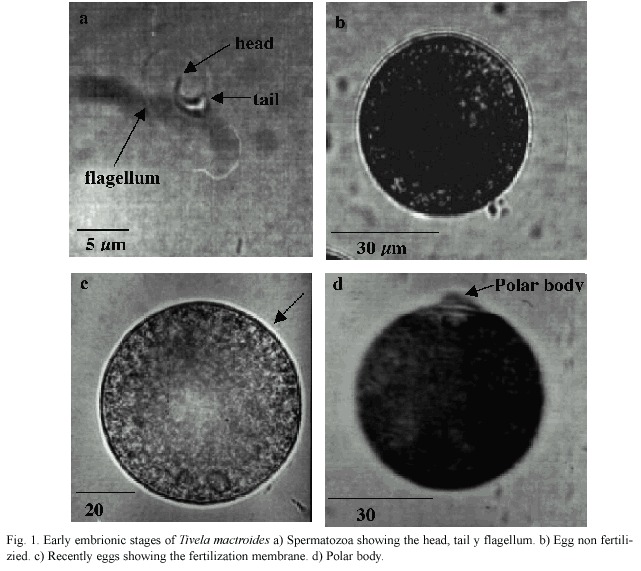
<body><![CDATA[<p><font face="Arial" size="2">Spermatozoa of <i>T.mactroides </i>have a hook-shapep head,with a mean length of 5.29 mm (<a href="#f1">Fig.1a</a>).They own a flagellum about 53 mm long.Eggs are completely spherical at spawning with a mean diameter of 60.69 mm (<a href="#f1">Fig. 1b</a>).Obtaining of fertilized eggs was no problem;nearly 100%of the eggs were fertilized using the techniques suggested by <a href="#lo63">Loosanoff and Davis (1963)</a>.In each experiment, unfertilized eggs were removed to decrease the chance of bacterial contamination.</font></p> <a name="f1"></a>     <div style="text-align: center;"><img src="/img/fbpe/rbt/v52n4/3136i4.JPG" title=""  alt="" style="width: 641px; height: 571px;"></div>     
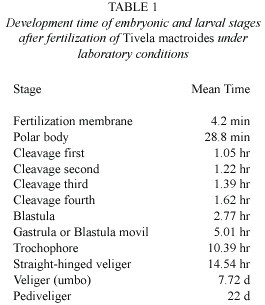
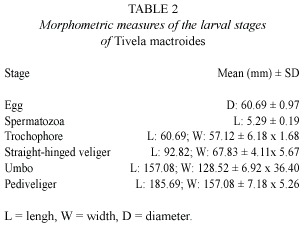
<p><font face="Arial" size="2"><a href="#t1">Tables 1</a> and <a  href="#t2">2</a> show mean developmental times for all stages and its morphometry. Fertilization was recognized by the appearance of a thick fertilization membrane (<a href="#f1">Fig. 1c</a>)at 5 min.After 30 min,a polar body appeared as a protuberance at the egg animal pole (<a  href="#f1">Fig.1d</a>).</font></p> <a name="t1"></a>     <div style="text-align: center;"><img src="/img/fbpe/rbt/v52n4/3136i5.JPG" title=""  alt="" style="width: 265px; height: 305px;"></div>     
<p><font face="Arial" size="2">&nbsp;    <br> <a name="t2"></a></font></p>     <div style="text-align: center;"><font face="Arial" size="2"><img  src="/img/fbpe/rbt/v52n4/3136i6.JPG" title="" alt=""  style="width: 305px; height: 225px;"></font>    
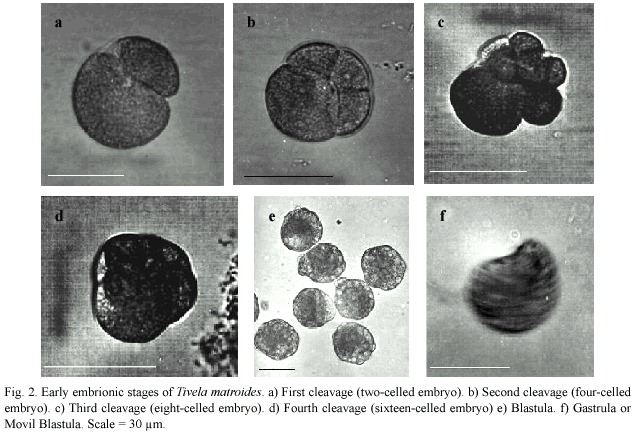
<br> </div>     <p><font face="Arial" size="2">The first cleavage occurred 1.05 hr after fertilization (<a href="#f2">Fig.2a</a>).The second and third cleavages occurred 1.22 and 1.39 hr after fertilization, respectively (<a  href="#f2">Fig.2b</a>,<a href="#f2">c</a>).The fourth cleavage occurred 1.62 hr after fertilization (<a href="#f2">Fig.2d</a>).Two to five hours after fertilization,most embryos were in blastula (<a  href="#f2">Fig.2e</a>)and gastrula or mobile blastula stages,respectively (<a href="#f2">Fig.2f</a>).</font></p> <a name="f2"></a>     <div style="text-align: center;"><img src="/img/fbpe/rbt/v52n4/3136i7.JPG" title=""  alt="" style="width: 636px; height: 434px;"></div>     
]]></body>
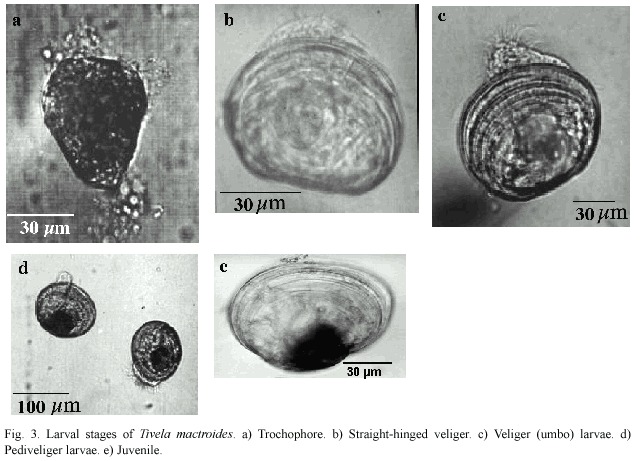
<body><![CDATA[<p><font face="Arial" size="2">Trochophore larvae (<a href="#f3">Fig.3a</a>)were observed approximately 10 hr after fertilization,with mean length and width of 60.69 mm and 57.12 mm respectively.Straight-hinged veliger (<a href="#f3">Fig.3b</a>)appear approximately 15 hr after fertilization,with a mean lenght of 92.82 mm and 67.83 mm of width.The veliger development to the umbo stage occurred about eight days after fertilization,with a mean length of 157.08 mm and a mean width of 128.52 mm (<a href="#f3">Fig.3c</a>).Pediveliger larvae (<a href="#f3">Fig.3d</a>)were observed 22 days after fertilization,with a mean length of 185.69 mm and a mean width of 157.08 mm (<a href="#t2">Table 2</a>).</font></p> <a name="f3"></a>     <div style="text-align: center;"><img src="/img/fbpe/rbt/v52n4/3136i9.JPG" title=""  alt="" style="width: 641px; height: 461px;"></div> <font face="Arial" size="2"><b>     
<p>Discussion</p> </b></font>     <p><font face="Arial" size="2">Under natural conditions,two spawning peaks have been registered for <i>T.mactroides </i>,one in May and the other in November, with ripe gonads observed all year around. (<a href="#se96">Severeyn <i>et al.</i>1996</a>,<a href="#re98">Reverol <i>et al.</i>1998</a>). In this sense,our success in getting mature gametes is in agreement with <a href="#ch81">Chanley (1981)</a> and <a href="#ga94">García <i>et al.</i>(1994)</a>,who indicated that gonadal stage is a key factor controlling the possibility of spawning and production of viable gametes under laboratory conditions.</font></p> <font face="Arial" size="2"><i></i></font>     <p><font face="Arial" size="2"><i>T.mactroides </i>from Caño Sagua beach has been described to show separated sexes (<a href="#se96">Severeyn <i>et al.</i>1996</a>,<a href="#re97">Reverol 1997</a>). However,<a href="#pr80">Prieto (1980)</a>described the presence of hermaphrodites in his study at Guiria Beach,Venezuela.Our analysis of gonads in Caño Sagua beach confirmate this bivalve has separate and independent sexes.We do not have explanations for this dual behavior.</font></p>     <p><font face="Arial" size="2">It is important to mention that it is normal that the eggs of <i>T.mactroides </i>do not have a hyaline capsule.However,after an oil spill in February 1997 in the Gulf of Venezuela, pilot sampling demostrated the presence of a hyaline capsule in all eggs analyzed.Probably this modification was a product of the high stress caused by the spill,and the capsule may function as a protective structure (<a href="#re98">Reverol <i>et al </i>.1998</a>).The role of the capsule is controversial.<a href="#se93">Severeyn (1993)</a>argued that it could play an important role in protecting the eggs and improving their ability to disperse within and between estuarine areas.<a href="#ga94">García <i>et al </i>.(1994)</a> hypothesized that the capsule may protect advanced larval stages as long as unfavorable environmental conditions persist.However, further research is needed to clarify this issue and how the oil spill may have stimulated hyaline capsule formation in <i>T.mactroides </i>.</font></p>     <p><font face="Arial" size="2">Results suggest that <i>T.mactroides </i>has a larval planktonic cycle that is shorter in comparison with other bivalves (<a href="#ve67">Vélez and Martínez 1967</a>,<a href="#ve85">Vélez <i>et al </i>.1985</a>,<a href="#fi81">Fitt and Trech 1981</a>, <a href="#al89">Alargarswani <i>et al. </i>1989</a>, <a href="#su91">Sundberg 1991</a>,<a href="#ga94">García de Severeyn <i>et al.</i>1994)</a>.The embryological development of <i>T.mactroides </i>is completed in five hours,and the larval cycle in 20-22 days (<a href="#re97">Reverol 1997</a>,<a href="#re98">Reverol <i>et al </i>.1998</a>).</font></p>     <p><font face="Arial" size="2">Metamorphosis of <i>T.mactroides </i>was numerically not successful under our laboratory conditions because only in few cases juveniles were observed (<a href="#f3">Fig.3e</a>).We believe that bacterial contamination and subsequent mortalities were important factors constraining the final phase of the larval cycle.We suspect that this was due to unfavorable conditions (<i>e.g.: </i>unsuitable bacterial contamination,available food,etc.)in the laboratory.</font></p>     <p><font face="Arial" size="2">These results are based upon laboratory experiments and may not necessarily reflect what happens under natural conditions. The broad variation in developmental times suggests that these stages may be particularly sensitive to environmental changes.The mean developmental times observed in <i>T.mactroides </i>(<a  href="#t1">Table 1</a>)differ from those reported for <i>Polymesoda solida </i>(<a  href="#ga94">García de Severeyn <i>et al. </i>1994</a>),<i>Perna perna </i>(<a href="#ve67">Vélez and Matínez 1967</a>),<i>Tridacna squamosa </i>(<a href="#fi81">Fitt and Trench 1981</a>),and <i>Rangia cuneata </i>(<a href="#su91">Sundberg 1991</a>).The dissimilarities may be due to taxonomic differences and ecological factors (<a href="#ga94">García de Severeyn <i>et al </i>.1994</a>).</font></p> <font face="Arial" size="2"><b>     <p>Acknowledgments</p> </b></font>     ]]></body>
<body><![CDATA[<p><font face="Arial" size="2">To Antonio Godoy and Omer Moreno for help in the field and laboratory work.This research was partially suported by Consejo de Desarrollo Científico y Humanístico (CONDES)of La Universidad del Zulia, Venezuela.Additional facilities were provided by the Departamento de Biología,Facultad Experimental de Ciencias,La Universidad del Zulia,Maracaibo,Venezuela.</font></p> <font face="Arial" size="2"><b>     <p>Resumen</p> </b></font>     <p><font face="Arial" size="2">La almeja <i>Tivela mactroides </i>,de la playa Caño Sagua, Venezuela,fue desovada y cultivada bajo condiciones de laboratorio,monitoreando su desarrollo embrionario y larvario.El desove fue espontáneo,sin embargo,en algunos casos se indujo adicionando óvulos y espermatozoides. El desarrollo embrionario se produjo en cinco horas, aproximadamente.La larva trocófora fue observada a las diez horas,mientras que la prodisoconcha aparece a las 15 horas después de la fertilización.La larva disoconcha aparece ocho días después de la fecundación y la veliconcha,aproximadamente a los 20 días.La metamorfosis de <i>T.mactroides </i>no fue satisfactoria bajo estas condiciones, ya que la contaminación bacterial fue uno de los principales factores que provocó la mortalidad de las larvas durante la fase final del ciclo,sin embargo,en algunos casos, se observaron juveniles.Las condiciones no favorables (contaminación bacteriana,disponibilidad de alimentos, etc.)y la variación en los tiempos de desarrollo,sugieren que estos estadios son muy sensibles a los cambios ambientales. Estos resultados no necesariamente reflejan lo que ocurre en el medio natural.</font></p> <font face="Arial" size="2"><b>     <p>References</p> </b></font>     <!-- ref --><p><font face="Arial" size="2"><a name="al89"></a>Alagarswami, S.,J.Dharmara,A.Chellam &amp;T.S. Velayudhan <b>.</b>1989.Larval and juvenile rearing of black-lip pearl oyster,<i>Pinctada margaritifera </i>(Linnaeus).Aquaculture 76:43-56.</font>&nbsp;&nbsp;&nbsp;&nbsp;&nbsp;&nbsp;&nbsp;&nbsp;[&#160;<a href="javascript:void(0);" onclick="javascript: window.open('/scielo.php?script=sci_nlinks&ref=1225810&pid=S0034-7744200400040000900001&lng=','','width=640,height=500,resizable=yes,scrollbars=1,menubar=yes,');">Links</a>&#160;]<!-- end-ref --><!-- ref --><p><font face="Arial" size="2"><a name="an00"></a>Andrade,G.,M.Montiel de Morales,Y.García de Severeyn,H.Severeyn &amp;F.Morales.2000. Determinación cuantitativa de microorganismos del género <i>Vibrio </i>durante el desarrollo embrionario y larval de la almeja <i>Tivela mactroides </i>(Bivalvia: Veneridae)bajo condiciones de laboratorio.Ciencia 8(2):137-144.</font>&nbsp;&nbsp;&nbsp;&nbsp;&nbsp;&nbsp;&nbsp;&nbsp;[&#160;<a href="javascript:void(0);" onclick="javascript: window.open('/scielo.php?script=sci_nlinks&ref=1225811&pid=S0034-7744200400040000900002&lng=','','width=640,height=500,resizable=yes,scrollbars=1,menubar=yes,');">Links</a>&#160;]<!-- end-ref --><!-- ref --><p><font face="Arial" size="2"><a name="br84"></a>Brito,P.1984.Algunos aspectos de la dinámica poblacional del guacuco <i>Tivela mactroides </i>(Born,1778) en dos localidades de Barlovento.Tesis de Licenciatura, Universidad Simón Bolívar, Caracas, Venezuela.</font>&nbsp;&nbsp;&nbsp;&nbsp;&nbsp;&nbsp;&nbsp;&nbsp;[&#160;<a href="javascript:void(0);" onclick="javascript: window.open('/scielo.php?script=sci_nlinks&ref=1225812&pid=S0034-7744200400040000900003&lng=','','width=640,height=500,resizable=yes,scrollbars=1,menubar=yes,');">Links</a>&#160;]<!-- end-ref --><!-- ref --><p><font face="Arial" size="2"><a name="ch81"></a>Chanley,M.H.1981.Laboratory culture of marine bivalve molluscs.<i>In </i>Laboratory Animal Management: Marine Invertebrates.National Academy.382 p.</font>&nbsp;&nbsp;&nbsp;&nbsp;&nbsp;&nbsp;&nbsp;&nbsp;[&#160;<a href="javascript:void(0);" onclick="javascript: window.open('/scielo.php?script=sci_nlinks&ref=1225813&pid=S0034-7744200400040000900004&lng=','','width=640,height=500,resizable=yes,scrollbars=1,menubar=yes,');">Links</a>&#160;]<!-- end-ref --><!-- ref --><p><font face="Arial" size="2"><a name="de97"></a>Delgado,J.1997.Estudio comparativo de la biodiversidad y distribución de la fauna macrobentónica invertebrada presente en las playas arenosas de alta energía de Caño Sagua y Caimare Chico (Municipio Páez, Estado Zulia).Tesis de Licenciatura,La Universidad del Zulia,Maracaibo,Venezuela.</font>&nbsp;&nbsp;&nbsp;&nbsp;&nbsp;&nbsp;&nbsp;&nbsp;[&#160;<a href="javascript:void(0);" onclick="javascript: window.open('/scielo.php?script=sci_nlinks&ref=1225814&pid=S0034-7744200400040000900005&lng=','','width=640,height=500,resizable=yes,scrollbars=1,menubar=yes,');">Links</a>&#160;]<!-- end-ref --><!-- ref --><p><font face="Arial" size="2"><a name="et76"></a>Etchever,S.,S.L.1976.Notas ecológicas y cuantificación de la población explotable de "Guacuco <b>"</b><i>Tivela mactroides </i>en la ensenada La Guardia,Isla de Margarita<b>. </b>Bol. Inst. Oceanogr. Univ. Oriente. 15:57-64.</font>&nbsp;&nbsp;&nbsp;&nbsp;&nbsp;&nbsp;&nbsp;&nbsp;[&#160;<a href="javascript:void(0);" onclick="javascript: window.open('/scielo.php?script=sci_nlinks&ref=1225815&pid=S0034-7744200400040000900006&lng=','','width=640,height=500,resizable=yes,scrollbars=1,menubar=yes,');">Links</a>&#160;]<!-- end-ref --><!-- ref --><p><font face="Arial" size="2"><a name="fi81"></a>Fitt,W.K.&amp;R.K.Trench.1981.Spawning,development and acquisition of zooxanthellae by <i>Tridacna squamosa </i>(Mollusca,Bivalvia).Biol.Bull.161:213-235.</font>&nbsp;&nbsp;&nbsp;&nbsp;&nbsp;&nbsp;&nbsp;&nbsp;[&#160;<a href="javascript:void(0);" onclick="javascript: window.open('/scielo.php?script=sci_nlinks&ref=1225816&pid=S0034-7744200400040000900007&lng=','','width=640,height=500,resizable=yes,scrollbars=1,menubar=yes,');">Links</a>&#160;]<!-- end-ref --><!-- ref --><p><font face="Arial" size="2"><a name="ga40"></a>Galtsoff,P.S.1940.Phisiology of reproduction of <i>Ostrea virgínica </i>.III.Stimulation of spawing in the male oyster.Biol.Bull <b>.</b>78:117-135.</font>&nbsp;&nbsp;&nbsp;&nbsp;&nbsp;&nbsp;&nbsp;&nbsp;[&#160;<a href="javascript:void(0);" onclick="javascript: window.open('/scielo.php?script=sci_nlinks&ref=1225817&pid=S0034-7744200400040000900008&lng=','','width=640,height=500,resizable=yes,scrollbars=1,menubar=yes,');">Links</a>&#160;]<!-- end-ref --><!-- ref --><p><font face="Arial" size="2"><a name="ga94"></a>García de Severeyn,Y.,H.Severeyn &amp;J.Ewald. 1994.Early development of the estuarine mollusks <i>Polymesoda solida </i>(Philippi,1946)(Bivalvia: Corbiculidae)in Lake Maracaibo,Venezuela.Amer. Malacol.Bull.11:51-56.</font>&nbsp;&nbsp;&nbsp;&nbsp;&nbsp;&nbsp;&nbsp;&nbsp;[&#160;<a href="javascript:void(0);" onclick="javascript: window.open('/scielo.php?script=sci_nlinks&ref=1225818&pid=S0034-7744200400040000900009&lng=','','width=640,height=500,resizable=yes,scrollbars=1,menubar=yes,');">Links</a>&#160;]<!-- end-ref --><!-- ref --><p><font face="Arial" size="2"><a name="ga00"></a>García de Severeyn,Y.,H.Severeyn,W.Grant &amp;Y Reverol.2000.Effect of the temperature on larval development of the bivalve mollusk <i>Tivela mactroides </i>:evaluation in the laboratory and via simulation. Ecol.Model.129:143-151.</font>&nbsp;&nbsp;&nbsp;&nbsp;&nbsp;&nbsp;&nbsp;&nbsp;[&#160;<a href="javascript:void(0);" onclick="javascript: window.open('/scielo.php?script=sci_nlinks&ref=1225819&pid=S0034-7744200400040000900010&lng=','','width=640,height=500,resizable=yes,scrollbars=1,menubar=yes,');">Links</a>&#160;]<!-- end-ref --><!-- ref --><p><font face="Arial" size="2"><a name="go97"></a>Godoy,A.1997.Densidad poblacional,biomasa y rendimiento pesquero del guacuco <i>Tivela mactroides </i>(Born,1778)en la zona sur occidental del Golfo de Venezuela (Zulia,Venezuela).Tesis de Licenciatura, La Universidad del Zulia,Maracaibo,Venezuela.</font>&nbsp;&nbsp;&nbsp;&nbsp;&nbsp;&nbsp;&nbsp;&nbsp;[&#160;<a href="javascript:void(0);" onclick="javascript: window.open('/scielo.php?script=sci_nlinks&ref=1225820&pid=S0034-7744200400040000900011&lng=','','width=640,height=500,resizable=yes,scrollbars=1,menubar=yes,');">Links</a>&#160;]<!-- end-ref --><!-- ref --><p><font face="Arial" size="2"><a name="lo63"></a>Loosanoff,V.L &amp;H.Davis.1963.Rearing of Bivalve mollusks.Advance.Mar.Biol.1:1-136.</font>&nbsp;&nbsp;&nbsp;&nbsp;&nbsp;&nbsp;&nbsp;&nbsp;[&#160;<a href="javascript:void(0);" onclick="javascript: window.open('/scielo.php?script=sci_nlinks&ref=1225821&pid=S0034-7744200400040000900012&lng=','','width=640,height=500,resizable=yes,scrollbars=1,menubar=yes,');">Links</a>&#160;]<!-- end-ref --><!-- ref --><p><font face="Arial" size="2"><a name="ma93"></a>Marcano,J.1993.Abundancia,explotación y dinámica poblacional del guacuco <i>Tivela mactroides </i>(Born, 1778) (Mollusca:Bivalvia),aspectos reproductivos y distribución de tallas.Tesis de Maestría en Ciencias Marinas,Universidad de Oriente,Cumaná, Venezuela.</font>&nbsp;&nbsp;&nbsp;&nbsp;&nbsp;&nbsp;&nbsp;&nbsp;[&#160;<a href="javascript:void(0);" onclick="javascript: window.open('/scielo.php?script=sci_nlinks&ref=1225822&pid=S0034-7744200400040000900013&lng=','','width=640,height=500,resizable=yes,scrollbars=1,menubar=yes,');">Links</a>&#160;]<!-- end-ref --><!-- ref --><p><font face="Arial" size="2"><a name="mo96"></a>Morales,F.,H.Severeyn,Y.García,N.Blanco &amp;N. Carrasquero.1996.Comportamiento reproductivo de la almeja <i>Tivela mactroides </i>(Born,1778)en la playa de Caño Sagua,Golfo de Venezuela <b>.</b>Memorias de las VII Jornadas Científicas de la Facultad Experimental de Ciencias de La Universidad del Zulia.Maracaibo, Venezuela.38 p.</font>&nbsp;&nbsp;&nbsp;&nbsp;&nbsp;&nbsp;&nbsp;&nbsp;[&#160;<a href="javascript:void(0);" onclick="javascript: window.open('/scielo.php?script=sci_nlinks&ref=1225823&pid=S0034-7744200400040000900014&lng=','','width=640,height=500,resizable=yes,scrollbars=1,menubar=yes,');">Links</a>&#160;]<!-- end-ref --><!-- ref --><p><font face="Arial" size="2"><a name="pr77"></a>Prieto,A.1977.Contribución a la ecología de <i>Tivela mactroides </i>(Born,1778) (Mollusca:Bivalvia). Aspectos reproductivos y distribución de tallas.Tesis de maestría en Ciencias Marinas,Universidad de Oriente, Cumaná.99 p.</font>&nbsp;&nbsp;&nbsp;&nbsp;&nbsp;&nbsp;&nbsp;&nbsp;[&#160;<a href="javascript:void(0);" onclick="javascript: window.open('/scielo.php?script=sci_nlinks&ref=1225824&pid=S0034-7744200400040000900015&lng=','','width=640,height=500,resizable=yes,scrollbars=1,menubar=yes,');">Links</a>&#160;]<!-- end-ref --><!-- ref --><p><font face="Arial" size="2"><a name="pr80"></a>Prieto,A.1980.Contribución a la ecología de <i>Tivela mactroides </i>(Born,1778) (Mollusca:Bivalvia). Aspectos reproductivos. Bol. Inst.Oceanog.Univ.Oriente. 29:323-328.</font>&nbsp;&nbsp;&nbsp;&nbsp;&nbsp;&nbsp;&nbsp;&nbsp;[&#160;<a href="javascript:void(0);" onclick="javascript: window.open('/scielo.php?script=sci_nlinks&ref=1225825&pid=S0034-7744200400040000900016&lng=','','width=640,height=500,resizable=yes,scrollbars=1,menubar=yes,');">Links</a>&#160;]<!-- end-ref --><!-- ref --><p><font face="Arial" size="2"><a name="pr83"></a>Prieto,A.1983.Ecología de <i>Tivela mactroides </i>(Born, 1778)(Mollusca:Bivalvia)en la playa La Güiria. Bol. Inst. Oceanogr. Univ. Oriente.22 (1-2):7-19.</font>&nbsp;&nbsp;&nbsp;&nbsp;&nbsp;&nbsp;&nbsp;&nbsp;[&#160;<a href="javascript:void(0);" onclick="javascript: window.open('/scielo.php?script=sci_nlinks&ref=1225826&pid=S0034-7744200400040000900017&lng=','','width=640,height=500,resizable=yes,scrollbars=1,menubar=yes,');">Links</a>&#160;]<!-- end-ref --><!-- ref --><p><font face="Arial" size="2"><a name="pr87"></a>Prieto,A.1987.Ecología de <i>Tivela mactroides </i>(Born, 1778)(Mollusca:Bivalvia)crecimiento,mortalidad númerica,eliminación y rendimiento en la localidad de playa La Güria (Sucre,Venezuela).Trabajo de Ascenso,Universidad de Oriente,Cumaná, Venezuela.209 p.</font>&nbsp;&nbsp;&nbsp;&nbsp;&nbsp;&nbsp;&nbsp;&nbsp;[&#160;<a href="javascript:void(0);" onclick="javascript: window.open('/scielo.php?script=sci_nlinks&ref=1225827&pid=S0034-7744200400040000900018&lng=','','width=640,height=500,resizable=yes,scrollbars=1,menubar=yes,');">Links</a>&#160;]<!-- end-ref --><!-- ref --><p><font face="Arial" size="2"><a name="re81"></a>Rehders,H.A.1981.Field guide to North American seashells.The Audubon Society.New York,United States.894 p.</font>&nbsp;&nbsp;&nbsp;&nbsp;&nbsp;&nbsp;&nbsp;&nbsp;[&#160;<a href="javascript:void(0);" onclick="javascript: window.open('/scielo.php?script=sci_nlinks&ref=1225828&pid=S0034-7744200400040000900019&lng=','','width=640,height=500,resizable=yes,scrollbars=1,menubar=yes,');">Links</a>&#160;]<!-- end-ref --><!-- ref --><p><font face="Arial" size="2"><a name="re97"></a>Reverol,Y.1997.Desarrollo embrionario y larval de <i>Tivela mactroides </i>(Born,1778)almeja presente en la playa de Caño Sagua,Municipio Páez,Estado Zulia, Venezuela.Tesis de licenciatura,La Universidad del Zulia,Maracaibo,Venezuela.</font>&nbsp;&nbsp;&nbsp;&nbsp;&nbsp;&nbsp;&nbsp;&nbsp;[&#160;<a href="javascript:void(0);" onclick="javascript: window.open('/scielo.php?script=sci_nlinks&ref=1225829&pid=S0034-7744200400040000900020&lng=','','width=640,height=500,resizable=yes,scrollbars=1,menubar=yes,');">Links</a>&#160;]<!-- end-ref --><!-- ref --><p><font face="Arial" size="2"><a name="re98"></a>Reverol,Y.,Y.García de Severeyn,H.Severeyn &amp;J. Delgado.1998.Efecto de la temperatura sobre el desarrollo larvario del guacuco,<i>Tivela mactroides</i>. Bol.Cent.Invest.Biol.32(3):153-278.</font>&nbsp;&nbsp;&nbsp;&nbsp;&nbsp;&nbsp;&nbsp;&nbsp;[&#160;<a href="javascript:void(0);" onclick="javascript: window.open('/scielo.php?script=sci_nlinks&ref=1225830&pid=S0034-7744200400040000900021&lng=','','width=640,height=500,resizable=yes,scrollbars=1,menubar=yes,');">Links</a>&#160;]<!-- end-ref --><!-- ref --><p><font face="Arial" size="2"><a name="se93"></a>Severeyn,H.1993.Taxonomic revision and phylogeny of the genus <i>Polymesoda </i>Rafinesque,1820 (Bivalvia: Corbiculidae). Doctoral dissertation,University of Maryland,Eastern Shore Campus,MEES Program. 424 p.</font>&nbsp;&nbsp;&nbsp;&nbsp;&nbsp;&nbsp;&nbsp;&nbsp;[&#160;<a href="javascript:void(0);" onclick="javascript: window.open('/scielo.php?script=sci_nlinks&ref=1225831&pid=S0034-7744200400040000900022&lng=','','width=640,height=500,resizable=yes,scrollbars=1,menubar=yes,');">Links</a>&#160;]<!-- end-ref --><!-- ref --><p><font face="Arial" size="2"><a name="se96"></a>Severeyn,H.,F.Morales,A.Godoy &amp;J.Delgado. 1996.Dinamica poblacional de la almeja marina <i>Tivela mactroides </i>en la playa de Caño Sagua,Zulia, Venezuela.Invest.Cient.2:27-37.</font>&nbsp;&nbsp;&nbsp;&nbsp;&nbsp;&nbsp;&nbsp;&nbsp;[&#160;<a href="javascript:void(0);" onclick="javascript: window.open('/scielo.php?script=sci_nlinks&ref=1225832&pid=S0034-7744200400040000900023&lng=','','width=640,height=500,resizable=yes,scrollbars=1,menubar=yes,');">Links</a>&#160;]<!-- end-ref --><!-- ref --><p><font face="Arial" size="2"><a name="su91"></a>Sundberg,K.L.1991.Development,settlement and metamorfosis of larval <i>Rangia cuneata </i>(Sowerby, 1831).Thesis of Master of Science <b>.</b>University of Maryland.28 p.</font>&nbsp;&nbsp;&nbsp;&nbsp;&nbsp;&nbsp;&nbsp;&nbsp;[&#160;<a href="javascript:void(0);" onclick="javascript: window.open('/scielo.php?script=sci_nlinks&ref=1225833&pid=S0034-7744200400040000900024&lng=','','width=640,height=500,resizable=yes,scrollbars=1,menubar=yes,');">Links</a>&#160;]<!-- end-ref --><!-- ref --><p><font face="Arial" size="2"><a name="ta91"></a>Tatá,B.&amp;A.S.Prieto A.1991.Producción secundaria en una población del bivalvo tropical <i>Tivela mactroides </i>(Veneridae)en el Oriente de Venezuela.J.Caribb. Sci.27:28-34.</font>&nbsp;&nbsp;&nbsp;&nbsp;&nbsp;&nbsp;&nbsp;&nbsp;[&#160;<a href="javascript:void(0);" onclick="javascript: window.open('/scielo.php?script=sci_nlinks&ref=1225834&pid=S0034-7744200400040000900025&lng=','','width=640,height=500,resizable=yes,scrollbars=1,menubar=yes,');">Links</a>&#160;]<!-- end-ref --><!-- ref --><p><font face="Arial" size="2"><a name="ve67"></a>Vélez,R.A &amp;R.Martínez.1967.Reproducción y desarrollo larval experimental del mejillón comestible de Venezuela <i>Perna perna </i>(Linnaeus,1758).Bol.Inst. Oceanog.6(2):266-285.</font>&nbsp;&nbsp;&nbsp;&nbsp;&nbsp;&nbsp;&nbsp;&nbsp;[&#160;<a href="javascript:void(0);" onclick="javascript: window.open('/scielo.php?script=sci_nlinks&ref=1225835&pid=S0034-7744200400040000900026&lng=','','width=640,height=500,resizable=yes,scrollbars=1,menubar=yes,');">Links</a>&#160;]<!-- end-ref --><!-- ref --><p><font face="Arial" size="2"><a name="ve85"></a>Vélez,A.,B.J.Venables &amp;L.C.Fitzpatrick.1985.Growth and production of the tropical beach clam <i>Donax denticulatus </i>(Tellinidae)in Eastern Venezuela.Carib. J.Sci.21(1-2):63-73.</font>&nbsp;&nbsp;&nbsp;&nbsp;&nbsp;&nbsp;&nbsp;&nbsp;[&#160;<a href="javascript:void(0);" onclick="javascript: window.open('/scielo.php?script=sci_nlinks&ref=1225836&pid=S0034-7744200400040000900027&lng=','','width=640,height=500,resizable=yes,scrollbars=1,menubar=yes,');">Links</a>&#160;]<!-- end-ref --><!-- ref --><p><font face="Arial" size="2"><a name="wa61"></a>Warmke,G.L.&amp;R.T.Abbott.1961.Caribbeans Seashells. Dover,New York.348 p.</font>&nbsp;&nbsp;&nbsp;&nbsp;&nbsp;&nbsp;&nbsp;&nbsp;[&#160;<a href="javascript:void(0);" onclick="javascript: window.open('/scielo.php?script=sci_nlinks&ref=1225837&pid=S0034-7744200400040000900028&lng=','','width=640,height=500,resizable=yes,scrollbars=1,menubar=yes,');">Links</a>&#160;]<!-- end-ref --> ]]></body><back>
<ref-list>
<ref id="B1">
<nlm-citation citation-type="journal">
<person-group person-group-type="author">
<name>
<surname><![CDATA[Alagarswami]]></surname>
<given-names><![CDATA[S]]></given-names>
</name>
<name>
<surname><![CDATA[Dharmara]]></surname>
<given-names><![CDATA[J]]></given-names>
</name>
<name>
<surname><![CDATA[Chellam]]></surname>
<given-names><![CDATA[A]]></given-names>
</name>
<name>
<surname><![CDATA[Velayudhan]]></surname>
<given-names><![CDATA[T.S]]></given-names>
</name>
</person-group>
<article-title xml:lang="en"><![CDATA[Larval and juvenile rearing of black-lip pearl oyster,Pinctada margaritifera (Linnaeus)]]></article-title>
<source><![CDATA[Aquaculture]]></source>
<year>1989</year>
<volume>76</volume>
<page-range>43-56</page-range></nlm-citation>
</ref>
<ref id="B2">
<nlm-citation citation-type="journal">
<person-group person-group-type="author">
<name>
<surname><![CDATA[Andrade]]></surname>
<given-names><![CDATA[G]]></given-names>
</name>
<name>
<surname><![CDATA[Montiel de Morales]]></surname>
<given-names><![CDATA[M]]></given-names>
</name>
<name>
<surname><![CDATA[García de Severeyn]]></surname>
<given-names><![CDATA[Y]]></given-names>
</name>
<name>
<surname><![CDATA[Severeyn]]></surname>
<given-names><![CDATA[H]]></given-names>
</name>
<name>
<surname><![CDATA[Morales]]></surname>
<given-names><![CDATA[F]]></given-names>
</name>
</person-group>
<article-title xml:lang="es"><![CDATA[Determinación cuantitativa de microorganismos del género Vibrio durante el desarrollo embrionario y larval de la almeja Tivela mactroides (Bivalvia: Veneridae)bajo condiciones de laboratorio]]></article-title>
<source><![CDATA[Ciencia]]></source>
<year>2000</year>
<volume>8</volume>
<numero>2</numero>
<issue>2</issue>
<page-range>137-144</page-range></nlm-citation>
</ref>
<ref id="B3">
<nlm-citation citation-type="">
<person-group person-group-type="author">
<name>
<surname><![CDATA[Brito]]></surname>
<given-names><![CDATA[P]]></given-names>
</name>
</person-group>
<source><![CDATA[Algunos aspectos de la dinámica poblacional del guacuco Tivela mactroides (Born,1778) en dos localidades de Barlovento]]></source>
<year>1984</year>
</nlm-citation>
</ref>
<ref id="B4">
<nlm-citation citation-type="book">
<person-group person-group-type="author">
<name>
<surname><![CDATA[Chanley]]></surname>
<given-names><![CDATA[M.H]]></given-names>
</name>
</person-group>
<article-title xml:lang="en"><![CDATA[Laboratory culture of marine bivalve molluscs]]></article-title>
<source><![CDATA[Laboratory Animal Management: Marine Invertebrates]]></source>
<year>1981</year>
<page-range>382</page-range><publisher-name><![CDATA[National Academy]]></publisher-name>
</nlm-citation>
</ref>
<ref id="B5">
<nlm-citation citation-type="">
<person-group person-group-type="author">
<name>
<surname><![CDATA[Delgado]]></surname>
<given-names><![CDATA[J]]></given-names>
</name>
</person-group>
<source><![CDATA[Estudio comparativo de la biodiversidad y distribución de la fauna macrobentónica invertebrada presente en las playas arenosas de alta energía de Caño Sagua y Caimare Chico (Municipio Páez, Estado Zulia)]]></source>
<year>1997</year>
</nlm-citation>
</ref>
<ref id="B6">
<nlm-citation citation-type="journal">
<person-group person-group-type="author">
<name>
<surname><![CDATA[Etchever,S]]></surname>
<given-names><![CDATA[S.L]]></given-names>
</name>
</person-group>
<article-title xml:lang="es"><![CDATA[Notas ecológicas y cuantificación de la población explotable de "Guacuco "Tivela mactroides en la ensenada La Guardia,Isla de Margarita]]></article-title>
<source><![CDATA[Bol. Inst. Oceanogr. Univ. Oriente]]></source>
<year>1976</year>
<volume>15</volume>
<page-range>57-64</page-range></nlm-citation>
</ref>
<ref id="B7">
<nlm-citation citation-type="journal">
<person-group person-group-type="author">
<name>
<surname><![CDATA[Fitt]]></surname>
<given-names><![CDATA[W.K]]></given-names>
</name>
<name>
<surname><![CDATA[Trench]]></surname>
<given-names><![CDATA[R.K]]></given-names>
</name>
</person-group>
<article-title xml:lang="en"><![CDATA[Spawning,development and acquisition of zooxanthellae by Tridacna squamosa (Mollusca,Bivalvia)]]></article-title>
<source><![CDATA[Biol.Bull]]></source>
<year>1981</year>
<volume>161</volume>
<page-range>213-235</page-range></nlm-citation>
</ref>
<ref id="B8">
<nlm-citation citation-type="journal">
<person-group person-group-type="author">
<name>
<surname><![CDATA[Galtsoff]]></surname>
<given-names><![CDATA[P.S]]></given-names>
</name>
</person-group>
<article-title xml:lang="en"><![CDATA[Phisiology of reproduction of Ostrea virgínica .III.Stimulation of spawing in the male oyster]]></article-title>
<source><![CDATA[Biol.Bull]]></source>
<year>1940</year>
<volume>78</volume>
<page-range>117-135</page-range></nlm-citation>
</ref>
<ref id="B9">
<nlm-citation citation-type="journal">
<person-group person-group-type="author">
<name>
<surname><![CDATA[García de Severeyn]]></surname>
<given-names><![CDATA[Y]]></given-names>
</name>
<name>
<surname><![CDATA[Severeyn]]></surname>
<given-names><![CDATA[H]]></given-names>
</name>
<name>
<surname><![CDATA[Ewald]]></surname>
<given-names><![CDATA[J]]></given-names>
</name>
</person-group>
<article-title xml:lang="en"><![CDATA[Early development of the estuarine mollusks Polymesoda solida (Philippi,1946)(Bivalvia: Corbiculidae)in Lake Maracaibo,Venezuela]]></article-title>
<source><![CDATA[Amer. Malacol.Bull]]></source>
<year>1994</year>
<volume>11</volume>
<page-range>51-56</page-range></nlm-citation>
</ref>
<ref id="B10">
<nlm-citation citation-type="journal">
<person-group person-group-type="author">
<name>
<surname><![CDATA[García de Severeyn]]></surname>
<given-names><![CDATA[Y]]></given-names>
</name>
<name>
<surname><![CDATA[Severeyn]]></surname>
<given-names><![CDATA[H]]></given-names>
</name>
<name>
<surname><![CDATA[Grant]]></surname>
<given-names><![CDATA[W]]></given-names>
</name>
<name>
<surname><![CDATA[Reverol]]></surname>
<given-names><![CDATA[Y]]></given-names>
</name>
</person-group>
<article-title xml:lang="en"><![CDATA[Effect of the temperature on larval development of the bivalve mollusk Tivela mactroides: evaluation in the laboratory and via simulation]]></article-title>
<source><![CDATA[Ecol.Model]]></source>
<year>2000</year>
<volume>129</volume>
<page-range>143-151</page-range></nlm-citation>
</ref>
<ref id="B11">
<nlm-citation citation-type="">
<person-group person-group-type="author">
<name>
<surname><![CDATA[Godoy]]></surname>
<given-names><![CDATA[A]]></given-names>
</name>
</person-group>
<source><![CDATA[Densidad poblacional,biomasa y rendimiento pesquero del guacuco Tivela mactroides (Born,1778)en la zona sur occidental del Golfo de Venezuela (Zulia,Venezuela)]]></source>
<year>1997</year>
</nlm-citation>
</ref>
<ref id="B12">
<nlm-citation citation-type="journal">
<person-group person-group-type="author">
<name>
<surname><![CDATA[Loosanoff]]></surname>
<given-names><![CDATA[V.L]]></given-names>
</name>
<name>
<surname><![CDATA[Davis]]></surname>
<given-names><![CDATA[H]]></given-names>
</name>
</person-group>
<article-title xml:lang="en"><![CDATA[Rearing of Bivalve mollusks]]></article-title>
<source><![CDATA[Advance.Mar.Biol]]></source>
<year>1963</year>
<volume>1</volume>
<page-range>1-136</page-range></nlm-citation>
</ref>
<ref id="B13">
<nlm-citation citation-type="">
<person-group person-group-type="author">
<name>
<surname><![CDATA[Marcano]]></surname>
<given-names><![CDATA[J]]></given-names>
</name>
</person-group>
<source><![CDATA[Abundancia,explotación y dinámica poblacional del guacuco Tivela mactroides (Born, 1778) (Mollusca:Bivalvia),aspectos reproductivos y distribución de tallas]]></source>
<year>1993</year>
</nlm-citation>
</ref>
<ref id="B14">
<nlm-citation citation-type="confpro">
<person-group person-group-type="author">
<name>
<surname><![CDATA[Morales]]></surname>
<given-names><![CDATA[F]]></given-names>
</name>
<name>
<surname><![CDATA[Severeyn]]></surname>
<given-names><![CDATA[H]]></given-names>
</name>
<name>
<surname><![CDATA[García]]></surname>
<given-names><![CDATA[Y]]></given-names>
</name>
<name>
<surname><![CDATA[Blanco]]></surname>
<given-names><![CDATA[N]]></given-names>
</name>
<name>
<surname><![CDATA[Carrasquero]]></surname>
<given-names><![CDATA[N]]></given-names>
</name>
</person-group>
<source><![CDATA[Comportamiento reproductivo de la almeja Tivela mactroides (Born,1778)en la playa de Caño Sagua,Golfo de Venezuela]]></source>
<year>1996</year>
<conf-name><![CDATA[VII Jornadas Científicas de la Facultad Experimental de Ciencias de La Universidad del Zulia]]></conf-name>
<conf-loc>Maracaibo </conf-loc>
<page-range>38</page-range></nlm-citation>
</ref>
<ref id="B15">
<nlm-citation citation-type="">
<person-group person-group-type="author">
<name>
<surname><![CDATA[Prieto]]></surname>
<given-names><![CDATA[A]]></given-names>
</name>
</person-group>
<source><![CDATA[Contribución a la ecología de Tivela mactroides (Born,1778) (Mollusca:Bivalvia). Aspectos reproductivos y distribución de tallas]]></source>
<year>1977</year>
<page-range>99</page-range></nlm-citation>
</ref>
<ref id="B16">
<nlm-citation citation-type="journal">
<person-group person-group-type="author">
<name>
<surname><![CDATA[Prieto]]></surname>
<given-names><![CDATA[A]]></given-names>
</name>
</person-group>
<source><![CDATA[Bol. Inst.Oceanog.Univ.Oriente]]></source>
<year>1980</year>
<volume>29</volume>
<page-range>323-328</page-range></nlm-citation>
</ref>
<ref id="B17">
<nlm-citation citation-type="journal">
<person-group person-group-type="author">
<name>
<surname><![CDATA[Prieto]]></surname>
<given-names><![CDATA[A]]></given-names>
</name>
</person-group>
<article-title xml:lang="es"><![CDATA[Ecología de Tivela mactroides (Born, 1778)(Mollusca:Bivalvia)en la playa La Güiria]]></article-title>
<source><![CDATA[Bol. Inst. Oceanogr. Univ. Oriente]]></source>
<year>1983</year>
<volume>22</volume>
<numero>1-2</numero>
<issue>1-2</issue>
<page-range>7-19</page-range></nlm-citation>
</ref>
<ref id="B18">
<nlm-citation citation-type="">
<person-group person-group-type="author">
<name>
<surname><![CDATA[Prieto]]></surname>
<given-names><![CDATA[A]]></given-names>
</name>
</person-group>
<source><![CDATA[Ecología de Tivela mactroides (Born, 1778)(Mollusca:Bivalvia)crecimiento,mortalidad númerica,eliminación y rendimiento en la localidad de playa La Güria (Sucre,Venezuela)]]></source>
<year>1987</year>
<page-range>209</page-range></nlm-citation>
</ref>
<ref id="B19">
<nlm-citation citation-type="book">
<person-group person-group-type="author">
<name>
<surname><![CDATA[Rehders]]></surname>
<given-names><![CDATA[H.A]]></given-names>
</name>
</person-group>
<source><![CDATA[Field guide to North American seashells]]></source>
<year>1981</year>
<page-range>894</page-range><publisher-loc><![CDATA[^eNew York New York]]></publisher-loc>
<publisher-name><![CDATA[The Audubon Society]]></publisher-name>
</nlm-citation>
</ref>
<ref id="B20">
<nlm-citation citation-type="">
<person-group person-group-type="author">
<name>
<surname><![CDATA[Reverol]]></surname>
<given-names><![CDATA[Y]]></given-names>
</name>
</person-group>
<source><![CDATA[Desarrollo embrionario y larval de Tivela mactroides (Born,1778)almeja presente en la playa de Caño Sagua,Municipio Páez,Estado Zulia, Venezuela]]></source>
<year>1997</year>
</nlm-citation>
</ref>
<ref id="B21">
<nlm-citation citation-type="journal">
<person-group person-group-type="author">
<name>
<surname><![CDATA[Reverol]]></surname>
<given-names><![CDATA[Y]]></given-names>
</name>
<name>
<surname><![CDATA[García de Severeyn]]></surname>
<given-names><![CDATA[Y]]></given-names>
</name>
<name>
<surname><![CDATA[Severeyn]]></surname>
<given-names><![CDATA[H]]></given-names>
</name>
<name>
<surname><![CDATA[Delgado]]></surname>
<given-names><![CDATA[J]]></given-names>
</name>
</person-group>
<article-title xml:lang="es"><![CDATA[Efecto de la temperatura sobre el desarrollo larvario del guacuco,Tivela mactroides]]></article-title>
<source><![CDATA[Bol.Cent.Invest.Biol]]></source>
<year>1998</year>
<volume>32</volume>
<numero>3</numero>
<issue>3</issue>
<page-range>153-278</page-range></nlm-citation>
</ref>
<ref id="B22">
<nlm-citation citation-type="">
<person-group person-group-type="author">
<name>
<surname><![CDATA[Severeyn]]></surname>
<given-names><![CDATA[H]]></given-names>
</name>
</person-group>
<source><![CDATA[Taxonomic revision and phylogeny of the genus Polymesoda Rafinesque,1820 (Bivalvia: Corbiculidae)]]></source>
<year>1993</year>
<page-range>424</page-range></nlm-citation>
</ref>
<ref id="B23">
<nlm-citation citation-type="journal">
<person-group person-group-type="author">
<name>
<surname><![CDATA[Severeyn]]></surname>
<given-names><![CDATA[H]]></given-names>
</name>
<name>
<surname><![CDATA[Morales]]></surname>
<given-names><![CDATA[F]]></given-names>
</name>
<name>
<surname><![CDATA[Godoy]]></surname>
<given-names><![CDATA[A]]></given-names>
</name>
<name>
<surname><![CDATA[Delgado]]></surname>
<given-names><![CDATA[J]]></given-names>
</name>
</person-group>
<article-title xml:lang="es"><![CDATA[Dinamica poblacional de la almeja marina Tivela mactroides en la playa de Caño Sagua,Zulia, Venezuela]]></article-title>
<source><![CDATA[Invest.Cient]]></source>
<year>1996</year>
<volume>2</volume>
<page-range>27-37</page-range></nlm-citation>
</ref>
<ref id="B24">
<nlm-citation citation-type="">
<person-group person-group-type="author">
<name>
<surname><![CDATA[Sundberg]]></surname>
<given-names><![CDATA[K.L]]></given-names>
</name>
</person-group>
<source><![CDATA[Development,settlement and metamorfosis of larval Rangia cuneata (Sowerby, 1831)]]></source>
<year>1991</year>
<page-range>28</page-range></nlm-citation>
</ref>
<ref id="B25">
<nlm-citation citation-type="journal">
<person-group person-group-type="author">
<name>
<surname><![CDATA[Tatá]]></surname>
<given-names><![CDATA[B]]></given-names>
</name>
<name>
<surname><![CDATA[Prieto A]]></surname>
<given-names><![CDATA[A.S]]></given-names>
</name>
</person-group>
<article-title xml:lang="es"><![CDATA[Producción secundaria en una población del bivalvo tropical Tivela mactroides (Veneridae)en el Oriente de Venezuela]]></article-title>
<source><![CDATA[J.Caribb. Sci]]></source>
<year>1991</year>
<volume>27</volume>
<page-range>28-34</page-range></nlm-citation>
</ref>
<ref id="B26">
<nlm-citation citation-type="journal">
<person-group person-group-type="author">
<name>
<surname><![CDATA[Vélez]]></surname>
<given-names><![CDATA[R.A]]></given-names>
</name>
<name>
<surname><![CDATA[Martínez]]></surname>
<given-names><![CDATA[R]]></given-names>
</name>
</person-group>
<article-title xml:lang="es"><![CDATA[Reproducción y desarrollo larval experimental del mejillón comestible de Venezuela Perna perna (Linnaeus,1758)]]></article-title>
<source><![CDATA[Bol.Inst. Oceanog]]></source>
<year>1967</year>
<volume>6</volume>
<numero>2</numero>
<issue>2</issue>
<page-range>266-285</page-range></nlm-citation>
</ref>
<ref id="B27">
<nlm-citation citation-type="journal">
<person-group person-group-type="author">
<name>
<surname><![CDATA[Vélez]]></surname>
<given-names><![CDATA[A]]></given-names>
</name>
<name>
<surname><![CDATA[Venables]]></surname>
<given-names><![CDATA[B.J]]></given-names>
</name>
<name>
<surname><![CDATA[Fitzpatrick]]></surname>
<given-names><![CDATA[L.C]]></given-names>
</name>
</person-group>
<article-title xml:lang="en"><![CDATA[Growth and production of the tropical beach clam Donax denticulatus (Tellinidae)in Eastern Venezuela]]></article-title>
<source><![CDATA[Carib. J.Sci]]></source>
<year>1985</year>
<volume>21</volume>
<numero>1-2</numero>
<issue>1-2</issue>
<page-range>63-73</page-range></nlm-citation>
</ref>
<ref id="B28">
<nlm-citation citation-type="book">
<person-group person-group-type="author">
<name>
<surname><![CDATA[Warmke]]></surname>
<given-names><![CDATA[G.L]]></given-names>
</name>
<name>
<surname><![CDATA[Abbott]]></surname>
<given-names><![CDATA[R.T]]></given-names>
</name>
</person-group>
<source><![CDATA[Caribbeans Seashells]]></source>
<year>1961</year>
<page-range>348</page-range><publisher-loc><![CDATA[^eNew York New York]]></publisher-loc>
<publisher-name><![CDATA[Dover]]></publisher-name>
</nlm-citation>
</ref>
</ref-list>
</back>
</article>